Ideas

The Stalemate in Theology

Whether one can correctly speak of development in recent Protestant theology is in our day increasingly debatable. Fresh theories, shifting perspectives, even changing frontiers abound, but neither significant change nor meaningful progress seems demonstrable. Silent redecoration or soft repair of the entrenched theories is more characteristic of the last decade of theological studies than resounding debate on the crucial theological issues. The theology of the Protestant world seems, therefore, to have reached a stalemate.

What factors testify to such a stalemate? In the first place, the clamor for an ecumenical theology (the search for a unifying common denominator), coupled with the reduction of the role of reason and truth in religious experience, has dulled the desire for doctrinal depth. No one has given substance to theological discussions. Even Barth, in his much anticipated Princeton lectures, his critics complain, merely reproduced his system in miniature and supplied no new framework for an ecumenical theology. And without an adequate doctrinal foundation, the ecumenical movement is itself theologically vagrant; it is a rocket going into orbit without a sure sense of direction, gaining a momentum proper only to a guided missile, but wavering in its trajectory.

Those who sense that neither Barth, Brunner, Bultmann, Niebuhr, nor Tillich has produced an ecumenically serviceable theology, and who more and more bemoan the fact that no new stars have appeared in the ecumenical sky, are more and more interested in conversations with Rome, a process which is already much further along in Europe than in America. Conversations across ecclesiastical lines are to be encouraged and not deplored if they proceed in a climate of strength and not of weakness. But the extent to which such conversations have sprung from Protestant frustration with the liberal and neoorthodox theologies and from a reactionary refusal to probe anew the evangelical heritage in its historic depth, is a cause for serious alarm. The ecumenical movement itself, then, has hindered the vigorous advancement of theology while it has promoted theological conversations.

But the absence of significant doctrinal debate which characterizes our decade is not evidenced alone in an ecumenical politeness or in a frustration with the liberal and neoorthodox theologies. It is also the product of the problematic rather than a schematic approach to dogmatics which has been adopted by contemporary scholars. Instead of an uneasy conscience in the face of Protestantism’s widespread doctrinal disagreements and a consequent earnest engagement over theological issues, many contemporary religious teachers devote their attention only to the problems of method and tend to dismiss as unworthy of serious concern the doctrinal disagreements which have always been present in Protestant theology.

Barth’s influence has registered constructively in this respect. By insisting that the understanding of the Christian faith must begin with the canonical books—not with subjective religious experience, as in modernism, or with something “behind the Bible,” as urged by Bultmann—Barth made exegesis the main task of the Church. But questions of methodology have so far dominated the theological enterprise that biblical theology suffers still from Bultmann’s displacement of the objective work of Jesus Christ by the subjective work of the Holy Spirit. Even Bornkamm’s Jesus of Nazareth simply shifts Bultmann’s readiness to dispense with the historicity of the supernatural Jesus into low from high gear, without any significant change in directions.

In a recent survey of the past decade of New Testament studies, Professor Otto Piper singles out as significant achievements the preparation of extended bibliographical helps which cover the period 1800–1960, the publication of the Bodmer papyri (which supply no sensational insights), and the discovery of the Nag-Hammadi Coptic texts, particularly the Gospel of Thomas, which is a Gnostic manipulation of the Gospels. But, concedes Dr. Piper, even such a significant event as the publication in English of Bultmann’s Theology of the New Testament has not raised theological issues but only methodological questions.

The Old Testament arena has likewise disclosed little theological productivity. Once scholars were sidetracked into the scissors-and-paste sport of propounding sources. Today a preoccupation with the nature of language chokes off the exegetical gains which might otherwise have accrued to the new regard for the Hebrew text. In a recent Princeton address, Dr. James F. Armstrong observed that the discovery of the Dead Sea Scrolls, the latest Septuagint studies, and the findings of archaeology have tended to confirm the quality and antiquity of the Hebrew text and to discourage the easy emendations so extensively made by Old Testament scholars at the turn of the century. Yet Professor Armstrong also noted that the Old Testament remains poorly situated in respect to commentaries, most of those in use being a half century old.

For the seminary classroom the net result of the academic climate is inevitable: students are becoming more familiar with the addenda of biblical reservation than with the content of biblical revelation. At Princeton Seminary, for instance, only 35 per cent of a recent junior class passed a comprehensive examination on the content and structure of the Bible. Compounded with the theological barrenness which many seminarians inherit from their churches and with the cafeteria diet (dignified as “ecumenical dialogue”) which is now served on some divinity campuses, this promises an ominous future.

Can anything be done about the present state of the theological enterprise? Where must theology turn if it is to escape the stalemate which has accompanied an overly zealous devotion to the ecumenical cause and a scholarly preoccupation with the problems of biblical methodology? Protestant theology must find its way back to both revelation and reason, to a mode of faith and life that finds a friend rather than a foe in propositional truth, and to renewed and vigorous debate on the vital issues of a sound, relevant, and biblically oriented dogmatics. Until it does so, Protestant theology will continue to move on the periphery of biblical revelation and will never successfully or fully counter the philosophical-scientific criticism of our generation.

Is The Peace Corps Compromising On The Religious Issue?

We are glad the Peace Corps has replied to criticisms of its religious involvement. We are disappointed in its comments, however, for while the Peace Corps statement is factual, it ignores important items and borders on being oblique if not misleading.

CHRISTIANITY TODAY noted (Dec. 21 issue) that the Peace Corps approves schools like Notre Dame and Georgetown for training programs, but disapproves colleges like Wheaton and Berea as “too oriented” religiously. The Peace Corps comments that Wheaton has never formally applied, and that it “will probably” reapproach Berea about a feasible project. Actually, established routine calls for an official Peace Corps representative to approach an institution about becoming a training center, and then to invite campus authorities to submit a proposal. Wheaton has had no such invitation. It remains to be seen whether the Peace Corps moderates prejudices within its own staff that schools like Wheaton and Berea are “too oriented” religiously to qualify as training centers, while institutions like Notre Dame and Georgetown are approved despite their strong Roman Catholic orientation.

We noted, further, that despite the Peace Corps’s emphasis that appointees are not to participate in proselyting activity, its workers are being assigned to instructional posts in religious schools. In Borneo, for example, many workers are teaching in religious (for the most part Roman Catholic) enterprises. We have since learned that 14 additional trainees are about to begin training for forthcoming assignments to similar religious schools.

The Peace Corps contends it does not inquire into the religious affiliation of volunteers. Furthermore, appointments to private schools are made in fulfillment of requests by foreign governments, and never are appointees permitted to teach religion. The Peace Corps, it seems to us, is compromising itself. For one thing, it is not obligated to grant all requests from foreign governments, which in some cases are highly susceptible to Romanist pressures. Assigning volunteers to religious schools (whether Roman Catholic, Seventh-day Adventist, Baptist, or whatever else) runs counter to the Peace Corps’s selection policy which asks for a trainee’s virtual suppression of sectarian identification. Such assignment also contradicts American traditions of church-state separation, in that the federal government underwrites the salaries of such appointees to sectarian schools. Moreover, to expect Peace Corps volunteers wholly to divorce themselves from their sectarian faith in their teaching activities is to ask the impossible. Such a position either puts a premium on agnosticism or objectionably secularizes the Christian concept of vocation. We doubt that Roman Catholic appointees teaching in Roman Catholic schools will succumb to such a delusion, nor should Protestants teaching in similar schools be asked to do so. In fact, we don’t think Peace Corps workers, salaried by the United States government, should be teaching in sectarian institutions at all. We don’t see any reason for this kind of procedure except to establish precedents that yield easily to future exploitation.

Because of the Peace Corps’s requirements the wives of Protestant workers have confined their sectarian activity to Sunday school and church participation on their fields. But Roman Catholics have been less timid. In Borneo, for example, the wife of the associate representative of the Peace Corps is teaching religion in a Roman Catholic college. Recently, moreover, the Peace Corps program in Chile was interpreted on a television film by a priest on Notre Dame’s faculty, despite his church’s proprietary interest in that geographic field. The sooner this sort of thing ends, the better. END

Crisis In Katanga And The Gospel Imperative

Amid the swift-flowing crosscurrents of crisis in Katanga—to which such liberal voices as Albert Schweitzer and Adlai Stevenson find themselves speaking at cross-purposes—the Christian may mourn that crisis in the awakening “Dark Continent” seemingly overtook evangelizing activity there too soon. Congo atrocities underscore this. Ours is not a leisurely age for missions or anything else.

How now to quicken the penetration of that gospel which effects peaceful reconciliation to God? An American student at the Sorbonne points us, perhaps, to one of the most strategic means. In conversation with a student from the new African nation of Mali, he learned that among the thousands of foreign students at the university, a great number were from Mali and other African countries. Shortly afterward, the American student met a fellow American who was preparing for missionary service in Mali but was unaware of the presence of the many young people from Mali who were his fellow students—and this after a year of language study. Here was the future leadership of the country in which he planned to spend his life. Reaching these youth with the Gospel at such a formative period of their lives could have untold consequences for their young nation. Who knows but what a single convert for Christ at this point could mean the difference between a nation open or closed to the Gospel a generation hence?

Opportunities are large for personal witnessing as more Americans are discovering that they can go to school in Europe for less money than required by many private colleges in this country. And the opportunities multiply with the growing influx of foreign students in American universities. There are future Nkrumahs and Balewas in our midst preparing themselves for leadership. If they are to be instruments for the export of freedom, mere exposure to the “American way of life” is tragically deficient. To get to the heart of the matter, they must discover the Gospel’s liberating power. How much we help them toward this discovery?

Did Churches Miss The Boat In The Bay Of Pigs?

Because of its potentially nuclear, Communistic context the Bay of Pigs was a big fiasco. But it was also a military failure big with Christian opportunity for the demonstration of mercy. Here was a golden gate for the Christian church to show the world its concern for human need and destitution, to demonstrate that it takes seriously those words of Christ, “I was hungry and ye gave me meat … in prison and ye came unto me.” Although a number of churches have nobly met the needs of immigrant Cubans in Florida, no church or church organization seized the opportunity to ransom the ill-fated Cuban freedom fighters from Castro’s island prison. To the original failure of the American government was added that of the American Church.

Ransom by the Church of the prisoners of war Fidel Castro had put up for sale would have been such an act as comports with Christian charity. An American Christian looking for a hungry man might well become very hungry himself before he found such a man to feed. Prosperity combined with governmental and community welfare provisions have made the simpler forms of extending Christian mercy difficult to come by. Most Americans eat too much, and the rest turn to secular and civic organizations when lacking life’s physical and material necessities. The area in which the Church can show the mercy and concern of Christ for men in physical need is constantly shrinking; as the State and secular institutions do more and more, the Church’s opportunities to aid the destitute become smaller and smaller.

The Church missed a big opportunity to meet a big need in a big way. It could have shown to the Communist world and to the poor and destitute of every land that the mercy of Christ is bigger than any human need. It could have shown that it still understands the words, “I was in prison and ye visited me not.… Inasmuch as ye did it not to one of the least of these, ye did it not to me.”

Release of Castro’s prisoners was admittedly a big job calling for big money. No doubt American Christians meant well—so did the United States government in February, 1960. But mere intentions are not enough; they neither forestall failures, nor “release the captives.”

END

Diplomatically Correct—Possibly, But Morally Wrong

Our hearts have been stirred by a small group of intrepid Russian Christians who entered the American embassy in Moscow and asked for refuge. “Those who believe in God and Christ, help us!”, they pleaded. A few hours later they were in a bus, escorted away by representatives of the Russian Foreign Office at the request of our Embassy officials.

The niceties of diplomatic usage may have been observed. But there are many Christians who regard this incident with heavy hearts. Surely something might have been done other than a hasty turning of these religious refugees back to those who have been persecuting them.

END

Missionary Opportunities For Those With Special Gifts

The time-honored approach to missionary service has been to keep the Christian church aware of the need and to maintain interest through preaching on missions, distribution of missionary literature, and visits of missionaries or Christian nationals. From such a setting God has again and again called young men and women to go to the foreign field.

Some mission boards and individuals are concerned over the world mission of the Church and the lack of qualified and willing candidates for missionary service. They are accordingly exploring the wisdom and rightness of placing calls to specific types and fields of service before those who seem prepared but who have never volunteered for such ministry.

We fervently hope that the need will be met through the thrusting forth of those dedicated ones who respond to an inner compulsion. At the same time we think there is no reason why boards and persons aware of particular needs should not deliberately present those needs to “uncalled” but qualified men and women. How an individual reacts to such a proposal will be one way to determine whether the invitation is directed of God or of man.

Certainly the unmet needs of the mission fields of the world today are staggering. Every effort of enlistment, therefore, and every avenue of recruitment should be explored. Many of those in the ministry today are there because some godly person challenged them with the call in their formative years. Why not consider the same method of call to service abroad?

END

A Brief Word To The Pulpit On Knowing When To Quit

Not many years ago sermons in The Netherlands came in two parts, a song being inserted after the first part to keep the man in the pew from falling asleep or, if matters had gone beyond that, to wake him up. This unusual liturgical technique was abetted by a simpler device: a custodian with a long pole was authorized to administer a sharp tap on the head of any dozer (a prerogative which must often have been viewed as a “fringe benefit” of considerable satisfaction). Sharp, biting peppermints were also employed to counter the claims of sleep, and very effectively—if taken in time. All these NoDoz devices were made necessary by hour-and-a-half sermons.

It is difficult to compare the relative spirituality of this man of the pew with that of the more modern man who clamors for ever shorter pulpit efforts in sermon and prayer. The latter can at times appeal to Job who, after hearing out his friends, delivered that pithy sermonic criticism, “Surely you have multiplied words without wisdom,” for not every present-day pulpiteer knows that the ratio between sermonic impact and sermonic length is often an inverse one. And when did we last hear a sermon on that verbosity which Jesus said characterizes the heathen who “think that they shall be heard for their much speaking”?

Nor is the clamor for pulpit brevity necessarily evidence that the man of today has little time and even less spirituality. As far back as the eighteenth century Scotch frugality knew how both to save time and to prevent untimely sleep. J. H. Thomson said of the Scottish Covenanter preacher James Fisher (1741), “Like all the early Seceders, Fisher preached short sermons. Sometimes he would not be longer than a quarter of an hour, and he rarely exceeded 40 minutes. Indeed, brevity was one of the secrets of the popularity of the Fathers of the Secession.” And Brown of Inver-Keithing advised a young man, “Be short, begin well, go on, and when you see the people all eagerly listening, close, and be certain that what you have said will be remembered.”

There is of course neither a biblically nor an ecumenically endorsed standard length for a sermon. There is, however, one (painfully) self-evident truth: the less the preparation, the longer the sermon and the shorter the impact. Preachers do well to remember that in the reaction of the pew, an excellent sermon is always regarded as too short, and a poor one as too long.

Let the words of the pulpit set forth the Word clearly. Once the Christ has been brought to view, let the people reach for exit instead of peppermint.

The Ecumenical Road

Only a few years ago the words ecumenical and ecumenism meant nothing to the average laymen. They were just so much Greek, in the real sense of the word.

But now we are confronted with these words in sermons, in literature, and in church courts. It is therefore important to know what they mean, what they imply, and how they are used today.

Ecumenical means worldwide or universal, and, in relation to the Church, implies the oneness of Christians in the faith and all which flows therefrom.

Ecumenicity is not a religion. Rather it is a fruit or manifestation of Christianity. It is a spiritual reality separate and distinct from organizations or the manipulations of men. It is Christian unity which crosses all social, racial, denominational, or national barriers.

All of this being true, why are there those in the Church who have real misgivings about what is now known as the “ecumenical movement”? If true ecumenicity has existed since the beginning of the Christian church, should it not be fostered?

In order to clarify the matter it is necessary to define terms. I believe that the ecumenical movement is something separate from ecumenicity, just as the “fundamentalist movement” is separate from historic evangelical Christianity, or fundamentalism.

The ecumenical movement, as it now exists, is a relatively new phenomenon. With the Reformation there came into being a number of denominations, most of them established by men convinced of the importance of some particular doctrine or teaching of Scripture. The force was centrifugal—away from centralization—often independent, and sometimes divisive in effect.

However, in recent years the pervading force has been centripetal, towards cooperation, union, and unified action.

Unquestionably the pendulum of divisions swung too far, although there is too much evidence of the blessings of God on separate denominational activities for us to deplore the major divisions.

Nevertheless, a movement designed to draw Christians closer together and to present a more united front to the world should be questioned only where there is evidence that it is a movement implying more than appears on the surface.

There are two basic questions; these require clear answers. The first of these is whether the ecumenical movement sacrifices essential Christian doctrines on the altar of expedience, for the sake of organizational unity. The second has to do with the leadership of the movement.

From the standpoint of Christian doctrine the ecumenical movement refuses to make doctrinal deliverances, insisting these are the province of the constituent groups. The approved doctrinal statement of the World Council, interpreted at its highest level, still leaves room for dangerous heresies and has inexcusable omissions. For the sake of an outward facade of unity this movement has shown a lamentable willingness to emphasize organizational structure and a united witness, without a corresponding spiritual unity or a definition of what the content of the Christian faith really is.

Despite their weaknesses, the fact remains that the convictions characteristic of early denominational leadership, and loyalty to those convictions, are not in any impressive measure a characteristic of many who lead the ecumenical movement. A great number of these men are professional churchmen who apparently look with complacency on those who frankly question or reject the clear statements and doctrines taught in the Scriptures.

Considering itself as riding the wave of the future, the ecumenical movement seems oblivious to the fact that doctrinal laxity may dash it on the rocks of God’s judgment.

But there is a true ecumenicity (distinguished from the ecumenical movement, as such, and the spirit of ecumenicity abroad in the world) which began in the early Church, has continued throughout the centuries, and is growing today.

This ecumenicity is spiritual in nature, catholic in faith and practice. It is that unity of the spirit which springs eternal in the hearts of those who know and love the Lord Jesus Christ, a faith which unites believers even when they are separated by man-made barriers or secondary considerations.

These ecumenicals are, many of them, working loyally within denominational bounds. Others work in smaller, often interdenominational or non-denominational groups. These look for and accept Christian faith wherever it is found. They rejoice in the truth and are anxious to share in a witness to the saving power and work of Christ.

Strange to say—and possibly it is very revealing—the ecumenical movement often seems to deny its own nature in its attitude toward these true ecumenicals. We know of many instances where some in the ecumenical movement have been very unecumenical in attitude and action to those who for conscience’s sake have remained outside the orbit of the movement’s influence and ecclesiastical power.

Like the “fundamentalist movement,” which is far removed from true fundamentalism, the ecumenical movement is far removed from—and actually often hostile to—true ecumenicals.

The “fundamentalist movement” is distinguished from historic evangelical Christianity by its lack of Christian love. Contending for the faith becomes contentiousness, even to the point of impatience, unkindness, jealousy, boastfulness, arrogance, rudeness, irritability, resentfulness, rejoicing in wrong, tale-bearing, and believing, distorting, and passing on everything evil about a Christian brother. Some seem in danger of pulling up wheat in their zeal to destroy the tares.

The true ecumenical is at the same time a true fundamentalist. Loyal to his church, he believes that her mission is spiritual and her message of vital importance. For that reason he is far more concerned about the content of the Christian faith than about the organizational structure of the Church. So long as organization does not affect the message, he will go along with the organization. But when the content of the message is made secondary, he looks with genuine distrust on those who make it so.

We believe there is a true and straight road which the Christian should walk, one on which he rejects some trends of the ecumenical movement and also of the fundamentalist movement while at the same time bearing a clear testimony to the fact that the Gospel of Jesus Christ has changed his own life and is capable of changing the lives of all who will believe.

This walk must be dominated by a sound faith, clear convictions, and Christian love with humility.

We believe that the future of the great Church Universal rests in the hands of those who so walk.

Religion Is More than Buildings

Today many newly constructed houses of worship are reaching skyward, and many pastors and church officers are realizing the rewards as well as the trials of building programs. That these programs will exert a great influence on American church life goes without saying. The momentum a church generates by successfully completing a new edifice often can be felt for several years, and many pastors look forward to leading a congregation in building new or enlarged facilities.

It is natural for both pastor and people to want a breather after the strain of a building program, and to take their ease in Zion, as it were, by rejoicing and luxuriating in their achievements. Religion, however, is far more than physical facilities. The main task of the Christian church is not to erect impressive structures that bear glorious but mute testimony to the call of Christ to service and sacrifice. Unless a congregation’s qualities and attributes are of more than material significance, its new building will become but an empty shell that once housed a living organism of spiritual strength.

That religion is more than a building is apparent if we realize that without a congregation’s loyalty to God, a church building is but a mockery and a sham. The Old Testament records the story of the Tower of Babel, a structure that was intended to draw men heavenward to God, but which was, in fact, a useless idol. We read, too, of another building that was fashioned according to the commandment and will of God. On its day of dedication by King Solomon, God said concerning the Temple on Mount Zion, “… I have hallowed this house, which thou hast built, to put my name there forever.… And if thou wilt walk before me … in integrity of heart, and in uprightness, … then I will establish the throne of thy kingdom upon Israel forever.… But if ye shall at all turn from following me … [and] go and serve other gods, and worship them: then will I cut off Israel out of the land which I have given them; and this house, which I have hallowed for my name, will I cast out of my sight …” (1 Kings 9:3 ff.).

Unfortunately, in his old age King Solomon’s heart was “turned away … after other gods: and his heart was not perfect with the Lord his God.” Thus the king’s idolatry became the seed of Israel’s destruction.

Each day the church of Christ faces the same danger. Will its program and mission be centered in undivided allegiance to God, and in confidence of his blessing? Or will the church place its expectation in its own handiwork, thus belying the hopes and glorious vision that first inspired believers to sacrifice for the erection of a beautiful structure? Will the church praise God primarily by the beauty of its buildings, or by the purity and loyalty of its members?

A minister in the Church of England has analyzed the temptation that often confronts churches in Europe whose lavish structures have become a financial burden. Writing for the World Council of Churches, Frank C. Bennett describes the problem as follows: “We remain obsessed with our heritage of apparatus and buildings. Thus the Church now finds itself like some indigent nobleman who must make a show of preserving the family mansion and retainers, lest he should seem to have become less noble. This becomes his life work; it absorbs him. So the Church is under temptation to be absorbed in maintaining itself and to compromise the Gospel in order to entice those who will have none of the Gospel but have the money. Not the preaching of Christ crucified is presented as the objective, but something entitled ‘spiritual reconstruction,’ ‘spiritual values’ or whatever it may be.… For in such circumstances the Church has to choose between a measure of prosperity and the life which can only come by death and resurrection. The latter is the choice of faith” (The Church’s Witness to God’s Design, p. 68).

Congregations that anticipate years of usefulness from their new buildings must choose loyalty to Christ as the proper inspiration for their people and for their program.

Further, that a building without purity of life is a lie and a deception is seen in the tragic history of the prophet Jeremiah, who lived in the last hectic days before Judah’s captivity. All the signs of the times should have warned the people of impending disaster and judgment. Instead of returning to God, however, and confessing their sins as Jeremiah exhorted them, the people simply responded by pointing to the Temple in their midst. In this context Jeremiah’s words ring out: “Trust ye not in lying words, saying, The temple of the Lord, The temple of the Lord, The temple of the Lord, are these. For if ye thoroughly amend your ways, … then will I cause you to dwell in this place.… Will ye steal, murder, and commit adultery … and come stand before me in this house …? Is this house which is called by my name, become a den of robbers in your eyes?… But go ye now unto … Shiloh, where I set my name at the first, and see what I did to it for the wickedness of my people Israel” (Jer. 7:4 ff.).

An imposing and beautiful building, a full program of church activities, and a highly organized ecclesiastical machine are no substitute for personal commitment. Even the arduous labor or final satisfaction of completing a new church building is no reason to overlook the basic requirement of Christian discipleship. Do we who call Christ Lord and in his name build beautiful edifices really do what he commands?

As recorded in the book of Acts the first miracle performed by Peter and John took place at the gate of Herod’s temple against a dazzling display of elaborate furnishings and services. There the apostles found a lame man begging for alms, and with Christlike concern turned their attention from the splendor of the surroundings to the needs of a lowly individual.

As a church erects walls, its members ought to know what they are “walling in or walling out,” as Robert Frost would say. Scores of men and women outside the church long to know peace, assurance, and faith. A congregation must choose between making its church building merely a shelter from the storms of life or a base from which to minister to needy and hungry men.

Long ago at a strategic time in British history John Milton reminded his countrymen that “much remains to conquer still.” Similarly even after church construction is completed, “much remains to conquer still”—in allegiance to Christ, in obedience to his commandments, and in service for his name’s sake.—The Rev. KENNETH E. WILLIAMS, Minister, Ashbourne Presbyterian Church, Elkins Park, Pennsylvania.

Eutychus and His Kin: January 18, 1963

For Toastmasters

This is the banquet season. A former college admissions officer admitted to me that it was unnecessary for him to have anything home on the range from January till March. Sometimes he attended two dinners and a banquet in one evening.

Since dumping the farm surpluss abroad might dislocate world markets, there seems to be only one remaining disposition of the excess: the expanding frontiers of the American waistlands. The motto at banquets, dinners, luncheons, brunches, and potlucks is: Spread America First with Seconds. Hearty trenchermen aim to reverse the myth of the vanishing American.

A dedicated band of gastronauts fearlessly leads this attack on inner space. Automation has not yet reached the toastmaster. He must get up alone when the chops are down. He must be unfloppable. His jokes may be duds; he may forget the name of the speaker, and plant his elbow in his cottage cheese salad. But how does he respond? In just this situation a missile engineer made a quick sketch in his pocket memo and announced, “I’ve got the picture now. It’s called, ‘The missileman on his pad—after launch.’ ”

When you are asked to serve as master of ceremonies for the Men’s Fellowship banquet, remember that you stand in a long tradition. Toastmaster-General M. C. Megabohr tells us, in an intriguing study of “The Emcee Beecee,” that Samson’s riddles reveal an emcee craft that was centuries old when the Israelite judge first attended a Philistine banquet. Who could count the dinners that have been seasoned with the wit of Solomon’s aphorisms?

If you lack Solomon’s wisdom and Samson’s wit, don’t despair. Announce seconds on pie à la mode. If all else fails, turn to paper-folding. Have the guests make missiles from the banquet programs. Award first prize to the one whose programmed guidance system first lands on target in the speaker’s water glass.

Or announce a buzz session. In a four-minute conference each table must choose a speaker to present his favorite quotation. (If only stock-market quotations are offered, announce a prize for the best-dressed olive.)

Is there a chance that the organization of the Ecclesiastical American Toastmasters could lead the way to second thoughts about banquets as well as second helpings? Jesus attended many dinners, often to the disgust of his critics, but his after-dinner remarks were anything but traditional. Suppose we remembered what he said, not only about seating arrangements, but about inviting the hungry and the wicked (Luke 14:1–24; 15:1, 2, 22–32)? If our banquets were patterned more on heaven’s, they would cease to be boring.

Disputed Generalization

I am interested in the assertion (Editorial, Dec. 7 issue) that there was a time when the American people quite generally knew what was right and what was wrong. Could you give me a specific date for that?

My area of concentration in graduate school was British and American history, so I am very eager to learn just when that situation prevailed. In the most religious section of the country, the South, Negro slavery was quite generally considered right and worth fighting for, and thousands of ministers were proving it from the Bible.…

And if there was such a time, do you mean to imply that men lived up to what they knew was right?

Pardon me if for some reason there comes to mind a quotation from Flaubert: “Our ignorance of history causes us to slander the present.”

Los Angeles, Calif.

• We hope the editorial on page 26 of the January 4 issue cast light on the question.—ED.

Joy In The Bleachers

In reading … “Plastic Gods and Robot Men” (Editorial, Dec. 7 issue) one can only say that of all the many writings and sermons one has ever heard and read from all the sects in Christendom [the editorial] is the most prophetic utterance of all times.

Philadelphia, Pa.

I wish this editorial could be read by every citizen of our entire country. A Christian cannot but fully agree.… The god of pleasure and sport seems to dominate our entire land. An hour of formal worship is painfully spent in the house of God, while four and even more hours are joyfully spent on the bleachers of the athletic stadium—even up till midnight.…

Minneapolis, Minn.

Ecumenical Fellowship

“Joseph … a fruitful bough … whose branches run over the wall” (Gen. 49:22).

The division walls of our Protestant denominations, built by their founders, were … so tall that members on each side … could not view the beauty and symmetry, nor smell the fragrance of each other’s garden. Secluded from one another they became so nearsighted, or narrowminded, that some hyperdenomi-nationalists nurtured the belief that the sun of righteousness shone only on their particular garden, while dark clouds of ignorance covered the neighbor-gardens of faith.

Communications media have contributed to tearing down of denominational barriers as the pollen from the tree of knowledge has blown freely and the fruit from the tree of life been shared in interdenominational fellowship. Crusades, such as those held by the Billy Graham Team, have nurtured this fellowship between Christians of all evangelical faiths.

Emerging from seclusion we have begun to see not only the good of other denominations but also our own defects in clearer light.

The theological wall of Calvinism vs. Arminianism, for centuries … an invisible “iron curtain” of ill will between Christians, is now beginning to crumble. Theologians today are more and more unified in the concept that God’s sovereign will is not limited by man’s free will to accomplish His purpose, neither is God’s sovereign will responsible for the fate of man’s disobedience in his free will.…

Differences of temperaments amongst Christians tend toward separation and is also one contributory cause of the rise of denominations.… Casting out our evangelism net “on the right side” of our boat, in obedience to the Lord’s command, will give us the kind of fish destined to be ours in our particular church. Specialists for reaching different social strata of unsaved mankind are necessary in the King’s business.…

If that tasty fruit of the Spirit called “longsuffering, gentleness, … meekness” could be grown on a denominational branch so high that it would reach over the wall into other groups of denominational faiths we should see the miracle of a Christian “common market” with a spiritual prosperity in our Protestant communities never seen before.…

A warmer climate of mutual understanding has come to the Christian church on the interdenominational level in these latter days. Now is the time to cultivate that vine on which the fruit of God’s Spirit grows. May it grow so high and extend its branches so wide that it reaches the other side of the wall where “goodness” can be shared with men of every true evangelical faith, while the fruit of “faithfulness” be not neglected on the inside.

Our common Saviour, Lord and Chief Shepherd of “one fold,” is “the true vine” who is planted on each side of the denominational wall. If or when that wall crumbles into dust, this vine still stands, but not as a wall of division but as “the tree of life” who gives us all life, “in whom we live and have our being.” Let this divine Denominator become the Solver of all our interdenominational problems, the Crucified One who when “lifted up” will draw “all men” to himself into the mystic union of true ecumenical fellowship.

The Evangelical Alliance Mission

Brooklyn, N. Y.

The First Amendment

Could you not use the following from Christian Economics, October 30, 1962, titled “Free Exercise of Religion”: “The First Amendment reads: ‘Congress shall make no law respecting an establishment of religion, or prohibiting the free exercise thereof.’

“Congress has made no such law, and there was nothing on that subject on which the Supreme Court could properly rule.

“The Supreme Court ruling against the saying of a simple, non-sectarian prayer in the schools of New York was an act ‘prohibiting the free exercise (of religion)’ and is therefore a flagrant violation of the Constitution.

“The New York teachers and the pupils had not violated the Constitution in saying the prayer, but the Supreme Court in ruling that they had no right to do so did flagrantly violate that great document which it is their supreme duty to uphold.”

Thank God there is the Supreme Judge to judge and reward the judges!

Pittsburgh, Pa.

Note For Divinity Halls

“Can We Weather the Storm” (Editorial, Nov. 23 issue) is the most forthright that I have seen. I would comment that the use of terms of the theological school weakens it for both ministers and laymen. Such terms do not register dynamically.

Emeritus Professor, History of Religion

Drew University

Madison, N.J.

Report From The Echo Canyon

Strange, but I hear the same echo from opposite directions. “Why did not the World Council speak out forthrightly against Russia’s offensive buildup in Cuba?” (Editorial, Nov. 23 issue). “If the World Council expects its judgments to be taken seriously, it should deal as sternly with Soviet duplicity as it has with an American response to such duplicity” (The Christian Century, Nov. 14, p. 1377).

Assembly of God

Grafton, Ill.

A Flag Of Green

I am writing concerning the use of professional fund raisers by our churches. I have been a minister for more than 17 years; in that time I have seen three charges come out of dire financial straits into positions of financial strength. I … have seen my own denomination go through three great attempts to raise million-dollar funds. I know something about the matter of fund-raising.

There is no doubt about it, the professional who knows his business can come into a congregation and raise huge funds. Only rarely can the local pastor match his efforts.…

Money is certainly needed—but sheer money, the funds, the budget, the bookkeeping, such things must always be kept in their rightful places. Ours is a greater task. Yet the concepts of … money-raising are built around the central idea that money is our goal.… The professional’s sole emphasis is that of raising money; he has no other purpose.…

Even the services of divine worship must be geared to the professional’s methods. While he is present, everything about the church is branded with a dollar sign.

First, membership lists are made up—grouped according to income! Leaders are chosen for their ability to lead others into giving.… We do not actually replace the cross upon the altar, but honesty might suggest a flag of green, waving over a pile of silver. Thirty pieces would be about right!

… Sermons are preached on the joys of giving, and literature is passed out at the door. Laymen speak on the blessings of tithing, as if tithing would settle every financial problem. The pastor finds his flock boasting of pledges made, or … received.… Progress charts are posted on the walls. The Almighty Dollar reigns supreme!

… Techniques … demand the choosing of the more wealthy members as committee chairmen.… Soon we are duped into promoting the idea that the greatest in the Kingdom … are those whose possessions are great. The widow of 2,000 years ago, with only two mites to give, could have no part in our campaign. But then—Jesus Christ might not fit very well into the pattern of our ministry, either.

Now, I must admit that the church needs money. Our program would die without it. But money is a means, not the final end of our program. We raise funds in order to serve; we do not serve our fellow man that we might have an excuse for raising funds! In the words of an old poem, there are “ways and ways, and a Way,” but when we choose the professional, we have chosen the wrong way. In the words of a preacher much greater than I, “you cannot serve God and mammon.”

The Methodist Church

Hillsdale, Ill.

At Nicaea, No Mystery?

If by “soft on trinitarianism” (Editorial, Nov. 23 issue) you mean we Southern Baptists don’t harp on that time-worn cliché “God the Father, God the Son, God the Holy Ghost,” then the answer is a resounding yes! But if you mean we don’t believe in the Trinity, then the answer is a resounding no! It’s just that we prefer the biblical mystery rather than the Council of Nicaea’s “elucidation” (?).…

I believe that God, the Lord Jesus Christ and the Holy Spirit are one, yet with distinct personalities and manifestations. How? I don’t know. It’s a mystery which I can’t explain and won’t try to, but even though it is a mystery, I’d rather accept it by faith than abandon my intellectual integrity and deny it.

Columbus, Ohio

Room For The Needy

“Go Away!” (A Layman and his Faith, Dec. 7 issue) vividly describes the true situation of the whole society of the world today. If Christendom begins right here as you mentioned in your article to give room to those needy ones, Communism would not be a problem to us.…

Chinese Executive Secretary

The Reformation Translation Fellowship

Los Angeles, Calif.

In Windows, Use Caution

What is the significance of the use of the name of “Eutychus” in the heading of your section giving excerpts from letters?

Until I learn, I shall continue to wonder if your said use of the name … indicates that you think that the writers of the letters need to be awakened lest they be harmed by their attitudes.

Long Beach, Calif.

• The title “Eutychus and His Kin” is employed for letters to the Editor because Eutychus is an apostolic symbol for one made drowsy under the long exhortation of others, or providentially awakened to new opportunities. Except in the case of Eutychus, whose identity is already established (cf. Acts 20:9), communications must be accompanied by the name and address of the writer.—ED.

Glad Reunion

I have been without CHRISTIANITY TODAY for over a year and have greatly missed it. I have found myself especially lonely for your news and book review sections. In fact, I feel I have been a less informed, less adequately prepared pastor for not having had your excellent evangelical journal on hand.

First Baptist

Grand Marias, Minn.

Things are better now that your magazine is on the scene, but I still pray for a periodical which is broader in outlook. There are evangelical scholars who are trying to wrestle with new ideas.…

Seattle Pacific College

Seattle, Wash.

I am going to be moving to San Jose, Costa Rica, the latter part of December where I will be engaged in the work of the Oriental Missionary Society.…

I subscribed to your magazine while in seminary and the pastorate and I feel that some of its articles and missionary emphasis have helped lead us to the foreign field.…

The Oriental Missionary Society

Los Angeles, Calif.

Straw In A Hurricane

Your editorial “Hope in a ‘Post-Christian’ Era” (Aug. 3 issue) set me thinking.… The Christian Church is supposed to be a fellowship of believers. But most of us know that it is also a fellowship of status seekers, custom followers, and unenlightened, confused sheep.…

The number of believers in the church whose lives have been radically changed by the acceptance of Christ and who walk daily in his presence must be shockingly and heartbreakingly small. They will be a straw in the hurricane of secularism and materialism. They will be laughed at, ridiculed and constantly persecuted.…

But why should we be so surprised? The Bible says, “For the gate is narrow and the way is hard that leads to life, and those who find it are few.” Many are called but few are chosen. Christian belief, then, along with the joy it brings, often brings pain, too.…

Leesville, S.C.

To Say Howdy

I am a theologian, a member of the Anglican church.… I am a “shut-in” so most of my work is done by letter or (now it’s easier) by tape recording.

I would like to have as many correspondents as would be kind enough to write me or as many tapespondents as would like to reciprocatingly exchange views by this exciting new medium. I have a CSR 1 and take spools up to 7” (3¾ and 7½ speeds). I am a Jewish convert to Christianity and so if you … know of any other converts who would like to say howdy, I’d be grateful.…

Wellington, New Zealand

• Mr. Rodman’s address: 67 Pirie St., Wellington C.4., New Zealand.—ED.

No Time For Its Giver

And it came to pass that a certain man appeared before the Lord of Life and said, “I come from mankind, who are Thy creatures, Thy servants, and Thy children, to present this request: Thy law states that we shall labor six days, but that the seventh day shall be set apart for rest and for communion with Thee. But, O Lord, life has changed radically down on earth. When life was simple and the pace was slow, the law of the seventh day was indeed a fair law. But now we find a whole day for rest and communion with Thee too much.”

Now the Lord of Life was gracious and said, “I would not have my laws be an unnecessary burden to mankind. Would you be willing to set aside one hour a week?”

The representative of mankind was elated. “That’s more like it! One hour a week we shall gladly give Thee.”

But, lo, before the moon had waxed and waned, man was back again, and said, “O Lord of Life, we find that our lives are busier than we dreamed. One hour a week for rest and communion with Thee is too much. It is a burden.”

And the Lord of Life said, “I would not burden those I love. Would you be willing to set aside five minutes a week?”

Man cried out, “Five minutes! There is no one who cannot honor Thee with five minutes a week!” And with great rejoicing, man returned to tell his fellows of the great concession he had won.

But, behold, before the silver sickle of the moon had become a golden disk, man was back again, and said, “O Lord of Life, we find that even five minutes a week in our busy time is a long time, far more than we can spare for communion with Thee for spiritual rest.”

And the Lord of Life replied, “I see your predicament clearly. You want all time for yourself. Then, perhaps the best thing I can do for you is to give you all time, to do with as you will.”

Man leaped for joy and shouted, “That is what we need, all of time! We praise Thee! We glorify Thee! We shall never be back again.”

And in his hurry to get back to his fellow men with the good news, he did not hear the Lord of Life say, “You will be back.”

And, behold, it was so. Before the moon had marked another phase of time, man was back again, saying, “O Lord of Life, Most High, Thou hast been most considerate of our needs. Thou hast not only granted us six days for our own use, but Thou hast given us seven days, and every hour and every minute of those seven days. But, O Lord, we have decided that what we really need is an eight-day week.…”

It was then that somewhere someone touched a button. There was a worldwide explosion. Time ceased to be.

The Presbyterian Church

Wabash, Ind.

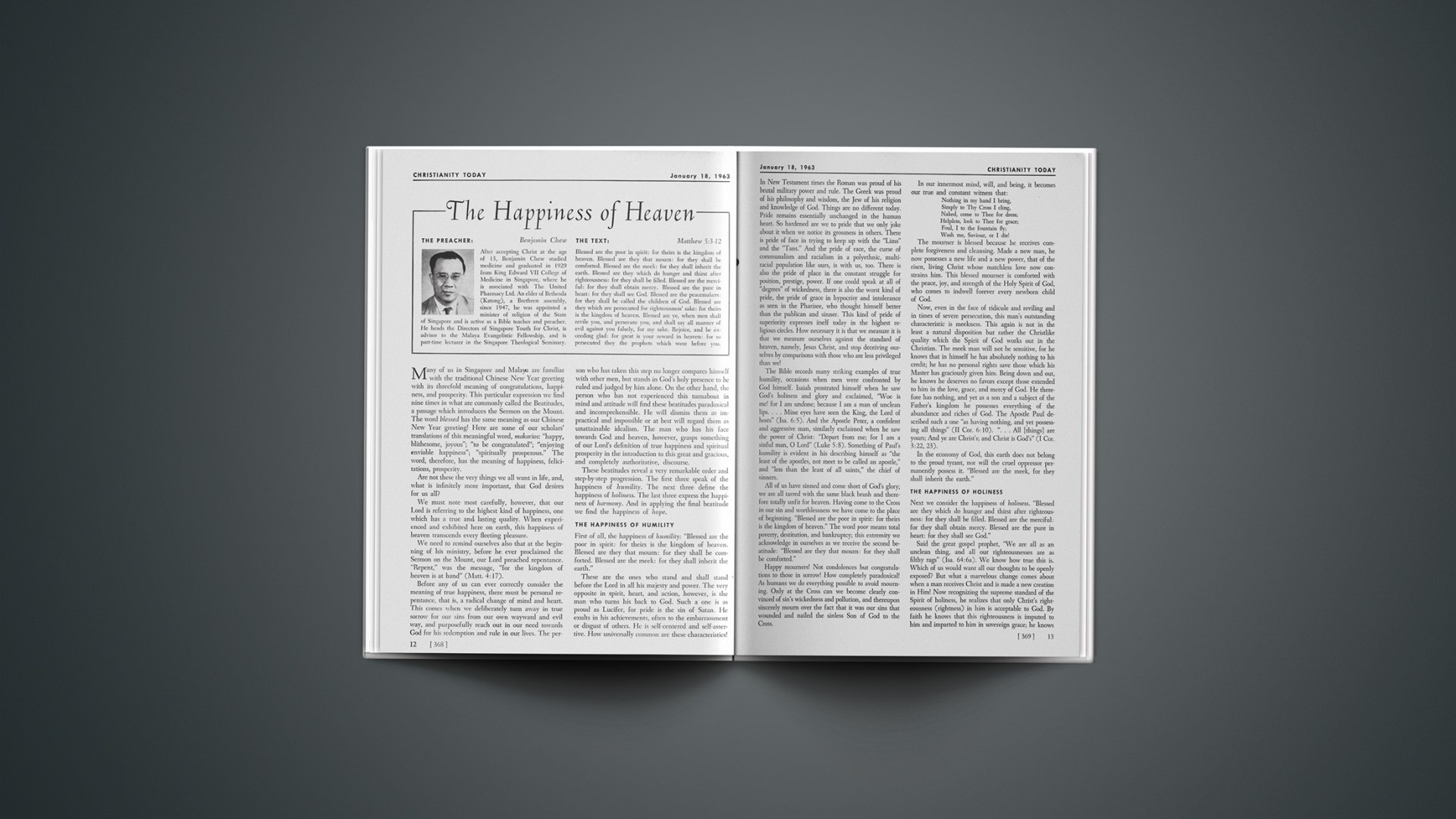
The Happiness of Heaven

The Preacher:

After accepting Christ at the age of 13, Benjamin Chew studied medicine and graduated in 1929 from King Edward VII College of Medicine in Singapore, where he is associated with The United Pharmacy Ltd. An elder of Bethesda (Katong), a Brethren assembly, since 1947, he was appointed a minister of religion of the State of Singapore and is active as a Bible teacher and preacher. He heads the Directors of Singapore Youth for Christ, is advisor to the Malaya Evangelistic Fellowship, and is part-time lecturer in the Singapore Theological Seminary.

The Text:

Matthew 5:3–12

Blessed are the poor in spirit: for theirs is the kingdom of heaven. Blessed are they that mourn: for they shall be comforted. Blessed are the meek: for they shall inherit the earth. Blessed are they which do hunger and thirst after righteousness: for they shall be filled. Blessed are the merciful: for they shall obtain mercy. Blessed are the pure in heart: for they shall see God. Blessed are the peacemakers: for they shall be called the children of God. Blessed are they which are persecuted for righteousness’ sake: for theirs is the kingdom of heaven. Blessed are ye, when men shall revile you, and persecute you, and shall say all manner of evil against you falsely, for my sake. Rejoice, and be exceeding glad: for great is your reward in heaven: for so persecuted they the prophets which were before you.

The Sermon:

Many of us in Singapore and Malaya are familiar with the traditional Chinese New Year greeting with its threefold meaning of congratulations, happiness, and prosperity. This particular expression we find nine times in what are commonly called the Beatitudes, a passage which introduces the Sermon on the Mount. The word blessed has the same meaning as our Chinese New Year greeting! Here are some of our scholars’ translations of this meaningful word, makarios: “happy, blithesome, joyous”; “to be congratulated”; “enjoying enviable happiness”; “spiritually prosperous.” The word, therefore, has the meaning of happiness, felicitations, prosperity.

Are not these the very things we all want in life, and, what is infinitely more important, that God desires for us all?

We must note most carefully, however, that our Lord is referring to the highest kind of happiness, one which has a true and lasting quality. When experienced and exhibited here on earth, this happiness of heaven transcends every fleeting pleasure.

We need to remind ourselves also that at the beginning of his ministry, before he ever proclaimed the Sermon on the Mount, our Lord preached repentance. “Repent,” was the message, “for the kingdom of heaven is at hand” (Matt. 4:17).

Before any of us can ever correctly consider the meaning of true happiness, there must be personal repentance, that is, a radical change of mind and heart. This comes when we deliberately turn away in true sorrow for our sins from our own wayward and evil way, and purposefully reach out in our need towards God for his redemption and rule in our lives. The person who has taken this step no longer compares himself with other men, but stands in God’s holy presence to be ruled and judged by him alone. On the other hand, the person who has not experienced this turnabout in mind and attitude will find these beatitudes paradoxical and incomprehensible. He will dismiss them as impractical and impossible or at best will regard them as unattainable idealism. The man who has his face towards God and heaven, however, grasps something of our Lord’s definition of true happiness and spiritual prosperity in the introduction to this great and gracious, and completely authoritative, discourse.

These beatitudes reveal a very remarkable order and step-by-step progression. The first three speak of the happiness of humility. The next three define the happiness of holiness. The last three express the happiness of harmony. And in applying the final beatitude we find the happiness of hope.

The Happiness Of Humility

First of all, the happiness of humility: “Blessed are the poor in spirit: for theirs is the kingdom of heaven. Blessed are they that mourn: for they shall be comforted. Blessed are the meek: for they shall inherit the earth.”

These are the ones who stand and shall stand before the Lord in all his majesty and power. The very opposite in spirit, heart, and action, however, is the man who turns his back to God. Such a one is as proud as Lucifer, for pride is the sin of Satan. He exults in his achievements, often to the embarrassment or disgust of others. He is self-centered and self-assertive. How universally common are these characteristics! In New Testament times the Roman was proud of his brutal military power and rule. The Greek was proud of his philosophy and wisdom, the Jew of his religion and knowledge of God. Things are no different today. Pride remains essentially unchanged in the human heart. So hardened are we to pride that we only joke about it when we notice its grossness in others. There is pride of face in trying to keep up with the “Lims” and the “Tans.” And the pride of race, the curse of communalism and racialism in a polyethnic, multiracial population like ours, is with us, too. There is also the pride of place in the constant struggle for position, prestige, power. If one could speak at all of “degrees” of wickedness, there is also the worst kind of pride, the pride of grace in hypocrisy and intolerance as seen in the Pharisee, who thought himself better than the publican and sinner. This kind of pride of superiority expresses itself today in the highest religious circles. How necessary it is that we measure it is that we measure ourselves against the standard of heaven, namely, Jesus Christ, and stop deceiving ourselves by comparisons with those who are less privileged than we!

The Bible records many striking examples of true humility, occasions when men were confronted by God himself. Isaiah prostrated himself when he saw God’s holiness and glory and exclaimed, “Woe is me! for I am undone; because I am a man of unclean lips.… Mine eyes have seen the King, the Lord of hosts” (Isa. 6:5). And the Apostle Peter, a confident and aggressive man, similarly exclaimed when he saw the power of Christ: “Depart from me; for I am a sinful man, O Lord” (Luke 5:8). Something of Paul’s humility is evident in his describing himself as “the least of the apostles, not meet to be called an apostle,” and “less than the least of all saints,” the chief of sinners.

All of us have sinned and come short of God’s glory; we are all tarred with the same black brush and therefore totally unfit for heaven. Having come to the Cross in our sin and worthlessness we have come to the place of beginning. “Blessed are the poor in spirit: for theirs is the kingdom of heaven.” The word poor means total poverty, destitution, and bankruptcy; this extremity we acknowledge in ourselves as we receive the second beatitude: “Blessed are they that mourn: for they shall be comforted.”

Happy mourners! Not condolences but congratulations to those in sorrow! How completely paradoxical! As humans we do everything possible to avoid mourning. Only at the Cross can we become clearly convinced of sin’s wickedness and pollution, and thereupon sincerely mourn over the fact that it was our sins that wounded and nailed the sinless Son of God to the Cross.

In our innermost mind, will, and being, it becomes our true and constant witness that:

Nothing in my hand I bring,

Simply to Thy Cross I cling,

Naked, come to Thee for dress;

Helpless, look to Thee for grace;

Foul, I to the fountain fly;

Wash me, Saviour, or I die!

The mourner is blessed because he receives complete forgiveness and cleansing. Made a new man, he now possesses a new life and a new power, that of the risen, living Christ whose matchless love now constrains him. This blessed mourner is comforted with the peace, joy, and strength of the Holy Spirit of God, who comes to indwell forever every newborn child of God.

Now, even in the face of ridicule and reviling and in times of severe persecution, this man’s outstanding characteristic is meekness. This again is not in the least a natural disposition but rather the Christlike quality which the Spirit of God works out in the Christian. The meek man will not be sensitive, for he knows that in himself he has absolutely nothing to his credit; he has no personal rights save those which his Master has graciously given him. Being down and out, he knows he deserves no favors except those extended to him in the love, grace, and mercy of God. He therefore has nothing, and yet as a son and a subject of the Father’s kingdom he possesses everything of the abundance and riches of God. The Apostle Paul described such a one “as having nothing, and yet possessing all things” (2 Cor. 6:10). “… All [things] are yours; And ye are Christ’s; and Christ is God’s” (1 Cor. 3:22, 23).

In the economy of God, this earth does not belong to the proud tyrant, nor will the cruel oppressor permanently possess it. “Blessed are the meek, for they shall inherit the earth.”

The Happiness Of Holiness

Next we consider the happiness of holiness. “Blessed are they which do hunger and thirst after righteousness: for they shall be filled. Blessed are the merciful: for they shall obtain mercy. Blessed are the pure in heart: for they shall see God.”

Said the great gospel prophet, “We are all as an unclean thing, and all our righteousnesses are as filthy rags” (Isa. 64:6a). We know how true this is. Which of us would want all our thoughts to be openly exposed? But what a marvelous change comes about when a man receives Christ and is made a new creation in Him! Now recognizing the supreme standard of the Spirit of holiness, he realizes that only Christ’s righteousness (rightness) in him is acceptable to God. By faith he knows that this righteousness is imputed to him and imparted to him in sovereign grace; he knows it can be implemented in a practical way in thought, word, and deed in his daily life only by the power of the Spirit of God. A “hunger and thirst after righteousness” now possesses him, a new desire to be more and more like his beloved Lord. Accordingly he strives to put away sinful desires and habits—anything which suppresses this spiritual appetite.

He delights in the Word, because he longs to know the wonderful Christ of the Word. As he partakes of it day after day, he is filled with milk and meat far “sweeter” than “honey and the honeycomb”; he is blessed with the fullness of Christ. In this way the longing for Christlikeness brings happiness to dwell in the human heart.

Micah utters these profound words: “He hath showed thee, O man, what is good; and what doth the Lord require of thee, but to do justly, and to love mercy, and to walk humbly with thy God?” (6:8). Holiness and humility are requirements of God, requirements that are bound up with the love of mercy. Like his Lord, the Christian is full of mercy. Jesus said on the cross, “Father, forgive them; for they know not what they do.” Stephen prayed for his murderers as he fell under a shower of stones, “Lord, lay not this sin to their charge.” This is the Christian’s attitude—no anger, no resentment, but rather a deep sorrow for the sinner, even when justice must be meted out to him. This is mercy. Shakespeare was right when he spoke of mercy as a heavenly quality! This quality of mercy is inseparable from inward holiness. A pure heart filled not with stringent and pharisaic correctness but with mercy is what is needed to see the Lord in all his loving mercy and holiness. It is at the Cross that all hearts can be cleansed; it is God who cleanses in order “to sanctify the soul, to pour fresh life in every part and re-create the whole.”

The Happiness Of Harmony

Thirdly, there is the happiness of harmony: “Blessed are the peacemakers: for they shall be called the children of God. Blessed are they which are persecuted for righteousness’ sake: for theirs is the kingdom of heaven. Blessed are ye, when men shall revile you, and persecute you, and shall say all manner of evil against you falsely, for my sake.”

What causes tension and war? Why did the League of Nations fail? Why is the authority of the United Nations so often flouted? The basic reason is the fact that the Lord’s principles and prerequisites of happiness have been disregarded. Where there is no humility and no holiness, there is no harmony. Just as this holds for an individual, so it is true for nations of the world. Jesus Christ alone is the Prince of peace. He is our peace, a peace we have through the laying down of his life for us. Satan has always been and is still the author of division and discord, and anyone who sows discord, says the Word of God, is an abomination. On the other hand, God’s child seeks to disseminate the peace that rules in his own heart, the undisturbed harmony in which he rests despite reviling, persecution, and calumny.

The peacemaker, however, cannot compromise with evil; neither can he ignore it. His task, in the final analysis, is to lead men who are at odds with one another to peace with God. This great work of reconciliation God has entrusted to the subjects and ambassadors of his kingdom. If any members are responsible for divisiveness and discord, however, judgment must begin, first of all, in the household of God. Only with the humility and holiness of Christ can we lovingly and in his power become true ministers of reconciliation.

The Happiness Of Hope

Our text closes with the happiness of hope! “Rejoice, and be exceeding glad: for great is your reward in heaven; for so persecuted they the prophets which were before you.”

Addressing the saints at Colosse, St. Paul wrote of their faith, their love, and “the hope which is laid up for you in heaven.” This is the heavenly reward which abides forever and which makes microscopic this present temporary suffering. This hope goes far beyond the usual human expectation, the “hope [that] springs eternal in the human breast.” The heavenly hope of the Christian shines brightly as absolute certainty, even in the deepest gloom. It is the sure and steadfast anchor “within the vail,” for it is the ascended and exalted Christ himself who is the “hope of glory.” We wait in certain exultant hope for his personal return. Then he shall gather his saints, and bring to consummation all the promises and purposes of God for mankind. Then in all creation shall be completed the glorious work of redemption.

Amid our present perils, amid the problems of pain and sorrow that we are called to endure, we begin to understand something of God’s refining process in our own lives as well as in the lives of all the saints. Beyond all these temporal and trivial trials of earth shines the certain hope of heaven and of home with God.

We must not study these precious words of Christ in a coldly analytic spirit. Rather we must receive them as personal tokens from our Saviour, Lord, Master, and Friend. Daily let us receive in increasing measure from the Lord himself this blessedness of felicitations, of congratulation, of happiness, and of prosperity. As we daily come to an end of ourselves and are filled with his humility, his holiness, and his harmony, may Christ in us be the hope of glory, and through us, that hope to others.

END

A Plea for Fasting

It was a Jewish army doctor who caused me to take a second look at fasting as a religious exercise. As a boy, I had fasted one day to test my willpower. As a seminarian, I had skipped the noon meal for a week to know something of China’s hunger and to contribute to its relief. As an army chaplain, I had observed the fast of Yom Kippur to encourage the Jewish men to keep up their religious practices. It was in that connection that I was speaking to our medical officer.

“Yes, I’m keeping the fast,” he said, “not as a religious exercise, but purely for hygienic reasons.” That made me wonder about the religious value of fasting. 1 knew the old answers—that it is better to do something positive than to deny something; that ours is a joyful religion—the Kingdom has begun; that the man who boasted of his fasting twice a week is to be despised. But I also reasoned that the same man made a boast of his tithing, yet that has not stopped us from taking up offerings. Ours is a joyful religion, but we also know humiliation and repentance in it. And Jesus said, “If any man would come after me, let him deny himself.…” Maybe denying oneself of food would be the easiest step in learning to discipline oneself in the service of One who asks for complete commitment.

This reasoning sent me to the Bible. The first reference to fasting comes in Leviticus 16:29, although we might well presume that in the great mournings of Abraham for Sarah and of Jacob for Joseph there was an abstaining from food. On the Day of Atonement, the people were commanded “to afflict” their souls, and this became “the fast” for the people of Israel. Later special occasions brought forth additional fasting—as when Joshua lay on the ground before the ark of the Lord after the defeat caused by Achan’s sin (Josh. 7:6), when the men of Israel fought against the children of Benjamin (Judges 20:26), when David fasted during the illness of his child by Bath-sheba (2 Sam. 12:16). (The fastings of Moses and of Elijah for 40 days were miraculous occurrences.)

When the Jews returned from captivity, the bitterness of those experiences was commemorated in additional fasts (Ezra 8:21; Neh. 9:1; Esther 4:1–3). Zechariah lists four (Zech. 8–9), but the emphasis was placed on the deliverance from these experiences—therefore, they should be of joy and gladness and cheerfulness. As the Jews continued to experience troubles, additional fasts were prescribed. By the time of the Herods and the Caesars, many Jews fasted twice a week (Thursday and Monday) in addition to all the others; for working men and women these must have been “heavy burdens” (Matt. 23:4).

Like the prophets before him, Jesus warned against the mere external observance of religious forms. In the Sermon on the Mount, he warned against wrong motives in almsgiving, praying, and fasting. If we do any of the three for the show, then that show is exactly what we will have and no more. But if we keep a steady countenance before men and “fast unto God” in secret, then we shall receive an open reward in that fasting (Matt. 6:16–18). Note also in this reference, Jesus said, “When ye fast …,” which implies an assumption that we shall fast.

In secret, our Lord must have fasted as well as prayed; he was not afraid of hunger (John 4:32) and commended fasting to those who would do his work (Matt. 17:21). When the disciples asked why they could not cure the afflicted boy at the foot of the Mount of Transfiguration, Jesus replied, “Because of your unbelief.… Howbeit this kind goeth not out but by prayer and fasting.” There would be hard tasks for the followers of Jesus—tasks that would not be accomplished but by prayer and fasting (race problems, inter-church relations, war and peace for examples?).

We have no reason to doubt that Jesus and his disciples kept the Fast of the Atonement and the other regular fast days of the Jewish faith, but he added no new ones—which might have been expected of a new teacher to show his religiosity—and disregarded the additional ones which others had added. (The fast days became so numerous that after the destruction of Jerusalem by Titus it became necessary to list the days when fasting was forbidden.) The Pharisees and the disciples of John did not charge that Jesus had broken the law of Moses, which they would have if he had neglected the Fast of the Atonement; rather they were offended that Jesus did not make his disciples conform to their customs and practices. This was the rub of their complaint: that the disciples did not fast as they did (Matt. 9:14). Jesus could have rebuked their self-righteousness, but instead he spoke of the bridegroom’s presence. The Messiah’s kingdom was a time of joy and cheer, of feasting and fellowship; all the best pictures of human happiness are used to describe this most joyful spiritual fulfillment—and so the fasting would be out of keeping. It was not the time of forms but of fellowship, not the place for tears but for laughter and joy. But listen to the Master: “… The days will come, when the bridegroom shall be taken from them, and then shall they fast” (Matt. 9:15b). Surprising, isn’t it?

And that time came. The disciples needed no one to tell them to fast after the crucifixion; thoughts of food must have escaped them, and only in the presence of a Risen Lord and when he himself had first eaten could they eat again. Then after he was “taken up” from them, there must have been fasting with their praying as they tarried in Jerusalem. It seems to have been a regular part of preparing for any special task, such as the setting aside of Paul and Barnabas (Acts 13:2, 3) and the ordaining of elders (Acts 14:23). Paul speaks of “[giving] yourselves to fasting and prayer” in special seasons and occasions (1 Cor. 7:5), and also of ministers of God approving themselves in fasting along with the watchings and labors (2 Cor. 6:5). These references seem to indicate that fasting is to be a part of the Christian’s spiritual discipline until the Lord returns in triumph. The rejoicing of the disciples in the physical presence of Jesus was a foretaste of our eternal joys—but until then, shall we not discipline ourselves to serve him by abstaining from food as the need and calling arise? Can it not be inferred that Jesus expects his followers to fast: “… When the bridegroom shall be taken away … then shall they fast” (Luke 5:35)?

A Religious Exercise

I am confident that we need to take a second look at fasting as a religious practice. Like John’s disciples, we are prone to increase external forms; we had rather create new departments in our denominational work, or have special Sundays, or new programs, more meetings, higher goals, new drives, and so on. These are our “fasts” today, and they have been multiplied until somebody ought to designate some Sundays when we can be free of these “drives” and just enjoy our religion. Today, fasting itself is not fashionable—rather we like the easy-smiling, winsome, popular appeal of optimism and confidence. Maybe we need the affliction of soul, the humiliation of spirit, the emptying of oneself. We ought to consider it. After all, did not Jesus say, “If any man will come after me, let him deny himself …”? What a rebuke to some of us who are out to make a name for ourselves or to get ahead or to be a success or to look out for Number One. And what have we ever denied ourselves; come, now, tell it? What do we know of denying? Perhaps to deny oneself of food and drink “from even to even” would be a first lesson.

Of course, the condition of the body affects the soul. Once a British actress told me that when she was learning a play she ate no potatoes or bread—only fruit, eggs, vegetables, and a little lean meat. And I have found that during times of examination, and when I am preaching, it is better not to eat much. We are keener of mind and heart when not so full; a big meal brings drowsiness and sluggishness. (Aren’t you glad that you preach to your congregation at eleven o’clock rather than at one? Somehow, we have found eleven o’clock—with a little edge of hunger—better suited to religious purposes than one o’clock when we are stuffed.) If these observations are valid, don’t they suggest that fasting might hold special religious significance for us?

As Americans, we are known for our much eating. In France during the Second World War, we were told: “You Americans eat everything—even horses’ food (corn)—and all the time. You have a big breakfast; then, a snack (coffee break); after which comes an enormous lunch, and another snack (Coke break); and a big dinner, and then a bedtime supper—and yet you are not satisfied; you have something to put in your mouth which keeps your teeth going up and down all the time (chewing gum).” It might help if we knew something of hunger. For one thing, we would “feel” better, and it undoubtedly would aid our health. (Long ago James Morrison said: “There are multitudes of diseases which have their origin in fulness, and might have their end in fasting.”) Fasting would sharpen our sympathies for the unfortunates of our own society and for the hungry of the world. Fasting would help clear our minds and spirits as we face great problems and tasks. It also affords a lesson in thanksgiving for food—and sheer joy again of eating. Some have said primitive man abstained from eating that he might better eat his god. We, too, want God to abide within; can physical hunger prepare the soul to receive him?

Now, I am not advocating a special “Fast Sunday” or anything like that. It is not something to be required, but in preparation for special revival services and on other special times (as when I preached on segregation), I have invited members of the church to share in a fast—and I have been amazed at the ones who whispered in my ears that they had been blessed in it. And more—there were “open rewards” from it.

This is enough. Take another look at this ancient practice, or better, just try it. There is no telling what the Lord will do for you, if you fast “unto thy Father which is in secret.”

END

The Church and Psychiatry

Psychiatric illness is common to all mankind regardless of race, creed, or color. It is estimated that over half the patients who enter doctors’ offices in the United States present some symptoms of psychosomatic, psychoneurotic, personality, and other emotional disturbances. The most severe form of mental disorder, the psychosis, has a much lower incidence, and its treatment almost invariably consists of extended hospital care. The incidence of psychiatric illness in professional people is less than the overall average, probably owing to the elimination of emotionally unstable individuals during the many years of vocational preparation. It is worthwhile to consider how and to what extent the Church can help to prevent and alleviate psychiatric illness in members of the clergy, and what relation the Church has to Christian psychotherapy.

The Minister And Psychiatric Illness

The ministry differs from other professions in that it concerns itself with the spiritual nature of man. The minister himself is usually looked up to as the paragon of faith and virtue. He is the stalwart among his parishioners in time of trouble and is not expected to falter in his strength and comfort to others. Consequently, when psychiatric illness afflicts him it is attributed to some external cause such as overwork, an obscure physical ailment, or family frictions. Although these factors may act as precipitating agents, hardly ever are they causative agents.

Almost without exception psychiatric illness arises from unresolved intrapsychic conflicts. The symptoms of depletion, discouragement, bitterness, frustration, uncontrolled anger, and depression are a culmination of distortions within the psychical processes of sensing, feeling, thinking, and believing. Relief from environmental pressures may decrease the intensity of symptoms, but the basic conflict persists. Hence, advice from his solicitous family, friends, or colleagues which is directed toward circumstances is of very little use to the troubled minister, especially if he is only partially aware of what lies at the source of his illness.

The type of treatment that is required uses psychological methods to alleviate or remove the results of emotional conflict and to improve psychic equilibrium. This psychotherapy is aimed at enucleating psychical distortions and stimulating the growth of healthy perceptions, insights, reasoning, and trust. Although in nature it is mainly psychological, it is also physical, and is basically spiritual in that the personal encounter is its matrix.

This delineation of psychiatric illness and psychotherapy puts into a different light the view that a member of the clergy, or for that matter any believer, does not succumb to psychiatric malady unless he is spiritually weak or bankrupt. Although sin no longer has control over the believer, he still exists in sin. The Bible teaches that sickness and calamity may come to the believer as chastisement or test of faith. Psychical illness does not detract from the person’s accountability before God. Ability to assume responsibility may be decreased, but responsibility remains. The degree of responsibility, whether in sinful disobedience or in spiritual, psychical, or physical illness, ultimately rests in the hand of God. Genuine psychotherapy does not dispose of sin or explain away spiritual illness. On the contrary, it alleviates psychical barriers to a healthier spiritual life. Nor is responsibility impugned or denied, if for no better reason than that success in therapy hinges on the growth of responsibility toward greater psychical and spiritual freedom for service.

Ministry Of The Church

Inasmuch as man is a spiritual being endowed with psychophysical means of expression, it follows that a healthy spiritual life contributes to the health of the whole person. The spiritual powers that reside in the communion of believers also benefit psychical and physical well-being. Healing flows from the fruit of the Spirit manifested in the lives of the redeemed. It may not be amiss to ask whether these potentials are exercised sufficiently by believers and utilized fully by those who are ill. The ministrations of redemptive grace deserve greater emphasis within the Church and more extensive application to emotional ill-health. The Church’s soul-care includes specific ministry to minister and parishioners troubled by psychiatric illness.

In addition to this spiritual ministry the Church can promote the emotional and mental welfare of the minister by removing undue impositions on his time and energy. On the basis of the scriptural precept that the minister’s chief task is to preach the Word and tend the flock, many extraneous duties now required of him ought to be eliminated. Situational pressures of administrative, social, and civic functions should be delegated to qualified laymen, who often have more time and ability to serve in education and on local and denominational boards and committees.

Every effort should be made by the organized Church to eliminate financial worries that sap the minister’s strength, cause discontent in his home life, and prevent expenditures for books and study. These and many other burdens, some perhaps quite minor, in the aggregate can weigh heavily on members of the clergy.

The Minister And Psychology

The Church needs to be receptive and take initiative in complementing the work of the ministry with the accumulated principles of psychology. Benefits may be expected to accrue to both the emotional health of the minister and the cogency of his message and counseling. Discerning church leaders are aware of progress being made in the effort to coordinate psychological tenets and Scripture. These tenets, derived from professional investigations by Christian therapists and interested theologians, are an emergence from various psychological and psychiatric skills tempered by the Christian view of man. They are being confirmed and established in daily therapeutic experience.

This respectable body of knowledge increasingly must find a place in the training of the minister. The preseminary student must become more aware of the psychological aspects of the pastor’s practical work. The college faculty is concerned with his grades and conduct, but attention should also be focused on his overt behavior, such as mannerisms, attitudes, bodily movements, and verbal expressions. This total evaluation is more revealing of his fitness for the ministry than the use of standardized psychological, aptitude, or vocational testings. The student needs help to understand himself better, to discern psychiatric symptoms, to attain a working knowledge of human behavior, and to develop a sympathetic, instead of judgmental, attitude toward those who are ill. Confidential conferences with a Christian therapist, group sessions, and psychodrama may be utilized to teach the interplay of emotions, perceptions, and motivations. It might be added that the therapist’s responsibility is to the student, not to the faculty or administration, since the student may not be put under duress in revealing his inner thoughts.

Seminary training likewise can be used to advance the student’s psychological proficiency. A committee of faculty members and therapists can be set up to revise the curriculum so as to suffuse it with the light psychology throws on the interpretation of Scripture. For instance, what are the implications of Paul’s conversion, or Elijah’s despondency, or Jesus’ methods in healing the sick? What meaning do these biblical events have for our present time? This infusion of the curriculum is preferable to the current practice of tacking on a few extra courses in pastoral psychology, anthropology, sociology, and the like. The seminarian’s comprehension becomes more real to him as he engages in clinical work in social agencies, medical centers, and counseling services. Thus he may be spared the fear and trembling that usually beset a new minister when he enters his first pastorate, and be better prepared to assume his high calling.

Pastoral Counseling

The purpose of pastoral counseling is to promote spiritual health. It is a personal confrontation bridged by communication and rapport. Unavoidably the pastor assumes a psychological posture, whether he realizes it or not. A well-founded psychological approach enhances rapport and lays the foundation for the spiritual encounter. The pastor will be alert to the psychical disposition of his counselee, and this understanding will facilitate the counseling by preventing emotional and psychiatric entanglements beyond the scope of his competency. The pastor is inherently a psychologist, and the demands of his high office cannot be satisfied with the gropings of individual notions, “common sense,” or “intuition.”

It is impossible to escape the conclusion that the Church must join with Christian psychology and psychiatry to prevent and alleviate psychiatric difficulties in the minister himself and to apply sound psychological principles in his profession. The Church should be actively engaged in fostering and subsidizing qualified Christian young people for careers in psychology, psychiatry, and allied fields. It should promote the establishment of psychiatric treatment facilities, premarital and marital counseling, family services, guidance clinics, and other similar agencies, staffed by Christian personnel. This could very well be an interdenominational venture that would provide a center for training in group sessions, psychodrama, refresher courses in a clinical setting, and postgraduate study. Although they are still in short supply, the number of Christian therapists is increasing. The Church is under obligation to provide a full-orbed ministry that offers help to those whose spiritual health is endangered by emotional and mental distress.

END

Who Is Ministering to Ministers?

In olden times, before there was a Protestant church, the priest or other member of a religious order had a spiritual director to whom he could always take his troubles. Today most Protestant clergymen are not that fortunate. It is a rare denomination indeed that has any adequate ministry to its ministers, although emotional problems of clergymen are on the increase.

I do not want to imply that our Protestant clergymen are any more confused than their neighbors across the street or than those in their congregations. Our rapidly changing morals, standards of commerce, and the quickening pace of day-to-day life are already taking their toll in heightened emotional disturbances among many individuals. Granting that our clergymen are average, normal individuals, they are caught up in the problems and anxieties of the day. Their families are subject to the same stresses and strains. More than ten thousand of our Protestant ministers are now receiving some form of individual or hospital psychiatric care.

Here again I am not trying to prove that there is a vast amount of serious mental illness among our clergy. Actually, there are no statistics proving that there is more emotional and mental illness among clergymen than among members of any other professional group, despite the fact that there has been a threefold increase in the number of ministers in state hospitals. The figures are of particular interest only because clergymen are supposed to be figures of emotional strength and stability in our communities and churches. It must be obvious to anyone who is professionally concerned with physical or mental illness, however, that our clergy, like all other individuals, have problems in these areas.

Over the past several years, as I have worked with clergymen and psychiatrists throughout the country, I have been appalled at the number of clergymen who want to discuss their personal problems. Many of their difficulties are tragic. Some of these clergymen are rapidly becoming alcoholics or dope addicts. Others have fallen in love with another woman and are searching for a way out of the dilemma through divorce. There are other problems just as serious, if not as tragic. Many clergymen are unhappy and realize too late that they are in the wrong vocation. Others are burdened with anxiety and guilt because of their inability to play the part of the supernatural, holy saint that the congregation expects of them. Problems involving their children, their marital relations, and the peculiarities and ills of their aging parents often place intolerable burdens upon many clergymen and help to weaken their spiritual, physical, and mental health. Some clergymen become deeply disturbed when they do not receive an expected promotion. All organizations involve politics and politicians, and I know of one clergyman who became violently embittered when he narrowly lost being elected a bishop on the ninth ballot. Low salaries, frustrated ambitions, and sheer loneliness aggravate a predisposition to serious emotional disturbances that need the help of wise counselors.

Fortunate is the denomination that has a warm ministry to such ministers, but many clergymen complain that their denominations have made no provisions to help them with their personal problems. Most bishops and other heads of religious groups are too busy with administrative and community activities to find time to minister to the troubles of ministers. I have known clergymen to have to wait a month before being able to get an appointment with a bishop. Even when an appointment is granted, there is no guarantee that the church head will have the resources to help the clergyman with his problem or, even worse, to understand it. I have known bishops and other superiors to panic when clergymen revealed to them deep-seated, emotional problems.

In a sense, Protestant clergymen are paying the penalty for being members of a professional group rather than a religious order. Most of our religious organizations are primarily concerned with administrative matters—programs, budgets, church government. One only need look at Roman Catholic religious orders and the pastoral care and supervision provided for those entering the religious life to see the difference between Roman Catholic and Protestant concern for the clergy. In the Roman Catholic Church, once an individual consecrates himself by a vow to God to serve the cause of God and the church and is admitted to the Community of the Ordained, he is taken under the wing of the Holy Church. His problems become the church’s problems, and all are bound in a supernatural order that knits them together with a bond much stronger than that linking members of a family in the natural order. The church accepts the priest for better or for worse. Without the priest the church could not exist, and without the church the priest could not have his holy vocation.

We are becoming more aware that many of our emotional problems may be symptomatic of deeply underlying mental or physical illness. The stresses of everyday living can easily push us into illness, and fortunate is the individual who can obtain good medical and psychological care when he ceases to be at ease with himself. If he is a Protestant clergyman, he is often forced to seek help outside his church, particularly if he is in psychological difficulty. More often than not, fear of chastisement or condemnation by his superior will cause him to bear his burdens alone. Few low-salaried ministers have the courage or funds to consult a psychiatrist.

Church leaders and authorities need to know much more about mental health and illness if they are going to serve the needs of their clergy effectively. We need to examine the records of men droppd from the ministry over the past two decades to determine what problems compounded their failure or dismissal. All too often men are relieved of their posts because of mental and emotional illness that could easily have been recognized years earlier by a church prepared to minister to ministers. To save the reputation of the church by helping to destroy the reputation of a clergyman denies the love of Christ. If we believe in the doctrine of salvation or in the individual’s ability for spiritual growth, we must support those who are walking in the valleys of emotional distress and personal agony. Each of us, if he is honest with himself, has often seen the strengthening of his spiritual powers after a personal crisis with evil. The very least a church can do is to provide its clergy with the means of regaining health. In attempting to preserve the good name of the church, church leaders must not endanger the physical, mental, and spiritual health of the clergyman who once dedicated his life to the church. We do not strike a physical cripple; neither should the church whip a clergyman who is emotionally disabled. The inescapable duty of Christian love is to care for the sick and distressed. Yet all too often church authorities, either through ignorance or fright, condemn the emotionally troubled minister to deeper suffering and perhaps to tragedy. Some wash their hands of the matter by dismissing the minister or turning him over to a psychiatrist. Organizations require discipline and disciplined members, and I do not for a moment imply that discipline should be discarded. But the Carpenter of Nazareth found time on his cross to comfort even a criminal and to assume some responsibility for his future care. We need spiritual directors who will stand by their men in sickness and in health.

Caring For The Caretakers

Today we hear much about pastoral care, pastoral counseling, pastoral guidance, and pastoral theology. We try to take care of those in the congregation; but who is taking care of the caretakers? Some churches are beginning to provide psychological and psychiatric services for their troubled clergymen, and this is all to the good. However, these services should be only auxiliary to the most needed work of all—building a deeper sense of brotherhood among clergymen and a genuine concern among those in authority for the welfare of their colleagues. We need to restore the concept of the church denomination as a community of individuals who have joined together for a common task. In a Christian community there is no place for a self-righteous hierarchy, or for disregard or ignorance of another’s problems, or for hate or condemnation of a brother who has become spiritually sick. A Christian community should be a healing community where the weaknesses of all may be known but unuttered, where the strength that comes from genuine love brings relief and healing. The manner by which a church denomination serves the deep-seated needs of its clergy is a fair indication of its worth as a community of Christ. At the risk of sounding trite I suggest that we should remember that a church is as strong as its weakest link. When the weak link is one of its own clergy, the need for support becomes obvious. From the viewpoint of sound organizational practice, one might expect a church to take steps to remedy the matter. But in ministering to ministers we must be stirred by something much higher than a desire to preserve the church’s reputation. The supreme motivation must be love.

END

William F. Albright: Toward a More Conservative View

CHRISTIANITY TODAYis pleased to present an interview with Dr. William F. Albright, distinguished archaeologist and biblical scholar who served as Professor of Semitic Languages at Johns Hopkins University from 1929 to his retirement in 1958. He has written a number of outstanding books, among them From the Stone Age to Christianity, and has contributed one way or another to almost a thousand volumes. Currently he has curtailed nearly all lecturing and teaching to fulfill a program of publications which includes over a dozen volumes and many shorter efforts.

Dr. Albright’s critical position is broadly liberal, but he has a strong conservative orientation on many issues. This epousal of conservative views as well as his rejection of extreme liberal views creates wide evangelical interest in his convictions.

Many of the evangelical movement’s younger Old Testament scholars have pursued doctoral studies under Dr. Albright’s teaching. In addressing the following questions to Dr. Albright, the editors of CHRISTIANITY TODAY reflect inquiries suggested by a number of Old Testament scholars, among them Dr. Oswald T. Allis, Dr. Gleason L. Archer, Jr., Dr. Clyde T. Francisco, Dr. David W. Kerr, Dr. Meredith G. Kline, Dr. Charles F. Pfeiffer, Dr. Kyle M. Yates, Dr. G. Douglas Young, and Dr. Edward J. Young.—ED.

Q. Where do you locate yourself in the contemporary theological spectrum?

A. My position remains in the middle—equally far from extreme conservatives and from extreme liberals. I am still growing more conservative on questions of date and authorship, historical background, and so forth, having moved considerably farther to the right, but I am even more strongly “liberal” on general problems of the history of theology, the use of evidence, the impossibility of man’s being able to formulate ultimate theological doctrines in human language.

Q. According to some reports you have become even more conservative since the Spring of 1961. What is the significance of these reports?

A. With respect to biblical tradition, this is quite true. In the Spring of 1961 I worked out details of my Goldenson Lecture on Samuel (published by the Hebrew Union College); that summer I completed my reconstruction of the background of Abraham; and during the past year I have made great progress on a more conservative approach to Job. These are only major examples of what I have been doing in both Old Testament and New Testament, especially in the latter, where my views tend to be more conservative than those of many professed conservatives in matters of date and authorship.

Q. What archaeological discoveries of recent times do you consider most significant?

A. Ugarit (Ras Shamrah) for early Hebrew literature and its date; Qumran (Dead Sea Scrolls) for all branches of biblical study (especially for early dating of New Testament books); Chenoboskion (Nag Hammadeh) for pre-Gnostic content of New Testament books.

Q. What do think of Dr. Cyrus H. Gordon’s contention that there is conclusive linguistic evidence of a parent culture common to both Hebrew and Greek civilizations and that this discovery is more important than the finding of the Dead Sea Scrolls?

A. Gordon’s work is often useful in appraising elements common to Northeast-Mediterranean cultures in the second millennium B.C. These common elements may be detected by archaeological and literary comparisons, but practically never by linguistic methods as such. I cannot accept any of his three successive decipherments of Linear A nor his explanations of early place and personal names in the Greek area as Semitic. The value of the Dead Sea Scrolls for biblical research is far greater than that of any other archaeological find or research based thereon.

Q. Do you stand by your conviction that, contrary to the liberal Protestant view of the past generation, every book of the New Testament could have been written by some contemporary of Jesus of Nazareth, rather than in the second century?

A. Rephrasing the question, I should answer that, in my opinion, every book of the New Testament was written by a baptized Jew between the forties and the eighties of the first century A.D. (very probably sometime between about 50 and 75 A.D.).

Q. In the article on “Return to Biblical Theology” (The Christian Century, Nov. 19, 1958), you stated: “Until 1 was twenty-one I had never met anyone whom I knew to be Jewish, but after nearly half a century of friendly association I am in some ways more at home in Jewish circles than anywhere else.” Now some persons, pointing to the basic difference in attitude of Jew and Christian toward the divine messiahship of Jesus, have found this statement puzzling. In what ways are you more at home in Jewish circles than anywhere else?

A. The attitude of Jews toward education and culture tends to be more intelligent than that of Christians; Jews also tend to have a keener feeling for moral and social problems. Christ said of spiritually insensitive people who flaunt his name, “Not every one that saith unto me, Lord, Lord, shall enter into the kingdom of heaven; but he that doeth the will of my Father which is in heaven. Many will say to me in that day, Lord, Lord, have we not prophesied in thy name? and in thy name have cast out devils? and in thy name done many wonderful works? And then will I profess unto them, I never knew you: depart from me, ye that work inquity.”

Q. You have somewhere remarked that Protestantism can be held in balance only by recognizing the permanent values in Catholicism and Judaism. Briefly what are these values, and do they imply that Judaism and Catholicism are on a parity with Protestantism?

A. Jews tend to have keener ethical and social conscience. Catholics tend to show greater reverence and greater humility. I am a convinced Protestant of Methodist background.

Q. You have stood out among modern scholars in emphasizing the confirmation archaeology gives to the historical trustworthiness of the Bible. Would you view a reference in the biblical narratives as presumptive evidence of historical facticity?

A. Certainly. In many cases, however, archaeological confirmation or illustration is necessary before we can understand the historical meaning of biblical narratives or allusions.

Q. What major problems remain by way of apparent conflict between the Bible and present archaeological data?

A. Major remaining problems mostly involve clarification of complex oral and/or written transmission of biblical texts.

Q. Is it the fact that carbon 14 is inaccurate for dating bones? Has carbon dating been tested by applying it to objects known to come from the Eighteenth Egyptian Dynasty (ca. 1500B.C.)?

A. Carbon 14 is almost totally useless in dating bones, which contain a minimum of carbon. We now have many thousands of carbon dates from all over the world, but dating material by inscriptions is nearly always more accurate than use of radiocarbon.

Q. Are there instances in which you are convinced that the biblical writers erred in matters of detail?

A. The question is not clear. Commentators have erred in detail; so have translators, copyists, ancient compilers of written texts, and collectors of oral tradition. Before them, “errors” were made in the process of transmitting oral and written tradition. In my opinion no national literature in the world has suffered so little as Israelite from these multiple sources of error. I am always surprised anew by what Nelson Glueck calls “the incredible historical memory of Israel.”

Q. Many Old Testament scholars still accept the results of source analysis (J, E, P, D, and so on). In what way has archaeology changed the attitude of biblical scholars from that which prevailed in the late nineteenth century?

A. Everybody admits the existence of different genres of literature in the Pentateuch: the narratives containing, more or less alternatively, the divine names Yahweh and Elohim; the priestly descriptions of buildings, rituals, and cultic regulations in Exodus-Leviticus; the “Second Law” in Deuteronomy. The Pentateuch is mostly in the same “dialect”—the literary language of Southern Israel between the tenth and the early sixth century B.C. (as we know positively from inscriptions). The spelling of our Hebrew text was gradually fixed between about 500 B.C. and A.D. 900 (after vowel points had been added). The study of the Dead Sea Scrolls has dealt a crushing blow to the minute critical analysis of the early books of the Bible that has prevailed since Wellhausen, by proving that there were different early recensions of the text and that the Masoretic text is too derivative to provide a basis for such minute “analysis.”

Q. What permanent significance do you attach to the Genesis creation narratives?

A. The narratives of Genesis 1–11 come from the hallowed past of the Hebrew people; they were sacred from the remotest times, and they acquired new meaning in biblical days under the Mosaic dispensation, which demythologized where necessary and added new spiritual meaning. I do not think that these narratives will ever lose their unequalled importance for a Christian picture of God in creation and history.

Q. In what respect may we term the stories of the patriarchs in Genesis historical?

A. See the first chapters of my Harper Torchbook, The Biblical Period from Abraham to Ezra, appearing in January, 1963. I maintain that the same approach holds for the phases not specifically included in my treatment. Briefly, I think that the patriarchal narratives were handed down, in general, by word of mouth in verse form, which might be preserved for centuries because of its fixed style and musical setting. Some oral tradition was undoubtedly transmitted in prose, and some very ancient written documents presumably were known. Oral tradition is subject to its own regularities of behavior, which make it more flexible and more easily dramatized than written tradition. It is thus far better suited to become the vehicle of basic religious instruction. The process of compiling prose narratives from poetic sources was at its height in the tenth century B.C.

Q. Scholars of evangelical persuasion are interested in the sense in which you view the Bible as the Word of God, and whether this view has scriptural sanction.

A. Certainly the Bible is the Word of God—but not in a magical sense; it cannot be used for divination cr for esoteric purposes, as is so often the case. The Bible contains the creative and prophetic revelation of God, but to understand its meaning, the most penetrating and comprehensive study has always been and still is needed. In the Bible itself the terms which are rendered “word” in English have a very wide range of meanings, which we have no right to disregard. Lighthearted acceptance of any one dogma about the meaning of “verbal inspiration” is dangerous in the extreme.

Q. Do you think that Israel became a nation under Mosaic monotheism with a covenant at Sinai, or rather agree with Martin Noth who thinks the first national covenant was made at Shechem?

A. I accept the tradition of the Book of Exodus. Moses, not Joshua, was the founder of Israel.

Q. Many passages in Isaiah 40–66 denounce idolatry as a current evil in Israel (for example, 44:9–20; 51:4–7; 65:2, 3; 66:17). How can these be reconciled with a theory of post-Exilic authorship, since idolatry admittedly was never reintroduced into Judah after the Restoration (as witness Ezra, Nehemiah and Malachi by implication)?

A. I do not think that anything in Isaiah 40–66 is later than the sixth century.

Q. Will you elaborate the implications, as you now see them, of your statement in December, 1955, that certain Qumran manuscripts “preserve textual elements going directly back to the original Deuteronomic Samuel, compiled toward the end of the seventh century B.C.”?

A. I agree with Martin Noth that Deuteronomy-II Kings (excluding Ruth) were compiled from older materials by an anonymous editor, whom I date (except for the last chapters of II Kings) in the reign of Josiah (ca. 640–609 B.C.). Many earlier conservative scholars dated the compilation of Judges-II Kings at about that time. The contents are, in the main, much older.

Q. Questions of lower criticism aside, when it comes to a criterion by which to judge of the accuracy and trustworthiness of the biblical record, do you recognize as final the authority of Scripture or do you consider yourself in respect to the principle of authority still in the school of Wellhausen?

A. “Authority of Scripture” is a valid theological principle, whereas the “School of Wellhausen” is only one of many ideological systems built on arbitrary philosophical postulates and baseless historical presuppositions.

Q. Do we have reason to expect future contributions from archaeology to be as significant for biblical scholarship as those in the past?

A. They should become more important all the time, since we are only beginning to utilize past discoveries adequately, and future discoveries may be as extraordinary as the Dead Sea Scrolls.

Q. To guide and stimulate young scholars, will you suggest some of the most urgent archaeological tasks before us today?

A. More and better scientific excavation, and more and better scholarship in interpreting finds.

Q. How can a young theological student become a member of a “digging team”?

A. By attending schools where there is a live archaeological interest and distinguishing himself in his study or in useful skills. He can also help raise money for an expedition.

Q. What is your general evaluation of neoorthodoxy as a theological emphasis?

A. Neoorthodoxy is so generous in its tolerance of philosophical approaches that I should hesitate to affiliate myself with any form of it. Personally I am a rational empiricist in my general approach to history. Many “neoorthodox” theologians support some form of Gnosticism or Neo-Platonism.

Q. Some evangelical interpreters are unsure of your attitude toward the historical character of supernatural events related in the Bible, in part because of statements in From the Stone Age to Christianity in which you assert that “in the presence of authentic mysteries” the historian’s duty is “to stop and not attempt to cross the threshold into a world where he has no right of citizenship” (1957 ed., p. 390); that “the historian … has no right to pass judgment on (the) historicity” of Jesus’ virgin birth and resurrection; and that “the historian, qua historian, must stop at the threshold, unable to enter the shrine of the Christian mysteria without removing his shoes …” (ibid., p. 399). Are you doubtful of the factuality and historicity of the supernatural birth and bodily resurrection of Jesus of Nazareth? Do you relegate these events to super-history or do you regard them as unique historical events?

A. I still subscribe to this position as an empirical historian. Theological truth is no less true because it is not the kind of truth that an archaeologist can validate.

Q. Do you consider yourself an orthodox Christian trinitarian?

A. Yes, but this does not mean that I pretend to understand the ultimate mysteries of divine being. One must, furthermore, never forget that “Person” of the Trinity has been authoritatively described by a number of different key words since apostolic times.

Q. What in general is your view of prophecy and miracles?

A. I believe in prophecy and miracles, but refuse to accept any confining theological definition of either. I believe that both continue to this day and that both are relative to the human scene in which they appear. Not all prophecy in the Bible can be validated, though the standard of validation is far higher than anything we find today. Some miracles of the Bible would not be considered as such today, and most miracles of today pass unnoticed. But the fact of prophecy and the fact of miracles are central to a living Christian faith, whatever may be thought of alleged individual miracles, ancient or modern. I believe in both prophecy and miracles as essential to Christian faith. What we mean by these terms changes constantly. Scientific medical triumphs of today were miracles once. I should not label every supposed prophecy and miracle of the Bible by this name, nor do I believe that prophecy and miracles came to an end with the canon. On the contrary’, God is just as active in history, in the life of the individual human being, and in the world of nature as ever.

Q. How do you view the Bible alongside the other literature of the world religions?

A. The Bible, as the revelation of God, remains absolutely unique, but we must not despise non-biblical religions or refuse to profit from their example.

END

Review of Current Religious Thought: January 04, 1963

Before the opening of the Vatican Council, Roman Catholics were heard to say that while we must not think of the council as a natural occurrence, neither ought we to view it as supernatural. One wonders, perhaps, why anyone would be tempted to think of the council as something supernatural. But then we must remember that Protestants, as do Roman Catholics, frequently offer the prayer Veni Creator Spiritus before church assemblies. Does this prayer for the coming of the Spirit not suggest an expectation of something supernatural?

When the Roman Catholic says that the council is not to be thought of supernaturally, he means to say that a council is not to be put in the category of miracle, of mystic vision, or of the purely vertical dimension. The work of the Spirit, he insists, manifests itself in and through the human, the natural. One must not, writes Roman Catholic theologian E. Schillenbeekcx, have romantic, lyrical notions about the council.

The council is part and parcel of all that is human, relative, non-absolute, and non-final. Conciliar decisions rise from a collective consciousness that is tempered by the age. The worldwide episcopate reaches out for the Word of God as the source of power and light for our thinking and doing. But the council, Schillenbeekcx insists, will not transcend the theological efforts and accomplishments of our day. It will be moving on the plane of the doctrinal work of the past 20 years. The Holy Spirit will be present, indeed, but he will be working in the context of the limited and imperfect terms of our human situation. Schillenbeekcx reflects genuine sobriety and good sense.

This leads us to the question of the Veni Creator Spiritus and its relation to what we may call the unexpected or surprising elements of Church experience. We Protestants do pray for the coming of the Spirit in our midst. And after we pray we go about our work as human beings, using our limited judgment and employing political means. All sorts of very human considerations are involved in the work for which we pray the involvement of the Creator Spirit.

Doctrinal decisions of Protestant synods always reflect the theological thought and achievements of a given day. They do not come to synods de novo, without preparation and conditioning beforehand. What, then, do we intend when we pray, Veni Creator Spiritus? Is the Spirit limited to the prevailing conditions within the Church at that particular time? Or are our human thoughts suddenly intruded upon and sent into a new channel by the supernatural work of the Spirit? Are we really open to the possibility of the unexpected, the surprising activity of the Spirit?

In correspondence Dr. Schillenbeekcx emphasized the fact that Roman Catholics must be open to the possibility of surprises in the council. But he added that we must acknowledge as well the limited, human context in which the Spirit would be at work. The council must not be expecting miracles, he insisted. Thus he suggests that prayer for the Spirit must involve a readiness for the unusual, but not an insistence on the miraculous.

We tend to pray for the Spirit too casually. Recall the Reformation and its surprising effect upon the Church of West Europe. There were plenty of human, fallible, limited factors at work there. The Reformation was not a miraculous event. There were preparations for it long before the event. Think of Luther hard at work on the Book of Romans in 1515. Everything did not happen at once, in a sudden, miraculous way. Yet there was a charismatic factor at work.

The Church always experiences both the vertical and horizontal dimensions in its own life. And when we pray for the coming of the Spirit we ought to be open to his coming and ready for whatever he may do. We must be sure not to limit his work by our own definitions of what he must do. We must surely avoid party loyalties which we feel cannot be changed by him. He who prays for the coming of the Spirit must see to it that he stands at the window of anticipation.

Human factors, the psychological and sociological, are unavoidable elements within Church life. But what we must beware of is the tendency to allow these to confine and strait-jacket the work of the Spirit of God. Aware that the Spirit works within and through the human side of Church life, we must be doubly guarded against letting the human side control and determine the possibilities of the Spirit’s activity. When we do the latter, sometimes unwittingly, we are working on the assumption that nothing can really happen through the Spirit. Pentecost then becomes merely an interesting historical incident. We stop believing that the Church is created and re-created by the Spirit in and through human conditions. The coming of the Spirit is not a miracle. When we pray for his coming, we must be sitting on the edge of expectation, believing with St. Paul that “he is able to do abundantly above all that we ask or think.”

It is worthwhile to listen to Catholic voices as they speak about their expectations for the present council. They remind us of the presence of both vertical and horizontal dimensions in the Church.

Within Roman Catholic circles today a great deal of emphasis is being put on the fact that the Church is a congregation of sinners. More than ever, theological spokesmen are calling attention to this reality. We hear it from Hans Urs von Balthasar (Basel), from Karl Rahner (Innsbruck), and from Hans Küng (Tübingen), as from others. With this emphasis in the background, prayer for the coming of the Spirit gets a new tone.

While I write this, the Vatican Council has been at work for less than a month. No one can prophesy anything at this stage. But all believers and the entire Church must recognize the tremendous importance of praying for the Spirit.

The prayer for the Holy Spirit is a prayer that embraces the entire Church, the Vatican Council as well as the “churches” in their unholy divisions. Veni Creator Spiritus! Let us pray it anew. Let us watch for the new winds of the Spirit.

addApple PodcastsDown ArrowDown ArrowDown Arrowarrow_left_altLeft ArrowLeft ArrowRight ArrowRight ArrowRight Arrowarrow_up_altUp ArrowUp ArrowAvailable at Amazoncaret-downCloseCloseellipseEmailEmailExpandExpandExternalExternalFacebookfacebook-squarefolderGiftGiftGooglegoogleGoogle KeephamburgerInstagraminstagram-squareLinkLinklinkedin-squareListenListenListenChristianity TodayCT Creative Studio Logologo_orgMegaphoneMenuMenupausePinterestPlayPlayPocketPodcastprintremoveRSSRSSSaveSavesaveSearchSearchsearchSpotifyStitcherTelegramTable of ContentsTable of Contentstwitter-squareWhatsAppXYouTubeYouTube