No-Growth Guilt

Mr. Swank is pastor of the Church of the Nazarene, Walpole, Massachusetts.

What to do when your cathedral isn’t crystal.

He faced me and tried to talk. She faced my wife and tried to talk. The tears said more than the words.

Husband and wife, pastoring a struggling congregation, they had come for a visit, souls dry and nerves tight. How could they trim one more dollar from the family budget? What would happen if another couple left the tiny congregation? Why didn’t the establishment even seem concerned about their ministry?

This was not their first church, simply the latest in a string of small, struggling congregations. Their fading self-esteem left them wondering if their lives had been wasted.

Another fellow, in his first pastorate, arrived from out of state. He is married with several children, and his family is a third of the congregation. An average of 15 attend morning worship.

God knows he has tried. For five years he has worked a second job to permit him to pastor this congregation. The facilities are not attractive. And he inherited a church with troubles that date back many years. Each previous minister left broken.

He was keyed up, ready to snap.

“They blame me for the church not growing,” he said. “They say I’m lazy—that I don’t care. They say I don’t have charisma. Even colleagues—those I look to for help with this burden—hint that I need more magnetism. I don’t know if I can take one more put-down.”

I knew he wasn’t lazy. If anything, he was a bit too aggressive. Yet he was in death valley, and it wasn’t working.

We talked. We walked. We prayed. We cried some and then laughed. Then we parted. For what? More times than not, for another round of the same.

I returned from a gathering of clergy where we were to report on the past year. I knew many of the pastors were hurting terribly, yet when they got behind the microphone, they parroted those sweet words of cover-up. Why?

Embarrassed? Not wanting to make waves? Escapists?

Maybe.

Or perhaps they were afraid of retribution.

One featured speaker stood behind the massive pulpit, looked down at the wriggling peasant pastors who faced struggling congregations every day, and boldly preached that if he wasn’t in a church that was growing by leaps and bounds, he would leave it.

So much for the faithfulness of pastors who offer themselves, their families, their careers, to minister the gospel in one hamlet or another.

“You would think those at the top actually think we want to remain in struggling situations,” said a fellow pastor. “Do they think we haven’t tried? How many times have we called, prayed, hoped, and dreamed? How many times have we been let down by those who have promised to help us build the church?”

It was the deformed child speaking again, the one in the family who simply doesn’t fit. If we’re not calling him evil, we put him in the cellar and try to forget him. Cover his face when visitors call. Hope that he’ll quietly disappear.

When will the mindset change? Not every situation is going to produce a swelling congregation. Even though the superchurches are the ones bragged on at one conference after another, they still are not in the majority. There remain thousands of average-sized churches and even more tiny worshiping centers that barely manage to survive.

There are many reasons why struggling churches remain that way—some legitimate, some not. Yet for those pastors planted in settings that simply don’t produce numbers and where no mortal is at fault, some things need to be done other than laying on another chastening blow. What kinds of things?

1. Opportunity to be heard. Some would give anything merely to have someone listen. Instead of watching couples falling apart under the strain, our empathy will help lift weary heads.

2. Practical help. Often small-church pastors are offered five-and-dime advice, the quick fix, the hollow formulas for success that hurt rather than help. What they could really use, however, is encouragement and assistance. Maybe even financial aid. Could it be that instead of starting another small church, the powers that be should build up those they already have?

3. Appreciation. Pastors of struggling churches desperately want to know that God needs them where they are. And it helps when the rest of the company appreciates them for being there. I’ve heard applause for missionaries who return from the field only to tell of years of continual struggle. They are treated as heroes—rightfully so. Yet nearly identical souls laboring here are flipped aside if they tell of hardships that beg for assistance.

A concerted effort by the more-established congregations within the denominations, as well as a change of mind from the leadership, could preserve many parsonage families that give up the ministry. We could also salvage many depressed laity who have just about had it. And we can fulfill the gospel by giving to some of the least of these, Christ’s brethren.

In the end, could it be that we find Jesus will have walked with these, while the status-conscious will have strutted pretty much alone?
Kierkegaard’s Leap or Schaeffer’s Step?

The religious philosopher and the evangelical thinker disagree on the nature of faith.

Most of those who encountered Francis Schaeffer in his early days at L’Abri, in the Swiss Alpine village of Huémoz, will remember that one of the ways Schaeffer began to attract attention was by a ferocious attack on the ideas and influence of the melancholy Dane, Kierkegaard. This was shocking to many young evangelical theological students who encountered Schaeffer in those days, because a Kierkegaard renaissance was under way in the 1950s and 1960s, and many evangelicals were fascinated by him. What we saw was Kierkegaard’s utter seriousness and intensity. What Schaeffer told us to look at was his absurdity.

Kierkegaard launched a protest against the smug, self-satisfied churchly Christianity of his own day, which thought that Christianity was identical to nineteenth-century bourgeois, comfortable civility. He challenged his generation to take the gospel with radical seriousness, to make a “leap of faith” into the “unknown.” For Schaeffer this was a counsel of despair. Not being able to prove the truth of Christianity, Kierkegaard, Schaeffer thought, told people in effect, “Just believe.” Faith involves a leap, Kierkegaard said in many places and many ways, including his most famous work, Fear and Trembling, a series of imaginative accounts about how Abraham might have reacted to God’s command to sacrifice Isaac, his only legitimate son. For Schaeffer, Kierkegaard thought Abraham was just obeying, as a kind of leap in the dark, with no confidence at all that God was not playing a cruel joke on him. Schaeffer, by contrast, contended that Abraham never doubted that God would preserve Isaac or restore him. Thus Abraham says, when leaving with Isaac, “I and the lad will go, and [we] will come again” (Gen. 22:5). It was not a leap at all, but a confident step, trusting that God would fulfill his promise to Abraham and his descendants, despite the apparently self-defeating command to sacrifice Isaac. Schaeffer stressed that there are what he called “good and sufficient reasons” for trusting God, and faith does not involve a “leap” but only a step.

Schaeffer’s quarrel with Kierkegaard is based on the conviction that Kierkegaard was not interested in the content of one’s beliefs, but only in the existential attitude of believing. If this is true, then Kierkegaard could not have been a real Christian. Many of Kierkegaard’s Christian admirers claim that Kierkegaard, as a nineteenth-century Danish Lutheran, never for a moment questioned the truth of the great creeds and confessions, but was concerned to get people to see their absolutely overwhelming impact—indeed, more than merely to see it, to feel it.

For Schaeffer, Abraham’s obedience was truly Christian (by anticipation) because he trusted God, and was not swayed by the apparent absurdity and even cruelty of God’s command to sacrifice Isaac. Kierkegaard’s Abraham did what God told him to do, but unlike Schaeffer’s, he did it not in quiet confidence but in tremendous anguish of soul, alternating between feelings of despair and rage.

With Scandinavia’s nautical heritage in view, Kierkegaard likened trusting God to stepping out on 20,000 fathoms of depth, without being sure, only trusting to be upheld. With the Alps in front of his window, Schaeffer likened trusting God to letting oneself down from a ledge in a fog, but not as a leap into the unknown—rather, trusting a voice from below to the effect that there is another ledge, just out of reach, a couple of feet beneath one’s feet. Schaeffer did a tremendous amount of hiking, but I don’t think that he did much rock climbing. If he had, he would have recognized that there is more similarity between his example and Kierkegaard’s than he thought. Schaeffer’s step, or drop, is a reasonable, plausible, justifiable step, because it is based on trustworthy assurances from a reliable source. All these reduce the risk, but nevertheless, at the moment that one has to let go of the solid rock and let oneself fall—even on the basis of someone else’s confident assurances—there is a moment when you give up the security that you had on the basis of trust in someone you cannot see.

In Kierkegaard’s day, church Christianity had become so comfortable that many people no longer realized that it does involve risking one’s life: hence his emphasis on stepping off into the unknown. In Schaeffer’s day—which is also our own—confidence in the truth of Christianity has been so undermined that many people no longer realize that there are good and sufficient reasons for taking that “step.” To the extent that Kierkegaard meant that faith is an irrational, absurd “leap,” he was mistaken. But to the extent that he meant that, in spite of all the arguments, assurances, and testimonies of happy and successful Christians, it does involve an act of courage, letting go of worldly security before being caught and upheld by God, he was right. A step is less threatening than a leap, especially in the mountains, but where faith is concerned, even a simple step involves commitment and requires courage.

Harold O. J. Brown is currently interim pastor at the Evangelical Reformed Church of Klosters, Switzerland. He is on leave of absence from his post as professor of biblical and systematic theology at Trinity Evangelical Divinity School, Deerfield, Illinois.

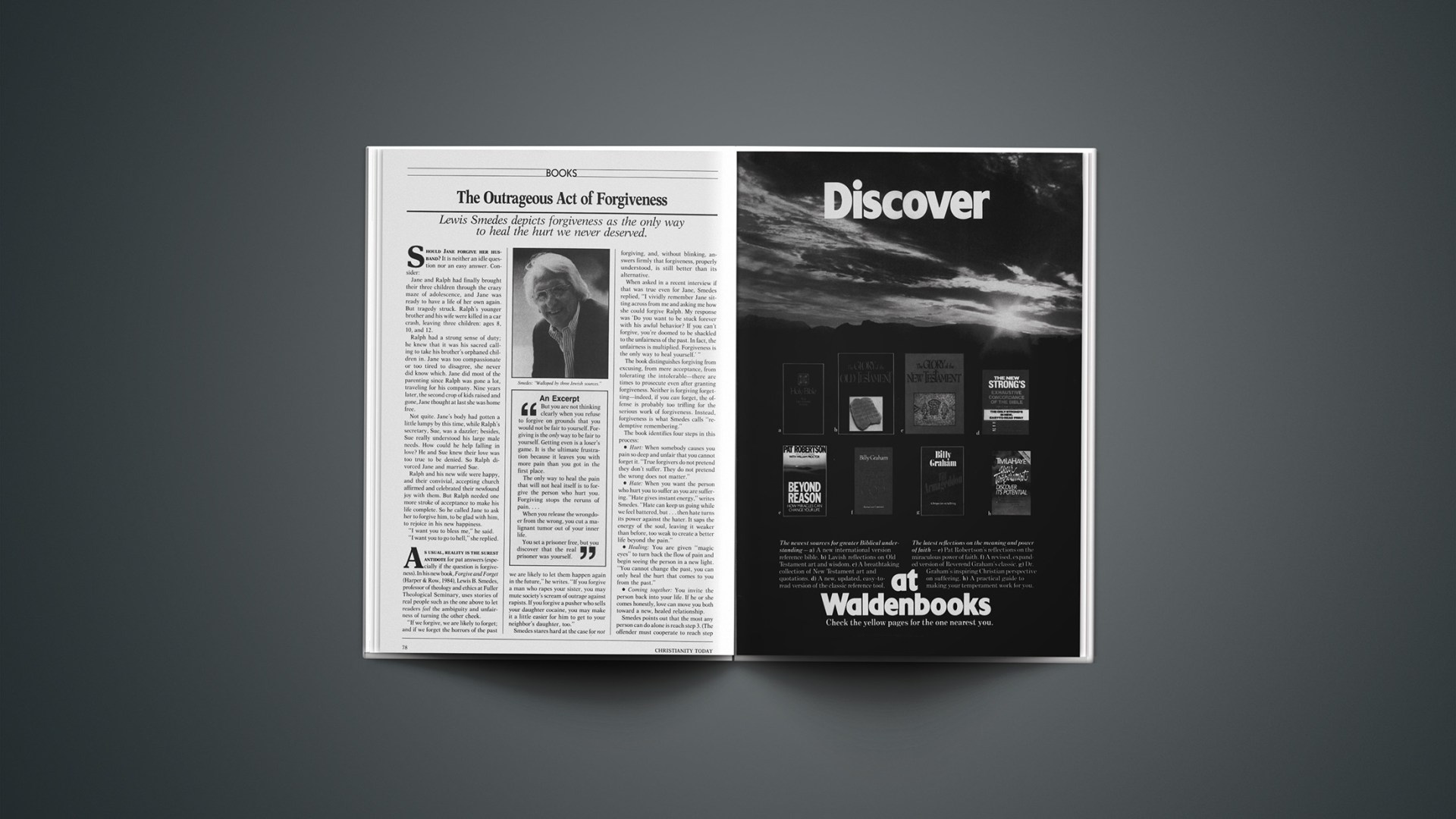
The Outrageous Act of Forgiveness

The Outrageous Act of Forgiveness1Marshall Shelley is the associate editor of Leadership magazine.

Lewis Smedes depicts forgiveness as the only way to heal the hurt we never deserved.

Should Jane forgive her husband? It is neither an idle question nor an easy answer. Consider:

Jane and Ralph had finally brought their three children through the crazy maze of adolescence, and Jane was ready to have a life of her own again But tragedy struck. Ralph’s younger brother and his wife were killed in a car crash, leaving three children: ages 8, 10, and 12.

Ralph had a strong sense of duty; he knew that it was his sacred calling to take his brother’s orphaned children in. Jane was too compassionate or too tired to disagree, she never did know which. Jane did most of the parenting since Ralph was gone a lot, traveling for his company. Nine years later, the second crop of kids raised and gone, Jane thought at last she was home free.

Not quite. Jane’s body had gotten a little lumpy by this time, while Ralph’s secretary, Sue, was a dazzler; besides, Sue really understood his large male needs. How could he help falling in love? He and Sue knew their love was too true to be denied. So Ralph divorced Jane and married Sue.

Ralph and his new wife were happy, and their convivial, accepting church affirmed and celebrated their newfound joy with them. But Ralph needed one more stroke of acceptance to make his life complete. So he called Jane to ask her to forgive him, to be glad with him, to rejoice in his new happiness.

“I want you to bless me,” he said.

“I want you to go to hell,” she replied.

As usual, reality is the surest antidote for pat answers (especially if the question is forgiveness). In his new book, Forgive and Forget (Harper & Row, 1984), Lewis B. Smedes, professor of theology and ethics at Fuller Theological Seminary, uses stories of real people such as the one above to let readers feel the ambiguity and unfairness of turning the other cheek.

An Excerpt

“But you are not thinking clearly when you refuse to forgive on grounds that you would not be fair to yourself. Forgiving is the only way to be fair to yourself. Getting even is a loser’s game. It is the ultimate frustration because it leaves you with more pain than you got in the first place.

The only way to heal the pain that will not heal itself is to forgive the person who hurt you. Forgiving stops the reruns of pain.…

When you release the wrongdoer from the wrong, you cut a malignant tumor out of your inner life.

You set a prisoner free, but you discover that the real prisoner was yourself.”

“If we forgive, we are likely to forget; and if we forget the horrors of the past we are likely to let them happen again in the future,” he writes. “If you forgive a man who rapes your sister, you may mute society’s scream of outrage against rapists. If you forgive a pusher who sells your daughter cocaine, you may make it a little easier for him to get to your neighbor’s daughter, too.”

Smedes stares hard at the case for not forgiving, and, without blinking, answers firmly that forgiveness, properly understood, is still better than its alternative.

When asked in a recent interview if that was true even for Jane, Smedes replied, “I vividly remember Jane sitting across from me and asking me how she could forgive Ralph. My response was ‘Do you want to be stuck forever with his awful behavior? If you can’t forgive, you’re doomed to be shackled to the unfairness of the past. In fact, the unfairness is multiplied. Forgiveness is the only way to heal yourself.’ ”

The book distinguishes forgiving from excusing, from mere acceptance, from tolerating the intolerable—there are times to prosecute even after granting forgiveness. Neither is forgiving forgetting—indeed, if you can forget, the offense is probably too trifling for the serious work of forgiveness. Instead, forgiveness is what Smedes calls “redemptive remembering.”

The book identifies four steps in this process:

Hurt: When somebody causes you pain so deep and unfair that you cannot forget it. “True forgivers do not pretend they don’t suffer. They do not pretend the wrong does not matter.”

Hate: When you want the person who hurt you to suffer as you are suffering. “Hate gives instant energy,” writes Smedes. “Hate can keep us going while we feel battered, but … then hate turns its power against the hater. It saps the energy of the soul, leaving it weaker than before, too weak to create a better life beyond the pain.”

Healing: You are given “magic eyes” to turn back the flow of pain and begin seeing the person in a new light. “You cannot change the past, you can only heal the hurt that comes to you from the past.”

Coming together: You invite the person back into your life. If he or she comes honestly, love can move you both toward a new, healed relationship.

Smedes points out that the most any person can do alone is reach step 3. (The offender must cooperate to reach step 4.) But healing can begin even if the final stage is never fully realized. Indeed, Smedes observes that forgiveness often comes slowly over months, even years. And he allows for gradual and incomplete forgiving.

At this point, the book’s realism will trouble many Christians who expect spiritual and emotional battles to be won instantly. Just as zealous individuals expect a widow to accept immediately her husband’s death without grieving, so some supersaints expect victims to forgive their oppressors immediately. The forgiveness cycle, like the grief cycle, must run its course before healing can happen.

What prompted Smedes to write a book on forgiveness?

“I was walloped by three Jewish sources,” he says. “First, Hannah Arendt’s The Human Condition, in which she shares her discovery that the only power that can stop the inexorable stream of painful memories is ‘the faculty of forgiveness.’ Second, Simon Wiesenthal in The Sunflower and other Jewish writers who suggest that forgiving Hitler his atrocities is unthinkable. Third, Michael Christopher’s play The Black Angel, which probes our deep need for forgiveness.” (All three sources are used as illustrations in the book.)

“I looked for Christian literature on forgiveness, and it was mostly hortatory, or else it dealt with conditions for forgiveness by God. I looked in psychological literature, and if it appeared at all, it was mostly jargon. There was nothing on the dynamics and ethics of human forgiveness.”

Forgive and Forget is the most mature treatment yet of the painful necessity of forgiving. The strength of the book is Smedes’s ability to speak thoroughly Christian concepts with the vocabulary of a newscaster. And because it does not rely on proof texts or Christian jargon but presents the benefits of forgiveness as valid for everyone, the book has potential for reaching secular readers, perhaps even more than Karl Menninger’s Whatever Happened to Sin?

As Smedes points out, no one can ever force us or trick us into forgiving. It is a totally free act, but an outrageous act—a voluntary forfeit of our right to fairness, to extract sweet revenge.

But, as he concludes, forgiveness is also the only way to “heal the hurt we never deserved.”

Speaking out: What? Ban My Book?

My publisher was outmaneuvered by narrow minds.

A funny thing happened to me on the way to the bookstore. My book got banned.

Actually, it wasn’t my book, it was someone else’s. But the local bookstore was participating in a nationwide boycott of the “guilty” publisher—my publisher—and a few bystanding authors got caught in the crossfire.

Now, it was no great affront to me personally. My book, about rock music and pop culture, had been around awhile. And I have to admit that clearing it off the shelves was hardly a setback to the furtherance of Christian thought and belief. I was just a little surprised, though, to hear that it was no longer available to anyone who happened to want a copy.

Quite a few other books were not available either: Paul Little’s Know Why You Believe and How to Give Away Your Faith, John Stott’s Basic Christianity and J. I. Packer’s Knowing God, Calvin Miller’s Singer Trilogy; and books by the likes of John White, H. R. Rookmaaker, Os Guiness, Rebecca Manley Pippert, and Walter Trobisch, to mention only a few.

I found myself in some pretty good company, but it was of no real consolation. These authors have something important to say and deserve to be heard. And yet patrons of the boycotting bookstores were deprived of a listening—all because one book was deemed sufficiently noxious that the publisher’s entire catalog had to be tossed out.

That’s the trouble with restricting other views: there are bound to be regrettable consequences. In this case, someone decided a point had to be made; that a particular strain of thinking was so harmful, so spurious—so threatening?—that it could not be expressed. No matter that such evangelical luminaries as theologian Carl Henry and philosopher Arthur Holmes saw value in the book. It had to go—and that was that. You can’t make an omelette without breaking a few eggs, and you can’t promote narrow thinking without breaking a few legs. Figuratively speaking.

Such are the tactics of those who fear the free contest of ideas so much that they have to fix the match. And fixing the match can lead to some decidedly nasty practices. It might start with boycotting a book, but if the author persists in making himself heard, what then? In this instance, of course, we’ll never know. InterVarsity bowed to all the pressure and withdrew the book in question.

In retrospect, maybe they acted too quickly. Maybe their decision was based more on potential loss of support than on a concern for the marketplace of ideas. Maybe. But one thing is certain. InterVarsity was outmanuevered by narrow-minded invective and left waiting for evangelical support that never came. And that’s another consequence of censorship: even close friends keep a safe distance.

So who or what will it be next time? Will it be my next book? Or yours? Or maybe it won’t be a book at all. Maybe it will be a speech or a sermon. Regardless, once would-be censors are allowed to have their way, no one is immune; anyone who wishes to debate controversial topics in the arena of public opinion can become a target.

In the meantime, the four-month-long boycott is over and all the books by all those authors I mentioned earlier, including my own, are back on the shelves. All, that is, except one—the one that started the controversy in the first place. Was Brave New People filled with such menace and danger that the reading public had to be protected from it?

That is something you will never have the chance to decide for yourself. The book has been burned—figuratively speaking.

Mr. Lawhead is an accomplished author whose most recent title, The Sword and the Flame (Crossway Books, 1984), is the final book in his widely acclaimed Dragon King Trilogy.

Church and State Unite to Distribute Scriptures in Brazil

The government of Brazil is assisting an effort to distribute 25 million New Testaments through the nation’s public school system.

Secondary school students in Brazil are required to attend either Jewish, Catholic, or Protestant religion classes. The New Testaments would be used in the Catholic and Protestant classes. Government officials and educators cite evidence that an emphasis on Bible reading increases literacy—no small concern in a nation that expects illiteracy to rise more than 3 percent next year.

More than a year ago Nilson Fanini, pastor of the 5,000-member First Baptist Church in Niteroi, Brazil, proposed the nationwide distribution of New Testaments. In a meeting with Fanini earlier this year, religious and governmental officials—including Brazilian President Joāo Figueiredo—endorsed the project. Figueiredo requested that the program be expanded to include distribution to military personnel and prison inmates.

“Brazil will elect its first nonmilitary president in 20 years in January,” said Aroldo de Oliveira, a member of Brazil’s House of Deputies. “We are beginning the building of a stable society, and we believe the Bible plays a central role in this.”

Pastors and other leaders from 18 denominations met in late October to appoint a Scripture-distribution steering committee. Representatives of groups as diverse as Episcopalians, Baptists, Assemblies of God, Roman Catholics, Lutherans, and Churches of Christ pledged to complete the distribution by 1990.

The cooperative effort of Protestants, Catholics, and the government will cover the cost of distribution. Foreign organizations are providing funds for printing New Testaments and shipping them to Brazil. A Swedish publisher agreed to subsidize the printing of $6 million worth of Portuguese-language New Testaments. In addition, the Illinois-based World Home Bible League plans to raise $12 million for the printing and shipping of New Testaments. Fanini’s Reencontro (Reencounter) Ministries, working with state ministries of education, will coordinate distribution.

Mainline Churches Reassess Prochoice Stand on Abortion

Mainline Protestant denominations, long identified with a prochoice stand on abortion, have begun to reassess that position.

The Presbyterian Church (USA) in October sent study materials on abortion to its 12,000 congregations. The mailing launched a four-month review of the denomination’s 1983 abortion statement. At the church’s annual meeting in July, many objected to the statement’s view that abortion is not only a right but sometimes an “act of faithfulness before God.”

James Andrews, the denomination’s stated clerk, said he sees a “very broad concern and rethinking” on abortion in his denomination and possibly throughout mainline Protestantism.

“There is a great deal of discomfort with the fact that there are 1.5 million abortions a year,” he said. “People who favored our statements [supporting abortion in the early 1970s] are now saying, ‘I never thought there would be so much pressure for abortion.’

“I think we’ve also been influenced heavily by the Catholic bishops’ pastoral letter [on nuclear arms],” Andrews said. He cited the bishops’ view that opposition to both abortion and nuclear arms forms part of a “consistent ethic of life.”

“When you discuss such things as nuclear arms, capital punishment, and abortion, you have to realize that they are related in some way,” he said.

Another Protestant spokesman, however, denies that the Catholic bishops’ approach has influenced him.

“I think the nuclear arms race and abortion are two completely different issues, and to try to link them up is intellectual nonsense,” said Thomas White, director of the Office of Social Witness of the Reformed Church in America (RCA). White and some other RCA leaders favor abortion rights. But the denomination’s policy-making body has shifted away from its past position emphasizing the right of an individual to free choice.

Last year the RCA opposed “the use of legal abortion in all but very exceptional circumstances.”

In other denominational action:

• At its midsummer quadrennial meeting, the African Methodist Episcopal Church, the second-largest black denomination in the country, reaffirmed its opposition to abortion except in cases of rape and incest.

• In July, delegates to the annual meeting of the Church of the Brethren tightened the church’s position by stating that it “opposes abortion because the rejection of unborn children violates the love of God by which God creates and nurtures human life.”

• The Lutheran World Federation, which embraces 54 million Lutherans worldwide, passed a strong resolution against abortion at its August meeting.

• The General Conference of the United Methodist Church in May tightened its stand on abortion. Delegates deleted a sentence from the church’s governing code that read, “We support the legal option on abortion under proper medical procedures.” Inserted was a sentence reading, “In continuity with past Christian teaching, we recognize tragic conflicts of life with life that may justify abortion, and in such cases support the legal option of abortion under proper medical procedures.”

James Heidinger, editor of the evangelical Good News magazine, said the change implies that the United Methodist Church supports abortion only when a mother’s life is endangered by pregnancy. However, Cassandra Johnson, of the church’s Board of Church and Society, said the statement also supports abortion when a pregnancy threatens a woman’s “quality of life.” She charged Methodist prolifers with “trying to market” the statement for their own purposes.

At its 1985 general convention, the Episcopal Church is expected to face the strongest challenge ever to its 1979 statement on abortion. The statement expresses moral disapproval of “abortion for convenience,” but opposes legal limitations.

RELIGIOUS NEWS SERVICE

Canadian Churches Gain Independence from Their U.S. Counterparts

In 1985, two Canadian denominations will finalize processes that will make them independent of parent bodies in the United States. They will join the ranks of two other churches that in recent years have severed most of their ties to American denominations.

The Canadian branch of the Baptist General Conference (BGC) will finalize its autonomy process in June at the denomination’s annual meeting in Illinois. Another church, the Lutheran Church in America-Canada section, will become autonomous in May when it merges with a Canadian denomination. In recent years, the Canadian branch of the Christian and Missionary Alliance and the Evangelical Free Church of Canada broke away from their U.S. counterparts.

Reasons for autonomy vary from church to church. With Lutherans, the move is tied to the denominational merger. But with all groups, the sense of Canadian identity has been a major factor.

There has been a strong desire “for people in Canadian churches to get to know and work with each other,” said Canadian BGC general secretary Abe Funk. With 6,000 members in 72 churches, the BGC began its autonomy process in the late 1970s.

Funk said the Canadian BGC will reflect a slightly more conservative stance than its American counterpart, particularly in the area of biblical inerrancy. However, strong links will remain, particularly with respect to world mission projects. The Canadian BGC plans to seek closer ties with other Baptist bodies in Canada, including possible joint theological education.

In May, the 210,000-member Evangelical Lutheran Church in Canada will be created by the merger of the Evangelical Lutheran Church of Canada (ELCC) and the Lutheran Church in America-Canada section. With the merger, the latter body will become independent of the Lutheran Church in America (LCA).

Jackie Schmitt, a member of a committee set up to work on continuing relationships between Canadian and American Lutheran bodies, said her committee will deal with questions of pension portability and joint cooperation. The matter of pension plans grows more complex when a denomination gains autonomy after a long-time Canadian-American exchange of pastors.

Schmitt also was a member of the commission that brought the Lutheran autonomy-merger process to a vote last spring. At that time, the ELCC already was autonomous. The ELCC is strongest in the four western Canadian provinces, with the LCA-Canada section stronger in populous Ontario, where 40 percent of the merged church’s members live.

The Canadian branch of the Christian and Missionary Alliance (CMA) gained independence on January 1, 1981. The Canadian body sets its own goals, but it cooperates with CMA headquarters in Nyack, New York, on overseas ministries. At the time of its founding, the Canadian church claimed 241 congregations with a membership of 39,865. It has grown to 273 churches with 49,576 members. Canadian census figures show the CMA and the Pentecostal Assemblies of Canada to be the fastest-growing denominations in the country.

The Evangelical Free Church of Canada began its autonomy process six years ago, as Canadian church members struggled with “a new sense of community and responsibility,” said Dean Johnson, the church’s moderator. He credits much of the group’s recent church-planting activity to the spirit of autonomy. In the 20 years prior to 1979 there had been a net gain of one church on a base of 70. Today, the denomination includes 94 churches, with a combined membership of 5,000 and attendance running around 10,000.

LLOYD MACKEYin Vancouver,

British Columbia

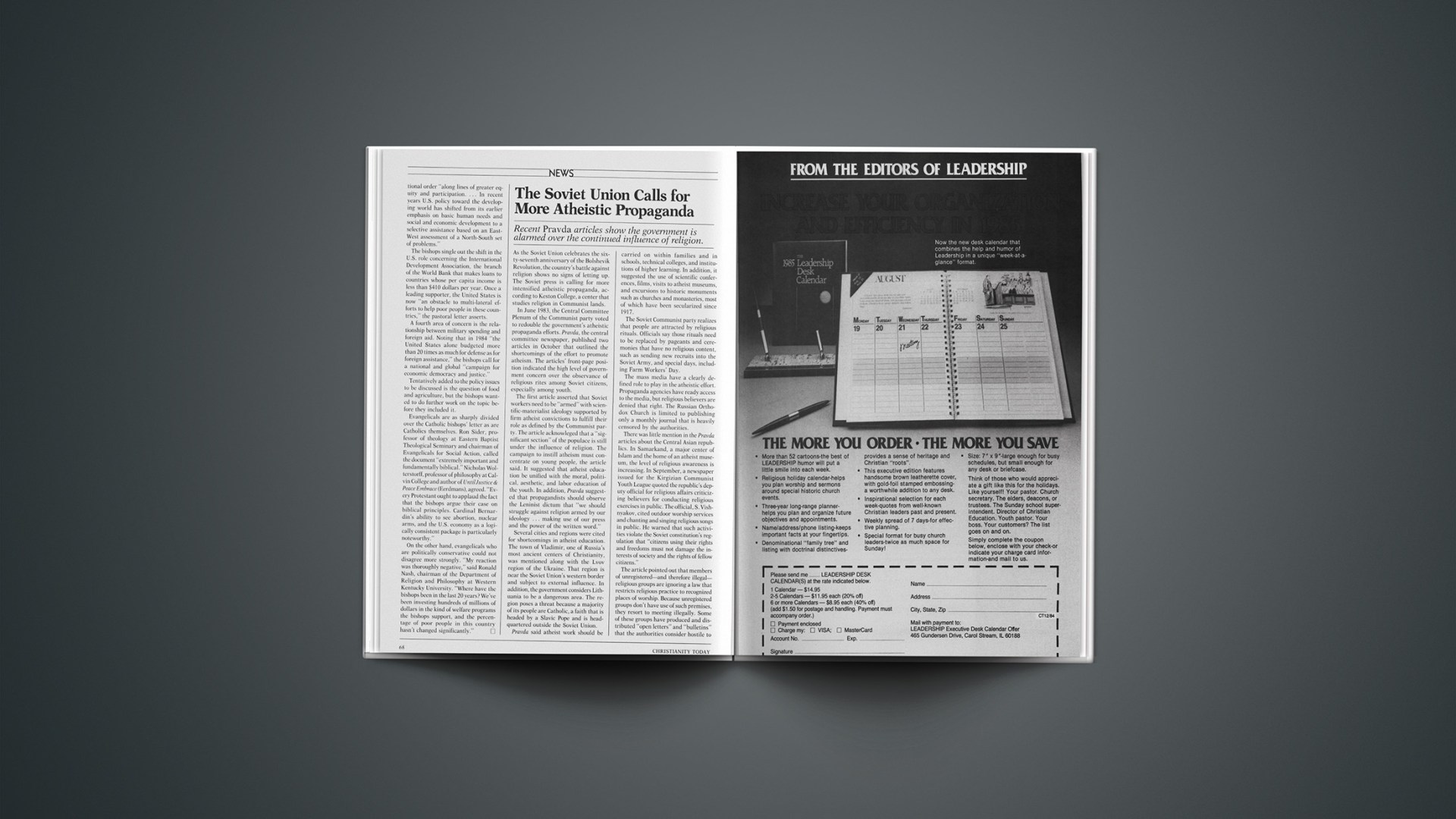
The Soviet Union Calls for More Atheistic Propaganda

Recent Pravda articles show the government is alarmed over the continued influence of religion.

As the Soviet Union celebrates the sixty-seventh anniversary of the Bolshevik Revolution, the country’s battle against religion shows no signs of letting up. The Soviet press is calling for more intensified atheistic propaganda, according to Keston College, a center that studies religion in Communist lands.

In June 1983, the Central Committee Plenum of the Communist party voted to redouble the government’s atheistic propaganda efforts. Pravda, the central committee newspaper, published two articles in October that outlined the shortcomings of the effort to promote atheism. The articles’ front-page position indicated the high level of government concern over the observance of religious rites among Soviet citizens, especially among youth.

The first article asserted that Soviet workers need to be “armed” with scientific-materialist ideology supported by firm atheist convictions to fulfill their role as defined by the Communist party. The article acknowleged that a “significant section” of the populace is still under the influence of religion. The campaign to instill atheism must concentrate on young people, the article said. It suggested that atheist education be unified with the moral, political, aesthetic, and labor education of the youth. In addition, Pravda suggested that propagandists should observe the Leninist dictum that “we should struggle against religion armed by our ideology … making use of our press and the power of the written word.”

Several cities and regions were cited for shortcomings in atheist education. The town of Vladimir, one of Russia’s most ancient centers of Christianity, was mentioned along with the Lvov region of the Ukraine. That region is near the Soviet Union’s western border and subject to external influence. In addition, the government considers Lithuania to be a dangerous area. The region poses a threat because a majority of its people are Catholic, a faith that is headed by a Slavic Pope and is headquartered outside the Soviet Union.

Pravda said atheist work should be carried on within families and in schools, technical colleges, and institutions of higher learning. In addition, it suggested the use of scientific conferences, films, visits to atheist museums, and excursions to historic monuments such as churches and monasteries, most of which have been secularized since 1917.

The Soviet Communist party realizes that people are attracted by religious rituals. Officials say those rituals need to be replaced by pageants and ceremonies that have no religious content, such as sending new recruits into the Soviet Army, and special days, including Farm Workers’ Day.

The mass media have a clearly defined role to play in the atheistic effort. Propaganda agencies have ready access to the media, but religious believers are denied that right. The Russian Orthodox Church is limited to publishing only a monthly journal that is heavily censored by the authorities.

There was little mention in the Pravda articles about the Central Asian republics. In Samarkand, a major center of Islam and the home of an atheist museum, the level of religious awareness is increasing. In September, a newspaper issued for the Kirgizian Communist Youth League quoted the republic’s deputy official for religious affairs criticizing believers for conducting religious exercises in public. The official, S. Vishnyakov, cited outdoor worship services and chanting and singing religious songs in public. He warned that such activities violate the Soviet constitution’s regulation that “citizens using their rights and freedoms must not damage the interests of society and the rights of fellow citizens.”

The article pointed out that members of unregistered—and therefore illegal—religious groups are ignoring a law that restricts religious practice to recognized places of worship. Because unregistered groups don’t have use of such premises, they resort to meeting illegally. Some of these groups have produced and distributed “open letters” and “bulletins” that the authorities consider hostile to the Soviet system and society. Citizens were advised to report any such activities to the authorities.

Official Soviet statements still maintain that religious life is in a general state of decline, according to Keston College. In addition, such statements say most people who attend worship services are elderly women. However, propaganda measures set in motion 18 months ago concentrate on signs of a religious reawakening among young people.

U.S. Catholic Bishops Call Poverty a National Scandal

When the National Conference of Catholic Bishops completed a statement on Marxism four years ago, critics said they had tackled an easy problem because none of them lived under a Marxist government. The bishops accepted the challenge, and last month released the first draft of their pastoral letter on the U.S. economy.

Archbishop Rembert G. Weakland of Milwaukee, chairman of the committee that prepared the document, said the members “find it a disgrace that 35 million Americans live below the poverty level and millions more hover just above it.”

In addition to Weakland, the committee consists of Archbishop Thomas A. Donnellan, of Atlanta; Auxiliary Bishop Peter A. Rosazza, of Hartford, Connecticut; Bishop George H. Speltz, of St. Cloud, Minnesota; and Bishop William R. Weigand, of Salt Lake City. The pastoral letter will undergo at least two major revisions before it is adopted in November 1985 as the official position of the Catholic church.

None of the committee members has formal training in economics, but they have all handled the administration of a wide variety of parishes in a wide range of economic areas. In preparing the document, the committee consulted some 150 experts in the fields of economics, business, and labor.

Critics, including former U.S. Treasury Secretary William Simon, former U.S. Secretary of State Alexander Haig, and members of a Catholic lay group led by Michael Novak, said the bishops adopted a version of the Democratic party platform.

In the document, the bishops write, “We have often been asked what possible connection there could be between Christian morality and the technical questions of economic policy.… We believe that the level of inequality in income and wealth in our society and even more the inequality on the world scale today must be judged morally unacceptable.”

The prelates say the poor are of special concern because they are vulnerable and needy. All human beings “must measure their actions and choices by what they do for and to the poor,” they add. “The U.S. economy has been immensely successful in providing for the material needs and in raising the living standards of its citizens.” However, the document notes that high unemployment and a rise in the rate of poverty have hurt many during the recent recession.

The 50,000-word document criticizes “policies that put large amounts of talent and capital into the production of luxury consumer goods and military technology” while at the same time “failing to invest sufficiently in education, in the basic infrastructure of our society, or in economic sectors that produce the jobs, goods, and services that we urgently need.”

After surveying Catholic social teaching on economic justice, the bishops turn to the thorny problems of unemployment, poverty, and the nation’s welfare system, the need for “global affirmative action,” and distortions in U.S. foreign aid policy. The bishops recommend “a major new policy commitment” to reduce unemployment to 3 or 4 percent, what they call “a reasonable definition of full employment.” They support increased government backing of “public service employment and also of public subsidies for employment in the private sector.”

The pastoral letter argues for “improvements in welfare programs for the poor” and involvement in “broader social and institutional factors,” such as racial discrimination, “the feminization of poverty,” and the current distribution of income and wealth. It admits that Catholic social teaching “does not suggest that absolute equality in the distribution of income and wealth is required.” But it argues that gross inequalities are morally unjustifiable, “particularly when millions lack even the basic necessities of life.… In our judgment, the distribution of income and wealth [in the United States] is so inequitable that it violates this minimum standard of distributive justice.”

The bishops’ letter argues for global affirmative action. What is needed, they say, is a restructuring of the international order “along lines of greater equity and participation.… In recent years U.S. policy toward the developing world has shifted from its earlier emphasis on basic human needs and social and economic development to a selective assistance based on an East-West assessment of a North-South set of problems.”

The bishops single out the shift in the U.S. role concerning the International Development Association, the branch of the World Bank that makes loans to countries whose per capita income is less than $410 dollars per year. Once a leading supporter, the United States is now “an obstacle to multi-lateral efforts to help poor people in these countries,” the pastoral letter asserts.

A fourth area of concern is the relationship between military spending and foreign aid. Noting that in 1984 “the United States alone budgeted more than 20 times as much for defense as for foreign assistance,” the bishops call for a national and global “campaign for economic democracy and justice.”

Tentatively added to the policy issues to be discussed is the question of food and agriculture, but the bishops wanted to do further work on the topic before they included it.

Evangelicals are as sharply divided over the Catholic bishops’ letter as are Catholics themselves. Ron Sider, professor of theology at Eastern Baptist Theological Seminary and chairman of Evangelicals for Social Action, called the document “extremely important and fundamentally biblical.” Nicholas Wolterstorff, professor of philosophy at Calvin College and author of Until Justice & Peace Embrace (Eerdmans), agreed. “Every Protestant ought to applaud the fact that the bishops argue their case on biblical principles. Cardinal Bernardin’s ability to see abortion, nuclear arms, and the U.S. economy as a logically consistent package is particularly noteworthy.”

On the other hand, evangelicals who are politically conservative could not disagree more strongly. “My reaction was thoroughly negative,” said Ronald Nash, chairman of the Department of Religion and Philosophy at Western Kentucky University. “Where have the bishops been in the last 20 years? We’ve been investing hundreds of millions of dollars in the kind of welfare programs the bishops support, and the percentage of poor people in this country hasn’t changed significantly.”

Apple PodcastsDown ArrowDown ArrowDown Arrowarrow_left_altLeft ArrowLeft ArrowRight ArrowRight ArrowRight Arrowarrow_up_altUp ArrowUp ArrowAvailable at Amazoncaret-downCloseCloseEmailEmailExpandExpandExternalExternalFacebookfacebook-squareGiftGiftGooglegoogleGoogle KeephamburgerInstagraminstagram-squareLinkLinklinkedin-squareListenListenListenChristianity TodayCT Creative Studio Logologo_orgMegaphoneMenuMenupausePinterestPlayPlayPocketPodcastRSSRSSSaveSaveSaveSearchSearchsearchSpotifyStitcherTelegramTable of ContentsTable of Contentstwitter-squareWhatsAppXYouTubeYouTube