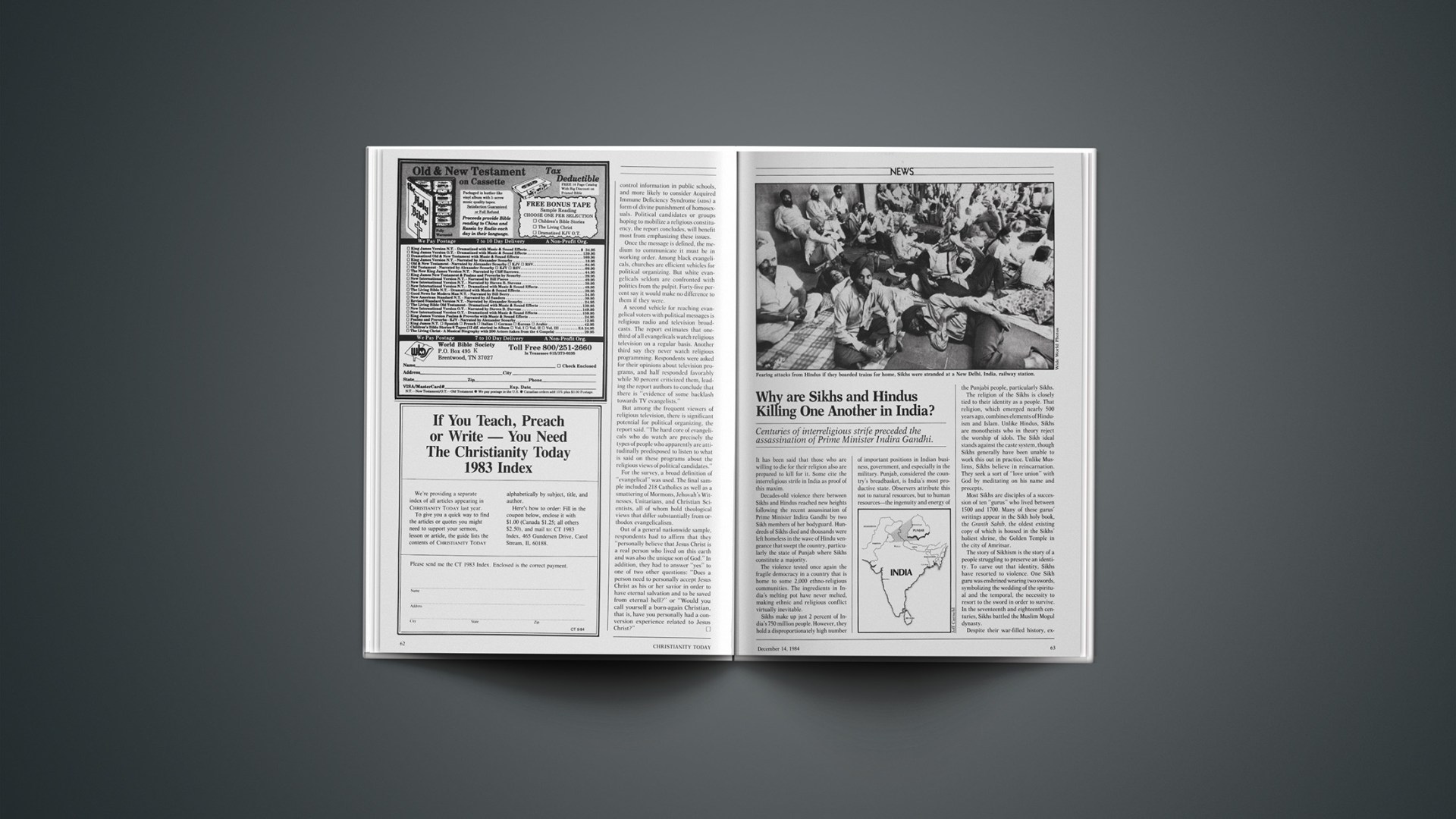
Why Are Sikhs and Hindus Killing One Another in India?

Centuries of interreligious strife preceded the assassination of Prime Minister Indira Gandhi.

It has been said that those who are willing to die for their religion also are prepared to kill for it. Some cite the interreligious strife in India as proof of this maxim.

Decades-old violence there between Sikhs and Hindus reached new heights following the recent assassination of Prime Minister Indira Gandhi by two Sikh members of her bodyguard. Hundreds of Sikhs died and thousands were left homeless in the wave of Hindu vengeance that swept the country, particularly the state of Punjab where Sikhs constitute a majority.

The violence tested once again the fragile democracy in a country that is home to some 2,000 ethno-religious communities. The ingredients in India’s melting pot have never melted, making ethnic and religious conflict virtually inevitable.

Sikhs make up just 2 percent of India’s 750 million people. However, they hold a disproportionately high number of important positions in Indian business, government, and especially in the military. Punjab, considered the country’s breadbasket, is India’s most productive state. Observers attribute this not to natural resources, but to human resources—the ingenuity and energy of the Punjabi people, particularly Sikhs.

The religion of the Sikhs is closely tied to their identity as a people. That religion, which emerged nearly 500 years ago, combines elements of Hinduism and Islam. Unlike Hindus, Sikhs are monotheists who in theory reject the worship of idols. The Sikh ideal stands against the caste system, though Sikhs generally have been unable to work this out in practice. Unlike Muslims, Sikhs believe in reincarnation. They seek a sort of “love union” with God by meditating on his name and precepts.

Most Sikhs are disciples of a succession of ten “gurus” who lived between 1500 and 1700. Many of these gurus’ writings appear in the Sikh holy book, the Granth Sahib, the oldest existing copy of which is housed in the Sikhs’ holiest shrine, the Golden Temple in the city of Amritsar.

The story of Sikhism is the story of a people struggling to preserve an identity. To carve out that identity, Sikhs have resorted to violence. One Sikh guru was enshrined wearing two swords, symbolizing the wedding of the spiritual and the temporal, the necessity to resort to the sword in order to survive. In the seventeenth and eighteenth centuries, Sikhs battled the Muslim Mogul dynasty.

Despite their war-filled history, experts say the perception that Sikhs are attracted to violence is unjustified. “It’s been confused in people’s minds that all Sikhs are terrorists,” said India scholar Paul Wallace of the University of Missouri. “The overwhelming majority of Sikhs are nonviolent.”

University of Wisconsin professor Robert Frykenberg, born and reared in India as a son of Christian missionaries, said the American news media is partially responsible for the misperception. “To show Sikhs dancing in the streets [celebrating Indira Gandhi’s death] without pointing out the huge moderate block which does not hold to the extremists’ views was inflammatory and irresponsible,” he said. “It probably led to further bloodshed because the reports were shown almost immediately on Indian TV.”

The Sikh identity was dealt a severe blow in 1947. With the partitioning of the Punjab region, western Punjab, the cradle of Sikh culture, became a part of Muslim Pakistan. The eastern Punjab remained Hindu. Three years later, the Indian constitution defined Sikhism not as a distinct religion, but as a Hindu sect. Since then, things have improved for the Sikhs. Frykenberg cited the recent violence as evidence of the improvement. “People become restive when circumstances get better and then something comes along to frustrate the progress.”

Sikhs made moderate advances in the first half of the twentieth century under British rule. Progress continued from 1947 to 1964 when Indira Gandhi’s father, Jawaharlal Nehru, ruled India. In 1966, eastern Punjab was broken into two states. The northern portion retained the name Punjab, and the Sikhs at long last had a state in which they constituted a political majority.

But Wallace said that under Gandhi, the sensitivity that Nehru displayed was “significantly qualified.” Frykenberg added that Gandhi sparked unrest by “systematically destabilizing anyone who opposed her.”

Most observers, including Wallace and Frykenberg, said Gandhi and her Congress-I party intentionally encouraged Sikh extremists in order to pit Sikh against Sikh, thus undercutting Sikh political unity. But in doing so, Wallace said, “they created Frankenstein.”

He said one of the side effects of Gandhi’s interference was the emergence of an influential terrorist leader named Jamail Singh Bhindranwale. Two years ago, Bhindranwale led some 1,000 Sikh terrorists into the Golden Temple at Amritsar. From there, they launched terrorist attacks, killing hundreds of Hindus. Finally, last June, the Indian army moved in with heavy artillery, annihilating the terrorists and defacing some of the buildings on the grounds of the Sikhs’ holy shrine.

This act of aggression enraged even moderate Sikhs, including, in all probability, the two men who later killed Gandhi. Frykenberg said one of the assassins grew up in the same area as Bhindranwale, and quite likely knew his family.

The violence has opened a window of opportunity for India’s small Christian community. “The idea of Eastern religions being peaceful and tolerant has been shatterred,” said Paul Hiebert, professor of missions anthropolgy at Fuller Theological Seminary. Hiebert, who, like Frykenberg, grew up on India’s mission field, said Indian citizens regard Christianity as a religion of war. “They refer to the atom bomb as the ‘Christian bomb,’ ” he said.

“Christians now have the opportunity to reverse that. Among people in the East, peace is not just on the agenda, peace is the agenda for spirituality,” Hiebert said. “If Christianity can be seen as a religion of peace, Christians can have a tremendous impact throughout the region.”

North American Scene

The United Methodist Church’s highest court has upheld a ban on the ordination of “self-avowed, practicing homosexuals.” The ban was passed by the denomination’s general conference in May. However, the church court restricted the authority of Methodist bishops to refuse ministerial appointments to already-ordained homosexuals. A bishop can take such action only if a regional church body already has suspended an ordained homosexual.

The trustees of two Christian liberal arts colleges in the Northeast have voted to merge the institutions. Gordon College, near Boston, and Barrington College, near Providence, Rhode Island, will combine operations beginning with the 1985–86 school year. Barrington’s 110-acre campus will be sold, with the money being used to expand facilities at Gordon’s 900-acre campus (CT, Nov. 9, 1984, p. 66).

The U.S. Supreme Court has agreed to decide whether federal aid to parochial schools violates the First Amendment. The case involves New York City’s use of federal funds to send public school teachers into parochial schools to provide specialized instruction. A lower court ruled that the practice violates the First Amendment’s ban on an establishment of religion. However, New York City argues that the practice does not advance religion or excessively entangle government with the church.

Two former Indiana governors and more than 60 religious, educational, and political leaders are combating efforts to legalize gambling in the state. The group plans to finance a lobbying effort to ensure that Indiana will continue to prohibit all forms of gambling, including a state lottery. Mississippi, Utah, and Hawaii are the only other states that outlaw all forms of gambling.

New York’s highest court has ruled that a person can be deemed legally dead when the brain ceases to function, even if heartbeat and breathing are being maintained artificially. With the ruling, New York joins 37 other states that have expanded the traditional definition of death to include the functioning of the brain.

World Scene

An interracial Christian training center for youth has opened near Johannesburg, South Africa. A project of Youth for Christ/Southern Africa, the center offers short-term courses in leadership and the Bible. Young people—both black and white—from southern Africa, Great Britain, New Zealand, and the United States have received training there.

A West German television documentary reported that some 2,500 witches and satanic priests are active in that country. The program said more than 2 million West Germans have paid for “occult services,” including prophecies, curses, and “death rituals.” The program was broadcast despite the objections of the West German Evangelical Alliance. Alliance chairman Fritz Laubach said the documentary should have included “warning words of the Bible” against occult practices.

The Church of England’s controversial bishop of Durham has described the Resurrection as a “conjuring trick with bones.” David Jenkins made the statement during a BBC radio program. The bishop did not explain what he meant by “conjuring trick.” But he repeated his view that Christians do not need to believe in the Virgin Birth and the Resurrection as absolute facts. Jenkins’s liberal views have raised a stir in the Church of England since July when he was consecrated as the church’s fourth most-senior cleric (CT, Sept. 7, 1984, p. 74).

A Nicaraguan Catholic bishop has publicly criticized the Sandinista government, saying it is not sincerely seeking peace and is imposing “new oppressions.” Bishop Pablo Antonio Vega’s language was stronger than that used in the Nicaraguan bishops’ pastoral letter criticizing the government last April. The bishop said Sandinista ideology “promotes and institutionalizes violence.” His statement is expected to increase friction between the government and the church.

Official figures indicate that the Church of England’s membership is once again on the decline after a modest improvement in the early 1980s. However, some question whether clergymen underreport membership to reduce the amount of assessment, based on membership, that parishes pay to the denomination. Official figures show Sunday attendance down by 2.8 percent.

The head of the Jesuit order says he supports the teachings of liberation theology. Jesuit superior general Peter-Hans Kolvenbach says members of his order will continue to assist efforts to achieve social justice in Latin America. The Vatican has criticized liberation theology, saying it relies too heavily on Marxist analysis.
A Study Finds No Connection between Christian Beliefs and Political Party Affiliation

Survey results published before last month’s election indicate no relationship between evangelical Christian beliefs and political party affiliation. The extensive research project calls into question the Religious Right’s claims of mobilizing a monolithic bloc of Christian voters.

The report was based on a survey conducted for the Institute for Government and Politics, an affiliate of Paul Weyrich’s Free Congress Research and Education Foundation. Factors such as income, race, education, and occupation appear to influence voting and political activity to a greater extent than religious belief or practice. However, on specific moral issues, support may be “activated” among evangelicals by political candidates who make a straightforward appeal on religious grounds.

The report, The Evangelical Voter, was written by Stuart Rothenberg and Frank Newport. It looks beyond 1984 to assess whether evangelicals constitute a special interest group, similar to organized labor or minorities. If there is cohesion among evangelicals, and if they are easily reached via the pulpit or through religious broadcasting, then political organizers would do well to appeal to them. If not, the efforts of conservative groups to do so may be a colossal waste of time and resources.

In fact, the report points out, massive voter registration drives may have the opposite effect of what groups like Tim LaHaye’s American Coalition for Traditional Values expect. “Mass registrations of people who can be identified as fundamentalist Christians bring to the polls more Democrats than Republicans, if nothing else is done,” Rothenberg and Newport conclude. This is particularly true for congressional and local races, in which voting behavior is less likely to be influenced by idealistic or symbolic factors that weight presidential politics.

The survey of 1,000 evangelicals nationwide reveals 52.9 percent are registered as Democrats and 33.3 percent are Republicans. The phenomenon of crossover voting, crucial to Republican victories, is evident among Christians, with 47.1 percent saying they usually vote for Democrats. When the survey sample is divided by race, Democrats still come out ahead among both blacks and whites. White evangelicals are registered 48 percent Democrat and 37 percent Republican, and black evangelicals split 88 percent Democrat and 6 percent Republican.

Based on the survey, Rothenberg said he would characterize evangelicals as “a swing constituency with a Democratic bias.”

The survey, conducted by Tarrance and Associates of Houston, offered a hypothetical contest between Ronald Reagan and U.S. Sen. John Glenn (D-Ohio), an early Democratic contender for the presidential nomination. Among evangelicals, Glenn would have come within striking distance of Reagan with 37.2 percent support compared with Reagan’s 41.3 percent. Against Mondale, however, Reagan scored much higher, gaining 47 percent to Mondale’s 32 percent.

“As a political constituency, evangelicals are very much up in the air,” Rothenberg said. “They are cross-pressured on many issues. I am struck by the lack of coherence and consistency on some issues.” Evangelicals tend to support a nuclear freeze and higher defense spending, for instance. They are antiabortion, but sympathetic to exceptions in “hard cases.” They favor school prayer, a conservative rallying point, as well as the Equal Rights Amendment (ERA), a centerpiece of liberal policy.

The study explored attitudes toward four advocacy groups: the National Conservative Political Action Committee, Moral Majority, National Education Association (NEA), and National Organization for Women. “Sizable numbers of evangelicals are unaware of even the most widely discussed and politically active of these groups,” the report says. All except the NEA have roughly equal percentages of respondents who favored and opposed the groups.

The report says individuals who regard religion as “very” or “extremely” important are more likely to favor tuition tax credits, less likely to favor the ERA, more likely to support voluntary school prayer, less likely to favor birth control information in public schools, and more likely to consider Acquired Immune Deficiency Syndrome (AIDS) a form of divine punishment of homosexuals. Political candidates or groups hoping to mobilize a religious constituency, the report concludes, will benefit most from emphasizing these issues.

Once the message is defined, the medium to communicate it must be in working order. Among black evangelicals, churches are efficient vehicles for political organizing. But white evangelicals seldom are confronted with politics from the pulpit. Forty-five percent say it would make no difference to them if they were.

A second vehicle for reaching evangelical voters with political messages is religious radio and television broadcasts. The report estimates that one-third of all evangelicals watch religious television on a regular basis. Another third say they never watch religious programming. Respondents were asked for their opinions about television programs, and half responded favorably while 30 percent criticized them, leading the report authors to conclude that there is “evidence of some backlash towards TV evangelists.”

But among the frequent viewers of religious television, there is significant potential for political organizing, the report said. “The hard core of evangelicals who do watch are precisely the types of people who apparently are attitudinally predisposed to listen to what is said on these programs about the religious views of political candidates.”

For the survey, a broad definition of “evangelical” was used. The final sample included 218 Catholics as well as a smattering of Mormons, Jehovah’s Witnesses, Unitarians, and Christian Scientists, all of whom hold theological views that differ substantially from orthodox evangelicalism.

Out of a general nationwide sample, respondents had to affirm that they “personally believe that Jesus Christ is a real person who lived on this earth and was also the unique son of God.” In addition, they had to answer “yes” to one of two other questions: “Does a person need to personally accept Jesus Christ as his or her savior in order to have eternal salvation and to be saved from eternal hell?” or “Would you call yourself a born-again Christian, that is, have you personally had a conversion experience related to Jesus Christ?”

Tim Lahaye Will Move to Washington to Promote Christian Political Activity

Christian author Tim LaHaye plans to move from San Diego to Washington, D.C., next month to establish a permanent office for his American Coalition for Traditional Values (ACTV) and to set up a political lobby. At a meeting last month in Washington, LaHaye met with ACTV board members to plot a strategy for boosting legislative goals, including a Human Life Amendment, religious freedom guarantees, antipornography laws, and a voluntary school prayer amendment.

LaHaye’s coalition includes 31 evangelical and fundamentalist leaders representing large constituencies of their own. They hope to increase their ranks to a total of 50 conservative Christian leaders. Prominent television preachers on the board include Jerry Falwell, Jim Bakker, and Jimmy Swaggart. Southern Baptist Convention president Charles Stanley and Assemblies of God general superintendent Thomas Zimmerman also serve on the board.

ACTV took shape before the presidential election to conduct a voter registration drive using a network of 300 volunteers from churches across the country. “When we had our first meeting, we said we were going to pursue a plan of starting in on one or two issues and hammering away until we saw the country move in a moral direction legislatively,” LaHaye said.

In addition, ACTV will try to interest Christians in government to the point where they consider civil service careers or party politics. For funding, LaHaye said the organization will not use direct-mail solicitations, which would compete with the ministry appeals of board members. ACTV will look to foundation grants, among other sources, for financial support.

ACTV’s tax status requires it to remain strictly nonpartisan, so a lobbying arm will be established to advocate specific bills in Congress. “Lobbying will not be a major function,” LaHaye said. “We’ll use it only on those issues where it is required.” He said he sees ACTV primarily as an opportunity for conservative Christians to communicate a consensus on issues of overriding moral significance.

Questions about the group’s nonpartisan nature were raised throughout the election campaign, because much of ACTV’s literature aligned identically with the Republican party platform. Three ACTV board members, Falwell, Swaggart, and Southern Baptist evangelist James Robison, testified before the Republican platform committee and lauded its final result.

Yet LaHaye said, after last month’s meeting, that ACTV “formally went on record as saying we are nonpartisan. We are an issue-oriented organization. We don’t want to be perceived as a promoter of one party. Any fallout help any candidate will get will be on the basis of his position on issues. Our ultimate dream for America would be to so raise the consciousness level on all moral issues that both parties would field candidates who reflect these views.”

Continued participation by some board members, including Bob Dugan, director of the National Association of Evangelicals’ Washington office, depends on how ACTV authenticates its nonpartisanship. Dugan said the “cross-fertilization of Christian leadership” provided by ACTV has helped already. “To know these people and to understand each other is of great value,” he said. “And it is of political benefit to the country to make common cause on moral concerns.”

Many of ACTV’s goals are shared by another organization that plans to move to Washington, D.C., from California. Christian Voice, headed by Colonel V. Doner, is best known for issuing “moral report cards” on members of Congress before each election. Doner, who serves on ACTV’s board, has said Washington is big enough for both groups.

Gary Jarmin, ACTV’s national field director during its voter registration drive, will return to his former position as Christian Voice legislative director. He will not retain any affiliation with ACTV.

Romanian Authorities Raze Another Church

The Romanian government last month destroyed the meeting place of a 500-member Baptist congregation in the city of Bistriţa, ostensibly for violating a building code. The pastor of the church, Nicu Minzat, was fined 6,000 lei, equivalent to $500 U.S., or about half a year’s salary.

Romanian authorities have razed 13 churches in the last four years, according to Christian Response International (CRI), a religious rights watchdog organization based in Washington, D.C. In September, the Romanian government threatened to demolish the Second Baptist Church in Oradea, the largest church in the country (CT, Oct. 5, 1984, p. 100). CRI’s Jeff Collins says public pressure from the West so far has prevented the government from carrying out its threat.

A New Revised Standard Bible Will Make Limited Use Of Inclusive Language

When the Revised Standard Version (RSV) of the Bible was completed 32 years ago, it met with harsh criticism. Some opponents called it blasphemous and modernistic. One North Carolina preacher stood in front of his congregation and burned a copy with a blowtorch.

In spite of such protests, the RSV caught on. Copyrighted by the National Council of Churches’ (NCC) Division of Education and Ministry, more than 34.5 million copies have been sold in the United States alone. However, criticism of the RSV might be revived when an updated version is published in 1990. According to the chairman of the translation committee, the modernized RSV will correct the King James Version’s “overmasculinization” of personal pronouns.

Bruce M. Metzger, emeritus professor of New Testament language and literature at Princeton Theological Seminary, chairs the RSV committee. He said inclusive nouns such as “one” or “people” will replace “man” or “men” where the Hebrew and Greek texts allow such usage. Some 30 Protestant, Roman Catholic, Eastern Orthodox, and Jewish scholars are responsible for updating the translation.

In 1946, the first edition of the RSV New Testament made use of some inclusive language. For example, Revelation 3:20 reads: “Behold, I stand at the door and knock; if any one hears my voice and opens the door, I will come in to him and eat with him, and he with me [italics added].” In the King James Version, “any one” is translated “any man.”

The updated RSV will not, however, use generic nouns and pronouns in reference to God and Christ. In that respect, translation principles for the new RSV differ from guidelines followed by a committee producing the NCC’s inclusive-language lectionary. A collection of Scripture readings for corporate worship, the lectionary is a separate project of the NCC’s Division of Education and Ministry. It includes such changes in wording as “Child of God” for “Son of God,” and “Sovereign” for “Lord” and “King.” The second installment of the three-part lectionary was published in October.

Metzger said such changes in reference to God and Christ “tamper with the Word of God” and impose phrases on the biblical writers that they did not use. The 1990 RSV will, however, make second-person pronouns referring to God conform to modern usage. In the 1930s, the first RSV committee decided to use “you,” “your,” and “yours” for people, but retained the use of “thee,” “thou,” “thy,” and “thine” when speakers addressed God. In the current RSV, for instance, Jesus’ prayer in John 17:1 reads: “ ‘Father, the hour has come; glorify thy Son that the Son may glorify thee,’ [italics added].” But in the previous verse, Jesus’ words to his disciples read: “I have said this to you, that in me you may have peace [italics added].”

Such differences in pronouns “introduced a distinction not present in Hebrew or Greek …,” Metzger said. “In the Hebrew and Greek texts, the same form of the second-person pronoun is used in talking [both] to God and to people.”

He said discoveries of additional ancient manuscripts clarify the meaning of some biblical words and make the RSV revision necessary.

Personalia Update: December 14, 1984

Alice E. Ball, a general secretary of the American Bible Society, is the first woman to be elected chairman of the United Bible Societies Council. The council is the highest policy-making body of a worldwide fellowship of 69 Bible societies. The societies translate, publish, and distribute the Bible in more than 180 countries and territories.

William F. Keucher last month was inaugurated as president of Central Baptist Theological Seminary in Kansas City, Kansas. He formerly served as the seminary’s interim president. Keucher is a former president of the American Baptist Churches in the U.S.A. He also served as president of the denomination’s Foreign Mission Society and pastored churches in Pennsylvania, Kansas, and Michigan.

Leaders in the Jewish community insist that Unification Church founder Sun Myung Moon and his followers are anti-Semitic. The Moonies say such charges are false, and they have revised their scriptures to prove it.

Rabbi A. James Rudin, director of interreligious affairs for the American Jewish Committee, has led an attack on the Unification Church and its leader. Rudin said Moon’s Divine Principle, the Bible of the Unification Church, “reveals an orientation of almost unrelieved hostility toward the Jewish people, exemplified in pejorative language, stereotyped imagery, and sweeping accusations of collective sin and guilt.

“Rev. Moon is contributing to a theologically reactionary mentality whose traditional fixations on anti-Semitism have been repudiated in recent decades by virtually every major Catholic, Protestant, Greek Orthodox, and evangelical group and leader,” Rudin said.

The Unification Church has attempted to counter such charges by revising Divine Principle. In an article published in the Journal of Ecumenical Studies, a Moon disciple tried to explain away Moon’s apparent anti-Jewish statements. Andrew Wilson, a Harvard University doctoral candidate and a graduate of the Unification Theological Seminary, wrote that the Unification Church rejects the idea that the Jews were responsible for the crucifixion of Jesus. He says they also eschew any suggestion that Jewish suffering since the crucifixion is God’s punishment for their rejection of Christ.

“From a Unification perspective, since Christians, Jews, and Romans, representing all humanity, participated in the murder of Christ, each one of us today also participated in that sin,” he writes.

Wilson, who was converted to the Unification faith from Judaism, admits that to reach his conclusions he had to reject some of Moon’s statements in Divine Principle. “A primary reason why Divine Principle contains remarks that could be interpreted as anti-Semitic about the faithlessness of the Jews toward Jesus and their subsequent suffering is precisely as a warning to Christians not to be complacent and make the same mistake,” he argues.

When American Jews reacted so strongly to the English translation of Divine Principle in the 1970s, Moon took out a full-page ad in the New York Times to repudiate the charges. Since then Moon and his followers have tried to distance themselves from the wording of Divine Principle. In 1979, Moon said of the Jews, “Their oppression was not a punishment from God, but was the same glorious sacrificial role that Jesus was given in order to complete the restoration of mankind.”

In 1980, the Holy Spirit Association for the Unification of World Christianity, as the Moonies are officially known, published Outline of the Principle, Level 4, a revision that Wilson says “has all but replaced Divine Principle as the church’s instructional standard.” The new text takes a first step, he says, toward the removal of anti-Jewish language from Divine Principle.

Richard Quebedeaux, senior consultant to the church’s New Ecumenical Research Association and head of the movement’s efforts to arrange conferences with Protestant ministers and other clergy, said copies of the revised Divine Principle have been sent to Rudin and other Jewish leaders, “but they haven’t responded.” He insists that the Unification Church is not anti-Semitic. He says much of the Jewish opposition is caused by the fact that the movement attracts Jewish people, “particularly bright young Jews who’ve gone to all the best schools.”

Evangelicals most familiar with the Unification Church agree that it is not and never has been anti-Jewish. However, Ronald Enroth, professor of sociology at Westmont College and an expert on cults, said the movement does stress the Jewish rejection of Jesus as the Messiah.

J. Isamu Yamamoto, author of a book about Moon called The Puppet Master (InterVarsity Press), says the general thrust of the movement is not anti-Semitic. “They would, in fact, try to appeal to Jews, as they do to Christians, as brother believers,” he said. ‘But of course, on a deeper level, they are convinced that all other religious groups, including Jews, are not the truth.”

James Bjornstad, academic dean of Northeastern Bible College and author of The Moon Is Not the Son (Bethany House), said Unification beliefs are flexible. “Doctrines are subject to change as Moon receives new revelations,” he said. “If you look at the testimony of ex-Moonies, you will not find them saying the movement is anti-Semitic.”

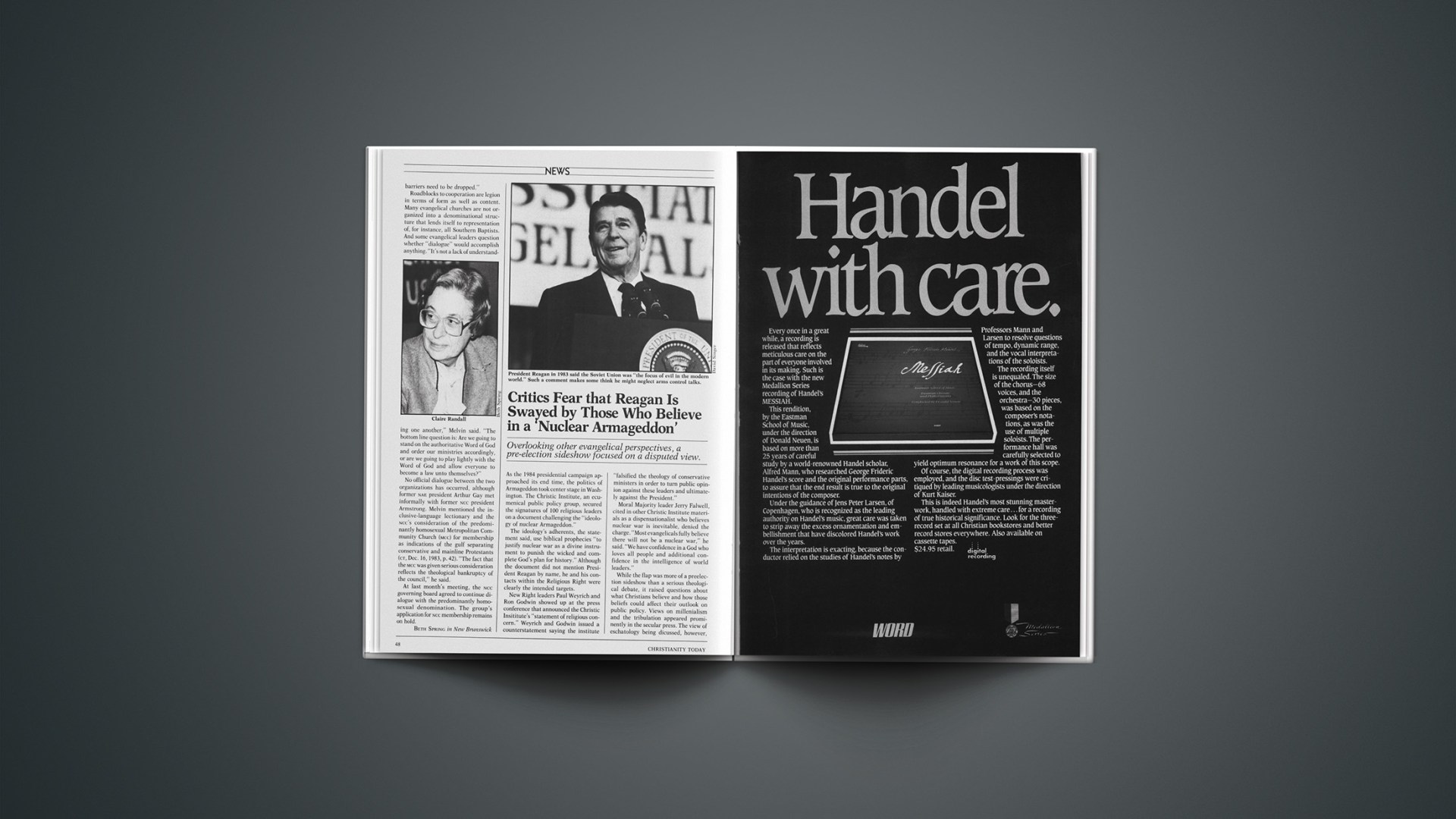
Critics Fear that Reagan Is Swayed by Those Who Believe in a Nuclear Armageddon’

Overlooking other evangelical perspectives, a pre-election sideshow focused on a disputed view.

As the 1984 presidential campaign approached its end time, the politics of Armageddon took center stage in Washington. The Christie Institute, an ecumenical public policy group, secured the signatures of 100 religious leaders on a document challenging the “ideology of nuclear Armageddon.”

The ideology’s adherents, the statement said, use biblical prophecies “to justify nuclear war as a divine instrument to punish the wicked and complete God’s plan for history.” Although the document did not mention President Reagan by name, he and his contacts within the Religious Right were clearly the intended targets.

New Right leaders Paul Weyrich and Ron Godwin showed up at the press conference that announced the Christic Insititute’s “statement of religious concern.” Weyrich and Godwin issued a counterstatement saying the institute “falsified the theology of conservative ministers in order to turn public opinion against these leaders and ultimately against the President.”

Moral Majority leader Jerry Falwell, cited in other Christic Institute materials as a dispensationalist who believes nuclear war is inevitable, denied the charge. “Most evangelicals fully believe there will not be a nuclear war,” he said. “We have confidence in a God who loves all people and additional confidence in the intelligence of world leaders.”

While the flap was more of a preelection sideshow than a serious theological debate, it raised questions about what Christians believe and how those beliefs could affect their outlook on public policy. Views on millenialism and the tribulation appeared prominently in the secular press. The view of eschatology being dicussed, however, was confined to a version popularized by Hal Lindsey in his best-selling book, The Late Great Planet Earth (Bantam). Lindsey applies specific Old Testament prophecy and the symbols of the Book of Revelation to contemporary events.

Whether Reagan realizes that he is espousing dispensational premillenialism is debatable. The President is inclined to use the word “Armageddon” in a generic sense, said J. Douglas Holladay, a staff member in the White House office of public liaison. “He means the end of time, the final dénouement of history.” In his second debate with Democratic presidental nominee Walter Mondale, Holladay pointed out, the President said he does not know if “Armageddon is a thousand years away or day after tomorrow.”

Christic Institute research director Andrew G. Lang said Reagan’s theological perspective is not what worries many church leaders. Rather, he said, their concern centers on the way believers in a “nuclear Armageddon” might seek to shape the President’s world view and policy decisions regarding war and peace. “We are concerned about the religious sanction offered by dispensationalism for the belief that conflict with the Soviet Union is a historic inevitability,” Lang said.

Reagan’s characterization last year of the Soviet Union as “the focus of evil in the modern world” and his comments about the disintegration of communism heighten Lang’s concern that arms control talks with the Soviets may be neglected. In a report, Lang called nuclear dispensationalism “a particularly violent mixture of religious intolerance and anticommunist ideology.” The prospect of victory for the forces of good, defeat for the evil side, and a “rapture” removing all Christians from earth before the troubles begin in earnest appeals to people who fear nuclear war, Lang said. “If I were a right-wing anti-Communist, dispensationalism is the religion I’d shop around for. It permits people to avoid dealing responsibly with the Soviet Union.”

In its research, the Christic Institute overlooked other evangelical perspectives on the end times. Serious Bible scholars reject Lindsey’s fanciful depiction of how today’s world events mesh with biblical prophecies. In a book entitled There’s a New World Coming (Bantam), Lindsey writes, “According to the prophet Daniel, the Russians will sweep down to join the Arabs in an attack on Israel and will then continue right through Israel to Egypt and take it over.” He deals with the prospect of nuclear war almost flippantly, saying, “Nuclear weapons will surely be used in any warfare in the future. The major powers of the world aren’t stockpiling nuclear weapons for nothing, and even an effective arms control agreement between nations wouldn’t do away with existing weapons.”

As a result, Lindsey is not taken seriously even at his alma mater, Dallas Theological Seminary. “[Lindsey] goes beyond our teaching,” said seminary president John Walvoord, Sr., adding that there is no way to prove that Scripture describes a nuclear exchange. “The end-time war is a conventional war. I disagree with him that the Bible teaches nuclear war.”

Lindsey is not the first to draw apocalyptic conclusions from global events. CHRISTIANITY TODAY advisory editor Kenneth Kantzer pointed out that when Napoleon ruled France, some Christians “had it all plotted out” that Napoleon would reconstruct the Holy Roman Empire and usher in the Second Coming. Between the two world wars, the same concern arose about Germany. “One generation’s set of specifics looks pretty ridiculous to the next,” Kantzer said. “Lindsey tries to map it all out in great detail. A lot of us think it’s not very safe to do that.”

Evangelicals largely agree that a time of terrible destruction throughout the planet will precede Christ’s return. The sequence of events leading to Christ’s return, and what God chooses to do with believers, are points of disagreement among Christians.

Kantzer said the big mistake of the doomsday proponents is to assume that the forces of good and evil in the Bible necessarily refer to the United States and the Soviet Union. “The real question is: Do we still work toward peace? I don’t know anyone who would say no.”

Armageddon refers to a site in Israel where the writer of the Book of Revelation envisioned a great, final battle. Lindsey says the battle will intensify when the Soviet Union invades Israel from the north. To reach that conclusion, he relies on proper names from the Book of Ezekiel, which he translates into “Russia,” “Moscow,” and another Soviet city. However, numerous Bible scholars—including those at Falwell’s Liberty Baptist College—dispute Lindsey’s linguistics.

Elmer Jantz, writing in the Liberty Bible Commentary (Thomas Nelson), says no linguistic analysis yields the result Lindsey proposes. Theologian Carl F. H. Henry says biblical prophecy “certainly applies to some historical period. But the problem is, when someone says we’ve moved into the last several years, then you go counter to Christ’s own warning against setting the day or the hour.”

Walvoord said he believes the signers of the Christic Institute statement misunderstand Reagan as well as dispensationalism. “To accuse Reagan of nuclear dispensationalism is totally unjustified,” he said. “There is no such thing, and Reagan has no theological moorings to that sort of teaching.

“Dispensationalism has to do with the stewardship of life and has nothing to do with nuclear war,” he said. “A premillenialist has just as much obligation to work for arms control as anyone else. I believe in a pretribulational rapture, but certainly we should work for world peace in every possible way.”

Eerdmans Takes Over Publication Of Controversial Intervarsity Book

The William B. Eerdmans Publishing Company has agreed to take over publication of the book Brave New People. Written by medical biologist D. Gareth Jones, the book originally was published in the United States by InterVarsity Press (IVP).

In September, IVP halted further sales because of a wave of protest from many who perceived the book as being proabortion (CT, Sept. 21, 1984, p. 63).

“We feel the book was simplistically treated [by those who opposed it],” said Jon Pott, Eerdmans’s editor in chief. “What happened was a blow not only to this book, but to thoughtful evangelical Christianity.”

Pott said he and IVP editor James Sire considered the possibility of Eerdmans taking over publication of the book independently. Pott said Eerdmans’s readers are likely to accept a book like Brave New People. “People sort of expect us to be on the progressive edge of evangelicalism,” he said.

Terms of the agreement are still being worked out between Eerdmans and IVP in the United Kingdom, which owns the rights to Brave New People and continues to sell it overseas. Pott said he did not know if the Eerdmans edition would contain any changes.

Dominion over the Airwaves

Consider the picture of the satellite and what John the “Revelator” envisioned when he wrote:

“And I saw another Angel fly in the midst of heaven, having the everlasting Gospel to preach unto them that dwell on the earth, and to every nation, kindred, and tongue, and people.”

(Revelation 14:6)

DBS—“SATELLITE TO HOME” TELEVISION

DBS (Direct Broadcast Satellites) is a new technology that will play a primary role in the fulfillment of the Great Commission to preach the Gospel directly to people around the Earth from the “midst of Heaven”, bypassing local broadcast and cable systems.

Dominion Video Satellite, a Christian controlled corporation, is one of a handful of companies to receive a license from the U.S. Government for this type of service to the entire Nation—a unique gift that God has given to His people.

Because of their high power and unique orbital slots, Dominion’s Direct Broadcast Satellites, which are now under construction, will be capable of transmitting up to eight separate channels of television programs directly to a small, inexpensive 24-inch dish shaped antenna placed on any home, business or apartment.

DOMINION—A NETWORK FOR CHRISTIANS BY CHRISTIANS

Dominion DBS is felt by many to be the platform God is building to provide His people with a cost effective television and radio network capable of reaching nearly any home on the North American continent without the expense and control associated with secular television stations and cable systems.

DBS will usher in a new era in Christian television and radio, and serve a need that has not been met through the secular broadcast industry.

UNITY AND SUPPORT FROM FAMILY AND RELIGIOUS BROADCASTERS

CBN, PTL and the new ACTS NETWORK programming will be featured on Dominion DBS channels.

An “all religious” channel will carry dozens of prominent Evangelists and Teachers such as Robert Schuller, Kenneth Copeland, Oral Roberts, Jerry Falwell, John Osteen, David Mainse, Mother Angelica, Charles Stanley, John Giminez, Jimmy Swaggart, Marilyn Hickey, Fred Price, and many, many others who will provide regular programming throughout the day, including prime time.

NEWS AND EDUCATIONAL CHANNELS

A national and international News Channel is planned. Christian universities will be invited to provide live satellite to home credit and non credit educational courses.

VIDEOTEXT AND RADIO SERVICES

Stereo radio, weather service, stock and commodity market quotations, personal computer programming, video games, shopping by video catalog and much, much more will be available on a Dominion DBS home receiving system.

BECOME A DOMINION “CHARTER HOME AFFILIATE”

Those who place their orders early for a Dominion DBS home receiving system will become “Charter Home Affiliates” and be guaranteed installation in time for special inaugural broadcasts of the Dominion Network.

During the advance sales period, special “early bird” pricing on sales and installation will prevail. The total cost of a complete DBS home receiving system, produced and installed by a well known consumer electronics firm, is about what you would expect to pay for a quality color television console.

Special recognition and memorabilia to accompany the first satellite launch will be given, identifying “Charter Home Affiliates” as “pioneers” with Dominion in helping to establish this innovative and much needed, God centered satellite to home network.

Only a limited number of homes nationwide will be guaranteed installation of DBS home receiving equipment in time to receive inaugural telecasts.

Send in the RESPONSE CARD or write DOMINION NETWORK, 29201 Telegraph Road, Suite L-8, Southfield, Michigan 48034 for more information on how you can become a Dominion DBS “Charter Home Affiliate.”

The ecumenical body elected two leaders with conservative theological roots and hopes to interact with more evangelicals.

The two top leaders of the National Council of Churches (NCC) voiced a common theme of spiritual renewal at last month’s meeting of the council’s governing board. Philip R. Cousin, a bishop in the African Methodist Episcopal Church, was elected as NCC president. He said he wants to see the ecumenical organizaton recapture a “fire and fervor” that has ebbed over the years.

That will happen only if mainline Protestants find a common theological foundation for their activities, the NCC’s new general secretary suggested. “The quality of all our work and of all our life together in the ecumenical movement depends first, last, and always on our relationship to God in Christ and to one another in Christ,” said Arie R. Brouwer. Former general secretary of the Reformed Church in America and former deputy general secretary of the World Council of Churches, Brouwer was elected to replace retiring NCC general secretary Claire Randall.

An emphasis on becoming a “community of communions”—rather than a cooperative agency with a political agenda—pervaded the meeting in New Brunswick, New Jersey. That emphasis was evident in a report on “future mission and resources” that calls the council to be Christ-centered, responsible to its member churches, committed to the poor, and cooperative with Christians outside the NCC. The council’s 266-member governing board, made up of representatives from its 31 member denominations, approved the report.

The evaluation was under way before criticisms of the NCC reached their peak early last year, but the report addresses some of the structural problems raised by critics. In 1983, Reader’s Digest magazine and CBS’s “60 Minutes” featured reports about church members objecting to NCC support for leftist causes abroad. In addition, an independent United Methodist newspaper critiqued the council, recommending more accountability to member denominations and a larger role for smaller, more conservative members. James Wall, editor of the Christian Century, joined the chorus, saying liberal church leaders should stop alienating rank-and-file church members who have no use for radical Third World politics.

Brouwer said it has become “fashionable to trash the NCC,” and he is determined to extricate the council from that position. He and the NCC’s governing board anticipate that new leadership, reorganization, and increased contact with Roman Catholics and conservative evangelicals will help restore the council to a position of leadership and credibility in American church life.

In his first speech as NCC general secretary, Brouwer noted that his background is not in the liberal, mainline tradition. “I belong to that generation of midwestern-evangelical-Reformed-pietist patriots for whom the pledge of allegiance to the flag was a nearly sacred part of our daily school experience.”

Today, Brouwer is wary of labels, but he said, “I would clearly call myself evangelical. I would not use the word ‘pietist’ about myself today. I am not a social activist, but I am clearly socially active.” He said his view of Scripture conforms to the Belgic Confession, which says the Bible is the “infallible rule of faith and life.”

Like Brouwer, Cousin also emerges from a tradition of theological conservatism. He was elected to a full two-year term as NCC president. Last year he completed the unexpired term of former NCC president James Armstrong, who resigned his post (CT, Dec. 16, 1983, p. 46).

In addition to electing leaders with conservative roots, the governing board approved a report that is expected to give the board greater control over the NCC’s autonomous program units. The program units have been accused of pursuing political goals with scant accountability to the council or its member churches. The report also gives smaller and often more conservative denominations more influence within the governing board.

A variety of Orthodox denominations—among the most theologically conservative NCC members—welcome the reorganization. However, critics of the NCC doubt whether the changes will make much difference in what the council does. Diane Knippers, program director for the Institute on Religion and Democracy (IRD), said the NCC reorganization will alter the way in which decisions are made but may not change the substance of those decisions.

IRD, an advocacy and research group made up of conservative mainline Protestants, has spoken out against instances of a leftward tilt in the NCC’s programs and policies. NCC spokesmen defend their stance by saying the American church has a prophetic calling to hold the U.S. government accountable to the demands of the gospel. It is not as important, they say, to criticize excesses of the left in other nations.

Knippers questioned this reasoning: “Increasingly, people are realizing that the whole world listens to what our churches say. Especially in the Third World, where nations are forming their own identities, what our churches say about the democratic experiment versus totalitarianism makes a real difference. To say democracy has all sorts of problems without putting it in context is very damaging.”

Knippers said the council’s intent to give smaller bodies a higher profile is a positive step, but it does not address the real problem of representation in the NCC. Council delegates from larger denominations “do not begin to represent” the lay people in their congregations, she said.

Some governing board members said they hope the council will evolve into an open forum, similar to the United Nations. “If it were to do so, its thrust would not be toward reinforcing its own biases, but toward really reaching out [to others],” said Vladimir Berzonsky, a governing board member from the Orthodox Church in America.

That goal is sometimes thwarted by the actions of NCC program units. What comes out of the program units puts the NCC in the headlines, shaping its public image. A recent example is the inclusive-language lectionary, a collection of Scripture readings altered to eliminate sexual bias, including masculine references to God.

Initiatives such as the lectionary stand in the way of NCC cooperation with evangelicals, but council leaders are seeking ways to bridge the gap. The centerpiece of their outreach to other Christians is a proposed all-inclusive “gathering of Christians” planned for the early 1990s. Whether evangelicals outside the NCC will participate is open to question. Without commenting specifically on the proposed gathering, National Association of Evangelicals (NAE) executive director Billy A. Melvin said, “We are not going to confuse our constituency by involving ourselves in anything that would give the impression there are not sharp distinctions between the NCC and us.”

However, NCC overtures to the evangelical community appear to be on the increase. Robert Neff, the NCC’s second vice-president, said an NAE official was invited to address the NCC governing board within the past two years, but declined. “NAE sees the NCC as anathema,” Neff said. “I would hope it would reassess the possibility of conversation. The day has to come when those barriers need to be dropped.”

Roadblocks to cooperation are legion in terms of form as well as content. Many evangelical churches are not organized into a denominational structure that lends itself to representation of, for instance, all Southern Baptists. And some evangelical leaders question whether “dialogue” would accomplish anything. “It’s not a lack of understanding one another,” Melvin said. “The bottom line question is: Are we going to stand on the authoritative Word of God and order our ministries accordingly, or are we going to play lightly with the Word of God and allow everyone to become a law unto themselves?”

No official dialogue between the two organizations has occurred, although former NAE president Arthur Gay met informally with former NCC president Armstrong. Melvin mentioned the inclusive-language lectionary and the NCC’s consideration of the predominantly homosexual Metropolitan Community Church (MCC) for membership as indications of the gulf separating conservative and mainline Protestants (CT, Dec. 16, 1983, p. 42). “The fact that the MCC was given serious consideration reflects the theological bankruptcy of the council,” he said.

At last month’s meeting, the NCC governing board agreed to continue dialogue with the predominantly homosexual denomination. The group’s application for NCC membership remains on hold.

BETH SPRINGin New Brunswick

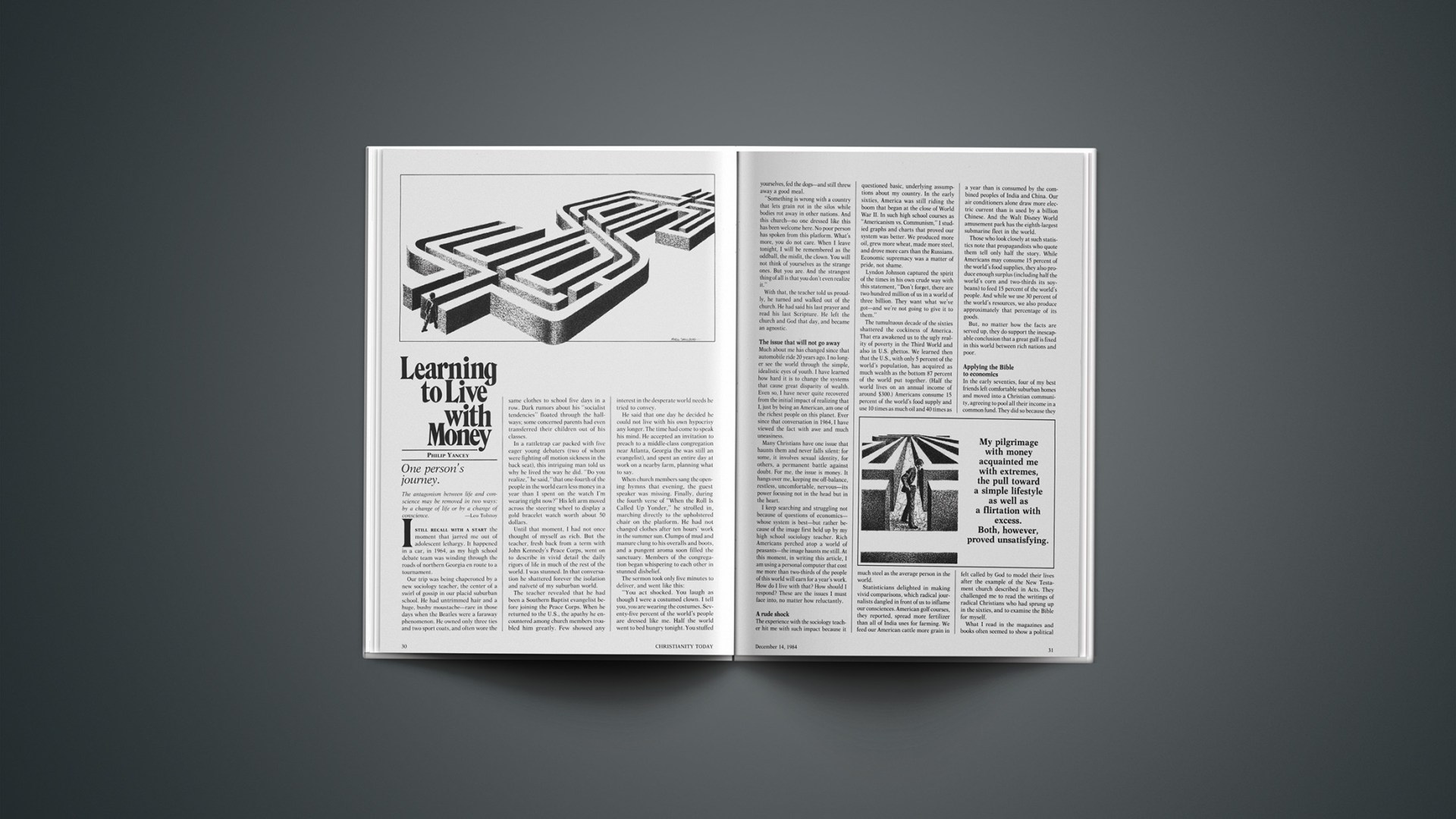
Learning to Live with Money: One Person’s Journey

The antagonism between life and conscience may be removed in two ways: by a change of life or by a change of conscience.

—Leo Tolstoy

I still recall with a start the moment that jarred me out of adolescent lethargy. It happened in a car, in 1964, as my high school debate team was winding through the roads of northern Georgia en route to a tournament.

Our trip was being chaperoned by a new sociology teacher, the center of a swirl of gossip in our placid suburban school. He had untrimmed hair and a huge, bushy moustache—rare in those days when the Beatles were a faraway phenomenon. He owned only three ties and two sport coats, and often wore the same clothes to school five days in a row. Dark rumors about his “socialist tendencies” floated through the hallways; some concerned parents had even transferred their children out of his classes.

In a rattletrap car packed with five eager young debaters (two of whom were fighting off motion sickness in the back seat), this intriguing man told us why he lived the way he did. “Do you realize,” he said, “that one-fourth of the people in the world earn less money in a year than I spent on the watch I’m wearing right now?” His left arm moved across the steering wheel to display a gold bracelet watch worth about 50 dollars.

Until that moment, I had not once thought of myself as rich. But the teacher, fresh back from a term with John Kennedy’s Peace Corps, went on to describe in vivid detail the daily rigors of life in much of the rest of the world. I was stunned. In that conversation he shattered forever the isolation and naïveté of my suburban world.

The teacher revealed that he had been a Southern Baptist evangelist before joining the Peace Corps. When he returned to the U.S., the apathy he encountered among church members troubled him greatly. Few showed any interest in the desperate world needs he tried to convey.

He said that one day he decided he could not live with his own hypocrisy any longer. The time had come to speak his mind. He accepted an invitation to preach to a middle-class congregation near Atlanta, Georgia (he was still an evangelist), and spent an entire day at work on a nearby farm, planning what to say.

When church members sang the opening hymns that evening, the guest speaker was missing. Finally, during the fourth verse of “When the Roll Is Called Up Yonder,” he strolled in, marching directly to the upholstered chair on the platform. He had not changed clothes after ten hours’ work in the summer sun. Clumps of mud and manure clung to his overalls and boots, and a pungent aroma soon filled the sanctuary. Members of the congregation began whispering to each other in stunned disbelief.

The sermon took only five minutes to deliver, and went like this:

“You act shocked. You laugh as though I were a costumed clown. I tell you, you are wearing the costumes. Seventy-five percent of the world’s people are dressed like me. Half the world went to bed hungry tonight. You stuffed yourselves, fed the dogs—and still threw away a good meal.

“Something is wrong with a country that lets grain rot in the silos while bodies rot away in other nations. And this church—no one dressed like this has been welcome here. No poor person has spoken from this platform. What’s more, you do not care. When I leave tonight, I will be remembered as the oddball, the misfit, the clown. You will not think of yourselves as the strange ones. But you are. And the strangest thing of all is that you don’t even realize it.”

With that, the teacher told us proudly, he turned and walked out of the church. He had said his last prayer and read his last Scripture. He left the church and God that day, and became an agnostic.

The Issue That Will Not Go Away

Much about me has changed since that automobile ride 20 years ago. I no longer see the world through the simple, idealistic eyes of youth. I have learned how hard it is to change the systems that cause great disparity of wealth. Even so, I have never quite recovered from the initial impact of realizing that I, just by being an American, am one of the richest people on this planet. Ever since that conversation in 1964, I have viewed the fact with awe and much uneasiness.

Many Christians have one issue that haunts them and never falls silent: for some, it involves sexual identity, for others, a permanent battle against doubt. For me, the issue is money. It hangs over me, keeping me off-balance, restless, uncomfortable, nervous—its power focusing not in the head but in the heart.

I keep searching and struggling not because of questions of economics—whose system is best—but rather because of the image first held up by my high school sociology teacher. Rich Americans perched atop a world of peasants—the image haunts me still. At this moment, in writing this article, I am using a personal computer that cost me more than two-thirds of the people of this world will earn for a year’s work. How do I live with that? How should I respond? These are the issues I must face into, no matter how reluctantly.

A Rude Shock

The experience with the sociology teacher hit me with such impact because it questioned basic, underlying assumptions about my country. In the early sixties, America was still riding the boom that began at the close of World War II. In such high school courses as “Americanism vs. Communism,” I studied graphs and charts that proved our system was better. We produced more oil, grew more wheat, made more steel, and drove more cars than the Russians. Economic supremacy was a matter of pride, not shame.

Lyndon Johnson captured the spirit of the times in his own crude way with this statement, “Don’t forget, there are two hundred million of us in a world of three billion. They want what we’ve got—and we’re not going to give it to them.”

The tumultuous decade of the sixties shattered the cockiness of America. That era awakened us to the ugly reality of poverty in the Third World and also in U.S. ghettos. We learned then that the U.S., with only 5 percent of the world’s population, has acquired as much wealth as the bottom 87 percent of the world put together. (Half the world lives on an annual income of around $300.) Americans consume 15 percent of the world’s food supply and use 10 times as much oil and 40 times as much steel as the average person in the world.

Statisticians delighted in making vivid comparisons, which radical journalists dangled in front of us to inflame our consciences. American golf courses, they reported, spread more fertilizer than all of India uses for farming. We feed our American cattle more grain in a year than is consumed by the combined peoples of India and China. Our air conditioners alone draw more electric current than is used by a billion Chinese. And the Walt Disney World amusement park has the eighth-largest submarine fleet in the world.

Those who look closely at such statistics note that propagandists who quote them tell only half the story. While Americans may consume 15 percent of the world’s food supplies, they also produce enough surplus (including half the world’s corn and two-thirds its soybeans) to feed 15 percent of the world’s people. And while we use 30 percent of the world’s resources, we also produce approximately that percentage of its goods.

But, no matter how the facts are served up, they do support the inescapable conclusion that a great gulf is fixed in this world between rich nations and poor.

Applying The Bible To Economics

In the early seventies, four of my best friends left comfortable suburban homes and moved into a Christian community, agreeing to pool all their income in a common fund. They did so because they felt called by God to model their lives after the example of the New Testament church described in Acts. They challenged me to read the writings of radical Christians who had sprung up in the sixties, and to examine the Bible for myself.

What I read in the magazines and books often seemed to show a political bias, with facts distorted and passages from the prophets recklessly applied. But I could not so easily dodge what the Bible said about wealth and poverty. I discovered that over 450 separate biblical passages deal with the subject of money. The issue forms the second most dominant motif in the entire Bible, exceeded in emphasis only by the subject of idolatry.

The Old Testament, while not condemning wealth, conveyed God’s passionate concern for the poor. I found hidden among the laws given to Moses many creative provisions that limited property rights and protected the poor. Such prophets as Hosea and Amos were more blatant. Addressing a prosperous Israel, they scathingly denounced the disparity between rich and poor.

The Old Testament emphasis can be summarized in one trenchant passage, Jeremiah 22:16. There, God comments on the reign of King Jehoahaz of Judah: “He defended the cause of the poor and needy, and so all went well. Is that not what it means to know me?” (NIV).

Turning to the New Testament, I found an even stronger emphasis on money. Jesus spoke more often about money than about heaven and hell, sexual immorality, or violence. Nearly one-sixth of his recorded statements concern the subject. His parables present wealth as a great temptation and danger, a potential obstacle to a proper relationship with God.

The weight of biblical emphasis on wealth and poverty took me by surprise, for I had rarely heard a sermon on the topic. At first it seemed like a trendy new issue, a vagary of the times. But as I read church history I learned that the church has traditionally involved itself in money issues. The medieval church actively entered into economic policies, setting “just” prices and legislating against the excesses of greed. (For example, Bishop John V. Taylor points out that lending money for interest was forbidden to clergy by the Council of Arles in 314 and that of Nicea in 325. Councils at Carthage in 348 and Aix in 789 objected even to laymen charging interest.) We in America, nurtured in a free market economy, stand as an exception to the pattern of church history.

An Attempt To Respond

My survey of the Bible’s perspective on wealth and poverty, combined with the impact of the rhetoric of the sixties, convinced me of the need to make sweeping personal changes. The Bible and also wise Christians through the ages were stressing the dangers of materialism. Shouldn’t I make a determined effort to resist those dangers?

Like many young Christians of that generation, I consciously strove to simplify my lifestyle. I scorned such automobile luxuries as air conditioning and whitewall tires. I went to extreme lengths to get the very best possible price on any item, and was known among friends for my books of discount coupons. At one point I proudly calculated the total value of furniture in our three-bedroom house at about $500.

One question obsessed me: “Is there a lifestyle level above which a Christian should not live?” To my disappointment, however, I found that no amount of striving helped relieve the restlessness and guilt I felt. No matter where I drew the line, it was never absolute. I lived in a mobile home for three years—but half the world lives in mud huts and shacks of cardboard or corrugated iron. My stripped-down automobile? A mockery of simple lifestyle, when nine of ten people in the world have no automobile.

The notorious French Queen Marie Antoinette, an actress by training, built a perfect reproduction of a French peasant village on the grounds of the magnificent palace of Versailles. For diversion, she enjoyed visiting that village and playing at peasant life. I cannot help thinking that, in a similar way, we Americans, even the most dedicated among us, merely play at simple lifestyle. We may spend less money than before, but we hardly approach the level of world-scale poverty. We still learn to read, and go to doctors, and eat nutritiously—luxuries unavailable to much of the world.

There are some 230 million of us in America making an average of $7,000 a year; China alone has 200 million peasants who earn less than $50 a year. The haunting illustration of my high school teacher’s gold bracelet watch still holds true.

Days Of Confusion

During my experiments with “simple lifestyle,” I began to see that biblical principles of justice and equality have to be worked out in a real world of economics. And in that world, does reduced consumption indeed help the world’s problems? What would happen if all American Christians, out of concern for the world’s inequities, altered their consumption patterns? We saw an indication in the oil crisis of the seventies: after enduring justified criticism for our voracious oil appetite, we cut imports dramatically. In the process we almost wrecked the economies of Nigeria and Mexico.

We could cut coffee drinking in half, but economies in Brazil and Kenya and much of Latin America would go into a tailspin. (I wonder if radical Christians appreciate the irony of their current campaigns on behalf of the Sandinistas in Nicaragua. Radicals have long criticized North Americans for “economic imperialism” that entices developing countries to devote precious land to money crops that do not feed the local population. Not so long ago radical Christians were urging us to cut back our appetites for coffee and bananas. But now those who oppose U.S. policy come to my church selling foil bags of high-priced coffee beans. The ultimate protest against U.S. policies, they announce, is to buy Nicaraguan coffee, an exploitative money crop!)

Capitalism attracts virulent criticism. But the more I studied it the more it seemed to me that, on strictly pragmatic grounds, the capitalist system has fared pretty well. In his striking book, In Defense of Decadent Europe, Raymond Aron concludes that “In terms of productivity, technical innovation, living standards, scientific progress, and human freedom, it is the West, the United States and Europe together, which took the lead during the course of the last thirty years.” He goes on to document the failure of more coercive systems such as Marxism. In the Soviet Union, for example, only 1 percent of the land is given over to cultivation by private plots; all else is state run. Yet that paltry 1 percent produces 25 to 30 percent of the nation’s total agricultural production!

The American economy has major imperfections, of course: the planned obsolescence it builds into products, its waste, its abuse of the environment, its obsession with style over substance. But somehow the freedom built into our system, which by definition must tolerate those imperfections, produces better results than other, more idealistic systems. Authors such as Raymond Aron and Michael Novak (The Spirit of Democratic Capitalism) make that case convincingly. And the developing countries that have performed best in recent years—South Korea, Taiwan, Singapore, Hong Kong—have done so by following the classical capitalist model.

In some cases, Marxist countries, by using their full arsenal of state controls, have had quick success in raising the incomes of the lower classes and distributing wealth more equitably. The quickest method of all is to exterminate the upper class and seize their property. But does violence and hatred based on class have any more moral justification than violence and hatred based on race? Our century harshly condemns the one (Hitler’s anti-Semitism, colonialist racism) but, tragically, seems more tolerant of the other (the mass purges and enforced starvation of the peoples of Russia, China, and Cambodia).

Over time, as I pondered these anomalies and learned more about how economic systems work, I sensed a recurring flaw in the radical protests against capitalism. Their criticisms are well substantiated: capitalism does promote inequities, greed, oppression, and poverty. But the idealists have yet to demonstrate a system that does not duplicate those sins and also add in a few others.

Flirting With Excess

My pilgrimage with money first led me down roads that stressed its dangers and called for a radically simpler lifestyle. I tried those roads and found them unsatisfying. Although I gained great admiration for the commitment of Christians who sought the “right Christian lifestyle,” I never found a solution to my restlessness about money. Mainly, I found complexity, ambiguity, and personal confusion.

However, I have also explored the other side of the money question. After futile attempts to find a balance in lifestyle, I encountered very different personal circumstances: I got an economic windfall. It came after several years of struggle when my free-lance writing started producing extra income at a steady rate, supplementing my full-time salary. Suddenly, for the first time, I was receiving more money than I really needed. I had not found satisfaction in deliberate attempts to live simply, so I spent a few years reveling in my new circumstances.

The richest man of his time, John D. Rockefeller, was once asked how much money is enough. He responded with a perfect definition of greed: “Just a little bit more.” That driving spirit of greed took me by surprise; I had thought myself more resistant.

I devoured all the advertisements on ways to use my money. Some promised me free lines of credit. Others described tax shelters in the Bahamas and elite investment opportunities. From all sides I heard the same advice: Maximize your earnings! Put aside for your future! Try stocks, options trading, Keogh plans, zero-coupon bonds, whole-life insurance! Christian financial counselors echoed their secular counterparts, adding words like “stewardship” to the vocabulary of accumulation.

I found all these financial matters exhilarating, at least for awhile. I scoured financial journals for the best deals to guarantee my future. I followed the prime rate like some people follow football scores.

After a couple of years, however, doubts began to set in. Although I had more “disposable income” than ever, I was surely no happier. Paradoxically, instead of pleasure the surplus was bringing me mostly misery.

Books on investment strategy and tax avoidance tips had supplanted my reading interests in wildlife and classical music. I felt a ceaseless tug to acquire: newer clothes and a bigger house, when those I owned were perfectly adequate; a new car, even though my old one ran fine; a string of investments to accumulate a good nest egg—but for what? Money had become a black hole: the more I had, the more I wanted. I experienced an ironic form of bondage very similar to what I had sensed in my search for the perfect simple lifestyle.

The pattern held true as I looked at my friends with excess money. In most cases, a large home and fine furniture had made them less hospitable, not more. Our conversations, which had once ranged over personal and social concerns, kept drifting to comparisons of clothing labels, gourmet restaurants, and video recorders. Affluence had a strangely distancing effect. It created barriers.

The Poverty Of Affluence

It dawned on me that a deep irony was at work in me and in others in society. A recent book, The Poverty of Affluence, documents this irony. In it, author Paul Wachtel explores the full cycle of the disillusionment that comes with affluence. He cites many indications that a person’s sense of well-being does not increase along with material possessions and comforts. In fact, surveys in the U.S. have shown that a higher percentage of those with grammar-school educations and poverty-level incomes report themselves very satisfied with life than do college graduates with high incomes.

It seems that millions of us spend our lives frantically chasing what ultimately proves unsatisfying. As the author of Ecclesiastes concluded long ago, money alone cannot satisfy the deepest human longings.

We live in the eighties now, not the sixties, and our view of money has undergone a transformation in the last 20 years. I, for one, have come to look back on that turbulent earlier decade with a sense of loss. At least then we searched our consciences and questioned the vast inequities in the world. Now, on the rebound from a recession, it seems we are back to reveling in our wealth. College students choose careers on the basis of income potential, not society’s needs. The American dollar is soaring, Third World countries are held hostage to us by gargantuan debts, and we are nearly back to LBJ’s attitude of the early sixties when he said: “They want what we’ve got—and we’re not going to give it to them.”

Coming To Terms

My pilgrimage with money acquainted me with extremes, the pull toward a simple lifestyle as well as a flirtation with excess. Both, however, proved unsatisfying. Never was I able to quiet the voice of discomfort I felt in my soul about money. I had looked for The Answer to live by, and had come away empty.

Along the way, however, I did learn about the inherent power of money—an irrational, almost magical power. In ancient days, coinage had the face of the king stamped on it, and its bearers believed that money transferred some of the power of the king to themselves. They were right in more than mere symbolism. Money can make a table mysteriously appear in a crowded restaurant, can allow an insignificant and ugly man to purchase companionship and sex with a beautiful woman, can propel a tiny nation from obscurity to world prominence.

I came to realize that much of my personal struggle with money had been misdirected simply because I failed to recognize its nature. I had looked for a solution, an absolute system I could put faith in to resolve the money problem for the world and for me. But there is no solution for money, just as there is no “solution” for any other temptation of Satan—not until the end of this age. The battle is fought not in halls of Congress or in guerrilla bands roaming Latin America. The true battle with money is a spiritual battle fought in my heart.

In its effect on me, money works much like the temptations of lust and pride. It holds me in a pythonic grip. It attracts me to fantasies it can never fulfill. It produces unexplainable, irrational behavior that later causes me puzzlement and shame. And, like lust and pride, money presents an arena of personal struggle that I will never “get over.” It is a force with a personality. It is, in truth, a god, and Jesus called it that.

First Steps Toward Freedom

Once I recognized money for what the Scriptures say it is, a demanding god exacting a demanding worship, I realized a need to redirect my energies. No amount of human striving, whether toward intentional poverty or toward surplus, would gain me freedom; indeed, my obsession with money had already led to bondage in both circumstances. Mainly, I concluded, I need spiritual deliverance from money’s power.

“I know what it is to be in need and I know what it is to have plenty,” said the apostle Paul. “I have learned the secret of being content in any and every situation” (Phil. 4:12). He carried money lightly, using it to accomplish God’s work, but he showed no signs of bondage to it. Christian saints throughout the centuries have reflected a similar holy indifference to money. John Wesley, informed that his house had just burned down, had this reaction: “The Lord’s house burned. One less responsibility for me!”

I would be woefully dishonest if I pretended to anything like the spirit of freedom shown by the apostle and John Wesley. But I have felt the slight tremors of a gradual shift in personal direction. Formerly, I might have expressed my goal like this: “I want to find a lifestyle level that would free me from guilt.” Now, I would say, “Whatever my lifestyle level, I desire freedom from money’s spiritual bondage. Then, perhaps, I could more purely seek guidance on how my money should best be used.”

At the very least; a freedom from bondage should express itself in how I treat other people. Despite all our talk about democracy and equality, we Americans live in a class-ridden society. I find myself avoiding contact with the very rich. Instead, I use them as a compost heap for my guilt: “At least I’m not that bad!” Similarly, I avoid the very poor. I don’t want them to threaten my assumption that they must surely share some of the blame for their condition.

No view of money, no economic system has the power to heal such twisted views of humanity. Communism would have me hate the rich and love the poor (while, paradoxically, helping the poor become richer). Capitalism would have me love the rich and scorn or pity the poor. For healing I must seek the spirit of Jesus Christ, who fed the multitudes in the daytime and dined with the tax collectors and Pharisees at night. His statements about money applied with equal force to rich and poor, and his love showed no class distinction.

The call of Christ cuts across the distinctions between communism and capitalism and all other economic systems. As Jacques Ellul explains in Money and Power, these systems differ in technique alone. All of them share the goal of prosperity and view money as the solution to the world’s human needs. Wealth is a good worth striving for; a system’s effectiveness is judged by its impact on the gross national product. But the Bible presents money as one of the problems, a dangerous seduction away from God toward human solutions.

How Should I Then Live?

Recognizing the spiritual power of money offers a beginning point, but it does not cause the practical questions to vanish. I still face a multitude of lifestyle decisions each day. Can a committed Christian accumulate wealth? At what level should I live?

I know fine Christians who represent conflicting points of view on wealth and lifestyle. Some see America’s wealth as a sign of God’s blessing. Our faithfulness, honesty, and hard work, they say, find their reward in material blessing. They cite selective Old Testament references, especially those regarding Job, Solomon, and Abraham, whom God rewarded with material goods. Some of these wealthy Christians have expressed their faith by donating millions of dollars to further the outreach of the gospel.

Although the concept of prosperity as a sign of divine approval has some truth, it certainly cannot be applied in an absolute sense. Christians in Iran and the Soviet Union, for example, suffer impoverishment in direct proportion to their faithfulness to Christ. And I have yet to hear success theologians explain away the greatest windfall of wealth in the history of mankind: that realized by Muslim nations in the Middle East because of their fortuitous location over oceans of oil.

Radical Christians call for the opposite approach: embrace poverty, they urge, in order to resist materialism and identify with the poor and suffering. I have seen firsthand the personal devotion and sacrifice of many of these brothers and sisters. We need their prophetic voices in our day just as Israel needed the voices of Hosea and Amos in its day of prosperity. Perhaps only through an approach of equality and sharing will we be able to bear witness to Christ with integrity in the world that is beyond our borders.

And yet the radicals also lack a total solution. Personal commitment alone does not wipe out disease and purify water supplies. Africa’s drought calls for massive outside assistance: cargo planes and Land Rovers full of canned goods and IV solutions. The crumbling neighborhoods of our major cities need shops and health clinics and new apartment buildings and places of employment—in short, a major structural change involving a heavy commitment of capital. The best proven source for such structural change has, like it or not, come from enlightened capitalism. If you doubt that, read Raymond Aron or Michael Novak.

Does God Have An Economic System?

Both the capitalists and the radicals search the Bible for hints of a revealed economic system. From the hundreds of verses on the subject of money, they draw out specific guidelines that could be molded into a system and applied to modern society.

God did, in fact, design an economic system at a certain time in history: for the nation of Israelites. It protected personal property rights and made no prohibition against accumulating wealth. But it also contained built-in boundaries to protect the poor, to set a “statute of limitations” on debts, and to prevent abuse of people. The Old Testament laws made plain that people have a greater value than things.

In addition, God clearly stated whose side he was on. He constantly exhorted his people to care for widows and orphans. And every three years the abundant tithe normally given directly to God as an act of worship went instead to the poor, poignantly demonstrating that a gift to the poor was a gift to God himself.

The New Testament contains no such neatly packaged economic system. God’s grace was bursting out into a great missions outreach, and Jesus did nothing that would confine the gospel to one form of government or one kind of economic system.

Those who look to Jesus for practical advice on money come away baffled. He told a rich young ruler to give away all that he had, and yet Jesus himself accepted the largesse of wealthy women (Luke 8:1–4). He praised a widow for giving a few pennies to a religious institution, the synagogue, that he had previously blasted in the strongest possible language. He paid taxes, but to get the money he had to send his disciples fishing.

A few people approached Jesus outright on financial matters. One man, for example, asked his help in settling a family dispute over an inheritance. Jesus replied, “Man, who appointed me a judge or an arbiter between you?” Then he proceeded to tell the parable of a rich man who built bigger storage barns only to meet a sudden death. “Be on your guard against all kinds of greed; a man’s life does not consist in the abundance of his possessions,” he concluded (Luke 12:15, NIV).

Once the disciple Judas made a mathematical calculation, comparing the benefits of distributing money to the poor versus “wasting” it in the form of expensive perfume poured on Jesus’ feet. To his surprise, Jesus praised the woman for her costly act of worship.

Someone who seeks a “mathematical model” for an economic system finds little help in the example and teaching of Jesus. He tended to avoid specific, practical rules and instead recast the issues in terms of an individual’s crisis of choice. Whom do you serve, God or Mammon? You cannot serve both, he said. Systems focus on the allocation of money: who should get it and how much. In contrast, Jesus dealt with a deeper question: What is the ultimate effect of money on you?

On one essential point, systems from Right and Left fail alike, as Jacques Ellul spells out. Each proceeds under the false assumption that man is neutral or even good. Perhaps the benevolence of the rich will trickle down to the needy, say some. Perhaps enforced equality of wealth will produce substantial changes—the new socialist man—and eliminate greed, say others. Both assumptions are wrong. Every human solution flounders on the fallenness of man, a doctrine that the Bible assumes as a starting point.

Down Jackets And Melmac Dishes

If you have read this far hoping to find a “mathematical solution” to the problem of money, I am sorry to have to disappoint you. In examining the Bible, I have yet to find such a systematic solution. Its many words on the subject resist translation into an economic system. And, over time, I have come to see the wisdom of that approach.

Early in this article I described various stages in my own pilgrimage with money. I was searching desperately for a mathematical solution, from the Right or the Left, a solution that would silence the questions and give me peace. But there can be no truce with a god like money. No neat mathematical solution will relieve me of my Christian responsibility to confront it in all its many forms.

Can a Christian own a yacht? A Sunfish? A microwave oven? A down vest? A vacation home? How many shirts and suits? Should a Christian eat on Melmac or china? Use silver or stainless steel? We want guidelines, the more specific the better. “Who is my neighbor?” the expert in law demanded of Jesus. Exactly who? Please be specific. Tell me who to love, and when. Tell me just how selfish is too selfish, how rich is too rich.

But specific guidelines would devalue the real issues. Money is far more than a question of statistics; it is a god that bids us worship it. The poor are more than a problem of allocating resources. They stand as God’s constant challenge to my faith and love. Will I serve God or Mammon? God will never make that decision for me; it is mine alone.

No two of us will decide exactly alike. You will choose one level, and I another. The Bible does not call us to precisely the same answers, but only to the same questions.

The Battleground Today

Identifying money as a spiritual power does not in any way reduce the practical problems facing me. As a teenager I was shocked by an image of myself as a rich American living comfortably on the backs of a billion peasants. And the reality of that world, the arena in which we fight our battles with the god of money, presses in daily.

I will tell you which of the issues in our modern era loom most ominously before me. Each deserves an article in itself:

• In a media-shrunken globe that makes the whole world my neighbor, do I have a compelling moral responsibility for the welfare of Ethiopians and Angolans and Cambodians? And if so, how can I possibly respond in any meaningful way to such overwhelming human needs?

• Do I have a right to self-fulfillment when much of the world has no right to basic food and medicine? The values that give me greatest pleasure are values of beauty and quality. These express my self-identity, but they also cost money. How do I balance them against other values of justice and charity?

• How can I develop a love that applies to the poor as well as the rich? How can I even meet both groups in our class-segregated society?

• Can I avoid contamination in an economic system which, though effective, produces great injustice and often contradicts kingdom values? Can I live the good life and a good life simultaneously?

All these questions have, over time, translated into principles that I live by. Confrontation with money has had a profound effect on my lifestyle and on what I do with my money. I will not give details here, because that would run counter to my purpose in writing. I am not offering a mathematical solution to “the money problem.” I cannot solve the money problem for you, or for anyone else. I can merely understand its great power over me and commit myself to Christ in a battle against its incipient temptations.

The Ultimate Protest

Although the Bible usually speaks to broad principles rather than specific guidelines on money, it does present one action open to all of us. We can disarm the power of money, and we do that by giving it away.

For many years, my own giving merely concealed another form of bondage. How much should I give? Ten percent? More? Should I follow the graduated tithe advocated by Ron Sider? To whom should I give? Naturally I must find the charities that offer the best return, the most agape per dollar invested. And as a good steward I must not look for individual needs, but rather for organizations that have been approved by the IRS for tax deductibility.

That kind of uptight, calculated giving, I have since learned, is the opposite of what the Bible teaches. Even in the Old Testament, a tithe was less an act of self-denial than a joyous, even raucous celebration. (See the instructions on the annual tithe in Deuteronomy 14.) Virtually all financial sacrifice took place in the context of a great feast.

Paul mentions a hilarious or cheerful giver. The hilarity comes, I think, because the act of giving is at its core irrational. It destroys the aura of worth surrounding money. Instinctively, we hoard money in steel vaults and secret caches; giving flagrantly sets it free.

It made no sense for a widow to donate her last few pennies to a corrupt and crumbling institution in Jerusalem. But in that woman’s act Jesus saw a moving display of the proper spirit of money. It is best used when we give it away. A rich man earning a million dollars matters little; a poor person giving away her last pennies merits the disciples’ attention—and ours.

Gordon Cosby of the Church of the Savior in Washington, D.C., tells the story of a very poor widow in his church. Her income was barely adequate to feed and clothe her six children. One day, a church deacon came to Cosby with a report on the widow’s giving. Every week she had been faithfully placing four dollars into the offering plate. The deacon suggested that Cosby go to the widow and assure her that, although the church appreciated her sacrifice, perhaps she could put the money to other use for her family’s benefit.

Cosby followed the deacon’s advice, to his everlasting regret. When he informed the widow, she responded with great sadness. “You are trying to take away the last thing that gives me dignity and meaning,” she said. She had learned a key to giving, which she was clinging to at all costs.

The key is this: the main benefit of giving is in its effect on the giver. Yes, people in Africa and Lebanon and India need my financial help, as the fund-raising appeals urgently remind me. But in truth, my need to give is every bit as desperate as their need to receive.

The act of giving best reminds me of my place on earth. All of us live here by the goodness and grace of God—like the birds in the air and the flowers of the field, Jesus said. Those creations do not worry about future security and safety; neither should we. Not even Solomon, the wealthiest man of his time, could outshine a common lily. Giving offers me a way to express my faith and confidence that God will care for me just as he cares for the sparrow and lily.

The Final Word

Giving proves an effective antidote to the temptations of money idolatry because it brings to money the power of grace. And, in the final analysis, my long pilgrimage with money has brought me back to this single word: grace.

We live in a world that operates according to the rules of ungrace. In this world, you earn your way by possessing some quality others do not have. We rank people by nationality and by race (if you doubt that, examine the yearly immigration quotas by country). We also rank by intelligence, from kindergarten onward, with letter grades announcing the rating for all to see. We rank by natural ability, as the salary scales in professional sports clearly show. And we rank by looks, even to the extent of broadcasting female contestants’ measurements at beauty pageants.

In such a world ruled by ungrace, money offers the most convenient of all measurements. Do you wish to join an “exclusive” club? Merely produce enough money. Do you wish to appear well-bred, powerful, connected? Money gives you access to the clothes, home, and other accouterments you need to carry off such an image. Do you wish to run for political office? Again, money offers the quickest way to achieve your goals.

Society does not let us stop thinking about money. “Can you really afford to go another business day without the Wall Street Journal?” the television actor asks in a solicitous tone. Can we?

Will we somehow miss out on an important principle for success? Indeed, money is the primary force permitting ungrace to reign in the world. It gives us concrete standards of merit to use in rating ourselves and others. Our very wording betrays us: “How much is he/she worth?” we ask.

When grace enters into such a world, it may seem naïve, even foolish. Jesus’ statements on money to the rich man, to the widow, still seem shocking two thousand years later. But no other antidote can stand against the deadly power of money than pure and simple grace.

I had thought, when I began my pilgrimage, that the battle lines of money were clearly drawn: between rich and poor, between those who have and those who have not. Ultimately, I found that the amount of money—who has how much—is a mere skirmish in the real war. The real war takes place inside every one of us, rich or poor: the war between grace and ungrace. I now realize the territory that lies before me in a true pilgrimage with money.

First, I need grace to see my own sins. In our money-dominated society, that will require a process of constant self-examination. Money fuels pride. I easily convince myself I earned the money, I deserve it, and therefore I have a right to dispose of it as I wish. Grace cuts through the shell of pride, reminding me that everything in this life is on loan, each moment dependent on the goodness of God. And then, grace offers cleansing to replace obsessive guilt with calm forgiveness.

The word grace has spawned many English derivatives, among them gratitude. And I have learned it takes grace for me to experience gratitude. Too easily I want to replace gratitude with pride (I worked hard for what I have) or guilt (How can I feel grateful when others have so little?). Gratitude removes that sense of pride and self-dependence, and turns me to the proper source of blessing, God himself.

All my life I will need grace to live with the ambiguity of money issues I have mentioned in this article. We live in a fallen world, where no system will bring equity and justice, and only grace lets me live at peace in such a world. Peace? There is a vast difference between the spiritual peace that Christ gives (“not as the world gives”) and apathy. I must not fold my hands and sit quietly by. In remaining open to God’s Word, I will also need grace to make whatever financial sacrifices God calls for. He may someday ask for total dispossession of all that I own. Am I open to that? If not, then grace has not fully disarmed money’s power over me.

I will need grace to accept other Christians of different viewpoints. In my own pilgrimage, I have learned to steer away from extremism on both sides, from those who insist they have the solution, whether it consists in poverty or in wealth. But I dare not let disagreement with them affect my love. “If I give all I possess to the poor … but have not love, I gain nothing.”

And, I badly need grace to find the heart of God, for the Bible gives decisive proof that he has primary concern for the poor, the needy, the imprisoned, the hungry. How do I respond to them? The answer to that shows how I respond to Christ himself, as Jesus pointed out in an eloquent manner in Matthew 25. I need grace for the very act of giving.

In the war between grace and ungrace, the poor actually have an advantage, for ungrace has yet to get its death grip around them. But for the rest of us, the rich, the situation is grave. It will take a powerful force to defeat the god of Mammon in my heart and yours, a force no less than the grace of God himself.

Tim Stafford is a free-lance writer living in Santa Rosa, California. He is a distinguished contributor to several magazines. His latest book is Do You Sometimes Feel Like a Nobody? (Zondervan, 1980).

The God and Politics Debate: How the Press Got Religion

When the 1928 presidential election was heating up, H. L. Mencken made a prediction: “It will break up in a fist fight, with ears torn off and teeth knocked out. It will be a good show.” As it was in 1928, so it is and ever shall be, at every election as long as the Republic stands. And in the campaign just past, evangelical and fundamentalist Christians were in the middle of the fight.

Conservative Christians were seen early in the campaign to be a solid part of President Reagan’s constituency.

Democratic vice-presidential candidate Geraldine Ferraro, then, rang the bell only for round one when she declared that she did not believe “for one minute” that Reagan was a good Christian. Fundamentalists were quite visible at the Republican Convention in Dallas. But if Jerry Falwell was a champion to the Republicans, he was depicted as an unscrupulous street fighter in Democratic television commercials that attacked the policies of “Reagan and Falwell” as if Falwell, not George Bush, were the Republican vice-presidential candidate. Roman Catholics jumped into the ring when prominent archbishops questioned the stand of Roman Catholic politicians who say they are personally antiabortion but officially prochoice. The gloves came off in September, surprising such representatives of the general press as Newsweek, which could hardly believe that “Religion? Yes, religion” was energizing a presidential campaign.

Conservative Protestants pressed two main issues: abortion and the relationship of church and state. Since political campaigns and fist fights are not noted for their decorum, we might wonder how well the Christians fared, mixing it up in the Reagan-Mondale melee. Was the fundamentalist nose bloodied, the evangelical lip split? And did the Religious Right land some blows of its own? How, as a result of the election struggle, does the American public now view the arguments against abortion and for a proper place of religion in politics?

After a boxing match at this summer’s Olympics, Howard Cosell ardently disagreed with the judges’ decision. “They were not watching the same fight I saw!” he protested. And so it is with the debate over religion and abortion during the presidential campaign. Different referees have different opinions of the outcome. Yet they are agreed—to a surprising degree—on the substantial advances made in the discussion of abortion and church-state interaction. There are points, it could be said, solidly scored by the Religious Right—and worth considerable examination.

But it is also fair to ask: Were there points scored against the Religious Right? Perhaps the single most damaging criticism was the bluntest one made against Reagan Republicanism in general. Columnist Joseph Kraft posited it early in September when he wrote that “selfishness is the Reagan hallmark” and “ ‘get rich’ is the basic message of the administration to the American people.” Sidney Blumenthal, writing with acid for ink in the New Republic, said, “Reagan is more a hero for consumption than production” and dismissed a vote for Reagan as “a vote for immediate gratification.”

Other critics saved some arrows to injure the Religious Right on the same theme. “Social Darwinism has also a comfortable association with one branch of fundamentalist theology, which holds that property expresses God’s approval of the worthy,” said John Kenneth Galbraith in the New York Times Magazine. “The relevant texts can be had from the religious broadcasters and the spokesmen for the Moral Majority.” Christian Century concurred, saying the Religious Right “does not manifest a sacrificial gospel, but is a celebration of self-righteous greed.” Finally, historian Martin Marty toured Japan and found that, to Japanese Christians, the American Religious Right “comes on as a kind of self-serving interest group.”

We will, of course, immediately note that none of these criticisms come from conservative Christians themselves. Yet passionate enemies as well as passionate friends are believed to be the keenest observers of a person’s characteristic strengths and weaknesses. Likewise, the critics of a movement, intensely opposed and so determinedly seeking the weak spots, may discover true problems. For instance, some have asked, how well does the campaign appeal “Aren’t you better off than you were four years ago” jibe with a commitment to obey and follow Jesus Christ, the preeminent “Man for Others”? Politicians of any pedigree, Republican or Democratic, are certainly inclined to offer “smooth words and seductive visions” rather than hard truth and “true visions” (Isa. 30:10).

However correct this prime criticism may or may not be, there was much more to the God and politics debate of the election. Midway through the flap, on September 19, the New York Times and CBS News decided to take control of the disputation in thoroughly American fashion: they conducted a poll. With it we learned that a mere 22 percent of registered voters thought candidates should discuss religion in the campaign. But even if politicians should not have played theologians, the controversy of that spectacle qualified it as the subject of genuine democratic, coffee shop debate.

It is, after all, in coffee shops that democracy is actually at work. Will Rogers, a man of the grassroots, was no doubt aware of this truth, and so would not mind a modification of one of his more famed sayings: All Americans know about the world is what they read in the papers—and hear at the coffee shop. The lawmakers hammer out legislation beneath gilded domes. But ordinary citizens decide their politics over danish and steaming cups.

And what it was that they heard at the coffee shop, if we may judge by the press, was a debate that became over time increasingly—and surprisingly—more enlightened. Consider the discussion of religion’s rightful place in politics generally.

What the American public heard in September and October were not new arguments. Robert Bellah, writing in a 1978 issue of the liberal Society, declared that religion had never been absolutely separate from politics in America: “Every movement to make America more fully realize its professed values has grown out of some form of public theology, from the abolitionists to the social gospel and the early socialist party to the civil rights movement under Martin Luther King and the farm workers’ movement under Caesar Chavez.”

So the arguments of the recent election were not novel. But for the first time, they were widely disseminated. How many of your friends at the coffee shop wave off talk of the evening news in favor of a discussion over the latest Commentary or Society? The Religious Right forced the debate into the middle of the evening news. In the process, it flushed antireligious bias into the open. Prejudice of any sort flourishes in the dark; bring it into light bright enough for the reading of newspaper headlines, and it falters.

And lo, suddenly the antireligious prejudice was recognized and called to task in surprising places. Charles Krauthammer, of the liberal New Republic, consistently penned some of the fairest and most perspicacious commentary on the God and politics debate throughout its duration. Christian Century put it in print that secular neutrality in politics is a myth. “Politics and religion are inseparable,” the Century editorialized. “Individual voters cast their ballots for or against candidates for many reasons; personal religious conviction may be one of those reasons.”

Likewise, the Catholic Commonweal flatly insisted there “is a striking amount of intolerance toward religious belief, and it is particularly frustrating because it is frequently displayed by those who hold themselves as models of tolerance and openmindedness.”

It is true, of course, that the coffee shop set has never won subscription drive contests for New Republic or Christian Century. But we can be sure that such wisdom made its way into the coffee shop debates, since most in that set do read Time, Newsweek, and the local paper. Said Time: “It is, of course, absurd to tell the church to stay out of politics, if politics is defined as that universe of activity in which people collectively decide what the public good is and how to pursue it.” Said Newsweek: “As long as there are issues that have a moral component—war, poverty, injustice—no arbitrary dividing line can ever completely separate religious beliefs from political passions.”

There is (as Commonweal might put it) much more to be said about the relation of religion and politics. The Religious Right’s solution too often sounds like a call for a theocracy. It is not difficult to understand why such rhetoric is upsetting to, among others, American Jews, in whose ears the words “Christian America” sound ominously like “Nazi Holocaust.” Rabbi Alexander Schindler explained, “Everywhere else in our wanderings we suffered persecution; never here [in America]. In all other countries there was an established faith; here there is none. That is why we prize the First Amendment as the very cornerstone of our liberties.”

This is a serious warning about what must not follow from religious influence in government. That warning taken into account, though, the Religious Right did shove the “myth of neutrality” into the forefront of the campaign’s argument—and saw the myth shattered in the process.

Part of the debate about religion in politics, yet a controversy unto itself, was abortion on demand. And here there was a similar effect. Somehow the nation had declared a sort of partial moratorium on the public discussion of abortion. It was all right to bring up the subject occasionally, briefly, and only with shibboleths coined no later than 1975. Thus a reporter could query an officeholder or candidate, “Is abortion morally wrong and are you opposed?” The politician could answer, “I am personally opposed, but prochoice when I legislate on the matter.” This standard answer, containing logical holes the size of the Grand Canyon, would cause reporters half as aggressive as Mike Wallace to salivate if given in another context. But given in answer to an inquiry about abortion, it was meekly accepted, reportorial notebooks slamming shut quicker than mousetraps.

It was accepted, that is, until the campaign just past. Moved actually to talk about abortion on demand, journalists could not help seeing difficulties with some standard prochoice arguments. So, 11 years after Roe v. Wade, the New York Times ran a news story outlining the positions of major religions on abortion. Another side was being heard: a politician could no longer end discussion with one phrase (“personally opposed, but publicly neutral”).

A few journalists still wanted it the old way. Washington Post columnist Mary McGrory, for instance, managed to find some individuals who do not appear to be among our more astute citizens. Among them was one Stella Bronzell, “a smiling woman who has 11 grandchildren.” She told McGrory that Geraldine Ferraro was being harassed by antiabortionists at campaign rallies because she is a woman and a Catholic. “They have no other reason to go after her,” said Grandmother Bronzell, apparently forgetting that Ms. Ferraro, besides being a woman and a Catholic, was prochoice and, just incidentally, a vice-presidential candidate.

The conservative Catholic journal, Fidelity, uninhibited by Stella Bronzell’s suspicions about bigoted journalistic motives, dredged up the candidate’s arguments in favor of legalized abortion. Speaking for federal funding in the House in 1979, Congresswoman Ferraro said, “As a Catholic, I accept the premise that a fertilized ovum is a baby.” But she must vote for funding, since “I have been blessed with the gift of faith, but others have not. I have no right to impose my beliefs on them.”

The congresswoman also lamented how agonizingly difficult it would be to ban abortion in such extreme cases as rape and incest. Yet these cases, as cannot be too strenuously and redundantly stated, do not account for 1.5 million abortions every year. Fidelity noted, instead, the pivotal point of the congresswoman’s abortion apologetic: that her personal opposition arises from the gift of faith alone, and thus should not be imposed on those who do not share that gift.

But it is simply not fact that the Catholic opposition to abortion on demand is based on faith and faith alone. Commonweal neatly summarized the basis of the church’s stand: “The briefest investigation would show that the church’s case against abortion is utterly unlike, say, its belief in the Real Presence, known with the eyes of faith alone.… The church’s moral teaching on abortion, as it happens, is for the most part like its teaching on racism, warfare, and capital punishment, based on ordinary forms of moral reasoning common to believers and nonbelievers.”

New York Governor Mario Cuomo felt compelled to address the abortion question in September, and spoke eloquently from a profound faith (he has said he is a Catholic first and a politician second). Cuomo too, however, came down to the same basic insistence: the church opposes abortion for religious reasons, and such an opposition should not be forced on disagreeing Americans. He added that since so many Americans disagree, pressing antiabortion laws would fragment the nation and embitter major parts of it. In other words, wait for unanimity before legislating against abortion.

A host of writers (to say nothing of bishops) contested Cuomo’s assertions. If we had waited on unanimity, critics in the New Republic, New York Times, and Chicago Tribune said, there would never have been civil rights legislation—for that matter, we might still have slavery. As ever and always, it basically comes back to the central question: How valuable, how sacred, how human is the fetus?

If the myth of “personally opposed but publicly neutral” has not, like the myth of secular neutrality, been shattered, it has at least been tried and found wanting. It will no longer be an easy code word for politicians Protestant or Catholic, and the coffee shop debate on abortion has, we may hope, been raised to a higher plane. Continued public discussion may erode away other noble-sounding abortionist rhetoric, such as that of “personal privacy and liberty,” and help all Americans to face the unpleasant truth—that sheer convenience and our rampant hedonism motivate the vast majority of abortions. And as long as the Christian activists are around, there will be such public discussion, whether the rest of the nation wants it or not.

Tim Stafford is a free-lance writer living in Santa Rosa, California. He is a distinguished contributor to several magazines. His latest book is Do You Sometimes Feel Like a Nobody? (Zondervan, 1980).

Wesley’s Other Children: Some Denominations of the Wesleyan Tradition outside the Giant United Methodist Church Are among the More Innovative in America

In the November 9 issue of CT, three articles considered the state of evangelicalism in the United Methodist Church. But what of the other Wesleyan denominations? Where did they arise, and how do evangelicals fare in them?

Two hundred years ago this month 60 American preachers who considered themselves followers of John Wesley, the British Methodist reformer, gathered in Baltimore. Their purpose: to form the first autonomous church in the new nation. Their resources: some 80 preachers, about 15,000 adherents, a great evangelistic passion, and a theological position distinctive in colonial America. Their impact on us today is much larger than most Americans know.

In 1784 the American Wesleyans were a shining example of unity. They had little choice. John Wesley ruled them doctrinally, and their new bishop, Francis Asbury, more or less dictated on practical matters. The intervening centuries, though, have seen the same story of schism that has afflicted the rest of Protestant America. In the end, Methodism in the U.S. was not a single group; it was dozens of independent denominations.

When reminded of Methodism, the typical American tends to think of the giant and troubled United Methodist Church. With its current membership of 9.4 million, it is the second-largest Protestant denomination in America. Yet the reality is that there are more direct lineal descendents of the 1784 founding band who are outside the United Methodist Church than there are members of all the Presbyterian churches in this country.

More surprising yet, some of these groups are among the more innovative and evangelistic churches in America. The newest figures show a combined membership of non-United Methodist churches with a strong Wesleyan heritage of more than 9.4 million—as many people as are in the United Methodist Church. Other groups that reflect Wesleyan influence, such as a number of churches in the Christian Holiness Association, would significantly enlarge that number.

What was it that fragmented those children of Wesley? Two issues seem to predominate. The first was racial; the second, theological.

Black Wesleyan Churches

White evangelicals may be surprised to learn that some of this country’s largest black denominations are Methodist in origin. The three major black Methodist bodies have more than four million members.

How did they come into being? From the beginning Wesley and Asbury were strongly opposed to slavery, and as a result, blacks came into the Methodist church in considerable numbers. But the idealism of Wesley and Asbury did not control all Methodist practices. Required separate seating in church and other evidences of prejudice were resented, especially by the free blacks in the North.

So in 1787 the first of two groups of northern black Methodists pulled out to form what turned into their own denominations. The larger of these, the African Methodist Episcopal Church, has 2,210,000 members. Its first bishop, Richard Allen, was ordained by Asbury himself. The second group, the African Methodist Episcopal Zion Church, has 1,132,179 members.

A third black Methodist body was formed after the Civil War from segregated congregations attended by former slaves. The Christian Methodist Episcopal Church, originally called the Colored Methodist Episcopal Church, had the blessing and the financial support of white southern Methodists. It now has about 786,000 members.

These bodies developed somewhat differently from the largely white United Methodist Church. Because they served a poor and largely powerless people, they often became more important centers of political and cultural activities than their white counterparts.

Another distinctive that set black Methodists apart was their isolation, especially at the lay level, from American theological liberalism. Because they pulled out before the advent of higher criticism and religious liberalism, and because their pastors had less access to theological higher education, black Methodists were less affected by theological trends. Though this situation has changed in recent decades (especially among the educated leadership), rank and file members have had little use for nonevangelical Christianity. Probably more than most in other mainline denominations, typical members still see the Bible as “the Book.” However, with a better grasp of theology and of the Bible, they could release to American Christianity a massive creative energy that would enrich us all.

The Holiness Movement

A second influence that brought division within Methodism was theological. Just as American Methodist leadership backed away from Wesley’s commitment to abolition, it also ultimately shied away from his commitment to the doctrine of Christian perfection. Both departures left schism in their wake.

Sometimes both the social and the theological factors were at work. The Free Methodist church (80,000 members) and what became “The Wesleyan Church” (103,000 members) broke away from the northern Methodist church in the mid-nineteenth century. The Free Methodists, for example, declared they would be free of slavery, rented pews, elaborate lifestyles, abuses of ecclesiastical authority, and secret societies. What they were for, both then and now, is Christian perfection, the doctrine of entire sanctification.

Perhaps the most significant contribution of early Methodists was theological—the emphasis on the need for a deeper sanctification in the ordinary believer. Wesley had been convinced that the believer not only should but could come, through grace, to a position where conscious willful sin was not his practice. Such a life of victory was obtained when the believer entirely consecrated himself to God. Accompanying this would be faith that God would empower the heart so one could live a holy life. Wesley was careful to state that this experience of sanctification did not necessarily prevent the believer from sinning. He did teach that sanctification would remove the Christian’s in-born desire to sin.

This idea meshed well with the optimistic American spirit. If people could be made holy through God, then why not society as well? The gigantic Methodist movement quickly spread its ideas and style throughout the Protestant world. The price of such commitment with the cultural tensions it produced was high. In due time the emphasis on entire sanctification and social righteousness was played down and ultimately forsaken by many Methodists.

But after midcentury, a group arose who tried to correct this shift. The long series of revivals led by Dwight L. Moody found great acceptance among many Methodists. Moody’s emphasis on free will suited them, and their enthusiasm for the Holy Spirit agreed with Moody’s followers. For a while the two groups made common cause.

Yet these revival-centered Methodists soon found themselves less than welcome in their own church. Believers in sanctification from other traditions experienced the same discomfort.

Eventually such people began forming some unusual and vibrant denominations.

Church Of The Nazarene

Today, one of the more impressive of these is the Church of the Nazarene. Little known by most American Protestants, it is a success story that promises greater impact in the days ahead. October 16, 1983, marked the church’s seventy-fifth anniversary. On that day it received into membership on profession of faith 22,000 new members. That is a number larger than the membership of the Orthodox Presbyterian Church and the Reformed Presbyterian Church of North America combined. Today the church’s membership stands at over a half million, and its Sunday school constituency at over a million.

Perhaps its greatest strength, though, is to be seen in its educational thrust. In addition to a Bible college and seminary (450 students each), there are eight fully accredited liberal arts colleges that this year have enrolled more than 10,000 students. The potential is obvious when this number is compared with the total of 13,000 students enrolled in all colleges of the Christian College Consortium.

The Salvation Army

Surely first prize among all Christian denominations for the most original approach to evangelism goes to the Salvation Army. In 1865 a Methodist preacher in Britain, William Booth, tried to get Methodists there to support his evangelistic efforts in the inner city. They had no vision, and he could not contain his, so he left. Booth had been heavily influenced by a personal visit from Phoebe and Walter Palmer of New York, who were leaders of the new holiness movement. Along with Wesley’s doctrine of sanctification came a typical by-product—a social conscience. This explains Booth’s dual emphases of saving men’s souls and being deeply concerned with their social welfare. He saw his work as a crusade. And for a credible crusade he needed an army. So he built one.

Today the U.S. Salvation Army has 419,000 members organized in more than 1,000 corps (that is, local churches). Although the Army’s vast programs of social work tend to obscure the fact that it is an actual church, one visit to a corps on Sunday morning will convince the visitor that it is one of the most evangelical churches anywhere.

The Army succeeds most plainly where other denominations usually flunk—in evangelizing the poor. Most of their corps are planted right in the worst neighborhoods of America’s cities. Their ministers—they call them officers—spend a considerable amount of time and money seeing to the material needs of their neighborhoods. This strategy tends to open the ears of the poor to the telling of the gospel.

Church Of God, Anderson, Indiana

Another group formed when the holiness adherents came out of the Methodist mainstream was the Church of God, Anderson, Indiana (U.S. membership—183,000). This is an unusual group for at least three reasons: (1) Their membership refuse to call themselves a denomination. As far as they are concerned, they are merely individual churches, even though they have several colleges, a publishing house, and other denomination-like agencies. (2) They are one of the few bodies left in the U.S. who hold a strict postmillennialism. (3) They have had remarkable success in attracting ethnic minorities into their churches. Twenty percent of the group’s American membership is black.

Wesleyan Pentecostal Churches

Most of the groups in the holiness movement are extremely uncomfortable with the practice of speaking in tongues. While they do not deny the possibility of the gift being given by the Holy Spirit, in practice they try to prevent the occurrence.

So it is more than a little ironic that a major part of the modern Pentecostal movement is an outgrowth of the holiness movement with its emphasis on the Holy Spirit and sanctification.

The holiness Wesleyans taught the need for a “second work of grace,” sanctification. In 1901 Charles Parham declared that there was a third work of grace to be added to sanctification: baptism in the Holy Spirit. This baptism would be like that of Pentecost, thus the term Pentecostal and the emphasis on speaking in tongues.

This new variation on Wesleyan theology quickly spread into two holiness churches founded just a few years earlier. One, the Pentecostal Holiness Church, has experienced modest growth in recent years, with a U.S. membership today of 110,000. The church is doing much better in South America, where its Pentecostal Methodists are experiencing explosive growth.

The other denomination, the Church of God in Christ, is a little-known but huge black church of 3.7 million members. The body was begun by black minister C. H. Mason of Mississippi. In 1907 Mason traveled to see the booming Azusa Street revival in Los Angeles, where W. J. Seymour was preaching Parham’s third work of grace. Mason spoke in tongues, and returned to adjust the theology of his church.

Today the Church of God in Christ plays a unique and constructive role in America’s inner-city neighborhoods. The church describes itself as “fervently fundamental, earnestly evangelical, and purely pentecostal.” Wesleyan in organization and most of its doctrine, the denomination continues to grow rapidly.

The denominations we have considered are just the larger examples of Wesley’s other children. A number of smaller Wesleyan bodies in this country are geographically or numerically limited, but play significant roles in American church life. Most of these bodies are members of the Christian Holiness Association, which serves as an ecumenical organ for them.

One such small group is the Brethren in Christ, an indigenous denomination that has given evangelicalism Messiah College. A tiny Anabaptist and Wesleyan group of 11,000 in 1973, it has seen an annual rate of growth of 3.4 percent; it now has more than 17,000 members. The Missionary Church, which maintains Bethel College, Mishawaka, Indiana, and Fort Wayne Bible College, is another of the smaller Wesleyan groups.

To gauge the significance of biblical Christianity, it is plain in this bicentennial year of organized Methodism in America that due regard must be given groups with a decided link to the Wesleyan movement. In addition to over two million evangelicals in the United Methodist Church, denominations with a combined membership of over nine million send a clear signal that God is raising up an invigorated Wesleyan evangelicalism as we approach the close of the twentieth century.

Tim Stafford is a free-lance writer living in Santa Rosa, California. He is a distinguished contributor to several magazines. His latest book is Do You Sometimes Feel Like a Nobody? (Zondervan, 1980).

Room for Christ

It is no use saying that we are born two thousand years too late to give room to Christ. Nor will those who live at the end of the world have been born too late. Christ is always with us, always asking for room in our hearts.

But now it is with the voice of our contemporaries that he speaks, with the eyes of store clerks, factory workers, and children he gazes; with the hands of office workers, slum dwellers, and suburban housewives that he gives. It is with the feet of soldiers and tramps that he walks, and with the heart of anyone in need that he longs for shelter. And giving shelter or food to anyone who asks for it, or needs it, is giving it to Christ.

We can do now what those who knew him in the days of his flesh did. I am sure that the shepherds did not adore and then go away to leave Mary and her child in the stable, but somehow found them room, even though what they had to offer might have been primitive enough. All that the friends of Christ did for him in his lifetime, we can do. Peter’s mother-in-law hastened to cook a meal for Christ, and if anything in the Gospels can be inferred, it surely is that she gave the very best she had, with no thought of extravagance. Matthew made a feast for him, inviting the whole town, so that the house was in an uproar of enjoyment, and the straitlaced Pharisees—the good people—were scandalized.

The people of Samaria, despised and isolated, were overjoyed to give him hospitality, and for days he walked and ate and slept among them. And the loveliest of all relationships in Christ’s life, after his relationship with his mother, is his friendship with Martha, Mary, and Lazarus and the continual hospitality he found with them. It is a staggering thought that there were once two sisters and a brother whom Jesus looked on almost as his family and where he found a second home, where Martha got on with her work, bustling around in her house-proud way, and Mary simply sat in silence with him.

If we hadn’t got Christ’s own words for it, it would seem raving lunacy to believe that if I offer a bed and food and hospitality to some man or woman or child, I am replaying the part of Lazarus or Martha or Mary, and that my guest is Christ. There is nothing to show it, perhaps. There are no halos already glowing around their heads—at least none that human eyes can see. It is not likely that I shall be vouchsafed the vision of Elizabeth of Hungary, who put the leper in her bed and later, going to tend him, saw no longer the leper’s stricken face, but the face of Christ. The part of a Peter Claver, who gave a stricken Negro his bed and slept on the floor at his side, is more likely to be ours. For Peter Claver never saw anything with his bodily eyes except the exhausted black faces of the Negroes; he had only faith in Christ’s own words that these people were Christ. And when on one occasion the Negroes he had induced to help him ran from the room, panic-stricken before the disgusting sight of some sickness, he was astonished. “You musn’t go,” he said, and you can still hear his surprise that anyone could forget such a truth: “You mustn’t leave him—it is Christ.”

It would be foolish to pretend that it is always easy to remember this. If everyone were holy and handsome, with alter Christus shining in neon lighting from them, it would be easy to see Christ in everyone. But he is disguised under every type of humanity that treads the earth.

To see how far one realizes this, it is a good thing to ask honestly what you would do, or have done, when a beggar asked at your house for food. Would you—or did you—give it on an old cracked plate, thinking that was good enough? Do you think that Martha and Mary thought that the old and chipped dish was good enough for their guest?

In Christ’s human life, there were always a few who made up for the neglect of the crowd. The shepherds did it; their hurrying to the crib atoned for the people who would flee from Christ. The wise men did it; their journey across the world made up for those who refused to stir one hand’s breadth from the routine of their lives to go to Christ. Even the gifts the wise men brought have in themselves an obscure recompense and atonement for what would follow later in this child’s life. For they brought gold, the king’s emblem, to make up for the crown of thorns that he would wear; they offered incense, the symbol of praise, to make up for the mockery and spitting; they gave him myrrh, to heal and soothe, and he was wounded from head to foot and no one bathed his wounds. The women at the foot of the cross did it too, making up for the crowd who stood by and sneered.

We can do it too, exactly as they did. We are not born too late. We do it by seeing Christ and serving Christ in friends and strangers, in everyone we come in contact with. For he said that a glass of water given to a beggar was given to him. He made heaven hinge on the way we act toward him in his disguise of commonplace, frail, ordinary humanity.

Did you give me food when I was hungry?

Did you give me to drink when I was thirsty?

Did you give me clothes when my own were all rags?

Did you come to see me when I was sick, or in prison or in trouble?

And to those who say, aghast, that they never had a chance to do such a thing, that they lived two thousand years too late, he will say again what they had the chance of knowing all their lives, that if these things were done for the very least of his brethren they were done to him.

Tim Stafford is a free-lance writer living in Santa Rosa, California. He is a distinguished contributor to several magazines. His latest book is Do You Sometimes Feel Like a Nobody? (Zondervan, 1980).

Apple PodcastsDown ArrowDown ArrowDown Arrowarrow_left_altLeft ArrowLeft ArrowRight ArrowRight ArrowRight Arrowarrow_up_altUp ArrowUp ArrowAvailable at Amazoncaret-downCloseCloseEmailEmailExpandExpandExternalExternalFacebookfacebook-squareGiftGiftGooglegoogleGoogle KeephamburgerInstagraminstagram-squareLinkLinklinkedin-squareListenListenListenChristianity TodayCT Creative Studio Logologo_orgMegaphoneMenuMenupausePinterestPlayPlayPocketPodcastRSSRSSSaveSaveSaveSearchSearchsearchSpotifyStitcherTelegramTable of ContentsTable of Contentstwitter-squareWhatsAppXYouTubeYouTube