What Makes a “Good and Faithful” Servant

Does it matter whether one is a plumber or a president?

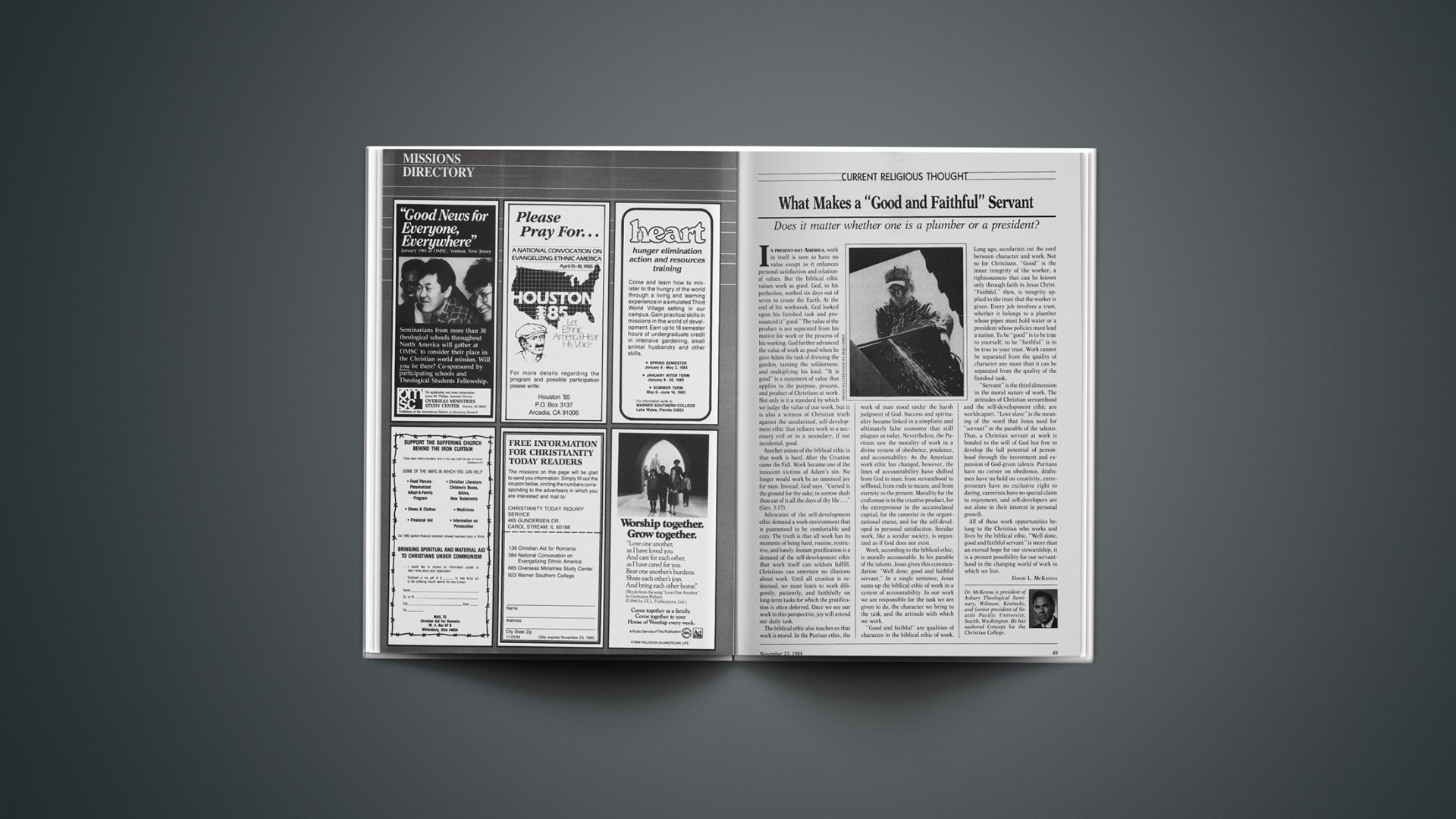
In present-day America, Work in itself is seen to have no value except as it enhances personal satisfaction and relational values. But the biblical ethic values work as good. God, in his perfection, worked six days out of seven to create the Earth. At the end of his workweek, God looked upon his finished task and pronounced it “good.” The value of the product is not separated from his motive for work or the process of his working. God further advanced the value of work as good when he gave Adam the task of dressing the garden, taming the wilderness, and multiplying his kind. “It is good” is a statement of value that applies to the purpose, process, and product of Christians at work. Not only is it a standard by which we judge the value of our work, but it is also a witness of Christian truth against the secularized, self-development ethic that reduces work to a necessary evil or to a secondary, if not incidental, good.

Another axiom of the biblical ethic is that work is hard. After the Creation came the Fall. Work became one of the innocent victims of Adam’s sin. No longer would work be an unmixed joy for man. Instead, God says, “Cursed is the ground for thy sake; in sorrow shalt thou eat of it all the days of thy life …” (Gen. 3:17).

Advocates of the self-development ethic demand a work environment that is guaranteed to be comfortable and cozy. The truth is that all work has its moments of being hard, routine, restrictive, and lonely. Instant gratification is a demand of the self-development ethic that work itself can seldom fulfill. Christians can entertain no illusions about work. Until all creation is redeemed, we must learn to work diligently, patiently, and faithfully on long-term tasks for which the gratification is often deferred. Once we see our work in this perspective, joy will attend our daily task.

The biblical ethic also teaches us that work is moral. In the Puritan ethic, the work of man stood under the harsh judgment of God. Success and spirituality became linked in a simplistic and ultimately false economy that still plagues us today. Nevertheless, the Puritans saw the morality of work in a divine system of obedience, prudence, and accountability. As the American work ethic has changed, however, the lines of accountability have shifted from God to man, from servanthood to selfhood, from ends to means, and from eternity to the present. Morality for the craftsman is in the creative product, for the entrepreneur in the accumulated capital, for the careerist in the organizational status, and for the self-developed in personal satisfaction. Secular work, like a secular society, is organized as if God does not exist.

Work, according to the biblical ethic, is morally accountable. In his parable of the talents, Jesus gives this commendation: “Well done, good and faithful servant.” In a single sentence, Jesus sums up the biblical ethic of work in a system of accountability. In our work we are responsible for the task we are given to do, the character we bring to the task, and the attitude with which we work.

“Good and faithful” are qualities of character in the biblical ethic of work. Long ago, secularists cut the cord between character and work. Not so for Christians. “Good” is the inner integrity of the worker, a righteousness that can be known only through faith in Jesus Christ. “Faithful,” then, is integrity applied to the trust that the worker is given. Every job involves a trust, whether it belongs to a plumber whose pipes must hold water or a president whose policies must lead a nation. To be “good” is to be true to yourself; to be “faithful” is to be true to your trust. Work cannot be separated from the quality of character any more than it can be separated from the quality of the finished task.

“Servant” is the third dimension in the moral nature of work. The attitudes of Christian servanthood and the self-development ethic are worlds apart. “Love slave” is the meaning of the word that Jesus used for “servant” in the parable of the talents. Thus, a Christian servant at work is bonded to the will of God but free to develop the full potential of personhood through the investment and expansion of God-given talents. Puritans have no corner on obedience, draftsmen have no hold on creativity, entrepreneurs have no exclusive right to daring, careerists have no special claim to enjoyment, and self-developers are not alone in their interest in personal growth.

All of these work opportunities belong to the Christian who works and lives by the biblical ethic. “Well done, good and faithful servant” is more than an eternal hope for our stewardship, it is a present possibility for our servanthood in the changing world of work in which we live.

Dr. McKenna is president of Asbury Theological Seminary, Wilmore, Kentucky, and former president of Seattle Pacific University, Seattle, Washington. He has authored Concept for the Christian College.
North American Seminaries Enroll Record Numbers

Seminaries in the United States and Canada reached a record enrollment of 55,112 in 1983, a rise of 4.7 percent over 1982, says the 1984 Yearbook of American and Canadian Churches.

The growth rate in seminary enrollments was three times that of higher education overall, “once again indicating that general post-secondary enrollment trends do not apply to schools of theology in any direct way,” said Marvin J. Taylor, associate director of the Association of Theological Schools in the United States and Canada, who prepared the report.

The 55,112 students enrolled in seminary last year were equivalent to 39,923 full-time students.

“Each year, entering seminary students appear to be a bit older than their predecessors, many coming from other careers, and fewer each year direct from college,” Taylor said. “There are fewer full-time enrollees. They are coming to seminaries at an older age, wanting to study part-time while pursuing careers and other interests. Seminaries are learning how to cope with the new type of student.”

In 1983, record highs were also reached in the seminary enrollment of women and minority students. Women now comprise 24.4 percent of the enrollment, compared with 10.2 percent in 1972. However, the growth rate has been slowing in the last few years, Taylor said.

RELIGIOUS NEWS SERVICE

World Scene

The Peruvian bishops’ conference completed talks with the Vatican’s chief theologian without taking a firm stand on liberation theology. A document released by the bishops neither condemns nor condones liberation theology. Pope John Paul II encouraged a compromise, fearing that a hard-line document would split the Peruvian bishops’ conference, according to the Italian Catholic News Service.

An Israeli research institute says 12 percent of the country’s Jewish homes have a New Testament. Twenty-three percent of the respondents to a survey admitted to reading some of the New Testament text. However, 42 percent of Israelis believe that distribution of New Testaments is harmful to their society.

Sweden’s Lutheran archbishop is being criticized for suggesting that church members should be baptized. Archbishop Bertil Werkstrom says that 500,000 members of Sweden’s state church—on the rolls because of their parents’ membership—should be baptized in order to join the church. Members of the church assembly criticized Werkstrom for expressing his views on issues under study by committees. The church assembly, whose members are elected on the basis of political party affiliations, will make a final decision on the issue.

Poland’s Roman Catholic bishops have issued a pastoral letter declaring abortion an act of terrorism and accusing Communist authorities of spreading “anti-life propaganda.” The Polish government blames the church’s opposition to abortion and artificial birth control for the country’s high birth rate.

A growing number of Sicilian clergymen and lay Catholics are openly opposing the Mafia. Under the leadership of Cardinal Salvatore Pappalardo, priests are condemning organized crime from their pulpits. A lay Catholic group is putting pressure on the Palermo government either to fight the Mafia and political corruption or to resign.

Orthodox Jewish political and religious leaders in Israel have mounted a campaign against Christian television and radio broadcasts. Opponents of a Christian television station and a radio station say programs broadcast for south Lebanese Christians are followed by Israeli Jews in northern Israel. The Orthodox lobby says the programs represent a blatant attempt at introducing “missionary propaganda” into Jewish homes.

Personalia

Will L. Herzfeld has become the first black to head a Lutheran body in the United States. Herzfeld, 47, succeeds William H. Kohn, 68, as bishop of the Association of Evangelical Lutheran Churches (AELC). The denomination’s vice-president since 1976, Herzfeld automatically succeeded Kohn when the former AELC bishop resigned. The AELC is scheduled to merge with the Lutheran Church in America and the American Lutheran Church by 1988.

South African Anglican Bishop Desmond Tutu, a major opponent of apartheid, has been named the 1984 winner of the Nobel Peace Prize. Tutu, 53, is general secretary of the South African Council of Churches. Most of South Africa’s white churches have dropped out of the council because of its stand against the government’s policy of forced racial segregation.

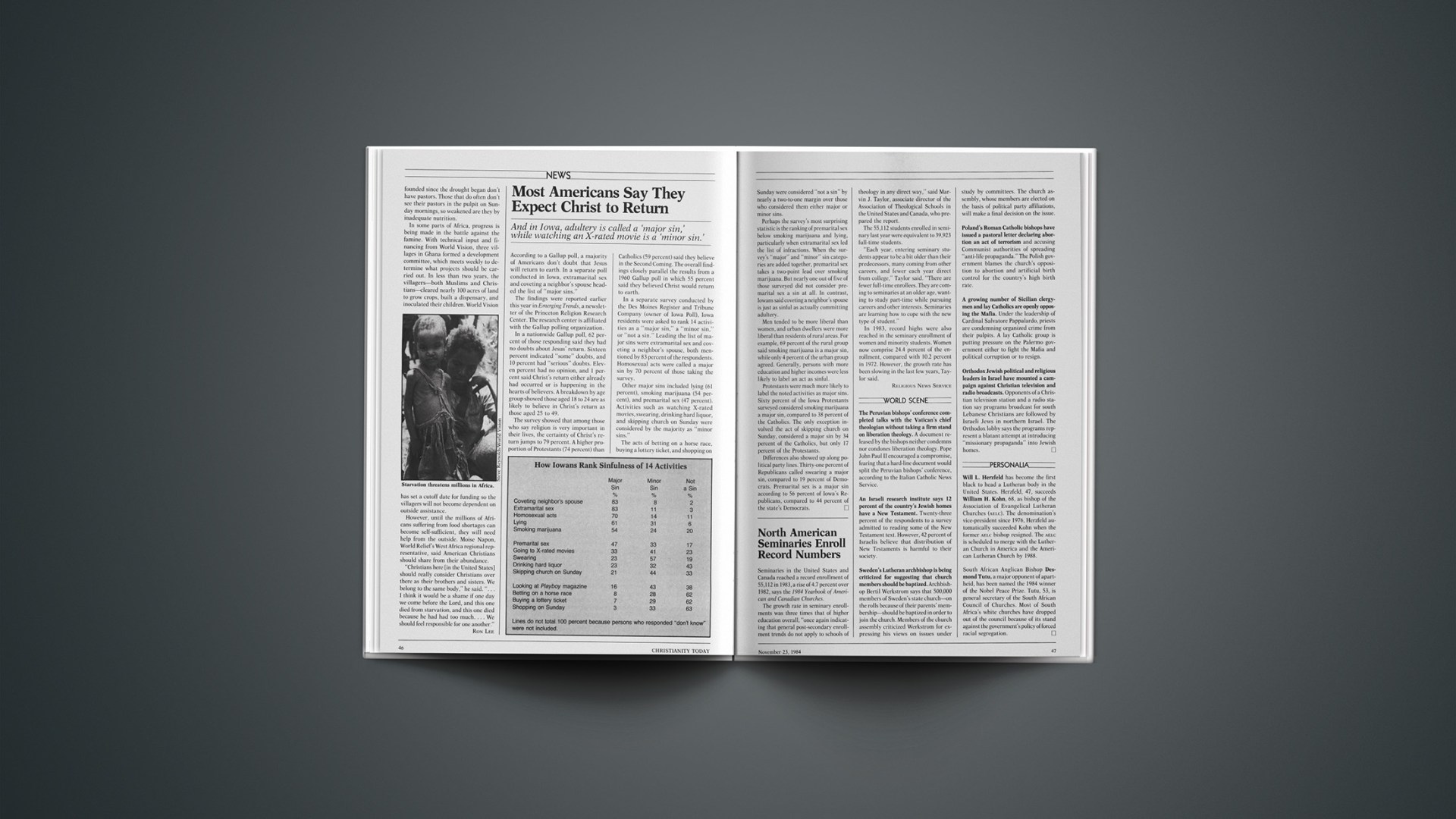
Most Americans Say They Expect Christ to Return

According to a Gallup poll, a majority of Americans don’t doubt that Jesus will return to earth. In a separate poll conducted in Iowa, extramarital sex and coveting a neighbor’s spouse headed the list of “major sins.”

The findings were reported earlier this year in Emerging Trends, a newsletter of the Princeton Religion Research Center. The research center is affiliated with the Gallup polling organization.

In a nationwide Gallup poll, 62 percent of those responding said they had no doubts about Jesus’ return. Sixteen percent indicated “some” doubts, and 10 percent had “serious” doubts. Eleven percent had no opinion, and 1 percent said Christ’s return either already had occurred or is happening in the hearts of believers. A breakdown by age group showed those aged 18 to 24 are as likely to believe in Christ’s return as those aged 25 to 49.

The survey showed that among those who say religion is very important in their lives, the certainty of Christ’s return jumps to 79 percent. A higher proportion of Protestants (74 percent) than Catholics (59 percent) said they believe in the Second Coming. The overall findings closely parallel the results from a 1960 Gallup poll in which 55 percent said they believed Christ would return to earth.

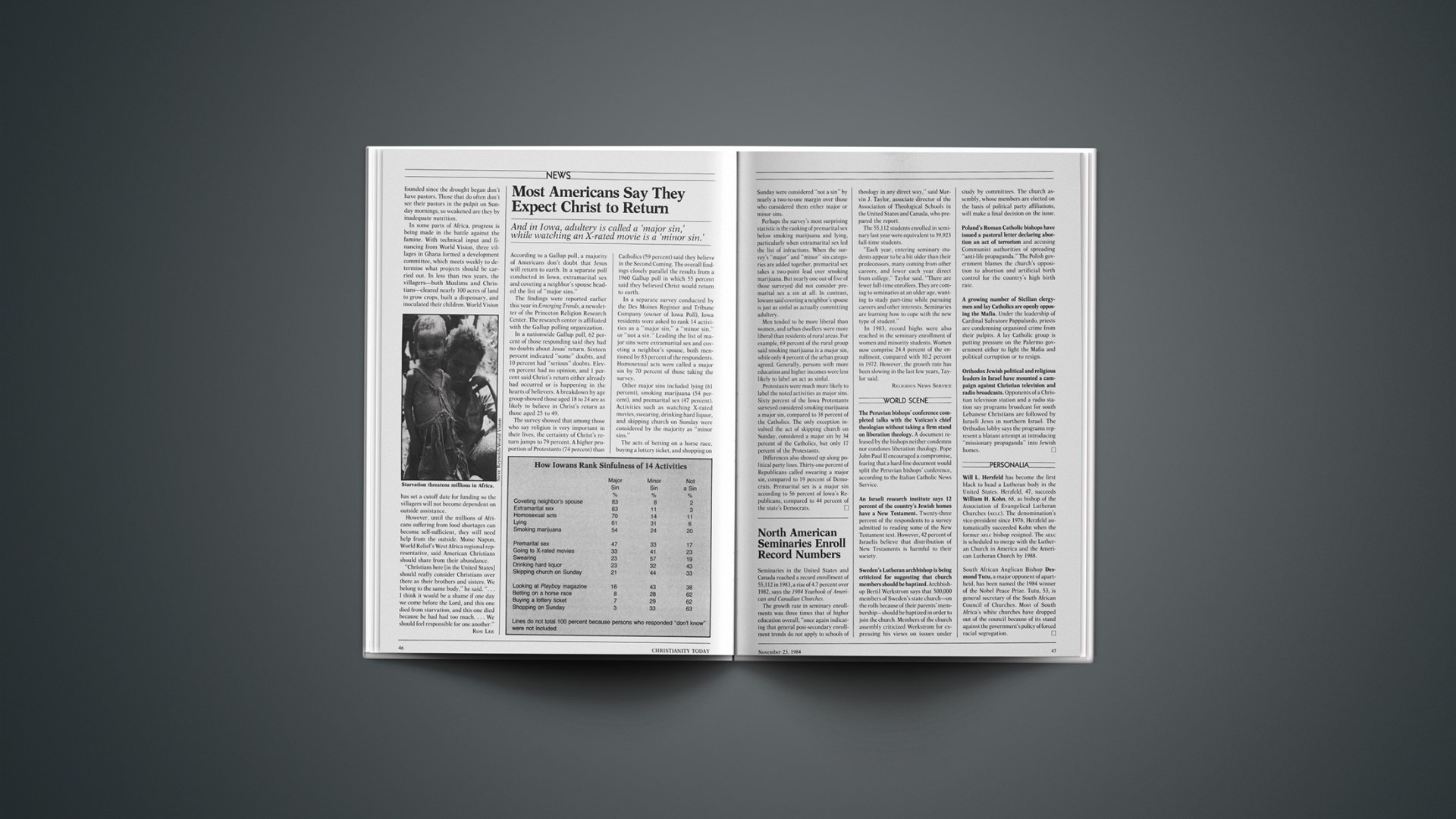
In a separate survey conducted by the Des Moines Register and Tribune Company (owner of Iowa Poll), Iowa residents were asked to rank 14 activities as a “major sin,” a “minor sin,” or “not a sin.” Leading the list of major sins were extramarital sex and coveting a neighbor’s spouse, both mentioned by 83 percent of the respondents. Homosexual acts were called a major sin by 70 percent of those taking the survey.

Other major sins included lying (61 percent), smoking marijuana (54 percent), and premarital sex (47 percent). Activities such as watching X-rated movies, swearing, drinking hard liquor, and skipping church on Sunday were considered by the majority as “minor sins.”

The acts of betting on a horse race, buying a lottery ticket, and shopping on Sunday were considered “not a sin” by nearly a two-to-one margin over those who considered them either major or minor sins.

Perhaps the survey’s most surprising statistic is the ranking of premarital sex below smoking marijuana and lying, particularly when extramarital sex led the list of infractions. When the survey’s “major” and “minor” sin categories are added together, premarital sex takes a two-point lead over smoking marijuana. But nearly one out of five of those surveyed did not consider premarital sex a sin at all. In contrast, Iowans said coveting a neighbor’s spouse is just as sinful as actually committing adultery.

Men tended to be more liberal than women, and urban dwellers were more liberal than residents of rural areas. For example, 69 percent of the rural group said smoking marijuana is a major sin, while only 4 percent of the urban group agreed. Generally, persons with more education and higher incomes were less likely to label an act as sinful.

Protestants were much more likely to label the noted activities as major sins. Sixty percent of the Iowa Protestants surveyed considered smoking marijuana a major sin, compared to 38 percent of the Catholics. The only exception involved the act of skipping church on Sunday, considered a major sin by 34 percent of the Catholics, but only 17 percent of the Protestants.

Differences also showed up along political party lines. Thirty-one percent of Republicans called swearing a major sin, compared to 19 percent of Democrats. Premarital sex is a major sin according to 56 percent of Iowa’s Republicans, compared to 44 percent of the state’s Democrats.

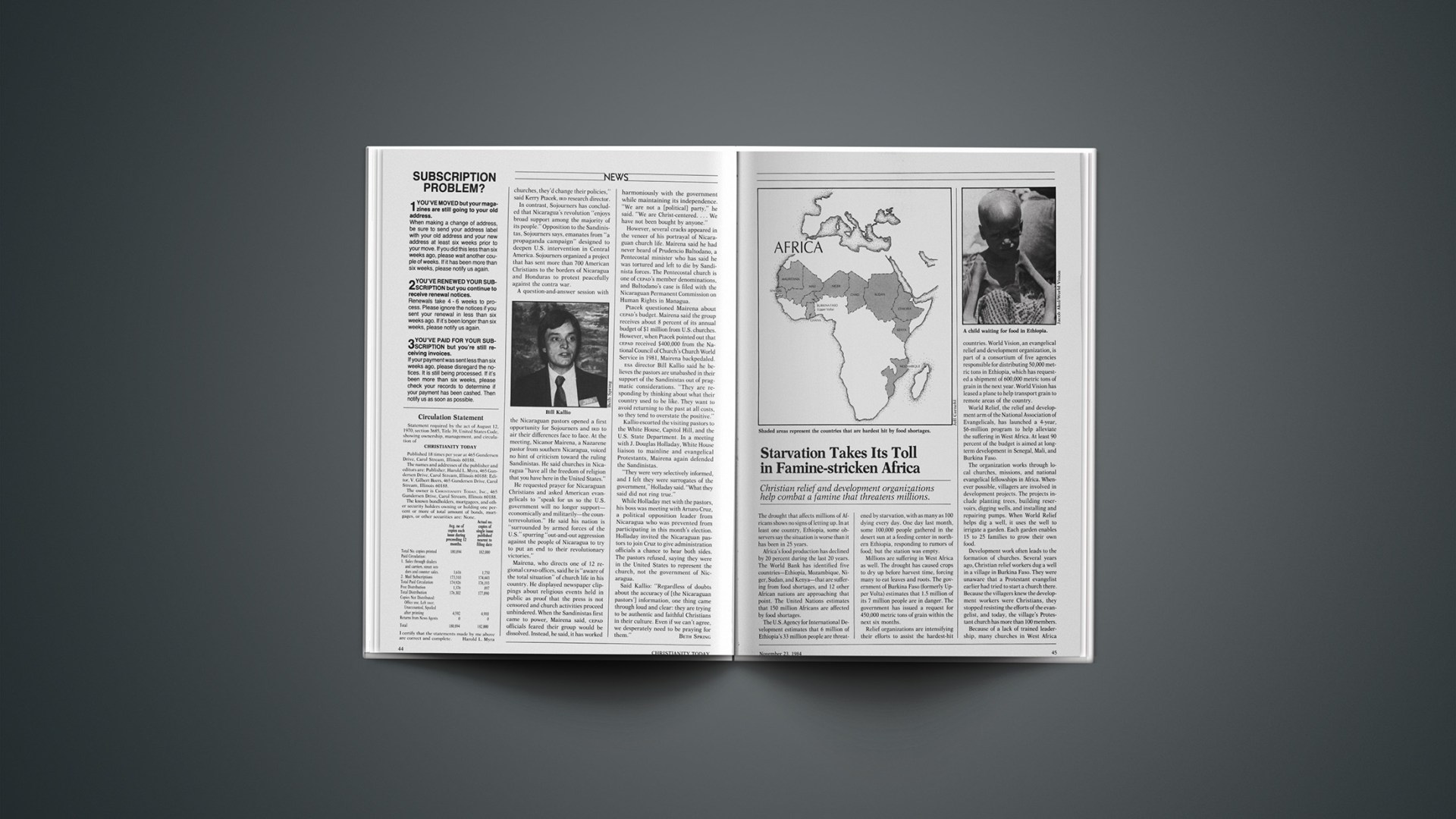
Starvation Takes Its Toll in Famine-Stricken Africa

The drought that affects millions of Africans shows no signs of letting up. In at least one country, Ethiopia, some observers say the situation is worse than it has been in 25 years.

Africa’s food production has declined by 20 percent during the last 20 years. The World Bank has identified five countries—Ethiopia, Mozambique, Niger, Sudan, and Kenya—that are suffering from food shortages, and 12 other African nations are approaching that point. The United Nations estimates that 150 million Africans are affected by food shortages.

The U.S. Agency for International Development estimates that 6 million of Ethiopia’s 33 million people are threatened by starvation, with as many as 100 dying every day. One day last month, some 100,000 people gathered in the desert sun at a feeding center in northern Ethiopia, responding to rumors of food; but the station was empty.

Millions are suffering in West Africa as well. The drought has caused crops to dry up before harvest time, forcing many to eat leaves and roots. The government of Burkina Faso (formerly Upper Volta) estimates that 1.5 million of its 7 million people are in danger. The government has issued a request for 450,000 metric tons of grain within the next six months.

Relief organizations are intensifying their efforts to assist the hardest-hit countries. World Vision, an evangelical relief and development organization, is part of a consortium of five agencies responsible for distributing 50,000 metric tons in Ethiopia, which has requested a shipment of 600,000 metric tons of grain in the next year. World Vision has leased a plane to help transport grain to remote areas of the country.

World Relief, the relief and development arm of the National Association of Evangelicals, has launched a 4-year, $6-million program to help alleviate the suffering in West Africa. At least 90 percent of the budget is aimed at long-term development in Senegal, Mali, and Burkina Faso.

The organization works through local churches, missions, and national evangelical fellowships in Africa. Whenever possible, villagers are involved in development projects. The projects include planting trees, building reservoirs, digging wells, and installing and repairing pumps. When World Relief helps dig a well, it uses the well to irrigate a garden. Each garden enables 15 to 25 families to grow their own food.

Development work often leads to the formation of churches. Several years ago, Christian relief workers dug a well in a village in Burkina Faso. They were unaware that a Protestant evangelist earlier had tried to start a church there. Because the villagers knew the development workers were Christians, they stopped resisting the efforts of the evangelist, and today, the village’s Protestant church has more than 100 members.

Because of a lack of trained leadership, many churches in West Africa founded since the drought began don’t have pastors. Those that do often don’t see their pastors in the pulpit on Sunday mornings, so weakened are they by inadequate nutrition.

In some parts of Africa, progress is being made in the battle against the famine. With technical input and financing from World Vision, three villages in Ghana formed a development committee, which meets weekly to determine what projects should be carried out. In less than two years, the villagers—both Muslims and Christians—cleared nearly 100 acres of land to grow crops, built a dispensary, and inoculated their children. World Vision has set a cutoff date for funding so the villagers will not become dependent on outside assistance.

However, until the millions of Africans suffering from food shortages can become self-sufficient, they will need help from the outside. Moise Napon, World Relief’s West Africa regional representative, said American Christians should share from their abundance.

“Christians here [in the United States] should really consider Christians over there as their brothers and sisters. We belong to the same body,” he said. “… I think it would be a shame if one day we come before the Lord, and this one died from starvation, and this one died because he had had too much.… We should feel responsible for one another.”

Does the Sandinista Regime Promote Religious Freedom?

Visiting Nicaraguan pastors fuel the debate over their government’s stance on human rights.

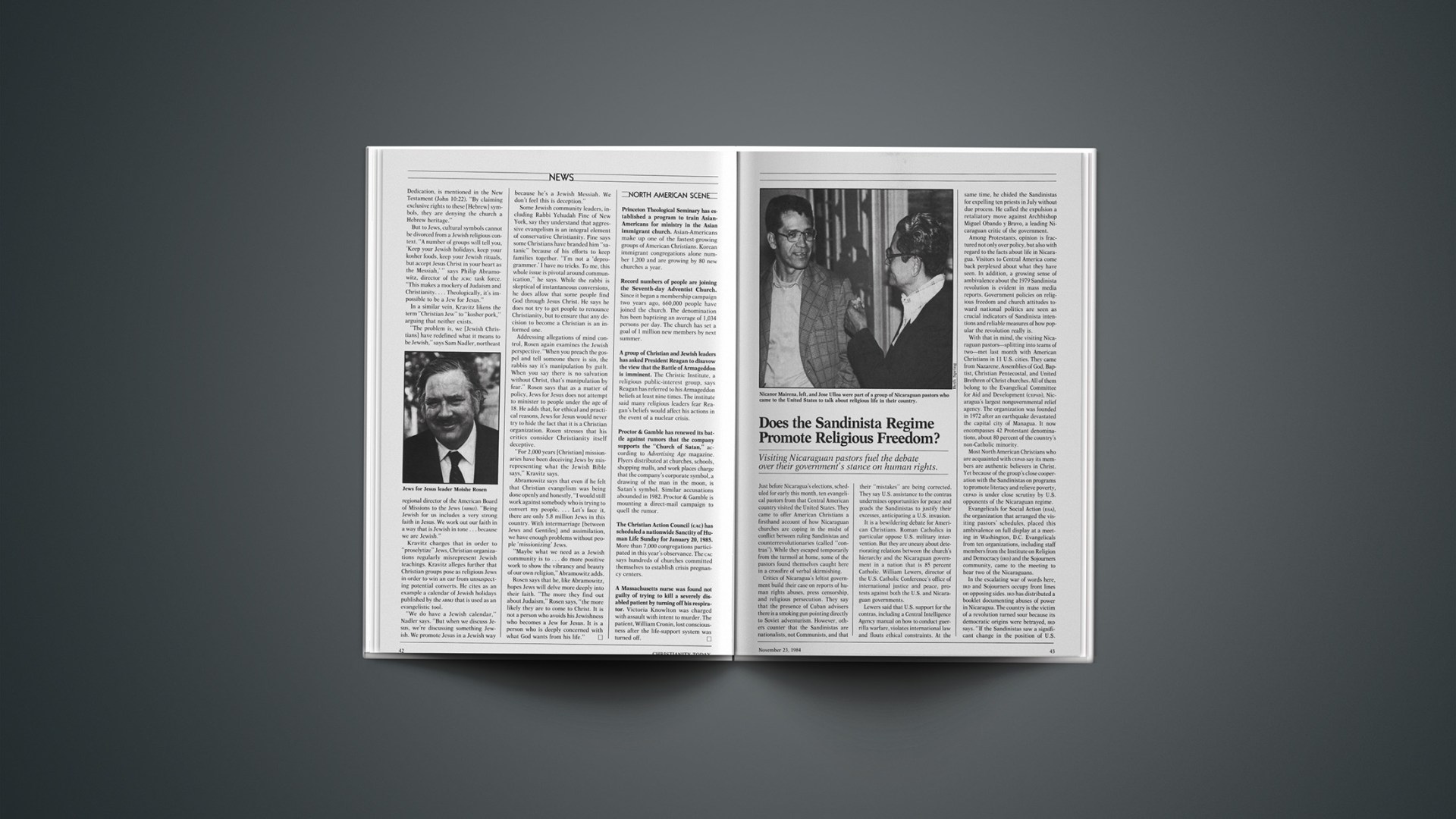
Just before Nicaragua’s elections, scheduled for early this month, ten evangelical pastors from that Central American country visited the United States. They came to offer American Christians a firsthand account of how Nicaraguan churches are coping in the midst of conflict between ruling Sandinistas and counterrevolutionaries (called “contras”). While they escaped temporarily from the turmoil at home, some of the pastors found themselves caught here in a crossfire of verbal skirmishing.

Critics of Nicaragua’s leftist government build their case on reports of human rights abuses, press censorship, and religious persecution. They say that the presence of Cuban advisers there is a smoking gun pointing directly to Soviet adventurism. However, others counter that the Sandinistas are nationalists, not Communists, and that their “mistakes” are being corrected. They say U.S. assistance to the contras undermines opportunities for peace and goads the Sandinistas to justify their excesses, anticipating a U.S. invasion.

It is a bewildering debate for American Christians. Roman Catholics in particular oppose U.S. military intervention. But they are uneasy about deteriorating relations between the church’s hierarchy and the Nicaraguan government in a nation that is 85 percent Catholic. William Lewers, director of the U.S. Catholic Conference’s office of international justice and peace, protests against both the U.S. and Nicaraguan governments.

Lewers said that U.S. support for the contras, including a Central Intelligence Agency manual on how to conduct guerrilla warfare, violates international law and flouts ethical constraints. At the same time, he chided the Sandinistas for expelling ten priests in July without due process. He called the expulsion a retaliatory move against Archbishop Miguel Obando y Bravo, a leading Nicaraguan critic of the government.

Among Protestants, opinion is fractured not only over policy, but also with regard to the facts about life in Nicaragua. Visitors to Central America come back perplexed about what they have seen. In addition, a growing sense of ambivalence about the 1979 Sandinista revolution is evident in mass media reports. Government policies on religious freedom and church attitudes toward national politics are seen as crucial indicators of Sandinista intentions and reliable measures of how popular the revolution really is.

With that in mind, the visiting Nicaraguan pastors—splitting into teams of two—met last month with American Christians in 11 U.S. cities. They came from Nazarene, Assemblies of God, Baptist, Christian Pentecostal, and United Brethren of Christ churches. All of them belong to the Evangelical Committee for Aid and Development (CEPAD), Nicaragua’s largest nongovernmental relief agency. The organization was founded in 1972 after an earthquake devastated the capital city of Managua. It now encompasses 42 Protestant denominations, about 80 percent of the country’s non-Catholic minority.

Most North American Christians who are acquainted with CEPAD say its members are authentic believers in Christ. Yet because of the group’s close cooperation with the Sandinistas on programs to promote literacy and relieve poverty, CEPAD is under close scrutiny by U.S. opponents of the Nicaraguan regime.

Evangelicals for Social Action (ESA), the organization that arranged the visiting pastors’ schedules, placed this ambivalence on full display at a meeting in Washington, D.C. Evangelicals from ten organizations, including staff members from the Institute on Religion and Democracy (IRD) and the Sojourners community, came to the meeting to hear two of the Nicaraguans.

In the escalating war of words here, IRD and Sojourners occupy front lines on opposing sides, IRD has distributed a booklet documenting abuses of power in Nicaragua. The country is the victim of a revolution turned sour because its democratic origins were betrayed, IRD says. “If the Sandinistas saw a significant change in the position of U.S. churches, they’d change their policies,” said Kerry Ptacek, IRD research director.

In contrast, Sojourners has concluded that Nicaragua’s revolution “enjoys broad support among the majority of its people.” Opposition to the Sandinistas, Sojourners says, emanates from “a propaganda campaign” designed to deepen U.S. intervention in Central America. Sojourners organized a project that has sent more than 700 American Christians to the borders of Nicaragua and Honduras to protest peacefully against the contra war.

A question-and-answer session with the Nicaraguan pastors opened a first opportunity for Sojourners and IRD to air their differences face to face. At the meeting, Nicanor Mairena, a Nazarene pastor from southern Nicaragua, voiced no hint of criticism toward the ruling Sandinistas. He said churches in Nicaragua “have all the freedom of religion that you have here in the United States.”

He requested prayer for Nicaraguan Christians and asked American evangelicals to “speak for us so the U.S. government will no longer support—economically and militarily—the counterrevolution.” He said his nation is “surrounded by armed forces of the U.S.” spurring “out-and-out aggression against the people of Nicaragua to try to put an end to their revolutionary victories.”

Mairena, who directs one of 12 regional CEPAD offices, said he is “aware of the total situation” of church life in his country. He displayed newspaper clippings about religious events held in public as proof that the press is not censored and church activities proceed unhindered. When the Sandinistas first came to power, Mairena said, CEPAD officials feared their group would be dissolved. Instead, he said, it has worked harmoniously with the government while maintaining its independence. “We are not a [political] party,” he said. “We are Christ-centered.… We have not been bought by anyone.”

However, several cracks appeared in the veneer of his portrayal of Nicaraguan church life. Mairena said he had never heard of Prudencio Baltodano, a Pentecostal minister who has said he was tortured and left to die by Sandinista forces. The Pentecostal church is one of CEPAD’s member denominations, and Baltodano’s case is filed with the Nicaraguan Permanent Commission on Human Rights in Managua.

Ptacek questioned Mairena about CEPAD’s budget. Mairena said the group receives about 8 percent of its annual budget of $1 million from U.S. churches. However, when Ptacek pointed out that CEPAD received $400,000 from the National Council of Church’s Church World Service in 1981, Mairena backpedaled.

ESA director Bill Kallio said he believes the pastors are unabashed in their support of the Sandinistas out of pragmatic considerations. “They are responding by thinking about what their country used to be like. They want to avoid returning to the past at all costs, so they tend to overstate the positive.”

Kallio escorted the visiting pastors to the White House, Capitol Hill, and the U.S. State Department. In a meeting with J. Douglas Holladay, White House liaison to mainline and evangelical Protestants, Mairena again defended the Sandinistas.

“They were very selectively informed, and I felt they were surrogates of the government,” Holladay said. “What they said did not ring true.”

While Holladay met with the pastors, his boss was meeting with Arturo Cruz, a political opposition leader from Nicaragua who was prevented from participating in this month’s election. Holladay invited the Nicaraguan pastors to join Cruz to give administration officials a chance to hear both sides. The pastors refused, saying they were in the United States to represent the church, not the government of Nicaragua.

Said Kallio: “Regardless of doubts about the accuracy of [the Nicaraguan pastors’] information, one thing came through loud and clear: they are trying to be authentic and faithful Christians in their culture. Even if we can’t agree, we desperately need to be praying for them.”

Jewish Leaders Attempt to Fight Effects of Evangelism

Rabbis say Christians who share the gospel with Jews use deception and mind control.

Leading Jewish spokesmen are the first to acknowledge that Christian evangelism has had an impact on the Jewish community. In the last two decades, tens of thousands of people have abandoned Judaism to become Christians. Some Jewish leaders fear for the future of their religion in this country.

In addition to Christian evangelism, cults are partly responsible for the exodus of young Jews. To combat that exodus, the Jewish community in recent years has stepped up its efforts to keep its sheep in the fold.

Malcolm Hoenlein, director of the New York-based Jewish Community Relations Council (JCRC), in the mid-1970s launched a Task Force on Missionaries and Cults. As its name implies, Jewish leaders see little difference between losing people to cults and losing them to Christianity.

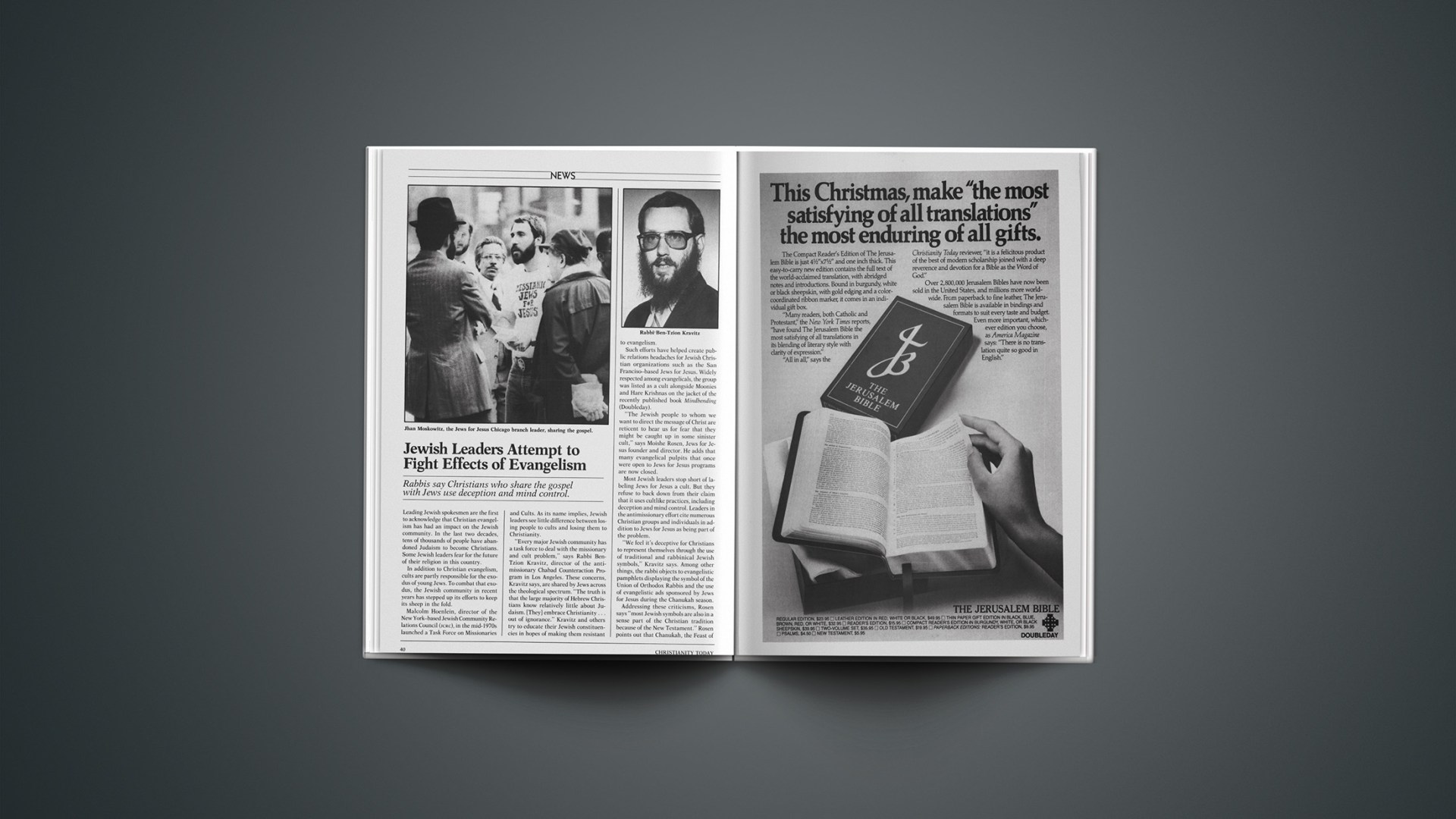
“Every major Jewish community has a task force to deal with the missionary and cult problem,” says Rabbi Ben-Tzion Kravitz, director of the antimissionary Chabad Counteraction Program in Los Angeles. These concerns, Kravitz says, are shared by Jews across the theological spectrum. “The truth is that the large majority of Hebrew Christians know relatively little about Judaism. [They] embrace Christianity … out of ignorance.” Kravitz and others try to educate their Jewish constituencies in hopes of making them resistant to evangelism.

Such efforts have helped create public relations headaches for Jewish Christian organizations such as the San Franciso-based Jews for Jesus. Widely respected among evangelicals, the group was listed as a cult alongside Moonies and Hare Krishnas on the jacket of the recently published book Mindbending (Doubleday).

“The Jewish people to whom we want to direct the message of Christ are reticent to hear us for fear that they might be caught up in some sinister cult,” says Moishe Rosen, Jews for Jesus founder and director. He adds that many evangelical pulpits that once were open to Jews for Jesus programs are now closed.

Most Jewish leaders stop short of labeling Jews for Jesus a cult. But they refuse to back down from their claim that it uses cultlike practices, including deception and mind control. Leaders in the antimissionary effort cite numerous Christian groups and individuals in addition to Jews for Jesus as being part of the problem.

“We feel it’s deceptive for Christians to represent themselves through the use of traditional and rabbinical Jewish symbols,” Kravitz says. Among other things, the rabbi objects to evangelistic pamphlets displaying the symbol of the Union of Orthodox Rabbis and the use of evangelistic ads sponsored by Jews for Jesus during the Chanukah season.

Addressing these criticisms, Rosen says “most Jewish symbols are also in a sense part of the Christian tradition because of the New Testament.” Rosen points out that Chanukah, the Feast of Dedication, is mentioned in the New Testament (John 10:22). “By claiming exclusive rights to these [Hebrew] symbols, they are denying the church a Hebrew heritage.”

But to Jews, cultural symbols cannot be divorced from a Jewish religious context. “A number of groups will tell you, ‘Keep your Jewish holidays, keep your kosher foods, keep your Jewish rituals, but accept Jesus Christ in your heart as the Messiah,’ ” says Philip Abramowitz, director of the JCRC task force. “This makes a mockery of Judaism and Christianity.… Theologically, it’s impossible to be a Jew for Jesus.”

In a similar vein, Kravitz likens the term “Christian Jew” to “kosher pork,” arguing that neither exists.

“The problem is, we [Jewish Christians] have redefined what it means to be Jewish,” says Sam Nadler, northeast regional director of the American Board of Missions to the Jews (ABMJ). “Being Jewish for us includes a very strong faith in Jesus. We work out our faith in a way that is Jewish in tone … because we are Jewish.”

Kravitz charges that in order to “proselytize” Jews, Christian organizations regularly misrepresent Jewish teachings. Kravitz alleges further that Christian groups pose as religious Jews in order to win an ear from unsuspecting potential converts. He cites as an example a calendar of Jewish holidays published by the ABMJ that is used as an evangelistic tool.

“We do have a Jewish calendar,” Nadler says. “But when we discuss Jesus, we’re discussing something Jewish. We promote Jesus in a Jewish way because he’s a Jewish Messiah. We don’t feel this is deception.”

Some Jewish community leaders, including Rabbi Yehudah Fine of New York, say they understand that aggressive evangelism is an integral element of conservative Christianity. Fine says some Christians have branded him “satanic” because of his efforts to keep families together. “I’m not a ‘deprogrammer.’ I have no tricks. To me, this whole issue is pivotal around communication,” he says. While the rabbi is skeptical of instantaneous conversions, he does allow that some people find God through Jesus Christ. He says he does not try to get people to renounce Christianity, but to ensure that any decision to become a Christian is an informed one.

Addressing allegations of mind control, Rosen again examines the Jewish perspective. “When you preach the gospel and tell someone there is sin, the rabbis say it’s manipulation by guilt. When you say there is no salvation without Christ, that’s manipulation by fear.” Rosen says that as a matter of policy, Jews for Jesus does not attempt to minister to people under the age of 18. He adds that, for ethical and practical reasons, Jews for Jesus would never try to hide the fact that it is a Christian organization. Rosen stresses that his critics consider Christianity itself deceptive.

“For 2,000 years [Christian] missionaries have been deceiving Jews by misrepresenting what the Jewish Bible says,” Kravitz says.

Abramowitz says that even if he felt that Christian evangelism was being done openly and honestly, “I would still work against somebody who is trying to convert my people.… Let’s face it, there are only 5.8 million Jews in this country. With intermarriage [between Jews and Gentiles] and assimilation, we have enough problems without people ‘missionizing’ Jews.

“Maybe what we need as a Jewish community is to … do more positive work to show the vibrancy and beauty of our own religion,” Abramowitz adds.

Rosen says that he, like Abramowitz, hopes Jews will delve more deeply into their faith. “The more they find out about Judaism,” Rosen says, “the more likely they are to come to Christ. It is not a person who avoids his Jewishness who becomes a Jew for Jesus. It is a person who is deeply concerned with what God wants from his life.”

North American Scene

Princeton Theological Seminary has established a program to train Asian-Americans for ministry in the Asian immigrant church. Asian-Americans make up one of the fastest-growing groups of American Christians. Korean immigrant congregations alone number 1,200 and are growing by 80 new churches a year.

Record numbers of people are joining the Seventh-day Adventist Church. Since it began a membership campaign two years ago, 660,000 people have joined the church. The denomination has been baptizing an average of 1,034 persons per day. The church has set a goal of 1 million new members by next summer.

A group of Christian and Jewish leaders has asked President Reagan to disavow the view that the Battle of Armageddon is imminent. The Christic Institute, a religious public-interest group, says Reagan has referred to his Armageddon beliefs at least nine times. The institute said many religious leaders fear Reagan’s beliefs would affect his actions in the event of a nuclear crisis.

Proctor & Gamble has renewed its battle against rumors that the company supports the “Church of Satan,” according to Advertising Age magazine. Flyers distributed at churches, schools, shopping malls, and work places charge that the company’s corporate symbol, a drawing of the man in the moon, is Satan’s symbol. Similar accusations abounded in 1982. Proctor & Gamble is mounting a direct-mail campaign to quell the rumor.

The Christian Action Council (CAC) has scheduled a nationwide Sanctity of Human Life Sunday for January 20, 1985. More than 7,000 congregations participated in this year’s observance. The CAC says hundreds of churches committed themselves to establish crisis pregnancy centers.

A Massachusetts nurse was found not guilty of trying to kill a severely disabled patient by turning off his respirator. Victoria Knowlton was charged with assault with intent to murder. The patient, William Cronin, lost consciousness after the life-support system was turned off.

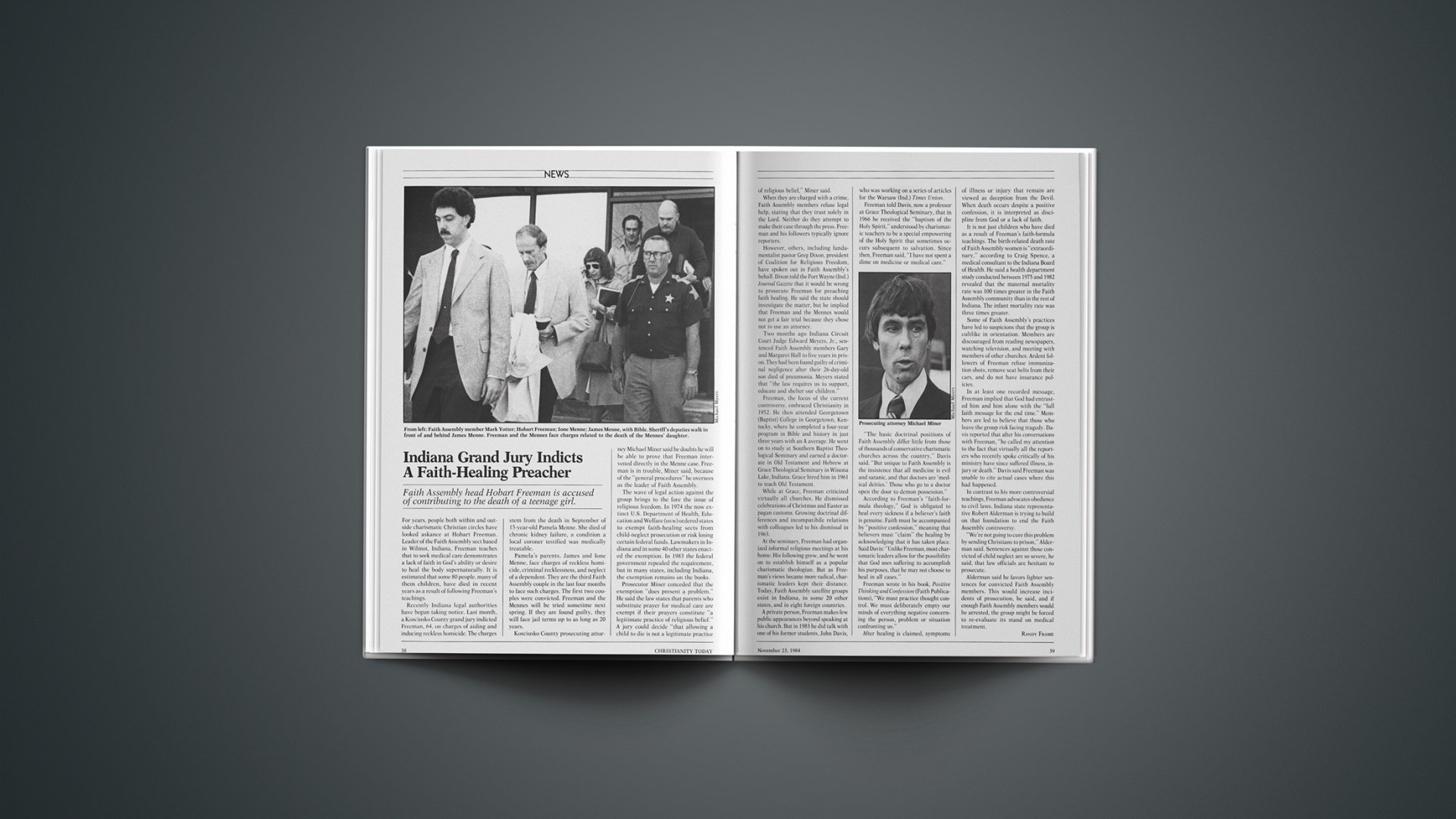
Indiana Grand Jury Indicts a Faith-Healing Preacher

Faith Assembly head Hobart Freeman is accused of contributing to the death of a teenage girl.

For years, people both within and outside charismatic Christian circles have looked askance at Hobart Freeman. Leader of the Faith Assembly sect based in Wilmot, Indiana, Freeman teaches that to seek medical care demonstrates a lack of faith in God’s ability or desire to heal the body supernaturally. It is estimated that some 80 people, many of them children, have died in recent years as a result of following Freeman’s teachings.

Recently Indiana legal authorities have begun taking notice. Last month, a Kosciusko County grand jury indicted Freeman, 64, on charges of aiding and inducing reckless homicide. The charges stem from the death in September of 15-year-old Pamela Menne. She died of chronic kidney failure, a condition a local coroner testified was medically treatable.

Pamela’s parents, James and Ione Menne, face charges of reckless homicide, criminal recklessness, and neglect of a dependent. They are the third Faith Assembly couple in the last four months to face such charges. The first two couples were convicted. Freeman and the Mennes will be tried sometime next spring. If they are found guilty, they will face jail terms up to as long as 20 years.

Kosciusko County prosecuting attorney Michael Miner said he doubts he will be able to prove that Freeman intervened directly in the Menne case. Freeman is in trouble, Miner said, because of the “general procedures” he oversees as the leader of Faith Assembly.

The wave of legal action against the group brings to the fore the issue of religious freedom. In 1974 the now extinct U.S. Department of Health, Education and Welfare (HEW) ordered states to exempt faith-healing sects from child-neglect prosecution or risk losing certain federal funds. Lawmakers in Indiana and in some 40 other states enacted the exemption. In 1983 the federal government repealed the requirement, but in many states, including Indiana, the exemption remains on the books.

Prosecutor Miner conceded that the exemption “does present a problem.” He said the law states that parents who substitute prayer for medical care are exempt if their prayers constitute “a legitimate practice of religious belief.” A jury could decide “that allowing a child to die is not a legitimate practice of religious belief,” Miner said.

When they are charged with a crime, Faith Assembly members refuse legal help, stating that they trust solely in the Lord. Neither do they attempt to make their case through the press. Freeman and his followers typically ignore reporters.

However, others, including fundamentalist pastor Greg Dixon, president of Coalition for Religious Freedom, have spoken out in Faith Assembly’s behalf. Dixon told the Fort Wayne (Ind.) Journal Gazette that it would be wrong to prosecute Freeman for preaching faith healing. He said the state should investigate the matter, but he implied that Freeman and the Mennes would not get a fair trial because they chose not to use an attorney.

Two months ago Indiana Circuit Court Judge Edward Meyers, Jr., sentenced Faith Assembly members Gary and Margaret Hall to five years in prison. They had been found guilty of criminal negligence after their 26-day-old son died of pneumonia. Meyers stated that “the law requires us to support, educate and shelter our children.”

Freeman, the focus of the current controversy, embraced Christianity in 1952. He then attended Georgetown (Baptist) College in Georgetown, Kentucky, where he completed a four-year program in Bible and history in just three years with an A average. He went on to study at Southern Baptist Theological Seminary and earned a doctorate in Old Testament and Hebrew at Grace Theological Seminary in Winona Lake, Indiana. Grace hired him in 1961 to teach Old Testament.

While at Grace, Freeman criticized virtually all churches. He dismissed celebrations of Christmas and Easter as pagan customs. Growing doctrinal differences and incompatibile relations with colleagues led to his dismissal in 1963.

At the seminary, Freeman had organized informal religious meetings at his home. His following grew, and he went on to establish himself as a popular charismatic theologian. But as Freeman’s views became more radical, charismatic leaders kept their distance. Today, Faith Assembly satellite groups exist in Indiana, in some 20 other states, and in eight foreign countries.

A private person, Freeman makes few public appearances beyond speaking at his church. But in 1983 he did talk with one of his former students, John Davis, who was working on a series of articles for the Warsaw (Ind.) Times Union.

Freeman told Davis, now a professor at Grace Theological Seminary, that in 1966 he received the “baptism of the Holy Spirit,” understood by charismatic teachers to be a special empowering of the Holy Spirit that sometimes occurs subsequent to salvation. Since then, Freeman said, “I have not spent a dime on medicine or medical care.”

“The basic doctrinal positions of Faith Assembly differ little from those of thousands of conservative charismatic churches across the country,” Davis said. “But unique to Faith Assembly is the insistence that all medicine is evil and satanic, and that doctors are ‘medical deities.’ Those who go to a doctor open the door to demon possession.”

According to Freeman’s “faith-formula theology,” God is obligated to heal every sickness if a believer’s faith is genuine. Faith must be accompanied by “positive confession,” meaning that believers must “claim” the healing by acknowledging that it has taken place. Said Davis: “Unlike Freeman, most charismatic leaders allow for the possibility that God uses suffering to accomplish his purposes, that he may not choose to heal in all cases.”

Freeman wrote in his book, Positive Thinking and Confession (Faith Publications), “We must practice thought control. We must deliberately empty our minds of everything negative concerning the person, problem or situation confronting us.”

After healing is claimed, symptoms of illness or injury that remain are viewed as deception from the Devil. When death occurs despite a positive confession, it is interpreted as discipline from God or a lack of faith.

It is not just children who have died as a result of Freeman’s faith-formula teachings. The birth-related death rate of Faith Assembly women is “extraordinary,” according to Craig Spence, a medical consultant to the Indiana Board of Health. He said a health department study conducted between 1975 and 1982 revealed that the maternal mortality rate was 100 times greater in the Faith Assembly community than in the rest of Indiana. The infant mortality rate was three times greater.

Some of Faith Assembly’s practices have led to suspicions that the group is cultlike in orientation. Members are discouraged from reading newspapers, watching television, and meeting with members of other churches. Ardent followers of Freeman refuse immunization shots, remove seat belts from their cars, and do not have insurance policies.

In at least one recorded message, Freeman implied that God had entrusted him and him alone with the “full faith message for the end time.” Members are led to believe that those who leave the group risk facing tragedy. Davis reported that after his conversations with Freeman, “he called my attention to the fact that virtually all the reporters who recently spoke critically of his ministry have since suffered illness, injury or death.” Davis said Freeman was unable to cite actual cases where this had happened.

In contrast to his more controversial teachings, Freeman advocates obedience to civil laws. Indiana state representative Robert Alderman is trying to build on that foundation to end the Faith Assembly controversy.

“We’re not going to cure this problem by sending Christians to prison,” Alderman said. Sentences against those convicted of child neglect are so severe, he said, that law officials are hesitant to prosecute.

Alderman said he favors lighter sentences for convicted Faith Assembly members. This would increase incidents of prosecution, he said, and if enough Faith Assembly members would be arrested, the group might be forced to re-evaluate its stand on medical treatment.

A New Program Will Help Churches Study War and Peace

Few evangelical churches provide a forum for considering issues of war and peace. When they do, they tend to use information that advocates certain public policy positions, such as a nuclear freeze or military superiority over the Soviet Union.

Those findings are based on a poll conducted by the National Association of Evangelicals (NAE). TO help churches study the issue, the NAE plans to launch a Peace, Freedom, and Security Studies Program from its Washington, D.C., office.

The program will not advocate policies, said coordinator Brian O’Connell, but instead will encourage churches to begin studying the issue. It will assist churches by identifying speakers and resource materials; by developing “model programs” for discussions of war and peace; and by sponsoring meetings among evangelical leaders. O’Connell said he also plans to provide guidelines to frame the debate and “clarify the biblical, theological, educational, and political standards” that are necessary. The effort is an outgrowth of NAE’s participation in a conference last year in Pasadena at which evangelicals debated the issue of war and peace.

In a report prepared for NAE, O’Connell pointed out that “there is little activity detected, beyond occasional sermons, aimed at clarifying the biblical and theological points of reference for the individual’s conscience when faced with personal civic choices about America’s proper role in world affairs.”

If evangelicals remain sidelined on the issue, O’Connell said, they will be “highly vulnerable to partisan political pressures seeking to enlist [them] in one or another faction of the present argument.” He said he intends to see both liberal and conservative views challenged by the process of systematically studying the issues and seeking to balance the twin goals of peace and national security.

A graduate of Seattle Pacific University, O’Connell developed the project survey and proposal. The NAE executive board approved it in June. A nonpartisan Seattle organization, the World Without War Council, is cosponsoring the program and will help O’Connell raise $11,000 to help finance it.

The NAE survey shows that evangelical churches, associations, and colleges are reluctant about debating the issue of war and peace, NAE received survey replies from 18 of the 38 NAE-member denominations it polled. Respondents included the Assemblies of God, the Brethren in Christ Church, Baptist General Conference, Christian and Missionary Alliance, Church of God (Cleveland, Tenn.), Conservative Congregational Christian Conference, the Brethren Church, and the Wesleyan Church. Six said they have issued a public statement on the issue. Four said they actively pursue a commitment to a particular position.

Only one denomination polled—the Brethren in Christ Church—said it produced or distributed original material about the issue. Two-thirds of the respondents said they have no plans to promote books on war and peace. Eight denominations seek no outside information on the issue, six rely on the NAE and its affiliate, World Relief, and four listed a variety of advocacy groups and parachurch organizations that provide literature.

The survey included responses from 28 state and local evangelical associations, 39 Christian colleges, and 23 seminaries and Bible colleges, indicating a similar lack of emphasis on the issue outside historic “peace church” circles.

The Gospel Flourishes in the Ussr’s Second Largest City

The Gospel Flourishes In The Ussr’S Second Largest City

With 4.5 million people, Leningrad is the Soviet Union’s second-largest city. The city of the czars and of Lenin has a history of glory, heroism, and tragedy.

On the city’s north side, the Leningrad Baptist Church claims some 3,000 members plus perhaps twice that many unbaptized children and other adherents. One of more than 60 congregations in the northwest district of the All-Union Council of Evangelical Christians-Baptists (AUCECB), it is also the “mother church” for seven smaller churches in the Leningrad suburbs.

Two full-time pastors, a paid administrator, 27 “preachers,” 16 deacons, three choirs of more than 100 voices each, and several other music groups serve the congregation. The three Sunday services, each lasting two hours, are always crowded. Additional services are held on Tuesday, Thursday, and Saturday evenings. A Bible-study session is held on Monday nights, and classes for new Christians and other nurture opportunities round out the schedule.

An estimated 95 percent of the members have Bibles, and just about everyone else has a New Testament, according to Pastor P. B. Konovalchik. Some 10,000 additional Bibles are due early next year when the AUCECB expects its latest shipment from West Germany. However, other Christian literature and study materials are in short supply. In neighboring Estonia, where “Russification” efforts affect the long-range use of the Estonian language, the shortages are worse.

Within the past seven years, the number of young people in the northwest district’s churches has grown fivefold, according to AUCECB district superintendent Sergei Nikolayev. Sunday afternoon, Tuesday night, and Saturday evening services are primarily youth affairs, as are the Monday night Bible studies and an informal evangelistic meeting on Wednesday nights. Nonbelieving friends are invited to the Wednesday night meetings.

New believers receive special training. Those aged 18 and older can be baptized and apply for church membership. Soviet law prohibits younger persons from joining. The converts first must pass the scrutiny of the church’s pastors and deacons. They must articulate an understanding of their Christian experience, demonstrate a changed life, and pursue personal Bible study.

Spiritual growth usually is rapid. Nikolayev said the northwest district’s pastors include young men who had not even heard the gospel as recently as five years ago. Women are excluded from leadership positions in the church.

Individual congregations try to determine which youths show evidence of a divine call to the ministry. Those selected are discipled by other leaders, enroll in the AUCECB’s three-year correspondence course (adaptations of a Moody Bible Institute series), and gradually assume preaching and other church chores. They must pass muster in personal and family life before being considered for ordination. Unlike earlier times, government approval is no longer required.

Nikolayev said young Soviet Christians take seriously the command to spread the gospel. He tells of a steady stream of them who relocate to some town or city, even thousands of miles away, where there is no church. After they settle into new apartments and jobs, he said, “a new church is almost always the result.”

Revival Spreads in Soviet Churches despite Government Opposition

The Communist government has stepped up its antireligious propaganda while loosening some restrictions on churches.

In September, the Soviet government helped facilitate the four-city preaching mission of evangelist Billy Graham. Last summer, the government provided limited assistance for a National Council of Churches—sponsored tour of more than 250 American Christians.

Those are recent examples of the Communist government’s recognition of religion within its own borders. In a country where atheism and the eventual evaporation of religious belief are government policies, many churches are thriving.

Young people have been turning to the church in large numbers despite stepped-up efforts to propagate atheism in Soviet schools and a media campaign aimed at stemming the religious tide. New churches are opening. Innovative one-on-one evangelism is working. Choirs have membership waiting lists. Churches are crowded during three or four services each Sunday.

Spiritual renewal is under way in some sectors of the Russian Orthodox church, which may claim the loyalty of more than 50 million of the USSR’s 270 million citizens. Orthodox leaders say they hope the movement will grow quietly and gradually. A sudden upsurge, they fear, would ignite extensive countermeasures by the government.

Most Orthodox churches hold services daily. They center on a liturgical observance of Communion. Many younger, educated members—careful not to criticize the liturgy—are asking for more Bible-centered preaching. Priests with a strong preaching ministry generally attract large audiences.

The going is slow among evangelicals, but more churches are opening. In southern Siberia, for example, the All Union Council of Evangelical Christians-Baptists (AUCECB) has opened 45 churches in the past five years, according to AUCECB general secretary Alexei Bichkov. Agnostics, intellectuals, scientists, and other university graduates are among those becoming devoted followers of Christ, he says. Estimates of the number of AUCECB constituents, including children and unbaptized adherents, range from 1 million to 3 million. Official statistics are not kept.

The AUCECB was formed by Evangelical Christians and Baptists in 1944 in response to a Stalinist measure permitting churches to function within an organized joint body. A number of Pentecostal and Mennonite congregations joined in subsequent years, but others were not ready for such imposed unity. Those congregations continued to meet without government sanction, often suffering the consequences.

Evangelical leaders in several Soviet cities said that over the past decade, relationships between the officially recognized churches and the Council of Religious Affairs (CRA) have improved gradually. (The CRA is the government agency that regulates churches.) In addition, the CRA has been permitting the independent registration of congregations opposed to membership in the AUCECB.

Sources say there has been controversy within government circles over how far the authorities should cooperate in activities that boost the church. For now, those citing international-image and foreign-policy considerations have prevailed over Communist party hard-liners who would like to shut down the churches overnight. Observers are quick to point out that the government has not changed its ultimate policies regarding religion. Among other things, they say, as many as 300 Christians are in prison for running afoul of Soviet laws governing religious activities—a marked increase since 1982.

Under a crackdown by Nikita Khrushchev beginning in 1959, AUCECB leaders agreed to harsher restrictions of church activities in order to keep the doors of churches open. This capitulation provoked a split that persists, despite easing of restrictions and attempts at reconciliation by AUCECB leaders. The dissidents, advocating the complete separation of church and state, as well as a strong stand against worldliness and compromise within the church, organized the Council of Churches of Evangelical Christians-Baptists. That organization was denied government approval.

Known as Initiative or Reform Baptists, they and members of other unregistered groups carried on their ministries. As a result, their leaders were often jailed, their meetings were broken up, and their activities were suppressed. Still, they flourished, numbering as many as several hundred thousand, including unbaptized children.

In recent years, however, the Reform Baptist movement has weakened and split. With many of its key figures imprisoned or growing old and dying, leadership has fallen on less-experienced shoulders. Georgi Vins, one of the dynamos of the movement, was deported in 1979. Another, Gennadi Kriuchkov, has been in hiding for years, but still manages to direct much of the movement.

After the government expanded its provision for independent registration, some dissident Pentecostals and Reform Baptists (including Vins’s church in Kiev) signed up. Although some later deregistered in objection to certain reporting requirements, independent registration seems to be gaining momentum with an estimated 300 congregations in the fold and numerous applications pending.

A large number of separatist believers and pastors were among the multitudes of mostly German-speaking Russians who emigrated in the late 1970s and early 1980s. Major quarrels and a split developed among the thousands who settled in West Germany, affecting loyalties of those who remained in the USSR.

In West Germany, the Baptist immigrants had a difficult time adjusting to their new freedoms and especially to the complex, materialistic-oriented culture. The Baptist churches in West Germany were not as “alive” as the ones they left behind, they felt, and the members were not as committed.

Only two of the nearly 30 congregations formed by Soviet immigrants have become officially aligned with the West German Baptist organization. Ten of the congregations, whose leaders have roots in the AUCECB, have decided to pursue only fraternal relations with the West Germans. One of their best-known leaders is Johann Martens, pastor of a large church near Hannover.

Reform Baptists in West Germany organized their own denomination this year, the Evangelical Baptist Brethren Churches. It is closely identified with Vins, now based in Indiana. One of its primary ministries is providing support and Christian literature to Reform Baptists in the Soviet Union.

Meanwhile, evangelism is emerging as a prime concern of Soviet evangelicals. During his September visit, Graham voiced the sentiment of many of his Soviet brothers and sisters. Said the evangelist: “[I would] like everyone in the USSR to follow Jesus Christ, to have faith in God.”

EDWARD E. PLOWMANin the Soviet Union

Apple PodcastsDown ArrowDown ArrowDown Arrowarrow_left_altLeft ArrowLeft ArrowRight ArrowRight ArrowRight Arrowarrow_up_altUp ArrowUp ArrowAvailable at Amazoncaret-downCloseCloseEmailEmailExpandExpandExternalExternalFacebookfacebook-squareGiftGiftGooglegoogleGoogle KeephamburgerInstagraminstagram-squareLinkLinklinkedin-squareListenListenListenChristianity TodayCT Creative Studio Logologo_orgMegaphoneMenuMenupausePinterestPlayPlayPocketPodcastRSSRSSSaveSaveSaveSearchSearchsearchSpotifyStitcherTelegramTable of ContentsTable of Contentstwitter-squareWhatsAppXYouTubeYouTube