The Toughest Virtue

True humility is not self-abasement, but magnification of God.

“Humility,” writes Gale D. Webbe in The Night and Nothing, “is the hardest of all virtues to acquire.” Hard though this virtue may be to acquire, it is not difficult to find opportunities to practice it. The following reflections are excerpted from chapter 2 of his intriguing book about the stressful points of spirituality.

Enormous raw material for growth in humility is ready at hand in our temptations. The self-made man reacts with irritation when his weak spots are thus sought out; in the same experience a spiritual person relearns the depths of his own incapacities for good. He uses the constant proof of his potential sinfulness to lead him into deepening dependence upon God—“there, but for the grace of God, go I.” Perhaps from time to time he rejoices in the thought that the Devil must be experiencing great despair at having his best assaults thus turned to his own confusion.

Another unfailing flow of opportunity to grow in humility is found in humiliation itself. An ample inner supply of this is always available in our sins and (perhaps not so often, for we are clever at concealment) in the humiliation of being discovered in them. Seeking out humiliation is usually quite unnecessary. It is sufficient in our fallen world that we accept with all grace the humiliations which the world flings our way. The entire armor of a sinful, stupid, and unjust environment—misunderstandings, misquotations, slanders, failures—that makes the natural man red-faced, disappointed, discouraged, or even despairing, is the finest kind of material for learning humility, when rightly used.

Temptation and humiliation are, as it were, steady daily teachers in the school of humility. In addition, on occasion a visiting examiner comes to test our progress. Every life has its critical moments, when we know with special clarity that we do not dare trust our own strength. There are times—as when we face a serious operation, or undertake a new job, or watch our business fail, or in any way become lost in the woods—when the whole human and cosmic affair is too big for us. We are adrift on a tiny raft in the middle of a boundless ocean. In this situation, when a person is thrown back upon really basic resources, he can easily be reckless or despairing in a hundred different ways. On the other hand, profiting from the experience, he can learn a deeper degree of dependence on the strength of God.

These three factors—temptation, humiliation, crisis—that come our way in the providence of God or the maliciousness of events provide the most excellent material for growth in humility. Our own cooperating life of prayer, as we grope toward the virtue, is the final factor that will be mentioned here.

Humility does not originate in our squashing ourselves down. Such self-abasement is born of pride. True humility, on the contrary, comes through magnifying God. (Indeed, everything that can be said on our subject is in commentary on the Magnificat.) It is born and flourishes as a by-product of the cultivated habit of looking up and away from oneself. A mountain range, the endless ocean, the sweep of stars at night—contemplation of these things often helps the viewer see his true size. In the same manner the prayer of adoration (von Hügel has shown us that the essential religious attitude is adoration) recognizes the centrality of God and the peripheral location of the adorer. This right proportion is the essence of humility.

It follows that the prayers of praise and thanksgiving, the attitudes of worship and adoration, are the fundamental ones that must be the ever-growing elements in our total prayer life. As through deliberate cultivation they come to bulk larger and larger in our life of prayer, the growing knowledge of our own creatureliness will slip in from the side.

This striving is the cultivation of what is dangerously called “holy indifference,” which is not so much a passive as an active desire for God’s will. Holy indifference desires what God desires, in his time and manner. It doesn’t care whether one is president or janitor, so long as that is what God wants. It doesn’t care whether life is lived in exhilaration or deadness, by flashing inspiration or dry duty, so long as that is what God wants at the moment.

The essence of the matter is that holy indifference doesn’t fuss about itself, but attends to God. Indeed it does not so much fight self, or argue with self, as merely drop self as being of no particular consequence in comparison with God—yet as being safely in the hands of God. This is the morning that dawns at the end of the night of humility.

Gale D. Webbe, an Episcopal priest, has served parishes in western North Carolina, and was headmaster of Christ School in Arden. This article was excerpted from The Night and Nothing (Harper & Row, 1964).

Refiner’s Fire: A Christ for the Crowds

A 32-year-old actor brings the Word alive on stages across America.

Acting the role of Jesus Christ is a life’s dream for many, but few are the actors who can play that most difficult of parts. Oregon actor Leonardo Defilippis is one who can. He foretells Christ’s final days, as recorded by Luke, on a dark stage lit by two menorahs. Christ dies in anguish on a large wooden cross. An angel dances at an empty tomb.

Defilippis, 32, is a Shakespearean actor who gave up an acting career four years ago to do one-man shows on the Gospel of Luke and the life of Saint Francis of Assisi. His recitation of the Gospel from memory has captivated west coast audiences.

Inspired by Mother Theresa to lead a simple life, Defilippis’s performances have always been free, enabling both rich and poor to attend. Sponsored by the Roman Catholic Archdiocese of Portland, Defilippis and his recent bride, Patti, have performed before more than 75,000 people.

They are best known for the production Saint Francis: Troubadour of God’s Peace (CT, Dec. 17, 1982). The success of that play has buoyed their Luke productions, The Gift of Peace (Luke 1–6) and The Passion According to Saint Luke (Luke 19–24). Defilippis had no intention of doing the Passion until a Benedictine monk suggested he act out the end of Luke to balance out the first part.

The Passion opens with the Old Testament prophecies that are fulfilled in Luke’s Gospel. Patti, who is veiled, sings them as a means of coaxing the audience to open their hearts to the gospel. Defilippis enters as Christ weeping over Jerusalem. As he quotes Luke verbatim, verse by verse, he acts out every part: Pilate, the Roman soldiers, the apostles. Scripture is heard and seen. His cloak symbolizes angels’ wings, Pilate’s toga, and the Devil enveloping Judas. His staff is Peter’s sword, the crossbeam for the cross, and a prophet’s staff.

The crucifixion takes place on a dim stage to the sound of a melancholy clarinet and orchestra. As the stage blackens, the only sound is howling wind. Defilippis appears again—this time in the resurrection dance as an angel dancing with the shroud. He and Patti end the production kneeling before the cross.

The audiences love it. Word of these productions has spread beyond the Northwest. Requests from across the country led to one recent tour through Missouri, where the pair performed at eight colleges and universities, and at one Assembly of God church. They got one of their best receptions from University of Missouri journalism students.

“Protestants are fascinated by Francis,” Defilippis says. “They’re not so much interested in the Gospels as they are in someone who lived them out.” Still, the gospel is never boring, he adds, and the two describe the Passion as their most powerful show.

“When you start performing the Word of God, you feel this tremendous grace,” he says. “You begin to see as an actor that this is not another script. If you believe the Word of God is God, then Jesus becomes present in the actor for the people. It hits you that a man died. People are in tears. This is the ultimate in drama.”

The acting out of such intense material—Scripture has inherent power in the words alone—puts a heavy responsibility on the actor, DeFilippis says. The audience identifies him with Jesus or Francis, and they confide their problems to him after performances. The children are less shy; they call him Jesus.

“Our faith has increased,” says Defilippis. “The more you experience [Jesus], the more intimate you become with him.”

Recently, the videotaped version of Francis won a bronze medal in the 1983 New York International Film and Television Festival, and the Proclaim Award from the New York-based Catholic Communications Campaign.

The couple has also formed a company: the Beaverton, Oregon-based St. Luke Productions. Following their tour of Catholic missions in California last September, they planned to videotape the Luke performances. The Francis narrative has been aired twice on commercial television in Portland, and the DeFilippises are deciding how to market it nationwide. They hope to balance future shows between Scripture and the saints: Saint Therese of Lisieus, the Book of Acts, and possibly Martin Luther.

Ms. Duin is a reporter for the Sun-Tattler, a Scripps-Howard newspaper in Hollywood, Florida.

Places in the Heart Makes a Place for Religion

Tri-Star Pictures, written and directed by Robert Benton; rated PG

Places in the Heart is one of the few films that violates the separation of church and cinema. Opening titles roll to a rousing rendition of “Blessed Assurance” that might well have been lifted from a Billy Graham crusade. The first scene shows a family praying before dinner. One wonders: What is going on here?

It’s business as usual, at least for a while. Within five minutes the husband is shot and killed by a drunken black youth who is then lynched by the outraged citizenry. (The scene is rural Texas in the thirties. Later, the Klan makes a mandatory cameo appearance.) This is straight out of Bonnie and Clyde, one of director/writer Robert Benton’s previous films. Attention then shifts to the widow, Edna Spalding, played by Sally Field.

Edna must now face a predatory bank manager (who is also a deacon in the church), the Depression, an untended farm, a weak cotton market, and dangerous Texas weather effectively depicted in frightening tornado scenes. Along with all this, she must raise her two children, Frank and Possum (a girl), who between them steal many scenes. She hires Moze, a wandering black man, to help with the cotton. Will they be able to get the crop in? Will they all survive? These were the struggles of many in those days, and most viewers will care what happens. I did.

To help with finances, the plucky Edna takes in Mr. Will, a blind boarder with a demented look but a heart of gold. Strangely, there is no romantic interest between these two. That all takes place with another couple in the town and amounts to a separate story line, not a subplot. Even so, it involves an engaging (and rare) treatment of forgiveness.

This is a visually beautiful film. Nestor Almendros’s careful cinematography exudes a lush realism: plows unzipping the earth, hands picking cotton, ominous clouds gathering. However, Benton violates this realism with a surprise ending borrowed from another film genre that will truly surprise, or even astonish. Whatever the reaction, one leaves the theater thinking.

What Places in the Heart represents is Benton’s return to his roots. It is as much about a town and a time as it is about people. But this effort, even if patchy and flawed, is to be applauded. Too many of those from rural America who have “made it” consider themselves to have “grown” into a state where such things as religion are beyond mention except as something that was settled, negatively, in the past. Benton appears to recognize, as Chesterton did, that America is a nation with the soul of a church.

The religious dimension could have been deeper here; indeed, that would have helped the story. But there is an honest effort to stretch the medium to include this vital part of life. The role that religion plays in this film is for the most part positive. That, at least, is something, and Places in the Heart is a most unconventional movie and worthy of being seen.

Reviewed by Lloyd Billingsley, a screenwriter and novelist living in Southern California.

Church Discipline without a Lawsuit

Lawyers tell how to convict a sinner without landing in jail.

Lawsuits have become part of the American way of life. Skiers injured on the slopes sue ski resorts. Inmates sue prison officials. Now the specter of litigation also looms over churches.

“Church, not Mother Sinned,” read a March 16, 1984, newspaper headline. The story reported the verdict in a lawsuit against the Collinsville (Okla.) Church of Christ and three of its elders for “inflicting emotional distress and invading the privacy” of a woman who was disfellowshiped.

A Tulsa jury awarded Marian Guinn $205,000 in actual damages and $185,000 in punitive damages after a week-long trial. The decision will be appealed to the Oklahoma Supreme Court. In light of the crucial church-and-state issues involved, the case will probably go to the U.S. Supreme Court.

Increasing interest in the biblical practice of church discipline, “the third mark of the true church” (Belgic Confession, 1561), has heightened the threat of legal action. A California woman named the pastor and six elders of the Fairview Church of Christ in Garden Grove as defendants in a lawsuit stemming from disciplinary action in connection with her divorce. A letter read to the congregation urged church members not to associate with her until she repented. As in the Marian Guinn case, she charged libel, slander, invasion of privacy, and intentional infliction of emotional distress.

Five years ago Church Mutual Insurance Company of Wisconsin, which has been insuring church buildings since 1898, added coverage up to $1 million for clergy desiring protection from malpractice actions relating to their counseling of parishioners.

While it is impossible to avoid a lawsuit if a malicious person insists on pursuing one, lawyers suggest these steps for reducing the chances of being sued for exercising biblical discipline:

1. Spell out completely in your church constitution or bylaws your beliefs regarding church discipline. Specify the procedures and provide the scriptural basis (Matt. 18:15–20; 1 Cor. 5:1–13; Gal. 6:1; 2 Thess. 3:14–15; 1 Tim. 5:19–21).

2. Also include a statement such as, “We the members of First Church will not pursue legal action or sue the pastors, elders, deacons, or church staff in connection with the performance of their official duties.” You may want to include a general statement about lawsuits based on 1 Corinthians 6:1–8.

3. Acquaint those seeking membership with the constitution, including the steps for dealing with sinning saints. Inform them that, as members, they will be expected to abide by this agreement.

4. Specify in the constitution that members of the church have entered a covenant to minister to one another’s spiritual needs, and since this relationship is entered by mutual consent with the church leaders and congregation, it also ends only by mutual consent. This statement will help deter (1) resignation from membership as a means to avoid discipline, and (2) lawsuits for administering discipline after resignation.

5. When discipline is necessary, make sure to follow the constitution. Strict adherence will deter charges of partiality, prejudice, and intentional infliction of emotional distress.

6. If information is disclosed to church leaders in confidence, such privileged information must not be disclosed to others. Marian Guinn insisted that what she had told the elders was in strict confidence. When the elders reported the details of their conversations to their own church and several other churches, they exposed private information and were legally accountable.

7. Respect the privacy of the one being disciplined. Avoid any appearance that the discipline is designed to harass or cause emotional distress. If public disclosure is demanded, word the announcement carefully. It is possible to exercise public discipline without exposing privileged information. Naming the specific sin is not always necessary; a general statement may suffice. Loving concern, a desire for restoration, and careful wording can “tell it to the church” without violating confidence.

8. Don’t publicize the action outside the church family. Although the elders of the Collinsville church thought it necessary, they appear to have overextended their responsibility when they reported the situation to four neighboring congregations. There may be two exceptions: (1) when another church requests a transfer of membership for that person; and (2) when a minister’s ordination is revoked. In the first situation, all that need be said is, “John Doe did not leave our church in good standing. We cannot recommend him for membership in your church.” In the latter situation, prudence would suggest announcing the discipline only to other churches within the denomination.

9. If a lawsuit is filed, pursue an out-of-court settlement or alternative means of resolving the conflict. The goal of mediation should be reconciliation, not “winning.” The Christian Legal Society of Oak Park, Illinois, recently established the Christian Conciliation Service to help Christians resolve legal disputes.

Church discipline is risky. Despite all precautions, your church or its leaders may still be sued. But if you follow biblical procedures and administer discipline out of love and with a view of restoration, your conscience can be clear before God regardless of the outcome of the trial. These experiences add new meaning to Paul’s words in 2 Timothy 3:12: “Indeed, all who desire to live godly in Christ Jesus will be persecuted.”

Mr. Laney is associate professor of biblical literature at Western Conservative Baptist Seminary in Portland, Oregon.

Experts Say Clergy Stress Doesn’t Have to Result in Burnout

Joe Smith graduated from Pittsburgh Theological Seminary in the mid-1960s. His heroes were activist clergy who participated in civil rights marches and demonstrations.

However, those role models did not serve him well when he encountered the hard realities of parish ministry. Smith says church members wanted a pastor who excelled at raising money, making people feel good, and conducting weddings and funerals.

“They didn’t like challenging sermons …,” he says. “[They wanted] warm, fuzzy sermons about sweet Jesus, not about putting yourself on the cross.”

Last year, Smith was fired. During his nearly 20 years in the ministry, he says he never made more than $19,000 annually. With three children, he says he survived only because his wife had a good job. There were periods of depression during his pastoring years, Smith says, but now he’s mostly angry.

Joe Smith is not his real name, but his experience could be echoed by the many pastors who have left the ministry, partly as a result of clergy stress. A Gallup survey last year indicated that 29 percent of American clergy have “often” or “occasionally” considered quitting the ministry because of frustrations or disappointments. In 1977, the National Institute for Occupational Safety and Health published a study of 9,000 persons admitted to mental health centers in Tennessee. Clergy ranked 36th among 130 professions represented, ahead of teachers, 47th; policemen, 70th; and physicians, 106th.

Behavioral scientist Roy Oswald estimates that at least one clergyman in four is “burned out.” Two years ago, Ministers Life Insurance Company asked Oswald to write a brochure about clergy stress and burnout. More than 101,000 clergymen requested copies of the brochure.

“Doctors or lawyers can refuse clients,” says John Sanford, author of Ministry Burnout (Paulist Press). “But a clergyman has to deal with the people of his parish whether he likes them or not.”

To help ministers cope with the pressures inherent in their work, Pittsburgh (Pa.) Pastoral Institute is starting a stress-management program. Participants will be tested on their values, abilities, and personalities. The results will be fed into a computer, which will produce a stress-management book of 80 pages for each individual. It will deal with job, family, and personal life. In addition, clients will be taught how to deal effectively with stress.

Experts say stress can be damaging or enriching, depending on how a person reacts to it. George Vailant, a professor of psychiatry at Harvard Medical School, was involved in a 40-year study of 95 originally healthy young men. “I was impressed at how little effect stress per se had upon their lives,” he says. “What was important was how they responded to stress.”

He gave an example of two men devastated by death. One, who had lost his best friend, spent the night writing a poem. The other, a man whose mother had died, went on an alcoholic binge until he had to be hospitalized.

Vailant says the study also showed the benefits of tolerating frustration, counting to 10 before reacting, and choosing to look at the bright side of difficult situations. “Rather than fostering ulcers and high blood pressure, “he says,” [such approaches] had emerged as the dominant defense in the lives of men who have aged most youthfully.”

RELIGIOUS NEWS SERVICE

North American Scene

Robert Schuller’s Crystal Cathedral has received back more than half of the $473,185 in property taxes it paid last year under protest. The refund came several months after the California Board of Equalization gave the church a partial tax exemption (CT, April 6, 1984, p. 62). The 10,000-member church lost its property tax exemption in 1982 because it held commercial concerts and other profitable activities in its sanctuary.

Duluth, Minnesota, voters have rejected an ordinance that would have prohibited discrimination against homosexuals. Citizens petitioned for the referendum after the Duluth city council overrode a veto by mayor John Fedo in June. “We’re not opposed to them [homosexuals] as people, but we are opposed to creating a special minority status for them,” said Robin Tellor, president of Duluth Citizens for Decency through Law.

Teetotalers in Oklahoma lost a battle to retain the state’s ban on selling liquor by the drink. Oklahoma voters passed a constitutional amendment that authorizes the state legislature to give counties the right to decide whether to allow barroom sales of liquor. Antiliquor forces, including many Southern Baptists and United Methodists, say they will continue to fight against open bars at the county level. Proliquor forces argue that sales of liquor by the drink would boost tax revenues and increase convention business and tourism.

Five Protestant groups have asked a federal appeals court to give them equal air time to respond to a 1983 “60 Minutes” report that charged that church contributions were being used to support Marxist groups overseas. The church groups argue that the dispute warrants the imposition of the Federal Communications Commission’s “fairness doctrine.” The “60 Minutes” report focused on activities in Africa and South America funded by the World and National Councils of Churches. Both organizations receive support from the groups that filed the complaint, including the United Church of Christ, the Presbyterian Church (USA), the Episcopal church’s Diocese of Ohio, the Christian Church (Disciples of Christ), and the United Methodist Church’s ecumenical commission.

The U.S. Tax Court has denied tax-exempt status to the Church of Scientology of California. The court ruled that the church operates for commercial purposes, noting that it calls its parishioners “customers” and its missions “franchises.” Scientology president Heber Jentzsch said the ruling strengthened the organization’s determination to seek reform in the Internal Revenue Service.

Four members of the Faith Assembly sect in Indiana have been convicted of reckless homicide and child neglect in the deaths of their children. Two married couples were found guilty of withholding medical treatment from two infant children. Faith Assembly members shun conventional medical care. One of the couples, Gary and Margaret Hall, was sentenced to five years in prison. The other couple, David and Kathleen Bergmann, could face up to 28 years in prison.

Violence in weekend children’s television programming last year reached an all-time high, with 30 violent incidents per hour. George Gerbner, dean of the Annenberg School of Communication at the Universitiy of Pennsylvania, added that the rate of violence on prime-time dramatic programs has remained “remarkably stable” for the past 17 years, averaging five incidents of violence per hour. Differences among the three major networks are negligible, he said.

A controversial civil rights measure died in the U.S. Senate before Congress adjourned last month. The Civil Rights Act of 1984 was designed to undercut a U.S. Supreme Court decision regarding Grove City (Pa.) College, a Christian institution that refused to fill out federal forms on sex discrimination because it accepts no direct federal aid. Nonetheless, the government maintained that federal student loans paid to the institution constitute federal aid (CT, April 6, 1984, p. 70). Conservatives oppose the bill because of its potential application to churches whose donors receive federal assistance. It is likely that the bill will be reintroduced.

World Scene

Peru’s National Evangelical Council (CONEP) has issued a declaration to the government protesting the recent slayings of evangelicals in the state of Ayacucho. Terrorists, presumably from the Maoist Shining Path guerrilla group, killed seven people in a Pentecostal congregation in July (CT, Oct. 5, 1984, p. 90). CONEP suspects that government soldiers killed six members of a Presbyterian church in August. CONEP has formed a committee to provide supplies, money, and refuge for those affected by terrorist violence.

Missionaries report limited freedom for Christians in Egypt. Some 200 Bible-study groups meeting in homes have been disbanded as a result of government regulations. The Coptic Church patriarch still is under house arrest. In addition, eight bishops and 20 priests—after being released from prison—have been barred from returning to their parishes.

Former priests in Italy are fighting to end the celibacy rule for priests in the Roman Catholic Church. Vocatio, an organization that includes married expriests, is planning an international synod of married clergymen next summer in Rome to put pressure on the Catholic church. An estimated 10,000 married former priests live in Italy.

The first Protestant Chinese New Testament study Bible will be released this fall in Hong Kong. The book is the first study Bible written and edited entirely by Chinese scholars. A Chinese Old Testament study Bible tentatively is scheduled for release late next year.

The West German village that produces the Oberammergau Passion Play has decided to forgo additional script revisions, despite new charges that the play is anti-Semitic. Under the auspices of the American Jewish Committee, a delegation of three Americans requested the changes. However, the 25-member passion play committee voted unanimously not to change the script again. The script was revised several years ago to remove elements considered anti-Semitic. Scholars have argued for 40 years that the play blames Jews for the death of Jesus.

Enthusiasm for missions in South Korea has led to an increase in the number of Korean missionaries serving in other countries. The number of Western missionaries serving in Korea has dropped. Missionaries from Korea primarily serve in Asian countries, with some in Africa. The Africa Inland Mission actively recruits Korean missionaries.

Poland’s Roman Catholic church and Communist authorities have agreed on establishing a Western-supported fund to aid private farmers. Some 3.3 million farmers till more than 75 percent of the country’s land. The United States and Western European countries will contribute most of the $1.8 billion needed over a 5-year period to buy chemicals, modern machinery, and fertilizer. President Reagan has asked Congress to approve a $10 million contribution.

Eight evangelicals have been elected to the Argentine legislature, and several others won positions in the government’s executive branch. Observers say the participation of evangelicals in politics constitutes a major change. Argentina’s constitution requires that the president and vice-president be Catholics.

Just as some economic progress was being made, drought has hit Kenya. Agricultural output surpassed population growth at just over 4 percent. However, malnutrition is increasing. Between 1977 and 1982, the proportion of children aged one to four who are below normal size and weight rose from 24 percent to 30 percent.

Evangelical Students Gain Visibility at Yale

Yale University and Yale Divinity School, long considered centers of liberalism, are witnessing a resurgence of evangelical activity.

Organizations such as Campus Crusade for Christ and the Theological Students Fellowship (TSF) are active on the New Haven, Connecticut, campus. In addition, a new Christian Study Center is having an impact on both the divinity school and the surrounding community.

One of Yale’s leading evangelical activists is Randy Thompson, who earned a master of divinity degree there in 1980. He and some colleagues organized the Christian Study Center two years ago to promote church renewal in the New Haven area and to provide support and fellowship for evangelicals at Yale. The center operates out of the six-room apartment where Thompson lives with his wife and two children.

The Episcopal layman says evangelicals at Yale experience “creative tension” with more liberal Christians. “I find it enormously useful to have someone ask me, ‘Should we evangelize or not?’—a question that one would not likely face at an evangelical seminary.”

The Christian Study Center offers evening classes in Bible Greek, Old and New Testament studies, inner healing, and an introduction to C. S. Lewis. This year the center lined up such evangelical heavyweights as Richard Lovelace and John Stott to lecture at the school.

The divinity school’s tradition of “taking the classical Christian tradition with utmost seriousness” attracts evangelicals, says Dean Leander Keck, a minister of the Christian Church (Disciples of Christ). He points to faculty members who emphasize a knowledge of the Bible and to the school’s emphasis on historical theology.

“We still take the canon very seriously,” Keck says. At the same time, he points out, “the school as a school doesn’t have a position” on most theological questions.

In addition to the Christian Study Center, a TSF group has operated at Yale Divinity School for the past year. Its leader, Rocky Black, is studying for a master of divinity degree at Yale.

“I think there’s a certain sort of increasing amenability to the evangelical voice [at Yale],” Black says. “But I think people at the divinity school are still reticent to have the evangelical tag placed on them.”

A member of the Lutheran Church-Missouri Synod, Black says TSF lectures have attracted as many as 60 students. He says evangelicals are still thought to be “myopic” on such topics as homosexuality. At the same time, he says, “the administration is very encouraging in terms of allowing evangelicals to organize.”

Campus Crusade for Christ has been operating at Yale University for four years under the leadership of Miles Ahrens, a Southern Baptist minister with a degree in biomedical engineering from Brown University. “I think that there is more of an interest in spiritual life in general, and I think evangelical Christianity has been a part of that,” he says.

RELIGIOUS NEWS SERVICE

Cbn Cancels Its Christian Soap Opera

After 875 episodes, a Christian daytime drama known as the “soap with hope” was canceled last month. “Another Life” was produced by CBN Cable Network, a subsidiary of Pat Robertson’s Christian Broadcasting Network.

The soap opera’s hybrid presentation of Hollywood dilemmas and gospel solutions modeled a new approach to “religious” programming and attracted about 500,000 viewers as well as positive notices in broadcast journals.

However, its commercial sponsors—including Richardson Vicks, General Mills, and Kraft—did not provide enough advertising revenue to keep the show afloat. Each half-hour episode cost an estimated $19,000 to produce, and the show aired daily for three and a half years.

“We plan to take all the resources from ‘Another Life’ and put them into prime-time television so we can draw a bigger audience,” said Earl Weirich, spokesman for CBN Cable Network. New programs being developed include “Butterfly Island,” an adventure filmed in Australia, and “The Campbells,” a drama about a pioneer family emigrating from Scotland to Canada.

Gordon College and Barrington College Consider a Merger

Executive committees of the boards of two evangelical colleges last month approved a merger of the institutions. Pending the approval of the Barrington College and Gordon College boards of directors, the two will become one in the fall of 1985.

If that happens, the Barrington campus near Providence, Rhode Island, would be sold. Many of Barrington’s faculty members and students likely would make the 80-mile move to the Gordon campus in Wenham, Massachusetts. What the merged school would be called has not been determined, but sources say it probably would be called Gordon College.

Because the two nondenominational colleges are close geographically and philosophically, they have competed for students. This year, Barrington’s fall enrollment dropped to 460; Gordon’s remained steady at nearly 1,100.

Barrington president David Horner proposed a merger five years ago, but Gordon balked because of Barrington’s financial problems. Gordon officials credit Horner for working financial miracles at Barrington. Since he took over in 1979 at just 29 years of age, the school has operated in the black. Prior to his arrival, it had endured nearly a decade of deficits.

Nevertheless, Barrington’s future did not look bright. During the next ten years, colleges in the Northeast will face a projected 35 percent decline in the number of prospective students. By considering a merger, both schools are anticipating the troubled waters ahead.

David Macmillan, Gordon’s vice-president for development, stresses that both schools view the proposed move as a merger, despite the appearance of a bigger institution swallowing a smaller one. Macmillan points out that Barrington has as many alumni (6,000) as Gordon. He adds that the strength of Barrington’s faculty and programs would be a major contribution to a merged college. “The new school could become the focal point of evangelical education in the Northeast,” he said.

“There is a sense of loss, and with that comes some sadness,” said Horner. “But there’s also a tremendous sense of excitement about what we see being created here. I believe the Northeast will be better served by a single evangelical institution of higher learning.”

According to Macmillan, the new institution would honor all credits earned at Barrington. He added, however, that it is not certain all the programs now offered at Barrington would be retained. Students likely to be affected most are the more than 100 commuters who attend Barrington because it is nearby. Also, there probably would be some casualties among Barrington’s faculty members.

Horner said the major criterion for the decisions that remain is “what’s best for the merged institution.” At this point, he said, that standard probably would entail sacrificing Barrington’s name.

Spokesmen for both schools agree that retaining the Barrington identity would be a top priority if the merger is approved. William Buehler, professor of Bible and theology at Gordon, said it would take “some creative thinking to figure out how this can be done.… I don’t think naming a building Barrington Hall would do it,” said Buehler, who taught for 17 years at Barrington before coming to Gordon 5 years ago.

Buehler has talked extensively with Barrington faculty and staff. He said he is surprised at how positive most of them are about prospects for the merger. “They see the wisdom behind it,” he said. “They see it as a way to continue Barrington’s ministry.”

Ex-Jehovah’s Witnesses Protest the Group’s Practice of Shunning Former Members

Pat Matthews decided she was not cut out to be a Jehovah’s Witness when the organization’s leaders instructed her to turn her back on a friend whose husband had died.

Matthews’s friend had been disfellowshiped (excommunicated) by the local Jehovah’s Witnesses group because of a “bad attitude.” Therefore, she was to be shunned by other members. When the woman’s husband died, Matthews telephoned leaders at the cult’s headquarters for advice. They told her to have nothing to do with the woman.

The funeral was held in the Jehovah’s Witnesses meeting hall because the deceased was a member in good standing. But no place was provided for his widow and son. They had to find a place by themselves near the casket.

“Ushers were stationed nearby, watchful and with arms folded,” Matthews said. “They were checking to see if anyone talked to her. Few of us did for fear of being excommunicated ourselves.”

At the graveside ceremony, the widow and her son stood alone, Matthews said. No one moved to comfort them. “I knew what was happening was not Christian,” she said, “and I was part of it. I had to ask myself, ‘what am I becoming?’ ”

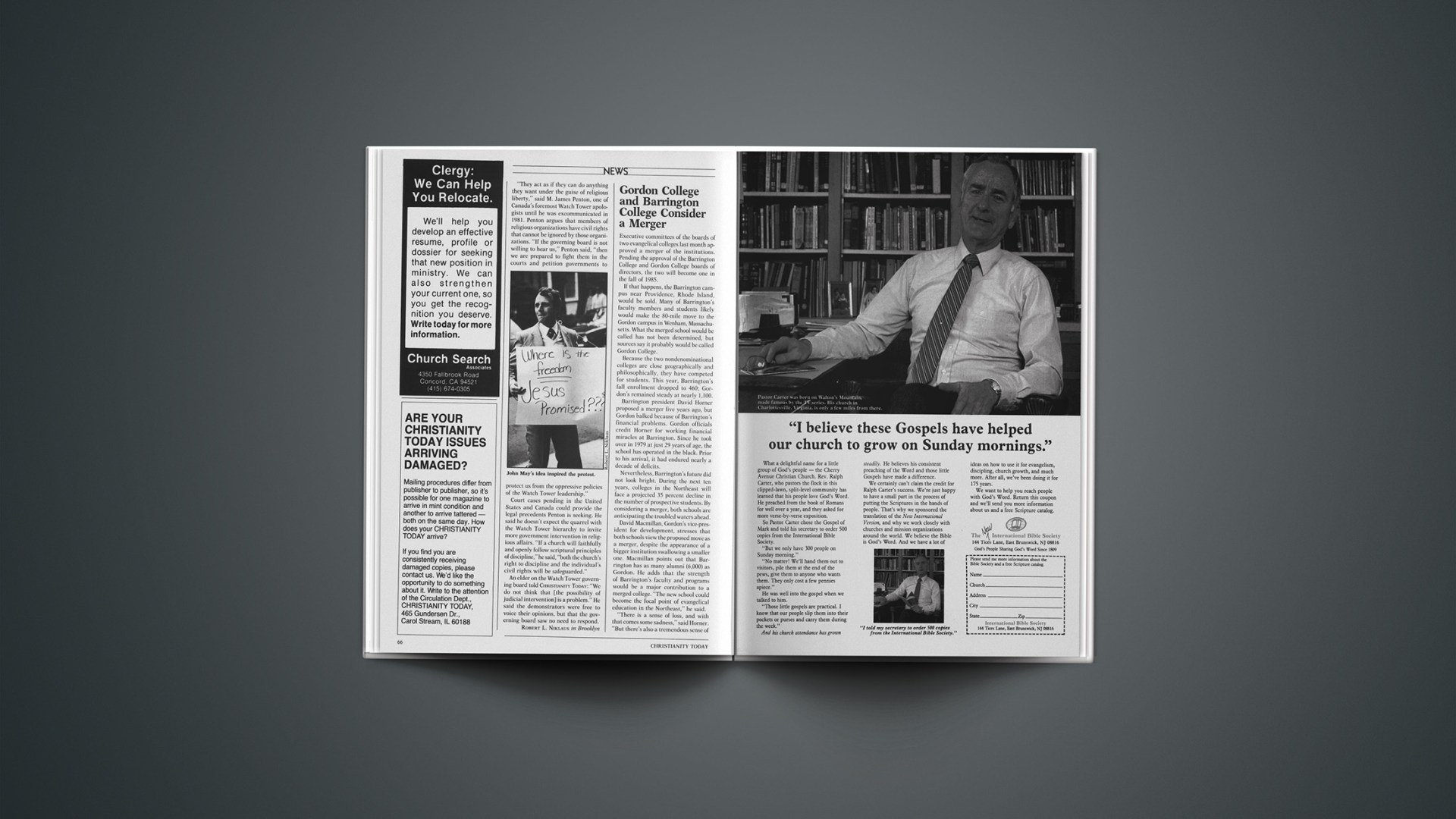
Now an ex-Witness, Matthews recently joined some 20 other demonstrators outside the building that houses members of the Jehovah’s Witnesses governing board in Brooklyn, New York. The four-day “Freedom of Conscience” demonstration marked the first time a public protest was carried to the doorstep of the organization’s headquarters, known officially as the Watch Tower Bible and Tract Society.

Former Witness John May of County Dublin, Ireland, said he initiated the demonstration to focus attention on the “outrageous cruelty” and “totalitarian oppression” of the Watch Tower hierarchy. The demonstrators represented eight countries and perhaps several hundred thousand former Witnesses.

The Watch Tower society claims about 2.5 million members worldwide, including 600,000 in the United States. But sources say a “revolving-door syndrome” has pulled about one million members from the ranks in the last decade. Richard Hickman, who heads one of some 20 organizations that assist banished Witnesses, said he has helped 2,600 individuals over the past three years.

Watch Tower theology recognizes only two kingdoms, Jehovah’s and Satan’s. Members are pressured to make friends only among themselves and to sever all contact with the outside world—political parties, social clubs, and “worldly” friends and relatives.

The effect over a period of years is “total isolation from the real world,” said Richard Rawe, one of the protest organizers. Rawe’s mother, 85, was told to cut all ties with her son. She was disfellowshiped when she refused to comply. Rawe said he has collected evidence showing that the Witnesses’ practice of disfellowshiping and shunning former members has caused broken homes, divorces, mental and emotional disorders, and suicides.

The demonstrators didn’t challenge the Watch Tower’s right to discipline members. “That’s their business,” said Ron Reed of Sacramento, California. Reed is a former Witness who is studying law in order to combat their methods. “Freedom is a two-way street,” he said. “I am free to worship or not to worship. I have the right to change my religion, but Jehovah’s Witnesses will not honor that right. They will not let anyone leave with dignity.”

Members who are banished and those who resign are treated alike. Their departure is publicly explained with inferences of immorality or with statements like “dogs returning to their vomit.” A strict policy of ostracism then takes over.

In their book The Orwellian World of Jehovah’s Witnesses (University of Toronto Press), Heather and Gary Botting suggest that paranoia in the Watch Tower board room prompted a more stringent practice of shunning in recent years (CT, Sept. 21, 1984, p. 66). The overzealous and often capricious manner in which local Jehovah’s Witnesses judicial committees evict and ostracize members has raised the larger issue of religious freedom.

“They act as if they can do anything they want under the guise of religious liberty,” said M. James Penton, one of Canada’s foremost Watch Tower apologists until he was excommunicated in 1981. Penton argues that members of religious organizations have civil rights that cannot be ignored by those organizations. “If the governing board is not willing to hear us,” Penton said, “then we are prepared to fight them in the courts and petition governments to protect us from the oppressive policies of the Watch Tower leadership.”

Court cases pending in the United States and Canada could provide the legal precedents Penton is seeking. He said he doesn’t expect the quarrel with the Watch Tower hierarchy to invite more government intervention in religious affairs. “If a church will faithfully and openly follow scriptural principles of discipline,” he said, “both the church’s right to discipline and the individual’s civil rights will be safeguarded.”

An elder on the Watch Tower governing board told CHRISTIANITY TODAY: “We do not think that [the possibility of judicial intervention] is a problem.” He said the demonstrators were free to voice their opinions, but that the governing board saw no need to respond.

ROBERT L. NIKLAUSin Brooklyn

A Fringe Cult Calls Michael Jackson the Returned Christ

Grammy Award-winning superstar Michael Jackson poses special problems for the leadership of the Watch Tower Bible and Tract Society (Jehovah’s Witnesses).

As a rock singer, Jackson represents a segment of contemporary culture that the Watch Tower leadership considers evil. At the same time, he is a devout Jehovah’s Witness who reportedly leads a life free of drugs, sexual immorality, and alcohol. Disguising himself, Jackson reportedly stands on street corners distributing copies of Watch Tower publications.

The problem he poses for the Watch Tower leadership looms much larger than his success as a rock singer. He is the unwilling star of a fringe cult that hails him as the second-coming Christ.

In view of Jehovah’s Witnesses theology, the claim is not as bizarre as it seems. The Watch Tower society considers Jesus to be Michael the Archangel, who is to return to earth. The Michael Jackson cult says Jackson is the archangel.

“This is the same as saying that he is Jesus Christ in the second coming,” says Gary Botting, an expert on Jehovah’s Witnesses. “They use prophecies of the religion to support their arguments.” Jackson was conceived in 1957, prophesied by Witnesses to be a pivotal year of the Second Coming. He was born in 1958 in the same month Jehovah’s Witnesses held their largest international assembly ever.

A Michael Jackson cult pamphlet concludes, “After all, if Michael is the Archangel, He’s been here before. And His appearance on earth would have grave implications for Witness theology: it would mean that Armageddon has already come and gone, and that we are already living in a ‘new world,’ over which Michael, the returned Messiah, rules as the Prince of Peace.”

Humanist Leader Files a Lawsuit against Aspects of Congressional Chaplaincy

The chaplains of the U.S. Senate and House of Representatives are targets of a lawsuit filed by Paul Kurtz, philosophy professor at the State University of New York in Buffalo and a well-known humanist. Kurtz seeks court action to force the chaplains to allow “nontheists” to participate in a guest-speaker program. He also wants to prevent the chaplains’ prayers from being published at taxpayer expense.

Kurtz filed the suit in U.S. District Court in Washington, D.C. Earlier this year, he provoked a confrontation with Senate Chaplain Richard C. Halverson and House Chaplain James D. Ford through a flurry of letters. He asked permission to deliver opening remarks at a daily session of either house of Congress. The humanist leader acknowledged that because of his beliefs he would not pray or “invoke any deity” during his remarks.

Ford wrote back saying House rules require that opening statements be in the form of prayer. Halverson replied that guest speakers were invited only when they were sponsored by a senator. Kurtz sought sponsorship from five senators and received one reply, from Oregon Republican Mark O. Hatfield. Hatfield said he would not sponsor Kurtz because a nontheist, by definition, could not utter a prayer or “acknowledge our dependence upon the transcendent Creator.”

Kurtz, editor of Free Inquiry magazine and a spokesman for humanism, said he is entitled to “equal access” to the floors of Congress because nontheists are excluded from providing moral or spiritual guidance in that forum. He said nontheists—whom he described as “people who may or may not be atheists”—do offer legitimate prayers. “There are a lot of ministers in this country who are nontheistic yet who provide moral inspiration,” he said.

Kurtz opposes as well the printing of the chaplains’ prayers every two or three years at taxpayer expense. He singled out Halverson’s prayers as unconstitutional, charging that they “are routinely used to advance theism and to disparage nontheists, including secular humanists, by … calling into question the morality and humanity of nontheists.” On the advice of legal counsel, Chaplain Halverson declined to comment on the lawsuit.

The U.S. Supreme Court has found the congressional chaplaincy to be constitutionally sound, so Kurtz’s suit is limited to the guest speaker program and the publishing of prayers.

Researcher Sees Hope For Less Soviet Repression Of Believers

Keston College, an organization that monitors religious affairs in Communist countries, is more optimistic about the plight of religious believers in the Soviet Union.

In an article published in the Keston College journal, research student Carolyn Burch writes: “The replacement of Yuri Andropov’s more forceful presidency by what must be naturally a more collective leadership under [Konstantin] Chernenko may give cause for a cautious hope for the leveling off of the recent sharp escalation in repression [of believers].…

“The increase in repression of any attempt to extend religious life beyond the officially stipulated boundaries has been a part of a general clamp-down on dissent which began in the Olympic purges of 1978–80, when Andropov was head of the KGB [Soviet secret police],” Burch writes. “Under Andropov, several Baptists were re-arrested and given fresh sentences, only months after completing a previous term of imprisonment.”

Orthodox Christians also have been suffering increasingly over the last two years from the attack on clandestine religious literature, though the brunt of this has fallen on evangelical groups. The work of the Christian Committee for the Defense of Believers’ Rights likewise has found increasing difficulties and risks over the last two years.

Burch writes that it is significant that Chernenko referred to religion at a central committee plenum last year. Such references are rare—particularly, open acknowledgment of the continuing influence of the Christian faith in the lives of the Russian people. It is also worth noting, she writes, that Chernenko has appeared to stress that the struggle is against religious ideology and not against believers themselves.

RELIGIOUS NEWS SERVICE

James Robison Leaves Church of Former Baptist President

Chafing under what he describes as constant discussion of his ministry by the church staff, evangelist James Robison said he is leaving First Baptist Church in Euless, Texas. The church is pastored by James T. Draper, Jr., former president of the Southern Baptist Convention (SBC).

Robison’s status in Draper’s church had been the subject of discussion over the past two years. During that time, Robison’s ministry increasingly emphasized healing, deliverance from demons, and spiritual gifts (CT, June 15, 1984, p. 69).

The evangelist told the Baptist Standard, news journal of the Baptist General Convention of Texas, that he would join Lake Country Baptist Church, a Southern Baptist congregation in nearby Fort Worth. There he will be involved in a new satellite ministry.

Draper has said that while Robison doctrinely “would not be that different from most of us [Southern Baptists],” his charismatic emphases are “not typically Southern Baptist.”

Draper told the Standard that he was not surprised by Robison’s plans to leave. Draper said “50 to several hundred” members might leave the church with Robison. Draper’s church has a membership of about 7,000.

Robison joined Jim Hylton and Dudley Hall in a seminar ministry earlier this year. Hylton pastors Lake Country Baptist Church, the congregation Robison is joining. Robison said he, Hylton, and Hall had been praying about establishing a satellite ministry for 18 months. He declined to give details, saying negotiations for property were at a critical stage.

BAPTIST PRESS

Apple PodcastsDown ArrowDown ArrowDown Arrowarrow_left_altLeft ArrowLeft ArrowRight ArrowRight ArrowRight Arrowarrow_up_altUp ArrowUp ArrowAvailable at Amazoncaret-downCloseCloseEmailEmailExpandExpandExternalExternalFacebookfacebook-squareGiftGiftGooglegoogleGoogle KeephamburgerInstagraminstagram-squareLinkLinklinkedin-squareListenListenListenChristianity TodayCT Creative Studio Logologo_orgMegaphoneMenuMenupausePinterestPlayPlayPocketPodcastRSSRSSSaveSaveSaveSearchSearchsearchSpotifyStitcherTelegramTable of ContentsTable of Contentstwitter-squareWhatsAppXYouTubeYouTube