Eutychus and His Kin: September 28, 1962

Breakthroughs

For Rally Day in our Sunday school we have varnished the chairs in the primary department, and the Ladies’ Aid has sewed new drapes for the basement windows. This renovation falls somewhat short of the rebuilding program of the local school district. Two new elementary schools have been added to the system. I hear rumors of new teaching methods, too. Ungraded primary classes are scheduled so that individual children can learn at their own rate, and Russian is at the present time included in the high school curriculum.

Of course our church primary department has been upgraded from the beginning, but I’m not sure that this accelerated individual learning. Perhaps that was because no one knew how progressive it was. Our equipment has never seemed very dramatic, either. Breakthroughs in education are always made with teaching machines, or visual aids, or tactile alphabets made of sandpaper, or perhaps by three-year-olds on electric typewriters.

Our biggest innovation came ten years ago when Miss Brownstone discovered the flannel board. Even that didn’t seem as exciting as it did when I read about it last month in an audio-visual magazine. Perhaps it was because Miss Brownstone didn’t have enough figures, and the children remembered Jonah and insisted that he wasn’t Peter and hadn’t walked on the sea but had sunk down to the big fish. In any event, after most of the sets were scrambled and lost we stopped having a flannel story every Sunday.

Group dramatics has lasted a little longer. We always bring down the walls of Jericho with a shout. But it takes three or four years to get back to Jericho and action lags in the interval.

With new equipment and teaching materials we could accomplish much more—at least for a while. And there is always George Parker’s class of Juniors. I don’t know what he has discovered, unless it’s the Bible. Teaching takes more than faith, hope, and love, but not much more. George’s breakthrough seems to be in matching love of Christ, love of the Bible, and love of boys.

EUTYCHUS

Resurrection Of The Body

I have just completed the reading of the article “Death and Immortality” by J. G. S. S. Thomson (Aug. 3 issue). It is, I believe, a good brief treatment of the subject from the traditional viewpoint. You are to be commended for your continuing interest in the presentation of theological materials—this is, I note, #40 in the series, many of which I have read.…

The sentence “Christ taught the possibility of the loss of the soul in hell” is not supported by any cited references or evidence. I suppose the passage that would be used [is] … Matthew 10:28. Yet in this passage we do not find “the soul in hell” but rather “both soul and body in hell,” thus maintaining the O.T. and N.T. picture of the nature of man as a psychosomatic unity. It is man who is affected, as body-soul togetherness, for good or ill in the NT portraits of death, judgment, eternal life and resurrection. This is recognized by Dr. Thomson when he writes: “The body is essential to the self.” One could have avoided a watering down of the belief in the resurrection of the body potentially present in his last section. If full bliss is granted the Christian at death, then no resurrection is needed and the doctrine is made an unpleasant hangover of a bygone era and the belief in the immortality of the soul (in some form or other; not necessarily a natural or inherent immortality, but as a gift of God) becomes the proper view. I do not think such is the case nor that it is the intention of Dr. Thomson to indicate such a belief in either his or the teaching of the N.T.

ROBERT E. BAILEY

Prof. of Bible

College of Liberal Arts

University of Dubuque

Dubuque, Iowa

Prayer And The Court

This letter is being written to commend the editorials “Supreme Court Prayer Ban” and “The Church’s True Head” (July 20 issue).… I wish that every professing Christian in the world, and especially in the United States, would read them.…

A. A. PAGE

President

Pikeville College

Pikeville, Ky.

The Bible says, “Blessed is the nation whose God is the Lord.” It also says, “When the righteous are in authority, the people rejoice; but when the wicked beareth rule, the people mourn.”

What saith the law? Quote: “Congress shall make no law respecting an establishment of religion, or prohibiting the free exercise thereof.” Even this does not in the least debar individual states from doing it.

So it is clearly shown that this is a matter for the states to decide for themselves. The law does not forbid any from honoring God in prayer, be it official or otherwise.…

In all fairness, is not the action of the Supreme Court … showing favoritism to the non-Christian [by] allowing … lewdness, lasciviousness and pornography and … depriving all others from exercising their God-given rights and privileges?…

N. P. GATES

Free Will Baptist Temple

Detroit, Mich.

Let me express my appreciation to you for actually including … the statement of the majority opinion and Justice Stewart’s dissent.… So much of the public discussion has neglected to consider the precise wording of the Supreme Court opinion.…

IRWIN W. JOHNSON

Bettendorf, Iowa

Congratulations on your editorial.… Also for printing texts.…

JAMES A. ADAMS

First Baptist Church

Salisbury, Mo.

In all of the tempest over the Supreme Court’s school prayer decision, one of the chief points has been missed: The whole of the affair would have been non-existent if America had not committed the major error around a century ago of succumbing to the idea of what theretofore had been largely an alien institution on our soil of freedom—a Prussian-style governmentally-operated educational system.…

Inevitably, in any government-run school system the time will come when there will be no recognition that God is supreme in the process. That being so, and with school life being of the vastest importance in the formative years, then most youths will have this belief deeply implanted in their hearts: God does not really matter in life.

ROBERT M. METCALF, JR.

Memphis, Tenn.

It would be presumptuous for a Canadian to criticize the decision of the U.S. Supreme Court on the New York school prayer issue, except to say that it is perplexing to find that a custom practiced for more than a century and a half suddenly becomes illegal. We have no state church in Canada either, but the acknowledgment of God, as he may be understood by the various religions, as the source of man’s blessings, finds expression in devotional exercises in the schools—this is not considered to be in the same category as preferential treatment of one particular religious group.

ROBERT K. EARLS

Cobden, Ont.

Those citizens who have accepted without protest the recent … decision banning prayer from the public schools would do well to take note of the fact that in the case, “The Church of the Holy Trinity vs. the United States,” (143 U.S. 457) this same Supreme Court, of course with different personnel, decreed that “this is a Christian nation.”

VERNE P. KAUB

President

American Council of Christian Laymen

Madison, Wise.

In the mountain fastness of the old Presbyterian and Reformed Review, which was then antecedent of the Princeton Theological Review, and in the issue of July, 1891, I came upon this excerpt from that sage and prophetic figure, Dr. Benjamin B. Warfield of Princeton Seminary. His statement has marked applicability to the current controversy of Bible reading and prayer in the public schools.

In a review of a book, Must the Bible Go? A Review of the Decision of the Supreme Court of Wisconsin, in the Edgerton Bible Case by W. A. McAtee of Madison, Wisconsin, Dr. Warfield wrote as follows:

“An admirably clear and satisfactory discussion of the issues raised by the novel and intolerable decision of the Wisconsin Supreme Court, excluding the reading of the Bible from the public schools. There seems to be abroad a very unnecessary confusion of mind on this great subject, even among Christian men. It would not be Christian to compel others to violate their consciences; but it certainly is not Christian to permit others to forbid our recognition of God in all our functions. As Christian men, acting in our organized relation as a Christian state, we must retain the Bible and Christian worship in our public schools, lest we should sin against our children and the nation’s welfare” (Vol. II, p. 534).

Characteristically, Dr. Warfield speaks with as much significance to our generation as to his readers of seventy years ago.

G. HALL TODD

Arch Street Presbyterian Church

Philadelphia, Pa.

Doctrine Of The Trinity

Re the letter from Mr. Flanigen of Pinopolis, S. C. (July 20 issue) in which he questions your statement that the doctrine of the Trinity is a New Testament doctrine (Editorials, May 25 issue).

To my mind this raises the question of what is meant by “New Testament doctrine” or “biblical doctrine.” As I see it, God’s revelation was given in divine acts to which the biblical writers bore witness. Whether or not a doctrine is a biblical doctrine depends on whether it is a true understanding of that to which they gave their witness. Whether or not they themselves grasped the significance of the evidence they provide is comparatively unimportant.

I myself maintain that the doctrine of the Trinity is definitely a New Testament doctrine, meaning by that that it expresses what God has revealed himself to be in the activity to which the New Testament bears witness. I think it was and is a doctrine implied by the passages to which you refer (Matt. 16:16; 28:9; 2 Cor. 13:14; Rom. 1:4), but I do not think it was consciously held as a theological doctrine by St. Paul, by whoever wrote the first gospel, or by any of their contemporaries. We have to distinguish between the immediacy of the revelation of the doctrine in the activity of which from the first the New Testament has been the enduring record, and the successiveness in the process of its realization by the Church. LEONARD HODGSON Leamington Spa, Warwickshire, England

Church Property Grab

CHRISTIANITY TODAY (News, July 20 issue) reports that Dr. Glen W. Harris, fraternal delegate from the UPUSA to the Cumberland Presbyterian Assembly, apologized for his denomination’s suing and closing Cumberland churches 55 years ago. “We are conscious that 55 years ago and in the years immediately following, our church appeared to be more interested in church property and legal rights than in Christian love and witness. For this too we ask your forgiveness.”

Fine words these! Maybe 55 years from now the UPUSA will ask our forgiveness for its continued interest in church property and its lack of Christian love.

Before the merger of the UP and USA churches in 1958 our congregation asked for and received a quit claim deed to our property from the old UP church. The congregation voted unanimously not to enter the merger, and then requested admission to the Reformed Presbyterian Church. But after the merger, the big church instituted suit against us. The matter is still in court. Maybe they are waiting to win the suit before apologizing.

GORDON H. CLARK

Indianapolis, Ind.

Chicago Crusade

I have read with interest … “Like a Mighty Army” (News, July 6 issue). [Re] your statement: “Ministers of the General Association of Regular Baptist Churches were the most aggressive in their opposition, sowing virulent attacks against the evangelist”: … do you have any documentation for this?… I live in Chicago, and I have not heard of any such incidents.

We are not against Mr. Graham, and it is our definite policy not to attack him. I am sure that he is frequently the object of the prayers of our brethren.… I have been in contact with Dr. Graham in an effort to arrange a conference with him, whereby we could sit down face to face and discuss the differences of methods that divide us.…

We are strongly opposed to the inclusivist policies which Dr. Graham follows as they relate to his sponsoring committees and the assignment of decision cards.…

PAUL R. JACKSON

National Representative

General Association of Regular Baptist Churches

Chicago, Illinois

• Our news source has been unable to put into our hands the material on which he based his verdict. If he misread the material, then an apology is certainly in order. Since we have been unable to confirm the facts, we hereby gladly make it.—ED.

A Pentecostal’S Reaction

Being a minister of the Pentecostal faith, I am deeply thrilled over the article by Philip Hughes in Current Religious Thought (May 11 issue).…

W. R. COLE

St. Petersburg, Fla.
Fall Book Forecast 1962

Each spring and fall CHRISTIANITY TODAY presents a forecast of religious books. These forecasts are not made to sell books—we leave the commercials to the publishers. They are presented for the convenience of those who want to know what is coming in their particular fields of interest, and to alert the lovers of religious books. Many ministers, students, and professors of religion have found it helpful to post these forecasts in their studies to avoid missing significant books as they come from the press.

Anyone who looks to the hand of the future will sometimes see things that are not there, and some things out of proportion. Some of the books here listed as significant on the basis of advertising claims and promises may not be such at all. On the other hand, some omitted may be significant—but then some of the future always slips through the fingers of those who try to judge her hand.

In the category of THEOLOGY there appears to be a full hand. Holt, Rinehart and Winston promises Evangelical Theology: An Introduction by Karl Barth (the lectures Barth delivered in America) and Basic Christian Doctrines, edited by Carl F. H. Henry. Inter-Varsity Press promises K. S. Kantzer’s An Interpretation of Karl Barth (apparently for college students), and Macmillan, C. W. Kegley’s The Theology of Emil Brunner. From the presses of Concordia will come The Structure of Lutheranism by W. Elert, and from Westminster: the third volume of E. Brunner’s dogmatics, The Christian Doctrine of the Church, Faith, and the Consummation; J. B. Cobb Jr.’s Living Options in Protestant Theology: A Survey of Methods; and—this must be far out for I see dimly now—D. Jenkins’ Beyond Religion. Zondervan predicts the appearance of the first volume of J. O. Buswell Jr.’s Systematic Theology of the Christian Religion and W. R. Martin’s handbook Essential Christianity; and Eerdmans will publish The Elope of Glory by Dale Moody and The Last Judgment by J. P. Martin.

The hand of the future is also full of promise for CHURCH HISTORY AND BIOGRAPHY. Association Press is ready with The Place of Bonhoeffer edited by Martin E. Marty, and Holt, Rinehart and Winston with a novel on the life of Calvin, The Master of Geneva by Gladys H. Barr. Harper & Row will publish The Twentieth Century Outside Europe, by that dean of American church historians, K. S. Latourette; E. P. Dutton, The Catholic Reformation by H. Daniel-Rops; and Eerdmans, The Reformation by W. C. Robinson. Looking back, David McKay will publish K. Burton’s Leo XIII: The First Modern Pope; Harvard University Press, The Religious Renaissance of the German Humanists by L. W. Spitz; Baker, Paul the Missionary by W. M. Taylor; and Hawthorn, The Church in the Eighteenth Century by M. Braure. Westminster promises what should be an interesting book, The Presbyterian Ministry in American Culture by E. A. Smith.

In the category of ECUMENICS Association Press promises to publish two books, The New Delhi Report edited by W. A. Visser ‘T Hooft and The Vatican Council and All Christians by C. D. Nelson. Morehouse-Barlow will publish An Anglican View of the Vatican Council authored by B. Pawley, and Westminster, a historical study by A. J. Lewis, Zinzendorf, the Ecumenical Pioneer. Also scheduled is Ecumenical Beginnings in Protestant World Mission by R. P. Beaver (Thomas Nelson).

In OLD TESTAMENT AND ARCHAEOLOGY Harper & Row promises The Prophets of Israel by Abraham Heschel, and again promises (cf. Spring Forecast) Old Testament Theology by G. von Rad, who does to the Old what Bultmann does to the New Testament. Abingdon is on promise to publish The People of the Covenant by M. Newman, and McGraw-Hill, Our Living Bible by M. Avi-Yonah and E. Kraeling. There will be at least two books of archaeological interest, Eerdmans’ The Bible and Archaeology by J. A. Thompson and Thomas Nelson’s Archaeology and the Old Testament World by J. Gray.

Of special interest in NEW TESTAMENT: D. Guthrie’s General Epistles and Revelation (Volume II in his New Testament Introduction) will be published by Inter-Varsity Press. Scribner’s will present F. C. Grant’s Roman Hellenism and the New Testament and C. K. Barrett’s intriguing title, From First Adam to Last. Hawthorn promises to publish H. Daniel-Rops’ Daily Life in the Time of Jesus; Westminster, T. W. Manson’s Studies in the Gospels and Epistles; Revell, S. E. Wirt’s Open Your Bible to the New Testament Letters; and Harper & Row, John Knox’s The Church and the Reality of Christ, which, according to advance promises, reconciles the Christ of faith with the Jesus of history.

The promises of the future for PASTORAL THEOLOGY AND PSYCHOLOGY are few: Abingdon will give us J. H. Ziegler’s Psychology and the Teaching Church; Zondervan, J. B. Wilder’s The Young Minister; and Seabury, R. N. Rodenmayer’s I John Take Thee Mary.

The future promises to be niggardly also in the area of APOLOGETICS, PHILOSOPHY, AND SCIENCE. A. N. Well’s The Christian Message in a Scientific Age will be published by John Knox, W. E. Stuermann’s Logic and Faith: A Study of the Relations Between Science and Religion by Westminster, and C. Tresmontant’s The Origin of Christian Philosophy by Hawthorn.

Reflecting the problems and agonies of our time, the following will appear in the area of ETHICS AND SOCIAL PROBLEMS: The South and Christian Ethics (Association) by J. E. Sellers; Albert Schweitzer’s Peace or Atomic-War? (Holt, Rinehart and Winston); The Christian in Politics (Oxford Press) by W. James; The Christian in Business (Revell) by J. E. Mitchell, Jr.; Ethics and Business (Scribner’s) by W. A. Spurrier; and Christianity and Sex (Inter-Varsity) by S. B. Babbage.

A clutch of books are promised in LITURGY AND WORSHIP, reflecting the continued growing interest in this area. Bethany Press will print L. R. Smith’s Four Keys to Prayer; Revell, Michael Daves’s Famous Hymns and Their Writers; John Knox, The English Hymn by L. F. Benson; Augsburg, Altar Prayers for the Church Year by C. H. Zeidler; World, Christian Hymns edited by L. Noss; and, finally, Hawthorn promises These Are the Sacraments by Bishop Fulton J. Sheen.

The wide interest in missions and in the crucial problems which arise as Christianity encounters non-Christian religions is pointed up by the forthcoming books in MISSIONS AND EVANGELISM: Why Christianity of All Religions (Westminster) by H. Kraemer; Upon the Earth (McGraw-Hill) by D. T. Niles; To the Whole Creation: The Church Is Mission (Judson) by J. P. Skoglund; The Ministry of the Spirit (Eerdmans) by Roland Allen; The People of God (Seabury) by A. D. Kelley; Apologetics and Evangelism (Westminster) by J. V. Langmead; and, of a different type, The Home Front of Jewish Missions (Baker) by A. Huisjen, These Too Were Unshackled by F. C. Bailey, and Spurgeon on Revival by E. Hayden (the latter two by Zondervan).

SERMONS—few are offered. Baker will present Expository Preaching Without Notes by C. W. Koller. As the late Clarence Macartney so eloquently insisted, preaching without notes is great. But what about the man who needs not only notes but also sermons? Eerdmans will take care of that by offering these three books: In the Midst by G. D. Gilmore, The Forty Days by G. R. King, and The Inevitable Encounter by Edward L. R. Elson.

In the needy field of RELIGIOUS EDUCATION the offerings are again few. Eerdmans will publish Bernard Ramin’s The Christian College in the Twentieth Century, and Westminster, The Teaching Office in The Reformed Tradition by R. W. Henderson. The University of Pittsburgh Press will issue Wider Horizons in Christian Adult Education edited by L. C. Little, and Abingdon, Religious Drama: Ends and Means by H. Ehrensperger.

RELIGIOUS LITERATURE AND DEVOTIONAL: Harper & Row will present Chad Walsh’s From Utopia into Nightmare; Columbia University Press, H. N. Fairchild’s Volume V of Religious Trends in English Poetry, which covers the period 1880–1920; and Augsburg, three books in this field: Printer’s Devil from Wittenberg by T. J. Kleinhans, A Practical Guide for Altar Guilds by E. Bockelman, and Thy Word in My Heart by F. P. Reid.

The continuing large interest in the study of the Bible is again indicated by the full hand the future holds in the area of BIBLE STUDY, COMMENTARIES, AND DICTIONARIES. With Thomas Nelson’s exclusive publishing rights to the Revised Standard Version of the Bible running out at month’s end, other publishers are quickly moving in. A. J. Holman will issue the Holman Study Bible, and Oxford Press, The Oxford Annotated Bible; both are based on the RSV. Holt, Rinehart and Winston will reissue Hurlbut’s Story of the Bible. John Knox will publish Volumes VIII, XV, XVII, and XXIV of the Southern Presbyterian Church’s The Layman’s Bible Commentary. Baker will issue Thessalonians by H. J. Ockenga and Hebrews by C. S. Roddy, both volumes in the series Proclaiming the New Testament, and The Epistle to the Philippians by W. Hendriksen, a volume in Baker’s New Testament Commentary series. From Thomas Nelson will come The Gospels and the Book of Acts and The New Testament Epistles (Volumes VI and VII of Nelson’s Bible Commentary), both by F. C. Grant; and from Westminster, The Psalms, A Commentary (The Old Testament Library series) by A. Weiser. Moody Press will publish The Wycliffe Bible Commentary co-edited by C. F. Pfeiffer and E. F. Harrison, and Harcourt, Brace and World, The Revelation of John—a translation by R. Lattimore. McGraw-Hill will print The Clarified New Testament: The Four Gospels by E. G. Kraeling. Zondervan will publish Pictorial Bible Dictionary edited by M. C. Tenney; W. A. Wilde, a revision of W. M. Smith’s Profitable Bible Study; Eerdmans, The Spirit of Holiness by Everett Lewis Cattell.

Things have come a long way since Bibles were handwritten and chained to the medieval pulpit lest something so valuable be stolen. Today the printing press produces the riches of scholarship in innumerable inexpensive paperbound editions.

In the field of PAPERBACKS publishers in the next six months will give us Sören Kierkegaard’s Edifying Discourses (2 volumes), Karl T. Schmidt’s Rediscovering the Natural in Protestant Theology, Harupa and Nold’s Advent Day by Day, L. Mero’s My Christmas Book (all from Augsburg); H. Thielicke’s Advice for Young Theologians and G. Stob’s Handbook of Bible History (both from Eerdmans); A. L. Creager’s Old Testament Heritage, R. Hazelton’s New Testament Heritage, R. L. Shinn’s The Sermon on the Mount (all from United Church Press); W. E. Waldrop’s How to Combat Communism, J. Bloch’s Armour of Light, How to Make Pastoral Calls by R. L. Dicks, The Living Christ in Our Changing World by J. Daniel Joyce, and The Delinquent, The Hipster, and The Square edited by A. I. Cox (all from Bethany Press); E. F. Harrison’s John, A Brief Commentary and C. F. Pfeiffer’s The Epistle to the Hebrews (both from Moody). Other paperbacks to appear are Jean-Jacques Von Allmen’s Preaching and Congregation (John Knox), Dietrich Bonhoeffer’s Letters and Papers from Prison (Macmillan), W. E. Post’s Saints, Signs, and Symbols (Morehouse-Barlow), and H. R. Landon’s Reinhold Niebuhr: A Prophetic Voice in Our Time (Seabury). Oxford is bringing out Volumes IV, V, and VI of Arnold J. Toynbee’s A Study of History, Volume IV bearing the title The Breakdown of Civilizations, V (Part 1) and VI (Part 2) the title The Disintegrations of Civilizations.

If interpreting the past is difficult, interpreting the future is precarious. Yet looking back on these scannings of the future it seems safe to say that the schedule of coming productions of religious books seems to indicate no new significant patterns of change in the religious situation. Areas of busy religious and theological activity in the past will continue to be busy; those that were weak will continue weak. It appears that the Church still has a healthy appetite for biblical studies, commentaries, historical and theological studies, and for missions, and a continuing smaller appetite for the important areas of liturgy, religious education, and ethics. Also lacking is a deep and sustained concern by conservative evangelical scholarship for that central theological-philosophical issue of our time: the question of revelation and history. Matters could, however, soon change for the better, for I have looked at only six months’ worth of the future,

J. D.

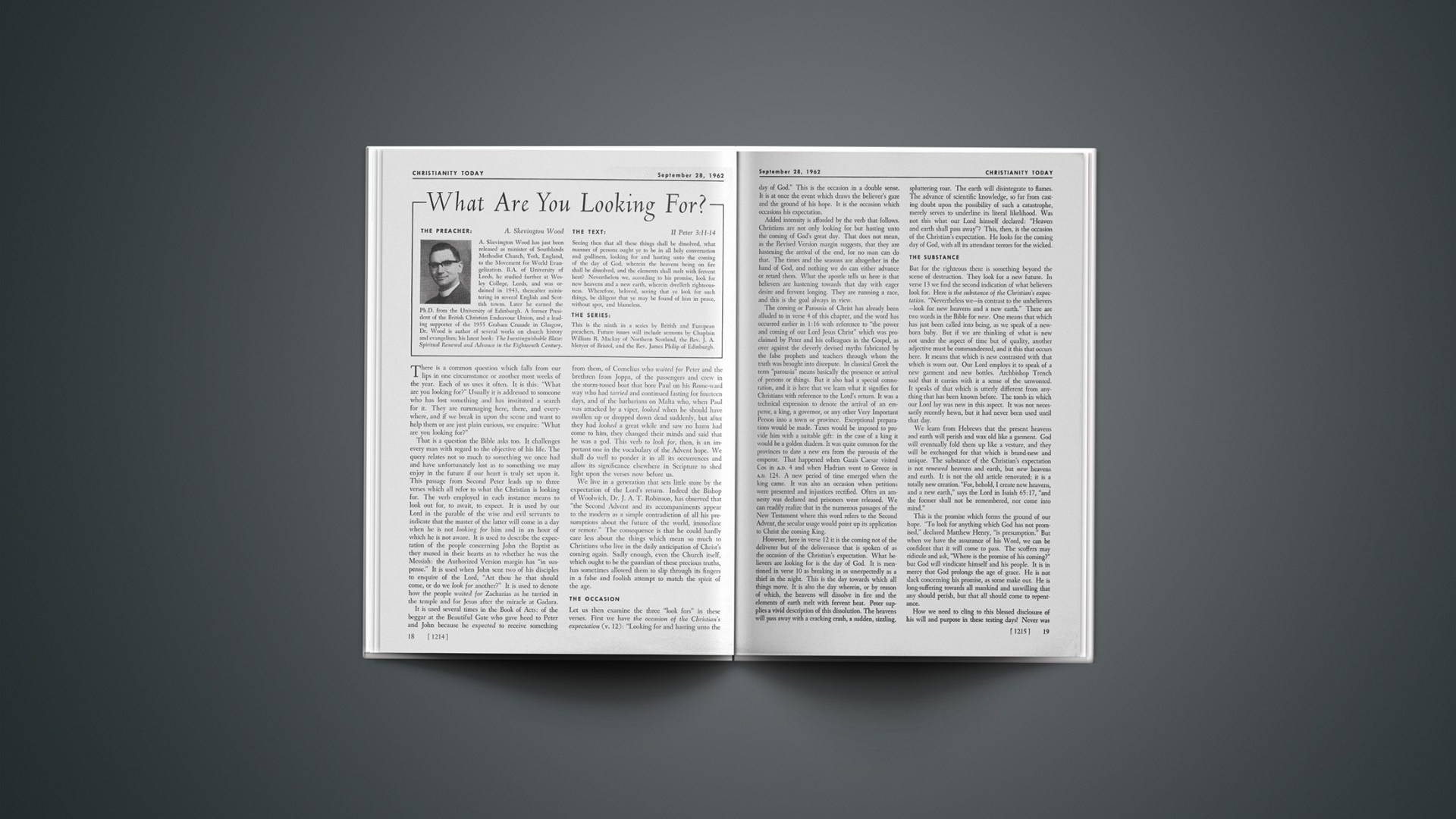
What Are You Looking For?

2 Peter 3:11–14

The Preacher:

A. Skevington Wood has just been released as minister of Southlands Methodist Church, York, England, to the Movement for World Evangelization. B.A. of University of Leeds, he studied further at Wesley College, Leeds, and was ordained in 1943, thereafter ministering in several English and Scottish towns. Later he earned the Ph.D. from the University of Edinburgh. A former President of the British Christian Endeavour Union, and a leading supporter of the 1955 Graham Crusade in Glasgow, Dr. Wood is author of several works on church history and evangelism; his latest book: The Inextinguishable Blaze: Spiritual Renewal and Advance in the Eighteenth Century.

The Text:

Seeing then that all these things shall be dissolved, what manner of persons ought ye to be in all holy conversation and godliness, looking for and hasting unto the coming of the day of God, wherein the heavens being on fire shall be dissolved, and the elements shall melt with fervent heat? Nevertheless we, according to his promise, look for new heavens and a new earth, wherein dwelleth righteousness. Wherefore, beloved, seeing that ye look for such things, be diligent that ye may be found of him in peace, without spot, and blameless.

The Series:

This is the ninth in a series by British and European preachers. Future issues will include sermons by Chaplain William R. Mackay of Northern Scotland, the Rev. J. A. Motyer of Bristol, and the Rev. James Philip of Edinburgh,

There is a common question which falls from our lips in one circumstance or another most weeks of the year. Each of us uses it often. It is this: “What are you looking for?” Usually it is addressed to someone who has lost something and has instituted a search for it. They are rummaging here, there, and everywhere, and if we break in upon the scene and want to help them or are just plain curious, we enquire: “What are you looking for?”

That is a question the Bible asks too. It challenges every man with regard to the objective of his life. The query relates not so much to something we once had and have unfortunately lost as to something we may enjoy in the future if our heart is truly set upon it. This passage from Second Peter leads up to three verses which all refer to what the Christian is looking for. The verb employed in each instance means to look out for, to await, to expect. It is used by our Lord in the parable of the wise and evil servants to indicate that the master of the latter will come in a day when he is not looking for him and in an hour of which he is not aware. It is used to describe the expectation of the people concerning John the Baptist as they mused in their hearts as to whether he was the Messiah: the Authorized Version margin has “in suspense.” It is used when John sent two of his disciples to enquire of the Lord, “Art thou he that should come, or do we look for another?” It is used to denote how the people waited for Zacharias as he tarried in the temple and for Jesus after the miracle at Gadara.

It is used several times in the Book of Acts: of the beggar at the Beautiful Gate who gave heed to Peter and John because he expected to receive something from them, of Cornelius who waited for Peter and the brethren from Joppa, of the passengers and crew in the storm-tossed boat that bore Paul on his Rome-ward way who had tarried and continued fasting for fourteen days, and of the barbarians on Malta who, when Paul was attacked by a viper, looked when he should have swollen up or dropped down dead suddenly, but after they had looked a great while and saw no harm had come to him, they changed their minds and said that he was a god. This verb to look for, then, is an important one in the vocabulary of the Advent hope. We shall do well to ponder it in all its occurrences and allow its significance elsewhere in Scripture to shed light upon the verses now before us.

We live in a generation that sets little store by the expectation of the Lord’s return. Indeed the Bishop of Woolwich, Dr. J. A. T. Robinson, has observed that “the Second Advent and its accompaniments appear to the modern as a simple contradiction of all his presumptions about the future of the world, immediate or remote.” The consequence is that he could hardly care less about the things which mean so much to Christians who live in the daily anticipation of Christ’s coming again. Sadly enough, even the Church itself, which ought to be the guardian of these precious truths, has sometimes allowed them to slip through its fingers in a false and foolish attempt to match the spirit of the age.

The Occasion

Let us then examine the three “look fors” in these verses. First we have the occasion of the Christian’s expectation (v. 12): “Looking for and hasting unto the day of God.” This is the occasion in a double sense. It is at once the event which draws the believer’s gaze and the ground of his hope. It is the occasion which occasions his expectation.

Added intensity is afforded by the verb that follows. Christians are not only looking for but hasting unto the coming of God’s great day. That does not mean, as the Revised Version margin suggests, that they are hastening the arrival of the end, for no man can do that. The times and the seasons are altogether in the hand of God, and nothing we do can either advance or retard them. What the apostle tells us here is that believers are hastening towards that day with eager desire and fervent longing. They are running a race, and this is the goal always in view.

The coming or Parousia of Christ has already been alluded to in verse 4 of this chapter, and the word has occurred earlier in 1:16 with reference to “the power and coming of our Lord Jesus Christ” which was proclaimed by Peter and his colleagues in the Gospel, as over against the cleverly devised myths fabricated by the false prophets and teachers through whom the truth was brought into disrepute. In classical Greek the term “parousia” means basically the presence or arrival of persons or things. But it also had a special connotation, and it is here that we learn what it signifies for Christians with reference to the Lord’s return. It was a technical expression to denote the arrival of an emperor, a king, a governor, or any other Very Important Person into a town or province. Exceptional preparations would be made. Taxes would be imposed to provide him with a suitable gift: in the case of a king it would be a golden diadem. It was quite common for the provinces to date a new era from the parousia of the emperor. That happened when Gauis Caesar visited Cos in A.D. 4 and when Hadrian went to Greece in A.D. 124. A new period of time emerged when the king came. It was also an occasion when petitions were presented and injustices rectified. Often an amnesty was declared and prisoners were released. We can readily realize that in the numerous passages of the New Testament where this word refers to the Second Advent, the secular usage would point up its application to Christ the coming King.

However, here in verse 12 it is the coming not of the deliverer but of the deliverance that is spoken of as the occasion of the Christian’s expectation. What believers are looking for is the day of God. It is mentioned in verse 10 as breaking in as unexpectedly as a thief in the night. This is the day towards which all things move. It is also the day wherein, or by reason of which, the heavens will dissolve in fire and the elements of earth melt with fervent heat. Peter supplies a vivid description of this dissolution. The heavens will pass away with a cracking crash, a sudden, sizzling, spluttering roar. The earth will disintegrate to flames. The advance of scientific knowledge, so far from casting doubt upon the possibility of such a catastrophe, merely serves to underline its literal likelihood. Was not this what our Lord himself declared: “Heaven and earth shall pass away”? This, then, is the occasion of the Christian’s expectation. He looks for the coming day of God, with all its attendant terrors for the wicked.

The Substance

But for the righteous there is something beyond the scene of destruction. They look for a new future. In verse 13 we find the second indication of what believers look for. Here is the substance of the Christian’s expectation. “Nevertheless we—in contrast to the unbelievers—look for new heavens and a new earth.” There are two words in the Bible for new. One means that which has just been called into being, as we speak of a newborn baby. But if we are thinking of what is new not under the aspect of time but of quality, another adjective must be commandeered, and it this that occurs here. It means that which is new contrasted with that which is worn out. Our Lord employs it to speak of a new garment and new bottles. Archbishop Trench said that it carries with it a sense of the unwonted. It speaks of that which is utterly different from anything that has been known before. The tomb in which our Lord lay was new in this aspect. It was not necessarily recently hewn, but it had never been used until that day.

We learn from Hebrews that the present heavens and earth will perish and wax old like a garment. God will eventually fold them up like a vesture, and they will be exchanged for that which is brand-new and unique. The substance of the Christian’s expectation is not renewed heavens and earth, but new heavens and earth. It is not the old article renovated; it is a totally new creation. “For, behold, I create new heavens, and a new earth,” says the Lord in Isaiah 65:17, “and the former shall not be remembered, nor come into mind.”

This is the promise which forms the ground of our hope. “To look for anything which God has not promised,” declared Matthew Henry, “is presumption.” But when we have the assurance of his Word, we can be confident that it will come to pass. The scoffers may ridicule and ask, “Where is the promise of his coming?” but God will vindicate himself and his people. It is in mercy that God prolongs the age of grace. He is not slack concerning his promise, as some make out. He is long-suffering towards all mankind and unwilling that any should perish, but that all should come to repentance.

How we need to cling to this blessed disclosure of his will and purpose in these testing days! Never was there a time when more scorn was poured upon the evangelical doctrines of our Lord’s return. Never was it more unfashionable, even in ecclesiastical circles, to profess attachment to this testimony. Never was it easier for men to buttress their rejection of God’s revelation with ill-digested arguments from prevalent science. Never did it seem more cultured and clever and up-to-date to decry the Scripture message concerning the end. Never was it harder for true believers to hold on in faith and hope and love. “Nevertheless, we, according to his promise, look for new heavens and a new earth, wherein dwelleth righteousness.” Sin banished, Satan bound, and Christ the righteous King in recognized command—this is the vision that spurs us on.

The Incentive

It leads the apostle to his next consideration. Those who now abide in Christ anticipate that righteousness which is the hallmark of the new heavens and earth. It is not a righteousness of their own, for all our righteousness is as filthy rags. It is the righteousness of Christ himself, imputed to us at the Cross when we were justified by faith alone, but also imparted to us through the Holy Spirit as we grow in grace. So the third “look for” has to do with the incentive of the Christian’s expectation (v. 14). This takes up the theme of verse 11. It would appear that the false teachers had divorced the Christian hope from the Christian life. As Dr. Paul S. Minear effectively puts it: “The victorious Christ had become the object of hope: the crucified Lord was no longer its source and ground and motive power. The hope of glory was therefore separated from the transfiguration wrought by Christ in the Christian.” Now that is a constant peril to those who hold the Advent truth. We must see to it that all who claim allegiance to the blessed hope are endeavoring after the blessed life. Peter says that we must be diligent to this end.

Something that C. S. Lewis wrote in his book on Christian Behaviour is relevant to the issue involved here. “Hope is one of the theological virtues. This means that a continual looking forward to the eternal world is not (as some modern people think) a form of escapism or wishful thinking, but one of the things a Christian is meant to do. It does not mean that we are to leave the present world as it is. If you read history you will find that the Christians who did most for the present world were just those who thought most of the next.… It is since Christians have largely ceased to think of the other world that they have become so ineffective in this. Aim at heaven and you will get earth thrown in: aim at earth and you will get neither.”

This diligence, according to the apostle, is to be exercised in order that we may be found of (or by) Christ at his return living in peace, without spot or blemish. In 2:13 the libertine mockers of the faith are called spots and blemishes. Christians are to be just the opposite, so Peter puts a negative in front of each of those repulsive terms and urges his readers to make it their eager aim to be discovered by Christ when he comes as unspotted and unblemished. Those same words are used of the Lord Jesus himself in 1 Peter 1:19 where he reminds us that we were redeemed “with the precious blood of Christ, as of a lamb without blemish and without spot.” We are to be as he is in the world. We can be found in him at the end only as we live in him now. “In Christ” should be the Christian’s permanent address. This alone will enable us to weather the mortal storm in these atomic times.

That stalwart evangelical scholar, Principal James Denney of Glasgow, had little patience with any sort of woolly mysticism. He suspected those who talked about being lost in God without reference to the essential mediacy of His Son. He used to affirm trenchantly: “I would rather be found in Christ than lost in God.” We have found Christ because he first found us. May we also be found in him, so that when he comes in power and great glory we shall be found of him without blame.

Awards For Best Sermons On Human Destiny

Universalism with its profoundly unbiblical thesis that all men are already saved is sweeping Protestantism. To arouse active concern over this distorted “gospel” which cuts the nerve of both evangelism and missions, CHRISTIANITY TODAY announces a stimulating venture. More than $1,000 will be awarded for relevant sermons (abridged to 2,500 words in written form) that (1) expose the fallacies of this contemporary movement and (2) faithfully expound the biblical revelation of man’s final destiny and the ground and conditions of his redemption. Selection of winners will be by CHRISTIANITY TODAY’S editorial readers, whose decisions will be final. First, second, and third place awards of $500, $250, and $125, respectively, will he paid upon publication of the sermons. The editors reserve the right to publish two additional manuscripts selected for fourth and fifth place awards of $75 each. All rights to winning manuscripts become magazine property.

All entries must be original sermons actually preached to a congregation sometime during 1962. Two typewritten, doubles-paced copies of each submitted sermon should be postmarked to the Washington office of CHRISTIANITY TODAY no later than December 31, 1962. No manuscript will be returned unless a self-addressed, stamped envelope accompanies the entry. Attached to each sermon (both copies) should be a cover page giving the contributor’s name, address, and present station of service.

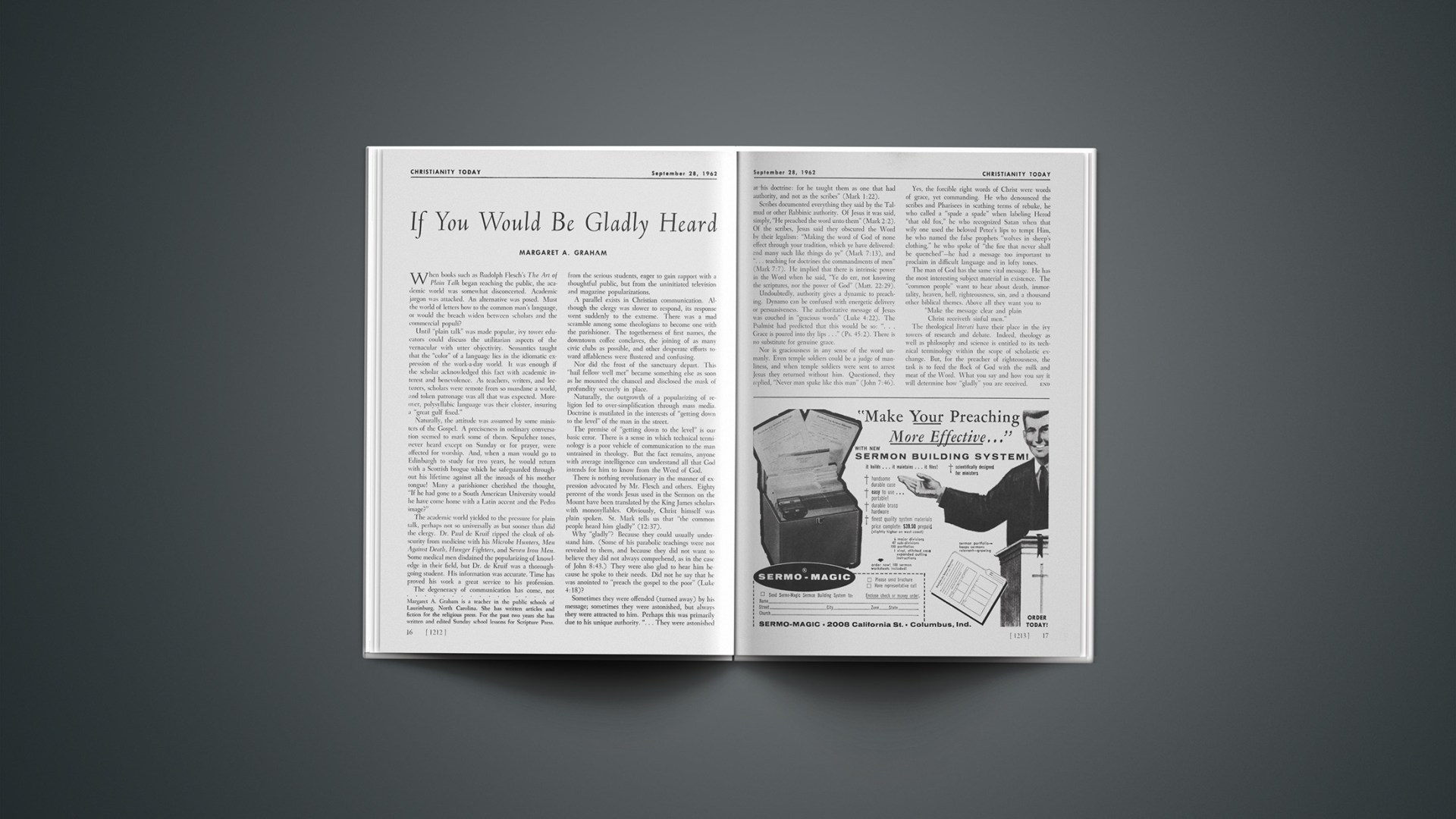
If You Would Be Gladly Heard

When books such as Rudolph Flesch’s The Art of Plain Talk began reaching the public, the academic world was somewhat disconcerted. Academic jargon was attacked. An alternative was posed. Must the world of letters bow to the common man’s language, or would the breach widen between scholars and the commercial populi?

Until “plain talk” was made popular, ivy tower educators could discuss the utilitarian aspects of the vernacular with utter objectivity. Semantics taught that the “color” of a language lies in the idiomatic expression of the work-a-day world. It was enough if the scholar acknowledged this fact with academic interest and benevolence. As teachers, writers, and lecturers, scholars were remote from so mundane a world, and token patronage was all that was expected. Moreover, polysyllabic language was their cloister, insuring a “great gulf fixed.”

Naturally, the attitude was assumed by some ministers of the Gospel. A preciseness in ordinary conversation seemed to mark some of them. Sepulcher tones, never heard except on Sunday or for prayer, were affected for worship. And, when a man would go to Edinburgh to study for two years, he would return with a Scottish brogue which he safeguarded throughout his lifetime against all the inroads of his mother tongue! Many a parishioner cherished the thought, “If he had gone to a South American University would he have come home with a Latin accent and the Pedro image?”

The academic world yielded to the pressure for plain talk, perhaps not so universally as but sooner than did the clergy. Dr. Paul de Kruif ripped the cloak of obscurity from medicine with his Microbe Hunters, Men Against Death, Hunger Fighters, and Seven Iron Men. Some medical men disdained the popularizing of knowledge in their field, but Dr. de Kruif was a thoroughgoing student. His information was accurate. Time has proved his work a great service to his profession.

The degeneracy of communication has come, not from the serious students, eager to gain rapport with a thoughtful public, but from the uninitiated television and magazine popularizations.

A parallel exists in Christian communication. Although the clergy was slower to respond, its response went suddenly to the extreme. There was a mad scramble among some theologians to become one with the parishioner. The togetherness of first names, the downtown coffee conclaves, the joining of as many civic clubs as possible, and other desperate efforts toward affableness were flustered and confusing.

Nor did the frost of the sanctuary depart. This “hail fellow well met” became something else as soon as he mounted the chancel and disclosed the mask of profundity securely in place.

Naturally, the outgrowth of a popularizing of religion led to over-simplification through mass media. Doctrine is mutilated in the interests of “getting down to the level” of the man in the street.

The premise of “getting down to the level” is our basic error. There is a sense in which technical terminology is a poor vehicle of communication to the man untrained in theology. But the fact remains, anyone with average intelligence can understand all that God intends for him to know from the Word of God.

There is nothing revolutionary in the manner of expression advocated by Mr. Flesch and others. Eighty percent of the words Jesus used in the Sermon on the Mount have been translated by the King James scholars with monosyllables. Obviously, Christ himself was plain spoken. St. Mark tells us that “the common people heard him gladly” (12:37).

Why “gladly”? Because they could usually understand him. (Some of his parabolic teachings were not revealed to them, and because they did not want to believe they did not always comprehend, as in the case of John 8:43.) They were also glad to hear him because he spoke to their needs. Did not he say that he was anointed to “preach the gospel to the poor” (Luke 4:18)?

Sometimes they were offended (turned away) by his message; sometimes they were astonished, but always they were attracted to him. Perhaps this was primarily due to his unique authority. “… They were astonished at his doctrine: for he taught them as one that had authority, and not as the scribes” (Mark 1:22).

Scribes documented everything they said by the Talmud or other Rabbinic authority. Of Jesus it was said, simply, “He preached the word unto them” (Mark 2:2). Of the scribes, Jesus said they obscured the Word by their legalism: “Making the word of God of none effect through your tradition, which ye have delivered: and many such like things do ye” (Mark 7:13), and “… teaching for doctrines the commandments of men” (Mark 7:7). He implied that there is intrinsic power in the Word when he said, “Ye do err, not knowing the scriptures, nor the power of God” (Matt. 22:29).

Undoubtedly, authority gives a dynamic to preaching. Dynamo can be confused with energetic delivery or persuasiveness. The authoritative message of Jesus was couched in “gracious words” (Luke 4:22). The Psalmist had predicted that this would be so: “… Grace is poured into thy lips …” (Ps. 45:2). There is no substitute for genuine grace.

Nor is graciousness in any sense of the word unmanly. Even temple soldiers could be a judge of manliness, and when temple soldiers were sent to arrest Jesus they returned without him. Questioned, they replied, “Never man spake like this man” (John 7:46).

Yes, the forcible right words of Christ were words of grace, yet commanding. He who denounced the scribes and Pharisees in scathing terms of rebuke, he who called a “spade a spade” when labeling Herod “that old fox,” he who recognized Satan when that wily one used the beloved Peter’s lips to tempt Him, he who named the false prophets “wolves in sheep’s clothing,” he who spoke of “the fire that never shall be quenched”—he had a message too important to proclaim in difficult language and in lofty tones.

The man of God has the same vital message. He has the most interesting subject material in existence. The “common people” want to hear about death, immortality, heaven, hell, righteousness, sin, and a thousand other biblical themes. Above all they want you to

“Make the message clear and plain

Christ receiveth sinful men.”

The theological literati have their place in the ivy towers of research and debate. Indeed, theology as well as philosophy and science is entitled to its technical terminology within the scope of scholastic exchange. But, for the preacher of righteousness, the task is to feed the flock of God with the milk and meat of the Word. What you say and how you say it will determine how “gladly” you are received.

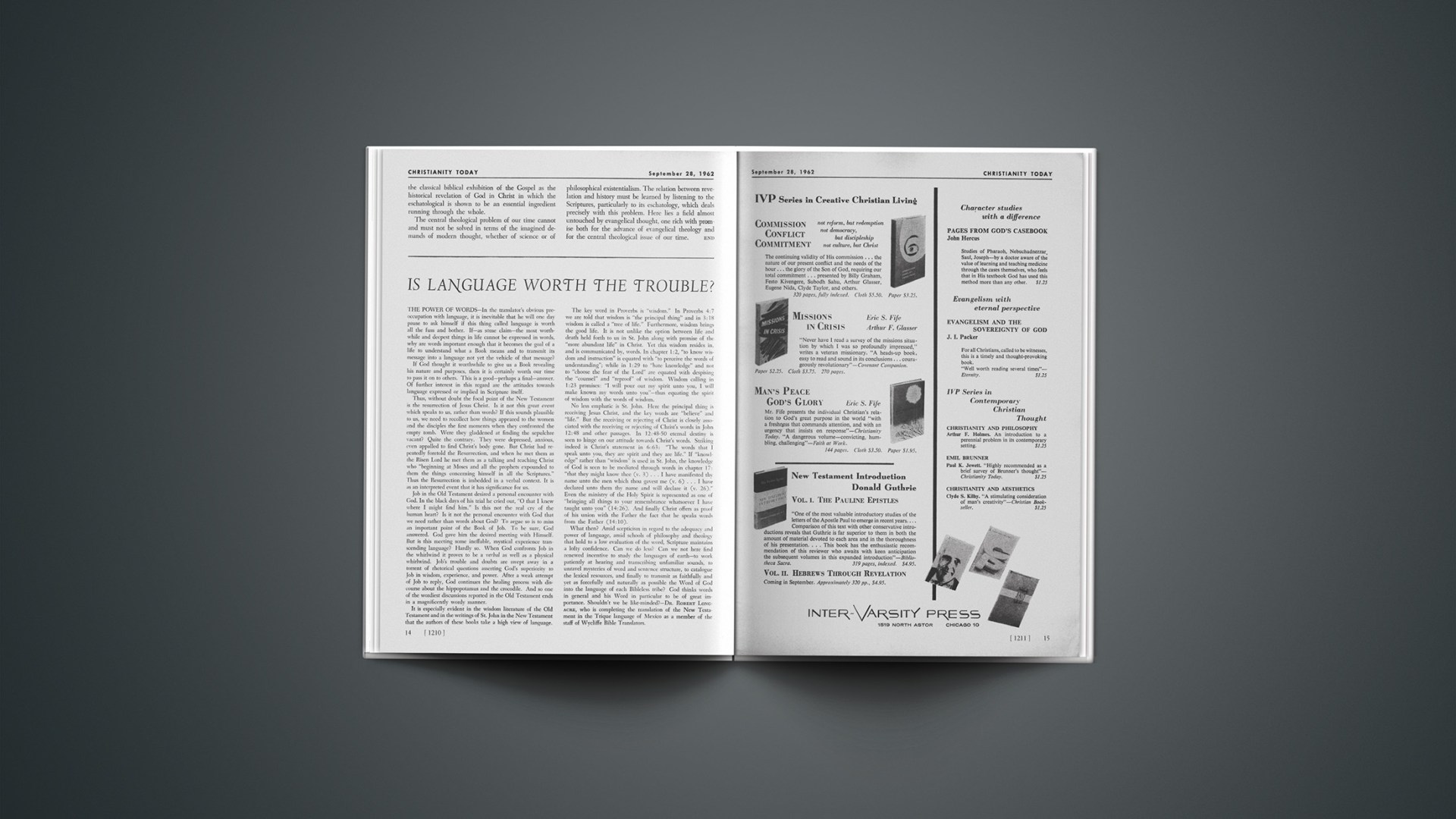
Is Language Worth the Trouble?

The power of words—In the translator’s obvious preoccupation with language, it is inevitable that he will one day pause to ask himself if this thing called language is worth all the fuss and bother. If—as some claim—the most worthwhile and deepest things in life cannot be expressed in words, why are words important enough that it becomes the goal of a life to understand what a Book means and to transmit its message into a language not yet the vehicle of that message?

If God thought it worthwhile to give us a Book revealing his nature and purposes, then it is certainly worth our time to pass it on to others. This is a good—perhaps a final—answer. Of further interest in this regard are the attitudes towards language expressed or implied in Scripture itself.

Thus, without doubt the focal point of the New Testament is the resurrection of Jesus Christ. Is it not this great event which speaks to us, rather than words? If this sounds plausible to us, we need to recollect how things appeared to the women and the disciples the first moments when they confronted the empty tomb. Were they gladdened at finding the sepulchre vacant? Quite the contrary. They were depressed, anxious, even appalled to find Christ’s body gone. But Christ had repeatedly foretold the Resurrection, and when he met them as the Risen Lord he met them as a talking and teaching Christ who “beginning at Moses and all the prophets expounded to them the things concerning himself in all the Scriptures.” Thus the Resurrection is imbedded in a verbal context. It is as an interpreted event that it has significance for us.

Job in the Old Testament desired a personal encounter with God. In the black days of his trial he cried out, “O that I knew where I might find him.” Is this not the real cry of the human heart? Is it not the personal encounter with God that we need rather than words about God? To argue so is to miss an important point of the Book of Job. To be sure, God answered. God gave him the desired meeting with Himself. But is this meeting some ineffable, mystical experience transcending language? Hardly so. When God confronts Job in the whirlwind it proves to be a verbal as well as a physical whirlwind. Job’s trouble and doubts are swept away in a torrent of rhetorical questions asserting God’s superiority to Job in wisdom, experience, and power. After a weak attempt of Job to reply, God continues the healing process with discourse about the hippopotamus and the crocodile. And so one of the wordiest discussions reported in the Old Testament ends in a magnificently wordy manner.

It is especially evident in the wisdom literature of the Old Testament and in the writings of St. John in the New Testament that the authors of these books take a high view of language.

The key word in Proverbs is “wisdom.” In Proverbs 4:7 we are told that wisdom is “the principal thing” and in 3:18 wisdom is called a “tree of life.” Furthermore, wisdom brings the good life. It is not unlike the option between life and death held forth to us in St. John along with promise of the “more abundant life” in Christ. Yet this wisdom resides in, and is communicated by, words. In chapter 1:2, “to know wisdom and instruction” is equated with “to perceive the words of understanding”; while in 1:29 to “hate knowledge” and not to “choose the fear of the Lord” are equated with despising the “counsel” and “reproof” of wisdom. Wisdom calling in 1:23 promises: “I will pour out my spirit unto you, I will make known my words unto you”—thus equating the spirit of wisdom with the words of wisdom.

No less emphatic is St. John. Here the principal thing is receiving Jesus Christ, and the key words are “believe” and “life.” But the receiving or rejecting of Christ is closely associated with the receiving or rejecting of Christ’s words in John 12:48 and other passages. In 12:48–50 eternal destiny is seen to hinge on our attitude towards Christ’s words. Striking indeed is Christ’s statement in 6:63: “The words that I speak unto you, they are spirit and they are life.” If “knowledge” rather than “wisdom” is used in St. John, the knowledge of God is seen to be mediated through words in chapter 17: “that they might know thee (v. 3) … I have manifested thy name unto the men which thou gavest me (v. 6) … I have declared unto them thy name and will declare it (v. 26).” Even the ministry of the Holy Spirit is represented as one of “bringing all things to your remembrance whatsoever I have taught unto you” (14:26). And finally Christ offers as proof of his union with the Father the fact that he speaks words from the Father (14:10).

What then? Amid scepticism in regard to the adequacy and power of language, amid schools of philosophy and theology that hold to a low evaluation of the word, Scripture maintains a lofty confidence. Can we do less? Can we not here find renewed incentive to study the languages of earth—to work patiently at hearing and transcribing unfamiliar sounds, to unravel mysteries of word and sentence structure, to catalogue the lexical resources, and finally to transmit as faithfully and yet as forcefully and naturally as possible the Word of God into the language of each Bibleless tribe? God thinks words in general and his Word in particular to be of great importance. Shouldn’t we be like-minded?—DR. ROBERT LONGACRE, who is completing the translation of the New Testament in the Trique language of Mexico as a member of the staff of Wycliffe Bible Translators.

Eschatology and History

During the early decades of the twentieth century theological liberalism gave shape and buoyancy to the hopes and ideals of a multitude of Americans. The force of the movement is now largely spent. No one today suggests turning to W. Adams Brown, H. Nelson Wieman, or to Shailer Mathews for help. Liberalism’s inadequacy has been too convincingly demonstrated, its exuberant estimate of life’s potentialities too battered by life’s actualities.

There was irony in liberalism’s decline, since the very thing with which it sought reconciliation arose to destroy it. Claiming that orthodoxy had forfeited its claim upon modern man by its failure to update Christianity and that no man could any longer be orthodox and intellectually honest, liberalism accommodated Christianity to what it regarded as the demands of modern scholarship. It was therefore ironical that history itself arose to discredit liberalism by demonstrating that the actual world was something quite different from the one to which liberalism had adjusted. History itself undid liberalism’s faith in its character and inevitable progress. In the deep crisis of the twentieth century there appeared a depravity and demonic brutality which demonstrated that liberalism’s morally intact man ever moving toward perfection was nonexistent. Although an estimate of the human situation has rarely been more mistaken, liberalism would still to be very much alive had it been challenged merely by orthodoxy. It has, however, been challenged and discredited by history itself.

The Role Of History

Nevertheless, although history proved to be too much for it, it was liberalism that brought the category of the historical into a large role in theological thinking.

In his new book, The Impact of American Religious Liberalism, W. K. Cauthen shows that liberalism, led by its assessment of advances in epistemology and in the natural and historical sciences, reinterpreted Christianity in terms of three basic tenets. First, God must be regarded as wholly immanent within the world. Liberalism urged that even if orthodoxy’s transcendent God existed, his unknowability would render him of no practical concern. Fortunately, it was said, modern knowledge demanded that God be regarded as one aspect of a single reality, internal, not external, to nature, man, and history. Second, man is autonomous in his knowledge of God. Knowledge of God does not come as a divinely guaranteed repository of truth transcending and judging human experience. Rather, knowledge of an immanent God is disclosed within experience, and by virtue of this immanency, man is morally intact and competent to judge what is authentic knowledge of God. Third, liberalism urged that Christianity must henceforth reckon with the fact of historical evolution. The historical consciousness which emerged in the nineteenth century was said to reveal that reality is not static but dynamic. God, nature, man are all aspects of a single, growing reality, moving in the changes of history toward an ever greater truth and perfection.

These basic tenets in terms of which liberalism reinterpreted Christianity—an immanent God progressively disclosed within man and a world moving toward greater truth and perfection—are obviously an insistence that the category of the historical should play a large role in Christian theology. Yet for all this insistence, the historical consciousness of liberalism was faulty for it contained no awareness of the eschatological and apocalyptic aspects of history so clearly enunciated in the New Testament. Even before it was discredited by history itself, Albert Schweitzer pointed liberalism beyond itself by his insistence that eschatology was an essential ingredient of the New Testament understanding of Jesus. Liberalism’s faulty view of history stems from the fact that it constructed its view of history within the Kantian contention that a rational knowledge of a transcendent God is impossible and within the contention of the prevailing science that the world is a closed system of cause and effect, allowing no intrusion by the divine from without.

The Problem In Neoorthodoxy

After the basic tenets of liberalism had been discredited by the historical convulsions and upheavals of the early part of this century, to which it had contributed and for which it had so dismally prepared men, liberalism’s insistence on the crucial significance of the category of the historical in theological thought was accepted in the neoorthodox movement.

Neoorthodox theologians refuse to be identified either as orthodox or as liberal. Because of their peculiar dynamic view of the historical, they accept but reinterpret various orthodox doctrines which liberalism had rejected as outmoded. Nonetheless, the heart of their difference with orthodoxy concerns the historical character of divine revelation. While orthodoxy contends that revelation can be identified with the historical and can therefore exist in the form of the Bible, neoorthodoxy contends that revelation, while always an historical occurrence, cannot be identified with the historical and hence not with the Bible.

Neoorthodoxy also refuses the designation of liberal, and again the heart of the difference lies in the question of revelation and its relation to history. It has uttered a loud NO to liberalism’s immanent God everywhere accessible within human experience and to the concomitant idea that man, being neither a radical sinner nor radically in need of divine grace, possesses the autonomy to discover and evaluate the authentic revelation of God.

Thus it is neoorthodoxy’s peculiar view of revelation and history which accounts for its rejection of both the orthodox and the liberal classification. And it is its peculiar view of the precise nature of the conjunction of revelation and history which, on the one hand, makes it impossible for orthodoxy to accept neoorthodoxy and, on the other, lends credence to the liberal’s claim that neoorthodoxy is in the tradition of liberalism.

Whereas liberalism denied the possibility of a miraculous inbreak into the world’s natural and historical processes, neoorthodoxy insists that God in his act of self-disclosure enters into history from outside and beyond history. Yet the precise nature of the conjunction of the revelational with the historical is in question. God is said to enter history tangentially; revelation is defined as Event, yet as Event is said never to be identical with the historical. Hence the distinctions between Geschichte and Historie, between the Jesus of history and the Christ of faith, the New Testament life of Jesus and the kerygma, sacred and secular history, between the Bible as something which is and as something which becomes the Word of God, all of which are so common in neoorthodox thought, as is the need for and wide usage of such terms as myth, saga, and symbol.

Where The Answer Lies

This question of the precise nature of the conjunction of revelation and history—and in consequence the question of the nature of our knowledge of God—is the crucial problem of modern theology. In this situation what should evangelical theologians do? Should they take heart, as Cauthen does, because modern physics today is not so certain that the world is a closed system, thus allowing for the possibility of a revelational inbreak of the divine which would violate neither nature nor the continuum in which history occurs? This would not only place theology again at the mercy of science but would be a gross neglect of the very revelation of God to which orthodoxy is committed. It is rather in the Scriptures themselves that orthodoxy must seek light on the admittedly complex question of the relationship of revelation and the historical. The Bible has a vast and rich doctrine of eschatology which liberalism so completely ignored and which orthodoxy has so largely rendered impotent for the solution of this vexing problem by its reduction of biblical eschatology to a number of items associated only with the calendar end-time of the world. Yet it is precisely in the biblical eschatology that one is confronted both with the fact of revelation and with the fact that it both occurs within history and alters history, which means that biblical revelation, on the one hand, is an authentically historical revelation, and yet, to the degree that it alters history, cannot be simply identified with history. This crucial problem of present-day theology is obviously a complex and intricate one, yet orthodoxy can neither afford to ignore the problem, nor surrender the genuine historicity of revelation by taking recourse to the merely mythological or symbolical. Neither classical Protestant Lutheranism nor Calvinism has absorbed into the structural part of its theology the biblical eschatological significance of the Incarnation, Cross, Resurrection, Pentecostal coming of the Spirit, and the dynamic moment of gospel proclamation. Even millennial theologies, with all their eschatological concern with an end-time millennium, do not express that eschatology which in the Bible is grounded in the Cross and the resurrection of Christ. In biblical thought revelation is not merely historical; it is also eschatological, that is, a modification of history. In this profound sense the Bible speaks of the Cross not only as an historical event which occurred some 2,000 years ago, but also as an event which so alters history that the time of its occurrence is described as an event of the end-time. Similarly, the Bible speaks of the Resurrection not merely as a given datable historical event but as an event which is also a new beginning, one which so modifies history that it is permissible to speak of a man within history actually being in Christ, and of a new song, a new covenant, a new society (the Church), a new and eternal life, all of which within history are free from the historical ravages of death, sin, and the onslaughts of hell. And around these central events there are, according to biblical teaching, a whole galaxy of eschatological truths which stem equally from a revelation which at once is historical and yet alters the historical. Paul’s Epistle to the Romans is perhaps the classical biblical exhibition of the Gospel as the historical revelation of God in Christ in which the eschatological is shown to be an essential ingredient running through the whole.

The central theological problem of our time cannot and must not be solved in terms of the imagined demands of modern thought, whether of science or of philosophical existentialism. The relation between revelation and history must be learned by listening to the Scriptures, particularly to its eschatology, which deals precisely with this problem. Here lies a field almost untouched by evangelical thought, one rich with promise both for the advance of evangelical theology and for the central theological issue of our time. END

The Sermons of John Donne

The recent publication of the tenth and final volume of The Sermons of John Donne has brought to a close one of the great homiletic publishing events of the twentieth century. (The Sermons of John Donne, 10 vols., ed. by George R. Potter and Evelyn M. Simpson, University of California Press: Berkeley and Los Angeles, 1953–1962; all volume and page references in this essay are to this edition.) Praises of John Donne the metaphysical poet—most distinguished member of a school numbering George Herbert, Richard Crashaw, Abraham Cowley, Andrew Marvell, Henry Vaughan, Thomas Traherne—have long been sung; indeed there was no English non-dramatic poet of Donne’s stature between Edmund Spenser and John Milton. But only with the publication of this definitive edition of the sermons is the magnitude of his prose achievement likely to become known. Since 1953 the handsome, well-made volumes containing the 160 extant sermons of perhaps the greatest preacher in England’s history have been issuing from the University of California Press. The editors—Mrs. Evelyn M. Simpson of Oxford, England, and the late Professor George R. Potter of the University of California—have, with a brilliantly exacting scholarship, set their texts from various manuscripts and from the three great folio volumes of Donne’s sermons: the LXXX Sermons of 1640, the Fifty Sermons of 1649, and the XXVI Sermons of 1661. They have also supplied excellent introductory material and critical essays.

Difficult it is to find a more moving example of devotion to one’s calling than that of Mrs. Simpson and Mr. Potter. Mrs. Simpson was publishing material on Donne as early as 1913, Mr. Potter as early as 1927. It was in the mid-1940’s that they determined their collaborative effort, the exciting course of which took on saga-like proportions—a transcontinental, transoceanic enterprise (except for a summer together in 1949), spanning the miles from Berkeley, California, to Oxford, England. Mr. Potter’s lamentable death on April 12, 1954, brought to Mrs. Simpson the full responsibility of completing the task. The measure of her achievement—and of Mr. Potter’s too—lies in ten magnificent volumes.

Born in 1572 in London of Roman Catholic parents—his mother traced her lineage back to the family of Sir (and Saint) Thomas More—Donne was in childhood privately tutored, and then successively attended Oxford University, Cambridge University, and the London schools of law at Thavies Inn and Lincoln’s Inn. During the first decade of the seventeenth century, no longer a member of the Roman communion, he assisted Thomas Morton, later Bishop of Durham, in writing treatises designed to persuade English Papists of some of the errors of their ways. After much casting about for a calling, after full inner questioning and debate, early in 1615 in his forty-third year he took orders in the Church of England. His first biographer, Isaak Walton, a parishioner of Donne’s from 1624 to 1631 at the Church of St. Dunstan’s in the West, wrote that, with Donne’s ordination, “the English Church had gain’d a second St. Austine [Augustine], for, I think, none was so like him before his Conversion: none so like St. Ambrose after it: and if his youth had the in firmities of the one, his age had the excellencies of the other; the learning and holiness of both.”

Majesty In Preaching

Donne’s first major charge as preacher came with his invitation in 1616 to serve as Reader in Divinity at Lincoln’s Inn, England’s greatest law school; here for over five years he preached to the academic community twice every Sunday during the terms of study, resigning his post shortly after his induction as Dean of St. Paul’s Cathedral on November 19, 1621. The Dean-ship he graced with fullest distinction until his death on March 31, 1631. To gain some sense of Donne’s preaching majesty we may turn once again to Walton, who describes him as preaching the Word so, as shewed his own heart was possest with those very thoughts and joys that he laboured to distill into others: A Preacher in earnest; weeping sometimes for his Auditory, sometimes with them: always preaching to himself, like an Angel from a cloud, but in none; carrying some, as St. Paul was, to Heaven in holy raptures, and inticing others by a sacred Art and Courtship to amend their lives; here picturing a vice so as to make it ugly to those that practised it; and a vertue so, as to make it be beloved even by those that lov’d it not; and all this with a most particular grace and an unexpressible addition of comeliness.

Man’S Calling Under God

Donne’s awareness of this significance of a man’s calling under God was immense. And he was—certainly in all measurable respects—fit for his vocation. He had some facility in Hebrew and Greek; knew well the various translations of the Bible, particularly the Greek Septuagint, the Latin Vulgate, and the various English versions; had a thorough knowledge of the Church Fathers, especially St. Augustine; was well read in the Medieval and Renaissance biblical commentators and theological controversialists. His control over his own language has seldom been equalled, and he was, judging by contemporary reports (including Walton’s), a moving and commanding speaker. The preparation of a sermon was to him a true discipline in devotion, for he knew a sermon’s purpose to be the proclamation of God’s saving power:

There is no salvation but by faith, nor faith but by hearing, nor hearing but by preaching; and they that thinke meanliest of the Keyes of the Church, and speake faintliest of the Absolution of the Church, will yet allow, That those Keyes lock, and unlock in Preaching; That Absolution is conferred, or withheld in Preaching, That the proposing of the promises of the Gospel in preaching, is that binding and loosing on earth, which bindes and looses in heaven (VII: 320).

The center of preaching, Donne asserts on another occasion, is “Christ Jesus, and him crucified; and whosoever preaches any other Gospell, or any other thing for Gospell, let him be accursed” (IV:231).

Piercing Into God’S Revelation

To speak of Donne’s greatness as a preacher is to speak also of his literary craftsmanship and his theological acumen. He is a master of organization. The basic pattern of his sermons (the written texts average 9,000 words, though the preached sermons were in most cases shorter) is to begin with a brief introduction, to move to a minute division of his text, and to proceed to a most detailed exposition of each part of the division. One is impressed again and again by his sure sense of architectonics, by his ability to unfold his exegesis layer by layer, piercing deeper and deeper into God’s revelation and holding everything firmly in its ordered place, moving from beginning to middle to end and keeping his reader (or hearer) in constant touch with the development of his exposition.

As it is with the whole, so it is with the parts, for Donne exercises the same control over each section, each paragraph, each sentence. A superb rhetorician, he constructs his phrases and clauses and chooses his words to fashion a gloriously rhythmical style. Note for example the following quotation (a passage describing a man spiritually ill), in which there is just enough parallelism to make for an exhilarating flow of language and just enough asymmetry to prevent monotony:

Every fit of an Ague is an Earth-quake that swallows him, every fainting of the knee, is a step to Hell; every lying down at night is a funerall; and every quaking is a rising to judgment; every bell that distinguishes times, is a passing-bell, and every passing-bell, his own; every singing in the ear, is an Angels Trumpet; at every dimnesse of the candle, he heares that voice, Fool, this night they will fetch away thy soul; and in every judgement denounced against sin, he hears an Ito maledicte upon himself, Goe thou accursed into hell fire (II:84).

Still another compelling aspect of Donne’s style is his seemingly endless treasury of apt and striking figures of speech; he forges his images from the fields of medicine, law, cosmology, exploration and discovery, commerce, agriculture—and the list could go on. A few examples must suffice. To distinguish between the original sin and our daily sins, he invokes a commercial image: “In Adam we were sold in grosse; in our selves we were sold by retail” (II:115). He draws from agriculture to trace the growth of the Kingdom within a human being: the Kingdom is “planted in your election; watred in your Baptisme; fatned with the blood of Christ Jesus, ploughed up with many calamities, and tribulations; weeded with often repentances of particular sins …” (II:337). And how well, through bodily analogy, he describes woman’s proper place in the world! “[Eve] was not taken out of the foot, to be troden upon, nor out of the head, to be an overseer of him [Adam]; but out of his side, where she weakens him enough, and therefore should do all she can, to be a Helper” (II:346).

Theological Perspective

If Donne was a great stylist he was also a sound Anglican theologian. In the immediate tradition of such towering Anglicans as Richard Hooker and Lancelot Andrewes, he is a supreme exponent of the via media, dead center between Rome and Geneva. In ritualistic and ceremonial matters Rome was superfluous, the Puritan offspring of Geneva deficient. The fount of right practice is to be found in Canterbury, not “either in a painted Church, on one side, or in a naked Church, on another; a Church in a Dropsie, overflowne with Ceremonies, or a Church in a Consumption” (VI: 284). In doctrinal matters Rome also asked too much, demanding assent not only to what Donne deemed certain fundamental beliefs to which every Christian must adhere, but also to nonfundamental matters, assent to which or dissent from which was peripheral to the determination of a man’s salvation. “Certainly nothing endangers a Church more,” Donne writes with a glance toward Rome, “then to draw indifferent things to be necessary” (II:204). And how could the very heart of the Christian faith be succinctly stated? Donne would affirm that “there is one God in three persons, That the second of those, the Sonne of God, tooke our nature, and dyed for mankinde; And that there is a Holy Ghost, which in the Communion of Saints, the Church established by Christ, applies to every particular soule the benefit of Christs universall redemption” (V:276).

Basic Christian Themes

The themes on which Donne’s sermons play constant and mighty variations are the great themes of the Christian tradition: sin and redemption, grace and free will, death and resurrection. Original sin is “that snake in my bosome … that poyson in my blood … that leaven and tartar in all my actions” (II: 120). Cursed and ravaged as we are by the fall, however, we may look with joy to one of the many paradoxes of our faith, knowing that “if I say my sins are mine own, they are none of mine, but, by that confessing and appropriating of those sins to my selfe, they are made the sins of him, who hath suffered enough for all, my blessed Lord and Saviour, Christ Jesus” (II:102).

In his views on grace and free will he threads his customary way between the Roman Catholic and Reformed positions. The Catholics think too highly of man’s freedom of will, of his intrinsic powers: witness the Roman belief in works of supererogation, those good deeds of the saints which go beyond what is necessary for their own salvation and which may consequently serve to help effect the salvation of their less virtuous brothers. To Donne the blood of Christ alone is sufficient for salvation; no man can begin to atone for his own sins, much less for those of others. And Donne was equally dismayed by the Calvinist doctrine of double predestination, which would seem to deny any freedom of the will. Beautifully expressed is Donne’s conviction that the flow of grace is continuous and that man, through the response of his heart, may in his freedom accept God’s inexpressibly gracious gift:

… As his mercy is new every morning, so his grace is renewed to me every minute, That is not by yesterdaies grace that I live now, but that I have Panem quotidianum, and Panem horarium, My daily bread, my hourely bread, in a continuall succession of his grace.… God made the Angels all of one naturall condition, in nature all alike; and God gave them all such grace, as that thereby they might have stood; and to them that used that grace aright, he gave a farther, a continuall succession of grace, and that is their Confirmation; Not that they cannot, but that they shall not fall; not that they are safe in themselves, but by Gods preservation safe … (VIII: 368).

The doctrine of the resurrection, Donne was convinced, lay at the center of the Christian faith. Death, man’s last enemy, will ultimately die, and the Last Day will be a summoning of the faithful to the Kingdom. The soul’s immortality Donne viewed as so self-evident as to need little argument. The resurrection of the body poses certain problems, but for those who wonder, for example, how a body which has lost some of its members or blood or bones can be reunited on the Day of Judgment, Donne has a ready answer. Picture yourselves, he tells them, seated at a table scattered with coins and effortlessly bringing those coins together as you compute your account; Donne continues: “Consider how much lesse, all this earth is to him, that sits in heaven, and spans all this world, and reunites in an instant armes, and legs, bloud, and bones, in what corners so ever they be scattered” (III: 109). The redeemed and resurrected man may be sure of a bliss unknown in this fallen world:

We shall see him [Christ] in a transfiguration, all clouds of sadness remov’d; and a transubstantiation, all his tears changed to Pearls, all his Blood-drops into Rubies, all the Thorns of his Crown into Diamonds: for, where we shall see the Walls of his Palace to be Saphyr, and Emerald, and Amethist, and all stones that are precious, what shall we not see in the face of Christ Jesus? and whatsoever we do see, by that very sight becomes ours (IV: 129).

A Beneficent Tonic

John Donne knew that the sermon is the proclamation of God’s Word, not an occasion for the expression of man’s foolishness. An expository preacher, he asserted the judgment and the mercy of God as it is revealed in Scripture, realizing that a sermon begins with, develops, and never loses sight of, a biblical text. On the other hand he was not so intent upon biblical exegesis as to lose sight of the congregation to whom he preached; he never forgot that the Bible is an account of God’s ways in history and toward man. He was uninterested in any form of biblical gamesmanship, of displaying ostentatiously his own subtle and acute textual understanding, cut off from the immediate relevance of the text to the hopeful sinner in the pew. He was forever concerned with God’s ways with man, with each man, and with the wondrous possibilities of man’s response to these gracious ways. He preached not of damnation and salvation in general, but of the necessity of each man’s deciding, always with the possibility of God’s grace, for life or for death. And he never forgot that the Christian life, in this world and the next, is one of abundant joy: “See him [God] here in his Blessings, and you shall joy in those blessings here; and when you come to see him Sicuti est, in his Essence, then you shall have this Joy in Essence, and in fulnesse …” (X:228). The contemporary preacher will find a careful reading of Donne a most beneficent tonic.

Writing Is a Ministry

Writing is a ministry. Surely the Apostle Paul has taught us this truth. It is a form of ministry peculiarly suited to this period of cultural development. For who can predict where a printed word will go? The Christian writer can reach many who will be reached by no other kind of minister.

The writing ministry lacks the exhilaration of public preaching services. There is no choir of voices in the composing room, no lovely Christian symbolism on a typewriter keyboard, no stained glass windows in the editorial offices. There is no beaming parade of well-scrubbed parishioners ready to file by at five o’clock and say, “My, that was a fine editorial!” Writing is lonely work, hidden work, often unappreciated work. It is easier to feel that one is an ambassador of Christ when standing in a pulpit preaching or when counseling in the dead of night with a couple threatening to abandon their marriage than when one sits at a desk alone, searching for the right word, rebuilding a paragraph, or brooding prayerfully over the state of the world. But writing is a ministry, and a highly important one too.

It is a ministry which has many exciting possibilities, many potential growing-points. It always calls for more than we have—more thought, more reading, more prayer, more literary craftsmanship.

“Who is sufficient for these things?” asks the form for ordination. And the answer, plainly, is no one. So the form goes on, “Let us therefore call upon the Name of the Lord in prayer.”

The Christian writer is a teacher, an analyst, a prophet, a comforter, an angry conscience. He needs to be caught up into the presence of God and remain there until something of a divine perspective anoints his spirit and suffuses his work. Format, advertising, circulation, style, illustration, variety—all are important. Unless the hand of God is resting upon the shoulder of the Christian writer, however, his work is vanity. But with this divine accreditation, the Christian writer will be able to transfer the power and the glory from his own vital relationship with God to the printed page. Let me turn to the developing ministry which beckons the evangelical press in our land.

This growing ministry is heightened by the urgent need of help on the part of preachers to discharge their teaching function. Thousands of Protestants in the United States and elsewhere are found in the house of God just one hour a week on Sunday morning. Whatever they learn of the Scriptures and of the life of Christian trust and obedience will have to be gleaned from this one weekly period. This fact places an intolerable burden of responsibility on the pulpit to be a teaching medium.

The home life of those who attend evangelical churches is feeling the attrition of American activism. It is doubtful if the children in our homes have a training in the Christian faith marked by as much regularity and faithfulness as may have been possible a generation or two ago. Today, home is a place where people are fed and bedded down for the night and from which the members of the family sally forth to attend meetings. Regular family worship and religious training have for many been thrown into the limbo of forgotten duties, with a consequent rise in biblical illiteracy in a segment of the Christian church where it would be least expected.

Nor can the Church itself be completely exonerated from all guilt in breaking up the home. One may even wonder how biblical a view of the Church is which equates a member’s consecration with his willingness to abandon the weekday natural communities in which he lives and works in order to involve himself in meetings of the organized church. The Church on the Lord’s Day is summoned together in “family reunion” to meet her Head, even Christ. But between Lord’s days it is ordained to be the “church of the dispersion,” penetrating for Christ’s sake the common life of mankind. Accepting seriously this responsibility of “witness in dispersion” might conceivably reduce the number of church meetings and restore a measure of balance and poise to the life of the pastor.

The teaching responsibility of the Church gets even less help from the school than from the family. We are now committed to the secularization of our public schools, simply because we can see no viable alternative in a pluralistic society. Sunday schools, though improving, are still notorious for their ineffective pedagogy, and further breakthroughs in the understanding of the church school’s role will have to take place before there will be any decrease in the dependence of church members upon the pulpit for training in the faith.

I have no doubt that preaching could do a better job of instructing, even in this one lonely hour per week. Far too much preaching is still problem-oriented rehearsal of human experiences, or highly quotational discourse on the state of the world, or pious inspiration. Biblical exposition is at a premium, possibly because we do not aim at producing it, and partly because everything in the current crowded church program conspires against the concept of a studying minister.

In view of this burden of instruction thrown on the pulpit, and in view of the unlikelihood of reinforcements appearing from other quarters, I would suggest that the writers of the Church should become important teachers of the Church.

Denominational papers and magazines have the frequent advantage of entry into 100 per cent of the homes of many congregations. They come regularly. They come often. Ways must be found to enhance their teaching function.

“Writing is a ministry. It is a ministry symbolized by a desk piled high with work in process … by deadlines, letters to the editor, the anxiety of late manuscripts, reject notices. If a pulpit is an instrument of ministering, so is a sheet of white paper, poised in a typewriter, waiting for the costly fruit of mental toil and prayerful concern, to be yielded up in loving obedience to him who is Lord of all.”

Commentaries on Sunday school materials have long been common. Symposia on controversial social concerns have been done with good effect. Perhaps serialized popular expositions of biblical material, or short series on special episodes in the history of the Church, or consecutive chapters on great Christian personalities of the past might suggest the sort of teaching that is peculiarly adaptable to the Christian periodical.

The paperback field has not yet been seriously entered by Christian evangelical writers. This market is now booming. It requires a bright, succinct, pithy prose that can be digested on a plane flight or during daily bus rides to work. This is not to imply that substantial material cannot succeed in the paperback field. On the contrary, everything from Marcus Aurelius to Camus is moving through the bookshelves at the Willow Run Airport in Detroit. But with the exception of a few devotional classics, like Augustine’s Confessions, paperbacks with a serious Christian thrust are hardly to be seen. Adults and students are reading paperbacks, no doubt about it. And the field deserves something more than yesteryear’s reprints.

Thoroughness And Accuracy

Returning for a moment to the plight of the pastor, the time the average minister has to read material not related to his current sermonic output is meager. One has to fight for it with something close to a mother bear’s concern for her cubs. A shocking number of pastors apparently do very little serious reading of any kind. For a time they can live off the accumulated biblical and theological capital they acquired in seminary. But for most men there is no such capital in the area of Christian concern on social, political, and international issues. Here the average pastor does little more than repeat what he hears on the street, or he reflects the attitudes of the income level dominant in his congregation, or he gives religious sanction to his own very superficially grounded prejudices.

At this point those who write for the Christian press have a heavy responsibility. Ministers and literate laymen alike depend on what they read to deal with current issues at a level deeper than slogans. Editors and writers on such topics have a clear duty to inform themselves with thoroughness and accuracy before committing opinion to print.

Let us frankly admit that few of those who sit at editors’ desks have had a rigorous training in politics, or economics, or international affairs, or sociology. Most are ministers of the Word with a flair for writing and an appetite for hard work. In this situation, is it not common sense to suggest that what such men need is a willingness to use experts to fill in the gaps in their own knowledge? Every editor would profit from having ready access to a dozen or more men with skill and background in the fields just mentioned—and they need not all be Christians either—to keep him from chronic foot-in-mouth disease. The social and political issues of the day are too complex to allow an untrained person to write out of ignorance and not produce palpable nonsense.

We have seen how the social ethics of theological liberalism have had a profound and unfortunate influence upon American public opinion, and this influence derived from a faulty doctrine of man. Evangelicalism, with a more serious view of sin and a high view of grace, should be able to express itself in a much more biblical social ethic.

A Call To Writing

Here I set my sights high. Some of the most perceptive thinkers of our time are the news analysts who work for the major newspapers and networks. Is it too much to hope for that the writers of opinion in the Christian press shall study and read with such honesty and dedication that they will earn a right to mold Christian opinion in our land?

I would like to propose a sabbatical year for editors of Christian periodicals. A year of travel and study would be a great stimulation to men who take seriously the task of interpreting our time with its complex crosscurrents of thought to a discerning readership. A year of disciplined study in almost any field of special interest, preferably in another country, including some travel to a few well-chosen lands of current importance, would immediately result in wider perspectives, deeper insights, and fresher copy. If some foundation wishes to use its financial resources in a really critical way, it could underwrite the cost of twenty such sabbaticals and study the results.

While most of my remarks have special reference to the Christian periodical, the ministry of writing certainly cannot ignore the novel, the poem, the play, the short story, the television script. If there is a single point on the perimeter of the universe of discourse where the challenge to Christian thinkers and writers is presently the hottest, it is likely not so much the philosophy class, nor even the science lab, but the English department. Faulkner, Hemingway, Camus, Kafka, Tennessee Williams, Robert Lowell, T. S. Eliot—these are the men who are posing the most pointed questions to Christian belief. And the Church’s writers able to write on these same questions with power, insight, and literary skill and out of the resources of Christian commitment are pitifully few. We speak of “a call to the pulpit.” Can there not be a counterpart in “a call to the pen”?

Writing is a ministry. It is a ministry symbolized by a desk piled high with work in process, by the sweet dissonance of the presses, by an endless flow of mail, by deadlines, letters to the editor, the anxiety of late manuscripts, reject notices. If a pulpit is an instrument of ministering, so is a sheet of white paper, poised in a typewriter, waiting for the costly fruit of mental toil and prayerful concern to be yielded up in loving obedience to him who is Lord of all.

One Lord, One History

The nineteenth century firmly believed that history will climax in a utopia. The world was automatically moving toward ever greater perfection. Although this optimism was shattered by the events of the twentieth century, Communists still echo it in their confident prediction that history will consummate in a worker’s paradise. Some noncommunists fear a nuclear holocaust will reduce the world to atomic ash.

All these views agree that some power other than man thrusts history toward its destiny. Each recognizes that history moves toward a goal that man has neither set nor chosen.

Each view also recognizes that man is a historical being caught up in, rather than in control of, the historical processes in which he lives. Were man the lord of history, he would be able to determine the goal of history, and that of his own life. He could then, for example, avoid death—except by choice. Were he lord of history, he could prevent his achievements from threatening his existence, as his scientific achievements today actually do. But man is not lord; he rides the moving arrow of history, but is unable to determine its direction and goal.

Further evidence that man is not lord of history is his inability to return on the past. He cannot backtrack on history and effect a new point of departure into the future. Even when he does not want to be at the place in time where he is, he cannot undo the past to make a new beginning. He can only go forward. This undemocratic, prescribed, no-choice-given rendezvous with a future conditioned by a past he cannot change, is a grim reminder that the disposition of history is in no sense his prerogative.

Marxism quite agrees and contends that an ironclad, economic determinism inexorably governs and propels history toward a preordained proletariat heaven. Herein lies the basis for Khrushchev’s confidence that Marxism will bury us.

Christians also believe that the movement and goal of history are not in man’s power. But they have heard from God that what is preordained is not economic materialism’s inevitable attainment of the worker’s paradise, but the reign of Jesus Christ as Lord of history and judge of the world. They know that he is God’s Elect, the one into whose hand God has chosen to delegate all power for the governance of all history and the gathering of all its strands for his purpose.

Because God has chosen him to be Lord, Jesus Christ can alter any situation; in bringing history to a chosen goal he can arrest its movement or reverse historical fact. His power to forgive and remove sin out of this world, to bring death to an end, to heal the sick, feed the hungry, still the storm, cast out demons, all demonstrate his power to dispose of all things, to cause former things to pass away, to make all things new. As Lord he can deliver the present from the snare of the past and thereby give the present an authentic future.

This lordship of Jesus Christ the Western world acknowledged in its decision to compute years and divide history in terms of B.C. and A.D.

Christ’s universal lordship is today being demonstrated. In our era of profound change and revolution, “one world” with a universal history is emerging. Whence comes the dynamic for these unprecedented cultural, social, economic, political upheavals that pressure and compress all nations into one world and one universal history?

The West is not being drawn into the history of the East. Rather it is the East which is being sucked into the history of the West. Western wars have become world wars. Western economic prosperity or depression affects the economics of the East as well. Western science, especially its technology, developed in a Christian milieu, is drawing the whole world into its economic and industrial orbit. Although the East wants no part of our wars, nor the undesirable concomitants of industrialization, it cannot escape involvement, nor evade the inheritance.

In Africa, Western ideas, chiefly Christian-oriented ideas of human dignity, freedom, and self-government, have caused uprising and turmoil.

This merging of the East into Western destiny is a remarkable phenomenon of our time. Tribes and nations that for centuries slumbered outside, have suddenly been drawn into one universal history.

Christians who know the Lordship of Christ and the power of his Gospel are not surprised at the revolutionary character of our times. They knew such times would come. They knew that Christ crucified would draw even earth’s remotest peoples to that one place of judgment and grace, the center of history, the Cross of Calvary. Christians are not surprised, for they know that Jesus Christ as Lord gathers all history into his own hand and purpose.

This Issue Exceeds 172,500 Copies

★ This issue closes out the sixth volume year of CHRISTIANITY TODAY. The annual index (pages 55–63) is the most exhaustive yet attempted. For the first time references to the news section are included. Bound copies of Volume VI will be available soon ($6.50 postpaid).

★ This is the Fall Book Issue, complete with forecast and several features on communicating the Gospel effectively through the printed page.

★ Editorial Associate James Daane contributes the threshold essay, the book forecast, and the article on “Eschatology and History” to this issue.

addApple PodcastsDown ArrowDown ArrowDown Arrowarrow_left_altLeft ArrowLeft ArrowRight ArrowRight ArrowRight Arrowarrow_up_altUp ArrowUp ArrowAvailable at Amazoncaret-downCloseCloseellipseEmailEmailExpandExpandExternalExternalFacebookfacebook-squarefolderGiftGiftGooglegoogleGoogle KeephamburgerInstagraminstagram-squareLinkLinklinkedin-squareListenListenListenChristianity TodayCT Creative Studio Logologo_orgMegaphoneMenuMenupausePinterestPlayPlayPocketPodcastprintremoveRSSRSSSaveSavesaveSearchSearchsearchSpotifyStitcherTelegramTable of ContentsTable of Contentstwitter-squareWhatsAppXYouTubeYouTube