Former Reformed Church Head Is Nominated for Top Ncc Position

Arie Brouwer, former general secretary of the Reformed Church in America, has been nominated to head the National Council of Churches (NCC). His nomination as NCC general secretary is expected to be confirmed this month by the council’s 266-member governing board.

A 28-member committee headed by Donald Shriver, president of Union Theological Seminary (N.Y.), nominated Brouwer after a seven-month search process. NCC sources said Brouwer was chosen over one other finalist, William Watley, a minister of the African Methodist Episcopal Church.

Shriver praised Brouwer for his “wide range of talents and commitments” and “deep theological rootage.… [He] embodies a proper evangelical piety alongside a great concern for social justice.”

Jerome DeJong, a long-time friend of Brouwer, agrees that the nominee is “evangelical in his faith and in his theology.” But DeJong is unhappy with Brouwer’s nomination to head the NCC.

“I don’t understand why he took this [nomination] …,” said DeJong, a Reformed Church in America pastor for 40 years. “Perhaps he feels that he can do something to move the council in a more evangelical direction.… I think it [the NCC] is a lost cause.”

Since last year, Brouwer, 49, has headed the social-action arm of the World Council of Churches in Geneva, Switzerland. He served as general secretary of the 346,000-member Reformed Church in America from 1977 to 1983. He holds degrees from Hope College and Western Theological Seminary, both in Holland, Michigan. Ordained to the ministry in 1959, he served as a pastor in Michigan and New Jersey.

If he is elected this month, Brouwer will become the fifth general secretary in the NCC’s history. Claire Randall, 62, the Presbyterian laywoman who has been general secretary since 1974, will step down at the end of this year. The NCC is an ecumenical organization of 31 Protestant and Orthodox denominations representing some 40 million Christians.

RELIGIOUS NEWS SERVICE

Personalia

C. Douglas Jay has been elected president of the Association of Theological Schools in the United States and Canada. Jay is principal of Emmanuel College of Victoria University in Toronto, Ontario, and an ordained minister in the United Church of Canada. The association includes schools related to Protestant, Roman Catholic, and Eastern Orthodox churches.

W. A. Criswell, 74, last month celebrated his fortieth anniversary as pastor of the 25,000-member First Baptist Church of Dallas, Texas. Criswell pastored churches in Oklahoma before coming to Dallas’s First Baptist, which then had 7,804 members. Today it occupies 10 buildings in downtown Dallas, including a seven-story recreation and parking building. The church boasts 22 choirs with a combined membership of more than 11,000, 120 paid staff members, a bowling alley, a skating rink, and a theater. Its budget this year will total more than $11 million. At his anniversary celebration, Criswell said he had no plans to retire.

Gordon MacDonald, senior pastor of Grace Chapel in Lexington, Massachusetts, became minister at large of World Vision U.S. on November 1. MacDonald, 45, also serves as chairman of the World Vision board of directors. As minister at large, he will be one of the organization’s principal spokesmen within the evangelical community. He resigned his pastorate October 31.

… and Black Americans Are Doing Their Part

Fifty California pastors, along with blacks in the fields of business, media, and entertainment, are working to combat a famine that threatens 150 million Africans.

The pastors formed a group called Black American Response to the African Crisis (BARAC) to raise $3 million to send to Africa. The organization already has raised $60,000 from contributors in the Los Angeles area. The money came in as a result of the airing of “The Desert’s Edge,” a television documentary produced by BARAC members who traveled to Africa.

“We really haven’t even launched our fund raising yet,” says Frank Wilson, associate pastor of Mount Zion Baptist Church in Los Angeles. “We have a very realistic objective of raising $3 million by the end of 1984.”

To raise that amount, BARAC has solicited donations from large corporations. Other fund-raising options include a major thrust into churches nationwide and benefit concerts featuring well-known black entertainers willing to donate their services. Some who have agreed to participate include singers Marilyn McCoo, Ray Parker, Jr., Stevie Wonder, the Pointer Sisters, and Smokey Robinson; athletes Bubba Smith, O. J. Simpson, and Muhammad Ali; and actress Jayne Kennedy.

BARAC is working with World Vision, a Christian relief organization, to funnel donations to famine-stricken areas. BARAC was formed shortly after Glandion Carney, director of urban ministry at World Vision, read news reports of the African famine. He expressed his concerns to California pastors Chuck Singleton and J. Alfred Smith. The three invited 100 ministers to join them in their concerns. They later formed BARAC with the 50 pastors who responded to their invitation.

Carney says BARAC was formed with three purposes in mind—“sensitizing America to the African crisis, … raising monies to care for people affected by the famine, and … keeping the crisis in the forefront of the media.”

Shortly after the organizational meeting, a group of BARAC members traveled to Africa where they produced “The Desert’s Edge.” BARAC member Larry Carroll, a reporter and anchorman at KABC-TV in Los Angeles, helped produce the documentary. His station broadcast the program five consecutive nights on the 11 o’clock news, immediately after coverage of the Olympics. Television stations in San Francisco, Detroit, Chicago, and New York also plan to broadcast the documentary.

“We found that [African] people were simply uplifted that a handful of black Americans would care enough to share in their suffering,” Carroll says. “When we saw the hope in their faces, it strengthened us as much as them. Right now, we’re not sure if raising money and distributing food—our original intentions—are not just byproducts of something much greater that God is doing for both black Americans and black Africans.”

Some Christian Leaders Want Further Political Activism

However, others—including Charles Colsonwarn against the seductions of political power.

Conservative Christian involvement in politics this year found expression in a coalition of leaders known as the American Coalition for Traditional Values (ACTV). The new organization, chaired by author Tim LaHaye, will chart its postelection course at a Washington, D.C., meeting this month.

LaHaye said he plans to convene ACTV’s board “to prioritize the moral issues about which we’re concerned, then try to orchestrate a ground swell of pro-moral and Christian people to get these established.” The board includes denominational leaders Charles Stanley (president of the Southern Baptist Convention) and Thomas Zimmerman (general superintendent of the Assemblies of God) as well as Jim Bakker, Bill Bright, Jerry Falwell, D. James Kennedy, James Robison, and 16 other prominent evangelicals and fundamentalists.

Not all of them, however, are enthusiastic about seeing ACTV join the ranks of proliferating Christian political interest groups, “ACTV began with two purposes, voter registration and nonpartisan voter education,” said board member Robert P. Dugan, Jr., director of the National Association of Evangelicals’ Washington office. “My hope would be that after the election it would lie dormant a while and then gear up again in 1986.”

Apparently a grander scheme has been LaHaye’s intent all along. “We didn’t set this up just for the election year,” he said, but rather to engage in battle over “whose values are going to dominate in American society.” Some observers speculate that ACTV could become LaHaye’s equivalent of the Moral Majority or replace other conservative groups that have faded from view in Washington, such as Ed McAteer’s Religious Roundtable and Pat Robertson’s Freedom Council.

Another goal LaHaye envisions for ACTV is the development of a “talent bank” of Christians to serve in government as political appointees or civil service employees. “Among government employees there should be the same [proportionate] number of Christians as in the population at large,” LaHaye said, ACTV will supply information about positions in government and encourage Christians to apply, he said.

According to an ACTV fact sheet, “We Christians are the largest single group in America—polls show we make up 25–30 percent of the population, but we certainly do not have 25–30 percent of the influence in this country. We intend to.”

For LaHaye, that strategy began with a voter registration drive involving churches across the country, using a mailing list compiled from most of the ministries represented by ACTV’s board. He said 2 million new Christian voters were registered by ACTV, but that claim is difficult to verify. Gary Jarmin, ACTV’s national field director, said 15 percent of the group’s registration sites reported 25,000 registrants, projecting a total closer to 200,000.

The registration drive, budgeted at $1.5 million, was fueled by a fund-raising campaign directed by Joe Rodgers, former finance chairman for the Reagan-Bush reelection committee. Participating churches received training guides, posters, and detailed instructions on how to set up a voter registration project. Jarmin supervised 350 field directors who in turn directed “church captains” to get their congregations organized.

ACTV’s second priority was “nonpartisan voter education,” which included a brochure comparing the two major political parties’ positions and ACTV’s positions on its top 10 moral issues. On each issue addressed by the party platforms, ACTV’s position aligned with the Republican platform. An ACTV leadership manual opens with a letter from President Reagan saying, “I thank you and your colleagues for your faithful patriotism.” Yet contributions to ACTV were tax deductible, a perquisite allowed only to organizations that do not endorse a candidate for office.

The group’s clear identification with the Republican party drew sharp criticism from several quarters. Robert L. Maddox, President Carter’s liaison to religious groups and head of Americans United for the Separation of Church and State, called on ACTV’s participants to “make it clean. Exit the closet and show your true political allegiance.”

Others balk at being tagged as a minority special-interest group. “The emergence of rival power blocs within the parties is not too promising for a democracy,” observed theologian Carl F. H. Henry. Tactics employed by conservative fund raisers “exploit the anxieties of the aged and the nonreflective,” he said. “That’s a disservice to social stability and to critical understanding.”

With increasing passion, Prison Fellowship head Charles W. Colson is warning against the seductions of power. “Our well-intentioned attempts to influence government can become so entangled with a particular political agenda that it becomes our focus; our goal becomes maintaining political access. When that happens, the gospel is held hostage to a political agenda, and we become part of the very system we were seeking to change.”

Colson said Christians need to “see through the political illusion” and “understand that the real problems of our society are, at their root, moral and spiritual. Institutions and politicians are limited in what they can do.”

Yet among some activists, political involvement is glorified for its perceived spiritual benefits. “God is using the one thing [politics] that we never thought he’d use to bring the body of Christ together,” said ACTV’s Jarmin. However, he freely admits he would like to see moderate-to-liberal evangelical congressmen such as Sen. Mark 0. Hatfield (R-Oreg.) and Rep. Don Bonker (D-Wash.) “retired to another line of work.”

Senate Chaplain Richard C. Halverson, like Colson, has grown increasingly outspoken about conservative Christian activism. “In our culture, the measure of faith has become the measure of getting the results you want. That’s not biblical faith,” Halverson said. “Sometimes I’m absolutely amazed and cannot believe the things I hear spoken as though they are God’s truth when they are simply human tradition.”

The theory behind LaHaye’s plan involves tipping the scales of consensus in American public life by inundating government structures with like-minded conservatives. Critics such as James Skillen, of the Washington-based Association for Public Justice, are troubled by this because the implication is that conservatives “have all the answers, and that’s the end of the matter.” In a democracy, however, the process of making public policy requires compromise among people with genuine differences of conviction.

LaHaye views this as a high-stakes battle. “It will take until the twenty-first century for even the most conservative President to turn this country back from its slide toward socialism,” he said. Keeping conservatives in power is essential, LaHaye has written, because “we are probably on the verge of a national moral revival, and with the perpetuation of freedom we could export it all over the world.”

The role ACTV will assume in LaHaye’s game plan is sure to be a central one. How much cooperation he continues to receive from key Christian leaders—after the election-year dust begins to settle—will indicate whether LaHaye can steer the Religious Right in the direction he hopes to go.

Deaths

Doris Schluntz Hillis, 75, missionary to India for 20 years (14 of those with her husband, Don Hillis, under The Evangelical Alliance Mission), supervised a boarding school in India, conducted children’s missionary conferences in the United States; September 3, in Orange City, Florida, of natural causes.

Harold V. Huber, 60, president of the Montana District of the Lutheran Church-Missouri Synod; August 17, in Billings, Montana, of a heart attack.

L. D. Thomas, Jr., 65, a founder of the evangelical Mission Society for United Methodists, former pastor of the First United Methodist Church in Tulsa, Oklahoma; September 24, in Vail, Colorado, of a heart attack.

William C. Martin, 91, last surviving bishop of the former Methodist Episcopal Church South, senior bishop of the United Methodist Church, president of the National Council of Churches in 1953 and 1954; August 30, in Little Rock, Arkansas, following a brief illness.

Congressmen’S Wives Raise Money To Combat Famine

The wives of four U.S. congressmen launched an effort to assist African nations plagued by drought and famine after visiting several of the hardest-hit regions. They have teamed up with World Vision to generate public awareness, organize fund-raising activities, and coordinate a “National Planned Famine” next spring in Washington, D.C.

The women are members of a congressional wives’ prayer group, which invited World Vision president Ted Engstrom to speak earlier this year. His report of extensive starvation and malnutrition in Africa stirred the group to respond. Carolyn Bonker, wife of U.S. Rep. Don Bonker (D-Wash.); Janet Hall, wife of U.S. Rep. Tony Hall (D-Ohio); Lisa Edwards, wife of U.S. Rep. Mickey Edwards (R-Okla.); and Grace Nelson, wife of U.S. Rep. Bill Nelson (D-Fla.) accompanied World Vision representatives on the 10-day trip. They visited remote, primitive villages where they met African women desperate to save the lives of their babies.

In Nioro, Mali, they held a listless, month-old girl whose mother died during childbirth. Women in the village were unable to nurse the baby, Nelson says, because the only food available consists of bitter green leaves cooked in warm water. The water is drawn from a nearly depleted well with dead animals floating in it. Because supplies are so short, the leaf concoction is prepared only once every four days. The baby’s grandmother showed the visiting Americans how she was trying to nurse the baby herself, with no success.

At a meeting on Capitol Hill, the women showed slides of their visit to 100 Christian women in leadership positions and urged them to organize fund-raising activities immediately. Lois Decker, who heads a fellowship of state legislative wives in Colorado, believes groups like hers will respond when they learn the facts. She plans to challenge the members of her prayer group to put their faith to work on behalf of starving African villagers.

World Vision will distribute collection boxes for churches and other groups to use to gather donations. Paul Carey, director of resource development for World Vision, says the organization earmarked $36 million for emergency famine relief where the problem is most severe: Ghana, Mali, and Senegal. The organization will assign projects to churches that want to help, building on an idea that has worked elsewhere. Recently, World Vision acted as go-between when church volunteers in Edina, Minnesota, raised $65,000 to buy a new drill for water wells among the Karapokot people of western Kenya.

“Our dream is to build a network of women around the country,” Carey says, and to tap resources from Christians in America who are not yet supporting relief efforts in Africa. Media exposure about the congressional wives’ trip already has generated some response.

Women in Melbourne, Florida, which is in the district represented by Nelson’s husband, read a newspaper account about her trip and organized a walkathon and danceathon to raise funds. They also plan to solicit pledges from fast-food restaurants, suggesting a one-cent donation on every hamburger sold.

Throughout their visit to west Africa, the congressmen’s wives met tribal chieftains who said, “When you go home, ask the Americans to pray for rain.” That and relief efforts generated abroad sustain a slim hope of recovery from a disaster affecting nearly half the African continent and claiming tens of thousands of lives each year.

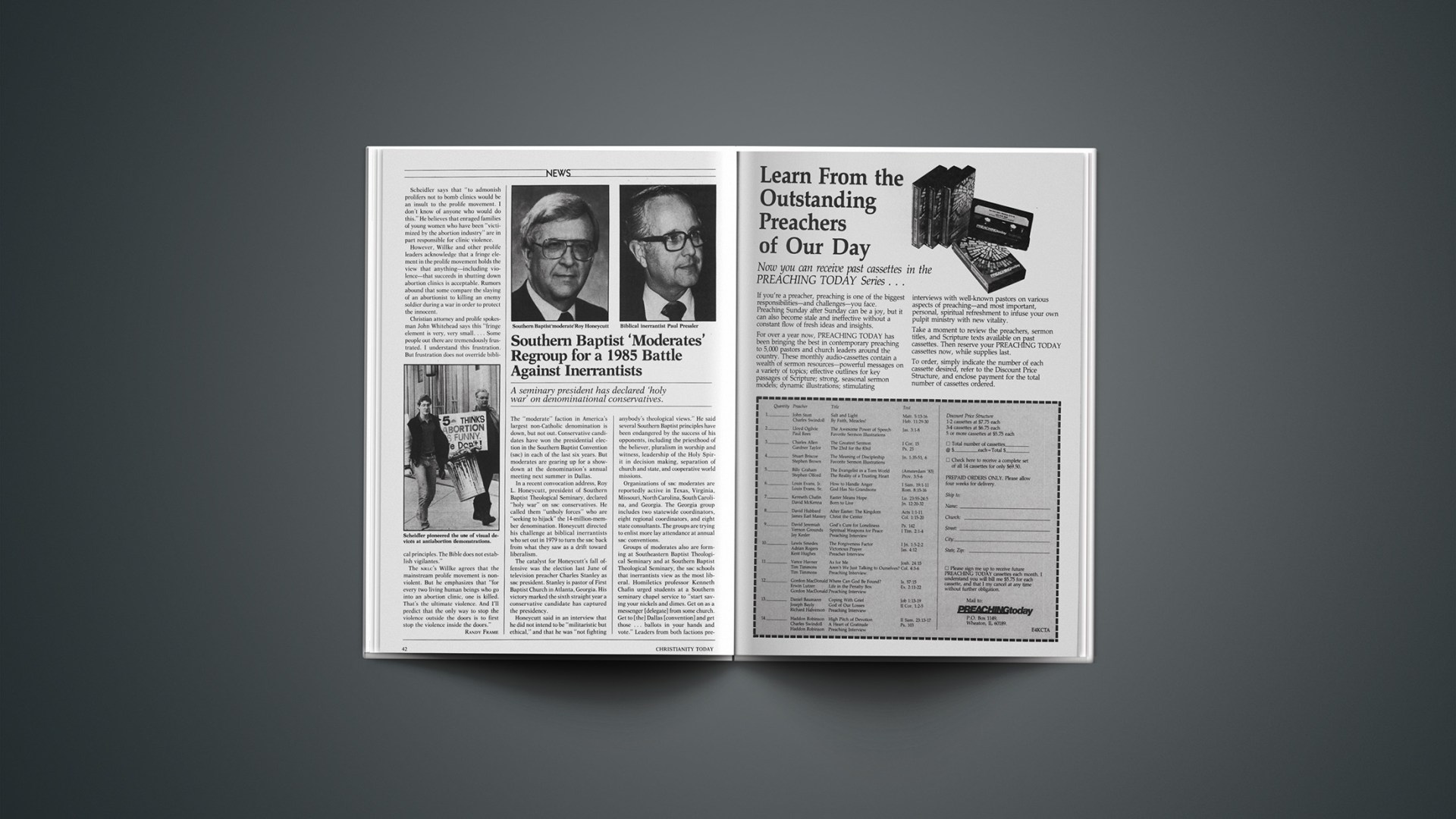
Southern Baptist ‘Moderates’ Regroup for a 1985 Battle against Inerrantists

A seminary president has declared ‘holy war’ on denominational conservatives.

The “moderate” faction in America’s largest non-Catholic denomination is down, but not out. Conservative candidates have won the presidential election in the Southern Baptist Convention (SBC) in each of the last six years. But moderates are gearing up for a showdown at the denomination’s annual meeting next summer in Dallas.

In a recent convocation address, Roy L. Honeycutt, president of Southern Baptist Theological Seminary, declared “holy war” on SBC conservatives. He called them “unholy forces” who are “seeking to hijack” the 14-million-member denomination. Honeycutt directed his challenge at biblical inerrantists who set out in 1979 to turn the SBC back from what they saw as a drift toward liberalism.

The catalyst for Honeycutt’s fall offensive was the election last June of television preacher Charles Stanley as SBC president. Stanley is pastor of First Baptist Church in Atlanta, Georgia. His victory marked the sixth straight year a conservative candidate has captured the presidency.

Honeycutt said in an interview that he did not intend to be “militaristic but ethical,” and that he was “not fighting anybody’s theological views.” He said several Southern Baptist principles have been endangered by the success of his opponents, including the priesthood of the believer, pluralism in worship and witness, leadership of the Holy Spirit in decision making, separation of church and state, and cooperative world missions.

Organizations of SBC moderates are reportedly active in Texas, Virginia, Missouri, North Carolina, South Carolina, and Georgia. The Georgia group includes two statewide coordinators, eight regional coordinators, and eight state consultants. The groups are trying to enlist more lay attendance at annual SBC conventions.

Groups of moderates also are forming at Southeastern Baptist Theological Seminary and at Southern Baptist Theological Seminary, the SBC schools that inerrantists view as the most liberal. Homiletics professor Kenneth Chafin urged students at a Southern seminary chapel service to “start saving your nickels and dimes. Get on as a messenger [delegate] from some church. Get to [the] Dallas [convention] and get those … ballots in your hands and vote.” Leaders from both factions predict an attendance of 25,000 to 30,000—nearly twice the usual number—for the Dallas showdown.

Biblical inerrantists such as Paige Patterson, president of the Criswell Center for Biblical Studies, say belief in the inerrancy of Scripture is foundational to healthy SBC institutions. Patterson said SBC moderates are in a no-win situation. “If they defeat us in Dallas, how will the thousands of Southern Baptists who respect Dr. Stanley and others view the leadership who led such a charge? If they lose, they will have laid it all on the line and will have trouble engendering enthusiasm for their agencies.”

Texas Appeals Court Judge Paul Pressler, credited with engineering the strategy that enabled conservatives to become dominant, said he is “concerned but not overly worried” about the moderates’ new offensive. “This is God’s battle, not ours,” he said.

Without naming them, Honeycutt targeted Pressler and Patterson during his declaration of “holy war.” He spoke of “unscrupulous and unethical acts by politicians” heading a Southern Baptist “independent fundamentalist party.” Leaders of the group, he charged, had enlisted students to tape lectures and speeches by seminary personnel “for the Dallas war room with its reported information banks. I understand there may be files on as many as 400 of us there.”

Patterson termed Honeycutt’s speech “a demonstration of denominational fascism which is determined to brook no criticism and … to squelch and suppress it.” He said the alleged war room at his school is “nothing more than historical archives.” He acknowledged meeting with some Southern seminary students—at their request—at last summer’s SBC convention in an “open hotel dining room.”

In his convocation speech, Honeycutt also charged—without naming him—that Pressler had frequently telephoned Honeycutt’s student airport driver to obtain information.

In an interview, Pressler said he had “absolutely no idea what he [Honeycutt] is talking about.” However, he admitted having talked to J. Stafford Durham, the student in question. “Our institutions should not be liberal base camps for a holy war,” Pressler said, “but should be open to all Southern Baptists.”

Besides Honeycutt, two other SBC seminary presidents and the president of Baylor University have taken hard public stands against the conservative bloc. Baylor president Herbert Reynolds called the inerrantists “a priestly and self-anointed group” out to make “clones” by controlling “the educational system of Baptists and our publishing houses.” Southwestern Baptist Theological Seminary’s Russell Dilday, Jr., warned at last summer’s SBC convention of “a powerful machine, computerized, national in scope, and aimed at control of the democratic processes of this convention.” Southeastern Baptist Theological Seminary’s W. Randall Lolley compared the methodology of SBC inerrantists to the Moonies and cult leader Jim Jones.

Lolley blasted the conservatives for pushing through a resolution at last summer’s convention opposing the ordination of women to the ministry. A number of SBC churches and associations, including SBC president Stanley’s own Atlanta association, have passed resolutions repudiating the action on women.

Patterson has challenged Honeycutt, Dilday, and Lolley to debate the issues publicly, but none have accepted. “They’re afraid,” Patterson said, “because they’d have to justify the teaching in their institutions, and that the extent of suppression of evangelical views in their institutions might surface.” He said he could present examples of unbiblical teaching in Southern Baptist seminaries, but he declined to be specific. The seminary presidents maintain that no heresy is being taught in their institutions.

Honeycutt predicted a gloomy future should denominational conservatives continue winning the presidential races. “We will become a group of fragmented, local congregations with no coherent pattern of support for missions, evangelism, and education, which have held Southern Baptists together.”

He said SBC moderates don’t have an umbrella organization. But he added that “there has emerged a kind of confederation without a national leader.… The aim is to defeat Charles Stanley [at the 1985 convention] and elect a denominational loyalist.”

In response to the opposition, Stanley hasn’t criticized anyone by name. He told members of the Southern Baptist Press Association that if leaders of both factions would “talk soberly” about principles and eliminate personalities, denominational troubles could be smoothed out.

The dispute is over who are the real Southern Baptists. Both factions say they fit the description. At stake is the future direction of the Southern Baptist Convention.

Ingersoll Prizes Go To Novelist And Social Critic

English novelist Anthony Dymoke Powell and American social critic Russell Kirk will receive awards this month aimed at reinforcing traditional values.

The Ingersoll Prizes in Literature and the Humanities—cash awards of $15,000—are sponsored by the Ingersoll Foundation. Through the prizes, the foundation focuses on such values as integrity, ethical norms that strengthen the family unit, and the ideals summarized in the Ten Commandments.

Powell, 78, author of numerous novels that chronicle the mid-twentieth century, will receive the T. S. Eliot Award for Creative Writing. His 12-volume work A Dance to the Music of Time was published between 1951 and 1975.

Kirk, 66, will receive the Richard M. Weaver Award for Scholarly Letters. Kirk is a founding editor of Modern Age, a columnist for National Review, and author of The Conservative Mind.

The Ingersoll Milling Machine Company of Rockford, Illinois, created the Ingersoll Foundation in 1948. The Ingersoll Prizes were begun in 1983. The foundation is administered by the Rockford Institute, a conservative research center and publisher in Rockford, Illinois.

Prolife Activists Escalate the War against Abortion

During an election year, prolifers intensify picketing efforts, venture into civil disobedience.

The National Abortion Federation (NAF) recorded 19 acts of bombing or arson against abortion clinics during the first nine months of this year. One of the bombings took place at the NAF’s Washington, D.C., office. Only four such incidents occurred during all of 1983. NAF blames “anti-choice” demonstrators for the increased violence.

The National Organization for Women (NOW) has launched a “campaign to end clinic violence.” In a letter to members, NOW president Judy Goldsmith alleged that President Reagan’s “irresponsible and inflammatory anti-abortion, anti-women rhetoric … incites and encourages the right-wing terrorists.” At the insistence of NAF and NOW, the United States Department of Alcohol, Tobacco and Firearms is investigating the violence. So far there have been no convictions.

Prolife spokesmen countercharge that abortion providers set fire to abortion clinics to collect insurance money, to hurt competitors, or to char the image of the prolife movement. Abortionists and antiabortionists, however, agree on one thing: prolife activism has escalated in this election year, and it shows no signs of abating.

In May, prolife activists met in Fort Lauderdale, Florida, for their first national conference. Among other things they discussed a strategy for picketing Democratic presidential candidate Walter Mondale and his running mate, Geraldine Ferraro. Prolife demonstrators regularly greeted Ferraro at her campaign stops.

In addition, demonstrations at abortion clinics have become more frequent and intense. “We have four abortion mills in Cincinnati,” says Jack Willke, president of the National Right to Life Committee (NRLC), the country’s largest antiabortion organization. “We’ve been picketing them for 12 years. But it used to be only on Saturdays. Now it’s three or four times a week.”

Steven Baer, until recently director of education for Americans United for Life, says prolifers are getting impatient. “A lot of frustration has been building up over the last 10 years,” he says. “[Reagan] is the most outspoken prolife President in history. And Congress is definitely moving in a prolife direction. But with 4,000 babies being killed every day, for some of us things aren’t moving fast enough.”

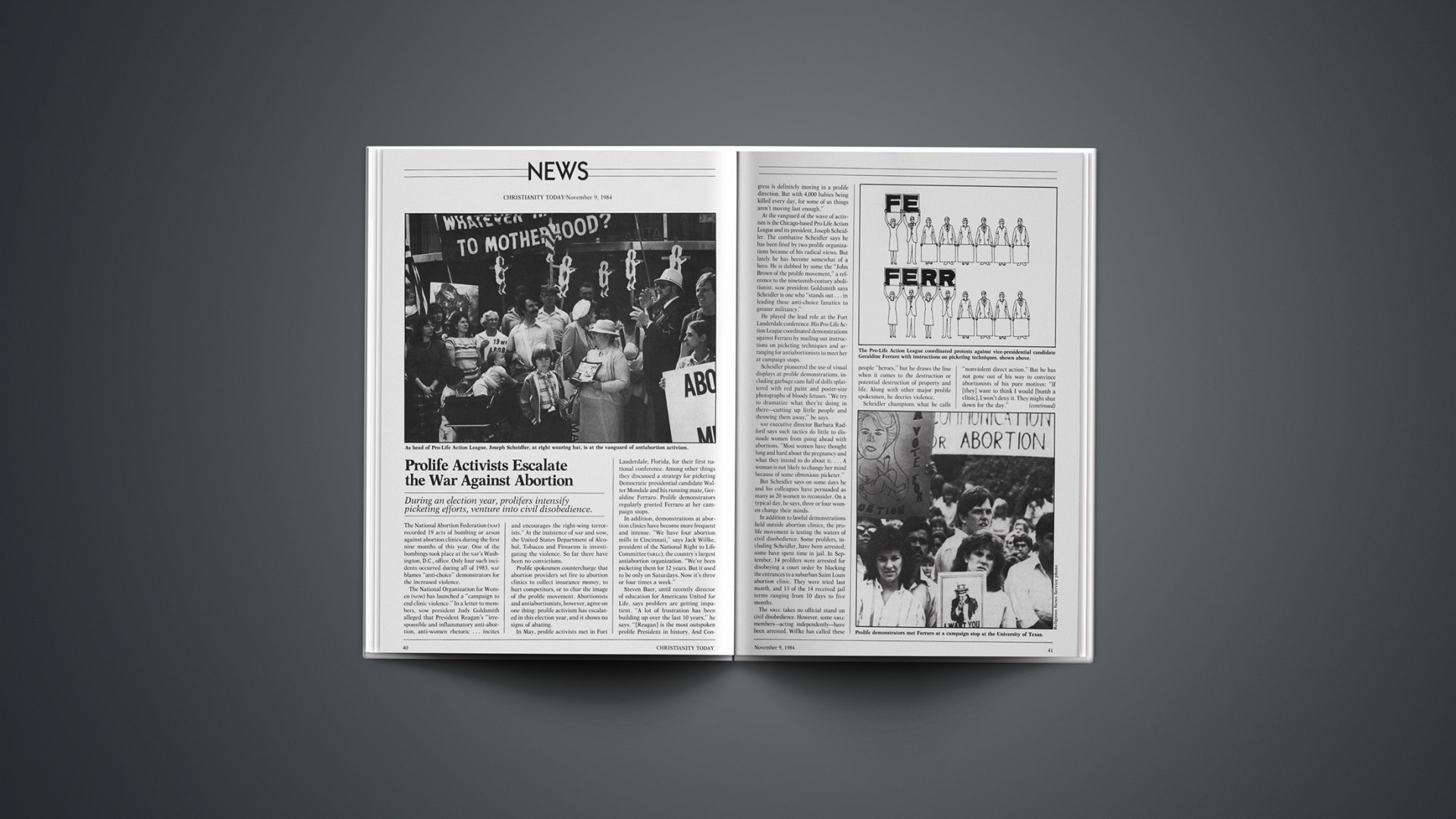
At the vanguard of the wave of activism is the Chicago-based Pro-Life Action League and its president, Joseph Scheidler. The combative Scheidler says he has been fired by two prolife organizations because of his radical views. But lately he has become somewhat of a hero. He is dubbed by some the “John Brown of the prolife movement,” a reference to the nineteenth-century abolitionist. NOW president Goldsmith says Scheidler is one who “stands out … in leading these anti-choice fanatics to greater militancy.”

He played the lead role at the Fort Lauderdale conference. His Pro-Life Action League coordinated demonstrations against Ferraro by mailing out instructions on picketing techniques and arranging for antiabortionists to meet her at campaign stops.

Scheidler pioneered the use of visual displays at prolife demonstrations, including garbage cans full of dolls splattered with red paint and poster-size photographs of bloody fetuses. “We try to dramatize what they’re doing in there—cutting up little people and throwing them away,” he says.

NAF executive director Barbara Radford says such tactics do little to dissuade women from going ahead with abortions. “Most women have thought long and hard about the pregnancy and what they intend to do about it.… A woman is not likely to change her mind because of some obnoxious picketer.”

But Scheidler says on some days he and his colleagues have persuaded as many as 20 women to reconsider. On a typical day, he says, three or four women change their minds.

In addition to lawful demonstrations held outside abortion clinics, the prolife movement is testing the waters of civil disobedience. Some prolifers, including Scheidler, have been arrested; some have spent time in jail. In September, 14 prolifers were arrested for disobeying a court order by blocking the entrances to a suburban Saint Louis abortion clinic. They were tried last month, and 13 of the 14 received jail terms ranging from 10 days to five months.

The NRLC takes no official stand on civil disobedience. However, some NRLC members—acting independently—have been arrested. Willke has called these people “heroes,” but he draws the line when it comes to the destruction or potential destruction of property and life. Along with other major prolife spokesmen, he decries violence.

Scheidler champions what he calls “nonviolent direct action.” But he has not gone out of his way to convince abortionists of his pure motives: “If [they] want to think I would [bomb a clinic], I won’t deny it. They might shut down for the day.”

Scheidler says that “to admonish prolifers not to bomb clinics would be an insult to the prolife movement. I don’t know of anyone who would do this.” He believes that enraged families of young women who have been “victimized by the abortion industry” are in part responsible for clinic violence.

However, Willke and other prolife leaders acknowledge that a fringe element in the prolife movement holds the view that anything—including violence—that succeeds in shutting down abortion clinics is acceptable. Rumors abound that some compare the slaying of an abortionist to killing an enemy soldier during a war in order to protect the innocent.

Christian attorney and prolife spokesman John Whitehead says this “fringe element is very, very small.… Some people out there are tremendously frustrated. I understand this frustration. But frustration does not override biblical principles. The Bible does not establish vigilantes.”

The NRLC’s Willke agrees that the mainstream prolife movement is nonviolent. But he emphasizes that “for every two living human beings who go into an abortion clinic, one is killed. That’s the ultimate violence. And I’ll predict that the only way to stop the violence outside the doors is to first stop the violence inside the doors.”

Is Church Discipline an Invasion of Privacy?: Recent Court Cases Force the Question

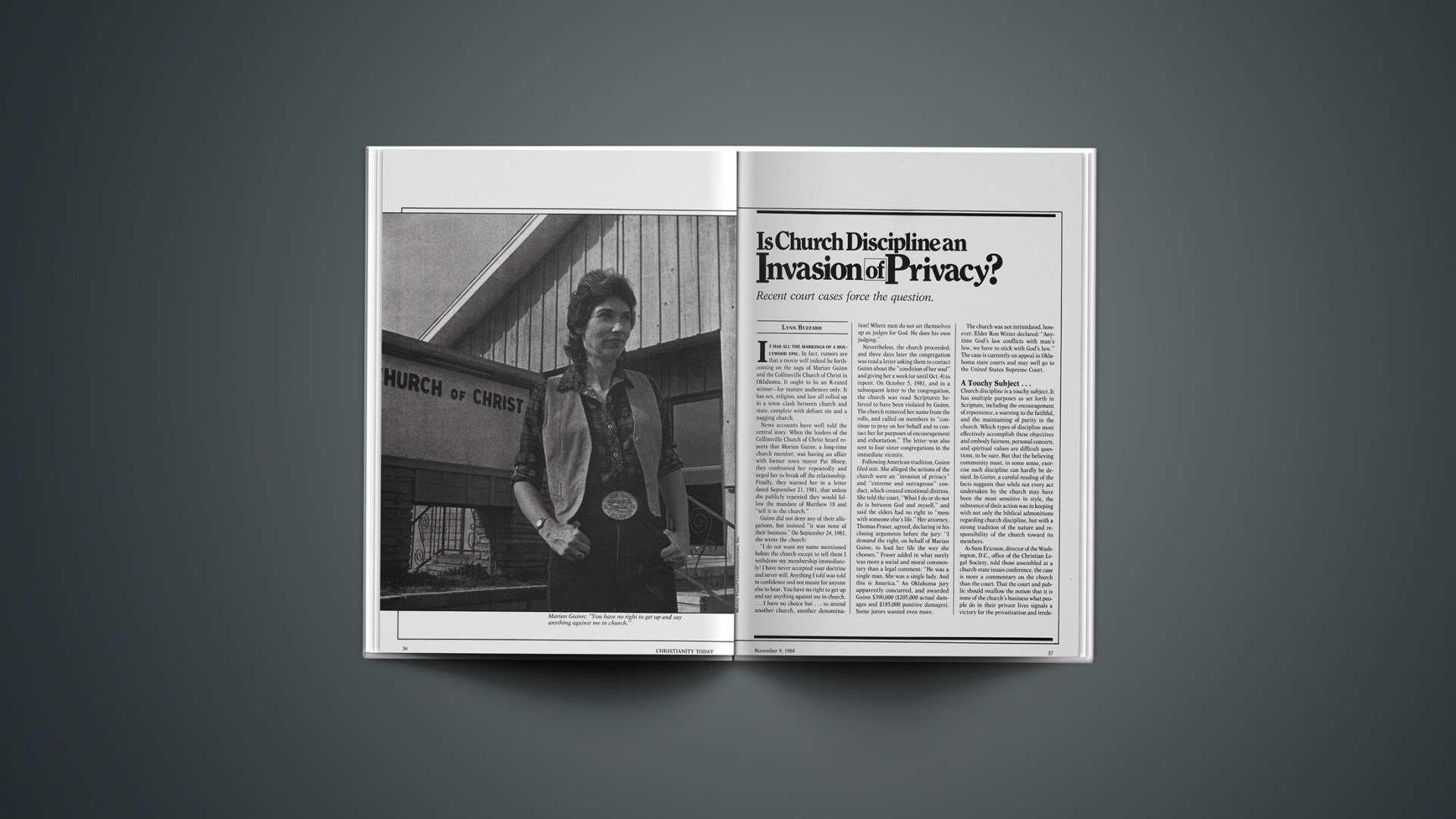
It has all the markings of a hollywood epic. In fact, rumors are that a movie will indeed be forthcoming on the saga of Marian Guinn and the Collinsville Church of Christ in Oklahoma. It ought to be an R-rated winner—for mature audiences only. It has sex, religion, and law all rolled up in a tense clash between church and state, complete with defiant sin and a nagging church.

News accounts have well told the central story. When the leaders of the Collinsville Church of Christ heard reports that Marian Guinn, a long-time church member, was having an affair with former town mayor Pat Sharp, they confronted her repeatedly and urged her to break off the relationship. Finally, they warned her in a letter dated September 21, 1981, that unless she publicly repented they would follow the mandate of Matthew 18 and “tell it to the church.”

Guinn did not deny any of their allegations, but insisted “it was none of their business.” On September 24, 1981, she wrote the church:

“I do not want my name mentioned before the church except to tell them I withdraw my membership immediately! I have never accepted your doctrine and never will. Anything I told was told in confidence and not meant for anyone else to hear. You have no right to get up and say anything against me in church.… I have no choice but … to attend another church, another denomination! Where men do not set themselves up as judges for God. He does his own judging.”

Nevertheless, the church proceeded, and three days later the congregation was read a letter asking them to contact Guinn about the “condition of her soul” and giving her a week (or until Oct. 4) to repent. On October 5, 1981, and in a subsequent letter to the congregation, the church was read Scriptures believed to have been violated by Guinn. The church removed her name from the rolls, and called on members to “continue to pray on her behalf and to contact her for purposes of encouragement and exhortation.” The letter was also sent to four sister congregations in the immediate vicinity.

Following American tradition, Guinn filed suit. She alleged the actions of the church were an “invasion of privacy” and “extreme and outrageous” conduct, which created emotional distress. She told the court, “What I do or do not do is between God and myself,” and said the elders had no right to “mess with someone else’s life.” Her attorney, Thomas Fraser, agreed, declaring in his closing arguments before the jury: “I demand the right, on behalf of Marian Guinn, to lead her life the way she chooses.” Fraser added in what surely was more a social and moral commentary than a legal comment: “He was a single man. She was a single lady. And this is America.” An Oklahoma jury apparently concurred, and awarded Guinn $390,000 ($205,000 actual damages and $185,000 punitive damages). Some jurors wanted even more.

The church was not intimidated, however. Elder Ron Witter declared: “Anytime God’s law conflicts with man’s law, we have to stick with God’s law.” The case is currently on appeal in Oklahoma state courts and may well go to the United States Supreme Court.

A Touchy Subject …

Church discipline is a touchy subject. It has multiple purposes as set forth in Scripture, including the encouragement of repentence, a warning to the faithful, and the maintaining of purity in the church. Which types of discipline most effectively accomplish these objectives and embody fairness, personal concern, and spiritual values are difficult questions, to be sure. But that the believing community must, in some sense, exercise such discipline can hardly be denied. In Guinn, a careful reading of the facts suggests that while not every act undertaken by the church may have been the most sensitive in style, the substance of their action was in keeping with not only the biblical admonitions regarding church discipline, but with a strong tradition of the nature and responsibility of the church toward its members.

As Sam Ericsson, director of the Washington, D.C., office of the Christian Legal Society, told those assembled at a church-state issues conference, the case is more a commentary on the church than the court. That the court and public should swallow the notion that it is none of the church’s business what people do in their private lives signals a victory for the privatization and irrelevancy of the church for much of life. Guinn’s attorney put it more bluntly: “It doesn’t matter if she was fornicating up and down the street. It doesn’t give [the church] the right to stick their nose in it.”

… A Trendy Issue

The tendency is to view Guinn as unique. However, it may actually symbolize the court’s own increasing tendency to intrude into the internal life of the church by applying secular perspectives and standards with little understanding or sympathy for the special character of the religious community. Indicative of this trend are two California cases subsequent to Guinn, raising similar claims and questions.

• John R. Kelly has brought suit against the Christian Community Church, its pastor, Ernest Gentile, and its board of elders—most especially one elder, Dr. Donald Phillips. Kelly alleged that Phillips, who undertook to counsel the plaintiff, “disclosed confidential, intimate, and embarrassing details of his sexual and marital life,” which ultimately lead to his being “publicly released” and “publicly excommunicated” in church services on April 24, 1983. The complaint alleges this conduct was professional malpractice, a breach of fiduciary duty, “outrageous conduct” causing emotional distress, reckless and careless negligence, and an invasion of privacy. The complaint even throws in a count for conspiracy. In keeping with the scope of the complaint, the suit calls for judgment in the amount of actual damages plus $5 million “exemplary and punitive damages.”

• In Santa Ana, a California woman was more modest, seeking only $3 million against officials of the Fairview Church of Christ in Garden Grove for publicly denouncing her divorce as “sinful behaviour.” Pastor Ken Dart read a letter on January 22, 1984, saying that “for so long as she refuses to repent, none of us should keep company or associate with her in any way that would suggest approval of these actions or her present position.” Dart and six elders are defendants in the Orange County Superior Court suit. Summonses were served on elders at the church on Easter Sunday. Both cases are pending.

Legal Implications: The Short And Long Of It

While the church must not succumb to the temptation of viewing these church discipline issues as primarily legal, it would be a serious error to ignore the long- and short-term legal implications of these and other cases. Guinn and its progeny do indeed reflect a trend—a tendency we ignore at our peril.

Of immediate concern is the issue of whether or not churches are legally invading a person’s privacy in situations such as those set forth in Guinn. (It should be noted here that while some commentators have mistakenly referred to these as libel cases, they really involve invasion of privacy questions. Libel and slander involve the publication of damaging and false stories. Truth is a defense in any libel action in U.S. law; and Marian Guinn said, “I’m not saying I wasn’t guilty. I was.”)

Courts have held that a right of privacy is invaded by “unreasonable publicity given to another’s private life.” Thus, one noted legal treatise declares: “one who gives publicity to a matter concerning the private life of another is subject to liability to the other for invasion of his privacy, if the matter publicized is of a kind that (a) Would be highly offensive to a reasonable person, and (b) Is not of legitimate interest to the public (see Restatement of the Law of Torts, Section 652).

In Guinn, there may be no doubt about the privacy involved; and the disclosure was made. But was the church exempt of an invasion charge due to the spiritual implications of the transgression and its impact on the church?

The Collinsville church argued it was; noting that a privilege was in order because its community had a legitimate interest in these facts. However, the attorney for Guinn thought otherwise, allowing that even if a qualified privilege was granted, it would have disappeared when Guinn, prior to public disclosure, resigned from the church.

The relevance of the resignation must be examined from both a spiritual and legal perspective—no small agenda for a court confused over things “religious.” Spiritually, membership in Christ’s body is not merely a question of legal membership. One does not so easily break the bond of Christian community. (The church, in fact, claims that its very doctrines do not permit unilateral withdrawal of membership.) The Collinsville church was spiritually correct in claiming a continuing duty of ministry and pastoral care for Marian Guinn.

But what about the law? Could Guinn legally bar any church action on the fourth by resigning on the third? Certainly resigning from the bar association does not prevent the discipline of an errant attorney. A Boy Scout leader whose conduct is morally reprehensible cannot bar discussion of his conduct merely by quitting his post. Where the relationship has been close and recent, and the conduct complained of close in time and continuing to have an impact on the association, resignation should not bar proper disclosure to the affected body.

Thus, if the actions of Miss Guinn were several years old, or she had resigned years or many months earlier, the argument might be more persuasive; but from a spiritual and legal standpoint, it should fail.

Judging The Church

But perhaps the most critical dimension of Guinn involves the government review of, or intrusion into, the life of the church.

The Supreme Court has frequently noted the dangers of such intrusion. In Watson v. Jones, the Court noted the dangers of entanglement with internal church decisions: “All who unite themselves to such a body (general church) do so with an implied consent to (its) government, and are bound to submit to it.” In Serbian Orthodox Diocese v. Milivojevich, the Court similarly eschewed interference, declaring that “questions of church discipline are at the core of ecclesiastical concern,” thus rendering court interference unconstitutional entanglement.

However, recent, highly publicized cases such as the conviction of the Reverend Sun Myung Moon and Bob Jones University have all raised issues of government intrusion into internal and even doctrinal policy. In Nally v. Grace Community Church and John MacArthur, the California Appeals Court has just recently reversed a trial court and held that a jury might find the church liable for what amounts to “clergy malpractice” in a case arising from the suicide of a young man. The suit alleges, in part, that the church had a duty to refer clients to secular counseling, but negligently relied on spiritual counseling.

A common problem in each of these cases is, in part, the fact that the government (whether agency officials or judges) is often insensitive to the values and norms motivating religious communities, and hence runs roughshod over them in the interests of other state-chosen standards.

It was precisely to avoid such problems (and in recognition that the state is incompetent to assess doctrine or recognize the special values and interests of a religious community), that the free-exercise clause was included in the First Amendment. The same principle is further protected by the Supreme Court’s interpretation of the establishment clause as barring “excessive entanglement.”

To be sure, the free-exercise clause protections are not absolute, and one may well imagine religious practices so abhorrent as to warrant liability. But courts require “compelling state interests” before such intrusion.

Today, the danger increasingly is that “compelling” often seems to require little more than public policy or preference. The mere interests of a state agency are all too easily persuasive to a judge who has little understanding of the values or character of the church or religious community.

Further, there is a tendency for the interests and perspectives of the state to become self-authenticating, and therefore “compelling.” For example, a state develops—quite often legitimately—an interest in an arena (e.g., child care, education, hospital care, senior citizens) and consequently sets policies and standards. It is not long before structures begin to apply and promulgate such interests. Soon these guidelines become mandates, not only for state-operated programs but for private programs as well; and their advocates will insist they are essential and “compelling.”

Public education exemplifies this process. At one time, there was virtually no “state interest” in education. Schools were totally operated by private persons and organizations, with churches prominently involved. The state soon became concerned with education, however, and gradually subsidized and then operated its own schools Naturally, standards and policies developed for the schools, and were promoted by educational bureaucracies Eventually, nonstate schools began to be subjected to these adopted standards as well. Such was the case in Nebraska where the state’s interest in quality education as well as in licenses and certification processes were held to be compelling and resulted in the closing down of a church-operated school. Evidence of educational competence there was seen as irrelevant; and the arguable legitimate interest in educational quality had become transfigured into an interest in compliance with state systems. Means had replaced ends.

The dangers of losing free-exercise rights in a sea of compelling state interests is serious because the state does not, perhaps cannot, understand religious interests and values. This was demonstrated by the press and public comment, which seemed generally to side with Guinn, picturing the church as oppressive and intrusive. Letters to local newspapers reflected the attitude of many. One wrote, “I cannot believe four Church of Christ officials … have anointed themselves and set about to pass judgment on one of their members.

… Taking up worship time to slander and belittle a person in front of a Sunday congregation is worthy of discipline itself.” Another opined, “How a Christian lives his private life is between that person and God, not between that person and the elders of the church. Let these elders tend to more critical issues of their church.…”

The courts (as well as the state) are inclined to view religion almost exclusively in narrow and often institutional terms; that is, they see churches as little more than institutions, liturgies, clergy, and doctrines. In these areas, great deference will be paid. But the state does not understand the comprehensive character of religion, that it touches areas the state wishes to label “secular.” Thus when churches become involved in education, social services, counseling, and so on, the tendency is to suggest that now the church has moved outside of “religion” and must conform. Thus, free exercise is relegated to only those areas where the state has little if any interest (i.e., doctrine) and is left with little vitality when real tensions develop.

But if free exercise is to remain a vital legal doctrine and an assurance of the vitality of religion as a moral force in society (and often as a counterforce to the state), then it must not automatically give ground to supposed state interests. In the case of a private association such as a church, there is every reason for the state to exercise great restraint before subjecting that body to civil liability for the exercise of its religious principles and values. Free-exercise interests and entanglement problems ought to make courts wary of stepping into church discipline situations and rewarding aggrieved parties who have fallen out of favor. Only the highest claims ought to outweigh the liberty of the church.

On page 76, J. Carl Laney discusses what practical steps churches can take for reducing the chances of being sued for exercising biblical discipline.

Tim Stafford is a free-lance writer living in Santa Rosa, California. He is a distinguished contributor to several magazines. His latest book is Do You Sometimes Feel Like a Nobody? (Zondervan, 1980).

Deliver Us from Evil: In Today’s Peril, as in Nazi Germany, the Tempted Christ Stands Close By

In today’s peril, as in Nazi Germany, the tempted Christ stands close by1(From Our Heavenly Father, ©1960 by John W. Doberstein; used with permission from Harper & Row, Publishers, Inc.)

Death squads. Incest. Bombs exploding in restaurants. Invective flung across both international borders and breakfast tables. The news of evil thoughts and evil deeds assault us daily.

Helmut Thielicke speaks to this in his sermon “Deliver Us from Evil,” part of a series on the Lord’s Prayer. The sermon on this topic is uniquely powerful because of the circumstances in which it was preached during the Nazi era in Germany. Here is Thielicke’s description:

“These sermons, delivered to congregations in Stuttgart, were addressed to people who continued to assemble throughout the horrors of the air raids, the declining days of a reign of terror, and finally through the period of total military and political collapse and the beginning of the occupation. They were begun in the Church of the Hospitallers when Stuttgart was still more or less intact and its cultural life still flourished in the midst of war. They were concluded in the small auditorium of Saint Matthew’s parish house, the largest auditorium available at the time when there were no more churches in Stuttgart and only bizarre remnants of walls showed where the venerable Church of the Hospitallers once stood, where people had lived for centuries, people who had now come face to face with Eternity.

“The preacher saw written upon the faces of his hearers the destinies from which they had come or which they were approaching. He sensed the tension they were feeling, not knowing whether the next moment the scream of sirens would scatter them in all directions—which happened not infrequently. He saw on those faces the torment of doubt and despair, the hunger and thirst for a valid comfort and encouragement that would stand the test in hours of work, in hours spent in underground shelters, suffering agonies of body and mind.”

Behind all the dangers in our life and behind all the dark menaces that overshadow it, there is a dark, mysterious, spellbinding figure at work. Behind the temptations stands the tempter, behind the lie stands the liar, behind all the dead and the bloodshed stands the “murderer from the beginning.”

Several decades ago some preachers who had to speak about this figure would probably have begun by apologizing for venturing as a modern and educated person to mention the word “devil” at all. And they probably would have taken some pains to convince their hearers that, after all, the Middle Ages had some very wise ideas in its conception of the Devil—though naturally expressed in all too “realistic” terms which were in accord with its time, but which we could no longer share.… The preacher would perhaps have continued: We today must take these crude images of medieval fantasy (the fact that there really is a personal Devil) and recast them in the crucible of our modern, informed understanding and distill them in all kinds of philosophical retorts until we had transformed this green-eyed Devil with the cloven hoof and the smell of brimstone into a properly spiritualized “concept of evil” which we might expect modern man to accept.

Dear friends, in our time we have had far too much contact with demonic powers;

• we have sensed and seen how men and whole movements have been corrupted and controlled by mysterious, abysmal powers, leading them where they had no intention of going;

• we have observed all too often how an alien spirit can ride people and change the very substance of men who before may have been quite decent and reasonable persons, driving them to brutalities, delusions of power, and fits of madness of which they never appeared to be capable before;

• year by year we have seen an increasingly poisonous atmosphere settling down upon our globe and we sense how real and almost tangible are the evil spirits in the air, seeing an invisible hand passing an invisible cup of poison from nation to nation and throwing them into confusion;

I say that we have seen all this too clearly; we have been far too shocked by all this for me to have to prepare your mind and mine in order to discuss the question of the Devil without embarrassing you. The overwhelming power of these experiences is so strong that it simply breaks through all the intellectual insulation which we are so prone to interpose in order to keep out these dark powers.

Why, actually, is the Tempter so dangerous? If he were not so dangerous, then surely Jesus would not have taught us to pray for deliverance from him. Then presumably he himself would not have been obliged to march out against him and spend his whole earthly life fighting this invisible enemy. I would answer this question of why the demonic power is so dangerous simply by saying that it is because he cannot be recognized, simply because he does not have the characteristic hoofs by which one could recognize him. If he had a passport, under the heading “Special Characteristics” there would be written “None.” The Devil is a master of disguise, and one important specialty of his tactics consists in his hiding behind positive values and ideals.

This can be illustrated by means of a simple, everyday example. When a seducer tries to bring another person into his power, he certainly does not begin by saying, “Come, I’ll teach you something evil; I’ll show you a sin.” If he were to begin his seduction in such a foolish way, our conscience would doubtless be shocked and we would seek to escape the temptation.

But the Tempter would never begin in such a stupid way. He always tries to represent his offer as something that will lead to positive and significant goals. So he says, “Come, I will teach you something interesting, something pleasurable, something that will give you a glorious thrill and give you the chance to live to the full.” The classical example of this technique of temptation was demonstrated in the temptation of Jesus in the wilderness.

As we discuss this a bit, and since this will require us to look into some deep abysses, we must from the beginning hold fast to this tremendously comforting thought: At the most perilous point in our life, namely, the place where we must do battle with the Tempter for life or death, there Jesus stood too, there he stands beside us. His heart too was shaken by the grandiose jugglery with which the Tempter tried to bemuse him. For, as we have said, what the Tempter does always has stature. It never lacks grand perspectives and the touch of idealism. But he who has the Lord beside him, that Lord who was “tempted as we are” and stands in the same rank with us, he who has beside him this Lord against whom the Tempter’s charm could not prevail—the person’s faith then begins to operate like a kind of divining rod by which he is able to “distinguish between spirits” and which reacts immediately whenever the Devil appears, no matter how deceiving his mask may be, whether he disguises himself as national idealism, or a democratic order that is going to make the whole world happy, whether he comes with a Bible in his hand or dripping with the oil of pious phrases, or whether he operates with the doctrines of some plausible-sounding and seemingly sound philosophy. The Lord who stood in the wilderness never departs from his own when the hour of temptation breaks in upon them.

Jesus is the Victor! He has already won, and all our struggles are only rearguard battles and mop-up actions, all of which are under the sign of that victory which the Lord achieved for us all in the wilderness.

And yet how positive and appealing are the means with which the Tempter operates! To understand this we need only to think of the third temptation, in which the Devil took Jesus to a very high mountain where all the kingdoms of the world and their glory lay spread out before him: “All these will I give you …!”

What a heady, intoxicating prospect that was! When the Devil offered him the kingdoms of the world he was by no means appealing only to the baser instincts, the vile thirst to satisfy the ambition to secure one zone of influence after another, or the brutal urge to power that hankers for dominion. No, he was appealing, as it were, to Jesus’ “idealism” and the highest aspirations of his soul; for if Jesus were elevated to the sovereignty of the world this would seem to give him the opportunity to use his power to the glory of God and carry on the mighty work of “Christianizing the world.” Would not any human heart, even the heart of the Son of God, tremble at the magnitude of this idea? If this were so, if the whole earth were led to Christianity “with power,” then the disciples would no longer need to have the oppressive feeling that they were so defenseless and exposed and that the history of the world was passing them by and paying no heed to them. Then they would cease to be “only” the quiet in the land, ignored by the loud, rushing stream of world events. Then they would no longer face the depressing embarrassment of not being able to prove the existence and power of their Lord when they were asked. Then, when the terrible catastrophes struck and the specter of doubt and despair of God lifted its head, they would no longer need to blush in silence when the godless raised their malicious question: “Where is your God?”

All this would suddenly be changed—if Jesus were the sovereign of the world, if he had the armies and their flags and standards at his disposal.

No missionary would ever again be left defenseless on alien coasts to face the butchers of men, if—yes, if Jesus were the sovereign of the world.

Is not this in fact a great idea, a positively dizzying prospect?

Or we think of the first temptation, in which the Devil tries to induce the Lord to turn stones into bread. Here Jesus suddenly sees himself confronted with this tremendous possibility: I could provide men with bread! I could perform this undreamed of act of brotherly love by feeding the hungry. This in itself must have been an extraordinarily powerful and appealing motive. But when we examine it closer, the charm of this devilish overture becomes still greater. The implications of providing bread are by no means confined to the body. They involve infinitely more than that. The satisfaction of hunger would immediately entail tremendous intellectual consequences, for do we not control the minds of men when we control their bread? When people have food and clothing and shelter, they usually “join the parade.” Then they get over their conscientious scruples and renounce their old faith with relatively light hearts and find the new gods quite unobjectionable. There have been many hunger revolts in history, but not many based on conviction. The food question is really one of the keys to world history. All this the Tempter intimated to the Lord. And again, isn’t this a great idea: If I can bind people to myself and get them to sing my tune by feeding them, why shouldn’t I try to bind them to God in this way?

So it is possible that the right solution of the food problem may have enormous significance for the kingdom of God and its extension.

But the bemusing questions which the Tempter keeps trying to drop like sweet poison into the mind of Jesus go even further. Feeling the impact of this Satanic insinuation, Jesus must now ask himself: Will not many become unfaithful to me (this is surely what the Devil was suggesting) simply because they will be afraid—and quite rightly—that they will lose their jobs and their bread, if they follow me? It may be costly for them to confess me. Many will therefore shun this confession or throw it overboard when the pinch comes. But the moment I give them bread the dilemma will be solved, and suddenly the conflict between God and “goods, fame, child, and wife” will vanish. Then the Christian faith will be popular for there will be no risks involved. I could turn millions of adherents, who simply flinch from me as long as I remain only an invisible and seemingly helpless Lord, into my most faithful followers. Ought I not therefore to give bread for God’s sake and the sake of these millions? Ought I not to restrict the risk and the venture that faith demands? Ought I not to make discipleship a rewarding and paying proposition? Otherwise, what will happen to the great masses who are out after bread and circuses? Does not love and compassion demand that I couple the kingdom of God and the breadbasket, and reward my adherents with food?

And again the question arises: Is not this a great idea of the Devil, which might be a solution to the deepest conflicts of human life?

And the second temptation, that Jesus throw himself down from the pinnacle of the temple—naturally, on the Sabbath when a great crowd would be present to be astonished by the feat—this second temptation too has a seductive grandeur about it. What it means is that the Tempter is challenging the Son of God to indulge in publicity and propaganda. He is suggesting to him something like this:

“Now, Jesus of Nazareth, you are starting out all wrong, if you think you can win people and call them to decision by preaching and ministering and personal encounter. Most people do not have the maturity to deal with such personal questions anyhow.

“Do you have such poor knowledge of people, Jesus of Nazareth, that you insist on riding their consciences? Just look at them: most of them have no wills at all; they are conscienceless copies of the great mass who swim along with the crowd and are pushed around by every wind that blows. They are purely sensual beings, moved not by ideas but by sensations and impressions. Look at any show or night club, Jesus of Nazareth! There they are—all spectators: the fools and the intelligent, the upright and the scoundrels. And all of them gaze entranced at the stage where the artists perform their tricks. Their hearts stop beating when the acrobat makes his mortal leap, and they all break out in one single burst of applause when the trick succeeds and the nervous tension is released. Look at them, Jesus of Nazareth; it’s their nerves you have to appeal to, for they all have nerves and they react immediately with their nerves. You should get this straight, Jesus of Nazareth: As far as the great masses are concerned, the conscience is a completely secondary organ. Most people do not live by their conscience at all. They do not live on the basis of responsibility and personal decision. They live by their nerves, their sensations, the herd instinct. If you want to win the world (even if you want to win it for God), you will have to satisfy their primitive sensuality, their need to have their nerves titillated. If you can impress them there, they will flock after you, and they will also believe what you tell them about the higher things of life. After all, Jesus of Nazareth, what you are telling them is something good (says the Devil!). After all, you want to lead them to your Father. Why shouldn’t you condition their hearts with the propaganda appeal to their senses? Then they will also be able to take in the higher message you proclaim as a ‘redeemer.’ ”

This idea, too, is not without greatness. It could put Jesus’ mission on a totally new and tremendously promising basis.

In short, everything the Devil says is enormously positive. These are stupendous goals, staggering in their persuasiveness.

And yet these ideals and grand prospects are nothing but a delusive cloak to cover up—now let us say it—a cloven hoof, to cover up the fact that all this would only serve the Devil: “If you will fall down and worship me!”

In order to understand why this is so, let us think back to the third temptation, to the moment when the Devil offered Christ all the kingdoms of the world.

In the thousand years of Christian history that lie behind us we have actually learned something about the chances and temptations inherent in this moment. For this millennium, which is now coming to an end, was the Constantinian age of the church. It offered the intoxicating opportunity for Christianity to enter into a secure alliance with the public, above all with the state. One need only think of the motto, “Throne and Altar,” to understand this. The schools were almost automatically Christian schools; the press was for the most part at the disposal of the church; the guilds had their reserved places in the sanctuaries. Did not this firm alliance of church and state, of parish and public, present a tremendous chance for Christianity to permeate all the areas of life? Was this not an impressive expression of Christ’s claim upon the whole of human life?

But now, since 1933, we have seen this “wholesale” Christianity of the great masses and mere “holders of baptismal certificates” simply collapse because it led only to a Christian façade for public life, behind which lingered the gods and myths of a pagan and atheistic age, gods and myths that were only waiting for the moment when they could tear down the facade and proclaim their dominion openly.

And surely they have done this impressively and consistently enough. Can any of us be anything but utterly astonished at the manifestations of paganism and neopaganism that suddenly appeared among our nominally Christian people? Would we ever have thought it possible that, in a country in which almost everybody was baptized and confirmed or at least brought up under Christian influence, hundreds of thousands would gather together in the Berlin Sports Palace and the largest auditoriums in every city and cheer themselves hoarse over the German faith-movement and other pagan ideologies?

Suddenly God led his church out of its accustomed public place in the Constantinian age. He allowed it to be driven into the ghetto of its own church walls and in some instance into the catacombs. And in these narrow places there occurred with God’s help a process of maturation that caused the church to find its way back to the substance of its message and its biblical foundations. The very fact that God took from the church its public position was a demonstration of his gracious providence, whereby he separated the wheat from the confusing chaff, cleared the jungle of so-called Christianity of everything except the two towering trees of “Scripture and confession,” brought forth the “holy remnant,” and sustained his church through it all.

Not that this ghetto is the ideal, not that the church should remain within its walls and renounce the world! I should hope never to be so misunderstood. But it does make a difference whether the world is simply labeled as Christian by higher authorities and surrounded with a Christian façade, thus creating a mere Potemkin village of sham Christianity, or whether a church which has been matured in the ghetto and catacombs, a “holy remnant,” tempted and tested in the fires of suffering, emerges from these walls and with authority proclaims Christ’s dominion over the world. This was the only interpretation that Jesus put upon the Great Commission when he commanded the disciples to go out into the world in the name of their Lord to whom all power was given.

The other temptation—to exercise power by means of bread and control of the sources of food—is perhaps the peril of the church of Jesus today. For, after all, we face the fact that the church is one of the very few trusted factors from the past that survived the great deluge. This act has its greatness but also its dangers. The church of Jesus and its bishops are now solicited for aid and counsel in many public affairs, even in political matters. The church of Jesus has the opportunity—at least for a brief period—to exercise power, to make use of the long lever, and by possible joint control of the food supply to bring people into the sphere of its influence.

Woe to it, if it does so! Woe to it, if it seeks to achieve its destiny of leading men to the Cross and bringing them into a living personal relationship with Jesus Christ by employing the instruments of power and the breadbasket! Woe to it, if even in a single case it allows the fact that a person is a member of the church or has left the church to work to his advantage or detriment! Then we would soon have exchanged the red and the brown terror for the black terror. And the black terror would be the worst, for in the other forms of terror only men are dishonored, whereas this most dreadful species of tyranny would desecrate the very Cross on which the Lord Christ died in helplessness in order to bring the world back home.

Woe to it, if the church of Jesus does not remain beneath this powerless Cross, if it does not speak out openly—no matter what the powers and pressures are that make it necessary—and say what is right and what is wrong, at least as clearly as it has sometimes done under past dictators!

Woe to it, if it does not prefer to give up all its influence rather than deny the truth, if it is not prepared to be like a sheep among wolves, no matter what the nationality of these wolves may be! The church has no other mission except to proclaim the commandments of God and to tell the imprisoned that they are free, the blind that they shall see, and the guilty and heavy laden that the Cross of Calvary is there for them. It was not for nothing that God allowed the church of Jesus to suffer for twelve years, and thus brought it to a place of blessing which we dare not now deny.

It is only human, “all too human,” that someone who has been in a concentration camp for Jesus’ sake or—as in my own case—dismissed, forbidden to travel or to speak, and hampered in every way, should now desire to get back into the stream of things and go ahead at full speed, to have the feeling of “power” he has been deprived of for so long, in order to make up for the time lost.

I say this is “human, all too human,” and we are actually seeing some evidences of this human delight in power within the church. But we must have nothing to do with it. This is not what Jesus Christ died for! The church of Jesus has no business to take revenge or to sit in judgment. The church must be a mother to all who are weary and heavy laden, to all who have strayed and gone wrong—even to those who have forsaken their mother in the last decade and fallen victim to strange ideas. And therefore its task is not to look to the great and powerful, to the “Americans” and the “English,” but rather to visit the prisoners and preach the gospel to those who cannot help the church because they have no privileges to bestow.

Jesus himself quite consciously passed up the great chances and the great moments for making propaganda in his life. When he had the chance to speak to great crowds, when he might have taken advantage of the wildest ovations of enthusiastic hearers, he made his way through the midst of them and went away to be alone with God or to help a sick person or a burdened conscience. This was precisely the time when he turned to the individual, who was completely lacking in influence and could not make him king. So the church too must bear witness to the truth and the love of God in this unpopular way and turn to those who need its help and comfort. Who was ever more unpopular than its Master? But the servant dare not be above his master.

So Jesus saw through the intoxicating visions and glittering prospects which the Devil conjured up before him. He renounced power—even the power that he might have used for his purpose, the Christianization of the world. He knew that the very substance of his message would be altered and falsified if the child were put under the slightest compulsion to go back home to the Father, for then the child would become a slave and the Father a tyrant.

So he rose up from the place where the kingdoms of the world shimmered before him, where crowns flashed and banners rustled, and hosts of enthusiastic people were ready to acclaim him, and he quietly walked the way of poverty and suffering to the Cross.

He walked the road where the great and the rich of this world will despise him, but where he is the brother of sinners, the companion of the forsaken and lonely, the sharer of the lot of all who are shelterless and know not where to lay their head, the comrade of the insulted and injured, to whom he reaches down from his shameful Cross.

With all these he associates himself, he who could have possessed the whole world.

And that is why the story closes with the angels ministering to him, which means that the presence of the Father was with him. The angels will always be where he is, even, and most particularly, in the darkest places of his journey through the deep. And in Gethsemane, too, one of them will come to him and strengthen him.

Did he stake his life on the wrong card, this Jesus of Nazareth? Did he make a bad exchange when in the hour of temptation he preferred the presence of the angels and the presence of the Father to the riches of this world? If he had accepted the riches of this world and their “glory” he would be forgotten today. He would have become a great king in history, recorded in the history books of our schools. He would have become a venerated museum piece—if he had signed the pact with the Devil. But because he suffered and in suffering learned obedience, he has become our brother and our king, and therefore we too know that this is our destiny:

And he who fain would kiss, embrace

This little Child with gladness

Must first endure with him in grace

The rack of pain and sadness.

We must not only die to the baser powers of temptations, the enchantment and allure of the senses and the wild fever of revenge and ambition—for when we are bewitched by these we cannot hear the “voice”—but we must also be willing to die to the “ideal” motives, to “goods, honor, child, and wife.” We must even maintain a certain distance from the great and gladsome, dear and familiar things of this world, as we saw in the picture of the “Knight, Death, and the Devil.” And the truth is that this is no small thing. All of it is painful, it is all a “rack of pain and sadness,” or at least can become so. But because of it we can embrace him and know the presence of the angels. God is blessed and because of this blessedness all this is worthwhile. Never will we regret it if we choose the way of the Cross in the hour of temptation, for it is the way of the Master. In every case God is richer than the Devil is evil; and none who has ever followed him has ever regretted the “rack of pain and sadness.”

May the church of Jesus not dream away the hour to which it has now been called. It faces great promises and terrible temptations. May the church be a mother who bends low to help the lost and defend their cause; and may it not become a courtesan who looks with longing glances at the glory of the mighty.

May it be a comforting beacon, proclaiming to all men that at least in one place in this world of hate and revenge there is love, because, beyond all comprehension, the Son of God died for this world. And if it must preach judgment, if it must call down woe upon the people and interpret the fearful signs of the times, then may it never do so pharisaically, as one who had no share in the great guilt. But rather may it do so as a mother, whose own soul is pierced through by a sword; may it do so as did Jesus Christ himself, who uttered the cry of judgment over Jerusalem in a voice that was choked with tears.

Tim Stafford is a free-lance writer living in Santa Rosa, California. He is a distinguished contributor to several magazines. His latest book is Do You Sometimes Feel Like a Nobody? (Zondervan, 1980).

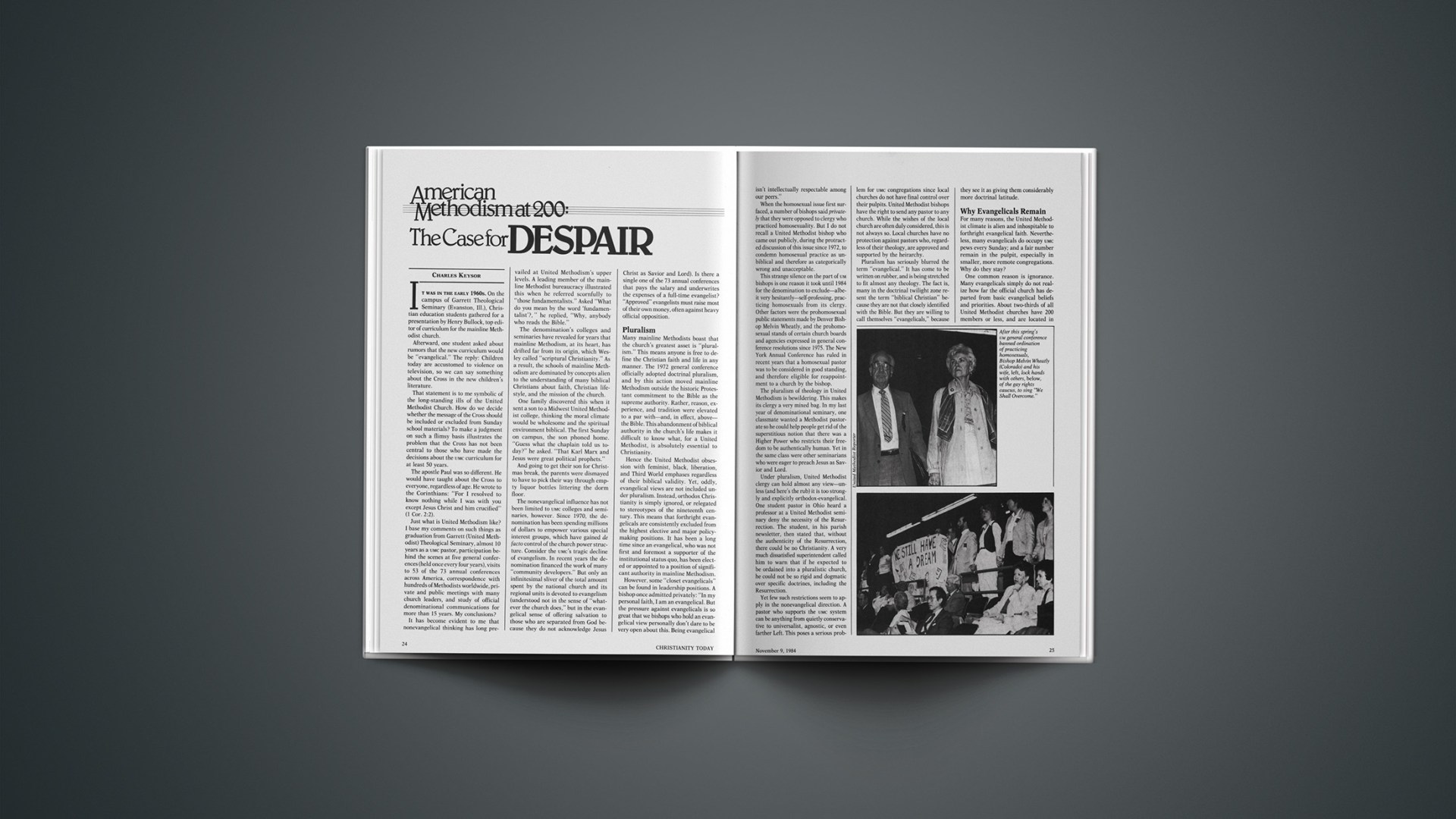
American Methodism 200: The Unclaimed Heritage

This year, American Methodism celebrates its bicentennial. Two hundred years ago, in the same decade that the republic was establishing its independence from Britain, American Methodists were affirming their own independence. The first autonomous American church, Methodism grew as the nation did. As one established its structures and extended its domain, so did the other.

The new nation became Methodism’s challenge. Its mission, as it understood it, was to reform the nation and spread scriptural holiness over this new land. This meant that the moral character of every person and of the society itself were not only valid but obligatory Methodist concerns. Even Methodism’s enemies were impressed with its phenomenal success.

In 1784 when the church was organized in Baltimore, it had 15,000 members. By 1855 it had grown until the Methodists in all branches made up 38 percent of the Protestant communicants of the country. The largest Protestant body in the predominantly Protestant country, Methodism became a national force.

The life of the church reflected the nature of the society, and vice versa. The successes of the one, and its failures, affected the other. William Warren Sweet, a Methodist historian, illustrates this with a reference to the division of the main body of Methodism in 1844 over the issue of slavery: “There are good arguments to support the claim that the split in the churches was not only the first break between the sections, but the chief cause of the final break.” The nation and the church suffered and succeeded together.

There were theological reasons why Methodism became such a naturalized part of the American scene. There was a democratic character to the theology that supported the ideals of the new democracy at its best. Wesley posed a theological mix that made Methodism a remarkable force for renewal and reform. The power of that theology, so evident in the nation’s first century, however, seems clearly to have been attenuated in the second.

Wesley’S Viewpoint

Four primary themes permeated Wesley’s theology. (1) Man, if he is to be saved, can be saved by grace alone, and (2) that grace is available for all; (3) if he is not saved, he alone is accountable; (4) the purpose of God is not just to prepare the saved for heaven, it is also to bring them to a perfection of love now that will enable them to live a life dominated by love for God and their neighbors. In other words, faith should show itself at work in love:

1. A primary assumption for Wesley was that man is fallen. He saw belief in the doctrine of original sin as the key difference between Christianity and paganism. As the result of the Fall, man traded freedom before God for bondage to himself. The problem is heightened by man’s illusion of freedom. The result is despair.

This assumption about original sin kept early Methodism realistic in a frontier nation where passions and individualism could run raw. It kept the preacher addressing society where it was—in need of God and his grace.

2. If there was a realism about sin, there was an optimism about grace. A person could be delivered through grace, and the dominion of sin could be broken, now. It was a possibility available for all.

There was something democratic about this. No social, economic, racial, sexual, political, or even religious differences exempted any. No one had to come; grace was resistible. But all were invited.

These beliefs had political and social implications. The founding fathers had taken the biblical doctrine of Creation seriously. They believed that man had his origin in the work of a benevolent Creator. They felt that political equality and equal human rights were divinely sanctioned.

But Methodist theology took this a step further. The doctrine of salvation was added to the doctrine of Creation. Every man must be seen in the light of the Cross as well as Creation since Christ died for all. Human worth had divine as well as political sanctions.

3. Grace was there for all, but how was it to be received? Here Wesley made perhaps his most significant contribution to Christian theology. He was convinced that the very response to the offer of grace was made possible by the grace that initiated the offer. He called it “prevenient grace,” the grace that comes before saving grace.

It is there to quicken conscience. The sinner sees and finds he can respond. Every person somewhere has the chance to see and be free. But when it comes, it is of grace.

This doctrine had its effect on the passion of Methodists for evangelism. They noted the special presence of prevenient grace when believers witness, and especially when the Word of God is preached. Thus they felt a special urgency about preaching. And by grace hundreds of thousands responded to the offer of Christ.

4. The fourth theme marking the early Methodist message was their telic view of the possibilities of grace in the here and now. Heirs of the Reformation, they believed man could be delivered from condemnation and justified by faith. The Puritan and Anglican influences had, however, left a profound hunger for holiness. Was it possible to be delivered from the tyranny of self-interest? Wesley’s conclusion was that through grace this could be achieved. Self could be denied and faith could be perfected in love.

This teaching also had its social and political implications. It may come as a surprise to many current Methodists, but the great concern of United Methodists with social issues had its origins largely in just such pietism.

Here two current scholars have helped us. Timothy Smith in Revivalism andSocial Reform and George Marsden in Fundamentalism and American Culture have chronicled the impact of such theology.

Just as the doctrine of universal atonement made the salvation of every soul a moral concern, the emphasis upon love made the well-being of others a personal priority. Wesley expressed it in his familiar wisdom on money: “Make all you can. Save all you can. Give away all you can.”

The result was that social issues now became religious concerns. Slavery, poverty, inhumane prison conditions, alcoholism, women’s inequalities, the abuse and misuse of children, the availability of education for the nonelite, and other problems in American life became the inescapable concern of the devout. The story of the nineteenth-century assault on social evil in America is one of the notable stories in Christian history.

Marsden and Smith, neither of them United Methodists, show that the passion for evangelism and the hunger for holiness were vital elements in a commitment to social reform that has characterized not just Methodism but so much of American Christendom.

Problems With Continuity

This year Methodism in America looks back on two centuries of pilgrimage. Pride and nostalgia have marked the celebrations. Some uncertainty, some self-doubt is apparent, though. Questions about lack of identity or a consensus on mission recur. At least part of this has to do with doctrine.

In 1972 a special theological study commission, headed by Albert Outler, reported to the denomination. One section read: “We can scarcely identify ourselves to ourselves; we baffle our separated brethren. Our Wesleyan heritage goes largely unclaimed.… Our doctrinal norms are ill-defined and anomalous. We have a Discipline [constitution and bylaws] that is generally clear on questions of administrative polity, but blandly vague with respect to doctrine and doctrinal standards. The simplest proof of this is the frequent mention of “our doctrines,” with no definition of what the phrase refers to. It is as if, once upon a time, an earlier generation understood it all and then forgot to tell their children—who never asked.”

One of the problems Methodism shares with other American denominations is that of memory and continuity.

Like people, institutions cannot be one thing today and a discontinuous “other” tomorrow, without psychic loss. While no reasonable person can fight change, discontinuities are destructive. Pruning is a different operation from cutting the tap root. We need the wisdom to know the difference.

This problem was brought into focus for Methodism almost two decades ago by a young theologian, Robert Chiles, who analyzed the theological transitions within Methodism from 1790 to 1935 as reflected in three of Methodism’s most respresentative theologians. He looked at their views on authority, man, and salvation:

1. In its origins, Methodism’s authoritative norm for determining belief was revelation; Scripture was the final court of appeal. But before the period studied was over, human reason was supreme.

2. Man was seen by early Methodism as fallen, but by the twentieth century, man the sinner had become man the moral agent.

3. A theology that in its origins emphasized free grace turned to belief in free will. The benefits of prevenient grace were now seen to be a part of man’s natural constitution.

So Chiles raised the question of continuity. Other Methodist thinkers are now noting that Methodist scholarship in this century has concentrated more on philosophy of religion than on systematic theology and biblical studies. An emphasis on religious experience in general has replaced the distinctive emphases on justification by faith, regeneration, and sanctification. General religious experience along with human reason have tended to be as much the locus for truth as the Scripture. The discontinuity between God and man has tended to be obscured.

To replace the transcendent Holy One with “God within” means that man then looks within for help. Inevitably, he faces an identity problem. With no external norm to protect him from himself, he sees his best impulses and confuses them with the divine. He thinks he sees God when it is really himself.

How Crucial Is Dogma?

But some say theology is not too important. An answer to this was given in, of all places, a 1970 lecture to the John Dewey Society by a sociologist, Robert Nisbet. His burden, strangely, was the importance of dogma.

Nisbet contends that every institution (church, college, etc.) is the structural expression of a set of dogmas. In fact, what oxygen is to an animal, dogma is to an institution. If the dogma goes, the institution goes (or gets another set of dogmas). But if the dogma changes, the institution changes too.

However, dogma is like oxygen, invisible to the naked eye. So the dogma that is the institution’s life may go, and no one may know that it has left. Exaggerated activity may represent death throes, not signs of life.

Perhaps that is part of the sovereign purpose of God in birthdays, even those of institutions. They make us conscious of time. That forces us to notice change. If birthdays force us to differentiate valid change from discontinuity, they will have served a grand and saving purpose.

Tim Stafford is a free-lance writer living in Santa Rosa, California. He is a distinguished contributor to several magazines. His latest book is Do You Sometimes Feel Like a Nobody? (Zondervan, 1980).

American Methodism at 200: The Case for Despair

It was in the early 1960s. On the campus of Garrett Theological Seminary (Evanston, Ill.), Christian education students gathered for a presentation by Henry Bullock, top editor of curriculum for the mainline Methodist church.

Afterward, one student asked about rumors that the new curriculum would be “evangelical.” The reply: Children today are accustomed to violence on television, so we can say something about the Cross in the new children’s literature.

That statement is to me symbolic of the long-standing ills of the United Methodist Church. How do we decide whether the message of the Cross should be included or excluded from Sunday school materials? To make a judgment on such a flimsy basis illustrates the problem that the Cross has not been central to those who have made the decisions about the UMC curriculum for at least 50 years.

The apostle Paul was so different. He would have taught about the Cross to everyone, regardless of age. He wrote to the Corinthians: “For I resolved to know nothing while I was with you except Jesus Christ and him crucified” (1 Cor. 2:2).

Just what is United Methodism like? I base my comments on such things as graduation from Garrett (United Methodist) Theological Seminary, almost 10 years as a UMC pastor, participation behind the scenes at five general conferences (held once every four years), visits to 53 of the 73 annual conferences across America, correspondence with hundreds of Methodists worldwide, private and public meetings with many church leaders, and study of official denominational communications for more than 15 years. My conclusions?

It has become evident to me that nonevangelical thinking has long prevailed at United Methodism’s upper levels. A leading member of the mainline Methodist bureaucracy illustrated this when he referred scornfully to “those fundamentalists.” Asked “What do you mean by the word ‘fundamentalist’?,” he replied, “Why, anybody who reads the Bible.”

The denomination’s colleges and seminaries have revealed for years that mainline Methodism, at its heart, has drifted far from its origin, which Wesley called “scriptural Christianity.” As a result, the schools of mainline Methodism are dominated by concepts alien to the understanding of many biblical Christians about faith, Christian lifestyle, and the mission of the church.

One family discovered this when it sent a son to a Midwest United Methodist college, thinking the moral climate would be wholesome and the spiritual environment biblical. The first Sunday on campus, the son phoned home. “Guess what the chaplain told us today?” he asked. “That Karl Marx and Jesus were great political prophets.”

And going to get their son for Christmas break, the parents were dismayed to have to pick their way through empty liquor bottles littering the dorm floor.

The nonevangelical influence has not been limited to UMC colleges and seminaries, however. Since 1970, the denomination has been spending millions of dollars to empower various special interest groups, which have gained de facto control of the church power structure. Consider the UMC’s tragic decline of evangelism. In recent years the denomination financed the work of many “community developers.” But only an infinitesimal sliver of the total amount spent by the national church and its regional units is devoted to evangelism (understood not in the sense of “whatever the church does,” but in the evangelical sense of offering salvation to those who are separated from God because they do not acknowledge Jesus Christ as Savior and Lord). Is there a single one of the 73 annual conferences that pays the salary and underwrites the expenses of a full-time evangelist? “Approved” evangelists must raise most of their own money, often against heavy official opposition.

Pluralism

Many mainline Methodists boast that the church’s greatest asset is “pluralism.” This means anyone is free to define the Christian faith and life in any manner. The 1972 general conference officially adopted doctrinal pluralism, and by this action moved mainline Methodism outside the historic Protestant commitment to the Bible as the supreme authority. Rather, reason, experience, and tradition were elevated to a par with—and, in effect, above—the Bible. This abandonment of biblical authority in the church’s life makes it difficult to know what, for a United Methodist, is absolutely essential to Christianity.

Hence the United Methodist obsession with feminist, black, liberation, and Third World emphases regardless of their biblical validity. Yet, oddly, evangelical views are not included under pluralism. Instead, orthodox Christianity is simply ignored, or relegated to stereotypes of the nineteenth century. This means that forthright evangelicals are consistently excluded from the highest elective and major policy-making positions. It has been a long time since an evangelical, who was not first and foremost a supporter of the institutional status quo, has been elected or appointed to a position of significant authority in mainline Methodism.

However, some “closet evangelicals” can be found in leadership positions. A bishop once admitted privately: “In my personal faith, I am an evangelical. But the pressure against evangelicals is so great that we bishops who hold an evangelical view personally don’t dare to be very open about this. Being evangelical isn’t intellectually respectable among our peers.”

When the homosexual issue first surfaced, a number of bishops said privately that they were opposed to clergy who practiced homosexuality. But I do not recall a United Methodist bishop who came out publicly, during the protracted discussion of this issue since 1972, to condemn homosexual practice as unbiblical and therefore as categorically wrong and unacceptable.

This strange silence on the part of UM bishops is one reason it took until 1984 for the denomination to exclude—albeit very hesitantly—self-professing, practicing homosexuals from its clergy. Other factors were the prohomosexual public statements made by Denver Bishop Melvin Wheatly, and the prohomosexual stands of certain church boards and agencies expressed in general conference resolutions since 1975. The New York Annual Conference has ruled in recent years that a homosexual pastor was to be considered in good standing, and therefore eligible for reappointment to a church by the bishop.

The pluralism of theology in United Methodism is bewildering. This makes its clergy a very mixed bag. In my last year of denominational seminary, one classmate wanted a Methodist pastorate so he could help people get rid of the superstitious notion that there was a Higher Power who restricts their freedom to be authentically human. Yet in the same class were other seminarians who were eager to preach Jesus as Savior and Lord.

Under pluralism, United Methodist clergy can hold almost any view—unless (and here’s the rub) it is too strongly and explicitly orthodox-evangelical. One student pastor in Ohio heard a professor at a United Methodist seminary deny the necessity of the Resurrection. The student, in his parish newsletter, then stated that, without the authenticity of the Resurrection, there could be no Christianity. A very much dissatisfied superintendent called him to warn that if he expected to be ordained into a pluralistic church, he could not be so rigid and dogmatic over specific doctrines, including the Resurrection.

Yet few such restrictions seem to apply in the nonevangelical direction. A pastor who supports the UMC system can be anything from quietly conservative to universalist, agnostic, or even farther Left. This poses a serious problem for UMC congregations since local churches do not have final control over their pulpits. United Methodist bishops have the right to send any pastor to any church. While the wishes of the local church are often duly considered, this is not always so. Local churches have no protection against pastors who, regardless of their theology, are approved and supported by the heirarchy.

Pluralism has seriously blurred the term “evangelical.” It has come to be written on rubber, and is being stretched to fit almost any theology. The fact is, many in the doctrinal twilight zone resent the term “biblical Christian” because they are not that closely identified with the Bible. But they are willing to call themselves “evangelicals,” because they see it as giving them considerably more doctrinal latitude.

Why Evangelicals Remain

For many reasons, the United Methodist climate is alien and inhospitable to forthright evangelical faith. Nevertheless, many evangelicals do occupy UMC pews every Sunday; and a fair number remain in the pulpit, especially in smaller, more remote congregations. Why do they stay?

One common reason is ignorance. Many evangelicals simply do not realize how far the official church has departed from basic evangelical beliefs and priorities. About two-thirds of all United Methodist churches have 200 members or less, and are located in small towns or rural areas. In relative isolation, they go on singing the familiar gospel songs, holding occasional revivals, and thinking Methodists everywhere believe and act as they do.

The illusion is intensified since United Methodism has no vehicle for communicating with its over nine million members in some 39,000 churches. There is no official publication being read by most of the “lowerarchy” to learn what is being said and done by the hierarchy. Local and regional leaders often soft-pedal the radicalism of national leaders so they can avoid alienating the grassroots, check-writing laity. This wide information gap allows the official church to proceed in nonevangelical directions without the knowledge of the laity, which trustingly finances the nonevangelical programs and superstructure.

There are also special reasons why evangelical pastors remain United Methodists. Often they say privately that they want to keep their pensions and their seniority in the appointive system. I know many such pastors. Their policy is simply to ignore the denomination as much as possible, while obeying its basic rules and paying its required apportionments. But they count the days until retirement will set them free from an alien system in which they feel trapped, with no possibility of real freedom or positive change.

Yet is is hard to ignore the UMC system, which reaches down into every local church. The case of one Sunday school teacher illustrates this. His pastor refused to allow direct teaching from the Bible because “it is not Methodist literature.” In another situation, a layman was puzzled when the new preacher sent by his bishop did not mention Jesus Christ in the first four months of preaching. Asked about this, the pastor said, “That’s old-fashioned. We have more important things to talk about.”

This lack of substantive biblical teaching poses a serious problem. Many United Methodist evangelicals are able to endure only because of the evangelical world beyond the United Methodist boundaries. Multitudes of UMC evangelicals are like thirsty desert plants sending out long roots to tap hidden springs where they can experience some degree of evangelical comradeship. They often get their curriculum and books from the parachurch world, and devote their energies to its organizations. Their dollars frequently go to parachurch missionaries.

Many United Methodist evangelicals remain because they are unwilling to leave the church they have always known. Having been baptized Methodist, confirmed Methodist, married at a Methodist altar, and having grown up in the familiar Methodist setting, nothing else seems possible. So they stay, though they are unhappy with the prevailing deadness, puzzled at the strange things advocated by their church leaders, and troubled that their money is going to support questionable causes espoused by the World and National Councils of Churches. Nevertheless, they remain. Nothing seems to dislodge these institutionalized evangelicals whose giving helps keep afloat the whole nonevangelical United Methodist superstructure.

Another tie that binds evangelicals to the United Methodist Church is the ownership of church property by the denomination. Rather than forfeit the churches they or their ancestors erected, building-centered evangelicals remain United Methodists.

Some evangelicals remain to minister and witness to fellow United Methodists, for many, including some pastors, give no evidence of a personal relationship to Christ. As a result, United Methodism is seen by many as a mission field ripe for harvest.

Some evangelicals hope that by staying United Methodist, they can change their denomination. This has been the idea behind Good News, “A forum for Scriptural Christianity within the United Methodist Church.” It has worked for change since 1966, publishing Good News magazine, holding national and regional meetings, building a churchwide network of evangelicals, publishing confirmation materials, seeking, since 1972, to exert influence by using the political process of the church.

It was my privilege to begin this movement and then to serve as editor of Good News magazine and executive secretary of the Good News movement until 1981. Then I became an ex-Methodist. I joined the exodus that began in the 1840s and has since carried millions out of mainline Methodism—at least 1.4 million since 1968.

The reasons differ for each person making this exodus. I can speak only for myself. Sadly, by 1981 I had concluded that the United Methodist system has become the enemy of evangelical faith, the enemy of the local church, the enemy of the pastor and people committed to scriptural Christianity. So I joined the exodus, voting with my feet in favor of a church where the climate is more favorable to historic Christianity.

To some people the idea of remaining “Methodist” is supremely important—enough to overbalance all the negative factors in the United Methodist equation. I came to realize that salvaging a sunken ship is not where my ultimate priorities lie. However, I salute those God calls to continue the battle from inside United Methodism.

Tim Stafford is a free-lance writer living in Santa Rosa, California. He is a distinguished contributor to several magazines. His latest book is Do You Sometimes Feel Like a Nobody? (Zondervan, 1980).

Missions on the Move

Missions On The Move

Nothing has caught the attention of the church so much as the recent formation of a rival mission agency, the Mission Society for United Methodists. Evangelicals have dialogued with the leaders of the Board of Global Ministries for more than a decade with no visible results. The board continues to follow its radical policies oriented toward liberation theology. Tens of thousands of dollars in grants are given regularly to questionable leftist political organizations. The number of missionary workers continues to decline, and no new fields are being opened. It is very difficult for an evangelical missionary candidate to be approved.

At its semiannual meeting last fall, the board named Peggy Billings the associate general secretary of the World Division of the Board of Global Ministries. This was the final blow for moderates in the church. Billings has been identified with the radical wing of the church and is considered a social activist rather than a missionary. She has been bold in her advocacy of gay rights and other questionable causes.

Last December a distinguished group of pastors and lay leaders met to organize an unofficial mission society to serve the United Methodist membership. The board chairman is L. D. Thomas, pastor of the 5,500-member First United Methodist Church of Tulsa. Ministers of several of the largest and most influential congregations of the denomination serve on the board. More than 20 people have already applied to serve as missionaries, and a prominent church sociologist has predicted that this mission society will have an income of $25 million in four years. H. T. Maclin, the executive secretary, has served as a missionary in Africa and was with the general board for more than 30 years.

Doctoral Fellowships

Perhaps the most exciting program in the denomination today is A Foundation for Theological Education. The sole purpose of AFTE is to strengthen the evangelical Wesleyan witness within the United Methodist Church.

AFTE’s cornerstone is the Fellowship program, which makes significant educational grants to evangelical United Methodist students pursuing doctoral degrees. AFTE-financed scholars will eventually teach at many United Methodist schools, bringing theological orthodoxy as a serious option for prospective ministers.

Each year the Fellowship committee selects 5 new participants, called John Wesley Fellows. These are financed for three years with an annual grant. A total of 15 fellows are in the program annually. More than 45 scholars have been involved so far; several have been placed in major schools and others have written popular and influential books.

AFTE is a ministry of the Ed Robb Evangelistic Association. Among the trustees are bishops Earl Hunt of Florida and Finis Crutchfield of Houston, Albert Outler, formerly of Southern Methodist University (who is the world’s foremost Wesleyan scholar), and Kenneth Kinghorn, provost of Asbury Theological Seminary.

The Institute on Religion and Democracy (IRD) has had an impact on the denomination too. At the recent general conference in Baltimore, reference was made almost every day to the Reader’s Digest article, “Do You Know Where Your Church Offerings Go?” (Jan. 1983) and the CBS television program “60 Minutes”: “The Gospel According to Whom?” (Jan. 23, 1983). As chairman of the institute, I was quoted in the Digest article and appeared on “60 Minutes.” IRD believes there is a relationship between the Christian faith and democratic values. It has exposed the support of the church bureaucracies for the totalitarian Left. The institute has successfully revealed the vast difference between the convictions of the average church member and the philosophy of the national church bureaucracies. There is a growing demand from the grassroots for accountability and responsibility.

The recent quadrennial general conference in Baltimore was the most moderate in recent history. While the moderates did not win on many issues, they were a force to be reckoned with. On many important questions the vote was very close. There seemed to be a great desire to get back to basics. The spirit of conciliation was evident throughout most of the conference.

On the most divisive issue before the conference, the ordination of practicing, avowed homosexuals, the conservatives won with a decisive vote. Delegates approved an addition to the Discipline (the church’s constitution and bylaws). It began with these key words: “[United Methodist ministers] are required to maintain the highest standards represented by the practice of fidelity in marriage and celibacy in singleness. Since the practice of homosexuality is incompatible with Christian teaching, self-avowed, practicing homosexuals are not to be accepted as candidates, ordained as ministers, or approved to serve in The United Methodist Church.”

Many non-United Methodists have some false impressions about the church. They do not realize there are millions of orthodox believers in the denomination and that their number is growing. Many church people have not rejected the evangelical faith; rather, they often have not heard it.

United Methodism remains a predominantly liberal denomination, but a shift is taking place. Perhaps these dry bones shall live again, and the burden of the church will be “to reform the continent and spread scriptural holiness over the land.”

Apple PodcastsDown ArrowDown ArrowDown Arrowarrow_left_altLeft ArrowLeft ArrowRight ArrowRight ArrowRight Arrowarrow_up_altUp ArrowUp ArrowAvailable at Amazoncaret-downCloseCloseEmailEmailExpandExpandExternalExternalFacebookfacebook-squareGiftGiftGooglegoogleGoogle KeephamburgerInstagraminstagram-squareLinkLinklinkedin-squareListenListenListenChristianity TodayCT Creative Studio Logologo_orgMegaphoneMenuMenupausePinterestPlayPlayPocketPodcastRSSRSSSaveSaveSaveSearchSearchsearchSpotifyStitcherTelegramTable of ContentsTable of Contentstwitter-squareWhatsAppXYouTubeYouTube