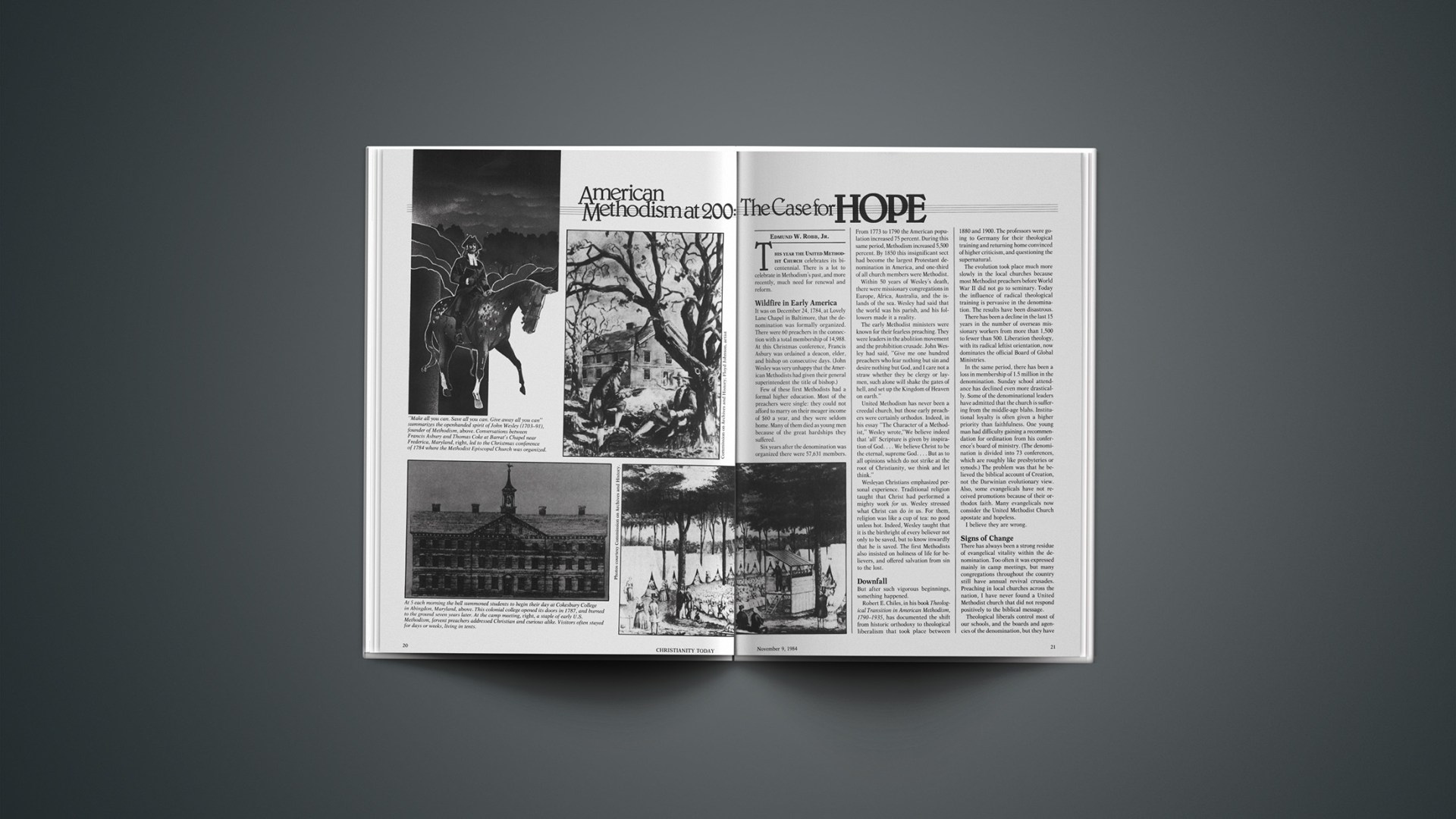
American Methodism at 200: The Case for Hope

Questions are being asked about the United Methodist Church as it celebrates the two-hundredth year of organized Methodism in the United States:

How dominant is radical theology in its power structure?

What future do UMC evangelicals have?

What are the denomination’s Wes-leyan roots?

How much of a role has Methodism played in American life over two centuries?

To find out, CHRISTIANITY TODAY asked three independent thinkers to give their answers. They do not always agree.

Two, Edmund Robb and Dennis Kinlawt are long-time active leaders of the evangelical wing of United Methodism. One, Charles Keysor, founder of the UMC’s burgeoning Good News movement and magazine, has left the denomination.

This year the United Methodist Church celebrates its bicentennial. There is a lot to celebrate in Methodism’s past, and more recently, much need for renewal and reform.

Wildfire In Early America

It was on December 24, 1784, at Lovely Lane Chapel in Baltimore, that the denomination was formally organized. There were 60 preachers in the connection with a total membership of 14,988. At this Christmas conference, Francis Asbury was ordained a deacon, elder, and bishop on consecutive days. (John Wesley was very unhappy that the American Methodists had given their general superintendent the title of bishop.)

Few of these first Methodists had a formal higher education. Most of the preachers were single: they could not afford to marry on their meager income of $60 a year, and they were seldom home. Many of them died as young men because of the great hardships they suffered.

Six years after the denomination was organized there were 57,631 members. From 1773 to 1790 the American population increased 75 percent. During this same period, Methodism increased 5,500 percent. By 1850 this insignificant sect had become the largest Protestant denomination in America, and one-third of all church members were Methodist.

Within 50 years of Wesley’s death, there were missionary congregations in Europe, Africa, Australia, and the islands of the sea. Wesley had said that the world was his parish, and his followers made it a reality.

The early Methodist ministers were known for their fearless preaching. They were leaders in the abolition movement and the prohibition crusade. John Wesley had said, “Give me one hundred preachers who fear nothing but sin and desire nothing but God, and I care not a straw whether they be clergy or laymen, such alone will shake the gates of hell, and set up the Kingdom of Heaven on earth.”

United Methodism has never been a creedal church, but those early preachers were certainly orthodox. Indeed, in his essay “The Character of a Methodist,” Wesley wrote, “We believe indeed that ‘all’ Scripture is given by inspiration of God.… We believe Christ to be the eternal, supreme God.… But as to all opinions which do not strike at the root of Christianity, we think and let think.”

Wesleyan Christians emphasized personal experience. Traditional religion taught that Christ had performed a mighty work for us. Wesley stressed what Christ can do in us. For them, religion was like a cup of tea: no good unless hot. Indeed, Wesley taught that it is the birthright of every believer not only to be saved, but to know inwardly that he is saved. The first Methodists also insisted on holiness of life for believers, and offered salvation from sin to the lost.

Downfall

But after such vigorous beginnings, something happened.

Robert E. Chiles, in his book Theological Transition in American Methodism, 1790–1935, has documented the shift from historic orthodoxy to theological liberalism that took place between 1880 and 1900. The professors were going to Germany for their theological training and returning home convinced of higher criticism, and questioning the supernatural.

The evolution took place much more slowly in the local churches because most Methodist preachers before World War II did not go to seminary. Today the influence of radical theological training is pervasive in the denomination. The results have been disastrous.

There has been a decline in the last 15 years in the number of overseas missionary workers from more than 1,500 to fewer than 500. Liberation theology, with its radical leftist orientation, now dominates the official Board of Global Ministries.

In the same period, there has been a loss in membership of 1.5 million in the denomination. Sunday school attendance has declined even more drastically. Some of the denominational leaders have admitted that the church is suffering from the middle-age blahs. Institutional loyalty is often given a higher priority than faithfulness. One young man had difficulty gaining a recommendation for ordination from his conference’s board of ministry. (The denomination is divided into 73 conferences, which are roughly like presbyteries or synods.) The problem was that he believed the biblical account of Creation, not the Darwinian evolutionary view. Also, some evangelicals have not received promotions because of their orthodox faith. Many evangelicals now consider the United Methodist Church apostate and hopeless.

I believe they are wrong.

Signs Of Change

There has always been a strong residue of evangelical vitality within the denomination. Too often it was expressed mainly in camp meetings, but many congregations throughout the country still have annual revival crusades. Preaching in local churches across the nation, I have never found a United Methodist church that did not respond positively to the biblical message.

Theological liberals control most of our schools, and the boards and agencies of the denomination, but they have never had the hearts of the great majority of the lay members.

Things are changing in United Methodism. The evangelical renewal that has had such a great impact across America has influenced this denomination. Those led to Christ by evangelical parachurch organizations are finding their way back to the church of their heritage. Many of them have entered seminary to prepare for the ministry. The laity have been watching the electronic church and wondering why they do not have biblical preaching and enthusiastic singing in their local churches. More and more churches are asking for evangelical ministers.

Along with the reemergence of traditional theology stands the charismatic movement. I find charismatics in almost every congregation where I preach. They are sincere Christians with a zeal for evangelism and a love for God’s Word. Some congregations are experiencing renewal through their witness and faith.

Furthermore, in the 1970s “lay witness missions” swept across the church. A typical mission is led by 20 to 30 couples who are guests of a congregation for a weekend. They share their faith and seek to lead people to Christ. Thousands have for the first time experienced the assurance of their salvation. In my home conference of northwest Texas, scores of young people have been converted and have answered the call to preach as a result of the missions. Most have gone to evangelical seminaries.

Asbury Theological Seminary, an independent evangelical seminary with a Wesleyan emphasis, is now training more people for the United Methodist ministry than any official theological school in the denomination. Their graduates are being sought by many conferences of the church.

Students of a new kind are coming to most of our denominational seminaries. They are more likely to have a traditional faith than the students of the 1960s and 1970s, and most of them want to go into the pastoral ministry. Very few theological radicals are going this route these days.

Good News, the “Forum for Scriptural Christianity within the United Methodist Church,” is the denomination’s largest caucus group, and is much stronger then any other evangelical renewal organization of the mainline denominations. The vitality of this movement continues to grow. Undoubtedly, at the recent general conference in Baltimore, the Good News lobby had the greatest impact of any organization of the church.

Good News magazine has more paid subscriptions than any official magazine of the church, with more than 20,000 receiving it bimonthly. At their annual meeting, the United Methodist Association of Communicators judged the Good News exposé “Missions Derailed” (May 1983) the outstanding general article in a United Methodist-related publication for 1983. The article sent shock waves through the Board of Global Ministries, exposing the excessive overhead of that vast bureaucracy. It was revealed that out of a budget of $59,326,497, only $ 10,047,497 was going to overseas missionary support. In 1981, headquarters expense alone was $18,116,82.

Each year the Good News movement has regional conferences throughout the church and a well-attended national convocation. It also provides supplemental evangelical educational materials to local churches.

Tim Stafford is a free-lance writer living in Santa Rosa, California. He is a distinguished contributor to several magazines. His latest book is Do You Sometimes Feel Like a Nobody? (Zondervan, 1980).

Learning from the Past

Learning From The Past

In the early decades of the century, many evangelicals and fundamentalists were anything but passive. Rather, they were politically partisan with a vengeance. They were a prime force behind Prohibition, which evangelist Billy Sunday connected directly with salvation. In his famous one-hour, 40-minute sermon “Booze,” Sunday rhetorically asked listeners if they voted “for the saloon.” Yes? “Then you shall go to hell.”

Such connecting of salvation to a specific viewpoint could also be seen in the Scopes trial (1925). At issue for activist Christians was this: Could a person be a Christian and still believe man was created gradually, through a God-controlled process? To many, the answer was a clear no. Echoing Billy Sunday on Prohibition, the Reverend John Roach Straton bluntly stated the widely affirmed conviction that “any man who believes in evolution won’t be saved.” (In contrast to Straton were other evangelicals of impeccable credentials, such as the earlier generation’s Benjamin Warfield. He opposed blind-chance evolution, a form of naturalism that denied God’s place in his universe. But Warfield believed that some sort of process of development, guided by God, could square with Genesis.) In the Scopes trial, William Jennings Bryan and others took basically one position as the only possible Christian viewpoint, which left them open to embarrassing manipulation by journalist H. L. Mencken.

Eight years after the Scopes trial, in 1933, Prohibition was repealed. But the damage caused by extravagant statements, such as Sunday’s and Straton’s, was done. To many, evangelicalism had become a symbol of backwardness and mean pettiness. Disillusioned, evangelicals withdrew from cultural and political engagement.

We are not arguing that it was a mistake to support Prohibition (historians agree that it had some salutary effects), or to oppose Scopes. Nor are we arguing that the religious modernist was an imaginary bogeyman—he was flesh-and-blood reality and carried a flawed agenda.

The relevant point here is that some evangelicals absolutized contestable positions on Scopes and Prohibition; they completely identified God with their cause, and they blurred the line between human programs and divine principles. Whether the causes were right or wrong, they were not at the center of the gospel, and these Christians treated them as if they were. It is extravagant to say that opposition to Prohibition or to a particular view of Genesis 1 automatically destroys one’s salvation. Identifying salvation with one contestable position undercuts the responsiveness of many men and women who might otherwise have heard and accepted the gospel. The problem was aggravated by unchecked polemics.

Today’s polemics can be just as overblown. One best-selling religious author informed us recently that should “the liberals regain control of the Senate and White House in the coming election (they still control the House of Representatives), it will be all over for free elections by 1988.” A national Christian magazine’s front cover stated, “Ronald Reagan is lying about Nicaragua.” A Christian lobby, in a mailing ominously stamped “URGENT,” feared a Mondale coup would “turn America into Sodom and Gomorrah at the election polls on November 6, 1984.” Such statements can make evangelical political involvement appear hysterical.

Perils Of Partisanship

We must be careful not to repeat the mistakes of our predecessors in the twenties. An evangelical leader of liberal political persuasion was recently quoted in a national magazine to the effect that one cannot be Christian and Republican. On the other side, several fundamentalist and evangelical leaders have aligned themselves with Reagan Republicanism. The strong implication—which is sometimes everything but a direct assertion—is that one cannot be a true Christian and a Democrat. As a result of such assertions, the faith becomes a political football.

In fact, the church has only one thing to offer that no other institution on earth can provide: the gospel. If the church becomes too closely identified with any political program—no matter how grand—at worst it discredits the gospel (should the program prove wrong), and at best it topples the gospel from its transcendent place.

Navigating Tricky Waters

From the pulpit, the Word of God is proclaimed. We can be sure of it; we cannot be sure of our political opinions. Nor do we want the infallible gospel of Christ to be confounded with our fallible judgments. C. S. Lewis warned against clergy devising detailed political programs. “The clergy are those particular people within the whole Church who have been specially trained and set aside to look after what concerns us as creatures who are going to live for ever …,” he wrote. Much of the responsibility for working out the particulars falls to the laity. “The application of Christian principles, say, to trade unionism or education, must come from Christian trade unionists and Christian schoolmasters,” said Lewis, “just as Christian literature comes from Christian novelists and dramatists—not from the bench of bishops getting together and trying to write plays and novels in their spare time.”

This does not mean the gospel must be preached as having no relation to the everyday world. The kingdom of God is among us, not solely in heaven. The Christian gospel disturbingly challenges individuals and society. As Harvard historian Christopher Dawson, a devout Christian, wrote, “The world which is the natural enemy of the Church is not a moral abstraction, it is an historical reality which finds its embodiment in the empires and world cities of history.…”

But clergy (and politically active laity) need to distinguish between biblical imperatives on one hand, and their particular applications on the other. The imperatives are plain enough. In the words of 1974’s Lausanne Covenant, the church is called to “proclaim God’s love for a world of sinners and to invite all men to respond to [Christ] as Savior and Lord in the wholehearted personal commitment of repentance and faith.” This “message of salvation implies also a message of judgment upon every form of alienation, oppression and discrimination, and we should not be afraid to denounce evil and injustice wherever they exist.” So it is that, “The salvation we claim should be transforming us in the totality of our personal and social responsibilities.”

But the applications are not so plain. Were James Watt’s environmental policies, judged on Christian terms, a case of poor stewardship? Is the welfare state doing more harm than good to the impoverished? On these and literally hundreds of other questions, Christians hold a variety of positions.

How, then, are we to navigate these tricky waters? An efficient navigator keeps an eye on his compass, and the church needs always to keep an eye on the center of its gospel and its mission; again, it must distinguish imperatives from applications. Confusing the two alienates seekers of the all-important truth the church alone has to tell. It is one thing for the Holy Spirit to persuade a person that he or she is uniquely loved by Christ. Do we seriously expect the Spirit also to convict that person that the U.S. should never have relinquished the Panama Canal? Or again: To proclaim an imperative is to insist that a just society cares for its poor. An application is confused with the imperative when we say the gospel itself demands that we follow the economics of John Kenneth Galbraith.

Indeed, the further we move from the center of the gospel, the more proposed applications of the gospel we find. Classical Christians agree that Christ is to be understood as God enfleshed; but they disagree about what economic system is truest to all the imperatives of the Bible. Since statements of the clergy are so easily taken for what “the church” thinks, these applications—these more specific outworkings of the imperatives—are best left to individual Christian and parachurch group action, or to Christians working within the national political parties.

Of course, exceptions arise. Certain socio-political developments (such as slavery or nazism) are clearly evil, and demand an equally clear denuciation from the church as the church. We believe abortion on demand is currently just such a development, as is apathy about the possibility of nuclear holocaust.

A Matter Of Perspective

The church looks through a glass—however darkly—to a world beyond our own. Biblical revelation is multifaceted and profound, much more profound than suggested by bumper-sticker political slogans. With the perspective of the Bible, the Christian has incentive to seek justice and peace no matter how hard the struggle, and has genuine hope to offer the world no matter what the outcome.

With this perspective, Christians in politics should understand the complexity of human nature and of evil. This will help us avoid absolutizing our detailed applications of the gospel and, as a result, denouncing our political opponents as enemies of God’s very truth. Some politicians, like some members of any profession, may be radically evil. But many are sincerely trying to do what they believe right and are struggling as creatures motivated both by good and evil. So to pronounce an ordinary sinner anathema because he disagrees with a particular political program alienates the sinner, muddles the debate at hand, and benefits only the Devil.

Christians can do better than that. We can responsibly bear the gospel into all the world, political as well as private, and guard its essence at the same time. The gospel is like an iceberg made of pearl. We successfully see and live out only a tiny percentage of it, but we draw strength and hope from the massive, great rest of it, which extends into and remains hidden in heaven.

In this election year particularly, we do well to remember with Paul that the treasure of the gospel is borne in earthen vessels, proving all the more that “such transcendent power does not come from us, but is God’s alone” (2 Cor. 4:7).

In conclusion, because God calls us to a full-orbed response to the gospel, we will each want to apply biblical truth to every area, including the political. It is a step forward for evangelicals to recapture the spirit of Christians in the mid-1800s, who worked so hard to abolish child labor, protect orphans, and free slaves.

Yet our generation of evangelicals is new at political involvement. We have forgotten costly lessons learned by our forebears, and will make many mistakes. Political involvement is complex and dangerous, but that does not excuse us from it. The admission of that complexity and danger is, simply and realistically, a recognition of what it is to serve an ideal kingdom in a fallen world. “We have much to be forgiven,” said John Henry Newman. “Nay, we have the more to be forgiven the more we attempt. The higher our aims, the greater our risks.” And, it is fair to add, the greater the gain for Christ and his world.

Ideas

Partisan Politics: Where Does the Gospel Fit?

The presidential election just past established it beyond all doubt: evangelical Christians are now solidly back in the public arena. In this year’s campaign they were represented from one end of the political spectrum to the other, from Christian Voice to Sojourners. As Newsweek declared, “Not since 1960 have so many local churches delved into—and been divided by—politics.”

It is a hopeful sign that evangelicals and fundamentalists are remembering their responsibility to society and the world. Apathy about political and social change betrays a failure to appreciate the radical depth and power of Christ’s passion. The gospel is adequately honored only when we insist that it renews all aspects of life, individual and corporate. Church historian Richard Lovelace asserts that “authentic spiritual renewal inevitably results in social and cultural transformation.” On the practical level, such transformation necessarily involves legislation, regulation, and taxation—all political matters.

It is good, then, that many boats are launched and on the political waters. At the same time, with the evangelical involvement becoming more intense and, as Newsweek notes, divisive, it may now be wise to consider some course corrections. To abandon political passivism is good; now we must be sure that political activism is well charted by sober biblical reflection. A captain whose ship has sailed into the shoals is ill advised to do nothing, but he is equally foolish to make an instant turn starboard or port without checking for sandbars. Likewise, only an activism based on adequate reflection has the bracing, clarifying effect evangelical political involvement ought to have. The alternative can produce bitter confusion and futile commotion, as two examples from the past illustrate.

Eutychus and His Kin: November 9, 1984

To Err Is Humor?

The October 5 issue of this magazine contains a peculiarity. At the top of page 55 are three photographs. One man is Bob Sweet, who is on staff at the White House. Next to him is Jerry Falwell. And to the right of Falwell (probably for the only time in his life) is Sen. Lowell Weicker (R-Conn.). Except it really isn’t Senator Weicker. It is Sen. John Chafee (R-R.I.).

How did this happen? Well, as resident jester at CHRISTIANITY TODAY, I consider it my responsibility to enliven the atmosphere now and then. So I thought, Why not a fun test for you, our erudite readers? And I put John Chafee’s photo in the space reserved for Lowell Weicker. You came through. We have many letters to prove you know Chafee from Weicker any day.

The only problem is that the CT editors didn’t get the joke. To be honest, I really didn’t expect to see that substituted caption in print. I thought somebody here would catch it and correct it. Now imagine those poor editors next time they’re in Washington. Say they drop by to interview Senator Weicker. They think that the black-haired, lanky Chafee really is Lowell Weicker. So the real Weicker would invite them into his office, but they’d say, “Thank you, that’s okay. We’re waiting for Senator Weicker.”

I mean it. It could happen. It appears these editors offer errors the same amount of resistance most defensive tackles offer Nebraska running backs: very little. But I’ll admit this adds an entirely new dimension to my job. I was getting a little bored, working only on my little column from issue to issue. But now that I’ve found out what I can get away with—just watch me work!

EUTYCHUS

The Public School Debate

John Alwood may be right (“The View from the Principal’s Office,” Sept. 7) when he said, “If there is a battle going on, there are a lot of schools where no one knows it.” I suspect that his school may be one of them.

His responses to the questions reveal an undeniable influence of the very humanism he is struggling to disregard. When Alwood indicated warmness to a teacher assigning students to write a horoscope to get the class interested in writing, and when he defended “a string of swear words” from Brave New World, he relinquished any credibility he might have had in speaking on the subject of humanism. One doesn’t ask the fox about the security of the henhouse.

EVERETT STENHOUSE

Costa Mesa, Calif.

I want to applaud Dr. Alwood for the spirit and balance of his views. He seemed to relate to all kinds of kids with justice and fairness, both rare qualities. He affirms our conviction that voluntarist organizations make a valid contribution to the school’s life and can participate in school life without being objectionable.

ROBERT MITCHELL

President, Young Life

Colorado Springs, Colo.

Can the loss of Bible teaching in public schools really have had no effect on American morals? Is there really no direct impact by a secularist teacher’s values on children he teaches? Is silent prayer at school really so awkward as to be unworkable? Considering the article’s answers, one can only hope Dr. Alwood has somehow been misunderstood or misquoted.

KENNETH J. BRYER

Carol Stream, Ill.

I heartily endorse Alwood’s challenge to evangelicals to become involved with the public schools. There is no more available mission field. Who speaks for God in those schools if all the evangelicals are withdrawn?

MALCOLM WILLEMS

Kent, Wash.

Old Testament Jews would have died a thousand deaths before allowing others with a different philosophy of life to educate their seed. Few parents can adequately balance the humanistic presuppositions, thinking, and attitudes that develop in the 7-hour gap between bus rides. Instruction is more than modern science labs, a computer terminal, or band. Biblical training is a way of life. The point is not “Look at those awful public schools!” but “Look how Christian education offers us, the Christian parents, help in fulfilling our responsibility to educate our children in a biblical basis for life!”

MARK ECKEL

Shiloh Christian School

Mandan, N.Dak.

The Real Kierkegaard

I commend CT for publishing the fine article by C. Stephen Evans on Sören Kierkegaard, “A Misunderstood Reformer” [Sept. 21]. I have been deeply disturbed by the evangelical tendency to depict Kierkegaard as a bogeyman threatening the true faith. (This perhaps is true of the Kierkegaard presented through the medium of some existentialist philosophers.) I hope Evans’s article will go a long way in banishing that caricature from the minds of evangelicals and stimulate a firsthand investigation of his writings.

CHRIS MCDERMOTT

Lakeland, Fla.

In his article, Evans asks, “Must an author be infallible to be read with profit, or appreciated as a Christian brother?” The answer is obvious. However, it gets a negative vote from some whose letters to the editor inform us that they intend to allow their subscriptions to lapse, citing a “liberal trend” in the publication. Frankly, I find the change refreshing and edifying.

REV. THOMAS R. TERRY

Sardis Baptist Church

Timmonsville, S.C.

American Baptists: No Nod to Gay Relationships

I must protest a discernible trend in CHRISTIANITY TODAY toward biased reporting of news related to mainline denominations. Your report on the Family Life Policy Statement adopted by the General Board of the American Baptist Churches, U.S.A. [Sept. 7], implies that the policy endorses homosexual relationships. That is a gross distortion, and was not the intention of the representatives.

It is also peculiar that a journal that claims great interest in advancing the cause of evangelism should ignore totally the fact that a policy statement on evangelism was also adopted by the general board at the same meeting.

DANIEL E. WEISS

National Secretary

American Baptist Churches, U.S.A.

Valley Forge, Pa.

For the reporter to say that “convenantal, intentional family arrangements” [is] an apparent reference to homosexual unions demonstrates a “tilt.” As chair of the drafting committee I can say unequivocally that no such inference was intended. The statement is clear that such an inference is not that unless one is looking for it.

REV. HARLEY D. HUNT

Emerald Baptist Church

Eugene, Oreg.

Is your reporter trying to paint the ABC “liberal”?

REV. MARVIN BREININGER

First Baptist Church

Pittsfield, Maine

You have resorted to the secular media’s irresponsible twisting of facts in order to sensationalize a story. Sadly, the damage doesn’t end here as the body is further divided by such misunderstandings.

REV. DENNIS HAMMONS

The Eastern Heights Baptist Church

Evansville, Ind.

Ralph Winter: Reinventing the Wheel?

I read with interest “Ralph Winter: An Unlikely Revolutionary” [Sept. 7]. However, I am a bit puzzled. Winter seems to have reinvented the wheel. In 1942, Paul Fleming became the center of a group known as New Tribes Mission, which selected for itself the somewhat arrogant motto, Reaching New Tribes Until We’ve Reached the Last Tribe. Wycliffe Bible Translators concludes their organizational theme song, “… ‘til in every language is told His salvation, / March onward, O Camp Wycliffe, with God’s saving Word.”

What is Winter doing that these two organizations are not? Why can he not simply stick pins into, give a hotfoot to, or otherwise irritate existing mission boards into pushing out to the edges of their organizational maps and finding “the least, the last, and the lost” to send missionaries to?

DAVID S. LANDON

Chicago, Ill.

The article was delightful, accurate, inspiring, and even entertaining. I would have added an item or two: first and foremost that beyond the sheer genius of the man and his passion for the next person and tribe yet to hear of Jesus Christ lies a personal godliness and love for the Lord Jesus that is inspiring and infectious. I believe Ralph Winter is one of our generation’s truly great men of God. His genius, plus the cross-pollinization of that great host of people committed to world evangelization, has got to be something that has never happened in the world before.

OLAN HENDRIX

U.S. Director, Send International

Farmington, Mich.

Your illustrations of Winter were counterproductive. The cover portrays him as God (almost), viewing the peoples of the world like a cosmological scientist. The illustrations of his head as a light bulb alternately pictured him as the Albert Einstein of missions or a dehumanized object—a head with ideas but no body or heart.

FRANK NOELL

Portland, Oreg.

Miss America and Conservative Chauvinism

Your recent editorial, “The Tarnished Crown of Miss America” [Sept. 7], is ludicrous. Am I to believe that all Miss America contestants other than Vanessa Williams are virtuous? Since when does about three centimeters of cloth create virtue? Your editorial is evidence of the conservative chauvinism sweeping America today, making lesbianism and homosexuality a greater sin than fornication and adultery. Actually, abortion is only a symptom of the latter two. I would suggest that you reread Genesis 1–3, Romans 3, and Galatians 5.

REV. LUKE H. BRANDT

Indiana Creek Church of the Brethren

Harleysville, Penn.

The officials of the Miss America pageant and the publisher and editors of Penthouse magazine are bedfellows: they all profit from the sexploitation of human flesh. It is just that the former are more subtle while the latter are blatantly offensive about it.

HAVEN BRADFORD GOW

American Life Lobby

Stafford, Va.

An “Absolutist” View on Abortion?

The unholy brouhaha that has erupted over the publication and subsequent withdrawal by InterVarsity Press of D. Gareth Jones’s book Brave New People (News, Sept. 21) provides sobering evidence for the rising level of hysteria that threatens to overtake thoughtful evangelical discussion of the thorny abortion issue. Quite properly concerned that secularism is making alarming inroads into the thought patterns and lifestyles of American evangelicals, prolifers have seized on abortion as the issue upon which to take an absolute, uncompromising stand. Yet the complex and tragic nature of some real-life cases and the genuine questions surrounding biblical interpretation makes such an absolutist position premature and self-serving.

Jones and InterVarsity Press are to be commended for attempting to responsibly contribute to the evangelical abortion dialogue. It is unfortunate that the present religious-political climate among American evangelicals is too brittle and polarized to allow it.

ROGER C. SIDER, M.D.

Rochester, N.Y.

I was greatly displeased with the negative light [in which] we were shown. The CAC and other groups were quite right in opposing a book that considers the abortion of a seriously handicapped infant “the least tragic of a number of tragic options.” Murder is always a tragedy, it is never an option. God in his wisdom created some people with great handicaps. We, as Christians, have no right to say, “This one would be too much trouble, Lord, so I’m going to kill him.”

GARY F. BENTLEY

Philadelphia Christian Action Council

Hatfield, Penn.

Heaven—and a New Earth

Philip Yancey’s “Heaven Can’t Wait” [Sept. 7] was well written and to the point, but he nowhere hints that there’s a new earth coming. Too many Christians have an altogether ethereal picture of the future. Actually, the promise of the new earth is an essential aspect of biblical eschatology. Our happiness will not be complete until our bodies will have been raised, and we shall be living on the renewed earth. This new earth will then still be heaven. To leave the new earth out of consideration when we think about the Christian’s future is greatly to impoverish biblical eschatology.

ANTHONY A. HOEKEMA

Calvin Theological Seminary

Grand Rapids, Mich.

One idea of heaven I value highly is that the essential ingredient of heavenly life is useful activity.Matthew 25 best illustrates that to me. The man who has worked faithfully is told that he may now enter more fully into work and the joy of usefulness. Fundamental to heaven’s joy is useful activity.

REV. DONALD L. ROSE

Huntingdon Valley, Penn.

Tobacco and Southern Baptists

I was surprised to read that 51 Southern Baptist churches in North Carolina had reacted against a resolution to end subsidies to tobacco farmers, calling it “the lifeline for many of our people and the majority of the churches” [News, Sept. 7]. Soon I expect to read that other churches are complaining about the crackdown on cocaine traffic since that is the primary source of their income. What if Californian marijuana growers and Times Square hookers tithe religiously? Does that sanctify their professions?

DAVID FARNUM

Coudersport, Penn.

Ministry to Homosexuals

In an age when evangelicals are out protesting against “gay rights,” I am so happy to see Christians reaching out for the homosexuals’ greatest right of all—the right to become children of God just as everyone else in the world [News, Sept. 21]. It’s high time Christians accept these people as human beings made in the image of God, having a need for salvation through Jesus Christ, needing love and friendship. They need Jesus, not our judgmentalism.

DEBORAH J. REINIKE

K. I. Sawyer A.F.B., Mich.

My dictionary defines the word gay as “joyous and lively; merry; happy; lighthearted.” This certainly cannot describe those unfortunate, ill members of society called homosexuals, and I cannot understand why you as America’s leading evangelical Christian magazine persist in using the word in reference to them.

DON BREWER

North Little Rock, Ark.

The persistent misconception is that evangelicals are not involved in ministry to homosexuals. This article helps. It says, however, “At this year’s United Methodist General Conference, participants turned down a statement in support of civil rights for gays.…” The paragraph considered and voted down by the general conference included the sentence, “Their invisibility as a minority has meant …” To pass that paragraph would have meant we were recognizing homosexuals as an official minority group. Then it stated, “We hold that persons should not be discriminated against on the basis of sexual orientation.…” Delegates wondered if a homosexual youth director at a church could be dismissed under such legislation. The rights statement also asked for the “creation and effective enforcement of legal sanctions against such discrimination.” United Methodists simply believe they have and must retain the right not to employ homosexual persons in church staff positions.

JAMES V. HEIDINGER II

Executive Secretary/Editor

Good News Wilmore, Ky.

That First Amendment

The editorial “Nonsense and the First Amendment” [Sept. 7] opens a sore spot with people who believe the Constitution means what it says—no less, no more. The long series of decisions about the practice of religion in schools has no constitutional basis whatever. It is abundantly clear that “the Congress can make no law …”; it seems equally clear that no restraint whatever is placed on any other legislative body. Isn’t there someone somewhere who can do something about the federal courts who put the nonsense into legal interpretation of the First Amendment?

JESSE DUCK

Trenton, Tenn.

Your editorial made good sense to me. What does not make sense is how you can decry, correctly, the nonsense promulgated by such pernicious provocateurs of permissiveness as the ACLU and at the same time “promote” perfidious “peregrination”! An ad on page 81 of your September 7 issue says “preference to women candidates.” My dictionary says of discrimination: to make a distinction in favor of (my analysis) or against one person or thing as compared with others. It is, therefore, just as wrong to favor one group (women/minorities) as it is to disfavor them! Would you have carried the ad if it said “preference given to white male candidates”?

JOHN L. ROBINSON, JR.

Overland Park, Kans.

Cardboard Culture

At least the ancients longed for the highest truth and beauty.

Ancient mythology possessed much that was beautiful. It was an illusion, but it prepared many people for that beauty which is no illusion. One great authority on classical literature, a man converted in midlife, Gerhard Nebel (1903–74), put it thus: “The encounter in Christ that was granted me in these years made it necessary for me to rethink … the myth and the beautiful from the perspective of the crucified and risen Lord” (from the Foreword, Das Ereiginis de Schönen, 1953). Nebel states repeatedly and in many ways that the concepts of beauty and strength, truth and virtue, that he found in the myths, did not and could not bring even true satisfaction (not to speak of salvation), but that they did create an empty stage, brushing aside the trivial concerns of banal daily living, and creating an expectancy that only the gospel could fill.

Nebel was also convinced that the ancient myths cannot be revived. Their beauty, even with its flaws, is lost as a real force in human lives (although we can still admire it at a distance, like statues in a museum of ancient art). The gospel is real, and proved far too strong for the gods and heroes of mythology. We can no longer believe in them, nor should we—even though we may learn something from them. But when the gospel is lost, when the true truth, real virtue, and absolute beauty that the gospel represents are forgotten and banished from our “post-Christian culture,” then we are worse off than ancient man with his imperfect but beautiful mythology.

To borrow Nebel’s imagery, we no longer have an empty stage, from which great tragic drama has swept false hopes, leaving us ready to hear the true hope of the gospel, but we have a pit, a sordid abyss filled with the wretched residue of culture.

Is it possible for a drunken man to understand the gospel? No doubt it is not impossible, but most of us would prefer trying to explain it to him when he is sober. His drunkenness may point out to others the misery of his condition, but it usually deprives the man himself of the ability to recognize it, or even if he does recognize it, to do something constructive about it. Ancient philosophy and literature did not have answers to the human predicament, but often left men with a sense of longing and expectancy that made them receptive to the gospel when it was proclaimed. Modern “culture,” in many of its forms, is more like drunkenness. To those observing it from the outside, its misery, futility, and despair seem to cry out for transformation, for salvation. But to those within it, that which looks disgusting to the outsider seems like that which is most desirable. One is not likely to look for a way out, and even less likely to find it.

Paul speaks of the “eager expectation” or “anxious longing” of the whole creation for the revelation of God (Rom. 8:19). Ancient culture, despite its often high, always flawed ideals, could not satisfy this longing, but it did share it and often increased it. Modern culture seems to have lost its myths, debased its heroes, and preserved only its demons.

Jesus said, “Seek, and you shall find” (Matt. 7:7). The cardboard heroes (at best) and the larger-than-life villains and demons of modern “culture” are creating such a disillusioned society that fewer and fewer people have the courage or even the curiosity to “seek the things above” (Col. 3:1).

It would be comforting to think that our popular culture might be renewed, and thus once again offer a kind of preparation for the gospel. In fact, however, the culture cannot renew itself. It lacks the power, the insight, the motivation. As Wilhelm Roepke wrote years ago, successful capitalist culture consumes itself, and rots from within. It needs to be renewed by something coming from outside itself. The only thing that is really and truly from outside culture is the Word of God.

Ancient myths had fascinating and attractive elements of beauty. But as the gospel was heard around the world, it superseded them and revealed their hollowness. During the Age of Reason—the eighteenth century, when the United States came into being—many people, including the majority of America’s Founding Fathers, thought that they could replace the narrow dogmatism of “sectarianism” (i.e., of Christianity) with the broader virtues and ideals of a renewed classical civilization. This hope is reflected in the monuments and ideas of the early days of the United States, which are so frequently drawn from the Roman republic. But such “republican” virtues, which were not as strong as the gospel, have no power in a world that thinks it has made the gospel obsolete.

In America today, two trends are in conflict: the sense of unbelief, which leads to the culture of corruption. In the most degenerate days of ancient Rome, there was a deep sense of self-disgust throughout society. Before society destroyed itself, the gospel was proclaimed, and there was social and cultural renewal as well as new spiritual life. Can such a thing happen once again in Western, “Christian” society? Indeed, it can, but it will require a consistent proclamation and living out of the Word of God with patience and perseverance, despite the fact that the senses of society seem to have become too gross to comprehend it.

Harold O. J. Brown is currently serving as interim pastor in the Evangelical Reformed Church of Klosters, Switzerland. He is on leave of absence from his post as professor of biblical and systematic theology at Trinity Evangelical Divinity School, Deerfield, Illinois. Professor Brown’s latest book is Heresies (Doubleday, 1984).

Refiner’s Fire: Can There Be Faith in Betrayal?

Shusaku Endo’s strange and wonderful novel asks some uncomfortable questions.

In silence, Shusaku Endo’s unsettling novel about martyrdom, the means of betrayal was the symbol of hope: the fumie, an image of Christ placed at the Judas’s feet. To trample on the sacred visage meant life—but at the renouncement of faith.

This is the novel’s spiritual backdrop. Set into motion by the apostasy in 1633 of an experienced and highly respected Jesuit missionary, Christovao Ferreira, the book becomes a spiritual odyssey of a former student of Ferreira’s, Sebastian Rodrigues, who goes to Japan as a missionary “to find out the truth about our teacher.” Once there, however, Rodrigues quickly begins to unravel the truth about himself, about his relationship to Christ, and about his relationship to those to whom he is sent. That he loves Christ above all else is certain from the beginning, but that he will somehow betray that love also becomes agonizingly clear.

When three hostages are to be taken from a Japanese village suspected of containing Christians, one asks Rodrigues: “ ‘Father, if we are ordered to trample on the fumie.…’ Mokichi, head hanging, mumbled the words as though he was talking to himself. ‘It’s not only a matter that concerns us. If we don’t trample, everyone in the village will be cross-examined. What are we to do?’ ”

Rodrigues, in his great pity for these men, would have them trample the face of Christ to save their lives just as later, after his capture, he would have his fellow priest, Garrpe, apostatize (he does not) in order to save the lives of three Japanese Christians.

“ ‘Trample! Trample!’ I shouted. But immediately I realized that I had uttered words that should never have been on my lips.”

Mokichi and the second hostage, Ichizo, do not apostatize and die cruel deaths; but the third hostage, Kichijiro, does and even betrays Father Rodrigues.

“ ‘Father, forgive me!’ Still kneeling on the bare ground Kichijiro cried out in a voice choked with tears. ‘I am weak. I am not a strong person like Mokichi and Ichizo.’ ”

Silence is about Father Rodrigues’s own weakness and his strength, his awful pride in presuming to identify himself with Christ during his early captivity, and the awful suffering he endures when finally he must place his own foot on the fumie.

Silence is also about Father Rodrigues’s achievement of the true nature of Christ, manifested in his capacity to love and forgive the unlovely, Judas-like Kichijiro. The means for that achievement occurs when Rodrigues comes before the fumie in order to save three Japanese who are suffering because of his refusal. The narrator shifts to the present tense: “The fumie is now at his feet.”

“This face is deeply ingrained in my soul—the most beautiful, the most precious thing in the world has been living in my heart. And now with this foot I am going to trample on it.”

Ferreira, his old teacher, encourages him; the Japanese interpreter urges him on: “It is only a formality. What do formalities matter?… Only go through with the exterior form of trampling.” Rodrigues acts: “The priest raises his foot. In it he feels a dull, heavy pain. This is no mere formality. He will now trample on what he has considered the most beautiful thing in his life, on what he has believed most pure, on what is filled with the ideals and the dreams of man. How his foot aches! And then the Christ in bronze speaks: … ‘Trample! Trample! I more than anyone know of the pain in your foot. Trample! It was to be trampled on by men that I was born into this world. It was to share men’s pain that I carried my cross.’

“The priest placed his foot on the fumie. Dawn broke. And far in the distance the cock crew.”

God’s silence is broken. In the last analysis Rodrigues tramples because Christ commands him to. His betrayal is thus an act of submission and obedience to Christ, a real act of love as well. Nevertheless, because of his act of public betrayal he can no longer identify himself with Christ, as he has done in his pride throughout his imprisonment and suffering. He must now identify himself with Kichijiro, and thus learn the real extent of Christ’s love, which understands and embraces even Judas.

“ ‘Lord, I resented your silence.’

“ ‘I was not silent. I suffered beside you.

“ ‘But you told Judas to go away: What thou doest do quickly. What happened to Judas?’

“ ‘I did not say that. Just as I told you to step on the plaque, so I told Judas to do what he was going to do. For Judas was in anguish as you are now.’ ”

One of the many virtues of Endo’s novel for Christian readers is that we too have a stake in the action, in the betrayals. We live our “blessed lives of faith,” as Rodrigues reflects before his capture, because we were not born in an age of persecution. Yet the “letters” written by Rodrigues and used to tell his story are addressed to us, his fellow seminarians, as it were. He is our brother in Christ, and what happens to him happens also to us. We too are brought before the fumie (thus the narrator shifts to the present tense); we too in our comfortable, easy lives must make that terrible choice.

And we choose, I think, like Kichijiro, like our brother Rodrigues. We too are betrayers of Christ, like the disciples in Endo’s interpretation, always striking a deal with the ruling powers. Yet betrayal is not the end, for once we see that weakness, that heart of darkness, that treachery in ourselves, then we are finally capable of comprehending the maternal love of Christ that embraces us in spite of our treachery, that embraces us in our anguish. Then we too can love and forgive as Christ does.

Shusaku Endo was born into a culture antithetical to Christianity, yet, when he was 11, his mother, who had become “a fervent, strict-observing Catholic,” had him baptized (Schuchert’s “Translators Preface” to A Life of Jesus). The tension between the Christian faith and Japanese culture in his own life makes his voice unique within the Christian community. He finds the love of Jesus in His compassion for the poor, the lonely, the sick and suffering, the weak, the guilty. The depth of that love reveals itself fully as the dying Jesus forgives from the cross, all the disciples who Endo believes have betrayed Jesus to save their own lives.

His many novels are available in good English translations. Encountering in Silence his vision of Christ as the one who came to be trampled ought to be a powerful and unsettling experience for any Christian.

“ ‘Father, I betrayed you. I trampled on the picture of Christ,’ said Kichijiro with tears. ‘In this world are the strong and the weak. The strong never yield to torture, and they go to Paradise; but what about those, like myself, who are born weak, those who, when tortured and ordered to trample on the sacred image.…’ ”

Rodrigues’s answer to Kichijiro is indicative of the depth of Rodrigues’s own understanding of Christ:

“ ‘There are neither the strong nor the weak. Can anyone say that the weak do not suffer more than the strong?’ ” Rodrigues hears Kichijiro’s confession for the final time, though he is formally an apostate priest, gives absolution, and sends him away in peace.

“No doubt his fellow priests would condemn his act as sacrilege; but even if he was betraying them, he was not betraying his Lord. He loved him now in a different way from before. Everything that had taken place until now had been necessary to bring him to this love. ‘Even now I am the last priest in this land. But Our Lord was not silent. Even if he had been silent, my life until this day would have spoken of him.’ ”

Dr. Startzman is associate professor of English at Berea College, Berea, Kentucky.

The Secret Life of Teenagers

To their elders, teenagers form a secretive society. They do not hang out in our company, they talk their own lingo, they rarely confide. Teenagers Themselves (compiled by the Glenbard East Echo, advised by Howard Spanogle; Adama Books, New York, 1984, $16.95) is a large, unlovely book designed to let us inside their world. The newspaper staff of Glenbard East (Ill.) High School compiled and organized uncensored quotes from nearly 9,000 teenagers in every state in America. They talk about sex, drugs, parents, money, education, drinking, capital punishment, and practically everything else you can think of. Reading this book is like listening to conversations secretly taped in a high school locker room. While not particularly pleasant or edifying, the experience is educational. Their language is sometimes ugly, but kids talk that way, and the purpose of the book is to let us hear them talk.

Predictably, no neat conclusions are reached or encouraged. The book reminds us that teenagers are a fabulously varied group. You get everything from farm kids who love God and America, to suburban kids who confess they are obsessed with sex and designer clothes.

Reading, I couldn’t help feeling sucked down into the adolescent maelstrom of conflicting opinions and emotions. These teenagers do not seem to believe anything terribly different from what their elders believe; they simply believe it while floating untied to anything outside their high school world. No one refers to an adult authority (except, sometimes, a parent), to a book, a magazine article, a TV news show. Even the Christian kids seem to refer to the Bible only as an afterthought. Not only do they lack perspective, they have no idea they lack it. Their only authority is experience. As Harold Spanogle, the faculty adviser who oversaw the book’s production, told CAMPUS LIFE magazine, “An overwhelming characteristic of self-centeredness pervaded many of the responses.… A predominant attitude seemed to be, ‘We can’t have a nuclear war. I haven’t had a chance to live my life yet.’ ”

That’s adolescence, and has been for a long time. Pastors and parents of teenagers could get a great deal from letting Teenagers Themselves carry them back to 16, to remember how they themselves felt and thought and acted. Much is unchanged. Parents and their rules, school and its drudgery still form major complaints. Boys are after only one thing; the double standard endures. It is better (more popular) to have a body than a brain. Everybody, except an occasional rebellious boy, wants to fall in love and get married. When you have trouble, your best friend can tell you what to do (though the influence of parents also remains apparently as strongly felt as ever). This, and much more, is familiar ground.

Much more, though, is not. For instance, from a 17-year-old girl on how she spends her free time: “On school nights my boyfriend comes over, and we play with our little girl.” Or from a 16-year-old from California: “My family is very close. Well, they used to be very close. My mother, my uncle, and my aunt have all been divorced once and started new families.… Both my mother and father have been living with someone else.…” To hear kids talk as casually and knowledgeably as they do about sex and drugs and abortion and divorce will shock some people, and frighten anybody. Teenagers have long felt temptation in these areas, but what they experience today seems beyond temptation: only the unusual person emerges from high school without experiencing one of these modern American plagues. We know these facts from reading the newspaper, but hearing kids talk about them helps us understand better how these facts seem to kids who have known nothing else.

God? Some students gave a clear, unapologetic Christian testimony, but for the others, Christianity and church seem to have made little impression. If these kids mirror society, we have a very secularized society. They sound terribly lost, not in the narrow religious sense alone. You can hear them laboring very seriously through decisions that will form their lives, but nobody—except occasionally their parents—seems to exist in their universe except other equally lost kids. There are no teachers, no pastors, no older adult friends, no books, no Bibles to ask for wisdom. Parents who have lost human contact with their kids usually hope that school or church or Boy Scouts will fill out what they miss, but Teenagers Themselves does not encourage such thoughts. I got the feeling that Christians are missing most of this generation: teenagers do not hear what Christians are saying about a personal God who loves them. Teens talk freely of God as a philosophical option, but their experience does not make them come to terms with him personally.

While Teenagers Themselves seeks to explain the teenage world, Parents and Teenagers (Jay Kesler, general editor, with Ronald A. Beers; Victor Books, Wheaton, Illinois, 1984) means to offer therapy for it. Produced by Jay Kesler and the Youth for Christ/USA organization, it is a fat, miscellaneous compilation of the wisdom of more than 50 Christian youth workers, counselors, and pastors. Like Teenagers Themselves, it covers every topic relating to teens and their parents you can think of. The articles are short, chatty, and directive. Contributors include Anthony Campolo, Howard Hendricks, Charles Swindoll, James Dobson, Joyce Landorf, Warren Wiersbe, John Perkins, Bruce Lockerbie, Kenneth Gangel, Gordon MacDonald, Josh McDowell, Larry Christenson, and H. Norman Wright, among others. Such a large all-star cast suggests the impression the book makes: that it is something of a hodgepodge of evangelical family advice. It also suggests that this is the best that evangelicals have to offer, which I think is true. I don’t know of a better book to put into the hands of offer, which I think is true. I don’t know of a better book to put into the hands of the parents of teenagers.

Parents and Teenagers emphasizes that a good marriage is the best gift you can give your kids. It teaches you how to communicate with them. It encourages you to encourage, counsel, guide, and love teenagers even when they seem to be far off track. It suggests how to respond when your kids swear, come home late, or want to go on a date at 14. Most of this advice could as easily have been written twenty years ago. It acknowledges that kids today are heavily involved with sex and drugs, that they live in a different world than we did, but it seems weak in specific ideas on what to do about it. It addresses the problems of broken families, but as an antidote falls heavily on the time-worn remedies of love and patience.

I would not quarrel with such good advice, but after bathing in the lostness of Teenagers Themselves I found it hard to envisage this Mom-and-Pop-know-best stuff having power to change any but the “good” kids. The best medicine is preventive, no doubt, and if all parents were as wise and patient and loving as Parents and Teenagers teaches them to be, no doubt our kids would be better too.

My impression, though, is that these 50 Christian contributors haven’t fully come to grips with the reality that most kids, male and female, graduate from high school accepting drugs as an ordinary form of recreation, having had sexual intercourse (or feeling ashamed that they haven’t), and believing that their happiness is the axis on which their world ought to turn. That must include a great many kids in our church youth groups, our camps, and our own families. These kids know things and assume things we don’t: but they don’t tell us about it, and they don’t look to us for advice. They look to each other.

That was my first reaction, fresh from the teenage maelstrom. Upon reflection, though, I realize that the advice in Parents and Teenagers remains, twenty years or one hundred years after it was formulated, the most helpful thing we can offer. Adolescence is a furnace which no one can go through for anyone else: you simply cannot reach into it and straighten things out. Kids do not want to listen to reason or common sense. The best witness from the adult world remains a life lived well, with love and reverence for God and neighbor. That must make an impact, sooner or later. Parents and Teenagers should be a substantial encouragement to Christian parents, suggesting to them that the strains which their teenagers put on family life are common, that others have lived through them and seen their kids grow into healthy, adult Christians, and that the best thing a Christian parent can do is hang in there, lovingly. It will also help them feel their way through innumerable specific problems.

What about the millions of teenagers who don’t happen to have Christian parents? Neither of these books is designed to address that problem, but they do leave me wondering: Is there a way for the gospel to penetrate broadly into the lostness of secularized adolescence? If not, then I think evangelicals will eventually withdraw their children into Christian schools. Either that, or we will spend our time and energy in a defensive war, trying to keep the darkness at bay in our own kids.

Red Dawn

MGM, directed by John Milius; PG-13

Fascism in 1984 is a label fashionably applied to anyone opposed to the nuclear arms freeze and its attendant ideologies. It is no surprise then that critics have branded Red Dawn “fascist.” In creating this parable of World War III, John Milius dared to slight popular scenarios for the “fate of the Earth.” When the film didn’t live up to many critics’ apocalyptic expectations, epithets sailed like the multiple warheads of an MX missile.

Accusations of social irresponsibility were common: Red Dawn bypasses our assumptions of modern atomic warfare. Instead, Milius prophesies a conventional war fought by high school students-turned-partisans when the U.S. is invaded by Soviet and Cuban troops. Based in the Colorado mountains, the children respond with brutal efficiency and timeless reasoning: “We live here!” one shouts. Time magazine called the film a “fascist fantasy.” Exactly why patriotism and freedom fighting equal fascism is never fully explained. A National Public Radio critic huffed that she missed the anarchy and rebellion of the 1960s—as if drug abuse and irrational protest were superior to self-sacrifice and duty. Most revealing (and ludicrous) was the assertion in the Los Angeles Times that the film “could have been as important” as Testament or The Day After—films notable only for their lack of production values and lukewarm public response.

Lost in all this rethoric, however, is the fact that Red Dawn seems to represent a growing trend in Hollywood toward old-fashioned flag waving. With the success of ABC’s Call to Glory and the premiere of Topeka, KansasUSSR, a TV movie about the aftermath of a Russian invasion of America(!), the entertainment media and their target audience seem to be moving away from post-Vietnam guilt into an era of renewed self-confidence and national pride.

Red Dawn is not unblemished. Character development is sacrificed for action, and the story often lurches forward disjointedly. But Red Dawn is a sign of the times. Americans are clearly sore from a decade of self-flagellation, and this film encourages a nobility of spirit foreign to the fascist fantasies some critics find only in paranoid dreams.

Reviewed by Harry Cheney, a writer living in Southern California.

Worldwide Church of God Loses a Defamation Suit

Herbert W. Armstrong’s Worldwide Church of God (WCG) seems to thrive on adverse publicity.

In 1980, the sect gained in membership and income after it emerged from state-imposed receivership resulting from charges of financial irregularities. The following year, sweeping personnel changes and further allegations of misconduct still failed to deter the church’s growth.

This year, after losing a defamation suit and seeing its leader divorce his wife, the WCG is bigger and wealthier than ever. Thousands have defected, but their numbers have been more than offset by new converts. Membership, pegged at 70,680 in 1982, has climbed to 75,000. Income rose 9.3 percent to an all-time high of more than $132 million last year.

The WCG lost a defamation suit in late August when a jury awarded $1.26 million to Leona McNair, former wife of WCG executive Raymond McNair, WCG attorney Allan Browne said he intends to file for a retrial or an appeal.

Raymond McNair divorced Leona in 1976, two years after she withdrew from the sect. He later remarried. In 1979, some 1,000 persons—mostly WCG ministers and their wives—heard Roderick Meredith, WCG director of pastoral affairs, defend Raymond McNair. Meredith’s comments were repeated in the Pastor’s Report newsletter six months later. He said Leona had cursed and spat on her former husband. “She departed so far from the teachings of the church that she is a major enemy of God’s church in Southern California,” Meredith said. In the Pastor’s Report he added, “She refused to sleep with her husband or cook for [him]. She turned the children against him.”

Antony Stuart, Leona McNair’s attorney, said church officials had spread the rumor that she had been “caught in bed with Ernest Martin,” a former WCG executive whose Foundation for Biblical Research holds wide influence among former Armstrong disciples.

The jury awarded Leona McNair $10,000 for medical expenses, $250,000 for emotional trauma and alienation of family and friends, and $1 million in punitive and exemplary damages. Explained jury foreman Ignacio Garcias: “We wanted to send a message to other churches that you can’t do this to people—ruin their lives just because you are a church or big organization.… The award was not the issue. We wanted to vindicate Mrs. McNair.”

Three months earlier, WCG leader Armstrong settled another legal action, his divorce. An out-of-court settlement ended the seven-year marriage of the WCG founder, 92, to Ramona Martin, 45 (CT, Aug. 6, 1982, p. 48). The litigation reportedly cost the church more than $5 million in legal fees. Although Armstrong’s attorneys blocked a potentially damaging jury trial, transcripts of courtroom proceedings gave the news media controversial insights into Armstrong’s private life.

Allegations of sexual misconduct, docmented previously in John Trechak’s Ambassador Report newsletter and in David Robinson’s book Herbert Armstrong’s Tangled Web, were summarized by the Los Angeles Times:

“Lawrence Deckter, Mrs. Armstrong’s lawyer, said the testimony would explain an ‘understanding’ the couple reached about Armstrong’s ‘prior incestuous conduct with his daughter for many years.’ ”

According to the Ambassador Report newsletter, “Ramona has admitted to friends that she and Herbert maintained a sexual relationship for three full years prior to their marriage.” However, Armstrong imposes on his followers a moral code that condemns the type of behavior he allegedly has practiced. Efforts to contact WCG officials for a response were unsuccessful.

Ironically, Garner Ted Armstrong, the WCG leader’s son who was banished from the sect in 1978, attributed the rift between himself and his father to his “stolid resistance” to Ramona Martin. After his dismissal from the WCG, Garner Ted Armstrong formed the Church of God International (CGI), based in Tyler, Texas. Broadcasting his modified version of the Armstrong gospel over two cable television networks, he will soon gain access to an additional 19 million households via WGN, a Chicago television station.

Still, the younger Armstrong’s following is far behind that of the WCG, which lists 391 television and 111 radio outlets worldwide for its broadcasts.

A Diverse Group Hammers Out Guidelines For Implementing The Equal Access Act

While “equal access” legislation was debated in Congress, evangelicals who favored the bill and civil libertarians who opposed it had little to say to one another. Once it became law, however, a surprisingly diverse group convened under the leadership of attorney John Baker of the Baptist Joint Committee on Public Affairs, and developed guidelines explaining what the Equal Access Act means for public school officials.

The law guarantees the right of high school students to meet for prayer and Bible study—or any other sort of discussion—when other extracurricular clubs are allowed to meet. This right has been challenged in courts across the country and is likely to be considered by the U.S. Supreme Court in its current term.

The bill generated widespread support among Christian organizations but raised fears among Jewish groups and secular civil liberties groups. Its opponents believed it would open public schools to religious cults, proselytizing, and polarization among students of differing religious beliefs.

The compromise version of the bill that passed both houses of Congress in August (CT, Sept. 7, 1984, p. 77) provides safeguards against potential abuses. The guidelines drawn up by Baker’s committee explain those safeguards in detail.

The committee included Forest Montgomery of the National Association of Evangelicals, and Samuel Ericsson of the Christian Legal Society, two staunch supporters of the bill. In addition, the bill’s most vocal opponents attended the drafting sessions. Included among the opponents were representatives of the American Civil Liberties Union, Americans for Democratic Action (ADA), and the National Education Association (NEA). Joel Packer, NEA legislative specialist, said the guidelines will appear in a monthly newsletter distributed to his organization’s 1.7 million members, most of whom are public school teachers.

The guidelines explain that Congress intended to strike a balance between the Constitution’s prohibition against state-sponsored religion and its guarantee of the right to practice religion. The Equal Access Act leaves intact earlier court decisions that outlawed organized classroom prayer, but it protects voluntary, student-initiated and student-run religious meetings. In addition, it preserves the school’s authority to exercise control over extracurricular activities.

“Our unanimity gives school principals some degree of assurance about what they can and cannot do,” Baker said. Members of his committee developed an unexpected sense of camaraderie as well as seven pages of guidelines. Mitchell Edelstein, of ADA, said he was “very pleased—even surprised—at how well it came off. It definitely was a strange-bedfellows situation.” Packer, of the NEA, said his group will monitor how religious clubs operate under the auspices of the Equal Access Act. If abuses are spotted, further court battles are a possibility.

San Diego Okays Plans For Campus Crusade University

In a 5-to-4 vote, the San Diego city council last month approved plans for a 5,000-acre development managed by Campus Crusade for Christ. Called La Jolla Valley, the development will include the 1,000-acre campus of the International Christian Graduate University (ICGU), a 750-acre high-technology industrial park, and several thousand acres of residential housing (CT, Feb. 3, 1984, p. 66).

The project faced heavy local opposition and had twice been recommended for rejection by city planners. Mayor Roger Hedgecock had charged that the development violated the city’s growth management plan. To make the project more palatable to opponents, planners deferred the residential section of the development until 1995. Campus Crusade president and founder William Bright plans to structure the residential and industrial development to “perpetually endow” the university. Plans for ICGU include schools of law, business, education, and communication.

During the last five years, Campus Crusade spent more than $1 million for engineering tests, land-use attorneys, and public relations firms to justify and promote the project.

The La Jolla Valley area lies between two affluent San Diego suburbs. Campus Crusade purchased the land in 1979 for approximately $25 million, and subsequently bought out the interest of Signal Landmark Corporation, a developer and early partner in the venture.

ICGU provost Ed Pauley, fomerly of Biola University, said construction probably won’t begin until 1986. Currently, ICGU is a school of theology at Campus Crusade headquarters in Arrowhead Springs, California, with satellite campuses in Kenya and the Philippines. The school is used primarily to train Campus Crusade staff members.

A Lutheran Missionary Will Head Lausanne Committee

Carl J. Johansson, a Lutheran Church in America pastor and missionary, has been named executive director of the Lausanne Committee for World Evangelization (LCWE).

Meeting in Stuttgart, West Germany, the LCWE appointed Johansson to succeed Gottfried Osei-Mensah, a Ghanian-born Baptist pastor who has held the post for nine years. Johansson, who has spent 35 years as a pastor in the United States and as a missionary in East Africa and Nepal, will set up an office in the United States. Support offices are planned for cities in other countries.

The 75 LCWE participants from 39 countries voted to hold a second International Congress for World Evangelization in 1989, probably in a Third World city. The committee will encourage the formation of regional and national conferences to provide input for the 1989 meeting.

LCWE grew out of the 1974 International Congress for World Evangelization held in Lausanne, Switzerland. The committee was formed by Christians from more than 150 nations.

Correction

CHRISTIANITY TODAY credited the wrong photographer for photos published on pages 56 and 57 of its September 21 issue. Frank Fenlon should have been credited.

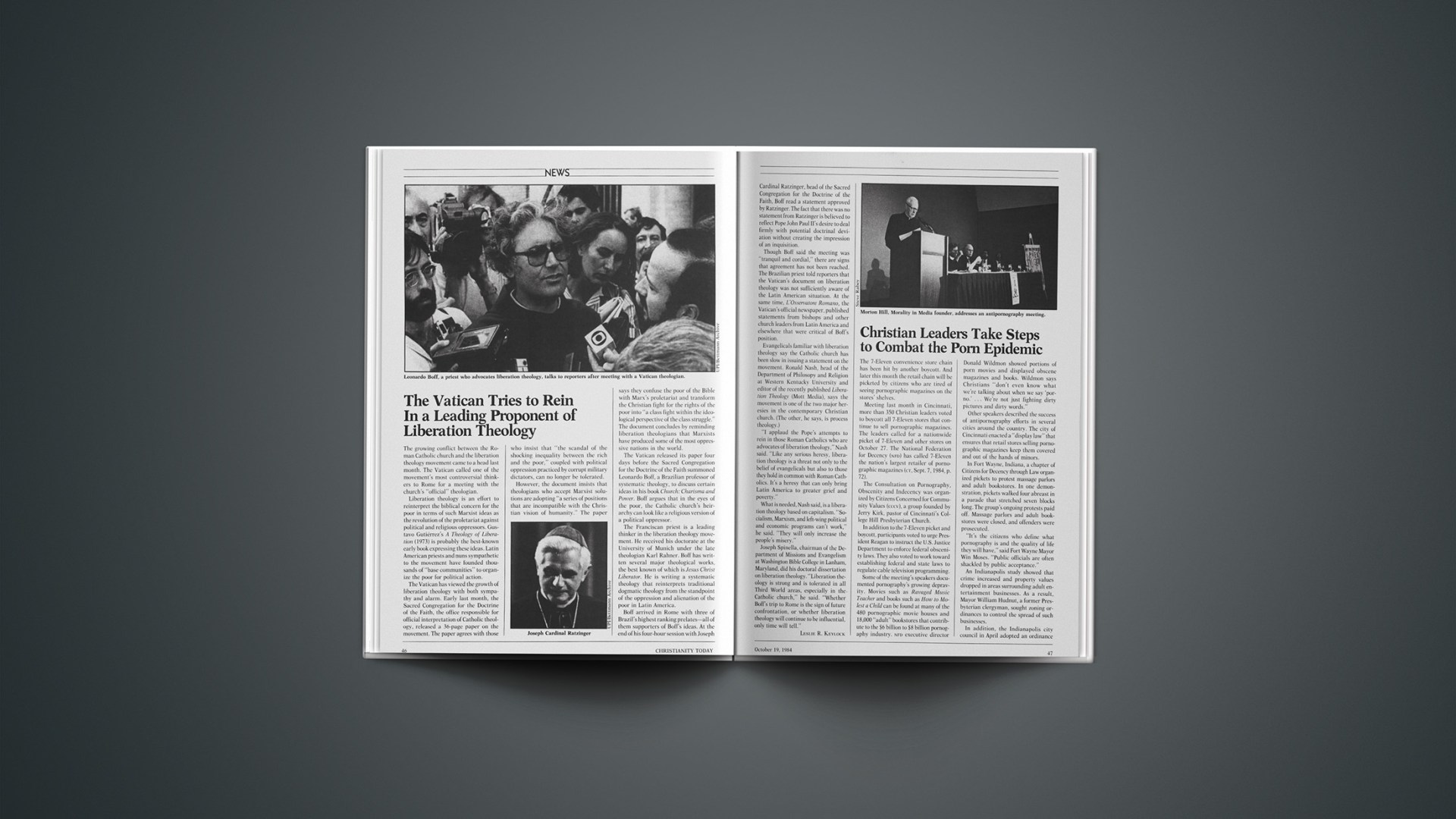
Christian Leaders Take Steps to Combat the Porn Epidemic

The 7-Eleven convenience store chain has been hit by another boycott. And later this month the retail chain will be picketed by citizens who are tired of seeing pornographic magazines on the stores’ shelves.

Meeting last month in Cincinnati, more than 350 Christian leaders voted to boycott all 7-Eleven stores that continue to sell pornographic magazines. The leaders called for a nationwide picket of 7-Eleven and other stores on October 27. The National Federation for Decency (NFD) has called 7-Eleven the nation’s largest retailer of pornographic magazines (CT, Sept. 7, 1984, p. 72).

The Consultation on Pornography, Obscenity and Indecency was organized by Citizens Concerned for Community Values (CCCV), a group founded by Jerry Kirk, pastor of Cincinnati’s College Hill Presbyterian Church.

In addition to the 7-Eleven picket and boycott, participants voted to urge President Reagan to instruct the U.S. Justice Department to enforce federal obscenity laws. They also voted to work toward establishing federal and state laws to regulate cable television programming.

Some of the meeting’s speakers documented pornography’s growing depravity. Movies such as Ravaged Music Teacher and books such as How to Molest a Child can be found at many of the 480 pornographic movie houses and 18,000 “adult” bookstores that contribute to the $6 billion to $8 billion pornogaphy industry. NFD executive director Donald Wildmon showed portions of porn movies and displayed obscene magazines and books. Wildmon says Christians “don’t even know what we’re talking about when we say ‘porno.’ … We’re not just fighting dirty pictures and dirty words.”

Other speakers described the success of antipornography efforts in several cities around the country. The city of Cincinnati enacted a “display law” that ensures that retail stores selling pornographic magazines keep them covered and out of the hands of minors.

In Fort Wayne, Indiana, a chapter of Citizens for Decency through Law organized pickets to protest massage parlors and adult bookstores. In one demonstration, pickets walked four abreast in a parade that stretched seven blocks long. The group’s ongoing protests paid off. Massage parlors and adult bookstores were closed, and offenders were prosecuted.

“It’s the citizens who define what pornography is and the quality of life they will have,” said Fort Wayne Mayor Win Moses. “Public officials are often shackled by public acceptance.”

An Indianapolis study showed that crime increased and property values dropped in areas surrounding adult entertainment businesses. As a result, Mayor William Hudnut, a former Presbyterian clergyman, sought zoning ordinances to control the spread of such businesses.

In addition, the Indianapolis city council in April adopted an ordinance that enables women to file civil suits against businesses that sell or display violent and dehumanizing pornography. The law gives women the right to claim that such material is a violation of their civil rights. The measure was challenged in court within hours of being signed into law, but Hudnut vows he will fight “all the way to the Supreme Court if necessary.”

The church, as well, is taking a more active role in the fight against pornography. The general assembly of the Church of God, Anderson, Indiana, in June adopted a three-page proposal for churchwide involvement. Paul Tanner, executive secretary of the church’s executive council, said the denomination’s autonomous form of government allows its congregations to “implement it creatively in ways that are appropriate.… I can’t tell you 2,300 [Church of God] churches will picket 7-Elevens. They won’t. But some of them will.”

Morton A. Hill, a Catholic priest who founded Morality in Media, said the Roman Catholic church is becoming more aware of the pornography problem. A pastoral letter on obscenity was read last month to the 2.25 million Catholics in Los Angeles, urging them to seek the enforcement of obscenity laws.

The antipornography movement is gaining momentum. Kirk is leading the search for a full-time executive director for CCCV. The organization also plans to set up offices outside the walls of College Hill Presbyterian Church.

STEVE RABEYin Cincinnati

North American Scene

Four Protestant denominations and the National Association of Evangelicals have joined a lawsuit challenging U.S. diplomatic recognition of the Vatican. The suit is being spearheaded by Americans United for Separation of Church and State. Churches joining the suit include the Presbyterian Church (USA), the American Baptist Churches, Church of the Brethren, and the Progressive National Baptist Convention. The Baptist Joint Committee on Public Affairs, representing nine Baptist denominations, plans to support the suit by filing a friend-of-the-court brief.

Former President Jimmy Carter says he doesn’t feel “compatible” with the dominance of conservative leaders in the Southern Baptist Convention (SBC). He told Baptist Press that conservatives have hurt the denomination’s missions emphasis, and that they are tied to a philosophy exemplified by Moral Majority. Carter said it would be inappropriate for him “to try to organize or lead a movement of moderates to recapture the Southern Baptist Convention.” The former President is a deacon at Maranatha Baptist Church in Plains, Georgia.

The Reformed Ecumenical Synod has declared that any theological defense of apartheid should be regarded as heresy. Apartheid is South Africa’s policy of racial segregation. The synod also asked its largest affiliate, the South African Dutch Reformed Church, and the smaller Reformed Church in South Africa to report within two years “what each has done to reevaluate its position” on apartheid. The synod claims 5.5 million members in more than 30 affiliated denominations around the world.

A judge has ruled that New York Mayor Ed Koch cannot forbid discrimination against homosexuals by private groups that do business with the city.

Judge Alvin Klein ruled that Koch does not have the right to “create new social policy absent a proper legislative basis.” The mayor’s Executive Order 50 was challenged in the state supreme court by the Roman Catholic Archdiocese of New York, the Salvation Army, and Agudath Israel of America, whose service contracts with the city are worth millions of dollars. The city plans to appeal the decision.

World Scene

Romania has released an Orthodox priest from prison after five years of his 10-year sentence. Gheorghe Calciu was arrested in 1979 on unsubstantiated charges of being a Fascist. Before his arrest, he inspired the formation of a believers’ rights group and a trade union. Calciu previously had spent 16 years in prison because of his religious activities. The government gave no reason for the priest’s release.

The government of Taiwan has limited the number of missionaries who can work in the country. The government told mission agencies they must restrict their personnel to April 1984 levels. Calling the limit a temporary measure, officials gave no explanation for the move. Some observers speculate that the government is alarmed by the number of young people brought into Taiwan by the Church of Jesus Christ of Latter-Day Saints (Mormon).

The Episcopal Church of Brazil has voted to ordain women as priests. The move makes the Brazilian church the latest province of the worldwide Anglican communion to vote in favor of women’s ordination. In Mexico and Puerto Rico, women recently were ordained as Episcopal priests in jurisdictions linked to the Episcopal church in the United States. The U.S. branch of the Anglican communion voted to ordain women in 1976.

The government of Zimbabwe has released United Methodist Bishop Abel Muzorewa after detaining him for nearly a year. The government had accused the bishop of conspiring with the South African government against Zimbabwe. Muzorewa said the Zimbabwe government detained him in an attempt to intimidate the opposition political party he heads.

Apple PodcastsDown ArrowDown ArrowDown Arrowarrow_left_altLeft ArrowLeft ArrowRight ArrowRight ArrowRight Arrowarrow_up_altUp ArrowUp ArrowAvailable at Amazoncaret-downCloseCloseEmailEmailExpandExpandExternalExternalFacebookfacebook-squareGiftGiftGooglegoogleGoogle KeephamburgerInstagraminstagram-squareLinkLinklinkedin-squareListenListenListenChristianity TodayCT Creative Studio Logologo_orgMegaphoneMenuMenupausePinterestPlayPlayPocketPodcastRSSRSSSaveSaveSaveSearchSearchsearchSpotifyStitcherTelegramTable of ContentsTable of Contentstwitter-squareWhatsAppXYouTubeYouTube