The Vatican Tries to Rein in a Leading Proponent of Liberation Theology

The growing conflict between the Roman Catholic church and the liberation theology movement came to a head last month. The Vatican called one of the movement’s most controversial thinkers to Rome for a meeting with the church’s “official” theologian.

Liberation theology is an effort to reinterpret the biblical concern for the poor in terms of such Marxist ideas as the revolution of the proletariat against political and religious oppressors. Gustavo Gutiérrez’s A Theology of Liberation (1973) is probably the best-known early book expressing these ideas. Latin American priests and nuns sympathetic to the movement have founded thousands of “base communities” to organize the poor for political action.

The Vatican has viewed the growth of liberation theology with both sympathy and alarm. Early last month, the Sacred Congregation for the Doctrine of the Faith, the office responsible for official interpretation of Catholic theology, released a 36-page paper on the movement. The paper agrees with those who insist that “the scandal of the shocking inequality between the rich and the poor,” coupled with political oppression practiced by corrupt military dictators, can no longer be tolerated.

However, the document insists that theologians who accept Marxist solutions are adopting “a series of positions that are incompatible with the Christian vision of humanity.” The paper says they confuse the poor of the Bible with Marx’s proletariat and transform the Christian fight for the rights of the poor into “a class fight within the ideological perspective of the class struggle.” The document concludes by reminding liberation theologians that Marxists have produced some of the most oppressive nations in the world.

The Vatican released its paper four days before the Sacred Congregation for the Doctrine of the Faith summoned Leonardo Boff, a Brazilian professor of systematic theology, to discuss certain ideas in his book Church: Charisma and Power. Boff argues that in the eyes of the poor, the Catholic church’s heirarchy can look like a religious version of a political oppressor.

The Franciscan priest is a leading thinker in the liberation theology movement. He received his doctorate at the University of Munich under the late theologian Karl Rahner. Boff has written several major theological works, the best known of which is Jesus Christ Liberator. He is writing a systematic theology that reinterprets traditional dogmatic theology from the standpoint of the oppression and alienation of the poor in Latin America.

Boff arrived in Rome with three of Brazil’s highest ranking prelates—all of them supporters of Boff’s ideas. At the end of his four-hour session with Joseph Cardinal Ratzinger, head of the Sacred Congregation for the Doctrine of the Faith, Boff read a statement approved by Ratzinger. The fact that there was no statement from Ratzinger is believed to reflect Pope John Paul II’s desire to deal firmly with potential doctrinal deviation without creating the impression of an inquisition.

Though Boff said the meeting was “tranquil and cordial,” there are signs that agreement has not been reached. The Brazilian priest told reporters that the Vatican’s document on liberation theology was not sufficiently aware of the Latin American situation. At the same time, L’Osservatore Romano, the Vatican’s official newspaper, published statements from bishops and other church leaders from Latin America and elsewhere that were critical of Boff’s position.

Evangelicals familiar with liberation theology say the Catholic church has been slow in issuing a statement on the movement. Ronald Nash, head of the Department of Philosopy and Religion at Western Kentucky University and editor of the recently published Liberation Theology (Mott Media), says the movement is one of the two major heresies in the contemporary Christian church. (The other, he says, is process theology.)

“I applaud the Pope’s attempts to rein in those Roman Catholics who are advocates of liberation theology,” Nash said. “Like any serious heresy, liberation theology is a threat not only to the belief of evangelicals but also to those they hold in common with Roman Catholics. It’s a heresy that can only bring Latin America to greater grief and poverty.”

What is needed, Nash said, is a liberation theology based on capitalism. “Socialism, Marxism, and left-wing political and economic programs can’t work,” he said. “They will only increase the people’s misery.”

Joseph Spinella, chairman of the Department of Missions and Evangelism at Washington Bible College in Lanham, Maryland, did his doctoral dissertation on liberation theology. “Liberation theology is strong and is tolerated in all Third World areas, especially in the Catholic church,” he said. “Whether Boff’s trip to Rome is the sign of future confrontation, or whether liberation theology will continue to be influential, only time will tell.”

The Senate Ethics Committee Drops Its Investigation of Mark Hatfield

The Senate Select Committee on Ethics last month dropped its investigation of U.S. Sen. Mark O. Hatfield (R-Oreg.) after finding no evidence worth pursuing. Hatfield cast his fate to the committee in August after allegations of a conflict of interest made nationwide headlines (CT, Sept. 21, 1984, p. 76).

Two syndicated columns written by Jack Anderson charged Hatfield with promoting a trans-African pipeline project while his wife received real estate fees from the project’s chief proponent, Greek financier Basil A. Tsakos. Hatfield says there was no connection between his wife’s business transactions with the Greek businessman—totaling $55,000—and his support for Tsakos’s project.

But at a press conference in Oregon, Hatfield said there was the “appearance of impropriety.” As a result, he and his wife, Antoinette, donated $55,000 to a children’s hospital. The incident appeared not to have damaged Hatfield’s reelection chances in Oregon, where he is running for his fourth Senate term.

Exoneration by the ethics committee came in a way that assures Hatfield a clean bill of ethical health. The committee’s bipartisan staff arrived at a verdict of “insufficient evidence” after questioning Tsakos and his wife, as well as several former employees of theirs who had charged that Mrs. Hatfield performed no consulting services for the Greek couple.

“There was no information available to us to justify opening a formal inquiry,” said committee chairman Ted Stevens (R-Alaska). A unanimous committee vote affirming the staff report came after a closed briefing by a U.S. Justice Department official who is continuing an investigation into Tsakos’s business affairs.

The New Right Disagrees over Taking Donations from Sun Moon

Sun Myung Moon’s Unification Church has contributed $500,000 to a New Right lobbying effort in Washington, D.C., headed by John “Terry” Dolan, chairman of the National Conservative Political Action Committee. His lobbying group, known as the Conservative Alliance (CALL), used the money for a computer system, direct mail expenses, and to conduct an international survey on communism.

After accepting the donation, CALL lost some of its popularity with other conservative political groups. Several right-wing groups severed their ties with the organization when they learned of the Moon connection.

Paul Weyrich, widely acknowledged for energizing conservative Christian political involvement, has spoken out against Moon’s blandishments. A devout Catholic, Weyrich refuses to affiliate his Committee for the Survival of a Free Congress with groups that accept money from any of Moon’s organizations.

“We have very serious problems with who they [the Moonies] are and what they represent,” said a spokesman for Weyrich. While coalitions necessarily involve people who are not completely like-minded, the spokesman said, the Unification Church is “very different and unique” because of claims that Moon is the messiah.

Those claims do not concern Rhonda Stahlman, a graduate of Bob Jones University and chairman of CALL. “I don’t want to split the conservative movement,” she said, “but other groups are taking money from Joseph Coors, a brewer. We can’t start picking apart each other’s contributors.”

She said CALL confines its activities to matters of defense and economics, opposing the importation of “slave labor” items from Communist countries and the transfer of high technology to the Soviet Union. The Unification Church has established an international organization, Causa, to promote “Godism” as an alternative philosophy to communism. The money donated to CALL came from Causa.

The Bible Is Marching On

A Christian TV network and three publishers spend millions to attract new Bible readers.

If some version of the Bible is not in every American home by next year, it won’t be because Bible publishers aren’t trying. After years of selling the Scriptures to Christians, publishers are discovering a new market—unchurched Bible readers.

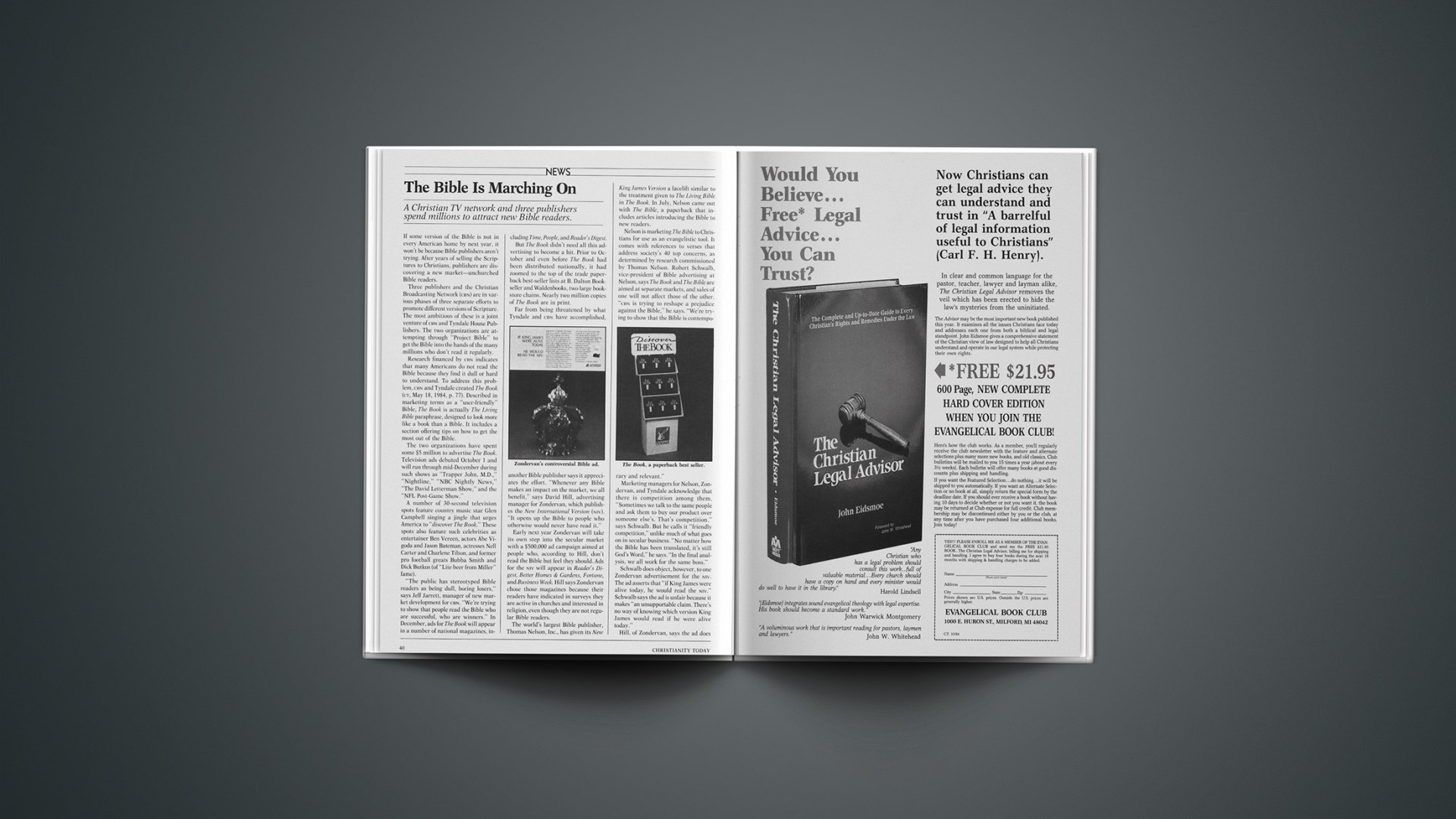
Three publishers and the Christian Broadcasting Network (CBN) are in various phases of three separate efforts to promote different versions of Scripture. The most ambitious of these is a joint venture of CBN and Tyndale House Publishers. The two organizations are attempting through “Project Bible” to get the Bible into the hands of the many millions who don’t read it regularly.

Research financed by CBN indicates that many Americans do not read the Bible because they find it dull or hard to understand. To address this problem, CBN and Tyndale created The Book (CT, May 18, 1984, p. 77). Described in marketing terms as a “user-friendly” Bible, The Book is actually The Living Bible paraphrase, designed to look more like a book than a Bible. It includes a section offering tips on how to get the most out of the Bible.

The two organizations have spent some $5 million to advertise The Book. Television ads debuted October 1 and will run through mid-December during such shows as “Trapper John, M.D.,” “Nightline,” “NBC Nightly News,” “The David Letterman Show,” and the “NFL Post-Game Show.”

A number of 30-second television spots feature country music star Glen Campbell singing a jingle that urges America to “discover The Book.” These spots also feature such celebrities as entertainer Ben Vereen, actors Abe Vigoda and Jason Bateman, actresses Nell Carter and Charlene Tilton, and former pro football greats Bubba Smith and Dick Butkus (of “Lite beer from Miller” fame).

“The public has stereotyped Bible readers as being dull, boring losers,” says Jeff Jarrett, manager of new market development for CBN. “We’re trying to show that people read the Bible who are successful, who are winners.” In December, ads for The Book will appear i a number of national magazines, including Time, People, and Reader’s Digest.

But The Book didn’t need all this advertising to become a hit. Prior to October and even before The Book had been distributed nationally, it had zoomed to the top of the trade paperback best-seller lists at B. Dalton Bookseller and Waldenbooks, two large bookstore chains. Nearly two million copies of The Book are in print.

Far from being threatened by what Tyndale and CBN have accomplished, another Bible publisher says it appreciates the effort. “Whenever any Bible makes an impact on the market, we all benefit,” says David Hill, advertising manager for Zondervan, which publishes the New International Version (NIV). “It opens up the Bible to people who otherwise would never have read it.”

Early next year Zondervan will take its own step into the secular market with a $500,000 ad campaign aimed at people who, according to Hill, don’t read the Bible but feel they should. Ads for the NIV will appear in Reader’s Digest, Better Homes & Gardens, Fortune, and Business Week. Hill says Zondervan chose those magazines because their readers have indicated in surveys they are active in churches and interested in religion, even though they are not regular Bible readers.

The world’s largest Bible publisher, Thomas Nelson, Inc., has given its New King James Version a facelift similar to the treatment given to The Living Bible in The Book. In July, Nelson came out with The Bible, a paperback that includes articles introducing the Bible to new readers.

Nelson is marketing The Bible to Christians for use as an evangelistic tool. It comes with references to verses that address society’s 40 top concerns, as determined by research commissioned by Thomas Nelson. Robert Schwalb, vice-president of Bible advertising at Nelson, says The Book and The Bible are aimed at separate markets, and sales of one will not affect those of the other. “CBN is trying to reshape a prejudice against the Bible,” he says. “We’re trying to show that the Bible is contemporary and relevant.”

Marketing managers for Nelson, Zondervan, and Tyndale acknowledge that there is competition among them. “Sometimes we talk to the same people and ask them to buy our product over someone else’s. That’s competition,” says Schwalb. But he calls it “friendly competition,” unlike much of what goes on in secular business. “No matter how the Bible has been translated, it’s still God’s Word,” he says. “In the final analysis, we all work for the same boss.”

Schwalb does object, however, to one Zondervan advertisement for the NIV. The ad asserts that “if King James were alive today, he would read the NIV.” Schwalb says the ad is unfair because it makes “an unsupportable claim. There’s no way of knowing which version King James would read if he were alive today.”

Hill, of Zondervan, says the ad does not put down the KJV, but merely argues that “the NIV is to the twentieth century what the King James [Version] was to the seventeenth century.”

Doug Knox, vice-president of sales and marketing at Tyndale, says he regards other Bible publishers as allies, not competitors. “Our objective is not really to sell The Book, but to get people reading the Bible.”

A Christian Musician Awaits Trial in the Soviet Union

A Christian Musician Awaits Trial In The Soviet Union

Valeri Barinov, a Christian rock musician in the Soviet Union, is awaiting trial in Leningrad and may face up to three years in a labor camp. He is charged with attempting to cross the Soviet-Norwegian border illegally, according to a Telex sent from the American embassy in Moscow to U.S. Sen. John East (R-N.C.).

In response to inquiries by East, the U.S. embassy checked up on Barinov, who was held in a Soviet psychiatric hospital for nine days last year for expressing his religious views in public (CT, Nov. 25, 1983, p. 36). Barinov is the leader of Trumpet Call, a gospel rock group, and he has counseled Soviet drug and alcohol abusers.

Curtis W. Kamman, charge d’affaires at the U.S. embassy in Moscow, told East that letters expressing the concern of individual Americans could make a significant difference in the treatment Barinov receives. “Many Soviet human rights activists tell us that such efforts by private citizens in the United States and Europe are helpful over the long term,” he said.

Christians can express their concerns by writing to the Honorable Anatoliy F. Dobrynin, Ambassador to the United States, Soviet Embassy, 1125 16th Street NW, Washington, D.C. 20036.

Billy Graham Sees Vitality and Dedication among Russian Christians

On his recent Soviet trip, the evangelist preached in crowded churches and shared the gospel with government officials.

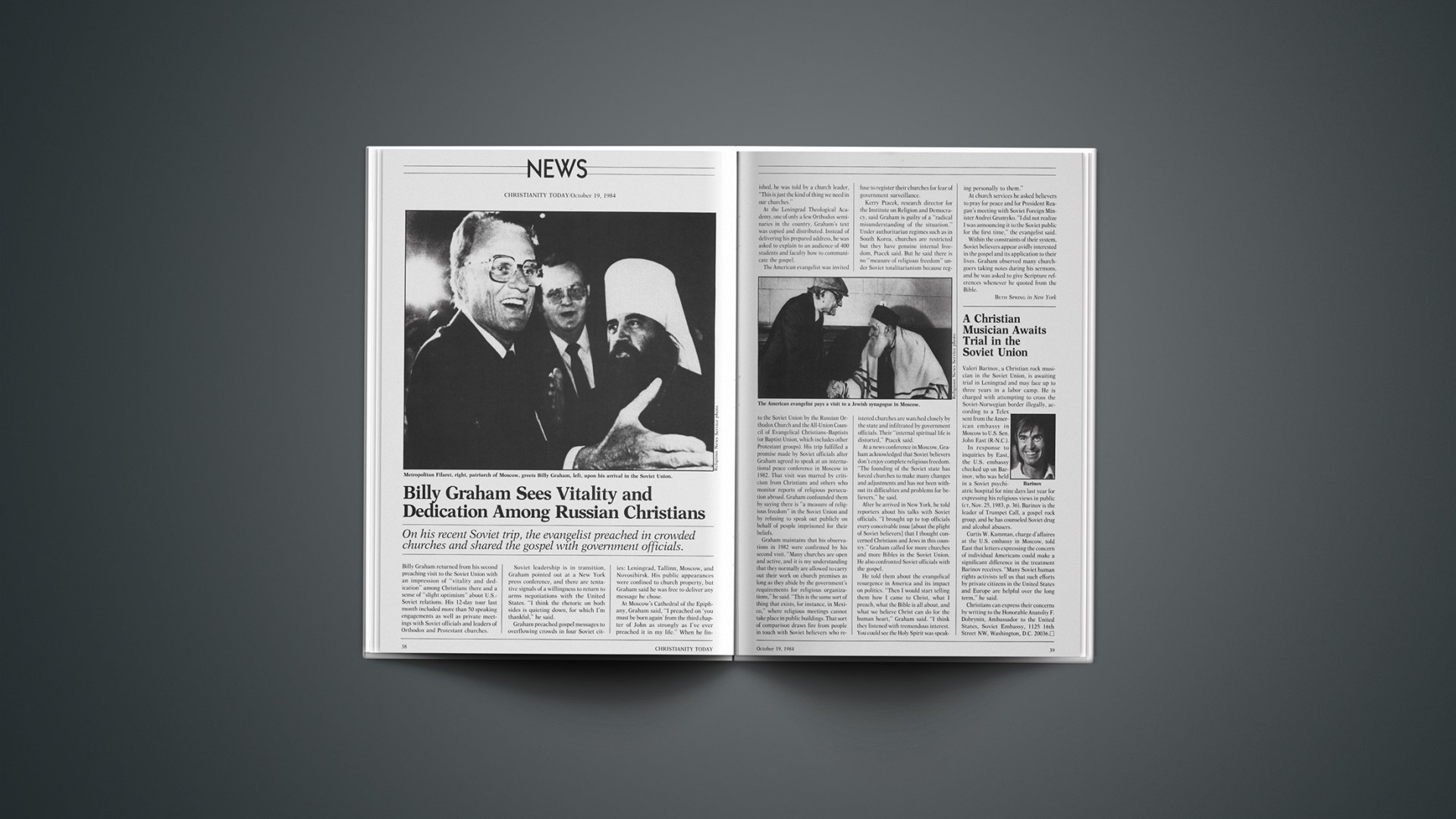
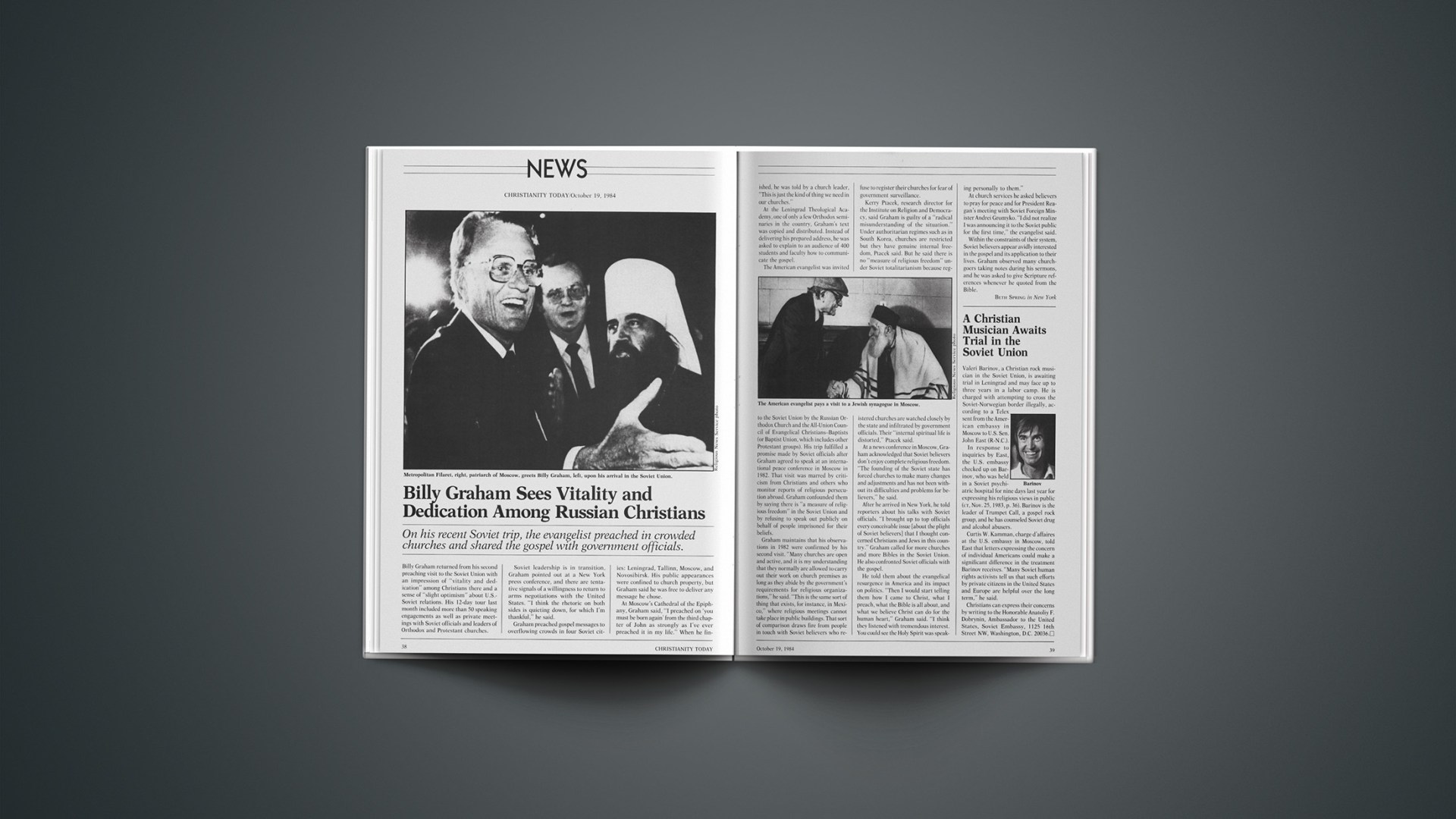
Billy Graham returned from his second preaching visit to the Soviet Union with an impression of “vitality and dedication” among Christians there and a sense of “slight optimism” about U.S.-Soviet relations. His 12-day tour last month included more than 50 speaking engagements as well as private meetings with Soviet officials and leaders of Orthodox and Protestant churches.

Soviet leadership is in transition, Graham pointed out at a New York press conference, and there are tentative signals of a willingness to return to arms negotiations with the United States. “I think the rhetoric on both sides is quieting down, for which I’m thankful,” he said.

Graham preached gospel messages to overflowing crowds in four Soviet cities: Leningrad, Tallinn, Moscow, and Novosibirsk. His public appearances were confined to church property, but Graham said he was free to deliver any message he chose.

At Moscow’s Cathedral of the Epiphany, Graham said, “I preached on ‘you must be born again’ from the third chapter of John as strongly as I’ve ever preached it in my life.” When he finished, he was told by a church leader, “This is just the kind of thing we need in our churches.”

At the Leningrad Theological Academy, one of only a few Orthodox seminaries in the country, Graham’s text was copied and distributed. Instead of delivering his prepared address, he was asked to explain to an audience of 400 students and faculty how to communicate the gospel.

The American evangelist was invited to the Soviet Union by the Russian Orthodox Church and the All-Union Council of Evangelical Christians-Baptists (or Baptist Union, which includes other Protestant groups). His trip fulfilled a promise made by Soviet officials after Graham agreed to speak at an international peace conference in Moscow in 1982. That visit was marred by criticism from Christians and others who monitor reports of religious persecution abroad. Graham confounded them by saying there is “a measure of religious freedom” in the Soviet Union and by refusing to speak out publicly on behalf of people imprisoned for their beliefs.

Graham maintains that his observations in 1982 were confirmed by his second visit. “Many churches are open and active, and it is my understanding that they normally are allowed to carry out their work on church premises as long as they abide by the government’s requirements for religious organizations,” he said. “This is the same sort of thing that exists, for instance, in Mexico,” where religious meetings cannot take place in public buildings. That sort of comparison draws fire from people in touch with Soviet believers who refuse to register their churches for fear of government surveillance.

Kerry Ptacek, research director for the Institute on Religion and Democracy, said Graham is guilty of a “radical misunderstanding of the situation.” Under authoritarian regimes such as in South Korea, churches are restricted but they have genuine internal freedom, Ptacek said. But he said there is no “measure of religious freedom” under Soviet totalitarianism because registered churches are watched closely by the state and infiltrated by government officials. Their “internal spiritual life is distorted,” Ptacek said.

At a news conference in Moscow, Graham acknowledged that Soviet believers don’t enjoy complete religious freedom. “The founding of the Soviet state has forced churches to make many changes and adjustments and has not been without its difficulties and problems for believers,” he said.

After he arrived in New York, he told reporters about his talks with Soviet officials. “I brought up to top officials every conceivable issue [about the plight of Soviet believers] that I thought concerned Christians and Jews in this country.” Graham called for more churches and more Bibles in the Soviet Union. He also confronted Soviet officials with the gospel.

He told them about the evangelical resurgence in America and its impact on politics. “Then I would start telling them how I came to Christ, what I preach, what the Bible is all about, and what we believe Christ can do for the human heart,” Graham said. “I think they listened with tremendous interest. You could see the Holy Spirit was speaking personally to them.”

At church services he asked believers to pray for peace and for President Reagan’s meeting with Soviet Foreign Minister Andrei Gromyko. “I did not realize I was announcing it to the Soviet public for the first time,” the evangelist said.

Within the constraints of their system, Soviet believers appear avidly interested in the gospel and its application to their lives. Graham observed many churchgoers taking notes during his sermons, and he was asked to give Scripture references whenever he quoted from the Bible.

BETH SPRINGin New York

Where the Democrats Come From

Where The Democrats Come From

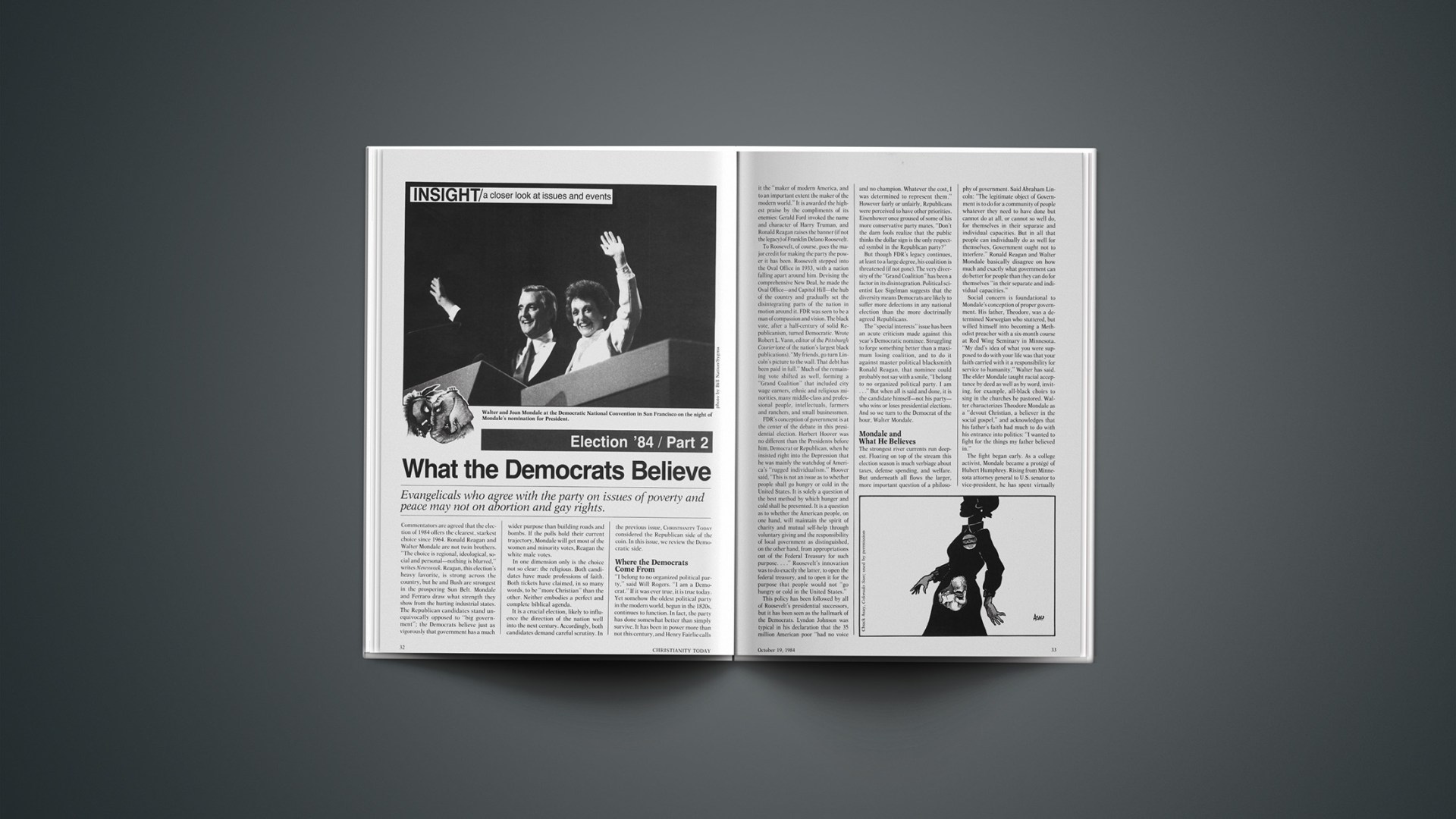
“I belong to no organized political party,” said Will Rogers. “I am a Democrat.” If it was ever true, it is true today. Yet somehow the oldest political party in the modern world, begun in the 1820s, continues to function. In fact, the party has done somewhat better than simply survive. It has been in power more than not this century, and Henry Fairlie calls it the “maker of modern America, and to an important extent the maker of the modern world.” It is awarded the highest praise by the compliments of its enemies: Gerald Ford invoked the name and character of Harry Truman, and Ronald Reagan raises the banner (if not the legacy) of Franklin Delano Roosevelt.

To Roosevelt, of course, goes the major credit for making the party the power it has been. Roosevelt stepped into the Oval Office in 1933, with a nation falling apart around him. Devising the comprehensive New Deal, he made the Oval Office—and Capitol Hill—the hub of the country and gradually set the disintegrating parts of the nation in motion around it. FDR was seen to be a man of compassion and vision. The black vote, after a half-century of solid Republicanism, turned Democratic. Wrote Robert L. Vann, editor of the Pittsburgh Courier (one of the nation’s largest black publications), “My friends, go turn Lincoln’s picture to the wall. That debt has been paid in full.” Much of the remaining vote shifted as well, forming a “Grand Coalition” that included city wage earners, ethnic and religious minorities, many middle-class and professional people, intellectuals, farmers and ranchers, and small businessmen.

FDR’s conception of government is at the center of the debate in this presidential election. Herbert Hoover was no different than the Presidents before him, Democrat or Republican, when he insisted right into the Depression that he was mainly the watchdog of America’s “rugged individualism.” Hoover said, “This is not an issue as to whether people shall go hungry or cold in the United States. It is solely a question of the best method by which hunger and cold shall be prevented. It is a question as to whether the American people, on one hand, will maintain the spirit of charity and mutual self-help through voluntary giving and the responsibility of local government as distinguished, on the other hand, from appropriations out of the Federal Treasury for such purpose.…” Roosevelt’s innovation was to do exactly the latter, to open the federal treasury, and to open it for the purpose that people would not “go hungry or cold in the United States.”

This policy has been followed by all of Roosevelt’s presidential successors, but it has been seen as the hallmark of the Democrats. Lyndon Johnson was typical in his declaration that the 35 million American poor “had no voice and no champion. Whatever the cost, I was determined to represent them.” However fairly or unfairly, Republicans were perceived to have other priorities. Eisenhower once groused of some of his more conservative party mates, “Don’t the darn fools realize that the public thinks the dollar sign is the only respected symbol in the Republican party?”

But though FDR’s legacy continues, at least to a large degree, his coalition is threatened (if not gone). The very diversity of the “Grand Coalition” has been a factor in its disintegration. Political scientist Lee Sigelman suggests that the diversity means Democrats are likely to suffer more defections in any national election than the more doctrinally agreed Republicans.

The “special interests” issue has been an acute criticism made against this year’s Democratic nominee. Struggling to forge something better than a maximum losing coalition, and to do it against master political blacksmith Ronald Reagan, that nominee could probably not say with a smile, “I belong to no organized political party. I am …” But when all is said and done, it is the candidate himself—not his party—who wins or loses presidential elections. And so we turn to the Democrat of the hour, Walter Mondale.

Mondale And What He Believes

The strongest river currents run deepest. Floating on top of the stream this election season is much verbiage about taxes, defense spending, and welfare. But underneath all flows the larger, more important question of a philosophy of government. Said Abraham Lincoln: “The legitimate object of Government is to do for a community of people whatever they need to have done but cannot do at all, or cannot so well do, for themselves in their separate and individual capacities. But in all that people can individually do as well for themselves, Government ought not to interfere.” Ronald Reagan and Walter Mondale basically disagree on how much and exactly what government can do better for people than they can do for themselves “in their separate and individual capacities.”

Social concern is foundational to Mondale’s conception of proper government. His father, Theodore, was a determined Norwegian who stuttered, but willed himself into becoming a Methodist preacher with a six-month course at Red Wing Seminary in Minnesota. “My dad’s idea of what you were supposed to do with your life was that your faith carried with it a responsibility for service to humanity,” Walter has said. The elder Mondale taught racial acceptance by deed as well as by word, inviting, for example, all-black choirs to sing in the churches he pastored. Walter characterizes Theodore Mondale as a “devout Christian, a believer in the social gospel,” and acknowledges that his father’s faith had much to do with his entrance into politics: “I wanted to fight for the things my father believed in.”

The fight began early. As a college activist, Mondale became a protégé of Hubert Humphrey. Rising from Minnesota attorney general to U.S. senator to vice-president, he has spent virtually his entire adult life in government. Fighting his father’s fight, Mondale concentrated on civil rights. He was one of the last Senate liberals to defend busing as a permissible tool for desegregation. Mondale was a cosponsor of the 1965 Voting Rights Act and would, as President, rectify what he sees as the Reagan administration’s “efforts to undermine enforcement of the act.” As part of his civil-rights agenda, Mondale would prohibit tax breaks for segregated private academies; “vigorously” enforce laws and court decisions seen to forward school integration and fair housing; restore budget cuts in programs for the disadvantaged; pass the Equal Rights Amendment (of which he was an original cosponsor in the Senate); and take “strong action against discrimination in the workplace.” He would “fully fund” the Legal Services Corporation, which provides legal services for the poor. Overall, Mondale promises to protect individuals against discrimination on the basis of “race, sex, national origin, sexual orientation, handicapped status, age, or any other irrational basis.”

Since the national press focuses on economic issues, Mondale’s economic plans are equally, if not better, known. He has admitted he will raise taxes. In a reversal on the familiar theme, a Democrat is berating a Republican about the budget deficit.

When it comes to defense issues, Reagan is not the only anti-Communist running for election. In the 1948 campaign for Harry Truman, there were bitter struggles within Minnesota’s Democratic Farmer-Labor party: left wingers united behind peace-at-any-price liberal Henry Wallace, and almost kept Truman off the state DFL ballot. Mondale was then disillusioned with apologists for the Soviet Union. “I realized that you can’t have a united front with a police state,” he said. In late 1948, Mondale became executive secretary of the college branch of Americans for Democratic Action, a liberal anti-Communist group. As with civil rights, Mondale’s views on the subject have been consistent. He was one of the final Senate liberals to oppose leaving Vietnam. At last summer’s Democratic Convention, Mondale’s forces blocked a move to include a plank in the party platform prohibiting a nuclear first use.

But Mondale does differ with Reagan on defense, of course. The same platform demands that disarmament talks with the Soviets be renewed, and declares that a Democratic President would work toward a mutually verifiable freeze on nuclear weapons. The platform denounces antisatellite weapons (Reagan’s “Star Wars proposal”), the production of nerve gas, and of the MX missile and B-1 bomber.

Mondale has promised a foreign policy based more on diplomacy than military intervention—a posture, Democrats say, exactly the reverse of President Reagan’s. To mention only one point, Mondale opposes the Reagan administration’s attempt to overthrow the Nicaraguan Sandinistas as “dangerous and wrong.”

Finally, there are two issues that may concern biblical Christians more than other sectors of the electorate. Mondale unequivocally supports abortion on demand—a position he believes to be in line with his general advocacy of civil rights. “We can all hold our personal views on abortion while agreeing that the government should have no role in limiting the choices available to women,” he says. Mondale has vowed to oppose a constitutional amendment or any legislation that would restrict “a woman’s right to choose to have an abortion.”

The second issue is church-state separation. Mondale opposed government-sponsored silent prayer in public schools. “As a preacher’s kid, I was taught that religion is a personal and family matter in which the state has no place,” he says. “I do not oppose prayer by children anywhere.… I simply do not want the state to determine if, when, and how we should pray and what we should say—if anything.” The Democratic platform supported the “principles of religious liberty, religious tolerance and church/state separation and of the Supreme Court decisions forbidding violation of those principles.” It pledged to “resist all efforts to weaken those decisions.”

What does all this mean for Christian voters? What is the case to be made for voting Democratic in this election? CHRISTIANITY TODAY spoke to several Christians who have some sympathies for the Mondale candidacy. The following analysis is based on those interviews.

Mondale And The Biblical Christian

“Serious Christians, thoughtful, faithful Christians, who wish for the gospel to bear upon all of the issues, will have a very hard time deciding who to vote for,” says Dale Vree, editor of the New Oxford Review and a political scientist. Vree observes that Reagan is attractive to Christians on issues of personal morality, Mondale on issues of social morality. Many Christians like Vree are sympathetic with Mondale on issues of social justice, war and peace, the environment, and foreign policy. But many of the same Christians are concerned about his stance on gay rights, and deeply disturbed by his position on abortion.

Bill Kallio, executive director of Evangelicals for Social Action, looks for a “biblical disposition” toward the poor in political candidates. Whether or not a candidate mentions the Bible, does he or she show a consistent and profound concern for the poor, the handicapped, or those otherwise needy? Congressman Don Bonker (D-Wash.), an evangelical, notes that “one out of ten verses in the synoptic Gospels deals with questions of wealth and poverty.” He believes that “concern for the poor is not a major theme in the Republican political platform and policies.” In its first term, “The Reagan administration has clearly shown that the political party it represents favors the privileged.” (Figures released late last summer by the nonpartisan Urban Institute indicated that income, during the last four years, did shift to the wealthier upper two-fifths of American families.) Kallio, Bonker, and others believe Mondale will be more sensitive to the needy.

A related issue is treatment of minority groups. Polls have shown as few as 10 percent of blacks affirming President Reagan’s performance. Reagan is also believed to have opened a “gender gap,” repelling many women voters. But that issue does not seem as clear as the wealth and poverty issue to these evangelicals. Says Nicholas Wolterstorff, professor of philosophy at Calvin College, “In spite of the fact that Reagan has opposed the Equal Rights Amendment, he has appointed several women cabinet members and a woman justice to the Supreme Court.” Stephen Monsma, an evangelical political scientist and former Michigan state senator, believes Mondale “would open up more areas for women than Reagan. Yet much of this condemnation of Reagan may come back to the abortion issue. I don’t think Reagan is really anti-women.”

For Wolterstorff, the picture is perfectly clear on environmental issues. “There’s as clear a contrast as any between Democratic policy and Reagan’s inclinations. Reagan is relatively indifferent. The Christian should care. We are tenders of the earth.” Adds Congressman Bonker, “GOP policies, especially those of the Reagan administration, are strongly prodevelopment and give only token attention to national and global environment problems.” On that count, says Bill Kallio, “The Democratic party has a better understanding of the long-term use of resources, a better view of the profit motive in business when gained at the long-term expense of the rest of society.”

These Christians are also more attracted to Mondale on the issue of war and peace. According to Dale Vree, “We have to have moral reservations about nuclear weapons for the same reason we are against abortion. It is the indiscriminate taking of innocent life.…” James Skillen, executive director of the Association for Public Justice, is dissatisfied with both candidates on the peace issue, saying they represent “pragmatic liberalism versus pragmatic conservatism,” but finally finds his sympathies “a bit more with the Mondale language than the Reagan language.”

Skillen is also worried about foreign policy concerned only for American preeminence in the world. “The growth of other economies is not seen as a healthy sign of global development, but the beginning of America’s decline,” he observes. The Reagan policy presents a “macho swagger,” says Stephen Monsma. Congressman Bonker contends that foreign policy has shifted from developmental aid to military programs: “Today 60 percent of our foreign aid goes in the form of guns and other military hardware. Alternatively, for every one billion dollars spent on defense, we could supplement the diets of 50 million undernourished children.”

Such factors, it might appear, would tend to tip some biblical Christians to the Democratic side in the polling booth. Yet there are severe reservations about parts of Mondale’s agenda, even among these potential supporters.

Abortion is primary. Mondale’s strong support of abortion on demand goes down even harder for antiabortionists after a look at the Democratic platform. Using the preposterous euphemism of “reproductive freedom,” the platform opposes “government interference in the reproductive decisions of Americans” and praises the 1973 Supreme Court ruling on abortion. It also recognizes that five of the nine members of the Supreme Court are over 75, and many new justices are likely to be appointed by the next President. “Today, the fundamental right of a woman to reproductive freedom rests on the votes of six members of the Supreme Court—five of whom are over 75. That right could easily disappear during a second Reagan term.” Stephen Chapman comments in the Chicago Tribune, “Is someone trying to stop Americans from making babies? No. That’s just the Democrats’ way of upholding the right of pregnant women to destroy their fetuses.”

Dale Vree admits that this issue may decide the vote for many Christians. “You could say nuclear war is a theoretical threat to life, whereas abortion is taking life every day. So vote to stop abortion today.” That would be a valid and defensible position, he believes. But, “You could also say that present policies may heat up the arms race so that it may not be more than a few more years before a nuclear war. An abortion can happen once, twice, a thousand times; the human race goes on, and you can still try to stop abortion. Nuclear war happens once. You could say the stakes are so immense you have to give it priority.”

The Democratic position on abortion can create a genuine voting dilemma for the biblical Christian inclined to cast a ballot on the Democratic side. Comments Stephen Monsma, “It’s the biggest bone in my throat.”

Also troublesome, though not as unambiguous, is the issue of homosexual rights. Mondale concurs with the Democratic platform, widely publicized as the boldest party endorsement of gay rights to date. Like all platforms, though, this one is vague in the statement of its position. It opposes discrimination based on “sexual orientation” and promises to “support legislation to prohibit discrimination in the workplace based on sexual orientation.” Most Christians are not opposed to civil rights for homosexuals. Jerry Falwell, for instance, has said, “I don’t believe that state punishment of homosexuals provides any answer whatever. I personally believe that homosexuals should be afforded total civil rights.” Stephen Monsma defends the rights of homosexuals to vote, worship, and be accorded public speech. In addition, few Christians would question housing rights for homosexuals.

What the platform does not even address, and what inevitably comes up in thoughtful discussions of gay rights, is the difference between sexual orientation and sexual behavior. To be a homosexual, says Monsma, is one thing; “To flout homosexuality is quite a different matter.” He believes a community should have the right to say no, for instance, to the teaching of its children by an openly admitted, practicing homosexual. “I’m uncomfortable with both extremes,” he says.

The question is complicated for conservative Christians, notes Dale Vree, because they were relatively passive about earlier civil and racial rights. Opposing gay rights can then appear to be a predictable attack on the freedom and dignity of an oppressed group by a collection self-righteous and self-centered moralists. Christians have to take care. “We are not proposing that homosexuals be persecuted,” says Vree. “We are all sinners. We want to recognize the dignity of man purchased for everyone in the Incarnation. But I’d be leery of any legislation that made homosexuality appear equally as good as heterosexuality. This is not a direct parallel to the racial question.”

As of now, the gay-rights debate remains open. It is not obvious exactly what Mondale would, if in office, propose by way of homosexual rights. Christians would support certain proposals and oppose others. At the least, the American system of checks and balances makes extreme and sudden change unlikely. Widespread public opposition could restrain whatever objectionable policies Mondale might present.

Lastly, what are Christians to make of Mondale’s understanding of the church-state issue, one especially pronounced this campaign? Judging by various campaign statements, Mondale roughly agrees with the Democratic platform enunciation endorsing past Supreme Court decisions on the issue. That platform promises to “resist all efforts to weaken those decisions.” To many evangelicals, these decisions have been stifling—less a wall between church and state than simply a wall around the church. Yet the Supreme Court decisions on separation of church and state need not be seen as separating religion and politics, says Stephen Monsma. The Court has “never said religious values cannot impact public policy,” Monsma observes.

As religion became a hot campaign issue, Mondale clarified his own understanding of faith and politics. He said the “President of the United States is the defender of the Constitution, which defends all faiths.” He defended the rights of fundamentalist political activists, saying that “There can be no rationing of the First Amendment,” and that he sympathized with their feeling that the past generation has seen “durable values give way to emptiness.” But he added that the “yearning for traditional values” has “undertows” that can turn it into a “force of social divisiveness and a threat to individual freedom.” Finally, Mondale resisted a perceived tendency to “transform policy debates into theological disputes.” He reaffirmed his own faith, patriotism, and family values.

Stephen Monsma wonders if the secular press has adequately represented Mondale’s own beliefs on the question of what faith has to do with politics. But if it has, he disagrees with Mondale that religion should have nothing to do with government. “Political decision making necessarily involves basic values,” says Monsma. How do we, the American public, see the world, and what do we want it to be? “Basic values rest ultimately on religious values, whether they’re theistic or not. So our political decision making necessarily involves religious values.”

Making A Decision

We are, then, back at the start. Who to vote for? In Don Bonker’s view, “Democrats are consistent when it comes to issues of corporate morality, but the party tends to give too little attention to matters concerning personal morality.… No one group or party can claim to represent the Christian political mandate. We must humbly acknowledge that each of us sees but a part of God’s truth.”

On this November 6, the kind of Christian represented in a favorite story of John R. W. Stott will be especially handicapped. That is the gentleman who told his pastor the sermons were too challenging. “Whenever I go to church,” he explained, “I feel like unscrewing my head and placing it under the seat, because in a religous meeting I never have any use for anything above my collar button.”

Deciding this election will require, in abundance, everything above the collar button.

RODNEY CLAPP

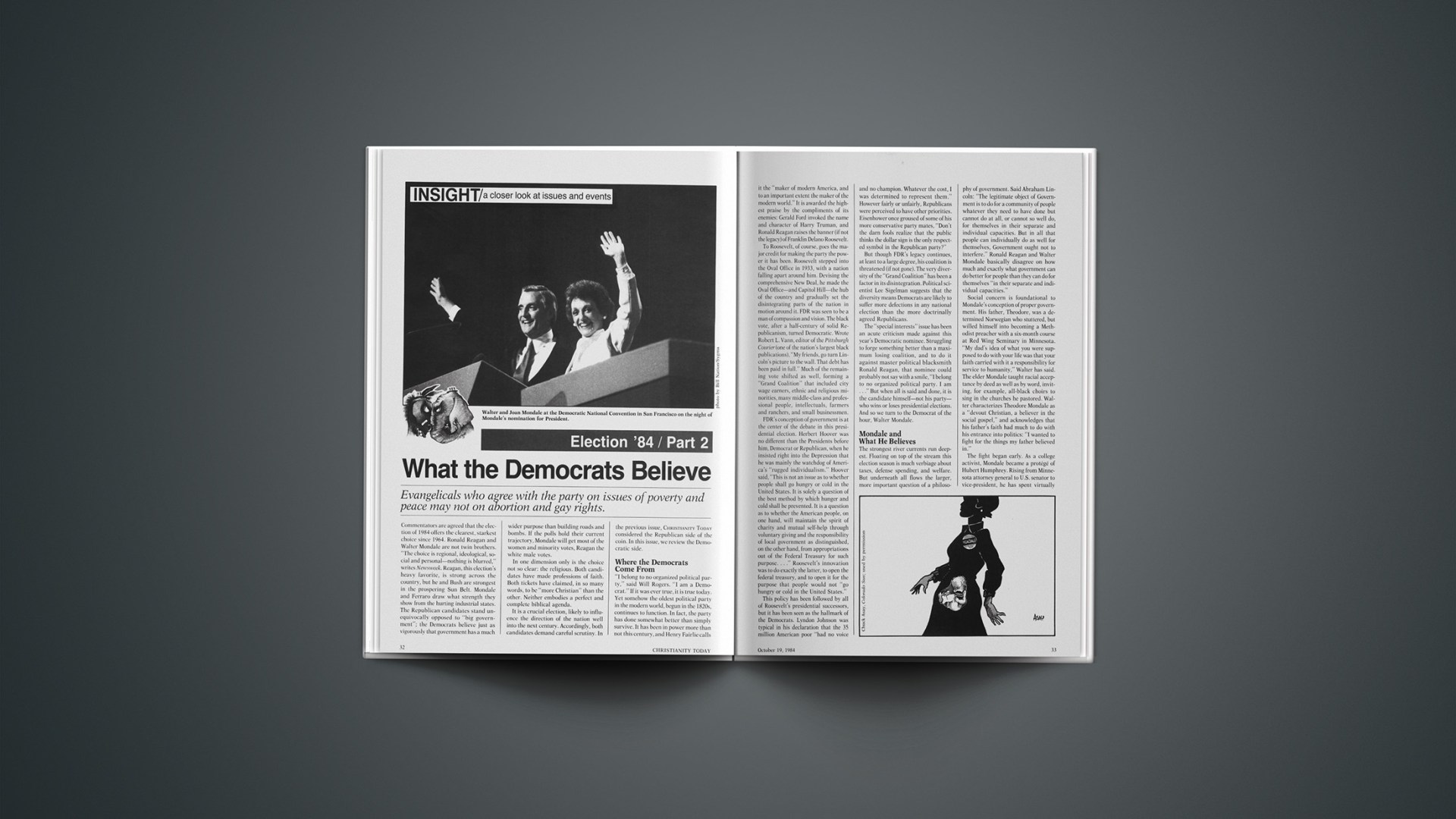
Election ’84 / Part 2 What the Democrats Believe: Evangelicals Who Agree with the Party on Issues of Poverty and Peace May Not on Abortion and Gay Rights

Commentators are agreed that the election of 1984 offers the clearest, starkest choice since 1964. Ronald Reagan and Walter Mondale are not twin brothers. “The choice is regional, ideological, social and personal—nothing is blurred,” writes Newsweek. Reagan, this election’s heavy favorite, is strong across the country, but he and Bush are strongest in the prospering Sun Belt. Mondale and Ferraro draw what strength they show from the hurting industrial states. The Republican candidates stand unequivocally opposed to “big government”; the Democrats believe just as vigorously that government has a much wider purpose than building roads and bombs. If the polls hold their current trajectory, Mondale will get most of the women and minority votes, Reagan the white male votes.

In one dimension only is the choice not so clear: the religious. Both candidates have made professions of faith. Both tickets have claimed, in so many words, to be “more Christian” than the other. Neither embodies a perfect and complete biblical agenda.

It is a crucial election, likely to influence the direction of the nation well into the next century. Accordingly, both candidates demand careful scrutiny. In the previous issue, CHRISTIANITY TODAY considered the Republican side of the coin. In this issue, we review the Democratic side.

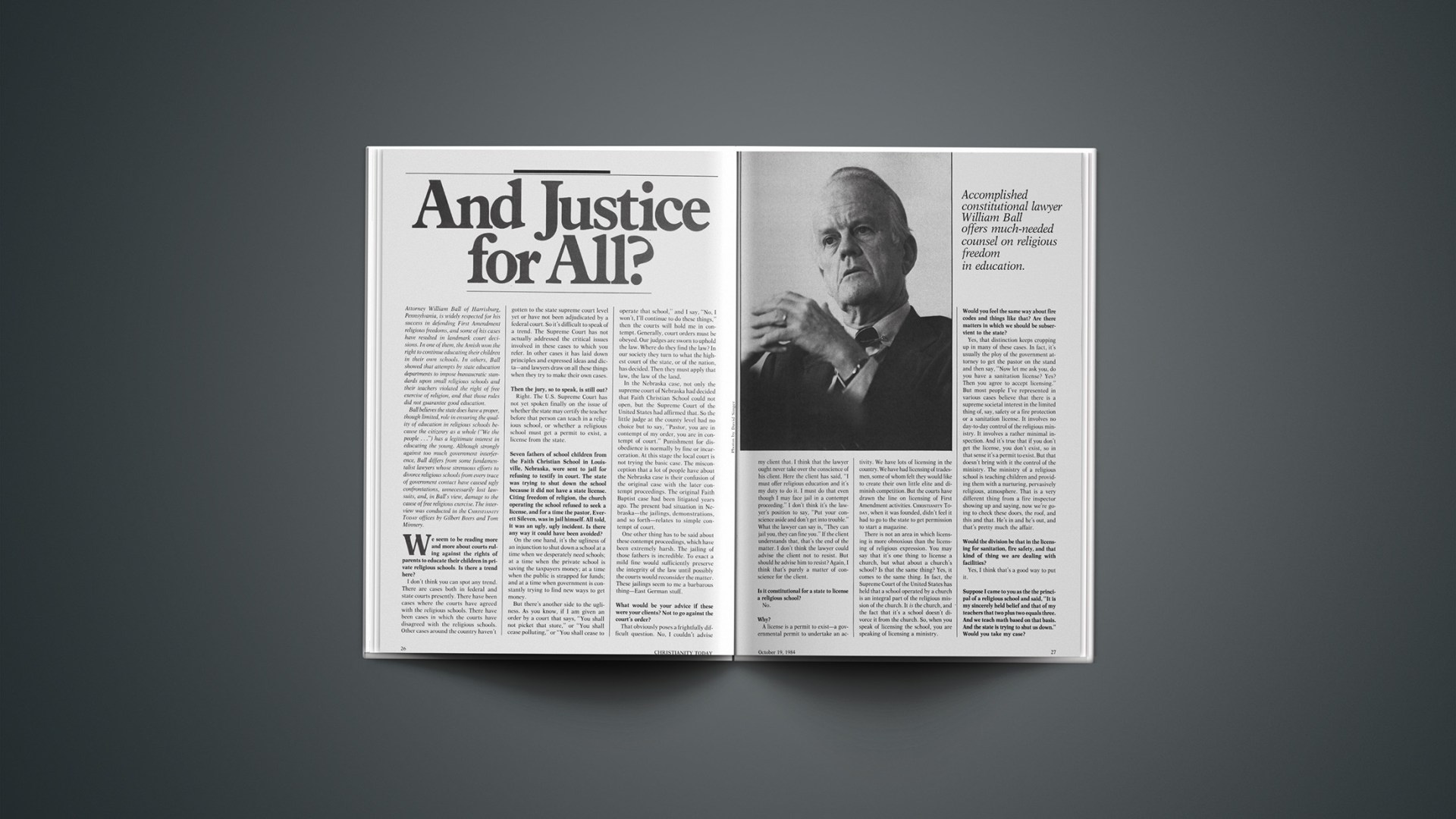
And Justice for All?: Accomplished Constitutional Lawyer William Ball Offers Much-Needed Counsel on Religious Freedom in Education

Attorney William Ball of Harrisburg, Pennsylvania, is widely respected for his success in defending First Amendment religious freedoms, and some of his cases have resulted in landmark court decisions. In one of them, the Amish won the right to continue educating their children in their own schools. In others, Ball showed that attempts by state education departments to impose bureaucratic standards upon small religious schools and their teachers violated the right of free exercise of religion, and that those rules did not guarantee good education.

Ball believes the state does have a proper, though limited, role in ensuring the quality of education in religious schools because the citizenry as a whole (“We the people …”) has a legitimate interest in educating the young. Although strongly against too much government interference, Ball differs from some fundamentalist lawyers whose strenuous efforts to divorce religious schools from every trace of government contact have caused ugly confrontations, unnecessarily lost lawsuits, and, in Ball’s view, damage to the cause of free religious exercise. The interview was conducted in the CHRISTIANITY TODAY offices by Gilbert Beers and Tom Minnery.

We seem to be reading more and more about courts ruling against the rights of parents to educate their children in private religious schools. Is there a trend here?

I don’t think you can spot any trend. There are cases both in federal and state courts presently. There have been cases where the courts have agreed with the religious schools. There have been cases in which the courts have disagreed with the religious schools. Other cases around the country haven’t gotten to the state supreme court level yet or have not been adjudicated by a federal court. So it’s difficult to speak of a trend. The Supreme Court has not actually addressed the critical issues involved in these cases to which you refer. In other cases it has laid down principles and expressed ideas and dicta—and lawyers draw on all these things when they try to make their own cases.

Then the jury, so to speak, is still out?

Right. The U.S. Supreme Court has not yet spoken finally on the issue of whether the state may certify the teacher before that person can teach in a religious school, or whether a religious school must get a permit to exist, a license from the state.

Seven fathers of school children from the Faith Christian School in Louisville, Nebraska, were sent to jail for refusing to testify in court. The state was trying to shut down the school because it did not have a state license. Citing freedom of religion, the church operating the school refused to seek a license, and for a time the pastor, Everett Sileven, was in jail himself. All told, it was an ugly, ugly incident. Is there any way it could have been avoided?

On the one hand, it’s the ugliness of an injunction to shut down a school at a time when we desperately need schools; at a time when the private school is saving the taxpayers money; at a time when the public is strapped for funds; and at a time when government is constantly trying to find new ways to get money.

But there’s another side to the ugliness. As you know, if I am given an order by a court that says, “You shall not picket that store,” or “You shall cease polluting,” or “You shall cease to operate that school,” and I say, “No, I won’t, I’ll continue to do these things,” then the courts will hold me in contempt. Generally, court orders must be obeyed. Our judges are sworn to uphold the law. Where do they find the law? In our society they turn to what the highest court of the state, or of the nation, has decided. Then they must apply that law, the law of the land.

In the Nebraska case, not only the supreme court of Nebraska had decided that Faith Christian School could not open, but the Supreme Court of the United States had affirmed that. So the little judge at the county level had no choice but to say, “Pastor, you are in contempt of my order, you are in contempt of court.” Punishment for disobedience is normally by fine or incarceration. At this stage the local court is not trying the basic case. The misconception that a lot of people have about the Nebraska case is their confusion of the original case with the later contempt proceedings. The original Faith Baptist case had been litigated years ago. The present bad situation in Nebraska—the jailings, demonstrations, and so forth—relates to simple contempt of court.

One other thing has to be said about these contempt proceedings, which have been extremely harsh. The jailing of those fathers is incredible. To exact a mild fine would sufficiently preserve the integrity of the law until possibly the courts would reconsider the matter. These jailings seem to me a barbarous thing—East German stuff.

What would be your advice if these were your clients? Not to go against the court’s order?

That obviously poses a frightfully difficult question. No, I couldn’t advise my client that. I think that the lawyer ought never take over the conscience of his client. Here the client has said, “I must offer religious education and it’s my duty to do it. I must do that even though I may face jail in a contempt proceeding.” I don’t think it’s the lawyer’s position to say, “Put your conscience aside and don’t get into trouble.” What the lawyer can say is, “They can jail you, they can fine you.” If the client understands that, that’s the end of the matter. I don’t think the lawyer could advise the client not to resist. But should he advise him to resist? Again, I think that’s purely a matter of conscience for the client.

Is it constitutional for a state to license a religious school?

No.

Why?

A license is a permit to exist—a governmental permit to undertake an activity. We have lots of licensing in the country. We have had licensing of tradesmen, some of whom felt they would like to create their own little elite and diminish competition. But the courts have drawn the line on licensing of First Amendment activities. CHRISTIANITY TODAY, when it was founded, didn’t feel it had to go to the state to get permission to start a magazine.

There is not an area in which licensing is more obnoxious than the licensing of religious expression. You may say that it’s one thing to license a church, but what about a church’s school? Is that the same thing? Yes, it comes to the same thing. In fact, the Supreme Court of the United States has held that a school operated by a church is an integral part of the religious mission of the church. It is the church, and the fact that it’s a school doesn’t divorce it from the church. So, when you speak of licensing the school, you are speaking of licensing a ministry.

Would you feel the same way about fire codes and things like that? Are there matters in which we should be subservient to the state?

Yes, that distinction keeps cropping up in many of these cases. In fact, it’s usually the ploy of the government attorney to get the pastor on the stand and then say, “Now let me ask you, do you have a sanitation license? Yes? Then you agree to accept licensing.” But most people I’ve represented in various cases believe that there is a supreme societal interest in the limited thing of, say, safety or a fire protection or a sanitation license. It involves no day-to-day control of the religious ministry. It involves a rather minimal inspection. And it’s true that if you don’t get the license, you don’t exist, so in that sense it’s a permit to exist. But that doesn’t bring with it the control of the ministry. The ministry of a religious school is teaching children and providing them with a nurturing, pervasively religious, atmosphere. That is a very different thing from a fire inspector showing up and saying, now we’re going to check these doors, the roof, and this and that. He’s in and he’s out, and that’s pretty much the affair.

Would the division be that in the licensing for sanitation, fire safety, and that kind of thing we are dealing with facilities?

Yes, I think that’s a good way to put it.

Suppose I came to you as the the principal of a religious school and said, “It is my sincerely held belief and that of my teachers that two plus two equals three. And we teach math based on that basis. And the state is trying to shut us down.” Would you take my case?

I wouldn’t represent you because you would, at least in my judgment, be trying to defend an absurdity. Now I realize that you will probably proceed from that question to say: Let’s suppose now a school is using a McGuffey Reader and a nineteenth-century approach. Would I then take the case? Well, that’s where I’d begin to say yes.

Some would consider the religious belief on separation of races at Bob Jones University to be in the same category as two plus two equals three. You took that case and defended it. What is the difference?

The Bob Jones case in my view didn’t involve any question of the intellectual verity of their teaching. There was a theological question as to whether God made three races at the outset and wanted them kept that way. If a client has a religious belief that I believe to be sincere and central to the person’s religion, then I must make an ethical judgment in taking a case. If I believe that the practice and belief are not something inimical to the common good (as, say, a belief in human sacrifice), I would feel perfectly right in representing the person.

In the Jones case, my first inquiry was whether this was a racist institution. I had to know that before I would listen to any importunings to take the case. I had not taken the case at the trial stage and took it only at the Supreme Court stage. I went into the trial records very carefully and found in my judgment a very credible case. Bob Jones University had a clear theological view. I found documentation going back before the whole stir over desegregation showed that they were teaching the three-race concept throughout their whole history. They simply believe, religiously, that the races should not intermarry. Their original restriction on intermarriage had taken the form of keeping all blacks out. Again I explored history and realized that they were initially a white religious group. The people who formed Bob Jones were white people, and they therefore did not come into being as a body of blacks and whites. They came into being white, and therefore they conceived that to preserve their intermarriage doctrine they should not admit people of any other color, whether oriental or black or whatever.

From our viewpoint, it was bad theology, the seed for racial enmity. Would there not be a case of compelling state interest in restricting a religion that says that certain people—blacks—can’t get into a school, that only whites can?

At this stage of the case when I became involved, blacks were admitted and were there. Barring of interracial dating continued.

But didn’t the case stem from a time much earlier?

When they were completely segregated? Yes, that’s correct.

Isn’t that an area in which the state has a compelling interest? That seems to be so clearly inimical to the public good.

Yes, I think that’s so. But it poses a problem. Let’s put this into a different context. Suppose that a number of non-Amish children want to join an Amish school. It seems to me that it doesn’t reject the humanity of those non-Amish people to say that they shall not come into the school.

Does the Bob Jones decision open the door for, let’s say, a white Anglo-Saxon woman to ask for enrollment in a Jewish seminary?

The rationale of the Bob Jones case is that to have tax-exempt status (an extremely valuable thing) you have to conform to “federal public policy.” “Federal public policy”: who knows what it means? What do those words mean? That’s the 64-dollar question the Bob Jones case leaves us with. We have “federal public policy” recited in congressional act after congressional act. The EPA, for example, says it shall be the policy of the United States that pollution shall be abated. But Hillary College’s septic tanks are polluting. Should Hillary lose its tax-exempt status? Is it offending “federal public policy” by polluting the environment? A very practical question arises with respect to sex differentiation. If a Jewish seminary admits only males according to its religious requirements and there is a federal public policy of sexual nondiscrimination, the seminary must be deemed to be discriminatory and lose its tax-exempt status.

Are we likely to find rulings like that—based on results of Bob Jones?

Nobody knows how likely we are to find cases succeeding Bob Jones that take the blank check of “federal public policy” and then write different things into it, but I think the stage is certainly set for the movement of “federal public policy” doctrine in the area of sex discrimination. The great question will be whether the U.S. Supreme Court, as it has upon occasion in the past, sidesteps the issue or simply never pursues it.

Let’s talk about public schools. Is prayer in public school proper or is the pluralistic nature of our country such that to introduce God in public school would be completely wrong?

Provision must be made for the enjoyment of religious liberty in the public schools. It’s true that for many the enjoyment of religious liberty takes place in a religious school. But there are parents who haven’t the financial resources to afford a tuition in a private school and there are parents for whom no such school is available. You might be a person of any religion—Catholic, fundamentalist, Orthodox Jewish—and be in a place where your child is going to have to go to public school. And in that event, shall the child be denied religious exercise within that school? The present state of the law is: yes.

How can a child’s religion be accommodated in the public school? I’ve always felt that the best way would be for an overruling of the McCollum decision of the 1940s. McCollum was the first in a series of cases that effectively dereligionized the public school. It held that you cannot have a minister, priest or rabbi come upon the school premises, assemble children of that faith, and instruct them in their religion. The Champaign, Illinois, plan considered in McCollum had been a carefully worked out interfaith agreement for providing that kind of accommodation.

The most important reason for it was that a child spends a very substantial part of his life in schooling—within the school walls. He is told that that is where he’s getting his education. If religion is not present, if it is barred from that whole process, the child inevitably comes to consider it irrelevant. It isn’t any part of his moral and intellectual learning environment. That teaches a very strong lesson. At the very least, the omission of religion teaches him that religion is nonessential.

The people in Champaign provided a way for religion to have a place in the educational setting. And it seems to me that one thing that is needed is an overruling in McCollum in order to reestablish some such plan.

What about prayer? Admittedly the sponsoring of prayer by the school, even though it’s a nondenominational prayer, may create offense to people who either disagree with the prayer or who have a violent religious objection to state sponsorship of the prayer. That presents a human difficulty.

Another matter that I think has been neglected in the prayer controversy is the question of what value the mere offering of vocal prayer has. It’s a symbol that affirms to the kid that God is still there and that we don’t dishonor him by barring him from the educational process. But we have a totally secularized curriculum in which religious values—as real values, as things inculcated—have to be absolutely excluded. Therefore, the first priority is the religious school. The second priority is a form of accommodation through equal access or some McCollum-type arrangement.

The First Amendment to the Constitutionsays that Congress shall make no law respecting an establishment of religion. That means the U.S. government is not to be in the business of supporting a state church, such as in England. How did we ever get to the situation we have today, in which every little religious observance, trinket, or tradition that is part of public life constitutes establishment of religion? What happened?

What happened was that in the 1940s there were skillful briefs written on one side of the issue. The Supreme Court in the Everson case, through Justice Black, announced its famous definition of establishment. He recited a long litany of situations that he said were barred by the Establishment clause. His thinking was aided by some very major briefs of advocates who appeared to have great influence on the Court. There was no basis for that view of the Establishment clause to be found in previous decisions of the Court. The Everson premises were then used as the basis for McCollum. The next stage was the Engel case, voiding the nonsectarian “Regents Prayer.” Then you came to the complete secularization of the public school: the Schempp (Bible-reading and Lord’s Prayer) case.

How can the Establishment clause mean one thing for 150 years and suddenly, when Hugo Black writes a decision, mean substantially something else?

To whom did it mean whatever it meant for 150 years?

To the Court, I gather.

The Court didn’t make decisions saying the Establishment clause means no established church. You don’t find such a decision over that period of time. The reason you don’t is because no one claimed that having religion in the public school—the offering of prayer or having the Reverend Smith in to talk to the Lutheran kids—constitutes an establishment of religion. No one dreamt that that was an establishment of religion. Thus these practices had not been contested in the courts.

How do we go from where we are now back to where we were before Justice Black issued his decision in that case? What do we do?

The Supreme Court has two ways of changing past decisions. One is by overruling and the other is by nuances and indirect changing of what seemed to be the established principle. Let me give you an example of the first. In 1942 the Supreme Court ruled that a child of the Jehovah’s Witnesses faith had to salute the flag in a public school ceremony. The Court held there was no constitutional right to avoid the flag saluting. Two years later the Court overruled that decision in the Barnette case. The Court simply said that because it had been mistaken once didn’t mean it should be mistaken twice. The Court has overruled itself more than 100 times in its history. We see the most famous example in Brown v. The Board of Education. There they said that the doctrine of “separate but equal,” in the 1891 decision of Plessy v. Ferguson was not right—or at least that today to continue the Plessy rule does not square with reality.

The other method of getting away from past decisions occurs through nuance. Look at the “créche” case—Lynch v. Donnelly. If you were a betting man and had read the McCollum, Everson, and Schempp cases, you’d have bet the Court would strike the Nativity scene practice down. Here was taxpayer sponsorship of a highly meaningful religious exhibition. But the Court said we have a long, long history of religious holidays and other recognition of our religious traditions. This is no departure from our previous decisions.

Will that change significantly if the Court’s composition is changed? Or does it change when circumstances and new evidence come in?

That’s a very good question. No one can absolutely state the answer. One really cannot say as a certainty how these changes come about. But some factors would appear to be these: First, the mood, or thinking, of the country as it begins to manifest itself in the Court. Second, whether a particular Court is dominated by the special pleading of pressure groups—whether a Court is under that influence, and irrespective of whether or not it mistakes it for a popular trend, or simply ideologically prefers what those people are saying in their briefs or their articles, or their representations in the media. A third reason for change can be philosophy of the newly appointed Court members. We would also like to think that simple good scholarship, high principles, and devotion to the most basic traditions of our country govern decisions.

The first you mentioned was a change in the mood of the country being manifested to the Court. Are you suggesting that justices’ opinions reflect the particular mood of the country?

I was careful to say you can’t lay that down as a statement of fact. But I think that historians of the Supreme Court have come fairly close to saying that the Court follows the election returns and that it’s conceivable that the Court may in the future become far more sensitive to what may well be the active concerns of a high majority of American citizens who feel very, very strongly about religious liberty and feel it’s being denied. That is one possible reading of the newer decisions in the Widmar and Chambers decisions, the tuition tax credit case and the Nativity scene. The Court appears impressed with the strong feeling in the country and it is responsive to it.

Does that suggest that Christian organizations that became more active politically would be able to make an impression on the Court?

I don’t think anybody can answer that. It depends upon the individual justice. A given justice may read the literature of Moral Majority and say to himself, “You know, that makes sense.” Some historians have observed that the Court seems at times to sense a tide of sentiment in the country and then to move in that direction. I would like to think that will be true concerning the abortion question. The abominable decision in Roe v. Wade [which struck down antiabortion laws] was simply homemade law; bad science, bad information, and a totally unfounded opinion creating a right of privacy in a woman to destroy her child. I’d like to think that subsequent decisions are going to see a modification of that point of view. We found in McCrae v. Harris that medical funding of abortions is not decreed by the Constitution. I am hopeful that better information and deeper pondering of issues will move the justices in new directions, even in the direction of overruling.

The second flag salute case, which I mentioned, is an excellent example of a complete change of position by the court. In Plessy v. Ferguson we see the Court absorbing a point of view over a long period of time. Not too long before the Brown decision a unanimous Supreme Court had upheld segregation policies that were challenged, with even Brandeis and Holmes agreeing.

But to say that the Court just responds to popular opinion deprives the Court of the aspect due a true judiciary body. It’s one of the characteristics of this remarkable institution that it, too, can learn and change its view. We would always hope that would be for the better.

I think what you have said is probably news to many people, and probably very gratifying to hear: that by being active and showing interest, they may have some influence on the Supreme Court.

I like to be an optimist about the country. I believe that good-willed people ought to take maximum advantage of the freedom they have to enter the public forum and try to advance opinions they believe in. I think that is a prime duty of Christians—we have an obligation to inform one another of things that are vital to the common good of the country.

I am not talking about the religious coercion of judges. We have seen cases in courts in which attorneys have implied that judges are agnostics or atheists. In a case I was involved in, a judge confided to me that he had only recently handled a somewhat similar case and had been virtually cursed by supposedly Christian people. When he was leaving the courtroom, they said he was anti-God, hated Christ, was an atheist, et cetera. He had ruled on a motion for summary judgment, a technical motion, and he thought that was the ruling he ought to make. He may not have been a religious man, but to subject him to abuse because he didn’t vote the way certain religious people thought he should was terribly bad.

You have said that some Christian lawyers are too defensive in their approach to the courts. You implied that they do not attack enough. Will you elaborate?

I was only saying that the defense of religious liberty ought to be aggressively pursued. I mentioned a case in one of the Eastern states in which parents were seeking an accommodation for their children’s religious liberty in the public schools and were met with the routine argument that to make any such accommodation is to create an establishment of religion. The parents’ position ought not to have been the negative, saying, “No, it isn’t an establishment.” They should instead have said: “Ours is a religious liberty case. We want liberty for our children within public institutions, and we want an accommodation made to them so that they can enjoy religious liberty—with harm to no one else.” That is the way the case should have been placed.

Of course they lost in their establishment-cause defense. They might not have won on their free-exercise attack, but that should have been the very point of the thing.

What advice do you have for pastors, housewives—lay people in the legal world, if you will—as they think about the concept of church-state relationships?

I think we have to create a better “legal culture” in this country. We need to get many important concepts into more popular thinking. Take the church-state separation question. The public should get an understanding of the “entanglement” idea. Surely we must realize how heavily the media influences the public, and hence the courts, and hence the law. Unhappily, the media tend to stress bizarre and ugly misdeeds of people—no matter how insignificant—who are “religious.” So secularist judges often have an already prejudiced mindset when encountering religious liberty cases. A vast push is needed to move public opinion toward appreciation of religious values.

There is another matter that needs to be spoken of. Some religionists have the idea that government is composed entirely of hobnail-booted people packed together in Washington, D.C., and state capitals. These religionists have lost all idea of government as “we the people.” They have begun to look upon government as the enemy. But from a Christian point of view, it is a very American idea that “we the people” are the words with which the Constitution begins, and that is a concept that promotes the common good.

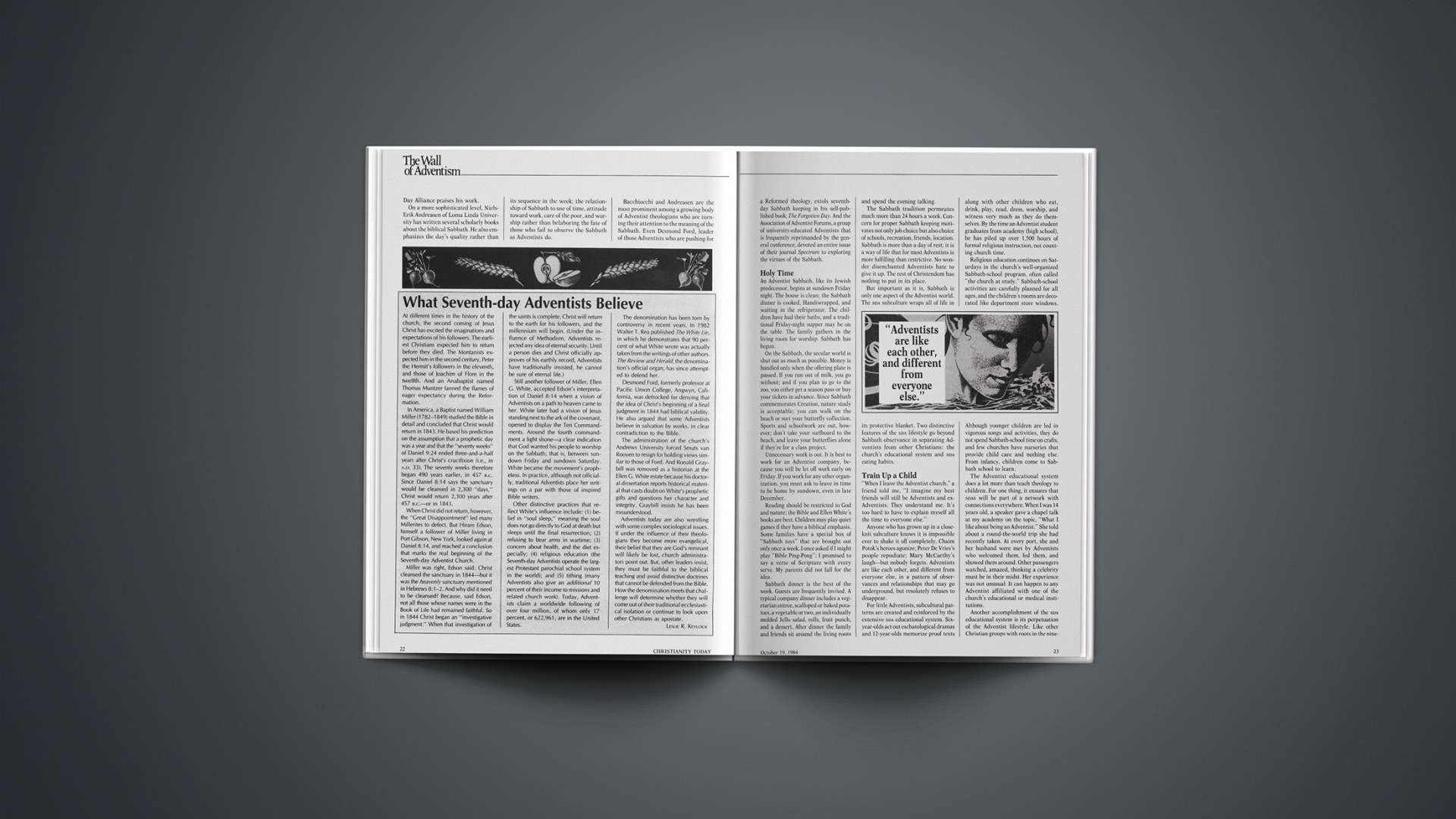
What Seventh-Day Adventists Believe

At different times in the history of the church, the second coming of Jesus Christ has excited the imaginations and expectations of his followers. The earliest Christians expected him to return before they died. The Montanists expected him in the second century, Peter the Hermit’s followers in the eleventh, and those of Joachim of Flore in the twelfth. And an Anabaptist named Thomas Muntzer fanned the flames of eager expectancy during the Reformation.

In America, a Baptist named William Miller (1782–1849) studied the Bible in detail and concluded that Christ would return in 1843. He based his prediction on the assumption that a prophetic day was a year and that the “seventy weeks” of Daniel 9:24 ended three-and-a-half years after Christ’s crucifixion (i.e., in A.D. 33). The seventy weeks therefore began 490 years earlier, in 457 B.C. Since Daniel 8:14 says the sanctuary would be cleansed in 2,300 “days,” Christ would return 2,300 years after 457 B.C.—or in 1843.

When Christ did not return, however, the “Great Disappointment” led many Millerites to defect. But Hiram Edson, himself a follower of Miller living in Port Gibson, New York, looked again at Daniel 8:14, and reached a conclusion that marks the real beginning of the Seventh-day Adventist Church.

Miller was right, Edson said: Christ cleansed the sanctuary in 1844—but it was the heavenly sanctuary mentioned in Hebrews 8:1–2. And why did it need to be cleansed? Because, said Edson, not all those whose names were in the Book of Life had remained faithful. So in 1844 Christ began an “investigative judgment.” When that investigation of the saints is complete, Christ will return to the earth for his followers, and the millennium will begin. (Under the influence of Methodism, Adventists rejected any idea of eternal security. Until a person dies and Christ officially approves of his earthly record, Adventists have traditionally insisted, he cannot be sure of eternal life.)

Still another follower of Miller, Ellen G. White, accepted Edson’s interpretation of Daniel 8:14 when a vision of Adventists on a path to heaven came to her. White later had a vision of Jesus standing next to the ark of the covenant, opened to display the Ten Commandments. Around the fourth commandment a light shone—a clear indication that God wanted his people to worship on the Sabbath; that is, between sundown Friday and sundown Saturday. White became the movement’s prophetess. In practice, although not officially, traditional Adventists place her writings on a par with those of inspired Bible writers.

Other distinctive practices that reflect White’s influence include: (1) belief in “soul sleep,” meaning the soul does not go directly to God at death but sleeps until the final resurrection; (2) refusing to bear arms in wartime; (3) concern about health, and the diet especially; (4) religious education (the Seventh-day Adventists operate the largest Protestant parochial school system in the world); and (5) tithing (many Adventists also give an additional 10 percent of their income to missions and related church work). Today, Adventists claim a worldwide following of over four million, of whom only 17 percent, or 622,961, are in the United States.

The denomination has been torn by controversy in recent years. In 1982 Walter T. Rea published The White Lie, in which he demonstrates that 90 percent of what White wrote was actually taken from the writings of other authors. The Review and Herald, the denomination’s official organ, has since attempted to defend her.

Desmond Ford, formerly professor at Pacific Union College, Angwyn, California, was defrocked for denying that the idea of Christ’s beginning of a final judgment in 1844 had biblical validity. He also argued that some Adventists believe in salvation by works, in clear contradiction to the Bible.

The administration of the church’s Andrews University forced Smuts van Rooyen to resign for holding views similar to those of Ford. And Ronald Graybill was removed as a historian at the Ellen G. White estate because his doctoral dissertation reports historical material that casts doubt on White’s prophetic gifts and questions her character and integrity. Graybill insists he has been misunderstood.

Adventists today are also wrestling with some complex sociological issues. If under the influence of their theologians they become more evangelical, their belief that they are God’s remnant will likely be lost, church administrators point out. But, other leaders insist, they must be faithful to the biblical teaching and avoid distinctive doctrines that cannot be defended from the Bible. How the denomination meets that challenge will determine whether they will come out of their traditional ecclesiastical isolation or continue to look upon other Christians as apostate.

Apple PodcastsDown ArrowDown ArrowDown Arrowarrow_left_altLeft ArrowLeft ArrowRight ArrowRight ArrowRight Arrowarrow_up_altUp ArrowUp ArrowAvailable at Amazoncaret-downCloseCloseEmailEmailExpandExpandExternalExternalFacebookfacebook-squareGiftGiftGooglegoogleGoogle KeephamburgerInstagraminstagram-squareLinkLinklinkedin-squareListenListenListenChristianity TodayCT Creative Studio Logologo_orgMegaphoneMenuMenupausePinterestPlayPlayPocketPodcastRSSRSSSaveSaveSaveSearchSearchsearchSpotifyStitcherTelegramTable of ContentsTable of Contentstwitter-squareWhatsAppXYouTubeYouTube