Latin American Evangelicals Gear up for Overseas Missions

In 1882, a Presbyterian missionary began the first permanent evangelical work in Guatemala. A century later, evangelical churches in that country are growing faster than their counterparts in neighboring Central American republics.

Evangelicals comprise nearly 25 percent of Guatemala’s population. Evangelical churches there are growing at an annual rate of 14 percent. Two Guatemalan denominations, Elim and Prince of Peace, have expanded into Honduras and war-torn El Salvador. But the growth is not limited to Central America. Latin American church leaders and missions strategists are planning to increase their foreign missionary force.

A major obstacle involves currency exchange laws that make it difficult to send money out of many Central American countries. In addition, few structures exist for sending Latin American Christians overseas. Latin America is a base for only 50 mission agencies, most of them in Brazil. That figure compares with 208 in Asia and 104 in Africa.

To try to overcome the problems, church leaders and missions strategists met at major meetings this year. In July, some 600 Christians from 17 countries met at the Central American Theological Seminary (SETECA) in Guatemala City. They laid the groundwork for the creation of mission sending agencies, and discussed ways to motivate churches to get involved in missions.

“We’ve seen how important it is that the local churches in Central America begin to take seriously the needs in other parts of the world, and not just wait for missionaries to come to us,” said Antonio Vasquez, a pastor from El Salvador.

“There’s a strong ground swell of interest and commitment on the part of local churches, both in terms of prayer and finances,” said Bill Taylor, coordinator of the event and director of SETECA’s new World Missions Center.

At an earlier missions conference in May, some 950 Christians from more than 30 denominations in Central America and Mexico met in San Salvador, the capital of El Salvador. The meeting was sponsored by San Salvador’s 1,200-member Nazareth Church. Five years ago, Nazareth Church sent its first missionary couple to Spain.

“The evangelical church in Latin America has a responsibility to be involved in world missions,” said Luis Bush, pastor of Nazareth Church and an Argentinian graduate of Dallas Theological Seminary. “But at this point there are very few structures available to those who feel called to foreign service.”

In addition to cross-cultural work, Central American evangelicals are making plans for evangelism within their own countries. A national church-growth conference was held in May in Antigua, Guatemala. Leaders from 41 parachurch and service organizations and from 33 denominations worked on strategies for reaching Guatemala with the gospel. They followed the Discipling a Whole Nation pattern developed in the Philippines. The program is based on each church drawing up its own plans and setting its own goals.

The common objective is for evangelicals to make up half of Guatemala’s population by 1990. That goal is attainable if the annual church growth rate can be increased from 14 percent to 17 percent and maintained at that level.

The Central American Evangelical Churches, the largest denomination in Guatemala, set goals for each of its congregations to double in size in addition to planting new churches. The denomination also made plans for each church to develop a literacy program for its members and others in the community, and for each regional association to promote schools, clinics, and homes for orphans.

Guatemala’s neighboring countries report average growth rates of 12 to more than 13 percent per year—four to five times greater than the rate of population growth. Each country manifests its own patterns and problems.

• In El Savador, hundreds of believers have been killed in violence related to the four-year-old civil war. Thousands have fled their homes, joining the tide of half a million displaced persons who have sought refuge in less affected areas or outside the country. In the midst of the conflict and suffering, the church is advancing. Evangelicals in El Salvador have tripled since 1974 to 750,000.

• In Honduras, evangelical church growth has been strong over the past 15 years, with an average annual growth rate of more than 13 percent. The Protestant community is estimated at half a million, around 11 percent of the population.

• In Nicaragua, the number of evangelical churches has doubled in the last five years to 3,002. Since the Sandinistas took power in 1979, Nicaragua has maintained a measure of religious freedom.

Many evangelicals supported the revolution and some continue to be committed Sandinistas. However, the government imposes some limitations on church activities. Special permission is needed for open-air meetings. Pastors say these permits are often refused. At other times they are issued and then canceled at the last minute. Churches are required to make minutes of business meetings available to the government.

Church-and-state tensions are evident as well in the Roman Catholic church, whose hierarchy at first supported the Sandinistas but is now at odds with the regime. The recent expulsion of ten foreign priests has exacerbated an already tense relationship. The priests apparently were expelled for participating in a march to support a Nicaraguan priest accused of passing CIA-supplied arms to rebels fighting against the Sandinistas.

STEPHEN R. SYWULKAin Guatemala City
NCC Won’t Allow a Watchdog Group to Examine Its Financial Records

A National Council of Churches (NCC) official has refused to allow the Institute on Religion and Democracy (IRD) to examine the council’s financial records. The records earlier were made available to two staff members of the United Methodist Reporter.

The IRD, a research organization known for its attacks on the NCC, had tried to obtain information regarding NCC grants made to outside organizations. IRD research director Kerry Ptacek said a staff member in the NCC’s office of information set up an appointment for him to view the financial data. He said the appointment was subsequently rescheduled and then canceled by Warren Day, the NCC’s information director.

Day told Religious News Service that the IRD received treatment different from that given the United Methodist Reporter because that newspaper serves the largest denomination in the NCC.

Ptacek said he believes the NCC refused to let him see the books because the IRD had charged that NCC grants were going to pro-Sandinista groups in Nicaragua. He said he tried to gain access to financial information that was not contained in data routinely made available by the NCC. Several months earlier, United Methodist Reporter staff members were allowed to examine a large computer printout of NCC financial data. The United Methodist Reporter published a series of articles in the wake of reports nearly two years ago in Reader’s Digest and on CBS-TV’s “60 Minutes” alleging NCC support of leftist causes.

After the Reader’s Digest and “60 Minutes” reports, Ptacek said NCC officials made such statements as “our records are open” or “our books are open.” In response, Day said, “I have not found this sort of thing in writing.” Day said the highest elected officials of NCC-member bodies and heads of those denominations’ finance offices have access to the NCC’s books. But he added that access is not routinely given to “any self-appointed group on the outside.”

RELIGIOUS NEWS SERVICE

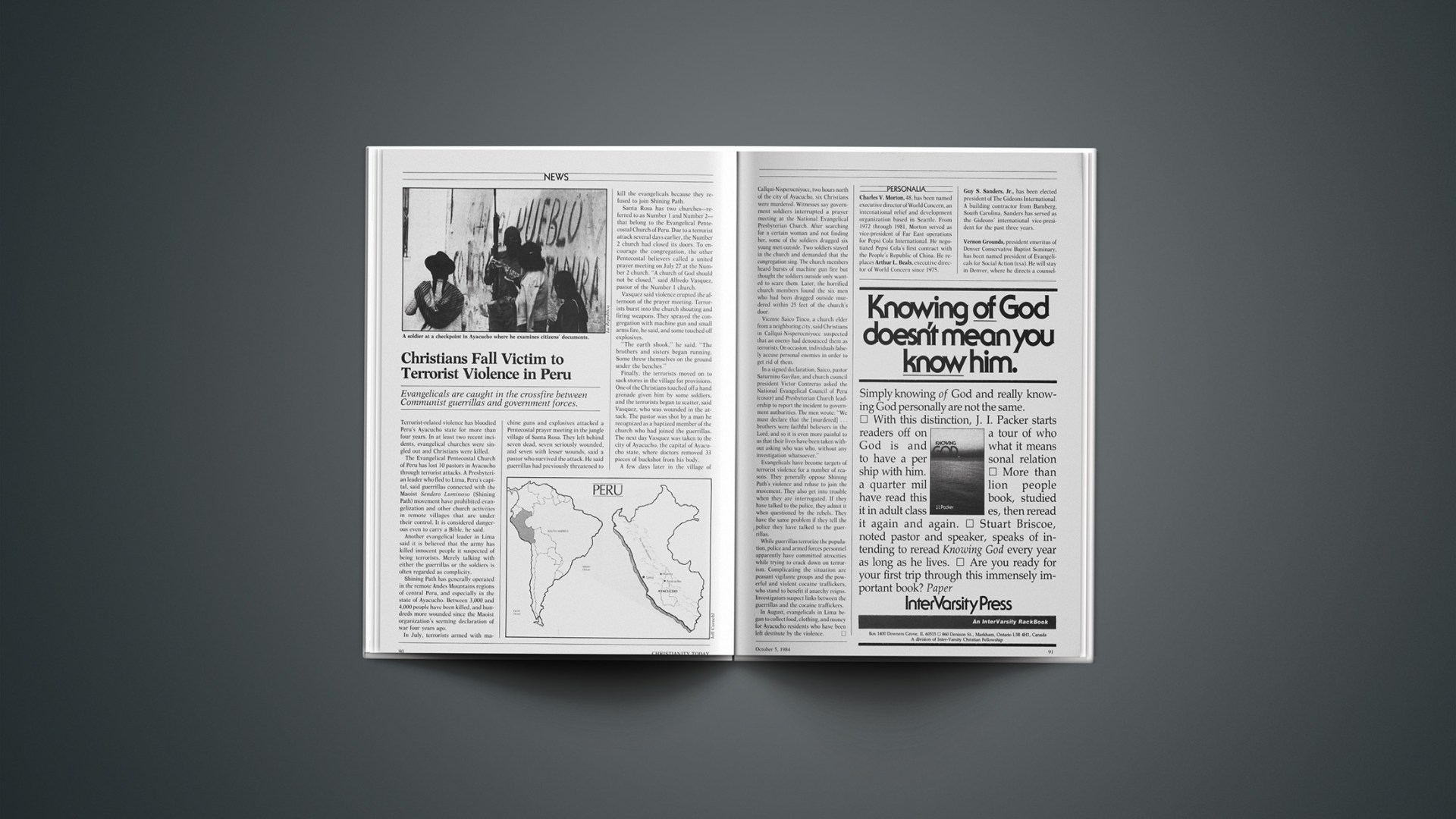
Christians Fall Victim to Terrorist Violence in Peru

Evangelicals are caught in the crossfire between Communist guerrillas and government forces.

Terrorist-related violence has bloodied Peru’s Ayacucho state for more than four years. In at least two recent incidents, evangelical churches were singled out and Christians were killed.

The Evangelical Pentecostal Church of Peru has lost 10 pastors in Ayacucho through terrorist attacks. A Presbyterian leader who fled to Lima, Peru’s capital, said guerrillas connected with the Maoist Sendero Luminoso (Shining Path) movement have prohibited evangelization and other church activities in remote villages that are under their control. It is considered dangerous even to carry a Bible, he said.

Another evangelical leader in Lima said it is believed that the army has killed innocent people it suspected of being terrorists. Merely talking with either the guerrillas or the soldiers is often regarded as complicity.

Shining Path has generally operated in the remote Andes Mountains regions of central Peru, and especially in the state of Ayacucho. Between 3,000 and 4,000 people have been killed, and hundreds more wounded since the Maoist organization’s seeming declaration of war four years ago.

In July, terrorists armed with machine guns and explosives attacked a Pentecostal prayer meeting in the jungle village of Santa Rosa. They left behind seven dead, seven seriously wounded, and seven with lesser wounds, said a pastor who survived the attack. He said guerrillas had previously threatened to kill the evangelicals because they refused to join Shining Path.

Santa Rosa has two churches—referred to as Number 1 and Number 2—that belong to the Evangelical Pentecostal Church of Peru. Due to a terrorist attack several days earlier, the Number 2 church had closed its doors. To encourage the congregation, the other Pentecostal believers called a united prayer meeting on July 27 at the Number 2 church. “A church of God should not be closed,” said Alfredo Vasquez, pastor of the Number 1 church.

Vasquez said violence erupted the afternoon of the prayer meeting. Terrorists burst into the church shouting and firing weapons. They sprayed the congregation with machine gun and small arms fire, he said, and some touched off explosives.

“The earth shook,” he said. “The brothers and sisters began running. Some threw themselves on the ground under the benches.”

Finally, the terrorists moved on to sack stores in the village for provisions. One of the Christians touched off a hand grenade given him by some soldiers, and the terrorists began to scatter, said Vasquez, who was wounded in the attack. The pastor was shot by a man he recognized as a baptized member of the church who had joined the guerrillas. The next day Vasquez was taken to the city of Ayacucho, the capital of Ayacucho state, where doctors removed 33 pieces of buckshot from his body.

A few days later in the village of Callqui-Nisperocniyocc, two hours north of the city of Ayacucho, six Christians were murdered. Witnesses say government soldiers interrupted a prayer meeting at the National Evangelical Presbyterian Church. After searching for a certain woman and not finding her, some of the soldiers dragged six young men outside. Two soldiers stayed in the church and demanded that the congregation sing. The church members heard bursts of machine gun fire but thought the soldiers outside only wanted to scare them. Later, the horrified church members found the six men who had been dragged outside murdered within 25 feet of the church’s door.

Vicente Saico Tinco, a church elder from a neighboring city, said Christians in Callqui-Nisperocniyocc suspected that an enemy had denounced them as terrorists. On occasion, individuals falsely accuse personal enemies in order to get rid of them.

In a signed declaration, Saico, pastor Saturnino Gavilan, and church council president Victor Contreras asked the National Evangelical Council of Peru (CONEP) and Presbyterian Church leadership to report the incident to government authorities. The men wrote: “We must declare that the [murdered] … brothers were faithful believers in the Lord, and so it is even more painful to us that their lives have been taken without asking who was who, without any investigation whatsoever.”

Evangelicals have become targets of terrorist violence for a number of reasons. They generally oppose Shining Path’s violence and refuse to join the movement. They also get into trouble when they are interrogated. If they have talked to the police, they admit it when questioned by the rebels. They have the same problem if they tell the police they have talked to the guerrillas.

While guerrillas terrorize the population, police and armed forces personnel apparently have committed atrocities while trying to crack down on terrorism. Complicating the situation are peasant vigilante groups and the powerful and violent cocaine traffickers, who stand to benefit if anarchy reigns. Investigators suspect links between the guerrillas and the cocaine traffickers.

In August, evangelicals in Lima began to collect food, clothing, and money for Ayacucho residents who have been left destitute by the violence.

Personalia

Charles V. Morton, 48, has been named executive director of World Concern, an international relief and development organization based in Seattle. From 1972 through 1981, Morton served as vice-president of Far East operations for Pepsi Cola International. He negotiated Pepsi Cola’s first contract with the People’s Republic of China. He replaces Arthur L. Beals, executive director of World Concern since 1975.

Guy S. Sanders, Jr., has been elected president of The Gideons International. A building contractor from Bamberg, South Carolina, Sanders has served as the Gideons’ international vice-president for the past three years.

Vernon Grounds, president emeritus of Denver Conservative Baptist Seminary, has been named president of Evangelicals for Social Action (ESA). He will stay in Denver, where he directs a counseling center at the seminary. Grounds will attend major evangelical events as ESA’s chief spokesman. Ronald Sider, former president of the ESA board of directors, has become chairman of the board.

William L. Baumgaertner has been named associate director of the Association of Theological Schools in the United States and Canada. He will replace Marvin J. Taylor, who has held the post since 1970. Baumgaertner previously served as executive director of the seminary department of the National Catholic Education Association.

Joseph McFarland will be inaugurated this month as president of Geneva College in Beaver Falls, Pennsylvania. He assumed the presidency in July. McFarland previously served as director of academic affairs for the Kansas Board of Regents.

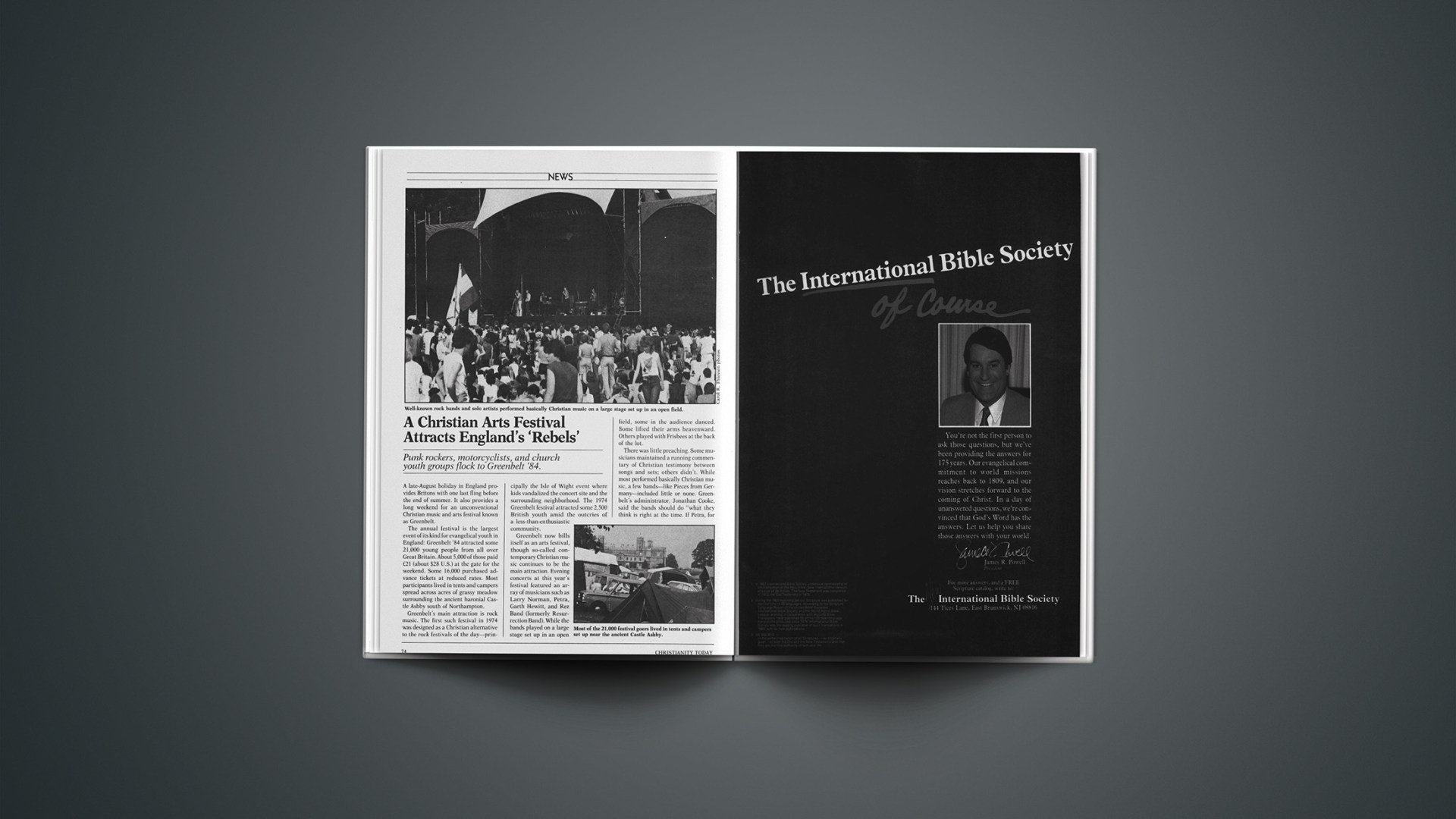
A Christian Arts Festival Attracts England’s ‘Rebels’

Punk rockers, motorcyclists, and church youth groups flock to Greenbelt ‘84.

A late-August holiday in England provides Britons with one last fling before the end of summer. It also provides a long weekend for an unconventional Christian music and arts festival known as Greenbelt.

The annual festival is the largest event of its kind for evangelical youth in England: Greenbelt ‘84 attracted some 21,000 young people from all over Great Britain. About 5,000 of those paid £21 (about $28 U.S.) at the gate for the weekend. Some 16,000 purchased advance tickets at reduced rates. Most participants lived in tents and campers spread across acres of grassy meadow surrounding the ancient baronial Castle Ashby south of Northampton.

Greenbelt’s main attraction is rock music. The first such festival in 1974 was designed as a Christian alternative to the rock festivals of the day—principally the Isle of Wight event where kids vandalized the concert site and the surrounding neighborhood. The 1974 Greenbelt festival attracted some 2,500 British youth amid the outcries of a less-than-enthusiastic community.

Greenbelt now bills itself as an arts festival, though so-called contemporary Christian music continues to be the main attraction. Evening concerts at this year’s festival featured an array of musicians such as Larry Norman, Petra, Garth Hewitt, and Rez Band (formerly Resurrection Band). While the bands played on a large stage set up in an open field, some in the audience danced. Some lifted their arms heavenward. Others played with Frisbees at the back of the lot.

There was little preaching. Some musicians maintained a running commentary of Christian testimony between songs and sets; others didn’t. While most performed basically Christian music, a few bands—like Pieces from Germany—included little or none. Greenbelt’s administrator, Jonathan Cooke, said the bands should do “what they think is right at the time. If Petra, for instance, feel strongly they should always do an altar call, they should do one here. Artists like Bruce Cockburn or Maria Muldaur [also at Greenbelt ‘84], who are not direct in what they’re saying, should equally come and do their thing. Neither should feel pressure to do either.”

Greenbelt committee chairman John Gooding described the festival as the “framework within which we want to explore the relevance of our Christian faith to all of life, using the arts as an example of how we might do that.” He said the daytime seminars at Greenbelt encourage people to “think biblically about some of the more difficult issues with which we are faced in the twentieth century.”

Beginning each morning at 9, festival goers crowded into large tents for worship services led by a variety of preachers and teachers. After the services, they could attend any of eight concurrent seminars on a wide range of subjects. The seminars continued throughout the day until the main-stage entertainment began. Thousands of kids listened to—and often debated with—such speakers as John Stott, Os Guinness, Ron Sider, and René Padilla. Some of the speakers dealt with issues of particular concern to young people, such as peace and justice. Others reinforced the arts emphasis, helping people to think through the relevance of Christianity to their work. One speaker, John Allan, spoke to packed sessions on Christian basics, including “How Do I Know If I’m a Christian?” and “How Much of the Bible Can You Still Believe?” Hundreds of teenagers whooped it up in another tent designated as a “rolling magazine” emphasizing humor and interviews with main-stage performers and speakers, and challenging the kids to identify where they are in their personal relationship to God.

At the same time, other tents featured dramatics and dance, while little-known musicians and other performers appeared on outdoor stages. Nearby, stalls were crowded with buyers of everything from Bibles, books, and records, to miscellaneous merchandise, including leather belts—some of them green colored and predictably labeled “Greenbelt.” A variety of organizations and humanitarian causes set up information booths.

Many Britons raise ecclesiastical eyebrows at the Greenbelt festival, pondering what, if anything, it accomplishes. Some point to established conferences—many of them geared to youth—and wonder where Greenbelt fits.

Organizers say the unconventional festival fills a niche untouched by more traditional programs. Greenbelt is more likely to attract the “rebels” in a church youth group, the kids who don’t go to anything else, Cooke said. Thousands of youth—from punk rockers with spectacularly colored hair to leather-jacketed motorcyclists—come to Greenbelt. Cooke said they come partly “because we don’t preach, and partly because the people behind the festival honestly like the music.”

Some of the young participants attend with groups from organizations or churches. Some bring non-Christian friends to hear the music. Others come as fans of a particular singer or band. One youth had painted his hair magenta and brilliant yellow to match the “Giantkiller” T-shirt he was wearing: Giantkiller’s performance at Greenbelt was his reason for being there.

While overt evangelism is downplayed, Greenbelt still manages to communicate the gospel. Gooding said the event itself is evangelistic because those who come are celebrating their faith. Many non-Christians who attended the main-stage concerts sensed a need for something they didn’t know about, and asked counselors or someone else for help in knowing more. Cooke estimated some 2,000 festival goers had asked to talk to someone in the counseling tent during the four-day weekend while another thousand or more sought out the on-site doctor, using a pretext of medical complaints to elicit his advice on spiritual matters.

Most participants attended the Sunday morning worship and Communion service. There the audience supplied the music, blending their own voices in familiar hymns and gospel choruses. A speaker challenged the crowd: “You come here either to have a happy-clappy time, or you come to have your life changed irrevocably.”

An offering taken at the service aided organizations and causes predetermined by the Greenbelt committee. This year, £17,300 ($23,355 U.S.) was raised to benefit nine groups such as Primary Colours, a Christian dance company that tours schools, and the Church Youth Fellowship Association, which produces Christian nurture material for young people’s groups.

For all its uniqueness, Greenbelt is almost a victim of its own success. To break even, each year’s festival needs to attract 25,000, a figure that exceeds by

4,000 the number of paid participants at this year’s event. The bank balance that existed before the festival began has disappeared. And because Greenbelt is not considered evangelistic enough by supporters of more traditional endeavors, outside contributions to maintain the year-round operation (which includes publication of a Christian music magazine, Strait) are few.

But for thousands of British youth, Greenbelt is a must. It has become a means of encouragement and growth for many, and the door to a personal relationship with Jesus Christ for countless others.

CAROL R. THIESSENin England

A Pastor Faces Legal Action For Refusing To Break A Confluence

A Florida clergyman was jailed after refusing to divulge a conversation he had with a parishioner accused of raping a young girl.

John Mellish, pastor of the 54-member Margate Church of the Nazarene near Fort Lauderdale, had spoken in counseling sessions with Earl Sands, an accused child molester. Sands was arrested in August on charges of sexual battery of a child, and a Broward County grand jury later indicted him.

State prosecutors subpoenaed Mellish to testify against Sands. When Mellish refused to testify, a Broward County circuit judge gave him a weekend to reconsider. The judge later sent Mellish to jail for contempt of court when the pastor said he still would not testify. Mellish was out on bail the next day.

Broward County legal authorities say Mellish is the first Florida minister to be jailed for maintaining a pledge of confidentiality. His case is being appealed to the Fourth District Court of Appeals in West Palm Beach, Florida. If Mellish loses, he will go back to jail.

“This is a real threat to the ministry, a threat to the separation of church and state, and [a threat to] the confidentiality between minister and parishioner,” Mellish says. If he testifies, the pastor says, he would set a precedent for the state to demand other confidential information from clergymen. Florida law protects the confidentiality of a pastor and counselee except in cases of suspected child abuse.

“The law says that if we even have knowledge or suspect child abuse, we must report it,” he says. “There’s no way a minister can minister to his flock without jeopardizing them. This infringes on the sanctuary of the church and the integrity of the ministry. The question would always be on the mind of parishioners as to whether I would tell on them in something else.”

The Adam Walsh Child Resource Center, a nationwide clearing house for missing children based in nearby Plantation, Florida, supported the action taken by the state. Its spokesmen say the well-being of a child is more important than pastoral confidentiality.

The 500,000-member Church of the Nazarene stands behind Mellish. The denomination’s bylaws prohibit its ministers from divulging anything said to them in confidence. An exception is made only when a parishioner signs a waiver giving a pastor permission to repeat what the parishioner told him. Sands refused to sign such a waiver. Even if he had, Mellish says he still would refuse to testify.

“There’s a greater principle here,” the pastor says. “All people must be able to come to the church as a sanctuary for spiritual help.”

JULIA DUINin Florida

North American Scene

A federal appeals court has ruled that the U.S. Constitution does not protect homosexual conduct. In a 3-to-0 vote, the court upheld the U.S. Navy’s 1981 discharge of a petty officer who admitted that he had engaged in homosexual acts. In his ruling, Judge Robert Bork wrote that “the effects of homosexual conduct within a naval or military unit are almost certain to be harmful to morale and discipline.”

The Massachusetts Supreme Court has ruled that a driver who causes the death of a viable fetus can be prosecuted for motor vehicle homicide. The court voted 4 to 3 that a viable fetus is a “person.” The ruling resulted from a case in which a car struck a pregnant woman and killed an eight-month-old fetus in 1982.

After nearly 20 years of steady increases, the percentage of firstborn babies conceived by unmarried women has stabilized. U.S. Census Bureau officials also reported that women who get married soon after conceiving or giving birth are more likely to face an eventual divorce than women who are neither pregnant nor mothers when they marry.

Americans United for Separation of Church and State has filed suit to challenge President Reagan’s appointment of an ambassador to the Vatican. Last year Congress repealed a 116-year-old ban on formal diplomatic ties with the Holy See, and Reagan named William A. Wilson to the post (CT, Dec. 16, 1983, p. 36). Americans United filed its suit in the U.S. Circuit Court of Appeals in Philadephia. Judges there are known to favor strict separation between church and state.

After eight months of daily protests, an adult bookstore in Fayetteville, Pennsylvania, has closed its doors. “Our persistence in picketing was the key,” said Olin Smith of the 1,600-member Franklin County Citizens for Decency Through Law. The organization plans to picket Franklin County’s other adult bookstore.

A judge has denied a 27-year-old rapist’s request for chemical castration, ordering instead a surgical castration. Circuit Judge C. Victor Pyle, Jr., ordered Roscoe Brown of Anderson, South Carolina, to find a doctor to perform the procedure. Brown agreed last year to be castrated in return for an early release from prison.

Nebraska’s State Board of Education has approved regulations allowing church schools to hire teachers who lack state certification. Parents must supply the board with background information on the teachers, a list of courses to be offered, and proof that students comply with compulsory attendance laws. The decision ends a legal battle that began in 1979 when a court ordered the unaccredited Faith Christian School in Louisville to close its doors (CT, Feb. 17, 1984, p. 32).

World Scene

Leaders of the Solidarity movement in Poland have called for a two-week boycott of vodka, the government’s largest revenue source. The action came in response to a church-sponsored one-month boycott of vodka. Poland’s Roman Catholic church sponsored the boycott as part of a two-year sobriety campaign. Thirty percent of the average family food budget in Poland is said to be spent on hard liquor.

Taiwanese officials have released the general secretary of the Presbyterian Church in Taiwan. Chung Ming Kao, 54, was sentenced in 1980 on charges of subversion. A Presbyterian Church (USA) official says Kao was released because the Taiwanese government is concerned about its poor international image resulting from the imprisonment of Kao and other opposition leaders.

The West German Baptist Union has issued a “declaration of guilt” for its behavior during the Nazi regime of Adolf Hitler. The 68,000-member body says it was “humbled by having been subordinated often to the ideological seduction of that time, in not having shown greater courage in acknowledging truth and justice.”

A United Nations Children’s Fund (UNICEF) report confirms that more than seven million Ethiopians face starvation.UNICEF has spent $2 million for emergency relief in Ethiopia in the last 18 months. The United States will send an additional 5,000 metric tons of grain to the famine-stricken country.

The Lutheran World Federation (LWF) Assembly has adopted a statement opposing abortion. Meeting in Budapest, Hungary, the assembly included the statement in an amendment to a proposal dealing with violence against women. The action calls on LWF-member churches to help Christians find alternatives to abortion.

Did They Find Noah’s Ark? Explorers Can’t Agree

Explorer Marvin Steffins was the focus of international attention recently when news reports said he found Noah’s ark on Mount Ararat. Steffins, president of the Louisiana-based International Expeditions, attributed the widespread reports to an “imaginative press” on a “slow news day.”

Steffins denies that he said he discovered the ark. But he adds that there is a strong possibility that the boat-shaped formation he and a half-dozen others examined in August does house the remains of the ark.

Ron Wyatt, an explorer from Nashville who led the team to the site, told the Turkish press that the formation is “definitely a boat” and that he believes it is Noah’s ark. Wyatt brought back to the United States something he describes as “decayed and oxidized metal and some decayed and partially petrified wood.” He believes the object is part of a rib timber from the ark.

At press time, the material was being analyzed in a laboratory whose location Wyatt declined to reveal. He says scientists will try to determine the kind and possibly the age of the wood and metal that was found.

The unusual formation, located some 5,200 feet up the southwestern side of Mount Ararat, has been known to explorers since 1959. But Wyatt says a hasty excavation done there in 1960 convinced most people that it had no archeological value.

Wyatt’s interest in the site escalated in 1979 after analysis of soil samples from the formation revealed high contents of carbon and ferric oxide. This, Wyatt says, indicated there was wood and metal in the mountain. Because Genesis 4:22 describes Tubal-cain as “the forger of all instruments of bronze and iron,” Wyatt believes Noah had access to metal, and would have used it.

On his recent trip, Wyatt took a metal detector to the site and got positive readings at nine-foot intervals the entire length of the formation. Astronaut James Irwin, who accompanied Wyatt on part of the expedition, says the metal readings are significant. However, he does not think the formation contains Noah’s ark. He says the land formation, near well-traveled highways, could not have kept the ark hidden from people through the years. Irwin says the formation might contain a replica of the ark, believed by some to have been constructed some 1,700 years ago.

Steffins says he hopes to get permission from the Turkish government to excavate the site. He has expressed concern that in the meantime, a poorly executed venture could hinder the site’s potential as an archaeological treasure. But Wyatt says Turkish officials are capable of protecting the site from looters. Wyatt stresses that further excavation and analysis “should be pursued with the best scientific methology available.… There is no room for fantasizing.”

An Appeals Court Upholds Christian Publisher’s Tax-Exempt Status

A federal appeals court has overturned a 1983 ruling that revoked the tax-exempt status of the Presbyterian and Reformed Publishing Company (P&R). The ruling is seen as a victory for religious publishers incorporated as not-for-profit organizations.

The U.S. Third Circuit Court of Appeals on August 31 overturned the U.S. Tax Court ruling that revoked P&R’s tax-exempt status. The small publisher, related to the Orthodox Presbyterian Church, had been battling the Internal Revenue Service (IRS) for seven years.

P&R spokesman John Murdoch said the IRS may have been trying to establish a legal precedent that would revoke tax exemption for all religious publishers. He suggested that the IRS targeted P&R because of the company’s limited financial ability to defend itself.

The IRS launched the case in 1977 when it informed P&R that its tax-free status was being reconsidered. In 1981 the IRS ruled against P&R and ordered the payment of back taxes dating to 1969. It cited P&R’s increased sales and business activities as justification for its action. The U.S. Tax Court in 1983 affirmed the IRS, citing management decisions that “replicate those of commercial enterprises.”

P&R maintained that its similarity to commercial operations was irrelevant to tax-exempt consideration, and argued that it met the criteria for not-for-profit organizations. Those organizations can make a profit, but profits cannot be distributed to stockholders or owners. Profits must either be refunneled into the organization or donated to other charitable causes.

The U.S. Third Circuit Court of Appeals agreed that P&R operates as a not-for-profit organization. The court ruled that denying tax-exempt status because of an organization’s profitable business procedures “does not reflect either the dynamic quality of our society or the goals that generated the grant of tax-exempt status to religious publishers.”

The tax division of the U.S. Justice Department has until November 27 to appeal the decision to the U.S. Supreme Court.

Canada Seeks $130 Million in Fines and Taxes from Amway

The Canadian government is seeking more than $130 million in unpaid taxes and penalties from Amway of Canada Ltd. That amount exceeds the company’s total retail sales for one year.

Canada’s federal tax department says Amway of Canada owes $ 105 million in taxes, duties, and penalties on goods imported into the country between 1977 and 1980. The government is seeking an additional $7.9 million in unpaid duties and taxes on goods imported between 1974 and 1977. In a separate action, Amway is appealing a ruling on the value of goods the firm has imported into Canada since 1980. Depending on the outcome of the appeal, the ruling could cost the company millions of dollars.

The American-based Amway Corporation and its Canadian affiliate were fined $25 million last year after pleading guilty to dodging $29.6 million in import duties and sales taxes (CT, Dec. 16, 1983, p. 38). That fine was the largest ever levied by a Canadian court.

The decision to try to collect an additional $105 million from the giant direct-sales corporation followed a judicial process during which Amway presented its arguments against the claim. If the firm refuses to pay the amount being sought, the tax department will take the case to the Federal Court of Canada.

Jack Wilkie, Amway’s public relations manager, said the company plans “to continue to make our arguments and to litigate aggressively.” He described the tax department’s move as a “minor procedural action.” Amway spokesman Peter Bennett said the firm’s Canadian sales are running ahead of projections despite the problems with the government and the resulting news coverage.

Founded in Michigan in 1959 by Richard DeVos and Jay Van Andel, Amway is known for projecting a Christian, patriotic image. Amway has 7,000 employees worldwide, with 400 working for its Canadian subsidiary. Some one million distributors sell the company’s products.

LESLIE K. TARRin Toronto

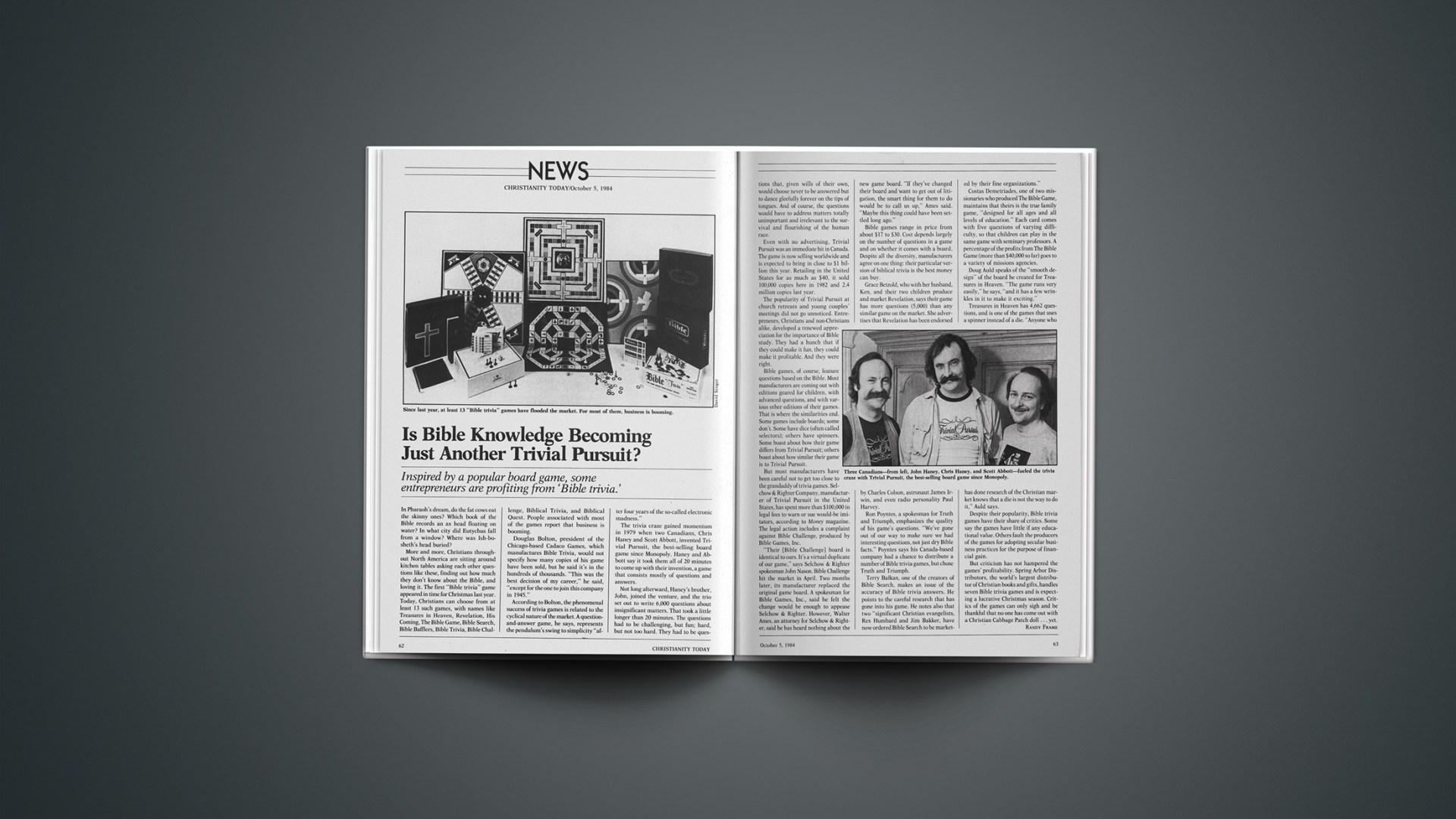
Is Bible Knowledge Becoming Just Another Trivial Pursuit?

Inspired by a popular board game, some entrepreneurs are profiting from ‘Bible trivia’

In Pharaoh’s dream, do the fat cows eat the skinny ones? Which book of the Bible records an ax head floating on water? In what city did Eutychus fall from a window? Where was Ish-bosheth’s head buried?

More and more, Christians throughout North America are sitting around kitchen tables asking each other questions like these, finding out how much they don’t know about the Bible, and loving it. The first “Bible trivia” game appeared in time for Christmas last year. Today, Christians can choose from at least 13 such games, with names like Treasures in Heaven, Revelation, His Coming, The Bible Game, Bible Search, Bible Bafflers, Bible Trivia, Bible Challenge, Biblical Trivia, and Biblical Quest. People associated with most of the games report that business is booming.

Douglas Bolton, president of the Chicago-based Cadaco Games, which manufactures Bible Trivia, would not specify how many copies of his game have been sold, but he said it’s in the hundreds of thousands. “This was the best decision of my career,” he said, “except for the one to join this company in 1945.”

According to Bolton, the phenomenal success of trivia games is related to the cyclical nature of the market. A question-and-answer game, he says, represents the pendulum’s swing to simplicity “after four years of the so-called electronic madness.”

The trivia craze gained momentum in 1979 when two Canadians, Chris Haney and Scott Abbott, invented Trivial Pursuit, the best-selling board game since Monopoly. Haney and Abbott say it took them all of 20 minutes to come up with their invention, a game that consists mostly of questions and answers.

Not long afterward, Haney’s brother, John, joined the venture, and the trio set out to write 6,000 questions about insignificant matters. That took a little longer than 20 minutes. The questions had to be challenging, but fun; hard, but not too hard. They had to be questions that, given wills of their own, would choose never to be answered but to dance gleefully forever on the tips of tongues. And of course, the questions would have to address matters totally unimportant and irrelevant to the survival and flourishing of the human race.

Even with no advertising, Trivial Pursuit was an immediate hit in Canada. The game is now selling worldwide and is expected to bring in close to $1 billion this year. Retailing in the United States for as much as $40, it sold 100,000 copies here in 1982 and 2.4 million copies last year.

The popularity of Trivial Pursuit at church retreats and young couples’ meetings did not go unnoticed. Entrepreneurs, Christians and non-Christians alike, developed a renewed appreciation for the importance of Bible study. They had a hunch that if they could make it fun, they could make it profitable. And they were right.

Bible games, of course, feature questions based on the Bible. Most manufacturers are coming out with editions geared for children, with advanced questions, and with various other editions of their games. That is where the similarities end. Some games include boards; some don’t. Some have dice (often called selectors); others have spinners. Some boast about how their game differs from Trivial Pursuit; others boast about how similar their game is to Trivial Pursuit.

But most manufacturers have been careful not to get too close to the grandaddy of trivia games. Selchow & Righter Company, manufacturer of Trivial Pursuit in the United States, has spent more than $100,000 in legal fees to warn or sue would-be imitators, according to Money magazine. The legal action includes a complaint against Bible Challenge, produced by Bible Games, Inc.

“Their [Bible Challenge] board is identical to ours. It’s a virtual duplicate of our game,” says Selchow & Righter spokesman John Nason. Bible Challenge hit the market in April. Two months later, its manufacturer replaced the original game board. A spokesman for Bible Games, Inc., said he felt the change would be enough to appease Selchow & Righter. However, Walter Ames, an attorney for Selchow & Righter, said he has heard nothing about the new game board. “If they’ve changed their board and want to get out of litigation, the smart thing for them to do would be to call us up,” Ames said. “Maybe this thing could have been settled long ago.”

Bible games range in price from about $17 to $30. Cost depends largely on the number of questions in a game and on whether it comes with a board. Despite all the diversity, manufacturers agree on one thing: their particular version of biblical trivia is the best money can buy.

Grace Betzold, who with her husband, Ken, and their two children produce and market Revelation, says their game has more questions (5,000) than any similar game on the market. She advertises that Revelation has been endorsed by Charles Colson, astronaut James Irwin, and even radio personality Paul Harvey.

Ron Poyntes, a spokesman for Truth and Triumph, emphasizes the quality of his game’s questions. “We’ve gone out of our way to make sure we had interesting questions, not just dry Bible facts.” Poyntes says his Canada-based company had a chance to distribute a number of Bible trivia games, but chose Truth and Triumph.

Terry Balkan, one of the creators of Bible Search, makes an issue of the accuracy of Bible trivia answers. He points to the careful research that has gone into his game. He notes also that two “significant Christian evangelists, Rex Humbard and Jim Bakker, have now ordered Bible Search to be marketed by their fine organizations.”

Costas Demetriades, one of two missionaries who produced The Bible Game, maintains that theirs is the true family game, “designed for all ages and all levels of education.” Each card comes with five questions of varying difficulty, so that children can play in the same game with seminary professors. A percentage of the profits from The Bible Game (more than $40,000 so far) goes to a variety of missions agencies.

Doug Auld speaks of the “smooth design” of the board he created for Treasures in Heaven. “The game runs very easily,” he says, “and it has a few wrinkles in it to make it exciting.”

Treasures in Heaven has 4,662 questions, and is one of the games that uses a spinner instead of a die. “Anyone who has done research of the Christian market knows that a die is not the way to do it,” Auld says.

Despite their popularity, Bible trivia games have their share of critics. Some say the games have little if any educational value. Others fault the producers of the games for adopting secular business practices for the purpose of financial gain.

But criticism has not hampered the games’ profitability. Spring Arbor Distributors, the world’s largest distributor of Christian books and gifts, handles seven Bible trivia games and is expecting a lucrative Christmas season. Critics of the games can only sigh and be thankful that no one has come out with a Christian Cabbage Patch doll … yet.

A Perspective

A Perspective

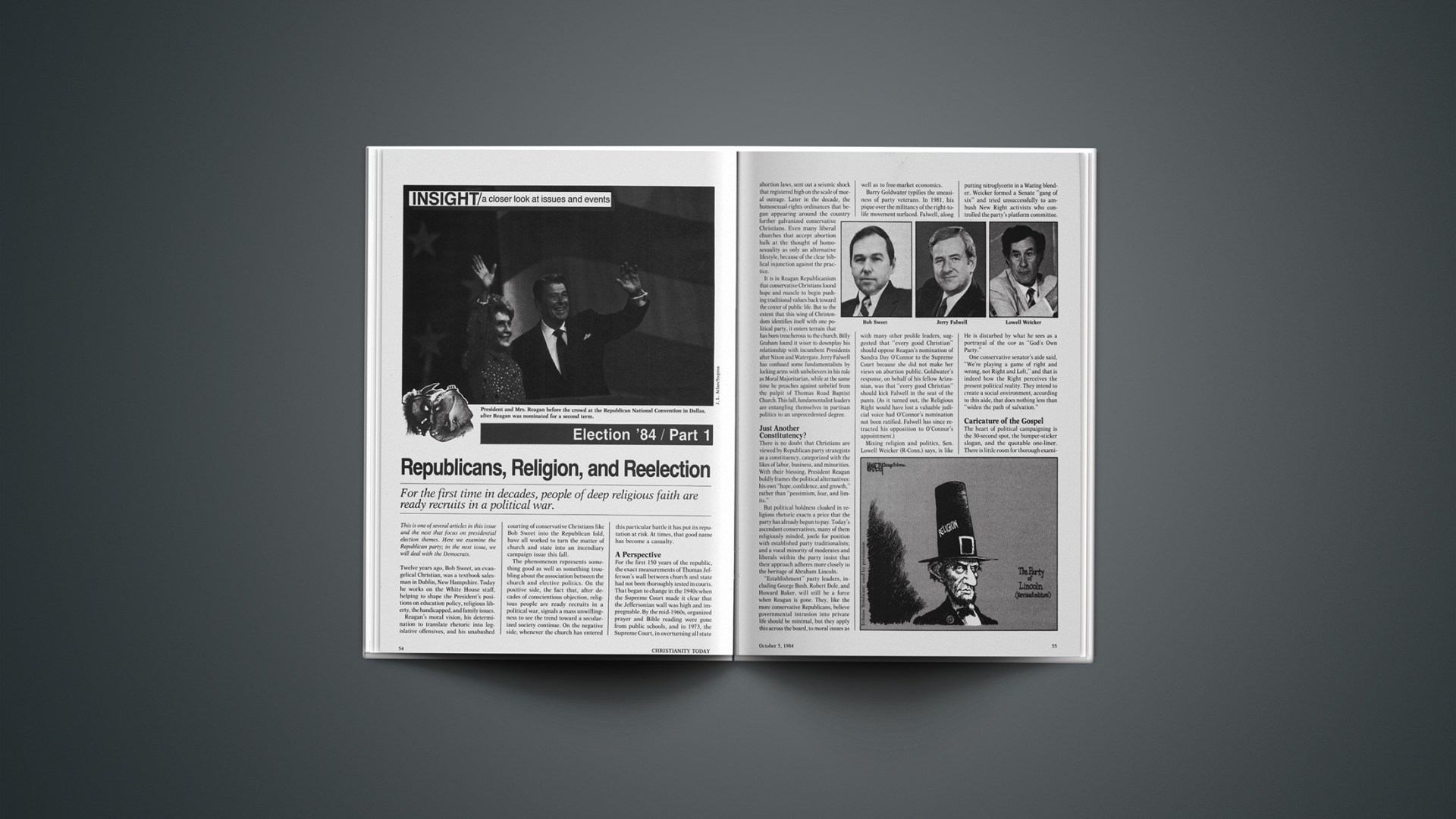
For the first 150 years of the republic, the exact measurements of Thomas Jefferson’s wall between church and state had not been thoroughly tested in courts. That began to change in the 1940s when the Supreme Court made it clear that the Jeffersonian wall was high and impregnable. By the mid-1960s, organized prayer and Bible reading were gone from public schools, and in 1973, the Supreme Court, in overturning all state abortion laws, sent out a seismic shock that registered high on the scale of moral outrage. Later in the decade, the homosexual-rights ordinances that began appearing around the country further galvanized conservative Christians. Even many liberal churches that accept abortion balk at the thought of homosexuality as only an alternative lifestyle, because of the clear biblical injunction against the practice.

It is in Reagan Republicanism that conservative Christians found hope and muscle to begin pushing traditional values back toward the center of public life. But to the extent that this wing of Christendom identifies itself with one political party, it enters terrain that has been treacherous to the church. Billy Graham found it wiser to downplay his relationship with incumbent Presidents after Nixon and Watergate. Jerry Falwell has confused some fundamentalists by locking arms with unbelievers in his role as Moral Majoritarian, while at the same time he preaches against unbelief from the pulpit of Thomas Road Baptist Church. This fall, fundamentalist leaders are entangling themselves in partisan politics to an unprecedented degree.

Just Another Constitutency?

There is no doubt that Christians are viewed by Republican party strategists as a constituency, categorized with the likes of labor, business, and minorities. With their blessing, President Reagan boldly frames the political alternatives: his own “hope, confidence, and growth,” rather than “pessimism, fear, and limits.”

But political boldness cloaked in religious rhetoric exacts a price that the party has already begun to pay. Today’s ascendant conservatives, many of them religiously minded, jostle for position with established party traditionalists; and a vocal minority of moderates and liberals within the party insist that their approach adheres more closely to the heritage of Abraham Lincoln.

“Establishment” party leaders, including George Bush, Robert Dole, and Howard Baker, will still be a force when Reagan is gone. They, like the more conservative Republicans, believe governmental intrusion into private life should be minimal, but they apply this across the board, to moral issues as well as to free-market economics.

Barry Goldwater typifies the uneasiness of party veterans. In 1981, his pique over the militancy of the right-to-life movement surfaced. Falwell, along with many other prolife leaders, suggested that “every good Christian” should oppose Reagan’s nomination of Sandra Day O’Connor to the Supreme Court because she did not make her views on abortion public. Goldwater’s response, on behalf of his fellow Arizonian, was that “every good Christian” should kick Falwell in the seat of the pants. (As it turned out, the Religious Right would have lost a valuable judicial voice had O’Connor’s nomination not been ratified. Falwell has since retracted his opposition to O’Connor’s appointment.)

Mixing religion and politics, Sen. Lowell Weicker (R-Conn.) says, is like putting nitroglycerin in a Waring blender. Weicker formed a Senate “gang of six” and tried unsuccessfully to ambush New Right activists who controlled the party’s platform committee. He is disturbed by what he sees as a portrayal of the GOP as “God’s Own Party.”

One conservative senator’s aide said, “We’re playing a game of right and wrong, not Right and Left,” and that is indeed how the Right perceives the present political reality. They intend to create a social environment, according to this aide, that does nothing less than “widen the path of salvation.”

Caricature Of The Gospel

The heart of political campaigning is the 30-second spot, the bumper-sticker slogan, and the quotable one-liner. There is little room for thorough examination of positions or for thoughtful debates that are not media events. When Christian principles are sucked into the process, as they are this year, what often emerges is a caricature of the gospel.

In an essay in Religious Broadcasting, Tim LaHaye, chairman of the American Coalition for Traditional Values (ACTV), says Reagan’s 1980 victory happened because “Our Heavenly Father looked down and saw our plight. He saw thousands of us working diligently to awaken his sleeping church to its political responsibilities and He gave us four more years to perpetuate religious freedom.”

He claims that if “liberals” gain control of the White House and Congress, “it will be all over for free elections by 1988.” Another adamantly right-wing group, Christian Voice, placed a full-page advertisement in the Republican National Convention program. Calling itself “America’s largest Christian-conservative coalition,” Christian Voice claims to hold the “key” to 45 million evangelical Christians. It distributed a pre-election brochure, “Why Christians Are for Reagan.”

In contrast, the media don’t often report statements by Christians with a more balanced perspective. Asbury Theological Seminary president David L. McKenna, for instance, stated strongly in United Evangelical Action magazine, the voice of the National Association of Evangelicals, why Christians must not be considered a monolithic voting bloc.

The party’s platform committee did not get this breadth of perspective as it prepared to write its document. It was led to believe that school prayer and abortion were the top two issues for American Christians, but a 1984 leaders poll conducted by the Evangelical Newsletter showed that evangelical leaders, as a group, are deeply concerned about a range of personal and social moral matters.

Congressman Jim Leach of Iowa, a leading Republican moderate, was amazed to learn of the existence of the Christian Legal Society, which opposed President Reagan’s school prayer amendment in favor of equal access legislation. Other groups keep a low profile, such as the National Association of Evangelicals, which emphasizes individualized political involvement because its four-million-member organization is politically diverse.

Theologian Carl F. H. Henry worries about the impact of hastily conceived Christian advocacy. “There are still too many evangelicals who think politics reduces to rallying behind one person, provoking confrontation, and getting media coverage. That’s too narrow a strip on which to venture permanent political change,” he says. But Christians ought to aim at raising the legitimate question of “what it means for a nation to be under God politically.” Settling for a “one-trip-plumber” approach, Henry says, “does not really probe the deeper question of the overall culture crisis.”

The Party Of Lincoln

Today’s conservative Christian leaders certainly are not the first to try to make a political impact (see the article by Mark Noll beginning on p. 20). During the Republican convention of 1864, a Methodist minister opened proceedings with what began as the Lord’s Prayer. About halfway through, he inserted a plea for the nominee, Abraham Lincoln: “Grant, O Lord, that the ticket here to be nominated may command a majority of the suffrages of the American people.”

Whether he was on God’s side or God was on his side, Lincoln won, a decade after the Republican party was born in Ripon, Wisconsin. Then, as now, tension between the party’s moral absolutists and political pragmatists was evident. Party organizers coalesced around a shared disdain for slavery, but they tended to be cautious “free-soilers,” opposed to the centralized economic power that slave labor afforded to states with plantation owners. They differed both in style and substance from the crusading abolitionists, who initially denounced the Republicans and nominated their own presidential candidate in 1860.

Lincoln, articulating pragmatic (although not passionate) opposition to slavery, emerged as the young party’s best hope for holding together its factions. During its first 100 years, it controlled the presidency for 60 years, building a foundation of support among farmers, businessmen, and the middle class.

Decline set in with the Depression and the ascendancy of Democrat Franklin Delano Roosevelt. To this day, many of Roosevelt’s initiatives remain federal fixtures, largely unchallenged even by conservatives as staunch as Reagan. George H. Mayer, in The Republican Party, says, “Like a groggy, bewildered football team, the Republicans never escaped from the shadow of their own goal posts” during those years. The party forfeited the support of minorities, trade unionists, and immigrants. Known as the “party of privilege,” it lost every election except two from 1932 to 1960.

The Republican Recovery

Torn by rivalry between the east coast establishment represented by Nelson Rockefeller, and conservatives in the West and Midwest, the party lapsed until the late 1940s. Its turnabout began with Congressman Richard Nixon’s investigation into Alger Hiss and the resultant crusade against communism. They managed to “convert public fear about communism into a winning issue against the Democrats,” historian Mayer writes.

This has reemerged, following decades of various versions of détente, as a key issue in 1984. Reagan drew the loudest cheers from Republican delegates when he reminded them that during his administration “not one inch of soil has fallen to the communists.” U.N. ambassador Jeane Kirkpatrick opened the convention with a stern foreign policy lecture in which she referred to “the re-Stalinization of the Soviet Union.”

This unapologetic conservatism and sense of national destiny was foreshadowed by events of the early 1960s after the popularity of Dwight Eisenhower restored the party’s momentum. An attempt to draft Goldwater for President in 1960 ended when he withdrew his name and told delegates to go home and “earn the right to nominate a conservative.”

They took him literally, and returned in four years with sufficient strength to field him as a candidate despite his popular depiction as an extremist on the fringe of the right wing. Even though he was beaten badly by Lyndon Johnson, Goldwater—and the winds of change that propelled him—had a lasting effect on Republicanism.

“The Republican party, after long domination by its relatively liberal eastern wing … had passed into the hands of a new management,” notes William A. Rusher, publisher of National Review, in his book The Rise of the Right. “Conservatism in 1960 was basically just a set of ideas. By 1965, it was a full-fledged political movement, ready to do battle for the leadership of America.”

Goldwater’s candidacy gave Ronald Reagan—host of the television program “G.E. Theater”—a chance to audition before the party and the nation with a taped speech in behalf of the nominee. Rusher observes that “fate has a curious way of hiding its pearls in the most unlikely places, and it outdid itself on this occasion.”

Like Lincoln, it is Reagan who holds together the party’s moderates and conservatives today. He has been a popular President, providing the country with a sense of direction and an air of confidence.

Four More Years?

What a second Reagan term would accomplish is a big question for the party as well as the electorate. With the burden of campaigning behind him for good, the President may move vigorously toward his unfulfilled 1980 promises to the New Right and harden his line against communism abroad. Or, the moderates hope, Reagan’s pragmatic political instincts might focus instead on reducing the federal budget deficit and getting down to business on arms negotiations with the Soviets. A large part of Reagan’s political genius involves his ability to offer genuine, persuasive assurances to both sides at once.

The party also is reaping the reward of Reagan’s ability to inspire and motivate political action among previously inactive conservatives, many of whom are Christians. Like Bob Sweet, they are responding to Reagan, not to Republicanism.

Sweet became alarmed about curriculum changes and educational experiments at the public school his children attended, so he ran for the school board in 1972. From that vantage point, a larger political vista came into focus. He attended a political workshop for Christians in 1975, which spoke for bipartisan political involvement. If Reagan had not appeared on the scene the following year, Sweet’s training session might have been forgotten. But he sensed something different about this long-shot, Sun Belt conservative. “Reagan represented the kind of moral integrity and moral leadership I believed was essential to the survival of this country,” Sweet says. “I believed he was genuine.”

Post-Reagan Republicanism

Reagan’s biggest political talent is his ability to arouse a broad spectrum of the electorate by appealing to shared values at the same time he is cultivating party loyalty. This is the challenge Republicans face in their post-Reagan years. They realize that they also must reach for the support of new constituents and offer their own “new ideas” in response to future Democratic leadership that builds on what Gary Hart began this year.

New ideas in the party, even moderates admit, are coming from conservatives who call themselves “populists.” They are organized, prolific, and wise in the ways of mass-media exposure. In the House of Representatives, Georgia Republican Newt Gingrich formed a Conservative Opportunity Society with fellow congressmen Jack Kemp and Vin Weber.

Gingrich is the intellectual, and the high-tech theorist of the Republican right wing. He told a platform subcommittee that public policy must move from “the geriatrics of the industrial age to the pediatrics of the information age.” He heralds the arrival of a new model of economic thought that has to be developed and articulated as America moves from being a welfare state to building an “opportunity society.”

“Our premise is that you can believe in left-wing ideology or you can believe in creating jobs,” he says, “but you cannot believe in both.” The old models for measuring society’s productivity and wealth no longer work, he has decided, because current economic growth, in his words, is a result of “human imagination, human spirit, and human commitment,” such as new applications of computer technology. “It becomes impossible to mathematically represent the forces which shape and dominate” the sort of society emerging today in the West.

While Gingrich’s vision is long-range, Jack Kemp gets down to particulars. In his foreword to a book titled Completing the Revolution, Kemp named voluntary prayer in schools, the right to life, human rights in Eastern Europe, and a simplified and reduced tax rate as key elements the “populists” will promote. Other issues will be affordable housing, urban enterprise zones to put inner-city poor to work, and modernized, streamlined armed forces as a better deterrent.

As this year’s Republican platform took shape, it was Kemp and company who cajoled committee members to write it their way. Kemp strode purposefully through the Dallas Convention Center halls, popping up at one subcommittee hearing after another to give a rapid-fire defense of these positions. Without exception, they prevailed in the platform.

The ‘Threat From The Right’

In the wake of the Watergate setback, during the respite of the Carter years, the party had time to regroup and build a massive national organization.

Its formal party structure includes the Republican National Committee (RNC) and two committees promoting the election of Republican senators and representatives. These three groups raised $93.3 million in 1983, compared with $16.4 million raised by the Democrats.

Republican fund raising relies on direct mail appeals and gifts from major donors, while the Democrats rely on “special interest” money from their diverse constituencies. Chief among the conservative fund raisers is Richard A. Viguerie, publisher of Conservative Digest, a staunch anti-Communist, and frequent critic of Reagan compromises with moderates and liberals. Twenty million names dot the disks of Viguerie’s computer, yielding multiple millions of dollars. This year, Republicans will be the chief beneficiaries of Viguerie’s hard work, but in Dallas, on network television, both George Bush and Robert Dole denounced Viguerie by name for seeking to influence the party while not even enrolling as a Republican. They are uneasy because Viguerie threatens frequently to outflank the party on the right by forming a new, populist coalition, and his threats are taken seriously. He could siphon away substantial numbers of newly registered and politically active citizens.

Viguerie rails against the “elitism” of the establishment. All Americans want their government doing, he says, is “defending the shores, building the roads, catching the criminal, and educating the young.” He is disappointed that Reagan has not narrowed the scope of federal government far more radically. Viguerie maintains very close ties with right-wing religious organizations involved in politics, and counts “conservative Christians and Jews” among those who could be persuaded to abandon the current party system.

This sort of sniping from outside the party’s perimeter deeply offends the activist Republican moderates and accounts, in large measure, for their efforts to get organized this year. Rep. Jim Leach (R-Iowa), head of the liberal Ripon Society, founded a “Republican Mainstream Committee” to counter what he calls “politics for profit.” Leach strenuously objects to massive, emotional direct mail appeals that “tear apart the decency that holds our society together.”

He wrote in a “mainstream manifesto” that “many of the issues of the New Right social agenda represent political opportunism rather than historical Republicanism. We must make it clear we are a party of individual rights rather than socialized values.”

Leach and a handful of others support “philosophical decentralization.” On abortion, for example, he says government should be strictly neutral. He believes government should “neither fund it nor preclude it by constitutional amendment or statute,” and he terms this “a classic position that has no friends.” Moderates also support the Equal Rights Amendment, emphasize civil rights, and back a nuclear freeze.

Above all, though, they are pragmatists, and that helps explain why they solidly back the Reagan-Bush ticket. They tend to take a long view, believing that the pendulum of party consensus will swing their way eventually. For the most part, they retain a good-humored perspective: Maryland Sen. Charles Matthias said “Swimming upstream is good exercise.”

The question the Republicans are so fond of asking the voters—Are you better off now than you were four years ago?—is likely to be asked interally as party leaders and challengers search for a flexible yet cohesive mix of program and principle. Staying conservative enough to prevent an outside threat from the Right, and moderate enough not to disenchant pragmatic leaders, is not easy.

It is made more difficult because of the tension between the historically Republican desire for individual autonomy and the restoration of traditional values, which demands that the federal government intrude into private affairs. But that intrusiveness, the conservatives contend, is necessary only because the federal government has intruded in the past to efface those values. School prayer and abortion would not be hot debates if local school districts had not been sued for their time-honored custom of class prayers or if abortion had not been legalized by the Supreme Court.

There is no question that the values debate will be around for some time, and it will be fought out squarely in the middle of the political arena. For many evangelicals, it is an uncomfortable, unfamiliar feeling to have their deepest values bruited about by strident spokesmen of both Right and Left. But the mere fact that the debate is here may be the surest evidence that the country has not yet passed into the “post-Christian era” many have prophesied. As the election campaign of 1984 shows, the forced removal of Judeo-Christian values from public life is not a given, and thousands have become active to ensure that it does not happen. Their success has yet to be determined, but if the Christian activist can keep the gospel itself separate from political views that emanate from its varied applications, that alone will be a certain victory.

BETH SPRING

Election ’84 / Part 1: Republicans, Religion, and Reelection: For the First Time in Decades, People of Deep Religious Faith Are Ready Recruits in a Political War

This is one of several articles in this issue and the next that focus on presidential election themes. Here we examine the Republican party; in the next issue, we will deal with the Democrats.

Twelve years ago, Bob Sweet, an evangelical Christian, was a textbook salesman in Dublin, New Hampshire. Today he works on the White House staff, helping to shape the President’s positions on education policy, religious liberty, the handicapped, and family issues.

Reagan’s moral vision, his determination to translate rhetoric into legislative offensives, and his unabashed courting of conservative Christians like Bob Sweet into the Republican fold, have all worked to turn the matter of church and state into an incendiary campaign issue this fall.

The phenomenon represents something good as well as something troubling about the association between the church and elective politics. On the positive side, the fact that, after decades of conscientious objection, religious people are ready recruits in a political war, signals a mass unwillingness to see the trend toward a secularized society continue. On the negative side, whenever the church has entered this particular battle it has put its reputation at risk. At times, that good name has become a casualty.

Apple PodcastsDown ArrowDown ArrowDown Arrowarrow_left_altLeft ArrowLeft ArrowRight ArrowRight ArrowRight Arrowarrow_up_altUp ArrowUp ArrowAvailable at Amazoncaret-downCloseCloseEmailEmailExpandExpandExternalExternalFacebookfacebook-squareGiftGiftGooglegoogleGoogle KeephamburgerInstagraminstagram-squareLinkLinklinkedin-squareListenListenListenChristianity TodayCT Creative Studio Logologo_orgMegaphoneMenuMenupausePinterestPlayPlayPocketPodcastRSSRSSSaveSaveSaveSearchSearchsearchSpotifyStitcherTelegramTable of ContentsTable of Contentstwitter-squareWhatsAppXYouTubeYouTube