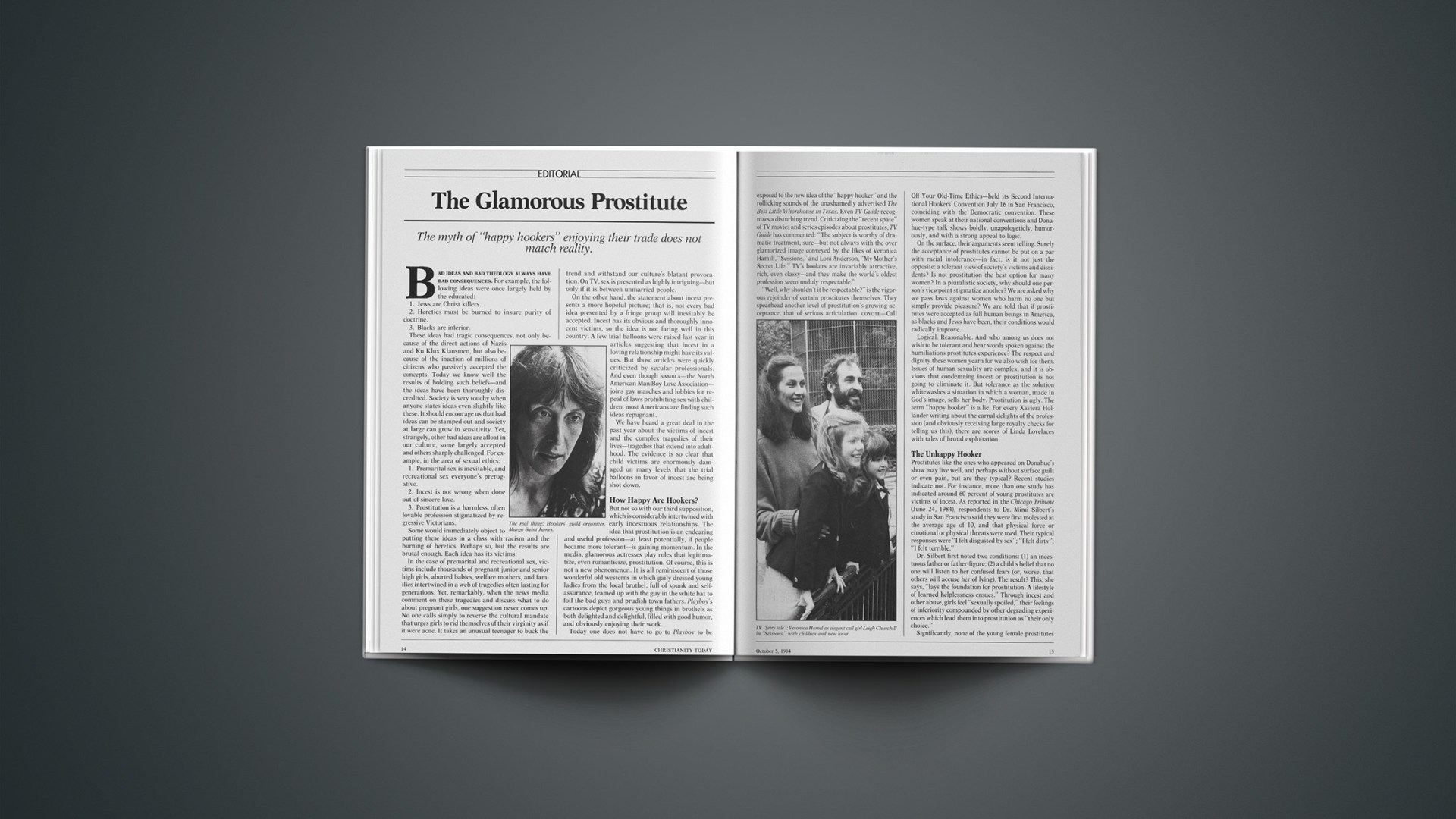
At Great Risk: Tyndale, Wycliffe, John Rogers, and Others Developed the English Bible despite Harassment and Enmity

The translators of the New English Bible worked without suspicion of inciting heresy among their readers. The teams producing the Revised Standard Version and the Good News Bible labored without fear of burning at the stake. We may be inclined, in fact, to imagine modern Bible translators as bookish, professorial people who are all but assured of dying quietly in bed.

It was not so for the earliest English translators.

Many did their work with the express opposition of the church of their day and fled to the European continent at the risk of their lives. They did this to make God’s Word available to every Englishman, including the lowly ploughman. Ecclesiastical authorities opposed translation of the Bible into the vernacular because they were deeply afraid that if lay people read the Bible, heresy would result, as had been the case with the Albigenses in France.

The method of Bible translation has also changed. The first English translations of the Bible were made before Johannes Gutenberg had even dreamed of creating a printing press. Instead, monks and priests spent hours copying verses by hand, with quill pen and ink, then comparing what they had written with one another.

Today complete concordances of the Bible can be produced by a computer.

It is often not easy to isolate one person as the translator of a book as long as the Bible. Over the years, however, individual names have come to be associated with particular translations. Some of the most interesting personalities associated with various English Bible translations are John Wycliffe, Miles Coverdale, William Tyndale, John Rogers, William Whittingham, Matthew Parker, Gregory Martin, Richard Bancroft, and Westcott and Hort.

English Bible Translators Before Wycliffe

Bede in his Ecclesiastical History of the English People tells the interesting story of Caedmon, a laborer in the monastery at Whitby in Yorkshire around the year 675, who quite unintentionally became the first known translator of a part of the Bible into English.

One evening, so the story goes, Caedmon left a party and went to the stable so he wouldn’t have to sing. There he fell fast asleep and dreamed that a heavenly visitor told him to sing about the Creation. He began to praise God in words he had never heard before. When Hilda, the abbess of the monastery, heard the story, she realized God had been calling Caedmon and persuaded him to become a monk. She taught him Bible stories from Genesis, Exodus, and Daniel, and he turned them into English poetry. So the earliest English translation of the Bible was a paraphrase.

Caedmon was followed by other talented translators whose names are all but forgotten. F. F. Bruce in The History of the Bible in English, S. L. Greenslade in The Cambridge History of the Bible, and Jack P. Lewis in The English Bible from KJV to NIV tell us stories about the brilliant poet Cynewulf; the learned Bishop Andhelm; the great Oxfordshire abbott, Aelfric; the translator for nuns, William Gifford; William of Waddington; the Augustinian monk Orm; and Richard Rolle. These translators of portions of the Bible into English lived between 950 and 1350.

John Wycliffe (Ca. 1330–84)

The first translation of the whole Bible into English is associated with the name of John Wycliffe, the six-hundredth anniversary of whose death we celebrate this year.

The most respected Oxford theologian of his day, Wycliffe seems to have first thought of the Bible as an authority to counteract the political involvement of English clergy in 1374 when he was on a royal commission to Belgium to contest money claimed by Pope Gregory IX. Wycliffe’s support of the anticlerical party in England resulted in the implacable opposition of such church leaders as William Courtney, the archbishop of Canterbury. In 1382 he and his followers were condemned as heretics at the Synod of Black Friars.

Wycliffe spent the last 18 months of his life in banishment at a Lutterworth rectory. There his friends and colleagues began the translation of an English Bible that would long survive him. Nicholas of Hereford translated the Latin Vulgate Bible into a very literal English version. He was interrupted in 1382 in the middle of the apocryphal book of Baruch because he had to travel to Rome to appeal his conviction as a heretic to Pope Urban VI. At Baruch 3:20, an unknown scribe wrote in, “Here ends the translation of Nicholas of Hereford.”

If Nicholas’s translation was as literal as today’s New American Standard Bible, the translation of Wycliffe’s secretary, John Purvey, attempted a “dynamic equivalence” translation like today’s Good News Bible. Of the 200 surviving hand-copied manuscripts of the Wycliffe Bible, 170 are in the Purvey translation. It proved so popular that despite its condemnation it survived to become the Bible Elizabeth I used at her coronation in 1558.

William Tyndale (Ca. 1494–1536)

Because Archbishop Thomas Arundel in 1408 in the Constitutions of Oxford “forbade anyone to translate, or even to read, a vernacular version of the Bible in whole or in part without the approval of his diocesan bishop or a provincial counsel,” most people, including the clergy, knew very little about the Bible. As a result, England was one of the last countries in Europe to have a printed Bible.

But by the time William Tyndale (or Hutchins, as he is also known) graduated from Oxford, individuals like Luther and Erasmus were already calling for a religiously literate laity, and scholars were studying Hebrew and Greek in earnest. A tutor of Sir John Walsh’s children, Tyndale got into arguments with his employer’s friends that led him to the conviction that he had to translate the Bible into English. A visit to Bishop Cuthbert Tunstall of London led to no offer of employment, so Tyndale headed to Germany where he talked Peter Quentell into printing the first English Bible translated from the original languages. Quentell had not finished more than 80 pages before the authorities stopped production. Tyndale fled to Worms, where 6,000 copies of the New Testament were printed. In 1526 they were on sale in England for two shillings. (Two of the 170 surviving copies of Tyndale’s Bible are from this printing. And in 1834 the first 64 pages of the 80 pages Quintell printed were discovered bound with another work.)

Bishop Tunstall was furious. He bought up as many copies as he could and burned them, but the money he paid was used to print additional copies.

By 1536 Tyndale, now in Antwerp, had already translated large sections of the Old Testament. In that year, however, Charles V, the Holy Roman emperor, had him condemned for heresy, defrocked, strangled, and burned at the stake. So excellent and enduring was his work, however, that nine-tenths of the King James Version shows his influence. A still-existing letter from prison requests a Hebrew Bible, grammar, and dictionary so he could continue translating.

Miles Coverdale (Ca. 1488–1569) And The Coverdale Bible Of 1535

Like that of so many clergymen in the days of Henry VIII, Edward VI, Mary, and Elizabeth I, Miles Coverdale’s life bounces back and forth between respected ecclesiastical office and exile to the European continent.

Coverdale will be remembered as the one who produced the first complete Bible in English. About half of his work indirectly became a part of the King James Version of 1611. Coverdale left the monastery to become a Lutheran. In Hamburg he helped Tyndale translate the five books of Moses in the Old Testament. Then he moved to Antwerp where Jacob van Meteren, a merchant, persuaded him to produce an English Bible. He finished it in 1535 and dedicated it to Henry VIII. It relies heavily on Tyndale, Luther, and the Vulgate. It is highly readable, although at times it adopts German expressions (“unoutspeakable” in Romans 8:26, for example).

Had Anne Boleyn not been executed in 1536, Coverdale’s Bible might have been the first “authorized” English version.

Coverdale was also responsible for editing the “Great Bible” of 1539 (so called because of its size), but in 1540 he was forced to flee to Strasbourg, where he stayed until the death of Henry VIII. Under Edward VI he was appointed bishop of Exeter, but when Mary became queen he almost lost his life. Only an appeal for pardon from his theologian brother-in-law in Copenhagen, through the king of Denmark, got him back to the Continent. There he became pastor of John Knox’s church in Geneva.

Under Elizabeth I, Coverdale took part in the consecration of the archbishop of Canterbury, Matthew Parker, whom we will meet later, and worked on the famous Geneva Bible of 1560.

John Rogers (Ca. 1500–50) And “Matthew’S” Bible

Once Coverdale’s 1535 Bible was allowed to be sold in England, others appeared in rapid succession. Matthew’s Bible, the first licensed English Bible, appeared in 1537.

The title page of this Bible tells its story. It says it was “truly and purely translated into English by Thomas Matthew,” though the Bible was the work of John Rogers. Tyndale had just been executed a year before, so it was still wise to use a pseudonym. Matthew’s Bible is a combination of Tyndale’s partial Old Testament, Coverdale’s translation of the rest of the Old Testament, Tyndale’s New Testament, and Coverdale’s Apocrypha. Rogers’s contribution was an extensive set of 2,000 notes with a strongly Protestant tone (the first English Bible commentary).

The title page also indicates the fact that it was “set forth with the kinges most gracyous lycence.” It pictures King Henry VIII on his throne handing the Word of God to Archbishop Thomas Cranmer and royal adviser Thomas Cromwell, for distribution to clergy and laity. They respond with cries of “God save the King.” Even on the title page of a Bible the king’s supremacy over religious matters was asserted. To protect Coverdale’s Bible, Cranmer refused to allow the printing of Matthew’s Bible in England, however, though it circulated freely in England.

Rogers met the tragic end so common to prominent clergymen of the time. When Mary became queen in 1553, Rogers preached a violently anti-Catholic sermon, and after a year of imprisonment he was burned at the stake.

William Whittingham (1524–89) And The Geneva Bible

During Mary’s reign, many Englishmen went to Geneva to study under John Calvin and Theodore Beza in Geneva. The leader of this group of exiles was William Whittingham, a graduate of Oxford and Calvin’s brother-in-law.

In 1557 Whittingham completed a revision of Tyndale’s New Testament that was unique in several ways. Incorporating an idea introduced by Robert Estienne in his 1551 Greek New Testament, Whittingham was the first to divide chapters into verses in an English Bible. He was the first not to include Paul’s name in the title to Hebrews. He was the first to speak of “General” rather than “Catholic” Epistles. He was the first to put into italics English words that had to be added to the literal translation for the text to make sense. The New Testament was the first study Bible in that it had chapter summaries, notes, and maps.

Working with colleagues, Whittingham then proceeded to produce the Geneva Bible. In the preface the translators say they had worked day and night for more than two years.

Though the Geneva Bible was dedicated to Queen Elizabeth, and she gave John Bodley the exclusive right to publish it for 19 years, Archbishop Matthew Parker allowed it primarily for home use and it was not printed in England until 1576. In 1579 it became the first Bible to be printed in Scotland.

The Geneva Bible won a place in the hearts of English-speaking people everywhere. It was preferred for years to the King James Version and was the Bible carried on the Mayflower in 1620. Sometimes called the “Breeches Bible” because it says Adam and Eve made “breeches” from fig leaves, it was the Bible Shakespeare used.

Matthew Parker (1504–75) And The Bishops’ Bible

Though the people loved the Geneva Bible, the strong Calvinism of its footnotes did not meet with the approval of the clergy. In 1566 Matthew Parker, the archbishop of Canterbury, assigned competent bishops and scholars who later became bishops to complete a translation but “to make no bitter notes.”

The actual work was done in only two years, and the translators lacked the ability in Hebrew and Greek the English exiles in Geneva during Mary’s reign had gained. The result is that the Bishops’ Bible, though it was published in 1568 and dedicated to Queen Elizabeth, was not an outstanding translation. It became the official Bible for church use, but the people continued to read the Geneva Bible.

Archbishop Parker, the man who was editor in chief, was a highly competent translator. In addition, he supervised the writing of the Thirty-Nine Articles, the official creed of the Church of England, and wrote several scholarly studies in English church history.

Gregory Martin (Ca. 1540–82) And The Rheims-Douai Bible

Protestants were making such effective use of English Bible translations that William Allen, a fellow of Oriel College, Oxford, and founder of the English College for Roman Catholics at Douai in northern France, called on one of his most distinguished scholars, Gregory Martin, to produce an English Catholic translation.

Martin had graduated from Saint John’s College, Oxford, in 1557, two years after its founding, and was proficient in both Hebrew and Greek. In 1570 he went to study at the English College, became a priest, and joined the faculty as professor of Hebrew in 1573. In 1578, when the college was located temporarily in Rheims, Martin began his translation, two chapters a day. Though he completed the Old Testament first, the New Testament was published first, in 1582. The Old Testament was not published until 1609–10, when the college had returned to Douai.

The translation is excessively literal and word for word, even when it makes no sense. For example, Psalm 68:12 reads, “The king of hoastes the beloved of the beloved, and to the beauty of the house, to divide the spoils.” William Allen and others provided a set of annotations that are more polemical than any of the Protestant editions of the Bible.

Between 1749 and 1772, Bishop Richard Challoner, a convert from Protestantism, thoroughly revised Martin’s translation and did such an excellent job that his version survived over 200 years among Catholics.

Richard Bancroft (1544–1610) And The King James Version

It is one of the ironies of history that the chief overseer of the most beloved of all translations, the King James Version, vigorously opposed the Puritan John Reynolds, president of Corpus Christi College, Oxford, and one of the leading scholars of his time, when he suggested to King James I at the Hampton Court Conference in 1604 that a new translation of the Bible was needed. Bancroft objected that there was “no end of translating.”

When James authorized the idea, however, Archbishop Bancroft did a complete about-face and supported it enthusiastically. Fanatically anti-Puritan, Bancroft spent a lifetime opposing Puritan practices and enforcing laws against Puritans.

James favored a new translation because he could not stand the extreme Calvinism of the notes in the Geneva Bible. When Richard Bancroft suggested that the new translation could appear without Calvinistic notes, James heartily approved.

James became one of the moving forces behind the translation. He apparently told Bancroft to appoint 54 scholars, six groups of 9, to do the work. Bancroft then appears to have selected candidates from proposals made by the universities, and came up with a list of 47, which he then broke into six groups, three to work on the Old Testament, two on the New Testament, and one on the Apocrypha. Among the members were Lancelot Andrewes, John Reynolds, and Miles Smith, one of the two final reviewers and authors of the preface. Two groups met at Oxford, two at Cambridge, and two at Westminster in London.

Though the new translation was bitterly attacked for 80 years after it was published, by 1650 it had become the only Bible printed in England because it was so clearly better than all its predecessors.

Westcott (1825–1901) And Hort (1828–92) And The Revised Version

Although the King James Version had been updated a number of times, by 1870 it was felt that a major revision was needed. Samuel Wilberforce, bishop of Winchester, made the proposal to a Canterbury convocation on February 10, 1870.

Brooke Foss Westcott, a biblical scholar and later bishop of Durham, and F. J. A. Hort, a New Testament scholar and authority on early Christianity, had spent a lifetime preparing what was at the time the best critical edition of the New Testament available. Published in 1881, it formed the basis for the New Testament of the English Revised Version, published the same year. Two committees, called “companies,” did the work. The New Testament, produced by a company of 24 members, created such excitement when it was published that it was telegraphed to a Chicago newspaper and printed in its pages. The Old Testament company, also consisting of about 24 members, completed its work in 1885, and a complete Bible was published that year.

Though critics attacked it for reliance on the Greek text of Westcott and Hort and for its excessive literalness, it has been called “a milestone in the history of the English Bible.”

From the start, American scholars were invited to participate in the project, and Philip Schaff of Union Theological Seminary in New York headed up the work on this side of the Atlantic. Unauthorized publication in 1881 led Oxford and Cambridge to publish the “American Revised Version.” This upset the Americans, who in 1901 published their own version as the American Standard Version.

The unbelievable amounts of time and energy devoted to efforts to produce outstanding translations of the Bible have characterized the twentieth century, too. The work is done by scholars whose stories can be fascinating and diverse. The earlier story from Wycliffe to Westcott and Hort, however, is one we need to be aware of as we celebrate the six-hundredth anniversary of the death of John Wycliffe, the one who laid, literally with his life, the foundation for the whole process.

Tim Stafford is a free-lance writer living in Santa Rosa, California. He is a distinguished contributor to several magazines. His latest book is Do You Sometimes Feel Like a Nobody? (Zondervan, 1980).
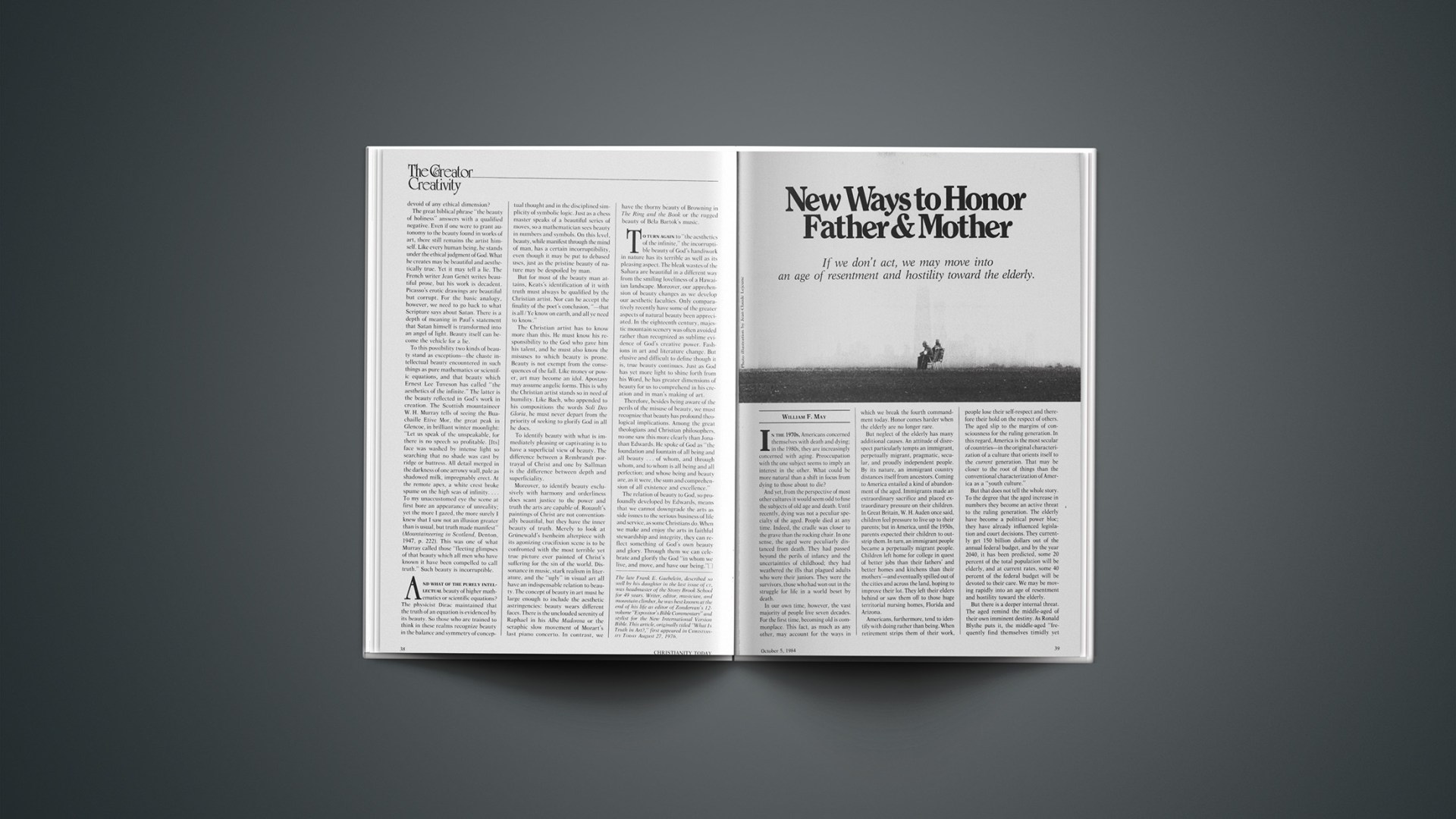
New Ways to Honor Father & Mother: If We Don’t Act, We May Move into an Age of Resentment and Hostility toward the Elderly

In the 1970s, Americans concerned themselves with death and dying; in the 1980s, they are increasingly concerned with aging. Preoccupation with the one subject seems to imply an interest in the other. What could be more natural than a shift in focus from dying to those about to die?

And yet, from the perspective of most other cultures it would seem odd to fuse the subjects of old age and death. Until recently, dying was not a peculiar specialty of the aged. People died at any time. Indeed, the cradle was closer to the grave than the rocking chair. In one sense, the aged were peculiarly distanced from death. They had passed beyond the perils of infancy and the uncertainties of childhood; they had weathered the ills that plagued adults who were their juniors. They were the survivors, those who had won out in the struggle for life in a world beset by death.

In our own time, however, the vast majority of people live seven decades. For the first time, becoming old is commonplace. This fact, as much as any other, may account for the ways in which we break the fourth commandment today. Honor comes harder when the elderly are no longer rare.

But neglect of the elderly has many additional causes. An attitude of disrespect particularly tempts an immigrant, perpetually migrant, pragmatic, secular, and proudly independent people. By its nature, an immigrant country distances itself from ancestors. Coming to America entailed a kind of abandonment of the aged. Immigrants made an extraordinary sacrifice and placed extraordinary pressure on their children. In Great Britain, W. H. Auden once said, children feel pressure to live up to their parents; but in America, until the 1950s, parents expected their children to outstrip them. In turn, an immigrant people became a perpetually migrant people. Children left home for college in quest of better jobs than their fathers’ and better homes and kitchens than their mothers’—and eventually spilled out of the cities and across the land, hoping to improve their lot. They left their elders behind or saw them off to those huge territorial nursing homes, Florida and Arizona.

Americans, furthermore, tend to identify with doing rather than being. When retirement strips them of their work, people lose their self-respect and therefore their hold on the respect of others.

The aged slip to the margins of consciousness for the ruling generation. In this regard, America is the most secular of countries—in the original characterization of a culture that orients itself to the current generation. That may be closer to the root of things than the conventional characterization of America as a “youth culture.”

But that does not tell the whole story. To the degree that the aged increase in numbers they become an active threat to the ruling generation. The elderly have become a political power bloc; they have already influenced legislation and court decisions. They currently get 150 billion dollars out of the annual federal budget, and by the year 2040, it has been predicted, some 20 percent of the total population will be elderly, and at current rates, some 40 percent of the federal budget will be devoted to their care. We may be moving rapidly into an age of resentment and hostility toward the elderly.

But there is a deeper internal threat. The aged remind the middle-aged of their own imminent destiny. As Ronald Blythe puts it, the middle-aged “frequently find themselves timidly yet compulsively, like tonguing a tooth nerve—measuring their assets against those of youth to see what they have left, and against those of old age to see what has to go. It is often a great deal in both cases” (The View in Winter, Harcourt, Brace, 1979).

What the middle-aged fear, however, is not merely physical decay, but the humiliation of dependency. They do not want the elderly to encumber them, and the elderly do not want to lapse into becoming a burden. Few of us, however, can avoid the awkwardness and dependencies of aging; the elderly are one minority that, sooner or later, almost all of us join.

Strategies For Care Of The Aging

The strategies we have adopted for the care of the elderly provide further clues to the American character and ideals.

Family care. No institution compares with the family in the care of the elderly. Seventy-five to 80 percent of the elderly have families nearby; 80 percent have seen a family member in the last week. Of those not institutionalized, half live alone and half with relatives. The government informally subsidizes this family-centered care through social security payments that far exceed the pensioner’s original contribution. This income allows many older people to live for a time near children or other relatives without becoming a full-time dependent. But little subsidy exists in the United States for other kinds of services, whereas, for example, in Great Britain there are respite houses where the elderly may go for brief periods to provide adult children with a break from constant care, and home visitation services that permit more elderly to function independently and longer near their children.

Also, the migration of large numbers of the elderly to the Sun Belt has led to the growth of extended families of the elderly who help one another and no longer depend upon children to take care of them. The ancient take care of one another. Some are a little better off than others, but all are roughly in the same boat—in need of someone who will play bridge, talk, or monitor the window shade daily to check whether all is well. This extended family functions within the limits of fragile resources and energies. Like the biological family, it relies on the reciprocities of giving and receiving and mutual dependence.

Public support and the marketplace. Within the bonds of family life, taking care of the elderly presupposes mutual, though not simultaneous, dependency. We honor our fathers and mothers (and other elderly people within the family circle) because, at least in part, we have received so much from them. Thus the care we give has a responsive element; so much precedes it. Our caring for them answers, in part, to our original dependency upon them.

Care beyond the family circle occurs usually within a different moral horizon, chiefly that of the marketplace. The ethical standards of buying and selling control much professional care and nonprofessional service. The elderly usually rely on money to purchase these services. Abhorring dependence on the family, they prefer, or seem to prefer, to purchase care, service, and attention. (Perhaps this is partly because they perceive how difficult it is for us to take them in.)

Social security provides a major support for the freedom of the elderly to continue participating in the marketplace. Until recently, a worker has withdrawn much more from the system than he or she put in. Unfortunately, this indiscriminate subsidy creates a drain on the system. Some liberals increasingly wonder whether it is fair to let entitlement programs for the elderly grow apace while poverty programs for mothers, children, and others are cut to the bone; some conservatives want to cut benefits back to a level too low to support the modestly fixed. A fair compromise may be to subject one-half of a pensioner’s social security income benefits to income tax rates. The poor would not make enough from all sources to be taxed, and the rich would no longer receive an untaxed windfall. Meanwhile, funds would increase to support basic income for the poor and the modestly fixed.

Total institutions. Eventually the day arrives when the elderly can no longer participate directly in the marketplace. The need arises then to purchase a total environment of care for them. To that end, we mobilize professional and subprofessional services in large institutions (hospital, retirement center, and nursing home) to address their needs.

The strategy of placing the aged in large facilities springs from a variety of motives, some benevolent, others self-serving, and often a mixture of both. In some cases, the elderly flourish best in total institutions. Either they have no family or they require a level of care that their family can no longer provide.

Still, 20 to 30 percent of the residents in total institutions do not need to be there for reasons of health or family circumstances. These older people require more care than they previously received or knew how to secure in the outside world, but they do not need the environment of the total care facility. Often a few strategic services would make independent or family life possible, and such services would cost far less than total institutional care. But the economics of our delivery system favors institutionalization.

The reason for institutionalizing does not spring wholly from the special interests of those who profit financially thereby. Society would not tolerate the cost if the segregation of the elderly did not also meet a deep psychic need. The nuclear family is already overloaded; both adults work, leaving no one at home to provide care; the house seems too small to accommodate. To have to face the elderly daily would be too depressing. We prefer to remove the decrepit from sight because they inspire fear. To address them in their needs would require us to acknowledge our own needs. What better way to place them in the shadows and obscure our own neediness than to put them in the hands of professionals whose métier it is to make a show of strength, experience, and competence in handling a platoon of the distressed?

Geriatric Barracks

However one adjudicates the cultural and religious forces at work behind unnecessary sequestering, the human cost of total institutions is great. Often they impoverish, with the same stroke, what they attempt to aid. In their very design, most nursing homes mock the word “home.” They are often little more than geriatric barracks. Like dogs who tremble as they are about to be left at the veterinarian’s, the elderly shiver at the thought of permanent consignment to a nursing home. Less than 6 percent of the elderly reside in such facilities, but the percentage is misleading: many more people will spend some time in a nursing home, and many will die there. Moreover, I am convinced that those who fear ending up in a nursing home far exceed in number those who spend time there. The nursing home now occupies the same place in the psyche of the elderly that the poorhouse and the orphanage did in the imagination of Victorian children.

The design of space for old bodies. The deprivations they impose hardly argue for the dismantling of total institutions. But serious thought must be given to their design, particularly to what might be called the moral significance of turf. Before the twentieth century, only the poor went to the hospital. Now, rich and poor alike get transported to the professional’s domain. The very architecture of the hospital and nursing home tends to serve the convenience of staff and the machines that dominate the institution. Patients are removed from the familiar settings where they feel in charge; strangers assume control. Not surprisingly, the elderly balk even more than the sick at entering total institutions. Sick people hope to come out of the hospital alive; the elderly usually move to the care center permanently. The institution swallows them up; it condemns them to a premature burial.

Successively and progressively, disease, impairment, old age, immobility, and death restrict space. The world is reduced to a single room, and ultimately to a casket. Ordinarily, the bedroom is only part of our total world, often a sanctuary from it. Meanwhile, psychic life also shrinks, as the elderly become increasingly preoccupied with the body and its troubles. The design of humane institutions requires sensitive reflection about the older person’s perception of his or her body and the contracting world it inhabits.

The body has a threefold meaning for a human being. First, and most obviously, it is an instrument for controlling our world. Illness and aging threaten us with a loss of control. Moving into a facility diminishes control not only because the elderly person moves to another’s turf, but also because the shock of the move assults the memory and, with it, the capacity to function. The man in his eighties, living alone and long familiar with his surroundings, may live and care for himself competently despite a tattered memory. He turns off the gas jet seven or eight times after preparing breakfast. He has enough memory left to know that he should turn off the gas, but not enough left to know whether he has done it. But if the society denies him supplementary services to sustain him in familiar surroundings and locates him in a large institution with its architectural accommodation to staff rather than to residents, then his memory and competence can precipitously deteriorate. Sensitive institutional design should attempt to minimize the loss of control and the humiliation.

Further, the body is a means for savoring the world. A move into a home for the elderly substitutes a functionally bland, salt-free environment for the variegated texture of the world that each of us has come to savor. Conscientious administrators need to admit into the room/world of the elderly a few of the bona fide sensations.

Finally, we are our bodies. Separate me from my body and I am divorced from my community. With old age this separation increasingly takes place, and in two forms. In some cases, the mind remains alert but the body sinks into ruin; in others, the body persists adequately, but the mind abandons it. In the first instance, the alert experience their bodily defects less as imperfections than as stigma that affect not just the flesh but the whole person. One’s body, and therefore one’s self, no longer feels lovable, touchable, cherishable. This experience has its implications for institutional design. It calls for respect for the body and respect for modesty. And it reinforces the warrants for creating an attractive environment. People find the bedridden more approachable if the room they inhabit is attractive. When the elderly offer a chair to a visitor, in a limited way they offer and extend themselves.

The Ideal Of Philanthropy

Philanthropy provides a motive for care largely outside the family circle (though it is not entirely absent when the blood tie is weak). The ideal of service to others helps keep the professional relationship from reducing itself to a commercial transaction alone; hence the term the “helping professions.” The philanthropic ideal also provides motive for amateurs who want to help others.

The ideal of philanthropy presupposes a fundamental asymmetry. It describes a one-way street from giver to receiver. It is an ethic of love without ties. It presupposes sufficiency and independence on one side and needy dependency on the other. Therein lies its spiritual danger: it tends to reinforce a great divide between giver and receiver.

This ideal also reflects the moral ideals to which Americans generally, and the Protestant churches in particular, have been committed. The Protestant social ethic has been almost obsessively and exclusively an ethic of love, an ethic of giving. The mark of the Christian life is responsiveness to the plight of the neighbor. Americans defined themselves out of the human race, and the American church out of Christendom, when they presumed that they were the exclusive specialists in philanthropy, serving others from a promontory above them. Members of the helping professions tend to define themselves by their giving alone—with others indebted to them.

In fact, however, a reciprocity of giving and receiving is at work in all professional relationships. To be sure, the student needs a teacher, but the professor also needs students to work out what he has to say and to rediscover his subject afresh through the discipline of sharing. During medical crises, patients need physicians, but physicians also need patients. No one can watch a doctor nervously approach her retirement without realizing how much her patients have helped her to be herself. And more than one minister has ventured tentatively into the sick room wondering what to say to a parishioner only to discover that the patient’s composure ministers to him.

Love defines the role of giving in human life, but humility makes possible (and tolerable) the act of receiving. Who can deal tenderly with the distress of the aged without acknowledging personal distress?

The Ethics Of The Aged

Ethicists unwittingly contribute to the exclusion of the elderly when they talk about the ethics of care givers but neglect the ethics of care receivers.

As John Yoder has pointed out, the New Testament appears to be ethically conservative in its discussion of the duties of husbands and wives, parents and children, masters and slaves. It emphasizes the duties, rather than the rights, of the subordinate in each pair. But, in fact, the New Testament table of duties had a revolutionary potential in that it addressed both persons in the pair as moral agents. In this respect, the New Testament writers broke with the stoic table of domestic duties that addressed only the person in a superior position—as though only the more powerful had a moral existence. But in the New Testament, says John Yoder, “the subordinate person in the social order is addressed as a moral agent.” There was no precedent for this, he argues, in Hellenistic thought. In addressing wives, children, and slaves, Christian Scripture assigned “personal moral responsibility to those who have no legal or moral status in their culture, and makes of them decision-makers.” Western culture (and the church) took a long time catching up with this change of status (The Politics of Jesus; Eerdmans, 1972).

Any serious reflection on the moral status of the aged requires reflection on the specific virtues that age calls for.

First on the list is courage, which Thomas Aquinas defined as a firmness of soul in the face of adversity. That firmness shows itself far from the battlefield. An 80-year-old bachelor faces resolutely his declining years; a widower takes his first steps alone after 50 years of marriage; an aged mother finds her children too busy to have her around.

Just as care givers need to evince the virtue of humility, care receivers need the same virtue. All the care in the world cannot overcome the sting of humiliation; only humility can. Perhaps midlife would not be so spoiled by pretension, so shadowed by the fear of failure, if we knew how to keep our feet in the soil of humility.

Patience is hardly a natural characteristic of old age. Just as readily, advancing age and infirmity provoke anger, frustration, and bitterness. Patience is surely misunderstood when it is interpreted as pure passivity. It is a most intense activity, a way of taking control of one’s spirit precisely when all else goes out of control.

Simplicity should also mark the elderly, and not merely because memory lapses into its familiar, repetitive grooves, but because the pilgrim has at long last learned how to travel light.

Benignity is, according to the Benedictine monks, a kind of purified benevolence. It hardly goes with the territory of old age. Quite the contrary, the ars moriendi of the late Middle Ages identified avarice as the chief besetting sin of the aged. The closer one gets to the final dispossession of death, the more fiercely one may be inclined to clutch at possessions: holding, grasping, manipulating. Avarice strikes those who are most insecure and least mobile.

Hilarity is a curious virtue to associate with the aged. Yet the monks talk about hilaritas, a celestial gaiety in those who have seen a lot, done a lot, grieved a lot, but now acquire that detachment of the fly on the ceiling looking down on the human scene. Children are blessed if they experience in grandparents a lightness of spirit that offers sunny relief from their parents’ gravity.

Voluntary communities and the aged. The aged are agents as well as patients; but they still need care, and care requires the mobilization of social resources. I take for granted the need for substantial government aid. The government has a responsibility for distributive justice in addressing human need. But the demography of the aged makes it clear that we are headed for disaster if we handle their care solely in the conventional ways.

This raises the question of other options. The major alternative to the huge bureaucracy that organizes professionals is the voluntary community that mobilizes amateurs.

We may be moving into a period in which we need to sustain two kinds of social organizations: first, the bureaucracies, the organizational equivalent of of the Egyptian pyramids—massive, formal, geometrical, hierarchical; but second, small-scale, informal, and spontaneous communities that counterbalance the bureaucracies—just as the Egyptians developed spontaneous, lyrical, naturalistic arts and crafts to compensate for the impersonal and massive forms of the pyramid.

In such a dual world, the voluntary communities have several social functions. First, they must provide services above and beyond those that the bureaucracies provide. Amateurs who can offer companionship to the elderly may sometimes better address their deeper needs than those with expertise.

Second, voluntary communities must provide a critical check to bureaucracies, placing representatives on their boards of directors and frequenting the halls of their institutions as advocates for the elderly. Too often teachers, administrators, and health care practitioners develop a defensive, proprietary relation to their institutions. The sheer repetitiveness of their work tends to give them spiritual callouses. But the amateur has the advantage of seeing the environment afresh. Every institution needs to be exposed to the “dumb” questions: Why do you do this rather than that? Why this kind of building, not that? One needs to sort out the difference between procedures that merely serve the convenience of institutions and their managers and those that best serve the needs of the elderly.

Further, outsiders need to enter total institutions in order to acquaint the community at large with the needs of the elderly. How else can we effect a favorable ethos of support for the bureaucracies in the society at large? I am not in favor of the romanticism of the late sixties that urged us to dismantle the bureaucracies and eliminate the expert. The work of amateurs is too inept, too easily discouraged, too episodic to dispense with the professional. But we must find ways of bringing the outside community into contact with the service bureaucracies.

Finally, voluntary communities will need not only to work with existing institutions, but also to create alternative patterns for the delivery of care. A church basement in San Francisco, where elderly folk received meals, offers a modest illustration of such experimentation. The church and other cooperating institutions provided this noonday service through a federal grant. At first glance, the basement setting was conventional enough. The elderly ate. But then it became clear that retarded and variously handicapped folk served the meal. It took the federal government to support the program, but it took the church to conceive and execute it, a cooperative venture between the two. With one stroke the program benefits not only the elderly, but also another deprived group, and, last but not least, a middle-class community of organizers and hosts.

Bold experiments will be required, against the day that the great institutions about us should crack and decay. I do not believe, however, that voluntary communities will be able to devise attractive alternatives unless they also recognize that they are beneficiaries at the hands of those they serve.

Tim Stafford is a free-lance writer living in Santa Rosa, California. He is a distinguished contributor to several magazines. His latest book is Do You Sometimes Feel Like a Nobody? (Zondervan, 1980).

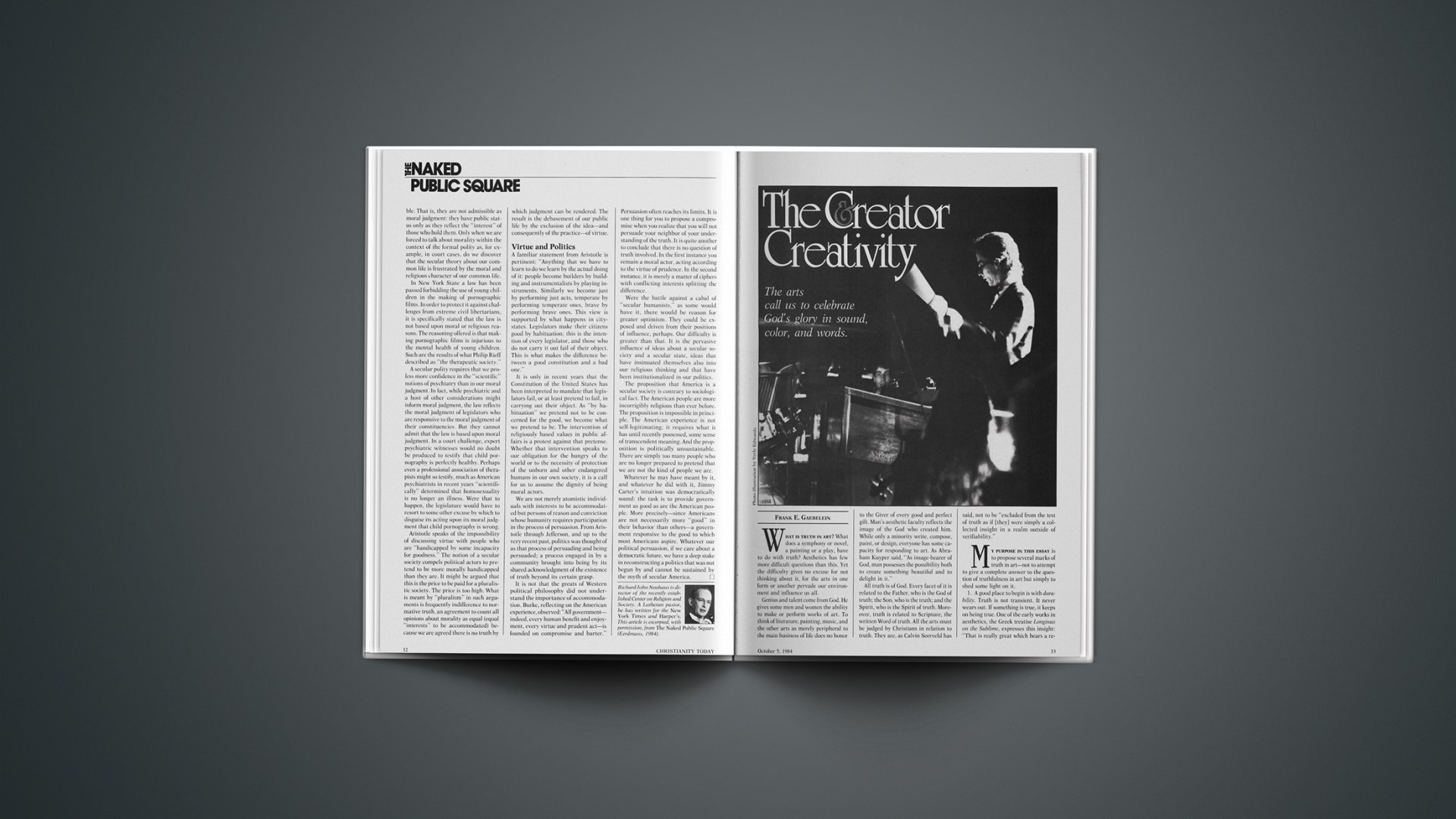
The Creator Creativity: The Arts Call Us to Celebrate God’s Glory in Sound, Color, and Words

What is truth in art? What does a symphony or novel, a painting or a play, have to do with truth? Aesthetics has few more difficult questions than this. Yet the difficulty gives no excuse for not thinking about it, for the arts in one form or another pervade our environment and influence us all.

Genius and talent come from God. He gives some men and women the ability to make or perform works of art. To think of literature, painting, music, and the other arts as merely peripheral to the main business of life does no honor to the Giver of every good and perfect gift. Man’s aesthetic faculty reflects the image of the God who created him. While only a minority write, compose, paint, or design, everyone has some capacity for responding to art. As Abraham Kuyper said, “As image-bearer of God, man possesses the possibility both to create something beautiful and to delight in it.”

All truth is of God. Every facet of it is related to the Father, who is the God of truth; the Son, who is the truth; and the Spirit, who is the Spirit of truth. Moreover, truth is related to Scripture, the written Word of truth. All the arts must be judged by Christians in relation to truth. They are, as Calvin Seerveld has said, not to be “excluded from the test of truth as if [they] were simply a collected insight in a realm outside of verifiability.”

My purpose in this essay is to propose several marks of truth in art—not to attempt to give a complete answer to the question of truthfulness in art but simply to shed some light on it.

1. A good place to begin is with durability. Truth is not transient. It never wears out. If something is true, it keeps on being true. One of the early works in aesthetics, the Greek treatise Longinus on the Sublime, expresses this insight: “That is really great which bears a repeated examination, and which is difficult or rather impossible to withstand, and the memory of which is strong and hard to efface.… For when men of different pursuits, lives, ambitions, ages, languages, hold identical views on one and the same subject, then the verdict which results, so to speak, from a concert of discordant elements makes our faith in the object of admiration strong and unassailable.” So art that is deeply true stands up to the passage of the years.

We must distinguish between durability in artistic works and the unique changelessness of God. “Jesus Christ is the same yesterday, today, and forever”—that is eternally durable truth. So are the other great truths about God and man revealed in Scripture. These constitute Truth, as distinct from truth in art and other fields of human endeavor. In the latter, truth has durability but on the finite rather than eternal level.

But the principle of durability does not help us with what is newer in art. However much we love the great aesthetic achievements of the past, to confine our attention to them alone is parochial. Durability must not be pressed so far as to rule out contemporary art from any claim to lasting truth. Nor does the application of it always require many years: occasionally contemporary judgment quickly recognizes a masterpiece and is proved right by posterity. More commonly, however, great works do not come into their own till years after their creation. For example, Melville’s Moby Dick, now a secure masterpiece, was practically forgotten for decades. And Bach’s Saint Matthew Passion lay dormant for nearly a hundred years until Mendelssohn’s revival of it revealed its towering greatness.

2. Consider next unity as a mark of truth in art. Truth has its own inner coherence. The criterion is very old. Biblically it is rooted in the oneness of the Triune God. Outside the Bible it found classic expression in Aristotle’s Poetics. It has been well said that form is the cup of art. When one finds that a book or symphony lacks unity, he does not have to know the Poetics to say, “It doesn’t hold together.”

The concept of order, which is related to that of unity, is implicit in the cultural mandate in Genesis. When God created man, he was placed in a garden and told to cultivate and keep it. Order is implicit in this idea of cultivating a garden. The creative process in man is not innately disorderly.

At its truest, art tends toward unity and order. The reason for this relates to the incarnational nature of art. As Goethe said, “The spirit tends to take to itself a body.” In the arts, the concept or idea is given definite form; it is “embodied” in sound, color, or words; in wood or stone; in action or movement, as in drama or ballet. But embodiment requires unity and order; a body cannot function effectively in a state of disorganization.

Certain aspects of contemporary art show a centrifugal and even schizophrenic trend. This stems from the sense of lostness and rebellion so prevalent today. Contemporary art does serve as a barometer of the times. But is this enough? Sure art that is ultimately true can do more than reflect what is. It can also have its prophetic function. The history of literature, music, and the other arts contains notable examples of genius that not only spoke to the present situation but went beyond it to break new trails for aesthetic advance.

3. Closely linked to unity as a mark of truth in art is integrity. Although both terms have to do with basic form or structure, integrity is more comprehensive, having to do with the matter of wholeness. A novel may be structurally unified, yet fall short of integrity if the characters or dialogue are unconvincing. Integrity refers to the overall truthfulness of a work of art. When we say that a person has integrity, we mean his entire personality is morally sound. So it is with integrity in art.

In the arts, integrity demands that anything contrived merely for the sake of effect and not organically related to the purpose of the work must be ruled out. Regrettably, there is much in evangelical literature, music, and art that lacks integrity. Sentimental pictures of Christ are widely promoted, records dress up hymn tunes in commonplace variations, and fiction written by evangelicals rarely rises even to the level of competent literary craftsmanship. It is evident that many Christians have much to learn about integrity in their use of the arts. In contrast, think of the art with which our Lord used words. He told the parables of the Prodigal Son, the Good Samaritan, and the Pharisee and the Publican without moralizing and with an integrity that has never been surpassed. As Saint Paul said of him, “He is before all things, and in him all things hold together” (Col. 1:17).

The Christian writer has the advantage of being in a position to tell the whole story. Because he is a Christian he can present the full picture of not only man’s alienation and lostness but also the possibility of his redemption through Christ. This added dimension has characterized the work of great Christian writers from Dante through Milton and Bunyan to Dostoevsky, T. S. Eliot, Graham Greene, François Mauriac, and Flannery O’Connor. In a letter written about ten years after his conversion, C. S. Lewis said, “One of the minor rewards of conversion is to be able [at] last to see the real point of all the literature we were brought up to read with the point left out.”

4. Still another mark of truth in art is inevitability. Some works of art seem to be the final and inevitable expression of an aesthetic idea. Here a kind of paradox we may call “the familiarity of the unfamiliar” is involved. We may experience this when we hear an unfamiliar work by a composer like Beethoven, in which the inevitability of certain phrases or modulations gives the impression of something already known. In painting, one recognizes that a picture by a master like Raphael is completely right and could have been done in no other way. In great poetry we have the same sense of inevitability. In such cases we say, “This is right; this is the way it has to be.”

In a letter to his publisher, Keats pointed to this quality in describing the kind of writing he hoped to achieve: “I think poetry should … strike the reader as a wording of his own highest thoughts and appear almost a remembrance.” And one of Haydn’s contemporaries, the critic Ernst Ludwig Gerber, said of that great composer, “He possesses the great art of making his music oftentimes seem familiar.” To be sure, this recognition of inevitability of expression does not always come at once. It may be delayed till one knows the work more thoroughly, because art does not always wear its heart on its sleeve.

These four criteria—durability, unity, integrity, and inevitability—give us some insight into the nature of aesthetic truth. They are not the whole answer to the question “What is truth in art?,” but they are components of it. And they are closely interrelated principles; each contains something of the others.

To these four marks of truth in art let us add two examples from art that is Christian. Here the criterion is the reflection of the reality of God himself.

The musically sensitive Christian who listens to a performance of Bach’s B Minor Mass experiences a supreme example of truth-telling in sound. Truth may be defined as correspondence with reality. The ultimate reality is God, and the Christian knows this reality in Jesus Christ, God manifest in human form. Anything in art that sheds light on this reality has truth at the highest level.

So consider a Christian hearing the B Minor Mass. As he listens to the hushed sound of the “Crucifixus” with its mysterious downward progressions, he hears a tonal portrayal of the Atonement that goes straight to the heart. Then, at the end of the “Crucifixus,” there is the sudden outburst of joy in the “Resurrexit,” as choir and orchestra acclaim the risen Lord Jesus Christ with a power few if any written commentaries ever attain. This presentation of the truth transcends barriers of language as it speaks to all Christian hearers. Aristotle spoke of art as mimesis or “imitation.” Here is mimesis in the highest sense, as Bach puts into music the profound truths of Christ’s passion and the victory over death.

To turn to another field, consider Rembrandt’s great portrayal of the supper at Emmaus. Here is truth in form and color. Unlike Salvador Dali, who painted a blond Christ on a cross suspended between heaven and earth, Rembrandt portrayed Christ with integrity. His pictures show us our Lord as he was—Jewish, a real human being here on earth. Yet when the great artist paints the supper at Emmaus, he gives us the very moment of truth when the disciples’ eyes are opened and they see the risen Lord. The person they see is indeed human. We recognize him as the Christ, but Rembrandt shows us at the same time his glory. Here again we have truth in art, mimesis in its highest Christian sense.

But what about truth in lesser works of art and literature? Truth in art cannot be limited to the works of supreme genius. Wherever there is integrity, honest craftsmanship, and devoted cultivation of talent, there something of truth may break through. Literature has its minor classics and painting its primitives. Folk music can speak as authentically as a sonata. Honest craftsmanship, as in functionally beautiful furniture or pottery, enriches culture. And though these may not receive universal renown, they can attain a measure of truth.

No discussion of truth in art can be considered complete without some reference to the relation of beauty to truth. After contemplating an ancient vase, John Keats wrote his “Ode on a Grecian Urn.” The final lines of the poem—“ ‘Beauty is truth, truth beauty—that is all / Ye know on earth, and all ye need to know’ ”—seem to provide a definitive answer to the question.

Yet this identification of beauty with truth, so often taken for granted, needs scrutiny. Writers and other artists correctly reject the tendency to put moralizing into art. But do they have no moral responsibility whatever? Is art devoid of any ethical dimension?

The great biblical phrase “the beauty of holiness” answers with a qualified negative. Even if one were to grant autonomy to the beauty found in works of art, there still remains the artist himself. Like every human being, he stands under the ethical judgment of God. What he creates may be beautiful and aesthetically true. Yet it may tell a lie. The French writer Jean Genêt writes beautiful prose, but his work is decadent. Picasso’s erotic drawings are beautiful but corrupt. For the basic analogy, however, we need to go back to what Scripture says about Satan. There is a depth of meaning in Paul’s statement that Satan himself is transformed into an angel of light. Beauty itself can become the vehicle for a lie.

To this possibility two kinds of beauty stand as exceptions—the chaste intellectual beauty encountered in such things as pure mathematics or scientific equations, and that beauty which Ernest Lee Tuveson has called “the aesthetics of the infinite.” The latter is the beauty reflected in God’s work in creation. The Scottish mountaineer W. H. Murray tells of seeing the Buachaille Etive Mor, the great peak in Glencoe, in brilliant winter moonlight: “Let us speak of the unspeakable, for there is no speech so profitable. [Its] face was washed by intense light so searching that no shade was cast by ridge or buttress. All detail merged in the darkness of one arrowy wall, pale as shadowed milk, impregnably erect. At the remote apex, a white crest broke spume on the high seas of infinity.… To my unaccustomed eye the scene at first bore an appearance of unreality; yet the more I gazed, the more surely I knew that I saw not an illusion greater than is usual, but truth made manifest” (Mountaineering in Scotland, Denton, 1947, p. 222). This was one of what Murray called those “fleeting glimpses of that beauty which all men who have known it have been compelled to call truth.” Such beauty is incorruptible.

And what of the purely intellectual beauty of higher mathematics or scientific equations? The physicist Dirac maintained that the truth of an equation is evidenced by its beauty. So those who are trained to think in these realms recognize beauty in the balance and symmetry of conceptual thought and in the disciplined simplicity of symbolic logic. Just as a chess master speaks of a beautiful series of moves, so a mathematician sees beauty in numbers and symbols. On this level, beauty, while manifest through the mine of man, has a certain incorruptibility even though it may be put to debased uses, just as the pristine beauty of nature may be despoiled by man.

But for most of the beauty man attains, Keats’s identification of it with truth must always be qualified by the Christian artist. Nor can he accept the finality of the poet’s conclusion, “—that is all / Ye know on earth, and all ye need to know.”

The Christian artist has to know more than this. He must know his responsibility to the God who gave him his talent, and he must also know the misuses to which beauty is prone. Beauty is not exempt from the consequences of the fall. Like money or power, art may become an idol. Apostasy may assume angelic forms. This is why the Christian artist stands so in need of humility. Like Bach, who appended to his compositions the words Soli Deo Gloria, he must never depart from the priority of seeking to glorify God in all he does.

To identify beauty with what is immediately pleasing or captivating is to have a superficial view of beauty. The difference between a Rembrandt portrayal of Christ and one by Sallman is the difference between depth and superficiality.

Moreover, to identify beauty exclusively with harmony and orderliness does scant justice to the power and truth the arts are capable of. Rouault’s paintings of Christ are not conventionally beautiful, but they have the inner beauty of truth. Merely to look at Grünewald’s Isenheim alterpiece with its agonizing crucifixion scene is to be confronted with the most terrible yet true picture ever painted of Christ’s suffering for the sin of the world. Dissonance in music, stark realism in literature, and the “ugly” in visual art all have an indispensable relation to beauty. The concept of beauty in art must be large enough to include the aesthetic astringencies: beauty wears different faces. There is the unclouded serenity of Raphael in his Alba Madonna or the seraphic slow movement of Mozart’s last piano concerto. In contrast, we have the thorny beauty of Browning in The Ring and the Book or the rugged beauty of Béla Bartók’s music.

To turn again to “the aesthetics of the infinite,” the incorruptible beauty of God’s handiwork in nature has its terrible as well as its pleasing aspect. The bleak wastes of the Sahara are beautiful in a different way from the smiling loveliness of a Hawaiian landscape. Moreover, our apprehension of beauty changes as we develop our aesthetic faculties. Only comparatively recently have some of the greater aspects of natural beauty been appreciated. In the eighteenth century, majestic mountain scenery was often avoided rather than recognized as sublime evidence of God’s creative power. Fashions in art and literature change. But elusive and difficult to define though it is, true beauty continues. Just as God has yet more light to shine forth from his Word, he has greater dimensions of beauty for us to comprehend in his creation and in man’s making of art.

Therefore, besides being aware of the perils of the misuse of beauty, we must recognize that beauty has profound theological implications. Among the great theologians and Christian philosophers, no one saw this more clearly than Jonathan Edwards. He spoke of God as “the foundation and fountain of all being and all beauty … of whom, and through whom, and to whom is all being and all perfection; and whose being and beauty are, as it were, the sum and comprehension of all existence and excellence.”

The relation of beauty to God, so profoundly developed by Edwards, means that we cannot downgrade the arts as side issues to the serious business of life and service, as some Christians do. When we make and enjoy the arts in faithful stewardship and integrity, they can reflect something of God’s own beauty and glory. Through them we can celebrate and glorify the God “in whom we live, and move, and have our being.”

Tim Stafford is a free-lance writer living in Santa Rosa, California. He is a distinguished contributor to several magazines. His latest book is Do You Sometimes Feel Like a Nobody? (Zondervan, 1980).
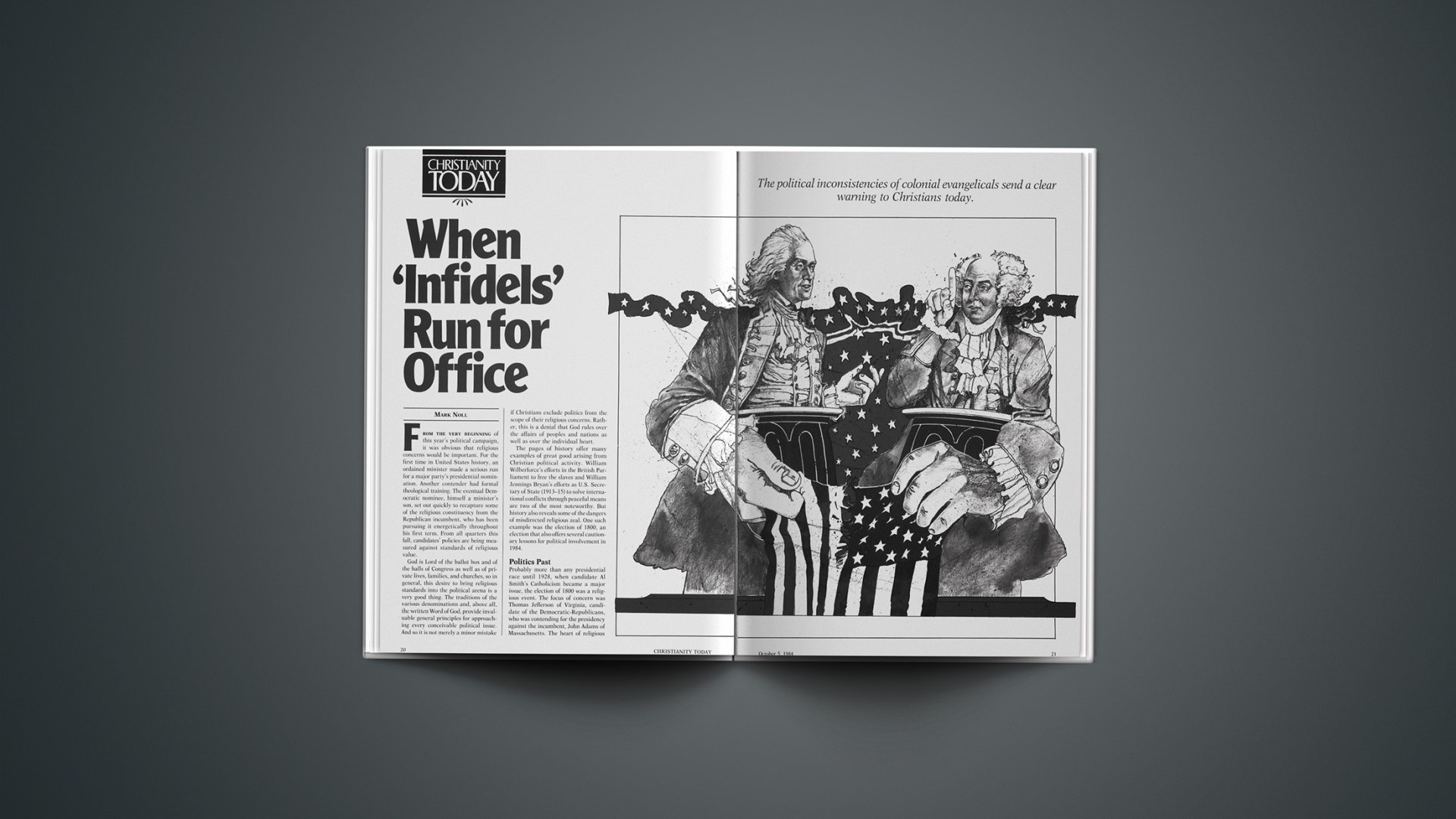
The Naked Public Square: Without Religious Ideals, Democracy Becomes Dangerous

Most people allow that democracy’s historical roots are somehow related to biblical religion. Most, but not all. Some textbook tellings of democracy’s story attribute the whole idea to classical Greece. In this version, the influence of Christianity was entirely negative. Religion as the enemy of democratic freedom is epitomized, it is said, in the Inquisition. The classic period and our modern era of enlightenment are the opposite of everything represented by the Inquisition. Those who tell the story this way overlook the fact that in 300 years the Inquisition had fewer victims than were killed any given afternoon during the years of Stalin’s purges and Hitler’s concentration camps. Nonetheless, it is asserted that the modern era is uniquely friendly to democratic freedom.

The American experiment, which more than any other has been normative for the world’s thinking about democracy, is not only derived from religiously grounded belief, it continues to depend upon such belief. In his first year as vice president under the new Constitution, John Adams said, “We have no government armed with power capable of contending with human passions unbridled by morality and religion. Our constitution was made only for a moral and a religious people. It is wholly inadequate for the government of any other.”

Secular historians and social theorists typically assert that a new and different grounding is now necessary, for in a “secular society” religion cannot provide the cohesion required. The assertion that we have “moved beyond” the possibility of a religious grounding of democracy says more about those who make the assertion than it does about American society.

Americans, as a people, are as religious, probably more religious, than they have ever been. Their religious allegiances are identifiably Judeo-Christian. Dissent from a broadly defined religious orthodoxy is perhaps more marginal today than it was in the heyday of eighteenth-century deism. The militantly antireligious campaign of, for example, a Thomas Paine would likely have little influence today.

The discussion of religion’s demise in “secular America” is a discussion carried on within a relatively small elite. All the while, ordinary people have gone along assuming that of course morality, public and private, is derived from religion. Most are mildly puzzled and a minority is outraged when told in textbooks and television that ours is a secular society.

Desire Disguised As Fact

Among the outraged, the suspicion grows that there is some kind of conspiracy afoot. It is said that certain elites declare things to be the way they want things to be. They declare the demise, or at least the decline, of religion because it is required for the kind of emancipation they seek. They declare the nuclear family to be moribund because the family is seen as repressive.

Meanwhile, however, the great majority of Americans, heedless of the wisdom imparted by their presumed betters, continue to go to church and to rate the “traditional” family as among life’s highest goods.

I served as presidential appointee on the ill-fated White House Conference on Families. One of the forces there was a cluster of activist homosexual organizations. It, in alliance with some feminists, was instrumental in having the name of the conference changed: from White House Conference on the Family to White House Conference on Families. The plural was critical because, they asserted, the sixties and seventies had witnessed a revolution in “alternative lifestyles” and alternative ways of defining what constitutes a family.

In a public hearing a gay activist spokesman, a medical doctor, was urging that the conference recommend changes in family law that would reflect this “revolution.” He agreed that the government’s legitimate interest in the family was protecting children and other dependents. In the ensuing exchange we explored the nature and extent of the revolution.

Stipulating for the sake of the exchange that 10 percent of the population is homosexual in inclination, it was allowed that there are about 25 million homosexuals in America. How many of those who are homosexual in orientation are exclusively and actively homosexual in practice? The doctor said his organization estimated the number to be 20 percent, thus arriving at the figure of 5 million “gays.” Since one-night stands could not qualify as a “family unit,” it was agreed that there should be a “longevity test” for such qualification, say of five years living together.

While lacking precise statistics, the doctor’s “informed guess” was that about 5 percent of homosexual couples had lived together for five years or more. Of these 125,000 “married couples,” how many would have a child or elderly dependent in their care? Again, he thought about 5 percent, meaning 6,250 homosexual “families” of legitimate interest to government policy. The doctor’s figures may be greatly inflated, but even if they are accurate, in a society of more than 230 million people the revolution he and others declare is an almost imperceptible ripple. A few thousand or a few hundred people are very important and, for the sake of children and dependents, public policy must take them into account. But that a national commission should spend millions of dollars recommending the overhaul of family law in America on the basis of such “revolutions” is, not to put too fine a point on it, absurd. Yet it is but one in a long list of absurdities by which desire is disguised as declaration of fact.

For better and for worse, traditional values are very much alive in America. Some who view all tradition as oppressive earnestly desire that such values should die. Toward that end, they propagate “the fact” of their demise. However many there are who actively promote a revolutionary reevaluation of values, there are many more who quietly assimilate the dogmas of secularism.

Among those dogmas, few have been so widely assimilated as the proposition that ours is a secular society. Religion may be indulged in privacy, but it is no longer available for the reconstruction of the public ethic. What has happened in recent decades is a redefinition of what constitutes “the real world.” Under the current guardians of public perceptions, religion only shows up on the screen when it impinges upon a real world defined apart from religion. We have all agreed, have we not, that ours is a secular society?

Media And Secularization

Those of us who received the grace of working with Martin Luther King, Jr., know how profoundly his life and work were empowered by religious faith. Following King’s assassination, a television announcer spoke in solemn tones: “And so today there was a memorial service for the slain civil rights leader, Dr. Martin Luther King, Jr. It was a religious service and it is fitting that it should be, for, after all, Dr. King was the son of a minister.”

How can we explain this astonishing blindness to the religious motive and meaning of King’s ministry? The announcer was speaking out of a habit of mind that was quite unconscious. The habit of mind is that religion must be kept at one remove from the public square, that matters of public significance must be sanitized of religious particularity.

The misunderstanding of King is not an isolated instance but is symptomatic of the way our world is interpreted by prestige communicators. These interpreters are not the mastermind of a secular humanist conspiracy, but victims of the secularizing mythology of which they are hardly aware. Thus, were the mythical Man from Mars to watch television news and read the prestige press for many months, he would likely be quite oblivious to the role of religion in the society. He certainly would not know that, next to family and work, the things that Americans do most are called religion.

The point is not to excoriate the media. The point is that the widespread exclusion of religiously grounded values and beliefs is at the heart of the outrage and alienation of millions of Americans. They do not recognize their experience of America in the picture of it purveyed by cultural and communications elites. At the heart of this nonrecognition—which results in everything from puzzlement to crusading fever—is the absence of religion.

At one level, it can be said that the prevailing situation is extremely non-democratic. At another level, more closely related to sociological theory, it must be said that the situation cannot be sustained. The emptiness of the public square will be filled by a state-promulgated civil religion, which poses a threat of totalitarianism. Or the emptiness will continue until the public square is finally invaded by one or another existing belief system, whether of the Left or the Right.

Church And State: Not A New Problem

It is important to caution ourselves against the crisis mongering of those who would tell us that these problems came into being only yesterday. The role of religion and the democratization of public values have been problematic from the beginning of the American experiment. Thomas Jefferson was hardly a conventionally religious person. Unlike many of those who signed the Declaration of Independence, he thought one of its central purposes was to free people from “monkish ignorance and superstition.”

Monkish ignorance and superstition, in his view, is what is ordinarily meant by Christian orthodoxy. Jefferson thought his “Bill for Establishing Religious Freedom” in Virginia one of the three greatest achievements in his life. The same Jefferson, however, had no illusions that democracy had resolved the religious question by establishing “the separation of church and state.”

Consider, for example, his well-known reflection on the immorality of slavery: “And can the liberties of a nation be thought secure when we have removed their only firm basis, a conviction in the minds of the people that these liberties are the gift of God? That they are not to be violated but with his wrath? Indeed I tremble for my country when I reflect that God is just; that his justice cannot sleep forever.…”

Jefferson understood that the naked public square is a very dangerous place. No constitution or written law is strong enough to defend rights under attack. Their “only firm basis” is in their being perceived as a transcendent gift. At the same time, the denial of such rights, as they were denied by slavery, cannot be sustained without invoking the dreadful judgment that follows upon the defiance of that moral basis.

Law And Secularization

Jefferson’s understanding of the unstated religious foundation of this democracy has been seconded frequently by the Supreme Court. A problem has been, and continues to be, how to state the unstated. In other words, the goal is to acknowledge the “only firm basis” of democracy without running into the difficulties of a government establishment of a particular way of expressing that religious basis. The careful balancing and nuancing that is required is evident in Zorach v. Clauson (1952) in which the Court declared, “We are a religious people whose institutions presuppose a Supreme Being.” This is a statement not of establishment but of acknowledgment.

Determined secularists sometimes dismiss the Zorach decision as something of a quirk in American judicial history. The statement in Zorach, however, was not an idiosyncratic aside. It was accompanied by reasoned explanation that bears a closer look: “We are a religious people whose institutions presuppose a Supreme Being. We guarantee the freedom to worship as one chooses. We make room for as wide a variety of beliefs and creeds as the spiritual needs of man deem necessary. We sponsor an attitude on the part of government that shows no partiality to any one group and lets each flourish according to the zeal of its adherents and the appeal of its dogma. When the state encourages religious instruction or cooperates with religious authorities by adjusting the schedule of public events (such as “released time” in schools) to sectarian needs, it follows the best of our traditions. For it then respects the religious nature of our people and accommodates the public service to their spiritual needs. To hold that it may not would be to find in the Constitution a requirement that the government show a callous indifference to religious groups. That would be preferring those who believe in no religion over those who do believe.”

A little over 10 years later, in 1963, Abington came before the Court. The quarrel then had to do with Pennsylvania’s practice of Bible reading in government schools. Justice Clark wrote for the majority and attempted, as is required, to demonstrate that the decision was in agreement with prior Court pronouncements. Quoting from an earlier finding, he acknowledged that “the history of man is inseparable from the history of religion.” He observed that many of the founding fathers believed in God and cited other instances in which the state continues to recognize religion.

Scholars have pointed out, however, that there is a significant shift from Zorach to Abington. In the second there is no affirmation that our institutions presuppose a Supreme Being. Nor is it said, as it was said in Zorach and earlier statements, that people do in fact have religious needs that the state must respect. Nor is there admission of the need for public encouragement of religion. As Prof. Glen Thurow writes: “All that is recognized [in Abington] is that our people do in fact participate in religious observances.… The Court does not say whether it is good or bad that our national life reflects a religious people.”

Abington is curious in another way. Historically, religious freedom was thought to be in the service of religious practice. Religious freedom was not primarily freedom from religion—although the freedom to espouse no religion or even to oppose all religion was carefully protected—but freedom to exercise religion in whatever way a person deems fit. In Abington, however, religious freedom is set against religious observance. Again Thurow: “Religion and the policy of freedom of religion are no longer seen as having a common root in recognition of presumed spiritual needs and institutional dependency on a Supreme Being. There is not one tradition, but two.”

Abington set asunder what had been a unified tradition, as articulated in Zorach and innumerable other statements from our legal and political history. Some of the other justices recognized the ominous implications of Abington. When “religious freedom” is set against religious observance it tends to become the same thing as secularism. If, in addition to that, the burden of constitutional guarantees are put on the side of this version of religious freedom, the state’s alleged neutrality to religion easily slides into hostility. Justice Stewart said as much in his dissenting opinion: “And a refusal to permit religious exercises thus is seen, not as the realization of state neutrality, but rather as the establishment of a religion of secularism, or at the least, as government support of the beliefs of those who think that religious exercises shall be conducted only in private.”

Although agreeing with the decision, Justices Goldberg and Harlan also had grave misgivings: “But unilateral devotion to the concept of neutrality can lead to invocation or approval of results which partake not simply of that noninterference and noninvolvement with the religious …, but of a brooding and pervasive devotion to the secular and a passive, or even active, hostility to the religious.” In their reservations, the justices edge up to the insight that the naked public square cannot remain truly naked. The need for an overarching meaning, for a moral legitimation, will not go undenied. What is called neutrality toward religion is an invitation for a substitute religion. That substitute will be constructed from reasoning that is compatible with “a brooding and pervasive devotion to the secular.”

While the 1952 decision is more satisfactory than that of 1963, Professor Thurow is correct, I believe, in arguing that both miss the public character of religion and of religiously based values. Thurow’s point is worth quoting at some length:

“Justice Douglas asserts that our institutions presuppose a Supreme Being, but he discusses only the accommodation of private desires and needs. Neither opinion raises directly the question of the public good involved. As under the theory of laissez faire in economics, the theory of the Court is that it is the function of government to allow or facilitate and to harmonize the private religious or irreligious desires of individual citizens, without any explicit consideration of the public good. But we may wonder whether the conflicting private desires of citizens can be harmonized for the public good without considering what the public good as a whole requires” (emphasis added).

This supposed neutrality to religion is a novelty, a break with the one tradition of the republic. Along with many other students of the subject, Thurow points to Abraham Lincoln as the exemplar of that tradition. Before the tradition was split and religious freedom was set against religion, it was understood that reference to the transcendent was a public reference by which public purpose was defined and judged. To be sure, that way of speaking of God in public lingers on in presidential Thanksgiving Day proclamations and in inaugural ceremonies. But such references are thought to be no more than elements of a vapid and residual “civil religion.”

Private Religion

As in the media, then, so also in the courts and centers of higher learning it is more or less taken for granted that ours is a secular society. When religion insists upon intruding itself into public space with an aggressive force that cannot be denied, it is either grudgingly acknowledged, or alarms are raised about the impending return of the Middle Ages. Then the proposition becomes more explicit: if ours is not a secular society, it should be. Unless overwhelmingly countered by the evidence, the tendency is for that desire to be presented as fact. For an event to be legitimately public, it must be secular. If it is touched by religion, that is to be viewed as a private and somewhat idiosyncratic factor. King was a legitimate public figure, despite the fact that he “was the son of a minister.” One “happens to be” religious, but it is not a factor that warrants public consideration.

Public consideration of the religious beliefs of others is an invasion of privacy. The public assertion of one’s own beliefs is an imposition upon carefully sterilized space. In the modern version of civility we agree not to lay uncomfortably ultimate burdens upon others. Our highest religious duty is not to offend those who might be offended by the idea of religious duty. There is much that is necessary and even admirable in this understanding of civility. But civility is vacuous when separated from the civitas of shared values. More than being vacuous, it is untenable; it inevitably results in the construction of values that are hostile to those values that might have given offense in the first place.

The democratic vitalities of America are today being stirred by those who were not consulted when it was decided that this is a secular society. Groups like the Moral Majority come to the public square not with the political religion of the republic but with the revivalist politics of the camp meeting. Confession of sin, repentance, decision, walking the sawdust trail—all is transferred to political campaign and ballot box. Revivalist politics is also not new in American life. It is usually populist in nature and can erupt on the political Right or Left. In 1972, George McGovern accepted the presidential nomination in a ringing speech that catalogued America’s iniquities, its wanderings from the path of righteousness. Again and again he cried out, “Come home, America!” Condemnation, contrition, turning, and returning—such are the elements in what the theologians call the ordo salutis, the steps of salvation, whether for persons or nations.

The alliance between religion and the protest against perceived cultural directions is not accidental. That is, the protest could not have allied itself with some other institution, such as the university, or labor unions, or a political party. This is true because other institutions have narrower interests and lack a base in mass participation. But it is most importantly true because only religion must, by definition, insist upon moral truth that is transcendent, intersubjective, and therefore normative. True, science and the university that limits itself to scientific knowledge speak about normative truth; but, again by definition, scientific knowledge does not address the issue of moral purpose, not to mention the question of transcendent judgment.

Without a transcendent or religious point of reference, conflicts of values cannot be resolved; there can only be procedures for their temporary accommodation. Conflicts over values are viewed not as conflicts between contending truths but as conflicts between contending interests. If one person believes that incest is wrong and should be outlawed while another person believes incest is essential for sexual liberation, the question in a thoroughly secularized society is how these conflicting “interests” might be accommodated.

Since the person who practices incest can do so without denying the rights of the person who abhors incest, the accommodation will inevitably be skewed in favor of incest. Similarly, one person believes the government has an obligation to assist the poor through tax dollars while another denies that there is any such obligation. Since the “interests” of the first person cannot be accommodated without interfering with the “interests” of the second person (by imposing higher taxes), the accommodation will be skewed in favor of the second.

What the justices described as a “pervasive and brooding devotion to the secular” leads to the extreme forms of libertarianism that erupt from time to time on both the Left and the Right of the political spectrum. It is tenuously based upon the split in the one tradition by which historically our public life was held accountable to critical judgment. In a thoroughly secular society, notions of what is morally excellent or morally base are not publicly admissible. That is, they are not admissible as moral judgment: they have public status only as they reflect the “interest” of those who hold them. Only when we are forced to talk about morality within the context of the formal polity as, for example, in court cases, do we discover that the secular theory about our common life is frustrated by the moral and religious character of our common life.

In New York State a law has been passed forbidding the use of young children in the making of pornographic films. In order to protect it against challenges from extreme civil libertarians, it is specifically stated that the law is not based upon moral or religious reasons. The reasoning offered is that making pornographic films is injurious to the mental health of young children. Such are the results of what Philip Rieff described as “the therapeutic society.”

A secular polity requires that we profess more confidence in the “scientific” notions of psychiatry than in our moral judgment. In fact, while psychiatric and a host of other considerations might inform moral judgment, the law reflects the moral judgment of legislators who are responsive to the moral judgment of their constituencies. But they cannot admit that the law is based upon moral judgment. In a court challenge, expert psychiatric witnesses would no doubt be produced to testify that child pornography is perfectly healthy. Perhaps even a professional association of therapists might so testify, much as American psychiatrists in recent years “scientifically” determined that homosexuality is no longer an illness. Were that to happen, the legislature would have to resort to some other excuse by which to disguise its acting upon its moral judgment that child pornography is wrong.

Aristotle speaks of the impossibility of discussing virtue with people who are “handicapped by some incapacity for goodness.” The notion of a secular society compels political actors to pretend to be more morally handicapped than they are. It might be argued that this is the price to be paid for a pluralistic society. The price is too high. What is meant by “pluralism” in such arguments is frequently indifference to normative truth, an agreement to count all opinions about morality as equal (equal “interests” to be accommodated) because we are agreed there is no truth by which judgment can be rendered. The result is the debasement of our public life by the exclusion of the idea—and consequently of the practice—of virtue.

Virtue And Politics

A familiar statement from Aristotle is pertinent: “Anything that we have to learn to do we learn by the actual doing of it: people become builders by building and instrumentalists by playing instruments. Similarly we become just by performing just acts, temperate by performing temperate ones, brave by performing brave ones. This view is supported by what happens in city-states. Legislators make their citizens good by habituation; this is the intention of every legislator, and those who do not carry it out fail of their object. This is what makes the difference between a good constitution and a bad one.”

It is only in recent years that the Constitution of the United States has been interpreted to mandate that legislators fail, or at least pretend to fail, in carrying out their object. As “by habituation” we pretend not to be concerned for the good, we become what we pretend to be. The intervention of religiously based values in public affairs is a protest against that pretense. Whether that intervention speaks to our obligation for the hungry of the world or to the necessity of protection of the unborn and other endangered humans in our own society, it is a call for us to assume the dignity of being moral actors.

We are not merely atomistic individuals with interests to be accommodated but persons of reason and conviction whose humanity requires participation in the process of persuasion. From Aristotle through Jefferson, and up to the very recent past, politics was thought of as that process of persuading and being persuaded; a process engaged in by a community brought into being by its shared acknowledgment of the existence of truth beyond its certain grasp.

It is not that the greats of Western political philosophy did not understand the importance of accommodation. Burke, reflecting on the American experience, observed: “All government—indeed, every human benefit and enjoyment, every virtue and prudent act—is founded on compromise and barter.” Persuasion often reaches its limits. It is one thing for you to propose a compromise when you realize that you will not persuade your neighbor of your understanding of the truth. It is quite another to conclude that there is no question of truth involved. In the first instance you remain a moral actor, acting according to the virtue of prudence. In the second instance, it is merely a matter of ciphers with conflicting interests splitting the difference.

Were the battle against a cabal of “secular humanists,” as some would have it, there would be reason for greater optimism. They could be exposed and driven from their positions of influence, perhaps. Our difficulty is greater than that. It is the pervasive influence of ideas about a secular society and a secular state, ideas that have insinuated themselves also into our religious thinking and that have been institutionalized in our politics.

The proposition that America is a secular society is contrary to sociological fact. The American people are more incorrigibly religious than ever before. The proposition is impossible in principle. The American experience is not self-legitimating; it requires what it has until recently possessed, some sense of transcendent meaning. And the proposition is politically unsustainable. There are simply too many people who are no longer prepared to pretend that we are not the kind of people we are.

Whatever he may have meant by it, and whatever he did with it, Jimmy Carter’s intuition was democratically sound: the task is to provide government as good as are the American people. More precisely—since Americans are not necessarily more “good” in their behavior than others—a government responsive to the good to which most Americans aspire. Whatever our political persuasion, if we care about a democratic future, we have a deep stake in reconstructing a politics that was not begun by and cannot be sustained by the myth of secular America.

Tim Stafford is a free-lance writer living in Santa Rosa, California. He is a distinguished contributor to several magazines. His latest book is Do You Sometimes Feel Like a Nobody? (Zondervan, 1980).
When ‘Infidels’ Run for Office

The political inconsistencies of colonial evangelicals send a clear warning to Christians today.

From the very beginning of this year’s political campaign, it was obvious that religious concerns would be important. For the first time in United States history, an ordained minister made a serious run for a major party’s presidential nomination. Another contender had formal theological training. The eventual Democratic nominee, himself a minister’s son, set out quickly to recapture some of the religious constituency from the Republican incumbent, who has been pursuing it energetically throughout his first term. From all quarters this fall, candidates’ policies are being measured against standards of religious value.

God is Lord of the ballot box and of the halls of Congress as well as of private lives, families, and churches, so in general, this desire to bring religious standards into the political arena is a very good thing. The traditions of the various denominations and, above all, the written Word of God, provide invaluable general principles for approaching every conceivable political issue. And so it is not merely a minor mistake if Christians exclude politics from the scope of their religious concerns. Rather, this is a denial that God rules over the affairs of peoples and nations as well as over the individual heart.

The pages of history offer many examples of great good arising from Christian political activity. William Wilberforce’s efforts in the British Parliament to free the slaves and William Jennings Bryan’s efforts as U.S. Secretary of State (1913–15) to solve international conflicts through peaceful means are two of the most noteworthy. But history also reveals some of the dangers of misdirected religious zeal. One such example was the election of 1800, an election that also offers several cautionary lessons for political involvement in 1984.

Politics Past

Probably more than any presidential race until 1928, when candidate Al Smith’s Catholicism became a major issue, the election of 1800 was a religious event. The focus of concern was Thomas Jefferson of Virginia, candidate of the Democratic-Republicans, who was contending for the presidency against the incumbent, John Adams of Massachusetts. The heart of religious concern was the expectation that the nation would come to grief if the “infidel” Jefferson were elected. Those who expressed this concern were almost exclusively evangelicals. Moreover, they were not insignificant persons on the fringes, but were among the country’s leading Christian spokesmen.

They included such dedicated New England Congregationalists as Timothy Dwight, president of Yale College, and Jedidiah Morse, a leading promoter of theological education, foreign missions, and the dissemination of the Bible. Evangelical clergymen in New York, such as the Scottish Presbyterian John Mitchell Mason, echoed the concerns of their Congregational brethren to the North. Presbyterians from New Jersey, including the president of Princeton, Samuel Stanhope Smith, and one of the most active Christian laymen in the country, Elias Boudinot, expressed a similar foreboding for the nation’s future if Jefferson were to win the election.

These evangelicals feared Jefferson for several reasons, all of which seemed to make the prospect of his election a horror. In the first place, Jefferson had led the fight in Virginia for the disestablishment of the Anglican church immediately after the American Revolution. Evangelical Congregationalists in New England saw this move as an assault upon religion altogether, for their denomination was still established by law in both Connecticut and Massachusetts. To them this establishment was but the necessary recognition that societies needed to acknowledge and heed the will of God. Evangelicals in New York and New Jersey were not committed to establishment, but they resented the way in which Jefferson had appeared to belittle all religion when he had spoken out for disestablishment.

Particularly galling to these evangelicals were statements Jefferson had made in his Notes on Virginia, published in 1784. In it, Jefferson seemed to dismiss the importance of Christian belief in favor of a radical kind of freedom. “It does me no injury,” Jefferson had written, “for my neighbor to say there are twenty gods, or no God. It neither picks my pocket nor breaks my leg.” Jefferson rather put his trust in “reason and free inquiry,” for these were “the only effectual agents against error.” Such statements, and the flippant spirit evinced by some of Jefferson’s other comments (e.g., “the happy discovery, that the way to silence religious disputes, is to take no notice of them”), seemed to indicate that Jefferson opposed religion itself as much as its establishment.

To be sure, Jefferson’s stand on church and state had won him the support of a few Baptists and a small number of other evangelicals who opposed a religious establishment in principle. But their influence was much less than that exerted by the presidents of the country’s two most prestigious evangelical colleges (Yale’s Dwight and Princeton’s Smith) and the most visible leaders of interdenominational cooperation (Massachusetts’s Morse and New Jersey’s Boudinot).

Jefferson himself was always reticent to make public his religious beliefs. He was a member in good standing of his Episcopal church in Virginia, and later in life he would even contribute to a local Bible society. Yet rumors had spread of his unorthodox views. It was said that he so highly exalted reason that he had no place for divine revelation. Another widely circulated suspicion was that Jefferson did not believe in the deity of Christ, but rather held him simply to be an extraordinarily good man. While nothing definite could be said about these matters in 1800 (they happened substantially to represent Jefferson’s actual beliefs), enough information was abroad to make some Christians very uneasy.

Yet another cause for concern was Jefferson’s connections with France. He had served as an ambassador to that country for several years, and had made no secret about his admiration for the French philosophes and for the general course of the French Revolution. Even when that revolution turned to bloody excess, and when many other Americans began to repudiate it, Jefferson continued to support those Frenchmen who wanted to rid themselves of the fetters of the past. To many evangelicals in America, Jefferson’s fondness for things French told volumes about his own instability. In their minds France was the country where a prostitute had been crowned as the Goddess of Reason at the cathedral of Notre Dame. It was the place where unchecked violence had first overthrown settled government, then executed the ruling family, and at last given way to the dictatorship of Napoleon Bonaparte. Anyone who professed to find this attractive was a threat to his own country.

A third reason why many evangelicals feared Jefferson was that he represented the political opposition. During George Washington’s first term as President (1789–93), political leaders had succeeded in preserving the vision of nonpartisanship that had been born during the Revolution. But in Washington’s second term and during the tenure of John Adams as President (1797–1801), great infighting had broken loose. Democratic-Republicans contended for liberty and the people; the Federalists were loud in defense of order and security. To those evangelicals who were also Federalists, Jefferson as the leader of the Democratic-Republicans had to bear the responsibility for destroying the harmony of the republic. Faction, partisanship, discord, turmoil—all seemed to be the responsibility of the upstarts who clamored for states’ rights, liberty, and the freedoms of the people. (Democratic-Republicans, it is hardly necessary to add, felt that the cause of public strife was the highhandedness of the Federalists, represented most strikingly to their minds by the repressive Alien and Sedition Laws that had been passed during President Adams’s tenure.)

These then were the reasons why many evangelical leaders feared Jefferson. He was a foe to the public influence of religion. He was suspect in his own personal beliefs. He was contaminated by the irreligion and disorder of France. And he was responsible for the great degeneration in American public life.

As the election of 1800 neared, evangelicals went into action to make their views on Jefferson known. On the Fourth of July in 1798, Timothy Dwight spoke out against the party of Jefferson by linking Democratic-Republicans explicitly to the atheistic movements of France. “For what end shall we be connected with men of whom this is the character and conduct?… Is it that our churches may become temples of reason … and our psalms of praise Marseilles hymns? Is it that we may change our holy worship into a dance of Jacobin frenzy and that we may behold a strumpet impersonating a Goddess on the alters of JEHOVAH?”

As the election came closer, concern grew more intense. John Mitchell Mason posed the terms very starkly in the election year itself: “Fellow Christians—A crisis of no common magnitude awaits our country. The approaching election of a president is to decide a question not merely of preference to an eminent individual, or particular views of policy, but, what is infinitely more, of national regard or disregard to the religion of Jesus Christ.… I dread the election of Mr. Jefferson, because I believe him to be a confirmed infidel.” And shortly before the states began to vote, the Federalist Gazette of the United States offered its own ultimatum: “THE GRAND QUESTION STATED: At the present solemn moment the only question to be asked by every American, laying his hand on his heart, is ‘Shall I continue in allegiance to GOD AND A RELIGIOUS PRESIDENT (John Adams) or impiously declare for JEFFERSON AND NO GOD!!!’ ”

A Conspiracy Theory

The last fear hanging over the heads of these leaders was that Jefferson might be the agent of an atheistic conspiracy. In 1798, first Jedidiah Morse and then Timothy Dwight had proclaimed the existence of a vast conspiracy, called the Bavarian Illuminati, which they supposed was reaching its tentacles into the United States. Morse and Dwight were availing themselves of detailed exposés from the continent that had identified the Illuminati as the source of most of the public evil that had occurred in Europe for the past century. Now they felt that the combination of godlessness and disorder spreading over the United States was a sign that the agents of this conspiracy were abroad in the land. And since they linked the “levelling” (or democratic) ideas and the French Revolution to this conspiracy, it was only natural that they saw Jefferson as the agent, witting or unwitting, of this cabal.

By the time of the actual voting in 1800, doubt had been cast on the Illuminati theory, but numerous evangelical leaders still believed that such an evil conspiracy was a genuine threat. In this Morse and Dwight were joined by some of the Presbyterians, including Samuel Stanhope Smith.

Immediately after Jefferson’s victory, some of those who had opposed him on religious grounds felt that the worst was just around the corner. Princeton’s President Smith, for instance, felt that Jefferson was promoting policies that led to “national imbecility and disorganization” and that he was encouraging “turbulence and anarchy” by delivering the nation “from one hotheaded and furious faction to another, till we are torn asunder.”

Inconsistencies And Ironies

No one can doubt the sincerity of the evangelicals who opposed Jefferson, nor can they be faulted for their desire to promote godliness in the public sphere. They were also approximately correct in their assessment of Jefferson’s own religious beliefs. He was not, by any stretch of the imagination, an orthodox Christian. And he valued Christian churches mostly for their role in preserving public morality. It is certainly true as well that evangelical leaders saw correctly some of the dangers in Jefferson’s political convictions. His educational theories, as an example, had no place for religious influence, but rather promoted a false ideal of humanistic neutrality.

All this having been said, the great religious outcry against Jefferson was both inconsistent and quite ironical. It was inconsistent because Jefferson’s opponents failed to apply their exacting religious standards to their own candidates. And it was ironical because the “infidel” Jefferson turned out to be among the most moral and upright of Presidents.

In the first instance, Federalists who opposed Jefferson for his heterodoxy failed to apply the same standards to their own candidate. While John Adams, like Jefferson, did not display his religion on his sleeve, his actual convictions were very close to Jefferson’s. John Adams’s wife, Abigail, was evangelical in belief and practice, but he was more of a conservative Deist. Like Jefferson, he belittled the Christian reverence for Scripture, once writing his son John Quincy in reproof for the younger Adams’s belief that one could find the scriptural solution to a problem. And like Jefferson, he held that the idea of an Incarnation was simply nonsense.

Much more important for modern considerations is the larger irony that attends the Christian opposition to Jefferson. His administration turned out to have a moral tone and to promote policies that, in several crucial areas, comported well with basic Christian values. In matters of personal rectitude, as an example, Jefferson was scrupulous in accounting for federal funds and conducted himself with great probity in the dispensation of patronage. In this he differed dramatically from Alexander Hamilton of the Federalists and Aaron Burr of his own party, two statesmen who regularly used politics to enhance their own prestige or increase their own wealth. Jefferson, by contrast, went out of his way to act honorably with the funds and personnel entrusted to his care. When he died he was in debt, not because he was profligate with his abilities and goods, but because he had put the public good ahead of private gain.

Apart from matters of personal honesty, Jefferson’s policies were also generally moral. He carried into the White House the effort he had begun in Virginia to insure freedom of religious expression for all citizens, and to prevent the state from imposing one form of religious belief or another on its citizens. This was but a specific instance of his belief that governmental intrusion into ordinary life was dangerous. Throughout his career Jefferson was an advocate of less government rather than more. He did not despise the accomplishments of organized politics, but he felt that the great powers potentially available to government made it a likely candidate for corruption. In this the Enlightenment thinker (who otherwise had an optimistic view of human nature) displayed a greater degree of Christian realism than the believers among his opponents (who often talked as if governmental aid for the churches and large-scale governmental activities were both unalloyed blessings).

Jefferson And War

Perhaps most strikingly, Jefferson also showed a Christian respect for life. The most obvious example here was his great reluctance to commit the nation to war. During his administration, tensions with both France and England were often high. As a consequence there were voices in both major parties insisting on war as a way to defend the national honor. Many patriots felt that only the field of battle could bring vindication against England’s highhanded dominance of the sea, or against France’s attacks on American shipping. While Jefferson was not a pacifist, he nonetheless was deeply opposed to warfare, except as a last resort. And so he resisted these appeals and tried to find peaceful alternatives to international conflicts.

Jefferson’s most explicit pursuit of peaceful internal politics involved the Embargo Act. This was an effort to force Britain and France to negotiate with the United States by closing American ports to all shipping, foreign and domestic. The occasion for this policy was a blatant act of British aggression on America’s very shores. In late June 1807, the British warship Leopard attacked an American ship, the Chesapeake, as the American vessel was clearing the harbor at Norfolk, Virginia. The British were looking for deserters from their navy, but the unprovoked assault upon the American ship, which resulted in 21 casualties, was a recognized justification for war. Against the outcry for immediate retaliation, Jefferson pursued a course of deliberate procrastination. Finally, he acted late in the year by encouraging Congress to pass the Embargo Act. His purpose in all of this was to avoid the slaughter that battle entailed, even in that day of wooden warships and single-shot muskets.

Historians and political scientists have long been divided concerning the success of the Embargo Act. It did bring much greater economic hardship to American merchants than to either the British or the French. And Jefferson was not entirely successful in cooling tensions. Still, his efforts were a partial success. He had shown how it was possible at least to attempt peaceful means of solving international conflicts. And he had demonstrated that a President could cool passionate nationalistic ardor. Many historians today feel that when war with Britain did come in 1812, under the leadership of President James Madison, it was a needless conflict that could have been avoided with only a little more of the restraint that marked Jefferson’s handling of the earlier crisis.

In sum, the individual whom evangelicals had feared as an “infidel” turned out to be not only an honest President, but a President whose policies reflected at least a general agreement with basic Christian values. This is not to say that Jefferson was more moral than Adams or even that his policies were always more in line with biblical values. It is to say that the great fears of Jefferson’s opponents in 1798, 1799, and 1800 were misplaced. They had misread the man and the times as well.

Lessons

A number of observations from the history of 1800 are pertinent for 1984. But first, it is important to say what the earlier story does not mean for our campaigns this year. It does not mean that Christian involvement in politics should cease. Nor does it mean that Christians are doing something illegitimate when they assess candidates and issues by moral and religious criteria. Soon after the election of 1800, in fact, evangelicals did tend to pay less and less heed to politics. It was as if they were being doubly cautious in light of their mistakes in assessing the issues in 1800. But this was unfortunate because large public issues—like states’ rights and slavery—needed consistent Christian consideration. Christians did much good in the first half of the nineteenth century in evangelism, moral reform, and mission efforts. But they did not contribute measurably to the political process. And the nation was the poorer for it.

The lessons to be learned from the anti-Jeffersonian fear deal rather with how Christians are to be involved politically. Here at least three matters are important.

The first of these concerns the damage done to the church when Christians identify their cause completely with any political party, position, or person. It simply was not the case that Jefferson and the Democratic-Republicans were the quintessence of evil, nor Adams and the Federalists the paradigm of virtue. Given important Christian teachings on human nature—that the redeemed can still act as sinners and that sinners can still contribute to public good—Christians in 1800 should have realized that a mixture of good and evil would be found in both parties. When they did identify the Christian cause with only one party, they demeaned both the faith and the political process.

Second, the story of 1800 should remind us that Christian activity in politics must involve an examination of public positions as well as of personal beliefs. Even if Jefferson were an unbeliever, his policies deserved to be analyzed in their own right. It is at least arguable that on more than one issue his public actions came closer to meeting biblical standards than those of the Federalists whom the evangelical leaders supported. On the matter of individual liberties, Jefferson recognized more clearly than his opponents that governmental meddling can lead to the abuse of religion even more than to its support. Given the American circumstances and the actual nature of the current threat, the Federalists’ Alien and Sedition Acts were an assault on liberty that did not comport well with Christian principles. In a similar way, Jefferson’s restraint on warfare showed a more consistent appreciation for the value of life than did the policies of those Federalists who were eager to go to war. Jefferson realized that no ultimate questions of justice or national self-existence were at stake in disputes with France or England, and so he sought peaceful solutions. In this he again acted in accord with general Christian principles.

The critics of Jefferson would have seen this more easily if they had pushed themselves beyond a mere reaction to his supposed beliefs to an analysis of his public record. Before the election of 1800, Jefferson had served as governor of Viriginia, the first secretary of state, and vice president. In each of these positions he instituted programs that showed a remarkable discernment concerning the potential evils of big government. And in each he evidenced a consistent respect for human life and dignity. As governor of Virginia he had worked to protect the rights of religious minorities (mostly evangelicals) who were not members of the Episcopal church. As Washington’s secretary of state in the early 1790s he had displayed considerable skill in promoting the interests of the United States against Britain, France, and Spain, while proceeding cautiously to avoid war.

Finally, the history of this entire subject constitutes a fresh reminder about the complexity of the political process. While certain issues will be more important in some campaigns than in others, issues are interrelated. While certain leaders may indeed be more genuinely Christian than others, their policies may yet contain a mixture of biblical and nonbiblical values. In the election of 1800, believers probably were correct to worry about Jefferson’s excessive commitment to democracy and his disrespect for political and religious traditions. Yet if they had gone on to analyze other issues with the same religious care, they may have discovered that other aspects of Jefferson’s record coincided much more closely with biblical values. It was not a mistake to judge Jefferson’s commitment to democracy with religious standards. It was a mistake to let a judgment on one part of his record overwhelm concern for the whole.

1800 And 1984

To realize the complexity of politics is certainly as important in 1984 as it was in 1800. Because politics partakes of the human condition, and because humanity is complex, Christians do well to approach political issues with careful analysis with a distrust of their first impressions, and with a commitment to explore as many sides of an issue as possible. Here the words of Elton Trueblood are appropriate: “One of the best contributions which Christian thought can make to the thought of the world is the repetition that life is complex. It is part of the Christian understanding of reality that all simplistic answers to basic questions are bound to be false. Over and over, the answer is both-and rather than either-or.”

A brief account of the 1800 election is not going to tell you how to vote in 1984. But it does offer some clues. First, look beyond rhetoric to actions. A person who uses God-talk freely should display a concern for public policy that conforms to godly standards. One who speaks moralistically in behalf of “the people” should not speak for only part of the population.

Second, analyze public action as well as stated platforms. Take time to examine the record of candidates. Let that record speak louder than the platitudes that make up so much of political advocacy.

Third, and most difficult, push your analysis out further to issues that do not at first strike you as particularly “religious.” For example, if you are consumed by a biblical vision of peace, by all means judge candidates by this criterion. But go further. Ask yourself if there are other important biblical values that should also be used to evaluate the policies and performances of candidates. A single issue—whether nuclear arms, abortion, women’s rights, educational freedoms, economic policy—may be more important at some times than others. But such single issues never exhaust the range of political life to which Christian values need to be applied.

With the hindsight of history it is possible to say that evangelical leaders in 1800 saw some things clearly and some things with distortion about politics. Today we may take from them the positive example of believers who were willing to speak out courageously in bearing witness to God amidst the give-and-take of the political marketplace. But evangelicals in 1800 would have been able to do better in politics if they had applied religious values more thoughtfully to more of the issues of the day. Almost 200 years later the world still needs redeeming Christian voices in politics as desperately as in any other human endeavor. May such voices in 1984 display both courage and intelligence, both fire and light.

Mark Noll is professor of history at Wheaton College. This essay was prepared with the assistance of Robert Lackie, a doctoral student in American history at the University of Illinois.

How Happy Are Hookers?

How Happy Are Hookers?

But not so with our third supposition, which is considerably intertwined with early incestuous relationships. The idea that prostitution is an endearing and useful profession—at least potentially, if people became more tolerant—is gaining momentum. In the media, glamorous actresses play roles that legitimatize, even romanticize, prostitution. Of course, this is not a new phenomenon. It is all reminiscent of those wonderful old westerns in which gaily dressed young ladies from the local brothel, full of spunk and self-assurance, teamed up with the guy in the white hat to foil the bad guys and prudish town fathers. Playboy’s cartoons depict gorgeous young things in brothels as both delighted and delightful, filled with good humor, and obviously enjoying their work.

Today one does not have to go to Playboy to be exposed to the new idea of the “happy hooker” and the rollicking sounds of the unashamedly advertised The Best Little Whorehouse in Texas. Even TV Guide recognizes a disturbing trend. Criticizing the “recent spate” of TV movies and series episodes about prostitutes, TV Guide has commented: “The subject is worthy of dramatic treatment, sure—but not always with the over glamorized image conveyed by the likes of Veronica Hamill, “Sessions,” and Loni Anderson, “My Mother’s Secret Life.” TV’s hookers are invariably attractive, rich, even classy—and they make the world’s oldest profession seem unduly respectable.”

“Well, why shouldn’t it be respectable?” is the vigorous rejoinder of certain prostitutes themselves. They spearhead another level of prostitution’s growing acceptance, that of serious articulation, COYOTE—Call Off Your Old-Time Ethics—held its Second International Hookers’ Convention July 16 in San Francisco, coinciding with the Democratic convention. These women speak at their national conventions and Donahue-type talk shows boldly, unapologeticly, humorously, and with a strong appeal to logic.

On the surface, their arguments seem telling. Surely the acceptance of prostitutes cannot be put on a par with racial intolerance—in fact, is it not just the opposite: a tolerant view of society’s victims and dissidents? Is not prostitution the best option for many women? In a pluralistic society, why should one person’s viewpoint stigmatize another? We are asked why we pass laws against women who harm no one but simply provide pleasure? We are told that if prostitutes were accepted as full human beings in America, as blacks and Jews have been, their conditions would radically improve.

Logical. Reasonable. And who among us does not wish to be tolerant and hear words spoken against the humiliations prostitutes experience? The respect and dignity these women yearn for we also wish for them. Issues of human sexuality are complex, and it is obvious that condemning incest or prostitution is not going to eliminate it. But tolerance as the solution whitewashes a situation in which a woman, made in God’s image, sells her body. Prostitution is ugly. The term “happy hooker” is a lie. For every Xaviera Hollander writing about the carnal delights of the profession (and obviously receiving large royalty checks for telling us this), there are scores of Linda Lovelaces with tales of brutal exploitation.

The Unhappy Hooker

Prostitutes like the ones who appeared on Donahue’s show may live well, and perhaps without surface guilt or even pain, but are they typical? Recent studies indicate not. For instance, more than one study has indicated around 60 percent of young prostitutes are victims of incest. As reported in the Chicago Tribune (June 24, 1984), respondents to Dr. Mimi Silbert’s study in San Francisco said they were first molested at the average age of 10, and that physical force or emotional or physical threats were used. Their typical responses were “I felt disgusted by sex”; “I felt dirty”; “I felt terrible.”

Dr. Silbert first noted two conditions: (1) an incestuous father or father-figure; (2) a child’s belief that no one will listen to her confused fears (or, worse, that others will accuse her of lying). The result? This, she says, “lays the foundation for prostitution. A lifestyle of learned helplessness ensues.” Through incest and other abuse, girls feel “sexually spoiled,” their feelings of inferiority compounded by other degrading experiences which lead them into prostitution as “their only choice.”

Significantly, none of the young female prostitutes surveyed mentioned pleasure as a motivation for entering the profession; and once involved, many felt there was no escape.

Said one fifteen-year-old in Minneapolis, “I hate what I’m doing. I don’t have fun at this.… I want to get out of it, but I can’t go home. My father’s no better than a trick [customer]. I mean, if someone’s going to mess with me, I might as well get paid for it, right?” The myth of “happy hookers” enjoying their trade doesn’t match reality.

And yet, fed by unchallenged acceptance of the myth that prostitution is harmless, a “victimless crime,” child prostitution is on the rise. One judge, apparently accepting the argument, sent a fourteen-year-old back to the streets again, asserting that prostitution is merely a “recreational transaction.” Such a position has immediate tragic consequences, among them an open field for the pimp.

But it is not just children who are exploited. Prostitutes themselves are pulled into a descending spiral. More than a decade ago New York Magazine ran a lengthy article by Gail Sheehy titled “Redpants,” which was carefully researched and thoughtfully written. One of the chilling aspects of that research was what happened to the beautiful young women who began as highly valued and highly paid prostitutes. As they grew older (entering their 20s) and lost some of their beauty, they were forced to work during more dangerous hours and made less money. By the time they reached their 30s they were often prematurely old and unattractive, with no recourse but to work the hours long past midnight when the income was very low and the potential for violence very high.

A social worker in Chicago confirms this downward slide. “I’ve been amazed,” she says, “at the number of bag ladies I work with who are former prostitutes. Now they have nothing to sell, and no future.”

Those who defend prostitution protest that by normalizing prostitution this is precisely the sordid picture they want to avoid. They might point to Amsterdam, for instance, where husbands drop off their wives in the morning and appreciate the extremely good pay the wives bring home at night. There it is accepted, and advertised worldwide.

Amsterdam may indeed be instructive. As someone has said about its red-light district, “Its primary driving sin is greed.” Anyone who has walked through the district and seen the proximity of drugs, warnings against pickpockets, the general degradation and violence, knows that what the city experiences is far from a liberating freedom and tolerance.

Most prostitutes have been entrapped and yearn for something better; relatively few have callously chosen prostitution with the same moral indifference as the adulteress so graphically warned against in Proverbs 5. To bright young women who have many options but still choose prostitution, we should speak out forcefully that it is corrosive. The wealthy Romans who drank out of lead goblets were, like some of these articulate women, unaware of the lead poisoning entering their bodies and could not account for the serious physical symptoms they experienced. Ironically, the slaves, drinking from clay goblets, were spared. These ancients never knew what was happening to them, and in a sense this is just the case with those self-assured women who willingly embrace the profession.

The women of COYOTE, however, will no doubt continue to hold fast to their argument. The discussions remind one of the great social and sexual experiments launched in the early 70s with a misunderstanding of the consequences. Writers and “experts” proposed that an open marriage, with occasional adultery mixed in for spice, would produce a healthier relationship. Many people experimented, and it took some time for them to realize that these proposals had been made with little basis in research or historical study. The results were disastrous. One writer in New York said she interviewed a great many of her friends who were having affairs. In beginning the interviews she fully expected her friends to be enriched with new horizons and expanding awareness. But—surprise—she found the affairs had been extremely destructive to both the marriages and the partners themselves. More than a dozen years later, some of the same writers who extolled the sexual revolution are admitting to the naïveté and excesses of those years. A similar awakening may one day occur among those who view prostitution as a mere “recreational exchange.”

What To Do?

How can Christians combat the myths surrounding prostitution? To be salt in the world means to engage the difficult questions (such as whether decriminalization would cause more or less pain); it means to confront ultimately destructive ideas and to make our views known.

First, we should praise the media for coverage like that already cited on teen prostitution, incest, and child abuse. We agree with TV Guide’s assertion that true dramatic treatment of prostitutes would be appropriate for television. What Roots did to sensitize us to the suffering of blacks, dramatic and accurate stories could do regarding prostitution. When television moves into “entertainment,” it should especially avoid sugarcoated stories on this subject. Second, we should ask the press to go beyond just reporting on statistics, and beyond a few brief paragraphs against glamorizing prostitution; it should publish the work of some editorialists who perceive the tragedy prostitution represents.

But in calling for this, we must also caution ourselves as Christians. While prostitutes were holding their first national convention in Washington, D.C., in the mid-seventies, three appeared on a local talk show with then-CT editor Harold Lindsell, who presented a scriptural viewpoint. Though they vigorously debated him, it was clear they felt they had no way out, and they asserted with some emotion that the churches would have nothing to do with them. It was a cry for help beneath their rhetoric, although today they would surely deny that. These women represent thousands who see no acceptance and no safe haven in the church. Yet it is the church which should represent Christ to them. The church is against prostitution because God is holy and because it supports their dignity as persons made in God’s image. When we project the opposite to them, we fail to act redemptively.

In contrast, Jesus treated Mary Magdalene with respect; she became a believer and it was she he honored with his first appearance after the Resurrection. When a prostitute washed Jesus’ feet with her hair, his host thought he should recoil from the woman of bad reputation. But instead, Jesus praised her tribute and criticized his host. The woman taken in adultery was told by Jesus to go and sin no more. But before saying that, he pointed out the sins of the religious people who had self-righteously dragged her there. It was obvious he considered religious pride and middle-class hypocrisy at least as damaging to the soul as sins of the flesh. The Gospels never record an instance where Jesus lashed out at prostitutes; and he freely moved among them despite risk to his reputation.

We must take care that we do not find ourselves on the side of those who, unlike Jesus, treat prostitutes as inferiors. If we think ourselves even slightly better than just one person, we do not understand our own doctrines. In addition, we must also be ready to admit with humility that the church historically has made some very bad judgments in regard to sex. Often Christians have distorted human sexuality, giving secularists ammunition to support their charge that we have disqualified ourselves to speak. Bad doctrinal assumptions stain the church: we are still suffering from the results of anti-Semitism, heretic-burning and racism, ideas once supported by many Christians. We must genuinely pattern both our standards and our actions after Christ and, in the words of Saint Francis, be an “instrument of his peace.” Only as we follow Christ’s compassionate yet holy example can we act as salt and light.

But that does not mean we cannot be outraged. To be outraged at prostitution is a Christian response. Unfortunately, our outrage agenda has been neatly circumscribed by our culture. We have learned to be outraged at some evil ideas but not others. On the plus side is our extreme touchiness about Jew-baiting and ethnic slurs: Thirty years ago children chanted, “Catch a nigger by the toe, if he hollers, let him go.” Most parents today would correct a child who chants that. But when we hear a lighthearted Best Little Whorehouse in Texas, and little snickering jokes about bordellos, we let them pass. Currently both in Germany and in the U.S. some dark humor treats casually what the Jewish people endured in the concentration camps. What if we heard in snickering bad taste a parody line, “The best little gas oven in Auschwitz”? Just reading the line makes us cringe. It does not belong in this magazine. And that is just the point. It is in horrible taste, unthinkable, and we should not let such a comment pass unchallenged.

In one way racial bigotry and prostitution have the same root—they deny a person’s value before God. Making light of prostitution makes light of vilifying persons loved by God. C.S. Lewis eloquently stated the positive side of this in The Weight of Glory:

“It is a serious thing to live in a society of possible gods and goddesses, to remember that the dullest and most uninteresting person you talk to may one day be a creature which, if you saw it now, you would be strongly tempted to worship.… All day long we are, in some degree, helping each other to one or other of these destinations. It is in light of these overwhelming possibilities, it is with the awe and the circumspection proper to them, that we should conduct all our dealings with one another, all friendships, all loves, all play, all politics. There are no ordinary people. You have never talked to a mere mortal. Nations, cultures, arts, civilization—these are mortal, and their life is to ours as the life of a gnat. But it is immortals whom we joke with, work with, marry, snub, and exploit.…”

Prostitutes are immortals too. We must be extremely careful that we do not vilify them, but act for them, and let them see the compassionate, holy Christ who reaches out in love to every one of them.

HAROLD MYRA

Ideas

The Glamorous Prostitute

The myth of “happy hookers” enjoying their trade does not match reality.

Bad ideas and bad theology always have bad consequences. For example, the following ideas were once largely held by the educated:

1. Jews are Christ killers.

2. Heretics must be burned to insure purity of doctrine.

3. Blacks are inferior.

These ideas had tragic consequences, not only because of the direct actions of Nazis and Ku Klux Klansmen, but also because of the inaction of millions of citizens who passively accepted the concepts. Today we know well the results of holding such beliefs—and the ideas have been thoroughly discredited. Society is very touchy when anyone states ideas even slightly like these. It should encourage us that bad ideas can be stamped out and society at large can grow in sensitivity. Yet, strangely, other bad ideas are afloat in our culture, some largely accepted and others sharply challenged. For example, in the area of sexual ethics:

1. Premarital sex is inevitable, and recreational sex everyone’s prerogative.

2. Incest is not wrong when done out of sincere love.

3. Prostitution is a harmless, often lovable profession stigmatized by regressive Victorians.

Some would immediately object to putting these ideas in a class with racism and the burning of heretics. Perhaps so, but the results are brutal enough. Each idea has its victims:

In the case of premarital and recreational sex, victims include thousands of pregnant junior and senior high girls, aborted babies, welfare mothers, and families intertwined in a web of tragedies often lasting for generations. Yet, remarkably, when the news media comment on these tragedies and discuss what to do about pregnant girls, one suggestion never comes up. No one calls simply to reverse the cultural mandate that urges girls to rid themselves of their virginity as if it were acne. It takes an unusual teenager to buck the trend and withstand our culture’s blatant provocation. On TV, sex is presented as highly intriguing—but only if it is between unmarried people.

On the other hand, the statement about incest presents a more hopeful picture; that is, not every bad idea presented by a fringe group will inevitably be accepted. Incest has its obvious and thoroughly innocent victims, so the idea is not faring well in this country. A few trial balloons were raised last year in articles suggesting that incest in a loving relationship might have its values. But those articles were quickly criticized by secular professionals. And even though NAMBLA—the North American Man/Boy Love Association—joins gay marches and lobbies for repeal of laws prohibiting sex with children, most Americans are finding such ideas repugnant.

We have heard a great deal in the past year about the victims of incest and the complex tragedies of their lives—tragedies that extend into adulthood. The evidence is so clear that child victims are enormously damaged on many levels that the trial balloons in favor of incest are being shot down.

Eutychus and His Kin: October 5, 1984

The Holy Kiss

For all their theological profundity, our nation’s seminaries are failing to teach some things vital to a successful pulpit ministry. Take, for example, kissing from the pulpit. A moot point, you say? Hardly! Just see for yourself:

Ethel has been the church secretary for 30 years. Everybody loves her; she’s been a jewel. But her husband has retired and the two of them are moving to Florida. It is her last Sunday morning and you’ve called her up to the front of the church, spent five minutes expressing your profound gratitude, and given her a very nice gift. Now she’s beaming. Tears are streaming down her cheeks. And the congregation is applauding. It’s all very moving.

But how should you close this little ceremony? Shake Ethel’s hand? Slap her on the back? Of course not. Etiquette demands that you kiss Ethel on the cheek. But how? It occurs to you that you’ve never kissed a woman, any woman, from the pulpit on a Sunday morning. How do you make it look natural while you’re feeling so awkward?

You see the problem. Trained in biblical exegesis, armed with apologetic weapons, sweetened to deliver homiletic honey, instructed in the cure of souls, our skilled seminarians know nothing of the holy kiss. I say a practicum is in order. The rudiments of biblical bussing await academic discussion.

Now if only someone, somewhere, felt qualified to lead it.

EUTYCHUS

Killing in Love?

I was glad to see Stephen Talbott’s article “Can We Transcend the Nuclear Stalemate?” [Aug. 10], but I found some of his reasoning disturbing. To suggest that one could “train one’s rifle sights on a Viet Cong guerrilla and squeeze the trigger, all the while loving him,” reduces love to an abstraction. By contrast, Scripture describes love in terms of deeds, doing “to others as you would have them do to you,” and not doing “harm to one’s neighbor.” “Hating with a perfect hatred” would seem to me to be a more appropriate motive for killing someone, if killing were justifiable for Christians.

HARVEY YODER

Broadway, Va.

Is love a warm feeling inside a person—a warm feeling even a murderer can have while killing the helpless victim? Was Jesus’ thinking inverted when he told us that the greatest love involves not killing anyone, but laying down your own life? Did Paul neglect to tell the Corinthians about this important manifestation of love?

No! Love is humble, giving, self-sacrificing. Love does not bomb or kill.

THEODORE KOBERNICK

Shelton, Wash.

Thanks for publishing Stephen Talbott’s article. May we continue to see such qualitative reflection.

JOE LUDDERS

Campbell, Calif.

Contrary to Talbott, I find nowhere in the Bible that any human beings “transform the world.” That is a job description that only the Lord Jesus Christ can fill and will fulfill.

MRS. TOM DODSON

Fairfax, Va.

Talbott argues that “one of the principles of the kingdom” is to “Love your enemies,” and says Christ’s display of power protected the soldiers from having to face injury (At his hands? At the disciples’ hands? At the hands of the Father on Judgment Day?) should they proceed with their evil intentions of harming the disciples.

I cannot but think Jesus’ demonstration of power is an example of the efficacy of deterrent force in the face of aggressors. I cannot understand how Talbott can have missed that.

E. CALVIN BEISNER

Colorado Springs, Colo.

The Pastor’s Feminine Role

Stephen Wiest, in “Streisand and Woman’s Ordination” [Aug. 10], implies that the role of ordained minister would involve modern women in the same sort of moral transvestism that Singer described of his character Yentl.

I suggest that modern ministry offers male clergy the challenge of putting on roles that have been traditionally regarded as feminine. The role model for all of us in such an undertaking is, of course, Jesus. However, male clergy who are overly rigorous in their search for “certain undeniable distinctions between the sexes” might not think of looking to the women around them for examples of Christlike behavior that they themselves might emulate in becoming more responsible and caring as leaders of his church.

REV. CONSTANCE D. MCCLELLAN

Westminster United Presbyterian Church

Las Vegas, Nev.

Actually, Streisand’s Yentl, as any viewer should have realized, was not about ordination at all, but something far more basic, more timely, more crucial to the heart of Christianity. Its real concern is about whether God can permit—indeed, desire!—every single person he has created to know and understand and love and act on his Word—firsthand! Or whether God’s Word is the exclusive property of theologians and seminarians to mull over, dissect into harmless, meaningless parts that lend themselves to impressively ambiguous dissertations in scholarly journals—so that if any hungering soul could ever learn about the God for whom he/she was created, it would only be at such scholars’ most generous whim.

BONNIE COMPTON HANSON

Santa Ana, Calif.

Weist implies but does not state his opposition to the ordination of women. He appeals to Scripture and “God’s self-revelation in the Cross of Jesus Christ.” What bothers me is that Wiest seems to want his readers to feel a vague uneasiness about Yentl and women’s ordination; he appeals to our emotions but not to our reason. I neither understand nor respect an opponent who uses such techniques.

J. BARRY VAUGHN

Hayden, Ala

America’s Civil Religion

Civil religion in America may indeed have the aura of being Christian [Editorial, July 13]. Historically, it has been influenced by some of the values of faith, freedom, and the dignity of persons. However, this does not render American civil religion any less idolatrous. It becomes dangerous in its syncretism. Civil religion is a culturally ensconced lie that has diluted the full allegiance of the Christian believer to Christ.

If American civil religion is the cement which holds this nation together, and if its nature determines the character of this nation, it is a religion of self-perpetuation at the expense of others. The values of the kingdom surely oppose the values that are at the center of American civil religion.

RONALD W. NIKKEL

Washington, D.C.

Schuller’s Critics Comment

Your insightful, thought-provoking interview, “Hard Questions for Robert Schuller about Sin and Self-esteem,” the sidebar, “A Theologian Looks at Schuller,” and his own piece, “Schuller Clarifies His View of Sin” [Aug. 10], were a joy to read and reread.

And that is what Schuller’s life, ministry, and books are all about—joy! In my recent five-year assignment as a missionary in Los Angeles and five surrounding counties, I grew spiritually far more than during the entire preceding portion of my Christian life. This was, in large part, due to his influence.

He is both faithful to the spirit of Reformed theology and an imaginative, scholarly trendsetter with the pen and in the pulpit. I especially love his concept of the church as first of all a mission, his down-to-earth approach of not alienating the already-alienated (from God) by giving them a guilt complex, and his ability to relate traditionally theological subjects to the mundane frame of reference.

REV. VICTOR E. BUKSBAZEN, Ph.D.

The Christian Jew Foundation

San Antonio, Tex.

I object most strongly to the colossal arrogance displayed in the Kantzer/Fromer article where they “damn with faint praise,” using such classic put-downs as: “Robert Schuller has grasped some important pieces of evangelical truth.” I don’t know what they are looking for, or what their purpose is. It is probably something shrouded in the murky mists of fundamentalism. I have profound respect for my Dallas Theological Seminary professor, the late Dr. Lewis Sperry Chafer, who taught us the philosophy of “hate sin, but love the sinner.” If it is a choice between Paul and Kantzer vs. Jesus and Schuller, I will choose the latter any time.

GERALD F. BEAVAN

Centerville, Mass.

Nobody’s perfect. To focus on Schuller’s view of sin and repentance as the principal point of theological weakness represents, to my thinking, a naïvely, culturally biased viewpoint. Missiologists, who deal with the world’s cultural spectrum, have long recognized that while repentance of sin is a good entry point for the gospel in the guilt-oriented culture (such as American evangelicalism), it is not the only approach which God honors. Perhaps Schuller has discovered something about contemporary, secularized, unchurched American culture that most other evangelicals have missed. For every rich young ruler there is a Philippian jailor, and the demands for each are quite different.

C. PETER WAGNER

Fuller Theological Seminary

Pasadena, Calif.

Schuller is so downright likeable. One wants to agree with him. Nevertheless, I still have to side with C.S. Lewis who said: “The greatest barrier I have met (when presenting the Christian faith to modern unbelievers) is the almost total absence from the minds of my audience of any sense of sin.… The ancient man approached God (or even the gods) as the accused person approaches his judge. For the modern man the roles are reversed: He is the judge: God is in the dock.” Schuller’s basic problem is that he’s willing to accept this switch.

JAMES S. KIEFER

Elizabethtown, Pa.

Dr. Schuller Comments

Few people have the opportunity to see their strengths and their shortcomings so boldly emblazoned in print as I did with the article in CHRISTIANITY TODAY. I thank you for what I consider to be a very responsible and fair treatment on the subject. I must say that no other publication in magazine or book format has ever been as responsible or thorough as you have in your treatment of the Robert Schuller theology and ministry.

I shall most earnestly seek to improve myself where I am failing. I ask my colleagues in evangelism, apologetics, and ministry, to pray that I may be the man that God wants me to be. My earnest hope is that I shall only help and never be a hindrance to our Lord’s redemptive enterprise. My first love is still to his church and to his called servants. Passionately I want to encourage and strengthen the work of my fellow pastors and evangelists.

May I ever prove to be true and truer to the Word of God incarnate and the Word of God in print within the sacred Scriptures.

Oh, yes, I shall trust the Holy Spirit for wisdom when it comes to dealing with the entire subject of “how to proclaim sin”—effectively, redemptively, winsomely and graciously. Mr. Kantzer—or was it Paul Fromer—in his critique credited Jesus coming down on sin stronger than Schuller. And seems to fault me at that point. I have two observations:

1. First, I do not believe that I’ll ever be able to come close to Christ in effectively dealing with the subject of sin. I believe that people will take the judgmental proclamation from the innocent and holy Jesus much quicker than they would from Robert Schuller whom they intuitively suspect, correctly, to be far from sinless himself!

2. I don’t think anything has been done in the name of Christ and under the banner of Christianity that has proven more destructive to human personality and, hence, counterproductive to the evangelism enterprise than the often crude, uncouth, and unchristian strategy of attempting to make people aware of their lost and sinful condition. I would remind Mr. Kantzer, whom I love and respect deeply, that in understanding Schuller’s treatment of sin we must also understand Schuller’s definition of sin, which was well stated in an article in the same issue of CHRISTIANITY TODAY. “The core of sin is lack of faith. This is the result of the Fall.”

This is solidly scriptural. “But without faith it is impossible to please Him, for he who comes to God must believe that He is, and that He is a rewarder of those who diligently seek Him” (Heb. 11:6).

If I preach to build people’s faith—I am preaching against sin! When I preach possibility thinking, that is biblical faith—rooted strongly in Christ! That’s preaching against sin. When I preach the Christ-centered theology of self esteem, that’s faith in oneself because of who I am as a redeemed child of God. That’s preaching against sin—positively! When I lead someone to a personal acceptance of Jesus Christ as Savior and Lord, I am introducing him to the Source of redeeming faith into an experience of salvation from doubt to belief. That’s preaching against sin—positively!

When I was a child on the Iowa farm we had a plot of ground where cockleburs grew every spring. It was the job of my brother and I to cut them down, pile them up, and burn them. We hated cockleburs. We killed the cockleburs. We attacked the cockleburs. But every spring they grew back. Until one year my father plowed up the plot of ground and planted alfalfa hay. The roots of the alfalfa grew so deep and so thick that they choked out the cockleburs—forever. And at the same time the ground produced nutritional food for the cows to supply sweet milk. When my father planted alfalfa, was he not fighting cockleburs? And was this not a more positive and productive and redemptive and creative strategy?

Finally, I am walking closer with my Lord today than ever. Thanks to good people like yourself who have knowingly or unknowingly given me the counsel I need to see how and where I should improve my mission.

REV. ROBERT H. SCHULLER

Garden Grove, Calif.

Maranatha: A Biased Report

I am shocked and alarmed at Randall Frame’s article in the August 10 issue [“A Team of Cult Watchers Challenges a Growing Campus Ministry”]. I am concerned by the hypercritical “tone” of the article; an alarming lack of objectivity is obvious in Frame’s failure to address any of the strong points in the track record of Maranatha Ministries. Instead, he casts doubt “upon an impressive list of endorsements”—excusing himself from any necessity to objectively pursue another side of the story.

The overall tone of the article is not only overzealous and hypercritical, but the very appearance of such an article in CHRISTIANITY TODAY demonstrates an alarming lack of discretionary wisdom. “He who speaks before he has heard the whole of a matter—it is folly and shame to him” (Prov. 18:13).

REV. PHILIP R. SUGG

Church in the Valley

Reno, Nev.

Ronald Enroth states that there are parallels between Maranatha and the cults. This is a silly statement. There are parallels between the First Presbyterian Church and cults! And people who leave First Church during a church split might well feel the same “depression and feelings of guilt” that Maranatha members have felt in leaving. The only real accusation I can find is over-authoritarianism, but does church history not show that any dynamic, fast-growing organization requires more authority at its outset?

REV. R. L. HYMERS, JR.

The Fundamentalist Baptist

Tabernacle

Los Angeles, Calif.

I feel that there is a bias against “high demand” evangelical groups. Some of the same complaints could have been made against the Salvation Army during its formative years. Most effective foreign mission agencies are also “high demand” ministries, as are many rescue missions. I think the utter dedication of Maranatha Campus Ministries serves to make other Christians feel guilty.

MOISHE ROSEN

Jews for Jesus

San Francisco, Calif.

Thank you for the article. As one who has dealt with Maranatha and also counseled its castaways, I can say it was sorely needed. But I must disagree on one point: things the article stated are isolated excesses are often the norm, no matter how in “excess” they may seem. Paraplegic friends of mine were solicited for large contributions in exchange for prayers that would restore their ability to walk. Also, Wiener’s claim that the ad hoc committee had an “anti-charismatic” bias is hocum. The most anti-MCM people I know are charismatic.

ART WILLIAMS

Greenville, Miss.

Some time ago, Bob Weiner shared the materials critical of Maranatha with me and asked me to make a response. This is my analysis: (1) There were unfortunately some theological statements that could be misleading at best and wrong at worst; those have been corrected. (2) Most theological objections were against Pentecostal theological concepts which have been taught for decades in the Pentecostal mainstream. We in the mainstream may believe that they are wrong, but why do we single out Bob Weiner? (3) Mr. Weiner does believe in the freedom of conscience of each individual before God. However, in seeking to plant one hundred churches, he has a dynamic idea full of promise yet fraught with the danger of unseasoned leaders. This is the primary reason for abusive leadership, which will improve over time as these men are trained.

What disturbs me about the news story is the guilt by innuendo and the application of unbiblical standards of judgment assumed to be criteria for judging a ministry.

DANIEL C. JUSTER

Beth Messiah Congregation

Rockville, Md.

Letters are welcome; only a selection can be published. All are subject to condensation, and those of 100 to 150 words are preferred. Address letters to Eutychus and His Kin, CHRISTIANITY TODAY, 465 Gundersen Drive, Carol Stream, Illinois 60188.

Pastors

Anatomy of a Spiritual Leader

A conversation with Gordon MacDonald

When he was an infant, Gordon MacDonald survived two close brushes with death-a near-drowning and being close to a fatal plane crash. His mother viewed these as providential sparings of his life. From his earliest days, she often told him, “God is raising you for something special.”

His reaction? “Throughout childhood and even my somewhat rebellious adolescence, I had an awareness that God had this stake in my life and was going to claim it one of these days. It made me very aware that my life is not my own. Every decision I made had some sort of spiritual implication. God wasn’t going to let me run free.”

God didn’t, and Gordon eventually entered seminary, accepted his first pastorate in tiny St. Francis, Kansas, and now, some twenty years later, serves Grace Chapel in Lexington, Massachusetts. He is also chairman of the board of World Vision. LEADERSHIP interviewed him about what distinguishes spiritual leaders.

Looking back, all the indicators seemed to point you toward spiritual leadership. Did it come naturally? Or has it been a struggle?

There was a day when I would have been jealous for leadership; today I find it sobering. I have passed the point of aspiring to leadership. It is a privilege to be a leader, but the price is great.

Anyone with a leadership responsibility has to watch every word he or she says, and you learn you can’t go through life without a few critics, some well deserved. Occasionally you have a rough time knowing who’s a genuine friend, and there are serious time limitations on pursuing healthy friendships. There’s pressure on your spotlighted children and marriage, and at times most leaders, I suspect, ask, “Who needs all this?”

On the other hand, everything I’ve been privileged to be part of has been the result of a choice to respond to God’s call. So I’m not whining about the pressure.

It comes back to God’s anointing. Gail and I are constantly aware that God has called us to do something. Every morning we take time to ask God, “What is the purpose of this in our lives?”

I no longer entertain the notion that whatever I’m supposed to do has to be great. I don’t feel the need to pastor the largest church in the world. I don’t aspire to a television ministry or national radio ministry. I don’t need to have my name in every magazine. But I do feel strongly a sense of call and obligation.

Besides the Lord’s anointing, what other traits must the Christian leader possess?

The ability to communicate vision. The leader is the custodian of the vision of a movement. Some of us communicate the vision through our gift of speaking, but others have done it differently. D. E. Hoste, for example, Hudson Taylor’s successor at China Inland Mission, was an administrator, and his leadership was accomplished in the office and at the committee table. His wisdom and ability to persuade convinced people that he was filled with the Holy Spirit and worthy to be followed.

If pastors, however, are going to be effective leaders, they will have to master the business of preaching or abdicate a great deal of what pastoral leadership is all about.

What’s another element?

Sensitivity to people. That means, first, a leader must hear what people are saying. This is true even in preaching. Peter Drucker says communication doesn’t happen with the speaker but with the hearers. As a speaker I’ve got to understand the way you think. How do you perceive information? Churchill knew the English people, so he was sensitive to the right word forms that would capture their attention-he knew what would inspire them and make them mad enough at the enemy to keep persevering despite incredible hardship.

Being sensitive also means the ability to look at situations and decode what’s going on. I think God has given me a gift in that area. It’s instinctive for me to walk into a room and quickly sense who is in charge, or for that matter, to quickly realize that no one is in charge. That’s an important skill in church situations.

That means sensitive leaders need to know themselves.

Definitely. If we don’t know ourselves and what shaped us, what neutralizes us, and what our limits are, we invite disaster. Let me give an example. Many men and women in leadership positions are insecure persons. Some struggle with large unresolved areas from the past. Many of today’s evangelical leaders came out of poverty-ridden backgrounds from the Depression, which can affect one’s relational style or one’s temptation to ambition. One of the most poignant descriptions of this sort of thing comes from the pen of Charles Blair (The Man Who Could Do No Wrong, Chosen Books).

Unless the past can be resolved, it often becomes an Achilles’ heel in leadership. People run from one thing to another. I came into the ministry as an insecure person, specifically needing affirmation. I needed for people to like me, and I equated applause with affirmation. I’ve had to work on that, to transfer from being a driven person to being a called person.

How does a person resolve that?

It’s a lifelong process. The resolution begins through daily self-examination against God’s righteousness and the discovery of sinful motives. Second, it’s going back in your past to ask, What has formed me? What am I looking for in life? What didn’t I get that I needed?

Two resources are invaluable to help with this: a good spouse and a good mentor. I’m thankful I’ve always had a good mentor. And I’ve had Gail for over twenty years.

What does a mentor do?

A mentor provides affirmation, so you don’t have to look for it in artificial ways. Second, a mentor provides correction. In seminary I sat under the teaching of Ray Buker. For another course, I was to present a position paper in a Christian education debate, so I cut two classes I had with Dr. Buker that day to work on it. That night after I read the paper and everyone had left, Buker came up and said, “Gordon, that was a good paper you read. Unfortunately, it wasn’t a great one. Would you like to know why it wasn’t a great one?”

I said, “I’m not sure, but . . .”

“It was not great because you sacrificed the routine to write it.”

That was one of those open-window moments where you recognize a real principle in life. Sacrificing the routine is not what makes effective people. Buker was trying to point out that most of us go through life for the peaks, rather than realizing that life is often lived in the valleys and on the hillsides. I never forgot that lesson.

Not everyone seems capable of learning those lessons.

I know men my age who had access to the same mentors I did but resisted their help. When I was an athlete, I lost a very important race because I didn’t listen to my coach. Afterward he said to me, “You have all the promise of being a man who’s going to go through life learning things the hard way.”

I walked off the field that day saying, That’s the last lesson I’m going to learn the hard way. I’m going to learn by other people’s hard ways. That principle also stuck with me. I began to watch others’ failures and humiliation and ask myself, Where would I be apt to make that error?

As the years went by, the mentoring turned toward attitudes. One of my mentors (more a friend but also a mentor) was the late Philip Armstrong, then president of Far Eastern Gospel Crusade. Once in Manila I made a flip statement about somebody, and Phil said gently, “Gordon, a man of God would not say a thing like that.” I could have bristled, but it was a loving confrontation, and he was dead right.

Many leaders operate at a level where they can go for a long time without anybody calling them to account, and the result is they get so busy helping other people that their perceptions drift. Then the mentor comes along, asks the hard question, makes the stiff confrontation, and you say to yourself, How could I have been so stupid not to have seen this?

The other resource you mentioned-your wife, Gail. What have you gained from her?

She has been an incalculable factor in helping me know myself. She’s not afraid to show me my negative side, confront me, and ask me to think things through a little bit better than I’m doing. We do that for each other, and together we have worked through both our pasts. We both had a lot to resolve.

We isolate both the positive and that which we must discard. I could use my background and say, This is why I am, so take me the way I am. But I can’t afford that kind of self-pity. We work hard on it, but it’s a lifelong process. I could go back to being a driven man pretty quickly if I didn’t maintain a spiritual center.

What do you mean by your “spiritual center”?

I’m convinced from my reading of the mystics that our perception of reality revolves around a spiritual center. That center quickly becomes almost inoperative if it’s not maintained through constant spiritual discipline. Almost all Christian leaders believe that doctrinally, but few believe it experientially enough to carve out one or two hours a day to maintain the spiritual center.

What results is an accumulation of knowledge without wisdom. You get leaders who operate on charisma instead of spiritual power. And it takes spiritual power to make the clear break with the world’s values as a spiritual leader must. I don’t mean to sound pious, but as I get older I realize this truth more and more. We can’t maintain the pace unless we pray, study Scripture, and read heavy doses of the classical spiritual literature.

Have you had leadership models?

Yes, Charles Simeon was one. He pastored a church in Cambridge, England for fifty-three years (1783-1836) and seemed to do all the right things: caring for the people, working hard at his sermons, developing others, having a world view for the gospel, and staying free of restricting theological systems. He borrowed liberally from both Arminian and Calvinist theology. Although he rarely mentioned politics in his sermons or writings, he nurtured people who went out and changed the world. There were many things about him I could never like, but I’ve learned a great deal from reading about him.

Can you really learn from a written account, especially when only the good things are usually recorded?

I think you can. In Simeon’s case his writings reveal a spiritually broken man who knew his own sins. For one thing, he had an impulsive mouth. His journals are full of phrases like, “Talk not about thyself,” and “Three things I must have: humility, humility, humility.”

Sometimes a pastor has a spouse to help teach verbal prudence, but Simeon was a lifelong single man. He was often very lonely. Still, he has been my pastoral model for the last two or three years.

Gail and I have also been deeply impressed by several missionary leaders. Besides D. E. Hoste, we have been touched by the leadership style of Fred Mitchell (also of the China Inland Mission), who was the English home director in the 1940s.

Gail just finished a two-volume biography of William Booth that deeply affected us both. She read me many excerpts about the mind-boggling work of Booth and his wife, Catherine.

Another is Samuel Logan Brengle, also a leader in the Salvation Army in the early 1900s. Brengle traveled the world, and whenever he walked into the offices of Salvation Army leaders, they stopped their work, dismissed their secretaries, and gave him their total attention. They knew that to be with Brengle was a cleansing experience; they knew he’d take the time to pray for them. We rarely have experiences like that today with pastors or leaders.

Not long ago I was in London and found myself in some low moments. One man, sensing my mood, said, “Gordon, are there any knots in your life?” I found myself able to suddenly open up to a prayer partner, a pastor I badly needed.

It’s been said that a leader is someone well acquainted with human passions but liable to none of them. How far removed does the leader have to be in order to function well?

I don’t have the intelligence to answer that question adequately. My experience has been that those you lead play a game with you-they want you to be one of them, yet they don’t.

Being with you may escalate their self-image. So it becomes a game to see who can spend the most time with the pastor or the pastor’s wife. It’s prestigious to have the pastor attend your party instead of someone else’s.

At the same time, they also want you to be above them, because that releases them from responsibility. If they get you on a pedestal, then they don’t have to maintain your standards. In fact, some people like to put their leaders up high enough so they can shoot them down.

One of the pressures of leadership is having to face the fact that you cannot be friendly with everybody. That’s painful. But you can’t afford to confuse leadership with friendship. Sometimes when a leader works with people, they think the leader wants to be their best friend, and they’re hurt when the leader turns away from them to go on to someone else for another purpose or project. Gail and I made some terrible mistakes along this line in the early stages of our ministry when we didn’t differentiate between discipling or leading people and, on the other hand, simply cultivating their friendship.

That’s a tough distinction to make.

I don’t want to be misunderstood, but perhaps we can observe that the Lord himself wasn’t a friend of everyone with whom he worked. You get the feeling he deliberately withdrew on occasions when a person who was just a friend might have stayed. He trained a few people to establish the church. But he didn’t seem to try to be friends with them all. Leadership demands a kind of relationship different than simply intimate friendship.

How can you tell if you’re letting a discipling relationship drift into an intimate friendship?

Ask yourself how your time together is being spent. I can think of relationships where one day I woke up and realized I was not being a spiritual person with this individual. It would have been almost odd for the two of us to switch into a spiritual conversation.

When we pastored in Illinois, we accepted almost every invitation that came along. We were desperate to be well liked, and pretty soon we were-and we were having a corking good time besides. But as the months rolled by, we began to ask ourselves if that was why we had come. Did we come to this church just to be good guys, or did we come to be a physician for souls?

Another way to test yourself is to evaluate who you are spending your time with. I’ve devised a little scheme that’s very helpful to me. A pastor has four kinds of people:

-VIPs. The very important people are those you are developing for leadership roles. You share with them your vision for ministry. They’re your spiritual heavyweights that are really coming along.

-VTPs. The very teachable people are the younger believers who are open to learning and will be tomorrow’s leaders.

-VNPs. The very nice people are wonderful to be around, but they make no difference whatsoever as far as the spiritual life of the church is concerned. The church is full of VNPs.

-VDPs. The very draining people are the ones who create a negative balance in the arrangement. You’re always giving to them, whether it’s advice or encouragement or problem solving. You get absolutely no return from them.

The VIPs are doing the work now, the VTPs will do the work tomorrow, the VNPs are likely to avoid work whenever possible, and the VDPs often are the work itself.

Most pastors spend their time with groups three and four. We minimize our time with the very important people because they can take care of themselves. We don’t give enough time to the very teachable people because the draining people are making such extreme demands on our time.

Jesus, however, spent most of his time with the first two groups, and he got them to help with the work of dealing with the other two groups. At the same time, they were being built up as leaders to carry on the work of the church.

I suggest to young pastors that they take out their datebook for the last month and candidly put one of those four sets of initials behind the name of everyone they met with. You quickly find out where your priorities lie.

We do this at Grace Chapel by breaking down our time with people into three categories-program contacts, problem contacts, and pastoral contacts. The first two are self-explanatory. Pastoral contacts are where you simply go to see people for care and maintenance of the soul. They don’t have a problem and you’re not working with them on a program-you just want to encourage them, spur them on to growth, tell them you love them, or just find out who they are.

We discovered that almost all our pastors were spending most of their time with program and problem contacts. So we set up ratios one year and asked them to include the percentages in their staff reports. We really grew because of being forced to make more pastoral calls.

So you’re saying that prioritizing your work is also an important part of being an effective Christian leader.

Yes, and let me underscore-the minute you start setting priorities, you’re going to gather some critics. Our Lord did. The classic illustration is the end of Luke 18 and beginning of 19, where Jesus’ friends and enemies complained when he stopped to touch the blind man, and they really muttered when he went to the home of Zacchaeus. The problem in both cases was he had a different set of priorities than his followers did.

Is part of this prioritizing defining your objective?

Yes. To that extent it’s very managerial. We have key, critical, and specific objectives at Grace Chapel. Our stated key objective is that “Grace Chapel is a Christian congregation committed to the discovery and enjoyment of the self-revealed God and to the creation of an environment in which people can grow to Christian maturity.”

Under that are four critical objectives: worship, fellowship, Christian education, and commission. Specific objectives are what we want to do in each of those areas this year.

We recommit ourselves to the key objective and the critical objectives at a pastoral staff retreat every fall, and at that time we also develop our specific objectives. We also have an annual evaluation and appraisal every May to see how we’re doing in each area. We have briefer quarterly meetings, too, and of course weekly staff meetings to keep us on track.

Every staff member makes a weekly written report to our executive minister and me. We give enormous amounts of latitude for personal innovation underneath the mission statement, but-and this is important-maximum autonomy requires maximum reporting.

You’ve mentioned six qualities-special anointing, ability to communicate the vision, sensitivity to people, self-knowledge, a strong spiritual center, and ability to prioritize. Would you say those are the essentials for spiritual leadership?

We left out one that I hear a lot of complaints about-the ability to confront. Thousands of the Lord’s dollars are being used to carry people we can’t work with in Christian organizations. We’re afraid to deal with them because we don’t want anyone to get hurt. You can see it happen every Sunday. Three hundred people come to church fifty-two Sundays a year and sit and suffer through substandard organ playing. The people suffer, the pastor suffers, the soloist suffers, and the music program is 15 percent of what it should be, all because no one has the nerve to fire that organist.

As a leader of a pastoral staff for some years, I have had to face the painful decision to ask a few people to leave. It is hard to remember worse moments in my life than those. And frankly, I’m not sure I handled any of the situations in the best possible way. After all, it’s not the sort of thing you do every day. But in part I was motivated by the words of a fine Christian layman who told me that sometimes to fire a person can be the greatest of Christian acts, because if you as the leader are not happy with his or her work, chances are the person isn’t happy either. I’m not sure the few people I’ve had to dismiss over the years remember me with a lot of affection, but I do find personal satisfaction in that in each case they went on to more suitable tasks and seem to be better adjusted people today. They will never credit me with their present happiness, and that’s all right, but I remind myself of how unhappy they would be and how unhappy I would be if they were still with us.

We have had some tearful sessions with people who have been dismissed. I am not by nature a tough person, and those moments took a lot out of me. But leadership cannot happen without them.

Of the leadership characteristics you’ve mentioned, rank them in order of need as you perceive it in yourself and the pastors you know.

The number one struggle of Christian leaders is a lack of personal internal organization-that is, a sense of the spiritual center. Frankly, I don’t think many of us who have the privilege of Christian leadership have our spiritual-discipline or intellectual-growth acts together. And it’s not because we don’t have the desire. We’re just not adequately organized to make it happen.

It’s not unusual that when I go someplace to lecture and, during the course of the talk, quote half a dozen authors, someone will come up afterward and say, “Where do you get the time to read? It must be because you’ve got this big staff and they’re releasing you for all this reading time.” Yes, a little, but mostly no. Having a staff doesn’t automatically guarantee discretionary time. I have to work hard for it, as the pastor of any small church does. It’s a matter of what I call internal organization.

That’s where pastors are losing the battle most frequently. When you’re not organized internally, it affects your preaching, relational capacities with your congregation, and your ability to interact with your past and resolve it. After internal organization, all the other skills we mentioned are pretty much equal in importance.

What if you realize you don’t have your act together and you’re paralyzed-you can’t get yourself off square one. How do you deal with that?

I have a mental metaphor that fits what you’re talking about: shifting from fifth gear to first gear. I imagine myself suddenly expending all my horsepower on a few central things that I deal with very slowly. I’ll say to myself, For the next week I’ve got to go into first gear.

When I feel paralyzed, I take a day off as soon as possible and re-evaluate my whole time budget. I go back to basics and make sure I’m allowing the right amount of time for the things we’ve been discussing. Because they are so central to effective Christian leadership, we sometimes don’t consciously budget time for them. We assume they will happen, and sometimes they get away from us.

There are three things in my life that I need most, but they never scream for immediate attention: God, family, and my mind. If I miss my devotions one day, God doesn’t zap me. Gail and my kids are very understanding. If I say to them, “I’m awfully busy this week,” they’re liable to say, “That’s OK, we understand.” And since I’m pretty good with words, I can miss my study time this week and still deliver a credible sermon on Sunday-for three or four Sundays, probably.

So what happens? I start paying too much attention to things that scream, the people who want to see me, the staff, the board meetings, the speaking trips. And I ignore the things that don’t scream but are actually the most important. Young pastors have the most problems with this because the things that scream are the public, “doing” things that seem so important until you sit down and actually prioritize them on a list. I think this is so important that I just finished writing a book on the subject called Ordering Your Private World (Moody Press, 1984).

How long will the young pastoral leader survive in the ministry without this internal ordering?

Maybe five to ten years. Young leaders usually have natural talent, charisma, and huge chunks of energy. So they get by on that. I was about thirty-three when I realized I was moving ahead in ministry mostly on charisma and energy, and those were bound to give out. Meanwhile, the guys who maybe didn’t have as much charisma and talent but had learned to make it on sheer determination were slowly creeping up in their effectiveness, and by my figuring, they would leave me in the dust at about age forty.

Natural talent can be both a blessing and a curse. It can get us through those early rough years when experience is wanting, but it can lull us into cheating on the development of a spiritual center. That realization was the occasion for me getting my spiritual house in order and some of the other things we talked about today. It was a very important discovery in my life.

Copyright © 1984 by the author or Christianity Today/Leadership Journal. Click here for reprint information on Leadership Journal.

Pastors

Must Men Be Friendless?

Who are your three closest brothers?… If you have trouble thinking of names, keep reading.

In this first article on the male aspects of fellowship the author explains the hurdles to be crossed and then outlines what makes a good male friendship work. The article “Even Pastors Need Friends” shows how one pastor in a small Minnesota town has found three nourishing relationships.

My pastor and I like to break away from busy schedules and sit, drink coffee, and talk. Periodically we meet at a nearby restaurant and chat about our families and the church; we’ve even been known to argue theology.

Some time ago, we shared our reactions to the Olympic games and the phenomenal camaraderie of the male gymnasts. We were struck by the “special something” that happened the night of the team competition. The young men helped one another, celebrated each other’s performance, and embraced each other without inhibition or embarrassment.

It was different from the typical champagne-pouring, locker room revelry; the gymnasts seemed genuine friends rather than a pack of victorious wolves. I felt drawn toward them: I hung suspended as Bart Conner lowered into an iron cross; my hands tingled as they hit “high fives” following Mitch Gaylord’s perfect dismount from the pommel horse; my blood surged as twelve interlocking arms celebrated the blending and bonding of team achievement. The moment was magnetic.

How could two nonathletic preacher friends be pulled into such an intense display of fraternity? Usually my pastor and I don’t talk about male friendship. When we do, it’s about men experiencing difficulty in their relationships, men like the neurosurgeon in Alan Loy McGinnis’s book The Friendship Factor. He describes a scene quite different from the telecast, a scene of loneliness and despair: “The surgeon took a deep breath, like a man about to plunge into a cold swimming pool, and said, ‘I guess I’m here because I’m messing up my relationships. All these years I’ve fought to get to the top of my profession, thinking that when I got there people would respect me and want to be around me. But it just hasn’t happened. Oh, I suppose I do command some respect at the hospital, but I’m not close to anybody, really. I have no one to lean on. I’m not sure you can help me either.’ “

I am afraid this is closer to the male interpersonal-relationship scene in most neighborhoods and congregations. When asked, “How many men have real friends?” the leading psychologists and therapists in this country answer about 10 percent. Most males, including Christian males, view other men as allies at best and enemies at worst. Getting ahead and staying on top dominate our thought and conversation. The emphasis is on doing, producing, and having; far in the distance are wives, children, and friendships.

All the World’s a War?

According to Elliot Engel of North Carolina State, the male twosome is designed more for combat than comfort. Men are expected to compete, whether the setting is the tennis court or the law court. That almost ensures the relationship will never deepen into intimacy but stay at a superficial, guarded level. Vulnerability is not accepted as a healthy component of male relationships.

When I probed several pastors about relationships between clergymen, I turned up comments like these:

“I risked honesty with a colleague, and he burned me.”

“The moment I [senior pastor] project anything more than a casual, professional interest in one of the male staff, the rest of my male colleagues seem to be intimidated by this potential friendship. They begin worrying that I’ll become partial in my decisions.”

“I’m too insecure to be vulnerable-every time I share a weakness with a peer, he uses it against me.”

Joel Block, a prominent Long Island psychologist, says the growing-up message programmed into men is “Show any weakness, and we’ll clobber you with it.” Men are afraid that signs of weakness invite harsh judgment and exploitation: “If I tell another man I’m not confident in my job, he might try for it. If I tell him I’m having trouble with sex in my marriage, he might say, ‘Well, perhaps I ought to come over and help you out.’ “

Clergymen, in addition to fearing exploitation, harsh judgment, and the stigma of failure, are burdened by the “man of God” image. Parishioners often superimpose a more demanding set of expectations upon their pastor than they do upon themselves or the rest of their congregational peers. These expectations further inhibit the clergyman’s abilities to develop close friendships. One pastor lamented, “On the surface it looks like I have dozens of friends; but the truth is, I’m the loneliest man in town.”

Women, in contrast, seem to have a monopoly on close interpersonal relationships. In a 1982 Newsweek column about male friendship, Elliot Engel tells about getting ready to move cross-country to a new teaching position. Just before he and his wife left town, her best friend came for a final good-by; Elliott describes the scene: “Their last hugs were so painful to witness that I finally had to turn away and leave the room. I’ve always been amazed at the nurturing emotional support my wife can seek and return with her close female friends. Her three-hour talks with friends refresh her and renew her far more than my three-mile jogs restore me. In our society it seems as if you’ve got to have a bosom to be a buddy.”

Why do affection, vulnerability, and emotional support seem to be the natural domain of women, while men go on majoring in carefully constructed defense mechanisms? Why do women outwardly express their feelings, using them as seeds for sowing loving relationships, while men turn their feelings inward and harvest ulcers and heart attacks? How can women start as strangers and end as sisters, while men start as strangers and end as swordsmen? To the average man, the very idea that he could forge emotional bonds with another man contradicts everything that makes him male. He views the field of interpersonal relationships as a small one; at the outside, his relationships are confined to about four kinds of friendship.

The “Safe” Relationships

Only the atypical male would dare venture beyond these:

Convenience friendships. The foundation here is a helping hand, exchanged favors. Convenience friends help you fix your car or water your tomato plants when you are on vacation, and you do the same for them. Most convenience friends never become close. When the exchange of services is no longer needed, the relationship fades.

Doing-things friendships. These friends share mutual interests-Rotary, racquetball, fishing. It’s a relationship that can be entered easily, thoroughly enjoyed for what it is-companionship-and then sidestepped without causing much discomfort. Such friends often work hard to find things to do together, thinking friendship will come from activity-the sort of carousing good fellowship you see on television beer commercials. As Eugene Kennedy of Loyola University puts it, “There’s nothing wrong with doing things together, but it isn’t true friendship.” What it often is is a contest, unfortunately-a battle of wit or skills-not an affirmation of one another. A high percentage of men, including clergymen, never get beyond this level of friendship.

Mentor friendship. Actually, there are two kinds of mentor friends. Primary mentors are those who have been where we are and help us make sense of it. Mentor friendships often generate strong ties, but the bonding tends to be short-lived, since what began as a union between unequals degenerates into a struggle for self-identity. A young ministerial intern explains, “Dr. Tillson is a tremendous man, and I was fortunate to serve under him. At first we were unusually close; then I realized he was always going to be the trainer and I was always going to be the trainee. As I successfully practiced what he taught me, I sensed that I threatened him, and our relationship became distant and cool.”

Dr. Block refers to another kind of mentor relationship he calls “a-part-of-a-couple friendship.” These are the husbands of couples about whom we feel especially good, see often, share much of our private lives, and celebrate our joys. They provide us with sustenance. As couples they are special, but the men rarely see each other alone. Two on two doesn’t translate into one on one, especially male on male.

Milestone friendships. Milestone friends are those with whom we share significant memories. They knew us “when”-a college roommate, a former employer, persons who shared intense moments of fortune or misfortune. When I think of milestone friends, I think of Wes, a colleague in ministry for three years. As we were returning home from a meeting, a five-year-old girl standing in the parkway suddenly and unexplainably darted into the path of our vehicle. Wes never saw her. I screamed, he braked, but she died in minutes. The inconsolable trauma and grief we shared with each other and with her parents established a special kind of relationship. Milestone friends are important because they keep us in touch with memories the passing years cannot diminish, even though our personal contact may be little more than an exchange of Christmas cards.

Bold as a Turtle

Jim Smith of Highland Park Presbyterian Church in Dallas thinks men seldom get beyond these four kinds of friendships because anything more would be too risky. Unlike women, men instinctively size up risk; our world is by definition aggressive and competitive. Safety comes from being able quickly to gauge the situation and determine one’s place vis- … -vis the competition. Comfort comes from a well-established pecking order of rank and privilege.

To move to something more intimate requires a careful testing of the other person over a long period of time. Smith says men are like turtles. Ever so slowly and cautiously, they stick out their heads, a millimeter at a time, to see if it’s safe to proceed. Miscalculation is deemed fatal. The slightest hint of exploitation, real or imagined, causes instantaneous withdrawal.

The 10 percent who seek relationships beyond these four kinds reach out with calculated probes to find answers for questions: Will he accept me, or will I be rejected? Can he be trusted, or will I be deceived? Will he forgive me, or will I be condemned? Like the turtle, when the testing is completed and a sense of safety prevails, men slowly relax into a genuine friendship.

Without a doubt my own close male relationships have developed in this manner. It would be difficult to capture the distinctives of each one without telling several lengthy stories. No two are alike in origin or degree of closeness; each is a customized relationship. On the other hand, I believe three understandings exist in all genuinely close friendships. (What’s interesting is that these understandings are also basic to a good marriage.) They are acceptance, honesty, and commitment.

These can function only in reciprocity. Without two-way, equal interaction, genuine friendship is impossible.

The greatest myth about friendship or marriage is that it is mostly chemistry, one of those things that just happens. Not true. Genuine friendship requires much time and work. Thus, before we can receive-and we must receive an equal response-we must give of ourselves.

Reciprocal Acceptance

Eugene Kennedy states that a close friendship starts when we accept ourselves as we are and then present ourselves to others in a way they will perceive as authentic. Like everything else in life, the real and genuine start with ourselves. Since so many people aren’t on good enough terms with themselves and don’t appreciate the simple things about their own character, they think they have to be something other than what they are. The only coin that passes in the kingdom of friendship is authenticity.

Genuine friendship requires unqualified acceptance. It precludes the demand that you think, feel, or act like me. It presumes the acceptance of the undesirable as well as the desirable. Since there is no danger of rejection, acceptance permits anger as well as affection. It allows us to be our true selves-weak when we feel weak, scared when we feel scared, confused when we feel confused.

A pastor personalized this concept: “I’m comfortable with Bill because he accepts me for what I am. He doesn’t try to make me into something I’m not, nor ever will be.”

Carl Rogers would agree; he said, “True friendships cannot be built until we destroy the idea of what the other person should be.” Momentum toward closeness develops as two separate, accepting people experience each other in just that way-separate, accepting people.

Listening is the gateway to acceptance. All of us want a friend who will pick up on our signal and listen. Have you ever tried to express yourself to a person whose eyes registered a preoccupation with what he was thinking and wanted to say if you would only shut up? To have someone who wants to absorb us, who wants to understand the shape and structure of our lives, who will listen for more than our words, is one of friendship’s greatest gifts.

David Smith, author of The Friendless American Male, tells about Queen Victoria’s impressions of her two most famous prime ministers. When she was with William Gladstone, “I feel I am with one of the most important leaders of the world,” she said. Disraeli, on the other hand, “makes me feel as if I am one of the most important people in the world.” Gladstone provoked admiration; Disraeli provided nurture. Reciprocal acceptance depends on reciprocal nurture.

Usually when someone says, “I know how you feel,” he doesn’t. A close friend may not know either. But the difference is that the close friend cares how you feel. One of my closest friends often responds to my statements of hurt or frustration with the question “Well, how can I help you with those feelings?” With one response he affirms that while he doesn’t have the same feelings and doesn’t totally understand mine, he cares about them and is prepared to help me deal with them. That’s nurture.

Reciprocal Honesty

C. S. Lewis said, “Eros will have naked bodies; friendship naked personalities.” To be honest is to be transparent.

Babies are honest because they have transparent personalities. There is no deception. When a baby expresses affection, contentment, hurt, or fear, he or she is the experience all the way through. One reason so many of us respond so warmly to infants is because we know exactly where we stand with them. A pastor friend put it this way: “No pretense always generates a sense of refreshment.”

Proverbs 27:6 says, “Faithful are the wounds of a friend.” Friends who can level with one another-even rebuke each other in love-create bonds that will stand the strain of crisis and the battering of time. Those who remain quiet when seeing a personality flaw or problem-even when to do so might appear to be prudent-are not close friends.

Some people think disagreements, especially disagreements that become argumentative, are destructive to a relationship. Not necessarily. Healthy, vigorous, even heated debate conducted with respect projects and establishes our true selves and gives the other person a far better understanding of who we are and how we function.

Reciprocal honesty admits vulnerability. Genuine friends aren’t afraid to ask for help or to express needs. The I-don’t-want-to-be-a-burden disclaimer is an obstacle to vulnerable relationships. One of the most intense desires of the human heart is the need to be needed. We help satisfy this craving in others when we allow them to disclose themselves to us and ask for help-and vice versa.

At the heart of reciprocal honesty is direct expression: “Please tell me what you really want, what you really think, what you really feel. Don’t snow me with words.” Words are so amoral; they can be used to praise, flatter, manipulate, or deceive. They can be used to coax, cajole, or beat around the bush. But when honest expression is desired-change, clarification, reassurance, and help-it’s important that the message be direct and to the point. “For me,” one pastor said, “honesty with another man does not develop until we have prayed together several times. I am reasonably sure we are talking honestly and directly to each other when I sense we’re both talking honestly and directly to God.”

A note of caution: reciprocal honesty is not psychological nudity. The tell-all school of thought so popular during the early days of encounter groups has inflicted a lot of damage on relationships.

I recall a magazine article about two friends who created a conversational depository called the Swiss bank. Their friendship included an understanding about what not to say as well as what to say. Either party could invoke the Swiss bank at any time, and the other person knew not to pursue the matter any further. For these two friends this was a comfortable way to avoid damage from probing sensitive insecurities.

Reciprocal Commitment

Soon after Jack Benny died, George Burns, the quintessential song and dance man, was interviewed on a TV talk show. When asked about his relationship to Jack, George flicked his unlit cigar and answered with that distinctive voice so experienced in delivering punchy lines. “Well,” he said, “Jack and I had a wonderful friendship for nearly fifty-five years; Jack never walked out on me when I sang a song, and I never walked out on him when he played the violin.” Though couched in jest, Burns expressed the fact of commitment. He and Benny were genuinely close friends-committed friends. While they were not given to a formal covenant, hardly a day went by when they didn’t talk, at least by telephone. Each would have done anything for the other. People who knew them envied their commitment.

Reciprocal commitment does not require a formal covenant, although in the biblical friendship of Jonathan and David, such a pact existed (1 Sam. 20:16-17). In fact, one does not know early in most relationships if and when the blossom of commitment will occur, but there is no doubt about its beauty and fragrance once it bursts forth.

One evidence is the speed with which comfort and continuity can be re-established after an interval of time. When Jim Smith and I recently chatted about our twenty years of close friendship, we noted that we can pick up where we left off, no matter how much time has intervened. But that’s been possible only since we reached the point of commitment.

Like the three legs of a stool, reciprocal commitment rests upon:

Trust. Jim and I turned the corner when we traveled for the national office of Youth for Christ. By day, we tried to help young men and women sort through the complicated personal and vocational problems young ministers face. By night, we tried to help each other. Jim is one of the few people who have read my psychological profile-a process I sought following a difficult period in my life. I know without doubt that when I tell Jim something in confidence, he will not spread it around. All can be safely shared with him-my doubts, my struggles, my tears. He knows I am committed to him in the same way.

Loyalty. When someone speaks negatively about me, Jim doesn’t cover up my flaws or faults. But he puts himself on the line and speaks positively on my behalf. He speaks the same way in the presence of a third party as he does in mine. He knows I will do the same for him.

Faithfulness. When Jim makes me a promise, I know he will do every reasonable thing-sometimes unreasonable things-to keep it. I can put my full weight on his word because his word is his authentic person.

Unfortunately or fortunately, depending on how you look at it, trust, loyalty, and faithfulness can only be defined by testing; commitment can only be proven by crisis. As someone put it, “Commitment ain’t commitment till it hits bottom.” Friendships are not genuine friendships until they have survived misunderstanding and estrangement. Friends must face moments of tragedy and loss together; they must be given the opportunity to desert and run for cover. Kennedy says we can never be sure of a friendship until a friend sticks with us “when we can no longer do anything for him, when we can no longer confer some kind of grace on him by his tie with us.” Just as acceptance risks rejection, and honesty risks deception, commitment risks abandonment.

The story is told of a military patrol reconnoitering enemy territory. Taut as piano strings, the little group of men probed the shadowy images of uncharted terrain. Suddenly, the night was rent by a blinding flash, and the point soldier was mortally wounded.

While the sergeant screamed for the unit to take cover, a young recruit plunged insanely ahead to the dying man. There he, too, was wounded. In extreme pain, mustering his ebbing strength, he dragged his now-dead friend back to the unit and collapsed. Above the roar of the battle the sergeant yelled, “You fool! Why’d you go get yourself shot for a dead man?”

The recruit replied, “Sarge, I had to hear him say, ‘I knew you’d come.’ “

Such epic tales of friendship to the death have been sung and celebrated throughout the ages. There’s a kernel of truth to them. In every genuine friendship, some kind of death is involved. The example of our Lord is the perfect model. He, the friend who sticks closer than a brother, gave everything for his friends. He is waiting for us to reciprocate-with him and with one another.

Copyright © 1984 by the author or Christianity Today/Leadership Journal. Click here for reprint information on Leadership Journal.

Apple PodcastsDown ArrowDown ArrowDown Arrowarrow_left_altLeft ArrowLeft ArrowRight ArrowRight ArrowRight Arrowarrow_up_altUp ArrowUp ArrowAvailable at Amazoncaret-downCloseCloseEmailEmailExpandExpandExternalExternalFacebookfacebook-squareGiftGiftGooglegoogleGoogle KeephamburgerInstagraminstagram-squareLinkLinklinkedin-squareListenListenListenChristianity TodayCT Creative Studio Logologo_orgMegaphoneMenuMenupausePinterestPlayPlayPocketPodcastRSSRSSSaveSaveSaveSearchSearchsearchSpotifyStitcherTelegramTable of ContentsTable of Contentstwitter-squareWhatsAppXYouTubeYouTube