New & Notable Books

The following books have been chosen from publishers’ lists of recent releases or those forthcoming in the next two months. Content descriptions are condensed from those supplied by publishers.

Abingdon Press

P. E. Quinn, Cry Out! Inside the Terrifying World of an Abused Child (April).

An account of one child’s abuse as told from the child’s point of view.

Robert D. Dale, Surviving Difficult Church Members (May).

How the pastor should deal with six common types of members: the traditionalist, the hostile, the apathetic, the lonely, the clique, and the noncommunicating crazymaker. Fourth in the Creative Leadership Series.

Ballantine Books (Epiphany)

Edith Schaeffer, Lifelines (January).

For those troubled by the emptiness and confusion of today’s world. Tells how to apply the Ten Commandments to living in the 1980s.

Madeleine L’Engle, A Winter’s Love (February).

A novel about an American couple who experience their first marital crisis while spending their Christmas holiday at a small French Alpine resort.

Bethany House Publishers

Andrew Murray, The Believer’s Secret of a Perfect Heart (January), The Believer’s New Life (March), and The Believer’s Secret of Holiness (April).

Three additions to the Andrew Murray Christian Maturity Library. Nine other Andrew Murray titles available. Andrew Murray was a Dutch Reformed leader who lived from 1828–1917, standing against liberalism in his church, traveling and speaking, as well as writing, for the spiritual guidance of converts.

William L. Coleman, Today’s Handbook of Bible Times & Customs (May).

A look at Bible times, incorporating recent archaeological findings. Avoids overly technical historical analysis.

Concordia

William Hulme and Dale Hulme, Who Am I Lord … and Why Am I Here? (July).

Offers Christian teens the promise of a fresh start. Topics such as drugs, peer pressure, sex, parents, guilt, and suicide are presented through real-life situations, frank discussion, and current language.

Wm. B. Eerdmans

Robert K. Johnston, The Christian at Play (Spring).

Examines the problem that play poses for the contemporary person and discusses play in relation to leisure time, to humankind’s moral responsibilities, and to today’s competitive, sports-oriented society.

Richard John Neuhaus, The Naked Public Square: Religion and Democracy in America (June).

Explores the strengths and weaknesses of various sectors of American religion in pursuing the task of critical legitimation. Argues that America is now engaged in a historic moment of testing. George Marsden, Evangelicalism and Modern America (June).

A collection of essays by leading evangelicals and scholars, this book discusses the recent reemergence of evangelicalism as a strong force in American life.

Dean C. Curry, Evangelicals and the Bishops’ Pastoral Letter (April).

On May 3, 1983, the National Conference of Catholic Bishops approved a pastoral letter on war and peace entitled “The Challenge of Peace: God’s Promise and Our Response.” The letter signals a fundamental change on the part of Catholic leaders, strongly favoring a bilateral halt to “the testing, production, and deployment of new nuclear weapons systems.” This book is a significant step by a group of well-qualified evangelicals to weigh into the debate.

Peter J. Schakel, Reason and Imagination in C. S. Lewis (April).

Explores the tension between reason and imagination that significantly shaped Lewis’s thinking and writing. Especially examines Till We Have Faces.

William C. Ringenberg, The Christian College: A History of Protestant Higher Education in America (July).

Organized chronologically; begins with seventeenth-century Harvard and follows the development of American higher education to the present.

Franciscan Herald Press

Germain Grisez, The Way of the Lord Jesus: Christian Moral Principles (Spring).

This is the first of a four-volume series that treats the fundamental principles of moral theology. Vatican II called for a new look at moral theology with a view to updating what has to be updated. This is a response. The book is unequivocally based upon Catholic faith and teaching.

Harper & Row

Walter Wangerin, Jr., Ragman and Other Cries of Faith (May).

Interweaves fiction, poetic narrative, autobiographical experiences, drama, and legend.

Donald W. Dayton, Discovering an Evangelical Heritage (July).

This historical investigation tells the story of the lives and works of major nineteenth-century evangelical Christian Reformers and shows their relevance today.

Edward Yoxen, The Gene Business: Who Should Control Biotechnology? (May).

A highly controversial, passionately argued, and factually scrupulous book about the big business of genetic engineering.

Intervarsity Press

Calvin Miller, Table of Inwardness (July).

In the inward life of the believer, God and man meet and commune together. Miller discusses this aspect of our spiritual lives.

Robert G. Clouse, Wealth and Poverty: Four Christian Views of Economics (May).

Brings together four Christians who interact on the question: How should believers respond to the poor?

Judson Press

Donald E. Messer, Christian Ethics and Political Action (January).

Challenges the church to help revitalize the elective process. Citing the need to balance reason with reality, Messer urges the church to focus on important human issues and encourage qualified persons to become active in politics.

Moody Press

Howard F. Vos, An Introduction to Church History (May).

Highlights the significant events, movements, and characters of the history of the church.

Multnomah Press

Vernon Grounds, Radical Commitment (July).

Points to basic principles crucial to consistent growth and challenges us toward change.

Jerry S. Herbert, editor, America: Christian or Secular? (July).

Compiles the views of several spokesmen who give us a balanced overview of our nation’s heritage and help us determine how we should participate biblically in America’s present public arena.

Navpress

J. Oswald Sanders, Paul the Leader (Spring).

A thorough examination of the dynamics of leadership in the life and teachings of the apostle Paul.

Thomas Nelson

W. E. Vine, Merrill F. Unger, and William White, Jr., An Expository Dictionary of Biblical Words (April).

Two reference works are combined into one: Vine’s Expository Dictionary of New Testament Words and Nelson’s Expository Dictionary of the Old Testament.

Ronald Reagan, Abortion and the Conscience of the Nation (April).

President Reagan examines the philosophy underlying the proabortion arguments and brings to light a “quality of life” ethic in opposition to a “sanctity of life” ethic.

Thomas Howard, Evangelical Is Not Enough (May).

Howard takes the reader through his painful transition to his rediscovery of the church, its worship and sacrament, and the communion of saints.

Prentice-Hall

Dandi Daley Knorr, A Spiritual Handbook for Women (May).

Offers short, biblically based pieces of advice for building stronger relationships with Christ, husbands, and children.

Servant Publications

Peter Toon, Protestants and Catholics (March).

A guide for all who want to understand where Protestants and Catholics disagree and where they stand together. Suggests that if there were a genuine cry from the parishes and congregations for a greater understanding and fellowship, the theologians’ work would be easier and more relevant.

Tyndale

G. Douglas Young, Young’s Bible Dictionary (March).

Contributions from a wide range of Bible scholars and archaeologists; reveals the latest research in Israel.

James Montgomery Boice, Standing on the Rock: The Importance of Biblical Inerrancy (July).

A six-week elective course helps develop a basic knowledge of the present controversy, as well as a strong foundation of biblical truth.

Victor Books

Jay Kesler and Ronald A. Beers, Parents and Teenagers (July).

A complete reference work from Youth for Christ with practical advice from more than 40 respected Christian leaders. To help parents guide their teenagers.

Joyce Landorf, For These Fragile Times (July).

From her own hurts and heartaches, the author shares secrets to help you stay whole, or rediscover spiritual joy and fulfillment.

Word Books

J. I. Packer and Thomas Howard, Christianity: The True Humanism (May).

The authors make the claim that historic Christianity promotes true human concerns more powerfully than any other system.

Bob Slosser, Reagan Inside Out (February).

The author, a Christian and newsman for more than a quarter century, probes Reagan and his faith. His answers are based on personal interviews.

Zondervan

Paul Brand and Philip Yancey, In His Image (March).

Blends scientific information with spiritual insight to produce a book that is both devotional and informative.

C. Stephen Evans, Existentialism: The Philosophy of Despair and the Quest for Hope (July).

Discusses Kierkegaard, the father of existentialism, and surveys existentialism in the twentieth century. Presents Christianity as a striking response to the despair of morality and meaning.

Choice Books: June 15, 1984

Helping someone choose a book is like helping him pick out a car. Does he want inspiration? Does he merely need to get from here to there and want transportation? Does he zip along in the passing lane or is he content to flow with the traffic?

We have been surveying the new books and have picked out six we think you will want to know about. These are, to continue our metaphor, outstanding models. We do not think you will agree with everything in them (we certainly don’t), but we consider them worth your attention. Some—devotional books—are inspirational and excite a deeper Christian faith. Others—such as a Bible commentary—provide nuts and bolts transportation: nothing fancy, but dependable and solid in understanding the Bible. Still others—volumes on social and political issues, and Christian fictionmove against traffic.

If books were cars and bookstores were freeways, the sight would be more intimidating than a Los Angeles freeway at rush hour. Because the sheer volume of books published is so great, we will be singling out special books quarterly (once every three months). The following books represent our first selection.

The Gravedigger File, by Os Guinness (InterVarsity Press, 1983, 245 pp.; $6.95).

The danger of secular humanism, says Os Guinness, is not so much what professing secular humanists say and do (they are a distinct minority) as how secularism has pervaded the church itself. In this he echoes the thesis previously well put by James Hitchcock in his What Is Secular Humanism? (Servant Books, 1982). Christianity, in a real sense, is digging its own grave—hence the title of Guinness’s book.

Guinness adopted C. S. Lewis’s Screwtape device to present his argument. The “Gravedigger Files” are ostensibly memos circulated among the Devil’s intelligence operatives. Unfortunately, the device only gets in the way here—Guinness does not have Lewis’s wit and the reader is left with only the inconvenience of translating bad to good, “Adversary” to God, and so on. That aside, Guinness is clear and interesting. He makes accessible to a wider audience the tremendously helpful insights of several leading sociologists, especially Peter Berger. Most significantly, he makes a persuasive case that Christians have all too uncritically adopted secular techniques and fascinations, from marketing to the celebrity cult.

Os Guinness recently completed his D.Phil. in the study of sociology at Oxford University. He has lived and traveled in the United States, but his original and present home is England. He has written two other books, including the widely acclaimed The Dust of Death (InterVarsity, 1973).

An Excerpt: Secularization is the acid rain of the spirit, the atmospheric cancer of the mind and the imagination. Vented into the air not only by industrial chimneys but by computer terminals, marketing techniques and management insights, it is washed down shower by shower, the deadliest destroyer of religious life the world has ever seen.

Consider for a moment what was involved in the Apollo moon landing in 1969. No operation could be more characteristically modern, yet it was really no different in principle from designing a car or marketing a perfume. Strip away the awesomeness of the vision and the pride of achievement and what remains? A vast assembly of plans and procedures, all carefully calculated and minutely controlled, in which nothing is left to chance. By the same token, nothing is left to human spontaneity or divine intervention.…

Medieval Christians could have as their maxim, “I dress their wounds, but God heals them.” But how many modern Christians … would think of saying, “I irrigated the desert, but God made it grow”? The problem for the Christian in the modern world is not that practical reason is irreligious, but that in more and more areas of life religion is practically irrelevant. Total indifference to religion is characteristic of the central and expanding areas of modern life.

The Holy Fool, by Harold Fickett (Crossway, 1983, 284 pp.; $7.95).

The Holy Fool is a comic novel that takes 2 Cor. 12:9 as its epigraph: God’s “strength is made perfect in weakness.” Fickett’s protagonist is a 55-year-old Baptist preacher who gives ample opportuntity for God to make perfect his strength. The pastor’s wife (an atheist) is ready to divorce him, and his daughter is wildly promiscuous. Depressed and floundering, the preacher bashes in the nose of his assistant pastor (an annoying “biblical beach boy”). The pastor’s violent act triggers a turbulent reexploration of his Christian faith.

Fickett’s reasonably candid account of this modern reexploration contains some profanity and frank scenes. Contemporary evangelicals have not been enamored with recent novels, exactly because of the elements of explicit sex, profanity, and violence. But the fiction genre can be used to chart and plumb human thought, emotion, and vision more deeply and fully than any other species of prose. Good novels, in other words, explore great truths, and this one tackles one of the greatest, the utterly unmanageable and wonderful thing we call grace. That Fickett—born, reared, and stayed evangelical—succeeds to the degree he does is cause for celebration among those who hope someday to see a thriving artistic community within evangelicalism.

Harold Fickett received his M.A. in writing from Brown University and has taught writing at Wheaton College. He now lives in Newburyport, Massachusetts. His previously published fiction includes Mrs. Sunday’s Problem and Other Stories (Revell, 1979).

An Excerpt: My history in relation to hospitals, including recent history, should give an idea of how I felt about the new job [as a hospital chaplain]. That I sought the position didn’t lessen my fear in the least. In hospitals I had been the victim of suffering and the recipient of miraculous grace. When it came down to it, however, I didn’t want my life to be filled with the high drama of the holiest mysteries; I didn’t want to stare death in the face as the church fathers did, by keeping a skull on their desks, or stare into the heart of the divine light without the sunglasses of worldly circumstance, like a contemplative monk. I wanted my ego intact, functioning nicely, thank you.

Why then this suicide [of the ego]? Perhaps because I had not found relief from this world’s pain except in abandonment, as Martin Luther never accepted the fact of his salvation until he valued it above the opinion of the entire Western world. Some of us must go around to the backside of the moon in order to see the light.

Approaching Hoofbeats: The Four Horsemen of the Apocalypse, by Billy Graham (Word Books, 1983, 240 pp.; $11.95).

Many authors have looked toward the future with varying degrees of optimisim and pessimism, mostly pessimism. In today’s world, futurism finds much to breed a pessimistic outlook. Billy Graham here presents a view of the end times that is neither optimistic nor pessimistic. “This book is a call for repentance and a call for hope,” says Graham. The hope is that things will change if we heed the warnings of the four horsemen of the Apocalypse.

Approaching Hoofbeats, then, is a warning and a call to hope, presented by a man who has not only seen more of the religious world than any other person, but commands worldwide respect. “I wanted to stress the point that the future of the world does not belong to the Communists,” says Graham. “The future belongs to the Sovereign God.”

The book is lent extra significance by the global insight of its author. Graham has become something of an international diplomat, even behind the Iron Curtain. He brings a depth of experience and wisdom concerning world affairs to the Book of Revelation, and specifically to the warnings delivered by the four horsemen.

Evangelist Graham’s other books include Till Armageddon, The Holy Spirit, and How to Be Born Again.

An Excerpt: Lately, there has been something magnetic to me about the writings of the apostle John; they keep drawing me back, haunting me, hounding me. Again, perhaps it is because I, like John, am growing older. But it is more and more obvious that the world I see around me is no longer so real or important as the world I cannot see—but it is real all the same.… It would seem, on the surface, that John and I have almost nothing in common. Yet I can almost hear the voices he heard. I hear the approaching hoofbeats of the distant horsemen. I hear their warnings and, like John, I have no choice but to deliver them.

Until Justice and Peace Embrace, by Nicholas Wolterstorff (Eerdmans, 1983, 197 pp.; $13.95).

Some Christians withdraw from the world and seek God in individual mystical experiences. To Nicholas Wolterstorff, a Reformed Christian, this is not a valid alternative. The Christianity of Calvin is “world-formative,” seeking to change the world for the better and to bring the earth closer to God’s shalom, or peace and wholeness. Until Justice and Peace Embrace is a provocative sketch of a “world-formative” Christian vision.

Make no mistake: this book will be vigorously objected to by many evangelicals. Wolterstorff places blame for the Third World’s abject poverty squarely on Western capitalism. He listens carefully (though with some sharp criticisms) to the liberation theologians. He hints that resistance movements may sometimes be justified in reacting violently to governmental injustice. But his book is an intelligent, orthodox Christian attempt at taking seriously the grievances of the world’s poor. Thoughtful readers will want to study it in tandem with Michael Novak’s earlier published The Spirit of Democratic Capitalism (Simon and Schuster, 1982), which, like Wolterstorff’s book, is a Christian examination of Third World injustices, but refutes the idea that Western capitalism is at fault.

Although the main focus of Until Justice and Peace Embrace is political and social justice, Wolterstorff presents a broad but comprehensive vision of shalom in all of life by also addressing chapters to aesthetics and to worship.

Nicholas Wolterstorff is professor of philosophy at Calvin College, Grand Rapids, Michigan. His earlier books include Art in Action (Eerdmans, 1980) and Reason Within the Bounds of Religion(Eerdmans, 1976).

An Excerpt: Something on the order of 800 million people … “continue to be trapped in … absolute poverty: a condition of life so characterized by malnutrition, illiteracy, disease, squalid surroundings, high infant mortality and low life expectancy as to be beneath any reasonable definition of human decency.” Of course, it is not the sheer fact of massive world poverty that is a scandal to the church and all humanity; the scandal lies in the fact that this abject poverty is today not an unavoidable feature of our human situation, and even more so in the fact that the impoverished coexist in our world-system with an equal number who live in unprecendented affluence. Poverty amidst plenty with the gap becoming greater: this is the scandal.

Loving God, by Charles Colson (Zondervan, 1983, 255 pp.; $11.95).

In the last decade there have been several celebrity conversions to the Christian faith. Few of the converted celebrities, however, have evidenced the solid, steady growth in faith and practice shown by Charles Colson. Caught in the Watergate web, Colson has since established a respected ministry to prisoners. He has also earned a reputation as a challenging Christian speaker.

Colson’s latest book concentrates on a matter of central importance to Christians—how men and women love God. It is empowered by Colson’s thoroughly evangelical faith and his willingness to challenge sin in even its most popular forms. Of the prosperity-and-success gospel, for instance, he writes: “This is not just a religious adaptation of the look-out-for-number-one, winner-take-all, God-helps-those-who-help-themselves gospel of our culture; it is heresy.” Loving God is a devotional book, but a devotional book in the strongest sense of the word. Colson was helped in the writing by some of the best writers and editors in evangelicalism, and the book skillfully interweaves fascinating stories with basic theology.

Charles Colson’s other books are Born Again (Chosen Books, 1976) and Life Sentence (Chosen Books, 1979).

An Excerpt: My question, then, for individual believers and thus the church, is this: do we view our faith as a magnificent philosophy or a living truth; as an abstract, sometimes academic theory or a living Person for whom we are prepared to lay down our lives? The most destructive and tyrannical movements of the twentieth century, Communism and Nazism, have resulted from fanatics singlemindedly applying fallible philosophies. What would happen if we were actually to apply God’s truth for the glory of His kingdom?

The result would be a world turned upside down, revolutionized by the power of God working through individual Christians and the church as a whole.

The Bible Knowledge Commentary, John F. Walvoord and Roy B. Zuck, editors (Victor Books, 1983, 992 pp.; $19.95).

The New International Version (NIV) of the Bible is being used ever more frequently in evangelical seminary classrooms and in church congregations. The Bible Knowledge Commentary, written by faculty members of Dallas Theological Seminary, is the first single-volume commentary to be based on that translation, and this accounts for part of the surprising success of the work. When it was introduced at the Christian Bookseller’s Association convention last year, its first press run of 10,000 copies was sold in three days. Now, sales have passed 60,000—exceptionally strong for a serious commentary. This initial success further suggests that laymen recognize and appreciate the rock-solid stand on scriptural inerrancy for which the seminary is known.

The commentary is also the first to be researched and written entirely by the faculty of a single seminary, which lends it a consistency of interpretation. Throughout the commentary, the unity of authorship is evident in the interpretation of passages that underlie the seminary’s doctrinal views (among them a pretribulational, premillennial perspective). The Dallas faculty is firm in its belief about critical points of Bible doctrine. For lay Bible students, this sureness may give the book a certain sturdy appeal as difficult passages are explained.

Absent from the list of contributors to the Bible Knowledge Commentary is Charles Ryrie, who recently retired from the seminary. Among laymen, Ryrie is the best-known Dallas Seminary theologian because of his widely used Ryrie Study Bible (Moody Press, 1976). There are no doubt many purchasers of the Bible Knowledge Commentary from among users of the Ryrie Study Bible and the New Scofield Reference Bible, but the commentary will require some adjustment for them because neither Ryrie nor Scofield is available in the NIV translation.

Will American Evangelicalism Survive?

“Popularity” is no substitute for influence.

Eight years ago, during an election year that saw born-again Jimmy Carter sweep to the White House, Newsweek magazine declared 1976 “The Year of the Evangelicals.” It was only one indication that the news media had discovered evangelicalism. During the next four years optimism virtually oozed from evangelical pulpits. It is now time to ask—in this election year: What sort of impact are evangelicals making on American society?

Signs of the vitality of the old-time religion are still obvious. One out of every five Americans professes an evangelical faith. Billy Graham remains on the “most admired” lists. Just a few months ago President Reagan brought the convention of the National Religious Broadcasters to its feet by a rousing endorsement of the Bible. And conversions of celebrities are almost commonplace.

The visibility of evangelicals, however, has not translated into significant social impact. TV programming continues to fill American homes with soft porn; public school officials are running scared about anything remotely Christian; and family disintegration spreads like a deadly social sickness. Whenever evangelicals have tried to rally opposition to these trends they have usually met stiff resistance.

Why does evangelicalism evoke such hostility? It should now be evident that evangelicalism stands for an alternative to the prevailing values of the secular mind. As Harry Blamires argues in The Christian Mind, the Christian faith can only exist by fruitfully influencing action. It grows by responding to the course of human events.

But that is where today’s secular mind wants to relegate Christianity. It wants to confine it to the realm of personal opinion and religious services. On every hand we hear that only the secular mind is capable of weighing and evaluating the secular world. In American society, we are told, Christian charity will restrain itself, much as a gentleman refuses a second piece of cake.

This secular view of the Christian faith is compounded by a widespread fear of religious bigotry. The centuries-old Enlightenment attack upon the Christian faith succeeded in planting this fear deep in the soul of the Western world. The contemporary evidence of it in America is the public reaction to the Moral Majority. Countless columnists and talk show hosts conjure up visions of the Inquisition and the bloody wars of religion at the mere mention of Jerry Falwell’s name.

This strange blend of domesticated Christianity and public panic at the slightest hint of intolerance combines to limit evangelicalism’s public influence.

In the face of this opposition, how has evangelicalism been able to survive? In a recent book, American Evangelicalism, sociologist James D. Hunter argues that evangelicalism endures because its strength lies in areas demographically distant from the centers of secular power: the universities, the higher socioeconomic classes, urban culture, and professions. It is strongest in the South and the Midwest, in rural areas, and among the less educated.

It also endures—and shows some signs of thriving—because it has made a significant adjustment to American life.

As Hunter shows, evangelicals have packaged both evangelism and spirituality for “easy, rapid and strain-free consumption.” Most evangelicals today do not defend their faith on the grounds that it is intellectually plausible. They argue, instead, that it provides greater benefits in this life than any alternative faith. The subjective side of their faith gains the public platform: It helps people solve their personal problems of stress, depression, and loneliness. That is quite acceptable in a secular society. Faith is safe in the heart. It is public policy that is off limits.

As secularism reaches the strongholds of evangelical strength, will born-again religion be able to survive? Can a personal faith in Jesus Christ resist the constant attack of modernity leveled, let’s say, by prime-time TV?

Will Herberg, the Jewish scholar who taught at Drew University, once observed that the brainwashing that all of us receive daily from our cultural environment is far more deadly than any rational argument from atheists. “What has affected the modern mind,” he said, “has not been an array of intellectual arguments, but the unremitting operation of mind-setting attitudes, often hardly noticed, doing their remorseless work by cultural pressures and compulsions.”

Herberg is probably right. Only today the brainwashing is no longer subtle. It is often blatantly overt.

When James Hunter faces the future he is not optimistic about evangelicals’ survival in America. “The future strength of the Evangelical movement and the purity of the Evangelical world view are dubious. Popular support will undoubtedly lessen in the long run.” Cognitive bargaining, he feels, is unavoidable. He acknowledges, however, that modernity has its limits. It sometimes goes so far that it provokes “bold reassertions of religious meanings.” Is that what we are seeing today? Are the prolife rallies, the TV boycotts, the school prayer amendments anything more than frustrations? Or are they proposals for life based upon superior values for all Americans? That is the fundamental issue before evangelicals this election year.

Bruce L. Shelley is professor of church history at Denver Conservative Baptist Seminary. His latest book is Church History in Plain Language (Word, 1982).

Foreign Missions in the U.S.

Foreign Missions In The U.S.

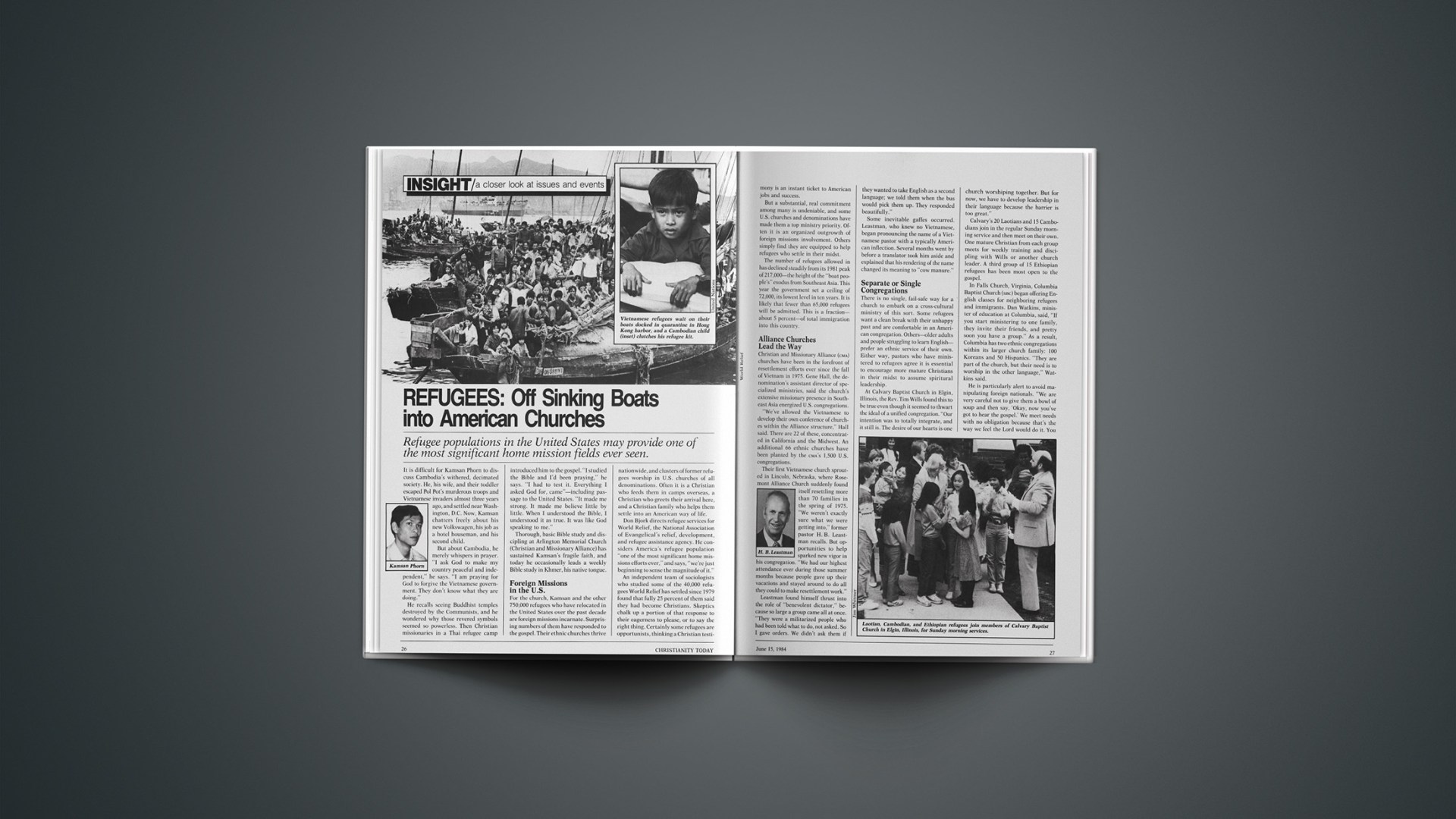
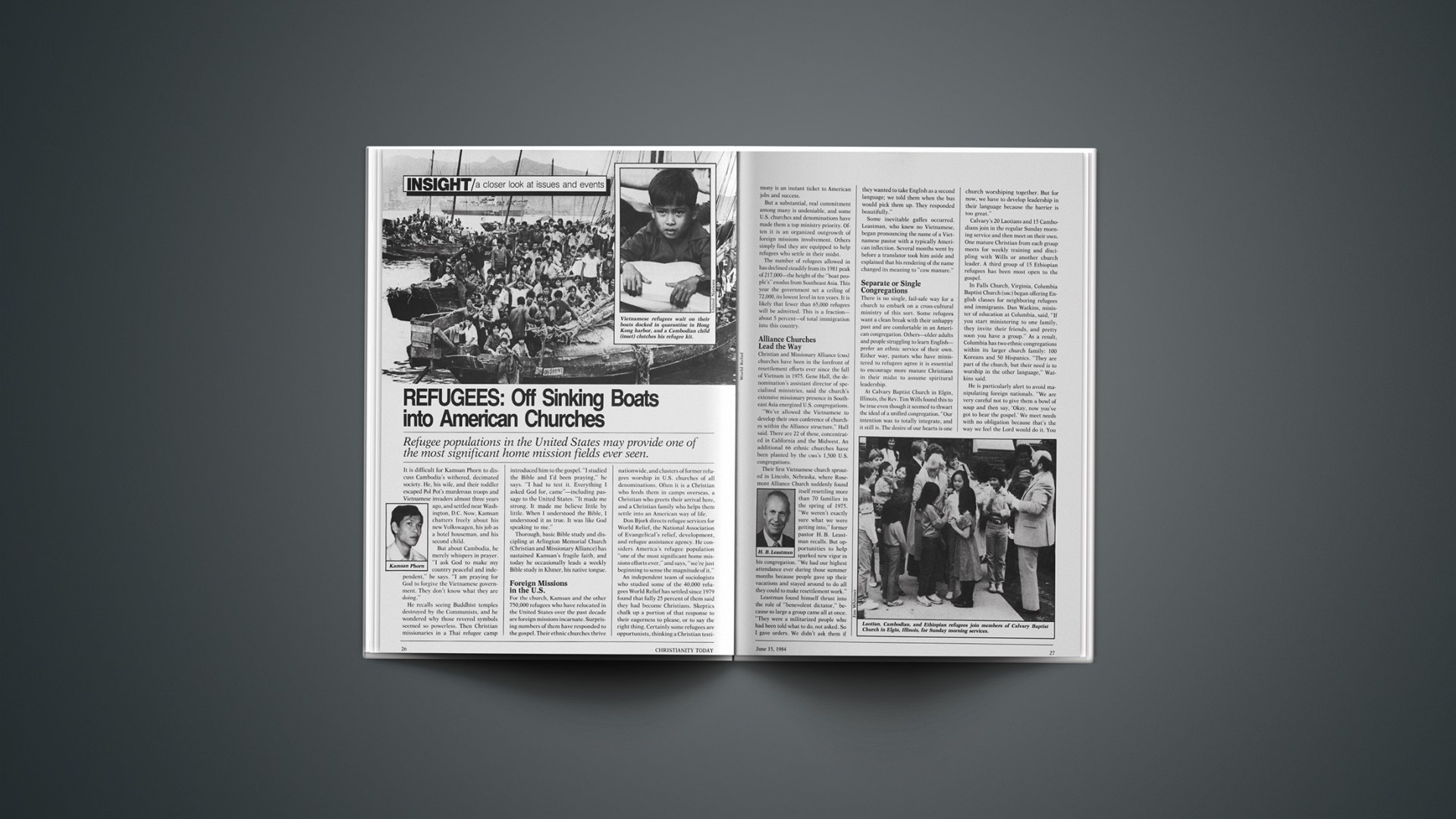
For the church, Kamsan and the other 750,000 refugees who have relocated in the United States over the past decade are foreign missions incarnate. Surprising numbers of them have responded to the gospel. Their ethnic churches thrive nationwide, and clusters of former refugees worship in U.S. churches of all denominations. Often it is a Christian who feeds them in camps overseas, a Christian who greets their arrival here, and a Christian family who helps them settle into an American way of life.

Don Bjork directs refugee services for World Relief, the National Association of Evangelical’s relief, development, and refugee assistance agency. He considers America’s refugee population “one of the most significant home missions efforts ever,” and says, “we’re just beginning to sense the magnitude of it.”

An independent team of sociologists who studied some of the 40,000 refugees World Relief has settled since 1979 found that fully 25 percent of them said they had become Christians. Skeptics chalk up a portion of that response to their eagerness to please, or to say the right thing. Certainly some refugees are opportunists, thinking a Christian testimony is an instant ticket to American jobs and success.

But a substantial, real commitment among many is undeniable, and some U.S. churches and denominations have made them a top ministry priority. Often it is an organized outgrowth of foreign missions involvement. Others simply find they are equipped to help refugees who settle in their midst.

The number of refugees allowed in has declined steadily from its 1981 peak of 217,000—the height of the “boat people’s” exodus from Southeast Asia. This year the government set a ceiling of 72,000, its lowest level in ten years. It is likely that fewer than 65,000 refugees will be admitted. This is a fraction—about 5 percent—of total immigration into this country.

Alliance Churches Lead The Way

Christian and Missionary Alliance (CMA) churches have been in the forefront of resettlement efforts ever since the fall of Vietnam in 1975. Gene Hall, the denomination’s assistant director of specialized ministries, said the church’s extensive missionary presence in Southeast Asia energized U.S. congregations.

“We’ve allowed the Vietnamese to develop their own conference of churches within the Alliance structure,” Hall said. There are 22 of these, concentrated in California and the Midwest. An additional 66 ethnic churches have been planted by the CMA’s 1,500 U.S. congregations.

Their first Vietnamese church sprouted in Lincoln, Nebraska, where Rosemont Alliance Church suddenly found itself resettling more than 70 families in the spring of 1975. “We weren’t exactly sure what we were getting into,” former pastor H. B. Leastman recalls. But opportunities to help sparked new vigor in his congregation. “We had our highest attendance ever during those summer months because people gave up their vacations and stayed around to do all they could to make resettlement work.”

Leastman found himself thrust into the role of “benevolent dictator,” because so large a group came all at once. “They were a militarized people who had been told what to do, not asked. So I gave orders. We didn’t ask them if they wanted to take English as a second language; we told them when the bus would pick them up. They responded beautifully.”

Some inevitable gaffes occurred. Leastman, who knew no Vietnamese, began pronouncing the name of a Vietnamese pastor with a typically American inflection. Several months went by before a translator took him aside and explained that his rendering of the name changed its meaning to “cow manure.”

Separate Or Single Congregations

There is no single, fail-safe way for a church to embark on a cross-cultural ministry of this sort. Some refugees want a clean break with their unhappy past and are comfortable in an American congregation. Others—older adults and people struggling to learn English—prefer an ethnic service of their own. Either way, pastors who have ministered to refugees agree it is essential to encourage more mature Christians in their midst to assume spiritural leadership.

At Calvary Baptist Church in Elgin, Illinois, the Rev. Tim Wills found this to be true even though it seemed to thwart the ideal of a unified congregation. “Our intention was to totally integrate, and it still is. The desire of our hearts is one church worshiping together. But for now, we have to develop leadership in their language because the barrier is too great.”

Calvary’s 20 Laotians and 15 Cambodians join in the regular Sunday morning service and then meet on their own. One mature Christian from each group meets for weekly training and discipling with Wills or another church leader. A third group of 15 Ethiopian refugees has been most open to the gospel.

In Falls Church, Virginia, Columbia Baptist Church (SBC) began offering English classes for neighboring refugees and immigrants. Dan Watkins, minister of education at Columbia, said, “If you start ministering to one family, they invite their friends, and pretty soon you have a group.” As a result, Columbia has two ethnic congregations within its larger church family: 100 Koreans and 50 Hispanics. “They are part of the church, but their need is to worship in the other language,” Watkins said.

He is particularly alert to avoid manipulating foreign nationals. “We are very careful not to give them a bowl of soup and then say, ‘Okay, now you’ve got to hear the gospel.’ We meet needs with no obligation because that’s the way we feel the Lord would do it. You often hear them say, ‘Now that I’m an American, I want to have an American religion.’ That element is always there, so we are very cautious.”

Mormons Outwork Christians

The Mormon church has made tremendous progress in incorporating refugees into its congregational life, and that has galvanized some previously sluggish evangelical churches into action. Some Mormon churches obtain computer printouts of new arrivals and demonstrate a genuine and irresistible level of friendship. There are very few refugees who are able to distinguish ways in which Mormon doctrine differs from orthodox Christianity.

“They’re going to go where the love is,” Greg Butler says. He leads the Bible study in Arlington, Virginia, that Kamsan attends, and he has observed firsthand the phenomenal attraction of Mormons in the Washington, D.C., area: “I saw a group of Mormon businessmen playing volleyball with the Cambodian kids and taking them out for ice cream.” In contrast, he finds apathy among many evangelicals. “We just are not reaching out the way we should. We’d rather turn the task over to some relief agency.”

Pat Pearson, with World Relief in Washington, D.C., spent her Sundays visiting Mormon services one summer, and their phenomenal outreach to refugees launched her into action. Equipped with her Betamax video recorder and a tape of the movie Jesus—produced in Khmer by Campus Crusade for Christ—she visits refugee families who have shown an interest in Christianity.

Often, this familiar-sounding presentation of a new set of beliefs helps heal family divisions. Pearson met with one mother who was perplexed over her son’s conversion to Christianity in a refugee camp. After seeing Jesus, the mother said she understood for the first time what the gospel meant. “Now I want to ask Jesus into my heart,” she told Pearson.

Christianity Versus Buddhism

Pearson’s work among refugees has provided unusual insight into a spiritual crisis of enormous magnitude. “These people had their Buddhism ripped out from under them,” she says. “Their whole world view of good and evil made no sense in the face of their enormous national tragedy.”

Communist leader Pol Pot, bent on eliminating the middle class and creating a totally agrarian society, brought mass murder to Cambodia’s peaceful people in 1975. Between two and three million people were killed systematically or died from disease and malnutrition. Vietnamese invaders deposed Pol Pot in 1979, and their fierce reign still spurs a steady exodus of terrified families fleeing famine and civil war.

Their Buddhist beliefs centered on attaining merit by works, and by and large they assumed that good things happen to good people. After escaping from a Cambodian nightmare, Pearson says, “the idea of the sinful nature of man made sense to them. Buddhism suits tranquil people in peaceful circumstances, but they seem to know deep down that it doesn’t do the job. What about human failure? Only Christianity answers that. And they saw the depths of human evil in Cambodia.”

Sometimes Pearson is amazed at the ways small deeds can evoke a profound response. She arranged to have beds delivered to the family of Ho Nhek just after they arrived from Cambodia. Several weeks later, she discovered Ho was struggling to understand the differences among various church groups in America. Torn between a local non-Christian group and Pearson’s Episcopal church, he told her, “Whenever I go to sleep on my bed I think your God must be number one, because your church helped me first.”

To Proselytize Or Not

Usually a church or family within a church sponsors the arriving refugee. Matching up willing Americans with dependent newcomers is the task of about a dozen private, voluntary agencies under contract with the U.S. State Department. About half of these are church related, involving Catholics, Jews, Lutherans, and the National Council of Churches (through Church World Service). Groups with religious affiliations handle 70 percent of the actual case load.

Placement with evangelical sponsors occurs most often through World Relief. These public-private efforts have raised no constitutional concerns about government promoting religion. A State Department official said, “Nothing in the contract says ‘Thou shalt not proselytize,’ but that is understood at the top levels of the State Department and the agencies.”

At World Relief, this is viewed as a plus, not a hindrance. Alec Hill, World Relief regional director in Seattle, explains, “We shouldn’t be doing the things the church does anyway. If our hands are tied evangelistically, that’s okay. It forces us in the direction of mobilizing the church.”

The government’s role includes setting limits on the number of refugees allowed in and selecting eligible refugees from among the multitudes in camps worldwide. Chances of resettlement in the United States increase dramatically if a refugee can prove he has a relative here already. Once they arrive, the Department of Health and Human Services provides a grant of several hundred dollars for each newcomer, and the State Department monitors how well sponsorship is working.

Surprises And Frustrations Of Sponsorship

Often the sponsor bumps up against unexpected frustrations. One Chicago sponsor was dismayed to discover an infestation of cockroaches left behind by Afghan refugees. Cuban refugees moved out of their sponsor’s home abruptly, taking along all the sponsor’s furniture. And Vietnamese families frequently move without warning to California, to join relatives there.

When that happened twice at Columbia Baptist in Falls Church, Virginia, the church opted out of sponsorship as a ministry. Watkins blames the difficulties on circumstances that left Vietnam’s first wave of refugees traumatized and confused. “There they were upper-class people with servants. All of a sudden, they found themselves at the low end of society having to beg for help.” Often they came with exaggerated visions of instant American prosperity, and struggled hard with the realities of a competitive job market and housing discrimination.

Disillusionment among sponsors has made resettlement efforts tougher through the years. George Wadsworth, WRC regional director in Chicago, says, “The mystique and the media coverage are gone. The sponsors we get are the ones we find.” In areas where many immigrants settle, some churches resist a cross-cultural ministry.

The refugee ministry at Calvary Baptist Church in Elgin, Illinois, began with one couple, Ed and Phyllis Williams, who have discovered that some refugee families are abandoned by their assigned sponsors. Pastor Tim Wills believes this happens because some churches vote to start a refugee outreach with no idea of what is involved. “If the family comes with bugs, tuberculosis, venereal disease, or three wives, what are you going to do?” he asks. Apparently some sponsors who are simply overwhelmed by grim realities introduce their charges to other refugees, and then leave them to fend for themselves.

Successful Assimilation

Refugees frequently bear the brunt of unjustified stereotypes picturing them as unwashed hordes or hopeless welfare dependents. But several reliable studies show that through the years, refugees have unexpectedly buoyed the economy by taking jobs few others want and achieving a remarkable degree of independence. But newly arriving refugees from Indochina and rural Central America tend to be less literate and not as employable as their early-arriving counterparts. They are more likely to need sustained assistance.

A survey by Church World Service found “no evidence of any significant long-term welfare dependence among refugees” despite the recession and high jobless rate of the past three years. Dale S. deHaan, program director for CWS and a former United Nations offical, said, “The basic partnership among refugee families, the private sector, and the government is working today as it has for nearly a generation. This partnership is accomplishing its humanitaran goals and it deserves the continuing support of all concerned.”

Who Can And Cannot Come

However, controversy about restricting the flow has simmered steadily in Washington, and a reluctant consensus has developed that the United States cannot open its arms as widely as many would like. This is partly due to a grim recognition that political circumstances causing displacement are not going to disappear overnight. Chronic international unrest, and fears that unrestrained admission may stimulate more people to flee lead policy strategists to counsel careful scrutiny of applicants overseas.

This approach began in 1980, when Congress officially defined refugees as people unwilling or unable to return to their homeland due to a reasonable fear of political, racial, or religious persecution. Previously, refugees were identified informally in terms of people fleeing communism.

The 1980 definition was welcomed by just about everyone involved, but it led to a bottleneck in processing applicants in refugee camps. Immigration and Naturalization Service officials began tediously reviewing refugees case by case. They began to suspect that some were “economic migrants”—people not really threatened by persecution, but simply wanting a new chance to thrive.

This is extremely disturbing to some voluntary agency representatives, who have told Congress it presents to the world “a refugee policy in disarray.” At the same time the U.S. is screening out some refugees, it is urging other nations to accept more refugees. Sending an uncertain signal abroad harms U.S. credibility, they say.

From Boat People To Feet People

The advent of the “feet people”—undocumented immigrants from Mexico and Central America—complicates policy making further. Already this problem is sowing seeds of division between churches willing to shelter them and others unwilling to break the law (CT, March 16, 1984, p. 34).

World Relief’s Bjork estimates that 1.1 million cross the southern border furtively each year, and 600,000 stay for good. Their presence confronts the church with an insistent ethical dilemma, Bjork believes, and in meeting with mainline Protestant and Catholic relief officials, he said, “I have discovered to my chagrin that across the board they have done a lot more thinking than we [evangelicals] have.”

The need for churches to continue resettling refugees, and perhaps sheltering undocumented aliens, does not promise to diminish. Refugee camps in Southeast Asia still hold 200,000 people who are anxious to settle permanently in a peaceful land. Their plight deeply touched Bjork during recent visits to Asia where, in Hong Kong’s Jubilee Camp, he found refugees piled three high in bunks in tiny cubicles, “like tiger cages.”

More rigorous requirements for admission and lower numerical quotas portend long days of bitter disappointment for the Kamsans who may never see their prayers answered. As long as nations are split along ideological borders, and people are marooned by international politics, ethnic ministry probably will remain a permanent fixture of American church life.

Congregations and pastors who have made it work view it as anything but a burden. For some, seeing Kamsan lead a roomful of Cambodians in “Sing Alleluia to the Lord” in Khmer is more than enough reward.

BETH SPRING

Refugees: Off Sinking Boats into American Churches: Refugee Populations in the United States May Provide One of the Most Significant Home Mission Fields Ever Seen

It is difficult for Kamsan Phorn to discuss Cambodia’s withered, decimated society. He, his wife, and their toddler escaped Pol Pot’s murderous troops and Vietnamese invaders almost three years ago, and settled near Washington, D.C. Now, Kamsan chatters freely about his new Volkswagen, his job as a hotel houseman, and his second child.

But about Cambodia, he merely whispers in prayer. “I ask God to make my country peaceful and independent,” he says. “I am praying for God to forgive the Vietnamese government. They don’t know what they are doing.”

He recalls seeing Buddhist temples destroyed by the Communists, and he wondered why those revered symbols seemed so powerless. Then Christian missionaries in a Thai refugee camp introduced him to the gospel. “I studied the Bible and I’d been praying,” he says. “I had to test it. Everything I asked God for, came”—including passage to the United States. “It made me strong. It made me believe little by little. When I understood the Bible, I understood it as true. It was like God speaking to me.”

Thorough, basic Bible study and discipling at Arlington Memorial Church (Christian and Missionary Alliance) has sustained Kamsan’s fragile faith, and today he occasionally leads a weekly Bible study in Khmer, his native tongue.

Vanishing Childhood: What Christians Can Do to Save a Shelter that Is Slipping Away

Part Two

Most parents prefer kids to Corvettes. If one magazine is correct, though, the same does not apply for the population in general. Behavior Today has declared that “children are now running behind automobiles as a consumer preference.” Overlooking the regrettable presumption that children are items of “consumer preference,” the magazine has a point.

Prognosticators in the 1950s, who feared a national population of 350 million by 1980, overshot the mark by 100 million. Doomsday headlines no longer chant about overpopulation in the Western nations. The U.S. birth rate, for one, hovers at replacement level.

Married women who have children are having them later. Both motherhood and the joys of child rearing have been demythologized. In the 1950s, gleeful children were supposed to make a complete, happy family. In the 1980s, we are reminded that caring for a baby through infancy means changing at least 3,500 diapers, and that the same child, seen from crib through college, will cost $85,000. Children require self-sacrifice—and in an age of narcissism, of preening and indulging and admiring one’s individual self, nothing could more quickly render them suspect. They cost parents more than money and time: they puncture illusions of self-perfection. “The raising of children … brings each of us breathtaking vistas of our inadequacy,” writes philosopher Michael Novak.

Realism about raising children is not all bad. Improved birth control and feminism are just two factors that have contributed to the slowed birth rates. (Statistics, as we all know by now, are tricky. We should remember that the vast majority of married couples—over 90 percent—still have children. Their choice is to have fewer children, not to forgo children altogether.) Vance Packard observes that we could be entering the Era of the Wanted Child. Some truly responsible, and not merely selfish, married couples are choosing not to have children and to channel their limited time and energy into other important tasks. Those who do want children can now make a very conscious, deliberate choice of it. They can, in other words, be genuinely, not accidentally, committed to their children.

But if we are entering the Era of the Wanted Child, we are entering it with doubts. The concept of childhood is eroding. Children are increasingly banned from rental apartments—a full fourth of apartment complexes in the United States now deny housing to young human beings of every race and sex. Children are pressured to grow up sooner. In their language, dress, and sexual manners they act more and more like adults. Things are happening in our society that could mean adults generally like children less. Abortion and, yes, infanticide are again practiced. People openly describe children as brats, eels, piranhas. Motherhood is no longer charged with mythological dimensions, and the desire to be “a happy mother of children” (Ps. 113:9) is scorned. In books and films supposed to amuse adults, children are kidnaped, burned, murdered. Ours is an iconoclastic society, addicted to change, to the new and the novel. We seem to believe that attacking cultural institutions such as the church, education, or childhood will never really hurt anything, that we are only taking icepicks to an iceberg.

But the cavalier attitude alternates with insecurity. Occasionally we see that what we half-thought was a law of nature—our idea of childhood, for example—is dramatically changing. Then we panic and cry that the icepicks were really jackhammers, that the iceberg has exploded and a hundred pieces are adrift in every direction. We realize that, to a real degree, we are responsible for our institutions, and what we do to them matters. Responsibility has weight.

Some may flee responsibility, but Christian awareness is a centripetal force whirling toward it. To be created in God’s image means, above all and uniquely among his creation, to be a responsible creature. It means to be capable of choice and to be held liable for our decisions and the actions that flow from them. It means, in Saint Paul’s words, to “work out your own salvation in fear and trembling.” So central is responsibility that to remove it results, in C. S. Lewis’s phrase, in the abolition of man.

Since Christians are called to claim responsibility, we have deep and essential reasons—radiating from the center of the faith—not only for concern for our own children, but for concern about all children. What, then, can be done about the erosion of childhood?

The Need For Profound Encouragment

Everyone is an expert on one subject. No one, as the tirelessly offered wisdom of my mother-in-law demonstrates, is without a comprehensive theory of child raising. All these theories, furthermore, are foolproof as long as they are (1) applied to another family’s children or (2) espoused by someone who does not have any children. Actual, practicing parents universally testify that it is only when these theories are tried that they sink as fast as a submarine made of Swiss cheese. Freud was not baffled by much, but he called three professions impossible: psychoanalysis, government—and parenthood.

Parenthood is not getting any easier with the erosion of childhood. There are many causes, and Marie Winn neatly summarizes them: “The great social upheavals of the late 1960s and early 1970s—the so-called sexual revolution, the women’s movement, the proliferation of television in American homes and its larger role in child rearing and family life, the rampant increase in divorce and single parenthood, political disillusionment in the Vietnam and post-Vietnam era, a deteriorating economic situation that propels more mothers into the work force—all these brought about changes in adult life that necessitated new ways of dealing with children.” It was this peculiar conjunction of events that especially assailed the traditional idea of childhood. The rise of two-career families, rocketing divorce rates, and television’s employment as the electronic babysitter all coincided. “Suddenly the idea of childhood,” Winn writes in Children Without Childhood, “as a special and protected condition came to seem inadvisable if not actually dangerous, and in any event, quite impossible to maintain.”

The operative word in Winn’s concluding statement is “seem.” The idea of childhood as a “special and protected condition” may seem inadvisable or impossible. Yet it was always difficult to maintain. Parents in the past were encouraged because the constant emphasis was not on the inadvisability or impossibilities of raising children, but on the wonder of it all. The ancient Egyptians thought youngsters could foresee the future, and listened to child babblings for a hint of the world to come. There was a truth, of course, hidden in that superstition. Children do not merely foretell the future, they are the future. And so parenthood, comprehended, means not only shaping individual children, it means shaping tomorrow. Today this sounds so hopelessly corny that no one says it aloud. Fashionable conversation about child raising tends to calculations of how much the kid costs, the contemporary imagination (such as it is) stretching to tallies reminiscent of automobile repair records.

Slowing and stopping the erosion of childhood may, then, depend on encouragement, and with it a rekindling of the collective imagination about children.

Our cultural malaise and discouragment is, in part, a reaction to the shattering of ill-founded myths. With Watergate and Vietnam went blind trust in government. Among others, the Horatio Alger myth is gone. Not every man can go from rags to riches; not every woman will grow up to be a queen (or a business executive). Yet such myths, stories, and legends—imagination, in a word—fuel everything from businesses (see the latest book that executives have made a best seller, Search for Excellence) to entire societies.

The trouble with the ill-founded myths was that they did not answer reality. To last, imagination must not be shallow or illusory. Disillusionment is the father to cynicism, and no flesh-and-blood fathers and mothers will be helped by starry-eyed preachments that parenthood is always joyous and lovely. The encouragement called for is profound encouragement: an encouragement that rests on consistent realism rather than blind optimism, and an encouragement that goes beyond the individual level to the levels of government and mass media.

Experts And Parents

We might begin to encourage beleaguered contemporary parents by returning to the subject of experts. Freud recognized surprising secrets in children: they were, after all, seething with sexuality. He saw the awesome, irrevocable importance of the first five or six years of life. A traumatic experience—witnessing the “primal scene” or poor toilet training—could scar a child once and for all. Before Freud, raising children was thought a matter of common sense. After Freud, and with his filtering into popular consciousness through Spock, Fraiberg, and others, child raising was seen to be complex and intimidating. Who knew what time bombs might accidentally be set to explode years later in the adult child?

The self-consciousness of modern parenthood is illustrated by a Bedford, New York, father who spoke frankly to Marie Winn. “It’s as if our family were one big group-therapy session,” he said. “Sometimes we’re so self-conscious about it all that we spend as much time talking to the kids about what we’ve done with them as we actually spend doing things with them.” The parent becomes psychoanalyst, and since he or she is untrained, the trained expert becomes the all-important consultant.

Surely modern parents are right to be concerned, careful, and informed. But not paralyzed. Writing in In Defense of the Family, Rita Kramer declares, “The perniciousness of so much advice from experts that pervades the media is that it undermines the confidence of parents in their own abilities and their own values, overemphasizes the significance of child-rearing techniques, and grossly misrepresents the contribution the expert in psychiatry or education can make to the conduct of ordinary family life.”

Child-raising techniques—though I doubt it is very much the fault of the experts—do tend to be overrated. (One of the first child-raising experts was Daniel Gottlieb Moritz Schreber, a German doctor who believed in total control of a child’s mind and actions. Schreber’s technique was distinguished by its failure: his son became one of the most celebrated mental cases of the nineteenth century, complete with a paper on his case by Freud.) For Christians, it may be telling that Scripture, which often addresses the subject of child raising, offers not particular techniques, but broad and solid principles. Raising children remains an art. It contains more than a dash of mystery, uncertainty, and, in the happy cases, serendipity. The true experts are there to support parents and provide them helpful resources, but never to pretend they offer a perfect, comprehensive technique. Such techniques are like fad diets: if any one of them works so fantastically, why are there so many?

The central responsibility remains with parents (who, after all, pay the expert and must live under the same roof as the unruly child). And over the parents looms the devastating specter of divorce. Nearly half of the children born in recent years will spend a portion of their lives before age 18 in a one-parent household, according to projections from Census Bureau figures. We have already noted (see part one; CT, May 18) that children of divorce are more likely to be depressed, commit crimes, fail in school, and experiment with alcohol and drugs. Some studies indicate these children are more likely to follow the lead of media violence and act destructively. Without a doubt, they are often forced to act beyond the wisdom and experience of their years.

Beyond continuing church efforts at building solid marriages and preventing divorces, it may help to expose some persistent, widely accepted assumptions. Divorce, in part, results from the stress of contradictory expectations. Who will not support the couple that wants a career for both husband and wife? But must parenthood be seen to be a trap for such a couple? And if we see that children bear on parents’ career goals, should we not also see that career pursuits—far from always leading to personal Edens—breed ulcers, alcoholism, loneliness? If we are going to be realistic, shouldn’t we be realistic across the board?

Rita Kramer is refreshingly level-headed on the topic of the much-maligned housewife. Housework is often dismissed as a “wretched job,” she notes. But: “Compared to what? To factory work on an assembly line? To clerking in an office? To a high-level position in a policy-making organization, perhaps. But not every woman, for whatever reasons of nature or nurture, wants that particular life. Even some well-educated women enjoy cultivating the arts of domesticity, and technology has made housework a matter of relative ease and convenience. The picture of the average American housewife’s life painted by militant feminists is as distorted as their view of the average working woman’s world is romanticized.”

Government And Media

In our world, much of the Christian influence for children will necessarily be pressed in two arenas, government and the mass media. Government, with everything from child labor laws to tax breaks, can play an important role in making a society hospitable to children. And it is the mass media, of course, that not only disseminate, but shape and influence fashions of thought and behavior.

In both forums, evangelical and fundamentalist Christians can unwittingly hasten the erosion of childhood. Take one instance. Lobbying for the abolition of juvenile codes (so that teenage offenders may be more harshly punished) plays into the hands of those children’s rights advocates who say children should be treated just as adults.

Some political conservatives (including many Christians) regard any additional governmental attention to children as insidious. Yet, as Neil Postman observes in The Disappearing Child, the movement toward “a humane conception of childhood was due, in part, to a heightened sense of government responsibility for the welfare of children.” It was government that passed child labor laws and juvenile codes.

Of course, government is never utopian. If it can help to make a society hospitable to children, it can also make a society inhospitable to them. In a mass society such as modern America, then, the question is not whether or not government will have anything to do with children. It is what government will have to do with children. Lobbyists and congressmen favoring protective rights for children, called “child savers” by the New York Times, press for a kind of children’s rights Christians can support. (Even the staunchest New Right Christian, for example, will not want to dismiss government as a tool to stop abortion and infanticide. Likewise, the same Christians must use government in their commendable battle to restore the so-called squeal rule, the regulation that would would require parents to be informed when their minor children receive contraceptives from public agencies.)

In the realm of the mass media, there are more unintended effects. Conservative Christian literature sometimes betrays a penchant for alarmism, for interpreting current events only in the darkest and most frightening fashion. In a society jaded and desensitized by pervasive images of sex and casual violence, much can be said for the personal sensibility that can still be shocked and will react with justifiable outrage. But we must take care not to overstate our concern, to respond with an outrage that distorts reality and, in the process, has a strange boomeranging effect.

Consider, for example, teenage sex. Few things worry parents or confuse Christian adolescents more. On the one hand, we have a host of studies “proving” teenagers are very promiscuous. On the other, an avalanche of Christian literature and broadcasting echoes the allegation of this terrible promiscuity and warning of judgment.

Now, it is true that Zelnick and Kantner’s 1980 study found that 35 percent of America’s 15- to 19-year-olds are sexually active. But such statistics lend themselves to wide and varied interpretation. The picture changes when we note that Zelnick and Kantner defined as “sexually active” those who had simply had sexual intercourse at least once. (A married man or woman who had only had intercourse once would hardly be considered sexually active.) In fact, over half the teenagers dubbed “sexually active” had not had sexual intercourse in the month prior to the survey. Make no mistake: sexual behavior has changed. But teenagers remain more or less human and have hardly turned into raging sex maniacs. Exaggerating the problem demoralizes parents and burdens celibate teenagers with additional “evidence” that they are awesomely odd and unusual. Peer pressure intensifies. The boomerang effect, of course, happens in other areas besides sexual behavior.

And beyond the boomerang effect is our careless adoption of loaded language. Handy catch phrases shade opinions on many subjects. The words we use affect the way we think. Accordingly, what used to be called “childless” couples are becoming “childfree,” implying a positive liberation. People in favor of having children are called “pronatalist,” and having children becomes an ideological preference, as debatable as whether one should affiliate with the Democratic or the Republican party. These terms are fairly obvious in their offensiveness. More subtle ones have already crept into Christian vocabularies. Nearly everyone refers to traditional homemakers as “unemployed mothers,” as if they don’t work. And what is the message sent by the widely accepted formulation that homemakers spend “quantity time” with children, whereas busy professionals spend “quality time” with them?

Understanding Media

These crucial phrases and impressions leaven society through the powerful, but woefully misunderstood, mass media. Basic to this misunderstanding is a misperception of the nature of news. We seem compelled to base our understanding of life (our world view or philosophy) almost solely on what we watch on television, hear on the radio, or read in newspapers and magazines. Yet “news,” by its very definition, will always be the novel, the bizarre, the unusual. If a dog bites a man, the homely apothegm has it, that’s not news. If a man bites the dog, that’s news. Television and newspapers, if they do their jobs, will look for and emphasize the atypical. In this sense, the mass media do not reflect reality at all. But they are relied on for the authoritative depiction of reality. On the night of a lunar eclipse, essayist E. B. White notices that his neighbors close their curtains and switch on their television sets. None of them simply look out the window. If an eclipse is real, really real, it must be on television.

We no longer trust our immediate experience, but solely our mediated experience. The application to childhood is obvious. Children are changing, no doubt. But are they as burdensome as it might appear to one who knows what he knows of children only from what he reads in the newspaper? The child we meet in the newspaper is the violent or troubled child. And well we should, for the violent child is news. He is not our nephew, who committed the most violent act of his life when he accidentally cracked his father’s car window with a BB gun. Of course, none of us is exempt from violence or, for that matter, from committing violence. But an entire year of our personal lives is not interrupted by as much violence as we witness on 15 minutes of the evening news.

Besides being atypically violent, the world seen through the news camera is excessively narrow. It looks for the new but rarely reminds us of the old. And so we court the conceit that our time is, in all respects, uniquely bleak. Again, our view of children is affected. The classrooms, we suspect when we put down the morning paper, are peopled with the most aggressive and menacing students of all time. The paper does not remind us that 5-year-olds once wore swords and knew how to use them. It says nothing about a seventeenth-century rebellion in France where students barricaded themselves in school, fired pistols, threw benches out the windows, tore up books, and attacked passersby. Some of our classrooms are surely more dangerous than they ought to be, but so far no 11-year-olds have seceded en masse, as they did in eighteenth-century England. Nor have older students occupied an island only to be routed by the army, as did some of their eighteeth-century English predecessors. That would make a news story.

Television

It is television, of course, that looms as the most significant medium and so merits more attention. It took printers 60 years to happen across the innovation of numbering the pages of books; the first television signal was broadcast between New York and Philadelphia scarcely that long ago. Yet its impact has already been enormous. Nearly all commentators are concerned about its effect on children. Again, Rita Kramer speaks with bracing clarity. Extreme television watching, she writes, is a “totally destructive activity” for children. It is not the content of programs, but the nature of television watching, that she decries. “It works against every important need of the young child: to be interacting with the members of his family, learning about them and himself, to practice skills not only relating to people but in the active use of his own body and his own imagination; to learn to organize and express his own ideas verbally, first in thought and then in speech and writing; to create his own fantasies in order to work out solutions to his problems.”

Television erodes the line between childhood and adulthood because it requires no instruction for understanding. Children must learn to read, so a pornographic book is nothing but undecipherable symbols to a three-year-old. The same three-year-old, however, can switch on cable television’s movie channels and witness sexual intercourse. Television does not segregate its audience: it is open and ready for the youngest child or the oldest adult. Sadly, as philosopher Michael Novak writes, media children “become sophisticated about everything but the essentials: love, fidelity, childrearing, mutual help, care of parents and the elderly.” To be concerned for childhood and a society’s impression of childhood is to be concerned about television and the limiting of its significance in the lives of children.

In addition to the obvious step of curtailing children’s viewing, Christians might recognize that the cable movie channels’ wholesale pandering of sex and violence is not an open-and-shut legal privilege. The broadcast media have been more heavily regulated than print media because broadcasters use airwaves said to belong to the public. So far, cable companies have successfully argued that they do not use the public airwaves. But the cable companies are dependent on government-launched and -leased satellites. And some, in fact, do broadcast signals. At the least, there are arguments for increased cable regulation.

Children And Subversion

In the end, the course of history is not decided only by government or only by mass media. It is decided by the activity of spirited, imaginative people in the church, school, and other spheres. And what is there about raising a family that will attract such people if raising a family is seen to be stagnating? Who can argue that the American dream—two cars, a house, a lawn to mow, three kids, a dog, and a very predictable (if financially rewarding) nine-to-five job—is tired and uninspiring?

But an irony is afoot. Just as a painting can appear more or less attractive because of its frame or position on the wall, children are gaining a new allure because of the shifting background of our culture.

The recent generation of married men and women are the first to make conscious, careful decisions for or against having children. Not only is birth control available, but arguments against children and a family are openly stated. If there is a stigma, it no longer rests so heavily on childless couples. In fact, it is shifting to those who choose to have children. Thus the recent generation of parents—forced to an especially conscious choice to be parents—is refreshingly aware of the sheer wonder of children.

In this connection, one friend springs to my mind. David began a family while he and Anna were still in college. Today they have four children. It has not been easy. David is finishing graduate school and will soon enter seminary. Financial demands have Anna working part-time; David holds down a full-time job and a burgeoning piano tuning service on the side. Their life is intense and often exhausting. But I have never found David without enthusiasm for his children.

He calls children “exciting and intoxicating.” They are “extremely creative and innovative and unpredictable,” he says. “The freshness is what I really enjoy the most. There’s also a purity, an innocence, that you cannot duplicate once it’s lost. Children are really children for parents. Their lives are a gift for parents.” For David, children are not stultifying, but a vein leading straight to the heart of life. “They keep me in tune with the very important issues of life—the real values—not just making more money, or whatever. They teach the value of the individual for the individual’s sake. Children aren’t impressed with whether or not their daddy is famous. Children love people for who they are. I wake up in the morning with fishbowl mouth, but my daughter kisses me. She appreciates who I am without dressing up.”

David tells (and retells, I can testify) a story of Josh, his oldest, at age four. David jumped into Josh’s room and growled, “I am the terrible green Hulk!”

“No you’re not,” the boy replied. “You’re just a plain old daddy.” To David, being a “plain old daddy” is not so plain.

The wonder David and other parents of his generation now know is a rediscovery. Unique to them is the irony of challenging the status quo by the act of having children. “To marry, to have children, is to make a political statement …,” Michael Novak writes. “It is a statement of flesh, intelligence, and courage.” Childbearing and protective child-raising verge, in our culture, on being subversive activities. To stop the erosion of childhood, to preserve it, will require energy and sacrifice. It will require energy of all Christians—not simply parents—who use the public media, determine government, and live and work and play, affecting the thoughts and actions of neighbors in a hundred small ways. The cost, counted, is great. And so we come to the final question, and to anyone of sensitivity it must be a plea. Is there help?

Help And Hope

In answer to that question, the Christian is bound to look to Jesus. “Brothers, have you found our king?” asked George MacDonald. “There He is, kissing little children and saying they are like God.”

Jesus’ astonishing sympathy with the helpless or despised is so complete that it translates to identification. When we feed the hungry, clothe the naked, aid the sick, visit the prisoner, Christ said, we do it not only to them, but to the Lord himself. Significantly, he says the same of children, themselves powerless and dependent: “Whoever receives one of these children in my name receives me” (Mark 9:37).

It is a testament to the triumph of Christ’s attitude that even now, with childhood corroding, it stretches the imagination to think of children as an oppressed group. In this world, Christ’s kingdom is only realized partially, in fits and starts, in glimpses and glimmers. But would it be too much to say that in this way, perhaps more than any other, Christ’s kingdom has been realized on earth? In the poor and the prisoner dwells Christ, and yet how sadly far many are from accepting him there. But in a child—there Christ is embraced and wept over and kissed a trillion times daily.

Parenthood is an impossible profession. But hope comes. It comes not merely because we realize that, somehow, children are durable and strong beyond the weakness of adults, that adults need not be perfect to raise whole, healthy children. It comes because in the children who need our help, is our help: is, in fact, the God of whom it was said nothing is impossible.

We can teach the children courage, faith, endurance. They can teach us how laugh, how to love, how to sing. The weary world is turning, turning; but in a child’s eyes, tomorrow is a new day.

Tim Stafford is a free-lance writer living in Santa Rosa, California. He is a distinguished contributor to several magazines. His latest book is Do You Sometimes Feel Like a Nobody? (Zondervan, 1980).

The City and the Scriptures: The Bible Speaks Richly of City Life and City Values, and It Is a Mistake to Ignore that Emphasis

Just after I arrived in Chicago in 1965 to study and to minister, the Community Renewal Society published an article suggesting that theological conservatives can’t make it in the city because they take their Bibles too literally. They said that when you take the Bible literally, you swallow an essentially rural milieu: “God builds gardens; men make cities. God prefers shepherds to vine growers and certainly to city dwellers.”

I began then in 1966 to look at the biblical data. That became extremely important for me because in my tradition and in my own experience, biblical materials were normative for deciding whether I had a mission in the city at all or whether I would have to abandon Scripture and stay in Chicago for other than biblical and theological reasons.

So I began a study of some 1,400 scriptural references to cities, including case studies of biblical cities, philosophy, the theology of corporate solidarity, and other kinds of biblical data. I suggest that we have biblical and theological resources for urban ministry. Let me use a simplistic outline and talk about principles, places, and persons.

A Theology Of Principles

Under biblical principles, let’s return to the principle of materialism. The Bible begins with creation; it centers on resurrection; it anticipates re-creation.

In Exodus 31 there is a little post-Red Sea vignette about two of my favorite fellows, Bezalel and Oholiab, who are given a special ministry by the Spirit to design and build a tabernacle. God is suggesting that this first-generation migrant group cannot exist worshiping only an invisible God, even with the benefit of fire, cloud, and pillars; even with such people as Moses, and with such institutions as worship, Sabbath, and codes. Some visible representation of the deity and some worship center upon which the people can focus are needed.

Luther understood this principle of materialism well when he told my forefathers, the Anabaptists, not to shatter the statutes or the liturgy or the calendar until they had replaced them with something else. Moses understood it too.

I think that such a concept is important, and I have seen it fulfilled. This thing that happened to Bezalel and Oholiab—this gifting of these former mud-brick makers by God with architectural and other skills to teach Israel in the wilderness—I have seen happen to Spanish immigrants and migrants. I have seen a real mess of a three-bedroom suite purchased for a Spanish-language seminary in Chicago. And I’ve seen the skills of Puerto Rican Christians emerge within our community as they fixed it up.

I see this “materialism” as scriptural and as the only way the church can take on the city and at the same time fight the escapist options presented by the Oriental religions.

There is also the principle of corporate solidarity in both Testaments. Ever since H. Wheeler Robinson’s essay on this topic appeared about the time of World War I, people have noticed that in the Bible individuals are often appendaged with a tribe or a place. You are “Bar Somebody” or “Ben Somebody”; you are from some place, you are part of a tribe. You are known by something other than just your individual self.

All the way through Scripture we see a principle of corporate solidarity: man and community. That principle gets us beyond the atomization or individualization of the Christian experience and makes it possible to deal with the city as a collection of people and interlocking institutions. We have a theology that says we are a part of a whole. As John Donne said, “No man is an island.”

Also important is the principle of incarnation. “The Word became flesh and dwelt among us.” That perhaps is the most powerful of all biblical principles. Our Lord did not wire the universe for stereo, put a woofer on Mars and a tweeter on Venus, use heavenly angels to sing the “Hallelujah” chorus to us, and, in multilingual vapor trails in the sky, beg that we repent. Instead, the Word became flesh, dwelt among us, and experienced human life. I think that at Christmas we ought to rehearse for our people not only the facts of the Incarnation, but the significance of those facts in our ministry as we incarnate ourselves in the life of the city.

A Theology Of Place

A few years ago evangelicals were developing a theology of persons, and we became very person centered. Then it began to dawn on me that there was another area that we had not explored: the theology of place. So I began to look at biblical places, particularly at cities referred to at least 30 times.

There are two chapters, for example, given to the study of Sodom (Genesis 18 and 19). Everything that prejudices anyone against all cities everywhere will prejudice you against the city if you look at Sodom. And yet there are some lessons there.

One is a godly motive for urban concern. The entire eighteenth chapter of Genesis is devoted to prayer, a prayer of negotiation. It is stylized to be sure, but it is a prayer in which the justice of God comes through. In verse 25 Abraham asks, “Will not the righteous Judge of the whole earth do what is right?” It is a confession of Abraham, a man of faith. It is also a prayer for a place, not for a specific person or program. It is a prayer for Sodom, and I think that is important.

Another lesson I see in the Sodom story is that God can distinguish one person, Lot, from the many. This happened also in Jericho, with Rahab, and in the case where Jesus is walking through the crowd and a woman touches him (Luke 8). Jesus says, “Who touched me?” His disciples respond, “You’ve got to be kidding—look at this crowd! It’s like rush hour.” He says, “No, I felt the power go out.” One of the lessons I see there is that the Lord can distinguish the accidental touch of the multitude from that one person who touches him by faith. That kind of understanding is important for anyone living in a city with a population in the millions.

In the book of Jonah, God struggles to get a man and a message to a city. No person in Nineveh is mentioned by name.

And then there is Babylon, another interesting city. It is so bad I call it a “corporate Judas.” By destroying the temple and cutting off the monarchy, Babylon did what Judas did in cutting off Christ. And yet Babylon is given the grace of God. The choice Hebrew sons and servants (Daniel, Ezekiel, and others) worked within its structures of government to make it more just. It seems to me that the intertestamental period and the theology of the New Testament are enriched because of Israel’s ministry in Babylon itself.

A Theology Of Persons

The careers of biblical persons are also important, for patterns and principles fall together in the lives of individuals. As I look at the story of Joseph, for example, I see 13 chapters of sacred text given over to the career of an Egyptian economist. He socialized the economy of Egypt. He moved the people into cities, put them on food stamps, and had two seven-year plans: one for budget surplus and one for budget deficit. And I see not a single disparaging word said about that ministry in either Testament. It’s full of Egyptianisms, and never once is it “knocked.”

Why is that story in Scripture? My conservative friends say it’s not normative: it is there because Joseph is a type of Christ. They refuse to deal with him. My liberal friends say it is not normative either; they don’t even necessarily believe there was a Joseph.

I say both of these traditions have joined hands, and have cut themselves off from the data. The story shows that a man can work in the government of a pagan pharaoh and use the instruments of the state to feed the entire Middle East, including God’s people. And if a man can work with pharaoh, for goodness’ sake, we should be able to work in any city ward.

The Bible repeatedly presents characters who work in and with city governments. Nehemiah, another such biblical character, was a Persian layman and builder who set up God’s first Model Cities Program in the rebuilding of Jerusalem after the captivity. He rediscovered the principle of the tithe and said, “I don’t expect everybody to move into Jerusalem. I would like 10 percent of each tribe of the nation.” And they had a little ordination service and blessed those who were willing to live in Jerusalem. It was very creative work.

There are also urban men such as Paul, whom (as church historian Stephen Neill says) the church was most fortunate to have as the architect of its mission. The apostle Paul was from the fair-sized city of Tarsus and never went anywhere in mission work or did anything we know about in a city smaller than Thessalonica. This was not necessarily because he had a conscious urban strategy but bcause the Jews were there. He was acquainted with that communications web. If you can believe the historian Philo (and sometimes you can in spite of his biases), 40 percent of Alexandria, for example, was Jewish.

It was to places like that—not only to Alexandria, but to many cities of the Empire—that the early church went; and its mission was synonymous with urban mission. Ian Blaiklock, the “Auckland classicist,” says in the preface of his book Cities of the New Testament, “The early church followed the contours of the urbanized Roman Empire.”

In an article a number of years ago, Gabriel Fackre said, “Revolutions accomplish two positive things. They inform people and they define policy.” This has always been true for the church. The way in which Gnosticism forced the church to grapple with its canon, creed, and organization is not unlike the way in which the city has challenged you and me to define ourselves and our own theology and to search for resources in Scripture to meet that challenge. What we discover in that search is that the biblical material does provide a wealth of ideas as we attempt to minister and think theologically about the city.

Tim Stafford is a free-lance writer living in Santa Rosa, California. He is a distinguished contributor to several magazines. His latest book is Do You Sometimes Feel Like a Nobody? (Zondervan, 1980).

Ideas

Revitalizing World Evangelism: The Lausanne Congress Ten Years Later

Evangelicalism owes much to billy graham. But when a definitive history of evangelicalism in the twentieth century gets written, it may well note that he contributed most not in his evangelistic crusades but when he initiated, supported, and guided world conferences on evangelization. The greatest of these was the International Congress on World Evangelization, held at Lausanne, Switzerland, in 1974—just ten years ago this summer.

Roots

It began in 1961 when Billy Graham called a meeting at Montreaux, Switzerland, to draw together evangelical leaders from around the world. He hoped they might focus on the task of world evangelism in the tradition of the great missionary conferences held at the turn of the century. Out of this meeting came the Berlin Congress on World Evangelism in 1966, drawing together 1,200 delegates from more than 100 countries to explore the missionary task of the church.

If Berlin did nothing else, it started a new track. Until the middle of this century, evangelical forces around the world were on the defensive, if not in full retreat. Evangelicals now came face to face with the immensity of their task, its complexity, and above all, its urgency. Berlin in turn spawned a number of international conferences that culminated at Lausanne in 1974 with the International Congress on World Evangelization. Four thousand participants, observers, and guests came from 150 nations; 50 percent represented the Third World. Time described it as “a formidable forum, possibly the widest ranging meeting of Christians ever held.”

Lausanne Revitalized Missions

The Lausanne Congress on World Evangelization worked a dramatic change on its participants. True, in part it merely brought to focus impressions that had already been formed at Berlin. But some things were new and destined to revitalize missions around the world. Lausanne taught us all that:

1. The task of cross-cultural evangelism had not been completed. For years the buzz word in ecumenical circles was “Moratorium!” The gospel, so it was alleged, had already penetrated every nation. But it became evident at Lausanne that the task yet to be done was immense. And, more critically, Lausanne showed that it was utter nonsense to think that cross-cultural missionaries were no longer needed. The church was weak in many areas of the world; also, within nations already partly evangelized were imbedded pockets of “hidden” or isolated peoples. These factors made cross-cultural missionaries absolutely necessary if the gospel were to be brought to all the world.

2. The task could not be done, and need not be done, only by affluent churches of the West or by people with white faces. Third World churches, too, could be effective sending agencies. And participants at Lausanne scattered to their homes to set up mission agencies everywhere. In the ten years since Lausanne, Third World missionaries increased from 3,000 to 15,000, and their number is growing rapidly.

3. Lausanne participants discovered the meaning of partnership in mission. They found they could work together, and that a mission society could accomplish its own goals more effectively by working with others than by doing its own thing alone. Moratorium gave way to partnership.

The “Covenant,” A Promise

Out of the Congress came the now famous Lausanne Covenant—a 3,000-word, 15-point document. It was not a comprehensive statement of faith, but rather a promise of commitment to the primary task of the church—the evangelization of the world. Its introduction reads: “We, members of the church of Jesus Christ, from more than 150 nations, participants in the International Congress on World Evangelization at Lausanne, … believe the gospel is God’s news for the whole world and we are determined by His grace to obey Christ’s commission to proclaim it to all mankind and to make disciples of all nations.” This covenant became one of the most accurate reflections of the heartbeat of contemporary evangelicalism ever to appear. It has been translated into many languages and has received worldwide acceptance and use. Particularly in that “two-thirds world,” which Western Europeans and Americans are prone to look upon as the mission fields of the world, it has become a banner around which conservative evangelicals can unite in their dedication to world evangelization. It has served as a strong bond to link together those who previously had not even known of each other’s existence. The linkage came not by joining another organization, but rather by discovering a shared faith and a deep commitment to the primary task of the church.

Criticisms

The Lausanne Covenant has been impugned as representing a take-over of the Lausanne Congress by extreme rightists because of its reference to the inerrant authority of the Bible and its radical stress on the urgency of the gospel. Others have lamented its concession to liberalism in its qualification of inerrancy by the words “in all that it [the Bible] affirms.”

It is true that some liberals signed the covenant who elsewhere have indicated that they do not believe in the inerrancy of Scripture, but they must answer to God for their duplicity. Actually, the statement is right on target. It is only pointing out that we must not take biblical statements out of context and then charge the Bible with error. Whatever the biblical text really asserts to be true is never false. The Bible always tells the truth.

Others have charged that the document jeopardizes the uniqueness of salvation through personal faith in Jesus Christ as the divine Lord and Savior of sinners. Yet the document explicitly repudiates every kind of syncretism or even dialogue that implies a cosmic Christ who saves through other religions and ideologies. General revelation has some validity, but it cannot save.

Even more controversy has been raised over the Lausanne approach to social action. Some have charged that it downgraded social responsibility and Christian concern for social justice. From an opposite point of view, others have warned that the Lausanne Covenant really led down the path of the World Council in its preoccupation with the issues of culture and social responsibility.

A simple reading of the covenant shows clearly enough that it not only affirms the legitimacy and unique importance of social action and a proper Christian concern for justice, but at the same time it retains the biblical emphasis on the priority of evangelism. It is not surprising, therefore, that the covenant has been widely adopted in many parts of the world—particularly in the two-thirds world—as a guide to cooperative effort in the work of mission. More than any other statement of the church, the Lausanne Covenant has taken its place in the rising churches of the two-thirds world as a guide for partnership in evangelism. The unifying question has quickly become: “Do you subscribe to the Lausanne Covenant?”

After Lausanne

What really sets off the Lausanne Congress from all others, however, is the continuing committee that has carried on its work through the past ten years. It was organized by demand of the participants at the conference (94 percent of those responding to a questionnaire urged the leadership to form some sort of follow-up work). As a result, a committee of 48 evangelicals, later enlarged to 75, was selected to represent theological viewpoints, denominations, parachurch groups, and the two-thirds world.

Contrary to what many think, the committee has not been controlled by Billy Graham or dominated by members of his staff. Only Leighton Ford of the Billy Graham Evangelistic Association is also a member of the committee of 75. With the enlargement of the committee many women and youth, particularly from the Third World, were added to its roster. Every two years one-third of the entire committee retires and a new segment of leadership is voted in—all within the framework of conservative evangelical commitment.

With an amazingly small staff and relatively meager financing, the committee has produced an extraordinary number of high-quality publications. In ten years it has published 24 in-depth “Occasional Papers,” and distributed over 180,000 copies to all parts of the world.

Keeping The Peace

In line with its strong emphasis on partnership in mission, the Lausanne Committee has also functioned as a peace-keeping force within evangelicalism. Between 1974 and 1982 it set up four consultations to provide guidance on issues troubling evangelicals and threatening to divide them. The first was the Pasadena Consultation (1977). It dealt with the homogeneous unit principle. Some mission strategists had noted that the church spread most rapidly when it did not need to cross racial, linguistic, or class barriers. Others had objected that such a strategy flouted the biblical teaching of the church as one body in Christ, without distinction as to Jew or Gentile, race or class.

After much deliberation, it was agreed that the church may spread most rapidly in homogeneous areas and legitimately take advantage of this principle to assist in its growth. Yet the consultants warned that any church relying merely on homogeneous expansion must be reckoned as incomplete and less than ideal, for Christ’s church is for all people.

The Willowbank Consultation (1978) dealt with the tension between the divinely revealed gospel and our relative human cultures into which it comes. It spoke to the issues of how to communicate the gospel in alien cultures and how the reception of the gospel is warped by the culture of those who hear it and obey it.

In March 1980, a London Consultation on Ethics and Society sought to deal with the recurring topic of the simple lifestyle. Later in the same year a larger Consultation on World Evangelism at Pattaya, Thailand, tackled an issue that many feared would destroy the unity of evangelical mission work—the relation between evangelism and social action. The consultation essentially reaffirmed the Lausanne Covenant: “Although evangelism and social action are not identical, we gladly reaffirm our commitment to both.” But it did not illuminate how the two were related.

This was left for the Consultation on the Relationship between Evangelism and Social Responsibility held at Grand Rapids in 1982. The latter consultation reaffirmed both the crucial importance of world evangelization and our social responsibility as biblical Christians. But it also went further by showing the relationship between the two. Once again it argued for a distinction between evangelism and social action, and then reasserted the primacy of evangelism. Social action should be the result of evangelism, a bridge to lead to evangelism, and a partner in the work of evangelism. This clarification greatly lessened the tensions that had been building up between evangelical activists and evangelical mission leaders.

During the decade that followed Lausanne, the continuing committee sponsored more than 60 conferences around the world. These dealt with theological issues threatening to divide evangelicals, with strategy to further the work of evangelization, and with practical problems troubling the church. On June 4–10 of this year the committee sponsored a World Prayer Assembly in Seoul, Korea.

Lausanne Committee/Wef

From time to time the Lausanne Committee has come under attack from those who have felt that it is a rival organization to the World Evangelical Fellowship. Some charge that it duplicates the work of the fellowship and thus brings confusion into the work of the church around the world. Particularly in the Third World, young churches and their leadership are often pulled in two directions, thinking they must choose between the two.

Yet the purposes of the two organizations are distinct. The World Evangelical Fellowship is concerned with the whole task of the church. The Lausanne Committee for World Evangelization focuses on just one aspect—world evangelization through proclamation of the gospel. The slight duplication of concern is more than offset by the greater contribution Lausanne is able to make to evangelization because of its specialized focus. Moreover, the Lausanne Committee represents no organization or denomination, but is merely a group of individuals seeking to help the church in every part of the world carry on its work of evangelism more effectively. As a result, many are free to participate in it who could not or would not feel free to belong to the World Evangelical Fellowship.

While for a time the two organizations seemed to be working at odds, under WEF’s new leadership of David Howard there is a growing recognition of the unique purpose of the Lausanne Committee, and of the complementary role of each. Already they have cooperated in at least two major consultations.

What Comes Next?

As the Lausanne Committee faces the new decade—its second decade—it will make plans for a Second International Congress on World Evangelization, to be held in the latter part of the 1980s. It will pass on the torch to a new generation of leaders. And it will set forth before the world church a vision of evangelism for the twenty-first century.

Evangelicalism and the cause of worldwide evangelism owe much to Billy Graham. Without him there could never have been a Lausanne or an Amsterdam. Yet his genius is that he does not force all who labor with him into his own mold. He calls great men and women into impossible tasks and lets them be themselves, under Christ.

If the Lausanne Committee is a product of Billy Graham, it is equally true to say that it is the work of Bishop A. Jack Dain or John R. W. Stott or Leighton Ford or Gottfried Osei-Mensah or a dozen others who labored with them, for their genius, too, is stamped on its work.

But more than any of these, Lausanne is a movement in partnership for worldwide evangelization. The “two-thirds” world that represents the world of the future is committed to a historical and biblical Christianity and, therefore, also to the mission of evangelism. Lausanne taught us all that we had more in common than we had thought, and that the task is too big for any one group. We need a truly evangelical fellowship of First World, Second World, and “two-thirds” world churches, younger churches, older churches, theologians, strategists, missiologists, missionaries, and nationals from every part of the globe.

Lausanne gave evangelicals everywhere renewed confidence in God’s ability. It has become a symbol of a movement of like-minded believers who long to see the day when the gospel will be preached to the whole world, and the Lord will return.

KENNETH S. KANTZER

Eutychus and His Kin: June 15, 1984

Keeping Your Head Above Water

I respect everyone’s mode of baptism, but, as a Baptist minister, I must admit that immersion is still my favorite kind. Could I ask, however, that we who do immerse not add anything humorous or embarrassing to the liturgy. I have all too often heard the Trinitarian formula end with a startled exclamation or fall flat on some faux pas.

To help remedy this situation, I hereby offer for your consideration the following immersionist’s checklist:

Number one, remove your watch. I once heard a baptismal end with “In the name of the Father, the Son and … Great Scott, I forgot … my watch!”

Number two, instruct young children not to play in the water. I remember watching a father and his young son being baptized. While the pastor reverently lowered the father into the waters, his curious boy passed by—lightly flutter kicking before the white-robed tableau.

Number three, if the water is cold, instruct the baptizee not to say “Brrr” out loud. I remember one blue candidate interrupting the minister’s baptismal flow: “I now … [‘Brrr’] … baptize you … [‘Brrr’] … in the name of the Father … and [‘Brrrrr Brrrrrr’] …” At last the “Brrrs” had grown too loud to hear in whose honor the baptism was occurring.

Number four, don’t let the cares of the day interrupt your train of thought. Once a pastor I knew had officiated at a large Sunday afternoon wedding. It was a major church event, and that night, as he began the evening worship, the wedding was still on his mind. Entering the baptistry, he threw up his head and said in mixed liturgy, “Marriage is an ordinance ordained of God …” He suddenly realized his mistake and tried, unsuccessfully, to right the wrong.

He did not succeed by finishing “and so is baptism”!

EUTYCHUS

An Aberrant Group?

While much of Ronald Enroth’s discussion of “aberrant Christian groups” [“Why Cults Succeed Where the Church Fails,” March 16] makes sense, his attack on our church as an example of such a group is unscholarly nonsense. Apparently Mr. Enroth has invested in hearsay instead of research, for he parrots the line of a small group of disgruntled people who have spread false rumors mostly in Southern California. In-person investigation would show that we practice no form of shepherding; indeed, we preach against it vehemently. Further, while we readily accept the label “Pentecostal,” we do not characterize ourselves as “Jesus Only” or “Oneness.” These labels—in addition to being inaccurate—connote legalism and imbalance. We are hardly “picking off Christians,” as Mr. Enroth contends. We are Christians in every sense of the word.

JACK A. HICKS

Community Chapel & Bible Training Center

Seattle, Wash.

I agree with all Mr. Enroth said.

You would be interested to know that the Community Chapel and Bible Training Center is mounting a heavy letter writing campaign against the claims made by Mr. Enroth in the interview. I am enclosing a letter sent to a member of that group giving specific instructions on what to include in just such a “Letter-to-the-Editor.” I find it rather interesting that the group says it opposes “shepherding” and yet tells its membership what to write and what not to write. It talks about the freedom group members have from “church” interference in their personal lives, and yet tells those members to espouse only the “church” position.

JERALD D. BEAL

Kent, Wash.

Another Kind of Giving

Bravo for Ross Lakes’s “Five Good Reasons to Show Caution in Giving” [April 20]. He has some excellent points. But may I offer an addendum?

Lakes briefly touches on one form of giving that too often is neglected when the subject of stewardship comes up: employing others. In many instances, what is needed is primarily the opportunity to work to support oneself and one’s family—not simply a handout of cash or material goods.

It costs roughly $30,000 to create one new job in today’s American economy. Thus, one of the most charitable forms of giving may be that in which someone risks his capital in the hope that a job he creates through investment—whether in his own business or another—will prove fruitful to the employee, his family, and to the buying public that benefits from the goods produced in that job.

E. CALVIN BEISNER, EDITOR

Discipleship Journal

Colorado Springs, Colo.

It was an unexpected privilege to find Ross A. Lakes’s message. Our generosity within the earthly family of God must be tempered with the same prayerful discretion that should characterize our generosity toward our children and toward others we love. Those of us who receive gifts for institutions of our respective denominations must recognize and encourage such discretion in those we turn to for contributions.

JOHN TURNER, M.D.

Miami, Fla.

Insight on the KKK

I applaud you on the excellent “Insight” article [“The Counterfeit Christianity of the Ku Klux Klan,” April 20]. I don’t know whether this is going to be added to the other social issue articles in CHRISTIANITY TODAY, but I certainly will give it my vote.

REV. GREGORY A. RYAN

Trinity Alliance Church

Aberdeen, N. C.

If the members of the KKK in any way represent the white race—then color me black.

DOROTHY D. GILSTRAP

Branson, Colo

There is no curse of Ham. If you look at Genesis 9:25, you will see that Ham, who was the ancestor of the Egyptians, the Cannanites, and the black Africans, was not cursed, but that Noah cursed Canaan and his descendants. Although the sin was Ham’s, his Egyptian and black descendents were not included in the curse.

GEORGE ELDREDGE

El Cerrito, Calif.

No Longer Unknown

Until this morning I had never seen or heard the name Jacques Ellul [“Answers from a Man Who Asks Hard Questions,” April 20]. But the combination of David Gill’s writing, and, I suspect, the influence of your editing, stimulated me to read with great interest. To think that I now want to read all the books of someone I had never heard of this morning is incredible!

FRANK KAPPLE

Monument, Colo.

The Real “Self”

I believe that John Stott [“Am I Supposed to Love Myself or Deny Myself?”, April 20] missed the single most significant aspect of human nature worthy of self-affirmation: the regenerate nature or new man. Even though it is in vogue to affirm the “created self,” the New Testament writers refer much more clearly and directly to the regenerate nature of man as that which is worthy of affirmation. Texts such as Romans 6:11 and 2 Corinthians 5:16–18 extol the new nature and encourage Christians to affirm this aspect of their regeneration.

For the Christian, the new nature is the real self. That real self is and must always be affirmed, since the created self is corrupted while the new self is dead to sin and alive in Christ. Only then are redemption and regeneration real and vital aspects of the Christian life.

REV. DAVID L. BAHN

Trinity Lutheran Church

Pine Bluff, Ark.

Stott does well to point out that the command to love my neighbor as myself is a command to love my neighbor, not a command to love myself. But he is wrong, I think, to describe the command to deny myself as a command to repudiate the Hyde part of me.

TERRY J. CHRISTLIET

Syracuse, N.Y.

Opposing the WCC?

The irony of your April 20 Editorial on the WCC unsettles me. You comment that “evangelicals were amazed at the serious attention given the Bible in study groups at Vancouver”; and that you were also “deeply impressed by the earnest piety evident in the worship services, and the commitment to prayer.” Yet even given your assessment that some members of the WCC are not consistent in “a basic Nicean and Chalcedonian Christology,” I am stunned that you should call us to “oppose it.” After all, where did the Christology of these two early world councils come from? Had the evangelicals of that day boycotted Nicea and Chalcedon, how many more millions would the heretics have been able to mislead?!

No, God calls us today—as he did back then—to be as leaven or salt. And the call should be for evangelicals to earn the right to speak and lead in the WCC.

DAVE CHEADLE

First Reformed Church

Muskegon, Mich.

You suggest dialogue with the WCC. You also suggest a major focus of that dialogue be theological, criticizing the superficiality of the Christological criteria for membership. Wouldn’t it be proper, however, to enter into the current agenda of the 300 member churches rather than call for a new agenda from one segment of a largely WASP portion of the body of Christ?

The points you raise are significant. But to ask a world body to reshape its agenda to your rhythm—if not your tune—may be a bit presumptuous.

REV. R. H. LITHERLAND

Trinity Presbyterian Church

Stockton, Calif.

A Mirror Image

For someone who never responds to what she reads in magazines, I am enthusiastically endorsing the sentiments of Larry Hart in his succinct, cogent article, “I Am a Charismatic and …” [April 20]. I am the mirror image of Mr. Hart—an evangelical in theology and experience, yet a charismatic in heart. Thank you for the thought-provoking, well-reasoned article.

JANIE PICKETT

Amarillo, Tex.

We must remember that the unity of the Body of Christ transcends the differences that exist among saints.

On a recent trip to Israel, I encountered a lady, a leader in her church, with obvious charismatic convictions. I talked about our oneness in Christ. She immediately responded, “Your greatest blessing is still to come.” This superior attitude, “I have something you don’t have,” constitutes a barrier to unity.

REV. ERNEST L. LAYCOCK

Bay Ridge Baptist Church

Seminole, Fla.

Swedenborg’s Beliefs?

In the review of the Helen Keller movie [April 20], there is the astounding statement that Emanuel Swedenborg was “a promoter of Unitarian-like views.” The direct opposite is true! He denounced Arianism and Socinianism, the ancestors of Unitarianism, precisely because they denied the divinity of Jesus. He showed from the Bible that Jesus is Jehovah in his divinely human form. He points to our Lord Jesus Christ as the one and only God, the true object of worship.

REV. DOUGLAS TAYLOR

Huntingdon Valley, Penn.

How Does the Church’s View of Millennialism Affect Missions?

A conference at Trinity Evangelical Divinity School suggests a close connection.

Trinity Evangelical Divinity School sits just off the Illinois Tristate Tollway, a spoke in a huge metropolitan wheel that leads north from the hub of Chicago. It was a fitting location for a conference concerned about Christianity’s global witness.

Members of Theological Students for Frontier Mission (TSFM) spent a weekend last month discussing premillennialism and amillennialism. At issue was which view of the millennium (Christ’s thousand-year reign on earth) provides the best motivation for spreading the Christian witness.

Richard Lovelace and Michael Pocock were the keynote speakers. Pocock, candidate secretary of The Evangelical Alliance Mission, spoke from a premillennial perspective. Lovelace, professor of church history at Gordon-Conwell Theological Seminary, defended the amillennial view.

Lovelace said renewal movements result in a revival of concern for missions, Christian literature, Christian educational institutions, social reform, and social justice. He acknowledged that the early church was premillennial. But he stressed that most great missionary movements from the time of Constantine to the twentieth century were inspired by amillennial leaders, largely influenced by Augustine.

Augustine believed the thousand-year reign of Christ, mentioned three times in Revelation 20, could be understood either literally or symbolically. The Reformers, as well, were amillennial. But they were involved in too much political strife to emphasize missions very strongly.

Lovelace said the New Testament reflects a world in which Christians were a minority, and premillennialism seems most compatible with minority status. But prophets such as Isaiah think of the increase of God’s government through his son as having “no end” (Isa. 9:7). Amillennialists see missions as the means for this unending and growing influence of Christ, he said.

One example is Count Nicholas von Zinzendorf, who led the early Moravian Brethren to start prayer watches to pray for the rest of the world. Others include the leaders of the English Clapham movement, who touched the lives of John Newton, William Wilberforce, and Robert Raikes. More effective than marches on Washington would be a united Christian outreach to the world’s spiritual and material needs. Such a renewal could occur only if the laity is mobilized for missions, Lovelace said.

Pocock took a more militant approach in his defense of premillennialism. He separated his view not only from amillennialism, but also from dispensational premillennialism. Those who adhere to the latter, he said, don’t believe Christians can speed Christ’s return (2 Pet. 3:12). They also divide Israel, Gentiles, and the church, losing a sense of the unity of the people of God, he added.

Historically, he said, amillennialism has tended to go hand-in-hand with state churches and spiritual lethargy. Liberation theology, especially in its Roman Catholic forms in Latin America, sees eschatology as “the very key to understanding the Christian faith,” Pocock said, quoting theologian Gustavo Gutierrez. Ironically, ecumenical Protestants have lost almost all of their eschatological vision and with it their motivation for missions and evangelism, he added.

TSFM, the sponsors of the conference, grew out of a 1980 meeting of 12 seminarians at the World Consultation on Frontier Missions in Edinburgh, Scotland. The organization’s goal is “a church for every people by the year 2000,” an ambitious objective. Some 2.7 billion people in 16,750 groups have yet to be reached by any Christian witness.

The group is trying to mobilize graduate theological students for career frontier missionary service. However, no more than 9 percent of the world’s missionaries will try to reach these unreached peoples. Seminaries are not adequately training people for frontier evangelism, the organization believes. But Jim Beates, president of the eight-member student board, says TSFM already has succeeded in changing the missions program at several seminaries.

Though the organization is still small, it has the zeal of Ralph Winter, general director of the U.S. Center for World Mission and one of four members of TSFM’s senior advisory board.

In A New Book, A Doctor Links Prayer And Physical Healing

Modern medicine has looked on the power of prayer with skepticism. Medical science relegated faith to hospital waiting rooms. Healing has been left up to technology, surgery, and improved patient care.

But in a book due for release next month, Dr. Herbert Benson presents a different view. A pioneer in the field of behavioral medicine, Benson is a cardiologist who heads the behavioral medicine unit at Beth Israel Hospital, one of the main teaching facilities of Harvard Medical School. His earlier books, The Relaxation Response (Avon) and The Mind-Body Effect (Berkley), discussed the health benefits of meditation and the strong influence of the mind over the body.

In his new book, Beyond the Relaxation Response (Times Books), Benson discusses the healing power of what he calls the “faith factor”—a combination of personal belief and the relaxed physical state brought about through meditation. Without advocating a particular faith system, he prescribes daily meditation that evokes a patient’s personal beliefs—a practice more commonly known as prayer.

“Medical marvels only deal with 25 percent of what physicians deal with in everyday practice,” Benson says in an interview published in the May issue of American Health magazine. “The other 75 percent are related to interactions between mind and body.”

An example of such an interaction is the fight-or-flight response, in which a person’s heart rate, blood pressure, and blood-flow patterns alter significantly when danger is perceived. In another common mind-and-body interaction called the anxiety cycle, worry activates the sympathetic nervous system, which, in turn, may cause such symptoms as backaches, tension headaches, and insomnia. Meditation, Benson has found, breaks these unhealthy mind-and-body circuits by causing the relaxation response—the physiological opposite of the fight-or-flight response.

In the course of prescribing periods of meditation on such neutral words as “one,” Benson and his colleagues discovered that patients meditated more easily on words that fit their religious beliefs. For example, a retired shopkeeper found it difficult to concentrate on the word “one” as a means of controlling his rapid heart beat. His condition worsened until a doctor, discovering that the man was Greek Orthodox, suggested the prayer “Kyrie eleison” (“Lord, have mercy”) for meditation. The man believed deeply in the value of his prayer, and his heart rate came under control. Today Benson recommends that his patients choose a word or phrase from their deepest-held beliefs to use in twice-daily meditation periods.

“I remember an elderly black woman who came to me for treatment for angina,” Benson told American Health. “She was taking medications, but still had painful attacks.

“I asked if she was religious, and she said she was a devout Christian. She chose to use the prayer ‘Jesus saves’ for her meditation. She began to elicit the relaxation response with the phrase twice daily. Although she still needed her medications, her anginal attacks markedly diminished.”

Such response comes as no suprise to Benson, who cites evidence for the power of faith to heal throughout the history of medicine. In addition to dramatic healings at religious shrines or at the hands of modern-day faith healers, he cites the effectiveness of placebos, medicines without curative ingredients given to calm or reassure a patient.

In fact, he says, belief is the hidden ingredient in every system of healing. In his new book, he suggests that Christians meditate on a line from the Lord’s Prayer, a psalm, the Apostles’ Creed, or a phrase from the Epistles. Benson suggests alternative phrases for Jews, Muslims, Hindus, and Buddhists.

“The faith factor involves principles and techniques that are not limited to any one religious or philosophical system,” he writes in his new book. “The same basic approach—which has a quantifiable, scientifically measurable effect—can be applied in a variety of specific circumstances and faith contexts.”

From his viewpoint, it is the process of faith rather than the object of faith that brings about what he calls the “crucial element in healing.” It is the mind—not the supernatural—that evokes the cure.

Nonetheless, the doctor’s call to prayer may lead some to reexamine their beliefs and resurrect a neglected habit—prayer. Says Benson: “Frequently my patient says, ‘Thank you, doctor, for telling me to pray again. I wanted to but felt funny about it.’ ”

United Church Of Canada Task Force Recommends Ordaining Gays

A United Church of Canada task force says practicing homosexuals should not be excluded from ordination on the basis of their sexual orientation.

In a 34-page report, the task force argues that homosexuality is not a moral issue but a tendency, similar to being left-handed. “Our sexuality, regardless of orientation, is a gift from God and, therefore, is good and worthy of appropriate expression,” it maintains. “Neither heterosexuality nor homosexuality is the superior state, the former being no more than the orientation of the majority.”

The task force report already has been approved by the United Church’s Division of Ministry Personnel and Education. In August, the church’s general council will consider the report, along with a recommendation that it be adopted.

If the report is approved, the United Church would become Canada’s first major denomination to permit ordination of self-declared homosexuals. The nation’s largest Protestant body, the church was formed in 1925 by the union of Methodists, Congregationalists, and a majority of Canada’s Presbyterians.

In preparing the report, the task force says it examined Scriptures that condemn homosexuality. But it rejected the traditional interpretation of those verses.

The report recognizes that the issue of an acceptable lifestyle for gay ministers could be a source of controversy. “Some … would want to apply to homosexual relationships the same principles of love, fidelity, and commitment that the church affirms for heterosexual marriage. Others feel that it is too early to determine an appropriate homosexual lifestyle, and that it is up to the gay and lesbian members of the church to take the lead in identifying such standards.”

It concludes, however, that “we would see long-standing fidelity, love, and commitment among the key principles in any partner relationship, ruling out promiscuity for both heterosexual and homosexual persons.”

The document was mailed as an insert in the April issue of The United Church Observer, the denomination’s monthly magazine. Reaction was swift and, in some instances, scathing. Early mail response—though lighter than expected—was entirely negative.

In anticipation of grassroots unrest, United Church moderator Clarke MacDonald sent a pastoral letter to be read in all congregations. Without taking a clear position himself, he pleaded with members to approach the issue with understanding.

The 3,000-member United Church Renewal Fellowship was outspoken in its criticism of the report. The evangelical group rejected the document and the recommendation that it be adopted. It charged that the report reflected an “ongoing erosion of biblical authority” in the United Church of Canada.

Lloyd Cumming, executive director of the renewal group, said he expected the report to drive some exasperated members out of the church. He added, however, that it would also alert others to the theological drift in the denomination and stiffen their resolve to work for spiritual renewal from within.

LESLIE K. TARRin Toronto

More Americans Withhold Taxes To Protest U.S. Military Spending

Two years after Seattle’s Catholic Archbishop Raymond Hunthausen decided to withhold half of his federal income taxes, a religious “war-tax” movement is growing rapidly.

The Internal Revenue Service (IRS) says the type of protest popularized by the Seattle archbishop has increased nearly fivefold in the last three years. Alternative forms of protest also have become more frequent. Some refuse to pay a small amount of tax or withhold federal excise taxes from their monthly telephone bills. Others file a return and write “paid under protest” on the check, or else they file for a refund of military taxes they have already paid.

Many religious groups are pressing Congress for legislation that would allow “conscientious objectors” to divert all their taxes to “peaceful” purposes. The tax-resistance movement is prompting the IRS to take action against local congregations that support their tax-resisting pastors. In one case, members of the First Summerfield Methodist Church in New Haven, Connecticut, have refused to hand over church records to the IRS, citing the constitutional principle of the separation of church and state.

Trustees of Bethany Presbyterian Church in Cleveland decided in March to refuse IRS demands to pay the penalty against the church’s tax-resisting pastor. Last year, under protest, the congregation began paying the minister’s original tax bills, under IRS rules that demand payment from any individual or group, including churches, that pays a salary to a tax resister.

Such activity is forcing national church bodies to sort out the issues involved in war-tax resistance. A National Council of Churches (NCC) study guide concludes that a vast majority of church members “do not contemplate war-tax resistance at present.” It says most denominations do not endorse such action. However, at least five denominations have formally endorsed some form of tax resistance, according to an NCC survey of member churches.

White estimates of the number of war-tax resisters vary, all show a sharp rise in recent years, IRS spokesman Larry Batdorf says 5,017 taxpayers indicated on returns for the 1982 tax year that they were witholding money to protest military spending, up from 4,383 in 1981, and 1,176 in 1980.

War-tax resister groups say the numbers actually are higher. The National War Tax Resistance Coordinating Committee says 10,000 to 20,000 people are refusing to pay some or all of their taxes to protest U.S. military spending.

The increased numbers are reflected in the formation of several new alternative funds to which tax resisters give or loan their withheld taxes. The money is used for charities and social services. A recent survey by the Nashua Peace Center in New Hampshire lists about 65 of these funds in as many cities, compared to 43 in 1983, and 36 in 1981.

RELIGIOUS NEWS SERVICE

Apple PodcastsDown ArrowDown ArrowDown Arrowarrow_left_altLeft ArrowLeft ArrowRight ArrowRight ArrowRight Arrowarrow_up_altUp ArrowUp ArrowAvailable at Amazoncaret-downCloseCloseEmailEmailExpandExpandExternalExternalFacebookfacebook-squareGiftGiftGooglegoogleGoogle KeephamburgerInstagraminstagram-squareLinkLinklinkedin-squareListenListenListenChristianity TodayCT Creative Studio Logologo_orgMegaphoneMenuMenupausePinterestPlayPlayPocketPodcastRSSRSSSaveSaveSaveSearchSearchsearchSpotifyStitcherTelegramTable of ContentsTable of Contentstwitter-squareWhatsAppXYouTubeYouTube