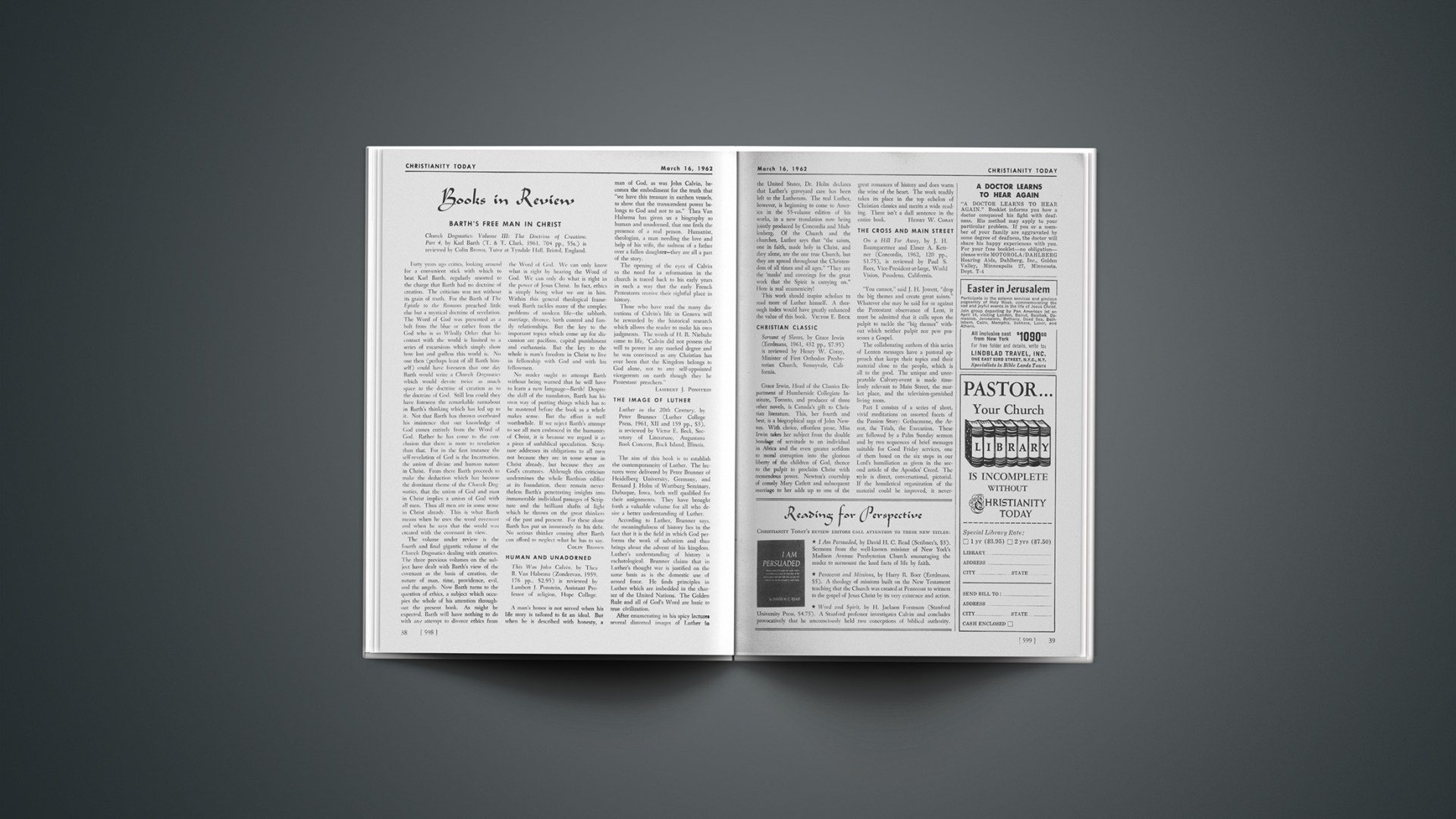
Book Briefs: March 16, 1962

Barth’S Free Man In Christ

Church Dogmatics: Volume Ill: The Doctrine of Creation: Part 4, by Karl Barth (T. & T. Clark, 1961, 704 pp., 55s.) is reviewed by Colin Brown, Tutor at Tyndale Hall, Bristol, England.

Forty years ago critics, looking around for a convenient stick with which to beat Karl Barth, regularly resorted to the charge that Barth had no doctrine of creation. The criticism was not without its grain of truth. For the Barth of The Epistle to the Romans preached little else but a mystical doctrine of revelation. The Word of God was presented as a holt from the blue or rather from the God who is so Wholly Other that his contact with the world is limited to a series of excursions which simply show how lost and godless this world is. No one then (perhaps least of all Barth himself) could have foreseen that one day Barth would write a Church Dogmatics which would devote twice as much space to the doctrine of creation as to the doctrine of God. Still less could they have foreseen the remarkable turnabout in Barth’s thinking which has led up to it. Not that Barth has thrown overboard his insistence that our knowledge of God comes entirely from the Word of God. Rather he has come to the conclusion that there is more to revelation than that. For in the first instance the self-revelation of God is the Incarnation, the union of divine and human nature in Christ. From there Barth proceeds to make the deduction which has become the dominant theme of the Church Dogmatics, that the union of God and man in Christ implies a union of God with all men. Thus all men are in some sense in Christ already. This is what Barth means when he uses the word covenant and when he says that the world was created with the covenant in view.

The volume under review is the fourth and final gigantic volume of the Church Dogmatics dealing with creation. The three previous volumes on the subject have dealt with Barth’s view of the covenant as the basis of creation, the nature of man, time, providence, evil, and the angels. Now Barth turns to the question of ethics, a subject which occupies the whole of his attention throughout the present book. As might be expected, Barth will have nothing to do with any attempt to divorce ethics from the Word of God. We can only know what is right by hearing the Word of God. We can only do what is right in the power of Jesus Christ. In fact, ethics is simply being what we are in him. Within this general theological framework Barth tackles many of the complex problems of modern life—the sabbath, marriage, divorce, birth control and family relationships. But the key to the important topics which come up for discussion are pacifism, capital punishment and euthanasia. But the key to the whole is man’s freedom in Christ to live in fellowship with God and with his fellowmen.

No reader ought to attempt Barth without being warned that he will have to learn a new language—Barth! Despite the skill of the translators, Barth has his own way of putting things which has to be mastered before the book as a whole makes sense. But the effort is well worthwhile. If we reject Barth’s attempt to see all men embraced in the humanity of Christ, it is because we regard it as a piece of unbiblical speculation. Scripture addresses its obligations to all men not because they are in some sense in Christ already, but because they are God’s creatures. Although this criticism undermines the whole Barthian edifice at its foundation, there remain nevertheless Barth’s penetrating insights into innumerable individual passages of Scripture and the brilliant shafts of light which he throws on the great thinkers of the past and present. For these alone Barth has put us immensely in his debt. No serious thinker coming after Barth can afford to neglect what he has to say.

COLIN BROWN

Human And Unadorned

This Was John Calvin, by Thea B. Van Halsema (Zondervan, 1959, 176 pp., $2.95) is reviewed by Lambert J. Ponstein, Assistant Professor of religion, Hope College.

A man’s honor is not served when his life story is tailored to fit an ideal. But when he is described with honesty, a man of God, as was John Calvin, becomes the embodiment for the truth that “we have this treasure in earthen vessels, to show that the transcendent power belongs to God and not to us.” Thea Van Halsema has given us a biography so human and unadorned, that one feels the presence of a real person. Humanist, theologian, a man needing the love and help of his wife, the sadness of a father over a fallen daughter—they are all a part of the story.

The opening of the eyes of Calvin to the need for a reformation in the church is traced back to his early years in such a way that the early French Protestants receive their rightful place in history.

Those who have read the many distortions of Calvin’s life in Geneva will be rewarded by the historical research which allows the reader to make his own judgments. The words of H. R. Niebuhr come to life, “Calvin did not possess the will to power in any marked degree and he was convinced as any Christian has ever been that the Kingdom belongs to God alone, not to any self-appointed vicegerents on earth though they be Protestant preachers.”

LAMBERT J. PONSTEIN

The Image Of Luther

Luther in the 20th Century, by Peter Brunner (Luther College Press, 1961, XII and 159 pp., $3), is reviewed by Victor E. Beck, Secretary of Literature, Augustana Book Concern, Rock Island, Illinois.

The aim of this book is to establish the contemporaneity of Luther. The lectures were delivered by Peter Brunner of Heidelberg University, Germany, and Bernard J. Holm of Wartburg Seminary, Dubuque, Iowa, both well qualified for their assignments. They have brought forth a valuable volume for all who desire a better understanding of Luther.

According to Luther, Brunner says, the meaningfulness of history lies in the fact that it is the field in which God performs the work of salvation and thus brings about the advent of his kingdom. Luther’s understanding of history is eschatological. Brunner claims that in Luther’s thought war is justified on the same basis as is the domestic use of armed force. He finds principles in Luther which are imbedded in the charter of the United Nations. The Golden Rule and all of God’s Word are basic to true civilization.

After enumerating in his spicy lectures several distorted images of Luther In the United States, Dr. Holm declares that Luther’s graveyard care has been left to the Lutherans. The real Luther, however, is beginning to come to America in the 5 5-volume edition of his works, in a new translation now being jointly produced by Concordia and Muhlenberg. Of the Church and the churches, Luther says that “the saints, one in faith, made holy in Christ, and they alone, are the one true Church, but they are spread throughout the Christendom of all times and all ages.” “They are the ‘masks’ and coverings for the great work that the Spirit is carrying on.” Here is real ecumenicity!

This work should inspire scholars to read more of Luther himself. A thorough index would have greatly enhanced the value of this book.

VICTOR E. BECK

Christian Classic

Servant of Slaves, by Grace Irwin (Eerdmans, 1961, 432 pp., $7.95) is reviewed by Henry W. Coray, Minister of First Orthodox Presbyterian Church, Sunnyvale, California.

Grace Irwin, Head of the Classics Department of Humberside Collegiate Institute, Toronto, and producer of three other novels, is Canada’s gift to Christian literature. This, her fourth and best, is a biographical saga of John Newton. With choice, effortless prose, Miss Irwin takes her subject from the double bondage of servitude to an individual in Africa and the even greater serfdom to moral corruption into the glorious liberty of the children of God, thence to the pulpit to proclaim Christ with tremendous power. Newton’s courtship of comely Mary Catlett and subsequent marriage to her adds up to one of the great romances of history and does warm the wine of the heart. The work readily takes its place in the top echelon of Christian classics and merits a wide reading. There isn’t a dull sentence in the entire book.

HENRY W. CORAY

Reading for Perspective

CHRISTIANITY TODAY’S REVIEW EDITORS CALL ATTENTION TO THESE NEW TITLES:

* I Am Persuaded, by David H. C. Read (Scribner’s, $3). Sermons from the well-known minister of New York’s Madison Avenue Presbyterian Church encouraging the reader to surmount the hard facts of life by faith.

* Pentecost and Missions, by Harry R. Boer (Eerdmans. $5). A theology of missions built on the New Testament teaching that the Church was created at Pentecost to witness to the gospel of Jesus Christ by its very existence and action.

* Word and Spirit, by H. Jackson Forstman (Stanford University Press, $4.75). A Stanford professor investigates Calvin and concludes provocatively that he unconsciously held two conceptions of biblical authority.

The Cross And Main Street

On a Hill Far Away, by J. H. Baumgaertner and Elmer A. Kettner (Concordia, 1962, 120 pp., $1.75), is reviewed by Paul S. Rees, Vice-President-at-large, World Vision, Pasadena, California.

“You cannot,” said J. H. Jowett, “drop the big themes and create great saints.” Whatever else may be said for or against the Protestant observance of Lent, it must be admitted that it calls upon the pulpit to tackle the “big themes” without which neither pulpit nor pew possesses a Gospel.

The collaborating authors of this series of Lenten messages have a pastoral approach that keeps their topics and their material close to the people, which is all to the good. The unique and unrepeatable Calvary-event is made timelessly relevant to Main Street, the market place, and the television-garnished living room.

Part I consists of a series of short, vivid meditations on assorted facets of the Passion Story: Gethsemane, the Arrest, the Trials, the Execution. These are followed by a Palm Sunday sermon and by two sequences of brief messages suitable for Good Friday services, one of them based on the six steps in our Lord’s humiliation as given in the second article of the Apostles’ Creed. The style is direct, conversational, pictorial. If the homiletical organization of the material could be improved, it nevertheless must be said that these messages have the flavor and grip of preaching.

In an Appendix to Part I the author has given a suggested Order of Service for Good Friday, the arrangement being governed by the topics used in the messages mentioned in the preceding paragraph.

Part II, which has no logical or structural relation to Part I, offers a series of eight sermons on the “Hands” of our Lord. Beginning with “Helping Hands” and ending with “Pierced Hands,” we are shown the manifold ministries of the Master, all of them culminating in that saving self-oblation in which His hands were “pierced.”

Though there is little of exegesis, the biblical content of these messages is strong. Inevitably, theological predilections are evident. In this case what emerges—not as apologetic but as assumption—is the Lutheran concept of baptism and a strongly Augustinian approach to “sin and grace.” This reviewer, knowing full well this will commend the book to many, still wishes that a Lenten series such as this might carry to Christians far more of the accent of Bonhoeffer’s “costly grace” and Thomas Kelley’s “holy obedience.”

PAUL S. REES

More Help

A Greek Grammar of the New Testament and Other Early Christian Literature, by F. Blass and A. Debrunner, tr. and ed. by Robert W. Funk (University of Chicago Press, 1961, 325 pp., $10), is reviewed by Robert C. Stone, Professor of Classical Languages, North Park College, Chicago, Illinois.

This English translation of an outstanding German work is an important addition to the stock of study aids at the command of students unfamiliar with the German language. For too long a time American students in the field of New Testament Greek have had to depend on works emphasizing the eight-case system and other points which, while valuable in themselves, served to overemphasize the classical writers. This book keeps the study of the Koine in proper perspective by its constant reference to and comparison with the classical Greek constructions and usages.

Three sections of the book deserve special mention: (1) “Syntax of the Cases” is a clear exposition of the many nuances of case usage in the New Testament, with a wealth of illustrations taken from the text; (2) the section on “Tense” contains a discussion of the significance of tense in Greek, a valuable exposition on a point to a great extent misunderstood; (3) the plain setting forth of the rationale of conditional sentences in Greek sheds a floodlight upon many passages.

This book is a must for anyone seriously concerned with the study of the Greek Testament, especially for students in college or seminary classes, and for pastors, whose primary task is clear and accurate exegesis of the sacred text. Extensive bibliographical references make it possible to investigate more thoroughly any desired subject.

ROBERT C. STONE

Ancient Criticism

The Earliest Lives of Jesus, by Robert M. Grant (Harper, 1961, 134 pp., $3.50), is reviewed by R. B. Culbreth, Pastor, Metropolitan Baptist Church, Washington, D. C.

Dr. Grant says that the purpose of his book is to “show how the problems, historical in nature, which arise out of the canonical Gospels whenever they are thoughtfully considered, were faced by Christian writers in the first two or three centuries.” In order to do this he seeks to relate modern questions pertaining to the early life of Jesus in the hope that these may provide the answers.

The author assumes for his readers an advanced knowledge of New Testament textual criticism and a familiarity with the first two centuries’ writings on the subject. He carefully reviews the teachings of Marcion, Papias, Justin, Tatian, Irenaeus, Clement and others. He presents an excellent analysis of the writings of Origen. In fact, the main body of the book concerns itself with Origen and his writings on the Gospels and the life of Jesus.

The interested reader will find this book very helpful in understanding the analogy of ancient literary criticism and the modern historical approach.

R. B. CULBRETH

To Meet A Real Need

Personal Devotions For Pastors, ed. by William B. Williamson (Westminster, 1961, 202 pp., $3.50), is reviewed by Leslie Hunt, Principal, Wycliffe College, Toronto, Canada.

I think this little volume of personal devotions will be widely received by ministers and others because it supplies a real need. No one knows better than the minister under the pressure of work in his parish that so often the spiritual output exceeds the intake and in the course of time may result in spiritual exhaustion. In this setting, aids to a vital prayer life are necessary and welcome.

This volume of personal devotions was born out of a need. The editor, an Episcopal clergyman, found himself hospitalized for serious surgery and tried to obtain a book of devotions which would help him. When he did not find what he sought, he set himself to the task of compiling such a volume, with the concern that there might be many others in his situation needing similar help and spiritual renewal. He gathered together this collection from a wide variety of sources and added some prayers of his own composition. The choice is such that they could be used by ministers of any denominational tradition. Many prayers have been rendered in the first person which has added greatly to making the little volume deeply personal.

The devotional situations of the book include sections for personal need; for special occasions such as sickness, recovery, discouragement, and perplexity; a grouping of devotions on “My Ministry;” and one on the “Seasons of the Church Year.” I commend this book especially to the clergy but it will prove valuable to laymen also.

LESLIE HUNT

The Shape And The Drift

One Great Ground of Hope, Christian Missions and Christian Unity, by Henry P. Van Dusen (Westminster, 1961, 205 pp., $3.95); On the Road to Christian Unity, by Samuel McCrea Cavert (Harper, 1961, 192 pp., $3.75), are reviewed by James Daane, Editorial Associate, CHRISTIANITY TODAY.

For eighteen centuries the Christian Church fragmented its unity. During this time there was scarcely an organization, or a fellowship of any kind, in which churches met to confer about their differences and attempt to regain their unity.

In the nineteenth century, which Kenneth Scott Latourette calls the “Great Century,” things changed. Through missionary effort Christianity expanded as never before and as no other movement in all history had ever expanded.

Out of the painful awareness that the disunity of the Church was a tremendous obstacle to the missionary effort, the ecumenical concern for regaining the oneness of the unbroken Body of Christ was born. “The Christian world mission,” asserts Van Dusen, “has been the principle parent of the effort after Christian unity” (p. 16). It is this missionary concern over disunity which constitutes Van Dusen’s “one great ground of hope,” a hope shared by many ecumenists. This widely held hope accounts for the enthusiasm which greeted the recent merger of the IMC with the WCC. Since missionary zeal is often stifled when channeled through the machinery of ecclesiastical organization, it remains to be seen whether this zeal will endure. It also remains for the future to disclose whether the primary motif for unity is still the deep missionary concern of early ecumenical decades. Since greater missionary effort seems to lie in the younger rather than in those older churches, and lies in America, where missionary concern is chiefly concentrated, outside rather than inside the membership of the World Council, many feel that they can correctly guess the answer.

Samuel McCrea Cavert presents an excellent history of the ecumenical movement and its progress, especially of the last 50 years, with an able and sympathetic treatment of the ecumenical problems and possibilities of Orthodoxy, Roman Catholicism, and of such non-cooperating Protestant bodies as the Southern Baptists.

Both books are excellent sources of information concerning the shape and drift of ecumenism today, for both authors write within a field they know well.

JAMES DAANE

Roman Ecumenics

The Ecumenical Council, the Church and Christendom, by Lorenz Jaeger (Geoffrey Chapman, tr. by A. V. Littledale, 1961, 194 pp., 21s.), and The Church of England and the Ecumenical Movement by James Good (Burns Oates, 1961, 163 pp., 18s.), are reviewed by Colin O. Buchanan, Anglican Minister at Cheadle, Cheshire, England.

These two books both have Roman Catholic authors and the word “ecumenical” in their titles. But the Archbishop of Paderborn is examining Roman Councils (especially the next one), while the Professor of Theology at Cork, reviews non-Roman counsels and councils, and the place of the Church of England in them.

Jaeger aims to show that the papacy has always been the same, belittles conciliarism as a passing and heretical fancy and suggests some probable formulations of the forthcoming Council. On the first point the Fathers are not helpful, on the second Jaeger sidesteps the Council of Constance almost completely, and on the third he warns us not rashly to expect anything but a closing of the hierarchical ranks. Thus Rome adheres to her own interpretation of “ecumenical.”

Good’s book is tremendous reading for Anglicans. He is thoroughly at home in all our modern writers from Kirk to Inge and from Headlam to Barnes. Historically he is a little weaker (e.g., he calls all continental influences at the Reformation “Lutheran”!). His logical mind exposes the folly of the “dualism” that Anglicans often count as a virtue. He grasps a slippery ecclesiology and shows that virtually exclusive statements can often be found in the same Anglican documents. Similarly he accurately exposes Anglican attempts (in differing ecumenical contexts) to trace authority for belief to the Scriptures, the early Fathers, the episcopate, or the enlightened conscience. He complains of insincerity bordering on deceit—and he has made out his case.

He is blind in deriding “private judgment” without contemplating that the Bible might be a genuine and clear means by which God reveals himself. He also says Rome is semper eadem—and, though he writes from the fastnesses of Cork, in this, as in all his arguments, Anglicans ought to read him very seriously.

COLIN O. BUCHANAN

Christ Our Exodus

When Israel Came out of Egypt, by Gabriel Hebert (John Knox Press, 1961, 128 pp., $1.75), is reviewed by David A. Hubbard, Chairman, Division of Biblical Studies and Philosophy, Westmont College, Santa Barbara, California.

Israel’s exodus has captured the interest of both Old Testament historians and biblical theologians. Historians seek to untangle knotty problems like its date, route, and scope, while theologians grow increasingly aware that the Exodus is the grand event in Israel’s experience, the pattern for God’s subsequent redemptive acts. This little book summarizes splendidly the results of both approaches.

Following a survey of passages which rehearse and interpret the Exodus, Hebert tackles such questions as the dates of Joseph’s descent into Egypt (c. 1360 B.C., under Akhnaton) and the Exodus (c. 1280–70 B.C., under Rameses II), the nature of the plagues and the location of Sinai. Linguistic and critical problems are touched upon: the origin and meaning of JHVH; the relationship between Moses and Israel’s law. Though critical in his approach, e.g., the post-Mosaic nature of much of Israel’s legal structure, Hebert is generally cautious in his conclusions.

In the final pages on the “Christian Exodus” he builds a graceful bridge between the Old Testament expectation of a second exodus and the New Testament affirmation that Christ has accomplished it. We who are strangers to the liturgical use of the exodus motif will welcome the moving lines from the Lenten and Easter services. The combination of scholarship and piety will commend this book to a wide range of readers.

DAVID A. HUBBARD

See Sinai

God’s Wilderness. Discoveries in Sinai, by Beno Rothenberg (Thomas Nelson & Sons, 1962, 196 pp., $15), is reviewed by Carl F. H. Henry, Editor of CHRISTIANITY TODAY.

For a few short months in the winter of 1956–57, the Sinai peninsula was open to the searching study of Israeli scholars. This volume yields the findings of those expeditions. Enlivened by 16 maps and plans and 90 photogravure illustrations, the work by Beno Rothenberg (in collaboration with Yohanan Aharoni and Avia Hashimshoni) sheds new light on the scene of the Hebrew desert wanderings. The location of the Mountain of God, of Kadesh-Barnea, Mount Hor and Jotbathah are among questions uppermost in the minds of the fieldworkers, who indicate the reasons for their agreements and disagreements. The volume will fascinate students of archaeology, but Bible scholars in general will also enjoy traversing the bleak Sinai mountains, with few hardships and many rewards, by entering into the narrative of these explorations.

CARL F. H. HENRY

Peale Faces His Critics

The Tough-minded Optimist, by Norman Vincent Peale (Prentice-Hall, 1961, 246 pp., $3.95), is reviewed by Lars I. Granberg, Professor of Psychology, Hope College, Holland, Michigan.

Dr. Peale’s familiar themes are developed in this book. As in his earlier books he encourages an optimistic approach to life and provides specific suggestions on how to accomplish this. One cannot, however, dismiss the book with “Here’s another,” for it contains Dr. Peale’s attempts to deal with his critics.

To those who speak of his work as a Pollyannish attempt to hear no evil and see no evil, Dr. Peale replies that the tough-minded optimist is one who faces his problems but nevertheless, is hopeful and active in the face of adversity. To the charge that he makes religion a kind of veneer or at best a tool in the service of positive living, he speaks firmly concerning his commitment to historic Christianity (p. 29 f.). His devotion to Jesus Christ is unmistakable.

That his system of thought falls entirely within historic Christian theology is less apparent. In speaking of its components he cites his father’s analysis with apparent approval:

… it is clearly evident that you have gradually evolved a new religious system of thought and teaching. And it’s OK too, very OK, because its center and circumference and essence is Jesus Christ. There is no doubt about its solid biblical orientation. Yes, you have evolved a new Christian emphasis out of a composite of Science of Mind, metaphysics, Christian Science medical and psychological practice, Baptist evangelism, Methodist witnessing, and solid Dutch Reformed Calvinism (p. 33).

Strange bedfellows. The nuclear concept appears to be a courageous affirmation of life through fellowship with God. In our day of foreboding and despair a vigorous call to clear-sightedness, courage and hope in the name of Christ is eminently in order. Such an orientation to life makes a significant Christian witness. However, Dr. Peale relies heavily upon self-suggestion techniques to produce this courage, hope and vigorous action. Can the presuppositions and techniques of ideal suggestion actually be grafted to Christian theology as easily as this? The Scriptures do contain a ringing call to the Christian to face life with courage, hope and joy, and this is what Dr. Peale seeks to underscore. I wonder whether it is not possible to achieve these objectives without leaning so heavily upon suggestion techniques.

The last chapter in the book is bound to get most notice. In it he says blunt things about preachers who fail to present their parishioners with “man-sized honest-to-goodness redemptive religion.” He is especially hard on what he calls the “would-be-erudite, super-scholastic vocabulary-ish ethical-implication social-action type.” He considers persons of this sort responsible for creating a misleading view of the church—especially in the business community—through dubious socio-economic pronouncements representing a point of view not characteristic of most church members.

Dr. Peale is obviously smarting from the personal attacks made upon him by persons of this type in criticizing his earlier books—and not without considerable justification. While his reaction is understandable, I wish he had remained positive.

LARS I. GRANBERG

Religious Novels

Search Your Soul, Eustace (American title: The Victorian Vision), by Margaret Maison (Sheed and Ward, 1961, 360 pp., 12s. 6d., $4.50) is reviewed by Arthur Pollard, Lecturer in English Literature, Manchester University, England.

Dr. Maison has had to read a lot of rubbish in order to write this book, but bad novels, like bad poets, can often be fascinating to read about, if intolerably boring to read. No reader should be put off by the unfortunately flippant title. This is an important book, a serious and perceptive study with a good bibliography, marred a little by the absence of footnote references and index.

It is difficult for us to realize the influence of religious attitudes on the writing of novels in the last century, but not the least of the commendations which, be it said, a rather insensitive publisher’s reading bestowed on Trollope’s The Warden was that it was “pervaded by a vein of quiet humour and [good-natured] satire, which will make the work acceptable to all Low Churchmen and dissenters.” That was the extent to which the religious reading public mattered. As a result there was a ready sale for explicitly religious novels of all kinds, High, Low, Broad, Non-conformist and agnostic. The surprising thing is that the masterpieces were so few.

Yet for literary diagnosis and historical commentary they are most interesting. They make the surprising thing less so, for they are countless horrible reminders of how to be certain not to write a masterpiece. Scattered about English literature are numerous warnings of the dangers of didacticism. The religious novelists of the nineteenth century were, in general, either ignorant of or undeterred by such admonitions. As a result plots are slanted to some predetermined didactic pattern to point a moral or to press the propaganda—sudden conversions after dire calamities for Evangelicals; contentment in the Church of England after perilous escape from the clutches of Rome for Tractarians; a plague on both your houses, preferably satirical, for agnostics. It is the same with character and dialogue. The difference between the good novelist and the bad is one of artistic integrity. The good novelist possesses it and respects it; the bad does not even know what it is. This was exactly the case with the writers Dr. Maison considers.

It is her triumph that she makes no extravagant claims for the unimportant. As she points out, they have a continuing documentary significance providing useful information about the strength and types of religious attitudes in the period. They also provide some (largely unconscious) humor, of which the following will serve as a sample with which to take leave of this interesting book. It is a quotation from a certain Emily Agnew:

“When he (the priest) informed her that the same Divine Being … would, in the three persons of His essential unity, descend on her soul in Baptism, Lilia immediately inquired, ‘By particles or emanation?’ ”

ARTHUR POLLARD

Handy But Incomplete

The Old Testament: its formation and development, by Artur Weiser (Association Press, 1961, 493 pp., $5.95) is reviewed by R. K. Harrison, Professor of Old Testament, Wycliffe College, University of Toronto.

This work is a revised and expanded form of the author’s Einleitung in das Alte Testament. It deals successively with the formation of the writings in the Old Testament canon, the growth of inter-testamental literature, and the significance of the Qumran sect. While the author purports to strike a balance between the tradition-history and form-critical schools, he is clearly an adherent of the old Wellhausen position.

What is perhaps even more unfortunate is that the student is unlikely to derive more than the barest hint from this work of the tremendous upheaval in the world of Old Testament studies. Weiser presents a picture of his subject as it existed in the late twenties, and although he has enlarged his bibliography by the addition of more recent works he has not modified his basic position to any extent discernable to the reviewer. While he mentions the writings of some conservative scholars, he clearly prefers the views of Noth and von Rad on the Pentateuch and makes only the briefest reference to the important criticisms of Wellhausenism advanced by Engnell and the Scandinavians.

His treatment of the minor prophets is rather scanty. He does not mention the Qumran commentary in the section of Habakkuk, while his introduction to the Book of Daniel shows no advance upon the views expressed by S. R. Driver in 1897. Similarly, some of the critical problems connected with the pseud-epigraphal literature are ignored completely in the writer’s survey.

To the reviewer the book is a handy survey of European critical thought in the late twenties. It is not as up-to-date as the author or publishers would have the reader believe. The book appears to have been translated carefully, and is attractively produced with few misprints.

R. K. HARRISON

Human Side Of The Faith

Treasure in Earthen Vessels, by James M. Gustafson (Harper, 1961, 141 pp., $3.50) and The Precarious Vision, by Peter L. Berger (Doubleday, 1961, 238 pp., $3.95) are reviewed by Ivan J. Fahs, Associate Professor of Sociology, Greenville College, Greenville, Illinois.

The extent to which these books regard things Christian as transcending social structural forms, the more valuable service they will render to the thinking leadership of Christianity. Gustafson, I think, has done this more explicitly than Berger. The net effect of both books is to sensitize the reader to those features of the Christian faith which are plainly human.

Gustafson, who employs the vocabulary of both minister and social scientist, does a competent job of extending his theme that the church is a human community. We have needed a book which would easily mix the language of sociology and theology within the context of a common question; this is especially well done in his chapter, “Social and Theological Interpretation of the Church.” The tone of the book is such that even the layman is ready to accept certain startling things he has to say.

Berger’s major theme is that what is manifestly Christian faith is often social fiction. For the most part, Berger is a debunker, a role he consciously and skillfully takes. This reviewer followed his argument with admiration, but with sustained regret that his keen and flashing sword was not more carefully lubricated with an oil of kindness. Berger inaccurately infers that the debunking technique and the techniques of social analysis are mutually overlapping terms. A rug can be pulled from under somebody’s feet so violently as to fracture a skull, or it may be done (repeat, it may be done) by a slow and gentle tug without serious side effects. I fear that only the hard-headed will survive this book—and, alas, these are often the hardhearted, too.

IVAN J. FAHS

Book Briefs

Effective Prayer by J. Oswald Sanders (China Inland Mission Bookroom, 1961, 28 pp., Is. 6d.). Twenty short meditations on prayer reprinted from the CIM periodical The Millions.

Sermons of Robert Murray M’Cheyne (Banner of Truth, 1961, 187 pp., 3s.). Twenty-five sermons of a great Scottish preacher of the last century, some from his own notes, and others from notes taken down by his hearers.

Emerging Pattern in the Diocese of Singapore and Malaya by R. Alan Cole (China Inland Mission Bookroom, 1961, 48 pp., 2s. 6d.). An account by an Anglican ClM missionary of the work in the last nine years in Malaya amidst attacks from Communist rebels, a decaying Buddhism, and rank materialism.

Christ’s Words from the Cross, by Charles Haddon Spurgeon (Zondervan, 1962, 120 pp., $1.95). Seven sermons by Spurgeon on the seven words of the Cross.

Pilgrimage into Depth, by Antoinette Adam (Antoinette Adam, 5345 Greene St., Philadelphia 44, 1961, 57 pp., $2.50). Fifty-six poems reflecting the faith and service of a Christian nurse.

The 7 Words, by John A. Holt (Baker, 1961, 95 pp., $1.50). Seven sermons which probe the seven words of the Cross.

What is Christian Life?, by P.-A. Liege (Hawthorn, 1961, 144 pp., $3.50). A Roman Catholic interpretation of the Christian life and Christian sanctity. Vol. 56 of “The Twentieth Century Encyclopedia of Catholicism.”

The Epistles of Paul to the Romans and Thessalonians, tr. by R. Mackenzie, ed. by David W. Torrance and Thomas F. Torrance (Eerdmans, 1961, 433 pp., $6). Romans and Thessalonians (Vol. 8) in a completely new translation of Calvin’s New Testament commentaries.

Trumpet of Salvation, by Norman E. Nygaard (Zondervan, 1961, 180 pp., $2.50). A biographical novel of the lives of William and Catherine Booth, founders of the Salvation Army.

They Called Him Mister Moody, by Richard K. Curtis (Doubleday, 1962, 378 pp., $4.95). A colorful biography of an unconventional man and a great revivalist who did much to change the climate of life in late nineteenth-century America.

The Ten Commandments Yesterday and Today, by James Burton Coffman (Revell, 1961, 128 pp., $2.50). The essays display the timeless validity of the Decalogue.
John H. Glenn: An Astronaut and His Faith

When the Friendship 7 space capsule landed with a splash and a sizzle and Lieutenant Colonel John H. Glenn, Jr., clambered out, American Christians had special reason to take heart. Not only had their prayers for Glenn been answered, but the nation had a new space hero. And for once at least the hero was not a smart-alecky ham with a long record of marital strife.

Throughout the world the word had gone out that Glenn and his family are devout Presbyterians and faithful churchgoers. They represent an American Christian home in the best tradition. Theirs is clearly not a head-in-the-sand Christianity, but a very practical faith.

“But are they born again Christians?” some evangelicals were asking. “Have they actually experienced regeneration?”

The Glenns come from a community where churchgoing was the rule. When they were youngsters in New Concord, Ohio, “everyone went to church.” As a junior high school student, John once collected his savings from small jobs and save them to an evangelist who was preaching at his church.

After high school, John and Annie both enrolled at Muskingum College, which was affiliated with the former United Presbyterian Church of North America now merged into the United Presbyterian Church in the U.S.A.

Glenn’s fellow students remember him as a clean-living, devoted individual, although he did not “wear his religion on his sleeve.” They did not consider him particularly pious. However, as one classmate puts it, “John wasn’t around when there was anything happening that he didn’t agree with.”

Glenn, to be sure, did not abandon his faith upon entry in the Marine Corps. Even in the jet pilot set, which is not especially distinguished for high moral standards, Glenn stood his ground as a clean-living individual. Down through the years he has made it a point to bring servicemen friends to church with him, although avoiding high-pressure evangelistic tactics. He was a trustee in one of his former churches, taught a boys’ Sunday School class in another, and was a choir singer (tenor) in another.

When the Glenn family moved to Arlington, they learned that the Rev. Frank A. Erwin, an old hometown friend, was pastor of the Little Falls United Presbyterian Church. Erwin got to know Mrs. Glenn’s parents during his own days at Muskingum, where he attended before going on to Pittsburgh-Xenia Theological Seminary.

Problems Of A Space-Age Parish

The most publicized church in the world in 1962 has been the Little Falls United Presbyterian Church of Arlington, Virginia. Its minister, the Rev. Frank A. Erwin, has played a key supporting role in the Glenn space drama by virtue of the fact that the astronaut and his family have worshipped at Little Falls since 1958.

The spotlight upon Little Falls has brought the flourishing church some problems, although Erwin does not regard them as serious. He says his biggest problem has been in trying to cope with the scores of inquisitive phone calls and letters. Another problem arose one Sunday morning when the Glenn family arrived at the church accompanied by a flock of news photographers. The photographers agreed to confine themselves to a balcony, but even at that Erwin felt their noise disrupted the service.

Demands on Erwin’s time reached their peak during the week of the space flight. The situation was somewhat alleviated for him in that it was the assistant minister’s turn to preach the following Sunday.

Erwin and the associate, the Rev. Arthur L. Stanley, serve a congregation which has grown in a decade from a nucleus of a dozen families to more than 1,000 members. In the church’s early days, substantial impetus came from lay help provided by the Wallace Memorial United Presbyterian Church of Washington, one of the leading evangelical churches in the national capital area.

At Little Falls, the Glenn family has been one of the most active in the entire congregation. Lyn, 14-year-old daughter, is currently president of a junior high fellowship. John and Annie were counsellors during a week-end camp retreat. Glenn took the pulpit once in a laymen’s Sunday address.

The Glenns exercise their faith in their home as well. During evenings when the father is home, they have family Bible reading together. One of their favorite traditions at Christmas is to bake a birthday cake for Jesus.

Evangelical Press Service quoted a minister friend of the Glenns as saying, “There’s no doubt about it. John is a born-again Christian.”

The minister’s father was said to have been used of the Lord to lead John Glenn’s father to Christ many years ago, “and the conversion of the entire family soon followed.”

Astronaut Glenn, however, is not known to refer to a specific conversion experience, but Erwin warns that this is not to be construed as reason to question his genuine Christian commitment. The minister says that Glenn is “neither a fundamentalist nor a liberal.”

Some observers have expressed a hope that wide identification of Glenn as a fellow Christian would lessen tendencies toward provincialism in some elements of U. S. evangelicalism.

Soon after the orbital space flight, the Glenns received a congratulatory message signed by United Presbyterian Stated Clerk Eugene Carson Blake and General Assembly Moderator Paul D. McKelvey. Many other U. S. church leaders were silent about the space feat, however. The quasi-pacifist element which inspirits much of organized American Protestantism seemed unable to dissociate space rocket launchings from their nuclear warfare counterparts.

Some evangelicals pointed out that the race to space should not be considered good or evil per se. The question was not whether man ought to explore space, but what for? These observers commented that space exploration could conceivably take on as profoundly religious aspects as has archaeology, and that in the providence of God the findings in space could glorify God and confirm and strengthen Scriptural truth as much as findings beneath the earth’s surface.

In Glenn’s own words, quoted in the February 1 issue of Presbyterian Life, “Space flight will contribute to man’s knowledge of God’s universe. I believe that it is not only within man’s proper province, but is expected of us, to find out all we can about God’s creation.”

Protestant Panorama

• A special day of repentance and prayer was held under auspices of the British Guiana Council of Evangelical Churches following riots and arson-set fires which destroyed a large section of the business district in the capital city of Georgetown. In issuing the call for prayer, the Evangelical Council, representing 13 Protestant denominations in the country, appealed to the nation’s leaders to offer prayers in their homes as well as at services.

• An American Lutheran Church committee plans to study glossalalia and faith healing. Three seminary professors, a physician, and two pastors have been named to the committee which will look into the phenomena described as unusual manifestations of the Holy Spirit’s power.

• A merger between the World Conference on Missionary Radio and the National Religious Broadcasters is being explored by directors of both groups, according to a joint statement which appeared in last month’s issue of the WCMR bulletin. “International Christian Broadcasters” is the name tentatively selected for the proposed new organization, the statement said.

• Leaders of the Philadelphia Synod of the United Church of Christ are supporting the U. S. District Court ruling which declared Bible reading in public schools to be unconstitutional. Their stand runs counter to the position taken by directors of the Greater Philadelphia Council of Churches, which terms the court’s interpretation too broad and warns that it “opens the door to more serious restraints in the public school program.”

• Five San Francisco Bay area theological schools are establishing a joint graduate study program leading to a doctor of theology degree. Participating in the program, known as the Graduate Theological Union, are the Church Divinity School of the Pacific (Episcopal), Berkeley Baptist Divinity School (American Baptist), Pacific Lutheran Theological Seminary (United Lutheran), Golden Gate Baptist Theological Seminary (Southern Baptist), and San Francisco Theological Seminary (United Presbyterian). The program is said to be the first such venture in American theological education.

• A Spanish-language version of “This Is the Life,” telecast produced by the Lutheran Church—Missouri Synod, is being introduced to South America. The program marks the second experiment in lip synchronization of the Christian drama telecast in a foreign language for viewing overseas. On Christinas Day the program was premiered in Japanese.

• Christian Service Brigade, which is marking the 25th anniversary of its founding, moved into a new headquarters building in Wheaton, Illinois, last month.

• Methodist spokesmen say that Amendment XII to the church constitution has failed to win sufficient votes among annual conferences to be legally adopted. The amendment would have increased the number of General Conference delegates and changed meeting dates of jurisdictional conferences so that they would meet before the General Conference instead of after it.

• The National Church Music Fellowship is sponsoring a hymn composition contest, with a $100 prize being offered by the Billy Graham Evangelistic Association for the copyright of the best gospel hymn submitted. Deadline for entries is August 31, 1962, according to competition chairman Rene Frank of Fort Wayne (Indiana) Bible College.

• A total of 102 persons are being selected to complete membership of the Commission on Brotherhood Restructure of the Christian Churches (Disciples of Christ). Selections were initially made by an 18-member central committee and were approved without change by directors of the Disciples International Convention. Names have not yet been made public.

• A color documentary film on Jerusalem narrated by Billy Graham will be premiered in the United States during Holy Week.

Prayer Breakfast

On a bright, brisk first morning of March in Washington, D. C., more than 1,000 men jammed into the grand ballroom of the Mayflower Hotel for what a U. S. Senator termed as one of the largest turnouts of bipartisan political rank that he had ever seen—for any reason. The head table at International Christian Leadership’s tenth annual “Presidential Prayer Breakfast” resembled the first row of guests at a presidential inauguration. In addition to President Kennedy (who arrived a half-hour late) and Vice President Johnson (who left a half-hour early), the head table included Chief Justice Earl Warren, House Speaker John McCormack, and five cabinet members.1Secretaries Freeman (Agriculture), Dillon (Treasury), Ribicoff (Health, Education and Welfare), Hodges (Commerce), and Postmaster General Day. At other tables were seated some 30 Senators and approximately 150 members of the House of Representatives, in addition to scores of other government and military dignitaries.

The mood of the breakfast did not measure up to last year’s, which approached that of a revival meeting. But the 1962 edition did produce perhaps the most dramatic moment in the history of the prayer breakfasts when host W. C. Jones stepped to the podium and uttered a public confession that he had harbored a prejudice against President Kennedy as a Roman Catholic. Kennedy sat expressionless as Jones admitted:

“On election night I was angry and resentful.”

The audience listened in a stunned silence as Jones explained that he prayed about the prejudice, knowing that he was scheduled to give a Christian testimony in the hearing of the President at last year’s prayer breakfast. Jones said that within two months the prejudice was dissolved. He attributed the transformation to a divine work, adding:

“This to me is the reality that comes in Jesus Christ.”

Other participants in the breakfast program included tenor Norman Nelson, who sang “How Great Thou Art,” Governor Price Daniel of Texas, Johnson, and evangelist Billy Graham, all of whom spoke briefly.

Kennedy also talked briefly, both at the men’s assembly and at the “Congressional Wives Prayer Breakfast” which was held simultaneously in another room of the hotel. He told some 800 women who were on hand that “it is a source of satisfaction to be here with Mrs. Johnson, the Vice President’s wife, and with the Governor of Texas—and Senator Carlson—Senator Stennis—most importantly, I think, of Reverend Billy Graham, who has served this cause about which I speak so well here and around the world. He has, I think, transmitted this most important quality of our common commitments to faith in a way which makes us all particularly proud.”

Here are salient excerpts from Kennedy’s remarks to the men’s breakfast:

I want to, as President, express my appreciation to all those whose efforts make this breakfast possible. This is only one of a world-wide effort, I believe, to build a closer and more intimate association among those of different faiths in different countries and in different continents, who are united by a common belief in God, and therefore united in a common commitment to the moral order—and as Governor Daniel said, the relationship of the individual to the state.

The effort made in New Delhi among the World Council of Churches, the efforts that have been made in Europe to build better understanding among men and women of different faiths, the effort made in this country I believe is most important and most essential.

I do not suggest that religion is an instrument of the cold war. Rather it is the basis of the issue which separates us from those who make themselves our adversary. And at the heart of the matter, of course, is the position of the individual—his importance, his sanctity, his relationship to his fellow men, his relationship to his country and his state. This is in essence the struggle, and it is necessary, therefore, that in these difficult days, when men and women who have strong religious convictions are beleaguered by those who are neither hot nor cold, or by those who are icy cold, it is most important that we make these common efforts—as we do this morning.… I believe yesterday we saw an interesting contrast in the response which Colonel Glenn made, as to whether he had prayed. And he said that he had not, that he had made his peace with his Maker many years before. And the statement made by Titov in which during his flight, as he flew over the Soviet Union he realized, he said, the wonders of the communist system.

I preferred Colonel Glenn’s answer because I thought it was so solidly based, in his own life, in his activities in his church, and I think reflects a quality which we like to believe and I think we can believe is much a part of our American heritage. So I congratulate you …

A Mormon’S Economics

International Christian Leadership’s annual banquet is usually overshadowed by the “Presidential Prayer Breakfast,” although both events are part of ICL’s annual conference. This year, however, the 18th annual conference banquet drew some attention in its own right. The speaker was George Romney, who (1) is a Mormon, (2) successfully pioneered the American compact car market by introducing Ramblers, and (3) now seeks to be governor of Michigan.

The selection of Romney as a key speaker stirred considerable controversy and disappointed many who have regarded ICL as an evangelical Protestant movement. Even persons close to the ICL leadership were distressed.

Romney, whose Mormonism showed through clearly at several points although he made no reference to specific doctrines, cited the American economic system as a Christian development. He said he regards the Constitution and the Declaration of Independence as “divinely-inspired documents.”

“The Constitution,” said Romney, “was written by inspired men raised up just for that purpose.”

New Exchange Of U.S.—Soviet Churchmen

Keeping company with a record-breaking thermometer which persisted in plummeting below the zero mark, the 272-member policy-making General Board of the National Council of Churches met in Kansas City, Missouri, February 26-March 2, and promptly took its own temperature in probing the unfavorable image it has acquired in many quarters. At the same time, it assured itself of some further adverse publicity in unanimously approving plans for an exchange visit between churchmen of the United States and the Soviet Union, the original invitation having come from a Russian Orthodox Church official.

Efforts are to be made to avoid “extensive publicity” in either country. United Presbyterian Stated Clerk Eugene Carson Blake, who headed the United States delegation in the previous such exchange in 1956 which attracted considerable criticism, called for an attitude of suspicion toward “right-wing extremist elements,” which are expected to renew charges of leftist tendencies against the council. A leading figure in preparing for the exchange, Blake said that its purpose was theological, not political, and represented an attempt to keep channels of communication open between Christians.

Difficulty of bifurcating the theological and the political was highlighted in topics scheduled for discussion, which include: the bearing of the Gospel on “social-economic concepts and practices,” the “place of the individual in society,” and what the churches can do to advance peace in the world. Blake indicated that effects of Communist and American materialism on religion and churches would also be discussed.

The exchange has been approved by both American and Soviet governments. The U.S. delegation will number 13 churchmen who will visit Russian churchmen in the Soviet Union for three weeks beginning next August 25. The return visit of the Russians is due in February, 1963. Possibilities for additional exchanges will be aired.

The lone voice of caution raised from the floor was that of Methodist layman D. W. Brooks of Atlanta, Georgia, who said it would be unfair to the Russian churchmen to assume they would be free agents as the Americans.

During an earlier extensive session on the significance of the New Delhi assembly of the World Council of Churches, Brooks had reported a conversation of his in the Soviet Union with a Russian minister who broke down and confessed that his fellow ministers were not free to speak their minds though they claim to be—that he himself had been sent to Siberia for preaching the gospel.

Dr. Franklin Clark Fry, chairman of the WCC Central Committee, had previously said that if government control were to be the criterion for WCC membership, the Church of England and the Lutheran church in Denmark would be excluded. He said there were churches more under government control than the Russian Orthodox.

Assuming a cautious stance toward WCC admission of the Russian Orthodox Church was Archbishop Iakovos, primate of the Greek Orthodox Archdiocese of North and South America, himself a WCC president: “I am neither thrilled nor over-pleased with the action which we took.” “Will we [be able to] persuade them to join hands in spreading the unaltered evangelical truth and thus eliminate false social preachings?” He warned against “unjustified mistrust,” but added: “It is childish to say even jokingly, that because we constitute the majority, the Russians will never dare to divert the route of the World Council of Churches. They have tried it already, in a pretentiously timid way, in some instances at both the sectional and the plenary sessions.”

Of kindred interest: the paperback A Christian’s Handbook on Communism, currently being distributed by the NCC at one dollar per copy, did not get to the floor for General Board approval, as the General Policy and Strategy Committee members reportedly had not time to read it.

Among other General Board actions:

•A major public pronouncement calling for reshaping of U.S. immigration policies along lines of four non-ethnic priorities: occupational skills, U.S. economic health, reunion of families, needy persons unable to support themselves. Also urged were equal treatment for naturalized and native-born citizens and permanent legislation for annual admission of approximately 10,000 refugees.

•A hearing of the serious Cuban refugee problem in Miami, Florida, and the attempt of NCC, Roman Catholic, and Jewish religious agencies to meet it by means of the new “Flights in Freedom” project which air lifts refugees from Miami and resettles them in other cities.

The opening hours of the board meeting were marked by an “inwardness” (assuredly not of Kierkegaardrian intensity) stimulated by G. Raymond Campbell, minister of Oklahoma City’s Westminster Presbyterian Church, who pointed to the need of improving the “cloudy,” “distorted” image of the NCC. He called for greater emphasis on its good works, which tend to be overshadowed by its pronouncements, and raised the question: To whom is the NCC responsible for its pronouncements? Campbell suggested it might better serve as the clearing-house for pronouncements of its member denominations. He indicated it would be well also to leave room for difference of opinion on public issues, rather than pronouncing a particular position the Christian one.

These ideas met with some resistance in the discussion period which followed. NCC President J. Irwin Miller had previously named extremist right-wing criticism which serves to publicize the NCC. as therefore “one of the best things that has happened to the Protestant churches.” A San Francisco Methodist underscored his president’s optimism in noting the value of Southern and Midwestern criticism of the NCC: “In my city, no one cares two hoots and a holler about what you say. It would be great if we could get up enough enthusiasm even to get criticism.”

F. F.

The ‘Super Church’ Charge

Dr. Paul S. Rees, a former president of the National Association of Evangelicals, says the World Council of Churches’ record and constitutional provisions should absolve it from charges that it seeks to become a “super church.”

Addressing the midwinter conference of the Evangelical Covenant Church of America in Minneapolis last month, Rees praised the concern of WCC leaders for the “fantastic dividedness” of Christians in today’s world. He said criticisms of the WCC to be valid and effective must be “far better informed.”

“I get increasingly concerned,” he added, “over the tendency by those outside the WCC to set up the terms ‘evangelical’ and ‘ecumenical’ as though they were simply opposites.”

Rees, a vice-president of World Vision, commented on the WCC New Delhi assembly, saying that it showed “early signs” that the WCC has begun to be strangled by its own ecclesiastics and administration “pros.”

The Covenant church conference also heard Dr. Edwin T. Dahlberg, past president of the National Council of Churches, describe the organization’s work.

Still another speaker was Dr. Harold J. Ockenga, the NAE’s first president, who credited NAE units with having revived America’s Sunday schools, spurred the foreign missionary movement, and protected the rights of religious broadcasters.

Ockenga said that the Evangelical Foreign Missions Association, an NAE affiliate, now handles more than half of the Protestant missionaries sent out from the United States, although the total constituency of the NAE numbers only about 10 million.

Denial Of A Review

The U. S. Supreme Court announced last month that it would not consider an appeal from the Scripture Press Foundation, which has been denied a tax-exempt status in decisions by the U. S. Tax Court and the U. S. Court of Claims.

The court had the case under advisement for three months, but its denial of a review cited no reasons and made no comment on the issues involved.

Scripture Press, owned and controlled by a private foundation, is one of the world’s leading publishers of evangelical Sunday School materials and related literature.

The question of whether Scripture Press is entitled to tax exemption because of its religious and educational character has been in dispute since 1953 when the Commissioner of Internal Revenue ruled that, although the publication of religious educational materials and supplies may be necessary to carry out the functions of churches purchasing such material, “the manufacture and supply thereof does not constitute a religious activity in itself but is a business of a kind generally carried on for a profit.”

Scripture Press quotes legal authorities who say that the decision could affect other religious and secular foundations.

Albert Rhys Williams

Ex-clergyman Albert Rhys Williams, 78, native-born American who had been a prolific Soviet apologist since 1917, died last month in Tarrytown, New York.

Williams was graduated from Hartford Theological Seminary in 1907 and served as an assistant at the Maverick Congregational Church of East Boston (no longer in existence) from 1907 until 1914. He was ordained as a Congregational minister in 1911 but failed to maintain his standing and was subsequently dropped.

He became a correspondent in World War I and ended up in the employ of a Soviet propaganda bureau in Petrograd. He then returned to the United States but paid visits from time to time to the Soviet Union. He has written a number of books relating to Bolshevism and on his 75th birthday in 1958 the Communist newspaper Pravda praised his efforts “for the great idea of socialism.”

Canadian Appeal

The Lord’s Day Alliance is asking the Canadian government to modernize the 1906 Lord’s Day Act and to regulate radio and television advertising on Sunday.

In a brief to Prime Minister John Diefenbaker, the Alliance pointed to several portions of the act which it said need revision, citing particularly that the act deals with such matters as hiring a boat or a horse and carriage on Sunday, but says nothing about airplanes, trucks, radio, or television.

The alliance asked for regulation of Sunday advertising on radio and television and said this would help to equalize treatment of the media, inasmuch as newspapers are not allowed to publish on Sundays in Canada.

In the United States, the Lord’s Day Alliance recently announced plans to expand operations to combat the attack on Sunday as a day of worship and rest.

Reformation On Film

Dr. Ernest G. Schwiebert, who doubles as a U. S. Air Force historian and as executive director of the Foundation for Reformation Research, is concerned lest all of Western culture be swept up in a mushroom cloud.

“This could be an age to which people will look back with pride in 50 or 100 years,” Schwiebert said at a meeting of Protestant Men of the Chapel at Andrews Air Force Base, Maryland, last month.

But it is also an age, he warned, of great potential danger to mankind. Precautions must be taken to insure that Western heritage does not disappear.

Dr. Schwiebert’s Foundation for Reformation Research was established in 1957 to make historical treasures of the Old World accessible to the scholars of the New by modern means of photo-duplication. Published and unpublished resources, wherever they can be found, are being brought together in St. Louis by the foundation, and made available to competent scholars and research specialists.

During a trip to Europe in 1959, Dr. Schwiebert made a master list of material which should be preserved. Filming began one year later. Some 500,000 pages of manuscript, the collection of Philip of Hesse, have been microfilmed in Marburg alone. Dr. Schwiebert exhibited various historical documents, including the letter from Martin Luther to Philip about the latter’s divorce, and the Speier document which first used the word “Protestant.” Aid has been enlisted from scholars all over Germany (118 of them in Berlin alone). In Switzerland there are, among other materials, 12,000 letters of Bullinger, one-third of them originals.

Roman Catholics, said Dr. Schwiebert, have been “wonderfully cooperative,” and quick to see the situation in the light of possible nuclear attack. Nearly one million pages have been filmed to date. “If we have to have a war,” Dr. Schwiebert said with a smile, “let’s wait till most of this valuable material has been collected!”

He said school of paleography is urgently needed to expedite the work.

Dr. Schwiebert added that this kind of work makes a “notable contribution to the ecumenical movement.” It will, he said, produce a different kind of scholar, make available a wider variety of material, and minimize preoccupation with adiaphora (matters on which the Scripture is silent).

J. D. D.

Important Precedent?

Protestant observers in Madrid say a recent court decision constitutes an important precedent for Protestant civil marriages in Spain. The decision, made by the Spanish Supreme Court of Appeals and dated December 12, 1961, said that there was no objection in law to a Spanish Baptist couple contracting a civil marriage.

Under Article 42 of the Spanish Civil Code, persons who formally affirm that they are not Roman Catholics may contract a civil marriage. However, during the past two decades, this article has in practice been overridden by a ministerial order of March 10, 1941, which has been interpreted to mean that an affirmation of “non-Catholicity” is not enough and that parties must also prove they have never been baptized as Catholics—something which is difficult to do in Spain.

The position was slightly alleviated by a decree of 1956 which provided that couples affirming non-Catholicity, but who were unable to prove they were not baptized in the Catholic church, might be authorized to contract a civil marriage if their case, after having been referred by the registrar to the Catholic bishop of the diocese, did not result in a decision within one month.

This is understood to have been the case of the Baptist couple whose appeal for permission to contract a civil union was taken to the Supreme Court of Appeals.

Spanish Protestants currently are said to number about 20,000.

Malta Election

Because of the “most barefaced moral pressure on an all-Catholic population, proclaiming it a mortal sin to vote labor,” the Archbishop of Malta ensured the Labor Party’s defeat in last month’s election on the island. This was the view of the party’s leader, Dom Mintoff, who further charged the British Colonial Office with working hand-in-hand with the ecclesiastical authorities in the “most unfair” election in Maltese history.

About 90 per cent of the population voted in the election, the first held under a new constitution. Pro-church Nationalists won 25 of the Legislature’s 50 seats, with the Labor Party coming second with 16. Some find it significant and even ominous, nonetheless, that in a backward urban population one islander in three voted Labor in the teeth of the church’s strictest sanctions. Anti-Labor posters on many churches declared: “God will curse you if you vote Socialist.”

(From Rome, meanwhile, came reports that there is a trend in the Vatican toward less direct involvement in Italian politics.)

It is widely felt that the result may be reversed before long because of the serious economic problems confronting the new government when the British pull out of this Mediterranean possession occupied for 150 years. For his part Mr. Mintoff has declared that he would accept help from the Soviet Union or its satellites if Western aid proved inadequate. In the light of this The Observer of London points what might be a pertinent warning: “Here are the seeds of a future Cuba rather than of a Cyprus,” says the editorial. “Will these symptoms be recognized in time both by Britain and by the local Catholic hierarchy?”

J. D. D.

Iamso And The Gospel

Religious alignments are carefully avoided in the newly-formed Inter-African and Malagasy States Organization, which brings together Christian states such as Ethiopia with Muslim states such as Somali. Christian leaders however, feel that the establishment of IAMSO may give greater opportunity for the spread of the Gospel. For instance, they point to the fact that the official languages of the organization will be French and English, explaining that use of more common languages makes literature work easier. Schools in some of the 19 charter member states already are teaching both languages.

IAMSO’s formation marks a further step toward the “United States of Africa” envisioned by many African leaders. The desire to give the continent a truly African voice in world affairs is reflected in the proviso that only “independent states under indigenous African rule” may join.

So far, IAMSO seems aware of Communist intrigue, whereas the Casablanca group (Ghana, Guinea, Mali, Morocco, and U. A. R.) have leaned toward the East bloc. The Casablanca group, which has stayed out of IAMSO, has called for more sensational political unity, but IAMSO countries have felt this is impractical and premature. The charter reflects mature thinking on practical ways to solve Africa’s problems of communication, education, health, economics, and technical development. A secretariat has been established in Lagos, Nigeria, and members states will meet at least every two years.

W. H. F.

Christianity and Communism

A Christian’s Handbook on Communism, which has been approved by the National Council of Churches’ Division of World Mission ($1 per paperback copy from the Interchurch Center) proposes that every local church of the large NCC constituency set up a Committee on Social Education and Action through which each member will be stimulated to fulfill his social responsibilities.

The potential for good or ill of such a development is unlimited. For more than a generation Protestant liberalism has misguided Christian action along “social gospel” frontiers, mainly on the left bank of American politico-economical life. Evangelicals on the other hand have largely neglected the tasks of social justice in order to concentrate on personal evangelism. In time liberalism lost not simply the Gospel, but from its social message lost also the emphasis on fixed principles and truths. Proud of its supposed relevance and carefully spurning “frozen patterns,” neoorthodoxy is now channeling the social energy of the churches into one tentative position after another. And evangelicals have shown increasing eagerness to rectify their neglect of the social order. For lack of constructive guidance, some, unfortunately, simply endorse secular or sentimental proposals. Others intuitively shy away from leftist errors but remain baffled or demoralized by incessant left-wing attacks on the right-wing. Most evangelicals nonetheless identify themselves proudly on the right. They are uneasy, however, over those radicals who breed internal suspicion, who emphasize negations instead of elaborating constructive alternatives, and who enter politics or economics simply in terms of a secular perspective rather than that of the biblical revelation.

It is heartening, then, that A Christian’s Handbook on Communism aims to provide a constructive overview as well as a negative critique. More than once Christian workers have complained that requests for packets of literature on Communism had brought from a large denomination’s headquarters little but diatribes against the right-wingers. With one-third of the world in the grip of Communism, and two-thirds strategically influenced by socialists, church leaders and workers will be eager to learn what the National Council regards as imperative study. Many have heard Khrushchev’s warning to the West: “Your children will live under Communism.” If Communism more than any other of the forces of anti-Christ threatens to sweep the whole world into its orbit, what shall the Christian churches say and do?

The National Council handbook must be assessed both for its evaluation of Communist theory and action and for its exposition of Christian theology and action.

The Presentation of Communism

The Handbook’s picture of Communist dogma and deeds is a realistic one. Controlled elections, totalitarian policy decisions, state ownership of industry, the imbalance between industrial development and military concentration, collectivization of agriculture, the propagandistic use of education are all portrayed. Oppression by secret police, disregard for individual rights, shortages of housing and food, restrictions on workers, striking salary differentials despite claims of equalization of income, scarcity of consumer goods, breakdown of family loyalties, repression of voluntary organizations are depicted as well. A noncritical paragraph appears on socialized medicine (“popular with the people”). The Handbook ascribes Communism’s appeal to the Chinese people in part to “positive programs” such as “health care” which, we are told, “appealed to the ethical sense of all, including Christians” (p. 40). Listed among the positive benefits of Communism is the fact that “hospital care and medical services are more widely available to the mass of the people” (p. 43). The pamphlet seems therefore to give veiled support to the widening of government health services.

The power and appeal of Communism are rightly linked to its philosophy, passion, and program in a world where most people daily face poverty, hunger, unemployment, disease, discrimination, and oppression. Communism is a revolutionary movement that “feeds on discontent and poses as the champion of every oppressed group” (p. 5).

The exposition of Communist theory is factual, instructive and illuminating. Marx’s critique of capitalism was based on limited observation and was therefore fallible; indeed, Marxism “oversimplifies, misunderstands, and distorts the nature of value, profits … society, government, man” and so on (p. 12).

Weaknesses in Evaluation

The Handbook’s overall evaluation of Communism is weak in three respects, however. First, the pamphlet fails to note the widespread tendency and danger even among evangelicals to honor Communism as a religion. Second, its judgment on socialism is ambiguous. Third, the Handbook minimizes Communism’s strong appeal to intellectuals on the basis of its seeming logical consistency.

Communism is now often catalogued as a religion because it demands ultimate loyalty, and offers a comprehensive framework for meeting life’s problems. The NCC Handbook emphasizes that Communism denies God and the supernatural, locates the source of evil in the economic system and not in man (as does the Handbook) and finds salvation in human resources rather than in God (p. 22). The discussion pictures Communism as “a new secular religion” which has fought the old established religions in Russia for half a century (p. 37). It notes also the religious revivalist flavor of much Chinese Communist activity (p. 41). At the same time, it is aware that Communist theory traces the origin of religion to the emergence of the social classes as a device for enslaving the masses, and explains the survival of religious feelings and denominations in “classless” Russia as due to ignorance and to uneradicated remnants of capitalism (p. 37). The 1936 constitution guaranteed freedom of worship and of antireligious propaganda (on the other hand, all religious propaganda is severely restricted). That only convinced atheists can be good Communists is an official tenet of the Young Communists League. While Christians are reportedly “seldom persecuted directly for their faith,” they are bypassed for responsible government posts because the totalitarian state “can brook no competitive allegiance.”

Since Communism believes that religion inevitably will disappear, it prefers to channel religion into the service of the state rather than to increase fanaticism by persecution (p. 51). But churchmen are frequently prosecuted, and always under the ruse of crimes against the state. Whatever its tactics, “Communist policy is to destroy the church, root and branch, using every power the state can exercise” (pp. 47 f.). Spies in churches report and apprehend nonconformist church leaders for eventual elimination (p. 54). Church ties to other lands are prohibited unless such associations serve government policy (p. 55). Communism “has not changed its attitude of opposition to religion” (p. 49) said Khrushchev in 1955. The Church must serve the state (p. 56). All church lands have been seized, all church schools closed; Communist activities are scheduled to coincide with church activities, which, incidentally, must be confined to church buildings. All welfare services are nationalized.

The Handbook adds “no truly committed Communist would favor or accept any kind of religion …” (p. 50). “The Communist has no God and, therefore, no conscience … and no divine law as basic universal code of morality and human decency” (p. 67). In view of these facts, it seems to us a confusing turn—which evangelicals and liberals, Protestants and Catholics alike encourage—to dignify Communism as a religion. It undoubtedly has pseudo-religious features. But to depict Communism as anything but irreligion is folly. Otherwise one creates respect for “the religion of Communism,” through the current emphasis on the universal desirability of “religion in life” of whatever sort. Taken only in the abstract, certain Communist objectives are commendable enough, and a materialist who finds the essence of religion merely in devotion to “moral values” may be easily misled into such a surface appraisal of Communism. But if one considers at all the means by which even such objectives are promoted, and the ultimate sanctions by which they are justified, then one must surely recognize how artificial it is to dignify as religion a “moral values” movement which aims to destroy the Ten Commandments and in fact repudiates their relevance for a just social order. Let us be done with the sentimental misjudgment of Communism as a religion; let us judge it for what it is; sheer irreligion or, at best, pseudo-religion.

Spongy on Socialism

The Handbook, moreover, portrays socialism as a live alternative to Communism rather than a modified or preliminary form of Communism. Liberal churchmen are defended for left-wing associations on the ground that Communists have at times infiltrated their movements (p. 19). Such rationalization does not explain, however, why those Communists were not repudiated; nor could it be expected to acknowledge the fact that some liberal churchmen themselves were actually Marxists. Attached to the observation that the West’s historic policy of government nonintervention in economic policy has been considerably modified is the strange comment that the West’s economy nonetheless is “in no way comparable” to the Soviet economy (p. 29). Communists, we are told, “fear socialism far more than people on ‘the right’ because they believe that middle-of-the-road people have more chance of … defeating the Communist program than conservatives …” (pp. 18 f.). This ludicrous commendation of socialism is really confuted by documents reflected elsewhere in the Handbook: 1. The Soviet Party’s 1961 Draft Program reports that “The dictatorship of the proletariat, born of the Socialist revolution, has played an epoch-making role by insuring the victory of socialism in the U.S.S.R.… The Socialist state has entered a new phase. The state has begun to grow over into a nationwide organization of the working people of Socialist society.… Having brought about a complete and final victory of socialism—first phase of communism”—etc. (p. 21). 2. Khrushchev’s 1961 draft of his second five-year-plan reads: “The Socialist world is expanding; the capitalist world is shrinking. Socialism will inevitably succeed capitalism everywhere …” (p. 26). 3. Lenin had previously regarded socialism as a preparation for Communism (p. 30).

Christians, says the Handbook, “need to understand how the profit motive, free competition, and government regulation work ideally.… They should know both the benefits and the dangers of widespread social planning” (pp. 76 f.). The appraisal favors what is called “present-day democratic enterprise’s modifications of capitalism,” and commends consumer’s cooperatives as “a democratic method of community development” (p. 78).

While the Bible’s social motivation and passion for social justice are acknowledged (p. 7), the pamphlet claims too broadly that “Christ and the church have historically denounced the same evils that communism decries” (p. 8). [Communism is not one of the evils communism deplores, nor does Christianity decry Christianity, private property (and other items that Communism does) as evil.] Communism’s opportunity, it is suggested, has been created by Christian neglect. The reader receives the impression that Communist goals are worthy and to be approved; and that Christianity criticizes only Communism’s method of violence and revolution, its violated promises and failure fully to implement those goals (p. 8). Christians who believe God shows concern for man’s economic affairs are “challenged by the truth in the insights” of Marx (p. 10). Indirect government controls in America, we are told, tend to stabilize the economy and thus provide more leisure for all (p. 13). In industry, the trade union movement has “made the lot of the worker better with ever higher wages and better living conditions as democratic enterprise has advanced”; “government regulations … prevent the full development of monopolies he [Marx] predicted,” and government planning seeks to curb unemployment (p. 14). Through such “democratic enterprise” many of the evils Marx associated with capitalism have been moderated.

In view of their compromised attitude toward socialistic tendencies in modern life, is it not remarkable that the Handbook writers voice concern over the “alarming degree that many people who are not Communists believe and practice the same things that Communists do” (p. 83)? More often than not references to the free enterprise system are critical of injustices (pp. 5 f., 83). Private property is mentioned only in conjunction with some reference to Marx’s view (“Since private property, which is the root of exploitation and all injustice, will have disappeared.… In this new type of society, there will be true communism …,” p. 15), or simply to reject the Communist tenet that the origin of evil is in personal ownership of private property (p. 22). Nowhere does the manual assert the biblical vindication and championing of property rights, let alone the truth that property rights are personal rights.

The impression is sometimes conveyed, therefore, that the sole reason for rejecting Communism is totalitarianism and revolutionary methods; that within limits Christians may cooperate with Communism “as long as it continues to work toward really Christian objectives” (p. 84)! Furthermore, while Communism’s denial of God and of human dignity is deplored, its economic program is not effectively challenged by Christian economic principles (p. 74).

In matters of war and peace, it is noted that Communists often camouflage their dedication to world conquest under the banner of peace (p. 45). Communism preaches world brotherhood even while resorting to imperialism and colonialism. Where it promised a classless society, new classes are in fact emerging (p. 44). Nowhere is Communist class-warfare actually condemned; the one reference made to war in the context of Christian conviction implies that under all circumstances it is contrary to Christian conscience (p. 80).

The Role of Reason

A third weakness of the Handbook to some might appear rather unimportant, namely, its tendency to underestimate Communism’s appeal to the intellectuals by offering a comprehensive rational integration of life. One ought to remember that recent liberal and neoorthodox apologetics downgrade the role of reason in Christian commitment; they defer, instead, to existential, nonrational aspects of religious experience. Such theological default creates a spiritual vacuum which the Communist philosophy is then free and waiting to fill. It is true, of course, that unlike the religion of the Logos and of rational revelation, the Communist rationale is not thoroughly comprehensive, consistent, and coherent. But the Handbook touches neither of these points in declaring that “Communists have been held together by overpowering personalities and a passion for their cause rather than by a unified, logical set of principles expressed in a consistent way” (p. 23). In fact, elsewhere the NCC Handbook notes Khrushchev’s 1961 reference to the emergence of a “new intelligentsia,” intellectuals who furnish “a basis for indestructible socio-political and idealogical unity” (p. 33). About the situation in China, we read: “Without doubt ideology is the basic cement which holds together the ruling group and which, to a large degree, explains its unity and dynamism. But the Chinese Communists … also are attempting to indoctrinate the whole population in the new ideology” (p. 41). It is even acknowledged elsewhere in passing that the Communists “have put their ideas together into a coherent plan of thought and action” (p. 83).

The Christian World-Life View

If anything, the Communist rationale should call us to a counterexhibition of Christianity, a world-life view rooted in the realities of supernatural disclosure. A proper question might well be whether the Handbook, which so carefully and comprehensively presents the Communist philosophy of history, of economics, and of life, also exhibits the Christian view with similar thoroughness and competence? Actually, less than one third of the Handbook deals with chapters on “The Christian Way” and “The Christian’s Responsibility.” How adequately is the Christian alternative presented?

The Bible is represented as the Christian’s “basic source book.” Its content, however, is depicted as human insight and inference from man’s encounter with God rather than as revealed truth and inspired teaching (p. 61). While the unique Saviourhood and Lordship of Jesus Christ are asserted, statements about his deity are sometimes ambiguously worded. We are told that “the meaning of the Christian faith is rooted in the incarnation of Christ, the cross, and the resurrection” (p. 62). But nowhere is the Resurrection (in contrast to economic determinism) relevantly depicted as the decisive hinge of history, although one finds the broad emphasis that “when God is replaced by idolatry of things, the impersonal rule of economic and social forces gains control of the whole of life” (p. 72).

The Church is assigned a strategic role, although the nature of the Church is not defined. It simply “bursts out quite unpredictably into new energy” (p. 64). What the Reformation was in Luther’s day the ecumenical movement is in ours; all forms—hierarchical, established, and free—are accorded equal blessing.

The exposition of Christian doctrine is sketched in strokes so broad as to be almost brittle (“Christianity relates man to God,” p. 66; “The Christian teaching is that every human being has infinite worth,” p. 67; “Christianity teaches that all men should love one another and serve one another,” p. 68; “Jesus taught that sin has its roots fixed deep in every human heart,” p. 69; “Jesus Christ demonstrated complete dedication of life to one supreme task,” p. 70). These fragments of Christian theology are expounded far less precisely in the Handbook than is the Communist theory. Even if they were as thoroughly delineated, one could hardly derive the Christian alternative to Communism from so incomplete an overview. Any seminary student who could not write anything more incisive and relevant than the Handbook exposition of the Christian way ought to be declined ministerial ordination.

Christian Social Imperatives

The Handbook’s major interest and climax are a call to “every believer to bear a social witness” (p. 72). In the Bible we have “the main foundation stones for Christian action in society.… God made all men of one blood and … man is his brother’s keeper.…” The Church therefore has “a clear directive for action in community and national life” (p. 73). But the Church is not organized “to exert economic power”; it cannot and should not decree changes in economic and political systems; it “dare not identify the Christian faith with any particular program” (p. 74). What direction then should social responsibility take? The Church 1. holds up Christ’s ideal standard and Christian conscience as the best measure of all social systems; 2. educates its members on social problems and encourages individual and group action along social, economic, and political lines; 3. provides a center of love and strength for such action (p. 75).

So far, in the main, the Handbook is on firm ground, and if the social action committees of most Protestant groups had operated within these limits the “social gospel” would have been shorn of much of its mischief. We are told, however, that “the church must be the conscience of the state” (p. 76). This notion reflects either an objectionable Romanist view of church-state relations or (more probably in this case) the liberal Protestant view that Church and world merge in a unitary culture. As a byproduct of its life and witness, a virile Church will stir and shape the conscience of the world. But when the Church makes the imposition of its mind and will upon the nation a prime objective (which it then readily promotes through political pronouncements and actions), the Church invariably becomes embraced by secular society.

What the Handbook does not stress is that 1. in the Bible the Church is given divinely revealed truths and principles to which it is in conscience bound; 2. Christ’s ideal standard is precisely the fulfillment of the scriptural requirements; 3. Christian conscience is fallible and requires correction by the Scriptures. Indeed, as the NCC pamphlet proceeds, it abandons scriptural precedent for an alternative approach to the Church’s role in social action.

“There is a middle ground,” we are told, “between generalities” [divinely revealed principles?] and “specific political programs”; “love one another” can be translated into the Church’s insistence that the economic system provides “opportunity for all men to work,” without at the same time endorsing “particular legislative bills on unemployment insurance or control of the business cycle as being specifically Christian” (p. 75).

Two important distinctions should be made at this point. It is one thing to delineate a scriptural principle to which the Church is bound as the revealed will of God, and which the individual believer in good conscience is to apply in deciding between the particular options in the social order. It is quite another to doubt whether the Church possesses revealed truths or principles, to treat “middle axioms” rather as if they are the will of God, and to have ecclesiastical leaders project these substitutes into particular programs of social action.

If the pamphlet’s plea for “opportunity for all men to work” were considered implicit in the biblical emphasis on work as a divine requirement, then the Christian Church might be expected to disallow rather than support the whole system of compulsory unionism (which requires membership in a labor union as the condition of a job). The large denominations, however, have given carte blanche approval to unions’ “right to organize.” The influence of the National Council of Churches’ Department of the Church and Economic Life, interestingly enough, stacks up against right-to-work and for compulsory unionism.

The degree to which study groups stay alert, to that degree they will be wary of championing “middle ground” as if it were the will of God. When urged to “express what love means in concrete terms,” church members need to realize that in calling for a Committee on Social Education and Action the NCC Handbook has already decided in advance, for example, that the will of God “embraces support of the United Nations” (p. 82).

It would be wrong to say that this Handbook is “soft on Communism,” or is “flipped against the right-wingers.” It does indeed look favorably toward socialism. Its chief weakness, however, is its meager delineation of Christianity. While the Handbook concludes: “At length a point is reached beyond which there is no way but a renunciation: either faith in communism or faith in Christ must go” (p. 84), the case against Communism is argued with greater power than the case for Christianity. At a time when ecclesiastical leaders so frequently condemn the radical right-wingers for this very failure, it is more than ironic—it is sheer tragedy—that their own propaganda must fall under the same condemnation.

Space, Man And Destiny

PRAYER OF THANKSGIVING—When Col. Glenn was safely back on earth the first words uttered in the astronaut’s home were a prayer of thanksgiving. The Glenn family’s pastor, Rev. Frank Erwin, of the Little Falls Presbyterian Church, thanked God for the “divine guidance” of all those who worked on Project Mercury.—CORDELIA RUFFIN,The Washington Daily News.

FAITH AND FLIGHT—We’re a Christian family and it thrilled us to hear John give testimony of his Christian faith.—JOHN H. GLENN, SR., New Concord. Ohio, father of the astronaut.

A GRATEFUL HEART—I am so very, very thankful to God for the safety and success of his mission.—MRS. JOHN H. GLENN, SR., New Concord, Ohio, mother of the astronaut.

STATE ASSEMBLY PRAYS—The State Assembly took time out to listen to a radio account over its public address system of Colonel Glenn’s descent. Then it stood for a silent prayer of thanksgiving and passed a resolution congratulating the astronaut.—RUSSELL PORTER.The New York Times.

IN A LONDON PUB—News of Glenn’s return suddenly buzzed around the bar, breaking an awed hush, and a chorus of “Thank God for that!” and “he’s made it at last!” split the air.—AP, London.

CAPE CANAVERAL RESPONSE—Fifty thousand spectators stood along the beach watching the climbing Atlas carrying Lieut. Col. John H. Glenn, Jr. into orbit. Some cheered, some clapped. An elderly woman said solemnly: “He’s in the hands of the Lord now.” Most remained silent.—GAY TALESE,The New York Times.

SPANNING THE SKIES—This is the new ocean.… The United States must sail on it and be in a position second to none.—President JOHN F. KENNEDY.

AIRY HOPES—This is yet another significant step in man’s conquest of space and time, and a striking demonstration of technological and scientific progress which, the whole world hopes, will be used for peaceful purposes and for the benefit of all mankind.—U THANT, Acting Secretary General, United Nations.

CERTAINTIES AND DOUBTS—There is no doubt that the way to the galaxies is finally going to be open to the men of earth. What is in doubt is whether we are going to be able to make outer space the common ground of peaceful men—or a battleground for the cold war.—ROSCOE DRUMMOND,New York Herald Tribune.

PROGRESS OR DOOM?—Every one of the handful of men who has taken this astounding voyage through space … has come back from space with the same observation: the world is a beautiful sight.… It is good to be reminded of it by men whose accomplishments are the fruit of a science that has within it the potentials both of overwhelming destruction and universal progress. The choice is not for the brave men who fly their tiny craft into the unknown to make. It is the responsibility of those on earth, who live upon a planet with room and resources enough for all the races and nations of men.—Editorial, New York Herald Tribune.

QUESTIONS AND ANSWERS—Many persons, however, have been asking: “What is the purpose of these flights and what practical return is there …?” That question will be given many an answer on the scientific side, but it will be a long time before the present generation of Americans gets the full benefit.… One satellite, however, is soon to make it possible for television waves to be relayed around the earth.—DAVID LAWRENCE,New York Herald Tribune.

DAWN OF A NEW AGE—There is something in the very air of this space age that is not unlike the climate of another great age of discovery which took place in the fifteenth century. Then, as now, man was in a period of depression and anxiety. Samuel Eliot Morison has described that doubting decade that closed the fifteenth century: “At the end of 1492 most men in Western Europe felt exceedingly gloomy about the future. Christian civilization appeared to be shrinking in area and dividing into hostile units.…” Then came … the discovery of the new world. That news changed the spirit of Europe. In Morison’s words: “New ideas flared up throughout Italy, France, Germany and the northern nations; faith in God revives and the human spirit is renewed.” So must these ventures into our space environment revive and renew the human spirit.—Washington Post.

WE HAVE SEEN—We do not care what others have done. This for us is the first time anyone has orbited the earth, because this is the first time we have seen him do it!—PEDRO FERRIZ, Mexican TV commentator.

ELIJAH’S ASCENT AND DESCENT—And it came to pass, when Jehovah would take up Elijah by a whirlwind into heaven, that Elijah went with Elisha from Gilgal.… And it came to pass, as they still went on, and talked, that, behold, there appeared a chariot of fire, and horses of fire, which parted them both asunder; and Elijah went up by a whirlwind into heaven.—2 Kings 2:1, 11, ASV. And after six days Jesus taketh with him Peter, and James, and John his brother, and bringeth them up into a high mountain.… And behold, there appeared unto them … Elijah talking with him.—Matt. 17:1, 3, ASV.

JESUS’ ASCENSION AND RETURN—And when he [Jesus] had said these things, as they were looking, he was taken up; and a cloud received him out of their sight. And while they were looking stedfastly into heaven as he went, behold, two men stood by them in white apparel; who also said, Ye men of Galilee, why stand ye looking into heaven? this Jesus, who was received up from you into heaven, shall so come in like manner as ye beheld him going into heaven.—Acts 1:9–11, ASV.

Ideas

The Hunger of the Masses

Christianity must deliberately apply its warm spirit of compassion to the frustrations and vexing needs of modern man. Deep and selfless concern for unreached multitudes and a passion to right social injustices should mark the Christian witness in the world no less than a determination to preach the Gospel. The Church’s thrust must somewhere intersect and penetrate the driving aspirations of restless, clamoring masses.

Today people’s needs are measured almost entirely in material terms, and in relation to economic status and strength. The Church on the other hand offers eternal security and abundant life. Do these orbits interact at any point? Can the Church maintain relevance when its God, and not Marx or twentieth century social theorists, defines the content of love and justice? How must the Church meet alien philosophies that attach strange expectations to “Christian social action”?

Communism meets the disparities in modern society with a crisis technique that in the seemingly beneficent act of equalizing wealth places men’s lives under total state regimentation. Professing to function in the name of the proletariat an elite cadre (the dictatorial party organization) freely resorts to violence to repress and destroy all opposition. Communists, however, hesitate to actually ameliorate economic inequities, since any improvement of conditions only decreases the discontents which Communism appropriates for revolutionary ends. Among the masses, Communist tactics of propaganda and violence are more effective in advancing: totalitarian goals than are Communist doctrine and theory. People may challenge Communist philosophy as fallacious, may recognize Communist practise as inconsistent (even Khrushchev’s regime compromises at numerous levels). But they dare offer no rejoinder to tyrannical repression.

The Free World has sought to meet the social problems that feed Communism’s aggressive exploits by financial aid, by assailing economic disparity and by promoting the redistricting of wealth. In other words, while it actively resists Communism by cold war at the military level, the Free World makes peace with socialism at the politico-economic level. The Free World today is prepared for a nuclear war it may never need to fight (pray God!). Khrushchev wants to inherit America, yes—but not in ashes; nor does he want Russian industrial development set back a generation. Only some peculiar miscalculation could possibly outweigh the deterring force of these considerations. With each passing day, however, by being forced to voluntarily extend its compromise with socialism and to strain its abundant but not illimitable resources, the Free World is losing out more and more in the politico-economic war. The greater its provision of material benefits to the underprivileged masses abroad, the more the West seems to experience that one set of corrected conditions can swiftly worsen another. The actual facts are sometimes cold and cruel; it is true, for example, that medicine, food and money have meant longer life, population increases, and hence multiplied needs which in turn leave the basic situation relatively unchanged. In seeking to relieve multiplied conditions of dire distress, the Free World is draining its resources to the point where ultimately it may default on its ideals through sheer inability to nourish and sustain those ideals.

Although the masses in poverty (more than the vaulting ambitions of underdeveloped nations) pose problems of conscience to their more wealthy neighbors, anyone who thinks that today’s major problem is one of money and property is uncritically swallowing the Soviet line. Despite Communism’s announced hostility to private property, for example, the Communists since World War II have gained 30 million acres of land by “liberation,” and without putting a single Russian soldier on the battlefield Communists now control 800 million people.

The Free World’s program of “economic amelioration” therefore is far too simple. Its effect is merely to postpone major crises. In fact, by nonviolent rather than revolutionary methods it even promotes certain Soviet goals.

The Church of Jesus Christ should not suffer the illusion that material benefits prompt men’s loyalties to truth, justice and love, any more than dollar diplomacy binds nations to continuing respect for freedom and justice once monetary support is exhausted and removed.

In this era of communications proficiency one of the greatest tragedies is the Church’s conspicuous failure to propagandize her historic values and achievements. Across the years thousands of missionaries tore themselves from their families and the material comforts of the West (which they esteemed inferior to life’s greatest treasure) to carry the hope of the Gospel to fallen creatures, and to promote man’s recovery of his true dignity and destiny in Christ.

An even greater tragedy is the Church’s failure either through indifference or distrust—to apply her distinctive supernatural dynamic to the social order.

What is her mandate?

She is to pray for a lost and doomed world, and certainly no amount of social activism on her part will compensate for neglect of prayer.

She is to preach the Gospel by word and deed, and certainly social activism on her part is no legitimate alternative mission.

She is to get the revealed and inspired Word of God to the restless masses, and certainly no amount of other ecclesiastical literature on contemporary problems (or even on mission) discharges this obligation.

Above all, the Christian is to love God with his whole being and his neighbor as himself. This responsibility is quite different from mastering a dozen handbooks on the social crisis in order to delineate the universal brotherhood of man.

The Church of Jesus Christ is to cement and to maintain the bond between passion for the lost and compassion for the needy.

Prayer and evangelical mission are not alternatives to social responsibility but are means for deepening the sense of justice and kindling the fires of love. The Church misunderstands her own mission if she allows evangelistic effort in the narrow sense to cancel social concern.

Several years ago a Brethren group in a Scottish industrial town refused to vote on the liquor issue (for or against public houses) because it wanted no part of local government affairs, and believed virtually in shutting itself up in its little mission hall against the “Coming Crowning Day.” These people did, however, call a special prayer meeting to beseech God against a victory for king alcohol. Alcohol won out, but by such a narrow margin that if these Christians had exercised their right to vote, the outcome would have gone the other way.

In every generation God calls dedicated men to specialized tasks of social service which ministers and missionaries cannot fulfill. Sometimes these workers lay themselves open not only to the defilement of the market place but also to the sneers of certain evangelicals who consider them suspect. Social passion born of biblical motivations, hallowed by biblical dynamisms, should encourage a wide range of activity that merits respect as Christian vocation. Christians cannot with good conscience deplore social service as secular if they themselves ignore or desert this arena of responsibility. In fact, ought they themselves not be in the very forefront of such social concern?

The Church must minister to the needy according to her ability. When they cannot care for themselves she must feed the hungry and heal the sick. While she must meet such survival needs she has no excuse for confusing human desires and wants with human rights, however. Teaching men how to raise their standards of living and how to develop technologically is neither an imperative nor a primary task of the Church. But caring for the hungry and the cold is no matter of choice or deliberation. And she must help the hungry not only out of concern to preach the Gospel to them, but also out of compassion for the hungry as physically hungry.

On the other hand, whatever she does in compassionate awareness of basic human needs she must do in the name of Christ. The Church’s compassion after all is really the compassion of Christ for the hungry. If she belabors this point, however, her compassion may easily become something less. Yet the principle of “a cup of water in my name” must always characterize her ministrations to the needs of both body and soul, of both the hungry and the lost.

She is not called to encourage totalitarian states to dispense welfare in the name of welfare statism. She ought not even align herself with government welfare on the assumption that while the state pays the bills she can preserve her reputation for benevolence by merely administering the services. Christ never asked Caesar to fulfill the Church’s responsibility in whole or even in part. Those who believe such alignment is the way to reach the masses may know how to strike a short-term bargain with modern social theory. They know little, however, of the Christian meaning of passion and compassion.

Preaching The Prince Of Peace While ‘Peace Talks’ Go On

The sudden and unexpected return of Christ to this earth, Paul wrote the Thessalonians, will come when people are unaware of their impending doom, when they are saying “there is peace and security” (1 Thess. 5:3).

Not since Jeremiah’s day has there been so much ceaseless prattle about peace and so little evidence of it. Politicians claim credit for preserving the peace and churchmen promote the United Nations as the world’s best hope for peace. Jeremiah reproved even the religious leaders of his day for saying “peace, peace” to heal the hurt of God’s people “when there is no peace” (6:14; 8:11). It is remarkable that while the visionaries today are writing of a world without war, so many professed realists fail to see that ours is a world without peace.

“Condemned to Talk” is Time Magazine’s apt caption for the endless cold-war attempts to achieve peace. The test-ban talks begun in Geneva in October, 1958, by the U.S., the U.S.S.R., and Britain, we are reminded, “finally broke up, after 353 sessions, without the slightest sign of substantive agreement.… Yet … discussion … has positive values. It can furnish clues to developing Communist policy … (and) … keep the Kremlin fully informed of basic Western positions.… In a strong sense, then, the great cold-war adversaries are condemned to keep right on talking.

Absent from such summitry is not only the Messiah who carries peaceful government upon his shoulders, but also modern men who personally know the Redeemer’s peace in a troubled world. While it is true that Russia’s unwillingness to allow meaningful inspection jeopardizes every plan for nuclear weapon control, it is far from true that the basic problem of war centers in supervising the atom. Even the atomic age has not lifted us out of the Adamic age, and there’s the rub. To shape a new society we need not merely control of the armaments race but regeneration of the human race. When secular leaders are “condemned to talk” the Church may with benefit search her soul to rediscover what she is under orders to preach.

Student Interests Demonstrate Need For Guiding Principles

What is happening with students today? If the recent descent upon Washington by thousands of college and university students to picket for disarmament may be taken as any indication, the dominant principle of academic detachment is being shaken in our day by a rising interest in moral issues and by a deep concern for social justice. This surge of interest has been characterized by such diversity, however, that it emerges in its essential nature as a search for principles rather than a vision of a cause. Against this recent spectacle in Washington, evangelicals may note with wisdom another student gathering, of similar proportions, in Urbana, Illinois—the Sixth Annual Missionary Convention of the Inter-Varsity Christian Fellowship. Here, with a parallel emphasis upon the problems of the world, went the prior demand for a personal experience with Jesus Christ. This is to declare that the regeneration of society must begin with the regeneration of the individual. It is a reminder that the principles being sought by students are only to be found in Jesus Christ.

No End In Sight For Agony In Algeria

Algeria may long continue as one of the world’s most agonized spots, with indiscriminate murder and bombings a way of life—and of death. To the rest of the world it is a blurred picture. Frenchmen and Algerians are arrayed in strange enmities. French troops and installations are attacked by their own nationals even while Moslems and whites engage in senseless killings.

The situation is all the more puzzling when one realizes that many French people have resided in Algeria for generations and now their descendants are caught in the maelstrom of rising Moslem nationalism. For these Frenchmen Algeria is home, while for the Moslem majority it is a native land.

After years of warfare without victory for either side, DeGaulle determined to work out a peaceful solution. Official cessation of hostilities may decrease major conflicts but only time and death will wipe out the hatreds and frustrations of thousands.

It is at this point that Christians may have failed Algeria almost completely. How many pray daily that the balm of love and toleration may be poured out on this troubled spot? The works of nations, no less than of men, do follow after them. Caught in the ambiguities of her earlier colonization, France can neither stay in Algeria nor get out.

30: Faith

In dealing with so vast a subject as faith in so narrow a space, one’s first need is to limit the area of discussion without thereby distorting or falsifying the true nature of the subject. Our analytical age is all too prone to divide to conquer, only to find that the sum of the parts divulges no deep truth about the original reality. We must avoid this danger in speaking of faith, for faith is more than the sum of those of its elements which can most readily be detected and analyzed—knowledge, reason, will, love, emotion, and others. “You may think that it is very easy to explain faith,” wrote C. H. Spurgeon many years ago, “and so it is; but it is easier still to confound people with your explanation (What Is Faith?, Chicago, 1897, p. 13).

Definition. Faith is a channel of living trust and communion between morally conscious free beings. The dimension of moral consciousness must exist if there is to be communion (“and man became a living soul,” Gen. 2:7), and freedom must exist if the unity of the society produced by faith (faulty on earth; perfect in heaven) is to be that of dynamic life, not of soulless machines. Because living faith permits each soul to extend its dimensions of existence into the souls of others, and into the Infinite Dimension of God, there is irretrievable commitment and consequent hazard in faith. True faith, in the words of T. S. Eliot, costs not less than everything. It also gains everything—if the object of faith is faithful.

The life, the power, which flows through the channels of faith is the ultimate energy of the universe: God’s love—the love which God is. Where love is perfect, faith is perfect, as in the ineffable beatitude of the Trinity.

Every dimension of reality, whether material or spiritual, is compatible with faith when that dimension is truly understood. That is, faith is harmonious with reason, with knowledge, with “science,” with “psychology”—with all truth, ancient or modern—though it is dependent on none of them.

When God’s love is permitted, through faith, to permeate existence, life manifests the qualities inherent in divine creation: harmony, beauty, holiness, joy. When man, through a defect of love wilfully wrought, blocked the channel of faith in the Fall, faith ceased in man to reach wholly outward and instead turned in upon itself, where it must sicken and die. The limit of our faith is the limit of our life. It is unimaginable that any man should have faith literally in nothing except himself and continue to “live.”

Self-severed from God by disbelief in God’s veracity, man is doomed, so far as his own power is concerned, to wander forever in darkness and spiritual death. Any solution must be entirely of God and entirely of grace, without merit on man’s part. Even man’s assent to the free offer of redemption and salvation from God is a gift of God (Eph. 6:23; 2:8,9; Phil. 1: 29); the Saviour who (alone—John 14:6; Matt. 11:27) works our redemption is a gift (2 Cor. 9:15); and man’s empowering in the transaction is by the Holy Spirit (2 Cor. 4:13; Gal. 5:5). It is all of God.

Of the utter centrality of faith in Christian theology there can be no question. So long as man is, by sin, displeasing to God and at enmity against Him, man is without all hope; and without faith it is impossible to please God (Heb. 11:6). The rays of divine love come to their sharpest focus in the simple words, “For by grace are ye saved through faith …” (Eph. 2:8).

Faith and Knowledge. The role of knowledge in faith, and the difference between the two, may perhaps best be discussed by noting the difference of meaning between two terms commonly used to define faith: belief and trust. In this context we use belief in its narrow, secondary meaning of “intellectual assent, based on a sufficiency of evidence.” Trust we use in its meaning of reliance upon and commitment to.

Upon sufficient evidence, I am prepared to believe that Jesus existed, and that during certain years he walked the roads of Palestine. This takes no commitment on my part, involves me in no hazard. My conduct need not be altered by it, nor my boundaries of trust (life) extended, nor my sinful condition modified. This belief is not accounted to me for righteousness, as was Abraham’s (Gal. 3:6), for I have not believed God but evidence. Indeed, no matter how much I believe in this way, I shall always be inferior to the fallen angels and to Satan, for they believe, and tremble (James 2:19).

Knowledge, therefore, may compel the assent of the intellect, but it cannot compel that act of the will which constitutes trust. Our stony natural hearts must be softened by a more powerful solvent than knowledge, “for with the heart”—not the head—“man believeth unto righteousness” (Rom. 10:10).

But if knowledge is not of itself sufficient to produce reliant trust, it is, in greater or lesser quantity, an absolutely essential precondition to trust. “Flow then shall they call on him in whom they have not believed? and how shall they believe in him of whom they have not heard?” (Rom. 10:14). The basic imperative in this area is, “Acquaint now thyself with him, and be at peace” (Job 22: 21). Our Lord himself taught the value of objective evidence in developing reliant trust when he commanded doubting Thomas to reach forth his hand and feel the evidence of the wounds in Christ’s body. Saul of Tarsus, smitten to earth on the Damascus road, asked for one key bit of information: “Who art thou, Lord?” The answer, “I am Jesus whom thou persecutest” (Acts 9:5), gave him the Object of his trust.

To scorn knowledge is to make faith a purely subjective experience, which is as fatal as to seek salvation in knowledge alone. Modern Christian existentialism may be useful in reminding us that faith must be an inner reality and in Warning us against faith in human reason; but when it denies the reality of the objective source of knowledge which God has provided in his Word, and when it suggests that faith is a self-authenticating inner awareness, it cuts us off from the power of God by cutting us off from the historical Christ, who is the wisdom of God (1 Cor. 1:24).

The knowledge which leads to belief in scientific laws and principles is available to him who seeks, but the knowledge of the Person of God, which must be the basis of our trust, is given as an act of divine grace. We must learn of God by believing what he says of himself. “God, who at sundry times and in divers manners spake in time past unto the fathers by the prophets, hath in these last days spoken unto us by his Son” (Heb. 1:1, 2), and from this Source alone does perfect knowledge flow, the knowledge without which, no matter what our intellectual attainments, we walk in darkness.

There is no quantitative relationship between our knowledge and that act of trust through which we are saved. It was not ignorance which caused Adam to fall (1 Tim. 2:14), but the sin of disbelief committed as an act of will. Thus man born of Adam is in his fallen condition turned away from God and unable by his own powers to find God, for “he that believeth not God hath made him a liar” (1 John 5:10). When we have received sufficient knowledge to know to whom we speak (as did Saul of Tarsus), we then are no longer in a position to demand more knowledge but simply to confront commands which are in effect gracious invitations: “Trust in the Lord with all thine heart, and lean not unto thine own understanding” (Prov. 3:5).

Faith and Reason. What stacks of books and what quantities of heat have been produced by the debate over the role (if any) of human reason in Christian faith! Positions have ranged from Tertullian’s “Certum est quia impossible est” (De Carne Christi, 5) to the Cambridge Platonists’ “nothing truly religious is irrational and nothing truly rational is irreligious.” Each extreme has produced its own sickness: superstition, dependence on ecclesiastical authority, or pure subjectivism on the one hand; rational skepticism, materialism, or nihilism on the other.

The contemporary Protestant climate is suspicious of rational (or “natural”) theology as a basis for faith. In its place the tendency today is to stress faith as a product of “direct confrontation” of God subjectively and to consider the “quality” of that experience as self-authenticating.

First, if it be granted that any degree of knowledge whatever is a precondition to faith, then some role, however small, must be assigned to reason, for only reason knows how to identify and evaluate information.

Second, human reason, created in Adam and Eve as a trustworthy servant of the will, is in fallen man depraved and incapable of finding God (Rom. 8:7).

But though depraved, reason is not destroyed. Paul was not wasting his time when he spent hours and days arguing and debating in the synagogues. The remnant of right reason, though “aimed” away from God, may, like conscience in fallen man, give some light.

Faith and Love. To quote Spurgeon again: “Although we may not perhaps see it, there lies at the bottom of all love a belief in the object loved, as to its loveliness, its merit, or its capacity to make us happy. If I do not believe in a person, I cannot love him. If I cannot trust God, I cannot love Him.” As a corollary, we are moved to trust those whom we love. Indeed, we may say that faith is embraced in love, and thus the basic exhortation of both Testaments is “Thou shalt love.” True, love is not to be commanded, but it may be overwhelmingly attracted. That which attracts it is love, and “herein is love, not that we loved God, but that he loved us, and sent his Son to be the propitiation for our sins.… We love him because be first loved us” (1 John 4:10, 19).

How Faith Operates. Probably the key word is the preposition “through.” “By grace are ye saved through faith.…” On God’s side are the unsearchable riches of his grace; on man’s side, emptiness, drought, death. If man is to receive the water of life, there must be a channel, and that channel is faith. That channel need not be large nor perfect, for it is the reviving drop which is pure and efficacious. There is no merit in the channel, any more than there is reviving life in the dead pipe through which the water flows.

We must immediately distinguish between saving faith (“by grace are ye saved through faith …”) and living faith (“the just shall live by faith …” Heb. 10:38).

Saving faith is never spoken of in relative terms, for the consequence of faith is not relative: it is a passing from death unto life. One is either lost or saved, and the scale between the two conditions is not graduated.

Saving faith is not efficacious by reason either of its strength or the degree of its knowledge, but only by reason of its Object. The woman who touched Christ’s robe did so in almost complete ignorance, but she was healed. And so with Peter, when he began to sink beneath the boisterous waves: “Lord, save me.” And immediately Jesus stretched forth his hand, and caught him, and said unto him, “O thou of little faith, wherefore didst thou doubt?” (Matt. 14:30, 31).

Saving faith, therefore, is nothing more nor less than reliant trust in the Person of the Lord Jesus Christ. “He that believeth in me, though he were dead, yet shall he live” (John 11:25). It need be nothing more than this, for “by him, all that believe are justified from all things …” (Acts 13:39). “I give them eternal life; and they shall never perish, neither shall any man pluck them out of my hand” (John 10:28). It can be nothing less than this, for “this is the stone which was set at nought of you builders, which is become the head of the corner. Neither is there salvation in any other: for there is none other name under heaven given among men, whereby we must be saved” (Acts 4: 11, 12). “No man cometh unto the Father but by me” (John 14:6). “Through his name whosoever believeth in him shall receive remission of sins” (Acts 10:43).

The difference between saving faith and living faith is the difference between a channel first opened, bringing life, and a channel continuingly and increasingly used, bringing power, victory, and honor. Just as Adam’s faith before the Fall manifested itself in deeds of obedience and fulfillment, so the regenerate, now in Christ, saved by His perfect obedience, and made partakers of the divine nature, live in ever-broadening dimensions. The inexhaustible riches of God’s power are available through faith (Matt. 17:20); and on the degree of our appropriation of that power, through the channel of faith, depends our earthly blessedness and our heavenly rewards (1 Cor. 5:10).

All may be summed up in two passages:

Saving faith: “This is the record, that God hath given to us eternal life, and this life is in his Son. He that hath the Son hath life; and he that hath not the Son of God hath not life” (1 John 5:11, 12).

Living faith: “I am crucified with Christ: nevertheless I live; yet not I, but Christ liveth in me: and the life which I now live in the flesh I live by the faith of the Son of God, who loved me, and gave himself for me” (Gal. 2:20).

Bibliography: G. C. Berkouwer, Faith and Sanctification; J. Bright, The Kingdom of God; E. J. Carnell, Christian Commitment; J. Hick, Faith and Knowledge; J. G. Machen, What is Faith?; C. B. Martin, Religious Belief; A. Richardson, An Introduction to the Theology of the New Testament; C. H. Spurgeon and others, What Is Faith?; S. Thompson, A Modern Philosophy of Religion; B. B. Warfield, Biblical and Theological Studies, ed. by Samuel G. Craig.

Dean

Columbian College

George Washington University

Washington, D.C.

The Imperative of Repentance

Not only is the word “repentance” a good one, but for the sinner it is an imperative for salvation. There was a time when it carried with it tremendous theological implications as well as personal meaning. We do not hear much about it today.

Apparently there are a number of reasons why so little is said about repentance in the churches. Few indeed are the sermons which stress its necessity. Many are the church members who have never been confronted with the fact of personal sin and the steps whereby it is forgiven.

Central to our failure to stress the necessity of repentance is our failure to sense the total holiness of God and the offense of sin to him. We are inclined to regard the Cross as a token of sentimental love rather than God’s only way of effecting man’s redemption. And because we have downgraded the fact and the effect of sin the need of repentance has faded into the limbo of a supposedly antiquated theology.

Supplanting in the minds of many the biblical concept of redemption there are many bizarre theories which bypass the need for true repentance.

Some would have us believe that there are no such persons as “lost sinners”; that all men are saved, they just do not know it. By this philosophy evangelism consists of telling people they are already redeemed by the love of God, rather than telling them they stand under the judgment of God as sinners and must repent and turn from their sins through faith in Christ.

Why repent if there is no hell, no eternal separation from God? Why repent if sin is no more than a combination of unfortunate circumstances which may be adjusted by education, a new environment or other human endeavor?

Why become involved in “an emotional binge” of self-accusation? Why repent if our offenses are primarily against our fellowmen and not against a holy God?

Does not the crux of the matter rest—and we repeat the assertion—in our misunderstanding of man’s sinfulness and the holiness of God?

Job thought himself a good man and spent long hours defending his integrity. Then he found himself confronted by a revelation of God which put things in their proper perspective. Repentant he cried out: “I have heard of thee by the hearing of the ear: but now mine eye seeth thee. Wherefore I abhor myself, and repent in dust and ashes.”

David, guilty of adultery and murder, was confronted with the denunciation, “Thou art the man.” Then, realizing the enormity of his sins, he prayed in an agony of repentance: “Against thee, thee only, have I sinned, and done this evil in thy sight; that thou mightest be justified when thou speakest, and be clear when thou judgest” (Ps. 51:4).

Repentance today is ignored because there is so little conviction of sin; so little understanding of its nature and its effect. God, speaking through his prophet Ezekiel, said: “Therefore I will judge you, O house of Israel, every one according to his ways, saith the Lord God. Repent, and turn yourselves from all your transgressions; so iniquity shall not be your ruin” (Ezek. 18:30).

How many of us have faced up to our own sinfulness? How many have asked the Holy Spirit to enable us to see sin as God sees it? When this takes place repentance follows, for we see ourselves for what we are and not what we would like to think we are.

The people of Israel, the recipients of God’s love, mercy and revelation, as are we today, turned from God to their own sinful ways, and personal and national judgment stood at the door. In Joel we read: “Therefore also now, saith the Lord, turn ye even to me with all your heart, and with fasting, and with weeping, and with mourning: and rend your heart, and not your garments, and turn unto the Lord your God: for he is gracious and merciful, slow to anger, and of great kindness, and repenteth him of the evil” (Joel 2:12,13).

Repeantance, stressed in the Old Testament, comes into even clearer focus in the New. John the Baptist came preaching: “Repent ye: for the kingdom of heaven is at hand” (Matt. 3:2). Later our Lord came preaching, and saying: “… repent ye, and believe the gospel” (Mark 1:15). His disciples also “went out, and preached that men should repent” (Mark 6:12).

The vital role of repentance was stressed in our Lord’s observation about those Galileans whose blood Pilate had in derision mingled with their sacrifices: “Suppose ye that these Galileans were sinners above all the Galileans, because they suffered such things? I tell you, Nay: but, except ye repent, ye shall all likewise perish” (Luke 13:2,3).

As the apostles witnessed to the Resurrection of Christ they warned men everywhere to repent.

Paul tells us that the goodness of God should lead us to repentance, and distinguishes between worldly sorrow and godly repentance (2 Cor. 7:10).

The risen Lord says to the church in Ephesus: “Remember therefore from whence thou art fallen, and repent …; or else I will come unto thee quickly, and will remove thy candlestick out of his place, except thou repent” (Rev. 2:5).

God is not mocked; his holiness, love and judgment continue today. To us he says, “As many as I love, I rebuke and chasten: be zealous therefore, and repent” (Rev. 3:19).

What are we doing about it in our own lives? Do we think we can hide our sins from the One of whom it is said: … “all things are naked and opened unto the eves of him with whom we have to do” (Heb. 4:13).

Repentance is a very personal matter. No one can repent for the other for all stand individually under the condemnation of sin. One may rationalize it but it remains; deny it but it continues; ignore it but it is there.

Repentance involves the recognition of a condition, the admission of guilt, the confession of sin.

Repentance and confession have within them an element of spiritual catharsis, but of infinitely greater importance; they place us in the way of divine cleansing and forgiveness.

Why then is a matter of such grave concern so lightly treated today? Why are we so concerned about collective social sins while we ignore the personal sins from which the collective proceed?

Somewhere along the line we find ourselves standing guilty in silence before the sovereign God of all history. To us the Apostle Paul says: “Or despisest thou the riches of his goodness and forbearance and longsuffering; not knowing that the goodness of God leadeth thee to repentance?” (Rom. 2:4).

Our pulpits again need the voice of truth calling sin by its name and which at the same time calls for repentance, confession and faith in God’s Son—His provision for sinning and lost mankind.

No longer popular? Perhaps so, but the Gospel of Jesus Christ will be popular only to those saved by its power.

Eutychus and His Kin: March 16, 1962

Copybook

Why can’t Johnny read? He would like to. The letter is from Mary, and presumably could evoke delightful emotion. But he can’t read it because Mary can’t write. Or, rather, she is a creative writer. Her letters do the twist with imaginative abandon. An “S” may swell like a spanking spinnaker or slump like a slovenly slattern. However, no two are alike.

Mary’s writing was never regimented. She never traced letters in kindergarten nor did she copy “specimens” in the grades.

Of course, in the Old Days we did all that. Feet on the floor, paper at a proper angle, back rigid in spite of a kink. “Round and round and round we go; touch the line above, below.” Arm movement isn’t dead yet. A school teacher friend of mine, also trained in the Old Days, has a kind of Mae West jacket on her fountain pen to give it that Coca-Cola bottle grip beloved of the Arm Movement.

I must confess that I left the Movement on graduation from sixth grade. My writing teacher warned me not to use a fountain pen. That was before the days of status symbols, but the fountain pen was as modern as a Model A Ford.

Since then, I have been writing with a fountain pen and with my feet on a desk (or window sill). When I want someone else to read it, I use a typewriter. That brings in regimentation with a vengeance: the uniformity of the machine.

I suppose Pastor Peterson would see here the modern paradox of science and freedom. We write illegibly in individual freedom but communicate through the pica standard of the typewriter.

He preached on 1 Peter 2:21 recently, and presented the picture in the “example” that Christ left in his suffering for us. The word means a writing sample, “the dotted line of the copy-books of childhood.” Christ’s patience furnishes a pattern for our hand to follow, as well as footprints for our feet. The pastor found in Christ who is the image of God the one Pattern that can be slavishly copied in perfect freedom.

EUTYCHUS

Liberal Social Ethics

Frank Farrell’s articles (“Instability of Liberal Social Ethics,” Jan. 5, 19, and Feb. 2 issues) exposing the shifting-sands basis of liberalism in its approach to international problems are of great value; a truly original contribution.

ROBERT STRONG

Trinity Presbyterian Church

Montgomery, Ala.

The fact that liberal social ethics may have been wrong in some of its allegiances and predictions doesn’t render it valueless.…

DAN R. UNGER

Philadelphia, Pa.

I am heartily enjoying the … series.

JOHN H. KROMMINGA

President

Calvin Seminary

Grand Rapids, Mich.

Isn’t it possible that any attempt to trace theological positions or social declarations in “evangelical” literature would also reveal some confusion and inconsistency?…

ERNEST L. BOYER

Dean of Instruction

Upland College

Upland, Calif.

The word “unstable” is a euphemism.…

ROY STRICKLAND

Sterling, Va.

I enjoyed [the articles]—noticed that the author used liberals to confound liberals! This all goes to prove … that it is never fair to condemn all liberals or most any other group for that matter!

HENRY H. ROWLAND

Berkeley Springs, W. Va.

I am enclosing my … subscription renewal so that I may follow his reasoning on this matter.

O. V. STUBBS

Austin, Texas

I have followed with appreciation your analysis of liberal social ethics.… Now that you have worked at the much needed task of critical analysis may I urge CHRISTIANITY TODAY to also make a positive contribution by stimulating vigorous evangelical thought on current issues of social concern, such as the problem of the church and war. The nature of our age forces such questions upon Christian people and I think it most urgent that the best informed evangelical thought, of which I consider CHRISTIANITY TODAY representative, bring its biblical and theological insights to bear on the discussion.

EDGAR METZLER

Executive Secretary

Mennonite Central Committee,

Peace Section

Akron, Pa.

I especially would like to commend the articles.…

WAYNE WHITE

Cleveland, Tenn.

The viewpoints have changed on both sides in the past years.…

SYLVAN L. NUSSBAUM

Allen Street Methodist Church

Centralia, Mo.

Mr. Farrell’s articles reflect careful research in the efforts of liberal writers and seems to consistently reflect their “instability”.…

We conservatives stand with a unique advantage as we view the contradictions … of liberal social pronouncements. They have been dead wrong far too often.

Our advantage lies in the fact that we have never been wrong in our social pronouncements and efforts. Fact is, we have never made any mistakes; we have yet to move in this area, to make a stand, to declare ourselves.…

GEORGE V. ERICKSON

San Anselmo, Calif.

Warmest congratulations on your superb series.

GILES A. WEBSTER, O.F.M.

Atlanta, Ga.

ED GREENFIELD

Splendid—a terrific job.…

Church of Reflections

Buena Park, Calif.

The Church gets its “social ethics” concept from scientific socialists who have gotten their basic anti-miracle concepts across to churchmen.…

We have wars because part of the world (socialistic, whether Socialist Republics or Hitler’s National Socialism) wants to enslave the rest of the world and control its thought! Always they fight the free man, the independent, the Christian.

L. V. CLEVELAND

Canterbury, Conn.

Care in research is quite obvious and does not admit of any argument, either in facts or in regard to the conclusions drawn from the facts.

C. GREGG SINGER

Chairman, Dept. of History

Catawba College

Salisbury, N. C.

Consequences Of Smut

Foster’s case against obscenity (“Another Side to Censorship,” Feb. 2 issue) is strengthened and enlarged by reference to recent testimony of psychiatrists, juvenile court judges, law enforcement officials, and clergymen before Congressional committees and elsewhere, of obscenity’s serious moral and criminal consequences; e.g., chief neuropsychiatrist Nicholas Frignito of Philadelphia’s Municipal Court stated to a House Subcommittee his court has case histories of criminal behavior, including homicide, resulting from sexual arousal due to “smutty” books.

“Some of these children,” he said, “did not transgress sexually until they read suggestive stories and viewed lewd pictures or licentious magazines.… The filthy ideas implanted in their immature minds impelled them to crime” (“Obscene Matter Sent Through the Mail” Sept. 1959, p. 17).

W. G. REITZER

Washington, D. C.

I wish the really frightful depravity of the average Hollywood and foreign motion picture, and the newspaper advertising pertaining to these pictures, could be brought out and denounced, as well as the flood of salacious literature so prevalent everywhere today.

MARY LOU SAUSSER

Corte Madera, Calif.

Bonus From The Editor

Bully for Eddie Rickenbacker and his letter on the “Three B’s” (Eutychus, Jan. 19 issue). You ought to blow it up in print big enough to see and run it again.

While my subscription price doesn’t entitle me to information service, would you be kind enough to tell who this Eddie Rickenbacker is? Perchance the one of flying fame?…

VANDER WARNER, JR.

Oak Grove Baptist Church

Bel Air, Md.

• The name’s the same, but the author of our “Rickenbacker letter” is a young pastor from Carlton, Texas. He is enrolled at Southwestern Baptist Theological Seminary in Fort Worth. The better known of the two is chairman of the board of Eastern Airlines.—ED.

The letter … seems to reflect a general viewpoint of many who would term themselves conservative Protestants.…

These Germans and Swiss are theological masters in our time, not because they have been forced upon us, not because they are trying to play God. That some people fall down and almost worship them only speaks of the tendency for idolatry to be found in all human affairs. And that others look upon them as some sort of demons indicates that even as men have false gods, so they often create false devils.

American Protestantism needs to be confronted by the Three B’s—for the good of its soul.… No more than any other human beings, are they to replace the Bible. But God is a living God, and we need to listen to his voice wherever he chooses to speak. For me, … it is extremely difficult to believe that he has not at times spoken through the pens of Barth, Brunner, and Bultmann.

BOYD MATHER

Evanston, Ill.

Were I an old time Methodist, I would shout Amen to the Rickenbacker letter.… Those three B’s remind me of what Paul found at Corinth and endeavored to correct. Neither they nor the other … heads of the wilderness of denominationalism expose much evidence of genuine realization of the truth our Lord repeatedly emphasized in his great intercessory prayer.…

O. L. WILLSON

Monmouth, Ill.

Unwrap The Word!

Modern man does not understand because we throw our theological jargon at him on Sunday, with which he is most unfamiliar, and the rest of the week he deals in earthy, everyday English.

Recently I read of a man who sought advice of one of our governmental agencies about using a certain chemical in his business. They wrote a negative reply, but it was couched in such technical language he couldn’t understand it, so he assumed it was all right and wrote back thanking them and informing them he would proceed to use it.… Then the department saw the light and wrote back, “Don’t use this chemical, it will rust the hell out of your pipes!”

If we are to get Christ’s message to the masses, we too must take the wrappers off the Word.

ELRY E. PONTIOUS

Cap Haitien, Haiti

God’s Way Is Grace

Leon Morris

The Preacher:

Leon Morris is Warden of Tyndale House, Cambridge, a residential library for the encouragement of biblical research. Australian by birth, he graduated at Sydney and London Universities, then earned his Ph.D. at Cambridge. An Anglican clergyman, he was for 15 years Vice-Principal of Ridley College, Melbourne. Dr. Morris is a notable evangelical scholar whose many published works include The Lord from Heaven, The Story of the Cross, and commentaries in the Tyndale and New International series.

The Text:

For by grace are ye saved through faith; and that not of yourselves; it is the gift of God; not of works, lest any man should boast.

The Series:

This is the third sermon in a series in which we present messages by notable preachers of God’s Word in Britain and on the Continent. Plans for future issues include sermons by Professor G. C. Berkouwer of Amsterdam; the Rev. John Stott of London; Professor Jean Cadier of Montpellier; Dr. Charles Duthie of the Scottish Congregational College; and Dr. Ermanno Rostan, Moderator of the Waldensian Church of Italy.

Grace is one of the great Christian words. It is moreover a distinctively Christian word, in that it is used in the New Testament with a fullness of meaning it does not seem to have elsewhere in Greek literature. And this fullness of meaning takes us to the very heart of the Christian faith. All God’s dealings with men are on the basis of grace.

The Greek word for grace, charis, is connected with that for joy, chara. Basically grace means “that which causes joy.” We still retain something of this meaning when we speak of “a graceful movement,” i.e., one that is aesthetically pleasing, or when we speak of “the social graces.” Now in the Christian view of things there is nothing which gives joy like the good news of what God has done for man in Christ. Thus grace is used typically of the free, unmerited act of God whereby he takes sinners and redeems them. Grace points us to salvation as a free gift of God. Grace points to the joy which comes into a man’s heart when he is released from the burden of sin and guilt and brought into the glorious liberty of God’s sons. Sometimes we lose sight of this connection with joy. It is all too easy to be so taken up with the solemnities of life that we overlook the fact that a right Christian faith includes a deep unshakable joy, a joy that is securely based on what God has done in Christ. Forgiveness is a serious business, but it is also a happy one.

Salvation By Merit

It is important to see that salvation by grace is a characteristically Christian idea. It is a truth of revelation, not an idea common to mankind at large. In fact men at large almost invariably tend to think of salvation in terms of merit. All kinds of religions from the most primitive to the most cultural can be found to agree on this one point, that however salvation is understood, it is brought about as the result of man’s striving. Take the primitive savage. He undergoes some disaster. His crops fail or his fowls die. He concludes that his god is angry with him. The remedy, he thinks, is in his own hands. He chooses a costly offering, and offers it up in sacrifice. He believes that if his choice has been well made and if the offering has been done in the right way, his “salvation” is assured. His god will now be kind to him. His idea of salvation is a crude and primitive one, but he is quite clear that it depends on himself whether or not he obtains it.

Or let us think of a very different religion indeed, Judaism in the time of our Lord. The Jews had discovered that in the Law there were 613 separate and distinct commandments. For them the way of salvation was simple. All that was necessary was to keep those 613 commandments and all would be well! Now this represents a high and challenging ideal, and one incidentally which is a rebuke to the easy-going religion all too common in modern times. But it represents the negation of grace. It roots salvation squarely in men’s own hands. It depends on men whether or not they are saved. They must keep the commandments.

It is not otherwise with the great religions of modern times. Thus the Muslim has before him a few simple requirements: at least once in his lifetime he must recite with full meaning the simple creed, “There is no god but Allah and Mohammed is his prophet.” He must fast during the daylight hours of the month of Ramadan. He must say his prayers at the prescribed times, and fulfill other such requirements. If he does these things he is saved. If he does not he is lost.

A very different religion is Hinduism. Here the source of evil is found in man’s desires, and the way of salvation is the way of overcoming those desires. So through incarnation after incarnation the Hindu endeavors to overcome desire. He seeks to ensure that in the end he can sit all day and do nothing, think nothing, even be nothing. Then he has attained the bliss of Nirvana—nothingness. This is a very different conception of salvation. But again, we see the same basic idea. Salvation depends on what men do.

But we do not have to go outside Christianity to find evidence of the same outlook. Who has not met the Roman Catholic who believes that if he goes to Mass regularly and devoutly he will be saved? Or the Protestant who believes that if he lives a good life he will go to heaven when he dies? The idea of merit is not confined to any one or any group of the world’s religions. It seems to be an idea natural to men, and dear to natural men. In the whole range of religious development from the most primitive to the most cultured this one strand of thinking is common. Salvation comes as a result of what the worshiper does. He himself is responsible for the works or the attitude or whatever the requirement may be, which leads to salvation.

Salvation By Grace

Christianity cuts clean across this idea of the natural man. It refuses to allow any place for human pride. Man is a sinner. Left to himself he can produce nothing that will earn him salvation. Left to himself his best efforts will result only in condemnation.

But he is not left to himself. The great teaching of Christianity is that in the fullness of time God sent forth his Son to be our Saviour. So he came to earth in lowliness and great humility, the Babe of Bethlehem. He lived out his life in poverty and obscurity. After a brief public ministry he died a felon’s death, crucified between two thieves. And on the third day he rose again triumphant. Then some days later he ascended to his Father in heaven. This series of events was not aimless. It was God’s provision for our need. Because of the atoning death Christ died, our sins are put away. Our salvation rests on what he has done and not on any merit of our own. The central message of Christianity is the message of the Cross, the Cross where man’s salvation was wrought out by the sheer grace of God.

Jesus had a great deal to say during his ministry on this subject of God’s grace. Take, for example, the parable of the prodigal son, possibly the best known of all the parables. Here we read of a young man who was all that a young man ought not to be. He went away from home taking all his father’s money he could get. Then he wasted the money living riotously. Only when he was at the end of his resources and found himself worse off than his father’s servants did he think of going back home. Yet, when he did go back, repentant at last, his father bore no ill will. He eagerly ran out to meet the boy, and welcomed him warmly. His loving kiss, his provision of little extras like the ring for his son’s hand, and his slaughter of the fatted caft, left no doubt of his joy at the young man’s return.

This parable has sometimes been misunderstood. Thus the great German scholar, A. Jülicher, held that this is the way things happen among men. Therefore we may argue this is how God reacts. But later Anders Nygren maintained that Jülicher was as wrong as a man well can be. He pointed out that this interpretation can easily be countered by telling of another prodigal who, instead of being welcomed by his father, was told to go away and produce some evidence that his repentance was genuine. And he said to himself, “Dad’s right! I certainly ought to do something to show that I am in earnest.” So away he went, and later on was able to come back and thank his father for the strictness which had led to his amendment of life. You cannot deny, reasoned Nygren, that sometimes it happens like this among men. But because men may do this we cannot argue that God does the same. No, the story of the prodigal son is not there to show us that God behaves as good men do. It is there to teach us of the free and boundless grace of God. He does not wait for men to become good before he forgives. He is always ready, in his love and his grace and his mercy, to receive them.

Nowhere do we see this more clearly than in the parable of the laborers in the vineyard. You remember this story. A man went out and hired men to work in his vineyard for a penny a day. At intervals through the day he added to their number, right up till the last hour of the working day. When the laborers were paid, these last received the full day’s wage, the same as the first. And the first men complained. “It isn’t fair!” they said, “These people have received the same amount as we. They have worked only for one hour, but we have carried the burden and worked through the heat of the day. It isn’t right! It isn’t fair!” And their complaints had some justification. There was nothing right or fair in what had happened.

But that is just the whole point of Jesus’ parable. He is making it plain that God does not deal with men on the grounds of merit and strict justice. I do not know better how to make this clear than by drawing attention to a parable told by the rabbis. It is very similar to the parable of our Lord, but it differs in the punch line. In response to the complaint of those who had worked all day, in the rabbis’ story the lord replies, “Yes, but don’t you see? This man has done more in one hour than you fellows have done working all day!” See how man’s incurable tendency to reason in terms of merit comes out in this parable. The man who received the full day’s pay for an hour’s work merited it. He deserved it. He had produced the full quota of work. But in Jesus’ parable the principle is that of grace. They received the wage not because they had earned it, but because their lord was good. In his mercy he chose to give them that which they had not merited. And so it is with salvation.

Salvation is all of grace. It is God’s good gift. It is not something cheap, for it was bought dearly. It was bought at the price of the blood of Christ, that “Lamb without blemish and without spot,” who was slain for us. But the price was paid by him and paid entirely. Nothing is left for us to pay. Nor is there room for works of righteousness that we may do. No good works can merit salvation. Salvation by way of grace excludes salvation by way of good works. This does not, of course, mean that good works are not important. They have their place, and a most important place, in the living out of our Christian faith. They are the necessary fruits of our salvation. But the point I am making is that they are not its root. They are its result and not its cause. The idea of grace, when properly understood, completely excludes such a thought.

So natural does it come to man to follow the way of merit rather than that of grace that even in the Christian Church there is a continual tendency to pervert the way of Christ. With the very best of intentions men sometimes put their emphasis in such a place that the essence of the Gospel as grace is obscured.

Thus there are those who insist on the necessity of proclaiming a social gospel, and who are so ceaseless in their endeavors to ensure that society is permeated by Christian principles that all that can be seen is social endeavor. Now I would not have it thought that the social implications of the Gospel are unimportant. They are very important. A right Christian faith will have respect to all aspects of living, and social relationships cannot but be affected accordingly. All that I am complaining about is the overstressing of the importance of these relationships to such an extent that the basic idea of good grace is obscured. It must be insisted upon that Christianity is first and foremost a religion of grace. Anything that obscures this is self-condemned.

It is possible to obscure the importance of grace in a very religious fashion. Thus some men do this in the way they regard the sacraments. The sacraments are, of course, very important. Our Lord himself commanded us to observe the sacraments and no true believer can accordingly regard them as anything other than highly important. But they are not the means of earning grace. Christ did not replace a system of law-keeping by a system of sacrament-keeping. He did not counsel his followers to regard the observance of sacraments as good works which being duly carried out would be suitably rewarded.

In fact, the sacraments, rightly understood, point us to God’s good grace. Baptism (among other things) symbolizes death to sin and a rebirth to righteousness. That is to say, it reminds us that left to ourselves we are at best unprofitable. We must die to all our sins and be born again in the power of God. And the Lord’s Supper is meaningless apart from the death of the Saviour. It is not his body, but his body broken for us, not his blood, but his blood poured out, that it sets forth. Both sacraments take their meaning from what Christ has done for us. They do not take their meaning from our efforts.

It is even possible to preach the Cross in a way which obscures God’s grace. I have sometimes heard men explain the meaning of the Cross in some such way as this: “Christ has done all this for you; therefore you should do such-and-such things for him. Christ has died for you: you must live for him.” Now I would not deny that it is legitimate to take the Cross as an incentive to godly living. I am sure that there is no greater incentive. What I am denying is that this is the major thrust of the Christian Gospel. We must allow nothing to obscure the great truth that salvation is all of grace. Our puny works may express some of the gratitude we feel for what he has done for us, but they cannot add to the perfection of his work.

If then we profess to be Christians it is well that we examine ourselves whether we are truly relying on God’s grace. Concern for human merit is so all-pervasive that it is easy for it to creep in. But to deny the primacy of grace is to deny the fundamental truth of Christianity. “By grace are ye saved.…”

The Shadow of the Cross

Then they hurried Christ, the Galilean,

Stumbling, bleeding, to Golgotha;

Home they drove the thirsty spikes,

And as the timber bottomed in the hole,

Blood spurted from the gaping wounds.

Still casts the Cross its shadow through the earth,

On camp and field and startled glen …

Still shines the Cross above our cluttered years,

In mystic symbol, bleeding heart.…

The Tree on which they hung the Galilean

Now lifts its head among the stars,

And branches still as redly in the sky.

W. E. BARD

The Cross and Demythologizing

On the surface, Bultmann’s proposal to “demythologize” the New Testament proclamation aims so to express the Word of the Bible that it will be understood and accepted in the present-day situation. The language of the New Testament, its expressions, its forms of thought, and its pictures are to be transformed into our way of thinking and language.

If this “demythologizmg” were restricted only to clarifying the pictures and parables of the New Testament, the Bible-reading church would really be very thankful for any new and a better understanding imparted through such exegesis.

But, to our sorrow, Bultmann understands by “demythologizing” far more than just an unraveling of the Words of the Bible. For his concern is not only with form but also with content. Accordingly, not only the entire form of the New Testament, but its content also is first rejected as mythological and only then interpreted. This includes everything from the Virgin Birth to the Second Coming of Christ. It is a terrible tragedy, an enormous sorrow, that not only atheists or critics standing outside the church of Jesus Christ now ridicule the substance of the New Testament, but that such views are taught by a professor of theology.

Among other things, Bultmann proposes to reject the Cross in its meaning of substitution and sacrifice. He thinks that, according to ethical principles, an atonement for a moral guilt can be made only by the guilty himself, or that guilt can be cancelled in an act of forgiveness by the one against whom the wrong has been committed. Substitutionary atonement by someone else other than the guilty himself is a reparation or atonement in a legal sense of simple payment for damages only, and never a reparation or atonement in an ethical sense. If Christ’s death on the Cross is understood as the substitutionary satisfaction, then, it is not an acceptable expression of the guilt-removing forgiveness of God.

Bultmann thinks also that when one explains Christ’s death on the Cross with the help of the cubic idea of sacrifice, according to the modern understanding of it, he forsakes the ground of an ethically definite notion of God. The sacrifice, then, is understood as a substitutionary payment for gratification of an angry, bloody God, who demands a sacrifice and, if not appeased by it, would totally destroy the human race. According to Bultmann, such a nonbiblical understanding would reduce God to the heathen rank; it would “demonize” God. Bultmann supposes that such a notion of sacrifice characterized the primitive and heathen notions of human and blood sacrifices (cf. Bultmann’s remarks concerning notions of sacrifice in his reply to Schniewind in Kerygma and Myth, pp. 108 f.).

Bultmann thinks further that, were it permissible to accept the substitutionary suffering of one who is sinless, then, on the psychological grounds, this acceptance would itself break down, because, as the Son of God, the sufferer did not experience a true suffering of death. As result of the certainty of immediate resurrection, Bultmann contends, there may have been a pain of death, but not a danger of death. This supposition Bultmann expresses in the following words: “Moreover, if the Christ who died such a death was the preexistent Son of God, what could death mean for him? Obviously very little, if he knew that he would rise again in three days!” (Kerygma and Myth, p. 8).

What must we say to this?

The One Door To The Throne

By such thought processes we are treading upon the holiest ground of that which adoption and redemption mean. Therefore, it is our duty to approach these sacred events and the deeds of God with the deepest awe and submission of heart. In ever new expressions, similes, and analogies from the earthly life, the writers of the New Testament, filled with adoration, clarify again and again the great act of adoption on Golgotha that embraces both heaven and earth, time and eternity. This is especially seen in Paul, who speaks about “Redemption,” “Forgiveness,” “Adoption,” “Justification,” “Acceptance as sons,” “Payment of debt,” “Taking upon Himself a punishment,” “Sacrifice,’ “Shedding of blood,” and so on. For the Apostle all these expressions designate one and the same great deed of God, namely, “Salvation in Christ.”

Paul goes back into the life of Law, which was near to him as to a former Rabbi, and from that life brings the illustrative material for describing a unique act of God in Christ on Golgotha, in order to make intelligible to his readers the great, once-for-all sacrifice of God and God’s shedding of blood! Again and again Paul is concerned with comprehensibility.

Paul sees man before God as accused, as an enemy, as a slave of sin. Only in Christ does the accused receive acquittal or justification, does the enemy receive sonship, the guilty—forgiveness, the slave—a ransom, redemption or adoption. To the throne of the Kingdom of Grace there leads but one open door: Jesus Christ, the Crucified. The Cross-event became a burning heart-throb of Paul’s preaching, the burning thorn-hush that never is extinguished.

Primitive Or Profound?

What does Bultmann say about the substitutionary uniqueness of the Cross-event? This is what he writes: “What primitive notions of guilt and righteousness does this imply? And what primitive idea of God?” (ibid., p. 7). Concerning the Cross as Sacrifice he says: “What a primitive mythology it is, that a divine being should become incarnate, and atone for the sins of men through his own blood!”

Let us examine some of Bultmann’s expressions. First this: “What primitive idea of God!” And this is understood in connection with the “substitutionary satisfaction through the death of Christ”! What a harsh and bitterly damaging statement! Before the soul of Paul stood a previously unheard, tension-filled question: “How are holiness and mercy reconciled in God?” This rich, deeper idea of God was voiced by Paul. How, then, can one speak about a primitive idea of God?

God is holy, therefore he hates, condemns, and punishes sins, and possibly cannot allow sinners to fellowship with him. Yet, God forgives, therefore, he permits a rebel, who insolently exalts himself against God, a criminal with all his malice and guilt of sin, to enter into fellowship with him.

The Tree

Lost, longed for tree of life,

with Eden lost,

by cherubim safeguarded,

by flaming sword crossed,

lest man the also lost, condemned

awhile to breath,

reach forth to grasp its fruit and live

in endless death.

Found now at Golgotha

dwarfing the hill

the horrifying hate-carved tree

where God hung still.

Yet beautiful this tree of life

grows to me,

this blood, this cross where I too die

and taste eternity.

Looked for in paradise

come again—

an end to death through death, an end

to pain;

an end to night, man’s light the Lamb,

an end to strife;

an end to thirst, the right to grasp

God’s tree of life.

ELLIOTT KNIGHT

God is the unapproachable holiness which must reject a sinner from itself, and, again, God is the forgiving mercy which sits at the table with a sinner. How are these two possible at the same time? How can both “Holiness” and “Mercy” be understood? This is the problem.

Modernism answers the question in a simplified manner, since it proposes to understand forgiveness of God simply as an activity that exercises clemency, as a “because of love all is covered” activity. “To pardon is the handiwork of God.” This unbiblical view of forgiveness would destroy the meaning of the word. The love that has its origin in God is not softness, but the strongest protest against sin. Certainly, God permits the sun to shine upon the wicked and the good, permits it to rain upon just and unjust, and sustains the sinners with unending patience, long-suffering, and kindness—yet his patience and mercy is never to be equated with a limitless clemency. Again and again the Bible stresses: “The one who commits sin shall surely die.” Should, then, God forgive without punishment?

God, because he is God, cannot stand in opposition to sins of man “reactionless,” since sin is not a mere mistake, or a weakness, an indolence or sickness, as the liberal view asserts in connection with the all-excusing love of God, but sin is self-separation, insolence, revolt and rebellion against God, a legal breach of relationship between God and man, self-seeking and self-love; it is a denial of God without limit, and an assertion of the human “I” to a hardly conceivable and hardly possible extent. It is the honor of God that is attacked through sin. God cannot permit his honor be attacked. His God-essence, the reality of all righteousness and moral order, shortly, the law itself (understood in its deepest sense) demands the divine reaction against sin, the divine opposition to his rebellion. God does not permit himself to be mocked.

If this is not true, there would be no honesty in the world; there would be no sense in life at all, no order, no certainty; all would sink into chaos. God would completely dissolve and deny himself as God if he would not prove himself as a “real and terrible wrath” against the sinning man. God cannot and will not favor sin. Therefore his wrath burns against everyone who opposes him. The wrath of God is not an illusion, but a reality. The easygoing world “does not permit itself to be persuaded concerning such a wrath.… The world thinks about it as if God is a mere yawning mouth, as if his mouth only opens wide … and does not bite” (Luther).

The law of God, the moral order of the world, demands that the sin, injustice, and crime be punished. Forgiveness that does not involve punishment means destruction of the world order, of the laws of the universe, and, therefore, it is the most monstrous thing that one can imagine. Such forgiveness would declare the ordinances and commandments of God invalid; it would be also a self-destruction of God’s own Person. A lawgiver who declared his own laws invalid is no more a lawgiver. Thus forgiveness as the invalidation of divine commandments would be the most unthinkable, the most impossible concept that can be presented.

Grace In Justice

Our question was: How God’s holiness and God’s holy wrath, that removes a sinner from itself, unites with God’s love, which has fellowship with a sinner?

We say once more: God’s righteousness is the inexorable no to each violation of the law. But God’s righteousness, at the same time, is also his just, and justifying, and rectifying act for the salvation of the world. In a special way this is the theme of the Book of Romans. The Judge gave himself for that purpose of salvation through sacrifice and substitution. See Isaiah 53:4, 5; 2 Corinthians 5:19; Romans 8:33, 34.

With great clarity God appears as a subject of the work of adoption. He is not adopted, but accomplishes adoption. God gave himself for that purpose in his Son (Rom. 8:32). God gives himself in his Son, and the Son accomplishes the purpose of God.

In the Old Testament God’s righteousness was veiled. Forgiveness in the Old Testament was temporal; the one that forgave exercised patience in view of the New Testament. But in the New Testament God’s long-suffering of sin broke, and he did not delay his judgment any more but fulfilled it once for all—upon himself—in Christ—on our behalf (James 2:13).

It occurred in the judgment of the Cross, where God gave himself in Christ, not in the usual usage of phrase “grace before justice,” but in the following expression: “God’s grace came into being in justice.” God’s grace came into being in fulfillment of justice, because it is not a covering of sins, but a pitiless uncovering of sins through Christ’s death.

The expression “God’s grace forgave us” in the sense of a general amnesty is, therefore, a misunderstanding. The correct expression is: “God’s just, and rectifying, and justifying righteousness forgave.”

God’s grace is not a mild indulgence or kindness. It is not a hidden or secret grace that operates behind the back of righteousness. No, it appeared in the clear daylight of God’s righteousness and was accomplished by the Supreme Judge himself, since the Judge himself gave himself to the just punishment for us in Christ. And since this is so tremendous, so uncomprehensible, so indescribable, so overwhelming, surpassing all thoughts, so that the angels themselves desired to look into this mystery, Paul voices a triumphant cry: “If God be for us, who can be against us?” (Rom. 8:31–33).

Now, does such praise and such triumphant song about God taking our place in Christ express a “primitive idea of God,” as Bultmann supposes? We say, “No.” We say: Here is truly Almighty, a really great God, who offered himself, his very Self, for us in Christ! Such is not an everyday occurrence in the universe! God gave himself for us on behalf of God. He accomplished the unparalleled service of God (see Heb. 9:24–26).

The concept of substitutionary atonement is presented, then, by the picture of a great and mighty sacrifice. Through the entire Bible, as a purple thread, there runs a great Word: “Without blood, without sacrifice there is no salvation.” By slaying millions of victims the law and the prophets pointed to the Great Victim who reconciles us with God through his blood. The apostles and the martyrs had only one basis for their hope, namely, that they were bought by God through the blood of the Lamb. Without blood there is no preservation in and no victory over all darkness, no approach into the holiness of God, no royal priesthood, no throne, and no crown.

The entire Letter to the Hebrews is filled with this great content: Jesus Christ, a unique and once-for-all sacrifice for us. The Gospels are full of that. Paul and Peter are covered with that. The Revelation presents Jesus as the Lamb, the sacrifice for us (Rev. 5:12).

And think, the content of praises and adoration of the future worlds and aions, for Bultmann, is only “primitive mythology.” Can it be so? No, never. It is simply impossible to erase out of the Bible the great number (close to a thousand) of very meaningful words that are so important to the meaning of the saving act of Christ as sacrifice, as substitution, as atonement, as adoption, as ransom, and that present those ideas so weightily and so convincingly to the reader of Scripture.

What is, then, the meaning of the Cross for Bultmann? According to Bultmann, the Cross of Christ in its meaning is a saving event. Thus for him the Cross is not a saving event really but means a saving event. Bultmann says: “To believe in the cross of Christ does not mean to concern ourselves with a mythical process wrought outside of us and our world, with an objective event turned by God to our advantage, but rather to make the cross of Christ our own, to undergo crucifixion with him. The cross in its redemptive aspect is not an isolated incident which befell a mythical personage, but an event whose meaning has ‘cosmic’ importance” (ibid., pp. 36–37).

What do we say to this expression of the meaning of the Cross in the sense of “to believe in the cross … to undergo crucifixion with him”? This sounds very biblical. But against the background of Bultmann’s lectures and his book Neues Testament und Mythologie, this statement contains the old liberal theology in a new form. Then all expressions, like “to believe in the cross of Christ” is “to undergo crucifixion with him,” expressed also elsewhere as “surrender oneself in a total renunciation of all self-contrived security in a conscious acceptance of the word about forgiveness and thus to be free for an authentic new life”—all this means actually self-salvation.

They Brake Not His Legs

Inaccurate understanding of the mechanism of crucifixion has often led scholars to question the trustworthiness of this aspect of the Johannine account. For example, J. Spencer Kennard, writing in the Journal of Biblical Literature (Vol. LXXIV, p. 227 ff.), states that “the breaking of the legs threw the entire weight upon the arms and thereby intensified the agony that hastened death” (italics supplied). A little later he states: “But we may be certain that since quick death was intended from the very start, Jesus’ legs were broken like those of his companions. Presumably the breaking took place early in the proceedings.”

But the mechanism of crucifixion, as physicians will affirm, is such that the weight of the body fixes the rib cage; and respiration can take place only in diaphragmatic action. After a prolonged period of suspension, however, fatigue of the diaphragm will occur; and, finally, complete paralysis of this muscle will supervene. The fastening of the legs enables the victim to relieve this respiratory failure by providing a point of leverage to raise the body and thus alleviate the paralysing tension on the thorax set up by the body weight hanging on the arms. No matter how agonizing the process, the victim may continue to surge and plunge in this way for amazingly long periods of time.

When the legs are broken, however, the point of leverage is removed and the victim dies because of respiratory failure. The breaking of the legs is not to be understood, therefore, merely as an act of torture but rather as an act of mercy or expediency directed to the accelerated dispatch of the victim. The imposition of the crurifragium (leg-breaking) took place at the end of the process of execution in order to hasten death (cf. John 19:31). If Jesus was already dead; then there was no need for his legs to be broken (cf. John 19:33). One of the executors, however, might have desired—quite understandably—to make sure that Jesus had not simply lapsed into a coma and consequently “pierced his side with a spear” (cf. John 19:34). Thus, it seems fair to conclude that the sequence of events pertaining to the crucifixion, as presented in this Gospel, are quite in agreement with the conclusions derived from an examination of the mechanism of crucifixion.—The Rev. GERALD LEO BORCHERT, B.A., LL.B., B.D., Th.M., Research Assistant, Princeton Theological Seminary.

A Letter from Pontius Pilate

No doubt you are surprised to hear from me. An opportunity to send you a message does not often come, you know. And while you probably seldom think of me, I hope you will read this nonetheless. I want to get some things off my mind, and would also like to offer an explanation for my action.

You don’t know anything about me, really, for I am almost a total stranger to you. For you to attempt a character reference of anyone you knew so slightly would be unthinkable. Yet I understand you are all very quick to damn me to Hell—just because of one small decision I made.

Believe me, a man doesn’t know when he is well off. In my early manhood in Rome, I had thought of nothing else than being a member of the legal profession. I was well bred according to standards of my day. My parents did not force their religious beliefs upon their children. They let them decide for themselves whether they wanted to become religious when they reached adulthood.

I found no interference from things of morals or religion. I wanted and got power, position, and wealth. I was reputed to be one of the best young lawyers in Rome. I enjoyed confusing witnesses. When they (and I) knew that my client was guilty, I delighted in seeing them doubt what they knew was true. Of course, not all my clients were guilty, but when they were, they paid more. What I did was not wrong! Isn’t every man entitled to a fair trial and the best lawyer possible? Am I to blame because stupid jurors were easy to fool?

Of course I made money! I had great desire for wealth, but I don’t need to tell you about greed and selfishness. You put us to shame in that regard. But like you, I never made enough and my wife reminded me of this constantly. This is one reason I was so pleased to hear about my appointment as procurator of Judea, Samaria, and Idumea. It would give me a better position, more power and a chance to make more money. We hear you still use political office for personal gain, and change your moral standards after you get in office. I only did what is common practice for you, too. Yet you blame me, and I really can’t understand why.

Life in Rome was very fine, but I had reached the top in my profession. The only better thing was to get the office of procurator in one of the provinces. I would not have chosen Judea for myself, but some bad gambling debts (I laugh when I hear you say there’s nothing wrong in matching for a Coca-Cola), and quite a few enemies, made us glad to leave Rome. However, Caesarea was just about the end! After Rome, it was horrible! My wife was so displeased at first that she almost regretted having nagged me so constantly to get the position. Time helped, and we settled down to the life of a Roman governor in a strange land.

We lived in a large castle-like house in Caesarea, that was very beautiful and quite comfortable. We had a number of servants and a few slaves. Friends came in quite often, and many times we had fabulous parties. I understand some of your parties are about as wild as ours were.

Being the procurator of a local province is much different, legally, than being a lawyer in Rome. In Rome we had juries and had to appeal before different bodies. Previously I had defended others; but in Judea I had complete judicial authority. I was never questioned and my decisions were never opposed. I acted on cases as I saw fit. I will admit that in certain instances I did not know all the facts, but pressing social engagements made it necessary to act quickly, and perhaps I did make a mistake occasionally.

I alone stated, pronounced, and confirmed death sentences. This authority gave me great power over the people. I was respected and I must say feared by many because they knew their lives were in my hands.

Not long after my arrival in Judea I began to hear small rumors about a man named Jesus, who came from a place called Nazareth. I understand he made some rather extreme claims about his relationship to his own God. On several occasions he claimed, or at least was blamed for believing, that he was a king. I paid no attention. He was just a peasant-carpenter. He never came near the political leaders and I saw no reason to fear him in any way or to be upset by his teachings. Little did I suspect that one day he would stand before me for my judgment on his life and that throughout the remaining history of the world I would be blamed for condemning him to death. One never suspects such things, they just happen.

The thing that amazes me most now is that every time I am thought of, it is always in connection with this man called Jesus. I myself really seem to have no place in history except where he is concerned. I wish you could understand what a small place he occupied in my life. I never thought of him. The supposedly extreme things he claimed about himself were of no significance whatsoever to me.

At the trial I spent only a few minutes with him. I knew something of the turmoil and disturbance that was going on among the people. One can hardly be governor of a land without feeling the pulse beat of the people. I thought the whole thing would blow over in a few days. When he was brought to me, I investigated. You have a record of the questions I asked him. He answered me directly and without hesitation. I had no intentions of being cruel, unkind or unfair. I just did as was my custom. I listened to the facts and drew a conclusion. In this case I believed the man was innocent.

You know about the crowd. But no! You don’t really know about the crowd. You blame me for listening to them. But you didn’t hear them. You didn’t hear the din and the constant demand the overwhelming emotion of their cry, Crucify Him, Crucify Him! How was I to know that he was so important? Did I know he was the son of God? You know these things. You see both sides. All I had to go by was what he said and what the people wanted. You blame me for my decision. I had at my side one man who was apparently innocent. I had before me hundreds of people that clamored for his death. I knew this man was innocent of the charges made against him, but I was afraid of the people. You ask how could I, a man of such important political stature, be afraid of them? Put yourself in my place. How many of you follow this man’s teachings instead of those of the crowd? How many of you obey his laws of morality and purity instead of following what the world advertises as being a good life? Yes, I made a mistake. But I wonder if you people who read this letter have any right to judge me.

When Jesus left me I was alone with my thoughts. My wife came in. She told me about a dream she had had the previous night and urged me to leave this man alone and let him go free. I was interested but I could not be bothered with a woman’s dream and foolish advice. I simply thought, “He is an innocent man. I have a responsibility to him. He ought to be freed.” And then I began to think of myself and my wife. Had I not worked hard for what I had? Do you condemn me? Do you expect me to throw away my wealth, my power, my position, just because of one innocent man who was entirely insignificant to me? I confess, this was not the first time I had seen innocent blood condemned. (But this case has come to mean so much in history, and especially to you!) I thought, “What are you going to do, Pilate?” I looked for a way out, just like many of you try to free yourselves from difficult decisions—a way, I should add, that is never successful. It was then, and still is, the cowardly thing to do. I didn’t understand it then, but I felt that since Jesus was a Jew and the Jews wanted this judgment against him—I was a Roman, you know, and had no personal feelings in the matter—I would let them be responsible in making their own decision. How vividly I remember calling in my slave and asking for a bowl of water. I washed my hands in it in the presence of the multitude and said, “I wash my hands of the blood of this innocent man!” Occasionally I get enough courage to look at my hands. They still are red. Sometimes they are covered with crimson blood. Right now they seem on fire. Whenever I begin to defend myself with logic that excuses my behavior, they become almost white. But always around the fingernails is that stain which never washes off. There is always that bright redness of blood. Will these hands ever be clean? Never since that day have I looked at them and seen them free of the telltale blood of Christ. I hear some say that I am now washing my hands in a bowl of fire. I wish it were fire! I could bear the pain of the fire more than the sight of the blood of the son of God!

I am miserable here. If I tried to describe the terrible conditions, you wouldn’t believe me. There is no escape from here. And time passes so slowly. But what matter? I have long since stopped wishing I had another chance. It is too late now.

I am haunted by Jesus’ face. I remember how he looked when the trial began. He had not an ounce of fear or of haughtiness either. His face was perhaps a bit tired, but otherwise expressionless. But his eves! They seemed to see right through me and to lay open every evil deed I had ever done! He never stopped looking at me. In but a moment I knew I was on trial and not he. To condemn someone to death and Hell is one thing; to condemn yourself is quite another. And that’s exactly what I did, and what you are doing. You don’t get off any lighter now for your denial of Him than I did then! There is plenty of room here for others who decide to come.

I remember his face when I saw him last. Still there was no trace of fear. He seemed to look at me with pity, and in my sinful arrogance I remember thinking he should pity himself. But now I understand. I was on trial. I was the one who received the death sentence. Oh, what a death! And I know what his face expressed. He loved me. How ashamed I am! If only he would hate me. I hate myself for what I did and for my denial of his love.

It is easy enough to look back and say “IF!” Maybe that is why I am writing you. Please, set the standard straight and high and stick to it, no matter what may be the cost. If I had known he was the son of God, I would have decided differently. Don’t make my mistake! Don’t make the mistake of turning him away!

I am one of the most despised persons of all time. I am condemned and scorned by all. I don’t have a single friend. Even here people hate and shun me. Certainly, I dislike their hate and scorn. But the hardest part of my existence is knowing what might have been, if I had not been so selfish. His face! It is the only one full of perfect love for me. The worst hell of all is realizing he is not with me, and never will be; I will never really see him. All I have, and I wish it would go away, is the memory of a face!

PONTIUS PILATE

addApple PodcastsDown ArrowDown ArrowDown Arrowarrow_left_altLeft ArrowLeft ArrowRight ArrowRight ArrowRight Arrowarrow_up_altUp ArrowUp ArrowAvailable at Amazoncaret-downCloseCloseellipseEmailEmailExpandExpandExternalExternalFacebookfacebook-squarefolderGiftGiftGooglegoogleGoogle KeephamburgerInstagraminstagram-squareLinkLinklinkedin-squareListenListenListenChristianity TodayCT Creative Studio Logologo_orgMegaphoneMenuMenupausePinterestPlayPlayPocketPodcastprintremoveRSSRSSSaveSavesaveSearchSearchsearchSpotifyStitcherTelegramTable of ContentsTable of Contentstwitter-squareWhatsAppXYouTubeYouTube