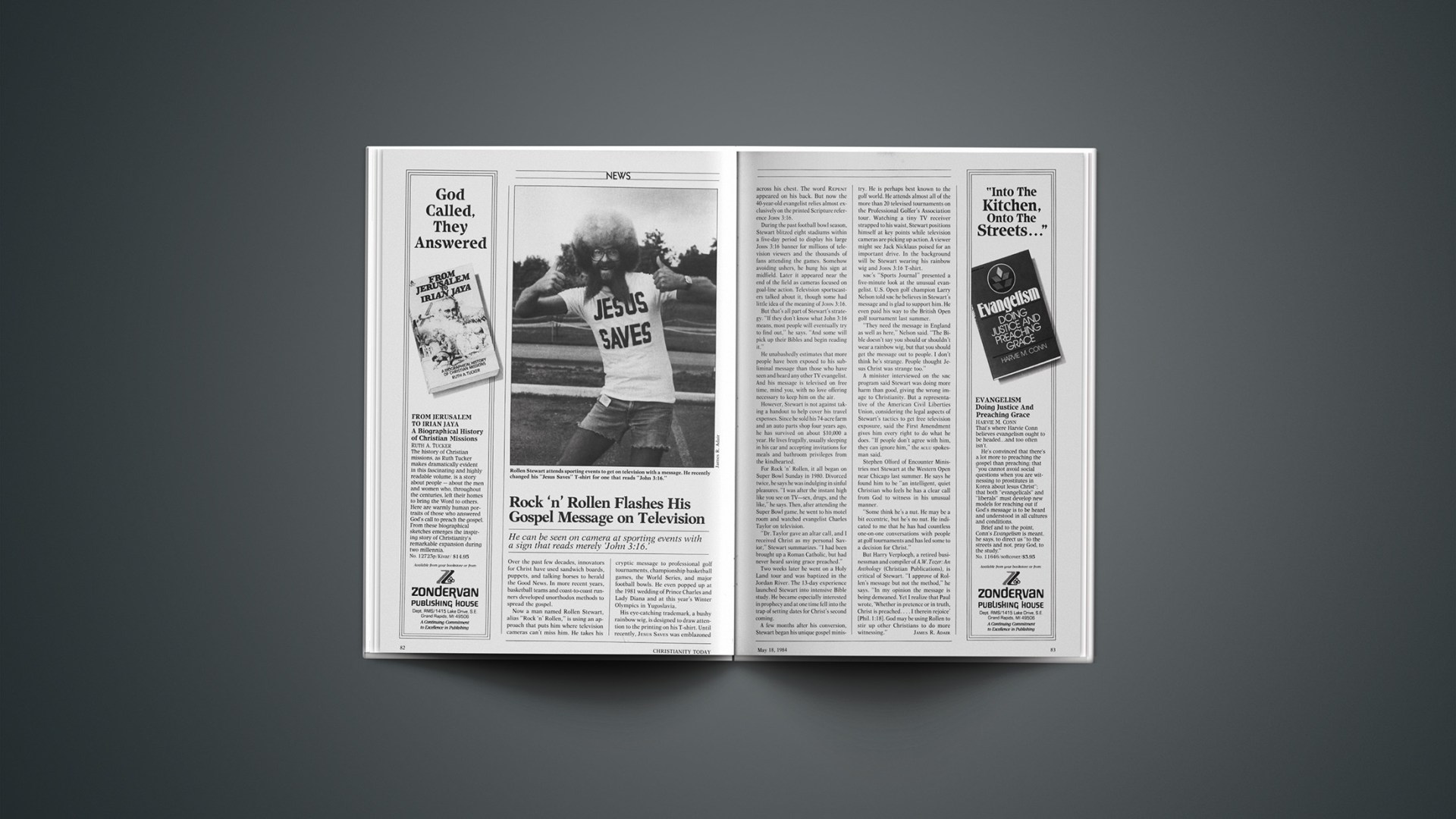
Rock ‘N’ Rollen Flashes His Gospel Message on Television

He can be seen on camera at sporting events with a sign that reads merely ‘John 3:16.’

Over the past few decades, innovators for Christ have used sandwich boards, puppets, and talking horses to herald the Good News. In more recent years, basketball teams and coast-to-coast runners developed unorthodox methods to spread the gospel.

Now a man named Rollen Stewart, alias “Rock ‘n’ Rollen,” is using an approach that puts him where television cameras can’t miss him. He takes his cryptic message to professional golf tournaments, championship basketball games, the World Series, and major football bowls. He even popped up at the 1981 wedding of Prince Charles and Lady Diana and at this year’s Winter Olympics in Yugoslavia.

His eye-catching trademark, a bushy rainbow wig, is designed to draw attention to the printing on his T-shirt. Until recently, JESUS SAVES was emblazoned across his chest. The word REPENT appeared on his back. But now the 40-year-old evangelist relies almost exclusively on the printed Scripture reference JOHN 3:16.

During the past football bowl season, Stewart blitzed eight stadiums within a five-day period to display his large JOHN 3:16 banner for millions of television viewers and the thousands of fans attending the games. Somehow avoiding ushers, he hung his sign at midfield. Later it appeared near the end of the field as cameras focused on goal-line action. Television sportscasters talked about it, though some had little idea of the meaning of JOHN 3:16.

But that’s all part of Stewart’s strategy. “If they don’t know what John 3:16 means, most people will eventually try to find out,” he says. “And some will pick up their Bibles and begin reading it.”

He unabashedly estimates that more people have been exposed to his subliminal message than those who have seen and heard any other TV evangelist. And his message is televised on free time, mind you, with no love offering necessary to keep him on the air.

However, Stewart is not against taking a handout to help cover his travel expenses. Since he sold his 74-acre farm and an auto parts shop four years ago, he has survived on about $10,000 a year. He lives frugally, usually sleeping in his car and accepting invitations for meals and bathroom privileges from the kindhearted.

For Rock ‘n’ Rollen, it all began on Super Bowl Sunday in 1980. Divorced twice, he says he was indulging in sinful pleasures. “I was after the instant high like you see on TV—sex, drugs, and the like,” he says. Then, after attending the Super Bowl game, he went to his motel room and watched evangelist Charles Taylor on television.

“Dr. Taylor gave an altar call, and I received Christ as my personal Savior,” Stewart summarizes. “I had been brought up a Roman Catholic, but had never heard saving grace preached.”

Two weeks later he went on a Holy Land tour and was baptized in the Jordan River. The 13-day experience launched Stewart into intensive Bible study. He became especially interested in prophecy and at one time fell into the trap of setting dates for Christ’s second coming.

A few months after his conversion, Stewart began his unique gospel ministry. He is perhaps best known to the golf world. He attends almost all of the more than 20 televised tournaments on the Professional Golfer’s Association tour. Watching a tiny TV receiver strapped to his waist, Stewart positions himself at key points while television cameras are picking up action. A viewer might see Jack Nicklaus poised for an important drive. In the background will be Stewart wearing his rainbow wig and JOHN 3:16 T-shirt.

NBC’s “Sports Journal” presented a five-minute look at the unusual evangelist. U.S. Open golf champion Larry Nelson told NBC he believes in Stewart’s message and is glad to support him. He even paid his way to the British Open golf tournament last summer.

“They need the message in England as well as here,” Nelson said. “The Bible doesn’t say you should or shouldn’t wear a rainbow wig, but that you should get the message out to people. I don’t think he’s strange. People thought Jesus Christ was strange too.”

A minister interviewed on the NBC program said Stewart was doing more harm than good, giving the wrong image to Christianity. But a representative of the American Civil Liberties Union, considering the legal aspects of Stewart’s tactics to get free television exposure, said the First Amendment gives him every right to do what he does. “If people don’t agree with him, they can ignore him,” the ACLU spokesman said.

Stephen Olford of Encounter Ministries met Stewart at the Western Open near Chicago last summer. He says he found him to be “an intelligent, quiet Christian who feels he has a clear call from God to witness in his unusual manner.

“Some think he’s a nut. He may be a bit eccentric, but he’s no nut. He indicated to me that he has had countless one-on-one conversations with people at golf tournaments and has led some to a decision for Christ.”

But Harry Verploegh, a retired businessman and compiler of A. W. Tozer: An Anthology (Christian Publications), is critical of Stewart. “I approve of Rollen’s message but not the method,” he says. “In my opinion the message is being demeaned. Yet I realize that Paul wrote, ‘Whether in pretence or in truth, Christ is preached.… I therein rejoice’ [Phil. 1:18]. God may be using Rollen to stir up other Christians to do more witnessing.”

A British Television Series Denies The Deity Of Christ

An independent British broadcasting company last month televised a three-part series that denied the deity of Christ. The programs also charged that Jesus participated in occult practices, magic, and sexual rites.

Called “Jesus the Evidence,” the programs were shown throughout England only weeks before a series of evangelistic crusades to be led by Billy Graham and Luis Palau. The three-hour series allowed only one minute for an evangelical viewpoint.

Produced by London Weekend Television at a cost of nearly $800,000, the programs said the Bible is unreliable as historical evidence. It added that it is impossible to find the historical Jesus in the New Testament. To find “authentic” information about Jesus, the television producers went to the so-called secret gospels and gnostic writings discovered in this century.

The programs argued that the belief that Jesus is God was created by the Roman Catholic church in the fourth century. “He [Jesus] was a man who—like other charismatic figures of the period—healed, exorcized, and preached to the outcast,” the final program concluded. “He was not the Messiah most of his compatriots were expecting.… There is no evidence that he was ever seen as God in his lifetime or that he ever intended to found a new church.”

Palau, who will begin a series of London crusades next month, condemned the programs. “The blasphemy as to the person of Jesus Christ horrifies me,” he said. But he added that the programs will likely help his London crusades. “The Lord usually takes Satan’s strategies and turns them around for his glory. And I believe that he will do the same here.” The evangelist urged Christians in England to use the television series as an opportunity to present “the real Jesus Christ.”

Palau was joined by virtually every major denomination and by individual British Christians in protesting the television series. “All the evidence is one-sided from people who are are hell-bent on knocking Christianity,” said Steve Goddard, editor of the Christian magazine Buzz.

“The television company seems to have incurable preference for inferior evidence put forward by scholars who are on the fringe of, rather than at the center of, New Testament studies,” said Canon Michael Green, an Anglican and one of England’s best-known evangelical preachers.

In the face of such criticism, spokesmen for London Weekend Television denied that they produced the series as an attack on Christ.

“I was keen to make the film because I am fascinated by religion,” said David Rolfe, the programs’ producer. “I’m not an atheist.… I believe Christianity touches us all deeply somewhere. I accept [that] the scholars we used have been branded as radicals. But we feel the balance is right.”

NIGEL SHARPin England

North American Scene

A University of California at Berkeley sociologist says television promotes materialism and makes viewers distrustful of others. At an institute sponsored by the U.S. Catholic Conference, Robert Bellah said television “really doesn’t believe in anything.” At the same meeting, Gene Jankowski, president of the CBS Broadcasting Group, said TV is more likely to reinforce existing values than to change them.

San Francisco’s director of health has banned sexual activity in the city’s 14 bathhouses. Dr. Mervyn Silverman said his decision is an effort to reduce the spread of acquired immune deficiency syndrome (AIDS), a fatal disease that primarily affects homosexual men. So far, 477 people in San Francisco have contracted AIDS, and 175 have died. Research indicates that AIDS is more likely to affect homosexual men who have multiple sexual encounters.

A federal judge has declared Clearwater, Florida’s charitable solicitation ordinance unconstitutional. The law would have required some religious organizations to register each donation and to keep detailed records of how funds are spent. Judge Elizabeth A. Kovachevich ruled that the law created an opportunity for arbitrary enforcement.

The U.S. Supreme Court will rule on the constitutionality of an Alabama law allowing a “moment of silence” in public schools. The state of Alabama and the Mobile school board are appealing a federal appeals court ruling that the law violates the First Amendment’s “establishment” clause. The Supreme Court is expected to issue its decision next year.

A Presbyterian Church (USA) theological advisory council has recommended against the use of “nonsexist” references to the Trinity during baptismal services. The panel affirmed the importance of the words “Father, Son, and Holy Spirit.” It rejected the proposed alternatives: “Creator, Redeemer, and Sustainer” or “Shepherd, Helper, and Refuge.”

The Unification Church has started a book publishing company in New York City called Paragon House. The company’s editorial board consists of 18 scholars from universities including Harvard, Yale, Stanford, and the University of Chicago. The venture is seen as an attempt to gain respectability for the church, founded by Sun Myung Moon. Paragon will open shop with a five-year, $5 million budget.

The Reorganized Church of Jesus Christ of Latter Day Saints (RLDS) has voted to accept women into its priesthood. The vote came after RLDS president and prophet Wallace B. Smith presented a written revelation to delegates at a conference in Independence, Missouri. Most of those attending accepted the document as “the mind and will of God.” The decision heightens the differences between the RLDS and the Utah-based Church of Jesus Christ of Latter-day Saints (Mormon), which does not ordain women.

A Seventh-day Adventist runner and Olympic hopeful has refused to run on the Sabbath, and may miss her chance for a medal. Michelle Bush will not run between sundown Friday and sundown Saturday. At the August games, the finals in the 1,500-meter race are set for a Saturday. Bush has been compared to the late Eric Liddell, an Olympic runner whose refusal to race on a Sunday was recounted in the movie Chariots of Fire.

The Minnesota Senate Judiciary Committee has postponed action on a bill proposing a state-run lottery. The proposed constitutional amendment would allow voters to decide whether they want a lottery. However, the issue might not appear on the November ballot because of the committee’s action. The evangelical Berean League of Minnesota and Minnesota IMPACT, an ecumenical advocacy group, have worked for the defeat of the measure.

Moral Majority will try to register 2.5 million new voters for this fall’s elections. The conservative political organization plans to contact 100,000 churches and hold numerous voter registration rallies as part of the massive effort. Moral Majority’s founder and president, Jerry Falwell, says the campaign could determine the direction of this nation for the rest of the decade.

The Texas Board of Education has repealed a requirement that public school textbooks describe evolution as “only one of several explanations” of the origin of human beings. The rule’s opponents called it an unconstitutional intrusion of religion that inhibited the teaching of accurate science. The same day it repealed the rule, the board of education approved a new provision that “theories should be clearly distinguished from fact.”

World Scene

A Tanzanian government official has ordered the demolition of all Jehovah’s Witnesses kingdom halls (churches) in the country’s western district. The All Africa Conference of Churches said the meeting halls were demolished because members of the sect refused to participate in government-sponsored development activities. Tanzania banned the sect 10 years ago, saying it was “in conflict with the aims” of the government.

New immigration laws in the Netherlands may force many missionaries to leave the country. Holland has tightened its immigration policies because of severe overcrowding and the economic burden of providing welfare for immigrants. Missionaries hope to acquire exemptions by showing that they are not a drain on the welfare system.

Evangelical leaders in Guatemala say President Oscar Mejia’s support of Catholicism is causing problems for their churches. They say the government won’t permit the construction of new churches. And evangelical churches—but not Catholic churches—are forced to pay property taxes. The church leaders also believe the military was involved in the abduction of two evangelical pastors.

A church delegation is urging the worldwide Anglican communion to exert pressure for the independence of Namibia. After visiting the African nation, the group called for the withdrawal of South African forces. The delegation said a democratic settlement cannot be reached without involving the South-West Africa People’s Organization, a black liberation group.

The Sandinista government in Nicaragua has cracked down on the National Council of Evangelical Pastors (NCEP). Authorities have questioned the council’s leaders and have canceled its activities. The action took place shortly after an NCEP-sponsored crusade with Argentine evangelist Alberto Mottesi. More than 288,000 attended the meetings.

Candidates for the ministry who refuse to cooperate with female pastors should be denied ordination. That’s the ruling of the newly instituted church assembly of the (Lutheran) Church of Sweden. But only 6 of the denomination’s 13 bishops say they accept the assembly’s 180-to-71 vote. The other 7 say they will go to court over their right to ordain those who will not cooperate with female pastors.

Tensions between the Vatican and the Czechoslovakian government have worsened, with both publishing articles highly critical of the other. The Vatican is concerned over the government’s refusal to endorse its nominations of bishops. The government complains that the Vatican won’t allow priests to join certain political groups.

The Netherlands’ largest Protestant denomination opposes the deployment of U.S. medium-range nuclear missiles in Holland. The synod of the 2.7-million-member Netherlands Reformed Church sent a letter to the Dutch parliament declaring itself “in favor of the removal of all nuclear weapons from Dutch soil.”

The Polish government and the Roman Catholic church have reached a compromise regarding the recent crucifix controversy. Crosses will be allowed in dorms and reading rooms—but not in classrooms—of a state-owned agricultural school near Garwolin. The compromise came after more than 450 Polish clergymen joined Jan Mazur, bishop of Siedlce, in a fast protesting the crucifix ban.

Deaths

Martin Niemoller, 92, Evangelical Church (Lutheran and Reformed) pastor who led church opposition to Adolf Hitler, spent eight years in Nazi concentration camps, was a former president of the World Council of Churches, commanded a German U-boat in World War I; March 6, in Wiesbaden, West Germany, after a long illness.

Karl Rahner, 80, a leading Catholic theologian, a critic of rigid church doctrine, influential in the Second Vatican Council, helped inspire liberation theology; March 30, in Innsbruck, Austria, of heart failure.

Benjamin Mays, 89, black educator and civil rights leader, mentor of Martin Luther King, Jr., former president of Morehouse College, ordained Baptist minister; March 28, in Atlanta, after an extended illness.

Paul Woolley, 82, a founder of the Orthodox Presbyterian Church, professor of church history at Westminster Theological Seminary from its founding in 1929 to his retirement in 1972; March 17, in Athens, Ohio, of heart failure.

Personal

Thomas W. Gillespie was inaugurated in March as the fifth president of Princeton Theological Seminary. He had assumed the administrative role of president seven months earlier. Gillespie pastored First Presbyterian Church in Burlingame, California, for 18 years. He also taught as an adjunct professor at Fuller Theological Seminary.

Friedhelm K. Radandt has been named president of The King’s College in Briarcliff Manor, New York. He will take office in July. The president of Northwestern College in Orange City, Iowa, Radandt will replace Robert A. Cook, who is retiring after 22 years.

James E. Lee, chairman and chief executive officer of Gulf Oil Corporation, has been named chairman of this year’s National Bible Week, November 18–85. The observance is sponsored by the Laymen’s National Bible Committee.

Cristina Ferrare DeLorean, fashion model and wife of automotive entrepreneur John Z. DeLorean, says she and her husband have become born-again Christians. In an interview published in Contemporary Christian Magazine, Mrs. DeLorean says her husband is innocent of criminal charges that he planned to raise money for his company through the sale of cocaine.

Corrections

In an article about Baptist spokesman James Dunn (CT, March 16, 1984, p. 44), CHRISTIANITY TODAY incorrectly stated that in 1983 the Southern Baptist Convention (SBC) endorsed a constitutional amendment to allow organized, vocal prayer in public schools. A resolution supporting the amendment was passed by SBC messengers in 1982. Last year, without rescinding the earlier resolution, conventiongoers softened their stance by expressing “confidence in the U.S. Constitution and particularly in the First Amendment as adequate and sufficient guarantees to protect these freedoms.”

In an article about Christian books (CT, Feb. 17, 1984, p. 45), CHRISTIANITY TODAY incorrectly stated that Robert Schuller’s book Tough Times Never Last, But Tough People Do had not appeared on the Bookstore Journal best-seller list. It has been included on that list.

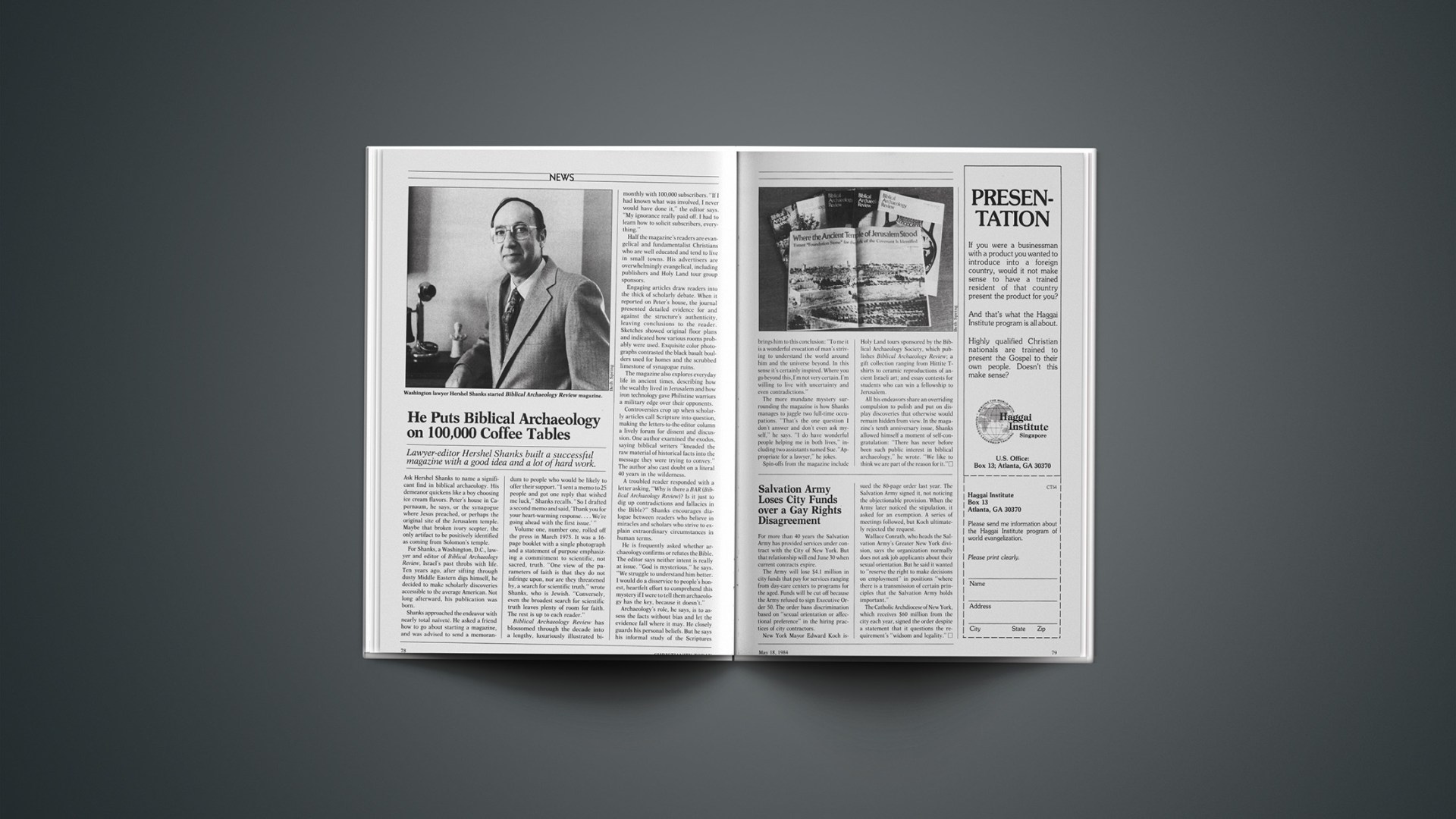
A White House Aide Reaches out to Reagan’s Opponents

Doug Holladay tries to bring moderate evangelicals and mainline Protestants in from the cold.

The most interesting personnel shifts at the White House are not always the ones that occur every four years. Washington watches staff appointees come and go with a vigilance normally reserved for storms brewing off the coast. And predicting changes in the administration as a result of turnover is a favorite Potomac pastime.

A recent ripple in the White House public liaison office may have special significance for mainline and evangelical Protestants. Doug Holladay, formerly with the Department of Education, has taken charge of building rapport between the White House and Christians who differ with the President or do not align themselves with politically conservative groups. As an associate director of public liaison, he also attends to groups representing education and the environment.

Holladay, 37, is an Episcopalian and an evangelical. He studied under Francis Schaeffer at L’Abri. In the seventies he directed Young Life in Richmond, Virginia. And he has helped build a thriving network of nonpartisan fellowship groups and Bible studies in government.

Holladay is welcomed by both the pragmatists and the ideologues on the White House staff. He was recommended for the liaison post by Senate moderate Mark Hatfield (R-Oreg.) and conservative William Armstrong (R-Colo.). He says he is particularly interested in “a group [of evangelicals] in the center that gets left out. They’re not politically active like the New Right and basically have a different cultural orientation.” Liberal religious leaders and evangelicals in mainline denominations are targets as well.

“Many of these folks want to stay out of politics. They need to be educated,” he says. “Evangelicals need to realize we’re not in a neutral environment. To be apolitical is to endorse business as usual.”

Protestants active in liberal politics require a different approach. Holladay set out to get acquainted with them by calling the National Council of Churches (NCC) and saying, “I’d like to discuss our nonrelationship.”

That may prove to be a formidable task because of the antagonism that has festered since Reagan took office. NCC spokesmen say they have encountered a “stone wall” from the administration. They are at odds with the President over oral prayer in public schools, Central American policy, and federal social spending.

It particularly rankles them that Reagan has identified closely with conservative Christian leaders. James Dunn, executive director of the Baptist Joint Committee on Public Affairs, says he senses “a great well of resentment about how [the White House] has invited only a handful of TV evangelists” on a regular basis.

Usually it is Reagan’s public liaison officers—not the President himself—who meet with constituent groups or invite representatives of special interests to the White House. Until last January, the staff member Christian leaders heard from most frequently was Morton Blackwell. He resigned earlier this year to recruit and train conservatives for political work. At the public liaison office, he handled conservative political groups as well as Christians. Because of Reagan’s popularity among conservative religious groups, this was seen as a logical pairing. But it left mainline Protestants and moderates out in the cold.

Holladay is not a direct replacement for Blackwell, whose duties have been divided among several staffers. White House strategists were careful to avoid linking Christians and conservative political groups in his job description, recognizing the need to reach out to a broader base of churchgoers.

Three other White House appointees look after Jews, Catholics, and conservative evangelicals and fundamentalists. Marshall Breger, an orthodox Jew, is the White House liaison to Jews and groups supporting Israel. Bob Reilly, a former U.S. Information Agency official, meets with Catholic and prolife voters. He also heads the administration’s Central American outreach effort, an attempt to combat what they perceive to be media myths about the U.S. role there. Carolyn Sundseth stays in touch with conservative women and some Christian groups. Along with her boss, Faith Ryan Whittlesey, she shares a disdain for feminist thought.

Reagan’s public liaison staff represents a major change from the Carter days. During the last two years of the former President’s term, Robert L. Maddox served as all-purpose religious liaison. Maddox says his tenure began when Carter’s aides realized “there was a roaring forest fire” among conservatives objecting to some of Carter’s positions as well as the absence of recognizable Christians on his senior staff. Maddox says Reagan has “a corresponding fire on the left.”

But such observations don’t frighten Holladay. “The criticism [of the Reagan administration] has been a lack of access,” he says. “I’ll open that up.”

He Puts Biblical Archaeology on 100,000 Coffee Tables

Lawyer-editor Hershel Shanks built a successful magazine with a good idea and a lot of hard work.

Ask Hershel Shanks to name a significant find in biblical archaeology. His demeanor quickens like a boy choosing ice cream flavors. Peter’s house in Capernaum, he says, or the synagogue where Jesus preached, or perhaps the original site of the Jerusalem temple. Maybe that broken ivory scepter, the only artifact to be positively identified as coming from Solomon’s temple.

For Shanks, a Washington, D.C., lawyer and editor of Biblical Archaeology Review, Israel’s past throbs with life. Ten years ago, after sifting through dusty Middle Eastern digs himself, he decided to make scholarly discoveries accessible to the average American. Not long afterward, his publication was born.

Shanks approached the endeavor with nearly total naïveté. He asked a friend how to go about starting a magazine, and was advised to send a memorandum to people who would be likely to offer their support. “I sent a memo to 25 people and got one reply that wished me luck,” Shanks recalls. “So I drafted a second memo and said, ‘Thank you for your heart-warming response.… We’re going ahead with the first issue.’ ”

Volume one, number one, rolled off the press in March 1975. It was a 16-page booklet with a single photograph and a statement of purpose emphasizing a commitment to scientific, not sacred, truth. “One view of the parameters of faith is that they do not infringe upon, nor are they threatened by, a search for scientific truth,” wrote Shanks, who is Jewish. “Conversely, even the broadest search for scientific truth leaves plenty of room for faith. The rest is up to each reader.”

Biblical Archaeology Review has blossomed through the decade into a lengthy, luxuriously illustrated bimonthly with 100,000 subscribers. “If I had known what was involved, I never would have done it,” the editor says. “My ignorance really paid off. I had to learn how to solicit subscribers, everything.”

Half the magazine’s readers are evangelical and fundamentalist Christians who are well educated and tend to live in small towns. His advertisers are overwhelmingly evangelical, including publishers and Holy Land tour group sponsors.

Engaging articles draw readers into the thick of scholarly debate. When it reported on Peter’s house, the journal presented detailed evidence for and against the structure’s authenticity, leaving conclusions to the reader. Sketches showed original floor plans and indicated how various rooms probably were used. Exquisite color photographs contrasted the black basalt boulders used for homes and the scrubbed limestone of synagogue ruins.

The magazine also explores everyday life in ancient times, describing how the wealthy lived in Jerusalem and how iron technology gave Philistine warriors a military edge over their opponents.

Controversies crop up when scholarly articles call Scripture into question, making the letters-to-the-editor column a lively forum for dissent and discussion. One author examined the exodus, saying biblical writers “kneaded the raw material of historical facts into the message they were trying to convey.” The author also cast doubt on a literal 40 years in the wilderness.

A troubled reader responded with a letter asking, “Why is there a BAR (Biblical Archaeology Review)? Is it just to dig up contradictions and fallacies in the Bible?” Shanks encourages dialogue between readers who believe in miracles and scholars who strive to explain extraordinary circumstances in human terms.

He is frequently asked whether archaeology confirms or refutes the Bible. The editor says neither intent is really at issue. “God is mysterious,” he says. “We struggle to understand him better.

I would do a disservice to people’s honest, heartfelt effort to comprehend this mystery if I were to tell them archaeology has the key, because it doesn’t.”

Archaeology’s role, he says, is to assess the facts without bias and let the evidence fall where it may. He closely guards his personal beliefs. But he says his informal study of the Scriptures brings him to this conclusion: “To me it is a wonderful evocation of man’s striving to understand the world around him and the universe beyond. In this sense it’s certainly inspired. Where you go beyond this, I’m not very certain. I’m willing to live with uncertainty and even contradictions.”

The more mundane mystery surrounding the magazine is how Shanks manages to juggle two full-time occupations. “That’s the one question I don’t answer and don’t even ask myself,” he says. “I do have wonderful people helping me in both lives,” including two assistants named Sue. “Appropriate for a lawyer,” he jokes.

Spin-offs from the magazine include Holy Land tours sponsored by the Biblical Archaeology Society, which publishes Biblical Archaeology Review, a gift collection ranging from Hittite T-shirts to ceramic reproductions of ancient Israeli art; and essay contests for students who can win a fellowship to Jerusalem.

All his endeavors share an overriding compulsion to polish and put on display discoveries that otherwise would remain hidden from view. In the magazine’s tenth anniversary issue, Shanks allowed himself a moment of self-congratulation: “There has never before been such public interest in biblical archaeology,” he wrote. “We like to think we are part of the reason for it.”

Salvation Army Loses City Funds Over A Gay Rights Disagreement

For more than 40 years the Salvation Army has provided services under contract with the City of New York. But that relationship will end June 30 when current contracts expire.

The Army will lose $4.1 million in city funds that pay for services ranging from day-care centers to programs for the aged. Funds will be cut off because the Army refused to sign Executive Order 50. The order bans discrimination based on “sexual orientation or affectional preference” in the hiring practices of city contractors.

New York Mayor Edward Koch issued the 80-page order last year. The Salvation Army signed it, not noticing the objectionable provision. When the Army later noticed the stipulation, it asked for an exemption. A series of meetings followed, but Koch ultimately rejected the request.

Wallace Conrath, who heads the Salvation Army’s Greater New York division, says the organization normally does not ask job applicants about their sexual orientation. But he said it wanted to “reserve the right to make decisions on employment” in positions “where there is a transmission of certain principles that the Salvation Army holds important.”

The Catholic Archdiocese of New York, which receives $60 million from the city each year, signed the order despite a statement that it questions the requirement’s “widsom and legality.”

Move over National Enquirer—The Bible Is Coming

The Bible will soon be on sale at local supermarkets alongside popular tabloids and People magazine. The Christian Broadcasting Network (CBN), in cooperation with Tyndale House Publishers, has launched a multimillion-dollar campaign called “Project Bible.” The campaign is designed to increase Bible readership and knowledge across the United States.

The project is built around The Book, a special edition of The Living Bible paraphrase (Tyndale) to be sold in the secular marketplace, CBN is prepared to spend $10 million on radio, television, and possibly billboard advertising to promote The Book. The ad campaign is being coordinated by Compton Advertising of New York City, which handles some $200 million worth of advertising for Procter & Gamble products.

In September, consumers throughout the country will be able to buy The Book for $9.95 at grocery stores, convenience stores, bookstores, and discount stores. The book is being test marketed in Milwaukee, Kansas City, Portland, Providence, Nashville, Oklahoma City, and Norfolk.

“So far we’ve had an overwhelmingly positive response in these cities,” says Tyndale president Mark Taylor. “About twice as many stores as we anticipated are displaying The Book.” But Taylor says the real test is whether or not people will buy it.

Project Bible is the result of extensive research and analysis, much of it commissioned by CBN and done by the Gallup organization. The major conclusion of the research is that America is biblically illiterate. According to Gallup, more than 100 million Americans read the Bible once a month or less often. Nearly 50 million never read it.

Ninety-six percent of American households own a Bible. The overwhelming majority own the King James Version (KJV). Research done by CBN and Compton reveals that people don’t read the Bible largely because they find it either hard to understand or irrelevant to their lives. Project Bible is tailored to combat these perceptions, “CBN is attempting to show people that the Bible is very contemporary and applicable,” Taylor says.

One television ad for The Book features King James himself testifying that he understands The Book better than the version he commissioned. The cover and layout design of The Book are contemporary. And it is equipped with several aids for new Bible readers. “The consumer will not find The Book intimidating,” says CBN’s Jeff Jarrett, marketing manager for Project Bible.

Jarrett says CBN does not expect to make money from sales of The Book. Rather, success will hinge on whether the project meets its stated goals, CBN has commissioned pre- and postproject research to determine the extent to which Bible reading in America changes during the time of the project.

Says Tyndale’s Taylor: “If the only people who buy The Book are people who already own and read the Bible, the project will not have achieved its purpose.”

Fundamentalists Go to Capital to Discuss God, Not Government

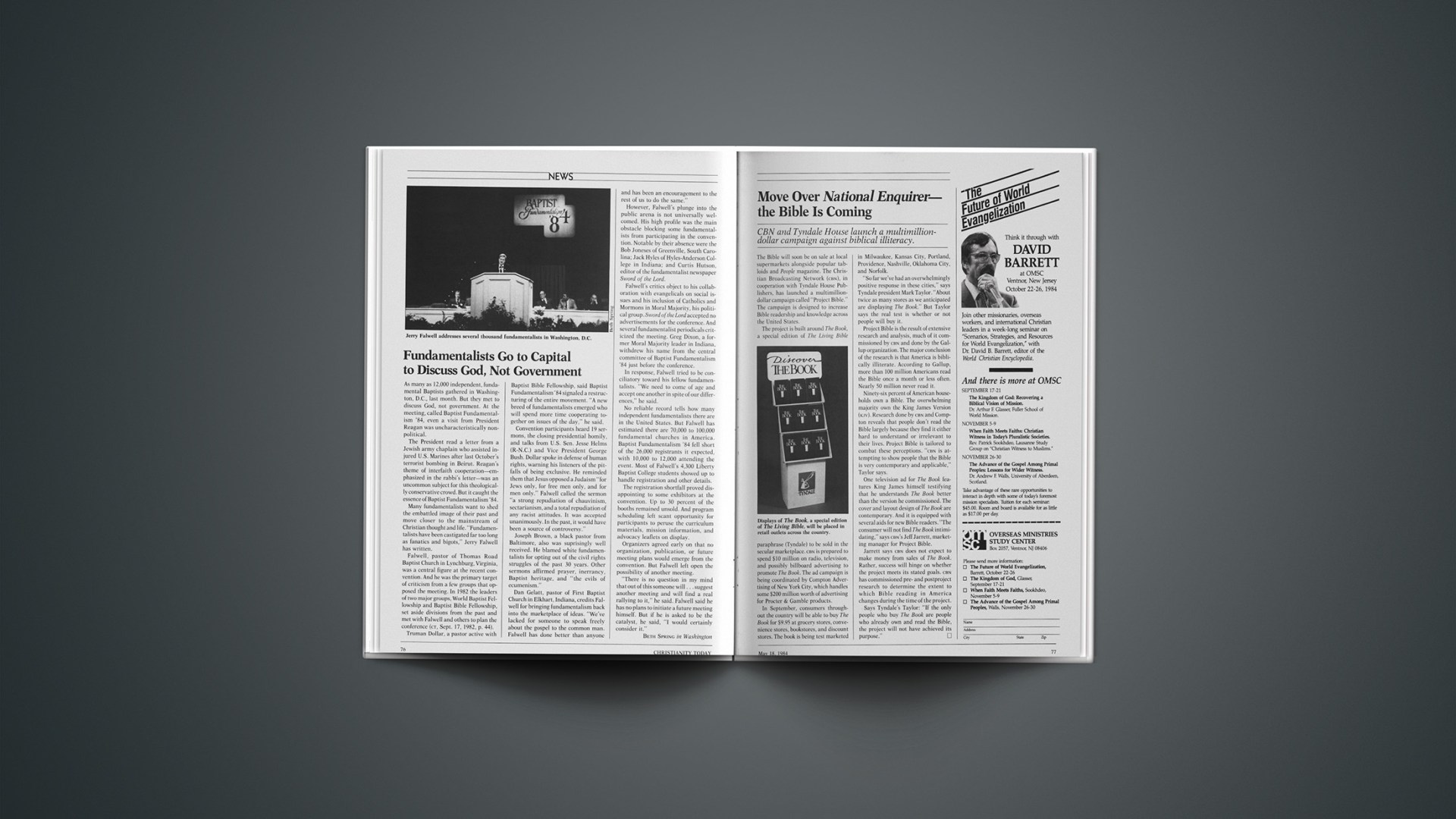
As many as 12,000 independent, fundamental Baptists gathered in Washington, D.C., last month. But they met to discuss God, not government. At the meeting, called Baptist Fundamentalism ‘84, even a visit from President Reagan was uncharacteristically nonpolitical.

The President read a letter from a Jewish army chaplain who assisted injured U.S. Marines after last October’s terrorist bombing in Beirut. Reagan’s theme of interfaith cooperation—emphasized in the rabbi’s letter—was an uncommon subject for this theologically conservative crowd. But it caught the essence of Baptist Fundamentalism ‘84.

Many fundamentalists want to shed the embattled image of their past and move closer to the mainstream of Christian thought and life. “Fundamentalists have been castigated far too long as fanatics and bigots,” Jerry Falwell has written.

Falwell, pastor of Thomas Road Baptist Church in Lynchburg, Virginia, was a central figure at the recent convention. And he was the primary target of criticism from a few groups that opposed the meeting. In 1982 the leaders of two major groups, World Baptist Fellowship and Baptist Bible Fellowship, set aside divisions from the past and met with Falwell and others to plan the conference (CT, Sept. 17, 1982, p. 44).

Truman Dollar, a pastor active with Baptist Bible Fellowship, said Baptist Fundamentalism ‘84 signaled a restructuring of the entire movement. “A new breed of fundamentalists emerged who will spend more time cooperating together on issues of the day,” he said.

Convention participants heard 19 sermons, the closing presidential homily, and talks from U.S. Sen. Jesse Helms (R-N.C.) and Vice President George Bush. Dollar spoke in defense of human rights, warning his listeners of the pitfalls of being exclusive. He reminded them that Jesus opposed a Judaism “for Jews only, for free men only, and for men only.” Falwell called the sermon “a strong repudiation of chauvinism, sectarianism, and a total repudiation of any racist attitudes. It was accepted unanimously. In the past, it would have been a source of controversy.”

Joseph Brown, a black pastor from Baltimore, also was suprisingly well received. He blamed white fundamentalists for opting out of the civil rights struggles of the past 30 years. Other sermons affirmed prayer, inerrancy, Baptist heritage, and “the evils of ecumenism.”

Dan Gelatt, pastor of First Baptist Church in Elkhart, Indiana, credits Falwell for bringing fundamentalism back into the marketplace of ideas. “We’ve lacked for someone to speak freely about the gospel to the common man. Falwell has done better than anyone and has been an encouragement to the rest of us to do the same.”

However, Falwell’s plunge into the public arena is not universally welcomed. His high profile was the main obstacle blocking some fundamentalists from participating in the convention. Notable by their absence were the Bob Joneses of Greenville, South Carolina; Jack Hyles of Hyles-Anderson College in Indiana; and Curtis Hutson, editor of the fundamentalist newspaper Sword of the Lord.

Falwell’s critics object to his collaboration with evangelicals on social issues and his inclusion of Catholics and Mormons in Moral Majority, his political group. Sword of the Lord accepted no advertisements for the conference. And several fundamentalist periodicals criticized the meeting. Greg Dixon, a former Moral Majority leader in Indiana, withdrew his name from the central committee of Baptist Fundamentalism ‘84 just before the conference.

In response, Falwell tried to be conciliatory toward his fellow fundamentalists. “We need to come of age and accept one another in spite of our differences,” he said.

No reliable record tells how many independent fundamentalists there are in the United States. But Falwell has estimated there are 70,000 to 100,000 fundamental churches in America. Baptist Fundamentalism ‘84 fell short of the 26,000 registrants it expected, with 10,000 to 12,000 attending the event. Most of Falwell’s 4,300 Liberty Baptist College students showed up to handle registration and other details.

The registration shortfall proved disappointing to some exhibitors at the convention. Up to 30 percent of the booths remained unsold. And program scheduling left scant opportunity for participants to peruse the curriculum materials, mission information, and advocacy leaflets on display.

Organizers agreed early on that no organization, publication, or future meeting plans would emerge from the convention. But Falwell left open the possibility of another meeting.

“There is no question in my mind that out of this someone will … suggest another meeting and will find a real rallying to it,” he said. Falwell said he has no plans to initiate a future meeting himself. But if he is asked to be the catalyst, he said, “I would certainly consider it.”

BETH SPRINGin Washington

Strategists Work to Sound the Death Knell for Abortion

What will it take to overturn Roe v. Wade?

On January 22, 1973, the U.S. Supreme Court issued its historic judgment that personal privacy includes a woman’s right to abortion. Eleven years and some 15 million abortions later, six of the seven justices who agreed with the Roe v. Wade decision still serve on the High Court. But five of those six are at least 75 years old, including Harry A. Blackmun, who wrote the majority opinion.

Blackmun has said one of the prizes to be claimed by the winner of this fall’s presidential election is “the opportunity to fill [Supreme Court] vacancies.” He predicted there will be as many as four vacancies to fill in the next four years.

Many prolife leaders regard a sympathetic Supreme Court as an important, though not indispensable, pillar in the plan for overturning Roe v. Wade. Believing the time may soon be right, some of the nation’s most articulate legal spokesmen came to Chicago in March to discuss strategies. Speakers included constitutional lawyer William Bentley Ball and Northwestern University law professor Victor Rosenblum. Americans United for Life (AUL), the legal arm of the prolife movement, sponsored the meeting.

“When two of the six-member pro-Roe majority are replaced with justices who oppose or can be persuaded to oppose the Roe doctrine, the reversal process may begin,” Rosenblum said in a paper prepared for the conference. Prolife leaders want to make sure that if and when that ground is prepared, the legal seeds for reversal are planted with prudence.

AUL spokesman Steven Baer said the conference was “designed to begin discussion on the very best kind of case to push up to the Supreme Court.” In his address, attorney Ball raised questions he said should be asked to make that determination. These include whether to take a case to federal or state court, and whether to initiate legal proceedings or assume the posture of the underdog by being named as a defendant. Making these choices, Ball suggested, would depend in part on an evaluation of the leanings of the news media most likely to cover the case.

Rosenblum, who successfully argued the 1980 Supreme Court case prohibiting the use of Medicaid funds for abortions, presented a comprehensive proposal for reversing Roe v. Wade. The key element in his strategy is the principle of gradualism. He and others cited as a useful model the gradual approach used by N.A.A.C.P. lawyers to achieve the 1954 Supreme Court reversal of institutionalized racial segregation.

He called for “confronting the court with a series of specific, carefully considered issues calculated to open wounds in the Roe doctrine that will eventually sap the life from it.” He noted that the High Court has held that abortion is legal if a mother’s health is at stake, and that it has defined “health” to include medical, psychological, social, and economic factors. “A first step might be to enact legislation banning sex-selective abortion after viability,” he said.

Ball stressed the importance of building a court record replete with expert testimony regarding the humanity of prenatal life.

“The rightness or wrongness of this case of ours does not depend on who is on the Court,” he said. “We will have to attack [Roe v. Wade’s] pseudo-science, its dated notions, by unmasking the whole battery of hard evidence that can now be brought against the Roe decision.”

John T. Noonan, Jr., a professor at the University of California (Berkeley) School of Law, noted that the Supreme Court has reversed itself more than 100 times. “What was done by raw judicial power in Roe must answer to reason, and it will ultimately do so,” he said.

In the meantime, prolife leaders fear that one hasty legal maneuver could set the reversal process back indefinitely.

A Pastors’ Group Calls For A Stop To Ucc-Discipies Merger Talks

An ad hoc coalition of pastors in the United Church of Christ (UCC) is calling for an end to church union talks between the UCC and the Christian Church (Disciples of Christ).

The coalition was organized shortly after a joint UCC-Disciples steering committee issued a working paper on church union. The pastors’ coalition said the document’s proposals, if accepted, would commit the UCC to union “without the clear consent of our churches and various member bodies.”

The working paper on union calls for “an intentional sharing of life with a firm commitment to becoming one church.” It envisions that the top decision-making bodies of both denominations next year will decide to work toward organic union. The document also suggests certain aspects of church life—to include mission, membership procedures, theology, ordained ministry, and celebration of the Lord’s Supper—to be included in the process of becoming a new church.

The UCC and the Disciples began a six-year process to study union in 1979. Their national meetings next year must determine any future steps in the relationship.

“You have to search long and hard to find anyone in favor of it [the union proposal],” said Robert Alward, the Glenview, Illinois, UCC pastor who chairs the coalition. “The grass roots are largely not in favor. They have ignored it, and have been shocked to hear that a vote by the General Synod in 1985 could determine that we enter into negotiations toward formal union.”

In addition, he said, some officials of national UCC boards and commissions are cool to union efforts. “People who are opposed to this at a bureaucratic level are afraid to come out of the closet,” he said. “They send us money, but say ‘don’t use my name.’ ”

The coalition said discussions leading to union should be ended. Instead, it suggested the pursuit of “cooperative ecumenical partnerships” with both the Disciples of Christ and other denominations. It argued that the church’s focus on opposing “the sins of racism, militarism, poverty, dehumanization, and injustice” would be deflected by an “internal preoccupation with structure and self-definition” during union negotiations. The group suggested also that union could result in “a lowest common denominator theological compromise.”

In another development, a cautionary work on the proposed UCC-Disciples union was issued recently by the UCC’s Commission for Racial Justice. The commission said blacks are underrepresented at policy-making levels of the Disciples of Christ. The group cautioned against compromising on critical issues in order to unite with the Disciples.

Paul Crow, ecumenical officer for the Disciples of Christ, said no organized opposition to the union proposal has surfaced in his denomination. The 1.2-million-member Christian Church (Disciples of Christ) was founded on the American frontier in the nineteenth century as a movement to unify Christians. The 1.7-million-member United Church of Christ is a product of church union. It was formed in 1957 when the Congregational Christian Churches united with the Evangelical and Reformed Church.

RELIGIOUS NEWS SERVICE

An Evangelical Presbyterian Body Asks a Second Group to Join It

An Evangelical Presbyterian Body Asks A Second Group To Join It

For the second time in its short history, the Presbyterian Church in America (PCA) has invited another denomination to join it. Founded in 1973 by Southerners leaving the then Presbyterian Church, U.S., the PCA is ready to welcome the Orthodox Presbyterian Church (OPC) into its fold. Just two years ago the Reformed Presbyterian Church, Evangelical Synod (RPCES), joined the PCA.

When PCA presbyteries voted in 1981 and 1982 to invite the RPCES, they also considered an invitation to the OPC. The latter invitation failed to be ratified by the required three-fourths of the PCA presbyteries. But by late March of this year, a second invitation had been approved by the necessary 29 PCA presbyteries. The proposal will be sent to the general assembly of the OPC for consideration. Looking forward to its fiftieth anniversary in 1986, the OPC is not expected to begin its year-long formal consideration of the invitation until 1985.

In inviting the two smaller but older Presbyterian groups, the PCA has used an unprecedented “joining-and-receiving” method. The procedure skips the difficult step of negotiating a plan of union. The young denomination has simply asked the others to join it; in the process they officially become part of the PCA, accepting its name, doctrine, government, and programs.

If the OPC decides to join, the resulting body would have more than 150,000 communicant members in about 1,000 congregations. The OPC would add significant strength on the West Coast, in the upper Midwest, and along the Atlantic seaboard from Northern Virginia to Maine. The two denominations already share ownership of Great Commission Publications, which publishes hymnals and educational materials. They also are partners in a military chaplaincy commission.

Even without the OPC’s more than 12,000 communicant members, the PCA already has churches in all but a handful of the 50 states, as well as in principal Canadian population centers. When the RPCES joined in 1982, it brought to the PCA 189 churches with more than 25,000 communicant members.

A Study Finds Little Evidence that Religious TV Hurts Local Churches

But for many, prime-time television supplants religion.

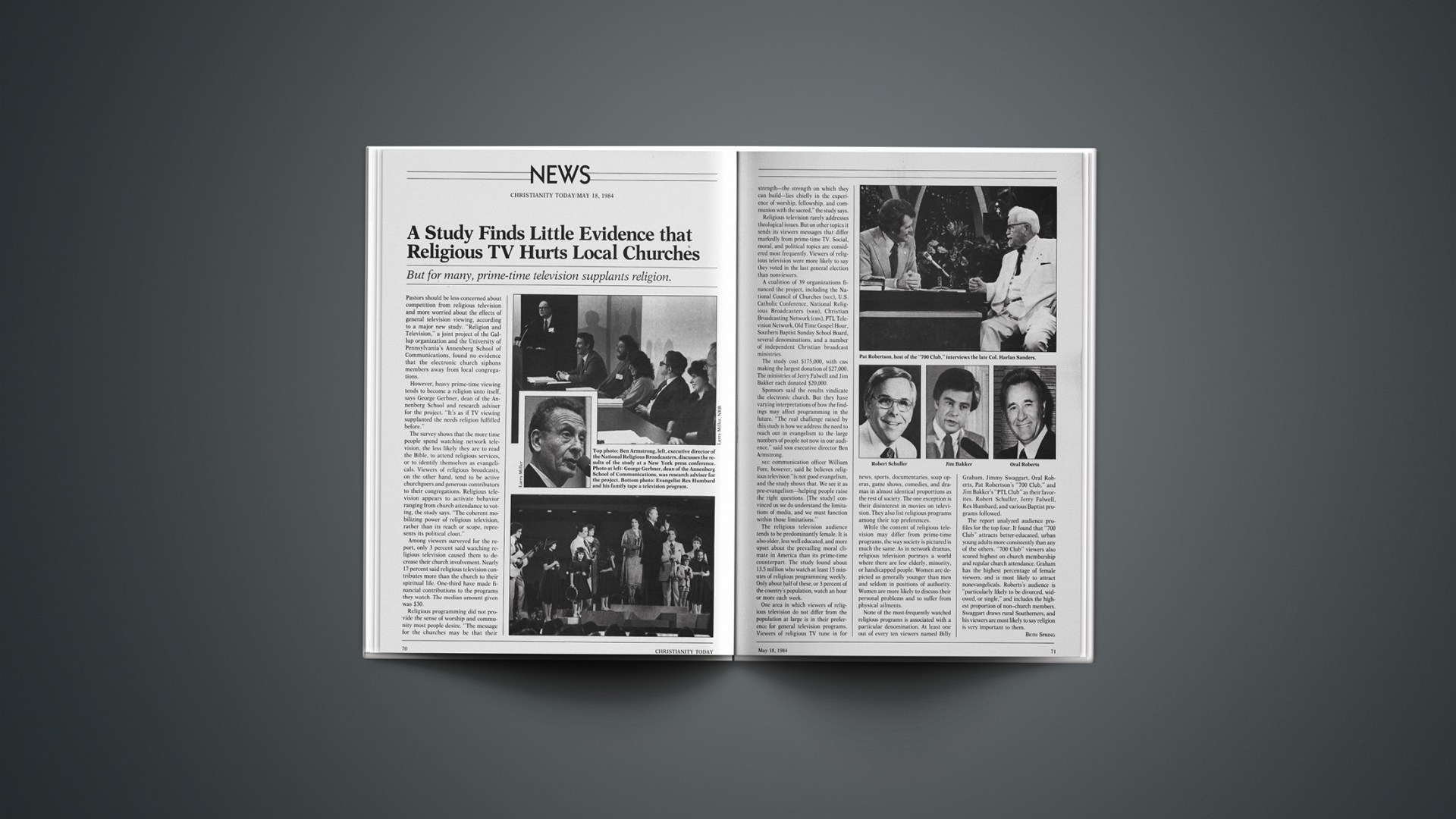
Pastors should be less concerned about competition from religious television and more worried about the effects of general television viewing, according to a major new study. “Religion and Television,” a joint project of the Gallup organization and the University of Pennsylvania’s Annenberg School of Communications, found no evidence that the electronic church siphons members away from local congregations.

However, heavy prime-time viewing tends to become a religion unto itself, says George Gerbner, dean of the Annenberg School and research adviser for the project. “It’s as if TV viewing supplanted the needs religion fulfilled before.”

The survey shows that the more time people spend watching network television, the less likely they are to read the Bible, to attend religious services, or to identify themselves as evangelicals. Viewers of religious broadcasts, on the other hand, tend to be active churchgoers and generous contributors to their congregations. Religious television appears to activate behavior ranging from church attendance to voting, the study says. “The coherent mobilizing power of religious television, rather than its reach or scope, represents its political clout.”

Among viewers surveyed for the report, only 3 percent said watching religious television caused them to decrease their church involvement. Nearly 17 percent said religious television contributes more than the church to their spiritual life. One-third have made financial contributions to the programs they watch. The median amount given was $30.

Religious programming did not provide the sense of worship and community most people desire. “The message for the churches may be that their strength—the strength on which they can build—lies chiefly in the experience of worship, fellowship, and communion with the sacred,” the study says.

Religious television rarely addresses theological issues. But on other topics it sends its viewers messages that differ markedly from prime-time TV. Social, moral, and political topics are considered most frequently. Viewers of religious television were more likely to say they voted in the last general election than nonviewers.

A coalition of 39 organizations financed the project, including the National Council of Churches (NCC), U.S. Catholic Conference, National Religious Broadcasters (NRB), Christian Broadcasting Network (CBN), PTL Television Network, Old Time Gospel Hour, Southern Baptist Sunday School Board, several denominations, and a number of independent Christian broadcast ministries.

The study cost $175,000, with CBN making the largest donation of $27,000. The ministries of Jerry Falwell and Jim Bakker each donated $20,000.

Sponsors said the results vindicate the electronic church. But they have varying interpretations of how the findings may affect programming in the future. “The real challenge raised by this study is how we address the need to reach out in evangelism to the large numbers of people not now in our audience,” said NRB executive director Ben Armstrong.

NCC communication officer William Fore, however, said he believes religious television “is not good evangelism, and the study shows that. We see it as pre-evangelism—helping people raise the right questions. [The study] convinced us we do understand the limitations of media, and we must function within those limitations.”

The religious television audience tends to be predominantly female. It is also older, less well educated, and more upset about the prevailing moral climate in America than its prime-time counterpart. The study found about 13.5 million who watch at least 15 minutes of religious programming weekly. Only about half of these, or 3 percent of the country’s population, watch an hour or more each week.

One area in which viewers of religious television do not differ from the population at large is in their preference for general television programs. Viewers of religious TV tune in for news, sports, documentaries, soap operas, game shows, comedies, and dramas in almost identical proportions as the rest of society. The one exception is their disinterest in movies on television. They also list religious programs among their top preferences.

While the content of religious television may differ from prime-time programs, the way society is pictured is much the same. As in network dramas, religious television portrays a world where there are few elderly, minority, or handicapped people. Women are depicted as generally younger than men and seldom in positions of authority. Women are more likely to discuss their personal problems and to suffer from physical ailments.

None of the most-frequently watched religious programs is associated with a particular denomination. At least one out of every ten viewers named Billy Graham, Jimmy Swaggart, Oral Roberts, Pat Robertson’s “700 Club,” and Jim Bakker’s “PTL Club” as their favorites. Robert Schuller, Jerry Falwell, Rex Humbard, and various Baptist programs followed.

The report analyzed audience profiles for the top four. It found that “700 Club” attracts better-educated, urban young adults more consistently than any of the others. “700 Club” viewers also scored highest on church membership and regular church attendance. Graham has the highest percentage of female viewers, and is most likely to attract nonevangelicals. Roberts’s audience is “particularly likely to be divorced, widowed, or single,” and includes the highest proportion of non-church members. Swaggart draws rural Southerners, and his viewers are most likely to say religion is very important to them.

How the World’s Largest Church Got that Way: The Pastor Explains How to Evangelize through Cell Groups

Central Gospel Church in Seoul, Korea (Assemblies of God), has a membership estimated at 350,000. Growing at a rate of 10,000 members per month, it is predicted that the membership will top 500,000 within a few years. The pastor, Paul Y. Cho, is committed to the use of small cell groups, to which he attributes the church’s phenomenal growth. In this excerpt adapted from his book More than Numbers (Word, 1984; used by permission), Dr. Cho describes how the cell system works.

We tried the cell system in our church and it didn’t work. What went wrong?” an American pastor asked me recently. As I analyzed his experimentation with the system I found essential in building my church, I discovered several problems.

Although the pastor had read my book Successful Home Cell Groups, he himself had not participated in the cell system. This is a fatal mistake. You must take a continual and active role in its implementation and motivation.

Second, he did not wait long enough for the truth to become an integral part of his church’s consciousness. You cannot expect something new to take hold immediately. You must first unteach people the wrong concepts before they accept a new way of doing things. Most churches traditionally have viewed the work of the ministry as the role of the pastor, who was hired to preach, visit the sick and elderly, marry and bury, and to build up the membership. It takes months and years of teaching to change these ingrained false concepts.

Third, many churches establish home cell groups by simply laying out a map of the community, and then saying to the leaders, “Have a meeting in your home.” But too often the home meeting becomes simply another church service. Since most of the people are already members of your church, why should they attend another church service?

Let us address five important questions: (1) What is a cell group? (2) How does a cell group function? (3) How is a cell group organized? (4) How are cell group leaders chosen? (5) What happens to a cell group when it gets too large?

I believe the answers to these questions will answer most others.

What A Cell Group Is

A cell group is not a social gathering, although people do socialize in cell groups. It is not a home meeting or house church, although cell groups may meet in homes. It is not a center for charity, although cell groups may perform charitable acts. A cell group is not another church service, although there may be singing, praying, and speaking.

A cell group is the basic part of our church. It is not another church program. It has a limited size, usually not more than 15 families. It has a definite goal, set by my associate ministers and me, a definite plan given to each cell in written form. It has definite leadership, trained in our school. It has a homogeneous membership—that is, the people who comprise it are similar in background.

When we first experimented with the cell system, we tried to get all of the leading men, mostly our deacons, to start a meeting in their homes. We found this was not workable. Many of the men were busy in their businesses and sometimes got home late at night. They did not have the energy to accept another responsibility. They also felt we had to try the system out on a small scale before committing ourselves too broadly to something new.

Although I could not disagree with their logic, I knew I had heard from the Holy Spirit and had to obey. It is important to hear from God for a new and fresh vision for your church, for unless you have been given a vision from the Holy Spirit, you will not be able to persevere through all of the obstacles.

Then God showed me that we should use women as cell leaders. This was totally revolutionary to us. In Korea, as in most of the Orient, leadership is a man’s business. The traditional role for women is to marry, have children, and keep a good and happy home. Because our culture is basically male-oriented, to give women positions of responsibility and authority in the church was more revolutionary than to establish the cell system itself.

The first problem I had in using women was theological. Paul did say, “Let your women keep silence in the churches” (1 Cor. 14:34). However, Peter, preaching at Pentecost, said, “But this is that which was spoken by the prophet Joel; … in the last days, saith God, … your sons and your daughters shall prophesy, … and on my servants and on my handmaidens I will pour out in those days of my Spirit; and they shall prophesy” (Acts 2:16–18). The promise of the Holy Spirit giving the ability to prophesy was not made just to men, but also to women. I also noticed that women were more loyal and faithful than men in the ministry of Jesus. As I prayed and studied, I concluded that a woman could have a ministry as long as she was under the authority of the church.

Once the women began to be used and we had overcome all of the ensuing obstacles, the men in the church became much more cooperative. These women have worked hard. My advice is, “Don’t be afraid of using women.”

The Homogeneous Principle

There is one basic sociological principle that must be maintained for cell groups to be successful. That principle is homogeneity. By homogeneity I mean like, or similar, in kind. In his book Our Kind of People, Peter Wagner describes his basic theory that churches will grow if they minister to similar groups of people. The same basic homogeneous principle holds true in Korea. Our national culture is divided more along the lines of education and profession. Therefore, medical doctors, college professsors, and other professional people will have more in common with one another than with factory workers and waiters. Housewives will find more in common with other housewives than with female teachers. We found that cell groups based upon this homogeneous principle were more successful than cell groups based primarily on geographical lines.

I have discovered that groups based on geographical considerations alone tend to bring people together who have little in common, what we call heterogeneous cell groups. So much time and energy will be spent trying to develop a feeling of oneness that the main purpose of reaching the lost and caring for the sheep will not be as effective.

If Mr. Chun the banker is in charge of a cell meeting, his cell will be comprised mainly of financial people. Their one-hour cell meeting might take place in a local restaurant and look very much like a business lunch. They have a clear goal: it is the salvation of two souls per year—knowing that if they get two heads of households to accept Christ as Savior their families will also become members of the family of God. After sharing what God has been doing in their lives and in the lives of their families, they might spend some time praying for their specific needs. Yet, before the hour is up, they will discuss one potential convert. Perhaps it is another financial person who has a problem. If that person is going to respond to the gospel, it will be during a time when he needs more support than his family and his present religion can give him.

The potential convert is invited to the meeting. Notice that he is invited to a nonthreatening location and by people to whom he can relate. If he were invited to a heterogeneous group, he might feel totally out of place. But he knows at least one person at the luncheon and will note that the others he is meeting with have something in common with him.

The men in the group will try to help the potential convert—let us call him Mr. Lee. Mr. Lee is not immediately bombarded with the gospel, but he is shown love and concern. This is the gospel in action. Not only is Mr. Chun helpful to Mr. Lee, but all of the members of the cell try to be of help. Soon Mr. Lee will be open to the message of Jesus Christ. He and his family will want to join our church because they have already joined the family of God. Mrs. Lee will want to join a cell with wives of the cell group members. When Mr. Lee has been accepted as a member of the cell, they can pray concerning the next person to be invited.

Also, though two would be targeted for conversion in the year, this does not mean more cannot be reached. But they have been given a clear goal; if they convert four people in one year, they have doubled their goal and feel very proud about it.

Donald A. McGavran, who has been called the father of the modern church-growth movement, states in Understanding Church Growth, “Men and women do like to become Christians without crossing barriers” (p. 227). This experienced scholar and missionary states many examples of the homogeneous principle working in his research throughout the world. Yet we must remember that the homogeneous principle is used in developing our cell system, not in developing our entire church. We do not differentiate between rich and poor, high and low, or well-educated and uneducated; we are all one in the body of Christ. But in developing our cell system, we try to use this natural principle for the sake of more efficiently reaching the lost for Jesus Christ.

The clearest example of this principle can be found in the New Testament. The original church started out as a Jewish movement. Thousands of Jews accepted Jesus Christ as their Messiah. The early church met regularly in the temple and synagogues and kept the Jewish festivals. As long as becoming a Christian did not mean you were not Jewish, the church thrived within the Jewish community. The principle remains true that people will accept the gospel if they don’t feel that they must become something other than what they already are.

In our church, we have a licensed minister for every 30 cells to pastor them. Our cells are also divided into 12 districts, each district headed by an ordained minister. On the wall of our church offices are maps and charts for each district. In fact, it looks like a military strategy room. This is a war we are fighting. The enemy is the Devil. The battlefield is the hearts of lost humanity. The objective is to get as many souls saved as possible before Jesus comes.

One of the problems we have in preaching the gospel in Seoul is how to reach people who live in high-rise/high-security buildings. One of our female cell-group leaders took an apartment in one of the most difficult buildings to evangelize. Then she moved her ministry into the elevator and would ride it up and down looking for ways to serve her neighbors. One day, a lady entered the elevator with a small child and some groceries, so she offered to help her. Once in the apartment, our leader invited the woman to come up to her apartment for tea. The next day, during tea, she witnessed to the woman about Jesus Christ. These tea sessions continued, until a few weeks later the woman accepted Jesus Christ as Savior. Now the leader had an accomplice in her elevator ministry. Today most of the residents of that building are committed Christians. There are a number of cell meetings in that building every week.

In today’s urban explosion, evangelism can conquer even the high-rise building. Every difficult situation is an opportunity for evangelism. With 18,000 cell groups in our church, there are 18,000 stories that could be told, Yet, it is sufficient to say that once the system gets going in a church, there are no limits to growth potential.

How A Group Functions

There is no one way a cell group takes form. It can be held in a classroom during off hours; it can be in a hotel, marketplace, or high-rise building. Yet, each group has a leader who has gone through a prescribed training program. He is also responsible to choose an assistant, so when the group gets too large the second group will have a trained leader ready to function.

The cell group also has a treasurer. We saw a problem developing soon after the system was put into effect in our church when a cell leader began lending money to other members of the cell without any accounting or anyone’s knowledge. After the problem was discovered, we appointed treasurers for every group. If there is a financial need within the cell group, money is given to the member who is in need until he can get back on his feet. A record is kept of all financial matters and it is open for any member of that cell to inspect. This takes away any possibility of misunderstanding.

We have also had to limit the amount of socializing that could be done within each group. In the beginning we had families serving lovely meals when the group visited. However, when they were invited to another home, the hostess would try to outdo the food served in the previous home. Those who were poor felt discouraged because they could not compete with the more prosperous hosts. This situation could have destroyed the entire system if we had not put a stop to it. Now, the cells that meet in homes during the week limit their eating to tea and possibly a few cookies.

A cell meeting must also be limited in time. In the beginning, people want to drag the group meeting on. Some have questions to ask, others want prayer for a particular problem. Yet, if the time is not limited, meetings become too long, and people who have to work the next day are reluctant to attend again. It is also a good philosophy for people to go home when they still have a desire for more.

Choosing Leaders

Leadership is a quality inherent in the personalities of some people. A good pastor will always keep his eyes open for people who natuarally attract others to themselves. Sometimes people who have a knack for communicating with other people make excellent leaders. Usually I find that those with leadership qualities will surface naturally. My job then is to direct that leadership quality toward useful service to the whole church.

Our leaders are trained in our school, and they are motivated to use their full potential in the work of God. This is done by recognition for good service and a system of awards and certificates of accomplishment. I cannot overstress the importance of laying out a clear goal and plan for each leader.

Concentration On Outreach

I reemphasize the importance of keeping cell groups as outreach vehicles in the church. One of the problems a group of people have when they meet together regularly is that they become ingrown. When someone becomes part of a cell group, he soon develops a family tie to other members of the group. As in your family, you enjoy being together and you act differently when a visitor comes into your home. It is hard to incorporate outsiders. That is why the purpose of the cell group has to be stressed continually. Bringing in people from the outside also gives the newly trained members of the cell group the opportunity to teach someone else.

We naturally have a tendency to remember those things we believe are most important. So also in a cell group. A new member of the group begins to be trained in the theology and methodology of soul winning. If he is not given someone to teach what he is learning, he will not learn with the same enthusiasm.

Reaching Discouraged Believers

There are many people in a community who have been members of a church but are not now attending anywhere. Most Christian dropouts seem to have similar stories. They still believe in Jesus Christ. They still consider themselves Christians. But they have been disappointed in the church. Some might have been involved in a church split or become disillusioned with the pastor or church leadership. Some might have fallen into sin and feel ashamed to go back to church. Whatever the reason, there is still a large group of people who need to be brought back into the fold.

A cell group leader is also trained in counseling others. This is very important, for a Christian dropout does not need to be treated like the person who has never heard the gospel. Someone needs to listen to a person who is wounded, then show him or her that the grace of God is applicable to anyone who will call upon him.

Without passing judgment and condemnation, the cell leader introduces the wounded Christian to other members of the cell, who also show a genuine concern. Once the wounded Christian dropout feels he is loved and accepted, he is ready to come back to the church. The cell group then becomes a personal and intimate outreach to needy Christians who are not attending any church. If they were invited to church immediately, they might be turned off. Therefore, not only soul winning, but healing and bringing home those who are not attending church are ministries that can be effectively carried out in the cell system.

When A Cell Gets Too Large

If you are going to have a problem, let it be due to success, not failure. Groups that get too large for the facilities in which they are meeting, and for the purpose they were intended to fulfill, are divided. Yet, this is not easy for some people. The way to divide successfully is to keep the leadership they know. Remember, the cell leader had been training the new leader for this purpose all along, so the new leader is not a stranger. The group will also have a successful division if the purpose for the division is continually emphasized. Cell groups exist to lead sinners to Jesus Christ. If the group becomes too large, then there is a natural hindrance for people to get to know Jesus.

Once the cell has divided into two parts, the leaders from both cells meet regularly. They keep in personal touch with each member. When someone is in the hospital, that person is visited. If there is a personal need, then the leader is there. Each person is pastored far more personally than in most churches that have only a few hundred members.

A young man had started a cell in one of the suburbs of Seoul, and soon there were so many that they had to rent buses on Sunday morning to get them all to church. I could never have properly ministered to the needs of that community some 30 miles away, but our cell system was there and meeting the needs effectively.

When I teach the cell system in church-growth conferences, I usually draw a triangle on a blackboad. If you put the triangle upside-down and place the pastor underneath the triangle, you are demonstrating the conventional way most churches grow. The larger the church, the more weight falls on the shoulders of the pastor.

However, by developing the cell system, a church can grow without destroying its leader. I show this by turning the triangle right-side up. The pastor now is on top of the triangle. The size of the church does not affect the weight upon the pastor.

You have the same Holy Spirit that I do, the same Spirit who opened my eyes to see the reality of the cell system as God’s plan to cause the growth of a new era of superchurches. He can give you the specific answers you need as you go to him in faith and prayer.

Don’t be hindered by the advice of those who say, “It can’t work in this community.” Every town, no matter how large or small, has a key for revival. As you spend time developing an intimate fellowship with the Holy Spirit, he will give you the key to your community. God is not going to bring about church growth in your church without using you. It won’t fall from the sky like rain. It must begin in your heart. It is not only for Korea. It is for every corner of the earth.

Tim Stafford is a free-lance writer living in Santa Rosa, California. He is a distinguished contributor to several magazines. His latest book is Do You Sometimes Feel Like a Nobody? (Zondervan, 1980).

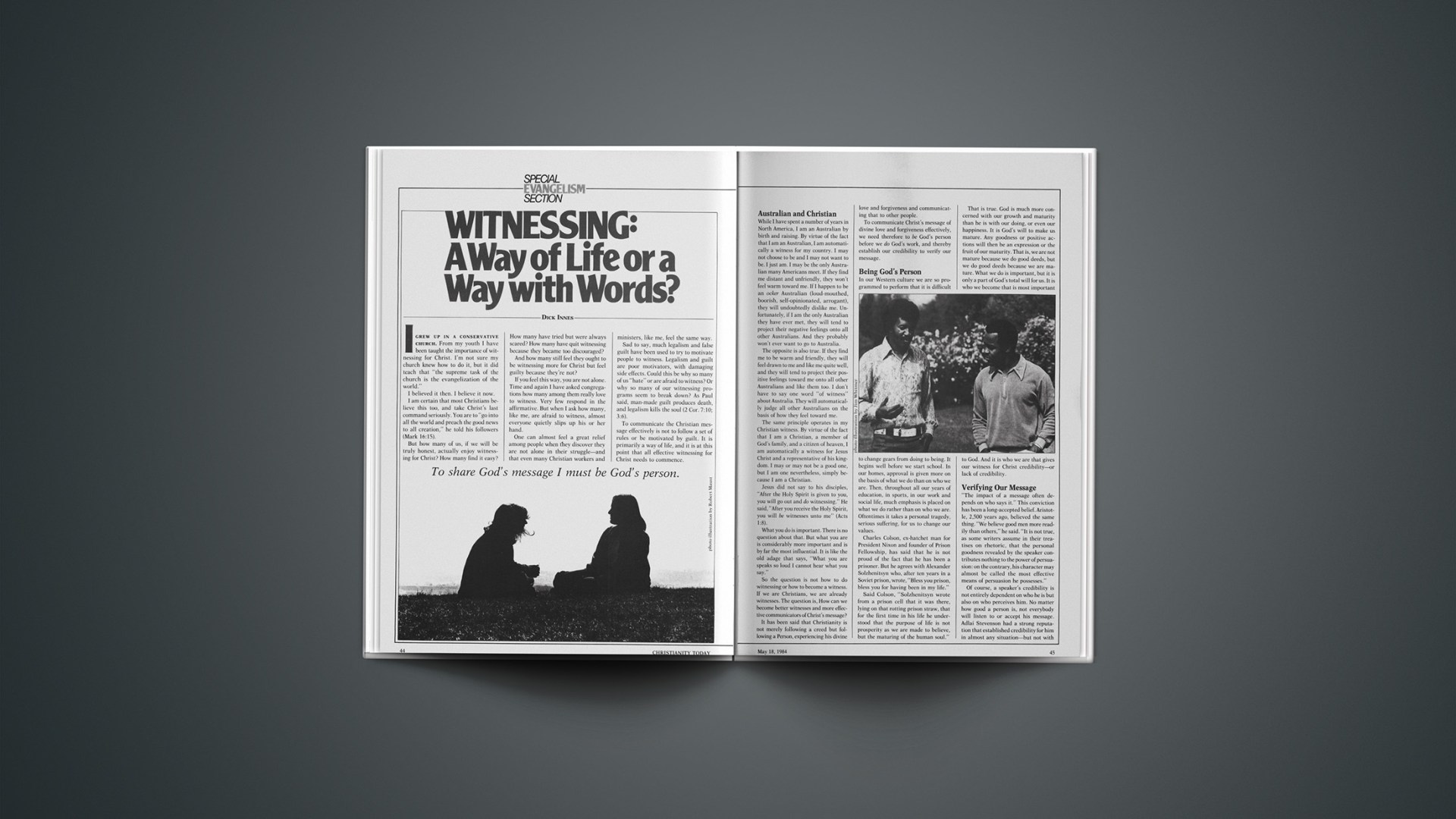
Witnessing: A Way of Life or a Way with Words?: To Share God’s Message I Must Be God’s Person

Igrew up in a conservative church. From my youth I have been taught the importance of witnessing for Christ. I’m not sure my church knew how to do it, but it did teach that “the supreme task of the church is the evangelization of the world.”

I believed it then. I believe it now.

I am certain that most Christians believe this too, and take Christ’s last command seriously. You are to “go into all the world and preach the good news to all creation,” he told his followers (Mark 16:15).

But how many of us, if we will be truly honest, actually enjoy witnessing for Christ? How many find it easy? How many have tried but were always scared? How many have quit witnessing because they became too discouraged?

And how many still feel they ought to be witnessing more for Christ but feel guilty because they’re not?

If you feel this way, you are not alone. Time and again I have asked congregations how many among them really love to witness. Very few respond in the affirmative. But when I ask how many, like me, are afraid to witness, almost everyone quietly slips up his or her hand.

One can almost feel a great relief among people when they discover they are not alone in their struggle—and that even many Christian workers and ministers, like me, feel the same way.

Sad to say, much legalism and false guilt have been used to try to motivate people to witness. Legalism and guilt are poor motivators, with damaging side effects. Could this be why so many of us “hate” or are afraid to witness? Or why so many of our witnessing programs seem to break down? As Paul said, man-made guilt produces death, and legalism kills the soul (2 Cor. 7:10; 3:6).

To communicate the Christian message effectively is not to follow a set of rules or be motivated by guilt. It is primarily a way of life, and it is at this point that all effective witnessing for Christ needs to commence.

Australian And Christian

While I have spent a number of years in North America, I am an Australian by birth and raising. By virtue of the fact that I am an Australian, I am automatically a witness for my country. I may not choose to be and I may not want to be. I just am. I may be the only Australian many Americans meet. If they find me distant and unfriendly, they won’t feel warm toward me. If I happen to be an ocker Australian (loud-mouthed, boorish, self-opinionated, arrogant), they will undoubtedly dislike me. Unfortunately, if I am the only Australian they have ever met, they will tend to project their negative feelings onto all other Australians. And they probably won’t ever want to go to Australia.

The opposite is also true. If they find me to be warm and friendly, they will feel drawn to me and like me quite well, and they will tend to project their positive feelings toward me onto all other Australians and like them too. I don’t have to say one word “of witness” about Australia. They will automatically judge all other Australians on the basis of how they feel toward me.

The same principle operates in my Christian witness. By virtue of the fact that I am a Christian, a member of God’s family, and a citizen of heaven, I am automatically a witness for Jesus Christ and a representative of his kingdom. I may or may not be a good one, but I am one nevertheless, simply because I am a Christian.

Jesus did not say to his disciples, “After the Holy Spirit is given to you, you will go out and do witnessing.” He said, “After you receive the Holy Spirit, you will be witnesses unto me” (Acts 1:8).

What you do is important. There is no question about that. But what you are is considerably more important and is by far the most influential. It is like the old adage that says, “What you are speaks so loud I cannot hear what you say.”

So the question is not how to do witnessing or how to become a witness. If we are Christians, we are already witnesses. The question is, How can we become better witnesses and more effective communicators of Christ’s message?

It has been said that Christianity is not merely following a creed but following a Person, experiencing his divine love and forgiveness and communicating that to other people.

To communicate Christ’s message of divine love and forgiveness effectively, we need therefore to be God’s person before we do God’s work, and thereby establish our credibility to verify our message.

Being God’S Person

In our Western culture we are so programmed to perform that it is difficult to change gears from doing to being. It begins well before we start school. In our homes, approval is given more on the basis of what we do than on who we are. Then, throughout all our years of education, in sports, in our work and social life, much emphasis is placed on what we do rather than on who we are. Oftentimes it takes a personal tragedy, serious suffering, for us to change our values.

Charles Colson, ex-hatchet man for President Nixon and founder of Prison Fellowship, has said that he is not proud of the fact that he has been a prisoner. But he agrees with Alexander Solzhenitsyn who, after ten years in a Soviet prison, wrote, “Bless you prison, bless you for having been in my life.”

Said Colson, “Solzhenitsyn wrote from a prison cell that it was there, lying on that rotting prison straw, that for the first time in his life he understood that the purpose of life is not prosperity as we are made to believe, but the maturing of the human soul.”

That is true. God is much more concerned with our growth and maturity than he is with our doing, or even our happiness. It is God’s will to make us mature. Any goodness or positive actions will then be an expression or the fruit of our maturity. That is, we are not mature because we do good deeds, but we do good deeds because we are mature. What we do is important, but it is only a part of God’s total will for us. It is who we become that is most important to God. And it is who we are that gives our witness for Christ credibility—or lack of credibility.

Verifying Our Message

“The impact of a message often depends on who says it.” This conviction has been a long-accepted belief. Aristotle, 2,500 years ago, believed the same thing. “We believe good men more readily than others,” he said. “It is not true, as some writers assume in their treatises on rhetoric, that the personal goodness revealed by the speaker contributes nothing to the power of persuasion: on the contrary, his character may almost be called the most effective means of persuasion he possesses.”

Of course, a speaker’s credibility is not entirely dependent on who he is but also on who perceives him. No matter how good a person is, not everybody will listen to or accept his message. Adlai Stevenson had a strong reputation that established credibility for him in almost any situation—but not with the John Birch Society.

But even though credibility is partly in the eyes of the beholder, we cannot control that factor. We can only control ourselves. If people like us, they are more likely to give us a hearing. If they don’t, we barely stand a chance of gaining a hearing.

Avoiding Pitfalls

If we have not already established credibility in the eyes of our audience, we could affect them in adverse ways. Some of these are described as: the boomerang effect, the regression effect, the sleeper effect, and the focusing effect.

The boomerang effect. If a person does not like me, or feels that I am not being honest or fair to his point of view, my words may backfire. He may not only be opposed to what I am saying, but move further away from my position, deeper into his own territory of beliefs.

The regression effect. Simply put, this means that if I push a person too hard too fast, he may come along with me only because of the excitement or emotion of the moment. However, after he has had time to think things through, he may not be so excited about what I said and then regress to his former position. He may not only regress, but may become hardened against our cause in the process.

The sleeper effect. This can be seen in what happens if I attract people too much to me personally rather than to my cause; that is, if I try to get people to like me too much, I run the risk of them not taking much notice of my message or quickly forgetting it if they do hear it. A classic example of this was seen in one-minute television spots produced by the Christian Television Association in Australia. The spots featured Evie Tornquist Karlsson singing parts from her popular songs. Research showed that there was an incredibly high recall of the spots: 90 percent of the people watching televison at the time Evie was on remembered them. The problem was that it was Evie the people loved and remembered. They didn’t have any idea 24 hours later what her messages were saying. That’s no offense to Evie. She was singing to a secular audience. I can recall at least two of the spots several years later.

The focusing effect. In some photographs, the foreground is in sharp focus but the background is hazy and out of focus. If, in presenting the Christian message I only show one side of the picture, later on the listener is going to wonder about the other side. As he brings it into focus and looks at it through his own lenses, he may in the process get out of focus the picture I have presented. The best way to overcome this problem is to present a well-balanced view of the Christian faith, including the negative aspects as well as the positive. We should squarely face all of the other person’s arguments and doubts—even bring some up in advance. To paint too rosy a picture of the Christian life is to disillusion people further down the line.

The implications are clear in our presentation of the message of Christ. To verify our message we need credibility. Credibility comes from within. It is who we are much more than what we do or say. If people don’t like me, if they feel I am not entirely straight or honest, if they feel I am too pushy, if I don’t paint a whole picture, or if I try to draw too much attention to myself, in the long run I will do more to drive them from Christ than draw them to him.

Identifying With Your Audience

Over the years, I have found that the greatest way I can influence others is not through eloquent sermons or clever presentations of the Christian message but by identifying with my listener and allowing him or her to see me as I really am—that I am a fellow sinner with human weaknesses, and that I, too, am in the struggle to become the person God wants me to be. Knowledge alone does not change lives. Growth does. And people only grow as we are open and honest and grow together.

Simply put, to communicate God’s message effectively, I need to be God’s person and not merely talk about God’s message.

Tim Stafford is a free-lance writer living in Santa Rosa, California. He is a distinguished contributor to several magazines. His latest book is Do You Sometimes Feel Like a Nobody? (Zondervan, 1980).

Apple PodcastsDown ArrowDown ArrowDown Arrowarrow_left_altLeft ArrowLeft ArrowRight ArrowRight ArrowRight Arrowarrow_up_altUp ArrowUp ArrowAvailable at Amazoncaret-downCloseCloseEmailEmailExpandExpandExternalExternalFacebookfacebook-squareGiftGiftGooglegoogleGoogle KeephamburgerInstagraminstagram-squareLinkLinklinkedin-squareListenListenListenChristianity TodayCT Creative Studio Logologo_orgMegaphoneMenuMenupausePinterestPlayPlayPocketPodcastRSSRSSSaveSaveSaveSearchSearchsearchSpotifyStitcherTelegramTable of ContentsTable of Contentstwitter-squareWhatsAppXYouTubeYouTube