Evangelicals and Jews Strive for Mutual Understanding

They are concerned that many Jews and evangelicals know each other only by reputation. And they are alarmed by the subtle threat of anti-Semitism that is heightened by Middle East tensions. So they gathered to discuss past misunderstandings, to build friendships, and to confront issues of mutual concern.

Cochaired by Rabbi A. James Rudin of the American Jewish Committee (AJC) and Marvin R. Wilson of Gordon College, the 60 participants included scholars, theologians, and lay leaders. They represented various segments of evangelicalism and the major divisions of Judaism—Orthodox, Conservative, Reform, and Reconstructionist.

Meeting at Gordon College in Wenham, Massachusetts, the conferees examined the roots of the two communities, their part in shaping American society, their teaching about one another, and the problems confronting their religions. The conference was the third of its kind. A consultation in 1975 focused on beliefs concerning the Messiah, conversion, and the Holocaust. A second meeting in 1980 concentrated on views of sin, atonement, and redemption.

At the recent meeting, sparks flew during a discussion of the state of Israel. Both sides agreed that the Jewish state had a right to exist and rejected the idea that Zionism is racism. But disagreement erupted over criticism of Israel and the plight of the Palestinians. Some evangelicals maintained that no political entity is above criticism, while some Jews who believe Israel has a special status bristled.

The AJC’s Judith Banki referred to the “sharp difference between critical friends and critical enemies of Israel.” She said most critics condemn Israel for “failing to live up to pure democracy or pure justice.” But she added that little is said about the sins of Israel’s neighbors.

The conferees did not debate the issue of whether a Jew who converts to Christianity can remain a Jew. The Jewish participants agreed that such a convert cannot still be considered a Jew. They said the conversion of Jews furthers their extinction as a people. The Christian participants did not press the issue.

It remains to be seen whether the conversion question will be the rock on which evangelical-Jewish dialogue will inexorably founder. But the Wenham consultation made it clear that evangelicals and Jews can work together in the areas of biblical studies, justice, and human rights.

Whatever Happened to Eldridge Cleaver?

The radical Black Panther-turned—Christian never found a home in the evangelical world.

In June of 1965, inside Folsom Prison, Eldridge Cleaver wrote an essay that became the first chapter of his best-selling book, Soul on Ice (McGraw). In it, Cleaver described himself as “extremist by nature.” He was intense, aggressive, outspoken, combative, uncompromising.

Two decades later, the adjectives still apply. But the focus of his fury has changed radically.

In the 1960s, the American system had no greater enemy than Cleaver. As a leader of the militant Black Panther party, he worked for a Marxist overthrow of the democratic form of government. In 1968, he fled the country to avoid a prison term for a shoot-out with Oakland, California, police. For the next few years he toured Communist and Third World countries only to become disillusioned by the hypocrisy he found in communism.

Cleaver surrendered to U.S. authorities in 1975, and today the American system could not find a more loyal friend.

Cleaver is running for the U.S. House of Representatives as an ultraconservative independent in the radical Berkeley, California, area. He portrays his opponent, veteran black Democrat Ron Dellums, as a Soviet puppet.

“There is a war going on,” Cleaver warns. “The goal of communism is to take control of the world. President Reagan’s assessment [of this war] is not exaggerated. If anything, it is understated. We will never have peace and rest until the job is completed of bringing democracy to the whole world.”

Not a trace remains of the black activism Cleaver once so passionately embraced. He is an outspoken critic of presidential candidate Jesse Jackson.

“I don’t think the black community has received any kind of balanced view of what Ronald Reagan has done,” Cleaver says. “There is an economic crunch, and blacks have suffered because of the overall impact of budget cuts. But if you ask blacks if they’re better off now than they were in 1980, you’ll find them saying ‘yes’ because President Reagan has challenged black people to start thinking again for themselves and not just lay around depending on handouts from [House Speaker] Tip O’Neill and the Democrats in Congress.”

If Cleaver’s search for political truth ended unambiguously, his spiritual quest is marked by endless twists and turns. He was baptized a Roman Catholic. As a young man he embraced atheism. As a prison inmate he became a Black Muslim.

When he returned to the United States in 1975, he told a sensational story about an encounter with God. He wrote a book, Soul on Fire (Word), in which he tells how in 1976, while in jail, he accepted Christ. Cleaver became an instant Christian celebrity. He started his own evangelism ministry. He spoke at Campus Crusade for Christ functions and at a National Religious Broadcasters (NRB) convention. He even shared a pulpit with Jerry Falwell.

But the honeymoon didn’t last. Even in Soul on Fire there were hints that not all was well with Eldridge.

The late Arthur DeMoss financed Cleaver’s release from jail, a gesture described in Soul on Fire as a gamble. In the book’s epilogue, DeMoss wrote that “ever since [Cleaver’s] release from prison, he has been inundated with every conceivable kind of request, business proposition, financial lure, and temptation.… Eldridge needs our prayers because, like the rest of us, he is not perfect—just forgiven.”

Cleaver regularly proved to evangelicals that he was not perfect. He was scratched from the NRB’s 1978 convention because of his plans to market jeans highlighting the male genital organ. He fell into further disfavor by spending time at a Unification Church ranch and speaking at Moonie gatherings. Reports spread that Cleaver advocated wife beating. For a time, he attempted to combine Christianity and Islam.

Through all the controversial ventures, Christians close to Cleaver tried to dissuade him. But he regularly offered what he believed was a sound explanation for everything. Eventually his friends grew weary and gave up. “It just became apparent that Eldridge would always be doing something weird,” said one friend.

Cleaver maintains that he has been severely misunderstood. He says the mass media—including Christian media—have circulated misleading information without seeking his perspective. He is not a Moonie and never was, he says, though he still works with Moonies on college campuses to combat communism.

He says his venture into jeans manufacturing was unfairly portrayed as frivolous and risqué. Actually, Cleaver says, “it was a statement against the unisexual ideology that has been structured into our clothing and is being pushed by organized homosexuals. I felt it was necessary to establish a line of demarcation between male and female.”

He traces the wife-beating allegations to a magazine article he describes as an “absolute hatchet job done by a former left-wing associate who set me up and betrayed me.”

Cleaver says in his early days as a Christian he was “buffeted about. Some people said, ‘Don’t go talkin’ with the charismatics.’ Some said, ‘Don’t go talkin’ with the Presbyterians; don’t hang out with the Baptists; don’t go with the Methodists; don’t go with the Unitarians; don’t go with the Moonies; don’t go with the Mormons.’ It seems that whenever you meet a new group of people, you lose some of your old friends.”

Those close to Cleaver say he probably was exploited, but that he has done some exploiting of his own. They maintain high respect for his intelligence and believe his Christian conversion was genuine. But they say he never matured spiritually because he rejected opportunities to become grounded in the faith.

Four months ago, in the latest step in his spiritual journey, Cleaver joined the Mormon church. Will the former radical ever be the kind of person evangelicals hoped he would be?

“Evangelicals are gonna be dead,” he says in response to that question. “Evangelicals are gonna be nuked like everyone else. This is not a time to be issuing each other report cards. Communists are pouring millions of dollars into an effort to destroy this country.…

“When we have meetings to combat the influence of communism, the Moonies and the Mormons come. Evangelicals only come out for Thursday-night Bible study.”

School Prayer Fails, but Equal Access Gets a Boost in Congress

There is growing support for legislation guaranteeing the right of students to hold religious meetings at school.

Last month’s lengthy school-prayer debate in Congress failed to produce the votes needed for a constitutional amendment. But it provided a tremendous boost for “equal-access” legislation being considered in both houses.

The speeches and media attention “plowed the ground for us perfectly,” says Dan Evans, legislative assistant to U.S. Rep. Don Bonker (D-Wash.). The debate showed that some courts are too strict in prohibiting voluntary religious meetings on school property, he says.

Equal access is considered more substantial—and less symbolic—than President Reagan’s proposed prayer amendment. The legislation addresses a problem plaguing increasing numbers of high school students. Principals and school boards, reacting to court decisions prohibiting the establishment of religion, have forbidden student Bible club meetings and voluntary prayer groups. Critics say this is an overreaction.

In Williamsport, Pennsylvania, the “Petros” club was banned after a school board attorney decided that any religious speech on school grounds is unconstitutional, even if it is voluntary, nonsectarian, and takes place before or after school hours. Lisa Bender, a student who organized the group, filed suit and won in federal court (CT, June 17, 1983, p. 30). Because that decision contradicts other lower court rulings, the issue is likely to come before the U.S. Supreme Court.

The Supreme Court upheld the equal-access principle for college students in Widmar v. Vincent. But the principle has not been expanded to include secondary or elementary school students. This broader application is the intent of two equal-access proposals now before Congress.

The proposed legislation would leave intact the Supreme Court decisions from the early 1960s that prevent state officials from writing or choosing prayers and prohibit teachers from assuming the role of priest or minister in the classroom.

Companion bills sponsored by Bonker in the House and by Oregon Republican Mark Hatfield in the Senate would guarantee secondary school students the right to meet on campus for religious purposes. Hatfield calls situations like the ban on the Petros club “an intolerable perversion of the Constitution.

“There exists today a profound denial of First Amendment rights which is not being addressed in the school-prayer debate,” he says. “Under terms imposed by an increasing number of lower court decisions, students have been permitted to form groups to discuss virtually any subject imaginable except religion. Why is it acceptable to discuss music, to discuss politics, to discuss virtually everything under the sun, except religion?”

A second equal-access proposal has been offered by Sen. Jeremiah Denton (R-Ala.) and Rep. Trent Lott (R-Miss.). That bill would encompass elementary school students as well as those in junior high and high school.

Denton’s Alabama constituents have been battling over school prayer at the elementary school level in a case recently appealed to the Supreme Court. In that case, agnostic Ishmael Jaffree sued to prevent his grade-school children from being exposed to vocal grace at lunchtime (CT, June 17, 1983, p. 24).

March Bell, an aide to Denton, says that type of court challenge shaped the reasoning behind the senator’s proposal. “Our concern about elementary schools is not equal access so much as it is individual students being picked on,” Bell says. “We want the legislation to clarify that in certain situations it’s hands off the students—on the playground or in the lunchroom, for instance.”

The equal-access concept has attracted wide support in Congress, from liberals who view it as a free-speech issue to conservatives who supported Reagan’s prayer amendment. Bills in Congress need only a simple majority vote to pass, unlike the two-thirds vote required for a constitutional amendment. Both equal-access bills are thought to be popular enough to win.

During his speech opposing the school-prayer amendment, Sen. Patrick Leahy (D-Vt.) indicated why equal-access legislation holds such broad appeal. “If a school has a forum open to all clubs, the phrase ‘all clubs’ should include religious clubs. And if those clubs choose to pray during a meeting, that is their private business. I would support legislation to provide for equal access in school with open forums, providing it had sufficient safeguards to prevent misunderstanding or misuse by those whose intent was to bring official prayer back to the classroom.”

Even Sen. Lowell Weicker (R-Conn.), who led the successful floor battle against the school-prayer amendment, is considering support for an equal-access bill. Some see the measure as a chance to save face among constituents who may be influenced by right-wing groups using the prayer amendment vote as election-year cannon fodder.

Moral Majority head Jerry Falwell enthusiastically supports the equal-access approach. “This is the ultimate in freedom of choice, and could be better than the prayer amendment,” he says.

The equal-access approach has been endorsed by Reagan as well as by religious groups, including some that opposed the prayer amendment. “My administration will continue our efforts to allow government to accommodate prayer and religious speech by citizens in ways that do not risk an establishment of religion,” said the President, following the Senate’s defeat of the school-prayer amendment. “I urge the Congress to consider the equal-access legislation before both houses.…”

The National Association of Evangelicals (NAE) has supported both equal-access legislation and the defeated school-prayer amendment. At least one equal-access proponent sees a providential hand at work in the matter. Lisa Bender Parker, the student who filed the Williamsport lawsuit, is in training with her husband at New Tribes Mission in Kentucky. They live in the district represented by Democrat Carl Perkins, who chairs the House committee responsible for sending Bonker’s equal-access bill to the floor.

Parker has written to Perkins and distributed a letter to his constituents explaining and endorsing the measure. The constituents, in turn, have applied pressure that could speed the bill along.

America’S Top Military Officer Calls Christians To “God’S Army”

It is not surprising that America’s top military officer would make a pitch for national defense funding. But most Americans would not expect the plea to be overshadowed by the general’s call for readiness to serve in “God’s army.” That is what happened when Gen. John W. Vessey, chairman of the Joint Chiefs of Staff, spoke recently in Dallas.

“Christianity is like the service,” he told an audience of 2,000. “You’re in it no matter what comes up, so you must be ready for action today.” He admonished the crowd to strive for Christ’s standard of service. “Self-control, endurance, and trust constitute the code by which you are judged.”

The 61-year-old U.S. Army general was speaking at the Dallas Leadership Christian Prayer Breakfast, an event that attracts Christians from business, education, government, labor, and sports. It was not the first time Vessey had addressed a large gathering of Christians. Last summer he spoke at the fifty-fifth general convention of the Lutheran Church-Missouri Synod, the denomination in which he holds membership.

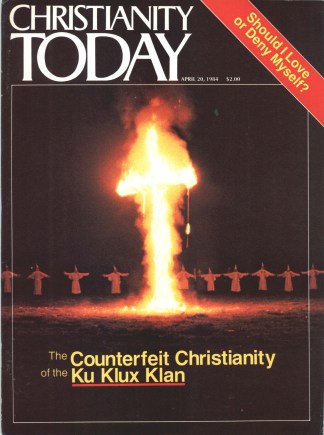
The Counterfeit Christianity of the Ku Klux Klan

“I can go just about anywhere, and I never have to worry,” says a robed and hooded man. “If I get in trouble, I can make one phone call, and immediately I’ll get help.… People, guns, anything I want. I could even get a tank if I wanted. But I haven’t needed that yet.”

“When do they burn the cross?” he is asked.

“We don’t burn crosses, we light them,” he clarifies. “We light the cross because Christ is the Light of the world.”

From a makeshift stage in the middle of an Alabama hillside, a local band blares country and rock tunes as white-robed and hooded figures stroll about, laughing and talking informally. Many of the men have brought their families. Proud mothers pull out their pocket Instamatics® to grab a snapshot of Daddy, all decked out in white, holding Junior. Some of the mothers themselves wear robes and hoods. Other families man the refreshment stand, selling hot dogs, hamburgers, and RC Cola. (No beer or liquor is permitted.)

In a nearby booth, a bearded man in a KKK baseball cap displays Klan belts, buckles, bumper stickers, hats, wallets, knives, and helium-filled KKK balloons for the kids. Quite a few teenagers and college students roam through the crowd, some clad in white, others in jeans and plaid flannel shirts.

Strings of bare bulbs, not yet lit, surround the gathering. And beyond the lights, off to the far side of the field, stands a cross, wrapped in burlap and soaked in diesel fuel. It seemingly goes unnoticed by all but a few third-graders, who play touch football in its lengthening shadow.

The air is quickly cooling from afternoon temperatures in the 70s. Dusk has settled in, and darkness is about an hour away. The crowd numbers three or four hundred at most (a disappointing turnout, someone said), about half robed and hooded, and the other half families, friendly supporters, and a few curious observers—all white, of course. Everyone whoops and cheers as the band finishes its final song. Then a Ku Klux-clad announcer officially welcomes the crowd, and turns the mike over to a graying woman who opens the program with prayer. She too is dressed in white, her pointed hat tipped backward in feminine fashion. She prays with startling sincerity, calling out to Jesus prayer-meeting style.

“And Jesus,” she says, her voice barely audible above the buzzing sound system, “you know our needs … you know our feelings about the Klan.… And Jesus, you know how much it hurts us when we hear people say you can’t live right and join the Klan. Jesus, I try to live right, and I want to do your will.…”

Background

The Ku Klux Klan (from the Greek kuklos, meaning circle or wheel) arose in the aftermath of the Civil War, but not until after the release of D. W. Griffith’s 1915 film, The Birth of a Nation, did the movement gain widespread support. The film romanticized the Klan and fueled racial fears so that by the mid-1920s, KKK membership had peaked at nearly 5 million members. For the next 50 years the Klan would influence (and sometimes dominate) the American political scene. Their activities were often violent in nature—lynchings, murders, bombings. By the 1960s and ’70s, many members had gone underground, many had quit, and a few had remained. Splits and rivalries occurred among various Klan factions.

According to the Klanwatch Project of the Southern Poverty Law Center in Montgomery, Alabama, about 25 different Klan groups have operated within the past five years or still do so. The three largest of these, respectively, are the United Klans of America, based in Tuscaloosa, Alabama, and headed by Robert Shelton; The Knights of the Ku Klux Klan, based in Tuscumbia, Alabama, and officially headed by Don Black, who is currently in jail; and the Invisible Empire, Knights of the Ku Klux Klan, based in Denham Springs, Louisiana, and headed by Bill Wilkinson.

Klanwatch estimates that the present combined national membership of all 25 public Klan groups amounts to less than 10,000. According to Klanwatch, virtually all of the groups state that theirs is a Christian calling to separate and/or eradicate all minority races to preserve and protect the purity of the white (Aryan) race.

An Evening Of Hatred

Today is Saturday, October 15. This afternoon about 100 KKK (Invisible Empire) members from several communities in Alabama and Georgia assembled at Handley High School, donned their white apparel, and marched for a mile through the center of Roanoke, Alabama, ending at the front porch of city hall. Imperial Wizard Bill Wilkinson led the march and spoke from the city hall steps. He stressed political and legislative changes that would protect whites and remove special treatment for minorities. He never used the word “nigger” or any other derogatory names or terms. He spoke with force and authority, and passionately set forth the official goals and purposes of the Klan: voluntary separation of the races, and the protection and preservation of the white race.

Unfortunately, the toned-down, politically oriented speeches given in front of city hall this afternoon turn to high-powered, endless tirades against “niggers” for this evening’s rally. As various speakers take their turns, nothing approaches the sincerity of the woman’s opening prayer. For example:

“Sure is nice to see all you white folks here. And it’s great that we don’t have to rub elbows with any niggers!” “Ronald Reagan may not be a racist, but I’ll bet he doesn’t have any black jelly beans in his jar!”

“I’m an electrician, and I know that when you mix a black wire and a white wire, you get sparks. It’s the same with black people and white people. They’re not meant to be mixed together!”

Again, Wilkinson gives the main address; and though he still emphasizes political and legislative issues, he speaks in a much louder, more antagonistic manner than this afternoon. His approach is generally intellectual, argumentative, rational rather than purely emotional. He speaks smoothly, with authority, and like a politician he pauses every few phrases for applause.

Complete darkness has now settled over the countryside, bringing with it a slight chill and a thin layer of fog. The hanging bare bulbs now burn brightly through the mist, casting an eerie glow over the gathering.

More speeches drag on, and they begin to sound the same. But the announcer rekindles the audience’s attention by introducing a 15-year-old girl. The crowd whoops and cheers and claps as a short, sandy-haired girl climbs up on the platform.

“Hey y’all,” she says. “I’m kinda little bit nervous; it’s the first time I’ve gotten up in front of this many people in my life! Plus it’s the first rally I’ve ever been to. Like he said, my name is Cheryl Hoffman [not her real name]. I’m 15 years old, I’m a member of the Klan Youth Corps and I’m proud of it.”

More cheers. “I attend a high school which is about 90 percent black. I tell you, we’ve got so many niggers you could make a Tarzan movie—except it would be hard to find a white person to be Tarzan.

“Well, I’m here today to tell you all about the kind of harassment I’m put through at school. Like in the mornings, sometimes I have to go down this super-long hall to get to my locker. Lined up against the wall are about 30 nigger boys. When I go down there I have to put up with rude, nasty, disgusting nigger boys and their vulgar comments. I even have to put up with them reaching and trying to grab me.”

Cheryl goes on to complain about Black History Month at school: “I’m forced to study about a bunch of niggers that don’t pertain nothin’ to me!”

Then she launches into a tirade against atheist Madalyn Murray O’Hair: “That’s the lady who banned public prayers from schools. I think she’s nothing but a female dog, a flea-bitten female dog! And now she’s trying to cut [prayer] out from our airways and our televisions, and keep us from learning about our Lord. I tell you, I’m a devout Christian, I go to church and I love the Lord and I’m proud of it. You know I’d love to lead prayer in school, but I can’t because of her. The only way we can stop her and all these communist niggers out there is to join the Ku Klux Klan.

More hollering. “We need to join together because the KKK stands for three main things,” Cheryl concludes. “We all know that Number One is God. We stand for God, and want to teach all people about the Lord. Two is for Race, which is the white race—and we all know, the right race!” Again the audience erupts into cheering and applause.

“And Number Three is Country, to help make America what it once was. The only way we can do that is to join the KKK. We need your support, y’all.”

The crowd claps and whoops like crazy as Cheryl hops down from the stage. She is greeted by her white-robed father, who envelops her with a giant embrace. Then her mother and younger brothers and sisters, beaming with pride, also surround her with hugs. Smiling broadly, Cheryl stands with her family and applauds the next speaker.

The final speaker concludes by explaining the dilemma their leader Bill Wilkinson is in. Bill and the KKK have been sued by several groups for alleged illegal activities (most notably the operation of military-style training camps for young people). And the cost of defending these charges in court has considerably drained the central office’s finances.

The speaker asks people to come to the front and drop their donations into white plastic buckets alongside the platform. His plea sounds just like the invitation to come forward at the end of a Sunday sermon. Slowly and quietly, people begin filing to the front, mostly white-robed people.

Now it is time for the cross lighting, and the crowd makes its way to the far side of the field. One by one, the robed Klanspeople light their torches (which look like broomsticks with rags) and encircle the cross. They widen the circle, pushing back the crowd, while Bill Wilkinson stands near the center with a bullhorn. He takes a moment to say that the cross lighting is a Christian and a sacred ceremony, not a display of hatred or violence. Then he issues orders to the participants in simplified military fashion.

At his command, they march around the cross, then stop, face the center, and wave their torches up and down three times. Then they circle in the other direction, stop, and wave again. Finally Wilkinson says: “Klansmen—to the cross.” The ring of white figures closes in, and the torches are tossed at the foot of the cross.

The flames quickly travel to the top and then to each side of the cross. For the first minute or so it is engulfed in fire, but then the initial flare-up settles down and the cross’s shape stands out clearly. The circle of white robes has reformed, and everyone is silent.

“Klansmen—salute!” commands Wilkinson. They all stretch their arms to the side while Wilkinson recites a litany of some kind: “This cross is an inspiration, a sign of the Christian religion, a symbol of faith, hope, and love. We do not burn, but rather light the cross to signify that Christ is the light of the world, and that his light destroys darkness. Fire purifies gold, silver and precious stones. It destroys wood, stubble, and hay.…

As Wilkinson speaks, a man stands nearby holding his wide-eyed two- or three-year-old daughter. “Daddy, look!” she says.

Dad makes no effort to prevent her from watching. “That’s a cross,” he says to her softly. “See that cross?”

“It’s burning!” she exclaims gleefully, as if playing a guessing game.

“Yeah,” Dad confirms. “See it on fire?… That’s white power!” He gives her a fatherly squeeze as they gaze upon the scene.

Kkk “Theology”

Just what does the Ku Klux Klan believe? That’s hard to say, since no unified theology characterizes all Klan factions, and many members are uneducated, secular citizens. But Klan leaders and more educated members have attempted to Christianize their prejudices by appealing to various biblical passages.

One of these views, based on the account of Noah and his three sons in Genesis 9:20–27, erroneously assumes that Ham was a Negro and Noah’s curse of him therefore extended to the entire Negro race.

Another prevalent view is that Eve had sexual intercourse with Satan in the Garden of Eden and bore Cain. (Abel was her child by Adam.) Cain is identified as the seed of the serpent in Genesis 3:15, and the Jewish race descended from him. According to Klan teaching, the Jews then fled to the woods, where they had sex with the animals and created all the other minority groups. Jews and minorities are viewed as clearly inferior to the true chosen people, the white race, descended from Adam.

But wasn’t Jesus a Jew? Klan doctrine neatly skirts this problem by saying Jesus descended from Adam and is therefore part of the white, Aryan race.

A closer look at Scripture will quickly expose the fallacies of Klan theology. According to Genesis 3, Eve’s sinful act was not sex with Satan, but the eating of the forbidden fruit. Genesis 4:1–2clearly states that both Cain and Abel were children of Adam and Eve, making it impossible for them to have begun different races. Abraham, not Cain, is identified as the father of the Jewish race (Gen. 12:1–3; Rom. 4).

While the Klan distinguishes between the Jews (who they say descended from Cain) and the Israelites (who they say descended from Adam), the Bible plainly equates the two. In Romans 9, the apostle Paul distinguishes between the physical and spiritual descendants of Abraham, but the distinction is based completely on God’s election and man’s faith, not on racial differences.

Though God commanded the Jews in the Old Testament to remain racially pure, his primary concern was for their spiritual purity. God in no way limits his promises or blessings to the Jews but rather tells Abraham that “all the nations of the earth shall bless themselves by him” (Gen. 18:18).

Regarding the Jewishness of Jesus: Once the Klan’s distinction between the Jews and Israelites is disproved, no argument can be set forth to depict Jesus as anything but a bona fide Jew. The genealogies of Matthew and Luke show his lineage through both Abraham and Adam. Jesus’ minority status becomes the Klan’s biggest embarrassment.

Somehow the KKK seems to ignore two themes that recur throughout Scripture: that God makes salvation available to all peoples, and that in God’s eyes all people are equal. The universality of the gospel, predicted in the Old Testament (Joel 2:28–32; Isa. 42:6, 52:10, et al), becomes one of the central messages of the New. The Book of Acts describes the growing awareness of the young, Jewish church that God also wants the gospel preached to the Gentiles—people of different races and cultures. This awareness grew through the speaking in other languages at Pentecost, the subsequent conversion and ministry of non-Jews, and Peter’s sheet vision at Joppa after which he concluded, “Truly I perceive that God shows no partiality, but in every nation any one who fears him and does what is right is acceptable to him” (Acts 10:34–35).

The apostle Paul echoes Peter’s conclusion throughout his own writings; in fact, he even calls himself an “apostle to the Gentiles” (Rom. 11:13). “For there is no distinction between Jew and Greek,” he writes. “The same Lord is Lord of all and bestows his riches upon all who call upon him” (Rom. 10:12; see also Gal. 3:26–29). The biblical principles of universality and equality cut to the very heart of Klan doctrine, making it completely incompatible with true Christianity.

“Different branches of the Klan have different philosophies,” says recent Christian convert Tommy Rollins, former Grand Wizard of a Klan group known as the White Knights of America. “But the bottom line is always the same: the white race is God’s chosen people, and the minorities were placed here by Satan to overthrow. That’s how the organization can justify killing, terrorizing, and so on, because these other people are not looked upon as being human.”

“Just Kinda Neutral”

Following the cross lighting, the crowd lets forth one last round of cheers and applause, then disperses. The eerie atmosphere of the ceremony quickly changes to that of a homecoming bonfire. The band steps onto the stage and begins another set. Many decide to remain and listen to the music or chat with friends. Others stand near the cross, which still burns but much less brightly. They rub their hands together near the flames for warmth, as if the cross were a campfire.

One friendly 16-year-old boy strikes up a conversation. He says he and his parents attend a local Baptist church (his parents are both active in the Klan). And others in the church know of the family’s Klan involvement.

What do people from church say to his parents? “No one really talks about it. Besides, some of the others at church are involved [in the KKK] too. The people around here who join the Klan just join—it doesn’t have nothing to do with their religion.”

And how does the preacher feel about this? “He doesn’t preach about it, but he has talked to my parents. He doesn’t really support them, but he doesn’t have nothing against ’em to say. He’s just kinda neutral about it.”

Local Pastors’ Views

How any preacher could be neutral on a subject such as the Klan is a mystery. But several Roanoke-area pastors, two blacks and two whites, talked about the KKK and the October rally. All four condemn the Klan’s organization and activities, though rarely from the pulpit. (They prefer to preach against racist and terrorist groups in general, rather than by name.) And none of them has ever been a victim of Klan harrassment. But they differ somewhat on how the church should respond to the Klan.

“I think the attitude toward the resurgence of the Klan in Roanoke is one of complacency, especially on the part of the church,” says Lithonia J. Wright, a Roanoke resident and pastor of New Home Missionary Baptist Church in Hissop, Alabama. “Even some black churchmen, along with my white brothers, have been too silent.”

Wright recommended that the Randolph County Ministerial Association publish a letter in the local newspapers opposing the Klan. Last fall the association talked about the issue just before the KKK rally, but no official action or public statement was adopted, Wright says. “I think this complacency on the part of the ministers causes the lay people in the area to be quiet.”

“When the church fails to be the militant church that Jesus has established, [when it fails] to address all evils—personal sins and sins of society—and when we become so complacent that we don’t want to get involved, it’s advantageous to the enemy,” he says.

While completely agreeing with Wright’s opposition to the Klan, Steve Pearson, pastor of the First Church of God (Anderson, Ind.), a white congregation in Roanoke, explains his approach: “Our strategy was simply to boycott the march, to not even show interest in it. We [in the ministerial group] all promised to go back to our churches and say we felt strongly that this thing should not only be avoided, but totally ignored. We thought it would be nice if the downtown area [where the march took place] would be just like a graveyard—no one there, no interest whatsoever. And I think we did manage to keep a lot of people away from the meetings. Just standing there watching is almost like supporting them—or at least they think so. They want to be seen. So we just tried to avoid any kind of confrontation or visible support.”

Center Chapel Baptist Church (independent) stands two miles up the same road where the evening rally was held. That same night the church sponsored a big youth gathering. Pastor Mark Poston says the kids didn’t talk a whole lot about what was happening, but offered a few comments such as, “Down the road they’re burning the cross, and up here we’re lifting up the cross.”

While stressing the importance of the prejudice issue and opposing the KKK at every point, particularly its anti-Semitism, Poston doesn’t see the Klan as something that affects the everyday lives of his members. “I don’t preach a series of messages on the Klan as long as my people don’t feel it’s a real issue.”

Instead, he opts for strengthening the local church, and providing teaching that will help people discern counterfeit Christian groups. “Basically, the people need to be taught against any secret organizations, or against organizations that substitute for the work of the church,” he says.

Robert L. Heflin, pastor of Mount Pisgah Missionary Baptist Church in Roanoke, agrees with Wright’s remarks about the church’s complacency. But he also challenges the black people to oppose the Klan publicly in simple ways: “One thing would be to register and vote. That would be one of the most powerful weapons I know of—good citizenship. We need to take responsibility for our opportunities. I think that’s a sharp comment on us [blacks]; for all the opportunity we get, we don’t show a lot of responsibility as citizens. We don’t participate in civil activities enough.”

Counterfeit

In conclusion, three points about Christianity and the Ku Klux Klan merit restating:

1. The “Christianity” taught and adhered to by the KKK is indeed a counterfeit. It is based on clearly erroneous interpretations of Scripture. It manipulates the Bible into condoning principles that are entirely consistent with those of Nazi Germany: the superiority and purity of the white race, the need to separate from other inferior races, and ultimately the elimination of minorities. And it ignores two of the central themes of the New Testament—that the gospel is intended for all people, the Jew and the Greek, and that in God’s eyes all people are equal before him.

2. For many of its members, the Klan has served as a substitute for the church. Over and over again, Klan members mentioned togetherness, “fellowship,” and support as reasons for joining. The church can offer all this and more, and needs to consider how it can present the gospel of love in a way that will overcome the ignorance and fear held by so many Klanspeople. Is it possible that some have turned to the Klan because churches did not meet these needs?

3. Many churches have remained silent in the face of racial injustice and violence. Particularly in areas where the Klan is active or where other forms of discrimination abound, churches or Christian organizations must publicly, corporately, and peacefully oppose racism and terrorism, while aggressively setting forth the true biblical alternative.

VERNE BECKER

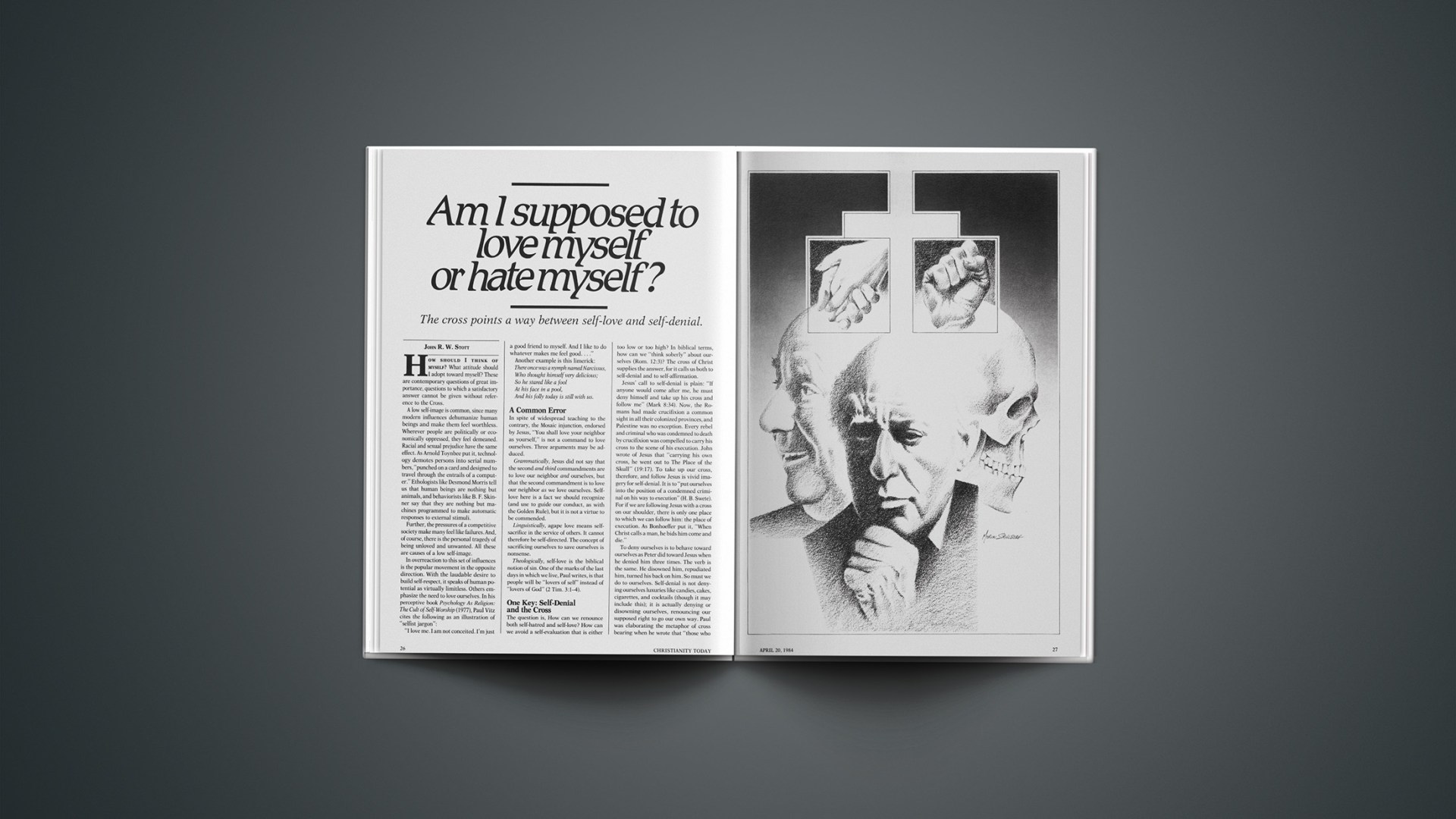
Am I Supposed to Love Myself or Hate Myself?

The Cross Points a Way between Self-Love and Self-Denial

How should i think of myself? What attitude should I adopt toward myself? These are contemporary questions of great importance, questions to which a satisfactory answer cannot be given without reference to the Cross.

A low self-image is common, since many modern influences dehumanize human beings and make them feel worthless. Wherever people are politically or economically oppressed, they feel demeaned. Racial and sexual prejudice have the same effect. As Arnold Toynbee put it, technology demotes persons into serial numbers, “punched on a card and designed to travel through the entrails of a computer.” Ethologists like Desmond Morris tell us that human beings are nothing but animals, and behaviorists like B. F. Skinner say that they are nothing but machines programmed to make automatic responses to external stimuli.

Further, the pressures of a competitive society make many feel like failures. And, of course, there is the personal tragedy of being unloved and unwanted. All these are causes of a low self-image.

In overreaction to this set of influences is the popular movement in the opposite direction. With the laudable desire to build self-respect, it speaks of human potential as virtually limitless. Others emphasize the need to love ourselves. In his perceptive book Psychology As Religion: The Cult of Self-Worship (1977), Paul Vitz cites the following as an illustration of “selfist jargon”:

“I love me. I am not conceited. I’m just a good friend to myself. And I like to do whatever makes me feel good.…”

Another example is this limerick:

There once was a nymph named Narcissus,

Who thought himself very delicious;

So he stared like a fool

At his face in a pool,

And his folly today is still with us.

A Common Error

In spite of widespread teaching to the contrary, the Mosaic injunction, endorsed by Jesus, “You shall love your neighbor as yourself,” is not a command to love ourselves. Three arguments may be adduced.

Grammatically, Jesus did not say that the second and third commandments are to love our neighbor and ourselves, but that the second commandment is to love our neighbor as we love ourselves. Self-love here is a fact we should recognize (and use to guide our conduct, as with the Golden Rule), but it is not a virtue to be commended.

Linguistically, agape love means self-sacrifice in the service of others. It cannot therefore be self-directed. The concept of sacrificing ourselves to save ourselves is nonsense.

Theologically, self-love is the biblical notion of sin. One of the marks of the last days in which we live, Paul writes, is that people will be “lovers of self” instead of “lovers of God” (2 Tim. 3:1–4).

One Key: Self-Denial And The Cross

The question is, How can we renounce both self-hatred and self-love? How can we avoid a self-evaluation that is either too low or too high? In biblical terms, how can we “think soberly” about ourselves (Rom. 12:3)? The cross of Christ supplies the answer, for it calls us both to self-denial and to self-affirmation.

Jesus’ call to self-denial is plain: “If anyone would come after me, he must deny himself and take up his cross and follow me” (Mark 8:34). Now, the Romans had made crucifixion a common sight in all their colonized provinces, and Palestine was no exception. Every rebel and criminal who was condemned to death by crucifixion was compelled to carry his cross to the scene of his execution. John wrote of Jesus that “carrying his own cross, he went out to The Place of the Skull” (19:17). To take up our cross, therefore, and follow Jesus is vivid imagery for self-denial. It is to “put ourselves into the position of a condemned criminal on his way to execution” (H. B. Swete). For if we are following Jesus with a cross on our shoulder, there is only one place to which we can follow him: the place of execution. As Bonhoeffer put it, “When Christ calls a man, he bids him come and die.”

To deny ourselves is to behave toward ourselves as Peter did toward Jesus when he denied him three times. The verb is the same. He disowned him, repudiated him, turned his back on him. So must we do to ourselves. Self-denial is not denying ourselves luxuries like candies, cakes, cigarettes, and cocktails (though it may include this); it is actually denying or disowning ourselves, renouncing our supposed right to go our own way. Paul was elaborating the metaphor of cross bearing when he wrote that “those who belong to Christ Jesus have crucified the sinful nature with its passions and desires” (Gal. 5:24). We have taken our slippery self and nailed it to Christ’s cross.

Another Key: Self-Affirmation And The Cross

I wonder how you have reacted to the last couple of paragraphs? I hope you have felt uneasy about them. For they have expressed such a negative attitude to self that they appear to align Christians with the bureaucrats and technocrats, the ethologists and behaviorists, in demeaning human beings. It is not that what I have written is untrue (for Jesus said it), but that it is only one side of the truth. It implies that our “self” is wholly bad and must therefore be totally rejected, indeed “crucified”!

But we must not overlook another strand in Scripture. Alongside Jesus’ explicit call to self-denial is his implicit call to self-affirmation (which is not the same as self-love). Nobody who reads the Gospels as a whole could possibly gain the impression that Jesus had a negative attitude to human beings himself, or encouraged one in others. The opposite is the case.

Consider, first, his teaching about people. He spoke of their “value” in God’s sight. They are “much more valuable” than birds or beasts, he said (Matt. 6:26; 12:12). What was the ground of this value judgment? It must have been the doctrine of Creation, which Jesus took over from the Old Testament. It is the divine image in us that gives us our distinctive value. In his excellent little book The Christian Looks at Himself (1975), Prof. Anthony Hoekema quotes a young black who, rebelling against the inferiority feelings inculcated in him by whites, put up this banner in his room: “I’m me and I’m good, ’cos God don’t make junk.”

Then, second, there was Jesus’ attitude toward people. He despised nobody. On the contrary, he went out of his way to honor those the world dishonored, and to accept those the world rejected. He spoke courteously to women in public. He invited children to come to him. He spoke words of hope to Samaritans and Gentiles. He allowed leprosy sufferers to approach him and a prostitute to anoint and kiss his feet. He ministered to the poor and hungry and made friends with the outcasts of society. In all this, his love for human beings shone out. He acknowledged their value and loved them, and by loving them he increased their value.

Third, and in particular, we must remember Jesus’ mission and death for people. He had come to serve, not to be served, and to give his life as a ransom for many (Mark 10:45). Nothing indicates more clearly the value Jesus placed on people than his determination to suffer and die for them. He was the Good Shepherd who came into the desert to seek and save only one lost sheep, and who laid down his life for his sheep. It is only when we look at the cross that we see the true worth of human beings. As William Temple expressed it, “My worth is what I am worth to God, and that is a marvelous great deal because Christ died for me.”

Resolving The Paradox

We have seen so far that the cross of Christ is both a proof of the value of the human self and a picture of how to deny and crucify it. How can this biblical paradox be resolved? How is it possible to value ourselves and to deny ourselves simultaneously?

The problem arises because we discuss and develop alternative attitudes to ourselves before we have defined this “self” we are talking about. Our “self” is not a simple entity that is either wholly good or wholly evil, one that should therefore be either totally valued or totally denied. Our “self” is a complex entity of good and evil, glory and shame, which therefore requires that we develop more subtle attitudes.

What we are (our self or personal identity) is partly the result of the Creation (the image of God), and partly the result of the Fall (the image defaced). The self we are to deny, disown, and crucify is our fallen self, everything within us that is incompatible with Jesus Christ (hence Christ’s command, “let him deny himself and follow me”). The self we are to affirm and value is our created self, everything within us that is compatible with Jesus Christ (hence his statement that if we lose ourselves by self-denial we shall find ourselves). True self-denial (the denial of our false, fallen self) is not the road to self-destruction, but the road to self-discovery.

So, then, whatever we are by creation, we must affirm: our rationality, our sense of moral obligation, our masculinity and feminity, our aesthetic appreciation and artistic creativity, our stewardship of the fruitful earth, our hunger for love and community, our sense of the transcendent mystery of God, and our inbuilt urge to fall down and worship him. All this is part of our created humanness. True, it has all been tainted and twisted by sin. Yet Christ came to redeem and not destroy it. So we must affirm it.

But whatever we are by the Fall, we must deny or repudiate: our irrationality; our moral perversity; our loss of sexual distinctives; our fascination with the ugly; our lazy refusal to develop God’s gifts; our pollution and spoliation of the environment; our selfishness, malice, individualism, and revenge, which are destructive of human community; our proud autonomy; and our idolatrous refusal to worship God. All this is part of our fallen humanness. Christ came not to redeem this but to destroy it. So we must deny it.

Dignity And Depravity

There is, therefore, a great need for discernment in our self-understanding. Who am I? What is my “self”? Answer: I’m a Jekyll and Hyde, a mixed-up kid, having both dignity, because I was created in God’s image, and depravity, because I am fallen and rebellious. I am both noble and ignoble, beautiful and ugly, good and bad, upright and twisted, image of God and slave of the Devil. My true self is what I am by creation, which Christ came to redeem. My fallen self is what I am by the Fall, which Christ came to destroy.

Only when we have discerned which is which within us shall we know what attitude to adopt toward evil. We must be true to our true self and false to our false self. We must be fearless in affirming all that we are by creation, and ruthless in disowning all that we are by the Fall.

Moreover, Christ’s cross teaches us both attitudes. On one hand, it is the measure of the value of our true self, since Christ died for us. On the other hand, it is the model for the denial of our false self, since we are to nail it to the cross and so put it to death.

Tim Stafford is a free-lance writer living in Santa Rosa, California. He is a distinguished contributor to several magazines. His latest book is Do You Sometimes Feel Like a Nobody? (Zondervan, 1980).

Five Good Reasons to Show Caution in Giving

The night before thanksgiving, I lay back in my tub, truly thankful for the steamy water with which I basted my weary body. Properly settled in my little pool of prosperity, I opened my November 25 issue of CHRISTIANITY TODAY and began to peruse the current events of the Lord’s church, content with my luxury, until I came to the article by Mark Galli concerning the Christian’s many excuses for not giving to the poor (“Five Reasons for Not Giving to the Poor”).

As I read, I perceived an uneasy feeling of guilt over the comfort of my bath in a world where “comfort” is too often an unshared experience. How often have I, myself, used the excuses Pastor Galli had so aptly pointed out.

And yet, a red light began to blink its warning. Then I saw the hang-up: a desperately needed point of consideration had been totally excluded from the piece—the need for caution and direction in giving.

It must be said, at the outset, that the intent of Galli’s article was well taken. We more prosperous Christians have an ugly tendency to bury our responsibility to the poor in a pile of excuses. Indeed, this reply to Galli’s article is not so much a rebuttal as it is an addendum. The suggestions I offer are not to be used as simply more excuses not to give, but rather, as cautions to give properly.

Years ago, as a young associate pastor at a large church in Indiana, I found myself a prime target for the multitude of fund seekers in the community. (I suppose anyone who wears a three-piece suit every day is considered rich.)

In those tender years, I gave “till it hurt.” It took over 10 years of experience to learn the reasons for showing caution in giving.

You May Hurt The Person You’Re Trying To Help

Before we can learn how to give, we must have a solid grasp of why to give. Am I giving to give, or giving to help? If my intention in giving is to tell myself that I have followed Christ’s command to give, then almost any form of giving will do. However, if my goal in giving is actually to help the person in need, then I must be more diligent in defining my gift.

In the latter case, giving becomes much more than an act of transferring my property to someone else. Such transfer can, indeed, result in harm to the person I intended to help.

In my first pastorate, a man started attending church who was a professed alcoholic. One night he came to the altar and gave his heart to Christ. During the next few weeks, he became active in the fellowship, never came to church drunk and was, evidently, quite grateful for the change God had made in his life.

After the service one evening, he told me of a problem he was having. His newly acquired job would not issue his first paycheck in time to pay his rent. He asked if I could help him out, and I did—to the tune of $50. He ended up in the hospital that night with a blood alcohol of 400. In my effort to be an obedient “giver,” I had nearly killed my newborn brother with $50 worth of hard liquor.

You May Hurt The Person Functionally As Well As Physically

On the level of the individual, I do not hesitate in stating that great harm can be done to people by those who give indiscriminately. A simple case in point should amply illustrate.

Last year, I was visiting with another minister in town when the phone rang. On the other end was a man calling from a restaurant with a heart-rending story of great need. I have a policy to pray before I act, so I asked the man if he could call me back in a few minutes. As the phone rang the second time, God answered my prayer, and instructed me to help the man, but not to give him any money.

We met the man at the restaurant, where we fed him a hearty meal and talked with him about his need. From his tattered clothes, we could see he was destitute, and we longed to help. His needs were simple: clothes, food, and a place to stay until his boarding room opened up in two weeks.

We took him to a clothing storehouse operated by several churches in town, and stocked him with a small wardrobe of very nice clothes. We sat down for coffee, and I offered him a place to stay and three meals a day if he would help me around the church with a few odd jobs for the next two weeks. His answer almost bowled me over.

“I think I’d like to stay and eat, but I don’t know about that work stuff. I ain’t worked in a long time. Why don’t you guys just give me some money?” he said. “All the other churches just give me money.”

We sat till four o’clock that morning trying to convince him to stay. I even gave in and told him he didn’t have to work, just attend the church services. He ended up turning us down cold on our heartless, demanding offer. For a parting shot he rummaged through the stack of clothes we’d given him, picked out a pair of shoes and a jacket and said, “I can’t wear that other stuff. It’s too good. If I wore that stuff, nobody’d ever give me anything.” With that, he was off into the night.

In their desire to be “givers,” the other churches, in this man’s experience, had done nothing more than reinforce his reprehensible lack of dignity. Even now, he is probably calling still another pastor for help.

You Can Easily Hurt Your Relationship With The Other Person

Not long ago, my wife and I were tallying our financial outreach to individuals and trying to evaluate the actual benefits rendered. We were happy to see that, recently, our selectivity in giving had produced far more permanent results than had previous years of token benevolence. One man’s business was saved and is still flourishing. Another maintained his home ownership until he was finally called back to work.

But there was one thing we still noticed that was quite disturbing. In every single case of large-scale giving (which often included the total loss of our savings), the recipients had—within weeks—become offended at us and relinquished our relationship. It seemed, somehow, that our generosity had precipitated hard feelings.

It would be presumptuous of me to imply that I would be able to analyze professionally the emotional causes of their actions. But I have come to a simple conclusion of caution that my wife and I have decided to practice from now on in our giving: “But when thou doest alms, let not thy left hand know what thy right hand doeth” (Matt. 6:3).

One Man’S Gain Can Be A Needier Man’S Loss

In Matthew 25, we are taught to be good stewards of all our assets issued by the Lord. Stewardship, to be sure, involves a strain of generosity considered foolish by the world’s standards. But it also demands a godly wisdom. We are instructed to be wise as serpents as well as harmless as doves. The story of Joseph teaches us the planned use and distribution of God’s wealth.

It would be impossible for me to list the scores of times I have thrown my money into every hand extended, only to find that, when a true need arose, I had nothing left to give. Can we honestly claim that God is pleased when we give all that we have to those in need of a newer pair of jeans—and then have nothing left for the mother who has no winter coat? Is it right to support someone’s Pepsi habit, and void ourselves of the funds to help the child in need of milk?

Mark Galli, in his article, claims that we have no right to criticize the misuse of the money we give. I cannot more harshly disagree! Every time I give of my wealth, I deplete my funds to help more people by the amount that I have given. Jesus told us that the poor would be with us always, and there are certainly more poor in the world than there are funds in my pocket. It is, therefore, logical to conclude that every time I give to one person I am taking from another whom I could have given to if he or she come to me first. Plainly speaking, I am taking out of one man’s mouth to feed another. If the first rule of giving is cheerfulness (2 Cor. 9:7), the second must surely be forethought (1 Cor. 16:2).

You Can Hurt Your Own Family

There has always been abundant preaching in the Christian world about putting others’ needs before our own. One particular Scripture that seems to confirm this idea is 1 Corinthians 10:24: “Let no one seek his own good, but the good of his neighbor.”

Understanding for this verse comes with the study of the word “seek.” Literally, the Greek zeteo means “to endeavor,” “to plot,” “to worship.” As Christians, the purpose in our lives is clearly not just to seek and glory in our own well-being. But there is a vast difference between “worshiping one’s prosperity” and “providing for one’s household.”

In my early years as a pastor, my enthusiasm for giving almost cost me my home. How often did I give my last $20 away to someone who needed to pay a parking ticket when at home there was nothing for my family to eat but some popcorn—without butter! How many times have I (ignoring the plea of my frustrated spouse) invited some strange man into my home to spend a few days, only to find out later his history of rape and child molesting?

It is so easy for us to lay the responsibility on God by saying “God will provide and protect.” Certainly all provision comes from our Father, and the miracle supply of God has never run out; but the warning of 1 Timothy 5:8 is directed at us, not God: “If any one does not provide for his relatives, and especially for his own family, he has disowned the faith and is worse than an unbeliever.”

It is with this caution in mind that I mention a type of giving quite removed from giving to the poor. It is the practice of giving to the ministry.

I am a full-time pastor and draw all my wages through the offerings in my church. My wife works with me, and the only outside income we have is that of special offerings when we sing and preach in other churches. Thus, it is safe to say that I am heartily in favor of generous giving to the professional ministry.

However, I have recently noticed a spirit of foolishness in giving that is frightening. The doctrine goes something like this, “God promises to return to me tenfold everything I give to the kingdom. Therefore, if I will give $10 in the offering, God is obligated, by his Word, to return to me $100 in blessing. If I give $100, God must return $1,000. If I really have ‘faith’ and give $1,000, God will give me $10,000.”

Several months back a Christian friend invited me to lunch. We dined at a nice restaurant where he fed me an expensive meal. During our conversation, he told me he was treating me because he needed extra money, and he knew that if he blessed God’s minister, God would return to him a hundredfold. After lunch, he invited me into his small apartment. My stomach sickened as I realized that, while we fared sumptuously on his meager funds, his wife was sitting hungry with their child in a two-room apartment with no rugs, one lamp, and towels for a curtain.

In the wake of this mistaken philosophy of giving are families with no food, unpaid bills, and even some believers with $2,000 and $3,000 personal loans they secured from the bank to give the preacher. Giving is meant to be a beautiful expression of concern and love. But it can be used by the enemy as a tool of waste and despair.

So What’S The Answer: To Give Or Not To Give?

It is the unfortunate characteristic of magazine articles that they often overstate one side of a point. I am more aware than anyone that my words may be taken to say, “Don’t give! You’ll get taken!” That is not what I intend.

Nor is it my intention that readers be so logical and selective about their giving that they approach every prospect with a fine-toothed comb, in perilous dread of making a mistake. To do this would destroy the spirit of giving altogether.

The answer is not one of fear, but of “true concern.” Token compassion will cause me to give indiscriminately just to relieve the pressure of the moment. True concern will drive me to become readily familiar with the variety of ways I can really help someone. If my heart yearns to give, there are several things to consider.

First, I must familiarize myself with the numerous service groups in my region that specialize in particular forms of aid. The Lions help people pay for glasses and eye examinations. Goodwill has an abundance of clothing. I pastored for three years in one community before I realized there was a local mission that housed and fed the destitute while it ministered to their spiritual needs as well.

We must be careful not to allow “groups” to do all our giving for us. But if we really love, we will search out beforehand where help is available.

Second, we can determine other ways to help besides giving money. In our society, cash is looked on as a cure-all. Often it is easy to give money or old clothing but very hard to give time, an open ear, a shoulder to cry on, counsel, friendship, or church fellowship. One time a man in our church said he needed money to pay his bills. Upon investigation I discovered he earned more than I and had fewer expenses. The man didn’t need money; he needed a financial adviser and a good budget.

There will come the time when the problem must stop at my doorstep. No service group can help; no counselor can change the situation. It is up to me to dig deep into my pocket and give of my earthly goods. Yet, even at this point, wisdom must be employed.

Instead of giving cash and sending the bum on his way, I can take the time needed to use that extra touch of the spirit of God that dwells within me. I can take him to the store and buy him clothes. I can (if I’m not too proud) take him to dinner; or, better yet, invite him home for dinner (with my wife’s permission).

It is my choice how I will approach the art of giving. Will I handle it like a “duty” that must be carried out to maintain my good Christian standing? Or will it be an act of love—well thought out, prepared for, longed for, and executed? Let me settle it now, before the need arises.

Tim Stafford is a free-lance writer living in Santa Rosa, California. He is a distinguished contributor to several magazines. His latest book is Do You Sometimes Feel Like a Nobody? (Zondervan, 1980).

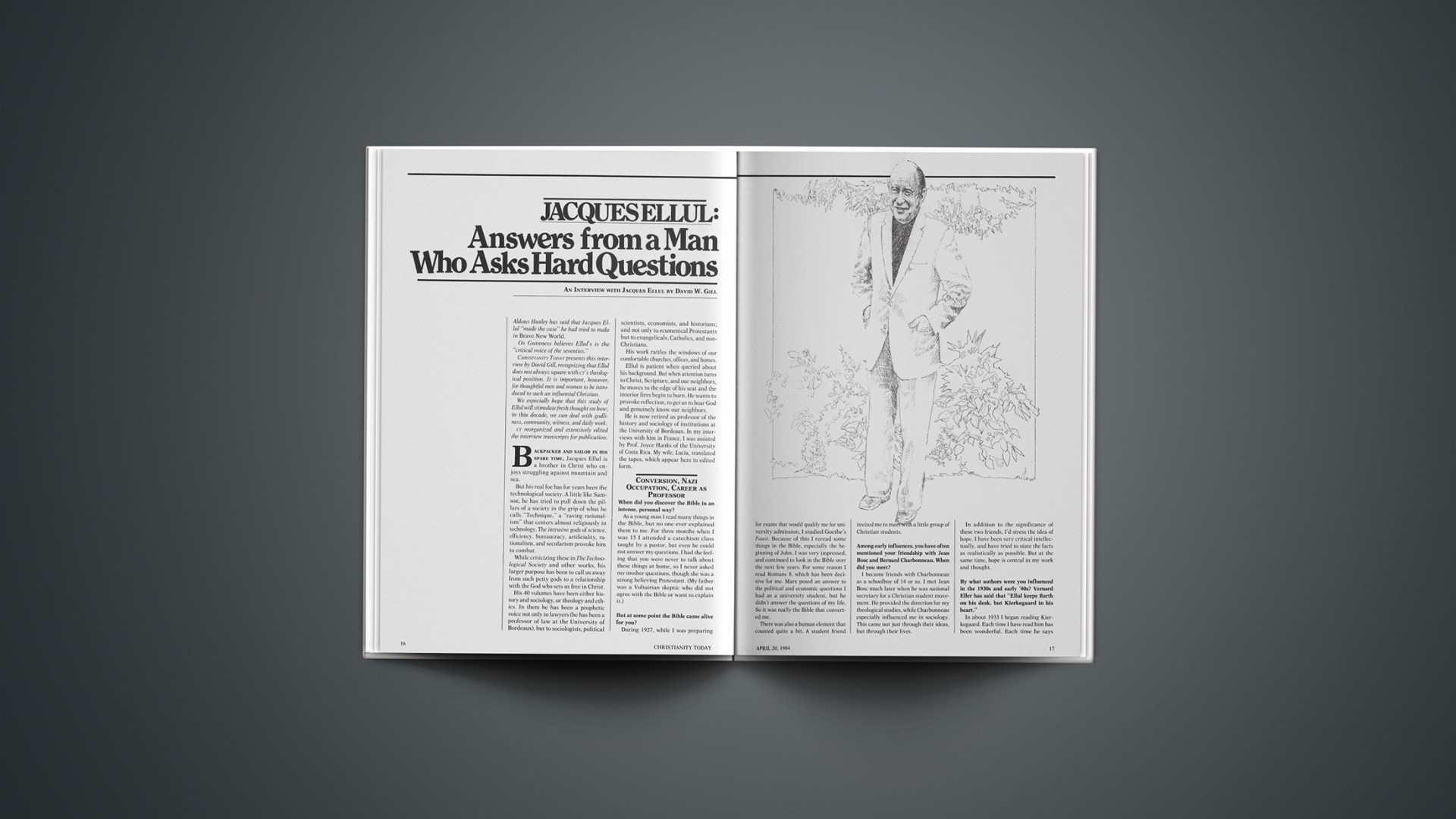
Jacques Ellul: Answers from a Man Who Asks Hard Questions

Aldous Huxley has said that Jacques Ellul “made the case” he had tried to make in Brave New World.

Os Guinness believes Ellul’s is the “critical voice of the seventies.”

CHRISTIANITY TODAY presents this interview by David Gill, recognizing that Ellul does not always square with CT’s theological position. It is important, however, for thoughtful men and women to be introduced to such an influential Christian.

We especially hope that this study of Ellul will stimulate fresh thought on how, in this decade, we can deal with godliness, community, witness, and daily work.

CT reorganized and extensively edited the interview transcripts for publication.

Backpacker and sailor in his spare time, Jacques Ellul is a brother in Christ who enjoys struggling against mountain and sea.

But his real foe has for years been the technological society. A little like Samson, he has tried to pull down the pillars of a society in the grip of what he calls “Technique,” a “raving rationalism” that centers almost religiously in technology. The intrusive gods of science, efficiency, bureaucracy, artificiality, rationalism, and secularism provoke him to combat.

While criticizing these in The Technological Society and other works, his larger purpose has been to call us away from such petty gods to a relationship with the God who sets us free in Christ.

His 40 volumes have been either history and sociology, or theology and ethics. In them he has been a prophetic voice not only to lawyers (he has been a professor of law at the University of Bordeaux), but to sociologists, political scientists, economists, and historians; and not only to ecumenical Protestants but to evangelicals, Catholics, and non-Christians.

His work rattles the windows of our comfortable churches, offices, and homes.

Ellul is patient when queried about his background. But when attention turns to Christ, Scripture, and our neighbors, he moves to the edge of his seat and the interior fires begin to burn. He wants to provoke reflection, to get us to hear God and genuinely know our neighbors.

He is now retired as professor of the history and sociology of institutions at the University of Bordeaux. In my interviews with him in France, I was assisted by Prof. Joyce Hanks of the University of Costa Rica. My wife, Lucia, translated the tapes, which appear here in edited form.

Conversion, Nazi Occupation, Career As Professor

When did you discover the Bible in an intense, personal way?

As a young man I read many things in the Bible, but no one ever explained them to me. For three months when I was 15 I attended a catechism class taught by a pastor, but even he could not answer my questions. I had the feeling that you were never to talk about these things at home, so I never asked my mother questions, though she was a strong believing Protestant. (My father was a Voltairian skeptic who did not agree with the Bible or want to explain it.)

But at some point the Bible came alive for you?

During 1927, while I was preparing for exams that would qualify me for university admission, I studied Goethe’s Faust. Because of this I reread some things in the Bible, especially the beginning of John. I was very impressed, and continued to look in the Bible over the next few years. For some reason I read Romans 8, which has been decisive for me. Marx posed an answer to the political and economic questions I had as a university student, but he didn’t answer the questions of my life. So it was really the Bible that converted me.

There was also a human element that counted quite a bit. A student friend invited me to meet with a little group of Christian students.

Among early influences, you have often mentioned your friendship with Jean Bosc and Bernard Charbonneau. When did you meet?

I became friends with Charbonneau as a schoolboy of 14 or so. I met Jean Bosc much later when he was national secretary for a Christian student movement. He provided the direction for my theological studies, while Charbonneau especially influenced me in sociology. This came not just through their ideas, but through their lives.

In addition to the significance of these two friends, I’d stress the idea of hope. I have been very critical intellectually, and have tried to state the facts as realistically as possible. But at the same time, hope is central in my work and thought.

By what authors were you influenced in the 1930s and early ’40s? Vernard Eller has said that “Ellul keeps Barth on his desk, but Kierkegaard in his heart.”

In about 1933 I began reading Kierkegaard. Each time I have read him has been wonderful. Each time he says what I am thinking. After discovering Kierkegaard, I read Calvin and then Barth. Calvin was impossible! I spent a whole year in the early forties studying him alone. I was very unhappy with it. I cannot get into Calvin’s way of reasoning. He is a teacher, but Kierkegaard, it is true, gets into my heart.

Did you have trouble during the Nazi occupation of France?

After I earned my doctorate in law in 1936, I taught as a university professor, but I was dismissed by the Vichy government in 1940 on the ground that my father had never become a French citizen. (I was also in trouble for my statements about the Germans.) Three weeks later, in August 1940, my father was arrested and sent to a detention camp. My wife and I lived on a small farm near Bordeaux for the next four years during the occupation.

What did you do during this period?

I studied theology, for one thing. The theological faculty of Strasbourg was on the other side of the line of demarcation, but gave me a program to study, and corrected my work by correspondence. I did not receive the degree, however, since I did not finish the thesis. During the war I also passed the examination to become a member of the University of Bordeaux faculty of law. I wrote my 1943 book on the history of the discipline of the French Reformed Church, my denomination, for this exam.

In your work with the Resistance, did you help the Jewish community?

That is how I began. I tried to help people, especially Jews, who were being pursued by the Germans. I found false papers for them. I also organized local Resistance groups to serve as links with the maquis, the guerrilla soldiers in the outlying areas.

Then the liberation in 1944?

Yes. I was appointed professor of law at the University of Bordeaux. Also, at the moment of liberation those who had led the Resistance were appointed to various council posts in the city government. For a time I was in charge of public works and commerce. But despite our high hopes, I found political reform constantly thwarted by corruption and bureaucracy.

From 1944 to 1980 you were at the University of Bordeaux on the law faculty. And from 1947 on you also taught at the Institute of Political Studies?

Yes, three hours a week I taught history of law, and at the Institute two hours a week I taught on Marx or one of his successors.

My work on “Technique” and the technological society was developed mostly in lectures at the Institute of Politics. For the faculty of law I have taught only doctoral students for the past 20 years.

How have you managed to get so many things written?

No committee work, for one thing. But, nevertheless, it has always been a great problem to find enough time to write and to prepare for my classes. One of my most important activities over the years has been to take 10 or 12 students on a camping trip in the mountains where we would reflect on various political (sometimes religious) ideas. At home, or even when we go on vacation, I have written from 6 to 8 o’clock each morning. At that hour I don’t bother anyone. I sleep very little; that is my sickness!

Did the theological and ethical books originate as sermons?

Not exactly, but often my books were the result of Bible studies I prepared for church, or for groups of students who asked me to address a particular subject.

Biblical Reliability

Some say that nearly 50 million Americans profess to being “born again.” Your work is particularly important to this community because both you and they are deeply rooted in Scripture. Inerrancy is an important issue here. How do you understand it?

Essentially, we must ask where the error lies. The first question is not whether a passage is literally correct, but why the passage was written. The Bible makes no mistakes when it comes to the revelation of God himself, or man himself. But in other respects it may be contradictory. The Christian must ask what is more essential: to know who God is, the One who liberates and pardons me, or to know that a text is correct according to modern scientific or historical research. The problem is that our scientific controls are variable; what was considered an error 50 years ago might be considered true today. Science may change; God never lies to me.

Many cults believe in inerrancy. In what way must evangelicals go beyond this?

It is necessary to call ourselves and others to an ethic of responsibility. This means we have to be responsible for the way we read this Bible. We must read with our intelligence and with our community, before God.

Learning Ethics From Christ

You have stressed that Christ does not conform to this world with its web of bondage and sin. Why do you not go further in spelling out his ethic, perhaps by drawing more on the Sermon on the Mount?

I don’t want to give directions that could be built into a rigid ethical system. The Sermon on the Mount has its place, especially in the ethics of holiness and love. I have begun with the ethics of freedom precisely to bring Christians to the position of being free in obedience. If first we obey freely, the rest will come.

If an evangelical’s love is restricted to his inner life, he may have made a separation in the person of Jesus between him as Savior and him as Lord. Jesus is both. It is important for ethics not to separate the two.

In your own experience, what is the value of emphasizing a personal relation with Christ in terms of ethics?

In France I often encounter nonbelievers who find the words of Jesus very good, morally speaking. But they take no interest whatever in the person of Jesus Christ. It is necessary to explain that these words are true precisely because Jesus is the Son of God.

What do these ethical words of Christ mean today?

That is the great question for me. I cannot read these words as a man of the Middle Ages, or even of a hundred years ago. I cannot love my neighbor today without taking into account the economic problems of our present society. I cannot love him without recognizing that I am united with, and mutually responsible for, the evil in the world. It is no longer a question of loving a neighbor who is somehow independent of the economic situation. We are now all responsible.

What is the relation of the Old to the New Testament in developing a biblical ethic? Our view of war, for instance, needs to be illuminated by the example of Joshua and David. Yet how do we relate Christ to this?

All Scripture is inspired by God, and it all reveals Jesus Christ to us. We can never fully know the Christ by reading the Gospels alone, so it is important to read the Old Testament. All the Bible teaches us who Jesus is.

On the question of war in the Old Testament, we must remember that God is not only a God of love, but also the Master of history, and the Judge. The God who was incarnated in Jesus Christ can be a terrible God: “It is a fearful thing to fall into the hands of the living God.” This text from Hebrews shows us that God can indeed be a fearsome Being. But he is also our Father. Calvinists have sometimes stressed him as Judge and neglected him as Father. One must not forget either side of God. The Word of God teaches us who Jesus Christ is during all of history.

While some aim at high standards, others justify a second-rate discipleship because they know they will fall short. What would you say to them?

The real difficulty is always to know how to make God’s calling concrete. Many Christians have become politically involved on behalf of the poor. But we must ask, “Who are the truly poor?” It is not fully obvious. The difficulty is to find how to apply our faith in God to each situation. As we do this, we must not allow self-criticism to immobilize us. I don’t know finally if God accepts my actions and choices: the final judgment is his to make. But I trust in his judgment, so I can act in freedom.

Eschatology And Universalism

Can a preoccupation with the end times potentially develop into an interest in ethical actions in the present?

We must not consider eschatology as something merely in the future that has no relationship to the present. Eschatology must be lived now. It provides an actual ethic.

How would you answer those who question your eschatology because of its universalism?

I make a difference between judgment and condemnation. I believe everyone undergoes the judgment, but that does not necessarily mean God condemns. In my view, judgment does not consist of the weighing of the good and the bad of a whole lifetime, and ending in the rejection, in certain cases, of the total person. The judgment makes a separation. God keeps all that has been good and rejects everything in us that has been evil.

In distinguishing between judgment and condemnation, are you not separating between the person and his work in a way that contradicts the Old Testament, where a person is what a person does?

The works of a person last a lifetime. They form a whole history. There is no separation between the being of the person and his works. The judgment happens at the interior of this history of the person. There is a gradual creation of a person during all his lifetime. One cannot view the human being as a static entity. Being and doing are inextricably linked. Of course, man’s goodness is not natural goodness. Any he possesses comes only by God’s grace, not by one’s own righteousness.

You have written that God’s future kingdom now invades our present in a way that is partial but still real. Will God, at some point on our historical time line, decisively intervene and create a new heaven and a new earth?

I am convinced that there is a rupture in history, a break, an End. But the emphasis of my writing has been on the often neglected fact of a series of interruptions in history by God, not just the rupture at the last moment.

The Church Or Individualism?

In your writings you stress two factors: the lonely individual, and the collective, mass forces of society. In laying so much stress on the individual, have you given enough stress to the church, with its ability to stand up to the institutional principalities and powers?

You are right in pointing out the totally individualistic aspects of my thought and life. I know it is true. Actually, France (and America) have tended to lay too much emphasis on individualism. But there are really not individuals today, but a crowd—a solitary, lonely crowd. So it is necessary to rediscover what it means to be an individual alone with God.

It is difficult to go to the community. All my life I have been in the church and have tried to do all I can for it. But this has not worked out very well. It has not been a community. Since I write not just with my head but with my experience, it is very difficult for me to write on this subject. I have not experienced community at the level of the World Council of Churches. And for 30 years I participated in the national synod of the Reformed Church of France; for 20 years I was a member of its national council. But I always returned very unhappy after the meetings of these groups.

On the local level, of course, in our little group of 15 or 20 people, we experience some community, but on a small scale. In Bible studies, for example, what I have learned has often come from other members, even when I have been the leader. They have pushed me and caused me to learn new concepts. This community brings out in me the desire to do research. They make my faith grow. I try to avoid the situation where the group listens only to one person. Rather, we should use the gifts of all the members. But it is difficult to bring people to believe that within the church everyone has a gift.

IS “CALLING” THE SAME AS “WORK”?

Are you still convinced that the biblical view of work must begin with the Fall rather than with the doctrine of Creation?

Classically, Christians have held that work existed in the Creation. But it was work in a different sense there. Work in Genesis 1 and 2 was not utilitarian. All the trees gave their fruit spontaneously, and though Adam was commissioned to watch over the Garden, no enemies threatened him there. So it was a good work, a job, but not one that was a necessity.

Since God’s work was creative and very good, can we say that, as much as possible, our work ought to be creative, serving life, leading to products that are very good?

Yes, but I do not think we can say that Creation was a job, work, for God. The Greeks and Babylonians considered Creation to be an effort. But the Bible says it is the Word rather than a work. It is something more simple than work. I agree that God’s act was creative, and that what responds in us is word and work. There is a work command, but Adam and Eve were in the presence of God, not merely doing a work or pursuing a vocation. The ideas of work and vocation are confusing, but I believe that vocation (calling) is always and only service to God.

In your books you make a radical distinction between “work” and “calling.” But consider your work with the Prevention Club [a ministry to troubled young people in the city]. Does not everything have an aspect of work to it? And, likewise, cannot work become a calling from God?

I think of a young educator who worked with delinquents of the Prevention Club. He said that when he worked for eight hours during the day he often did it for the pay. But when he continued on after hours because he loved them and they needed him, he became free, and his activities became a calling. Many people engaged in difficult work have this kind of experience.

In your conception of the relation of ethics to “work” and “calling,” how has being a Christian made a difference to you as a professor at the University of Bordeaux?

I would like to answer on two levels, one dealing with professionals, and the other with students. My friend Jean Bosc and I started the Association of Protestant Professionals. We discussed professional problems, concretely, just as they are in life. The theologians would describe simply what the Bible says, without spelling out what those present should do. Then the professionals were challenged to figure out what to do, what sort of solution to bring to their problems.

We had some very different experiences! It was easier for doctors and nurses than for business people. The groups that never went along very well were those composed of bankers and insurance agents.

How do you apply your views of “work” and “calling” to your relation with students?

When I began to teach, I quickly discovered that the meaning of my work lay not in the science of transmitting information, but in my relationship to my students. As in the case of my Bible studies, my university students inspired me to undertake research on various questions. I did not do research for the sake of research, but because a group of students were interested in a particular question.

It was important for me that my students knew I was a Christian. I have often lived the experience Peter described: “Always be ready to give an answer to everyone who asks you to give the reason for the hope that you have.” The students should always feel free to ask questions. When, for example, I taught classes on the thought of Marx and his successors, I did not try to teach that Marx was wrong. Marx said some admirable things, and I told my students that this was so. It was amusing to me, then, that students would often ask, “How can you teach this when you are a Christian?” So I would be given opportunity to respond.

I also felt it was important to be available to my students. I had a close pastoral relationship with many of them.

Should we encourage people to bring their work into closer conformity to their calling from God? Sometimes your writings seem to dismiss the possibility of service to God in one’s secular work.

I would not have worked so much myself if I had not been convinced that work responds to a certain will of God, and not only to a necessity of the world. The difficulty comes in that it is necessary to appreciate a job in the measure to which it is creative and liberating. I agree with the Reformed tradition in refusing to make a simple distinction between work that is good and work that is not good. I have a new group forming in Paris, composed of bankers and stockbrokers. They are Christians. Can I tell them that a Christian should not be a stockbroker? That is very difficult to do.

Peter directed Cornelius’s attention to Christ as Lord, and left him as a Roman centurion. But it was not long before most Christian “Corneliuses” (army officers) left their commissions. What would happen if we followed Paul’s example with bankers and stockbrokers?

I agree with this approach. But the problem remains that there are various techniques used in different jobs. It is difficult to judge accurately and fairly whether the work is to the glory of God—that is, whether it is creative and liberating.

Is it fair to summarize your advice to Christian lawyers by saying that you think they should gather to analyze their profession and practice realistically? Do you think they should study biblical notions of justice and law, and then discuss and pray to discover what this means for their law practices?

That is a fair summary. The first point is very important, especially for lawyers, since they are tempted by idealism. It is well and good to serve the law, but they must understand the reality of what is happening. Just last month a young man struck his daughter, who then fell on the sidewalk, becoming crippled and blind as a result of a spinal injury. The prosecuting attorney was a Christian, as were the defending attorney and the judge. I know all three quite well.

The father had a temper, but was a good man, sensitive and devastated by this accident. However, the press portrayed him as an unworthy, scandalous father. The prosecutor was appalling, and the defending lawyer had no concrete defense. The young man was sentenced to 17 years in prison and hung himself the next day.

I told the lawyers afterward, “You did not realistically judge the person in this matter.” It is important to stress the need of the legal profession to be realistic and responsible.

What were your experiences with the Association of Protestant Professionals?

Most lasted six years, from 1947 to 1953. Participants, who might have been businessmen, for instance, submitted problems. We tried to get them to reflect on practical matters. There were congresses, study courses, and consultations. A businessman might submit a business venture for the group’s study and discussion. Two groups, doctors and teachers, have continued to this day, but the others have not.

In some of your writings about alternative education you have recommended getting off into the mountains, camping and so on. Do you think a Christian college is wrong to locate near a major secular university?

In France there is an interesting experiment at Aix-en-Provence. A group of Christians have installed a theological school right next to the university’s college of letters and sciences. They are succeeding very well. The university is lay and secular, and has no moral preconceptions or idealism. The faculty of theology is thus the place where students can find responses to their questions.

Can we hope that theologically and ethically trained professionals might go back to their churches and teach a Christian view of work and discipleship to the blue-collar workers who worship with them?

It sounds excellent. For workers, Christianity has appeared at other times to be either a means of getting them to accept their condition, or a means of criticizing society. I believe this criticism is specially important, and that some new associations of workers might be created, since American labor unions are not at all in the business of transforming society. It is important to have Christian associations that ponder changes in society.

“Afterword,” By David Gill

What are we to think of Jacques Ellul? In the introduction to his In Season, Out of Season I have stated part of my own answer:

“While the label ‘prophet’ is tossed about rather loosely these days, I believe that in the case of Jacques Ellul it is fully appropriate. The value of the prophet lies in his ability to disturb the status quo, to put in question what is taken for granted, to shed new light on old issues, to bring in a new perspective. As in the commission to the prophet Jeremiah, the prophet acts by ‘uprooting, tearing down, destroying, and overthrowing,’ and by ‘building and planting.’ The prophet is both angry and compassionate. He brings a Word from outside. He brings a challenge.

“On the other hand, the prophet has limitations. The prophet is not a teacher in the full sense of the term. The teacher gives a more complete, reasoned exposition of the truth, filling it out and applying it. Ellul’s work has many rough edges and not a few blind spots, overstatements, and contradictions. As ‘teaching,’ Ellul’s work is lacking in various ways. But as ‘prophecy,’ it is an explosive challenge that is ignored only at great loss. Americans need to give a continued and expanded hearing to the Bordeaux prophet in our technological wilderness.”

Is Ellul Against “Technology”?

David Gill: A good deal of confusion has surrounded the words “technique” and “technology” in English translations of your works. Many believe you are opposed to all forms of technology, and that you think it is not only non-Christian but antihuman. Perhaps the French word technique ought to be translated into English as “technique” (small t) when it refers to various individual techniques or to the general way of thinking that is not meant to be a kind of religion.

But what would you think of using “Technique” (capital T) in English when referring to the global, almost religious ensemble of means, the way of thinking? Harper & Row will follow this scheme in your next two books. However, the translator of The Technological System claims you approved the continued use of “technology,” even for this global idea.

Jacques Ellul: No! Never! Absolutely not! In the first translation of The Technological Society it was decided to do just what you are suggesting: use “Technique” with a capital T when it was a question of the totality of techniques. We were not going to use the word “technology.” But in spite of this, I was told “technique” was not an English word that could be used this way.

But I have never given my approval to it.

Gill: It is an innovative concept, so why should we not innovate by using a word in a new way?

Ellul: Exactly! It is even becoming a problem in France now because the concepts of Technique and technology are being confused.

Tim Stafford is a free-lance writer living in Santa Rosa, California. He is a distinguished contributor to several magazines. His latest book is Do You Sometimes Feel Like a Nobody? (Zondervan, 1980).

Ideas

Winds of Change in the World Council?

Changes over the past 25 years demand a fresh look.

Evangelicals do not agree on what evangelicalism is, so it is no surprise that they do not agree on what to do about the World Council of Churches. It would be foolhardy, therefore, to attempt to prescribe what all evangelicals ought to think about the World Council. Our goal is much simpler: to spell out how we ourselves respond to it.

Ecumenism (the unity of the household of faith) has always been a deep concern of evangelicals. They recognize that unity of the spirit is far more important than any unity of structure. Yet since Reformation days, evangelicals have had a continuous history of attempts at union. In spite of meager success, Luther’s dialogue with Zwingli, the Diet of Augsburg, and the correspondence of Lutheran leaders with the Eastern churches bear witness to their hope that the body of Christ might be united.

The modern ecumenical movement began with evangelicals during the nineteenth century. The National Council of Churches, however, was never distinctly evangelical. Nor was the WCC when it was organized at Amsterdam in 1948. Ernest Hocking’s famous Layman’s Report on Missions typified the viewpoint of liberal ecumenists of that day. It decried efforts to convert the heathen. The aim of missions, so it argued, was not to convert Buddhists to Christianity but to make Buddhists better Buddhists. In 1948 at Amsterdam, liberals, many holding such beliefs, nurtured the new world organization through its infancy. Only the insistence of a block of European conservative churches eventually secured a commitment to the deity of Christ.

Karl Barth’S Rebuke Of The First Council

Karl Barth addressed the Amsterdam council as an outsider. Though he would hardly be recognized as a spokesman for American evangelicals, he roundly rebuked the council for its cavalier use of the Bible. The leaders, so he charged, did not acknowledge it as their authority. They employed it only as a resource from which they could pick and choose what supported radical views they had already adopted on wholly other grounds.

After Amsterdam, the WCC leadership quickly went from bad to worse. The gospel soon became lost in all sorts of political and social causes with which the World Council identified. It represented the tail end of the Roosevelt New Deal/Fair Deal/New Frontier bandwagon. From 1960 through 1980 this seemed to be the permanent direction of the council.

Most troubling to biblically oriented evangelicals were the following: (1) The deity of Christ was left undefined, though the council’s constitution gave it lip service. Vastly differing views on the person and work of Christ flourished equally within the leadership of the council. (2) The New Testament gospel became lost—the gospel that Jesus Christ, the divine Savior and Lord, became incarnate, died on the cross and rose again bodily from the dead to redeem mankind from sin through personal faith in himself. (3) The Bible was an honored book from which proof texts were selected when they supported views considered relevant on other grounds, but no attempt was made to deal seriously with scriptural teaching. (4) Universalism—the view that all will be saved regardless of faith, religion, or moral condition—became standard doctrine. (5) World history was interpreted in Marxist terms, superficially glossed with traditional Christian vocabulary. (6) Left-wing offenses against human rights and human freedom were seldom noted, and rarely rebuked. By contrast, right-wing oppression was made a cause célèbre; and the council actively opposed efforts to further human rights and political democracy in Marxist countries.

Winds Of Change In The World Council

After 1960, the WCC found itself faced with new pressures. In the United States, mainline denominations, composing the bulk of support for the National Council and World Council, were losing tens of thousands of members yearly. By contrast, the largest Protestant group and the fastest growing—the Southern Baptist Convention—remained outside the fold. Ecumenical leaders in America, therefore, made a determined effort to woo the conservative Southern Baptists.

Then, in 1961, the Eastern Orthodox churches joined the council and became an increasingly significant voice for a more conservative theology. In the sixties the World Council also began seriously to attract into its orbit the Roman Catholic church, which had undergone a number of changes. Through these years, moreover, the Third World missionary churches, especially in Africa and South America, began to influence the World Council. These conservative pressures in and out of the organization were finally climaxed at the Melbourne Missionary Conference in 1980. To a lesser extent, the council’s sixth assembly at Vancouver followed in this same direction. Though it did not quite reach the heights of Melbourne, it provided a noticeably different climate than that of the assembly at Nairobi in 1975 or at Uppsala in 1968.

New Wcc Trends Demand A New Evaluation

Clearly it is time, perhaps past time, to reassess the new ecumenical situation. What can be made of these new winds of change blowing through the WCC—long written off by most evangelicals as a liberal wasteland? The perspective of the World Council has changed completely for some. A group of evangelicals at Vancouver, headed by Arthur Glasser, dean emeritus of the Fuller School of World Mission, and Richard Lovelace of Gordon-Conwell Theological Seminary, called for an end to evangelical stereotypes of the World Council. Their “open letter,” signed by 200 evangelicals attending the Vancouver assembly, ended with the plea, “Should evangelicals not seek to receive all who confess Jesus Christ as Lord, even though they may seriously disagree on theological issues apart from the core of the gospel? There is no biblical mandate to withdraw from those who have not withdrawn from Christ.”

Another Viewpoint

We respect this reevaluation of the World Council and hope it is valid. From our perspective, however, it is not realistic. Yet while rejecting what we believe is an overly optimistic evaluation of these new trends in the World Council, we are glad to note that the Vancouver meeting was not just a repetition of old heresies. And our response to the World Council’s recent move cannot be wholly negative.

1. We are grateful for the obvious desire of the World Council to include evangelicals and to give them a hearing. Sincere dialogue, though it has its dangers, is good. We cannot expect to communicate unless we are also willing to listen.

2. We are also grateful for the increased emphasis upon biblical exposition. Evangelicals were amazed at the serious attention given the Bible in study groups at Vancouver. The Bible is a dangerous book—for World Council leaders as well as for anyone who takes it seriously. Martin Luther began to search its teaching, and the Protestant Reformation was the result.

3. We were also deeply impressed by the earnest piety evident in the worship services, and the commitment to prayer. Here evangelicals have much to learn.

4. We recognize many World Council supporters as fellow believers in Christ, and rejoice in our common faith. The word “evangelical” is derived from a Greek root meaning “good news,” the gospel. In its broadest sense, therefore, “evangelical” includes all who believe in Christ. Particularly in the United States, however, the word has traditionally been employed in a much more restricted sense. In common American-English, “evangelicalism” has meant those who adhere to the basic doctrines of the Reformation churches—Lutheran, Reformed, Anglican, and Anabaptist (independent and Pentecostal groups would also be included now).

It is evident, then, that the whole church is not evangelical in this more contemporary sense of the term. Many nonevangelicals are fellow believers and are part of the body of Christ—the oikoumene of faith. For example, members of the National Association of Evangelicals and the Evangelical Theological Society acknowledge as fellow believers many who could never sign either organization’s statement of faith. Neither poses as a church but as an association of evangelicals.

5. Apart from theological considerations, evangelicals appreciate the battle the World Council wages against oppression, the violation of basic rights, and the disregard of our God-given environment. To cite Peter Beyerhaus, Arthur Johnston, and Myung Yuk Kim in their generally negative evaluation of the sixth assembly at Vancouver, “Evangelicals are no less concerned for welfare, justice, and peace than other Christians, although we might differ in our analyses, in our proposals for solution, and in the theological motivation of our Christian task to help the poor and depressed.”

Yet when all is said and done, many of us are unwilling to identify with the World Council. We cannot in clear conscience support it in its educational and teaching ministry, and in its social and political involvement. In spite of changes for which we are grateful, neither the missions statement at Melbourne in 1980 nor the Vancouver assembly in 1983 changed the basic nature of the WCC.

Necessary Areas Of Change

Most evangelicals will find it difficult to join forces with the World Council as long as the following basic areas remain unchanged:

1. Its equivocal stand on the deity of Christ. It is true that the constitution of the World Council includes a confession of “the Lord Jesus Christ as God and Savior, according to the scriptures.” Yet it does not define what it means by these terms. We can understand that the World Council is not responsible for what every individual in its member churches will teach. But it is responsible for its own teaching officially sponsored at its assembly or dispersed from its Geneva office. And much of the teaching sponsored by the World Council clearly sets forth a much lower Christology. For example, Dorothee Soelle, as the representative of the German church, argued in a major teaching session at Vancouver for a complete reconstruction of the traditional concept of God. Many less blatant simply leave their views of Christ undefined.

We are not asking the World Council to clear up all the mysteries of the eternal Trinity or to unravel how the human and divine natures are related to each other in the one person of Jesus of Nazareth. Yet we are asking the council to stop giving mere lip service to an undefined doctrine of the deity of Christ that permits it to teach anything. In short, the World Council must clean up its act. It must let us hear a consistent commitment to a basic Nicean and Chalcedonian Christology, for this is the very heart of biblical revelation.

2. Its failure to diagnose the predicament of mankind. The biblical diagnosis is that human sin separates man from a holy God and rightly calls down divine judgment. This alienation from God, this human lostness, in turn produces man’s alienation from himself and from others. Yet at Vancouver once again the focus was not on separation from God, but on human disorder on the horizontal level.

3. Its wrong diagnosis surely leads to a wrong remedy. So the basic thrust of the biblical gospel still fails to shine through with recognizable clarity. In the WCC study volume prepared for the Vancouver assembly, John Paulton lists as one unlikely option that “only those calling upon Jesus as their personal savior, can be saved, the rest of humanity being assigned to eternal perdition.” We hear no clear presentation of the biblical doctrine of justification only through faith in Jesus Christ. And this is the crux of the biblical and evangelical gospel. As Luther taught us, by it Christianity stands or falls. And its absence is a fundamental obstacle to evangelical support of the World Council.

4. Its almost exclusive concern for the horizontal dimension of salvation. The World Council’s inadequate diagnosis of the human predicament leads it to view salvation primarily as horizontal. Its purpose is to heal the alienation between man and man. Again and again at Vancouver (as at previous assemblies) and in its constant flow of study materials, the WCC makes salvation an earthly affair. In this view, the root evil lies in the social and political structures of human society, and the remedy is to change them. While occasional speeches might have referred by indirection to the vertical dimension, horizontal relationships certainly represented the overpowering concern of the council’s leadership. In his opening sermon, the outgoing general secretary, Philip Potter, surprised and pleased evangelicals with a biblical message that offered some splendid insights. Yet his conclusions point only to the horizontal or communal salvation, one that leads to a new humanity and a restoration of society rather than to personal faith in Jesus Christ, a right relationship to God, and the new birth.

5. Its religious pluralism. World Council confusion about the gospel leads inevitably to a synchretism that finds salvation in other religions. The Vancouver theme, “Jesus Christ the hope of the world,” could be interpreted as a rejection of synchretism, but it was not so interpreted by the World Council in its official preassembly study guide. “In the end the great communities of faith will not have disappeared. None will have ‘won’ over the others. Jews will still be Jews; Muslims still Muslims; and those of the great Eastern faiths, still Buddhists or Hindus or Taoists. Africa will still witness to its traditional life view; China to its inheritance. People will still come from the east and the west, the north and the south, and sit down in the Kingdom of God, without having first become ‘Christians’ like us.” All religions, apparently, lead to God. Jesus Christ is merely our way. At Vancouver, this growing synchretism gained further support from the Indian mythology employed in worship, from the role given to the leaders of other religions, and from the stern warning presented by World Council official D. C. Mulder against evangelizing because it imposed an obstacle to dialogue with other religions.

The Issue Of Authority

By contrast, evangelicals plead for a clear recognition of the lostness of mankind without Christ. They insist on an unambiguous commitment to a Savior who is fully God and fully man, united in one person, who died for our sins and rose bodily from the grave—the Christ of the Bible; this commitment was witnessed to in the historic creeds of the ancient church, and reaffirmed in Reformation days. Neither Holy Scripture nor historic Christianity supports religious pluralism or synchretism or universalism.

The World Council, moreover, carries on an immensely influential teaching role in the church. The constant flow of study papers from Geneva proves this. Evangelicals, therefore, are concerned that it adhere to sound doctrine—theology clearly set forth in Scripture.

For the evangelical this points out the importance of biblical authority for the life of the church and, therefore, its importance for any realistic evaluation of the WCC. The council’s official publication The Bible: Its Authority and Interpretation in the Ecumenical Movement rightly states: “The churches will inevitably be confronted with the issue of the authority and the right interpretation of the Bible.… To form a fellowship of effective common witness, it is essential that the churches reach a common understanding of the priority of the use of the Bible in the life and witness of the church.”

Unfortunately, the surprising emphasis on biblical exposition at Vancouver did not really include a commitment to the authority of the Bible. Although many individual representatives were undoubtedly sincere in their devotion to Scripture, the leadership at the council maintained, as in the past, a very selective approach to biblical passages. It chose those that would support its special interests. Biblical teachings about man’s social obligations, therefore, were drawn upon skillfully. But there was little or no exposition of those grand doctrinal themes that abound in Old and New Testaments. Or of those teachings about personal responsibility and personal ethics the Epistles are so concerned to inculcate in the lives of first-century Christians.

It should not be a surprise, therefore, to discover that the World Council study guide on the Bible declares: “There are diverse literary traditions in the biblical writings.… Some of these traditions may be contradictory. The church is in dialogue with Scripture, but has been fed from many sources, in the light of which, biblical statements may have to be declared inadequate, or erroneous.… We are not to regard the Bible primarily as a standard to which we must conform in all the questions arising in our life.”

For these reasons, therefore, we cannot encourage evangelicals to identify with the World Council of Churches. Rather, we would recommend as an alternative the National Association of Evangelicals and similar bodies. No doubt evangelicals need to seize their opportunities more boldly, and to raise a more prophetic voice. But it is our conviction that NAE, World Evangelical Fellowship, and the series of evangelical congresses sponsored by Billy Graham at Berlin in 1966, in Lausanne in 1974, at Pattaya in 1980, and at Amsterdam in 1983 have accomplished infinitely more for the kingdom of God than all the assemblies of the World Council and the meetings of its study groups and subsidiary organizations put together.

The World Council encourages Christians in a multitude of good causes; but in doing so, it manages to squeeze out the biblical gospel and distances itself from the authority of Scripture. So long as the World Council persists in its departure from truly biblical Christianity, most evangelicals will find it unwise to support it in its teaching and in its ministry.

Appropriate Response

How, then, shall evangelicals respond to the new winds stirring in the World Council? We certainly cannot speak for all evangelicals. Recognizing that some may chart quite a different course, we for our part commend the following approach:

1. Listen to hear what the WCC is really saying. The evangelical must be willing to set aside stereotypes and let the council be what it chooses to be, without either expecting it to be perfect or faulting it for erroneous views it never espoused or no longer defends.

2. Dialogue from a position of faith. The evangelical is not searching for the gospel; by grace he has heard and received it. To some, this may sound arrogant. To the evangelical, this is his assurance of faith in the truth and goodness of God.

3. But still he must dialogue. The evangelical has much to learn from dialogue with those of no faith or of other faiths. Certainly, he has much to learn from dialogue with the mixed bag that the wcc represents. By sincere dialogue he understands better those to whom he is seeking to communicate the gospel or those whom he hopes to call to more obedient faith. But he has much to learn beyond this. We evangelicals can greatly enlarge our understanding of reverence, of proper worship, of application of the gospel to the world, of Scripture, and of biblical ethics.

Being wrong on essential points does not preclude the possibility that the World Council is right on some points. Evangelicals must be humble enough to learn from brothers and sisters in the faith whom they believe to be dead wrong on important doctrines.

4. Pray for the spiritual discernment of WCC leaders, and for their greater commitment to biblical faith. Especially we must pray for fellow evangelicals seeking to minister within the framework of the National and World Councils, that they may be wise as serpents and as harmless as doves as they seek to further the cause of Christ.

5. Love each person in the World Council. Evangelicals must learn to treat the ecumenist with tender consideration and with strict adherence to the truth as we see it. When necessary, we must warn him in a loving manner of his departures from the truth or from right action. We will exhort him faithfully to a greater obedience through our Lord Christ and his written Word—yet always in humility as befits sinners who themselves daily fall short of perfection.

Yet, so long as the World Council fails to teach essential truth, or in its teaching and practice denies what is essential to biblical Christianity, we shall continue to oppose it, and to warn against its subversion of the faith. And though other evangelicals may disagree, we shall refuse to support it or to identify with it.

KENNETH S. KANTZER AND V. GILBERT BEERS

Eutychus and His Kin: April 20, 1984

Ode To The Overhead

Turn in the Word and watch the screen

While I expose John Seventeen.

Point one’s begun, behold the Son.

(He’s outlined red.)

He kneels to pray; What does he say?

(It’s outlined blue.)

Here’s my thesisexegesis

Verse four’s my theme.

(It’s outlined green.)

And notice this—no aorist!

Jesus never strides a fence;

His verb here is the perfect tense,

Gesinius, Arminius, and Lenz agree.

Now let’s change slides:

Here I have shown

What leftist theologians think

(Get it? Leftist? Outlined in pink?)

Great scott! The bulb,

It’s blown! You’ll mark

The Holy God grows silent

When the screen is dark.

Miss Jones! Could you go out and get

A d.y.s. Sylvania (projector lamp)

There, in my office cabinet?

Be patient, folks, I’ll change the bulb.

What? What, Miss Jones?

There is no lamp?

Oh woe! No mighty rushing wind

Or tongues of fire!

And having eyes, we cannot see

The great verse three transparency.

Oh, how we long to set men free With lens and light technology.

EUTYCHUS

Capital Punishment

There may be scant New Testament prescription for the death penalty; there is none in either Testament for incarceration [“The Death Penalty: Two Sides of a Growing Issue,” Mar. 2]. God appears to have authorized capital punishment, corporal punishment, involuntary servitude, and restitution as remedies for the sins of humans against one another. Would those who wish to abolish capital punishment be willing to reinstitute corporal punishment and involuntary servitude, or do they totally reject God’s remedies? The typical felon has no ability or means to make restitution aside from involuntary servitude (community service is a form of involuntary servitude that does not benefit the victim).

God deals in justice, mercy, and love in proportions that contribute to his own glory. Any benefit to us is a provident side effect. Theologically speaking, is it possible for an “innocent” person to be executed?

BILL WALD

Vashon, Wash.

Tickled Pink

You’ve really done it this time! you’ve succeeded in tickling me pink! Kathryn Lindskoog’s “Did You Hear the One About Cardinal Sin.…” [Mar. 2] was, for obvious reasons, very personal. I had two possible options: I could sue your shirt off, or take it on the chin and grin and bear it. I chose the latter, of course. (Besides, if I had sued you, I might lose my subscription to CHRISTIANITY TODAY!)

Incidentally, my father is a doctor who practices neurology in the L.A. area.

REV. DAVID W. BONECUTTER II

Lincoln, Neb.

Urban Ministries

Barbara Thompson is to be commended for “In the Ghetto, Where Authentic Christianity Lives” [Feb. 17]. It well capsulizes many crucial lessons for those who desire to serve in urban ministry. I appreciated Tom Nees’s humble admission that he learned he could not hold an attitude of personal superiority over those he had come to serve but instead recognized that he was in the ghetto to work out his own salvation and thus “receive as well as give.” Some of the most despairing and defeated people in our society demonstrate a very deep and genuine faith by which I have been touched and blessed.

Nees’s emphasis on the proper motives for urban service is also essential. People driven by guilt or idealism will not only experience fatigue and frustration but also risk misrepresenting the Christian life as something other than the joy-filled walk that it is. In urban ministry, living the Christian life is surely a struggle. However, it is not merely a struggle against the likes of external sin, evil, indifference, and injustice but also a fight against intrapersonal forces: the old man within that demands both rapid solutions to complex problems and enormous change when the will of God may be that one learns to accept and love an individual or a culture for what it is.

NED STRINGHAM

Lincoln, Neb.

Updike: Christian Art?

I was somewhat astonished to read Rodney Clapp’s evaluation of John Updike’s recent collection of essays and criticism, Hugging the Shore, and to find him so ready to leap to the conclusion that Updike’s work is a legitimate and, indeed, exemplary corpus of Christian writing [“The Generous Critic: John Updike” Mar. 2]. It seems to me that one would have to have an awfully broad understanding of the term “Christian art” to include the fiction of John Updike within this category.

Updike’s major works, rather than celebrate the glory of man made in the image of God and the central place of God’s will and His people in bringing the blessing of God’s covenant to earth, often promote instead the perverse and depressing, exploding these aspects of human experience up to some sort of cosmic norm. People are forever having children and swearing like sailors throughout the pages of Updike’s novels. Moreover, Updike’s low view of the church and its importance in the world takes on something of an evolutionary character.

Overall, human life is made out to be one continuing series of crises and depressions, and the only joy that anyone experiences is strictly momentary, fleeting, and on the whole relatively insignificant.

T. M. MOORE

Fort Lauderdale, Fla.

Gundry Versus ETS

“Evangelical Scholars Remove Gundry for His Views on Matthew” [Feb. 3] sounds like a replay of what went on in the Catholic church some 40–80 years ago. Geisler has forced Gundry’s position to its logical conclusion, even if Gundry does not personally hold to such extreme conclusions. His position creates such possibilities and logically implies them. Biblical history is no longer reliable with Gundry’s method.

TIMOTHY G. CLEARY

Aptos, Calif.

It is disturbing to me that so often we as Christians are guilty of intolerance toward the views of our brothers and sisters in Christ, especially on issues where there are no clear, definite answers. Too often we say, “Either you believe as I believe or you do not believe.” Too often we mistakenly make the Bible the object of our faith. We do not possess definite knowledge on questions such as inspiration. Yet, we choose sides, force others to choose sides, and shout judgments from both camps. Thus it is that the world lies waiting while we waste our energy fighting amongst ourselves.

C. LACY THOMPSON

Belle Chasse, Louis.

Hats Off!

Hats off to you for your fine article on pastoral responsibilities [“How Many Hats Does Your Pastor Wear?” Feb. 3], especially for that last line about the priesthood of believers, which put it all into the proper perspective. Each of the ministries you mentioned can and should be undertaken, at least in part, by gifted and trained “lay” persons in the congregation. But it would seem that it is too easy to forget that the pastor of a church is not the minister but rather an equipper of ministers who have all been gifted for the task by the Holy Spirit. If more pastors recognized this as their chief responsibility (Eph. 4:11–12), what a difference it would make to the cause of Christ throughout the world!

KEVIN J. WHEELER

Honolulu, Hawaii

Naïve Statements

Richard A. Baer, Jr., understates the case when he says our schools are “one of our key structures” [“They Are Teaching Religion in the Public Schools,” Feb. 17]. Our schools are more than that. They are the roots from which grow our most precious commodity, our religious freedom. Today’s private school systems, motivated for religious, cultural, and political reasons, are springing up all around us. Many are sponsored by us evangelicals. Is this wise? Isn’t there danger that this splintering up of our children during their formative years may in time destroy our togetherness as a nation and in turn tear away at our religious liberty? The recent influx of Mexicans and Southeast Asians to our country, people who understandably want to share our liberties and our wealth, makes this need more urgent than ever. The thread that holds our nation together is a slender one.

Let’s speak up for our public school educational system. Let’s pump in Christian teachers, and work on school boards and in the PTA SO our grandchildren can be assured of religious liberty also. Then let’s encourage our fellow evangelicals to phase out their well-meaning though dangerous programs of private school educational systems—and leave religious training of our children (ages 6 to 16) where it belongs, in our homes and churches.

GUNNAR HOGLUND

Santa Clara, Calif.

’Tis strange that when nontheistic scientists admit their inability to prove evolution by logically coherent evidence but choose to give it credibility due to their inability to accept its only alternative, theologians accept evolution as the gospel. ’Tis strange, also, that when Christian scientists have no problem with a scriptural view of creation, theologians do. ’Tis strange—that is, until we recall that Darwin was an apostate divinity student. No wonder evolution is hotly debated in the higher levels of the scientific community and is generally accepted as fact only by those undereducated in science and overeducated in theology.

CARL D. FORD

Laurel, Miss.

What Is Art?

With regard to “Must Art Be Christian to be Good?” [Feb. 3], Veith makes some very naı̈ve statements about art and the Christian community. To assert that “art as art is essentially neutral” is to misunderstand the very nature of art. Art communicates; it reveals a philosophy of life that brings it into being.

Art is a gift from God. Christians need to be aware of the power of the arts to communicate, to inspire, and to stimulate. While art cannot “be” Christian, it can reflect a philosophy of life compatible with the Christian faith.

REV. CHARLES WARNOCK III

Stone Mountain, Ga.

The Thinking Machine

Although I agree with some points made by Emerson and Forbes [“Living in a World with Thinking Machines,” Feb. 3], I would like to take exception to several others. While making several specific admissions of the limitations of AI, they nevertheless convey the impression that these will soon be overcome, with profound psychological and theological implications (even the quote from Jastrow recognizes that “sixth generation” machines will need to work with human intuition).

Furthermore, a memory that helps us learn is not “in a word, free will”; a machine that is given “the most rudimentary notions of mathematics” is not starting from “virtually nothing” in its development of mathematics; the ability to “create analogies,” even if developed, is not “the wellspring of imagination.” While many poets, artists, and scientists do not observe their creative processes, some do. It is not accurate to say that these people are “unconscious” and “… so are we much of the time.”

R. P. PHILIPCHALK Langley,

B.C., Canada

Supreme Court Speaks up for Religion in American Life

That nativity scene at the Pawtucket city hall is not unconstitutional.

In a ruling that helps anchor religion more firmly in the mainstream of American life, the Supreme Court ruled last month that the city of Pawtucket, Rhode Island, did not violate the Constitution by erecting a nativity scene at its city hall.

A five-to-four majority on the Court agreed that “there is an unbroken history of official acknowledgment by all three branches of government of the role of religion in American life.” Citing a previous ruling, Chief Justice Warren E. Burger wrote, “We are a religious people whose institutions presuppose a Supreme Being.”

Thus, the case, known as Lynch v. Donnelly, took on significance far beyond the borders of Pawtucket’s annual Christmas display in a city park. That display was challenged by a group of taxpayers and the American Civil Liberties Union for including a 140-square-foot manger scene, or crèche, in the midst of decorated trees, Santa Claus, snowmen, and other seasonal trappings.

Lower courts had ruled that the crèche violated constitutional prohibitions against government promotion of religion. In oral arguments before the Supreme Court last fall (CT, NOV. 11, 1983, p. 52), an attorney for the mayor of Pawtucket called Christmas “a dominantly secular holiday with religious roots and components.” U.S. Solicitor General Rex E. Lee, entering the case on behalf of the Reagan administration, tried not to diminish the religious significance of the crèche, arguing that Christ belongs in Christmas, and removing any hint of him from such a display is “cultural censorship and intellectual dishonesty.”

Both of these arguments found their way into the high court’s decision last month. It emphasizes that the Constitution “affirmatively mandates accommodation, not merely tolerance, of all religions, and forbids hostility toward any.” In a strong dissenting opinion, the remaining four justices focused on the crèche itself rather than the broad sweep of American tradition and accused the majority of being swayed by the fact that the “Christmas holiday seems so familiar and agreeable.”

The decision is one of four in recent years that have applied the brakes to accelerating efforts to expunge religion from public expression. The Court granted “equal access” to Christian college students who were told they could not meet for prayer on campus; it upheld the right of state legislatures to employ chaplains; and it allowed Minnesota to offer tuition tax deductions for private school students.

In the Pawtucket case, the chief justice plainly states how he views the “wall of separation” between church and state. Burger calls the “wall” a “useful figure of speech” that serves as a reminder that an established state church is not allowed in America.

However, he says the metaphor does not accurately describe “the practical aspects of the relationship that in fact exists between church and state. No significant segment of our society and no institution within it can exist in a vacuum or in total or absolute isolation from all the other parts, much less from government.”

The opinion lists numerous examples of official acknowledgment of American religious heritage as well as “governmental sponsorship of graphic manifestations of that heritage.” Among these, noted Burger, are the national motto “In God We Trust,” the “one nation under God” language in the Pledge of Allegiance, the presidential proclamations of days of prayer, and the celebration of Thanksgiving.

The crèche, in comparison, is merely “one passive symbol,” the Court ruled. Forbidding its use “would be a stilted overreaction contrary to our history and to our holdings.” Burger thus agreed that religion need not be locked in a closet. He also wrote that the crèche serves a secular purpose as well when it is considered in the context of the Christmas season as a whole.

Opponents of the crèche based their case on a three-part test used by courts to determine if the constitutional requirements of separation have been breached by the religious practice. Those three questions ask whether a secular purpose is being served by the religious practice; whether the government is advancing religion; and whether there is evidence of excessive entanglement between the two.

Noting that Pawtucket’s entire display “is sponsored by the city to celebrate the holiday and to depict the origins of the holiday,” the Court decided that “these are legitimate secular purposes.” There is no reason to impute a hidden agenda to the crèche’s sponsors, as the ACLU sought to do. The crèche does not represent “a purposeful or surreptitious effort to express some kind of subtle governmental advocacy of a particular religious message.”

In the strongly worded dissent, Justice William J. Brennan, Jr., attempted to isolate and reject what he believes is a subconscious bias in favor of Christianity that pervades the nation’s institutions and threatens the liberty of nonbelievers. The primary effect of the crèche’s display is not to celebrate a holiday, Brennan wrote, but rather “to place the government’s imprimatur of approval on the particular religious beliefs exemplified by the crèche.

“Those who believe in the message of the nativity receive the unique and exclusive benefit of public recognition and approval of their views,” he wrote. This constitutes “religious chauvinism,” which silently tells members of minority religious groups, or those who reject all religions, “that their views are not similarly worthy of public recognition nor entitled to public support.”

The dissent calls into question the very nature of Christmas, saying that government recognition of the holiday “does no more than accommodate the calendar of public activities to the plain fact that many Americans will expect on that day to spend time visiting with their families, attending religious services, and perhaps enjoying some respite from preholiday activities.”

This de facto denial of any transcendent significance illustrates the widening chasm between proponents of secularism and people of faith in many areas of life. By addressing this issue head-on, the Supreme Court brought the conflict into the open and has staked out, on both sides, the terms of a debate that promises to grow in intensity.

A Double-Edged Decision By The Court On Grove City College

The tale of Grove City has two endings, with good news and bad news for Christian colleges around the country. The Supreme Court ruled last month that private schools, like Grove City College in western Pennsylvania, are subject to government regulations even if they receive no direct federal aid. The good news, according to Christian educators, is that the reach of the government’s controlling arm is limited to specific programs.

The court ruled six to three that Grove City College may be held accountable for federal rules against sex discrimination because it enrolls students who receive tuition money from the government, known as Pell grants. Even though the checks are payable to individual students, not the school, the Court said any scholarships, loans, or grants to students “constitute federal financial assistance to that entity.”

This is the reasoning the Department of Health, Education, and Welfare used in 1977 when it required Grove City College officials to sign a form stating they met the requirements of Title IX, a law prohibiting sex discrimination in “any education program or activity receiving Federal financial assistance.”

Grove City College, affiliated with the United Presbyterian Church, never has accepted direct federal assistance and adheres strictly to a nondiscrimination policy of its own. It refused to sign the government form on principle, and appealed to the Supreme Court when a lower court said it had to comply.

Because a sex discrimination statute was at issue, feminist groups rallied behind the original government challenge. However, they were just as dismayed by the decision as conservatives because of the way the Court limited Title IX’s impact. It said Title IX, in this instance, only affects Grove City’s student loan program, not the whole school.

Kim Colby, an attorney with the Christian Legal Society, said the Court combined a broad reading of “aid” with a narrow reading of “program,” thus disappointing nearly everyone.

At the National Organization for Women, president Judy Goldsmith saw the decision as a serious setback: “It is shocking that the Court would rule that in effect sex discrimination is acceptable in programs, departments, or activities in educational institutions that don’t specifically receive federal funds.” Title IX has helped guarantee funding for women’s athletics and a host of other school programs.

Women’s rights groups saw Grove City as a key test of whether sex-discrimination laws will be applied as broadly as laws prohibiting racial discrimination. They believe the Court reduced the legal firepower of Title IX from cannon strength to mere pop-gun efficacy.

Much of the Court’s reasoning hinges on “congressional intent”—what Congress really meant when it passed both Title IX and student-loan legislation in the early 1970s. The opinion, written by Justice Byron R. White, said, “We have found no persuasive evidence suggesting that Congress intended that the [Education] Department’s regulatory authority follow federally aided students from classroom to classroom, building to building or activity to activity.”

Likewise, the opinion finds that the language of the law “contains no hint that Congress perceived a substantive difference between direct institutional assistance and aid received by a school through its student.”

On this point John Dellenback, president of the Christian College Coalition, vigorously disagrees. At the time the legislation passed, he was a congressman from Oregon and served on the House Education Committee. “To the best of my recollection that was not the intention. Our target purpose was to help students, not institutions, by providing the student with choice.”

Dellenback said the Court’s reasoning is akin to saying that a veteran’s pension check spent on groceries constitutes federal aid to the supermarket.

Grove City College is one of 71 members of the coalition, an association for schools that stake their existence on a distinctively Christian outlook and program. Dellenback believes the Grove City ruling will give pause to all other church-related private schools.

“It is tremendously important for our colleges to ask themselves, ‘How do we remain faithful to our basic Christ-centered mission?’ ” rather than worry about how to change policies to comply with the law, he said. All the other colleges also have students receiving federal aid, and the ones approached with compliance forms have signed them.

Only one other college in the country, Hillsdale College in Michigan, has refused to sign on principle. The Supreme Court’s ruling will be binding upon it as well.

Another troubling aspect of the case involves potential court challenges to Christian schools because of government entanglement. Like unwitting carriers of plague, students with federal loans may expose their schools to an epidemic of questions about whether a pervasive Christian commitment is compatible with any government support. The First Amendment’s “establishment clause” has long been interpreted to prohibit church-state entanglements or aid to a particular religion.

These concerns were addressed in a single paragraph at the end of the Court’s opinion. White wrote that there is no constitutional infringement as long as students may “take their [grants] elsewhere or attend Grove City without federal financial assistance.” CLS’s Kim Colby found this particularly unsettling because it gives Congress authority to attach any sort of condition to federal aid as long as the institution is free to refuse the aid. The hard reality for Christian colleges, like most others, is that their survival hinges on being affordable in times of diminishing enrollment and rising costs.

Grove City College officials are disappointed by the ruling, but unperturbed. Spokesman Robert W. Smith said, “We assume the government will offer us another compliance form to sign, and we will not sign. Grove City will probably be removed from the list of eligible colleges for students with Pell grants to attend.” Currently, 300 of the school’s 2,200 students receive the aid, and the school plans to raise funds on its own to bridge expected gaps in their ability to pay. Sympathetic donors have contributed $400,000 to the school to cover six years of court costs.

Three Supreme Court justices signed a reluctant concurring opinion in the case, lambasting the Carter administration for “an unedifying example of overzealousness on the part of the federal government.

“One would have thought that the Department, confronted as it is with cases of national importance that involve actual discrimination, would have respected the independence and admirable record of this college,” they wrote. “But common sense and good judgment failed to prevail.”

A New Study Predicts Growth And Decline In U.S. Churches

More than 10 years have passed since Donald McGavran published his classic study, Understanding Church Growth. In McGavran’s wake, several other specialists have begun educating Christian leaders in principles of church growth.

The father-son team of Win and Charles Arn, publishers of Church Growth: America magazine, have done their own pioneering in the field. Recently, the Arns released a 10-year forecast of growth-and-decline trends for a number of Protestant denominations. Their predictions include the following:

• Denominations expected to grow by 20 percent or more include the Lutheran Church-Missouri Synod, the Christian and Missionary Alliance, the Evangelical Free Church, the Assemblies of God, the Church of the Nazarene, and the Church of God, Cleveland, Tennessee.

• Churches expected to grow by 10 to 20 percent include the Churches of Christ, the Christian Church, the Advent Christian Church, the Salvation Army, the Reformed Church in America, the Free Methodist Church, the Presbyterian Church (USA), and the Church of God, Anderson, Indiana.

• Denominations expected to grow by as much as 10 percent include the Southern Baptist Convention, the Church of the Brethren, the Evangelical Covenant Church, the United Methodist Church, the Episcopal Church, the Free Will Baptist Church, the Christian Church (Disciples of Christ), and the Christian Reformed Church.

• The American Baptist Churches in the U.S.A. and the Conservative Baptist Association of America are predicted to decline by as much as 10 percent.

• The American Lutheran Church (ALC), the Lutheran Church in America (LCA), and the United Church of Christ are expected to decline by more than 10 percent.

Why will some denominations grow and others won’t?

“One common denominator between growing churches is an emphasis on mission, reaching out to the surrounding community’s needs,” says Charles Arn. “In this sense, theology and doctrine are not the crucial connections to church growth.”

As an example, Arn compares the growth forecasts of the three major Lutheran denominations. The Missouri Synod will grow the most, while the LCA and the ALC (scheduled to merge by 1988) will decline the most, according to the forecast. With Lutheran theology and doctrine common to all three bodies, the variation in growth forecasts is based on what Arn calls “mission consciousness. Missouri Synod is strong on the Great Commission,” he adds, “while the ALC/LCA has other priorities and not much outreach into the community.”

The study warns against denominational mergers and institutionalization, which Arn says contribute to decline. “The longer a group exists,” he suggests, “the more likely it will be concerned with self-perpetuation. The more this happens, the more the original reason for existing is lost. Sometimes a church’s goals will digress from ‘mission’ goals to ‘survival’ goals, as is happening to some degree in the Southern Baptist Convention.”

Arn says denominational headquarters do not determine whether churches will grow. Rather, the crucial link is the district office. “A commitment on the part of district executives to provide direction, insight, and practical tools will often determine whether or not churches will grow in that particular district.”

The forecast includes only denominations with which the Arns’ organization, the Institute for American Church Growth, has had extensive contact. The study was based on computer analysis of 30,000 churches, observations from staff members around the country, extensive reading of church publications, and an examination of courses offered in denominational seminaries.

DANIEL W. PAWLEY

North American Scene

Fearing a boycott of its annual cookie sale, the Detroit-area Girl Scout Council has revised a program on teen sexuality. After an antiabortion group charged that the original program would deal with birth control and abortion, troops threatened to cancel orders for about 450 cases of cookies. The council subsequently removed discussions about birth control and abortion from the program.

Unmarried young women who attend church regularly are less likely to get pregnant than those who do not attend church. A national survey indicates that church-going women aged 17 to 20 are also less likely to have an abortion, says Frank Mott, a sociologist at Ohio State University. He did find, however, that unmarried women who attend church and have a child are not more likely to want to keep the baby than those who do not attend church.

Three congregations in Minnesota and Iowa have left the American Lutheran Church (ALC). The pastors of the churches say the Commission for a New Lutheran Church is not sensitive to the views of conservative Lutherans. The commission is planning the merger of three Lutheran bodies: the ALC, the Lutheran Church in America, and the Association of Evangelical Lutheran Churches.

A California teenager convicted of shooting his father will spend two years of his sentence building schools and preaching the gospel in Hong Kong. Robert Moody, convicted of voluntary manslaughter, claimed that God told him to kill his father to protect his family from sexual abuse. Moody, 19, will spend the first two years of his five-year probation working with Youth With a Mission.

The Montgomery County (Md.) Council has voted to ban discrimination against homosexuals in employment, housing, and public accommodations. The bill generated a bitter dispute between fundamentalists and the local gay community. As a partial compromise, the law allows employers to refuse a job to a person who advocates homosexuality if the job involves working with minors of the same sex.

More than two dozen doctors sent a letter to President Reagan, agreeing with his statement last January that fetuses suffer pain during an abortion. The letter responded to a recent statement by Dr. Erwin Nichols, a spokesman for the American College of Obstetrics and Gynecology. Nichols said there is no evidence that fetuses feel pain early in pregnancy.

The Boy Scouts of America has introduced a new religious emblem for Hindu scouts. The Dharma emblem will reward advancement in Hindu knowledge and spiritual growth. The Scouts have emblems for 17 other religions.

Postal officials are investigating the theft of 69,600 pieces of mail addressed to Oral Roberts. The mail was discovered in a commercial storage building in Tulsa, Oklahoma. The missing letters contained about $1.5 million in checks. Police estimate as much as $250,000 in cash may have been removed from the envelopes.

The Director Of Keston College Wins The Templeton Prize

An Anglican priest who heads a center for the study of religion and communism will receive this year’s Templeton Foundation Prize.

Michael Bourdeaux, founder and director of Keston College in Kent, England, will receive the $210,000 prize next month. Donated by John M. Templeton, a Presbyterian layman, the Templeton Prize is the world’s largest annual monetary award. Past recipients include Alexander Solzhenitsyn, Billy Graham, and Mother Theresa.

“Michael Bourdeaux has … highlighted the suffering of those under exile, prison, or psychiatric hospitals and has given a strong injection of hope to those who have shown the costly witness to the truth,” the foundation said in its citation. It added that Bourdeaux and his colleagues have “developed one of the most crucial links in religious freedom between East and West.”

“I think that Keston College has a significant role to play in the future formulation of international Christian relations,” Bourdeaux says. “The prize is a confirmation of what we are doing. We shall be more self-confident in stating what we believe.”

For the past 15 years, Bourdeaux—an Oxford graduate—and his colleagues have conducted their research in defense of religious rights on a shoestring budget. “The financial aspect of the award is extremely important to Keston,” Bourdeaux says. “We have only just begun to build up any kind of reserve and have been living from day to day.”

Although the prize money was awarded to Bourdeaux personally, he intends to use it to benefit Keston. The $210,000 will be invested as a family trust, and each year the income from the trust will be given to the college. Bourdeaux says he plans to designate the first year’s income for a building addition to the Keston College headquarters.

Bourdeaux took up the cause of beleaguered believers in communist societies in 1959 when he spent a year at Moscow State University. There he encountered Russian Christians who pled, “Be our voice in the West.”

He returned to England and began not only to speak for Soviet Christians but also to enlist other scholars to form the research organization that came to be called Keston College in 1974.

Although Keston is well known for its publicity of Christians in the Soviet Union and Eastern Europe, the organization has broadened its scope to include China and many other Communist-dominated countries. Pursuing its unofficial motto, “the right to believe,” Keston monitors the situation of Jews, Muslims, and Buddhists as well. The college has been a primary source of information about many Christian dissidents, such as Soviet Baptist pastor Georgi Vins and the Russian Pentecostalists known as the Siberian Seven.

The significance of Keston College has long been recognized by Christians in communist countries. One Soviet Baptist wrote, “It is a great shame that many do not understand the mission of Keston College.… Through Keston College, the Lord preserves many souls in his holy hands in countries where religion and religious liberty are scorned and where the Creator himself is scorned.”

Bourdeaux has spoken and written extensively to enhance Western understanding of religion in communist countries. In addition to his six books, Keston has produced numerous other publications, including the scholarly journal Religion in Communist Lands and a biweekly news service.

The organization has affiliates in Australia, New Zealand, and the United States. Charles Little, chairman of Keston U.S.A., says the recognition of Bourdeaux through the Templeton Prize “will bring benefit in raising consciousness in the U.S. about the plight of people in the Eastern bloc.”

ANITA DEYNEKA

If a Christian school opened shop just when the public schools around it began integrating, must the Christian school recruit minority students to prove it is not racist? That question, which arose more than 10 years ago in Mississippi, was debated last month before a federal appeals court in Washington, D.C.

The controversy dates back to a lawsuit filed in 1971. Several black families in Mississippi asked a court to deny tax-exempt status to church-run schools known to discriminate by race, and to schools established or expanded in the early 1960s. The presumed racism of the latter schools, the court decided, could be disproved with “clear and convincing” actions to the contrary, such as conducting programs to recruit minorities.

Charging that the 1971 injunction was not upheld properly, the families reopened the case in 1976. Tougher court orders were issued in 1980. And they were reaffirmed last July in federal district court.

The Clarksdale (Miss.) Baptist Church entered the fray even though it was never named in the suit. In fact, the church already had satisfied Internal Revenue Service (IRS) examiners. The church’s day school responded to two IRS inquiries after being told it was among 51 schools that raised a suspicion of discrimination. The IRS dropped the matter, and only five schools were threatened with revoked tax exemption unless they began a program to recruit minorities.

But Clarksdale Baptist objected on principle and filed an appeal on grounds that the inquiry and the court order violate the First Amendment guarantee of religious freedom. The church, affiliated with the Southern Baptist Convention, is represented by noted constitutional attorney William Ball.

The church school operates in a Mississippi community of 25,000 where 60 percent of the population is black. When the U.S. Supreme Court banned prayer and Bible reading in public schools in 1963, the congregation of Clarksdale Baptist Church responded in the same way many fundamentalists did—it opened a Christian school. That is how the church’s pastor at the time, Lucius B. Marion, paints the picture.

But those pushing for public school integration said they saw a different motive at work. The church opened its school in the fall of 1964, just when desegregation got under way in Mississippi. At first, the church school offered only first and second grades, the same grades targeted for public school integration that year.

“The religious character of an institution does not preclude the possibility that it is also racially discriminatory,” the church school’s opponents point out. Clarksdale’s current pastor, Donald R. Dunavant, agrees. But he says his church and school, though they are all white, are vigorously opposed to racial discrimination.

“The crux of the matter comes down to whether the state can dictate how a church runs a ministry,” Dunavant says. Forced recruiting of minority students would constitute “court-ordered evangelism,” he says, since every aspect of the school’s program incorporates the beliefs of the church. Requiring it to advertise for minority students mandates expenses and energy not germane to the church’s main mission; and shouldering a burden of proof sullies the church’s name and reputation, he says.

Supporters of the court order say it is the government’s duty to verify a religious organization’s entitlement to tax exemption. They cite the U.S. Supreme Court precedent set last year in the Bob Jones University (BJU) case. That decision held that nondiscrimination is a “compelling state interest” that overrides even sincerely held religious beliefs that include racial bias.

In the BJU decision, the high court gave the IRS authority to revoke the South Carolina school’s tax exemption because of its policy against interracial dating and marriage. Even the Reagan administration, in a brief filed by the Justice Department, sided against Clarksdale Baptist because of the BJU decision. Supporters of the Clarksdale school have tried their best to wrestle out from under the comparison.

Constitutional attorney Ball says Clarksdale’s case is different. “They hold a Calvinist view,” he says. “They’re out to convert everybody and may not exclude blacks from their religious mission.

“If blacks do not attend the church’s school, let it be remembered that neither do they attend the Amish schools of Pennsylvania or Hassidic schools in Brooklyn,” Ball adds. He objects most strenuously, though, to the implied guilt the court order imposes on churches. “The district court has now legislated—there is no other word for it—a presumption that church schools are to be considered intentionally discriminatory.”

A federal appeals court faces the task of sorting out 20-year-old motives and suggesting IRS guidelines acceptable to all parties involved. Whether the court accepts the distinction Dunavant and Ball draw between the Clarksdale school and BJU could have major consequences for other Christian schools throughout the country.

BETH SPRING

Personalia

U.S. Senator Mark Hatfield (R-Oreg.) has received the 1984 Distinguished Service Award from the Southern Baptist Christian Life Commission. Foy Valentine, the commission’s executive director, said Hatfield’s career is characterized by integrity, vision, courage, and effectiveness. Billy Graham received last year’s award.

A Southern Baptist, Charles Kimball, has been named director of the National Council of Churches’ (NCC) Middle East office. A former director of the Fellowship of Reconciliation, he will help NCC-member churches better understand the Middle East region.

Fred P. Thompson, Jr., will retire in May as president of Emmanuel School of Religion in Johnson City, Tennessee. He will become a professor at large. Calvin L. Phillips, pastor of South Side Christian Church in Munster, Indiana, will become president.

John R. Knecht has announced his retirement as president of United Theological Seminary in Dayton, Ohio. He will step down in June 1985, or sooner if a successor is named. Knecht has long been involved in ecumenical outreach.

Don D. Petry has been named interim president of CBN University in Virginia Beach, Virginia. He succeeds Richard F. Gottier who resigned for personal reasons. Petry formerly was the university’s vice-president for administration.

Apple PodcastsDown ArrowDown ArrowDown Arrowarrow_left_altLeft ArrowLeft ArrowRight ArrowRight ArrowRight Arrowarrow_up_altUp ArrowUp ArrowAvailable at Amazoncaret-downCloseCloseEmailEmailExpandExpandExternalExternalFacebookfacebook-squareGiftGiftGooglegoogleGoogle KeephamburgerInstagraminstagram-squareLinkLinklinkedin-squareListenListenListenChristianity TodayCT Creative Studio Logologo_orgMegaphoneMenuMenupausePinterestPlayPlayPocketPodcastRSSRSSSaveSaveSaveSearchSearchsearchSpotifyStitcherTelegramTable of ContentsTable of Contentstwitter-squareWhatsAppXYouTubeYouTube