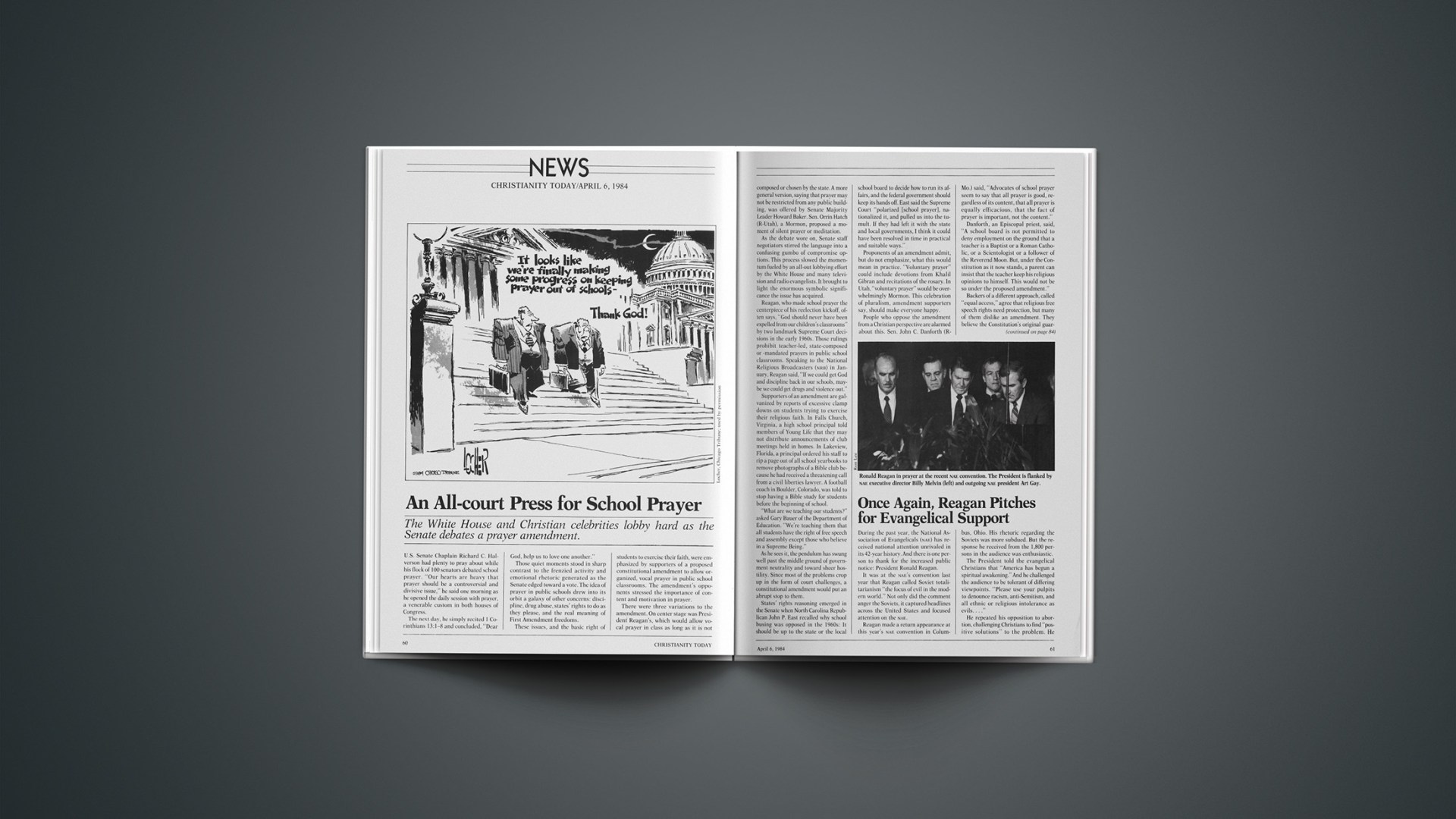
An All-Court Press for School Prayer

The White House and Christian celebrities lobby hard as the Senate debates a prayer amendment.

U.S. Senate Chaplain Richard C. Halverson had plenty to pray about while his flock of 100 senators debated school prayer. “Our hearts are heavy that prayer should be a controversial and divisive issue,” he said one morning as he opened the daily session with prayer, a venerable custom in both houses of Congress.

The next day, he simply recited 1 Corinthians 13:1–8 and concluded, “Dear God, help us to love one another.”

Those quiet moments stood in sharp contrast to the frenzied activity and emotional rhetoric generated as the Senate edged toward a vote. The idea of prayer in public schools drew into its orbit a galaxy of other concerns: discipline, drug abuse, states’ rights to do as they please, and the real meaning of First Amendment freedoms.

These issues, and the basic right of students to exercise their faith, were emphasized by supporters of a proposed constitutional amendment to allow organized, vocal prayer in public school classrooms. The amendment’s opponents stressed the importance of content and motivation in prayer.

There were three variations to the amendment. On center stage was President Reagan’s, which would allow vocal prayer in class as long as it is not composed or chosen by the state. A more general version, saying that prayer may not be restricted from any public building, was offered by Senate Majority Leader Howard Baker. Sen. Orrin Hatch (R-Utah), a Mormon, proposed a moment of silent prayer or meditation.

As the debate wore on, Senate staff negotiators stirred the language into a confusing gumbo of compromise options. This process slowed the momentum fueled by an all-out lobbying effort by the White House and many television and radio evangelists. It brought to light the enormous symbolic significance the issue has acquired.

Reagan, who made school prayer the centerpiece of his reelection kickoff, often says, “God should never have been expelled from our children’s classrooms” by two landmark Supreme Court decisions in the early 1960s. Those rulings prohibit teacher-led, state-composed or -mandated prayers in public school classrooms. Speaking to the National Religious Broadcasters (NRB) in January, Reagan said, “If we could get God and discipline back in our schools, maybe we could get drugs and violence out.”

Supporters of an amendment are galvanized by reports of excessive clamp downs on students trying to exercise their religious faith. In Falls Church, Virginia, a high school principal told members of Young Life that they may not distribute announcements of club meetings held in homes. In Lakeview, Florida, a principal ordered his staff to rip a page out of all school yearbooks to remove photographs of a Bible club because he had received a threatening call from a civil liberties lawyer. A football coach in Boulder, Colorado, was told to stop having a Bible study for students before the beginning of school.

“What are we teaching our students?” asked Gary Bauer of the Department of Education. “We’re teaching them that all students have the right of free speech and assembly except those who believe in a Supreme Being.”

As he sees it, the pendulum has swung well past the middle ground of government neutrality and toward sheer hostility. Since most of the problems crop up in the form of court challenges, a constitutional amendment would put an abrupt stop to them.

States’ rights reasoning emerged in the Senate when North Carolina Republican John P. East recalled why school busing was opposed in the 1960s: It should be up to the state or the local school board to decide how to run its affairs, and the federal government should keep its hands off. East said the Supreme Court “polarized [school prayer], nationalized it, and pulled us into the tumult. If they had left it with the state and local governments, I think it could have been resolved in time in practical and suitable ways.”

Proponents of an amendment admit, but do not emphasize, what this would mean in practice. “Voluntary prayer” could include devotions from Khalil Gibran and recitations of the rosary. In Utah, “voluntary prayer” would be overwhelmingly Mormon. This celebration of pluralism, amendment supporters say, should make everyone happy.

People who oppose the amendment from a Christian perspective are alarmed about this. Sen. John C. Danforth (R-Mo.) said, “Advocates of school prayer seem to say that all prayer is good, regardless of its content, that all prayer is equally efficacious, that the fact of prayer is important, not the content.”

Danforth, an Episcopal priest, said, “A school board is not permitted to deny employment on the ground that a teacher is a Baptist or a Roman Catholic, or a Scientologist or a follower of the Reverend Moon. But, under the Constitution as it now stands, a parent can insist that the teacher keep his religious opinions to himself. This would not be so under the proposed amendment.”

Backers of a different approach, called “equal access,” agree that religious free speech rights need protection, but many of them dislike an amendment. They believe the Constitution’s original guarantees of free exercise of religion are as valid as ever and might be called into question by an amendment that suddenly tacked on school prayer. “The God of Abraham, Isaac, Jacob, and Jesus does not need a hall pass in any school,” said Tom Getman, chief legislative aide to Sen. Mark O. Hatfield (R-Oreg.). Hatfield and Sen. Jeremiah Denton (R-Ala.) are sponsoring legislation to permit Bible clubs and off-hour studies on school property.

The President and supporters of his amendment had a difficult time moving Capitol Hill, but they set in motion a mountain of public opinion. Sports figures, including Washington Redskins coach Joe Gibbs and Dallas Cowboys coach Tom Landry, gave personal testimonies before a special House of Representatives hearing. The gridiron rivals sat side by side, and Gibbs described how God permeates every aspect of his family’s life. Redskin place-kicker Mark Moseley believes prayer in school is necessary because “if their family fails them [in religious instruction], school is the only place children will hear about God.

At the same hearing, former football star Rosey Grier quietly described how he had verged on committing suicide at a low point in his life. What kept him from it was his memory of the Lord’s Prayer, recited during grade school. The nuances of the several prayer proposals before Congress seemed unimportant to these advocates. Moseley said he did not prefer any particular measure over another. “All we’re asking is if kids want to pray, schools should allow them to.”

A sweeping Christian media blitz orchestrated by the White House left no doubt about which proposal should steer the bandwagon. Reagan highlighted his prayer amendment in speeches to the National Association of Evangelicals (NAE), the NRB, and in a Saturday radio broadcast. Excerpts of the President’s remarks were heard on James Dobson’s “Focus on the Family” radio program and Pat Robertson’s “700 Club.” Administration spokesmen produced editorial page articles on prayer and testified on Capitol Hill.

While House aide James Baker III described the amendment to Dobson’s estimated five million listeners, and overwhelming numbers of them responded with calls to Congress. Sen. Don Nickle (R-Okla.) received 2,000 letters and phone calls in two weeks. “Last year’s abortion vote didn’t receive anywhere near this much attention,” Nickles’s assistant Paul Lee said. “And that one was a lot more clear-cut from a Christian standpoint.”

Dobson’s program mentioned only the President’s amendment. A homemaker in Burke, Virginia, Judi Brotzman, called her two senators after hearing the Dobson show. “I trust him,” she said of Dobson. “I’ve found nothing offensive or off the mark in what he’s said or written. His concerns are for the family and mine are also.” When she placed her calls, she did not know there were other prayer proposals. “I wondered later why Dobson didn’t mention them,” she said.

For his interview with Baker, Dobson was given background material supplied by the White House, including a list of suggested questions. Pebb Jackson, vice-president of Dobson’s organization, said, “We were very aware that there were other amendments, but we knew the President’s amendment included voluntary vocal prayer and prohibited prayers written by the state, and that is what we preferred.” Dobson said, “Not every Christian will see this issue in exactly the same way. Nevertheless, it is my responsibility to speak my own conscience on our radio broadcast and I did that.”

In Hatfield’s office, up to 150 callers each day voiced overwhelming support for an amendment but seemed poorly informed about alternatives. When Getman explained Hatfield’s “equal access legislation” to an Oregon constituent, the caller demanded, “What business does [Hatfield] have introducing a bill?”

According to Getman, many parents changed their minds when they realized their children could be asked to participate in offering prayers outside the Christian tradition. “I’d rather have my daughter compose her own prayer in her head,” one mother acknowledged.

The debate has had noticeable effect on some Senate staff members. Paul Lee said, “People are beginning to ask themselves, ‘Do I pray? How important is this to me? What is my relationship with God?’ ”

From Halverson’s perspective, the time and energy invested by senators on both sides of the issue was impressive. “It ought to mean something to the nation that this powerful legislative body is taking prayer so seriously.”

Once Again, Reagan Pitches For Evangelical Support

During the past year, the National Association of Evangelicals (NAE) has received national attention unrivaled in its 42-year history. And there is one person to thank for the increased public notice: President Ronald Reagan.

It was at the NAE’s convention last year that Reagan called Soviet totalitarianism “the focus of evil in the modern world.” Not only did the comment anger the Soviets, it captured headlines across the United States and focused attention on the NAE.

Reagan made a return appearance at this year’s NAE convention in Columbus, Ohio. His rhetoric regarding the Soviets was more subdued. But the response he received from the 1,800 persons in the audience was enthusiastic.

The President told the evangelical Christians that “America has begun a spiritual awakening.” And he challenged the audience to be tolerant of differing viewpoints. “Please use your pulpits to denounce racism, anti-Semitism, and all ethnic or religious intolerance as evils.…”

He repeated his opposition to abortion, challenging Christians to find “positive solutions” to the problem. He reiterated his support for group prayer in public schools, tuition tax credits, and a strong national defense.

One of three standing ovations followed Reagan’s call for evangelical support of the proposed school prayer amendment. He also asked the audience to support a bill that would give students the right to use public school facilities for religious purposes. The following day, convention delegates passed a resolution supporting both measures.

While Reagan spoke, a few hundred demonstrators stood outside the convention center. Some were there in support of the President’s appearance, but others chanted anti-Reagan slogans. One man was arrested after he tried to force his way into the ballroom where Reagan was speaking.

A separate group of Reagan opponents staged a peace witness after the President left the convention center. The Christian pacifists, from Athens, Ohio, held placards and handed out leaflets outside the main meeting hall during the remainder of the NAE convention. One of them, Art Gish, a former Church of the Brethren pastor, was briefly detained by convention center security officers for violating a no-solicitation regulation. But he was released at the request of Darrell Fulton, NAE’s director of business administration.

In addition to their presence outside the meeting hall, the peace witnesses joined an ad hoc meeting approved by the NAE’s executive committee. Some 30 convention participants came to discuss the biblical teachings on war.

In business sessions, the NAE:

• Passed a resolution urging Congress and the President to reduce the federal budget deficit.

• Reaffirmed its opposition to the proposed Equal Rights Amendment as it is currently worded.

• Urged its member denominations, congregations, and organizations to conduct voter registration drives.

• Named U.S. Senator William Armstrong (R-Colo.) its 1984 Layman of the Year.

• Elected Robert W. McIntyre, a general superintendent of the Wesleyan Church, as its new president.

• Welcomed the 500,000-member Church of the Nazarene into membership. The NAE claims some 40,000 constituent congregations from 76 denominations, representing some 4 million evangelical Christians.

RON LEEin Columbus

The Crystal Cathedral Gains Only A Partial Tax Exemption

The California Board of Equalization has rendered a middle-of-the-road decision on the tax status of the Crystal Cathedral. The board’s determination was met with ambivalence by Robert Schuller and the congregants of his Crystal Cathedral church.

Had the board endorsed the recommendations of its investigators and totally denied the church tax-exempt status, the church would have lost all of the $465,000 it has paid. But with the ruling, as much as $302,000 could be returned to the church.

Schuller’s tax headaches began in 1982 when California authorities balked at the use of the Crystal Cathedral by profit-making businesses and performing artists. Schuller says his church exists to serve the community. He sees nothing wrong with making it available for community use as long as the activities are wholesome (CT, Aug. 5, 1983, p. 52).

Board investigators reasoned that since the church facility is rented—not donated—its tax-free status gave it an unfair advantage over other renters of building space.

In its recent judgment, the board granted tax-exempt status on the entire cathedral for 1981. (The board determined that concerts and rentals to profit-making organizations did not begin until late in the year.) For 1982, the board denied tax-free status on the church’s sanctuary and on about 30 of its auxiliary rooms. When the controversy arose in 1982, the church suspended the practices being questioned by the board.

Schuller and his congregation will now decide whether to let the matter rest or take it to court. That decision won’t come until the state determines the specific amount of money to be returned to the church.

Orange County tax assessor Brad Jacobs says he will need considerable guidance from the board of equalization if he is to carry out its wishes. He says the board’s ruling will make tax-exempt status more difficult to determine.

Ptl Explains Bakker’S Costly Hotel Visit

The PTL organization has clarified reports of talk-show host Jim Bakker’s stay at a Buena Vista, Florida, hotel.

CHRISTIANITY TODAY reported last October that Bakker spent four nights in a suite at the Palace Hotel at a cost of $1,000 a night (CT, Oct. 21, 1983, p. 44). Richard Dortch, corporate executive director of PTL ministries, says Bakker’s chief of security chose the expensive suite for security reasons. (The suite has eight rooms, but just one entrance.) Bakker had been receiving death threats, presumably because of the television personality’s aggressive antiabortion campaign. The incident was first reported in the Orlando Sentinal Star. CT carried its brief report after a PTL spokesman neither denied the accuracy of the Star article nor elaborated on it. Several months after the CT article was published, PTL released details of the incident to CT.

Dortch, a PTL board member who joined PTL’s staff last November, says it was his idea to get Bakker away from the organization’s offices in Charlotte, North Carolina, while security measures at PTL headquarters were reevaluated. Buena Vista, Florida, was chosen because it was a center for hotel construction. Dortch says Bakker and several members of his staff used the time in Buena Vista to tour construction sites to pick up ideas for a hotel now being built at PTL’s Heritage USA facility.

He says 14 people shared the costly hotel suite. Dortch says the bill was paid not from funds donated to PTL, but by Heritage USA, which operates as a business, not as a ministry.

PTL is one of only two major television ministries that submit to the guidelines of the Evangelical Council for Financial Accountability. The other is the ministry of evangelist James Robison.

The U.S. Senate Confirms An Ambassador To The Vatican

The U.S. Senate has approved the nomination of William Wilson as the first American ambassador to the Vatican since 1867. The 81-to-13 vote indicated that there was not as much Senate opposition to Vatican diplomatic ties as many had thought.

Opponents of the appointment, including the National Council of Churches and Americans United for Separation of Church and State, stress that the issue is not Wilson but the principle of the separation of church and state. The National Association of Evangelicals and the Southern Baptist Convention also opposed the appointment.

U.S. Senator Richard Lugar (R-Ind.) testified that the appointment is not “the first step toward an erosion of the historical separation of church and state.” He said formal ties with the Vatican would be “good for U.S. diplomacy and security.”

In opposition, U.S. Senator Mark Hatfield (R-Oreg.) testified that in addition to violating the church-and-state separation principle, official ties with the Vatican would “demean the Pope’s status” by making him primarily a political rather than a spiritual leader.

The House Appropriations Subcommittee has approved the redirecting of funds to support the mission to the Vatican. The Senate is expected to do the same. When the matter leaves Congress, Americans United plans to file suit against the U.S. government. Spokesman Joseph Conn said the Vatican appointment “is clearly a violation of the Constitution.”

Fundamentalists Leave Jail, But Nebraska Church Schools Are Still In Trouble

After spending three months in a Nebraska jail, six fundamentalist Christian fathers are free. The men had been jailed for refusing to testify about the Faith Baptist Church School in Louisville, Nebraska.

Faith Baptist has wrangled with the state for seven years over teacher certification and school accreditation (CT, Feb. 17, 1984, p. 32). Its school continues to operate in defiance of Nebraska law.

After the men’s attorney, Michael Farris, appealed to U.S. Supreme Court Justice Harry Blackmun to unravel what had become a legal quagmire, Cass County prosecutor Ron Moravec offered a compromise. He dropped the contempt charges against the men and canceled warrants for the arrests of their wives, who had fled the state with their children. In exchange, the men agreed not to send their children to Faith Baptist School until the state recognizes the school as operating legally. Warrants are still out for the arrests of Faith Baptist pastor Everett Sileven and his daughter, a former teacher at the school. The two also have fled the state.

Some 20 fundamentalist pastors who want to operate schools free from government control have been drawn into this bitter clash between church and state. In mid-February it looked as if the end was in sight. Nebraska governor Robert Kerrey endorsed a bill that fundamentalists found acceptable. The measure would have allowed church schools to operate without state certification as long as students tested favorably on national standardized exams. If students failed the tests, the state could prosecute parents, but not churches, according to the proposed legislation.

Coordinators of the protest movement in Louisville had charged earlier that Kerrey was being controlled by the Nebraska State Education Association (NSEA). The NSEA—which contributed heavily to his election campaign—opposes any change in certification laws.

But the governor shattered that notion by siding with the four-member commission he appointed to study the controversy. That commission determined that the state is denying First Amendment freedoms to churches that choose to operate uncertified schools.

NSEA public relations director Barc Bayley said he was “neither able nor willing” to explain why his organization opposed the student-testing proposal. The NSEA lobbied against the measure, so despite Kerrey’s support, Nebraska’s legislature defeated it by a 26-to-20 vote.

In mid-March, the legislature came one step closer to passing a bill that calls for the testing of teachers prior to permitting them to teach. Fundamentalists oppose the requirement, saying it is merely another form of teacher certification.

Robert Gelsthorpe, pastor of the North Platte (Neb.) Baptist Church, had been hoping the legislature would pass a bill he could accept. The pastor was reporting to the local sheriff’s office for six hours every day his uncertified school held classes. Now he will report to his school instead. He expects to be arrested and sentenced to a jail term. Gelsthorpe says he hopes the legislature will reconsider its stance before it recesses on April 6.

Meanwhile, the Nebraska Supreme Court has agreed to hear the oral arguments of constitutional attorney William Ball, who is representing Park West Christian School in Lincoln, Nebraska, in its legal battle with the state. Ball says the Nebraska courts have not heard a thorough presentation of the First Amendment issues pertaining to the church-school controversy.

World Scene

The Bible was published in four additional languages last year. The American Bible Society says the entire Bible is available in 283 languages. At least one book of the Bible is available in 1,785 languages.

Grenada’s preinvasion Marxist government had prepared plans to suppress the Caribbean nation’s churches. The U.S. State Department says documents seized after the American invasion show that the government feared a major church-led resistance. The documents indicate that the government considered monitoring the church’s activities, membership, and financing.

Church officials estimate that 20 to 30 percent of Puerto Rico’s 3.1 million inhabitants have left the Catholic church for Protestant churches. Most of the switching occured after Protestants stepped up their missionary efforts less than 40 years ago.

The government of Singapore is encouraging well-educated people to have more children and less-educated people to have no more than two. The program is based on the theory that children born to scholars will have a better chance to become productive citizens. Educated mothers will be given priority when enrolling their children in the best schools. Second on the list will be less-educated mothers who agree to be sterilized after their first or second child.

Japan has only one Protestant church for every 19,400 people. The Church Information Service says several major Japanese cities, with a combined population of more than 370,000, do not have any Protestant congregations.

Roman Catholicism is no longer Italy’s state religion. An agreement signed by the Vatican and the Italian government curtails some of the church’s privileges. Religion classes in public schools will become elective courses. Previously, children were required to attend. In addition, church marriage annulments must now be approved by Italian courts. However, the Vatican will remain a sovereign state run by the Pope.

A Romanian Baptist human rights leader was found dead in January. Nicolae Traian Bogdan had been missing for a month. A medical examiner said Bogdan, 25, committed suicide. But Bogdan’s associates suspect that he was murdered. The Baptist leader was wanted by the secret police for unapproved religious activities.

If the growth of Mozambique churches continues at its present rate for the next 20 years, the entire country will be evangelized. Robert Foster, international director of Africa Evangelical Fellowship, estimates that in some districts more than 50 percent of the people are born-again Christians. The government expelled missionaries in 1959, but has eased restrictions on religious activities in recent years.

The Africa Inland Church plans to open a missionary college in Kenya by May 1985. The college will train nationals for outreach into unevangelized areas in Kenya and surrounding countries. It will be the first school of its kind in east and central Africa.

Yugoslav officials held a Baptist leader for questioning on the opening day of the Winter Olympics in Sarajevo. They also withdrew permission for Baptists to distribute leaflets inviting Olympics visitors to a coffee house in a church. Authorities ordered the Baptists to collect all leaflets already distributed, but they did allow the coffee house to remain open.

Some 197 million people—about 4 percent of the world’s population—consider themselves atheists. In addition, statistics released by the Vatican indicate that atheism is the state religion in 30 countries. The number of atheists increases by about 8.5 million each year.

Deaths

G. Aiken Taylor, 64, president of Biblical Theological Seminary, Hatfield, Pennsylvania, for 24 years the editor of Presbyterian Journal, moderator of the Presbyterian Church in America General Assembly (1978), former vice-president of the National Association of Evangelicals; March 6, at his home in Colmar, Pennsylvania, of cardiac arrest.

Roland H. Bainton, 89, professor emeritus of church history at Yale Divinity School, author of Here I Stand: A Life of Martin Luther; February 13, in New Haven, Connecticut, after an extended illness.

Southern Baptist Committee Votes Against Full Ties With Canadians

For several years, the Southern Baptist Convention (SBC) and some Canadian Baptist churches have considered establishing formal ties. Sixty-two Baptist congregations in Canada have ties to Southern Baptist regional bodies in either Ohio or the Pacific Northwest.

At issue is whether the Canadian Baptist churches should be permitted to send messengers (delegates) to the annual Southern Baptist denominational meeting (CT, March 16, 1984, p. 48). Chances of that happening in the near future appear slim. A 21-member committee appointed to study the issue has come out against the seating of Canadian messengers.

Specifically, the committee concluded that the SBC constitution should not be changed to add the words “and Canada” to define the geographical boundaries of the 14-million-member denomination. The committee will forward its recommendation to the SBC convention in June.

Despite its stand against formal ties, the committee urges “increasing involvement between churches, associations, and state conventions in the United States and churches in Canada.” The committee also recommends the formation of a Canada planning group, consisting of representatives from several Southern Baptist agencies, including the home and foreign mission boards.
Refiner’s Fire: The Master’s Touch

A surprising Easter with Leonardo da Vinci’s Last Supper.

It happened on our first trip to Europe. We left Bern, Switzerland, early Good Friday morning and arrived in Milan, Italy, shortly after noon. Bern had been cold, and we had traveled through blowing snow. But as we pulled into the Milan station where we were to change trains, the cloudless sky and radiant sunshine warmed our hearts and our bodies. The Easter weekend looked promising. We were heading south to Rome, and I looked forward to an unforgettable Easter. I could picture Michelangelo’s dome atop Saint Peter’s Basilica, and his glorious Sistine Chapel.

The huge Milan station was jammed with travelers. My husband joined the throngs near the ticket windows marked for Rome and points south, while I stayed with the luggage. I stood near the wall and watched life flowing around me.

Elderly women, clad in long, black dresses and worn coats, stood there quietly, wisps of gray hair under the black scarves on their heads framing careworn faces. Shabbily dressed old men shuffled by, their thin shoulders sagging from the weight of cardboard-box “suitcases” tied with rope. Family groups animatedly discussed their plans. Joyful young people laughed and shouted. The atmosphere seemed charged with excitement.

Then I saw my husband hurrying toward me, his face glum. “There aren’t any seats on any train going in any direction,” he sputtered. “A snowstorm in the mountains closed roads. This is a big holiday weekend, so everyone is taking the trains. Unless you want to stand all the way to Rome, we’ll have to stay here for a couple of days.”

A couple of days! That meant we wouldn’t be in Rome for Easter. I protested. He shrugged his shoulders hopelessly. Then I realized I was acting like a spoiled child, and I tried to hide my disappointment. “Oh, well,” I said, “Rome will be awfully crowded.”

We were in Europe on vacation following a series of family crises. It was supposed to be a therapeutic and inspirational change for both of us. Now it seemed that this, too, would end in disappointment.

My husband went to look for a hotel, and I waited again with the luggage. But the festive mood of the crowd was contagious. By the time he returned, my spirits had lifted, and he, too, was feeling more optimistic.

On the way to the hotel, I thought about Milan’s many features, which include one of the largest cathedrals in the world and, of course, the La Scala Opera House. “And didn’t Leonardo da Vinci paint his Last Supper here?” I wondered aloud. Maybe Easter in Milan wouldn’t be so bad, after all.

Early the next afternoon we strolled along the Corso Magenta toward the church of Santa Maria delle Grazie. A sign alongside the narrow walk indicated that Leonardo da Vinci had owned vineyards here. I felt a tingle of excitement. The legendary Leonardo had no doubt walked these same ancient, cobblestoned streets. When we reached the church, we waited with five or six other people until the caretaker opened the doors to the Cenacolo Vinciano, the dining hall in which Leonardo had painted his masterpiece. We entered a large room, nearly devoid of furnishing, except for murals on the front and back walls. I spent a few minutes studying the Crucifixion, which had been painted by one Giovanni Montorfano, a contemporary of da Vinci, on the back wall of the room. It is a painting I suspect might have received greater recognition had it not been in a position to be compared with Leonardo’s masterpiece.

Finally I turned to look at the Last Supper. My heart sank. Was this mildewed, cracked wall with its faded colors and flaking paint all that remained of “the most sublime of all human paintings”? I’d heard of its deterioration, but I hadn’t expected this. For the second time in two days I felt bitter disappointment.

I saw my husband on the other side of the room, so I joined him. Then I turned to look again at the Last Supper. I was amazed. The shabbiness that had been so disillusioning seemed to fade, and I began to discern a spiritual beauty in the fresco. So perfect was the three-dimensional perspective the artist had created that I had the odd sensation that I was actually standing on the threshold of the Upper Room as Jesus and the apostles shared the sacrament. (I have since read that Leonardo intended the painting to appear as an actual extension of the dining hall.)

My eyes blurred with tears. Suddenly the real meaning of Maundy Thursday and Good Friday seemed clear. In all the years that I had attended church services and participated in Holy Communion, nothing had ever moved me as this blemished painting did.

Today, the Last Supper is being lovingly and painstakingly restored. Art experts have been working with magnifying glasses to clean and renew the fresco, inch by inch. In removing the grime of five centuries, they have discovered golden rims on the wine glasses and bits of fish and bread on the plates. By the time the work is completed, in late 1984 or early 1985, they hope to reveal the fresco as Leonardo painted it.

The memory of that experience remains luminous, especially at Easter time. A snowstorm in “sunny Italy” on April 20 must surely be an unusual occurrence. For me, it was an unusual blessing.

Mrs. Belleranti is a free-lance writer living in Cudahy, Wisconsin.

Help Me Shed My Excess Baggage

The prayer of a senior citizen.

Backward, turn backward,

O Time, in your flight,

Make me a child again

Not just for a night.

That’s the name of that tune, Lord, the way I’d like it sung now that I’m past 80. But I would make it a prayer, not a poem or song. However, you might think I’m joking, or that I don’t know the difference between an idle wish and a prayer. So, much as I might like you to run time backward—at least long enough for me to sneak in and erase some of the more glaring errors showing on my tape—I shall stop myself from asking for such science fiction possibilities.

Because the point of praying, if I’m going to pray at all, must be not to weaken the mind’s common-sense grasp on things, but to strengthen that grip.

Accept this as my first prayer for us, your senior citizens: Help us not to dig any more deeply the ditches of our delusions, for delusions are like trenches that imprison us, cutting us off from reality.

Yes, Lord, let us recognize that some of us are a bit stubborn and deluded. I remember when my father-in-law came to celebrate his eighty-second birthday. He complained that I served the rest of the family creamy whole milk but poured him only skimmed. I had merely given him a different glass—a clear one instead of the amber-colored ones we used. But no amount of explanation ever convinced him.

That was 40 years ago, Lord, and now it’s my turn to be 82. Paranoid or just farsighted, it’s my time hardly to see the butterfly alighting under my nose for the one I’m dreaming about. May we recognize things as they are, Lord, but have our dream time, too.

Help us not to need our vanity. My daughter recently pointed out that I should be prepared to live longer, perhaps even indefinitely, if science succeeds in breaking the genetic code.

“But what would I look like at 120?” I replied. How much vanity is part of all of us!

I remember back in school reading the adventures of Don Quixote of La Mancha. Proud but perilously poor, knights in his day would sally forth with a few crumbs stuck in their whiskers, hoping to convince the world they had eaten well.

Help us not to need these crumbs to feed our vanity, Lord. Let us be ready to show ourselves to others “as is,” secure in the conviction they will accept us just as we are—just as you do. Didn’t we used to sing “Just As I Am” when we were still able to sit in the pews and hear each other sing?

Teach us, Lord, to let go of our egos. Soon enough we’ll be off the ego trip and have to do without it anyway, without security blankets as well as teeth.

My husband, a retired university professor, gave in to persuasion and at 84 made the long trip to see our younger daughter in her new home. The next morning, having looked everything over and approved of it, he hooked his extra bow tie around the paper bag containing his pajamas and toothbrush (he preferred the bag to the fine set of initialed luggage he received at his retirement dinner) and said, “I’m ready to go now.”

Help us, Lord, to rid ourselves of our excess baggage. Help us need a little less every day. Help us to detach ourselves from our possessions and follow the signposts pointing to simplicity (not oversimplification).

Help us deal with feedback from you and others and ourselves in a positive manner, too. If biofeedback experts are right that we can consciously control such functions as body temperature and heartbeat, let us benefit from it. Perhaps that’s a way we can rectify our past mistakes. Instead of trying to correct the moving finger that has already writ, we elderly can attempt to solve our next problems before they emerge by nourishing our good reactions and starving out the bad.

If we can tune in that positively to ourselves and to existence, Lord, maybe we can forge a link in the chain of time and serve a real purpose in your overall plan. The young will see continuity in us. They will be eager to know the past, not turn their backs on it. Being no longer alienated by what is mirrored in us, they will fear the futureless, incline themselves less to hide under an artificially prolonged, if glorified and gilded, shell of youth. We will remember less resentfully and less apprehensively that youth is the future and we cannot afford to be cut off from it, any more than youth can stand being segregated from us. That will be the happy day when, if not the lion and the lamb, youth and age will lie down together, having put aside their individual egos. Then none of us will want them back, because we will have found too much use, too much purpose, for ourselves.

If that millennium comes about, I shall say to the angel of my guard, “Thanks for keeping me company, thanks for letting me not be such bad company myself. Thanks for these lived-out years, years when I have identified with all the joy and all the pain and all the knowledge. Thanks if I’m a well-used-up and not rusted-out instrument of life.”

And by then, when there are already bridges into new territory, I can say, perhaps, not too unlike the child I was wishing in the beginning to be again, “Lead me, O Lord, to step where I cannot see, for the blazing white light of a new dawn will be in my eyes as I set out on the greatest journey of my life.”

Mrs. Lewis lives in El Paso, Texas.

Books that Influence Our Lives

“Study to show thyself approved unto God …”

2 Timothy 2:15

“A book,” wrote Franz Kafka, “must be the axe for the frozen sea inside us.” A Christian book that melts cold doctrine and soaks it into the heart is a book that has done its job well. Many kinds of books can accomplish this, depending on the size and terrain of that inward frozenness. In the following pages, people from a variety of positions and professions write about books that have managed to reduce the distance between them and their Lord. Some of these books are well known, some less known. All are successful books because they have touched lives with the truth of the risen Christ. There is no more appropriate time to introduce such books than now, as we enter the Easter season.

A Role Model For A Politician

Those of us in public life who profess the Christian faith are uniquely challenged to display Christlike qualities in our work. This is particularly true of politicians because it seems that some aspects of our profession are contrary to the way Christians should act.

By its nature, political life is self-centered, not Christ-centered. This is constantly reinforced during campaigns, in which the candidate’s virtues and accomplishments are inflated, by staffs and supporters eager to serve the congressman’s every whim, and by lobbyists who are only too happy to massage congressional egos. Everybody looks to Congress to solve problems; yet we are fallible, and as Christians we readily admit we cannot even solve our own problems without God’s help. William Wilberforce, an English aristocrat who served in Parliament around the turn of the nineteenth century, offers a model of how Christians can serve both God and country.

Wilberforce has been the subject of several recent books, including John Pollock’s excellent Wilberforce (St. Martin), but my favorite is Saints and Politics (Allen Unwin), by Ernest Howse. He offers a poetic account of this extraordinary man’s life and faith.

Wilberforce’s England, as Dickens aptly described it in his epigram, was the “… best of times; it was the worst of times.” The wealthy and popular young MP indulged in London’s “best of times” society and its vices. But even then, for all his gaiety and indolence, it was apparent God had special plans for Wilberforce. Once he accepted Christ, he set about to use his position and prestige to address many of the moral issues of the day. Wilberforce presided over a group known then as the Saints (later called the Clapham Sect), who possessed wealth and power, but who were deeply motivated by religious impulses. Their movement sprung out of a new doctrine of responsibility—a doctrine that received its vision from the Christian emphasis on the value of each person.

Led by Wilberforce, they organized the movement to abolish the slave trade and embarked upon a number of social issues, including reforming parliamentary and penal systems, curbing gambling and other social vices, and educating the illiterate. Their concern was not only with the moral, but also the material, well-being of the less fortunate. So Wilberforce and his friends gave generously of their own fortunes to help others.

There is much today’s politician can learn from Wilberforce’s example.

First, he unabashedly proclaimed Christ. His faith was there for everyone to see and judge. At first, he felt that public life and serving Christ were incompatible and wanted to resign from Parliament, but his good friend John Newton convinced him otherwise.

Second, political expedience did not compromise his stands on the issues. An aristocrat and a Tory, he nonetheless offended the financial establishment by wanting to end the slave trade.

Third, as Sen. Mark Hatfield has noted, Wilberforce was a practitioner of relational politics. Even his friend Prime Minister William Pitt, with whom he differed on major issues, was drawn to Wilberforce’s unconditional love for others.

Fourth, Wilberforce was a devout man, but he needed nurturing and accountability. Thus, he gathered around himself like-minded friends who met frequently to seek God’s wisdom, pray, and support one another at a place called Clapham, outside London.

Fifth, as a politician and Christian, Wilberforce’s conduct was above reproach. He once observed about himself: “How careful ought I to be, that I do not disgust men by the inconsistency between the picture of a Christian which I know, and which I exhibit.”

Four of us have been meeting regularly for five years on Capitol Hill for Bible study, and to pray, share our faith, uphold one another, and discuss ways in which we can be more Christlike in our political lives.

Wilberforce has been an inspiration to each of us. He has shown us that politics is simply the means, but that God’s divine will is the end. Regardless of ideology, we can strive to accomplish his work on this planet.

Wilberforce and his close friend William Pitt were both elected to Parliament at age 21. Pitt went on to become prime minister of England at the astonishing age of 24. But it was not Pitt the politician but Wilberforce the Christian who altered the course of history during their time.

Don Bonker

A Smorgasbord Of Christian Insight

Choosing the one book that has brought me closest to Christ is like choosing the one child who has contributed most to my positive outlook on family life.

There is no one book, although there is a single theme running through my Hit Parade of Christian books. Books that are down to earth and offer useful insights into living and sharing everyday life are at the top of my list.

Finding those books in my home and office are easy. They are the ones in which I have underlined numerous pages, dog-eared for later reference, starred in the margin, and pulled off the shelf time and again to use in teaching, writing, and sharing. My favorite books would not appeal to everyone because my tastes—like my needs—range from Watchman Nee to Ann Kiemel.

I have a hard time keeping up with my best books because I give them away. That is a much better practice than lending books, because it reduces the guilt on both sides when a book is away from home for months at a time. My favorite books to give away have been C. S. Lewis’s Mere Christianity and Bob Benson’s In Quest of the Shared Life.

But the book I have used most frequently in personal study and teaching Sunday school is a book by C. S. Lewis called God in the Dock (Eerdmans). This book, edited by Walter Hooper, is a marvelous collection of essays and letters on theology and ethics.

I must admit, I am not a heavy theology man. I can and will read all of Ann Kiemel’s books before I’ll plunge into a book on theology. If I want theology, I’ll take it straight, thank you—straight from the Bible.

But C.S. Lewis is different.

God in the Dock has helped me because it is one of the most practical and far-ranging books I have ever encountered. It has helped make my faith stronger and more real.

Lewis, of course, was an intellectual, but his strength for me is his simplicity of style and his anticipation of the questions that nag believers and nonbelievers alike.

Lewis’s ability to deal with skepticism in a straightforward, nonhysterical way is a great asset. Throughout this book, Lewis refuses to water down the supernatural underpinnings of Christianity, but he offers sensible, pragmatic insights to practical living.

That is a rare blend. He puts the Christian faith in marvelous perspective with this obvious but succinct observation: “One must keep on pointing out that Christianity is a statement which, if false, is of no importance, and, if true, of infinite importance. The one thing it cannot be is moderately important.”

My underlined passages and dog-eared passages cover the full range of this book, from Lewis’s advice on human relationships to his opinion on whether it is proper for Christians to be ambitious.

God in the Dock is a smorgasbord of Christian insights, which is why it has helped me so much. There is nothing single-dimensional about the Christian life, and that’s what makes this book such a joy.

Like all the books on my Hit Parade, God in the Dock illuminates and brings to life the truths of the Bible. That, of course, is the essence of any good book and explains why C. S. Lewis continues to be so popular.

Charles Overby

What Job Never Understood

Several months ago I was going through a pressure-packed time: major business decisions coupled with some pressing family problems. At the same time, my turn at teaching the men’s Bible class at my church required a study of Job’s interesting experiences. A friend suggested that I look at G. Campbell Morgan’s book The Answers of Jesus to Job (Baker).

Morgan’s book encouraged me to discover what I already knew but had carelessly ignored. Jesus Christ is not only my Redeemer, but, as Lord of my life, a deep resource of comfort, assurance, and peace. In short, he is the answer to all personal problems if I will just ask for his assistance.

As I studied Job’s story and read Morgan’s book, I was struck again with the hopelessness and inadequacy of human thinking in the midst of crisis. God called such thinking and advice “words without knowledge.” But the chief thrust of Morgan’s book was that today life’s problems find their answers in the provision of Christ—something Job couldn’t fully comprehend.

Stripped of all the trappings of human comfort—including his health—Job cried for a mediator to create contact with God so he could plead his case. Paul tells me there is one mediator between God and man uniquely qualified as diety and as man: Jesus Christ. There it was! God would see my problems and hear my case because Christ made access to God possible. How remarkable!

As Morgan points out so clearly, again and again Job would cry out for answers to his plight. Then the book would direct me to a clear answer from Christ, who meets all human needs. The reality of this resource in Jesus brought great relief to my troubled time. My problems were insignificant compared to Job’s, but my Lord was just as concerned with my details as with any major world crisis.

Job’s story was written centuries ago. The story of Jesus’ earthly ministry came later. Morgan’s book was written several years ago, but it pointed out to me once again the relevance of the Holy Scriptures and the timelessness of Jesus’ work and provision. What a remarkable privilege it is to have bold access today to the presence of God and to be a beneficiary of the work of Christ.

William Seay

Bloom Where You’Re Planted

I grew up loving to read. I can remember being totally immersed in such historical novels as the Altsheller series on the Civil War and the Fenimore Cooper stories of the American frontier. But with college and then business and professional life, reading became something I had to do to keep current, especially with the volume of required literature. Often my two hours of daily reading, as I commuted from Connecticut to New York and back, were not enough to keep up with the stack.

So I was somewhat less than enthusiastic around 1970 when my wife, Sally, started producing “good Christian” books for me to read. A couple of years before she had had a meaningful experience in church and made a commitment to God, which I didn’t really understand. But I did appreciate the change in her. Housekeeping, cooking, doing laundry, and looking after three active children did not seem to be the same burden as before. All of us noticed and remarked upon Mom’s new and happier image, though she talked more about her Bible study than I cared to hear.

One evening, at the dinner table, our oldest son, Chris, who loved to debate (so much that he has gone on to become a lawyer), was arguing with his mother. He pointed out apparent inconsistencies between certain books in her beloved Bible. Finally, his mother, her patience growing thin, said, “Chris, just tell me one thing: Have I changed?” There was a pause, and then to my astonishment, Chris threw his hands in the air and said, “You win, Mom.” That went through me like a knife, and I thought, He’s right. She really has changed.

I myself had been a lifelong church attender and believer in God but at that time was without any personal commitment to him. It was in that same time frame that Sally gave me The Hiding Place (Revell), Corrie Ten Boom’s account of her life before and during World War II. This story of an ordinary Dutch spinster and her family’s bravery with the Nazis before and during imprisonment came alive to me. It had to be God, I thought, because no human being in his or her own strength would be able to do what she had done and affect so many lives through her simple but iron-strong faith in Jesus Christ.

Concurrently, I also read L’Abri, by Edith Schaeffer, a story of an American preacher and his family led by the Lord to establish a mountainside Christian community in Switzerland. What impressed me again was how many people’s lives were impacted by men and women simply doing in their daily lives what they believed God was telling them to do. It was just after finishing this book that Sally cabled our son Chris, who was then touring in Europe, to visit L’Abri. She told me what she had done, and I agreed completely. And I sensed that somehow our complete agreement on that had something to do with Chris deciding to go back to Switzerland and spend time at L’Abri. That experience marked a dramatic deepening of his own personal commitment to God.

As for me, those two books made a profound impression, bringing home the trust that I can do the Lord’s work right where he has put me. I didn’t need to wait until retirement, nor did I have to go into full-time Christian activity to prepare to do God’s work in my own daily life—in my family, my work, my community life, my church.

Too many of us decide to wait for a better time to start a new life—when the pressures of business or family have eased, when we’re less tired or feeling better, when the children are in college or off to their jobs. The truth that Corrie Ten Boom and Edith Schaeffer so powerfully dramatized is this: We don’t have to wait; we can start serving him right now, and right where we are.

William Kanaga

An Eternal Debt To C.S. Lewis

I am eternally in debt to a number of Christian writers whose books have influenced my life and helped me in my quest to know and love the Christ who died for me. Charles Colson’s trilogy of works—Born Again, Life Sentence, and Loving God—immensely influenced my career choices and the conduct of my life. Likewise, James Dobson’s books, tapes, films, and personal testimony have had an immeasurable impact on our entire family.

No writer or single book, however, has had more influence on my life or drawn me closer to Christ than the C. S. Lewis masterpiece Mere Christianity (Macmillan). This 190-page paperback, actually a compilation of three Lewis books, confronted me with directness and authority as to the meaning of Christianity and the behavior to be expected from those who claim and want to follow Christ. I don’t believe anyone can read Mere Christianity without being forced to face ultimate questions about who Christ is or what his life and death means to each individual.

I have read and reread all or parts of Mere Christianity many times, each time with new insight and renewed appreciation for the clear, logical, and practical way in which C. S. Lewis presents his thoughts. By the time I reached the chapter titled “The Practical Conclusion,” I realized how necessary it is that all of us must individually heed Lewis’s concluding thought: “Now, today, this moment, is our chance to choose the right side. God is holding back to give us a chance. It will not last forever. We must take it or leave it.”

Having personally made this choice, Lewis then tells me how Christians should live. In his chapter titled “Is Christianity Hard or Easy?” he explores the myth that I could have both Christ and self. He tells me that “the terrible thing, the impossible thing, is to hand over your whole self … to Christ.” Lewis reminds me that “Christ says, ‘Give me all … I want you.… Hand over the whole natural self, all the desires which you think innocent as well as the ones you think wicked—the whole outfit. I will give you myself: My own shall be yours.’ ”

Deciding for Christ and giving up self—that to me is the essence of Christianity. It seems so basic, yet I didn’t understand it until C. S. Lewis told me. I can’t wait to thank him and Him.

Dan Coats

How To Step Back From The Daily Battle

On occasion a friend or a colleague has sent me a gift of “shared celebration” or “encouraging words” in the form of a book. This is how I received a copy of The End of Christendom (Eerdmans), by Malcolm Muggeridge, whom I admire greatly for his heart, wit, and intelligence.

The book came from a professional acquaintance who has served in the government for many years. He knew the satisfactions and pressures in public service and could empathize with my experiences. My job in the Reagan administration includes administering programs and research to reduce early teenage sexual activity and to improve the outcome of adolescent pregnancy. I also have responsibility for the program that provides family planning services to approximately four million poor women across the country. These problems affect many families throughout the country and have serious repercussions for our society.

It is a privilege to have responsibility for even a few of the successful initiatives this administration supports to help people in need. At the same time, there are inevitable frustrations brought about by the realities of addressing deeply entrenched social problems. These frustrations present an opportunity to gain deeper insight into Christian faith. Muggeridge is a good guide. He highlights eternal truths about the character of God and the believer’s relationship to him that help keep life in perspective. Using the insights gained in a prison camp, Alexander Solzhenitsyn shows the good that can come from the most difficult circumstances. He seems to encourage us to keep working and to have faith. In the government, as in other professions, the ideal is seldom achieved. Yet we should set our sights on the ideal anyway, and if it appears to be beyond reach, we must still try, for as Robert Browning wrote, “Ah, but a man’s reach should exceed his grasp, or what’s a heaven for?”

In his book, Muggeridge eloquently states his strong prolife beliefs, based on a universal view of human rights and a loving Creator who values all of his creatures equally. He also deplores the current notion of freedom. With alarm, he sees morality on the decline and “senseless self-indulgence” becoming a norm.

Yet the author does not leave us without hope. He reassures his readers that it is in a crisis that we learn the lessons of faith. “It is in the darkness and the cold when Christ’s hand reaches out sure and firm,” he writes. Whatever the crisis, personal or public, the central role of faith and the warmth of Christ’s love is a redeeming factor.

Muggeridge lets us know that “I believe” is as central as “I know.” We are all tempted at times to rely solely on reason in our pursuits, and Muggeridge pulls us back into a proper understanding of God’s sovereignty.

This book has helped me step back and take the longer view. There is nothing more reassuring than knowing that God remains in charge and that faith will be triumphant regardless of circumstances.

Marjory Mecklenberg

Finding My Way Through The Wilderness

In 1977 I stepped aboard a plane with several men from around the country, most of whom I had never met. We were heading for a land I had been fascinated with as a child and awed by as an adult.

It was in the middle of my race for the U.S. Congress and I had a thousand things on my mind. But the most prominent thought that day was that soon I would be sleeping under the stars in the Sinai desert—a wilderness used by God for incredible purposes.

I was traveling with Jamie Buckingham, my pastor and personal friend from Melbourne, Florida. He had invited me to be one of 12 sojourners to traverse the desert sands, following the footsteps of Moses. He was compiling factual data for a book he was writing about the Sinai and also gaining insight about the wilderness itself and the effect it has had on the men who walked its sands and climbed its mountains.

Buckingham’s book, A Way Through the Wilderness (Chosen), describes Moses making his trek across the peninsula wasteland to nowhere—spending 40 long, hot years tending sheep. But God had not forgotten Moses. The plan for his life was still in effect.

Then one day, as an old man of 80, Moses saw a burning bush. It spoke to him, and Moses obeyed.

Buckingham’s book describes the Sinai wilderness as being the tool that God used to hone the future leader of the Israelites. For 40 years Moses was shaped by God until he became the only leader able to stand up to the Egyptian pharaoh and demand in the name of the God of Abraham, Isaac, and Jacob, “Let my people go.”

As I felt the scorching sand beneath my feet and the sun baking my skin, I realized the torment Moses must have felt when he first entered that arid land in exile. Yet, standing in that wilderness, I realized that God has a purpose for our lives just as he did for Moses’ life. I felt his coolness in the heat of the day and his warmth during the chill of the night.

Each of us has had wilderness experiences—loved ones dying, dreams fading, and prayers seemingly going unanswered. But through times of spiritual solitude, God always grants the necessary perseverance and confidence. As Buckingham describes in his book, “He has always guided me to the fresh Waters of Elim, where the springs of life flow.” While leading our group through the desert, God taught us the lessons of the wilderness—lessons in patience, obedience, and relationships.

As in the Sinai wandering, God’s presence is constant. He continues to be a single cloud in the daytime, giving us direction and cooling us in his shadow while warming us at night as a pillar of fire.

Standing on the summit of Mount Sinai, I remembered Moses and the fears he had when God first spoke to him. If he had doubted God, he never would have stood on that mountain and received God’s commandments. The Lord spoke and he had to act.

In that wilderness, I learned that God will communicate to each of us as well. The “wilderness” is an experience we all must go through, says Buckingham, but God will always remain with us and will reveal to us his purpose for our lives.

Refreshing Sensations In The Word

Few things are as important to a maturing Christian as a daily quiet time with God. But it is easy for our regular appointment with God—reading his Word and praying—to become dry and seemingly noninspirational. For this reason, A Day at a Time (Zondervan), by Richard C. Halverson, has been an important part of my walk with the Lord.

Halverson, chaplain of the U.S. Senate, has been a godsend, not only to the men and women who work in the Senate, but to the thousands of lives he has touched personally and through his book. A good friend of mine once described the chaplain this way: “He’s the most Christlike man I’ve ever known!” I’m sure knowing him personally makes A Day at a Time that much more meaningful.

Halverson’s book has helped me get the day started on the right track. There is a devotion for every day of the year to add depth and new insights to an accompanying Scripture verse.

I don’t know about you, but I can read the same verse over and over again without understanding its full meaning. For example, John 7:17, “If any man chooses to do God’s will, he will find out …” can be read repeatedly without striking a responsive nerve. But this is how Halverson arouses a heartfelt response by commenting on it:

“… the tragedy is not that Christ has failed or that His church has failed. The tragedy is that men have played at Christianity and church or have rejected it altogether. Obviously it won’t work if men won’t work it! There’s only one way to discover whether medicine works or not. Try it! Argument proves nothing. Debate is fruitless. It has to be applied.

“And until a man has tried Christ, until he has met the conditions of repentance and commitment, until a man takes Christ seriously, he is in no position to debate whether Christ works or not.… Christ has never failed in any test under any conditions—when men have been willing to give them a chance!”

That adds a special fullness to John 7:17. It also adds the needed spark to set the rest of my day on fire.

Because weekday mornings are generally so rushed, A Day at a Time helps me maintain daily devotions without the excuse that I don’t have time. Each devotional takes less than five minutes to read, and many are only one or two minutes long. Yet, the message is so clear and to the point that it often stays with me all day. And that’s where the real benefits lie—by giving God the time to mold thoughts and develop character.

Even when passages of Scripture are read with intellectual understanding, we can often miss the warm or refreshing sensations tucked away in God’s Word. Halverson helps bring the Scriptures to life with anecdotes that relate to everyday living. His devotions encourage us to see God’s hand in the events surrounding our lives and give us hope that the Lord is working mightily in each of us.

Don Nickles

Evidence Of God’S Power

Having read Born Again and Life Sentence, by Charles Colson, I turned to his new book, Loving God (Zondervan), with real anticipation. This volume reached me while I was undergoing a lengthy, severe, and tormenting case of shingles. During this period, God’s Word was my special comfort and encouragement. However, after the Bible itself, Loving God was the book the Lord used to bring me closer to himself, helping me through my “miry clay” of pain and exhaustion. The book was so helpful I sent copies to about 100 friends.

One reason the book is so valuable is that Colson has so throughly stocked his writing with appropriate Scripture passages. We say with Jeremiah (15:16), “Thy words were found, and I did eat them; and thy word was the joy and rejoicing of mine heart.”

Colson vividly describes an appreciation of Scripture in his portrayal of the appalling Vietnam prisoner of war camp. In that camp, the “Hanoi Hilton,” American fliers strained to keep their sanity by recalling portions of Scripture they had learned in childhood and meditating upon them.

Two prisoners in adjacent cells, Howard Rutledge and Harry Jenkins, whispered back and forth between passes of the prison guard:

“ ‘I remember another story,’ said Jenkins quickly.

“ ‘What is it?’

“ ‘Ruth and Naomi. How Naomi lost everything she had—her husband, her sons, and her land.’

“ ‘I remember some of it.’

“ ‘Ruth was Naomi’s daughter-in-law. Ruth was faithful to Naomi and stayed with her. They went to a foreign land.’

“ ‘What happened?’ Rutledge asked.

“ ‘I can’t remember that.’

“Rutledge spent hours trying to remember the name of the person who had helped Ruth and Naomi. Later that night Rutledge climbed up to reach the small window in his cell.

“ ‘Jenkins,’ he whispered.

“A pause, then, ‘What?’

“ ‘Boaz.’

“ ‘I know. I just remembered.’ ”

The lesson for us in this is, “Man shall not live by bread alone, but by every word of God” (Luke 4:4). We must “let the word of Christ dwell within [us] richly” (Col. 3:16) to be ready for any occasion.

How beautifully God’s Word is exalted as Colson ties the resurrection of Christ to the Watergate experience. He describes the events of the Watergate cover-up, and writes: “With the most powerful office in the world at stake, a small band of hand-picked loyalists, no more than ten of us, could not hold a conspiracy together for more than two weeks.”

If the Resurrection were untrue, then one must believe 11 powerless men, with the complicity of 500 others, risked imprisonment and death to keep the “cover-up” alive, and they were successful. Given Colson’s Watergate experience, he doesn’t believe they could have done it.

“The gospel of Christ … is the power of God unto salvation to every one that believeth” (Rom. 1:16). This power, of course, is manifested in each individual conversion, but we can observe it more dramatically in an Augustine, a Luther, a John Newton, and other great men and women of God. Now we see in Colson’s conversion and complete commitment an additional impressive evidence of the gospel’s might. I enjoyed observing the progress of his spiritual maturity, from Born Again, to Life Sentence, to Loving God. He has a real call from God and is being faithful to it.

Fred Russell Esty, Jr.

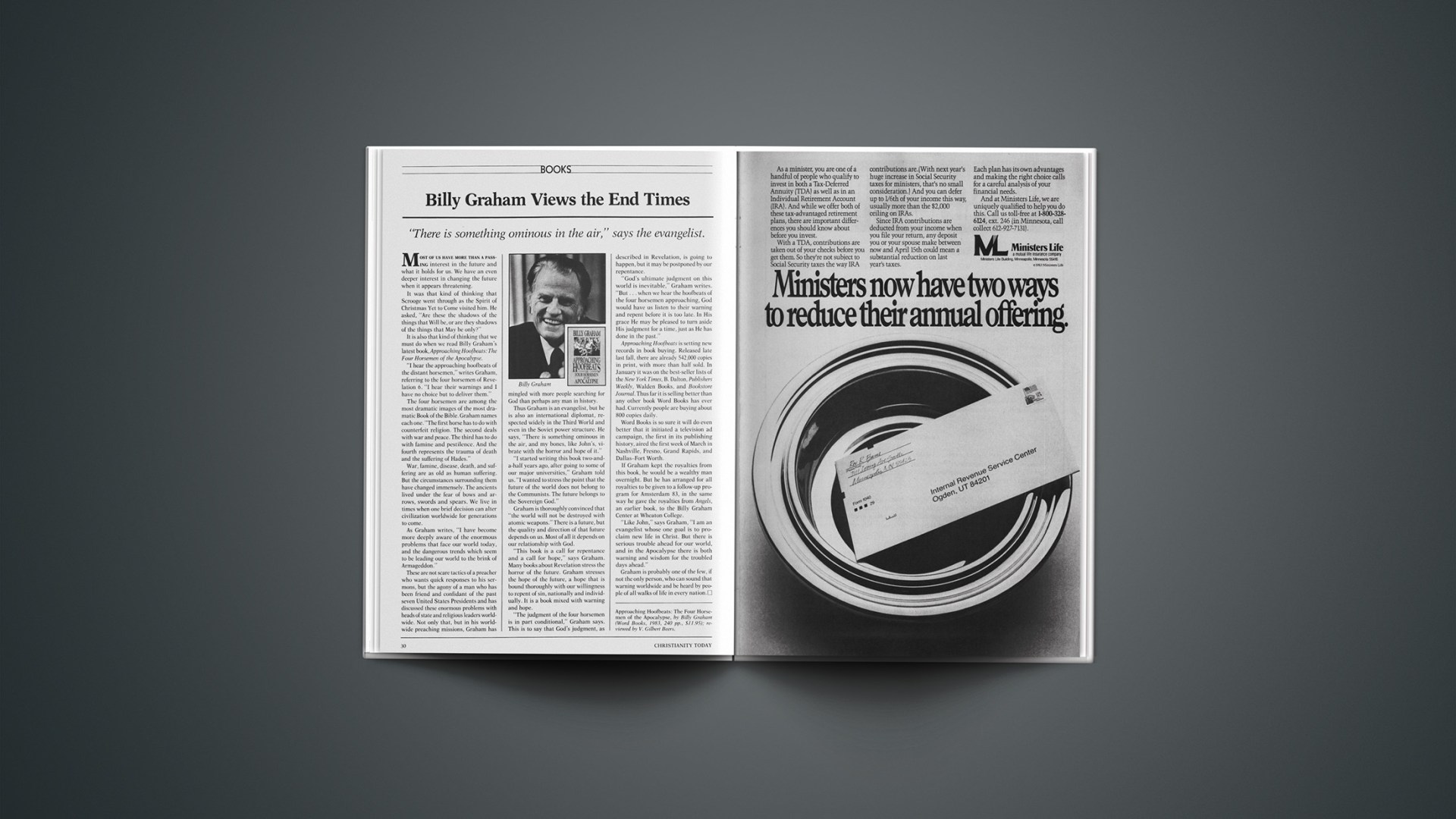
Billy Graham Views the End Times

Most of us have more than a passing interest in the future and what it holds for us. We have an even deeper interest in changing the future when it appears threatening.

It was that kind of thinking that Scrooge went through as the Spirit of Christmas Yet to Come visited him. He asked, “Are these the shadows of the things that Will be, or are they shadows of the things that May be only?”

It is also that kind of thinking that we must do when we read Billy Graham’s latest book, Approaching Hoofbeats: The Four Horsemen of the Apocalypse.

“I hear the approaching hoofbeats of the distant horsemen,” writes Graham, referring to the four horsemen of Revelation 6. “I hear their warnings and I have no choice but to deliver them.”

The four horsemen are among the most dramatic images of the most dramatic Book of the Bible. Graham names each one. “The first horse has to do with counterfeit religion. The second deals with war and peace. The third has to do with famine and pestilence. And the fourth represents the trauma of death and the suffering of Hades.”

War, famine, disease, death, and suffering are as old as human suffering. But the circumstances surrounding them have changed immensely. The ancients lived under the fear of bows and arrows, swords and spears. We live in times when one brief decision can alter civilization worldwide for generations to come.

As Graham writes, “I have become more deeply aware of the enormous problems that face our world today, and the dangerous trends which seem to be leading our world to the brink of Armageddon.”

These are not scare tactics of a preacher who wants quick responses to his sermons, but the agony of a man who has been friend and confidant of the past seven United States Presidents and has discussed these enormous problems with heads of state and religious leaders worldwide. Not only that, but in his worldwide preaching missions, Graham has mingled with more people searching for God than perhaps any man in history.

Thus Graham is an evangelist, but he is also an international diplomat, respected widely in the Third World and even in the Soviet power structure. He says, “There is something ominous in the air, and my bones, like John’s, vibrate with the horror and hope of it.”

“I started writing this book two-and-a-half years ago, after going to some of our major universities,” Graham told us. “I wanted to stress the point that the future of the world does not belong to the Communists. The future belongs to the Sovereign God.”

Graham is thoroughly convinced that “the world will not be destroyed with atomic weapons.” There is a future, but the quality and direction of that future depends on us. Most of all it depends on our relationship with God.

“This book is a call for repentance and a call for hope,” says Graham. Many books about Revelation stress the horror of the future. Graham stresses the hope of the future, a hope that is bound thoroughly with our willingness to repent of sin, nationally and individually. It is a book mixed with warning and hope.

“The judgment of the four horsemen is in part conditional,” Graham says. This is to say that God’s judgment, as described in Revelation, is going to happen, but it may be postponed by our repentance.

“God’s ultimate judgment on this world is inevitable,” Graham writes. “But … when we hear the hoofbeats of the four horsemen approaching, God would have us listen to their warning and repent before it is too late. In His grace He may be pleased to turn aside His judgment for a time, just as He has done in the past.”

Approaching Hoofbeats is setting new records in book buying. Released late last fall, there are already 542,000 copies in print, with more than half sold. In January it was on the best-seller lists of the New York Times, B. Dalton, Publishers Weekly, Walden Books, and Bookstore Journal. Thus far it is selling better than any other book Word Books has ever had. Currently people are buying about 800 copies daily.

Word Books is so sure it will do even better that it initiated a television ad campaign, the first in its publishing history, aired the first week of March in Nashville, Fresno, Grand Rapids, and Dallas-Fort Worth.

If Graham kept the royalties from this book, he would be a wealthy man overnight. But he has arranged for all royalties to be given to a follow-up program for Amsterdam 83, in the same way he gave the royalties from Angels, an earlier book, to the Billy Graham Center at Wheaton College.

“Like John,” says Graham, “I am an evangelist whose one goal is to proclaim new life in Christ. But there is serious trouble ahead for our world, and in the Apocalypse there is both warning and wisdom for the troubled days ahead.”

Graham is probably one of the few, if not the only person, who can sound that warning worldwide and be heard by people of all walks of life in every nation.

Approaching Hoofbeats: The Four Horsemen of the Apocalypse, by Billy Graham (Word Books, 1983, 240 pp., $11.95); reviewed by V. Gilbert Beers.

W. A. Criswell’s Key to Successful Preaching

It lies in keeping your appointment book filled—with the right pursuits.

In the bible, the phrse “thus saith the Lord” appears more than 2,000 times. The preacher who has the Holy Scriptures in his hand as he stands before his congregation is a tower of spiritual strength.

If, however, he depends solely on his own personal speculations about life and the times, he is only a paper tower, one that the slightest wind of disagreement can blow down.

I appeal to the pastor, therefore, to preach expository sermons. If he stands on the Word of God, he may have times when he will be afraid of human opposition, but the rock on which he stands will give his ministry a solid foundation and prevent the collapse of his fortress.

The expository preacher will take time for study and preparation. If his Sunday morning message—or Sunday evening message, for that matter—is not based on a thorough study of God’s Word, it will be of little ultimate value to the congregation.

If you are a pastor, avoid like the plague the temptation to squander your time on endless empty engagements and become a back slapper. Instead, fill your calendar with engagements with God for Bible study and prayer. If someone asks you to give the invocation at the annual meeting of the Beekeepers Association some morning, tell that person you have an important engagement at that time. And keep that engagement—with God in the study. The endless demands on your time are skim milk; you cannot live on skim milk all through the week and preach cream on Sunday.

Many pastors succumb to the temptation to live on skim milk, however. A friend of mine who had attended one church for 40 years commented to me, “Many sermons today are empty. They have absolutely no doctrinal content. As a result, they are light and superficial.”

She was right. I appeal to the pastor to study—and keep on studying all through his life. Phillips Brooks, even after he had become famous, continued to study the Bible and Bible commentaries so his preaching would have the ring of truth.

If you can, have your study in your home where you can avoid the inevitable interruptions that you will have at the church. When you get up in the morning, go to your study. Keep the time holy and sacred for God.

College graduates thinking of attending seminary often ask me, “Dr. Criswell, if you had one piece of advice to give to a young seminarian, what would it be?”

Year after year, through more than 55 years of preaching, I have invariably answered, “Keep your mornings for God.”

When you stand in the pulpit for the first time, tell your people that your mornings are to be kept sacred for prayer and Bible study. In the afternoon you can do the work of the church. In the evening you can go to any kind of church meeting. But in the morning let people know you want to be left alone with the Lord and his Holy Scriptures. Your people will respect your wishes. And when they sit in the pew before you, they will know by the message you bring that you have been with Jesus.

If you prepare expository messages, the congregation will not feel its time has been wasted in the house of the Lord on Sunday. Henry David Thoreau said of the uninspired drivel of pastors who had not spent the time to prepare careful expository sermons, “I would rather sit on a pumpkin listening to the chickadees than to the dry drivel of the D.D.’s in Boston.”

When the pastor preaches expositorily, his message is always waiting. There are many preachers who pace up and down the floor of their studies wondering, “What shall I preach on next Sunday?” Even the great preacher Charles Haddon Spurgeon did that.

The expository preacher will also pace up and down the floor of his study. But he will do it for a different reason. “O God,” he will cry, “I am going to grow old and die before I get to the depths of the treasures you have hidden in your Holy Book.”

Preaching from the Bible is like dipping water out of the ocean with a bucket. We never exhaust the vast reservoir of truth we have in the Bible. If a pastor preaches through a book of the Bible, he has the text of his message in front of him at his desk. Instead of wasting valuable time pondering what message he is going to preach the following Sunday, let the pastor sit down at his desk and immediately begin to learn what the Word of God has to say to his people.

Any series of expositions can make a mighty and meaningful message from the pulpit. The illustrious teacher of preachers, Andrew Blackwood, in his book The Preparation of Sermons quotes B. H. Streeter as saying, “A connected series in any subject by a man of moderate ability will make for a more permanent impression than an equal number of isolated sermons by a brilliant speaker. The congregation recalls what was said the last time. They look forward expectantly to what will be said the next time.”

Preaching the Bible paragraph by paragraph, chapter by chapter, section by section, book by book, affords the pastor an incomparable series that the Holy Spirit will bless in winning the lost and encouraging God’s people in the faith.

Dr. Criswell is pastor of First Baptist Church, Dallas, Texas, one of the nation’s largest churches.

Insights on Eternity from a Scientific View of Time

Ever since Galileo, the Christian faith has beat a steady retreat from science. Perhaps because of this posture toward science, few Christian thinkers today seem to be taking advantage of remarkable developments in modern physics. In their own way, Einstein and Bohr accomplished a revolution every bit as momentous as that of Copernicus. To begin with, not merely mankind but individual men and women have, through modern physics, regained their place as central figures in the history of the universe. If modern physics has taught us anything, it is that the conscious individual is an essential component in, well, everything.

In Newtonian physics, individuals have no special place except as observers and occasional participants in the orderly world of cause and effect. But in the twentieth-century view, the very reality of an occurrence depends upon whether an observer is present. Bernard D’Espagnat concludes in Scientific American, “The doctrine that the world is made up of objects whose existence is independent of human consciousness turns out to be in conflict with quantum mechanics and with facts established by experiment.” In other words, he questions whether anything even exists apart from consciousness. At the very least, the individual matters; the observer is essential.

Surely the average Christian fears to tread in the realms of relativity and quantum physics where, as in Alice’s Wonderland, all common sense tends to break apart. We read that time varies depending on gravitation and movement, for example, yet we still rely on watches to get us to work on time. This whole world of modern physics, with its creepy terms like wormholes and quantum foam, seems better left alone.

And yet we must not flee modern physics so quickly. Most of its main tenets about the nature of time and space have been verified by such exotic experiments as bouncing lasers off the moon or flying atomic clocks around the world in jumbo jets. The remarkable discoveries offer new constructs for understanding Christian doctrines that have previously eluded comprehension.

Consider just one such doctrine: the timelessness of God. For thousands of years Christians have cited proverbs such as “A thousand years is as a day in God’s sight” to express their belief that God views time differently. He is outside time and space, we say. We see human history as a sequential series of still frames, one by one as in a motion picture; but God sees the entire movie at once, in a flash. Although Christians believe this doctrine, until recently it has been bewildering.

Enter modern physics. Time, we are now told, depends on the relative position of the observer. Take a very primitive example. When I glance at the sky right now, at 3:12 in the afternoon, I see a bright light in the sky—the sun—which hangs in space some 93 million miles away. Yet the light I now see left that star 500 seconds ago. Because light travels only 186,000 miles per second, it took that long for the light to reach me. As an observer on Earth, I view the sun at 3:12, although I dimly realize that I am actually seeing the astral results of what took place at 3:04 Earth time. If the sun suddenly vanished into a black hole, I would not know it for eight minutes. Then the sky would darken, and I would cry, “The sun is gone!”

Imagine now a very large person—someone with a leg span of, say, 93 million miles. This person stands in our solar system, his head towering above it, with one foot planted firmly on Earth and one foot resting on the sun. He stamps his left foot on the sun. Such an action will have effects visible on Earth as solar flares shoot out in all directions. Eight minutes later I, on Earth, notice a dramatic change in the sun.

But I am trapped on Earth. The Very Large Person exists partially on Earth and partially on the sun—his consciousness spans both. The part of him resting on Earth has knowledge of the left foot stomping eight minutes in advance of anyone else on Earth.

The analogy approaches absurdity, but it may demonstrate how our concept of time would change if we existed in two widely separated places at once. Now, however, take a further mental leap and imagine a being larger than the Very Large Person. Imagine a being as large as the universe, who exists simultaneously on Earth and on a star in the Andromeda galaxy billions of miles away. If a star explodes in that galaxy, this being takes note of it immediately, yet he will “see” it also from the viewpoint of an observer on Earth millions of years later, as if it just happened.

Such speculation opens up intriguing possibilities when ancient debates on omniscience, foreknowledge, free will, and determinism come up. A word like “foreknowledge” makes sense only when considered from our Earth-bound viewpoint. It presumes that time proceeds sequentially, frame by frame. From God’s viewpoint, encompassing all of the universe at once, the word has considerably different meaning. Some of the fog around the doctrine evaporates.

Budding theologians would do well to study physical theories of parallel universes in concert with their investigation into the problem of evil; theories of interconnectedness of all matter and energy along with their doctrine of the union of believers; quantum explanations of consciousness affecting matter as a stimulant to their discussions on prayer. But for any of us to study these esoterica, we need a few qualified scientist-guides. The Zen Buddhists have seized the day and published volumes expounding their beliefs by using the language of contemporary models of the universe. I hope Christians don’t lag too far behind in doing the same thing from our perspective. Religious faith, like matter, is in constant peril of being swallowed by black holes.

Willie: Maximum Freedom in a Maximum-Security Prison

Tell them kids of Yours about me, so’s they don’t come to this hellhole.”

Willie Stephens, inmate 12674A at the state penitentiary in Boise, Idaho, said these words to me at the last session of the Prison Fellowship seminar. He squeezed my arm before slipping through the crowd of prisoners and volunteers to return to his cell. The day before he had invited me to his “home,” as he calls his eight-by ten-foot cinder-block room in the basement of A Block, an apartment-looking building housing about 90 men. There, for more than an hour, he filled me in on prison life and “his Jesus.” Such an invitation is an honor, I later found out, and if I had refused Willie he would probably have had no more to do with me. But my problem now, as I write, is how to put such a visit in perspective.

How does one summarize a visit to a murderer and rapist? How does one absorb his story with anything like comprehension—and compassion? I mean, it wasn’t a movie. I was there face to face with the real item, our worst night mare as a nation, judging from all the media attention these crimes get.

I wasn’t surprised by Willie’s list of crimes; I suppose I expected them in a maximum security prison and so was numbed to them as I heard them. I was, however, greatly surprised and pleased when I discovered I felt compassion for a man in such darkness. It is this compassion, this love if you will, for the inmates that I would like to untangle from the events of the seminar, and from Willie’s story.

At The Prison

The Idaho State Correctional Institution lies by itself on a high and windy plateau 11 miles from the closest Best Western Motel and is reached on a two-lane highway that twists its way through desolate hills. In May, the snow on a distant line of mountains seems to hang like clouds midway up the pale sky. A silver water tower marks the location of the prison from a couple of miles away. Then the fences and towers and buildings, slung out like those on a college campus, come gradually into view. My wife and I were riding in the back seat of a car driven by Bill Russell, the regional director of Prison Fellowship for Idaho, Montana, Wyoming, and Utah. Beside him was Art Lindsley, the featured speaker for the seminar. Over three days and seven sessions Art was going to speak to the men on topics ranging from guilt to grace.

After being admitted to the prison grounds through an electrically controlled fence, we went into the administration and control building, then met the prison chaplain and the warden. When we moved to the control room manned by the guards, we lined up single file before a door, ladies first. We were counted by the guard behind the glass, who then pushed a button that unlocked the door with a pop as the bolt slammed open.

We entered another room and passed through a set of double swinging doors, then out onto a walk. It was bordered by a tall cyclone fence topped by coiling razor wire (which looks something like barbed wire but actually has thin razorlike jags of metal coming off the main coil at intervals of an inch or so). Inside this fence, and running parallel to it some 20 feet away, is a second fence equally high. Between the fences the earth is kept plowed so nothing can grow on it and interfere with the view of the guards in the towers. Armed with carbines or M-16s (I was not clear about which or both), the guards need clear fields of fire. From the walk and through the fences one can look at the neat green lawns and well-maintained buildings. The lawns slope down to the main part of the yard, where yet more fences divide the acreage.

Still in single file, we proceeded along the walk, down a few flights of stairs, and to the first fence with its electrically controlled gate. We were admitted, the gate was closed, again we were counted before the second fence, and admitted through its gate onto the main yard. The old volunteers did not seem to realize what we new ones did: there was nothing now between us and the prison population. They chatted breezily, waving occasionally to some inmate, pointed to various buildings as though on tour of a college campus, and in general behaved as though they had nothing to fear. So did I. We sauntered past the dining hall and stopped at the education building next to it where the prison chapel is located and where we were to have our meetings.

There were about 30 inmates seated on hard pews in the small chapel as we filed in and took our seats in the front pews. A mixture of races, hard faces, mustaches, and tattoos—lots of tattoos on lots of arms—were my first impressions. Bill opened the seminar and introduced a gospel quartet, two young men in dark pinstripe suits and two attractive women in lavender dresses.

Here it comes, I thought, they’ll bomb and the men will boo and it will all be downhill from here. But the men didn’t boo. They clapped heartily and broke into wide smiles of delight. I suppose it was this first song and the reaction to it that started breaking apart the notions about prisoners I had learned from Hollywood. There were murderers, thieves, burglars, and dope dealers in that room. But over the next three days they became Tony and Al and Randy and Chip and Raul—human beings in a dark place, but with a radiance of soul that they said came from knowing Jesus Christ. One inmate named Chuck said later that he had “done time, hard time, Quentin time,” and that his first 42 years had gone down the toilet before Christ came into his life. “If there’s anything you like in me, it’s Jesus Christ working through me,” he said.

Each session of the seminar was run the same way. Art Lindsley would make a 45-minute presentation on self-image or anger or discouragement and then the inmates and volunteers would be divided into small groups for discussion. Art is one of the main instructors on the national level for Prison Fellowship, the organization started by Charles Colson when he left prison a born-again believer. The organization exists, according to its literature, “to assist and exhort the church in its ministry to inmates, ex-offenders and their families, and to work for a just and effective criminal justice system.”

Willie’S Story

It was after one of the first day’s sessions that Willie “adopted” me. At least that is how I felt after he gave me an invitation to see his house. The next day between the noon and night meetings I stayed on the yard after the other volunteers had left, and with Willard Chapman, a volunteer chaplain and himself a former prisoner, went to see Willie.

“A” House is laid out like a dorm at any college. The inmates have single rooms, and each has a key to lock his door. There are no bars. The Boise pen is a modern one. “A” House is the honor block, and to qualify for residence inmates must have served at least two years without any write-ups for disciplinary infractions. Willie’s room is on the bottom floor, or tier, as the levels are called. His room feels cramped. It is filled with a hard bunk made up military style, taut and crisp, a steel cabinet for clothes, doodads, and Willie’s sleeping and tension medications. The cement floor is painted dark brown, as is the steel door. The walls are beige-painted cinder blocks. Willie has a calendar mounted near his bed and it has a picture of a lake about which he fantasizes. (“I go fishin’ right there,” and he points.) There are pictures of Jesus spread here and there across all of his walls like meadow flowers, and he has about 50 books neatly filed in a row on the floor. All are about Jesus.

When Willard and I entered, Willie shut the door to cut out the sound of the television mounted outside in the “living room” where several inmates lounged on couches and chairs. The soothing hum and hiss of air from the air-conditioning duct helped further drown out the prison. Willard talked for awhile as Willie busied himself getting coffee and rolling a cigarette on orange paper. Then he began. His story floated out on a soft, barely southern drawl, a Louisiana cotton-chopping drawl, punctuated now and again by his long bony arms slicing or jabbing the air as he kept repeating after each statement he felt I would not accept, “You can believe it or leave it lie.”

He remembers the cotton and the blacks who apparently worked for him and who would say at break time, “Don’t want no RC, boss, want Royal Crown instead.” Willie smiles at this recollection, at least as much as he ever smiles. His taut mouth barely breaks its line at the edges, flickers slightly like a glint of sun across a wave, and disappears. Mostly he is withdrawn, and his long, pale, almost cadaverous face, with its long nose and tight mustache, seldom expresses anything but great distance and tension. He does have a sense of humor, as I found out. In the hallway of the chapel after one of the sessions, I suddenly felt a breath on the back of my neck and turned to find Willie with his flickering smile. He said, “I could’ve had you if I wanted.”

Like so many other inmates, Willie had a bad home life. His dad said Willie would never amount to anything and would no doubt end up in prison. His dad was a con and knew. Crime is sometimes a family affair, with generation after generation entering it. Willie did.

When Willie married and had daughters, he apparently had relations with one of them, or perhaps it was with his step-daughter—I couldn’t get this part straight. Willard concurred, saying this kind of crime was much more common than I thought. (I had heard of it now and then at the high school where I teach, but I didn’t comment.) Willie went on to mention briefly his murder, and Willard again added what he knew, which was that while not excusing the crime at all, the guy deserved what he got.

Willie has tried suicide five or six times. Once he pointed a gun at his temple and three times clicked the trigger on cylinders that wouldn’t fire. And then, on the fourth, he pointed it at the floor. It fired. Another time he tried to run his car off a cliff, but even with the accelerator pressed to the floor and the motor howling, the car refused to budge. (“Tell me there ain’t a God after that, buddy,” he said after each of these stories.)

Willie says he came to prison 14 years ago with 23 personalities but that now he’s down to 3 because of Jesus. Willard said I would be amazed at some of the early prison photos taken of Willie, especially about some quality in his eyes. As I’ve said, all of these things are so far from my own experience that I cannot truly comprehend them. But through them all I sensed Willie’s pain and intense loneliness, and I felt compassion for the man behind and apart from his deeds.

Shortly after Willard and I first entered Willie’s room he asked us if we’d done our assignment We stared blankly until he reminded us that Art, when he’d finished speaking on self-image, had said to try an experiment for ourselves:

List the five most significant things other people have said to you in praise; then list the five most significant criticisms.

Willie didn’t wait for us to speak but quickly ripped a page from his small spiral memorandum book and handed it to me. As I read the list, the powerful elements in their starkness and simplicity moved me deeply. They moved me because there was so little to praise and so much to blame, and because I knew I could never make such a straightforward list of my own sins. Willie did not offer much comment other than that I was free to show it to my students if I thought it would help keep them from his path of life. Here it is, headed neatly as he wrote it:

Compliments

1. Work

2. Patience

3. Manner of Dress

4. School

5. Studies of Bible

Criticism

1. Just Like Dad

2. Murderer/Anti-Social

3. Liar & Adulterer

4. Child Molester

5. Quitter/Institutionalized

Why Compassion?

So why the compassion? Why did I go away from those three days feeling so strangely free and content? Why did I suddenly feel that this sort of prison ministry was for me?

I’ve sifted out a few of the answers. I knew compassion because I saw God’s grace covering all kinds of sin. Not one of us deserves salvation through Jesus Christ, so no matter who we are, murderer, thief—even schoolteacher—we are all equally distant from God, equally lost. Since this is so, all can be equally saved, and though I knew this absolutely and believed it firmly before I went to Boise, to see it in action made me feel God’s compassion and the freedom one can only know in Christ. Rob, Reilly, Randy, Rory, and the others were transformed and radiantly free of their sins, and they knew it and rejoiced in it.

I knew compassion because even in the darkest places there is light. It is dark there in southern Idaho, but how brightly shines the Light!

I knew compassion because I saw in these men a closeness and love that I desired. John 13:35 says, “By this all men will know that you are my disciples, if you have love for one another.” Willie and the others look eagerly for one another in brotherly expectation, and, if I might say it, with relief to see a fellow light bearer in the midst of a crooked and perverse generation.

Finally, I was attracted by their zeal and commitment. They spend about two hours daily reading their Bibles and praying. One inmate hit it on the head when he wrote my wife from the state penitentiary at Walla Walla, Washington, about our trip: “I’ll bet you found out that the guys are more solid, more serious, more interested in learning, and a whole lot more courteous and appreciative than 99 percent of the people on the outside.” That is sadly true, I’m afraid. Even if we make allowances for the uniqueness of their situation and say things such as, “They have more time than I do to study since they’re locked up with nothing else to do,” or “Don’t worry, their love for one another and their zeal for the Bible will fade away when they get out with the rest of us,” we cannot get away from the indictment—we simply are not committed. In our prosperity we too often forget our Lord.

Graduation for the inmates came at the seventh session of the seminar. Willie was there in the chapel, seated beside my wife, and I was further up with Tony and Raul. Art spoke on the topic of discouragement and explained the symbol of the bruised reed used by Prison Fellowship on all correspondence and on the certificates the inmates were to receive. All of us in the chapel were bruised reeds, said Art, all of us are discouraged and ready to give up at times; but Christ holds us and will not allow us to break. Many of the men in that room knew how close they had come to breaking. I had heard at least two others besides Willie say they had come to the end, that suicide was the only way left since life held nothing more that they wished to see.

The ceremony was short. Each man went forward when his name was called, shook hands with Art, then Bill, then with the prison chaplain, and returned to his seat with his name on a white certificate. Simple, but how electric! Tony couldn’t believe he’d done it, that he’d actually and finally graduated from something. Raul later prayed in closing and said what I’ve never said at any of my graduations, from grade school through college: “Lord, I’m so deeply touched and grateful.” Willie couldn’t say it out loud, so he wrote on his little memorandum book for my wife to see: “God loves Larry and Mary and all the volunteers. Willie.”

Tim Stafford is a free-lance writer living in Santa Rosa, California. He is a distinguished contributor to several magazines. His latest book is Do You Sometimes Feel Like a Nobody? (Zondervan, 1980).

The Necessity of Death: There Is No Life without It

One day last year in the middle of June, I was descending a trail leading from the lip of a rocky Wyoming ridge to the sagebrush flats in the canyon below. Quite suddenly a hawk dropped through the branches of the pines in a lazy, controlled parabola and, hanging at the nadir of its long arc for a moment, grasped a negligent ground squirrel in its claws and flew away among the trees again.

One stops at such sights. I stood in the thicket of limberpine for a good quarter of an hour while the import of this unexpected scene seeped through me.

Was the message of this secluded morality play I had stumbled into merely memento mori—a reminder of inevitable death? It had been played out with a certain ease and grace and matter-of-factness. The small rodent had not squealed or struggled. The only sound had been the sheerest shuffle of wind through the bird’s wings. It caused no more stir on the rocky slope than my sitting down to breakfast did in my house.

So this was death—from natural causes, as we say. Death descending from the sky on silent wings. Death with implacable, immobilizing talons. Death somewhere, not far away, ripping open the warm carcass while I still stood under the tree. The necessary death of this world. Death destroying in order to live.

I went on down the trail, descending the switchbacks and trying to keep my analogies under control. For I sometimes thought I heard wings overhead myself. There is the dove of heaven, we know, that descends when the heavens open, sometimes in fire. But perhaps there is also a hawk in heaven that swoops down on us with the gift of death to deliver us from our used-up past, the past we have neither the courage nor the imagination to walk away from.

We mortals die many deaths in our lives. Patterns that have served the purposes of their particular time and place have to be discarded and left behind. If we grow in wisdom and stature, it is only over the dead bodies of our former selves. One cannot begin to live a new life until the old one has adequately died. Otherwise, life itself becomes nothing but an artificial resuscitation, year after year, of a desiccated, worn-out self, a mummy with only the painted appearance of life.

Death In The Wilderness

The Wyoming wilderness, especially in winter, is an instructive place to learn about death, even to learn how to die. Here death is not covered over or whisked out of sight. It is difficult to learn about death today in towns, at least in respectable neighborhoods. No horse-drawn hearses clop by with mourners in their wake to remind the community of the inevitable. Those sick enough to die go to hospitals where machines monitor their descent into death. If city children no longer know where milk comes from, still less are they acquainted with the source of hamburger.

But in the wilderness things die in the open, nor is this indecent. In fact, when winter descends on the northern Rockies and grips the land in its obdurate talons, death becomes the daily diet of contemplation. Animal populations are thinned of their weak members. Vegetation sinks its capital into its deepest roots. And the wind scours even the stones of any detritus or extraneous life.

Not many people want to learn about dying. Maybe that is why the population is so sparse among the bare bony ridges of Wyoming. To be sure, we live in terrified times and our world is understandably more interested in images of reassurance and rebirth than it is in death. At each moment, death that could be the end of history waits to erupt from the underground Wyoming weapons silos, let loose by some hand over which we have no control. Children grow up under the shadow, not just of their own deaths or the deaths of those they love, but under the shadow of world death, future death.

Perhaps our terror of death at other hands is so great that we cannot concentrate on our own task of dying and instead try to leap over that abyss, attempting to be born again without dying first. If so, I don’t know that we are so very different from other ages. There have, in fact, been times in history when whole civilizations have been driven mad with death: fourteenth-century Europe and the Aztec kingdom, for example, when people wallowed in death in order to inure themselves to its terrors. Perhaps this is our own motive for watching people being killed over and over, artificially and not very accurately, on television. Perhaps this is our unconscious Aztecan ritual that accustoms us to the terror of death.

But we are not the first generation to live in a reign of terror, despite our technological weapons. Apocalypse has threatened—and happened—before. The world, as its inhabitants then knew it, has been destroyed before. Sodom and Gomorrah, incinerated and smoking on the plains, is only a scale model for our own fears about the future. The citizens of those cities knew not much more of the world than their own neighborhood. To them the fire and brimstone were, effectually, the end of the world. Holocaust is not new among humankind. Jericho, Jerusalem, Rome, Dresden, Hiroshima, Hue—all the world that somebody knew has gone up in flames before.

This is the death that is the enemy, the death that aims at the unmaking of creation. This is the enemy that desires creation’s diminution, its degradation. This is the death that would destroy the world if it could, either in one great conflagration or by sucking life slowly at whatever fissure it finds in the entities we call our bodies and souls.

But if death is only the enemy, how then do we dare speak of the necessity of death in our lives, of how we must die with Christ, be in fact baptized into his death? Why does the common table at the heart of our faith commemorate the very death of our Savior? Do we celebrate life or death when we consume body and blood?

And what, after all, is the nature of this death? Is it the necessarily opposing force to life that holds reality together as pictured in the light and dark of the yin-yang symbol? Is it only a part of the cyclical process of being? Do we protest against it only because our flesh, entangled in time, deludes us? Is death actually a release from the illusions of time and space and particularity? Is it rest? A sleep and a forgetting? Or is it punishment? The wages of sin? Should we desire it, as Paul did, as access to the presence of God? Or should we cry out against the dying of the light?

On Necessary Death

Certainly there is the death that, within the context of earthly existence, is necessary. If all beings were on earth immortal, where would food come from? Or time, for that matter? We know little enough about this kind of death and do not contemplate it sufficiently to understand our own creaturely nature.

And what is the meaning of that great lost word of the church, one it seldom utters now—our death in Christ? Why are we called upon to embrace this enemy? Why did not Jesus, like his Jewish kin, the Maccabees and the Essenes, build a fortress against the enemy where we could all huddle together in safety? Why did he, in order to “deliver them who through fear of death were all their lifetime subject to bondage,” invade the kingdom of death itself?

One must, it seems, close with the enemy in order to overcome it. Death could not be destroyed by keeping clear of it. A great reversal is always accomplished on the point, the fulcrum, of a paradox; an infinitesimal eye at the center of the storm we call human history, a place becalmed, transfixed, immobile. There light confronted darkness, consciousness looked into chaos, being met unbeing and was not overcome.

But we forget that we too are called to that place. We, too, find life only by losing it. In order to know the power of the Resurrection, Paul said that he must share Christ’s suffering, “becoming like him in his death.”

We, too, must learn to lay down our lives and walk away from them. No death therapy can help us here. Breaking down the process of dying by analysis into five or any other number of stages is insufficient to our needs. We play parlor games with the psyche in order to subdue reality. That may be entirely necessary. Even Aristotle described Greek drama as a useful tool for coping. But we must beware of thus diminishing our very selves and the unrepeatable experiences vouchsafed to us.

I know all life to come from God; I also know that the approach to the source of that life lies only through the valley of the shadow of death, our death in Christ. Death is that narrow, straight gate through which we struggle toward the light. There is no other way, and that way is so lean, so constricted, that it scrapes all the flesh from our skeletal selves before we can writhe and heave through the aperture. Who enters there leaves everything behind: brothers and sisters, mother and father, home, hope, fear, fancy. All the flesh is scraped off in that centrifugal force, the bones tumbled smooth as stones.

Annie Dillard asks, “Did you think before you were caught, that you needed, say, life? Do you think you will keep your life, or anything else you love? But no. Your needs are all met. But not as the world giveth.… You see the creatures die, and you know that you will die. And one day it occurs to you that you must not need life.” And Bonhoeffer, amid quite different circumstances and with the heightened awareness that war with this world brings, put the case more succinctly: “When Jesus calls a man, he bids him come and die.”

The Difficulty Of Voluntary Death

For human beings, the necessary death, the death essential to life, is always voluntary, which is what makes it so hard. The rest of creation, though it dies, has no need to make an act of the will. Death simply comes upon it and overshadows it, in the dive of the osprey, the pounce of the coyote, the freezing of cells.

Nevertheless, in everything but will, creation—dumb, brute creation—can show us something of how this dying is done. Indeed, how else can we know death except among the creatures?

Yet even our ties to earth-death are being systematically cut off. We neither kill nor harvest the food for our own tables. It comes to us already death-processed. We have no bone-deep knowledge that other things die so that we may eat and live. How can we then possibly sense the depth of sacrifice that atonement requires? Our salvation seems easy and grace cheap because we have lost the death link to our tables. Since we are deprived of death within our own dwellings, we must look elsewhere for instructive examples. Outside.

Outside, the world itself dies every year. We have almost forgotten that. The sun withdraws its light, the darkness overshadows the earth. The waters freeze and the leaves decay. We forget because we don’t have to live in that world anymore. We have created our own world where we have as much light and heat as we desire, hot running water, and fresh fruit the year round. We exempt ourselves from the season of death that envelopes the world outside our artificial environment. We live as though on an alien planet; this has become our imitation victory over death.

How is this kind of ignorance to be instructed? How can we learn what it is we mean when we use the word death? We have gotten woefully glib with our theological metaphors. We need either to change the metaphors to match our experience more honestly or else experience the metaphors we insist on using. We need to watch as life abandons the land in winter, to contemplate in detail the dereliction of creation. Then maybe those mute lessons will seep slowly into the landscape of our minds so that we can learn to bear the abandonment of our own lives.

Tim Stafford is a free-lance writer living in Santa Rosa, California. He is a distinguished contributor to several magazines. His latest book is Do You Sometimes Feel Like a Nobody? (Zondervan, 1980).

Apple PodcastsDown ArrowDown ArrowDown Arrowarrow_left_altLeft ArrowLeft ArrowRight ArrowRight ArrowRight Arrowarrow_up_altUp ArrowUp ArrowAvailable at Amazoncaret-downCloseCloseEmailEmailExpandExpandExternalExternalFacebookfacebook-squareGiftGiftGooglegoogleGoogle KeephamburgerInstagraminstagram-squareLinkLinklinkedin-squareListenListenListenChristianity TodayCT Creative Studio Logologo_orgMegaphoneMenuMenupausePinterestPlayPlayPocketPodcastRSSRSSSaveSaveSaveSearchSearchsearchSpotifyStitcherTelegramTable of ContentsTable of Contentstwitter-squareWhatsAppXYouTubeYouTube