The Justice Department Enters a Legal Battle over a Dying Infant

How much right to life does a handicapped baby have?

For the second time since President Reagan took office, bitter controversy surrounding a handicapped newborn has pitted the Administration against the weight of popular legal and medical opinion.

In 1982, it was a Down’s syndrome infant in Indiana, whose parents and doctors agreed—with the consent of the state’s courts—to withhold food, water, and medical treatment because mental retardation would diminish “Infant Doe’s” quality of life.

In a Long Island hospital, “Baby Jane Doe” was born October 11 with an incomplete spine, excess fluid on the brain, and a small—though not abnormal—head.

Her parents, who consulted Roman Catholic clergy, said “no” to an operation that would close her spinal wound and perhaps allow her to live into her twenties. Her life expectancy with no surgery is two years, and postponing treatment caused her to develop meningitis, which was treated.

The federal government stood by helplessly as Indiana’s “Infant Doe” slowly starved, but in the New York case the Justice Department and U.S. Surgeon General C. Everett Koop sought to get a foot in the door by suing for access to the baby’s medical records. Their justification for entering the case is a civil rights law that prohibits unequal treatment based on physical or mental handicap.

A federal judge—a Reagan appointee—rejected the Administration’s request, saying the evidence “conclusively established there is no discrimination.” Arguments favoring the parents’ right to privacy and their choice of “conservative” rather than heroic treatment prevailed over the government’s effort to enforce a federal law.

Beyond law enforcement, however, the Administration views this case, and others like it, as the front line in an ideological defense of moral values it considers essential to society’s well-being.

Following the “Infant Doe” case in Indiana, Koop drew up new regulations to protect handicapped newborns by establishing a hotline in Washington to receive reports of deliberate neglect. Also, funds were to be cut off from federally supported hospitals that withheld treatment.

These measures—still locked in litigation—faced severe criticism from doctors and lawyers who viewed them as unwarranted intrusions into private, confidential relationships. Koop, at odds with his colleagues over the whole range of sanctity-of-life issues, is particularly distressed about a new perception of medicine as a consumer item, complete with money-back guarantee via malpractice suit if the “expectancy of perfection” is dashed.

In a book entitled Infanticide and the Handicapped Infant, Koop writes, “The medical profession has slipped its anchor and drifted away from the commitment which put the patient first.… I am distressed that in an era of moral relativism, the life of a handicapped child can be forfeited to alleviate suffering in the family.”

It was readily apparent that this view prevailed in the Indiana situation, and the broad public consensus sided against the parents. But the Baby Jane situation is clouded with additional complexities that have resulted in nearly uniform editorial support for her parents.

The mother, who along with her husband has remained anonymous, said the likelihood of her child’s lifelong pain and immobility were primary considerations.

Supporters of the parents say they are opting, under a doctor’s advice, for conservative care rather than “heroic measures” to prolong life.

David Fishlow, spokesman for New York’s attorney general, said Baby Jane “is receiving constant medical attention. No one is terminating the child’s life.” When she was one month old, he said, she underwent surgery to relieve pressure on her brain due to excess fluid. New York’s courts, Fishlow said, have found that “the parents and doctors acted consciensciously and competently” to provide appropriate care.

Koop’s suspicions were raised, however, when diametrically opposed medical opinions were reached. A neurologist present just after Baby Jane’s birth recommended immediate surgery—standard procedure for the one in 1,000 babies born with spina bifida. The baby was transferred to another hospital, where a second neurologist painted a bleak picture for Baby Jane’s father of a life of paralysis, retardation, and chronic infection.

Fourteen hours after her birth, Baby Jane’s father decided against surgery, and the first neurologist withdrew from the case because he disagreed with the decision.

Koop believes these circumstances dictate the need for a third opinion, and his expertise in pediatric surgery give him a special professional interest as well.

He pointed out in a televised interview that requesting medical records is nothing extraordinary. “We have asked for records from 48 other institutions since April of this year and not one institution has failed to give us those records.” Koop at first tried to obtain Baby Jane’s records without going to court, but the effort was rebuffed.

Justice Department involvement in suing for the records is reminiscent, some say, of civil rights enforcement during the 1960s, protecting an individual against the ultimate discrimination. It is thoroughly consistent with Reagan’s antiabortion views, articulated some months ago in a Human Life Review essay.

Critics are quick to point out that Reagan is the same president who promised less government intrusion and more support for families. They say it is “preposterous” to liken the case to traditional civil rights interests, since a complicated mix of ethics and science yields no firm consensus in society.

Carl Horn III, a lawyer with the Justice Department’s civil rights division, says, “We’ve conceded that a degree of medical and parental discretion is appropriate, but as a matter of principle there have to be parameters.” Child abuse is a prime example, he said, because outside informers are encouraged to alert authorities, and the state’s interest in protecting life and health is seen as legitimate.

“We have to be willing to affirm absolutes while discussing nuances and exceptions,” Horn said. “It comes down to a basic attitude about life.”
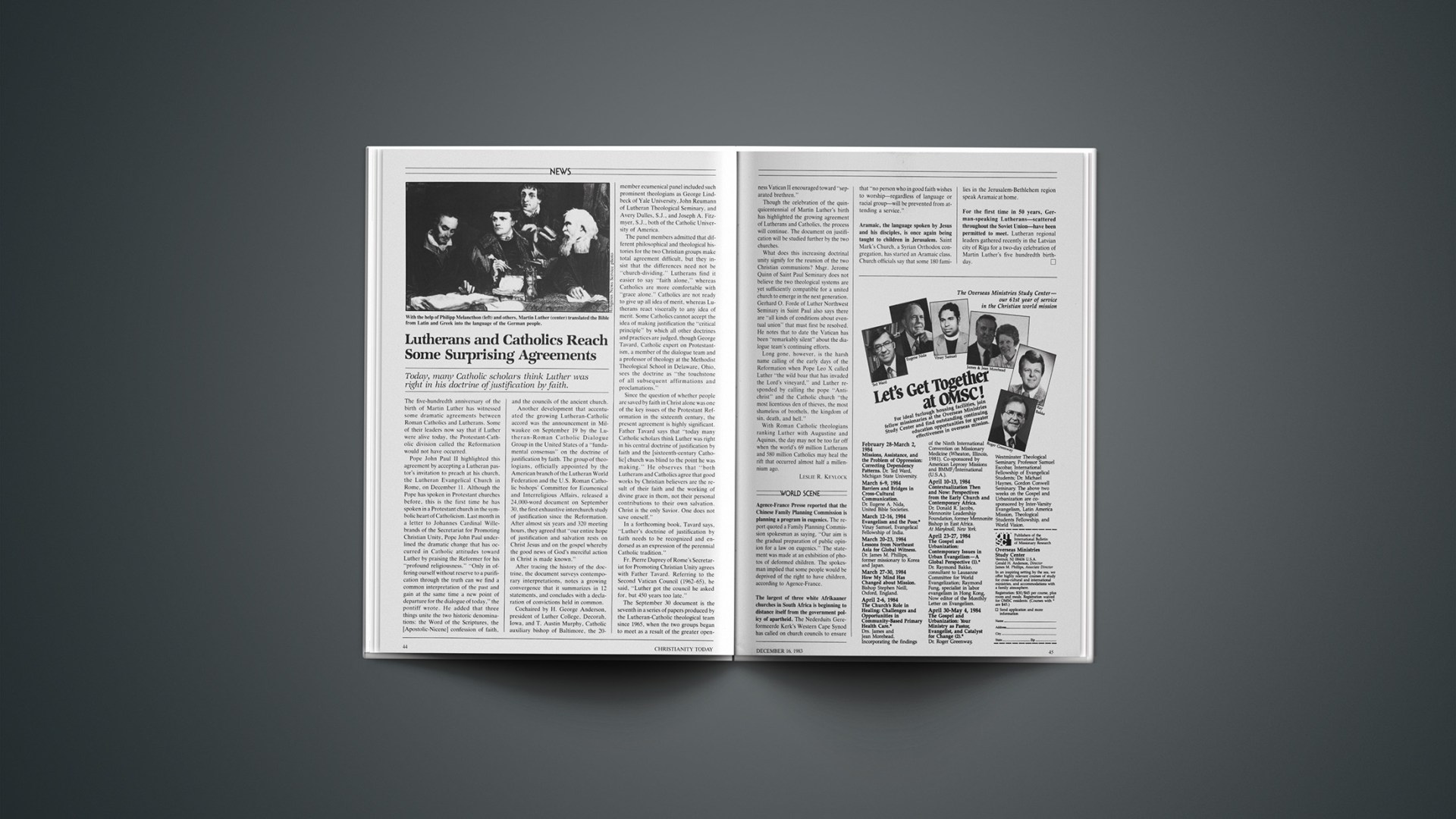
Lutherans and Catholics Reach Some Surprising Agreements

Today, many Catholic scholars think Luther was right in his doctrine of justification by faith.

The five-hundredth anniversary of the birth of Martin Luther has witnessed some dramatic agreements between Roman Catholics and Lutherans. Some of their leaders now say that if Luther were alive today, the Protestant-Catholic division called the Reformation would not have occurred.

Pope John Paul II highlighted this agreement by accepting a Lutheran pastor’s invitation to preach at his church, the Lutheran Evangelical Church in Rome, on December 11. Although the Pope has spoken in Protestant churches before, this is the first time he has spoken in a Protestant church in the symbolic heart of Catholicism. Last month in a letter to Johannes Cardinal Wille-brands of the Secretariat for Promoting Christian Unity, Pope John Paul underlined the dramatic change that has occurred in Catholic attitudes toward Luther by praising the Reformer for his “profound religiousness.” “Only in offering ourself without reserve to a purification through the truth can we find a common interpretation of the past and gain at the same time a new point of departure for the dialogue of today,” the pontiff wrote. He added that three things unite the two historic denominations: the Word of the Scriptures, the [Apostolic-Nicene] confession of faith, and the councils of the ancient church.

Another development that accentuated the growing Lutheran-Catholic accord was the announcement in Milwaukee on September 19 by the Lutheran-Roman Catholic Dialogue Group in the United States of a “fundamental consensus” on the doctrine of justification by faith. The group of theologians, officially appointed by the American branch of the Lutheran World Federation and the U.S. Roman Catholic bishops’ Committee for Ecumenical and Interreligious Affairs, released a 24,000-word document on September 30, the first exhaustive interchurch study of justification since the Reformation. After almost six years and 320 meeting hours, they agreed that “our entire hope of justification and salvation rests on Christ Jesus and on the gospel whereby the good news of God’s merciful action in Christ is made known.”

After tracing the history of the doctrine, the document surveys contemporary interpretations, notes a growing convergence that it summarizes in 12 statements, and concludes with a declaration of convictions held in common.

Cochaired by H. George Anderson, president of Luther College, Decorah, Iowa, and T. Austin Murphy, Catholic auxiliary bishop of Baltimore, the 20-member ecumenical panel included such prominent theologians as George Lindbeck of Yale University, John Reumann of Lutheran Theological Seminary, and Avery Dulles, S.J., and Joseph A. Fitzmyer, S.J., both of the Catholic University of America.

The panel members admitted that different philosophical and theological histories for the two Christian groups make total agreement difficult, but they insist that the differences need not be “church-dividing.” Lutherans find it easier to say “faith alone,” whereas Catholics are more comfortable with “grace alone.” Catholics are not ready to give up all idea of merit, whereas Lutherans react viscerally to any idea of merit. Some Catholics cannot accept the idea of making justification the “critical principle” by which all other doctrines and practices are judged, though George Tavard, Catholic expert on Protestantism, a member of the dialogue team and a professor of theology at the Methodist Theological School in Delaware, Ohio, sees the doctrine as “the touchstone of all subsequent affirmations and proclamations.”

Since the question of whether people are saved by faith in Christ alone was one of the key issues of the Protestant Reformation in the sixteenth century, the present agreement is highly significant. Father Tavard says that “today many Catholic scholars think Luther was right in his central doctrine of justification by faith and the [sixteenth-century Catholic] church was blind to the point he was making.” He observes that “both Lutherans and Catholics agree that good works by Christian believers are the result of their faith and the working of divine grace in them, not their personal contributions to their own salvation. Christ is the only Savior. One does not save oneself.”

In a forthcoming book, Tavard says, “Luther’s doctrine of justification by faith needs to be recognized and endorsed as an expression of the perennial Catholic tradition.”

Fr. Pierre Duprey of Rome’s Secretariat for Promoting Christian Unity agrees with Father Tavard. Referring to the Second Vatican Council (1962–65), he said, “Luther got the council he asked for, but 450 years too late.”

The September 30 document is the seventh in a series of papers produced by the Lutheran-Catholic theological team since 1965, when the two groups began to meet as a result of the greater openness Vatican II encouraged toward “separated brethren.”

Though the celebration of the quin-quicentennial of Martin Luther’s birth has highlighted the growing agreement of Lutherans and Catholics, the process will continue. The document on justification will be studied further by the two churches.

What does this increasing doctrinal unity signify for the reunion of the two Christian communions? Msgr. Jerome Quinn of Saint Paul Seminary does not believe the two theological systems are yet sufficiently compatible for a united church to emerge in the next generation. Gerhard O. Forde of Luther Northwest Seminary in Saint Paul also says there are “all kinds of conditions about eventual union” that must first be resolved. He notes that to date the Vatican has been “remarkably silent” about the dialogue team’s continuing efforts.

Long gone, however, is the harsh name calling of the early days of the Reformation when Pope Leo X called Luther “the wild boar that has invaded the Lord’s vineyard,” and Luther responded by calling the pope “Antichrist” and the Catholic church “the most licentious den of thieves, the most shameless of brothels, the kingdom of sin, death, and hell.”

With Roman Catholic theologians ranking Luther with Augustine and Aquinas, the day may not be too far off when the world’s 69 million Lutherans and 580 million Catholics may heal the rift that occurred almost half a millennium ago.

World Scene

Agence-France Presse reported that the Chinese Family Planning Commission is planning a program in eugenics. The report quoted a Family Planning Commission spokesman as saying, “Our aim is the gradual preparation of public opinion for a law on eugenics.” The statement was made at an exhibition of photos of deformed children. The spokesman implied that some people would be deprived of the right to have children, according to Agence-France.

The largest of three white Afrikaaner churches in South Africa is beginning to distance itself from the government policy of apartheid. The Nederduits Gereformeerde Kerk’s Western Cape Synod has called on church councils to ensure that “no person who in good faith wishes to worship—regardless of language or racial group—will be prevented from attending a service.”

Aramaic, the language spoken by Jesus and his disciples, is once again being taught to children in Jerusalem. Saint Mark’s Church, a Syrian Orthodox congregation, has started an Aramaic class. Church officials say that some 180 families in the Jerusalem-Bethlehem region speak Aramaic at home.

For the first time in 50 years, German-speaking Lutherans—scattered throughout the Soviet Union—have been permitted to meet. Lutheran regional leaders gathered recently in the Latvian city of Riga for a two-day celebration of Martin Luther’s five hundredth birthday.

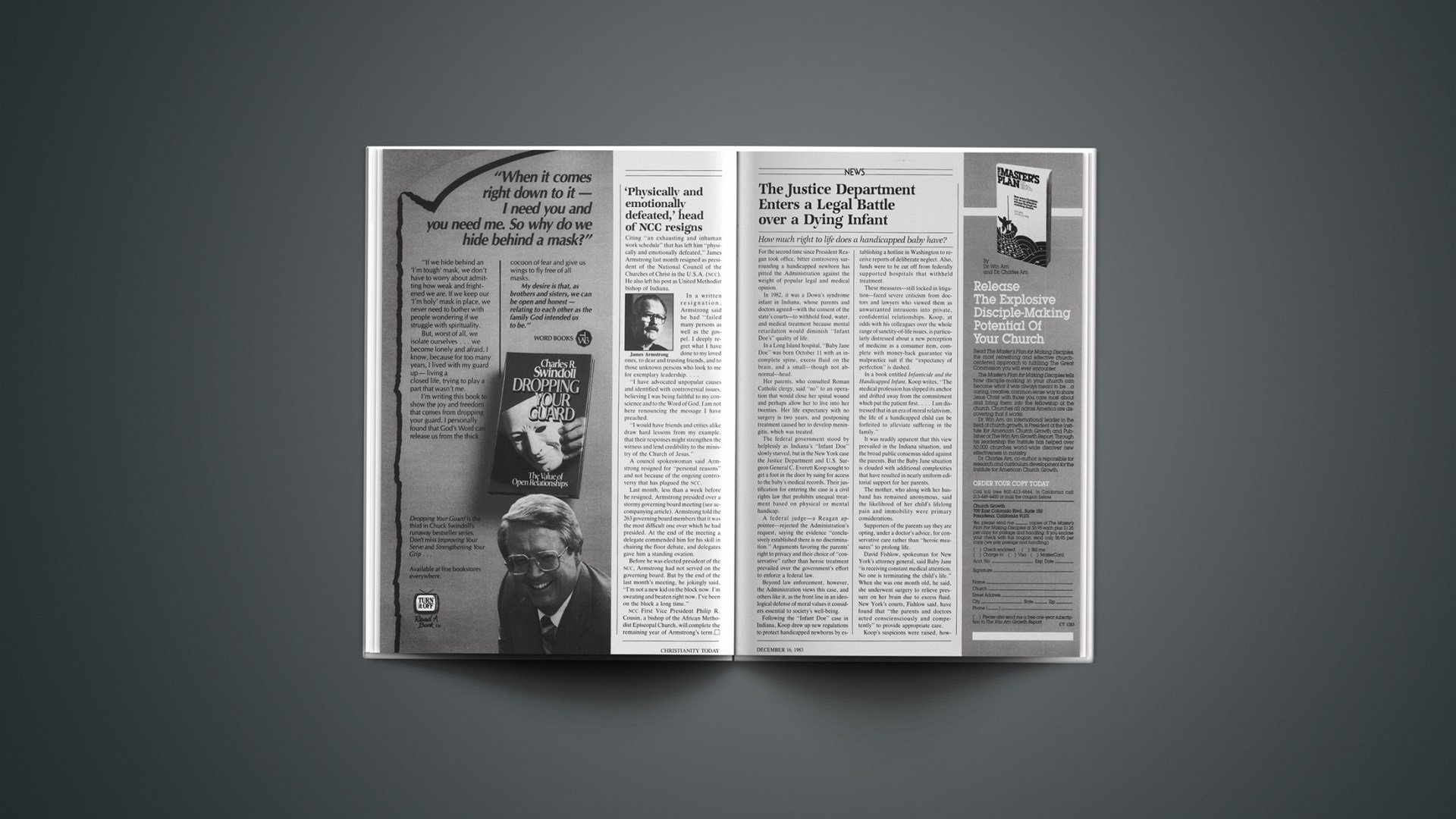
‘Physically And Emotionally Defeated,’ Head Of Ncc Resigns

Citing “an exhausting and inhuman work schedule” that has left him “physically and emotionally defeated,” James Armstrong last month resigned as president of the National Council of the Churches of Christ in the U.S.A. (NCC). He also left his post as United Methodist bishop of Indiana.

In a written resignation, Armstrong said he had “failed many persons as well as the gospel. I deeply regret what I have done to my loved ones, to dear and trusting friends, and to those unknown persons who look to me for exemplary leadership.…

“I have advocated unpopular causes and identified with controversial issues, believing I was being faithful to my conscience and to the Word of God. I am not here renouncing the message I have preached.

“I would have friends and critics alike draw hard lessons from my example, that their responses might strengthen the witness and lend credibility to the ministry of the Church of Jesus.”

A council spokeswoman said Armstrong resigned for “personal reasons” and not because of the ongoing controversy that has plagued the NCC.

Last month, less than a week before he resigned, Armstrong presided over a stormy governing board meeting (see accompanying article). Armstrong told the 263 governing board members that it was the most difficult one over which he had presided. At the end of the meeting a delegate commended him for his skill in chairing the floor debate, and delegates gave him a standing ovation.

Before he was elected president of the NCC, Armstrong had not served on the governing board. But by the end of the last month’s meeting, he jokingly said, “I’m not a new kid on the block now. I’m sweating and beaten right now. I’ve been on the block a long time.”

NCC First Vice President Philip R. Cousin, a bishop of the African Methodist Episcopal Church, will complete the remaining year of Armstrong’s term.

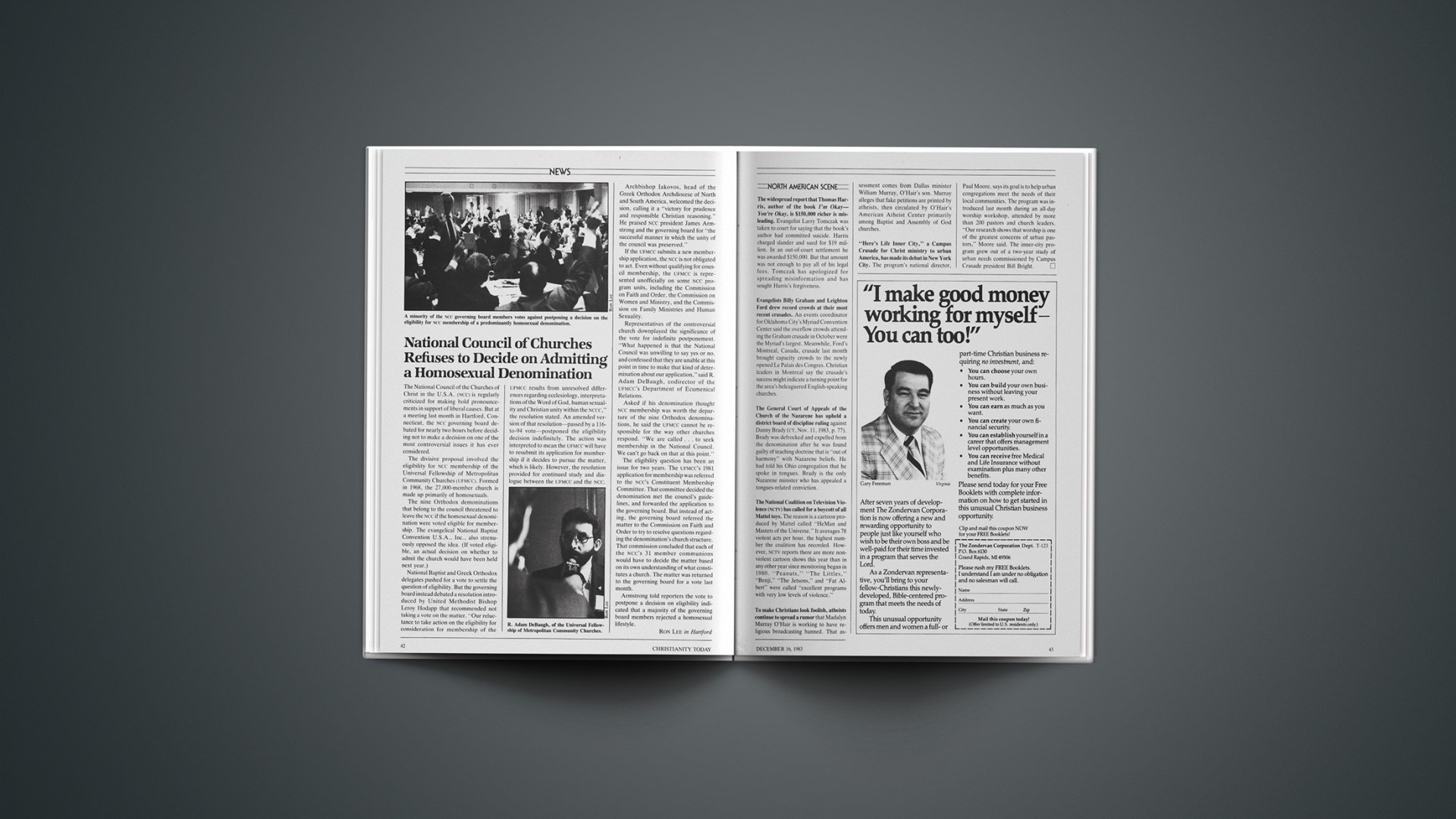
National Council of Churches Refuses to Decide on Admitting a Homosexual Denomination

The National Council of the Churches of Christ in the U.S.A. (NCC) is regularly criticized for making bold pronouncements in support of liberal causes. But at a meeting last month in Hartford, Connecticut, the NCC governing board debated for nearly two hours before deciding not to make a decision on one of the most controversial issues it has ever considered.

The divisive proposal involved the eligibility for NCC membership of the Universal Fellowship of Metropolitan Community Churches (UFMCC). Formed in 1968, the 27,000-member church is made up primarily of homosexuals.

The nine Orthodox demoninations that belong to the council threatened to leave the NCC if the homosexual denomination were voted eligible for membership. The evangelical National Baptist Convention U.S.A., Inc., also strenuously opposed the idea. (If voted eligible, an actual decision on whether to admit the church would have been held next year.)

National Baptist and Greek Orthodox delegates pushed for a vote to settle the question of eligibility. But the governing board instead debated a resolution introduced by United Methodist Bishop Leroy Hodapp that recommended not taking a vote on the matter. “Our reluctance to take action on the eligibility for consideration for membership of the UFMCC results from unresolved differences regarding ecclesiology, interpretations of the Word of God, human sexuality and Christian unity within the NCCC,” the resolution stated. An amended version of that resolution—passed by a 116-to-94 vote—postponed the eligibility decision indefinitely. The action was interpreted to mean the UFMCC will have to resubmit its application for membership if it decides to pursue the matter, which is likely. However, the resolution provided for continued study and dialogue between the UFMCC and the NCC.

Archbishop Iakovos, head of the Greek Orthodox Archdiocese of North and South America, welcomed the decision, calling it a “victory for prudence and responsible Christian reasoning.” He praised NCC president James Armstrong and the governing board for “the successful manner in which the unity of the council was preserved.”

If the UFMCC submits a new membership application, the NCC is not obligated to act. Even without qualifying for council membership, the UFMCC is represented unofficially on some NCC program units, including the Commission on Faith and Order, the Commission on Women and Ministry, and the Commission on Family Ministries and Human Sexuality.

Representatives of the controversial church downplayed the significance of the vote for indefinite postponement. “What happened is that the National Council was unwilling to say yes or no, and confessed that they are unable at this point in time to make that kind of determination about our application,” said R. Adam DeBaugh, codirector of the UFMCC’S Department of Ecumenical Relations.

Asked if his denomination thought NCC membership was worth the departure of the nine Orthodox denominations, he said the UFMCC cannot be responsible for the way other churches respond. “We are called … to seek membership in the National Council. We can’t go back on that at this point.”

The eligibility question has been an issue for two years. The UFMCC’s 1981 application for membership was referred to the NCC’s Constituent Membership Committee. That committee decided the denomination met the council’s guidelines, and forwarded the application to the governing board. But instead of acting, the governing board referred the matter to the Commission on Faith and Order to try to resolve questions regarding the denomination’s church structure. That commission concluded that each of the NCC’s 31 member communions would have to decide the matter based on its own understanding of what constitutes a church. The matter was returned to the governing board for a vote last month.

Armstrong told reporters the vote to postpone a decision on eligibility indicated that a majority of the governing board members rejected a homosexual lifestyle.

RON LEEin Hartford

The widespread report that Thomas Harris, author of the book I’m Okay—You’re Okay, is $150,000 richer is misleading. Evangelist Larry Tomczak was taken to court for saying that the book’s author had committed suicide. Harris charged slander and sued for $19 million. In an out-of-court settlement he was awarded $150,000. But that amount was not enough to pay all of his legal fees. Tomczak has apologized for spreading misinformation and has sought Harris’s forgiveness.

Evangelists Billy Graham and Leighton Ford drew record crowds at their most recent crusades. An events coordinator for Oklahoma City’s Myriad Convention Center said the overflow crowds attending the Graham crusade in October were the Myriad’s largest. Meanwhile, Ford’s Montreal, Canada, crusade last month brought capacity crowds to the newly opened Le Palais des Congres. Christian leaders in Montreal say the crusade’s success might indicate a turning point for the area’s beleaguered English-speaking churches.

The General Court of Appeals of the Church of the Nazarene has upheld a district board of discipline ruling against Danny Brady (CT, Nov. 11, 1983, p. 77). Brady was defrocked and expelled from the denomination after he was found guilty of teaching doctrine that is “out of harmony” with Nazarene beliefs. He had told his Ohio congregation that he spoke in tongues. Brady is the only Nazarene minister who has appealed a tongues-related conviction.

The National Coalition on Television Violence (NCTV) has called for a boycott of all Mattel toys. The reason is a cartoon produced by Mattel called “HeMan and Masters of the Universe.” It averages 78 violent acts per hour, the highest number the coalition has recorded. However, NCTV reports there are more nonviolent cartoon shows this year than in any other year since monitoring began in 1980. “Peanuts,” “The Littles,” “Benji,” “The Jetsons,” and “Fat Albert” were called “excellent programs with very low levels of violence.”

To make Christians look foolish, atheists continue to spread a rumor that Madalyn Murray O’Hair is working to have religious broadcasting banned. That assessment comes from Dallas minister William Murray, O’Hair’s son. Murray alleges that fake petitions are printed by atheists, then circulated by O’Hair’s American Atheist Center primarily among Baptist and Assembly of God churches.

“Here’s Life Inner City,” a Campus Crusade for Christ ministry to urban America, has made its debut in New York City. The program’s national director, Paul Moore, says its goal is to help urban congregations meet the needs of their local communities. The program was introduced last month during an all-day worship workshop, attended by more than 200 pastors and church leaders. “Our research shows that worship is one of the greatest concerns of urban pastors,” Moore said. The inner-city program grew out of a two-year study of urban needs commissioned by Campus Crusade president Bill Bright.

NCC’s Bisexual Lectionary Brings More Problems

A new inclusive-language lectionary, funded by a division of the National Council of the Churches of Christ in the U.S.A. (NCC), is encountering a storm of protest.

During last month’s meeting of the NCC’s governing board, a caucus of Orthodox delegates disavowed the lectionary, calling it “a new apocryphal canon.” The Orthodox delegates asked the governing board to pass a resolution that would make it clear that the lectionary was “produced only by a committee of interested groups and individuals” and that the translation “is neither a product nor a consensus” of the NCC. Last month’s meeting was the first opportunity for governing board members to raise questions about the document.

The lectionary—Scripture readings for use in public worship—attempts to eliminate what translation committee members call “male bias” in Scripture. The Orthodox delegates agreed that the generic Greek word anthropos, often translated as “man” in English Bibles, can accurately be rendered as “person” or “human being.” But they said the lectionary goes too far in its attempts to remove male bias.

Any change in the biblical text that refers to God as both male and female implies “a false theology and substantially alters crucial biblical witness to the church’s understanding of God—Father, Son, and Holy Spirit,” the Orthodox statement said. In response to the Orthodox appeal, the governing board approved a resolution that recognized “divisions within and among” NCC member communions regarding the project. Besides the Orthodox church’s opposition, the head of the NCC-affiliated Lutheran Church in America advised his denomination against using it. Recently, NCC headquarters in New York City received a death threat against members of the lectionary committee.

The lectionary was produced by an 11-member committee appointed by the NCC’s Division of Education and Ministry. It is intended for voluntary and experimental use, and did not require approval of the governing board.

Much of the controversy (CT, Nov. 11, 1983, p. 50) revolves around such references to God as “Father (and Mother)”: the substitution of “Sovereign One” for “Lord”; and “the Human One” for “the Son of Man.” Lectionary committee members at the governing board meeting defended their translation as a document in which “the whole congregation is being addressed in its Scripture.”

Committee member Burton Throckmorton. Jr., professor of New Testament at the Bangor (Maine) Theological Seminary, and a minister in the Presbyterian Church (U.S.A.), expressed a view that departs even further from traditional understandings of the written Word of God.

“The Scripture is the church’s book. It was written by the church [and] for the church,” Throckmorton said. “There’s no reason … that I can see why the church can’t add to its Scripture—delete from its Scripture. I think the church can do with its Scripture what it wants to [do] with its Scripture.”

The Division of Education and Ministry so far has spent about $25,000 on the lectionary project. David Ng, head of the agency, said sales of the lectionary are projected to recoup that investment within three to four years.

The lectionary includes readings for “Year A” of a three-year cycle. Two more editions—for years B and C—are being prepared by the committee. By 1985, when the project is completed, some 95 percent of the New Testament and 60 percent of the Old Testament will have been retranslated.

Another Adventist Scholar Is in Jeopardy over Ellen White

Nobody except his academic review committee at Johns Hopkins University would read Ronald Graybill’s doctoral dissertation on Ellen White for at least five years. Or so he thought. In August, two copies were released by mistake, and now Graybill is in danger of losing his job as associate secretary of the Seventh-day Adventist Church’s Ellen G. White Foundation.

The central controversy in the Adventist church is summarized by the words “Ellen White.” (CT, March 18, 1983). Revisionist Adventists, including most of the church’s theologians, contend that the founder and prophet of Adventism would not approve of the high authority her writings are accorded in church circles today.

Before she died in 1915, White established the foundation that bears her name for the purpose of controlling her writings and distributing her assets.

Partly because of his high position with the White Foundation, Graybill was thought to hold a traditional view of White. His dissertation has challenged that perception. Last month he was ordered by the foundation’s board of trustees to take an administrative leave of absence.

In his dissertation, Graybill excerpts from her personal letters, some of which have never been published. He discusses the problems White had with her husband and children.

Whereas conservative Adventists have cited White’s meager formal education as evidence that her writings were inspired, Graybill shows that she may have been better educated and simply more intelligent than most have realized. In short, Graybill’s account has spawned the notion that he is the latest prominent Seventh-day Adventist to come out of the closet against Ellen White.

But Graybill says it’s not true. “People who think I’m repudiating what I’ve stood for, or breaking with the church or with the estate,” he says, “are wrong.”

Graybill explains that he was writing for a secular reviewing committee at Johns Hopkins. Thus, the dissertation was “written consciously from a nonsupernaturalistic perspective.”

Because he planned to elaborate on the doctrinal implications of his work, Graybill arranged with University Microfilms, a storehouse for dissertations from major universities, not to release the manuscript for five years. The organization has apologized to Graybill for violating the agreement.

“I’ve written an incomplete statement,” Graybill says. “But there’s nothing in it that’s inconsistent with the [Adventist] church’s understanding of Ellen White.” That’s what Graybill now has to prove to the foundation’s board of trustees.

Graybill’s ordination is not at stake, unlike the cases of other Adventists who have spoken against church doctrine. “Nobody feels that Ron is a disloyal Adventist,” says Kenneth Wood, chairman of the foundation’s board. “The issue is whether he can continue as a credible representative of the White estate.” Graybill damaged his credibility by violating foundation procedures for the release of White’s writings. Wood says he realizes Graybill did not intend for the dissertation to be made public until 1988, but the reality is that a large segment of the Adventist church has been exposed to what Graybill wrote.

Douglas Hackleman, editor of the magazine Adventist Currents, which holds the nontraditional view of White, calls the issue of Graybill’s procedural violations a “red herring.” “The real problem,” Hackleman says, “is that for most Adventists, the dissertation will have the effect of demythologizing Ellen White.” Hackleman asserts that a decision by the foundation not to retain Graybill would testify to its tendencies to hide the facts about White.

Amway Fined $25 Million in Canadian Fraud

“Accountability is the glue that holds the society together. It is the common agreement by the members of any society that they will be responsible for their dealings with one another. Accountability is having to answer to someone for what one does,” wrote Richard DeVos (Believe!, Revell, 1975).

Chief Justice Gregory Evans of the Supreme Court of Ontario, Canada, apparently agreed with that contention. On November 10, he levied a fine of $25 million dollars against the Amway Corporation, and Amway of Canada, Ltd. DeVos is president and cofounder of the Amway empire.

The firm has acquired a Christian image and enlisted many Christians among its one million international distributors. The fine levied against it was the largest in Canadian history and, according to court documents, was imposed to penalize the firm for the largest fraud in Canada’s history.

The police investigations revealed that Amway had defrauded the government of as much as $148 million dollars of customs charges between 1965 and 1982. The Crown attorney told the court that the company had been cheating the Canadian government and lying to Canadian customs officials on “almost a daily basis” during that period.

It had been expected that the case would involve a lengthy trial because Amway officials initially had insisted the firm was not guilty. The guilty plea came as a surprise. The final statement, signed by DeVos and Amway chairman Jay Van Andel, stated that the two officials and the company “assumed full responsibility for the acts of all officials or agents of the corporation and their declarations made to Canada Customs and their agents.”

DeVos and Van Andel admitted that “they were acting illegally and beyond the scope of their legitimate and lawful authority.”

In return for the guilty plea, the Canadian government dropped personal charges against DeVos, Van Andel, and two other Amway officials. The government, however, is seeking a further $148 million for recovery of customs revenue from the firm through civil actions.

Otto Stolz, Amway vice-president and general counsel, was present at the Supreme Court hearing in Toronto. He told reporters that Amway’s co-owners and executives “were filled with remorse,” but that Amway still regarded the fraud as little more than a “misunderstanding.”

“The provisions of the Customs Act are extremely complex,” Stolz told the newspeople “They [Amway officials] referred the whole matter to their legal advisers, and they relied on the advice they received.”

The company’s published statement insisted on offering that explanation of inadequate legal advice, adding that legal costs in the case were running $2 million annually.

But Crown attorney Paul Lindsay contended that the fraud was a direct result of company policy. The government’s case documented an elaborate customs scam that involved a web of fictitious invoices and price lists at a dummy company to conceal the fraud. Amway’s auditors objected to the scheme, and the company’s chief financial officer had resigned in protest, but the dimensions of the operation began to emerge only when, in 1979, Amway’s customs broker resigned in protest and, as required by law, reported the company’s noncompliance with customs regulations. Lindsay contended that DeVos and Van Andel were intimately involved with most of the arrangements. Chief Justice Gregory Evans described the company’s guilty plea as a “deathbed confession of guilt.”

After the legal settlement was disclosed, Amway ran a full-page advertisement in several newspapers, in defense of its executives. It read in part: “Why … would Amway pay a large fine and let its lawyers submit a statement describing past company mistakes in harsh terms? For 15 years, Amway management relied in good faith on their understanding that an agreement had been reached in 1965 with two Canadian customs officials. Amway’s cofounders relied consistently upon the advice of various responsible corporate officers and legal counselors that the agreement existed and that the company was acting in full compliance with the law. The Canadian authorities now assert that their understanding of the events in 1965 differs significantly from that of the Amway officials who participated at that time.”

Amway was founded in 1959 by DeVos and Van Andel, and the Canadian company was incorporated in 1962. The international corporation has had phenomenal growth and now has 7,000 employees and about one million distributors. The firm has extensive holdings, including ownership of Mutual Broadcasting Company, the world’s largest radio network. DeVos is a personal friend of President Reagan and was, until last year, finance chairman of the Republican National Committee.

A member of the Christian Reformed Church, he has identified himself with the evangelical cause. “I am a Christian by faith and by experience,” he stated in Believe!, “and in no aspect of my life can I make major decisions or take positions which are not compatible with my discipleship.”

LES TARRin Toronto

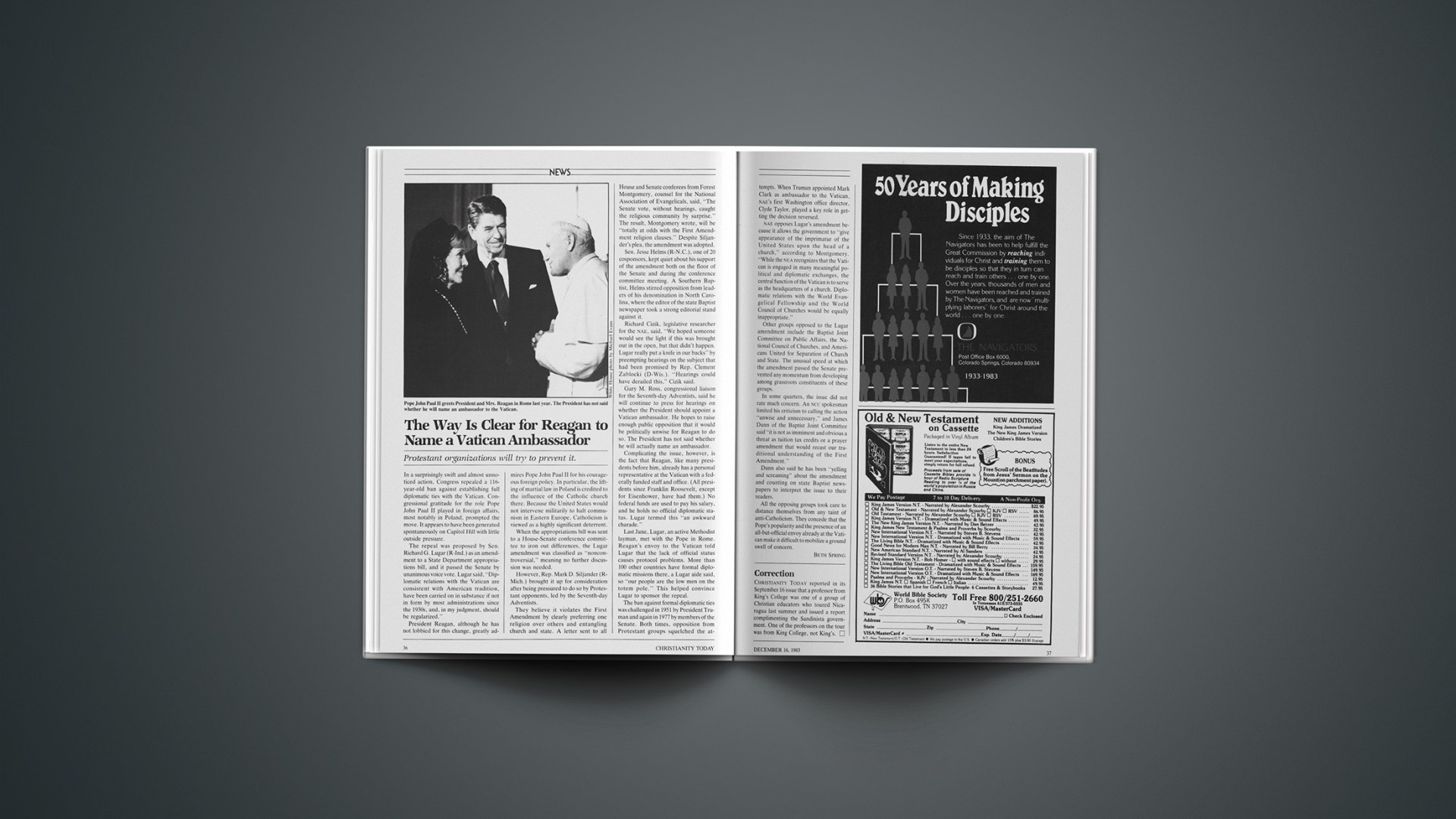
The Way Is Clear for Reagan to Name a Vatican Ambassador

Protestant organizations will try to prevent it.

In a surprisingly swift and almost unnoticed action. Congress repealed a 116-year-old ban against establishing full diplomatic ties with the Vatican. Congressional gratitude for the role Pope John Paul II played in foreign affairs, most notably in Poland, prompted the move. It appears to have been generated spontaneously on Capitol Hill with little outside pressure.

The repeal was proposed by Sen. Richard G. Lugar (R-Ind.) as an amendment to a State Department appropriations bill, and it passed the Senate by unanimous voice vote. Lugar said, “Diplomatic relations with the Vatican are consistent with American tradition, have been carried on in substance if not in form by most administrations since the 1930s, and, in my judgment, should be regularized.”

President Reagan, although he has not lobbied for this change, greatly admires Pope John Paul II for his courageous foreign policy. In particular, the lifting of martial law in Poland is credited to the influence of the Catholic church there. Because the United States would not intervene militarily to halt communism in Eastern Europe, Catholicism is viewed as a highly significant deterrent.

When the appropriations bill was sent to a House-Senate conference committee to iron out differences, the Lugar amendment was classified as “noncontroversial,” meaning no further discussion was needed.

However, Rep. Mark D. Siljander (R-Mich.) brought it up for consideration after being pressured to do so by Protestant opponents, led by the Seventh-day Adventists.

They believe it violates the First Amendment by clearly preferring one religion over others and entangling church and state. A letter sent to all House and Senate conferees from Forest Montgomery, counsel for the National Association of Evangelicals, said, “The Senate vote, without hearings, caught the religious community by surprise.” The result, Montgomery wrote, will be “totally at odds with the First Amendment religion clauses.” Despite Siljander’s plea, the amendment was adopted.

Sen. Jesse Helms (R-N.C.), one of 20 cosponsors, kept quiet about his support of the amendment both on the floor of the Senate and during the conference committee meeting. A Southern Baptist, Helms stirred opposition from leaders of his denomination in North Carolina, where the editor of the state Baptist newspaper took a strong editorial stand against it.

Richard Cizik, legislative researcher for the NAE, said, “We hoped someone would see the light if this was brought out in the open, but that didn’t happen. Lugar really put a knife in our backs” by preempting hearings on the subject that had been promised by Rep. Clement Zablocki (D-Wis.). “Hearings could have derailed this,” Cizik said.

Gary M. Ross, congressional liaison for the Seventh-day Adventists, said he will continue to press for hearings on whether the President should appoint a Vatican ambassador. He hopes to raise enough public opposition that it would be politically unwise for Reagan to do so. The President has not said whether he will actually name an ambassador.

Complicating the issue, however, is the fact that Reagan, like many presidents before him, already has a personal representative at the Vatican with a federally funded staff and office. (All presidents since Franklin Roosevelt, except for Eisenhower, have had them.) No federal funds are used to pay his salary, and he holds no official diplomatic status. Lugar termed this “an awkward charade.”

Last June, Lugar, an active Methodist layman, met with the Pope in Rome. Reagan’s envoy to the Vatican told Lugar that the lack of official status causes protocol problems. More than 100 other countries have formal diplomatic missions there, a Lugar aide said, so “our people are the low men on the totem pole.” This helped convince Lugar to sponsor the repeal.

The ban against formal diplomatic ties was challenged in 1951 by President Truman and again in 1977 by members of the Senate. Both times, opposition from Protestant groups squelched the attempts. When Truman appointed Mark Clark as ambassador to the Vatican, NAE’s first Washington office director, Clyde Taylor, played a key role in getting the decision reversed.

NAE opposes Lugar’s amendment because it allows the government to “give appearance of the imprimatur of the United States upon the head of a church,” according to Montgomery. “While the NEA recognizes that the Vatican is engaged in many meaningful political and diplomatic exchanges, the central function of the Vatican is to serve as the headquarters of a church. Diplomatic relations with the World Evangelical Fellowship and the World Council of Churches would be equally inappropriate.”

Other groups opposed to the Lugar amendment include the Baptist Joint Committee on Public Affairs, the National Council of Churches, and Americans United for Separation of Church and State. The unusual speed at which the amendment passed the Senate prevented any momentum from developing among grassroots constituents of these groups.

In some quarters, the issue did not rate much concern. An NCC spokesman limited his criticism to calling the action “unwise and unnecessary,” and James Dunn of the Baptist Joint Committee said “it is not as immiment and obvious a threat as tuition tax credits or a prayer amendment that would recast our traditional understanding of the First Amendment.”

Dunn also said he has been “yelling and screaming” about the amendment and counting on state Baptist newspapers to interpret the issue to their readers.

All the opposing groups took care to distance themselves from any taint of anti-Catholicism. They concede that the Pope’s popularity and the presence of an all-but-official envoy already at the Vatican make it difficult to mobilize a ground swell of concern.

BETH SPRING

Correction

Christianity Today reported in its September 16 issue that a professor from King’s College was one of a group of Christian educators who toured Nicaragua last summer and issued a report complimenting the Sandinista government. One of the professors on the tour was from King College, not King’s.

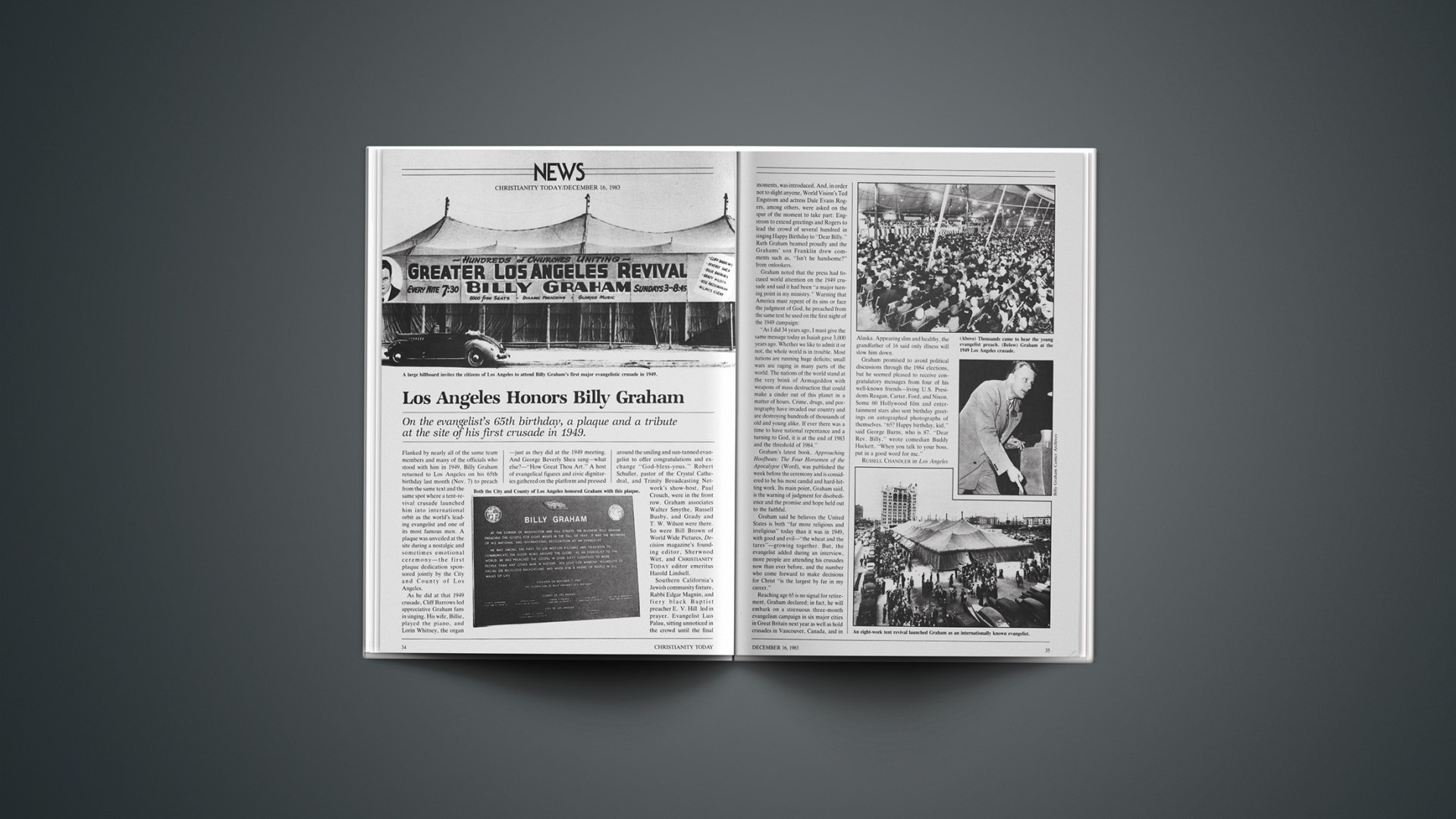
Los Angeles Honors Billy Graham

On the evangelist’s 65th birthday, a plaque and a tribute at the site of his first crusade in 1949.

Flanked by nearly all of the same team members and many of the officials who stood with him in 1949, Billy Graham returned to Los Angeles on his 65th birthday last month (Nov. 7) to preach from the same text and the same spot where a tent-revival crusade launched him into international orbit as the world’s leading evangelist and one of its most famous men. A plaque was unveiled at the site during a nostalgic and sometimes emotional ceremony—the first plaque dedication sponsored jointly by the City and County of Los Angeles.

As he did at that 1949 crusade, Cliff Barrows led appreciative Graham fans in singing. His wife, Billie, played the piano, and Lorin Whitney, the organ—just as they did at the 1949 meeting. And George Beverly Shea sang—what else?—“How Great Thou Art.” A host of evangelical figures and civic dignitaries gathered on the platform and pressed around the smiling and sun-tanned evangelist to offer congratulations and exchange “God-bless-yous.” Robert Schuller, pastor of the Crystal Cathedral, and Trinity Broadcasting Network’s show-host, Paul Crouch, were in the front row. Graham associates Walter Smythe, Russell Busby, and Grady and T. W. Wilson were there. So were Bill Brown of World Wide Pictures, Decision magazine’s founding editor, Sherwood Wirt, and CHRISTIANITY TODAY editor emeritus Harold Lindsell.

Southern California’s Jewish community fixture, Rabbi Edgar Magnin, and fiery black Baptist preacher E. V. Hill led in prayer. Evangelist Luis Palau, sitting unnoticed in the crowd until the final moments, was introduced. And, in order not to slight anyone, World Vision’s Ted Engstrom and actress Dale Evans Rogers, among others, were asked on the spur of the moment to take part: Engstrom to extend greetings and Rogers to lead the crowd of several hundred in singing Happy Birthday to “Dear Billy.” Ruth Graham beamed proudly and the Grahams’ son Franklin drew comments such as, “Isn’t he handsome?” from onlookers.

Graham noted that the press had focused world attention on the 1949 crusade and said it had been “a major turning point in my ministry.” Warning that America must repent of its sins or face the judgment of God, he preached from the same text he used on the first night of the 1949 campaign:

“As I did 34 years ago, I must give the same message today as Isaiah gave 3,000 years ago. Whether we like to admit it or not, the whole world is in trouble. Most nations are running huge deficits; small wars are raging in many parts of the world. The nations of the world stand at the very brink of Armageddon with weapons of mass destruction that could make a cinder out of this planet in a matter of hours. Crime, drugs, and pornography have invaded our country and are destroying hundreds of thousands of old and young alike. If ever there was a time to have national repentance and a turning to God, it is at the end of 1983 and the threshold of 1984.”

Graham’s latest book, Approaching Hoofbeats: The Four Horsemen of the Apocalypse (Word), was published the week before the ceremony and is considered to be his most candid and hard-hitting work. Its main point, Graham said, is the warning of judgment for disobedience and the promise and hope held out to the faithful.

Graham said he believes the United States is both “far more religious and irreligious” today than it was in 1949, with good and evil—“the wheat and the tares”—growing together. But, the evangelist added during an interview, more people are attending his crusades now than ever before, and the number who come forward to make decisions for Christ “is the largest by far in my career.”

Reaching age 65 is no signal for retirement, Graham declared; in fact, he will embark on a strenuous three-month evangelism campaign in six major cities in Great Britain next year as well as hold crusades in Vancouver, Canada, and in Alaska. Appearing slim and healthy, the grandfather of 16 said only illness will slow him down.

Graham promised to avoid political discussions through the 1984 elections, but he seemed pleased to receive congratulatory messages from four of his well-known friends—living U.S. Presidents Reagan, Carter, Ford, and Nixon. Some 60 Hollywood film and entertainment stars also sent birthday greetings on autographed photographs of themselves. “65? Happy birthday, kid,” said George Burns, who is 87. “Dear Rev. Billy,” wrote comedian Buddy Hackett, “When you talk to your boss, put in a good word for me.”

RUSSELL CHANDLER in Los Angeles

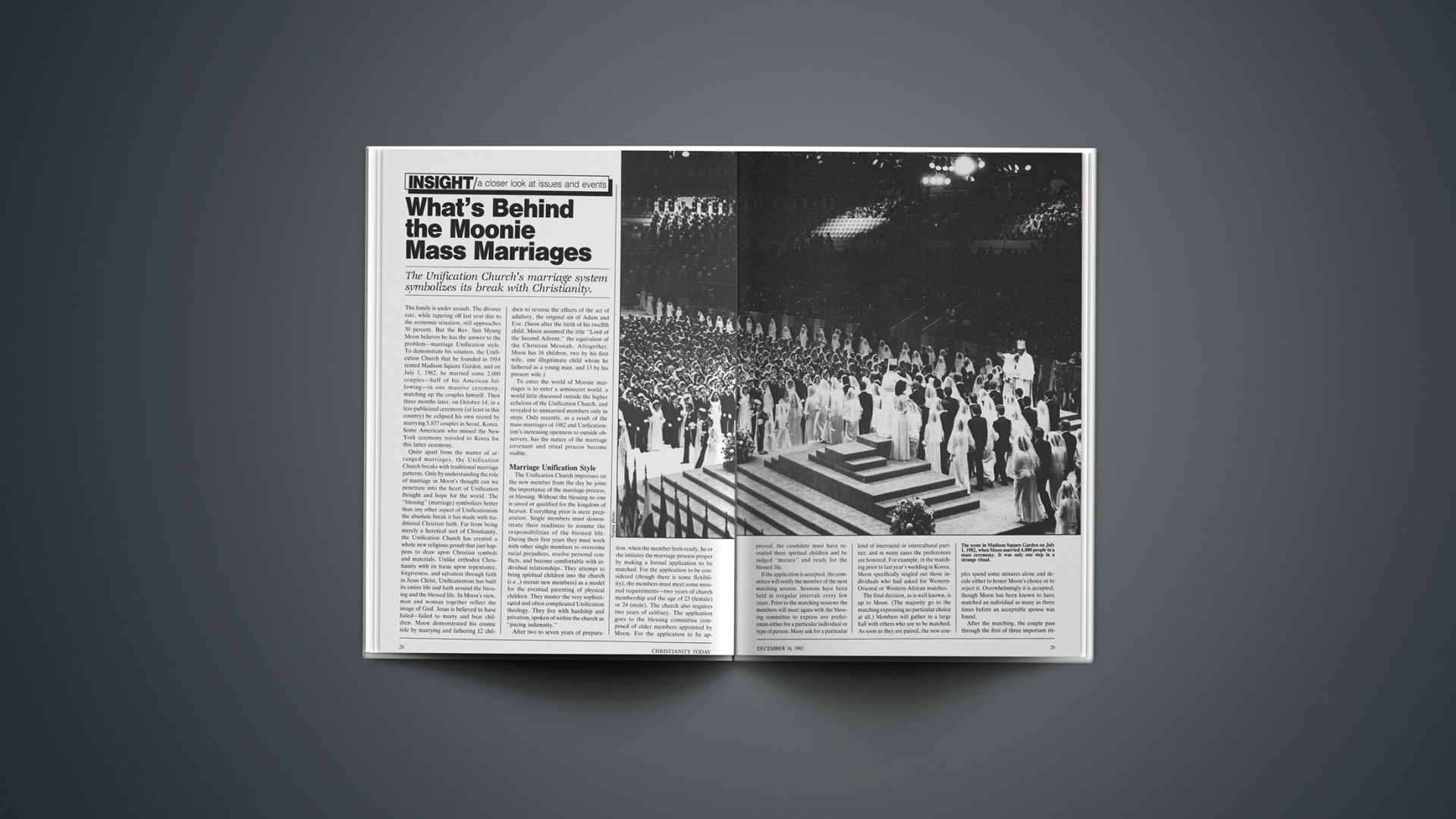
What’s behind the Moonie Mass Marriages

The Unification Church’s marriage system symbolizes its break with Christianity.

The family is under assault. The divorce rate, while tapering off last year due to the economic situation, still approaches 50 percent. But the Rev. Sun Myung Moon believes he has the answer to the problem—marriage Unification style. To demonstrate his solution, the Unification Church that he founded in 1954 rented Madison Square Garden, and on July 1, 1982, he married some 2,000 couples—half of his American following—in one massive ceremony, matching up the couples himself. Then three months later, on October 14, in a less-publicized ceremony (at least in this country) he eclipsed his own record by marrying 5,837 couples in Seoul, Korea. Some Americans who missed the New York ceremony traveled to Korea for this latter ceremony.

Quite apart from the matter of arranged marriages, the Unification Church breaks with traditional marriage patterns. Only by understanding the role of marriage in Moon’s thought can we penetrate into the heart of Unification thought and hope for the world. The “blessing” (marriage) symbolizes better than any other aspect of Unificationism the absolute break it has made with traditional Christian faith. Far from being merely a heretical sect of Christianity, the Unification Church has created a whole new religious gestalt that just happens to draw upon Christian symbols and materials. Unlike orthodox Christianity with its focus upon repentance, forgiveness, and salvation through faith in Jesus Christ, Unificationism has built its entire life and faith around the blessing and the blessed life. In Moon’s view, man and woman together reflect the image of God. Jesus is believed to have failed—failed to marry and bear children. Moon demonstrated his cosmic role by marrying and fathering 12 children to reverse the effects of the act of adultery, the original sin of Adam and Eve. (Soon after the birth of his twelfth child, Moon assumed the title “Lord of the Second Advent,” the equivalent of the Christian Messiah. Altogether, Moon has 16 children, two by his first wife, one illegitimate child whom he fathered as a young man, and 13 by his present wife.)

To enter the world of Moonie marriages is to enter a semisecret world, a world little discussed outside the higher echelons of the Unification Church, and revealed to unmarried members only in steps. Only recently, as a result of the mass marriages of 1982 and Unificationism’s increasing openness to outside observers, has the nature of the marriage covenant and ritual process become visible.

Marriage Unification Style

The Unification Church impresses on the new member from the day he joins the importance of the marriage process, or blessing. Without the blessing no one is saved or qualified for the kingdom of heaven. Everything prior is mere preparation. Single members must demonstrate their readiness to assume the responsibilities of the blessed life. During their first years they must work with other single members to overcome racial prejudices, resolve personal conflicts, and become comfortable with individual relationships. They attempt to bring spiritual children into the church (i.e.,) recruit new members) as a model for the eventual parenting of physical children. They master the very sophisticated and often complicated Unification theology. They live with hardship and privation, spoken of within the church as “paying indemnity.”

After two to seven years of preparation, when the member feels ready, he or she initiates the marriage process proper by making a formal application to be matched. For the application to be considered (though there is some flexibility), the members must meet some minimal requirements—two years of church membership and the age of 23 (female) or 24 (male). The church also requires two years of celibacy. The application goes to the blessing committee composed of older members appointed by Moon. For the application to be approved, the candidate must have recruited three spiritual children and be judged “mature” and ready for the blessed life.

If the application is accepted, the committee will notify the member of the next matching session. Sessions have been held at irregular intervals every few years. Prior to the matching sessions the members will meet again with the blessing committee to express any preferences either for a particular individual or type of person. Many ask for a particular kind of interracial or intercultural partner, and in many cases the preferences are honored. For example, in the matching prior to last year’s wedding in Korea, Moon specifically singled out those individuals who had asked for Western-Oriental or Western-African matches.

The final decision, as is well known, is up to Moon. (The majority go to the matching expressing no particular choice at all.) Members will gather in a large hall with others who are to be matched. As soon as they are paired, the new couples spend some minutes alone and decide either to honor Moon’s choice or to reject it. Overwhelmingly it is accepted, though Moon has been known to have matched an individual as many as three times before an acceptable spouse was found.

After the matching, the couple pass through the first of three important rituals in the blessing process. In Unification theology, the wine ceremony, the closest parallel in the Unification Church to the Lord’s Supper or Eucharist, begins the reversal of the Eden events. It changes the satanic blood lineage of the couple and restores them to the heavenly lineage Adam and Eve had before the Fall. In the wine mixture, which contains over 20 ingredients and takes three years to prepare, is blood from Moon and his wife. The women receive the cup first. Since Eve fell before Adam, the women are the first to be restored. They lead their husbands-to-be in that restoration. Also, after this ceremony until the marriage is consummated, the men view their future spouses as “mother” figures who lead them to their full status in the kingdom. The wine ceremony binds the couple as surely as marriage. The bond can only be broken by one partner’s leaving the church or committing adultery.

After the engagement (except in those cases that occur immediately before a blessing ceremony), the couple separate and build their relationship through letters, phone calls, and occasional visits. The church is quite explicit about the subordination of romantic love to the larger goal of sharing a spiritual relationship to God, Moon, the church, and the creation of a stable home. The engagement may last for a few days or a few years. Many of those who participated in the 1982 blessings were matched just days before the ceremony.

The second major step in the marriage process is the blessing ceremony itself, in which vows are taken in public. Moon, as God’s representative, conveys God’s blessing on the union. This is the ceremony that was held in Madison Square Garden.

Although couples reach the high point of the process in the blessing ceremony, it is by no means the end of the procedure. In spite of what has been said about the ceremony, it was not even a legal wedding for the majority of those who participated. Until recently. Moon had not gone through the formality of obtaining a license to marry (required of all ministers in New York City), and until 1982 none of the “blessings” he performed in America were legal marriages. The several licensed ministers in the church performed a private ceremony, or the couple sought out a justice of the peace to make the wedding legal. Many couples in the 1982 blessing “married” several years ago (though they followed the church’s rules against cohabitation), especially in cases in which a marriage could stop an attempted deprogramming. Many other individuals (and almost half of the participants in the July 1 wedding flew in from out of the country to participate) did not arrive in time to get the legal papers (license, blood test, etc.) required for a legal marriage. A few couples are not legally married even yet.

But for those who came out of the blessing ceremony legally married, the final stage had begun. The day after the ceremony they gathered with one of the church’s older members for a lengthy lecture. For example, many of the seminary students listened to David S. C. Kim, the president of the Unification Theological Seminary. He explained that they were to begin a 40-day separation period to allow for some prayerful meditation on the seriousness of the blessed life. After the 40 days, if all other requirements had been met, the couple would consummate the marriage in a private three-day ceremony. This ceremony also completes the restoration to pre-Adamic conditions. The ceremony begins with the acknowledgment of the woman as dominant—the relationship assumed at the wine ceremony—but ends with the man assuming the dominant role he will have as head of the family.

Having finished the blessing process, the couple is ready to found a home and raise a family. It is at this point that the church has failed to live up to some expectations. Many couples looked forward to a home life resembling their image of normalcy—an apartment, a job, family life. However, the ideal Unification marriage is an ordered existence in which leisure time is given in service to the church and world.

Many couples accept this idea. Kevin Barbazon, who lives and works with his wife, Maria, in Harlem in New York City, says, “I can see that our struggles actually pulled Maria and I very close. Rather like the early pioneers in America who fought it out together!”

When such service requires a spouse to undertake a mission across the country or even around the world, tremendous strain is placed on the most stable, happy home. The loss of some prominent married members for just that reason has led the church to cut the practice to a minimum.

Living The Blessed Life

A full year has passed since the marriage of the 4,000 in New York and 10,000 in Korea. What has happened to the church since then? The immediate effect was disastrous. The marriage of half of the church’s American membership in July disrupted its life at every level. As members turned their attention to marriage and spouse and the practical problems of setting up homes, they neglected the day-to-day maintenance of the church. (Church members are expected to work for the church in exchange for small stipends, or to work elsewhere and donate all but their living expenses to the church.)

The cash flow was so disturbed that the World Mission Center (the former New Yorker Hotel) was closed during the hard winter weeks to save fuel costs. I visited the center last December and found it more like a tomb than a beehive of activity, which it customarily is. Program budgets were cut to the minimum, and a recovery did not occur until the spring of 1983. The long-term effects of the blessings may well be more positive for the church. Prior to 1982 it had relatively few Americans who had been through the entire blessing process and who could testify to the reality of the blessed life. It now has a firm foundation upon which to move into the next generation.

Married couples, previously bonded by their experiences as singles, now share a common wedding date, so they can join together for large anniversary parties. In the spring of 1983 the first babies from the 1982 blessings arrived. The church heralds each newborn with a picture in the Blessing Quarterly, a church journal for married couples only. Couples then become even more closely intertwined as together they learn the joys and pains of parenthood.

Will the Unification marriages enable the church to reach its long-term goal of bridging racial, cultural, and national barriers and unifying all people? Only time will tell. However, that success will depend upon the church’s ability to lower the extreme hostility now directed against it.

The weddings’ next accomplishment may be to quell that hostility, based as it is in the anger and hurt of parents who feel the church has taken their children from them. Some parents used the blessing ceremony as the occasion for reestablishing broken relationships. “In our case, what the blessing did not accomplish, the arrival of our first baby did,” one previously blessed couple said.

On Living With The Unification Church

It seems obvious that we need some alternative to the marriage-on-demand/divorce-on-demand pattern within which Western culture has become increasingly trapped. It is also just as obvious that the Unification Church’s utopian option is unworkable for even a significant minority of the public. About 90 percent of those who become Moonies drop out sooner or later. Of those who remain, only one in ten completes the blessing process.

The Unification marriage process is not acceptable as a Christian alternative. Christians would have to abandon the essentials of biblical faith and adopt the Unification Church’s theology before it could begin to make use of the few attractive aspects of the marriage system.

I hope the marriage crisis in our society will be resolved. I am convinced that the churches of Jesus Christ will be a major factor in that solution, not as we move into a utopian and tighter structure, but as we adopt a more realistic attitude toward the pressures on contemporary marriage, provide more support for single adults, and strengthen our educational efforts with the youth under our care.

J. GORDON MELTON

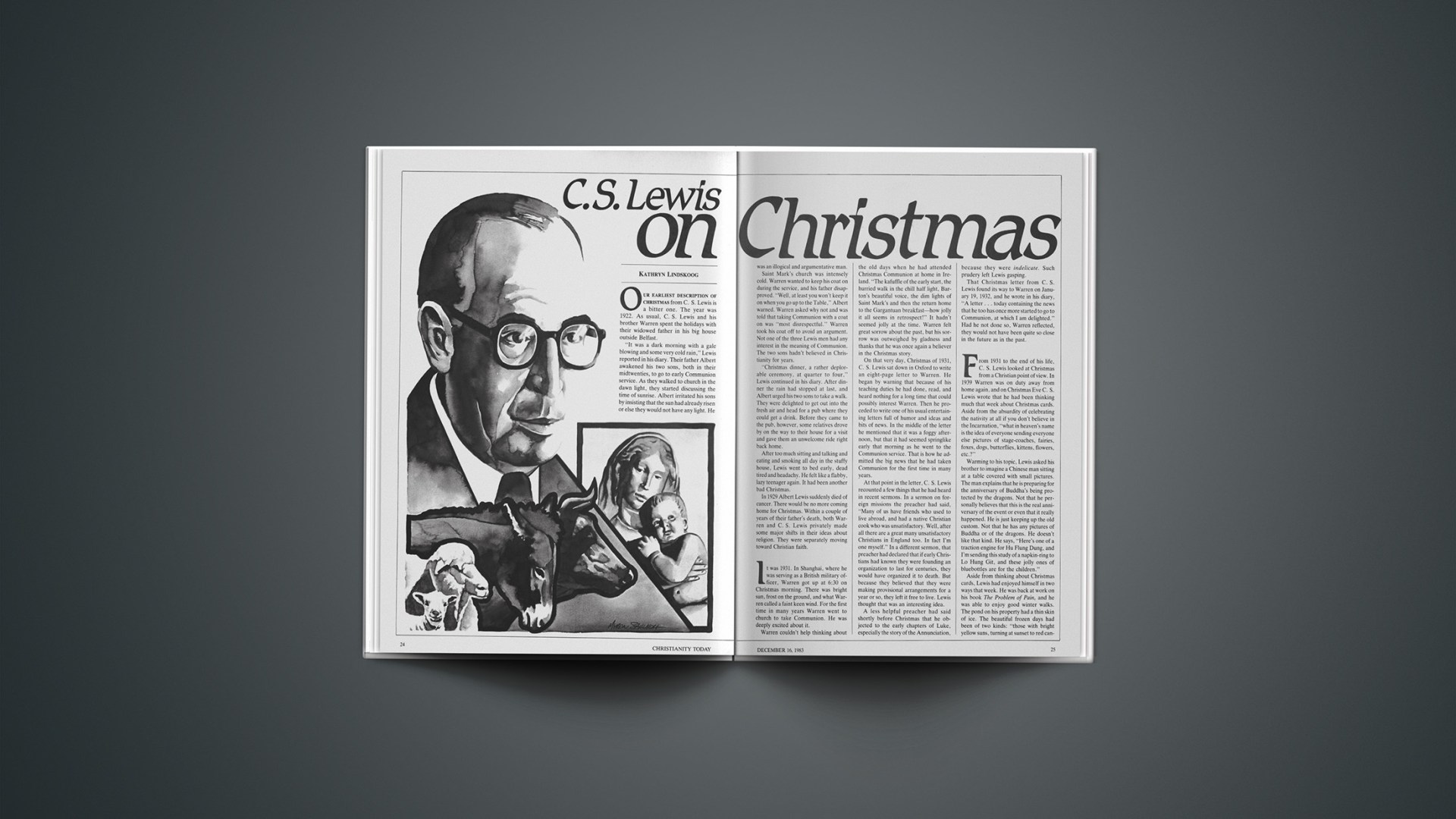
C.S. Lewis on Christmas

Our earliest description of christmas from C. S. Lewis is a bitter one. The year was 1922. As usual, C. S. Lewis and his brother Warren spent the holidays with their widowed father in his big house outside Belfast.

“It was a dark morning with a gale blowing and some very cold rain,” Lewis reported in his diary. Their father Albert awakened his two sons, both in their midtwenties, to go to early Communion service. As they walked to church in the dawn light, they started discussing the time of sunrise. Albert irritated his sons by insisting that the sun had already risen or else they would not have any light. He was an illogical and argumentative man.

Saint Mark’s church was intensely cold. Warren wanted to keep his coat on during the service, and his father disapproved. “Well, at least you won’t keep it on when you go up to the Table,” Albert warned. Warren asked why not and was told that taking Communion with a coat on was “most disrespectful.” Warren took his coat off to avoid an argument. Not one of the three Lewis men had any interest in the meaning of Communion. The two sons hadn’t believed in Christianity for years.

“Christmas dinner, a rather deplorable ceremony, at quarter to four,” Lewis continued in his diary. After dinner the rain had stopped at last, and Albert urged his two sons to take a walk. They were delighted to get out into the fresh air and head for a pub where they could get a drink. Before they came to the pub, however, some relatives drove by on the way to their house for a visit and gave them an unwelcome ride right back home.

After too much sitting and talking and eating and smoking all day in the stuffy house, Lewis went to bed early, dead tired and headachy. He felt like a flabby, lazy teenager again. It had been another bad Christmas.

In 1929 Albert Lewis suddenly died of cancer. There would be no more coming home for Christmas. Within a couple of years of their father’s death, both Warren and C. S. Lewis privately made some major shifts in their ideas about religion. They were separately moving toward Christian faith.

It was 1931. In Shanghai, where he was serving as a British military officer, Warren got up at 6:30 on Christmas morning. There was bright sun, frost on the ground, and what Warren called a faint keen wind. For the first time in many years Warren went to church to take Communion. He was deeply excited about it.

Warren couldn’t help thinking about the old days when he had attended Christmas Communion at home in Ireland. “The kafuffle of the early start, the hurried walk in the chill hal flight, Barton’s beautiful voice, the dim lights of Saint Mark’s and then the return home to the Gargantuan breakfast—how jolly it all seems in retrospect!” It hadn’t seemed jolly at the time. Warren felt great sorrow about the past, but his sorrow was outweighed by gladness and thanks that he was once again a believer in the Christmas story.

On that very day, Christmas of 1931, C. S. Lewis sat down in Oxford to write an eight-page letter to Warren. He began by warning that because of his teaching duties he had done, read, and heard nothing for a long time that could possibly interest Warren. Then he proceded to write one of his usual entertaining letters full of humor and ideas and bits of news. In the middle of the letter he mentioned that it was a foggy afternoon, but that it had seemed springlike early that morning as he went to the Communion service. That is how he admitted the big news that he had taken Communion for the first time in many years.

At that point in the letter, C. S. Lewis recounted a few things that he had heard in recent sermons. In a sermon on foreign missions the preacher had said, “Many of us have friends who used to live abroad, and had a native Christian cook who was unsatisfactory. Well, after all there are a great many unsatisfactory Christians in England too. In fact I’m one myself.” In a different sermon, that preacher had declared that if early Christians had known they were founding an organization to last for centuries, they would have organized it to death. But because they believed that they were making provisional arrangements for a year or so, they left it free to live. Lewis thought that was an interesting idea.

A less helpful preacher had said shortly before Christmas that he objected to the early chapters of Luke, especially the story of the Annunciation, because they were indelicate. Such prudery left Lewis gasping.

That Christmas letter from C. S. Lewis found its way to Warren on January 19, 1932, and he wrote in his diary, “A letter … today containing the news that he too has once more started to go to Communion, at which I am delighted.” Had he not done so, Warren reflected, they would not have been quite so close in the future as in the past.

From 1931 to the end of his life, C. S. Lewis looked at Christmas from a Christian point of view. In 1939 Warren was on duty away from home again, and on Christmas Eve C. S. Lewis wrote that he had been thinking much that week about Christmas cards. Aside from the absurdity of celebrating the nativity at all if you don’t believe in the Incarnation, “what in heaven’s name is the idea of everyone sending everyone else pictures of stage-coaches, fairies, foxes, dogs, butterflies, kittens, flowers, etc.?”

Warming to his topic, Lewis asked his brother to imagine a Chinese man sitting at a table covered with small pictures. The man explains that he is preparing for the anniversary of Buddha’s being protected by the dragons. Not that he personally believes that this is the real anniversary of the event or even that it really happened. He is just keeping up the old custom. Not that he has any pictures of Buddha or of the dragons. He doesn’t like that kind. He says, “Here’s one of a traction engine for Hu Flung Dung, and I’m sending this study of a napkin-ring to Lo Hung Git, and these jolly ones of bluebottles are for the children.”

Aside from thinking about Christmas cards, Lewis had enjoyed himself in two ways that week. He was back at work on his book The Problem of Pain, and he was able to enjoy good winter walks. The pond on his property had a thin skin of ice. The beautiful frozen days had been of two kinds: “those with bright yellow suns, turning at sunset to red cannon balls, and those with deep dark-grey fog through which the ridges of the grass loom up white.” Near the end of his letter he said, “Well, Brother, (as the troops say) it’s a sad business not to have you with me to-morrow morning …” That meant church.

During World War II C. S. Lewis gave a series of talks about Christianity on BBC radio, and later he brought these out as his book Mere Christianity. In that book Lewis summed up Christmas and Christianity in one memorable sentence: “The Son of God became a man to enable men to become the sons of God.”

In his 1950 book for children, The Lion, the Witch and the Wardrobe, Lewis made it clear that he was all for merry times and good gifts and Christmas pudding. The land of Narnia was under the spell of a wicked white witch who made it always winter and never Christmas. When the great gold lion Aslan brought the thaw that spelled her doom, Father Christmas came at last.

In 1954 Lewis published a very different kind of fantasy about Christmas, “Xmas and Christmas.” It is an essay about the strange island called Niatirb (Britain spelled backwards) and the winter festival called Exmas that the Niatirbians observe with great patience and endurance.

One of the customs that fills the marketplace with crowds during the foggiest and rainiest season of the year is the great labor and weariness of sending cards and gifts. Every citizen has to guess the value of the gift that every friend will send him so that he may send one of equal value whether he can afford it or not. Everyone becomes so pale and weary that it looks as if calamity has struck. These days are called the Exmas Rush. Exhausted with the Rush, most citizens lie in bed until noon on the day of the festival. Later that day they eat far too much and get intoxicated. On the day after Exmas they are very grave because they feel unwell and begin to calculate how much they have spent on Exmas and the Rush.

There is also a festival in Niatirb called Crissmas, held on the same day as Exmas. A few people in Niatirb keep Crissmas sacred, but they are greatly distracted by Exmas and the Rush.

On December 17, 1955, Lewis wrote to an old friend that he was pleased by the card the man had sent him, a Japanese-style nativity scene. But, he continued, Christmas cards in general and the whole vast commercial drive called “Xmas” was one of his pet abominations. He wished they would die away and leave the Christmas observance alone. He had nothing against secular festivities. But he despised the artificial jollity, the artificial childlikeness, and the attempts to keep up some shallow connection with the birth of Christ.

In 1957 C. S. Lewis published “What Christmas Means to Me.” He claimed that three things go by the name of Christmas. First is the religious festival. Second is an occasion for merry making and hospitality. Third is the commercial racket, a modern invention to boost sales. He listed his reasons for condemning the commercial racket. First, it causes more pain than pleasure. Second, it is a trap made up of obligations. Third, many of the purchases are gaudy rubbish. Fourth, we get exhausted by having to support the commercial racket while carrying on all our regular duties as well. “Can it really be my duty to buy and receive masses of junk every winter …?” Lewis demanded plaintively.

Two years later C. S. Lewis was featured in the Christmas issue of the Saturday Evening Post. The issue, dated December 19, 1959, bore on its cover a 15-cent price, a picture of a man struggling clumsily to get a package wrapped, and the announcement of a new Screw-tape letter by C. S. Lewis. Inside was a life-size, close-up photo of Lewis’s face and his essay “Screwtape Proposes a Toast.” This was a kind of Christmas gift to the public from the editors.

In 1963 the Saturday Evening Post featured C. S. Lewis in its Christmas issue for the second time. This time the price on the cover was 20 cents and the picture on the cover was of a children’s choir. Inside was Lewis’s article “We Have No ‘Right to Happiness’ ” with the heading, “Is happiness—in particular sexual happiness—one of man’s inalienable rights? A distinguished author attacks the brutality of this increasingly common notion.” In the upper right-hand corner is the announcement, “As this article went to press, its author died at his home in Oxford, England. The article is his last work.”

Since Lewis’s death on November 22, 1963, a number of his writings from earlier years have become more widely available. A few not published at all in his lifetime have now found their way into print. One of these is his undated poem “The Nativity,” available in his book Poems. In this brief poem Lewis shows what the nativity scene meant in his own prayer life.

First, Lewis likens himself to a slow, dull ox. Along with the oxen he sees the glory growing in the stable, he says, and he hopes that it will give him, at length, an ox’s strength. Second, Lewis likens himself to a stubborn and foolish ass. Along with the asses he sees the Savior in the hay, and he hopes that he will learn the patience of an ass. Third, Lewis likens himself to a strayed and bleating sheep. Along with the sheep in the stable he watches his Lord lying in the manger. From his Lord he hopes to gain some of a sheep’s woolly innocence.

One of the earliest photos of C. S. Lewis shows him as a very little boy posed with a Father Christmas doll. The half-smile caught forever on his plump young face seems balanced between anxiety and pleasure. He looks thoughtfully attentive. It is fitting, because he half-smiled at Christmas the rest of his days. We might do well to pause in the “kafuffle” and “Exmas Rush” and look into the manger with C. S. Lewis.

Apple PodcastsDown ArrowDown ArrowDown Arrowarrow_left_altLeft ArrowLeft ArrowRight ArrowRight ArrowRight Arrowarrow_up_altUp ArrowUp ArrowAvailable at Amazoncaret-downCloseCloseEmailEmailExpandExpandExternalExternalFacebookfacebook-squareGiftGiftGooglegoogleGoogle KeephamburgerInstagraminstagram-squareLinkLinklinkedin-squareListenListenListenChristianity TodayCT Creative Studio Logologo_orgMegaphoneMenuMenupausePinterestPlayPlayPocketPodcastRSSRSSSaveSaveSaveSearchSearchsearchSpotifyStitcherTelegramTable of ContentsTable of Contentstwitter-squareWhatsAppXYouTubeYouTube