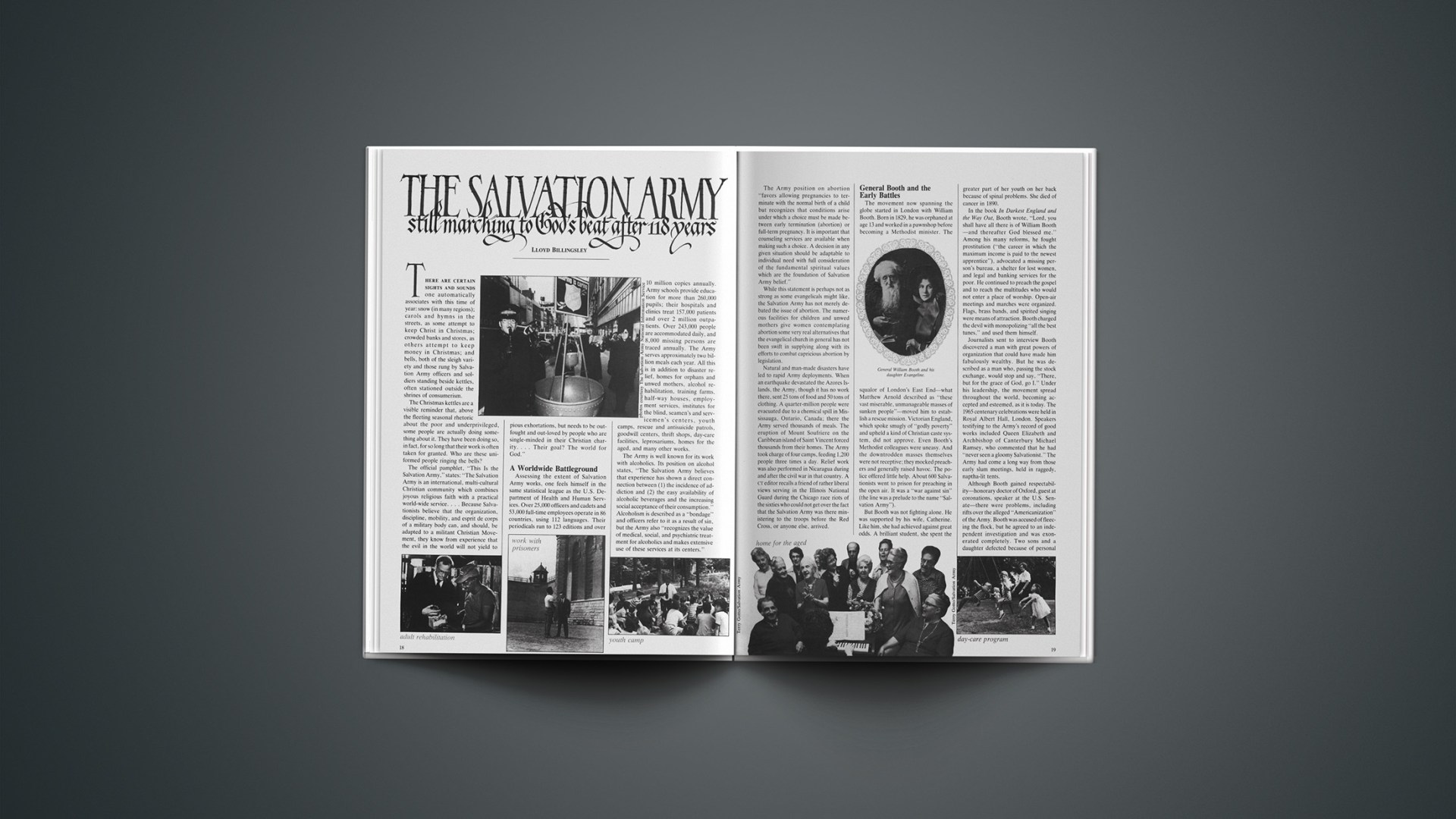
The Salvation Army: Still Marching to God’s Beat after 118 Years

There are certain sights and sounds one automatically associates with this time of year: snow (in many regions); carols and hymns in the streets, as some attempt to keep Christ in Christmas; crowded banks and stores, as others attempt to keep money in Christmas; and bells, both of the sleigh variety and those rung by Salvation Army officers and soldiers standing beside kettles, often stationed outside the shrines of consumerism.

The Christmas kettles are a visible reminder that, above the fleeting seasonal rhetoric about the poor and underprivileged, some people are actually doing something about it. They have been doing so, in fact, for so long that their work is often taken for granted. Who are these uniformed people ringing the bells?

The official pamphlet, “This Is the Salvation Army,” states: “The Salvation Army is an international, multi-cultural Christian community which combines joyous religious faith with a practical world-wide service.… Because Salvationists believe that the organization, discipline, mobility, and esprit de corps of a military body can, and should, be adapted to a militant Christian Movement, they know from experience that the evil in the world will not yield topious exhortations, but needs to be outfought and out-loved by people who are single-minded in their Christian charity.… Their goal? The world for God.”

A Worldwide Battleground

Assessing the extent of Salvation Army works, one feels himself in the same statistical league as the U.S. Department of Health and Human Services. Over 25,000 officers and cadets and 53,000 full-time employees operate in 86 countries, using 112 languages. Their periodicals run to 123 editions and over 10 million copies annually. Army schools provide education for more than 260,000 pupils; their hospitals and clinics treat 157,000 patients and over 2 million outpatients. Over 243,000 people B are accommodated daily, and 8,000 missing persons are traced annually. The Army serves approximately two billion meals each year. All this is in addition to disaster relief, homes for orphans and unwed mothers, alcohol rehabilitation, training farms, half-way houses, employment services, institutes for the blind, seamen’s and servicemen s centers, youth camps, rescue and antisuicide patrols, goodwill centers, thrift shops, day-care facilities, leprosariums, homes for the aged, and many other works.

The Army is well known for its work with alcoholics. Its position on alcohol states, “The Salvation Army believes that experience has shown a direct connection between (1) the incidence of addiction and (2) the easy availability of alcoholic beverages and the increasing social acceptance of their consumption.” Alcoholism is described as a “bondage” and officers refer to it as a result of sin, but the Army also “recognizes the value of medical, social, and psychiatric treatment for alcoholics and makes extensive use of these services at its centers.”

The Army position on abortion “favors allowing pregnancies to terminate with the normal birth of a child but recognizes that conditions arise under which a choice must be made between early termination (abortion) or full-term pregnancy. It is important that counseling services are available when making such a choice. A decision in any given situation should be adaptable to individual need with full consideration of the fundamental spiritual values which are the foundation of Salvation Army belief.”

While this statement is perhaps not as strong as some evangelicals might like, the Salvation Army has not merely debated the issue of abortion. The numerous facilities for children and unwed mothers give women contemplating abortion some very real alternatives that the evangelical church in general has not been swift in supplying along with its efforts to combat capricious abortion by legislation.

Natural and man-made disasters have led to rapid Army deployments. When an earthquake devastated the Azores Islands, the Army, though it has no work there, sent 25 tons of food and 50 tons of clothing. A quarter-million people were evacuated due to a chemical spill in Mississauga, Ontario, Canada; there the Army served thousands of meals. The eruption of Mount Soufriere on the Caribbean island of Saint Vincent forced thousands from their homes. The Army took charge of four camps, feeding 1,200 people three times a day. Relief work was also performed in Nicaragua during and after the civil war in that country. A CT editor recalls a friend of rather liberal views serving in the Illinois National Guard during the Chicago race riots of the sixties who could not get over the fact that the Salvation Army was there ministering to the troops before the Red Cross, or anyone else, arrived.

General Booth And The Early Battles

The movement now spanning the globe started in London with William Booth. Born in 1829, he was orphaned at age 13 and worked in a pawnshop before becoming a Methodist minister. The squalor of London’s East End—what Matthew Arnold described as “these vast miserable, unmanageable masses of sunken people”—moved him to establish a rescue mission. Victorian England, which spoke smugly of “godly poverty” and upheld a kind of Christian caste system, did not approve. Even Booth’s Methodist colleagues were uneasy. And the downtrodden masses themselves were not receptive; they mocked preachers and generally raised havoc. The police offered little help. About 600 Salvationists went to prison for preaching in the open air. It was a “war against sin” (the line was a prelude to the name “Salvation Army”).

But Booth was not fighting alone. He was supported by his wife, Catherine. Like him, she had achieved against great odds. A brilliant student, she spent the greater part of her youth on her back because of spinal problems. She died of cancer in 1890.

In the book In Darkest England and the Way Out, Booth wrote, “Lord, you shall have all there is of William Booth—and thereafter God blessed me.” Among his many reforms, he fought prostitution (“the career in which the maximum income is paid to the newest apprentice”), advocated a missing person’s bureau, a shelter for lost women, and legal and banking services for the poor. He continued to preach the gospel and to reach the multitudes who would not enter a place of worship. Open-air meetings and marches were organized. Flags, brass bands, and spirited singing were means of attraction. Booth charged the devil with monopolizing “all the best tunes,” and used them himself.

Journalists sent to interview Booth discovered a man with great powers of organization that could have made him fabulously wealthy. But he was described as a man who, passing the stock exchange, would stop and say, “There, but for the grace of God, go I.” Under his leadership, the movement spread throughout the world, becoming accepted and esteemed, as it is today. The 1965 centenary celebrations were held in Royal Albert Hall, London. Speakers testifying to the Army’s record of good works included Queen Elizabeth and Archbishop of Canterbury Michael Ramsey, who commented that he had “never seen a gloomy Salvationist.” The Army had come a long way from those early slum meetings, held in raggedy, naptha-lit tents.

Although Booth gained respectability—honorary doctor of Oxford, guest at coronations, speaker at the U.S. Senate—there were problems, including rifts over the alleged “Americanization” of the Army. Booth was accused of fleecing the flock, but he agreed to an independent investigation and was exonerated completely. Two sons and a daughter defected because of personal differences and disputes over discipline. (They are absent, nonpersons, in official Army geneologies.) His fourth daughter, Evangeline, was one of the bright spots.

The Salvation Army yearbook states, “The position held by women in the Salvation Army is unprecedented in history. Even in eastern lands, women Salvationists have played a great part in keeping with the Army’s principle of equal opportunity of service for both sexes.” Evangeline seems to bear this out. She was the first woman General of the Army (perhaps of any army), feted by dignitaries and celebrated in musicals. She led the fight for the repeal of laws against open-air preaching. Her philanthropic service during the First World War led to a decoration from Woodrow Wilson. She died in 1950.

Chain Of Command

Still based in Britain, the Salvation Army prefers to call itself a “movement” or a “community” rather than a church. Official publications state that the primary aim is “to preach the gospel of Jesus Christ to men and women untouched by ordinary religious efforts.” Whatever the label, the Salvation Army is, in the true sense of the term, an army, with a strict chain of command.

The current general is Jarl Wahlstrom, a native of Finland. All appointments are made and all regulations are issued under his authority. Previous generals have been mainly British and Canadian, with the exception of Gen. Erik Wickberg, a Swede.

The general is elected by the High Council, composed of the chief of the staff (the second in command), all active commissioners, and colonels of two years’ standing who also hold territorial commands. Once in command, she or he serves until the retirement age of 68. The High Council votes shortly before this age is attained, unless there is a death or health problem. Deaths in the Army are referred to as “promotions to Glory.”

Converts above age 15 who have been sworn in are known as “soldiers.” Before enrollment, they are required to sign the Articles of War, an eleven-point doctrinal statement and seven-point rule of conduct. (Salvationists, in keeping with the Army’s claim to be the world’s largest temperance organization, are total abstainers from alcoholic beverages.) The Articles of War also entail a promise to be “a true soldier of the Salvation Army til I die.”

Salvationists who aspire to full-time service are known as “cadets.” They attend a two-year School for Officer’s Training, the equivalent of a Bible school or seminary. They graduate as lieutenants, a rank they hold for five years. A favorable review after this period leads to a promotion to the rank of captain, which must be held for 15 years. From that point, based on service, there may be promotions to major, lieutenant colonel, colonel, and commissioner. There is only one active general.

It is expected that officers will remain in the Army for life. Chosen to Be a Soldier states, “No one must become a soldier as an experiment or with mental reservations as to the length of his ‘service for the salvation of the whole world.’ Only those who are fully determined, by God’s help, to be true soldiers of the Salvation Army til they die can rightly take the holy vows involved in the swearing-in ceremony.” Efforts would be made to discourage officers from even an amiable parting with the Army, but such a one, spokesmen say, would not be excommunicated. Officers have no personal autonomy; they obey the orders of their superiors. They are paid a modest allowance according to their needs. An officer of lower rank with a large family could receive more than a superior with fewer needs.

As far as lay ministry is concerned, there are other designated ranks: auxiliary captain, corps sergeant major, and sergeant. These are also called “local officers.” Members who make the Salvation Army their place of worship, but do not sign the Articles of War, are called “adherents.”

Salvation Army worship halls are known as “citadels.” Prayer meetings are “knee drills”; monetary contributions by soldiers to the Army are “cartridges.” A vehicle used to distribute literature is a “field unit.” And there are military-style decorations: The Order of Distinguished Auxiliary Service, the Order of the Founder, and the Order of the Silver Star. The official periodical is the weekly War Cry magazine.

Army Doctrine, Views, Practices

Salvationist literature describes their creed as “that of the great Christian Communions.” Few evangelicals or fundamentalists would quarrel with their doctrinal statement, with the possible exception of two points.

First, the Army is staunchly Arminian. One of the Articles of War states, “Continuance in a state of salvation depends upon continued obedient faith in Christ.” The book Chosen to Be a Soldier interprets this as a warning against “mistaken notions” and “deadly errors.” It dubs Calvinism “the terrible doctrine that God has predestined some souls to be eternally lost.” In spite of this rather aggressive language, there are references to the Army as not seeing it as “their God-given task to protest against the doctrines and practices of other Christians, but to attest the gospel message” (emphasis theirs).

Second, the Articles allude to believers being “wholly sanctified.” Chosen to Be a Soldier (which in places quotes Kierkegaard) speaks of a “crisis of sanctification,” a second work of grace. The obvious question—Does the Army believe in sinless perfection?—receives no direct answer in official literature, although regulations state, “The Salvationist will never claim for the Army that it is perfect in every respect.” Christians of other traditions might conclude that this also applies to all soldiers not yet promoted to glory.

But Army regulations are not all questions of doctrine. There is a strong emphasis on love. Concerning human relations we read, “People we may find difficult are often unhappy people. They may seem to us to be deliberately nasty. But their past history is imperfectly known to us. It may be that they have never experienced true kindness. Perhaps they had to suffer humiliation and harshness or deliberate injustice in a critical period of development. Whatever the reason, kindness and love coupled with firmness are likely to work a cure.”

The section on homosexuality states, “This psychological leviance, so long as it does not express itself in homosexual acts, is not blameworthy, nor should it be allowed to create guilt. Such persons need understanding and help, not condemnation.”

Whether an official “church” or not, the Salvation Army holds regular services, or “holiness meetings.” The buildings (like countless evangelical places of worship) are not architecturally distinguished, and the soldiers in their dark uniforms are less than sartorially resplendent. But the services are joyous and lively, featuring spirited singing and the participation of many members, who often represent a wide cross section of races. Below the platform is a “holiness bench” where repentant members may publicly confess or be reconciled one to another.

Music has played a large role in the Salvation Army since its inception. A brass band plays in services, and efforts are being made to use contemporary music, including rock, in outreach. Emmy award-winning Hollywood composer Bruce Broughton is a Salvationist. He has written scores for the “Quincy” television series, as well as for World Wide Pictures’ The Prodigal. He says, “Music was in our family because music is part of Salvation Army life. I believe that my background playing hymns was a very good foundation for my current work, because it gave me a solid background in basic musical forms and techniques.” (See also Refiner’s Fire, p.49.)

One of the chief distinguishing features of the Army is the absence of baptism and the Lord’s Supper, both practiced by virtually all Protestants in one form or another. When William Booth was questioned as to what they would offer in place of Communion, he replied, “Farthing breakfasts for starving children.” The current position is that “the Salvation Army does not believe the sacraments to be essential to salvation and therefore, while not opposing their use, does not observe them.”

An official book, The Sacraments, states that there were sacramental observances in the early days of the Army, but they were dropped for various reasons. It was (and is) thought that there are no specific New Testament injunctions to practice baptism and Communion (technical, textual arguments are used against “This do in remembrance of Me” from Luke 22:19). Booth seemed to hold that sacramental observations smacked of sacerdotalism. With many converts being reformed alcoholics, the use of wine was thought unwise. In addition, The Sacraments warns that outward symbols can snare believers into a merely formal religiosity. The aim of the Army, the text states, is “to make the whole of life sacramental.” The book denies that the wearing of uniforms and Army swearing-in ceremonies are in any sense substitutes for the sacraments, but another chapter urges soldiers to “recognize uniform wearing as a way of witnessing for Christ.”

The Army would also seem to avoid Falwell- or Sojourners’-style political activism (the current American commissioner says the Army is “nonpartisan”), but some of its members are politically involved. Maj. Paul Kelly recently testified to the Senate Subcommittee on Housing and Community Development that “it is essential that actions be taken now” to help those with basic needs. Derek Foster, British Salvationist member of Parliament, has written, “I am a politician because I am a Christian. I am not a politician who happens to be a Christian. I am in full-time service for God with every fiber of my being and I am endeavoring to do what God wants me to do.”

Contemporary Battles

The Army is not affected by the disputes over biblical inerrancy or prophecy that have rocked some denominations. With men and women on an equal footing in ministry, there are no divisive debates over “Christian feminism.” (Verses such as 1 Cor. 14:34 and 1 Tim. 2:12, often used to argue against the ministry of women, are considered culturally relative and applying mainly to biblical times.) They seem to have avoided internal dissension and all traces of scandal. But there have been controversies.

On August 24, 1981, the Salvation Army withdrew from membership in the World Council of Churches. (It is not a member of the National Council of Churches.) The issue was a grant of $85,000 to the Patriotic Front Guerrillas in Zimbabwe, then Rhodesia. This came two months after eight Christian missionaries, including two from the Salvation Army, were murdered in that country. The late Commissioner John Needham told Morley Safer earlier this year on CBS’S “60 Minutes,” a show watched by an estimated 43 million people: “The suggestion was that money from the World Council was being given to feed, to take care of medicines, that sort of program. But after all, the end result was, they were guerrillas about their work, which resulted in death and violence.” The WCC, predictably, said that Rhodesian troops were responsible. Needham also answered a charge that the Army left the council under pressure from large corporations. “Nothing could be farther from the truth,” he told Safer, adding, “I don’t know where people get those kinds of ideas.”

The only other criticism of the Army this writer could find comes from evangelical quarters. The March 1983 issue of The Other Side reviewed various organizations to whom their readers send money, and wrote of the Salvation Army that it was “supportive of the political status quo, and makes no attempt to deal with the root causes of today’s problems.” When asked if the Salvation Army should support the political status quo in Cuba and Nicaragua where it also operates, Mark Olson, author of the article, replied, “If they saw some non-biblical situations, they should speak out. “Olson cited Bread for the World as an organization that, unlike the Army, deals with root problems by working through the political process for grain reserves, increased food stamp programs, and a stipulation in Reagan’s Caribbean Initiative plan that would make poor countries meet their own needs before any of their food could be exported.

Current National Commander Norman Marshall states, “In the 86 countries in which the Army carries out its ministry, it works under many forms of governments in order to benefit the people of those countries meeting basic personal needs.”

The most serious charges concerned finances: “The Salvation Army’s four territorial divisions report fund balances of $965.2 million (151% of their annual budget); in 1981, these four territorial offices took in $22.4 million more than they spent; the Salvation Army appears to need less income, not more” (parenthesis and emphasis theirs). The latter part of this statement does not mean that, in the view of The Other Side, the Salvation Army is unworthy of financial support, but that more money should go to organizations that are “more poverty stricken.” Olson, who also denies that the Army makes audits available, obtained his information from the Philanthropic Advisory Service of the Better Business Bureau (BBB) in Washington.

The Army, as it happens, has been publishing independently audited statements of its income for 116 years. The New York Times of November 7, 1982, ran 800,000 copies of a Salvation Army supplement, complete with an operating budget and the notation, “Copies of the audited financial statements will be made available upon request from The Salvation Army.” But does the Army, as The Other Side alleges, have multimillion-dollar surpluses? Commissioner Marshall, in direct reply, writes:

“Possibly, a nonaccountant was responsible for the section of the magazine report concerning ‘Finances and Financial Accountability’ since the total clearly identified in the BBB report from which the information was taken as ‘Fund Balances’ is described in the magazine article as ‘Cash and Securities on Hand at End of Fiscal Year.’ The footnote in the BBB report, however, correctly defines Fund Balances as ‘All operating, endowment, land and buildings, board-designated, donor-restricted, and live income and annuity funds.’ This observation also relates to the Fund Balances of the four territories which are included in the independent audits and represents all resources, including land and buildings, for all Salvation Army Centers and activities in the United States” (emphasis mine). He adds, “All funds are raised in and reported to the local community: the Salvation Army does not conduct a national fund-raising appeal. The captions are somewhat misleading when related to the National Headquarters financial statement.”

Other evangelicals might share The Other Side’s contention that the Salvation Army often functions as “a secular social service entity with little or no overt connection to Christianity.” Is it weak on evangelism? “Evangelism and human services are obverse sides of the same coin,” says Commissioner Marshall. Officers in Los Angeles signal new outreach to Hispanics and Koreans as evidence of renewed evangelistic vigor. The Yearbook of American and Canadian Churches, 1982 cites a 28 percent growth in Salvation Army ranks between 1970 and 1980. Many officers, though, are not drawn from the ranks of new converts but rather are children, even grandchildren, of other officers. This trend would seem to be similar to the “being born into the faith” of the catholic tradition, as opposed to the “baptist” style (see Martin Marty on “Baptistification”; CT, Sept. 2, 1983).

Still Loving The Unlovely

One thing the Army certainly cannot be accused of is using the poor to further its own ends. Many, especially bureaucrats who administer government poverty programs, have discovered that there is money in poverty. Jacques Ellul points out that there are different kinds of poor people. There are the “interesting poor” through whose plight partisan aims can be achieved and one’s political enemies can be denounced. For example, by championing the boat people, conservatives can discredit the Communist government of Vietnam, while liberal supporters of Central American refugees use the civil-war situation and its victims to denounce the Reagan administration, a kind of moral form of war profiteering.

Then, as Ellul writes, there are the “uninteresting poor,” whose difficulties concern only themselves. Certainly, skid-row derelicts and other forgotten people of society with whom the Army does so much are in this category. Unlike seals and whales, they have no high-profile advocates among celebrities, and no observer at the UN. And there is no Drunkard Liberation Front—that is, other than the Salvation Army itself.

Former President Jimmy Carter said, “We are a better nation because of the constructive work of the Salvation Army, and we are closer to the ideals our Founding Fathers envisioned as guide-posts of American life. The Army’s mission has gone hand in hand with our national progress and development. Its programs have strengthened our faith in God and our determination to perform good works in His name. I hope that in the decades ahead the Salvation Army will retain its position of spiritual, moral, and social leadership in our society. More than ever we need its steadying influence as we face the critical challenges and opportunities of the years ahead.”

In spite of such encomiums, the Salvation Army is often taken for granted. Few people have stopped to think of the torrent of problems that would be unleashed if the Army were to disappear. But, fortunately, it is still around and shows no sign of capitulating in its battle against sin. Its hand cleaves to the sword. Although the Army is more visible at Christmastime, outfighting and outloving evil is not seasonal work.
One Who Took up Her Bed and Walked

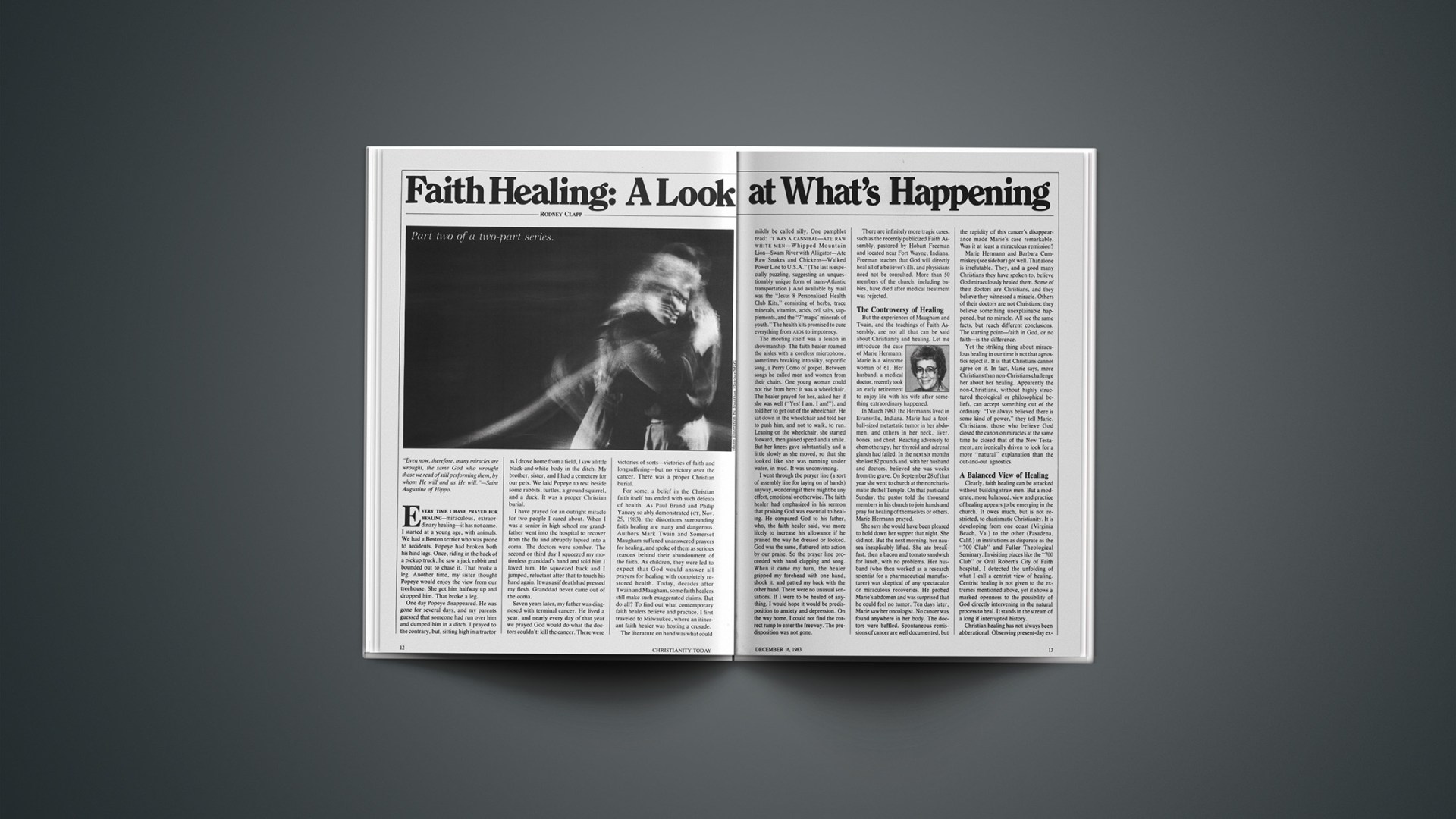
At age 14, nothing was wrong. Barbara Cummiskey would reach for the gymnastics ring and, like it was supposed to, her hand would close on it. At age 15, the hand began to take on a life of its own. Sometimes it would not grasp the ring, and Barbara fell, as she remembers it, “from the rafters to the floor.” But to the adolescent, much of the body seems to veer out of control. The face grows acne like a perverse and independent garden. A strange, willful sexuality is alarmingly born. Barbara decided the falling was part of growing up, the teen-ager’s normal awkwardness.

Still, it was bothersome. At Campus Life meetings, Barbara was a championship Bible quizzer. Leaders asked questions about the Bible, and on jumping from a chair, quizzers would switch on a light, qualifying the quickest jumper to answer the question. Barbara still knew many of the answers, but as she shot from her chair she often ended up lying on the floor. She stumbled down stairs. From time to time, her vision blurred. Then the left hand clenched into an involuntary half-fist. By age 19, her doctors were all too sure. Barbara Cummiskey had the “young person’s disease”: multiple sclerosis (MS).

MS is an unpredictable ailment. It is a degenerative disease that attacks the central nervous system, hardening tissues in the brain and/or spinal cord. It can result in paralysis of different degrees. It can mean an early death. But it may mean only periods of disablement or discomfort, and no effect on the life span.

Barbara’s choice was no different than any other MS victim’s. She could only wait to see what the disease did each week, each month, and cope with it as best she could. She was frequently bedridden. She learned to type with one hand. From 1972 to 1974 she was healthy enough to attend college as a handicapped student. Sometimes she could walk without a cane.

The Ravages Of Ms

Leaving college, Barbara managed a job as a secretary. But by 1977, her diaphragm was paralyzing. Breathing was already a problem, then she developed a chronic lung disease unrelated to MS. Her weaknesses caused constant pneumonia and asthma. A year later, one lung collapsed and the other labored at half its potential.

MS struck the bowels next, confirming Barbara’s case as the rare severe MS that attacks the body’s organs. An ileostomy for the bowel and catheter for the bladder were necessary. In 1972, breathing was so difficult doctors did a tracheotomy—cutting a hole in Barbara’s neck so a respirator could be attached. Her vision worsened to the point of technical blindness. She was absolutely confined to bed, and she spent nearly as much time in the hospital as out. There were several surgeries, and three times Barbara had respiratory and cardiac arrest. Her brain received inadequate oxygen and she was sometimes mentally confused—it was as if not only her body but her mind was reeling out of control.

The most dreadful pain was an unceasing ache in the middle of Barbara’s chest. She felt like desperately pounding her chest, just as child bangs his head against a wall to knock out a headache. The long, attractive blonde hair was still there. But the green eyes were useless (a patch covered one), the legs spindly and dangling, the arms and hands turned in on themselves, and frequently the twisted body was connected to machines. As if fate were adding a final grotesque stroke, tumors unrelated to MS grew on her hands and feet. Barbara was admitted as an outpatient at a nearby hospice. She and her family were preparing for her to die. Barbara Cummiskey was 31.

Twenty-two years before, at nine, she had said to Jesus: “My life is yours. Take it.” In her late teens, watching friends bound effortlessly into life, a sick Barbara questioned God. Although she never turned away completely, church and God became unimportant. But by her mid-twenties, that changed. About the only thing Barbara could do was pray, and she prayed not only for herself, but for others. She talked, out loud and unself-consciously, to God. A nurse would walk into her hospital room, and Barbara would be talking to God as if he were a physical visitor. She remembers those simple, childlike conversations as some of the best times of her life. She was physically wrecked, but spiritually whole.

A Healing

So came June 7, 1981. Days before, a local religious radio station mentioned Barbara’s plight, and suggested it for prayer. Nearly 450 cards and letters flooded her. On this summer day, a Sunday, Barbara sat in bed as two women from her church read cards to her. Barbara (but not the other two women) heard a voice over her shoulder. It was not a booming voice, but a calm one, and it said, “My child, get up and walk.” Barbara assumed it was God, at last answering in kind after all those hours of her audible address. She told the two women she was going to walk, and that they should go alert her family. Since Barbara had not walked in two years, the women were confused. But they left the room.

Barbara could not wait for her parents. She says she “jumped” out of bed. Elated, she started down the hall, where her mother met her. Barbara’s legs, atrophied from lack of exercise, now had muscle tone and firmness. Her mother’s first words were a shout: “Calves! You have calves!”

Her father, when Barbara met him downstairs, could summon no words. He grabbed his daughter and danced around the living room with her. After waltzing with her father, Barbara did ballet steps—standing on her toes, leaping, and laughing. A friend, who is an occupational therapist, was also at the home. “You know,” she told Barbara, “you just wrecked everything I learned in school.”

MS is an incurable disease. Barbara Cummiskey, her doctors admit, should never have gotten well. But not only did the MS leave (conclusive spinal taps show no trace). Barbara’s caved-in lung, dormant for years, should have been no good. It was completely healthy and functioning. The chronic lung disease, also “incurable,” was gone. So were the hand and feet tumors. Even if the woman somehow recovered from MS, there should have been permanent nerve damage. There was none. Fortunately, the surgeon performing Barbara’s ileostomy had not removed the entire bowel. Now the bowel was functioning, so the ileostomy was reversed. Likewise the trachaeostomy. Health was entirely restored, instaneously.

Today Barbara is training to be a surgeon’s assistant. A man she trains under was one of her doctors. He delights in introducing her to classes. “Here is a woman who used to lay under my knife. I said she would not live. I said she would never walk. Now she hands me the knife. You can see how good my predictions are.”

RODNEY CLAPP

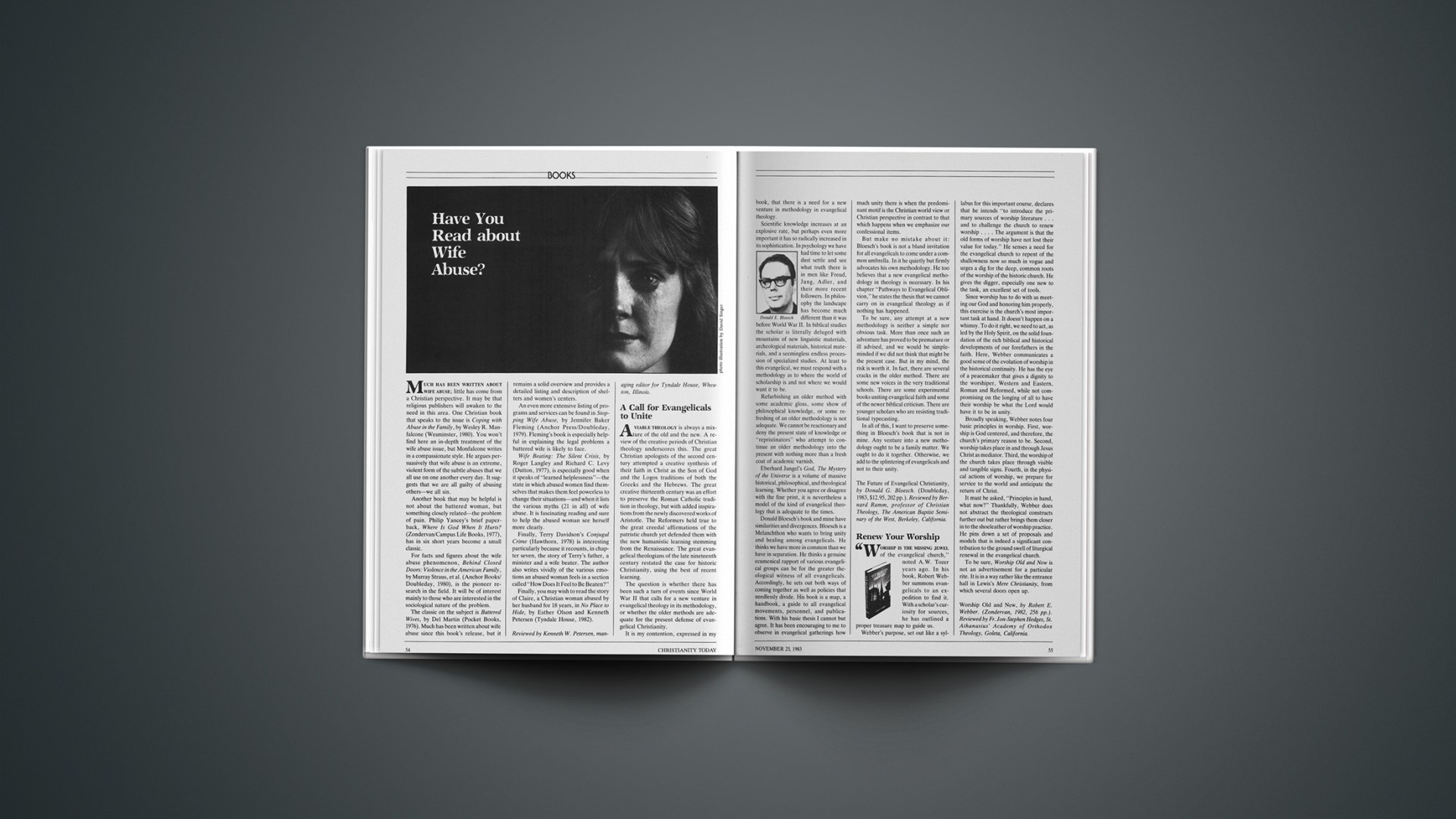
Faith Healing: A Look at What’s Happening

“Even now, therefore, many miracles are wrought, the same God who wrought those we read of still performing them, by whom He will and as He will.”—Saint Augustine of Hippo.

Every time i have peayed for healing—miraculous, extraordinary healing—it has not come. I started at a young age, with animals. We had a Boston terrier who was prone to accidents. Popeye had broken both his hind legs. Once, riding in the back of a pickup truck, he saw a jack rabbit and bounded out to chase it. That broke a leg. Another time, my sister thought Popeye would enjoy the view from our treehouse. She got him halfway up and dropped him. That broke a leg.

One day Popeye disappeared. He was gone for several days, and my parents guessed that someone had run over him and dumped him in a ditch. I prayed to the contrary, but, sitting high in a tractoras I drove home from a field, I saw a little black-and-white body in the ditch. My brother, sister, and I had a cemetery for our pets. We laid Popeye to rest beside some rabbits, turtles, a ground squirrel, and a duck. It was a proper Christian burial.

I have prayed for an outright miracle for two people I cared about. When I was a senior in high school my grandfather went into the hospital to recover from the flu and abruptly lapsed into a coma. The doctors were somber. The second or third day I squeezed my motionless granddad’s hand and told him I loved him. He squeezed back and I jumped, reluctant after that to touch his hand again. It was as if death had pressed my flesh. Granddad never came out of the coma.

Seven years later, my father was diagnosed with terminal cancer. He lived a year, and nearly every day of that year we prayed God would do what the doctors couldn’t: kill the cancer. There were victories of sorts—victories of faith and longsuffering—but no victory over the cancer. There was a proper Christian burial.

For some, a belief in the Christian faith itself has ended with such defeats of health. As Paul Brand and Philip Yancey so ably demonstrated (CT, Nov. 25, 1983), the distortions surrounding faith healing are many and dangerous. Authors Mark Twain and Somerset Maugham suffered unanswered prayers for healing, and spoke of them as serious reasons behind their abandonment of the faith. As children, they were led to expect that God would answer all prayers for healing with completely restored health. Today, decades after Twain and Maugham, some faith healers still make such exaggerated claims. But do all? To find out what contemporary faith healers believe and practice, I first traveled to Milwaukee, where an itinerant faith healer was hosting a crusade.

The literature on hand was what could mildly be called silly. One pamphlet read: “I WAS A CANNIBAL—ATE RAW WHITE MEN—Whipped Mountain Lion—Swam River with Alligator—Ate Raw Snakes and Chickens—Walked Power Line to U.S.A.” (The last is especially puzzling, suggesting an unquestionably unique form of trans-Atlantic transportation.) And available by mail was the “Jesus 8 Personalized Health Club Kits,” consisting of herbs, trace minerals, vitamins, acids, cell salts, supplements, and the “7 ‘magic’ minerals of youth.” The health kits promised to cure everything from AIDS to impotency.

The meeting itself was a lesson in showmanship. The faith healer roamed the aisles with a cordless microphone, sometimes breaking into silky, soporific song, a Perry Como of gospel. Between songs he called men and women from their chairs. One young woman could not rise from hers: it was a wheelchair. The healer prayed for her, asked her if she was well (“Yes! I am, I am!”), and told her to get out of the wheelchair. He sat down in the wheelchair and told her to push him, and not to walk, to run. Leaning on the wheelchair, she started forward, then gained speed and a smile. But her knees gave substantially and a little slowly as she moved, so that she looked like she was running under water, in mud. It was unconvincing.

I went through the prayer line (a sort of assembly line for laying on of hands) anyway, wondering if there might be any effect, emotional or otherwise. The faith healer had emphasized in his sermon that praising God was essential to healing. He compared God to his father, who, the faith healer said, was more likely to increase his allowance if he praised the way he dressed or looked. God was the same, flattered into action by our praise. So the prayer line proceeded with hand clapping and song. When it came my turn, the healer gripped my forehead with one hand, shook it, and patted my back with the other hand. There were no unusual sensations. If I were to be healed of anything, I would hope it would be predisposition to anxiety and depression. On the way home, I could not find the correct ramp to enter the freeway. The predisposition was not gone.

There are infinitely more tragic cases, such as the recently publicized Faith Assembly, pastored by Hobart Freeman and located near Fort Wayne, Indiana. Freeman teaches that God will directly heal all of a believer’s ills, and physicians need not be consulted. More than 50 members of the church, including babies, have died after medical treatment was rejected.

The Controversy Of Healing

But the experiences of Maugham and Twain, and the teachings of Faith Assembly, are not all that can be said about Christianity and healing. Let me introduce the case of Marie Hermann. Marie is a winsome woman of 61. Her husband, a medical doctor, recently took an early retirement to enjoy life with his wife after something extraordinary happened.

In March 1980, the Hermanns lived in Evansville, Indiana. Marie had a football-sized metastatic tumor in her abdomen, and others in her neck, liver, bones, and chest. Reacting adversely to chemotherapy, her thyroid and adrenal glands had failed. In the next six months she lost 82 pounds and, with her husband and doctors, believed she was weeks from the grave. On September 28 of that year she went to church at the noncharismatic Bethel Temple. On that particular Sunday, the pastor told the thousand members in his church to join hands and pray for healing of themselves or others. Marie Hermann prayed.

She says she would have been pleased to hold down her supper that night. She did not. But the next morning, her nausea inexplicably lifted. She ate breakfast, then a bacon and tomato sandwich for lunch, with no problems. Her husband (who then worked as a research scientist for a pharmaceutical manufacturer) was skeptical of any spectacular or miraculous recoveries. He probed Marie’s abdomen and was surprised that he could feel no tumor. Ten days later, Marie saw her oncologist. No cancer was found anywhere in her body. The doctors were baffled. Spontaneous remissions of cancer are well documented, but the rapidity of this cancer’s disappearance made Marie’s case remarkable. Was it at least a miraculous remission?

Marie Hermann and Barbara Cummiskey (see sidebar) got well. That alone is irrefutable. They, and a good many Christians they have spoken to, believe God miraculously healed them. Some of their doctors are Christians, and they believe they witnessed a miracle. Others of their doctors are not Christians: they believe something unexplainable happened, but no miracle. All see the same facts, but reach different conclusions. The starting point—faith in God, or no faith—is the difference.

Yet the striking thing about miraculous healing in our time is not that agnostics reject it. It is that Christians cannot agree on it. In fact, Marie says, more Christians than non-Christians challenge her about her healing. Apparently the non-Christians, without highly structured theological or philosophical beliefs, can accept something out of the ordinary. “I’ve always believed there is some kind of power,” they tell Marie. Christians, those who believe God closed the canon on miracles at the same time he closed that of the New Testament, are ironically driven to look for a more “natural” explanation than the out-and-out agnostics.

A Balanced View Of Healing

Clearly, faith healing can be attacked without building straw men. But a moderate, more balanced, view and practice of healing appears to be emerging in the church. It owes much, but is not restricted, to charismatic Christianity. It is developing from one coast (Virginia Beach, Va.) to the other (Pasadena, Calif.) in institutions as disparate as the “700 Club” and Fuller Theological Seminary. In visiting places like the “700 Club” or Oral Robert’s City of Faith hospital, I detected the unfolding of what I call a centrist view of healing. Centrist healing is not given to the extremes mentioned above, yet it shows a marked openness to the possibility of God directly intervening in the natural process to heal. It stands in the stream of a long if interrupted history.

Christian healing has not always been abberational. Observing present-day extremes and dismissing the Christian tradition of healing by prayer and faith would be rash, since examples can be chosen selectively. We would want no history of Christianity that skipped over Genesis and Exodus, the Psalms and Gospels, then concentrated on the Inquisition or witch hunting in Salem.

As William Barclay observes, “The Church never altogether lost [its] gift of healing.” Healing is near the heart of Christianity. Christ and the apostles were healers, and this could not help but affect their followers. In addition, the Christian ethic is a positive one. Some religions ask only that their adherents not do anything harmful to the neighbor; Christianity goes an extra step and says, “Do good to your neighbor.” It is natural, then, that Christians not only refrain from injuring a neighbor, but try to heal him whenever he is hurt. This is why religion scholars say Christianity has been the major impulse toward healing in history.

Healing in the Christian tradition includes not just Hobart Freeman, but Augustine, Irenaeus, Chrysostom, and Francis of Assisi (not to mention Jesus Christ, and the apostles Peter and Paul). The sacrament of unction was for healing until the ninth century—only then did it become the sacrament of extreme unction, a preparation for death. Early Christian liturgies regularly included a place for healing, such as one from the year 400 asking God to send on the anointing oil the power of his “good compassion, that it may deliver those who labor, and heal those who are sick.”

After the early centuries of the church, the teachings and practice of healing waned. But there were bursts in the Middle Ages: Saint Bernard of Clairvaux in the twelfth century, Saint Francis Xavier in the sixteenth, George Fox, the founder of the Quakers, worked quietly (then, as now, healing could be controversial) in the seventeenth century. The Pentecostal revival late in the nineteenth century and early in this one ignited the healing movements with which most Christians are familiar today.

New Movements For Healing

The centrist view of healing is emerging in the context of this long history of healing. In Judeo-Christian history, there have been lengthy periods of relative dormancy in the alleged occurrence of miracles. “A renewal of these phenomena, however, seems to be occurring in both Protestant and Catholic circles,” the Los Angeles Times (Aug. 7, 1983) suggests. Faith healing is spilling over its accustomed charismatic boundaries. Harold Lindsell, former editor of CHRISTIANITY TODAY, writes in his latest book that there are “a few people here and there who receive the gifts of healing or miracles. These gifts have not ceased. They are still there even though they occur with less frequency than some people suppose.” Fuller Theological Seminary, of Presbyterian and Reformed origin, now offers course MC510: “Signs, Wonders, and Church Growth.” One of the seminary’s most popular courses, it includes a “ministry time” of prayer for healing. Of the 279 students who took the course last year, 278 were convinced healing should be part of the church’s ministry.

Within its accustomed charismatic boundaries, healing is being significantly moved away from extremes. The Assemblies of God, America’s fastest-growing denomination, publishes “The Believer and Positive Confession,” a level-headed statement advising Assemblies members that “doctrine based on less than a holistic view of Bibilical truth can only do harm to the cause of Christ.” Five years ago Pat Robertson decided his televised “700 Club” ought to be careful about publicizing bogus healings. He now has a staff of three researchers (including a registered nurse) and five reporters investigating purported healings. According to head researcher Karen Thomson, only about one-third of the reported “healings” pass a screening that includes interviews of involved physicians and reviews of pertinent medical records.

Unquestionably, the boldest experiment in centrist healing is in Tulsa. There, Oral Roberts has opened his City of Faith Medical and Research Center. Rising 62 stories from the Oklahoma prairie, the clinic building is the state’s tallest and is (to say the least) a far cry from Robert’s old revival tent. It is flanked by a 30-story hospital and a 20-story research building. If it reaches capacity, the $150 million complex will house medical, nursing, and dental teaching schools, 777 beds, 200 laboratories, 318 physicians, 850 nurses, and more than 3,000 other employees. Its purpose is an all-out fusion of science and religion. Prayer partners (the rough equivalent of chaplains) visit each patient at least once a day for prayer and counsel. They are considered part of the healing team, with doctors and nurses, whose members consult one another about helping the “whole person.” Bringing in the spiritual dimension, then, does not mean pushing out what a publicist calls “the most advanced medical hardware for the diagnosis and treatment of human disease.”

The City of Faith staff promises patients no miracles. According to Duie Jernigan, director of the prayer partner ministry, “There are no more miracles at the City of Faith than any other hospital. Just as many patients die.” Jaspar McPhail, chief of surgery, affirms, “Almost always the Lord heals through the natural process.” McPhail has a relaxed manner, half his hair, and is tall enough that when he chooses to rest his arm on a sofa’s back, the entire sofa is occupied. He specializes in heart surgery and has studied with Michael DeBakey. The surgeon’s credentials are not atypical at the hospital. Paul Kosbab, chief of psychiatry, is thoroughly and respectably trained and, with a thick Viennese accent, sounds like Freud reincarnated. Like all five of the City of Faith doctors I talked to, Kosbab has rigorous criteria for what constitutes a direct supernatural act of healing. His is not given to pronouncing every disappearing wart a miracle, and wryly suggests the closest thing to it he has seen is that, in 25 years of practice, none of his patients has completed a suicide. The head administrator of the City of Faith is James Winslow, who, before joining Oral Roberts University, had one of Tulsa’s most lucrative practices in orthopedics. It is obvious that Roberts has not gathered a crowd of snake handlers.

What sets apart the City of Faith’s approach is its openness to the occasional miracle, and the recognition that faith can be an important factor in healing whether or not a miracle occurs. (Interestingly, surgeon Paul Brand, coauthor of the previous issue’s article on healing, has been considered for a position at the City of Faith. Brand had other commitments and thus never joined the staff, but he thinks Robert’s hospital is “wholly admirable … a very real and sincere effort to bring together the different elements of healing.”

“Faith is a healing factor not usually sanctioned by the medical establishment,” says administrator Winslow. “But medical science has begun to realize that treatment of the whole patient—mind, body, and spirit—is the best way to approach real wellness.”

Foundations Of Centrist Healing

This concern for “real wellness” has been, as we have seen, important to Christianity throughout its history. The rudimentary medical science of Augustine’s day left prayer as his only choice in dealing with many ailments or injuries. Even since the development of sophisticated treatments there have been awkward moments when some Christians insisted on relying on “faith alone” and refused the benefits of medical technology. But now we are seeing the circle close into a whole. Faith and medical technique work together, and both are seen to derive from a single divine source. These are all element’s of what I have called centrist healing. Four points may roughly summarize its foundation. Centrist healing is rational, but not rationalistic; it attempts no absolute formulas about divine healing; it is ultimately concerned with “real wellness,” and means to include the best medical technology available to achieve that healing; and it does not pretend to eliminate suffering. Each of these points deserves separate attention.

• To say that centrist healing is rational is to say that it is realistic. It gives no guarantees. The cancer or heart patient is clearly in danger of his life. “Patients may live or die,” says one of Jernigan’s colleagues at the City of Faith. “Either way, we stand by and walk with them to the end, for better or for worse.” The centrist healer can agree with the dictum of Charles Williams, “The glory of God is in the facts; and those devoted to the glory have to deal with the facts.”

Yet the centrist healer is not rationalistic: he believes there is a God capable of operating beyond his understanding. This God can choose to heal through the instrument of medicine, or directly and dramatically. Statistically, it is clear he does not do the latter often. Yet the centrist healer cannot pretend to know God’s sovereign and free will, and the next patient he prays for may be changed. Psychologically and spiritually, the patient needs hope. The odds are against every new business, even every new marriage, but something deeply human pushes people to risk and hope—their business will succeed, their marriage be unbroken. As psychiatrist Karl Menninger has said, “man can’t help hoping even if he is a scientist. He can only hope more accurately.”

This realistic but hopeful approach to healing was apparent when my father was diagnosed with cancer. His minister grieved with him in facing the grim reality of the situation, but also set aside three days for fasting and special prayer for healing. No healing came: the cancer proved terminal. But the pastor’s action gave my father hope that speeded his recovery from surgery; it assured him that his pastor believed in the free power and love of God; and it demonstrated the pastor’s true empathy, opening a door to sensitive counseling as death appeared more and more inevitable.

• Centrist healing also attempts no absolute formulas about divine healing. Sometimes people who are healed have great faith; sometimes they have none at all. They may avidly praise God, as the Milwaukee faith healer exhorted, or they may sullenly hate him. They may not even have been praying for healing, as in the case of Barbara Cummiskey. But others may have been praying for them, as in the case of Barbara Cummiskey. The healer may or may not speak in tongues. C. Peter Wagner, originator of the “Signs and Wonders” course at Fuller, says his wife is used for healing by God more than he. Yet she doesn’t speak in tongues, and Wagner does.

A comprehensive formula of spiritual healing eludes us at every step. Nothing can explain why multiple sclerosis mysteriously left Barbara Cummiskey and not John Koys, another Christian afflicted with the disease. Barbara certainly claims no superiority. She finds herself questioning almost as much as she did when she suffered for 15 years. Finally, “I just leave it. God never promised me I’d understand everything. Not when I was sick. Not now. He just says, ‘Love me, my child, and accept me.’ ”

• Because it is ultimately concerned with healing, centrist healing will seek and use any means to achieve that healing. It is not a question of God getting the credit if the healing is direct and instantaneous, and medicine getting the credit if it is gradual and chemical-related. Nor is it a question of the pastor or physician taking credit. The pastor, physician, and chemicals are all instruments of healing. Anointing oil and penicillin can both be sacraments of health. No means are to be denigrated or denied their place in attempting to get the patient well. As physician Paul Tournier has written, the interaction between medicine and prayer is often unclear. “Faith and technology work together. Psychoanalysis explores the problems in order to bring them out into the daylight. Grace dissolves them without our ever knowing exactly how” (emphasis added). In the same vein, prayer partners and physicians at the City of Faith want to cooperate, not compete. Lack of clarity in a single source of healing helps credit to be given where it belongs: to God.

• A centrist view of healing does not pretend suffering will be eliminated. Marie Hermann may have been visited by a miracle in losing her cancer, but she still knows the pain of multiple sclerosis, which did not leave her body.

And three years after the unusual disappearance of Marie’s cancer, it has returned. Two nodes on the back of her neck have been found to be malignant. A biopsy showed the cancer is the same one that so nearly killed her three years earlier. The prognosis is mixed, but Marie’s attitude remains the same. On the day she calls to tell me the bad news she comments on the bright fall weather. She says God is still God, that she has had three “wonderful” years, and that she may have many more yet.

The oddness of Barbara Cummiskey’s case also did not end with her being healed of MS. Only months later doctors did a fairly simple operation to remove a cyst that had grown in Barbara’s lower abdomen. A freakish infection developed and she almost died. Only intensive medical care saved her, and her recovery was gradual and quite “natural.”

We might also note that Barbara suffered 15 years before her healing. Marie Hermann suffered more than 10 years with various cancers, and knew the pain of a radical mastectomy before she was healed. If God miraculously healed these women, he obviously was not merely eliminating pain: that could have come much sooner. Yet Barbara and Marie both look back on their times of pain with some fondness. They recall a closeness to God that is difficult to maintain in the hubbub of a busy, healthy life. P. T. Forsyth once commented that too often so much of our moral energy is “engrossed with healing or preventing pain, that it is withdrawn from the noble enduring of it, from the conversion and sanctification of wounds incurable.”

When Marie Hermann was sick, she conducted Bible studies and talked on the phone for hours with distressed friends. Her counsel was valued and appreciated, and she admits that when she got well some of the same friends misunderstood her—she was not always home, always available. She had almost endured pain too nobly, had surely converted and sactified a wound incurable.

“Chiefly For This End …”

Among the galaxy of wonderful scenes in Tolkien’s Lord of the Rings, I especially like one. The timid hobbit Sam Gamgee has survived goblins, giant spiders, thirst, and hunger in a perilous journey through a dark land. Then he awakes from a sleep he thought was death and gasps at his friend, “Gandlf! I though you were dead! But then I thought I was dead myself. Is everything sad going to come untrue? The Christian God is no mere wizard, and in this marred though beautiful world we live in, not everything sad is going to come untrue. There is pain. There are no absolute guarantees, no formulas (no sorcerer’s spells), but room for faith and hope.

The centrist approach to healing is cropping up in a variety of traditions, but almost always in the setting of community. (It is not an accident that Robert’s hospital is named the City of Faith.) Pastor Dick Rasanen, of Hope Evangelical Covenant Church in East Grand Forks, Minnesota, describes a simple Sunday evening service. Anyone desiring prayer was invited forward, one at a time, for laying on of hands. The service was conducted quietly and in order—no histrionics, no extravagant claims. “The service provided a special opportunity for the body to minister to one another, to give and receive God’s healing love, to realize again that each of us is hurting in some way,” says Rasanen.

It is quite likely that the extremes of faith healing are due in some measure to the organized church’s neglect of it. The hope of faith can arouse desperate and profound emotion. As with many other things, Scripture prefers that healing be practiced in community (see 1 Cor. 12 and James 5:13–16). In community the lunatic fringe can be moderated, and healing practiced with dignity and caution. Finally, it is in community that we can remind one another our ultimate purpose is not to escape pain, but to glorify Jesus Christ.

Richard Sibbes, a seventeenth-century Puritan pastor of unusual grace and sensitivity, said: “This is a sign of a man’s victory over himself, when he loves health and peace of body and mind, with a supply of all needful things, chiefly for this end, that he may with more freedom of spirit serve God in doing good to others.” If this is the object of all prayers for healing, all our efforts at health, whatever healing is achieved will be healing indeed.

Ideas

Just One Moment, Senator …

An unusual encounter in Falwell country produced some wise—and some unacceptable—words.

Some weeks ago, Sen. Edward Kennedy (D-Mass.) the weathering warrior of liberal politics, traveled to Lynchburg, Virginia, to speak to the students of Liberty Baptist College at Jerry Falwell’s invitation. The fundamentalists were gracious, and Kennedy’s speech was accorded a standing ovation by the students (CT, Nov. 11, 1983, p. 55). When something like this happens, it is time to recheck our gauges and look in a little closer.

By and large, the senator delivered reasoned warmth and gentle admonition. He said, “The separation of church and state can sometimes be frustrating for women and men of deep religious faith. They may be tempted to misuse government in order to impose a value which they cannot persuade others to accept.”

Those are wise words. As single-issue Christian lobbies learn the direct-mail strategies of their secular brethren, we should be reminded that Christian ethics are an outgrowth of Christian conversion and spiritual maturity. What we are about as Christians will not come by might or by power, but by the Spirit.

Elsewhere in his speech, Kennedy made another telling point: “We sorely test our ability to live together if we too readily question each other’s integrity. It may be harder to restrain our feelings when moral principles are at stake—for they go to the deepest wellspring of our being. But the more our feelings diverge, the more deeply felt they are, and the greater is our obligation to grant the sincerity and essential decency of our fellow citizens on the other side.”

Well said. Some conservative Christians too readily discern the shape of humanist conspiracy in the smoke of normal political conflict. Some are too ready to attack when the Lord’s grandest commandment is to love.

Kennedy’s admonitions are apt in this time of darkening temper over the causes of moral languor everywhere evident. We hope it was comments such as these that promoted the standing ovation, because elsewhere in his speech, Kennedy parts company with evangelicals in his understanding of the relationship between church and state, and between God and government.

“The real transgression occurs when religion wants government to tell citizens how to live uniquely personal parts of their lives,” Kennedy said. “The failure of Prohibition proves the futility of such an attempt.… In such cases, cases like Prohibition and abortion, the proper role of religion is to appeal to the conscience of the individual, not to the coercive power of the state.”

One moment here. Prohibition is gone (although we will not grant that it was a total failure), and a person may drink himself to death if he wishes. But there are still laws that would prevent him from killing others by driving while drunk. When innocent lives are at stake, we are no longer in a “uniquely personal” realm. Likewise, an innocent—and helpless—life is at stake in each abortion. It is appropriate for public law to guard that innocent life. When Kennedy says the coercive power of the state should not intrude into the abortion question, he should also recall that it was the coercive power of the U.S. Supreme Court that in 1973 struck down all state laws prohibiting abortion. A decade later, it is still that same coercive power that keeps striking down new abortion laws as they rise from the conscience of the people in the states.

Kennedy also spoke against a religious test for public office. He said, “After the last election, the Reverend James Robison warned President Reagan not to surround himself, as presidents before him had, with the counsel of the ungodly. I utterly reject any such standard for any position anywhere in public service.”

Senator Kennedy’s equation is a false one. We pray that all Presidents will have many wise and godly counselors. There is no more appropriate place for righteous thinking than the West Wing of the White House. The Oval Office is the seat of American government. Godliness—Reformation theology—significantly influenced our Constitution. Harvard law professor Harold Berman reminds us that a century before Locke and Hobbes, Puritans, carrying forward the Lutheran concepts of sanctity of the human conscience, were bent on reforming the world. Their defiance of English law was based on their religious convictions. It contributed to the foundations of civil rights, and freedom of speech, press, and religious practice that we cherish today.

Too many people in public life are ignoring the transcendent reality behind constitutional freedoms. They are turning law into mere social utility. As a result, respect for the law is disintegrating at about the same rate as respect for religious values.

From Washington, D.C., to Lynchburg, it is only a short plane hop across Virginia to the Blue Ridge Mountains. If one measures by the value placed on religion in public life, the distance is numbing. Senator Kennedy said some valuable things to the Liberty Baptist students. We hope he learned a few valuable things as well.

Eutychus and His Kin: December 16, 1983

Yes, Virginia, There Is A Baby Jesus

My dear Virginia,

I sense your confusion at this time of year. Adults do have a way of giving things and then taking them back. Yes, it is even as you suspected: there is no Easter bunny, no sandman, no tooth fairy and—and I know this is hardest of all—no Saint Nick. But lest you think this story about Mary and Joseph and the baby and the angels is another of those pretty images we will later retract, I assure you it is not.

There is a baby Jesus!

I almost want to say was a baby Jesus, because in the short course of time he became the man he now is. Like your father—who was once a baby himself—he became a man. Still, babies are babies, and the reason we keep their pictures around is not so that we can keep them little but that we can keep the correlation between their babyhood and their grownuphood.

I guess none of us mind keeping Jesus a baby, because births are always kind of special and they remind us that everyone is born to do something important. I know it seems to you that only adults are important, but babies are important too. And the baby Jesus was the most important baby who ever lived. Believe me when I tell you that this little baby is so important that real angels sang at his birth; real kings brought real presents and gave them to a real baby.

Of course, the real Jesus now is a grown man, but I don’t think he minds much if we stop once a year to celebrate his babyhood.

We grownups fuss a lot about his having to be born in a manger. Of course, it wasn’t right. But babies don’t mind stables. They would just as soon sleep in hay as anywhere, I guess. The important thing to remember is that they are happy just as long as they are loved. I know right now that you do love him, and I am glad.

You see, it’s like this, Virginia. Loving you was his reason for being born. And your loving him was your reason to be born. You don’t understand? Well, that’s fine—you don’t have to understand right now.

The key thing is to believe that this baby is God’s Son, and just as shepherds and kings loved him, so should everyone.

I’m so sorry about the sandman, the tooth fairy, the Easter bunny, and even Santa Claus, but the baby—well, I don’t have to be sorry about him—he was … no, he is real. The baby is a man, but a man who understands how important all babies are—it sort of makes you proud to know that God thought so much of babies he became one, doesn’t it? Yes, Virginia, there really is a baby Jesus.

Merry Christmas,

EUTYCHUS

Witchcraft—Satanic Or Not?

Like J. Gordon Melton [“Witchcraft: An Inside View,” Oct. 21], I had many negative images and beliefs about Witches. However, thanks to the author’s “ripping them away one by one and tossing them into the garbage can,” I am greatly enlightened. The only thing I found lacking in the article was information on finding a coven of my own where I can “grasp the depth of Paganism’s appeal and the spiritual life it provides.”

REV. JIMMY A. ROBINSON

First Assembly of God Murfreesboro, Tenn.

As a teacher in a Christian school that keeps CHRISTIANITY TODAY in its library for the students’ use, I am quite concerned about the conclusion by Gordon Melton when he says pagan philosophy also prepares one for the reception of the gospel as does the Jewish Law. Obviously, the writer has not had to deal with the fruit of witchcraft, or he wouldn’t think it so harmless.

I personally know young people who were once in witchcraft who actually practiced blood sacrifice. They tell of killing stolen babies as part of the ritual. Drugs play a major role in witchcraft, and the Bible has a strong admonition against being involved with it.

JANE JAMES

Hollywood Christian School Hollywood, Fla.

Were The Facts Confirmed?

It distresses me to see your usually fine magazine stooping to the level of pure, unadulterated gossip that the news item concerning PTL president Jim Bakker reported in the October 21 issue. We all get enough of this in the secular news media, with all of their alleged and reported lies.

While I do not personally agree with much of the ministry of Jim Bakker, I feel that you owe us responsible news coverage, minus the insinuations of misconduct presented without solid evidence. When all you have to go on is the word of another journalist, when there is no confirmation by either involved party, it would seem to be the biblical pattern to confirm with either party just what the facts are.

I realize PTL does not have a good reputation for financial responsibility in some circles. Please, however, do not become like the rest of the media. Rather, be salt, and refuse to print “news” without responsible information gathering.

REV. JAMES P. BEESLEY, JR.

First Congregational Church Kenosha, Wis.

I cannot tell you how disappointed I am to come home from an assignment and pick up my October 21 CHRISTIANITY TODAY. I have been a subscriber from issue one, have preserved each copy, bound them into volumes, and only a few weeks ago presented the whole to our graduate school in Springfield, Missouri. I have always felt—until now—that I could quote the magazine with confidence. But on page 44 of the aforesaid issue, under the heading “PTL Host Reportedly Spent $1,000 a Day for a Hotel Room,” two-thirds of the column is given to an outrageously slanted attack upon Jim Bakker. I immediately went to an unimpeachable source and learned the suite was used by 12 people engaged in a business conference. My experience with similar conferences indicates that such an expenditure is not out of line.

I am not blindly supportive of everything the TV network evangelists support, but I am willing to hear their side of the story. You must be aware that there is an open conspiracy in the media to destroy these ministries. Why are you part of it? I no longer feel I can quote CHRISTIANITY TODAY with any confidence in its presentation of the “facts.”

REV. D. E. SMITH

The General Council of the Assemblies of God Springfield, Mo.

CT checked with all parties involved—the reporter, the hotel management, and Jim Bakker’s office—before deciding to run the article—Ed.

I Beg Your Pardon

I would like to take exception to comments by Martin E. Marty and Eddie B. Lane concerning the performance of President Reagan [“ ‘Rejuvenating’ or ‘Out of Balance’?,” Oct. 7]. As to the environmental policies of the Administration, is it not true that man was given dominion over the earth? A good steward uses resources for the common good. A good steward does not allow resources to sit idle. Was not the slave who buried his one talent severely castigated by his master and cast into outer darkness?

The church was given the task to feed the hungry and clothe the naked. Scripture fails to mention the welfare agencies. It is a tragedy that the church has failed miserably in meeting the physical needs of people but chooses to sit quietly and give that chore to an entity that sometimes opposes the teachings of Christ. We adore the doctrine of separation of church and state until its invocation would mean putting the principles of love and compassion into action.

LACEY P. WALLACE

Shreveport, La.

African Culture Ambivalence

Tim Stafford’s ambivalence about African culture [“Torn by Two World’s,” Oct. 7] highlights a problem that perplexes all students of foreign missions. On the one hand, it appears that Kenya is the success story of recent missionary history. Well over half of the population profess Jesus as Lord, and most of these are Protestants. On the other hand, the maternal mortality is the world’s fifth highest, and the Physical Quality of Life Index puts a hundred nations above Kenya, many of them unevangelized. The GNP growth rate is 2.4 and the population growth 3.6, which spells disaster. This doubling of population about every 15 years began at approximately the same time as the advent of foreign missions and medical science. Today the “average” woman has nine living children. (A hundred years ago, most would have died in infancy.)

HARVEY L. SPERRY

Greenwood, S.C.

Handwriting—Science Or Superstition

I was distressed at reading “Handwriting Analysis Provides Another Slant on Luther” [Oct. 21]. Despite the self-serving “Handwriting is considered more science than superstition today,” and the frightening reference to the “many businesses that use scientific handwriting analysis in job testing and interviews,” there are a great many of us with scientific training who remain skeptics of graphologists as we do also of palmologists, tea readers, and other types who can be found on carnival midways.

God will judge our works and our words. Christians know Christians by their fruits. God help us if our pulpit committees start selecting pastors on the basis of their handwriting rather than by the guidance of the Holy Spirit, given after prayer and fasting according to the model both of Jesus and the early church.

RALPH A. EWERT

Lincoln, Neb.

Biblical Authority

Regarding your article “Biblical Authority: Where Both Fundamentalists and Neoevangelicals Are Right” [Oct. 7], it seems to me that we can have full confidence that the Scriptures have accomplished their purpose whether or not they meet the critical standards of men. Our divine Savior quoted from the Old Testament without correcting it. Thus, can’t we assume with every surety of mind and faith that we have God’s Word?

JUNE E. BURTNER

St. Petersburg, Fla.

This letter is not an appropriate place to defend my exegesis of Matthew from Dr. Kantzer’s editorial description “misguided.” But this quoting “other evangelicals” to the effect that my methodology, “if applied to the bodily resurrection of Christ, would allow us to understand it merely as Christ’s continuing spiritual existence,” plus a similar statement about the Virgin Birth, should not go unchallenged. These statements overlook two facts.

First, my commentary on Matthew (Eerdmans, 1982) treats the stories of Christ’s virgin birth and resurrection with the very same methodology applied elsewhere—but without the suggested results. Second, philosophicalpresuppositions have influenced affirmations and denials of the historicity of Christ’s virgin birth and resurrection far more than higher critical methodologies as such have influenced them.

In view of these facts, those who posit a slippery slope need to show both that my application of redaction critical methodology is inconsistent and that an antisupernatural bias is endemic to that methodology. I heartily agree with Kantzer that the issue needs to be decided “in light of history and grammar and cultural data.”

ROBERT H. GUNDRY

Westmont College Santa Barbara, Calif.

America’s “Good Old Days”

Were they really?

Two types of architecture on some of our Christian college campuses suggest two strikingly different stances of evangelicals toward modern culture. On a number of campuses there is an “old main” building that looks like a Victorian conception of a medieval fort. Towers and parapets abound. Such imagery suggests that one attitude of evangelicals toward the modern world has been to make war on it. From the crusading forays of Wheaton College’s Jonathan Blanchard against slavery, Masonry, and Sabbath breaking to fundamentalist attacks on modernist theology and secular humanism, a constant theme in evangelical approaches to America has been militancy.

Recently, however, a far more popular architectural style among evangelicals has been the colonial. This motif suggests peacefulness, harmony, and tranquility toward the culture. It relates to the pervasive sense evangelicals have of a lost golden age. Colonial America is widely viewed as a time when the harmonies of Christian culture prevailed. The telling irony, however, is that such themes are suggested by borrowing the classical and Enlightenment architectural ideals of Thomas Jefferson.

Most people do not think they think about history, but these two attitudes toward America are based on evangelical views of history. Each is based more on what the Bible is seen as saying about the modern world than on historical analysis of modern culture itself. The stance of warfare reflects apocalyptic themes in Scripture, focusing on prophecies concerning the upheavals that will surround the approach of the millennial age. The theme of harmonies and lost harmonies reflects the covenantal ideal. America is viewed as, in effect, a new Israel, often blessed by God, but always in danger of destructive judgments. Recently these two views have often been combined in militant efforts to restore America’s lost Christian moral ideals. If the moral reforms are accomplished, America will be great again. If they fail, the judgments of God may mark the beginning of millennial upheavals. Such efforts are, of course, sometimes valuable.

Nonetheless, we should note how recent history is used in such popular views. Each of them begins with a fixed interpretation of the meaning of Scripture for contemporary history. Any actual historical study of American culture is then directed toward collecting illustrations that will fit the historical pattern already determined. Moreover, in such accounts evangelicals, especially American evangelicals, turn out to be privileged people. The actual evangelical heritage, accordingly, is seldom subjected to careful or balanced historical scrutiny.

Many of our nonevangelical contemporaries, finding such views of history self-serving and shallow, suppose that evangelicals simply have no regard for history as a serious critical discipline. Such a view of evangelicals as lacking a sense of history is plausible. Evangelicals indeed have rejected the reverence for history that prevails among our intellectual contemporaries. In this prevailing view, all reality often is reduced to just history. Human experience is regarded as best understood by analyzing the natural cultural and psychological processes that have shaped it. The Bible itself is viewed as just the expression of the historical experience of the Hebrew people. “Truth” is not fixed, but part of the historical stream itself, determined by social convention.

Can we not, however, find a balance between these two extremes—between views that lack critical historical analysis of our own traditions and those that reduce everything to history? On what principle can we adopt modern standards for cultural analysis without adopting the antisupernaturalism and cultural relativism they so often involve?

The Incarnation should be our model in answering these questions. Knowing the incarnate Christ, the historical Jesus of Scripture, commits us to a view of reality and of history. This incarnational view rules out some of the assumptions of prevailing contemporary views of history, but it leads us to appreciate some other of its qualities. First, our faith in the Incarnation tells us that reality cannot be reduced to just human history. A starting point for thought for those who know Christ is that reality involves more than just humanity and nature. We cannot say with Carl Sagan, “The cosmos is all that is or was or ever will be.” Rather, we begin our thought with the affirmation that God created the cosmos and enters its history. Second, and closely related, is that we do not need to accept the popular twentieth-century belief that fixed truth cannot be found in historically conditioned circumstances or statements. Faith in Christ’s incarnation presupposes otherwise. Although Christ appears in real human culture and history, his life and words reveal eternal truths, even if we can understand them only imperfectly. The same applies to Scripture.

Finally, and on the other hand, our starting point in the Incarnation should impel us to take ordinary human history with complete seriousness. Christ did not just appear to be human, he was fully human. The Holy Spirit does not just appear to work through ordinary cultural circumstances in the church’s history. These circumstances are crucial means through which he works. Christians therefore should study human cultural developments with utmost care and not be afraid to apply the tools of historical scholarship to their own traditions. Our incarnational starting point commits us to the assumption that God works through the ordinary and even through the uncomely. We need not fear, therefore, to look critically at our own traditions, warts and all.

Who Counsels Ministers When They Have Problems?

The minister is on call 24 hours every day. But who is on call for the minister?

Things were rough in one of my pastorates. I was experiencing a variety of disappointments. The Enemy’s attacks seemed to come from every side.

What was worse, I did not know whom to turn to. I did not feel free to go to my superior. Nor did I feel comfortable going to a clergyman within my own denomination. My own relatives were miles and miles away. Lifelong friends were dispersed around the world. I had talked out the matter with my own family till they were tired of hearing about it; after all, they were being squeezed in the same tension that was enveloping me.

One Monday morning 1 found the skies particularly dark within my mind. I was confused, and my nerves were torn.

The parsonage phone kept ringing from parishioners seeking a pastor’s help for their own hurts. The routine responsibilities of administering affairs of the congregation continued without letup. Appointments had to be met; duties had to be seen through on time. But how could I be of serious help to another mortal when I felt my own mortality all too severely?

I needed someone to talk to: someone not part of the ecclesiastical machine’s political structure; someone who would not betray me and could not undercut me; someone who would sympathize with what I was going through. 1 needed a caring heart that could align with the specific anxieties of a minister under strain.

I had been attending the evensong of a downtown Episcopal church—a treat I had given myself over the previous 20 years in my various pastorates. I had picked up the bulletins and begun to feel a part of its family. I somehow felt that the clergy of that parish had come to be my own comrades in the faith.

And so when I dialed that Episcopal church number, I did not feel a total stranger. Still, I had never talked with any of the ministers on its staff, nor seriously talked with any of the laity. From all practical vantages, I had been only a peripheral spectator. However, I had a warm spot in my heart for that fellowship and all that went on there.

The phone rang and a secretary answered pleasantly on the other end. “Is there a minister I could talk to? I know this is Monday and no doubt the clergy are not in. But I am a minister in this same city and I need to talk with a pastor for about an hour, if that is possible.”

She put me on hold, and presently a kind voice took the place of hers. It was one of the clergymen telling me that he was in his study and would be glad to chat with me.

Within half an hour I was seated in his office. He was relaxed and, surprisingly, I was, too. I sensed that he accepted me as an equal, one pastor talking with another. I poured out the matters I was anxious about, longing for a friend to hear me out, to slide in where I was bleeding. He quickly picked up my frequency and let me know that he was meshing with my hurt.

The Episcopal Church and the Church of the Nazarene are dissimilar in traditions of worship, with obvious differences in liturgy, vestments, hymn selection, and the like. But those distinctions did not concern us. It was a mystifying marvel to witness the invisible presence of the living God weaving together the reaching out for divine strength, the talking, the praying together, the promises of further intercessions together of the two of us. Yet it happened, and I will never forget it.

When this new friend of mine had finished his compassionate prayer on my behalf, I left his study. He could have dropped me. He was a busy man. His parish concerns were many. But I heard from him by phone and letter in the weeks that followed.

Looking back, I know of no one else within driving distance of my parsonage I could have talked to in such openness on that Monday morning. There simply was no one.

To be frank about the ministry, political, competitive networks overlay much of what is done in the name of the Lord within the church. These breed clerical suspicions that form barriers to open communication. Pastors wonder who is going to pull the supports out from under them if they open up, if they are honest about the tensions of the pastorate. Consequently, in too many cases it is very hard for the minister to discover a partner in ministry other than the spouse. Reality militates against it; so does carnality lurking around corners.

Through that storm of testing, I found that one can overcome by finding, in the leading of the Lord, an understanding brother in the faith from another denomination.

Why another denomination? Because neither can undercut the other. Neither can pull some political trick nor set loose some competitive scheme. That is the genius of such fellowship, and it is available to any who believe in the working of the Spirit beyond their own boundaries.

Happily, since that dark Monday I have found the Lord opening up for me communication with those of other communions. I have been able, in my own small way, to hear out someone else undergoing a stressful situation. And each time I have thought back to the help, tailored to my need, that I received from that Episcopal friend. And I have been prompted in turn to be faithful in extending the same honest help to another hurting fellow minister in the faith.

J. GRANT SWANK, JR.1J. Grant Swank, Jr., is pastor of the Church of the Nazarene in Walpole, Massachusetts.

Refiner’s Fire: Faithful Thought: Demeaned and Forgettable?

At the beginning of his Paradise Lost, John Milton prayed:

And chiefly thou, O Spirit, that dost prefer

Before all temples th’ upright heart and pure.

Instruct me, for thou know’st; thou from the first

Wast present, and, with mighty wings outspread,

Dove-like sat’st brooding on the vast Abyss,

And mad’st it pregnant: what in me is dark

Illumine.…

To Christians writing today, it may not seem a curiosity that a literature of the faith should enlist the power of the Spirit of that faith. We take the proclamation seriously. The substance of our literature is glorious and of supreme importance. God help us!

On the other hand, the contemporary Christian writer may (blithely) miss this: that Milton’s prayer, earnestly devout, is also earnestly secular. He was writing an epic. The best epics began with an invocation to the Muse. It was a convention he recognized and practiced. Moreover, John Milton, with studied skill, both recognized and practiced all the conventions of the genres of his age—because he who took his thesis seriously took just as seriously the form in which he clothed that thesis.

I wonder whether Christian writers haven’t become too careless of dress, allowing the form of the written proclamation a certain sloppiness in the sad supposition that (1) good intent and (2) excellent message are enough to persuade a willing reader. Style is too much work, and skill is unnecessary for sincere and holy hearts. Or so we think. And if we think so, God help us.

Once upon a time, art was the handmaid of faith.

But if faith were the highest and most noble thing expressible in the world, then it followed that its expression, too, should be of the highest artistic form. Precisely because his thesis was worthy, Milton sought and learned the worthiest genres and the finest styles for his writing. He would have been ashamed (from personal, artistic, and from faithful principles) to dress grand, momentous thought in common, forgettable form. He did the work. He apprenticed himself. For the faith, he became an artist.

But today so much of the faithful thought is demeaned and forgettable simply because its form is. In this world, when speaking to the world, our thesis alone does not carry the communication, and a cheap dress cheapens it. If we sound like children, the secular audience will presume our thinking childish.

The result? Whereas once the Christian writer held the artistic field, today that writer has lost the field to those whose faiths are cynical or humanistic or narcissistic, but whose art is fine, fine. Thus, those who study literatures of the past—whatever their personal convictions—are willy nilly forced to deal with the faith of faithful writers. They may harden their hearts; yet they must harden their hearts not to be touched by Milton’s creed. On the other hand, those who read and criticize present literature can, with little effort, dismiss Christian thought and never mess with it. It isn’t a matter of the hard heart but the fault of formlessness, foolishness, an arrogant dismissal of worldly craft—and all of it ours. One dismissal allows the other!

Be ye therefore wise as serpents.

We writers must apprentice ourselves, for the sake of the faith, to the skills of the world. We must write better than the best of the secular writers, since our truth is greater than their greatest. A requisite in the writer, says Ben Jonson, “is imitation: to be able to convert the substance or riches of another Poet to your own use. To make choice of one excellent man above the rest, and so to follow him, til you grow a very He.” Make choice of the world, to be heard of the world, to win the world.

WALTER WANGERIN1Mr. Wangerin, pastor of Grace Lutheran Church, Evansville, Indiana, is an award—winning author. To further the theme of this article he and other recognized authors are leading a Christian Writers Conference in New Harmony, Indiana, January 27–29, 1984. Information may be obtained from Mr. Wangerin, 831 E. Chandler, Evansville, Indiana 47713.

Book Briefs: November 25, 1983

Have You Read About Wife Abuse?

Much has been written about wife abuse; little has come from a Christian perspective. It may be that religious publishers will awaken to the need in this area. One Christian book that speaks to the issue is Coping with Abuse in the Family, by Wesley R. Manfalcone (Wesminster, 1980). You won’t find here an in-depth treatment of the wife abuse issue, but Monfalcone writes in a compassionate style. He argues persuasively that wife abuse is an extreme, violent form of the subtle abuses that we all use on one another every day. It suggests that we are all guilty of abusing others—we all sin.

Another book that may be helpful is not about the battered woman, but something closely related—the problem of pain. Philip Yancey’s brief paperback, Where Is God When It Hurts? (Zondervan/Campus Life Books, 1977), has in six short years become a small classic.

For facts and figures about the wife abuse phenomenon, Behind Closed Doors: Violence in the American Family, by Murray Straus, et al. (Anchor Books/Doubleday, 1980), is the pioneer research in the field. It will be of interest mainly to those who are interested in the sociological nature of the problem.

The classic on the subject is Battered Wives, by Del Martin (Pocket Books, 1976). Much has been written about wife abuse since this book’s release, but it remains a solid overview and provides a detailed listing and description of shelters and women’s centers.

An even more extensive listing of programs and services can be found in Stopping Wife Abuse, by Jennifer Baker Fleming (Anchor Press/Doubleday, 1979). Fleming’s book is especially helpful in explaining the legal problems a battered wife is likely to face.

Wife Beating: The Silent Crisis, by Roger Langley and Richard C. Levy (Dutton, 1977), is especially good when it speaks of “learned helplessness”—the state in which abused women find themselves that makes them feel powerless to change their situations—and when it lists the various myths (21 in all) of wife abuse. It is fascinating reading and sure to help the abused woman see herself more clearly.

Finally, Terry Davidson’s Conjugal Crime (Hawthorn, 1978) is interesting particularly because it recounts, in chapter seven, the story of Terry’s father, a minister and a wife beater. The author also writes vividly of the various emotions an abused woman feels in a section called “How Does It Feel to Be Beaten?”

Finally, you may wish to read the story of Claire, a Christian woman abused by her husband for 18 years, in No Place to Hide, by Esther Olson and Kenneth Petersen (Tyndale House, 1982).

Reviewed by Kenneth W. Petersen, managing editor for Tyndale House, Wheaton, Illinois.

A Call For Evangelicals To Unite

Aviable theology is always a mixture of the old and the new. A review of the creative periods of Christian theology underscores this. The great Christian apologists of the second century attempted a creative synthesis of their faith in Christ as the Son of God and the Logos traditions of both the Greeks and the Hebrews. The great creative thirteenth century was an effort to preserve the Roman Catholic tradition in theology, but with added inspirations from the newly discovered works of Aristotle. The Reformers held true to the great creedal affirmations of the patristic church yet defended them with the new humanistic learning stemming from the Renaissance. The great evangelical theologians of the late nineteenth century restated the case for historic Christianity, using the best of recent learning.

The question is whether there has been such a turn of events since World War II that calls for a new venture in evangelical theology in its methodology, or whether the older methods are adequate for the present defense of evangelical Christianity.

It is my contention, expressed in my book, that there is a need for a new venture in methodology in evangelical theology.

Scientific knowledge increases at an explosive rate, but perhaps even more important it has so radically increased in its sophistication. In psychology we have had time to let some dust settle and see what truth there is in men like Freud, Jung, Adler, and their more recent followers. In philosophy the landscape has become much different than it was before World War II. In biblical studies the scholar is literally deluged with mountains of new linguistic materials, archeological materials, historical materials, and a seemingless endless procession of specialized studies. At least to this evangelical, we must respond with a methodology as to where the world of scholarship is and not where we would want it to be.

Refurbishing an older method with some academic gloss, some show of philosophical knowledge, or some refreshing of an older methodology is not adequate. We cannot be reactionary and deny the present state of knowledge or “repristinators” who attempt to continue an older methodology into the present with nothing more than a fresh coat of academic varnish.

Eberhard Jungel’s God, The Mystery of the Universe is a volume of massive historical, philosophical, and theological learning. Whether you agree or disagree with the fine print, it is nevertheless a model of the kind of evangelical theology that is adequate to the times.

Donald Bloesch’s book and mine have similarities and divergences. Bloesch is a Melanchthon who wants to bring unity and healing among evangelicals. He thinks we have more in common than we have in separation. He thinks a genuine ecumenical rapport of various evangelical groups can be for the greater theological witness of all evangelicals. Accordingly, he sets out both ways of coming together as well as policies that needlessly divide. His book is a map, a handbook, a guide to all evangelical movements, personnel, and publications. With his basic thesis I cannot but agree. It has been encouraging to me to observe in evangelical gatherings how much unity there is when the predominant motif is the Christian world view or Christian perspective in contrast to that which happens when we emphasize our confessional items.

But make no mistake about it: Bloesch’s book is not a bland invitation for all evangelicals to come under a common umbrella. In it he quietly but firmly advocates his own methodology. He too believes that a new evangelical methodology in theology is necessary. In his chapter “Pathways to Evangelical Oblivion,” he states the thesis that we cannot carry on in evangelical theology as if nothing has happened.

To be sure, any attempt at a new methodology is neither a simple nor obvious task. More than once such an adventure has proved to be premature or ill advised, and we would be simple-minded if we did not think that might be the present case. But in my mind, the risk is worth it. In fact, there are several cracks in the older method. There are some new voices in the very traditional schools. There are some experimental books uniting evangelical faith and some of the newer biblical criticism. There are younger scholars who are resisting traditional typecasting.

In all of this, I want to preserve something in Bloesch’s book that is not in mine. Any venture into a new methodology ought to be a family matter. We ought to do it together. Otherwise, we add to the splintering of evangelicals and not to their unity.

The Future of Evangelical Christianity, by Donald G. Bloesch. (Doubleday, 1983, $12.95, 202 pp.). Reviewed by Bernard Ramm, professor of Christian Theology, The American Baptist Seminary of the West, Berkeley, California.

Renew Your Worship

Worship is the missing jewel of the evangelical church,” noted A.W. Tozer years ago. In his book, Robert Webber summons evangelicals to an expedition to find it. With a scholar’s curiosity for sources, he has outlined a proper treasure map to guide us.

Webber’s purpose, set out like a syllabus for this important course, declares that he intends “to introduce the primary sources of worship literature … and to challenge the church to renew worship.… The argument is that the old forms of worship have not lost their value for today.” He senses a need for the evangelical church to repent of the shallowness now so much in vogue and urges a dig for the deep, common roots of the worship of the historic church. He gives the digger, especially one new to the task, an excellent set of tools.

Since worship has to do with us meeting our God and honoring him properly, this exercise is the church’s most important task at hand. It doesn’t happen on a whimsy. To do it right, we need to act, as led by the Holy Spirit, on the solid foundation of the rich biblical and historical developments of our forefathers in the faith. Here, Webber communicates a good sense of the evolution of worship in the historical continuity. He has the eye of a peacemaker that gives a dignity to the worshiper, Western and Eastern, Roman and Reformed, while not compromising on the longing of all to have their worship be what the Lord would have it to be in unity.

Broadly speaking, Webber notes four basic principles in worship. First, worship is God centered, and therefore, the church’s primary reason to be. Second, worship takes place in and through Jesus Christ as mediator. Third, the worship of the church takes place through visible and tangible signs. Fourth, in the physical actions of worship, we prepare for service to the world and anticipate the return of Christ.

It must be asked, “Principles in hand, what now?” Thankfully, Webber does not abstract the theological constructs further out but rather brings them closer in to the shoeleather of worship practice. He pins down a set of proposals and models that is indeed a significant contribution to the ground swell of liturgical renewal in the evangelical church.

To be sure, Worship Old and New is not an advertisement for a particular rite. It is in a way rather like the entrance hall in Lewis’s Mere Christianity, from which several doors open up.

Worship Old and New, by Robert E. Webber. (Zondervan, 1982, 256 pp.). Reviewed by Fr. Jon-Stephen Hedges, St. Athanasius’ Academy of Orthodox Theology, Goleta, California.

Greek Orthodox Church Tries to Muzzle a Popular Charismatic Priest

Despite hundreds of letters commending his work, the Greek Orthodox church hierarchy refuses to allow an itinerant priest to preach the gospel to its members.

Father Eusebius Stephanou is a priest without a parish. His unofficial ministry of spiritual renewal is popular among hundreds of Greek Orthodox church members. But in July, Bishop Maximos of the Pittsburgh Diocese upheld earlier rulings that left Stephanou without a church to pastor. Maximos charged that the priest has a “questionable Orthodox mentality” and sent his case to the Holy Synod (the ruling body of bishops) for a judgment on his “good standing” in the church.

Stephanou, 58, is charismatic. Until 1968 the church regarded him as a respected scholar. He holds four graduate degrees in theology, and he taught for seven years at Holy Cross Greek Orthodox Seminary in Brookline, Massachusetts. In the late 1960s he became the first visiting Orthodox professor at the University of Notre Dame.

In 1968 he began a renewal ministry and began publishing a bimonthly magazine called The Logos. Soon after its publication. Archbishop Iakovos, head of the Greek Orthodox church in America, suspended the priest for six months for “undermining the authority of the church.” That event prompted Stephanou to begin an itinerant teaching ministry that has extended to Canada, Greece, Kenya, and Australia.

The most decisive judgment against the priest came last July. Maximos accused him of refusing to serve in a local parish, refusing to “submit to the authority of the faith and practice of the Orthodox church,” and “confusing” the laity.

In August, Stephanou sent a formal reply to Maximos, Iakovos, and the Holy Synod. The priest reminded them of his acceptance in 1981 of an invitation from the church hierarchy to serve on a spiritual renewal committee. (The committee was disbanded by Iakovos soon after Stephanou joined it.)

The priest said he wrote to Maximos twice last year requesting official preaching assignments, but received no reply. Rather, the bishop sent a Mailgram to the priest last February stating, “I am completely satisfied with your service.”

To counter charges that he is unorthodox, Stephanou affirmed the dogmas of the church and repeated his belief that the Orthodox church is the apostolic church of the Nicene Creed. Nevertheless, he asserted that “God can and does reach certain individuals outside the true church.…”

Whatever course of action the church will take, it could have far-reaching consequences. It could jeopardize not only Stephanou’s future as an Orthodox priest, but the prospect of spiritual renewal in the Greek Orthodox church.

Apple PodcastsDown ArrowDown ArrowDown Arrowarrow_left_altLeft ArrowLeft ArrowRight ArrowRight ArrowRight Arrowarrow_up_altUp ArrowUp ArrowAvailable at Amazoncaret-downCloseCloseEmailEmailExpandExpandExternalExternalFacebookfacebook-squareGiftGiftGooglegoogleGoogle KeephamburgerInstagraminstagram-squareLinkLinklinkedin-squareListenListenListenChristianity TodayCT Creative Studio Logologo_orgMegaphoneMenuMenupausePinterestPlayPlayPocketPodcastRSSRSSSaveSaveSaveSearchSearchsearchSpotifyStitcherTelegramTable of ContentsTable of Contentstwitter-squareWhatsAppXYouTubeYouTube