We Can Get the Job Done

Leighton Ford’s vision for world evangelization.1This article is taken from an address prepared for delivery at the International Conference for Itinerant Evangelists in Amsterdam last summer. Leighton Ford is a veteran evangelist and associate of Billy Graham. Copyright 1983 by Leighton Ford; used by permission.

Late in the last century two French writers went to visit a famous scientist, Pierre Berthelot. The scientist predicted that in decades, mankind would develop awesome weapons of terrible power. “We are only beginning to lisp the alphabet of destruction,” he said, and he went on to express his fears that the human race might destroy itself. One of the writers spoke up. “I think,” he said, “that before that time comes God will come down, like a great gatekeeper, his keys dangling at his waist, and say, ‘Gentlemen, it’s closing time.’ ”

Now, in the 1980s, many people are wondering if we are getting close to closing time. There is a widespread feeling of hopelessness in the face of economic problems and international tensions. Ours is a world in which 10,000 people a week die of starvation. It is a world in which 40 different wars are now being fought, any one of which might flare up into an international conflict. It is a world in which main nations wrestling with poverty are threatened with totalitarian regimes. It is a world with terror on the horizon, in which our nuclear arsenals contain weapons with explosive power equal to one million of the bombs dropped on Hiroshima. A teen-age girl in Morris West’s novel The Clowns of God speaks for many youth when she says to her father, “You have given us everything except tomorrow.”

For many, this is an hour when despair and hunger and darkness reign. But from the standpoint of the gospel, another reigns. Jesus ties together world evangelization and the climax of history. “This gospel of the kingdom will be preached in the whole world as a testimony to all nations.” says our Lord, “and then the end will come” (Matt. 24:14).

This prophecy of Jesus comes in a twofold context. First, he speaks of the instability of human history. Describing the “signs of the age.” he says that the whole period from his first coming to his second coming will be an age marked by wars, famines, earthquakes, false prophets, and persecution. Down to the time he returns there will be hostility to the gospel, and at the end of the age evil will actually intensify.

If these “signs of the age” were all we had to go by, then Christians, too, might give way to despair. But Jesus also speaks of “the signs of the end.” “The sign of the Son of Man will appear in the sky and all the nations of the earth will mourn. They will see the Son of Man coming in the clouds of the sky, with power and great glory” (Matt. 24:30).

So it is in the context of human instability, but also a great divine certainty, that Jesus says, “This gospel of the kingdom will be preached to the whole world as a testimony to all nations and then the end will come.”

This is one of the most exciting statements in all the Word of God concerning the evangelist’s task. King Jesus tells us that his coming lies right over the path of world evangelization. We are in an age of great spiritual conflict. Satan, the god of this age, is at work. The false rulers of darkness do strut around the world. But in the middle of all this we are to believe and to proclaim: King Jesus reigns!

As we go forth to preach the reign of Jesus, we ought to go with three great convictions about the King. These are the convictions that Jesus has a great power, a great program, and a great promise.

Great Power

First consider that King Jesus has a great power. Not only does Jesus promise us that “this gospel of the kingdom will be preached,” but in the Great Commission of Matthew 28 he claims “all authority is given unto me in heaven and earth.”

To present Jesus either as Lord but not Savior, or as Savior but not Lord, is to misrepresent the gospel. “The true response of a person to Christ is a genuine repentance which involves recognizing Jesus as true King in God’s world and thus seeking to live under his authority,” wrote John Chapman.

It is important that the evangelist understand the gospel of the kingdom, the power of Jesus. The kingdom is God’s reign, in the person of his Son, to abolish his enemies and to bring the blessings of God to redeemed humanity.

Consider how King Jesus actually shows his power in Luke 7. At Capernaum, he heals the highly valued servant of a centurion. In Nain, he stops a funeral procession and raises to life the only son of a poor widow. At dinner in the house of Simon the Pharisee, he says to a sinful woman. “Your sins are forgiven” (Luke 7:1–10. 11–17, 36–50). So Luke tells us Jesus traveled about “proclaiming the good news of the kingdom of God” (Luke 8:1). The “good” in the “good news” is that King Jesus has the power to overcome the great enemies of mankind: sickness, death, and sin.

As Paul tells us in several places, sin, death, and Satan have been “abolished” by Jesus (2 Tim. 1:10; Heb. 2:14–15; Rom. 6:6). “Abolish.” in this context, means to defeat. Satan is a defeated enemy. He is still at work, but his doom is sure. A decisive victory has been won. King Jesus began his reign at his first coming. He continues his reign through his church now, and he will complete his reign when he comes again.

But we also need to know what the gospel of the kingdom is not. It is not a kingdom without a cross. On Jesus’ last trip into Jerusalem, the crowds, even the disciples, were delirious with joy. They felt sure that the kingdom was coming in glory and power at that moment. But Jesus took the Twelve aside and told them, “We are going up to Jerusalem, and everything that is written by the prophets about the Son of Man will be fulfilled. He will be handed over to the Gentiles. They will mock him, insult him, spit on him, flog him and kill him. On the third day he will rise again” (NIV). The disciples did not understand any of this. Its meaning was hidden from them and they did not know what he was talking about (Luke 18:31–34). Likewise today, we have many popular ideas of Jesus: Jesus the great example or Jesus the revolutionary or Jesus the guru. Many causes want to identify his kingdom with theirs. But without Jesus’ death for our sins, he would not be Lord and King. We always have to ask: are we Christian soldiers “marching as to war, with the cross of Jesus going on before”? There is no crusade or no kingdom without a cross.

Nor can we have a gospel of the kingdom without conversion. Also on that final trip to Jerusalem, Jesus called the children and said to his disciples, “Whoever will not receive the kingdom of God like a little child will never enter” (Luke 18:17). Then we have the story of the two rich men. The first is a rich young ruler who will not be like a child. He trusts in his riches and turns away from Jesus. The second is Zacchaeus, who becomes like a child, welcomes Jesus into his life and his house, and gives half his goods to the poor. Jesus says, “This day has salvation come to this house.” Ultimately we believe that the power of Jesus will bring a new social and political order. “The kingdom of the world has become the kingdom of our Lord and of his Christ, and he will reign for ever and ever” (Rev. 11:15, NIV). We can expect the power of the kingdom to bring some profound and positive changes of peace, justice, and freedom in the structures of our world. We should pray and work to that end. But primary in Jesus’ program is the changing of men and women.

And who is the gospel of the kingdom for? The answer is clear. When John the Baptist asked Jesus whether he was the Messiah or if another was to come, Jesus’ answer was clear, “The blind receive sight and the lame walk, the deaf hear, the dead are raised and the good news is preached to the poor” (Luke 7:22). Are these poor for whom King Jesus exercises his power the economically poor? Yes, and the presence of the King must be seen in the community of the King as Jesus’ people do works of mercy and seek justice on behalf of the poor of this world. But look again at the people Jesus helped in Luke 7: they were not only the economic poor. Each had a need only God could meet. The centurion’s servant was sick, the widow’s son was dead, the sinful woman was cast out of society. In the eyes of their peers these people had no claim on God. The centurion was just a Gentile, the widow only a female, the woman merely a sinner. They were outside the circle of privilege. So good news for the poor is a message of grace. King Jesus’ power is for those who have no claim on God, for the helpless, who are ready to receive salvation as a gift.

If we are going to be caught up into the Great Commission, we need to see the magnificent power of King Jesus. God, through Jesus Christ, plans to put this broken world back together. Mankind’s great enemies of sin, suffering, and death are defeated foes. God, through Jesus, is redeeming sinners and will change all creation. The good news is for all—all who know their need and seek the mercy of the king.

A missionary, working in Southeast Asia, was taken by a little group of guerillas. He had several weeks to discuss political revolution and Christ with the leader of the revolutionary band. At the end of his time the revolutionary leader said a significant thing: “I have become convinced that your message of Christ is a more powerful one than our message. But, nevertheless, we are going to win. Christ means something to you, but the revolution means everything to us.” Only when King Jesus begins to mean everything to us because he means everything to the world will we truly become world Christians.

A Great Program

The second conviction the evangelist should have as he preaches is that King Jesus has a great program. “This gospel of the kingdom will be preached in the whole world as a testimony to all nations.” he affirms (Matt. 24:14). If the kingdom is the power of King Jesus, then the world is his goal. Evangelists are to be kingdom proclaimers with world horizons.

Matthew 24:14 is perhaps the most important verse in the whole Bible in helping us to know where history is headed. What is the meaning of our human story? The ancient civilizations and religions saw history as a kind of merry-go-round of endless cycles repeating themselves over and over. The secular humanist sees history as a moving staircase with humankind progressing onward and upward forever. The nihilist sees history as a blind man in a dark room looking for a black cat that is not there. The Marxist sees history as the zigzag lightning bolt of class conflict. But those who believe in King Jesus see history as an arrow shot toward a target. We look to that day when our King will return and God’s purpose will be reached. Meanwhile, we have been commissioned to carry out his program for the world.

The central theme of the Bible is God’s redemptive work in history. First, he chose a small, despised people. Israel. Then, “in the fullness of time.” God sent his Son. Now the purpose of God is centered in King Jesus’ new people—the church. Jews and Gentiles become one new body in Christ. For nearly 2,000 years, God’s program and purpose have been found in the evangelistic program of the church.

This is staggering. God has given to you and me, redeemed sinners, the responsibility of carrying out his purpose. Who are we? We are not great people in the eyes of the world. It is focusing on the UN or what happens in Washington, London, Paris, or Peking. Sometimes we get an inferiority complex. Why did God put this program in our hands? Why didn’t he use angels? Our mindset begins to be that of self-preservation. A survival theology replaces a search theology.

Then let this verse burn in our hearts: “This gospel of the kingdom will be preached in the whole world as a testimony to all nations and then will the end come.” God has not said this about any other group. The good news will be preached by the church in all the world. This is God’s program.

The Immensity Of The Task

We must not oversimplify here. God’s program does not imply that the whole world will be converted. No, the gospel will be preached as a testimony. Some will respond and some not. Nor should we suppose God’s program might be fulfilled merely by preaching one gospel sermon or producing one gospel tract in each language. Rather, Christ has commissioned us to preach to make disciples and to teach these new disciples to obey all he has commanded.

Still, Scripture says, “This gospel will be preached in the whole world.” Do we really believe this? There are still over two and one-half billion people in the world who have not heard it. If they could be reached at the rate of one million new people a day it would take six and one-half years to complete the task.

Think of Islam with its seven hundred million followers worldwide, now the third largest religion in Europe. Think of China with its billion-plus population. Think of the great world-class cities. Cairo, the largest African city, went from four to eight million people in the 1970s. Mexico City, the world’s largest city, has a growth rate of about a million a year. Or think of the mass of defections from Christianity that have taken place in Western Europe due to secularism; in Eastern Europe and Russia, due to Communism; and in America due to materialism. The challenge of the unfinished task is greater than ever.

It has also been estimated there are 10 to 30 thousand people groups yet unreached with the gospel. Time magazine, in a recent article, singled out the idea of reaching the world one people at a time as the most significant development in missionary strategy in the last decade.

Recently a thrilling story came to light of how one “people group” was reached. It is the story of the Cholanaikkans. In 1972, woodcutters working near the Mangeri Hills in India reported sighting a tribe of naked, fair-skinned people living in caves.

Curious newsmen took the woodcutters as guides and set out to investigate. As they approached the hill area they saw a group of men, women, and children, without clothing, sitting around an open fire. As they came closer to the caves, the Cholanaikkans ran and hid. Soon some of the stronger men began to come out of the caves. The newsmen became frightened, but moved closer and eventually began communicating by using sign language.

The Cholanaikkans were living in caves because they were afraid of wild elephants. They ate fruits, vegetables, and wild honey. They never bathed, cleaned their teeth, or shaved. When it was cold, they wrapped themselves in the bark of trees.

This same year preparation had already begun on an Unreached Peoples Directory for the 1974 Lausanne Congress on World Evangelization. Because of the report written by the newsmen, the Cholanaikkans were “discovered” and listed along with thousands of other unreached people groups. As information from the directory began to spread, a group of concerned Christians living near the Cholanaikkans began to pray specifically for this unreached group. They realized the responsibility for reaching the Cholanaikkans rested with them, so they formed an organization called Tribal Missions.

The Cholanaikkans lived deep in the hills of the forest and it took the newly formed group a full day to reach them on foot. As they approached, the tribal group was again frightened by outsiders wearing clothes, and they ran to hide. The Christians then devised a strategy: they took off their shirts and trousers, leaving only their waists covered, then walked on.

After repeated visits, the believers began to win the confidence of the Cholanaikkans. They cleaned their wounds, gave baths to their children, applied ointment to diseased skin, and taught them to wear clothes. They brought them food and tablets for headaches. They knew they had to meet both the physical and spiritual needs of the Cholanaikkans.

The Cholanaikkan children began to attend a small school where they were taught stories and songs. Pictures were used to share the gospel story. A number of both adults and children began to understand and accepted Jesus Christ as their personal Savior.

By their third year of ministry, Tribal Missions was able to buy land and build a small place of worship and a medical center. The place of worship is the center of activity for the Cholanaikkan community. About 50 people attend the regular worship services and more than half are baptized believers. Most of the Cholanaikkans no longer live in caves. Their whole standard of living has been changed because a group of believers cared enough to reach out to a lost and hurting people.

If disciples are to be made of all nations, then it will take a tremendous new task force of all kinds of evangelists—mass evangelists, village evangelists, city evengelists, student evangelists, men and women evangelists, Western and Third World evangelists, full-time and lay evangelists, pastor and tent-maker evangelists, older and younger evangelists.

A Great Promise

And that will happen. The evangelists will come and the gospel will be preached. For King Jesus has not only a great power and a great program, but a great promise. This is the evangelist’s third great conviction.

The gospel will be preached, for Jesus says so. This sure promise of our King Jesus should be a mighty motive. “There can be no doubt,” writes Michael Green, “that the expectation of the imminent return of Christ gave a most powerful impetus to evangelism in the earliest days of the church.” He believes that “it is difficult to overestimate the importance of eschatology on the mission of the early Christians. They believed that the long-awaited kingdom of God … was already ushered in through the person and work of Jesus of Nazareth.… They were conscious thereafter of living in the last chapter, so to speak, of the book of human history, however long or short that chapter might be.” King Jesus did not give to his disciples any dates. What he did was to promise them the Holy Spirit for world evangelization. Our sovereign God has mysteriously linked the completion of his kingdom to the completion of our task of evangelization. And he has promised his presence through the Holy Spirit to be with his disciples in this task until the end of the age (Matt. 28:19).

Peter tells us to look forward to the day of God and to “speed its coming” (2 Pet. 3:12). How can we speed his coming? Will he not come when he is ready? There was a saying among the rabbis that if all Israel would repent for one single day the Messiah would appear. Peter seems to say: God in his gracious mercy is delaying his coming until the good news is spread to the whole creation. “The Lord is not slow in keeping his promise as some understand slowness. He is patient with you, not wanting any to perish, but everyone to come to repentance. But the day of the Lord will come like a thief” (2 Pet. 3:9–10). So we are to present Christ, warning all that they will face him some day and that will bring them either great joy or terrible judgment.

There are several obstacles to evangelism. “The doors are closed,” says someone.

“But are not things to get worse and worse in the last days? Are we not to expect suffering and rejection rather than the triumph of the gospel?” objects another. Of course, Scripture teaches that evil will intensify. But Scripture also tells that in the last days God pours out his Spirit upon all flesh (Acts 2:17). The last days will be evil, but not totally evil. God has given us the gospel for the last days and a power to take that gospel into all the world for a testimony. “We are not rosy optimists,” wrote George Ladd, “expecting the gospel to conquer the world. Neither are we despairing pessimists who feel that our task is hopeless. We are realists, biblical realists, who recognize the terrible power of evil and yet who go forth on a mission of worldwide evangelization to win victories for God’s kingdom until Christ returns in glory to accomplish the last and greatest victory.”

When world evangelization is completed, “then will the end come,” Jesus promises. That leaves us with three ends to keep in mind. There are the ends of the world to which the gospel is to go. There is the end of history which will be consummated with the return of Christ. And there is the end of our lives. Are we willing to go all out to the end of our lives, until the ends of the world are reached, until the end comes and Christ returns?

Paul said to the Ephesian elders, “I consider my life worth nothing to me, if only I may finish the race and complete the task the Lord Jesus has given me—the task of testifying to the gospel of God’s grace” (Acts 20:24). When the time came for him to be offered up, he wrote to Timothy, “I have finished the race” (2 Tim. 4:7).

Finishing The Race

When our oldest son Sandy was 14, he developed a very serious heart problem. The problem seemed to be corrected by surgery and he returned to the athletics he loved so much, particularly track and cross-country running. Once he was pulling ahead to a record-setting victory in the mile run with a 40-yard lead on the next runner. Then either his old heart problem came back or he developed a problem with his legs. He stumbled and fell. He picked himself up and stumbled forward a few more yards and fell again. Looking around, he saw the second-place runner closing in on him. Sandy rose to his hands and knees and crawled under the tape, across the finish line and fell there, having won his race. They took a picture of that dramatic finish and put it in our paper. When I saw it, I thought of Paul’s words, “I have finished the race.”

That same son of ours had an intense dedication in everything he did and he was especially dedicated to Christ. He wanted to be a minister of the gospel and he was a strong witness for Christ at his secular university. Then in November of 1981 his heart problem returned. Further surgery was required and after 12 long hours the doctors came to tell us that they could not get his heart started again.

We miss him terribly. There are many things we do not understand about why God would allow the death of a 21-year-old man with so much to give to Christ. And yet we know this, that God has used Sandy’s life and death as a witness to stir other young people both to come to Christ and to go for Christ.

Were 21 years enough? There is no answer to that question. How many would be enough: 31, 51, 81? The only answer is that every moment we have must be filled as full as it can be to the glory of God.

So, until the power of King Jesus is proclaimed to all the world, and until he returns in great glory and God finally says, “It’s closing time,” let us run the race that is set before us, “looking unto Jesus, the author and perfecter of our faith.”
Why the Church Should Teachteens about Sex

And how to overcome objections and get started.

Scripture speaks of virgins and a Virgin Birth, of the erotic and the carnal, of heterosexual and homosexual behaviors, of the body and the flesh. Does the youth group your son or daughter attends ever address these issues? If not, the morning paper does, the evening television news does, the weekly news magazines do, their peers do, and 43 percent of their schools may (results of a 1978 Gallup Youth Survey).

Some religious leaders have been vigorously criticizing sex education in the public schools; innumerable clergy hesitate to risk sponsoring a family life and sex education series in their church. Meanwhile, innumerable teenagers do not hesitate to risk less than responsible sexual behavior in their environment. Our high school youngsters face sexual temptation or sexual themes or sexual innuendoes rather regularly. A school biology class may involve discussions about genetics and genitals, particularly where dissection is a part of the laboratory experience. An English literature class in the classics may discuss various deviant relationships. A social studies class might explore the similarities and differences between marriage customs in various Third World countries and Western civilization. When a health class may offer films, pamphlets, and handouts, whose values will prevail? Will the art class discuss nudity? Playground jokes can easily border on the risqué. And trips to away ballgames where cheerleaders can pair off with players in the back of the bus offer special temptations from the benign to the ridiculous.

In the public high schools, one may find few convinced Christian friends. Away from the classroom—but not necessarily removed from the influence of classmates—television programming becomes rather quickly another battlefield. One would need ESP to know when these graphic elements are due, and one would have to move with alacrity to turn the dial before Hollywood’s latest pandering passes by.

Do the churches have a heart for teenagers, who live in a sex-laden atmosphere? If so, if our teenagers are to be light and salt in their own environment, someone must help them make sense of sexuality. What is the effect of such a sex-laden atmosphere on teens today? Have Christian educators discovered how to influence teen behavior in this area? Much evidence is available on today’s sexual situations in such areas as premarital sex activity, pregnancy, abortion, venereal disease, self-image, one-parent families, and suicide.

The Teenage Environment

Premarital activity.By 1979, 50 percent of metropolitan-area teenage women (ages 15–19) had had premarital sexual intercourse, while 70 percent of men (ages 17–21) were sexually active prior to marriage.

Since the girls in this range typically are involved with males who are about two years older, these data are given for the two different age increments. The surveys by Johns Hopkins sociologists Melvin Zelnik and John F. Kantner document the increased premarital sexual activity of our nation’s young women. While 30 percent had had such experiences in their 1971 study, by 1976 43 percent were active. This upward trend suggests that part of the sexual revolution finds adolescent women catching up with their male peers in premarital sexual activity.

Good data on the sexual mores of evangelical young adults are scanty. One survey disclosed that 22 percent of young adults over age 18 (both for males and for females) who identified themselves as “born-again” evangelical Christians had been sexually active prior to marriage.

Revolutions sweep along spectators, too.

Pregnancy.By 1979, the proportion of American teenage girls who had been pregnant before marriage reached 16 percent.

Our culture has seen an increase in adolescent out-of-wedlock pregnancies from 9 percent in 1971 through 13 percent in 1976 to the present level. The proportion marrying before the resolution of the pregnancy has fallen from 33 percent in 1971 to 23 percent in 1976 and to 16 percent in 1979 (Zelnick and Kantner).

One study discovered that three out of five teenage girls who were pregnant when they married and who were aged 17 or younger at the time of marriage were separated or divorced within six years of the marriage.

One study of adolescent females in New Jersey disclosed that one out of every five girls in junior and senior high school would become pregnant during the year. In the inner cities there, the rate approached 30 percent.

Traditionally, adolescent pregnancies are higher-risk pregnancies. In such circumstances, the maternal death risk is 60 percent higher for young teenagers, low birth weight for the infant is twice as high, and the babies of young teenage mothers are two to three times more likely to die in the first year of life. Pregnancy is the reason most often cited by teenage girls who drop out of school.

The Joseph P. Kennedy, Jr., Foundation has turned its attention to the national problem of adolescent pregnancy. Coauthor Ethel Kennedy Shriver has written the foreword to the curriculum developed at Johns Hopkins Hospital (A Community of Caring: Helping the Pregnant Adolescent Have a Successful Pregnancy):

“This enterprise is dedicated to all those who believe we can create communities of caring—to those who believe that these young lives need not be blighted, that their families need not be torn apart by the fact of pregnancy and parenthood at an early age.… This program attempts to bring about a reconciliation a recognition that those at risk and in need are our neighbors, and that we owe our neighbors the love … ingrained in every cultural and religious tradition we value.”

After over eight years with this program, studies have disclosed a much healthier outcome to pregnancy, repeat out-of-wedlock pregnancies reduced by almost two-thirds, drug and alcohol abuse significantly curtailed, dependency on welfare greatly lessened through the resumption of educational goals, and the incidence of child abuse vastly diminished.

With the availability of adoptive couples (one out of nine marriages is infertile), and with the support of such a loving family, not every adolescent pregnancy need face a bleak outlook.

The teenager who becomes pregnant may not know what values she lives by, but suddenly she is confronted with life’s ultimate values.

Abortion.By 1979, approximately 37 percent of adolescent out-of-wedlock pregnancies were terminated by an induced abortion.

The proportion has risen from 23 percent in 1971 through 33 percent in 1976 to 37 percent in 1979 (Zelnik and Kantner).

Though the sanctity of human life may be ill-defined in modern America, easy abortions neither clarify nor satisfy this classic moral principle.

Venereal disease.By 1981 the reported cases of gonorrhea in the 15- to 19-year-old population had increased by 62 percent over the calendar year 1969.

The Herpes Resource Center estimates that 1 percent of this age group is afflicted with herpes simplex virus II. The Sorensen Report of 1973 disclosed that 12 percent of all nonvirgin boys aged 16–19 and 11 percent of all nonvirgin girls aged 16–19 indicated that they had had a venereal disease.

Promiscuity has natural health consequences; while modern sexologists may seek to defuse the moral language of sexual behavior, in no way can they deny the consequences of illicit activity.

Loneliness of church teens.A 1977 study of over 21,000 church youth disclosed that one out of five experienced continuing thoughts of severe self-criticism and personal loneliness.

The survey conducted by Merton P. Strommen (Five Cries of Youth, Harper & Row) on selected Baptist, Episcopal, Evangelical Covenant, Lutheran, Mennonite, Methodist, Orthodox, Roman Catholic and Young Life teenagers in the years 1970, 1971, 1974, and 1977 underscored the loneliness of adolescents as one of their major vulnerabilities.

About half of the respondents perceived themselves to be persons without importance. Of the 20 percent most troubled by feelings of low self-esteem, 62 percent admitted to thoughts of self-destruction.

Adolescent loneliness can be compounded by the loss of a parent through death or divorce. Lack of self-confidence, lack of personal participation in school social or sport activities and lack of family affirmation can all contribute to feelings of loneliness and rejection.

Human loneliness called forth the first spouse while human estrangement called forth the Second Adam; both are incarnations of divine love and both are offered the solitary soul.

One-parent families.The 1980 census revealed that one out of five children under 18 lives with only one parent in this country.

Among black families, the proportion of such children living with only one parent is considerably higher—almost 46 percent. As a consequence of our high divorce rates and out-of-wedlock birth rates, it is predicted that close to half of American children will reach the age of 18 having spent at least some of their lives with only one parent.

While it may take considerable courage to be a parent today, it may demand real sacrifice to be a surrogate parent to the confused, lonely, and unloved friends our children may bring home.

Suicide.In 1982, suicide was the third leading cause of death for people between the ages of 15 and 24 in this country.

The two leading causes of death for this age group are accidents and homicides. Approximately 250,000 young Americans try to kill themselves each year and about 10,000 are successful. In this age group more lives are lost to suicide each year than to any disease. Project Gateway, a special program for adolescents funded from the Catholic Community Services, has documented how these “at risk” teenagers are usually victimized by situations involving serious family conflicts.

The seven psychosexual and psychosocial areas just discussed are often part of the life experience of members of your church youth group or their friends. Hayrides are fun and missionary conferences are important, but seminars to deal thoroughly and biblically with the psychosexual baggage of being a teenager in 1983 are crucial if this generation is to learn of values that endure.

Responsibility For Sex Education

That parents are the primary educators in this area is universally acclaimed. About 80 percent of our population think schools should also participate; at the same time, this raises a number of unsettling questions. The primary variable in the classroom is the influence of the teacher. Only three states (Kentucky, Maryland, and New Jersey), plus the District of Columbia, require some form of sex education in the public schools. However, a recent Gallup Youth Survey disclosed that only 43 percent of 13- to 18-year-old male and female students reported having had any kind of sexuality instruction in their school experience.

Who requires that churches offer family life and sex education seminars for their youth? Who demands the development of a responsible course to aid those parents who want to be able to field the questions inquisitive youngsters can raise? Has any denomination any evidence that its churches offer such seminars with both quality and regularity? Surely if the church proclaims the whole counsel of God it will have to address issues in family life and sex education.

When churches and parents cooperate on family life and sex education seminars, a natural collaboration has taken place. Outside the pluralistic public sector now, parents and churches discover themselves to be several things: (1) They are paired in a value system they both affirm, the Judeo-Christian ethic. (2) They often share the benefit of family ties that reach across several generations. (3) Usually they experience multiple contacts on a weekly basis. (4) They clearly acknowledge common concerns. (5) They benefit from the continuing influence of leaders who often themselves become surrogate parents to the church’s youth.

Some churches have provided parents with good biblical interpretation, accurate information, answers that appropriately fit the questions of children and youth, and a forum within which one can view good films, share concerns, and integrate the faith with the facts. Such a series, well-done, with competent and engaging faculty, is attractive to townspeople as well.

While most parents feel the weight of their responsibility, many do not feel adequate for the task for a variety of reasons. Some young parents have only recently survived the ravages of the sexual revolution; their minds are still spinning with difficult questions and only partially thought-out Christian answers. Others are slowly recovering from home backgrounds deficient in warmth and mutual respect. Still others are reticent to be too explicit, lacking a clear set of pedagogical guidelines.

Many lack a responsible home library where accurate information, both from the health sciences and from the social sciences, has meshed with the Christian tradition. Many are not readers. And some have difficulty communicating with their youngsters or teenagers on any subject.

Parental aspirations are not always matched by parental action. The Cleveland study on “Family Life and Sexual Learning” discovered that, while most parents may wish that they were educating their children in this area, few are. Fathers were discovered to be both less emotionally expressive around their children as well as less verbal with their children about matters sexual. Both tasks—both privileges—are the province of the mother still. By typically giving brief, often terse answers to their children’s inquiries, parents retreat into silence. The children learn that this is too threatening an area to explore at home.

Since many clergy itch to be creative, here is one grand theme around which the insights of Hebrew and Greek, Old and New Testament principles, systematic and historic theology, and educational and pastoral concerns can blend with distinction. All that is necessary is the formation of a supportive committee to get on with the task.

A superb series is possible if the church and parents enlist Christian physicians, marriage and family counselors, psychologists, social workers, nurses, lawyers, theologians, sociologists, parents, grandparents, and mature singles. For inexperienced family life educators, beginning with groups of parents and pastors can provide the least threatening kind of audience that is combined with a most appreciative crowd.

Parents want help and they let you know of their gratitude once a course is under way. As experience is gained, a healthy comfort level can encourage one to address the concerns of senior high and then junior high students in subsequent months. A good series here has its rewards; teenagers let you know with their enthusiasms, and they change their lifestyles.

One specialized form of Christian education is the Christian college. Here is a natural setting where some of our sons and daughters might benefit from a course in human sexuality taught by qualified professors guided by Scripture. That recent survey located only six evangelical institutions where such a course was offered: Goshen, Gordon, Wheaton, Whitworth, and Messiah colleges, and Seattle-Pacific University. Given the dozens of Christian colleges in this country, and given the whole counsel of God, whence this reluctance, this timidity in confronting so controversial yet so ubiquitous a theme?

Near our home are four Ivy League colleges and five state universities. Every one offers a course on human sexuality, but one would not expect any defense of the Judeo-Christian ethic. How well do our evangelical students do if they are presently enrolled in these courses in secular institutions? Would dorm and classroom discussions be well seasoned with the salt and light of young disciples nurtured in our congregations? (For an interview with a Christian college health physician who began such a course almost a decade ago at Goshen College, see the Winter 1982 issue of the Journal of Psychology and Christianity.)

Why Ministers Feel Ill At Ease

The Lancaster County ministerium of Mennonites and Methodists, Presbyterians and Pentecostals, Baptists and Free Church members agreed that the impact of sexuality upon their teenagers merited a conjointly sponsored series of Sunday afternoon seminars. While mutually respecting one another’s differences in theology, they easily reached agreement on the lordship of Christ and their commitment to the lifestyles of their youth members.

Committee work began to identify faculty and films, and the larger group debated how to handle controversial issues within the various traditions represented. Several options were sketched until a method gained agreement.

Eighty teens from a dozen churches and four high schools attended the six-week series. An initial meeting with parents paved the way.

Often when a pastor or parent or youth sponsor or teacher or teenager inquires about a series on marriage, family, and human sexuality, objections arise that skewer the best of intentions. Here are six:

1. There is too much sex already. Agreed. But is there enough emphasis on commitment, trust, covenant, communication, patience?

Sex is a three-letter, three-dimensional word invading the physical, psychosocial, and spiritual. But it is severely truncated in our culture. It defines our gender, our genitals, and our generalized, total response to the coital act. But “Dallas,” “Dynasty,” Playboy, Cosmo, the National Inquirer, and the local locker room seem to have a fixation with only one dimension of this grand personal treasure.

Where will our children, our teenagers, be enchanted with the splendid scenario God designs for those willing to trust the future to his hands? Responsible family life and sex education seminars have a repertoire of themes beyond the merely physical. Elemental knowledge about the human reproductive cycle is clearly warranted for adolescents whose physiological systems are already telling them of new possibilities and new desires.

Adolescents also deserve sound information regarding their psychosocial development—themes such as handling their newfound independence, dating options, mate selection, decision-making processes, self-esteem, body image, grooming habits, personality development, peer pressure, the joys of parenthood, the handling of guilt, gender roles, and uncommon courtesy.

At the least our teenagers deserve psychosocial as well as theological reasons regarding the validity of virginity, the management of masturbation, and appropriate attitudes toward petting, homosexuality, out-of-wedlock pregnancy, contraception, and abortion.

The field is broad and few there be who pasture in it.

2. There are too many controversial issues. Agreed. But while American entrepreneurs thrive on risk taking, woe be to the Christian leader who seeks to match contemporary controversial themes with ancient holy writings where no clear guideline exists. Sadly, the average church has not learned well how to handle controversial issues. Neither liberal nor conservative churches would say their present approaches are wineskins that do justice to the full richness of the new wine offered in Christ. Retreats into bumper-sticker answers and out-of-context biblical proof texting are common errors.

For some themes in human sexuality, the Bible teaches absolute ethics (adultery, fornication, rape, incest, and prostitution, for example). Other issues have two or three acknowledged responses in the Christian community (masturbation, premarital petting, contraception, divorce, nudity, and abortion). Responsible leadership finds ways to translate absolutes into sensible strategies and to transmit ethical options to the spiritual sensitivities of a new generation.

What does one do when teenagers ask difficult questions in a family life and sex education seminar? Three possibilities exist: (1) Always give black-and-white answers. (2) Explain absolutes in everyday terms where they apply, and give biblical principles where both Scripture and reality are ambiguous, trusting the Holy Spirit to assume some of the risk as well. (3) Or don’t plan a family life and sex education program; then Monday morning phone calls from Deacon Brown’s wife can be avoided. Option (3) seems to be in vogue in most comtemporary, progressive, American evangelical churches.

If contemporary Christian leaders do not aid this generation of the young to find answers to controversial questions, we only postpone for posterity the day of reckoning.

3. There are too few qualified leaders. Agreed. This is often true in the local church. But in the larger body of Christ, especially in metropolitan areas, this is not likely the case. And what of the legacy of leaders encapsuled on tape, or in film, or on the printed page?

With the emergence of professionally qualified, spiritually sensitive marital and family educators, no local church is beyond the reach of these authorities. The question of competence is best answered by discerning those writings/tapes/films that best integrate good data from the health and social sciences with first-rate exegesis of the biblical texts.

On the local scene, parishioners may include physicians, nurses, teachers, psychologists, lawyers, and social workers. Nearby institutions or neighborhood congregations may provide additional faculty members. The merging of small youth groups can provide a lively grouping that is efficient.

Aside from the professional criteria for leadership roles, the spiritual qualifications of the pastoral epistles might guide the selection process as well. Adults comfortable with their own sexuality, informed about the issues, sensitive to Holy Scripture and gifted with ready rapport with youth provide the ideal faculty. No small task; no impossible dream.

Such an agenda presumes personal integrity. The tragedy of clerical hypocrisy in sexuality is well-chronicled in the LEADERSHIP journal article, “The War Within: An Anatomy of Lust” (Fall 1982).

Thank God that he usually matches competent leadership to the stresses of each age.

4. There are church inertia and apathy. Agreed. Those two church tramps are members everywhere. Leadership in the local church often meets a parishioner named Inertia. A family life and sex education seminar series and sermon can enumerate the problems with little difficulty. Is there an articulate physician available who can answer anticipated questions? How will he or she speak on abortion, homosexual civil rights, masturbation? What should be said of dating non-Christians? Will menstruation be discussed in a coeducational setting? Will parents get to see any of the films to be used in advance? What explanation will be given of the Song of Songs? Worthy questions all.

But if six months of committee work can find responsible answers to these queries. Inertia can readily raise another shopping list of questions to occupy committee members for another half year. It is interesting how frequently this fellow Inertia can raise both the right questions and peripheral questions in an endless succession of committee sessions. It is interesting how infrequently he lifts the phone in the quest for answers and action. It is interesting the discernment it takes to see through smokescreens. It is interesting how easy it is to table this project until a more opportune time. Inertia, thy clones are legion.

Perhaps the best strategy Apathy uses to sabotage life’s agenda is scapegoating: “Sex education is not the responsibility of the school or church; it’s the responsibility of the home.” Suppose the church through its pastors, youth pastors, youth sponsors, boards of Christian education, Sunday school teachers, parents, and teenagers has no central role in family life and sex education? Then the burden of responsibility and the blame for failure can be safely shifted to the shoulder of parents. In either instance, Apathy need burn no midnight oil in establishing a seminar series or bear any sense of responsibility for shipwrecked lives. Apathy can live with a clean conscience because it has no conscience.

Blessed are those churches where Caring Concern and Thoughtful Action become members of each committee.

5. We made it without such a course. Agreed. Some of us have successful marriages and happy homes without ever having attended such a course at home, at school, or at church. That is correct. And some of us have bank accounts, retirement plans, homes, cars, boats, and insurance programs without ever having taken a course in finance either. Boy, have we been taken!

We are the survivors. But what of our siblings or our former friends in the youth fellowship of days gone by? Their absence in the congregation of the righteous is silent testimony to a wide range of reasons, not the least of which is the damnable egocentricity that sulks in silence or ridicules with rage the foibles of the faithful.

But without relevant programs, without substantial answers, without compelling role models, sometimes without a stable family background, sometimes without a friend who really cared, and usually without a solitary encounter with the Incredible One who sets one’s steps on high and lofty places, these friends and relatives stumble through the days.

Our marriage combined the life scripts of two families of seven children; two of us and five brothers and sisters, now in-laws. Of them all, only one besides us has known a stable, satisfying Christian marriage. Among the four others lie five divorces: five painful memories: eight wounded children. Both families of origin were Christian and both families were reared in evangelical churches—proper pedigrees. Whence disaster? Multiple factors, surely.

The Sexual Revolution Of The Twentieth Century

Sex is a major preoccupation in modern America. Here’s how we got where we are.

• European views after World War I gave returning servicemen a taste for looser living.

• Disillusionment with political leadership and a sense of ennui were an American heritage of World War I.

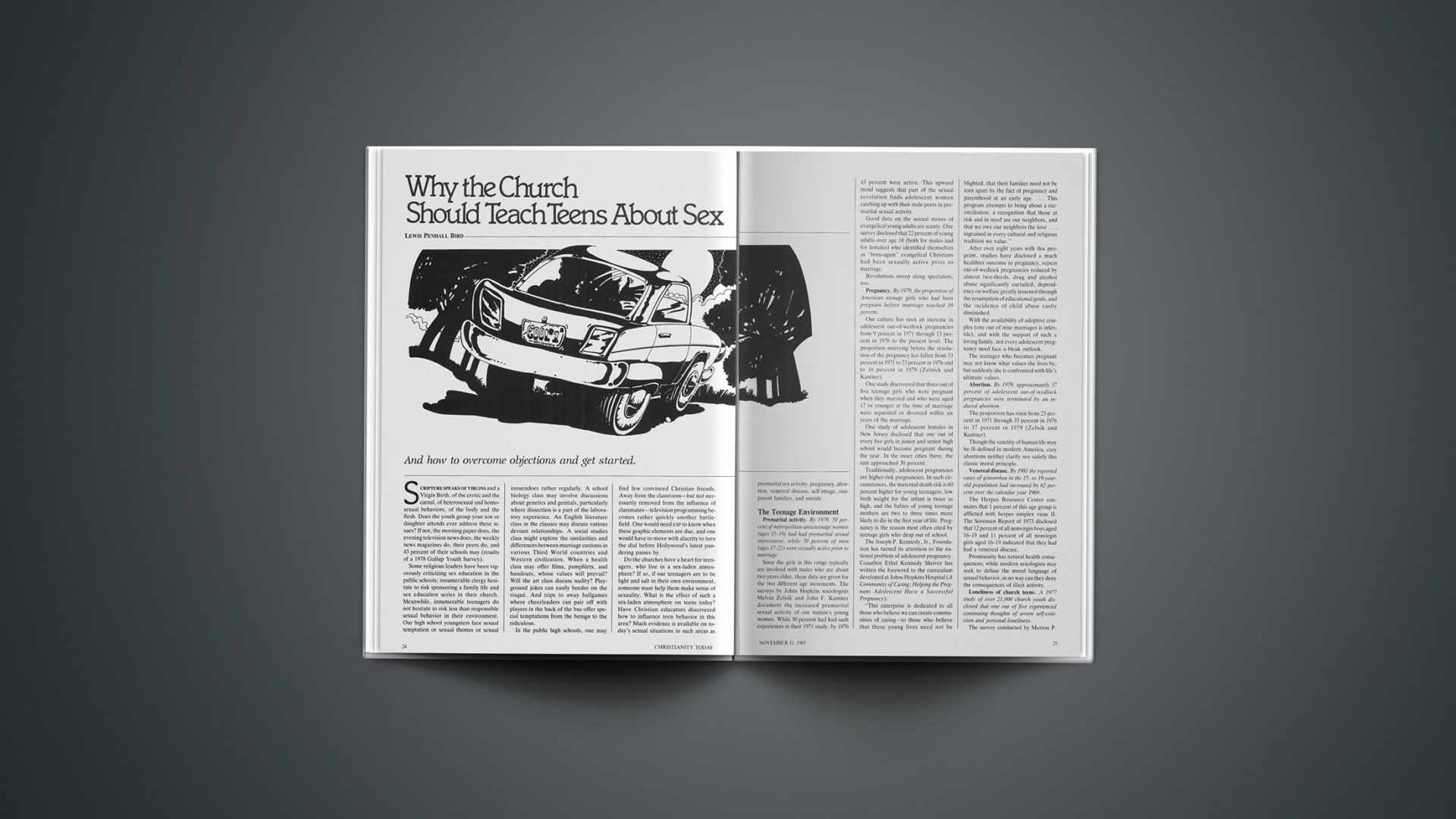
• The automobile became a vehicle not only for travel but also for escape, and the chaperone system broke down as increased mobility gave increased privacy.

• The Nineteenth Amendment gave women the vote; this legitimate concern produced a side effect—rhetoric calling for the “double standard” to be replaced with mutual sexual freedom. This led to a new pattern of selecting mates.

• Birth control methods encouraged greater risk. As a result, the triple threat of detection, conception, and infection was first effectively counterchecked in the 1920s.

• Much literature of the 1920s ridiculed conventional morality (F. Scott Fitzgerald, Ernest Hemingway, Sinclair Lewis, Ring Lardner, et al.). The value system and lifestyle of masses of people were affected.

• Havelock Ellis’s Studies in the Psychology of Sex (1905–15) crossed new frontiers.

• Pop versions and distortions of Freud, Jung, and Ellis offered nostrums for inhibition and repression, giving “scientific” permission to indulge natural impulses more glandular than cerebral.

• The 1920s, which were often called the “lost generation,” Lawrence Lipton described as the “democratization of amorality.”

• Walter Lippmann asked (1929) whether society’s sexual openness reflected less hypocrisy or more promiscuity.

What began in the 1920s was institutionalized in the 1960s and pursued with a vengeance in the 1970s. Sexual values and attitudes impinge on institutions and behavior, amending them as change occurred. If the 1920s became Phase I of the sexual revolution, Phase II began to be obvious in the 1960s. What happened in that decade?

Medicine

1960—the “pill” first became available to the public.

1966—first transsexual surgery.

1966—Masters and Johnson published Human Sexual Response. In 1970 they released Human Sexual Inadequacy, and in 1974 The Pleasure Bond (now emphasizing commitment in a relationship).

Late 1960s—amniocentesis first available to general public.

1967—first medical journal given entirely to human sexuality.

Medical-Legal

1965—Comstock Act of 1873 overturned by U.S. Supreme Court; public advertising, display, and mailing of contraceptive devices now legal.

1967—Colorado first state to make abortion on demand legal if the pregnancy gravely threatened a woman’s physical or mental health, resulted from rape or incest, or was likely to result in the birth of a severely defective infant.

1973—all previous state laws severely limiting abortion were overturned by the U.S. Supreme Court, and our current permissive climate resulted.

Mid-1960s—artificial insemination using donor sperm (AID) became more readily available for infertile couples; legal questions lingered.

1974—American Psychiatric Association changed category in its diagnostic manual for homosexuality from “Sexual Deviation” to “Sexual Orientation Disturbance,” commenting that pathology was present only when such people are disturbed by their orientation.

1978—Louise Joy Brown, first baby born by in vitro fertilization. Many medical-moral-legal questions arose.

Legal

1966—New York joined California to make divorce legally permissible when “irreconcilable differences” existed.

1967—interracial marriages were freed of legal restraint by the U.S. Supreme Court (Loving v. Virginia). This declared all antimiscegenation laws unconstitutional.

Literary-Legal

1957—pornography defined as “utterly without redeeming social importance” where the average person, exhibiting “contemporary community standards” would find the dominant “theme” appealing only to one’s “prurient interest” (Roth v. U.S.).

1966—“Pandering” or “titillating” advertising was censured.

1967—attempted distribution of licentious material to juveniles was an appropriate guideline for writing obscenity laws (U.S. Supreme Court).

Literary

1953—Playboy founded. William F. Buckley later called Hugh Hefner “the godfather of the sexual revolution.” Through most of the 1960s and 1970s, Playboy’s circulation outstripped Time, Newsweek, and U.S. News and World Report.

1982—Hefner said in Newsweek, “Things are a lot better in the bedroom today than when I was growing up, and I think there is a clear recognition that Playboy played an important part in changing attitudes and values. It’s the single thing I’m proudest of.”

Theology

1963—J. A. T. Robinson’s Honest to Cod.

1966—Joseph Fletcher’s Situation Ethics: The New Morality.

1968—Pope Paul’s encyclical Humanae Vitae (“Of Human Life”) reaffirmed the traditional Roman Catholic position that artificial means of birth control are immoral.

The absence of courses on love, sex, and marriage certainly froze our pools of ignorance. Unanswered questions remained so, with the hidden assumption that they probably were unanswerable. The lack of any premarital classes reflected deficiences in clergy education as much as pastoral ineptitude. In the process, many deserted the Bridegroom as well. Out of common disasters emerged an explicit disrespect for the church that soon slid into implicit disregard for Christ. Though the former is more understandable than the latter, neither reflect a mature response to reality. But then, none of the four has ears to hear anymore, if one is to believe his or her discontents.

Each generation has its own agenda of stresses to manage; civilization depends upon the elders of the tribe to pass on the principles and the God who remains responsive to any new threat to personal intimacy.

6. No data exist that courses make a difference. Disagreed.

Numerous studies have demonstrated that positive change does occur in the areas of knowledge and attitudes. One might have predicted this. The more difficult outcome to measure is behavioral change. Some form of investigation over a lengthy stretch of years would be needed to measure subsequent behavior. To date, few have attempted this task.

A recently published study in Family Planning Perspectives by Johns Hopkins researchers Melvin Zelnik and Young J. Kim (May/June 1982) shows that “young people who have had sex education are no more likely to have sexual intercourse than those who have never taken a course” (italics added). This is among the first reassuring evidence that such courses do not necessarily trigger sexual acting out, a concern of opponents.

Zelnik and Kim also discovered that “amongst 18- to 19-year-old white women surveyed in 1979, those who had not had instruction had a higher rate of sexual activity than those who had (71 percent compared with 55 percent).” In 1980, Dougles Kirby reviewed studies on behavior in The Journal of School Health (December 1980) and generally agreed with Zelnik and Kim.

On the national problem of adolescent pregnancy, the curriculum prepared by The Joseph P. Kennedy, Jr., Foundation entitled “A Community of Caring” and based on six years of experience at the Johns Hopkins Hospital in Baltimore has well-measured, positive outcomes for these girls. Their involvement in a comprehensive prenatal health care program where values are specifically salted into the curriculum has had very encouraging results. (No evangelical health care provider working with this problem should be without information on this marvelous program.)

However, a Minnesota study published several years ago in Minnesota Medicine (February 1973) found that adolescent girls who had not taken a sex education course had more than 16 times as many out-of-wedlock births over a 20-year period as those who had taken a course. This same study discovered that adolescent boys who had not taken the course had about four times the divorce rate of those who had taken the course.

A particular caveat may be noted here. Students are stuck with an enormous amount of sexually laden stimuli in our culture. Then too, their social, emotional, and sexual needs contribute to their valnerabilities. To expect classroom discussions to counterbalance all these influences may be asking for a miracle—but then, in a church-sponsored program, wouldn’t that be appropriate?

We do have impressive, overwhelming evidence that, in the absence of courses, adolescent sexual behaviors are marching off the charts. With little information from caring, well-informed, well-matched adults, teenagers seem to assume that (1) everyone’s doing it; (2) answers to permissive sexual lifestyles do not exist; (3) the Bible is out of date; and (4) television and movie innuendoes probably disguise a pretty exquisite experience. So off to bed they go.

One bumper sticker that has appeal reads: “If you think knowledge is expensive, try ignorance.” Our teenagers, lacking any comprehensive knowledge of the interface between abiding love and sexual fulfillment, are acting on their ignorance.

Why Wait?

Please do wait until a committee can be formed, the best available leaders found, the budget prepared, the films screened, the parents informed, the publicity launched, the paperbacks ordered, the handouts written, and the teenagers’ opinions solicited.

But please don’t wait until the first out-of-wedlock pregnancy rocks your youth group, the first abortion unsettles a family, the first college kid contracts herpes, the first elder’s daughter has a shotgun wedding, and the last recalcitrant deacon steps into the twentieth century.

How To Begin: Methods And Curricula

Once a committee has been formed, speakers and films can be identified and a trajectory outlined. Prayers for discernment and discretion as well as for courage are appropriate. Funds may need to be budgeted. To begin with a series for parents is a natural course of action to take. Competency demonstrated here will pave the way later for the development of a series with senior high and then junior high youth. One needs patience to secure the kind of qualified speakers and discussion leaders needed.

In the past decade, several curricula have appeared for use by evangelical congregations. The recently released, newly revised Concordia series on sex education comes with splendid recommendations. By age group, the titles are: “Each One Specially” (3- to 5-year-olds), “I Wonder Why” (6–8), “How You Got to Be You” (8–11), “The New You” (11–14), “Lord of Life, Lord of Me” (14 and up), and “Sexuality: God’s Precious Gift to Parents and Children” (adults and parents). The books are reasonably priced ($5.95), while a filmstrip series that compliments the set has been developed for Sunday school, Christian day school, youth group, family retreat, or teacher education audiences.

Interesting also is the Southern Baptist series published in 1973 but relevant to contemporary mores and morals. Titles include: “Made to Grow” (6- to 8-year-olds), “The Changing Me” (9–11), “Growing Up with Sex” (junior high), “Sex Is More Than a Word” (senior high) and “Teaching Your Children About Sex” (parents). Youth groups and senior high Sunday school classes could be stimulated to think through some of the issues by using the David C. Cook curriculum, “Created He Them Male and Female: A Biblical Perspective on Sexuality.”

The film Human Reproduction by McGraw-Hill (Third edition, 1981) offers as useful and as graceful a portrayal of the subject as any church group could desire. The volume by Christian physician Grace Ketterman, How to Teach Your Child About Sex, is useful with parental groups. One could trace a range of themes in recent issues of CHRISTIANITY TODAY that would provide a contemporary primer on family life and sex education issues.

Along with the essays, films, books, and paperbacks that would be useful for background research or distribution in seminaries, competent local leaders and speakers who can respond well to questions on the spot are the most valued asset. Select them with care. Members of both the Christian Medical Society (CMS, Richardson, Tex.) and the Christian Association for Psychological Studies (CAPS, Farmington Hills, Mich.) may live near you and have competency in these areas. But do locate these leaders and do begin the dialogue with parents and teenagers that renews itself from generation to generation.

Conclusion

Adults need to be more profoundly aware of the chemical interaction of the H-Bomb and Hollywood—not to mention the perverse influence of Hugh Hefner and the personal impact of individual hormones—on our teenagers. To eat, drink, and be sexual before Doomsday has a certain compelling logic.

The middle-aged parent is caught in the middle. On the one hand, one hears grandparents comment: “I certainly wouldn’t want to be raising teenagers today.” Certain other graybeards firmly dissuade their youth pastor from organizing any family life and sex education program for their church’s youth group. One nearby, sizeable evangelical youth group experienced about a 50 percent rate of premarital sexual activity a few years ago. Known to the youth pastor alone, his plea for a seminar series on family life and sex education fell on deaf ears in the board of Christian education. Should he have breached confidentiality?

Our teenage males see innumerable female bodies, but they do not understand women. Our teenage girls see sexiness from cover to cover in their magazine choices, but they little understand sensuality. Our adolescents listen to the lyrics of love wailed by society’s dropouts but they learn little from these moral midgets. Our teenagers are touched by injustice, by poverty, by suffering, by abuse; are they touched regularly as well with nurturing love? With remarkable insight Paul Ramsey observes, “Ours is the only era in the entire history of human life on this planet in which the ‘elders’ of the tribe ask its newer members what the tribal rules and standards of expected behavior should be.”

With the sexual revolution (and the women’s movement, an equally revolutionary phenomenon) have come gains and losses. Both are profound societal dislocations. However, the Good News still liberates from cultural fashionability while offering discernment through any revolution.

The Pauline trilogy of faith, hope, and love can offer discriminating perspectives for individuals of all ages, both sexes, and whether one is single or married. The modern quest for personal intimacy, so promiscuously pursued in our day, can be safeguarded for those disciples who have the sense to have faith in God’s will and God’s way. The quest for personal integrity, beyond hope in too many human relationships, is yet the hope of those who have experienced the power of a covenant-keeping God. And the quest for personal identity, so denied the abused, the manipulated, the lonely, and the perverse can so richly flower in the sunlight of God’s agape love.

God is love. For modern pagans that is revelation indeed, and for modern Puritans that is liberation indeed. In a world so confused about love, so timid about commitment, so bestial about sexuality and so negligent about nurturance, the Lord God has incarnated Love, established covenants, admitted to creating our sexuality and become our heavenly Father.

In the biblical revelation he is the author of eros (Song of Songs), the embodiment of agape, and still the friend of sinners (John 15:15). From his astonishing imagination have come male and female, gender and genitals, procreation and re-creation, identity and intimacy, roles and rules, ecstasy and eternity. And in the Incarnation these sexual themes took on flesh. There are many treasures that we hold in earthen vessels besides the gospel (though that is surely the pearl of great price!); our sexuality is one. As with most treasures, this jewel is not truly cherished until all counterfeits are exposed, all imitations acknowledged, and the proper matrix disclosed within which this unique gem can fully sparkle.

He can use parents and pastors to achieve this.

Bill Armstrong: Senator & Christian

A rising young member of Congress comments on faith and politics.

Bill Armstrong is a first-term Republican senator from Colorado who earlier served three terms in the House of Representatives. He chairs the Senate subcommittee studying solutions to the severe problems facing Social Security and is earning respect as a leader. The Wall Street Journal says of Armstrong: “[He] has moved ahead of the pack of bright, young conservatives elected to the Senate in the past three elections.” Armstrong, 46, is the owner of a radio and television station and formerly owned a newspaper, the Colorado Springs Sun. While he was a member of the House of Representatives. Armstrong became a committed Christian. He was interviewed in Washington recently by CHRISTIANITY TODAY editors.

If you had the choice of 50,000 Christians becoming either better Christians or getting involved in politics, which would you choose?

I don’t see those as being mutually exclusive. I frequently talk to people individually about their spiritual lives and about Christ. I think that is one of the most important things I can do. But I don’t see that as being in conflict with politics. In fact, sometimes they go together. Because I’m deeply involved in politics, I am thrown together with other people in the Senate or in the House of Representatives. A colleague recently called me for three reasons. He first asked for two political favors. After we were done talking about that, he said. “By the way, can we get together some time? I want to talk about religious things.” I sense he might be ready to give his life to Christ.

Virtually every denomination and large church group emphasizes organized political action. Jerry Falwell has been prominently identified with that recently. That is largely because he has been the pastor to, and spokesman for, probably the largest group of those who stayed away from political activity over the last 25 years. Virtually all of the mainstream denominations teach that it is an aspect of religious leadership to play their part in political action.

If I had to say what is the most important thing a believer can do. I’d probably say to tell people about Jesus. But that doesn’t mean I don’t think it’s important that they pray or that they register to vote. Would people who say that political activity is not a proper role for Christians also say that William Wilberforce shouldn’t have run for the British Parliament to put an end to the slave trade? It just doesn’t hold up.

On the other side of the coin, there is a danger when believers get deeply involved in political activity that they will try to put the mantle of Christ over their cause. They might try to deify that cause and say, “Because I’m motivated to run for office for reasons that are related to my faith, a vote for me is a vote for Jesus.” That’s not right. Even on such sensitive issues as school prayer, there are conscientious believers on both sides of the issue.

It is terribly important never to let the church see itself as a power bloc. I would resist the church itself organizing as a political force, encouraging individual Christians to do so, and even creating political organizations. Those activities should be separate from the body of Christ itself.

How do you feel about Christians organizing politically to support candidates because they are good candidates, not because they are good Christians?

Members of the church can organize without saying, “A vote for this candidate is a vote for Christ.” What if you have a good candidate who is not a believer and a bad candidate who is? My view is that each case has to be resolved on its merits. I do not think it is proper for a believer to support another believer only on religious grounds. I would not refuse to have a nonbeliever do brain surgery on me in preference to a believer who is not as well qualified. It limits the power of God to say that only a believer can function effectively in brain surgery or in public office. Scripture teaches that God can raise up sons of Abraham out of stone. There are men and women in Congress who are not believers, but they still are doing God’s will.

There are a number of Christians in the Senate and in the House of Representatives. How does your Christianity influence what you do and how you vote on issues?

It makes all the difference in the world. My conception of what a senator is hinges on what his world view is. Scripture tells us to perform any vocation as if unto the Lord. When my staff and I gather for our weekly legislative meeting, we begin with prayer. Sometimes we pray specifically about the substance of legislation or about how we will handle a matter. One of the recurring attitudes in our office is that as we deal with people with whom we disagree, we will be sensitive to their point of view. We want to recognize that they could be right. We feel that relationships with other members of Congress are important. Those relationships transcend whatever the political issue is.

Another level at which we pray specifically is for guidance. A lot of the important questions defy human understanding. I’ve got some idea of what we should do about the economy. But the truth is that nobody knows for sure. Even the most brilliant of our economists are baffled. The same is true with issues of war and peace, drug abuse, pornography, and law enforcement. The things that we really care about, for the most part, are those issues on which human understanding isn’t sufficient. So prayer for wisdom is a recurring theme.

My faith really does affect relationships in the Senate. There is a spirit of brotherhood among a number of us which goes beyond political questions. For two years I’ve been meeting with a group of senators on a weekly basis. We are growing closer together in ways that include our official responsibilities. But that doesn’t mean we’ll all be on the same side of a particular issue. Frequently we are not. But we’re growing together in brotherhood and unity, which I believe is consistent with the sort of brotherhood Christ would have us seek.

Are there more Christians in Congress today than in the past?

That’s hard for me to measure since my interest in spiritual things began after I arrived in Washington. Instinctively my answer is “yes.” I think it is easier today for those in public life to be open about their faith than it was a few years ago. Much of the credit for that belongs to former President Jimmy Carter. He was up-front about his faith, and in so doing he opened the door for a lot of people in less-prominent positions to do the same. For a long time there were only a handful of political figures who were prominently identified as believers. That’s much less true today. There are many men in public life today who are serious about their faith.

Is it harder for a President to lead the country these days?

There is almost a total breakdown in the ability of anybody to lead the country. The results of leadership seem to be deteriorating rapidly. It is almost impossible for any President to fulfill his historical task. The last successful President we had was Eisenhower.

What is the cause of the decline in our Presidents’ ability to lead us?

We have raised the expectations of leadership to a level that is awesome for anybody to fulfill. In addition, we subject our leaders, particularly Presidents, to a degree of scrutiny that makes it impossible for them to have time for reflection. The reaction times are so quick, and there is so much harrassment in the media—not in the ideological sense, but in the sense of the speed with which Presidents are forced to react.

Here’s a typical example: The President’s budget was leaked to the news media before Congress received it. The details were published in newspapers around the country. The opposition in both parties had already analyzed and dissected the budget and had begun to critique it before the President even had an opportunity to present it. The reaction time has become so quick, and the criticism by the media has become so instantaneous, that it makes it very difficult to be a leader.

The breakdown in respect for authority is another reason for the decline in the ability to govern. You see it on campus, and you see it in politics. People ignore the leaders of Congress. It used to be that the top two or three men in the Senate and in the House would virtually control the outcome of legislation in their chambers. That’s no longer true. And it used to be that when the President cracked the whip, everybody would fall in line.

Are we expecting more from one another than we are capable of delivering?

I think that is true. If you put people in positions where they have vast authority over other human beings, where they are subjected to temptations, where they are cut off from the kind of accountability most human beings have, and then expect them to exhibit anything other than corruption it’s totally unrealistic. We put our leaders in that kind of situation. It especially affects the President, but it’s not just the President. It affects heads of corporations, and certainly senators. We surround them with people whose task is to flatter their egos and open doors for them. We deprive them of the experiences and self-correcting mechanisms that would make them balanced human beings. If you want to create the worst atmosphere for policy making, give people a lot of public adulation, separate them from their families for prolonged periods of time, and force them to work late night after night. Then, on weekends, take them away from their families and send them to visit their constituents. That’s exactly what we’ve done to those in public office. The wonder is that we’re doing as well as we are.

How would you reverse that and make the best possible situation?

I’ve been encouraging people to pray that there will be an end to the night sessions in Congress. We keep a bunch of men and women [members of Congress] away from their families until late at night, night after night. Then we punctuate that with all-night sessions of Congress. It gets to be a routine that they’re never home for dinner. They’re never with their families under ordinary, relaxed circumstances. That’s going to produce divorce. I think statistics would show that Congress is a divorce factory for its members and also for the staff, of which there are several thousand.

How do you handle that kind of pressure?

When I travel. I’m on the telephone every night with my family. Second, my wife travels with me some. Third, when I’m home. I meet with my family at 6:45 every morning for prayer and Bible study. A lot of times that’s the only time we are together.

My son and I are trying to start a tradition that one weekend every year he and I will spend two days skiing together. We believe that the quality of the time is more important than the quantity. I must admit, however, that if you get the time cut down too far, no amount of quality will compensate.

It’s terribly important that men and women in public life have regular access to the kind of Christian fellowship that I’ve been fortunate to have. The greater the pressures, the more that need exists.

Is there a specific place and time you can recall when you became a Christian?

Yes. I had been a nominal churchgoing Christian suburbanite all my life. But I accepted Christ as my personal Savior in the Joseph Martin Dining Room in the Capitol after I was elected to Congress 10 years ago.

Some people are led to the Lord as a result of tragedies. That was not my experience, but just the opposite. I had dreamed of certain kinds of success: making a lot of money, being elected to public office, and so on. I had achieved those things at a rather early age when I discovered they were fundamentally empty. Instead of being filled and satisfied. I was feeling kind of desperate. Just at that point I was converted by a Christian layman who shared the gospel with me in a very direct way. I came to the realization that although I had been a church member, I wasn’t really a Christian in the sense of trusting Christ for salvation and for the ultimate questions of life. So sitting there in this little dining room, we discussed the gospel. He said, “Does this express the desire of your heart, to accept Christ as your personal Savior and let him take charge of your life?” I said, “Yes, it does. Let’s pray.” It was just about in that matter-of-fact manner.

Why has abortion not been outlawed, particularly after all the outcry?

I think we are in the process of winning the battle. There is a much greater sensitivity to the issue, and a much greater understanding of the moral question involved. Federal funding for abortions is unlikely to be reinstated. But I think it is unlikely that we are going to take the next step—outlawing abortion—any time soon, although I think we should. There are a lot of people who are like I used to be. They simply do not understand the ramifications of it, the moral gravity of abortion.

What are your conclusions about another moral question: the nuclear arms race?

We are in an intellectual cul-de-sac. I basically affirm the doctrine of deterrence, and I affirm the idea of the just war. On the personal level, I respect people who argue for pacifism. But none of those ideas give me much sense of optimism for the future. I have reached the conclusion that the Lord will give us better approaches if we can get out of the intellectual rut we’re in.

From a moral standpoint, our present nuclear doctrine, nuclear destruction, is absolutely bankrupt. It is contrary to the teachings of pacifism and it is contrary to deterrence, because it won’t work. It is contrary to several of the main premises of the just-war theory. It does not direct itself to combatants or to keeping civilians safe. It is not proportionate by several of the hallmarks of the just-war theory. Clearly we need something different. Our country has become, by virtue of the doctrine of nuclear destruction, the first major nation to decide that we’re not going to defend our homeland upon attack. Instead, we are relying for safety on our threat to kill millions of people, such as Soviet citizens if the Soviet Union makes a hostile move against us. I believe that policy to be impractical.

There is a growing body of scientific thought and military strategic thought that we could come up with a purely defensive system. It would not have offensive capability. One of the most promising of those ideas is called “High Frontier.” It is a system that relies partially on space-borne defensive site areas. And I stress, it has no offensive capability. It wouldn’t be a threat to another country. That has a lot of practicality, and I believe it is more scripturally sound.

I attended a conference in Pasadena called “The Church and Peacemaking in the Nuclear Age.” I urged the people there to think about Nehemiah when he rebuilt the wall. He didn’t threaten Sanballat with nasty retaliation or with mutual destruction. He didn’t negotiate with him. He just rebuilt the wall. And he did a lot of other things. He put through a number of civic reforms, including lowering taxes and freeing the slaves. I think that’s the kind of leadership that we need to provide the country with.

What is it about the pacifist argument that you think is fundamentally wrong?

I think pacifism is completely honorable and proper at the individual level. But as John Stott has said, Scripture clearly distinguishes between the role of the individual and the role of the state. The magistrate is not only permitted—but may well be required by the state—to use force to protect the innocent, to restrain evil, and to punish wrongdoing.

At the national level, Scripture teaches that it is proper for leaders to bear the sword in self-defense or to defend an innocent third party. So pacifism on a national level is not scriptural. And it doesn’t respond to practical reality.

Some might say that it’s better to give in. I sense that there is in some people almost a desire for the United States to be subjugated so that we can test out and live our faith in captivity. One of the most articulate of the pacifist spokesmen at the Pasadena conference even admitted that there were some circumstances in which he would be willing to resort to violence—in defense of his life or the life of his family. So I don’t think pacifism is the answer.

So far as the nuclear freeze is concerned, I think that’s an idea that has run out of steam intellectually. It doesn’t stand up under rigorous examination. The reality is that the United States has had a nuclear freeze for 12 years. It hasn’t affected the Soviet Union in any particular way that I can tell. By the same token, I think the mindless expansion of the arms race clearly is not the answer. How many weapons are we going to end up with? That’s why I’m looking for ideas like High Frontier.

How do you regard the Moral Majority?

I don’t think there’s any doubt that the Moral Majority has both helped and hurt. On balance it has been enormously helpful. Many of the people who criticize the Moral Majority for taking moral stands are the same individuals who have been taking moral stands for decades, but from a different perspective. The criticism I hear against the Moral Majority is from those who simply disagree with its political positions.

Whether it’s the Moral Majority or the National Council of Churches, any Christian who approaches a political subject should do so with a degree of intellectual humility and should clearly distinguish the gospel from the political issues. There are no political positions on which salvation hangs. Your citizenship in the kingdom does not depend on your position on a balanced federal budget, nuclear disarmament, or even on abortion.

I think I can demonstrate to the satisfaction of most impartial listeners that our form of government is vastly preferable to Marxism. But that doesn’t prove that Christ would be a capitalist. I think Christ is indifferent to issues of that type, with one exception. I think he would approve of those institutions of government or economy that foster human liberty. So I take it for granted that Christ would not approve of the arrangements in Nazi Germany or in the Soviet Union. There are some political and economic features in our own country that don’t seem as hateful to me as to some, but that Christ wouldn’t approve of either. The point is that there is a risk that the church or a religious group would see itself as a power bloc. That is not scriptural in my opinion.

Such groups may unwittingly tend to limit the Lord’s power by assuming that the only way God can accomplish his purposes is through political ends. Now I think political service is worthy and that Christians should wade into politics with both feet. But in the end the Lord is not bound by political considerations.

We are really in danger of throwing the mantle of Christ over any lesser cause. I think it’s perfectly proper for Christians to be in the used-car business. But I don’t think you can say, “This is Christ’s used car lot.” By the same token, I don’t think you can say, “This is Christ’s legislative program.”

The right approach for any Christian in politics is to ask, “Does this actively honor Christ?” If it does, the rest will take care of itself. If it doesn’t, no matter how right it may be on a particular political issue, it’s out of bounds from the Christian perspective.

There are about 184,000 Christians who read CHRISTIANITY TODAY. If you could address them all at once, what subject would you like to speak on? What are a few of the main points you would make?

Christ told how the world would know that Christians belonged to him. He said, “If you have love for one another,” that would be the sign [John 13:35], I think one of the greatest needs in Christendom is that Christians rise above their disagreements over economic issues, political issues, even the most serious issues of war and peace. We should emphasize the overriding significance of our unity in Jesus Christ.

I attended the peace-making conference in Pasadena with some sense of tension. I agreed to make the trip because I felt a deep need to learn about the issue of nuclear war. I wanted to be receptive to people whose views were quite different from my own. But I prayed about the conference for months. My church even prayed that whatever the disputes about policy were, that Christ would be honored. And to a large extent that was true.

When I got back, I was talking to a colleague in the Senate about the experience I had. He said it would be a shame if we let anything become more important than our brotherhood in Christ. And he is a senator who holds quite a different viewpoint from mine on the nuclear issue.

I told some of the people in Pasadena that politics supposedly is very rough and tumble. We are supposed to be tough guys, professional advocates in a sense. But I have never seen the kind of brutal personal relationships between senators that occasionally crop up among leaders of the church. A very deep need of the church is for us to emphasize our unity—not to say we shouldn’t argue. I think we should. I appreciate the contribution made by the U.S. National Conference of Catholic Bishops in their pastoral letter on nuclear arms. Even though I may not agree with their conclusions, it’s good to have those kinds of intellectual disputes. We can honor Christ if the spirit is right.

What If Christian Colleges Don’t Join the “High Tech” Revolution?

The High Technology Challenge

We are entering a revolution as far-reaching as the one that followed Gutenberg’s invention of the printing press. The survival of some of our Christian colleges is at stake in a struggle with the high technology revolution. Their significance for several decades to come will be determined by the way they respond to the challenges (see “Christian College Enrollment Trends”).

Just what is “high technology”? There is no definition that is universally accepted, but the key element that distinguishes “high” technologies from other types of technology is their dependence on information or communication systems (see “What Is High Technology?”) The close identification of high technology with the concept of the emerging information society is no accident. Whether in genetic codes or computer codes, understanding and using an information and communication system is what really matters. Understandably, therefore, the most immediate high tech problems for the majority of Christian colleges concern computers and other electronic communications and knowledge systems.

Books And Computers

These information and communication technologies are in the process of altering society and education as fundamentally as did Gutenberg’s technology for printing books. They are altering the way people think and learn and value. Therefore, they are challenging current practices in American higher education, including Christian higher education.

The advent of Gutenberg’s printing press technology changed both the method of learning and what one needed to learn. It replaced hand manuscripts and rote memorization with a more efficient means of storing and transfering information. In the same process, it redefined what was worth knowing. Printing eventually broke the knowledge monopoly that university professors who read their carefully guarded lectures held over scribbling students. And it also broke the church’s monopoly on divine truth as it opened the mystery of the Scriptures to every literate layman. The book offered knowledge equality to everyone who could read. In addition, a person no longer had to know every detail a book contained; he only needed to know where he could find information and what it meant. No wonder books were attacked as a tool of the devil. Computers now share similar abuse.

Knowledge Is Power

Print on paper will continue to be important, of course. Like the book, the computer can store information in readily accessible form. But unlike the book, the computer can also manipulate the information. It can do mental work for us. It can “think.” An integrated electronic information and communications network can answer important questions and solve significant problems. Individuals, organizations, or nations with such systems at their service have immense advantages over those without them. In an information society, knowledge is power.

In hard times such as those Christian colleges face in the 1980s, success in the competition for dwindling numbers of freshmen and declining funds will depend in large part on the ability to deal wisely with high technology. They will have to offer that technology to their students and use it in their own operations. Many people will need to learn new ways of doing things. Morale may suffer when technological disruptions are rubbed into the wounds left by lower enrollments. And at the same time, these mostly small, mostly nonendowed colleges will have to avoid going bankrupt.

Change Without Changing

The rapid rate at which these information and communication technologies are developing will challenge the adaptability and resilience of the Christian colleges. The majority of them are liberal arts institutions organized and supported to be bastions of stability, not centers of change. They are designed to preserve values, not promote a technocratic revolution. They are oriented to teaching rather than research. They study the past, not the future. How can they influence the information society if they cannot speak its language?

The liberal arts—like high technology—lack a universal definition. Usually the term implies a broad education in varied fields of study, verbal and artistic expression, analytical and synthetic thinking. Each college would claim more than this, few would claim less, and every one would claim uniqueness for its particular version of educating the whole person.

As these colleges work for significant survival, even the concept of “Christian liberal arts” is likely to undergo modification. The Christian college must be able to attract students and donations. Christian college graduates must be able to find jobs in the world of microchips, communications satellites, laser video discs, and gene splicing. Almost every corner of the successful institutions will be touched before the revolution is over. The trick is to change without changing, to adapt without blindly adopting. Without destroying their identity or losing the essence of the liberal arts, they must transform themselves into colleges as different from the present type as the present type is from a pre-Gutenberg university. Those that do it well will be the influential Christian colleges of the twenty-first century, the ones the church and the rest of the world will listen to and support.

The Industrial Past

Today’s Christian colleges are creatures of America’s industrial era. Most of them were created between 1860 and 1960 during the golden finale of American heavy industrialization. Their founders typically sought to ensure that the college would perpetuate certain religious beliefs and values in the midst of that industrial society. Thus, their purposes have tended to center on transmitting a body of knowledge, imparting skills, and inculcating life values and behavior patterns. They have adapted well to a church and society that look to them as a special source of broadly educated spiritual and organizational servants and leaders. Christian college graduates have provided an important alternative to the university-trained specialist on the one hand, and the Bible-college-trained specialist on the other. The Christian college taught about the industrial world, and even pointed out its evils, but also sent liberal arts graduates into it and drew contributions from it.

In terms of employment, the industrial society reached its peak in America around 1920, when slightly over half of all workers were employed in manufacturing, commerce, and industry. Then the industrial decline started, and by 1976 more than half the working population was employed in information, knowledge, and education. A social and economic revolution was under way. Interestingly, Christian colleges responded by placing more emphasis on “the major” or specialization at the expense of any common conception or high valuation of general education. The common question is, “What is your major?” rather than a query about general studies.

As generalists in a world of specialized industrial workers, Christian college graduates stood out and moved naturally into leadership roles. As specialists in a world of knowledge workers, the difference between graduates of Christian and secular colleges begins to blur. The effort to develop a distinctively Christian collegiate experience, based on the constant interaction of Christian beliefs with all courses and activities, has matured just in time to have its best insights captured in print or video for use on any campus, secular or Christian. That is the nature of information flow in the high tech information society.

Christian College Enrollment Trends

The number of freshman students the Christian colleges enroll is closely related to the number of students graduating from high school each year in the United States. That number has been declining since 1980, and enrollments at Christian colleges are beginning to reflect this trend. Nationally, the number of high school graduates is projected to decline about 20 percent from 1980 to 1990, with the only respite being a modest upswing in 1987–88.

From 1981 to 1982 the number of high school graduates nationally dropped approximately 1.2 percent. However, figures released by the Christian College Coalition indicate that some Christian colleges are bearing more than a proportionate share of the reduction. The total opening full-time freshman enrollment at all these colleges together fell 7 percent during the same period. Since some Christian colleges maintained or even increased their enrollment, the declines at the others have been precipitous and catastrophic.

Many have attributed the surprisingly large decline to the compounding effects of unfavorable economic conditions and reductions, and uncertainty in government student-aid programs. Others point out that a few colleges with extreme circumstances may have caused much of the change. Although some Christian colleges are still saying publicly that they expect to grow or maintain their current size, recent experience suggests that reality may soon destroy such optimism.

Evangelicals have consistently made up about 20 percent of the nation’s population, and the number of evangelical high school graduates is expected to follow the national patterns, including significant regional variations. In short, Christian colleges are trying to cope with nationwide declines in the size of their traditional pool of freshman prospects.

In order to avoid, or at least minimize, enrollment declines when the total size of their student market is declining, Christian colleges are competing more aggressively with one another. They are also trying to market themselves to students who otherwise would be expected to attend secular institutions. Such groups as the Christian College Coalition are attempting to assist such efforts by clarifying the differences between secular and Christian higher education in the lives of alumni. Whether or not such efforts eventually prove successful, some colleges have already reduced faculty and cut budgets to ensure financial and programmatic stability with fewer students. Others surely will follow as the great wave of enrollment declines sweeps in.

Christian colleges have grown as the student population grew, especially between 1960 and 1980. But now there will be fewer students, and Christian colleges are beginning to adjust, not painlessly and not always with very good long-range planning or strategic marketing. But they have been adjusting nevertheless. Fewer Christian college students means fewer Christian college professors, and thus a smaller pool of Christian writers and thinkers. And the decline now starting in the number of evangelicals graduating from college will soon have its effect on the size of seminaries and Christian graduate schools, inducing faculty reductions in that sector of Christian higher education as well.

Christian colleges must join the high tech revolution if for no other reason than to keep this decline to a minimum.

RICHARD KRIEGBAUM

The “Mentafacturing” Future

By the year 2000, over two-thirds of all Americans will spend most of each working day creating, storing, retrieving, organizing, revising, teaching, learning, sending, receiving, or otherwise using information. In such a world, machines will do most of the “physical labor,” and people will think. Knowledge will be, as many experts already feel it is, a nation’s most important economic resource. Not factories, not farms, not nuclear weapons, but knowledge.

The Latin roots of the word “manufacturing” suggest “making with the hands.” Many of those working hands, however, already belong to computer-controlled industrial robots. In the world now upon us we need a new word, “mentafacturing,” to suggest “making things with our minds, doing things by our silent commands.” Integrated systems for computer-assisted design and computer-controlled manufacturing allow a programmer engineer to alter a product or create a new one by giving new instructions to the automated system from the computer terminal in his office or living room. Mass production is no longer obligatory; customized production becomes the norm. In a mentafacturing world, to imagine is to make. Creative imagining becomes a critically important ability, and the life of the mind the central arena of human endeavor. Considerable irony hides in the possibility that many Christian colleges will find it difficult to adapt to such an environment. The industrial past seems much more comfortable than the mentafacturing future.

In Every Home

What will life be like in a high tech, mentafacturing, information-based society? In each home, there will be a centrally located, compact, computer-and-communications center or “comcenter.” It will handle all voice and “print” communication, such as sending an electronic letter or receiving and displaying the latest news and weather forecasts. Most everyday transactions, especially banking and paying for purchases, will be conducted electronically. Many people will actually shop from their homes or offices electronically by using interactive computerized “yellow pages” called videotext, that give full pricing and product information on every item in an entire shopping mall. Videotext is already in wide use in France and is currently being used by test markets in the United States.

The comcenter will receive TV and radio programming, of course, but it will also play inexpensive laser video discs of digitally recorded music, entertainment, and education. One disc will contain a complete encyclopedia, another the Bible, a full unabridged concordance, and a complete home Bible study library, including all the best-known Bible commentaries. Other discs could offer the best Christian college professors in the nation delivering all the lectures for a liberal arts degree.

With the comcenter you can get a recommendation about a health problem from the health diagnosis data base, or legal advice from the legal advisory data base. You can get a stock market report and execute trading orders. You can check the library holdings of a distant seminary or university and get a copy of the desired pages. You can find just about any kind of information in thousands of on-line data bases, each with the latest information. Eventually, top caliber college freshmen raised with a comcenter at home and its equivalent at school will not want, or even know how, to function without one.

Student Recruitment

In such an environment, the critical question for Christian colleges is how to distinguish themselves adequately from secular alternatives to attract the necessary quantity and quality of students. It is those students who have in the past allowed Christian colleges to claim a leadership role in the church and society. The high tech challenge is not just a question of finding money for student computer access or video disc storage in the library. High technology raises for many prospective students the larger question of whether any Christian college education is worth the extra cost and effort.

Most students go to college because they expect a college education and diploma to help them obtain a fuller life and better job than they could otherwise expect. The steadily growing career emphasis of most Christian liberal arts colleges responds to this reality. The Christian liberal arts have often been called an education for living, but most Christians need to “make a living” as well. Most Christian students also seek a place where they can grow spiritually and socially, and most prefer not to go too far from home. They will not attend a college that cannot meet these expectations. If more than one college can meet all their criteria, however, most families will select the college with the lowest net cost after figuring in financial aid. The price discounting colleges use to attract the students they want further erodes their income and long-term vitality.

The thriving parachurch organizations and other Christian ministries that serve students on secular campuses and the less radical mood at most secular institutions have reduced the environmental advantage of the Christian campus. Large universities can provide students with access to the latest technology and may also have more status when a graduate goes high tech job hunting. Various estimates place the number of people who will need computer skills to do their jobs at between 50 and 75 percent by the end of the decade. Almost as many will also be using computers at home. Eventually, an education that does not provide thorough familiarity with the computer as a tool of daily life and learning will not be attractive at any price.

The Electronic College Guide

Increasing numbers of prospective students will make their first judgments about college options by entering their interests and abilities into a computer terminal that accesses a college information data base. For example, they will enter how far from home they want to go, how big a student body they would like, and what activities they want to participate in. The computer may take information about aptitudes and interests, high school grades and activities, and family finances, and recommend which college looks like the best choice. The system will eventually allow students to apply right on the spot through their terminal.

What Is High Technology?

First of all, what is technology, high, low, or otherwise? In The Technological Society, Jacques Ellul suggests that technology is what results from human striving for “greater efficiency.” Technology replaces spontaneous, “natural” ways of doing things with a consciously designed system of actions. Technology is about more efficient means, about the best way to achieve an objective.

In this broad sense, technology touches every aspect of modern life as a contradictory combination of the best and worst in mankind. Where technology allows good ends to be more efficiently achieved, it seems a blessing, a beautiful outworking of the image of God in people. Where technology dehumanizes and simply improves efficiency toward evil ends, technology seems a curse, another expression of human depravity.

Planting corn in straight rows and chopping the weeds with a hoe is a technological system. Automobiles, typewriters, injections of antibiotics, and nuclear missiles are technologies also. Each bears the fatal flaw in the technological definition of efficiency: technological solutions have to be applied to narrowly defined problems, and the increased yield or efficiency achieved in that narrow problem area normally creates new problems elsewhere. Planting corn in rows with all competing vegetation removed leaves the soil more vulnerable to erosion and the corn plants more vulnerable to pests and infestations that thrive on high concentrations of the host plant. Automobiles move people efficiently from one place to another (assuming that other technologies have provided smooth, safe highways and well-stocked service stations), but the efficiency in transportation is obtained at the cost of polluting the environment with noxious gases, to say nothing of the “inefficiency” of millions of human injuries and deaths caused by automobile accidents. Nuclear missiles are an immensely efficient technological system for destroying the life and property of “the enemy,” but the radioactive cloud will also rain on those who made the missile.

What is currently called “high technology” or, more popularly, “high tech,” can be distinguished from other technologies by the crucial role of information codes or systems. This special role of information has made the computer the most obvious symbol of the information society, though the same focus exists in other high tech areas. For example, genetic engineering seeks to solve a vast array of problems by directly altering the DNA information code that controls cell activity. Traditional plant and animal breeding technology works slowly with naturally available genetic material. High technology gene splicing can create totally “new” plants or animals with combinations of characteristics that would never exist normally. The key is understanding and manipulating the information code of the cell.

In a totally different arena, organizational management traditionally has focused on getting things done by controlling the efforts of other people. The high tech approach to management steps back and views the organization as an abstracted open systems model, constructed (usually on a computer) of information that describes what is happening inside and outside the organization. Managerial decisions are made to affect the appearance of the computerized model.

Because the information-based approach is such an efficient technology, high speed information and communication systems are the essence of current high technology. Systems that create, capture, move, organize, and retrieve information have high payoff and thus high priority. The revolution in electronic communications systems during the twentieth century is a direct response to the fundamental maxim of the high technology information society: knowledge is power, and knowledge is directly proportional to the speed and accuracy of our information. High technology is restructuring the industrialized mass-society in which we have been living and giving us new options and new versions of timeless human problems.

God can “think” things into existence. He created the universe by his word. Now humanity with high tech tools moves from manufacturing to mentafacturing. As man’s high tech tools make his powers more godlike, the results of not using them with divine wisdom become all the more dangerous. To a man with only a hammer, everything looks like a nail. In the mentafacturing high tech world, everything looks like an information system. But where is the wisdom in all the knowledge, and who will define worthwhile knowledge with almost unlimited information? That is the question God has given us to answer in the age of high technology.

RICHARD KRIECBAUM

Some of these systems do not now, and may never, allow students to identify and select only distinctly Christian colleges. Christian colleges will need to be on such systems. They may also need to develop their own system, with a data base that enables student prospects and their parents to avoid catalog rhetoric with objective information that really helps students get a feel for the important differences among various Christian colleges and know whether they will “fit in.” The computer will alter the ways students obtain their information and make their decisions about colleges. Christian colleges will have to anticipate such changes.

High Tech Teachers And Learners

What becomes of teaching and learning in such a high tech environment? Electronic modes of learning will profoundly alter the role of the Christian college teacher. Successful professors will devote much of their time to developing self-paced courses and course elements on various electronic media. This activity will require them to spend much of their time deciding what needs to be learned. Their live interaction with students will be devoted to discussion based on what the student has already mastered in the electronic learning systems. Almost every live-taught course will have as a prerequisite certain mastery scores obtained through electronic learning. The definition of a college degree will be restated to acknowledge these new approaches, and the nature of a college education will reflect the increased importance of personal interaction and small seminars in the high technology setting.

The New Christian Liberal Arts

The college curriculum is a zero-sum game; if something is added something must be dropped. When modern foreign languages were added, for example, Greek and Latin requirements were eliminated. In addition to obvious additions such as computer courses, three areas will require more curricular attention: creativity, futuring, and normative theory.

With so much information so readily available, creativity and problem-solving skills will become increasingly important. Christians view creativity as one of humanity’s highest activities. The mentafacturing environment will provide immensely powerful tools that will require commensurate creativity. The proclivity of a technology to create new problems as it achieves its objective, plus the tendency of high-speed naked information to provide half truths and disguise reality, will intensify the need for leaders who can devise supratechnological solutions to complex problems. Such creativity can be taught—but what will be replaced in the curriculum? The decision will not be an easy one to make.

The Christian college experience will also have to develop in students more tolerance for instability, rapid change, high levels of uncertainty, and future-focused thinking. A few futurists are working in some Christian colleges already. Many more will be needed to prepare Christian leaders to help individuals, organizations, and the church sort out alternatives and act wisely. Futuring can be learned, but it takes time.

Most theory is simply descriptive. If the future is like the past, theory predicts what is likely to occur. This presents Christians with two serious problems. We do not expect the future to necessarily be like the past, nor can describing what does happen substitute for describing what should happen. Normative theory will have renewed importance and replace simple descriptive or predictive theory. Christian colleges will have to be sure their graduates know how to distinguish between typical and normal, common and correct, how things are and how they ought to be.

All these new learning goals and methods will require older elements of the Christian liberal arts curriculum to be reshaped or replaced. Education will be much more individualized. Word processing will be the normal vehicle for creating “written” work of all kinds. Spelling errors will be automatically eliminated. Learning how to learn will be an even higher priority as colleges discover how to prepare and continue to serve life-long learners.

The Future Of The Christian College

Christian colleges have a wide variety of alternative futures. Some of these futures are more desirable than others, and nothing guarantees the significant survival of any Christian college except its ability to continue meeting the needs of the church and society it serves. The Christian college is in a special position to resist the dehumanizing effects of ubiquitous high-speed electronic information and communication systems. It has to be able to help the church distinguish between mere information and the worthwhile knowledge that can lead to true wisdom. It must find ways to change its academic programs without involving the faculty and administration in a destructive “academic war.” It must find wise ways of dealing with the human hurts that are the constant companion of rapid change.

Technology is assuming the role of prophet in society, telling us which way to go by showing us how to get there. But prophets only lead when people follow. As a prophet, technology is arbitrary and witless. The question is where are the true prophetic voices that will teach people how to develop and use technology wisely, how to master technology rather than serve it blindly? Perhaps some of those prophetic voices and the wise “followers” will come from the Christian colleges; perhaps not. Each Christian college must prayerfully write its own future as it attempts to take the greatest advantage of the high tech revolution.

Ideas

A Christian Response to the Korean Air Lines Disaster

What we can learn from the loss of 269 passengers

I see it,visually and on radar.… The light is flashing.… What are instructions?” All of us in the free world remember the chilling words of Soviet pilot 805 concerning Korean Air Lines Flight 007: “Now I will try a rocket.… I am closing on the target.… I have executed the launch.… The target is destroyed.”

“How could they do it?” we exclaimed. Then, with a touch of bitterness, we may have recalled the old Cold War battle cry, “You can always trust a Communist—to be a Communist!” It was as if the Soviet government were determined to prove this was so.

The Korean pilot and his 269 civilian passengers ranging in age from 4 to about 70 flew far above the clouds in passage from Alaska to Korea. They were serenely unaware that they were miles off course and flying over a highly sensitive Soviet military establishment. Then, without warning, a soviet Su-15 interceptor launched the missile that blasted a planeload of people from the air.

We Must Understand Soviet Fears

Why would the Soviets do it? I think of myself as an essentially p fair-minded person. I remember the Golden Rule and try to put myself in the other person’s shoes. But long years of Russian history have created for the Soviets a paranoid fear of invasion. The flat plains of their Western borders invited enemies, making defense almost impossible. Rome, Sweden, Turkey, France, Britain, Austria, Hungary, Germany in World War I, then a generation later Germany again in World War II—all remind every Russian citizen that his very racial name, Slavic, means slave. And now the United States and its allies ring their military forces around the edges of the Soviet empire. And add to this the Mongul invasions from past centuries, the Japanese occupation of lower Sakhalin Island in 1905 after the Russo-Japanese War, to say nothing of the constant Soviet fear of China, the colossus of the East.

Yes, I can understand the Soviet fear of invasion and how, for them, self-defense has become paranoia. That explains Article 36 of the Soviet Border Law Code: “Use weapons and military technology for … repulsing violators of the state border of the USSR on land, water, and in the air … in cases when stopping the violation cannot be achieved by other means.” In today’s nuclear world with threatening war on every side, I can understand the order to shoot down air flights that trespass sensitive areas along borders.

Chilling Pattern Toward Human Life

But 269 men, women, and children shot down in an unarmed civilian passenger plane!

The evidence seems overwhelming that either (1) the Soviet pilot knew this was a civilian plane that might or might not have also been engaged in spy activity, or (2) he did not know whether it was a civilian plane. In either case, the pilot, his ground crew, and the general who approved the action knew that it might well be a civilian plane filled with passengers. And the Soviets were unprepared or unwilling to take adequate precautions to insure that they would not be shooting down a commercial passenger plane that had simply wandered off course.

This was not the first time such an incident had occurred. In April 1978, another Korean civilian passenger plane flew over Soviet air space. The Russian interceptor shot off 15 feet of its wing and killed two passengers, but the pilot managed to get the planeload of people back to ground safely. In that incident, the Korean pilot had given the distress signal and indicated by the internationally agreed-upon sign of turning on his landing lights that he would follow the instructions and guidance of the interceptor plane. But the Soviet pilot shot the passenger plane down anyway.

Philosophy Does Affect Actions

Events like these tell us something about the mindset of the Soviet leadership and its military establishment. They demonstrate a different view of human life and what it means to be human. Officially, at least, Soviet leadership is committed to a philosophy of dialectical materialism: a human being is essentially a thing. He can be used, and then becomes disposable when he gets in the way. He has no inalienable rights or inherent dignity stemming from God’s image in him. Such values are essentially inconsistent with a merely one-dimensional materialistic view of mankind.

Against this stands a Christian view of humanity that finds its deepest expression in the most familiar verse in all the Bible—John 3:16: “For God so loved the world, that he gave his only begotten Son.…” By creation God made me—and every other human—a creature of infinite value. By redemption he demonstrated that I, along with every other human person, still have infinite value in spite of sin. The Christian knows that humans are not expendable. Every human being is of infinite value to our God, and therefore must be held in infinite value by us.

Fortunately for our world, neither communism nor Marxist materialism is a monolithic structure always on the side of evil. Christians are not alone in setting a high value on life. By natural revelation, and in some cases by direct borrowing from biblical revelation, many non-Christians recognize the uniqueness of humankind. Many Muslims, Buddhists, and those of other faiths recognize the inherent worth of man. There is much truth in many religions, and even in dialectical materialism. It is precisely these pieces of truth that give non-Christian religions their religious and moral power over mankind.

And unfortunately, Christians, committed to the doctrine that God created us in his own image and that every human is the object of God’s redemptive love, have not always acted accordingly. Remember the Thirty Years’ War in Central Europe or, closer to home, some of the more unpleasant scenes from the recent war in Vietnam? Professing Christians are not always good; professing Marxists are not always bad.

My point is simply this: At the core of the Christian view is the infinite worth of each human. By contrast, Soviet leadership is avowedly committed to a philosophy of materialism, rejecting the Christian view. Given its current paranoid fear of invasion, the Soviet leadership only acted consistently with its own basic view of mankind in shooting dow KAL Flight 007 at the price of 269 passengers lives.

Free World Response

Where does that leave us in the free world? Some representatives of the so-called New Right call us to a renewal of the Cold War of two decades ago. To them, an apology with indemnity followed by serious negotiations to avoid a repetition of this tragedy is not enough. They say the Soviets are wholly evil. They are uncivilized barbarians, and we must be prepared to destroy them or they will destroy us. Therefore, we must exact an appropriate vengeance. We must cut off all negotiations with the Soviets. We must stop scientific and cultural exchanges. We must revoke the grain agreement. We must call off the arms negotiations. And above all, we must build up our nuclear stockpile and conventional weaponry to the point where we can crush any Soviet aggression.

Unfortunately, such actions would in most cases hurt us far more than the Communists. Isolating ourselves from the Soviets and refusing to negotiate with them will not stop the building of their war machine. And we have no evidence that Soviet communism will simply disappear from our earthly scene.

By contrast with the New Right, the traditional liberal all too often deludes himself by thinking that the Soviets really hold to a noble system. Their unruly and unjust actions are caused by us. We goad them into such behavior. If we would only stop threatening them, reduce or renounce armaments, and start talking with them, all would be well.

Such a view is blind to the avowed philosophy of Soviet leadership, and denies the reality of human depravity—Russian as well as American. Such a view is utterly irresponsible in its assessment of Soviet actions.

Ostracizing the Soviet Union as a parish among nations will not make it go away. Rushing into an ever-escalating arms race can only place a crushing burden upon ourselves as well as on the Soviets; and in the end, it is most likely to lead to our own annihilation as a people. But trusting the Communists to be “good boys” is only asking them to deny their nature.

A Realistic Christian Middle Way

We must see the Soviets for what they are and wisely map our course accordingly. We must call the Western world to a serious renewal of the disarmament discussions. We must seek justice by law, negotiation, and arbitration. We must do what we can to alleviate Soviet fear of invasion ingrained in them through the centuries.

But, because we do believe in their depravity as well as our own, we will seek disarmament that can be checked. We will seek to meet their threats to world peace with firmness and strength. Because we place infinite value on human life and freedom, we strive for justice, oppose war, and struggle for mutual disarmament. But because we also believe in depravity, we must be prepared, as a last resort, to stop violence even by violence.

Let us remember the massacre of 007. But as Christian people, let us not react with blind hate. Nor with the sticky sentimentalism that denies the depravity of man and ignores the history of Marxist philosophy and action. Rather, let us respond as becomes Christian people—“wise as serpents and harmless as doves.”

KENNETH S. KANTZER

Eutychus and His Kin: November 11, 1983

The Reluctant But Thankful Governor Bradford

Full of turkey, and dozing during a football half time, one nameless American who had taken it all for granted had the following dream:

He was in the fall of 1621, dressed in a buckled hat and sitting in the corner of the Bradford cabin.

First Puritan (entering breathlessly with Second Puritan): Your worth, the Indians are outside.

Governor Bradford: Tell them to go home.

FP: I think they’ve come for dinner, sir.

Bradford: I suppose they’re going to freeload again.

FP: Not this meal, sir. They’ve brought buzzards and cob grains.

SP: Those buzzards and cob grains are called turkeys and corn.

Bradford: Turkeys? They eat those things?

FP: I’m afraid so, sir, with cornbread.

Bradford: Haven’t these savages ever heard of brisket, barley, and trifle? Why, back in Bristol [enter Miles Standish] …

Standish: Beggin’ your pardon, Governor, but back in Bristol we couldn’t even hold our own worship services. And if you remember, the new Stuart kings kept us reading those state-supported liturgies. Turkeys aren’t all bad.

Bradford: Bah, Humbug! What’s that smell, Miles?

Standish: Goodie Standish is boiling cranberries, sir. The Indians taught her, sir. They always eat boiled cranberries with their turkeys.

Bradford: Boiled cranberries and baked turkey and corn bread—what will they think of next? Making pies out of pumpkin squash?

Third Puritan (entering with two yellow pies): Sir, the Indians brought dessert and they’re setting up a big dinner over by the log church.

Bradford: Anybody bring beef, barley, and trifle?

TP: I’m afraid not. Squaw Massasoit brought venison and wild apples.

FP (cautiously): Miles, tell him what we decided.

Standish (stiffening with resolve): Sir, you recall how most of us died of sickness on the Mayflower.

Bradford: Yes.

Standish: Well, sir, we’re mighty grateful to God that some of us made it, and we were wondering if you might want to proclaim this day a day of special thanksgiving to God and we could worship him and read the old One Hundredth down at the meetinghouse?

Bradford: Yeah. I guess.

Standish: And we kinda wanted to eat that turkey with Massasoit and the boys.

Bradford: Now, wait a minute. We can be thankful and read the old One Hundredth; but why mess up our spirit of thanksgiving with buzzard and squash pies? And eating with Indians—you know they don’t use forks.

Standish: Yes sir, but it is Thanksgiving and we’re all God’s creatures.

Bradford: Well, all right. Let’s go to church and I’ll proclaim it. Tell Massasoit to pick the turkeys out in the woods—we sure don’t want any feathers in our squash pies.

EUTYCHUS

Lovelace Apology

I owe CHRISTIANITY TODAY readers an apology for a harsh-sounding statement about dispensational theology in my article on “Future Shock and Christian Hope” [Aug. 5]. Modern dispensationalists may well ask how I can “hope all things, believe all things” about the World Council of Churches, and rule my biblically committed friends at Dallas Seminary out of the ranks of historic orthodoxy.

In its original context (my Renewal newsletter), I meant to refer to imbalances in parts of the original dispensational movement, not to its current forms. While elements in Darby’s eschatology, and especially his outlook on “the ruin of the church,” did profoundly change American evangelicalism’s approach to social issues and church unity for the worse, many other elements in this stream (especially its lay activism) seem to me to be extremely helpful and classically orthodox. And I would be very open to having my misgivings about Darby set straight by those who have studied the primary sources more carefully.

RICHARD LOVELACE

Gordon-Conwell Theological Seminary

South Hamilton, Mass.

Prayer And The Unsaved

If Curtis Mitchell, in “Don’t Pray for the Unsaved!” [Sept. 16], has a difficult time praying for the unsaved, I can take comfort that Jesus and all the saints in heaven are offering this prayer. What Jesus prayed from his cross—“Father, forgive them for they know not what they do”—is a prayer that he has never ceased praying and the Father has never ceased praying, and that the Father has never ceased answering. Without this prayer, neither I nor any other Christian would ever have been converted. For an example of a quickly answered prayer for the “unsaved,” how about Stephen’s, “Lord, do not hold this charge against them” (Acts 7:60)? Shortly thereafter Paul was converted. That’s scarcely one chapter later.

DAVID P. SCAER

Concordia Theological Seminary

Fort Wayne, Ind.

A Balanced Wcc?

I am disturbed at the lack of balance in your coverage of the WCC Sixth Assembly in Vancouver [Sept 16], Richard Lovelace merits respect as a facile church historian. But when observing contemporary events, his consistent rose-tinted optimism often obscures journalistic objectivity.

Lovelace expresses the hope that the WCC “will recover its original balance and dynamism.” At what point historically did that body possess either of these qualities?

MICHAEL A. ROGERS

Church of the Savior

Williamsville, N.Y.

Music And The Law

I agree that the artists and publishers need to make a living [“Hitting Sour Notes: The Clash over Music Copyright,” Sept. 16]. However, if they could make it easier for me to purchase music in my area, I would rejoice. If the Christian radio stations could clue me in to sources for the selections they play, I would jump for joy. If I could buy two copies of a song without spending $25.00 for two huge books, my pocketbook would be thankful.

Many of us work in small churches without a full-or part-time minister of music. We want to produce just as great a sound for the Lord as do the electronic churches. Writers, publishers: please help us.

JOAN HOLLAND HORNISH

Westbury, N.Y.

The very people who are crying the loudest against the practice, the publishers, are those who encourage it. With the proliferation of new songs on the market, what is a church supposed to do with its good traditional hymnal?

What the publishers need to do is to reprint the newer, more popular hymns in a form that would be compatible with existing hymnals, and sell them in quantities of 25, 50, 100, and so on, so that churches could purchase the new hymns they want.

WILLIAM T. PAULEY

Grace Bible Church

Leo, Ind.

Many writers have offered suggestions to help solve the problem, and these are being forwarded to the Church Music Publishers AssociationEd.

Bob Jones Decision, Again

I would like to make some observations regarding “The Bob Jones Decision: A Dangerous Precedent” [Sept. 2]: (1) The “tax break” offered by a government to a religious institution is a holdover from the Middle Ages when church and state worked so closely with one another. (2) Though religious institutions are free to accept such “tax advantages,” they should probably expend as much energy being grateful for the privilege as they do in defending what they view as a right. (3) The nation and the church might be better off if this tax break were eliminated. The nation would collect more taxes toward lowering the budget deficits, and churches would be supported by those who give cheerfully rather than for lower taxation. The Lord will provide for his projects.

REV. RAY VANDERWALL

Rolla, Mo.

Kenneth Kantzer suggests the possibility that Christians might at some point want to take to the streets in an effort to reclaim the civil rights the courts have stripped from them. This is what Francis Schaeffer recommends in A Christian Manifesto. The history of other movements (civil rights, feminism, etc.) indicate peaceful demonstrations are a good way to focus public opinion on one’s cause. We have sought comfort rather than confrontation with the world, and that is the major reason the world does not respect or listen to us.

CAL THOMAS

The Moral Majority, Inc.

Washington, D.C.

Right, Left, Or Whole?

Your publication of “Seeing Christianity in Red & Green as Well as Black & White” [Sept. 2] is indeed unfortunate. Anyone who has a more than passing acquaintance with the research and the issues knows that these sharp distinctions cannot be reasonably sustained. The right and left hemispheres [of the brain] are different and distinct in their primary processing styles, but they are highly interactive and interdependent. It is an open question as to what degree each is involved in the various epistemological transactions in which human beings regularly engage.

Contrary to Owens’s assertion, it is highly likely that the inductive portion of the scientific process is heavily dependent on that processing style of the right hemisphere. Aside from the somewhat cavalier summary of the research evidence, Owens relies on two major cultural evidences for “right brain atrophy.” First, according to her, after the sixteenth century, morality was no longer “incarnated.” It was only discussed. Second, Western civilization and Western Christianity have lost the “visual element.” Neither is conclusive as to brain atrophy. The first problem has existed since Eden. The second is more likely the result of a shift in values held by the brain organism rather than loss of particular modal capacities in the organism itself.

I too believe that all of life is worship. I believe that the Christian life is both propositions and performance. But in my opinion, Owens’s thesis regarding the brain is not based in sound thinking and does not reach the level of craftsmanship I associate with your journal. What is worse, it may be used in the scientific community to discredit those who operate within the context of a Christian theistic world view.

DENNIS L. VOGT

Kingston, Wash.

Cumbey And The Antichrist

Regarding “Is the Antichrist in the World Today?” [Sept. 2], I want to emphasize two things. First, the only conspiracy World Concern is involved in is making Jesus Christ known through word and deed. We are concerned with the coming of God’s kingdom even as our Lord instructed us to pray for his coming, and we are seeing his kingdom coming as persons open themselves to all the Father has for us to receive in Jesus Christ.

Second, if Constance Cumbey spent more of her time in honest relationships with those she criticizes rather than in developing her conspiracy theories, we might all express more of the unity in Christ’s body that he called us to seek.

ARTHUR L. BEALS

World Concern

Seattle, Wash.

Book Briefs: October 21, 1983

Genetic engineering is perhaps at a stage in its technological development approximately equivalent to that of computers 15 years ago—that is, many of the future developments can be foreseen, but are not reality yet. It is, therefore, important to examine the risks and benefits that future developments might bring, while it still may be possible to draw back from these developments. Anderson’s Genetic Engineering is an attempt to do just that. He quotes the Journal of the American Medical Association to define his subject: “… anything having to do with the manipulation of the gametes … or the fetus, for whatever purpose, from conception other than by sexual union, to treatment of a disease in utero, to the ultimate manufacture of a human being to exact specifications.” (Actually, much of the book, and much present interest in genetic engineering, centers on genetic engineering in nonhuman organism, or manipulation of nonreproductive human cells, rather than on genetic engineering as defined.)

Genetic Engineering includes chapters as follows: artificial insemination, artificial sex selection, in-vitro fertilization, recombinant DNA research, and human cloning, each with sections on ethical and theological considerations. These, and the introductory and closing chapters, make clear that Anderson values what the Bible says and tries to apply it to the issues. He feels that artificial insemination, by husband or donor, is not biblically prohibited in all cases, that the Bible has little to say relevant to sex selection (but Anderson apparently opposes it), that in-vitro fertilization is an inappropriate technology, that some types of recombinant DNA research are acceptable, but others (creating new types of creatures, surmounting what he sees as the barriers between kinds established at Creation) are not. Anderson also rejects human cloning.

Anderson’s writing is generally clear and to the point. The book explains the techniques clearly, and the typical reader of CHRISTIANITY TODAY should have no trouble understanding it. The book is well organized, inexpensive, and thoroughly documented, and makes for a reasonably good introduction to the subject from an evangelical viewpoint. The major defect is superficiality. Too much of the documentation is from the Dallas Times-Herald—no doubt an excellent newspaper, but one not likely to be as readily available to those wishing to research further as Science, Nature, or more broadly circulated dailies, nor as authoritative. The logic is also superficial at times. Anderson invokes the slippery slope argument without really explaining clearly what a slippery slope is, or why we can’t decide to stop at some point. He has not clearly explained why transferring an insulin gene from a human to Escherichia coli is not transgressing “built-in barriers between kinds that we would do well to maintain” (p. 100), but that creating a human-primate hybrid would be. Another example of superficial logic is his statement on page 98 that ecosystems usually “bounce back” to normal, then, two paragraphs later, lamenting cases where they didn’t.

Other valuable books have been written on similar subjects. Perhaps the best, because they include some give-and-take between the authors, are Michael Hamilton’s The New Genetic and the Future of Man and part of Craig Ellison’s Modifying Man. The latter includes noted evangelical authors. Manipulating Life, by Duane Gish and Clifford Wilson, covers much the same ground as Genetic Engineering, for the same audience, and in approximately the same depth.

Genetic Engineering, by J. Kerby Anderson (Zondervan, 1982, 135 pp.; $4.95). Reviewed by Martin LaBar, visiting professor of science, Bryan College, Dayton, Tennessee.

It is important to note that this book gives excellent source material with regard to abortion in the Jewish, Greco-Roman, and early Christian worlds. This source material is valuable to anyone interested in human life and the present-day devaluation of it. For this purpose the book is most helpful, and it can be highly recommended.

However, gradually the purpose of the book unfolds itself; this becomes explicit from page 82 onwards. The purpose is to link abortion to some form of pacifism. That link is constructed around the first sentence under the subtitle, “The Ethical Context,” on page 82. This sentence reads: “The early Christian love for life and abhorrence of bloodshed both inherited from the Jews, contrasted sharply with the violence and disrespect for human life which stained the pagan culture around them.” One can be happy for the accuracy of this sentence in reference to abortion and infanticide. However, this sentence is not only linked to these but to war as well.

The book shows its weakness on this point in three ways:

1. The previous source material, which the author has presented so very well, does not substantiate this linkage.

2. Since so much is built on the abhorrence of bloodshed on the part of the Jews, it is remarkable that the most available source material, the Old Testament, is not applied. The Old Testament, under which the Jews lived before the time of the early church and through the centuries covered by this book, does not condemn all war, and it commanded capital punishment in the Jewish theocracy.

Thus, one must conclude that from the Jewish viewpoint, their abhorrence of bloodshed with respect to abortion was not linked to these other subjects.

3. The treatment of the character and practice of Christ neglects his statements about his coming judgments and specifically omits the detailed description in Revelation of what this means to his character and acts in regard to justice.

None of us wants war of any kind, but many of us feel the modern drift to pacifism of one sort or another guarantees war. Thus, from the side of hindering the probability of war, atomic or otherwise, it is unfortunate to link the clarity of what is involved concerning abortion and infanticide to the debatable premise of the book.

And from the side of abortion, it is unfortunate to link the killing of the most helpless of humanity to the attempt (in this fallen world) to do what is needed in loving our neighbors as ourselves when there is no other way to help, as was the case in the last world war against Hitler’s terrible inhumanity in Europe.

If only the author had stayed with that which is indicated in the title of the book he would have made an unusual contribution in the abortion discussion with his fine source material.

Abortion and the Early Church, by Michael J. Gorman (InterVarsity Press, 1983; $3.95). Reviewed by Francis A. Schaeffer, Chesieres, Switzerland.

R.c. sproul covers a wide range of topics in this short book, from prison reform to the failure of Marxism to deliver on its promises. Yet he manages to avoid the danger of superficiality in writing on the themes of dignity in marriage, labor and management conflicts, the discipline of children, and on other areas of life.

The theme of dignity is one that many others have written about and campaigned for in marches and protests. Sproul avoids the natural human tendency to set the dignity of one group in conflict with another group, to evaluate one class at the expense of another. He aims at reconciliation of competing

His excellent chapter on prisons provides an example. Based primarily on his association with Prison Fellowship and Charles Colson, he is familiar with the indignities imposed on an inmate, from strip searches to homosexual rape. In contrast to many advocates of prisoners’ rights, though, he does not make a scapegoat of prison guards, police, or others assigned to enforce the law. He also has a section on crime victims and their loss of dignity and the absence of restitution in the criminal justice system.

Sproul’s training as a theologian is an asset in his ability to give justice to competing cries for dignity, for he makes the fine distinctions required in theology. He makes his theological emphasis very practical, too, in combination with his excellent capability to describe the atmosphere of a prison or a factory or a locker room.

He tells the story of one of his teachers—who stands as an accurate prophet as well as an example of one who possesses the gift of developing a sense of dignity in the life of an impressionable young person. She read Sproul’s English composition to the entire junior high school class, declaring, “R. C., don’t ever let anyone tell you that you can’t write.”

Others have tried to prove her wrong, as he explains in a passage that any successful or unsuccessful writer will appreciate: “Do you have any idea how many people have since tried to tell me I cannot write? Who in his right mind would be foolhardy enough to risk the red pencils of the critics by putting his work into print? Can you imagine that there are people out there who make money by being professional critics? They are the people who give meaning to the word anxiety for filmmakers, playwrights and authors.”

The teacher was right.

In Search of Dignity, by R. C. Sproul (Regal, 1983, 215 pp.; $10.95). Reviewed by Russ Pulliam, editorial writer and columnist, the Indianapolis News, Indianapolis, Indiana.

Are Some Electronic Preachers Social Darwinists?

Christians who made an impact on society were of a radically different stripe.1Mr. Tarr is a free-lance writer in Scarborough, Ontario, Canada.

Evangelical and fundamentalist spokesmen are speaking out with increasing frequency on social and political issues. If those pronouncements reflected a clearly biblical perspective, one would welcome the development as being long overdue. But it is to be feared that many of those statements are merely echoes of social Darwinism or the platform of the Libertarian party.

The television and radio preachers and writers who make those political statements usually deliver them with the same note of finality and dogmatism with which they appropriately affirm the deity of Christ or the authority of Scripture. Most viewers or readers probably assume that the social or political pronouncement was the only possible Christian perspective on the particular issue.

Some electronic evangelists, for instance, devote a good deal of time to promoting free enterprise and attacking what they define as liberalism and socialism. In that regard they may lambast antipoverty and school lunch programs, Medicare, social welfare, and overseas aid. The basic objection seems to be that such government-sponsored initiatives interfere with a free market, laissez-faire system, reward the undeserving and nonproductive, and restrict and penalize the industrious.

The type of laissez-faire free enterprise that is being advocated by most of these evangelical commentators is found nowhere on the face of the earth in pure form. They imply that American politicians of both parties have for years flirted with and embraced a sinister liberalism and leaned toward socialism. Social welfare programs and environmental regulations are frequent objects of wrath.

The basic thesis seems to be that government has interfered with the functioning of business and industry and has intruded unnecessarily into the lives of all citizens.

That viewpoint is known as social Darwinism. At the same time that Charles Darwin proposed the theory of evolution to explain the origin and development of species, Herbert Spencer contended that evolutionary insights—the law of the jungle and the survival of the fittest—were applicable in the social and economic realm. Thus business should be permitted to operate with little or no restriction from government. In that process the strong would survive and grow, and the weak would be eliminated.

The captains of industry welcomed Spencer’s views. His visit to America was a triumph. Preachers such as Henry Ward Beecher became enthusiastic boosters of social Darwinism.

Those who advocated such views opposed the emerging labor movement because it interfered with free, unfettered competition. In addition, of course, they opposed regulations to restrict hours of work, improve working conditions, or break up monopolies.

It is ironic that the same people who today vehemently oppose biological Darwinism are the enthusiastic advocates of social Darwinism!

William Jennings Bryan, the hero of fundamentalists, was more consistent. He was the outspoken critic of both, and contended that Darwinism in all its expressions cheapened life.

The Libertarian party philosophy is reflected today in the writings of Robert Ringer. According to Ringer, the functions of government are very limited: “1. Providing physical protection for the lives and property of citizens; 2. Providing a system of arbitration for contractual disputes; 3. Providing for a so-called national defense” (Restoring the American Dream). He condemns “the gourmet banquet”: social security, unemployment compensation, minimum wage laws, and such government regulatory agencies as the Food and Drug Administration. I find it alarming that such a philosophy is reflected, although in a more palatable form, in the utterances of Christian social commentators.

In a free society it is to be expected that everyone, including Christians, will espouse differing ideological and political viewpoints. Indeed, diversity contributes to vitality. But when one viewpoint is advanced as the Christian social and political position, we have cause to be alarmed, especially when that position appears to reflect the law of the jungle and the survival of the fittest.

Furthermore, I shudder when I hear its advocates sneeringly refer to “do-gooders” and “bleeding hearts.” Are we to conclude that the ideal is “nature red in tooth and claw” and that compassion and mercy are reluctant concessions to the weak and disadvantaged?

Christians who have made an impact on society have been of a radically different stripe. William Wilberforce, John Howard, Elizabeth Fry, and the Earl of Shaftesbury, for instance, maintained a dynamic Christian presence in and through government and countered the same callousness that seems to be promoted by these contemporary advocates of a baptized version of social Darwinism and Libertarianism. Slaves, chimney sweeps, prisoners, industrial workers, slum dwellers, and the disadvantaged heard the gospel from their lips and saw it demonstrated in their public policies.

If these electronic evangelists succeed in identifying their macho, swashbuckling version of laissez-faire capitalism with the gospel, not only will many people regard Christians as callous social obscurantists, but non-Christians will reject a religion that seems to spawn insensitivity.

Mr. Tarr is a free-lance writer in Scarborough, Ontario, Canada.

Review of ‘The Grey Fox’

The Grey Fox

Zoetrope Studios, United Artists Classics

It is no exaggeration to say, as some reviewers have, that The Grey Fox, could have been filmed by Ansel Adams. This movie, a product of the Canadian Film Development Corporation, is visually stunning throughout, a cinematic work of art. At the same time, intentionally or otherwise, it raises questions about the role of film in modern society.

It is 1901. Bill Miner, a crafty old robber, is released after 33 years in prison. Times have changed; stagecoaches have gone the way of the brontosaurus; horses share the streets with cars. There are things called moving pictures. The question is: how will Miner adapt to the new age?

The answer is a parable to the power of film. George Lucas, who ought to know, believes that the movies have usurped the place of the church and family. Cinema is inherently weak at exploring inner, moral struggles, and The Grey Fox is no exception. Miner makes attempts to “go straight” but finds it constricting. He watches a train robbery film spellbound, like a child viewing Star Wars. Soon thereafter, he leaves his job, buys a gun, and begins robbing trains. He has found his place in the new age. Film has been his guide. For many others, it still is, as myriads of women dressed in the slob chic of Flashdance verify.

The Grey Fox also provides a textbook example of the way crime is often dealt with in movies and on television. Behind every criminal is a “respectable” felon, in this case the old standby of a cigar-chomping capitalist, manipulating his squads of stooges. Miner is portrayed as something of a victim, as well as a Robin Hood type, excused by the populace because he only steals from the railroad. But Christians find it hard to pull for a hero who is clearly in the wrong, however historically accurate she or he might be, and however good the performance, which, in the case of Richard Farnsworth as Miner, is good indeed.

Thus, The Grey Fox, though an interesting, unconventional film, bears out a statement of Simone Weil: “Fictional good is dull and boring, but fictional evil is exhilarating and full of charm.”

Reviewed by Lloyd Billingsley, a writer living in Southern California.

Refiner’s Fire: Christian Artists on the Outs Form Their Own in Groups

Mutual support also spurs evangelism of other artists.

Christians in the arts feel isolated. Their non-Christian peers and colleagues often have little sympathy or understanding for their Christian philosophy and convictions. At the same time, other Christians just as often tend to dismiss them as eccentric, and are unable to decipher what the artists are trying to communicate.

But there is a stirring within many artistic communities and disciplines. Christian artists are not only finding one another and exploring avenues for fellowship, they are also reaching out to other artists in evangelism.

A visit last June to the biennial CIVA conference (Christians in the Visual Arts) revealed just how much is happening.

CIVA itself is six years old. Eugene Johnson, a now-retired art professor at Bethel College (St. Paul, Minn.), simply wrote to 30 or 40 Christian artists whose names he had acquired, asking if they would be interested in getting together. The response was overwhelmingly positive. As a result, the first CIVA conference was held on the Bethel campus in 1977 and drew some 120 people who “found and nurtured friendship, strength, direction, and encouragement with other Christians who had a vital interest in the arts.”

This year’s conference, the fourth, was hosted by the art department at Calvin College in Grand Rapids, Michigan, with Calvin art professor Edgar Boevé serving as chairman. The three-day program included juried art exhibits and slide shows in addition to plenary sessions and discussions. There were also unscheduled, spontaneous prayer and brainstorming sessions. Among comments heard at one such unplanned meeting was one that suggested artists might turn criticism into creative prayer—not just “God bless you prayers.”

Major addresses were given by Hilton Kraemer, former art editor of the New York Times and now editor of The New Criterion, and by Marcus Uzilevsky—better known to many as Rusty Evans, who formerly sang and recorded with the New Christy Minstrels. Following his conversion, Uzilevsky returned to his first love, art, and he has since become an eminently successful artist whose posters and paintings have had wide sales. Uzilevsky saw his drawings as an extension of his Christian life, and he wanted them to relate very strongly to his Christian experience. “All work, if you’re doing it for the Lord,” he says, “is an expression of praise.”

The stirring in artistic communities became evident in presentations at CIVA by representatives of several organized arts groups. A major figure is Nigel Goodwin, who developed the Arts Centre Group in London, England, because, he said, he had always wanted a home where artists could come and be themselves—where they could “climb the wall and shout and unwind and be vulnerable and not be next Sunday’s sermon illustration.” The problem, Goodwin said, is that while most people go to work at 9 and finish at 5, those in the performing arts go to work at 5 or 6 in the evening and finish at 11 o’clock at night, “and the world’s closed down.”

“Where do you go?” he asked. “Do you wander the streets of New York? The church isn’t open. Why is God only there at 11 in the morning and 6 in the evening?”

And so, said Goodwin, he and his wife opened their home to these people, praying a prayer they learned at Francis Schaeffer’s L’Abri: “Lord, bring those of your choice and keep away those who are not.” He added, “If the phone rings at 3 o’clock in the morning, you’d better believe it’s his choice!” When there were 400 coming, the Goodwins had to move out. The dramatic growth continued, and the Art Centre today has about 800 members.

Goodwin is quick to point out that the British program will not necessarily be the American pattern. But he has strongly influenced the burgeoning arts groups in this country, as have the writings of Francis Schaeffer and Hans Rookmaaker. James Bergwall of the five-year-old New York Arts Group, or NYAG, credits Goodwin with initially leading that group to think about getting together, NYAG’s goal, in a goal-oriented city, is simply yet profoundly “to glorify God.”

New York, he says, is a “mass of skyscrapers of islands of people, all bent on building their own edifices.” Christians, however, are called to do the opposite: get together. Of over 2,000 Christian artists in New York, NYAG has established contact with about 500,140 of whom are members, and “is itself becoming a symbol in New York City.”

The Washington (D.C.) Arts Group, begun in 1977, was also influenced by Goodwin. Jerry Eisley had met Goodwin in 1971 and was challenged to think about Washington’s community of artists. As a group began to pray, they decided they needed to reach out to performing artists who came to town. Often the only attention such people receive is on opening or closing nights. Since Washington is a “party” town, “we got called to give receptions.” On one occasion, at Christmastime, when the American Ballet Theater was in town, invitations to a party were sent to the troupe in the name of Sen. Mark Hatfield, who also agreed to speak. The Washington group has since decided it should also bring stage productions to the city, and has done several one-man shows, including Tom Key’s portrayal of C. S. Lewis.

Other arts groups were officially represented at CIVA last June, notably by Jan Van Loon of the Netherlands and David Nelson who is associated with the Grünewald Guild in Leavenworth, Washington.

Nelson, who is a Vancouver pastor, says, “Art can help make connections among people in the parish and among the concerns of all God’s people in the whole wide Christian community. Art can help the church in its prophetic role.… But we are rarely confronted with the visual spectrum of El Salvador or South Africa, or political imprisonment or starvation or nuclear proliferation or poverty—within the context of liturgy in worship. Art can help us do that.”

Karen Mulder, a NYAG member, has recently been attempting to learn how many arts groups or similar organizations now actually exist in the U.S. Last June she counted 23. By late August, she knew of 83. Something is indeed stirring. (For locations of these groups, or to add another name to the list, contact Karen Mulder at NYAG, P.O. BOX 489, Old Chelsea Station, New York, N.Y. 10011.)

In addition, Christian theater groups are also springing into being. While the Lamb’s Players on the West Coast are probably the best known, there are others. Among them is Chicago’s new Night Light Theater, which played to full houses every weekend last summer after Chicago Tribune theater critic Richard Christiansen favorably reviewed their production of Cotton Patch Gospel. In Detroit, Trinity House, begun by Trinity Baptist Church in suburban Livonia, does original plays in what was once a small rural church building that has been transformed into an intimate playhouse. And these are but a few examples.

Says Nigel Goodwin, “We need to redeem the arts for Christ—we need to reassert the fact that John Calvin loved the arts and wanted them to serve in the sphere in which they were meant to serve. He did not believe in the ‘manipulation’ of the arts.”

Perhaps the time has finally come when we will restore the arts to the church. The artists themselves are leading the way.

Apple PodcastsDown ArrowDown ArrowDown Arrowarrow_left_altLeft ArrowLeft ArrowRight ArrowRight ArrowRight Arrowarrow_up_altUp ArrowUp ArrowAvailable at Amazoncaret-downCloseCloseEmailEmailExpandExpandExternalExternalFacebookfacebook-squareGiftGiftGooglegoogleGoogle KeephamburgerInstagraminstagram-squareLinkLinklinkedin-squareListenListenListenChristianity TodayCT Creative Studio Logologo_orgMegaphoneMenuMenupausePinterestPlayPlayPocketPodcastRSSRSSSaveSaveSaveSearchSearchsearchSpotifyStitcherTelegramTable of ContentsTable of Contentstwitter-squareWhatsAppXYouTubeYouTube