Handwriting Analysis Provides Another Slant on Luther

Analyzing character traits from a person’s handwriting is considered more science than superstition today. Witness the many businesses that use scientific handwriting analysis in job testing and interviews. A study of Martin Luther’s handwriting through the eyes of a handwriting expert reveals some likely characteristics of the great Reformer.

On November 10, 1483, at Eisleben, Germany, a child was born who would have the greatest effect on Christianity of anyone since Jesus Christ. His name was Martin Luder—which he later changed to Luther—the son of peasants, the father a laborer in the copper mines of the Harz Mountains.

What kind of a man was Luther? Using graphoanalysis, a scientific method of determining personality characteristics from the strokes made in handwriting, we can learn much about the man. Graphoanalysts think of handwriting as “brainwriting,” because the brain dictates the way we write. The individual actually has little control over many of the formations in his writing. (Perhaps you’ve noticed that you write differently at different times. That’s because you don’t always feel the same.)

The fairly heavy strokes in Luther’s writing show that he felt things deeply. Many of those feelings remained with him a long time, some for life. The forward slant of the writing indicates that emotion played an important part in his thinking and that he had feelings for people and things around him. He was not the kind of monk to crawl into his shell and isolate himself from the world.

Life to Luther was a serious business, for he had strong convictions of right and wrong. When he felt something was wrong, he could become quite depressed over it. The blunt endings on most of his words indicate an ability to make decisions readily. Having made a decision, he usually felt sure it was the correct one, which is shown by the several rigid downstrokes going straight to the baseline.

The narrowness of some of his circle letters (a, o, e, d) shows that he did not always accept the viewpoints of others, especially if they did not conform to his own strict codes and beliefs. The roundness of most of the dots over the dotted letters indicates a strong loyalty both to his principles and to people he felt deserving of it.

Luther was an energetic thinker, analyzing ideas and probing into subjects that aroused his interest. The frequent breaks between letters means that he used instinctive or “gut” feeling in deciding on a course of action. His active imagination tended to run to abstract subjects (philosophy, ethics, religion) more than to material things, although he was not without imagination in that area.

Strong drives made him tackle a task vigorously and sometimes impetuously, with lots of confidence in his ability to see the job through. His accomplishments were due more to energy and conviction than to being well organized; he did not attain leadership and prominence through a desire for responsibility or self-importance but rather through a dogged, energetic pursuit of his ideals. It was more important to Luther to satisfy his conscience than to gain fame or fortune.

The writing shows a stubborn, defiant nature—small wonder that he defied the papacy by nailing his 95 theses to the church door in Wittenberg! Luther did not handle people with kid gloves, being too direct and inclined to speak his mind and let the chips fall where they may. One would always know exactly where one stood with Martin. He was prone to argue and often lost his temper, and there must have been many people who found him difficult in spite of his great honesty and sincerity. He did not seek popularity, but he was the kind of man who would attract some loyal friends and followers.

What kind of career would Luther have followed if he hadn’t become a monk? The aptitudes revealed in his handwriting give us some clues. His depth of feeling and a generally creative nature show a leaning to the arts. (We know that he loved music and played well on the lute.) Literary aptitude is indicated as is some appreciation of the visual arts. He would have made a poor politician, being much too straight-forward and truthful.
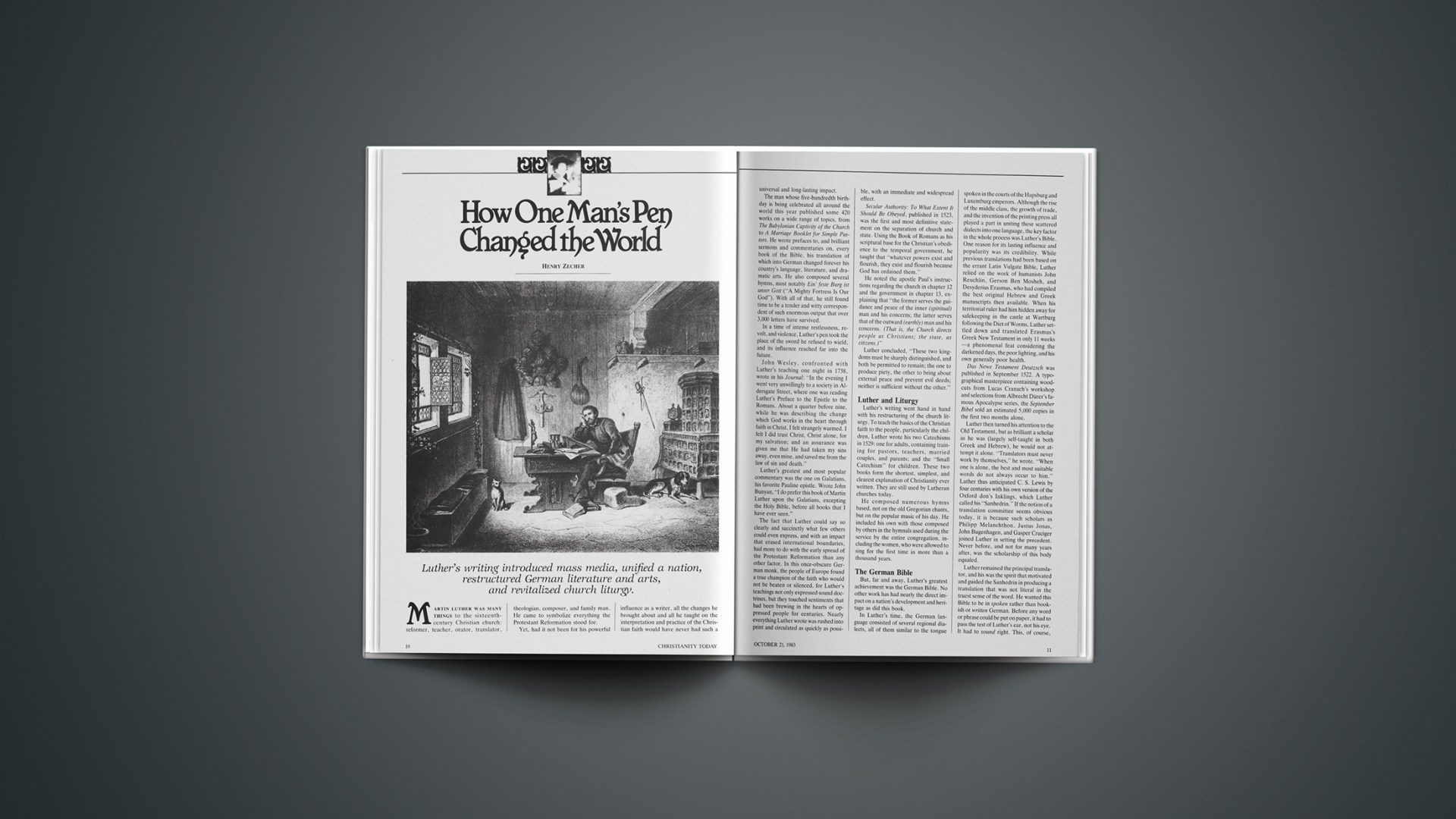
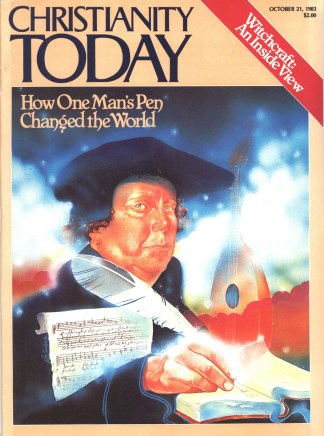
How One Man’s Pen Changed the World

Luther’s writing introduced mass media, unified a nation, restructured German literature and arts, and revitalized church liturgy.

Martin luther was many things to the sixteenth-century Christian church: reformer, teacher, orator, translator, theologian, composer, and family man. He came to symbolize everything the Protestant Reformation stood for.

Yet, had it not been for his powerful influence as a writer, all the changes he brought about and all he taught on the interpretation and practice of the Christian faith would have never had such a universal and long-lasting impact.

The man whose five-hundredth birthday is being celebrated all around the world this year published some 420 works on a wide range of topics, from The Babylonian Captivity of the Church to A Marriage Booklet for Simple Pastors. He wrote prefaces to, and brilliant sermons and commentaries on, every book of the Bible, his translation of which into German changed forever his country’s language, literature, and dramatic arts. He also composed several hymns, most notably Ein’ feste Burg ist unser Gott (“A Mighty Fortress Is Our God”). With all of that, he still found time to be a tender and witty correspondent of such enormous output that over 3,000 letters have survived.

In a time of intense restlessness, revolt, and violence, Luther’s pen took the place of the sword he refused to wield, and its influence reached far into the future.

John Wesley, confronted with Luther’s teaching one night in 1738, wrote in his Journal·. “In the evening I went very unwillingly to a society in Aldersgate Street, where one was reading Luther’s Preface to the Epistle to the Romans. About a quarter before nine, while he was describing the change which God works in the heart through faith in Christ, I felt strangely warmed. I felt I did trust Christ, Christ alone, for my salvation; and an assurance was given me that He had taken my sins away, even mine, and saved me from the law of sin and death.”

Luther’s greatest and most popular commentary was the one on Galatians, his favorite Pauline epistle. Wrote John Bunyan, “I do prefer this book of Martin Luther upon the Galatians, excepting the Holy Bible, before all books that I have ever seen.”

The fact that Luther could say so clearly and succinctly what few others could even express, and with an impact that erased international boundaries, had more to do with the early spread of the Protestant Reformation than any other factor. In this once-obscure German monk, the people of Europe found a true champion of the faith who would not be beaten or silenced, for Luther’s teachings not only expressed sound doctrines, but they touched sentiments that had been brewing in the hearts of oppressed people for centuries. Nearly everything Luther wrote was rushed into print and circulated as quickly as possible, with an immediate and widespread effect.

Secular Authority: To What Extent It Should Be Obeyed, published in 1523, was the first and most definitive statement on the separation of church and state. Using the Book of Romans as his scriptural base for the Christian’s obedience to the temporal government, he taught that “whatever powers exist and flourish, they exist and flourish because God has ordained them.”

He noted the apostle Paul’s instructions regarding the church in chapter 12 and the government in chapter 13, explaining that “the former serves the guidance and peace of the inner (spiritual) man and his concerns; the latter serves that of the outward (earthly) man and his concerns. (That is, the Church directs people as Christians; the state, as citizens.)”

Luther concluded, “These two kingdoms must be sharply distinguished, and both be permitted to remain; the one to produce piety, the other to bring about external peace and prevent evil deeds; neither is sufficient without the other.”

Luther And Liturgy

Luther’s writing went hand in hand with his restructuring of the church liturgy. To teach the basics of the Christian faith to the people, particularly the children, Luther wrote his two Catechisms in 1529: one for adults, containing training for pastors, teachers, married couples, and parents; and the “Small Catechism” for children. These two books form the shortest, simplest, and clearest explanation of Christianity ever written. They are still used by Lutheran churches today.

He composed numerous hymns based, not on the old Gregorian chants, but on the popular music of his day. He included his own with those composed by others in the hymnals used during the service by the entire congregation, including the women, who were allowed to sing for the first time in more than a thousand years.

The German Bible

But, far and away, Luther’s greatest achievement was the German Bible. No other work has had nearly the direct impact on a nation’s development and heritage as did this book.

In Luther’s time, the German language consisted of several regional dialects, all of them similar to the tongue spoken in the courts of the Hapsburg and Luxemburg emperors. Although the rise of the middle class, the growth of trade, and the invention of the printing press all played a part in uniting these scattered dialects into one language, the key factor in the whole process was Luther’s Bible.

One reason for its lasting influence and popularity was its credibility. While previous translations had been based on the errant Latin Vulgate Bible, Luther relied on the work of humanists John Reuchlin, Gerson Ben Mosheh, and Desyderius Erasmus, who had compiled the best original Hebrew and Greek manuscripts then available. When his territorial ruler had him hidden away for safekeeping in the castle at Wartburg following the Diet of Worms, Luther settled down and translated Erasmus’s Greek New Testament in only 11 weeks—a phenomenal feat considering the darkened days, the poor lighting, and his own generally poor health.

Das Newe Testament Deutzsch was published in September 1522. A typographical masterpiece containing woodcuts from Lucas Cranach’s workshop and selections from Albrecht Dürer’s famous Apocalypse series, the September Bibel sold an estimated 5,000 copies in the first two months alone.

Luther then turned his attention to the Old Testament, but as brilliant a scholar as he was (largely self-taught in both Greek and Hebrew), he would not attempt it alone. “Translators must never work by themselves,” he wrote. “When one is alone, the best and most suitable words do not always occur to him.” Luther thus anticipated C. S. Lewis by four centuries with his own version of the Oxford don’s Inklings, which Luther called his “Sanhedrin.” If the notion of a translation committee seems obvious today, it is because such scholars as Philipp Melanchthon, Justus Jonas, John Bugenhagen, and Gasper Cruciger joined Luther in setting the precedent. Never before, and not for many years after, was the scholarship of this body equaled.

Luther remained the principal translator, and his was the spirit that motivated and guided the Sanhedrin in producing a translation that was not literal in the truest sense of the word. He wanted this Bible to be in spoken rather than bookish or written German. Before any word or phrase could be put on paper, it had to pass the test of Luther’s ear, not his eye. It had to sound right. This, of course, was the German Bible’s greatest asset, but it meant that Luther had to straddle the fence between the free and the literal.

“It is not possible to reproduce a foreign idiom in one’s native tongue.” he wrote. “The proper method of translation is to select the most fitting terms according to the usage of the language adopted. To translate properly is to render the spirit of a foreign language into our own idiom. I try to speak as men do in the market place.”

The translators used the court tongue as their base language but flavored it with the best of all the dialects they could find in the empire. Ever the relentless perfectionist who might spend a month searching out a single word, Luther talked at length with old Germans in the different regions. He called on local craftsmen and studied their tools, and had the town butcher cut up sheep so he could study their entrails. When he ran into the precious stones in the “new Jerusalem” that were unfamiliar to him, he had similar precious stones from the elector’s collection brought up for him to study, along with explanations of their names.

It was Luther’s desire to express the original Hebrew in the best possible German, but the task was not without its difficulties. “We are now sweating over a German translation of the Prophets,” he wrote. “O God, what a hard and difficult task it is to force these writers, quite against their wills, to speak German. They have no desire to give up their native Hebrew in order to imitate our barbaric German. It is as though one were to force a nightingale to imitate a cuckoo, to give up his own glorious melody for a monotonous song he must certainly hate. The translation of Job gives us immense trouble on account of its exalted language, which seems to suffer even more, under our attempts to translate it, than Job did under the consolations of his friends, and seems to prefer to lie among the ashes.”

In spite of this, the Sanhedrin worked rapidly but accurately, translating in a tone more apologetic than scientific. The result was a German Bible of such incomparable literary quality that those competent to say so consider it superior even to the King James Version that followed it. And because it sounded natural when spoken as well as read, its cadence and readability have made it the most popular Bible in Germany to this day.

The German Bible’S Impact

Germans everywhere bought it, not only for the salvation of their souls (if such was their concern), but also for the new middle-class prestige it conferred. It was the must book to have in their homes, and many Germans had no choice but to read it because it was likely to be one of the few books they could afford to buy.

It was the first time that a mass medium, in the form of the printed word, had ever penetrated everyday life. Everyone read it or listened to it being read. Its phrasing became the people’s phrasing, its speech patterns their speech patterns. So universal was its appeal, and so thoroughly did it embrace the entire range of the German tongue, that it formed a linguistic rallying point for the formation of the modern German language and a more formal restructuring of German literature and the German performing arts. Its impact, and Luther’s in general, were so awesome that Frederick the Great later called Luther the personification of the German national spirit, and scholars today consider him the most influential German who ever lived.

As might be expected, the German Bible’s impact reached well beyond the borders of the empire. It was the direct source for Bibles in Holland, Sweden, Iceland, and Denmark. Its influence was felt in many other countries as well, but most important was the permanent impression it left on the first great translator of the English Bible.

William Tyndale, one of the Reformation’s greatest champions, had fled from England to the Continent about the time Luther was publishing his German New Testament. He, too, was engaged in translating from the original manuscripts, and he and Luther are believed to have met in Wittenberg.

Among the many strong points of Luther’s work that impressed Tyndale was the order the German gave to the books of the New Testament. There had never been any uniform arrangement of these books in previous Bibles, and earlier translators had simply placed them in whatever order suited them.

Luther, however, ranked them by the yardstick of was treibt Christus—how Christ was taught: the four Gospels (Matthew, Mark. Luke, and John); the Acts of the Apostles; the Epistles, in descending order of the Savior’s prominence in each; and, finally, the Revelation of John. Subsequent research has confirmed Luther’s choice, and Tyndale followed it almost without question, as have all Bible translators since.

Many of the phrases we know today came from Luther through Tyndale. From the German’s natürlich, Tyndale wrote natural, and the phrase natural man appeared in 1 Corinthians 2:14. Luther’s auf dem gebirge became was a voice heard in Matthew 2:18. Tyndale translated from Luther the place of men’s skulls in John 19:17. Ye vex yourselves off a true meaning in 2 Corinthians 6:12, Doctors in the Scripture in 1 Timothy 1:7, and hosianna in Matthew 21:15. Like Luther, Tyndale eschewed the Latinized ecclesiastical terms in favor of those applicable to his readers: repent instead of do penance; congregation rather than church; Savior or elder in the place of priest; and love over charity for the Greek/Christian agape.

Both translations flowed freely in a rhythm and happy fluency of narration; and, wherever he could, Tyndale upheld Luther’s doctrine of justification by faith. While there were certainly many instances where the two men must have reached the same conclusions independent of each other, Luther’s strong influence on the father of the English Bible is unmistakable. Considering the fact that Tyndale’s English translation makes up more than 90 percent of the King James New Testament and about 80 percent of the Revised English Version, Luther’s legacy is plain to see.

Luther was exceptionally gifted in most everything he did, but that aspect of his genius most responsible for the impact he had is the one least heralded through the centuries—his skill and power as a writer. Had it not been for that, the Protestant Reformation and the growth of a united German nation would have taken an entirely different course.

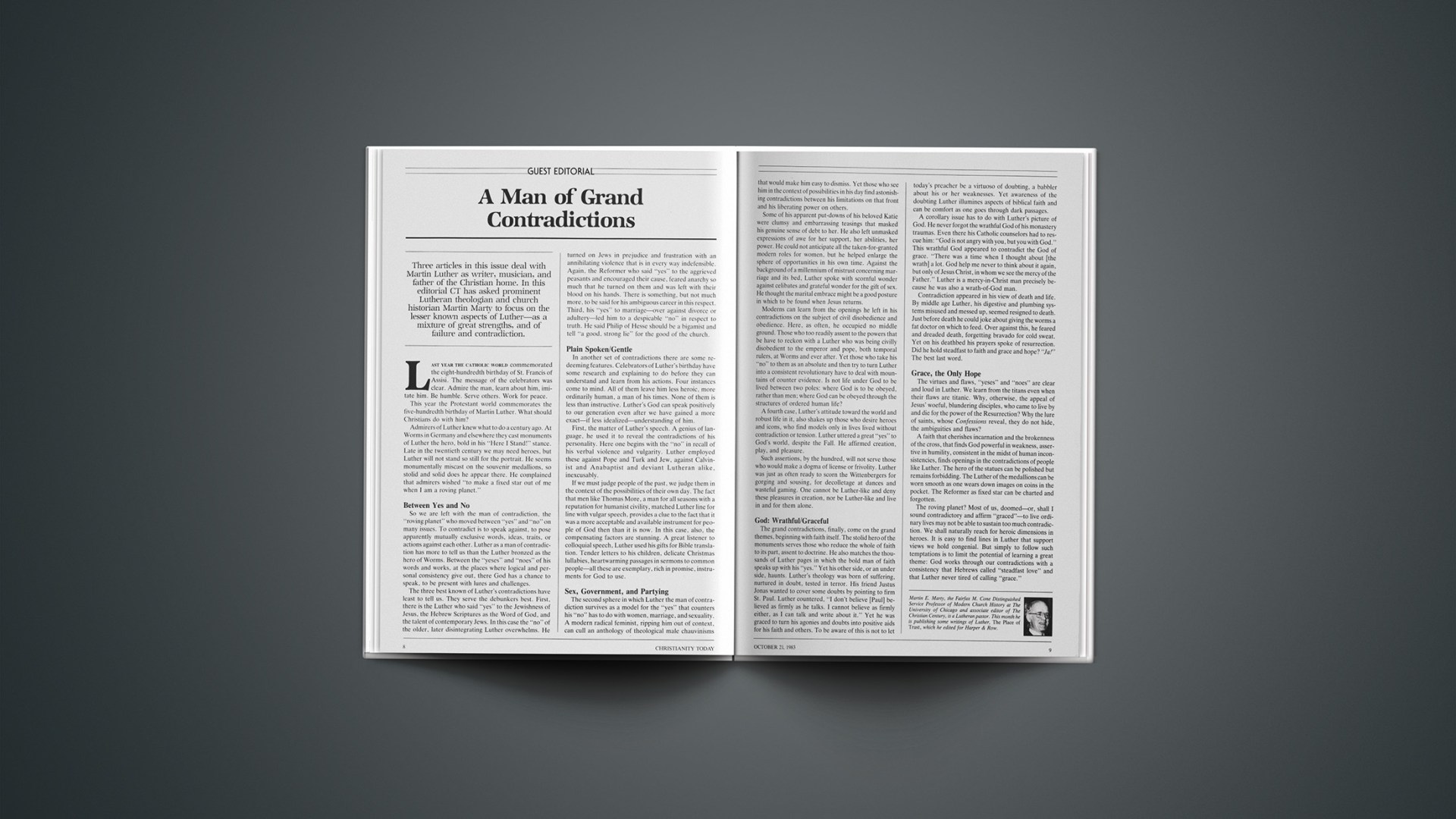
Guest Editorial: A Man of Grand Contradictions

Three articles in this issue deal with Martin Luther as writer, musician, and father of the Christian home. In this editorial CT has asked prominent Lutheran theologian and church historian Martin Marty to focus on the lesser known aspects of Luther—as a mixture of great strengths, and of failure and contradiction.

Last year the catholic world commemorated the eight-hundredth birthday of St. Francis of Assisi. The message of the celebrators was clear. Admire the man, learn about him, imitate him. Be humble. Serve others. Work for peace.

This year the Protestant world commemorates the five-hundredth birthday of Martin Luther. What should Christians do with him?

Admirers of Luther knew what to do a century ago. At Worms in Germany and elsewhere they cast monuments of Luther the hero, bold in his “Here I Stand!” stance. Late in the twentieth century we may need heroes, but Luther will not stand so still for the portrait. He seems monumentally miscast on the souvenir medallions, so stolid and solid does he appear there. He complained that admirers wished “to make a fixed star out of me when I am a roving planet.”

Between Yes And No

So we are left with the man of contradiction, the “roving planet” who moved between “yes” and “no” on many issues. To contradict is to speak against, to pose apparently mutually exclusive words, ideas, traits, or actions against each other. Luther as a man of contradiction has more to tell us than the Luther bronzed as the hero of Worms. Between the “yeses” and “noes” of his words and works, at the places where logical and personal consistency give out, there God has a chance to speak, to be present with lures and challenges.

The three best known of Luther’s contradictions have least to tell us. They serve the debunkers best. First, there is the Luther who said “yes” to the Jewishness of Jesus, the Hebrew Scriptures as the Word of God, and the talent of contemporary Jews. In this case the “no” of the older, later disintegrating Luther overwhelms. He turned on Jews in prejudice and frustration with an annihilating violence that is in every way indefensible. Again, the Reformer who said “yes” to the aggrieved peasants and encouraged their cause, feared anarchy so much that he turned on them and was left with their blood on his hands. There is something, but not much more, to be said for his ambiguous career in this respect. Third, his “yes” to marriage—over against divorce or adultery—led him to a despicable “no” in respect to truth. He said Philip of Hesse should be a bigamist and tell “a good, strong lie” for the good of the church.

Plain Spoken/Gentle

In another set of contradictions there are some redeeming features. Celebrators of Luther’s birthday have some research and explaining to do before they can understand and learn from his actions. Four instances come to mind. All of them leave him less heroic, more ordinarily human, a man of his times. None of them is less than instructive. Luther’s God can speak positively to our generation even after we have gained a more exact—if less idealized—understanding of him.

First, the matter of Luther’s speech. A genius of language, he used it to reveal the contradictions of his personality. Here one begins with the “no” in recall of his verbal violence and vulgarity. Luther employed these against Pope and Turk and Jew, against Calvinist and Anabaptist and deviant Lutheran alike, inexcusably.

If we must judge people of the past, we judge them in the context of the possibilities of their own day. The fact that men like Thomas More, a man for all seasons with a reputation for humanist civility, matched Luther line for line with vulgar speech, provides a clue to the fact that it was a more acceptable and available instrument for people of God then than it is now. In this case, also, the compensating factors are stunning. A great listener to colloquial speech, Luther used his gifts for Bible translation. Tender letters to his children, delicate Christmas lullabies, heartwarming passages in sermons to common people—all these are exemplary, rich in promise, instruments for God to use.

Sex, Government, And Partying

The second sphere in which Luther the man of contradiction survives as a model for the “yes” that counters his “no” has to do with women, marriage, and sexuality. A modern radical feminist, ripping him out of context, can cull an anthology of theological male chauvinisms that would make him easy to dismiss. Yet those who see him in the context of possibilities in his day find astonishing contradictions between his limitations on that front and his liberating power on others.

Some of his apparent put-downs of his beloved Katie were clumsy and embarrassing teasings that masked his genuine sense of debt to her. He also left unmasked expressions of awe for her support, her abilities, her power. He could not anticipate all the taken-for-granted modern roles for women, but he helped enlarge the sphere of opportunities in his own time. Against the background of a millennium of mistrust concerning marriage and its bed, Luther spoke with scornful wonder against celibates and grateful wonder for the gift of sex. He thought the marital embrace might be a good posture in which to be found when Jesus returns.

Moderns can learn from the openings he left in his contradictions on the subject of civil disobedience and obedience. Here, as often, he occupied no middle ground. Those who too readily assent to the powers that be have to reckon with a Luther who was being civilly disobedient to the emperor and pope, both temporal rulers, at Worms and ever after. Yet those who take his “no” to them as an absolute and then try to turn Luther into a consistent revolutionary have to deal with mountains of counter evidence. Is not life under God to be lived between two poles: where God is to be obeyed, rather than men; where God can be obeyed through the structures of ordered human life?

A fourth case, Luther’s attitude toward the world and robust life in it, also shakes up those who desire heroes and icons, who find models only in lives lived without contradiction or tension. Luther uttered a great “yes” to God’s world, despite the Fall. He affirmed creation, play, and pleasure.

Such assertions, by the hundred, will not serve those who would make a dogma of license or frivolity. Luther was just as often ready to scorn the Wittenbergers for gorging and sousing, for decolletage at dances and wasteful gaming. One cannot be Luther-like and deny these pleasures in creation, nor be Luther-like and live in and for them alone.

God: Wrathful/Graceful

The grand contradictions, finally, come on the grand themes, beginning with faith itself. The stolid hero of the monuments serves those who reduce the whole of faith to its part, assent to doctrine. He also matches the thousands of Luther pages in which the bold man of faith speaks up with his “yes.” Yet his other side, or an under side, haunts. Luther’s theology was born of suffering, nurtured in doubt, tested in terror. His friend Justus Jonas wanted to cover some doubts by pointing to firm St. Paul. Luther countered, “I don’t believe [Paul] believed as firmly as he talks. I cannot believe as firmly either, as I can talk and write about it.” Yet he was graced to turn his agonies and doubts into positive aids for his faith and others. To be aware of this is not to let today’s preacher be a virtuoso of doubting, a babbler about his or her weaknesses. Yet awareness of the doubting Luther illumines aspects of biblical faith and can be comfort as one goes through dark passages.

A corollary issue has to do with Luther’s picture of God. He never forgot the wrathful God of his monastery traumas. Even there his Catholic counselors had to rescue him: “God is not angry with you, but you with God.” This wrathful God appeared to contradict the God of grace. “There was a time when I thought about [the wrath] a lot. God help me never to think about it again, but only of Jesus Christ, in whom we see the mercy of the Father.” Luther is a mercy-in-Christ man precisely because he was also a wrath-of-God man.

Contradiction appeared in his view of death and life. By middle age Luther, his digestive and plumbing systems misused and messed up, seemed resigned to death. Just before death he could joke about giving the worms a fat doctor on which to feed. Over against this, he feared and dreaded death, forgetting bravado for cold sweat. Yet on his deathbed his prayers spoke of resurrection. Did he hold steadfast to faith and grace and hope? “Ja!” The best last word.

Grace, The Only Hope

The virtues and flaws, “yeses” and “noes” are clear and loud in Luther. We learn from the titans even when their flaws are titanic. Why, otherwise, the appeal of Jesus’ woeful, blundering disciples, who came to live by and die for the power of the Resurrection? Why the lure of saints, whose Confessions reveal, they do not hide, the ambiguities and flaws?

A faith that cherishes incarnation and the brokenness of the cross, that finds God powerful in weakness, assertive in humility, consistent in the midst of human inconsistencies, finds openings in the contradictions of people like Luther. The hero of the statues can be polished but remains forbidding. The Luther of the medallions can be worn smooth as one wears down images on coins in the pocket. The Reformer as fixed star can be charted and forgotten.

The roving planet? Most of us, doomed—or, shall I sound contradictory and affirm “graced”—to live ordinary lives may not be able to sustain too much contradiction. We shall naturally reach for heroic dimensions in heroes. It is easy to find lines in Luther that support views we hold congenial. But simply to follow such temptations is to limit the potential of learning a great theme: God works through our contradictions with a consistency that Hebrews called “steadfast love” and that Luther never tired of calling “grace.”

Martin E. Mart, the Fairfax M. Cone Distinguished Service Professor of Modern Church History at The University of Chicago and associate editor of The Christian Century, is a Lutheran pastor. This month he is publishing some writings of Luther, The Place of Trust, which he edited for Harper & Row.

Eutychus and His Kin: October 21, 1983

Where There Is No Vision

Ah, what practical vision abounds in over-the-counter Christian Bookstores. Across the bookstore from Kittel’s Theological where the “John 3:16 Frisbees” lie gleaming in the counter in redemption blue plastic, has at last come a Spiritual answer for Christians in the North: the “Jesus Ice Scraper.”

I could hardly look upon them without feeling cheap and worldly because I have used only a secular “Firestone Ice Scraper” for most of my long winters. (But then what kind of life-depth can you expect from one who has also used only a “Pepsi beats Coke Frisbee” instead of a Scripture Frisbee?)

What made me feel even worse is that I had overlooked the potential power of the “Jesus Ice Scraper.” Perhaps the efficacy of such a scraper could be merely waved over light frost on a February windshield while ice is rebuked in the name of consecrated celluloid.

Gazing down into a pail filled with the scrapers, I realized the vast power now available to Christians in the North. Vision—blessed sight—making travel and light possible to all those blinded by frost. Oh how true the blest injunction “Open my eyes that I may see …” but with the “Jesus Ice Scraper,” there is not only vision, but interstate travel.

As l gazed downward, a divine voice broke in the air around me and I heard the ancient words again: “What wilt thou?”

“Oh, plastic joy,” I cried, “that I might receive my sight.”

“Then crucify thyself,” cried a voice rising from the pail of scrapers, “if thou wouldst see, and take unto thee this 89-cent purchase and come from darkness to marvelous sight.”

“Still,” I cried, “I see through this glass darkly. I see only little Hondas as trees driving.”

And at the word, I scraped again and saw every Honda clearly.

I had been healed.

As I gazed into the bucket of scrapers, joy fell upon me in wholeness. Scriptures in new translations flew at me:

“See ye, indeed, but perceive not.”

“Without a vision, there are 13 car pile-ups!”

“Whether the 89-cent Jesus Ice Scraper is divine I know not, one thing I know, whereas I once was blind, I now see.”

In ecstasy and joy I did buy, and lo, I did scrape and my vision came again to me as of the vision of a little child.

EUTYCHUS

Not To Be Ignored

Constance Cumbey and her book Hidden Dangers of the Rainbow [News, Sept. 2] should not be dismissed without a hearing. Granted, she could not argue her case in a court of law and win. “The Plan,” however, will be presented to the court of World Opinion and the Bible has something to say about the outcome.

I do not hesitate to affirm that Cumbey’s thesis is correct: the Man of Sin is alive today, he is about to be brought forward as the Christ of the New Age and it will shortly be our responsibility to identify him as Antichrist even if it means, God forbid, being labeled “Fundamentalists.”

DAVE MEEKER

Joplin, Mo.

This article raises questions anew in my mind as to why discussions on providence, evil, and the will of God almost always center in Genesis 3 and never consider Romans 8, particularly from verse 17 onward. Paul suggests that our creaturely imperfections and the incompleteness of this world may have to do, not with Adamic perverseness, but with some design of the Creator himself who intended that his creation be incomplete and thus forced to turn to him for strength and fulfillment. The possibility that he intended for evil to coexist in this world with good as a necessary foil or point of contrast for his divine goodness ought to be explored. Romans 8 would enable us to break out of the old dogmatic ruts of original sin and human depravity, and put the discussion on a more wholesome plane.

REV. EDWARD A. JOHNSON

Trinity Lutheran Church

Dalton, Neb.

Further Consideration

I want to express my deep appreciation for “Schooling at Mother’s Knee: Can It Compete?” [Sept. 2]. It was refreshing and very balanced.

I would like to add something regarding the consideration of the pros and cons. In reference to the idea that “family closeness is gained at the expense of the varied experiences of school.” I would like to propose that this may be a faulty assumption. In actuality, the school environment is often very “artificial” with its same-age grouping of children in the classroom with one adult role-model. I would suggest that home schooling affords the opportunity for greater exposure to the real world (if one takes it) and more time for meaningful relationships with people of all ages.

SHARON R. GRIFFITH

Anderson. Ind.

Rewarding And Refreshing

Reading Virginia Stem Owens’ “Seeing Christianity in Red & Green as Well as Black & White” [Sept. 2] was as rewarding and refreshing as seeing a 3-D film with stereophonic sound after a photo album of black and white candids. It takes courage to call Christians to be “whole brains.” or at least to balance out the dominant left brain in evangelicalism with healthy right brain activity. That kind of courage is not always appreciated.

The sad thing in the Christian hierarchy is not that the theologians have a secure niche of authority and respectability near the peak of the mountain, but that the artists and musicians and actors and imaginative writers cannot share the view from the top but have been sentenced to wander homeless in the foothills below.

Creative Christians deserve a chance to show their stuff, to be taken seriously, to affect the patterns of thought and life in the Christian community. The Word needs to become flesh again; Christ speaks through the arts if we will only hear him.

LUCI SHAW

Wheaton, Ill.

Alarming!

Loss of liberty pointed out bv Kenneth Kantzer’s article “The Bob Jones Decision: A Dangerous Precedent” [Sept. 2], alarms anyone who values his right to speak the truth, no matter how unpopular. I, for one, never considered my position as a pastor to be one of the leaders of a “government subsidized” organization. Were Americans to accept this Supreme Court idea there would soon be another cabinet-level department at the White House to control both our pulpits and our actions.

REV. BARRY NEALY

Westside Baptist Church

Lafayette, La.

Where is it written that religious institutions have an inalienable right to tax exemption at all? Perhaps the church’s biggest mistake was allowing the government to put this burden on us in the first place. The decision that tax exemption constitutes government subsidy was correct to at least one extent: it can be and is being used to wield control over the churches.

Many Christian institutions which have bragged for years about their refusal to accept government aid must now realize that they have actually been doing so all along, and now stand in grave danger of government control through threats to their tax exemption status.

Since there is no command of God that says we are entitled to such privileges and the government is morally obligated to give them to us, perhaps the best thing we could do is surrender such status, pay the taxes, and teach our people biblical giving habits to cover the cost. Only then could we genuinely be free of secular control.

JAMES F. SENNETT

College-Career Christian Fellowship

Lincoln, Neb.

Babelfication?

In regard to Martin E. Marty’s article “Baptistification Takes Over” [Sept. 2], if Baptistification is the “most dramatic shift in the Christian world,” God help us; Christendom is far worse off than I thought it was. I find the identification highly offensive. It must be a stench in the nostrils of God. Why not title the article for what it is—Babelfication?

CLARICE BANDOW

Madison, Wis.

Thank you for the outstanding article by Martin Marty on Baptistification. I appreciate his fresh honesty and humor in dealing with a most basic question of how one becomes a Christian in the 20th century. As Marty states, in baptism “there is power and promise” and being “born from above” is a daily experience of dying to sin and rising to new life in Christ. Amen.

REV. RICHARD T. PEARSON

DeSoto-Freeman Lutheran Parish

DeSoto, Wis.

I Second The Motion

Dr. Waltke has answered correctly the question “Is It Right to Read the New Testament into the Old?” [Sept. 2]. I second his motion that we put into practice the church’s traditional view of the priority of the New Testament in the interpretation of the Old.

I also agree that in the hands of the New Testament writers the “literal fulfillment” of the prophetic Scriptures frequently received a spiritual, or nonphysical, form. The writer of the letter to the Hebrews might justly be accused of “spiritualizing” the Old Testament when he insists that Israel’s people, land, city, temple, and highpriest are no longer earthly or political, but eternal and heavenly in nature. Yet, it is this climax of revelation that explains the purpose of Israel’s nationhood and religious ceremonies. The Spirit-guided writer of Hebrews not only clarifies the meaning of the Old Testament, he completes our Lord’s own teaching about the nature of the kingdom of God which was taken away from the physical seed of Abraham and “given to a nation producing the fruit of it” (Matthew 21:43).

Both the unity of Scripture and the finality of Jesus Christ are at stake in this issue. If the Messiah’s rule is indeed the fulfillment of the “Law and the Prophets,” as well as the culmination of all creation and history, then we as Christian interpreters must allow him to have the last word.

ART LEWIS

Bethel College

St. Paul, Minn.

Kushner Theology Heresy?

Philip Yancey’s hesitancy to condemn Kushner’s Theology as heresy, “When Bad Things Happen to Good People,” [Aug. 5] is further evidence of a widespread reluctance in evangelical circles to take God’s sovereignty and man’s inability seriously. Job was able to say, “The Lord gave and the Lord has taken away; may the name of the Lord be praised.” And yet in saying “all this, Job did not sin by charging God with wrongdoing.” (Job 1:22). It would seem that wrongdoing lay instead at the door of all who refuse to have their view of suffering informed by the strange, but ultimately comforting fact, that God “doeth all things well.”

REV. LARRY ALLEN

Presbyterian Church of the Covenant

Houston, Tex.

Enlightening Article

I’ve been profoundly influenced by the writers of two articles on the subjects of past and future in your Aug. 5 issue: “Future Shock & Christian Hope,” and “Yesterday: The Key That Unlocks Today.” Lovelace and Hatch shone beacon lamps into the heart of the issues of history, faith, and future.

REV. HOWARD VRANKIN

St. Olaf Lutheran Church

Fort Dodge, Iowa

Review of ‘Merry Christmas, Mr. Lawrence’

Merry Christmas, Mr. Lawrence

Directed by Nagisa Oshima

Like a cinematic hothouse, Merry Christmas, Mr. Lawrence teems with ideas and supercharged emotion growing lush—and impenetrable—as the South Pacific jungles where it was filmed. Ostensibly a study of diametric cultures at war, Japanese director Nagisa Oshima compromises the film’s integrity in his attempt to graft the delicate blossoms of Eastern thought onto the oak of Western pragmatism. To instruct (and win) American and European audiences, Oshima becomes a Samurai in Anglican vestments and Lawrence is deprived of a distinct point of view.

Missionaries, in particular, will recognize the conflicts in the film: when the best of intentions are frustrated by a lack of understanding between cultures. The characters convene in a Japanese prison camp during World War II where each seeks to work out his own salvation with fear, trembling, and casual brutality. The camp commandant (Ryuichi Sakamoto) sees a kindred spirit in British officer Jack Celliers (David Bowie), but their mutual respect is negated by a historically imposed antagonism. Former diplomat Col. John Lawrence (Tom Conti) tries unsuccessfully to bridge the gap between two worlds and represents the ideal civilized man: harbinger of the blessed peace heralded by angels that first Christmas. As Oshima is quick to tell us, truth and morality in war are determined by the victor. In the film’s epilogue, the warm friendship between Lawrence and a Japanese sergeant is severed when the engines of Allied victory condemn the former captor to death.

Despite its noble pretensions, there is little to recommend this film. The cast is superlative, but the film seems to have been edited with a Samurai sword. Most Christians will be put off by the violence, a reaction Oshima intended. In the end, Lawrence tellingly restates its own problem. The prisoners are singing hymns in defiance of the Japanese—as if to say, there can be no dialectic between East and West, no synthesis in life or in film. Without the unifying principle of Christmas, truth, morality—and art—will always be captive of the temporal visitor. Merry Christmas, Mr. Lawrence is one gift better left unopened.

Reviewed by Harry Cheney, a freelance writer living in Southern California.

Refiner’s Fire: Elie Wiesel Poses Hard Questions from the Holocaust

“As surely as the victims are a problem for the Jews, the killers are a problem for the Christians.”

Elie wiesel is a jewish author all Christians ought to read. His Jacob-like struggle with God was born from his experience of the Nazi pogrom and his vision of the terrifying flames gushing from the tall chimneys of Auschwitz. Taken with his mother, three sisters, and father to the German concentration camp in 1944, he recounts the experience in Night (1958), his first book.

François Mauriac, the Christian French novelist, who encouraged Wiesel to tell his story, wrote the foreword to Night. He describes what engaged him “most deeply”: “The child who tells us his story here was one of God’s elect. From the time when his conscience awoke, he had lived only for God and had been reared on the Talmud, aspiring to initiation into the cabbala, dedicated to the Eternal. Have we ever thought about the consequence of a horror that, though less apparent, less striking than the other outrages, is yet the worst of all to those of us who have faith: the death of God in the soul of a child who suddenly discovers absolute evil? [emphasis added].”

Night; the flames of the crematorium; absolute evil.

Here is Wiesel’s description of arrival at Birkenau, the reception center for Auschwitz:

An SS noncommissioned officer came to meet us, a truncheon in his hand. He gave the order:

“Men to the left! Women to the right!”

Eight words spoken quietly, indifferently, without emotion. Eight short, simple words. Yet that was the moment when I parted from my mother. I had not had time to think, but already I felt the pressure of my father’s hand: we were alone. For a part of a second I glimpsed my mother and my sisters moving away to the right. Tzipora held Mother’s hand. I saw them disappear into the distance; my mother was stroking my sister’s fair hair, as though to protect her, while I walked on with my father and the other men. And I did not know that in that place, at that moment, I was parting from my mother and Tzipora forever. I went on walking. My father held onto my hand.

Behind me, an old man fell to the ground. Near him was an SS man, putting his revolver back in its holster.

Christians, I think, tend to forget the absolute evil that was the crucifixion. Our shining silver crosses and crucifixes decorate our fallen humanity; we hardly feel the weight. Yet if we take Jesus’ words seriously—that what we do or fail to do to the least of our brothers and sisters we do to him—then every death in that Holocaust was also in some very real sense the death of Christ: Who is guilty? Who is not guilty?

My nine-year-old son said to me recently that the world would be such a good place if God simply got rid of all the evil: people who pollute our environment; thieves who steal our goods; killers who steal our lives. I agreed. Yet I saw immediately that if all evil were gotten rid of, I, too, would no longer exist. Evil is so inextricably bound up in ourselves. Who is guilty? Who killed Elie Wiesel’s mother, his sister Tzipora, his father? Where was God? Why did God allow the Holocaust? Who is not guilty?

Wiesel’s works raise many questions for Christians and Jews, but there are no easy answers. In A Jew Today (1978), a collection of essays, Wiesel asks:

How is one to explain that neither Hitler nor Himmler was ever excommunicated by the Church? That Pius XII never thought it necessary, not to say indispensable, to condemn Auschwitz and Treblinka? That among the SS a large proportion were believers who remained faithful to their Christian ties to the end? That there were killers who went to confession between the massacres? And that they all came from Christian families and had received a Christian education?… It is a painful statement to make, but we cannot ignore it: as surely as the victims are a problem for the Jews, the killers are a problem for the Christians.

Wiesel’s novels and plays explore the human responses, primarily Jewish, but Christian, too, to a world where faith in a just and merciful God is constantly threatened by the presence of persons only too eager to hurt and maim and kill, and by the silence of that God in the face of such evil.

In his first novel, Dawn (1960), the central character is Elisha, an 18-year-old Jewish youth who has escaped the gas chambers of Buchenwald. How does one live with and understand the evil he has experienced?

The study of philosophy attracted me because I wanted to understand the meaning of the events of which I had been the victim. In the concentration camp I had cried out in sorrow and anger against God and also against man, who seemed to have inherited only the cruelty of his creator. I was anxious to reevaluate my revolt in an atmosphere of detachment, to view it in terms of the present.

Elisha, however, does not study philosophy but is recruited for a Jewish terrorist movement directed against the British forces occupying Palestine in the mid-1940s. As the novel begins, we discover that Elisha’s commander has chosen him to execute a British officer in reprisal for Britain’s execution of a Jewish prisoner:

Tomorrow, I thought for the hundredth time, I shall kill a man.… I did not know the man.… All I knew was that he was an Englishman and my enemy. The two terms were synonymous.

Thus Elisha, the former victim, becomes the killer, and we follow his thoughts through his dark night to the awaiting dawn and its consequences. The execution takes place, but the reversal of roles, we discover, is no solution; the killer only kills himself:

The night lifted, leaving behind it a grayish light the color of stagnant water. Soon there was only a tattered fragment of darkness, hanging in midair, the other side of the window. Fear caught my throat. The tattered fragment of darkness had a face. Looking at it, I understood the reason for my fear. The face was my own.

Other novels and other responses follow: The Accident (1961), where despair drives the Jewish survivor to cooperate with fate in his own destruction; The Town Beyond the Wall (1964), where another response is madness. Here the Jewish survivor, Michael, wants to return to his home town, Szerencsevaros, now behind the Iron Curtain, to confront the spectator who had stood at his apartment window and watched while the Jews of his town were sent to the concentration camps.

The Town Beyond the Wall is about all the walls (physical, psychological, spiritual) that exist to separate one person from another, and about the breaching of those walls, about reaching the city where real human beings meet face to face, recognize their common humanity, love, affirm one another in themselves. Embracing insanity, we find, like murder, like suicide, is evil.

Other novels include The Testament (1981), where the focus shifts from the Holocaust in Germany to the terrible persecutions of the Jews in Russia.

Wiesel’s stories bring us to the heart of darkness, but they do not leave us in despair, for we are led by his art to touch those depths in life where laughter, love, friendship, faith, understanding all point to an underlying mystery, an affirmation at the heart of Judaism in the Torah, one that, for Wiesel, reaches back to the story of Cain and Abel, the first victim. Writing—astonishingly!—of Abel’s guilt, Wiesel says:

In the face of injustice, one may not look the other way. When someone suffers, and it is not you, he comes first. His very suffering gives him priority. When someone cries, and it is not you, he has rights over you even if his pain has been inflicted by your common God.

… Abel did nothing—such was the nature of his fault” (Messengers of God).

Who is guilty? Who is not guilty?

Wiesel’s fiction explores human responses to evil, yet in the final analysis Wiesel is a contemporary Job, demanding a hearing, a contemporary Jacob, wrestling with God to understand, in the face of monstrous evil, the meaning of God’s apparent silence. The outcome of Wiesel’s struggle ought to concern every Christian.

L. EUGENE STARTZMAN1Dr. Startzman is professor of English at Berea College in Berea, Kentucky.

Let Your Minister’s Wife Be the Minister’s Wife

We hire the pastor, hut not his wife.

Is there some quasi-ecclesiastical office known as “minister’s wife?”

In American Christianity over the last couple of centuries, the pastor’s wife has come to be regarded as a special kind of woman with a special kind of responsibility. Because it has been assumed that the pastor is a super Christian, his wife must be also especially holy. Much honor and prestige has been associated with this special “office.” Many women have risen to the challenge and met the expectations. The successes are well known; the failures, like men who have failed in the pastorate, are soon forgotten.

But in recent years more and more women have wrestled with some of the expectations and qualifications that go with their “office.” They have begun to wonder whether it is proper for them to conform to all that is expected. Their questions are not merely the outworking of feminism in American culture or symptoms of the individualism of the “me” generation. They arise out of the troubling awareness of many women—not all of them young—that what Scripture requires a pastor’s wife to be is obscured by cultural demands. Some examples:

“Cleanliness Is Next To Godliness”

This little maxim is not one of the Ten Commandments. Nevertheless, it has taken on the force of Holy Writ and become the basis of numerous criticisms and judgments about the pastor’s wife. A clean, tidy house is desirable, of course. But must the pastor’s wife have the cleanest and tidiest of them all?

The mania for cleanliness is a cultural value embedded in the middle classes of Europe and North America. But the kingdom of God does not depend upon Lysol and Endust. To invest too much time in cleaning and arranging possessions is to establish false priorities.

The Pastor’S Wife Is To Be A Leader

This expectation surfaces in many communities—and not without warrant. After all, she has more background in theology and Bible than most women, and is married to a church professional.

But despite a relatively successful pattern of pastors’ wives as teachers and leaders among women, it is unhealthy for a congregation to expect that of every woman who assumes the “office.” Scripture makes clear that in the body of Christ various people function according to the gifts they have been given.

In any given group of pastors’ wives you will find a whole range of personalities: timid, shy, outgoing, confident, reflective, brash, insightful, comic, serious. Men going into the pastorate manage to court and wed women of every type—thank God for that! As a consequence, one does not know what particular gifts she will bring to the congregation until she is there. She may have teaching and leadership gifts; then again, her gifts may be counseling or supporting or serving.

Pastors’ Children Are To Be Exemplary

It is true that 1 Timothy 3:4 reminds the church that an elder “must manage his own family well and see that his children obey him with proper respect.” But that obligation applies to all Christian parents. Elders are to be chosen from among those in the congregation who demonstrate that they can manage their families and rear respectful children. But it is another thing to expect elders always to have the most exemplary children, those who score A+ in every category.

Pastors’ wives come from all kinds of backgrounds: strong Christian families, weak Christian families, non-Christian families, broken homes. Only by God’s grace do any of them—or any of us—become competent parents.

Pastors’ wives take a great deal of criticism when their children fail to live up to others’ expectations. This is unjust if those expectations are not applied to every family in the congregation.

The Pastor’S Wife Is The Official Hostess

Hospitality is both an obligation of all and a special gift for some. Every Christian should be ready to respond to the needs of persons who are traveling, who need food, clothing, shelter, and comfort. But some Christians have a special gift for hospitality. Their homes are like inns, with guests dropping in and out all the time. Usually these gifted people enjoy their calling, even thrive on it.

While all pastors’ wives recognize their basic obligation to be hospitable, not all have a special gift to be the congregation’s sole task force on hospitality.

The Scriptural Requirements For The Office

The cultural role model for the pastor’s wife sets up a number of false expectations. A church should resist adopting them since to fail to live up to them is no serious deficiency.

What does Scripture put forth as the special requirements or qualifications of a pastor’s wife?

Absolutely nothing! There is no office of minister’s wife. There are no qualifications or expectations that wives of pastors, teachers, evangelists (and elders of any type) are to meet to distinguish them from Christian women in general.

It is time to depose pastors’ wives from their special “office” and enroll them in the general priesthood of the church along with the rest of us.

The pastor’s wife is called to be the wife of the man she married. Whatever Scripture requires of wives, that is what one should expect of pastors’ wives: to serve their Lord by supporting, nurturing, and building up their husbands and their children. And, because pastors’ wives are women who have particular gifts, they can be expected to use their gifts to contribute to the building up of the whole body of Christ and to the wellbeing of the society in which they live. It is presumptuous for the church to require anything more of a pastor’s wife. There is no biblical warrant for requiring higher standards of performance of those who are in full-time Christian ministry.

The single, traditional role model for the minister’s wife in American Christianity is giving way to a plurality of roles. One reason is that American culture itself is increasingly pluralistic. What is important for the congregation to recognize is that, until her particular gifts are known, there should be no expectations as to the role the pastor’s wife will play as a member of the body. Her particular function in the church and in the world will be shaped by her gifts and by her husband’s and her own expectations for herself.

On the other side, a pastor’s wife who comes to a new congregation will likely want to know what role previous pastors’ wives have filled in the church. She will probably be willing to meet some of the expectations that constitute the pattern of roles in that congregation. It is right for her to do so. But where she deviates from the “norm,” she is not to be judged if she fails to live up to cultural, and not biblical, expectations.

Take a hard look at your expectations for your pastor’s wife. Are they biblical or have they developed from the accumulated traditions of your congregation? While you are reflecting on this, take time to pray for her and for the unique challenges that she faces. Encourage her to capitalize on the special opportunities for ministry that come with her situation. When you are tempted to criticize your pastor’s wife, give her more encouragement, support, and assistance instead. By so doing, you glorify your father in heaven.

MICHAEL G. SMITH1Mr. Smith is the former managing editor of Great Commission Publication. The article is condensed and reprinted from the March 1983 issue of New Horizons, publication of the Orthodox Presbyterian Church.

What Is Narrative Theology?

Theologians take a new look at storytelling.

To many people today the Bible seems irrelevant. It was written in cultures that vanished many centuries ago. The customs and concepts that fill its pages are unfamiliar. How, then, can its message make sense today?

A recent movement called “narrative theology” sees “story” as the link between Scripture and modern times. The Bible, after all, is full of stories. Think, for instance, of the fairly brief stories of Gideon or Ruth or Jonah, or of longer ones such as the Exodus or the spread of the early church, or of the overarching historical drama from Creation to Consummation that encompasses them all. Clearly, when the Bible wants to tell us about God and humanity, about sin and salvation, if often recounts stories in which these realities come dramatically alive.

Narrative theologians also note that modern people strive for meaning and self-identity through trying to understand their own “stories.” To find themselves, many investigate their ethnic and historic “roots,” analyze significant episodes in their past, and then seek to accept or creatively redirect these influences.

For such people, the Bible can come alive if they are challenged to consider how biblical stories might interact with and alter their own. They might, for instance, investigate Paul’s letters and Acts to discover the religious and cultural roots of Saul the Pharisee and what it was that transformed him into Paul the apostle. In the process, they might find helpful parallels with their own pilgrimages.

Narrative theology offers much promise. In some modern theologies, social, psychological, or philosophical themes are very prominent. The Bible is seldom used, sometimes merely in occasional attempts to support these preconceived theories. But beginning perhaps with Hans Frei’s The Eclipse of Biblical Narrative in 1974, the emerging narrative theology movement has sought to let Scripture tell its own stories.

Narrative theologies listen to entire biblical texts. They reject sharp distinctions between historical “events” that the texts report and the theological “interpretations” given by their authors. This counters biblical criticism’s tendency to take the texts apart, to cast doubt on some of the “events,” and to regard the writers’ “interpretations” as merely human perspectives.

Second, narrative theology suggests ways of bringing theology and pastoral psychology together. Frequently, biblical scholars pay little attention to psychology, while Christian counselors rely heavily on secular theories. But if the story is a pattern by which personal background, conversion, and sanctification can be understood, biblical stories can provide guidance for personal growth, and personal stories can illuminate and lend concrete meaning to many biblical themes and terms.

Third, narrative theology can provide links between Scripture and the arts—especially literature and drama. For the more one is sensitized to the narrative elements in Scripture, the more capable one becomes of appreciating the truths and untruths in other narrative structures—and perhaps of creating narrative forms of art.

Fourth, stories can provide avenues for healing social and racial conflicts. Human groups are often at odds because their backgrounds and histories are so different. But if such groups can listen to each others’ “stories,” understanding and communication can occur. Here again, biblical stories—think of the conflicts and adjustments among Jews and Gentiles in the early church—can provide insightful parallels.

Nevertheless, narrative theology has potential problems. (Many are sympathetically reviewed in Michael Goldberg’s Theology and Narrative: A Critical Introduction [Abingdon, 1982].) It has shown how “stories” can be helpful and illuminating. But in a world full of personal, ethnic, and religious stories, which ones are true? How can one choose among them? Some narrative theologians, such as George Stroup in The Promise of Biblical Narrative, emphasize the normativity of biblical stories. Others, however, despite their respect for Scripture, are often unclear as to what sort of priority biblical stories might have over others. And by simply referring to all of them as “stories,” they can pass over questions as to whether the biblical episodes recorded actually occurred in history, and whether they are not only “helpful” but true.

Second, how meaningfully will narrative theology deal with biblical texts and theological themes that contain no stories? Think of psalms that simply exude praise to Yahweh. Can narrative theology deal significantly with worship? Or will it neglect worship in favor of themes like history, psychological development, and ethics—themes easily expressed in storylike form?

Finally, many narrative theologians try to distance themselves from what they denounce as a conservative, literalist approach to Scripture and theology. Evangelicals may easily feel that they are the target of abuse. However, they should not be put off by these routine, overgeneralized caricatures. Despite some differences, thinking evangelicals and narrative theologians will find that they have much in common, and much to contribute to each other.

THOMAS FINGER1Dr. Finger is associate professor of systematic theology at Northern Baptist Theological Seminary, Lombard, Illinois.

Book Briefs: October 7, 1983

Capitalism: For Good Or Evil?

Evangelicals agree that Christians have a duty to love and care for the poor, the downtrodden, and the oppressed. However, there is widespread debate within the evangelical community over the proper means to this end. Liberals and conservatives alike claim moral and rational superiority for their methodologies. In recent years, the tide seems to have shifted toward the political Left.

The leftist bias of the National Council of Churches and several mainline Protestant churches has long been suspected and was recently documented by Reader’s Digest and CBS’s “60 Minutes.”

The proportion of evangelicals who are willing to endorse left-wing political and economic programs has been growing. What is the catalyst turning traditionally conservative and moderate Christians toward the Left? According to Ronald Nash, the Left has captured the attention of evangelicals under false pretenses. Deftly utilizing Christian rhetoric, the Left has made serious inroads into the evangelical community under the rubric of “social justice,” an ill-defined term that entails a “large, powerful and paternalistic state.”

In classical political thought, justice implied harmony and balance.

For Plato, a properly ordered soul was a just soul ¡similarly, a properly ordered state was a just state. In such a regime, every person did the work that he was best suited for, thus maximizing his contribution to the city-state. Reward was given according to merit, and each received what he deserved. Equality prevailed among equals, and inequality reigned among unequals.

Aristotle went even further and introduced the concepts of universal justice (justice as virtue) and particular justice (justice as fairness).

According to Nash, justice has been torn from its classical and biblical bearings and has been narrowly redefined as social justice, which simply translates into economic and social leveling. Nash ably attacks this distorted modern notion of justice and the socialist economic program that it entails. We seem to have forgotten that in biblical and classical literature, justice serves “several functions ranging from its use as a synonym for righteousness to more particular usages in which people receive their due in commercial, remedial and distributive situations.”

Concerned Christians not only must have a proper understanding of justice but must also be informed about political and economic affairs. Nash writes, “If a Christian wishes to make pronouncements on complex social, economic and political issues, he also has a duty to become informed about those issues.” Good intentions are not sufficient; only sound economic principles are capable of truly aiding the indigent.

Capitalism is often accused of being in opposition to Jesus’ message and mission. “Capitalism is supposed to be unchristian because it is supposedly a system that gives a predominant place to greed and other unchristian values. On the other hand, socialism is thought to encourage basic Christian values.…” It is refreshing to see an evangelical scholar join the ranks of those arguing on behalf of free-market capitalism. Recently, such scholars as George Gilder (Wealth and Poverty) and Michael Novak (The Spirit of Democratic Capitalism) have attempted to redeem capitalism and demonstrate that it is the most moral, effective, and equitable means of providing economic prosperity for mankind. This book circulates that message to the evangelical community.

Nash shows that “capitalism is not inherently immoral.” All economic systems are amoral, only people are moral or immoral. He argues that more attention should be paid to the positive moral contributions fostered by capitalism. He concedes that capitalism can be used for immoral ends, but he asserts that socialism “contains far more potential for evil.”

He also maintains that free-market capitalism is the most rational means of aiding the poor. It has succeeded in providing mankind with a higher standard of living than any other system ever devised. Socialist systems have proven to do more harm than good due to the fact “that before society can have enough to distribute among the needy, a sufficient quantity of goods must be produced. By focusing all their attention on who gets what, defenders of the welfare state promote policies that severely restrict production.”

He concludes that “no Christian need be ashamed to count himself a defender of capitalism.” To do otherwise means to support an inferior economic system that harms the poor and thus runs counter to our Christian duty. “The belief that the welfare state is an indispensable means to social justice is a myth whose time has passed.”

A note of caution to the unwary reader: One should not attempt to equate biblical and classical notions of justice. Admittedly, there are points of similarity, but to assume that they are synonymous without substantiating argument is troublesome. Nash often stresses the classical notion of justice at the expense of a biblical notion. Perhaps a carefully defined biblical notion of justice was beyond the scope of this book, but it is nonetheless necessary if one is to evaluate adequately modern notions of justice.

This short volume provides us with a well-argued polemic against leftist political rhetoric while it praises the merits of a free market system. It is a book that liberals must refute to maintain credibility, and a book that conservatives would be wise to study carefully if they desire better to articulate and defend their position.

Social Justice and the Christian Church, by Ronald Nash (Mott Media; 1983). Reviewed by David L. Weeks, assistant professor of political science, Azusa Pacific University, Azusa, California.

What’S Wrong With Darwinism?

What do the emerging information/service-based economy, experimentation in recombinant genetics, fundamentalist attacks on evolution, the boom in electronic games, and the philosophy of Alfred North Whitehead have in common?

According to Jeremy Rifkin’s latest book, Algeny, published this spring, a lot. Each is a sign either of the decay of the old Darwinian cosmology or of the growth of the algenic one replacing it.

The reason the human race is currently despoiling the environment, tolerating hazardous working conditions, and finding meaning in acquiring things is because of Darwinism, asserts Rifkin—who now heads a Washington lobby, the Foundation on Economic Trends. Darwinism enables industrial man to celebrate the survival of the fittest, to expend massive efforts to “perfect” nature, and to believe that such strivings are necessary if society is to progress and the economy is to grow.

Rifkin, a student activist in the sixties, questions these Darwinian assumptions on both intellectual and practical grounds. A brilliant writer, he is convincing as he uses the best and latest scientific sources. But the problem with the death of any world view is the need for an invention of an acceptable alternative. Although society is still in the process of doing this, Rifkin tries his hand anyway.

What does Rifkin see around him, around us, that will provide an alternative to an evolutionary cosmology?

Algeny is a word Rifkin borrows from Joshua Lederburg, the Nobel laureate biologist and president of the research-dedicated Rockefeller University. It is the concept he uses to order the objects he sees on the horizon. A play on the word alchemy, the medieval attempt to change base metals to gold, “Algeny means to change the essence of a living thing by transforming it [genetically] from one state to another” (p. 17).

Read Rifkin for a lucid analysis of the dilemma that faces mankind in conjoining bioengineering and computer technologies. Read Rifkin for a scratching critique of the shortcomings of Darwinism written graphically in laymen’s language. But turn to life in the Spirit based on the Word of God for the dynamism and the guidance to strive toward a humanly possible future.

Algeny, by Jeremy Rifkin (Viking Press, 1983; 293 pp.). Reviewed by George W. Jones, director, religious programs, Ball State University, Muncie, Indiana.

The Last Self-Help Book

What a relief in an age of narcissistic introspection to find a book that pokes fun at an entire culture preoccupied with the “self.” With sardonic wit and philosophical miscellany, novelist Walker Percy challenges the Zeitgeist of our age in his second work of nonfiction, Lost in the Cosmos. The Roman Catholic author subtitles his volume “The Last Self-help Book.” The designation is ironic because Percy seriously questions whether we can ever know ourselves and is critical of the very attempt to try.

To buttress his skepticism of the Socratic dictum, “Know Thyself,” the author asks the reader why there are “sixteen schools of psychotherapy with sixteen theories of the personality and its disorders and that patients treated in one school seem to do as well or as badly as patients treated in any other—while there is only one generally accepted theory of the cause and cure of pneumococcal pneumonia and only one generally accepted theory of the orbits of the planets and the gravitational attraction of our galaxy …” (p. 6). Percy’s point is that as the workings of the universe are understood more completely, cosmological myths and religious belief systems (such as Christianity) that guarantee the identity of the self lose their credence. The twentieth-century result is that “the self becomes a space-bound ghost which roams the very cosmos it understands perfectly” (p. 13).

The author adopts a very loose and constantly changing genre to show us that we are taking ourselves too seriously. The book consists of a mock self-help quiz. Percy poses 20 questions with didactic overtones intending, perhaps, to prod the reader to theistic answers. Along the way he couples the cultural cynicism of Kurt Vonnegut, Jr., with the Christian world view of Flannery O’Connor and Malcolm Muggeridge. Lost in the Cosmos contains essays, science fiction, one-liners, charts, a script for “The Last Donahue Show,” and letters to “Dear Abby.” Percy uses these tools to critique everything our culture has to offer. The final product is a provocative look at a generation that in the end can only say, I am, therefore I am. Speaking as a modern-day writer of Ecclesiastes, the author offers not the last self-help book but the first polemic intended to crush thoroughly the Enlightenment notion of the autonomous self.

Undoubtedly the book has more significance than value. Percy’s musings will probably end up being humorous despair for the avant-garde instead of a primer for the Christian faith. While the author does not actually suggest that man can make sense of life in the cosmos through faith in God, he leaves the reader with virtually no alternative.

Lost in the Cosmos, by Walker Percy (Farrar, Straus & Giroux, 262 pp.; $14.95). Reviewed by Reed Jolley, pastor, Santa Barbara Community Church, Santa Barbara, California.

Who Are Today’s Pharisees?

A recent encounter raises this provocative question.

Some mormons will tell you they converted on a visit to Salt Lake City and Temple Square, and understandably so. Perhaps neuroses fester underneath, but externally the Utah society appears to work. A few years ago, the Mormons themselves spent millions of dollars advertising their success in a series of 12-page inserts in Reader’s Digest. The first, entitled “Seven Keys to Mormonism,” centered on the healthy, upright lifestyle that presents itself to a visitor to Utah.

Home and family come first to the Mormons, the pamphlet said. “It will be a family likely to be admired by neighbors for its quiet competence and self-assurance, and generally envied for its closeness and good-natured round of shared activities.” The pamphlet went on to praise the virtues of self-reliance and enjoying work.

Temperance, a rather old-fashioned word, is unashamedly adopted by Mormons. They abjure alcohol, tobacco, coffee, tea, soft drinks, and other vices. In short, Mormons point to upright living, high achievement, and sterling citizenship as primary proofs of their faith.

Despite the obvious attraction of all these qualities, something kept nagging me as I studied the pamphlets extolling the virtues of Mormonism. Virtually every word could have been written by the National Association of Evangelicals in a brochure touting evangelicals. Do we want to be known for our citizenship, industriousness, righteousness, and temperance? Is not that the goal of right-wing evangelicals—to create a national climate that would allow these qualities to flourish?

Another thought troubled me when I compared the Mormon self-promotion with its evangelical equivalents. It contains not one word about grace, forgiveness, or a vicarious sacrifice on our behalf. If indeed we evangelicals are becoming known for the very same external principles that distinguish Mormons, are we also in danger of stumbling over the essential core of the gospel? Would not a phrase like Repentant Majority or Forgiven Majority serve as a more orthodox way of defining evangelicals than a term like Moral Majority? Such a label would give credit to God to assure that, in Paul’s phrase, “no one can boast.”

We leave it to renegade artists, such as Walker Percy, Flannery O’Connor, and Frederick Buechner, to portray the inherent fallenness of the most religious people, while in our policies, our self-promotion, and our churches we tend to focus on the good works. One of Percy’s characters in The Second Coming captures this well:

“I am surrounded by Christians. They are generally speaking a pleasant and agreeable lot, not noticeably different from other people—even though they, the Christians of the South, the U.S.A., the Western world have killed off more people than all other people put together. Yet I cannot be sure they don’t have the truth. But if they have the truth, why is it the case that they are repellent precisely to the degree that they embrace and advertise the truth? One might even become a Christian if there were few if any Christians around. Have you ever lived in the midst of fifteen million Southern Baptists?… A mystery: If the good news is true, why is not one pleased to hear it?”

His last question rings loud. Could it be that evangelicals are so anxious to point out how good they are that they neglect one basic fact—that the gospel comes as a eucatastrophe, a spectacularly good thing happening to spectacularly bad people?

Since evangelicals are reading into the Congressional Record biblical rationales for opposing abortion, the Department of Education, tobacco subsidies, and sundry Supreme Court decisions, I would propose an important and corrective balance. In our churches, why not spend more time studying the implications of Jesus’ parable of the righteous man and the tax collector? One man thanked God for his blessings, that he was not a robber, evildoer, adulterer, or tax collector. He fasted twice a week and tithed his income. The other had an indefensible morality, not much in the way of a résumé, and a hopelessly inadequate theology. One prayed eloquently; the other said seven simple words, “God, have mercy on me, a sinner.” Yet which one went home justified?

Interestingly, the righteous Pharisees had little historical impact, save for a brief time in a remote corner of the Roman Empire. But Jesus’ disciples—an ornery, undependable, and flawed group of men—became exhilarated with the power of a gospel offering free forgiveness to the worst sinners and traitors. Those men managed to change the world.

Disciplined

Tethered by the wind and the sun,

whether these shadows stand still or run

along the grass, they must follow the line

of pattern the elements define.

As God is more than sun and wind

I am more than shadow, yet disciplined

I must be: tethered, tugged by His hand

this way or that, to run as He planned.

—Pearl Lunt Robinson

Apple PodcastsDown ArrowDown ArrowDown Arrowarrow_left_altLeft ArrowLeft ArrowRight ArrowRight ArrowRight Arrowarrow_up_altUp ArrowUp ArrowAvailable at Amazoncaret-downCloseCloseEmailEmailExpandExpandExternalExternalFacebookfacebook-squareGiftGiftGooglegoogleGoogle KeephamburgerInstagraminstagram-squareLinkLinklinkedin-squareListenListenListenChristianity TodayCT Creative Studio Logologo_orgMegaphoneMenuMenupausePinterestPlayPlayPocketPodcastRSSRSSSaveSaveSaveSearchSearchsearchSpotifyStitcherTelegramTable of ContentsTable of Contentstwitter-squareWhatsAppXYouTubeYouTube