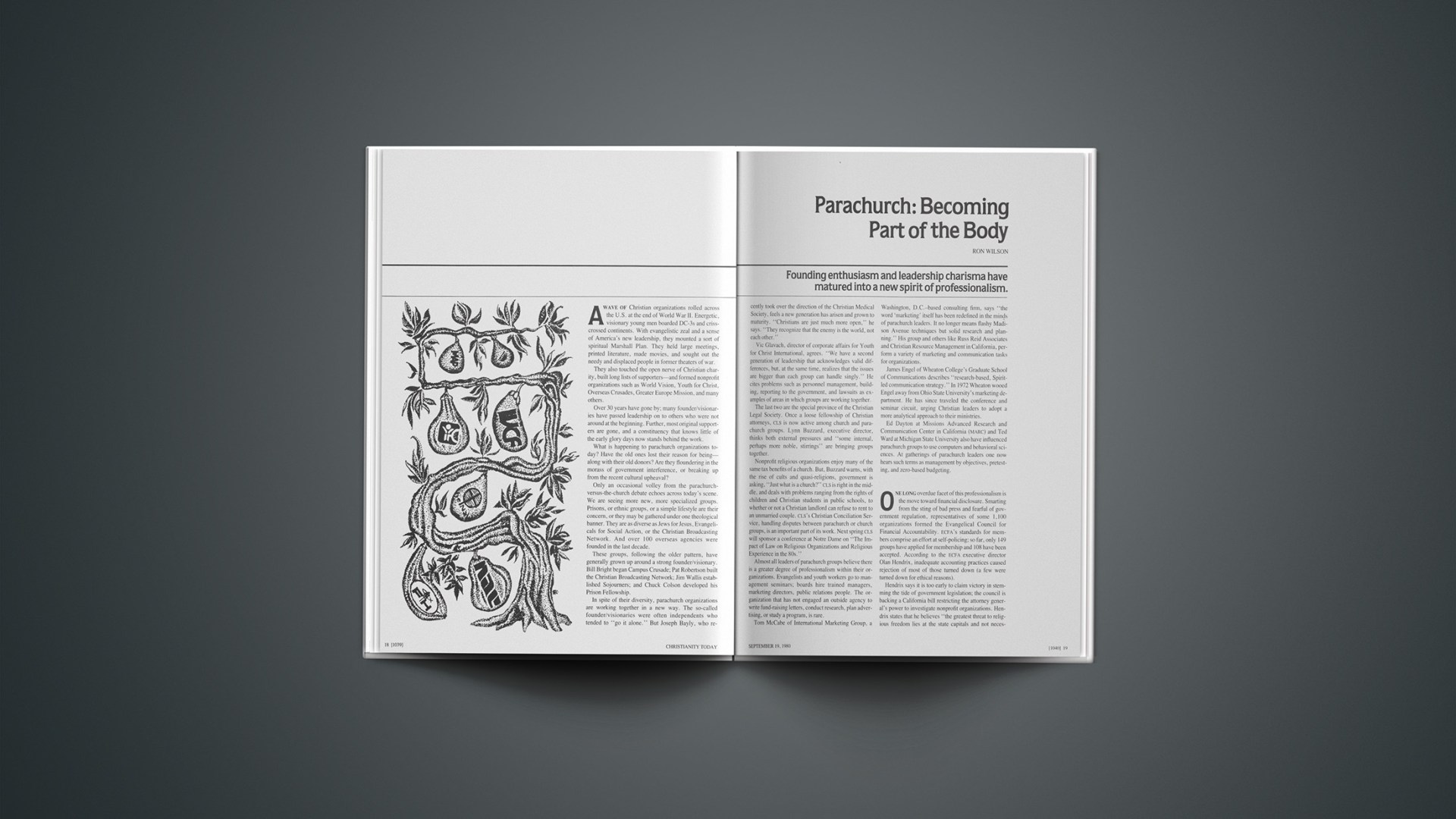
Parachurch: Becoming Part of the Body

Founding enthusiasm and leadership charisma have matured into a new spirit of professionalism.

A wave of Christian organizations rolled across the U.S. at the end of World War II. Energetic, visionary young men boarded DC-3s and crisscrossed continents. With evangelistic zeal and a sense of America’s new leadership, they mounted a sort of spiritual Marshall Plan. They held large meetings, printed literature, made movies, and sought out the needy and displaced people in former theaters of war.

They also touched the open nerve of Christian charity, built long lists of supporters—and formed nonprofit organizations such as World Vision, Youth for Christ, Overseas Crusades, Greater Europe Mission, and many others.

Over 30 years have gone by; many founder/visionaries have passed leadership on to others who were not around at the beginning. Further, most original supporters are gone, and a constituency that knows little of the early glory days now stands behind the work.

What is happening to parachurch organizations today? Have the old ones lost their reason for being—along with their old donors? Are they floundering in the morass of government interference, or breaking up from the recent cultural upheaval?

Only an occasional volley from the parachurch-versus-the-church debate echoes across today’s scene. We are seeing more new, more specialized groups. Prisons, or ethnic groups, or a simple lifestyle are their concern, or they may be gathered under one theological banner. They are as diverse as Jews for Jesus, Evangelicals for Social Action, or the Christian Broadcasting Network. And over 100 overseas agencies were founded in the last decade.

These groups, following the older pattern, have generally grown up around a strong founder/visionary. Bill Bright began Campus Crusade; Pat Robertson built the Christian Broadcasting Network; Jim Wallis established Sojourners; and Chuck Colson developed his Prison Fellowship.

In spite of their diversity, parachurch organizations are working together in a new way. The so-called founder/visionaries were often independents who tended to “go it alone.” But Joseph Bayly, who recently took over the direction of the Christian Medical Society, feels a new generation has arisen and grown to maturity. “Christians are just much more open,” he says. “They recognize that the enemy is the world, not each other.”

Vic Glavach, director of corporate affairs for Youth for Christ International, agrees. “We have a second generation of leadership that acknowledges valid differences, but, at the same time, realizes that the issues are bigger than each group can handle singly.” He cites problems such as personnel management, building, reporting to the government, and lawsuits as examples of areas in which groups are working together.

The last two are the special province of the Christian Legal Society. Once a loose fellowship of Christian attorneys, CLS is now active among church and parachurch groups. Lynn Buzzard, executive director, thinks both external pressures and “some internal, perhaps more noble, stirrings” are bringing groups together.

Nonprofit religious organizations enjoy many of the same tax benefits of a church. But, Buzzard warns, with the rise of cults and quasi-religions, government is asking, “Just what is a church?” CLS is right in the middle, and deals with problems ranging from the rights of children and Christian students in public schools, to whether or not a Christian landlord can refuse to rent to an unmarried couple. CLS’s Christian Conciliation Service, handling disputes between parachurch or church groups, is an important part of its work. Next spring CLS will sponsor a conference at Notre Dame on “The Impact of Law on Religious Organizations and Religious Experience in the 80s.”

Almost all leaders of parachurch groups believe there is a greater degree of professionalism within their organizations. Evangelists and youth workers go to management seminars; boards hire trained managers, marketing directors, public relations people. The organization that has not engaged an outside agency to write fund-raising letters, conduct research, plan advertising, or study a program, is rare.

Tom McCabe of International Marketing Group, a Washington, D.C.-based consulting firm, says “the word ‘marketing’ itself has been redefined in the minds of parachurch leaders. It no longer means flashy Madison Avenue techniques but solid research and planning.” His group and others like Russ Reid Associates and Christian Resource Management in California, perform a variety of marketing and communication tasks for organizations.

James Engel of Wheaton College’s Graduate School of Communications describes “research-based, Spiritled communication strategy.” In 1972 Wheaton wooed Engel away from Ohio State University’s marketing department. He has since traveled the conference and seminar circuit, urging Christian leaders to adopt a more analytical approach to their ministries.

Ed Dayton at Missions Advanced Research and Communication Center in California (MARC) and Ted Ward at Michigan State University also have influenced parachurch groups to use computers and behavioral sciences. At gatherings of parachurch leaders one now hears such terms as management by objectives, pretesting, and zero-based budgeting.

One long overdue facet of this professionalism is the move toward financial disclosure. Smarting from the sting of bad press and fearful of government regulation, representatives of some 1,100 organizations formed the Evangelical Council for Financial Accountability. ECFA’s standards for members comprise an effort at self-policing; so far, only 149 groups have applied for membership and 108 have been accepted. According to the ECFA executive director Olan Hendrix, inadequate accounting practices caused rejection of most of those turned down (a few were turned down for ethical reasons).

Hendrix says it is too early to claim victory in stemming the tide of government legislation; the council is backing a California bill restricting the attorney general’s power to investigate nonprofit organizations. Hendrix states that he believes “the greatest threat to religious freedom lies at the state capitals and not necessarily with the federal government.”

Financial Executives of Christian Organizations (FECA), has grown up alongside ECFA. That is also part of a trend. Evangelicals have formed groups of like-minded professionals—lawyers, counselors, airline personnel, broadcasters, educators, filmmakers—and some of these have formed associations of groups. The result is an alphabet soup of agencies—CBA, EPA, NRB, EFMA, NBEA, ETS, IVCF, IID, and a potful more.

The maturing of parachurch organizations has brought the realization that full-time, paid workers cannot win the world single-handed. Gordon Loux of Prison Fellowship says “there are too many burned out and frustrated people who have tried to do the job alone.” His group uses some 6,000 volunteers and he is looking for 40 state coordinators to mobilize others to work in prisons.

Loux sees volunteer workers as a bridge across the old gap between church and parachurch. The parachurch function, he says, “is to activate the church person in a specific area. We must depend on church people to get the job done.”

Volunteers are not new. The World Home Bible League, for example, has long had office volunteers who bind and repair used Bibles, or others who take Bibles door to door. Some groups, like Messiah College with its dollar-a-year program, use retired people to teach science, or repair audio-visual equipment, or assist in planned giving. Others, like Youth for Christ and Young Life, depend heavily on the volunteer work of local board members.

Even volunteerism looks professional. Dave Keesling of Young Life says that 10 years ago a book on the topic was hard to find, and only recently have colleges begun to offer courses.

Many leaders respond negatively to volunteers, Keesling claims. “They’ve had failure experiences, and they get excited when they learn that volunteers can be held accountable.” Most agree that it takes extra skills to maintain a successful volunteer program.

Keesling worked 10 years with a health agency, and says that secular nonprofit groups are far ahead of the church. He and some colleagues hold seminars and consult with other Christian organizations, using the name Volunteer Leadership Systems.

While often the founder visionaries of parachurch organizations were evangelists, a few quickly responded to the physical needs they saw, especially in India and the Far East. Bob Pierce and Everett Swanson, for example, pulled thousands of orphans off the streets of Korea and respectively began World Vision and Compassion. Later they rushed food, medicine, and supplies to wherever war or disaster created a need.

These groups still provide relief, but today’s trend is toward development. Attacked for fostering dependency, they are seeking ways to help people help themselves. Compassion, for example, primarily a child-care agency, now has projects such as digging wells, supplying sewing machines for vocational training, and planting trees on vegetation-starved hillsides of Haiti.

Medical Assistance Programs began by collecting surplus medicines from pharmaceutical companies and channeling them to missionary doctors and hospitals. Today MAP also has a department of community health and export education. Aware that giving away medicine is not a long-range solution, MAP holds overseas workshops to help nationals discover what causes disease.

Development groups have worked out biblical models for their work, and point to the Good Samaritan as an example of simple relief. The Samaritan helped the man in need, paid the bill, then went his way. In the feeding of the five thousand, however, they find an illustration of development. Jesus helped people to use their own resources to meet personal needs. Wes Stafford, a project director for a consortium of agencies in Haiti, says, “For years charity has been a matter of ‘I have. You don’t have. Here it is.’ Now we’re saying, ‘I have it. You don’t have it. Let’s find a way you can develop it and get it.’ ”

Public understanding of program changes has not kept pace, however. Stafford complains that when he discusses development in churches, people think he’s in a body-building program.

Parachurch organizations, traditionally dominated by men, have made only token moves toward involving women in leadership. Some have appointed women to their board or established a department of women’s ministries, but few have yielded real power. Mae Page, associate field director for Young Life, wants “young people to have good role models. They need to see women working out of their gifts, not just as helpers.” Young Life leaders acknowledge they need that type of leadership.

The other side of this coin is the increase in Bible-study-luncheon or kaffee-klatch-and-fellowship groups. Winning Women, Women Aglow, and Women Alive, as well as the older Christian Women’s Clubs, are more traditional, non-ERA type groups.

Where will parachurch organizations go in the 80s? The movement shows few signs of weakening. Perhaps the old debate is all but dead because groups are seriously trying to work with the institutional church and not just pay lip service to it.

Church historian Richard Lovelace (Gordon-Conwell Theological Seminary) points out that parachurch groups appeared late in the eighteenth century when God raised up evangelical, task-oriented groups that were interested in missions or social reform. Such groups have been with us ever since. “But,” he adds, “an awful lot of work still needs to be done in getting groups together in close coordination with one another and the denominations they want to serve.”

Carl F. H. Henry, first editor of Christianity Today, is lecturer at large for World Vision International. An author of many books, he lives in Arlington, Virginia.
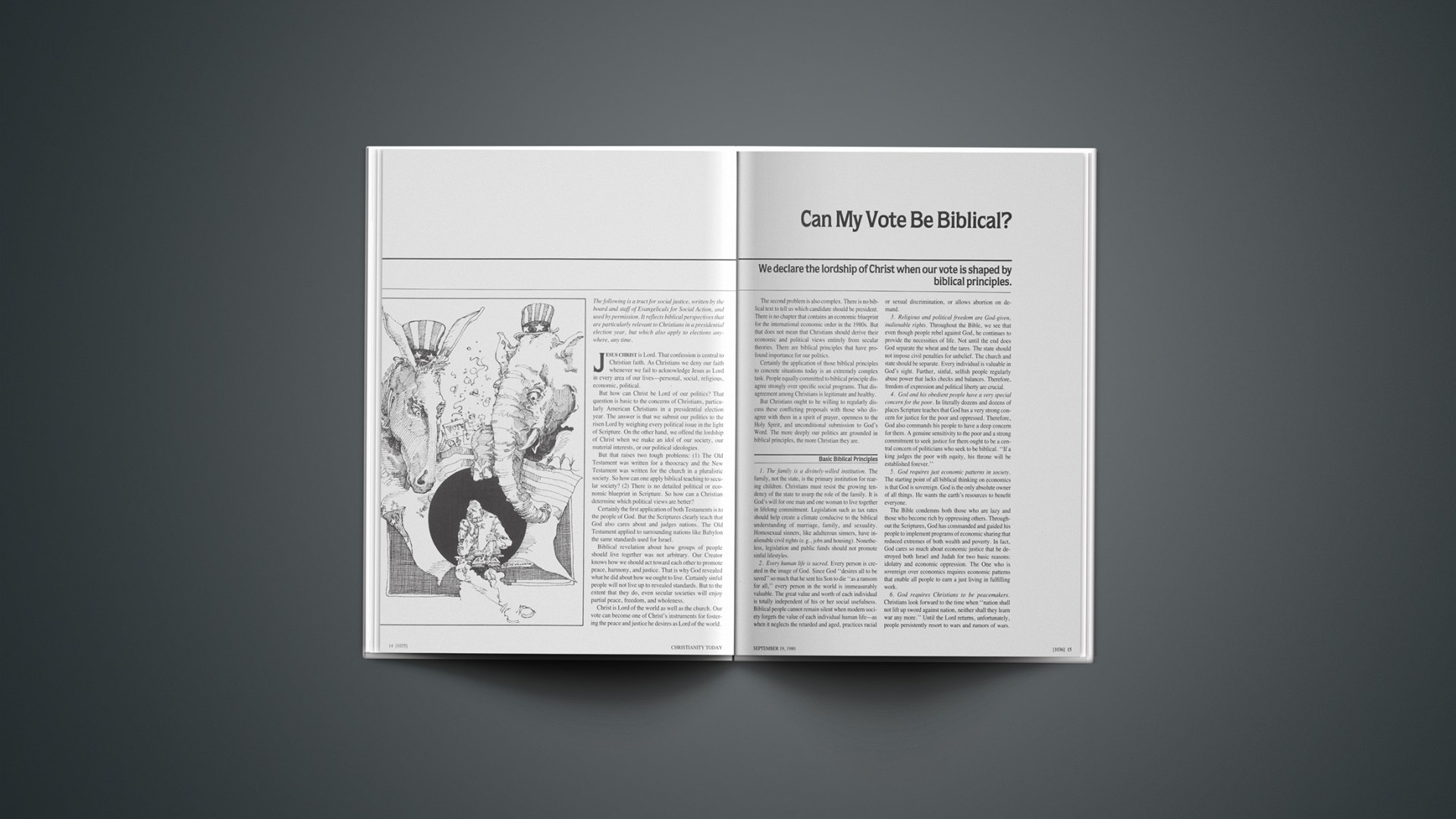
Can My Vote Be Biblical?

We declare the lordship of Christ when our vote is shaped by biblical principles.

The following is a tract for social justice, written by the board and staff of Evangelicals for Social Action, and used by permission. It reflects biblical perspectives that are particularly relevant to Christians in a presidential election year, but which also apply to elections anywhere, any time.

Jesus christ is Lord. That confession is central to Christian faith. As Christians we deny our faith whenever we fail to acknowledge Jesus as Lord in every area of our lives—personal, social, religious, economic, political.

But how can Christ be Lord of our politics? That question is basic to the concerns of Christians, particularly American Christians in a presidential election year. The answer is that we submit our politics to the risen Lord by weighing every political issue in the light of Scripture. On the other hand, we offend the lordship of Christ when we make an idol of our society, our material interests, or our political ideologies.

But that raises two tough problems: (1) The Old Testament was written for a theocracy and the New Testament was written for the church in a pluralistic society. So how can one apply biblical teaching to secular society? (2) There is no detailed political or economic blueprint in Scripture. So how can a Christian determine which political views are better?

Certainly the first application of both Testaments is to the people of God. But the Scriptures clearly teach that God also cares about and judges nations. The Old Testament applied to surrounding nations like Babylon the same standards used for Israel.

Biblical revelation about how groups of people should live together was not arbitrary. Our Creator knows how we should act toward each other to promote peace, harmony, and justice. That is why God revealed what he did about how we ought to live. Certainly sinful people will not live up to revealed standards. But to the extent that they do, even secular societies will enjoy partial peace, freedom, and wholeness.

Christ is Lord of the world as well as the church. Our vote can become one of Christ’s instruments for fostering the peace and justice he desires as Lord of the world.

The second problem is also complex. There is no biblical text to tell us which candidate should be president. There is no chapter that contains an economic blueprint for the international economic order in the 1980s. But that does not mean that Christians should derive their economic and political views entirely from secular theories. There are biblical principles that have profound importance for our politics.

Certainly the application of those biblical principles to concrete situations today is an extremely complex task. People equally committed to biblical principle disagree strongly over specific social programs. That disagreement among Christians is legitimate and healthy.

But Christians ought to be willing to regularly discuss these conflicting proposals with those who disagree with them in a spirit of prayer, openness to the Holy Spirit, and unconditional submission to God’s Word. The more deeply our politics are grounded in biblical principles, the more Christian they are.

Basic Biblical Principles

1. The family is a divinely-willed institution. The family, not the state, is the primary institution for rearing children. Christians must resist the growing tendency of the state to usurp the role of the family. It is God’s will for one man and one woman to live together in lifelong commitment. Legislation such as tax rates should help create a climate conducive to the biblical understanding of marriage, family, and sexuality. Homosexual sinners, like adulterous sinners, have inalienable civil rights (e.g., jobs and housing). Nonetheless, legislation and public funds should not promote sinful lifestyles.

2. Every human life is sacred. Every person is created in the image of God. Since God “desires all to be saved” so much that he sent his Son to die “as a ransom for all,” every person in the world is immeasurably valuable. The great value and worth of each individual is totally independent of his or her social usefulness. Biblical people cannot remain silent when modern society forgets the value of each individual human life—as when it neglects the retarded and aged, practices racial or sexual discrimination, or allows abortion on demand.

3. Religious and political freedom are God-given, inalienable rights. Throughout the Bible, we see that even though people rebel against God, he continues to provide the necessities of life. Not until the end does God separate the wheat and the tares. The state should not impose civil penalties for unbelief. The church and state should be separate. Every individual is valuable in God’s sight. Further, sinful, selfish people regularly abuse power that lacks checks and balances. Therefore, freedom of expression and political liberty are crucial.

4. God and his obedient people have a very special concern for the poor. In literally dozens and dozens of places Scripture teaches that God has a very strong concern for justice for the poor and oppressed. Therefore, God also commands his people to have a deep concern for them. A genuine sensitivity to the poor and a strong commitment to seek justice for them ought to be a central concern of politicians who seek to be biblical. “If a king judges the poor with equity, his throne will be established forever.”

5. God requires just economic patterns in society. The starting point of all biblical thinking on economics is that God is sovereign. God is the only absolute owner of all things. He wants the earth’s resources to benefit everyone.

The Bible condemns both those who are lazy and those who become rich by oppressing others. Throughout the Scriptures, God has commanded and guided his people to implement programs of economic sharing that reduced extremes of both wealth and poverty. In fact, God cares so much about economic justice that he destroyed both Israel and Judah for two basic reasons: idolatry and economic oppression. The One who is sovereign over economics requires economic patterns that enable all people to earn a just living in fulfilling work.

6. God requires Christians to be peacemakers. Christians look forward to the time when “nation shall not lift up sword against nation, neither shall they learn war any more.” Until the Lord returns, unfortunately, people persistently resort to wars and rumors of wars. Many Christians believe that as the lesser of two evils they should engage in just wars for the sake of preserving some order in a fallen world. Other Christians believe war is contrary to the teaching of Christ and that he calls us to overcome our enemies with suffering love rather than the sword. But all agree that Jesus’ words, “Blessed are the peacemakers,” are urgent in our time.

We must live out Jesus’ call to peacemaking in a world that devotes to military expenditures each year an amount equal to the total annual income of the poorest one-half of the world’s people. Because we know human life is sacred, Christians must do everything they can to reduce the growing danger of nuclear holocaust. President Eisenhower reflected a biblical concern when he said: “Every gun that is made, every warship launched, every rocket fired signifies, in the final sense, theft from those who hunger and are not fed.”

7. The Creator requires stewardship of the earth’s resources. The earth is the Lord’s, and humanity is to exercise dominion over it. Such a high calling requires each generation to protect the environment and preserve the quality of life for future generations. We are stewards of God’s good gift.

8. Sin is both personal and social. Consciously willed individual acts such as lying and adultery are sinful. So too, according to the Scriptures, is participating uncritically in social structures that are not just. In one breath the prophets condemn both kinds of sin. The Bible denounces laws that are unjust. Politicians with a biblical perspective will have a deep concern to correct social structures that are evil.

9. Personal integrity is vital. The Scriptures demand honesty and personal righteousness. Dishonesty in public affairs undercuts the democratic process. A politician’s personal and family life should be a good model for the rest of society. Government leaders ought to be humble and honest enough to acknowledge mistakes. Knowing that we all err, we should forgive those who offer forthright confession. Personal religious belief that fosters a profound sense of God’s sovereignty over all nations and sharp awareness of God’s passion for justice helps prevent the abuse of political power for narrow personal or nationalistic purposes.

A Biblical Balance

To proclaim Christ’s lordship in politics means evaluating political candidates by their commitment to biblical principles, rather than by their pragmatism, patriotism, or personality.

That does not mean that Christians should only vote for Christians. Ironically, non-Christians sometimes have a deeper commitment to fundamental biblical teaching about society than do many Christians. Christians must resist the temptation to espouse simple prescriptions for complex problems, remembering that there is a mistaken zeal in politics as well as religion. There is undeniably a superficial appeal in the call to Christians to mobilize as a political force and elect “one of our own.” But the Christian must resist all temptation to use the gospel for political purposes or to make the gospel hostage to any politician or political cause. The words of the apostle Paul, “Do not be conformed to this world,” must continually ring in our ears.

Unfortunately, no candidate for public office will embody perfectly a commitment to all the biblical principles mentioned above. More likely, candidates will be strong in some areas, weak in others. One should strive to find candidates concerned about the whole range of concerns reflected in these principles. Biblically informed politics will reflect the balance of concerns revealed in God’s Word.

Assessing Candidates: Nine Steps

The nine steps suggested below are ones that can be taken by either individuals or groups. A group of Christian friends or church members could divide up the tasks listed below. During the course of two or three evening meetings together in someone’s living room, you should be able to begin a meaningful assessment of candidates. There is no substitute, however, for extensive involvement in the complexities of politics.

At every one of the following steps, ask how the biblical principles above apply to this issue or candidate.

1. Use the Almanac of American Politics. This paperback is the best available guide to the political views and voting record of members of the U.S. Senate and House of Representatives. Get one from your local library or bookstore. The Almanac profiles every member of Congress, along with a description of the districts they represent, the votes they have taken on crucial issues, and how they are evaluated by a very broad spectrum of citizens’ groups.

2. Attend political debates. During the course of a campaign, most candidates hold a public debate with their opponent. The opponent will have done a lot of your research and will probe for weaknesses. Attending the debate, listening, and asking questions is one of the best ways to become informed about where candidates really stand on the issues. Seeing them in action will also give you insight into the kinds of people they are.

3. Get position papers. Write to candidates and ask for all their position papers on the issues. Nearly every candidate will have developed such detailed statements, which, if read critically, will tell you a lot about his or her stands.

4. Make personal contact. If you have particular questions to put to candidates, write directly to them. Better yet, form a delegation of local Christians, set up meetings with candidates, and question them face to face.

5. Follow the mass media. Find out what the candidates are saying in the newspapers and magazines, on radio and TV. Evaluate what is said about them by political commentators, editorial writers, and columnists.

6. Use citizen evaluation groups. Many private organizations, such as the League of Women Voters, do their own evaluations of candidates, especially around election time. All organizations have their own axes to grind; rarely are their evaluations done from an objective point of view. However, reading a variety of such reports will give you an additional slant on a candidate’s commitments. (Many citizen evaluation groups are listed in the Almanac of American Politics.)

7. Find out who is contributing money to the campaign. Many questions can be answered by looking at the kinds of campaign contributions a candidate is receiving. Is he or she a wealthy person who is putting substantial personal funds into the campaign? Is the campaign high-priced or low-budget? Are special interest groups heavily involved in supporting the candidate? Is there a particular profession, occupational group, corporation, or union that is giving large amounts to the campaign?

Now that we have both national and local campaign financing disclosure laws, it is easy to get this kind of information. At the national level (candidates for the U.S. Senate and House), the best resource is the Office of Public Records, Federal Election Commission, 1325 K Street N. W., Washington, D.C. 20005. You can call the commission toll free (800-424-9530) and request the most recent copies of a candidate’s finance contribution report. The commission will send you a listing of the kinds of reports they have on the candidate, the number of pages in the report, and the charge (usually 10¢ per page) for sending it to you. Upon receipt of your check, they will send you the most recent information on contributions the candidate has been receiving.

Campaign disclosure laws vary from state to state, but by calling the state, county, or city government offices, you should be able to find the agency that keeps comparable records. Other sources of information on campaign financing are newspaper reports and private organizations such as Common Cause, 2030 M Street N.W., Washington, D.C. 20036 (see telephone directory for the address of the nearest such local office).

8. Apply the biblical principles. Evaluate all the data you have gathered in light of the biblical principles on God’s will for society.

9. Vote! In light of your careful study of the complex issues and biblical principles, vote prayerfully as an act of obedience to Christ as Lord of your politics.

The Bible teaches that “justice is what makes a government strong.” The ideal ruler is one who “has pity on the weak and poor; he saves the lives of those in need. He rescues them from oppression and violence; their lives are precious to him.”

Voting for candidates who promote programs consistent with biblical principles is one crucial way of confessing that Christ is our Lord.

Ezekiel 8

Dig you prophet, Dig in the wall

Probe the hole that opens to the night

Weep Ezekiel, Weep for your call

Crumble small the whitewash with your awl

Daubed by holy priests who smothered light

Dig you prophet, Dig in the wall

Dig you deeper, Dig back to the fall

Hasten shepherd, see your flock’s in flight

Weep Ezekiel, Weep for your call

Hide your eyes and shrink from the small

Door that dries your bones as if you might

Not dig. You watchman, Dig in the wall

Seventy elders, sentries of God’s law

Worship beasts and creatures slimed with blight

Weep Ezekiel, Weep for your call

Watch the Spirit flee among the tall

Cherubim, who bear Him out of sight

Hear the curse of God upon your wall

Weep you watchman, Weep for your call

CAROLYN NYSTROM

Theory

Some say

birds on harpsichords

plus all the time

in the world

could have sounded

the Goldberg variations

or monkeys on

typewriters

could have come out

Dante

I say

God had

all the time

in the world

but didn’t

need it

to orchestrate all and write us real

in black

and white

LUCI SHAW

Ideas

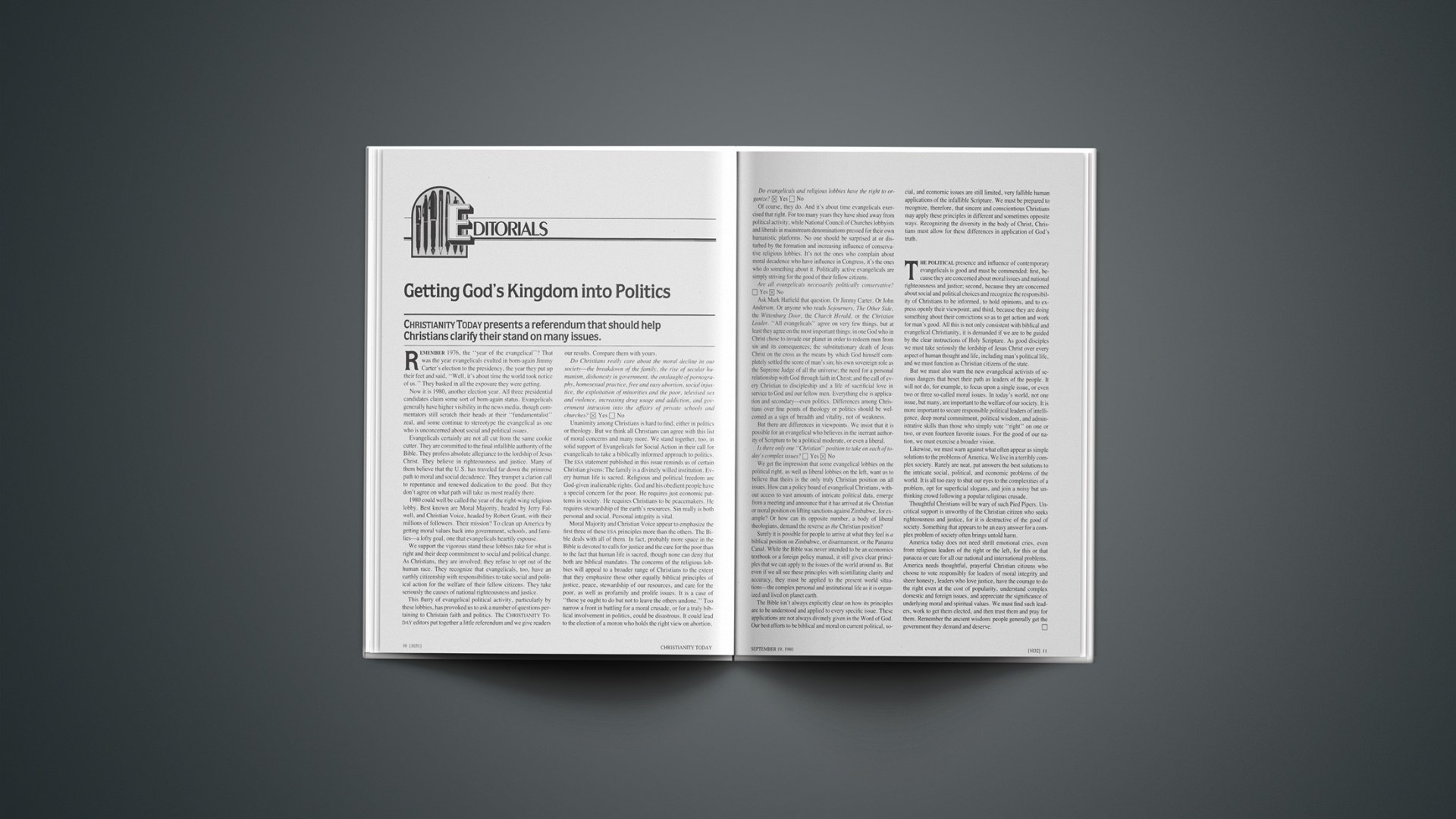
Getting God’s Kingdom into Politics

CHRISTIANITY TODAY presents a referendum that should help Christians clarify their stand on many issues.

Remember 1976, the “year of the evangelical”? That was the year evangelicals exulted in born-again Jimmy Carter’s election to the presidency, the year they put up their feet and said, “Well, it’s about time the world took notice of us.” They basked in all the exposure they were getting.

Now it is 1980, another election year. All three presidential candidates claim some sort of born-again status. Evangelicals generally have higher visibility in the news media, though commentators still scratch their heads at their “fundamentalist” zeal, and some continue to stereotype the evangelical as one who is unconcerned about social and political issues.

Evangelicals certainly are not all cut from the same cookie cutter. They are committed to the final infallible authority of the Bible. They profess absolute allegiance to the lordship of Jesus Christ. They believe in righteousness and justice. Many of them believe that the U.S. has traveled far down the primrose path to moral and social decadence. They trumpet a clarion call to repentance and renewed dedication to the good. But they don’t agree on what path will take us most readily there.

1980 could well be called the year of the right-wing religious lobby. Best known are Moral Majority, headed by Jerry Falwell, and Christian Voice, headed by Robert Grant, with their millions of followers. Their mission? To clean up America by getting moral values back into government, schools, and families—a lofty goal, one that evangelicals heartily espouse.

We support the vigorous stand these lobbies take for what is right and their deep commitment to social and political change. As Christians, they are involved; they refuse to opt out of the human race. They recognize that evangelicals, too, have an earthly citizenship with responsibilities to take social and political action for the welfare of their fellow citizens. They take seriously the causes of national righteousness and justice.

This flurry of evangelical political activity, particularly by these lobbies, has provoked us to ask a number of questions pertaining to Christain faith and politics. The CHRISTIANITY TODAY editors put together a little referendum and we give readers our results. Compare them with yours.

Do Christians really care about the moral decline in our society—the breakdown of the family, the rise of secular humanism, dishonesty in government, the onslaught of pornography, homosexual practice, free and easy abortion, social injustice, the exploitation of minorities and the poor, televised sex and violence, increasing drug usage and addiction, and government intrusion into the affairs of private schools and churches? ☒ Yes  No

Unanimity among Christians is hard to find, either in politics or theology. But we think all Christians can agree with this list of moral concerns and many more. We stand together, too, in solid support of Evangelicals for Social Action in their call for evangelicals to take a biblically informed approach to politics. The ESA statement published in this issue reminds us of certain Christian givens: The family is a divinely willed institution. Every human life is sacred. Religious and political freedom are God-given inalienable rights. God and his obedient people have a special concern for the poor. He requires just economic patterns in society. He requires Christians to be peacemakers. He requires stewardship of the earth’s resources. Sin really is both personal and social. Personal integrity is vital.

Moral Majority and Christian Voice appear to emphasize the first three of these ESA principles more than the others. The Bible deals with all of them. In fact, probably more space in the Bible is devoted to calls for justice and the care for the poor than to the fact that human life is sacred, though none can deny that both are biblical mandates. The concerns of the religious lobbies will appeal to a broader range of Christians to the extent that they emphasize these other equally biblical principles of justice, peace, stewardship of our resources, and care for the poor, as well as profamily and prolife issues. It is a case of “these ye ought to do but not to leave the others undone.” Too narrow a front in battling for a moral crusade, or for a truly biblical involvement in politics, could be disastrous. It could lead to the election of a moron who holds the right view on abortion.

Do evangelicals and religious lobbies have the right to organize? ☒ Yes  No

Of course, they do. And it’s about time evangelicals exercised that right. For too many years they have shied away from political activity, while National Council of Churches lobbyists and liberals in mainstream denominations pressed for their own humanistic platforms. No one should be surprised at or disturbed by the formation and increasing influence of conservative religious lobbies. It’s not the ones who complain about moral decadence who have influence in Congress, it’s the ones who do something about it. Politically active evangelicals are simply striving for the good of their fellow citizens.

Are all evangelicals necessarily politically conservative? □ Yes ☒ No

Ask Mark Hatfield that question. Or Jimmy Carter. Or John Anderson. Or anyone who reads Sojourners, The Other Side, the Wittenburg Door, the Church Herald, or the Christian Leader. “All evangelicals” agree on very few things, but at least they agree on the most important things: in one God who in Christ chose to invade our planet in order to redeem men from sin and its consequences; the substitutionary death of Jesus Christ on the cross as the means by which God himself completely settled the score of man’s sin; his own sovereign role as the Supreme Judge of all the universe; the need for a personal relationship with God through faith in Christ; and the call of every Christian to discipleship and a life of sacrificial love in service to God and our fellow men. Everything else is application and secondary—even politics. Differences among Christians over fine points of theology or politics should be welcomed as a sign of breadth and vitality, not of weakness.

But there are differences in viewpoints. We insist that it is possible for an evangelical who believes in the inerrant authority of Scripture to be a political moderate, or even a liberal.

Is there only one “Christian” position to take on each of today’s complex issues? □ Yes ☒ No

We get the impression that some evangelical lobbies on the political right, as well as liberal lobbies on the left, want us to believe that theirs is the only truly Christian position on all issues. How can a policy board of evangelical Christians, without access to vast amounts of intricate political data, emerge from a meeting and announce that it has arrived at the Christian or moral position on lifting sanctions against Zimbabwe, for example? Or how can its opposite number, a body of liberal theologians, demand the reverse as the Christian position?

Surely it is possible for people to arrive at what they feel is a biblical position on Zimbabwe, or disarmament, or the Panama Canal. While the Bible was never intended to be an economics textbook or a foreign policy manual, it still gives clear principles that we can apply to the issues of the world around us. But even if we all see these principles with scintillating clarity and accuracy, they must be applied to the present world situations—the complex personal and institutional life as it is organized and lived on planet earth.

The Bible isn’t always explicitly clear on how its principles are to be understood and applied to every specific issue. These applications are not always divinely given in the Word of God. Our best efforts to be biblical and moral on current political, social, and economic issues are still limited, very fallible human applications of the infallible Scripture. We must be prepared to recognize, therefore, that sincere and conscientious Christians may apply these principles in different and sometimes opposite ways. Recognizing the diversity in the body of Christ, Christians must allow for these differences in application of God’s truth.

The political presence and influence of contemporary evangelicals is good and must be commended: first, because they are concerned about moral issues and national righteousness and justice; second, because they are concerned about social and political choices and recognize the responsibility of Christians to be informed, to hold opinions, and to express openly their viewpoint; and third, because they are doing something about their convictions so as to get action and work for man’s good. All this is not only consistent with biblical and evangelical Christianity, it is demanded if we are to be guided by the clear instructions of Holy Scripture. As good disciples we must take seriously the lordship of Jesus Christ over every aspect of human thought and life, including man’s political life, and we must function as Christian citizens of the state.

But we must also warn the new evangelical activists of serious dangers that beset their path as leaders of the people. It will not do, for example, to focus upon a single issue, or even two or three so-called moral issues. In today’s world, not one issue, but many, are important to the welfare of our society. It is more important to secure responsible political leaders of intelligence, deep moral commitment, political wisdom, and administrative skills than those who simply vote “right” on one or two, or even fourteen favorite issues. For the good of our nation, we must exercise a broader vision.

Likewise, we must warn against what often appear as simple solutions to the problems of America. We live in a terribly complex society. Rarely are neat, pat answers the best solutions to the intricate social, political, and economic problems of the world. It is all too easy to shut our eyes to the complexities of a problem, opt for superficial slogans, and join a noisy but unthinking crowd following a popular religious crusade.

Thoughtful Christians will be wary of such Pied Pipers. Uncritical support is unworthy of the Christian citizen who seeks righteousness and justice, for it is destructive of the good of society. Something that appears to be an easy answer for a complex problem of society often brings untold harm.

America today does not need shrill emotional cries, even from religious leaders of the right or the left, for this or that panacea or cure for all our national and international problems. America needs thoughtful, prayerful Christian citizens who choose to vote responsibly for leaders of moral integrity and sheer honesty, leaders who love justice, have the courage to do the right even at the cost of popularity, understand complex domestic and foreign issues, and appreciate the significance of underlying moral and spiritual values. We must find such leaders, work to get them elected, and then trust them and pray for them. Remember the ancient wisdom: people generally get the government they demand and deserve.

Eutychus and His Kin: September 19, 1980

When Appeals Appall

Mortimer Eggleston has solved one of the most pressing problems that serious Christians face today: how to find time to read and respond to all the parachurch appeal letters that arrive in the mail. When we heard of Eggleston’s achievement, we drove right over for a personal interview.

“Just what is your solution to the problem of appeal letters?” we asked.

“It’s very simple,” he replied. “I publish a magazine called Appeal Digest. In it we print summaries of the most important appeal letters received, and we rate them—5-star, 4-star, and so on. You can read Appeal Digest in maybe half an hour and get it over with.”

“But how does the reader respond? I mean, suppose he wants to send a donation to an organization?”

Mortimer smiled and turned to the last page of Appeal Digest.

“The last page of each issue is a response form. You fill in your name, address, and other pertinent information, and then check off the items that most interest you. Mail it in with your check, and my office processes the form and sends the gift to the ministry you have chosen. It’s really quite simple.”

We were stunned. But then came the big question.

“If we subscribe to Appeal Digest, we’ll still receive a lot of appeal letters and won’t have to read them. What should we do with them?”

Mortimer smiled an even bigger smile and reached into the bottom drawer of his desk. He brought out a metal device that (as he demonstrated) fit right over the top of the wastebasket. He dropped a letter into the top of the device and it immediately fell to the bottom of the basket.

“We call this our para-chute,” he explained. “Appeal letters from parachurch organizations go right down the chute. The device fits all letters and all wastebaskets.”

There it is, folks! Better send your subscription to Mortimer while the offer lasts.

EUTYCHUS X

Unwarranted Gossip

I find your news article, “Bill Gothard Steps Down During Institute Shakeup,” (Aug. 8) to be at best an example of poor journalism, and at worst an unwarranted piece of gossip without excuse in a periodical of your nature and of your usual caliber.

Certainly Gothard’s release to you was a complete explanation of the matters at IBYC. Why, under the guise of investigative reporting, did you take it upon yourselves to seek the discrepancies in the timetable of IBYC’s problems, to dispense secondhand information about who went where, when and why, and to violate the confidence between Gothard and his brother-in-law? Is this news which the Christian community must know? I think not. Such extraneous details are reminiscent of the gossip found in The National Enquirer.

SETH DIBBLEE

Geneva, Ill.

To report that there have been moral problems within an organization and that a housecleaning has been done is one thing, but to have to report the man’s name who is involved is going a bit too far, especially for a Christian publication.

It’s too bad that these things happen and many times I wish I didn’t know about the corruption and shady dealing going on in so-called Christian organizations along with the vast amount of immorality being practiced by so-called men of God. But to make this kind of thing common knowledge to lay people—they don’t need to know about it. It’ll wreck the faith of many of them.

REV. CEDRIC WHITCOMB

First Baptist Church

Marysville, Mich.

Thank you for your August 8 article on the resignation of Bill Gothard and the subsequent shakeup within the Institute in Basic Youth Conflicts. This must have been an exceedingly difficult article to write, and you did a thorough and informative job. We as evangelicals take no pleasure in the demise of Christian leaders. IBYC and Bill Gothard have touched many lives and I believe furthered the kingdom of God. Yet we also know that those of us who are teachers will be judged more strictly (James 3:1). A publishing leader in the evangelical world like CHRISTIANITY TODAY has a responsibility to be as unbiased as possible in presenting the news, and I commend your forthrightness in the Bill Gothard story.

LARRY FULLERTON

Assistant Pastor

College Church

Wheaton, Illinois

Crystal Clear?

I was grieved to read Refiner’s Fire in the August 8 issue (“The Crystal Cathedral: Reflections of Schuller’s Theology”). Though David Singer raises the question of impropriety, he left me with the impression that building monuments which testify to the success of our theology is a positive statement to the world.

It is my belief that the church should affect the world, not the other way around. To spend $16.5 million for an “icon” (which in my judgment is more of an idol) is a slap in the face of the poor and needy.

REV. ALAN NEWLOVE

Temple Baptist Church

San Francisco, Calif.

During and after the reading of David Singer’s article, I found a chorus repeating itself in my head, and it was not one of angelic blessing. It was rather a chorus of woes modeled after the Pauline warning of Galatians 1:8–9. Dr. Schuller correctly sees contemporary man as biblically illiterate, but surely the answer is not found in perpetuating such illiteracy by appealing to a “possibility thinking” theology which is constructed of “me generation” categories and not biblical ones.

JAMES B. ROMNES

Assistant Librarian

The Lutheran Bible Institute of Seattle

Issaquah, Wash.

Muy Bueno!

“Gloria a Dios, era tiempo!” I have often wondered when the anglo evangelical press would take notice of the great challenge of the Hispanics in the U.S.A.

I congratulate you on a fine article by John Maust, “The Exploding Hispanic Minority: A Field in Our Back Yard” (Aug. 8).

Though I am not aware of the 25 denominations the “Hispanic ministry survey” was sent to, I am quite sure that they represented the historic/denominational churches. What about the indigenous/independent storefront Pentecostal denominations? My experience in ministry across the country and particularly the east coast reveals that for each Hispanic historical/denominational church there are about two indigenous/independent storefront Pentecostal churches.

REV. ELDIN VILLAFAÑE

Executive Presbyter

Spanish-Eastern District Council

Assemblies of God

South Hamilton Mass.

Are Hispanics hungry for God’s Word? The Cubans at Indiantown Gap nearly mobbed me whenever I would distribute Bibles. Would they believe that the Bibles of most Americans collect dust, unused and neglected?

REV. ROBERT G. LEROE

Chaplain

Fort Indiantown Gap, Penn.

Comments on COWE

The phrase “people evangelism” was never used at Pattaya, nor was the phrase “affinity groups.” What you are describing in your editorial on the Consultation on World Evangelism (Aug. 8) is “people groups.” Seeing the world as made up of thousands of people groups was first described at Lausanne in 1974 and thus became the basis of the COWE study groups. There were hundreds of study groups discussing unreached people groups before COWE. You are wrong that a people group is to be equated with “class lines.” You are right that what is needed is a theology of the church.

EDWARD R. DAYTON

World Vision International

Monrovia, Calif.

After reading your editorial (Aug. 8) I know I’m not dealing with a magazine that takes a party line. Still, your comparison of the emphasis on social concerns at the Melbourne conference and the emphasis on evangelism at the Thailand consultation carries with it the assumption that evangelism and social concerns are separate, rather than intrinsically one.

The editorial ended on a bad note for me. I dread the prospect of 200,000 North American recruits for world evangelism. That wouldn’t be a radical response; that’s more of the same. Only when we develop missionaries who know the meaning of kenosis and identification will it be safe to send American missionaries.

ALFRED C. KRASS

Philadelphia, Pa.

Spiritual Warfare

The article by Peter Gillquist on “Spiritual Warfare: Bearing the Bruises of Battle” (Aug. 8) was a tremendous statement on a reality that is hard for many Christians to accept. With so much sugar-coated victory without any battles, no wonder there are so many depressed Christians today.

REV. DON FOX

Oneonta Alliance Church

Oneonta, Alabama

Thanks to Peter Gillquist and CT for a much-needed word about the bruises that come with Christian victory! Also a word of admonition to the same author and his fellow EOC bishops Sparks and Braun, who the same CT issue reports face enormous lawsuits for allegedly dishing out some “bruises” of their own (News, pp. 47–49). Defense of orthodox faith must not degenerate into careless and unfair accusations—something the same authors have been accused of doing in other works as well. The same CT (p. 54) contains a classified ad for the EOC paper “Again.” As a reader of it, I have observed a tendency toward the same exclusive spirit and total dogmatism which the EOC bishops call “cultic” in others.

EDWARD FUDGE

Athens, Ala.

Too Much Gallup

I enjoy your magazine very much. Yet, I am very disappointed that you have jumped on the Gallup Poll bandwagon without reservation. It appears that, in the area of sampling and statistical inference, Christians will again follow popular culture and only later subdue the medium to analysis based on biblical truth.

Under no circumstances can any facet of a human being be conclusively represented by a number. This reduction and categorization has its root in machine technology and not in the fullness of God-given reality.

HENRY E. DUITMAN

Bradenton Christian School

Bradenton, Fla.

The ride has been nice but I’m getting saddle sore from “Galluping” so long. Let the poll rest for awhile and gather some dust in your files. You must have other articles of high quality you could fill up the issues with.

REV. GENE GREEN

Bethel Assembly Church

Springfield, Ill.

Editor’s Note from September 19, 1980

Church leaders have hotly debated parachurch organizations; evangelicals in liberal denominations generally have supported them. Many are convinced parachurch organizations have taken over by default tasks originally committed to the churches. It is a case of getting something done by parachurch organizations or not getting it done at all. But some evangelicals are having second thoughts, and Ron Wilson assesses some of the successes and problems of such groups.

Gary Collins provides another helpful article on the caring church, and gives practical suggestions about making care effective. David Moberg, respected author and sociologist, analyzes ethical and social practices of American people as reflected in the CHRISTIANITY TODAY-Gallup Poll. He draws intriguing and remarkable contrasts between evangelicals and the general populace.

With the November election fast approaching, Christian citizens will profit from reading “Can My Vote Be Biblical?” prepared by Evangelicals for Social Action. Now is the time to make sure your ballot will be the exercise of a responsible citizen in obedience to the lordship of Christ.

Nancy Barcus attended the third White House Conference on Families in Los Angeles. If you have followed news reports, you may be heartened by her balanced presentation on page 40. It emphasizes the solid recommendations of the group as a whole rather than the bizarre positions advanced by minorities. Note especially the definition of the family as set forth in the official national task force report for WHCF.

History
Today in Christian History

September 19

January
February
March
April
May
June
July
August
September
October
November
December
<>

September 19, 821: Theodulf, poet, scholar, secretary of education, and bishop of Orleans during Charlemagne's reign is buried. He wrote hymns, among which his best remembered is "Gloria Laus et Honor" or "All Glory, Laud and Honor / To thee Redeemer King.

September 19, 1853: Baptist missionary pioneer J. Hudson Taylor sets sail from England for China at the age of 21 (see issue 52: Hudson Taylor).

September 19, 1888: Missionary Jonathan Goforth begins a tour of the Henan region of China, where he would spend the rest of his life preaching, establishing churches, and ministering to the needy (see issue 52: Hudson Taylor).

September 19, 1955: Mission Aviation pilot Nate Saint spots the Auca villages in the Amazon jungle. The Auca massacred him and his companions on January 6, 1956.

History
Today in Christian History

September 18

January
February
March
April
May
June
July
August
September
October
November
December
<>

September 18, 1884: People pack out the Brooklyn Tabernacle for the funeral of Jerry McAuley, founder of New York’s Water Street Mission and a pioneer among American rescue missions.

History
Today in Christian History

September 17

January
February
March
April
May
June
July
August
September
October
November
December
<>

September 17, 1179: Hildegaard of Bingen, a German abbess, mystic, author, and preacher who received visions of God from the age of 5, dies at age 82 (see issue 30: Woman in the Medieval Church).

September 17, 1575: Swiss reformer Heinrich Bullinger dies. Next to John Calvin, Bullinger exerted the most influence over the second-generation Reformers (see issue 12: John Calvin).

September 17, 1630: English settlers change the name of Trimountain, Massachusetts, to Boston in honor of pastor John Cotton, formerly of St. Botolph's Church in Boston, England.

History
Today in Christian History

September 16

January
February
March
April
May
June
July
August
September
October
November
December
<>

September 16, 681: The Third Council of Constantinople adjourns, having settled the Monothelite controversy in the Eastern Church. The Council, which proclaimed the orthodox belief of two wills in Christ: divine and human, condemned as heretics, the Monothelites, who believed Christ had only “one will,” (see issue 51: Heresy in the Early Church).

September 16, 1498: Tomas de Torquemada, the first Spanish Inquisitor General, dies. He burned over 2,000 victims, tortured thousands more, and in some areas, immolated as many as 40 percent of those accused.

September 16, 1672: Puritan Anne Bradstreet, America’s first noteworthy poet, dies (see issue 41: The American Puritans).

History
Today in Christian History

September 15

January
February
March
April
May
June
July
August
September
October
November
December
<>

September 15, 1648: The British Parliament approves the Larger and the Shorter Catechisms, now used by Presbyterian, Congregationalist, and Baptist congregations.

September 15, 1853: Antoinette Brown becomes the first female minister ordained in America.

September 15, 1963: In a racially motivated attack, the 16th Street Baptist Church in Birmingham, Alabama, was bombed, killing four girls. The sermon that day was "The Love That Forgives," based on Matthew 5:43-44.

Apple PodcastsDown ArrowDown ArrowDown Arrowarrow_left_altLeft ArrowLeft ArrowRight ArrowRight ArrowRight Arrowarrow_up_altUp ArrowUp ArrowAvailable at Amazoncaret-downCloseCloseEmailEmailExpandExpandExternalExternalFacebookfacebook-squareGiftGiftGooglegoogleGoogle KeephamburgerInstagraminstagram-squareLinkLinklinkedin-squareListenListenListenChristianity TodayCT Creative Studio Logologo_orgMegaphoneMenuMenupausePinterestPlayPlayPocketPodcastRSSRSSSaveSaveSaveSearchSearchsearchSpotifyStitcherTelegramTable of ContentsTable of Contentstwitter-squareWhatsAppXYouTubeYouTube