Our Response to the Poor: A Barometer of Belief

The needs of the poor provide occasions for God to mold and shape our faith.

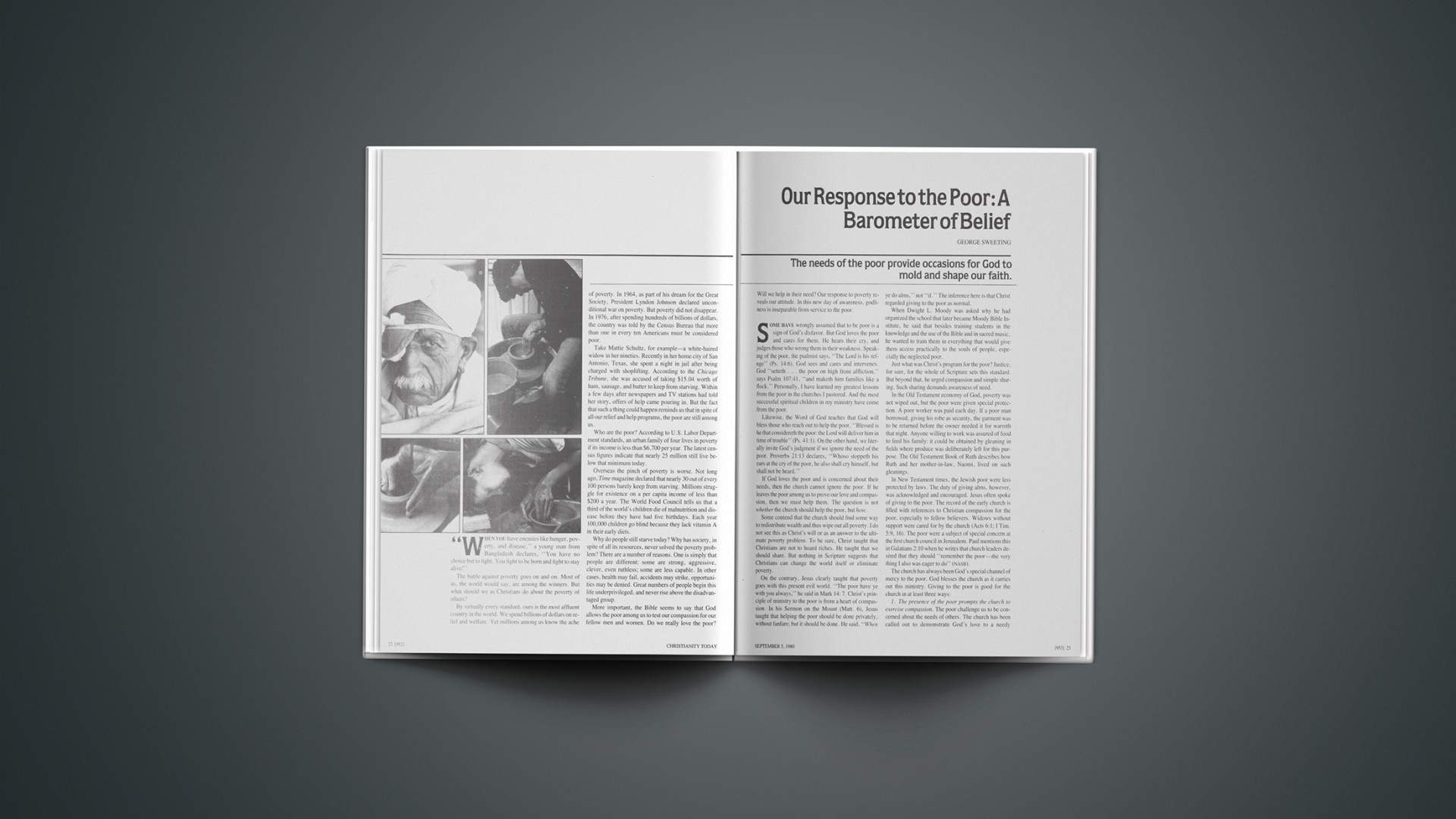
“When you have enemies like hunger, poverty, and disease,” a young man from Bangladesh declares, “You have no choice but to fight. You fight to be born and fight to stay alive!”

The battle against poverty goes on and on. Most of us, the world would say, are among the winners. But what should we as Christians do about the poverty of others?

By virtually every standard, ours is the most affluent country in the world. We spend billions of dollars on relief and welfare. Yet millions among us know the ache of poverty. In 1964, as part of his dream for the Great Society, President Lyndon Johnson declared unconditional war on poverty. But poverty did not disappear. In 1976, after spending hundreds of billions of dollars, the country was told by the Census Bureau that more than one in every ten Americans must be considered poor.

Take Mattie Schultz, for example—a white-haired widow in her nineties. Recently in her home city of San Antonio, Texas, she spent a night in jail after being charged with shoplifting. According to the Chicago Tribune, she was accused of taking $15.04 worth of ham, sausage, and butter to keep from starving. Within a few days after newspapers and TV stations had told her story, offers of help came pouring in. But the fact that such a thing could happen reminds us that in spite of all our relief and help programs, the poor are still among us.

Who are the poor? According to U.S. Labor Department standards, an urban family of four lives in poverty if its income is less than $6,700 per year. The latest census figures indicate that nearly 25 million still live below that minimum today.

Overseas the pinch of poverty is worse. Not long ago, Time magazine declared that nearly 30 out of every 100 persons barely keep from starving. Millions struggle for existence on a per capita income of less than $200 a year. The World Food Council tells us that a third of the world’s children die of malnutrition and disease before they have had five birthdays. Each year 100,000 children go blind because they lack vitamin A in their early diets.

Why do people still starve today? Why has society, in spite of all its resources, never solved the poverty problem? There are a number of reasons. One is simply that people are different: some are strong, aggressive, clever, even ruthless; some are less capable. In other cases, health may fail, accidents may strike, opportunities may be denied. Great numbers of people begin this life underprivileged, and never rise above the disadvantaged group.

More important, the Bible seems to say that God allows the poor among us to test our compassion for our fellow men and women. Do we really love the poor? Will we help in their need? Our response to poverty reveals our attitude. In this new day of awareness, godliness is inseparable from service to the poor.

Some have wrongly assumed that to be poor is a sign of God’s disfavor. But God loves the poor and cares for them. He hears their cry, and judges those who wrong them in their weakness. Speaking of the poor, the psalmist says, “The Lord is his refuge” (Ps. 14:6). God sees and cares and intervenes. God “setteth … the poor on high from affliction,” says Psalm 107:41, “and maketh him families like a flock.” Personally, I have learned my greatest lessons from the poor in the churches I pastored. And the most successful spiritual children in my ministry have come from the poor.

Likewise, the Word of God teaches that God will bless those who reach out to help the poor. “Blessed is he that considereth the poor: the Lord will deliver him in time of trouble” (Ps. 41:1). On the other hand, we literally invite God’s judgment if we ignore the need of the poor. Proverbs 21:13 declares, “Whoso stoppeth his ears at the cry of the poor, he also shall cry himself, but shall not be heard.”

If God loves the poor and is concerned about their needs, then the church cannot ignore the poor. If he leaves the poor among us to prove our love and compassion, then we must help them. The question is not whether the church should help the poor, but how.

Some contend that the church should find some way to redistribute wealth and thus wipe out all poverty. I do not see this as Christ’s will or as an answer to the ultimate poverty problem. To be sure, Christ taught that Christians are not to hoard riches. He taught that we should share. But nothing in Scripture suggests that Christians can change the world itself or eliminate poverty.

On the contrary, Jesus clearly taught that poverty goes with this present evil world. “The poor have ye with you always,” he said in Mark 14:7. Christ’s principle of ministry to the poor is from a heart of compassion. In his Sermon on the Mount (Matt. 6), Jesus taught that helping the poor should be done privately, without fanfare; but it should be done. He said, “When ye do alms,” not “if.” The inference here is that Christ regarded giving to the poor as normal.

When Dwight L. Moody was asked why he had organized the school that later became Moody Bible Institute, he said that besides training students in the knowledge and the use of the Bible and in sacred music, he wanted to train them in everything that would give them access practically to the souls of people, especially the neglected poor.

Just what was Christ’s program for the poor? Justice, for sure, for the whole of Scripture sets this standard. But beyond that, he urged compassion and simple sharing. Such sharing demands awareness of need.

In the Old Testament economy of God, poverty was not wiped out, but the poor were given special protection. A poor worker was paid each day. If a poor man borrowed, giving his robe as security, the garment was to be returned before the owner needed it for warmth that night. Anyone willing to work was assured of food to feed his family: it could be obtained by gleaning in fields where produce was deliberately left for this purpose. The Old Testament Book of Ruth describes how Ruth and her mother-in-law, Naomi, lived on such gleanings.

In New Testament times, the Jewish poor were less protected by laws. The duty of giving alms, however, was acknowledged and encouraged. Jesus often spoke of giving to the poor. The record of the early church is filled with references to Christian compassion for the poor, especially to fellow believers. Widows without support were cared for by the church (Acts 6:1; 1 Tim. 5:9, 16). The poor were a subject of special concern at the first church council in Jerusalem. Paul mentions this in Galatians 2:10 when he writes that church leaders desired that they should “remember the poor—the very thing I also was eager to do” (NASB).

The church has always been God’s special channel of mercy to the poor. God blesses the church as it carries out this ministry. Giving to the poor is good for the church in at least three ways:

1. The presence of the poor prompts the church to exercise compassion. The poor challenge us to be concerned about the needs of others. The church has been called out to demonstrate God’s love to a needy world—love that is to be shown in tangible, practical ways. In 1 John 3:17–18, the apostle writes: “But whoever has the world’s goods, and beholds his brother in need and closes his heart against him, how does the love of God abide in him? Little children, let us not love with word or with tongue, but in deed and truth” (NASB). John is speaking here of love for fellow Christians. But Christian love is to reach beyond the confines of church membership.

Paul wrote the church in Thessalonica, “The Lord make you to increase and abound in love one toward another, and toward all men …” (1 Thess. 3:12). As the church ministers to the poor, inside or outside its membership, it demonstrates God’s love. Jesus taught that the will of God can be summed up in two great commandments—love God, and love your neighbor. If we do the will of God, we must have compassion on the poor.

2. The presence of the poor gives us opportunity to prove that Christ has touched our hearts and made them new. Helping the poor, especially when it costs us time and money, is not a natural instinct. Our old sin natures prompt us to look the other way instead. Compassion, on the other hand, is an evidence of an inner work of grace.

The apostle James speaks in his epistle of faith and works. Real faith produces works. Our acts are proof of faith. The church that helps the poor proves beyond the shadow of a doubt that it shares the life and love of Christ.

3. The poor give Christians opportunity to lay up heavenly treasure. “He that hath pity upon the poor lendeth unto the Lord,” says Proverbs 19:17, “and that which he hath given will he pay him again.”

To give to the poor for Jesus’ sake is to lay up treasure in heaven. Not only are such treasures safe from moth and rust, but they cause us to fix our hearts on heaven. “For where your treasure is,” Christ said, “there will your heart be also.”

It is not just a duty for the church to help the poor. In the wisdom of God, it is a blessing and a privilege.

How should a local church reach out to the poor? The first concern should be for the poor among its members. Some may be struggling with inadequate housing. For others, sickness may have brought financial crisis. Someone else may be out of work. Many churches have special funds for providing material help, and these often can be used to relieve a needy situation.

But individual Christians also have an obligation. If we see a need that is within our power to meet, we have no right to turn away. God will help us if we share in love, and trust that God will meet our needs as we give generously to others. The apostle James warns, “If a brother or sister is without clothing and in need of daily food, and one of you says to them, ‘Go in peace, be warmed and be filled’; and yet you do not give them what is necessary for their body; what use is that?” (James 2:15–16, NASB).

The same principles hold for those we encounter outside the circle of church membership. If we see a need and it lies within our power to help, we are responsible to help. Neither the church as a body nor the individual can close its eyes to need, wherever it may be.

And then there is the yawning chasm of worldwide need. The church as a whole, and every member of the church, can have a part in helping somewhere in our world. We cannot respond to every need, but we can help generously with some. Jesus told his disciples, “Freely ye have received, freely give.” Our first and great obligation, of course, is to share the Bread of Life. But we cannot withhold the bread of material aid when it lies within our power to give it.

Jesus told two parables to help us see our obligation. The first, in Luke 16, is about a rich man and a beggar. The rich man, Jesus said, lived out his life in luxury. In time he died and went to hell—not because he had been rich, of course, but because he had been satisfied with riches and had looked no further. The poor man lived out his life unnoticed at the rich man’s very doorstep. The parable teaches the folly of trusting riches, but it also should remind us that the poor are all around us. Like the rich man we can shut them out, or we can help them in compassion. We in the United States are the rich in a world that knows unbelievable poverty. We cannot banish human need, but we can help to relieve it if we will.

The other parable is the story of the Good Samaritan. Three travelers in succession saw a man in a desperate plight. He had been robbed, and beaten, and left beside the road to die. Two of these men, who professed to be religious, passed by the victim; they did not want to get involved. The third, a Samaritan, took the time and trouble to help. He bound up the wounds of the injured man and brought him to a place of safety. He even arranged to pay his bills until the victim was back on his feet. Jesus ended the parable by saying to the crowd, “Each one of you do the same.”

The church collectively and Christians as individuals have been called to be good neighbors. We cannot prevent the tragedies of life that leave poor people by the wayside. Nor can we help them all. But we can help some of the needy: the poor within our reach.

What kind of attitude shall we have—that of the rich man who lived a lifetime indifferent to the beggar on his doorstep, or that of the Samaritan who, in a moment of opportunity, chose to show compassion? God’s call to the church is to be like the Good Samaritan: recognizing the needs around us, and going out of our way to meet those needs, even to the point of sacrifice. May we never forget, “that though (Jesus) was rich, yet for your sake he became poor, so that by his poverty you might become rich” (2 Cor. 8:9).

Carl F. H. Henry, first editor of Christianity Today, is lecturer at large for World Vision International. An author of many books, he lives in Arlington, Virginia.
World Hunger: Starve It or Feed It?

Won’t feeding the world’s hungry only fuel the root problem of a growing population?

Is it so obvious that we should feed the world’s hungry?

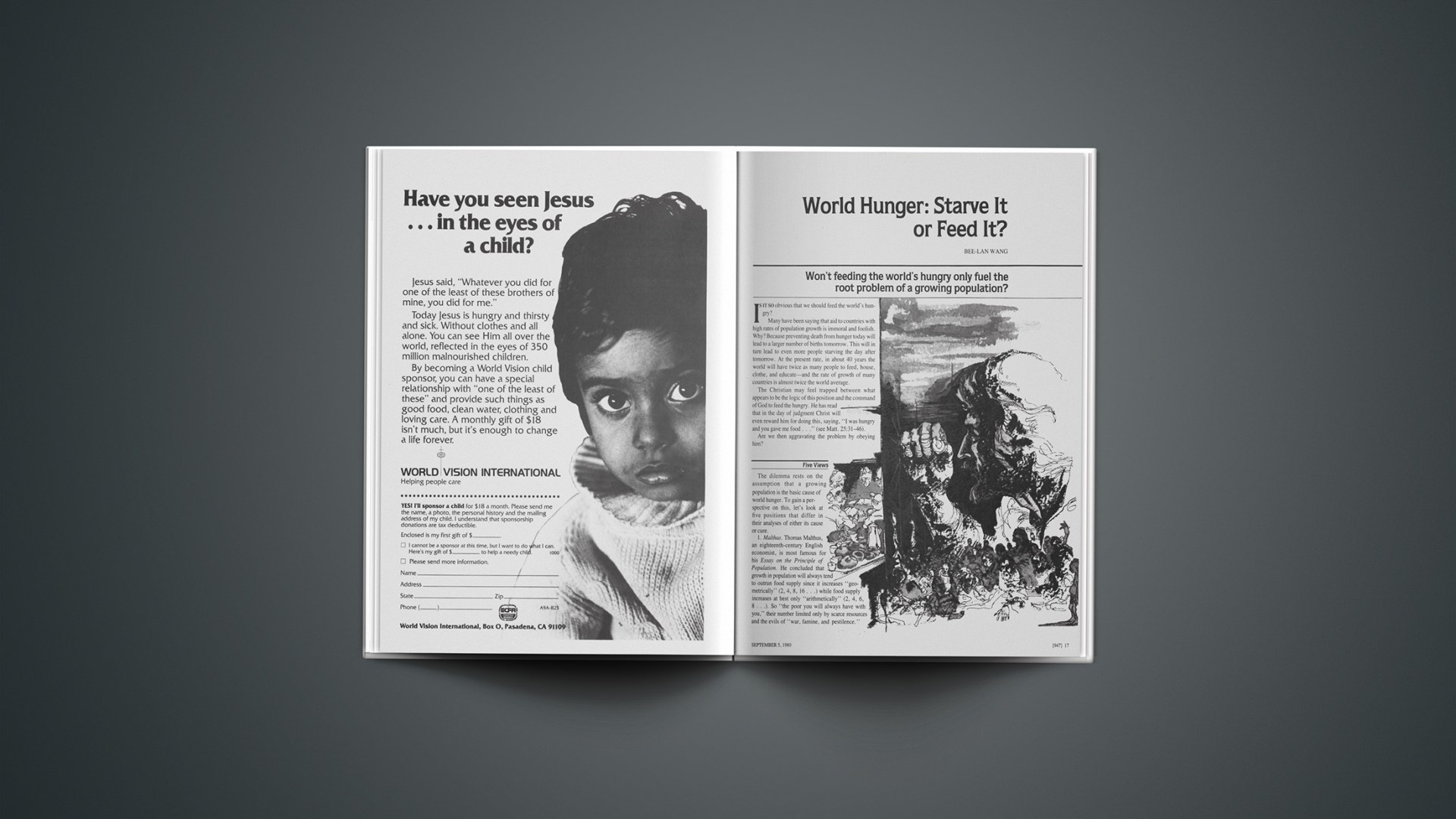
Many have been saying that aid to countries with high rates of population growth is immoral and foolish. Why? Because preventing death from hunger today will lead to a larger number of births tomorrow. This will in turn lead to even more people starving the day after tomorrow. At the present rate, in about 40 years the world will have twice as many people to feed, house, clothe, and educate—and the rate of growth of many countries is almost twice the world average.

The Christian may feel trapped between what appears to be the logic of this position and the command of God to feed the hungry. He has read that in the day of judgment Christ will even reward him for doing this, saying, “I was hungry and you gave me food …” (see Matt. 25:31–46).

Are we then aggravating the problem by obeying him?

Five Views

The dilemma rests on the assumption that a growing population is the basic cause of world hunger. To gain a perspective on this, let’s look at five positions that differ in their analyses of either its cause or cure.

1. Malthus. Thomas Malthus, an eighteenth-century English economist, is most famous for his Essay on the Principle of Population. He concluded that growth in population will always tend to outrun food supply since it increases “geometrically” (2, 4, 8, 16 …) while food supply increases at best only “arithmetically” (2, 4, 6, 8 …). So “the poor you will always have with you,” their number limited only by scarce resources and the evils of “war, famine, and pestilence.”

What then shall we do about world hunger? Welfare aid to the poor will serve only to increase their number, so Malthus advocated benign neglect of the poor and urged them to exercise “moral restraint” in sexual activities.

2. Optimism over technology. Malthus’s dire predictions of chronic hunger and poverty were ignored in the heady optimism of nineteenth-century Europe. Advances in science, technology, and economic production led to great faith in our limitless ability to produce to meet our needs. This view has been reinforced by the discovery in the 1960s of dramatically high, yielding varieties of corn, wheat, and rice. When these were introduced into parts of India, Mexico, the Philippines, and elsewhere, the “Green Revolution” blossomed.

The scientist primarily responsible for pioneering these developments, Norman Borlaug, won the 1970 Nobel Peace Prize for his efforts. Many development agencies are currently trying to spread the techniques of the Green Revolution to the hungry parts of the world.

What then shall we do about world hunger? According to this position, technology will eliminate world hunger. The knowledge for it already exists, awaiting only our willingness to invest time and money to put it into widespread use.

3. Environmental crisis: The New Malthusians. Rachel Carson’s best-selling Silent Spring has, however, stimulated public outcry against the excessive use of chemicals in agriculture. And what are we to make of the droughts and floods that caused mass starvation in Africa and Asia in 1972–73? The ecological balance of earth’s life-support system is evidently more delicate than many had at first supposed. Further, the energy crisis shows that we do not possess an inexhaustible supply of essential minerals. The idea that we can always find a “technological fix” for our problems has increasingly come under attack.

Attempts to use modern technology to grow more food are viewed with extreme caution and even disapproval because alteration of the environment may cause further ecological damage. According to some scholars, such methods aggravate the basic cause of hunger—too many people. In much of the world, excess population has caused permanent environmental damage because of overgrazing, deforestation, erosion, and pollution. Many biologists are sounding the alarm: when these things happen, they say, the inevitable result is massive disaster.

What then shall we do about world hunger? This perspective provides the reasoning behind “lifeboat ethics,” which argues that bringing more people aboard a lifeboat already filled to capacity will result in more deaths than if we were to allow those in the water to die. So the new Malthusians call for strict population controls rather than further aid to starving countries.

4. Economic reform. We have seen that the new Malthusians point to excessive population growth in Third World countries as the basic cause of world hunger. In contrast, a number of people find the cause in the actions of not the poor but the rich countries; they consume too much, and they use their power to take advantage of the poor countries.

This viewpoint notes the accepted fact that patterns of world consumption are determined by purchasing power, not need. For example, in the case of minerals the United States has 5 percent of the world’s population but consumes more than one-third of the world’s nonrenewable resources. In the case of food, the U.S. annually consumes close to 2,000 pounds of grain per person (most of it indirectly, for livestock), as compared with 400 pounds in India. Further, the rich world imports more protein from the poor world. As a result, Third World countries are left with inadequate resources to support themselves.

Two other factors make it even more difficult for poor countries to improve their situation. First, they have to accept inequitable terms of trade with rich countries. What happens is that much of their best land is controlled by multinational corporations whose interests are to reap profits by producing such crops as coffee, sugar, bananas, cocoa, and rubber as cheaply as possible for export to the West. Also, the prices poor countries must pay for needed imports from industrial countries have increased much faster than the prices of their own exports to industrial countries.

The second factor concerns a skewed distribution of wealth. The profit that does stay in the poor country may simply fatten their elite. And further, this group often have vested interests in the status quo. This means they may oppose land reforms that would enable the landless to grow food for themselves.

This fourth viewpoint therefore blames an inequitable world economic system for world hunger. We are not on a lifeboat but in a luxury liner feasting on products taken in unfair exchange.

What then shall we do about world hunger? This perspective says we must reduce consumption in rich countries, and revise the world economic arrangements so that poor countries get fair treatment from outside. Poor countries must also be encouraged to carry out economic reforms within their borders.

5. Shift in birth and death rates. “Demographic transition” is a widely documented phenomenon, so all viewpoints must take it into account. It concerns the change in a country’s birth and death rates from high to low when it develops economically. This takes place in two stages. First, because of better health and nutrition, death rates fall while birth rates remain high, bringing about a period of rapid growth in population. This occurred in Western European countries during the eighteenth and nineteenth centuries, in Japan and the United States in the late nineteenth century, and has been occurring in most Third World or poorer countries since World War I and especially since World War II.

The second stage of the transition occurred in industrialized nations about 50 to 150 years after death rates declined; birth rates then fell, until zero or near zero population growth resulted. Although birth control techniques at that time were primitive and largely ineffective, one sees that in effecting low birth rates, human decisions to limit family size are more important than birth control techniques or government programs.

In some Third World countries that have experienced social and economic progress (such as Taiwan, Singapore, and Costa Rica), birth rates began to decline 10 or 15 years ago; but these have not yet matched the low level of death rates, and these populations are still growing significantly. In poor countries, where a child means an extra pair of hands on the farm and additional old-age insurance, it makes sense to have a large family. Since young children are much more vulnerable to deficiencies caused by poor nutritional and health conditions, parents are more likely to survive to old age than their children are to adulthood. To ensure that at least one son will survive to support the parents in their old age, it is necessary to bear about six children, according to computer simulations.

When a society experiences socioeconomic development, several basic changes take place in the lifestyle of the people. Farming becomes commercialized and mechanized so that fewer people are needed in agriculture. Instead, more become wage earners in offices and factories. Also, children are no longer economic assets; with the increasing necessity of education they become liabilities in terms of costs to support them till they reach financial independence. Further, government and employer-sponsored retirement programs replace children as the source of security in old age. Under these conditions, families voluntarily limit the number of children borne, and societal birth rates fall.

What then shall we do about world hunger? This view says that it is not sufficient merely to promote the use of birth control devices in order to reduce birth rates in poor countries. Rather, a country needs greater socioeconomic development, particularly in education, wage employment, and social security, as well as in health and nutrition.

Relationship with Scripture

We have looked at various analyses of the cause and cure of world hunger. Not all these perspectives are mutually exclusive, nor is the truth contained in only one. The Christian or the scientist can find something valid in most of them. The problem is to pull together useful facts and ideas to arrive at a position that is consistent with biblical teaching.

First, how does Scripture relate to optimism with respect to technology? The Bible says God created man in his own image and gave him dominion over the earth. Because of this, human beings have been able to exercise control over nature through their possession of culture and technology. Archaeology and history give evidence that more than once in the last ten thousand years or so technological revolutions have helped people to break through the limits set by scarce resources. There is room for believing that we are yet capable of increasing world food production.

Such a faith must, however, be tempered with humility and caution; this calls to mind the concerns of present-day environmentalists. Scripture says God gave Adam the right to eat the earth’s produce, but he also charged him to take care of the garden (Gen. 2:15). The command to be good stewards, together with the understanding that our knowledge is limited and often faulty, should result in respect for the world God created.

Next, we must consider the ideas of Malthus, and then pass on to the somewhat revised and expanded views of the new Malthusians. Malthus’s view of man stopped at the level of sex and food. However, the Bible teaches that because man is made in God’s image, he seeks a quality of life fuller than is suggested by mere physical existence. This seeking can lead him to plan rationally for his future. Food, then, is not the only limit on population growth. Instead, as history bears out, increasing prosperity brings with it increasing nonmaterial aspirations. These produce a complex lifestyle that leads people to limit their offspring voluntarily.

But before developing this we need to return to the special claims of the new Malthusians. Concern that overpopulation will cause irreparable damage to the environment has led many thinkers like situation ethicist Joseph Fletcher to suggest a moratorium on sending food to the starving.

In contrast, direct biblical commands to feed the hungry constrain us to continue sending aid. “If there is among you a poor man, one of your brethren, in any of your towns within your land which the Lord your God gives you, you shall not harden your heart or shut your hand against your poor brother” (Deut. 15:7). And James says that if a brother or sister is ill-clad and in lack of daily food, we show dead faith if we ignore him (James 2:14–16). God’s purpose in giving these commands to Israel and the church is not to restrict their concern to one group, but to teach them in pilot projects to show compassion to anyone in need.

But does obedience to these and other commands mean we are contributing to greater future starvation by enabling hungry people to reproduce themselves? If so, we stand accused of foolish emotionalism.

As the perspective of “Economic Reform” notes, damage to the environment is due not only to overpopulation in some places. It also comes when commercial interests force poor people onto marginal lands and exploit ruthlessly their resources. If, given present technological practices, we are in danger of exceeding the capacity of the earth to support human life, then the rich are more to blame than the poor. This view is supported by economists E. F. Schumacher and Kenneth Boulding, among others. They argue convincingly that growing consumption by the rich is a greater culprit than is the growing number of the poor. Worldly economic systems, whether socialist or capitalist, are based on “more is better.” All economic systems need the correction of the Bible, which warns us against materialism, telling us that man shall not live by bread alone. Our greed and our disrespect for God’s created world will lead to disaster if we continue to use nonrenewable resources extravagantly, and to pollute the environment.

Even if we grant that overpopulation is a major problem, we solve nothing by allowing poor people to die of starvation. Studies have shown that when standards of nutrition and health improve, young children are less likely to die, and limiting the number of children borne begins to make sense to poor people. Further, when education and jobs are made available to people, their aspirations rise along with their sense of security. Children become less necessary as insurance and, indeed, become economic liabilities. When a society begins to reach this point, birth rates have been observed to fall. It is fair to conclude that poverty breeds babies.

Vested economic interests often are the cause of poverty—or they at least prevent its alleviation. Unjust practices and laws that penalize the poor and the powerless too often go unchallenged—but not by the Bible, which contains many warnings against those who misuse the poor. Injustice occurs not only because the rich have much while the poor have little (often through no fault of their own), but frequently also because the rich actively oppress the poor. For example, see Amos 2:6–8; 4:1; 5:11–12; James 5:1–6.

What should be the Christian’s response? He should base his action on God’s desire that he show not only justice, but also active love, that goes beyond legal requirements to meet the needs of the poor. “At the end of every seven years you shall grant a remission of debts.… If there is a poor man with you … you shall freely open your hand to him, and shall generously lend him sufficient for his need … Beware, lest there is a base thought in your heart, saying, ‘The seventh year, the year of remission, is near,’ and … you give him nothing.… For the poor will never cease to be in the land; therefore [emphasis added] I command you, saying, ‘You shall freely open your hand …” (Deut. 15:1–11, NASB). This is important for our Christian witness because we are to show our faith by our works (James 2:14–20).

Conclusions

1. We must refuse to pursue increasing levels of material consumption while ignoring worldwide depletion of resources. Not only would we be better stewards, but we would probably live more abundant lives if our interests were more balanced, so that we paid more attention to our spiritual, social, and psychological needs than to our material desires.

2. We must take the opportunity to support agricultural research in less-developed countries. Methods developed in the West are often inapplicable in the physical and social environments of Third World countries. In fact, they often cause or aggravate ecological problems and inequalities between rich and poor.

3. We should support development aid as well as continue to send relief to starving countries. Before people will use birth control techniques, they need mass elementary education, technology that creates rather than eliminates jobs, community health and nutrition, and basic social security.

4. As Christians, we should stimulate the conscience of our nation, bring unjust practices to light, and help form policy that reflects our concern for justice and compassion. We must ask multinational corporations to be accountable for their activities around the world.

5. Christian missions should minister to the whole person, just as Christ did when he lived on earth. God created each person as one, with body, mind, and spirit. Missionaries and Christian organizations must wed evangelism and the treatment of material poverty in a comprehensive approach to human development.

We see, then, that helping the hungry does not increase the problem of poverty and starvation; God’s commandments are not foolish. Rather, obedience to the biblical mandates of stewardship, justice, and love is prerequisite to freedom from want. How should we obey these biblical mandates?

Carl F. H. Henry, first editor of Christianity Today, is lecturer at large for World Vision International. An author of many books, he lives in Arlington, Virginia.
Ideas

Being on the Board and Getting Off

Over the years Bill Gothard has sought to avoid publicity. The seminar leader is noted for turning down interviews with secular and religious publications wanting to describe to a curious public his popular Institute in Basic Youth Conflicts (IBYC).

Because the institute probably would have received much positive publicity over the years, it is ironic and unfortunate that recent reporting has reflected badly upon it. Gothard’s supporters and all evangelicals were shocked to learn of the institute shakeup, which caused Gothard to step down as president. CHRISTIANITY TODAY sought to explain with accuracy and sensitivity the apparent causes: sexual involvements between staff members (not involving Bill Gothard), internal discontent with Gothard’s exercise of authority over his staff, and allegations of lavish spending of institute money. (See News, Aug. 8 issue.)

For some, the revelations may have confirmed suspicions that the institute has had something to hide—that otherwise, it wouldn’t have been so secretive. We disagree; we believe Gothard’s motives were sincere: he wanted the focus on the teachings, not the man, and he believed reporters would present his complex teachings out of context. At the same time, we also disagree with his institute’s well-known avoidance of publicity and its posture of nondisclosure. Every Christian organization, particularly when it is tax exempt, has the responsibility to be accountable to its supporters, to the church, and to the public.

Some might criticize the reporting of an organization’s internal problems as irrelevant and detrimental to the cause of Christ. However, large Christian organizations touch thousands of lives and depend upon the church and individual Christians for financial support.

Gothard’s seminars, for instance, have attracted hundreds of thousands of people; many have attested to changed lives and strengthened spiritual commitments. Pastors need to know about Gothard’s teachings so they can knowledgeably answer parishioners’ questions. Potential attenders need to be able to evaluate whether the seminar is worth time and money.

Also, the institute is a multimillion-dollar, nonprofit corporation, owning a 200-acre slice of choice property in the Chicago suburb of Oak Brook, as well as a 3,000-acre retreat facility in Michigan. Donors must know whether the institute is spending its money wisely. This is especially important in light of questions about funds put into the Michigan property.

Any Christian organization that refuses disclosure breeds suspicion. More seriously, it denies (though it may not mean to) the responsibility and integrity of supporters taught by Scripture to be accountable to one another and to God.

Too many organizations give the impression that individuals “can’t handle” or don’t need information. But whenever a Christian organization appeals to Christians for support, it owes them a strict accountability. Otherwise, it encourages them to disobey God by failing to exercise good stewardship of the resources that God has graciously entrusted to them.

We regret the sentiments expressed by one telephone caller, who warned us that the IBYC “has too many alumni that are loyal.… If you [CHRISTIANITY TODAY] put out anything adverse to the institute, you’re going to be the ones to suffer for it, not us.”

In the long run, who gets hurt is not the issue. The church in general suffers. The Christian journalist’s responsibility is to report truth the churches need to know, even if the content seems to reflect badly upon some individual or organization.

Bill Gothard did release a letter to his supporters, frankly admitting the tragic events that have taken place at the IBYC. We honor his courage and forthrightness. Since the institute has made clear that Gothard’s departure is only temporary, we trust that he will continually lessen the tight controls on information the Christian public has a right to know. We sincerely hope that other Christian organizations learn from his experience, and remove any roadblocks to full public disclosure.

Almost weekly I receive requests to serve on the advisory or governing board of some evangelical organization. The invitation often comes with something to this effect: “You are a well-known, trusted leader in the Christian community. We are not known; we need your support—your name on our letterhead and in our advertising—so that people will have adequate confidence in our organization. Moreover, because of your knowledge of theology (or of theological education or evangelical churches), we need your wisdom and counsel to enable us to become more effective in the Lord’s work.”

But what is the responsibility of a board member—particularly a board member of a nonprofit Christian organization? His is a position of trust. For Christian organizations, he represents the church of Jesus Christ on that board. For all nonprofit organizations, he also represents the general public. By allowing his name to be used, he is declaring to all concerned that he stakes his own integrity on the fact that the organization is worthy of the trust and financial support of Christian people and, in the case of the general public, that it is an honest organization worthy of the privilege of being tax exempt.

A board member can function responsibly only when he knows adequately both an organization’s structure and its actual practice so he can stand as a knowledgeable witness to its integrity.

A member of an advisory board naturally assumes less responsibility to the public for encouraging confidence in the organization he in effect endorses. If only his advice were needed, there would be no need of advertising his relationship to the structure. His name is presented publicly to win public trust and support (and usually public and Christian funds) for the organization. If he allows his name to be used, he must take a significant measure of responsibility for the honesty and moral and spiritual integrity of the organization, for the worth-whileness of the work it does, and for its financial probity. The least he can do is to make continual inquiries and to request copies of a detailed budget and an approved auditor’s report from a well-recognized, highly rated auditing firm (not from an untrained, friend-of-the-board auditor).

The responsibility of a member of any governing board is far greater. I serve on such a board (a Christian college), and I make it my business to be nosy. I attend all meetings of the board and ask questions inside and outside the board meetings. I talk with staff members. I have lunch with faculty and students. I read the school’s advertising mail. And, of course, I regularly receive (and examine minutely) a detailed copy of the budget and its annual audit by a highly competent, trustworthy auditing firm.

I also serve on the reference board of another nonprofit organization. I know only its president. I am confident he is a charming person and thoroughly honest; but I have no way to check on what this organization actually does. I never receive a copy of the budget. Its accounts are audited not by a reputable, well-known auditing firm, but by a private Christian businessman, whom I do not know. That’s about all I know about this organization. Because it doesn’t give me any more information, I am resigning from its reference board—right now!—KSK

When Food Is Basic

What force poses the greatest threat to international order? The Soviet Union? The Islamic world? Inflation? The energy crisis?

None of these, according to a recent study. “The most potentially explosive force in the world today is the frustrated desire of poor people to attain a decent standard of living,” says the report of the Presidential Commission on World Hunger.

The problem of world hunger has no easy solutions. What should a country like the U.S. do? Two years ago the Presidential Commission on World Hunger set out to answer this question, and its findings and recommendations have now been published under the title “Overcoming World Hunger: The Challenge Ahead.” The most startling of its recommendations (to many observers) is that the U.S. should center its policy toward developing nations on the task of ending hunger.

To achieve this goal, the commission suggested that the U.S. take several important steps: (1) give the head of the U. S. International Development and Cooperation Agency cabinet-level status; (2) double the $1.5 billion of technical and economic aid it gives to developing countries for advancing agriculture; (3) set up a national grain reserve and help to form an international reserve for times of shortage; (4) promote greater self-sufficiency among poor nations; and (5) educate the American people in order to build support for policies that help to conquer world hunger.

Some have criticized the report, claiming it did not adequately consider the economic impact of its proposals on the U.S., the rapidly multiplying world population, the long-term effects on political and economic policies, and other factors. Certainly these criticisms deserve careful study. But the chief strength of the report is that it seems to treat the world’s hungry as persons rather than as “economic entities” or merely a “potential labor force.” Most important is to meet the basic needs of people. Setting aside the question of just how evangelism and social concern relate to each other, Scripture makes it clear that Jesus took time to meet people’s physical needs. He ministered to the whole person, treating people as human beings in God’s image, not simply as potential converts or church members.

The commission’s report reinforces the conclusions of a growing number of researchers who feel we already have the technology, resources, and people to end hunger. We need the moral courage to get with it. No doubt human depravity and human selfishness almost guarantee that we shall fail to meet this challenge. But evangelicals who guide their lives by biblical principles know that God cares about the 500 million to 1 billion people in the world who are suffering from hunger, and so must they. Without the strong and vigorous commitment of evangelicals motivated by a divine love for God and for fellow human beings, the world’s hungry will live and die in their hunger. Evangelical faith and integrity are on the line.

Eutychus and His Kin: September 5, 1980

Where’s the Colosseum?

This being an election year, I am announcing to all present that I will not—I repeat, not—vote for any candidate who compares the present state of our country to the decline and fall of the Roman Empire. I further announce that I will not send donations to any radio or television preacher who makes the same comparison. Believe me, I admire Mr. Gibbon’s classic work, but I will not change my mind. I have spoken.

To begin with, is there anybody around who ever wanted the Roman Empire to continue? I mean, what about Daniel’s prophecies and those grotesque pictures in Clarence Larkin’s book of dispensational charts? The Empire just had to go. (I must be honest and admit that I found one man who wanted the Empire to continue. His name was Lucius Contamulus, and he did a land-office business selling Latin correspondence courses to the Celts and Huns. The last anyone heard of him, he had a shop in Piccadilly Circus and was selling Roman candles.)

Furthermore, is there any direct relationship between what happened to Rome and what is happening to us? Other great empires have fallen; why do we pick on Rome? The United States government hasn’t been providing any games for me and my family. In fact, if taxes keep going up on tickets, we’ll have to stay home and watch reruns on TV. How’s that for a decline and fall?

Another thing: literary scholars are not so sure Gibbon wrote the work. He finished his last volume near midnight on June 27, 1787, and by his own admission “took several turns” in a covered walk. While his manuscript lay unguarded, it is possible that his neighbor, Lord Chumley Rumley, slipped his own material into the manuscript. When Gibbon read the proofs, he thought he had written it himself. After all, it is a large book.

I know my protests are in vain. We shall be bombarded with the decline and fall of Rome from podium, pulpit, and panel. All I can say is, “Gibbon, we who are about to be bored to death salute you!”

EUTYCHUS X

Fake Classified Ads?

I’ve written this letter a dozen times. This time I’m sending it.

The device of carrying a ridiculous ad by John Lawing is clever; I am living proof that it causes readers to look through your classifieds for a bit of humorous relief in a generally humorless world.

The problem is, apart from the name Lawing, I often can’t tell the real ones from the bogus. How many and which ones of the following are fake?

1. Retiree wants a sunbelt preaching assignment. Congregational or community church.

2. Introductory offer. Free postage and handling. The intimate diary of a divorce, Jason Loves Jane (But They Got a Divorce) is an honest account of one Christian’s divorce experience. One-month rental of the five 60-minute cassettes. $6.50. Quality guaranteed.

3. Prophecy outline on end times—today to Second Coming. 25ȼ (no checks).…

4. Free monthly newsletter preaching Jesus Christ and the Mark of the Beast.

5. Instant reference filing solves ministering filing problems.

6. Prepare for end of world system (economic, government, religious), tribulation, and return of Jesus Christ. Free Bible information.

7. Christian singles pen pal club for Bible believing Christians nationwide and Canada.

8. Single Christians—God did not ordain loneliness. Meet others through membership in S.C.F. Receive a monthly publication and means of writing to other singles.

9. Vacation in Germany—visit the colorful land which gave us Formgeschichte. Walk in the footsteps of Hermann Gunkel, Julius Wellhausen and Rudolf Bultmann. Full-color brochures available.

10. Visiting U.K.? Stay with Christian families—better fellowship, less expensive. Send $2 for information.…

11. Vacation at Christian guest ranch. Appaloosa and Quarter Horses. Write Heavenly Nook Ranch.…

Having now “field-tested” this letter, I can inform you that two highly intelligent readers guessed at every true ad before locating a bogus! [See bottom of page 8 for the answer.] Grand Rapids, Mich.

E. E. ERICSON

Pastor’s Pay

As a layman I heartily endorse your recent editorial, “Proper Pay for Pastors” (July 18). Several years ago in our local church we established a proper base salary for the pastor, which resulted in a sizable increase. Our annual review takes into account increases in the cost of living, current job requirements, and job performance.

Many churches say they cannot afford to pay a proper salary. The first step in meeting this problem is to adopt the philosophy that the first bill to be paid is the pastor’s salary. Second, after a thorough study, the facts should be presented to the congregation, along with a challenge from the church board. If this is done in the Spirit, a congregation will respond, and the church will prosper spiritually.

May I suggest the following principles for consideration: (1) Provide the pastor a housing allowance in lieu of requiring him to live in a church-owned parsonage or manse. The advantages to the church and the pastor are obvious. (2) Separate money paid into retirement accounts from salary, and do not take such amounts into consideration when setting the salary. Incidentally, many churches do not realize that a pastor not under Social Security can elect to establish his own annuity program. All persons entering the ministry for the first time should explore this matter. (3) Mileage allowance at least equal to the current centsper-mile allowance recognized by IRS should be provided over and above salary.

BOB CARLTON

Saint Charles, Mo.

The editorial on pastor’s pay said nothing about the fringe benefits that pastors often get in addition to their salaries. If a pastor had housing, utilities, medical, and some transportation expenses paid for, his real compensation would be double his take-home salary.

RICHARDSON GRAY

Montreat, N.C.

Your editorial’s subtitle was misleading in contrasting 14 percent of pastors who earn less than $6,000 with truck drivers who average $18,300.

I agree that pastors should receive a proper salary. I also feel their salaries should be properly contrasted with other skilled and professional individuals.

WILLIAM J. PLUM

Irvington, N.J.

Syncopated Drumbeat?

In “Tomorrow’s Missionaries: To Whose Drumbeat Will They March?” (July 18), David J. Hesselgrave unjustly criticizes John Stott’s inclusion of feeding the hungry, healing the sick, etc., in the definition of the Christian mission. He makes three dubious assertions: (1) that Protestants mean “apostle” when they say “missionary”; (2) that, therefore, a wide definition of mission is unwisely connected with “missionaries”; and (3) that Stott assigns “to the ‘missionary’ all that is involved in his definition of ‘mission.’ ”

In fact, Protestants should and usually do have a wider definition of “missionary” than the article’s narrow emphasis on evangelist and church builder (e.g., missionary doctor, teacher, pilot). Moreover, it is Hesselgrave himself and not Stott who connects the whole mission of the whole church to the “missionary” (by which Hesselgrave means evangelist/church developer). Stott’s balanced book is purposely titled Christian Mission.… not The Evangelist’s Mission …

MICHAEL J. GORMAN

Plainsboro, N.J.

David Hesselgrave’s article was timely and thought provoking. However, I have two observations to make.

Hesselgrave seems to dismiss the current developments in theology in the Third World like liberation theology or African theology without giving the reader the reasons for such developments. Could it be that these theologies have sprung up because Western theology, which some people might want to label “Christian theology,” has failed to speak to the needs of the people?

True, we don’t start with our experience or our situation, but with God and what his Word teaches. However, Hesselgrave does not go further to apply the teaching of the Bible in given situations; for example, in Zimbabwe before independence, or in Namibia.

Second, Hesselgrave points out the dangers of contextualization. I agree that a balance is difficult to achieve. But that is what we should be striving for. Liberals are not the initiators of contextualization. He writes: “All too often evangelicals sound like yesterday’s liberals. The current emphasis on contextualization is a case in point.” Contextualization is as old as Christianity itself, although it was not labeled so. The Incarnation is a good example. The early church dealt with the problem in Acts 15. The church leaders resolved that it was not necessary for Gentiles to be Jews in order to be Christians.

Missionary statesman Edwin Smith, who served in Africa during the first half of this century, observed: “Our aim must be to make of the Africans not European Christians but Christians, and to Europeanize them as little as we can in the process—to implant the Gospel of Christ deep within their hearts, and allow them to organize their faith in a manner suited to their traditions and environment” (The Golden Stool).

Anyone who is involved in cross-cultural communications, especially in the Third World, is aware of the rise of cultural nationalism. We can’t close our eyes to these issues, yet we have to remain uncompromisingly biblical.

NGONI SENGWE

Salisbury, Zimbabwe

Lyrics: Ho Hum

I read with great interest your recent articles on church music (June 27), mostly because as a pastor I’ve been inadequately trained and educated in the field, and partly because of a current struggle in my own mind over what music is most appropriate in worship. I feel there was an important issue that was not thoroughly explored.

Philip Yancey perceptively noted (“Sacred Music by the Masters: ‘Drippings of Grace,’ ” Refiner’s Fire) that “Music short-circuits the senses with a direct pathway into human emotion.” I would add that “enroute, it by-passes the intellect.” Music, whether it be classical, rock, country, or whatever, is something that “happens” to a person and, as with any other art form, is generally not thought through except by theoreticians. Most of us go to art exhibits, listen to rock, attend the theatre, or sing in church and enjoy doing so primarily because emotions are stirred up in us.

In music, the lyrics, though having intrinsic value, have little practical value. The average listener hears the words exactly as he does one of the instruments. The meaning behind the words is not primary. For example, if the lyrics of some punk rock tune were translated into Latin or German and set to Beethoven’s “Missa Solemnis,” I’m afraid the elite at Yancey’s symphony concert would be just as thrilled, and any teeny-bopper types around would be just as bored.

I wouldn’t deny that the Jewish tenor on the third row belting out “Agnus Dei, Agnus Dei,” had a transformed look on his face. However, assuming that he and his listeners were being secretly evangelized is silly. The fact of the matter is that words don’t mean much in music. Perhaps the only time they did was in the “message” music of the 60s, but even then (I was a teen-ager at the time), only a minority really heard them.

I go to symphonies, rock concerts, Pentecostal camp meetings, folk festivals, and a lot of church services, and I see people from many diverse backgrounds truly enjoying what they hear. In most cases, though, the words are garbled or not enunciated well enough for listeners to understand. It doesn’t seem to matter! (Dinwiddie’s article is highly cogent in theory, but irrelevant in practicality.)

The profit of Yancey’s article is that it helps us to understand the motivations behind our church music. But most listeners or singers of that music don’t have the time to examine the background of every piece. Furthermore, they aren’t that interested. In our narcissism we care most about how much emotional value the music has for us. The senior adult begging the young pastor to sing the old favorites really wants to relive a past experience that was an emotional high, not to glorify God because the words send praise heavenward (Clarkson’s point).

There is, to be sure, a certain amount of emotion raised in praising God. But is this emotion the goal of our songs, or the by-product of real worship? I’m afraid that most of us judge the effectiveness of a piece of church music not so much by how much glory God gets as by how many goosebumps we get.

JOSEPH E. SREBRO

First Baptist Church of Peoria

Peoria, Ill.

Copy “Rights”

Our church music room is packed with wall-to-wall, floor-to-ceiling music. I am praying for a handyman to increase the storage area. And our church budget contains funds for the purchase of additional music!

We do abide by the rules and restrictions of the copyright law. We too feel that Christian individuals and churches should be honest and obey the commandment “Thou shalt not steal.”

But let’s look at the other side of the coins lining the coffers of the multimillion-dollar gospel music industry. I am glad to buy new music, printed and recorded, and I belong to several choral clubs to keep up with new and exciting things in the gospel music field. But I am sad and frustrated that some of the music that has blessed us cannot be shared even in part because of the ridiculous restrictions publishers impose on law-abiding Christians.

I’m not talking about Xeroxed copies of an entire piece, but simply sharing a few lines of a chorus in a bulletin or in an aid to worship. I have written months in advance for permission to use music in this way and I often receive refusals. One publisher sent a long legal form with requirements no human could control, and then asked for a payment of $15 to $200 for the one-time bulletin use! These requirements are simply impossible for most churches to meet. We have another commandment we obey also: “Thou shalt be good stewards.”

But the last string on my “harp” has to do with my recent purchase of a tape (with legal tender). In addition to the usual warnings against copying or unlawful use, I noticed a new wording that actually said. “You cannot loan it out.” No other product that I purchase would have the audacity to so inscribe!

Somehow I was under the impression that in our constitutionally based society when I purchased an item, it was mine to use, abuse, throw away, give away, share with someone or dispose of in any manner as long as life or limb are not endangered. If the present law had been in force a few thousand years ago, we might not have the Twenty-third Psalm to sing or set to music or publish today.

VERDA DAVIDSON

Clarkston, Wash.

There are many instances where certain kinds of copying without the permission of the copyright owner (most often the publisher) are specifically exempted or generally exempted in the provisions of fair use. Such is the case with the specific exemption for churches to perform or display a nondramatic literary or musical work of a religious nature, during the course of worship or other religious services held on their premises.

This, of course, precludes the use of dramatic-musical works of a nonreligious nature. Making multiple copies for a performance would clearly violate the legislation and churches should abruptly bring such practices to an end by considering other alternatives, such as purchasing the copies, or copying and performing works that are now in the public domain and no longer subject to copyright protection.

STUART MILLIGAN

Librarian

Eastman School of Music

Rochester, N.Y.

Answer to Quiz:

The only fake classified ad was number 9. All of the others are authentic.

Editor’s Note from September 05, 1980

Books are precious gifts from God. When we are downcast and all life displays a drab, desolate hue, books can bring joy and hope. When we face difficult decisions, books provide data to help us make intelligent, informed choices. There is a book for every time and place—but not all books are equally valuable. Twice each year CHRISTIANITY TODAY prepares for you a book issue; it will help guide you to the right book for the occasion. Don’t waste time reading the wrong book. Most of all, don’t ignore the great treasury of wisdom that is yours for the asking. Read the best books for your need: to prepare a sermon or a Sunday school lesson or a speech to the local Kiwanis; or read for sheer recreation of your soul. A friend asked Justice Oliver Wendell Holmes when he was over 90, why, at his advanced age, he was reading Plato’s Republic. “To improve my mind,” the jurist responded. One reason public speakers are so often boring is that they don’t know anything interesting to say. For that malady, CHRISTIANITY TODAY’s book issues are a sure cure.

Helen Wolter reminds us of one recent period in history when children’s books (largely evangelical) effected a major transformation within our society. Did you know that a century ago Sunday school libraries contained twice as many volumes as all public, town, college, school, and university libraries combined?

Finally, sociologist Bee-Lan Wang and Bible institute president George Sweeting provide thoughtful articles about the Christian’s responsibility to the poor of this world. President Sweeting discusses it as a biblical command, while Dr. Wang analyzes the ways by which many affluent evangelicals seek to free themselves from their biblical responsibility.

History
Today in Christian History

September 5

January
February
March
April
May
June
July
August
September
October
November
December
<>

September 5, 1888: Sensational preacher Billy Sunday marries Helen Amelia Thompson, who became his evangelistic campaign adviser. Her organizational talents helped raise him to national prominence.

September 5, 1997: Mother Teresa, winner of the 1979 Nobel Peace Prize and founder of the Missionaries of Charity (now with 517 missions worldwide) dies in Calcutta, India (see issue 65: The Ten Most Influential Christians of the Twentieth Century).

History
Today in Christian History

September 4

January
February
March
April
May
June
July
August
September
October
November
December
<>

September 4, 1736: Robert Raikes, an English newspaper editor who founded Sunday schools (which met from 10 a.m. to 5 p.m.) to educate poor children, is born in Gloucester (see issue 53: William Wilberforce).

September 4, 1842: After a 284-year hiatus, construction of the Cologne Cathedral continues. And you thought road crews took long breaks!

September 4, 1965: Albert Schweitzer, German theologian, organist, and medical missionary, dies in what is now Gabon. He wrote The Quest of the Historical Jesus (1910) received the Nobel Peace Prize in 1953.

History
Today in Christian History

September 3

January
February
March
April
May
June
July
August
September
October
November
December
<>

September 3, 590: Gregory I (“the Great”) is consecrated pope. Historians remember him as the father of the medieval papacy and last of four Latin “Doctors of the Church.” He was the first pope to aspire to secular power, the man for whom Gregorian Chant is named, and one of the main organizers of Roman liturgy and its music. He was also one of the prime promoters of monasticism.

September 3, 1752: This day and the next 10 never happen in Great Britain as the kingdom adopts the Gregorian Calendar (developed by Pope Gregory XIII in 1582) to replace the inaccurate calendar created by Julius Caesar in 46 B.C. Riots break out as Brits argue the government just stole 11 days from their lives.

September 3, 1894: American neo-orthodox theologian H. Richard Niebuhr, professor at Yale University and author of Christ and Culture (1951), is born.

History
Today in Christian History

September 2

January
February
March
April
May
June
July
August
September
October
November
December
<>

September 2, 459 (traditional date): After spending 36 years on top of a pillar praying, fasting, and occasionally preaching, Simeon Stylites dies. At first he sat on a nine-foot pillar, but he gradually replaced it with higher and higher ones; the last was more than 50 feet tall. After his death, the Syrian ascetic—who had won the respect of both pope and emperor—inspired many imitators (see issue 64: Antony and the Desert Fathers).

September 2, 1192: The Third Crusade, which had the mission of retaking Jerusalem (it had fallen to Muslim general Saladin in 1187), ends with the signing of a treaty. Though Christians had not won back Jerusalem, Richard I (later king of England) negotiated access to the holy city (see issue 40: The Crusades).

September 2, 1784: John Wesley consecrates Thomas Coke as the first "bishop" of the Methodist church by John Wesley. An indefatigable itinerant minister, Coke crossed the Atlantic 18 times, all at his own expense (see issue 2: John Wesley and issue 69: Charles and John Wesley).

September 3, 1833: Ohio's Oberlin College, the first coeducational college in the United States and one of the first to offer education to blacks, opens. Its unique character was formed as a result of the revival movement of Charles Finney, who later served as president of the school (see issue 20: Charles Finney).

September 2, 1973: Scholar, novelist, and devout Catholic J.R.R. Tolkien, author of The Hobbit (1937) and The Lord of the Rings (1954-55), dies at age 81 (see issue 7: C.S. Lewis; issue 78: J. R. R. Tolkien).

History
Today in Christian History

September 1

January
February
March
April
May
June
July
August
September
October
November
December
<>

September 1, 256: North African bishops vote unanimously that Christians who had lapsed under persecution must be rebaptized upon reentering the church. The vote led to a battle between Cyprian, one of the North African bishops, and Stephen, bishop of Rome, who disagreed with the vote. Cyprian yielded, precipitating a longstanding argument for the Roman bishop’s supremacy in the early church (see issue 27: Persecution in the Early Church).

September 1, 1159: Adrian (or Hadrian) IV, the only English pope in history, dies.

September 1, 1836: Missionaries Marcus Whitman and H.H. Spalding and their wives reach what is now Walla Walla, Washington. The first white settlers in the Pacific Northwest, Whitman, his wife, and 12 others were killed at their mission by Native Americans in 1847. News of their massacre was largely responsible for Congress’s organizing the Oregon Territory in 1848 (see issue 66: How the West Was Really Won).

September 1, 1957: At a massive rally in Times Square, Billy Graham concludes his 16-week evangelistic crusade in New York City, attended by nearly 2 million people (see issue 65: The Ten Most Influential Christians of the Twentieth Century).

Apple PodcastsDown ArrowDown ArrowDown Arrowarrow_left_altLeft ArrowLeft ArrowRight ArrowRight ArrowRight Arrowarrow_up_altUp ArrowUp ArrowAvailable at Amazoncaret-downCloseCloseEmailEmailExpandExpandExternalExternalFacebookfacebook-squareGiftGiftGooglegoogleGoogle KeephamburgerInstagraminstagram-squareLinkLinklinkedin-squareListenListenListenChristianity TodayCT Creative Studio Logologo_orgMegaphoneMenuMenupausePinterestPlayPlayPocketPodcastRSSRSSSaveSaveSaveSearchSearchsearchSpotifyStitcherTelegramTable of ContentsTable of Contentstwitter-squareWhatsAppXYouTubeYouTube