Saving Energy Dollars by Design

Build energy efficiency into your church—new or old.

Energy-efficient church architecture is coming our way—and just in time. With both the money crunch and the energy squeeze hard upon us, churches built in the 1980s will include several energy-efficient features hardly considered a few years ago.

You might expect this new energy-efficient church to be easily recognizable—that a close look at the lower pitch of the roof, the slant of the entryway, and the way the main sanctuary hugs the ground, would tell the tale. But, no; the energy-efficient church differs from others not so much in its design as in its technology.

The reason is because—or indeed—the only blatantly energy-efficient structure of any kind in the history of architecture may be the cave. One of the foremost church architects in the country, Henry Jung (American Institute of Architects), and successor to Harold E. Wagoner of Philadelphia, advises wryly, “The cave is the answer.” Then he hastily adds, “But only if you don’t care anything about design and function.” The energy-efficient church, like its cousin the energy-inefficient church, will in all probability look either as traditional or as innovative as a church board and its architect choose. But it will, nevertheless, somehow look like a church. That is what church architecture is all about—wedding the theology of a worshiping body to its practical needs in an aesthetic statement of masonry, wood, steel, and the new materials.

Since design is still the major consideration, architects, as always, make that decision first. “We design the kind of structure most appropriate for the needs and theology of a group of people and then we compensate to get the energy efficiency we need today,” says Jung. The term “compensate” indicates that architects are aware they must indeed provide energy measures. Using compensation available in today’s technology, the church architect can sensibly design arches, high ceilings, domes, or something altogether different.

It costs money, of course, to get both the best design and energy efficiency—but it is an expenditure well worth it to those concerned with Christian stewardship. A building erected in 1980 can be three times as efficient as one constructed 10 years ago. That is a timely savings; some churches are thinking twice about building at all. Building starts of all kinds are so much fewer that for the time being, activity in the area of church architecture has almost dried up in some areas of the country. But the situation is temporary. The F. W. Dodge statistical division of McGraw-Hill Information Systems Company predicts that church building will spurt up again, increasing to top speed in the sun belt states. Even now, there are more church building starts in Texas and other sun states as the population continues to shift southward. In these areas, religious building climbed steadily from 37 to 43 percent of the national total, the largest share of any building type for any region, according to F. W. Dodge economist George Christie. Nationwide, church building has climbed from 27 million square feet in 1970 to 35 million square feet in 1979 and it is projected to climb to 41 million square feet in 1984, when the slowdown eases off.

That church building is still increasing is surely a reflection of the national interest in religious matters reported by the recent CHRISTIANITY TODAY-Gallup Poll. But it is a painful fact that from now on people who build churches must face a new set of realities, forced by oil and other energy shortages. The monetary squeeze on the Western world has set in motion a chain reaction that has catapulted through the church doorway. Energy and budgetary issues are both so real that every decision about the church design of the 1980s will be made in light of their consideration.

“We’ve been aware of these things for a long time,” says Henry Jung. “Architects have been working on energy efficiency for many years.” This awareness is now heightened by the present costs of fuel, up 300 percent, and followed closely by both operating and maintenance costs on any new building. The Architectural Record reported in early 1980 that the prices for all fuel-related products—asphalt, roofing, insulation—had risen between 15 to 18 percent above a year ago; concrete prices increased 12 percent in the past year; mineral wood insulation is up 27 percent; lightweight concrete blocks are up 11.5 percent; steel is up 11 percent; and hourly wages of building trade craftsmen are up 8–9 percent, for a total construction cost increase of 1.3 percent per month. With costs so high, no church can afford not to build energy efficiency into its final building product in order to recover those costs in future savings. There is even greater urgency if the church wants to leave money in its budget to help a needy world.

For churches that were built before prices skyrocketed and are less energy efficient, certain things can still be changed in order to correct inefficiency, and will quickly make up for the original expenditure, as Douglas R. Hoffman of the Office of Architecture, United Methodist Church, points out in his resource book for church boards. Such measures are increasingly within reach for all church buildings, new or old.

The first point to grasp is what constitutes an energy-efficient church building. At rock bottom, all energy efficiency is a matter of heating and cooling. “Heat loss is the big issue,” says consultant Jon Mosby of Associated Church Builders in Palatine, Illinois. At a meeting last April, church architects evidenced their concern by inviting Douglas R. Hoffman, who edited The Energy-Efficient Church (Pilgrim, 1979; reviewed elsewhere in this issue), to speak at the Interfaith Forum on Religion, Art, and Architecture. Hoffman says that among the greatest causes of wasted energy are inefficient heating and cooling plants, and the needless heating or cooling of unused portions of a church building. These drains on energy can be corrected in many ways, and today’s technology is all on our side.

Insulation is a top priority. “I call it passive solar,” says William E. Burroughs of Jenkintown, Pennsylvania, a consulting engineer on church construction. “We insulate the walls and ceilings very heavily. Roofs get around as much as R-30 insulating batting, especially in attic spaces. Walls get R-19 insulating batting.” Designations such as R-30 describe the degree of thickness: the colder the area, the thicker the batting, Burroughs explains. Consultant Jon Mosby adds that a region as cold as North Dakota can take as much as R-38 in the roof. Although a church building constructed before 1960 will invariably have uninsulated walls, necessary insulation can often be piped in “after the fact.” But a word of warning: studies are revealing evidence that certain forms of pumped-in foam insulation may produce long-term carcinogenic effects—a possibility that is still being verified. Meanwhile, Hoffman’s book suggests other measures to regain efficiency. The principle behind the use of any insulation, says Hoffman—whether for new or old buildings—is to reduce the temperature difference between inside and outside.

Doors and windows are a close second priority after insulation. “Some people want to eliminate windows altogether for energy efficiency,” says Mosby. But if you like windows, Mosby and Burroughs both recommend double or triple panes with tight hardware and double latches. “Double-hung windows aren’t tight enough to keep out the cold. I avoid them,” says Mosby. Hoffman suggests that members of church boards could team up to caulk older windows and interior shutters of various kinds, so as to hold in the heat and discourage the cold to a greater extent, or to shield from the heat in warm climates. Another innovative example in the use of windows is seen in architect Gunnar Birkets’s IBM office building in Detroit. Birkets introduced natural light into the building by using reflectors of stainless steel along narrower-than-usual glass ribbons, so that more daylight bounced into the interior, minimizing reliance on electric light.

Since any means of admitting natural daylight eliminates expensive artificial lighting, some church architects introduce skylights for economic as well as aesthetic reasons. Birkets also designed Calvary Baptist Church in Detroit, where he used interior mirrors to enhance the incoming natural light.

Wherever interior lighting is needed, costs can be reduced by switching to fluorescent lights. And light can be adjusted to different levels—called “task lighting”—depending upon the requirements of the work being done. An encouraging note is that current illumination standards have been cut back considerably. Walter F. Wagner, Jr., in an article in the March 1980 Architectural Record, advises that we can reduce consumption 50 to 60 percent by using common sense; 2 watts per square foot—or even 1½—can suffice.

Close in importance to insulation and the increased efficiency of doors and windows is a well-regulated heating/cooling system. Correct choices here make a difference in energy consumption. It is important that every new church have a unit with automatic thermostat setbacks that, for instance, will readjust for internal temperature that is set at 68 when it is already 65 outside.

“We recommend economizers,” says Mosby. An economizer triggers a mechanism to heat the building on cold days, to bring in fresh air from the outside on moderate days, and to avoid the expensive condensing unit for cooling on hot days except when the automatic sensor says it is really needed. Architect Burroughs recommends electric heat pumps as well, to recycle heat already in a building for use on those merely cool days that are common in many areas. On other moderately warm days—not hot ones—circulating fans can operate at reduced speeds, acting much like the old ice cream parlor fans that are once again popular. These fans can keep air moving at less expense, and reduce the temptation to turn on costly air conditioning units. By contrast, Douglas Hoffman recommends that automatic stack dampers be used on cold days to close the stack in the chimney when the burner stops, thus preventing warm air from going up the chimney. This device should be carefully approved and inspected though, he warns.

All planning of floor space should be heat sensible, and compatible with the heating/cooling system. During planning stages you can elect to place hallways, corridors, and closets along outer walls, especially on the north, and cluster together internally the rooms that require the most heat. During construction, many builders choose to install (at additional expense) larger ducts that will permit more direct air flow and greater efficiency.

Most of these energy-saving features will be almost invisible to the untrained eye. And yet, without them, buildings will be either too cold or too hot, and definitely too expensive.

Some energy features, however, will be observable to the trained eye. For example, from the outside you can determine whether a building is placed wisely on its site. Southern exposure usually gives the best sun and light. Doors that open into the north winds should be avoided; some buildings have neither windows nor entrances on the north side. If entrances on the north side are unavoidable, they should have double chamber entries to keep out the wind.

Another visible energy feature is landscaping. Architect Jung’s cave suggestion partly explains the tendency to berm up, or pack dirt, two to three feet around the base of a building to add insulation. Vegetation carefully placed around a building can also reduce wind force, especially when evergreens are planted next to windows. Small trees and shrubs near basement windows further blunt the force of winds.

If sun is the problem, sun belt dwellers can arrange to be shaded from the overhead sun, while still allowing the low winter sun to shine in. Louvered shutters that may be opened and closed as needed can provide shade when the sun is low in eastern and western skies, and yet admit daylight. A short roof overhang can do the same thing.

Tinted or reflective glass, while expensive, also saves energy in hot climates by reducing the load on cooling equipment. In older buildings, though, the cost to replace with this type of glass is high, and should be balanced against estimated savings.

Exterior wall coverings should be selected with care for best energy efficiency. Traditional brick works well; or, as in the Birkets IBM building in Detroit, metallic silver covering the south and west reflects light and heat, while charcoal black covering the north and east walls, absorbs them.

Gazing at the exterior of the church building, you may or may not perceive any of these features of energy efficiency. Churches built since 1976 are likely to utilize many of these energy-saving devices, and churches built from now on are likely to have an increasing number of them. But can anyone tell by looking which walls are insulated? Which roofs? The answer is, not entirely. Architect Burroughs says both A-line and mansard roofs insulate well. While the mansard gives a more contemporary look, some churches want their buildings to look more traditional or colonial. But whether colonial or contemporary, Burroughs increasingly is recommending a floor plan where, for the same square footage, greater heating efficiency can be achieved. Almost any shape or design can accommodate energy efficiency.

Indeed, church designs that incorporate energy efficiency are just as innovative as ever. “Any design is still possible,” architect Jung assures. “The secret is to compensate. If you like high ceilings, put circulating fans up there to recycle the heat so it doesn’t escape. New indoor malls are doing this. Churches can too. It costs dollars to recover that heat, but you can save and reuse the energy you already have.… Don’t rule out a feature you really want.”

But Jung doesn’t really think we’ll be seeing many Gothic arches these days. A shift in certain design concepts can be traced not so much to energy use as to the way the church views itself. The most visible and obvious changes are related to theology. Changes in worship concepts and in the view of community have radically affected design patterns. Four years ago CHRISTIANITY TODAY reported this shift in a conversation with a Chicago architect, Richard A. Smits. Smits testified to the trend away from linear alignment of the church interior where everything happens up front before a spectator audience. Trends include moving the choir closer to the congregation, and seating the congregation in a semicircle facing in, toward the focus of worship. This arrangement is called “centrality,” differing from “linear” worship. The linear church worshiper makes the long pilgrimage—on foot or with the eye—to the mysterious Presence at the front. By contrast, the circular concept of worship portrays it as a community affair with the worshipers’ shared experiences of God of central significance.

Two implications are suggested by this shift. For some worshiping bodies, it is that the emphasis has indeed moved from God toward man. But church groups with a more evangelical theology will offer an interpretation that declares God in Christ is as central as ever, but that the experience of the believer is also important, and consistent with Protestant theology.

These considerations about the role of theology as it relates to church design still take priority in a discussion of church architecture—even though the issue of energy efficiency has come to occupy a necessary prominence. Architect Jung advises that he always reviews design concepts with a church board in terms of their liturgy, and explores many factors: the emphasis on the spoken word, the placement of the sacraments, the participation of the clergy, the emphasis or deemphasis of the clergy. When they are at the planning stages for their building, says Jung, a church group must go back to basics. Church boards need a clear understanding of their own theology first of all, and then of their program, and their budget. Such dialogues between architect and board force a church to define itself more clearly, and thus to be more effective in the work of Godwhen the new building is finished. “I want to see flow charts, circulation charts, and be sure the congregation has done its homework,” Jung explains. “Homework” implies counting the cost and even deciding to forego certain extravagances in order to provide energy necessities that are more practical.

When the homework is completed, the church architect is able to participate intelligently in planning for the purposes of that body of believers as he imagines and designs a structure that will both represent their faith and insure responsible stewardship of the world’s resources in the 1980s.

As the congregation and the architect talk, pray, and imagine together as a team, they will produce yet another innovative structure that can speak the name of God into a new decade. Exercising their mandate to be good stewards of the earth and of their talents, Christians will find themselves cooperating together ever more faithfully and wisely in seeking to build an energy-efficient church.

Carl F. H. Henry, first editor of Christianity Today, is lecturer at large for World Vision International. An author of many books, he lives in Arlington, Virginia.
Ministering to the Poor: Our Embarrassment of Riches

Failure to minister to the poor reveals our distorted view of the church.

What are the key issues facing society? Environmental pollution? Sex discrimination? World hunger? Poverty? How do American clergymen respond to these problems, personally and in the church programs?

Because the issue of poverty and the poor is so predominant in social, political, and theological thought today, the CHRISTIANITY TODAY-Gallup Poll raised a number of questions on this specific point, as well as questions about social renewal in general. First, let us look at the data, to compare answers from the public as a whole, all clergymen, and evangelical clergymen.

Between 30 and 40 percent of the clergy believe they should help the poor, and in this regard they surpass the public. However, when it comes to giving money to religious and community organizations for this purpose, the clergy fall slightly below the public. But in terms of persuading public and private support for the poor, the clergy are more activist than the public. Further, the clergy feel much more strongly than the public that their obligation to the poor goes beyond paying taxes for welfare.

So much for what they say they should do. What do the clergy actually do? High numbers of them live up to their expectations in giving personal and institutional help, and in a greater percentage than the public. However, less than half of the clergy have actually gotten involved in “persuasion” of church, religious, and government aid-to-the-poor programs.

The poll pushed the clergy one step further regarding the poor. If they come off as having not only good intentions but also high performance as individuals, what about their churches? Pastors know very well there often is a gap between what they would like to see done and what actually happens. Their private convictions and deeds are not always activated by the body of Christians they shepherd, especially in terms of what to do about controversial social issues that spark philosophical, economic, and political differences. Therefore, when asked to list “especially successful” church programs, less than 1 percent of all clergy and less than 1 percent of evangelical clergy cited “concern for the poor.”

Commenting on clergy responses to the poll, Al Krass, United Church of Christ minister and associate editor of The Other Side magazine, said: “I’m gratified to see that no group of clergy listed in the first question had even 1 percent listed as choosing alternative answer 4. Evangelical clergy seem to take slightly more responsibility than the other clergy to do something themselves about poverty.”

But what about the very low “success rating” the clergy give to their church programs for the poor? This is worth looking into.

Several years ago Methodist theologian Howard Snyder wrote: “In short, Jesus Christ, the Son of God, demonstrated the same attitude toward the poor that God revealed in the Old Testament. Though the Savior of all men, he looked with special compassion upon the poor. He purposely took the gospel to the poor, and specifically called attention to what he was doing.

“This is, in summary, the biblical evidence. That there is biblical evidence for God’s particular concern for the poor is obvious if one takes the trouble to look for it” (The Problem of Wineskins, InterVarsity, pp. 40–41).

He later underscores the critical nature of this understanding for the church: “So the urgency to preach the gospel to the poor brings us right to the question of the church and the problem of wineskins. The gospel to the poor and the concept of the church are inseparably linked. Failure to minister to the poor testifies to more than unfulfilled responsibility; it witnesses to a distorted view of the church” (p. 51).

Apparently this urgency has not been translated from the pulpit to the pew. Well-organized, fruitful local church programs for the poor are few and far between. Apart from this lack of successful programs, there is also a gap between what the clergy and their people do individually for the poor:

Sixty-five percent of the clergy give directly to the poor and 70 percent give to religious and community organizations that help the poor. By way of comparison, 13 percent of the Catholics and 21 percent of the Protestants give directly to the poor, and 44 percent of the Catholics and 39 percent of the Protestants give to religious and community organizations. About 30 percent of evangelicals give to the poor personally and about 50 percent give to organizations that do.

Apart from the specific question about poverty and poor people raised in this poll, it may also be encouraging to note that in more general areas of social concern the poll shows 52 percent of all clergy are convinced that it is “very important” for religious organizations to “make public statements about what they feel to be the will of God in political-economic matters.” When separated out, 52 percent of evangelical clergy also have this conviction, which would seem to show some progress in similar areas of concern, because only a few years ago they generally did not want to meddle in politics or oppose the war in Vietnam. Likewise, 82 percent of all clergy (and 82 percent of all evangelical clergy) think that religious organizations should try to persuade senators and representatives to enact legislation they would like to see become law (as opposed to 41 percent of the general public).

This 82 percent figure appears to be a discrepancy when compared to the 40 percent who say they try to persuade church, religious, and community organizations to aid the poor (but it is a happy discrepancy—a sign of progress!). David Burr, pastor of Winston-Salem’s First Presbyterian Church, expresses his encouragement at this large percentage: “I am extremely surprised that so few fail to recognize the importance of religious organizations making public statements on ethical and moral issues. The church has always underestimated its power and the power of its pronouncements. Because of this the church will remain impotent where it could exert strength.”

The CHRISTIANITY TODAY-Gallup Poll underscores one of the enigmatic convictions of evangelical clergy, one that has to do with the relation between personal renewal and social renewal. The enigma is that evangelical clergy are nearly universal in their conviction that personal renewal generally leads to social renewal (88 percent) and that the church should concentrate its efforts more toward personal renewal than toward social renewal (82 percent). Yet there is really little hard data to indicate that personal renewal has this effect generally. Al Krass states: “In the total absence of hard evidence that personal renewal does lead to social renewal, I find it distressing that all categories of clergy should seem to believe that social renewal follows personal renewal.” Father Joseph Fichter, professor of sociology at Loyola University of New Orleans says: “What these clergy are saying is that this should be the case.”

Only 18 percent of evangelical clergymen believe that the church should concentrate its efforts toward equal amounts of both personal renewal and social renewal. Professor Donald Buteyn of San Francisco Theological Seminary comments: “We are mandated for both life changing and world changing ministry. This [lop-sided emphasis on personal renewal] reflects an unhealthy condition for the church and its leadership. History has swung to extremes in these matters, so I am not surprised at the present swing toward privatism in the area of personal renewal in the church. It is in step with the secular mood.”

So here we are with our ostensible evangelical awakening, with our billion-dollar programs of evangelism, with our lavish cathedrals, and with our slickly promoted evangelical agencies without number. We have Christian communications media resources that stagger the mind, and countless famous personalities giving evangelical testimony of their personal experience with Jesus.

And now we have this poll on evangelical clergy attitudes toward social issues. I’m not sure I thank you, Mr. Gallup. This whole thing begins to get sticky. I’m one of those evangelical clergy, a real fat cat, tall steeple, First Presbyterian pastor. And you’ve left me all but naked. I call Jesus “Lord,” and it is he who announced: “the Spirit of the Lord is upon me, because he has anointed me to preach good news to the poor” (Luke 4:18). Something is incongruous here.

This poll raises the question of what evidence there is—I mean real evidence in our lives—of the new creation, of the fruits of repentance, of kingdom priorities and lifestyle. I’m not sleeping as well since I read this, thanks to you, Mr. Gallup. Somewhere out of the past, down through the centuries, come echoing some discomforting words: “Is not this the fast that I choose: to loose the bonds of wickedness, to undo the thongs of the yoke, to let the oppressed go free, and to break every yoke? Is it not to share your bread with the hungry, and bring the homeless poor into your house; when you see the naked, to cover him, and not to hide yourself from your own flesh? Then shall your light break forth like the dawn …” (Isa. 58:6–8).

And another voice: “For you know the grace of our Lord Jesus Christ, that though he was rich, yet for your sake he became poor, so that by his poverty you might become rich” (2 Cor. 8:9).

Of course, probably hidden from view and not even touched by this poll, are the faithful pastors and evangelists, working 10 and more hours a day to support themselves, then laboring untold hours more among their poor friends in the back streets of Newark, or in a Hispanic neighborhood in Houston. They are immersed in ministry to the poor. It is their flock who are hungry and sick and in prison. These are the ones who have heard the calling of Christ, who obey his word, who know what the Incarnation is all about, and who are preaching good news to the poor. All they have to give is themselves and the gospel. They haven’t even the possibility of being paternalistic to the poor. And the Savior rejoices in them.

As for the rest of us? Successful ministries to the poor? Less than 1 percent!

Where U.S. Clergymen Stand On The Church And Social Concern

• Most think their churches should concentrate more on personal renewal than social renewal (65 percent).

Significantly higher than the national norm: evangelical, Southern Baptist and Baptist. (Note: the national norm in each case is the figure in parentheses.) Significantly lower: Catholic, Methodist, Presbyterian, Episcopal, United Church of Christ.

• About one-third think personal and social renewal should have equal concentration (32 percent).

Significantly higher than the national norm: Catholic, Methodist, Presbyterian, Episcopal, United Church of Christ.

• Most think personal renewal generally leads to social renewal (79 percent).

Significantly lower than the national norm: United Church of Christ.

• Most think religious organizations should try to influence legislation (82 percent).

Significantly lower than the national norm: Episcopal.

• Most think it is important for religious organizations to make public statements on political and economic matters (81 percent).

• Virtually all of them have no “especially successful” programs in the churches to help the poor (less than 1 percent).

• Very few say their church programs relating to social concerns in general are “especially successful” (15 percent).

• Very few think organized religion is failing in social outreach (15 percent).

• A mere handful would like to see religious periodicals address themselves more effectively to “social dimensions of faith and ministry” (6 percent).

• Most have personally and directly helped the poor (65 percent).

• Most have given to religious and community organizations to aid the poor (70 percent).

Significantly higher than the national norm: Episcopal.

• About half have tried to persuade church, religious, and government organizations to aid the poor (45 percent).

Significantly higher than the national norm: Methodist, United Church of Christ, Episcopal.

• Very few feel paying taxes is the end of their obligation to the poor (8 percent).

Carl F. H. Henry, first editor of Christianity Today, is lecturer at large for World Vision International. An author of many books, he lives in Arlington, Virginia.
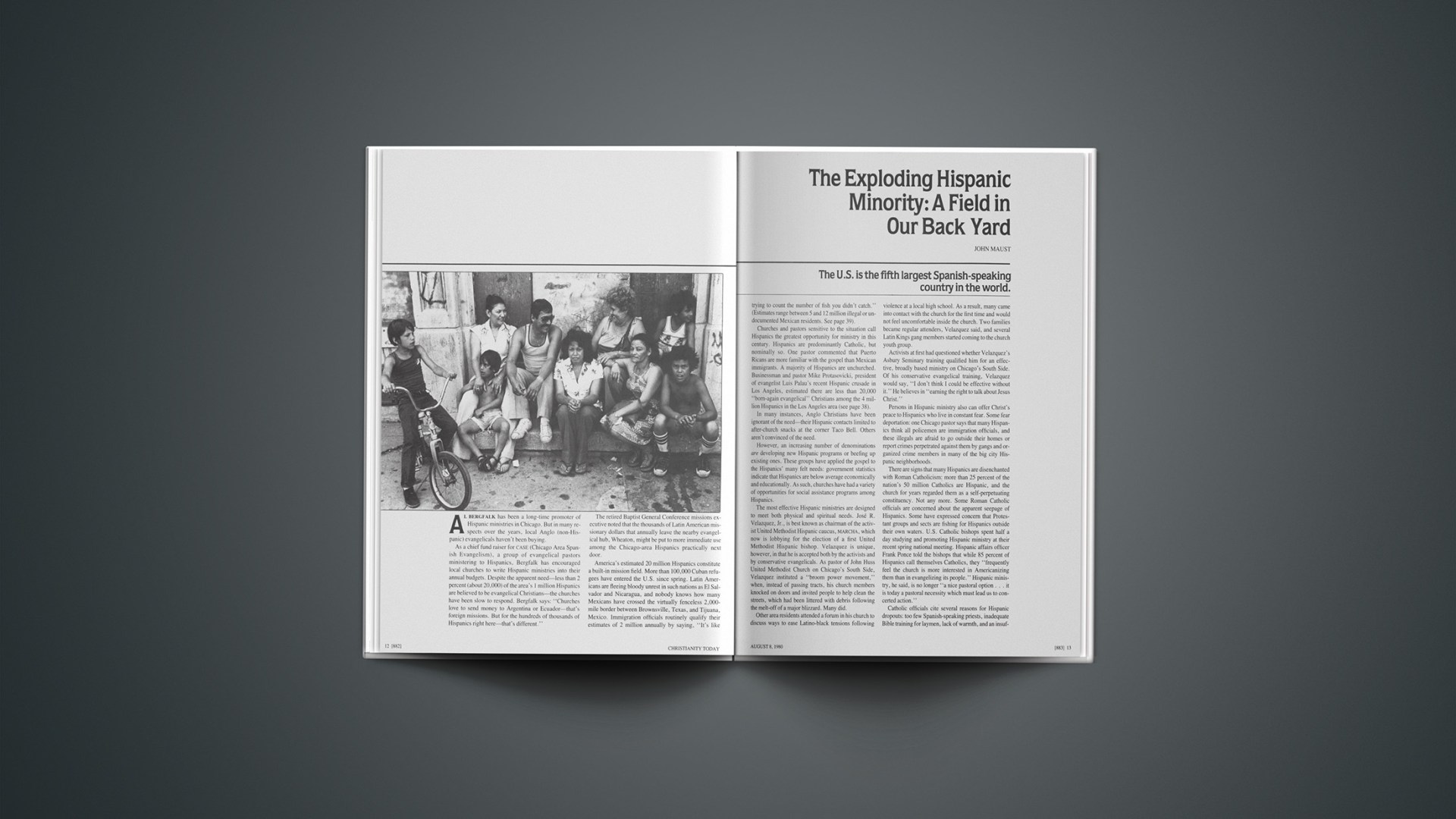
The Exploding Hispanic Minority: A Field in Our Back Yard

The U.S. is the fifth largest Spanish-speaking country in the world.

Al bergfalk has been a long-time promoter of Hispanic ministries in Chicago. But in many respects over the years, local Anglo (non-Hispanic) evangelicals haven’t been buying.

As a chief fund raiser for CASE (Chicago Area Spanish Evangelism), a group of evangelical pastors ministering to Hispanics, Bergfalk has encouraged local churches to write Hispanic ministries into their annual budgets. Despite the apparent need—less than 2 percent (about 20,000) of the area’s 1 million Hispanics are believed to be evangelical Christians—the churches have been slow to respond. Bergfalk says: “Churches love to send money to Argentina or Ecuador—that’s foreign missions. But for the hundreds of thousands of Hispanics right here—that’s different.”

The retired Baptist General Conference missions executive noted that the thousands of Latin American missionary dollars that annually leave the nearby evangelical hub, Wheaton, might be put to more immediate use among the Chicago-area Hispanics practically next door.

America’s estimated 20 million Hispanics constitute a built-in mission field. More than 100,000 Cuban refugees have entered the U.S. since spring. Latin Americans are fleeing bloody unrest in such nations as El Salvador and Nicaragua, and nobody knows how many Mexicans have crossed the virtually fenceless 2,000-mile border between Brownsville, Texas, and Tijuana, Mexico. Immigration officials routinely qualify their estimates of 2 million annually by saying, “It’s like trying to count the number of fish you didn’t catch.” (Estimates range between 5 and 12 million illegal or undocumented Mexican residents. See page 39).

Churches and pastors sensitive to the situation call Hispanics the greatest opportunity for ministry in this century. Hispanics are predominantly Catholic, but nominally so. One pastor commented that Puerto Ricans are more familiar with the gospel than Mexican immigrants. A majority of Hispanics are unchurched. Businessman and pastor Mike Protasovicki, president of evangelist Luis Palau’s recent Hispanic crusade in Los Angeles, estimated there are less than 20,000 “born-again evangelical” Christians among the 4 million Hispanics in the Los Angeles area (see page 38).

In many instances, Anglo Christians have been ignorant of the need—their Hispanic contacts limited to after-church snacks at the corner Taco Bell. Others aren’t convinced of the need.

However, an increasing number of denominations are developing new Hispanic programs or beefing up existing ones. These groups have applied the gospel to the Hispanics’ many felt needs: government statistics indicate that Hispanics are below average economically and educationally. As such, churches have had a variety of opportunities for social assistance programs among Hispanics.

The most effective Hispanic ministries are designed to meet both physical and spiritual needs. José R. Velazquez, Jr., is best known as chairman of the activist United Methodist Hispanic caucus, MARCHA, which now is lobbying for the election of a first United Methodist Hispanic bishop. Velazquez is unique, however, in that he is accepted both by the activists and by conservative evangelicals. As pastor of John Huss United Methodist Church on Chicago’s South Side, Velazquez instituted a “broom power movement,” when, instead of passing tracts, his church members knocked on doors and invited people to help clean the streets, which had been littered with debris following the melt-off of a major blizzard. Many did.

Other area residents attended a forum in his church to discuss ways to ease Latino-black tensions following violence at a local high school. As a result, many came into contact with the church for the first time and would not feel uncomfortable inside the church. Two families became regular attenders, Velazquez said, and several Latin Kings gang members started coming to the church youth group.

Activists at first had questioned whether Velazquez’s Asbury Seminary training qualified him for an effective, broadly based ministry on Chicago’s South Side. Of his conservative evangelical training, Velazquez would say, “I don’t think I could be effective without it.” He believes in “earning the right to talk about Jesus Christ.”

Persons in Hispanic ministry also can offer Christ’s peace to Hispanics who live in constant fear. Some fear deportation: one Chicago pastor says that many Hispanics think all policemen are immigration officials, and these illegals are afraid to go outside their homes or report crimes perpetrated against them by gangs and organized crime members in many of the big city Hispanic neighborhoods.

There are signs that many Hispanics are disenchanted with Roman Catholicism: more than 25 percent of the nation’s 50 million Catholics are Hispanic, and the church for years regarded them as a self-perpetuating constituency. Not any more. Some Roman Catholic officials are concerned about the apparent seepage of Hispanics. Some have expressed concern that Protestant groups and sects are fishing for Hispanics outside their own waters. U.S. Catholic bishops spent half a day studying and promoting Hispanic ministry at their recent spring national meeting. Hispanic affairs officer Frank Ponce told the bishops that while 85 percent of Hispanics call themselves Catholics, they “frequently feel the church is more interested in Americanizing them than in evangelizing its people.” Hispanic ministry, he said, is no longer “a nice pastoral option … it is today a pastoral necessity which must lead us to concerted action.”

Catholic officials cite several reasons for Hispanic dropouts: too few Spanish-speaking priests, inadequate Bible training for laymen, lack of warmth, and an insufficient appeal to the Hispanic emphasis on the family.

If evangelical groups don’t reach out to these Hispanics, other religions have indicated they will. The Jehovah’s Witnesses reportedly have a growing Hispanic membership of 45,000. At a recent area meeting attended by 75,000 Southern California Mormons, President Spencer W. Kimball noted proselytizing efforts toward Hispanics and other minorities were “a little behind” and said his church should more actively seek such converts. Even so, he noted that the Mormon Hispanic membership in Southern California had tripled in the previous five years, and that there were 50,000 Spanish-speaking Mormons in the Southwest. Some Catholic clergy have warned about the spread among Hispanics of the so-called Santeria cult, a mixture of Catholicism and African spiritism. Those Protestant groups with the strongest Hispanic ministries are Baptists and Pentecostals.

There are 1,400 Hispanic congregations affiliated with the Southern Baptist Convention, with 115,000 members and 150,000 Sunday school attenders. Language missions director Oscar I. Romo, a Mexican-American, responding to a CHRISTIANITY TODAY Hispanic ministries survey sent to more than 25 denominations, listed 21 Southern Baptist Hispanic programs, ranging from development of Hispanic Sunday school materials to leadership training for Hispanic pastors. American Baptists report 300 Hispanic congregations in the U.S. and Puerto Rico.

The Assemblies of God list 707 Hispanic congregations with 66,000 members. The Church of God (Cleveland, Tenn.) has divided its Hispanic churches into five districts, and reports that its small Hispanic membership has doubled to 10,000 members just within the last two years.

Other church bodies and religious groups have only recently gotten involved in outreach to Hispanics. An increasing number of seminaries—such as Fuller and Concordia (Lutheran Church-Missouri Synod)—have developed Hispanic ministries programs. WMBI/AM radio of Moody Bible Institute in Chicago now devotes all day Saturday to Hispanic programming—an increase over the first, single, 15-minute radio program for Hispanics in 1970. Spanish programming director Jaime (Jim) Shedd said, “One of the exciting things has been that we’re the only noncommercial station doing things in Spanish in Chicago,” and that as a result Hispanic community leaders have expressed an interest in the station. He said Moody has been getting involved in public affairs, pushing Hispanic support for the census and learning English, although, “of course, our primary purpose is to touch them with Christ.”

Other examples of innovative Hispanic ministries include one begun by the Miami Baptist Association in Florida, which is promoting the value of indigenous leaders. The association, which has 39 affiliate Hispanic congregations—most of them Cuban—is supporting the Ethnic Branch of the New Orleans Baptist (Southern) Theological Seminary, where 110 laity and clergy now are receiving advanced Bible training. Wheaton College students were involved in registering nearby West Chicago Hispanics to vote.

Four years ago the Church of God (Anderson, Ind.) created its first full-time director for Hispanic ministries. Since then, the number of its Hispanic congregations has increased from 9 to 18. “The majority of new ministries have been started by strong, well-established Anglo congregations who are reaching out in commitment to their communities and beginning Hispanic services in the neighborhood,” said Church of God president Marvin Hartman.

The Lutheran Church-Missouri Synod has 39 Hispanic congregations totaling 3,800 members. It hopes to double that number soon. Last year’s synodical convention established a goal to open 50 new Hispanic churches and to recruit 100 new workers for Hispanic ministries within the next 10 years.

The Latin America Mission has done evangelism among Hispanics outside the U.S. for more than 65 years. But just two years ago the mission appointed its first Hispanic ministries director for the U.S., Richard Boss, a New York City native and missionary for 12 years to Colombia. He said his division grew out of an awareness of the Hispanic influx, and because of the many requests from local congregations for information on how to minister among Hispanics.

A problem has been ignorance of successful models for Hispanic ministries. “We feel there’s a gap in finding out what actually is being done, and what needs to be done in different areas of the country,” said Boss. He said LAM expects to bring on a full-time, evangelism-research specialist who can evaluate what needs to be done in different cities throughout the country.

Responding to the CHRISTIANITY TODAY Hispanic survey, denominational officials listed several problems common to Hispanic ministries. Most often mentioned was the lack of trained Hispanic clergy, as well as divisions among the Hispanics themselves.

Because of the mixed racial groupings and unique cultures, it is difficult to speak definitively of what constitutes Hispanic ministry, except that it is one conducted in the Spanish language.

(The nation’s Hispanics are grouped primarily in the cities. New York City’s 2 million Hispanics are predominantly Puerto Rican. The second largest urban Hispanic aggregation—Los Angeles, with about 1.9 million—are mostly Mexican. Miami’s 512,000 Hispanics are overwhelmingly Cuban. Since the Castro takeover produced the first wave of immigration, Miami’s Hispanic population has grown some 10 to 40 percent. Chicago is unique in that its officially estimated 420,000 Hispanics are divided in almost equal proportions among the three racial groupings.)

Cecilio Arrastia, associate for Latino mission development in the United Presbyterian Church, noted a problem of division and “lack of trust” among Hispanics. Talk about a “Latin American culture” is misleading, he said. “There are many subcultures within the total spectrum of Latin Americans. The differences which add color and romance in many senses, account also for lack of trust, lack of coherence, and lack of a sound strategy.”

Often Hispanics have been divided into hostile Pentecostal and non-Pentecostal camps. Indeed, lack of cooperation between Pentecostals and non-Pentecostal pastors in Chicago was cited as one of the reasons evangelist Luis Palau canceled an anticipated Chicago Hispanic crusade in 1976. Last month, Palau did hold his first Spanish-language crusade in the U.S.—his Festival of the Family in Los Angeles. (See opposite page.)

Richard W. Colenso, director of specialized ministries for the Christian and Missionary Alliance, cited a problem of competition among denominations “which brings about the offering of salaries, benefits, and status to pastors, or buildings, grants, and other assistance to the congregations, tempting them to leave their current denomination and switch to another, thus destroying the peace and the discipline of self-support we try to impose upon our people.” The CMA. with 73 Hispanic congregations, holds to the homogeneous philosophy and has placed its Hispanic churches into Hispanic conferences.

Pastors ministering to Hispanics face several tough questions themselves. For instance: How does one minister to an illegal alien? Should Hispanic congregations be started with the goal of later incorporating them into the larger Anglo body? Regarding the latter, Pastor Doug Moore of Salem Evangelical Free Church in Chicago prefers to retain his Spanish congregation intact. Though many in his congregation have a basic working knowledge of English, “you need to use Spanish to get at the ‘heart language,’ ” he said.

How can an English-speaking church get involved in Hispanic ministry? Obviously, churches in Hispanic neighborhoods can start sister Hispanic congregations.

Doug Moore has had success with his sister churches concept—inviting young people from other churches to spend a weekend at his Salem Church, where they can be exposed to the Spanish culture. Churches can also sponsor Hispanics who are seeking to immigrate to the U.S. They can bring into their homes a Latino youngster who may want to escape for a time the pressures of a teen gang environment in the city. Boss, of LAM, said, “We found that some churches had block parties or social events, in which they invited and asked Latin Americans to provide some type of typical food or dance or native folklore, just to get the Anglos exposed. Often we find that Anglos have a negative view of Latin Americans.”

Hispanics won’t be ignored. By the end of the century Spanish speakers almost certainly will pass blacks as the largest minority group in the U.S. Recent U.S. Census Bureau figures indicate the birth rate of U.S. Hispanics is more than twice that of whites and 60 percent greater than blacks. Put differently, the U.S. is the fifth largest Spanish-speaking country in the world, after Mexico, Spain, Argentina, and Colombia.

The Hispanics, whose treks show they know something about personal sacrifice, can provide strength to a flabby, affluent society, say Hispanic ministry officials. The Hispanics’ unique culture can add flavor to a bland American melting pot.

“People should look at the growing Hispanic population as an opportunity rather than an infringement,” said radio programmer Shedd of WMBI in Chicago. In the Spanish congregation he’s been part of as a local pastor, Shedd has seen “a real spontaneity of the spirit. The Hispanics exhibit a real joy of the Lord.… We Anglos might learn, for instance, how to be able to exhibit that same joy.”

Carl F. H. Henry, first editor of Christianity Today, is lecturer at large for World Vision International. An author of many books, he lives in Arlington, Virginia.

Ideas

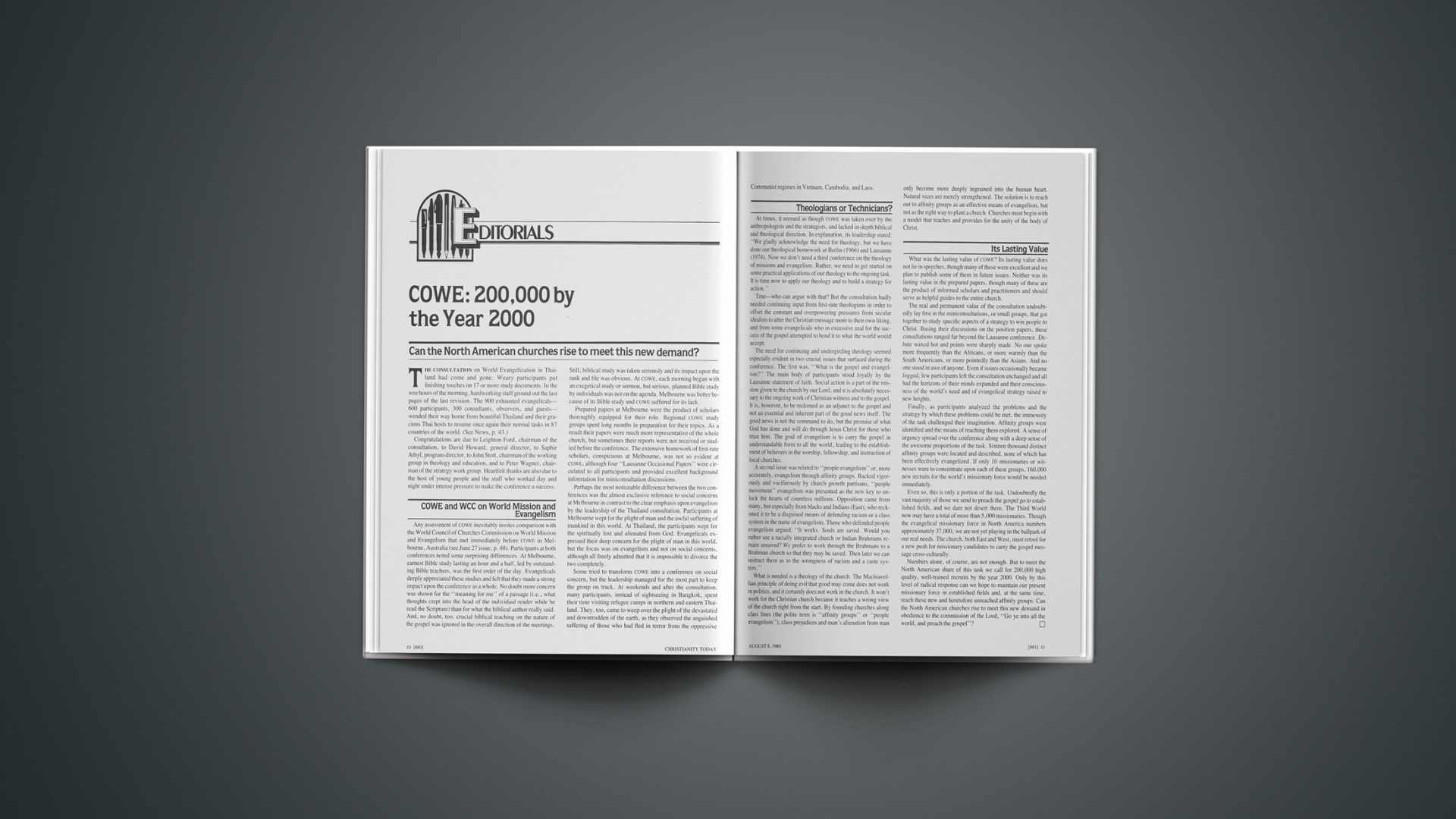
COWE: 200,000 by the Year 2000

Can the North American churches rise to meet this new demand?

The consultation on World Evangelization in Thailand had come and gone. Weary participants put finishing touches on 17 or more study documents. In the wee hours of the morning, hardworking staff ground out the last pages of the last revision. The 900 exhausted evangelicals—600 participants, 300 consultants, observers, and guests—wended their way home from beautiful Thailand and their gracious Thai hosts to resume once again their normal tasks in 87 countries of the world. (See News, p. 43.)

Congratulations are due to Leighton Ford, chairman of the consultation, to David Howard, general director, to Saphir Athyl, program director, to John Stott, chairman of the working group in theology and education, and to Peter Wagner, chairman of the strategy work group. Heartfelt thanks are also due to the host of young people and the staff who worked day and night under intense pressure to make the conference a success.

COWE and WCC on World Mission and Evangelism

Any assessment of COWE inevitably invites comparison with the World Council of Churches Commission on World Mission and Evangelism that met immediately before COWE in Melbourne, Australia (see June 27 issue, p. 48). Participants at both conferences noted some surprising differences. At Melbourne, earnest Bible study lasting an hour and a half, led by outstanding Bible teachers, was the first order of the day. Evangelicals deeply appreciated these studies and felt that they made a strong impact upon the conference as a whole. No doubt more concern was shown for the “meaning for me” of a passage (i.e., what thoughts crept into the head of the individual reader while he read the Scripture) than for what the biblical author really said. And, no doubt, too, crucial biblical teaching on the nature of the gospel was ignored in the overall direction of the meetings. Still, biblical study was taken seriously and its impact upon the rank and file was obvious. At COWE, each morning began with an exegetical study or sermon, but serious, planned Bible study by individuals was not on the agenda. Melbourne was better because of its Bible study and COWE suffered for its lack.

Prepared papers at Melbourne were the product of scholars thoroughly equipped for their role. Regional COWE study groups spent long months in preparation for their topics. As a result their papers were much more representative of the whole church, but sometimes their reports were not received or studied before the conference. The extensive homework of first-rate scholars, conspicuous at Melbourne, was not so evident at COWE, although four “Lausanne Occasional Papers” were circulated to all participants and provided excellent background information for miniconsultation discussions.

Perhaps the most noticeable difference between the two conferences was the almost exclusive reference to social concerns at Melbourne in contrast to the clear emphasis upon evangelism by the leadership of the Thailand consultation. Participants at Melbourne wept for the plight of man and the awful suffering of mankind in this world. At Thailand, the participants wept for the spiritually lost and alienated from God. Evangelicals expressed their deep concern for the plight of man in this world, but the focus was on evangelism and not on social concerns, although all freely admitted that it is impossible to divorce the two completely.

Some tried to transform COWE into a conference on social concern, but the leadership managed for the most part to keep the group on track. At weekends and after the consultation, many participants, instead of sightseeing in Bangkok, spent their time visiting refugee camps in northern and eastern Thailand. They, too, came to weep over the plight of the devastated and downtrodden of the earth, as they observed the anguished suffering of those who had fled in terror from the oppressive Communist regimes in Vietnam, Cambodia, and Laos.

Theologians or Technicians?

At times, it seemed as though COWE was taken over by the anthropologists and the strategists, and lacked in-depth biblical and theological direction. In explanation, its leadership stated: “We gladly acknowledge the need for theology, but we have done our theological homework at Berlin (1966) and Lausanne (1974). Now we don’t need a third conference on the theology of missions and evangelism. Rather, we need to get started on some practical applications of our theology to the ongoing task. It is time now to apply our theology and to build a strategy for action.”

True—who can argue with that? But the consultation badly needed continuing input from first-rate theologians in order to offset the constant and overpowering pressures from secular idealists to alter the Christian message more to their own liking, and from some evangelicals who in excessive zeal for the success of the gospel attempted to bend it to what the world would accept.

The need for continuing and undergirding theology seemed especially evident in two crucial issues that surfaced during the conference. The first was, “What is the gospel and evangelism?” The main body of participants stood loyally by the Lausanne statement of faith. Social action is a part of the mission given to the church by our Lord, and it is absolutely necessary to the ongoing work of Christian witness and to the gospel. It is, however, to be reckoned as an adjunct to the gospel and not an essential and inherent part of the good news itself. The good news is not the command to do, but the promise of what God has done and will do through Jesus Christ for those who trust him. The goal of evangelism is to carry the gospel in understandable form to all the world, leading to the establishment of believers in the worship, fellowship, and instruction of local churches.

A second issue was related to “people evangelism” or, more accurately, evangelism through affinity groups. Backed vigorously and vociferously by church growth partisans, “people movement” evangelism was presented as the new key to unlock the hearts of countless millions. Opposition came from many, but especially from blacks and Indians (East), who reckoned it to be a disguised means of defending racism or a class system in the name of evangelism. Those who defended people evangelism argued: “It works. Souls are saved. Would you rather see a racially integrated church or Indian Brahmans remain unsaved? We prefer to work through the Brahmans to a Brahman church so that they may be saved. Then later we can instruct them as to the wrongness of racism and a caste system.”

What is needed is a theology of the church. The Machiavellian principle of doing evil that good may come does not work in politics, and it certainly does not work in the church. It won’t work for the Christian church because it teaches a wrong view of the church right from the start. By founding churches along class lines (the polite term is “affinity groups” or “people evangelism”), class prejudices and man’s alienation from man only become more deeply ingrained into the human heart. Natural vices are merely strengthened. The solution is to reach out to affinity groups as an effective means of evangelism, but not as the right way to plant a church. Churches must begin with a model that teaches and provides for the unity of the body of Christ.

Its Lasting Value

What was the lasting value of COWE? Its lasting value does not lie in speeches, though many of these were excellent and we plan to publish some of them in future issues. Neither was its lasting value in the prepared papers, though many of these are the product of informed scholars and practitioners and should serve as helpful guides to the entire church.

The real and permanent value of the consultation undoubtedly lay first in the miniconsultations, or small groups, that got together to study specific aspects of a strategy to win people to Christ. Basing their discussions on the position papers, these consultations ranged far beyond the Lausanne conference. Debate waxed hot and points were sharply made. No one spoke more frequently than the Africans, or more warmly than the South Americans, or more pointedly than the Asians. And no one stood in awe of anyone. Even if issues occasionally became fogged, few participants left the consultation unchanged and all had the horizons of their minds expanded and their consciousness of the world’s need and of evangelical strategy raised to new heights.

Finally, as participants analyzed the problems and the strategy by which these problems could be met, the immensity of the task challenged their imagination. Affinity groups were identified and the means of reaching them explored. A sense of urgency spread over the conference along with a deep sense of the awesome proportions of the task. Sixteen thousand distinct affinity groups were located and described, none of which has been effectively evangelized. If only 10 missionaries or witnesses were to concentrate upon each of these groups, 160,000 new recruits for the world’s missionary force would be needed immediately.

Even so, this is only a portion of the task. Undoubtedly the vast majority of those we send to preach the gospel go to established fields, and we dare not desert them. The Third World now may have a total of more than 5,000 missionaries. Though the evangelical missionary force in North America numbers approximately 37,000, we are not yet playing in the ballpark of our real needs. The church, both East and West, must retool for a new push for missionary candidates to carry the gospel message cross-culturally.

Numbers alone, of course, are not enough. But to meet the North American share of this task we call for 200,000 high quality, well-trained recruits by the year 2000. Only by this level of radical response can we hope to maintain our present missionary force in established fields and, at the same time, reach these new and heretofore unreached affinity groups. Can the North American churches rise to meet this new demand in obedience to the commission of the Lord, “Go ye into all the world, and preach the gospel”?

Eutychus and His Kin: August 8, 1980

You Gotta Be Tuned In and Turned On

While it is not polite to read other people’s mail, this letter was delivered to me by mistake, so you might as well read it, too.

Dear Bob:

Believe me, I’m really proud and humble that you’ve chosen me as your agent. You have a great voice and will do great things in the great world of Christian music. Please don’t think of me as Mr. Fifteen Percent. Think of me as a brother and a friend (that’s 10 percent brother and 5 percent friend).

I have some practical suggestions that will help you succeed in this great business—that is, the ministry of gospel music. To begin with, you’ll need a new name. “Bob Johnson” is a wholesome, American name, but it says nothing to the eager and excited music masses. My research team tells me “Karol” is a popular name in Chicago, but I think they stayed in one neighborhood too long. Well, think about it.

I listened to the tapes of your last perform—uh, concert, and you sounded great, just great. But you didn’t do enough talking. People expect gospel singers to talk a lot. Anyway, talking saves your voice so you don’t have to sing too much. It also cuts down rehearsal time. I’m sending you our book of musical comments and religious ad libs. Study it and develop some patter.

The really big thing, Bob, is your need for sound equipment. I know, some people still like organ and piano accompaniment, but they are a minority. Everyone does it now with tracks, and I’m sending you our equipment catalog; we’ll give you a 10 percent discount. My engineers suggest the xv–143 microphones and the .007 KJX speakers.

Are you dating anybody, or thinking of getting married? I hope not. Nothing ruins record sales like having a wife.

Finally, I think you’ll have to quit this business of accepting whatever honorarium people give you. Believe me, we’ll never retire on retiring offerings! I’m suggesting a fee of $2,500 a performance to start with. You can pay for the new sound equipment in no time. Of course, I’ll be watching for my $375 checks.

I predict great things for us—that is, you.

EUTYCHUS X

Dear Church: I Quit

My thanks for “Dear Church, I Quit,” by Gordon MacDonald (June 27). The article described so accurately many of the battles that I, a pastor of three years, am currently struggling with.

I must admit that after enjoying MacDonald’s grasp of the mountain-sized internal problems of irrelevance and integrity, I was disappointed with a concluding paragraph that left me with the internal problem of answers that were only molehills in seeking solutions.

What I need some Monday mornings is not a phone interview with George Gallup, but rather a reaffirming “call” from God.

REV. DON BARSNESS

Lignite Church of God

Lignite, N.D.

Since I did quit the pastoral ministry once and am now back in, I think I can speak from both sides. One question MacDonald failed to touch on: What about the pastor who ought to quit but won’t consider the question seriously enough to actually do it?

MARVIN MOORE

Keene, Tex.

The body of Christ is not divided; the work of the ministry is done by all members of the body. Paid professionals are the exception, not the rule, in Scripture. A true local church should have several pastors and teachers, these being among the gifts given to the church. No one man has all the gifts.

I sympathize with men who go through crises such as those described in MacDonald’s article. However, their trauma could be lessened by realizing that what they are leaving is, in many cases, a sub-biblical system.

LLOYD BILLINGSLEY

Poway, Calif.

Out of Tune

C. Nolan Huizenga in “A Biblical ‘Tune-up’ for Hymn Singing” (June 27) assumes that the “psalms, hymns, and spiritual songs” of Ephesians 5:19 and Colossians 3:16 are three classes of praise: the biblical psalms, plus two sorts of human compositions designated “hymns” and “spiritual songs.”

I am disappointed that in presenting this popular exegesis, Huizenga does not discuss the view of many of the ablest commentators, that the three terms all refer to the psalms of the Bible.

Paul was familiar with the Septuagint, in which the terms “psalms,” “hymns,” and “songs” are used as titles over the various biblical psalms. Sixty-seven have the title “psalm,” 34 have the title “song,” and 6 the title “hymn.” For some psalms these titles are combined. Most commentators, even in hymn-singing denominations, have accepted these passages as speaking of psalms only, though declining to accept them as regulative.

A truly biblical “tune-up” for hymn singing would begin with the recognition of the Book of Psalms as the divinely appointed manual of praise, and follow the Reformation principle of exclusive psalmody.

REV. STEPHEN C. CONTE

Reformed Presbyterian Minister

Oskaloosa, Iowa

The articles by Margaret Clarkson and Richard Dinwiddie (“What Makes a Hymn Good?” and “Did I Really Sing That?” June 27) advising us as to what are proper hymns to sing left me somewhat bewildered and amused. For many years I have enjoyed and felt uplifted and worshipful when singing most of the songs they considered unsuitable.

All except the most naive and biblically ignorant recognize the poetic license taken by some of the songwriters. Neither can they be expected to run the gamut of qualities explained by Clarkson in every song.

Perhaps to satisfy Clarkson and Dinwiddie the publishers of songs should put seals of approval on them or else give them star ratings. I’m looking forward to seeing these critics compile a quick reference list of approved songs for evangelicals to sing without feeling guilty. Imagine the kettle of fish David would have been in if he had written the Psalms in the twentieth century.

URBAN MEYER

Wheaton, Ill.

Mr. Dinwiddie’s article on theologically “unsound” songs is more of a reflection on his rather narrow views than on the supposedly unsound theology of most of the songs he mentions. When scholars trained in the analysis of minutiae come face to face with a work of the creative imagination, they are often incapable of seeing the forest for the trees.

J. R. ANDREWS

Woodford, Va.

Paul Wohlgemuth is right, of course; people should not be deprived of their rightful compensation in the matter of copyrighted material. There is, however, a deeper issue. Can or should the language of devotion be copyrighted? Can or should the songs of the faithful be subject to any law?

The songs of devotion ought to be the public property of the universal Christian church and not subject to the vagaries of the profit margin. Use the copyright to protect the authenticity of a historic text. Give credit where credit is due. But let the people sing!

REV. F. RICHARD GARLAND

St. Paul’s United Methodist Church

New Bedford, Mass.

Porn Again

In your editorial, “Policing Pornography: For Christians Who Care” (June 27), you twice cited drugstores as sources of neighborhood pornography. As a pharmacist, I agree that drugstores openly displaying Playboy and other “girlie” magazines should be approached and petitioned, but these types of “soft-core” pornography are not the gravest threat to family stability.

The real family threat lies in our growing permissiveness toward sex outside of marriage. As Christians we should: (1) support groups pressuring television networks to produce more family-oriented programs that do not suggest extramarital sex as acceptable behavior; (2) strive to limit “hard-core” pornography to adult bookstores that have no proximity to residential areas; and (3) approach store managers of reputable businesses that display certain pornographic magazines. Many of these managers are probably church members and share our concerns about this moral issue.

JOHN H. WOOLWINE

Durham, N.C.

Compliment

Congratulations! In your news article, “Black-Ruled Zimbabwe’s Church: The Premonitions of Doom Fade” (June 6), you at last attempted to be fair to [Prime Minister] Mugabe. During the height of the war in Zimbabwe, CT called Mugabe and Nkomo “the externally-based and Communist-backed leaders” (June 8, 1979). It was his followers (guerrillas) who did all the killings and not the Smith government. According to CT (July 21, 1978), “Many other blacks have been hideously maimed by terrorists.” Now the people you used to call terrorists are in government.

Bishop Joshua Dube is right when he says that Zimbabwean Christians have to find their own identity in terms of their culture and country. In doing so, Christianity will be rooted in African soil. Unless that is done, Christianity will remain a foreign religion in Zimbabwe, and indeed in the rest of Africa. As a Zimbabwean Christian, I rejoice with my fellow countrymen that at last we are a free people.

NGONI SENGWE

Salisbury, Zimbabwe

Correction

We regret that in the July 18 issue, page 28, the denominational percentages in the chart were wrong. We ask readers to insert the correct figures, as follows:

General Public Priorities for Christians

Regardless of whether or not you consider yourself a Christian, which one of these actions would you say should be the top priority of Christians?

1. Help to win the world for Jesus Christ.

2. Concentrate on the spiritual growth of one’s family and self.

3. Join groups and support causes that will improve the entire community.

4. Help strengthen the local church.

5. Take part in efforts to influence local, state, and national legislation on important issues.

6. Don’t know.

Editor’s Note from August 08, 1980

Spanish-speaking Americans represent the fastest-growing minority in the U.S. An estimated 20 million strong—hiked by a high birthrate (twice that of whites and 60 percent higher than blacks) and the continuing flow of legal and illegal immigrants (some estimate 2 million illegals cross the U.S. border from Mexico every year)—Hispanics may soon pass blacks as the largest minority in the American melting pot. The problem is they are not melting: language and cultural barriers, and the illegal status of so many, make them a neglected minority. Certainly, they are the least evangelized of any major ethnic group. Most are unchurched or on the outer fringes of the Roman Catholic church. Evangelicals are just now beginning to wake up to Hispanic ministry. Luis Palau’s first major Spanish-language crusade in the U.S., held last month in Los Angeles, provides the occasion for news articles and staff member John Maust’s general overview of budding evangelical ministries among Hispanics.

Elsewhere in this issue, Presbyterian pastor Robert Henderson pricks our conscience on another area of neglected ministry: the nation’s poor. Nancy Barcus describes how proper planning for church building can save money and energy, and managing editor James Reapsome tells how one energy-minded church cut its heating bill by 40 percent. Finally, Peter Gillquist meets head-on a superficial triumphalism characteristic of some evangelical piety. We trust such articles will rouse us all from the lethargy of summer doldrums.

History
Today in Christian History

August 8

January
February
March
April
May
June
July
August
September
October
November
December
<>

August 8, 1471: Thomas a Kempis, Dutch mystic and devotional author of The Imitation of Christ, dies at age 91. In his classic, Thomas wrote, “We must imitate Christ’s life and his ways if we are to be truly enlightened and set free from the darkness of our own hearts. Let it be the most important thing we do, then, to reflect on the life of Jesus Christ.

August 8, 1492: Albrecht Durer’s art is published for the first time when one of his woodcuts serves as the title page for St. Jerome’s letters. In a few years, he became one of the most famous painters and engravers in Germany.

History
Today in Christian History

August 7

January
February
March
April
May
June
July
August
September
October
November
December
<>

August 7, 317: Constantius II, Son of Constantine the Great and Roman emperor from 337 to 361, is born. During his lifetime, he outlawed pagan sacrifice (see “The Emperor Strikes Back” in issue 57: The Conversion of Rome). But Constantius was also a devout Arian (a heresy his father had condemned at the Council of Nicea) and strongly opposed Athanasius (see issue 51: Heresy in the Early Church).

August 7, 1409: The Council of Pisa, convened by the cardinals to end the Great Schism that had divided Western Christendom since 1378, closes. The council deposed both warring popes as schismatics and heretics, and elected Alexander V. It didn’t end the schism (as there were now three warring popes), but it paved the way toward a solution at the Council of Constance in 1417 (see issue 68: Jan Hus).

August 7, 1560: The Scottish Parliament ratifies the Calvinistic “Scottish Confession,” which had been drawn up in four days principally by John Knox. The document remained the confessional standard until superseded by the Westminster Confession in 1647 (see issue 46: John Knox

August 7, 1771: Francis Asbury answers John Wesley’s call for volunteers to go to America as missionaries; he would become the father of American Methodism (see issue 45: Camp Meetings & Circuit Riders).

History
Today in Christian History

August 6

January
February
March
April
May
June
July
August
September
October
November
December
<>

August 6, 258: Emperor Valerian executes Bishop of Rome Sixtus II for preaching a sermon in a cemetery. The emperor originally tolerated Christians, but switched to persecuting them because he believed they were responsible for the plagues, earthquakes, and other disasters that disturbed his reign (see issue 27: Persecution in the Early Church).

August 6, 1221: Dominic, founder of the Order of Preachers (or Dominicans), dies, having just confessed his darkest sin—that, though he had always been chaste, he enjoyed talking with younger women more than older ones. He left this "inheritance" to his followers: "Have charity among you, hold to humility, possess voluntary poverty." A mere five years earlier, he had six followers. At his death, he had thousands (see issue 73: Thomas Aquinas).

August 6, 1651: Francois Fenelon, Roman Catholic priest and mystical theologian, is born in Perigord, France. His 1697 Explication des Maximes des Saintes is still in print under the title Christian Perfection.

August 6, 1774: Ann Lee and a small band of her followers arrive in New York from Liverpool, England. Though known as the "Shaking Quakers" and later the "Shakers," the millenarian communal society preferred to call itself the United Society of Believers in Christ's Second Coming. They initially did not receive a warm welcome, as they were British and advocated pacifism and celibacy.

August 6, 1801: Revival hits a Presbyterian camp meeting in Cane Ridge, Kentucky. Within a week, 25,000 were attending the revival services. It was the largest and most famous camp meeting of the Second Great Awakening (see issue 45: Camp Meetings and Circuit Riders).

History
Today in Christian History

August 5

January
February
March
April
May
June
July
August
September
October
November
December
<>

August 5, 642: Oswald, the king of Northumbria who first began the official establishment of Christianity in England, is “martyred” in battle against the pagan Penda of Mercia. Converted at Iona, Scotland, Oswald erected a wooden cross before one of his earliest battles and commanded his soldiers to pray. When he defeated the English king in that battle, Oswald commissioned the Irish monk Aidan to begain establishing Christianity(see issue 60: How the Irish Were Saved).

August 5, 1570: Spanish Jesuits, intent on converting the Native Americans, arrive in Chesapeake Bay, Virginia. Six months later, Native Americans massacred the group, and the Jesuits ended their work in the region.

August 5, 1604: John Eliot, the “Apostle to American Indians,” is baptized. He succeeded in converting over 3,600 Native American, publishing the Bay Psalm Book (the first book printed in America), and forming the Society for the Propagation of the Gospel.

August 5, 1656: Eight Quakers from England arrive in Boston, where Puritans of the Massachusetts Bay Colony immediately imprisoned them without trial. They were held until the ships that brought them were ready to take them back to England (see issue 41: The American Puritans).

Apple PodcastsDown ArrowDown ArrowDown Arrowarrow_left_altLeft ArrowLeft ArrowRight ArrowRight ArrowRight Arrowarrow_up_altUp ArrowUp ArrowAvailable at Amazoncaret-downCloseCloseEmailEmailExpandExpandExternalExternalFacebookfacebook-squareGiftGiftGooglegoogleGoogle KeephamburgerInstagraminstagram-squareLinkLinklinkedin-squareListenListenListenChristianity TodayCT Creative Studio Logologo_orgMegaphoneMenuMenupausePinterestPlayPlayPocketPodcastRSSRSSSaveSaveSaveSearchSearchsearchSpotifyStitcherTelegramTable of ContentsTable of Contentstwitter-squareWhatsAppXYouTubeYouTube