Entering the Twilight Age

The energy problem comes full circle, exposing our sin and greed.

In the year 2000, the supplies for the earth’s seven billion inhabitants will have to come from the same planet Adam and Eve’s supplies came from. Because there will be so many needing food, clothing, and shelter, just living will be far more difficult for some than for others.

Currently Americans have it easier than people on other continents. The United States is sprawled out over 3.5 million miles of the earth’s surface. The density of our population is 60 people to every square mile—as opposed to Bangladesh where the density is 1,461 per square mile. The Republic of Singapore houses ten thousand people per square mile.

We have not only room, but we also have the energy we need. According to a survey, energy consumption for the average middle-class family in our part of the world is equivalent to 200 personal servants for every citizen! Yet this is true for just 6 percent of the world’s population.

Out of all of this affluence has come a startling statistic: Today, in the industrialized countries of the world, man himself does less than 1 percent of the total work. Machines do the rest.

How many adults do you know who do not drive? For every square mile of land in our country there is a mile of paved roadway. America is crowded with an unbelievable flow of traffic. Every weekday fifty million cars carry the driver alone. Transportation uses one-fourth of all our energy.

We buy things that are convenient. We eat more than we need. Expensive packages and containers become trash. And so it goes. As victims of an easy lifestyle we have unthinkingly perpetuated a problem that is fast becoming a crisis.

Somehow, we have to convince ourselves that even though things seem right, something is very wrong. How did we manage to acquire so much that other things ceased to matter? Do we have a monopoly on natural resources? No; we just happened to be at the right place at the right time in history to take advantage of cheap, plentiful energy.

We are now in the midst of an energy crisis, one that means more than just a shortage of gasoline. We can hope it’s a mistake, an error in calculation, or another scheme to gouge the public. Even experts disagree. But a reasonable analysis has begun to emerge: the energy crisis is for real.

More petroleum has been used in the last 10 years than in the preceding 100 years. If we continue what we’re doing for 10 more years, the U.S. will be using the last of its own oil. And in another 10 years, supplies will begin to diminish throughout the rest of the world—even the Middle East.

Petroleum, half of which is imported, supplies 46 percent of all our energy. Twenty-seven percent comes from natural gas, 20 percent from coal, and the remaining 7 percent from hydroelectric, nuclear, geothermal, solar, wood, and waste sources.

Unless we do something about our oil and energy consumption, it could be disastrous. We must not bury our heads in the sand and pretend the shortage isn’t there. We need to stay informed, face the problem, and then act intelligently.

The industrialized world is caught woefully short of an easy solution. The only thing we can do right now to make a difference is to stop wasting what we have. It just might give us the 15 to 20 years we so desperately need to find and use something to take the place of petroleum and natural gas.

The energy problem should remind us that human solutions have human limitations. We are in a dying world. But how can Christians respond to the energy crisis? First, they should look to God to bring them through the stormy seas that may lie ahead. Our confidence is in the Lord, come what may. He is sovereign, and he can be trusted.

Second, Christians need God’s help to be examples to the world. Wasting energy is as much an act of violence against the poor as refusing to feed the hungry. Since we know that what we have is out of proportion to what other people have, it should make us uncomfortable, motivated to take action.

Writing on ecology, Dr. Francis Schaeffer points out that exploitation comes basically from greed and haste. In the end, he says, those who take too much too fast find the problems they have created return full circle to themselves. Dr. Schaeffer reminds us that the church is really God’s pilot plant—his living, small-scale demonstration of the world as it should be. We dare not live selfishly. We must be examples of those who see and face the issue clearly, who restrain our self-desires. We should walk as children of light.

In the end, even such seemingly secular matters as the energy crisis have their roots in the motives of the human heart. Only God can free the heart from the shackles of selfishness and sin. We must exercise stewardship concerning energy. We have a responsibility to be examples of wise, careful users of God’s gifts.

George Sweeting is the sixth president of Moody Bible Institute, Chicago. His article is based on information in the film, Energy in a Twilight World, released last month by Moody Institute of Science.

Global Housekeeping: Lords or Servants?

We reflect the duality of the Incarnation in our relationship to the earth.

Today we find ourselves in a battle royal over how to act toward “the environment.”

“Handyman for the earth” describes for Lewis Thomas the relationship each of us should cherish toward our planet. As he sees it, the earth has produced us. Now, because it has fallen on hard times, we owe it the devotion of tender care.

By contrast, many think “bulldozer of the earth” describes the modern Christian more aptly, and believe the Bible and the church have fueled the West’s technological extravagance.

It may seem surprising, then, that among today’s defenders of the earth the fine old biblical word “steward” has gained great currency. One conservation group, for instance, calls its donors “stewards.” And a book about living on a wildlife preserve bears the title, Planet Steward.

In the Bible, a steward managed a household for the householder, his master. A steward was an oikonómos, one who gave order (nomos) to a house (oikos). Oikos is also used more broadly in the phrase, “house of Israel.” And combined with the word for “dwell” it gives rise to oikoumén, which refers to the whole inhabited world.

We can see, then, why the new science studying this “house” we all live in, the world, was named “ecology” by nineteenth-century German biologist Ernst Haeckel. Today when we use such terms as “eco-sphere” (which means about the same as the biblical oikoumén) and “ecofreak,” we employ close cousins of the biblical word for “steward.” It is the planet-wide dimension of the word that has made it (and its “eco” relatives) an appropriate way to express the new perspective on managing this household planet.

What has stimulated this new interest? First, in taking a step outside our planet into deep space, we have been able to look back at ourselves and see that our oikos is limited—and thus requires an oikonómos, a steward.

Second, we have recognized that whatever else we are, we are organisms, enmeshed in a network of other life. The young science of ecology is teaching us that all living things affect our environment, and are affected by it. The main sources of the oxygen we breathe, for instance, are the phytoplankton in the seas and the vast rain forests of equatorial regions. Yet we are removing the tropical forests at a rate that will practically eliminate them by the end of the century. And we are treating the seas not as lungs for the planet, but as dumps for our waste. So by seeing that we too are organisms, depending on the organisms of the “ecosphere,” we have gained a new concern for planetary management, “stewardship.”

A third change producing this concern is a growing awareness—half-fearful, half-exultant—that we have a plant manager’s powers. As our knowledge has increased, so has our ability to turn that knowledge into power. This is reflected in the title chosen by a leading technological optimist, Buckminster Fuller, for one of his books: An Operating Manual for Spaceship Earth.

These three changes in perspective—our recognition that the earth is limited, that we ourselves are organisms, and that we possess vast technological powers—underlie this broadening of the concept of stewardship to refer to management of this household planet.

Different from the Earth

Leaders in this movement, however, have accused the Christian world view of causing many of the problems that now make stewardship so urgently needed. They speak of irresponsibility, not to the planet’s Creator, but to the planet itself. As this reasoning goes, the planet has produced us: now we owe it the wise and caring use of the powers it produced in us. Thus Lewis Thomas, a contemporary biologist with a strong sense of both man and planet as organisms, says each of us should be a “handyman for the planet.” This is an appealing concept. Is there any biblical basis for the idea that humans have a responsibility to their oikos as well as to their Master? Critics of Christendom have said that the Bible has rather caused the trouble and its concept of “dominion.”

The first two chapters of Genesis certainly reveal a strong doctrine of human dominion. It is clear, for example, that humans are different from anything else in creation: God made only them “in his image.” Likewise the Garden of Eden was clearly created for them. This uniqueness in what humans are is borne out by a uniqueness in what they are told to do. Genesis 1:28 is explicit in its command: “And God said unto them, Be fruitful, and multiply, and replenish the earth, and subdue it; and have dominion over the fish of the sea, and over the fowl of the air, and over every living thing that moves upon the earth.”

Two verbs forcefully express the intended human relationship to the earth: “subdue,” and “have dominion,” the Hebrew kabash and radah. The metaphor behind these words is instructive. Kabash comes from a Hebrew root meaning to tread down; it conveys the image of a heavy-footed man making a path by smashing everything in his way. The connotation of radah is no less harsh: it also conveys a picture of “treading” or “trampling” and suggests the image of a conqueror placing his foot on the neck of a slave.

These commands to men, who bear God’s image, do not sound very stewardly. They seem more in line with those enormous powers over the earth that humans have recently developed. Nevertheless, it is clear from these two words that such power over the earth is appropriate. The idea of legitimate human dominion is restated clearly in Psalm 8: “Thou [God] hast put all things under his [man’s] feet.” (Interestingly, the passage continues the picture of trampling or treading begun in Genesis 1.) This view of the relation of humans to creation has dominated Christian thought, and perhaps explains why the ideal of “stewards of the earth” has not played a very significant part in Christian teaching.

Of the Earth

But it is important not to stop with this forceful picture of dominion and subduing. The Genesis account not only portrays man as different from the earth, and having legitimate power over it: it portrays him (as recent ecological studies have also confirmed) as enmeshed in the earth, and told to care for it. This other role of man’s relationship to creation is reflected powerfully in the statement that God made man (Hebrew: adam) out of the “dust of the earth” (Hebrew adamah). The words adam and adamah are obviously related. No translation catches the richness of the Hebrew pun here; it is as though the biblical writer declared that God made humans out of humus. Matching this intimate involvement with the earth, his oikos, man is given his task: “And the Lord God took the man, and put him into the garden of Eden to dress it and to keep it” (Gen. 2:15).

Again (as in Gen. 1:28) two verbs delineate human action. The word translated “dress” is elsewhere translated “till” or “work”; it is the Hebrew word abad, also the Hebrew word for servant. Though it is the most common Hebrew expression for agricultural labor it implies the labor is to be undertaken for the sake of the earth—not primarily for the sake of the laborer.

The other verb, shamar, here translated “keep,” has the connotation of “being vigilant for the sake of another.” When Adam and Eve were driven from the garden, the cherubim placed at the gate were told to “keep” or “guard” it, as man had been told to do; later, Cain used the same word when he asked, “Am I my brother’s keeper?”

Dilemma

In these chapters—which provide the mandate for human stewardship of the planet—we thus find a striking polarity. On one hand, man is described as being, like God, transcendent over the earth, and told to dominate it; on the other, he is described as being immanent in the earth, and told to serve it.

These same two apparently contradictory perspectives underlie today’s renewed interest in the concept of stewardship. Part of what prompts modern-day stewards is the recognition that humans are, in fact, humus: our life is enmeshed in the life of soil, air, water. But another source of stewardly concern is the fearful recognition that man has supreme manipulative power: we can transcend the earth; we can shape it; we can trample it.

Looking further afield in our culture we find the polarity everywhere. Man longs deeply to build cities, machines, power plants, and strip mines. Longshore-man-philosopher Eric Hoffer speaks for a large part of humanity when he declares: “Man should wipe out the jungles, turn deserts and swamps into arable land, terrace barren mountains, regulate rivers, eradicate all pests, control the weather, and make the whole land mass fit habitation for man. The globe should be ours and not nature’s home.”

But another part of us longs to flee the city—if not to the wilderness, at least to the suburbs. We seek the natural, the organic, the “wild.” Sometimes the division is clear between one person and another; more often, however, we are individually torn within ourselves between these two views of human nature and the human task. We argue against the depredations of technology—then reinforce our antitechnological statement by traveling to the wilderness in our high-technology camping gear. On the other hand, we argue that the earth should be tamed—and breathe with pleasure the air wild nature produced, eat food bred from the wild earth’s plants, and drink water stored for our reservoirs in the spongy humus of unlogged forest.

We cannot escape the dilemma: we are of the earth, and want to care for it; we are other than the earth, and want to dominate it. Remarkably, the dilemma of both our nature and our task is clearly set forth in Scripture.

Given such a dilemma, how are we to live? How are we to balance our legitimate urge to dominate the earth with our equally legitimate task to steward it, to look out for its welfare? Clearly, on biblical grounds, we owe a certain stewardship to the earth. God’s command to tend the garden can only be deepened by our contemporary awareness of how thoroughly our human lives are entwined with the life of the planet. Yet Genesis also makes it clear that we are God’s stewards of his creation. Thus we are stewards of the earth in a double sense: we owe the garden, which sustains us, care; and we owe its Creator our responsible management of it.

Resolution: Balance

The Christian’s task of stewarding the earth might be easier if the Genesis account did not recognize so clearly the duality in our nature. But the duality is unmistakable: other than the earth, and of it; dominating the earth, and serving it. Presumably God intended man to achieve the balance between these two poles, and to learn to be both lord and servant.

But the tragedy of the human story is that we did not follow the way God established: we sinned, choosing to grasp at godhead on our own terms. Thus we began to set ourselves up as lords on the earth—only rarely exercising a lordship balanced by service. One way of understanding the Fall is to see it simply as the choice to have dominion, but not to serve; to lord, but not to husband. It is not that the towering achievements of human art, science, and technology are wrong. It is rather that man has usually undertaken them for himself alone, without an awareness of his rootedness in the earth, and his obligation to care for it.

Of course, man’s relationship to the earth is only one of his relationships; his failure there is only one of his sins. We experience the same tension in our relationship with other people. We can use our separateness, our God-given individuality, to suck them up into ourselves, to increase our power at their expense. Or we can use our “transcendence” to be immanent in them—to “put ourselves in their place,” to be touched with their infirmities. But whether we turn to the earth or to other persons, we are skewed and twisted: our “natural” proclivity is to expand our well-being at the expense of others.

We can understand biblical history as a long lesson teaching humans that they are to balance dominion with service; that the true Lord is a Servant. The lesson culminates in the death of Jesus. The disciples struggled with the lesson in their years with him, as we continue to struggle with it. They clearly expected lordship to mean dominion of the ordinary sort: the conqueror’s foot on the neck of Rome, and themselves with a share in that power. Instead, Jesus began his kingdom by washing their feet.

The ultimate expression of God’s dominion as service is the death of Jesus, “who, although He existed in the form of God, did not regard equality with God a thing to be grasped, but emptied Himself, taking the form of a bondservant, and being made in the likeness of men” (Phil. 2:6–8, NASB). This passage begins by calling for the impossible—“that each of you regard one another as more important than himself.” Only the life-giving sacrifice of Christ provides the power for such an unnatural stewarding of others: “Have this mind in you which was also in Christ Jesus.” If we are familiar with this passage, we think of it primarily with regard to interpersonal ethics. But the pattern established is the pattern for all stewardship. Just as God transcends his creation, so man transcends it: he is placed as lord over it. But just as God chose to become immanent in his creation “for the life of the world,” so man must choose to bend his transcendence into immanence.

We are not saved out of the world; we are saved for it. This is the inescapable implication of Romans 8:19: “The creation waits in eager expectation for the sons of God to be revealed” (NIV). Our “tending” of the garden earth is not a mere preservation, nor is it a man-centered destruction: rather, it is a transformation of the earth in light of God’s purposes. This preserves the purpose and uniqueness of each thing, even as our own salvation presents us with true selfhood.

This view of the relationship between our salvation and the earth has not been common in Western Christianity, but it has long been an important doctrine of the Eastern church. One contemporary Eastern Orthodox thinker has written: “In his way to union with God, man in no way leaves creatures aside, but gathers together in his love the whole cosmos, disordered by sin, that it may at last be transfigured by Grace.” Western Christianity might learn much from this aspect of Eastern tradition. But the basic principle—that man is redeemed back into his original stewardly role towards the earth—is inescapably biblical.

Implications of Balance

The secular concern for stewardship of the earth thus bears a certain harmony with biblical principles. Christians should be leaders, not followers, in such a movement, for God’s stewarding of us in Christ provides us with not only an example, but the power to carry it out. What does it mean, specifically, for Christians to exercise stewardship of the earth? In general, it means we cannot act as though the maintenance of our own well-being is all-important. That, of course, is basic Christian behavior. What a concern for Christian stewardship of the earth suggests, however, is that we extend our awareness of the impact of our actions beyond our family, friends, and neighbors, to all peoples of the earth, to future generations, and to the whole household: the oikoumén, or ecosphere—all the interrelated life of the planet.

Such a stewarding is enormously complex, for it must seek to match our understanding with the complexity of the ecosphere. This understanding of the earth’s complexity is, after all, nothing more than carrying out in detail the command to know and name the earth’s creatures. Nevertheless, within that complexity several principles, and some specific guidelines, can be pointed out.

1. No process of agriculture, mining, transportation, energy generation, waste disposal, recreation—in short, no resource-using human activity—should take place until its consequences for the household of life have been established with reasonable certainty. When we understand the breadth of our household, such concern becomes simply good “economy”: stewardship.

2. As planet managers, we need to know how the planet works. Careful, loving, imaginative study of creation is thus not simply a secular necessity: it is a Christian duty. Too often we have acted out of ignorance of basic “ecological” or “household” principles the science of ecology now makes available to us.

3. The demands placed on stewards by both the human population and the whole ecosphere are complementary. The biblical picture of creation does not leave room for elimination of the nonhuman at the expense of the human; nor does it suggest that the demands of other creatures need diminish the true quality of human life. It is not a case, as one recent writer put it, of “people or penguins.” There is room for the whole household—though it may take careful management to provide it.

4. Good stewardship does not mean abandoning technology. Man is indeed in dominion over the planet; it is legitimate for him to use his knowledge to increase his power. The more power he has, however, the more he must seek to use it for the whole world.

5. Good stewardship does not place on the future greater debts than it inherited from the past. This principle is particularly important in considering our use of nonrenewable resources like metals and fossil fuels. It suggests that if we use those things, part of their use should be diverted to establishing a substitute the future can use. For example, establishment of facilities for capturing and distributing renewable solar energy should be a major goal of the burning of nonrenewable oil or coal.

All these principles could entail serious costs, and might mean that we would have to live less luxuriously, eat differently, travel less. They certainly mean rejecting the assumption, implicit in our economic system, that growth is always good.

These are some of the implications of our stewardship—the legitimate human lordship of the earth, exercised after the mind and example of Christ, who gave himself “for the life of the world”—which bids us, in our lives, and for our great household, to do the same thing.

Loren Wilkinson teaches at Trinity College’s extension in Oregon. He is the principle author of Earthkeeping: Christian Stewardship of Natural Resources—an outgrowth of the Calvin Center for Christian Stewardship—to be published this year by Eerdmans.

Did I Really Sing That?

We are often unaware of the theological heresies we sing

Biblically taught Christians might well dismiss their pastors if they were to teach as sound theology some of the things those same believers sing so fervently! Scrupulous to the letter about their pastors’ preaching, they often lack adequate understanding of the meaning of what they sing. Singing becomes for them an emotional experience rather than an expression of worship in truth. But the apostle Paul said he would pray and sing both with his emotions (the human “spirit”) and with his intellect (“understanding”). We are to think about the words we sing and understand them.

Christians are too often unaware of the theological heresies they sometimes express when they sing without understanding. For example, doctrinally they oppose the old idea that they will make the world better and better until they effect the kingdom of God upon earth—yet sing, “bring in the day of brotherhood and end the night of wrong” (“Rise Up, O Men of God”), “with deeds of love and kindness, Thy heavenly kingdom comes” (“Lead On, O King Eternal”), and “for the darkness will turn to dawning / and the dawning to noonday bright, / and Christ’s great kingdom will come to earth, / the kingdom of love and light” (“We’ve a Story to Tell to the Nations”).

Consider some other ironic situations: premillennialists sing amillennial theology—as in “I love Thy kingdom. Lord, / the church of Thine abode,” or “The King Is Coming.” People sing “Joy to the World” at Christmastime—even though this hymn is obviously about the second advent and the millennial reign, and has nothing to do with the Incarnation. “Break Thou the Bread of Life” is sung at Communion—making that hymn an expression of the belief that Christ is physically present in the bread and the cup. They proclaim, “Here I raise mine Ebenezer” (“Come, Thou Fount”)—yet few in the congregation could define “Ebenezer.”

Some popular hymns create a false image of Christ as weak or soft in referring to him as mild. It is unfortunate that “mild” rhymes so readily with “child,” as in “Gentle Jesus, Meek and Mild.” Even Charles Wesley misses the point when he says, “mild. He lays His glory by” (“Hark! the Herald Angels Sing”). We equate humility with being nonassertive. But Jesus could be very assertive, as when he confronted the moneychangers in the temple. On the other hand to put the defiant words of “Rise Again” into the mouth of Christ on the cross is to contradict totally the Bible’s emphasis on his actual demeanor throughout his suffering and death.

Even allowing for the proper use of figurative, poetic language in hymns, nostalgia often triumphs over truth, and shallow sentiment over genuine emotion. Scripture never teaches that in heaven believers will trade in the Cross of Christ for a crown, or that it is the Cross, rather than the Savior, to which they are to cling—two ideas sentimentalized in “The Old Rugged Cross.” It is wrong to treat Christ as a romantic figure out of a Gothic novel, as do some gospel songs; Christians do not have a romantic tryst with him “In the Garden.”

The blood of Christ is most precious, the Atonement is not a laughing matter; yet some misguided songleaders play games, trying to see how many “powers” can be squeezed into the chorus of “There Is Power in the Blood.” The Bible does not refer to the blood of Christ as a flood into which Christians throw themselves, but several hymns refer to “plunging” into “the crimson flood”: “The Cleansing Wave,” “Only Trust Him,” “ ’Tis So Sweet to Trust in Jesus,” and, perhaps worst of all, “I Took a Plunge in the Crimson Flood.”

Some hymn texts suggest that God may revoke our salvation, and worshipers implore Jesus to “suddenly return, and never, nevermore Thy temples leave” (“Love Divine”). Many hymns about the Holy Spirit are theologically confusing. In fact, it is common for the same song to be used to express opposite points of view, particularly by both charismatics and noncharismatics; for example, “He Touched Me,” and “Spirit of the Living God.”

More than a few hymns subtly convey a Pollyana-like impression of the Christian life, confusing joy with happiness; most Christians are not “happy all the time” (“At the Cross”), although they may have joy. At the opposite extreme, some hymns confuse refuge with escape, encouraging Christians to withdraw from the world, rather than to live victoriously in it, as in “Higher Ground.”

Theological pitfalls in hymn singing increase geometrically when doctrinally concerned Christians think about the words of much of the newer gospel music. But often, worshipers have little choice about what they sing. Much of the responsibility for singing without understanding belongs to those who determine what will be sung, and who, too often, are just not prepared for the ministry of singing.

One’s understanding is often hindered by a “cafeteria” approach to hymn singing—picking just one or two stanzas each from randomly selected songs. No wonder people have short spans of concentration in worship. Another strategem is to delete stanzas for no better reason than to “save time,” thus frequently removing the pivotal element in the message of a hymn. The worst offense is to use hymns primarily for nonreligious purposes—such as opening windows, exiting children, or changing seats. It is little wonder many people fail to see the importance and meaning of what they sing.

In their obsession to do anything to “hype” the congregation, many songleaders practically become ringmasters, presiding over a worship circus instead of a service, often cheapening the gospel and making fools of themselves. “Sing as if you really mean it” usually means “sing louder”—as if there were some necessary correlation between loudness and spiritual vitality. Inspiration is not induced by perspiration. We can express joy and delight without the mindless frivolity of “Do, Lord”!

How can Christians improve their singing with understanding? Briefly, here’s how worship leaders can help:

Take time for preparation. Select hymns in advance. Read them and think about them. Incorporate them into personal devotions. Relate them to life. If there is something you do not understand, find out what it means. Know your theology. Make sure your people know the meanings of obscure but important references, as well as the primary significance of the hymn. Pray for sensitivity and insight. If a stanza is doctrinally awry, either alter the text or eliminate the stanza. But whenever possible, sing all the stanzas to preserve the wholeness of the message of the hymn. Use more hymns of an objective nature; this will not only help train people to evaluate subjective hymns properly, but it will increase their capacity to know God in a mature way.

It is true that God has often blessed people through a song with deficient theology. Nonetheless, one cannot but wonder how much greater the impact of his Word might have been had the theology been correct. Christians should have a passion for truth in their singing. It is their responsibility not only to sing what they believe, but to understand it as well. It does matter what we sing. Let us make sounds unto the Lord that are not only joyful, but true.

Carl F. H. Henry, first editor of Christianity Today, is lecturer at large for World Vision International. An author of many books, he lives in Arlington, Virginia.

What Makes a Hymn “Good”?

To write a hymn is to look on the face of God, embrace his will, and sing his grace.

Hymns are expressions of worship. They are man’s glad and grateful acknowledgement of the “worth-ship” of almighty God, his confession of his own creatureliness before his Creator, his bowing before the transcendence of God. Hymns are a celebration of what God is and what he has done: songs of praise, thanksgiving, and joy in God. Christians sing hymns because God is worthy to be praised.

If a hymn is an expression of the worth-ship of God, a statement of Christian belief, a means of teaching biblical truth, and a witness to personal Christian experience, it follows that its words are of utmost importance. It is the words that decide the worth of a hymn. The music is merely the setting against which the words will be experienced; its purpose is to strengthen and enhance the message of the words. The best hymn tunes are those that best illuminate their text. With this background, let me suggest six characteristics of a good hymn.

1.Good hymns are God-centered, not man-centered. Good hymns adore the eternal Godhead for what he is, worshiping him for his holiness, wisdom, power, justice, goodness, mercy, and truth. They praise him for his mighty acts—for creation, preservation, redemption; for guidance, provision, protection; for the hope of glory. They offer petition suitable to their theme. Good hymns are free from introspection; they focus on God, not man. When man enters the picture it is to acknowledge the darkness of his sinful nature in the light of such a God, to seek his mercy, and to marvel and rejoice in his redeeming grace.

2.Good hymns are theologically sound. Many hymns in common use today contain theological untruths, yet they are sung by congregations who would quickly root theological error from the sermon.

For example, waxing sentimental over an old rugged cross will never save anyone; our faith must be in the Christ of the Cross, in his death, resurrection, exaltation, and present ministry for us—and our hymns must say so. The church should be more aware of this. Erik Routley, in Hymns Today and Tomorrow (Abingdon, 1964), says a hymn is a persuasive thing; it makes us feel that this is what we think, not just what the writer thinks:

“A congregation’s disposition towards right belief or away from it is subtly influenced by the habitual use of hymns. No single influence in public worship can so surely condition a congregation to self-deception, to fugitive follies, to religious perversities, as thoughtlessly chosen hymns. The singing congregation is uncritical; but it matters very much what it sings, for it comes to believe its hymns. Wrong doctrine in preaching would be noticed; in hymns, it may come to be believed.”

We should take a long, sober look at the theology of our songs and hymns, and seek out and use only those that are true to the Scriptures. There is no shortage of theologically sound hymns.

3.Good hymns are doctrinal in content. True worship is so inseparable from the foundation truths of our faith that most good hymns, in measure at least, are expositional in nature. And this is good.

Some preachers are evangelists or pastors rather than expositors or teachers; some stress certain doctrines and neglect others. But the worshiping congregation with a good and wisely used hymnbook can be constantly instructed and blessed as the great doctrines of the faith come before it in continual renewal and review.

The doctrine of good hymns is true to Christian experience as well as to Scripture. It does not describe as commonplace certain emotional, mountaintop experiences that for most Christians occur rarely, if at all. Good hymns express the thoughts and feelings of the average believer, not some super saint. Their doctrine is not only biblical, but down-to-earth and practical, helping worshipers to live as Christians should.

Good hymns are not myopic; they are full-orbed in their view. Good missionary hymns thus encompass the whole spectrum of evangelism, not content to “Bring them in” or “Send the light” again and again, or to rely on man’s feeble though necessary labors. Rather, they embrace God’s great redemptive purpose, and give themselves unsparingly to work in cooperation with him who alone can build his church. Neither do good hymns on prayer wallow in the sweetness of the hour, but set forth the true nature of prayer and encourage us to give ourselves to the sacrificial warfare it demands.

4.Good hymns have words of beauty, dignity, reverence, and simplicity. Whether lofty exultations or simple declarations of trust, good hymns are chaste, precise, and lovely in their utterance. Their language is clear and concise. Such hymns are never glib or pat or extravagant or sentimental; they are always true. They speak beautifully, feelingly, compellingly, and with restraint of the things of God, and they do not transgress the limits of good taste.

Good hymns are adult in word and tone. They do not insult our intelligence by requiring us to sing immortal truths in childish or unsuitable modes of expression. They contain nothing to bewilder or embarrass an unbeliever, but will speak to him of a deep, sincere, vital experience of God. While their figures of speech will have meaning for the contemporary worshiper, they will be in keeping with the worth-ship of God.

5.Good hymns display preciseness and finesse of poetic technique and expression. Good hymns have a single theme and organic unity. The poetry moves from a bold attack in the opening line through a definite progression of thought to a clear and decisive climax. Rhymes and rhythms are interesting, original, and correct. Meters may be varied, but conservative enough so that good, singable tunes can be written for them. The union of words and music is accurate. Good hymns should be short enough to be sung in their entirety so that the full impact of their sequence is not lost. They should be free of irrelevant, detracting refrains.

6.Good hymns turn heavenward. Worthy hymns rejoice in the unity of believers and the communion of saints. The best hymn writers have recognized more often than most of us that the people of God are one. They take their place with the warring, suffering, and triumphing church universal, identifying as readily with saints of the past as with those of today. Such hymns speak often of the soul’s true home.

In the end, good hymns are not the result of desire or ambition, but are an outgrowth of spiritual life. They are based not on feeling but on eternal verities, centered not on man but on God.

To write a hymn is to do more than use correctly certain techniques. It is to look on the face of God, to worship in his presence, embrace his will, accept his Cross and live daily under its obedience; it is then, having learned the disciplines of good writing, to sing God’s grace. True hymn writers have not primarily sought to write hymns but to know God; and knowing him, they could not but sing. Theirs are the hymns that have lived through the ages and will live into the future. We need this kind of hymn writing today if our generation will contribute anything real to the church’s treasury of worship and praise.

Carl F. H. Henry, first editor of Christianity Today, is lecturer at large for World Vision International. An author of many books, he lives in Arlington, Virginia.

A Biblical “Tune-up” for Hymn Singing

Hymn singing reflects our spiritual vitality and response to God’s grace.

Scripture abounds with references to music. In the Old Testament, music is richly woven into the fabric of folk life, and it assumes special spiritual significance in temple worship. The Psalms record the poetic prayer and praise of Jewish worship, and remain a beautiful source for Christian song. The New Testament alludes briefly to music in the Gospels, Acts, and Epistles, and the Book of the Revelation vibrates with a great eternal psalm to the sovereign Creator-Redeemer-Lord.

But the Bible nowhere gives us a carefully reasoned discourse on the use of music in worship. For that matter, there is little systematic discussion of the content and procedure of corporate Christian worship. An examination of the Scriptures reveals that only for certain aspects of music in worship do we have direct biblical authority: its motivation, purpose, and tone. Stated simply, the Bible gives us the spiritual “why” and “how” of music in worship; it does not give us the musical or stylistic “what.”

We want here to examine two New Testament instructions for hymn singing: Ephesians 5:15–20 and Colossians 3:12–17. Both passages deal with some aspect of Christian conduct—the practical expression of doctrines the apostle Paul set forth in the earlier chapters of each epistle.

Ephesians 5

In this chapter, Paul encourages believers to live as children of light, with all the fruits and graces of the Holy Spirit. They must make the most of every opportunity because the days are evil, and “understand what the Lord’s will is.” They are not to get drunk with wine, but instead be filled with the Spirit.

The apostle’s musical exhortation follows in verses 19 and 20: “Speak to one another with psalms, hymns and spiritual songs. Sing and make music in your heart to the Lord, always giving thanks to God the Father for everything, in the name of our Lord Jesus Christ” (NIV). Paul here encourages believers to communicate spiritually with each other in poetic and musical modes—probably in settings that were spoken as well as sung. Christians might well ask whether they recognize today that poetic and musical communication may be inspired by the Holy Spirit, and may be one evidence of the Spirit’s filling in a believer. The context of this verse seems to support such a view.

The Greek text uses three different terms for “psalms, hymns and spiritual songs.” Their meanings and uses overlap, however, so no distinction should be pressed too far. Psalmon (“psalm”) means a song of praise, originally with plucked instrumental accompaniment. It may refer to the Old Testament Psalms, but the Greek term does not specifically say so. Similarly, humnon (“hymn”) signifies a song of praise, but its use suggests no precise kind of text or music. It may refer to hymns and doxologies that enhance the Gospels and Epistles.

The Greek for “spiritual song” is pneumatikos ōdē, an ode or lyric voicing spiritual adoration and aspiration, perhaps even personal testimony or exhortation. In Greek culture the ode demonstrated nobility of feeling and dignity of style. Poetically gifted believers may have composed and sung spiritual odes. These may have been spontaneous lyric effusions, and the term may imply both solo and corporate musical expressions.

The three terms for “psalms, hymns and spiritual songs” have one important trait in common: they connote upward praise and adoration of God in Christ for who he is and what he has done. And this praise includes minimal personal reference. How wholesome and exhilarating is this objectivity of focus upon God!

The verb “sing” in verse 19 means to “sing an ode”; to “make music” (or melody) literally means to “psalm.” Perhaps Paul here uses “odeing” for the lyrics and “psalming” for the tune. In any case, he indicates that the song should involve both larynx and heart; in other words, the entire personality. Singing is both an outward act and an inward disposition, and the focus of our song is upward worship of the Lord. This singing to the Lord also becomes communication with one another: our praise of God can and should edify our fellow believers.

The paragraph concludes with a favorite Pauline thrust: “… always giving thanks to God the Father for everything, in the name of our Lord Jesus Christ.” The Greek for “giving thanks,” eucharisteō, suggests gratitude for grace bestowed. The same word describes Jesus’ giving of thanks as he instituted the Lord’s Supper, the Eucharist. The whole motive, mood, theme, and aim of Christian song is gratitude, thanksgiving to God.

One further observation: Paul implies a comparison of alcoholic and spiritual “intoxication.” Both wine and the Spirit bring joy: the one synthetic and temporary, the other real, permanent, and progressive. Both impart a sense of release and freedom: one spasmodic, the other lasting. Both release the tongue and stimulate communication. While drunkenness often induces profane or obscene singing, spiritual renewal inspires believers to holy hallelujahs of joy and gratitude.

Colossians 3

Like the Ephesian passage, Paul discusses hymn singing in Colossians 3:12–17 after an opening doctrinal discourse. The context for his specific exhortation in verse 16 regarding hymn singing is the whole chain of Christian graces to be found among God’s chosen people and especially their culmination in love, unity, peace, and thankfulness. What a setting for musical advice! Imagine what a mutuality of these graces among believers could do for the music in our churches!

Verse 16 begins: “Let the word of Christ dwell in you richly as you teach and counsel one another with all wisdom …” The results of the rich indwelling Word are teaching and counseling. The teaching perhaps involves mainly doctrinal content, and the counseling, practical exhortation.

Paul goes on to translate this wise teaching and counseling into musical expression. Here the NIV and RSV read: “… and as you sing psalms, hymns and spiritual songs with gratitude |‘thanksgiving.’ RSV | in your hearts to God.” This makes the clause parallel to “as you teach and counsel” and both clauses signify ways through which the indwelling word may be expressed. The ASV, however, renders the passage, “Let the word of Christ dwell in you richly; in all wisdom teaching and admonishing one another with psalms and hymns and spiritual songs, singing with grace in your hearts unto God.” This suggests a closer connection between teaching-counseling on one hand and singing on the other; as a musician, I naturally prefer this translation. In any case, the context implies a close connection and Paul’s parallel paragraph in Ephesians verifies it. Here is doctrinal teaching and spiritual counseling in song.

The major ideas of verse 16 are (1) the rich indwelling of the Word of Christ: and (2) the teaching, counseling, and singing. Which is cause and which effect? The most obvious answer seems to be that the rich indwelling Word produces teaching and singing. But a complementary interpretation is also possible: Teaching-counseling with wisdom and singing with gratitude are natural ways to let the Word indwell us richly.

Reflecting upon this great passage raises some searching questions about the contemporary use of hymns: How faithful to the Word is a particular hymn? How richly indwelt by the Word am I as a hymn singer or accompanist? How fully does a certain gospel song reflect the Word or my response to the Word? Should the church consider using hymns for doctrinal instruction or spiritual encouragement of the young, and for newborn believers? Is this expecting too much of a hymn?

In verse 17 Paul summarizes his thought in one comprehensive ethical principle: Do all on the basis of your relationship to God through Christ, with thanksgiving. For the third time in three verses the apostle emphasizes gratitude to God. We are moved again to ask certain personal questions: Does this hymn or gospel song text reflect a scriptural understanding of God’s grace and my Christian response of gratitude? Am I singing (in the congregation, choir, or as soloist) with genuine thanks, based on a fresh, daily appropriation of God’s grace? Should one of the qualifications for church musicians (choirs, choir directors, organists, soloists) be a thankful spirit? What would an attitude of grace and gratitude do for the music problems in our churches?

Common Emphases

Paul’s two paragraphs on hymn singing emphasize four basic points. First, hymn singing has a twofold inspiration: the believer’s continuous filling by the Holy Spirit and the rich indwelling of the Word in his heart.

Second, Paul discusses the attitude and motivation of the singers and the spiritual content of their hymns, but he says nothing about musical styles, forms, or accompaniment. It is important, especially for professional musicians, to remember that we have no inspired scriptural revelation regarding the music itself, which is largely affected by changing culture and history.

But the biblical emphasis on the spiritual motivation, content, and purpose of hymn singing does not give us carte blanche for any musical style desired. The first step—perhaps the most important—toward appropriate musical style is to fulfill the biblical and doctrinal criteria for worthy hymn texts and “focus” in worship and teaching. To do this is to go a long way toward choosing hymn tunes that enhance their texts. Moreover, believers who are biblically informed and spiritually committed will be open to new musical ideas. They will feel freer to communicate with each other regarding appropriate musical taste and style.

Third, Paul sees hymn singing primarily as joyous, thankful response to God’s grace; its basic movement is upward praise to God. Only secondarily does it flow outward to fellow believers for edification.

Fourth, one feels in these verses a kind of “musical koinonia,” a sense of sharing and active participation by the congregation. The privilege of singing belongs to the whole Christian community, not an elite few.

The brevity of these passages may suggest that the early church had no great problems with singing. Paul’s musical advice seems to apply equally to full church or small group meetings and family devotions, with hymn singing a natural expression of Spirit-filled living in all settings.

The New Testament contains many majestic and sub lime passages that are poetic in form and content. These, along with the Old Testament psalms and the many references to music in the temple, show that singing and musical performance were an integral part of the life of Israel and of the early church. We can learn to make the kind of music that is inspired by the Spirit and the Word, and directed upward to God in grateful response to his grace.

Carl F. H. Henry, first editor of Christianity Today, is lecturer at large for World Vision International. An author of many books, he lives in Arlington, Virginia.

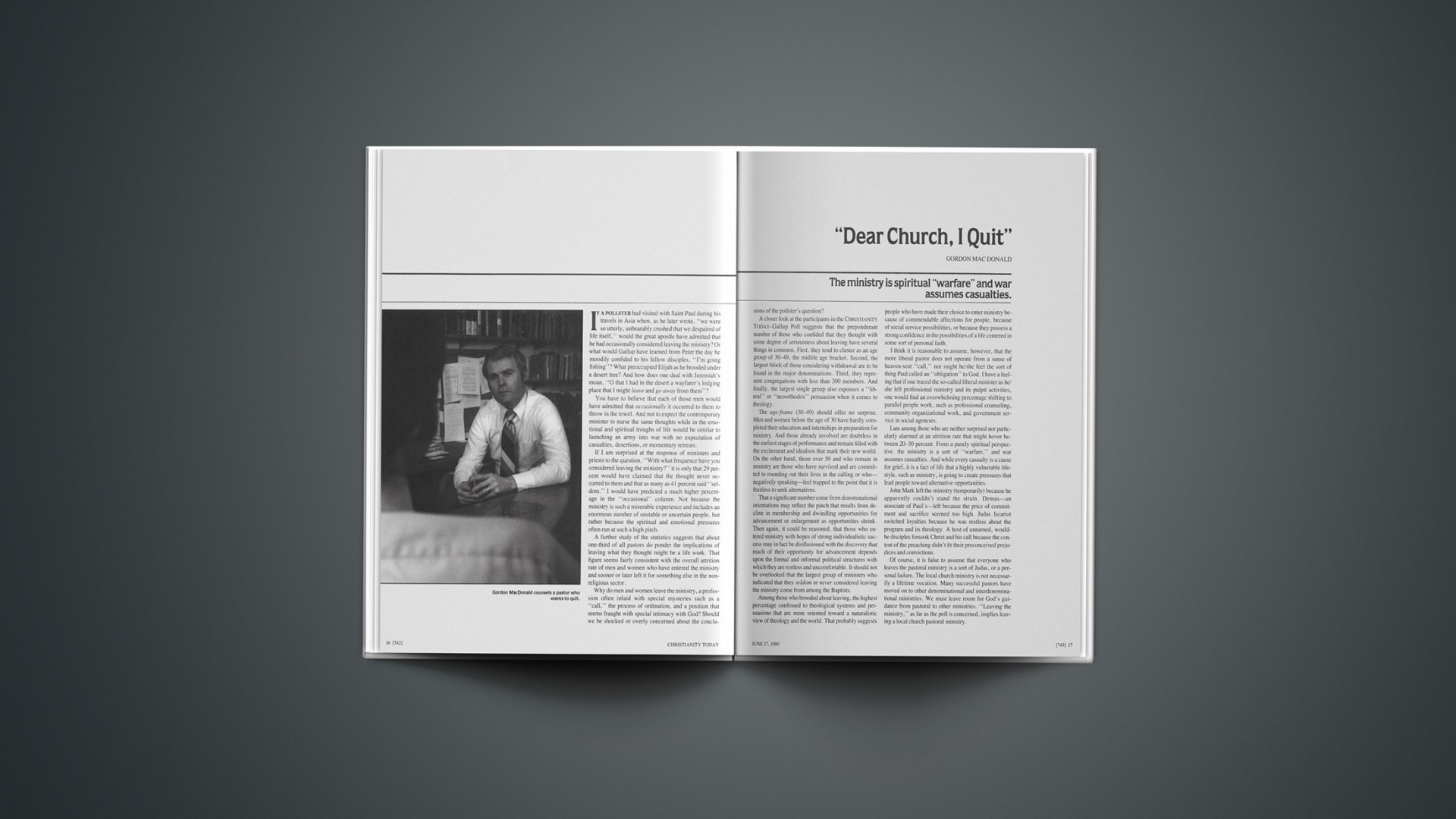
“Dear Church, I Quit”

The ministry is spiritual “warfare” and war assumes casualties.

If a pollster had visited with Saint Paul during his travels in Asia when, as he later wrote, “we were so utterly, unbearably crushed that we despaired of life itself,” would the great apostle have admitted that he had occasionally considered leaving the ministry? Or what would Gallup have learned from Peter the day he moodily confided to his fellow disciples, “I’m going fishing”? What preoccupied Elijah as he brooded under a desert tree? And how does one deal with Jeremiah’s moan, “O that I had in the desert a wayfarer’s lodging place that I might leave and go away from them”?

You have to believe that each of those men would have admitted that occasionally it occurred to them to throw in the towel. And not to expect the contemporary minister to nurse the same thoughts while in the emotional and spiritual troughs of life would be similar to launching an army into war with no expectation of casualties, desertions, or momentary retreats.

If I am surprised at the response of ministers and priests to the question, “With what frequence have you considered leaving the ministry?” it is only that 29 percent would have claimed that the thought never occurred to them and that as many as 41 percent said “seldom.” I would have predicted a much higher percentage in the “occasional” column. Not because the ministry is such a miserable experience and includes an enormous number of unstable or uncertain people, but rather because the spiritual and emotional pressures often run at such a high pitch.

A further study of the statistics suggests that about one-third of all pastors do ponder the implications of leaving what they thought might be a life work. That figure seems fairly consistent with the overall attrition rate of men and women who have entered the ministry and sooner or later left it for something else in the nonreligious sector.

Why do men and women leave the ministry, a profession often inlaid with special mysteries such as a “call,” the process of ordination, and a position that seems fraught with special intimacy with God? Should we be shocked or overly concerned about the conclusions of the pollster’s question?

A closer look at the participants in the CHRISTIANITY TODAY-Gallup Poll suggests that the preponderant number of those who confided that they thought with some degree of seriousness about leaving have several things in common. First, they tend to cluster as an age group of 30–49, the midlife age bracket. Second, the largest block of those considering withdrawal are to be found in the major denominations. Third, they represent congregations with less than 300 members. And finally, the largest single group also espouses a “liberal” or “neoorthodox” persuasion when it comes to theology.

The age-frame (30–49) should offer no surprise. Men and women below the age of 30 have hardly completed their education and internships in preparation for ministry. And those already involved are doubtless in the earliest stages of performance and remain filled with the excitement and idealism that mark their new world. On the other hand, those over 50 and who remain in ministry are those who have survived and are committed to rounding out their lives in the calling or who—negatively speaking—feel trapped to the point that it is fruitless to seek alternatives.

That a significant number come from denominational orientations may reflect the pinch that results from decline in membership and dwindling opportunities for advancement or enlargement as opportunities shrink. Then again, it could be reasoned, that those who entered ministry with hopes of strong individualistic success may in fact be disillusioned with the discovery that much of their opportunity for advancement depends upon the formal and informal political structures with which they are restless and uncomfortable. It should not be overlooked that the largest group of ministers who indicated that they seldom or never considered leaving the ministry come from among the Baptists.

Among those who brooded about leaving, the highest percentage confessed to theological systems and persuasions that are more oriented toward a naturalistic view of theology and the world. That probably suggests people who have made their choice to enter ministry because of commendable affections for people, because of social service possibilities, or because they possess a strong confidence in the possibilities of a life centered in some sort of personal faith.

I think it is reasonable to assume, however, that the more liberal pastor does not operate from a sense of heaven-sent “call,” nor might he/she feel the sort of thing Paul called an “obligation” to God. I have a feeling that if one traced the so-called liberal minister as he/she left professional ministry and its pulpit activities, one would find an overwhelming percentage shifting to parallel people work, such as professional counseling, community organizational work, and government service in social agencies.

I am among those who are neither surprised nor particularly alarmed at an attrition rate that might hover between 20–30 percent. From a purely spiritual perspective the ministry is a sort of “warfare,” and war assumes casualties. And while every casualty is a cause for grief, it is a fact of life that a highly vulnerable lifestyle, such as ministry, is going to create pressures that lead people toward alternative opportunities.

John Mark left the ministry (temporarily) because he apparently couldn’t stand the strain. Demas—an associate of Paul’s—left because the price of commitment and sacrifice seemed too high. Judas Iscariot switched loyalties because he was restless about the program and its theology. A host of unnamed, would-be disciples forsook Christ and his call because the content of the preaching didn’t fit their preconceived prejudices and convictions.

Of course, it is false to assume that everyone who leaves the pastoral ministry is a sort of Judas, or a personal failure. The local church ministry is not necessarily a lifetime vocation. Many successful pastors have moved on to other denominational and interdenominational ministries. We must leave room for God’s guidance from pastoral to other ministries. “Leaving the ministry,” as far as the poll is concerned, implies leaving a local church pastoral ministry.

Today men and women think to leave the ministry for an array of reasons. Perhaps the most obvious one is that they find themselves unsuited to face the enormous diversity of responsibilities and activities. The question of fitness for the ministry often goes back to the circumstances surrounding a person’s motive for entering the pastorate in the first place. Often one discovers that ministerial dropouts began their careers impelled by an unnatural drive to please a significant individual in their lives: a parent, a mentor, or sometimes even a particularly unique concept of God. Ministry in these cases becomes a quest for affirmation and acceptance.

It is no secret that another parallel objective has been the pursuit of some sort of authority position in which one can enjoy control of a module of people. For many, ministry seems to be the best place in which to pursue such an unhealthy purpose. What is tragic is that it appears to be all too easy for a man or woman with mixed and unsound motives to move through theological training, gain access to a pastoral position, and only then find in the crucible of congregational pressure that what appeared to be an earnest desire to serve God and his people was actually the pursuit of a form of self-fulfillment.

Once into ministry, the first crisis that most often causes ministers to entertain the thought of leaving centers on the discovery that most congregations do not want to change. Highly trained in seminary in the theological systems, taught to think through the logical elements of issues, and exposed to the latest programmatic schemes, the young minister is often confused when he discovers that people are rarely brought to new levels of spiritual performance through persuasion based on logic or reason. His/her youthful idealism forces change and faces the resulting congregational backlash. One has hardly been trained to face the reality of tradition (not always bad), subsurface prejudice, and deeply ingrained habit and attitude patterns. The result is a feeling of total helplessness and leadership impotence, and if the pollster calls at the right moment (usually a Monday morning), he is more often than not liable to hear an admission that amounts to “occasional” or “often” when asked if leaving is ever on the agenda.

It is not an easy matter to assess the impact of marital relationships upon a pastor’s choice to stay or leave his/her post. However, I am going to predict that the growing incidence of pastor’s wives seeking independent careers is going to increase measurably the number of people leaving pastorates. My own experiences suggest to me that working spouses will be unable to give the sort of support and encouragement that is almost always necessary in Protestant pastorates. My friends in the Catholic priesthood will doubtless dispute this, however.

The fact that these are pastors heading into midlife, leading smaller congregations, and claiming something of a liberal position may leave room to suggest that there is some financial pressure tied to their thoughts about leaving. We are talking of people most likely to be facing increased costs due to growing children, working in congregations where the salary scale is likely to be on the lower end, and men or women whose sense of “call” may not be strong enough to urge them to a superhuman endurance on a veritable poverty level.

We live in an achievement-oriented society in which everyone always enjoys the right to make choices about work in order to measurably gain a professional position of greater respect or prestige, higher levels of income, or more power. As a pastor, I find myself frequently rejoicing with lay men and women who shared with me their decision to change jobs because of greater opportunities for advancement or increases in salary. Somehow I am almost always applauding such people and congratulating them (unless the change is detrimental to other priorities).

But who could imagine a pastor saying to his congregation, “I am leaving you for another congregation, which is considerably larger or which has agreed to pay me more”? What is acceptable for a manager in industry does not sound quite right for a minister. I have often been amused with the insight of my pietistic background that causes me to “give glory to God” if I do something well but to accept the unvarnished responsibility when I fail. I speak as the fool when I note that, as a human being, I seem to be losing both ways. But—please understand—I speak only in such a fashion if I have been affected by the drive that has reached almost everyone else: to achieve and gain. And that sort of inner battle can cause pastors to admit to the notion of leaving.

Ministers consider leaving their work behind when they suffer under the internal crises of irrelevance or integrity: irrelevance in that it becomes tempting to assume that the role of Christian leadership is neither needed nor wanted in this secular world; integrity as one wrestles with the seeming gap that regularly appears between matters preached and matters lived. Both crises can beat upon the internal life of the pastor to such an extent that, in the wake of low spiritual and self-esteem, the choice is to seek something that seems more useful or honest.

These are but a few hints of the subterranean thought patterns that run through the mind of the contemporary pastor who candidly admits that he/she has considered leaving the ministry. Perhaps a last question ought to be: What can be done to speak to such an issue?

We might begin by simply accepting a certain amount of selectivity that must work its way through ministerial lives. We cannot, nor should we attempt, to protect pastors from pressure.

Attrition could be retarded, however, if we asked harder questions about the kinds of men and women admitted to seminaries for theological training. The evolution of seminaries from schools of pastoral training to graduate institutions of theology may have led to the frequent admission of the wrong sorts of persons and, in fact, inadvertently precluded the type of person who is most suited for ministry. Those most gifted with sensitivities of pastoral care and communication are not always the top-line students when measured against academic standards. A study of ministerial attrition and its correlations to academic achievement might be an interesting one—perhaps frightening.

Attrition in ministry might be more effectively addressed if there were a vehicle for spiritual support other than the typical professional association. More often than not, the local clergymen’s alliance is nothing more than a gathering of religious professionals who invest their time in little more than surface talk about town politics, social service organizations, and retirement annuities. It seems incredible that men and women whose lives are given over to the service of the faith find it almost impossible to discuss faith with one another at a level where there might be support, mutual prayer, and peer counsel.

The recent renewal of the laity has been a welcomed advance for us all. But a negative side effect may have been the diminution of the role of the pastor in the average congregation. The sense of call, the idea of spiritual authority, the person esteemed as a spiritual leader may be for some congregations a thing of the past. But the result is a minister whose role no longer carries a meaningful punch. Perhaps it is time to recover the role of the pastor and place it in proper juxtaposition with our new insights on the role of the lay person.

The fact of the matter is that our secular society militates against the sense of significance of the spiritual leader. Regarded by many as not much more than an in vocation giver, a member of the library board, and the keeper of a few dusty traditions, the pastor’s role will continue to shrink and create conditions in which ministers find it easy to admit that they consider leaving. But whenever there is resurgence of spiritual priorities and a new awareness of the moral and contemplative aspects of being, the pastor who is in tune with events suddenly rises to the occasion and, affirming his call and marshaling his support, sets forth. And in doing so, he realizes that when called upon to face the real facts, he would never really want to leave.

Carl F. H. Henry, first editor of Christianity Today, is lecturer at large for World Vision International. An author of many books, he lives in Arlington, Virginia.

Ideas

Policing Pornography: For Christians Who Care

We must draw hard lines between toleration, temperance, and socially destructive smut.

People talk about religion becoming big business these days. But vice has been raking in profits for centuries. And in this twentieth century, vice in the form of printed obscenity—pornography—has become a multibillion dollar racket.

A National Opinion Research Center study in 1978 found that 57 percent of Americans are convinced that pornography leads to a breakdown of morals and encourages the crime of rape. Yet the pornography industry continues to grow each year. Why is it so difficult to combat its proliferation?

First, police have trouble stopping pornography because most of the time they are unable to find the producers of the material. Sometimes they can do no more than prosecute store owners, who usually only distribute the literature. Shrewd business practices and organized crime connections make it difficult for police to find the sources of smut.

Second, the Supreme Court has defined “obscenity” too vaguely for local governments to apply it effectively. The Court’s guidelines are “(a) whether the average person, applying contemporary community standards, would find that the work, taken as a whole, appeals to the prurient interest; (b) whether the work depicts or describes, in a patently offensive way, sexual conduct specifically defined by the applicable state law; and (c) whether the work, taken as a whole, lacks serious literary, artistic, political, or scientific value.” Few would disagree that these are fair criteria, but inevitably the judgments they require must be subjective. Different courts can and do disagree over whether certain material has any value.

A third reason is the ignorance of many to the reality and pervasiveness of smut. Of course, most people know that advertisers use sexual images to sell products, and many have attended an R-rated movie; but many still seem unaware of the extent of the filth their fellow citizens can pick up at the corner drugstore. Neil Gallagher of the Citizens for Decency Through Law suggests that this ignorance can be cured quickly just by collecting a few pornographic magazines and showing them to one’s church or civic groups.

Fourth, many who realize the seriousness of the problem are unwilling to take the trouble to get involved. It is easier just to look the other way. The antidote for this is to educate people to the devastating consequences such widespread pornography brings our society. No Christian concerned about the moral level of his culture and the society about him dares to pursue such a selfish unwillingness to be bothered.

Fifth, Americans further soothe their consciences by labeling their moral indifference and unwillingness to get involved as “toleration.” We are a tolerant people and all of us are thankful for our tolerant society when it comes to our own deviations from the social norm. But for the sake of our entire social structure, toleration must be limited or we destroy ourselves as people. Murder or theft, if tolerated, would destroy the structure of human society. But the morally sensitive person recognizes that in the long run pornography is more devastating to society than theft. Stealing robs us of things; pornography robs us of character. Stealing destroys property; pornography destroys our humanity. In a fallen and sinful society, we cannot expect to be freed from the tension of drawing hard lines between toleration and socially destructive permissiveness.

A sixth problem we encounter as we try to rid the world of pornography is the First Amendment of the Constitution: “Congress shall make no law … abridging the freedom of speech or of the press.” If the courts decide to restrict pornography, why can’t they restrict certain kinds of religious expression as well? In fact, this is already happening in some areas (June 6 issue: News, p. 44; Editorial, p. 12). As Christians, we would not want the right to share our faith rescinded; but neither would we want to allow anything and everything.

Some civil libertarians feel that any restriction of expression violates the First Amendment; however, reasonable limits on obscenity do not restrict freedom of speech or press but rather extend freedom in society as a whole. The purveyor of pornography does not seek to communicate his own ideas and convictions so as to share them with others or to convince others of the truth; he is simply without conscience, selling for profit material that he would not like his own children to use. Wise laws against pornography do not inhibit the freedom to express ideas; they restrict profiteering aimed at the destruction of society.

Moreover, wise laws against pornography create a new world of freedom for women to function in society as human persons in the image of God instead of as sex objects; it frees women from fear of rape; it frees our children from a diseased view of sex; it fosters a normal and healthy view of the human body; and it strengthens the family and the beauty of sex as a noble and joyful gift of God.

Despite the difficulties, Christians can still do their part to control pornography. Here are some suggestions for action:

Urge local governments to crack down on businesses that sell porn. Supreme Court decisions seem to have given local governments the power to decide for themselves what is obscene. Pressure by citizens can lead to laws forbidding the display of dirty magazines in stores, keeping them behind the counter instead. Press for zoning ordinances that either contain porno shops to one area or forbid them from locating near residential areas or near each other. Detroit, Rochester, Philadelphia, Boston, Denver, and Dallas have established ordinances of this type.

Bring local community pressure on the businesses themselves. Circulate petitions and present them to store owners. Threaten to boycott local drugstores that sell porno materials. Talk to store managers. Write letters to the home offices of stores that are part of a chain. Inform stores that do not sell porn why you are giving them your business.

Support and promote those groups that uphold the family. Author Gary North observes that “there is hardly an issue more fundamental to a community than the impact of sexual behavior on the structure of the family.” This, of course, includes strengthening one’s own family by spending time together, teaching one’s children the truths of Scripture, and getting involved in a church fellowship. But it also includes writing members of Congress to support legislation that upholds the family, and voting for the lawmakers who do so as well.

When president Gerald R. Ford signed Public Law 94–553 on October 19, 1976—the nation’s first comprehensive revision of our copyright law since 1909—a new awareness of the rights of copyright holders began to emerge. By the time the new law became effective on January 1, 1978, widespread abuse of the copyright law had been uncovered in churches, schools, and other organizations.

The problem has become acute in recent years because photocopy machines make duplicating music so easy and inexpensive that choir directors simply purchase one copy of music and duplicate multicopies at a much lower cost. But every time a piece of copyrighted music is illegally duplicated, the composer/arranger, author, and publisher are robbed of their rightful compensation.

In a recent copyright workshop an attorney who had been involved in the development of the 1976 copyright law stated that several music publishing companies had gone bankrupt because of the widespread illegal duplicating practices of choir directors. His final cutting comment was that churches are the prime offenders. What an indictment of the Christian church, which by example should represent the best in honest, law-abiding, and Christlike ethical practice!

It’s mystifying that such illegal practices are so blithely tolerated while at the same time churches are very scrupulous about paying for utilities, Sunday school materials, and the pastor’s services. Many try to rationalize their illegal actions with such arguments as “the church is a nonprofit organization,” “I’m not going to sell it,” “the church doesn’t give me enough money for music,” or “this is for the Lord’s work.” None of these excuses would hold up in a court of law. Of much graver import is the tarnished reputation a church’s witness may acquire by breaking the law when, on the contrary, it should work, worship, and conduct its business impeccably.

Much effort, especially by publishers, has gone into informing choir directors of the requirements of the new copyright law. Nevertheless, churches, schools, and other organizations have been so flagrant in violating the copyright law that the National Music Publishers Association (NMPA) and the Music Publishers Association (MPA) have recently announced a “get tough” policy with offenders. They feel that after three years’ effort to inform the public concerning the new copyright law, choir directors cannot claim honest error or innocence.

Dean C. Burtch of MPA states, “In view of this concentrated program of informing and educating, those who continue to violate the copyright law can only be looked upon as willful and deliberate offenders who have knowingly engaged in unlawful activities and are openly inviting prosecution.” Many churches are subject to the possibility of being sued for present holdings of illegally photocopied music in their choral libraries. All such duplicated music should be withdrawn from the choral library and destroyed.

The penalties for infringements can be severe. Would-be violators should give serious consideration to the high price tag of both damages and legal expenses.

Copying for the purpose of performance or for the purpose of substituting for the purchase of music is prohibited. Thus, copying to avoid the purchase of music in any way is illegal. Pastors need to be aware that words as well as music may be copyrighted. A glaring abuse is the practice of printing booklets of words of contemporary gospel songs with the erroneous belief that since the music is not printed, the practice is legal. It would be expedient for church musicians to order a copy of an important publication entitled, “The United States Copyright Law—A Guide for Church Musicians,” from the Church Music Publishers Association (CMPA, Box 4329, Washington, D.C. 20012).

The end result of illegal photocopying of music is that copyright holders lose money, the cost of music escalates to help compensate for such losses, good people become cheaters, and Christian ministries become blemished. In fact, everybody loses except the manufacturers of copying machines and supplies. Although some matters regarding the law will need clarification in the courts, we have enough clear guidelines to enable us to abide easily by legal standards.

PAUL WOHLGEMUTH

Coordinator of Church Music, Oral Roberts University, Tulsa, Okla.

Eutychus and His Kin: June 27, 1980

It’s All in Knowing When

I have developed a new philosophy. Its purpose is to assist the pastor in knowing when he should resign. I call it Exit-stentialism, and its many profundities are explained in my latest book, When Shall We Then Leave? I hope you will purchase a copy because I need the money to pay Allied Vans for my last moving bill.

The “Personal Inventory” alone is worth the price of the book. You cannot help but become excited and enlightened as you seek to answer these questions, a sampling of which follows:

1. Has your church board ever offered you a one-way trip to the Holy Land? Would you accept it?

5. Does the church janitor open the doors and then go home?

7. Are the trustees dragging their feet about repairing the sound system?

9. Do some of the women bring their knitting to church and coyly remark, “Pastor, you keep us in stitches”? Does this needle you?

14. What is the condition of your sermon notes? Have you used some of them so often that they are now unreadable?

16. At summer camp this year, did the counselors throw you in the lake and hold you under?

17. Do the trustees keep changing the locks on the church doors without telling you?

18. Has the number of anonymous letters and phone calls increased?

23. Do the members keep giving you books about how to improve your preaching?

Of course, the Personal Inventory is only the first part of the book. (There are 237 questions in all.) The section on “Signs to Watch For in a Business Meeting” fills 125 pages, and is illustrated with photographs donated by my personal physician and my plastic surgeon. (Believe me, I have been in some interesting business meetings.) There are also sections for your wife, your children, and your staff members, if you have any left.

I predict that Exit-stentialism will sweep the country. Get smartre and purchase a copy. I’m getting tired of receiving bills from Allied Vans.

EUTYCHUS X

Science

My thanks for “Who Sets the Stage for Understanding Scripture?” by Mark Noll (May 23). Not so much for myself, but for so many evangelicals who remain unable to work with the message of Scripture because of their mechanistic perspective of truth and revelation.

Evangelicals need to understand this point: that it is the scientist, and not science, that either confesses or rejects the notion of God and revelation, and that the very tools used by a materialistic scientist to deny God can be used by a Christian to affirm or testify to the reality of God and his revelation.

REV. THOMAS P. EGGEBEEN

First Presbyterian Church

Sapulpa, Okla.

Mark Noll’s exhortation about evangelicals’ naive acceptance of inadequate philosophies of science is well taken. However, his understanding of these philosophies and their alleged influence on Christian theists leaves something to be desired.

For example, to my knowledge no Christian theist ever held that “the existence of God and the truth of his revelation [is] dependent on our ability to verify them by the methods of science in general.…” Here Noll confuses the epistemological and the ontological realms.

Also, few theists argue that “the proofs of science … become the basis for belief in God and in scriptural revelation” (emphasis mine). Reason and evidence aid in establishing that God exists, but belief in God is a matter of the will.

NORMAN L. GEISLER

Professor of Systematic Theology

Dallas Theological Seminary

Dallas, Tex.

Suggestion

I appreciated Allyn Sloat’s article, “Lifelong Learning: The Centerpiece of Christian Education” (May 23). For years I have felt that evangelical churches should make much more of adult educational opportunities. Why not offer courses for credit? Assignments, assigned reading, textbooks, papers, tests, lectures.… Many churches have the people resources to do it. I am sure a denominational college or two could be found to go along with the idea. Why not make Sunday school the most valued hour of the week? Why, we might even introduce the serious study of missions into the church/college curriculum!

ROGER HEDLUND

Coordinator

Church Growth Research Centre

Madras, India

Methodists

John Maust’s report on the sad state of the United Methodist Church (“Methodists Grope for a Common Center,” May 23) was accurate, expected, and obvious. When groping about for a common center, any church suffers, unless that center be the gospel of Christ and the authority of Scripture.

When membership declines, the reason is not difficult to come by. It’s a matter of priorities. Christ said that we are to seek first the kingdom of God and his righteousness, not some common center of consultation, for that would be compromise. When the Methodist church had its priorities right, it grew, not only numerically, but spiritually.

WALDO W. SPEAR

Sarasota, Fla.

Black Evangelicals

It was a joy to see your coverage of the National Black Evangelical Association Convention (NBEA) this year (“Theology-Culture Rift Surfaces Among Evangelical Blacks,” News, May 23). In the past I have found very little coverage of this annual meeting in your magazine.

But what a disappointment to read an article which caught nothing of the spirit of the convention. In capitalizing on a story of rift, you missed the real story.

Such an atmosphere of brotherhood prevails in the NBEA that the “rift” (as you called it) only served to bring people closer in the Lord. There are differences. Thoughtful consideration of theological differences should be undertaken. And it will. You mentioned all too briefly that a resolution was made to discuss differences, and the resignations were tabled. NBEA did not split—the roots go too deep.

I hope you will follow up on the NBEA story, and continue to give attention to a group of black evangelicals who are determined to bring Christ to communities long neglected by any evangelical.

ELIZABETH PETERS

Open Door Press

St. Louis, Mo.

No Cure

John R. W. Stott, in his Cornerstone article “The Just Demands of Economic Inequality” (May 23), states that “what we should be seeking is equal opportunity for all human beings (through education, medical care, housing, nutrition, and trade) to develop their full, God-given potential.”

While this “social gospel” attitude is evidence of the Christian virtue of “loving thy neighbor,” it is no cure for man’s fallen nature. The social gospel is directed to man’s outward condition, while the real good news is that Jesus Christ has provided salvation without reference to worldly goods. Man’s problem is that he is a rebel against God and no amount of sumptuous living in this world will cure it. “What does a man profit if he gains the whole world and loses his own soul?”

Real culpability arises when the twice-born acquiesce to the status quo of sinful men.

DANIEL. C. BAILEY

Elk River, Minn.

Socialism

Thank you for Klaus Bockmühl’s helpful discussion, “The Socialist Ideal: Some Soul-Searching Constraints” (Current Religious Thought. May 23). It certainly appears that younger evangelicals are generally rejecting traditional capitalism, mainly for the reasons Bockmühl indicates. But socialism is no better option, even though the socialist ideal is compatible with Christian ethics at several points.

Neither capitalism nor socialism will work for the future, for they are both based on unlimited economic growth and are therefore ecologically irresponsible. They are becoming, in fact, fundamentally impossible in a world of limited resources. Given the law of entropy and God’s “economy” as revealed in Scripture, the only way to avoid total chaos is for the world to move rapidly to a conservation ethic and economy and to recover what the Bible says about our stewardship of God’s creation.

HOWARD A. SNYDER

Executive Director

Light and Life Men International

Winona Lake, Ind.

Lacks Balance

I have recently read the news article about the Billy Graham mission in Oxford and Cambridge (Mar. 21). As one fully involved in the Cambridge mission, I am rather disappointed with the report. The author’s account fails to capture the momentous impact on the whole university here at Cambridge.

Although naturally the national press was cynical throughout (as it would be to any evangelistic effort), the reaction among students was markedly different. Despite a few outspoken critics, the vast majority of students “voted with their feet” by coming to hear Billy Graham. It would be impossible to describe the eager anticipation of those packed into Great Saint Mary’s Church each night, and the rapt attention maintained through every talk.

It was quite remarkable how many who were most suspicious and hesitant before the mission were impressed and surprised by the quiet but authoritative way Mr. Graham spoke. Many who had never understood the gospel before were forced to face up to the claims of Jesus. The Christian message became the talking point of the whole university. Students showed an openness and interest which often took us by surprise! Among Christians too there has been a noticeably deepened level of commitment.

I hope these comments help to give a more balanced picture of the lasting impact of Mr. Graham’s visit.

JOHN BARCLAY

Former President

Cambridge Inter-Collegiate Christian Union Cambridge,

England

Editor’s Note from June 27, 1980

At their recent convention follow-up meeting in Dallas (News, p. 58), black evangelicals of the National Black Evangelical Association set an example for their white brethren in the sensitive and caring way they faced important internal differences. As black evangelicals they are concerned about the Christian’s social and political responsibility for the poor and needy. Our prayer for them is that they will not divide but rather unite in a solid commitment to biblical authority and its practical application to the social needs of our day. As for inerrancy, we trust they can avoid some of the foolish controversy of their white counterparts and settle for the historic position of the church—inerrancy correctly and simply defined to mean that the Bible, when properly interpreted, gives us God’s truth and nothing but the truth.

In this issue you will also wish to read perceptive articles by Loren Wilkinson and George Sweeting. As a visiting scholar at Calvin College, Dr. Wilkinson explored with a research team the implications of biblical faith for the conservation of earth’s diminishing resources. President Sweeting of Moody Bible Institute tackles the same problem from a different perspective, but they are agreed: no Christian who takes the Bible seriously and is informed about the world he lives in can afford to slough off his God-given responsibility to face up to this disturbing problem.

Gordon MacDonald continues analysis of the CHRISTIANITY TODAY-Gallup Poll with a study of what tempts some pastors to leave the ministry. And in this tightly packed issue, Nolan Huizenga offers a biblical study on the role of music in church worship. Margaret Clarkson, a hymn writer in her own right, tells us what makes a good hymn, and Richard Dinwiddie cautions us about singing theological error, while Paul Wohlgemuth warns against dishonest practices in the choir loft.

History
Today in Christian History

June 27

January
February
March
April
May
June
July
August
September
October
November
December
<>

June 27, 444: Cyril, patriarch of Alexandria and author of several writings on the dual natures of Christ, dies. He opposed Nestorius, who supposedly taught there were two separate persons in the Incarnate Christ, one divine and the other human. Historians doubt, however, whether or not Nestorius actually taught this. In any case, Cyril deposed Nestorius in 430 (see issue 51: Heresy in the Early Church).

June 27, 1933: James Mountain, English revivalist and hymnwriter ("Like a River Glorious"), dies.

Apple PodcastsDown ArrowDown ArrowDown Arrowarrow_left_altLeft ArrowLeft ArrowRight ArrowRight ArrowRight Arrowarrow_up_altUp ArrowUp ArrowAvailable at Amazoncaret-downCloseCloseEmailEmailExpandExpandExternalExternalFacebookfacebook-squareGiftGiftGooglegoogleGoogle KeephamburgerInstagraminstagram-squareLinkLinklinkedin-squareListenListenListenChristianity TodayCT Creative Studio Logologo_orgMegaphoneMenuMenupausePinterestPlayPlayPocketPodcastRSSRSSSaveSaveSaveSearchSearchsearchSpotifyStitcherTelegramTable of ContentsTable of Contentstwitter-squareWhatsAppXYouTubeYouTube