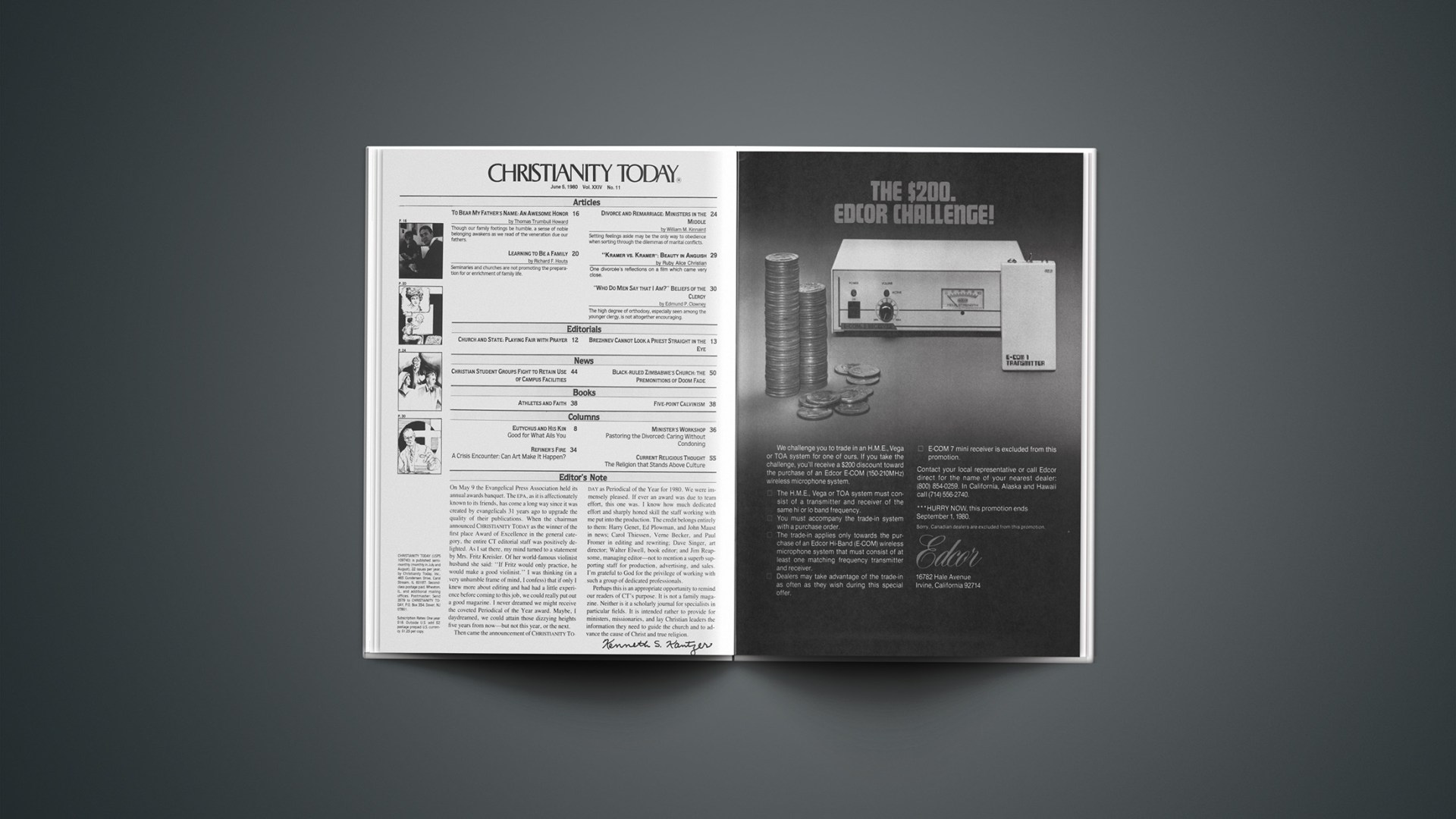
To Bear My Father’s Name: An Awesome Honor

We stand under God’s authority to honor our parents.

As i sit at my desk writing, a number of eyes gaze down on me. They look out from several icons, three pictures of John Henry Newman, and a small ceramic figure of Saint Edward the Confessor.

This is all very august and alarming, this cloud of witnesses. I sometimes fancy that they are saying to me, “What are you doing?” or more narrowly, “What are you thinking?” or worst of all, “What are you?”

But ranged around the alcove where my desk sits is a frieze that is more alarming yet. In it are five huge photographs, and the gentlemen who look down on me from them are my father, his father, his uncle, and his two grandfathers.

Now it would all be very well if the interest here were merely genealogical; it is heady to point to power and glory in one’s forebears: but I do not belong to one of the families that can do much of that; there are no Cabots or Lodges or Winthrops there. So it is not a gallery of the noble and renowned under whose eyes I sit.

Or rather, not the renowned. But not noble? On two accountings at least I ought to reconsider that. First, being a Christian, I stand under the authority of the divine law that enjoins us to honor our fathers and mothers. That may seem an oddity, indeed sheer mindlessness, in this era of orgiastic self-analysis, which eagerly and remorselessly begins by rooting one’s own “problems” in one’s parents’ shortcomings, thereby dismantling any honor supposed to attach to them. But for any serious Jew or Christian, a most solemn interdict lies across this path (see Exod. 20:12). Whoever it may be who bears the responsibility for pointing out a man’s faults, it is not his son.

But also on a second accounting I rescind the hasty comment that these fathers who look down on me are not among the noble. Oh, to be sure, you will not find them in Debrett (the list of peers). But their names and achievements are in a higher register, one kept with complete faithfulness by angels—at least so one might gather from the visions of Saint John the Divine.

What achievements? And in what way am I, middle-aged myself, obliged to pay honor to my fathers under this ancient and divine command?

No doubt a man may do this in any number of ways. Four occur to me: I can remember them; I can give thanks for them; I can follow their example; and I can speak of them, especially to my children.

Once more one feels obliged to protest rather awkwardly here, since the whole enterprise is so embarrassingly anachronistic. How is an activity like this to be kept alive when the thing that is dinned at us all with dazzling and deafening iteration, by every kilowatt and decibel available, is that we cut loose? To be authentically ourselves (we are told), we must not only declare our independence from whatever is past: we must positively disavow it. Whatever our fathers espoused or embodied is to be avoided like the pestilence. We must be “now” people (the adverb has, alas, apparently been dragooned into service as an adjective by the breathless zealots of contemporaneity. Alas for the poor word; alas for English syntax; alas for the sensibility that can spawn horrors like this).

But how shall I remember my fathers? Two of the five gentlemen looking down on me from above my desk I do not remember at all: they are the two great-grandfathers. Of these two, I know almost nothing of my father’s paternal grandfather except that I bear the surname he passed on to his posterity. But that is a heavy thing. What is a name? What is a good name? It is rather to be chosen than great riches.

What makes a name good? As far as the history books go, it would seem to be a matter of the bearer having exhibited some great valor or intrepidity or integrity or service to humanity. For most of us, the only throng witnessing what we are making of our name will be not the jostling multitude with klieg lights and video cameras, but only the host of saints and angels; but when you come down to it, that is as venerable a company as any we will find in the Royal Enclosure at Ascot, or even in the audience at the Oscar presentations.

So, what duty do I owe to this man of whom I know next to nothing, this man with the high stiff collar and the thoroughly “manly” profile (that was a Victorian word, since rejected by more timorous generations), and the eyes in which you seem to see great gentleness and great reticence dancing oddly with great wit and humor—an amusing and fugitive business that I can see looking out at me now, more than a hundred years later, from the eyes of my brothers and sisters and their children.

I know more about the other great-grandfather, Henry Clay Trumbull. His eyes twinkle quite unabashedly, and an immense beard cascades down his chest. He was a chaplain in the Union Army during the Civil War, and he seems to have had a hand in bringing the Sunday school movement to America during the nineteenth century. Christians who trace their religious lineage back through mainstream evangelicalism to good fundamentalism (the Moody-Wheaton-Dallas-Columbia Bible College-Scofield Bible-Sunday School Times connection, so to speak) know his name, if they are old enough. He was “illustrious” (another nice old word), and people looked to him for strong leadership and faithful teaching, which he gave.

He died some decades before I was born, but he existed for me not only in photographs in family houses but also in the stories kept vigorously alive in the family by the formidable array of grand-dame great aunts, all of whom were his daughters and all of whom seemed to be looking at you through lorgnettes, even though they weren’t. The main thing about this family seems to have been its explosive violence, which was always saved in the nick of time by merriment. Do not imagine bitter shouting matches such as you might see in TV soap operas: rather, there would be loud and frenzied bursts of polysyllabic frustration, vexation, or rage, going off like a Roman candle, and, like a Roman candle, dissipating in a shower of coruscating harmlessness.

Once, for example, when my father’s father was courting the young lady who was to become his wife (my grandmother, that is), he heard a stentorian bellow from upstairs. Hastening up in the greatest anxiety, and expecting the apocalyptic worst, he found my great-grandfather (his father-in-law to be) dancing in rage in his study, demanding to know why books always fell to the left when they flopped over in the shelves. This sort of thing has furnished generations’ worth of hilarity at family gatherings for us, not least because we all see this very volatile elixir boiling through our own veins. But it may be that same elixir, purified and made holy, that made this man so energetic and uncompromising a champion of godliness.

My father’s father, Philip Howard. Sr., I knew until he died when I was 11. He was terribly infirm, having had at least one severe stroke before I was born, and he was almost blind into the bargain. So my recollection of him is of his shuffling about, being cared for with infinite solicitude by my aunt, his daughter. Even to my young eyes, there was a tragic irony in seeing a napkin being tucked at dinner under the chin of this man whom the Christian world seemed to think, and whom I knew, was a great and noble man.

When he laughed, though, I saw decades of hearty male camaraderie, and of his beloved hiking and fly fishing in the mountains of New Hampshire, all coming out in their sheer, hardy good health and vigor. He seemed to move in an almost palpable aura of what I can only describe as the particular sanctity one associates with the orthodox past of Philadelphia Presbyterianism: gentlemanly, civilized, gracious, urbane, sober, and merry.

It is a brand of churchmanship that does not exist in our own time as far as I know, but I am glad to have seen it. My grandfather knew intimately all the early fundamentalists, in the days when there was no stigma other than orthodoxy attached to that word. It was only later that it came to be associated with the rather hectic, tawdry, and semi-Manichaean piety for which it seems to be blamed nowadays.

The fourth picture above my desk is of my father’s uncle, Charles Gallaudet Trumbull. He was the one son in the huge family of daughters over which my great-grandfather reigned. I remember seeing him once or twice in my infancy, but my main impression of him is from family stories, the earliest of which is of his smashing, as a small boy, a closet door to splinters.

One of his sisters had locked him in with the pledge that she would let him out the instant she heard his cry for release. The catch was that, once she had him locked in, she proceeded to run shrieking about the house with her ears stopped up so that she could not hear him, thus technically keeping her word. (They were taught a fierce standard of truthfulness in that family.)

It may be pointed out that his bursting with such violence from this entombment is to be attributed to a terrible plague of claustrophobia which gripped, and still grips, the entire family. I and my daughter still eye tight places nervously. This great-uncle became famous in the sector of American Christendom of which I am speaking on a two-fold accounting. For one thing, he was instrumental in importing from England the so-called Keswick teaching, which also went under the name of the “victorious life.” His two pamphlets, “The Life that Wins” and “The Perils of the Victorious Life,” were influential beyond all calculating in the life of early twentieth-century American evangelical piety. Second, he was for many years the editor of The Sunday School Times.

But this needs a paragraph to itself, since that journal is indistinguishable from, and indeed almost synonymous with, four of the five men of whom I am speaking (the only one not included being my father’s paternal grandfather, a physician whose interests did not lie along these lines). The Sunday School Times began in the mid-nineteenth century, and lasted just over a century. During its heyday it enjoyed an eminence probably unknown by any journal nowadays. It had a reputation for absolute integrity and trustworthiness, and for editorial purity, and for wise and sober Christian common sense that would be as out of date now as the statesmanship of Lord Palmerston.

My great-grandfather was the first editor, his son (my great-uncle) was the second, and my father the third (rather like Henry I, II, and III, whose reigns seemed to span century after century). My grandfather, Philip E. Howard, Sr., was president of the company. It was a dynastic affair to be sure, but no dynasty was ever less “dynastic”: there was nothing imperious or megalomaniacal about any of these men, strong though they were. I really do think that I have been given some glimpse of what is meant by that odd scriptural comment about Moses—the giant Moses—being meek, since I have known men like that—my forebears.

Which brings me to the last of the five, my father, Philip E. Howard, Jr. He was, I think, the meekest man I have ever known. Not the weakest: the meekest. There had been funneled down to him all these generations of orthodoxy and conviction and integrity, plus a passionate love for the outdoors and a wry humor. I suppose almost everything I think about God and the world and existence—especially about contemporary existence—has been shaped by my inheritance, and most especially by my father.

I don’t think he was aware of doing any particular “shaping” other than passing on faithfully, as thousands of generations of godly fathers have done since Abraham, the counsel of God. Or to put it another way: the thing which was supreme in his mind, taking precedence even over his responsibility as editor of The Sunday School Times, which weighed on him cruelly, was raising his six children to love and serve God.

As it happens, he accomplished this—we are all past middle-age now, and all remain within the pale of conservative orthodoxy, which is no credit to us: there is a heritage to which we are accountable. But not for one minute of his life would he have predicted success on this front. He prayed most earnestly for all of us at least twice a day, but first during his morning prayers. These began at five o’clock and included one to two hours of Bible study, Scripture memory work, some systematic reading in Matthew Henry’s Commentary (a seventeenth-century work), and then prayer. He prayed for his responsibilities, his friends, missions, Christians all over the world, and then his family.

We all knew we were prayed for by name. Once in a while if I happened to have tiptoed downstairs early and his study door was open, I could see him kneeling at the chair in his study with a blue afghan over his shoulders. I do not know what images young boys form of their fathers these days, but I for one cannot be grateful enough for this one.

I am sure that a good deal of his influence on his children came in the form of his own tastes and inclinations. To the eye of the 1980s, he would look austere and distinguished, although he never thought of himself as either. He wore dark blue or gray wool three-piece suits, dark ties with tiny dots or designs in them, and long, black, silk socks. He thought of himself as ungainly, and would regale the family with tales of his pratfalls and maladroitness. Social situations made him uneasy: he became edgy in the neighborhood of loud, back-slapping male bonhomie, or too much female burbling.

He loved to sit down at the piano like a great spider and play his favorite hymns, which ranged from William Cowper and Isaac Watts to “Praise Him! Praise Him!” or “All the Way My Savior Leads Me.” His soul turned to ashes in the presence of any sort of religious tomfoolery such as the high jinks of cheap preachers and the treacly words and worse melodies of the “choruses” that dominated fundamentalist piety in the forties (my earliest recollections). We never heard him scoff or rail at anyone’s piety, but we knew that a great deal of what was abroad agonized him.

And yet he remained absolutely faithful to the embattled minority of conservative Protestants known as fundamentalists who struggled and lived for biblical fidelity in those very dark days of the modernist ascendency. I myself would guess that one reason none of his six children has ever been inclined to leave the faith is that we had nothing to despise or rebel against in what we saw in our father (and, I may say, in our mother).

He loved very simple pleasures, too. The days of our upbringing were the decades of depression and war, so there was not much chance for luxury and waste in any event; but the simplicity of his tastes and preferences had a purity and integrity about it that was exquisite. He was an amateur ornithologist, so we all grew up in a world in which black-capped chickadees, winter wrens, tufted titmice, and hermit thrushes were important inhabitants, and you cannot go far astray with that crowd. He could imitate the songs of these birds almost perfectly, and if there are any residual and remote echoes of Eden left in our poor world, it must be these songs. Here again, his influence on our imaginations was not something he calculated.

Early in these brief reminiscences I mentioned four ways in which a man might pay honor to his fathers. In these comments I have touched on the first and the last of these ways, namely remembering my fathers and speaking of them. As for the second and third, those I must try to do myself, day by day. Insofar as I give thanks for these men it is a salutary discipline for my own soul, for it is an offering enjoined on me by the Most High, and all such offerings come back to the offerer multiplied a thousand fold.

The real rub comes in the third item: following their example. Alas. What a farce for me even to presume to place myself in this lineage. Ah—but that is not a matter of choice. My fathers, like everyone else’s fathers, are part of the given data, like the century in which one is born or the color of one’s hair. Well, then, heaven help me to follow their example well enough so that 30 years from now, if my own son has pictures like these five over his desk, he may not be ashamed to add a sixth.

Epithalamion For John And Betsy Genesis 2:21–23

As God removed the archetypal rib

for metamorphosis, John, so did he hone

from you some temporary joys

(from discipline he makes delight)

so that he might

give you back Betsy, bone of your bone.

And Betsy, waking from your

wife-initiation, knowing now truly,

for the first time, who you are,

remember, how, when the Lord God spoke,

that curving, warm bone woke

into a woman!

Lord, let now your word leap down

again, lift the old curse, restore

Eden, and innocence, and say once more

Good! Will you, who made one like

yourself and from that one made two,

join them in one again?

LUCI SHAW

Carl F. H. Henry, first editor of Christianity Today, is lecturer at large for World Vision International. An author of many books, he lives in Arlington, Virginia.
Ideas

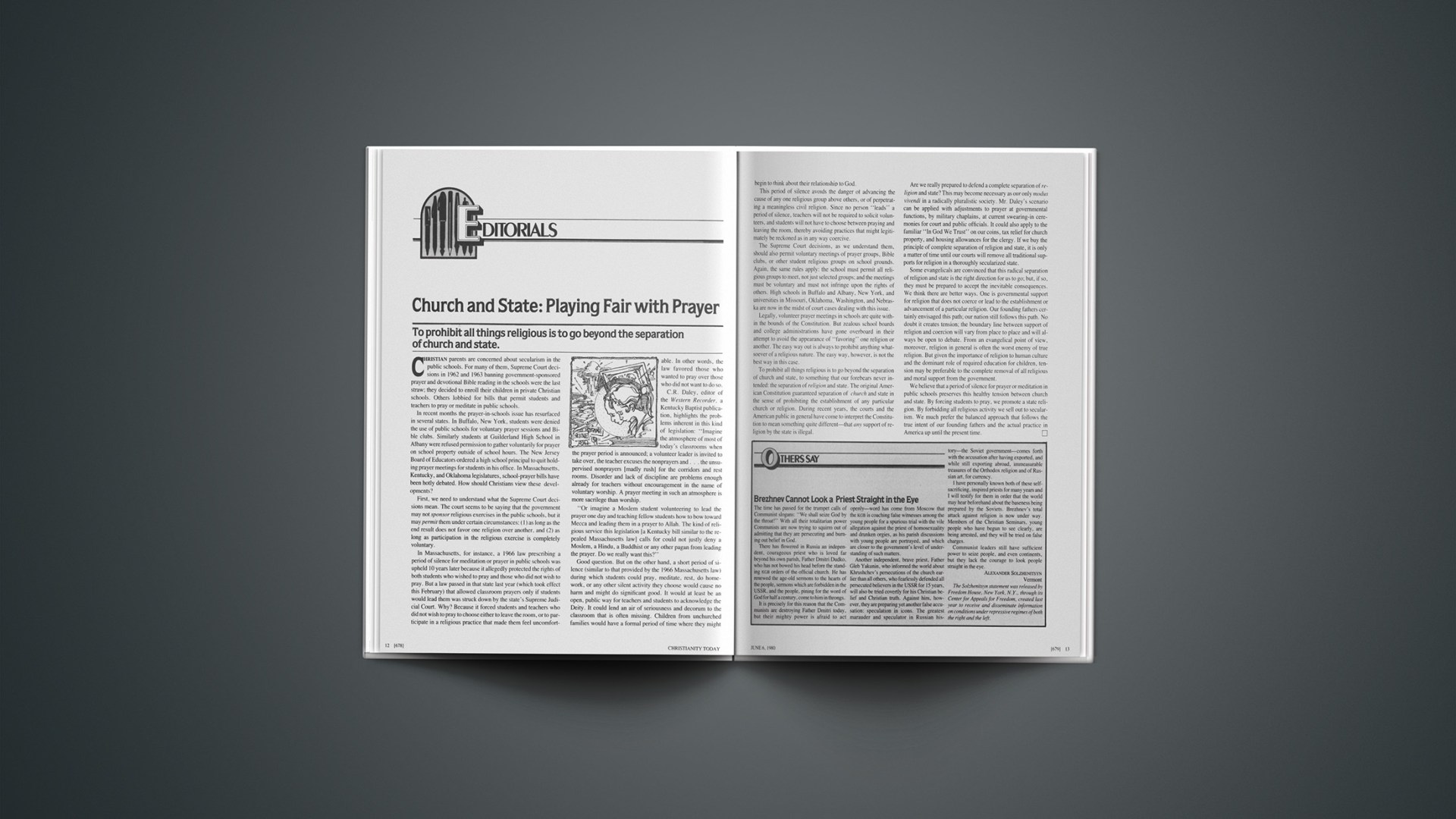
Church and State: Playing Fair with Prayer

To prohibit all things religious is to go beyond the separation of church and state.

Christian parents are concerned about secularism in the public schools. For many of them, Supreme Court decisions in 1962 and 1963 banning government-sponsored prayer and devotional Bible reading in the schools were the last straw; they decided to enroll their children in private Christian schools. Others lobbied for bills that permit students and teachers to pray or meditate in public schools.

In recent months the prayer-in-schools issue has resurfaced in several states. In Buffalo, New York, students were denied the use of public schools for voluntary prayer sessions and Bible clubs. Similarly students at Guilderland High School in Albany were refused permission to gather voluntarily for prayer on school property outside of school hours. The New Jersey Board of Educators ordered a high school principal to quit holding prayer meetings for students in his office. In Massachusetts, Kentucky, and Oklahoma legislatures, school-prayer bills have been hotly debated. How should Christians view these developments?

First, we need to understand what the Supreme Court decisions mean. The court seems to be saying that the government may not sponsor religious exercises in the public schools, but it may permit them under certain circumstances: (1) as long as the end result does not favor one religion over another, and (2) as long as participation in the religious exercise is completely voluntary.

In Massachusetts, for instance, a 1966 law prescribing a period of silence for meditation or prayer in public schools was upheld 10 years later because it allegedly protected the rights of both students who wished to pray and those who did not wish to pray. But a law passed in that state last year (which took effect this February) that allowed classroom prayers only if students would lead them was struck down by the state’s Supreme Judicial Court. Why? Because it forced students and teachers who did not wish to pray to choose either to leave the room, or to participate in a religious practice that made them feel uncomfortable. In other words, the law favored those who wanted to pray over those who did not want to do so.

C.R. Daley, editor of the Western Recorder, a Kentucky Baptist publication, highlights the problems inherent in this kind of legislation: “Imagine the atmosphere of most of today’s classrooms when the prayer period is announced; a volunteer leader is invited to take over, the teacher excuses the nonprayers and … the unsupervised nonprayers [madly rush] for the corridors and rest rooms. Disorder and lack of discipline are problems enough already for teachers without encouragement in the name of voluntary worship. A prayer meeting in such an atmosphere is more sacrilege than worship.

“Or imagine a Moslem student volunteering to lead the prayer one day and teaching fellow students how to bow toward Mecca and leading them in a prayer to Allah. The kind of religious service this legislation [a Kentucky bill similar to the repealed Massachusetts law] calls for could not justly deny a Moslem, a Hindu, a Buddhist or any other pagan from leading the prayer. Do we really want this?”

Good question. But on the other hand, a short period of silence (similar to that provided by the 1966 Massachusetts law) during which students could pray, meditate, rest, do homework, or any other silent activity they choose would cause no harm and might do significant good. It would at least be an open, public way for teachers and students to acknowledge the Deity. It could lend an air of seriousness and decorum to the classroom that is often missing. Children from unchurched families would have a formal period of time where they might begin to think about their relationship to God.

This period of silence avoids the danger of advancing the cause of any one religious group above others, or of perpetrating a meaningless civil religion. Since no person “leads” a period of silence, teachers will not be required to solicit volunteers, and students will not have to choose between praying and leaving the room, thereby avoiding practices that might legitimately be reckoned as in any way coercive.

The Supreme Court decisions, as we understand them, should also permit voluntary meetings of prayer groups, Bible clubs, or other student religious groups on school grounds. Again, the same rules apply: the school must permit all religious groups to meet, not just selected groups; and the meetings must be voluntary and must not infringe upon the rights of others. High schools in Buffalo and Albany, New York, and universities in Missouri, Oklahoma, Washington, and Nebraska are now in the midst of court cases dealing with this issue.

Legally, volunteer prayer meetings in schools are quite within the bounds of the Constitution. But zealous school boards and college administrations have gone overboard in their attempt to avoid the appearance of “favoring” one religion or another. The easy way out is always to prohibit anything whatsoever of a religious nature. The easy way, however, is not the best way in this case.

To prohibit all things religious is to go beyond the separation of church and state, to something that our forebears never intended: the separation of religion and state. The original American Constitution guaranteed separation of church and state in the sense of prohibiting the establishment of any particular church or religion. During recent years, the courts and the American public in general have come to interpret the Constitution to mean something quite different—that any support of religion by the state is illegal.

Are we really prepared to defend a complete separation of religion and state? This may become necessary as our only modus vivendi in a radically pluralistic society. Mr. Daley’s scenario can be applied with adjustments to prayer at governmental functions, by military chaplains, at current swearing-in ceremonies for court and public officials. It could also apply to the familiar “In God We Trust” on our coins, tax relief for church property, and housing allowances for the clergy. If we buy the principle of complete separation of religion and state, it is only a matter of time until our courts will remove all traditional supports for religion in a thoroughly secularized state.

Some evangelicals are convinced that this radical separation of religion and state is the right direction for us to go; but, if so, they must be prepared to accept the inevitable consequences. We think there are better ways. One is governmental support for religion that does not coerce or lead to the establishment or advancement of a particular religion. Our founding fathers certainly envisaged this path; our nation still follows this path. No doubt it creates tension; the boundary line between support of religion and coercion will vary from place to place and will always be open to debate. From an evangelical point of view, moreover, religion in general is often the worst enemy of true religion. But given the importance of religion to human culture and the dominant role of required education for children, tension may be preferable to the complete removal of all religious and moral support from the government.

We believe that a period of silence for prayer or meditation in public schools preserves this healthy tension between church and state. By forcing students to pray, we promote a state religion. By forbidding all religious activity we sell out to secularism. We much prefer the balanced approach that follows the true intent of our founding fathers and the actual practice in America up until the present time.

The time has passed for the trumpet calls of Communist slogans: “We shall seize God by the throat!” With all their totalitarian power Communists are now trying to squirm out of admitting that they are persecuting and burning out belief in God.

There has flowered in Russia an independent, courageous priest who is loved far beyond his own parish. Father Dmitri Dudko, who has not bowed his head before the standing KGB orders of the official church. He has renewed the age-old sermons to the hearts of the people, sermons which are forbidden in the USSR, and the people, pining for the word of God for half a century, come to him in throngs.

It is precisely for this reason that the Communists are destroying Father Dmitri today, but their mighty power is afraid to act openly—word has come from Moscow that the KGB is coaching false witnesses among the young people for a spurious trial with the vile allegation against the priest of homosexuality and drunken orgies, as his parish discussions with young people are portrayed, and which are closer to the government’s level of understanding of such matters.

Another independent, brave priest. Father Gleb Yakunin, who informed the world about Khrushchev’s persecutions of the church earlier than all others, who fearlessly defended all persecuted believers in the USSR for 15 years, will also be tried covertly for his Christian belief and Christian truth. Against him, however, they are preparing yet another false accusation: speculation in icons. The greatest marauder and speculator in Russian history—the Soviet government—comes forth with the accusation after having exported, and while still exporting abroad, immeasurable treasures of the Orthodox religion and of Russian art, for currency.

I have personally known both of these self-sacrificing, inspired priests for many years and I will testify for them in order that the world may hear beforehand about the baseness being prepared by the Soviets. Brezhnev’s total attack against religion is now under way. Members of the Christian Seminars, young people who have begun to see clearly, are being arrested, and they will be tried on false charges.

Communist leaders still have sufficient power to seize people, and even continents, but they lack the courage to look people straight in the eye.

ALEXANDER SOLZHENITSYN

Vermont

The Solzhenitsyn statement was released by Freedom House. New York. N.Y., through its Center for Appeals for Freedom, created last year to receive and disseminate information on conditions under repressive regimes of both the right and the left.

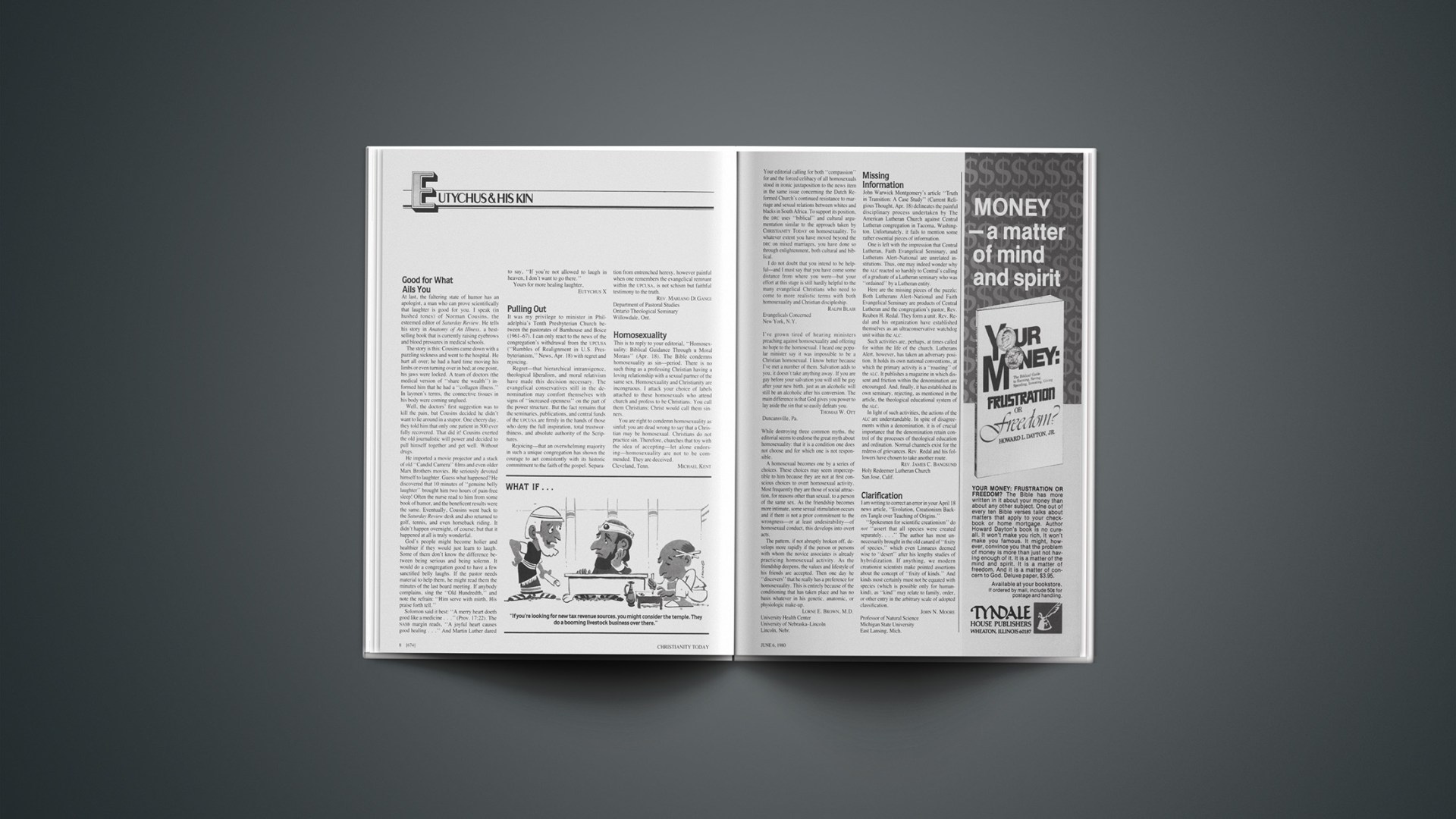
Eutychus and His Kin: June 6, 1980

Good for What Ails You

At last, the faltering state of humor has an apologist, a man who can prove scientifically that laughter is good for you. I speak (in hushed tones) of Norman Cousins, the esteemed editor of Saturday Review. He tells his story in Anatomy of An Illness, a bestselling book that is currently raising eyebrows and blood pressures in medical schools.

The story is this: Cousins came down with a puzzling sickness and went to the hospital. He hurt all over; he had a hard time moving his limbs or even turning over in bed; at one point, his jaws were locked. A team of doctors (the medical version of “share the wealth”) informed him that he had a “collagen illness.” In laymen’s terms, the connective tissues in his body were coming unglued.

Well, the doctors’ first suggestion was to kill the pain, but Cousins decided he didn’t want to lie around in a stupor. One cheery day, they told him that only one patient in 500 ever fully recovered. That did it! Cousins exerted the old journalistic will power and decided to pull himself together and get well. Without drugs.

He imported a movie projector and a stack of old “Candid Camera” films and even older Marx Brothers movies. He seriously devoted himself to laughter. Guess what happened? He discovered that 10 minutes of “genuine belly laughter” brought him two hours of pain-free sleep! Often the nurse read to him from some book of humor, and the beneficent results were the same. Eventually. Cousins went back to the Saturday Review desk and also returned to golf, tennis, and even horseback riding. It didn’t happen overnight, of course; but that it happened at all is truly wonderful.

God’s people might become holier and healthier if they would just learn to laugh. Some of them don’t know the difference between being serious and being solemn. It would do a congregation good to have a few sanctified belly laughs. If the pastor needs material to help them, he might read them the minutes of the last board meeting. If anybody complains, sing the “Old Hundredth.” and note the refrain: “Him serve with mirth. His praise forth tell.”

Solomon said it best: “A merry heart doeth good like a medicine …” (Prov. 17:22). The NASB margin reads, “A joyful heart causes good healing …” And Martin Luther daredto say. “If you’re not allowed to laugh in heaven, I don’t want to go there.”

Yours for more healing laughter,

EUTYCHUS X

Pulling Out

It was my privilege to minister in Philadelphia’s Tenth Presbyterian Church between the pastorates of Barnhouse and Boice (1961–67). I can only react to the news of the congregation’s withdrawal from the UPCUSA (“Rumbles of Realignment in U.S. Presbyterianism.” News, Apr. 18) with regret and rejoicing.

Regret—that hierarchical intransigence, theological liberalism, and moral relativism have made this decision necessary. The evangelical conservatives still in the denomination may comfort themselves with signs of “increased openness” on the part of the power structure. But the fact remains that the seminaries, publications, and central funds of the UPCUSA are firmly in the hands of those who deny the full inspiration, total trustworthiness, and absolute authority of the Scriptures.

Rejoicing—that an overwhelming majority in such a unique congregation has shown the courage to act consistently with its historic commitment to the faith of the gospel. Separation from entrenched heresy, however painful when one remembers the evangelical remnant within the UPCUSA, is not schism but faithful testimony to the truth.

REV. MARIANO DI GANOI

Department of Pastoral

Studies Ontario Theological Seminary

Willowdale, Ont.

Homosexuality

This is to reply to your editorial, “Homosexuality: Biblical Guidance Through a Moral Morass” (Apr. 18). The Bible condemns homosexuality as sin—period. There is no such thing as a professing Christian having a loving relationship with a sexual partner of the same sex. Homosexuality and Christianity are incongruous. I attack your choice of labels attached to these homosexuals who attend church and profess to be Christians. You call them Christians; Christ would call them sinners.

You are right to condemn homosexuality as sinful; you are dead wrong to say that a Christian may be homosexual. Christians do not practice sin. Therefore, churches that toy with the idea of accepting—let alone endorsing—homosexuality are not to be commended. They are deceived.

MICHAEL KENT

Cleveland. Tenn.

Your editorial calling for both “compassion” for and the forced celibacy of all homosexuals stood in ironic juxtaposition to the news item in the same issue concerning the Dutch Reformed Church’s continued resistance to marriage and sexual relations between whites and blacks in South Africa. To support its position, the DRC uses “biblical” and cultural argumentation similar to the approach taken by CHRISTIANITY TODAY on homosexuality. To whatever extent you have moved beyond the DRC on mixed marriages, you have done so through enlightenment, both cultural and biblical.

I do not doubt that you intend to be helpful—and I must say that you have come some distance from where you were—but your effort at this stage is still hardly helpful to the many evangelical Christians who need to come to more realistic terms with both homosexuality and Christian discipleship.

RALPH BLAIR

Evangelicals Concerned

New York, N.Y.

I’ve grown tired of hearing ministers preaching against homosexuality and offering no hope to the homosexual. I heard one popular minister say it was impossible to be a Christian homosexual. I know better because I’ve met a number of them. Salvation adds to you, it doesn’t take anything away. If you are gay before your salvation you will still be gay after your new birth, just as an alcoholic will still be an alcoholic after his conversion. The main difference is that God gives you power to lay aside the sin that so easily defeats you.

THOMAS W. OTT

Duncansville. Pa.

While destroying three common myths, the editorial seems to endorse the great myth about homosexuality: that it is a condition one does not choose and for which one is not responsible.

A homosexual becomes one by a series of choices. These choices may seem imperceptible to him because they are not at first conscious choices to overt homosexual activity. Most frequently they are those of social attraction, for reasons other than sexual, to a person of the same sex. As the friendship becomes more intimate, some sexual stimulation occurs and if there is not a prior commitment to the wrongness—or at least undesirability—of homosexual conduct, this develops into overt acts.

The pattern, if not abruptly broken off, develops more rapidly if the person or persons with whom the novice associates is already practicing homosexual activity. As the friendship deepens, the values and lifestyle of his friends are accepted. Then one day he “discovers” that he really has a preference for homosexuality. This is entirely because of the conditioning that has taken place and has no basis whatever in his genetic, anatomic, or physiologic make-up.

LORNE E. BROWN. M.D.

University Health Center

University of Nebraska-Lincoln

Lincoln, Nebr.

Missing Information

John Warwick Montgomery’s article “Truth in Transition: A Case Study” (Current Religious Thought, Apr. 18) delineates the painful disciplinary process undertaken by The American Lutheran Church against Central Lutheran congregation in Tacoma. Washington. Unfortunately, it fails to mention some rather essential pieces of information.

One is left with the impression that Central Lutheran, Faith Evangelical Seminary, and Lutherans Alert-National are unrelated institutions. Thus, one may indeed wonder why the ALC reacted so harshly to Central’s calling of a graduate of a Lutheran seminary who was “ordained” by a Lutheran entity.

Here are the missing pieces of the puzzle: Both Lutherans Alert-National and Faith Evangelical Seminary are products of Central Lutheran and the congregation’s pastor. Rev. Reuben H. Redal. They form a unit. Rev. Redal and his organization have established themselves as an ultraconservative watchdog unit within the ALC.

Such activities are, perhaps, at times called for within the life of the church. Lutherans Alert, however, has taken an adversary position. It holds its own national conventions, at which the primary activity is a “roasting” of the ALC. It publishes a magazine in which dissent and friction within the denomination are encouraged. And, finally, it has established its own seminary, rejecting, as mentioned in the article, the theological educational system of the ALC.

In light of such activities, the actions of the ALC are understandable. In spite of disagreements within a denomination, it is of crucial importance that the denomination retain control of the processes of theological education and ordination. Normal channels exist for the redress of grievances. Rev. Redal and his followers have chosen to take another route.

REV. JAMES C. BANGSUND

Holy Redeemer Lutheran Church

San Jose, Calif.

Clarification

I am writing to correct an error in your April 18 news article, “Evolution, Creationism Backers Tangle over Teaching of Origins.”

“Spokesmen for scientific creationism” do not “assert that all species were created separately.…” The author has most unnecessarily brought in the old canard of “fixity of species,” which even Linnaeus deemed wise to “desert” after his lengthy studies of hybridization. If anything, we modern creationist scientists make pointed assertions about the concept of “fixity of kinds.” And kinds most certainly must not be equated with species (which is possible only for humankind), as “kind” may relate to family, order, or other entry in the arbitrary scale of adopted classification.

JOHN N. MOORE

Professor of Natural Science

Michigan State University

East Lansing. Mich.

Editor’s Note from June 06, 1980

On May 9 the Evangelical Press Association held its annual awards banquet. The EPA, as it is affectionately known to its friends, has come a long way since it was created by evangelicals 31 years ago to upgrade the quality of their publications. When the chairman announced CHRISTIANITY TODAY as the winner of the first place Award Of Excellence in the general category, the entire CT editorial staff was positively delighted. As I sat there, my mind turned to a statement by Mrs. Fritz Kreisler. Of her world-famous violinist husband she said: “If Fritz would only practice, he would make a good violinist.” I was thinking (in a very unhumble frame of mind, I confess) that if only I knew more about editing and had had a little experience before coming to this job, we could really put out a good magazine. I never dreamed we might receive the coveted Periodical of the Year award. Maybe, I daydreamed, we could attain those dizzying heights five years from now—but not this year, or the next.

Then came the announcement of CHRISTIANITY TODAY as Periodical of the Year for 1980. We were immensely pleased. If ever an award was due to team effort, this one was. I know how much dedicated effort and sharply honed skill the staff working with me put into the production. The credit belongs entirely to them: Harry Genet, Ed Plowman, and John Maust in news; Carol Thiessen, Verne Becker, and Paul Fromer in editing and rewriting; Dave Singer, art director; Walter Elwell, book editor; and Jim Reapsome, managing editor—not to mention a superb supporting staff for production, advertising, and sales. I’m grateful to God for the privilege of working with such a group of dedicated professionals.

Perhaps this is an appropriate opportunity to remind our readers of CT’s purpose. It is not a family magazine. Neither is it a scholarly journal for specialists in particular fields. It is intended rather to provide for ministers, missionaries, and lay Christian leaders the information they need to guide the church and to advance the cause of Christ and true religion.

History
Today in Christian History

June 6

January
February
March
April
May
June
July
August
September
October
November
December
<>

June 6, 1654: Christina, Queen of Sweden, abdicates her throne and joins the Roman Catholic church. She spent the rest of her life engaged in religious thought (though she twice attempted to resume the crown).

June 6, 1844: English merchant George Williams founds the Young Men's Christian Association (YMCA) out of his London meetings for prayer and Bible reading.

June 6, 1903: Brother Bakht Singh, Indian evangelist regarded as one of the most well-known Bible teachers and pioneers of the Indian Church movement was born in Punjab, India.

History
Today in Christian History

June 5

January
February
March
April
May
June
July
August
September
October
November
December
<>

June 5, 754: English monk Boniface, missionary to Germany, dies with 50 other Christians in an attack by angry pagans. The missionary, famous for smashing pagan idols, also established a monastery at Fulda that is still the center of Roman Catholicism in Germany.

June 5, 988 (traditional date): Rus's Grand Prince Vladimir orders his people to be baptized into the Orthodox Christian faith. He personally oversaw the baptism of the majority of the population of Kiev, the capital of his realm (see issue 18: Russian Christianity).

June 5, 1191: England's Richard I (the Lion-hearted) of England sets sail for Muslim-controlled Acre in the Third Crusade. After helping Philip II, king of France, capture the city, Richard took Jaffa and negotiated Christian access to Jerusalem, also Muslim-controlled (see issue 40: The Crusades).

June 5, 1305: Bertrand de Got, who as Pope Clement V (1305-1314) moved the seat of papal power to Avignon, France, was elected pope.

June 5, 1414: Bohemian reformer Jan Hus appears before the Council of Constance. Instead of allowing him to state his beliefs, the council only permitted him to answer trumped-up charges of heresy. Hus was condemned and burned the following July (see issue 68: Jan Hus)

June 5, 1661: English mathematician and physicist Isaac Newton is admitted as a student to Trinity College, Cambridge. But the "greatest scientific genius the world has ever known" actually spent less of his life studying science than theology, writing 1.3 million words on biblical subjects (see our special section on Newton in issue 30: Women in the Medieval Church).

History
Today in Christian History

June 4

January
February
March
April
May
June
July
August
September
October
November
December
<>

June 4, 1873: Charles F. Parham, founder of the Apostolic Faith movement and one of the founders of the modern Pentecostal movement, is born in Muscatine, Iowa. In 1900 he founded the Bethel Bible School, where speaking in tongues broke out—launching the Pentecostal movement (see issue 58: Pentecostalism).

June 4, 1948: The Far East Broadcasting Company, based in the Philippines and broadcasting across Asia, goes on-air with the staff singing “All Hail the Power of Jesus’ Name.”

History
Today in Christian History

June 3

January
February
March
April
May
June
July
August
September
October
November
December
<>

June 3, 1098: After a seven-month siege, the armies of the First Crusade recapture Antioch (now in Turkey) (see issue 40: The Crusades).

June 3, 1162: Thomas a Becket is consecrated Archbishop of Canterbury. Nominated by his friend, King Henry II (Becket had previously served as his chancellor), Becket underwent a radical change as archbishop. He became pious and devoted to the church, which Henry found annoying. When knights heard the king grumbling, they killed Becket as he prayed.

June 3, 1647: The Puritan British Parliament bans Christmas and other holidays.

June 3, 1905: Hudson Taylor, English missionary to China and founder of the China Inland Mission, dies. "China is not to be won for Christ by quiet, ease-loving men and women," he once said. "The stamp of men and women we need is such as will put Jesus, China, [and] souls first and foremost in everything and at every time—even life itself must be secondary" (see issue 52: Hudson Taylor).

June 3, 1963: Pope John XXIII, convener of the Second Vatican Council, dies. Expected to be merely a "caretaker pope," he ushered in some of the Roman Catholic Church's most momentous changes in its history (see issue 65: The Ten Most Influential Christians of the Twentieth Century).

June 3, 1980: Catholic and Eastern Orthodox representatives meet officially for the first time since the Great Schism of 1054 (see issue 54: Eastern Orthodoxy).

History
Today in Christian History

June 2

January
February
March
April
May
June
July
August
September
October
November
December
<>

June 2, 553: The Second Council of Constantinople closes, having condemned Nestorian teachings. Nestorianism teaches Jesus incarnate was two separate persons—one divine, the other human—rather than one person with two natures (see issue 51: Heresy in the Early Church).

June 2, 597: Augustine, missionary to England and first archbishop of Canterbury, baptizes Saxon king Ethelbert, the first Christian English king. The missionary's tomb in Canterbury bears this epitaph: "Here rests Augustine, first archbishop of Canterbury, who being sent hither by Gregory, bishop of Rome, reduced King Ethelbert and his nation from the worship of idols to the faith of Christ" (see the article on Bede in issue 72: How We Got Our History).

June 2, 1491: Henry VIII, the English king who went from being called "Defender of the Faith" by the pope (for attacking Martin Luther) to galvanizing the English Reformation, is born in Greenwich (see issue 48: Thomas Cranmer).

June 2, 1875: James Augustine Healy becomes the first African-American Roman Catholic bishop in the U.S. However, he never really identified himself with the black community.

June 2, 1979: Pope John Paul II makes a return trip to his home country of Poland, the first visit by a pope to a Communist country (see issue 65: The Ten Most Influential Christians of the Twentieth Century).

History
Today in Christian History

June 1

January
February
March
April
May
June
July
August
September
October
November
December
<>

June 1, 165 (traditional date): Justin, an early Christian apologist, is beheaded with his disciples for their faith. “If we are punished for the sake of our Lord Jesus Christ, we hope to be saved,” he said just before his death. Christians soon named him Justin Martyr (see issue 27: Persecution in the Early Church).

June 1, 1843: Isabella Baumfree, having received a vision of God telling her to “travel up an’ down the land showin’ the people their sins an’ bein’ a sign unto them,” leaves New York and changes her name to Sojourner Truth. She became one of the most famous abolitionists and women’s rights lecturers in American history (see issue 62: Bound for Canaan).

Apple PodcastsDown ArrowDown ArrowDown Arrowarrow_left_altLeft ArrowLeft ArrowRight ArrowRight ArrowRight Arrowarrow_up_altUp ArrowUp ArrowAvailable at Amazoncaret-downCloseCloseEmailEmailExpandExpandExternalExternalFacebookfacebook-squareGiftGiftGooglegoogleGoogle KeephamburgerInstagraminstagram-squareLinkLinklinkedin-squareListenListenListenChristianity TodayCT Creative Studio Logologo_orgMegaphoneMenuMenupausePinterestPlayPlayPocketPodcastRSSRSSSaveSaveSaveSearchSearchsearchSpotifyStitcherTelegramTable of ContentsTable of Contentstwitter-squareWhatsAppXYouTubeYouTube