

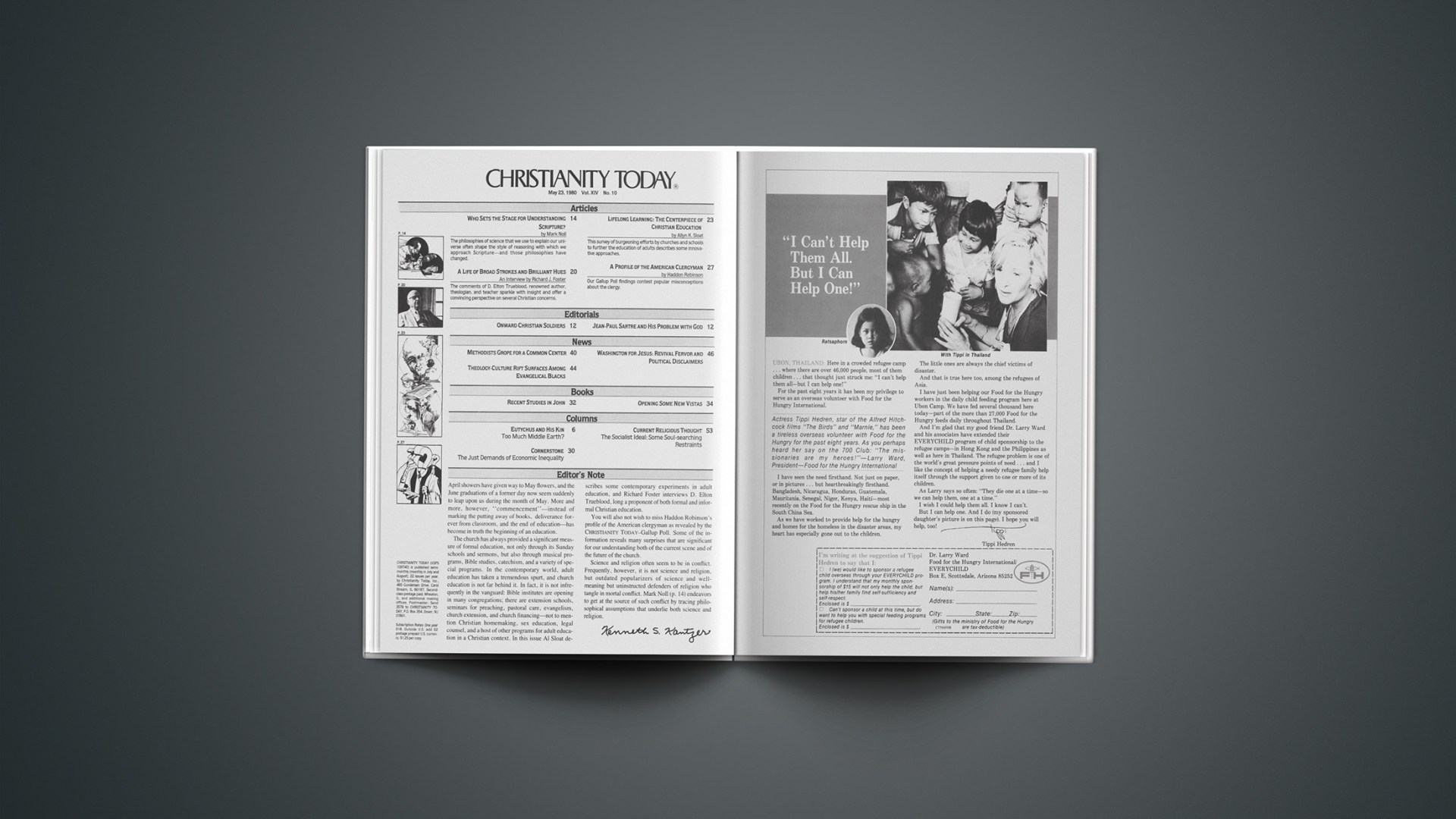
Editor’s Note from May 23, 1980

April showers have given way to May flowers, and the June graduations of a former day now seem suddenly to leap upon us during the month of May. More and more, however, “commencement”—instead of marking the putting away of books, deliverance forever from classroom, and the end of education—has become in truth the beginning of an education.

The church has always provided a significant measure of formal education, not only through its Sunday schools and sermons, but also through musical programs, Bible studies, catechism, and a variety of special programs. In the contemporary world, adult education has taken a tremendous spurt, and church education is not far behind it. In fact, it is not infrequently in the vanguard: Bible institutes are opening in many congregations; there are extension schools, seminars for preaching, pastoral care, evangelism, church extension, and church financing—not to mention Christian homemaking, sex education, legal counsel, and a host of other programs for adult education in a Christian context. In this issue Al Sloat describes some contemporary experiments in adult education, and Richard Foster interviews D. Elton Trueblood, long a proponent of both formal and informal Christian education.

You will also not wish to miss Haddon Robinson’s profile of the American clergyman as revealed by the CHRISTIANITY TODAY-Gallup Poll. Some of the information reveals many surprises that are significant for our understanding both of the current scene and of the future of the church.

Science and religion often seem to be in conflict. Frequently, however, it is not science and religion, but outdated popularizers of science and well-meaning but uninstructed defenders of religion who tangle in mortal conflict. Mark Noll (p. 14) endeavors to get at the source of such conflict by tracing philosophical assumptions that underlie both science and religion.

History
Today in Christian History

May 23

January
February
March
April
May
June
July
August
September
October
November
December
<>

May 23, 1430: French mystic and military hero Joan of Arc is captured by the Burgundians. They sold her to English, who tried her for sorcery and heresy (see issue 30: Women in the Medieval Church).

May 23, 1498: Italian reformer Girolamo Savonarola, who preached aggressively against the corruption of northern Italy’s church and society, is hanged for heresy and his body burned. After gaining fame for successful prophecies, he sought to establish an ascetic Christian community. Scholars still debate whether he was a saintly prophet or a fanatic.

May 23, 1533: Thomas Cranmer, archbishop of Canterbury, declares King Henry VIII’s marriage to Catherine of Aragon null and void: a key moment in the English Reformation (see issue 48: Thomas Cranmer).

May 23, 1618: Bohemian Protestant rebels storm the castle of Catholic Hapsburg king Ferdinand II and throw his governors out the window (and into a pile of manure). This act touched off Europe’s Thirty Years War, which ended in 1648 by the Treaty of Westphalia (see issue 13: Jan Amos Comenius).

May 23, 1633: Though Huguenots (French Protestants) had tried to colonize “New France” (Canada) for three decades, France declares only Roman Catholics are allowed to permanently settle there (see issue 71: The Huguenots).

History
Today in Christian History

May 22

January
February
March
April
May
June
July
August
September
October
November
December
<>

May 22, 337: Constantine, the first Christian emperor of Rome, dies. Though known for calling the Council of Nicaea (which condemned the Arian heresy) and for beginning the process of Christianizing the empire, he waited until just before his death before he finally accepted baptism into the church (see issue 57: Converting the Empire).

May 22, 452: Leo, bishop of Rome, sends three angry letters to protest the Council of Chalcedon's recent elevation of Constantinople to the preeminent see in Christendom. The two cities had been placed on equal footing by a 381 ecumenical council in Constantinople, but Chalcedon tipped the scale, saying that since the imperial capital had moved to "New Rome" (Constantinople), that city deserved the benefits Rome once enjoyed. This event was one of many leading up to the East-West schism of 1054 (see issue 54: Eastern Orthodoxy).

May 22, 1883: Billy SunDay , who would become the greatest American tent revivalist after a career in professional baseball, has his first at bat playing for the Chicago White Stockings. He struck out his first 14 attempts.

History
Today in Christian History

May 21

January
February
March
April
May
June
July
August
September
October
November
December
<>

May 21, 1382: The "Earthquake Synod" in London (so named because a temblor interrupted the proceedings), led by Archbishop Courtenay, condemns as heretical 24 theses from the writings of John Wycliffe. Wycliffe later claimed that God sent the earthquake "because the friars had put heresy upon Christ. The earth trembled as it did when Christ was damned to bodily death" (see issue 3: John Wycliffe).

May 21, 1471: Painter, engraver, and woodcut designer Albrecht Durer is born in Nuremberg, Germany. Durer, one of the greatest artists of his Day , almost certainly converted to Protestantism in the 1520s.

May 21, 1527: Anabaptist minister Michael Sattler, a former Benedictine monk who left the monastery and married after reading Paul's letters, is tortured and killed in Rottenburg, Germany. His wife was drowned eight Day s later (see issue 5: Anabaptists).

May 21, 1536: The General Assembly of Geneva officially adopts the Reformation and separates from the Roman Catholic diocese. John Calvin, who became forever associated with the Swiss city, arrives two months later (see issue 12: John Calvin).

May 21, 1738: Charles Wesley, who would cofound Methodism with his brother, experiences an evangelical conversion while sick with pleurisy. "In the name of Jesus of Nazareth, arise and believe, and thou shalt be healed of thy infirmities," a mysterious voice told him in his sickbed. "I believe, I believe," he replied. One year later on this date, he wrote "O for a Thousand Tongues" to commemorate the event (see issue 31: The Golden Age of Hymn).

May 21, 1780: English Quaker and social reformer Elizabeth Fry is born in Norwich, England. Though involved in reforms from education to poverty, her greatest burden was to improve prison life (see issue 53: William Wilberforce).

May 21, 1789: The first American Presbyterian General Assembly convenes in Philadelphia.

May 21, 1832: Hudson Taylor, English missionary to China and founder of the China Inland Mission, is born in Barnsley, Yorkshire (see issue 52: Hudson Taylor).

May 21, 1864: Missionary-priest Joseph de Veuster (better known as Father Damien) is ordained a priest in Honolulu. In 1873, at his own request, he was sent to a settlement of lepers on the island of Molokai, where he later contracted the disease and died.

History
Today in Christian History

May 20

January
February
March
April
May
June
July
August
September
October
November
December
<>

May 20, 325: Emperor Constantine convenes the first Ecumenical Council in Nicaea (now Iznik), Bithynia, to discuss Arianism, a heresy arguing that Christ was subordinate to God the Father. "I entreat you," Constantine said at the opening of the Council of Nicea, "to remove the causes of dissension among you and to establish peace." The council attempted to resolve the bitter conflict by anathematizing Arius (Arianism's founder) and ordering the burning of all his books, but the conflict continued to rage for decades (see issue 51: Heresy in the Early Church).

May 20, 1277: Pope John XXI dies when his castle ceiling collapses on him. The name was a mistake—there was never a John XX.

May 20, 1506: Christopher Columbus, who saw himself as a missionary, not just an explorer, dies impoverished in Spain at age 55. "I hope in our Lord that it will be the greatest honor to Christianity that, unexpectedly, has ever come about," he concluded in the log of his first voyage to the Americas (see issue 35: Christopher Columbus).

May 20, 1690: John Eliot, English missionary to the Native Americans of New England and publisher of the first Bible printed in America, dies (see issue 41: The American Puritans).

May 20, 1960: Six months before John F. Kennedy, a Roman Catholic, is elected president of the United States, the Southern Baptist Convention condemns the election of Catholics to public office. "When a public official is inescapably bound by the dogma and demands of the church," it declared, "he cannot consistently separate himself from these.

History
Today in Christian History

May 19

January
February
March
April
May
June
July
August
September
October
November
December
<>

May 19, 804: Alcuin of York, an English scholar who became an adviser to Charlemagne and the most prominent figure in the Carolingian Renaissance (the rebirth of classical learning under Charlemagne), dies. He also devised a handwriting system using both small and capital letters for easier reading.

May 19, 1805: Joshua V. Himes, best known for promoting William Miller's Second Advent movement, is born. Miller predicted the Second Coming between 1843 and 1844. When this did not happen, many followers deserted; others reorganized themselves as Seventh-Day Adventists (see issue 61: The End of the World).

History
Today in Christian History

May 18

January
February
March
April
May
June
July
August
September
October
November
December
<>

May 18, 1291: The last Christian territory taken by the Crusaders, Acre, falls to the Sultan of Egypt (see issue 40: The Crusades).

May 18, 1834: Sheldon Jackson, Presbyterian missionary to the frontier West and Alaska, is born in Minaville, New York. Jackson's reputation for ministering to the spiritual, physical, and social needs of both natives and settlers earned him the nicknames "Bishop of All Beyond" and "Apostle to Alaska" (see issue 66: How the West Was Really Won).

May 18, 1920: Karol Wojtyla (who would take the name John Paul II when elected pope) is born in Wadowice, Poland (see issue 65: The 10 Most Influential Christians of the Twentieth Century).

History
Today in Christian History

May 17

January
February
March
April
May
June
July
August
September
October
November
December
<>

May 17, 1844: German biblical scholar Julius Wellhausen is born. His controversial theory about the Pentateuch—that it is a compilation of four literary sources (J, Jahwist; E, Elohist; D, Deuteronomist; and P, Priestly Editor), laid the foundation for most subsequent Old Testament criticism.

May 17, 1971: The musical Godspell, based on Matthew's gospel, opens at the Cherry Lane Theater in New York.

History
Today in Christian History

May 16

January
February
March
April
May
June
July
August
September
October
November
December
<>

May 16, 583 (traditional date): Brendan the Navigator, founder of a Celtic monastery in Clonfert, Ireland, dies. Some Irish scholars have asserted that Brendan was among the first Europeans to reach America, nine centuries before Columbus (see issue 60: How the Irish Were Saved).

May 16, 1805: Henry Martyn, a well-educated Englishman, arrives in India to aid William Carey with translation work (see issue 36: William Carey).

History
Today in Christian History

May 15

January
February
March
April
May
June
July
August
September
October
November
December
<>

May 15, 1265: Poet and politician Dante Alighieri, author of "The Divine Comedy," is born in Florence, Italy. Dante finished the epic poem just before his death, and it was quickly recognized as brilliant. His epitaph begins: "Dante the theologian, skilled in every branch of knowledge that philosophy may cherish in her illustrious bosom" (see issue 70: Dante's Guide to Heaven and Hell).

May 15, 1525: Radical reformer Thomas Munzer is captured and many of his followers are killed in the disastrous Battle of Frankenhausen. Munzer was executed in Muhlhausen 12 days later after being tortured to force a confession. Though many of his beliefs were rejected by later, nonviolent Anabaptists, his emphasis on suffering discipleship, his rejection of infant baptism, and his call for judgment of the church became key teachings in the movement (see issue 5: The Anabaptists).

May 15, 1886: American poet Emily Dickinson, author of many poems on death, eternity, God, and the afterlife, dies. Only 7 of her 1,775 poems were published at the time.

May 15, 1948: Father Edward Flanagan, founder of the U.S. Home for Homeless Boys (later called Boys Town) in Omaha, Nebraska, dies. "There is no such thing as a bad boy," Flanagan believed.

May 15, 1984: American evangelical Francis A. Schaeffer dies in Rochester, Minnesota. Many of his books, which include The God Who is There (1968) and How Should We Then Live (1976), argue that moral relativity is responsible for social ills.

Apple PodcastsDown ArrowDown ArrowDown Arrowarrow_left_altLeft ArrowLeft ArrowRight ArrowRight ArrowRight Arrowarrow_up_altUp ArrowUp ArrowAvailable at Amazoncaret-downCloseCloseEmailEmailExpandExpandExternalExternalFacebookfacebook-squareGiftGiftGooglegoogleGoogle KeephamburgerInstagraminstagram-squareLinkLinklinkedin-squareListenListenListenChristianity TodayCT Creative Studio Logologo_orgMegaphoneMenuMenupausePinterestPlayPlayPocketPodcastRSSRSSSaveSaveSaveSearchSearchsearchSpotifyStitcherTelegramTable of ContentsTable of Contentstwitter-squareWhatsAppXYouTubeYouTube