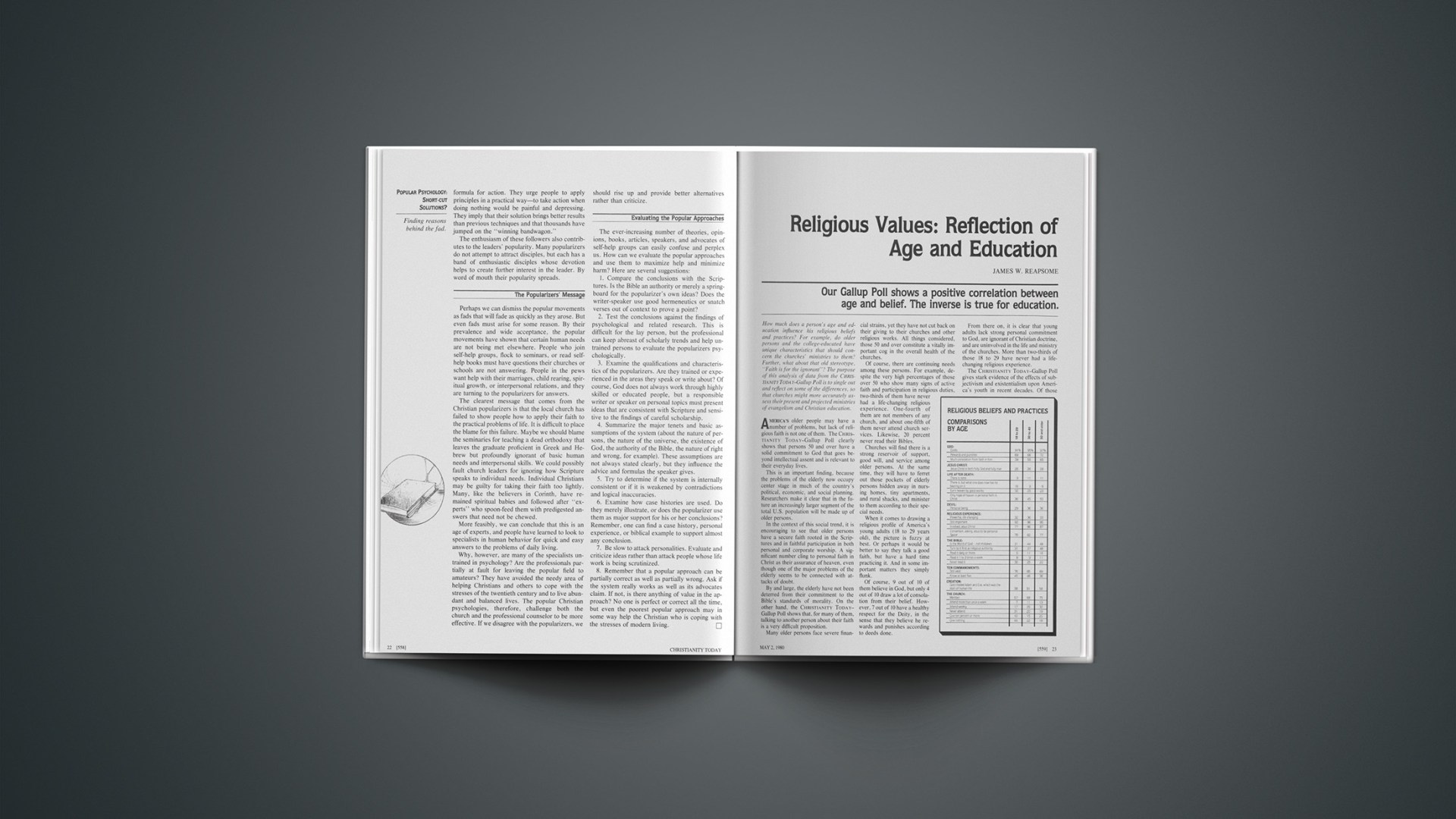
Religious Values: Reflection of Age and Education

Our Gallup Poll shows a positive correlation between age and belief. The inverse is true for education.

How much does a person’s age and education influence his religious beliefs and practices? For example, do older persons and the college-educated have unique characteristics that should concern the churches’ ministries to them? Further, what about that old stereotype, “Faith is for the ignorant”? The purpose of this analysis of data from the CHRISTIANITY TODAY-Gallup Poll is to single out and reflect on some of the differences, so that churches might more accurately assess their present and projected ministries of evangelism and Christian education.

America’s older people may have a number of problems, but lack of religious faith is not one of them. The CHRISTIANITY TODAY-Gallup Poll clearly shows that persons 50 and over have a solid commitment to God that goes beyond intellectual assent and is relevant to their everyday lives.

This is an important finding, because the problems of the elderly now occupy center stage in much of the country’s political, economic, and social planning. Researchers make it clear that in the future an increasingly larger segment of the total U.S. population will be made up of older persons.

In the context of this social trend, it is encouraging to see that older persons have a secure faith rooted in the Scriptures and in faithful participation in both personal and corporate worship. A significant number cling to personal faith in Christ as their assurance of heaven, even though one of the major problems of the elderly seems to be connected with attacks of doubt.

By and large, the elderly have not been deterred from their commitment to the Bible’s standards of morality. On the other hand, the CHRISTIANITY TODAY-Gallup Poll shows that, for many of them, talking to another person about their faith is a very difficult proposition.

Many older persons face severe financial strains, yet they have not cut back on their giving to their churches and other religious works. All things considered, those 50 and over constitute a vitally important cog in the overall health of the churches.

Of course, there are continuing needs among these persons. For example, despite the very high percentages of those over 50 who show many signs of active faith and participation in religious duties, two-thirds of them have never had a life-changing religious experience. One-fourth of them are not members of any church, and about one-fifth of them never attend church services. Likewise, 20 percent never read their Bibles.

Churches will find there is a strong reservoir of support, good will, and service among older persons. At the same time, they will have to ferret out those pockets of elderly persons hidden away in nursing homes, tiny apartments, and rural shacks, and minister to them according to their special needs.

When it comes to drawing a religious profile of America’s young adults (18 to 29 years old), the picture is fuzzy at best. Or perhaps it would be better to say they talk a good faith, but have a hard time practicing it. And in some important matters they simply flunk.

Of course, 9 out of 10 of them believe in God, but only 4 out of 10 draw a lot of consolation from their belief. However, 7 out of 10 have a healthy respect for the Deity, in the sense that they believe he rewards and punishes according to deeds done.

From there on, it is clear that young adults lack strong personal commitment to God, are ignorant of Christian doctrine, and are uninvolved in the life and ministry of the churches. More than two-thirds of those 18 to 29 have never had a life-changing religious experience.

The CHRISTIANITY TODAY-Gallup Poll gives stark evidence of the effects of subjectivism and existentialism upon America’s youth in recent decades. Of those who have had a religious conversion, nearly one-fourth asserted that it had nothing to do with Jesus Christ. Their subjectivism is also seen in the fact that more than one-third of them determine their religious beliefs first by what the Holy Spirit says to them individually. Further, only 31 percent think the Bible is free of mistakes. On the origin of man, young adults lean heavily toward theistic evolution.

Only 26 percent have a correct doctrinal understanding of Jesus as fully God and fully man. Because of their ignorance of basic Christian doctrine, huge numbers of young adults are trying to earn their way to heaven, and many others don’t care because they don’t believe what they do in the here and now has any effect on their fate in the life after death.

It is in terms of church life that the religious weakness of America’s young adults is most noticeable. Thirty-one percent of them never go to church! Nearly half of them (44 percent) never give any money to the church or religious work. Only 57 percent belong to any church—10 percent less than the national average.

Their private worship record is no better. Thirty percent of the young adults never read the Bible and 28 percent of them read it less than once a month. In this regard their performance is not much below that of the public as a whole.

All in all, in spite of the much touted religious revival among youth in the sixties, it is clear there is urgent need for evangelism among young adults and for a new revival of personal and corporate piety and Christian duty among those who have some level of commitment to Christ and his church. Perhaps the prevailing pressure of the cultural “counterrevolution” of the late sixties and early seventies made a more lasting and deeper impact than has previously been conceded by scholars, pastors, and church workers.

Middle-aged Americans (30 to 49 years old) also are strongly committed to the church, but a remarkably high 63 percent of them recall no life-changing religious experience. Nearly 7 out of 10 are members of a church, and one-fourth of them go to church once a week or more. On the other hand, 20 percent never go to church at all, so that means there are some 10.5 million persons in this age bracket who need to be reached.

Their commitment to the Bible’s authority, internal integrity, and moral application also ranks high. On the other hand, their personal devotions leave much to be desired: only 11 percent read the Bible daily or more and 25 percent never read it.

At the same time, those in their middle years for the most part do have a personal faith in Jesus Christ as their only hope of heaven. Such faith needs to be nurtured; discipleship training is imperative. Bible knowledge is lacking and daily witnessing is virtually nonexistent.

A college education doesn’t do much for one’s religious faith; in fact, Americans with only a grade school education are more consistently religious in belief and practice than those who have been to college. Those who have completed high school fall somewhere in between.

This fact places the churches in a critical bind. For many years, Christians were taunted with charges of ignorance and obscurantism. Faith was said to be for the ignorant and pastors were accused of ducking tough intellectual questions. Church kids by the thousands went off to college and promptly lost whatever faith they had.

More recently, the Christian faith has achieved a more respectable standing in academia, thanks to the hard work of committed evangelical scholars. Yet the pressures of secular culture and economics have been such that college is seen as a necessity for Christian and non-Christian alike.

Facts from the CHRISTIANITY TODAY-Gallup Poll show the necessity of a much stronger precollege Christian education program in the churches. Of course, it could also be said that part of the answer is Christian higher education. The poll of the public’s religious attitudes does not test the distinction between those respondents who went to secular colleges against those who went to Christian ones. That may not make much of a difference in the future, considering the vast differences in enrollments. The country’s religion in the future, perhaps even more than in the past, will be determined to a significant extent by what happens in its colleges and universities. Here’s why:

As a group, across the country, college-educated persons rank lower than others in belief in God, in belief that the Deity rewards and punishes, and in the degree of consolation they receive from their faith. They stand lower in commitment to a Bible free of errors, in belief that human life began when God created Adam and Eve, and in going to the Bible first to settle religious questions.

It follows that college-educated persons read their Bibles less often, but it is striking that 84 percent of them believe the Ten Commandments are valid, and more college-educated persons can name at least five of the commands than can either high school—or grade school—educated persons.

But when compared to others of lower educational attainments, college-trained people have less hope in Christ alone to save them, and more than one-fourth of them either do not believe there is life after death, or if there is, it doesn’t matter how one lives now.

On the other hand, there is no small indication that a religious experience of some kind has touched the lives of a significant portion of people who have been to college. Thirty percent of them testify this to be true of themselves, but of that group, one-fifth had no personal encounter with Christ and one-fourth said the experience was not a “conversion.”

There is solid data to show considerable vagueness in religious understanding. But that vagueness does not deter college people from church membership and attendance. Interestingly, in membership and attendance one’s educational attainments make virtually no difference at all. There appears to be significant commitment to institutional religion among those with college degrees, but intellectual and doctrinal understanding are lacking.

Compared to the general public, to Roman Catholics, and to Protestants, America’s 31 million evangelical Christians show remarkably higher levels of religious commitment, knowledge, and practice. However, what makes interpretation of the CHRISTIANITY TODAY-Gallup Poll a tricky business is the fact that figures for the public at large, as well as for Catholics and Protestants, include evangelicals as well.

For example, take away the evangelical presence, and what would happen to the 94 percent figure that measures the public’s belief in God? Or to the statistic that shows 42 percent of the public believing the Bible is without mistakes? And if you took the evangelicals out of the Catholic and Protestant percentages, where would you be?

However, one of the benefits of using poll data is achieved by comparing the statistical separation of the groups. (See accompanying chart.) In some matters there are significant differences, in others none. For example, evangelicals as a group do tend to have a firmer commitment to God who rewards and punishes. They also are ahead in terms of getting more consolation from their faith.

It is to be expected that evangelicals, when compared to nonevangelical Catholics and Protestants, would outrank them in having a life-changing religious experience. And in greater numbers they identify this experience as a conversion that involved Jesus Christ. Consequently, they are much more sure of heaven solely on the basis of their faith in Christ.

Their doctrinal understanding is sharper, as is their Bible knowledge. They surpass Catholics and Protestants in believing the Bible has no errors, in believing human life began when God created Adam and Eve, and in going to the Bible first as their authority in religious matters.

When it comes to church life, evangelicals rank highest in membership, attendance, and giving. In expressing their faith, evangelicals are ahead in witnessing and in daily Bible reading.

Comparisons of Catholics and Protestants confirm traditional strengths and weaknesses. To a greater extent, Catholics believe God rewards and punishes; Protestants draw more consolation from their faith and are more strongly committed to Christ alone as their hope of heaven.

More Protestants than Catholics believe the Bible has no mistakes, and of course Protestants far surpass Catholics in going to the Bible first as their religious authority. Conversions and life-changing religious experiences are predominantly Protestant territory.

Protestants and Catholics rank about the same in accepting the validity of the Ten Commandments, but Catholics know them better. Catholics also are ahead of Protestants in a proper doctrinal understanding of the person of Christ.

In terms of personal devotions, Protestants do much better than Catholics. There is not much difference in church membership and attendance, but Protestants tithe to a greater degree. There’s not much to brag about in this category: one-fifth of Protestants and Catholics alike don’t give anything.

Clearly, the country’s religious pulse is strong. That strength no doubt is due in significant measure to the lasting impact of widespread evangelism, strong local churches (many independent), and commitment to Bible study personally and institutionally. The dissemination of Bible teaching by radio, television, literature, and at camps and conferences is also important. As evangelical distinctives are maintained, strengthened, and targeted to meet changing social and intellectual needs, Protestantism, Catholicism and the nation at large will benefit.

Carl F. H. Henry, first editor of Christianity Today, is lecturer at large for World Vision International. An author of many books, he lives in Arlington, Virginia.

Popular Psychology: Short-Cut Solutions?

In this age of experts people look to “specialists” for quick and easy answers.

For many years, magazine writers, newspaper columnists, sales managers, preachers, and others have tried to apply the conclusions of psychology to a variety of human problems.

Perhaps millions of people follow the teachings of these “popularizers” and uncritically accept their conclusions on how to rear children, have a better marriage, cope with depression, mature spiritually, get along with people, succeed at work, or have a more satisfying sex life. Many others attend self-help groups to help one another stop drinking, lose weight, adjust to widowhood, prepare for surgery, or cope with cancer. Most people fail to realize that the advice they receive often deviates considerably from the established findings of scientific psychology.

Professional counselors often marvel at these popular approaches to problem solving. Sometimes they criticize or dismiss them as simplistic, potentially harmful, and unimportant. Yet scientific evidence shows these movements, including Christian nonprofessional approaches, are exploding in number, variety, and acceptance. Popular psychologies can be divided into three categories: self-help groups, popular writings, and popular speakers. We will examine the common elements, appeal, and message of these systems.

The Popular Self-Help Groups

The term “self-help group” is widely used but somewhat misleading because these groups really consist of people who meet for “mutual aid.” Such groups are characterized by compassion, an attitude of acceptance, common needs and experiences, self-reliance, informality, similar beliefs, hope, and a desire to help others. Frequently, the participants resist what they view as the cold, ineffective, and expensive influence of professional counselors. In short, these groups embody a basic principle for meeting stresses: people must help one another in times of need.

Although the secular world widely accepts the self-help, mutual aid group, several writers have argued that the movement began in the Judeo-Christian tradition. The New Testament repeatedly instructs us to encourage, support, pray for, teach, comfort, care for, and otherwise help one another. Early Wesleyans met in small, mutual-support groups, and the controversial Oxford Movement of the last century clearly was a religious phenomenon. The Oxford Movement probably led to one of the most effective and best known of the self-help groups, Alcoholics Anonymous, which still has strong religious overtones. More overtly Christian groups such as Bible study, prayer, and sharing groups have grown up in neighborhoods, schools, business offices, and churches throughout North America.

Professional counselors, including Christians, have not always accepted these groups with enthusiasm. While the groups can be beneficial, they may discourage or prevent people from getting needed professional help. They also may encourage unhealthy dependence on other group members, fragment the society as each group “does its own thing,” or pressure people who fail to improve in spite of their involvement in the group. Of more serious concern, Christians should consider whether these groups (including some Christian groups) foster a self-centered philosophy that looks to the human resources of a group, rather than Christ, to meet all of one’s needs.

In spite of these criticisms, however, the groups continue to spread. Time will tell whether they are a passing fad, or a return to the old attitude of people helping people.

The Popular Self-Help Writings

Many people look to books and magazines to help them cope with the stresses of life. Bestseller lists often include books that offer easy answers and “never-fail” formulas for asserting oneself, building a better marriage, succeeding in life, losing weight, finding lasting happiness, and solving a variety of problems. The catchy titles sometimes blatantly promise immediate success.

In a survey of 70 of these books, one psychologist concluded recently that self-help authors frequently lead readers to expect that change is possible and likely to occur, imply that every problem has a solution, help readers identify and elaborate problems, reassure readers that their problems are common and not abnormal, provide easy approaches to problem solving, and provide a new language for organizing and explaining behavior. Words such as “pathological” or “abnormal” are eliminated and replaced with less threatening concepts such as “games people play,” “biorhythms,” and “erroneous zones.”

Self-help books and articles especially appear to reassure and help those well-adjusted readers who can analyze their problems somewhat objectively, and who can personally commit and discipline themselves to apply self-help principles.

Unfortunately, not all consumers of self-help advice fit this description. Those who don’t are probably confused rather than helped. For at least four reasons, self-help books can be dangerous:

Simplistic Assumptions. Life is complicated and human problems rarely have simple solutions, but self-help writers seldom say so. Many imply that solutions to life problems can come quickly and easily by following a simple recipe. In a widely read Christian book on depression, for example, the author writes, “of one thing I am confident, you do not have to be depressed.… I am convinced that by using the formula in this book, you can avoid ever being depressed again.” Such promises are misleading, grossly simplistic, and potentially harmful. They discourage people from seeking needed counseling help and arouse guilt, discouragement, and bewilderment when the formulas do not bring the promised prolonged relief.

Unrealistic Expectations. Many of the books and articles create unrealistic expectations about how people should feel, what life should be like, and how problems should be solved. In contrast to biblical teachings, these writings imply that problems will disappear if people “pray hard enough,” “trust enough,” or “believe enough.” When the problems persist, many people try harder, afraid to admit that the self-help formula may be wrong or that the expectations may be unrealistic.

Self-Condemnation. Self-help formulas often imply that problems are self-caused and self-cured. This assumption leads people to be overly self-critical, since they cannot identify influences beyond their control and hesitate to seek competent outside help. While the self-help emphasis on personal responsibility is admirable, the implied intolerance of personal failure can be destructive.

Egocentric Emphasis. Within recent years, one of the most widely purchased self-help books has instructed readers how to “look out for Number 1.” Another tells people how to “win through intimidation”; others advise people on how to “get to the top” in their businesses and careers.

These books illustrate what may be the most dangerous and erroneous aspect of self-help writings—the assumption that happiness and success come when people focus their attention and energies on themselves and their own achievements. Our society widely accepts this narcissistic, self-centered viewpoint. It emphasizes hedonistic pleasure, immediate gratification, and self-fulfillment in place of concern for others, duty, self-denial, responsibility, and commitment to God. This philosophy shines through the pages of Christian as well as secular books and articles. It tells us to “think positively, trust ourselves and do our own thing,” but it fails to realize that true happiness comes only when we have meaningful relationships with God and with other humans.

Today, when life is stressful and printed materials are both inexpensive and readily available, self-help books and articles can offer help to those in need. They can enlighten and provide meaningful insight when they are consistent with biblical teaching, psychologically sound, and free of unrealistic promises or simplistic formulas. They can be a useful adjunct to counseling and at times can make counseling unnecessary. But many books, including some by Christian authors, can also harm readers. Christians must be cautious in applying what the self-help books and articles proclaim.

The Popular Self-Help Speakers

For centuries, speakers (including teachers and preachers) have tried to help people by giving instruction, guidance, and advice from the public platform. Radio and television have increased the influence of the spoken word. Within the past decade, the popularity of seminars and the widespread availability and use of cassette tapes have further extended this verbal influence.

Although there are exceptions, these cassette or seminar speakers (many of whom are writers as well) have several common characteristics:

Relevance. Popular speakers focus on meaningful issues such as marriage, loneliness, failure, phoniness, child rearing, and sex. Case histories or personal illustrations stimulate interest and make it easy for the listener to identify with the topic being discussed.

Simplicity. Both the explanations for the causes of human problems and the proposed solutions tend to be concise and simple, if not simplistic. One popular speaker, for example, lists only two causes of human problems: sin and organic malfunctioning.

Practicality. The popularizers frequently give specific advice and tell people precisely what to do in order to cope with a problem. Success stories lead people to expect that the formulas work for anyone.

Avoidance of the academic. Technical terms, research, theology, and scholarly literature are deemphasized in favor of a person emphasis, which is more appealing to audiences.

Communication Skills. All of the popularizers are good communicators. Using simple, understandable language, they present clear and explicit messages.

Personal Appeal. Popularizers possess attractive personalities. Of course they differ in many ways and therefore do not all attract the same followers. Nevertheless, each speaker appeals to a certain following, centering on the speaker’s personality.

Biblical Orientation. Christian popularizers base their ideas on the Bible and attempt to apply Christianity to life in a practical way. An acknowledgment of the Bible’s importance undoubtedly attracts people who fear or otherwise avoid a strictly secular psychology.

Reactionary Nature. Popularizers generally are dissatisfied with something. For example, Paul Tournier began his writing career by opposing a form of medicine that ignores the spiritual and psychological nature of human beings, while Norman Vincent Peale has resisted “negative thinking” and an attitude that says “I can’t.” Opposition to some injustice or faulty thinking attracts followers who are equally dissatisfied and willing to join with a leader in seeking to bring change for the better.

Uniqueness. Each of the popularizers has something unique—a fresh new writing style, a new message, a new way of presenting an idea. Many of the principles for living are not new, but they are presented in a uniquely creative way.

The Appeal of the Popularizers

Many of these popular leaders have little or no training in psychology and some are untrained theologically. Nevertheless they attract great numbers of followers who are looking for practical advice about psychological and spiritual problems. Why are these popular secular and Christian psychologies flourishing today?

Perhaps a part of the answer lies in the current state of the society. The turmoil of the 1960s created a widespread discouragement and insecurity. The political corruption, ecological crisis, and economic problems of the 1970s have further shaken our faith in the future and made people especially receptive to anyone who brings hope and confidence.

This is precisely what the popular psychologies have promised as we move into the 1980s: hope for the future, answers to life’s problems, and success in coping with stress. They present this message clearly, often by appealing to Scripture, and support it with numerous selected case histories and testimonies to show that the popular psychologies do, in fact, “work.”

The leaders couple this message of hope with a formula for action. They urge people to apply principles in a practical way—to take action when doing nothing would be painful and depressing. They imply that their solution brings better results than previous techniques and that thousands have jumped on the “winning bandwagon.”

The enthusiasm of these followers also contributes to the leaders’ popularity. Many popularizers do not attempt to attract disciples, but each has a band of enthusiastic disciples whose devotion helps to create further interest in the leader. By word of mouth their popularity spreads.

The Popularizers’ Message

Perhaps we can dismiss the popular movements as fads that will fade as quickly as they arose. But even fads must arise for some reason. By their prevalence and wide acceptance, the popular movements have shown that certain human needs are not being met elsewhere. People who join self-help groups, flock to seminars, or read self-help books must have questions their churches or schools are not answering. People in the pews want help with their marriages, child rearing, spiritual growth, or interpersonal relations, and they are turning to the popularizers for answers.

The clearest message that comes from the Christian popularizers is that the local church has failed to show people how to apply their faith to the practical problems of life. It is difficult to place the blame for this failure. Maybe we should blame the seminaries for teaching a dead orthodoxy that leaves the graduate proficient in Greek and Hebrew but profoundly ignorant of basic human needs and interpersonal skills. We could possibly fault church leaders for ignoring how Scripture speaks to individual needs. Individual Christians may be guilty for taking their faith too lightly. Many, like the believers in Corinth, have remained spiritual babies and followed after “experts” who spoon-feed them with predigested answers that need not be chewed.

More feasibly, we can conclude that this is an age of experts, and people have learned to look to specialists in human behavior for quick and easy answers to the problems of daily living.

Why, however, are many of the specialists untrained in psychology? Are the professionals partially at fault for leaving the popular field to amateurs? They have avoided the needy area of helping Christians and others to cope with the stresses of the twentieth century and to live abundant and balanced lives. The popular Christian psychologies, therefore, challenge both the church and the professional counselor to be more effective. If we disagree with the popularizers, we should rise up and provide better alternatives rather than criticize.

Evaluating the Popular Approaches

The ever-increasing number of theories, opinions, books, articles, speakers, and advocates of self-help groups can easily confuse and perplex us. How can we evaluate the popular approaches and use them to maximize help and minimize harm? Here are several suggestions:

1. Compare the conclusions with the Scriptures. Is the Bible an authority or merely a springboard for the popularizer’s own ideas? Does the writer-speaker use good hermeneutics or snatch verses out of context to prove a point?

2. Test the conclusions against the findings of psychological and related research. This is difficult for the lay person, but the professional can keep abreast of scholarly trends and help untrained persons to evaluate the popularizers psychologically.

3. Examine the qualifications and characteristics of the popularizers. Are they trained or experienced in the areas they speak or write about? Of course, God does not always work through highly skilled or educated people, but a responsible writer or speaker on personal topics must present ideas that are consistent with Scripture and sensitive to the findings of careful scholarship.

4. Summarize the major tenets and basic assumptions of the system (about the nature of persons, the nature of the universe, the existence of God, the authority of the Bible, the nature of right and wrong, for example). These assumptions are not always stated clearly, but they influence the advice and formulas the speaker gives.

5. Try to determine if the system is internally consistent or if it is weakened by contradictions and logical inaccuracies.

6. Examine how case histories are used. Do they merely illustrate, or does the popularizer use them as major support for his or her conclusions? Remember, one can find a case history, personal experience, or biblical example to support almost any conclusion.

7. Be slow to attack personalities. Evaluate and criticize ideas rather than attack people whose life work is being scrutinized.

8. Remember that a popular approach can be partially correct as well as partially wrong. Ask if the system really works as well as its advocates claim. If not, is there anything of value in the approach? No one is perfect or correct all the time, but even the poorest popular approach may in some way help the Christian who is coping with the stresses of modern living.

Carl F. H. Henry, first editor of Christianity Today, is lecturer at large for World Vision International. An author of many books, he lives in Arlington, Virginia.

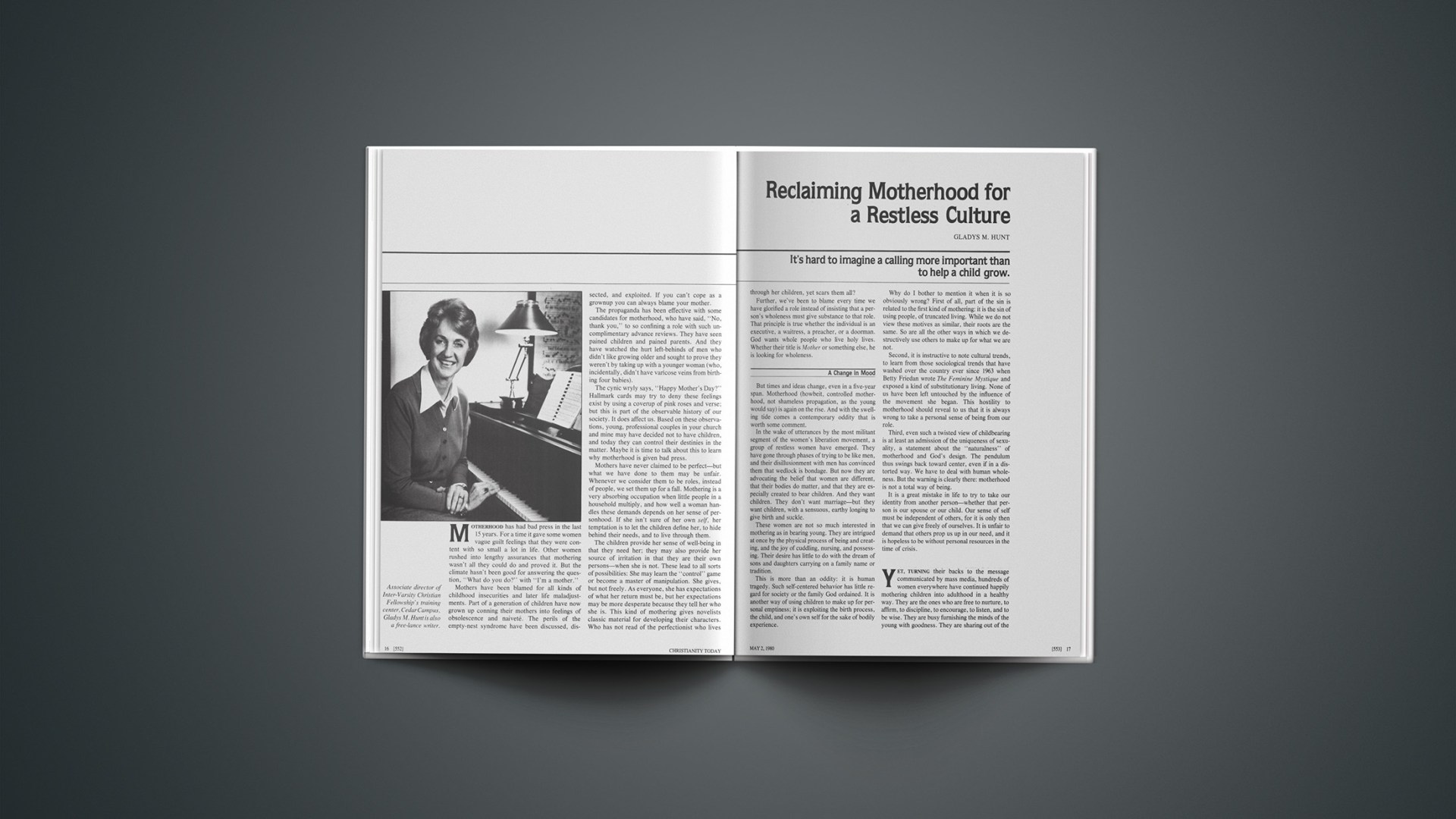
Reclaiming Motherhood for a Restless Culture

It’s hard to imagine a calling more important than to help a child grow.

Motherhood has had bad press in the last 15 years. For a time it gave some women vague guilt feelings that they were content with so small a lot in life. Other women rushed into lengthy assurances that mothering wasn’t all they could do and proved it. But the climate hasn’t been good for answering the question, “What do you do?” with “I’m a mother.”

Mothers have been blamed for all kinds of childhood insecurities and later life maladjustments. Part of a generation of children have now grown up conning their mothers into feelings of obsolescence and naiveté. The perils of the empty-nest syndrome have been discussed, dissected, and exploited. If you can’t cope as a grownup you can always blame your mother.

The propaganda has been effective with some candidates for motherhood, who have said, “No, thank you,” to so confining a role with such uncomplimentary advance reviews. They have seen pained children and pained parents. And they have watched the hurt left-behinds of men who didn’t like growing older and sought to prove they weren’t by taking up with a younger woman (who, incidentally, didn’t have varicose veins from birthing four babies).

The cynic wryly says, “Happy Mother’s Day?” Hallmark cards may try to deny these feelings exist by using a coverup of pink roses and verse; but this is part of the observable history of our society. It does affect us. Based on these observations, young, professional couples in your church and mine may have decided not to have children, and today they can control their destinies in the matter. Maybe it is time to talk about this to learn why motherhood is given bad press.

Mothers have never claimed to be perfect—but what we have done to them may be unfair. Whenever we consider them to be roles, instead of people, we set them up for a fall. Mothering is a very absorbing occupation when little people in a household multiply, and how well a woman handles these demands depends on her sense of personhood. If she isn’t sure of her own self, her temptation is to let the children define her, to hide behind their needs, and to live through them.

The children provide her sense of well-being in that they need her; they may also provide her source of irritation in that they are their own persons—when she is not. These lead to all sorts of possibilities: She may learn the “control” game or become a master of manipulation. She gives, but not freely. As everyone, she has expectations of what her return must be, but her expectations may be more desperate because they tell her who she is. This kind of mothering gives novelists classic material for developing their characters. Who has not read of the perfectionist who lives through her children, yet scars them all?

Further, we’ve been to blame every time we have glorified a role instead of insisting that a person’s wholeness must give substance to that role. That principle is true whether the individual is an executive, a waitress, a preacher, or a doorman. God wants whole people who live holy lives. Whether their title is Mother or something else, he is looking for wholeness.

A Change in Mood

But times and ideas change, even in a five-year span. Motherhood (howbeit, controlled motherhood, not shameless propagation, as the young would say) is again on the rise. And with the swelling tide comes a contemporary oddity that is worth some comment.

In the wake of utterances by the most militant segment of the women’s liberation movement, a group of restless women have emerged. They have gone through phases of trying to be like men, and their disillusionment with men has convinced them that wedlock is bondage. But now they are advocating the belief that women are different, that their bodies do matter, and that they are especially created to bear children. And they want children. They don’t want marriage—but they want children, with a sensuous, earthy longing to give birth and suckle.

These women are not so much interested in mothering as in bearing young. They are intrigued at once by the physical process of being and creating, and the joy of cuddling, nursing, and possessing. Their desire has little to do with the dream of sons and daughters carrying on a family name or tradition.

This is more than an oddity: it is human tragedy. Such self-centered behavior has little regard for society or the family God ordained. It is another way of using children to make up for personal emptiness; it is exploiting the birth process, the child, and one’s own self for the sake of bodily experience.

Why do I bother to mention it when it is so obviously wrong? First of all, part of the sin is related to the first kind of mothering: it is the sin of using people, of truncated living. While we do not view these motives as similar, their roots are the same. So are all the other ways in which we destructively use others to make up for what we are not.

Second, it is instructive to note cultural trends, to learn from those sociological trends that have washed over the country ever since 1963 when Betty Friedan wrote The Feminine Mystique and exposed a kind of substitutionary living. None of us have been left untouched by the influence of the movement she began. This hostility to motherhood should reveal to us that it is always wrong to take a personal sense of being from our role.

Third, even such a twisted view of childbearing is at least an admission of the uniqueness of sexuality, a statement about the “naturalness” of motherhood and God’s design. The pendulum thus swings back toward center, even if in a distorted way. We have to deal with human wholeness. But the warning is clearly there: motherhood is not a total way of being.

It is a great mistake in life to try to take our identity from another person—whether that person is our spouse or our child. Our sense of self must be independent of others, for it is only then that we can give freely of ourselves. It is unfair to demand that others prop us up in our need, and it is hopeless to be without personal resources in the time of crisis.

Yet, turning their backs to the message communicated by mass media, hundreds of women everywhere have continued happily mothering children into adulthood in a healthy way. They are the ones who are free to nurture, to affirm, to discipline, to encourage, to listen, and to be wise. They are busy furnishing the minds of the young with goodness. They are sharing out of the richness of their own lives. You meet their children everywhere. Sometimes they marry your children and you are twice-blessed. This mothering is worth writing about.

It is hard to imagine a calling more important than to help a child grow, to make him aware of his world, and to have an uncommon delight in goodness, truth, and beauty—and to have an uncommon commitment to them. In the final analysis we cannot make our children; that is God’s business. We can, however, provide a diet he can use. Mothers who do this best are themselves growing, delighted by their own potential and by others.

My Child

My child, what can I give you?

I should like to give you everything so that you lack for nothing, not even one single desire, but I know that for want of many things I have come to be satisfied with what I have and to think of others and their needs.

I should like to give you a life full of fun and games, but I know that because of many “chores” and responsibilities of my youth I have learned to be responsible.

I should like to protect you from all the errors of your youth, but I know that because of my failures I have learned to make better decisions.

I should like to give you a profession of wealth or importance, but I realize that man is truly happy only when he fulfills the purpose for which God has created him.

What then, my child, can I give you that would be of any real value?

I give you my love, which means that I accept you, without reservations, just as you are and will be.

I give you my personal presence in order that you will have the security you need during your childhood.

I give you my ears, in the sense that I will never be too busy to listen to you—sometimes never uttering even one word.

I give you opportunities to work so that you might learn to do it without shame and come to enjoy the satisfaction of work well done.

I give you my counsel only when it is necessary or you ask for it so that you might avoid some of the mistakes I have made.

I give you my consolation when you have failed or feel discouraged, but I will not always protect you from the consequences of your sins.

I give you instruction in the way of the Lord so that when you are old, you will never depart from it

I give you my daily prayers that the Lord will keep you and guide you in such a way that you, my child, will be a man or woman, who will serve and glorify our heavenly Father.

This I give you, with all my love,

Your Mother

Lydia Lightner

It is this delight that inspires poetic verse about motherhood. It inspires a football player to smile and say, “Hi, Mom. I love you,” when the television camera suddenly zooms in on him on the bench. It inspires young children clutching coins in hot, sticky hands, to comb the variety store looking for the just-right gift for a mother too wonderful for what is found. It makes sentimental verse beautiful, not maudlin; for everyone, deep down, wants this kind of mother.

What a safe, beckoning place such a mother makes! I remember coming home from school, opening the door, and calling, “Mom!” I wouldn’t have said I needed her; I only wanted to know she was there. The good smells of the kitchen sent out love messages—freshly baked cookies or bread.

My mother: she listened to my tales, showed me how to tear out the stitches and begin again, stayed up late at night to finish the dress I’d hoped to wear the next day, suggested I solve my problems in one way or another. So many memories crowd in. She was not a preaching mother, but a being mother, quicker to think of others than of herself.

I picked blueberries alongside my dad one bright September day shortly before he died. He said to me, “Now, honey, when it comes time to go home, take a look at how many berries your mother has. She will pick twice as many as the rest of us.” He was thoughtful and then went on, “She is so good with her hands. All of our lives she has made life better because of the way she used her hands.” Her hands worked out what was in her heart.

Nowadays my own hands look more and more like Mother’s—fingers slightly twisted with enlarged knuckles, but still capable hands. It comes full circle when my own back door opens and I hear the call, “Mom!” I make sure the kitchen shouts, “I’m glad you’re home.” Will it also come full circle that my hands—my self—have blessed the lives of my children?

On the one hand, that’s the privilege of being a mother: out of the fullness of her life, she gives to others. On the other hand, it is not only mothers who have a corner on that kind of giving and loving, for it isn’t the role, but rather the authentic person behind the role that determines how rich life will be and how it will bless others. Such knowing and sharing of love can come full circle for anyone. “We love because he first loved us.” It’s been God’s idea from the beginning.

Carl F. H. Henry, first editor of Christianity Today, is lecturer at large for World Vision International. An author of many books, he lives in Arlington, Virginia.
Ideas

Demands of an Aging Population: Family Solutions

The ramifications of this social phenomenon are enormous.

“Sooner or later we’re gonna getcha!” went the old White Owl cigar commercial on television. That’s the feeling many have about old age. The elderly, the aged, the senior citizens, the Gray Panthers: they’re always somebody else out there. Then one day it hits you: you’ve just retired, you’ve become a grandparent for the fourth time, or you’ve been promoted to the “old people’s” class in your Sunday school. Remember how hard it was to admit—to yourself and to others? But finally, you confessed that you were old.

People have always gotten old and died. In the past, the elderly weren’t a problem because there weren’t very many of them. Families generally managed to take care of old grandparents until they died. Those who survived went to the county home.

All of that has changed. Now the U.S. population includes 25 million persons 65 years old and over. If the death rate continues to drop, their number will increase to 38 million in 20 years. That’s to say nothing of the very old people. A decade ago 4.4 percent of Americans were 75 years old and over; by the year 2000 that percentage could leap to 6.9. That equals nearly 18 million persons. Experts talk about the “young old” (those who have just turned 65) and the “old old” (those in the 80s or older).

The ramifications of this social phenomenon are enormous. For example, if those over 65 continue to enter nursing homes at current rates, the number of residents will increase from 1.3 million last year to 2.1 million by the year 2000. If death rates continue to fall, however, the nursing home population could reach 2.8 million.

Many elderly persons live with relatives who are rapidly losing their financial ability to carry the load. Women who in the past stayed home to care for an elderly relative now must work. Actually, the major problem in caring for older people at home is time, not money.

Another important social factor is that with people living longer, “young old” children must care for their “old old” parents. Women in their late 60s care for their 90-year-old mothers and their 70-year-old husbands. Financial and other pressures on these women are incredible. Longevity aggravates the squeeze on retirement income, while inflation grinds away at the living standard. Assuming a 10 percent inflation rate (low by today’s figures) over the next decade, today’s $100-a-month pension will be worth only $39.

Despite these rather bleak forecasts for the elderly, some experts see positive signs for the future. George Maddox, director of Duke University’s Center for the Study of Aging and Human Development, says tomorrow’s elderly population will be better educated, in generally better health, and have greater economic security. Robert N. Butler, director of the National Institute on Aging, says that predictions of a “doddering, unproductive, stagnant society” are unfair and inaccurate. The big issue, he claims, is how society comes to grips with the reality of human change. We can no longer pretend that aging will somehow pass us by.

The CHRISTIANITY TODAY-Gallup Poll makes clear that persons 50 and older are by no means worried about the future. Fifty-nine percent described their outlook for the U.S. over the next 20 years as either “optimistic” or “very optimistic,” while only 30 percent said “pessimistic” or “very pessimistic” (11 percent didn’t know). Further, persons 50 and older identified their most important personal needs as “physical well-being—health,” “salvation—closeness to God,” and “love and affection.” These needs match exactly with those of people of all ages, demonstrating that we have no basis for isolating the elderly.

Similar parallels occur in responses to the question about where to find help with personal problems. Both those 50 and older and the public as a whole answer first, “a member of my immediate family,” and second, “a member of the clergy.” Ranking last is “a government organization.” And despite all the good being done by volunteer community organizations, both the public and people 50 and over chose such groups next to last as a source of help with a “personal development” problem. The same goes for money problems and for problems of food, clothing, and shelter: young and old alike turn first to their “immediate family” for help.

What should Christians do, therefore, about the mushrooming population of the “young old” and the “old old”? We must give top priority to maintaining family stability. It is essential for the families of older persons to seek bonds of love and sacrifice that enable them to stick together through the most serious social, physical, and financial onslaughts.

At the same time, we call for fresh ideas about how to obey the biblical injunctions about family life in a time of rapidly changing circumstances and values. “Honor your father and your mother” applies not only to preschoolers and teen-agers alone. It applies to all people at all stages of life, and necessarily includes caring for the elderly in our families. To abandon them because they are living too long to suit our priorities, or because we would have to reduce our living standard, is to dishonor our parents. We may have to cut back on discretionary spending. We may have to remind teen-agers and young adults that they, too, can care for the elderly.

God equates neglect of family duties with unbelief and worse. “If anyone does not provide for his relatives, and especially for his own family, he has disowned the faith and is worse than an unbeliever” (1 Tim. 5:8). Such provision includes financial support, but goes well beyond. Emotional well-being is critical. It is not enough to send checks, or to find a nice retirement home for one’s elderly parents. The toughest demand is finding time for them; regular visits are imperative.

When conditions require institutional care for the elderly, no one should have to endure false guilt feelings. Vastly improved facilities owned and operated by Christians are an impressive evangelical accomplishment of recent years. Calling for family care for the elderly in no way downgrades the value of such Christian institutions. But many families are short-circuiting the responsibilities and rewards of taking care of their own—simply because they think they don’t have the time and money to do it.

Family stability and family responsibility are the essentials of our Christian commitment to the aging. Interestingly, what the polls show people desire—help from their own families first—is what God tells us to provide. We urge Christian institutions and churches to work now to give practical counsel. Intergenerational Christian education should be explored. Creative counselors have found that young and old provide an exciting mix, if they are given a chance. Churches should initiate discussions that deal with money, jobs, nursing care, and other long-range problems facing the elderly and their families.

When our elderly parents and relatives suffer serious illness, physical disability, or mental limitations, it’s painful to be in their company and difficult to offer them the love and care they need. But our faith demands it.

Erich Fromm was well known and widely read as a psychoanalyst and social critic. From the beginning of his career as a Freudian analyst until his death in March, Fromm’s stimulating insights articulated the struggles of modern human beings and significantly influenced the direction of psychology and sociology. His writings covered a broad range of social and psychological issues, and included several penetrating criticisms of religion.

On the other hand, Fromm represented much that is weak about contemporary counseling. His rejection of God, criticism of the Scriptures, misunderstanding of the gospel, humanistic view of love, and belief in the omnipotence of social science all challenged the traditional beliefs of evangelicals. In spite of his perceptive writings, Fromm contributed to the distrust of psychology that persists in many churches.

If psychology has weaknesses, where does one turn for help? For many, the answer is found in self-help groups, popular speakers, and self-improvement books and articles that often combine biblical teachings with personal testimonies and psychological conclusions. As Gary Collins points out elsewhere in this issue, many of these approaches have been helpful, but they too have weaknesses and must be evaluated carefully.

The psychology boom that paralleled Fromm’s lifetime and gave rise to popular approaches to helping has also given impetus to a counseling profession that includes many committed men and women, including pastors, who are both alert to contemporary counseling methods and guided by the Word of God. In times of crisis or other personal distress, there can be no substitute for the face-to-face involvement with a trained, sensitive counselor, especially one who is committed to Jesus Christ and dedicated to serving him through counseling.

We cannot permit the false premises and conclusions of influential scholars like Erich Fromm to deny us the help of properly trained therapists. Too often in the past Christians have allowed unscriptural theories to close doors of investigation and usefulness in the social sciences. The church can properly recognize and proclaim that the need for professional help with personal problems is neither a source of shame nor a cause for embarrassment. In fact, Fromm’s popularity, especially his book. The Art of Loving, shows that people are hurting and want help. We cannot “pass by on the other side,” as the priest and Levite did when they encountered the battered traveler, just because Fromm and others are at root anti-Christian. God’s mercy requires that we use all available tools of healing.

Eutychus and His Kin: May 2, 1980

So Who’s Responsible?

A friend of mine was doing a good job pastoring and preaching, when one Sunday he happened to preach a “great sermon.” It has been downhill ever since.

He has no more idea than does his congregation how that “great sermon” came about. He hadn’t checked his biorhythm chart. He did not spend the previous Saturday in fervent prayer. (To tell the truth, he spent it watching various sporting events on TV and taking intermittent naps.) Nevertheless, something ignited that morning, and the result was a “great sermon.”

“I’m scared to preach!” he told me as we snacked at Louie’s Lunch and Exotic Fish Shop. “They expect me to come up with another grand-slam home run next Sunday, and I know I’m going to strike out.”

I felt a soothing quotation coming on. “Some are born great, some achieve greatness, and some have greatness thrust upon ’em.”

“A great help you are,” he muttered over his prune Danish. “You have it easy—you preach ordinary sermons.”

“Look,” I said, trying to sound repentant, “why not just tell them the truth? Admit that you got the sermon from Spurgeon or some obscure Puritan.”

“That’s the trouble,” he replied. “I didn’t borrow the sermon from anybody. It was my own. I have to take the blame.”

We sat and chewed quietly (Louie hates loud chewing), trying to penetrate the existential significance of this unique homiletical horror. Then it hit me.

“I’ve got it!” I shouted, startling a dozen fish and incurring Louie’s silent wrath. “Tell your congregation that they were responsible for the sermon. They were praying hard, or somebody got right with God, or what have you.”

A smile turned my friend’s face into daylight. “I get it,” he said. “Then if I don’t preach any more great sermons, it’s their fault and not mine. But if I do, they get the credit!”

Well, it worked. His congregation is so proud (in a humble way) of their pastor’s preaching that they haven’t permitted him to preach a poor sermon yet. And they are inviting their friends to come to hear these messages. The church is filling up and they may have to expand.

How much better can things get?

EUTYCHUS X

Biblical Ecumenism

With regard to your editorial “Selective Obedience Is Disobedience” (Mar. 21), I must say that the editor fell into his own trap. In fact, he urges evangelicals to selective obedience by failing to note that Christ’s prayer for unity is also tempered by his command to avoid persistent errorists. “I urge you, brothers, to watch out for those who cause divisions and put obstacles in your way that are contrary to the teaching you have learned. Keep away from them” (Rom. 16:17–18).

Yes, strive for unity, but not at the expense of confessional integrity. How can we all work together in “unity of spirit” when there is no unity of spirit? Only after unity of spirit has been established can there be unity of goals and efforts. Evangelicals want unity, too, but on God’s terms, not liberal theology’s terms.

REV. DUANE R. VANSELOW

Beautiful Savior

Evangelical Lutheran Church

Corvallis, Oreg.

Your interpretation of John 17:23 is out of context and application. That verse had nothing to do with churches or denominations in organic union. This speaks of a spiritual union.

I do not believe that organic unity of churches will help in evangelizing the world. Those churches who have in recent years come together organically have not grown; rather, their membership has receded. The only true unity that will stand is that of a common faith in the person and teaching of God based on the Bible.

VANCE ZINN

Director of Missions

North Central Baptist Area

Decatur, Tex.

I greatly appreciate your exhortation for all evangelicals to display a commitment to the visible unity of Christ’s church. You are correct when you connect visible unity to more authentic and obedient evangelism.

You are wrong, however, when you conjecture that there were no evangelicals at the January plenary. I consider myself an evangelical in every biblical sense of that word, and would guess that a majority of those present would make that claim as well.

You intimate that the consultation is preaching a “watered-down” theology. I would suggest that, in light of our eighteen-year effort to reach greater theological agreement (cf. Phil. 1), we take theology as seriously as any Christian group in the country.

I appreciate the attempt you have made to interpret our attempt to be obedient to the biblical mandate for visible unity among the followers of Christ.

GERALD F. MOEDE

General Secretary

Consultation on Church Union

Princeton, N.J.

Persuasive?

Thank you very much for the good article by D. G. Kehl, “Peddling the Power and the Promises” (Mar. 21).

I do take exception to his distinction between the meanings of the Greek words peithomen and peithos. Both words are from peitho, which means “to prevail upon or win over,” “to persuade,” or “to convince.”

It is obvious that Paul persuaded (Acts 18:4 and 28:23–24) and, as Kehl pointed out, he relied on the Holy Spirit and not clever human persuasion. The question is, then, why did he say in 1 Corinthians 2:4 that he did not use “persuasive words” when it is obvious that he did try to persuade?

I feel that 1 Corinthians 2:4–5 must be seen in the light of 1 Corinthians 1:17. There Paul used sophia logou (wisdom of words), not sophia ton legein (the art of speaking well). He was denouncing those who would compare Christianity to just another religious philosophy.

Thus, Paul was referring to subject, not form. To say that Paul was not persuasive as he presented the Lord Jesus Christ is to misunderstand 1 Corinthians 2:4 and ignore all the Scripture that shows us how persuasive he really was.

CLYDE COOK

President

O.C. Ministries

Santa Clara, Calif.

Not Ecstatic

I just finished reading Walter Elwell’s article, “Belief and the Bible: A Crisis of Authority?” (Mar. 21). Although I found it to be generally informative, some of his conclusions are not supported by the statistics. A case in point is his statement:

“That twice as many frequent readers of the Bible are noncharismatic as charismatic seems to indicate that people immersed in Scripture feel less need for ecstatic immediacy.”

However, the same chart that shows noncharismatics outnumbering charismatics 2 to 1 among Bible readers also shows the charismatics outnumbered 7 to 1 among the infrequent Bible readers. This completely discredits Elwell’s inference.

ERIK PETERSON

San Bruno, Calif.

Dr. Elwell’s comment was based only on the statistics regarding frequent Bible readers. To compare statistics of frequent and infrequent readers is impossible, since most of the infrequent readers who are noncharismatic are probably non-Christians.—Ed.

Editor’s Note from May 02, 1980

Mother’s Day, which falls on May 12, once again reminds us that the hand that rocks the cradle rules the world. Unfortunately, too few mothers these days rock their child’s cradle and, correspondingly, the influence of mother and family in molding the lives of the young has deteriorated significantly in Western Christendom. Still, so Gladys Hunt argues, we have turned a corner. Read her thoughts on motherhood just to warm your heart.

Gary Collins offers wise counsel regarding the current flood of pop psychologies, pointing out their undoubted value, but also raising serious questions about extravagant claims and warning against unrealistic expectations. He gives practical guidelines for evaluating the confusing multitude of “nonprofessionals.”

Also in this issue, Jim Reapsome offers a miscellany of interesting and useful information from the CHRISTIANITY TODAY-Gallup Poll, and Anthony Hoekema successfully refutes the commonplace that history means nothing, by setting forth a truly biblical philosophy of history.

It is with deep regret that we bid goodbye to senior editor Edward Plowman, who has resigned to publish a religious newsletter. Ed joined the staff nearly ten years ago, succeeding as news editor E. Russell Chandler, now of the Los Angeles Times, who in turn succeeded Richard Ostling of Time Magazine. We wish Ed well in his new venture. His name will still appear in CHRISTIANITY TODAY as he continues to submit news reports and feature articles. We are grateful for the solid journalistic contribution he has made to CT over the last decade. In the field of religious news, he exemplifies responsible “investigative reporting” at its best.

History
Today in Christian History

May 2

January
February
March
April
May
June
July
August
September
October
November
December
<>

May 2, 373: Church father Athanasius, "the father of Orthodoxy," dies. He attended the Council of Nicea, and after becoming bishop of Alexandria, he fought Arianism and won. He was also the first to list the New Testament canonical books as we know them today (see issue 51: Heresy in the Early Church).

May 2, 1507: Martin Luther celebrates his first mass (delayed by a month so his father could attend) as an ordained priest. Luther was so nervous that he nearly dropped the bread and cup. He became so terrified of the presence of Christ in the sacrament that he tried to run from the altar. (see issue 34: Luther's Early Years).

May 2, 1559: John Knox, having spent several years on the Continent studying and writing, returns to Scotland to help lead the Reformation there (see issue 46: John Knox).

May 2, 1821: Methodist missionary William Taylor is born in Virginia. He ministered to miners during the California gold rush and later became missionary Bishop of Africa (1884-1896). Taylor University in Upland, Indiana, named itself after him (see issue 66: How the West Was Really Won).

History
Today in Christian History

May 1

January
February
March
April
May
June
July
August
September
October
November
December
<>

May 1, 1572: Pius V, pope from 1566, dies at age 68. A reforming pope, he ordered bishops and clergy to accept the propositions of the Council of Trent, but he also vehemently opposed the Reformation. He rarely hesitated to use the Inquisition in Italy and hastily excommunicated England’s Elizabeth I (creating serious problems for English Catholics).

May 1, 1873: Missionary-explorer David Livingstone dies. Responsible for “opening up” central Africa and for popularizing missions to that continent, Livingstone himself only made one convert—who later backslid. Still, he is widely considered one of Christianity’s missionary heroes (see issue 56: David Livingstone).

History
Today in Christian History

April 30

January
February
March
April
May
June
July
August
September
October
November
December
<>

April 30, 304: The last and most punishing anti-Christian edict during Roman Emperor Diocletian's reign is published. The ensuing carnage was so horrific that it was said even the coliseum lions got tired. The man behind the edict, Augustus Galerius, finally issued an edict of toleration on April 30, 311—just Days before dying of a disease known as "being eaten with worms" (see issue 27: Persecution in the Early Church).

April 30, 418: Roman Emperor Honorius (395-423) issues a decree against Pelagianism, a heresy teaching that man can take the initial and fundamental steps towards salvation by his own efforts, apart from divine grace (see issue 51: Heresy in the Early Church).

April 30, 1562: Two ships carrying 150 Huguenot (French Protestant) immigrants arrive off the coast of northeast Florida. The settlers established a colony at Parris Island, South Carolina, but abandoned it two years later due to a lack of supplies (see issue 71: Huguenots).

April 30, 1822: Hannibal Goodwin, rector of the Episcopal House of Prayer in Newark, New Jersey, is born in Taughannock, New York. Though his main passion was making the Bible "come to life" for the children in his church, he dreamed up 24 inventions during his life and received 15 patents. Today we remember him primarily as the father of celluloid film for photography.

History
Today in Christian History

April 29

January
February
March
April
May
June
July
August
September
October
November
December
<>

April 29, 1380: Italian mystic Catherine of Siena dies from exhaustion brought on by her efforts to bring unity to the church. Her visions, experienced since childhood, and her persistent pleading led Pope Gregory XI to return the papal seat to Rome from Avignon, France (see issue 30: Woman in the Medieval Church).

April 29, 1429: Joan of Arc, who had experienced mystical visions and voices since childhood, enters the besieged French city of Orleans to lead a victory over the English. The next day, the English retreated, but, because it was a Sunday, Joan refused to allow any pursuit. On a sortie the next year, The English captured Joan and put her on trial for heresy (see issue 30: Woman in the Medieval Church).

April 29, 1607: English settlers establish the first Anglican church in the American colonies at Cape Henry, Virginia.

Apple PodcastsDown ArrowDown ArrowDown Arrowarrow_left_altLeft ArrowLeft ArrowRight ArrowRight ArrowRight Arrowarrow_up_altUp ArrowUp ArrowAvailable at Amazoncaret-downCloseCloseEmailEmailExpandExpandExternalExternalFacebookfacebook-squareGiftGiftGooglegoogleGoogle KeephamburgerInstagraminstagram-squareLinkLinklinkedin-squareListenListenListenChristianity TodayCT Creative Studio Logologo_orgMegaphoneMenuMenupausePinterestPlayPlayPocketPodcastRSSRSSSaveSaveSaveSearchSearchsearchSpotifyStitcherTelegramTable of ContentsTable of Contentstwitter-squareWhatsAppXYouTubeYouTube