

Ideas

Homosexuality: Biblical Guidance through a Moral Morass

Myths and a lack of clear teaching have blocked compassion on the one hand and discipline on the other.

Later this month the General Conference of the United Methodist Church will have to make some difficult decisions about its attitudes toward homosexuality. It will discuss whether to delete policy statements that prohibit homosexual practice (it is “incompatible with Christian teaching”) and the giving of funds to any group that promotes the acceptance of homosexuality.

In place of these would be a vague statement noting that “today some biblical scholars, theologians, and ethicists are critically re-examining and questioning this teaching” and that the church is “seeking the truth as we take seriously both the witness of our heritage and the Spirit who is leading us.”

These are the immediate questions. They provoke the need for all Christians to be absolutely clear both about biblical standards of sexual morality and how to relate to those who break them. We must first determine just what the Bible says about homosexual activity and then look at some popular myths that Christians often unthinkingly accept. We must remember that we are talking about real people, not abstractions. Thousands of people—many of them evangelicals—are struggling over how their homosexual condition squares with Scripture and with their ministries in churches and in Christian organizations. Our previous editorial (Dec. 7, 1979) addressed the issue in the United Methodist Church. We focus here on the personal response of Christians to homosexuals in their midst. First, what does Scripture teach?

Heterosexuality is the biblical norm. In the Genesis account, man is created “male and female” (1:27). Throughout the whole of Scripture, heterosexuality is both assumed and affirmed as God’s order of creation. Though Jesus never spoke about homosexuality, clearly he presupposed heterosexuality. In Matthew 19:4–6, while talking about divorce, Jesus appealed to the creation account of man as male and female, thus reaffirming the heterosexual orientation as God’s norm. The homosexual condition and behavior, therefore, are not normal, and those who try to prove otherwise are mistaken.

Homosexuality is one of many human conditions and activities resulting from the Fall. Adam’s sin tainted every aspect of man’s being. Death, divorce, war, pride, and greed also stem from the Fall. Not one of these conforms to God’s original purpose.

Scripture condemns all sexual promiscuity, both homosexual and heterosexual. The sin of homosexual rape accompanied Sodom’s other sins of pride and inhospitality (Gen. 19; Ezek. 16:49; Jude 7). Heterosexual prostitution, premarital and extramarital sex, and lust are condemned. Homosexual activity comes under God’s judgment in Romans 1; 1 Corinthians 6, and 1 Timothy 1.

The Bible does not distinguish between different kinds of homosexual activity. Some have argued that the Bible permits homosexual activity if it is confined to one mate only. We can find no scriptural support for this claim. The two Greek words translated “homosexuals” or “sexual perverts” in 1 Corinthians 6:9 may refer to the practice of pederasty, where older men have intercourse with young boys. If Scripture addressed the subject of homosexuality in this passage alone, one might be able to argue that Paul condemned only one kind of homosexual activity. But it is not at all clear that this was his intent. His other condemnations of homosexual activity make such an interpretation impossible. Therefore, in keeping with the whole of Scripture, Paul forbade homosexual activity in general, even in this passage.

The plain teaching of Scripture is that all homosexual activity is sinful. But while Christians must believe the Bible, they should not believe the myths about homosexuality circulated by many. Some of these are as follows:

Myth #1: All homosexuals are effeminate limp wrists who wear women’s clothes, recruit and molest little children, and preoccupy their minds with sex. These characteristics simply are not true of all persons with a homosexual condition, but are usually seen in public displays of homosexual activity reported in the news media.

Myth #2: Those persons who have a homosexual condition actively seek to live promiscuously with any member of the same sex. Homosexuality is not only something one does, it is something one is. Usually homosexuals don’t consciously choose to be homosexual. Often they simply discover that they have no interest in members of the opposite sex and are attracted to members of the same sex. At that point they must decide whether or not to engage in overt homosexual behavior. People may be homosexual all their lives and never choose to engage in homosexual activity.

However, those who do choose homosexual activity do not necessarily become prostitutes or follow the lifestyle of gay bars and one-night stands. Instead, some choose a loving relationship with one partner. Numerous professing Christians who have a homosexual condition have taken this route.

Myth #3: One can always be cured of his or her homosexual condition by a Christian conversion experience. Many Christian homosexuals have prayed for God to change them, but change did not come. Some have, with God’s help, been able to overcome their sinful activity, but still do not find that their condition has changed. In some cases, homosexuals have been able to reverse their orientation to heterosexual—usually after long and intense periods of psychotherapy and Christian counsel.

Most psychiatrists agree that certain behaviors and traits are formulated early in childhood, and many of these traits are difficult to change later in life. Sexual preference is one of these traits. Right- or left-handedness is another. Changing one’s homosexual condition is in a way like renouncing one’s right-handedness. One can control homosexual behavior, though it is difficult; but the condition is even harder to reverse. One must draw on all the resources God has given to effect change, including professional help.

At this point we must confront a central question: What should we expect of the Christian who discovers that he or she is homosexual? What about those who believe in the authority of Scripture, read the Bible regularly, serve on church committees, and work for Christian organizations?

First, we should not expect that God will necessarily change their homosexual condition, though unquestionably he is able to do so, and in some cases does by means of psychotherapy. This change usually depends on the person’s motivation. Christians, of course, should have the highest motivation to change. Conformity to God’s will should lead them to seek professional help in dealing with the causes of their homosexual condition.

Second, even if their homosexual condition persists, we should counsel them to abstain from homosexual activity. Chastity is never easy—for the heterosexual or the homosexual. However, we need to stress God’s power to prevent people from yielding to homosexual impulses, and his promise to meet the emotional needs of those who choose celibacy. God does give grace to maintain chastity and celibacy. Scripture does not say there will be no struggle; it only promises God’s presence and help.

Many Christians who are homosexual feel that the burden of celibacy is too great for them to bear, and choose instead a permanent relationship with another homosexual Christian. While this kind of relationship may seem preferable to promiscuous homosexual activity, it is still condemned as sin by Scripture.

Third, we must hope that homosexuals will be patient with the vast majority who are heterosexually oriented and may have what seems to be an especially prejudiced view of homosexuality. Our whole culture is based on heterosexual attitudes with built-in protection against the weakness of the flesh on the part of heterosexuals. These culturally embedded safeguards simply do not exist to shield against homosexual temptations. This explains, for example, the great reservation of school boards to hire even a nonpracticing homosexual schoolteacher.

Many people in churches across the country conceal their homosexual condition in order to continue worshiping and serving in their churches. Some teach Sunday school classes, serve as pastors, elders, and deacons, work with youth groups, and conduct Bible studies.

To deny that they know Christ would be to go beyond Scripture. But God’s apparent blessing of their ministry does not mean that he approves of their homosexual activity, or that their condition is normal or desirable.

How should the church respond? First, it should recognize how widespread homosexuality is in both the secular and Christian community. Some have estimated that 10–15 percent of the U.S. population is homosexual. Churches must without hesitation stand behind the teachings of Scripture, but at the same time strive to understand the personal struggles of homosexuals.

Second, the church should show compassion. Christians can affirm that homosexual activity is sin without rejecting the person. Honest conversation can increase one’s compassion and understanding a great deal. Homophobia must be replaced by teaching, preaching, and counseling that strengthens and supports those who see their need of help and who want to change.

Many who slip into homosexual activity do so because they have not heard clear, scriptural teaching in their churches, families, and youth groups. They have not carefully studied the biblical data. Evangelical churches must share part of the blame for this. The Christian’s sexual ethic is clear in the Bible. It is blurred when people try to rationalize their own unscriptural positions.

United Methodists are to be commended for facing up to the difficult problem of homosexuality. We can only pray that they—and all Christians, heterosexual and homosexual alike—will be willing with equal boldness to face up to the clear teaching of Scripture.
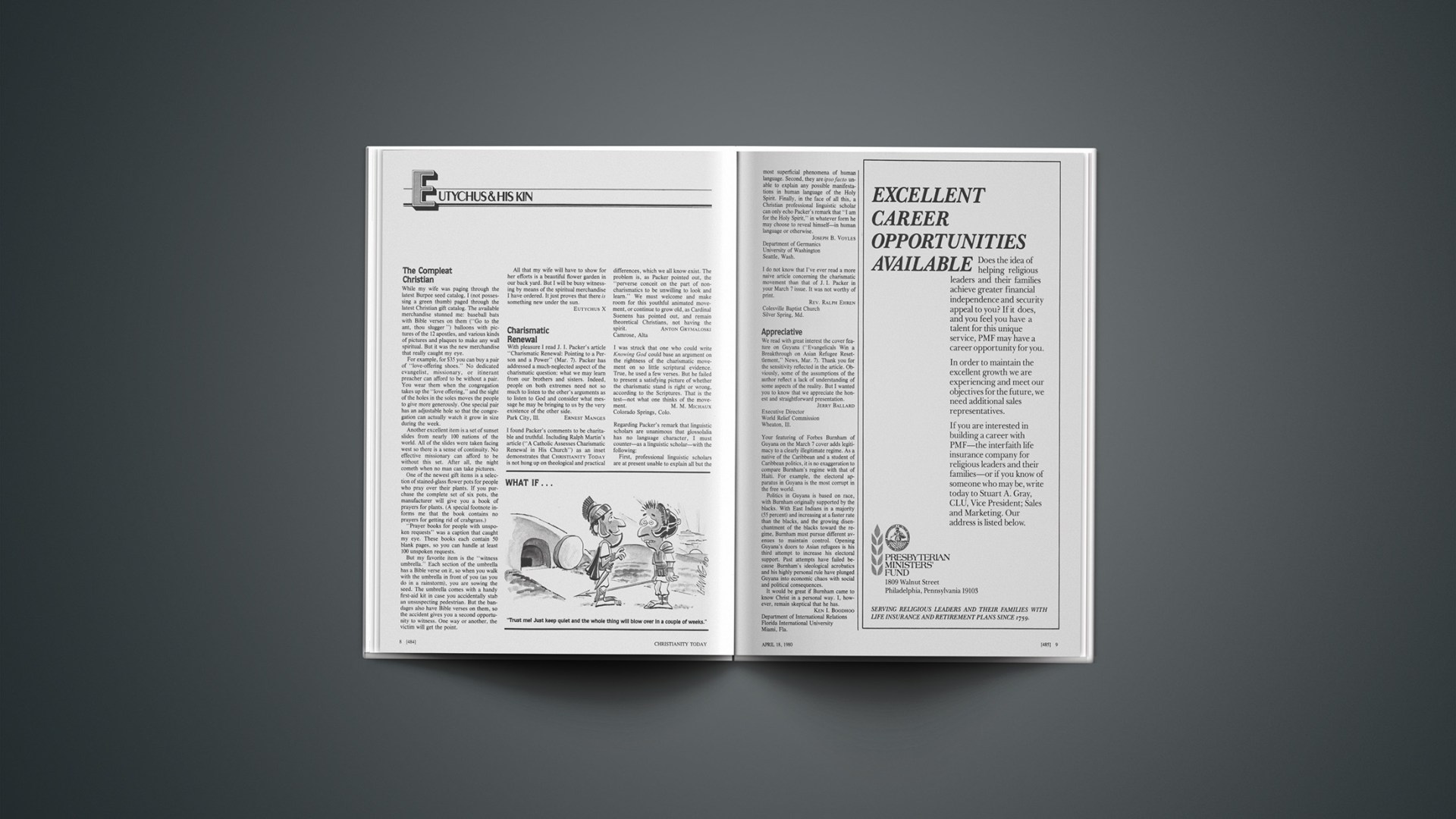

Eutychus and His Kin: April 18, 1980

The Compleat Christian

While my wife was paging through the latest Burpee seed catalog, I (not possessing a green thumb) paged through the latest Christian gift catalog. The available merchandise stunned me: baseball bats with Bible verses on them (“Go to the ant, thou slugger”) balloons with pictures of the 12 apostles, and various kinds of pictures and plaques to make any wall spiritual. But it was the new merchandise that really caught my eye.

For example, for $35 you can buy a pair of “love-offering shoes.” No dedicated evangelist, missionary, or itinerant preacher can afford to be without a pair. You wear them when the congregation takes up the “love offering,” and the sight of the holes in the soles moves the people to give more generously. One special pair has an adjustable hole so that the congregation can actually watch it grow in size during the week.

Another excellent item is a set of sunset slides from nearly 100 nations of the world. All of the slides were taken facing west so there is a sense of continuity. No effective missionary can afford to be without this set. After all, the night cometh when no man can take pictures.

One of the newest gift items is a selection of stained-glass flower pots for people who pray over their plants. If you purchase the complete set of six pots, the manufacturer will give you a book of prayers for plants. (A special footnote informs me that the book contains no prayers for getting rid of crabgrass.)

“Prayer books for people with unspoken requests” was a caption that caught my eye. These books each contain 50 blank pages, so you can handle at least 100 unspoken requests.

But my favorite item is the “witness umbrella.” Each section of the umbrella has a Bible verse on it, so when you walk with the umbrella in front of you (as you do in a rainstorm), you are sowing the seed. The umbrella comes with a handy first-aid kit in case you accidentally stab an unsuspecting pedestrian. But the bandages also have Bible verses on them, so the accident gives you a second opportunity to witness. One way or another, the victim will get the point.

All that my wife will have to show for her efforts is a beautiful flower garden in our back yard. But I will be busy witnessing by means of the spiritual merchandise I have ordered. It just proves that there is something new under the sun.

EUTYCHUS X

Charismatic Renewal

With pleasure I read J. I. Packer’s article “Charismatic Renewal: Pointing to a Person and a Power” (Mar. 7). Packer has addressed a much-neglected aspect of the charismatic question: what we may learn from our brothers and sisters. Indeed, people on both extremes need not so much to listen to the other’s arguments as to listen to God and consider what message he may be bringing to us by the very existence of the other side.

ERNEST MANGES

Park City, Ill.

I found Packer’s comments to be charitable and truthful. Including Ralph Martin’s article (“A Catholic Assesses Charismatic Renewal in His Church”) as an inset demonstrates that CHRISTIANITY TODAY is not hung up on theological and practical differences, which we all know exist. The problem is, as Packer pointed out, the “perverse conceit on the part of noncharismatics to be unwilling to look and learn.” We must welcome and make room for this youthful animated movement, or continue to grow old, as Cardinal Suenens has pointed out, and remain theoretical Christians, not having the spirit.

ANTON GRYMALOSKI

Camrose, Alta

I was struck that one who could write Knowing God could base an argument on the rightness of the charismatic movement on so little scriptural evidence. True, he used a few verses. But he failed to present a satisfying picture of whether the charismatic stand is right or wrong, according to the Scriptures. That is the test—not what one thinks of the movement.

M. M. MICHAUX

Colorado Springs, Colo.

Regarding Packer’s remark that linguistic scholars are unanimous that glossolalia has no language character, I must counter—as a linguistic scholar—with the following:

First, professional linguistic scholars are at present unable to explain all but the most superficial phenomena of human language. Second, they are ipso facto unable to explain any possible manifestations in human language of the Holy Spirit. Finally, in the face of all this, a Christian professional linguistic scholar can only echo Packer’s remark that “I am for the Holy Spirit,” in whatever form he may choose to reveal himself—in human language or otherwise.

JOSEPH B. VOYLES

Department of Germanics

University of Washington

Seattle, Wash.

I do not know that I’ve ever read a more naive article concerning the charismatic movement than that of J. I. Packer in your March 7 issue. It was not worthy of print.

REV. RALPH EHREN

Colesville Baptist Church

Silver Spring, Md.

Appreciative

We read with great interest the cover feature on Guyana (“Evangelicals Win a Breakthrough on Asian Refugee Resettlement,” News, Mar. 7). Thank you for the sensitivity reflected in the article. Obviously, some of the assumptions of the author reflect a lack of understanding of some aspects of the reality. But I wanted you to know that we appreciate the honest and straightforward presentation.

JERRY BALLARD

Executive Director

World Relief Commission Wheaton, Ill.

Your featuring of Forbes Burnham of Guyana on the March 7 cover adds legitimacy to a clearly illegitimate regime. As a native of the Caribbean and a student of Caribbean politics, it is no exaggeration to compare Burnham’s regime with that of Haiti. For example, the electoral apparatus in Guyana is the most corrupt in the free world.

Politics in Guyana is based on race, with Burnham originally supported by the blacks. With East Indians in a majority (55 percent) and increasing at a faster rate than the blacks, and the growing disenchantment of the blacks toward the regime, Burnham must pursue different avenues to maintain control. Opening Guyana’s doors to Asian refugees is his third attempt to increase his electoral support. Past attempts have failed because Burnham’s ideological acrobatics and his highly personal rule have plunged Guyana into economic chaos with social and political consequences.

It would be great if Burnham came to know Christ in a personal way. I, however, remain skeptical that he has.

KEN I. BOODHOO

Department of International Relations Florida International University

Miami, Fla.

Editor’s Note from April 18, 1980

“Where Have All the Heroes Gone?” was the title of an article that recently crossed my desk. These days Christian organizations have quit looking for heroes. Even a moderately effective leader would satisfy them and they settle for mediocrity, grateful for a minimum of brilliance and a maximum of security. Leith Anderson has recently completed the arduous task of locating a president for a major evangelical institution. Now, with the agony behind him and laurels resting lightly on his brow, he shares with other evangelicals the secret of his success, via this issue’s Minister’s Workshop, as they search desperately for individuals with that elusive quality we call leadership.

In this issue we look at television and its influence on our American culture. We also introduce a new, occasional feature that explores the potential of educational media for communicating the Christian message. We review some films, filmstrips, and other audio-visual aids from the plethora of materials now available. This growing area is both encouraging and disheartening: encouraging because it places an extensive, powerful tool in the hands of church leaders; disheartening because the very abundance is represented by extremes in quality and poses a nearly insurmountable range of choices for the discriminating education director. We want to continue or expand this feature if readers find these reviews helpful.

Finally, Robert Johnston addresses a theme of perennial importance: How may we evangelicals seek unity in the midst of our diversity? With every passing day the scandal of evangelical diversity becomes more and more threatening. And accordingly, a measure of biblical and rational unity becomes increasingly necessary for the health of the church.

History
Today in Christian History

April 18

January
February
March
April
May
June
July
August
September
October
November
December
<>

April 18, 1161: Theobald, Archbishop of Canterbury, dies. He repeatedly quarreled with his superiors about church appointments and other political questions, but he the influential French abbot Bernard of Clairvaux supported him. Theobald helped strengthen the English church and build the career of Thomas Becket, whom he recommended as chancellor to England’s newly crowned King Henry.

April 18, 1587: English Protestant historian John Foxe, author of Actes and Monuments of Matters Happenning to the Church (the shorter version is now known as Foxe’s Book of Martyrs), dies at age 71 (see issue 72: How We Got Our History).

April 18, 1874: Having died nearly a year earlier (May 1, 1873) in what is now northern Zambia, missionary-explorer David Livingstone (whose remains had been brought, as his tombstone reads, “by faithful hands over land and sea”) is interred in London’s Westminster Abbey (see issue 56: David Livingstone).

History
Today in Christian History

April 17

January
February
March
April
May
June
July
August
September
October
November
December
<>

April 17, 1492: Spain’s King Ferdinand and Queen Isabella give Christopher Columbus a commission to seek a westward ocean passage to Asia. Though he was also interested in wealth, Columbus saw himself as a “Christ-bearer” who would carry Christ across the ocean to people who had never heard the gospel (see issue 35: Christopher Columbus).

April 17, 1708: Ambrose, Archbishop of Moscow from 1768-1771 is born. In 1771, in the middle of an outbreak of the plague, Ambrose (who is known for his translations of the Hebrew psalter and some Greek and Latin fathers) was martyred by a mob when he removed an icon from the church to prevent the spread of infection.

April 17, 1937: With Mussolini’s troops occupying Ethiopia, Sudan Interior Mission missionaries who had started a small church among the previously devil-worshiping Wallamo tribe are forced to leave the country. “We knew God was faithful,” one missionary wrote. “But still we wondered—if we ever come back, what will we find?” The missionaries returned in July 1943 to find that, despite severe persecution by Italian soldiers, the Christian community had grown from 48 members to 18,000.

History
Today in Christian History

April 16

January
February
March
April
May
June
July
August
September
October
November
December
<>

April 16, 1521: German reformer Martin Luther arrives at the Diet of Worms, convinced he would get the hearing he requested in 1517 to discuss the abuse of indulgences and his “95 Theses.” He was astounded when he discovered it would not be a debate, but rather a judicial hearing to see if he wished to recant his words. In defending himself the next day, Luther said, “Unless I can be instructed and convinced with evidence from the Holy Scriptures or with open, clear, and distinct grounds of reasoning . . . then I cannot and will not recant, because it is neither safe nor wise to act against conscience. Here I stand. I can do no other. God help me! Amen!” When negotiations over the next few days failed to reach any compromise, Luther was condemned (see issue 34: Luther’s Early Years).

April 16, 1879: Bernadette Soubirous, who at age 14 became famous for her visions of the Virgin Mary at Lourdes, dies in Nevers, France. In 1933 the Roman Catholic church declaired her a saint.

History
Today in Christian History

April 15

January
February
March
April
May
June
July
August
September
October
November
December
<>

April 15, 1415: Jerome of Prague, a friend of Bohemian reformer Jan Hus, is seized by church authorities meeting at the Council of Constance. Under duress, Jerome recanted his Wycliffe-influenced beliefs and accepted the authority of the pope. However, when a crowd was assembled to hear him repeat the recantation, he changed his speech and eloquently defended both Wycliffe's teachings and the recently executed Hus. Jerome was subsequently burned at the stake (see issue 68: Jan Hus).

April 15, 1452: Italian painter and scholar Leonardo da Vinci is born in Florence, Italy. Among his most famous religious works are the Virgin of the Rocks, The Last Supper, and St. John the Baptist.

April 15, 1638: The castle of Hara, located on the Shimabara Peninsula, Japan, falls to Tokugawa Shogunate forces. Catholic leader Amakusa Shiro Tokisada defended the fortress with 27,000 Christians, over 14,000 of them combatants. They fought valiantly to the end—even the women and children. After the battle, all of the survivors were subsequently beheaded, save one Judas (Yamada) who had plotted to open the castle gate to the enemy.

April 15, 1729: Johann Bach conducts the first and only performance of St. Matthew Passion during his lifetime at a Good FriDay Vespers service in Leipzig, Germany. The choral work has been called "the supreme cultural achievement of all Western civilization," and even the radical skeptic Friedrich Nietzsche (1844-1900) admitted upon hearing it, "One who has completely forgotten Christianity truly hears it here as gospel.

April 15, 1889: Belgian Roman Catholic priest Joseph Damien, a missionary to lepers on Molokai, Hawaii, dies from the disease.

April 15, 1892: Dutch devotional writer Corrie ten Boom, known for hiding Jewish refugees in her home during World War II (an act dramatized in the 1971 film The Hiding Place) is born. She also died on this date in 1983.

History
Today in Christian History

April 14

January
February
March
April
May
June
July
August
September
October
November
December
<>

April 14, 1759: George Frideric Handel, composer of the oratorio Messiah, dies at age 74 in London.

April 14, 1775: America’s first society to abolish slavery organizes in Philadelphia.

History
Today in Christian History

April 13

January
February
March
April
May
June
July
August
September
October
November
December
<>

April 13, 655 (traditional date): Martin, pope from 649 to 655, dies in banishment. History remembers him as the last pope venerated as a martyr.

April 13, 1534: Sir Thomas More, Lord Chancellor of England, refuses to take the oath to the English succession. One year later, Henry VIII indicted him for treason and had him beheaded.

April 13, 1598: France’s Henry IV signs the Edict of Nantes, granting extensive political rights to the Huguenots (a Protestant group he once belonged to). The Huguenots retained the right to practice their religion until Louis XIV revoked the edict in 1685 (see issue 71: Huguenots).

April 13, 1742: Handel’s famous oratorio Messiah premieres in Dublin’s Fishamble Street Musick Hall and is met with critical praise.

April 13, 1829: In the Emancipation Act, the English Parliament grants freedom of religion to Roman Catholics. Within three weeks, the first Catholic was elected to Parliament.

April 13, 1986: Pope John Paul II visits a Jewish synagogue in Rome, marking the first such visit by a pope in recorded history.

History
Today in Christian History

April 12

January
February
March
April
May
June
July
August
September
October
November
December
<>

April 12, 1204: The Fourth Crusade sacks Constantinople, an allied city. The attack virtually destroyed the Byzantine Empire and ruined any hope of reunifying eastern and western Christians (see issue 40: The Crusades).

April 12, 1850: Adoniram Judson, pioneer Baptist missionary to India and Burma, and Bible translator, dies during a sea voyage. He and his wife, Ann, were the foremost American missionary heroes of their day.

April 12, 1914: A convention in Hot Springs, Arkansas, having founded the Assemblies of God adjourns. The assembly of God which would become the world's largest Pentecostal denomination (see issue 58: Pentecostalism).

April 12, 1944: The National Religious Broadcasters Association is founded in Columbus, Ohio, in order to represent and build the credibility of Evangelical Christian broadcasters after a set of regulations, proposed by the Federal Council of Churches, banned paid religious programming and limited broadcast personalities to denominationally approved individuals, effectively removing Evangelicals from the airwaves.

Apple PodcastsDown ArrowDown ArrowDown Arrowarrow_left_altLeft ArrowLeft ArrowRight ArrowRight ArrowRight Arrowarrow_up_altUp ArrowUp ArrowAvailable at Amazoncaret-downCloseCloseEmailEmailExpandExpandExternalExternalFacebookfacebook-squareGiftGiftGooglegoogleGoogle KeephamburgerInstagraminstagram-squareLinkLinklinkedin-squareListenListenListenChristianity TodayCT Creative Studio Logologo_orgMegaphoneMenuMenupausePinterestPlayPlayPocketPodcastRSSRSSSaveSaveSaveSearchSearchsearchSpotifyStitcherTelegramTable of ContentsTable of Contentstwitter-squareWhatsAppXYouTubeYouTube