History
Today in Christian History

April 11

January
February
March
April
May
June
July
August
September
October
November
December
<>

April 11, 1079: Stanislaus, Polish bishop of Krakow, is martyred. Whether or not he attempted to overthrow King Boleslaw II (called Boleslaw the Cruel) is debatable; he certainly excommunicated the evil king. In return, Boleslaw deemed him a traitor and had Stanislaus murdered.

April 11, 1506: Pope Julius II lays the foundation for the new St. Peter’s Basilica in Rome. Builders delayed its completion until 1626 due to its immense cost, size, and other factors. Indulgences sold to fund the construction drew criticism from Protestant reformers, most memorably Martin Luther (see issue 34: Luther’s Early Years).

April 11, 1836: George Mueller, leader of the Plymouth Brethren movement, opens his famous orphanage on Wilson Street in Bristol. By 1875, Mueller’s orphanage provided care for over 2,000 children, a work sustained not by regular fundraising but by thousands of “answers to prayer.

History
Today in Christian History

April 10

January
February
March
April
May
June
July
August
September
October
November
December
<>

April 10, 428: Nestorius is consecrated bishop of Constantinople. Almost immediately, Nestorius began attacking the term "Theotokos" (God-bearer) to describe the Virgin Mary. "It is impossible that God should be born of a woman," he said, suggesting Christotokos (Christ-bearer) instead. He did not deny Jesus' nature as God but simply felt that the term challenged the reality of Christ's human nature. Though the church denounced Nestorius as a heretic, modern theologians think the label may have been too harsh (see issue 51: Heresy in the Early Church).

April 10, 1829: English evangelist William Booth, founder and first general of the Salvation Army, is born in Nottingham. In 1865, Booth and his wife, Catherine, set out to reach the desperate poor and unchurched by conducting open-air meetings with lively music; preaching in theaters, bars, and jails; and creating large-scale plans to relieve poverty. His organization launched what became one of the most successful religious revivals in the modern era (see issue 26: William and Catherine Booth).

History
Today in Christian History

April 9

January
February
March
April
May
June
July
August
September
October
November
December
<>

April 9, 1626: English philosopher of science Sir Francis Bacon dies. After a dizzying rise to political power (he was named lord chancellor in 1618) and a bribery scandal, Bacon retired to writing. He introduced the essay form to the English language and wrote The New Atlantis, which mixed his scientific approach and his Christian beliefs. "Knowledge is the rich storehouse for the glory of the Creator and the relief of man's estate," he wrote. "A little philosophy inclineth man's mind to atheism, but depth in philosophy bringeth men's minds about to religion" (see issue 76: Christian Face of the Scientific Revolution).

April 9, 1761: English devotional writer William Law dies. His writings, such as A Serious Call to a Devout and Holy Life, greatly influenced George Whitefield and John Wesley though they later distanced themselves when Law wrote of the indwelling of Christ in the soul.

April 9, 1816: Richard Allen and others organize the African Methodist Episcopal Church in Philadelphia. The next day he was named the denomination's first bishop, thereby becoming the first black bishop in the United States. A few years earlier, Allen and his colleagues had left the Methodist Episcopal Church when it removed blacks from "white" seats during prayer (see issue 62: Bound for Canaan).

April 9, 1906: In Los Angeles, Holiness minister William Seymour and several associates experience what they called the "baptism of the Spirit," marked by speaking in tongues. This launched the three-year "Azusa Street Revival," considered the first major public event of Pentecostalism (see issue 58: Pentecostalism and issue 65: The Ten Most Influential Christians of the Twentieth Century).

April 9, 1945: The Gestapo hangs German theologian Dietrich Bonhoeffer, after discovering his involvement in a failed plot to assassinate Adolf Hitler. Bonhoeffer's last recorded words were, "This is the end—for me, the beginning of life" (see issue 32: Dietrich Bonhoeffer).

History
Today in Christian History

April 8

January
February
March
April
May
June
July
August
September
October
November
December
<>

April 8, 1378: Bartolomeo Prignano is elected Pope Urban VI. Mired in political controversy even before his election (threats from masses of violent demonstrators helped drive his election), his violent demeanor did little to contradict rumors that he was insane. His electors conspired to leave Rome and name a new pope (Clement VII), starting the Great Western Schism.

April 8, 1546: At its fourth session, the Council of Trent adopts Jerome’s Latin translation of the Bible (called the Vulgate), completed in 405, as the only authentic Latin text of the Scriptures. It became the official Bible of the Roman Catholic Church (see issue 43: How We Got Our Bible).

April 8, 1857: A small group of Dutch immigrants, meeting in Zeeland, Michigan, organize the Christian Reformed Church.

April 8, 1901: After nearly 30 years of successful church planting in New Guinea, Presbyterian missionary James Chalmers (accompanied by missionary Oliver Tomkins, who had just arrived in the field) sets out to explore a new part of the islands. No one ever saw the two again. A rescue party learned the men had been clubbed to death and eaten by cannibals. When London preacher Joseph Parker heard the news, he exclaimed, “I do not want to believe it! Such a mystery of Providence makes it hard for our strained faith to recover. Yet Jesus was murdered. Paul was murdered … I cannot but feel that our honored and nobleminded friend has joined a great assembly.

History
Today in Christian History

April 7

January
February
March
April
May
June
July
August
September
October
November
December
<>

April 7, 1199: England’s King Richard I, the “Lionhearted,” dies at age 41. Richard, as one of the three leaders of the Third Crusade, negotiated Christian access to Jerusalem (see issue 40: The Crusades).

April 7, 1498: Franciscan friars arrange an “ordeal by fire” in Florence to settle the dispute between reforming preacher Jerome Savonarola and Pope Alexander VI. Alexander had excommunicated Savonarola for preaching against papal corruption; Savonarola responded by calling for the pope to step down. If Savonarola’s friend Fra Domenico could walk safely between two walls of fire, God was supposedly on the Florentine city-manager’s side. But Savonarola never sent Domenico out. The crowd rioted, Savonarola’s power crumbled, and he was soon arrested, tortured, and executed.

April 7, 1541: On his thirty-fifth birthday, Francis Xavier, cofounder of the Society of Jesus (Jesuits), sets sail from Lisbon, Portugal, for Goa, India. The first Roman Catholic missionary there, he also traveled to Japan, Sri Lanka, and other countries in Asia. It is hard to say how many people Xavier, the Roman Catholic patron saint of all missions, converted; the figure goes as high as 1 million, but modern scholars peg the number around 30,000. Jesuits claim 700,000.

History
Today in Christian History

April 6

January
February
March
April
May
June
July
August
September
October
November
December
<>

April 6, 1249: Muslims take King Louis IX of France prisoner during the seventh crusade, which was supposed to overcome the Muslim political center in Egypt. After showing bravery in the face of torture, he was allowed to buy his freedom for a huge sum in gold—and the city of Damietta (see issue 40: The Crusades and issue 74: Christians & Muslims).

April 6, 1528: Albrecht Durer, German painter, engraver, and designer of woodcuts, dies. Famous for his religious scenes, he may have been so influenced by Luther (whom he called “the great Christian man who has helped me out of great anxieties”) that he converted to Protestantism. His most popular work is “Praying Hands.

April 6, 1801: The General Conference of the Methodist Episcopal Church recognizes the new African Methodist Episcopal Church (AME). Blacks who were denied membership and/or recognition within white Methodist churches, particularly in Philadelphia and New York, formed the original AME (see issue 62: Bound for Canaan).

April 6, 1932: Eric Liddell, the Olympic athlete featured in the film Chariots of Fire, makes his evangelistic debut by sharing his testimony to a group of men in Armadale, Scotland. Liddell later returned to the mission field in China, where he was born, and ministered in an internment camp following the Japanese invasion. He died in 1945 from a massive brain tumor.

History
Today in Christian History

April 5

January
February
March
April
May
June
July
August
September
October
November
December
<>

April 5, 1524: Swiss reformer Ulrich Zwingli marries Anna Reinhart for the second time—this time in public. In 1522, Zwingli (and 10 other priests) appealed to the bishop of Constance for permission to marry. When the bishop refused the petition, Zwingli married secretly and, later that year, resigned from the priesthood (see issue 4: Ulrich Zwingli).

April 5, 1649: John Winthrop, the first governor of Massachusetts Bay, dies. Profoundly religious, Winthrop, who left England because of its persecution of Puritans, believed New England to be “a city upon a hill” for the world to see and emulate (see issue 41: The American Puritans).

April 5, 1811: Robert Raikes, founder of English Sunday schools in 1780, dies. Raikes built his Sunday schools not for respectable and well-mannered children of believers, but for (in one woman’s description) “multitudes of wretches who, released on that day from employment, spend their day in noise and riot.” In 4 years, 250,000 students were attending the schools, by Raikes’s death, 500,000, and by 1831, 1.25 million(see issue 53: William Wilberforce).

As If It Were up to Us

God’s sovereignty exists apart from any human collaboration, and from that we can take heart.

When i opened my diary at 1980 1 knew there was something special about it, but that fugitive thought led me a merry dance. 1980. Bachelors beware (Gregory XIII was not your friend). The one-hundred-second rchbishop of Canterbury takes office. 1,460 days to Orwell. All true, but irrelevant.

I tried centenaries but 1980 is light on such. Thomas à Kempis would have been 600, Thomas Chalmers 200, Homer Rodeheaver 100.

Then I nailed it. Summer 1964. The British Faith and Order Conference at Nottingham had prophesied great things for 1980. I have two chief memories of that 1964 occasion. One was of singing “For All the Saints” when suddenly I was beset by a bout of free-ranging imagination. Looking at the spacious upper reaches of Nottingham University’s Great Hall, I sensed that they were crammed with a celestial company looking down on us and perhaps wondering how much we meant it. I am no mystic (no one will challenge that), but the exhilarating vision persisted until rude recollection came that heaven, alas, was no longer “up there.” I’ll never forgive the erstwhile bishop of Woolwich for that.

It was the second memory that concerned 1980. From one of the conference subsections came what Norman Goodall called a “splendidly irrational symbol,” later embodied in resolutions passed by a large majority. Here are the first two: “United in our urgent desire for One Church Renewed for Mission, this conference invites the member Churches of the British Council of Churches, in appropriate groupings, such as by nations, to covenant together to work and pray for the inauguration of union by a date agreed among them.

“We dare to hope that this date should not be later than Easter Day, 1980. We believe that we should offer obedience to God in a commitment as decisive as this.”

Most denominational leaders supported the plan (the archbishop in Wales was a rare exception). Considering that 20 denominations were represented at Nottingham, this was indeed a remarkable result.

There were other memorable aspects of that gathering. Its chairman, Dr. Oliver Tomkins, bishop of Bristol, stressed that unity was not necessarily a good thing in itself—“the massive merger of unrepentant, unrenewed, self-regarding ‘denominations’ would be a disaster” and could not happen, for his Satanic Majesty, the Author of Confusion, would have overreached himself. The real fiasco, continued the bishop, “could lie in our going away unchanged, deaf to the Spirit and blind to each other.”

On the same theme, World Council of Churches general secretary Dr. W. A. Visser’t Hooft said that our apparent deadlock on church unity must remind us that unity is not man-made but God-given, that “we are receivers, not creators. So we must get rid of all pride, stop talking about our great churches with their impressive history, forget church statistics which are anyway notoriously misleading, and come together as what we really are: beggars who depend wholly on the grace of God.”

Archbishop of Canterbury Michael Ramsey expressed the hope that there would emerge “a new awareness of a missionary scene … of Christ weeping over the city which does not know the things which belong to its peace; the unbelief, the apathy, the moral chaos, the spectacle of eternal loss.”

Sixteen years have passed. All three of those speakers have retired, and it is as though their words had never been. The covenant subscribed by such a large majority at Nottingham has been forgotten. And here we are at Easter 1980. A few remember Nottingham, but otherwise the Waters of Lethe have done their fell work. And when I think now of the enthusiastic assembly I can’t help applying to it those splendidly irreverent words:

Hans Breitmann gife a barty–

Vhere ish dat barty now?

Only 2 of the 20 denominations at Nottingham have got together: in 1972, English and Welsh Congregationalists merged with English Presbyterians and became the 200,000-strong United Reformed Church. Not all agreed to the unión, though; some opted to remain Congregationalists, and two Presbyterian congregations in the Channel Islands retained that polity by improbably (see a map) joining the Church of Scotland.

The post-Nottingham scene was otherwise bleak. Dating between churches has not been repeated, going steady has come to nothing, engagements have been broken off, one of them just before wedding day. Despite the backing of both archbishops, the Church of England turned down union with the Methodists. Scottish Methodists declined union with the Church of Scotland. Anglican-Presbyterian talks were again broken off, foundering on the rock of the historic episcopate. Within the transdenominational evangelical ranks, Church of England representatives insensitively gave the impression of having decided to concentrate on their own church’s affairs. From a section of non-Anglican evangelicaldom had earlier come an appeal for those in mainline denominations to leave their guilty associations. And as if the Nottingham 1964 resolutions were not sufficiently in ruins the World Council of Churches fanned the flames of dissension by the hamfisted way it was operating its Programme to Combat Racism.

Reflecting on all this, one might be forgiven for concluding that the Author of Confusion had orchestrated his diabolical symphony just right. In 1980, as an Anglican dean points out, 90 percent of English people are not regular members of any worshiping community. Here in Saint Andrews, the old ecclesiastical capital of Scotland where John Knox once ministered, town and gown between them can muster no more than a 10 percent attendance at worship on an average Sunday. One has to go to Northern Ireland to see enthusiastic British churchgoing!

I am uneasy about such a dismal recital, and conscious that faithful witness to Christ is continuing in this nation, deserving of an article in itself. I tried to sum up my views on the foregoing:

1. The Bible does not call for organic unity.

2. Headcounting is no sort of reflection of the extent of Christ’s victory.

3. Why am I surprised that the love of many is waxing cold (that’s biblical)?

4. God is working his purpose out. In William Temple’s words, “While we deliberate, He reigns; when we decide wisely … (or) foolishly, He reigns; when we serve Him self-assertively … (or) rebel, He reigns—the Alpha and the Omega which is, and which was, and which is to come, the Almighty.” To believe that is to go unafraid into the 1980s.

J. D. Douglas is an author and journalist living in Saint Andrews, Scotland.

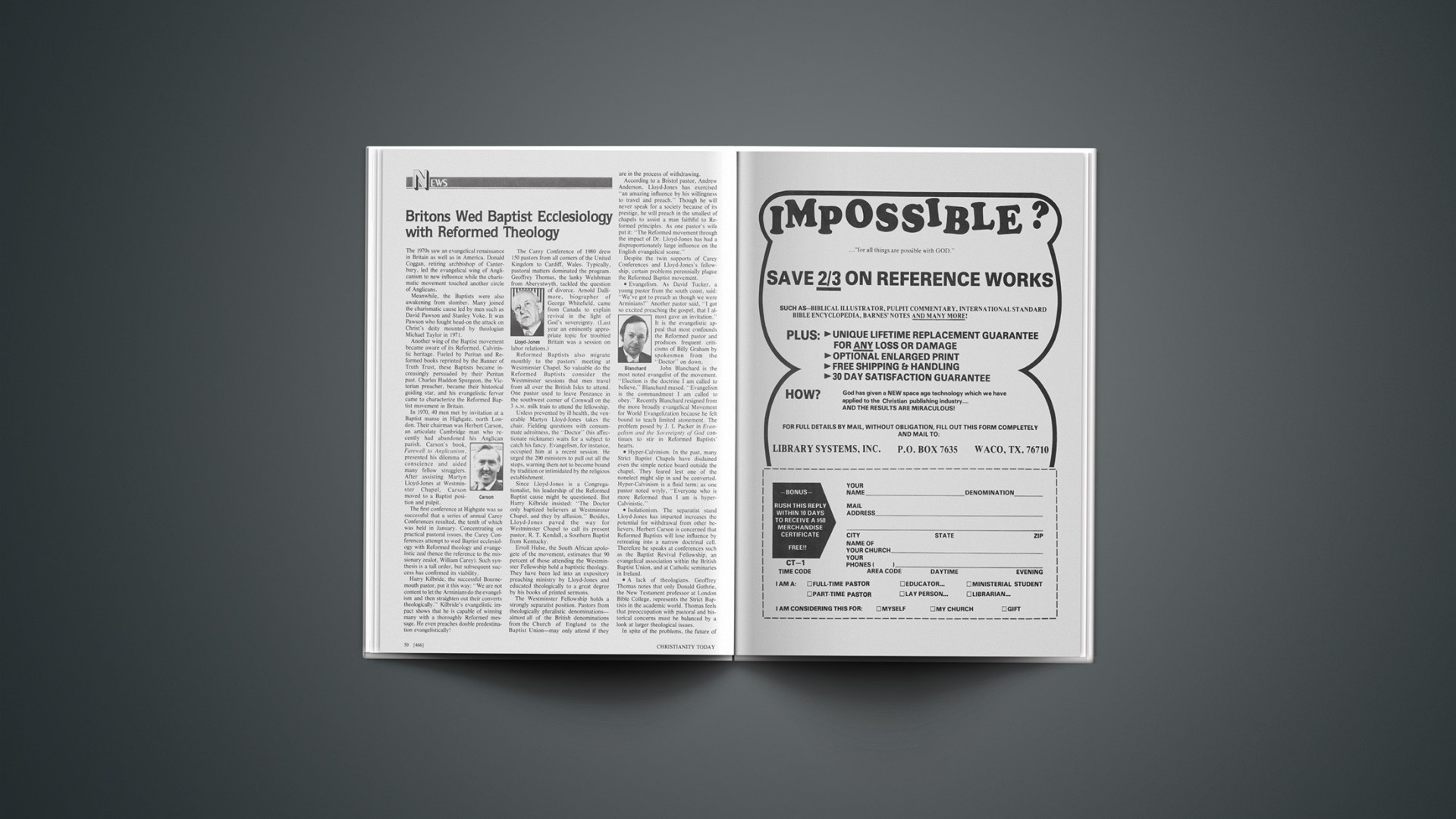
Britons Wed Baptist Ecclesiology with Reformed Theology

The 1970s saw an evangelical renaissance in Britain as well as in America. Donald Coggan, retiring archbishop of Canterbury, led the evangelical wing of Anglicanism to new influence while the charismatic movement touched another circle of Anglicans.

Meanwhile, the Baptists were also awakening from slumber. Many joined the charismatic cause led by men such as David Pawson and Stanley Voke. It was Pawson who fought head-on the attack on Christ’s deity mounted by theologian Michael Taylor in 1971.

Another wing of the Baptist movement became aware of its Reformed, Calvinistic heritage. Fueled by Puritan and Reformed books reprinted by the Banner of Truth Trust, these Baptists became increasingly persuaded by their Puritan past. Charles Haddon Spurgeon, the Victorian preacher, became their historical guiding star, and his evangelistic fervor came to characterize the Reformed Baptist movement in Britain.

In 1970, 40 men met by invitation at a Baptist manse in Highgate, north London. Their chairman was Herbert Carson, an articulate Cambridge man who recently had abandoned his Anglican parish. Carson’s book, Farewell to Anglicanism, presented his dilemma of conscience and aided many fellow strugglers. After assisting Martyn Lloyd-Jones at Westminster Chapel, Carson moved to a Baptist position and pulpit.

The first conference at Highgate was so successful that a series of annual Carey Conferences resulted, the tenth of which was held in January. Concentrating on practical pastoral issues, the Carey Conferences attempt to wed Baptist ecclesiology with Reformed theology and evangelistic zeal (hence the reference to the missionary zealot, William Carey). Such synthesis is a tall order, but subsequent success has confirmed its viability.

Harry Kilbride, the successful Bournemouth pastor, put it this way: “We are not content to let the Arminians do the evangelism and then straighten out their converts theologically.” Kilbride’s evangelistic impact shows that he is capable of winning many with a thoroughly Reformed message. He even preaches double predestination evangelistically!

The Carey Conference of 1980 drew 150 pastors from all corners of the United Kingdom to Cardiff, Wales. Typically, pastoral matters dominated the program. Geoffrey Thomas, the lanky Welshman from Aberystwyth, tackled the question of divorce. Arnold Dallimore, biographer of George Whitefield, came from Canada to explain revival in the light of God’s sovereignty. (Last year an eminently appropriate topic for troubled Britain was a session on labor relations.)

Reformed Baptists also migrate monthly to the pastors’ meeting at Westminster Chapel. So valuable do the Reformed Baptists consider the Westminster sessions that men travel from all over the British Isles to attend. One pastor used to leave Penzance in the southwest corner of Cornwall on the 3 A.M. milk train to attend the fellowship.

Unless prevented by ill health, the venerable Martyn Lloyd-Jones takes the chair. Fielding questions with consummate adroitness, the “Doctor” (his affectionate nickname) waits for a subject to catch his fancy. Evangelism, for instance, occupied him at a recent session. He urged the 200 ministers to pull out all the stops, warning them not to become bound by tradition or intimidated by the religious establishment.

Since Lloyd-Jones is a Congregationalist, his leadership of the Reformed Baptist cause might be questioned. But Harry Kilbride insisted: “The Doctor only baptized believers at Westminster Chapel, and they by affusion.” Besides, Lloyd-Jones paved the way for Westminster Chapel to call its present pastor, R. T. Kendall, a Southern Baptist from Kentucky.

Erroll Hulse, the South African apologete of the movement, estimates that 90 percent of those attending the Westminster Fellowship hold a baptistic theology. They have been led into an expository preaching ministry by Lloyd-Jones and educated theologically to a great degree by his books of printed sermons.

The Westminster Fellowship holds a strongly separatist position. Pastors from theologically pluralistic denominations—almost all of the British denominations from the Church of England to the Baptist Union—may only attend if they are in the process of withdrawing.

According to a Bristol pastor, Andrew Anderson, Lloyd-Jones has exercised “an amazing influence by his willingness to travel and preach.” Though he will never speak for a society because of its prestige, he will preach in the smallest of chapels to assist a man faithful to Reformed principles. As one pastor’s wife put it: “The Reformed movement through the impact of Dr. Lloyd-Jones has had a disproportionately large influence on the English evangelical scene.”

Despite the twin supports of Carey Conferences and Lloyd-Jones’s fellowship, certain problems perennially plague the Reformed Baptist movement.

• Evangelism. As David Tucker, a young pastor from the south coast, said: “We’ve got to preach as though we were Arminians!” Another pastor said, “I got so excited preaching the gospel, that I almost gave an invitation.” It is the evangelistic appeal that most confounds the Reformed pastor and produces frequent criticisms of Billy Graham by spokesmen from the “Doctor” on down.

John Blanchard is the most noted evangelist of the movement. “Election is the doctrine I am called to believe,” Blanchard mused. “Evangelism is the commandment I am called to obey.” Recently Blanchard resigned from the more broadly evangelical Movement for World Evangelization because he felt bound to teach limited atonement. The problem posed by J. I. Packer in Evangelism and the Sovereignty of God continues to stir in Reformed Baptists’ hearts.

• Hyper-Calvinism. In the past, many Strict Baptist Chapels have disdained even the simple notice board outside the chapel. They feared lest one of the nonelect might slip in and be converted. Hyper-Calvinism is a fluid term; as one pastor noted wryly, “Everyone who is more Reformed than I am is hyper-Calvinistic.”

• Isolationism. The separatist stand Lloyd-Jones has imparted increases the potential for withdrawal from other believers. Herbert Carson is concerned that Reformed Baptists will lose influence by retreating into a narrow doctrinal cell. Therefore he speaks at conferences such as the Baptist Revival Fellowship, an evangelical association within the British Baptist Union, and at Catholic seminaries in Ireland.

• A lack of theologians. Geoffrey Thomas notes that only Donald Guthrie, the New Testament professor at London Bible College, represents the Strict Baptists in the academic world. Thomas feels that preoccupation with pastoral and historical concerns must be balanced by a look at larger theological issues.

In spite of the problems, the future of Reformed Baptists seems assured. Throughout Britain large, urban churches are being drawn into the Reformed orbit. According to Erroll Hulse, “a network of distinctively Reformed churches of various denominations, mostly Baptist or Independent, covers the entire land.” Notable among these are Westminster Chapel, London; The Heath Evangelical Church, Cardiff; Lansdowne Baptist Church, Bournemouth; and Charlotte Chapel, Edinburgh.

Even the historic Reformed Baptist groups are uniting. Last October the Strict Baptists got together with the Particular Baptists under the chairmanship of Geoffrey Thomas. As a result, the Grace Baptist Assembly was formed, embracing 80 churches committed to the Reformed position.

The surge is fired by a Thomas group of unusually persuasive preachers. The key to Reformed Baptist survival and success seems to be believing like the Puritans and preaching like the Wesleyans.

Oceania

Church Stance Helps Win New Hebrides Self-rule

The South Pacific Islands of New Hebrides become independent in May, largely due to the political involvement of Protestant church leaders over the past seven years. The new Chief Minister in the House of Assembly is Walter Lini, an Anglican priest, president of the New Hebrides National Party since 1974.

Another prominent figure in the struggle for independence has been chief Fred Timakata, a Presbyterian minister who became vice-president of the NHNP while serving as clerk of the General Assembly of his church.

The new name for the independent country will be Vanuaatu, which means “a country that has stood alone, and will continue to stand alone.”

Since 1906 the New Hebrides, a chain of 73 inhabited islands with a population of about 100,000, has been administered jointly by Britain and France as a condominium (the two nations duplicated medical services, police forces, customs and immigration, and even forms of currency). Schools taught in French are largely Roman Catholic, while most English-speaking schools are Protestant. With some 100 tribal languages in the New Hebrides, a pidgin English has evolved as the language used in common.

More than half of the people belong to or are connected with the Presbyterian Church of the New Hebrides, which owes its start to Canadian Presbyterians led by John Geddie. Since World War I, when transportation from Canada became difficult, support has come mostly from Australian and New Zealand churches. The Presbyterian Church became autonomous in 1948, 100 years from Geddie’s arrival.

As early as 1913 the Presbyterian Church declared opposition to the condominium form of government, and in 1973 issued a formal request for independence, a copy of which went to the United Nations.

DECOURCY H. RAYNER

World Scene

Swiss voters rejected separation of church and state last month in a national referendum by a margin of three to one. Most Swiss cantons (states) currently provide direct aid to churches or allow them to collect their own taxes; at the same time the churches provide many social services. German-speaking Roman Catholics were most opposed to the separation initiative, while French-speaking Protestants were least opposed.

After 35 years of persistent refusal, the Polish government is granting permission for the Roman Catholic church to build a seminary in Bialystok near the Soviet border. The seminary moved there when its former campus in the northeastern part of prewar Poland was annexed into the Soviet Union at the end of World War II. The students have studied in private houses ever since, and the church has applied every year for permission to build. No reason for the government’s abrupt change of heart has been determined.

A double agent of the South African government worked in the Geneva, Switzerland-based International University Exchange Fund (IEUF) over a four-year period, according to the Toronto Star. The IEUF, substantially funded by church groups, channeled funds into South Africa for antiapartheid activities. The “mole,” Craig Williamson, 31, had been deputy director since June 1978. Actually a captain in the South African police force, he returned to South Africa in January, fearing imminent exposure by former South African agent Andrew McGiven, who recently defected to Britain. Williamson’s testimony is expected to be used to support a new wave of arrests and trials of both black and white dissidents and to discredit the Fund.

Anglican Bishop Desmond Tutu, general secretary of the South African Council of Churches, last month was ordered by the Department of the Interior to surrender his passport. He had been slated to lead a South African delegation to a World Council of Churches consultation in Kenya this month. In February the SACC recommended that black Christians next year form a “confessing church” similar to that organized by anti-Nazis in Germany in the 1930s. It also asked churches to withdraw their ministers as marriage officers to protest laws against interracial marriage, and to cease participation in religious programs of the South African Broadcasting Company because it branded them “a vehicle for racist propaganda.”

Bible schools in Ethiopia are increasing in both number and enrollment for the Word of Life churches in spite of the upheaval created by revolution. The Sudan Interior Mission-related denomination now reports 65 Bible schools in operation with no expatriate teachers, and financing and organization totally in the hands of the churches. The enrollment figure is 3,714.

Reform Jewish leaders in Israel are intensifying their drive for legitimacy. In February Mordechai Rotem became the first Israeli to be trained and ordained as a Reform rabbi in Israel. Israel’s two chief rabbis pronounced the ceremony invalid and harmful. Now Reform Jews are asking the Minister of Religious Affairs to empower two Reform rabbis to issue marriage certificates. The expected refusal would set the stage for a court case.

The Israeli government reverted to the monetary unit used in Israel during much of the Old Testament period in February One shekel replaced 10 Israeli pounds in a move designed psychologically to combat inflation and avoid confusion between “new” and “old” pounds or liras. In announcing the currency change, the government also stressed the shekel’s biblical symbolism.

One positive result for Christians in India resulting from Indira Ghandi’s return to power has been the scuttling of the controversial “Freedom of Religion Bill.” The bill, favored by elements in the Janata coalition, which has now disintegrated, would have banned nationwide the use of any “inducement” to bring about conversion from one religion to another. Mrs. Ghandi denounced the bill as unwarranted government interference in the religious arena. Similar legislation remains in force, however, in several of India’s states.

Six church groups are again meeting in Phnom Penh, the capital of Cambodia (Kampuchea), according to the Christian and Missionary Alliance. Four pastors and two laymen are leading the congregations in house meetings, but it is anticipated the government will soon return two former church buildings.

There has been a significant turning to Christ among the Cambodian refugees in the Khao I Dang camp on the Thailand border. Reports indicate that more than 20,000 of the 105,000 interned in the camp are now believers. From a nucleus of three Cambodian pastors and 300 Christians, the movement has mushroomed with the help of several lay leaders and Overseas Missionary Fellowship missionary Don Cormack.

Two official churches have recently been opened in China’s Chekiang province, according to the China Research Center in Hong Kong. Both are in the capital city of Hangchow, not far from Shanghai. Chekiang was one of the first provinces opened to foreign missionary penetration in the nineteenth century.

Islam is making inroads in South Korea. When the Korea Muslim Federation was formed in 1967, it had fewer than 3,000 members. Now its ranks have grown to more than 10,000. A mosque has been built on the outskirts of Seoul, and another is under construction in Pusan.

Personalia

The National Association of Evangelicals, meeting in annual convention last month in Los Angeles, installed as its twentieth president Bishop J. Floyd Williams, general superintendent of the Pentecostal Holiness Church, succeeding Bethel (St. Paul, Minn.) College president Carl H. Lundquist. The NAE recognized ministries of three persons; Abner Haldeman, the former mayor of Upland, California, as layman of the year; Paul S. Rees, former Evangelical Covenant Church pastor and vice-president at large of World Vision International with the “Faithful Servant” award by the social action commission; and Frank Ineson, for his support ministry for missionaries, with the “Helping Hands” award by World Relief Corporation.

William R. Hausman was elected president of North Park College and Theological Seminary in Chicago. Hausman, whose election is subject to final approval by officials of the Evangelical Covenant Church of America, presently is associate dean of Trinity Evangelical Divinity School. He succeeds Lloyd H. Ahlem, who resigned last June.

Religion editor Tom Harpur of the Toronto Star recently resigned his orders as an Anglican priest, citing irreconcilable conflicts of interest between being both priest and journalist. With the Star since 1971, Harpur said his stories related to Anglicans often have brought accusations that he was betraying his church.

David Gill, a Congregational minister, has been elected general secretary of the new Uniting Church of Australia. Gill, 40, has spent most of his career overseas, much of it on staff appointments within the World Council of Churches.

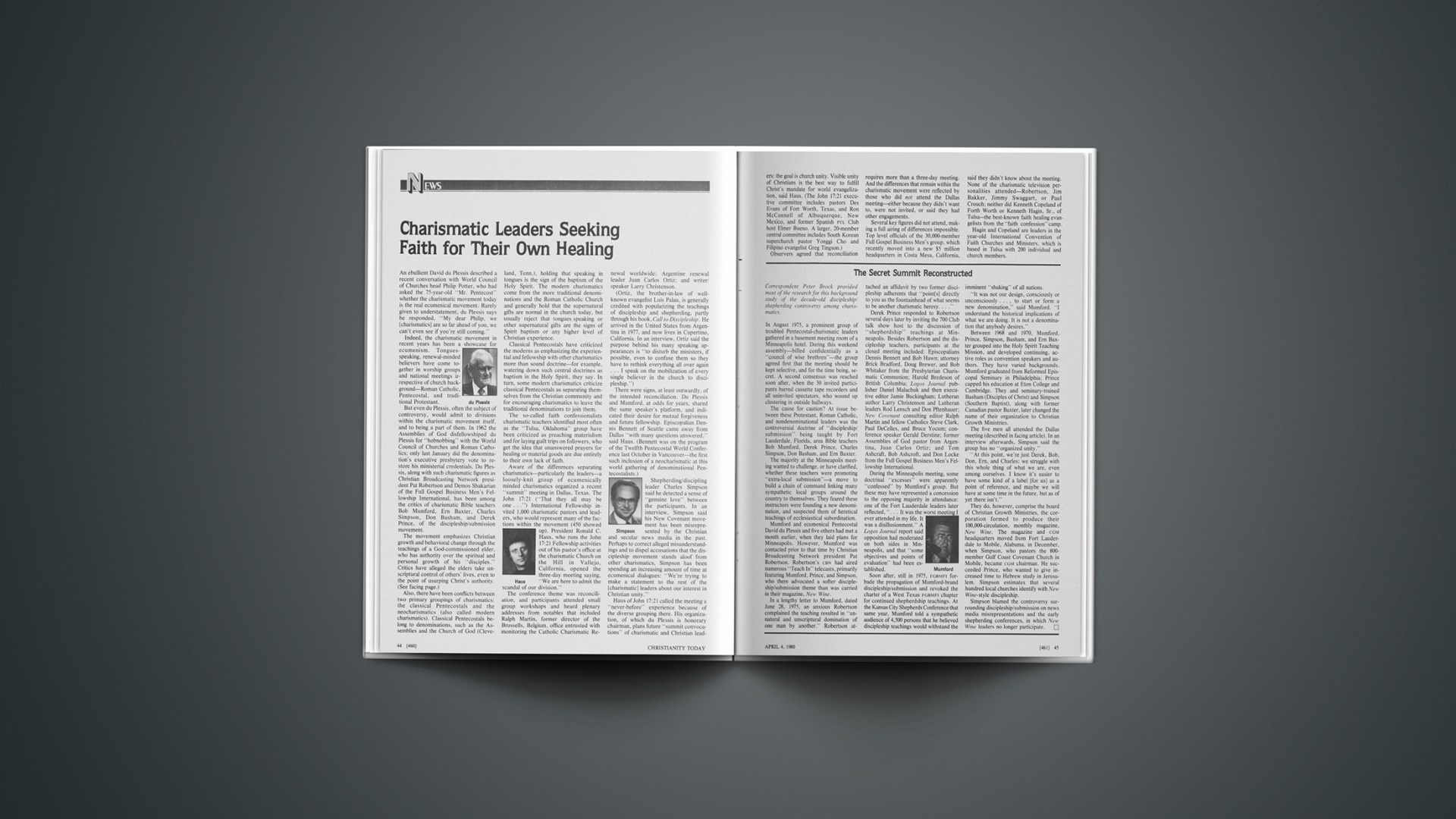
Charismatic Leaders Seeking Faith for Their Own Healing

An ebullient David du Plessis described a recent conversation with World Council of Churches head Philip Potter, who had asked the 75-year-old “Mr. Pentecost” whether the charismatic movement today is the real ecumenical movement. Rarely given to understatement, du Plessis says he responded, “My dear Philip, we [charismatics] are so far ahead of you, we can’t even see if you’re still coming.”

Indeed, the charismatic movement in recent years has been a ecumenism. Tongues-speaking, renewal-minded believers have come together in worship groups and national meetings irrespective of church background—Roman Catholic, Pentecostal, and traditional Protestant.

But even du Plessis, often the subject of controversy, would admit to divisions within the charismatic movement itself, and to being a part of them. In 1962 the Assemblies of God disfellowshiped du Plessis for “hobnobbing” with the World Council of Churches and Roman Catholics; only last January did the denomination’s executive presbytery vote to restore his ministerial credentials. Du Plessis, along with such charismatic figures as Christian Broadcasting Network president Pat Robertson and Demos Shakarian of the Full Gospel Business Men’s Fellowship International, has been among the critics of charismatic Bible teachers Bob Mumford, Ern Baxter, Charles Simpson, Don Basham, and Derek Prince, of the discipleship/submission movement.

The movement emphasizes Christian growth and behavioral change through the teachings of a God-commissioned elder, who has authority over the spiritual and personal growth of his “disciples.” Critics have alleged the elders take unscriptural control of others’ lives, even to the point of usurping Christ’s authority. (See facing page.)

Also, there have been conflicts between two primary groupings of charismatics: the classical Pentecostals and the neocharismatics (also called modern charismatics). Classical Pentecostals belong to denominations, such as the Assemblies and the Church of God (Cleveland, Tenn.), holding that speaking in tongues is the sign of the baptism of the Holy Spirit. The modern charismatics come from the more traditional denominations and the Roman Catholic Church and generally hold that the supernatural gifts are normal in the church today, but usually reject that tongues, speaking or other supernatural gifts are the signs of Spirit baptism or any higher level of Christian experience.

Classical Pentecostals have criticized the moderns as emphasizing the experiential and fellowship with other charismatics more than sound doctrine—for example, watering down such central doctrines as baptism in the Holy Spirit, they say. In turn, some modern charismatics criticize classical Pentecostals as separating themselves from the Christian community and for encouraging charismatics to leave the traditional denominations to join them.

The so-called faith confessionalists charismatic teachers identified most often as the “Tulsa, Oklahoma” group have been criticized as preaching materialism and for laying guilt trips on followers, who get the idea that unanswered prayers for healing or material goods are due entirely to their own lack of faith.

Aware of the differences separating charismatics—particularly the leaders—a loosely-knit group of ecumenically minded charismatics organized a recent “summit” meeting in Dallas, Texas. The John 17:21 (“That they all may be one …”) International Fellowship invited 1,000 charismatic pastors and leaders, who would represent many of the factions within the movement (450 showed up). President Ronald C. Haus, who runs the John 17:21 Fellowship activities out of his pastor’s office at the charismatic Church on the Hill in Vallejo, California, opened the three-day meeting saying, Haus “We are here to admit the scandal of our division.”

The conference theme was reconciliation, and participants attended small group workshops and heard plenary addresses from notables that included Ralph Martin, former director of the Brussells, Belgium, office entrusted with monitoring the Catholic Charismatic Renewal worldwide; Argentine renewal leader Juan Carlos Ortiz; and writer/speaker Larry Christenson.

(Ortiz, the brother-in-law of well-known evangelist Luis Palau, is generally credited with popularizing the teachings of discipleship and shepherding, partly through his book, Call to Discipleship. He arrived in the United States from Argentina in 1977, and now lives in Cupertino, California. In an interview, Ortiz said the purpose behind his many speaking appearances is “to disturb the ministers, if possible, even to confuse them so they have to rethink everything all over again … I speak on the mobilization of every single believer in the church to discipleship.”)

There were signs, at least outwardly, of the intended reconciliation. Du Plessis and Mumford, at odds for years, shared the same speaker’s platform, and indicated their desire for mutual forgiveness and future fellowship. Episcopalian Dennis Bennett of Seattle came away from Dallas “with many questions answered,” said Haus. (Bennett was on the program of the Twelfth Pentecostal World Conference last October in Vancouver—the first such inclusion of a neocharismatic at this world gathering of denominational Pentecostalists.)

Shepherding/discipling leader Charles Simpson 9 said he detected a sense of “genuine love” between the participants. In an interview. Simpson said his New Covenant movement has been misrepresented by the Christian and secular news media in the past. Perhaps to correct alleged misunderstandings and to dispel accusations that the discipleship movement stands aloof from other charismatics, Simpson has been spending an increasing amount of time at ecumenical dialogues: “We’re trying to make a statement to the rest of the [charismatic] leaders about our interest in Christian unity.”

Haus of John 17:21 called the meeting a “never-before” experience because of the diverse grouping there. His organization, of which du Plessis is honorary chairman, plans future “summit convocations” of charismatic and Christian leaders: the goal is church unity. Visible unity of Christians is the best way to fulfill Christ’s mandate for world evangelization, said Haus. (The John 17:21 executive committee includes pastors Des Evans of Fort Worth, Texas, and Ron McConnell of Albuquerque, New Mexico, and former Spanish PTL Club host Elmer Bueno. A larger, 20-member central committee includes South Korean superchurch pastor Yonggi Cho and Filipino evangelist Greg Tingson.)

Observers agreed that reconciliation requires more than a three-day meeting. And the differences that remain within the charismatic movement were reflected by those who did not attend the Dallas meeting—either because they didn’t want to, were not invited, or said they had other engagements.

Several key figures did not attend, making a full airing of differences impossible. Top level officials of the 30,000-member Full Gospel Business Men’s group, which recently moved into a new $5 million headquarters in Costa Mesa, California, said they didn’t know about the meeting. None of the charismatic television personalities attended—Robertson, Jim Bakker, Jimmy Swaggart, or Paul Crouch; neither did Kenneth Copeland of Forth Worth or Kenneth Hagin, Sr., of Tulsa—the best-known faith healing evangelists from the “faith confession” camp.

Hagin and Copeland are leaders in the year-old International Convention of Faith Churches and Ministers, which is based in Tulsa with 200 individual and church members.

The Secret Summit Reconstructed

Correspondent Peter Brock provided most of the research for this background study of the decade-old discipleship/shepherding controversy among charismatics.

In August 1975, a prominent group of troubled Pentecostal-charismatic leaders gathered in a basement meeting room of a Minneapolis hotel. During this weekend assembly—billed confidentially as a “council of wise brethren”—the group agreed first that the meeting should be kept selective, and for the time being, secret. A second consensus was reached soon after, when the 30 invited participants barred cassette tape recorders and all uninvited spectators, who wound up clustering in outside hallways.

The cause for caution? At issue between these Protestant, Roman Catholic, and nondenominational leaders was the controversial doctrine of “discipleship/submission” being taught by Fort Lauderdale, Florida, area Bible teachers Bob Mumford, Derek Prince, Charles Simpson, Don Basham, and Ern Baxter.

The majority at the Minneapolis meeting wanted to challenge, or have clarified, whether these teachers were promoting “extra-local submission”—a move to build a chain of command linking many sympathetic local groups around the country to themselves. They feared these instructors were founding a new denomination, and suspected them of heretical teachings of ecclesiastical subordination.

Mumford and ecumenical Pentecostal David du Plessis and five others had met a month earlier, when they laid plans for Minneapolis. However, Mumford was contacted prior to that time by Christian Broadcasting Network president Pat Robertson. Robertson’s CBN had aired numerous “Teach In” telecasts, primarily featuring Mumford, Prince, and Simpson, who there advocated a softer discipleship/submission theme than was carried in their magazine, New Wine.

In a lengthy letter to Mumford, dated June 28, 1975, an anxious Robertson complained the teaching resulted in “unnatural and unscriptural domination of one man by another.” Robertson attached an affidavit by two former discipleship adherents that “point[s] directly to you as the fountainhead of what seems to be another charismatic heresy.…”

Derek Prince responded to Robertson several days later by inviting the 700 Club talk show host to the discussion of “shepherdship” teachings at Minneapolis. Besides Robertson and the discipleship teachers, participants at the closed meeting included: Episcopalians Dennis Bennett and Bob Hawn; attorney Brick Bradford, Doug Brewer, and Bob Whitaker from the Presbyterian Charismatic Communion; Harold Bredeson of British Columbia; Logos Journal publisher Daniel Malachuk and then executive editor Jamie Buckingham; Lutheran author Larry Christenson and Lutheran leaders Rod Lensch and Don Pftenhauer; New Covenant consulting editor Ralph Martin and fellow Catholics Steve Clark, Paul DeCelles, and Bruce Yocum; conference speaker Gerald Derstine; former Assemblies of God pastor from Argentina, Juan Carlos Ortiz; and Tom Ashcraft, Bob Ashcroft, and Don Locke from the Full Gospel Business Men’s Fellowship International.

During the Minneapolis meeting, some doctrinal “excesses” were apparently “confessed” by Mumford’s group. But these may have represented a concession to the opposing majority in attendance: one of the Fort Lauderdale leaders later reflected, “… It was the worst meeting I ever attended in my life. It was a disillusionment.” A Logos Journal report said opposition had moderated on both sides in Mineapolis, and that “some objectives and points of evaluation” had been established.

Soon after, still in 1975, FGBMFI forbade the propagation of Mumford-brand discipleship/submission and revoked the charter of a West Texas FGBMFI chapter for continued shepherdship teachings. At the Kansas City Shepherds Conference that same year, Mumford told a sympathetic audience of 4,500 persons that he believed discipleship teachings would withstand the imminent “shaking” of all nations.

“It was not our design, consciously or unconsciously …, to start or form a new denomination,” said Mumford. “I understand the historical implications of what we are doing. It is not a denomination that anybody desires.”

Between 1968 and 1970, Mumford, Prince, Simpson, Basham, and Ern Baxter grouped into the Holy Spirit Teaching Mission, and developed continuing, active roles as convention speakers and authors. They have varied backgrounds. Mumford graduated from Reformed Episcopal Seminary in Philadelphia; Prince capped his education at Eton College and Cambridge. They and seminary-trained Basham (Disciples of Christ) and Simpson (Southern Baptist), along with former Canadian pastor Baxter, later changed the name of their organization to Christian Growth Ministries.

The five men all attended the Dallas meeting (described in facing article). In an interview afterwards, Simpson said the group has no “organized unity.”

“At this point, we’re just Derek, Bob, Don, Ern, and Charles; we struggle with this whole thing of what we are, even among ourselves. I know it’s easier to have some kind of a label [for us] as a point of reference, and maybe we will have at some time in the future, but as of yet there isn’t.”

They do, however, comprise the board of Christian Growth Ministries, the corporation formed to produce their 100,000-circulation, monthly magazine, New Wine. The magazine and CGM headquarters moved from Fort Lauderdale to Mobile, Alabama, in December, when Simpson, who pastors the 800-member Gulf Coast Covenant Church in Mobile, became CGM chairman. He succeeded Prince, who wanted to give increased time to Hebrew study in Jerusalem. Simpson estimates that several hundred local churches identify with New Wine-style discipleship.

Simpson blamed the controversy surrounding discipleship/submission on news media misrepresentations and the early shepherding conferences, in which New Wine leaders no longer participate.

John Jacobs, ICFCM administrative assistant, said his office didn’t know about the meeting. (Haus said Hagin and Copeland were themselves invited but chose not to attend.) Members of ICFCM do practice faith healing and tongues speaking but prefer to be identified as persons who “teach all of the Bible,” said Jacobs. They teach that Christians are entitled to all the “blessings of Abraham”—health, wealth, and wisdom—according to the promises in Deuteronomy 28 and Galatians 3. Those who don’t receive are either ignorant [of the blessings] or “are moved by what [they] see rather than what the Bible says,” said Jacobs. “It’s God’s will that you be the head, not the tail.”

(Many of those not represented in Dallas are behind a larger-scale gathering planned for the nation’s capital. Pastor John Gimenez of Virginia Beach, Virginia, is organizing an April 28–29 “Washington for Jesus” rally as a call to national repentance and prayer. Lending their support are charismatic leaders Robertson, Bakker, Shakarian, Daniel Malachuk of Logos International, and C. M. Ward of the Assemblies of God. They advertise a gathering of one million for an outdoor prayer service at the Washington monument, personal contacts with all U.S. congressmen, and a 100,000-person march down Constitution Avenue.)

Differences remained, even among those who attended the Dallas meeting. Despite expressing a willingness to forgive Mumford’s group, du Plessis said he still opposes its style of discipling, which he calls “sheepstealing”: “They are not discipling sinners to Christ; they’re discipling members of other churches to themselves.”

Doctrinal differences—either real, or the result of misunderstandings—may be an inescapable by-product of a movement as large and as diverse as the charismatics’. For example, participant Richard Williams from Addison, Illinois, said after the Dallas meeting that “no man is a law unto himself” in the discipleship movement. But pastor Robert Schmidgall of nearby Naperville, Illinois, said that while the Fort Lauderdale teachers may not, in fact, be teaching authoritarian principles (for example, getting approval from one’s elder before buying a car) “that idea still is getting around.” Williams said he agreed with speaker Ralph Martin’s comment that workable unity will come only when there is “obedience to objective truth.”

Ecumenism

Black Methodist Bodies Have Another go at Union

Three black Methodist denominations in the early 1960s sought a merger that never materialized. But ecumenists have learned a lesson from earlier ecumenical ventures, said John H. Satterwhite, executive secretary of the Center for Black Church Union in Washington, D.C.: “We thought we could unite churches from the top down; now we realize we have to do it from the bottom up.”

With this in mind, the same Methodist bodies—the Christian Methodist Episcopal, African Methodist Episcopal, and African Methodist Episcopal Zion Churches—are seeking merger again, but with an appeal to the grassroots. The Center for Black Church Union is conducting a series of conferences nationwide that are intended to win support for merger from local church members and conference delegates prior to their denominations’ summer voting conferences.

(A 1978 CME Church general conference already has voted to unite with the AMEZ Church. Before this year is out, proposals for union will come up at the AMEZ general conferences in May and the AME meetings in June.)

Satterwhite, an AMEZ minister and official of the World Methodist Council, would like an organic union of black churches as soon as possible. Some black church leaders, however, favor taking union in stages. An even smaller number prefers joining together on specific projects for now, such as uniting publishing efforts or seminaries. But Satterwhite fears that a uniting of service agencies without denominational merger will prove a “slowing down process” that may never lead to organic ecumenism.

The latest workshop on merger occurred in Washington, D.C. (Future workshops are slated for Kansas City, New York, Boston, San Francisco, Los Angeles, and Norfolk, Virginia.) The Washington seminars rotated to a different congregation every night (as is the custom), and black United Methodist and United Presbyterian bodies joined the three black Methodist bodies in an unusual ecumenical thrust. Black Methodists for Church Renewal, the black caucus within United Methodism, has shown interest in the merger workshops, said Satterwhite.

“It would not surprise me if some congregations within the United Methodist Church attempted to join a united black church,” Satterwhite added. However, he said the center does not encourage single congregations joining, preferring to unite groups by denomination.

Two other small black denominations (which refused to join Richard Allen’s founding AME Church in 1816) also have sent bishops to participate. The African Union Methodist Protestant Church and the Union American Methodist Episcopal Church enroll only a few thousand members each, while the AME has 1.3 million, the AMEZ, 1 million, and the CME, about 500,000.

James Cone, black theologian from Union Seminary (N.Y.) and a speaker at the workshops, said there is a greater possibility for unity when ecumenism is related to the “political struggle.” He referred to the success of the civil rights movement in rallying together Baptists, Methodists, Pentecostals, and others.

Black churches in the past legitimately avoided union with white denominations because of racism, asserted Cone. “But we must also consider why we haven’t gotten together ourselves—both as denominational families and as a whole.”

JAMES S. TINNEY

Church-and-State Issues

Court Rules that HEW’s Compliance Forms Don’t

Grove City (Pa.) College students and staff held a thanksgiving chapel service and an ice cream sundae party following their school’s courtroom victory over the U.S. Department of Health, Education, and Welfare. Many other private colleges besides this Christian liberal arts school may have celebrated vicariously the March 10 ruling in Pittsburgh as a significant triumph over government regulation and intervention.

Specifically, U.S. Federal District Court Judge Paul A. Simmons threw out as “faulty” HEW’s compliance form 639A, which is an assurance of compliance with Title IX of the Education Amendments of 1972. When signed, the forms show that a school does not practice discrimination on the basis of sex, race, or religion.

For nearly three years, Grove City has refused to sign the compliance forms. College president Charles MacKenzie, who said the college voluntarily practiced nondiscriminatory policies, opposed completing the form as opening the door to all kinds of government bureaucratic intervention. The department had no right to intervene, he said, since the school receives no federal funds.

In court, HEW has argued that Grove City and other private colleges are indeed recipients of federal assistance—and thereby subject to HEW jurisdiction—when students receive federally funded Basic Educational Opportunity Grants, and loans through the Guaranteed Student Loan program. The college said the grants and loans were transactions between the student and a lending institution, not between the school and the government. HEW has pressed for a cutoff of the grants and loans to students at non-complying schools, such as Grove City, to apply pressure for compliance. But barring a successful appeal of the ruling, HEW will no longer be allowed to do so.

Judge Simmons said the compliance forms cannot be used—at least in their present form—under any circumstances. The basis for his decision: some sections of the regulations that were drawn to execute the compliance form touch on sex discrimination in the employment policies of an institution—a matter not contemplated by Congress in its drafting of Title IX.

If the form is rewritten to refer to sex discrimination in terms of student programs, the compliance form could then be applicable. In that event, the judge ruled, HEWcould withdraw students’ BEOG funds, which he said do, in fact, constitute federal assistance to a college. However, he said, the federal agency has no control over Guaranteed Student Loan monies; he said the GSL program is specifically exempt from HEW jurisdiction under the guidelines set by Congress.

Significantly, Simmons ruled that HEW had violated Fifth Amendment rights in not giving legal notice and a proper hearing to all the students who were adversely affected by the proposed cutoff of funds. Simmons did not speak to the First Amendment separation of church and state—another issue raised by Grove City and other private Christian colleges.

Following Simmons’s decision, which for the time being ended the school’s three-year legal wranglings, MacKenzie exulted in this “landmark” in the school’s “battle for freedom.” His and other private schools, at least for the time being, won’t have to worry about present and potential students leaving when their grants and loans are lost due to a school’s resistance to HEW paperwork. The federal agency was considering an appeal, but one Grove City lawyer said Simmons’s decision at least “will slow them [HEW] down a little bit.”

North American Scene

A TV watchdog group has linked the brutal murder of a Wichita Falls, Texas, girl to CBS-TV’s February 13 airing of the movie Exorcist II. For that reason, the National Federation for Decency has called for a boycott of CBS programs during July—the month when national ratings are taken. The mother of four-year-old Khonji Wilson was charged with murdering her daughter—found stabbed, with her heart cut from her body. Neighbors said the mother and daughter together had watched the movie, which had a similar scene in which a girl’s heart was cut out to get rid of a demon. Founded two years ago by United Methodist pastor Donald Wildmon, the influential NFD now has 10,000 members.

Episcopalians recently established a church structure for ministry to the cities. At a meeting in Indianapolis, 500 Episcopalians, representing 42 dioceses and several existing urban groups, formed the Episcopal Urban Caucus. A 16-member EUC governing board was created to pursue programs for parish revitalization, economic and social justice, and energy conservation by churches and individuals.

Southern Baptist churches showed nearly a 10 percent increase in baptisms in final statistics for 1979, with a total last year of 368,738. The gain ends a three-year decline in baptisms in the denomination. Baptist officials also report that giving topped $2 billion for the first time last year.

A three-year-old, $8.6 million hymn-pirating suit ended recently in an out-of-court settlement. A Los Angeles-based religious music publisher, F.E.L. Publications, accused the U.S. National Conference of Catholic Bishops of complicity in “pirating” the firm’s hymns (the best known, perhaps, “They’ll Know We Are Christians by Our Love”) for use in 15 dioceses. The settlement calls only for the conference to notify all U.S. dioceses that it is illegal and immoral to use copyrighted material without written permission from the copyright owner.

Charitable organizations gained added legal protections through a recent Supreme Court ruling. By an 8-to-l majority, the high court struck down a Schaumburg, Illinois, ordinance requiring that any groups soliciting funds door-to-door must prove to town officials that at least 75 percent of the money raised goes to charity. The justices cited past high court decisions upholding the right to solicit as guaranteed by First Amendment freedom of speech and religion clauses.

Shades of Huxley? California businessman Robert K. Graham announced he has created a sperm bank for Nobel prizewinning scientists, and that so far three East Coast women have been successfully inseminated. The Los Angeles Times interviewed 11 Nobel winners, and reported that only one—Stanford University’s William B. Shockley, winner of the 1956 Nobel Prize in physics—had actually donated to the bank. Graham, 74, a self-made tycoon who pioneered the manufacture of plastic spectacle lenses, denied any intention of creating a master race: “We are thinking in terms of a few more creative, intelligent people who otherwise might not be born.”

Deaths

Theodore F. Adams, 81, Southern Baptist and former president (1955 to 1960) of the Baptist World Alliance; he was chairing a long-range planning committee responsible for a BWA plan of action through the year 2005, which includes a five-year evangelistic thrust, 1995 to 2000, commemorating the 2000th anniversary of Christ’s birth; February 27, in Richmond, Virginia, after an apparent stroke.

Apple PodcastsDown ArrowDown ArrowDown Arrowarrow_left_altLeft ArrowLeft ArrowRight ArrowRight ArrowRight Arrowarrow_up_altUp ArrowUp ArrowAvailable at Amazoncaret-downCloseCloseEmailEmailExpandExpandExternalExternalFacebookfacebook-squareGiftGiftGooglegoogleGoogle KeephamburgerInstagraminstagram-squareLinkLinklinkedin-squareListenListenListenChristianity TodayCT Creative Studio Logologo_orgMegaphoneMenuMenupausePinterestPlayPlayPocketPodcastRSSRSSSaveSaveSaveSearchSearchsearchSpotifyStitcherTelegramTable of ContentsTable of Contentstwitter-squareWhatsAppXYouTubeYouTube