Minister’s Workshop: Am I Jogging with You, Jesus?

It is hard for me to look ceremonious and holy when I am straining to finish a run.

I lay there all by myself with the guilt sweeping over me. My wife had left me. I knew it was my fault that I was there alone. She had run away. She did it every day.

She would come back, of course, fresh and vibrant from her two-mile run. But why was I, the schoolboy track star, the college soccer player, lying there in bed, while my wife was out running? “Bodily exercise profiteth little,” I mumbled piously, but I admired her discipline. “I hate running,” I thought. “Anyway, I did enough of it when I was in school.”

I had to admit, though, that muscles that are not exercised quickly degenerate into fat. And I was also aware that a former athlete’s eating habits easily build unpleasant additions to the Lord’s temple. Deep down I knew I should be out there with her for the sake of my weight, my heart, my energy, and my self-respect.

The next day I joined her in her two-mile run. I enjoyed her company, but I hated the run. And I did it the next day. And the next. I hated every one of the first hundred miles I ran. But now I keep on running because I have grown to enjoy it. It benefits my body, my mind, and even my ministry.

Everyone knows the physical benefits of running. Increased energy, lowered risk of heart attack, and reduced weight head the list. The mental benefits—self-confidence, relaxation, and that unspeakable “runner’s high”—are touted from a hundred magazines and books. Those benefits are real and reason enough to keep me going, but as a pastor I have additional reasons to run.

Running humanizes a pastor. So often my people meet me only on spiritual grounds, either literally or metaphorically. We see each other on Sundays in the church building, or we gather there for committee meetings during the week. Even when I go to see members in their homes or on their jobs, we still talk about such spiritual things as their walks with God or their ministries. On Sundays I am wearing a robe that proclaims my status as ordained, and during the week I am properly attired as befits my reverend dignity. It is easy for them to think that I am a spiritual being inhabiting only a spiritual world. But when they know I run, they realize there is at least one very physical part of me. They may think that my head is in the clouds, but they know my feet are pounding the ground. That knowledge can help bridge the gap that so many church customs tend to establish.

It is hard for me to look ceremonious and holy when I am straining to finish a run. My hair is sticking out wildly, my face flushed, and my shirt drenched. More than once one of my people has seen me in that condition. Their response is to shout and wave. Then they make a special point to tell me they have seen me. Part of the joy in their retelling of the encounter is the tacit statement, “You may fool some of the people by looking so cool and dignified in your black robe, but I have seen the real you.”

Running also benefits my ministry by giving me a point of contact with my people. Once a young visitor wanted to talk to me but did not know exactly what to say to the pastor. “I hear you’re a runner” was his opening gambit. Then the ice was broken as we talked about our experiences with the sport. This opening gave us a bond, and it built understanding and respect. We then moved on to the things that were really on his mind.

Going running together provides another point of contact with members of my congregation. Running partners develop a bond of shared discipline, pain, and achievement that grows stronger with every mile. Recently, one of our deacons and I challenged each other to train for, and to run in, the Boston Marathon. Often we ran together, and when we could not, we compared distances and times. A friendly competitiveness spurred us on to achieve our goal. As each of us worked hard to get ready, our respect for the other grew.

Examples culled from my experiences in running are another benefit to my ministry. I immediately gained a hearing for my message during one college chapel when I mentioned the pain I felt while running the marathon. Many of the students were runners, and all knew the rigors of the 26-mile race. After grabbing their attention by the reference to running, I went on to compare the daily training necessary for a long race with the daily discipline required to run the race of the Christian life. I have also learned that those Bible passages that use running or athletes as a metaphor can become even more vivid when illustrated from personal experience.

Besides improving my teaching, my friendships, and my image, running has also helped my budget. No expensive sports club or fancy equipment is required. I can get 1,500 miles from a $20 pair of running shoes, and I never pay a court fee because sidewalks, roads, and woodland paths are free.

Most people are convinced about the benefits of running but just cannot bring themselves to begin. Or they start off with a few miles the first day and then are laid up for two weeks with sore legs. I recommend that a person start off by running for five minutes in one direction at a comfortable pace and then turn around and head home, walking some of the way if he gets tired. If one does this three or four times a week, gradually he will be able to run the whole way without stopping. Then he can lengthen his outbound run by 30 seconds each week until he can comfortably run for 20 minutes. A person who runs for 20 minutes three times a week will be receiving all the major benefits of running.

Great as the benefits are, some people get started running but then do not keep it up. Boredom seems to be one major reason people quit. Running is just not that exciting. It is much more fun to compete in a game, or at least to chase a ball around a court. I get bored with running. I try to overcome the boredom by forcing myself to sing, or to think, or to pray. It takes mental discipline, but God and I have had some good chats on those afternoon runs.

Setting goals and keeping records of times and distances also motivate me to keep running. The goals and records help me see my running from a different perspective. Usually the goals are a carrot; only rarely are they a stick. It gives me a feeling of accomplishment to log a 20-mile week, knowing I am on my way to a 1,000-mile year. On the rare occasions when I do not feel like running, the thought that I will fall behind sometimes gets me going. Often those reluctant runs have been the most exhilarating. While laying down each individual brick may be boring, building the cathedral of mental, spiritual, and physical fitness is very exciting.

Don’t just sit there feeling guilty. “So run to obtain.…”

Charles White is minister to students at Park Street Church, Boston, Massachusetts.

Refiner’s Fire: Science Fiction Films: A Cast of Metaphysical Characters

The recurring biblical motifs are Creation, tasting of the forbidden fruit, and the Apocalypse.

One of the most durable cinema genres is the science fiction film, which is now in the midst of a great renaissance. This film category demands the attention of evangelicals because, like the related mystery thriller and the Gothic horror film, it delves into questions of an ultimate, frequently theological, nature.

The science fiction film has been a staple ever since the early days of motion pictures, beginning with such notable efforts as George Méliès’s A Trip to the Moon (1902). Since then, the sci-fi film has been a cinematic constant, existing throughout the history of the motion picture. Yet it has clearly flourished more in some periods than in others. The reasons for this have to do with the sci-fi film’s role as a cultural barometer, reflecting our changing view of ourselves and our varying perceptions of the cosmic order of things.

Sci-fi film is currently booming. Beginning with Star Wars and Close Encounters of the Third Kind, there has been a rush on sci-fi themes in the cinema, and on TV as well. Most recently we have been given Buck Rogers, Battleship Galactica, Alien, Star Trek, The Black Hole, and more are on the way. To assess the current importance of sci-fi film, we need to look at it as an important film category in its own right, with a special set of dominant themes.

Science fiction film, as opposed perhaps to science fiction literature, has usually been only peripherally interested in science per se. The sci-fi film has often been the province of mysticism and fantasy, more metaphysical than physical, and has drawn heavily on the traditions of nineteenth-century romanticism, which were distinctly antiscientific in tone.

Percy Bysshe Shelley’s wife, Mary, was the author of Frankenstein, a work that has been far more influential in film than in literature. The story is a caveat for scientific investigation: there are realms belonging only to God that humans enter only at their peril. This plot has been stock-in-trade for scores of sci-fi films with “mad” scientists daring to “go beyond the bounds of what man is permitted to know.” Such a view is far more theological and metaphysical than it is scientific.

The value of the sci-fi film for the Christian lies more in its metaphysical character than in what it reveals of science. The sci-fi tradition thus poses metaphysical—and theological—questions to the ever-expanding domain of scientific knowledge. One might view these questions in terms of at least two biblical motifs: Creation and the Fall, and the Apocalypse.

Science fiction films can open up dialogue between the Christian and the secularist who recognizes the pervasive power of film images. It is possible to discern a two-fold image of the Fall running throughout sci-fi films. Humans frequently go beyond the limits set in creation, thereby partaking of forbidden fruit which, while it brings new knowledge, also brings terrible consequences. The sci-fi film asks whether the knowledge gained in science is worth the risk of misfortune that may follow. The brilliant English director of the early thirties, James Whale, developed this theme of man pursuing the forbidden fruit of secret knowledge in three superior sci-fi films: Frankenstein (1931), The Invisible Man (1935), and Bride of Frankenstein (1935). In all three of these works, a scientist goes beyond the bounds of creation in order to gain greater knowledge and power. In all three cases he is met with destructive forces of his own making.

This “Frankenstein formula” has been used with great frequency, always in the form of monsters unleashed upon humanity by a science gone too far. One might recall the great mad scientists of the thirties and forties: Lionel Atwill (Man Made Monster), George Zucco (The Mad Ghoul), Bela Lugosi (Devil Bat), and of course, Boris Karloff in a minor classic like The Invisible Ray. To these could be added the giant ants, grasshoppers, and other creatures of the nuclear age of the 1950s in such films as Them!, Tarantula, and The Preying Mantis. The assumption of such films, despite their occasional crudity, ought not to be missed. The world is not a neutral phenomenon, to be investigated and explored freely by human beings at will: rather, there is a moral purpose to life. That purpose must be discovered and followed if men and women are to keep from destroying themselves.

A second aspect of the Fall in sci-fi films is the recurring theme of the loss of identity. The great threat is the loss of one’s own self (or one’s soul). We find echoes of the warning, “In the day you eat thereof, ye shall surely die.” In addressing the problem of science transgressing divine limits the sci-fi film gives us a picture of the corporate effects of the Fall. For example, Grant Williams in Arnold’s The Incredible Shrinking Man (1957) is the victim of radioactive dust while on a sea cruise. His loss of identity occurs as he shrinks down to an infinitesimal size. But his plight is not completely hopeless. As he contemplates shrinking entirely from view, he reflects that he is still part of the created order of things, though now “known only to God himself.”

The loss of identity theme informs a multitude of sci-fi movies from Flash Gordon (1936) to Dawn of the Dead (1979). It is nowhere more effectively treated, however, than in Don Siegel’s Invasion of the Body Snatchers (1956). The story involves the conquest of a whole community by strange seed pods that grow to imitate specific individuals and then take over their personalities while they sleep. Siegel’s film is a vivid image of soulless conformity, a warning to those who take their own human development lightly, a close parallel to those who would ignore the image of God found within them. Nowhere is the feeling of expulsion from the divine presence more forcefully presented on film. Siegel’s original ending was considered so strong that the studio insisted he add a happier conclusion. The recent remake, a much more expensive reworking of the theme, has none of the force and sensitivity of the original. Where the original version ends with a warning that gives it genuine prophetic force, the new version concludes only with despair.

The second important biblical motif in these films is the Apocalypse, the final judgment on this world. Creation not only has a moral purpose: it has a definite end, which often involves a judgment on the present. One of the early views of the future on film is found in Fritz Lang’s Metropolis (1926). The film’s story is trite and easily forgotten, but the power of its images is not. The world of Metropolis is a vast technological civilization where the rich frolic in bizarre pleasure gardens and workers are sacrificed to monstrous machines (as the Old Testament pagan god, Moloch) and where scientists have become engineers experimenting on human beings. This all culminates in a nightmarish image of watery destruction in subterranean tunnels where most of the city’s population lie trapped. Metropolis’s apocalyptic destruction influences a number of later, classic sci-fi works such as War of the Worlds (1953) and The War Game (1965).

Nor need the apocalypse come from outside the present earthly realm of time and space. In The Day the Earth Stood Still (1951) enlightened aliens warn earth of impending destruction assured by the continuing warfare of earthly nations. Stanley Kubrick’s controversial 2001 (1968) shows destruction brought about by human dependence on machines which, made in man’s image, take on their calculating, self-serving purposes. The thrust of such films allows for discussion of Scripture’s own apocalyptic vision as found in Daniel and Revelation.

All of this brings us to the present revival of sci-fi films. Unfortunately, many of these films do not measure up to past accomplishments. The mystical side of George Lukas’s Star Wars—his much-acclaimed “force”—is really too vague to serve as a meaningful symbol. The gratuitous blood and gore of Alien, a remake of a little-known film of 1958, It! The Terror from Beyond Space, amounts to little more than massive mayhem for its own sake.

On the bright side is Superman, the film that fantasy and sci-fi buffs picked as the best science fiction film of 1978. The imagery of Superman is unabashedly Christian down to the incarnational form of “mild-mannered reporter, Clark Kent.” Some have seen the Superman image as a substitute, pop image messiah. Yet the value of Superman is that he is a messianic symbol, as valid for our time as Charlemagne or Sir Galahad were in the medieval period. The symbol doesn’t substitute as an alternate reality, but points to a greater reality, albeit one it never fully expresses. Of no small value is the fact that Superman reintroduces the concept of the hero into our popular vocabulary.

The science fiction film will certainly not be on the wane in the 1980s. We should hope that the metaphysical and theological concerns underlying this film category find serious response from those of us who find both identity and hope for the future in Jesus Christ.

Paul Leggett is currently on a study leave from the faculty of the Seminario Biblico Latinoamericano in San José, Costa Rica.

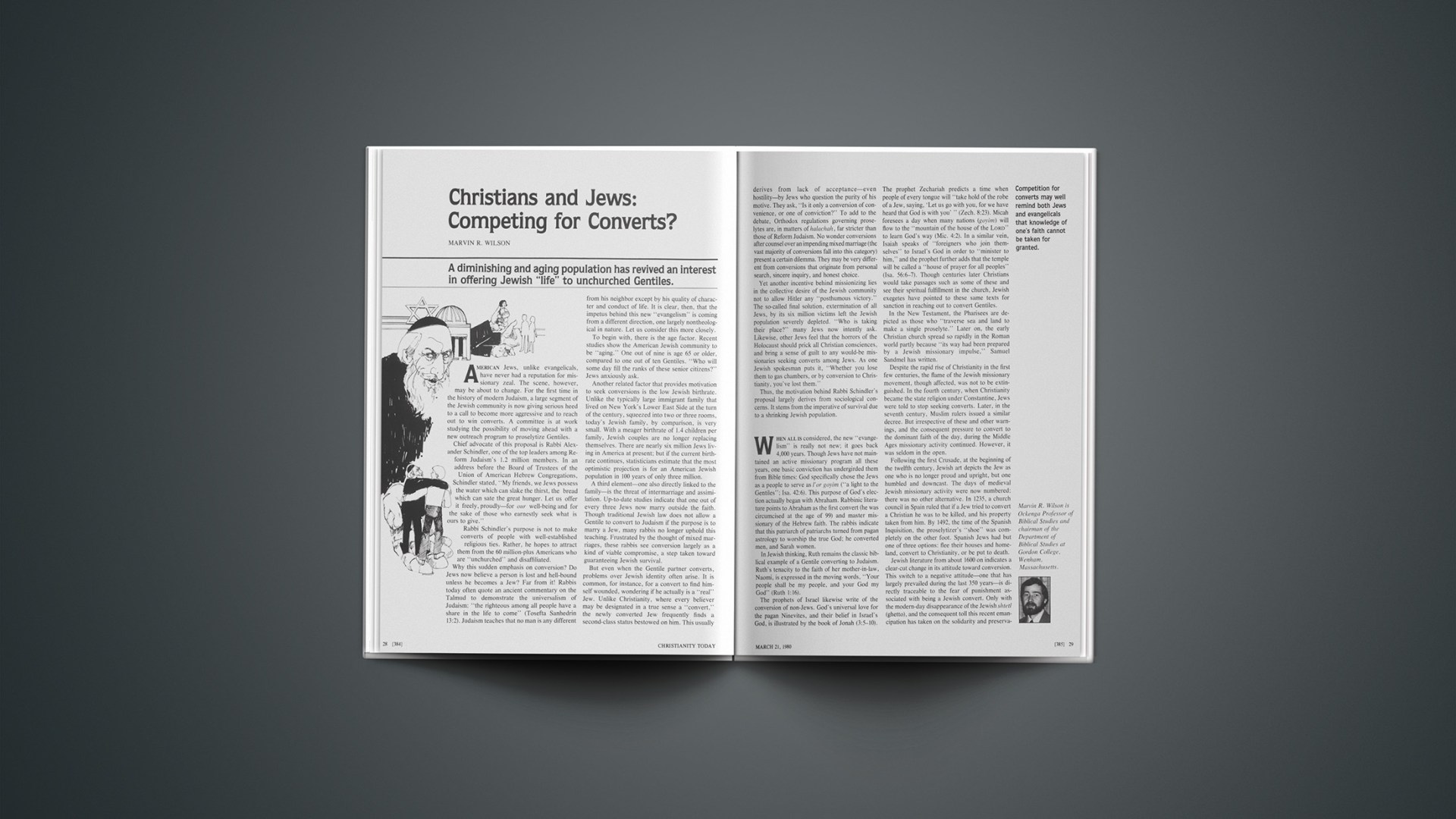
Christians and Jews: Competing for Converts?

A diminishing and aging population has revived an interest in offering Jewish “life” to unchurched Gentiles.

American Jews, unlike evangelicals, have never had a reputation for missionary zeal. The scene, however, may be about to change. For the first time in the history of modern Judaism, a large segment of the Jewish community is now giving serious heed to a call to become more aggressive and to reach out to win converts. A committee is at work studying the possibility of moving ahead with a new outreach program to proselytize Gentiles.

Chief advocate of this proposal is Rabbi Alexander Schindler, one of the top leaders among Reform Judaism’s 1.2 million members. In an address before the Board of Trustees of the Union of American Hebrew Congregations, Schindler stated, “My friends, we Jews possess the water which can slake the thirst, the bread which can sate the great hunger. Let us offer it freely, proudly—for our well-being and for the sake of those who earnestly seek what is ours to give.”

Rabbi Schindler’s purpose is not to make converts of people with well-established religious ties. Rather, he hopes to attract them from the 60 million-plus Americans who are “unchurched” and disaffiliated.

Why this sudden emphasis on conversion? Do Jews now believe a person is lost and hell-bound unless he becomes a Jew? Far from it! Rabbis today often quote an ancient commentary on the Talmud to demonstrate the universalism of Judaism: “the righteous among all people have a share in the life to come” (Tosefta Sanhedrin 13:2). Judaism teaches that no man is any different from his neighbor except by his quality of character and conduct of life. It is clear, then, that the impetus behind this new “evangelism” is coming from a different direction, one largely nontheological in nature. Let us consider this more closely.

To begin with, there is the age factor. Recent studies show the American Jewish community to be “aging.” One out of nine is age 65 or older, compared to one out of ten Gentiles. “Who will some day fill the ranks of these senior citizens?” Jews anxiously ask.

Another related factor that provides motivation to seek conversions is the low Jewish birthrate. Unlike the typically large immigrant family that lived on New York’s Lower East Side at the turn of the century, squeezed into two or three rooms, today’s Jewish family, by comparison, is very small. With a meager birthrate of 1.4 children per family, Jewish couples are no longer replacing themselves. There are nearly six million Jews living in America at present; but if the current birthrate continues, statisticians estimate that the most optimistic projection is for an American Jewish population in 100 years of only three million.

A third element—one also directly linked to the family—is the threat of intermarriage and assimilation. Up-to-date studies indicate that one out of every three Jews now marry outside the faith. Though traditional Jewish law does not allow a Gentile to convert to Judaism if the purpose is to marry a Jew, many rabbis no longer uphold this teaching. Frustrated by the thought of mixed marriages, these rabbis see conversion largely as a kind of viable compromise, a step taken toward guaranteeing Jewish survival.

But even when the Gentile partner converts, problems over Jewish identity often arise. It is common, for instance, for a convert to find himself wounded, wondering if he actually is a “real” Jew. Unlike Christianity, where every believer may be designated in a true sense a “convert,” the newly converted Jew frequently finds a second-class status bestowed on him. This usually derives from lack of acceptance—even hostility—by Jews who question the purity of his motive. They ask, “Is it only a conversion of convenience, or one of conviction?” To add to the debate, Orthodox regulations governing proselytes are, in matters of halachah, far stricter than those of Reform Judaism. No wonder conversions after counsel over an impending mixed marriage (the vast majority of conversions fall into this category) present a certain dilemma. They may be very different from conversions that originate from personal search, sincere inquiry, and honest choice.

Yet another incentive behind missionizing lies in the collective desire of the Jewish community not to allow Hitler any “posthumous victory.” The so-called final solution, extermination of all Jews, by its six million victims left the Jewish population severely depleted. “Who is taking their place?” many Jews now intently ask. Likewise, other Jews feel that the horrors of the Holocaust should prick all Christian consciences, and bring a sense of guilt to any would-be missionaries seeking converts among Jews. As one Jewish spokesman puts it, “Whether you lose them to gas chambers, or by conversion to Christianity, you’ve lost them.”

Thus, the motivation behind Rabbi Schindler’s proposal largely derives from sociological concerns. It stems from the imperative of survival due to a shrinking Jewish population.

When all is considered, the new “evangelism” is really not new; it goes back 4,000 years. Though Jews have not maintained an active missionary program all these years, one basic conviction has undergirded them from Bible times: God specifically chose the Jews as a people to serve as l’or goyim (“a light to the Gentiles”; Isa. 42:6). This purpose of God’s election actually began with Abraham. Rabbinic literature points to Abraham as the first convert (he was circumcised at the age of 99) and master missionary of the Hebrew faith. The rabbis indicate that this patriarch of patriarchs turned from pagan astrology to worship the true God; he converted men, and Sarah women.

In Jewish thinking, Ruth remains the classic biblical example of a Gentile converting to Judaism. Ruth’s tenacity to the faith of her mother-in-law, Naomi, is expressed in the moving words, “Your people shall be my people, and your God my God” (Ruth 1:16).

The prophets of Israel likewise write of the conversion of non-Jews. God’s universal love for the pagan Ninevites, and their belief in Israel’s God, is illustrated by the book of Jonah (3:5–10). The prophet Zechariah predicts a time when people of every tongue will “take hold of the robe of a Jew, saying, ‘Let us go with you, for we have heard that God is with you’ ” (Zech. 8:23). Micah foresees a day when many nations (goyim) will flow to the “mountain of the house of the LORD” to learn God’s way (Mic. 4:2). In a similar vein, Isaiah speaks of “foreigners who join themselves” to Israel’s God in order to “minister to him,” and the prophet further adds that the temple will be called a “house of prayer for all peoples” (Isa. 56:6–7). Though centuries later Christians would take passages such as some of these and see their spiritual fulfillment in the church, Jewish exegetes have pointed to these same texts for sanction in reaching out to convert Gentiles.

In the New Testament, the Pharisees are depicted as those who “traverse sea and land to make a single proselyte.” Later on, the early Christian church spread so rapidly in the Roman world partly because “its way had been prepared by a Jewish missionary impulse,” Samuel Sandmel has written.

Despite the rapid rise of Christianity in the first few centuries, the flame of the Jewish missionary movement, though affected, was not to be extinguished. In the fourth century, when Christianity became the state religion under Constantine, Jews were told to stop seeking converts. Later, in the seventh century, Muslim rulers issued a similar decree. But irrespective of these and other warnings, and the consequent pressure to convert to the dominant faith of the day, during the Middle Ages missionary activity continued. However, it was seldom in the open.

Following the first Crusade, at the beginning of the twelfth century, Jewish art depicts the Jew as one who is no longer proud and upright, but one humbled and downcast. The days of medieval Jewish missionary activity were now numbered; there was no other alternative. In 1235, a church council in Spain ruled that if a Jew tried to convert a Christian he was to be killed, and his property taken from him. By 1492, the time of the Spanish Inquisition, the proselytizer’s “shoe” was completely on the other foot. Spanish Jews had but one of three options: flee their houses and homeland, convert to Christianity, or be put to death.

Jewish literature from about 1600 on indicates a clear-cut change in its attitude toward conversion. This switch to a negative attitude—one that has largely prevailed during the last 350 years—is directly traceable to the fear of punishment associated with being a Jewish convert. Only with the modern-day disappearance of the Jewish shtetl (ghetto), and the consequent toll this recent emancipation has taken on the solidarity and preservation of the Jewish home, has there been a desire to revive the missionary spirit. And today, under the leadership of Reform Jewry, that spirit may be on the threshold of being rekindled.

The initial reaction by American Jews to Schindler’s proposal has been mixed. It has generated considerable discussion in both rabbinic and lay circles. But let us assume an effective missionary program is once again initiated in the eighties. How then might certain segments within evangelicalism react? And what are likely to be some of the practical implications of all this?

First, the competition to win converts is bound to intensify. This means some debate and disagreement over who are the “unchurched.” If Jews consider it legitimate to approach former practicing Christians who have temporarily lapsed in formal church affiliation, then some evangelicals are likely to feel more unrestrained than ever—contrary to the current warnings and protests of Jewish leadership—to seek to win over Jews who have no synagogue membership. In any case, evangelicals are most certainly going to be led to rethink their whole method of outreach to both Gentiles and Jews. As for the latter, this may include more emphasis upon historical apologetics and the Jewish origin of the Christian faith.

Second, evangelicals and Jews will become more directly aware of the differing missionary motives of the other. Jews do not teach that theirs is the only way of salvation, for Judaism is a universal faith. Evangelicals, as a whole, however, bound to biblical authority, have never departed from that historic position that affirms that salvation is found in Christ alone (John 14:6 and Acts 4:12). Therefore, most evangelicals find their primary motivation to evangelize in the personal acceptance of God’s love displayed in Christ for the sins of the world. Jews today, living in this secularized age of ecumenical broadmindedness and theological universalism, may interpret evangelicalism as being intolerant, even smacking of triumphalism. But, in a pluralistic society, evangelicals feel the most important question to be asked about the validity of any religion is not whether it is useful or universal, but whether it is true. Fortunately, American religious pluralism encourages the right of individuals in the pursuit of truth and in the making of informed choices. Both evangelicals and Jews must insist that it continue to remain that way.

Third, the new “evangelism” is bound to elicit considerable discussion on the ethics and methods to be used in missionary witness. Hopefully, the blood-shrouded events of the Crusades and Inquisition taught at least one valuable lesson: no one can be forced to convert against his will. It is one thing to seek converts by deceptive, manipulative, or devious means; it is another thing to provide information and instruction to those who have expressed a sincere desire to know. The noted author Rabbi Bernard Bamberger invites Christians and Jews to engage in dialogue with this open and encouraging perspective: “I see no reason why Christians should not try to convince us of their viewpoint, if they do so decently and courteously; and I believe that we Jews have the same right …” (Keeping Posted, Nov. 1975). Bamberger’s position is not shared by everyone in the Jewish community. But, granting the American tradition of both freedom of speech and religion, his perspective, built around the necessity of mutual respect, is fair in not seeking to muffle the Christian witness to Jews, nor Jews to Christians.

Fourth, it is likely to create renewed interest and study on the question of the validity of Jewish Christianity. In the early church, Christians were accepted as being Jews. But since church and synagogue parted ways—probably as early as the end of the first century—mainline Judaism has taken “Jew” and “Christian” to be mutually exclusive terms. It is argued that a Jew cannot have it both ways: he must decide on what side of the fence he will fall—Jewish or Christian. The Hebrew Christian movement today, of course, sees the issue differently. A Jewish believer in Jesus disavows he is a meshummad (apostate); rather he is a “completed” or “messianic” Jew, part of the body of Christ. This question of Jewish Christianity remains a most sensitive issue in the larger Jewish community.

Finally, we may expect an increase in evangelical-Jewish dialogue, and consequently, a deeper understanding of each other’s faith. For the most part, Orthodox Jews are not interested in pursuing interfaith dialogue, but Reform Jews are. Evangelicals can learn much from Jews, and vice versa. The roots of Christianity run deep in the soil of Judaism. We share in common about 80 percent of the Bible, the Old Testament. In addition, the history and future of the land of Israel is of mutual concern. But most of all, there is great need to understand one another, freed from the biases, prejudices, and stereotypes that in the past have so often divided us.

As we move into the eighties, the “new” evangelism poses many potential questions for both synagogue and church. With this in mind, both evangelical and Jew must respect the deepest sensitivities and convictions of the other.

Carl F. H. Henry, first editor of Christianity Today, is lecturer at large for World Vision International. An author of many books, he lives in Arlington, Virginia.

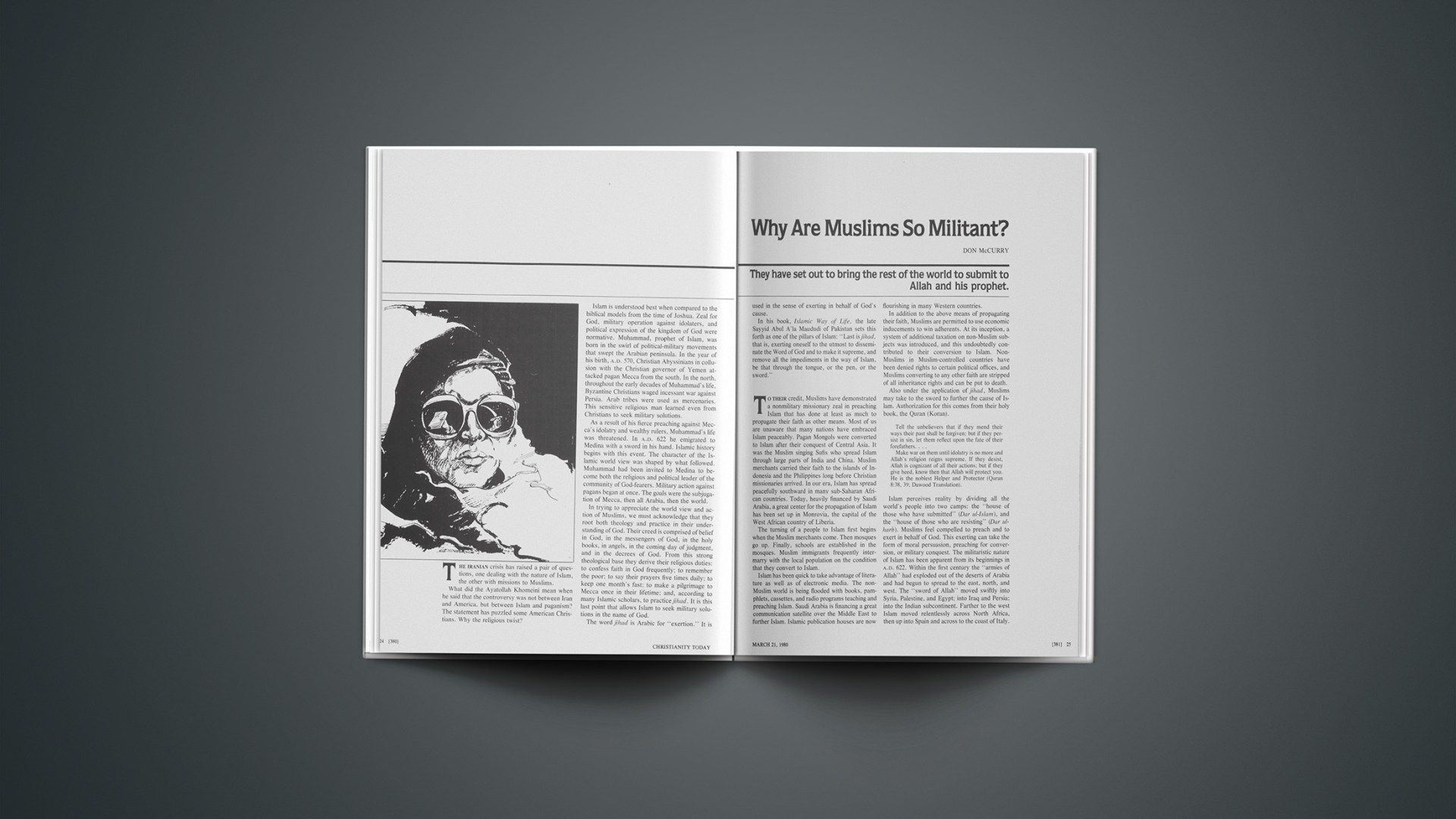
Why Are Muslims so Militant?

They have set out to bring the rest of the world to submit to Allah and his prophet.

The iranian crisis has raised a pair of questions, one dealing with the nature of Islam, the other with missions to Muslims.

What did the Ayatollah Khomeini mean when he said that the controversy was not between Iran and America, but between Islam and paganism? The statement has puzzled some American Christians. Why the religious twist?

Islam is understood best when compared to the biblical models from the time of Joshua. Zeal for God, military operation against idolaters, and political expression of the kingdom of God were normative. Muhammad, prophet of Islam, was born in the swirl of political-military movements that swept the Arabian peninsula. In the year of his birth, A.D. 570, Christian Abyssinians in collusion with the Christian governor of Yemen attacked pagan Mecca from the south. In the north, throughout the early decades of Muhammad’s life, Byzantine Christians waged incessant war against Persia. Arab tribes were used as mercenaries. This sensitive religious man learned even from Christians to seek military solutions.

As a result of his fierce preaching against Mecca’s idolatry and wealthy rulers, Muhammad’s life was threatened. In A.D. 622 he emigrated to Medina with a sword in his hand. Islamic history begins with this event. The character of the Islamic world view was shaped by what followed. Muhammad had been invited to Medina to become both the religious and political leader of the community of God-fearers. Military action against pagans began at once. The goals were the subjugation of Mecca, then all Arabia, then the world.

In trying to appreciate the world view and action of Muslims, we must acknowledge that they root both theology and practice in their understanding of God. Their creed is comprised of belief in God, in the messengers of God, in the holy books, in angels, in the coming day of judgment, and in the decrees of God. From this strong theological base they derive their religious duties: to confess faith in God frequently; to remember the poor; to say their prayers five times daily; to keep one month’s fast; to make a pilgrimage to Mecca once in their lifetime; and, according to many Islamic scholars, to practice jihad. It is this last point that allows Islam to seek military solutions in the name of God.

The word jihad is Arabic for “exertion.” It is used in the sense of exerting in behalf of God’s cause.

In his book, Islamic Way of Life, the late Sayyid Abul A’la Maududi of Pakistan sets this forth as one of the pillars of Islam: “Last is jihad, that is, exerting oneself to the utmost to disseminate the Word of God and to make it supreme, and remove all the impediments in the way of Islam, be that through the tongue, or the pen, or the sword.”

To their credit, Muslims have demonstrated a nonmilitary missionary zeal in preaching Islam that has done at least as much to propagate their faith as other means. Most of us are unaware that many nations have embraced Islam peaceably. Pagan Mongols were converted to Islam after their conquest of Central Asia. It was the Muslim singing Sufis who spread Islam through large parts of India and China. Muslim merchants carried their faith to the islands of Indonesia and the Philippines long before Christian missionaries arrived. In our era, Islam has spread peacefully southward in many sub-Saharan African countries. Today, heavily financed by Saudi Arabia, a great center for the propagation of Islam has been set up in Monrovia, the capital of the West African country of Liberia.

The turning of a people to Islam first begins when the Muslim merchants come. Then mosques go up. Finally, schools are established in the mosques. Muslim immigrants frequently intermarry with the local population on the condition that they convert to Islam.

Islam has been quick to take advantage of literature as well as of electronic media. The non-Muslim world is being flooded with books, pamphlets, cassettes, and radio programs teaching and preaching Islam. Saudi Arabia is financing a great communication satellite over the Middle East to further Islam. Islamic publication houses are now flourishing in many Western countries.

In addition to the above means of propagating their faith, Muslims are permitted to use economic inducements to win adherents. At its inception, a system of additional taxation on non-Muslim subjects was introduced, and this undoubtedly contributed to their conversion to Islam. Non-Muslims in Muslim-controlled countries have been denied rights to certain political offices, and Muslims converting to any other faith are stripped of all inheritance rights and can be put to death.

Also under the application of jihad, Muslims may take to the sword to further the cause of Islam. Authorization for this comes from their holy book, the Quran (Koran).

Tell the unbelievers that if they mend their ways their past shall be forgiven; but if they persist in sin, let them reflect upon the fate of their forefathers.…

Make war on them until idolatry is no more and Allah’s religion reigns supreme. If they desist, Allah is cognizant of all their actions; but if they give heed, know then that Allah will protect you. He is the noblest Helper and Protector (Quran 8:38, 39; Dawood Translation).

Islam perceives reality by dividing all the world’s people into two camps: the “house of those who have submitted” (Dar ul-Islam), and the “house of those who are resisting” (Dar ul-harb). Muslims feel compelled to preach and to exert in behalf of God. This exerting can take the form of moral persuasion, preaching for conversion, or military conquest. The militaristic nature of Islam has been apparent from its beginnings in A.D. 622. Within the first century the “armies of Allah” had exploded out of the deserts of Arabia and had begun to spread to the east, north, and west. The “sword of Allah” moved swiftly into Syria, Palestine, and Egypt; into Iraq and Persia; into the Indian subcontinent. Farther to the west Islam moved relentlessly across North Africa, then up into Spain and across to the coast of Italy. Farther east, it moved into Central Asia and deeper into India.

Through its long and amazing history, Islam has borne witness to its inherent urge for empire.

Our era has not been devoid of examples of violence at the hands of Muslims. Around the turn of the century, Turkish Muslims began their pogroms against Christian minorities living among them. Before it was all over, five million Armenians and one million Greeks had been massacred. Harassment of their minorities has continued down to the present.

Other illustrations of Islamic militancy are the overthrow of the Christian government of Chad by Muslim insurgents; the attempt by Idi Amin to Islamize Uganda, killing perhaps a half million people in the process; the protracted war for autonomy on the part of Muslims in the Philippines; and most recently, the Iranian declaration that Islam is in a holy war against pagans.

Many of us in the West, Christians and others, have been shocked by these developments. We should not have been. The truth is that we have not done our homework. It is this neglect that has led us to misjudge and underestimate Islam.

As recently as 1976, the well-financed Festival of Islam in Britain signaled a new Islamic perception of destiny. The most significant statement to emerge from the event was, “Unless we win London over to Islam, we will fail to win the whole of the Western world.” The Festival of Islam was a declaration by the Muslims that they believe a major turn in history is taking place.

Recommended Bibliography:

1. Rahman, Fazlur. Islam. New York: Anchor Books, 1968. A lucid introduction to the dynamics of Islam’s faith, history, ideologies, and present movements, written by a key spokesman of Islam to the West.

2. McCurry, Don. The Gospel and Islam. Monrovia: MARC Publications, 1979. A compendium of 40 papers exploring new concepts and strategies in the cross-cultural communication of the gospel to Muslims today. Outlines comparative status of Christianity and Islam worldwide.

3. Vander Werff, Lyle. Christian Mission to Muslims. Pasadena: William Carey Library, 1977. A scholarly probing into the Christian witness to Islam in India and the Near East from 1800–1938 with particular emphasis on the methodology of great Christian missionaries during that period.

4. Arberry, A.J. The Koran Interpreted. Macmillan Publishing Co., 1964. Perhaps the most understandable and enjoyable translation of the Quran for English readers. Arberry reproduces the poetic style and form of the Quran while maintaining its essential meaning.

5. Watt, W. Montgomery. Muhammed, Prophet and Statesman. New York: Oxford University Press, 1961. An excellent introduction to the background and influences upon Muhammad, especially the Judeo—Christian roots of Islam, as well as the development of his faith and the ultimate impact of his life.

The Muslim nations of the world are headed toward some form of purposeful Islamic community. The Arab League was founded in Alexandria in 1945. The International Assembly of Muslim Youth was founded in 1955. In 1969 the Islamic Conference of Foreign Ministries was inaugurated in Jeddah.

In Karachi the following year, a Charter of the Islamic Conference was produced, setting in motion the framework for Muslim summit meetings led by heads of states, a permanent Conference of Foreign Ministers, and the Secretariat in Jeddah. In 1972, an International Islamic News Agency was set up. An Islamic Development Bank was established in Karachi in March of 1973 with an initial deposit of one billion dollars.

In 1974, at the meeting of the Muslim World League, steps were taken to coordinate Islamic activities all over the world. At this same meeting, all Muslim governments were urged to adopt the Quran and the model of Muhammad as their foundational documents and impose Islamic Law. The setting up of Islamic Health, Education, and Welfare Institutes was also stressed. Existing Islamic preaching societies were also to be strengthened and new ones founded. And of special note to Christians, Christian missionary activities were to be curtailed in every Muslim country and all of their institutional work was to be taken over and Islamized.

Positive steps have been taken to implement many of these “reforms.” Bangladesh has become an Islamic republic. Islamic Law has been inaugurated in Iran and Pakistan. There is an Islamic resurgence in Turkey. Orthodox teachers are now spreading through Indonesia, attempting to purge syncretistic Islam from its impurities. In several Muslim countries, Christian schools have been nationalized and visas for Christian missionaries are being refused more often. In one case, a century-old mission was expelled from Algeria.

The scene in North America is also full of surprises. The Muslim population here is estimated at about one million Muslim immigrants and an undetermined number of Black Muslims estimated anywhere from 100,000 to 1 million. Abandoned churches in the ghettos are being bought up and converted to mosques. Saudi Arabia has contributed significantly to the orthodoxy of new adherents by subsidizing pilgrimages to Mecca, and by recently donating $50 million to establish community development projects among Black Muslims. Muslim students from abroad also constitute a significant presence.

The recent accumulation of enormous economic power through a near monopoly on oil now provides Islam with unprecedented opportunity to press these advantages into the services of Islamic expansion through preaching, economic inducements, and military adventures—expressions of the duty of Muslims to propagate their faith whether by “tongue, pen, or sword.”

How then is the Christian church to respond to this revitalized Islam? Here are some ideas needing major emphasis.

First, we must separate the Christian message from Western civilization. Islam has now had a century or more to look at and interact with modern forms of Western secularism. Current Islamic renaissance is Islam’s answer and it has no room for accommodating Western agnosticism, materialism, or amorality.

For too long, Western missionaries have unwittingly imposed their own cultural heritage on those they were sent to disciple. Where a people were predisposed to accept Western cultural patterns, things went well. But in the case of Islam, there is a long-standing inherent anti-Western bias. Only recently have we discovered that the so-called Muslim resistance to the gospel is often nothing more than resistance to the culture of the evangelist. When the gospel is presented in a relatively impersonal form through Bible correspondence courses or radio programs, the level of responsiveness is most heartening. And in those rare cases where national or expatriate evangelists have been able to adopt culturally congenial forms, the work has grown.

This illustrates the second major concern facing Christian missions to Muslims. New approaches must be developed that are far more appreciative of Islamic cultures. Christian workers respect their own cultures; they should likewise respect the culture of the Muslim people among whom they have been led to work. As they fit into their new context, of course, they must heed scriptural principles and resist syncretism (the embracing of values or practices incompatible with the ones that Christ approves). Guidelines for these approaches emerge as the evangelists work through the problem of how Christ seeks to relate to Islamic cultures. Because so little has been done in this area we are only at the threshold of a new era in missions to Muslims.

The Iranian crisis and renascent Islam have done the cause of Christian mission a great service. The violent reaction to Western secularism has driven a wedge between the gospel message and Western culture. It has also helped us see that the gospel message can be freed from its Western cultural forms. Iranians have been coming to Christ in Teheran during the very period of confrontation between student militants and the United States—and this has happened through converted Muslims.

The momentum of the spread of the gospel has been increasing proportionately with the Islamic revival. In the very countries where Islamic law is being imposed the number of Muslims turning to Christ is increasing dramatically. And veteran workers are reporting a higher receptivity than ever before.

Two dramas are going on right before our eyes. The first is an almost worldwide revival of Islam. In country after country orthodox Muslims are awakening, flexing their muscles, and becoming more militant. The number of Muslim countries reaching out to one another is growing. Plans evidencing some kind of Muslim design on the world are emerging. How we interpret this is of critical importance. If as Western Christians we are drawn into the age-old rivalry game between Islam and the West, we will be doing irreparable harm to the cause of Christian missions. But if we see the renascence of Islam as a rejection of Western secularism with its atheism, materialism, and amorality, then we can build on that Muslim longing for something more God-centered and moral. Renascent Islam is, in part, a cry for the kingdom of God. Alert and sensitive Christians are picking up on this and finding unprecedented receptivity among Muslims to the gospel.

And that heightens the second drama—the Christian one. The gospel is advancing as never before in many parts of the Muslim world. We must not be stampeded by the Islamic revival and evidences of its aggressive missionary activity into the blind reaction that feeds ancient cultural prejudices.

We now have the insights and tools for significant penetration of Islam. The recent North American Conference for Muslim Evangelization suggested new approaches in Muslim evangelism that are proving helpful.

We need the vision of a harvest among Muslims, and the nerve to obey Christ in evangelizing and discipling them. God is asking us to lay aside our long-standing prejudices and our centuries’ old neglect, and make disciples of these hurting friends for whom Christ died. It is time to claim promises long lying dormant concerning the sons of Ishmael.

Carl F. H. Henry, first editor of Christianity Today, is lecturer at large for World Vision International. An author of many books, he lives in Arlington, Virginia.

Belief and the Bible: A Crisis of Authority?

The CHRISTIANITY TODAY—Gallup Poll shows the Bible is highly revered but seldom used.

If future church historians choose to describe the last half of this century as a “crisis,” they might well choose to say there was a crisis of authority. Such a crisis exists both inside and outside the church. It may be seen outside in the collapse of society, the resort to violence, the selfish disregard of others, and the desire for instant gratification. Inside the church it appears in such matters as changing attitudes toward sex, redefinitions of worldliness, and the increasing success of the cults, but particularly in attitudes toward the Bible.

To discover the prevailing view of the Bible in the general public and specifically among Protestants and Catholics, the CHRISTIANITY TODAY-Gallup Poll asked questions in four areas. First, where do Americans stand with respect to religious authority. Second, how do they view the reliability of the Bible? Third, how often do they read the Bible, and how much do they know of it? Fourth, what effect does Bible reading have on their beliefs and lives? The answers were then given to a group of America’s leading experts on religious life for evaluation.

Fundamental Religious Authority

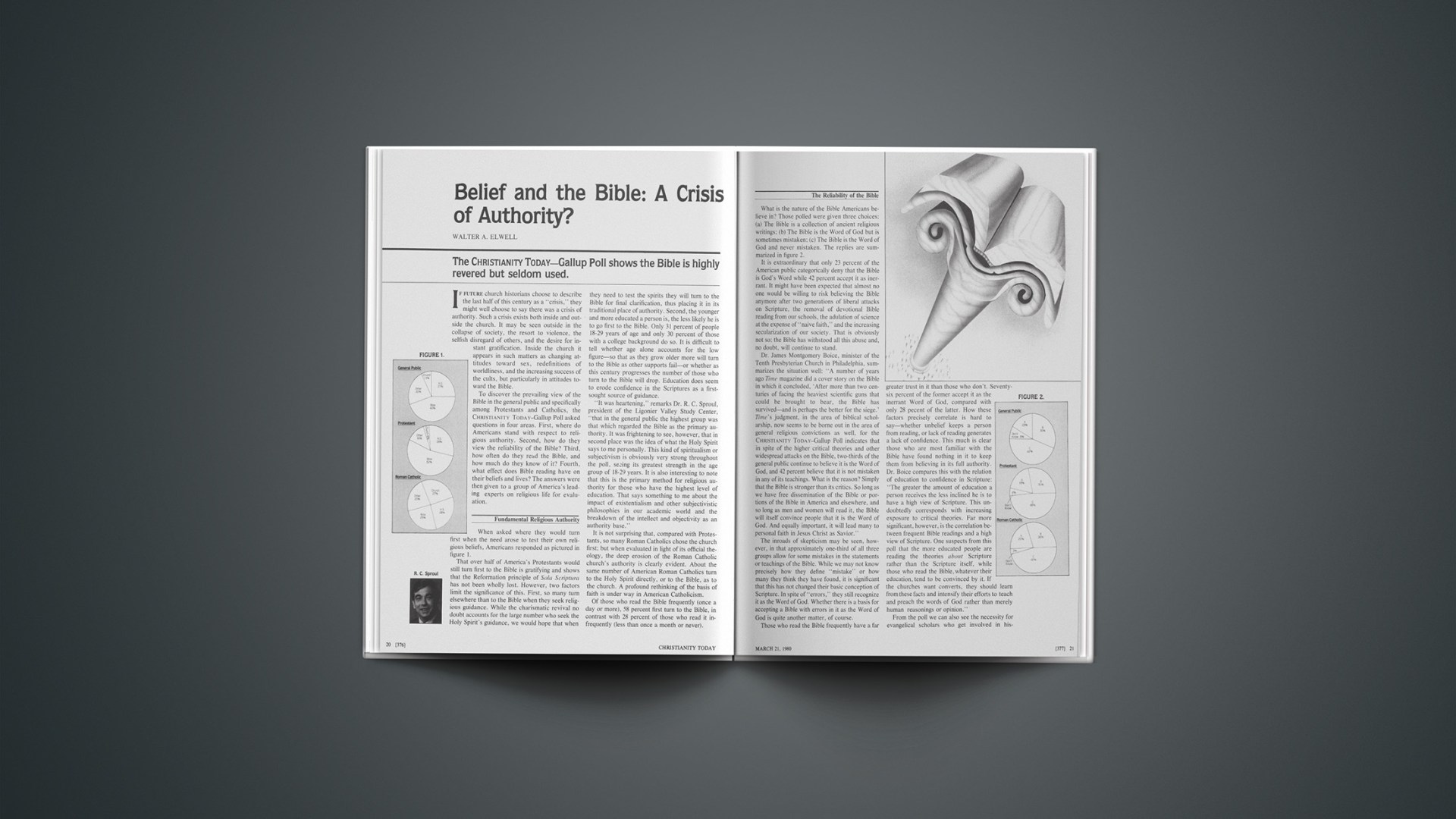
When asked where they would turn first when the need arose to test their own religious beliefs, Americans responded as pictured in figure 1.

That over half of America’s Protestants would still turn first to the Bible is gratifying and shows that the Reformation principle of Sola Scriptura has not been wholly lost. However, two factors limit the significance of this. First, so many turn elsewhere than to the Bible when they seek religious guidance. While the charismatic revival no doubt accounts for the large number who seek the Holy Spirit’s guidance, we would hope that when they need to test the spirits they will turn to the Bible for final clarification, thus placing it in its traditional place of authority. Second, the younger and more educated a person is, the less likely he is to go first to the Bible. Only 31 percent of people 18–29 years of age and only 30 percent of those with a college background do so. It is difficult to tell whether age alone accounts for the low figure—so that as they grow older more will turn to the Bible as other supports fail—or whether as this century progresses the number of those who turn to the Bible will drop. Education does seem to erode confidence in the Scriptures as a first-sought source of guidance.

“It was heartening,” remarks Dr. R. C. Sproul, president of the Ligonier Valley Study Center, “that in the general public the highest group was that which regarded the Bible as the primary authority. It was frightening to see, however, that in second place was the idea of what the Holy Spirit says to me personally. This kind of spiritualism or subjectivism is obviously very strong throughout the poll, seeing its greatest strength in the age group of 18–29 years. It is also interesting to note that this is the primary method for religious authority for those who have the highest level of education. That says something to me about the impact of existentialism and other subjectivistic philosophies in our academic world and the breakdown of the intellect and objectivity as an authority base.”

It is not surprising that, compared with Protestants, so many Roman Catholics chose the church first; but when evaluated in light of its official theology, the deep erosion of the Roman Catholic church’s authority is clearly evident. About the same number of American Roman Catholics turn to the Holy Spirit directly, or to the Bible, as to the church. A profound rethinking of the basis of faith is under way in American Catholicism.

Of those who read the Bible frequently (once a day or more), 58 percent first turn to the Bible, in contrast with 28 percent of those who read it infrequently (less than once a month or never).

The Reliability of the Bible

What is the nature of the Bible Americans believe in? Those polled were given three choices: (a) The Bible is a collection of ancient religious writings; (b) The Bible is the Word of God but is sometimes mistaken; (c) The Bible is the Word of God and never mistaken. The replies are summarized in figure 2.

It is extraordinary that only 23 percent of the American public categorically deny that the Bible is God’s Word while 42 percent accept it as inerrant. It might have been expected that almost no one would be willing to risk believing the Bible anymore after two generations of liberal attacks on Scripture, the removal of devotional Bible reading from our schools, the adulation of science at the expense of “naive faith,” and the increasing secularization of our society. That is obviously not so; the Bible has withstood all this abuse and, no doubt, will continue to stand.

Dr. James Montgomery Boice, minister of the Tenth Presbyterian Church in Philadelphia, summarizes the situation well: “A number of years ago Time magazine did a cover story on the Bible in which it concluded, ‘After more than two centuries of facing the heaviest scientific guns that could be brought to bear, the Bible has survived—and is perhaps the better for the siege.’ Time’s judgment, in the area of biblical scholarship, now seems to be borne out in the area of general religious convictions as well, for the CHRISTIANITY TODAY-Gallup Poll indicates that in spite of the higher critical theories and other widespread attacks on the Bible, two-thirds of the general public continue to believe it is the Word of God, and 42 percent believe that it is not mistaken in any of its teachings. What is the reason? Simply that the Bible is stronger than its critics. So long as we have free dissemination of the Bible or portions of the Bible in America and elsewhere, and so long as men and women will read it, the Bible will itself convince people that it is the Word of God. And equally important, it will lead many to personal faith in Jesus Christ as Savior.”

The inroads of skepticism may be seen, however, in that approximately one-third of all three groups allow for some mistakes in the statements or teachings of the Bible. While we may not know precisely how they define “mistake” or how many they think they have found, it is significant that this has not changed their basic conception of Scripture. In spite of “errors,” they still recognize it as the Word of God. Whether there is a basis for accepting a Bible with errors in it as the Word of God is quite another matter, of course.

Those who read the Bible frequently have a far greater trust in it than those who don’t. Seventy-six percent of the former accept it as the inerrant Word of God, compared with only 28 pecent of the latter. How these factors precisely correlate is hard to say—whether unbelief keeps a person from reading, or lack of reading generates a lack of confidence. This much is clear those who are most familiar with the Bible have found nothing in it to keep them from believing in its full authority. Dr. Boice compares this with the relation of education to confidence in Scripture: “The greater the amount of education a person receives the less inclined he is to have a high view of Scripture. This undoubtedly corresponds with increasing exposure to critical theories. Far more significant, however, is the correlation between frequent Bible readings and a high view of Scripture. One suspects from this poll that the more educated people are reading the theories about Scripture rather than the Scripture itself, while those who read the Bible, whatever their education, tend to be convinced by it. If the churches want converts, they should learn from these facts and intensify their efforts to teach and preach the words of God rather than merely human reasonings or opinion.”

From the poll we can also see the necessity for evangelical scholars who get involved in historical criticism of the Bible and matters of biblical introduction. They must set forth clearly and convincingly views consistent with evangelical faith.

Bible Reading and Bible Knowledge

We are encouraged to learn that America’s beliefs about the Bible have managed to stay significantly on track in spite of all the attempts to discredit it. But we are discouraged to see how few actually turn to the Bible (as opposed to what they hypothetically would do “if” they wanted a question answered), and how little they know of it. It is apparently one thing to believe that the Bible is God’s Word and quite another to read it.

These facts reflect dismally upon the reading habits of the American people. We have to reject the explanation that people are not reading much these days. Retail book selling has been growing year by year for the last 25 years. A standard reference work lists over 8,000 publishers in America, an increase of 40 percent over five years ago. It is not that we aren’t reading very much; it is rather that we are not reading the Bible very much.

We are also troubled that both those who are younger and those who are more educated tend not to read the Bible very frequently. Only 14 percent of those with a college background and 6 percent of the 18-to 29-year-olds reported reading the Bible daily or more. It is also troubling that 56 percent of the college-educated and 58 percent of the 18-to 29-year-olds read it less than once a month or never.

FIGURE 3.

The same unhappy situation exists in the area of factual Bible knowledge. When people fail to read the Bible it is unlikely they will know much about it. CHRISTIANITY TODAY chose one of the best-known chapters in the New Testament (John 3) and one of its most frequently heard references (“ye must be born again”) to test the public’s biblical literacy. Responses to the question “Which of the statements is what the Bible says Jesus told Nicodemus?” are indicated in figure 4 (the choices were supplied by the questionnaire).

When asked how many of the Ten Commandments they could name, 45 percent of the general public could name only tour or fewer, as compared with 49 percent of the Protestants, and 44 percent of the Roman Catholics.

When asked how many of the Ten Commandments they could name, 45 percent of the general public could name only four or fewer, as compared with 49 percent of the Protestants, and 44 percent of the Roman Catholics.

These two tests reveal the dismally low state of American biblical knowledge. Over 40 percent of any group did not know what Jesus said to Nicodemus, even when supplied with the answer, and could not name even five of the Ten Commandments. It is no surprise that the cults and aggressive people who claim religious authority, sometimes even biblical authority, are making such gains today. It would appear that most people simply would not know the difference between theological truth and error. When a person does not know even the simplest biblical facts, is he likely to understand more complex doctrines? It is similar to the situation of a man whose car wouldn’t start during a sub-zero period. When someone suggested that the trouble might be with the carburetor, he replied, “What’s a carburetor?” Little wonder he couldn’t solve the problem! Little wonder our churches are often weak and easy prey for religious hucksters.

Dr. Colin Brown, professor of systematic theology at Fuller Theological Seminary, aptly observes: “These facts about Bible reading and knowledge suggest that all the churches have a long way to go in Christian education and building up their members in regular Bible study. Comparison of the 72 percent who believe the Bible to be the Word of God in one fashion or other with the 12 percent who read it once or more daily suggests that the Bible is venerated as a sacred object. But in practice it is evidently not considered at all profitable for teaching, for reproof, and for training in righteousness.”

FIGURE 4.

That so few people know the Ten Commandments was particularly distressing to Dr. R. C. Sproul, because it indicates “a dismal ignorance of the ethical content of Scripture. We seem to be at a low ebb in the educating of our people into the Christian faith as a value system and an ethical system.”

Effects on Actions and Theology

Christianity Today probed beyond simply what people believed, because it is also necessary to examine what effect those beliefs and the relative frequency of bible reading have on their lives. What emerged was that a cluster of activities—reading the Bible frequently, attending church, talking about one’s faith, contributing financially to the church, and doing volunteer religious work—all corresponded rather closely, indicating that no one activity alone could fully account for a person’s action or belief; more likely, some combination of them did.

While we are mindful of this, we have singled out frequency of Bible reading for discussion, defining “frequent reading” as once a day or more and “infrequent reading” as less than once a month, or never.

Belief in God is not much affected by how often people read the Bible. While all believe in God who read it frequently, so do 92 percent of those who read it only infrequently. However, the first group have a clearer perception of who God is and draw much more consolation from knowing God. Of those who read the Bible frequently, 92 percent say they derive “a lot” of consolation from their beliefs about God, but only 40 percent of infrequent readers testify to such consolation. No doubt this is because those who read their Bible frequently have a more accurate understanding of God than those who do not; when they need consolation, they turn to the Bible for help and find it.

Dr. Millard Erickson, professor of theology at Bethel Theological Seminary, observes that it is no surprise that those who “have had a conversion, read their Bible frequently, attend church frequently, talk often about their faith, and tithe, derive a great deal of consolation and help from their beliefs. Christianity works for those who practice it.”

There is a striking contrast between those who say they have had a religious experience and those who haven’t when it comes to reading the Bible: 74 percent of the former read the Bible frequently, and 79 percent of the latter read the Bible infrequently. Obviously, a personal experience with God fills a person with a love for Scripture, whereas little desire for it exists where such experience is absent. Ninety-eight percent of frequent readers said their experience involved Jesus Christ, whereas only 64 percent of infrequent readers said this. Bible reading clearly gave specific Christian definition to such experience.

Both frequent and infrequent Bible readers were asked, “Are you a Pentecostal or charismatic Christian?” Figure 5 records the results.

That twice as many frequent readers of the Bible are noncharismatic as charismatic seems to indicate that people immersed in Scripture feel less need for ecstatic immediacy. The reading of Scripture provides a sense of security and nearness of God that is sufficient to meet their spiritual needs.

Conclusion

Where does all this leave us? Obviously, the results are a mixed bag. R. C. Sproul draws this conclusion: “The bottom line is that we have a populace who, for the most part, are uneducated about the content of the Scriptures, and particularly with respect to the ethical mandates of Scripture. There is a broad nebulous understanding of certain principles of right and wrong, and certain concepts of God, but the real information and content of Scripture is at a low ebb, and I think that, more than anything else, is reflected in the failure of the church to make an impact on secular culture. In spite of this, we have extremely high numbers of professed conversion experiences. The impact is not being made because of a significant lack of follow-up in which our understanding is affected by the Word of God.”

He continues, “In other words, we are having a revival of feeling but not of knowledge of God. The church’s most serious problem is that people both outside and inside the church do not really know who God is and what he requires of us.”

Colin Brown raises these final points for discussion: “Is the church today more guided by feelings than by convictions? Do we value enthusiasm more than informed commitment? Is there a credibility gap between veneration of the Bible and knowledge of its contents? It would seem so from the figures represented in the poll.”

FIGURE 5.

We can draw certain conclusions about the ministry of the church. First, Americans are strongly committed to the Bible as their religious authority, but have a great need to clarify what that means. Second, subjectivism is creeping into our religious life so that we need a resounding reaffirmation of the Bible’s objective authority. Third, there is pitiful ignorance of the content of Scripture, so the churches must gear their educational programs to the task of teaching their people. Fourth, the importance of reading the Bible is evident, so the churches must increase their efforts to get people to spend time with it. Fifth, we must find ways to help people turn their religious beliefs into actions. The world needs to see faith in action.

Carl F. H. Henry, first editor of Christianity Today, is lecturer at large for World Vision International. An author of many books, he lives in Arlington, Virginia.

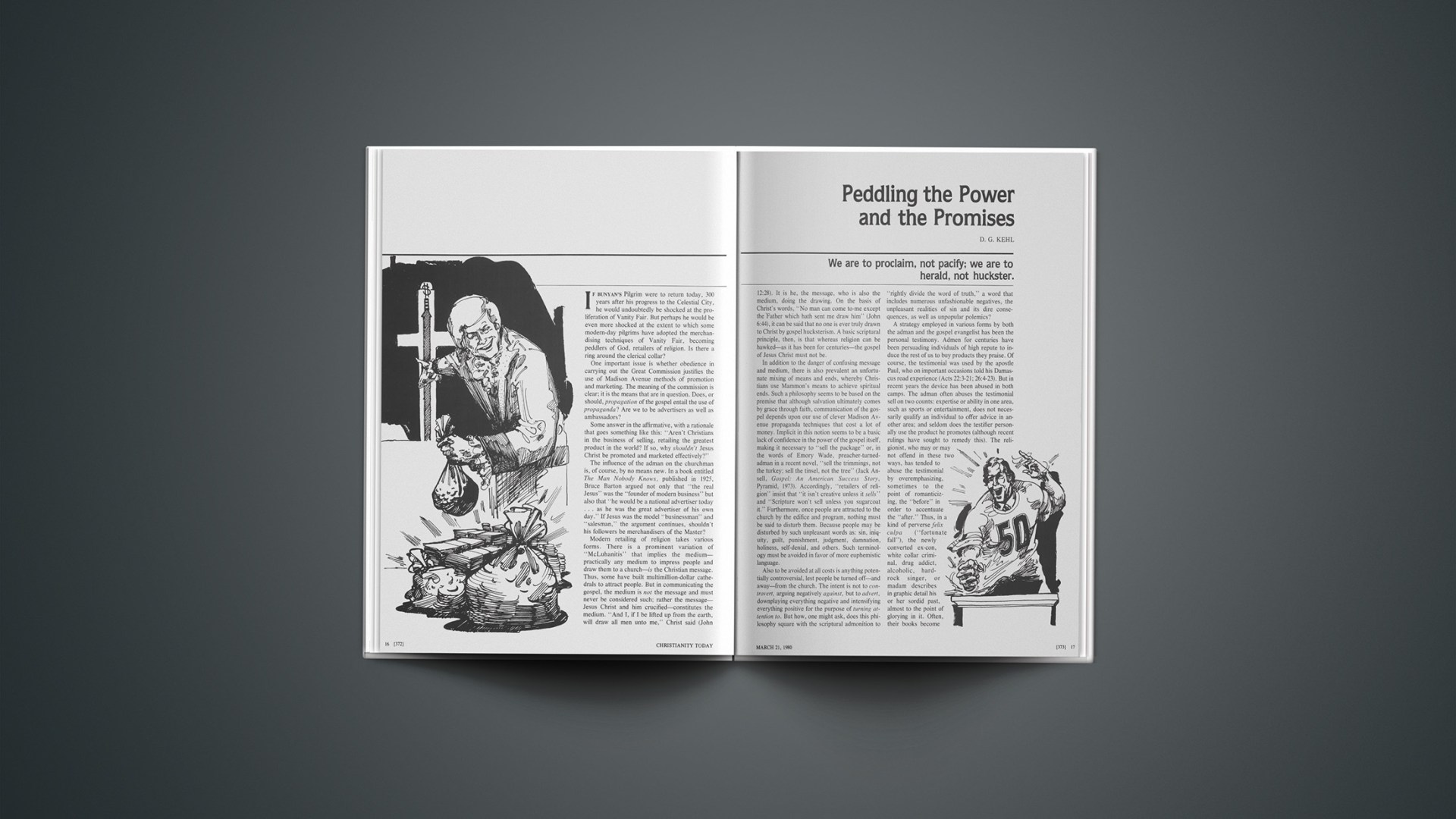
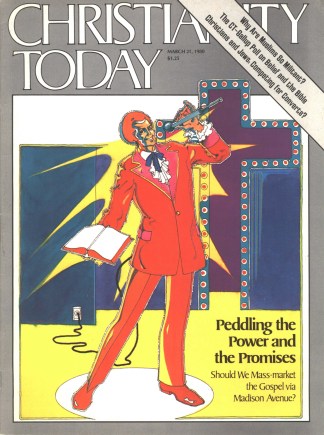
Peddling the Power and the Promises

We are to proclaim, not pacify; we are to herald, not huckster.

If bunyan’s Pilgrim were to return today, 300 years after his progress to the Celestial City, he would undoubtedly be shocked at the proliferation of Vanity Fair. But perhaps he would be even more shocked at the extent to which some modern-day pilgrims have adopted the merchandising techniques of Vanity Fair, becoming peddlers of God, retailers of religion. Is there a ring around the clerical collar?

One important issue is whether obedience in carrying out the Great Commission justifies the use of Madison Avenue methods of promotion and marketing. The meaning of the commission is clear; it is the means that are in question. Does, or should, propagation of the gospel entail the use of propaganda? Are we to be advertisers as well as ambassadors?

Some answer in the affirmative, with a rationale that goes something like this: “Aren’t Christians in the business of selling, retailing the greatest product in the world? If so, why shouldn’t Jesus Christ be promoted and marketed effectively?”

The influence of the adman on the churchman is, of course, by no means new. In a book entitled The Man Nobody Knows, published in 1925, Bruce Barton argued not only that “the real Jesus” was the “founder of modern business” but also that “he would be a national advertiser today … as he was the great advertiser of his own day.” If Jesus was the model “businessman” and “salesman,” the argument continues, shouldn’t his followers be merchandisers of the Master?

Modern retailing of religion takes various forms. There is a prominent variation of “McLuhanitis” that implies the medium—practically any medium to impress people and draw them to a churchis the Christian message. Thus, some have built multimillion-dollar cathedrals to attract people. But in communicating the gospel, the medium is not the message and must never be considered such; rather the message—Jesus Christ and him crucified—constitutes the medium. “And I, if I be lifted up from the earth, will draw all men unto me,” Christ said (John 12:28). It is he, the message, who is also the medium, doing the drawing. On the basis of Christ’s words, “No man can come to me except the Father which hath sent me draw him” (John 6:44), it can be said that no one is ever truly drawn to Christ by gospel hucksterism. A basic scriptural principle, then, is that whereas religion can be hawked—as it has been for centuries—the gospel of Jesus Christ must not be.

In addition to the danger of confusing message and medium, there is also prevalent an unfortunate mixing of means and ends, whereby Christians use Mammon’s means to achieve spiritual ends. Such a philosophy seems to be based on the premise that although salvation ultimately comes by grace through faith, communication of the gospel depends upon our use of clever Madison Avenue propaganda techniques that cost a lot of money. Implicit in this notion seems to be a basic lack of confidence in the power of the gospel itself, making it necessary to “sell the package” or, in the words of Emory Wade, preacher-turned-adman in a recent novel, “sell the trimmings, not the turkey; sell the tinsel, not the tree” (Jack Ansell, Gospel: An American Success Story, Pyramid, 1973). Accordingly, “retailers of religion” insist that “it isn’t creative unless it sells” and “Scripture won’t sell unless you sugarcoat it.” Furthermore, once people are attracted to the church by the edifice and program, nothing must be said to disturb them. Because people may be disturbed by such unpleasant words as: sin, iniquity, guilt, punishment, judgment, damnation, holiness, self-denial, and others. Such terminology must be avoided in favor of more euphemistic language.

Also to be avoided at all costs is anything potentially controversial, lest people be turned off—and away—from the church. The intent is not to controvert, arguing negatively against, but to advert, downplaying everything negative and intensifying everything positive for the purpose of turning attention to. But how, one might ask, does this philosophy square with the scriptural admonition to “rightly divide the word of truth,” a word that includes numerous unfashionable negatives, the unpleasant realities of sin and its dire consequences, as well as unpopular polemics?

A strategy employed in various forms by both the adman and the gospel evangelist has been the personal testimony. Admen for centuries have been persuading individuals of high repute to induce the rest of us to buy products they praise. Of course, the testimonial was used by the apostle Paul, who on important occasions told his Damascus road experience (Acts 22:3–21; 26:4–23). But in recent years the device has been abused in both camps. The adman often abuses the testimonial sell on two counts: expertise or ability in one area, such as sports or entertainment, does not necessarily qualify an individual to offer advice in another area; and seldom does the testifier personally use the product he promotes (although recent rulings have sought to remedy this). The religionist, who may or may not offend in these two ways, has tended to abuse the testimonial by overemphasizing, sometimes to the point of romanticizing, the “before” in order to accentuate the “after.” Thus, in a kind of perverse felix culpa (“fortunate fall”), the newly converted ex-con, white collar criminal, drug addict, alcoholic, hard-rock singer, or madam describes in graphic detail his or her sordid past, almost to the point of glorying in it. Often, their books become best-sellers, they are touted as spokesmen of the Christian faith, and they are prematurely given places of leadership, in violation of 1 Timothy 3:6.

The apostle Paul warned against the tendency toward religious hucksterism that adulterates the very message it purports to “sell.” A similar problem existed in the Corinthian church. Paul speaks sternly of the many who “hawk God’s word for gain” (2 Cor. 2:17, Weymouth), who “peddle the Word of God for profit” (NIV), “whose idea in-getting out the gospel is to make a good living out of it” (LB). The Greek word kapeleuontes, used here for the only time in the New Testament, denotes the act of retailing merchandise; and because first-century hucksters gained the reputation of increasing their profits by adulteration, the term came to denote a corrupting, an adulterating, of the product—in this case the Word of God.

The passage specifies two quite diverse ways of presenting the Christian message, and the distinction between them is crucial in the church’s task of presenting Christ to the world. One way is that of sincere propagation of an unadulterated gospel through the agency and medium of God in Christ. (The English word sincere is derived from Latin sine plus cera, “without wax”—alluding to the deceitful practice of filling cracks in pottery with wax. The Greek word for sincerity is eilikrineias, “judged by sunlight,” suggesting a spiritual pun.) The other way, the more popular way in Paul’s time and perhaps in ours, is that of manipulative propaganda, peddling an adulterated message.

Paul seems to suggest that the adulteration is the inevitable result of the peddling. Propaganda (the term having become pejorative since its original use in the Catholic Congregatio de Propaganda Fide) denotes the effort or activity by which an initiating communicator seeks to alter the attitudes and especially the actions of others by appealing to certain needs or predilections. The propagandist appeals largely to the emotions and nonrational experience.

Can—and should they if they can?—Madison Avenue’s secular propaganda techniques be used to disseminate the Christian message? What happens when the churches seek to package and market Jesus Christ? Perhaps answers to the second question will provide a basis for an answer to the first. Jacques Ellul, in his book Propaganda: The Formation of Men’s Attitudes (Vintage, 1973), argues that “every time a church tried to act through the propaganda devices accepted by an epoch, the truth and authenticity of Christianity were abased.” By acquiring power and influence that are of this world, he argues, Christianity integrates itself into this world, thereby “losing its spiritual part” and “transmitting only a false Christianity.” “Christianity ceases to be an overwhelming power and spiritual adventure and becomes institutionalized in all its expressions and compromised in all its actions. It serves everybody as an ideology with the greatest of ease, and tends to be a hoax. In such times, there appear innumerable sweetenings and adaptations, which denature Christianity by adjusting it to the milieu.” In short, the Christian message loses its saltiness and becomes sugary.

Propaganda, by its very nature and methodology, is not propitious to authentic Christian belief. “What is effective in the service of Jesus Christ,” Ellul notes, “receives its character and effectiveness from Jesus Christ”; propaganda, on the other hand, receives its effectiveness from media manipulation and reflex action conditioning.

Propaganda euphemizes, offering falsehood that is not quite false and truth that is not quite true; authentic Christianity offers a cross, to many a stumbling block, a scandal, downright foolishness. Propaganda tends to separate thought and action, appealing to the emotions, bypassing or short-circuiting God-given intellectual faculties; authentic Christian experience is balanced, involving the whole man—intellect, emotion, and will. Propaganda, in superficially appealing to the lowest common denominator of human nature, tends to dehumanize; authentic Christianity, by offering a divine nature, makes man more meaningfully human. Thus propaganda tends not only to dechristianize the message but also to dehumanize the recipient—and perhaps the messenger as well. Peter warns of those who, “with feigned words, make merchandise” of many (2 Peter 2:3). “In their greed for money they will trade on your credulity with sheer fabrications” (NEB).

Does this mean, then, that responsible promotion and advertising have no place in the churches, that Christians should not propagate the gospel persuasively, that, as Bruce Barton asked 50 years ago, other voices should be raised in the marketplace but the voice of Jesus of Nazareth should be still? Most assuredly not. The crux of the matter is whether the authentic voice of Jesus Christ is being heard. Paul kept the fine distinction between clever human persuasion and effective gospel communication clearly in mind. On the one hand he said, “Knowing the terror of the Lord, I persuade men” (2 Cor. 5:11); but on the other, “My speech and my preaching were not with persuasive words of man’s wisdom” (1 Cor. 2:4). (The Greek word for persuade is peithomen, “to influence by persuasion, endeavor to convince”; the word for persuasive is peithos, from the same stem but associated with Suada, pagan goddess of persuasion.) There is no contradiction here—just the difference between propaganda and propagation, between peddling and proclaiming.

Perhaps examination of a propaganda paradigm will clarify the differences. Propaganda in any form—whether commercial advertisement, political and governmental persuasion, or “public relations” of various kinds—follows this schema (formulated by Professor Hugh Rank of Governor’s State University in Illinois and endorsed by the Committee on Public Doublespeak of the National Council of Teachers of English):

Intensify own “good.” Intensify others’ “bad.”

Downplay own “bad.” Downplay others’ “good.”

But the authentic propagation of the Christian message follows a significantly different schema:

Intensify divine “good.” Intensify human “bad.”

Downplay divine “bad.” Downplay human “good.”

The secular propagandist intensifies in three major ways: (1) repetition (slogans, brand names, songs, etc.); (2) association (bandwagon, plain folks, sense of roots, testimonials, etc.); and (3) composition (syntax, semantics, etc.) The sincere Christian proclaimer, relying on the intensifying power of the Spirit and the living Word, also employs the three-fold technique. He uses repetition (“precept upon precept, line upon line, line upon line; here a little, and there a little,” Isa. 28:10); association (testimonial, promise of fulfillment), and composition (effective use of both verbal and nonverbal techniques).

The propagandist downplays in three major ways: (1) omission (slanted language, euphemism, distortion, half-truths, cover-up, ellipsis, etc.); (2) diversion (red herring, smoke-screening, nit-picking, hair-splitting, focusing on self, ad hominem,ad populum, etc.); and (3) confusion (doublespeak, circumlocution, ambiguity, incoherence, disorganization, equivocation, red tape, etc.).

Downplaying for the Christian proclaimer is considerably different from what it is for the propagandist-peddler. Spurning omissive half-truths, distortion, diversion, and confusion, he presents the message simply and plainly. He “handles aright (literally “cuts straight”) the “word of truth” (2 Tim. 2:15); he “declares the word of truth without distortion” (Conybeare). Paul, within a single verse, emphasizes both downplaying and intensifying as spiritual weapons of the believer: “We tear down calculations [or destroy false arguments] and every height that is raised against the knowledge of God [downplay]. And every mental perception we lead into subjection to Christ [intensify]” (2 Cor. 10:5, Berkeley). For the Christian proclaimer, then, downplaying is simply the other side of intensifying; that is, using the positive truth to offset the negative falsehood. The ineffective Christian proclaimer, like the religious huckster, often engages, intentionally or unintentionally, in such negative downplay as hairsplitting, nit-picking, circumlocution, and ambiguity.

Christian believers forget or ignore to their spiritual peril that ancient adage caveat emptor (“Let the buyer beware”), for Satan is the master propaganda paradigm. It could be said that when the world, the flesh, and the devil intensify, the believer should downplay; when that unholy triad downplay, the believer should intensify. But equally as important for believers to remember is caveat venditor (“Let the seller beware”). Which shall we be: hucksters or heralds? Effective Christian proclamation intensifies and downplays honestly, responsibly—the gospel message itself constituting the medium, the means suited to the ends, the motive unadulterated by desire for personal gain.

Carl F. H. Henry, first editor of Christianity Today, is lecturer at large for World Vision International. An author of many books, he lives in Arlington, Virginia.

Ideas

Selective Obedience Is Disobedience

Evangelical unity is not one option among many.

From all indications, there were no conservative evangelicals among the 100 delegates attending the recent meeting of the Consultation on Church Union. That seems unfortunate. Leaders of COCU have the professed goal of building a single, united church that will incorporate all the distinctive elements of each of the participating denominations. Surely, such a church structure would necessarily include many evangelicals.

In interviews, COCU leaders and delegates seemed unconcerned about the absence of evangelicals. Some intimated (no doubt with good reason) that evangelicals would only have blocked progress at the meeting, during which consensus was reached on a statement that would allow mutual recognition of ministers among the 10 participating denominations, a big step toward COCU’s goal of a single, united church.

But other COCU officials (no doubt with equally good reasons) shrugged that evangelicals aren’t all that interested in COCU. The ecumenical group has no written policy against conservatives. Each participating denomination elects 10 COCU representatives, and conservatives in each church body have opportunity to seek those posts. Denominations not wanting to join COCU still are encouraged to send observers, but of the nation’s predominantly conservative church bodies, only the Church of God (Anderson, Ind.) took advantage of that option at the recent meeting.

The absence of evangelicals at COCU proceedings may reflect more upon their traditional apathy toward ecumenical involvement than it does any kind of blackball policy of the theologically liberal crowd at COCU. Over the years, evangelicals have shied away from ecumenical projects, especially if such had National or World Council of Churches written upon them.

Evangelicals are justified in many of their suspicions.

Recent “ecumenical councils” have often preached a watered-down theology, finding it easier to organize the many diverse Christian groups around social principles than fine points of doctrine.

The Church of God observers at the recent cocu meeting had some doctrinal reservations: they acknowledged that many elements of cocu theology, perhaps even that pertaining to Christian social responsibility, would be unacceptable to some members of their own denomination. But if they did not agree with the doctrinal position of cocu, the Church of God observers expressed full sympathy with COCU’s vision for Christian unity.

All evangelicals ought to display a similar commitment to the visible unity of the body of Christ. To disagree with doctrinal error or indifference is one thing; but to be indifferent to the biblical mandate for unity is quite another matter. Evangelicals have no more right to pick and choose what biblical commands they will obey than liberals have the right to pick and choose what biblical truths they choose to believe.

Christ prayed that believers “be brought into complete unity to let the world know that you sent me and have loved them as you have loved me” (John 17:23, NIV).

Increased unity among Christians certainly would be a boon to evangelistic outreach. We all know unbelievers who criticize Christians for being divided into the myriad of denominations and churches: ecumenical leader Paul Crow of the Christian Church (Disciples of Christ) has said that outsiders frequently ask how Christ can be a reconciling factor in their own lives if he can’t even pull the churches together.

Church denominations probably won’t dissolve in the foreseeable future. That in itself is tragic enough. But evangelicals can at least work together in unity of spirit. Cooperation is not always compromise.

Evangelicals should maintain a presence at ecumenical gatherings if only to show liberal Christians that their own obedience to Scripture is not a piecemeal selection. Above all, evangelicals must work harder at cooperation among themselves. When an evangelical organization expends a major portion of its funds to lure funds away from other evangelical organizations into its coffers, something is rotten in places other than Denmark.

On the local level and on the mission fields of the world evangelicals must learn to give far greater priority to cooperative social and evangelistic outreach. Evangelical denominations—long separated by minor differences—must strive for coordinated programs and even for merger. True evangelical unity is not one option among many. It is a goal toward which every Christian who names Christ as Lord must strive.

A former theological student once said that when he was a small boy, he got a spanking for stacking the Bible on a shelf along with the other books, rather than putting it on top of the piano for everyone to see, because that’s where it belonged. He then remarked wistfully, “We never read it in our house, but we sure gave it high respect.” He has since abandoned the evangelical faith.

CHRISTIANITY TODAY’s recent Gallup Poll shows clearly that the American public is quite willing to “put a Bible on top of its piano.” A surprising 42 percent recognize in principle that the Bible is God’s Word, indeed inerrant, and should be treated with special respect. It stands alone, and on top. But tragically, it not only stands there, it stays there. Very few of those who say they respect the Bible actually read it. The poll shows that the simplest facts are almost lost on most Americans. They have trouble remembering the Ten Commandments and what Jesus said to Nicodemus.

There was a time when the American people were more biblically literate. They took pains to learn the Bible because they acknowledged its authority not only in principle, but also in their daily lives. Having committed its teaching to their hearts, they made it a lamp unto their feet; they hid it away in their hearts as a hedge against sin. But those days have passed.

If we are ever to recover the authority of Scripture for our lives, we need to fill our minds with its content. We need to search it, meditate upon it, memorize it, and make it a part of ourselves. Pastors need to emphasize its significance from the pulpit and parents need to read it with their children. We need a nationwide recommitment to letting the Bible matter in our lives.

Is it on the piano or in our hearts? That question must be faced squarely. The faith of the next generation could well depend on how we answer it. When true knowledge of the Bible goes, can faith be far behind?

The challenging situation we face as we enter the decade of the ’80s calls the national Christian community to consider the evangelization of our land. Taken as a whole over the last 200 years, American churches have shown remarkable growth. Statistics indicate increased church attendance and membership during the past decade. Still, there are vast numbers of our countrymen who are out of vital touch with Jesus Christ, his gospel, and his people.

We believe they can be reached. George Gallup’s recent poll is significant. In his interviews with unchurched Americans, he discerned some signs of real hope in evangelistic opportunity. He found, for example, that 50 percent of the unchurched see themselves becoming active members of the church in the near future; four out of five unchurched families want their children to have some spiritual nurture and education; and two-thirds of the unchurched pray, believe in God, believe in Jesus Christ as the Son of God, and believe in life after death.

We are convinced it is time for a fresh look at biblical evangelism in the contemporary American context. We have no desire to put an uncritical stamp of approval on “evangelism as usual.” Evangelicals need to check their bearings and, wherever necessary, to make some midcourse corrections. Some important questions need immediate attention: Who are the unreached peoples of America? Why are some churches growing and others not? Do our evangelistic efforts produce disciples—or just converts? Are the converts of the “born again” movement actually linking in fellowship with God’s people? What changes are needed in our evangelistic strategy? What aspects of the gospel will speak most powerfully to Americans? How would God have evangelicals work together? Do evangelicals really have a coordinated, imaginative, far-reaching strategy for taking the gospel to all areas of national life?

In that connection, we commend the steps already being taken toward an American Festival of Evangelism, a call for concerned Christians to consider the United States as a mission field. Meeting in Kansas City, Missouri, July 27–30, 1981, the four-day gathering will focus on the unreached peoples in America.

Thousands of congregations need to be renewed as centers of celebration and outreach. They should be motivated to plant churches in neglected areas of this nation. At the same time, however, we must not just talk glibly of “winning America to Christ.” Rather, we must visualize what America won to Christ would look like. Would Christianity affect our schools? Our economics? Our race relations? Our divorce rate? We do not expect America or any other country to be “the kingdom of God on earth,” but we do believe that the gospel, truly preached and fully lived, should cause dramatic changes in our national lifestyle. The salt, leaven, and light of the kingdom could spell a profound difference for the nation.

Eutychus and His Kin: March 21, 1980

“Blessed Are They Who Go Around in Circles.…”

Evangelism experts have long agreed that one of the most difficult places for Christian witness is the roller-skating rink. The famous Graff-Kneubling Report of 1975 contains all the pertinent data if you are interested. However, the problem may be solved, for a new ministry has appeared on the evangelical horizon.

“Holy Rollers” is a fellowship of Christians who enjoy roller-skating. I visited one of their meetings and was quite impressed. They opened with the singing of their theme song, “Give me oil on my skates, keep me rolling,” followed by the reading of Ezekiel 1, during which the members shouted “Amen!” whenever the word “wheels” was read.

After the meeting I interviewed the president, Bedford Frubish. “What is the purpose of your ministry?” I asked.

“We have two purposes,” he replied. “First, it is a fellowship of people who enjoy Christian skating. Second, it is a ministry of witness in the rinks. And, third, we are a right arm to the church.”

“That’s three purposes, Mr. Frubish,” I said. “You said there were two.”

“Well, yes. Actually, there are four different groups meeting now,” he explained. “We’ve had our problems with unity. You know how independent roller-skaters are.”

“You mean the organization has had its splits?”

“Yes—but all of them have been over important issues: Should we skate to worldly music or only to Christian music? Should we hold hands? What Bible verses should we print on our shirts? One group left because they didn’t like the name of the organization.”

“And what do they call themselves?”

“ ‘Witnessing Wheels,’ I think. But we’re a very young organization. We’re still getting our bearings.”

About that time, Frubish was called away to listen to some music and approve it, and I decided it was a safe time to de-part. I heard a thud, turned to see what it was, and there was Frubish on his back, his legs perpendicular to the floor. Very biblical, I said to myself. The wheels in the middle of the air.

EUTYCHUS X

Balanced Diet?

I decided to write you after reading the article by United Methodist Bishop Earl Hunt, Jr. (“Toward a Holiness Beyond the Obvious,” Feb. 8).

As a United Methodist pastor, I would appreciate more articles by United Methodists. The steady diet of Baptist and Presbyterian “propaganda” does get a bit stale. It seems many of the articles are written by the same select authors. More variety, please!

This is the first positive thing I can remember seeing in your magazine for a long time regarding the United Methodist Church. I’ve been vexed more than once in the past by your negative treatment of the church.

REV. JOHN FAIR

Wadena United Methodist Church

Wadena, Minn.

Perceptive

Congratulations on Carl Henry’s perceptive interview with Martyn Lloyd-Jones (Feb. 8). I discovered more about “The Doctor” from that one interview than from listening to many of his sermons or from the occasional conversation and correspondence which I have been privileged to have with him.

JOHN L. FEAR

Programme Director

Trans World Radio

London, England

Travesty

Senator Mark Hatfield’s article on “Why I Am a Christian Socialist” (I believe you entitled it “Finding the Energy to Continue,” Feb. 8) is a travesty of major proportions. Every one of his theological and philosophical premises is faulty.

For example, to proclaim concern for the poor and then argue for a “no growth” society is to condemn the poor to their poverty. Without an upward mobility in a free society there is no answer to poverty. Hatfield’s taking from the rich and giving to the poor is Marxism, not biblical Christianity.

DAVID A. NOEBEL

President

Summit Ministries

Manitou Springs, Colo.

Senator Hatfield’s premise of limited resources and the need for no growth and redistribution of what is left is a sad mixing of the discredited Club of Rome fears and socialism under the false guise of Christianity. Both factors will lead to economic decay and tragedy for future generations.

At this very moment we have large supplies of nuclear power to generate electrical energy economically. Instead, we fiddle with expensive alternates financed by borrowed funds that fuel inflation caused by federal deficit spending. The gasoline “shortage” was plainly caused by government price controls that held down the price of fuel, leading to needless waste and postponement of alternate sources of energy.

On the horizon lies the breeder reactor, and beyond that, fusion. God, not nature, has provided for mankind for a time beyond our imagination. The great need is to remove the shackles of government controls and creeping socialism that are choking productivity and individual responsibility.

MARTIN F. LITTMAN

Middletown, Ohio

Peacemaking

Thank you for your timely article on peacemaking by John Stott (“Calling for Peacemakers in a Nuclear Age, Part I,” Cornerstone, Feb. 8). We have too long failed to be peacemakers. This is in part because we have come so close to making an idol of freedom. Freedom is, of course, a good thing, but it is never promised to us in Scripture. Instead we are told that whether or not we have freedom, God will achieve his purposes and give us power to witness faithfully to him. If we think God needs our nuclear warheads to defend freedom so we can preach the good news, we insult God and make an idol of freedom; we also ignore the example of faithful Christians under repressive political systems.…

BRON TAYLOR

Director

Interfaith Center to Reverse the Arms Race

Pasadena, Calif.

Abrasive Review

Just a few observations on the review of my book Faith Founded on Fact (Books, Feb. 8), so readers can better evaluate the reliability of Irving Hexham’s judgments: (1) I never present process theologian Schubert Ogden as a “hero,” or anything resembling one. (2) My essay “Science, Theology and the Miraculous” does not deal with David Hume, but with miracle criticism in philosophy during the last 20 years. (3) The essay “Mass Communication and Scriptural Proclamation” is hardly a “tirade against various theologians”; it is an attempt to work out positive biblical and theological bases for communications theory (it was presented originally to the German branch of Trans World Radio at their congress in Zurich).

Ironically, any “abrasiveness” in my book is trivial by comparison with that quality in Hexham’s review.

JOHN WARWICK MONTGOMERY

Newport Beach, Calif.

Editor’s Note from March 21, 1980

The Iranian crisis has raised the consciousness level of most Americans, and especially of evangelicals, with regard to Islamic faith; may it also stir evangelicals’ concern for the Christian mission to Muslims. Don McCurry helps us to understand our contemporary world as he places in sharp focus both the challenge and the opportunity presented by recent Islamic trends.

American Jewry has long faulted evangelicals for efforts to convert Jews to Christian faith. Some even have viewed this as a mild form of Hitler-like genocide, for in the end the conversion of a Jew to Jesus Christ is considered by traditional Jewry as elimination of a true Jew. But recently, Marvin Wilson points out, some Jews are reviving the ancient Jewish zeal for proselytes. Such a revival need not lead to increased tension and bitterness between Jews and Christians, but rather to greater understanding.

As long as I can remember I have been addicted to science fiction—from Jonathan Swift and Jules Verne and H. G. Wells, to the potboilers of recent vintage. You may, therefore, be interested in Paul Leggett’s analysis of the theological implication of old and current science fiction films. For running freaks, Charles White of Park Street Church, Boston, provides a theology of running—orthodox running, naturally. What else after 150 years of Brimstone Comer?

D. G. Kehl helps us distinguish enthusiastic, effective witness to the gospel from sordid gospel hucksterism—an issue no evangelical in our day can avoid facing.

Finally, Walter Elwell continues the CHRISTIANITY TODAY-Gallup Poll series with an illuminating article on the Bible, its veneration, its use, and its abuse.

History
Today in Christian History

March 21

January
February
March
April
May
June
July
August
September
October
November
December
<>

March 21, 547: Italian monk Benedict, author of the Benedictine rule (which established the pattern for European monastic life through the Middle Ages), dies at Monte Cassino. In 1965 Pope Paul VI proclaimed him the patron saint of Europe.

March 21, 1146: At the urging of Bernard of Clairvaux (one of the most famous theologians and monks of his day), France's King Louis VII announces he will lead the Second Crusade to regain the crusader capital of Edessa. When he failed two years later, Christians were devastated that a crusade preached by a moral exemplar and led by royalty could fail (see issue 24: Bernard of Clairvaux and issue 40: The Crusades).

March 21, 1556: After denying earlier forced recantations, Anglican Archbishop of Canterbury Thomas Cranmer, a crucial figure in the English Reformation and author of the Book of Common Prayer, is burned at the stake by Queen Mary. He reportedly thrust his arm into the flames, saying the hand that had signed the recantations should be the first to burn (see issue 48: Thomas Cranmer).

March 21, 1685: German organist and composer Johann Sebastian Bach is born in Eisenach, Germany. Though largely unrecognized in his day and forgotten for years after his death, he has since become recognized as one of history's unequalled musical masters. But music was never just music to Bach. Nearly three-fourths of his 1,000 compositions were written for use in worship. Between his musical genius, his devotion to Christ, and the effect of his music, he has gained recognition in many circles as the "Fifth Evangelist.

March 21, 1656: James Ussher, calvinist theologian and archbishop of Armagh, Ireland, dies. Famous for his chronology of the Bible (which placed the creation of the world in 4004 B.C.), he also created a history of the Latin Church and the articles of faith for the Church in Ireland. Respected by Christians of all traditions, he was given a state funeral and buried in Westminster Abbey.

March 21, 1788: Charles Wesley, brother of John and author of 8,989 hymns (including "Hark! The Herald Angels Sing," "And Can It Be," "O for a Thousand Tongues to Sing," "Love Divine, All Loves Excelling," "Jesus, Lover of My Soul," "Christ the Lord Is Risen Today," "Soldiers of Christ, Arise," and "Rejoice! the Lord Is King!"), dies at age 81 (see issue 2: John Wesley, issue 31: Golden Age of Hmyns, and issue 69: Charles and John Wesley).

March 21, 1844: William Miller's first proposed date of Christ's return—between March 21, 1843, and March 21, 1844—ends with little fanfare. Miller soon changed the date to October 22, 1844, but when that passed his followers became disillusioned and premillennialism experienced a massive setback. The Adventist churches grew from the Millerite movement (see issue 61: The End of the World).

March 21, 1871: Journalist Henry M. Stanley, on assignment for the New York Herald, begins his search for David Livingstone in Africa. After he found him (and uttered the famous words "Dr. Livingstone, I presume?"), the Scottish missionary converted him. Stanley was persuaded to return to Africa years later to continue missionary work and exploration (see issue 56: David Livingstone).

March 21, 1900: After the death of its founder, evangelist Dwight L. Moody, Chicago's Bible Institute for Home and Foreign Missions changes its name to Moody Bible Institute (see issue 25: D.L. Moody).

March 21, 1965: Baptist minister Martin Luther King, Jr., leads more than 3,000 civil rights demonstrators on a march from Selma, Alabama, to Montgomery. By the time they reached their destination four days later, the group had expanded to 25,000 (see issue 65: The Ten Most Influential Christians of the Twentieth Century).

Apple PodcastsDown ArrowDown ArrowDown Arrowarrow_left_altLeft ArrowLeft ArrowRight ArrowRight ArrowRight Arrowarrow_up_altUp ArrowUp ArrowAvailable at Amazoncaret-downCloseCloseEmailEmailExpandExpandExternalExternalFacebookfacebook-squareGiftGiftGooglegoogleGoogle KeephamburgerInstagraminstagram-squareLinkLinklinkedin-squareListenListenListenChristianity TodayCT Creative Studio Logologo_orgMegaphoneMenuMenupausePinterestPlayPlayPocketPodcastRSSRSSSaveSaveSaveSearchSearchsearchSpotifyStitcherTelegramTable of ContentsTable of Contentstwitter-squareWhatsAppXYouTubeYouTube