History
Today in Christian History

February 23

January
February
March
April
May
June
July
August
September
October
November
December
<>

February 23, 155 (traditional date): Polycarp, the bishop of Smyrna, is martyred. Reportedly a disciple of the Apostle John, at age 86 he was taken to be burned at the stake. "You try to frighten me with fire that burns for an hour and forget the fire of hell that never burns out," he said. The flames, legend says, would not touch him, and when he was run through with a sword, his blood put the fire out (see issue 27: Persecution in the Early Church).

February 23, 303: Diocletian begins his "Great Persecution," issuing edicts that call for church buildings to be destroyed, sacred writings burned, Christians to lose civil rights, and clergy to be imprisoned and forced to sacrifice. The following year he went even further, ordering all people to sacrifice on pain of death (see issue 27: Persecution in the Early Church).

February 23, 1455 (traditional date): Johannes Gutenberg publishes the Bible, the first book ever printed on a press with movable type. (see issue 16: William Tyndale)

February 23, 1685: George Frederick Handel, composer of the oratorio "Messiah," is born. He died in 1759, having spent the last six years of his life in total blindness.
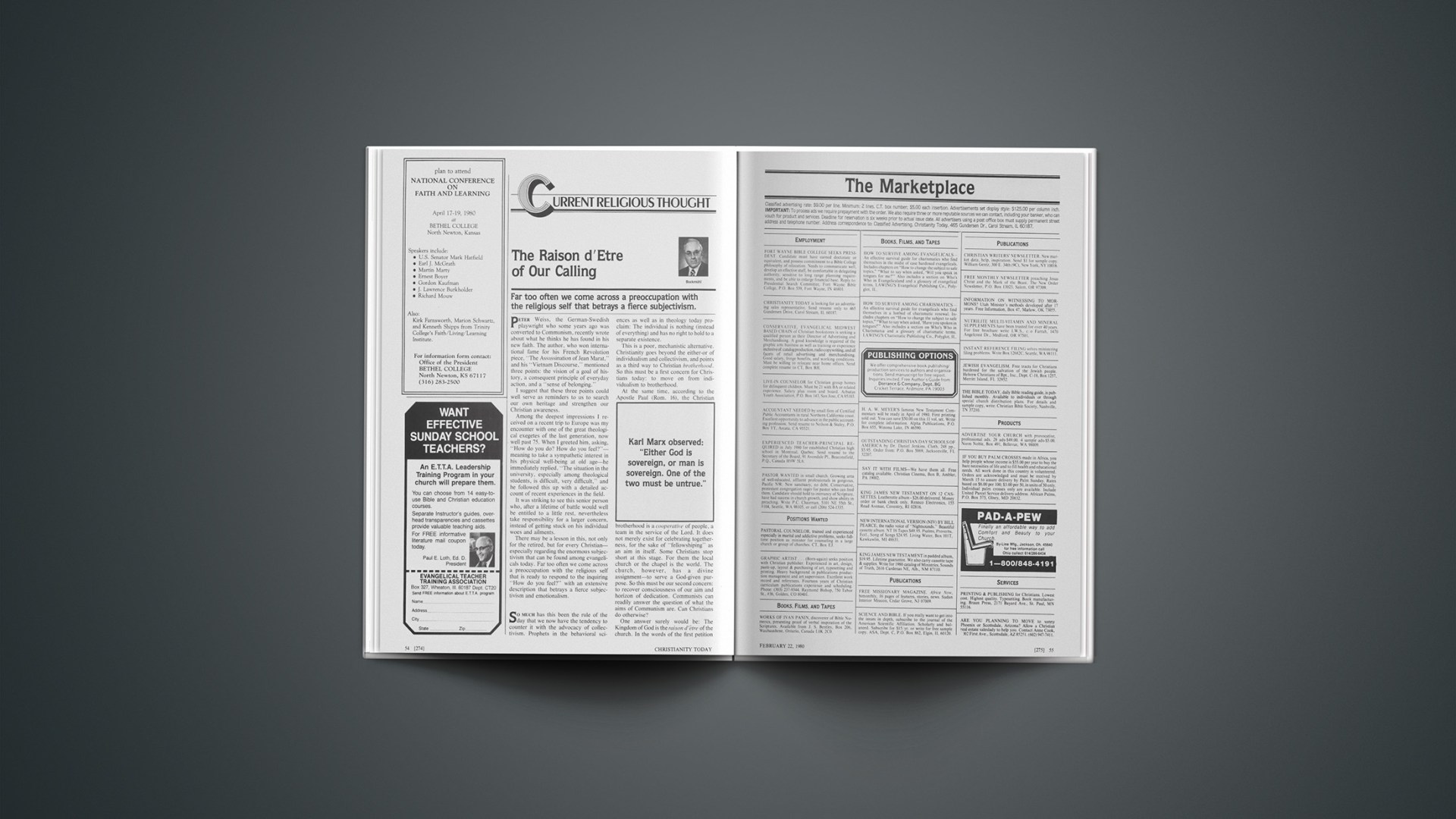
The Raison d’etre of Our Calling

Far too often we come across a preoccupation with the religious self that betrays a fierce subjectivism.

Peter Weiss, the German-Swedish playwright who some years ago was converted to Communism, recently wrote about what he thinks he has found in his new faith. The author, who won international fame for his French Revolution piece, “The Assassination of Jean Marat,” and his “Vietnam Discourse,” mentioned three points: the vision of a goal of history, a consequent principle of everyday action, and a “sense of belonging.”

I suggest that these three points could well serve as reminders to us to search our own heritage and strengthen our Christian awareness.

Among the deepest impressions I received on a recent trip to Europe was my encounter with one of the great theological exegetes of the last generation, now well past 75. When I greeted him, asking, “How do you do? How do you feel?”—meaning to take a sympathetic interest in his physical well-being at old age—he immediately replied, “The situation in the university, especially among theological students, is difficult, very difficult,” and he followed this up with a detailed account of recent experiences in the field.

It was striking to see this senior person who, after a lifetime of battle would well be entitled to a little rest, nevertheless take responsibility for a larger concern, instead of getting stuck on his individual woes and ailments.

There may be a lesson in this, not only for the retired, but for every Christian—especially regarding the enormous subjectivism that can be found among evangelicals today. Far too often we come across a preoccupation with the religious self that is ready to respond to the inquiring “How do you feel?” with an extensive description that betrays a fierce subjectivism and emotionalism.

So much has this been the rule of the day that we now have the tendency to counter it with the advocacy of collectivism. Prophets in the behavioral sciences as well as in theology today proclaim: The individual is nothing (instead of everything) and has no right to hold to a separate existence.

This is a poor, mechanistic alternative. Christianity goes beyond the either-or of individualism and collectivism, and points as a third way to Christian brotherhood. So this must be a first concern for Christians today: to move on from individualism to brotherhood.

At the same time, according to the Apostle Paul (Rom. 16), the Christian brotherhood is a cooperative of people, a team in the service of the Lord. It does not merely exist for celebrating togetherness, for the sake of “fellowshiping” as an aim in itself. Some Christians stop short at this stage. For them the local church or the chapel is the world. The church, however, has a divine assignment—to serve a God-given purpose. So this must be our second concern: to recover consciousness of our aim and horizon of dedication. Communists can readily answer the question of what the aims of Communism are. Can Christians do otherwise?

One answer surely would be: The Kingdom of God is the raison d’être of the church. In the words of the first petition of the Lord’s Prayer, it is the church’s foremost concern that God’s name be honored, and that his will be done on earth, as it is already done in heaven.

The kingdom of God stands for: God shall rule. In our historical setting, this means a constant conflict with “man shall rule,” the philosophy of secularism. Shrewdly, Karl Marx observed: “Either God is sovereign, or man is sovereign. One of the two must be untrue.” Christians, too, must become aware of this basic alternative that underlies all of today’s public debates.

A fresh understanding of the kingdom of God will give wide scope to Christian thinking. What does “God shall rule” mean, for example, in the professions: in the largely abandoned field of medical ethics, in business life, in legal affairs, and in politics? Moreover, the same perspective applies to the field of theology where we have a long way to go until it could truthfully be said that God’s name was being hallowed there. Even among the well-meaning, a new consciousness of purpose would mean overcoming much of the parochialism of our present theological interests, both in local and conceptual terms. The horizon of “God shall rule” would function as a much-needed yardstick for self-criticism, in the direction of a recovery of the task to counter the forces of secularism in the land.

When peter Weiss spoke of the Communist vision of the goal of history and a consequent principle of everyday action, the job of taking measure between the ideal and the actual and of deciding the course of action undoubtedly fell to human reason. If, however, God is sovereign, then also in terms of ways and means the battle cannot be fought on the basis of human insight and decision alone. We need the wisdom of the Holy Spirit in order to know which steps we are to take in our lives and in that wider conflict.

The Holy Spirit is the instructor in all matters concerning the kingdom. He must be called for counsel and asked for advice. He is not only the advocate, but also our vocator, the one who gives us our vocation, and assigns us to our place. It is his prerogative to interpret our situation in the light of God’s aim for all history, and to point out the steps that need to be taken: assessments that far exceed human ability.

This, then, should be our third concern, next to Christian brotherhood as a working unit, and to the understanding of the kingdom of God as the goal of history: to explore in prayer the mind of the Spirit in order to understand our time and our God-given task in it.

Klaus Bockmühl is professor of theology and ethics, Regent College, Vancouver, Canada.

Soviets Arrest Dudko in Try at Suppressing Orthodox Dissent

Religious persecution has increased in the Soviet Union since the Soviet invasion of Afghanistan and the resulting damage to Soviet-American relations. The most publicized victim has been scientist Andrei Sakharov who, although not himself a believer, has defended the rights of Christians and Jews to worship in freedom. Of comparable importance, however, has been the arrest of Russian Orthodox priest Dimitri Dudko, one of the most prominent activists for religious freedom in the Soviet Union.

“It seems that 1980 will be a very difficult year for all of us,” wrote Dimitri Dudko early in January. “Some have already been seized. I have been summoned to interrogation as a witness, and maybe yet as [one who is] accused.… However, all this is of little significance if we stand united.…”

In the early morning on January 15, Dudko was arrested at his parish church in Grebnevo outside Moscow, and taken to Lefortovo Prison. Officials searched the church and his Moscow flat for the next 12 hours. They confiscated everything of a religious nature: Bibles, prayer books, religious books and manuscripts, all of Dudko’s sermons, and a full set of the children’s magazine Trezvon—published in the U.S., it contains religious and Bible stories. All of the family’s money was taken.

Dudko became well known early in the 1970s for preaching fearlessly in Moscow’s Church of Saint Nicholas against labor camps, the timidity of the Russian Orthodox Church establishment, and the presence of informers in the hierarchy.

Dudko’s growing influence and popularity attracted the attention of the authorities, and in July 1972, he was summoned to the Moscow Patriarchate to account for his popularity. Official pressure for his dismissal increased.

At the end of 1973, Dudko began question-and-answer sessions with parishioners after church services. This soon tripled the number of his church attendee, including many young people and non-Orthodox Christians, Jews, and even unbelievers. Intellectuals such as Alexander Solzhenitsyn and Vladimir Maksimov also were attracted. Dudko preached the Christian faith and the way a believer should organize his life.

In May 1974, after nine such sessions, Patriarch Pimen ordered them suspended. But at the urging of his parishioners, Dudko held two more sessions in his home.

Later that year Dudko was transferred from his Moscow church to one in Kabanovo, a village some 40 miles from Moscow. This congregation grew steadily, augmented by people traveling there from Moscow and other towns.

In June of 1975, Dudko was involved in an automobile accident of suspicious nature, in which both legs were broken. Because he had been under surveillance by the secret police, many feel the accident was actually an attempt on his life. Dudko was dismissed from the Kabanovo church in December of that year, although parishioners wrote 10 appeals in his support, some signed by more than 100 people. Early in 1976 he was appointed to another church, in Grebnevo, about 20 miles from Moscow. He was attacked by name in the Literaturnayci Gazeta in April 1977, but without hesitation openly refuted the charges.

Toward the end of last year, Dudko was not allowed to serve in church on Sundays and was threatened on a number of occasions. Many of his parishioners were harassed by the militia. Undaunted, Dudko began publishing an unofficial parish newsletter for his flock.

Last October, 20 representatives of the KGB searched his apartment. He was summoned to Metropolitan Yuvenali, the bishop in charge of the diocese of Moscow, who warned Dudko against continuing his sermons.

After that, Dudko adhered scrupulously to spiritual questions—that is, until the arrest of fellow priest Gleb Yukunin (Dec. 21, 1979, issue, p. 44). In a statement dated November 26, Dudko condemned the arrest of Yakunin, the leader of the Committee for the Defense of Believer’s Rights in the USSR.

Dudko turns 58 this month. He is suffering from thrombophlebitis, and was feeling ill at the time of his arrest. His wife, Antonina Ivanovna, has taken bandages and mineral water to the prison, but thus far authorities have not accepted them. Dudko’s son, Mikhail, has been threatened with expulsion from the institute where he is studying and with his immediate drafting into the army.

On the day of Dudko’s arrest, house searches were made at seven homes of worshipers at the Grebnevo church. One house searched belonged to Viktor Kapitanchuk, the new secretary of the Committee for the Defense of Believers’ Rights.

Late last month no witnesses had been called for interrogation in Dudko’s case, and there had been no indication of the official charges against him.

In his letter, written several days before his arrest, Dudko wrote: “If anything happens to me, let this [letter] be my message from behind prison walls.… It is quite clear now why the authorities put away Father Gleb [Yakunin]—they want to silence dissenting voices [within the church] as far as possible.… They do this—grievous as it may be to say so—by the hands of the church leadership. The directives are issued in the name of the patriarch, but they are signed by the senior administrator of the Moscow Patriarchate, Metropolitan Alexi, who is extremely obedient to the Soviet authorities. Sound the alarm: ‘Silence and compromise are not tactical steps, they are betrayal.’ ”

Bangladesh

Bangladeshi Authorities Put Missions on Shorter Leash

Turbulence in the Islamic world has rippled eastward to the Muslim nation of Bangladesh. A recent government order has specified that all missionary societies must now register with the Ministry of Social Welfare. Each mission must produce audited financial statements, lists of projects, details of future plans, as well as projections for nationalization of existing institutions. In the future, government officials will approve or disapprove all missionary visas, budgets, and projects. There is a likelihood that each mission agency will be forced into the funding and supervision of social services in order to maintain its presence in Bangladesh.

Politically, this nation of 86 million people is calm. President Zia Rahman has restored a type of controlled democracy. A former military officer, Rahman is respected for his integrity and firm leadership qualities.

Inflation continues to hinder economic progress. Gasoline and kerosene shortages appear sporadically; crops have been adequate in the past few years. Demographically, Bangladesh is a statistician’s nightmare: more than 1,500 people presently occupy each square mile of land. Through the communications media, which are widely used, the Bengali people are exhorted to avail themselves of information and products distributed by government birth control centers.

India

Bakht Singh’s Movement Still Full of Grassroots Vitality

The old section of the Indian city of Hyderabad was still under dusk-to-dawn curfew in the aftermath of communal rioting. The riots began after inflammatory radio broadcasts, which reported the Ayatollah Ruhollah Khomeini’s accusations that Americans were responsible for the armed takeover of the Grand Mosque at Mecca. Enraged Muslims of Hyderabad, once the capital of a Muslim state under British rule, asked the city’s Hindus to join them in an anti-American demonstration. The Hindus’ refusal sparked the riot, which caused loss of lives and property on both sides.

In this explosive atmosphere, it would seem that what wasn’t needed was another demonstration—especially one involving Christians. But that is exactly what happened that day last November. Marching four abreast, many wearing aprons bearing Scripture texts, 20,000 persons marched the dusty roads in a column extending for three miles. They held high their banners with more Bible texts, and sang songs of love, peace, and life.

These were members of the assemblies loyal to Bakht Singh, 76, who began this Brethren church movement indigenous to India nearly 40 years ago. Some 25,000 people from all parts of India were in Hyderabad for the assemblies’ nine-day annual All India Holy Convocation.

The convocation meetings were held on the grounds of “Hebron,” the Hyderabad headquarters of Bakht Singh’s ministries (where, characteristically, the walls of the buildings are painted, both inside and out, with verses in English, Hindi, and Telegu). Men and women sat separately—on opposite sides of a central aisle—in a large tent designed to hold 7,000 to 8,000, but packed with many more. The overflow crowd sat in two or three smaller tents.

The speakers, both Indian and Western, challenged the congregation with messages on the convocation theme, “My grace is sufficient for thee.” Although this was a Christian family conference, rather than an evangelistic event, about 2,800 persons signed decision cards, 422 were baptized, and several volunteered for full-time service in India or abroad.

The approximately 20,000 out-of-town participants were housed and fed in more large tents. The participants were divided into teams for cooking, serving, drawing water, sweeping, guarding, and so on. There was no registration fee and “Brother” Singh made no appeal for money. “These are the guests of the King of kings and Lord of lords: therefore they should be treated as such,” said Singh.

Here, as in the assemblies, collections were taken only on Sundays at the time of the worship service. No plate was passed: instead, believers took their offerings to boxes placed at the front.

To provide fellowship for new converts scattered throughout India, Singh, taking his cue from Leviticus 23, began the first yearly convocation at Madras in 1941. The Holy Convocations, central to Singh’s work, now are held yearly in four cities—regional centers of southern India: Madras, Hyderabad, Ahmadabad, and Kalimpong. The largest of these annual gatherings is the Hyderabad convocation. It is surpassed in size in India only by the Maramon Convention, sponsored by the Mar Thomas churches of Kerala. Members of the assemblies dismiss the Maramon Convention, however. “It has become like a Hindu festival,” sniffed one assemblies worker.

A legendary figure in his own lifetime, Singh was born to well-to-do Hindu parents in the northern Punjab sector of India (now part of Pakistan), but dedicated to the Sikh religion. While studying agricultural engineering in Winnipeg, Manitoba, he was converted to Christ in 1929 at the age of 26. Four years later he returned to India, where his refusal to soft-pedal his own beliefs turned his parents and other relatives against him. His wife left him, never to return.

Singh plunged into evangelism, and worked in fellowship with all the Protestant denominations for eight years. Conversions on an unprecedented scale and the outbreak of revival accompanied his ministry. J. Edwin Orr observed that, during this period. “Bakht Singh became an all-India evangelist, rather than a provincial preacher.…”

Concerned that existing denominational churches were not adequately caring for the new converts, Singh spent a night on a mountain in prayer. He came down with the conviction that he should start assemblies patterned after the New Testament principles but applied within an Indian cultural background. This approach helped many Indians understand that they need not adopt Western culture to become Christians.

Singh and his coworkers have started some 500 indigenous assemblies in India—mostly in the South—since 1941. There are no paid workers in the assemblies, and no membership. The full-time workers, numbering about 400, are chosen by consensus, not elected. They are also expected to live by faith. The assemblies are among India’s largest and fastest growing churches.

Singh never attended Bible college or seminary and reads no biblical commentaries (his assemblies have no training school). He reads and meditates on Scripture upon his knees for hours each day. With something of a photographic memory, he is noted for his power of scriptural recall. Despite a speech impediment, he has preached his way to wide acceptance in India and around the world.

Singh shies away from publicity and seeks no seat among national or international Christian leaders. One Danish Christian leader commented, “Here we all love Brother Bakht Singh, mainly because he is a man of great humility.”

Singh’s desire to act only according to Scripture, and his refusal to compromise with church traditions or theological liberalism, make him a controversial figure. Critics say Singh is antimissionary and legalistic. But Singh, perhaps more than any other Indian leader, has popularized the daily use of the Bible. He carries his Bible everywhere and encourages others to do the same.

Singh says he will accept no preaching invitations either in India or abroad unless he feels he has God’s direction to do so. And in spite of his age, he remains in high demand. Many in Christian circles question whether the assemblies will live on after Singh’s death, but Singh says that the Lord, who started the work, will care for its future.

T. E. Koshy

The Netherlands

The Pontiff Puts the Heat on Avant-garde Dutch Church

The small but influential Dutch Roman Catholic church has been a special concern of the Vatican ever since Vatican II (1962–1965) first opened up the church to more influence from its bishops around the world.

Fervently traditionalist before World War II, Dutch Catholics saw the rigid lines dividing them from Protestants breached during their joint resistance to Nazi occupation. Postwar prosperity created a new and affluent Catholic middle class that felt less dependent on Rome. A mood of innovation prevailed.

A new adult catechism sidestepped teachings such as the virgin birth. Obligatory Sunday mass was dropped and private confession fell into disuse. Some Dutch churches celebrated interfaith rites with Protestants. Married ex-priests were allowed to teach on seminary faculties. Lay “pastoral assistants” began to carry out almost all tasks traditionally reserved for priests.

The frustrated Curia regarded all seven Dutch bishops as liberal. Pope Paul VI moved only indirectly to contain the reforming trends in the Dutch church. As dioceses fell vacant, he appointed conservative bishops—over the objections of the Dutch hierarchy. He named Adriaan Simonis a bishop in 1971. Simonis is considered a moderate on the Dutch spectrum, but a Vatican official once described him as “about 40 degrees to the left of the most liberal U.S. bishops.” He named Jan Gijsen, a conservative in anybody’s book, in 1972.

There has been nothing but wrangling ever since. Gijsen, especially, has attacked the liberalizing trends. Unhappy with the way the bishops had attached their five seminaries to state universities, he set up his own. (The number of his new priests has been falling off drastically over the last decade, and Gijsen’s seminary now is producing the most new priests.) He also set up a new missionary organization. Gijsen’s outspoken denunciation of his fellow bishops’ permissiveness has kept the hierarchy tense and those in the pew confused. The Dutch primate, Cardinal Jan Willebrands—himself mildly liberal, but also a conciliator—has failed in attempts to establish working harmony among the bishops.

Through last month’s special synod, Pope John Paul II put the Dutch bishops—as one Catholic reporter observed—in a pressure cooker. To the seven Dutch bishops he added Godfried Danneels, his newly appointed Belgian primate; six (conservative) Vatican representatives; and one Dutch theologian. Then for most of the two-and-a-half week synod he simply listened as the bishops grappled with the subjects on their agenda. Part of the pressure, though, came from his previous utterances on the issues under review.

The cooker experience seems to have worked on the bishops. They began by confirming the necessity for priests to remain celibate (in 1968 the Dutch bishops had passed on to the Vatican the recommendation of the Dutch Pastoral Council that celibacy should be optional for priests). The bishops went on to curb much of the innovation that has surfaced in celebration of the mass, and stressed that “individual confession and absolution” remain “the only normal way” for the faithful to be reconciled with God. They set up a commission to study whether priests in training are receiving adequate spiritual preparation in the university-attached schools.

The bishops also formed a commission that will define the status of pastoral assistants. During the synod they already had limited the assistants by specifically barring them from celebrating mass, hearing confessions, or anointing the sick. (The Dutch church has, in effect, overridden Vatican objections to women as priests and deacons and to married clergy by allowing them, as pastoral assistants, to perform virtually the same roles.)

While they may have satisfied the Pope, however, the bishops had to return to the Netherlands and win acceptance from their independent-minded colleagues, clerical and lay, who make the 5.6-million-member church function.

World Scene

Ten members of the Presbyterian Church in Taiwan were arrested last month. The arrests appeared to be part of a quiet roundup of critics of the Republic of China government, following December antigovernment riots. The governing Kuomingtang regime is largely composed of mainlanders who evacuated to Taiwan in 1949, while the Presbyterians, the island’s largest Protestant denomination, are mostly native Taiwanese.

In the highlands of Vietnam, many people have been killed, pastors are in prison, and the populace is suffering great hardship. This report, in a letter from a young Koho tribesman, Krong, to Christian and Missionary Alliance missionary Helen Evans, also revealed that Pastor Sau (of Bamboo Cross fame) and two of his sons were shot to death while praying with a group of young men in a cave. Krong, himself, had been imprisoned under a death sentence, but he escaped, made his way to the sea, and eventually reached Thailand.

A steady flow of response mail from mainland China listeners to Christian broadcasts continues. The Far East Broadcasting Company reported receiving more than 11,000 letters in 1979. Its transmitters, together with those of Trans World Radio, broadcast a combined total of 391/4 hours a day into the People’s Republic.

Partial restoration of Babylon and “reconstruction” of the Tower of Babel on its traditional site are being explored by the Iraqi government and Japan’s Kyoto University. Headed by a professor of architecture, the university team will prepare and submit detailed proposals for rebuilding the great Ishtar Gate of Babylon, construction of a museum, a research center, and a modern traffic system to accommodate tourists.

Missionaries are returning to the Islamic Republic of Comoros after a two-year absence. The Africa Inland Mission entered the Comoros, a group of islands in the Indian Ocean off the coast of Africa, in 1976. But the ready response to the gospel soon became “an embarassment” to the government then in power. After two AIM missionaries were arrested and expelled in late 1977, the mission withdrew its entire staff of 18. Now a new government has expressed regrets over the expulsion, and two AIM missionaries have returned.

Three Coptic churches in Alexandria, Egypt, were fire bombed last month. Members of a fundamentalist segment of the Muslim Brotherhood were responsible, said Shawky F. Karas, president of the American Coptic Association. The bombings all occurred on January 6, the Orthodox observance of Christmas, and there were injuries, “some severe.”

The All Africa Conference of Churches is in trouble. It has been facing a “leadership crisis” since its general secretary, Canon Burgess Carr, began a sabbatical leave in the United States in March 1978. Carr said he would not return to Kenya where the World Council of Churches-aligned body has its headquarters. Efforts to agree on terms for Carr’s return failed, and last month the chairman of the AACC General Committee, John Gatu, announced that “the post of the general secretary has now become vacant.” The organization also had a deficit of some $2.5 million at the end of 1979. Overseas donors have withheld funds pending resolution of the leadership problem and clarification of the direction of the AACC.

The Reformed Churches in the Netherlands have decided that men and women with a homosexual preference and practice should be fully accepted as members of their congregations. The General Synod’s nearly unanimous vote followed the report of a synodical advisory committee. The Reformed Ecumenical Synod News Exchange reports the committee’s representative, B. J. F. Schoep, admitted the starting point of committee deliberations was not biblical texts on homosexuality.

Belief in the divinity of Christ has steadily eroded in Britain over the last two decades, according to a study by Princeton Religious Research Center (an affiliate of the Gallup organization) done for the London Sunday Telegraph. Only about 55 percent of the British population now believe that Jesus is the Son of God, compared to 60 percent in 1963, and 71 percent in 1957. By contrast, 78 percent of Americans say they agree that Christ is divine, the center says.

The world’s oldest active editor was promoted last month as his magazine changed hands.The Christian Herald magazine, Britain’s largest interdenominational weekly and a family enterprise since its founding in 1866, has been purchased by Herald House Ltd., a new company backed by two Christian businessmen. Editor T. Wilkinson Riddle, 93, became editor-in-chief. He has been associated with the publication since 1938.

Carter’s Presence Confirms Clout of Evangelical Broadcasters

From the inner recesses of the White House to the board rooms of Japanese electronics manufacturers, officials are eyeing evangelical broadcasters with more than passing interest.

The ogling was evident on all sides at last month’s thirty-seventh annual meeting of the National Religious Broadcasters at the Washington Hilton in the nation’s capital. President Jimmy Carter was there (after pleading unavailability two years in a row). So was the Republican National Committee, the American Conservative Union, and Liberty Lobby—though confined to the exhibit hall. Also in the exhibit hall were companies like Sony, Panasonic, and RCA, competitively showcasing the latest cameras, coaxial connectors, and other technological wares of the industry, side by side with mission broadcasters, book publishers offering suggestions for giveaway offers on the air, and fund raisers.

Discerning observers noticed the relative absence of big-name singers and music companies, whose splashiness in past years created a show biz aura at NRB conventions. Their absence may be linked to the fact that some leading evangelical music companies and artists—mainly Bill Gaither—have been hauling Christian broadcasters into court for neglecting to pay music license fees to the secular organizations that represent the music industry. The litigation battles were a topic of intense concern in several workshops and in corridor talk.

But despite the political maneuvering in the foreground and the troubling court cases in the background, this year’s NRB convention was the best one ever in programming for professionals, said a number of long-time members in interviews.

Many of the nearly 2,000 convention participants gathered in seminars to discuss improvements of broadcasts beamed at overseas audiences, to consider new program strategies in reaching contemporary Americans—including those in the inner city—and to glean pointers from market specialists. Members of the Federal Communications Commission updated broadcasters on communication law. (FCC chairman Charles D. Ferris disclosed that his agency was receiving 300,000 letters a month at the beginning of 1979 about a nonexistent threat to religious broadcasting—a threat falsely attributed to atheist Madalyn Murray O’Hair. A public relations firm was finally hired to answer the mail and try to stop the unfounded rumor; mail now is down to 9,000 letters a month, said Ferris.)

Pollster George Gallup, Jr., was on hand to announce his latest survey—a privately commissioned “Profile of the Christian Marketplace.” The aim: to determine the attitudes, interests, opinions, use of time, spending habits, lifestyles, and giving, listening, and viewing patterns of evangelicals. The results will be published in April, and will have far-reaching implications for broadcasters, said a spokesman for the Estey-Hoover firm, sponsor of the survey. “No such research has been undertaken until now, and broadcasters therefore have not known very much about their audience,” he said.

President Carter, during his talk on the second night of the convention, candidly acknowledged that 1980 is an election year. “This time, I’m going to let you explain full-time what it means to be born again,” he quipped. He said that during his travels he had witnessed to the leaders of South Korea and Poland. Religious faith, he emphasized, was a central element in the Sadat-Begin talks. He said that he talked with Chinese vice-premier Teng Hsiao-ping about the Bible distribution program of the Gideons and told him China should reopen its doors to Christian missionaries. He called for prayer on his behalf, then plunged into the audience for a handshaking session.

Carter, who knows he is in deep trouble among many evangelical voters, invited 12 NRB representatives to discuss issues with him over grits and scrambled eggs at the White House the next morning. The 12 asked for his views on national defense, the family, abortion, government regulation of religion, prayer in the schools, and the lack of evangelical appointments to the White House staff. “Many in the delegation were disappointed by his answers,” commented Robert Dugan of the National Association of Evangelicals afterward (the NAE is the parent body of the NRB).

In response to the question, Carter said he would support a prolife amendment to the Constitution if one were passed. Television minister Jerry Falwell said he would announce the President’s position to tens of thousands at an antiabortion rally later in the day. A White House press officer, however, pointed out that the President is bound by law to uphold the Constitution, and that his answer should be taken in that light.

Sources said that Carter seemed perplexed by the question on evangelical appointments, finally commenting simply that religion cannot be a test of employment. He said he will not promote gay rights, and he rejected the notion that the Equal Rights Amendment might harm the family. As for classroom prayers, the President said he wanted the government completely out of “the prayer business,” hence he opposed school prayers. According to the sources, he voiced concern for Jewish children who might find themselves having to leave the classroom each day when it was time to pray.

Those present included Jim Bakker of the PTL network, D. James Kennedy of Evangelism Explosion, television preachers Oral Roberts and Rex Humbard. Howard Jones of the “Hour of Freedom” broadcast, Jimmy Allen of the Southern Baptist Convention, NRB vice-president E. Brandt Gustavson, San Diego author-pastor Tim LaHaye, Southern Baptist pastor Charles Stanley of Atlanta, and California Baptist pastor Morris Sheats.

(LaHaye’s wife, Beverly, who heads Concerned Women for America, and other women visited with Mrs. Carter; they said they were praying she would “listen to our side” and reverse her pro-ERA position. “I have heard and considered both sides;” the First Lady was quoted as replying.)

Dugan, Bakker, and Falwell joined with Bill Bright of Campus Crusade for Christ, Pat Robertson of the 700 Club, evangelist James Robison, Southern Baptist president Adrian Rogers, and others in forming a new group, the Coalition for the First Amendment, to lobby for the right to have classroom prayers. The U.S. Senate last year approved an amendment by Republican Jesse Helms of North Carolina that would remove the school prayer issue from the jurisdiction of federal courts. The amendment was removed from an important education bill and tacked on to one dealing with federal court reforms. That bill, however, has lain dormant in the House Judiciary Committee, whose chairman, Democrat Peter Rodino of New Jersey, opposes the prayer measure.

At an NRB breakfast sponsored by the NAE, Helms called on the broadcasters to generate a flood of mail urging members of Congress to sign a discharge petition that would bring the bill to the floor.

Republican Philip Crane of Illinois, House leader of the battle favoring prayer, said at an NRB press conference that he has 50 of 218 needed signatures.

NRB members passed a resolution asking Congress to adopt the Helms amendment. In other action, the members reelected California broadcaster David Hofer as president and approved a record $500,000 budget for 1980. Earlier, the NRB board adopted a resolution endorsing the deregulation of the broadcasting industry. The Roman Catholic bishops and some mainstream Protestant groups opposed deregulation; they say it will result in fewer religious programs that are aired free as a community service.

The electronic church is a reality. Of some 8,000 radio stations in the United States, 1,400 are religious, as are 30 of the nation’s 800 or so television stations and 66 of the 800 cable systems. Revenues are estimated by broadcast media sources to exceed $500 million a year, NRB officials estimate that their 900 members account for 70 percent of all religious radio and TV programming in the U.S., reaching an estimated audience of 129 million.

Says NRB executive secretary Ben Armstrong: “Broadcast religion touches more people than all the churches combined.”

United Methodists

Looking Out for Illegals Is a Borderline Affair

Some cross the Rio Grande River by night; others hide in car trunks. By various means, an estimated two million Hispanics illegally enter the United States every year. Because many undocumented immigrants are members of U.S. churches, and because the so-called wetback churches are called the fastest growing in the Southwest, U.S. churches are faced with deciding how to deal with the situation. When do acts of Christian compassion toward illegals violate federal immigration law?

Participants last month at the first Southwestern Border Consultation in Juarez, Mexico, had some suggestions for the United Methodist Church. They adopted a 15-page position paper, to be presented to the United Methodist General Conference, calling for immediate amnesty for undocumented immigrants.

The 250 participants, about half of them of Hispanic origin and representing both United Methodists and the 45,000-member Methodist Church of Mexico, also called for greater sensitivity in church and secular news media coverage of border problems, and for wide-ranging reforms of present federal immigration law.

Delegates to the UMC general conference will request $100,000 annually for a border program. The “border office” would supply chaplains to work with the Border Patrol, legal aid for immigrants who feel their rights have been violated, and publicity to non-Hispanics about the needs of the illegals.

Two Mexican bishops attended the three-day conference, as did three UMC bishops from the United States, including Jesse R. DeWitt, vice-president of the sponsoring UMC Board of Global Ministries. Some Mexican delegates complained that they were blocked from full participation because much of the study material was not translated into Spanish; they proposed a similar conference exclusively for Mexican Methodists and asked that future border conferences be run jointly by the U.S. and Mexican churches.

However, the participants pulled together to pass their position paper easily. They agreed that public agencies are inadequately caring for illegal aliens, and that church-supported agencies “have been challenged to respond to this unmet need …” Conference participants openly discussed the use of church facilities by illegal aliens. They wondered if, and how, those actions could be interpreted as violations of “overbroad” federal immigration law regulations governing such things as aiding and abetting, inducing, and transporting illegal aliens. But a discreet ambiguity was evident in the phrasing of resolutions, no doubt to be scrutinized closely at the April general conference.

“It is incumbent on us to decide what law ought to be and to take steps toward its realization.… We are called anew to stand in the tradition of Moses, the prophets, and the gospel of Jesus Christ to seek justice and equity.…” resolved conference members.

Pastor Conredo Soltero, who “for conversation’s sake,” hangs facing portraits of John Wesley and Mao Tse Tung in his Metropolitan Board of Missions office in El Paso, Texas, said benevolent activism toward illegals could lead to serious church-state consequences.

“If a local church wants to get deeply involved, then it’s going to have to make some hard decisions.”

PETER BROCK

North American Scene

Antiabortion groups lost a major battle last month. U.S. federal district court Judge John F. Dooling, Jr., ruled that federal Medicaid funds must be allowed for all abortions of “medical necessity”—defining that to include psychological, emotional, familial, and age risks, not just physical ones. His decision, which has been appealed by the U.S. Justice Department to the Supreme Court, made unconstitutional the so-called Hyde Amendment that since 1976 has banned federally-funded abortions except to save the mother’s life or in certain cases, such as rape or incest. Dooling partly based his decision on the argument (espoused by some Baptist and United Methodist spokesmen) that denial of an abortion to a woman who cannot afford to pay violates her freedom of conscience and religion.

Carrying banners such as “Missionaries are spiritual Nazis” and “Leave Jews to Judaism,” an activist Jewish group in Toronto, Bnei Akiba, last month picketed the home of Hans Vanderwerff, a Jew and spiritual leader of a charismatic group that is affiliated with the U.S.-based Union of Messianic Jewish Congregations. The activists complained that Vanderwerff tells Jews they can accept Christ as Messiah and Savior without renouncing their Judaism. Vanderwerff’s congregation is about 60 percent Jewish; he says it cherishes and retains the Jewish heritage.

Author Madeleine L’Engle’s A Wrinkle in Time is becoming a major Hollywood movie. L’Engle sold the film rights for an undisclosed amount to television and movie producer Norman Lear (“All in the Family,” “The Jeffersons”). An active Episcopalian, L’Engle negotiated the contract terms herself—stipulating that character and theme not be changed and that she be consulted during the production, which is to be completed in about two years. Wrinkle in 1963 won the prestigious Newbery Award for “the most distinguished contribution to American literature for children.” Like other books by L’Engle (also popular among adults), it is a fantasy with underlying religious themes.

Television preacher Jerry Falwell’s Liberty Baptist Seminary lost its dean in a doctrinal dispute over Calvinism. In his 19-page resignation letter to school chancellor Falwell, former dean Robert Hughes protested that against his objections faculty were hired who teach Calvinism (predestination for salvation or damnation). Falwell responded in a letter to Hughes that “fatalism” is not taught at either Liberty Baptist College or its seminary, according to the local Lynchburg, Virginia, Daily Advance. Well-known Baptist educator and writer Elmer Towns was appointed dean.

The Once Stymied COCU Makes Step-at-a-Time Progress

America historically has sprouted church denominations almost as fast as church buildings. Instead of a single body of believers, the nation grew Baptists, Episcopalians, and Presbyterians. Ecumenists say the result has been a denominational mindset. Ask someone to define “the Christian church” and the answer probably will be “the denomination with about one million members, also known as the Disciples of Christ.”

Leaders of COCU, the Consultation on Church Union, one of the longest-running ecumenical shows in the U.S., still think they have the answer. For nearly two decades, they have been selling the idea of merging America’s many church bodies into a single Church of Christ Uniting. After a meeting last month in Cincinnati, COCU delegates believed their organization and its ecumenical vision crossed a hump on the bumpy way to visible church unity.

Representatives of the 10 participating COCU denominations, with a combined membership of more than 20 million, voted to approve a theological consensus on ministry: chapter seven of their larger 10-chapter document, “In Quest of a Church of Christ Uniting.” Its intended effect would be the mutual recognition of ministers. In other words, a minister of one COCU church body could transfer to, and perform all the functions of, the ministry of another.

The ministry chapter was received enthusiastically at last year’s fourteenth plenary session in Cincinnati. However, some delegates wanted further reworkings, and they agreed to break their biennial meeting routine in order to study and, they hoped, approve a revised ministry statement during this special adjourned session.

COCU denominations already have reached agreement on various doctrinal and worship rites, which allow mutual recognition of members. Now that the sticky question of ministry has been resolved, COCU officials believe the theological obstacles to union have been cleared away.

From its beginnings, COCU has struggled to find acceptable language and structure for a common ministry. Five of the COCU church bodies have bishops: the United Methodist and Episcopal churches, and the predominantly black denominations—the African Methodist Episcopal, African Methodist Episcopal Zion, and Christian Methodist Episcopal churches. Two Reformed communions, the United Presbyterian Church in the U.S.A. and the Presbyterian Church U.S. (Southern), give prominence to ruling elders. The three other COCU churches—the United Church of Christ, the Christian Church (Disciples of Christ), and the small National Council of Community Churches—are congregational and the least structured, giving more authority to laypersons.

The COCU theology commission, chaired by McCormick Seminary dean Lewis Mudge, has had the difficult task of incorporating these various traditions into a common ministry for a united church. The commission has tried to retain the distinctive elements of each COCU denomination, so that no one would feel swallowed up, slighted, or otherwise angry enough to leave COCU talks for good.

The final document, which has been revised a number of times (during denominational meetings and plenary sessions in Cincinnati), defined the ordained ministry as comprised of bishops, presbyters (local clergy), and deacons. Its most distinctive feature, however, is its emphasis on the ministry of all believers—not just those set apart. The ministry statement reads that all Christians are “in a certain sense ordained to the whole corporate ministry,” as part of the “priesthood of believers.”

Theology commission member Jorge Lara-Braud of the PCUS called the document the “least clericalized” of any he has seen on six continents. High church delegates, however, criticized the ministry statement for that reason—saying it diminishes the role of ordained clergy.

Other difficulties and ambiguities surfaced during plenary session discussions. The United Methodist delegation wanted the document to state clearly that bishops should be chosen from among the presbyters. They also wished for laypersons to be allowed to function as clergy only in a pinch, or under “unusual circumstances.” The congregational churches, however, wanted as many options left open to laypersons as possible.

Another question to be resolved before there is a united church concerns who can preside over the sacraments. Episcopal delegate John Paul Boyer said that “to suggest that a deacon can preside over the sacraments is utterly unacceptable in the Episcopal Church.”

The Disciples give deacons sacramental leadership privileges and would have liked specific approval of this in the ministry document. The church’s delegates proposed revisions that would clearly place the bishops under the authority of the church assemblies. However, they did seem willing to allow bishops in a united church structure. Delegate Albert Pennybacker joked, “We’ve had a lot of experience with the self-appointed bishops, and we’re looking forward to the constitutionally-defined kind.”

In general, the COCU mood in Cincinnati was just this congenial. After final passage of the ministry statement, COCU president Rachel Henderlite suggested that the delegation sing the Doxology in celebration. “If I thought we were up to it, we’d sing the ‘Hallelujah Chorus,’ ” she said.

But then, nothing yet was vitally at stake. Final implementation of the ministry section will depend on approval of each denomination’s general assembly. Chapter seven, along with the document’s first six chapters, has been referred to the denominations for feedback and final revisions before the end of 1981.

In addition, most COCU delegates operated from the same theological perspective. Most agreed that there are no evangelicals—as the term is popularly understood—among them. (While the united church is described as catholic, reformed, and evangelical, theology commission chairman Mudge said the latter term implies only what it means in the Greek, “of or pertaining to the Gospel.”)

COCU traditionally has built into its theology a variety of social justice and equal rights positions. In Cincinnati, COCU delegates changed the ministry statement from a reference to his (God’s) people—to them, obviously sexist—to “the church.” One passage defines God as something like an equal opportunity employer: it says God gives gifts for ministry “without regard to handicap, race, sex, age, social, or economic status.” During their brief three-day meeting, leaders of several COCU denominations found time to publish a signed statement opposing reinstitution of military draft registration.

Still, the COCU concept has found increasing sympathy among more theologically conservative churchmen. This year, for the first time, the Church of God (Anderson, Indiana) sent observer/consultants. (Also sending observers were the American Baptist and Roman Catholic churches, the Lutheran Council of the U.S.A., the National Council and World Council of Churches, and several Canadian denominations and parachurch groups.) Conservatives criticized COCU in the past for diluting the gospel as a way to build a broad support base; but some of them like its contemporary emphasis on theology and Scripture, COCU president Henderlite, the first ordained woman in the Southern Presbyterian Church (1965), says her devotion to ecumenism stems from Christ’s prayer that believers become “one” (John 17).

The next step for COCU, and its biggest, is drafting an acceptable plan of formal union. An earlier plan of union was rejected in 1973; that, along with the United Presbyterians’ temporary withdrawal from COCU in 1972, spawned “COCU is dead” talk. Since 1973, COCU has been revising its entire plan of union, and has opted for building support for ecumenism at the local and regional church levels, rather than with the hierarchy. In recent years, COCU has experimented with model unified churches and interdenominational worship communities in several U.S. cities.

The consultation grew in response to a sermon in 1960 by Eugene Carson Blake. Then the stated clerk of the UPCUSA (and later a general secretary of the World Council of Churches), Blake suggested union talks between his United Presbyterians, the United Church of Christ, and the Episcopal and Methodist churches. He chose those churches first “because I thought they would say yes,” he said.

Blake’s idea caught on with several other church bodies, and representatives of each held a first meeting in 1962 in Washington, D.C. Blake was feted as the father of COCU at the Cincinnati meeting. He said in an interview that generally he is pleased with the “intent” of the current COCU movement, but that “the sooner we get a plan of union before the body, the better.” People are still asking whether COCU is still alive, and the time has come for participating churches to say either “yea or nay” to joining a united church, he said.

COCU officials advise patience, however. COCU general secretary Gerald Moede said similar church unions have taken 30 to 40 years, and that one can’t really expect formation of the Church of Christ Uniting until the year 2000. (Worldwide there have been 65 church unions since 1925, involving 180 churches, said Moede.)

COCU officials stress that they are creating an entirely new structure, not just merging the old. However, several questioned, “What is the shape of the unity we seek?” One COCU executive said privately that the bottom line of the united church’s structure must be a single means for ordaining clergy and a single decision-making structure.

Critics regard the vision of a multichurch merger as idealistic, if not naive. There will be disputes over what to do with each denomination’s property, finances, and bureaucracy. Many grassroots pastors and churchmen don’t care about COCU, and others don’t even know it exists, say the critics. A Southern Presbyterian said privately that, at best, COCU will become just another denomination on the crowded church scene—that some churchmen will leave their denominations to join the Church of Christ Uniting, while others will remain in each continuing denomination.

Former COCU general secretary Paul Crow said that many laypersons are misinformed about ecumenism; some, in fact, regard it as “demonic.” His task, as chairman of the COCU Church Order Commission, will be that of drafting a union plan that will win over the skeptics. Crow, 47, the chief ecumenical officer of the Christian Church, has been called “Mr. Ecumenical” for his many involvements—including ecumenical leadership posts in both the National and World Councils of Churches. He got interested in ecumenical work as a church historian at Lexington Theological Seminary (Ky.).

He stresses the importance of the COCU concept: “People outside the church say, ‘I don’t see Christ pulling you [churches] together—so how can he be the reconciling influence in my life?” ’

The 100 COCU delegates (10 representing each denomination) came to Cincinnati expecting passage of their ministry statement, and more or less supportive of the COCU concept. Many of their 20 million constituents remain unconvinced. One conservative observer said he fully endorses Christian unity—“that’s why I’m here”—but still questioned whether COCU is the proper vehicle for it.

In a speech, ecumenist Crow asked the delegates whether they can be as creative at “nurturing and educating” the churches in ecumenism as they have been at “proclaiming” it.

Southern Baptists

The Postmaster Puts His Stamp on Dallas College

W. Marvin Watson accepted the presidency of Dallas Baptist College last summer, at the time promising to make the school “more Bible oriented” than any other in the area. Now all 128 employees at the school, one of eight Southern Baptist-supported colleges in Texas, are learning what he meant. They have been required to sign—as a condition of their further employment—an explicit doctrinal statement supporting biblical inerrancy.

Watson, a former postmaster general, drafted the statement, which is identical to the denomination’s Faith and Message Statement, but with two additions. The first addition affirms the Old and New Testament Scriptures as “verbally inspired by God and inerrant in the original writing, and that they are of supreme and final authority in faith and life.” The second states that “man was created by a direct act of God in His image, not from previously existing creatures, and that all of mankind sinned in Adam and Eve, the historical parents of the entire human race.”

Dallas Baptist’s “Articles of Faith” apparently was written in order to close any loopholes in the denomination’s statement that might allow views favoring evolution or that certain Bible characters and stories are symbolic, not historic.

Watson, who was hired in hopes that he could remedy financial woes at the 1,000-student college, said the school previously had a broadly-worded statement of faith in its catalogue. The more explicit statement makes the school “uniquely Christian” in line with Texas Baptists’ expectations, and Watson. He said it would be helpful to parents and prospective students: “If I were paying my way … I’d want to know what the school believes.”

Dallas First Baptist pastor W. A. Criswell, a leader of conservatives in the ongoing inerrancy debate in the Southern Baptist Convention, endorsed, as chairman of its trustee board, the college’s doctrinal statement. Criswell, who last month was recovering from a mild heart attack, even suggested that other Texas Baptist colleges might institute the same kind of faith statement policy.

Seven Dallas Baptist employees (six faculty members) still had not signed the doctrinal statement last month. The greatest controversy focused on use of the term “verbally inspired,” Watson told the Baptist Press. He indicated the term meant “correct,” not, as some had feared, a process of inspiration by mechanical dictation. Four staff members signed revised versions.

Watson pledged to stand behind his doctrinal statement, even though it resulted last month in the temporary suspension of more than $70,000 in tuition grants for Dallas Baptist students. When he implemented his plan, Watson was not aware of a 1974 state ruling, which declared ineligible for state tuition grants and the federal government’s matching student incentive grants those institutions requiring that employees adhere to a particular religious belief.

Dallas Baptist attorneys sought a solution with the state attorney general’s office last month. The earliest blocked funds could be released is in June. In the meantime, the school was honoring students’ grants with funds raised from donors.

While this was going on, the academic affairs committee at nearby Baylor University in Waco continued study of its own doctrinal stance. The religion department faculty had requested guidance after department chairman H. Jack Flanders was criticized for having a liberal interpretation of Scripture. Elsewhere, the executive committee of the Georgia Baptist Convention reaffirmed editor Jack Harwell of the convention’s news journal, The Christian Index. Harwell had survived an ouster attempt at the Baptists’ state meeting. Conservatives said Harwell believed, among other things, that Adam and Eve are symbolic of mankind, not actual historical figures.

Personalia

In order to accept a faculty position with Baylor University, James E. Wood, Jr., has resigned as executive director of the Baptist Joint Committee on Public Affairs. The Washington, D.C.-based agency monitors public policy issues on behalf of nine Baptist bodies. Wood previously had taught at Baylor (Southern Baptist) for 18 years, and has been a Baptist spokesman in various human rights and ecumenical programs.

Pope John Paul II has appointed Cardinal William Baum, archbishop of Washington, as head of the Vatican group that supervises Catholic schools, universities, and seminaries around the world. In his post with the Sacred Congregation for Education, Baum becomes the highest ranking American in the Curia (administrative arm of the Vatican). He enters at a sensitive time, during debate over academic freedom in Catholic institutions. Baum generally is regarded as a conservative on doctrine and loyal to Rome, but not necessarily a hard liner.

Deaths

George Buttrick, 87, respected liberal Bible scholar and Presbyterian preacher; president from 1939 to 1941 of the old Federal Council of Churches and an editor of The Interpreter’s Bible; January 23 in Louisville, Kentucky.

Book Briefs: February 22, 1980

Definitive Evangelical Theology

God, Revelation and Authority, Volume III, by Carl F. H. Henry (Word, 1979, 536 pp., $24.95), is reviewed by Ronald Nash, head, Department of Philosophy and Religion, Western Kentucky University, Bowling Green.

Given Protestant theology’s poor state of health, the continuation of Carl Henry’s magnum opus may be just what the doctor ordered. Henry’s earlier volumes, which appeared in 1976, began a study of 15 theses about inspiration, revelation, and biblical authority. His original plan was to conclude his exposition of the last eight theses in Volume III. However, Henry obviously felt compelled to expand his discussion, so that it now takes up two volumes totalling some 1,200 pages. The projected fifth and final volume of the series, now scheduled for publication in 1983, will deal with the doctrine of God.

The thesis that God’s special revelation culminates in Jesus Christ who is the Incarnation of God, provides Henry with a way into the entire subject of Christology. God made himself known in the person and work of Jesus of Nazareth. The Christian conviction about the Incarnation makes Jesus’ views on any subject normative for the believer. Nowhere is this point more important than with regard to Jesus’ own view of the Bible. For Jesus, the Scriptures were inspired and authoritative. Henry challenges all views of the Bible that are incompatible with that held by Jesus. Of special significance is Henry’s critique of the claim that God’s revelation in Jesus eliminates or supersedes any need for a revealed Scripture. Jesus himself recognized that “genuine faith has an intellectual content not reducible to naked faith in a person.”

The conviction for which Henry is perhaps best known is his insistence on the possibility of cognitive knowledge of God. Assaults on this basic plank of the faith have come from a number of different directions. Henry does not miss one of them. First, however, he lays a foundation for his position through an extended analysis of the Logos-concept in Christianity. The Logos presupposes “an intelligible order or logos in things, an objective law which claims and binds man, and makes possible human understanding and valid knowledge.… The concept of the logos comprehends at once the interrelationship of thought, word, matter, nature, being and law.” Henry explores many related topics: the Logos-concept in ancient philosophy, its use in the Alexandrian Judaism of Philo, its appearance in the Johannine writings, its implicit use in the Book of Hebrews, and its continuing importance for Christian theology. As the Logos of God, Jesus guarantees human rationality and certifies the ability of man to understand the Word of God. The correspondence between the mind of God and the mind of man that is grounded in the Logos makes possible a human understanding of the divine communication of truth.

Henry denounces the prevalent neo-orthodox tendency to drive a wedge between the logic of God and a so-called human logic, a move that can only lead to total skepticism. If the divine and human reasoning processes differ in any significant way, all knowledge about God becomes impossible and all human reasoning, including that of neo-orthodox theologians, is vitiated. But since consistency has seldom been a virtue of neo-orthodox thinking, theologians in this camp rarely practice what they preach with respect to revelation. And so, while their premises entail skepticism, they claim to be reporting all kinds of information about God. Where, Henry wonders, in the absence of any divine revelation of truth, do they get their information? How can their reasoning be sound, since by their own admission it differs from God’s canons of reason? How can their theological judgments be true? If the premises of neo-orthodox theologians were true, their whole careers would be one bad joke. Henry hits hard at contemporary theologians who argue that because God is unique and totally other, human beings are incapable of attaining knowledge about God. Henry suggests that Karl Barth would not have recognized knowledge had it hit him in the face. Barth repeatedly confused knowledge with thanksgiving, wonder, awe, confrontation, and other noncognitive states. While no Christian should minimize the importance of those states, they are not knowledge; and any ignoring of the difference results in the kinds of mischievous confusions that pervade Barth’s writings. If God speaks and knows the truth, and man speaks and knows something different, then, quite simply, man cannot have either truth or knowledge. If man can know anything at all, then at that point at least, man’s knowledge and God’s knowledge must coincide.

Affirming that God’s revelation is a rational communication of truth, Henry embarks on a lengthy treatment of propositional revelation that insists that God’s revelation is not contradictory and that it is expressed in meaningful propositions that convey intelligible ideas. Human language is a more than adequate carrier for the truth God reveals, and human reason is capable of understanding God’s revealed truth. Henry speculates about the origin of language and rejects suggestions that linguistic knowledge arose from sense experience, or by evolutionary development. “In the theistic view,” he writes, “language is possible because of man’s God-given endowment of rationality, of a priori categories and of innate ideas, all of which precondition his ability to think and speak. Since every human mind is lighted by the Logos or Reason of God, thought stands behind language.… Human language is adequate for theological knowledge and communication because all men are divinely furnished with certain common ideas.”

The fact that God has spoken, has given men an intelligible, rational, and verbal revelation should discourage Christians from continuing their infatuation with the various forms of religious irrationalism that are the legacy of post-Kantian epistemologies. Carl Henry’s exciting and creative work will undoubtedly be regarded as the definitive statement of the evangelical theological consensus for years to come.

Renewing The Congregation

I Believe in the Church, by David Watson (Eerdmans, 1979, 368 pp., $4.95 pb), is reviewed by George Mallone, teaching elder, Marineview Chapel, Vancouver, British Columbia, Canada.

Several years ago I spent considerable time pondering the use of a sabbatical leave. I thought immediately of an internship type of program, in a church experiencing both spiritual and functional renewal, but I was not entirely satisfied with the options available in North America. Then a member of our church told me of Saint Michael’s Church in York, England, which was apparently experiencing a number of the elements I desired to see. After reading about the church and its pastor, David Watson, in Decision magazine, and being personally assured that my three-week visit would be welcomed, I headed for northern England. That exposure has proven to be the single most influential factor in my present vision of the local church.

Although David Watson is unknown to many North Americans, he is recognized in England as an outstanding younger leader in the evangelical wing of the Anglican Church. Recently, at a conference in Canterbury Cathedral, he was introduced humorously by the archbishop of Canterbury, Donald Coggan, as his “problem priest.” Before going to Canterbury, Coggan was the archbishop of York and directly responsible for the oversight of Watson’s work. Watson proved to be a “problem” by constantly requesting more space for the hundreds of people who began to flow first into the halls of Saint Cuthbert’s, and then into Saint Michael’s. In a day when many Anglican churches were being declared “redundant,” it was a pleasant “problem” to see a church that was actually healthy and growing.

Church leaders in North America now have a chance to understand some of the principles that are proven effective in the author’s ministry over the last dozen years. After contributing an earlier volume to Michael Green’s popular “I Believe” series on evangelism, Watson has now added this second book.

Watson, a highly sought after evangelist for student missions, begins by showing that the deteriorating condition of the local church is the greatest block to the acceptance of the gospel. Until that blockage is cleared, there will be only a marginal Christian impact on culture. “Unless renewal precedes evangelism, the credibility gap between what the church preaches and what the church is, will be too wide to be bridged. It is only when the world sees the living body of Christ on earth that it will be in any way convinced of the reality and relevance of Christ himself.”

The author reviews God’s movement through his church in history and concludes with the assurance that Jesus is “building his church,” even though it may be viewed as having faltering charisma and influence. Chapters four through eleven recite the great biblical themes of ecclesiology, “the Kingdom of God,” “the people of God,” “the Body of Christ,” and many others. The reader doubtless will be impressed, as I was, that Watson is not a man who traffics in unlived truths. He and his family work out what it means to be a part of the “people of God” by living in a community that includes the sharing of a “common purse.” However, he does not speak condescendingly to those of us who have not adopted such a lifestyle.

Chapter eleven, “The Spirit in the Church,” reveals that Watson is most concerned that the Holy Spirit not be relegated only to an article of the Apostles’ Creed, but that he be allowed to be the dynamic person of the Godhead who brings the presence of Jesus to the church in life and vitality. This concern, along with his assessment of the various gifts of the Holy Spirit, will no doubt result in his being labeled a “charismatic.” It should be perfectly clear, however, that Watson falls into that genre of Anglican “charismatics” who reject the exegesis and theology of classical Pentecostalism, as well as the cultural motif usually accompanying it, but who still maintain a need for a Spirit-controlled, gifted-oriented community. Michael Green’s earlier book in the same series, I Believe in the Holy Spirit, makes a rather extensive analysis of this issue and some of the practical outworkings of it.

The section entitled “The Life of the Church” offers refreshing insights into the context of traditional forms of church life and worship, as well as an account of new innovations that have been used successfully at Saint Michael’s. Watson assumes that the church is a community of people whose essential existence is for the benefit of nonmembers. The church is called to serve and to save; therefore, any creative vehicle that can be harnessed and used with integrity can be of service in the church’s mission. This can mean a craft shop or restaurant, open-air drama or dance, large city-wide rallies or small house fellowships—in short, anything that will visualize for the world the beauty and the love of the Lord Jesus as it is revealed in the life of his body, the church.

The two chapters I found most helpful were on worship and leadership. As one who has sat through a three-hour, Series Three, Communion service at Saint Michael’s, I have become convinced of the rightness and the fruit of wedding worship to evangelism. Watson has said, “We preach and answer questions that have been raised by our praise.” Praise and worship become the matrix for the hungry soul to find Jesus, and week after week people do find Jesus at Saint Michael’s.

Watson also concludes that the Scriptures demand the full equipment and emancipation of every believer-priest to the ministry for which God has gifted him. This demands not only a reassessment of the ministry of women, but also of the sharing of the pastoral oversight with a plural eldership.

I Believe in the Church is neither a heavy theological tome nor a fluffy testimonial on local church success. Within the bounds of its 368 pages, it brings together the best in exegetical and biblical theology of the church. Though many may have questions about some of Watson’s conclusions on spiritual gifts, the ordination of women, and certain sacramental issues, I Believe in the Church should be received as another stimulant in the ongoing search of the church which “knows in part” now, but shall someday “know fully.” Watson’s book is a practical one and needed by every pastor. It is written by a fellow pastor who has done his homework, both in and out of the study. For those who want to stay abreast of the latest in church renewal resources, this book is a must.

The Ultimate Integrity Of Their Witness

The German Churches under Hitler: Background, Struggle, and Epilogue, by Ernst C. Helmreich (Wayne State University, 1979, 616 pp., $30.00), is reviewed by David J. Diephouse, associate professor of history, Calvin College, Grand Rapids, Michigan.

This large and impressive volume deals with a subject that is no less compelling for its familiarity. More than a generation after World War II, the so-called Church Struggle in Nazi Germany continues to command widespread attention. For churchmen, of course, it will long stand as a crucible of faith and practice, a test in extremis of the Christian witness. Its significance for secular scholars is also considerable, if only for the fact that, of all the major institutions in German society, only the churches effectively resisted Nazi “coordination” and ideological control. While historians and political analysts seek to explain this institutional resiliency, the Christian community wrestles with the inner legacy of the Church Struggle for present-day theology, ethics, and church order. From either standpoint, the deeper one probes, the more ambiguities one uncovers and the more difficult it becomes to view the Church Struggle as a simple morality play, with Good and Evil cast in clear, easily distinguishable roles. From the Nazi leadership to the German Christians, from the confessing church “brotherhood councils” to the Catholic bishops conferences, the struggle testifies to human frailty and fallibility at every turn, and the line between martyrdom and apostacy often appears disturbingly thin.

To do justice to so emotional and complex an experience is a forbiddingly difficult undertaking. Few scholars are better equipped to attempt it than Ernst Helmreich. Emeritus professor of history at Bowdoin College (Maine) and long one of America’s leading students of European church-state relations, Helmreich brings to the task a lifetime of reading and research in German archives. The result is a balanced and meticulously documented account which, unlike most such studies, explores the full range of German church life, Catholic as well as Protestant, large territorial churches as well as the various free churches and sects. Helmreich proves a sure guide through the labyrinth of church-state confrontations in the Third Reich, including the drafting and implementation of the 1933 Concordat, the abortive and divisive drive for a Nazified national Protestant church, and the long list of subsequent skirmishes between church leaders and the regime. What sets Helmreich’s interpretation apart is the unusually broad historical context within which he sets these events. In effect his book is nothing less than a concise institutional history of the German churches since the Reformation, with fully one-third of the total text devoted to developments before 1933 and since 1945. Helmreich’s central thesis reflects this broad-gauged outlook. He argues—convincingly, for the most part—that the Church Struggle actually confirmed rather than altered the pattern of German church history, a pattern marked by growing secularism on the one hand and, on the other, by a growing interest in unity, autonomy, and ecumenicity within the historic church bodies.

As this suggests, and as the book’s title implies, Helmreich’s principal concern is with the churches’ institutional functioning rather than with theological or political issues as such. While he therefore deals only tangentially with many of the themes usually considered central to the Church Struggle, such as Lutheran political theology or anti-Semitism, his approach pays significant dividends of its own, not least of all for the American reader whose denominationalist prejudices might blind him to vital peculiarities of the German Volkskirche tradition, notably the intricate bureaucratic and financial links which, even today, influence relations between the church and the German states. Especially in the case of the large Protestant churches, but elsewhere as well, these peculiarities help to clarify many otherwise obscure aspects of the Church Struggle, including the shifting attitudes toward a national bishop, the often puzzling actions of the “intact” churches, and the persistent intramural tensions within the confessing church. They also help explain, at least in part, why the Nazi regime failed with the churches where it succeeded with trade unions, political parties, and even the army. In the end, as Helmreich emphasizes, only the churches offered any sustained institutional challenge to Nazi supremacy—belated, halfhearted, and self-interested though it may have been.

Helmreich is no polemicist, and although his own attitudes can often be deduced, his book holds a brief for no one political or ecclesiastical position. Throughout, however, the sober prose radiates a clear sympathy for the church as a spiritual community. The gospel was preached in Nazi Germany, Helmreich reminds us, and where it was preached it was not without effect. Without ignoring the serious flaws in Christians public behavior, particularly during the Nazi rise to power, Helmreich implicitly but unambiguously affirms the ultimate integrity of I their witness.

Minister’s Workshop: The Parsonage and Housing Allowance Too?

How to get a tax break on your home furnishings.

Many pastors may not realize that it may be possible for them to have a housing allowance for tax benefits even though they live in a parsonage. They simply assume that they do not qualify for one, thereby forfeiting a lawful claim to tax savings.

Under Section 107 of the Internal Revenue Code, a minister of the gospel is permitted to exclude as reportable income the value of a home furnished to him provided he is ordained, licensed, or commissioned. An IRS ruling sets the maximum excludable allowance as “the fair rental value of the home including furnishings and appurtenances, such as a garage, plus utilities.”

The average parsonage dweller dutifully reports the rental value of his parsonage as income for Social Security purposes, if he is in that program, and happily excludes the parsonage rental value from his income for income-tax purposes. But he stops short of what is legally available to him if he quits there. He has excluded only the rental value of the parsonage, not that of his furniture and furnishings. He is clearly entitled to exclude the fair rental value of both for income tax purposes. Just as the parsonage has a fair rental value, so also do his furniture and furnishings have a fair rental value.

In early days in America the parsonage was furnished with furniture owned by the church. Some churches still provide both a parsonage and all its furnishings, but most do not. The IRS ruling (71–280, IRB 1971–27, 12) offers the same advantage to the minister who owns his own furniture as that which is enjoyed by the minister who has the “free” use of furniture that the church owns. The minister who provides his own furniture is entitled under the law to exclude the fair rental value of it—provided he follows the proper procedure, and provided he spends that much on furniture or furnishings during the year covered by his tax return. The key lies in determining the fair rental value of the furniture and furnishings, a value that determines the maximum allowable amount of his housing allowance. The most accurate way would be to have two or three real estate appraisers establish in detail the fair rental value of the furniture and furnishings. This would vary greatly from community to community, of course. Lacking such appraisals, a number of ministers use the 1 percent rule. Under this rule, 1 percent of the total value becomes the “fair” amount per month which may be charged. It is not an IRS ruling, but it seems to be acceptable in common practice.

For example, assume your furniture and furnishings are valued at $10,000. Perhaps you have them insured for that amount. If you multiply 1 percent by the value of your furniture and furnishings, you will have a possible housing allowance of $100 per month, or $1,200 per year. That does not mean, however, that you can rush out and deduct $1,200 from your income tax! The procedure simply sets the maximum possible housing allowance you can claim. You must spend that amount for furniture or furnishings in order to claim it as excludable income.

Certain steps must be taken to set up such an allowance if you don’t have one. First, inform the church’s governing board that you have just discovered an important law whose implementation is your responsibility. Provide the board members with the proper Internal Revenue Code references and this article. Suggest that they take whatever time they feel necessary to research the subject on their own. You should quickly assure the board members that establishment of a housing allowance will not raise the amount they are already paying you. Ask the board to lower your salary by the amount you wish to use as a housing allowance. Continuing with the example above, you would then lower your salary from, say, $12,000 to $10,800 while creating a housing allowance of $1,200. The amount your church pays you remains the same; the amount you pay in income taxes will probably be less—if you spend the money for furniture or furnishings. The amount of your pension contribution and your Social Security payments will be the same; neither is affected by the change.

If any board member challenges your right to set up a housing allowance, he should be shown that Congress has already charged you, the minister, with the responsibility of substantiating the amount you set. Point out to him that, if you are audited, you cannot refer the IRS man to your board; it is you, the minister, who must answer to the IRS. Therefore, you must be the one, under the law, who is responsible for setting the amount in the first place.

It is the church’s responsibility to enter the resolution in the minutes of the official board before any money is paid out as a housing allowance. The law specifically prohibits any retroactive housing allowance. It is not necessary, apparently, to set up such an allowance at the beginning of a year, or even at salary review time, although the latter is probably the most convenient time.

Once the amount is established in the minutes of your church board, it is not necessary to disburse two separate checks. The important event is recording the amount in the minutes. It is then incumbent upon you to save your receipts. If you don’t save your receipts and you are audited by the IRS, it is entirely possible that you will have to report a housing allowance received in prior years as income. Contrary to popular belief, the IRS may go back as many years as it deems necessary under certain circumstances, especially where fraud is suspected. Furthermore, if you are audited and have not kept proper records, you may well find yourself temporarily out of the ministry while you scramble to collect records from previous church employers. In some cases, you may be told that all old records were lost, strayed, or thrown away. To help solve this, here is a strongly recommended suggestion: each year, ask your treasurer to write you a letter on church stationery, specifying your complete pay package, line by line, including your housing allowance. Save these letters, along with your receipts, so you will have them in the event you are audited. There is no reason to fear an audit if you are properly prepared.

Before taking any action to set up a housing allowance, you should verify the information in this article with your own tax consultant. Perhaps you can save enough tax money each year to help finance a supplementary tax-deferred annuity. If the predictions of our nation’s economists are true, most ministers will need some additional income at retirement. This fact alone could be well worth the effort of most parsonage dwellers to set up a housing allowance.

Herbert Lindsey Akin is regional representative for Ministers Life and Casualty Union Insurance, Hudson, Ohio.

Refiner’s Fire: The Loss of Soul in Rock Music

We can see the result: the extinction of the protest song and the rise of disco music.

I recently heard a documentary on the history of rock and roll. Having grown up during that era, I listened with interest. “Rock was born in 1955 when Bill Haley and the Comets released ‘Rock Around the Clock.’ By 1956 Elvis Presley was a legend. Twenty million kids watched “American Bandstand” every week. The transistor radio was introduced well within the price range of the baby-boom-turned-teen-age market, and the world has never been the same.” So began the radio documentary: brash, boisterous, and unabashedly optimistic. But the story of rock ends dismally. In the last 25 years rock music has progressed through several critical stages.

Christians ought to be aware of these stages—which are not simply about music, but about people who have developed non-Christian world views that are propagated through rock music. People’s lives are falling apart. They do not realize that their failures are in part the result of the attitudes conveyed in their music. Rock and roll went through an adolescence for the first 10 years—1955 to 1965. But in the late 60s, teen-agers began to hear a different beat—the rock beat of social conscience that led to a folk music revival. Peter, Paul, and Mary were in the forefront. They sang music with a strong social conscience. But the John the Baptist of this movement was Bob Dylan.

This music had wider airplay when Barry McGuire’s “The Eve of Destruction” hit number one in September of 1965. This song started a trend of music that was not rock, not folk, but protest. Race relations, war, and materialism became accepted subjects until 1972.

Simultaneously, while rock developed a social conscience it also developed a soul. As young people wrestled with the difficulties of social justice and rebelled against materialism, they sensed that man has spiritual needs to be satisfied. But how?

Drugs. Brotherly love. Relaxed sexual mores. And religion. In 1969 and 1970, 10 percent of rock songs had a religious theme, though not necessarily Christian. George Harrison, for example, could sing “My Sweet Lord” (1970) with the background “choir” singing both “Hallelujah” and “Hare Krishna.” Hardly anyone noticed the difference. Even when the Byrds were singing, “Jesus is just alright with me,” most young people were looking to themselves or their peers for spiritual answers.

Social conscience and soul developed twin-like, side by side. As they grew stronger, the counterculture became cocksure that they could give birth to their dreams. The song “Aquarius” from Hair (1966) became the name of an era, which culminated in Woodstock, New York, in the summer of 1969. There 400,000 young people attended the Woodstock Rock Festival. The crescendo of optimism resulting from Woodstock was best expressed by Joni Mitchell: “We are stardust. We are golden. We are caught in the devil’s bargain, and we’ve got to get ourselves back to the Garden.” The Woodstock nation, as the counterculture now called itself, was confident that for them Eden was just around the bend. What happened? Don McLean in 1971 gave an answer: his “American Pie” is one of the most significant rock songs ever released; but he admitted failure.

Why had the music died? The drugrelated deaths of superstars Janis Joplin and Jimi Hendrix (1971) demonstrated that drugs was not the answer. The Beatles, who symbolized the optimism of the rock movement, disbanded amid legal hassles. The rock scene turned ugly after Woodstock. At the Rolling Stone’s Altamont, California, concert (1970) the Hell’s Angels, who were hired to maintain order, stomped a man to death. “American Pie” describes this scene in detail:

As I watched him [Mick Jagger] on the stage,

My hands were clenched in fists of rage.

No angel born in hell could break that Satan spell.

And as the flames climbed high into the night

To light the sacrificial rite,

I saw Satan laughing with delight,

The day the music died.

Rock and the counterculture did not make the social problems disappear. Much of the social conscience had been a sham. Promoter Bill Graham explained, “An artist would go on stage and say: ‘Let’s get together and fight and share and communicate.’ Then he’d get into his jet and fly off to his island and play with his 16-track machine. It was hypocrisy.”

There seemed only two conclusions: either life has no purpose (put the group Kiss in that category); or, that man hasn’t got the answers to life and he must look to God (the view represented by Larry Norman and Andrae Crouch).

Strangely enough, the majority of the rock world has taken a route different from those two. Soon after McLean had sung his funeral farewell, rock musicians found renewed interest in the rock and roll of the 1950s. From the film American Graffiti and the television spin-off “Happy Days,” the 50s came to be viewed as the “innocent, golden age” of rock.

We can now see the result: the extinction of the protest song and the rise of disco music. Former Beatle Paul McCartney applauds the former in “Silly Love Songs” (1976): “Some people want to fill the world with silly love songs. What’s wrong with that I’d like to know?” He admits that the social commentary of rock is dead. This is vividly underscored in the 1978 song “I’m Not Gonna Let It Bother Me Tonight.”

“What are you going to do tonight so that it won’t bother you?” we should ask today. The answer is, “Go to the disco, of course,” for now the major movement is disco music, a form of rock only good for dancing. Thousands of young people are religiously devoted to disco music. Disco music and dancing are the direct result of the search for spiritual fulfillment through having a good time—as the kids of the 50s supposedly did.

We must know enough of the history of rock music to point out where it went astray. We should show them the gospel. Man was not made for one-night stands as the disco music claims. Instead, Christ says that “We are stardust. We are golden. We are caught in the devil’s bargain.” Christ alone brings us back to the Garden.

Finally, Christians must show God’s love through their compassionate involvement in social issues. If we have no evidence, the apathetic rock audience will assume that the gospel is no different than their own self-serving apathy.

Philip M. Bickel is pastor of Grace Lutheran Church in Lafayette, Indiana.

The Charismatics among Us

The CHRISTIANITY TODAY—Gallup Poll identifies who they are and what they believe.

Nearly a generation ago Henry Pitt Van Dusen predicted that the last half of the twentieth century would be remembered in church history as the age of Pentecostal charismatic Christianity. A few weeks ago a learned church watcher and personal friend of mine stated: “The Pentecostal-charismatic movement has passed its peak and is clearly on the wane.”

I disagree with both these gentlemen, but Van Dusen was nearer to the truth. According to the CHRISTIANITY TODAY-Gallup poll, 19 percent of all adult Americans (over 29 million) consider themselves to be Pentecostal or charismatic Christians. These 29 million Pentecostal-charismatics are found at almost equal percentages (18–21) in the Roman Catholic, Baptist, Methodist, and Lutheran denominations, and are similarly scattered among many smaller denominations and independents, and, of course, the “classical” Pentecostal denominations formed since 1906 and committed as denominations to Pentecostal distinctives (e.g., Church of God in Christ, Assemblies of God, United Pentecostal Church, Church of God [Cleveland, Tenn.], and Pentecostal Holiness Church, which are the five largest in that order).

About one-quarter of those who reckon themselves to be Pentecostal-charismatic are Roman Catholics and two-thirds are Protestants—corresponding approximately to the proportion of each in the American populace. Likewise, the major Protestant denominations are represented roughly according to their size: Baptists constitute 21 percent of all charismatics; Methodists, 8 percent; Lutherans, 6 percent; and Presbyterians, 4 percent; other smaller bodies plus classical Pentecostals make up approximately one-third of all Pentecostal-charismatics.

The CHRISTIANITY TODAY-Gallup poll, it should be noted, covers only persons 18 years old and up and, therefore, differs somewhat from denominational statistics. The latter cannot be compared directly because some denominations count all baptized infants; others, only members “confirmed,” usually age 13 or 14; still others, children on profession of faith at an early age—6 or 8 years; and some, only adult members.

The CHRISTIANITY TODAY-Gallup poll further revealed that only a small fraction of those who label themselves Pentecostal-charismatic actually have spoken in tongues (that is, approximately one-sixth or roughly 5 million of the 29 million adult Americans who consider themselves Pentecostal or charismatic have spoken in tongues).

The tongues-speaking segment, moreover, varies rather sharply from one group to another. Only one-tenth of Catholic charismatics speak in tongues (not one-tenth of all Catholics but one-tenth of the 18 percent of those Catholics who claim to be charismatics). One-fifth of all Pentecostal-charismatic Protestants speak in tongues; one-seventh of charismatic Lutherans do so; one-tenth of the charismatic Methodists, one-sixteenth of the charismatic Baptists, and a negligible portion of charismatic Presbyterians speak in tongues.

Looking just at those Pentecostal-charismatics who have spoken in tongues, we discover that the overwhelming majority (86 percent) are Protestant and only 14 percent Catholic. Among the Protestant tongues-speakers, 9 percent are Baptist; 4 percent, Methodists; 4 percent, Lutheran; and less than 1 percent, Presbyterians. Most tongues speakers (69 percent) are scattered minutely throughout many denominations and especially are to be found in classical Pentecostal denominations and independents.

The CHRISTIANITY TODAY-Gallup poll sheds considerable light on how the American people use the terms Pentecostal and charismatic. Most church watchers, including Pentecostals, are surprised at the number who call themselves Pentecostal-charismatic and wonder precisely what those who label themselves so actually mean by the term. Vinson Synan of the Pentecostal Holiness Church, and noted historian of the Pentecostal movement, writes: “I am not only surprised, I am astounded!” In explanation, he points to “the explosive growth among black Pentecostals and Catholic charismatics” and suggests that there is a “huge pool of ‘prayer group’ charismatics outside the normal flow of church life and statistics.”

That only 17 percent of the Pentecostal-charismatics speak in tongues was less surprising to Pentecostal-charismatic leaders. Previous studies show that from 50 to 66 percent of classical Pentecostal church members who accept Pentecostal teachings and who are full members of a Pentecostal denomination that is committed to Pentecostal distinctives have never spoken in tongues.

William Bentley, pastor of United Pentecostal Council of Assemblies of God, notes that the terms “Pentecostal” and “charismatic,” especially the latter, are largely white in origin. Many black Pentecostals traditionally preferred the term sanctified.” Kilian McDonnell, a Roman Catholic, points out that “a greater sophistication in theological areas and, therefore, both an appreciation of tongues and a correct view of its small place in the Christian life” have led to “a new look at tongues.” This is true even among classical Pentecostal denominations in Chile, he adds, citing some Pentecostal denominations, only 49 percent of whose pastors speak in tongues. Undoubtedly it is also true, as Jack Cottrell, a noncharismatic theologian of the Church of Christ, suggests: “Many reckon themselves as Pentecostal because they were reared in a Pentecostal body or because their closest affiliation or sense of ‘kinship’ is to a charismatic body even though they are not currently involved.”

Since the Bible clearly teaches that the Holy Spirit gives one or more spiritual gifts to every single Christian (note, for example, 1 Cor. 12:5ff.), in a sense every instructed Christian could claim to be charismatic (the word means gifted, from the Greek word charismata, gifts). In contemporary English the word is sometimes used in a religious context to refer to those Christians in denominations holding that speaking in tongues and other supernatural gifts are normative for the church today (usually called “classical Pentecostals” or simply “Pentecostals”). The term “charismatic” (or less frequently, neo-Pentecostal), however, is often distinguished from “Pentecostal” by restricting its reference to those within more traditional denominations who exercise or value tongues and other extraordinary gifts as a normal part of contemporary Christian experience.

The key word in these definitions is “normal” or “normative” because many non-Pentecostal charismatics will agree that God may give these gifts today but insist only that such supernatural gifts as tongues are neither the sign of a higher level of Christian experience nor are they promised as part of the normal Christian experience.

With the lessening emphasis upon actual speaking in tongues in recent years, especially among Catholic charismatics, McDonnell notes that the term is often applied “to all who have experienced a spiritual renewal, attend prayer meetings, or engage in other religious activities under general supervision of those in the renewal movement.”

A comparison of Pentecostal-charismatics and tongues speakers with the general populace and with evangelicals (evangelicals were defined in the first article in this series, issue of Dec. 21, 1979) reveals that those who claim to be Pentecostals or charismatics, taken as a whole, are more like the general populace, but the tongues speakers are much more like the evangelicals. Moreover, the figures for the Pentecostal-charismatics include the tongues speakers. The resemblance between Pentecostal-charismatics and the general populace would be even more startling if only charismatics who do not speak in tongues were compared with the populace. A further breakdown indicates that when “orthodox evangelicals” differ from “conversionalist evangelicals” the tongues-speaking Pentecostal-charismatics are more likely to follow the conversionalists.

It is evident that tongues-speaking Pentecostal-charismatics not only represent a significant portion of the evangelicals (40 percent), but the table below indicates that as a body they are in remarkable agreement with evangelicals. Tongues speakers, like their fellow evangelicals, are approximately nine-tenths Protestant and one-tenth Catholic; they hold both to the deity of Christ and the full truthfulness of all that is taught in Scripture; their only hope for heaven is through personal faith in Jesus Christ, the Savior; they acknowledge the existence of a personal devil who influences human beings for evil; they give generously to religious causes (even significantly more than their fellow evangelicals); they read the Bible faithfully; they acknowledge it as the most important religious authority for their life, even placing it over direct religious guidance of the Holy Spirit, which is their second most important religious authority; they set high priority on winning others to Christ and witness to others about their faith; they are members of a church; they do volunteer work for their church. Like other evangelicals they disapprove of sexual relations before marriage, and they do not use alcoholic beverages. From almost every point of view, in doctrine and practice they are part of the warp and woof of evangelicalism.

On some few issues, nevertheless, tongues-speaking charismatics differ significantly from other evangelicals. In the Pentecostal-charismatic group as a whole, women and men are represented in almost the exact same proportion as in the general public, whereas 62 percent of the evangelicals are women and only 38 percent are men. Only 42 percent of tongues-speaking Pentecostal-charismatics are women, however. This may reflect the fact that some charismatics do not encourage women to take leadership roles in the church.

Some tongues-speaking Pentecostals also give a slightly lower priority to winning the world for Christ than do other evangelicals. Horace Ward, executive secretary of the Society for Pentecostal Studies, suggests that this may reflect the still higher emphasis among charismatics on participation in corporate worship and their ministry through spiritual gifts, body-life programs, and discipleship.

Interestingly, tongues speakers do far better than any other group in knowing that Jesus said “Ye must be born again” to Nicodemus—far higher even than the conversionalist evangelicals; and, conversely, they did little better than the general populace and much worse than either orthodox or conversionalist evangelicals in ability to recall five of the Ten Commandments.

In political affiliation, evangelicals, Pentecostal-charismatics as a whole, and tongues speakers all conform closely to the pattern of the general populace except that evangelicals are likely to have a slightly higher percentage of Republicans and fewer independents whereas tongues speakers have significantly fewer Democrats (36 percent vs. mid-40s percentages for all other groups) and a higher percentage of independents (10 percent higher than any of the others).

Demographically, Pentecostal-charismatics are found in the central city in the same proportion as evangelicals (29 percent) but the percentage of tongues speakers in the inner city is larger than for evangelicals (only 17 percent of all evangelicals but 35 percent of all tongues speakers). By contrast, Pentecostal-charismatics are more likely to be located in the suburbs than are tongues speakers, and both tongues speakers and the Pentecostal-charismatic group seem to fare better in the suburbs than do evangelicals, while the reverse holds for small towns and rural areas.

Warning: Because of the small figures involved, data regarding tongues speakers should be taken only as general indicators, not as precisely accurate percentages.

When queried as to their explanation for the amazing growth of Pentecostal-charismatics over the last decade or two, leaders of the movement noted “The effects of 25 years of Oral Roberts, Full Gospel Businessmen, the television ministries of CBN and PTL, and the evangelistic fervor of Pentecostal churches.” Even more leaders, however, pointed to the moral and religious decline in America. Cottrell (as an outsider) writes: “The charismatic movement can be seen as the attempt to fill an emotional, experiential vacuum left in American Christendom that has become more liberal and more rationalistic.” Catholic McDonnell adds: “Churches do not seem to be offering spiritual depth. People go where they can (1) be fed, and (2) find community. They find their spiritual center in prayer groups rather than in parish life, even if they do not quit the parish. People want to experience God, not simply to know he exists. Charismatics have been able to show that God is here, now, today, a person, loving, caring, judging—and that they know this through experience. Thomas Zimmerman, general superintendent of the Assemblies of God, puts it bluntly: “People no longer felt comfortable in their former church relationships.”

Many pointed out that evangelicals have responded to Pentecostal-charismatic distinctives more tardily than have their more liberal or sacramental counterparts in American Christianity. William Menzies, chairman of biblical studies at Evangel College, suggests: “It is in the larger church world, loosely defined as nonevangelical, that the greatest awareness of spiritual need exists today. Evangelical Christianity in the United States has been more sure of its theological convictions than has the larger church world. It is more difficult for people of strong convictions to change opinion.”

Rapid growth of Pentecostal-charismatics poses serious problems, and these have not gone unrecognized by charismatics themselves. Only 59 percent of the entire group hold clearly to an evangelical view of salvation; less than half accept a personal devil. Only half accept an inerrant Bible, and less than half the Bible’s supreme authority; many do not have a traditionally orthodox view of the person of Christ.

“The charismatic movement as a whole is doctrinally unpredictable, at times marked and marred by a Corinthian elitism,” laments Russell Spittler, Assembly of God minister and associate dean of Fuller Theological Seminary. But he also notes: “Moral convictions often lag behind religious conversion.” Zimmerman adds: “The fact that people did not immediately understand all doctrine and did not adopt a biblical lifestyle did not mean their experience was not genuine. Assuming the commitment of those people to be genuine, it is my opinion they will become orthodox evangelicals. God does not wait until people have a perfect understanding of theology before granting regeneration and other spiritual blessings. In my opinion, however, there would be something drastically wrong if these people did not eventually accept the total teaching of Scripture.” Horace Ward then suggests a remedy: “Pentecostals should feel compelled by the statistics to add further emphasis to theological and biblical teaching. If our experience is to be a stable and valid one, it must be firmly based in the biblical faith. We must show our people that the most valid, most reliable, and most objective religious authority is the inspired record. We must also demonstrate that the most dangerous form of worldliness is that which affects our values rather than our manners.”

What is the significance of this vast new spiritual force unleashed upon the American church? Even Pentecostal-charismatic leaders would disclaim any suggestion that the movement is without fault or that it is solidly rooted in biblical faith or even that all parts of it are essentially Christian. As Menzies admits: “The new charismatics are not buying Pentecostal theology wholesale.”

To many, the Pentecostal-charismatic contribution to the church is a new awareness of gifts as ministry to the life of the church, new devotion techniques for public and private worship (not just tongues), the exercise of “body life,” an emphasis upon discipleship, and a means of penetrating the sacramental churches with Spirit vitality. Menzies says, “Denominational distinctions, sociological categorizations, political affiliations do not seem to follow sharp patterns where the Holy Spirit is welcomed … God’s spirit is breaking across boundaries that we did not know how to cross.” Zimmerman adds that the Pentecostal revival has brought an “evangelistic and missionary zeal that will hopefully challenge American Christians to greater efforts of bringing the gospel to the unsaved.”

Bentley perceives a subtle movement, unconscious perhaps, towards a “working ecumenicity.” He expects significant leadership for the churches as a whole springing from this group. He notes also that “Black Pentecostals, especially with their fairly unique contribution of theological conservatism and political-social radicalism, will provide a contribution of their own that will both challenge and contribute to the development of evangelicalism.”

The charismatic contribution, insists Kilian McDonnell, is “not an overblown doctrine of the Spirit, but a pneumatology that penetrates all theological concerns. The mutuality which exists between Christology and pneumatology will be recognized: there is no Christological statement which does not have its pneumatological counterpart.”

It is clear that Pentecostalism has traveled a great distance on the American scene in the last half-century, and most of that advance has occurred in the last two decades. In the eyes of Pentecostal-charismatics themselves this amazing penetration of American religion, so threatening to those in the more traditional churches, has first of all brought spiritual renewal and life to millions in the dead churches of twentieth-century America. “It is now fashionable,” William Menzies reminds us, “to make room for operations of the Holy Spirit.”

The CHRISTIANITY TODAY-Gallup poll documents what historians and sociologists and church workers in general have been telling us. As Kilian McDonnell says, “Charismatic renewal … is part of the religious life of American Christians. It is not going to go away, but it is and will remain a normal experience of the Christian life.”

But as the Belgian prelate Cardinal Leo Josef Suenens has said, to be most useful, the charismatic movement must disappear into the life of the church. It might even aid in the renewal of the Pentecostal churches.

Carl F. H. Henry, first editor of Christianity Today, is lecturer at large for World Vision International. An author of many books, he lives in Arlington, Virginia.

Sunday Schools: How to Avoid Teacher Trauma

If we want effective Sunday schools we must rethink our hit-or-miss approach to preparing teachers.

The day i started teaching first graders I was frightened beyond belief. My college degree and credentials could not stop me from being fingernail-chewing scared. Yet we confidently expect untrained Christians to handle the greater task of teaching children about God.

The truth is that most churches have a problem procuring Sunday school staff. Why? I have asked many teachers, pastors, and Sunday school administrators, as well as laymen who have refused a class. The basic reason, I discovered, is that most people will not teach because they are afraid they can’t handle such a lofty task.

Men and women of God are not too selfish to give of their time and they do want to trust the Lord, to let his perfect love cast out fear. They know something of their gifts, too. But Christian educators, whether pastors or laymen in positions of responsibility, are not preparing people; and God’s people have enough common sense to refuse to get into something for which they are not qualified.

If we want well-staffed, competent Sunday schools, therefore, we need to rethink our basic approach to providing staff. We must look at our philosophy of recruiting and training teachers. To introduce this, let’s look at some dangerous misconceptions about what a Sunday school teacher is supposed to be.

Superhuman Saints

One misconception is to think all Sunday school teachers will automatically know how to teach, present material, and set up a classroom, as if they were superhuman saints. But can they survive any environment—from crowded classrooms to a three-by-five storage room behind the organ loft? Actually, teachers are themselves sheep; they are members of the flock, and they need care and feeding so that they may survive, grow, and be effective.

We also make a mistake when we act as if all a teacher has to do is teach Sunday school. Intellectually, we may agree that there are minor incidentals in their lives, such as homes, families, and jobs; yet we act as if Christian teachers always have time to study devotedly for hours and attend endless, and sometimes meaningless, meetings. We assume they should be forever available at the ring of a phone.

Also, we erroneously envision each teacher as a haloed saint whose entire life is devoted to being a Sunday school teacher, one who never has the urge to miss church on a sunny Sunday. And of course this devoted educator, no matter how severely or unfairly he is criticized, never gets upset or snappy! Should we not rather honor the total person? We may see only the teacher because that is what we’re interested in.

Due to a final misconception, we consider a teacher someone who never makes a mistake—especially in front of his class—and who will know the answer to every question he is asked.

No wonder the average layperson is afraid to teach and is fearful about meeting the requirements of our unrealistic stereotype! He knows he has many weaknesses; he is torn between various commitments, and he has difficulty maintaining his priorities. He is afraid if he adds another, especially one as demanding as teaching, it will be the proverbial straw that breaks the camel’s back.

Because of such valid hesitations, we frequently resort to recruiting tactics reminiscent of those used by the marines in wartime.

Christian educators need to develop a workable, common sense philosophy about acquiring teachers. The recruiting program has to consist of more than a pulpit announcement designed to dump a guilt trip on the congregation. God loves a cheerful giver when it relates to time, as well as to money.

First and foremost, recruiting should be done continually, not annually, semiannually, quarterly, or when things reach panic proportion. Bulletin announcements should be made frequently, so the needs of the Sunday school are presented to the congregation on an ongoing basis. Leaders must provide opportunities for prospective teachers and workers to go into classrooms to see what a position would involve.

Many people will respond to a request from the pastor more readily than they will from a lay person, so pulpit announcements should be made as often as necessary. If the pastor regularly stresses the value and importance of the Sunday school, the congregation will be more responsive.

Those responsible for building a teaching staff must be willing to function on the premise that competent educators don’t just happen: they need to be trained and developed.

The secular world recognizes this. So must the church. Even if someone has been gifted by the Holy Spirit, he must be trained to use his gifts properly, within the framework of his own local church. Christ shepherded the Twelve: he called them, then devoted himself to teaching and nurturing them so they would be effective when they were sent to serve.

When I accepted the position of children’s director in our church, I had to do some quick evaluating. I reflected back on my teaching experience, both in the secular and Christian arenas, and decided that if I was going to get and maintain an adequate staff, I would have to make it comfortable to become a teacher, make it easy to minister. I determined that, as an administrator, I would try to do for the teachers what I had wanted and needed done for me when I was teaching. The church therefore offered an eight-week training class for all present and prospective teachers. Drawing on that experience and many since, I’d like to suggest what to do practically in recruiting and training teachers.

Teacher Training

A serious mistake in recruitment involves “patio pulling.” Poor Mrs. Bartel, who has attended church for a few weeks, is standing on the patio after the service. Superintendent Jacobs walks over, greets her, introduces himself, and steers her into a classroom, telling her how she is an answer to prayer for a second grade class of boys.

Exaggerated? Perhaps. But how often in your church are relative newcomers asked to teach? It can happen with a new Christian, too. Often the first comment we hear is, “maybe we could get him to teach a class.”

Patio pulling is looking for a live body to fill a space. In a way it is coercion, trapping someone who doesn’t know how to say “no” to a person in authority and shoving that person into a task he or she cannot do. This approach cannot be justified in light of Paul’s admonition to Timothy that we should not place a novice in a position of authority.

The only way to eliminate this panic approach is to have a systematic, ongoing means of training teachers. No matter how large or small your church, if you want good teachers, and enough of them, you must offer to train them for the job. You must set standards, lay down requirements for service, and be selective about who is to be allowed to hold the influential position of teacher.

But how can you challenge people to attend training sessions? Most important, it should be a stringent requirement that anyone who is going to teach must complete the church’s training course. Too often we are willing to compromise important standards just to get volunteers. I have observed that churches with the fewest staffing problems have the most demanding training courses: classes of 8–12 sessions that include written homework assignments and classroom observation and allow absences only for illness.

Also, leaders would be wise to choose a time for the course that will encourage attendance. Since most volunteers are regular churchgoers, they will be more apt to attend if training sessions are on Sunday mornings or Wednesday evenings as part of the regular schedule.

Several small churches have ongoing programs where the pastor disciples individual members who are going to teach. Sometimes the Sunday school superintendent spends several weeks in a one-on-one basis with trainees before they go into classrooms. In some cases, teachers train their own replacements before leaving. It should be a hard and fast rule never to put people into classrooms until they are properly trained.

In-service

We commit a second error if we offer no secondary support systems to teachers. Once they have started to teach we ignore them. But the basic training they have received is not sufficient; they need additional classes to help them develop expertise and to stimulate their creativity.

Periodically churches should offer courses on a variety of topics, as needs are noted. Teachers need practical suggestions on how to improve: constructing bulletin boards, preparing lessons, developing lecturing and questioning techniques, disciplining the unruly child, preparing interest centers; and “how-to” courses: how to teach a song, make interesting arts and crafts, conduct group discussions, or use the overhead projector.

A good in-service program will eliminate the weaknesses and undergird the strengths of the teaching staff. It will make for happy, secure teachers who enjoy what they are doing because they know how to do it.

One problem with in-service programs concerns the question of who should teach such classes. Often we can find men and women gifted in these areas within the permanent teaching staff or the congregation—a public school teacher, for instance, who can explain methods. And major curriculum publishers have materials for in-service programs.

Feeding the Feeders

Another mistake we make is to shut teachers off from the chance to be students themselves in a Bible class. In most churches, all classes occur at the same time, so this seems impossible. But we might, for example, offer an adult class on a week night for Sunday school teachers only. Or we might find ways to give each teacher a tape of the class of his choice. Nursery workers and children’s church workers who must miss the worship service could receive a copy of the pastor’s sermon.

But even beyond this, a teacher needs to be refueled; he or she should have a time for rest and recuperation. The easiest way to assure that teachers get some relief is to establish a quarterly rotation system whereby a person can take off one quarter out of every four. This means he will teach nine months and then take a “mini-sabbatical” for three. This is accomplished by developing a full staff, regardless of the size of the church.

A Sunday school that has one teacher and no one as back-up or resource has an insufficient staff. The Sunday school can run more efficiently and with fewer panics or emergencies if we are willing to offer opportunities for members to serve as other than permanent, weekly teachers, and to serve for shorter periods of time.

Staff Categories

Use of supplemental teaching positions will allow for flexibility, and several staff categories might be established. The first is the full-time teacher, who will teach for three quarters and then take off one quarter (not necessarily the summer). The timing will depend on the needs of the Sunday school and the teacher’s schedule. He could use these free weeks for personal study and spiritual refreshment; the time does not include the teacher’s annual vacation from his weekday employment.

The second category is part-time teacher. This person will teach only one or two quarters a year, filling in for full-time teachers.

Category three is the back-up teacher. He is being discipled by the regular teacher, and sits in the class of his chosen grade level as often as possible. He may be called on by the full-time teacher to substitute or to do team teaching. He should always be prepared with the week’s lesson, even if he is not planning to attend the class. Every grade level should have one back-up teacher.

The fourth category is substitute. Such a person will teach on an “on call” basis and serves when the back-up teacher is not available to fill in. Those in junior high through career-age brackets make good substitute teachers.

The last category is aide, who does not teach or prepare lessons, but assists with the physical manipulations in the room. People with special talents—such as pianists and secretaries—are in this category. Aides can supervise nonteaching children’s activities, such as storytelling and arts and crafts. Many young persons who start in this capacity end up as full-time teachers.

Usually, when someone accepts a teaching position we lock him into it; he cannot take off a Sunday unless there is a death or disaster in the family. Accepting a teaching position is considered to be a lifetime commitment. But while some people teach the same age group or class for years, the Lord may call others for a relatively brief period of time.

As recruiting proceeds, candidates will be more receptive if they are assured they can give teaching a try, and then decide later if it is God’s will for them. Of course, if a teacher knows he will have a back-up/support system, he will more readily accept a position. He needs the freedom to miss a Sunday or to go out of town without feeling guilty or thinking he is deserting the cause of Christ.

Common Sense Service

Most churches discourage prospective teachers because they overwork the ones they have. Word gets around—once a teacher, always a teacher.

Leaders and educators have to be more empathic about the service they expect and more selective about whom they allow to teach. If they truly want a quality Sunday school they must be more concerned with proper placement than merely with having “teachers” in the classrooms.

Hudson Taylor said, “God’s work done in God’s way never lacks God’s supply.” Those who are responsible for staff must accept and act in the belief that ultimately it is God’s job to fill the teaching positions. He will send his supply. To put the wrong person in the wrong position just because he’s there at a time of a vacancy can cripple the working of the whole body.

Pastors, Christian education directors, and administrators must rely on the leading of the Spirit in the hearts of people rather than on their own begging or coercion. They must commit themselves to the premise that they would rather not have a teacher in a class than to have someone with an unwilling spirit.

Trusting God will make us flexible. Once a husband-wife team who were doing a creative job as superintendents of a fifth grade Sunday school department came fearfully and apologetically to tell me they felt God was leading them to be sponsors of a new project in the high school department. Many of us had been praying for God to raise up the sponsors—but my first inclination was to say, “Oh, no, Lord! You can’t take my good people!” Yet they were obviously the ideal ones to do it, and I was happy for them and for those to whom they would minister. When they saw that I was pleased for them, both looked relieved and confessed that they had been scared to tell me. They were sure I would be mad because they were leaving their superintendency on such short notice.

I wish I could tell you I wasn’t human enough to be concerned about finding a replacement; I wish I could say the Lord immediately sent another superintendent, but he didn’t. That grade, with over 80 children and six teachers, functioned for months without one. But the teachers rotated the duty and had fun doing it, and grew spiritually and professionally. The children thrived, and in his time God sent another leader.

Defeminizing

Another erroneous concept is that women, not men, should teach children. Have you ever noticed how we feminize the children’s division in the church? In most churches a huge majority of teachers in grades six and below are women. In some congregations, all are. Why? Certainly not because of any biblical injunction. Probably not because it is written or required policy. I am afraid basically it is for that old excuse, “We’ve always done it this way.”

If we accept this premise and exclude the possibility of having the men in the congregation teach children, we cut our resources for recruiting almost in half. This “women teach the kids” policy is a loss to the entire body. Children, even very young ones, need a father figure. Many little ones in our churches come from broken homes and desperately need a masculine touch—a representative of God the Father.

A man in the classroom can help control behavior, improving the overall quality of instruction. By including men we also open the possibility of having husband-wife teams.

Let me tell you about Norm, a big man who looks like he could have played professional football. As I watched him with his sons one Sunday after church, I thought how great it would be if he would teach in the children’s division. I was elated when he signed up for the teacher training course. He would have been a natural to place in the higher grades, but the only opening we had at the time was with four-year-olds. When I asked him if he would teach there, he said yes.

Norm’s work with those preschoolers was phenomenal. He was later superintendent of that department, then of the entire preschool division; at present he is the elder who oversees the children’s division, nursery through sixth grade. I know personally of other men who followed his lead.

Encouraging the Sheep

Along with reevaluating educational philosophy and the approach to recruiting and training staff, Christian educators also need to encourage teachers by being available to them, being supportive of them, and by providing the services and materials needed to make their jobs easier. Teachers need positive encouragement from within the system because they are frequently criticized from outside it. They need empathy, love, and prayer support from their superiors.

There are some concrete ways leaders can edify and help their teachers. Primarily, they must provide both initial and ongoing training. They should offer opportunities for study, and be willing to cover expenses to send staff members to appropriate seminars, retreats, and conventions. Training both motivates and develops expertise.

Also, supplies and materials should be easy to obtain. Teachers should not have to grovel to get the tools of their trade, whether crayons, workbooks, duplicated outlines, or slide projectors. Even small churches should see that teaching materials are a high priority in the budget. Both children and adults are accustomed to sophisticated methods and materials—the world goes all out to attract us—and unless the church strives for quality, we will lose the interest of our students.

Further, we must make it convenient, even easy, for teachers to shift or resign their positions. We must respect them as people, graciously taking no for an answer without expecting or demanding explanations. We must not cling to someone who is being led away from a position by the Holy Spirit.

God frequently will not fill a spot until it is first vacated. It isn’t always wise to ask someone to stay until we find a replacement. Lame ducks don’t do well. In most cases it is better to release a teacher, look for a replacement, and use a substitute (or double up classes) until someone else is recruited and trained.

A Sunday school whose leaders are not willing to revamp their philosophical approach and training methods will always have staff problems. When pastors and others in charge are willing to challenge and train laypeople into ministries rather than pressure or force them, they will have the workers they need, and those who are on the receiving end of the instruction will be fed. The quality, not quantity, of a staff must be the priority.

Carl F. H. Henry, first editor of Christianity Today, is lecturer at large for World Vision International. An author of many books, he lives in Arlington, Virginia.

Apple PodcastsDown ArrowDown ArrowDown Arrowarrow_left_altLeft ArrowLeft ArrowRight ArrowRight ArrowRight Arrowarrow_up_altUp ArrowUp ArrowAvailable at Amazoncaret-downCloseCloseEmailEmailExpandExpandExternalExternalFacebookfacebook-squareGiftGiftGooglegoogleGoogle KeephamburgerInstagraminstagram-squareLinkLinklinkedin-squareListenListenListenChristianity TodayCT Creative Studio Logologo_orgMegaphoneMenuMenupausePinterestPlayPlayPocketPodcastRSSRSSSaveSaveSaveSearchSearchsearchSpotifyStitcherTelegramTable of ContentsTable of Contentstwitter-squareWhatsAppXYouTubeYouTube