

History
Today in Christian History

February 16

January
February
March
April
May
June
July
August
September
October
November
December
<>

February 16, 1497: German scholar and reformer Philipp Melanchthon is born in Bretten, Baden. He and Luther were at times allies (he defended Luther against Johann van Eck and Emperor Charles V) and at other times enemies (Luther thrashed him for his views on the Sacrament, but apologized on his deathbed). Melanchthon’s argument for justification by faith alone, known as theAugsburg Confession, is now the basic statement of Lutheran doctrine (see issue 34: Luther’s Early Years).

February 16, 1801: The African Methodist Episcopal Zion Church receives its charter. Five years earlier, black members of New York City’s John’s Street Methodist Episcopal Zion Church left the church over racist limitations imposed on them. They had not been allowed to preach or vote until Bishop Francis Asbury allowed them to hold their own meetings apart from the John’s Street church (see issue 62: Bound For Canaan).
History
Today in Christian History

February 15

January
February
March
April
May
June
July
August
September
October
November
December
<>

February 15, 1386: Jagiello, king of the Lithuanians, is baptized. His conversion, the condition of an alliance with Poland, marks the end of established paganism in Europe.

February 15, 1631: John Donne, the greatest love poet of the English language and dean of St. Paul's Cathedral, preaches his last sermon titled "Death's Duel." "We celebrate our own funeral with cries, even at our birth," preached the poet, who was seemingly obsessed with the subject for his entire life (32 of his 54 songs and sonnets are about death).

February 15, 1860: Wheaton College (formerly Illinois Institute), one of evangelicalism's top institutions of higher education, is chartered in Illinois.

February 15, 1905: Christian author Lew Wallace dies at age 77. Wallace famous Ben Hur (1880) conceived on a train ride while arguing about Christ's divinity with famous agnostic Robert Ingersoll. It sold more than 300,000 copies in a decade, making him one of the best-selling religious authors of the 1800s.

History
Today in Christian History

February 14

January
February
March
April
May
June
July
August
September
October
November
December
<>

February 14, 270: According to tradition, Valentine, a priest in Rome during the reign of Claudius II, is beheaded along the Flaminian Way. One explanation for Valentine’s subsequent relationship to the romantic holiday is this: Claudius, seeking to more easily recruit soldiers, removed family ties by forbidding marriage. Valentine ignored the order and performed secret marriages—an act that led to his arrest and execution.

February 14, 869: Cyril, “apostle to the Slavs,” dies. Creator of the Cyrillic alphabet (still used in Russia, Ukraine, Belarus, and elsewhere), translator of the Scriptures into Slavonic, and bishop, he worked with his brother, Methodius, who carried on the missionary work for another 15 years (see issue 54: Eastern Orthodoxy).

February 14, 1760: Richard Allen, founder of the African Methodist Episcopal Church, is born. The first African-American ordained by the Methodist church, Allen also a co-founded the Free African Society, America’s first organization founded by blacks for blacks (see issue 62: Bound For Canaan).

History
Today in Christian History

February 13

January
February
March
April
May
June
July
August
September
October
November
December
<>

February 13, 1633: Called to trial by the Inquisition, Italian astronomer Galileo Galilei arrives in Rome ready to explain his belief that the earth revolves around the sun. He was compelled to recant the view, and was placed under house arrest until his death in 1642 (see issue 76: Christian Face of the Scientific Revolution).

February 13, 1826: The American Temperance Society (later renamed the American Temperance Union) is founded in Boston to promote total (but voluntary) abstinence from distilled liquor. Among the 16 founders were Protestant clergymen.

History
Today in Christian History

February 12

January
February
March
April
May
June
July
August
September
October
November
December
<>

February 12, 1663: Congregational minister Cotton Mather is born in Boston. The most celebrated New England writer of his day, he was a scientist (whose work included early studies of inoculation), one of the founders of Yale University, and pastor of Boston’s Second Church (just as his father, Increase Mather, had been). He also wrote Wonders of the Invisible World, a description of the Salem witch trials(see issue 41: American Puritans).

February 12, 1809: Abraham Lincoln, the sixteenth president of the United States and author of the Emancipation Proclamation, is born near Hodgenville, Kentucky (see issue 33: Christianity and the Civil War).

February 12, 1834: German theologian and philosopher Friedrich Schleiermacher dies. He made religion a matter of the will, defining it as feeling an absolute dependence on God in works including On Religion: Speeches to Its Cultured Despisers (1799).

February 12, 1865: Presbyterian minister and militant abolitionist Henry Highland Garnet becomes the first African-American to address the U.S. House of Representatives (see issue 62: Bound For Canaan).

February 12, 1915: Blind hymnwriter Fanny Crosby dies at age 95 after writing more than 8,000 texts.

History
Today in Christian History

February 11

January
February
March
April
May
June
July
August
September
October
November
December
<>

February 11, 1790: The Society of Friends (Quakers) presents a petition to Congress calling for the abolition of slavery.

February 11, 1858: Bernadette Soubirous, a 14-year-old peasant from Lourdes, France, experiences her first vision of the Virgin Mary. By July she had 18 similar visions.

February 11, 1929: The Lateran Treaty is signed by Mussolini and the Holy See, recognizing Vatican City as a sovereign state. At a mere 109 acres, it became the smallest nation in the world.

History
Today in Christian History

February 10

January
February
March
April
May
June
July
August
September
October
November
December
<>

February 10, 60 (traditional date): The Apostle Paul is shipwrecked at Malta (see issue 47: Apostle Paul and His Times).

February 10, 1535: A dozen Anabaptists run stark naked through the streets of Amsterdam. Such strange actions, usually by Melchoirite Anabaptists, led to the group’s ridicule by Protestants and Catholics alike. Former Catholic priest Menno Simons (1496?-1561) was finally able to bring the group into a nonresistant, discipled, and disciplined vision (see issue 5: Anabaptists).

February 10, 1751: John Wesley suffers a fall on the ice-covered London Bridge and is carried to the home of Mary Vazeille, a sailor’s widow. Within a week, the two were married—with disastrous results. The unhappy couple spent so little time together that, in 1771, Wesley recorded this in his journal: “I came to London and was informed that my wife died on Monday. This evening she was buried, though I was not informed of it” (see issue 2: Wesley and issue 69: Charles & John Wesley).

History
Today in Christian History

February 9

January
February
March
April
May
June
July
August
September
October
November
December
<>

February 9, 249 (traditional date): According to Dionysius (died c. 264), bishop of Alexandria, on this date, Roman officials “seized that marvelous aged virgin Apolloinia, broke out all her teeth with blows on her jaws, and piling up a bonfire before the city, threatened to burn her alive if she refused to recite with them their blasphemous sayings. But she asked for a brief delay and without flinching leapt into the fire and was consumed” (see issue 27: Persecution in the Early Church).

February 9, 1881: Russian novelist Fyodor Dostoyevsky dies. A devout Russian Orthodox Christian, the author of Crime and Punishment (1866) and The Brothers Karamazov (1880) once wrote “If someone proved to me that Christ is outside the truth, and that in reality the truth were outside of Christ, then I should prefer to remain with Christ rather than with the truth.

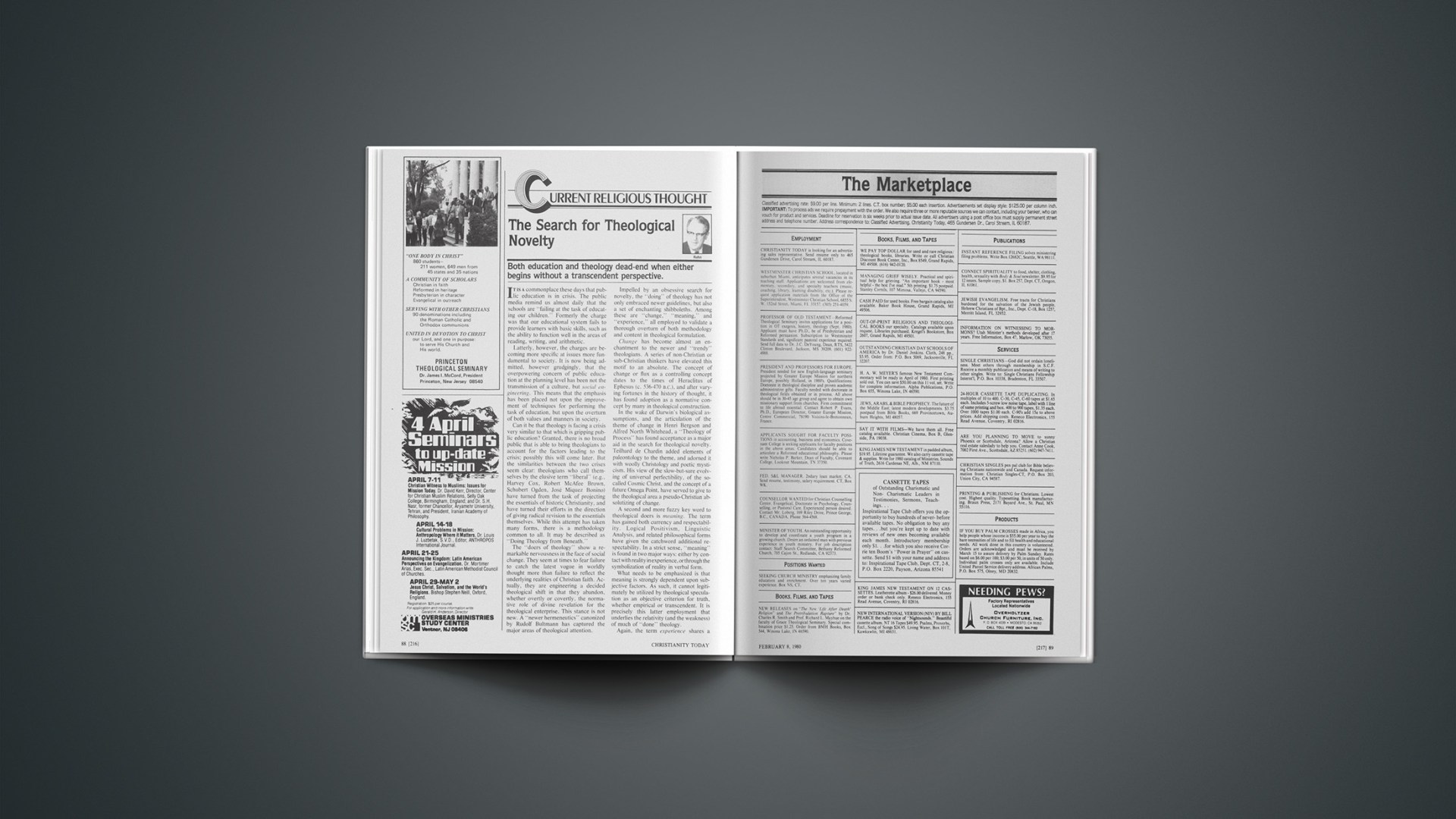
The Search for Theological Novelty

Both education and theology dead-end when either begins without a transcendent perspective.

It is a commonplace these days that public education is in crisis. The public media remind us almost daily that the schools are “failing at the task of educating our children.” Formerly the charge was that our educational system fails to provide learners with basic skills, such as the ability to function well in the areas of reading, writing, and arithmetic.

Latterly, however, the charges are becoming more specific at issues more fundamental to society. It is now being admitted, however grudgingly, that the overpowering concern of public education at the planning level has been not the transmission of a culture, but social engineering. This means that the emphasis has been placed not upon the improvement of techniques for performing the task of education, but upon the overturn of both values and manners in society.

Can it be that theology is facing a crisis very similar to that which is gripping public education? Granted, there is no broad public that is able to bring theologians to account for the factors leading to the crisis; possibly this will come later. But the similarities between the two crises seem clear: theologians who call themselves by the elusive term “liberal” (e.g., Harvey Cox, Robert McAfee Brown, Schubert Ogden, José Miquez Bonino) have turned from the task of projecting the essentials of historic Christianity, and have turned their efforts in the direction of giving radical revision to the essentials themselves. While this attempt has taken many forms, there is a methodology common to all. It may be described as “Doing Theology from Beneath.”

The “doers of theology” show a remarkable nervousness in the face of social change. They seem at times to fear failure to catch the latest vogue in worldly thought more than failure to reflect the underlying realities of Christian faith. Actually, they are engineering a decided theological shift in that they abandon, whether overtly or covertly, the normative role of divine revelation for the theological enterprise. This stance is not new. A “newer hermeneutics” canonized by Rudolf Bultmann has captured the major areas of theological attention.

Impelled by an obsessive search for novelty, the “doing” of theology has not only embraced newer guidelines, but also a set of enchanting shibboleths. Among these are “change,” “meaning,” and “experience,” all employed to validate a thorough overturn of both methodology and content in theological formulation.

Change has become almost an enchantment to the newer and “trendy” theologians. A series of non-Christian or sub-Christian thinkers have elevated this motif to an absolute. The concept of change or flux as a controlling concept dates to the times of Heraclitus of Ephesus (c. 536–470 B.C.), and after varying fortunes in the history of thought, it has found adoption as a normative concept by many in theological construction.

In the wake of Darwin’s biological assumptions, and the articulation of the theme of change in Henri Bergson and Alfred North Whitehead, a “Theology of Process” has found acceptance as a major aid in the search for theological novelty. Teilhard de Chardin added elements of paleontology to the theme, and adorned it with woolly Christology and poetic mysticism. His view of the slow-but-sure evolving of universal perfectibility, of the so-called Cosmic Christ, and the concept of a future Omega Point, have served to give to the theological area a pseudo-Christian absolutizing of change.

A second and more fuzzy key word to theological doers is meaning. The term has gained both currency and respectability. Logical Positivism, Linguistic Analysis, and related philosophical forms have given the catchword additional respectability. In a strict sense, “meaning” is found in two major ways: either by contact with reality in experience, or through the symbolization of reality in verbal form.

What needs to be emphasized is that meaning is strongly dependent upon subjective factors. As such, it cannot legitimately be utilized by theological speculation as an objective criterion for truth, whether empirical or transcendent. It is precisely this latter employment that underlies the relativity (and the weakness) of much of “done” theology.

Again, the term experience shares a similar ambiguity that is ignored by those who attempt to make it a criterion for passing judgment upon the validity of revelation. To make a univocal use of either meaning or experience, making forms of human need determinative for theology, cannot but lead to shallow and erroneous conclusions. Here is a total inversion of historical criteria, from recognition of a source from above man, to a theology which begins from below.

It is small wonder that many forms of theological elaboration today, in spite of their surface disagreements, share in a radical (from radix-root) crisis. Like trendy education experts who perceive their task to be that of social engineering, the doers of theology venture upon a total inversion of both the source and the method by which they do their work.

One needs only to read current literature dealing with the newest theologies (Robert McAfee Brown’s Theology in a Now Age; José Miquez Bonino’s Doing Theology in a Revolutionary Age) to realize that today’s theological scene is one of disarray. Indicative of this is the manner in which varieties of theology are “Theologies of …”

Here is a close parallel between the current crisis in public education and that of theology. The confusion in which education finds itself is due, in part, to the deviousness marking the objectives toward which social engineering is sought. Theological confusion issues, in part, from the fact that doing of theology is too frequently determined by the parochial wishes of those involved in formulation. This leads to a corresponding neglect of the historic criterion of divine revelation.

Both education and theology have fallen into the trap of granting criteriological ultimacy to concepts and objectives of questionable validity.

Faulty maxims for theology have been mentioned: the absolutizing of the motif of change, the univocal employment of such terms as meaning and experience, and above all, the canonization of the related concept of process. Modern man’s semantic fashions and subjective insights are utilized for theological engineering, which currently takes precedence over the ever-fresh searching of divine revelation. And as in education, failures in the basics are remedied by all sorts of electives, many of which are banal at best, and of the nature of “pop” at the worst.

If beginning with man is self-defeating, are not evangelicals under strong obligation to deal with utmost seriousness with revelation, and to apply a searching, believing scholarship to ongoing development in Christian theology?

Harold B. Kuhn is professor of philosophy of religion, Asbury Theological Seminary, Wilmore, Kentucky.

Europe’s Surprise Groundswell for Missions

Neither Switzerland nor the European continent had ever seen anything like what occurred when more than 7,000 young people from over 20 countries converged on Lausanne for MISSION 80, the Second Missionary Congress for European Youth, held the last five days of 1979.

Most observers called the historic event the largest missionary gathering for young people in Europe’s history. But that was what had been said about the event’s predecessor, MISSION 76, attended by 2,500 in December 1975.

Conference director Eric Gay, a Swiss, and his colleagues had planned for 3,000 this time. But the 3,000 mark in registrations was passed on November 13, with more coming in. “It was impossible to get word to all the countries [about a closing of registrations],” said congress information director Luc VerLinden of Belgium. “So we prayed, sought the mind of the Lord, and felt we should keep registrations open.” By the end of November, 5,500 persons had registered.

But doubling the size of a highly subsidized conference 30 days before opening, in a country where the cost of living ranks among the highest in the world, seemed impossible.

Because of gifts from individuals and churches throughout Europe, students from countries such as Greece, Portugal, and Spain were able to attend the congress, paying as little as $12 for registration plus room and board for the entire week.

The registrations, completed opening night, showed 7,155 participants. Most participants were under 30, but organizers estimate that students were a minority. The most startling delegation figures: 935 from France, 665 from Sweden, 560 from Spain—and Greece. “When the registrations from Greece the last week went over 200,” VerLinden admitted in a press conference, “we had to tell them, ‘No more!’ ” Even so, one Greek pastor said, “I think half the evangelical young people in Greece must be here!”

Though the $400,000 budget included heavy subsidies, many individuals still attended at personal sacrifice. A young woman from Portugal used a whole month’s salary for transportation costs to the conference. At the conclusion of the conference, over $30,000 of the subsidy had yet to be met, due to the last-minute increase in registration.

Because of the unanticipated numbers, congress directors had to divide the conference into two completely separate programs—one in the main hall of the Palais de Beaulieu, and a second divided among three other halls linked by a closed-circuit television system obtained from the University of Geneva.

The congress was conducted in 11 official languages which, because of the two virtually identical programs, required a team of more than 50 interpreters. Coordinated by veteran interpreter Neil Britton, an Englishman who is the pastor of a Swiss church, the interpreters came from all over Europe—many at the last minute.

The schedule included traditional plenary sessions; but they ran as long as three hours, with up to a third of the time devoted to singing. Daily Bible studies were led by Michael Griffiths, general director of Overseas Missionary Fellowship (who is resigning to assume leadership of London Bible College). Other speakers were Tokunboh Adeyemo, secretary of the Association of Evangelicals of Africa and Madagascar; David Chan, regional director of Scripture Union in Singapore; Thomas Wang, director of the Chinese Coordination Center for World Evangelization in Hong Kong; and well-known Eastern-bloc figure “Brother Andrew” (Anne van der Bijl).

But there was a heavy emphasis at the conference on action—practical steps toward world evangelization. A full hour and a half daily were given to seminars on what young people could do in their local churches when they returned. Congress directors provided each participant with a letter to his or her pastor, suggesting ways the attender could be used as a resource person in the church.

The action orientation of the congress included a march through the streets of Lausanne by the 7,000 participants. Grouped by country, marchers moved through the narrow streets of the old city, passing out literature, and singing as they went. The “demonstration of Christian testimony and unity” concluded with a large rally in two city squares, where coffee bars were set up for contact with the local population, and singers and entertainers presented programs of witness.

The conference was very much a European affair. Plenary meetings revealed some of the cultural differences: Germans would arrive ahead of time in their designated seating areas, whereas the Spanish would often drift in for 15 minutes after the program had started. And despite their common language, the French and French-speaking Swiss and Belgians plainly differed at times over management techniques.

Even the professional staff of the Palais de Beaulieu, one of the most heavily used conference centers in Europe, expressed amazement at the MISSION 80 staff’s ability to run the oversized, complex conference smoothly. Computers helped make this possible; the registration system used at Urbana 76 was given to MISSION 80 by its developers, Intercristo, of Seattle, Washington, then modified to meet MISSION 80 requirements. The registration system sorted out for the 7,000, 12 workshops each day in the 11 languages, requiring more than 450 workshop leaders. What was the reason for the tremendous increase in response over MISSION 76?

Some said it mirrored the revival of religious interest in Europe among the young, rejecting the materialism into which their parents—preoccupied with repairing the ravages of World War II—had slipped.

Other observers suggested it represented the growing cumulative result of God’s quiet moving over the last 20 years. They repeatedly mentioned U.S. launched youth ministries such as the Navigators, Youth for Christ, and Operation Mobilization. These have worked in Europe for many years, and more recently have been joined by Youth With a Mission and Campus Crusade. These groups, they said, have had a profound effect on evangelism among Europe’s young people, preparing them for an event such as MISSION 80.

Other influences were the European Bible schools, many founded by American mission boards. These schools are seen as providing a basis for much of the groundswell of student interest in missions across Europe, TEMA, The European Missionary Association and the congress sponsor, is an outgrowth of the European Student Missionary Association, which in turn got its start at Greater Europe Mission’s Lamorlaye Bible Institute on the outskirts of Paris.

Floyd McClung, American missionary of Youth With a Mission and a speaker on the last night of the congress, said he felt the conference had happened because for the first time Europe had “some indigenous visionaries who are doing something big.

Participants gave nearly $65,000 in a cash offering for two missionary projects—inauguration of a new Arabic Christian magazine for Muslims in Europe, and radio programming by the Far East Broadcasting Company directed to Southeast Asia.

An exhibition center housed displays for some 200 European-based Christian and missionary agencies. Students had nine hours each day to visit these displays, manned by an estimated 700 Christian workers.

At the conclusion of the congress, the participants had Communion together at midnight. Afterward they spent the remainder of the night in prayer and singing. Two thousand of the young people visited the exhibits one last time, stopping to pray for the various ministries of each as they walked through the hall. The group disbanded as the gray dawn broke over Lake Geneva and ushered in the new decade.

World Scene

Pope John Paul II met with Cardinal Leo Josef Suenens and other leaders of the Roman Catholic charismatic renewal movement in December. “I am convinced,” he said, “that this movement is a very important component of the entire renewal of the Church.” Ralph Martin, a movement spokesman from Belgium, assured the pontiff of the loyalty of charismatics. “We rejoice …” he said, “when we hear you talking to theologians and telling them not to destroy the faith.… We are at your disposal.”

Six Western church leaders who tried in December to visit the seven Pentecostals in asylum at the U.S. embassy in Moscow were rebuffed. Five Baptist and Assemblies of God clergymen—including Baptist World Alliance general secretary Robert Denney—were in Moscow to attend the congress of the All-Union Council of Evangelical Christians and Baptists in the U.S.S.R. They were refused permission to see the families of Pyotr Vaschenko and Maria Chmykhalova, as was Keston College specialist Michael Rowe.

A group of Reform rabbis has provoked an uproar in Israel by encroaching on the exclusive right of Orthodox rabbis to perform marriages. They did so by performing a ceremony last month, then prevailing on an Orthodox rabbi who witnessed the marriage to register it with the Interior Ministry. Since the founding of Israel in 1948 only Orthodox rabbis have been allowed to marry, bury, or receive converts into Judaism. The influence of Orthodox Judaism—out of proportion to its numbers—stems from the fact that no political party, right or left, has been able to form a government without its support.

Algerian Christians in the capital city, Algiers, organized a church late last year. The North Africa Mission reckons that the congregational election of elders and deacons makes this church the first in the mission’s project of establishing 25 churches across North Africa.

A recently established Muslim mission academy in Mecca, Saudi Arabia, recently graduated its first class of 36 imams (teachers) and preachers, according to Willi Hopfner, executive secretary of Orient Dienst, a German evangelical agency at work in the Muslim world. He also said that attempts are under way to unite Muslim missionary organizations and to train Muslim missionaries in specialized subjects.

The new Islamic order in Iran embodies a strong moral impetus.Bambad, a Tehran newspaper, reported last month that the Islamic authorities have established a center (on authority of the prosecutor’s office) that is intended to prevent activities harmful to Islamic society, particularly its youth. Agents of the center reportedly will issue warnings to owners of places of entertainment that spread corruption by permitting prostitution, distributing drugs, showing or publishing provocative pictures, and allowing women to perform as dancers or singers.

American missions whose properties in China were confiscated when the People’s Republic was established could possibly receive greater compensation than previously reported (see issue of Apr. 6, 1979, p. 38). A bill submitted to the Senate in December by Jacob Javits (R-N.Y.), Richard Lugar (R.-Ind.), and Frank Church (D-Idaho) would increase the share of agreed compensation of $80.5 million for religious and charitable organizations from one-fourth to nearly one-half. Businesses would receive less. The reasoning behind the bill: businesses were allowed tax write-offs, while charitable organizations were not.

Apple PodcastsDown ArrowDown ArrowDown Arrowarrow_left_altLeft ArrowLeft ArrowRight ArrowRight ArrowRight Arrowarrow_up_altUp ArrowUp ArrowAvailable at Amazoncaret-downCloseCloseEmailEmailExpandExpandExternalExternalFacebookfacebook-squareGiftGiftGooglegoogleGoogle KeephamburgerInstagraminstagram-squareLinkLinklinkedin-squareListenListenListenChristianity TodayCT Creative Studio Logologo_orgMegaphoneMenuMenupausePinterestPlayPlayPocketPodcastRSSRSSSaveSaveSaveSearchSearchsearchSpotifyStitcherTelegramTable of ContentsTable of Contentstwitter-squareWhatsAppXYouTubeYouTube