

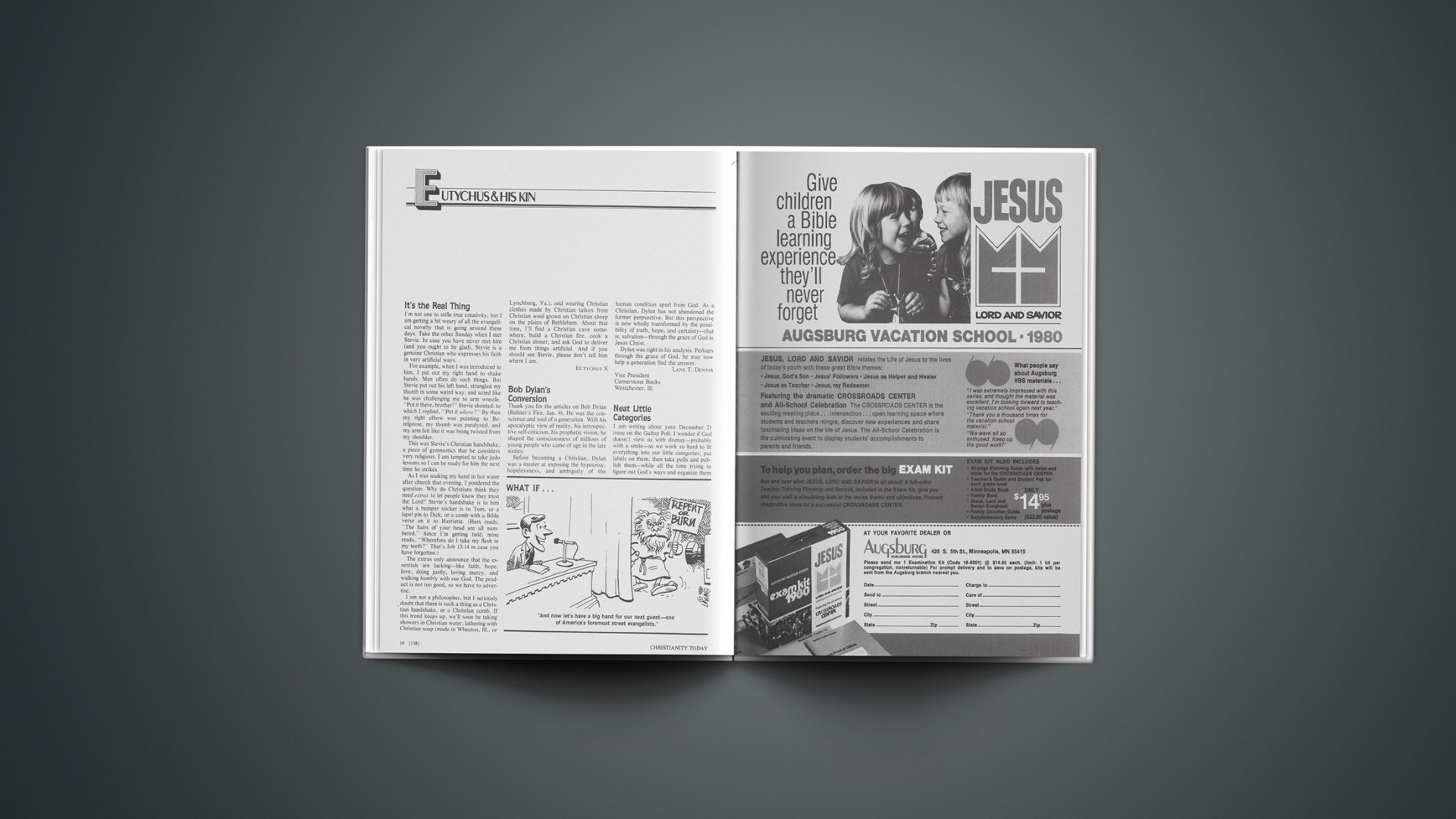
Eutychus and His Kin: February 8, 1980

It’s the Real Thing

I’m not one to stifle true creativity, but I am getting a bit weary of all the evangelical novelty that is going around these days. Take the other Sunday when I met Stevie. In case you have never met him (and you ought to be glad), Stevie is a genuine Christian who expresses his faith in very artificial ways.

For example, when I was introduced to him, I put out my right hand to shake hands. Men often do such things. But Stevie put out his left hand, strangled my thumb in some weird way, and acted like he was challenging me to arm wrestle. “Put it there, brother!” Stevie shouted; to which I replied, “Put it where?” By then my right elbow was pointing to Betelgeuse, my thumb was paralyzed, and my arm felt like it was being twisted from my shoulder.

This was Stevie’s Christian handshake, a piece of gymnastics that he considers very religious. I am tempted to take judo lessons so I can be ready for him the next time he strikes.

As I was soaking my hand in hot water after church that evening, I pondered the question: Why do Christians think they need extras to let people know they trust the Lord? Stevie’s handshake is to him what a bumper sticker is to Tom, or a lapel pin to Dick, or a comb with a Bible verse on it to Harriette. (Hers reads, “The hairs of your head are all numbered.” Since I’m getting bald, mine reads, “Wherefore do I take my flesh in my teeth?” That’s Job 13:14 in case you have forgotten.)

The extras only announce that the essentials are lacking—like faith, hope, love, doing justly, loving mercy, and walking humbly with our God. The product is not too good, so we have to advertise.

I am not a philosopher, but I seriously doubt that there is such a thing as a Christian handshake, or a Christian comb. If this trend keeps up, we’ll soon be taking showers in Christian water, lathering with Christian soap (made in Wheaton, Ill., or Lynchburg, Va.), and wearing Christian clothes made by Christian tailors from Christian wool grown on Christian sheep on the plains of Bethlehem. About that time, I’ll find a Christian cave somewhere, build a Christian fire, cook a Christian dinner, and ask God to deliver me from things artificial. And if you should see Stevie, please don’t tell him where I am.

EUTYCHUS X

Bob Dylan’s Conversion

Thank you for the articles on Bob Dylan (Refiner’s Fire, Jan. 4). He was the conscience and soul of a generation. With his apocalyptic view of reality, his introspective self-criticism, his prophetic vision, he shaped the consciousness of millions of young people who came of age in the late sixties.

Before becoming a Christian, Dylan was a master at exposing the hypocrisy, hopelessness, and ambiguity of the human condition apart from God. As a Christian, Dylan has not abandoned the former perpsective. But this perspective is now wholly transformed by the possibility of truth, hope, and certainty—that is, salvation—through the grace of God in Jesus Christ.

Dylan was right in his analysis. Perhaps through the grace of God, he may now help a generation find the answer.

LANE T. DENNIS

Vice President

Cornerstone Books

Westchester, Ill.

Neat Little Categories

I am writing about your December 21 issue on the Gallup Poll. I wonder if God doesn’t view us with dismay—probably with a smile—as we work so hard to fit everything into our little categories, put labels on them, then take polls and publish them—while all the time trying to figure out God’s ways and organize them for our strategic tactics. What is happening to CHRISTIANITY TODAY?

HELEN-MAE GERARD

Beaver, Pa.

Reading your definition of the orthodox evangelical (I call myself an orthodox [mere] Christian), I jibbed at “only” in “the only hope of heaven is through personal faith in Jesus Christ” (“The CHRISTIANITY TODAY-Gallup Poll: An Overview,” Dec. 21). I have that faith. There are good, truly good, men who don’t. God can limit me; I cannot limit him. Those good men are doing his will whether they know it or not.

I do not, for a minute, say that men cannot damn themselves if they choose. But the good man with the block against seeing and believing: he may, like the company in C.S. Lewis’s Great Divorce, have the final choice later at Heavensgate. That “only” sounds too arrogant. Shouldn’t we say perhaps “the only hope, as far as we can see”? Otherwise it’s too like limiting God.

Again, I’m not saying that all are saved any more than Lewis was; most of the people went back to the gray city. But what if one cried, “Oh God! It’s true, after all!”

SHELDON VANAUKEN

Lynchburg, Va.

C.S. Lewis Defended

Thank you for the major article on Lewis (“A Closer Look at the ‘Unorthodox’ Lewis,” Dec. 21). By and large it seemed to be very perceptive. The treatment of him on the issue of inerrancy was, however, shameful.

One might ask why a Christian as brilliant and committed as Lewis did not believe in the inerrancy of the Scriptures, as Donald Williams thinks he should. If he did not, then it should at least be open to debate.

DAVID N. CARLE

Louisville, Ky.

Donald Williams is right: there is no honest way to doubt that for C.S. Lewis Christian truth was objectively real. That Lewis was skilled in the use of metaphor and myth never meant the gospel message could be demythologized. Rather, he used those marvelous tools to make that truth credible to us flatlanders.

Let me, however, defend myself from inclusion within the ranks of those who see Lewis as nothing more than “a more poetic Bultmann,” where a quick reading of Williams’s article would place me. I wrote in my 1975 Christian Century article that the argument for God’s existence in Mere Christianity “simply does not work.” I was not, as Williams claims, discarding the rational and doctrinal basis of Lewis’s work.

For myself, Lewis’s arguments for God’s existence are quite persuasive. But I have found that they are more weighty for believers like myself than they are for those outside. In this realization of the impotence of naked reason I am only following Calvin, not liberal, existential, nor any other breed of contemporary theologians.

W. FRED GRAHAM

Professor of Religious Studies

Michigan State University

East Lansing, Mich.

I’m thankful that the conservatives have “long known and loved” C.S. Lewis. It’s quite biblical to do so, quite understandable also, for his writings opened a world of delight for all of us. But what’s this note about liberals finding ourselves embarrassed by him, or that we wish to explain him away? I suppose myself to be somewhere around the center of the liberal heart of our faith and I must report that I’m not at all embarrassed by Lewis and have no need to explain him away. In fact I’m a hearty enthusiast for him.

Mr. Williams’s entire article seemed to me to be a bit foolish (destructive?). He demonstrates a need to make Lewis into an evangelical of one sort or another. I would suggest that the world doesn’t need such suitcase packing of individuals. Lewis was a person, a Christian person. If he had wanted to be known as a fundamentalist or as an evangelical, he had a lifetime to arrange it. He chose not to. I for one see little value in the categorizing that goes on in much of today’s Christendom. It may keep journals like CHRISTIANITY TODAY selling, but it does little to unify the body of Christ.

REV. RONALD L. MCCULLOUGH

Lind United Methodist Church

Lind, Wash.

Pretty Powerful

Thanks for the excellent article “The Power of Preaching” by Stephen Olford (Dec. 7). I was debating whether or not to renew my subscription and that article settled it for me. Keep up the excellent work.

DAVID RIDEOUT

B.L. Morrison Pentecostal School

Postville, Labrador, Nfld.

Art Lover Responds

Thank you so much for the Alba Madonna on the cover of your Christmas issue (Dec. 7). It indeed adorns it, and at last evangelicals can claim their heritage of Christian art. For years I have been presenting Advent and Lent series of Bible and art studies. I believe great masterpieces illuminate the Scriptures.

ELIZABETH PAYNE

Lexington, Va.
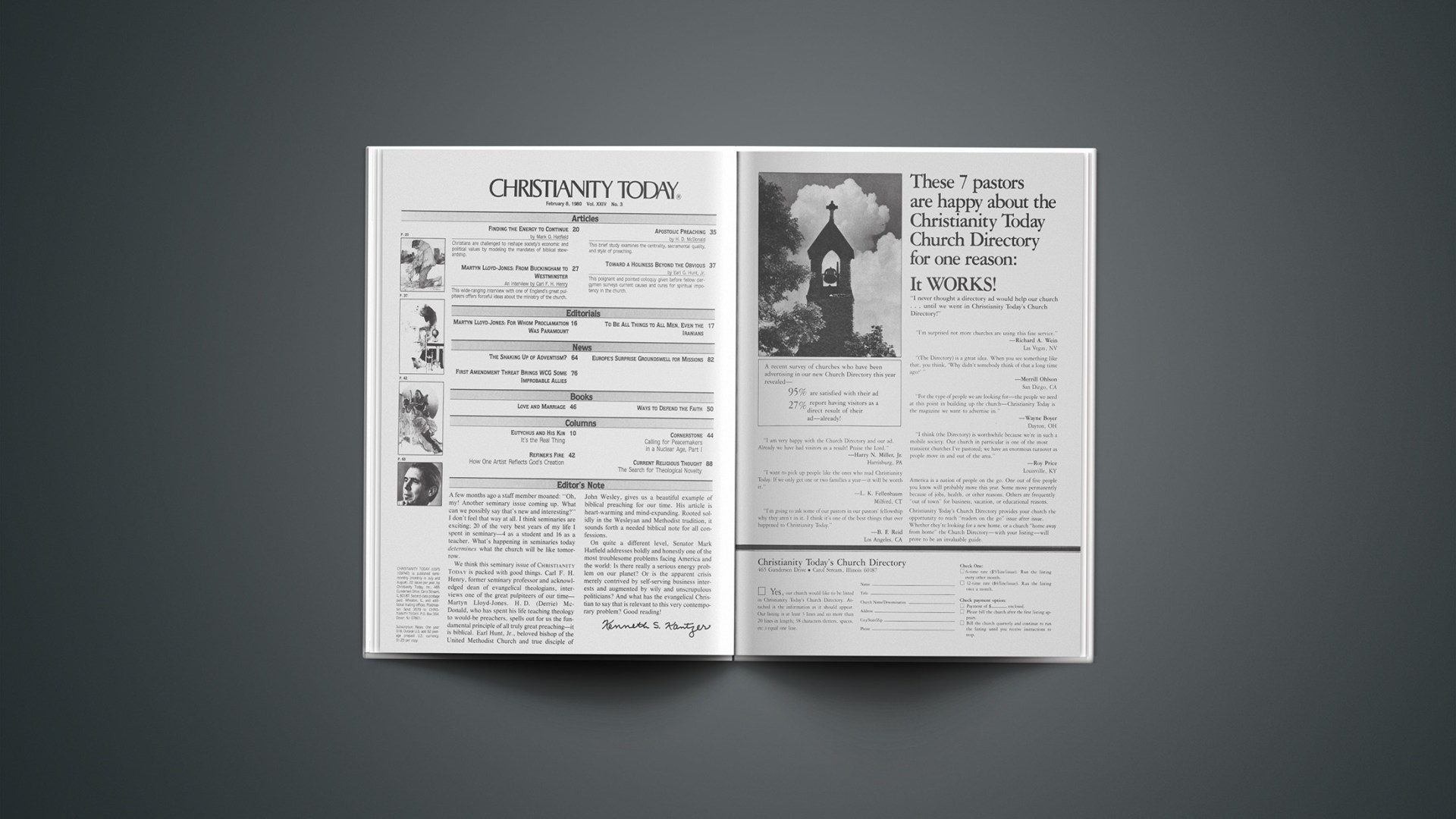
Editor’s Note from February 08, 1980

A few months ago a staff member moaned: “Oh, my! Another seminary issue coming up. What can we possibly say that’s new and interesting?” I don’t feel that way at all. I think seminaries are exciting; 20 of the very best years of my life I spent in seminary—4 as a student and 16 as a teacher. What’s happening in seminaries today determines what the church will be like tomorrow.

We think this seminary issue of CHRISTIANITY TODAY is packed with good things. Carl F. H. Henry, former seminary professor and acknowledged dean of evangelical theologians, interviews one of the great pulpiteers of our time—Martyn Lloyd-Jones. H. D. (Derrie) McDonald, who has spent his life teaching theology to would-be preachers, spells out for us the fundamental principle of all truly great preaching—it is biblical. Earl Hunt, Jr., beloved bishop of the United Methodist Church and true disciple of John Wesley, gives us a beautiful example of biblical preaching for our time. His article is heart-warming and mind-expanding. Rooted solidly in the Wesleyan and Methodist tradition, it sounds forth a needed biblical note for all confessions.

On quite a different level, Senator Mark Hatfield addresses boldly and honestly one of the most troublesome problems facing America and the world: Is there really a serious energy problem on our planet? Or is the apparent crisis merely contrived by self-serving business interests and augmented by wily and unscrupulous politicians? And what has the evangelical Christian to say that is relevant to this very contemporary problem? Good reading!

History
Today in Christian History

February 8

January
February
March
April
May
June
July
August
September
October
November
December
<>

February 8, 356: For the third time since the Council of Nicea in 325, Athanasius goes into exile. The defender of orthodoxy was out of favor as Arianism, a heresy condemned at the council, ran rampant throughout the Empire. He would be exiled twice more before he died (see issue 51: Heresy in the Early Church).

February 8, 1587: Mary, Queen of Scots, is beheaded. Attempting to restore Catholicism to England, she began persecuting Protestants. But, largely thanks to the work of John Knox, her attempts failed (see issue 48: Thomas Cranmer and issue 46: John Knox)

February 8, 1693: The College of William and Mary is founded in Williamsburg, Virginia. Originally intended to educate Anglican clergymen, it is America’s second-oldest higher education institution (Harvard is the oldest).

History
Today in Christian History

February 7

January
February
March
April
May
June
July
August
September
October
November
December
<>

February 7, 1478: Thomas More, lord chancellor of England during the English Reformation, is born. Though he idealized freedom of religion in Utopia (1516), he supported the punishment of heretics and Protestants like Martin Luther and William Tyndale. He retired from office rather than acknowledge Henry VIII's divorce and was beheaded for refusing to acknowledge Henry as head of the church (see issue 16: William Tyndale).

February 7, 1818 (traditional date): Abolitionist Frederick Douglass is born into slavery in Talbot County, Maryland. After escaping to freedom, he became the most prominent of the black abolitionists and eventually became the first black to hold high political office, as consul-general to the Republic of Haiti (see issue 62: Bound For Canaan).

February 7, 1938: After years of being closely watched by Nazi secret police, Lutheran pastor Martin Niemoller is put on trial. He was subsequently confined in a concentration camp, but he survived and went on to hold a leadership role in the World Council of Churches from 1948-1968 (see issue 32: Dietrich Bonhoeffer).

History
Today in Christian History

February 6

January
February
March
April
May
June
July
August
September
October
November
December
<>

February 6, 891: Photius, patriarch of Constantinople from 858-867, dies after a series of excommunications and restorations. His 867 encyclical, which denounced the presence of Latin missionaries in Bulgaria as an intrusion and objected to the filioque clause in the creed (“the Holy Ghost . . . who proceeds from the Father and the Son“), was significant in the East-West conflict that eventually led to the “Great Schism” (see issue 54: Eastery Orthodoxy).

February 6, 1564: Carried to church in a chair, John Calvin preaches his last sermon three months before his death (see issue 12: John Calvin).

February 6, 1820: Eighty-six free black colonists sail from New York to Sierra Leone, Africa. Though white abolitionists initially supported such emigration efforts, most free blacks (and eventually more radical white abolitionists) denounced the effort as racist and ultimately proslavery (see issue 62: Bound For Canaan).

History
Today in Christian History

February 5

January
February
March
April
May
June
July
August
September
October
November
December
<>

February 5, 1597: Twenty-six Japanese Christians are crucified for their faith in Nagasaki, Japan. By 1640, thousands of Japanese Christians had been martyred.

February 5, 1631: English clergyman Roger Williams arrives in America. After questioning Massachusetts’ fusion of church and state, he was banished. He bought land from native Americans and founded Rhode Island, where he established America’s first Baptist church in America. His writings on religious liberty were greatly influential in securing that freedom later in America.

February 5, 1736: Methodism cofounders and brothers John and Charles Wesley arrive in Savannah, Georgia. They were to be missionaries to the native Americans, and John was to be pastor of the Savannah parish. Their efforts failed. “I went to America to convert the Indians; but O! who shall convert me?” he asked two years later (see issue 2: John Wesley and issue 69: Charles & John Wesley).

February 5, 1837: Dwight Lyman (D.L.) Moody, the greatest evangelist of his day and one of the greatest revivalists of all time, is born in Northfield, Massachusetts. Speaking to 10,000 or 20,000 at a time, he presented his message, by voice or pen, to at least 100 million people (see issue 25: D.L. Moody).

February 5, 1864: Having already established herself as a poet, 44-year-old Fanny Crosby pens her first hymn. She went on to write 8,000 more before her death 50 years later.

History
Today in Christian History

February 4

January
February
March
April
May
June
July
August
September
October
November
December
<>

February 4, 856: Rabanus Maurus, a theologian and educator mentored by Alcuin, dies at age 80. His "retirement" from school administration at age 66 was followed by a career as archbishop of Mainz, Germany.

February 4, 1555: English reformer and theologian John Rogers becomes the first Protestant martyr under "Bloody" Mary I when he is burned at the stake for heresy (see issue 48: Thomas Cranmer).

February 4, 1906: Lutheran pastor and theologian Dietrich Bonhoeffer is born in Breslau, Germany. Author of The Cost of Discipleship (1937) and Letters from Prison (1944), he opposed the Nazis as one of Germany's Confessing Church leaders. Believing that Hitler was like a madman "driving a car into a group of innocent bystanders," he was privy various a plots to kill the leader. A particular assassination attempt was discovered around the time Bonhoeffer was arrested, though it is unclear whether he was directly connected to it. Bonhoeffer was imprisoned and eventually hanged—just days before Allied troops liberated the concentration camp where he was held (see issue 32: Dietrich Bonhoeffer).

History
Today in Christian History

February 3

January
February
March
April
May
June
July
August
September
October
November
December
<>

February 3, 865 (traditional date): Anskar, the first archbishop of Hamburg and called the "Apostle of the North," dies. Missionary to Denmark and Sweden, he converted many, including the King of Jutland (see issue 63: Conversion of the Vikings).

February 3, 1468: Johannes Gutenberg, who developed a printing press with movable type that helped the Protestant Reformation (by allowing the easy dissemination of reformers' writings), dies at age 67 (see issue 34: Luther's Early Years).

February 3, 1809: German composer Felix Mendelssohn, a very devout Lutheran, is born in Hamburg. His "Elijah" oratorio is considered second only to Handel's "Messiah," and he is responsible for rediscovering Bach, whose music had been forgotten for 80 years.

February 3, 1864: The Christian Union, composed of Protestant congregations opposed to "political preaching" during the Civil War, is formed in Columbus, Ohio.

History
Today in Christian History

February 2

January
February
March
April
May
June
July
August
September
October
November
December
<>

February 2, 767: Alcuin, the academic who would later play a large role in establishing schools under Charlemagne, becomes headmaster of York Cathedral School, where he once studied. Alcuin's curriculum was built on the seven liberal arts: the elementary Trivium (grammar, rhetoric, and dialectic) and the more advanced Quadrivium (music, arithmetic, geometry, and astronomy).

February 2, 1594: Giovanni P. da Palestrina, the most gifted composer of Renaissance church music, dies.

February 2, 1745: Popular British poet and dramatist Hannah More is born. She renounced the social life and concentrated on religious efforts, such as setting up Sunday schools. For her work with the Clapham Sect of British social reformers, she was once derisively called "a bishop in petticoats" (see issue 53: William Wilberforce).

History
Today in Christian History

February 1

January
February
March
April
May
June
July
August
September
October
November
December
<>

February 1, 524 (traditional date): Brigit, founder of a monastery at Kildare and considered the “second patron saint of Ireland,” dies (see issue 60: How the Irish were saved).

February 1, 1516: Desiderius Erasmus dedicates his “amendment” of Jerome’s Latin (Vulgate) translation of the Bible to Pope Leo X. Perhaps because his work was so politically risky, he assured the pontiff, “We do not intend to tear up the old and commonly accepted edition [the Vulgate], but amend it where it is corrupt, and make it clear where it is obscure.” Luther, Tyndale and other Protestants based their vernacular versions on the translations and hailed Erasmus’s calls for reform (see issue 34: Luther’s Early Years).

February 1, 1650: French philosopher Rene Descartes dies. Though more famous for his saying, “Cogito ergo sum” (I think, therefore I am), he followed that statement with a logical argument for the existence of God. In essence, he argued that the idea of God, a perfect being, could only be caused by that perfect God. Though fellow philosopher-mathematician-scientist Blaise Pascal (an avid Christian) considered Descartes a mere Deist, “letting [God] give a tap to set the world in motion,” Descartes repeatedly wrote about his devotion to Roman Catholicism.

February 1, 1763: Thomas Campbell, founder of the Disciples of Christ (which flourished under the leadership of his son, Alexander), is born. A popular itinerant preacher, he sought to unite Christians under a common, simple confession of Christ as Lord and immersion baptism (see issue 45: Camp Meetings and Circuit Riders).

February 1, 1810: Charles Lenox Remond, a black abolitionist preacher who supported slave uprisings and the use of violence to end slavery, is born in Salem, Massachusetts (issue 62: Black Christianity before the Civil War).

February 1, 1834: African Methodist Episcopal bishop Henry McNeal Turner is born a free African-American at Newberry Courthouse, South Carolina. One of the denomination’s leaders during Reconstruction, he is considered a precursor of later black theology for his statement, “God is a Negro.” He was also the first black chaplain in the U.S. Army.

February 1, 1862: Ardent abolitionist Julia Ward Howe publishes “Battle Hymn of the Republic” in The Atlantic Monthly (see issue 33: Christianity and the Civil War).

Apple PodcastsDown ArrowDown ArrowDown Arrowarrow_left_altLeft ArrowLeft ArrowRight ArrowRight ArrowRight Arrowarrow_up_altUp ArrowUp ArrowAvailable at Amazoncaret-downCloseCloseEmailEmailExpandExpandExternalExternalFacebookfacebook-squareGiftGiftGooglegoogleGoogle KeephamburgerInstagraminstagram-squareLinkLinklinkedin-squareListenListenListenChristianity TodayCT Creative Studio Logologo_orgMegaphoneMenuMenupausePinterestPlayPlayPocketPodcastRSSRSSSaveSaveSaveSearchSearchsearchSpotifyStitcherTelegramTable of ContentsTable of Contentstwitter-squareWhatsAppXYouTubeYouTube