History
Today in Christian History

January 31

January
February
March
April
May
June
July
August
September
October
November
December
<>

January 31, 1561: Anabaptist leader Menno Simons, for whom Mennonites are named, dies in Wustenfeld, Germany (see issue 5: Anabaptists).

January 31, 1686: King Louis XIV of France, having already revoked the Protestant-tolerating Edict of Nantes, orders all Waldensian churches burned. The Waldensians, members of a pre-Reformation tradition that stressed love of Christ and his word and a life of poverty, were soon devastated: 2,000 killed, 2,000 “converted” to Catholicism, and 8,000 imprisoned (see issue 22: Waldensians).

January 31, 1737: Jacob Duche, Episcopal clergyman and chaplain to the Continental Congress, is born in Philadelphia. He later had a change of heart about the war and asked George Washington to have Congress recall the Declaration of Independence (see issue 50: The American Revolution).

January 31, 1892: Baptist preacher Charles Haddon Spurgeon, one of the greatest public speakers of his day, dies at Mentone, France (see issue 29: Charles Spurgeon).

History
Today in Christian History

January 30

January
February
March
April
May
June
July
August
September
October
November
December
<>

January 30, 1536: Catholic priest Menno Simons leaves the Roman Catholic church over his doubts about transubstantiation and converts to the Anabaptist movement, which he would soon lead (see issue 5: Anabaptists).

January 30, 1649: England's King Charles I, a devout Anglican with Catholic sympathies who staunchly defended the "divine right of kings" while oppressing the Puritans, is executed after being convicted of treason under a Puritan-influenced Parliament.

January 30, 1877: Responding to Henry Stanley's plea for "some pious, practical missionary" to follow up David Livingstone's missionary foray into Uganda, three members of Alexander Mackay's Church Missionary Society team arrive at King Mutesa's court. Though missions saw few immediate results, the Ugandan church quickly strengthened and grew after the missionaries' deaths (see issue 56: David Livingstone).

January 30, 1912: Evangelical missionary, philosopher, author, and lecturer Francis Schaeffer is born in Philadelphia. A leading figure in the resurgence of evangelicalism during the 1960s and 1970s, he blamed the rise of relativism for the decline of Western culture.

History
Today in Christian History

January 29

January
February
March
April
May
June
July
August
September
October
November
December
<>

January 29, 993: Ulric (890-973), bishop ofAugsburg from 923, is formally canonized by Pope John XV, the first recorded canonization by a pope.

January 29, 1499: Katherine von Bora, a German nun who married Martin Luther in 1525, is born. At their wedding, she was 26 and he was 41 (see issue 39: Luther’s Later Years).

January 29, 1523: Before an audience of more than 600 people gathered at the first Zurich Disputation, Swiss reformer Ulrich Zwingli successfully defends his 67 theses. He appealed only to Scripture and rejected the authority of the pope, the sacrifice of the Mass, the invocation of saints, times and seasons of fasting, and clerical celibacy. But the city council nevertheless declared “that Master Ulrich Zwingli (may) continue to preach the Holy Gospel and the true divine Scripture as he has done until now for as long a time and to such an extent until he be instructed differently” (see issue 4: Ulrich Zwingli).

January 29, 1535: The French royal family, church officials, and many other dignitaries join in an immense torch-lit procession from the Louvre to Notre Dame—an attempt to purge Paris from the defilement caused by overzealous Protestants and their placards (a man named Feret had nailed one of the most inflammatory placards to the king’s bedroom door months before). The day ended with six Protestants being hung from ropes and roasted (see issue 12: John Calvin and issue 71: Huguenots).

History
Today in Christian History

January 28

January
February
March
April
May
June
July
August
September
October
November
December
<>

January 28, 814: Charlemagne, the first Holy Roman Emperor, dies. He was, in his day, not only one of the greatest political rulers of all time, he was, in his day, more influential in church matters than the pope. He saw his task as secular ruler “to defend with our arms the holy Church of Christ against attacks by the heathen from any side and against devastation by the infidels.

January 28, 1547: England’s Henry VIII, who split the church of England from Rome and presided over the founding of the Anglican church, dies (see issue 48: Thomas Cranmer).

January 28, 1769: Thomas Middleton, first Anglican bishop of Calcutta, is born in England. While he oversaw a vast diocese covering all the territories of the East India Company, the church made some great advances, including the establishment of Bishop’s College in Calcutta(a training college for missionaries in Asia).

History
Today in Christian History

January 27

January
February
March
April
May
June
July
August
September
October
November
December
<>

January 27, 398: John Chrysostom, the greatest preacher of his age, is consecrated bishop of Constantinople (see issue 44: John Chrysostom).

January 27, 417: Pelagius, a British monk, is excommunicated for heresy. He was condemned for denying original sin and claiming that men could become righteous purely by the exercise of free will. (see issue 51: Heresy in the Early Church).

January 27, 1302: On a trumped-up charge of hostility to the church and corrupt practices, Dante Alighieri is fined heavily and perpetually excluded from political office (he was a chief magistrate). Further condemned in March and driven out of Florence in April, Dante began writing The Divine Comedy, an epic poem in which he travels through hell, purgatory, and heaven (see issue 70: Danle Alighieri).

History
Today in Christian History

January 26

January
February
March
April
May
June
July
August
September
October
November
December
<>

January 26, 1564: Pope Pius IV accepts and confirms the decrees of the Council of Trent by the bull Benedictus Deus. The product of the Counter Reformation, it improved church organization, strengthened the papacy, and blocked any reconciliation with Protestants (see issue 28: The 100 Most Important Events in Church History).

January 26, 1859: Millionaire inventor of the reaper, Cyrus McCormick, marries Nettie Fowler, a devoted Christian. Following Cyrus’s death in 1884, Nettie used her enormous wealth to establish Chicago’s McCormick Theological Seminary and to support the work of D.L. Moody, John R. Mott, and countless missionaries to Asia.

January 26, 1906: The Church of God (Cleveland, Tennessee), the oldest Pentecostal denomination, convenes its first General Assembly (see issue 58: Pentecostalism).

Abortion: Courting Severe Judgment

While all sins are equal, some sins are more equal than others.

There is a very real equality among sins. James tells us that “whosoever shall keep the whole law and yet offend in one point, he is guilty of all.” In one of Charles Williams’s novels, the descent into hell of a specialist in military uniforms occurs when he commits the seemingly trivial sin of knowingly misleading others about the style of an epaulet. Since God’s standards are no less than perfection, any sin can keep one from the kingdom. Moreover, sins are equal in the sense that “the blood of Jesus Christ cleanses us from all sin” (1 John 1:7): no sin—except for the unpardonable sin of refusing redemption—is too heinous for Christ’s redemptive cleansing at the last day.

Yet one can legitimately paraphrase George Orwell: while all sins are equal, some sins are more equal than others. That is to say, whereas all sins receive their just recompense at the last judgment, some sins are such an affront to the divine majesty that they are very likely also to trigger imminent judgment in the course of human history itself. In the Old Testament, for example, we read that Uzzah was struck down on the spot for touching the ark of the covenant (2 Sam. 6:6–7), and the deaths of Ananias and Sapphira for attempting to deceive in spiritual things (Acts 5) is a not dissimilar New Testament incident. To be sure, God’s ways are not our ways, and no one can presumptively say that certain sins will always be followed by imminent consequences; yet, at the same time, it would appear that there are some acts that by their very nature kindle the divine wrath and are likely to lead to immediate retribution.

One thinks of the destruction or perversion of marriage. The Bible presents the proper relationship between husband and wife as the highest analogy of the relationship between Christ and the church (Eph. 5), and frequently parallels apostasy and harlotry (Hos. 1–2). Thus it does not seem unreasonable when the early church fathers so often argue that the collapse of marital standards among the Romans (as displayed, for example, in Petronius Arbiter’s Satyricon) was a source of the divine judgment that led to Rome’s fall. The fragility of the short-lived French Revolutionary governments—and their replacement by Napoleonic autocracy—was due, at least in part, to the loose morals of the revolutionaries: one out of every five Parisian marriages ended in divorce in 1799–1800, and the nation could not survive the shockwaves (cf. J. M. Thompson, Napoleon Bonaparte [Oxford, 1952], p. 181).

The destruction of God’s chosen people is another, even more obvious example. From the standpoint of eternity, it is not going too far to hypothesize that Hitler’s “Thousand Year Reich” collapsed into a seething inferno in a single generation largely because the Führer and his cohorts attempted to exterminate the apple of God’s eye—the people he chose as the vehicles of human salvation.

May I suggest a third area of potential imminent judgment? Each of the gross sins just mentioned ties by high analogy or direct interconnection with the essence of the plan of salvation. “Little children,” as Scripture speaks of them, fall into this same category. “Suffer the little children to come unto me,” Jesus said, “for of such is the kingdom of heaven.” Destruction by the horror of being thrown into the sea with a millstone around the neck is associated with Babylon in Revelation 18:21 and with those who do harm to little children in Matthew 18:1–6. A little child—unable to save himself and fully dependent—is, like the Jewish people, one of those “weak things of this world” chosen by God to “confound the wise.” Those who harm them do so at their peril, both in time and in eternity.

The early church was especially concerned with the interests of little children. In contrast with the callous and fatal exposure of unwanted infants by “cultured” Greeks and Romans, the early Christians as a matter of conscience saved the lives of abandoned children (see C. L. Brace, Gesta Christi [London, 1886], chap. 7: “Exposure of Children”; and especially E. Semichon, Histoire des enfants abandonnés depuis l‘antiquité jusqu’ à nos jours [Paris, 1880]).

Since Scripture teaches that the child’s life begins at the moment of conception (Ps. 51:5) and that he is a genuine person no less while in the womb than after birth (Luke 1:41, 44), early Christians likewise protected prenatal life and regarded abortion as homicide. In his apologetic against paganism, third-century Christian lawyer Minucius Felix declared: “I see your newly born sons exposed by you to wild beasts and birds of prey, or cruelly strangled to death. There are also women among you who, by taking certain drugs, destroy the beginnings of the future human being while it is still in the womb and are guilty of infanticide before they are mothers” (Octavius, XXX [J. H. Freese ed., 1919], pp. 82–83). Such sentiments can be multiplied; thus the anonymous Christian work, The Prophetic Scriptures, written before A.D. 325, asserts that “the embryo is a living thing” and that “abortive infants shall share the better fate,” i.e., go to heaven (sec. 48, 50).

The kairotic time has come for American Christians to bring this eschatological perspective to bear on our society. If God did not tolerate the Nazi extermination of six million Jews, what makes us think that he will continue to ignore our daily mounting toll of infanticides? 1 am not a prophet, nor the son of a prophet, but I see as less than accidental our simultaneous slaughter of the innocents and declining domestic and foreign position. In baldest terms, the life we can save by a right-to-life amendment to our federal Constitution may well be our own.

John Warwick Montgomery is a lawyer-theologian in California, and director of studies for the International Institute of Human Rights, Strasbourg. France.

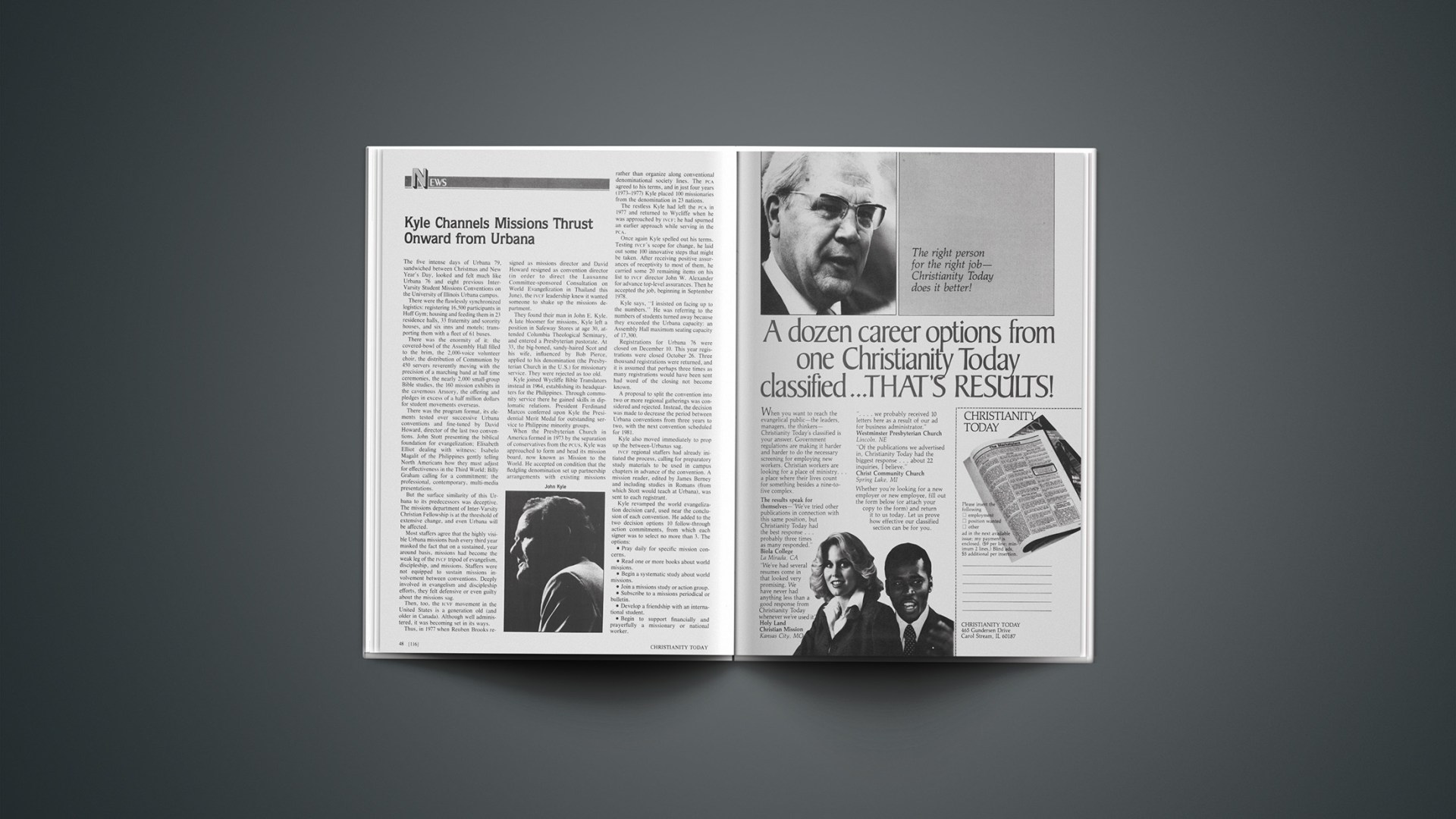
Kyle Channels Missions Thrust Onward from Urbana

The five intense days of Urbana 79, sandwiched between Christmas and New Year’s Day, looked and felt much like Urbana 76 and eight previous Inter-Varsity Student Missions Conventions on the University of Illinois Urbana campus.

There were the flawlessly synchronized logistics: registering 16,500 participants in Huff Gym; housing and feeding them in 23 residence halls, 33 fraternity and sorority houses, and six inns and motels; transporting them with a fleet of 61 buses.

There was the enormity of it: the covered-bowl of the Assembly Hall filled to the brim, the 2,000-voice volunteer choir, the distribution of Communion by 450 servers reverently moving with the precision of a marching band at half time ceremonies, the nearly 2,000 small-group Bible studies, the 160 mission exhibits in the cavernous Armory, the offering and pledges in excess of a half million dollars for student movements overseas.

There was the program format, its elements tested over successive Urbana conventions and fine-tuned by David Howard, director of the last two conventions. John Stott presenting the biblical foundation for evangelization; Elisabeth Elliot dealing with witness; Isabelo Magalit of the Philippines gently telling North Americans how they must adjust for effectiveness in the Third World; Billy Graham calling for a commitment; the professional, contemporary, multi-media presentations.

But the surface similarity of this Urbana to its predecessors was deceptive. The missions department of Inter-Varsity Christian Fellowship is at the threshold of extensive change, and even Urbana will be affected.

Most staffers agree that the highly visible Urbana missions bash every third year masked the fact that on a sustained, year around basis, missions had become the weak leg of the IVCF tripod of evangelism, discipleship, and missions. Staffers were not equipped to sustain missions involvement between conventions. Deeply involved in evangelism and discipleship efforts, they felt defensive or even guilty about the missions sag.

Then, too, the ICVF movement in the United States is a generation old (and older in Canada). Although well administered, it was becoming set in its ways.

Thus, in 1977 when Reuben Brooks resigned as missions director and David Howard resigned as convention director (in order to direct the Lausanne Committee-sponsored Consultation on World Evangelization in Thailand this June), the IVCF leadership knew it wanted someone to shake up the missions department.

They found their man in John E. Kyle. A late bloomer for missions, Kyle left a position in Safeway Stores at age 30, attended Columbia Theological Seminary, and entered a Presbyterian pastorate. At 33, the big-boned, sandy-haired Scot and his wife, influenced by Bob Pierce, applied to his denomination (the Presbyterian Church in the U.S.) for missionary service. They were rejected as too old.

Kyle joined Wycliffe Bible Translators instead in 1964, establishing its headquarters for the Philippines. Through community service there he gained skills in diplomatic relations. President Ferdinand Marcos conferred upon Kyle the Presidential Merit Medal for outstanding service to Philippine minority groups.

When the Presbyterian Church in America formed in 1973 by the separation of conservatives from the PCUS, Kyle was approached to form and head its mission board, now known as Mission to the World. He accepted on condition that the fledgling denomination set up partnership arrangements with existing missions rather than organize along conventional denominational society lines. The PCA agreed to his terms, and in just four years (1973–1977) Kyle placed 100 missionaries from the denomination in 23 nations.

The restless Kyle had left the PCA in 1977 and returned to Wycliffe when he was approached by IVCF; he had spurned an earlier approach while serving in the PCA.

Once again Kyle spelled out his terms. Testing IVCF’s scope for change, he laid out some 100 innovative steps that might be taken. After receiving positive assurances of receptivity to most of them, he carried some 20 remaining items on his list to IVCF director John W. Alexander for advance top-level assurances. Then he accepted the job, beginning in September 1978.

Kyle says, “I insisted on facing up to the numbers.” He was referring to the numbers of students turned away because they exceeded the Urbana capacity: an Assembly Hall maximum seating capacity of 17,300.

Registrations for Urbana 76 were closed on December 10. This year registrations were closed October 26. Three thousand registrations were returned, and it is assumed that perhaps three times as many registrations would have been sent had word of the closing not become known.

A proposal to split the convention into two or more regional gatherings was considered and rejected. Instead, the decision was made to decrease the period between Urbana conventions from three years to two, with the next convention scheduled for 1981.

Kyle also moved immediately to prop up the between-Urbanas sag.

IVCF regional staffers had already initiated the process, calling for preparatory study materials to be used in campus chapters in advance of the convention. A mission reader, edited by James Berney and including studies in Romans (from which Stott would teach at Urbana), was sent to each registrant.

Kyle revamped the world evangelization decision card, used near the conclusion of each convention. He added to the two decision options 10 follow-through action commitments, from which each signer was to select no more than 3. The options:

• Pray daily for specific mission concerns.

• Read one or more books about world missions.

• Begin a systematic study about world missions.

• Join a missions study or action group.

• Subscribe to a missions periodical or bulletin.

• Develop a friendship with an international student.

• Begin to support financially and prayerfully a missionary or national worker.

• Make plans to participate in a summer mission program.

• Begin corresponding with one or more mission agencies about service opportunities.

• Seek further training for preparation to become a missionary.

The card also asks if the decision may be shared with the student’s pastor.

The most far-reaching innovations are in Urbana follow-up, coordinated with mission agencies and in some cases with local churches.

More than 100 “Urbana Onward” weekend mini conferences are scheduled near campuses across the United States next month. Urbana 79 attenders, plus those whose registrations were returned, are to participate. The activities include reviewing their decision cards. The goal is to have one missionary present for each 15 students, involving an estimated 500 missionaries.

“Urbana Onward” evolved bearing Kyle’s stamp. “My style,” he says, “is openness and cooperation.” He began by persuading evangelical missions executives to come to Chicago for two days of consultations last April. Kyle asked them how IVCF could help them better reach students. The boards asked for more access to the campus groups. The “Urbana Onward” concept was roughed out on the spot, with the missions agreeing to cover their own travel costs, and IVCF to care for missionary hospitality. Plans were finalized at a September 15 meeting.

Then, immediately following Urbana 79, some 100 missions personnel met for three days with the entire IVCF staff to preview the program, breaking up into regional clusters to plot coordination of the area mini conferences.

Kyle’s stance for linking Urbana decisions with sending agencies is winning plaudits from the agencies.

Kyle overflows with more ambitious plans. For starters he is challenging mission boards to lend expert personnel for two-year periods to coordinate the missionary presence on the campuses in each of the 10 IVCF regions. He envisions these leaders orchestrating the efforts of a corps of furloughing missionaries, who would be assigned to secular campuses as missionaries in residence.

Kyle says that the Urbana conventions have been honed and polished and that he has no intention of tampering with their basic format. “Why fool with success?” he asks.

But he also believes Christians are on the verge of seeing “another Student Volunteer Movement.” His prediction may be on target. In immediate Urbana 79 response, about 1,800 or 12 percent of the student participants indicated that they believed it was God’s will for them to serve abroad. Another 4,400 or 30 percent said that they would actively seek to increase their involvement in world missions. Mailed-in decision cards will up the tally.

But tapping such a surge will require establishing a broad range of programs besides the spectacular conventions. John Kyle looks like the man for the assignment.

The Iran Crisis

The Ayatollah and the Clerics

The Iranian crisis involved religion as much as politics last month as two groups of American clergymen visited Iran. Other clergy, like most Americans, voiced opinions regarding what to do about the American hostages in the U.S. embassy in Teheran.

Three clergymen held Christmas services for the hostages at the invitation of the regime of the Ayatollah Khomeini: controversial activist William Sloane Coffin, senior pastor of Riverside Church in New York City; William Howard, president of the National Council of Churches; and Thomas Gumbleton, an auxiliary Catholic bishop from Detroit. Observers speculated these clergymen were selected as being more sympathetic to the Khomeini position. Coffin, for instance, had denounced the deposed Shah, criticized a hard-line U.S. stand, and said in remarks prior to his departure that the Iranian student captors were “not being all that unreasonable.”

A more conservative group had an hour-long audience with Khomeini late Christmas day. Jimmy Allen, past president of the Southern Baptist Convention, led a group of four clergymen and two Iranian scholars. They warned Khomeini that increased tensions had placed the two nations on a collision course threatening violence and war. The group also emphasized similarities between the Christian and Islamic faiths, including the worship of a God of mercy and freedom.

Allen is a close friend of President Jimmy Carter, a fellow Southern Baptist, but the White House denied any involvement in the trip. The group traveled at the invitation of the Iranian ambassador in Washington, D.C., who was perhaps not ignorant of Allen’s potential presidential influence.

Some clergymen recommended prayer—for Khomeini, the hostages, tolerance, and a peaceful solution. Others urged more of a hard-line approach. Nationally known pastor Jess Moody of the 8,400-member First Baptist Church of Van Nuys, California, blasted the Iranians in his church newsletter: “They [Iranians] know no more about decency than a pig does about Sunday. The Iranian mentality could drive St. Francis of Assissi to Valium.” (He mentioned later that “Jesus Christ makes men loving and considerate.”)

From Somoza to Sandinists

Church Also Is Transformed by Nicaragua’s Revolution

The following is based on reports by aCHRISTIANITY TODAYcorrespondent who visited Nicaragua.

A shift in the activities and theology of Nicaragua’s churches has been one surprising outcome of the bloody revolution in that country.

Before the revolution the Roman Catholic church was highly critical of the Anastasio Somoza dictatorship (some of its priests were involved in the insurrection). But the Catholic church has been slow to endorse wholeheartedly the new Sandinist government.

The Nicaraguan evangelicals, on the other hand, were split in their pre-revolution attitudes toward the Sandinistas. But now that Somoza has fallen, their commitment to the new government appears more enthusiastic than that of the Catholics.

Aware of the important roles the church would play in the future of Nicaragua, Jesuit priest Fernando Cardenal, who is assistant interior minister, commented last September, “If the church in Nicaragua takes the part of the poor and dispossessed as the revolution does, there will be no friction, as both are seeking the same goals. But if the church sides with the powerful, I believe there will be serious conflicts.”

The evangelical church has for several years been rethinking its posture toward the government—developing an appetite for sociopolitical matters in the process. CEPAD (Evangelical Committee for Development), a Nicaraguan agency founded after the 1972 earthquake, has filled the principal role in this process. CEPAD counts 36 denominations among its members, representing 96 percent of the nation’s 250,000 evangelicals.

In November 1976, CEPAD organized a meeting of 50 leading evangelicals, who drafted a document reflecting the state of the evangelical church as it emerged from “missionary colonialism” and made strides toward indigenization. The bulk of the document stressed the need for a united campaign to overcome the country’s sociopolitical problems.

Today, armed Sandinist troops patrol the streets. In an effort to collect evidence, the official Sandinist newspaper currently publishes entire pages of photos of former national guardsmen and supposed Somoza supporters, inviting people to formulate charges against them. More than 7,000 of these political prisoners will be tried soon in nine special tribunals. Judging from the published photos, many will be under 20 years of age.

Last September a local CEPAD committee sent a congratulatory letter to the government expressing the evangelical churches’ support for the regime. The committee suggested, however, that vengeance on the revolution’s enemies should be left in God’s hands.

Many pastors are uncertain about the future of their nation. It is estimated that 40 pastors have left Nicaragua, with others hoping to leave soon. Only a handful of foreign missionaries remains in the country. The government is limiting the presence of Americans, although Europeans and Latin Americans enjoy fairly easy access. Hundreds of Cubans have flown in for a literacy campaign scheduled to begin in March, and their number will swell to more than 2,000. Some of these Cubans are teaching atheism in the schools.

Meanwhile, it is risky to criticize the government or the Sandinistas. A Pentecostal pastor in Tipitapa, a city some miles east of Managua, was arrested in November during a church service and taken away by uniformed guards. Locals conjectured that he had spoken against the revolution.

In October, 500 pastors and evangelical leaders met at CEPAD’s invitation to consider the church’s role in a socialist society. Pastors at the conference reflected three attitudes toward the Sandinist revolution: some had been actively involved politically and militarily; some had a passive involvement through prayer, moral encouragement, and aid programs; while others had avoided becoming involved. Pastors’ noninvolvement today might lead to charges against them of being counterrevolutionary or pro-Somoza.

In a two-page declaration, these men congratulated and recognized the new Sandinist government as the legitimate authority of the nation. They promised to cooperate in the government’s plans as well as to encourage the churches to become actively involved in neighborhood Sandinist Defense Committees, in literacy programs, health programs, and “liberating educational processes” that will form a social and revolutionary conscience.

Pastors hope that by cooperating in government programs they can promote a moderate attitude in the nation, thereby preventing a sharp turn to the left similar to that occurring soon after Castro’s revolution in Cuba. CEPAD is sponsoring visits to Nicaragua by Cuban pastors.

Apprehensive that their liberties may be limited, many churches are engaged in or planning evangelistic crusades. No restrictions have been placed on public evangelistic activities to date, however.

Government literacy programs, pronouncements by mass media, and public teaching are aimed at producing a “new man” for the country, with a renovated conscience. Nicaraguan evangelicals have seized this opportunity to write tracts and preach that, while education can redirect men’s thinking, only Christ can change their desires.

World Scene

The pair downed over Cuba with a planeload of Jesus to the Communist World literature last May (Sept. 7 issue, p. 75) are serving 24-year jail terms, according to a recently freed Cuban political prisoner, Emilio J. Rivero. A U.S. State Department spokesman confirmed that Tom White and Melvin Bailey each were given a 4-year term for violating Cuban airspace and a 20-year term for “crimes against the integrity and stability of the nation, distributing counter-revolutionary propaganda.”

French rebel Archbishop Marcel Lefebvre has once again defied the Vatican. Under suspension since 1976, Lefebvre ordained deacons on Christmas Eve at his unauthorized seminary in Econe, Switzerland, using traditionalist rites. It had been speculated that as a result of a meeting with Pope John Paul II earlier last year, he might refrain.

The All-Union Congress of the Union of Evangelical Christians and Baptists met last month in Moscow. Since their last congress five years ago, these registered churches have baptized 35,000 new members, opened 200 new churches, and distributed more than 120,000 published items. Each congress elects the union’s 25-member council, which in turn elects its own 10-member presidium. This congress also considered extensive changes in the union’s constitution.

The KGB has aimed a decisive blow at Russian Orthodox activists in the Soviet Union—while Western attention has been diverted to the Iranian crisis. All but a few leaders of the Christian Seminar on Problems of Religious Renaissance have been imprisoned. The seminar, begun five years ago by young Orthodox intellectuals, has been forced to suspend its activities, at least for now. The latest of its few remaining leaders, Lev Regelson, was arrested on December 24 after undergoing preliminary interrogation.

Ghana’s three major Protestant denominations have agreed to merge into a united church next year. The Presbyterians, Methodists, and Evangelical Presbyterians have been negotiating the union for the past 20 years. Membership of the new Church of Christ in Ghana will embrace a quarter of the country’s population of 10.5 million.

Israel’s Interior Ministry has extended the temporary residence visa of American Messianic Jew Eileen Dorflinger for another year, rather than face a wrenching court case over the disputed issue of who is a Jew. The Israeli Supreme Court last March rejected the Dorflinger application for automatic citizenship as a Jew because she had been baptized in a Christian church in Connecticut. (The 1950 Law of Return guarantees automatic citizenship to anyone “born to a Jewish mother or converted to Judaism, and who does not adhere to another religion.”) The extension will allow Miss Dorflinger enough residence time to qualify for Israeli citizenship by naturalization.

Pakistani Christians, apprehensive after a rash of violence to missionaries and churches that was connected with the burning of the United States embassy, have been reassured by their president. Speaking at a Christmas observance at Rawalpindi Medical College last month, General Mohammad Zia-ul-Haq said that minorities in Pakistan enjoy equal rights and will share equal opportunity in every sphere.

Southeast Asians have sometimes been accused of indifference to tragic suffering in their own region. Not so in Singapore. There more than 2,000 high school students collected 103,600 cans of food in November for Vietnamese refugees, local orphans, handicapped, and the elderly. The Youth for Christ-sponsored “Agape Day” was conducted during a tropical downpour, soaking the labels off most of the canned goods.

Reports that Cambodian officials deliberately withheld distribution of relief supplies appear overdrawn, according to several relief agency officials. Much of the problem, they say, is an incredible lack of trucks plus poor roads with weak bridges. The result has been that supplies already provided have exceeded dock and distribution capacity. They say the pileup now is being eased; thousands of oxcarts are hauling grain and more trucks are becoming available. Enough relief supplies have reached the people to stave off widespread starvation in many areas.

China’s Catholic National Patriotic Association—regarded as official by the government but deviant by the Vatican—went ahead and consecrated the bishop for Peking whom parishioners elected last July. The post had remained vacant for 15 years. Last month’s consecration for Bishop Michael Fu Tieshan was delayed during months of fitful negotiation with the Vatican, which insists that bishops must be named through its hierarchy.

Deaths

HERBERT BELL SHAW, 72, presiding bishop of the predominately black African Methodist Episcopal Zion Church; he held World Council of Churches and World Methodist Council leadership posts, and was instrumental in establishing AME Zion conferences in London and the Caribbean; January 3, of a heart attack in Indianapolis during his church’s national board of bishops meeting.

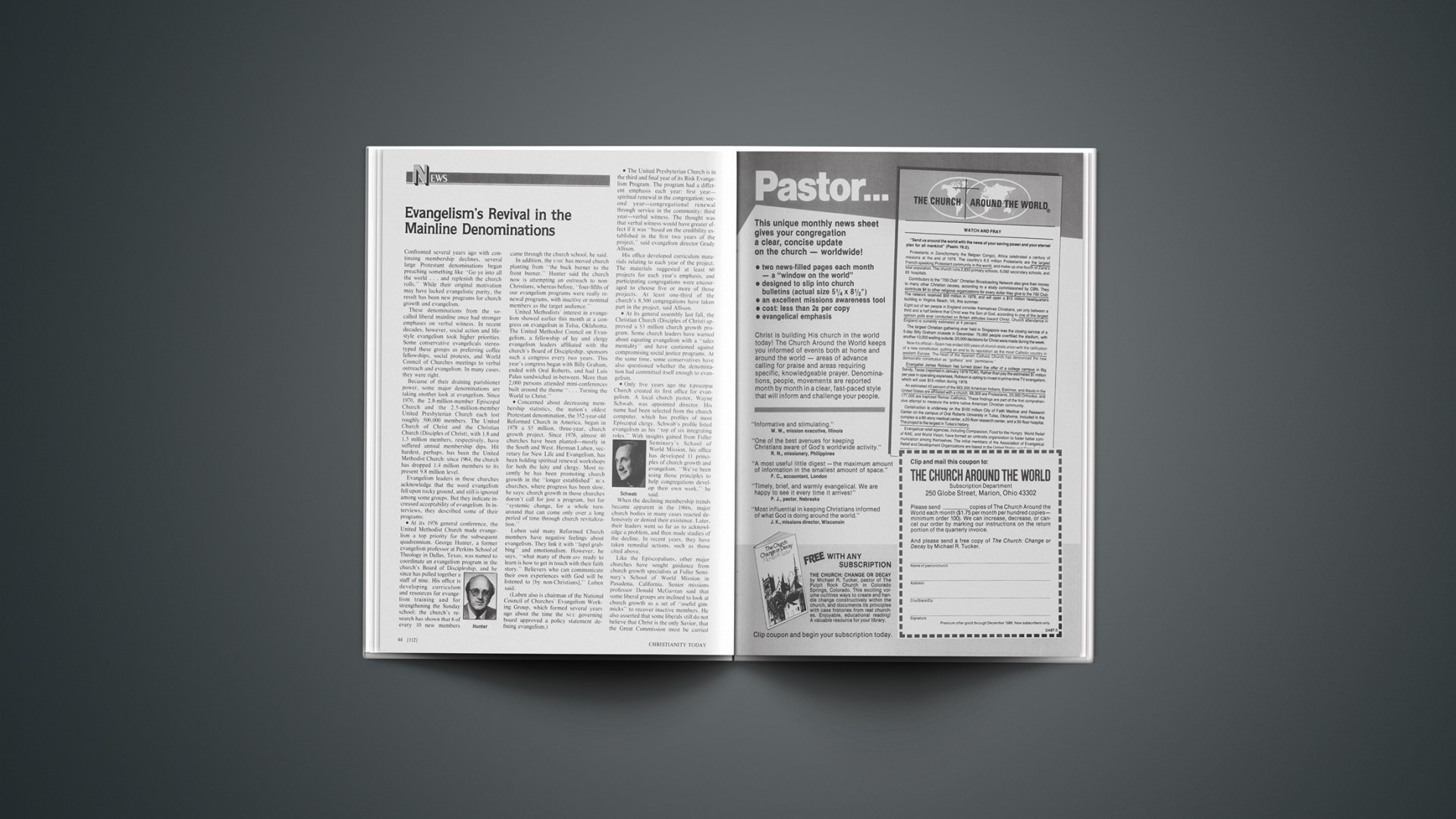
Evangelism’s Revival in the Mainline Denominations

Confronted several years ago with continuing membership declines, several large Protestant denominations began preaching something like “Go ye into all the world … and replenish the church rolls.” While their original motivation may have lacked evangelistic purity, the result has been new programs for church growth and evangelism.

These denominations from the so-called liberal mainline once had stronger emphases on verbal witness. In recent decades, however, social action and lifestyle evangelism took higher priorities. Some conservative evangelicals stereotyped these groups as preferring coffee fellowships, social protests, and World Council of Churches meetings to verbal outreach and evangelism. In many cases, they were right.

Because of their draining parishioner power, some major denominations are taking another look at evangelism. Since 1970, the 2.8-million-member Episcopal Church and the 2.5-million-member United Presbyterian Church each lost roughly 500,000 members. The United Church of Christ and the Christian Church (Disciples of Christ), with 1.8 and 1.3 million members, respectively, have suffered annual membership dips. Hit hardest, perhaps, has been the United Methodist Church: since 1964, the church has dropped 1.4 million members to its present 9.8 million level.

Evangelism leaders in these churches acknowledge that the word evangelism fell upon rocky ground, and still is ignored among some groups. But they indicate increased acceptability of evangelism. In interviews, they described some of their programs:

• At its 1976 general conference, the United Methodist Church made evangelism a top priority for the subsequent quadrennium. George Hunter, a former evangelism professor at Perkins School of Theology in Dallas, Texas, was named to coordinate an evangelism program in the church’s Board of Discipleship, and he since has pulled together a staff of nine. His office is developing curriculum and resources for evangelism training and for strengthening the Sunday school; the church’s research has shown that 6 of every 10 new members came through the church school, he said.

In addition, the UMC has moved church planting from “the back burner to the front burner.” Hunter said the church now is attempting an outreach to non-Christians, whereas before, “four-fifths of our evangelism programs were really renewal programs, with inactive or nominal members as the target audience.”

United Methodists’ interest in evangelism showed earlier this month at a congress on evangelism in Tulsa, Oklahoma. The United Methodist Council on Evangelism, a fellowship of lay and clergy evangelism leaders affiliated with the church’s Board of Discipleship, sponsors such a congress every two years. This year’s congress began with Billy Graham, ended with Oral Roberts, and had Luis Palau sandwiched in-between. More than 2,000 persons attended mini-conferences built around the theme “… Turning the World to Christ.”

• Concerned about decreasing membership statistics, the nation’s oldest Protestant denomination, the 352-year-old Reformed Church in America, began in 1978 a $5 million, three-year, church growth project. Since 1978, almost 40 churches have been planted—mostly in the South and West. Herman Luben, secretary for New Life and Evangelism, has been holding spiritual renewal workshops for both the laity and clergy. Most recently he has been promoting church growth in the “longer established” RCA churches, where progress has been slow, he says: church growth in those churches doesn’t call for just a program, but for “systemic change, for a whole turnaround that can come only over a long period of time through church revitalization.”

Luben said many Reformed Church members have negative feelings about evangelism. They link it with “lapel grabbing” and emotionalism. However, he says, “what many of them are ready to learn is how to get in touch with their faith story.” Believers who can communicate their own experiences with God will be listened to [by non-Christians],” Luben said.

(Luben also is chairman of the National Council of Churches’ Evangelism Working Group, which formed several years ago about the time the NCC governing board approved a policy statement defining evangelism.)

• The United Presbyterian Church is in the third and final year of its Risk Evangelism Program. The program had a different emphasis each year: first year—spiritual renewal in the congregation; second year—congregational renewal through service in the community; third year—verbal witness. The thought was that verbal witness would have greater effect if it was “based on the credibility established in the first two years of the project,” said evangelism director Grady Allison.

His office developed curriculum materials relating to each year of the project. The materials suggested at least 60 projects for each year’s emphasis, and participating congregations were encouraged to choose five or more of those projects. At least one-third of the church’s 8,500 congregations have taken part in the project, said Allison.

• At its general assembly last fall, the Christian Church (Disciples of Christ) approved a $3 million church growth program. Some church leaders have warned about equating evangelism with a “sales mentality” and have cautioned against compromising social justice programs. At the same time, some conservatives have also questioned whether the denomination had committed itself enough to evangelism.

• Only five years ago the Episcopai Church created its first office for evangelism. A local church pastor, Wayne Schwab, was appointed director. His name had been selected from the church computer, which has profiles of most Episcopal clergy. Schwab’s profile listed evangelism as his “top of six integrating roles.” With insights gained from Fuller a Seminary’s School of World Mission, his office has developed 11 principles of church growth and evangelism. “We’ve been using those principles to help congregations develop their own work,” he said.

When the declining membership trends became apparent in the 1960s, major church bodies in many cases reacted defensively or denied their existence. Later, their leaders went so far as to acknowledge a problem, and then made studies of the decline. In recent years, they have taken remedial actions, such as those cited above.

Like the Episcopalians, other major churches have sought guidance from church growth specialists at Fuller Seminary’s School of World Mission in Pasadena, California. Senior missions professor Donald McGavran said that some liberal groups are inclined to look at church growth as a set of “useful gimmicks” to recover inactive members. He also asserted that some liberals still do not believe that Christ is the only Savior, that the Great Commission must be carried out, or that persons who do not believe in Christ are lost.

He sees his role almost as an evangelist for evangelism to these mainline groups. But he also is concerned about evangelical denominations, naming as examples the Free Methodists, Conservative Baptists, and Reformed Presbyterians. “These are thoroughly good, sound, evangelical denominations, but their growth record is pitiful.”

He advocates church growth as an outreach to non-Christians, not as a means for church “self-preservation”: “We cannot say Jesus is Lord if we don’t communicate him to other people.” Church growth principles place verbal evangelism before social action: “Social and ethical actions are the fruit, not the root; nobody is saved by ethical action,” said McGavran.

Several evangelism leaders indicated their McGavran concern for social action remains as high as before. But they suggested an effort to link the two—verbal and lifestyle witnesses—in the minds of churchmen who distrust evangelism as a hard-sell, emotional proposition and a cop-out to involvement in the world.

When he became the United Presbyterians’ evangelism director seven years ago, Allison found a greater hesitancy about evangelism: “One almost got the idea that it shouldn’t be mentioned in polite society.” Some groups said social and justice ministries ought to take precedence, he said.

“But I think we’re getting to the place now where we realize it’s all part of the same thing. The justice and social ministries provide the context out of which one can talk to people effectively about their relationship with Christ. One is not sufficient without the other.”

Some churchmen who gave themselves to reforming social structures and systems in the 1960s are suffering from “compassion fatigue,” said Hunter of the United Methodist Church. Now they are looking again “into the sacraments, Scripture, and prayer for renewal and power” as a result, he said. As they discover that power, said Hunter, they are finding it is something “they want to share with people.”

When the Episcopal Church created its first office for evangelism in 1975, director Schwab said church leaders were “very fuzzy and very hesistant” about evangelism. People asked “Are we running away from social justice?” he said.

But his main accomplishment in five years has been helping Episcopalians “embrace the word evangelism.” “At this point,” he said, “they’re pretty aware that you can’t share what you don’t have. The church pretty well knows that it is not as close to Jesus Christ as it needs to be. People are saying ‘we don’t mind being called into account for our life with Him and in Him.’ ”

Differences in approach are evident, however. In the United Church of Christ, which is developing a media campaign aimed at the unchurched, and a Hispanic ministry, the commitment to social programs remains high. Evangelism secretary Alan Johnson said the ucc historically has been strongest in areas of the United States where evangelism is regarded in “the pejorative sense”—in New England, for instance.

The church now must reclaim its “language of faith,” said Johnson. Churchmen shouldn’t be afraid to use words like evangelism and salvation, but “salvation in its full sense,” he said: the Christian faith must address such problems as women’s liberation, inner-city decay, and Hispanic ministry—“otherwise, it’s dead.”

The United Presbyterian Church places more importance on the “concept of God’s kingdom in the world today” than do more conservative groups, such as the Southern Baptists, said Allison. He disagrees with conservatives who have an individualistic approach to faith: “It’s more a matter of their getting their reservations for heaven validated than it is a matter of their being a part of God’s kingdom here and now.”

Despite their evangelism efforts, mainline denominations will continue losing members in the 1980s, said Constant Jacquet, editor of the National Council of Churches’ annual yearbook of church membership statistics. “The decline in membership is something that is going to be around for a long time,” he said. He also predicted a leveling off of growth in the fastest growing groups—the Church of the Nazarene, the Assemblies of God, and the Southern Baptist Convention.

However, some of the shrinking churches are optimistic. Herman Luben, of the 215,000-member Reformed Church, said his denomination in 1978 registered slight membership gains: “We turned a corner last year—not in blazing headlines, but we are no longer going down.”

More significant, present trends indicate that the United Methodists’ 16-year membership decline will end by 1983, according to Warren Hartman of the church’s Board of Discipleship. Fewer persons are leaving the church, he said, and gains are being made, particularly among young adults.

UMC evangelism official Hunter said, “Sometimes the religious press has exaggerated the degree in which our grassroots leaders and churches have gotten away from our Wesleyan roots.”

But how substantial really is the push for evangelism movement in the mainline groups, such as the United Methodist Church? Said Hunter: “I wouldn’t say it’s a stampeding trend, but it’s a definite inclination. It’s not a movement: it’s a definite wiggle.”

Fund Raising

TV Personalities Merge Efforts for Starving Millions

Television preachers are criticized for many things, but no one argues with their ability to raise money. Jerry Falwell of “The Old Time Gospel Hour,” Pat Robertson of the Christian Broadcasting Network’s “700 Club,” and Jim Bakker of the “PTL Club,” for instance, generate a combined annual income estimated at $150 million. Religious broadcasting as a whole flushes out a cool half billion dollars annually, the Wall Street Journal reported.

So what would happen if the electronic church and its generous audience got behind a single, worthwhile money-raising project?

That thought spurred the creation of a unique fund-raising benefit for the starving Cambodians. Singer Pat Boone and several others have organized this effort, which requests the on-the-air support of television preachers and will focus around a television special featuring entertainers well-known to the Christian viewing public. The goal is millions of dollars, which will be distributed equally among Christian relief agencies presently working in Cambodia and the Thailand refugee camps.

The project evolved from a political fund-raising party in the California home of Republican presidential hopeful Ronald Reagan, attended by a number of religious figures. Author Doug Wead (People’s Temple, People’s Tomb. Logos, 1979) had just returned from Cambodia where he had been gathering material for a book. In conversation at the dinner with Pat and Shirley Boone and PTL’s Jim Bakker, Wead described the horrors he had witnessed, and the group discussed ways to help the Cambodians. “We agreed that if something was going to be done, it must be done quickly,” said Wead.

Nothing was settled that night. But Wead said he got a telephone call the next day from Shirley Boone, who mentioned a plan for organizing religious leaders and television preachers for a Cambodia prayer and fund-raising effort. “At the time I thought she was being very idealistic and naive,” said Wead, “because I thought they’d [television preachers] never come together for anything.”

However, Dan O’Neill, the Boones’ son-in-law, who would be asked to coordinate the project, replied to Wead’s observation, “If they won’t come together to help a million starving people, they won’t come together for anything.” All agreed, however, that television would be the quickest way to reach the largest number of people.

O’Neill, formerly of Youth with a Mission and with writing and television experience, worked literally around the clock to pull together the first planning meeting within a week. About 50 religious leaders ate a “Cambodian Thanksgiving Dinner” of fish, rice, and water, in the Boones’ Beverly Hills, California, home.

Dinner guests included TV preachers Oral Roberts, Rex Humbard, Robert Schuller, and representatives of the PTL and 700 Clubs. (Falwell and Jimmy Swaggert were invited, but did not attend, Wead said.) U.S. relief agencies represented were World Vision, World Relief, World Concern, Food for the Hungry, and Catholic Relief Services.

Also attending was Robert Maddox, the Southern Baptist minister turned White House staff member, who is President Jimmy Carter’s liaison officer to religious groups. Word of Maddox’s attendance at first caused controversy among those who thought “the whole thing might be politicized,” said Wead. He said Maddox’s interest in the Cambodian problem was sincere, however: Maddox and first lady Rosalyn Carter had just returned from visiting the Cambodian refugee camps and had expressed shock at the suffering there.

But partly due to cost and to the fact that another celebrity television special for Cambodia was being planned, the group’s executive committee shelved the telethon. Committee members Wead, Boone, O’Neill, and Bernard Law, Catholic bishop from Springfield, Missouri, now intend to produce a fund-raising television special without the celebrities, aimed specifically at a Christian audience.

The group’s intent is to keep overhead and organizational costs at a bare minimum. The only advertising for the campaign has come informally through Boone’s appearances on Christian television talk shows, such as the PTL and 700 Clubs. Donations have been sent to the mailing address of World Concern in Seattle, Washington (Save the Refugees Fund; Pat Boone, National Chairman, Box 33000, Seattle, Wash. 98133). Executive director of World Concern Arthur Beals explained the choice of mailing address as a way to speed the donor process—World Concern’s own Save the Refugees fund was already established. So far, he said, the only budgeted expense has been the cost of mailing tax deductible receipts to donors. Despite the lack of advertising, more than 10,000 letter responses had already been received, he said.

JOHN MAUST

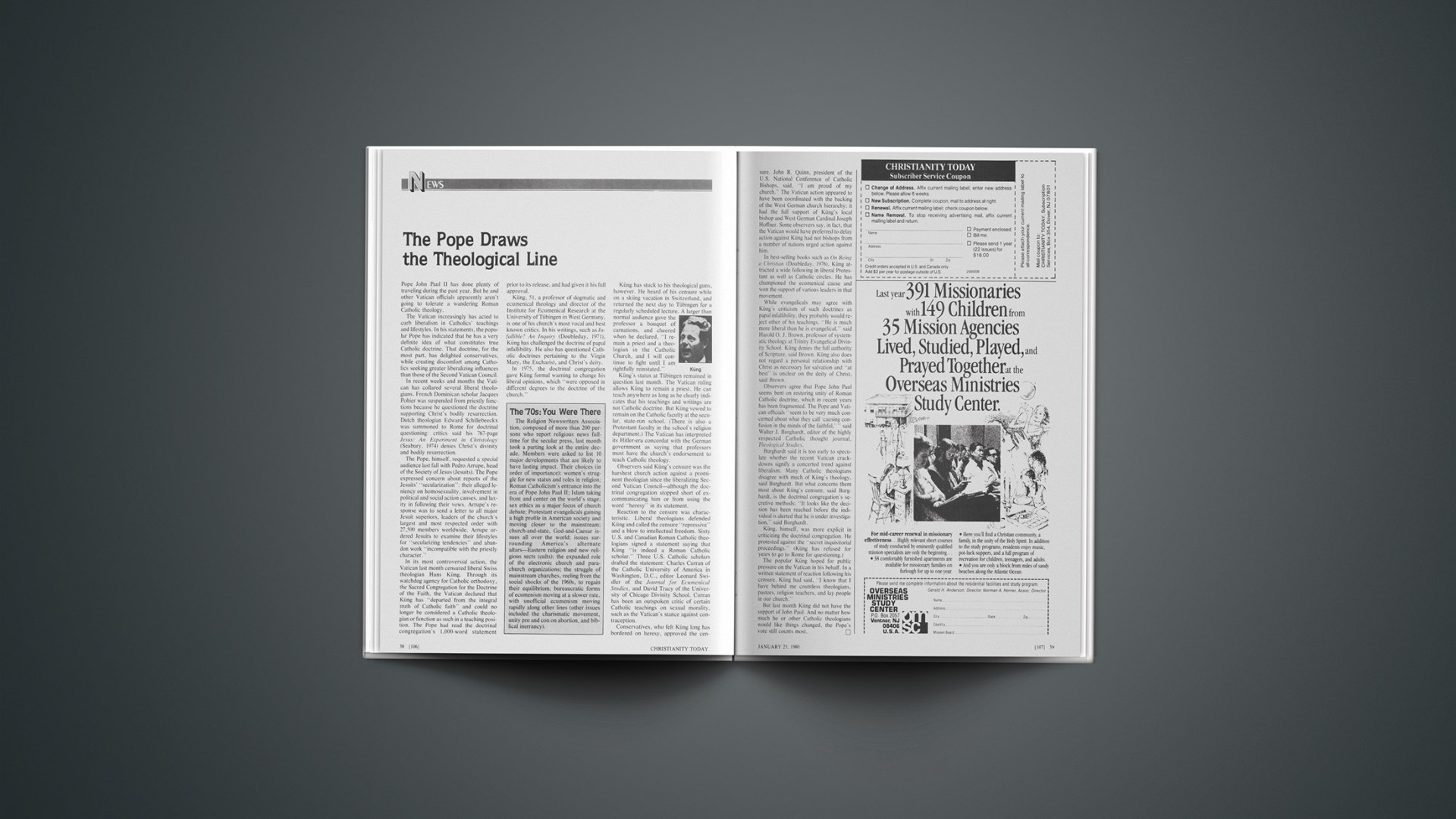
The Pope Draws the Theological Line

Pope John Paul II has done plenty of traveling during the past year. But he and other Vatican officials apparently aren’t going to tolerate a wandering Roman Catholic theology.

The Vatican increasingly has acted to curb liberalism in Catholics’ teachings and lifestyles. In his statements, the popular Pope has indicated that he has a very definite idea of what constitutes true Catholic doctrine. That doctrine, for the most part, has delighted conservatives, while creating discomfort among Catholics seeking greater liberalizing influences than those of the Second Vatican Council.

In recent weeks and months the Vatican has collared several liberal theologians. French Dominican scholar Jacques Pohier was suspended from priestly functions because he questioned the doctrine supporting Christ’s bodily resurrection. Dutch theologian Edward Schillebeeckx was summoned to Rome for doctrinal questioning: critics said his 767-page Jesus: An Experiment in Christology (Seabury, 1974) denies Christ’s divinity and bodily resurrection.

The Pope, himself, requested a special audience last fall with Pedro Arrupe, head of the Society of Jesus (Jesuits). The Pope expressed concern about reports of the Jesuits’ “secularization”: their alleged leniency on homosexuality, involvement in political and social action causes, and laxity in following their vows. Arrupe’s response was to send a letter to all major Jesuit superiors, leaders of the church’s largest and most respected order with 27,500 members worldwide. Arrupe ordered Jesuits to examine their lifestyles for “secularizing tendencies” and abandon work “incompatible with the priestly character.”

In its most controversial action, the Vatican last month censured liberal Swiss theologian Hans Küng. Through its watchdog agency for Catholic orthodoxy, the Sacred Congregation for the Doctrine of the Faith, the Vatican declared that Küng has “departed from the integral truth of Catholic faith” and could no longer be considered a Catholic theologian or function as such in a teaching position. The Pope had read the doctrinal congregation’s 1,000-word statement prior to its release, and had given it his full approval.

Küng, 51, a professor of dogmatic and ecumenical theology and director of the Institute for Ecumenical Research at the University of Tübingen in West Germany, is one of his church’s most vocal and best known critics. In his writings, such as Infallible? An Inquiry (Doubleday, 1971), Küng has challenged the doctrine of papal infallibility. He also has questioned Catholic doctrines pertaining to the Virgin Mary, the Eucharist, and Christ’s deity.

In 1975, the doctrinal congregation gave Küng formal warning to change his liberal opinions, which “were opposed in different degrees to the doctrine of the church.”

The ’70S: You Were There

The Religion Newswriters Association, composed of more than 200 persons who report religious news full-time for the secular press, last month took a parting look at the entire decade. Members were asked to list 10 major developments that are likely to have lasting impact. Their choices (in order of importance): women’s struggle for new status and roles in religion; Roman Catholicism’s entrance into the era of Pope John Paul II; Islam taking front and center on the world’s stage; sex ethics as a major focus of church debate; Protestant evangelicals gaining a high profile in American society and moving closer to the mainstream; church-and-state, God-and-Caesar issues all over the world; issues surrounding America’s alternate altars—Eastern religion and new religious sects (cults); the expanded role of the electronic church and parachurch organizations; the struggle of mainstream churches, reeling from the social shocks of the 1960s, to regain their equilibrium; bureaucratic forms of ecumenism moving at a slower rate, with unofficial ecumenism moving rapidly along other lines (other issues included the charismatic movement, unity pro and con on abortion, and biblical inerrancy).

Küng has stuck to his theological guns, however. He heard of his censure while on a skiing vacation in Switzerland, and returned the next day to Tübingen for a regularly scheduled lecture. A larger than normal audience gave the professor a bouquet of carnations, and cheered when he declared, “I remain a priest and a theologian in the Catholic Church, and I will continue to fight until I am rightfully reinstated.”

Küng’s status at Tübingen remained in question last month. The Vatican ruling allows Küng to remain a priest. He can teach anywhere as long as he clearly indicates that his teachings and writings are not Catholic doctrine. But Küng vowed to remain on the Catholic faculty at the secular, state-run school. (There is also a Protestant faculty in the school’s religion department.) The Vatican has interpreted its Hitler-era concordat with the German government as saying that professors must have the church’s endorsement to teach Catholic theology.

Observers said Küng’s censure was the harshest church action against a prominent theologian since the liberalizing Second Vatican Council—although the doctrinal congregation stopped short of excommunicating him or from using the word “heresy” in its statement.

Reaction to the censure was characteristic. Liberal theologians defended Küng and called the censure “repressive” and a blow to intellectual freedom. Sixty U.S. and Canadian Roman Catholic theologians signed a statement saying that Küng “is indeed a Roman Catholic scholar.” Three U.S. Catholic scholars drafted the statement: Charles Curran of the Catholic University of America in Washington, D.C., editor Leonard Swidler of the Journal for Ecumenical Studies, and David Tracy of the University of Chicago Divinity School. Curran has been an outspoken critic of certain Catholic teachings on sexual morality, such as the Vatican’s stance against contraception.

Conservatives, who felt Küng long has bordered on heresy, approved the censure. John R. Quinn, president of the U.S. National Conference of Catholic Bishops, said, “I am proud of my church.” The Vatican action appeared to have been coordinated with the backing of the West German church hierarchy; it had the full support of Küng’s local bishop and West German Cardinal Joseph Hoffner. Some observers say, in fact, that the Vatican would have preferred to delay action against Küng had not bishops from a number of nations urged action against him.

In best-selling books such as On Being a Christian (Doubleday, 1976), Küng attracted a wide following in liberal Protestant as well as Catholic circles. He has championed the ecumenical cause and won the support of various leaders in that movement.

While evangelicals may agree with Küng’s criticism of such doctrines as papal infallibility, they probably would reject other of his teachings. “He is much more liberal than he is evangelical,” said Harold O. J. Brown, professor of systematic theology at Trinity Evangelical Divinity School. Küng denies the full authority of Scripture, said Brown. Küng also does not regard a personal relationship with Christ as necessary for salvation and “at best” is unclear on the deity of Christ, said Brown.

Observers agree that Pope John Paul seems bent on restoring unity of Roman Catholic doctrine, which in recent years has been fragmented. The Pope and Vatican officials “seem to be very much concerned about what they call ‘causing confusion in the minds of the faithful,’ ” said Walter J. Burghardt, editor of the highly respected Catholic thought journal. Theological Studies.

Burghardt said it is too early to speculate whether the recent Vatican crackdowns signify a concerted trend against liberalism. Many Catholic theologians disagree with much of Küng’s theology, said Burghardt. But what concerns them most about Küng’s censure, said Burghardt, is the doctrinal congregation’s secretive methods: “It looks like the decision has been reached before the individual is alerted that he is under investigation,” said Burghardt.

Küng, himself, was more explicit in criticizing the doctrinal congregation. He protested against the “secret inquisitorial proceedings.” (Küng has refused for years to go to Rome for questioning.)

The popular Küng hoped for public pressure on the Vatican in his behalf. In a written statement of reaction following his censure, Küng had said, “I know that I have behind me countless theologians, pastors, religion teachers, and lay people in our church.”

But last month Küng did not have the support of John Paul. And no matter how much he or other Catholic theologians would like things changed, the Pope’s vote still counts most.

The cults

The Children of God: Fewer and Far Out

Correspondent Joseph M. Hopkins filed this report, updating information on the Children of God, a radical sect that emerged from the fringes of the Jesus movement in the late 1960s. Hopkins has written numerous articles (issue of Feb. 24, 1978, p. 44) and a book about the group.

“Moses” David Berg cites persecution as the reason for strategy and organizational changes in the Children of God. “The system is out to get us, and they are driving us from the streets,” complained Berg, 60, the founder-leader of the small, but international group.

In a “MO Letter” dated December 31, 1978, Berg told his disciples, “Beloved, we have had our good years!—our fat years and our famous years!… I believe that we’re now entering into our worldwide persecution lean years! Jonestown is their excuse to attack all the cults, and the cults are their excuse to attack us! Because there is not one of them that preaches Christ like we do.”

Berg, who two years ago renamed the group “Family of Love,” has ordered COG members into newly-formed small groups—“for security, smaller families more difficult to find.” His new strategy calls for door-to-door witnessing, peddling cult literature, organizing home Bible studies, and pushing the “Worldwide Mail Ministry.”

He also has called for stepping up the “Flirty Fishing” outreach to older men who are lonely and sufficiently affluent. (Under the Flirty Fishing policy, COG members use sex to win a hearing for the gospel. Their sexual contacts are asked for money “gifts,” which COG members give to their church.)

In a bitter blast at the news media last May, Berg revealed the firing in 1978 of 300 COG leaders. He said, “You [media] can’t hurt us anymore! We’ve already disbanded.… Go to Hell where you belong! We’re on our way to Heaven in spite of you! Thank God!”

Hundreds of family members have defected. From January 1978 to May 1979, total membership fell from 8,068 to 4,958; the number of live-in adults dropped from 3,650 to 3,259. (The number of children increased slightly from 1,451 to 1,699.) Despite the exodus, Berg exulted, “Our Worldwide Mail Ministry is absolutely booming at the rate of … about 300 new members per month.” The October Family News reported 6,700 “workers” in 83 countries.

A former top COG executive believes those figures are inflated. He estimates that only about 1,000 hard-core disciples remain. Literature distribution plummeted from a high of 8 million pieces per month to 3 million by December 1978 and to 1.5 million by August 1979. Last May Berg chided his followers. “Our world income is off over 25 percent this year!”

Casualties of the 1978 purge included Berg’s daughter Linda (“Queen Debbie”) and her ex-husband (“Jethro”), together with their present spouses Bill (“Isaiah”) and Melissa (“Joy”). Deborah (now Linda’s legal name) had pioneered a number of schools for COG children, six in Italy alone. Jethro had instituted and administered the group’s computerized accounting system. Isaiah and Berg’s son Jonathan (“Hosea”) had launched the sect’s monthly pictorial New Nation News. Melissa, daughter of former senior vice-president John Moody of Mobil Oil, gained national attention when in 1971 she married David “Michael” Senek, a Newton Falls, Ohio, COG convert. The two couples now are living in the U.S.; Berg banished them from South America.

Barbara Kaliher Cane (“Queen Rachel”) was heir apparent to “King” David’s throne until her defection several months ago. Mike Sweeney (“Timothy Concerned”) assumed Rachel’s leadership post, only to be axed a short time later when he refused to sign a “MO Letter” defaming Rachel. He and his wife Debbie (“Cornia”) now are involved in social work in Europe.

Recent castoffs are Berg’s legal wife Jane (“Mother Eve”) and her consort Stephen Ferguson (“Stephen David”). Jane and a team of disciples spent the past few years ministering to Arabs in North Africa, southern France, and the Mediterranean island of Malta, where last spring she was granted an audience with Libyan dictator Muammar El Qaddafi.

In an open letter last February to Qaddafi, a long-time COG booster, Berg shared his pleasure over the ouster of the Shah of Iran. Berg is rumored to be hiding out in Switzerland, although he wrote Qaddafi that he could be reached in Madrid. COG world publication headquarters has been moved from Rome to Zurich.

Bizarre aberrations continue surfacing in the “MO Letters.” The letters are extolled by their author as “God’s Word for today” and therefore of greater relevance than “God’s Word for yesterday,” the Bible. In Berg’s latest revelations:

• The Trinity consists of Father, Mother, and Son. The female member, the Holy Spirit, is described as the “Holy Queen of Love” and is portrayed by an artist as a beautiful, near-naked woman.

• Homosexuality and oral sodomy are acceptable under certain conditions as being “within the limits of the love of God.”

• Children conceived through Flirty Fishing are called “Jesus Babies.” Childhood sex is encouraged. A recent “MO Letter” contains an explicit photograph of the practice. Berg relates that he was introduced to oral sex at the age of three by a “little Mexican girl” babysitter. (This perhaps is a clue to his early and lifelong obsession with sex.)

In an interview, Berg’s daughter Deborah attested to growing up in a wholesome Christian home. However, it is no secret that in recent years Berg became deeply involved with wine, the occult, and women (he has admitted in print that he and his mistress “Maria” have been afflicted with venereal disease). What went wrong? How did this apparently authentic Christian ministry get off track?

A former high-ranking leader theorized that Berg fell victim to delusions of self-importance and power, of divinely conferred authority, and of messianic identity and mission. Like the late Jim Jones, Berg submitted to no higher authority, but forced his authority upon his disciples, while demanding total obedience.

A former top COG executive says COG is not a potential People’s Temple—mainly because cult members are dispersed throughout the world. But there are many parallels, including: supplanting biblical revelation with cult teaching; sexual and financial exploitation; manipulation of minds, bodies, spirits; stifling of dissent; paranoid hatred, suspicion, and fear of “outsiders”: and preoccupation with death. (In letters to Qaddafi and to his followers Berg has alluded to the approaching end of his earthly ministry and to “sweet release to a new world and a new life!”)

North American Scene

Four U.S. Congressmen have urged greater support for persecuted Christians in Soviet bloc nations. Senators Roger Jepsen (R-Iowa) and David Boren (D-Okla.) and Representatives Jack Kemp (R-N.Y.) and James Howard (D-N.J.) introduced companion resolutions in Congress last month protesting mistreatment of Christians by the Soviet Union as in violation of the Helsinki accords. Assemblies of God layman Jepsen also has called for a “national awareness campaign,” in which Americans support their suffering fellow Christians by writing or calling the Soviet embassy in Washington, their congressmen, and the White House.

Mennonite farmer Bruce Chrisman was convicted last month of federal income tax evasion. A U.S. District Court judge in Springfield, Illinois, upheld an Internal Revenue Service claim that Chrisman, 30, of Ava, Illinois, did not file a tax return in 1975. Actually, Chrisman did file a return in 1975—but with insufficient information to satisfy the IRS. Chrisman had attached a letter to his return saying he objected on religious and moral grounds to paying taxes that support the U.S. military. Chrisman’s attorney argued unsuccessfully that his client’s religious beliefs should exempt him from paying that portion of his federal income tax that supports the military.

Deprogrammer Ted Patrick was indicted on kidnapping charges last month. The charge stemmed from the alleged abduction last fall of Church of Scientology member Paula Dain, 24, of Los Angeles, who says she was held 37 days against her will in an unsuccessful attempt to get her to forsake her church. The San Diego, California, grand jury also indicted Dain’s father and stepmother, who had sought Patrick’s help.

A divorced woman who is living with a boyfriend cannot keep custody of her children, the Illinois State Supreme Court ruled last month. Such a living arrangement creates an unhealthy moral environment for children, and is immoral and in violation of state laws against open fornication, the court ruled. Divorce lawyers called it a landmark decision and expected that a flood of child custody suits would result.

Personalia

Lutheran theologian William H. Lazareth has been named to succeed Lukas Vischer as director of the World Council of Churches’ Commission on Faith and Order. Lazareth, regarded as one of the Lutheran Church in America’s top theologians and a second place finisher in balloting in 1978 for LCA president, assumes the post May 1. Vischer stepped down at the end of 1979 after 14 years as Faith and Order director. He now becomes director of the Protestant Office for Ecumenism in Switzerland—a specially created post of the German-Swiss Conference of Churches.

Immediate past president of the Southern Baptist Convention. Jimmy R. Allen, has been elected president of his denomination’s radio and television commission. The post has been filled by interim administrators since last February when, in controversial action, the commission’s trustees sent 26-year president Paul M. Stevens into early retirement because of differences over financing and programming priorities. Allen had a local television ministry in San Antonio, Texas, during an 11-year pastorate there.

James H. Taylor III has been named general director of the Overseas Missionary Fellowship (formerly China Inland Mission). Founded by his grandfather, OMF currently has personnel working in nine East Asian countries. Taylor is a former Free Methodist missionary to Taiwan and since 1970 served as the first president of the interdenominational China Evangelical Seminary in Taipei; he assumes the new post in July. He succeeds 11-year director Michael Griffiths, who next fall becomes principal of London Bible College.

Tale of two Trinities: Walter C. Kaiser, Old Testament scholar and author, has been appointed dean of Trinity Evangelical Divinity School in Deerfield, Illinois, where he has been a faculty member for 16 years. In the nearby Chicago suburb of Palos Heights, Trinity Christian College (Reformed) announced the appointment of new president Gerard Van Gronigen. A well-known Reformed pastor and theologian, he currently teaches at Reformed Seminary in Jackson, Mississippi.

For the third straight year, singer Anita Bryant was voted the most admired woman in America in the annual poll of readers of Good Housekeeping magazine. Only former first lady Pat Nixon, who was this year’s second-place finisher, has been named first more times (four) since the poll was begun in 1969.

United Church of Canada clergyman Bruce MacDougall has been named president of Faith at Work, succeeding Jeffrey Kitson, Bermuda businessman and president for two years. MacDougall has been executive director for Faith at Work, Canada. The organization promotes what it calls “relational Christianity” through its 30,000-circulation Faith at Work magazine, and conferences.

Apple PodcastsDown ArrowDown ArrowDown Arrowarrow_left_altLeft ArrowLeft ArrowRight ArrowRight ArrowRight Arrowarrow_up_altUp ArrowUp ArrowAvailable at Amazoncaret-downCloseCloseEmailEmailExpandExpandExternalExternalFacebookfacebook-squareGiftGiftGooglegoogleGoogle KeephamburgerInstagraminstagram-squareLinkLinklinkedin-squareListenListenListenChristianity TodayCT Creative Studio Logologo_orgMegaphoneMenuMenupausePinterestPlayPlayPocketPodcastRSSRSSSaveSaveSaveSearchSearchsearchSpotifyStitcherTelegramTable of ContentsTable of Contentstwitter-squareWhatsAppXYouTubeYouTube