PTL: Edging Away from the Brink

PTL Network founder-president Jim Bakker celebrated his thirty-ninth birthday early last month during a live broadcast of the PTL Club. His best birthday gift, Bakker told viewers, was “an even bigger miracle than I asked for”—namely, enough money to pay off debts incurred during construction of the network’s so-called Total Living Center (Dec. 15, 1978, issue, p. 41).

Bakker said the Charlotte, North Carolina-based network had gotten through the worst of its financial crisis, and he presented officials of the Laxton Construction Company with a check (of an unannounced amount) to finish payments of $2.5 million in outstanding bills. The firm had stopped construction at the 1,400-acre site last August.

The company had not resumed work last month, despite the payments, said a PTL spokesman. Reason given: “organizational restructuring” at PTL. The network’s board of directors said future construction would not take place unless there was enough money in building fund accounts to back it up. Already, $10 million has been spent on the educational-recreational-housing facility, which is located just across the state line in Fort Hill, South Carolina.

The network still owes $2 million in past due accounts, said a company spokesman. That some of a total $13 million debt (as of December) had been eliminated was due mostly to the success of a six-week fund-raising telethon, which ended in mid-December.

Bakker has blamed the network’s financial woes on mismanagement and foul-ups in the organization’s computers which, he said, resulted in the misprocessing of mail through which the organization gets its money pledges.

Bakker promised his television viewers that changes would be made to prevent future financial crises. There would be management training for all department heads and supervisors, the hiring of a business consultant and systems analyst, and, according to a PTL news release, “the employment of an open exchange of ideas between management and the work force of PTL.”
Cults: Armstrong versus the Law’s Strong Arm

The court-ordered receivership early last month of Herbert W. Armstrong’s Worldwide Church of God (WCG) set off a sequence of bizarre confrontations between loyal but obstinate WCG followers and California law authorities (Feb. 2 issue, p. 43). Retired judge Stephen Weisman, who as temporary receiver was responsible for seeing that WCG funds were being used correctly, said he was “getting no cooperation” from the WCG.

There were almost daily developments last month in the case, which was initiated when the California attorney general and six former WCG members filed suit charging that the 86-year-old Armstrong, top aide Stanley Rader, and other church officers had siphoned away millions of WCG dollars for their own use.

Weisman, who was maintaining an office at WCG headquarters at Ambassador College in Pasadena, at one point stopped Armstrong from mailing a two-page fund-raising letter, which requested donations from WCG supporters for “legal defense to save the work.” Armstrong intended that the money be sent directly to his Tucson home, but Weisman stopped 60,000 copies of the letter at the Pasadena post office since, he said, it violated the receivership.

WCG attorneys appealed Weisman’s decision to impound the letters, but he was upheld by Los Angeles Superior Court Judge Julius Title. The attorneys also asked a federal court judge, Robert Firth, to award Armstrong and the WCG $700 million in damages caused by the superior court action that placed the church in receivership. Firth allowed further hearings concerning the suit, but refused to intervene directly in the case, ruling that state courts have jurisdiction for the time being.

Vocal WCG supporters have appeared at the ongoing court hearings, and, for a time, some of them physically blocked court-appointed officials from access to church records at Ambassador College. There were charges of security breakdowns at WCG headquarters: The chief operating officer for the receiver believed that church assets, including gold bullion, valuable paintings, and computer tapes of financial records, had disappeared—despite the fact that Weisman was spending over $2,500 a day in church assets for security guards.

In addition, Weisman suspected that his office was being wiretapped by the WCG, according to press accounts. And WCG aide Rader, whose office is just down the hall from Weisman’s temporary quarters, claimed his office was being bugged by the state.

During the turmoil, the patriarchal Armstrong—who claims he is Christ’s sole ambassador on earth and disavows such Christian doctrines as the Trinity—has remained in seclusion in Tucson. Meanwhile, newly-appointed executive director of the WCG, Roderick Meredith, reportedly told a gathering of 1,000 WCG employees that church headquarters might be moved to Tucson or the Lake of Ozarks region in Arkansas, where the church owns property.

Weisman expressed dismay that he was unable to communicate directly with Armstrong. He told the Los Angeles Times, “I’m not even sure he’s alive.” Rader assured him that Armstrong was in fact alive, and the continuing turmoil last month seemed to indicate that this was so.

Refugees: Making Room for a Fleet of Boat People

The children on board the Huey Fong cheered when they saw the harbor lights of Hong Kong. Their freight ship, crammed with 3,000 refugees—most of them ethnic Chinese fleeing persecution in Vietnam—had been anchored for twenty-seven days outside the waters of the British colony. Now, for humanitarian reasons, the Hong Kong government was making exception to its policy of not accepting refugees on ships whose first port of call was not Hong Kong. (It said the Huey Fong was destined for Taiwan.)

The refugees found a temporary home, but a crowded one. Already one of the most densely populated cities in the world, Hong Kong had more than 5,000 Vietnamese refugees in camps waiting to be resettled when the Huey Fong docked. These so-called “boat people” were among an estimated 600,000 refugees (United Nations figure) in Southeast Asia, which has become a seething mass of displaced persons who are trying to escape war or communism. The resettlement of Indochinese refugees has been administered by the United Nations High Commissioner for Refugees (UNHCR), which channels the refugees to nations willing to accept them. Support has been requested from humanitarian and religious groups in the West—since provisions for the refugees have been markedly lacking.

The latest agency to offer assistance was the World Relief Commission (WRC), the relief arm of the National Association of Evangelicals. It appointed T. Grady Mangham last month as director of refugee resettlement—a position that will involve finding sponsors for the 50,000 Indochinese refugees expected to arrive in the U.S. by April. Mangham would work from his Christian and Missionary Alliance (CMA) office in Nyack, New York, where he had been a director of CMA missions for Southeast Asia.

The WRC awaited approval last month for membership in the American Council for Voluntary Agencies, an umbrella organization through which the U.S. government finds sponsors for refugees. (When a refugee is cleared Mangham for entrance to the U.S., after being interviewed in a Southeast Asia resettlement camp, his dossier is forwarded to the Council. Every Wednesday morning, representatives of its eight-member voluntary agencies gather in a New York City office to process the stack of dossiers. They are usually given six to eight weeks to find sponsors for a refugee.)

Up to this point, Church World Service has been the primary contact for Protestant churches and denominations interested in sponsoring refugees, and the U.S. Catholic Conference has issued requests for help from Catholic parishioners and dioceses. Other groups represented in the Council include Lutheran Immigration and Refugee Service and the International Rescue Committee (see Feb. 2 issue, page 12).

Once a sponsor is secured, the refugee is flown to the United States. Those refugees with relatives in the U.S. still are required to work through a U.S. voluntary agency, said a spokesman for the Indochinese Refugee Program of the U.S. State Department. Refugees sign a “loose promissory note” to pay back the cost of their plane trip, said Carl Harris, and “it’s up to the voluntary agency to collect this from the refugee—usually over a two or three year period.” (Voluntary agencies are given $350 per refugee as a kind of placement fee.)

Over 200,000 Indochinese refugees have been admitted to the U.S. since the fall of South Viet Nam in 1975. “Up to this point, there has not been a problem in finding sponsors,” said Harris. “But we’re just now getting into a program that will essentially double what we’ve been doing.”

“That’s why we’re so happy to have the World Relief Commission get in on this,” he said. “We are concerned … and are looking for organizations that will sponsor the refugees.”

One of the most active Protestant denominations in Indochinese work is the Christian and Missionary Alliance. There are nineteen Vietnamese, two Cambodian, and thirteen Laotian CMA churches in the U.S. Each church has a pastoral and administrative staff composed of nationals. The CMA has no plan of its own for sponsoring refugees—preferring instead to work through existing agencies.

John E. McCarthy, executive director of the Migration and Refugee Services of the U.S. Catholic Conference, appealed to President Jimmy Carter in a letter for immediate steps to alleviate the suffering of “boat people” and other Indochinese refugees. He said his office would commit itself to resettle 7,000 people a month. Working on an ecumenical basis, he said the Catholic Church in the U.S. had helped resettle more than 90,000 refugees from Southeast Asia in the past two and a half years.

In a newspaper interview, McCarthy expressed particular concern for situations such as the Huey Fong, saying “if no one else will do it [resettle the refugees], we will.” He complained that government administrative procedures were slowing the resettlement process.

As he spoke, another freighter, the Tung An, with 2,300 Vietnamese aboard, was stranded in the bay outside Manila. Philippine officials turned the ship away, saying their refugee camps already were too crowded. Assistance by church groups in the U.S. and other nations may determine whether these “boat people” and other Indochinese refugees find a safe, and permanent, port of entry.

Breakfast with Some Prominent Sinners

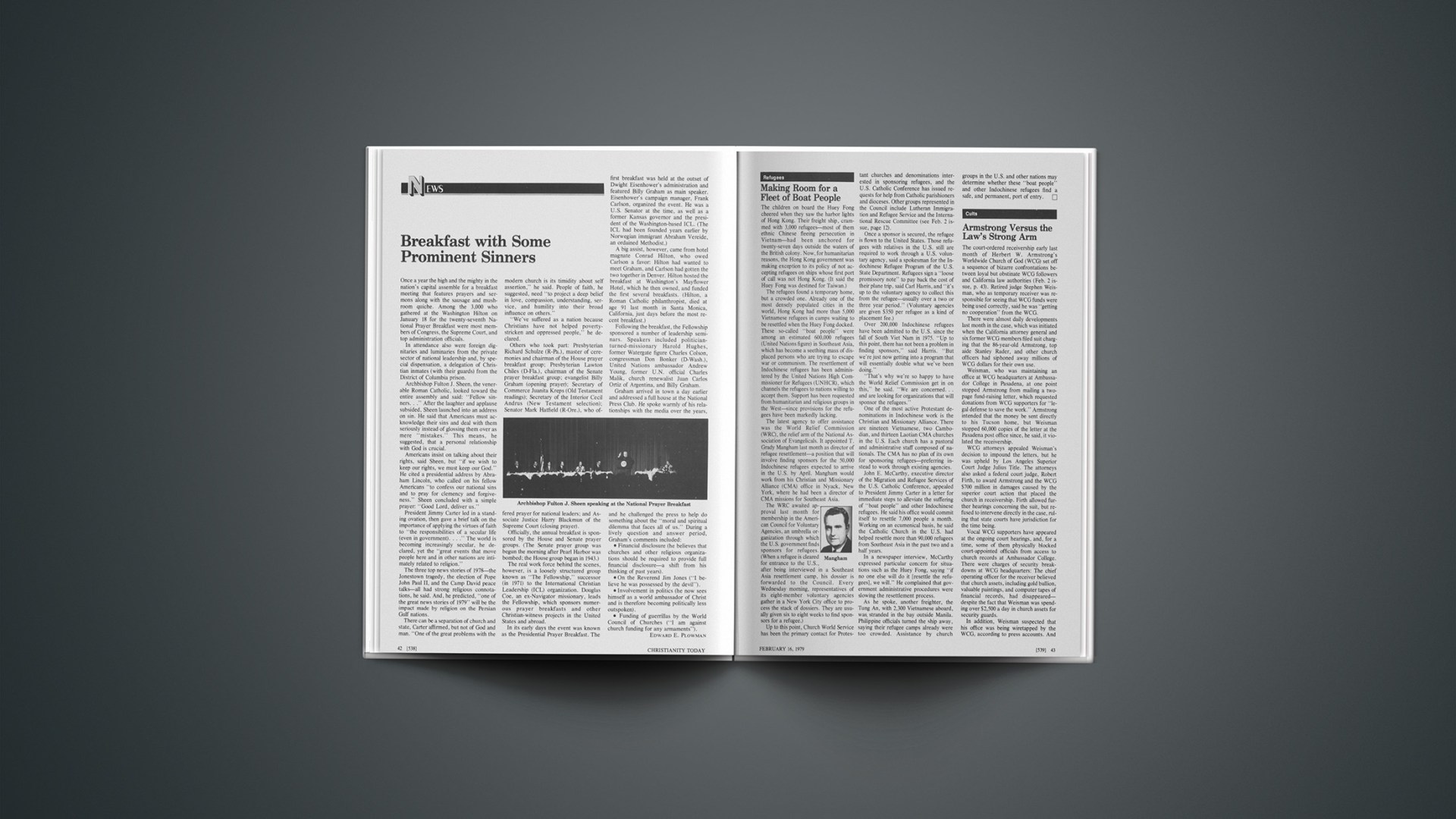
Once a year the high and the mighty in the nation’s capital assemble for a breakfast meeting that features prayers and sermons along with the sausage and mushroom quiche. Among the 3,000 who gathered at the Washington Hilton on January 18 for the twenty-seventh National Prayer Breakfast were most members of Congress, the Supreme Court, and top administration officials.

In attendance also were foreign dignitaries and luminaries from the private sector of national leadership and, by special dispensation, a delegation of Christian inmates (with their guards) from the District of Columbia prison.

Archbishop Fulton J. Sheen, the venerable Roman Catholic, looked toward the entire assembly and said: “Fellow sinners …” After the laughter and applause subsided, Sheen launched into an address on sin. He said that Americans must acknowledge their sins and deal with them seriously instead of glossing them over as mere “mistakes.” This means, he suggested, that a personal relationship with God is crucial.

Americans insist on talking about their rights, said Sheen, but “if we wish to keep our rights, we must keep our God.” He cited a presidential address by Abraham Lincoln, who called on his fellow Americans “to confess our national sins and to pray for clemency and forgiveness.” Sheen concluded with a simple prayer: “Good Lord, deliver us.”

President Jimmy Carter led in a standing ovation, then gave a brief talk on the importance of applying the virtues of faith to “the responsibilities of a secular life (even in government).…” The world is becoming increasingly secular, he declared, yet the “great events that move people here and in other nations are intimately related to religion.”

The three top news stories of 1978—the Jonestown tragedy, the election of Pope John Paul II, and the Camp David peace talks—all had strong religious connotations, he said. And, he predicted, “one of the great news stories of 1979” will be the impact made by religion on the Persian Gulf nations.

There can be a separation of church and state, Carter affirmed, but not of God and man. “One of the great problems with the modern church is its timidity about self assertion,” he said. People of faith, he suggested, need “to project a deep belief in love, compassion, understanding, service, and humility into their broad influence on others.”

“We’ve suffered as a nation because Christians have not helped poverty-stricken and oppressed people,” he declared.

Others who took part: Presbyterian Richard Schulze (R-Pa.), master of ceremonies and chairman of the House prayer breakfast group; Presbyterian Lawton Chiles (D-Fla.), chairman of the Senate prayer breakfast group; evangelist Billy Graham (opening prayer); Secretary of Commerce Juanita Kreps (Old Testament readings); Secretary of the Interior Cecil Andrus (New Testament selection); Senator Mark Hatfield (R-Ore.), who offered prayer for national leaders; and Associate Justice Harry Blackmun of the Supreme Court (closing prayer).

Officially, the annual breakfast is sponsored by the House and Senate prayer groups. (The Senate prayer group was begun the morning after Pearl Harbor was bombed; the House group began in 1943.)

The real work force behind the scenes, however, is a loosely structured group known as “The Fellowship,” successor (in 1971) to the International Christian Leadership (ICL) organization. Douglas Coe, an ex-Navigator missionary, leads the Fellowship, which sponsors numerous prayer breakfasts and other Christian-witness projects in the United States and abroad.

In its early days the event was known as the Presidential Prayer Breakfast. The first breakfast was held at the outset of Dwight Eisenhower’s administration and featured Billy Graham as main speaker. Eisenhower’s campaign manager, Frank Carlson, organized the event. He was a U.S. Senator at the time, as well as a former Kansas governor and the president of the Washington-based ICL. (The ICL had been founded years earlier by Norwegian immigrant Abraham Vereide, an ordained Methodist.)

A big assist, however, came from hotel magnate Conrad Hilton, who owed Carlson a favor: Hilton had wanted to meet Graham, and Carlson had gotten the two together in Denver. Hilton hosted the breakfast at Washington’s Mayflower Hotel, which he then owned, and funded the first several breakfasts. (Hilton, a Roman Catholic philanthropist, died at age 91 last month in Santa Monica, California, just days before the most recent breakfast.)

Following the breakfast, the Fellowship sponsored a number of leadership seminars. Speakers included politician-turned-missionary Harold Hughes, former Watergate figure Charles Colson, congressman Don Bonker (D-Wash.), United Nations ambassador Andrew Young, former U.N. official Charles Malik, church renewalist Juan Carlos Ortiz of Argentina, and Billy Graham.

Graham arrived in town a day earlier and addressed a full house at the National Press Club. He spoke warmly of his relationships with the media over the years, and he challenged the press to help do something about the “moral and spiritual dilemma that faces all of us.” During a lively question and answer period, Graham’s comments included:

• Financial disclosure (he believes that churches and other religious organizations should be required to provide full financial disclosure—a shift from his thinking of past years).

• On the Reverend Jim Jones (“I believe he was possessed by the devil”).

• Involvement in politics (he now sees himself as a world ambassador of Christ and is therefore becoming politically less outspoken).

• Funding of guerrillas by the World Council of Churches (“I am against church funding for any armaments”).

Book Briefs: February 16, 1979

The Teaching Of Theology

Case Studies in Christ and Salvation by Jack Rogers, Ross MacKenzie, and Louis Weeks (Westminster, 1977, 176 pp., $7.95 pb), is reviewed by John V. Dahms, professor of New Testament, Canadian Theological College, Regina, Saskatshewan.

This book illustrates how the case study approach, which was developed at Harvard Business School to train business personnel to make decisions may be adapted for a college or seminary class in theology. Students get background information about historical situations in which a particular theological question became an issue. It includes some understanding of the persons involved and the nontheological factors that were influential. They then are encouraged to discuss what the most appropriate resolution of the issue would have been. A note at the beginning of each chapter says that the material is intended as a “basis for class discussion rather than to illustrate either effective or ineffective handling of a situation.”

Seventeen case studies are presented. The first four, on Christology, set forth what prompted the Councils of Nicaea, Constantinople, Ephesus, and Chalcedon. The middle section of the book sets the stage for discussion of nine historical questions concerning soteriology, most of them having to do with theories of the atonement. The first question is about Augustine’s views on the content of catechetical instruction, the last with Aulen’s theology of the cross. The final section of the book deals with four recent problems on the person and work of Christ: the question of Kimbanguist membership in the World Council of Churches, Rosemary Radford Reuther’s perspective on sexism in theology, differences at the International Congress on World Evangelization at Lausanne, and tensions at the World Council of Churches Fifth Assembly at Nairobi.

I was surprised to see recent issues, whose permanent significance is doubtful, highlighted in a study of theology. The same may be said of the inclusion of such matters as an ethical problem faced by the Shakers in 1774. Moreover, I wonder why the challenge of Mary Baker Eddy is included but not the challenge of Mormonism or of Transcendental Meditation, to say nothing of such questions as those posed by liberalism, dispensationalism, and neo-orthodoxy.

Having said all of this, I note that each case is presented as clearly, concisely, and interestingly as possible. If some of the problems seem to be over-simplified, the need for brevity is the excuse. Also, stimulating classroom discussion may require it. On the other hand, I wonder whether some of the material is not more interesting than relevant, e.g., the relationship of Abelard and Heloise.

The authors indicate that here is a methodology in which “the heart of the matter is participation.” Therefore they hint that enjoyment is a major concern. The teacher is “primarily … a discussion leader,” a “moderator and enabler.” The authors magnify the idea that students should learn from one another.

This method may be excellent in problem-solving. It may be valuable as a secondary method when the academic concerns are of a different nature. I would encourage it as a secondary method for college classes in theology.

But only those whose philosophy of education has been unduly influenced by existential thought will suggest that it should be the primary method when the foremost concern is other than to train in problem-solving. To suggest—and I am not intimating that the authors do—that the heart of education generally should be “participation” makes the student more important than Christ, since it makes self-expression the summum bonum of education. Participation sometimes has no other value than that of ego-building. Although education should be made as enjoyable as possible, the primary concern therein ought to be to prepare students to serve God. And primary reliance on a method that emphasizes students learning from one another and that reduces the teacher to a moderator caters to the conceit of students and wastes both students’ time and teachers’ knowledge.

True Fellowship

Our Life Together, by James Thompson (Sweet, 1977, 144 pp., $1.95 pb), The Power of a Loving Church, byMargaret and Bartlett Hess (Regal, 1977, 143 pp., $1.95 pb), and Creative Love, by Louis H. Evans, Jr. (Revell, 1977, 126 pp., $5.95), are reviewed by Neal F. McBride, assistant professor of Christian education, Western Conservative Baptist Seminary, Portland, Oregon.

Christian periodicals and book stores offer a profusion of books that eagerly guarantee panaceas for healthy church life. A few of these would-be cure-alls actually include biblical, practical advice. Yet, all you get from others is a lighter purse.

These three books, read together, lay a biblical foundation for genuine Christian fellowship, examine the love bond of a church, and suggest a realistic way to attain fellowship. Although brief, these books are stimulating.

Our Life Together should be read first. The author presents a fresh, comprehensive look at genuine Christian fellowship. More instructional in nature than the other two, Thompson’s work builds a complete and convincing doctrine for the responsible practice of fellowship. His premise is that biblical faith and Christianity were never intended to be lived alone but rather in community. He forcefully argues that individualism, or the preoccupation with self, has permeated our society and churches. The author warns that if the church loses its intimate sense of family life to the “Me Decade” syndrome, it will become an anonymous crowd of worshipers. Thompson systematically and carefully examines the necessary ingredients for achieving the divine standard of koinonia. A possible weakness in Thompson’s book is the failure to include practical examples and advice to help implement the suggestions. This is not the case, however, with the other two books.

The Power of A Loving Church can be summed up in the familiar slogan, “in essentials unity, in nonessentials liberty, in all things charity.” Bartlett Hess is pastor of a church in Michigan that has grown to over 2,600 members in his twenty years as minister. The Hesses contend that leading a church to maturity comes through the power of love. “A loving church knows how to settle its differences. A loving church appreciates the endless flavors of human personality. A loving church first of all loves its Lord.” This book is not a mushy “this-is-how-we-did-it-you-do-it-too” prescription. Rather, the Hesses set forth seventeen short chapters on some issue of applied love, all effectively illustrated with the dynamics of their own church. The book is replete with practical suggestions on how love can be realistically demonstrated at all levels in a local church.

While the Hesses briefly touch on small groups as a vehicle for love in the local church, Creative Love is a more complete statement on the subject. Covenant groups, as Evans calls them, are the central subject of this concise volume, based on the experience of his Washington, D.C., church. Evans explains that covenant groups are composed of a small number of people who agree to enter into a covenant relationship with each other. He suggests eight covenants around which the groups operate: affirmation, availability, prayer, openness, honesty, sensitivity, confidentiality, and accountability. The majority of the book is then spent explaining each of these covenants. Unfortunately, the chapter on such details as establishing covenant groups is too short. Evans’s willingness to admit that he is still growing and that his ideas are not complete or necessarily correct is refreshing. In an age of know-it-alls, his book is a sincere attempt to provide useful and worthwhile information.

God Of A Philosopher

First Considerations by Paul Weiss (Southern Illinois University, 1977, 273 pp., $13.95), is reviewed by Winfried Corduan, assistant professor of religion and philosophy, Taylor University, Upland, Indiana.

In an age when metaphysics is often treated as the dross of philosophy, the work of Paul Weiss is a refreshing exception. His thought is a unique creation, reminiscent at times of Whitehead or Aristotle, but always original. First Considerations is Weiss’s latest and most rigorous presentation of his ever-changing system. Also included are six critiques and Weiss’s replies to the criticisms. The style is reflective and intuitive, never letting up in demanding the highest amount of concentration from the reader.

Common sense is not the final standard of truth for Weiss, but he does begin with the world of experience, rather than borrowing his methodology from the natural sciences. Our normal experience, he claims, is that we come to know a world outside of us. Reality is not merely constituted by our minds, as supported by the fact that frequently reality defies us and proves us to have been wrong.

Reality, to Weiss, is constituted by contexts of actualities. But actualities are not perceived in themselves, only their appearances. Such an appearance is always limited, for knowledge will penetrate beyond the appearance; and the actuality is larger than the appearance. The qualities that determine the make-up of actualities serve as evidences for knowledge.

For Weiss the actualities are existing states of affairs, not merely events. Of course actualities do change, and there is causal interaction among them. But the change is not haphazard or unruly. All actualities are governed by five finalities: Possibility, Substance, Being, Existence, and Unity. These ultimate realities stand behind the actualities and actively give them their modes of being, that is, they make the actualities possible and provide them with substance, being, existence, and unity, as their names indicate.

Although Weiss at one point remarks that Substance can be referred to as God, it is Unity for which he wants to reserve that title. But Weiss does not intend to set up a case for the God of Christianity. In fact, he prefers the term “Unity” in order to lessen the chance of such a confusion. Weiss’s God is not the God who created the world, to whom we pray, who intervenes in the history of the world. He is a philosophical abstraction with the purely metaphysical function of establishing unity among all actualities.

In religious terms, it is customary to speak of God as the ultimate reality. For Weiss, Unity is only one among five finalities and has no particular precedence over the others. All the finalities interact with each other and rely on each other; Unity enjoys no special eminence.

Thus we have here a form of pan-entheism, the theory that God metaphysically pervades the world. The world could exist without him, Weiss claims, but only with Unity can the sum total of actualities present an aesthetically unified whole. As ultimate source of coherence, Unity is also the source of values. Traditional arguments for God’s existence are “encrusted with irrelevancies,” but can be taken as metaphysical pointers to Unity.

Since Weiss makes it very clear that he is not talking of the personal God of Christianity, no ground is gained by confronting him with what the Bible teaches about God. Instead the object must be to show where he is wrong in his conceptions, and then to demonstrate that the Christian God is the true one. Such an undertaking demands a more thorough analysis than is possible here. Let me merely indicate a few relevant issues.

First, a point raised by several commentators: Weiss indicates no clear methodology. His introspective style only occasionally alludes to other thinkers; it becomes almost impossible to latch onto him in dialectical encounter. Hence, despite Weiss’s talk of evidence, he doesn’t give much. But where evidence gives way to insight, irrationality is around the corner.

Second, Weiss resists all attempts to saddle him with an ultimate God, either as a composite of the five finalities, as a God behind the finalities, or as the exaltation of Unity ahead of the other finalities. But this resistance is unconvincing. Weiss’s conception of the world is dominated by the value of having a functioning, coherent, and realistic cosmos, and this value is at the root of how Weiss understands the finalities to govern. Thus this value does take precedence over the rest of the system and should be admitted to being ultimate, whether as an aspect of Unity or as a “final finality.”

Third, given his starting point, Weiss has no warrant for positing Unity at all. His claim rests on the fact that the world represents a unified aesthetic totality. But that is a doubtful premise if you begin with a nontheistic starting point, as the existentialists (among others) have shown. Traditional arguments that only need to point to some contingent being to demonstrate God’s existence carry more plausibility.

First Considerations was published amid a rush of publicity that even filtered down to the level of television talk shows. As metaphysics is slowly gaining in respectability, Weiss’s importance is bound to increase, and with him his attacks on traditional conceptions of God. Evangelical thinkers will do well to deal carefully, thoroughly with his thought.

The Book Of Mormon, Of Smith, Or Of Whom?

Who Really Wrote the Book of Mormon?, by Wayne L. Cowdrey (Vision, 1977, 257 pp., $4.98 pb), The Mormon Papers, by Harry L. Ropp (InterVarsity, 1977, 118 pp., $2.95 pb), and Will the “Saints” Go Marching In?, by Floyd McElveen (Regal, 1977, 175 pp., $3.50 pb), are reviewed by J. Gordon Melton, director, Institute for the Study of American Religion, Evanston, Illinois.

Critics have attacked the credibility of the alleged translations of Joseph Smith, the founder of Mormonism, since the first publication. In an 1830 review of the Book of Mormon, Alexander Campbell snickered over the way a book supposedly written more than a thousand years earlier could have provided specific answers to each and every question that inflamed western New York in the 1820s. Throughout the nineteenth century friends and relatives of Solomon Spaulding published testimonies to the effect that the Book of Mormon was based on the manuscript of a novel by Spaulding, who died in 1816.

In more recent years, the attacks, which had continued without clear resolutions, found new ammunition. First, The Rocky Mountain Mason of January 1956 published the notes by Mormon apostle B.T. Roberts, which showed the parallel between the Book of Mormon and an obscure volume, The View of the Hebrews by Ethan Smith, published in Poultney, Vermont, in 1825.

Then in 1967, papyri used by Joseph Smith, which he called the Book of Abraham (another of Smith’s “translations,” included in The Pearl of Great Price, which Mormons also considered to be scripture), were discovered. Mistakenly believed to have been destroyed in the great Chicago fire of 1871, the papyri were turned over by the finders to the church, which in turn gave them to Dee Jay Nelson, a Mormon and an Egyptologist. He translated them, but found that they bore no relation to the content Smith had ascribed to them. In light of his work, Nelson resigned from the church.

Now, new evidence has surfaced that the Book of Mormon was more than the product of Joseph Smith’s vivid imagination as some critics have claimed. Howard Davis, a young research colleague of cult-scholar Walter Martin, noticed that the handwriting of a portion of the original manuscript of the Book of Mormon closely resembled the handwriting on several documents known to have been written by Solomon Spaulding. That portion of the Book of Mormon had been designated as by an “unidentified scribe.”

Who Really Wrote the Book of Mormon? tells the story of Howard Davis’s search following his initial discovery and how, joined by Wayne Cowdrey and Donald Scales, he carefully reconstructed a plausible history of the method of Joseph Smith’s obtaining the Spaulding material and republishing it in a new form as the Book of Mormon. This volume promised to be the most exciting new discovery relating to Mormon history in a decade. However, handwriting experts vacillated and disagreed on the identifications. (See CHRISTIANITY TODAY, Oct. 21, 1977, issue, p. 38.)

For those interested in pursuing the wider questions of the claims of Joseph’s Smith’s translations, Harry Ropp’s The Mormon Papers provides an excellent contemporary survey. Ropp brings together all the traditional arguments against the authenticity of the Book of Mormon, including the all-important archeological evidence. Rapp lacerates the Doctrine and Covenants, which does not claim to be a translation, but rather a collection of the ongoing divine revelations received by Smith. He spends a chapter detailing the significant changes between the first and second editions, the contradictions with the Book of Mormon, and the many unfulfilled prophecies.

Although Ropp acknowledges the Spaulding theory for the origin of the Book of Mormon (as set forth by Davis, Cowdrey, and Scales) he warns readers to refrain from a too hasty acceptance of their work. Ropp claims to have examined not only the disputed Book of Mormon manuscript but a manuscript of Doctrine and Covenant, entry 56, clearly written in 1831, long after Spaulding’s death. The Mormon Church claims that the latter document was also copied for Smith by the “unidentified scribe” and that the handwriting will prove identical.

Ropp’s point is well taken. Davis is quite incorrect in asserting that graphology is an “exact science,” and Ropp is quite correct in claiming that the evidence is not in yet, despite Davis’s hypothesis.

Finally, for those waiting for the issues to be resolved, Floyd McElveen’s Will the “Saints” Go Marching In? continues the traditional evangelical Christian approach to Mormonism. Drawing heavily on the massive research of Jerald and Sandra Tanner, the most famous ex-Mormons, McElveen offers a thorough critique of the Utah-based religion. He emphasizes the weakness of the case for the authenticity of the Book of Mormon, the Mormon’s polytheistic conception of God, and the false way of salvation that Mormonism teaches. McElveen’s position loses nothing in the controversy over the possible “fraudulent” manuscript and will remain the essential thrust of an evangelical critique, no matter how the Spaulding issue resolves itself.

• Since this review was prepared, McElveen has released another book, The Mormon Revelations of Convenience (Bethany Fellowship, 108 pp., $1.75 pb). Triggered by the recent “revelation” that permitted black men to enter the Mormon priesthood, he also surveys the role of other revelations in the group’s history.

One of the outstanding evangelical students of Mormonism is Gordon Fraser. His Is Mormonism Christian? (192 pp.) continues to be a top-selling Moody Press book. Its 1977 edition is a consolidation and revision of two earlier works. Three supplementary 1978 paperbacks are available directly from the author at $1.75 each, as is the Moody book (P.O. Box 10, Hubbard, OR 97032): Joseph and the Golden Plates (124 pp.), Sects of the Latter-day Saints (111 pp.), and A Manual for Christian Workers: A Workshop Outline for the Study of Mormonism (47 pp.).—Ed.

Pastoral Ministry

Every Pastor Needs a Pastor, by Louis McBurney (Word, 1977, 156 pp., $5.95), The Living Reminder, by Henri Nouwen (Seabury, 1977, 80 pp., $5.95), Today’s Pastor in Tomorrow’s World, by Carnegie Calian (Hawthorn, 1977, 153 pp., $6.95), The Authentic Pastor, by Gene Bartlett (Judson, 1978, 110 pp., $3.95), The Mid-Life Crises of a Minister, by Ray Ragsdale (Word, 1978, 105 pp., $4.95), and Survival Tactics in the Parish, by Lyle Schaller (Abingdon, 1977, 208 pp., $4.95 pb), are reviewed by Gerald C. Studer, pastor, Plains Mennonite Church, Lansdale, Pennsylvania.

A pastor can scarcely argue with Louis McBurney’s title, Every Pastor Needs a Pastor. No pastor should be too insecure to admit it. McBurney says, “The man of God is a man with the same needs as other men.” Unfortunately too few lay people understand this simple truth.

McBurney, founder of a psychiatric center devoted exclusively to ministers and their families, elaborates that statement in some thirty chapters. I expect books from the field of psychiatry to be heavily laced with professional jargon and case histories. But McBurney clearly supports his thesis and tells how a pastor can find a pastor.

Nouwen’s spare style and trenchant massage make this the most deeply provocative of these books. I intend to reread it. He reminds the reader that each of us, but ministers especially, represent the work of God, despite flaws and sin. Here is to be found such grist for personal growth: “… to forget our sins may be an even greater sin than to commit them. Why? Because what is forgotten cannot be healed and that which cannot be healed easily becomes the cause of greater evil.”

Calian in Today’s Pastor in Tomorrow’s World wants the minister to be a grass-roots theologian. Seminary training “must equip the pastor to think theologically on a lifetime basis.” He asserts that pastors tend to be overworked but underemployed. He also examines the role of the pastor’s wife, as well as the urgency of the church to eliminate “any kind of laicism or clericalism” if the priesthood of believers is to be realized as well as professed. This does not obviate the upgrading of the quality of professional leadership if the churches are to grow and the expectations of the laity are to be met.

Bartlett in The Authentic Pastor believes that “the very marks of a secular day which make ministry difficult also make it imperative.” He discusses the meanings of relationships rather than methods of pastoral work. He seeks to clarify some of the problems of pastoral counseling. Pastors, he says, have a lifelong task to understand who we are, what we do, and why we do it. He concurs with Calian and Nouwen that a pastor must base his relationships on theology. He criticizes the shallowness of much evangelism, asserting that it is often promotional, not pastoral. Real evangelism, he says, is much nearer courtship than salesmanship. We are reminded that preaching is a time of disclosure, not only of truth, but also of the person presenting the truth.

Ray Ragsdale, retired superintendent of the United Methodist district of Los Angeles, has written a pastoral rather than an analytical book on The Mid-Life Crises of a Minister. He roughly defines the mid-life crisis years as between thirty-five and fifty-five. He discusses four broad areas: physical, career, marital/family, and meaning. Since all are intertwined, an overview is necessary before problems can be properly identified. He uses case studies effectively and faces the implications for women in the ministry.

Schaller’s title, Survival Tactics in the Parish, suggests that the church is under seige. He follows a fictional pastor through a nine-year pastorate, and though he shares a remarkable array of helpful data, the persona seems wooden much of the time. His analysis is not enhanced by such corny humor as “back in the days when a three-cent stamp only cost a dime.” He generallizes too much. But he is nonetheless thought-provoking, as when he claims that the pastorate rarely reaches its greatest effectiveness before the fourth to eighth year. I thought Schaller too glib for the most part.

From Nazareth To Bethlehem

The Road to Bethlehem, by Tom Harpur (Cook, 1977, 95 pp., $6.95), is reviewed by Victor M. Parachin, pastor, Bethany Free Methodist Church, Melrose Park, Illinois.

Of the people who have taken the time to walk the 100 mile road from Nazareth to Bethlehem, only a few have reported their observations. The journey made by Mary and Joseph, which is recorded in the Gospel of Luke, has long been romanticized, especially on Christmas greeting cards and similar products. Seldom has the trek been viewed as a “gruelling, dangerous hike with a woman in the late stages of pregnancy through some of the most awesome terrain on the face of the earth.”

This, however, was the assessment of Tom Harpur, religion editor of one of the largest newspapers in Canada, The Toronto Star. (Before turning to journalism, Harpur was an Anglican minister who taught New Testament at Wycliffe College, a Toronto seminary.) Two years ago, Harpur persuaded his editors that a first-hand retracing of the trip made by Mary and Joseph would prove to be interesting for readers of the paper. Harpur explains: “I didn’t see it as a stunt or gimmick.… I wanted to see for myself the terrain which Joseph and Mary saw and which became so familiar to Jesus in his later life.”

Harpur, his wife Mary, and photographer Dick Loek made the journey; their delightful book on the experience is beautifully illustrated.

Harpur’s fascinating book helps refute some views advocated by scholars who question Luke’s accuracy. For example, Harpur writes: “I was aware from my New Testament studies that some scholars have argued Jesus could not have been born in the winter because the shepherds would not—as St. Luke says they were at the time of the Nativity—be tending their flocks in the hills at that time of year. Everything we saw, however, indicated quite the contrary. Off in the hills to our left towards Bethlehem, we could see vast flocks and the spreading tents of the Bedouin or nomadic shepherds.” Harpur noted that almost all the shepherds in the countryside were teenagers and female and therefore wonders if “the shepherds who hastened to the manger at that first Christmas were not the rather venerable men with staffs depicted on so many Christmas cards and in traditionals religious art, but young people, many of them girls.” Harpur’s suggestion would certainly be in harmony with the Old Testament report of Rachel, the daughter of Laban, caring for the sheep.

The book certainly belongs in every church library and ought to be read by those who want to have a fresh view of an ancient story.

How to Decorate a Pastor’s Office

Office surroundings affect human responses.

Ever notice how some ministers’ offices make you feel tense and uninvited? The person behind the desk unconsciously says, “I am an important person so state your business and be quick about it.” Other offices are warm and inviting and make the visitor feel comfortable. What is the difference between the two rooms? How can a pastor’s office be designed so that it communicates cordiality?

First, we must realize that office surroundings do affect human responses. Several studies, the best known by Maslow and Mintz, support this.

They selected three rooms for study. One was an “ugly” room (designed to give the impression of a janitor’s storeroom in disheveled condition). One was a “beautiful” room (complete with carpeting, drapes, and so forth). And one was an “average” room (a professor’s office). Subjects were asked to rate a series of photographs of faces. The experimenters tried to keep all factors, such as time of day, odor, noise, type of seating, and experimenter, constant from room to room so that the results could be attributed to the type of room. Results showed that while in the beautiful room the subjects tended to rate the faces significantly higher than did participants in the ugly room. Experimenters and subjects alike tried to avoid the ugly room, which they described as producing monotony, fatigue, headache, discontent, sleep, irritability, and hostility. The beautiful room, however, produced feelings of pleasure, comfort, enjoyment, importance, energy, and desire to continue the activity.

Suppose your church has built a new structure in which your office is to be located. You want it to be warm and cordial but the budget does not allow for interior decorating. Here, then are some hints.

Neatness and simplicity in an office are helpful. When a member of your church comes to you for counsel, the first impression an orderly environment communicates is that you have everything under control. If a desk is clutterd with papers, unanswered letters from three weeks ago, and opened books, they may hesitate on revealing their disorder to you.

The size of the office is important. Many pastor’s offices are too small to produce desired effects. The room should be large enough to accomodate a sofa and/or a lounge chair or two. But an office can also be too spacious. An oversized office causes loss of contact with a counselee.

There are certain colors that tend to promote specific human moods. The warm colors—yellow, gold, brown—are apt to create an intimate setting. This may be accented with blue in drapes and upholstered furniture. Blue is associated with tenderness, serenity, and comfort. According to an experienced decorator, white is the worst choice to produce a warm atmosphere.

Paneling is attractive for an office but should be put on only three walls. The fourth wall needs to be varied to relieve the eyes. Walls with fabric are popular today. They are appealing and add visual softness, quietness, and texture.

Paintings can also contribute character to the office of a minister. There should be a few reflecting your own interest, as well as landscape scenes. Violent and tragic works should be avoided.

Centering a picture in a wall space or over a piece of furniture gives symmetry, while placing one off-center creates movement. Whatever suits an individual’s taste is proper. Keeping pictures at about eye level lets them be seen comfortably and relates them to furnishings.

Small pictures and diplomas should be grouped to avoid spottiness. Diplomas and awards are best placed on a side wall and not directly behind the desk, unless you want them to appear as your crowns.

Soft floor coverings give rooms a furnished, completed look, even with little furniture. They provide a friendly intimacy and explicitly relate the floor to upholstered furniture, draperies, and occupants. Carpet can also alter the apparent size and shape of a room. A good choice of texture is plush or velvet pile. The color should be subtle so as not to draw attention to itself.

Good artificial light can protect health by minimizing eyestrain, as well as contribute to the attractiveness of the office. There are two ways to light a room: incadescent or fluorescent. Most offices use fluorescent light located in ceiling panels. However, a decorator advised against the blue-white light they emit because they tend to give a room an “institutional” look and create shadows under the nose and chin. Perhaps another reason to avoid them is because of the annoying hum or flicker they sometimes produce. The ideal lighting is side lights, shaded table lamps with incandescent bulbs. With these, the light in a room is warm and full because of its orange cast. The room’s occupants look more attactive and rested.

Easy listening background music (FM stereo) is soothing and it reveals an attitude of caring and quality. Another advantage of music is that it masks distracting sounds of the environment—air conditioning, heating, hum from lights, and traffic.

The selection and arrangement of furnishings can communicate volumes to a visitor. Space can be arranged so that it encourages people to converse. People are most likely to speak when others are seated at right angles to them.

When arranging chairs, it is wise to remember that according to E. T. Hall, a pioneer in the study of proximics, social consultative distance (for personal business) ranges from four to twelve feet.

A desk is a fine place to study but it can be an obstruction when it comes to communication. An experiment conducted in a doctor’s office suggests that the presence or absence of a desk may significantly alter the patient’s at ease state. With the desk separating doctor and patient, only 10 per cent of the patients were perceived at ease. Removal of the desk brought the figure up to 55 per cent.

Generally, the minister should sit with his visitor in lounge-type chairs or sofa. However, there are times when a minister needs to maintain a business-like atmosphere. The desk can help achieve this, and the minister should remain at the desk. The chairs should be comfortable, especially if the counselee will be there long. The attitude “I can’t wait until I can stand up and get out of this uncomfortable chair” should be avoided. Upholstered chairs are preferred to vinyl, which are uninviting and can become hot. If you have a sofa, add a warm touch with a couple of throw pillows.

Interior decorators generally advise those who work with people to have personal effects in their office. A picture of the family, souvenirs, and humorous plaques are ways of showing the humanness of the person whose name is on the door.

You can design your office so that it shows cordiality and warmth. Remember that your surroundings preach volumes and have an effect upon interpersonal communication.—GREG HULLINGER, youth pastor, Prairie Creek Baptist Church, Dallas, Texas.

Refiner’s Fire: Wiebe: A Voice Crying in the Wilderness

The prophet is always a problem for those who feel they have the answers.

When The Temptations of Big Bear was awarded the Canadian Governor-General’s Award in fiction in 1973, a large talent became public. Prior to that, we had known Rudy Wiebe as a prize-winning short story writer on the university scene. His first novel, Peace Shall Destroy Many, with its bluntly honest rendering of a wartime Saskatchewan Mennonite community, grated on evangelical nerves. Wiebe was, at the time of its publication, the editor of the Mennonite Brethren Herald. He left the post soon after.

That first book, as awkward and angular as its young Mennonite protagonist, Thom, held much promise. His writing skill, combined with the anguish of honesty, has both deepened and grown, so that I find myself seeing Wiebe as Mrs. Wiens sees her son Thom at the end of Peace Shall Destroy Many: “Huge before her, staring skyward … driving them towards the brightest star in the heavens.”

Wiebe, who is a forthright Christian still active within the evangelical Mennonite Brethren church, looks every inch the prophet: a heavy beard, a straggle of dark hair, a high cheek-boned “lean and hungry look.” For a number of years a professor of Canadian literature and creative writing at the University of Alberta in Edmonton, Wiebe last year was writer-at-large at the University of Calgary. His insights into the human condition have successfully transcended cultural barriers, so that he is profoundly credible when describing an Indian chief, a Metis rebel, or a Canadian Mennonite.

The insistent question of his novels, whether answered by the questioning Thom, the Christlike David Epp (Blue Mountains of China), the Cree Indian chief, Big Bear (The Temptations of Big Bear), or the Metis visionary, Louis Riel (The Scorched Wood People), is: “What does the Lord require of you …?” (Micah 6:8).

The common denominator between these disparate characters is a passionately spiritual sensibility with a deep sense of personal accountability to God, as well as a pacifist stance in a violent world. Both of these qualities are deeply rooted in Wiebe’s own Mennonite background.

Yet Wiebe’s characters do not always offer Christian answers to the questions of life. The Mennonite characters of his early novels wrestle with their problems in the light of Scripture and tradition. But in the characters Pre-Christian Big Bear, worshiping the Great Spirit with the help of fetishes and spirit mediators, or in the heretical Catholic Riel, revolutionary leader in The Scorched Wood People, the novelist copes with the great questions of life outside of an orthodox Christian framework. His stance in these novels is more like that of an Old Testament prophet than of a New Testament Christian. He proclaims a good God in a loving relationship to his creation. But, writing for an audience that no longer has Christian presuppositions, Wiebe’s message, particularly in his last two novels, is more pre-Christian than Christian. Having asked what the Lord requires, Wiebe’s characters live out the answer: “to do justice, and to love kindness, and to walk humbly with your God” (Micah 6:8).

Another question turning within Wiebe’s work is, “What is the nature of the Kingdom of God?” He shows the age-old conflict between the City of God and the City of Man. The peace-lovers find themselves in the position of being understood by none but God—and, perhaps, Wiebe. In considering who belongs to the kingdom of God, Wiebe’s answer is again pre-evangelical. He proclaims through his novels, “I perceive that God shows no partiality, but in every nation anyone who hears Him and does what is right is acceptable to Him” (Acts 10:34).

The concluding lines of The Temptations of Big Bear include one of the most moving passages I’ve encountered in modern literature. As Big Bear senses death’s approach, he realizes: “It was time now. To lie down; to finish the long prayer to The Only One that was his life … he said: ‘You Only Great Spirit, Father. I thank you. I thank you for giving me life, for giving me everything, for being still here now that my teeth are gone. So now I have to ask you this last thing, and I think it’s like the first thing I asked … I ask you again. Have pity’ ” (p. 414). What more could anyone, anywhere, pray?

Rudy Wiebe is a challenging novelist. His writing is not for the casual reader. And although his landscapes and characters are Canadian, his style is in the tradition of James Joyce and William Faulkner: He stands in a tradition of the finest of English literature. For his marathon paragraphs of stream-of-consciousness soliloquy or unpunctuated lyric description, Wiebe never apologizes. “I have nothing to say to the speed reader,” he says. From the bare starkness that marked his style in his first novels, he has grown in richness and fluency. Again and again you read a phrase that lights a writer’s heart with envy, a reader’s with joy, Christian’s with praise to the One who “gave gifts unto men.”

In his latest novel, The Scorched Wood People, a memorable passage is his lyric description of the joy of married life. Riel tells his wife, “Father Tache told me long ago, love is the sacrament between a man and a woman. Whatever they feel, whatever they do to make themselves happy, that is pure, that is holy.” With that theological instruction, Marguerite teaches Riel the joy of the sacrament. Since in much current literature, sex must be sordid to be sensational, illicit to be interesting, the Christian reader can give thanks for this celebration of sex within marriage.

Many Christians cannot appreciate a work that honestly exposes the questioning heart, the inadequacies of the best of our answers, the problems of saintly society. The prophet is always a problem, particularly to those who feel they have the answers, although they may have forgotten the questions. But Wiebe, widely recognized as a leading novelist of this century, must be accorded a place of honor among Christian artists. His work is that of illumination, rather than of teaching. Christian doctrine could not be deduced from his books but Christian compassion, and a sense that “there’s a wideness in God’s mercy like the wideness of the sea” can be learned. In a largely non-Christian culture, Wiebe has the courage to give artistic shape to these concepts. He is, in the wasteland, “A voice crying in the wilderness, ‘Prepare Ye the Way of the Lord.’ ”

Maxine Hancock, whose latest book “People in Process” is published by Revell (1978), lives in Alberta.

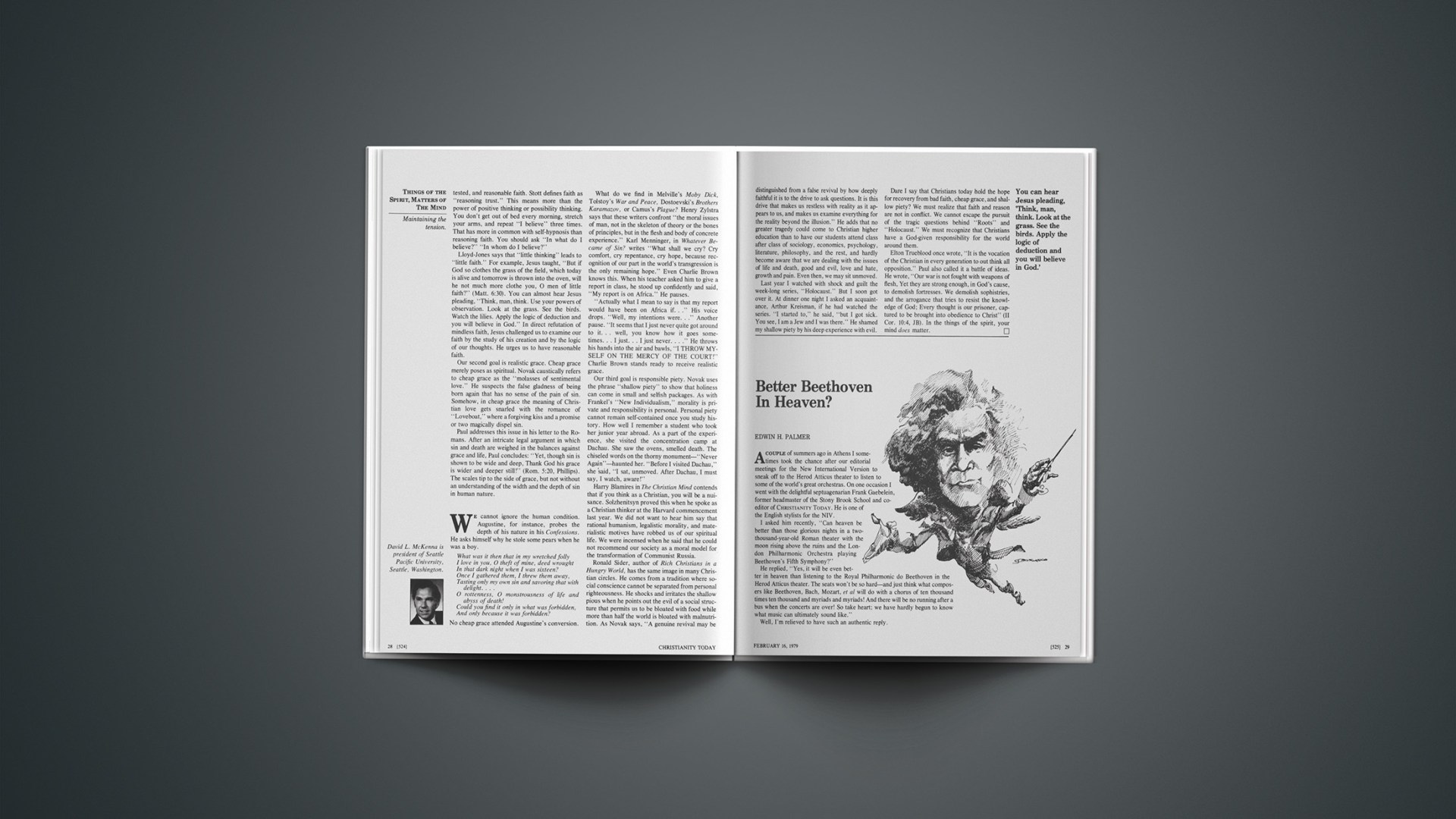
Better Beethoven in Heaven?: Softer Seats

A couple of summers ago in Athens I sometimes took the chance after our editorial meetings for the New International Version to sneak off to the Herod Atticus theater to listen to some of the world’s great orchestras. On one occasion I went with the delightful septuagenarian Frank Gaebelein, former headmaster of the Stony Brook School and coeditor of CHRISTIANITY TODAY. He is one of the English stylists for the NIV.

I asked him recently, “Can heaven be better than those glorious nights in a two-thousand-year-old Roman theater with the moon rising above the ruins and the London Philharmonic Orchestra playing Beethoven’s Fifth Symphony?”

He replied, “Yes, it will be even better in heaven than listening to the Royal Philharmonic do Beethoven in the Herod Atticus theater. The seats won’t be so hard—and just think what composers like Beethoven, Bach, Mozart, et al will do with a chorus of ten thousand times ten thousand and myriads and myriads! And there will be no running after a bus when the concerts are over! So take heart; we have hardly begun to know what music can ultimately sound like.”

Well, I’m relieved to have such an authentic reply.

Things of the Spirit, Matters of the Mind: Maintaining the Tension

Christians today hold the hope for recovery from bad faith, cheap grace, and shallow piety.

Two forces come together when Christians gather in an academic setting. One is the power of the things of the spirit, the other the power of the matters of the mind. Things of the spirit include faith in God, the grace of Jesus Christ, and piety—the desire to live a holy life. Matters of the mind are the facts, feelings, and actions that result from intelligent human behavior.

It is dangerous to separate those two. Charles Frankel, a humanist only interested in the matters of the mind, cites three problems facing higher education today: a “new irrationalism,” which substitutes subjective feelings for sound thinking; a “new egalitarianism,” which rebels against any differences in authority or achievement; and a “new individualism,” which demands personal freedom without social responsibility. When students do not want to think rationally, be graded objectively, or be responsible socially, higher education is in trouble.

Michael Novak, the columnist, has made a similar diagnosis of the things of the spirit. He observes that the current born-again movement encourages “bad faith, cheap grace, and shallow piety.” Bad faith means subjective Christian experience without the rigor of sound thinking and critical testing. Cheap grace indicates the easy acceptance of Christ’s forgiveness without the sense of tragedy in the redemption cost. And shallow piety denotes a small, self-centered devotion that does not address the larger issues of societal and institutional evil.

In the Christian university, we strive to avoid these pitfalls by melding the things of the spirit and the matters of the mind. We work for reasonable faith, realistic grace, and responsible piety.

Our first goal is a reasonable faith. Anyone who pits faith against reason fails to understand biblical truth. In a pithy book, Your Mind Matters, John Stott buries the idea that faith and reason are enemies. He says that he wanted to subtitle his book, “The Misery and Menace of Mindless Christianity.” Stott daringly calls the antiintellectualism cultivated by some Christian groups evil. He says, “To denigrate the mind is to undermine foundational Christian doctrines.” What are they?

Creation: God created us thinking beings.

Revelation: He communicated with us through language.

Redemption: He renews our mind and gives us the mind of Christ.

Judgment: He holds us responsible for the knowledge that we have.

Faith, then, is not what H.L. Mencken defined as “an illogical belief in the occurrence of the improbable.” Nor is faith the attitude of the Christian who wrote, “Whenever I go to church, I feel like unscrewing my head and placing it under the seat, because in religious meetings I never have use for anything above my collar button.” That attitude is distressingly similar to the state of the TV addict.

To avoid that we must strive for examined, tested, and reasonable faith. Stott defines faith as “reasoning trust.” This means more than the power of positive thinking or possibility thinking. You don’t get out of bed every morning, stretch your arms, and repeat “I believe” three times. That has more in common with self-hypnosis than reasoning faith. You should ask “In what do I believe?” “In whom do I believe?”

Lloyd-Jones says that “little thinking” leads to “little faith.” For example, Jesus taught, “But if God so clothes the grass of the field, which today is alive and tomorrow is thrown into the oven, will he not much more clothe you, O men of little faith?” (Matt. 6:30). You can almost hear Jesus pleading, “Think, man, think. Use your powers of observation. Look at the grass. See the birds. Watch the lilies. Apply the logic of deduction and you will believe in God.” In direct refutation of mindless faith, Jesus challenged us to examine our faith by the study of his creation and by the logic of our thoughts. He urges us to have reasonable faith.

Our second goal is realistic grace. Cheap grace merely poses as spiritual. Novak caustically refers to cheap grace as the “molasses of sentimental love.” He suspects the false gladness of being born again that has no sense of the pain of sin. Somehow, in cheap grace the meaning of Christian love gets snarled with the romance of “Loveboat,” where a forgiving kiss and a promise or two magically dispel sin.

Paul addresses this issue in his letter to the Romans. After an intricate legal argument in which sin and death are weighed in the balances against grace and life, Paul concludes: “Yet, though sin is shown to be wide and deep, Thank God his grace is wider and deeper still!” (Rom. 5:20, Phillips). The scales tip to the side of grace, but not without an understanding of the width and the depth of sin in human nature.

We cannot ignore the human condition. Augustine, for instance, probes the depth of his nature in his Confessions. He asks himself why he stole some pears when he was a boy.

What was it then that in my wretched folly

I love in you, O theft of mine, deed wrought

In that dark night when I was sixteen?

Once I gathered them, I threw them away,

Tasting only my own sin and savoring that with delight.…

O rottenness, O monstrousness of life and abyss of death!

Could you find it only in what was forbidden,

And only because it was forbidden?

No cheap grace attended Augustine’s conversion.

What do we find in Melville’s Moby Dick, Tolstoy’s War and Peace, Dostoevski’s Brothers Karamazov, or Camus’s Plague? Henry Zylstra says that these writers confront “the moral issues of man, not in the skeleton of theory or the bones of principles, but in the flesh and body of concrete experience.” Karl Menninger, in Whatever Became of Sin? writes “What shall we cry? Cry comfort, cry repentance, cry hope, because recognition of our part in the world’s transgression is the only remaining hope.” Even Charlie Brown knows this. When his teacher asked him to give a report in class, he stood up confidently and said, “My report is on Africa.” He pauses.

“Actually what I mean to say is that my report would have been on Africa if …” His voice drops. “Well, my intentions were …” Another pause. “It seems that I just never quite got around to it … well, you know how it goes sometimes … I just … I just never.…” He throws his hands into the air and bawls, “I THROW MYSELF ON THE MERCY OF THE COURT!” Charlie Brown stands ready to receive realistic grace.

Our third goal is responsible piety. Novak uses the phrase “shallow piety” to show that holiness can come in small and selfish packages. As with Frankel’s “New Individualism,” morality is private and responsibility is personal. Personal piety cannot remain self-contained once you study history. How well I remember a student who took her junior year abroad. As a part of the experience, she visited the concentration camp at Dachau. She saw the ovens, smelled death. The chiseled words on the thorny monument—“Never Again”—haunted her. “Before I visited Dachau,” she said, “I sat, unmoved. After Dachau, I must say, I watch, aware!”

Harry Blamires in The Christian Mind contends that if you think as a Christian, you will be a nuisance. Solzhenitsyn proved this when he spoke as a Christian thinker at the Harvard commencement last year. We did not want to hear him say that rational humanism, legalistic morality, and materialistic motives have robbed us of our spiritual life. We were incensed when he said that he could not recommend our society as a moral model for the transformation of Communist Russia.

Ronald Sider, author of Rich Christians in a Hungry World, has the same image in many Christian circles. He comes from a tradition where social conscience cannot be separated from personal righteousness. He shocks and irritates the shallow pious when he points out the evil of a social structure that permits us to be bloated with food while more than half the world is bloated with malnutrition. As Novak says, “A genuine revival may be distinguished from a false revival by how deeply faithful it is to the drive to ask questions. It is this drive that makes us restless with reality as it appears to us, and makes us examine everything for the reality beyond the illusion.” He adds that no greater tragedy could come to Christian higher education than to have our students attend class after class of sociology, economics, psychology, literature, philosophy, and the rest, and hardly become aware that we are dealing with the issues of life and death, good and evil, love and hate, growth and pain. Even then, we may sit unmoved.

Last year I watched with shock and guilt the week-long series, “Holocaust.” But I soon got over it. At dinner one night I asked an acquaintance, Arthur Kreisman, if he had watched the series. “I started to,” he said, “but I got sick. You see, I am a Jew and I was there.” He shamed my shallow piety by his deep experience with evil.

Dare I say that Christians today hold the hope for recovery from bad faith, cheap grace, and shallow piety? We must realize that faith and reason are not in conflict. We cannot escape the pursuit of the tragic questions behind “Roots” and “Holocaust.” We must recognize that Christians have a God-given responsibility for the world around them.

Elton Trueblood once wrote, “It is the vocation of the Christian in every generation to out think all opposition.” Paul also called it a battle of ideas. He wrote, “Our war is not fought with weapons of flesh, Yet they are strong enough, in God’s cause, to demolish fortresses. We demolish sophistries, and the arrogance that tries to resist the knowledge of God; Every thought is our prisoner, captured to be brought into obedience to Christ” (2 Cor. 10:4, JB). In the things of the spirit, your mind does matter.

The Cross Demands, the Spirit Enables: Salvation, Then Sanctification

Covenant theology links the promises of Pentecost to the provisions of Calvary.

Do you speak with an accent? In religious as well as in nonreligious settings, we need to feel part of the group. The sound of our speech, as well as the familiar meanings we attach to words and phrases, helps us feel at home.

Perhaps you have been struck, as I have in recent years, by the emergence of two clearly distinguishable ways of speaking the language of Christian faith, the language of Canaan. One of them accents the doctrine of the Atonement, the story of the cross, and emphasizes the trust that Christians put in the crucifixion of Jesus. I call that Calvary language. The other speaks of Pentecost, of the Holy Spirit’s presence in our lives, and of power—power to overcome sin, to witness, or to exercise some spiritual gift to edify our fellow Christians. I call this Pentecost language; its accent is the Spirit.

Christians whose spiritual roots lie in Lutheran pietism or Baptist evangelicalism are apt to speak most of the time in the accent of Calvary. They magnify grace, sometimes almost to the exclusion of good works, stressing their own unworthiness. They profess their joy to consist not in release from sin but in trusting the blood of Jesus Christ to atone for it. On the other hand, those who learned their faith from the Society of Friends, from Wesleyan or Keswick evangelicals, or from Pentecostal or charismatic fellowships, speak the idiom of Pentecost, with varying accents upon power or peace or purity.

One of the fascinating questions surrounding the history of the holiness movement in America and Britain is how the heirs of John Wesley moved beyond his almost exclusive use of Calvary language to declare the promise and describe the experience of sanctification. They began about the middle of the nineteenth century to use the term “baptism of the Holy Spirit” as a synonym for the older Wesleyan phrases “perfect love,” “heart purity,” or “entire sanctification.” To be sure, the sermons of Wesley and John Fletcher and of the early Methodists in America consistently affirmed the role of the Holy Spirit in actually bringing into human lives the sanctity promised and provided by the Atonement. But they emphasized the cleansing power of the blood of Christ, and almost never spoke of believers being “baptized” or “filled” with the Spirit. Wesley rejected Fletcher’s suggestion that Methodists employ these Pentecostal terms not because they dramatized the crisis experience over the process of sanctification, but from fear that he and his preachers would be charged with mystical enthusiasm. For Wesley, nothing could be worse; Christians must hold to the moral and rational character of biblical faith.

Those who preached the Gospel of heart purity, or Christian perfection, in both Wesleyan and Reformed traditions learned, first in America and then in Britain, to combine the dialects of cross and Pentecost, accenting equally the cleansing blood and the sanctifying Spirit.

Their enlargement of the language of Canaan was, I think, thoroughly biblical. When the Pharisees pressed John the Baptist as to who he really was, since he had denied he was either Messiah or Elijah or the prophet who should come, he replied, “I am the voice of one calling in the desert, ‘make straight the way for the Lord.’ ” The next day John the Baptist saw Jesus approaching and cried, “Look, the Lamb of God, who takes away the sin of the world!” I did not know who Messiah was to be, he went on to say; but “I saw the spirit come down from heaven as a dove and remain on Him. I would not have known him, except that the one who sent me to baptize with water told me, ‘the man on whom you see the Spirit come down and remain is he who will baptize with the Holy Spirit.’ I have seen and I testify,” John declared, “that this [Jesus] is the Son of God.”

This, of course, is covenant language. The writer of the Gospel began his story, as did the writers of the other three Gospels, with the announcement that God had fulfilled his covenant with Israel in the revelation of his Son, the dying Lamb, who became flesh and dwelled among us, “full of grace and truth.” As the prophets Isaiah, Ezekiel, and Jeremiah had promised, he would baptize the faithful remnant with the Holy Spirit, and write the law in their hearts. In the last days, Joel had declared that God would pour out his Spirit on all flesh.

Both of the New Testament accents in Canaan talk, then, stem from covenant theology—the covenant of righteousness that God affirmed both in giving of the law and in the judgments pronounced when Israel could not obey the law. The prophets foretold that the covenant would be renewed and fulfilled in the coming of a suffering servant, a dying lamb, and in the gift of a sanctifying Spirit.

The succeeding references to the Holy Spirit in the Gospel of John consistently link the promises of Pentecost to the provisions of Calvary. Note, for example, in John 3:5–15 the words Jesus uses in responding to Nicodemus, a ruler in Israel who found incredible the notion that he should be born again. Here Christ himself linked together fulfillment of the covenant in the gift of the Spirit to the proclamation of God’s faithfulness to it in the grace of the Cross.

To discover and combine in one rhetoric of redemption the idioms of Pentecost and Calvary, which declare the fulfillment of God’s sanctifying purpose, as the nineteenth-century preachers of righteousness did, was a recovery of biblical Christianity.

That recovery was, moreover, an improvement upon John Wesley. Wesley’s pilgrimage from Anglican work-righteousness to complete reliance upon Christ “and him alone” for salvation—from the Holy Club to the cross—drew heavily upon Moravian pietism, and through their influence, upon Luther’s doctrine of justification by faith. Little wonder that he remained throughout his life enthralled by a truly biblical vision of the right-making power of faith in the Atonement. It also seems true, however, that the demand of the Enlightenment for moral and intellectual responsibility in Christian thought intensified Wesley’s fear of the mysticism within Methodist fellowship and the misunderstanding outside it that would flow from extensive use of the New Testament language of spirituality. In the nineteenth and twentieth centuries those whom Wesley’s successors set to hungering and thirsting after righteousness discovered the meaning of Jesus’ promise “you shall be baptized with the Holy Spirit.” That does not dishonor him. Rather, it calls twentieth-century Christians to a biblical recovery of the lost unity of evangelicalism—pacifist, pietist, Wesleyan, and Calvinist.

The man chiefly responsible for the adoption by American Wesleyans of the terms “filling” or “baptism of the Spirit” to describe the experience of sanctification was Charles G. Finney, New School Presbyterian evangelist and professor of theology after 1835 at abolitionist Oberlin College. Finney’s breakthrough in biblical understanding and experience remained obscure to me until recently, despite the work that I and other scholars had done in clarifying his general alignment with the doctrine of Christian perfection. We scholars missed the point for two reasons. None of us realized how closely Finney’s theological development, particularly his search for some means by which Christians would come up to the New Testament standard of holiness, paralleled developments in the so-called New England theology. For three decades before the Civil War, that intensely ethical and tacitly Arminian theology dominated Congregationalist and New School Presbyterian preaching in both the Northeast and the Old Northwest. The second reason is more embarrassing: None of us seems to have read all the fine print.

Finney became interested in the subject of holiness when, after ten years of immensely successful evangelism, he accepted in 1833 a New York City pastorate, first at the Chatham Street Chapel, and then at the Broadway Tabernacle. His Lectures to Professing Christians displayed that concern, and his Memoirs, composed forty years later, recalled it. In the autobiography he says he examined the teachings of the Methodists on the subject during his years in the New York pastorate, but laid them aside, thinking them to refer primarily to the emotions, rather than to the will—a misimpression that probably flowed from John Wesley’s use of the term “perfect love.” For Finney, the will was absolutely central. “By the heart, I mean the will,” he often said. He was sure, as were Nathaniel William Taylor and Lyman Beecher, who led the revolution in New England theology, that God had made men free and responsible. Moreover, grace reached men in the form of truth—truth so persuasive to their minds that in loving response to God’s grace they could will to be all he would have them to be.

These doctrines of man’s ability to exercise free will and of the moral nature of divine government flatly contradicted the notion of salvation by divine decree, or predestination, which only forty years before had reigned triumphant in New England Calvinism. The new doctrines were so prominent in the preaching of Finney’s generation of Congregationalist and New School Presbyterian leaders that Old School Calvinists accused them, with some degree of justice, of being Pelagians, that is, of teaching that salvation rested upon the Christian believer’s determination to be holy. But Finney and Beecher and Albert Barnes were in fact affirming in a new way the primacy of grace. The truth of the Gospel, they declared, is the “power of God for the salvation of everyone who believes.” In that Gospel the right-making power of God is revealed, bringing to those who will respond by committing themselves wholly to him “a righteousness that is by faith from first to last.” Such a commitment was impossible apart from the revelation of God in Jesus Christ—“full of grace and truth.”

Finney, however, became concerned that the responses he saw even the most earnest Christians making, and the responses he saw in his own heart and life, had not yet brought them up to the biblical standard of righteousness. When, therefore, he began spending most of each year at Oberlin College, he was still in a quandary about how Christians could attain that standard. At Oberlin, of course, Finney became a close associate of Asa Mahan and the students who had rebelled from Lane Theological Seminary when the trustees attempted to curb their antislavery activities. The Oberlin College and community was from the day of its founding in 1835 the seedbed of American Christian radicalism, not only on the question of slavery, but of racial brotherhood, women’s rights, peace, prohibition, and a whole range of concerns for the creation of a righteous social order, in the nation and in the world.

President Mahan, swept along by the intensity of the religious search characterizing the community, preceded Finney in his experience of a second crisis of Christian faith. He called it, uncompromisingly, “perfect sanctification.” Finney did not profess a second work of grace at that point, however, though he played an important part in underlining, not only for Mahan, but for the whole Oberlin community, the important distinction between desire and will. A man might wish to be holy until his dying day, Finney insisted, but until he willed to be so, as both the Old and New covenants required, “with all his heart and mind and soul and strength,” wishing made little difference. Here, Finney exhibited what covenant theology had, since the Westminster Assembly of Divines, consistently affirmed: that God treated his children like persons, and expected them to respond fully to his grace and commit themselves heartily to him. But the question for Finney, as always for the Methodists, was, by what means, by what experience, does God communicate his grace so perfectly as to enable us to will his will?

In the fall of 1838 Finney was restrained by ill health from making his usual evangelistic tour to the East, so he set about delivering and publishing in the Oberlin Evangelist a series of lectures that, as he explained in an accompanying letter, were intended to correct his longstanding neglect of the doctrine of sanctification. The lectures show us a splendid mind laying aside old views and adopting new ones. The evangelist thought his way back through the Bible and revitalized the long-neglected promise of holiness that lay hidden in Puritan theology. He spoke of devotion to God, first; then of the law, which Christ had summed up in two “great commandments” to love God and our neighbors; and finally, of the attainability in this life of an experience of Christian holiness such as God had commanded and his covenant had promised. The evangelist did not retreat from the emphasis in New England theology on the ability of human beings, as distinct from their disposition, to choose God’s will; but he restored to a crucial place in giving them that disposition the revelation of God’s love, and their reception by faith of the sanctifying baptism of the Holy Spirit. He thus gave the idea of divine sovereignty a new and powerful meaning in Christian experience.

Moreover, in these lectures Finney worked his way through the whole of Old Testament theology, in a way that John Wesley never did, linking together Deuteronomy, the Psalms, and the prophets, to demonstrate the overwhelming consistency and force of the Old Testament promises of the sanctifying Spirit. The renewal of those promises in the preaching of John the Baptist and in the assurances Jesus gave to the Apostles on the eve of his crucifixion tied the Old and New Testaments together. The baptism of the Holy Spirit, poured out initially in a dispensational way at Pentecost upon the whole of the church, Finney declared, signaled the fulfillment of God’s covenant not just with Israel but with all humankind. The experience was, therefore, normative for all Christians; it was the source of that divine grace which sanctified their hearts and minds. Preachers must have it, and they must lead their converts into it. By this means alone could such righteousness prevail in individual and social life, in church and nation, as the Lord had ordained for his people.

Interestingly enough, Finney did not yet profess to have attained this experience himself. Not until three years after his course of lectures was completed did he find the covenant fulfilled in his own life. In a little-noticed passage of his autobiography, he recounted that during the winter of 1843–1844 he filled the pulpit at Marlborough Chapel, in Boston, a newly organized Congregationalist group, which he said was “composed greatly of radicals,” most of them holding “extreme views” on such subjects as nonviolence, women’s rights, or antislavery. He had always felt “greatly drawn out in prayer” when preaching in Boston, but during this winter, he declared, “my mind was exceedingly exercised on the question of personal holiness.” After many weeks of Bible reading and prayer, during which he avoided visiting with individuals, Finney found himself, as he remembered it, in “a great struggle to consecrate myself to God, in a higher sense than I had ever before seen to be my duty, or conceived as possible.” In particular, he felt unable to give up his ailing wife without reservation to the will of God. “What if, after all this divine teaching, my will is not carried,” he asked himself, “and this teaching takes effect only in my sensibility? May it not be that my sensibility is affected by these revelations from reading the Bible, and that my heart is not really subdued by them?” The issue was the same one he had raised at the revival in Oberlin in 1836: desire versus will, sentiment versus choice.

One memorable day, however, the evangelist was able, as he put it, “to fall back, in a deeper sense than I had ever before done, upon the infinitely blessed and perfect will of God.” Then, in an act of consecration that fit precisely Calvinist Samuel Hopkins’s description of the Christian’s duty, Finney recalled, “I went so far as to say to the Lord, with all my heart, that He might do anything with me or mine, to which His blessed will could consent; that I had such perfect confidence in His goodness and love, as to believe that he could consent to do nothing, to which I could object,” including “the salvation or damnation of my own soul, as the will of God might decide.” This act of consecration also involved giving up his former assurance of salvation, and taking it for granted thereafter that he would be saved, as he put it, “if I found that … [God] kept me, and worked in me by His Spirit, and was preparing me for heaven, working holiness and eternal life in my soul.”

Looking back at this experience when writing his Memoirs thirty-two years later, Finney declared:

“As the great excitement of that season subsided, and my mind became very calm, I saw more clearly the different steps of my Christian experience, and came to recognize the connection of all things, as all wrought by God from beginning to end. But since then I have never had those great struggles and long protracted seasons of agonizing prayer, that I had often experienced. It is quite another thing to prevail with God, in my own experience, from what it was before. I can come to God with more calmness, because with more perfect confidence. He enables me now to rest in Him, and let everything sink into His perfect will, with much more readiness, than ever before the experience of that winter. I have felt since then a religious freedom, a religious buoyancy and delight in God, and in His word, a steadiness of faith, a Christian liberty and overflowing love, that I had only experienced, I may say, occasionally before.… Since then I have had the freedom of a child with a loving parent.”

This testimony to the fruits of a second work of grace would have suited any Wesleyan. Certainly he did not describe it in the terminology of natural ability or of obedience to God’s absolute moral law, which had earlier pervaded his preaching. The full cooperation of God with man, a conjunction of divine and human agency, had become for him, as for John Wesley’s Methodists, the way to spiritual peace and moral triumph.

George O. Peck, editor of the influential Methodist weekly, the New York Christian Advocate, followed closely the publication of Finney’s lectures in 1839 and 1840. In the fall of the latter year he became the first Methodist to adopt Finney’s language. Others followed at once, and by 1850 reports of Methodist camp meetings and revivals frequently referred to persons being “baptized” or “filled with the Spirit,” and used the terms interchangeably with “heart purity,” “perfect love,” or “entire sanctification.” Phoebe Palmer, a leader of the holiness movement among Methodists, was so deeply involved in the elaboration of John Wesley’s language of Calvary that she was one of the last to adopt the new terminology; but she did adopt it, in the fall of 1856, after a summer of immense spiritual refreshing in camp meetings in western New York. Three years later she published her book, Promise of the Father for the Last Days, using Peter’s text at Pentecost for a biblical argument in favor of women’s right to preach the Gospel—a right that she had exercised, but refused to claim, for the previous twenty years.

Ever since, Wesleyans, Presbyterians, Congregationalists, and Friends devoted to the proclamation of Christian holiness have intermingled, in preaching and in witness, the language of Pentecost and the language of Calvary. The imagery of the Spirit did not displace the cross, certainly. Holiness camp meetings, especially Methodist ones held along the eastern seaboard, closed with long Sunday night communion services, at the end of which Christians who had prayed throughout the week for the baptism of the Holy Spirit were urged to open their hearts and sing, “The cleansing stream I see, I see, I plunge, and oh, it cleanseth me.”

What Methodists did not adopt from Finney, however, and possibly did not even seriously consider, was the revitalized form that his biblical study gave to covenant theology. Grafted onto the tap-root of the Wesleyan doctrine of a sanctifying atonement, this Puritan perspective on Old and New Testament truth would have deeply enriched the Methodist tradition, I believe. John Wesley, as Professor John N. Oswalt has recently pointed out, did not rely very much upon the Old Testament as a source for the doctrine of Christian perfection. In Wesley’s century, those who made a specialty of Old Testament theology were the Calvinistic preachers whom he found it important to resist, because he thought their doctrine of election undermined the call to Christian perfection. The theology of Charles G. Finney, however, brought the whole of both the old and new covenants to bear upon God’s purpose to create his children in holiness and righteousness.

Finney’s deep consciousness of sin—especially his awareness of its stubborn social character—and his fierce loyalty to the law offered a ballast against the sentimentalizing of New Testament doctrine, which lay immediately in the future. This is evident not only in the shallow uses many evangelicals made of the doctrine of the Atonement at the beginning of the twentieth century, separating their understanding of God’s love from his judgments that are “true and righteous altogether,” but also in the tendency of the liberal heirs of the New England theology to pull loose the idea of the Incarnation from its rooting in God’s covenant of grace. Moreover, the social gospel, which began in the sturdy biblical theology of Oberlin and Wesleyan preaching before the Civil War, became a shallow idea indeed when nothing but a humanized conception of the love of Jesus was its motive power. “What would Jesus do” is always a cleansing question; but what God’s law, and our faithfulness to him, requires, needs always to be the context in which Christians ask that question.

For the holiness movement itself, as for Christendom generally, the missed opportunity seems in retrospect a great loss. Although American evangelicals inspired by the Wesleyan, Oberlin, and English Keswick movements stressed with increasing consistency each Christian’s need of a personal baptism of the Spirit, comparing William Booth with Dwight Moody, or Henry Clay Morrison with R. A. Torrey, makes it plain that Bible-believing Christians still inhabited divergent theological worlds, and still spoke with different accents. The persistence of two dialects in Canaan, I believe, reinforced the tendency of the American wing of the Keswick movement to emphasize power over purity, and of the radical Wesleyans to concentrate on conventional standards of personal purity. As the twentieth century moved forward, both groups lost much of the social idealism, of the faith of nineteenth-century perfectionists in the power of the Holy Spirit to help not only the church but the nations of the world become the kingdoms of the Lord. The Pentecostal movement compounded these confusing tendencies, popularizing the notion, which the radical Wesleyans rejected, that the power of the Spirit’s baptism was expressed chiefly in charismatic gifts, particularly the unknown tongue. From all of this, I think, Charles G. Finney’s perfectionist version of covenant theology would have helped to save us.

But my purpose here is not to regret past failures but to raise a hope. Despite the confusions of our era, in which an essentially superficial New Testament biblicism undermined the authority of the Old Testament, and a growing worldliness in the old-line churches reinforced the tendencies of spiritual religion toward sectarian fragmentation, and despite what everyone thought was going to turn out to be the immense triumph of secularism in the twentieth century, evangelical religion has continued to flourish everywhere. And so, please God, we have come to a new day, when in the public life of many nations as well as in the inner life of the worldwide evangelical movement, Christians can hope again to unite in a vast outreach of the Gospel.

That hope depends, I believe, upon our doing what the nineteenth century did not quite succeed in bringing off. We must search the Scriptures together, evangelicals all, whether our backgrounds are Wesleyan, Reformed, Pietist, Quaker, charismatic, or liturgical, and recover for our day the biblical ideal of righteousness—one in which the God of the covenant shows us afresh that his judgments are true and right-making altogether.

Apple PodcastsDown ArrowDown ArrowDown Arrowarrow_left_altLeft ArrowLeft ArrowRight ArrowRight ArrowRight Arrowarrow_up_altUp ArrowUp ArrowAvailable at Amazoncaret-downCloseCloseEmailEmailExpandExpandExternalExternalFacebookfacebook-squareGiftGiftGooglegoogleGoogle KeephamburgerInstagraminstagram-squareLinkLinklinkedin-squareListenListenListenChristianity TodayCT Creative Studio Logologo_orgMegaphoneMenuMenupausePinterestPlayPlayPocketPodcastRSSRSSSaveSaveSaveSearchSearchsearchSpotifyStitcherTelegramTable of ContentsTable of Contentstwitter-squareWhatsAppXYouTubeYouTube