Brokenness and Wholeness

Mother, I am afraid I have bad news. Mus and Verena have had a terrible accident and are in a hospital in Germany. We’ve put in a call to the hospital and we’ll soon have more details.” Details included the facts that the car had skidded on an icy spot in a lonely area, and that Verena, finding that Mus was scarcely breathing, had amazingly extricated herself from the wreck and had run through the woods to find help. After telling what had happened and giving directions, she collapsed with her injury—a broken back. In the hospital it was discovered that Mus had broken six ribs and had punctured a lung so badly that the blood needed to be drained from that lung, which collapsed. Both of them had concussions, too.

Perfectly whole one minute, horribly broken the next. What an intensity of longing on the part of loved ones to put the broken parts back together again and take away the pain. Broken bodies, broken dreams.

When our Susan was twelve, she stayed for some weeks with dear friends of ours whose home was filled with very lovely art objects. One morning as Sue sat on a couch in the living room waiting for breakfast, she exuberantly stretched out her arms with pure joie de vivre. The joy was short-lived. One hand hit a priceless Ming vase, and the vase was knocked over and shattered. One moment in perfect condition, perfectly preserved for centuries; a second later, smashed.

As I am waiting for more news of Mus and Verena, my mind is filled with many thoughts of brokenness and wholeness. Broken relationships are more painful and serious than broken possessions or bodies. Our child’s breaking something as irreplaceable as a Ming vase could have broken the close relationship we had with its owners, but that didn’t happen. These people understood the real values in life. The awareness of the high cost of a broken relationship is an important thing to have. Lack of understanding in this area leads to brokenness, an internal injury to our very beings.

The very first broken relationship was the break that came between human beings and God, as Adam and Eve made a choice that showed, among other things, an insensitivity to the importance of that relationship. The expected “gain” that filled their thoughts as they believed Satan’s promise about their eating the fruit was one they suddenly valued above their relationship with God. The shattering of this relationship led to further brokenness, in their relations with each other, and then inside themselves as they became the first of the long, long line of “broken people.” Broken personalities, broken relationships, broken understanding, broken purposes, broken incentives, broken courage.

The Lord Jesus the same night in which he was betrayed took bread: and when he had given thanks, he brake it, and said, Take, eat: this is my body, which is broken for you; this do in remembrance of me.… Wherefore whosoever shall eat this bread and drink this cup of the Lord, unworthily, shall be guilty of the body and blood of the Lord. But let a man examine himself, and so let him eat of that bread and drink of that cup.… If we would judge ourselves, we should not be judged” (1 Cor. 11:23–31).

Human attempts to mend a variety of kinds of brokenness fall far short even in the area of individual wholeness, let alone perfect oneness between two people, or among a group, or with God. God himself has made it clear that he had no way of mending the broken relationship between him and us except to be broken for us. Jesus the Son of God was willing to have his body broken on the cross—a terrible price to pay for our wholeness. However, he also went through a broken relationship with his Father as he cried, “My God, my God, why hast thou forsaken me?” All this he endured so that we could come into an eternal relationship as children of his Father and joint heirs with him—so that we could be mended.

The fact is earth-shaking, universe-shaking, and as we eat the broken bread in remembrance of all this, we are meant to be aware of the wonder of what he has suffered for us, and to consider seriously what sins or hindrances need to be confessed. The broken relationship is mended when we accept Christ’s brokenness for us, and we can communicate with the Father continually, even to the point of confessing our fresh sins.

There is mending taking place in our other areas of brokenness—emotional, intellectual, spiritual, physical—but we will not be perfect until Jesus comes back again. “And if Christ be not raised, your faith is vain; ye are yet in your sins.… If in this life only we have hope in Christ, we are of all men most miserable. But now is Christ risen from the dead, and become the firstfruits of them that slept.… For as in Adam all die, even so in Christ shall all be made alive” (1 Cor. 15:17–22). The hope of perfect mending and complete wholeness is the resurrection.

How painful it was for Christ to be broken for us. But it is even more painful that his sacrifice is often disregarded by many of us who have accepted what he did. Our breaking, even temporarily, the relationship that cost Christ so much to repair should make us say “I’m sorry” even more fervently than we express sorrow over allowing things to break our human relationships. He is perfect; it is always we who are at fault when something comes between us and him.

On the horizontal level we have been given strong directions about how not to have broken relationships: “Put on therefore, as the elect of God, holy and beloved, bowels of mercies, kindness, humbleness of mind, meekness, longsuffering; forbearing one another, and forgiving one another, if any man have a quarrel against any: even as Christ forgave you, so also do ye. And above all these things, put on love, which is the bond of perfectness. And let the peace of God rule in your hearts, to the which ye are called in one body; and be ye thankful” (Col. 3:12–15). This leaves little room for misunderstanding how we are meant to feel and act toward one another as fellow children of the heavenly Father.

Brokenness in the body, the Church, must hurt Him who was broken that we might become the body put together in oneness. “And he is the head of the body, the church: who is the beginning, the firstborn from the dead; that in all things he might have the preeminence” (Col. 1:18). This is the One in whom we are “complete” (Col. 2:10). Pray that there may be more evidence of that completeness in us as individuals, and as “the body of Christ,” but also thank God that perfect victory will be evident throughout all eternity. His brokenness will fulfill its purpose; he really did nail to his cross the things that would be against us. Our brokenness will change to wholeness on that glorious day when he comes again.
Refiner’s Fire: ‘Serpico’ and the Voyeurs of the Moral War

In ordinary living, death comes as a shock, a nauseous insult and confusion. We confront it gradually, if at all, and often with silence or cliché, as a normal tone of voice seems offensive.

Art too may respond to death with silence and cliché. After Lear dies, the play closes with four couplets in which Albany offers the throne, Kent refuses it, and Edgar remarks, not profoundly, that the “oldest hath borne most” and that he himself will never live to see the like. This is, in effect, silence.

Containing death by means of cliché is the specialty of detective fiction. Of all its standard items, death is the least mysterious and intense. The corpse constrains the detective to do his work; but the work and the detective interest us, not the death and the deceased. Death is no more personal than a starting gun.

I have been thinking about detective stories for some time (see “Corpses, Clues, and the Truth,” August 30, 1974, and “The Pornography of Moral Indignation,” December 19, 1975), and the more I think the more complicated the form seems, until I fear I am running beyond my evidence.

Detective fiction offers an image of morality; the detective seeks to establish justice, to assign guilt and its proper remedies. But to see the form’s moral imagery chiefly in terms of its resolution—the moment when the evidence comes clear and explains the mystery—is to rationalize its morality into a kind of financial simplicity: debt and payment, liability and reward. But what of felt morality, the process of deciding, choosing, dreading, confronting, and escaping?

Few detective stories are complex enough to deal with this. Their characters are psychologically and thus morally simple. But the stories are needed and valued by real people, and the psychology of this is necessarily complex. Sometimes the primary motive in this psychology is social anxiety—a certain embattled class’s need to see its enemies, or a representative of them, insulted, degraded, and destroyed. This motive exaggerates and simplifies the villain; indeed, it dehumanizes him, so that he may be killed off without compunction.

That’s what the TV cop show does. It sees crime from the restricted viewpoint of a single class: suburban America, the imperiled middle. Evil comes from above or below, endangers essential securities, and is to be dealt with in extreme ways. The classic mystery, on the other hand, sees crime as growing up within the social complex; the criminal cannot be recognized by class markings or accent, and is dealt with firmly but with honor. Often, in fact, he has so thoroughly internalized the standards by which he is judged that he executes himself. Neither crime nor criminal seriously questions the common moral assumptions.

As a result the classic detective can remain a social figure. He has moral symbolism; but he needs no special moral sanction, for the community’s approved morality approves and supports him. He defends, not a class, but a whole society.

The TV cop, in contrast, is driven by his audience’s fear, though on the surface he seems to have infinite Bogart cool. The fear is generated by threats to a security that may well be social or even financial in essence, but one that we see as moral because it reaches so deeply into our lives, and also because overt social prejudice offends our self-conscious egalitarianism. In the fictional detective, therefore, this fear issues in moral passion.

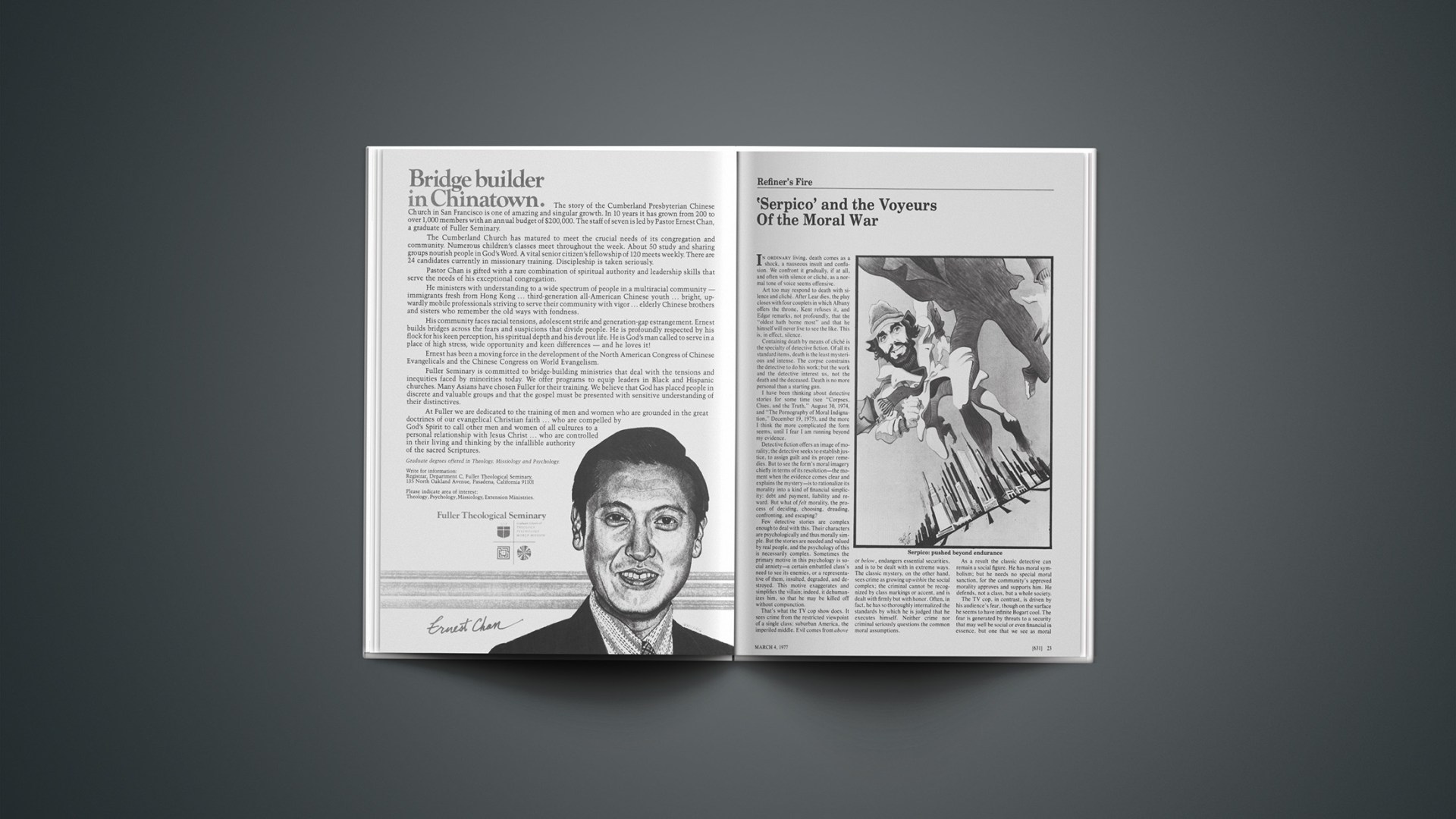
An interesting recent example of this is Serpico. (There is a real Serpico, and my comments on his fictional incarnation are not intended to reflect on him.) That he has become a symbol of outraged honesty as well as of embattled law enforcement makes the TV Serpico a complex and instructive image of the peculiar detective morality.

Serpico concerns himself with what fighting crime does to the integrity and emotional health of the crime fighter. His position is one of sympathy; appropriately, he is a sentimentalist. His moral authority is established by his feelings—by his taste for the sensitive arts, dance and music, by his compassion and vulnerability.

Of these, the aesthetic sense is window-dressing, the vulnerability essential. Serpico’s moral passion is a function of his basic passivity, and both are functions of his capacity to suffer. He embodies our odd modern belief that power is inherently bad, that to be itself virtue must be impotent. In this he differs from other TV cops who sneer and swagger and rough-house their suspects. They are the heirs of Bulldog Drummond. Serpico’s precedents go far deeper in our minds. In his justification by weakness he is a saint, a secular Francis, a debased Christ.

If his vulnerability is a moral credential, however, he does not prevail by suffering. His humility, unlike Christ’s, does not extend that far. Serpico “cares,” storms, weeps, and then beats the criminal senseless. His strength, we understand, is as the strength of ten, because his heart is pure.

The violence does not shock us because Serpico does not have to bear responsibility for it. If he is violent, it is only because he has been pushed beyond tolerance, beyond the point at which suffering patience can be a virtue. The criminal bears the guilt for Serpico’s violence as well as for his own.

For his role in supporting the detective’s moral heroism, the criminal is simplified and brutalized. He is usually an extreme case; no confused kid, no business-like or elegant thief, but a sadist and pervert, a vendor of filth and cruelty—a Fu Manchu with all that Sax Rohmer only implied made nauseously explicit.

His use is clear. His evil raises the story’s temperature high enough to justify the violence of Serpico’s emotions and behavior. Without this the hero would sound exaggerated, over-blown, false, a vaunting knight with no pagan to kill. That he is a parody-saint would become too obvious without the pressure of a parody-villain.

I have argued before that this kind of moral passion—the kind that takes away the humanity of its object, as a way of freeing itself of responsibility for its own results—is sub-Christian, essentially unjust. In some cop shows, dehumanizing the villain licenses the detective to indulge himself in anger and violence. The same happens in Serpico; it is a common tactic. But here we meet a further development. Serpico’s anger is “moral,” not only in a symbolic sense but as it is permeated by his sentimental morality; and the story utilizes this special quality. His morality is his ultimate excuse for violence; he is going to war, and only moral passion can justify it.

This takes us back to the psychology of the audience. On the crudest level, the standard popular detective story uses moral corruption, and violence both “good” and “bad” (the cop’s and the crook’s, ours and theirs), as sensation; it is pornographic, bypassing our minds and consciences, appealing to our nerves.

In a somewhat deeper sense, it feeds our social anxiety through a rough comanchero justice; it offers us the vision of anti-social elements brutalized (as we believe them to be in actual experience) and destroyed (as we wish they were).

But have Serpico’s tender moral feelings any place in this pattern? How does the addition of self-conscious moralizing intensify the effect of this sensationalism? Why is there no conflict?

The reason, it seems to me, must be found in religious psychology—specifically, in whatever faint Christian pulse remains alive in our post-Christian culture. All the TV detectives—in particular, however, Serpico, the moral hero—offers us an image of moral warfare. The hero’s rightness is not only an excuse for sensational violence, though it is that; it is not only a rationalization of his social utility. We enjoy it because we have an ingrown response to the warfare of light against darkness, and, distorted as it is, the detective’s image is of this warfare.

According to Christian belief, human beings are made for war—the universal war of good against evil. Historically, Christian writers have drawn on the Scriptures’ military metaphors to express our duty in this war, as in “Onward, Christian Soldiers.”

This spiritual militarism can be distorted, like any image, and the Prince of Peace made into General Jesus. But then, as Dorothy L. Sayers said, we normally “trim the claws of the Lion of Judah” and come up with “Gentle Jesus, meek and mild.” This is comforting. But if the truth is partly otherwise, and we are made in some sense to fight, then it follows that we have been given a penchant for battle. Every minor moral struggle braces and prepares us for a greater. Every skirmish has in it something of the Last Battle, and to that our spirits respond.

It is doubtful that many TV viewers—church members or not—actually take a conscious part in the war with principalities and powers, with social and moral corruption. We are nonetheless made for it, though in fear and sloth we avoid it. This tension our TV fantasies help to resolve. What we see in Serpico is a debased version of our own vocation.

One often hears TV praised for its immediacy. Marshall McLuhan’s thesis, that the medium is a direct extension of eye and ear, is familiar. But TV also creates distances. Like the radio scanner with which we listen in on police calls, like the news program that shows us war footage scarcely hours old—the dead are not buried before we watch them eviscerated in our living rooms—TV cop shows let us confront evil and death played out in explicit terms before us, but veiled by the blue screen. We examine them in the approach-avoidance techniques of flirtation. We are meant to oppose evil and prevail. Instead we watch, silently, as our fictional surrogate opposes fictional horrors and wins fictitious victory. We are voyeurs of the moral war.

Our pleasure in Serpico’s tirade, therefore, is deeper than the pleasure of seeing the good guy win, the bad guy lose. It is more subtle than social reassurance. Lacking moral passion ourselves, we enjoy its Active expression. Our “participation”—the little thrills of assent we feel as he preaches, our approval of his exaggerated vulnerability and his automatic violence—makes us feel that, for a moment, we are involved, though at no cost and without real effect.

Or has it no effect? There is a danger, at least, that we will come to believe that moral warfare is indistinguishable from social conflict—a kind of inverted bourgeois Marxism—and that it can be won by “legitimate” violence. We enjoy violence, of course, but then everyone always has. But will we come to believe also that violence is itself a morality, that intensity of feeling justifies its own fruits, provided it is on the side of superficial order?

There have been, and are, modern societies that have believed that violence is a morality. The obvious example is Nazism. Yet the Nazi’s opponents—from Allied firebombers to the purveyors of “holocaust chic”—have managed to believe almost the same thing regarding the Nazi himself: anything to exterminate the horror. We merely carry this one step further, putting the same attitude on TV for family consumption. But this is a malign step. For we are not serious about it; the wildly askew moral universe in which Serpico hunts his enemy is what we call fun. Like the Walrus, he weeps and sympathizes, and sorts out his prey; like the Carpenter, we applaud and join in.

Beneath the rational simplification of life into good guys and bad; beneath the rationalization of social fear; beneath the use we make of detective fantasy, the fictional trick of reducing death to cliché—beneath this, I think, there may be a moral impulse. It is to save ourselves the cost of actual moral life, with its complexity and confusion. Some escape may be necessary, for we cannot always be agonizing. Art gives us breathing space—especially the popular arts, the ones that do not replace life with occasions of even greater complexity. The problem is that we misuse our privileges.

The comprehensive social matters lying behind my thesis are too broad for this column. Detective stories are only a shred of evidence, a scrap of our consciousness. But any leaf responds to any wind, and will tell its direction. We are no longer a Christian culture, even in superficial ways. One evidence of this is that we take archetypal moral experiences for games, and are satisfied to substitute the game for the experience. To do this with social fact was the genius of the classic detective story. To do it with moral fact gives us a bigger kick: it is also more dangerous.

Lionel Basney is associate professor of English at Houghton College, Houghton, New York.

To See Life Steady and to See It Whole

Last winter, while recuperating from a car accident, I gathered around my bed a stack of books, not only to while away the time but also as a means of amplifying the experience of coming so suddenly and unpredictably close to death and surviving. The fact that I was lying there, breathing in and out, eating, drinking, and reading books seemed to me miraculous as I lived over and over again in my mind that scene, already fading as fast as dreams do when we wake. I knew this experience had enormous significance, perhaps accessible to me in sleep when I would groan and cry out and feel myself falling. But to abstract the meaning from those dream times eluded my conscious mind.

At times of crisis, I have discovered, the world begins to take on symbolic significance. The weather becomes a portent; mundane objects glow with messages. The books I had gathered would, I felt, contain clues to the meaning of my experience. Whether by accident, design, or unconscious selection on my part, they tended towards what can be called “confessional” literature, stories of true-life adventures from Christian veterans. Miraculous escapes from various life-threatening situations; hopeless, dead-end existences transformed into lives of unspeakable richness; stories of trust and daring, of contact with another dimension of life that ordinarily we only guess at. To someone suddenly snatched from the mainstream of life and flopped on the shore gasping for air, these books had the heady effect of undiluted oxygen. Almost-life became not quite good enough for me. Anything less than a marvel was meaningless.

When I finally got on my feet again, both literally and figuratively, I began to think a little more analytically about this genre of Christian writing. To a Christian, “confession” is a many-sided word. It can mean confession of sin, proclamation of God’s mighty works, or praise, as in “the heavens declare the glory of God.” All these meanings are usually present in Christian confessional literature, whereas in its secular counterpart the reader is simply the recipient of the intimate and sometimes compulsive confidences of the writer. Nevertheless, it now seemed necessary for me to identify the particular benefits and dangers of this kind of writing for Christians. Was it indeed a valid form of faithful witness? What sort of history did it have in the Christian tradition?

To begin in the middle, there is a long flat stretch of Christian history that is almost totally devoid of confessional writing of the sort so dear to the heart of browsers in Christian bookstores, though there was a good amount of devotional writing by mystics such as Thomas à Kempis. (The History of the Calamities of Abelard, ostensibly a letter to this meretricious monk’s friend but with at least one eye on its broader publication, can at best be labeled autobiography and not confessional in the many-faceted Christian sense.) Scholasticism, which extended its empire unquestioned from the eleventh century to the first rumblings of the Reformation, hardly allowed of such a messy variety. Theologians saw their task as categorizing the data of faith, much as their regrettably pagan mentor, Aristotle, had set about categorizing the biological world. After all, there is so much of it. How else is one to get a grasp of the subject unless it can be indexed?

Whereas Plato had meandered about in dialogues, Aristotle and the churchmen intended to tidy things up. Even in Dante, who, though he never laid claim to the title of theologian, nevertheless gave us perhaps the most read of medieval theological tracts, we find the categorizing influence of the Scholastics on a burgeoning imagination: carefully delineated circles marked off for circumscribed varieties of both sinners and saints. But as his characters spin out their stories, confessing under the stern eye of Virgil or the luminous eye of Beatrice how they got where they are, it is as though the floodgate holding back seven centuries of stories had broken. Out they spill, eager to fill in with particulars the broad, blank surface of universal categories.

From that point on, Scholastics fell on hard times. They were defamed as mere hairsplitting debaters devoid of feeling. Actually, they were quite fiery in their debates. Their fervor shines through in their hymns, such as St. John of Damascus’ still familiar “Day of Resurrection.”

Yet one can scarcely imagine an underling of the Avignon entourage writing the story of his conversion experience in the manner of Chuck Colson. It is not that these Christians lacked the material with which to chill one’s blood and thrill one’s soul. The history of St. John of the Cross, that playboy knight-errant turned mystical monk, would alone provide enough copy to saturate Guideposts. Instead, he chose to write an incredibly complex how-to-do-it book on attaining union with God.

The quintessence of Scholastic writings was contained in Peter Lombard’s “Sentences,” short, reasoned, doctrinal propositions, revered among churchmen because they were impersonal and therefore could not be confined to individual instances. At first, it would seem that the Reformation made precious little impression on how Christians wrote about their faith. True, Luther’s tracts were a little snappier, especially those directed against the pope, and his transcribed Tabletalk gives us vivid scenes of the tempestuous Luther household. But it took another century for the subjectivism inherent in the new theology to flower into confessional literature.

In fact, it was Jonathan Edwards who not only championed experiential religion in such works as A Treatise Concerning Religious Affections but also with his Personal Narrative brought into prominence the literary form that had been accumulating in the diaries of countless unpublished Puritans. When he writes that after a particular spiritual revelation “the appearance of everything was altered; there seemed to be, as it were, a calm sweet cast or appearance of divine glory, in almost everything,” his meaning is immediately accessible to the contemporary Christian in a way that systematic theology is not.

Indeed, the first literary production of the new world, William Bradford’s History of Plimouth Plantation, was a forerunner to Edwards’s Personal Narrative. This official diary of the Elect Nation took up the old medieval notion of the chronicle which, even when it described ecclesiastical events, never proposed to be more than history. Bradford’s History, however, became a continuation of the Hebrew’s confessional salvation history.

As we observe the fresh flowering of this mode of expression on the new continent, we can also trace its roots back to its greatest practitioner. The American historian Perry Miller links the Puritans to Augustine “simply because Augustine is the arch-exemplar of a religious frame of mind of which Puritanism is only one instance out of many in fifteen hundred years of religious history.… There survive hundreds of Puritan diaries and thousands of Puritan sermons, but we can read the inward meaning of them all in the Confessions” (The New England Mind: The Seventeenth Century, Beacon, 1961, p. 3)

The African Augustine, writing his Confessions in a monastic community half a world away while the Roman civilization was crumbling under the barbarians’ onslaught—what could be more alien to American Protestants? Yet the ordinary person in the pew can read St. Augustine’s Confessions, at least the first ten books, with much more ease and understanding than he can read a recently published theological tome. Why is it that, though most of the faithful, Protestants and Catholics alike, would feel totally at sea with Augustine’s treatise on the Trinity, they nevertheless would feel the firm foundation of faith beneath their feet as they read his recollections of the journey towards belief?

Possibly for the same reason that, says G. K. Chesterton, an ancient pagan “worships the peak of a particular mountain, not the abstract idea of altitude.” Few people are philosophers but everyone understands a good story. And that is why our faith is in a story, not in a philosophy abstracted from it, useful as that might be in more mundane matters. “Now this deep and democratic and dramatic instinct,” Chesterton continues, “is derided and dismissed in all the other philosophies. For all the other philosophies avowedly end where they begin; and it is the definition of a story that it ends differently; that it begins in one place and ends in another” (The Everlasting Man).

Certainly this is true not only of The Story but, by God’s grace, of our story as well. The change, the transformation, the metamorphosis, is the subject of all Christian confessionals; they can all be summarized by “I once was lost but now am found.” No analytical feats are necessary to understand that experience. We have all been supplied with the necessary raw lump of life.

While we are exulting over this fact, however, it may be well to remember that whatever stories we can tell are only derivative, not primary. Augustine himself must have been guarding against the pride incipient in his great work by casting the entire story in the form of a prayer. While dredging up the unsavory motivations that led him to excel in his studies, he adds: “I need not tell all this to you, my God, but in your presence I tell it to my own kind, to those other men, however few, who may perhaps pick up this book. And I tell it so that I and all who read my words may realize the depths from which we cry to you.” This extensive prayer, undoubtedly the longest in any language, is no mere literary device but a protection against pomposity.

For there is no parallel for such work in the Gospels. Even Paul, in his asides about his former life and conversion, is brief and unelaborative. One might have expected so spectacular a conversion to occupy more than the meager, almost impatient mention in Galatians and the thirty-one verses that Luke gives it in Acts. One cringes at the thought of a twentieth-century gospel modeled on the pseudo-personalism of our mass media—“How Jesus Turned My Life Around: The Miracle Story of a Simple Fisherman Now a World Renowned Evangelist, as Told to Our Roving Reporter, John Mark.”

Part of what a literary critic would call the internal evidence that authenticates the Gospels is this very constraint on the part of the narrator. That four separate accounts of the same events should focus so exclusively on the person of Jesus rather than on the observer’s reactions to him indicates the inexorable power of that person. It was not for nothing that Jesus chose his closest followers from among the illiterate. Luther once wrote that if the Gospel could be promoted or maintained by worldly means, God would never have entrusted it to fishermen. Perhaps they were the only ones who could be trusted not to be incessantly scribbling away at their diaries. Paul, that great and gifted writer, bemoans that the Lord appeared to him as to “one born out of due time.” But if Paul, the intellectual who, by his own admission, was obsessively introspective, had been one of that scruffy, itinerant band, into what temptation might not his talent have led him?

Still, we need not despair of finding a biblical prototype for our beloved confessional thrillers. For one, there is Jeremiah, who records his reactions in Lamentations. He, of course, was only amplifying the tradition of the confessional psalms. The psalmists seem to have been inveterate penitents, documenting their spiritual highs and lows in scrupulous detail. The movement that begins with “Save me, O God; for the waters are come in unto my soul” and culminates in “Let the heaven and earth praise him, the seas and everything that moveth therein” is a familiar one to us. This is why the psalms serve so well liturgically. Whereas people may shuffle their feet uneasily over certain sections of creeds, feeling inadequate to comprehend the meaning of “very God of very God,” everyone feels in his bones the full weight of the declaration “This poor man cried, and the Lord heard him, and saved him out of all his troubles.”

It is not difficult to understand the appeal of confessional literature. We all like to have someone else affirm our experience. “I know what you mean” is one of the most comforting phrases in the language. It is a part of the glue that holds humanity together. But we also read these books for inspiration. They open a tiny crack in the blank grey wall of the cul-de-sac we find ourselves in from time to time, and through the crack gleams the promise of undiscovered possibilities in life, a more expansive dimension into which others have been transported and from which they beckon us.

“You too can live through prison camps and unspeakable nightmares” we hear Corrie ten Boom and Solzhenitsyn and Jeremiah saying. “Your life can make a difference in other lives” declare Brother Andrew, the Bible smuggler, and Nicky Cruz, the delinquent tamer. I can even remember staring at myself in the bathroom mirror after finishing Keith Miller’s The Taste of New Wine, stunned by the realization that this was the face of one engaged in terrible spiritual warfare, that every act of mine was of everlasting importance, that vast invisible powers preserved and protected me. That knowledge was like an immense secret I bore into the world.

But though it is easy enough to identify these aspects of the appeal of confessional literature to readers, there remains a deeper motivation that links the reader and the writer in a common search. Corrie ten Boom says this in her book In My Father’s House: “So many times we wonder why God has certain things happen to us. We try to understand the circumstances of our lives, and we are left wondering.” I think this is a large part of what drives people to read others’ experiences or to write down their own. They must teach themselves the meaning of their own lives by seeing those lives not as a succession of disconnected episodes but laid out as a path, full of switchbacks and stones, but leading somewhere. The writer is left, not wandering in a trackless maze, but wondering at the delicate and intricate meetings and passages he has made. Without a perspective, a pattern is impossible to perceive.

Thomas Merton, whose own confessional Seven Storey Mountain became a best seller, explains the necessity of seeing his life as a story whose author is God: “Too often the conventional conception of ‘God’s will’ as a sphinx-like and arbitrary force bearing down upon us with implacable hostility, leads men to lose faith in a God they cannot find it possible to love. Such a view of divine will drives human weakness to despair.… We must learn to realize that the love of God seeks us in every situation, and seeks our good.” And Augustine, the arch-confessionalist, goes perhaps deeper than all the others when, stripped of every other concern, he cries out as to a lover, “Why do you mean so much to me? Help me to find words to explain.”

Nothing less than such a primal need can justify, however, the covering of pages with a welter of words about one’s private world. The dangers of a public, printed confession are manifold, both to the writer and to the reader. Too many times as I read the books beside my bed during that convalescence, I was driven almost to despair by well-intentioned writers more bent on an uplifting moral than on a painstakingly accurate description of their lives. Despite their frequent disclaimers of perfection, I was often depressed. When I came across Solzhenitsyn’s account of his dastardly behavior towards his fellow prisoners upon being arrested at the front in World War II, I was ambivalently thankful that someone else was as weak as I.

Also, there can creep into the documentary a subtle contempt for early experience that belies the notion of preparation. We too easily convince ourselves that we have risen above or outgrown what we once were. But I have had this illusion shattered for me when passing houses I once inhabited in childhood or as a student or young mother. Then the eerie feeling comes over me that my own ghost, a shadow of the person I was then, is looking out the window at me. A great pity, for that prisoner of the past weighs me down, and I know it is that ghost, as well as my current, transitory self, who must be redeemed, who will be with me when I give back my own story to its true author.

Edmund Spenser and the Angels

“How oft do they their silver bowers leave …

And their bright squadrons round about us plant.”

—The Fairie Queene

He saw their glowing pinions cleave the skies

As angel-squadrons left high heaven and came

To fight for man, to watch and daily ward

Against base fiends ranged round his sin-blind side.

So, twice-born, and within the Spirit’s flame,

Spenser beheld our world through light-filled eyes;

And rapt with awe the poet-mystic cried

(Seeing his own unworth before the Throne):

“Oh, why should heavenly God to men have such regard?”

And all the angels echoed: “Love, alone!”

M. Whitcomb Hess

Dorothy L. Sayers—For Good Work, for God’s Work

I met Lord Peter Wimsey in high school. He wasn’t handsome but was witty, urbane, often nonsensical. Listening to him chatter and patter I learned a great deal about logic—how to assemble facts and draw reasonable conclusions. It wasn’t until years later that I learned of his creator, Dorothy L. Sayers. Although Wimsey isn’t a male recreation of Sayers, she did give her famous detective the same mental powers she possessed.

Peter Wimsey stories are quite out of the ordinary—longer, more complex, and intellectual, without the stock characters useful to most detective novelists. As Peter Wimsey’s mother, the Dowager Duchess, says of Harriet Vane’s mysteries in Strong Poison, they are “really quite good and so well-written, and I didn’t guess the murder till page 200, rather clever, because I usually do it about page 15.” But more than just the cleverness and writing style place Wimsey above Asey Mayo or Albert Campion. Sayers provides us with clues in her mysteries to other facets of her personality and beliefs. As with C. S. Lewis, each of her writings forms a part of a unified whole. Whose Body, the first of the eleven Wimsey novels, may not appear to have much in common with The Mind of the Maker. But each of her books further develops the central or controlling theme of her creative life: we know man is made in God’s image by his desire to make things.

What are some of the clues Sayers’s novels give to her personality and beliefs? Police Inspector Charles Parker studied theology while in school and reads Bible commentaries to keep his wits sharpened. Lord Peter’s assistant, the spinster Miss Climpson, is an outspoken Christian who struggles with her conscience to determine right and wrong in the gray areas of investigations. She has a strong spiritual sensitivity that Wimsey relies on to discover the good from the bad, the guilty from the innocent. That spirituality saves Harriet Vane from being hanged for a murder she did not commit. (Lord Peter eventually marries Harriet in the final Wimsey novel, Busman’s Honeymoon.) Although Lord Peter is not a Christian, he is thoroughly versed in Scripture and theology, and in the early novels he and Parker have some low-key discussions about, for example, the merits of Bible scholars. In Whose Body? Lord Peter discovers the murderer not through a logical collecting and cataloguing of facts but by reading a book, Physiological Bases of the Conscience, written by the murderer: “The knowledge of good and evil is an observed phenomenon, attendant upon a certain condition of the brain-cells, which is removable.” The author went on to speculate that as man progressed the conscience would disappear, since when it functioned it caused death. Sayers juxtaposes this blatantly criminal philosophy with that of Christianity.

Some of Sayers’s Christian readers have wondered why she didn’t make Lord Peter convert to Christianity, since she herself was a Christian. Sayers replied in The Mind of the Maker: “Peter is not the Ideal Man; he is an eighteenth-century Whig gentleman, born a little out of his time, and doubtful whether any claim to possess a soul is not a rather vulgar piece of presumption.” Although her refusal to make Lord Peter something he wasn’t continues to disappoint readers—and to cause some to think she couldn’t really have been a Christian—her reason for not doing so is intrinsic to her view of the duty she owed to God the Creator, who gave her certain human, creative gifts. She could not violate her creation by imposing her will on him any more than God imposes his will on us. He wants us to surrender to him freely. (It may sound strange to talk of Lord Peter as though he were real. But anyone who has tried to invent characters, compose a song, or paint a picture knows that a work of art takes on a life of its own. No amount of molding or plumping or rewriting by the artist can change it. To try would be to violate the truth of art.)

Harriet Vane runs into this problem in Gaudy Night, one of Sayers’s best and most philosophical novels. She falsified one of her characters to smooth the plot, but the book was wooden. Lord Peter makes a few suggestions, to which Harriet says, “But if I give Wilfrid all those violent and lifelike feelings, he’ll throw the whole book out of balance.” She rewrites the book. Sayers avoided that kind of problem, except in Have His Carcase, where she invented a locality to hang her story on a murdered hemophiliac. Nothing about the book works; even the usually good dialogue between Harriet and Lord Peter strikes consistently false notes.

Sayers raised the level of detective writing to an art form, and her stories deserve to be called novels. Recognition of this and of her growing popularity is seen in the British productions of her novels—most recently Five Red Herrings—for public television’s exciting “Masterpiece Theatre” series. Regrettably, many of the Christian distinctives have been excised in the television adaptations. Those unfamiliar with Sayers would never sense from these films that she was a Christian. In his introduction Alistair Cooke tried to compensate for this by saying that late in life Sayers became a dedicated “church-woman,” a description that suggests a church bazaar mogul more than a serious Christian artist.

And that is finally what distinguishes her from other writers of the same genre—her attitude toward her work, of which those clues I outlined are only a small part. Her detective novels were just one expression of a theme—or to use her word from The Mind of the Maker, the Idea—that motivated her throughout her life: work as a sacrament. Through work God continually recreates us in his image, and in the words of the Book of Common Prayer, we offer back to him “our selves, our souls, and our bodies.” By our good labor we can express to God thoughts and feelings not possible with words alone. Our work becomes prayer made concrete. That is why a character in Gaudy Night can say, “A good painter mustn’t paint bad pictures—that would be immoral.”

God worked, we work. God created, we create. We can readily recognize God’s work as an act of primary creation, but we seldom think of our own as creation at all. We reserve that idea for artists. Sayers insisted that each of us should work as though it were a sacrament, an act of creation. In that way we reflect God’s image in us, and give back to him what he has given us, the opportunity to work creatively.

We think of work as an evil result of the fall. Yet before the fall Adam and Eve were told to be fruitful and multiply, to nurture the garden and care for the animals. Milton in Paradise Lost captures this prelapsarian attitude toward work:

On to thir morning’s rural work they haste

Among sweet dews and flow’rs; where any row

Of Fruit-trees overwoody reach’d too far

Thir pamper’d boughs, and needed hands to check

Fruitless imbraces: or they led the Vine

To wed her Elm; she spous’d about him twines

Her marriageable arms, and with her brings

Her dow’r th’ adopted Clusters, to adorn

His barren leaves [V, 211–19].

Here Adam and Eve eagerly attend to their tasks of keeping order and nurturing trees and plants. The attitude toward work perhaps more than the work itself changed when Adam and Eve sinned. Before the fall, man worked blissfully; after, grudgingly. In The Zeal of Thy House Sayers says, “The hatred of work must be one of the most depressing consequences of the fall.” As part of our Christian commitment, then, we need to change our attitude toward work.

Again and again in her novels, plays, and essays she talks about what work means, how we should respond to whatever it is God has given us to do, and what our attitude toward work should be. Before we can change our attitude, though, we need to discover what it is that God wants us to do. Once we’ve found that out, we can begin not only to enjoy our jobs but to do them well. In Creed or Chaos Sayers explains that the Church “has lost all sense of the fact that the living and eternal truth is expressed in work only so far as that work is true in itself, to itself, to the standards of its own technique. She has forgotten that the secular vocation is sacred … that work must be good work before it can call itself God’s work.… The official Church wastes time and energy, and, moreover, commits sacrilege, in demanding that secular workers should neglect their proper vocation in order to do Christian work—by which she means ecclesiastical work. The only Christian work is good work well done” (Harcourt, 1949, pp. 56–58). That harsh condemnation hits the evangelical church, which has often said that only missionaries or ministers, to use the most obvious examples, are doing God’s work. How many bad preachers were talked into the ministry by well-meaning people when they would have served God far better by being good grocers or conscientious craftsmen?

With her concern for work well done, it seems strange at first to think that Sayers’s most famous character is independently wealthy and only dabbles in detection as a hobby. Yet even in the first Wimsey story, which began what Sayers called her lifelong “hymn to the Master Maker,” the question of work comes up between Parker and Wimsey. Wimsey asks Parker if he likes his job. “The detective considered the question, and replied: ‘Yes—yes, I do. I know it to be useful, and I am fitted to it. I do it quite well—not with inspiration, perhaps, but sufficiently well to take a pride in it.’ ” To Lord Peter, criminal investigation is just an exciting hobby that keeps his life from boredom—at first. By the time we get to Busman’s Honeymoon, he and we discover that it’s his job just as much as Parker’s, and that no matter how much he’d like to disregard his duty, it would be immoral not to do it with all his energy. Harriet Vane in Gaudy Night defends her profession to the dean of her old school: “I know what you’re thinking—that anybody with proper sensitive feelings would rather scrub floors for a living. But I should scrub floors very badly, and I write detective stories rather well. I don’t see why proper feeling should prevent me from doing my proper job.”

Sayers understood the frustrations of not knowing what job she was called to do, as well as the emptiness of unemployment. After attending Oxford, where she was in the first class of women ever to receive a master of arts degree from the university, she taught in a girls’ school for a while, wrote some slim volumes of poetry, and finally returned to the Fen country to the home of her father, who was an Anglican clergyman. In her late twenties she took a temporary job writing jingles for a London advertising agency. She stayed ten years. Out of desperation she began writing mysteries, discovered she was good at it, and kept on until she’d made enough money to write and sometimes produce religious plays, such as The Zeal of Thy House and The Man Born to Be King, a cycle of twelve plays for radio written during World War II.

It is simple to say, “Enjoy your work; do it well as an offering to God.” But what of those whose work is degrading or boring or in fact harmful? Sayers understood those problems, too, with her ten years in a job she considered worthless, a job she exposed in Murder Must Advertise. She also discusses the problem in a chapter-length postscript to The Mind of the Maker, “The Worth of the Work.” In order to lift work from drudgery into a sacrament, we need to consider it apart from economic necessity. An artist or any creative person lives to see his work completed. He does not just work to live. “Whether it is possible for a machine-worker to feel creatively about his routine job,” she says, “I do not know; but I suspect that it is, provided and so long as the worker eagerly desires that before all things else the work shall be done.” Or, as the author of Ecclesiasticus says, the craftsman “watches to finish the work.” Each of us can have that attitude. The typist looking (almost lovingly) on clean, error-free letters, reports, or manuscripts, neatly stacked and assembled. A secretary who efficiently schedules and guides her supervisor’s day for the greatest productivity. The grocery clerk who rapidly and accurately checks out foodstuffs. Or the waiter who enhances the pleasure of a well-prepared meal by cheerful, courteous service. A housewife who knows that cleaning is a never-ending job and proudly views shining floors and polished tables. All these are jobs considered by our society as menial, yet they can be done creatively and can produce satisfaction. Any task that brings order out of chaos is of the nature of the first creative act of God and becomes a sacrament.

To this Sayers adds one strong note of warning in her moving play The Zeal of Thy House. We cannot continue with a task that God has taken from us and given to another. We must guard against making the work more than a sacrament, which is after all only a physical image of spiritual communion between us and God. Even as she explains the importance of work Sayers also warns us not to take the image literally, not to make work the thing it represents and worship it rather than him from whom work comes. William the master architect learns this at the end of The Zeal of Thy House: “What, in my work? The sin was in my work? Thou liest.… In my work? That cannot be.… O now, now I begin to see. This was well said, He is a jealous God. The work was not ill done—’twas done too well.”

Yet if we keep our perspective, always seeing the image as image, we can faithfully serve God by faithfully doing the work he gives us. Dorothy L. Sayers lived out this conviction, and her work shows that integrity. She was an honest craftsman who knew whom she served. Two verses from her poem “The Makers” sum up her message to us:

Let each do well what each knows best,

Nothing refuse and nothing shirk,

Since none is master of the rest,

But all are servants of the work

The work no master may subject

Save He to whom the whole is known,

Being Himself the Architect,

The Craftsman and the Corner stone.

… But Man Fell on Earth

“Scholar as preacher leaps into my mind,” said Helmut Thielicke’s translator in trying to describe him. John Doberstein, who translated Bonhoeffer also, notes that Thielicke combines “deep, scholarly, biblical and theological mastery with strong, vividly colorful, pictorial utterance, eschewing the worn cliché.…Thielicke’s sermons have been heard in bombed-out churches during Hitler’s regime, on contemporary radio and TV, and by overflowing crowds at his large Lutheran church in Germany. His sermons are considered by many to be among the finest ever preached. This selection is abridged from chapters nine and ten of the sermon collection entitled “How the World Began,” published by Fortress in 1961, and is used by permission.

I still have a vivid memory of one night during the war. On a height near Stuttgart there were some twenty boys from a Latin school manning an antiaircraft battery. They were anxious to have me come and give them religious instruction. But since this was prohibited and their request was not granted, they went on to a higher commanding officer and finally, by their spirit and persistence, secured his permission. So I walked out to visit them regularly and we sat down among the guns and talked about the “last things.”

But on this occasion they had called me for another reason. Their position had been hit by a low-level attack and the father of one of the boys, who happened to be visiting, was killed while his boy was manning the gun.

The boy carried his dead father away in a wheeled stretcher. The youngsters—for that’s all they were—crowded around me deeply shocked, almost like chicks around a hen. They were completely broken up and they looked to someone older for protection from a world whose dark enigma had suddenly leaped upon them for the first time. I spoke some words of comfort to them, though I myself felt utterly helpless.

But then the thing happened that accounts for my relating this incident at all. On my way home the moonlight lay upon the quiet valley, the white flowers of the trees shimmered in this soft light, and an unspeakable peace and stillness rested upon the landscape. The world was “like some quiet room, where wrapt in still soft gloom, we sleep away the daylight’s sorrow.”

I mention this, not to be romantic or to gain a sentimental effect, but rather because for me this hour was a parable of the dark threshold which, the account of the Fall says, man has crossed. Before me lay the seemingly whole and healthy world of a springtime night. But in that moment its very peace was like a stab of pain. For I knew that the peace of nature is delusive, and that I had just spoken, encompassed by a sea of blossoms, with boys whose eyes were filled with dread even though they bravely swallowed their tears.

No, this world was not sound and whole, because man had invaded it with his murderous instruments and despoiled it of its peace. And will it not grow even worse? How long will men be able to refresh themselves by looking at the starry heavens and their majestic calm? Will man disturb even this peace with his space ships and cosmic spies?

The story we shall discuss shows us how from this one point in the world—where man stands—evil streams out like an icy breath into the world, into a world that once was sound and whole, a world over which there rang the joy of the Creator: “Behold, it was very good; behold, it is very good.”

That wonderful serenity of the first man under God that rings out in Joseph Haydn’s radiant duets between Adam and Eve is suddenly ended. Their frank and open candor is shattered. Now they have something to hide, and they hastily make themselves aprons. And when they hear the voice of God as he walks through the garden, they go into hiding like culprits caught by surprise and with palpitating hearts watch to see what will happen.

We can only stand in amazement at this age-old story, for it summarizes in exemplary fashion what we see happening all around us and especially within ourselves. Surely all of us feel as I must confess I do when I hear these words. At first, as an intellectual living in the atomic age, one is inclined to take offense at many of the mythical features of this story—for example, the idea of a serpent that can speak. But scarcely has this skepticism begun to stir than we are so compelled to listen to what the serpent says that the feeble protest of our intellect is simply thrust aside.

Do not all of us know certain scenes in our lives that recur in this story of a temptation? Is it not something like a concentrate of the whole art of temptation? How can one capture in a few pages the great profusion of shapes conveyed in this story?

So I can do nothing else but deal with it several times, in order that in this way we may slowly work our way to the arch-question of all mankind—the question that even fourteen-year-olds ask and that still pursues people in their old age: the question of how evil came into the world.

And the first thing that strikes us is this. The drama of temptation, which now begins and puts a sudden end to the vision of a sound and healthy world, begins not with the crash of the kettle drum but rather with the sound of oboes. One might even say that it has in it hymn-like motifs.

The overture of this dialogue is thoroughly pious, and the serpent introduces himself as a completely serious and religious beast. He does not say: “I am an atheistic monster and now I am going to take your paradise, your innocence and loyalty, and turn it all upside down.” Instead he says: “Children, today we’re going to talk about religion, we’re going to discuss the ultimate things.”

Well, something like that immediately inspires confidence. After all, blackguards and rascals do not dabble in such topics. When you talk about pious things you immediately secure for yourself the alibi of serious-mindedness and sincerity.

So he begins by asking, “Did God—this God whom we all revere; even I, the serpent, honor him dearly—did our revered God say that you should not eat of any tree of the garden?”

In other words, the serpent is trying to start a discussion, something like a theological discussion about the “Word of God.” So there is not a trace of doubt—oh, no! The devil himself believes in God. He takes his stand on the fact of “God.” …

So this is the first point that we must note here: the Tempter always operates in disguise. He hides behind a mask of harmless, indeed pious benevolence. All temptations in life begin in sugared form.…

So this is the first idea that the serpent insinuates into our hearts with all the arts of suggestion. God is different from what you think. He is not at all a narrow-minded, moralistic God who is always getting in your way. Rather he is the God of life, the God of abundance. Take everything you can get, for God is handing it out to you. Act according to the laws of life, even when they are cruel, for God made life. Take advantage of the rights of the stronger, for God is always on the side that has the heaviest artillery. Keep shoving down and climbing up; that’s the way to get ahead. After all, that’s what this life God created looks like! Take away the hidden irony of that famous song of Bert Brecht’s and make it the principle of your life: “If anybody does the trampling, it’s me; and if anybody gets trampled, it’s going to be you.” C’est la vie—life is like that—and that’s probably what he who made it is like, too.

It is quite apparent that the serpent has well-reasoned arguments. He is far too subtle to appeal only to the baser instincts. His ambition is not to persuade but to convince.

And yet we have not even touched upon the shrewdest point in this temptation. The serpent not only does not suggest to Eve that she rebel against God; he actually gives her the chance to champion God and break a lance for him, as it were, to become religiously active. The serpent actually fires Eve’s piety; he activates her belief in God.

“Did God say, ‘You shall not eat of the trees of the garden’?” So runs the question with which the serpent introduces this pious exercise.

“No,” says Eve, thus becoming God’s defender, “he did not forbid that at all. He even permitted a great deal and gave us a lot of choice. We are allowed—most generously!—to eat of all the trees in the garden. God excepted only the one tree in the midst of the garden; we’re not even supposed to touch that one.” …

Now the woman in her conversation with the serpent has mentioned the critical point on which her destiny with God will be decided. It is really only “one point,” namely, a single tree, and on that tree, only one apple. God put at man’s disposal the whole breadth of his creation: the multitude of plants and animals are at his service, the laws of nature are there to be explored and technologically utilized, and the whole cosmos is offered as his dominion. Only one single spot in all this infinite expanse must remain tabu, inviolable, and reserved to God himself, namely, this one tree. And at this one point the serpent now begins to fire away.

Thus he is actually very careful not to try to tempt Eve with an atheistic suggestion. He does not say: God is an illusion; the only things that are true are what you can see and taste and touch. He makes only one modest, almost hesitant objection to Eve: after all, this one paltry point cannot matter that much! What is this one apple compared with the peaches and melons and strawberries and apricots, to which God has no objections! If you conform to God in 999 points in a thousand and more in the area he has assigned to you, surely, Eve, this one point in a thousand isn’t going to upset your peace with God!

But that’s the way it is; that’s the way it really is—in your life and mine. The fact is that all of us have sectors in the territory of our life which we are quite content to leave to God. But each of us also has a point which we will by no means let God approach. This point may be my ambition whereby I am determined to beat my way to success in my career at any price. It may be my sexuality to which I am determined to give rein no matter what happens and no matter what it costs. It may be a bottomless hatred toward one of my fellow men which I literally nurse and which gives me a kind of sensual pleasure which then comes between me and God and robs me of my peace. God can have everything, but not this one thing!…

Now the curious thing is that God lets me find him only when I offer to him this one, hardest thing in my life. In other words, God never comes through the door that I hold open for him, but always knocks at the one place which I have walled up with concrete, because I want it for myself alone. But if I do not let him in there, he turns away altogether.…

The first explosive charge lies in the Tempter’s effort to bring Eve to the point where she will not take God seriously. Up to this time she had taken him seriously. She knew that when we are dealing with God we are dealing with life and death, that one can die if one crosses him; then our destiny in time and eternity is at stake.

But now the serpent says to her: “Surely it is sheer nonsense to think that God would let you die and perish utterly just because you don’t take him so terribly in earnest, but rather just partly seriously. You will not die. The question of God is not that serious, my dear lady! All honor to your respect for him. I take my hat off to your display of piety, but really now, he’s not that serious about it!” …

But there is still a second explosive charge in this remark of the serpent. He says, “God has forbidden you to eat this fruit only because he knows very well that your eating it will endow you with a secret knowledge. But knowledge is power. And God is afraid of it. He wants to keep you on a short leash so you men will not get beyond his control. He is afraid that you will compete with him and that his little divine throne may totter if you discover the tremendous potential that lies in your human reason and the enormous leverage you could bring to bear if you call a general strike like Prometheus.”

In other words, here the Tempter is engaging in a little well-poisoning. His action can be reduced to this simple formula: he is sowing doubt of God’s goodness in Eve’s heart. He is saying: God doesn’t mean well by you when he forbids you to eat of this tree. His motives are rather jealousy and malevolence.

The serpent knows very well that, if this seed of distrust falls on receptive soil, it is only a short step from doubt of God’s goodness to doubt of his existence.…

So the Tempter sowed two poisonous seeds in Eve’s heart. First, he persuaded her that one must not take God too seriously, because what he says is by no means a matter of life and death; and second, he made her distrustful of the goodness of God.

It may surprise us—but it is typical of the course of every temptation—that at this point the conversation breaks off. We do not hear that Eve immediately reacted to these insinuations by saying, “Yes, you are right, I have been taking God too seriously. I have been relying all too naïvely and simple-mindedly upon his goodness.” No, the conversation breaks off; the poison must be given time to take effect. Besides, the Tempter is never fond of a static war of position; he prefers elastic tactics and a war of movement. So now like a fencer he suddenly changes his position.

Up to this time he has been playing with ideas, entangling Eve in a religious, philosophical discussion of the severity and goodness of God. Now he turns to a completely different area of the self, namely, to the senses and sensuality. But he knows that he has made a considerable dent in Eve’s intellectual resistance by the preceding arguments and that in this state she can be completely upset by a small sensual titillation.

So he simply proceeds—as we have said, before the discussion about God is finished—to dangle the forbidden fruit before her. There it hangs in all its luscious fulness and Eve’s eyes are sucked fast to it. Her mouth begins to water. “The woman saw,” the text says, which is to say: she meditated on the fruit, she turned it over in her thoughts.

But it was not only the sensual tickling of her palate that enchanted her. It was also the secret with which this fruit was laden: the eating of it would make one wise. So the fruit exerted a sensual and an intellectual fascination.…

Under the pressure of this twofold curiosity, the fascination of the senses and the mind, Eve reached out for the fruit. And only as she did this, as she performed this practical act of disobedience, did she actually answer the serpent’s question whether she was really going to take God so dreadfully seriously and whether she was really going to trust his goodness so utterly—answering it almost without being conscious of answering it. Now she is going to do neither of these things any more. And therefore she is quitting—not officially, not formally, and not by flinging an emotionally charged and defiant No toward heaven—like Prometheus—but through one very small gesture, through one very harmless snatch of a tidbit.

The Lady Stood on Perelandra …

the fall: two perspectives

In. C. S. Lewis’s novel “Perelandra,” Ransom has been sent to that planet to prevent the Lady from falling into original sin as Eve did on earth. Satan has taken over the body of Weston and through argument and reason is trying to get the Lady to disobey Maleldil, or God. What follows is a three-way dialogue among Weston, Ransom (or Piebald, as the Lady calls him), and the Lady on the nature of God’s will and of disobedience, and on what happened when Eve listened to the serpent.

Then listen,” said Weston’s body. “Have you understood that to wait for Maleldil’s voice when Maleldil wishes you to walk on your own is a kind of disobedience?”

“I think I have.”

“The wrong kind of obeying itself can be a disobeying.”

The Lady thought for a few moments and then clapped her hands. “I see,” she said, “I see! Oh, how old you make me. Before now I have chased a beast for mirth. And it has understood and run away from me. If it had stood still and let me catch it, that would have been a sort of obeying—but not the best sort.”

“You understand very well. When you are fully grown you will be even wiser and more beautiful than the women of my own world. And you see that it might be so with Maleldil’s biddings.”

“I think I do not see quite clearly.”

“Are you certain that He really wishes to be always obeyed?”

“How can we not obey what we love?”

“The beast that ran away loved you.”

“I wonder,” said the Lady, “if that is the same. The beast knows very well when I mean it to run away and when I want it to come to me. But Maleldil has never said to us that any word or work of His was a jest. How could our Beloved need to jest or frolic as we do? He is all a burning joy and a strength. It is like thinking that He needed sleep or food.”

“No, it would not be a jest. That is only a thing like it, not the thing itself. But could the taking away of your hand from His—the full growing up—the walking in your own way—could that ever be perfect unless you had, if only once, seemed to disobey Him?”

“How could one seem to disobey?”

“By doing what he only seemed to forbid. There might be a commanding which He wished you to break.”

“But if He told us we were to break it, then it would be no command. And if He did not, how should we know?” “How wise you are growing, beautiful one,” said Weston’s mouth. “No. If He told you to break what He commanded, it would be no true command, as you have seen. For you are right, He makes no jests. A real disobeying, a real branching out, this is what He secretly longs for: secretly, because to tell you would spoil all.”

“I begin to wonder,” said the Lady after a pause, “whether you are so much older than I. Surely what you are saying is like fruit with no taste! How can I step out of His will save into something that cannot be wished? Shall I start trying not to love Him—or the King—or the beasts? It would be like trying to walk on water or swim through islands. Shall I try not to sleep or to drink or to laugh? I thought your words had a meaning. But now it seems they have none. To walk out of His will is to walk into nowhere.”

“That is true of all His commands except one.”

“But can that one be different?”

“Nay, you see of yourself that it is different. These other commands of His—to love, to sleep, to fill this world with your children—you see for yourself that they are good. And they are the same in all worlds. But the command against living on the Fixed Island is not so. You have already learned that He gave no such command to my world. And you cannot see where the goodness of it is. No wonder. If it were really good, must He not have commanded it to all worlds alike? For how could Maleldil not command what was good? There is no good in it. Maleldil Himself is showing you that, this moment, through your own reason. It is mere command. It is forbidding for the mere sake of forbidding.”

“But why …?”

“In order that you may break it. What other reason can there be? It is not good. It is not the same for other worlds. It stands between you and all settled life, all command of your own days. Is not Maleldil showing you as plainly as He can that it was set up as a test—as a great wave you have to go over, that you may become really old, really separate from Him.”

“But if this concerns me so deeply, why does He put none of this into my mind? It is all coming from you, Stranger. There is no whisper, even, of the Voice saying Yes to your words.”

“But do you not see that there cannot be? He longs—oh, how greatly He longs—to see His creature become fully itself, to stand up in its own reason and its own courage even against Him. But how can He tell it to do this? That would spoil all. Whatever it did after that would only be one more step taken with Him. This is the one thing of all the things He desires in which He must have no finger. Do you think He is not weary of seeing nothing but Himself in all that He has made? If that contented Him, why should He create at all? To find the Other—the thing whose will is no longer His—that is Maleldil’s desire.”

“If I could but know this ——”

“He must not tell you. He cannot tell you. The nearest He can come to telling you is to let some other creature tell it for Him. And behold, He has done so. Is it for nothing, or without His will, that I have journeyed through Deep Heaven to teach you what He would have you know but must not teach you Himself?”

“Lady,” said Ransom, “if I speak, will you hear me?”

“Gladly, Piebald.”

“This man has said that the law against living on the Fixed Island is different from the other Laws, because it is not the same for all worlds and because we cannot see the goodness in it. And so far he says well. But then he says that it is thus different in order that you may disobey it. But there might be another reason.”

“Say it, Piebald.”

“I think He made one law of that kind in order that there might be obedience. In all these other matters what you call obeying Him is but doing what seems good in your own eyes also. Is love content with that? You do them, indeed, because they are His will, but not only because they are His will. Where can you taste the joy of obeying unless He bids you do something for which His bidding is the only reason?

When we spoke last you said that if you told the beasts to walk on their heads, they would delight to do so. So I know that you understand well what I am saying.”

“Oh, brave Piebald,” said the Green Lady, “this is the best you have said yet. This makes me older far: yet it does not feel like the oldness this other is giving me. Oh, how well I see it! We cannot walk out of Maleldil’s will: but He has given us a way to walk out of our will. And there could be no such way except a command like this. Out of our own will. It is like passing out through the world’s roof into Deep Heaven. All beyond is Love Himself. I knew there was joy in looking upon the Fixed Island and laying down all thought of ever living there, but I did not till now understand.” Her face was radiant as she spoke, but then a shade of bewilderment crossed it. “Piebald,” she said, “if you are so young, as this other says, how do you know these things?”

“He says I am young, but I say not.”

The voice of Weston’s face spoke suddenly, and it was louder and deeper than before and less like Weston’s voice.

“I am older than he,” it said, “and he dare not deny it. Before the mothers of the mothers of his mother were conceived, I was already older than he could reckon. I have been with Maleldil in Deep Heaven where he never came and heard the eternal councils. And in the order of creation I am greater than he, and before me he is of no account. Is it not so?” The corpse-like face did not even now turn towards him, but the speaker and the Lady both seemed to wait for Ransom to reply. The falsehood which sprang to his mind died on his lips. In that air, even when truth seemed fatal, only truth would serve. Licking his lips and choking down a feeling of nausea, he answered:

“In our world to be older is not always to be wiser.”

“Look at him,” said Weston’s body to the Lady; “consider how white his cheeks have turned and how his forehead is wet. You have not seen such things before: you will see them more often hereafter. It is what happens—it is the beginning of what happens—to little creatures when they set themselves against great ones.”

An exquisite thrill of fear travelled along Ransom’s spine. What saved him was the face of the Lady. Untouched by the evil so close to her, removed as it were ten years’ journey deep within the region of her own innocence, and by that innocence at once protected and so endangered, she looked up at the standing Death above her, puzzled indeed, but not beyond the bounds of cheerful curiosity, and said:

“But he was right, Stranger, about this forbidding. It is you who need to be made older. Can you not see?”

“I have always seen the whole whereof he sees but the half. It is most true that Maleldil has given you a way of walking out of your own will—but out of your deepest will.”

“And what is that?”

“Your deepest will, at present, is to obey Him—to be always as you are now, only His beast or His very young child. The way out of that is hard. It was made hard that only the very great, the very wise, the very courageous should dare to walk in it, to go on—on out of this smallness in which you now live—through the dark wave of His forbidding, into the real life, Deep Life, with all its joy and splendour and hardness.”

“Listen, Lady,” said Ransom. “There is something he is not telling you. All this that we are now talking has been asked before. The thing he wants you to try has been tried before. Long ago, when our world began, there was only one man and one woman in it, as you and the King are in this. And there once before he stood, as he stands now, talking to the woman. He had found her alone as he has found you alone. And she listened, and did the thing Maleldil had forbidden her to do. But no joy and splendour came of it. What came of it I cannot tell you because you have no image of it in your mind. But all love was troubled and made cold, and Maleldil’s voice became hard to hear so that wisdom grew little among them; and the woman was against the man and the mother against the child; and when they looked to eat there was no fruit on their trees, and hunting for food took all their time, so that their life became narrower, not wider.”

“He has hidden the half of what happened,” said Weston’s corpse-like mouth. “Hardness came out of it but also splendour. They made with their own hands mountains higher than your Fixed Island. They made for themselves Floating Islands greater than yours which they could move at will through the ocean faster than any bird can fly. Because there was not always food enough, a woman could give the only fruit to her child or her husband and eat death instead—could give them all, as you in your little narrow life of playing and kissing and riding fishes have never done, nor shall do till you break the commandment. Because knowledge was harder to find, those few who found it became more beautiful and excelled their fellows as you excel the beasts; and thousands were striving for their love.…”

“I think I will go to sleep now,” said the Lady quite suddenly. Up to this point she had been listening to Weston’s body with open mouth and wide eyes, but as he spoke of the women with the thousands of lovers she yawned, with the unconcealed and unpremeditated yawn of a young cat.

“Not yet,” said the other. “There is more. He has not told you that it was this breaking of the commandment which brought Maleldil to our world and because of which He was made man. He dare not deny it.”

“Do you say this, Piebald?” asked the Lady.

Ransom was sitting with his fingers locked so tightly that his knuckles were white. The unfairness of it all was wounding him like barbed wire. Unfair … unfair. How could Maleldil expect him to fight against this, to fight with every weapon taken from him, forbidden to lie and yet brought to places where truth seemed fatal? It was unfair! A sudden impulse of hot rebellion arose in him. A second later, doubt, like a huge wave, came breaking over him. How if the enemy were right after all? Felix peccatum Adae. Even the Church would tell him that good came of disobedience in the end. Yes, and it was true too that he, Ransom, was a timid creature, a man who shrank back from new and hard things. On which side, after all, did the temptation lie? Progress passed before his eyes in a great momentary vision: cities, armies, tall ships, and libraries and fame, and the grandeur of poetry spurting like a fountain out of the labours and ambitions of men. Who could be certain that Creative Evolution was not the deepest truth? From all sorts of secret crannies in his own mind whose very existence he had never before suspected, something wild and heady and delicious began to rise, to pour itself towards the shape of Weston.…

“Do you say this, Piebald?” asked the Lady again.

The spell was broken.

“I will tell you what I say,” answered Ransom, jumping to his feet. “Of course good came of it. Is Maleldil a beast that we can stop His path, or a leaf that we can twist His shape? Whatever you do, He will make good of it. But not the good He had prepared for you if you had obeyed Him. That is lost for ever. The first King and first Mother of our world did the forbidden thing; and He brought good of it in the end. But what they did was not good; and what they lost we have not seen. And there were some to whom no good came nor ever will come.” He turned to the body of Weston. “You,” he said, “tell her all. What good came to you? Do you rejoice that Maleldil became a man? Tell her of your joys, and of what profit you had when you made Maleldil and death acquainted.”

This excerpt was reprinted with the permission of Macmillan Co., Inc., from Perelandra by C. S. Lewis1944 by C. S. Lewis; renewed 1972 by Alfred Cecil Harwood and Arthur Owen Barfield).

Eutychus and His Kin: March 4, 1977

Two Parables Of Investment

A certain man had $400 to invest. “What shall I do with it?” he asked. “I want to invest it wisely for the greatest return.”

Many voices spoke loudly in reply.

“Give it to me,” said one, “I’ll take $300 for administration and invest $100 for you.”

“No,” said another. “Give it to me. For only $108 in administration costs, I’ll invest the rest for you: $292. And do I have a great project.”

“We are a mutual fund,” said a third. “We’ll only take $32 for administration, and invest $368 for you. Experienced people of sound, proven judgment manage the fund; they spend their time assessing the relative value of a wide variety of investments. You’re probably too busy to keep up with what’s happening in various corporations and on the stock market. Our investment committee keeps abreast of all this for you and maximizes the return on your capital.”

Which option would the prudent investor choose?

Another man had $400 to give. He had a deep concern for sick children and aged adults.

“What shall I do with it?” he asked. “I want to give it wisely, to help the most people.”

“Give it to me.” said government. “I’ll take $300 for administration and pass on $100 to the needy.”

“No, I’ll take your money,” said a private charitable agency. “I’ll take $108 for administration and pass on $292 to the needy.”

Then the man’s church spoke. “We’ll see that almost all your gift goes to needy people. We’ll take only $32 for administration and put the rest, $368, to work. We’re a kind of mutual fund. Experienced people of sound, proven judgment manage our missions and benevolence funds. They spend a lot of time assessing the relative values of a wide variety of Christian organizations and institutions. You’re probably not very well acquainted with them; you don’t know which will use your money wisely and which will not. Our committee keeps abreast of all this for you and maximizes your giving for a future return.”

Which option would the prudent giver choose?

(The figures are from a recent survey by the Association of Life Underwriters. The cost of channeling every dollar through the federal government is $3; through voluntary charitable organizations, 27¢; and through the church, 8¢.)

EUTYCHUS VIII

To Be Or Not to Be

I am appalled that Elisabeth Elliot, author of Let Me Be a Woman (book review, Jan. 7), has some confusion as to why God created two different sexes (“Did God create the two sexes for a reason?”). Perhaps instead of writing a book on liberation and marriage, Ms. Elliot would profit by reading a basic sex manual. Yet the old argument that since God created anatomical differences in the sexes he thereby ordained differences in “nature” or personality between men and women seems foolish. Ms. Elliot implies that if this is not so, God need not have created two sexes.

The “limitations of womanhood” that women must “learn to accept” are limitations imposed by society alone. A woman is limited only because the same opportunities are not available to her in the job market and fields traditionally reserved for men. Some women allow themselves to become even more limited, thinking that it is their “nature” to be submissive, and their “calling” to be housewives. If submission is the “natural” instinct of women, why must so many books be written and seminars be held to teach us how to submit, and how to gain the freedom that comes only with submission? This is not to argue with the scriptural command for women to submit to their husbands, as it is clearly outlined. My protest is that only women are called to the task. It is just as clearly outlined that all Christians (men and women) are to be submissive to one another in love (Eph. 5:21).

Ms. Elliot pleads by the title, Let MeBe a Woman. My answer is: go ahead—who is stopping you? On the other hand, there are many women pleading, “Let Me Be a Person”—free from the unnecessary, and non-scriptural, limitations that we have been operating under for centuries.

RUTH E. DEXTER

Clarkston, Ga.

A Lift For the Pastors

One good article is always worth the subscription price of any magazine. Such is the case of “The Spiritual Lift No One Is Talking About” by Leith Samuel (Jan. 21). This has to be the very best article dealing with these issues that I have ever read! Mr. Samuel’s presentation … surely should bring light to confused people on the subject of true spirituality. To me it was a “spiritual lift,” and I am talking about it.

HUBERT W. WRIGHT, JR.

East Paris Baptist Church

Paris, Tex.

Pastor Leith Samuel’s article was exactly what I needed for this “blue Monday.” (I think that most pastors will understand the term.) His statement, “We need the Spirit’s power … to have the ability to find some real delight in our weaknesses, for whenever we are weak, then, and then only, are we strong (2 Cor. 10:9–12)” spoke to my point of need today, and I am grateful.

BILL STOLBERG

Bethel Evangelical Methodist Church

Ridgefield, Wash.

Missed Distinctions Re ‘The Right to Die’

We need not decide whether the California law misleadingly characterized as a “right to die” statute is wise legislation in order to recognize that John Warwick Montgomery (“Do We Have the Right to Die?,” Jan. 21) is an unreliable interpreter of the issues at stake.

Lengthy argument is impossible here. A brief listing of some of the most obvious deficiencies in his treatment will have to suffice. (1) He fails to appreciate the distinction between killing and allowing to die. I cannot imagine that any serious ethicist would find the case of People v. Ah Fat a very persuasive counterexample. Some who equate killing and allowing to die do so in order to oppose both; others in order to affirm both. But they are blood brothers, for both miss a distinction of central importance for persons who understand themselves as creatures. (2) He fails to see that care may take on a new meaning for a patient irretrievably in his process of dying. I would have thought Paul Ramsey had made it sufficiently clear that ceasing to provide artificial life support for a dying patient need not mean ceasing to provide care. We stop giving one sort of care (now inappropriate) in order to render another kind of care: being humanly present with the dying one. (3) After equating ceasing to provide artificial life support for the irretrievably dying patient with voluntary euthanasia, he implies that only situationists like Joseph Fletcher would accept the former. The truth, of course, is that Paul Ramsey—Fletcher’s greatest critic—explicitly espouses the former in The Patient as Person.

Enough! More could be said, but it will suffice to note that Montgomery misses most of the distinctions necessary for careful theological reflection about “pulling the plug.”

GILBERT MEILAENDER

Dept. of Religious Studies

University of Virginia

Charlottesville, Va.

Not a Translator

Your report on my paper at the recent ETS meeting (“Theology and ‘Gutsy’ Exegesis,” Jan. 21) needs some correcting. First, although I am flattered by the suggestion, the truth is that I am not, nor have I ever been, one of the NIV translators—a point I made very clear to my questioner, lest I appear to be promoting a very good translation from some vested interest. Second, my paper had nothing at all to do with the NIV, or any other translation as such. Although I will stand by my remarks, they were in fact an off-the-cuff response to a question after the paper had been read, and were not a part of the actual presentation as your report implies.

GORDON D. FEE

Gordon-Conwell Seminary

South Hamilton, Mass.

A Reasonable View Of Carter

At last I have read a well-thought-out and reasonable article about the presidency of Jimmy Carter: “The Oval Office: Three Models For a Christian” by Stephen V. Monsma (Jan. 21). So much of what I read in evangelical magazines bordered so closely on the maudlin that I began to wonder if such publications had become propaganda sheets for the peanut man from Plains. It made you wonder if some of the writers knew their history or had forgotten that there have been sincere followers of Christ in the presidency before.… I say “Amen” to Professor Monsma when he states that the Church “must strike a balance that avoids both a cold aloofness and a too close identification with the new president.”

JAMES I. KLAAS

Decatur, Ga.

Editor’s Note from March 04, 1977

Take a good look at our lead editorial this issue. I believe in miracles and in divine healing. But the “economy of miracles” suggests they are infrequent; otherwise the word “miracle” loses its meaning. The miracle business is getting out of hand. The time has come for evangelicals to adopt a cautious attitude toward extravagant claims and to reject accounts that are unsubstantiated. Common sense and belief in miracles should go hand in hand.

Under the Perspective of Eternity

Last summer’s (third) volume of Kontinent, mouthpiece of Eastern European emigration literature, carried a striking article by Mihajlo Mihajlov, 43, a Yugoslav lecturer in Slavonic literature. Mihajlov is now in jail for the third time for his nonconformist publications, serving a seven-year sentence that began in 1974. The article is entitled “The Mystical Experience of Captivity.” In it Mihajlov describes his experience (also to be found in the Russian writers Solzhenitsyn, Panin, and Abram Terz) that “only he who saves his soul, i.e., remains loyal to the truth, his conscience or his inner voice, and is even willing to die for that end, may actually save both, soul and body, whereas those who compromise with lies and materialism usually lose both.

Mihajlov goes on to speak of some higher power and authority he experienced in prison that will make a person almost invincible if he listens to that inner voice, which he terms the calling of God. Consequently, for him the whole ideological battle and power struggle of today in the last analysis is not a political but a religious battle. The true battle line runs between good and evil. The peak sentence of this part of Mihajlov’s essay runs, “To follow that inner voice, then, means nothing else than to determine our present actions with a view to eternity.” This is the decisive rule for living in captivity—and that includes everybody, even those who enjoy civil liberty but are subject to lack of freedom in other ways, through illness or other adverse conditions.

This is a weighty and much needed challenge for us in the West who are continually tempted to compromise with materialism in its different and sometimes sublime forms. In his prison cell Mihajlov has struck on the “mystery” that used to animate Christians, that is, vivere sub specie aeternitatis, to live under the perspective of eternity.

A search for this almost proverbial phrase in theological encyclopedias and twentieth-century textbooks of dogmatics and ethics is fruitless. The absence reveals a major lack of conviction in present-day official Christendom. “Eschatology and ethics” is supposed to be an important element of New Testament thinking, but recent textbooks of ethics have nothing on eternity as a major motive and steering force of Christian action. Of course, the “theology of hope” has meant a step forward, but it often seems to be a hope geared to goals of social development designed to be attained in the near future. The biblical ideas that “our citizenship is in heaven” (Phil 3:20) and “For here we have no continuing city, but we seek one to come” (Heb. 13:14) do not figure in our teaching.

One has to go back to Calvin’s Institutes, in which he describes the Christian life under but two headings, mortification and meditation of the future life, and warns Christians not to give too much attention to earthly things. As often, Calvin here follows in the steps of St. Augustine of Hippo and his recommendation to seek the heavenly Kingdom and let our lives be formed by our desire for life eternal and the vision of God.

This is a call to reconsider our priorities. Ten years after World War II some of us began to study sociology along with theology. We began to take seriously the ideological challenge of Karl Marx—a task unavoidable at a time when Marxism had a curious idealistic appeal. Moreover, this generation began to shake off the dominance of Bultmann, Barth, and others in a quest for the reality of God. Nevertheless, we have been at fault in helping to replace the other-worldliness of former evangelicals with a thorough this-worldliness! This is wrong. For one thing, a completely this-worldly orientation will never do the job of preparing Christians for a time of persecution.

Again and again, the Bible tells us that we need to break the iron grip of this-worldliness. We are not permanently at home on earth. The biblical statement “our citizenship is in heaven” shows there is a contrast of even higher importance than that of rich and poor, free and slave. It means that we are strangers in the land who may quickly become outsiders. We are like pilgrims, migrant workers on a temporary assignment, ambassadors extraordinary and plenipotentiary, or simply persons in exile. There is something of all these characteristics in the life of a Christian.

But there is also a sense of belonging to a land to which we will return soon, and an expectation of splendor and glory that gives color to all our actions. It creates an eagerness to apply the standards of eternity to our present decision-making. During our life on earth we must be sanctified and remade into God’s image in order to be ready—or at least less unfit—for the heritage of eternity. Cleansed and changed and more and more drawn into his light, we need to become what we are meant to be. That wooden old egocentric heart of ours cannot inherit the Kingdom.

The precious privilege of that higher horizon must bring about soberness and a discernment of earthly things. Living in the light of eternity will always create a certain distance between the Christian and the affairs of this world. He must be found in a constant movement of exodus, in order to be with Christ—and perhaps bear Christ’s humiliations with him. If our reference point is in heaven, we will not be trapped in reactions of bitterness or cynicism, nor be controlled by what events and people do to us.

However, meditation on the future life does not teach us to hide and mourn in a remote corner. This may not be our way of thinking, but the Bible links existence “in exile” with the highest possible responsibility for the welfare of the land of our abode. Jeremiah is to write to those in exile in Babylon, “Seek the welfare of the city where I have sent you into exile” (Jer. 29:7). God commands nothing less than the engagement of the exiled. The believer shall not allow himself to be depressed by conditions but act responsibly to promote the welfare of a city that is not his own and will always take second place only in his hierarchy of values.

This sounds contradictory, and many evangelicals, tempted like other human beings to rationalize, have often voted for their first loyalty without recognizing the Lord’s orders for the second! But, having that higher point of reference and faculty of discernment in mind, who should be better equipped than the evangelical to look after the welfare of people, with a loyalty to his commission that is not diminished by adverse experiences?

The book of Daniel presents us with an admirable example for the Christian to follow during his earthly run of time. Like Daniel, he is to exercise his statesmanlike task and prerogative to help sustain the world even if there are only ten just men in a city. And at the same time, like Daniel, he needs to have “his windows open toward Jerusalem” (Dan. 6:10), to honor his eternal calling in prayer and in everything he does.

Religious Broadcasters: Pressing the Issues

Over the years, the growing National Religious Broadcasters (NRB) organization has grown accustomed to having the president of the United States appear at its annual Washington convention. The 1977 meeting was held the week after Jimmy Carter’s inauguration, and even though the White House staff never confirmed that the President would attend, there were high expectations that he would show up. He didn’t.

Carter’s name was on the program as the special “invited guest” at the Sunday-night opening session. After he did not appear for that, rumors made the rounds that he would be at the final banquet on Wednesday. He ate elsewhere.

NRB members who stayed in Washington long enough to read the following day’s newspapers learned that while they were hearing a written message from the new President, he was at a Washington Press Club party honoring the new Congress.

The President’s greetings, read by fellow Georgian Jimmy Waters, chairman of the Southern Baptist Radio and Television Commission, assured the broadcasters of his “warm support and understanding.” In remarks at the Press Club social across town, Carter joked about his celebrated Playboy magazine interview and about the possibility of sending a copy of it to guide Vice President Walter Mondale during his visit to Paris. Mondale’s wife was also a guest at the party.

The President’s absence from the NRB convention was all the more conspicuous since several prominent broadcasters had taken issue with him over the Playboy interview during the month before he was elected. The NRB had also arranged two September conferences at which President Gerald Ford, Carter’s opponent, gave his views to Christian leaders. Carter was interviewed by three NRB representatives later in the campaign.

Carter’s now famous sister, Ruth Stapleton, did attend the convention. She was there to promote her “inner healing” books and ministry. At the banquet she was seated next to the principal speaker, evangelist Billy Graham. She was also featured at a news conference with Graham earlier the same day.

Reporters grilled the President’s sister on her theological views, focusing on comments about hell she had made earlier on a network television show. She suggested that the context of her disputed denial of eternal punishment was an attempt to show God’s love, but she did not retract the denial. Her ministry does not emphasize the “afterlife,” she said in answer to a question about whether she believed in universal salvation. She revealed that she had conducted “inner healing” sessions for Hindus and members of other non-Christian groups, but she indicated that her “ulterior motive” was to “bring people to Christ.” Asked for her understanding of the term “born again,” Mrs. Stapleton declared that she is constantly born again in new experiences.

Graham, questioned by reporters after Mrs. Stapleton’s session, praised her for “going around the country to exalt the name of the Lord Jesus Christ,” but he stressed that his ministry is concerned with both “this life and the life to come.” This brought applause from scores of NRB participants at the conference.

In both his news conference and his banquet address, Graham made a point of applauding the often maligned Sunday-morning “religious ghetto” broadcasts. He reported that he had recently been listening to the programs and that he disagreed with those who criticized them for delivering poor service or poor quality to their audiences. “I thank God for them,” he told his audience, again evoking applause.

The evangelist also expressed gratitude for the signs of evangelical resurgence in the United States and elsewhere, but he cautioned that “harvest time never lasts long.” He urged the broadcasters to “give yourselves to prayer” while taking advantage of current freedoms to broadcast the Gospel.

Two of the most prominent symbols of the nation’s evangelical awareness, Charles Colson and Eldridge Cleaver, were seen and heard at the convention. They embraced each other at a news conference, and the former Black Panther leader said he had found Colson—the reputed “hatchet man” of the Nixon administration—“to be a very understanding person” because of his prison experience. About Cleaver, Colson commented: “I’m glad the Lord Jesus Christ got him.” Colson announced that he had agreed to let his story, Born Again, be made into a movie by Hollywood promoter Robert L. Munger, described as the originator of The Omen and “a brother” recommended to Colson by singer Pat Boone. The screenplay will be written by veteran television writer Walter Bloch, who identified himself to journalists and broadcasters at the convention as “born again like my dear brothers [Colson and Munger] at this table.” While Colson insisted that the movie will be a true portrayal of his spiritual experience, the producer said it would be a “secular” picture for general theater showing and not a “church film.”

Two lame-duck members of the Federal Communications Commission challenged the broadcasters to continue their fight for good alternative programming. Chairman Richard E. Wiley, whose term expires this year, and commissioner Benjamin L. Hooks, who is leaving to take over the top executive post at the National Association for the Advancement of Colored People, were both applauded when they spoke of the necessity of presenting broadcast fare that will enhance and not degrade the nation’s moral and spiritual values. Both FCC members emphasized, however, that government censorship was not the way to get more decent programs.

From within their own ranks the broadcasters heard a challenge to speak up as prophets on current issues. In accepting the NRB’s award of excellence in program production, speaker Joel Nederhood of the “Back to God Hour” cited abortion as one pressing issue. He told an overflow crowd at the convention’s congressional breakfast, “Just two days after we installed our President with prayers and hymns, it became our sad duty to recall the date that will live in infamy for the United States, January 22, 1973, the day abortion on demand was legalized. Because of this, we as broadcasters and you as legislators and judges express our callings in an environment of grave moral confusion, expressed in the devaluation of human life itself.”

While last year’s joint NRB—National Association of Evangelicals convention was larger, this year’s NRB meeting had a record attendance of broadcasters and guests. A total of 1,300 registered, compared with 150 ten years ago. The organization added nineteen new members this year to bring the roster up to 769 from 104 on the rolls ten years ago. The NRB membership is made up of station operators and program producers. Ben Armstrong, the executive secretary, was cited for his ten years of work in the organization.

Curses

The whole thing began with a routine sort of curse in the Scottish Hebridean island of Lewis. The local cinema had scandalized Calvinist opinion by showing Jesus Christ Superstar, and the Free Presbyterian minister in Stornoway weighed in with a curse that gave a welcome boost to the sparse attendance. Nevertheless, coincidence or not, the cinema ceased operations thereafter. Rejoicing was premature, however, and the efficacy of the curse is now being questioned, for announcement has been made that the erstwhile cinema is reopening—as a bingo hall.

Thomas F. Zimmerman, Assemblies of God general superintendent and retiring first vice-president of the NRB, was cited for serving twenty-five years as an officer. In a surprise request read at a business session, he asked not to be reelected. He has attended all thirty-four of the organization’s conventions and served several terms as president. In response to a reporter’s question, Zimmerman said his stepping down from NRB office was in no way related to a controversy in the Assemblies of God involving him and aired in a recent Jack Anderson column.

The current president, Abe C. Van Der Puy of the World Missionary Radio Fellowship (HCJB), was named to another one-year term. In accordance with NRB practice, two nominees were presented for each major office, but members chose Van Der Puy over Georgian Jimmy Waters. Waters continues on the board. Zimmerman will also continue to serve on the board and on its executive committee.

For the first time this year, the NRB will be operating on a budget of more than a quarter of a million dollars. Projected expenditures for 1977 total $322,500, compared with a 1976 budget of $244,700 and actual 1976 expenditures of $276,425.

At a board meeting during the convention, the NRB’s backing was given to an ad hoc group of station operators who have put up a war chest of over $10,000 to challenge the current fee system imposed on them by music copyright holders. The group of over 100 stations organized a year ago, but they are operating independently of the NRB. They anticipate a savings of over $1 million for religious stations if they can negotiate a new contract.

Casting For News

Burgeoning interest in evangelical Christianity in 1976 is being followed in 1977 by expanding news coverage of evangelicals—especially on radio.

Broadcasters visiting exhibits at last month’s Washington, D.C., convention of National Religious Broadcasters found more offerings on the news front than ever before. The newest is a daily service being planned by Forrest Boyd, a veteran White House radio-network correspondent who is now communications director of the Billy Graham Evangelistic Association. Details remain to be worked out, but Boyd expects to produce the newscast from BGEA headquarters in Minneapolis even though a separate company might be established as the parent body. He anticipates a staff of five or six journalists, with about half of them working in Washington.

A brochure available to broadcasters at the convention described the new service as offering “not exclusively Christian or religious news, but news that is of special interest to Christians.” Boyd is completing arrangements with United Press International to transmit the programs over its lines. In addition to news feeds five days a week, Boyd also plans a weekend interview feature. Stations will pay about $11 per week for the material and line charges.

Boyd said he began working on the idea long before he went to the BGEA last fall. Station operators at the NRB convention a year ago approached him about the possibility of developing the service.

The NRB itself launched a news service in 1974 in connection with the International Congress on World Evangelization in Lausanne. The fifteen-minute weekly program, “World Religious News,” continued under NRB sponsorship until the end of 1976. It was not paying its own way, however, and the NRB Board decided to drop it as a nonessential function of the organization.

“World Religious News” is being continued under the auspices of the Walter F. Bennett advertising agency at its Philadelphia office. Bennett handles the production of radio and television programs for a number of Christian organizations, including the BGEA. Robert Straton, account executive with Bennett, is in charge of the new enterprise, but he said that it has been set up as a separate company. The principals in the Bennett agency are the major stockholders of the new company, however.

Kathy Osbeck, who joined “World Religious News” last year, has moved to Philadelphia to be the producer of the program. Broadcaster Denny Milgate, once the producer of the show when it was under NRB auspices, is working with her one day a week. The program is mailed to stations. Bennett is doubling the rates (to $35 per month, air mail) in the hopes of making it pay off. Straton also anticipates expanding the service, possibly offering it to pastors and other Christian leaders for non-broadcast use.

Milgate, meanwhile, as started a new program featuring interviews with prominent Christians. He is working initially with publishers, and the program, “First Hand,” is given to stations without charge. Authors of new books are the principal guests on the two weekly programs.

The newer offerings share a market with a variety of other news-oriented programs. Most of the older ones are produced by missionary organizations to inform supporters of their own work and not to report on a broad spectrum of evangelical activity, however. Boyd and Osbeck assured questioners that their shows will not be pushing the work of any particular organization.

Among the other religious news programs available to Christian and secular stations are “Ecumedia,” produced under the auspices of the National Council of Churches, and “Church World News,” produced jointly by the Lutheran Church in America and the American Lutheran Church.

ARTHUR H. MATTHEWS

Only Males Need Apply

The Vatican last month said it again, only this time there were more people listening: the Roman Catholic Church cannot admit women to the priesthood. The tradition of conferring priestly ordination only upon men began with Christ, said a 6,000-word paper approved by the Pope, and the church must remain faithful to Christ’s example.

As expected, the pronouncement has provoked widespread expressions of protest, even demonstrations outside churches by activists who want equal rights for women in the church. U.S. bishops endorsed the paper but said women should have more rights.

Religion in Transit

Despite stiff opposition from church leaders, a new ruling by the Internal Revenue Service went into effect last month. It requires most church-supported colleges, universities, hospitals, and nursing homes, as well as certain other organizations with church ties, to file an informational return known as Form 990. Most secular tax-exempt educational and charitable groups have been subject to the requirement for years. Total income and its sources, expenses, major salaries, and names of officers are among the items on the form. Church leaders claim it amounts to intrusion by the government in religious affairs.

Tens of thousands of demonstrators turned out for the fourth annual March for Life in Washington, D.C., last month. Legislators were among those at a rally outside the Capitol calling for a constitutional amendment to outlaw abortion. Participants then marched down Pennsylvania Avenue and held another rally near the White House, where President Carter was entertaining diplomats.

Southern Baptists in Texas this month launched a four-week $1.5 million media blitz to give “living proof” (the program’s theme slogan) through testimonies of well-known personalities that Christ can change lives. The project is sponsored by the 4,400 Southern Baptist churches in Texas. Coach Grant Teaff of Baylor University and actress Jeanette Clift George (The Hiding Place) are co-chairpersons. A 1975 survey showed that of the 12 million people in Texas, 4.7 million were not members of any Christian group.

Describing himself as “just an everyday Baptist,” Arkansas state legislator Arlo Tyer of Pocahontas has proposed a $1,500 tax on unmarried couples, according to news reports. “God created the home,” said Tyer, 65, “and it’s being broken up by permissiveness.”

Fifteen religious groups last month filed stockholder resolutions with five major U.S. banks in an effort to halt hundreds of millions of dollars in loans to South Africa. The groups (including the United Presbyterian Church, Presbyterian Church in the U.S., United Methodist Church, Episcopal Church, United Church of Christ, Union Seminary, and several Catholic bodies) own nearly $10 million in bank stock. The action is in protest against South Africa’s apartheid policies.

Thanks to a generous bequest, a Jesuit high school in Phoenix has found itself the new landlord of a topless dance bar, an X-rated movie theater, a pornography shop, and a Salvation Army thrift shop. School officials say they will sell the property “when the price is right.” The deceased willed the properties to Brophy prep shortly before her husband of two years began developing leases for adult entertainment on them.

Personalia

David J. du Plessis, 71, a kind of traveling ambassador for the charismatic movement, is the object of controversy in some circles, but he claims it is the result of misunderstanding and distortion of a remark he made last year about the Pope. During a Canadian newspaper interview, du Plessis was asked what he thought of the doctrine of papal infallibility. He replied that God had used it to bring about rapid renewal in the Catholic Church. “God only had to deal with one man to renew an entire church,” he said. “Papal infallibility is not a problem for me.” Somehow his remarks (repeated in some charismatic meetings) have been twisted by some to indicate he personally believes in papal infallibility (he doesn’t).

World Scene

For a while it appeared that Wycliffe Bible Translators would have to leave Peru because of opposition in some circles, but last month the government authorized Wycliffe’s academic arm, the Summer Institute of Linguistics, to continue its work there for the next five years. The Expreso, a leading daily, editorialized in Wycliffe’s behalf.

Anglican Burgess Carr, general secretary of the All Africa Conference of Churches, last month called for the countries of Africa to declare war against Rhodesia. Within three days, he said, power could be transferred to the nation’s black majority.

At least ten million Hindu pilgrims sought salvation last month through immersion in the Ganges River at the climax of Kumbh Mela, Hinduism’s holiest ritual bathing festival, according to news dispatches. The ancient festival, which takes place every twelve years, is also a sort of parliament of Hinduism, the faith of most of India’s 600 million people. Held near Allahabad, it is believed to be the largest mass gathering in the world.

Divorce with remarriage is forbidden by the Spanish constitution, but the topic is a growing storm center of public debate. Legislation permitting divorce is being considered by a government commission. Opponents of the ban claim it hurts society and has made adultery—a prison-punishable criminal offense—“rampant.” Government figures show there are some 200,000 persons legally separated but barred from remarrying. Currently, under a 1953 concordat with the Vatican, only ecclesiastical courts can dissolve (annul) marriages, which it does by declaring them non-existent in the first place. Few annulment petitions are successful.

An episode of the American television series “Executive Suite” that dealt with abortion and lesbianism was banned from Irish television because of “sensitive moral and legal issues which are inappropriate for treatment in a program of this type,” according to an Irish TV official. (In the United States, CBS said none of its affiliates had refused to show the controversial episode.)

The World Council of Churches appealed last month to President Jorge Rafael Videla of Argentina to take “urgent steps to find educator Mauricio Lopez, a well-known ecumenical leader and WCC commission member kidnaped from his home in Mendoza on New Year’s Day. Lopez’s family reportedly received a letter from him stating he had not been subjected to any pressure but giving no indication of where he was being held or why.

Baptist work in Angola continues despite renewed fighting and the absence of Baptist missionaries, say Southern Baptist sources. Some churches are packed on Sundays. Several congregations plan to ordain their lay leaders. Bibles, say leaders, are much in demand but in short supply.

Authorities in the Philippines are investigating faith healers who allegedly pay off travel agents abroad to send them patients. The Board of Medicine recently declared faith healing to be “an illegal practice of medicine.” The type of faith healing under scrutiny is practiced by many people, a number of them uneducated entrepreneurs who employ magic, questionable potions, and the like. For the most part, patients have been reluctant to testify.

Executive Paul Hansen of the Lutheran World Federation has announced tentative plans whereby German-speaking Lutheran congregations in the Soviet Union will be provided with Bibles. Officials of the government’s Council of Religious Affairs suggested the possibility, he said.

Eleven pastors for the 350,000-member Evangelical Luthern Church of Latvia in the Soviet Union have been ordained in recent months, according to news sources. All graduated from the Theological Institute in Riga, which has about forty students, most of them over age 30.

During the first year of legalized abortion in France, more than 45,000 abortions were reported.

Apple PodcastsDown ArrowDown ArrowDown Arrowarrow_left_altLeft ArrowLeft ArrowRight ArrowRight ArrowRight Arrowarrow_up_altUp ArrowUp ArrowAvailable at Amazoncaret-downCloseCloseEmailEmailExpandExpandExternalExternalFacebookfacebook-squareGiftGiftGooglegoogleGoogle KeephamburgerInstagraminstagram-squareLinkLinklinkedin-squareListenListenListenChristianity TodayCT Creative Studio Logologo_orgMegaphoneMenuMenupausePinterestPlayPlayPocketPodcastRSSRSSSaveSaveSaveSearchSearchsearchSpotifyStitcherTelegramTable of ContentsTable of Contentstwitter-squareWhatsAppXYouTubeYouTube