The Refiner’s Fire: Criticism

Participating In The Evil

In his essay “On Evil in Art” (issue of December 17, 1971), Professor Thomas Howard of Gordon College asked: “Does there come a point at which the portrayal of evil passes a certain line and begins to participate in the evil it is portraying?” Clearly the mere portrayal of evil characters and deeds does not constitute participation. The crucial factor, as Howard notes, is not the presence of evil but the way it is treated: Is the artist standing on the side of the evil figures and acts he describes, leering at the audience, or with the audience sharing its revulsion and dismay?

To say that a writer has not participated in evil does not necessarily imply that he has explicitly condemned it. Indeed, because of the complexity of evil and the ambiguous situation of fallen man in a darkened world, a novelist or dramatist who realistically grapples with the problem of evil may find it impossible to sum up his work with an unambiguous moral judgment and the meting out of appropriate punishments and rewards.

This is done in medieval miracle and mystery plays and in some specimens of early modern mass culture—for example, the “Gangbusters” school. While not without a certain educational value, especially for the young, these highly moralistic efforts are seldom satisfactory. Not only do they frequently fail from an artistic perspective, but they generally are morally deficient as well, since they minimize the power of evil in this world. That evil will ultimately be judged and punished is a valid and necessary statement. But in this fallen world, evil may go unpunished, and art that depicts a situation in which the due punishment for evil appears inevitable may not be only unconvincing but unreliable and unhelpful as a representation of man’s moral predicament.

Nevertheless, between a moralistic and unpersuasively automatic condemnation and punishment of evil on the one hand and identification with it on the other (what Howard means by leering at the audience) lies a broad realm for creative work that is neither artistically nor morally defective.

In considering the way artists deal with evil, we may properly limit ourselves to literature, including drama (and in modern times, film). The plastic and graphic arts are not well suited to the unambiguous portrayal of moral evil. The visually ugly may represent evil, but not necessarily so, for great moral evil may clothe itself in apparent beauty. The literary arts, as Lessing pointed out in his classic essay Laocoon, deal in the element of time, which the merely visual arts cannot do. As a result, they can show the motivation and consequences of evil actions, and these are far more important for the moral significance of characters and situations than mere appearances.

Does an artist portray any moral awareness, any internal conflict, any self-examination or remorse in the agents of evil? Are they moral beings who struggle with evil, even though they may ultimately act wrongly? Does the evil in which they involve themselves have consequences that they are consistent with a moral universe ordered by God? Or is the evil presented as a good, or as a goal, without complications, without remorse, while any unpleasant consequences—the fate of its victims, for example—are glossed over? Points like these are significant clues to where an artist’s sympathy lies.

Broadly speaking, we can discern three major stages in the literary treatment of evil: the pre-Christian pagan, the Christian, and the post-Christian pagan or apostate. This three-fold division is an oversimplification, of course; there are moods and movements in literature that do not fit into it. But it may provide a helpful insight into the general development of the artistic imagination in dealing with evil.

If we look at pre-Christian paganism, we see that the problem of evil plays a central role in Greek tragedy. In the Oresteia cycle by Aeschylus, for example, a single but momentous wrong decision by King Agamemnon sets in motion a chain of evils that other characters seem unable to break. In order to secure propitious winds so that his fleet could set out on its expedition against Troy, Agamemnon sacrificed his daughter. Having avenged the seduction of his brother’s wife Helen by Paris of Troy, Agamemnon returns home with a concubine as part of his spoils of war. His queen, Clytemnestra, brooding over her husband’s murder of their child and seeking consolation in an affair with Aegisthus, traps and kills Agamemnon on his return. Their son Orestes feels duty bound to avenge his father’s murder, but in so doing he must kill not only Aegisthus but also his own mother, Clytemnestra. Because this crime violates the order of nature, he becomes the target of the Furies, those baleful spirits who hound the perpetrators of unnatural violence.

Despite its stylized and schematic form we can see in Aeschylus’s trilogy some of the authentic characteristics of evil in human experience. He shows that an endless chain of evil may result from a decision not totally bad but from an ambiguous one. Evil may be committed under apparent duress, by a person who lacks real freedom of action, who may even be fulfilling a duty. Nevertheless, although he acts under some duress, and although the evil in which he becomes involved may result from a mere flaw in an otherwise great character, the tragic hero is accountable for the evil he does and ultimately must pay the consequences. Perhaps, likes Orestes at the end of The Furies, he will gain a final tragic insight into the high principles of justice and fate and into the distance that separates men from gods, even though he will still be destroyed.

In this respect the Greek tragic hero is a model for certain real-life figures in our post-Christian world: a flawed hero, driven by apparent necessity, involves himself in evil, and the very greatness of his gifts serves only to increase the inevitability and severity of his ultimate disaster. Both ancient tragedy and modern life seem to cry out for a redeemer who can break the chain of ambiguous motivation and guilty complicity. But the pagan Greeks had not yet heard of Him, and too many modern Americans have forgotten.

To turn to the Christian period: it has been frequently and aptly observed that for Christians tragedy in the classic Greek sense does not exist. Where the light of the Gospel shines, guilt and ambiguity can be overcome. If a person continues to reject the Gospel and its message of redemption and salvation, he will end in misery, but we can no longer call his fate tragic nor him a hero. The hero of pagan tragedy was not without guilt, but his tragic end was the result of forces and factors too great for him to understand, much less resist. The unrepentant sinner in a Christian context stands self-condemned, rebellious and self-destructive to the end, his own.

For this reason the genre of tragedy in the Greek sense is rare in Christian culture. When it is found—as in French and German classicism—it represents a deliberate and artificial attempt to recapture a vanished world. The great antagonist of Milton’s Paradise Lost, Satan, despite all his brilliance and his grief, cannot really merit our admiration or sympathy as a tragic hero does; his fate is self-inflicted, and even in his humiliation he perversely refuses to relent and seek forgiveness, for he views repentance as submission. Yet he does possess a certain insight into his own character. Milton’s Satan knows that if he could repent and be restored to his former state of grace, he would soon “recant/Vows made in pain … And heavier fall” (IV, 11. 96, 97, 101). Milton knew of God’s justice and of redemption and hence did not write tragedy of man or of Satan.

As the dominant influence of Christian thought on Western society began to recede, something akin to a tragic sense developed again. It was possible to present evil in literature without placing it in the context of ultimate divine judgment or forgiveness. But the omission of the Christian message does not mean that modern artists have really rediscovered the tragic sense of life. The Gospel rejected and forgotten is not the same as the Gospel never heard. The consequence of this rejection is not a return to the tragic heroism of the lonely individual in his unequal struggle with immortal gods and iron necessity. The meaningfulness of the conflict between good and evil that was given by the perspective of God’s judgment and mercy is lost, but the ancient nobility has not been restored. Modern theater does not know tragedy; it knows absurdity and despair.

The ancient tragic hero, such as Aeschylus’s Orestes, may suffer, but in suffering he realizes that he is penetrating to the threshold of being and sees things as they are—himself a tiny speck, dwarfed by the gods and powerless in the harsh grip of Fate. This understanding of man’s predicament may form a powerful vehicle of pre-evangelism, because it shows the way in which even those who aspire to goodness and nobility are entangled in evil of their own and others’ doing and are brought to a situation that almost cries out for a message of redemption and salvation.

Post-Christian literature, by contrast, has lost the element of flawed nobility that is essential for ancient tragedy. In Eugene O’Neill’s re-creation of the Orestes cycle, Mourning Becomes Electra, everything is obscured—there is no great guilt, no great nobility, no tragic insight. It is curious that neither the Calvinistic concepts of sin and forgiveness nor the lofty optimism of Unitarianism, both very much present in the New England of O’Neill’s setting, intrudes to resolve, or even illuminate, the sordid and somehow bloodless tangle of guilt and consequences he portrays. Post-Christian “heroes” such as K. in Franz Kafka’s Trial or the tramps in Samuel Beckett’s Waiting For Godot are even farther from tragedy in the classic sense. O’Neill’s Lavinia attains, at the end, a minimal insight into some kind of ultimate judgment, but K. and the tramps attain at best an insight into absurdity and hopelessness.

Yet even this post-Christian way of dealing with evil, ending not in insight but in absurdity, does not involve the kind of participation of which Howard speaks. Kafka and Beckett, for example, no longer hope in the good, but they do not turn and embrace evil. They recognize it and expose themselves, together with their audience, to its shriveling mockery.

This type of literature, while it may be more despairing than pre-Christian pagan tragedy, by its very bleakness cries out for a source of hope that it does not know and cannot itself provide. As a consequence, Kafka and Beckett, like Aeschylus, exert no seductive influence in favor of the evil they portray, and they too can be used effectively in pre-evangelism, at least in order to reveal how desperate the human condition appears to the most sensitive and creative minds when they do not know, or will not recognize, the reality of God. Where Aeschylus breaks autonomous man on guilt and fate, Kafka and Beckett break him on absurdity, and that too cries out for redemption.

Participation in evil, in Howard’s sense, comes not when the art is too realistic about the reality of evil and its consequences for human life, but when it is dishonest or unrealistic. In our day the prime offenders are found not so much in “serious” art (e.g., O’Neill, Kafka, Beckett) but in mass culture, and specifically in films.

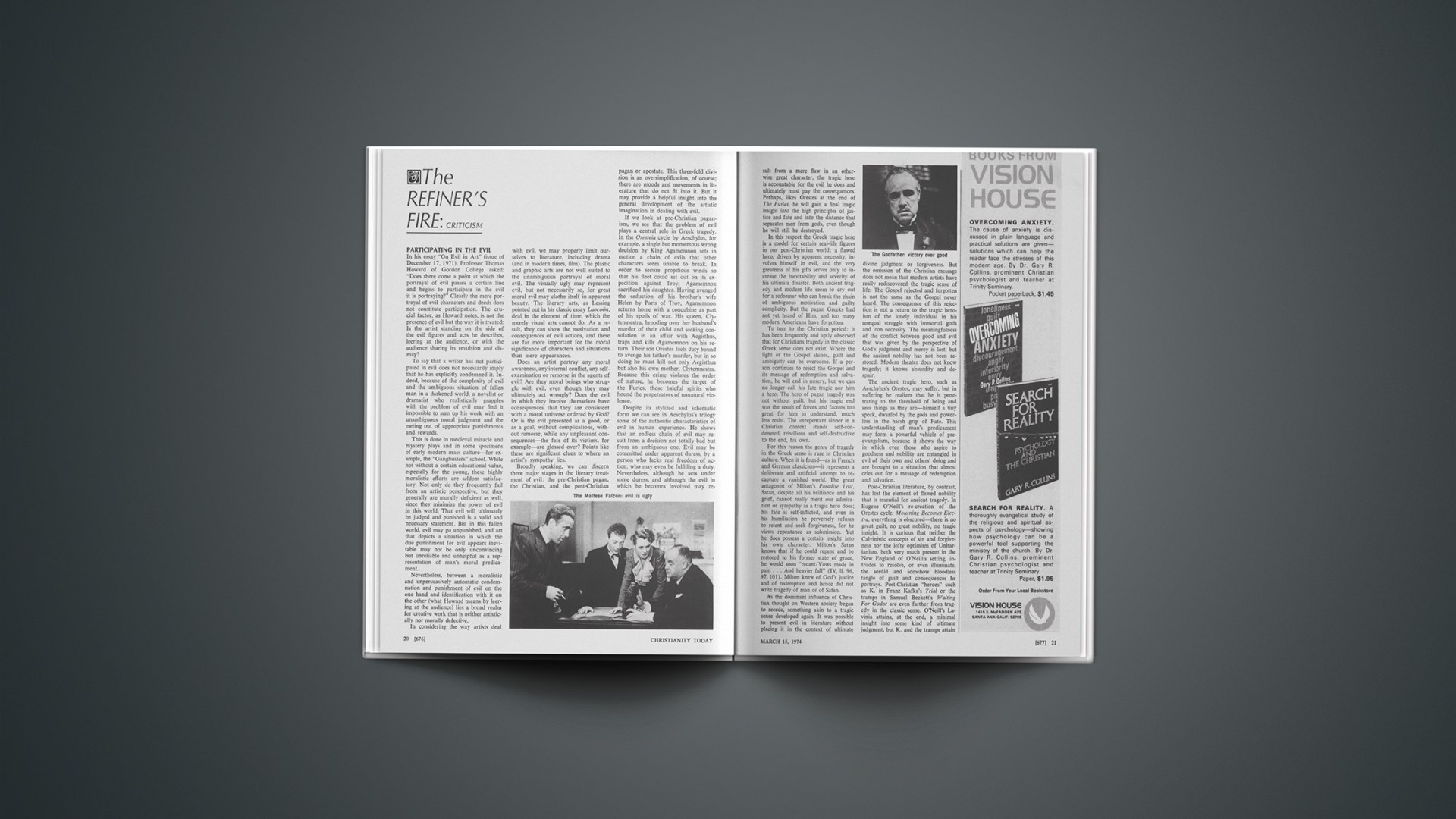
Howard discussed The Devils, and I have previously commented on A Clockwork Orange, but we need not turn to such esoteric films to see where the problem lies. If we consider the police or detective story, we find that the old, moralistic but valid “crime does not pay” motive has broken down in two different ways. In the detective story and related films, the transition from the pursuit and exaltation of justice to the praise of evil is marked by the transition from The Maltese Falcon to The Godfather. In the one, evil is ugly and ultimately defeated; in the other, evil, while not exactly pretty, appears more attractive than its opposite, and if not altogether triumphant, it at least gains a moral (!) victory over the forces of good. The detective story has become the criminal story.

An equally significant transmutation is that from the detective story to the spy story. In the spy story, the secrecy motive prevents the hero from identifying with good. If we compare the series of French films about Georges Simenon’s Inspector Maigret with the far more successful British series involving Ian Fleming’s creation, James Bond, we notice significant differences. Maigret, an unprepossessing, dumpy bourgeois, knows evil and its consequences first hand. He understands criminals and their motivation; frequently he can even sympathize with them. He intuitively recognizes the pathetic chain of wrong decisions and mixed motives that can plunge relatively ordinary people into dreadful crimes. There is nothing pretty about crime in the Maigret films, neither for the victims, nor for the perpetrators, nor for Inspector Maigret himself. Often it is with mixed emotions that he turns a pitiable but guilty miscreant over to the courts of justice.

Bond by contrast is brilliant, but only slightly more so than his enemies. They all live in a world of illusion, luxury, glitter, cruelty, and sudden if not always merciful death. Bond’s only superiority to his enemies, apart from a certain elegance of style, lies in the fact that his salary is paid by the British queen, a figure held by Fleming’s literary convention to be morally preferable to ominous combines such as SMERSH and SPECTRE. What Maigret shows us, but Bond never does, is the real consequences of evil for those other than the hero—the murdered man, his aging widow, the criminal, his broken and despairing wife, the permanently crippled victim of an assault.

Simenon’s stories do not teach a moral in the superficial sense, for Maigret is occasionally unsuccessful, frequently unsatisfied. Bond, by contrast, always “gets his man.” But Maigret sees, avenges, and to some extent participates not in evil but in the suffering caused by evil. Bond instead participates directly in the evil, and to a considerable extent enjoys his participation. It may be that the old police and detective genre did little to discourage potential evil-doers of an earlier day from embarking on their misdeeds, but it is likely that entertainment of the Godfather and James Bond type stimulates their successors today. Good is seen as distinguishable from evil only by a convention, always as less exciting, frequently as less successful.

It would be foolish to minimize the debasing effect of the current flood of pornography on the human spirit. To apply Howard’s question about participation in evil to that monstrous and lush enterprise would certainly be useful. But it may well be that the greatest threat from the entertainment world to the moral sense in our day lies not in the spectacular cinematic dramatization of sexual vice and perversion but in the trivialization and beautification of violence that characterizes the shift from The Maltese Falcon to The Godfather and from Jules Maigret to James Bond.

HAROLD O. J. BROWN
Theology

Was Nicodemus Really a Coward?

Another look at the night visitor.

Nicodemus has often had what may be called a bad press among preachers and Bible commentators. He has been accused of timidity, even cowardice, on two chief grounds: first, that he came to Jesus by night instead of in broad daylight, and second, that he was a disciple in secret, failing to identify himself publicly with Jesus Christ until His crucifixion and death. For instance, Clovis G. Chappell says that “his timidity was at least part of the reason for his coming by night” (Questions Jesus Asked). A. Leonard Griffith says, “We cannot escape the conclusion that for obvious reasons Nicodemus did not want to be seen either by the common people or by his colleagues of the Sanhedrin” (Encounters With Christ). J. D. Grey speaks of Nicodemus and Joseph of Arimathea as “two outstanding men [who] having failed to stand up for Christ during his life, came to shed their tears too late after his death” (Epitaphs For Eager Preachers).

But this idea that Nicodemus was timid and even cowardly is certainly open to question. Take first the matter of his coming to Jesus by night. It may not have been due to fear at all; there are several other possible explanations. For example, Raymond Calkins says that Nicodemus came by night “simply because he could not wait for day.… Some wonderful word of Jesus had entered into this man’s heart” (Religion and Life).

Another possible explanation is that only at night would he have the opportunity for the calm and unhurried conversation he wanted. Or it may have been caution rather than cowardice that compelled Nicodemus to come by night. After all, he occupied a highly important and influential position among his fellow Jews: Clovis Chappell quotes a description of him as “at once the equivalent of a college professor, a judge of the supreme court, and a bishop of the church.” In view of his position Nicodemus had to be careful not to take any public stance on a religious matter before he was sure of his ground. So he came to Jesus by night to avoid undue publicity on a matter about which he had not yet made up his mind.

Furthermore, Nicodemus’s failure to identify himself publicly with Jesus until the crucifixion may have been due not to cowardice but to uncertainty and puzzlement. At his memorable interview with Jesus recorded in the third chapter of John’s Gospel, Nicodemus was told of the necessity of a new birth in order to enter the kingdom of God. Bewildered, he asked, “How can a man be born when he is old?” (John 3:4). Even when Jesus explained that he was talking about spiritual and not physical rebirth, Nicodemus apparently did not understand. It may well be that he did not really comprehend Jesus’ message until Calvary, when he came to realize the meaning of Jesus’ statement to him that “as Moses lifted up the serpent in the wilderness, so must the Son of man be lifted up, that whoever believes in him may have eternal life” (John 3:14, 15). Then, and only then, did Nicodemus experience the repentance, the change of mind, that is essential to the new birth. So genuine bewilderment and uncertainty, rather than cowardice, may have kept Nicodemus from publicly identifying himself as a follower of Jesus until His crucifixion.

On the other hand, on two occasions Nicodemus displayed what must be called courage, even heroism. In the seventh chapter of John’s Gospel it is recorded that when the Pharisees sent officers to arrest Jesus, these officers returned empty-handed, saying, “No man ever spoke like this man!” Hearing this the Pharisees chided them, saying, “Are you led astray, you also? Have any of the authorities or the Pharisees believed in him?” At that point Nicodemus interjected this question, “Does our Law judge a man without first giving him a hearing and knowing what he does?” (John 7:51), thus exposing himself to the taunting reply, “Are you from Galilee too? Search and you will see that no prophet is to rise from Galilee” (John 7:52). Though Nicodemus was here stating a well-recognized principle of Jewish law, by doing so to these bitter enemies of Jesus he risked their scorn and opposition.

It is recorded, too, that after Jesus had been crucified, Joseph of Arimathea (it is he and not Nicodemus who is described as a “disciple of Jesus, but secretly for fear of the Jews” in John 19:38) asked permission from Pilate, the Roman governor of Judea, to have the body of Jesus in order to give it burial: and Nicodemus brought a mixture of myrrh and aloes to anoint the body. James Black points out that in doing this Nicodemus and Joseph of Arimathea “threw in their lot with [Jesus] at the very ebb of his defeat, when the world laughed at him … when they ran the danger of the scorn of the world, and the … prejudice of the triumphant priests” (An Apology For Rogues). This was not the act of a coward.

Nicodemus’s relation with Jesus permits the interpretation that he was a sincere and high-minded religious seeker who, when he became convinced of the truth of the Christian message, did not hesitate to express his Christian discipleship publicly. And though no authentic records of Nicodemus’s subsequent career have survived, there seems no reason to doubt that he continued in the Christian way until his life’s end.

Lausanne May Be a Bomb

Appraisal of the /CWE’s potential.

The explosive secret of nuclear energy that has blasted the world into a radical new era of history is the critical mass. Neither a spark nor a shock can detonate it. When an adequate quantity—a critical mass—of fissionable material is suddenly brought together, the awesome detonation occurs. Similarly, my hope is that the International Congress on World Evangelization—to be held in Lausanne, Switzerland, in July—will result in a great spiritual fission whose chain reaction world-wide will speed the completion of Christ’s great commission in this century.

The spiritual fissionable material will be there: invitations have gone to some 2,700 evangelical leaders from every known Protestant denomination and evangelistic organization in more than 150 nations. All these persons were selected for their evangelical commitment and influence. Lausanne will be the most representative Protestant conclave in history. Given the blessing of the Holy Spirit, it could become a twentieth-century Pentecost.

The World Congress on Evangelism held in Berlin in 1966 illustrated this principle of a spiritual critical mass initiating far-reaching chain reactions. I well remember seeing there a dark-skinned Pacific islander, clad in a mixture of Western and national dress. Titus Path was the pastor of a Presbyterian church in the New Hebrides, a former moderator of his denomination’s General Assembly, and a member of the government’s Advisory Council. He did not say a lot at Berlin, but he took in a lot, and went home to apply it in his own remote island church, which was afflicted with second-generation nominalism. He secured the consent of his General Assembly to inaugurate a five-year plan for evangelism throughout the church. He planned campaigns lasting six or seven weeks in each area, involving large numbers of national and missionary workers.

The amazing result was that almost one-fourth of the population of the islands made commitments to Christ. The local congregations have been revitalized. Social evils have been strongly challenged. A will to witness was engendered in the national church. And young lives were offered for the Lord’s service. This last fact led Titus Path to move in the 1970 General Assembly that a Presbyterian Bible college be set up. Since its inception the college has had more applicants than it can take, more than half of whom are the direct fruit of the evangelistic campaign spurred by Titus Path.

Other incalculably significant results of Berlin have been the many continental and national evangelistic congresses that in turn have sparked countless new programs of nation-wide in-depth evangelism, cross-cultural missionary outreach, revivals in churches, and so on. These results have been particularly apparent in the Third World, where the majority of the world’s two billion unreached live.

“The vision for Explo ’72 in Dallas [the largest gathering of Christian youth in history] was given as a result of the inspiration of the U. S. Congress on Evangelism in Minneapolis in 1971,” Director Bill Bright of Campus Crusade for Christ reports. The Minneapolis congress was but one outgrowth of the Berlin congress. And springing from Explo ’12 came Spree ’73 in London and next summer’s Explo ’74 in Seoul, Korea, where 300,000 are expected.

The Berlin congress did not program these results. But many of the world’s spiritual leaders were present. Speakers, fellowship, and insights through interaction stimulated vision and imparted new motivation. And the Holy Spirit initiated chain reactions.

The potential for spiritual results in many parts of the world is many times greater in 1974 than in 1966. Twice as many countries will be represented at Lausanne. (For that matter there will be twice as many as at the historic Edinburgh conference in 1910.) Immense effort is being made to see that each country of the world will be represented; at this writing only Albania and the People’s Republic of China are excepted. Bringing the influential evangelical leaders of every nation to the congress has been the goal of the participant-selection process. This is the fissionable material making up a critical mass, the potential for a total thrust in world evangelization in this century.

Specifically, what does the congress planning committee (thirty men drawn from five continents and sixteen countries) hope will result from Lausanne ’74? Primary goals are these:

1. To impart vision and motivation to the churches of the world regarding their responsibility for E-1, E-2, and E-3 evangelism. E-1 evangelism is the evangelism of one’s own culture and community; E-2 evangelism is witness to culturally similar peoples who may be close at hand or far away, such as Germans to Greek immigrant workers in Germany; E-3 is cross cultural evangelism, the so-called foreign missionary evangelism. (See “Existing Churches: Ends or Means?,” by Ralph Winter, CHRISTIANITY TODAY, January 19, 1973.) Acts 1:8 is the basis for this helpful terminology: the biblical emphasis is that all Christians are to witness simultaneously, “both in Jerusalem and … to the uttermost parts of the earth.”

2. To inform churches and leaders of the successful strategies, methods, and tools God has given to accomplish the task of total evangelism. Specially needful are the 1,200 Third World participants, whose knowledge of what God is doing is largely limited not just to their own countries but often to their own areas. Through demonstrations, models, and fellowship with participants from around the world, whole new horizons of possibilities will be opened to these men. The hope is that new faith and confidence that their own nations and the world can be evangelized in this generation will be born in the hearts of many as it was in the heart of Titus Path at Berlin.

3. To encourage the basic spiritual unity of evangelicals world-wide for cooperation in a new, all-out thrust for world evangelization. Often the criticism of the fragmentation of Protestant evangelicals is exaggerated. Evangelicals are one in Christ. Current conditions of world crisis and opportunity are increasing their consciousness of the need to work together. Lausanne will provide the climate for strengthening this authentic unity.

The Asia-South Pacific Congress on Evangelism in Singapore, 1968, was a spontaneous outgrowth of Berlin. There some of the most productive movements began in unscheduled free sessions. Theologians met together; out of their meetings have come several Asian evangelical theological societies that today are confidently propounding biblical theology. Asian mission leaders met; last year, as a result, the first all-Asian conference of national foreign missionary societies was born and pledged itself to a goal of sending at least 200 Asian foreign missionaries to the world this year. COFAE (Committee for Asian Evangelism) was born and has served to inform and bind together Asian leaders in prayer and cooperation for Asian evangelism.

Lausanne, too, may provide the conditions for the birth of many such spontaneous cooperative efforts. There will be regional sessions, international sessions of those sharing vocational interests (such as radio evangelists, theologians, missiologists), and free times for informal meeting.

4. To identify the unevangelized enclaves of the world population so that they may be reached; to reemphasize the biblical basis of evangelism and missions in this day of theological confusion; to relate biblical truth to crucial issues facing Christians everywhere; to awaken our Christian consciences to the implications of expressing Christ’s love to men of every class and color—these are other important objectives of Lausanne.

The Church of Jesus Christ now has at its command three great resources never before adequately available. First are the technological tools of transportation and mass communication. No area of the world is now geographically inaccessible to God’s servants. Radio, television, inexpensive literature, mass literacy campaigns, and almost universal Bible translation and publication make total world evangelization physically possible for the first time in this generation.

Second, God has been sovereignly creating a huge manpower pool of committed youth in the last decade. Frequently bypassing customary channels, the Holy Spirit has through such movements as the Jesus People worldwide, Campus Crusade for Christ, Youth With a Mission, Operation Mobilization, and Inter-Varsity Christian Fellowship brought tens of thousands of young people to Christ. Last Easter Sunday I worshiped in a renovated garage in The Hague, Netherlands. Seated on the floor celebrating Christ’s resurrection that morning were a hundred young people, nearly all converted from the drug culture there within the last year. In Muslim Egypt an amazing revival has been taking place among the young. I believe that the commitment of these youths in many cases is clearer and deeper than that of members of my generation. If alongside the present army of Christian workers thousands of these can be channeled world-wide into E-1, E-2, and E-3 evangelism, the manpower needs for world evangelization can be met.

Third, money to finance the task is in the Church. William Carey’s words are contemporarily pertinent: “God’s work done in God’s way will not lack God’s supply.” Those who say that funds are inadequate need to reexamine the facts prayerfully. In England, where churches and Christian organizations are perennially impoverished, a relatively new American evangelistic organization challenged the Christians, and the equivalent of more than $300,000 was contributed for evangelistic projects within the last two years. Particularly in the West, million-dollar church sanctuary blueprints must be sacrificed for world evangelistic strategies. The responsibility of affluent Western churches is great. I repeat, the money to do the job of world evangelism in this century is in the Church, if it will reexamine its priorities and reapportion its money. Many people hope that Lausanne will motivate church leaders to do this.

Amazing open doors around the world invite the Church today. More nations are accessible to the Gospel than ever before in history. Three of the four formerly forbidden Himalayan kingdoms are now open to tactful evangelism. Such nations as Brazil, Indonesia, Korea, and others are experiencing unprecedented movements to Christ. The “two billion unreached” are now within reach of the Church, since most are located in populous enclaves or areas within countries where the Church is already planted.

The day obviously calls for new strategies and patterns of evangelism. There are few totally pioneer “mission fields” left. Missionary colonialism wherever it remains must be abandoned (that it was ever widespread is a doubtful assumption). Partnership in mission and evangelism is the strategy of the hour.

New leadership for both church and mission is strongly emerging from the younger churches coming of age in the Third World. Lausanne will feature these persons on the programs—almost half of the program personalities and group leaders will be new Asian, African, and South American leaders, unfamiliar to most Westerners. Lausanne ’74 will mean for the Western churches a new vision of mission, I believe. Though interest and funds are rapidly waning among ecumenically oriented missions, evangelical Third World leaders welcome the cooperation of the right kind of evangelistic missionary partners. Witness the thrilling challenge of the Ethiopian Lutheran church leaders to their European partners in 1972, asking for less relief money and more Gospel-preaching missionaries.

While the World Council of Churches’ Conference on Salvation Today (Bangkok, 1973) may well have presaged the death of evangelistic mission programs in many WCC-related denominations, evangelical national churches still warmly welcome biblically oriented, evangelistic missionaries. Lausanne should give ample evidence of this. And it will graphically demonstrate that total world evangelization in the last quarter of this century will be the task of Easterner and Westerner, black and white, younger and older church leaders working shoulder-to-shoulder to finish the task committed to Christ’s Church. “You don’t need a crystal ball to predict that during the 1970s the number of missionary societies will increase, not decrease. They will spring up from Asia, Africa and Latin America. Missionary budgets will swell, but different priorities will exist for spending money,” Peter Wagner predicts (Stop the World I Want to Get On, Regal, 1974).

“Vast numbers of people have been prepared by God’s spirit to respond to the good news of Christ.… We are persuaded that God has brought us to one of history’s great moments,” reads the official “Call to the International Congress on World Evangelization.”

The congress planning committee wholeheartedly acknowledges that ultimately the success of Lausanne ’74 depends upon the Holy Spirit. But every human effort is being made to bring together the people, to provide the information, to share the resources available for world evangelization. This fissionable material in the hands of the Holy Spirit may detonate an evangelism explosion and initiate the spiritual chain reaction that will complete in this century the task committed by Christ to his Church.

The Christian mind

One of the most ill-advised dogmas in the American cultural creed is the belief that intellectual activity is somewhat sissified, that it is something for the pointy-heads to fritter away time on while the real folk get along with the business of living. No attitude, imported into the assembly of Christians, could be deadlier. For a Christianity that is aware of itself, self-confident, and eager to follow the mind of its Lord is a Christianity that by hard study and diligent thought has steeped itself in the truths of Holy Scripture. And the way these truths are extracted and applied to Christian life is by reading, by rereading, and by bending every mental gift from God toward an understanding of his Word for us.

It is evident that the anti-intellectual trend has penetrated the Church, for if it had not, ignorance of the central themes and the great teachings of the Bible would not be so pervasive. It cannot be overstressed that if there is to be a Christian life today, it will arise by Christians’ coming to terms with God’s self-revelation in Scripture; as Christ was the Word of God in the flesh, so is the Bible God’s Word for us in written form. Most Christians have a nodding acquaintance with some rudiments of the Christian faith, but it is questionable whether the average churchman can explain or apply such essential biblical teachings as justification, propitiation, sanctification, and glorification, to mention only a few. And since these doctrines lie at the heart of our faith and our life as Christians, it is only to our eternal peril that we neglect to study them.—MARK A. NOLL, graduate student in church history at Vanderbilt University, Nashville, Tennessee.

Biblical Lessons from Watergate

Reflections by a former Key Biscayne pastor.

During 1973 we saw the inauguration of a President boasting an overwhelming electoral victory, after which he moved on to a higher pinnacle of success as he disengaged our nation from the longest war in the history of the United States. We paused. We prayed. We breathed a sigh of relief as the ceasefire went into effect. We watched the POWs come home. Many of us saluted the efforts of the commander-in-chief, Richard M. Nixon, who stood at the apex of his career.

Now, a year later, the President stands as a tragic, isolated figure. Dozens of public officials have been swept from positions of great influence, accused of betraying our trust. Bludgeoned by fuel shortages, rising costs, and international unrest, our President and nation seem unable to cope creatively with these problems, held as we are in the clutches of the unresolved Watergate affair.

In looking at Watergate, I do not intend to attack persons or assign guilt. Nor do I intend to defend anyone with a declaration of innocence. I have a deep love for President Nixon and value highly his graciousness to me during my six Key Biscayne years. I greatly appreciate my friendship with him, his family, and some of his White House associates. For me to make fallible human judgments on incomplete data would be foolish. Fortunately, we have a legal system that we can expect to proceed deliberately, convicting those who are guilty and acquitting the innocent.

What I would like to do is to look at Watergate and see what biblical lessons appear. The problem is bigger than any one man, any one administration. We have a responsibility to learn from these distressing events in order to free ourselves by God’s grace from the bondage and inertia of such tragedies.

God’s Word calls for transparent integrity on the part of every single believer in Jesus Christ. It leaves no room for accommodation with wrongdoing. It calls for frankness, honesty, open discussion of difficult problems within the context of biblical faith. Here are some of the biblical lessons we can learn from Watergate.

I “Let Your ‘Yea’ Be ‘Yea’ And Your ‘Nay’ Be ‘Nay.’ ”

The desire to shade truth for personal benefit is a part of human nature. And when we engage in this shading, we are unlikely to analyze the future cost. I have been personally acquainted with some of the principal figures in the Watergate matter. Some of these men either have confessed their dishonesty or clearly appear dishonest if one compares their public statements over a span of several months. I am convinced that some of them did not originally intend to get caught up in such a complicated web of dishonorable activity and dishonest coverup. They rationalized their actions along these lines: “Little white lies don’t make any difference. In fact, they can protect many people from hurt. There’s nothing wrong with a little concealment when the security of our nation is at stake.”

How about you? Have you ever instructed your secretary to get rid of a phone caller by saying, “Tell him I’m not in”? If so, you have compromised your integrity. You’ve involved yourself in a life style of coverup. How much better to say, “Tell him I’m not available now.” Or, “I’ll return his call later.” Or, if necessary, “I’ll not be able to talk with him at all.” Jesus said, “Let what you say be simply ‘Yes’ or ‘No’; anything more than this comes from evil” (Matt. 5:37, RSV).

Clean, crisp honesty. A “yea” that is “yea” and a “nay” that is “nay.” Pay some prices right now. But then be free from the possibility of your own Watergate. Coverup functions not only in public life but subtly in our own interpersonal relations in business, marriage, family, and other areas. Yet God wants you and me to be stripped of our phoniness, to be authentic people whose word can be trusted.

II The New Morality Does Not Stand Up

Since the early 1960s there has been a lot of discussion about situational ethics, which also goes under the name of contextual ethics or the new morality. Joseph Fletcher, an Episcopal theologian, has been one of the main articulators of this concept. Granted, the new morality means different things to different people. It seems to me that in its purest form it is calling us to be ethically motivated by love instead of by arbitrary laws. Situation ethicists say that a mature person who desires the best for someone else in love is set free to make his ethical decisions, not on the basis of what is set down in the Bible or some legal system, but on the basis of what is really best for all parties involved. An appeal is made to Christ’s statement that love should be our motivation for everything. The greatest commandment of all is to love the Lord your God with all your heart, soul, and might, and to love your neighbor as yourself. Following this logic, proponents of the new morality would release us from the arbitrary bondage of rules. For example, some say there are circumstances in which an altering of the truth or adultery are permissible.

I believe Watergate teaches us that this kind of morality does not stand up. In fact, it leads us to an Old Testament statement that underlines the plight of Israel caught up in moral and political anarchy: “In those days there was no king in Israel; every man did what was right in his own eye” (Judg. 21:25).

God has revealed to us, through the Scriptures, how you and I function best. No, we’re not bound by law. We live in the grace of our Lord, Jesus Christ, a grace that promises God’s forgiveness for everything we have done wrong. But this does not free us to live in the bondage of wrongdoing. Some highly intelligent, capable men felt that the reelection of Richard Nixon was in the highest ethical interest of our nation, and they did all kinds of wrong, which they called right, to gain this end. According to their value system, for him not to be reelected was evil; therefore their defiance of law, in the pursuit of what they considered to be good, was permissible. This explains why they could self-righteously point the finger at criminal and immoral activities carried out by other elements in society without realizing that their activities, both the initial acts and in the coverup, were wrong.

God’s Word calls us to assume an ethical discipline, to live obedient to the guidelines the Lord has revealed in Scriptures. The order we have in society came through the efforts of people who took the moral or divinely revealed law seriously. The relativistic approach in which a person feels he can live above God’s law will only cause him trouble, and hurt those whom he is trying to help.

III Two Wrongs Don’T Make A Right

In discussing Watergate some people have said, “But that’s politics. Everybody else does it. The only thing wrong here was that these men got caught!” It is true, tragically, that elections can be stolen in America. And it is true that a study of our American political process points out some enormous ethical inconsistencies. But does this give us any right to “fight fire with fire”? Absolutely not! We should do all we can to uncover other coverups. We have a God-given responsibility to see that justice prevails.

We are on dangerous ground when we presume to take divinely revealed law into our own hands, using it to our own advantage when it is convenient and dismissing it when we are trying to get even with those who function in a lawless manner. Our insistence that “they all do it” will mean that the horrible experience of Watergate will not purge our society but will only make us look for more subtle ways to get around what is right.

5. A Letter to Sardis

He saw the broken stone

of your dead works;

and stooped to clay

to form the tablet of a Son,

on which He wrote His love

with you in mind.

Why do you pass

the finger of concern

beneath sin’s

lettered tombstone

of the past? Repent!

He comes,—a thief,

to take those ready

and the choice to be.

6. Church of Philadelphia

Girdling the world with witness,

you’re His key chain.

Through you

He opens doors

that can’t be shut.

Now, urge the seeking world,

“Pass through,—”

to mount the stairs

of His descent, before

a tampering tribulation

will try to change

the locks.

IV Success In A Christian Context Is Determined By Eternal, Not Temporal, Standards

The secular pragmatist is interested in getting results and getting them now. To lose an election is to fail if one’s highest priority is winning. The Christian has the exhilarating opportunity to see beyond the immediate external success syndrome. He is able to realize that in losing he may make a moral and spiritual impact much larger than that made if he wins (especially if he wins using illegal methods). For example, take the election of 1972. As we look back we can say it was inevitable that Richard Nixon would win. Why were any dirty tricks needed? Yet it was not always inevitable that he would win. These illegal activities were carried out long before the election was secured. The highest priority, according to some involved in the campaign, was to win the election. How much happier all the parties would be today if the election had been lost with personal honor and integrity kept intact. Joseph “lost” when he rejected the seductive advances of Potiphar’s wife. Doing what was right sent him to jail. Now he stands in the pages of history as an eternal winner, a man of character who would not adapt to the expedient.

The man of God is going to lose at many points in this world. Jesus warns us that the Christian life is a difficult life. Yet he says, “He who loses himself shall find himself. He who would be first shall be last. The last shall be first.” Christ sets our success-failure motivations into a context of the eternal. In reality, Jesus is saying, “God’s payday is not always Friday.” To put it more crassly, it is better to win on the day of judgment as you stand before Almighty God than to win down here.

Pragmatic, non-spiritual man has no scales on which to measure success or failure except those of the immediate. An editorial in the Christian Century stated it crisply,

The functional man dares not to view his immediate victories in the light of a thousand years, because his entire life is dependent upon that victory. Not to have it treated as ultimate is to require that all our victories be measured against the victory of Advent, which promises us a hope that is not seen. And the moment we are driven into an arena of waiting for something not to be seen, we lose the win-or-lose certainty that powers functional man [December 12, 1973].

Now I realize that this kind of conversation has been used as a narcotic to dull the senses of those who suffer. Give people promises of the future life and they are much more exploitable in this life. God forbid that we twist this to our own purposes.

7. Laodicean Church

The church social

makes sure the coffee’s hot,

with saccarine blend

of animated talk

to sweeten and to cream

for connoisseurs;

but poured into cracked cups

without saucers,

water is shared elsewhere

tepid, lukewarm;

spit out by Christ,—

who stands outside the door.

“Behold, I Come Quickly!”

V Don’T Put Your Faith In America; Put It In Jesus Christ

During the past several months quite a few people have said to me, “I’ve lost my faith in politicians.” But why did they have their faith in politicians in the first place? “I’ve lost my confidence in our public leaders.” The Christian’s confidence is to be in God Almighty, not in human leaders. We all have heard people say, “I believe in the United States.” Imagine that the United States disappeared just as Rome disappeared from its position of world leadership. What would that do to our faith? Would it mean that God was any less alive than he is today? Granted, our circumstances of life would be quite different. But would Jesus Christ be any different? An editorial in Eternity magazine stated:

Hopefully, the relevations of Watergate have brought us back to reality. Unpleasant as the facts were, we can be grateful for the jolting reminder that no man, no party, no administration can give us assurance of righteousness in government.

Thousands of conservative Christians across the land, consciously or unconsciously, felt that the conservative politics of the administration, coupled with Mr. Nixon’s religious roots and associations, pointed toward a high moral tone in government. The facts have demonstrated otherwise, and we are driven back to the total dependence and trust in God that should characterize us at all times, under all administrations, Democratic, Republican, or otherwise [November, 1973],

I thank God that in the United States there is still some concern about right and wrong. There are countries in this world where corruption in government would never be aired. At least there is a kind of residual ethical impulse that makes us recoil from abuse of the public trust. Former Vice-President Agnew has talked about a post-Watergate morality, using this as a rationalization for his lawless actions. Thank God that there is a kind of post-Watergate morality. And let’s hope that it sticks. Let it never be forgotten.

VI Watergate Gives Us A Correcting Confrontation With The True Nature Of Man

A strange kind of double standard has developed. Some of us have the capacity to speak stirring words about righteousness at public hearings, political rallies, or religious gatherings even though our own lives do not support our claims. One political party points its finger at the coverup morals of another when that same party covered up the corruption of the Bobby Baker scandal. The evening after the resignation of the Vice-President, I had dinner in Washington with a prominent congressman. He said, “Many a governor and ex-governor is shaking in his boots as a result of these Maryland allegations against Agnew. Those same companies which gave him kickbacks are functioning in a number of other states. That’s the way this political business functions.”

There is a tragic disjuncture between personal and social morals. Some of the very men and women who are most quick to accuse the President and others of dishonesty are now totally disregarding the marriage vows of fidelity that they made “till death do us part.” The Bible says, “All have sinned and come short of the glory of God.” Watergate puts a mirror in front of me, alerting me to the coverups in my own life. My subtle shadings of the truth. My unfaithfulness to the trust people have put in me.

Jesus had some terse words for those who tossed that pathetic adulteress at his feet. With a penetrating expression that could come only from one who had ultimate authority he said, “He who is without sin, let him cast the first stone.” Suddenly there weren’t many accusers. The self-righteous became guilty. The guilty one was set free with the words, “Go and sin no more.”

Vii Remember, These Are People

There’s a danger for us in trying to find a scapegoat for everything that goes wrong. I do not for a moment mean to excuse illegal activities. Those who have done wrong should be held responsible. At the same time a man should be considered innocent until proved guilty. And even if he is found guilty, he should be treated as a person who is created in the image of God and still loved by Him. Watergate will help us, I hope, to reanalyze our whole attitude toward the criminal, to show a greater compassion toward people who have sinned against society.

Thank God that the coverup is being uncovered. Thank God that the breaking of laws has been discovered. Thank God that our country, at least for the moment, has been halted in its direction toward a totalitarianism in which the powerful few see fit to live above the law. Let’s remember that these men have children and wives. Many of them were misguided zealots who thought they were serving their country. Some of them, in the process of trying to do their best, failed. There needs to be a love, a compassion, a concern that says, “There but for the grace of God go I.”

Too long have we taken pornographic delight in the misadventures of others. For too many months now we have eaten away at the vitals of our political and moral system, enjoying Watergate for its entertainment value. Let us love. Let us care. Let us make certain that justice prevails. Let us call for repentance from those who have done wrong, refusing to put a glaze of respectability on immoral activity. But let us temper justice with mercy for all in our society who have failed. Perhaps this is the time for a kind of amnesty, a year of forgiveness, both for those who failed to serve their country in military service and for those who failed to serve their country in the highest levels of leadership. Let us reach out with a gesture of love as we have been loved, a gesture of forgiveness as we have been forgiven, in the name of Jesus Christ, our Saviour.

Theology

Easter—Myth, Hallucination, or History?

Examining the evidence.

First of Two Parts

That the Easter faith in the Resurrection of Christ is the core of Christianity can hardly be denied. Whether that conviction is rooted in myth, in hallucination, or in history has often been debated. Some have maintained that the Resurrection of Christ is a myth patterned after the prototypes of dying and rising fertility gods. Others argue that subjective visions of the risen Christ were sufficient to convince the disciples that their leader was not dead. Even those who do not doubt the historicity of Christ’s life and death differ as to how the Resurrection may be viewed historically. Let us examine the evidences for these alternatives.

I. Easter As Myth

A. Dying and Rising Fertility Gods

John H. Randall, emeritus professor of philosophy at Columbia University, has asserted: “Christianity, at the hands of Paul, became a mystical system of redemption, much like the cult of Isis, and the other sacramental or mystery religions of the day” (Hellenistic Ways of Deliverance and the Making of the Christian Synthesis, 1970, p. 154). Hugh Schonfield in Those Incredible Christians (1968, p. xii) has declared: “The revelations of Frazer in The Golden Bough had not got through to the masses.… Christians remained related under the skin to the devotees of Adonis and Osiris, Dionysus and Mithras.”

The theory that there was a widespread worship of a dying and rising fertility god—Tammuz in Mesopotamia, Adonis in Syria, Attis in Asia Minor, and Osiris in Egypt—was propounded by Sir James Frazer, who gathered a mass of parallels in part IV of his monumental work The Golden Bough (1906, reprinted in 1961). This view has been adopted by many who little realize its fragile foundations. The explanation of the Christian Resurrection by such a comparative-religions approach has even been reflected in official Soviet propaganda (cf. Paul de Surgy, editor, The Resurrection and Modern Biblical Thought, 1966, pp. 1, 131).

In the 1930s three influential French scholars, M. Goguel, C. Guignebert, and A. Loisy, interpreted Christianity as a syncretistic religion formed under the influence of Hellenistic mystery religions. According to A. Loisy (“The Christian Mystery,” Hibbert Journal, X [1911–12], 51), Christ was “a saviour-god, after the manner of an Osiris, an Attis, a Mithra.… Like Adonis, Osiris, and Attis he had died a violent death, and like them he had returned to life.…

B. Reexamination of the Evidences

A reexamination of the sources used to support the theory of a mythical origin of Christ’s resurrection reveals that the evidences are far from satisfactory and that the parallels are too superficial.

In the case of the Mesopotamian Tammuz (Sumerian Dumuzi), his alleged resurrection by the goddess Inanna-Ishtar had been assumed even though the end of both the Sumerian and the Akkadian texts of the myth of “The Descent of Inanna (Ishtar)” had not been preserved. Professor S. N. Kramer in 1960 published a new poem, “The Death of Dumuzi,” that proves conclusively that instead of rescuing Dumuzi from the Underworld, Inanna sent him there as her substitute (cf. my article, “Tammuz and the Bible,” Journal of Biblical Literature, LXXXIV [1965], 283–90). A line in a fragmentary and obscure text is the only positive evidence that after being sent to the Underworld Dumuzi may have had his sister take his place for half the year (cf. S. N. Kramer, Bulletin of the American Schools of Oriental Research, No. 183 [1966], 31).

Tammuz was identified by later writers with the Phoenician Adonis, the beautiful youth beloved of Aphrodite. According to Jerome, Hadrian desecrated the cave in Bethlehem associated with Jesus’ birth by consecrating it with a shrine of Tammuz-Adonis. Although his cult spread from Byblos to the Greco-Roman world, the worship of Adonis was never important and was restricted to women. P. Lambrechts has shown that there is no trace of a resurrection in the early texts or pictorial representations of Adonis; the four texts that speak of his resurrection are quite late, dating from the second to the fourth centuries A.D. (“La ‘resurrection’ d’Adonis,” in Melanges Isidore Levy, 1955, pp. 207–40). Lambrechts has also shown that Attis, the consort of Cybele, does not appear as a “resurrected” god until after A.D. 150. (“Les Fêtes ‘phrygiennes’ de Cybèle et d’ Attis,” Bulletin de I’Institut Historique Belge de Rome, XXVII [1952], 141–70).

This leaves us with the figure of Osiris as the only god for whom there is clear and early evidence of a “resurrection.” Our most complete version of the myth of his death and dismemberment by Seth and his twofold resuscitation by Isis is to be found in Plutarch, who wrote in the second century A.D. (cf. J. Gwyn Griffiths, Plutarch’s De Iside et Osiride, 1970). His account seems to accord with statements made in the early Egyptian texts. After the New Kingdom (from 1570 B.C. on) even ordinary men aspired to identification with Osiris as one who had triumphed over death.

But it is a cardinal misconception to equate the Egyptian view of the afterlife with the “resurrection” of Hebrew-Christian traditions. In order to achieve immortality the Egyptian had to fulfill three conditions: (1) His body had to be preserved, hence mumification. (2) Nourishment had to be provided either by the actual offering of daily bread and beer, or by the magical depiction of food on the walls of the tomb. (3) Magical spells had to be interred with the dead—Pyramid Texts in the Old Kingdom, Coffin Texts in the Middle Kingdom, and the Book of the Dead in the New Kingdom. Moreover, the Egyptian did not rise from the dead; separate entities of his personality such as his Ba and his Ka continued to hover about his body.

Nor is Osiris, who is always portrayed in a mumified form, an inspiration for the resurrected Christ. As Roland de Vaux has observed:

What is meant of Osiris being “raised to life”? Simply that, thanks to the ministrations of Isis, he is able to lead a life beyond the tomb which is an almost perfect replica of earthly existence. But he will never again come among the living and will reign only over the dead.… This revived god is in reality a “mummy” god [The Bible and the Ancient Near East, 1971, p. 236].

C. Inexact Parallels From Late Sources

What should be evident is that past studies of phenomenological comparisons have inexcusably disregarded the dates and the provenience of their sources when they have attempted to provide prototypes for Christianity. Let me give two examples, Mithra and the taurobolium.

Mithra was the Persian god whose worship became popular among Roman soldiers (his cult was restricted to men) and was to prove a rival to Christianity in the late Roman Empire. Early Zoroastrian texts, such as the Mithra Yasht, cannot serve as the basis of a mystery of Mithra inasmuch as they present a god who watches over cattle and the sanctity of contracts. Later Mithraic evidence in the west is primarily iconographic; there are no long coherent texts.

Those who seek to adduce Mithra as a prototype of the risen Christ ignore the late date for the expansion of Mithraism to the west (cf. M. J. Vermaseren, Mithras, The Secret God, 1963, p. 76). The only dated Mithraic inscriptions from the pre-Christian period are the texts of Antiochus I of Commagene (69–34 B.C.) in eastern Asia Minor. After that there is one text possibly from the first century A.D. from Cappadocia, one from Phrygia dated to A.D. 77–78, and one from Rome dated to Trajan’s reign (A.D. 98–117). All other dated Mithraic inscriptions and monuments belong to the second century (after A.D. 140), the third, and the fourth century A.D. (M. J. Vermaseren, Corpus Inscriptionum et Monumentorum Religionis Mithriacae, 1956).

The taurobolium was a bloody rite associated with the worship of Mithra and of Attis in which a bull was slaughtered on a grating over an initiate in a pit below, drenching him with blood. This has been suggested (e.g., by R. Reitzenstein) as the basis of the Christian’s redemption by blood and Paul’s imagery in Romans 6 of the believer’s death and resurrection. Gunter Wagner in his exhaustive study Pauline Baptism and the Pagan Mysteries (1963) points out how anachronistic such comparisons are:

The taurobolium in the Attis cult is first attested in the time of Antoninus Pius for A.D. 160. As far as we can see at present it only became a personal consecration at the beginning of the third century A.D. The idea of a rebirth through the instrumentality of the taurobolium only emerges in isolated instances towards the end of the fourth century A.D.; it is not originally associated with this blood-bath [p. 266].

Indeed, there is inscriptional evidence from the fourth century A.D. that, far from influencing Christianity, those who used the taurobolium were influenced by Christianity. Bruce Metzger in his important essay “Methodology in the Study of the Mystery Religions and Early Christianity” (Historical and Literary Studies: Pagan, Jewish and Christian (1968), notes:

Thus, for example, one must doubtless interpret the change in the efficacy attributed to the rite of the taurobolium. In competing with Christianity, which promised eternal life to its adherents, the cult of Cybele officially or unofficially raised the efficacy of the blood bath from twenty years to eternity [p. 11].

Another aspect of comparisons between the resurrection of Christ and the mythological mysteries is that the alleged parallels are quite inexact. It is an error, for example, to believe that the initiation into the mysteries of Isis, as described in Apuleius’s The Golden Ass, is comparable to Christianity. For one thing, the hero, Lucius, had to pay a fortune to undergo his initiation. And as Wagner correctly observes: “Isis does not promise the mystes immortality, but only that henceforth he shall live under her protection, and that when at length he goes down to the realm of the dead he shall adore her …” (op. cit., p. 112).

On the other hand, the followers of Dionysus (Bacchus), the god of wine, did believe in immortality. But they did not hope for a resurrection of the body; nor did they base their faith on the reborn Dionysus of the Orphics, but rather on their experience of drunken ecstasy (cf. M. Nilsson, The Dionysiac Mysteries of the Hellenistic and Roman Age, 1957).

In any case, the death and resurrection of these various mythological figures, however attested, always typified the annual death and rebirth of vegetation. This significance cannot be attributed to the death and resurrection of Jesus. A. D. Nock sets forth the most striking contrast between pagan and Christian notions of “resurrection” as follows:

In Christianity everything is made to turn on a dated experience of a historical Person; it can be seen from 1 Cor. 15:3 that the statement of the story early assumed the form of a statement in a Creed. There is nothing in the parallel cases which points to any attempt to give such a basis of historical evidence to belief (Early Gentile Christianity and Its Hellenistic Background, 1964, p. 107).

THE TIME IS AT HAND

Seven poems on Revelation 2 and 3 by JEAN RASMUSSEN

1. The Church at Ephesus

The ushers pass the plate:

collect loose change,

collect the folded green;

service, worship, patience

are dropped from week-day hands.

The count is made before

the ushers walk—aisle to altar;

He knows what’s left

in pockets boasting bulge for self.

He knows you do not sweep the house

to search the coin

of your first love.

2. Letter to Smyrna

Not all prisons you will suffer

are dungeon walled,

not all arena lions stalk with roar.

In catacombs

above the ground,

where death

is parlored with bouquets;

sin still is sin,

death still is death,

with you the wine

at Satan’s wedding

to the world;

God’s marriage gift—your chains,

while you receive a crown.

3. To the Church at Pergamos

The food they offered to idols

they offer you;

for idols don’t break bread,

bear cross,

or leave the tomb.

You have your choice

of feasts—His soon to come.

You have your choice

of bread, and choice

erases names;

or writes them on a stone.

4. Message to Thyatira

Yours is the vineyard

in which they slew the Son,

where little foxes

spoil the grapes,

and idols chipped from sin

are pedestaled on lies

of Jezebel—who pleads,

“Give me your vineyard.”

Would she be satisfied?

Or do her foxes bear

the brands of fired hate

consuming those who yield.

Plant and prune—until

chariot wheels of His return

pass over her.

II. Easter As Hallucination

The Latin word that is the root of “hallucination” meant “to wander in thought” or “to utter nonsense.” The modern concept defines “hallucinations” as “subjective experiences that are consequences of mental processes, sometimes fulfilling a purpose in the individual’s mental life” (W. Keup, editor, Origin and Mechanisms of Hallucinations, 1970, p. v).

David Strauss in his famous Life of Jesus (1835) suggested that the recollection of Jesus’ teachings in the clear air of Galilee produced among some of the more emotional disciples hallucinations of Jesus appearing to them. In a more positive vein, Theodor Keim in his work on Jesus (1867–72) proposed that the basis of the Easter faith resulted from God-given “telegrams from heaven.”

Hallucinations do play a major role in religious cultures, but they are induced either by drugs or by the extreme deprivation of food, drink, and sleep (cf. E. Bourguignon, “Hallucination and Trance: An Anthropologist’s Perspective,” in Keup, p. 188). These factors were not present in the various appearances of the risen Christ to his disciples.

The details of the varied epiphanies of Christ, which in several cases were to more than one individual and on one occasion to more than 500, are not typical of hallucinations. A visual hallucination is a private event; it is by definition the perception of objects or patterns of light that are not objectively present (ibid., p. 181). The variety of conditions under which Christ appeared also militate against hallucination. The appearances to Mary Magdalene, to Cleopas, to the disciples on the shore of Galilee, to Paul on the road to Damascus, all differ in their circumstances. C. S. Lewis suggests:

And any theory of hallucination breaks down on the fact (and if it is invention it is the oddest invention that ever entered the mind of man) that on three separate occasions this hallucination was not immediately recognized as Jesus (Luke 24:13–31; John 20:15, 21:4) [Miracles, 1947, p. 153].

Hugh Schonfield in The Passover Plot (1966) concedes: “We are not dealing in the Gospels with hallucinations, with psychic phenomena or survival in the Spiritualist sense” (p. 159). He further remarks: “What emerges from the records is that various disciples did see somebody, a real living person. Their experiences were not subjective” (p. 173).

Finally, what rules out the theory of hallucinations is the fact that the disciples were thoroughly dejected at the death of Christ and were not, despite Christ’s predictions, expecting a resurrection of their leader. H. E. W. Turner remarks:

The disciples to whom they [the women] finally report do not believe for joy. There is here no avid clutching at any straw. Something quite unexpected had happened, rather than something longed for having failed to occur [Jesus, Master and Lord, 1960, p. 368].

III. Easter As History

A. An Existential Concept?

It has become common in circles that find the supernatural aspects of the Resurrection incredible to place an existential interpretation on the Easter event. According to Bultmann’s thinking, “Jesus ist auferstanden ins Kerygma”—Jesus arose in the faith and the preaching of the disciples. For Emil Brunner the Resurrection is not an event that “can be fitted into the succession of historical events”; it is a fact only if it has taken place “for us.” Karl Barth is more positive though still ambiguous in affirming that the Resurrection is a real event though inaccessible to historical investigation. Barth denies any connection between the appearances of Christ listed in First Corinthians 15 and the Resurrection, for if these should be brought within the context of history, the Resurrection “must share in its obscurity and error and essential questionableness.”

In a recent conference held at Pittsburgh Theological Seminary, Professor Samuel Sandmel of Hebrew Union College made the following suggestion to Christians:

I think, if I understand right, the issue about the resurrection which has preoccupied us this afternoon stems from the fact that what was once readily credible is in our environment not credible.… If I were a Christian, I think I would not be dismayed by the idea of resurrection. I think I would [find simple prose] that would say: Here is a message that has to do with man’s potential perfection.… I would not let this array of values suffer because one element—in view of the present environment—has to be interpreted allegorically or be divested of its pristine meaning and given a different meaning. The world too badly needs Christianity at its best [D. G. Miller and D. Y. Hadidian, editors, Jesus and Man’s Hope, 1971, p. 324],

B. A Historical Question?

It is certainly not to be denied that there must be a personal decision for the Resurrection to be meaningful to us as individuals, and that the Resurrection of Christ transcends ordinary history in its significance. But what is at issue is whether the Resurrection of Christ is rooted in history as an objective event or is simply a creation of the subjective faith of the disciples.

Some demur that to make the Resurrection a question of historical research would be to assume that God’s ways are open to our observation. But is not this indeed a distinctive feature of God’s revelation as recorded in both the Old and the New Testament? Others object that since historical judgments can never achieve absolute certainty, they should not be the basis of our faith.

To this fallacious argument Peter Carnley replies:

The important thing is that it is not legitimate to argue that faith cannot be based on any historical judgments or must be totally independent of historical research and autonomous, because no historical judgment is ever justifiably claimed with certainty [S. W. Sykes and J. P. Clayton, editors, Christ, Faith and History, 1972, p. 189],

That is, historians deal not in certainties but in probabilities, but this does not render historical investigation without value for the question of the Resurrection. In his presidential address to the American Historical Association, Kenneth Scott Latourette concluded with these words:

The historian, be he Christian or non-Christian, may not know whether God will fully triumph within history. He cannot conclusively demonstrate the validity of the Christian understanding of history. Yet he can establish a strong probability for the dependability of its insights [“The Christian Understanding of History,” The American Historical Review, LIV (1949), 276].

As J. C. O’Neill has argued:

It will immediately be clear that in asserting that the resurrection is an historical question I have not been asserting that an historian as historian can establish that Jesus rose from the dead. The historian in this case can only show whether or not the evidence makes it at all plausible to assert that Jesus rose from the dead [Sykes and Clayton, op. cit., p. 217].

[To be continued.]

Editor’s Note from March 15, 1974

In this issue John Huffman has a word on what we can learn from Watergate; Editor-at-large Edwin Yamauchi begins a two-part substantive article on the resurrection; Norman Hope asks whether Nicodemus was a coward; and Associate Editor Harold Brown tackles the question, “When does the portrayal of evil become participation in it?”

As a former professor of missions I find the article by Donald Hoke and the lead editorial, both on the upcoming Lausanne congress, and also the charts of North American missionary outreach in another editorial, right in rhythm with my own heartbeat. I believe with all my mind and heart that the primary business of the Church and every Christian is to take the Gospel of Jesus Christ to every creature. And we can do it, no matter how dark and difficult the day, if we are willing to go, give, and pray. My prayer is: “God, awaken your Church and send your people to the ends of the earth with the Gospel.”

Theology

East Side, West Side

In company with eighty intrepid fellow believers, I saw the old year out and the new year in at Bach’s church in Leipzig, East Germany. (Correction: the German Democratic Republic, since the latest official policy is to emphasize the existence of this separate state, now a member of the United Nations, and no longer to favor expressions suggesting a divided Germany that will one day be reunited. So passes the Bismarkian ideal of a unified Germany.) This was my eighth sojourn in the DDR, and my visits have spanned a decade. I know the geography of Luther country, from Eisenach and the Wartburg Castle to Eislcben and Wittenberg, better than the geography of the Chicago suburbs, and have several dear friends who are citizens of that most rigid of all Eastern-bloc nations.

What continues to amaze me most about American evangelicals’ attitudes toward Communist lands is a recurring naivete. Example: before the current trip I received letters from more than one well-meaning person asking if I could smuggle in Bibles that they would supply, since “the Scriptures are not allowed by the Marxists.” In point of fact, there is absolutely no prohibition of Bible-reading or Bible ownership in the DDR, and attractive, inexpensive editions of the Bible in several German translations can be purchased.

To be sure, there is pressure against the Church and against the Gospel, but it is much more subtle than the burning of Bibles. Proselytizing is quite definitely discouraged, and a Billy Graham campaign would be inconceivable. What constitutes proselytizing, however, varies widely according to the severity of current state policy, which is cumbersomely administered in a top-heavy bureaucracy.

Generally, personal evangelism can be carried on with no negative repercussions. The Church cannot “meddle in politics,” which means, in practice, that it is encouraged to speak a good word for Angela Davis and company but must under no circumstances criticize Marxist theory or practice. This is a direct blow to the prophetic function of the Church, but it has at least one positive virtue: clergy are obliged to preach from the Bible instead of reading inflammatory manifestos that may or may not have anything to do with the Gospel!

Most unfortunately, young people are subjected to Marxist-atheistic indoctrination in the public schools (no private or parochial schools are allowed); and efforts are made to provide secular substitutes for the rites of the Church (“dedications” that ape baptism and confirmation). The idea is that if the young people give up Christianity, the Church will die without the necessity of messy purges.

However, as always, the anti-Christic opposition displays its fundamental weakness of arrogant overconfidence. Church attendance is admittedly low in the DDR, but not particularly lower than it is in western Europe—and those who do attend are hardly doing so to gain social status. Some East German pastors regard the current situation as a blessing, since it has rid the Church of dead wood and hangers-on. Moreover, the theology from the pulpit is almost always orthodox and biblical these days: theological liberalism is a luxury that no church in crisis, with its back to the wall, can afford.

The most dangerous aspect of the American evangelical stereotype of the religious situation in Marxist lands is that it sees the East as black and the West as white, much as in an old Western movie the bad guys (in black hats) were clearly distinguished from the good guys (in white hats). The Eastern-bloc countries are supposed to be the materialistic, atheistic ones, as opposed to “God-fearing” America and its allies. This, of course, is nonsense, and the nature of the nonsense can be well seen by two parallel illustrations, one from East and one from West.

On returning home from the DDR, I found in my mail the 1974 New Year’s greeting card from the regime’s Zentralantiquariat (Centralized Antiquarian Book Dealer), from which I have bought a number of ancient theological tomes. This year the card displayed an attractive woodcut of a window partially open to the morning sun, accompanied by a quotation from Marxist playwright Bertolt Brecht, author of Threepenny Opera and Mother Courage, whose last years (1948–56) were spent in East Berlin as director of The Berliner Ensemble. I translate:

Pleasures: The first glance out of the window in the morning. The rediscovery of an old book. Snow. The changing seasons. The newspaper. One’s dog. The dialectic. Showers and swimming. Classical music. Comfy shoes. Modern music. Travels. Singing. Friendship.

Materialistic? Not in the narrow sense of the term, for genuinely human values are emphasized. But tragically secular, for the limits of the world establish the limits of Brecht’s list.

In reality, a newspaper reminds one that Koheleth was right after all: there is nothing new under the sun, and the human experience apart from God is vexation, not pleasure. Even François Villon read the deeper message of the snow—its terrible fragility, mirroring the terrible fragility of human life: “Where are the snows of yesteryear?” One’s beloved dog dies, never to return. The dialectic, as a formal principle, can more readily lead to Orwell’s 1984 than to the classless society. And what good is the sun of a new year if increasing entropy will eventually bring the universe to heat-death? Without the Sun of righteousness, all is vanity.

The same mail brought the latest issue of the New Yorker, and one of its cartoons shows a middle-class, middle-age American husband lecturing to his wife in their living room. He points to a blackboard where he has written the following sequence: “Mortgage paid. Solvent. Fully insured. Kids OK—on their own. We have our health. We have each other. Total: HAPPINESS.” Says his wife: “Would you run through that once again, please, Walter?” But no matter how many times Walter runs through it, it comes out the same: a secularism, divorced from eternity, differing in no significant way from Brecht’s conception of happiness.

We might as well admit it. East side and West side are committed to secularistc goals, and all around the town childish human beings are singing ring-around-the-rosy while London bridge is falling down. The trouble comes from satisfaction with earthly cities and objectives when we ought to be seeking “the better City, that is the heavenly one, which hath foundations, whose builder and maker is God.”

To strike deeper than pleasure and happiness to true joy, one must learn the lesson taught in Neander’s great chorale hymn, which we sang in Bach’s church in Leipzig as the chimes rang in a new year of grace: “Praise to the Lord, the Almighty, the King of creation! O my soul, praise Him, for He is thy Health and Salvation!”

Americans United: Parting Shots

With fresh reinforcements now due on the scene, church-state separationists feel they are well on the road to victory in what has been called the last unresolved issue of the American Revolution. A good look at where things now stand was provided by the twenty-sixth annual National Conference on Church and State, held last month in Orlando, Florida.

Many relatively minor controversies still dot the church-state landscape. But unless constitutional amendments are passed, something that seems highly unlikely at least for a few years, recent Supreme Court decisions will go a long way toward ensuring that not very much public money flows into the treasuries of religious organizations. Much of the credit for the prohibition belongs to Americans United for Separation of Church and State, which sponsored the three-day conference. The Americans United organization has been instrumental in most of the litigation involving church-state separation during the last generation.

Where do we go from here? That was the big question underlying the meeting, held beside a lush tropical garden that decorates the Orlando Hilton. Next year’s meeting will feature new leaders. Glenn Archer, the highly effective executive director of Americans United since its founding in 1947, is retiring this year, as is his very able right-hand man, C. Stanley Lowell. Both are likely to remain somewhat active with the organization, but the responsibility for staff initiative will be in other hands.

The Orlando meeting was in effect a reunion of veterans of the church-state struggle and an unofficial farewell party. Key speakers included America’s most famous thorn in Catholic flesh, Paul Blanshard, now 81, Senate Watergate committee chairman Sam Ervin, 77, and former congressman and Southern Baptist Convention president Brooks Hays, 75. All are still very robust for their years and capable of ringing rhetoric.

Blanshard, author of the best-selling American Freedom and Catholic Power in 1949, concedes he has mellowed a bit (“but Pope John mellowed first”) since the days when he toured the country warning thousands of Rome’s bid for social supremacy. He says that ten big publishers turned down his manuscript and that the New York Times refused for several years to carry ads for the book.

Blanshard maintains that there is still a large Catholic conservative constituency, and he is yet suspicious of its intentions. Moreover, he chides Protestants, including the Christian Century magazine and church historian Sydney Ahlstrom, who fail to recognize such anxieties. Blanshard’s criticism of the Century, whose commentary on church-state issues he characterizes as “mush with molasses,” is particularly ironic in view of the fact that a late editor of the magazine, Charles Clayton Morrison, was a founder of Americans United. Speaking about Ahlstrom, Blanshard lamented having not even made the index of the Yale professor’s award-winning A Religious History of the American People.

Blanshard’s anti-Catholic posture had a lot of support from fundamentalists in the early lecture-tour days. The issues have shifted, however, as a result primarily of the Supreme Court’s ban on public school devotions and the deterioration of public education in some areas. Fundamentalists are not now nearly as worried about Catholic power as they are about the intrusion of secular and anti-Christian value systems into public education, an issue toward which the Americans United camp has not shown significant sensitivity.

The Orlando conference drew about 100 registrants from among people who have figured prominently in church-state hassles around the country. The Ervin speech, however, packed out the hotel ballroom with more than 1,000 persons. Ervin was closely associated with Americans United long before his name became a household word in connection with the televised Watergate hearings, and in past years he has received a merit award given annually by Americans United in recognition of outstanding service in the cause of religious liberty.1This year’s award went to Jack Eppes of Jacksonville, Florida, executive secretary of United Christian Action. In his address and in remarks at a news conference he steered away from any discussion of Watergate. Instead, he warned against the increasing power of the federal government, the watering down of the right of privacy, deficit spending, no-knock and preventive detention laws, compulsory unionism, and school busing aimed at racial balance.

Hays was more entertaining than educational, a role not unappreciated by delegates from the north who were also thankful for the pleasure of soaking up some Florida sunshine amidst the conduct of vital business.

Americans United recently helped to launch a new National Coalition for Public Education and Religious Liberty (PEARL) aimed at combatting government aid to private schools. Episcopal suffragan bishop John Walker of the Washington Cathedral is president. An assortment of religious agencies is allied with the organization, and it was not immediately made clear whether the group would register as a political lobby. The Supreme Court is now deciding a case rising out of an Americans United appeal of Internal Revenue Service’s revocation of its tax-exempt status for lobbying. The ruling in that case, along with one in which Bob Jones University is appealing a similar revocation for racial segregation, is expected to set an important precedent.

Parochaid: More Battles

Court battles are still being waged over parochaid, and advocates of government aid to private schools are still trying to find ways to circumvent adverse decisions. Among the latest developments:

• The Supreme Court has heard arguments involving refusal by Missouri school officials to send public school teachers into parochial schools to assist in federally funded remedial reading programs. A court ruling is expected before June.

• An arrangement involving public school teachers in parochial classrooms in Kentucky was seen as “excessive entanglement” between church and state and ruled unconstitutional by a federal court. (The practice of sending public school teachers to parochial schools, known as “reverse shared time,” has continued elsewhere in Kentucky, Michigan, and Rhode Island. Americans United [see preceding story], which prosecuted the Kentucky case, won a similar suit in New Hampshire last year.)

• Parochial and private schools in Maryland are lobbying for a $7.5 million state appropriation to provide textbooks and bus service for their schools. A similar $12 million plan, approved by the state assembly in 1971, was rejected by voters in 1972. Under the plan, parochial school books would remain public school property and would be screened to prevent purchase of religious books with taxpayers’ money.

• In another Americans United suit, a federal court in San Francisco struck down a California law providing $125 per student income tax credit for parents who pay tuition to parochial schools. The parents were seen as conduits of state aid to sectarian schools.

• An experimental trial “voucher” plan involving as many as 8,000 New Hampshire students won an $88,227 planning grant from the federal Health, Education, and Welfare agency (HEW). Under the plan parents will cash federal vouchers at the schools of their choice. Opponents, including the National Education Association, declare it is a “thinly veiled” device to support non-public schools to the detriment of the public system, and there were reports of considerable controversy within HEW over the grant. (The test alone will cost some $3 million altogether and won’t get under way before the fall of 1975, if at all.)

• New York State’s Select Committee on Higher Education announced an interim plan to allow up to $1,700 in tuition grants covering the first two years for each student attending a public or private (including church-related) college in the state. The plan affects mostly those students whose families are in the $7,000–$15,000 income bracket, many of whom leave the state to enroll elsewhere. Total cost: $28.2 million the first year, $71.5 million when fully implemented.

• In his recent State of the Union message, President Nixon restated his election-campaign commitment to public aid for parochial schools. Vice-President Gerald Ford has also spoken out publicly in support of parochaid.

Missouri Impasse

Opposing forces in the strife-torn Lutheran Church-Missouri Synod appeared to be at an impasse midway through last month. Concordia Seminary in St. Louis remained virtually closed as students boycotted classes in protest against the firing of seminary president John Tietjen in January (see February 15 issue, page 45). The majority of students and faculty were discussing the possibility of setting up a “seminary in exile” at an unused Catholic facility in Chicago. Various denominational boards and officials were huddled in talks aimed at restoring peace—or at gaining a more advantageous position in the confrontation. Synod president J. A. O. Preus appointed a fourteen-member Committee on Doctrine and Conciliation to define the issues “point by point” and to draw up proposals that can be voted on by the denomination in 1975. But there’ll be a lot more fighting in the interim.

Religion In Transit

The figures are in. Again last year Jonathan Livingston Seagull and The Living Bibleled in fiction and non-fiction hardback sales respectively, according to Publishers Weekly. Seagull sold 540,000 copies; the paraphrased Bible had sales of about 2.7 million hardcover editions. Paperback figures were not available.

The Arizona Billy Graham Crusade will go on as scheduled May 5–12 in the 50,000-seat Sun Devil stadium on the Arizona State University campus at Tempe. At first the university regents denied use of the stadium on grounds it would violate church-state separation rules. A statewide uproar ensued, with even the Arizona Civil Liberties Union backing the Graham cause. Ten days later the regents reversed themselves.

The Cost of Living Council announced that religious and other non-profit organizations are exempt from wage and price controls. The wages of many workers in tax-exempt groups were already exempt, said the CLC, because their wages were less than $3.50 per hour.

For the third year in a row, 40 per cent of all American adults attended a church or synagogue during a typical week in 1973, according to the Gallup Poll, with Catholics registering 55 per cent, Protestants 37 per cent, and Jews 19 per cent.

A federal judge ruled that the U. S. Constitution does not require an employer to accommodate a work schedule to a worker’s religious beliefs. Seventh-day Adventist Albert Leland Fisher had brought suit after the public works department of Ashland, Oregon, refused to let him leave work half an hour early on Fridays. Fisher said he needed the time in winter months in order to arrive home before sundown and onset of the sabbath.

The World Home Bible League has completed two years of a program to stock motel rooms throughout the country with take-home paperback copies of The Living Bible. Of the 1.2 million motel rooms in America, 200,000 have the Bible available, says WHBL director John DeVries. More than 100,000 copies were taken by tourists in one month alone last summer, he says.

Personalia

Dr. Ira Gallaway, appointed in 1972 as the top evangelism executive of the United Methodist Church, has resigned to become pastor of the 4,000-member First United Methodist Church of Peoria, Illinois.

Sudan Interior Mission executive Ian M. Hay was elected president of Interdenominational Foreign Missions Association, a group of forty-seven independent North American missions.

Louis W. Schneider, 58, is the new national executive director of the American Friends Service Committee, one of the highest posts in the Quaker realm.

Baptist clergyman Ralph D. Abernathy told a San Francisco audience that politics will head this year’s agenda of the Southern Christian Leadership Conference. And, he added, the top political priority will be the removal of President Nixon from office.

World Scene

A special synod of the 24,000-member Evangelical Lutheran Church in Chile has been called for later this month as part of an attempt to oust Bishop Helmut Frenz as president of the denomination. He has been under fire for chairing an ecumenical project that helped nearly 5,000 refugees, many of them allegedly “leftist,” leave the country after the military takeover. The World Council of Churches committed $600,000 to the project.

Protestant and Catholic leaders in Israel issued an appeal for funds for the rehabilitation of soldiers wounded in the recent Mideast war. Anglican archbishop George Appleton of Jerusalem went to Cairo and suggested that Christian leaders there issue a similar appeal for the Arab wounded. He planned to visit Amman and Damascus also.

The huge Collins publishing firm of London and Glasgow has bought for an undisclosed price the $10-million-a-year Bible and dictionary business of World Publishing Company, a subsidiary of the Los Angeles Times-Mirror company and publisher of Webster’s New World Dictionary. World has reputedly been the world’s largest publisher of Bibles.

Evangelicals in Australia began a year of intensified activity with a nine-day event named Nowtime ’74. Organized by Christian Endeavor, it culminated in a march of several thousand in Sydney to proclaim Christ and knock pornography. Next will be a national Festival of Light, patterned after the British Christian morality campaign with the same title. After that a Key 73-type evangelistic outreach will be launched.

European youth-work leaders met in Amsterdam with representatives of the Billy Graham organization to plan Eurofest ’75, a continental version of Britain’s SPREE ’73 youth evangelism conference. It will probably be held in southern France. Planners hope to get 30,000 to attend.

Of the world’s 3.6 billion population, 669 million (18.3 per cent) are Catholics, according to latest Catholic statistics.

Bishop Richard K. Wimbush, 64, was chosen by his fellow bishops as primus of the Episcopal Church in Scotland.

Reform and Conservative Jews are reacting sharply to demands upon Prime Minister Golda Meir by Israel’s (Orthodox) National Religious Party that the Law of Return be amended to recognize only conversions performed by Orthodox rabbis as valid. The party has threatened to withdraw support of the coalition government if the demands are not met.

The governing body of the 250,000-member Lutheran Church of Alsace and Lorraine ruled that French Lutherans now “may welcome to communion the faithful of another church, including the Catholic church.”

Birthday: the weekly journal Life of Faith, 100, published in London, the organ of the Keswick “deeper life” movement.

British Mission Aviation Fellowship has more than one way of getting around. It has developed an economical hovercraft to transport medical missionaries and others along the shores and among the islands of West Africa’s Lake Chad, an inland sea the size of Massachusetts. The 22-foot-long boat skims along on a cushion of air, driven by two Volkswagen engines and an overhead propeller.

By the Light of the ‘Saviourly’ Moon

An Oriental Moon is rising in the Occidental sky.

It’s the Reverend Sun Myung Moon, a Korean evangelist who has been gaining national attention through his pro-Nixon rallies and blitzing the United States with four-day “Day of Hope” conferences to spread his one-world, one-religion faith.

Moon heads the Unification Church (formally the Holy Spirit Association for the Unification of World Christianity). He is beginning another lecture circuit of thirty-two cities this month, and full-page ads in major newspapers herald his coming.

On the surface of his growing movement (he claims two million followers and members worldwide, 10,000 in the United States), the message is obey Puritan morals, fight Communism, unite behind the nation’s President, and believe Bible fundamentals. But those drawn to hotel ballroom banquets and Day of Hope sermons—and those who seriously inquire about membership—find a strange, unorthodox theology and austere regimentation suggestive of the militaristic Children of God sect.

A few Unification Church beliefs and practices:

• Moon is a modern-day John the Baptist preparing the way for the “third Adam”—the “Lord of the Advent.” Some followers are convinced Moon himself is that Christ.

• Communication with the dead is practiced. Moon has sat in several séances, including one in 1964 with Arthur Ford, the late Bishop James Pike’s favorite medium. Ford predicted great things for Moon.

• Marriage is essential to salvation because the coming Christ will marry and the union will typify the perfect family relationship. On the other hand, divorce is recognized, and Unification Church couples may find church discipline so stringent that their marriages do not survive. Those that do survive are “resolemnized” through a Unification rite. “Couples who married before they joined the church will want to do this,” said Neil A. Salonen, 28, a one-time Cornell student and business manager of a Washington, D. C., psychiatric hospital who is now president of the American wing of Moon’s church.

• The Holy Spirit is the “feminine” element of the Trinity and bears a special affinity with Eve. The coming Christ (who will have been born in Korea by 1980) is the male element of the Trinity; the perfect union of male and female elements of the Godhead will occur when the Messiah marries. (Those who accept Moon as the Christ believe that his second marriage—his first wife left him after ten years—fulfills this.)

• Jesus of Nazareth accomplished man’s spiritual salvation. But since Jesus was crucified before he could marry, he (the second Adam) couldn’t finish man’s physical salvation, thus regaining what the first Adam and Eve lost in the garden Fall.

Moon must approve each marriage within the church. Matrimony-minded members submit up to five names of possible partners, and leaders pair “candidates” for Moon’s final nod. He personally performs all weddings—en masse.

The number has been increasing according to a progression with special symbolism. The last mass wedding involved 793 couples (the church publishes 777 as the figure because of that number’s significance, however) in Seoul, Korea, in 1970. U. S. president Salonen says the next group wedding will be soon, probably in America.

Most Unification Church members are in their 20s and 30s. Many live in the church’s centers scattered in about 120 U. S. cities. Members devote much time to fund-raising. They are often on the streets from dawn to dusk hawking anything from peanuts to flowers for “donations.”

Teaching and doctrine are based on Moon’s 536-page Divine Principles, which, he says, came to him through revelation and meditation over the years. The black-covered volume assumes the authority that The Book of Mormon and Science and Health do in the Mormon and Christian Science faiths.

When a young mother (who recently quit the sect) and her husband joined the church in the Midwest, they were told to split up, she said. The husband (still a member) was sent to a church commune in the Pacific Northwest. Their children were placed in a church-operated nursery and taught that Mr. and Mrs. Moon were now their true parents, the ex-member told a reporter.

Insiders also confirmed that the heads of the Omaha, Nebraska, and Boise, Idaho, centers are husband and wife, but that they have lived separately for seven years—since they first joined the church.

Church officials contend that there is too much emphasis on sex today. Consequently, all newlyweds must abstain from relations for forty days. While Salonen denies that families are forcibly split up, he acknowledges that all couples married before joining the church must undergo a period of separation and “live as sister and brother,” often for six months or more.

Young members appear completely sold on the church, and gladly share their possessions, living frugally (a former member said $60 every two weeks was the total food allowance for fifteen persons in a Midwestern commune). They speak of a personal relationship to Jesus Christ. Many attend various institutional churches on Sunday, seeing this as a way of spreading Moon’s teachings of religious unity and the belief that America has a special role in saving the world.

The latter belief stems from Moon’s assertion that the United States, under the divinely ordained leadership of President Nixon, can bring other nations to God—if the United States itself repents of moral wrong. Unification Church followers gathered at the December White House Christmas-tree lighting ceremony to back Nixon, and on the day of the National Prayer Breakfast (see February 15 issue, page 52), 1,000 rallied in Lafayette Park across the street from the White House. Moon himself somehow got into the by-invitation-only breakfast, causing a stir among members of the sponsoring committee. Meanwhile, 2,000 Japanese followers demonstrated at the U. S. embassy in Tokyo in support of Nixon.

Although Moon has been drawing crowds of only 300 to 500 at Day of Hope crusades in major cities, he hopes for a bigger response on the upcoming junket, which will take him to all states. (During Moon’s recent visit to Berkeley, members of the Christian World Liberation Front handed out leaflets labeling him a false prophet and leader of “his own messianic personality cult.” Most of the Christian groups on the University of California campus jointly sponsored a full-page anti-Moon ad in the campus daily. As word spreads, Moon may increasingly find himself the target of such counter moves by Christians on his future forays.)

An aide was asked at the Los Angeles conference last month (Moon himself has granted no interviews since the beginning of the circuit in New York) why Moon spends so much time in the United States when only a small fraction of his membership is here. “So much of the world’s power and strength is in America,” she said. “The United States has the ability to serve other countries and unify them.”

The Moon family lives in a thirty-five-room stone mansion near Barry-town, New York—when Moon and his attractive wife aren’t on tour. And an interviewer was left with the impression that America’s affluence rather than influence may have something to do with the Unification Church’s concentration of efforts here. The sect owns an $800,000 training center in Tarry-town, New York, owns 225 acres near Barrytown, and leases national headquarters in Washington, D. C. The Freedom Leadership Foundation, a related organization set up to “capture positive values of society” and combat Communism, is also located there. There are about 120 communal centers around the country, a number of them palatial residences in expensive neighborhoods.

A sore point with Moonites is the widely circulated statement that Moon is worth $15 million. This is untrue, they say: he personally owns very little. But church-related business assets may approach that figure—a tea company, titanium production, pharmaceuticals, air rifles, retreat ranches, and the New World Home Cleaning Service, among others.

Moon was born to Christian parents in Korea in 1920. He and his businesses thrived—as did his religion—after he was released from Communist imprisonment during the Korean War (see October 12, 1973, issue, page 67). He founded the church twenty years ago after he was ousted by Presbyterians, in part for his involvement in Pentecostal activities.

Moon and his chief associates deny that he teaches that he is the Korean Christ, or “third Adam.” But in timing and characteristics the new saviour described in Moon’s Divine Principles bears a striking similarity to the 54-year-old evangelist.

Is Moon that Christ? “It is entirely possible God could ordain him to that function,” replied Salonen when pressed. “It will be for God and history to say.”

African Evangelicals: Contextualizing Theology

The drive for a “Black Theology” is partly a reaction to racism, particularly in the United States and South Africa, commented Dr. Byang H. Kato, general secretary of the Association of Evangelicals of Africa and Madagascar (AEAM). He was speaking at an Evangelical African Theological Consultation held at Igbaja Seminary, Nigeria, in late January. Representing four theological seminaries and several Bible colleges and institutions, delegates to the consultation went on to reject the concept of an African theology but called for research to contextualize biblical theology in Africa.

Nationalistic pressures to revert to traditional religions and to syncretize the Christian faith were referred to in papers by Dr. John A. Laoye of the Department of Religion at Ife University and Dr. Emmanuel A. Dahunsi of the Baptist Seminary in Ogbomosho, both in Nigeria. Delegates were reminded of developments in neighboring Chad Republic, where Christians in some areas are being forced to undergo pagan initiation rites in the cause of national patriotism. “It will become increasingly difficult for evangelicals as liberal theology gains strength, appealing to a sense of tradition and patriotism,” warned Kato. “We must be African Christians, but we must not depart from the verities of Scripture, as understood by evangelicals.”

The consultation was one of a series (so far others have been held in Ivory Coast and Kenya) in preparation for presenting an evangelical African viewpoint on theology at the International Congress on World Evangelization.

A committee was also selected to pursue recognition and accreditation of evangelical theological schools.

W. HAROLD FULLER

‘The Exorcist’: Just Acting

For a junior high school student newly turned 15, it was quite a birthday present: the award as best supporting actress for her role as the demon-possessed child in the controversial movie The Exorcist, her first film appearance. The honor was bestowed on Linda Blair by the Foreign Press Association in its annual Golden Globe awards presentation in Hollywood in January. (Part of the controversy over the film concerns Miss Blair’s age. Some critics, citing the obscenities and other scenes, charge the producers with corrupting the morals of a minor.)

On her way back home to Westport, Connecticut, a young man on the plane recognized Miss Blair, handed her a Christian tract, and asked her to read it. A few days later in an interview in her Westport home with CHRISTIANITY TODAY editorial associate Cheryl Forbes, Miss Blair said she could remember only vaguely that the tract was an appeal to turn to God. But she went on to express her own religious beliefs and her views about her part in the movie.

Meanwhile, Linda’s mother, Elaine Blair, briefed Miss Forbes on the family’s religious background. Mrs. Blair said she was raised in a “strict” Methodist home (her mother is an ardent supporter of evangelists Kathryn Kuhlman and Billy Graham), the children were baptized in a Presbyterian church, and the family’s membership is now in the Saugatuck Congregational Church outside Westport, a United Church of Christ congregation.

The following are edited excerpts of the interview:

Question. Linda, how were you selected for “The Exorcist”?

Answer. My agent contacted the casting director, who sent me to William Blatty, author of the novel, and Bill Friedkin, the film’s director. I read the original novel, auditioned, and got the part.

Q. What did you think of the book?

A. I liked it. It didn’t scare me. But I did wonder how they were going to film certain things.

Q. What about you, Mrs. Blair?

A. All the parents of those being auditioned were required to read the book. I thought it was a strong book, though some of the language surprised me. I just accepted the story as that of a sick child. After the director explained how the film would be made, I knew Linda wouldn’t be exploited.

Q. What kind of orientation did you receive, Linda?

A. None, other than to read the book.

Q. What about the priests on the set?

A. They were present to make sure the demon possession was done realistically. They didn’t advise or counsel me, as some reports stated.

Q. Before you accepted the job did you discuss it with your minister?

A. No. And since the film has been released there’s been no reaction on his part or on the part of the congregation.

Q. “Newsweek” stated that you are active in your church.

A. That’s not exactly true. I attend confirmation class on Tuesday evenings. It started in September and will end at Easter. We don’t attend church regularly because my horse shows take me out of town on weekends so much.

Q. What exactly are your beliefs about God and Christianity, then?

A. I believe God is real and that I can talk to him. I do talk to him, and I believe he hears and answers my prayers. And I believe Jesus was God’s son and that he died and was resurrected. Some of my friends think it’s a little strange that I believe that. Maybe that’s what makes me a little bit different. Most of the kids at school think Christianity is a myth. But this is one area where I’m one-minded and won’t take someone else’s opinion.

Q. Why do you think God sent his son to earth?

A. Well, he came to earth to help people because it was kind of going bad. He wanted to tell people that God is real. He came to heal, to help the poor, to try to change sinners. And then God let his son die so people could see [the love] and the good they [were rejecting].

Q. Do you read the Bible?

A. I want to, but haven’t started to yet. I got a booklet from confirmation class telling how to read the Bible, and when I was little I had a Bible story book that I read over and over again.

Q. “Newsweek” said you didn’t believe in demons. Is that true?

A. No. I do believe in demons, but I’m not sure that I believe in the devil. Maybe I do, but I’m not sure that he would be the one to possess a person.

Q. Did your role in “The Exorcist” affect you or your beliefs in any way?

A. No, except that I never had any thoughts about the devil before; now I know a little more. As for me personally, I’m no different from before. My friends can see that.

Q. Do you think the film might be harmful, especially to young people?

A. That all depends on the person maybe, but I don’t think it is—unless the person already has a mental problem. I liked the movie a lot. When I look at movies I’m watching people who are acting. Kids who see The Exorcist for the most part see it as a movie, [not as something real], so they come out a lot better than adults. I’ve heard rumors about people who can’t sleep afterward, but I’ve never met any.

Q. What about the reports of terrified teen-agers who come out of the theater believing they are possessed? Some are hospitalized.

A. I hadn’t heard about them.

Exorcism In The Pulpit

The Exorcist continued to attract long waiting lines outside theaters across America last month. It was also attracting wide pulpit interest.

For the most part clergy advice seems to be, “It’s a bad show; stay away.” But for different reasons. Among other things, theological liberals are upset that the film assumes the reality of supernatural evil beings. (The Christian Century objected because evil “is not an entity that occupies space.”) Evangelicals dislike the spoken obscenities and other aspects.

Evangelist Billy Graham calls the movie “a sort of spiritual pornography” that panders to man’s superstition and his fascination with the supernatural. He’s worried about the psychological fallout it may cause, but he concedes the film may have some value if it serves to warn anyone “thoughtlessly involved in satanic phenomena” or if it leads someone to a confrontation with Christ.

In the Chicago suburb of Oakbrook, Pastor Arthur De Kruyter of the 2,200-member independent evangelical Christ Church joined 42,000 others who saw the movie one week, then advertised he would preach on it. An overflow crowd heard him pan it (“there’s nothing entertaining or educational about it”). He decried the inability to handle evil and guilt as portrayed in the film, and he pointed to biblical Christianity as the authoritative answer. The sermon got him feature coverage in the Chicago Tribune and an invitation to speak at a local high school. A repeat of the sermon three weeks later drew another large audience.

In Minneapolis the show is the talk of the town—and of his church’s high school group, says Pastor H. Bruce Chapman of the First Evangelical Free Church. Although he hasn’t seen the movie, he’s opposed to it (“I don’t have to experience evil to preach about evil”). Relatedly, he is concerned about a school board plan to introduce a course on the occult to junior high school pupils. The course, he says, comes complete with ouija boards (in the film a ouija board provides the initial contact between the girl and the demon), witches as guest speakers, and séances for the students. Chapman is spearheading opposition to the proposed course.

In spot checks no pastor reported that people had come seeking counsel after seeing the film. (Some psychiatrists predict there will be an upsurge in the number of persons who believe they are demon possessed.) However, Calvary Chapel of Costa Mesa, California, reports fifty new converts in its congregation of 10,000 as a result of leaflets passed out among crowds after the show is over.

The novel and screenplay, both written by William Peter Blatty, are based on a 1949 case involving a 14-year-old Maryland boy (see February 1 issue, page 16, and February 15 issue, page 48). The story of that exorcism was initially broken by Washington Star-News reporter Jeremiah O’Leary, who lived a few blocks from the boy in the District of Columbia suburbs. O’Leary, a Catholic, withheld the boy’s name then, and he refuses to tell it now. (The subject is today a married man with three children, still lives in the area, and reportedly has no memories of the period when he was undergoing exorcism.) Several of the Catholic priests involved in the original exorcism are known to both O’Leary and Newsweek religion writer Kenneth Woodward (also a Catholic), but both decline to name them (Woodward resisted pressure from his editors to do so in his recent cover story on exorcism), mainly out of respect for the priests’ right to privacy and their clerical vows not to discuss the incident.

BARRIE DOYLE

South Korea: Punishing The Preachers

Church-state relations in South Korea took a turn for the worse last month when six Protestant clergymen were sentenced to long prison terms for allegedly criticizing the nation’s constitution. The constitution, imposed by martial law in 1972, makes President Park Chung Hee a virtual dictator. To stem mounting protests, Park suspended certain freedoms guaranteed under the old constitution, and he warned in January that political dissent would be dealt with severely (see February 1 issue, page 40).

Four of the clerics were sentenced by a special court martial panel to fifteen years in prison. They are Methodists Kim Nyung Nak of the ecumenical Urban-Industrial Mission and Presbyterian evangelists Kim Chin Hong, Lee Hae Hak, and Lee Kyu Sang. Two Presbyterians received ten-year terms: Im Myung Jin, also of the ecumenical mission, and Park Yoon Soo, evangelist at Seoul’s Changhyun Presbyterian Church. It remains to be seen whether the action sparks a national protest movement within the churches.

Land Of The Free

Civil and political freedoms are denied 1.6 billion people in sixty-four nations and nine dependencies—43 per cent of the world’s population, according to a survey by Freedom House in New York City. In the most repressive countries, religious freedom is also severely curtailed, and in some nations, clergymen who speak up for freedom are in recrimination deprived of it altogether.

The annual survey named the Soviet Union and the People’s Republic of China as the most repressive nations. Countries were rated on a score of one to seven in each of two freedom categories, civil and political. The “freest” countries got the lowest score; the Soviet Union scored 6–6, and China 7–7. The United States, “much of Western Europe,” Canada, Argentina, Australia, Botswania, Dominican Republic, India, Israel, Lebanon, Malaysia, New Zealand, Sri Lanka (formerly Ceylon), Trinidad, and Venezuela were all rated 1-1.

But South Africa and Rhodesia intensified their “police state apparatus to maintain a rigid caste society” last year, said Freedom House, assigning 4–5 and 6–5 scores respectively. And, it said, Chile was “almost destroyed” by former president Salvadore Allende, though that did not justify the “severity” of the military coup and its “repressive aftermath.”

In all, only 44 of the 155 nations surveyed were rated free, while another 43 were listed as “partly free.”

In many of those countries experiencing repression and lack of freedoms, commented a Religious News Service columnist, churches—sometimes in the nation, other times outside—helped the fight against repression. For example, Protestant, Catholic, and Buddhist leaders in South Korea have been publicly protesting government repression. In the Philippines, the Catholic Church has reportedly become a center of resistance to President Ferdinand Marcos’s one-man martial-law rule (the Philippines got a 5–5 score from Freedom House.)

Meanwhile, a United Methodist Church executive who recently visited Cuba described that nation as a “controlled” but “not unfree” society. L. M. McCoy, executive secretary of the church’s Latin America division, said Cubans participate in government at many levels. They take part in setting salaries and discussing “mistakes and changes” in the revolution since 1959, he said, adding that while the Church as such does not participate in the Cuban “historical process,” individual Christians do—“for the betterment of the social conditions.” Cuba today is far from being a perfect society, he acknowledged, describing it instead as “a revolution in creation.”

The Pows: Faith Tested

When American military prisoners began returning from North Vietnamese prisons one year ago, they brought with them tales of torture, poor food, and inadequate medical attention. Many of them also brought back stories of newfound faith in God, secret Morse code exchanges of half-remembered Bible verses, and clandestine church services. Despite difficult family and social readjustments over the past year, most of the new believers have apparently experienced a strengthening of faith.

“If anything, I find my faith growing, and I try never to take it for granted,” said Navy captain Eugene “Red” McDaniel, shot down in 1967 and a prisoner for more than seventy months—during thirty-five of which he was listed as missing in action (MIA). While a prisoner he served as one of several unofficial chaplains to the other prisoners. Telling his story to church, high school, and civic-club audiences, he recounts lost years of suffering with no medical treatment for his injuries (crushed vertebrae and compound fractures). That he walked out in “nearly perfect health” is a miracle attributable only to God, he tells audiences. McDaniel’s story was featured recently on “Religious America,” a prime-time TV series over the Public Broadcasting network. Now that he’s home, he says, he still makes a conscious effort “never to forget those hard times and what Christ meant to me.”

His thoughts are echoed by other former POWs, including another named McDaniel (not a relative). Air Force major Norman A. McDaniel told Decision magazine recently that Christ was in his Vietnamese cell. “The concept I had of Christ in that prison is the same that I have today,” he said. “He is a comforter, he is a friend, he is a saviour.”

For Navy commander Howard E. Rutledge, now based in San Diego, the past year has been an opportunity to acquaint himself with the Christ he found in Hanoi (see April 13, 1973, issue, page 49). Shot down in 1965 and a prisoner for “seven years, two months, fifteen days, and I forget how many hours,” he scoffs at suggestions that the POWs’ ardor for their newfound faith might wane. “I’m pretty sure that won’t be the case. We’ve been changed.”

Rutledge is one of the more visible ex-POWs. A book and a film, both entitled In the Presence of Mine Enemies, have made him a much-in-demand speaker.

But the activity and exuberance shown by former POWs shouldn’t fool anyone, says former astronaut Colonel James B. Irwin. “There are still difficulties and readjustments for them.” Irwin’s Colorado-based evangelistic association, High Flight, sponsored counseling retreats for POWs and MIA families last summer (see August 31, 1973, issue, page 41). All of the former prisoners attending the retreats (there were nearly fifty) came back from captivity with “a deeper relationship with God,” Irwin confirmed. Nevertheless, counselors found many problems, chief among them being the returned prisoners’ need to forge new relationships with their families. “They must renegotiate their roles as husbands and fathers,” said Irwin. And it’s here that the Church can help, he pointed out.

The main effort of both churches and individual Christians should be to show concern without being pushy, said High Flight’s vice-president, L. H. “Rocky” Forshey. One thing the retreats showed was that few “took the time to understand” the POW-MIA problems. “We’ve got to help them without overpowering them,” said Forshey. The best approach, he explained, is to express concern and willingness to help the individual or family involved “and then leave the rest up to them.”

A San Diego-based military POW study center has detected difficulties in family readjustments but no discernible trend. Within seven months of their release, however, fifty of the 300-plus Air Force POWs either had become divorced or were in the final stages of doing so. (The center points out that some divorces were granted before the release and that others were the result of pre-captivity marital troubles.)

MIA families face special problems, say High Flight officials. Resentment—sometimes deeply hidden—at those POWs who returned, plus guilt feelings among some POWs because they survived when others didn’t, were among the problems that surfaced at the High Flight retreats. MIA families have been “hanging in limbo for a long time,” and they deserve a better accounting than they’ve had, says Rutledge. Privately, he doubts that any American military prisoners remain in North Viet Nam. (More than 1,200 are unaccounted for.) The families “need our compassion, help, and prayers,” Rutledge added. Red McDaniel pointed to the support given his family by his Baptist church in Virginia Beach, Virginia, as an example of how churches can help MIA families. For one thing, he said, the church made sure his three children were included in all activities.

For many of the returned POWs, the year has meant a return to active duty. Many are in colleges and universities upgrading their education for further military service (none is known to have resigned to enter a theological school). Red McDanield is back flying Navy fighters but has a semi-official status with High Flight, which calls on him for speaking engagements. Rutledge is pursuing a graduate course in human behavior prior to taking a shore command. Among other ex-POWs recounting spiritual experiences, Air Force colonel J. Robinson Risner, an Assemblies of God member and one of the senior spiritual leaders in the camps, was recently promoted to general. He, too, has written a book based on his experiences.

All things considered, the faith that emerged from the “Hanoi Hilton” and other prison camps seems to be an enduring one.

BARRIE DOYLE

LIBERATING THE OFFERING

In protest against the World Council of Churches’ financial support of African liberationists or so-called freedom fighters, the Church of England parish of Shipley withheld $23 from its diocesan quota. The congregation asked that the money be sent instead to a mission working behind the Iron Curtain. In light of an official view that Christians persecuted in Bulgaria are not helped by protests from outside, and that their trust is in God, Shipley’s vicar Brandon Jackson marvels: “The oppressed in South Africa need outside help; those in Eastern Europe trust in God.”

Evangelical Social Concern

The thanksgiving/73 “Declaration of Evangelical Social Concern” was significant for numerous reasons, some of which I shall indicate below.

Its importance for the future doubtless depends upon whether evangelical Christians can marshall cooperation for certain social objectives even as they do for evangelistic goals, whether some independent spirits make it an occasion of provocatory reaction, or whether others unilaterally exploit the statement for partisan purposes. No single evangelical enterprise or leader—whether CHRISTIANITY TODAY or evangelist Billy Graham or whatever and whoever—today speaks definitively for evangelical social concern. Reasons for this are not hard to give, but no profitable purpose would be served by listing them here.

There is no doubt that the American evangelical outlook today is more disposed to social involvement than it has been for two generations. Yet those who have direct access to evangelical masses have not been providing principial leadership for authentic courses of action. This accommodates a great deal of confusion, the more so since ecumenical spokesmen, Carl McIntire, and others have successfully exploited mass-media coverage for conflicting positions that often have more support in emotion than in sound reason.

Whatever disposition some interpreters may have to shrug off the Chicago Declaration as saying nothing that had not already been said by denominational or ecumenical commissions on social action, negatively at least it avoided several mistakes to which contemporary religious activism has been highly prone. For some denominational spokesmen, changing social structures constitutes the Church’s evangelistic mission in the modern world; the call to the new birth in the context of a miraculous redemption—whether under the umbrella of Graham crusades, the Jesus movement, Key 73, or whatever—was considered a diversionary waste of time, energy, and money. The sole change demanded by the god of the social radicals is in social structures, not in individuals. The Chicago evangelicals, while seeking to overcome the polarization of concern in terms of personal evangelism or social ethics, also transcended the neo-Protestant nullification of the Great Commission.

A second defect of ecumenical social engagement has been its failure to elaborate the revealed biblical principles from which particular programs and commitments must flow if they are to be authentically scriptural. Insofar as the Chicago Declaration spoke, it attempted to do so in a specifically biblical way. The cleft between the ecumenical hierarchy and the laity, along with many clergy as well, derived in part from pervasive doubt that publicly approved socio-political particulars could actually be derived from “Christian ethics,” “the Church,” “the Cross,” or whatever other spiritual flag was hoisted by religious lobbyists. Instead of being rallied to support specific legislative or social positions in view of hierarchical approval, a generation of church-goers illiterate in scriptural principles of social ethics ought to have been nurtured in scriptural teaching and urged to seek a good conscience in applying the biblical principles to contemporary situations.

The Chicago Declaration did not leap from a vision of social utopia to legislative specifics, but concentrated first on biblical priorities for social change. A high responsibility presently rests on evangelical clergy to deepen the awareness of churchgoers—and their own expertise as well—in what the Bible says about social morality.

The Chicago Declaration sought to transcend the polarization of “right” and “left” by concentrating not on modern ideologies but on the social righteousness that God demands. To be sure, Chicago participants reflected a variety of perspectives, and many differences remain on specifics. Most of the biting social criticism of the twentieth century has been left to Marxists; this creates a climate in which Marxist solutions gain a hearing and prestige wider than they would have were they not permitted to preempt a field to which the ancient biblical prophets spoke boldly in a time when pagan kings were thought to be incarnate divinities and to rule by divine right.

The paramount Chicago concern was not to advance one or another of the current ideologies but to focus on the divine demand for social and political justice, and to discover what the Kingdom of God requires of any contemporary option. In brief, the Chicago evangelicals did not ignore transcendent aspects of God’s Kingdom. Nor did they turn the recognition of these elements into a rationalization of a theology of revolutionary violence or of pacifistic neutrality in the face of blatant militarist aggression. Neither did they trumpet such fanfare as “capitalism can do no wrong” or “socialism is the hope of the masses.” The real interest was in the question: What are the historical consequences of the economic ideologies for the masses of mankind?

To speak now of positive significance, one striking feature of the Chicago Declaration is the very fact of evangelical initiative in social action at a time when the secular and ecumenical social thrust is sputtering for lack of steam. Ecumenical activism accelerated to the peak of massive public demonstrations mounting direct political pressures upon Congress and the White House, at times involving civil disobedience and disruptive tactics. Failure of these power techniques to achieve effective social changes has understandably led to a disenchantment with public institutions, instead of reexamination of ecumenical policies, practices, and proposals for swift solution.

Evangelicals are contemplating anew the Evangelical Awakening, which is often said to have spared England the throes of the French Revolution. In that movement of social morality, evangelicals took an initiative in such matters as slavery, factory working conditions, child-labor laws, illiteracy, prison conditions, unemployment, poverty, education for the underprivileged, and much else. If ever America has stood in dire need of an awakening of both social and personal morality, the moment is now.

Another promising center of the Chicago conference was its interest in the problem of power and politics. Evangelicals see no promising way into the future of the nation unless the political scene reflects the participation of those who are involved for reasons higher than self-interest, a kind of political involvement now too much at a premium. While there is no disposition to launch an “evangelical political party,” there is mounting concern for open evangelical engagement in the political arena.

If evangelical leadership means anything identifiable, it ought to imply at least that one’s public moral responses in time of crisis are highly predictable. Sad to say, it does not always work out that way. But if it works out with a high degree of probability, the national scene could take a happy turn for the better.

Apple PodcastsDown ArrowDown ArrowDown Arrowarrow_left_altLeft ArrowLeft ArrowRight ArrowRight ArrowRight Arrowarrow_up_altUp ArrowUp ArrowAvailable at Amazoncaret-downCloseCloseEmailEmailExpandExpandExternalExternalFacebookfacebook-squareGiftGiftGooglegoogleGoogle KeephamburgerInstagraminstagram-squareLinkLinklinkedin-squareListenListenListenChristianity TodayCT Creative Studio Logologo_orgMegaphoneMenuMenupausePinterestPlayPlayPocketPodcastRSSRSSSaveSaveSaveSearchSearchsearchSpotifyStitcherTelegramTable of ContentsTable of Contentstwitter-squareWhatsAppXYouTubeYouTube