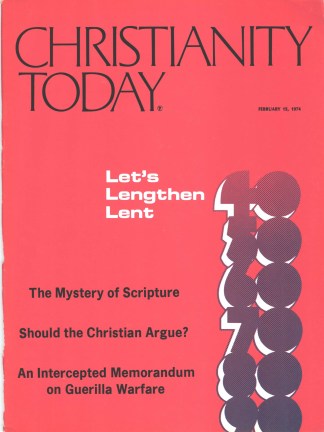
Theology

Let’s Lengthen Lent

Relating the Spirit to the season.

The approach of the Lenten season brings a furrow to the evangelical brow. What are we to do with it? For congregations that follow the church year there is no problem: Christians will do what they have always done. They will use Lent as a time for taking spiritual inventory. Many non-liturgical churches, by contrast, consider the forty days before Easter to be no holier than any other time of year. For them an Ash Wednesday service is simply a Wednesday-night prayer meeting.

The word “Lent” itself doesn’t help us much. It is derived from an Anglo-Saxon word meaning “to lengthen” and refers to a season when the days become longer, i.e., spring. The Oxford Dictionary of the Christian Church says that the number forty was “evidently suggested by the forty days’ fasts of Moses, Elijah, and especially our Lord himself.”

Since the fourth century A.D. the Church has generally observed Lent as a time of fasting, of inner examination, of abstaining from festivities, of alms-giving, and of more strict attendance at worship. The first break in Lenten observance in Europe may have occurred in 1522 when Ulrich Zwingli sided with certain Zurich printers who insisted they had to have something more invigorating to eat than fish on Fridays to carry out their duties. In the years since, dispensations have gradually eroded the discipline of the holy season in the traditional churches. Virtually all dietary requirements have been lifted in quite recent times. At the same time pre-Lenten festivals such as the Mardi Gras have turned into bacchanales that have become a reproach to civilization.

So what do we do? Observe Lent or ignore it? Follow the disciplines or celebrate our Reformation heritage by doing what we please—including staying at home and watching television?

For the answer we must turn to the Scriptures themselves. If I read my New Testament correctly, the whole life of the believer is to be lived in the power of the Spirit. Once the Paraclete takes command of our lives, once he personally fills us with the love of God, there is no further need to be troubled about Lent. Or about Pentecost, or Christmas, or Easter, or any other “special day” or “days” on the church calendar. We can attend stated services or not attend; fast or not fast; kneel or not kneel. We are free to do as the Holy Spirit directs, in the light of Scripture.

The real challenge facing the believer is not, therefore, “What shall I give up for Lent?” but rather, “How can I be filled with the Spirit?” Perhaps that sounds too simplistic. The New Testament quite often comes across that way.

In one of his letters Brother Lawrence (Nicholas Herman) writes:

It is a great delusion to think that the times of prayer ought to differ from other times; we are as strictly obliged to adhere to God by action in the time of action as by prayer in the season of prayer.… I made this my business as much all the day long as at the appointed time of prayer; for at all times, every hour, every minute, even in the height of my business, I drove away from my mind everything that was capable of interrupting my thought of God. As for my set hours of prayer, they are only a continuation of the same exercise.

Undoubtedly the leaders of the fourth-century church devised the Lenten church to honor our Lord in the period preceding Holy Week. One cannot fault their motive, and certainly one can only admire the discipline that resulted. Yet it is with an equally sound motive that the Apostle Paul warns the Galatian Christians against observing “days, and months, and times, and years.” He is standing in the great tradition of the Prophet Isaiah, who thundered, “To what purpose is the multitude of your sacrifices unto me? saith the LORD.… Bring no more vain oblations” (Isa. 1:11, 13).

Jesus Christ became incarnate to set men free, and he died on the cross to accomplish that deliverance. He sent his Spirit into his Church to sustain believers in that freedom. The letter of the law kills; the Spirit gives life. Unless the Spirit is in command, nobody keeps Lent. God has no more use for a traditionalist with a vindictive heart than for an evangelical who considers himself past the need to confess anything. Yet wherever Spirit-filled Christians have surfaced, the true Church has recognized them and honored them for their love.

So far we are on biblical ground, but before we write off a custom that has been followed in the Church for centuries perhaps we ought to look again. Do Spirit-filled Christians need to look into their personal lives? Of course they do. We all become careless. We all tend to forget our obligations and to ignore those we should be remembering. We all need a fresh look at the cross.

So what shall we do with Lent? One place to begin might be with our Lord’s instruction to his disciples that “they should not depart from Jerusalem, but wait for the promise of the Father.” We could consider Lent a time of waiting to get our priorities in order. Then we could move to the Apostle Paul’s injunction, “Be filled with the Spirit!” If we approach it in this fashion, Lent can become a beautiful and deeply moving experience of walking spiritually with Jesus on his pilgrimage to the cross. For as John tells us, he went to the cross not only to bear our sin but that he might send us his Spirit.

Whether we keep the specific observances or not depends on many contingent factors—some of them personal, some related to background and upbringing. I need Lent. I hope to be in my church on Ash Wednesday as a worshiper. As Brother Lawrence suggests, what really matters is not our prayers but Jesus. He keeps us in a round-robin inventory. He takes our Lent, lengthens it, and makes it a blessing all the year around.

Editor’s Note from February 15, 1974

Our interview with Billy Graham on Watergate (January 4 issue) has, at this writing, been quoted in newspapers having a circulation in excess of 25 million. The response has, predictably, ranged from passionate assertions that Mr. Nixon can do no wrong to heated avowals that he can do no right.

The next issue, March 1, is our book issue, with comprehensive surveys of the 1973 crop of religious books. It will also have a penetrating essay on Thomas Aquinas, who died 700 years ago this March. CHRISTIANITY TODAY is sponsoring a Christo Awards Competition to encourage excellence in religious advertising and will give three prizes for the best advertisements in the book issue. The judges are professionals, but I would like to get opinions from our readers also. A ballot box in that issue will enable you to tell me which three advertisements please you the most. And you can check your opinion against that of the judges when their decision is announced.

My book The World, the Flesh, and the Devil has gone into a second printing. It has a chapter on the Devil, a personage of increasing interest to people because of The Exorcist.

Theology

A Church Without Theology

The only theology we in Latin America are acquainted with is that which we have inherited from a reflection foreign to our own situation.

A few months ago, after a visit to Latin America, an American theologian reported that a number of professors at a well-known evangelical seminary there had adopted the “theology of liberation.” He might well have added that by default on the part of evangelical theology the whole church in this part of the world is fertile soil for any theology attempting to take life in a revolutionary situation seriously.

To understand the problem one must first realize that the Latin American church is a church without theology. To be sure, a theology is always implicit in the communication of the Gospel, even on the most elementary level. Furthermore, it must not be assumed that the only theology deserving of the name is speculative theology. In stating that the Church in Latin America is a church without theology, I am neither denying the existence of an “implicit theology” nor lamenting the absence of speculative theology. The statement has meaning only within a deeper analysis of the function of theology in the life and mission of the Church. It points to a failure of the Church to think on the significance of God’s revelation here and now, and on its implications for the Christian mission in a concrete situation. To be more exact, we might say that the Church in Latin America is a church without theological reflection of its own.

A quick look at the curriculum in the majority of seminaries and Bible schools, at the preaching and the liturgy in the churches, and at the literature in Christian bookstores throughout Latin America would suffice to show that our “theological dependence” is just as real and as serious as the economic dependence of the countries of the Third World.

This absence of theological reflection is seen in every aspect of the life and mission of the Church. The only theology we are acquainted with is that which we have inherited from a reflection foreign to our own situation—a collection of concepts little related to the questions that our own world poses to the Christian life.

The consequences of this regrettable theological deficit can hardly be exaggerated. I will mention three:

1. The lack of an incarnation of the Gospel in the Latin American culture. True, the Gospel cannot be one thing here and another one there. It has been given “once for all,” and the proclamation of it is faithful in the degree to which that proclamation manifests the permanence of the revealed data in whatever geographical location it is made. One of the roles of theology, however, is to show the relevance of biblical revelation to every culture. If theology fails in this respect, the Word of God is a logos asarkos, a message that will touch life only on a tangent. This is one of the most tragic consequences of the lack of theological reflection in the Church in Latin America—that the Gospel still has a foreign sound, or no sound at all, in relation to many of the dreams and anxieties, problems and questions, values and customs of life in this part of the world.

2. The inability of the Church to cope with the ideologies of the day. A church without theology is a church without criteria to evaluate the answers of the ideologies to the problems of society. The result is that the Church conforms to contemporary circumstances and becomes a guardian of the status quo; or else it lets itself be conditioned by propaganda in favor of change and becomes an instrument of the ideologies of the day. I believe that in this area lies the greatest danger of a “church of the masses” with no theological reflection, such as the Church in Latin America, at this moment of history—the danger of letting itself be carried about by whatever winds happen to blow, with no criteria to discern the demands of the Gospel in its own situation.

The seriousness of this plight is illustrated by many young people reared in Christian homes and churches who, once they begin to consider their responsibility in the face of social injustice, find themselves unable to answer the arguments of their Marxist friends and either compromise with Marxism or take flight into an individualistic Christianity marked by political conservatism. There is an urgent need for a biblical framework that will help Christians to evaluate the different interpretations of the historical situation (or to change it!), without falling into the sanctification of either leftist or rightist ideologies.

3. The loss of second-and third-generation Christians. This is a common phenomenon. I have seen it all over Latin America. Many young people who were brought up in Christian homes now have nothing to do with the Gospel. One of the many “sociologists” who are studying the “fabulous growth of the Church in Latin America” nowadays could render an invaluable service to the cause of Christ by including a survey not only of those who enter the Church but also of those who leave it. I suspect this study would show that the number of young second-and third-generation “Christians” who have left the Church in the last decade is well up in the thousands and that in most cases the reason was the absence of a sound biblical basis and of an understanding of Christianity’s wider dimensions.

The young person whose biblical knowledge never gets beyond Sunday-school level sooner or later finds that his Christian system breaks, that his faith lacks a basis strong enough to sustain the weight of objections raised by life in contemporary society. It is not really surprising that many of the guerrilla leaders in some Latin American countries are from Christian homes! What the Church was unable to give them in terms of a purpose in life and a perspective from which to understand the historical process, they have found in a secular ideal that in the end destroys their “inherited faith.”

The foregoing analysis of the situation provides the context for understanding the wide appeal that the “theology of liberation” has for Christians in Latin America. A church characterized by a one-sided emphasis on the preaching of the Gospel and the multiplication of members is easily carried about by every wind of doctrine. If the theological situation of the Church in Latin America proves anything, it proves that theological reflection is not a commodity but an essential part of the life and mission of the Church.

‘Urbana East’: Asians Consider Asia

While more than 14,000 Christian students gathered at Urbana, Illinois, at the turn of the year to discuss foreign missionary work (see January 18 issue, page 41), nearly 800 students and graduates from twenty-four nations assembled in Baguio City in the mountains north of Manila to do the same thing.

“Missions are no longer the monopoly of Western Christians. Asians have not sold their birthright,” declared Harvey T. Co Chien, general secretary of InterVarsity Christian Fellowship of the Philippines (IVCFP), to the delegates, three-fourths of them Filipinos.

The Urbana-style event—the first Asian Student Missionary Convention—was sponsored by the International Fellowship of Evangelical Students and IVCFP. It was called to challenge and recruit Asian students to become missionaries, especially to other Asians. By the end of the convention some 250 said they were willing to go—as full-time career missionaries—or at least to pray seriously about it. Volunteers were referred to sending agencies.

In addition to plenary sessions, there were thirty-six seminars that focused on individual Asian nations and how to reach them. They were led mostly by Asian graduates. Daily Bible-study sessions dealt with the biblical basis of missions, and the spiritual needs of Asian countries were prime topics at nightly prayer meetings.

Co Chien in his keynote address blamed Western missionary paternalism, colonial identity, and misconceptions for the scarcity of Asian missionaries. (He roughly estimated that only 1,125 Asian missionaries have been sent to work among the more than two billion Asians, a ratio of 1 to 1.9 million.) The church in the Third World is now acutely embarrassed by any past associations with Western colonialism and imperialism, he asserted, adding, “This reaction has an important backlash on Asians going forth confidently as Christ’s ambassadors.”

Further, Co Chien alleged, Western missionaries for the most part had not adequately encouraged and challenged Asian Christians to spread the Gospel abroad. He went on to suggest possible solutions to recruiting and to the financial, racial, and cultural tensions that exist.

Filipino pastor Jonathan E. Parreno called on the Asian church to adopt a system of theology that fits the East, especially in relation to materialism, Communism, and Asia’s syncretistic and pluralistic religions. He cautioned students about enrollment in a seminary in the West, implying they might suffer cultural disorientation as a result. The churches back home have different needs from those in the West, he suggested. Also, he warned, living for a time in an affluent society tends to cultivate a credibility gap among those one must face when he returns home.

Despite all the emphasis on national identity, a warm sense of unity was evident as cables of greetings were exchanged with the students assembled at Urbana. Some 8,000 miles separated them, but they were clearly bound together in the reality behind the Baguio City convention theme—“One Lord, One People, One Task.”

South Korea: Church Crisis Coming?

South Korean church leaders face imprisonment if they persist with others in demanding restoration of former constitutional guarantees.

That is the message inherent in two “emergency measures” invoked by President Park Chung Hee. The measures provide for arrest, court-martial, and imprisonment of anyone criticizing the constitution or advocating its revision. (The old constitution was scrapped under martial law in 1972 and replaced by one giving President Park vast powers and enabling him to stay in office for life. It also curbed certain civil liberties.)

Prior to announcement of the new measures, Cardinal Stephen Sou Hwan Kim of Seoul, leader of South Korea’s Catholics, and General Secretary Kim Kwan Suk of the (Protestant) National Council of Churches had joined with thirteen other prominent national figures calling for constitutional reform and restoration of “genuine democracy” before “a grave national crisis” occurs. Also, many pastors had preached on the topic.

Clearly, a national crisis is shaping up that may severely affect the Church in an era of unprecedented growth and evangelistic outreach.

Mission To Big Business

Since last year some of this country’s major denominations have increased their activity in what has become—in the minds of some leaders—a new and growing part of the Church’s mission.

The Church Project on United States Investments in Southern Africa has asked twenty companies to disclose details of their activities in the apartheid-dominated area of Africa. Membership in the organization has increased to nine denominational agencies (American Baptist, United Presbyterian, United Church of Christ, United Methodist, Episcopal, Reformed Church in America, Christian Church [Disciples of Christ], Unitarian Universalist, and Roman Catholic), plus the National Council of Churches.

The agencies own stock in the companies and therefore are able to introduce requests, resolutions, and even challenges at meetings of stockholders. While most corporations arrive at these meetings with a majority of proxy votes already in their pockets, United Presbyterian executive Donald Wilson, who chairs the project, thinks the effort nevertheless is making corporation executives more sensitive to the issues.

The churches want to ensure that corporate profits don’t support colonial regimes and that blacks are treated justly in employment practices. At least one company, International Harvester, voluntarily released the requested information. Other companies to receive resolutions include Bethlehem Steel, Getty Oil, Phillips Petroleum, Colgate Palmolive, Chrysler, and Gillette. Leaders of the movement say they will withdraw requests as companies fill them.

Making (Air) Waves

The Portsmouth, Virginia-based Christian Broadcasting Network has been making waves in recent weeks.

Since Christmas, CBN (see March 17, 1972, issue, page 40, and August 31, 1973, issue, page 46) has arranged to buy a television station in Seattle, Washington (its fifth owned and operated TV facility) and has added four affiliate stations. It is completing arrangements for a fifth affiliate. It is also constructing a station in Boston, with start-up time scheduled for this fall.

The Seattle purchase, subject to Federal Communications Commission approval, involves station KTVW, Channel 13, obtained by CBN for an estimated $3 million.

New affiliates are WDCA, Channel 20, in Washington, D. C., which will broadcast sixteen hours of CBN programming weekly; WPGH, Channel 13, in Pittsburgh, twenty-one hours; and also stations WSNS, Channel 44, in Chicago, and WANC, Channel 21, in Asheville, North Carolina, each with sixteen hours weekly, CBN affiliates now number eighteen. Negotiations are underway to service WOPC, Channel 38, in Altoona, Pennsylvania. Several other stations carry CBN’s programs also.

• In addition CBN operates five FM radio stations and provides programming for a number of others. Founder-director Pat Robertson is also interested in expanding internationally; he has been dickering with the government of Cyprus for permission to build a radio station that will beam programs into the Middle East.

Late last month at its annual meeting in Washington, D. C., the National Religious Broadcasters accorded CBN a “Best Stations of 1973” award for excellence of programming in its joint radio-television operation.

Cocu: Test Patterns

Nearly two dozen local ecumenical church groups around the country have been identified by the Consultation on Church Union (COCU) as possible candidates for living together COCU style. As many as ten of them are expected to enter into a three-year “covenant” with COCU by April 1. What is learned from the experiences of these test “generating communities” may then contribute significantly to the final structural form of union that COCU proposes to its member denominations (there are nine at present).

The decision to study was made at COCU’s plenary meeting last year (see April 27, 1973, issue, page 40), when COCU tabled its controversial plan of union in response to grass-roots fears and disagreement.

COCU says the groups it has found, ranging from Hawaii to Massachusetts, are engaged in deeper than usual interchurch cooperation. Some hold common worship services or share staff, facilities, or Communion, or conduct joint social projects.

COCU hopes to elicit from participating groups an agreement to emphasize such “key elements” as regular joint communion; preservation of “some of the richness” of the denominational heritages with openness to the heritages of others; inclusiveness in race, age, sex, culture, and economic class; flexibility; affirmation of ministry of the laity as well as clergy; and foundation on historic faith and Scriptures “but encouragement of contemporary expressions as well.”

The next plenary meeting will be held in November in Cincinnati. Meanwhile, COCU’s executive committee has okayed a 1974 budget of $140,800 for its operations.

OUR KIND OF PLACE

Jenison, Michigan (population: 20,000, largely of Dutch stock), is on the map at last. Of the more than 3,500 McDonald’s hamburger establishments in the world, Jenison’s is the only one that is closed on Sunday, according to hamburger officialdom.

During construction of the restaurant last year, area ministers of several denominations (but principally Christian Reformed and Reformed Church in America) petitioned McDonald’s Chicago headquarters people, requesting that they conform to Jenison’s closed-on-Sundays tradition. McDonald’s agreed to go along with the you-deserve-a-break-today idea.

The restaurant opened its doors at year’s end with a special breakfast for area pastors and local government officials—a sort of Egg McMuffin prayer breakfast.

BRUCE BUURSMA

Victory In Victoria

Playboy magazine ran into religious snags both at home and abroad last month.

In Victoria, Texas (population: 50,000), a citizens-for-decency movement led by Church of Christ minister-turned-writer Neil Gallagher, 32, succeeded in removing Playboy and a number of “offensive” magazines from most of the sales racks in town. The campaign included meetings with city officials, newspaper ads, handbills, and—perhaps most tellingly—a threatened boycott against merchants who sold the magazines. Gallagher, who is working toward a doctorate in philosophy, said in an interview that the bare minimum for blacklisting of magazines is the depiction of frontal nudity. At last word, a Playboy lawyer was looking into the situation. (A few months ago Gallagher’s 250-member group successfully rid its city of X-rated movies.)

Frontline Israeli troops will also have to get along without the magazine. The wife of Israeli president Ephraim Katzir, with the assistance of U. S. ambassador Kenneth B. Keating, had made arrangements to send 3,000 copies to the troops. But the Union of Immigrant Rabbis of Western Countries halted the plan. Said Rabbi Alexander Carlebach, the union’s chairman: “[Playboy] is not the appropriate gift for Jewish soldiers on Hanukkah, the festival which commemorates Jewish triumph over heathen practices.”

Nixon And The Church

Some Quakers are campaigning to strip President Nixon of his church membership. But the California “meeting” to which he has belonged for many years apparently has no intention of dropping him from its roll.

“We feel he has been convicted in the minds of many before the evidence is all in,” said T. Eugene Coffin, minister of East Whittier Friends Church.

The issue was brought to a head following appearance of an article by Milton Mayer in the Christian Century last October. Mayer listed some grounds on which “Friend Nixon might be had up.”

A reply from Coffin, also published by the Century, maintained that “the Christian fellowship is not an exclusive club trying to maintain a certain status by its own effort, but is a caring community which refuses to abandon those in trouble and seeks to restore rather than destroy, heal rather than hurt, reconcile rather than divide, and accepts the risks involved. It is in this spirit that we regard the membership of Richard M. Nixon, President of the United States, and all other members of East Whittier Friends Church.”

Coffin said Nixon’s membership was questioned at the time of the “Cambodian Incursion.” The Ministry and Counsel Committee considered the concerns prayerfully, he reported, “and replied that it would be an un-Christian act to drop his membership and that the role of a Meeting should be one of prayerful support and counsel.”

Some Friends are also working to get Nixon out of the White House. At least twenty meetings are reported to have formally acted to call for impeachment or resignation of the President.

Nixon has not visited the Whittier church for some time. During his stay in San Clemente at the turn of the year he attended a worship service at a Presbyterian church.

Nevertheless, said Coffin in an interview, Nixon has “regularly communicated” with the 500-member East Whittier church (the communications include contributions that were not listed in the President’s financial statement made public recently), thereby maintaining his status as an active non-resident member. Coffin has also preached at the White House. Nixon, in one of his latest letters to Coffin, expressed appreciation for his response to the Century article. As for the Quaker meetings that want Nixon out, “they are only twenty out of 1,000,” says Coffin. The latest tape-erasure charges and other developments have not changed Coffin’s mind about his or the church’s pastoral attitude and responsibility to the President: “It remains the same as it would toward any of our members in trouble.”

When in Florida, Nixon sometimes attends the Key Biscayne Presbyterian Church, where the Reverend Stephen Brown recently succeeded the Reverend John Huffman as pastor. Huffman now is pastor of First Presbyterian Church in Pittsburgh. Brown, from Quincy, Massachusetts, birthplace of the second and sixth American Presidents, says he preaches expository sermons in a systematic sequence and won’t direct his messages at the President.

Religion In Transit

Ohio’s oldest woman, Mary E. “Mother” Silver, pastor of Little Zion Holiness Church in Springfield, died last month at age 116. She reputedly began preaching at age 7 to sharecroppers in North Carolina, going on to preach in every state and Canada over the next century.

Are they married or not? Hundreds of marriages performed in New York City were conducted by bogus clergy, say authorities after months of investigation. City clerk Herman Katz, whose office processes some 80,000 marriage licenses yearly, has “remarried” some of the couples involved (the courts may have to decide the legality of others) and ordered the phonies to stop.

Under a recently signed agreement the U. S. Navy will use the Seventh-day Adventist Church’s “Five-Day Plan to Stop Smoking” in offering help to personnel who want to kick the habit. Adventists say the plan, consisting of five consecutive group-therapy sessions, has been used in more than 100 countries and has proved effective for 75 per cent of the smokers who enrolled.

The American Board of Missions to the Jews dropped its impending law suit against WPIX-TV in New York after the station agreed to air a thirty-minute debate between a rabbi and an ABMJ spokesman. The legal action grew out of the station’s cancellation last April of the ABMJ-sponsored special, “Les Crane Reports on Jews for Jesus.”

That dispute between Rabbi Irving J. Block and United Presbyterian pastor William Glenesk, whose congregations have shared the same Presbyterian-owned building in New York’s Greenwich Village since 1954, is still on. Block accuses Glenesk of bigotry, and now he wants the New York Presbytery to take action against its man. As matters stand, if Glenesk stays, Block’s flock will not.

DEATHS

RALPH FREED, 81, veteran Christian and Missionary Alliance missionary and general director of Trans World Radio, the international Christian broadcasting organization; in Monte Carlo, of a heart attack.

C. HUGH WHITTEKER, 73, Canadian Lutheran who served as the first president of the Lutheran Church in America-Canada Section (1963–1969); in Bridgewater, Nova Scotia, of a heart attack.

Wisconsin governor Patrick J. Lucey approved legislation to permit bingo games for charitable, non-profit organizations in the state.

Free-lance Detroit reporter Patrick T. Halley, 23, is suing Guru Maharaj Jifor $1 million. Halley was beaten up and his skull fractured by several of the teenage guru’s followers after he threw a pie in the guru’s face.

Concordia College, a 2,500-student American Lutheran Church school in Moorhead, Minnesota, is the scene of a bitter collision between urban black students (there are seventy-five blacks on campus) and many rural and small-town whites, according to a Minneapolis Star story. Intramural touch football and basketball games between black and white teams ended in slugging matches. President Joseph Knutson and student-body president Eric Fontaine, 21, a black senior from Washington, D. C., are trying to cool it.

New: The Disciple, bi-weekly successor to The Christian (a weekly) and World Call (a monthly) of the Christian Church (Disciples of Christ).

In response to queries from reporter Edward B. Fiske of the New York Times,evangelist Billy Graham said he gives between 10 and 15 per cent of his gross income to non-profit organizations. On another front, Graham and his beliefs were treated rather favorably in a new book, A Catholic Looks at Billy Graham, by Jesuit Charles W. Dullea, former president of the University of San Francisco who is now superior of the Pontifical Biblical Institute in Rome.

Catholic University of America in Washington, D. C., sold a thirty-six-acre tract of land, described as the city’s largest privately owned parcel, to a housing developer “to pay off debts and pay back salaries [and] to stave off bankruptcy,” according to school officials.

Isn’t It Good to Know, the latest color film from World Wide Pictures, took top honors among religious theme entries in the annual International Film and Television Festival of New York.

Mrs. Joyce Stedge, 47, a mother of six who graduated from New York’s Union Seminary, was ordained as the first woman minister in the Reformed Church in America. She is pastor of an RCA church in Accord, New York.

Southern Baptists have launched a $20 million fund-raising drive to help finance their denomination’s $42.6 million foreign missions budget for 1974.

Birth: The Southern Baptist Journal, described by its sponsor—the Baptist Faith and Message Fellowship—as the first national news journal of Southern Baptists. Former Southern Baptist Convention evangelism staffer William A. Powell is editor. The Fellowship was organized a few months ago to stress biblical infallibility, missions, and evangelism in the denomination, and to provide “a conventionwide free press.”

Southern Baptist membership is estimated to have reached 12,274,000 in 1973, with total receipts pegged at $1.2 billion.

The predominantly black Church of God in Christ is organizing a system of Bible schools (to be known as the C. H. Mason Bible colleges) to train its ministers. Schools already operating in Chicago, New York, Philadelphia, and other cities offer graduate-level studies even for those without high school diplomas.

Catholic bishop James W. Malone of Youngstown, Ohio, was elected president of the Ohio Council of Churches by the council’s 181-member assembly.

Almost $20 million in three years has been given by the Catholic Church’s domestic anti-poverty program to more than 500 self-help projects.

The Hymn Society of America (475 Riverside Drive, New York City 10027) is seeking new hymns by this June to commemorate the nation’s bicentennial anniversary in 1976.

Personalia

Theologian Clark H. Pinnock of Trinity seminary (Deerfield, Illinois) has been named to head Theological Students Fellowship, a new branch of Inter-Varsity Christian Fellowship, as a member of IVCF’s associate staff.

Physics professor Thomas G. Barnes of the University of Texas at El Paso was elected president of the ten-year-old Creation Society, a group of 400 scientists with master’s or doctor’s degrees who advocate that the biblical version of creation is correct. Barnes, citing the rate of decay of Earth’s magnetic field, believes the world may be less than 10,000 years old.

After Secretary of State Henry A. Kissinger, evangelist Billy Graham is the man the American people admire most in the world today, according to the latest annual Gallup Poll. Kissinger superseded President Nixon, who dropped to third. Graham has placed second several years in a row.

Among the new board members of the Billy Graham Evangelistic Association: Dr. John Wesley Williams, black Kansas City pastor, a leader in state and national units of the National Baptist Convention of America, host for the first national Black Congress on Evangelism (1970), a past vice-president of the National Council of Churches, and a civil-rights marcher.

Little Rock, Arkansas, native Thomas Lee York, 33, now a United Church of Canada clergyman studying and teaching at Tulane University in New Orleans, was sentenced to three years in prison for failing to tell his draft board where he was after he left for Canada in 1963. Maintaining his innocence, he surrendered last summer.

World Scene

An international charismatic conference on the Holy Spirit will be held in Jerusalem in March. Organizers say nearly 3,000 have signed up for the event, sponsored by Logos magazine.

Polish authorities have ordered Verum, a Catholic publishing house, to close within three months. No reason was given. The firm, founded less than two years ago by lay leader Andrezej Micewski, has sold some 80,000 copies of history and religious-education books. Another Catholic publisher was ordered to cease its publication of religious news for priests.

Diplomatic sources say the Soviet Union permitted 34,750 Jews to emigrate to Israel in 1973, 3,200 more than in 1972.

The world’s Jewish population stands at 14.3 million, according to the American Jewish Year Book. Most live in the United States (6.1 million), Israel (2.7 million), and the Soviet Union (2.6 million). The largest communities are found in the New York area (2.3 million), Los Angeles (535,000), Tel Aviv

(394,000), Philadelphia (325,000), Paris (300,000), and Moscow (285,000).

Date: Japan Congress on Evangelism, June 3–7 in Kyoto. Chairman: Nakaichi Ando, president, Japan Evangelical Association. Attendance: 1,000-plus.

Missionary sources report that South Vietnamese Bible-school students recently engaged in a week of intensive evangelism among the 1,000 Stieng (Montagnard) tribesmen who have been resettled midway between Saigon and Dalat. Some 1,400 professed Christ, they say, bringing the Stieng Christian population to 5,000. Most have been converted since the North Vietnamese invasion in April, 1972.

It was a bleak year for Catholics in France. Enrollments in Catholic seminaries dropped from 289 to 210, and only five priests were ordained in the Paris area in all of 1973. A dozen parishes are experimenting with lay-led but sometimes clergy-opposed religious assemblies dubbed “The Celebration of the Message.” Serious dissension exists between traditionalists and reformists in clergy ranks. (Traditionalist priest Georges de Nantes, leader of the Catholic counter-reform movement, even lodged charges of heresy and schism against Pope Paul.)

A new Protestant-produced translation of the Bible, twenty years in the making, will soon roll off the presses in Hungary, if all goes according to schedule. Meanwhile, a 1,200-page expository and introductory guide, written by twenty-six scholars and billed as “the first complete commentary based on agreed principles that has ever been published in the Reformed Church of Hungary,” was completed and printed.

Cover-up: Anglican dean Harold Circh-low of St. Michael’s Cathedral in Bridgeton, Barbados, has banned halter-style dresses from services and is keeping a supply of capes on hand for women who show up with bare backs.

Catholic influence in Spain’s government was dealt a blow when new prime minister Carlos Arias last month excluded long-dominant Opus Dei figures from his cabinet. Opus Dei is a secretive Catholic lay society whose members have been highly prominent in politics and business for years. Most of the Catholic hierarchy endorsed the move, however, because of Opus Dei’s involvement in recent financial scandals.

Emmaus Bible Correspondence School of Oak Park, Illinois, unofficially related to the Plymouth Brethren assemblies, circulates correspondence courses in 120 languages. They are administered by 160 regional directors in 95 countries. Last year more than 122,000 courses were completed. More than 1.8 million courses have been completed out of 6 million initiated since the school was founded about 30 years ago.

More than 400 religious sects are registered in Indonesia, a predominantly Muslim country that officially recognizes only the Muslim, Catholic, Protestant, Hindu, and Confucian faiths.

The small Baptist congregation in the Mexican village of Miahuatlan, near Oaxaca, has launched thirty-six missions and is baptizing scores of villagers. The missions are in area villages where reportedly at least one member of every family has been baptized. Many of the missions will become churches.

Bangladesh: ‘Two Years of Heaven and Hell’

Bangladesh, formerly East Pakistan, in December observed its second anniversary as an independent nation.CHRISTIANITY TODAYreported the religious situation as its existed amid the hunger, confusion, and bloodshed that accompanied the nation’s birth (see February 4, 1972, issue, page 32). The following is an update based on reports by correspondents Phil Parshall and Mrs. Pip Land and on interviews with mission sources.

Bangladesh’s second birthday found the country’s minute minority of 75,000 Protestant Christians struggling to develop a solid identity and to increase numerically. The missionary force had grown substantially since the civil war days of 1971, new churches had been organized, and pockets of remarkable receptivity to the Christian message were evident.

The Churches of God mission in Bogra baptized more than 150 Bengalis last year. More than 3,500 conversions among the animistic tribespeople in the Rajshahi and Dinajpur districts have been reported over the past twenty months. Requests for Christian teaching have come from a community of 6,000 Hindus in a remote part of the land. For the first time there are believers in the 40,000-member Mogh tribe south of Chittagong, thanks to the ministry of the “Bangladesh Brigade,” a group of twenty-four Wheaton College students and adult workers. Revival has come to churches in Chandpur and Comilla.

British Baptist missionary Gwyn Lewis, who in his fourteen years in the area had never before had any direct converts, reported 110 baptisms in a four-month period last year at Dinajpur. Several new churches have been organized as a result, and others are planned. He and pastors of Bangalee churches founded years ago have been swamped with requests from Hindu farmers for instruction in the Christian faith.

“It looks like the Lord is giving us a second chance,” says Lewis. He was referring to the vain attempt to get the nation’s churches together for a unified evangelistic thrust in the late sixties.

Yet a number of churches remain relatively closed to the winds of spiritual change. Missionaries and Bangalee pastors cite jealousy, organizational differences, and lack of initiative and evangelistic zeal.

One of the persons most anxious for the churches to experience an awakening is Garo tribesman Subhash Sangma, secretary of the National Christian Council, one of Bangladesh’s leading evangelists, and a convener of the upcoming Lausanne congress on world evangelization: (Australian Baptist work among the Garos has thrived; there are more than 100 Garo churches.) Sangma believes more evangelistic missionaries are needed in his land, and he wants their work—and that of missionaries already on the field—to be fully integrated with the work and programs of the churches. His sentiment is typical of the feelings of church leaders in lands where churches are developing a national identity. But it is at this point that some missionaries experience frustrations and tension. “Must we wait for the church to take the opportunities, or do we get on with the job ourselves?” asked one.

BANGLADESH IN BRIEF

With some 75 million inhabitants, Bangladesh is the world’s eighth most populous nation and one of its most densely peopled: nearly 1,500 per square mile. It is also one of the world’s poorest lands. Annual per capita income may be less than $50, and only massive injections of aid keep the country going. In its first year it received more than $1.3 billion in outside help (the United States gave $347 million, India $248 million, and the Soviet Union $132 million). Only a third of the population is literate.

Much of the land is delta territory for five rivers. In 1970 a cyclone driven by 150 mph winds slammed ashore, causing hundreds of thousands of deaths and untold destruction. Many more perished and millions were uprooted in the nine months of civil war in 1971. Looting and arson were widespread. The monsoon rains failed in 1972, a staggering blow to the farmers, who account for 60 per cent of the nation’s economy. Sheikh Mujiber Rahman, the popular Muslim head of state, predicts his country will be able to feed itself within the next four years or so.

About 86 per cent of the people are Muslims; the majority of the others are Hindus. Catholics have about 60 churches, 85 foreign missionaries, and 300 national workers, including four bishops. There are some 200 Protestant missionaries from nearly a dozen nations. (Other statistics were still being processed last month.) Protestant work in the land, then East Bengal, was pioneered in 1815 by British Baptist missionary William Ward, who traveled to India with “the father of modern missions,” Baptist William Carey. So far, the present government is friendly toward the missionaries, especially those engaged in medical, relief, and agricultural work, and nation-building is on the agenda of the churches.

Britain ruled the area until 1947 when East Bengal curiously became part of the Muslim state of Pakistan, the two segments divided by 1,500 miles. In 1971 the distance—and differences—became too great, and with an assist from India East Pakistan battled its way to independence and a name change (“Bangladesh” means “Bengal state”).

Meanwhile, the work is going on. Several Bible schools are training nationals for full-time ministry. Mission and para-mission groups are becoming more involved in evangelism. The Bangladesh Bible Correspondence School, operated by the International Christian Fellowship mission, processes more than 14,000 evangelistically slanted lesson papers each month. Thousands more are being processed in a similar program by International Correspondence Institute, sponsored by the Assemblies of God.

The Bangladesh Bible Society has set as a goal the distribution of 1 million Scripture portions this year, an increase of nearly 100 per cent over 1973, and a number of other groups are extensively involved in literature projects. For example, new translations of the Bible into two common languages of the land are being spearheaded by the Philadelphia-based Association of Baptists for World Evangelism (ABWE), which has fielded the largest Protestant missionary force in Bangladesh. Looted libraries are being replaced.

ABWE is also heavily involved in medical work. Dr. Viggo Olsen tells how Shomar Das, director of music for Bangladesh radio and TV, accepted Christ as a result of contacts made when he admitted his seriously ill 11-year-old son to the ABWE hospital near Chittagong. The boy was cured, and Das gave his first Christian concert at the hospital.

Poverty and hunger abound; nearly a dozen evangelical relief agencies continue to reflect the social concern of Christians in several western countries. Churches in these lands have sent millions of dollars to help alleviate the suffering of the Bangalees.

On the one hand, spiritual breakthroughs. On the other, hardship and unspeakable need. One worker summed it up: “It’s been two years of heaven and hell.”

Humbard’s Cathedral: Supply Versus Demand

Financial woes are still plaguing TV preacher Rex Humbard and his Cathedral of Tomorrow church in Akron, Ohio.

In response to a court-ordered repayment offer to 4,000 holders of nearly $13 million sold by the Cathedral since 1959, investors have asked for more money than the Cathedral has available in its repayment fund. Published reports indicate the repayment Requests exceed $8 million; the fund has only half that much. The Cathedral had reached a settlement in November with state and federal securities agencies, agreeing to set up initially a $4 million trust fund to pay off note-holders who wanted their money back. To implement the arrangement the church agreed to pay $50,000 monthly to the fund.

Sources say that early last month the trust fund has only about $3.5 million in it and that Humbard had dickered for sizeable loans to bring it up to 50 per cent of repayment requests. The shortage means the note-holders who met the year-end deadline for requests will be paid a pro-rata share of the amount owed now and get the balance from the monthly $50,000 the church will continue to pay to the fund. The remaining note-holders must presumably wait until later for their money unless special arrangements are worked out in the interim.

Humbard and other religious leaders who sell bonds have repeatedly made a point that seems to fall on deaf ears: virtually no bank or business that leans heavily on investment capital could meet such demands as those imposed upon the Cathedral without being forced—in effect, by court action—into bankruptcy. But such demands would not have been made in the first place, regulatory officials point out, had the Cathedral registered and marketed its bonds properly and had it adequately informed and protected its investors.

Meanwhile, blaming the energy crisis but offering no details, Humbard announced on a telecast last month that television rallies in cities across the United States and Canada had been canceled. Thus another source of offerings and names for the mailing list was cut off from Humbard at least for the present. (Sources say fuel shortages at airports dictated the grounding of the church’s four-engine Viscount prop-jet that enabled the Humbard team to meet its rally schedule.)

Humbard also told his TV audience the Cathedral had sold all its secular enterprises, including Realform Girdle Company in Brooklyn. From now on, he implied, he’ll concentrate only on the Lord’s business. That business, unlike the other operations, has been good. Humbard says he’s preached in live appearances over the past four years to 646,000 persons, of whom 80,000 made first-time decisions for Christ.

The Jesus Bowl

There was plenty of Christian visibility as the clock ran out on the football bowl season at the turn of the year. At the Orange Bowl in Miami, Bill Bright of Campus Crusade for Christ led the stadium audience in prayer over national television, and Miami (Southern) Baptist Association workers handed out Scripture portions. Testimonies of Christian players on both the Penn State and Louisiana State teams got newspaper coverage. Penn State coach Joe Paterno said he believes the Christian faith possessed by some of his players “is a good thing” and has had a beneficial influence on the entire team. (Penn State won.)

At the Cotton Bowl in Dallas it was noted that Nebraska University head coach Tom Osborne, five of his coaches, and fifteen players attended a pre-game worship service. All six coaches are known on the NU campus as committed Christians. Two of them helped spark the formation of fifteen Bible-study groups on campus. Throughout the season, Southern Baptist campus worker Brett Yohn and one of the coaches led pre-game Bible-study sessions for the team. (Nebraska defeated Texas in the Cotton Bowl, 19–3.)

Power To The British

The Evangelical Alliance (TEA) in Britain is sponsoring a continuous plan of evangelism named “Power.” It has four phases. The first fifty days, beginning with hundreds of united sunrise services on Easter, will be a time of preparation for individual church members. Three months of summer evangelism will follow. After this churches will examine their own structures and effectiveness, drawing up strategies for evangelism appropriate to their areas. The final phase, beginning next year, will involve local outreach to the entire community.

During the first phase the musical Come Together, written and directed by Californian Jimmy Owens, will be a major feature. London’s Royal Albert Hall was packed for a recent two-night stand of the musical.

“Power” grew out of the general reawakening of interest in mission and evangelism, according to TEA spokesmen. TEA invited a large number of representative evangelical leaders to two meetings in the summer and autumn of 1972. Out of those meetings emerged an executive committee, with the Reverend John Bird as Power’s director. There has been no major promotional campaign for Power. Ministers and church leaders are being approached on a personal basis. The hope is that in this way more than 1,000 men and women strategically placed in major towns will help to make Power known.

Already more than 1,000 people have become Power partners, 300 have enrolled as prayer supporters, and about $5,000 has been given toward the projected $50,000 total cost.

Greece: Still No Peace

Peace is still a missing commodity in the Orthodox Church of Greece. The election last month of the new primate, Archbishop Seraphim, 61, sowed more seeds of dissent, and several bishops say it will result in division in the church for decades.

Seraphim was elected by a majority of the Assembly of Bishops—after the military government barred from voting twenty-nine bishops consecrated under the former primate, Archbishop Ieronymos, as well as five of the seven bishops who had elected Ieronymos in a special synod in 1967. (Ieronymos was forced to resign in December.) A few of the remaining thirty-two active bishops boycotted or walked out of the assembly in protest against the procedure, and of the twenty-eight votes cast, Seraphim won twenty. Ieronymos himself drafted a protest, but the telegraph office refused to accept it (he then sent it by mail).

Seraphim is a long-time friend of several leaders of the military junta that seized control in November, including President Phaidon Gizikis.

Books

Book Briefs: February 1, 1974

Perfect Love

A Theology of Love: The Dynamic of Wesleyanism, by Mildred Bangs Wynkoop (Beacon Hill, 1972, 372 pp., $6.95), is reviewed by Kenneth E. Jones, professor of theology, Warner Pacific College, Portland, Oregon.

The professor of theology at Trevecca Nazarene College has given us a ground-breaking study of the theology of John Wesley and his spiritual heirs. “The thesis of this book is that love is the dynamic of Wesleyanism.… Rather than Wesley representing a theology of holiness it would be more faithful to his major emphasis to call it a theology of love.” The book does not seek to set forth a systematic theology but rather to lay the foundation for one. This it does not only by studying Wesley’s thought but also by reviewing the biblical teaching, carefully defining terms, studying presuppositions, and tracing out some of the implications of this perspective in theology.

All students of John Wesley have seen that he defines holiness in terms of “perfect love,” and that he puts a major emphasis on the kind of love manifested in Jesus Christ. But the major contribution of this book is the way in which Wynkoop spells out the results, in the various aspects of theology, of making godly love—agape—central. Naturally the emphasis is on theological anthropology and soteriology. There is careful analysis of all the major ideas and words so dear to Wesleyan theologians, and an exposition of the basic presuppositions of theology—both false and true.

In all these definitions and analyses, the author seeks above all to be biblical both in terminology and in concepts, giving a biblical meaning to such basic terms as love, sin, holiness, and perfection. In so doing she clearly shows that if one accepts her basic thesis, then he must admit that some of the most common uses of these words in theology are inconsistent or unscriptural, or both. In severely criticizing certain modern forms of “Wesleyanism,” the author states that they are based on three wrong and unscriptural assumptions: “(1) the Greek versus Hebrew concept of man, (2) the substantial versus relational concept of sin, and (3) the magical versus moral concept of salvation.” Speaking particularly of the second assumption she states:

A materialistic interpretation of the self, sin, holiness, even of the Holy Spirit, robs men of a basis for an understanding of all aspects of redemption as moral relationship with God and men.… The danger is that the language of the Bible, so thoroughly and wholesomely spiritual and psychological, may be hardened by the just demands of theology into nonpersonal categories submitting to nonmoral, even magical manipulation.

In barest outline, the author concludes that holiness is a personal relationship with the holy God, initiated by him. Sin is personal rebellion against God, which shatters that relationship. Redemption is the restoration of the relationship by God. Christian perfection is not perfectionism: “perfection is not, principally, the absence of all that is less than perfect, but the presence of love with all the dynamic meaning of love.”

Non-Wesleyans may find that in reading this book they come to understand both themselves and Wesley better. All of us who consider ourselves “Wesleyan” in theology owe it to ourselves to study this book very carefully. Wynkoop challenges us to do more careful biblical exposition and to be more scriptural in terminology. She points the way out of some of the confusions and inconsistencies into which many of us have fallen at times, even while we were most earnestly seeking to be biblical. She puts the Calvinist-Wesleyan controversy in a new perspective.

It seems to me that Wynkoop has brought to this book a welcome maturity of thought. In her years of teaching theology to college and seminary students she has sharpened her terminology and hammered out her logic. Despite the sketchiness of some of the exegetical studies (probably for reasons of space), this is the fullest and most persuasive exposition of “relational” holiness theology yet published.

Diminished Usefulness

Violence: Right or Wrong?, by Peter W. Macky (Word, 1973, 210 pp., $5.95), is reviewed by Harold O. J. Brown, associate editor,CHRISTIANITY TODAY.

Violence, Macky reminds us, is an immensely complex phenomenon. He examines it from four perspectives: linguistic, behavioristic, biblical, and church historical, and on three levels: individual violence, group violence, and international violence. In a concluding chapter he proposes “The Cure for Violence,” offering suggestions for attitude, communication, education, and political and social action.

Despite his attempt to define the term clearly, Macky’s concept of violence remains elusive: he wants it to cover “establishment” and “institutional violence” as well as overt acts of personal and corporate aggression, but he addresses himself primarily to overt violence, such as war and revolution. In these areas, the book offers an impassioned restatement of the traditional views of Christian pacifism. Macky is original and creative in his suggestions for reducing violence, and many of these will be recognized as useful even by those who do not share his optimism about the non-violent resistance he advocates.

Macky’s approach to “Violence in the Bible” will not appeal to evangelicals, inasmuch as he presupposes most of the so-called results of higher criticism and, after designating as violent the policies of God pictured in the Old Testament, goes on to tell us that “it is likely that most of these atrocity stories never happened.” He is on surer ground in rejecting S. G. F. Brandon’s thesis that Jesus was a would-be revolutionary.

His approach to church history is slapdash—e.g., he describes the Jehovah’s Witnesses as one of the two best-known remaining advocates of Christian pacifism and overlooks the Mennonites. He seems unaware that some religious “pacifists,” such as the Jehovah’s Witnesses, oppose only the world’s wars, and in this resemble the religious warriors (e.g., the Münster Anabaptists), who thought they were fighting God’s war.

His approach to secular history is impressionistic. Believing that Americans see their history as a series of noble triumphs in war and that this predisposes them toward violent solutions to conflict, he reinterprets that as a sordid tale of bloody oppression and enslavement of despised racial groups. In so doing he completely overlooks the fact that this is the common experience of nations and that therefore it hardly explains what he considers a peculiar penchant for violence in the United States.

This tendency to overstate grossly a valid point also mars his views on the “gun culture.” High levels of violence in the majority community are due to the gun mystique and a selfish concern for defending their affluence; admittedly still higher levels of violence within the black community are due to white discrimination and oppression. His idea that Americans are taught to love violence and to glory in their military history may have a certain validity, but it appears näive in a world in which universal military service and the cult of military heroism are far more evident elsewhere.

In short, Macky’s historical and psychological observations are drawn more from current rhetoric than from current reality. Although he sets out to present “the arguments pro and con” on capital punishment, he begins, “As a particularly striking example of this violence against criminals which produces more social damage than their crime did, we can look at the judicial homicide commonly called capital punishment.” His subsequent conclusion that capital punishment is abhorrent will not astonish. This pronounced tendency to present strongly held partisan opinion as objective observations, combined with his low view of Scripture and his surrealistic approach to history, diminishes the book’s potential value to Christians trying to know and obey God’s will in a world of violence and conflict.

The Basis Of Canonicity

The Formation of the Christian Bible, by Hans von Campenhausen (Fortress, 1972, 342 pp., $10.95), is reviewed by F. F. Bruce, professor of biblical criticism and exegesis, University of Manchester, Manchester, England.

A work on the early history of the Christian canon of holy writ by the distinguished professor of ecclesiastical history at Heidelberg would be welcome at any time, but it is especially welcome in the present situation. Some fundamental questions about the very idea of a written canon have been posed, to the point where Professor Christopher Evans of London has asked: Is Holy Scripture Christian? (The issue that he invites his readers to face is whether the very freedom of the Gospel, to which the New Testament writings bear witness, may not be imperiled by the canonization of those writings.)

Professor von Campenhausen’s study, which first appeared in German in 1968, is a contribution to historical theology rather than to biblical introduction. He too asks fundamental questions, and gives them positive answers—answers based on historical certitude. What is implied in the Christian acceptance of a written canon, comprising first the Old Testament and then extended to include the New? How did the early Christians square their retention of the Old Testament as Holy Scripture with their conviction that the Mosaic law, or a subsantial part of it, had no binding force for Christians? (This is a more important question than we might at first blush realize; von Campenhausen devotes the first three chapters of the book to various aspects of it.) How did the concept of a New Testament canon take shape, and what were its implications for the existing Old Testament canon? What pressures led to the emergence of the complete Christian canon and what forms of resistance obstructed it? What was the outcome of these controversies and what the theological bearing of that outcome—in the early Church and today?

For the earliest Church the Bible was simply the Old Testament canon—the Old Testament canon, to be sure, understood in the light of its fulfillment by Christ. The first man to introduce a New Testament canon introduced it not as a supplement to but as a replacement for the Old Testament; that man, according to von Campenhausen, was Marcion. Here two things need to be said: one, that we must agree on our definition of “canon” in relation to the New Testament, and the other, that we must bear in mind the limitations of our knowledge of the second century.

For von Campenhausen the idea of a “canon” implies not only divine authority, not only a collection of writings invested with such authority, but such a collection that is, in theory at least, a closed collection. If before Marcion’s time a beginning had been made with the collecting of writings that were in due course to be included in the New Testament canon—such as the gospel collection and the Pauline collection—that did not yet amount to a gospel “canon” or a Pauline “canon.” If “canon” be defined in Professor von Campenhausen’s terms, then Marcion is the first man whom we know for sure to have promulgated a New Testament canon: his canon was not only a collection of Christian writings but a collection of Christian writings that, in his eyes, bore divine authority in an exclusive sense, and therefore it was a completely closed collection. It was the promulgation of Marcion’s canon that challenged churchmen who disagreed with him to promulgate the New Testament canon as they accepted it.

But while Marcion is the first man whom we know for sure to have promulgated a New Testament canon, can we be certain that none of his predecessors or contemporaries attempted such a thing? What about Valentinus? According to Tertullian, Valentinus (by contrast with Marcion) “seems to use the entire Testament (instrumentum).” Does this mean that Valentinus acknowledged the New Testament canon as a canon? The use of documents, we are reminded, need not imply their canonical recognition. Besides, von Campenhausen thinks that while Tertullian says “Valentinus,” he really means the Valentinians. Confirmation of Tertullian’s statement with reference to Valentinus himself was found by some scholars (e.g., W. C. van Unnik) when the Gospel of Truth, one of the Nag Hammadi texts, was first studied. According to Professor van Unnik, the author of the Gospel of Truth, whom he believes to have been Valentinus himself, “used practically the same books as constitute our present New Testament Canon” and “the manner in which he treats these documents proves that they had authority for him.” But von Campenhausen says that the supposed allusions to the New Testament in the Gospel of Truth “are not remotely so clear as is often alleged” and takes issue with van Unnik on this score.

The only course to follow in this situation is to examine the evidence for oneself and reach one’s own conclusions. Happily, von Campenhausen provides his readers with much as the evidence; his footnotes are replete with primary quotations, and he does his readers the courtesy of reproducing the original Greek or Latin texts, so that they are not reduced to depending on someone else’s translations. His study has thus special value for students.

NEWLY PUBLISHED

The Church and the Tribulation, by Robert H. Gundry (Zondervan, 224 pp., $5.95). Best current treatment of the post-tribulation position; the author is a Westmont professor who was raised in a staunch pre-trib environment. Pretribs should not read it if they don’t want to be disturbed, though scholars who are pretribs will doubtless be able to counter Gundry’s exegesis.

Drugs: Why Unconcerned Parents Should Be Concerned, by Walter S. Krusich and Ralph Bradbury (Moody, 112 pp., $1.95), and Drugs at My Door Step, by Art Link-letter (Word, 186 pp., $5.95). Both books call for parents to become educated to the recognition, realities, and rehabilitation of drug-users. The first is from a physician’s viewpoint and stresses detection and other medical aspects. The second is far more experiential, but does offer some practical suggestions for prevention.

Creeds of the Church, edited by John H. Leith (John Knox, 597 pp., $3.95 pb), and Assembly at Westminster, by John H. Leith (John Knox, 126 pp., $2.95 pb). The first is a reprint of a useful sampling. of creeds from earliest times to the present with introductions and comments. The second is a specific look at the Westminster confession and its influence. Both books demonstrate how creeds unavoidably define doctrines in terms of the times in which they are written.

Comparative Religion, by Michael Pye (Harper & Row, 248 pp., $5.95). A look at the similarities and dissimilarities among various religious beliefs. This is not a book on one religion after another, but rather a study of social and psychological comparisons. Rather technical in places.

The Pentecostal Reality, by J. Rodman Williams (Logos, 108 pp., $1.50 pb). Articles and lectures by a former theology professor at Austin Presbyterian Seminary who now heads the charismatic Melody-land School of Theology.

Children and Dying, by Sarah Cook (37 pp., $1.95 pb), and Caring for the Dying Patient and His Family, edited by Austin Kutscher and Michael Goldberg (72 pp., $9, $3.95 pb), both published by Health Sciences Publishing Corporation (451 Greenwich St., New York, N.Y. 10013). This publisher is bringing out many books that can be helpful to pastors and other counselors. Of course the evangelical has to draw upon other insights also.

The God I Don’t Believe In, by Juan Arias (Abbey, 200 pp., $5.95). English translation of a European best-seller. Attempts to disclose more fully the real nature of God, and refute the common images of a God figure. Readable presentation of the character of God with some interesting interpretations of Christ’s words.

Renewed Saints, by Ernest Emurian (Upper Room [1908 Grand Ave., Nashville, Tenn. 37203], 72 pp., $1). Inspirational reflections on biblical information about saints—that is, ordinary Christians.

The Bible Today Reader (Liturgical Press, 424 pp., $4.85 pb). Anthology of fifty-one essays from the first ten years of The Bible Today, a periodical designed to acquaint Catholic laymen with the Scriptures.

A Special Kind of Man, edited by Gary Warner (Creation, 236 pp., $1.95 pb). Collection of forty-four articles from The Christian Athlete.

Goals For Social Welfare: 1973–1993, edited by Harleigh Trecker (Association, 288 pp., $12). Because of the Church’s historic concern for the poor and others on society’s periphery—a concern growing out of clear biblical precepts—the profession of social work, though now secular, is one in which Christians should be particularly interested. Several prominent members of the profession discuss various aspects of its future roles and in the process give a good overview of what the vocation entails.

Faith Healing: Finger of God? or Scientific Curiosity, compiled by Claude A. Fraizer (Nelson, 192 pp., $5.95), and We Are All Healers, by Sally Hammond (Harper & Row, 272 pp., $5.95). While both deal with the experience of healing, the belief systems are drastically different. The first is the testimony of doctors from all over the country to the healing power of Jesus Christ in their patients’ lives. The second is an examination of the psychic healings taking place today through the power of mediums.

Prophetic Problems, by Clarence E. Mason, Jr. (Moody, 254 pp., $4.95). The Scofield Professor of Bible at Philadelphia College of the Bible examines various views before advocating his own on such topics as two kingdoms in Matthew, the resurrection body, the day of Christ, and Gog and Magog.

Nine Public Lectures on Important Subjects in Religion, by Nicholaus Zinzendorf (University of Iowa, 138 pp., $6.95). Translation of lectures given in 1746 by the great Moravian leader whom the editor, George Forell, calls in his introduction “the most influential German theologian between Luther and Schleiermacher.” Lengthy bibliography.

Born to Love: Transactional Analysis in the Church, by Muriel James (Addison-Wesley, 203 pp., $5.95). Psychological approach to healing a church’s problems through self understanding. Of some help but basically man centered. Sin is explained as ego assertiveness.

Contemporary Theology Series II (five volumes, Concordia, 46 to 62 pp. each, $1.95 each pb). Brief essays on abortion, ecumenicity, form criticism, the Lord’s Supper, and Marxism. One wonders why they (and the five in the first series) were not issued in one binding for a far more reasonable price.

A Man for Now, by John Beevers (Doubleday, 192 pp., $5.95), and Holy Man, by Gavan Davis (Harper & Row, 293 pp., $8.95). Both are biographies of Damien de Veuster, a Catholic priest who in the mid-1800’s voluntarily worked in a leper community in Hawaii. Facts are the same but the approaches differ considerably: the first is a typical glorification of a “saint,” the second a balanced portrayal of faults as well as virtues.

Peter in the New Testament, edited by Raymond E. Brown and others (Augsburg and Paulist, 181 pp., $1.95 pb). An attempt by a panel of eleven Lutheran and Roman Catholic scholars to agree on the place of the Lord’s “chief apostle” in the writings of the New Testament. The critical presuppositions of the book are generally those of radical biblical criticism, with only the slightest reference to the views of conservative scholars.

The Allied Occupation of Japan and Japanese Religions, by William P. Woodward (E. J. Brill [Leiden, Netherlands], 392 pp., n.p.). A somewhat mistitled record of the disestablishment of Shinto by the Supreme Commander for Allied Powers, written by the former head of the Religious Research Unit. The policies and edicts of SCAP relating to religion in Japan are dealt with fully. However, Woodward does not attempt to discuss the effect of the occupation on Japanese religion.

Pillars of Faith: Biblical Certainly in an Uncertain World, edited by Herman O. Wilson and Morris M. Womack (Baker, 280 pp., $4.95 pb). Fourteen essays by Church of Christ college professors addressing such questions as: Does the Bible have a message for modern man? Is the Bible scientifically reliable? Can faith survive in an age of doubt? Can the Bible influence man’s conduct?

Sexual Freedom and the Constitution, by Walter Barnett (University of New Mexico, 333 pp., $10). Explores and attacks certain “moral” statutes such as bans on fornication, adultery, and homosexual activity. Useful for those involved with legal procedures and principles who wish to understand an increasingly held viewpoint.

To Prod the “Slumbering Giant,” edited by Robert Carvill (Wedge [229 College St., Toronto 2B, Ontario, Canada], 189 pp., $3.95 pb). Seven essays that call the Christian community to provide Christ-centered education for elementary and secondary students. Presents a strong, though not unanswerable, case for Christian schools in view of the problems of public schools.

Handbook of New Testament Greek, by William LaSor (two volumes, Eerdmans, 560 pp., $8.95). Learn Greek grammar and vocabulary from reading Acts in the Greek rather than memorizing endless charts. Classroom-tested method of inductive learning. Study aids included. Can be used for private study.

Salvation Today, by Arne Sovik (Augsburg, 112 pp., $2.95). Discussion of the place of salvation; an outgrowth of the recent World Conference on Salvation Today held in Bangkok under World Council of Churches auspices.

Peace and Nonviolence, edited by Edward Guinan (Paulist, 174 pp., $4.50 pb). Fifty-one excerpts from thirty-six divergent sources such as Erasmus, George Fox, Gandhi, Bonhoeffer, and the Berrigans.

Beyond Right and Wrong, by Harry K. Girvetz (Free Press, 306 pp., $8.95). A thorough exposition of the view that what one intends to do is far more significant, from the perspective of ethics, than what one does. Presents various moral theories, but in the end sticks with Kant’s.

Come Fly With Me, by Lane Adams (Regal, 117 pp., $1.25 pb). Graphic and entertaining parallels between principles of flight and the spiritual life. Culled from the flying and ministerial experiences of the author, a former associate evangelist with Billy Graham.

Becoming One in the Spirit, by Larry Richards (Victor [Wheaton, Ill. 60187], 128 pp., $1.25 pb). While designed to explore the biblical teaching of unity, this volume seeks to direct the reader beyond mere facts into the experience of unity through principles developed from Scripture. Intended for use in group study.

The Theology of the New Testament, by Werner Georg Kummel (Abingdon, 350 pp., $14.95, $4.95 pb). An exposition of the message of the Synoptic Gospels, Paul, and John by a distinguished German scholar. Although the author lays greater stress on the diversity of the New Testament documents than many evangelicals would wish, he is firm in his commitment to the conviction that Jesus Christ is the focal point of the New Testament and that these writings are “normative for the belief of the Christian.”

The Humanist Alternative, edited by Paul Kurtz (Prometheus, 190 pp., $8.95, $3.95 pb). Following up on a brief “Humanist Manifesto II” released in August (see editorial, September 28 issue, page 40) is this collection of thirty essays edited by the philosophy professor who drafted the manifesto. Essays include “Heretical Humanism,” “Zen and Humanism,” “Behaviourism Is a Humanism,” and “Humanistic Theism,” as well as many general attempts to define this viewpoint.

The Unbelievable Pre-Trib Origin, by Dave MacPherson (Heart of America Bible Society [5528 Lydia St., Kansas City, Mo. 64110], 123 pp., $4 pb). Staunch defense of the disputed view that pretribulationism originated not from biblical exegesis but from a prophetic revelation in the high-church Pentecostal Irvingite movement in Britain.

The King Is Coming, by H. L. Willmington (Tyndale, 237 pp., $1.95 pb), and Outline Studies on the Rapture Question, by Ed Sanders (Biblical Research Institute [Box 367, Albion, Mich. 49224], 31 pp., $1 pb). Diametrically opposed studies of the Rapture. The first is a pre-tribulation outline of the entire topic of the Second Coming. The second is a brief study guide of the Rapture from a post-tribulation perspective. Both provide scriptural support for their position.

Revolution and Church, by Hans Maier (University of Notre Dame, 326 pp., $10). Thorough survey by a political scientist of the involvement of Catholicism in politics in nineteenth-century Europe. Focuses on forerunners of the modern Christian Democratic parties.

While he does not set out to deal with the problem of the canon today, he points out the contemporary relevance of the problem as it confronted the early Church. He agrees with Dr. Ellen Flesseman-van Leer that “it would certainly not be ‘legitimate’ to support the traditional Canon with arguments which played no part in its formation.” Yet, if (as he agrees) “the Scripture, read in faith and with the aid of reason, still remains the canon, the ‘standard,’ ” and if much early Christian argumentation concerning it is no longer acceptable, our persuasion of its abiding validity must be defended with arguments that are admissible today. At least it is still true that the basic principle of canonicity is the witness borne to Christ—prophetically by the Old Testament, historically by the New.

The Responsibility Of Christian Journalists

The Reformation of Journalism, by Jon R. Kennedy (Craig, 1972, 130 pp., $2.95 pb), is reviewed by Russ Pulliam, reporter, Associated Press, New York City.

This book is a welcome introduction to the largely unexamined area of the Christian journalist’s responsibility, particularly in secular areas such as politics and government. Kennedy, who heads the Center for Christian Studies adjacent to Stanford University, makes no attempt to be definitive in this short book. Rather than providing his own ideas, he generally weaves together the thoughts of others. The reader is sometimes left wondering what Kennedy’s own conclusions are, and several topics need more elaboration. But it is a beginning exploration of a neglected field. Kennedy starts with the premise of a radical, biblical Christianity that is rigorously and thoroughly applied to every phase of life, including science, politics, and journalism. He cites Francis A. Schaeffer as the leading contemporary proponent of this radical Christian philosophy. He also considers the historical movement of this kind of Christianity, especially in journalism.

Kennedy draws heavily on the works and life of Abraham Kuyper, a Dutch Calvinist theologian, journalist, and political leader of a radical Christian party in Dutch politics in the nineteenth and twentieth centuries. He draws an interesting contrast between the deep impact Kuyper and his reformation had in the Netherlands and the more superficial impact of the revivalists in the United States in the same time period who partly because of anti-intellectual tendencies neglected politics and the universities.

Kennedy analyzes American journalism, unfortunately, in a rather superficial manner. He misses the point of one of the best characteristics of American newspapers, the goal of objective, balanced reporting that attempts to look at all sides of a situation. Kennedy does not bother to assess this effort, nor does he consider the value of crusading efforts of newspapers from a biblical Christian point of view. Instead he holds out no hope for secular American journalism because it is motivated by profits or an unchristian democratic civic faith. Kennedy and others are seeking “a distinctive faith,” a well-defined philosophy that will motivate all the reporting in a publication.

He reveals that most American newspaper editors and reporters are not very conscious of their own motivation or goals in journalism. Those in journalism in the United States are generally activists, not philosophical thinkers with a conscious value system. Although they may be crusaders within the system, journalists unconsciously accept the system, since they haven’t stopped to consider their own values. The unconscious acceptance of the status quo is one of the main weaknesses of American journalism. Whether or not a book like this one serves any other purpose, it may begin some needed dialogue on the lack of conscious values behind journalism.

But this book offers even more. It challenges Christian journalists to analyze the entire world from a thoroughly developed biblical perspective that is not synthesized with other popular world views such as humanism. The task Kennedy suggests is almost overwhelming and frightening in its implications, calling for a complete change in thinking.

One needn’t be a journalist or a follower in the radical biblical Calvinist tradition to benefit from the book. This tradition challenges all Christians to realize that their commitment to Christ applies to every area of life:

We have reduced the Good News to the personal, individual, private, cultic aspects of our lives.… Evangelical Christians have lost the ability to witness to Jesus Christ’s redeeming power—save on an individualistic and personalistic basis [p. 101].

Kennedy has provided an initial step to help us gain that ability to apply the biblical perspective to all of life.

Ideas

A Becoming Modesty

Attempting to predict the future has become a popular pastime in religious circles. Christians everywhere seem to be absorbed in the prophetic aspects of Scripture. This is both good and bad: Christians certainly ought to be concerned about the Second Advent of Jesus Christ, but some spread ideas for which there is no biblical warrant.

This heightened interest in predictions comes at a time when intelligent foretellers working in other than religious fields are smarting from their failures. Old-timers will remember Drew Pearson’s radio broadcasts, which included “predictions of things to come; predictions that have proved to be 82 per cent accurate.” In our highly complex world, eighty-two per cent accuracy now appears to be an impossible dream.

The predictions made by astronomers last year about Comet Kohoutek are a current case in point: what was supposed to be a dazzling sky spectacle fizzled, and whatever the technical explanations, the highly touted event was a prognosticator’s flop.

Walter Heller, president of the American Economic Association, said recently: “Economists are distinctly in a period of re-examination. The energy crisis caught us with our parameters down. The food crisis caught us, too. This was a year of infamy in inflation forecasting. There are many things we really just don’t know.” A few years ago John Kenneth Galbraith, writing in The Affluent Society, castigated the “conventional wisdom” of the economists, which he said was often wrong. The trouble was that his unconventional wisdom isn’t much better. But at least he helped to make people aware that economics is not the science it was thought to be; the margin of error is large.

Physicists used to teach that the atom was the smallest unit of energy. Then they discovered protons, neutrons, and electrons, which were thought to be the ultimate components of the atom. Now they have found still smaller parts, quarks, which are said to store immense quantities of energy. Even the hard sciences don’t have final answers.

In geology, uniformitarianism has been the mortar binding the science together. This view presupposes long periods of time during which minute changes have occurred gradually. Evolution is generally related to this viewpoint. But years ago Velikovsky, who was widely disparaged by the scientific fraternity, published his Worlds in Collision in which he offered a vast amount of evidence to support his view that catastrophism is a fact. Among the evidences are fast-frozen warm-blooded mammals in Siberia, perfectly preserved with grass in their mouths. He gave convincing evidences to support Joshua’s long day, the reversion of the magnetic fields, and the slowing and speeding of the earth’s rotation. He told also of the La Brea tarpits in Los Angeles, where the bones of animals that were theoretically extinct for millions of years are found side by side with bones of animals of later geologic ages. While the significance of Velikovsky’s findings is open to a great deal of question, and he leaves many questions unanswered, his views nonetheless underscore the point that a true scientist can never rest assured that all the facts are in.

But at a time when economists and other scientists are becoming more reticent about making predictions lest they later look silly, Christians are going out on all kinds of predictive limbs. We have pre-tribulationists, mid-tribulationists, and post-tribulationists, and pre-millennialists, a-millennialists, and post-millennialists, all with their particular theories at the ready. We have those who say we are living in the last times and others who predict with certainty the very imminent coming of Jesus Christ. Those who hold that the Church will be raptured before the Great Tribulation seem to think that God would never let his people suffer. Korean, Russian, and Chinese Christians who have suffered greatly for their faith would testify that while God does deliver some of his people from suffering, he delivers others in suffering—during “mocking and scourging, and chains and imprisonment,” while they are “destitute, afflicted, ill-treated” (Heb. 11:36, 37).

Without question, the Lord Jesus is coming again; we can say that with 100 per cent accuracy. But no one can know when he will come. Certainly world conditions suggest the possibility that it will be soon. But in ages past Christians thought the same thing, and they were mistaken. We today may be similarly mistaken in our reading of current events.

We are to be looking for Jesus, not for the rapture of the Church. Our lives should be ordered so that if he does come today or tomorrow, we will not be ashamed at his coming. While we wait we had better be busy doing his will for our lives. That includes finishing the task of world evangelization, and fulfilling the normal functions of life as citizens of God’s kingdom and Caesar’s kingdom. And it must include also a becoming modesty that imbues our speculations about his coming with the biblical qualification that no man knows the day or the hour.

A Moment For Truth

The costliest minutes on television have been reported to be the ones for sale when they stop the clock during the Super Bowl. The initial asking price of CBS was $210,000 for each sixty-second commercial aired during this year’s big football event. That does not seem to be much of a bargain, until you recognize that under virtually no other circumstances is an advertiser likely to reach 80 million people at one time.

Suppose you had such a moment for truth at your disposal. How would you use it?

If you wanted to put across a message of Christian truth in that short span of time, just what would you say? Would you read a portion of Scripture? Sing a hymn? Say a prayer? Recite a poem? Act out a scene? Preach a mini-sermon?

Although few of us will ever have the opportunity to address that large an audience all at once, we do have chances to speak our minds to substantial numbers, and most of us do not use them. A single letter to the editor published in Time or the New York Sunday News, for example, gets into the hands of as many as ten million people!

The problem is not lack of access so much as inadequate expression. We’re not geared to make the most of a moment, and that’s a pity, for we pass up many openings daily to speak for God. And, really, when it comes down to obedience to the Lord of life, does it matter whether we are talking to one person or to one hundred million?

Unworthy Valentines

February 14, Valentine’s Day, is commonly considered a “romantic” holiday that historians think has its origin in the Roman festival of Lupercalia honoring Juno, goddess of marriage. The feast of St. Valentine, however, may also commemorate two Christian martyrs of the same name. While the exact details are legendary, their stories seem to be based on some historic fact. The first, a Roman priest, suffered martyrdom under the reign of the Emperor Claudius; the other, a bishop of Interamna (Terni), also died in Rome.

Both the pagan and the Christian festival commemorate love, the one love of man, the other the love of God that is man’s response to God’s love for him. The human expression of love in marriage can mirror divine love, as Paul’s metaphor of the faithful church as the bride of Christ shows. In knowing the love of a person or the love of God, each of us is seeringly conscious of his unworthiness to receive such a gift, all the while recognizing how necessary it is to accept love. George Herbert in “Love (III)” succinctly expresses such a need of unworthy people:

Love bade me welcome: yet my soul drew back,

Guilty of dust and sin.

But quick-eyed Love, observing me grow slack

From my first entrance in,

Drew nearer to me, sweetly questioning

If I lacked anything.

“A guest,” I answered, “worthy to be here”:

Love said, “You shall be he.”

“I, the unkind, ungrateful? Ah, my dear,

I cannot look on thee.”

Love took my hand, and smiling did reply,

“Who made the eyes but I?”

“Truth, Lord, but I have marred them; let my shame

Go where it doth deserve.”

“And know you not,” says Love, “who bore the blame?”

“My dear, then I will serve.”

“You must sit down,” says Love, “and taste my meat.”

So I did sit and eat.

Who Believes In Exorcism?

When The Exorcist was published in 1971, Thomas Culliman of the Cleveland Plain Dealer commented that the book was “absolutely superb.… Blatty makes you think this scary tale really might have happened.” Since then reports of witchcraft, Satan-worship, and demon possession have become more and more frequent. Last year official exorcists of the Roman Catholic Church performed several exorcisms in this country and abroad. According to the National Jesuit News the latest one occurred last fall. Karl Patzelt, S.J., performed the twenty-seven-page ritual fourteen times before the bedeviled family was “at peace.”

Now that the novel is a movie (see The Refiner’s Fire, page 16) some Jesuits fear that the church will be beleaguered by requests for exorcisms. Georgetown University, site of the film, already is experiencing some of this. The small Dahlgren University Chapel on the campus has received calls requesting the rite from as far away as Kansas. Priests and theologians disagree on the reality of demon possession, however. One Jesuit thinks demons can enter the body but not the soul. The university psychologist, on the other hand, thinks there is no evidence to believe in demon possession; he discounts New Testament reports of such a phenomenon.

Evangelicals generally agree that demon possession is possible in the unbeliever, though there seems to be some doubt about the possibility of demonic indwelling of a believer. For those interested in learning some ways in which demon possession manifests itself The Exorcist provides a vivid view. We cannot wholeheartedly recommend that Christians attend the film (the rating is R); as J. R. R. Tolkien said, “It is perilous to study too deeply the arts of the Enemy.” However, it is good to know who the enemy is, and to know that he sometimes uses bizarre means to attack the human soul. Although The Exorcist cannot be called a truly Christian film, it does not deserve the strict boycott many evangelicals will give it, for the eerie film shows the reality of that which our secular society has scoffingly relegated to the superstitious Middle Ages. What do you say now, Thomas Culliman?

The Lincoln Legacy

The American people have an unusually good opportunity this year to follow some spiritual examples set by Abraham Lincoln. Senator Mark Hatfield is trying to get the country to observe a “National Day for Humiliation, Fasting, and Prayer” on April 30. The Senate unanimously passed such a resolution just before Christmas, and the House is considering it.

The resolution, drafted by Hatfield, is patterned after one issued by Lincoln on April 30, 1863. Says Hatfield, “Our government and other institutions of our society would all cease business as usual, as I envision it, so that we all would be free to consider actions appropriate to a time that would symbolize national repentance.” Hatfield, a student of Lincoln, attributes to Lincoln the belief that “only through the acknowledgment of our corporate guilt and confession of national sins” can the country regain its national purpose and unity. The senator goes on to say:

Today our nation has once again been torn apart by a crisis from which there appears little relief. Our refusal to acknowledge our dependence and need for a Power beyond ourselves has severely damaged our national soul. I believe that only a national confession of corporate guilt can save us from the worship of our own finite power and the tragedies that this worship creates.

Elton Trueblood, author of an excellent new book, Abraham Lincoln, Theologian of American Anguish, says that the Great Emancipator issued nine separate calls to public penitence, fasting, prayer, and thanksgiving during his forty-nine months in the Presidency. He did so at the urging of Congress, which in turn may have taken its cue from President Jefferson Davis of the Confederacy. Davis had appointed June 13, 1861, as “a day of fasting and prayer throughout the Confederacy.”

By law, the President of the United States is required to proclaim a national day of prayer each year. The legislation dates back to Eisenhower’s time, though prayer was not on the minds of very many people then. During the Kennedy and Johnson years the proclamations were intimidated by the Supreme Court’s rulings against school prayers, and were therefore issued very quietly. But the timidity should be put aside in this hour of national need. We urge people who pray to get behind Senator Hatfield’s resolution. It could prove to be our great corporate corrective of the 1970s.

No Escape From Reason

Listen to this: “Like all tales told about God, the Christmas story is a myth whose truth lies in the telling and whose meaning transcends narrower questions of historical detail, philosophical purity or psychological significance.” That’s Newsweek, a highly respected and trusted magazine, at once sermonizing about and explaining so-called narrative theology (December 31, 1973). It’s jarring if not exasperating to come across such speculation in a periodical that has prided itself on separating fact from opinion. In this case, the editors may well have separated fact from opinion, but they failed to say which was which. Interestingly enough, a Christmas editorial in the Washington Post, which owns Newsweek, focused upon alleged differences between the Nativity narratives in Matthew and Luke, but was not nearly so dogmatic as that in the magazine.

We’ll not quibble about Newsweek’s objectivity or lack of it. There is something much more important to consider here, namely, a contradiction in its approach to the subject. On the one hand, the Newsweek account implies that theological truth and meaning need not be dependent upon history and philosophy. On the other hand, the account appeals to historical realities and philosophical principles to make its point. So do the books on narrative theology cited in the article. They all set forth logical arguments to persuade the reader that narrative theology is somewhat self-authenticating. They rely upon the very kind of dialectic that they disparage and minimize.

All this apparently goes to show that try as we will, we cannot get away from history or philosophy. We can only choose from among the varying theories found therein, apply our choices as we please, and run the risk of error through prejudiced selection or application.

We inevitably resort to reason, even when we try hard to disown it.

The Stewardship Of Energy

Owen Cooper makes good sense in noting that proper use of the Lord’s Day would save fuel energy and generate “spiritual energy.” The president of the Southern Baptist Convention, a retired industrialist, says, “If the Christians in this country were to commit themselves to the protection of the Lord’s Day, they not only would conserve enormous amounts of energy, but they would also make unprofitable the operation of many business establishments on the Lord’s Day.” Amen!

Let’s Clear The Air

There is a great deal of talk about impeachment of President Nixon and a certain amount of snail’s-pace action. While it goes on, the head of one of the world’s great nations remains in a kind of moral and executive limbo, unable to speak authoritatively or act effectively. And a large chunk of the government and its policies, both foreign and domestic, remains in a kind of suspended animation with him.

According to the United States Constitution, it is the responsibility of the House of Representatives to vote an indictment and of the Senate to hold the trial. But what are the members of Congress doing about it? Many of them, it seems, are asking their constituents, trying to “sound out the grass roots,” as the common mixed metaphor puts it. At least one congressman is reported to have ended his speeches with a call for a show of hands: How many for impeachment? How many against?

We can understand the hesitancy of many congressmen to vote for or against the impeachment of the President. It is indeed a difficult decision, and one fraught with dangers not only for the republic but for the world as a whole. But on this matter, consulting voter sentiment is no way for a congressman to make up his mind. In the first place, the United States is not a direct democracy, where the voters can be consulted by plebiscite on every issue. We have a representative form of government, in which the people choose representatives and invest them with certain powers—and obligations. The constitutional obligation to determine whether or not President Nixon should be indicted rests not with the voters but with the members of the House of Representatives. Some congressmen may wonder whether they know enough to make the right decision, but it is certain that the voters in general cannot know more.

It would be thought a disgrace if a judge, or a district attorney, were to make a general appeal to the members of a community to decide whether a murder suspect should be tried, or—even worse—condemned. In perhaps the most celebrated dereliction of judicial duty in all history, the Roman administrator of justice for Palestine, Pontius Pilate, appealed to the crowd to tell him what to do with a certain prisoner. When a whole community decides on whether to try or condemn an accused person, it may happen that justice will be done. But we call such a state of affairs lynch law.

If there is insufficient evidence to warrant bringing charges against President Nixon, then the congressmen have the solemn duty to vote against impeaching him, no matter how many citizens might want to see it done. If they feel that the evidence against him is sufficient, then their duty is to indict him, regardless of whether a majority of the people might wish to see the affair dropped.

For Congress to go on as it is doing now is to play a cat-and-mouse game with justice, and also with the person and honor of America’s highest elected officer. Perhaps some think they have something to gain, either for themselves or for their party, by temporizing, testing, talking—and perhaps they do. But they also have much to lose: personal integrity and honor. Let us clear the air: If impeachment should be brought, then bring it. If not, then stop toying with the idea and free the President to function as he should. There is far too much at stake, both for the President himself and for the nation as a whole, to allow this confusion to continue.

But What Of The Right To Life?

On December 27, the eve of the Feast of the Holy Innocents (the babies of Bethlehem slaughtered on Herod’s orders), the formation of a national “Religious Coalition for Abortion Rights” was announced in Washington, D. C. According to its own publicity, the coalition consists of “sixteen major Christian and Jewish organizations,” representing United Methodists, the United Church of Christ, and the Unitarian-Universalists (two organizations each), the United Presbyterian Church in the U. S. A. (the denomination as a whole plus two of its agencies), American Baptists and the Church of the Brethren (one agency each), plus one controversial Roman Catholic group and four Jewish organizations.

Leaving aside the rather macabre timing of the announcement, it seems strange that religious groups, particularly Jewish ones, should feel called on to defend the “option” of “safe and legal” abortion without giving any consideration to the humanity or rights of the unborn. Abortion is safe enough, for the mother at any rate, and also “legal” if the laws so define it. But do such “safeness” and such “legality” allow us to brush aside the question of the right to life? Herod wouldn’t have hesitated to say yes.

The State Of The Person

What is the worth of human beings? Is their nature basically right and their potential infinitely great? Or does realistic observation force upon us the conclusion that people inevitably succumb to evil?

Your answers to such key questions form a large part of the foundation of your philosophy of life. They go a long way to determining the role you assume in the world and the way you deal with others.

Christian teaching has a very high view of man. The reason for this is that God made man, and he made him well. God made man in His own image, Scripture tells us. To find fault with man as a created being is to accuse God of shoddy workmanship. Let no one think that the Bible devaluates humanity.

Man’s willful rejection of the place God had prepared for him in the created universe is something else. Man fell from grace because he rejected the relationship in which he could fulfill the purpose for which he was created. And herein lies the explanation of our inclination for evil. It stems from wanting our own way instead of God’s.

Man has marvelous possibilities—as long as he works within the framework supplied by his Creator.

Religion in the Schools

Last in a Series 1 This series was an address given at Wright State University at the symposium marking the tenth anniversary of the U. S. Supreme Court’s Schempp decision and the founding of the Public Education Religion Studies Center. The entire symposium is available in both cassette and booklet form from PERSC, Wright State, Dayton, Ohio 45431.

The schempp decision requires that study of the Bible or of religion as part of a secular program be done “objectively.” Whether objectivity is at all possible has been seriously questioned. Certainly it cannot mean that the teacher is to speak in absolute terms, as if with divine authority, since the whole sense of the Court decision is quite the opposite of this. Does “objectivity” therefore envision a kind of presuppositionless mind, as if man’s mental apparatus were a tabula rasa on which only nature or experience writes? That in itself would be a philosophically biased view. No one can be wholly free of presuppositions; if man did not presuppose the law of contradiction, for example, neither theology nor science nor education nor law would be possible. Nor can objectivity mean that study about the Bible and religion has its paradigm in computerized analysis. Even history—whether military or political—is increasingly acknowledged to be a highly selective discipline.

On the other hand, just as no education would be possible were man wholly devoid of presuppositions, just so none would be possible were the entire process of education totally subjective. What the Schempp decision means by objectivity is probably some form of inter-subjectivity, that is, an approach that involves a certain recognition of the transcendence of truth, and agreed methods of verification. On that basis similar results are presumed to be accessible to all persons using an identifiable methodology.

The temptation to teach whatever one likes is not limited to private campuses; academic freedom is increasingly invoked in public institutions to justify communicating personal preferences (the issue is usually not the Bible!), and to approve even a literature of sexual deviations, simply because teachers are presumably accredited authorities on their subject. Academic freedom has traditionally been the liberty to investigate and report the results of one’s research; as such it involves accountability to a verifying methodology that is appropriate to the subject, and this presupposes a minimal critical distance between the teacher and his subject matter.

The best way to determine what the Court intends by objectivity may be to consider a fourth point of the Schempp decision. Here we come face to face with the radical secularly now overtaking public educational institutions. The decision approves “study of the Bible or of religion … as part of a secular program of education.” In a very real sense the Christian community need not be at all apologetic or retiring in face of the secular, for Christianity is world-affirming; there is no need to abandon the world in order to cling to the God of the Bible.

Unfortunately some Christians capitulate to a prejudicial definition of the secular and consequently bequeath the world to the enemy all too generously. Seen from the right perspective, studying about the Bible and Christianity alongside other religions “as part of a secular program” should present no problem; there should, in fact, be evangelical eagerness for such intellectual engagement.

The biggest temptation facing modern Western society, however, is to elevate the secular into the entirety of human concerns. Picking up the pieces of a crumbling society, the public school is now increasingly pervading the totality of the child’s life. For those under sixteen the schools function as surrogate for the home and attempt to answer all questions and solve all problems. The secular spirit is unbelievingly carnivorous, devouring everyone and everything that obstructs its path; it becomes hostile to whatever has previously implied or represented a religious perspective on life.

The Schempp decision supports those who warn against the establishment of a “religion of secularism” in the public schools. It reads: “We agree of course that the State may not establish a ‘religion of secularism’ in the sense of affirmatively opposing or showing hostility to religion, thus ‘preferring those who believe in no religion over those who do believe.’ ” It happens, however, that a religion of secularism is emerging in our time as the quasi-official commitment of American public education. If the warning of the Schempp decision has any significance for classroom instruction, it can only mean that teachers in public schools have no license to indoctrinate students in the comprehensive contingency, radical relativity, and total transiency of reality. Nor may they encourage student commitment to human autonomy as against divine authority.

But what about implications of the decision also for fragmentary approximations, implicit concessions, and practical compromises with these dogmas? To say in effect that the state may not establish “a religion that is hostile to religion” is very fine—but is that not precisely what education does when it propagates secular values that preempt the field and thus exclude all other religions? Is not much of modern life already in the grip of secularism, and are not many of the schools steeped in it?

The enthusiasm for teaching about religion may multiply as the definition of religion becomes increasingly vague. There is no unanimity today on which if any ideas, rites, or inner experiences are indispensably religious. To critical observers it should be apparent that atheism itself now often appears in the role of a religion; the study of religion is held to require courses in atheism.

The new definitions emerging from the courts defer to the notion that any ultimate commitment is religious in nature. Recent court decisions in district and lower courts have allowed conscientious objection to military service on the basis of all variety of beliefs. One law journal commented that the justices in a given case (U. S. v. Seeger) must have been reading Paul Tillich, who held that God is whatever concerns one ultimately. If, however, whatever concerns one ultimately is religious reality, then secularism is the religion taught by a teacher who expounds the secular as one’s ultimate concern.

It is not the establishment of a sectarian religion in the traditional sense, but the educational disestablishment of such religion in favor of a “religion of secularism,” that presently reflects the pulsebeat of much education in the public arena. The premises on which our inherited culture rests are more unknown than known in debate; the educational ethos seems to have reduced the religious heritage of the West to irrelevance. The pressing question now, as Paul Ramsey affirms, is “how is it possible to become authentically a Protestant or a Roman Catholic or a Jew in a pluralistic society?”

Theology

The Corrosion of Christians

The following is a guest column by John E. Wagner, an attorney and Episcopal layman in Oklahoma City.

Nearly every regenerate Christian seems to have gone through a time when his newfound relationship to Christ was full of unburdened victory. But as the years pass, believers find that the ups and downs of life, recurring sins, as well as personal tribulations, are very much a part of the Christian walk.

Some become disillusioned or discouraged, and stray from the path. Others quietly abandon their commitment. Jesus explains all this clearly in the parable of the sower and its interpretation (Matthew 13; Mark 4, and Luke 8).

For some, it is that they really do not grasp the implications of their Christian commitment, the ramifications of faith in the Living God. They have not counted the cost. And they are like the seed sown on a path, where the birds come and snatch it away. The birds, Jesus tells us, are the Evil One—Satan, who entices to sin, and spiritual death.

One of the most gripping verses in the whole New Testament, and one that every believer should know by memory, is Second Corinthians 5:17: “Therefore, if any man be in Christ, he is a new creature: old things are passed away; behold, all things are become new.” But this verse, so dear to the hearts of believers, is also a stumbling block when taken out of the context of the whole Scripture. It is a gemstone of truth. But it needs to be viewed in the platinum mounting of the full biblical revelation.

The Evil One is still prowling around, seeking someone to devour. The capacity to sin still remains within the old man. Not to understand this is to find oneself ridden with guilt and despair. For we find, alas, that we have sinned in thought, word, and deed. Whether it be sin of the bodily appetite or of the psyche or spirit, we have nevertheless sinned. But God has provided the remedy of confession and cleansing. And we can once again walk in the light of his presence and in the fellowship of believers (1 John 1:7–9).

For others, it is tribulation and personal difficulty that is the cause of defection from the faith. Tribulation in some places includes persecution and rejection. Those who fall when these come are likened to the seed on rocky ground, without much soil. They endure for a while, but they do not progress in their spiritual growth. They have no roots through which to draw the Living Water in order to stand against the withering sun of trouble and discouragement.

But God in his mercy and grace has again provided a remedy. “Cast all your anxieties on him, for he cares about you” (1 Pet. 5:7). God gives us himself in time of great trouble so that we draw intimately on his strength, wisdom, and healing power. And with the great Apostle Paul, we know in our hearts that nothing can separate us from the love of God in Christ Jesus our Lord.

Finally, others are like seeds sown among thorns, and the thorns choke them out. The thorns? They are “worldly cares and the false glamor of wealth” (NEB).

Recently I talked with two laymen, both elders in their church, active in business and civic life. One has been greatly used by God in his support of independent evangelical ministries—he is, in fact, national board chairman of Young Life. The other’s ministry has been faithfully oriented around the local church—a large metropolitan congregation.

In spite of their differing vantage points, they agreed that the most besetting sin in the Christian community is the diversion of the world, the desire for wealth, the acquisition of things, and the drive for prestige. These constitute the kind of self-gratification that a very materialistic society presses upon us constantly. As subtle as this may be, as distinguished from more overt behavioral sins, it is nevertheless deadly to Christian growth.

Our Lord has told us clearly that no man can serve two masters. He cannot serve God and at the same time pursue money, things, or prestige as ultimate goals.

The Apostle John admonishes us not to love the world, nor the things that are in the world. For, he says, “all that is in the world, the lust of the flesh and the lust of the eyes and the pride of life, is not of the Father, but is of the world” (1 John 2:16, 17). The world he refers to is not the created order or the people in it, but the evil world system under the dominion of Satan. As the NEB puts it, “Do not set your hearts on the godless world.”

All of this is speaking about a matter of attitude. We are not called to abdicate from society. The evangelical church is not to be monastically withdrawn from the world. It is to be involved with love and compassion in the affairs of men. But it is called to keep a pure heart and a single eye. Our inner motivations, our goals and desires, are to be transformed. Our first loyalties to the Lord Jesus Christ are to be preserved. We are not to be conformed to the world but are to be renewed in the spirit of our minds (Rom. 12:2).

Only Jesus Christ can give this inner renewal, through the infilling of the Holy Spirit day by day. We are to be open to the Spirit and available to the Lord in whatever we are doing.

This is not achieved in a vacuum of passivity, however. Spiritual disciplines are necessary to a faithful, consistent walk with the Lord Jesus Christ. Prayer, Bible study, fellowship with believers, obedience to the written Word of revelation, witness to Christ by lip and life, regular worship and attendance at the Lord’s Supper: all these are channels of God’s presence, power, and grace in our lives. Through them he feeds us and guides us.

We do not earn God’s favor by their performance. But they are indispensable ways by which we respond to his love and manifest our love to him and to our neighbors. And through them God shows forth the gifts and graces of the Holy Spirit in our lives.

By them we keep the lines of communication with the Living God open and operative. Without communication, there cannot be a living relationship. These spiritual disciplines are the lines of communication ordained by the revealed Word of Scripture and verified in the lives of Christians through the ages.

How perfunctory these disciplines have become in the lives of many of us, even though in the flush of our first encounter with Christ they were joyful privileges—not dreary duties. Personal renewal and revival must come through a combination of some or all of them.

“As for what was sown on good soil, this is he who hears the word and understands it; he indeed bears fruit, and yields, in one case a hundredfold, in another sixty, and in another thirty” (Matt. 13:23).

Eutychus and His Kin: February 1, 1974

A Concrete Proposal

In 1976 the United States will celebrate 200 years of independence. No American wants to let that anniversary pass without fitting commemoration, especially as no one can be sure how many more chances we will get. But so far Americans have been unable to agree on a suitably momentous project. The mythical but ubiquitous “Johnny Horizon” (possibly a nom de plume for Sam Ervin?) urges “Let’s Clean Up America,” but somehow that does not seem like the answer. Since the political and business communities are puzzled, it is incumbent upon America’s religious community to make a suggestion.

On the one hand, it might seem difficult for so pluralistic a group to unite on a single suggestion. Actually, that very pluralism suggests the answer. China has its Great Wall and Jerusalem its Wailing Wall, the one built to keep the Mongol barbarians out of China, the other left over after the civilized Romans had knocked down everything breakable in Jerusalem. America too has a wall, but it is an invisible one. Apparently built into the U. S. Constitution by late eighteenth-century Freemasons, the Wall of Separation (Between Church and State) was all too frequently overlooked, even by tourists, until it was rediscovered and excavated by Glenn Archer, Madalyn Murray (now O’Hair), and several Supreme Court justices.

This Wall of Separation results from the pluralism of America’s religious community. And now that pluralistic community can unite on a very concrete proposal: build a real wall between church and state. Since churches are so numerous and scattered all over the country, it would be more efficient to build the walls around all existing government buildings and around new ones as fast as they spring up.

No better way could be found to solidify the wonderful democratic ideal of separation of church and state. At the same time, all over the country there would be monuments to mark the two-hundredth anniversary. Although the walls might not fully satisfy Johnny Horizon, they would at least help to tidy up America. And this country, which has declined somewhat in international stature of late, would again become the wonder of the civilized world, for what might once again be called the American Dream. If successful, these Walls of Separation would prove the superiority of Occidental civilization inasmuch as China’s Great Wall never succeeded in confining the barbarians. And if unsuccessful, they might at least be useful for wailing.

EUTYCHUS VI

Potential Punch

The news story “Missionary Radio at the Crossroads” (Nov. 23), stirred a number of sympathetic feelings in me. Having been associated with a foreign-based missionary radio broadcasting station (short-wave) for two years, I found very much the same situation as is referred to.… It is heartwarming to hear of the life-transforming impact that MR (missions radio) is making. In some stations this impact is gauged by the size of the mailbag. This, however, needs more careful analysis. It is my experience and observation that only from 15 to 20 per cent of the mail received relates to inquiries about the way of salvation, Scripture interpretation, or testimonies of God’s grace.…

Surveying and analyzing the broadcast target area is of prime importance. Most programming today is done by what I call the “shotgun method.” There is little attention given to preparing transmissions with a definite age group in mind, or, for that matter, with a given spiritual condition in mind. A notable exception to this is “Studio 70,” originating in Quito, Ecuador, in the studios of HCJB. Such exceptions are extremely rare. Time, money, and effort could be much better applied if a specified target area were kept in mind when preparing the programs.

Relevancy in the program content cannot be emphasized too much. It has been my viewpoint that the personnel employed at a given broadcasting station are probably least aware of what the most pertinent issues in a target area are, if the transmission is beamed out of the country of the station’s location. Wherever possible, strong efforts should be made by the broadcasting stations for reciprocity with Christian pastors in the target areas, whereby these pastors (or qualified Christian laymen) should submit a series of taped messages to the broadcasting station for use in their regular transmissions. This would require more field organization, but would, in my opinion, pay off in the long run.

The blessings/benefits of MR are untold. But there is a lot of slack that could be tightened up which would increase efficiency and utilize a modern medium with a contemporary program format providing a bigger punch in our modern world.

H. C. BORN

Parkview Mennonite Brethren Church

Hillsboro, Kan.

[The news story] presents a true picture of Christian broadcasting overseas. We have been producing programs in Chinese for listening in Asia for twenty years, and our most relevant programs are aired on secular stations. The Christian outlets are limited by rigid policies set by out-of-culture administrators that follow the traditional “tried” format in music and message.

LELAND HAGGERTY

Executive Director

Overseas Radio and Television Inc.

Taipei, Taiwan

Taken by and large, broadcasters seem to be more concerned with sending out the Gospel over the radio than reaching people for Christ by radio. And this applies to program suppliers as well as the transmitters which are so dependent on them for finance and material.… One can be broadcasting to China, Russia, Timbuctoo, or Tooting without necessarily reaching anyone unconverted. This word “unconverted” is important, because Christians will normally support an evangelistic opportunity far more than a teaching ministry. But I have yet to meet the evangelist who will disclose a breakdown of his mail response in order to indicate a proportion of inquiries from unsaved people. On the other hand, I have heard a well-known transmitter’s representative say, “Any evangelist using our station is doing a good public relations job—but he is not evangelizing.” That is the kind of realism and truth which I feel God blesses.

PHILIP A. BOOTH

Director

Radio Worldwide

London, England

Pleasing Scope

I have been particularly pleased with the quality of articles being printed in your publication recently. I refer specifically to the December 21 issue, and the article by David Haddon, “New Plant Thrives in a Spiritual Desert.” I thought this article was extremely well done. For the pastor or youth and education minister, this article was especially helpful because of its scope and its objective treatment of Transcendental Meditation. Mr. Haddon was a bit weak, perhaps, in bringing out the Christian attitude and response, though this was obviously not his intention in the article.

BILL ANDERSON

Minister of Education

West Side Baptist Church

Rochester, N. Y.

Off Target?

Thank you for giving prominent space to my C. S. Lewis books in your December 7 issue. [However, I did] … all my research at home in California. [I] wrote [my] master’s thesis at [Long Beach State College].… I was accused of mistakenly taking the Narnian series for allegory. Actually, there is no such blunder in The Lion of Judah in Never-Never Land. Both Walter Hooper and C. S. Lewis, whom your reviewer cites as her authorities, read this book in manuscript form and failed to find that error.… C. S. Lewis himself read my work on Narnia and responded, “I read it at once. You are in the centre of the target everywhere.… If you understand me so well you will understand other authors too.…” The author I am trying hard to understand now is your reviewer, Cheryl Forbes. When she accuses me of dullness, ambivalence, or irrelevance, I cannot object at all. It may be true. But when she inaccurately accuses me of inaccuracies or sloppily accuses me of sloppiness, that is a kind of careless slander. I must object. Orange, Calif.

KATHRYN LINDSKOOG

Not To Mislead

I am writing in regard to your November 23 news item entitled “Mission to the Strip.” That article carried some misleading statements which, for the sake of many others involved in the same sort of ministry as the Reverend Mr. Reid, dare not go unanswered.

1. Reid is not the first pastor to minister “strictly to the show people” of Las Vegas. Through the dreaming and planning of an interdenominational group of Las Vegas pastors in the early sixties, a ministry to the Las Vegas Strip was developed with assistance and support from the National Council of Churches. While controversial, this ministry proved to be very effective in meeting human need.…

2. Throughout the United States, there are a large number of resort and strip area ministries—some denominational and many interdenominational. Intentionally they do not broadcast their ministry, because in doing so they feel they will undercut the very roots of their ministry.…

3. I also call into question the statement that the seminary classes taught by the Reverend Mr. Wells are “believed to be the first offered on the subject in a major seminary.” I have known of courses in the area of leisure and resort ministry for several years, and have lectured myself on occasion on that subject in seminaries for over three years.

One of my major concerns with this article is in the strong denominational claims that are made because I believe that the most significant form of resort ministry is cooperative, seeking to help and assist persons to discover a sense of wholeness.

BOB OCHSENRIDER

Director of Leisure Ministries

United Methodist Church

Nashville, Tenn.

Apple PodcastsDown ArrowDown ArrowDown Arrowarrow_left_altLeft ArrowLeft ArrowRight ArrowRight ArrowRight Arrowarrow_up_altUp ArrowUp ArrowAvailable at Amazoncaret-downCloseCloseEmailEmailExpandExpandExternalExternalFacebookfacebook-squareGiftGiftGooglegoogleGoogle KeephamburgerInstagraminstagram-squareLinkLinklinkedin-squareListenListenListenChristianity TodayCT Creative Studio Logologo_orgMegaphoneMenuMenupausePinterestPlayPlayPocketPodcastRSSRSSSaveSaveSaveSearchSearchsearchSpotifyStitcherTelegramTable of ContentsTable of Contentstwitter-squareWhatsAppXYouTubeYouTube