Books
Review

When Pseudoscience Swallowed Scripture

In the heyday of eugenics, too many Christians lost their moral and theological bearings.

A digital collage combining a scientific illustration of the human body with photos of doctors and researchers.
Illustration by E S Kibele Yarman

Around a hundred years ago, America’s pastors received a curious invitation. A prominent national organization proposed putting their pulpit skills to the test. But the judges wouldn’t reward displays of biblical fidelity or apologetic brilliance. Instead, formal honors (and cash prizes) would flow toward preachers willing to walk a precarious theological tightrope.

Christianity affirms God’s image in all people. This makes it an awkward fit with the notion that some image bearers, deemed drags on society, should cease being fruitful and multiplying. Yet the sermon contest inspired pastors across the land to twist themselves into pretzels, which must have delighted its sponsor: the American Eugenics Society.

From a contemporary perspective, it boggles the mind that prominent eugenicists would court religious allies. Most perplexing, perhaps, is the fact that their overtures did not return void.

In her 2004 book Preaching Eugenics: Religious Leaders and the American Eugenics Movement, cultural commentator Christine Rosen (currently a senior fellow at the American Enterprise Institute) asks why Christians were pulled into this grotesque orbit. Her answer lies in rediscovering a time when eugenics occupied the cultural mainstream.

In its early-20th-century heyday, the movement gathered a loose but formidable coalition of scientists, reformers, and public officials who sought “rational” control over family formation. Worried that unchecked breeding would “pollute” the gene pool, they envisioned humanity’s finest specimens of health, intelligence, industriousness, and character crowding out their supposed inferiors. Leaders spoke frankly about racial purity, cataloging favored and disfavored traits that mapped with suspicious ease onto favored and disfavored groups.

This eugenic impulse had its softer and sterner forms. Some proponents thought education, moral suasion, and public policy nudges could suffice to stop the “unfit” from reproducing. Others recommended government coercion. If the diseased, dissolute, and other “defectives” wouldn’t gracefully exit the stage, they said, the state would have to yank them off by force.

Under the hardliners’ sway, elected bodies launched campaigns of involuntary sterilization and restricted interracial marriage, among other abuses. Over time, eugenics became a byword for crude ethnic chauvinism and pitiless assaults on human rights, all underwritten by junk science. Nazi Germany supplied a chilling exclamation point, clarifying where the whole sordid business could lead. 

Early on, however, eugenics supporters didn’t sound like cruel sadists. They espoused high-minded, humanitarian sentiments, sunnily investing science with near-limitless potential to spur social betterment. Christians inspired by social gospel thinking who already traveled in these progressive circles were primed to lend sympathetic ears and voices.

As Rosen notes, her book mainly concerns the church’s “modernist” (or liberal) wing rather than the fundamentalist opposition that arose in response. It revolves, then, around characters I typically hold in low esteem, like arrogant social engineers and Christians who discern God’s kingdom unfolding in every trendy cause. I’ll admit to an undignified relish at the prospect of watching these types embarrass themselves.

And sure enough, Rosen delivers a parade of lowlights. Consider Albert Edward Wiggam, a lecture-circuit fixture who fashioned an updated Ten Commandments, complete with zeitgeisty appeals to “The Duty of Measuring Men” and “The Duty of Preferential Reproduction.” Or the sermon contest participant who mocked one family maligned in eugenicist circles as symbols of intergenerational dysfunction. “Surely,” he claimed, “the Kingdom can never come in all its fullness among a people descended from the Jukes.”

Yet Rosen balances cringeworthy moments with more generous appraisals. She credits most Christian eugenics supporters with acting in good faith. She acknowledges that they grappled with serious social problems. And she argues plausibly that liberal pastors restrained more radical bedfellows. 

These moderating tendencies manifested along a key axis of eugenics debate over the relative influence of heredity and social environments. Many eugenicists imagined propensities for criminality or philandering passing from parents to children as mechanically as eye color. Pastors often questioned that deterministic view, even before real genetic scientists buried it.

Liberal pastors’ scientific skepticism had a moral corollary. Some hereditarians denounced welfare and charity, believing they wasted resources on people locked in genetic prisons of deficiency and vice. But these pastors continued promoting compassionate outreach, believing a humane society could lift lower classes up rather than weeding them out.

Despite these grace notes, I finished Preaching Eugenics in a censorious mood. Not because of Rosen herself, who clearly abhors eugenic quackery even as she pursues historical objectivity. Rather, because the church, for all its benevolence toward the eugenically “unfit,” could have been bolder. It could have taken a sledgehammer to the whole misbegotten project—namely, the doctrine of original sin. Often tainted by its association with dour pessimists and puritanical scolds, this doctrine is in fact profoundly ennobling. As with affirming that all people bear God’s image, affirming our common fallenness puts us on a radically equal plane. It defeats any attempt to mark some as unsuitable for life together—and condemns any aristocracy assigning itself that task.

Scripture says plenty about traits that further or frustrate individual and social righteousness, of course. We’re called to fight disorder and decay. But to adapt Alexander Solzhenitsyn’s penetrating words, the line between fitness and unfitness runs through each person’s heart.

The central characters in Preaching Eugenics betray little awareness that the figures they anoint as civilizational prototypes are cut from the same warped timber as everyone else. In a couple instances, Rosen notes the fretting that attended studies documenting low birthrates among descendants of the Mayflower pilgrims. Had the fretters read Romans 1? Did they suppose that American folk heroes somehow stood apart from the rest of sinful humanity? 

Rosen quotes one contest entry that epitomizes the eugenicist delusion. Reinterpreting the Good Samaritan story, the preacher fantasizes about an age when Christians won’t have to comfort victims because robbers won’t be born in the first place. It’s all too reminiscent of present-day murmurs about abortion lowering crime rates, biotechnology’s seductive vision of custom-designed offspring, or dark rumblings on the outer fringes of immigration and fertility debates.

In Deuteronomy 7, as Moses prepared the Israelites to the enter the Promised Land, he issued a humbling reminder: God chose them out of love, not because they were mighty or meritorious. What qualifies us to choose our neighbors any differently?

Matt Reynolds is senior books editor at Christianity Today.

Theology

God Remembers in Our Dementia

Alzheimer’s has robbed my mother of her memories. But in Christ, both she and I are not forgotten.

Sketch marks revealing family photos
Illustration by Vanessa Saba / Source Images: Courtesy of Jen Pollock Michel

Waving goodbye, I watch the glass doors close. On the other side, my mother stands red-faced, tears streaming, in the lobby of her assisted living community. Our family has a habit of damming up grief, but this is a pain neither of us can contain. I am crying too.

I leave my mother like this on the day I am tasked with delivering difficult news. On the advice of her physician and care team, my mother—officially diagnosed with Alzheimer’s two and a half years earlier—will be moving to the memory care floor. The move means admitting that she can no longer safely live without assistance. It means her Alzheimer’s is taking her into the deep end.

Everyone agrees this is the right choice, but that doesn’t ease my conscience. Am I acting prematurely to agree to the life-altering arrangement? Even after some desperate internet searches, it’s clear there is no objective measure of my mother’s readiness for the next level of care. The fog of my indecision mimics her own descending darkness, and I pray for a sign. It isn’t granted.

Thinking back now, the emotional truth of my mother’s disease had been plain long before her formal diagnosis. As many clinicians believe, dementia can creep in stealthily through the decades, diminishing function and often transforming personality.

After my husband, kids, and I moved to Canada in 2011, leaving my mother and stepfather in the US, the first signs of dementia showed up as passive, long-distance neglect.

Given the complications of cross-border shopping and shipping, my mother began to beg off buying Christmas and birthday presents for my children. So I dutifully ordered gifts on her behalf. When she complained about the geographical distance between us, I proposed, then arranged, her travel plans to visit us in Toronto. Every Sunday afternoon when I called, she sounded surprised, saying, “It’s been a long time!” The log of my resentments grew long in those years.

Then, in the summer of 2021, we visited my parents at their senior living community in Columbus, Ohio. It was our first time seeing them after 18 months of pandemic separation.

Dementia, as a clinical diagnosis, is largely a disease of deficit—impairments of memory, orientation, judgment, and executive functioning. During that weeklong visit, those deficits made their pathological presence known through excess, taking on a discomfiting pitch. The kitchen table was buried under months of unsorted mail and unpaid bills. The cabinets housed illogical quantities of hoarded items. In the refrigerator, Styrofoam containers of half-eaten food from the community dining room formed a blockade of spoilage and stench.

Was the clutter a symptom of my mother’s caregiving fatigue, given my stepfather’s deteriorating health? Or did it suggest something more sinister?

When I ventured to tell a neighbor that we were growing concerned for her, the woman—a longtime acquaintance from church—looked at me with knowing pity. “I think there are many who share your worries about your mother,” she said. I polled others discreetly, hoping for dissent, but that sentiment was only repeated.

Then, less than a year later, my step-father died—the same week we closed on a house in Cincinnati. I took control of all my mother’s practical affairs, and we left our life of 11 years in Canada to repatriate to America, moving my mother into a new senior living community eight minutes from our house.

Each time we invited her over for weekly dinner, she took to repeating, “I can’t believe we’re so close!”

At first, I corrected her. I wanted a little credit—and felt she owed me more than a little thanks. In truth, I was angry.

If I’m being honest, I do not know whose story this is. My mother and I are not the separate selves we imagine ourselves to be. Our stories were tangled from the womb, where boundaries between mother and baby are difficult to establish. In that secret place where God knit my inward parts, I drew life and breath from my mother’s body, and her health was my health. Is it still?

Over the past two and a half years, I have turned to science to puzzle together what’s happening to my mother. I am anxious to know, because dementia could quite possibly happen to me as my mother’s genetic heir. I want rational reassurances that I will not succumb to her disease. But I have yet to find any.

A 2025 Nature Medicine study states that US adults over age 55 have a 42 percent lifetime risk of developing dementia. One researcher told The New York Times that 6 million Americans are currently diagnosed with dementia. In 2060, that’s predicted to be 12 million.

I learn that, for all the technological advances we have made in medicine, we have made little progress in slowing the progress of dementia and other neurodegenerative diseases.

Although we’ve identified the genetic markers and observed (postmortem) the amyloid brain plaques and tau tangles often characteristic of Alzheimer’s patients, we also know that neither is a sure predictor of the disease. The widely accepted amyloid hypothesis, for example, has been more recently questioned by science reporter Charles Piller in his book Doctored: Fraud, Arrogance, and Tragedy in the Quest to Cure Alzheimer’s. Piller reports improperly enhanced photos of brain tissue appearing at least 80,000 times in scientific literature. That’s to say that, for decades, we might have been building a research house of cards.

I grow anxious about my own forgetting, certain on the worst days that any gap in my memory portends doom. I take up piano; I exercise religiously; I listen to the news in French. All of it is an effort to ward off the deterioration of my brain’s higher cortical functioning, the rationality without which it is hard to imagine existence. After all, I tell myself, studies show how healthy habits can improve cognitive functioning for at-risk populations.

Sketches photos of Jen Pollock Michel's familyIllustration by Vanessa Saba / Source Images: Courtesy of Jen Pollock Michel

I wonder if my mother also tried to keep her faltering memory at bay. As a trained nurse, she once read popular medical literature touting the health benefits of blueberries, red wine, and daily movement. But if she had early anxieties about her cognitive decline, she never confided them to me.

Surely Alzheimer’s is the crooked line in Ecclesiastes 1:15 that can’t be made straight. There will be no healing for my mother this side of the veil. The darkness of dementia descends, and we cannot penetrate it.

“Do I have Alzheimer’s?” my mother asked me three times in the first year after her diagnosis.

Always, I told her the truth: Yes. I offered my answer plainly, as a dignity, even if the truth was terribly grim. She’d cry, and I’d put my arm around her shoulders.

But sometimes I fudge the truth now. I tell myself it’s for her sake. Like when she asks me, “Who is this man?” pointing to the loose photo lying on her table. Again.

“That’s my brother, David.”

“Is he still alive?”

I shake my head. His suicide at the age of 25 is now mercifully forgotten.

“How did he die?” she asks.

“In a car,” I reply, a partial truth.

“Oh,” she says with concern, though not grief. “He was too young to die.”

As my mother’s ability to tell her own story diminishes, I am becoming the keeper of her memories, for better or for worse. And as I tell her story—to you and to others—I realize I might also be telling my own. If I now beg God for mercy on her behalf, am I not, at least in part, pleading for myself?

Of the four apocalyptic horsemen of disease—diabetes, heart disease, cancer, and neurodegenerative conditions—dementia is the most feared, says Peter Attia, author of Outlive: The Science and Art of Longevity. Dementia is spoken of as a robbery of the mind, a theft of the self. Attia admits that his patients “would rather die from cancer or heart disease than lose their mind, their very selves.”

I watch as my mother’s days grow increasingly confined; she spends more and more time in bed. I would be lying if I said it was easy to believe what theologian John Swinton asserts: “Lives that are touched by profound forms of dementia have meaning and continuing purpose.” It seems blindly idealistic in the face of something so devastating.
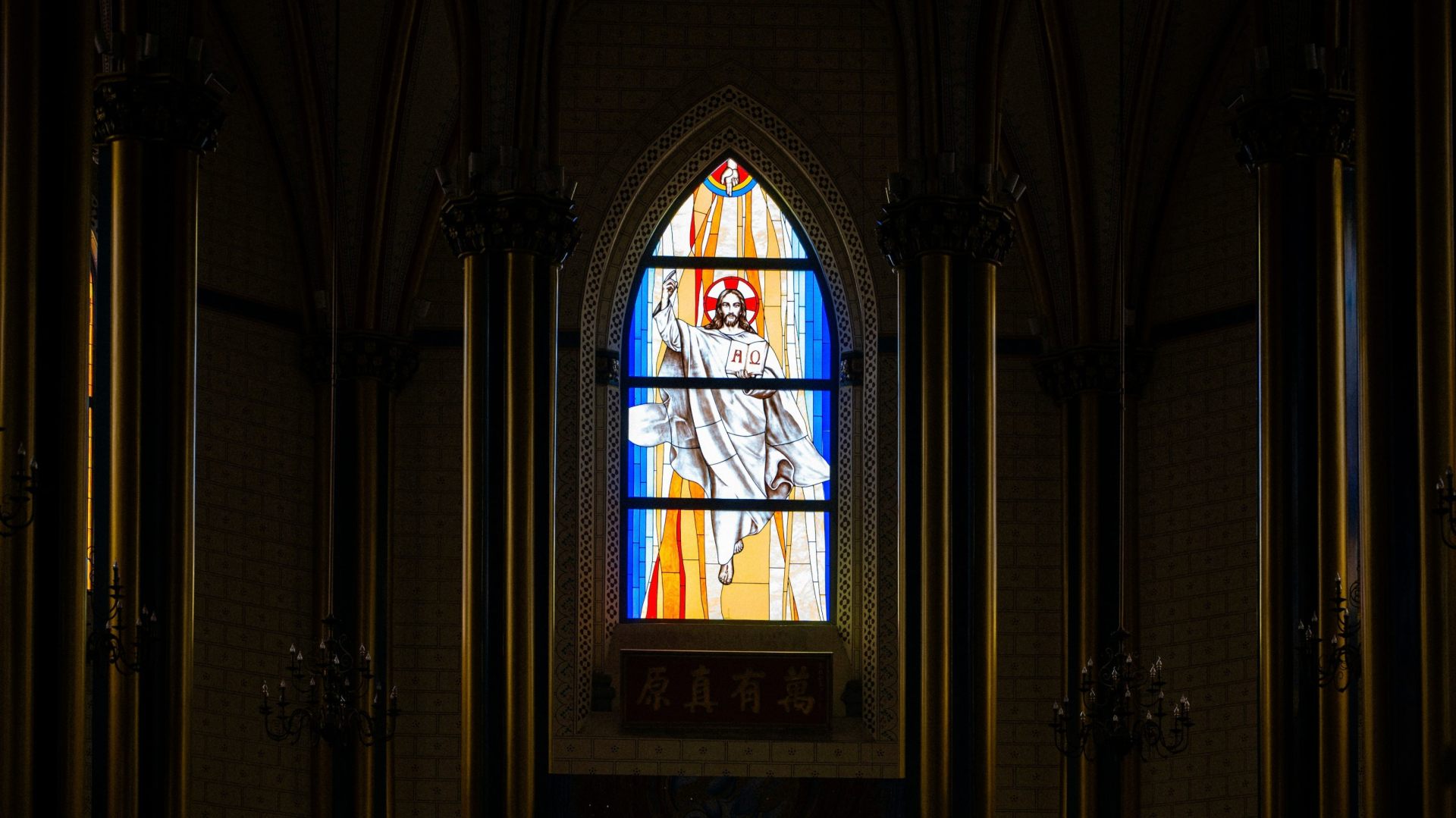
What good can God intend for these days that travel the short distances from bedroom to bathroom to dining room to activity room? What good can God intend for my mother to forget her two previous husbands, her son, her grandchildren, and occasionally even me?

The story of forgetfulness is written in the unraveling of my mother’s once-capable life, but for her part, she expresses very little fear over the loose threads. After our routine lunch at my house after church, I dial her oldest friend and hand her the phone.

“Well, hey, Sis!” my mother says.

She is having a good day, and the conversation lasts longer than normal. At one point, I even overhear her thank the Lord for her good health.

On the October day we tell my mother she is moving to the memory care unit, her caregiving team and I sell the change with clever half-truths. There are so many more activities! There are wonderful new people you’ll get to know! We describe the “concierge” services that will soon be available to her: laundry, housekeeping, weekly manicures.

My mother is, at first, nonplussed. Our efforts at spin are, I think, largely successful—until the two of us are back in her apartment later that afternoon, and the stark truth of it all crashes in.

“What’s wrong?” I ask when she turns toward me sadly, an empty hanger in her hand.

“It’s just so much change all at once,” she says. “Why does everything have to keep changing?”

When I remember that moment now, it strikes me how much I hear echoes of Jesus’ words to Peter, foretelling the kind of death the disciple would face:

Very truly I tell you, when you were younger you dressed yourself and went where you wanted; but when you are old you will stretch out your hands, and someone else will dress you and lead you where you do not want to go. (John 21:18)

As the glass doors close between us when I leave later that day, I’m comforted that, at the very least, hers is a kind of end that Jesus himself knows.

The losses of dementia strike at the very capacities we are tempted to consider most deeply human: our language, our thinking, our memory. But rather than seeing it as a totalizing story of loss, the gospel invites us to consider the goods that flourish in the context of human weakness.

As much as we wish it were not so, we cannot straighten the crooked lines of human disease. Some sufferings are inexplicable this side of the eschaton. But we can remember that God is present with us, working out good, even in our most profound experiences of suffering.

I see God at work as my mother and I are engaged in a holy, human task: she in the dying, I in the giving of care that makes her dying easier.

Dementia, at the very least, reminds us of what it means to be human. We are fragile, finite creatures. We cannot self-exist or self-sustain. We depend on God for our very lives, but we are also deeply dependent on each other to offer the companionship and care that helps us both live and die.

Those losing their memories are teaching us about our mutual need, and those like my mother, who have cultivated a lifetime of deep faith in Jesus, are quietly inviting us into the way of the saint.

Amid the crumbling ruins of my mother’s mind, grace still finds her in the forgotten places. Some truths are rooted so deeply that even dementia fails to yank them up. Each time an old hymn is sung at church, for instance, she joins the chorus for at least a few bars. Even if her song of hope is weakened in the land of forgetfulness, God still hears.

Recently, when we pick my mother up for church, as we do each Sunday, I see a tender bruise of blue above her eye. My first thought is that she fell—one symptom of dementia. When I reach out my hand to touch the bruise, though, it smears: eyeshadow.

She doesn’t remember putting it there. As I wipe her face, she gives herself peaceably into my hands. That submission is a gift I don’t take for granted. I receive it, and I pray for gentler hands. Having practiced presence with her these last two years, I am thankful I can now receive my mother as she is, honoring the best memories of who she once was.

These days, when I stoop to zip my mother’s coat, I go all the way down and kneel, the way she must have once done for me when I was little. I’ve come to assume it as a posture of prayer, saying the words of a liturgy from Every Moment Holy, Volume II:

Let me love well this one who suffers. Let me again and again choose love in each moment, so that through every small act of care and mercy the practice of love becomes a liturgy and a habit by which you are forming in me a compassion that cannot be learned any other way, save by the giving of myself in long service to another.

As I pray, I craft a new vision of my mother, myself, and the story we’re living together.

Genes are not the only thing my mother has given me. I remember how every morning, as a child, I would shuffle down to the kitchen and find her head bent over her Bible in prayer. She faithfully prayed for me on the days I didn’t know how—a generational gift of surpassing worth—and now I pray for her.

Even though she may have forgotten those mornings, and someday I may too, God will not. And when she and I awake someday into the new world, God will wipe away each tear as we remember.

This is the story we are both living: tragic, but not left unredeemed or unrecorded. From the very beginning, before we drew our first breath, in God’s book were written the days that were formed for us, every one of them. Our story is, in the end, his.

How precious are the thoughts of God; how vast the sum of his remembering. Today, it is enough for me to know this, both for myself and for my mother.

Jen Pollock Michel is a writer and speaker. Her books include In Good Time: 8 Habits for Reimagining Productivity, Resisting Hurry, and Practicing Peace.

News

Evangelical Report Says AI Needs Ethics

And other news from Christians around the globe.

Collage in the shape of the Swiss cross emblem with elements of digital technology, currency, mountains, and stock charts inside of it.

Illustration by Blake Cale

The Swiss Evangelical Alliance published a 78-page report on the ethics of artificial intelligence, calling on Christians to “help reduce the misuse of AI” and “set an example in the use of AI by demonstrating how technology can be used responsibly and for the benefit of all.” Seven people worked on the paper, including two theologians, several software engineers and computer science experts, a business consultant, and a futurist. They rejected the idea that Christians should close themselves off to AI, as that would not do anything to mitigate the risks of the developing technology. The group concluded that AI has a lot of potential to do good, if given ethical boundaries and shaped by Christian values such as honesty, integrity, and charity.

France: Cults cause concerns

The French government is warning about the growth of cults after an annual report showed an 111 percent increase of abuse in religious minority groups from 10 years ago. The National Council of Evangelicals in France said it stands with the government in opposing “any behaviour that is contrary to fundamental freedoms and respect” but also asked officials to be aware of “the risk of stigmatization” for religious minorities.

Norway: Medieval documents double-checked for women’s work

Women produced at least 110,000 medieval manuscripts, according to a new analysis of texts that survived in European monasteries and universities. Some of the women wrote their names in the colophons, such as Birgitta Sigfursdóttir, a nun in Norway who asked readers to pray for her. Others just used the feminine form of the Latin word for scribe. The scale of women’s contributions had not previously been studied.

Liberia: Global Methodist leader jailed

Police arrested Global Methodist leader Jerry Kulah for his involvement in a dispute with the United Methodist Church (UMC) over a church building. Kulah helped lead about 20 percent of congregations out of the denomination in a dispute over sexual ethics. The UMC in Liberia has reaffirmed its opposition to same-sex marriage but remains connected to the UMC in the United States. 

Kenya: No politicians in pulpits

Anglican Archbishop Jackson Ole Sapit has ordered priests to stop allowing politicians to speak to their congregations. Clergy may acknowledge them if they are present, but nothing more, Sapit said. He made the announcement at the consecration of a bishop in Nairobi, where the governor, the leader of an opposition party, and a former deputy president were all reportedly expecting to speak. Sapit previously forbade priests from announcing the size of politicians’ donations. “What we give to God, we don’t have to tell human beings,” he said. President William Ruto has made his evangelical faith central to his political image.

Ghana: An expensive hole

Plans for an interdenominational national cathedral seem doomed now that Nana Akufo-Addo is no longer president. The country spent $58 million on blueprints and digging a hole in the ground.

China: Closing loophole on religion

The Chinese government has imposed strict new rules on the religious activity of foreigners. Starting May 1, Christians from outside China may only worship at approved venues and even then will need written authorization. Government officials claim this is an issue of national security. The Communist-controlled government has been cracking down on missionaries for years, but now there is “almost a complete prohibition” on missionary work, Bob Fu, founder of Christian nonprofit ChinaAid, told CT. Evangelical leaders in China said they expected ministry to continue regardless. God “laughs at restrictions,” one of them told CT, “and so do we.”

Indonesia: Guilty of condemning Christ’s hair 

A social media influencer has been sentenced to nearly three years in prison for a video telling Jesus to cut his hair. Ratu Thalisa, a transgender Muslim woman with hundreds of thousands of followers on TikTok, was critiquing contemporary gender expectations. Multiple Christian groups filed complaints with police, and the court found Thalisa guilty of spreading hate online. The influencer is one of more than 400 people who have been sentenced under a controversial law criminalizing “incitement to discrimination, hostility or violence.” Most of the people sent to prison have been convicted for insulting Islam.

South Korea: Bible finally finished

The Korean Bible Society celebrated the completion of the New Korean Translation after 13 years of work. Thirty-six biblical scholars from a variety of denominations worked to translate its original languages into contemporary language, using modern vocabulary, shorter sentences, and consistent transliteration of proper names.

Argentina: New school for evangelicals

The first evangelical university in Argentina opened in Buenos Aires, founded by Assemblies of God pastor Osvaldo Carnival. The opening ceremony was attended by government officials and political leaders from across the country. The Universidad Evangélica del Cono Sur will offer accredited undergraduate degrees in theology, technology, and media production.

United States: No freeze on ICE in churches

A federal judge refused to block immigration officials from making arrests in churches. Places of worship and education have long been considered unofficial sanctuaries, and both Democratic and Republican administrations have instructed Immigration and Customs Enforcement (ICE) agents to avoid them. President Donald Trump decided to change that in his second term. His administration announced in January that “criminals will no longer be able to hide in America’s schools and churches.” A legal immigrant named Wilson Velásquez was pulled out of a Pentecostal church and deported later that month. Since then, 27 Christian and Jewish groups have sued the government, saying the policy change violates their religious freedom. According to the judge, however, churches are not being specifically targeted. 

United States: Guardrails take effect

Fourteen LGBTQ-affirming ministers lost their Church of God (Anderson, Indiana) credentials. The holiness church is anti-creedal and has not historically expelled ministers for theological deviations from traditional teaching. The general assembly adopted a manual with new stipulations about orthodoxy in 2017. General director Jim Lyon said they were “necessary guardrails” and ministers should “defer to the larger Body’s understanding of biblical boundaries defining faith and practice.”

News

Rise of the Thinking Machines

The development of artificial intelligence explained by experts in the field.

An illustration of a digital apple in a pixelated style.
Illustration by Nick Little

The history of artificial intelligence (AI) can be traced back through ancient literature and philosophy, where deep thinkers imagined intelligent machines and artificial beings. 

As a technical discipline, the field of AI began in the mid-20th century. In 1950, British mathematician Alan Turing proposed the idea of a machine that could simulate any human intelligence, conceiving the now-famous Turing test.

Just six years later, at the 1956 Dartmouth Conference, computer scientists John McCarthy, Marvin Minsky, and Claude Shannon coined the term artificial intelligence, laying the foundation for modern AI research and development.

In the decades that followed, AI went through cycles of optimism and disappointment—often referred to as “AI winters,” when progress floundered due to technological limitations and overhyped expectations. Still, significant strides were made in expert systems in the 1980s and machine learning techniques in the 1990s.

The 21st century proved to be a new era for AI, fueled by massive data availability, advances in computing power, and breakthroughs in neural networks. In 2012, a deep learning system built at the University of Toronto dramatically improved image recognition, sparking renewed interest in AI. Tech giants quickly adopted these methods, driving rapid developments in natural language processing, computer vision, and robotics.

Today, AI is embedded in everyday life—from virtual assistants to recommendation algorithms—and continues to evolve quickly. As it grows more powerful and integrated into society, discussions about ethics, safety, and human-AI collaboration have become more crucial than ever. 

artificial intelligence (AI) 

A human-made computer system that can emulate or exceed human thought and perform complex tasks of reasoning, decision-making, communication, and creation.

algorithm

A defined, sequential set of instructions that a computer program follows to solve a specific problem or complete a task. The algorithm works step by step, following code written by humans. For example, when Netflix recommends a show based on your viewing history, it is using an algorithm. Algorithms are often informed by machine learning. 

machine learning

A system that can identify patterns, learn from data, and improve its performance. Machine learning can adapt through an automated process and make decisions without being explicitly programmed for every possible scenario. Large language models (LLMs) are a type of machine learning, trained on vast amounts of text to recognize patterns and respond to natural-language prompts in a contextually appropriate way.

generative AI

An artificial intelligence model that uses its training data and learned patterns to create original content, such as text, images, or music. Generative AI relies on statistical patterns and associations, not step-by-step instructions, to fulfill user prompts. Chatbots such as ChatGPT, Grok, and Claude are examples of generative AI.

agentic AI

An AI system that operates with autonomy, enabling it to make decisions, take actions, and interact with its environment to achieve specific goals. Agentic AI can initiate tasks, adapt to changing circumstances, and pursue objectives independently, not simply responding to external prompts or following instructions. Self-driving cars are an example of agentic AI.

Ali Llewellyn and Nick Skytland are futurists and technologists with experience spanning space exploration, ministry, and church planting. They work at the intersection of faith and AI and are coauthors of What Comes Next?

Culture

Still Life with the Fruit of the Spirit

To be human is to be a maker of beauty and a steward of justice.

A still life arrangement of fruit, in various states of ripeness against a black background.

Illustration by Daniel Forero

Painting beneath the shifting lights of southern France, artist Paul Cézanne repeatedly turned to a simple composition: a still life with a bowl of fruit. The fruit, he observed, was never the same—each moment altered the scene before him. An apple in the morning would begin to wither by evening. As sunlight moved across the room throughout the day, the bowl’s shadows would change.

Rather than attempting to fix a fleeting moment—to capture some imagined, incorruptible fruit in static time—Cézanne endeavored to compress the fullness of time and space into a single image. His paintings were not about appearance but about essence, a pursuit of what lies beneath the surface. His is the fruit in flux and light, in ripening and becoming, its essence the visible echo of a deeper reality.

Similarly, God’s love resists reduction. God is love—eternal, extravagant, infinite—and this love is made manifest in us as we abide in Christ. We are invited to create with, into, and through that love, which grows in us as another kind of fruit—the fruit of the Spirit.

The fruit of the Spirit is not a plural set of virtues from which to pick and choose. The fruit—like Cézanne’s—is a single, multifaceted, organic whole. The Spirit grows within us something altogether lovely: a restoration of our longing to belong and to become, to be loved and to be known. To steward well and to be satisfied. And amid it all, to be made new in our redeemed humanity.

As an artist (Mako) and an attorney (Haejin), we have had opportunity to reflect on how the fruit of the Spirit relates to beauty and justice and how the two interact with each other.

Still life painting by Paul Cezanne of fruit on a plate with a pitcher next to it.WikiMedia Commons
Still Life by Paul Cézanne, 1890

In our work, we have found that beauty and justice are the overflow of God’s love—the mission-critical response of the church to herald the new creation.

Beauty and justice teach us how to be stewards of God’s love in the wasteland, reclaiming meaning over utility and holding to hope amid bleak suffering. They are rebellion, disrupting our transactional world and exposing the lies within. They proclaim that to be human is not merely to exist but to bear the imago Dei—the unique spark of God in each of us.

Just as Cézanne beheld the shifting light upon fruit, we are invited to behold the fruit of beauty and justice, the essential nourishment of humanity.

A young girl rescued from trafficking in South Asia was asked, “Now that you are free, what do you want?” After a brief silence, she replied, “I want to be beautiful again.”

Her answer is both heartbreaking and holy. From a young age, she endured tremendous pain and suffering. Yet she did not ask for revenge or escape. Instead, by wanting restoration, she named the very core of justice: an ache for beauty.

This longing is deeper than ambition. It is a memory of Eden, a yearning for the triune God who made the world out of love, forming us in his image and calling us to participate in the interdependent flourishing of creation. It is a memory of being called tov (Hebrew for “good and beautiful”) by the one who formed us (Gen. 1:31). It is the ache to become fully human again, luminous in love, as we were meant to be.

The injustice this young girl has lived stems, like all injustices, from the original injustice—the one humans enacted against God in Eden. We stole from God’s garden what was not ours, even when abundance was already given to us. Our desire to become more powerful, even godlike, severed our intimacy with the giver of life, marring what God had made tov. Our sinfulness destroyed all flourishing relationships: with God, with each other, and with creation.

Soon after, the second great injustice followed: Cain killed his brother Abel. From that moment on, violence, tyranny, and betrayal took root in history. Humanity spiraled into corruption, and our hearts grew hardened by the desire to control, to possess, to destroy. Beauty withered in the heat of such injustice, and blood soaked into the ground.

We now live in an age of acceleration, where the sacredness of humanity has been buried beneath data, algorithms, and metrics. Our souls, instead of being richly cultivated, have been mined for productivity and profit. We are either useful or invisible; measured, not beheld. We view other people with a scarcity mindset that gravitates toward reductive binaries, casting the “other” as our enemy and turning the outsider into a scapegoat. In the shattered ruins of the Fall, we have lost our capacity to see rightly at all.

Jesus warned us in the Gospel of John that “the thief comes only to steal and kill and destroy” (10:10). In our day, the thief seems to have met his goal. Who will save us from this wretched state?

Crushed for holy justice, Jesus Christ became for us the path to mercy from and intimacy with God, and the portal to the new creation. He took the full weight of our sin in his broken body, shedding his sacred blood and absorbing the wrath we deserved. His wounds became radiant with the beauty of prismatic, redemptive grace.

The antidote to the decay of humanity is, therefore, a spiritual union with Jesus, the one in whom beauty and justice meet. It is to “walk by the Spirit,” bearing the fruit made manifest in “those who belong to Christ Jesus” (Gal. 5:16, 24). It is to seek healing in his wounds (1 Pet. 2:24), so that our scars can display God’s artwork of grace.

Since we started Academy Kintsugi in 2020, the Japanese art of kintsugi has become ubiquitous in popular Christian culture. Many have resonated with the gospel imagery encapsulated in the mending of a broken ceramic vessel with gold powder and urushi (lacquer).

What can’t be captured in an afternoon workshop or a quick sermon illustration, however, is the amount of time the craft requires. Before beginning the work of repair, a kintsugi master will first behold the fragments of a broken dish, sometimes for many years, imagining how it might be whole again. Only after this initial period of envisioning does the work begin, transforming the cracks into the landscape of a healed world.

What if, like the kintsugi masters, the most radical thing we can do today is to slow down and behold the world’s fractures? What if justice is not simply a meting out of verdicts but a making—done with patience, attentiveness, and beauty?

Because of the time-consuming process that I (Mako) use to make my paintings, my work has been called “slow art.” I take pulverized materials—seashells, minerals, and precious metals like platinum and gold—and manually mix them with nikawa, a Japanese glue made from animal hide, before applying the custom paints to create prismatic layers.

The attentiveness of my craft is also my prayer. I work knowing that to create beauty is to echo the Creator, not for the hollow spectacle of momentary attention but for something that endures and is beheld in love. Such beauty resonates beyond the superficial and transactional. It is a gift that generatively expands into the world.

Elaine Scarry in On Beauty and Being Just discusses how beauty awakens us to take notice of our perceptual errors, begetting justice by teaching us to see rightly. To say “This is beautiful” is to make a claim about what is worthy of attention and care. And in the same breath, to say “This is just” is to insist that what is beautiful be protected and stewarded.

A still life sculpture of a fresh banana emerging from a rotten banana peel on a black background.Illustration by Daniel Forero

Psalm 33 tells us, “The Lord loves righteousness and justice; the earth is full of his unfailing love” (v. 5). The biblical vision of justice is God’s loving labor of new creation. It is not punitive but restorative. A cracked bowl—or person—is not thrown out but rather mended. Together, beauty and justice reclaim the fragments of a life and say, “You are not forgotten.” And their work is not complete until the soul can say without shame or fear, “I am tov again.”

Beauty and justice are birthed from a sanctified imagination and lived out while walking with the Spirit. They are the soil in which the fruit of the Spirit takes root and grows, setting things right in light of the present glory of creation and the glory yet to be revealed.

In the place of exile and fracture, beauty and justice empower us to imagine what could grow amid desolation, what shards might look like when wrought whole.

I (Haejin) have seen the fruit of the Spirit growing in abundance in the most unlikely place: an abandoned brothel in India. When a local pastor and I became friends, we chose to walk with the Spirit into that site of generational violence and shame.

With beauty’s imaginative eye, we saw beyond the decay into a future woven with justice: a place of safety, joy, and new beginnings for children born in brothels and for their mothers. In 2018, the building became the Sahasee Embers Center. Over the years, I have seen frightened young children bloom into vibrant youths. I have witnessed shame-faced mothers begin to stand tall again. I have experienced how—like Cézanne’s still-life paintings—the love of God at work in each individual resists all reduction.

In our recent visit to the center, I (Mako) taught an art class to the middle schoolers there. I distributed sheets of paper around the room and began to read J. R. R. Tolkien’s short story “Leaf by Niggle.” As I read, I sketched the meandering lines of a bare tree on a large sketchpad. I told how, during his lifetime, Niggle could not finish a painting of a tree —and how God graciously incorporated Niggle’s one leaf with a “charm of its own” into the new creation.

I asked each child to paint a unique leaf of their own, in any style they wished, and then invited them to glue their leaves onto the tree I had drawn. As the bare branches began to fill in, the students saw how beautiful the tree became when all of them worked together to bring it to life. The collage was a reflection of how beauty and justice were bringing kingdom healing into each of their lives.

Sahasee Embers Center is but one place where God—the only true Artist and Advocate—is at work even this very moment. And he invites us to participate in his resurrection work of imagining, mending, and making, wherever he may call us.

As we walk in the Spirit, may we have eyes to see how God begins to fill the gallery walls of our lives: Here is the collage made by the children of a former brothel; here are the golden lines of a vessel made whole. Here is a portrait of the young girl made beautiful again; here are the scars of the Son of God through whom God is making all things new.

In God’s love, there is enduring beauty. In God’s love, justice flows into our lives. And as we gaze on that love, we find that beauty and justice are not divided but are woven together—indivisible, interdependent, singing in harmony across the canvas of creation.

Haejin Shim Fujimura is principal attorney of Shim & Associates, president of Academy Kintsugi, and CEO of Embers International. Makoto Fujimura is a leading contemporary artist and award-winning author. The Fujimuras have coauthored Beauty x Justice: Creating a Life of Abundance and Courage, to be released in April 2026 (Brazos Press).

Books
Review

Racial Reconciliation Is on the Move

The gospel shouldn’t just change our hearts. At times, it should also change our addresses.

A woman welcoming a man who has just moved
Illustration by Michelle Garcia

Karen J. Johnson’s new book Ordinary Heroes of Racial Justice: A History of Christians in Action displays the mind of a historian, the heart of a teacher, the spirit of a disciple, and the credibility of someone who has practiced the life she commends.

Yet Johnson, a history professor at Wheaton College, takes on a challenging task. In her book, she aims to convince evangelical readers that racial injustice in America is “systemic,” “generational,” rooted in “structures of inequality,” and established in “hierarchies embedded… in systems,” without giving them reason to suspect that she has sacrificed her Christian faith at the altar of “wokeness.” (It saddens me to have to put things this way, but such are the times in which we live.)

Johnson carefully identifies the origins of contemporary America’s racial malaise in the behavior of fearful whites, whether they are establishing restrictive neighborhood covenants, resisting civil rights legislation as violations of “states’ rights,” abandoning public schools in the wake of enforced desegregation, or fleeing from integrating neighborhoods.

In case these historical phenomena seem remote from the experience of readers (or students), Johnson concludes each chapter with “Questions and Implications” designed to help them view race relations through the lens of their own experiences. Examples include: Does your church’s racial and theological logic expect people of color to give up more than white people to participate in mutual fellowship? Is the gospel big enough to handle poverty and racism, or is it just for the comfortable? How could incorporating both systemic and individual understandings of sin affect your approach to race and poverty? Perhaps most importantly, she asks what it would look like to live out the gospel by living closely with victims of injustice, even to the point of uprooting homes and changing addresses.

Johnson “does” history in ways that exemplify Christian virtues. She crafts wise narratives, values context, practices humility, and exercises empathy (not a popular value in some sectors of the American church). Her book models these virtues in extensive case studies of men and women who, over the past century or so, have lived out the gospel in communities bearing the scars of America’s racial trauma. Johnson’s “ordinary heroes of racial justice” are Catherine de Hueck, John Perkins, Clarence Jordan, and a group of white and Black Christians involved in multiracial ministry in the Austin neighborhood in Chicago.

Of these figures, de Hueck is probably the most intriguing. A Russian émigré who settled in Canada in the 1930s, she was recruited by a Roman Catholic archbishop who, in cooperation with local police, wanted to stem the spread of communism there.

But as she spent time in communist reading rooms, she learned something important about the movement’s appeal. It arose, in part, because the church had failed to address the needs of poor workers laboring on the underside of industrial capitalism. De Hueck took this lesson to the streets of Toronto with the formation of Friendship House, a Christian community whose members, she said, “have left homes and friends” for the sake of Christ, “whom we see in all the poor and downtrodden.”

After a year in Europe studying Catholic spiritual formation, de Hueck relocated to Harlem. Here she was again recruited by Catholic leaders, this time to help the church respond to Black New Yorkers’ affinity for communism. De Hueck’s vision for Harlem’s Friendship House, engaging in “corporal and spiritual works of mercy” while serving “Christ in the Negro,” is rooted in Catholic Social Teaching, which attempted to chart a middle way between communism and unfettered capitalism. Intimately familiar with the needs of the urban poor and deeply rooted in her faith, de Hueck sought a balance between addressing systemic problems and transforming individuals.

John Perkins, also known for his unwillingness to separate personal spirituality from societal justice, is the focus of Johnson’s second case study. Like de Hueck, Perkins made the fateful decision to live and minister among the poor, although Perkins’s path of relocation was circular, from California back to Mississippi in a reversal of the Great Migration. Through his work in the cities of Mendenhall and Jackson, Perkins influenced a generation of white evangelicals skeptical of the claim that “heart change” is a sufficient answer to social ills.

Johnson’s third case study involves Clarence Jordan, a Southern Baptist seminary graduate who began an intentional farming community in rural Southwest Georgia in the 1940s. Koinonia Farm billed itself as a “demonstration plot for the Kingdom” modeled on the first-century church. Its members were dedicated to communal living, pacifism, and rehabilitating what Johnson calls the “mangled White southern Christianity that had nurtured” Jordan and other farm residents.

At Koinonia Farm, writes Johnson, community members would “continue the incarnation” while sharing life on integrated terms and helping local sharecroppers improve farming methods. Although Jordan viewed Southern racism as both systemic and individual, the farm was not at the vanguard of social change in regard to laws and policies. Instead, says Johnson, the community’s activism expressed itself in “an alternative way of living.”

Until the mid-1950s, the 60 or so men, women, and children at Koinonia Farm (a quarter of them Black) enjoyed relative peace with neighbors. But that changed after the Supreme Court’s decision in Brown v. Board of Education, when local whites began a campaign of economic boycotts, vandalism, shootings, and bombings. The agitation took such a psychological and financial toll that only 10 people remained by 1958.

It almost goes without saying that local authorities could not be counted on to defend life and property at the farm. A grand jury investigating violence there concluded the perpetrators likely belonged to a communist front organization whose claim to be Christ-ian was “sheer window dressing.”

Johnson devotes about 10 pages to Koinonia Farm’s most famous neighbor, Jimmy Carter, who lived just 17 miles away when the community was under assault from local whites. Despite Carter’s later claims to have supported the farm during the 1950s, she finds no direct evidence that his family violated the local boycott to do business with its residents.

As Johnson concludes, the former president’s “relationship with Koinonia Farm was (and is) complicated.” She resists efforts to force Carter into a simplistic binary that labels every person as racist or nonracist. Even so, she endorses the conclusion of historian Ansley Quiros, in her study of civil rights conflicts in Carter’s corner of Georgia, that his “primary concern remained his own stature in the community, the economic success of his family’s farm, and, increasingly, his political ambitions.”

Johnson’s fourth case study centers on a collection of inner-city ministries in Chicago’s Austin neighborhood (the site of massive white flight beginning in the 1960s). In particular, it covers the interracial efforts of one white couple, Glen and Lonni Kehrein, and one Black couple, Raleigh and Paulette Washington.

Inspired by John Perkins, the Kehreins moved into the Austin neighborhood in 1973, joined Circle Church, and began an intentional community. Tragically, the church split along racial lines in 1976, when a Black pastor, Clarence Hilliard, preached a sermon that the white head pastor declared doctrinally unsound. (Influenced by Black liberation theology, the sermon bore the title “Down with the Honky Christ—Up with the Funky Jesus.”) Some church members blamed the split on white racism, while others faulted the Black pastor for insubordination. In any case, the two men ended their ministry partnership, and the church and neighborhood suffered most from this rupture.

In 1983, Austin witnessed another attempt at multiracial urban ministry. Raleigh Washington, a former army officer, founded Rock Church, which held services at the Kehreins’ Circle Urban Ministries. A decade later, Washington and Glen Kehrein collaborated on a book, Breaking Down Walls: A Model for Reconciliation in an Age of Racial Strife. Sadly, however, Washington’s decision to join the board of Promise Keepers in 1994 caused tension in the relationship, as Kehrein preferred to remain in Chicago rather than join Washington in Colorado Springs. The two did not reconcile until just before Kehrein’s death in 2011.

Johnson notes that Washington and Kehrein emulated de Hueck, Perkins, and Jordan in pursuing “fully evangelical” ministries, animated by a “wholistic gospel” that unites personal piety with social activism.

To demonstrate the importance of this model for interracial work, she refers to the landmark 2000 study Divided by Faith: Evangelical Religion and the Problem of Race in America. In the book, sociologists Christian Smith and Michael O. Emerson critique the “tools” white evangelicals bring to discussions of race—which emphasize individual free will and interpersonal relationships while discounting claims of structural disadvantage. Johnson describes being taught to rely on these tools herself—and recognizing their inadequacy only after living in a minority-majority context in urban Chicago.

A virtue that shines through Johnson’s case studies is empathy. In the context of studying history, she says it involves “seeking to understand why people in the past did what they did,” though it doesn’t require “withholding judgment” on sin and injustice.

We’ve seen how Johnson extends this empathy to Jimmy Carter, whose relationship to Koinonia Farm is colored by ambiguity. She also extends it to Raleigh Washington, the Chicago pastor who troubles her “wholistic gospel” narrative by downplaying the role systemic racism plays in determining the fortunes of Black Americans. Johnson even reveals empathy for white Southerners who resisted the Civil Rights Movement in Mississippi. From their perspective, she observes, it “seemed like an attack on all they knew to be right and good.” While historical empathy doesn’t amount to condoning white Southern racism, as Johnson makes clear, it can still represent “an act of love,” one that helps “build a bridge rather than sever a connection.”

Johnson’s “ordinary heroes” certainly embody this charitable mindset. What unites them most profoundly, however, is a sacrificial willingness to physically relocate. In response to the gospel’s call to racial justice and reconciliation, they each traveled a countercultural path of downward mobility and embedded themselves in communities of need. But their inspiring stories reveal something beyond heroism. They also attest to the messiness of the work these figures undertook.

Why is the work of racial justice so messy? For one thing, efforts to realize the social implications of the gospel will often generate outside resistance. One need only to recall the economic and physical violence provoked by Koinonia Farm’s “alternative way of living.” (As Johnson starkly notes, “Being at Koinonia could get a person killed.”) Or the impunity with which public officials in Mississippi harassed and tortured John Perkins.

Second, any racial justice work involving relocation will risk discomfort because whites and Blacks aren’t always skilled at living in proximity, let alone sharing life together. As a result, dreams of multiracial Christian harmony will inevitably run into many frustrations, such as personality conflicts, cultural missteps, unspoken resentments, paternalism, dueling charges of racism and perpetual victimhood, and the narcissism that often lurks beneath the surface of charismatic leadership, whatever its color. Add the stresses that come with residing in neighborhoods plagued by crime, substandard education, and diminished economic opportunity, and it is easy to see why multiracial intentional communities become spiritual and emotional testing grounds with high burnout rates.

In fact, Johnson’s case studies consistently highlight the conflicts between her “ordinary heroes” and those who are initially drawn to their vision of Christian community, only to stumble amid day-to-day difficulties or otherwise become disillusioned. These features of her book serve as a warning to idealists who might hear God calling them to relocate. As Johnson observes, it may be that love demands proximity and proximity produces empathy. But as her case studies attest, empathy is not always enough to sustain countercultural communities inhabited by flawed human beings.

Stephen R. Haynes is a religious studies professor at Rhodes College and theologian in residence at Idlewild Presbyterian Church in Memphis. His books include The Last Segregated Hour: The Memphis Kneel-Ins and the Campaign for Southern Church Desegregation.

Theology

Unlearning the Gospel of Efficiency

Technology pulls us toward optimization, but God’s work in our lives takes a slower route.

Mixed media painting of chicory flowers on canvas.

Chicory, Emily Verdoorn, 2025, mixed media on canvas, 11″ x 14″. Used with permission.

Painting by Emily Verdoorn

Many of us value results over process, especially when that process takes time. It certainly doesn’t help that today’s technology has made waiting optional in many cases, with things like AI chatbots’ efficient answers and Amazon’s same-day delivery. Our culture of instant gratification belittles tedious practices, slow growth, and long-term development. We want what we want, and we want it now.

The phrase “Time is money” is not biblical, yet we in the church have embraced this slogan and baptized a gospel of efficiency. This mindset has reshaped not only how we view money but also how we understand God and the Christian life. In a culture that elevates efficiency, productivity, and convenience, values like human flourishing and relational depth are crowded out by increasingly unrealistic expectations, isolation, exhaustion, and discontentment in an effort to achieve more and be more. In all this, we operate under an unspoken assumption that we were meant to do it all: that we are or should be infinite—a quality only God possesses.

Too often, the church has tried to solve the problem of endless obligation the way the world does—by seeking to increase our time-management skills: Get up earlier, be more disciplined, adopt the latest technological advances that promise greater optimization. But our emphasis on speed can lead us to misunderstand God and how he operates, which inevitably means we also misconstrue ourselves.

In other words, what if our fundamental problem is not functional, but theological?

The God of Scripture clearly has a different hierarchy of values than us. He is patient, deliberate, and faithful. He is comfortable taking his time, since his highest value is not efficiency but love. We need to connect our theology (our vision of God) with our anthropology (our vision of being human) and let God’s values shape ours, instead of projecting ours onto him.

Christians have always believed that God is no regional or tribal deity but is the creator of heaven and earth. Thus, theologians have often spoken of God’s independence: that God alone is self-existing and self-determining, and all creatures—including us—necessarily depend upon God. This is the heart of the creator-creature distinction.

Although dependence is mostly a negative word in Western culture, it is a positive term in Christian theology. Part of the good in our creation is that we were made to depend upon God, upon our neighbor, and upon the rest of creation. Deitrich Bonhoeffer argued that while sin may distort them, these dependencies are not a result of the Fall but are a reflection of God’s original design. The self-made man is a myth; after all, everyone has a belly button! We depend on others in countless ways, and our limits drive us to God, to others, and to the earth. It was God’s intention for human creatures to grow in our healthy dependence.

In her book God’s Provision, Humanity’s Need, theologian Christa L. McKirland describes the concept of “fundamental need,” where the characteristics of a creature determine its needs. When those needs are met, the creature flourishes; when they are withheld, the creature suffers. “A rose needs sunlight to flourish because it is a plant. A whale needs plankton to flourish because it is an animal,” she writes, and “humans need a second-personal relation to God.”

That is a fancy way of saying we were designed to relate to God in a two-directional way. In the 17th century, theologian John Owen called this “communion” and defined it as “mutual relations,” meaning we are meant for personal engagement with God. Without that interaction, the human creature withers, whereas an increase in that relation—in both quantity and quality—results in a fuller human life. 

True human flourishing requires not just water or food, oxygen, or human companionship, but also active communion with God.

Our relationship with God, however, is rarely efficient. It often feels slow and even inconvenient. For instance, when God extends his grace to our broken and needy lives, why doesn’t he immediately free us from our faults? Why are our bad habits not erased and positive virtues not instantaneously produced? If God doesn’t like certain attitudes and behaviors, why doesn’t the Almighty suddenly transform us so we never fall short?

We Christians feel guilt and shame not only in our continual struggle with sin but also over our creaturely limits. Whenever we fail to prioritize our relationship with God or whenever we don’t have the energy to do all we think needs to be done, we feel that we should know more, do more, be more—always more. And because we so often fall short of the godly ideal, we wonder whether God is constantly disappointed or maybe even angry with us.

But could it be that God values the process of our growth and the work involved in it, not just the outcome? You see, God’s highest value is not efficiency, especially not in any simple or mechanistic sense. It is love.

Love is often at odds with our notions of efficiency. One of the most inefficient things you can do is love another living being. Loving another creature requires energy, flexibility, and loads of patience. But the almighty Creator has always prioritized love and healthy growth over mechanistic efficiency. As we read in 2 Peter:

Do not forget this one thing, dear friends: With the Lord a day is like a thousand years, and a thousand years are like a day. The Lord is not slow in keeping his promise, as some understand slowness. Instead he is patient with you, not wanting anyone to perish, but everyone to come to repentance. (3:8–9)

God is more interested in relationship than in the speed of our progress; he is more concerned with lifting our gaze, provoking our song, and stimulating our imaginations with his goodness and glory than in simply bringing us over the finish line. And as most artists or authors know, mechanistic efficiency is often the enemy of creativity.

Wouldn’t it have been much more efficient for God to create the entire world in shades of black, white, and gray? Why the extravagance of a peacock’s feathers, the complexity of the orchid, the intricacies of the human voice, the transcendence of an orgasm in marriage? Was it really necessary to have so many colors, so much diversity, depth, and wonder?

Someone with a modern industrial mindset might accuse our Creator of being indulgent, wasteful, and excessive. But God is not careless or negligent; rather, he’s purposeful and wise, patient and intentional in all things.

The God who created the cosmos valued the process by which he made it. Rather than snapping his fingers, God spoke his Word, and his Spirit hovered over the turbulent waters to bring order out of the void (Gen. 1:2–3). He took six days to create everything that exists—whether they were 24-hour days or not. God could have created everything instantly, but he is described in Genesis as taking his time and then resting afterward. This process, which some might consider inefficient, was deemed “good” (1:10, 25).

Instead of efficiency, God is interested in cultivating love, beauty, wonder, community, and worship. Sometimes he is quick in his work—instantly turning water to wine or raising the dead. But God often opts for slower routes that involve his people in the process: The Exodus took decades, calling for faith and growth in the Hebrew people (Ex. 23:30).

As a dad, I enjoyed watching my young children learn and grow as they developed new skills and competencies—even when it involved failing, falling, or making a mess in the process. By contrast, we tend to think very poorly of our heavenly Father in similar situations, though we might never admit it. We seem to believe God expects us to be instantly flawless, to never make mistakes or fall on our faces. When we think that he values only efficiency and productivity, we misunderstand how he responds to us in our need.

We forget that the Creator’s original blueprint included limitations and dependence—and that his tenderness toward us is only increased by our deep need for him. The same Spirit of creation is the Spirit of sanctification; God is working in us over the course of our entire lives, not just at the moment of our conversion. We grow spiritually by slowly cultivating our delight in God, in our neighbor, and in the rest of creation (Gen. 2:15; Matt. 22:37–39). God values process, not just finished products (James 1:4).

As professor and author Leopoldo A. Sánchez M. observes, our response to God’s sanctifying work in us as creatures involves “a joyful yielding to the hands of the sculpting Spirit.” Such dependence can be joyful because our Creator doesn’t expect us to be gods; he asks instead that we trust and rely on him as God. Neglecting our creaturely realities can produce timidity instead of confidence, fear instead of hope, and exhaustion instead of rest.

Whenever we fall short—either because of sin or by simply being creatures with limited capacities—it does our souls great good to remember that our faith is built not on our own power or completeness but on the fact that God is trustworthy.

Productivity and efficiency are not terrible goals, but they can be destructive when we apply them to humans as if we were merely complicated machines. Humans don’t just need to be recharged or serviced; we were created to sleep, eat, feast, laugh, and live in relationship to God and others.

Oliver Burkeman, in his insightful book Four Thousand Weeks: Time Management for Mortals, describes the problem on a practical level: 

Convenience culture seduces us into imagining that we might find room for everything important by eliminating only life’s tedious tasks. But it’s a lie. You have to choose a few things, sacrifice everything else, and deal with the inevitable sense of loss that results.

Do we really believe that? Far too often, we imagine that if we just become quicker, making better decisions and getting more organized, then we can achieve all our goals. Such beliefs often work in the back of our minds, generating deep-seated discontentment.

This mechanistic push for ever-increasing productivity, maximum efficiency, and personal convenience acts like sandpaper on our souls. We long instead to take time for intimacy, belonging, and healthy dependence. Yes, sloth and neglect can be painful and destructive for human flourishing, but so are relentless demands to maximize productivity.

Our Creator is neither lazy nor tyrannical. Instead, he is wise, compassionate, and purposeful—and this should shape our vision of faithfulness. The God who was comfortable taking his time during his original process of creation is the same God who is comfortable doing the work of his new creation in us over time. Gently yet confidently, we must remind ourselves that “he who began a good work in you will carry it on to completion” (Phil. 1:6).

God does not promise us instantaneous change or victory; he promises that he is working, that he will not let us go, and that he has a longer view than we do. May his patience and perspective give us the courage we need for this day, this month, and this lifetime.

Kelly M. Kapic is a professor of theological studies at Covenant College in Lookout Mountain, Georgia. He is the author or editor of more than 15 books, including You’re Only Human and Embodied Hope, which each won a Christianity Today Book Award.

Ideas

The Transhumanist Question

Is our being merely human something that ought to be overcome?

The silhouette of a middle-aged woman, with a drawing of a kind of cyborg inside her.
Illustration by Robert Carter

Far before our time, the Renaissance humanist Giovanni Pico della Mirandola was an early advocate of transhumanism. In his Oration on the Dignity of Man from 1486, he has the Creator speak the following words to Adam, the first human:

We have made thee neither of heaven nor of earth, neither mortal nor immortal, so that with freedom of choice and with honor, as though the maker and molder of thyself, thou mayest fashion thyself in whatever shape thou shalt prefer. Thou shalt have the power to degenerate into the lower forms of life, which are brutish. Thou shalt have the power, out of thy soul’s judgment, to be reborn into the higher forms, which are divine.

Pico della Mirandola is the unofficial saint of transhumanists because he was pushing human plasticity over the edge. He believed that the higher forms of humans are, in fact, more than humans: They are divine.

Here in the 21st century, philosopher Nick Bostrom defines a posthuman as a being for whom at least one general central capacity, such as health span, cognition, or emotion, is “greatly exceed[ing] the maximum attainable by any current human being without recourse to new technological means.”

The neurotechnology company Neuralink has pioneered brain-computer interfaces for people with paralysis to help them communicate and control devices remotely. Neil Harbisson, born colorblind, received a skull implant in 2004 in the form of an antenna that allows him to “see” colors as audio vibrations. A filmmaker named Rob Spence replaced his right eye with a wireless video camera and calls himself an “eyeborg.” Biotech CEO Elizabeth Parrish underwent experimental gene therapy in 2015 and has claimed to have successfully slowed the aging process.

Still other potential developments are purely cosmetic. “If you could reshape your foot and turn it into a platform heel, would you?” asks one article about body modifications in the fashion world. “Or how about a statement piece consisting of soft, turquoise horns on either shoulder?”

One has only to read the great pessimist philosopher Arthur Schopenhauer—who wrote that “life swings like a pendulum backward and forward between pain and boredom”—to be tempted to join the transhumanist project. But whether the goal of transcending humanity is worthy of being pursued depends on whether we believe that being merely human is something that ought to be overcome.

I, for one, believe that just as there is beauty and goodness to being an eagle or a dolphin, there is beauty and goodness to being human and no more. The central article of the Christian faith, after all, is that the divine Word became human flesh. By dwelling among us, the Word sanctified humanity in its finitude and fragility. At the same time, upgrades—by which I mean our development and use of tools, even those that are integrated into our bodies—are not excluded.

A few years back, I taught a course at Yale University on faith and globalization with UK prime minister Tony Blair and a secularist colleague. At one point during the class, my colleague held up a pill and showed it to the students. When religious people are sick, he said, they pray, believing that God will perform a miracle. But secular people rely on the marvels of modern medicine, such as this tiny pill that almost instantly takes care of high blood pressure. He concluded that modern medicine, obviously, works better than God.

When he was finished, I turned to him and said, “You and I agree on one important thing: We both deny the same god!” He looked at me, puzzled.

“The god you deny is incompatible with human inventiveness and work—with all worldly processes,” I said. “I deny that god as well. In contrast, the God in whom I believe makes possible the entirety of the worldly reality in all its dynamic complexity, including human inventiveness and work.”

The first pages of the Bible tell of God working with such worldly realities. In the Garden of Eden, God didn’t drop food from heaven into the mouths of Adam and Eve and, applying pressure to their jaws, make them chew. Instead, they worked for food, tilling and keeping the garden; and in and under their work, God was at work too.

When it comes to the ethical dilemmas we encounter in transhumanism, we should exercise an abundance of caution. Yet it is a mistake to think that divine work and human work, including technological advances, mutually exclude one another.

Humans came to believe in God when they had no scientific knowledge about the basic structure of reality, when the best antiseptic was lavender, and when the dominant means of transportation was their own calloused bare feet.

Although our understanding of the world—and therefore of God’s relation to the world—has changed, we moderns can still believe in that same God now that we are exploring the astrophysical and quantum properties of black holes, editing the genome to prevent diseases and enhance human capacities, and traveling in driverless cars—and we can believe without abandoning reason.

The more power we have, the more important it is to choose wisely the basic direction of our lives. The more intelligent and powerful tools we create, the clearer we must be about the human purposes these tools will serve. And the only way to discern what purposes are worthy of our humanity is to know what we ought to trust and love above all things and what kind of humans we hope to be.

To be human—created in the imago Dei—is to live a vision of the good life. This vision sketches a portrait of the kind of humans we ought to be and provides the orienting criteria for what we ought to desire and how we ought to live. We all live by some such vision, whether we consciously embrace it or whether it remains inchoate and hidden from our sight, woven into the fabric of our beliefs and practices.

Since visions of the good life are by definition normative in character, science cannot formulate them. Knowledge about what was, what is, and what is likely to be, no matter how precise and detailed, can never prescribe what ought to be.

Imagine that we decided to give up privacy and permit all available data about us to be collected—all our conversations and correspondence, our health and habits and purchases. A highly intelligent algorithm could come up with an exceptionally accurate account of our behavior and therefore would likely be able to predict what we would do in many situations. It could tell us what we desire and what we find desirable, even what we believe about who we ought to be and what we ought to do. It might even come to know us better than we know ourselves, a scenario with which Yuval Noah Harari ends his book Homo Deus: A Brief History of Tomorrow.

But the one thing such a highly intelligent algorithm would not be able to tell us is who we ought to be—what we ought to do and toward what we ought to stretch ourselves, who we actually should be and what we should desire. Science and technological advancements cannot give us a vision of the true and good life. Reason cannot bring to light what should be most important to us—it cannot answer the question about how we as individuals and as the human community ought to live. For that, we believers turn to Jesus Christ.

Jesus is the measure of our humanity. We seek to move up, to ascend, to achieve with technology’s help a state of knowledge, power, and bliss comparable to God’s—to become gods. But we have a one-sided and therefore false image of God. In Jesus, the true God took on our limitations and came to serve the lowest, not considering

equality with God as something to be grasped, but emptied himself, taking the form of a slave, assuming human likeness. And being found in appearance as a human, he humbled himself and became obedient to the point of death—even death on a cross” (Phil. 2:6–8, NRSVue).

The coming of Christ radically changed how we should think not just of God but also of ourselves. If “the very essence of God is to love and serve,” as Max Scheler wrote, then what is most God-like is self-decentering love: in humility to regard others as more important than ourselves and to look to the interests of others, not primarily to our own (vv. 3–4).

This is not to say that technological developments are unimportant or that we should only fear them. But the crucial question for us is whether they help or hinder us in aligning our lives with the story of Jesus Christ. What we should fear most is a future devoid of faith in Christ and Christlike goodness.

Toward the end of the 21st century, surrounded by spectacular technology, it may come to pass, as Aldous Huxley imagined in Brave New World, that most of us will be so conditioned that we will not be able to “help behaving as [we] ought to behave.” And should anything nonetheless go wrong, some miracle drug would give us a “holiday from the facts.”

For Huxley, this was a dystopian vision. But the persistence with which we seek to eliminate suffering and multiply personalized pleasures suggests that this is the kind of future we want. With the help of science and technology, we may well find ourselves in such a world.

But like the swine in Jesus’ teaching who trampled over the pearls (Matt. 7:6), we will then have turned away from what matters most and squandered what’s best in our humanity. The crucial question for the future is thus the same one Jesus posed to his disciples two millennia ago: “When the Son of Man comes, will he find faith on the earth?” (Luke 18:8).

Miroslav Volf is the Henry B. Wright Professor of Theology at Yale University, founding director of the Yale Center for Faith and Culture, and author of The Cost of Ambition: How Striving to Be Better Than Others Makes Us Worse (Brazos Press, 2025).

Theology

For Most Muslims, Five Pillars are Crucial

Saudis deserve credit for last month’s less fatal pilgrimage.

al-Masjid al-Haram in Mecca
Christianity Today July 2, 2025
Illustration by Christianity Today / Source Images: Getty

In this series

(For previous articles in this series, see here and here.)

Journalists have become used to reporting annual disasters at the hajj, the once-in-a-lifetime trip to Mecca that all Muslims are obliged to take if they are physically and financially able. Last year, 1,300 pilgrims died as “lethal heat combined with humidity proved deadly,” one analysis declared.

And 2024 was not an outlier. A total of more than 4,800 Muslims have died in stampedes at the hajj’s Stoning of the Devil ritual in 1990, 1994, 1998, 2001, 2004, 2006, and 2015. Other years have brought epidemic outbreaks, building and crane collapses, and other disasters not unlikely when 2 million people from around the world crowd into a small area.

This year, at least 216 died, with the lessened total due in part to heat protection measures, including extra shade. Without 1,000+ deaths to report, it’s a good time to breathe deeply and explain why this pilgrimage is important in Islam. The starting point is that Muslims have not the Ten Commandments but the Five Pillars. (Some Shiites have different counts, such as seven, but since the requirements are similar, I’ll stick with the majority Sunni listing.) 

The first four requirements are as follows: Make a profession of faith (“There is no God but Allah, and Muhammad is his prophet”). Pray five times each day. Fast in the month of Ramadan during daylight hours. Give to the poor 2.5 percent of accumulated wealth above a specified amount, which at one time depended on the price of cattle, sheep, or camels. (A very rough approximation today might be $30,000.)

The hajj is the fifth pillar. As one Muslim website declares, “the one who goes for Hajj earns the pleasure of his Lord and comes back with all his sins forgiven. He also earns immense reward that he cannot earn in any other place; one prayer in al-Masjid al-Haram (the largest mosque in the world, located in Mecca), for instance, is equal to a hundred thousand prayers elsewhere.”

To understand what often has gone wrong and what went mostly right this year, start with the 2022 population of Mecca—1,578,722—and the 2020 census population of Phoenix, Arizona: 1,608,139. Almost identical, with a similar desert climate. Ramadan shifts through the year due to Islam’s lunar calendar adjustments, but what if Christians had a requirement to pour into Phoenix as Muslims descended into Mecca last month? What if they had to walk three to six miles in temperatures that rose above 90 degrees, as did Muslims in Saudi Arabia? 

It would be doable without many deaths, given Phoenix’s omnipresent indoor air conditioning and the outdoor cooling systems that would be put into place. That apparently is what the Saudis have now accomplished: They boast of the world’s largest cooling system in the Grand Mosque and, through misting fans and other means, vow “to ensure the comfort of all visitors.”

Overall, though, comfort is secondary. Muhammad said a Muslim who goes on hajj “will return … as if he were born anew,” free of all sins. Doing it properly means entering the holy mosque at Mecca with the right foot first and reciting a prayer, then moving in a counterclockwise procession around a stone building that Muslims believe Abraham and his son Ishmael originally built.

In fact, a comfortable hajj might be a problem. Muslim websites say difficulties teach the fear of Allah: Standing in long lines “reminds the pilgrim of the throngs of people on the Day of Gathering. If the pilgrim feels tired from being in a crowd of thousands, how will it be in the crowds of barefoot, naked, uncircumcised people, standing for fifty thousand years?”

Similarly, a ritual of running back and forth instructs Muslims in what Hagar, the mother of Ishmael, did when she desperately searched for water: “Since this woman was patient in the face of this adversity and turned to her Lord, this teaches man that doing this is better and more appropriate. When a man remembers the struggle and patience of this woman, it makes it easier for him to bear his own problems.”

The most dramatic event might be throwing seven pebbles at a pillar (now a wall) to commemorate what the Quran says was Satan’s tempting of Abraham to disobey Allah’s command and not kill his son. Some rituals, like this one, cannot be done anywhere except in Mecca. Whereas Christians emphasize justification by faith, Muslims emphasize justification by works.

The hajj is one of the Five Pillars and thus an enormous opportunity for justification—an opening to a heaven full of sensual pleasure, with saved souls living in blissful gardens with fruit, rivers, carpets, and cushions (Suras 3:198; 4:57; 55:56; 56:35–38; 69:21–24; 79:41; 88:8–16). The one major time of deprivation, the month of Ramadan during which Muslims are not to eat from dawn to dusk, ends with Eid al-Fitr, a three-day festival of fast-breaking marked by celebrations with relatives and friends and frequently the giving of gifts and money to children.

One of Islam’s appeals is the existence of strict dos and don’ts. Each time of prayer consists of units containing set sequences of standing, bowing, kneeling, and prostrating while reciting verses from the Quran or other prayer formulas. The sequences are repeated twice at dawn prayer, three times at sunset prayer, and four times at noon, afternoon, and evening prayers.

Meanwhile, Christians and Muslims debate central issues: If original sin does not exist, why does the Bible tell the stories of so many sinners? Muslims treat the Bible respectfully as the word of prophets but see it as corrupted through the centuries and right only when it agrees with the Quran. Muslims believe that all people are weak but not inherently sinful. Christians do not believe that any works are sufficient to merit salvation, while Muslims believe that having faith in Allah and practicing the Five Pillars make salvation effective.

Church Life

ISIS Victims Welcome Christian Help, Not Christian Conversion

Yazidis, a religious minority in Iraq, still face displacement 11 years after the jihadist group’s attacks.

A Yazidi man prays at the entrance of a temple in Iraq.

A Yazidi man prays at the entrance of a temple in Iraq.

Christianity Today July 2, 2025
John Moore / Getty

This is part 2 in a series on the Yazidi community. Click here for part 1.

The previous article in this series highlighted the impact of USAID cuts on the vulnerable Yazidi community in Iraq. ISIS displaced Yazidis from their historic home of Sinjar in northern Iraq in 2014, killing and enslaving thousands. The jihadist group claimed that the Yazidis, whose religion has roots in ancient Mesopotamia, worshiped Satan. (The nature of the Yazidi religion will be discussed in the final article of this series.)

After US coalition forces drove back ISIS, most Yazidis remained in United Nations camps for the internally displaced. USAID was a key aid provider, facilitating access to essential services for more than 30,000 people in Sinjar. The cuts have prevented vulnerable groups like the Yazidis from accessing food and health care they need to survive, wrote Amy Hawthorne, a former Obama-era State Department official.

Yet the legacy of USAID in the Middle East is mixed.

American foreign policy is “deeply unpopular” in the region, Hawthorne continued, while tens of billions of dollars in assistance have failed to create stability, prosperity, or democracy.

If USAID has its critics in the region, so too does faith-based aid.

“Some [Iraqis and secular expats] are very critical of Christians,” said one aid worker serving Yazidis. CT granted him anonymity due to the sensitivity of the issue. “They accuse us of mixing help with the gospel.”

Humanitarian organizations of many varieties rushed to help the Yazidis in 2014 during their displacement. Yet large agencies like World Vision, Medair, and Doctors Without Borders began leaving in 2019 as the situation stabilized and crises multiplied around the world. Among the international groups remaining, the aid worker said, many are small and motivated by a long-term commitment to serve the Yazidi people.

For instance, the Kurdistan-based Zalal Life (highlighted in part 1) provides food distribution, vocational training, and medical services to three Yazidi camps and dozens of villages in the northern Iraqi governorate of Duhok. Other Yazidis are displaced to Iraq’s Nineveh valley, bordering Syria.

Ashty Bahro, who founded the Christian group in 2007, has never received USAID or UN funding. But this would not be a problem in Kurdistan, he explained, because unlike many Arabs in the Middle East, most Kurds love America.  

Christian foundations and church support fund Zalal Life operations, he said, which recently included the repair of 100 tents left leaking in the wake of Trump’s budget cuts. And his two medical clinics are now serving twice as many patients as before, with three times the demand.

Bahro said the aid work is separate from his church ministry. He is also the pastor of Apostles’ Evangelical Church, which he registered with the Kurdish authorities in 2021—with its Kurdish name. Historic Christians in Iraq, like Bahro’s Chaldean community, worship primarily in Arabic or their ethnic languages. The vast majority of Kurds are Sunni Muslims. Few Middle East nations permit converts such public presence.

But the Kurdistan Regional Government (KRG) has embraced a spirit of religious tolerance for many faiths, said Jeremy Barker, associate vice president of international strategies at Religious Freedom Institute. While not without its challenges, the government has granted recognition to not only centuries-old Orthodox and Catholic communities but also a number of Protestant churches.

Sam Brownback, former US ambassador-at-large for international religious freedom, called the KRG a “rare example” in the Middle East. In April he attended Kurdistan’s first-ever national prayer breakfast, where Barker, who lives in Kurdistan’s capital of Erbil, facilitated two panel discussions on religious liberty.

Alongside his church ministry, Bahro runs a local stationery shop that also sells Bibles. He is upfront about his faith. But he said that some groups operate without consideration for the local culture. This issue—or at least this accusation—dates back to 2015 when ISIS was defeated.

“Attached with humanitarian aid, [Christian groups] distribute bibles and pamphlets containing information about Christianity,” Vian Dakhil, a Yazidi member of the Kurdish parliament, stated at the time. The Kurdistan region’s office of Christian affairs, however, commented that most established groups behave ethically and are not pushing conversion.

Samaritan’s Purse stopped working in the camps in 2023 but maintains six projects in the area.

“Like the biblical story of the Good Samaritan, we help people in the ditches of life regardless of their beliefs or background—without asking for anything in return.” CEO Franklin Graham told CT.

But the issue continues. Light A Candle, a humanitarian organization founded by Pentecostal worship leader Sean Feucht, distributes aid to the internally displaced. Two years ago, they conducted a prayer session at a Yazidi temple. After the group posted a video on Instagram of Christian aid workers praying for God to “break the power of the Satanic curse” it holds over Yazidis, local Yazidis were outraged.

Bahro apologized to the camp elders, as he had vouched for the group.

Hadi Maao, a Yazidi profiled in the previous story, said the incident at the shine angered his community not because of the prayer itself but because of its accusation that their religion is associated with Satan.

However, conversion is also a sensitive topic. If a Yazidi converts to another religion, they cannot return to their faith. Depending on the family, they may also be ostracized.

Local believers who want to promote Christianity can also complicate aid work. Last October, members of Bahro’s church distributed coloring books of biblical characters within a Yazidi camp where Zalal Life operates. The material was not evangelistic, but the incident with Light A Candle had troubled relations. Though the distribution was not associated with Bahro’s organization, Kurds and Yazidis both tend to see all Christians as the same, he said. The elders complained to the government, and as their pastor, Bahro once more apologized.

While the offense could have resulted in the expulsion of Christian aid work, the elders were gracious, he said, replying, “Just don’t let it happen again.”

Bahro advises eager Christians—local or expatriate—to consult with experienced local believers before working with non-Christian populations, whether Yazidis, Kurds, or Syrian refugees. Government officials, he said, do not have a problem with people sharing their faith. But the authorities also do not want to deal with problems between religious groups.

“Some have money; some have zeal,” Bahro said. “But all should have wisdom.”

Such insight has led Bahro to strive to increase local religious harmony. From 2021 to 2023, he ran seminars for government, religious, and community leaders to strengthen local religious relations. They were held in the regional capital of Duhok, home to Muslim, Christian, and Yazidi populations. On average, about 50 people would attend.

Most Kurds believe Yazidis share their ethnicity, and many help in the camps, Bahro said. While more-religious Muslims tend to reject them for their religion, Syrian refugees in Kurdistan view them through an ethnic rather than a religious lens, and Christians are also usually on good terms with Yazidis.

In private conversations with intolerant Muslims, Bahro emphasizes that Yazidis are humans created by God. But in the seminars, he did not discuss the particulars of the Yazidi faith or any creed—wishing to avoid disputed theological issues. Instead, his message focused on the ethics of neighborliness and common citizenship, noting that religion was not a reason to hate someone.

He even employed an implicit object lesson. Bahro’s co-presenter was an elder in his church of Kurdish Muslim background. Some present in the meetings knew this; others did not. But out of respect for all, his religion was not advertised. The elder was speaking as a fellow Iraqi citizen.

“People will see what we do and glorify our Father in heaven,” Bahro told CT, quoting from Matthew 5. “But we are all stronger if we love one another.”

Apple PodcastsDown ArrowDown ArrowDown Arrowarrow_left_altLeft ArrowLeft ArrowRight ArrowRight ArrowRight Arrowarrow_up_altUp ArrowUp ArrowAvailable at Amazoncaret-downCloseCloseEmailEmailExpandExpandExternalExternalFacebookfacebook-squareGiftGiftGooglegoogleGoogle KeephamburgerInstagraminstagram-squareLinkLinklinkedin-squareListenListenListenChristianity TodayCT Creative Studio Logologo_orgMegaphoneMenuMenupausePinterestPlayPlayPocketPodcastRSSRSSSaveSaveSaveSearchSearchsearchSpotifyStitcherTelegramTable of ContentsTable of Contentstwitter-squareWhatsAppXYouTubeYouTube