Ideas

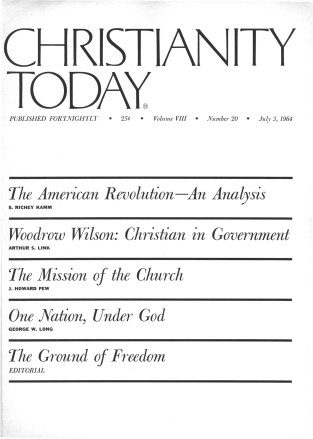
The Ground of Freedom

Freedom is a heritage—a priceless one—but where it is not understood, it may be lost. On the Fourth of July the American people ought not only to celebrate their freedom but also to give some thought to its source and nature.

Freedom is the power of self-determination. This power of self-determination is a dimension of the human spirit. Freedom, therefore, is not the absence of authority but a peculiar form of its exercise. A free man is not one who does whatever his whims dictate but one who determines the character and the direction of his life. He governs himself. The Book of Proverbs describes the free man as one who governs his spirit, and it asserts that such a man is better than he who takes a city. A free society is a people that determines the form and the function of its government and of the structures of its social life.

Since freedom is an aspect of the human spirit, no people on the face of the earth is wholly devoid of freedom. So long as men remain in control of their spirits, they are a threat to every form of totalitarian government. Collectivistic governments are aware of this and therefore attempt to control the spirits of men, to determine the form, direction, and goal of their lives.

Americans ought to know and appreciate the singular glory of their tradition of liberty. They should know and remember with excitement that their experiment in creating a free government and a free society was the first such democratic experiment in the whole of human history. The ancient Greeks experimented with democratic city-states, but even this limited experiment in democracy was built on the foundation of slavery. It is actually true that the experiment in liberty that produced the free American society and its free government had never before been attempted by any people anywhere.

National liberty, however, is not free. It is bought with a price and maintained at the cost of continuous vigilance. We are always in danger of having it taken from us, and wars are the price we have sometimes paid to retain it. It is a sobering thought that our free way of life has cost the lives of hundreds of thousands of America’s young men. Even today this price is being paid in Viet Nam. We are free because some men die. Remembering this, a people that is more free than any other people on earth ought to celebrate the Fourth of July thoughtfully and with a measure of sobriety.

The greatest danger to our national freedom, however, is not from the threat that comes from without but from that which arises within. Freedom is that quality of the human spirit that desires to exercise self-determination. The free man wants to take care of himself, make his own decisions, shape his own life, make his own living. Only insofar as he cannot care for himself, his family, his future does he look to his city, his state, his national government for aid. Similarly, he wants his city and his state to rule themselves by their own acts of self-government. To the extent that he surrenders his powers of self-determination to his city, to his state, to his national government, he surrenders his freedom.

An even greater threat to true freedom is that corruption and debilitation of spirit whereby men lose the ability to rule their own spirits. When this happens, men have lost the power to govern themselves. This has come about through human sin, with the result that men have become the victims of their own habits and weaknesses of their lusts and passions; and it constitutes a profound threat to a democratic form of government. Freedom means self-determination, and democratic government is self-government. Democratic governments as free societies can endure only so long as their citizens retain the ability to govern their own spirits. The society that loses self-discipline cannot long retain a form of free self-government. It is of the essence of a democracy that certain areas of life not be covered by laws. When, for example, obscenity in books and movies must be governed by a network of legislation because society has lost the moral power of self-discipline, the democratic society is losing its freedom.

It is at this point that Christianity has made, and must continue to make, its profound contribution to free society. There are forces within and outside the human spirit that bring it into bondage. In biblical thought, these forces making for bondage are sin and its uncontrollable passions. It is the message of Christianity that Jesus Christ alone can set men’s spirits free by delivering them from the power of individual and social sin, and from the ultimate threat of death.

Jesus said, “If the Son shall make you free, you shall be free indeed.” The Christian is the free man in Christ, and he is essentially free within his own spirit—which is the citadel of freedom—even if he lives in external” bondage. Christians in totalitarian societies are essentially free, as Paul was free in a Roman prison and John Bunyan in an English jail. A Christian is free even in a world of sin, as his confession and rejection of sin reveal. He is free even from death, in his liberating assurance of the resurrection and the life eternal. Through justification by faith he is a free man; being justified he is free to live. Because his past is canceled out, he has an authentic future.

Without Christianity, the grand, historic American experiment in democracy would not have been possible. The continuance of democracy in America depends on the degree to which Christianity flourishes in our land. Our liberty as a free society is grounded in religious freedom. As our national hymn asserts, God is the “author of liberty.”

Freedom is a deep and mysterious thing. It belongs to the very essence of the spirit of man. Misused, it turns into bondage. If it is to be understood, it can be understood only in terms of itself. The ground of freedom—by God’s creation and redemption—lies in itself. Freedom, therefore, presupposes itself. In its deepest aspects one cannot obtain it; one can only possess it. To have freedom, one must be free. It is, therefore, a gift from God—one that comes through Christ. For as Paul said, “For freedom did Christ make you free.”

As we celebrate our national freedom, let us think through the depths of the source and nature of our freedom until we see that every form of our freedom is grounded on that freedom which Christ alone can give. Where this is acknowledged, we can sing with confidence, “Long may our land be bright with freedom’s holy light.”

Peril On The Highways

With the approach of July Fourth, Americans need to think beyond the commemoration of battles and heroes. Recent history presses hard upon the national consciousness a form of blood-letting unforeseen in 1776. On Independence Day we celebrate our liberty and remember those who lived and died for it. In the Revolutionary War some 4,435 gave their lives in battle. But in our weekend celebration the number of traffic fatalities alone will come to between 450 and 550, according to the estimate of the National Safety Council. Thus it takes at the present rate only about nine annual celebrations of our independence to incur fatalities equivalent to the number who died in the war itself.

The gruesome irony does not end there. Last Memorial Day weekend 431 persons were killed on the roads. We were commemorating the fighting men who gave their last full measure. And they were many: since 1917, 53,402 in World War I, 291,557 in World War II, and 33,629 in the Korean War. But in 1963 alone 43,600 of our people were killed in motor vehicle accidents. The total number of such accidents reached a staggering 11,500,000. They resulted in 1,600,000 disabling injuries. They cost $7.7 billion. Experience shows that even now we are enlarging these figures for the statistician who will be giving us a report in 1964.

Twenty-five centuries ago the prophet Habakkuk looked out over his land in the last days of Judah and cried unto God about the violence he saw. Today there is ground for believing that centuries hence our own era will be called “The Violent Age.” Some say that our Western civilization is in its death agonies. If it is, surely one of the signs is our callous unconcern for the carnage on our highways. A calamity taking 43,000 lives would go down in history. But we continue to kill tens of thousands on our roads with comparatively little concern.

A great nineteenth-century hymn voices the prayer:

O hear us when we cry to Thee

For those in peril on the sea.

We need now to pray as well for the many more in peril on the road, as automobiles in statistical effect assume the destructive capability of rockets.

Twenty years ago some 9,000 Allied fighting men died at Normandy for the cause of freedom, which was in the balances. For what did last year’s 43,000 traffic fatalities in this nation die? For a faster society? Must this toll be paid for the affluent society? Do we have to watch silently and helplessly? Are we to rationalize highway casualties into a kind of population control, albeit a heartbreaking and bloody one? And this in contrast to great strides in life-saving through the healing arts!

The social gospel has had surprisingly little to say about the problem. Yet we must ask what implications the Gospel itself has in face of this social evil of increasingly stunning proportions. The Bible says that we hold the gift of life as stewards of God, its giver. A recovery of this truth would bring a needed reformation of Christian responsibility for safety on the highways. Christians are concerned, and rightly so, about civil rights. But what of the basic right to live? Life as God’s gift is precious beyond words. One who regards its extinction with apathy dishonors his Creator.

In recent months CHRISTIANITY TODAY has spoken editorially on the stewardship of life in connection with cigarettes and with alcohol. Concern for this kind of stewardship also points as a signpost to the highways. As we said in a previous editorial, special studies have indicated that as many as half the victims of fatal highway accidents had been drinking. One of the nation’s largest insurers of automobiles reports that over 80 per cent of traffic deaths and injuries can be traced directly to violations of rules of the road. Speeding and failure to yield right of way are also major causes.

Fatalism in the face of such a problem of our society as continuing carnage on the highways is a betrayal of the vigorous spirit which built that society. But there are ameliorating solutions. To see them we have but to look. Perhaps we should do well to look at a country like Norway with its strict regulations against drunken drivers. And why not? Has not a drinking driver turned himself into a potential killer, risking the lives of others for his own convenience—as well as risking his own life?

We need stricter traffic laws and stiffer penalties impartially enforced. Our civic leaders should lead in this area, and they should enjoy the enthusiastic support of their communities. The automobile industry should become involved in programs to awaken public conscience about safety and law enforcement. Additional safety devices must be developed. Seat belts alone, universally used, would save more than 5,000 lives annually.

With their God-given stewardship, Christians should be in the vanguard of such endeavors. The major finding of a test of airmen at the University of Colorado School of Medicine is that those who had suffered accidents were consistently less oriented toward religious values than those who had not. One psychiatrist declares that we drive as we live. Another suggests that speeding may be explained as the desire to recapture the delights of infancy, such as being rocked, tossed, or swung. Speed mania, he says, could be a form of belated revolt resulting from certain childhood problems never resolved.

The Christian is under divine mandate not to kill. But more, his is the priceless heritage of the law of love, which commands not only love for God but also love for neighbor equivalent to love for self. The most basic solution to traffic fatalities is changed men. And it is time for Christians to live like the changed men they profess to be. It seems that the acid test of the law of love in this century may well be located behind the steering wheel of a car. What is it about that wheel which seems to scrape off a code of ethics as one slides behind it? What strange alchemy in the driver’s seat transforms a gentleman into an egocentric menace? Does the traffic intersection negate the Pauline injunction: “Be kindly affectioned one to another with brotherly love; in honor preferring one another”?

With traffic in mind, it would be well for Christians periodically to review the biblical teaching about love especially as it relates to the highways. Love is patient at intersections, and not envious of the driver who got through the light while we were left. It does not seek its own right of way, regardless of the other driver who reached the intersection first. It does not behave itself discourteously. It is not easily provoked, but bears even traffic snarls and endures mistakes that the best of drivers make. Even behind the steering wheel … love is kind.

The Kennedy Mementos

The drugstore in our office building sells a night-light for fifty cents. It is an ordinary night-light, about an inch and a half in diameter. What distinguishes it is the picture of John F. Kennedy on its surface. Advertised as an “Eternal Flame,” it will allegedly burn continuously for six years for about three cents per year.

Kennedy mementos are big business, if show windows in Washington are any indication. One person found the following articles on sale (in addition to the many books, magazines, records, and postcards): a demitasse and saucer; an ashtray with a picture of President Kennedy in the middle; a coffee mug; a beer mug; a miniature JFK rocking chair, with and without a figure of the President seated in it; a medallion incorrectly inscribed with the phrase that, in the inaugural speech, ran, “… ask not what your country can do for you—ask what you can do for your country” (on the medallion, the second “ask” was replaced by “but”). There were salt and pepper shakers, pitchers, plates, plaques, playing cards, busts, and picture puzzles. There was a “key to the city” with a representation of Mr. Kennedy and a “guaranteed thermometer.”

The distressing thing about these mementos is that one has to be reminded of something so inexpressibly sad in such vulgar and essentially loveless fashion. Perhaps the whole trend indicates a basic human inability to find suitable expression for feelings about death, especially when it is the death of someone whose life meant so much. Perhaps the customers at the drugstore counters who reach for these things they can hold in their hands arc really seeking something else: a way to gather up the fragments of a shattered image, or a message, a word of some kind.

In Christ, God has offered men the final word: “Death is swallowed up in victory.”
Theology

The Forgotten Men

Scattered around the world, wherever our armed forces may be found, are the forgotten men of the Church.

Have you ever prayed for the chaplains in the armed services? Have you thought of them and prayed for them every day?

Few of these men have people in their congregations who pray for them. They work in the outposts of the Church, often forgotten by those bound to them by church ties and at times merely tolerated by those to whom they wish to minister.

The role of the chaplain is a lonely one. In many areas where our men are stationed, wives are not permitted to accompany them. Separated from home and loved ones these men sometimes find loneliness over-whelming.

On many occasions the writer has visited chaplains. He has found them hungry for Christian companionship, and soon the subject of home and dear ones has come up, showing how real their loneliness is.

Chaplains are also in the position of ministering to those who have not called them. Unlike ministers of churches here at home, these men have not been called by their congregations; and it is not easy to build up the relationships that usually exist in a church here.

Again, chaplains often work in most depressing and discouraging conditions. The greater the need of some to whom they have been sent to minister, the less they may find themselves welcomed by these very persons. Furthermore, the more sensitive a chaplain is to low moral and spiritual conditions, the more depressing he may find his situation to be.

Brightening the picture are those few devoted Christian men who back up the chaplain in his work, share in preparations for chapel services, and prove themselves a strong arm the chaplain can depend on in the conduct of his work.

But a chaplain also works under the handicap of military orders. His work may be regarded as merely a routine to be carried out in compliance with fixed procedures, a routine to which little spiritual significance is attached and from which little of value is expected.

One of the duties of a chaplain and an area of great potential value is counseling with men in trouble. There are those who are sorely tempted to go the way of the world, the flesh, and the devil, but who still have a heart-hunger to do what is right. For such men the chaplain is an anchor in a troubled sea.

Many servicemen—some of them just boys away from home for the first time—are desperately lonely. To them the chaplain can bring comfort and strength, not only by giving them friendly counsel but also by enlisting them in activities that will provide an outlet for their energies and will help to ease the ache of a gripping homesickness.

Some of these men have marital problems. Their wives and children are left at home. Some have wives who add to their burdens by sending complaining letters or by giving evidence of restlessness under the enforced separation. Some men fall in love with women in the country where they are serving, and it becomes the duty of the chaplain to counsel and to help in every way possible in order to prevent a step that may bring disaster later on.

Chaplains also have among their “parishioners” some who resent and reject them. Reminders of home and decent living cause some servicemen to resent the presence of the chaplain; he is an unwelcome reminder of a way of life they have rejected.

In many ways the role of the chaplain is affected by the commanding officer under whom he serves. One chaplain we know had tried for months to clean up an area in Japan where sailors were accosted by prostitutes the moment they stepped ashore, but to no avail.

Then a new officer took command. The chaplain told him of the situation, and the officer went to take a look for himself. He immediately called on the local Japanese mayor and told him that until the district was cleaned up, the entire town would be off-limits to the sailors. Within hours the area was cleared of the undesirable element. The chaplain told me that as long as that commanding officer was stationed in the port, the conditions remained greatly improved.

Some chaplains have the deep satisfaction of hearty support from superior officers in their areas. The officers express that support by attending chapel services and by letting it be known that they are Christians and that they consider the chaplain their spiritual adviser.

One chaplain told the writer of his experience when the American army took over Rome during World War II. Sunday morning the commanding general phoned the chaplain to ask where he was going to preach. Everything was in confusion in the city, and there had been no time to designate buildings for use as chapels. Nevertheless, the chaplain found a deserted church. The general arrived with his aide and sat in the front pew, and the chaplain preached a simple sermon on Psalm 91. After the service the general walked back and forth a few minutes, then turned to the chaplain and said, “Chaplain, thank you. That was just what I needed.”

Such encouragement means much; it helps to counteract the discouragement of trying to minister to hundreds who are utterly indifferent to all attempts to reach them.

But there are compensations for those who labor. One chaplain told the writer of a seriously wounded soldier whose condition was known to be hopeless. From the time he was admitted to the base hospital his Christian witness was felt. His simple faith and his clear affirmation of that faith made an indelible impression on both doctors and nurses.

Late one night the chaplain had finished hospital rounds and was weary in body and mind. As he was leaving the hospital, he felt he should go back to speak to this critically ill man. Retracing his steps, he stopped by the bed of the soldier, who was lying flat on the special frame used for spinal injuries. After a word and a prayer for which the man expressed deep appreciation, the chaplain returned to his quarters.

During the night the soldier died, and, in the chaplain’s words, “the entire hospital was shook up” because of the joyous faith of this lad.

Not only did the chaplain write the wife and parents of this man; later, when he returned to the States, he went to see them and told them of the triumphant life and death of their loved one.

Again we ask: Have you been praying for the chaplains? Are not these men, so far as you are concerned, the forgotten men of the Church?

We know of no group of men laboring under more adverse circumstances. These men need the comfort and strength of Christians here in America who pray daily for them. You who read this can see to it that they are no longer forgotten, and that they are held up in prayer before the Throne of Grace and thus strengthened in the One whom they serve.

Eutychus and His Kin: July 3, 1964

THE EIGHT-DAY WEEK

One of the gifts of my life has been a series of great professors, including Patrick Carnegie Simpson, an Australian turned Englishman. Why do I remember his saying twice in class, “The men a generation ago, if you will just study their pictures, had character in their faces. Look at Gladstone, for example. Where would you find a face like that in public life today”? Since I worry about my face every morning in the mirror, this word of Carnegie Simpson’s is never very far from my mind.

Simpson has a book, virtually unknown, called Recollections. His subtitle is, “Sometimes theological and sometimes interesting.” I can’t tell you where to get it, but I am delighted to have it myself. He tells in there of his undergraduate days when he set for himself the task of working meticulously through Kant’s Critique of Pure Reason. What he had in mind was to take notes, write briefs, work out précis, do whatever he had to do to master that one big piece of writing.

How was a man driven to do this? How do we get undergraduates motivated to do the same thing now? Why do our own scholarly resolutions disappear like the morning mist? Most of us believe we don’t have enough time. A brief reading of Arnold Bennett’s How to Live on Twenty-four Hours a Day will beat down that excuse forever.

Maurice Kelley of Princeton University has a study on Milton called This Great Argument: A Study of Milton’s De Doctrina Christiana as a Gloss upon Paradise Lost. Among other things (and this is not a book for reading while you are running) he quotes something of Milton’s purpose in drawing up his own body of Christian doctrine, De Doctrina Christiana. Listen to Milton: “I termed it … advisable to compile for myself by my own labor and study some original treatise which should be always at hand derived solely from the word of God himself and executed with all possible fidelity.…” There’s the sort of thing we all might do “if we only had a little more time.”

EUTYCHUS II

PASTORAL THEOLOGY

The pastoral theology theme of the June 5 issue was excellent. The article, “Once Married … Twice Wed” (by Edith Rees), was so good I read it aloud to my wife. Knowing that Dr. Rees, now with World Vision, travels greatly I expected the statement which came toward the close of the article, “No husband can travel over 2½ million miles by air alone … without a deep concern for a wife at home. Let’s face it, perhaps I am lonely.”

The veracity of this sentence was revealed as we turned a few pages to find Dr. Rees’s article (The Minister’s Workshop) in the same issue beginning, “This is written in India.…”

TYLER JOHNSON

First Presbyterian

Newport, R. I.

Thank you for the article, “A Layman Speaks to the Pulpit.” We need comments from our laymen. But let’s have them from laymen, not a man with a Bachelor of Theology degree, who has been an assistant pastor.…

Speaking of not communicating, if I began talking about “bombastic histrionics, obfuscating illogicality, and oft-strained, dogmatized tradition” in a sermon, as Mr. Samarin did in his article, people in my parish would wonder what I was saying. And I might even wonder myself.

Mr. Samarin’s problem is not his pastor but his position “on the bench.” He no doubt has many years of active, fruitful service in him and needs to be put back on the firing line again.

D. J. BRAKE

Lutheran Church

Houston, Minn.

If there has ever been a time when there has been a famine of the Word of God, it is today.… Too many take a text out of context and make a subject that has no Bible meaning.… [On] August 20 I will be 92.…

W. S. ROSE

Williamsburg. Pa.

Many laymen are like small children. They delight to sample the pie before dinner. No pastor can justify his position with one hearing, nor can any visitor be fair in his judgment of my message without knowing the motive of my sermon. I would suggest that Professor Samarin get away from the bright lights to some humble place of worship and then write again about preachers with a message of salvation that feed the sheep. I stand with these great men of God, highly educated or not, that have remained faithful to the divine call. I’ve always found it a good idea to find the best place to eat. They have a better variety of food.

F. L. HAGLEY

Nazarene Church

Jacksonville, Ill.

Probably a dozen times at least I have read the same criticism in the last forty years.

Why does not Dr. Samarin come up with something new?

I used to drive a horse when a boy. If the horse was thirsty, you could not keep it away from the watering trough. If it was not thirsty you could not force the horse to drink.…

RAYMOND TENNIES

Campbell, N. Y.

In regard to your editorial, “Preachers and Their Making,” which is very pertinent to the times, I want to say I attended Biblical Seminary in New York City some thirty years ago. In all that time there has never been a week in which I was ever at a loss in “finding a message to preach.”

As Dr. Samarin, in the same issue, might express it: thank you for hitting a “home run.”

S. N. CRAMER

Lookout Mountain, Tenn.

Re: “Counseling Unwed Parents,” I wish to endorse Tom Carter’s constructive … approach to this growing problem. Just recently at San Diego Billy Graham stated that sexual immorality was the worst sin there was (I presume worst in its effects upon the persons involved), and yet one could not miss his sharing his Saviour’s compassion and love for the one who had committed this sin. It is not easy to remain on the knife edge between hating the sin and loving the sinner. The minister must strive not to be misunderstood in his words or attitude as either condoning sin or, on the other hand, condemning the sinner so harshly that he shuts the door for repentance and forgiveness.

Christians too long have preached against sin without bearing the burden and sharing the shame with those who commit a specific sin, and especially is this true regarding sexual sins. I have seen those who have matured and come to Christian conversion through their experience in a home for unwed mothers and later establish a happy home. I have also seen those whose very spirit of life has been crushed by the rejection and lack of understanding and forgiveness of church people.…

Certainly every situation will have unique factors that may not make a good maternity home the best solution. Nevertheless this has proved valuable in multitudes of cases.…

To say that we encourage illegitimacy by providing help is as foolish as to say we encourage alcoholism by having a mission on the Bowery.… It is good that half of the unwed mothers come to ministers for counsel, but it should concern us that half feel that the minister is unable or unwilling to be of help.

To emphasize the rehabilitation end in no way denies that much could be done in our churches and homes on the preventive end of this problem. A deep and meaningful commitment to Christ as Saviour and Lord, and the thinking of one’s body as the temple of the Holy Spirit is the best surety that one will not fall before this heartrending sin.… There is no promise in the Bible that our children will never sin, but there is the promise of forgiveness and hope for a new life in Christ.

RICHARD CRABBS

Sycamore Methodist Church

Sycamore, Ohio

POETRY

May I remind the editors of CHRISTIANITY TODAY that the kind of bald polemic expressed in James Wesley Ingles’s poem “The Uncommitted” (May 8 issue) does not constitute or even approximate poetry. The versified theology you are prone to publish each fortnight, of which Mr. Ingles’s poem is an example, is embarrassing.

“The Uncommitted” serves as an excellent example of what a Christian poem is not, and in some ways, of what any kind of poem is not.… It picturesquely refers to the “bright” sun, to “a wrinkled brow,” and to a dogwood leaf which is “red as blood”.…

The imagery is fortuitous, unpatterned, and, in one instance where the uncommitted sees “on the dark sea, too many stars” (assuming stars are generally seen in the sky), incoherent. The uncommitted is “still testing all things” in the last line, but there is no prior indication in the poem that he was engaged in testing anything.…

The Pietà “impresses only as a work of art.” Is it supposed to stimulate a good healthy cry? If it has some specifically Christian function distinct from it being a work of art, then the statue is rather an affront both to Christianity and to art.

The crucial confusion, however, is the inability of the poet to distinguish between the uncommitted and the impenitent. The poem’s title and incipient concern are with “the untrammeled mind” which steers clear of the questions of beauty, good, truth, and, of all things, who the guilty are. A later concern, however, is not with the uncommitted but with the impenitent … with unbowed head and unbent knee.…

DAVID N. HOLKEBOER

Grand Rapids, Mich.

• We thank Mr. Holkeboer for his vigorous dissent from our choice of poems. But we go along with Mr. Ingles, who, to us, seems to state clearly a single theme; is not afraid to say simply that the autumn dogwood leaf is “red as blood” (which it is); knows, with Masefield, that sailors on a dark sea choose one star to steer by, that “a wrinkled brow” symbolizes perplexity, and that an unbowed head is a sign of refusal to worship.

The poem’s consistent theme is that the uncommitted soul, seeing no unmistakable course but testing different ones, wanders through life. The beauties of nature fail to move him to see a creator. After a little sleeplessness and perplexity over what truth is or what evil is, he washes his Pilate hands. Even the agonies of Gethsemane and the Cross—or the despair of Mary over her dead son—fail to move him. So he goes into death uncommitted.

Mr. Ingles is not, we admit, of the school of poets whose words must be startling, whose dogwood leaf explodes into some strange color, and who feel that if a Pietà or a poem “says something” to us instead of just being, it is an affront to art. That rather rules out “The Hound of Heaven” and other poems that affirm.—ED.

NOT ALWAYS WELCOME

Donald Moffett humbles most of us men of the cloth when he suggests (“At the Church Door,” May 8 issue) that we are more concerned about our plan books than about “doing good to all men, as we have opportunity.” But his words have a most unreal ring to them, for he greatly oversimplifies the situation by suggesting that the unconverted are panting for the minister to come and that they will cherish every word he offers when he knocks and says, “Let me in; I’ve come to solve your problems.” Mr. Moffett should know from experience that true pastoral work is hardly that easy, for Christ is still “a stumbling-block to Jews and folly to Gentiles.” And the natural man of today is as undiscerning about spiritual matters as the Corinthians ever were.

Feed the hungry? Clothe the naked? Visit the sick and imprisoned? Welcome the homeless? Of course. But let us not disillusion ourselves (or the neophyte pastors graduating this spring) into thinking that every visit will result in a conversion. Many will, praise God, but others will only bite the hand that feeds them.

MERWIN VAN DOORNIK

Second Reformed

Little Falls, N. J.

ROUND TRIP

If any of your readers in suburban Lanham read your May 8 issue, they’re going to be somewhat surprised and perhaps disappointed that you have moved their exciting Episcopal Church of St. Christopher from their Maryland town to Paradise Valley, California.

Just in case no one has pointed out this error on page 53 of this issue. Thank you, nonetheless, for covering the National Conference on Church Architecture in Dallas.

PHILIP DEEMER

Managing Editor

Protestant Church Buildings and Equipment

New York, N. Y.

• Paradise Valley did have a winner, however, which our story did not list: Hope Lutheran Church.—ED.

THESE MINISTER GRACE

We must not forget that “Christian writing” that does not mention Christ is not Christian.

A poem so fine as “Like as the Hart” (April 10 issue) might have been produced by a Unitarian, a Universalist, a Jew, or almost anybody. But a Christian “cannot but speak” of his own experience with Jesus.…

“Never a word about Jesus” should be our touchstone to determine values or the lack of them for the Christian. Portia Martin … should make Christ definitely known to me …, or her words lack relevance.…

MRS. FRANK J. MARSHALL

Munnsville, N. Y.

• Our spiritual heritage includes Psalm 42 as well as Psalm 22. We do not consider the story of the Prodigal to be Unitarian because it speaks only of the Father. These also minister grace to the hearers.—ED.

One Nation, under God

Among the books in my study are eight or ten commentaries on the Epistle to the Romans. All of them confirm the obvious meaning and force of these words of the Apostle Paul: “Let every soul be subject unto the higher powers.… The powers that be are ordained of God” (13:1). Christians are to submit themselves to the civil authorities.

Someone will say, “What if these authorities are ungodly and require things of us that are contrary to the will of God?” The answer is: A ruler could not be much more ungodly than Nero, the supreme head of state at die time Paul wrote these words.

One could indeed point to Peter and John, who were arrested in Jerusalem and commanded no longer to preach in the name of Jesus Christ, whereas Christ had commanded them to preach in his name. This was a direct conflict, and the disciples answered, “Whether it be right in the sight of God to hearken unto you more than unto God, judge ye. For we cannot but speak the things … we have seen and heard” (Acts 4:19, 20).

But note carefully: in this case of direct conflict, they could do nothing else but obey God rather than men; yet they did not resist arrest, nor did they rally the disciples to try to overpower the authorities. It is occasionally necessary for a Christian to suffer for doing what is right. In such cases, he should go on and do the thing that God requires and accept punishment if it comes. In this way he is being subject to the civil powers, even though he has put his allegiance to God first.

The occasional, very rare conflicts between the demands of the state and the commands of God must not be allowed to obscure the fact that the powers that be are ordained of God. Paul goes on to say, “Whosoever therefore resisteth the power, resisteth the ordinance of God.”

One famous commentator writes: “There are indeed always some tumultuous spirits who believe that the kingdom of Christ cannot be sufficiently elevated, unless all earthly powers be abolished, and that they cannot enjoy the liberty given by him except they shake off every yoke of liftman subjection. This error.…” Let me identify the commentator lest it be assumed that this is a newsman speaking of recent lawless activities. His name is John Calvin. Sometimes it is good to go back several hundred years, away from current controversies, to get a view of Scripture that cannot be colored by these present concerns.

The Law Of The Land

In essence, the thirteenth chapter of Romans is telling us that Christians are to obey the law of the land because it actually does, in general, approve what is orderly and disapprove what is wrong. Even the poorest governments do this. Moreover, even a Nero-type government is God’s instrument to enforce lawful conduct. This is a hard pill for some (though not all) to swallow today, but not nearly so hard as it was for the Jews of Paul’s day who were chafing under a Gentile tyranny.

Today we must face the often repeated question, “What is the law of the land?” It is a difficult question, a frighteningly up-to-date one, and one that must be solved. Jesus said, “If a kingdom be divided against itself, that kingdom cannot stand.” In America we have a kingdom divided against itself, and you and I are squarely in the middle of the clash. One voice says: The Constitution of the United States, with its associated documents, is the law of the land, and the Supreme Court of the United States is its interpreter. Another voice says: The Supreme Court has misinterpreted the Constitution, and the state will abide by what it deems to be a better interpretation of the Constitution.

We citizens are caught in the squeeze. Suppose we, as Christians, want to be subject unto the higher powers. Who are they? To which of the conflicting voices shall we listen? The Bible gives us some help: Paul directs Christians to submit to the supreme Roman officials—those who had the power of the sword and who collected taxes—rather than to the Jewish leaders. Almost everyone agrees that these are times of increasing tension, and that something needs to be done. At the same time, ironically, many people immediately criticize a person who tries to do something or even to say something directly on the subject.

One, Two, Or Fifty?

By saying that America is a kingdom divided against itself and that you and I are caught in the middle, I mean that there is a clash between the concepts of states’ rights and of federal government. Basically, we need to decide whether we are to be “one nation, under God,” or two (if not fifty). We cannot be both. It almost infuriates some of us to hear someone say that, because we want desperately to have the advantages of both; the thought that we cannot is terribly frustrating. Moreover, we hate to look the matter squarely in the face lest the answers that emerge be other than those we want.

I do not say these things to make anyone uncomfortable, or to take advantage of friendship or of freedom of the pulpit. I say these things because I care—because I care about you, about the people of our state and nation, and about the testimony of the Christian Church. I say these things because something needs to be said, solutions need to be sought and found. If what is said does not commend itself to your best knowledge of God’s will and Word, then it can be discarded and other approaches made. Let us at least think.

We need to decide whether we are first of all Americans, or first of all citizens of our individual state; whether in cases of conflict we follow United States law or state law; whether in matters of interpretation we follow Supreme Court rulings, or local rulings, or our own personal opinions; whether those chosen by the people at large to represent Americans represent us, or whether we are going to be an alien part of America, viewing others with suspicion and being looked upon by others as not a part of the whole.

The executive secretary of the General Council of the Presbyterian Church in the U. S., in speaking to a stewardship conference several years ago, pointed out an intriguing and perplexing problem. He said that a man who is trusted in his own town and his own presbytery immediately becomes suspect when he is called to serve on one of the denominational boards or agencies. How true this is. Men who would be beloved pastors of local churches are distrusted when they begin to represent the General Assembly.

The same thing is true in civil affairs. Men who would be highly honored for their work in a local community are viewed with suspicion and often bitterly criticized when they bend the same efforts in the service of the nation. The reason may be that in order to serve a whole nation they cannot be partial to any one section of it and thus do not entirely please anybody.

There is also more than a tendency among some people of our area to view our national leaders as—of all things—our enemies! This, I submit, must be a case of mistaken identity—unless we do not consider ourselves Americans, or unless we presume to declare the rest of the country un-American. For the sake of illustration, what about the nurse’s aid who said of the death of President Kennedy, “He got what was coming to him”? Or the students and—did I hear it wrong?—teachers who cheered when they got the news? Or the college students who grabbed each other and danced with glee? Was there a state legislator who clapped in a public meeting? A repairman said in my home, “I am not surprised that it happened, because there are so many people who hate him.” What kind of twist caused a university student to publish, on the very day of his death, “Every thoughtful American should hate Kennedy”?

People in national offices were chosen by a majority of Americans to be our leaders. If we do not acknowledge them as our leaders, we cut ourselves off from a majority of the American people. We do not need to approve everything they do, any more than the Old Testament prophets approved all their leaders did; but we do need to acknowledge that they are, in fact, our legitimate leaders. We should bend every effort to sway them in the right direction through letters and prayers. But when we cut ourselves off from them, we have a kingdom divided against itself, and we are then forced to decide between state and nation.

We are never helped, however, to see the distinction clearly. No one lines up before us all the advantages of being an entity unto ourselves as over against all the advantages of being a part of the nation. We are led to assume that we can have both. We want the military protection, the federal subsidies, the postal system, the TVA, the social security program, and all the rest; and yet we want to govern ourselves. We are like a dependent son trying to shake off all parental control before he is able or willing to support himself. It is a common problem, very trying in a family but tragic in a nation. Furthermore, the history that is being written day by day is demonstrating to us that such dualism will not work.

Preacher In The Red

It was my first big church wedding. At the rehearsal the evening before, I had noted that the couple appeared to be more than usually nervous, so I had tried to ease their tenseness. “You do not have to worry about a thing. I will keep everything under control. All you need to do tomorrow is follow exactly everything that I do.”

Now the ceremony was nearly over, and nothing had gone amiss. The couple had received communion and were kneeling in front of me for the benediction. As I bowed my head and began to pray, I sensed that something was going wrong. I opened my eyes a bit—and I was stunned. True to my instructions the couple were following my lead. Like swords crossed as a honor walkway, they and I had our arms raised and almost touching, as I stood there pronouncing the benediction in the traditional arm-raised style.—The Rev. HENRY T. MONEY, minister, Hooker Memorial Christian Church, Greenville, North Carolina.

For each accepted report by a minister of the Gospel of an embarrassing moment in his life, CHRISTIANITY TODAY will pay $5 upon publication. Anecdotes must narrate factually a personal experience and must be previously unpublished. Contributions should not exceed 250 words, should be typed double-spaced, and should bear the writer’s name and address. Accepted contributions become the property of CHRISTIANITY TODAY. Address letters to: Preacher in the Red, CHRISTIANITY TODAY, 1014 Washington Building, Washington, D. C. 20005.

I realize that a state has the right to govern itself as long as it does not conflict with the Constitution; but who is to decide whether or not state procedures conflict with the Constitution—the states themselves, or the Supreme Court? It is becoming apparent that what we vaguely refer to as “our Southern way of life” is in some ways incompatible with the “American way of life,” and we are being forced to decide whether to be Americans first or Southerners first.

The disagreement is not on a wide range of things. We are forging ahead industrially, economically, educationally, and in almost every other way along with the rest of the nation. We can keep most aspects of our Southern way of life—the graciousness, the refinement, the genteelness, the friendliness, the personal interest in one another.

About the only thing that is likely to have to go is our separateness. Even here, all that makes us different from other parts of the country is the laws on our books. Separation is largely practiced all over America, but it is not written on the books and it is not supposed to be practiced in public places. The federal government is not actually creating the problem. The problem is just naturally with us as population of the races increases, as intelligence and education increase, and as people, through modern communications media such as television, have their desires whetted. The government stirs the problem and aggravates it, forces us to deal with it, and at the same time makes it hard for us to deal with it; but it does not create the problem.

The thorn that is driving itself into my conscience is a growing conviction that those who want to abolish forced segregation are basically right, just as those who wanted to abolish slavery were basically right, and for just about the same reasons.

To summarize: God requires us to be in subjection to the higher powers, the “powers that be.” It is clear in the thirteenth chapter of Romans that Paul meant the Roman government rather than the subordinate Jewish state or the little Christian community.

As long as we have a conflict between state and nation, we have what Christ called a kingdom divided against itself, which cannot stand. The only feasible solution, if we are to have “one nation, under God,” and not two, or fifty, is to recognize, in cases of conflict, the authority of federal law as federally interpreted. The main area in which we are being pressed to change is that of forced segregation.

May God enable us to move toward peace and cooperation, not toward conflict and violence.

George W. Long is pastor of the First Presbyterian Church of Tupelo, Mississippi. A graduate of Wheaton College (A.B.) and Columbia Theological Seminary (B.D.), he has the Ph.D. degree from the University of Edinburgh and the D.D. from Bellhaven College. He preached this sermon to his people in December, 1963.

The Mission of the Church

Avital question before the United Presbyterian Church is whether or not the church, as a corporate body, should involve herself in economic, social, and political affairs. Many of its leaders, by precept and example, have already given an affirmative answer to this question, and much of their activity is concerned with civil affairs. The church has become involved through pronouncements, through appeals to political pressures, and through lobbies in Washington. Other denominations could be cited as examples, but this article discusses only the situation within the United Presbyterian Church. So far as Presbyterians are concerned, the elders are responsible for the spiritual welfare of the church. The very term “ruling elder” indicates an active role in governing the church.

In the United Presbyterian Church, a manual entitled Consider Your Ministry has been produced to help in governing the church. The second chapter defines the mission of the Church; its thrust is that the Church should be planted “in the middle of life with its everyday decisions.” No one would seriously deny that the individual Christian must relate his Christian convictions to the society of which he is a part in the economic, social, and political life about him. He must live out his Christianity in every phase of life, showing that he is salt and light in an unbelieving world. Nor is the right of the pulpit to speak out according to moral, ethical, and Christian principles in question. But Chapter II declares these things are also the responsibility of the corporate congregation. If the thesis of this chapter is true, then a session should involve the congregation “in the jobs men do to earn a living, in the power structures of the social order, in the decisions of politics, in the relationships of persons with one another as neighbors and members of various groups and clubs” (pp. 18, 19).

A paragraph on page 21 indicates the type of guidance a session should provide for the congregation:

But there are also things that the congregation as a corporate body can do; there are ways for the congregation itself to accept its being sent out into the world. A congregation may provide forums for the exploring of crucial issues, or it may conduct a survey of housing or job opportunities for minority groups, or it may establish an agency to meet the recreational needs of youth. It may deal forthrightly with some corruption of justice or even press for the passage or repeal of some law.

According to this, the session has the responsibility as a session to set up forums for every social, economic, and political issue of the day; to survey the community for housing and job opportunities for minority groups. But it is to do much more since the 1963 General Assembly passed this recommendation:

The 175th General Assembly … alerts the church to other pressing metropolitan problems including methods of metropolitan government, mass transportation, equitable representation in state legislatures, suburban residential segregation, and chronic poverty of segments of our population [Minutes of General Assembly, Part I, p. 326].

This means that sessions must lead their congregations in a study of methods of metropolitan government and inform all cities of the nation what is the best type of metropolitan government. They must study mass transportation and inform, among others, the leaders of the city in which they live how to overcome traffic problems and how best to transport the working population to and from work. They must inform their state capitals as to what is an equitable representation in state legislatures. And they must come up with the solution to such poverty as may exist in certain segments of our population.

Since the congregation speaks as a Christian congregation, the assumption must be made that it knows the mind of Christ concerning metropolitan government, mass transportation, equitable representation, and so on. It must be able to declare to the various governing bodies: “Thus saith the Lord.”

But to continue, sessions must be ready to send out members of the congregation to various cities, here and abroad, so that they can adequately study methods of metropolitan government. The problem of mass transportation has already cost millions of dollars, and still it remains unsolved. Must the church spend more millions, or does church affiliation equip individuals with greater knowledge and competence? Must the congregation engage political experts to help determine equitable representation in federal, state, and local government? And who can estimate the cost of eliminating chronic poverty? These are but a small fraction of the economic, social, and political problems about which the General Assembly, through its Committee of Church and Society, has already issued statements and made pronouncements.

But is this the mission of the Church? Does such a program square with the teachings of Christ, with the Scriptures, with the history and traditions of the Church, with the constitution of the United Presbyterian Church, and with reason and logic?

Caesar’s Kingdom And God’s

Even a superficial reading of Christ’s words reveals that he did not interfere with civil affairs. This disappointed the Pharisees, who were looking for a political messiah. And in order to entangle Jesus in the political and economic situation of their day, they asked him whether it was lawful to pay taxes to Caesar. Jesus gave a classic answer that is timeless for the Church: “Render therefore unto Caesar the things which are Caesar’s; and unto God the things that are God’s” (Matt. 22:21). Christ definitely distinguishes between Caesar’s kingdom and God’s. There is a clear distinction between temporal kingdoms and the kingdom of heaven. The jurisdiction of the state and that of the Church differ. Jesus never concerned himself about Caesar’s affairs. Job opportunities, methods of metropolitan government, mass transportation, equitable representation in legislatures are plainly problems for Caesar and not for the Church. And let us not forget that the economic, social, and political problems of Christ’s day were just as serious as they are today, if not more so.

That Jesus refused to involve himself or the Church in economic situations even when they involved justice is borne out by Luke 12:13, 14. One of his followers said, “Master, speak to my brother, that he divide the inheritance with me.” The brother was evidently cheating this follower of Christ out of his rightful inheritance. Here Christ had the opportunity to exercise justice and see that there was an equal distribution of wealth. But Christ refused to enter into a sphere that fell outside his divine calling. There are some church committees that feel that one of the functions of the Church is to bring about an equal distribution of wealth which they call justice. Yet Christ said, “My kingdom is not of this world” (John 18:36). What right has any court of the Church to cast the Saviour into a political role by involving his Church in civil affairs?

Most church pronouncements have to do with the material welfare of men. Now suppose someone would come and say to the Church: “Take no thought for your life, what ye shall eat, nor what ye shall drink; nor yet for your body, what ye shall put on” (Matt. 6:25). One can readily imagine that a committee on social action would vehemently attack him. Yet these were the words of Christ to the Church in the Sermon on the Mount.

The Lordship Of Christ

The modern-day Church justifies her invasion of economic, social, and political spheres on the ground of the Lordship of Christ. Is not Christ the Lord of all life? Then modern theologians, like the Roman Catholic theologians, proceed from the Lordship of Christ to the lordship of the Church over all facets of life. Christ forbids the Church to enter into the sphere of Caesar. If the Church really takes the Lordship of Christ seriously, then she must listen to him as he defines the separate jurisdictions of state and church, as he declares that his kingdom is not of this world, as he maintains that he is not a divider of wealth, as he limits the Church to spiritual weapons. If the Church is not hypocritical in declaring the Lordship of Christ, she must follow both his example and his teachings.

In the Scriptures we find that the apostles followed the same principles as their Lord. They were interested in establishing a spiritual kingdom and refused to become involved in secular affairs. The Apostle Paul declared: “For the kingdom of God is not meat and drink; but righteousness, and peace, and joy in the Holy Ghost” (Rom. 14:7). The sixth chapter of the Book of Acts describes an incident that arose about the distribution of charity. The apostles said to the Church: “It is not reason that we should leave the word of God, and serve tables” (v. 3). So they asked for the appointment of seven laymen to handle this business and stated: “But we will give ourselves continually to prayer, and to the ministry of the word” (v. 4). Now if the apostles felt that prayer and preaching were of such supreme importance that they could spare no time for the distribution of charity, what would they say to denominational leaders of our time who seek to solve the problem of metropolitan government and mass transportation? The apostles knew that prayer and preaching the Gospel would bring a thousandfold greater benefit to mankind than even feeding and clothing the poor.

Calvin in commenting on this incident calls attention to the preoccupation of the Roman Catholic Church with secular business. He said: “They entangled themselves in divers businesses, which they were scarce able to overcome, though every one of them had had ten heads.” If denominational leaders are going to solve all the secular problems they have taken upon themselves in this complex society, it would appear that they should be multiheaded.

The whole emphasis of the Book of Acts and of the Epistles is upon the preaching of salvation, the sanctification of believers, and the application of the Gospel in daily life according to the law of love. The apostles did not seek to reform society by external and political means; they used only the persuasive power of the Gospel. It was their conviction that the Gospel, and not legislative acts, would transform society. They did not discuss or become involved in economic, social, and political affairs, even though the society of their day was in a sadder state than ours.

Jesus Christ, the apostles, and the early Church knew that it was very important for the Church to adhere strictly to the Gospel, realizing that, should she become involved in non-ecclesiastical, controversial issues, those who opposed the position she took would question her competence to speak on ecclesiastical subjects.

During the Middle Ages the Church left the Gospel and entered into economic, social, and political spheres. By means of canon law the Church forbade the use of interest, fixed the amount of wages, and attempted to control the price of goods. The result was a period of poverty and stagnation. Society became corrupt because the Church neglected her spiritual weapons. Surely the example of the Middle Ages is sufficient to warn us against the folly of the Church’s interfering in fields outside her God-given jurisdiction.

The Reformation brought the Church back to the preaching of the Gospel. Both Luther and Calvin confined the Church to spiritual functions. One of the first things Calvin did in organizing the new Protestant church in Geneva was to set up two groups: one he called the “Consistory”—this was composed of five ministers and twelve lay elders; the other he called the “Company of Pastors”—this was composed solely of ministers. Concerning the Consistory the constitution stated, “All this is to be done in such a way that the ministers have no civil jurisdiction and wield only the spiritual sword of the Word of God, as St. Paul commands them.” The Consistory (which was the forerunner of what we know as the session) could reprove according to the Word of God. The severest punishment it could mete out was excommunication. It was denied any civil jurisdiction.

The ecclesiastical body, known as the “Company of Pastors,” had in its constitution that the pastor’s duty was “to preach the Word of God, to instruct, to admonish, to exhort and reprove in public and in private, to administer the sacraments, and, with the Consistory, to pronounce the ecclesiastical censures.”

It is commonly thought that Calvin and the ministers of Geneva dominated the civil affairs of that city. That is contrary to the facts, as original records recently discovered and translated prove. Calvin himself wrote: “I know well that the impious everywhere cry out that I aspire with an insatiable passion to political influence, and yet I keep myself so strongly separated from all public affairs, that each day I hear people discoursing upon subjects of which I have not the least knowledge. The government has recourse to my counsels only in grave affairs, when it is irresolute or incapable of deciding by itself” (letter to Zurich in 1555).

According to an eminent Swiss historian, Anedee Roget: “We do not know that the Council ever consulted the Church for any subject in the offing, nor the assembly of ministers, nor the Consistory, a mixed body.” Common sense tells us that the Reformation would never have proceeded from Geneva if the church had occupied herself with the civil affairs of Geneva. It was because the Geneva church concentrated on the Gospel that she came to have such an international influence.

John Knox and the Westminster Divines carried out the same policy and practice. Their belief found expression in the Westminster Confession of Faith, which forms part of the United Presbyterian constitution. Chapter XXXI, Section IV, reads:

Synods and councils are to handle or conclude nothing but that which is ecclesiastical; and are not to intermeddle with civil affairs, which concern the commonwealth, unless by way of humble petition, in cases extraordinary; or by way of advice for satisfaction of conscience, if they be thereunto required by the civil magistrate.

Many of the doctrines of the Westminster Confession were debated for weeks and months, but there was 100 per cent agreement on this section, which passed without debate. The Westminster Divines knew the damage the Roman Catholic Church brought upon Christianity by presuming to “intermeddle with civil affairs” and sought to safeguard the Presbyterian Church from such a proved folly.

Every time the Presbyterian Church as a corporate body becomes involved in economic, social, and political affairs, she transgresses both the word and the spirit of the constitution that elders and ministers sacredly vow to uphold.

Advice From John Witherspoon

When the Presbyterian Church in the U. S. A. was formed in Philadelphia in 1789, it adopted the Westminster Confession of Faith with its proviso that there would be no “intermeddl[ing] with civil affairs.” One of the leading spirits in the formation of that church was Dr. John Witherspoon, the only clergyman to sign the Declaration of Independence. He separated his duties as a citizen from those of a minister. In a sermon he stated:

The other direction I would offer upon this subject is, that ministers take care to avoid officiously intermeddling in civil matters. A minister should be separated and set apart for his own work; he should be consecrated to his office.… But it is still more sinful and dangerous, for them to desire or claim direction of such matters as fall within the province of the civil magistrate. When our blessed Saviour says, “My kingdom is not of this world,” he plainly intimates to his disciples that they have no title to intermeddle with state affairs.

From 1789 to 1912 the Presbyterian Church kept out of the civil sphere, except for the slavery question. During this time it had its greatest influence and strength. During the nineteenth century Alexis de Tocqueville made these discerning comments in comparing the effect of religion in America with that in Europe: “There is no country in the whole world in which the Christian religion retains a greater influence over the souls of men than in America; and there can be no greater proof of its utility and of its conformity to human nature, than that its influence is most powerfully felt over the most enlightened and free nation of the earth.… They [clergy] keep aloof from parties and from public affairs” (Democracy in America, I, 314, 315). In other words, it was not by interfering in civil affairs and not by political pressures that the Presbyterian Church became such a powerful influence for moral good but by keeping strictly to her spiritual sphere and by employing the persuasive power of the Gospel of Jesus Christ.

From the year 1912 we find the beginning of an encroachment into civil affairs by the Presbyterian Church, chiefly through the influence of a united effort on the part of major denominations and centering in the Federal Council of Churches. It is obvious from history that in proportion to her engrossment with economic, social, and political matters, the spiritual and moral influence of the Church waned. The moral corruption and spiritual poverty of our day certainly stem in great measure from the neglect of the Church to carry out her spiritual mission. The social gospel has proved to be ineffective in lifting up the moral standards of our nation.

If the church as a corporate body should follow through with the economic, social, and political programs presented by the United Presbyterian General Assembly’s Committee of Church and Society, she would find herself in opposition to the teachings of Christ and the apostles; she would ignore the lessons of history; she would despise the finest traditions of the Presbyterian Church and violate the constitution its elders and ministers have vowed to uphold.

Surely it is against all reason and logic that the congregation or the Church as a whole should enter into a program that can only prove divisive and weaken the spiritual witness of the Church. The program advocated is divisive. The Church has been known as an institution that proclaims the infallible truth of God, but when she issues pronouncements in fields outside her sphere, this can only bring shame, confusion, and disillusionment.

The great need of today is for the Church to be the Church and to manifest the spiritual power with which God has endowed her. Our people have a spiritual hunger; they desire the Bread of Life, not secular pronouncements. And if the Church proclaims the Bread of Life, she will, as has been proved in the past, so transform society that many of the prevalent social ills will disappear. She will infuse such virtues into society as to elevate all phases of human life. The mission of the Church is to redeem souls by the Gospel of salvation, and only as she redeems individuals will society be redeemed.

J. Howard Pew is a distinguished Christian layman and is active in many evangelical causes. He is the president of the Board of Trustees of the United Presbyterian Foundation and a member of the Board of Directors ofChristianity Today.He also serves as an elder in the Ardmore Presbyterian Church, Ardmore, Pennsylvania.

Woodrow Wilson: Christian in Government

Woodrow Wilson stands pre-eminent among all the inheritors of the Calvinist tradition who have made significant contributions to American political history. Indeed, he was the prime embodiment, the apogee, of the Calvinist tradition among statesmen of the modern epoch. Every biographer of Wilson has said that it is impossible to know and understand the man apart from his religious faith. His every action and policy was ultimately informed and molded by the Christian insight that it was given him to have.

One word of explanation is necessary at the outset of this essay. Woodrow Wilson was first a Christian and secondarily a Presbyterian; that is, his faith was that faith which God gives to the one holy catholic Church. He was, moreover, a very ecumenically minded Christian. As an undergraduate at Princeton University, and later as professor and president, he took active part in the interdenominational Philadelphian Society, the YMCA, and the World Student Christian Movement. As Governor of New Jersey and President of the United States, when his influence and interests had wider scope, he played as active a role as possible in the work of such groups as the Sunday School Union and the Federal Council of Churches of Christ in America. In death he sleeps in a crypt in an Episcopal cathedral. Insofar as the voluminous evidence of his life can show, he had no sectarian pride or consciousness; nor, for that matter, did he ever show any trace of antipathy toward other Protestants, Roman Catholics, or Jews. This was true, one would like to believe, because Wilson was a faithful Presbyterian. But saying this does not get the present writer off a very sharp methodological hook—the difficulty, almost impossibility, of discriminating between those influences in Wilson’s life and thought that are God’s gift to his one Church and those that might be considered an inheritance of the Calvinist tradition.

Woodrow Wilson was born in the Presbyterian manse in Staunton, Virginia, on December 28, 1856, and grew up in manses in Augusta, Georgia; Columbia, South Carolina; and Wilmington, North Carolina. Thus he had, as he once put it, “the unspeakable joy of having been born and bred in a minister’s family.” It was a secure, tightly knit family dominated by a strong-willed father who valued education along with faith. Young Woodrow grew up on family worship, Bible reading, study of the Shorter Catechism, and stories of Scottish Covenanters. As he later said in a speech in London on his sixty-second birthday, “The stern Covenanter tradition that is behind me sends many an echo down the years.” Admitted to the membership of the First Presbyterian Church of Columbia on July 5, 1873, he also grew up in the bosom of the church, imbibing unconsciously its traditions and faith. He shared in its work as his father’s right-hand man in pastoral calling, in carrying out the business of the North Carolina Presbyterian, which his father edited for a time, and in preparing the minutes of the General Assembly.

Such an inheritance laid strong foundations for faith in mature life. “My life,” he told a friend when he was President of the United States, “would not be worth living if it were not for the driving power of religion, for faith, pure and simple. I have seen all my life the arguments against it without ever having been moved by them.… There are people who believe only so far as they understand—that seems to me presumptuous and sets their understanding as the standard of the universe.… I am sorry for such people.” It was true, and Wilson apparently was never buffeted by strong winds, much less storms, of doubt. His faith found expression, among other ways, in family worship, daily prayer and Bible reading, and, above all, active church membership. He and his family were members, successively, of the Byrn Mawr Presbyterian Church, the Congregational Church of Middletown, Connecticut, the Second Presbyterian Church of Princeton, and the First Presbyterian Church of the same town. He was ordained a ruling elder in 1897 and served on the sessions of both Princeton churches.

Wilson and his wife moved their membership to the Central Presbyterian Church when they went to Washington in 1913, thus resuming intimate relationship with the denomination in which they both had been reared. It was a small congregation, and Wilson loved its simple service—it took him back, he said, to “the days when I was a boy in the South”—and the courtesy of the members in permitting him to worship quietly. “I have been to church,” he wrote one Sunday in 1913, “in a dear old-fashioned church such as I used to go to when I was a boy, amidst a congregation of simple and genuine people to whom it is a matter of utter indifference whether there is a [social] season or not.” He attended as regularly as possible until 1919, when illness confined him to his home, and he showed his concern in ways large and small.

An Eloquent Christian Speaks

Wilson was one of the most thoughtful and articulate Christians of his day. He spoke with increasing perception and power on subjects ranging from problems of the ministry and Christian education to problems of the rural church in a changing society. He was also a pulpit preacher of moving eloquence and great evangelical fervor. He preached only in the Princeton Chapel, and all but one of his sermons have remained unpublished and consequently unknown. They were among the greatest speeches he ever delivered.

It is fairly common knowledge that Woodrow Wilson was an honorable man. His integrity was as considerable as his personal ethics were lofty. Before he entered politics he had already given abundant evidence of integrity as president of Princeton in risking serious decline in enrollment by greatly elevating academic standards and in refusing to change policies in order to curry favor with alumni or potential donors. He was the same kind of man in politics. He was incapable, not only of outright corruption, but also of more subtle and dangerous forms of corruption, like acceptance of political support when he knew that strings were attached. There is no need to labor the obvious. Let it suffice to say that Wilson set an example of morality in politics excelled by few other American statesmen.

It is more important to talk about the wellspring of Wilson’s morality—his belief, undoubtedly sharpened and defined by the Calvinist emphasis, that God governs the universe through moral law, and that men and nations are moral agents accountable to God and transgress that law at the peril of divine judgment. This theme runs through virtually all his political speeches. But to stop at this point would be to repeat the common mistake of saying, at least implying, that Wilson was simply a moralist who lived rigidly by rules, with all the inevitable consequences of this way of life. Wilson had, in fact, a very sophisticated understanding of Christian ethics. He believed firmly, deeply, in moral law and judgment, but he understood them also in the light of God’s love and reconciling work in Jesus Christ. Moreover, he believed that morality and character were by-products of obedience, like Christ’s own obedience, and that Christ alone gives persons power to live righteously by enabling them truly to love one another. He said these things often, but never more movingly than in his baccalaureate sermon at Princeton in 1905:

And so the type and symbol is magnified,—Christ, the embodiment of great motive, of divine sympathy, of that perfect justice which seeks into the hearts of men, and that sweet grace of love which takes the sting out of every judgment.… He is the embodiment of those things which, not seen, are eternal,—the eternal force and grace and majesty, not of character, but of that which lies back of character, obedience to the informing will of the Father of our spirits.… [In Christ] we are made known to ourselves,—in him because he is God, and God is the end of our philosophy; the revelation of the thought which, if we will but obey it, shall make us free, lifting us to the planes where duty shall seem happiness, obedience liberty, life the fulfillment of the law.

Wilson, like all other mortals, suffered the plagues of sin and death. He had a powerful ego and drive toward dominance. He had a tendency to identify his own solutions with the moral law. He often sounded like a moralizer. But to form an accurate judgment one must look at Wilson’s entire career in politics, not merely at particular episodes. The record shows a man committed very deeply to fundamental Christian affirmations about moral law but also enormously flexible about details and methods, so long as they did not violate what he thought was right.

The Awesome Presence

Wilson was most obviously a Calvinist in his emphasis upon the majesty and sovereignty of God. He literally stood in awe of the Almighty One. He was not a prig, and he occasionally used words of which some Presbyterians would not approve. But using the Name lightly was to him blasphemy against divine majesty. His daughter, Mrs. Eleanor Wilson McAdoo, has told the present writer about his fearsome reaction when she once repeated a ditty that took liberties with God’s name. This is said merely as illustration of Wilson’s consciousness, manifested in numerous other ways, that he stood constantly in the presence of a jealous God.

This same God was, in Wilson’s view, not only the Lord of individuals but also the Lord of history, ruler of men and nations, who turned all things to his own purpose. “The idea of an all merciful God,” Wilson’s brother-in-law once said, “was, I believe, to him, a piece of soft sentimentality.” This did perhaps characterize Wilson’s earlier understanding of God’s sovereignty as it had been influenced by his father’s stern Calvinism. But it was not Wilson’s mature understanding of the sovereign Lord of history. At least by the early 1900s he had come to a new understanding—that men truly know God only through Jesus Christ. God’s saving work in history is most clearly revealed in his work of reconciliation through Christ, who is also the Lord of the ages. God’s providence did not end with the once-for-all revelation. In his triune nature he has constantly been at work in the affairs of men, shaping, directing, and controlling history in order to achieve his purpose of advancing justice, righteousness, and human welfare. Men might, often do, try to thwart God’s saving work. It does not matter. They are contemptible, futile, and impotent. It is man’s duty to apprehend God’s purposes and then to cooperate cheerfully.

‘Reform Cannot Be Stayed’

About the irresistibility of God’s providential work Wilson had the following to say in his address on the Bible in 1911:

The man whose faith is rooted in the Bible knows that reform cannot be stayed, that the finger of God that moves upon the face of the nations is against every man that plots the nation’s downfall or the people’s deceit; that these men are simply groping and staggering in their ignorance to a fearful day of judgment; and that whether one generation witnesses it or not the glad day of revelation and of freedom will come in which men will sing by the host of the coming of the Lord in his glory, and all of those will be forgotten—those little, scheming, contemptible creatures that forget the image of God and tried to frame men according to the image of the evil one.

There was power in faith such as this. For Wilson it meant, when plans were succeeding, the strength and joy that come from the conviction that one is doing God’s work in political affairs. It also brought courage and hope in the time of his great adversity, when the Senate wrecked his work at Versailles and, as he thought, the best hope for peace in the world. “I feel like going to bed and staying there,” he told his physician, Dr. Cary T. Grayson, after he had received word that the Senate had rejected the treaty for a second time. But later in the night he had Dr. Grayson read Second Corinthians 4:8, 9, and then he said, “If I were not a Christian, I think I should go mad, but my faith in God holds me to the belief that he is some way working out his own plans through human perversities and mistakes.” Later in the last public speech that he ever made he reiterated his unshaken faith: “I am not one of those who have the least anxiety about the triumph of the principles I have stood for. I have seen fools resist Providence before, and I have seen their destruction, as will come upon these again, utter destruction and contempt. That we shall prevail is as sure as that God reigns.”

To be sure, faith like this carried obvious dangers, the principal one being the temptation to believe that what the self wants to do is what God commands, and that one’s opponents are not only mistaken but of evil heart and mind. But all Christian statesmen have to run such dangers. And if Wilson succumbed at times, he never forgot for long that he was a servant of Jesus Christ and that the final judgment belongs to God. As he once said in an address before the Pittsburgh YMCA about men with whom he disagreed, “While we are going to judge with the absolute standard of righteousness, we are going to judge with Christian feeling, being men of a like sort ourselves, suffering the same temptations, having the same weaknesses, knowing the same passions; and while we do not condemn, we are going to seek to say and to live the truth.” Wilson even came to accept defeat of American membership in the League of Nations as God’s decision, saying humorously, “Perhaps God knew better than I did after all.”

It is a great temptation to an admirer of the Presbyterian form of government to say that Woodrow Wilson was profoundly influenced by the constitutional structure of the Presbyterian Church. He believed very ardently in representative government. He was forever writing constitutions for college debating societies, and he crowned this activity by writing one for the government of the world. He knew the Presbyterian system as well as any statesman this country has ever produced. But there is not a shred of evidence to suggest that his study and practice of the Presbyterian system influenced his thinking about a secular political order, while there is a great deal of evidence that English and American political theorists and practitioners influenced him strongly in this field.

The Role Of Government

The most remarkable thing about Wilson as a political leader was the change that occurred in his thinking about the functions of government. His views on government paralleled his thinking about the Christian’s duty toward his fellowman. This was more than mere coincidence. Wilson’s views about the role of government stemmed directly from his growing understanding of Christian social and political duty.

Wilson grew up during the high tide of individualism in the Western world. His political heroes were the English devotees of laissez faire—Cobden, Bright, and Gladstone, and the earlier but equally conservative Burke. He studied with some admiration British and American classical economists, including Adam Smith, Malthus, Ricardo, and Amasa Walker. We can say that Wilson, like most Eastern academic people during his day, did not seriously question prevailing assumptions. He admired rich men and captains of industry and their political allies like Grover Cleveland and William McKinley. He had ill-disguised contempt for the Populists, William Jennings Bryan, and other tribunes of the discontented. He seems to have been oblivious of the great movement to reawaken Christian social conscience that began in an organized way in the 1870s and was beginning to leaven American religious thought and life by the 1890s. This was true even as late as the first decade of the twentieth century, when Wilson was president of Princeton University. He gained what little political fame he then enjoyed as a critic of Bryan and Theodore Roosevelt and an advocate of very cautious solution of economic and political problems.

Wilson’s political thought first began to show signs of changing about 1907. By 1910, even before he entered politics, he was a moderate progressive who affirmed that reform of many aspects of American life was overdue. The first sign of this metamorphosis was a significant shift in his thinking about the role that Christians and the Church should play in the world at large. He delivered three major addresses on this subject between 1906 and 1909—“The Minister and the Community,” in 1906, and “The Present Task of the Ministry” and “The Ministry and the Individual,” both in 1909. They revealed that Wilson had not yet altogether shed his earlier pietism and intense individualism. The Church’s duty, he said, was to save individual souls. Christ was not a social reformer. “Christianity, come what may, must be fundamentally and forever individualistic.” The minister should “preach Christianity to men, not to society. He must preach salvation to the individual.” Yet a momentous intellectual ferment was also evidenced in the last two lectures. We find Wilson also saying—not in 1906, but in 1909—that “if men cannot lift their fellow-men in the process of saving themselves, I do not see that it is very important that they should save themselves.… Christianity came into the world to save the world as well as to save individual men, and individual men can afford in conscience to be saved only as part of the process by which the world itself is regenerated.”

Wilson crossed his political Rubicon dramatically in 1916 by espousing and winning adoption of a series of measures, including the first federal child labor law, that for the first time put the government squarely into the business of social reform and amelioration. Moreover, he went on during the campaign of 1916 to describe his vision of the new good society in which government would be ceaselessly at work to restrain exploiters, uplift the downtrodden, protect children, and defend the helpless and weak. It was nothing less than a vision of the modern welfare state. Again, the significant fact about his vision was its origin, at least in part, in Wilson’s Christian social conscience. Over and over he said that Americans had no choice but to carry their compassion into all the byways of life.

These convictions grew as the years passed. The last words that Wilson published—an article, “The Road away from Revolution,” which appeared in the Atlantic Monthly in 1923—were a warning to Americans then reveling in materialism that their society could not survive the onslaught of the disinherited unless it became “permeated with the spirit of Christ and … [was] made free and happy by the practices which spring out of that spirit.” This meant, he made clear, a social and economic order based on “sympathy and helpfulness and a willingness to forego self-interest in order to promote the welfare, happiness, and contentment of others and of the community as a whole. This is what our age is blindly feeling after in its reaction against what it deems the too great selfishness of the capitalistic system.”

America’s World Mission

Woodrow Wilson’s whole thinking about foreign policy for the United States was shaped by his concept of ministry and his belief in divine Providence. Ministry, as he said many times, is Christ’s ministry of unselfish service to individuals, societies, and nations. He believed that God had created the United States out of divers people for a specific, almost eschatological, role in history—as one scholar has written, “to realize an ideal of liberty, provide a model of democracy, vindicate moral principles, give examples of action and ideals of government and righteousness to an interdependent world, uphold the rights of man, work for humanity and the happiness of men everywhere, lead the thinking of the world, promote peace,—in sum, to serve mankind and progress.” Foreign policy should not be used for material aggrandizement, nor even defined in terms of material interest. America’s mission in the world was not to attain wealth and power but to fulfill God’s plan by unselfish service to mankind.

It is no coincidence that this sounded like the language of the American missionary movement of that day. Wilson believed intensely in an evangelical, missionary church. At Princeton he participated in the World Student Christian movement of the YMCA and knew and greatly admired its leader, John R. Mott. It was, he said to the Pittsburgh YMCA, “an association meant to put its shoulders under the world and lift it, … that other men may know that there are those who care for them, who would go into places of difficulty and danger to rescue them, who regard themselves as their brother’s keeper.” Speaking to the Presbytery of Potomac in 1915 about Christian missions in China, Wilson said:

Why, this is the most amazing and inspiring vision that could be offered to you, this vision of that great sleeping nation suddenly cried awake by the voice of Christ. Could there be anything more tremendous than that?… China is at present inchoate; as a nation it is a congeries of parts, in each of which there is energy but as yet unbound in any essential and active unity. Just as soon as its unity comes, its power will come in the world. Should we not see that the parts are fructified by the teachings of Christ?

Wilson came to the presidency, as has often been observed, with no training and little interest in foreign affairs and diplomacy. As President he of course had to deal with international problems, and to deal with them immediately in Mexico, the Caribbean area, and the Far East. He simply adopted all his assumptions about the nature of the Church’s worldwide ministry as the basic assumptions of his foreign policy. And during the first two years of his presidency, he and his secretary of state, William J. Bryan, another Presbyterian elder who shared Wilson’s motivation, put into force what has elsewhere been called “missionary diplomacy” aimed at helping underdeveloped countries work toward domestic peace and democracy.

Wilson struggled to avoid involvement in the First World War in part because he ardently desired to use American power for a noble mission—mediation of the conflict. He accepted belligerency in 1917 in large part because he then believed that American participation was at that time the surest if not the only way to peace. He created the League of Nations in part because he thought that it would be the instrumentality of America’s redemptive work in the world. And he spent his health and strength to convince Americans that God had laid the burdens of leadership for peace on them.

Another salient aspect of Wilson’s fundamental thinking about international relations was also an obvious product of his life and faith as a Christian. It was his abhorrence of war as an instrument of national policy. I do not believe that Wilson subscribed to the classical Christian doctrine of the just war, although we have scanty evidence of his views on this matter. He certainly thought that aggressive war was organized murder, and he burned with shame at the thought that his own country had engaged in aggressive war against Mexico in 1846–48. Wilson was not, however, a Christian pacifist. He thought that there were times and places when Christians had to accept war as the less evil option. But when he was forced to lead his country into battle in 1917, he tried to turn evil into good by giving moral purpose to American participation.

Woodrow Wilson’s Christian faith was the source and motivation of all his thinking about ethics, political and social action, and America’s role in the world at large. He was primarily not a moralist but a Christian realist who lived from day to day by the light that he believed God had given him. It would now surely be rhetorical to ask whether being a Christian, one profoundly influenced by the Calvinist tradition, made any difference in this great man’s life. The peculiar character of his contributions to American political traditions gives eloquent answer to this question.

How To Be Born Anew

Nicodemus recognized Christ’s power when he said, “We know that thou art a teacher come from God: for no man can do these miracles that thou doest, except God be with him.” He didn’t really get to his point before Christ cut in with something that took the direction of the conversation. “Except a man be born again, he cannot see the kingdom of God.” That was not administration, or code, or institutionalism: that was experience. And that was where Nicodemus was weak. It was where all his lineal descendants—the cultivated, well-intentioned, inarticulate, diffident, institution-minded laymen and clergymen—are weak today.…

They are always uneasy when anybody comes to the question of experience. They don’t quite think it is nice to talk about it. People like themselves have their religious code. Isn’t that enough? And Christ simply says, not to the prodigals and sinners who already know that they need to be changed, but to the religious, the respectable, the church people, clergymen and pious laymen, “Except a man be born again, he cannot see the kingdom of God.” It is difficult for a person like this to see where he needs anything more. He believes in the Commandments, he says his prayers, he is a good, religious citizen—what more can Jesus Christ want of him? For, mind you, Nicodemus was already just about everything that the present-day Christian Church requires of a layman. But still Christ says there is more to come. “Ye must be born again.” All the poor bewildered man can say to him is, “How …?” Nicodemus knew the “what” of religion, but he didn’t know its “how.”

If the Christian Church is to be effective again in the affairs of men, it must begin by once more illuminating this great truth of rebirth. We must see it, not in the light of somebody’s extravagant religious enthusiasm, but in the light of a world trying to live without God at all, reduced to its own power and wisdom. We tend to relegate such a truth to a few emotional people, in special needs, and rather susceptible; but Nicodemus was not from a slum. He was educated, he was privileged—and Christ told him he needed a new birth.

A man is born again when the control of his life, its center and its direction, pass from himself to God. We can go to church for years without having that happen. You can easily be vaccinated with just enough dead germs of Christianity to make you immune to the real thing, so immune that you won’t even know it when you see it. But then life and facts turn on us and make us face the truth. We look out on a world like ours; we helped make it, but we have no power to help remake it. We bleat plaintively or criticize censoriously; but in our hearts we know that something is desperately wrong, and we are part of the wrong. We may then be given grace to develop a conviction of sin.…

And the thing to do with sin is to do what Nicodemus did: go and search out someone with whom we can talk privately and frankly. Tell them of these things and, with them, to God. You say that you can do this alone with God; and I ask you, Have you succeeded in doing so? I said I was going to do that for years, but it never happened until I let a human witness come in on my decision. That is the “how” of getting rid of sin if you are in earnest about doing it at all: face it, share it, surrender it, hate it, forsake it, confess it, and restore for it.—SAMUEL M. SHOEMAKER. (From 88 Evangelistic Sermons, edited by Charles L. Wallis, Harper and Row, 1964. Used by permission.)

Arthur S. Link is professor of history at Princeton University. He holds the Ph.D. from the University of North Carolina and the M.A. from Oxford University. Dr. Link is the editor of The Woodrow Wilson Papers and the author of five books on President Wilson. This essay condenses a lecture he gave in Washington as part of the Woodrow Wilson Lecture Series sponsored by the Council of the National Presbyterian Church and Center. The address will appear in its entirety in “Calvinism and the Political Order,” edited by George L. Hunt.

The American Revolution: Revolutionary or Liberative?

The American Revolution is unique in the annals of modern man. It bears little resemblance to the late eighteenth-century revolution in France and has few, if any, parallels with the Russian Revolution of 1917. Its distinctive character is to be found in its religious antecedents. The demand of English colonials for redress of grievances, and ultimately independence, arose out of religiously grounded political convictions. Both the French and the Russian revolutions sought to deny religious antecedents and to base their claim for a new order upon rational or scientific assumptions.

Early interpreters recognized a number of influences in the American scene that gave rise to the Revolution. Underlying the contemporary grievances was a religious and philosophic state of mind. David Ramsay, one of the earliest American interpreters of the revolutionary changes of his generation, sought for an understanding of this colonial mind in his History of the American Revolution (Philadelphia, 1793). He was readily cognizant of the weaknesses in the British system of imperial administration and recognized also the selfish desire for property by men on both sides of the Atlantic. He made the observation that all the inhabitants were of one rank. But he did not neglect to observe that most of the colonists were Protestants, and that Protestantism was founded “on a strong claim to natural liberty, and the right of private judgment.” He reflected also that colonial Protestantism was strongly flavored with Puritanism, whose theology maintained a virile tradition of opposition to tyranny and talked much of the separation of church and state.

John Adams hinted at this perspective when, in looking back on the events of the last half of the eighteenth century, he observed that the Revolution was in the “minds and hearts” of the people. This observation gives point to the current emphasis in American scholarship upon the religious and intellectual heritage of the English colonials. It leads one back, as Ramsay observed, to the foundations of English Protestantism and to the classical underpinnings of such writers as Cato and Locke. From these sources, some biblical, some pagan, Englishmen and colonials had constructed a vision of society where law prevailed, where men possessed God-given rights that were natural to all, where political authority rested upon the agreement and consent of the people, where the final authority in all things political would be the people or their chosen representatives, and where resistance to all forms of tyranny through responsible representatives was sanctioned by the laws of God and the laws of nature.

What secular historians are now discovering is that American political liberalism of the eighteenth century had a rich subsoil of political Calvinism. This made it impossible for an English colonial—Anglican, Nonconformist, Deist, or Dissenter—to claim an absolute authority within the community. It must be external, always, whether grounded in the biblically revealed God or in the rationally conceived law of nature.

There is a vast difference between this vision of a new order and the visions that motivated the French and the Russian revolutions. For the men of the French Revolution, it was the desire to create a new world based on the model of a secularized Genevan republic so well portrayed in Rousseau’s Social Contract. Their absolute, their ultimate authority, was the ersatz God, the general will, revealed in the consensus of the citizenry. For the Bolsheviks in 1917, the historical image of cataclysmic change, vigorously predicted in the Communist Manifesto, had to be endured, along with the rigorous discipline of the dictatorship of the proletariat, before the new order of peace, harmony, and equality could be achieved. Their absolute was the dialectical materialism of universal history revealed in the class struggle. In neither case had the people concerned been involved in the development of the concept of a revolutionary state. For Frenchmen and for Russians the model was still a dream. To English colonials their model was a reality.

It is at this very point that the history of the American Revolution and other revolutions comes to the parting of the ways. The American resistance movement was in defense of a model of society already tried and found fruitful in the blessings of liberty. It was, as Edmund Burke put it, “a Revolution not made, but prevented,” for to the American colonial the growing power of the British imperial system threatened to destroy a way of life grounded in his religious convictions and substantiated by over a century of experience. For the Frenchman or the Russian, his revolution was a desperate reaching out for a model that was untried, a model that had few roots in and drew little sustenance from his cultural system.

It is this very feature of the American Revolution that enabled it to make a constructive contribution to mankind. The transition from monarchic government to republican institutions has frequently been attended by violence and continued instability. One would be foolish to disclaim the presence of any such phenomena on the American scene during the years 1774–89. But the fact remains that the psychology of the American political revolution is the biblical psychology of emancipation. It is the release to full responsibility of political institutions already grounded in the culture and practices of the people. Revolution is an act of liberation from the tyrannical hand of institutions already decadent because they have forsaken the time-honored foundations of political authority and are acting outside the law. This is in direct contrast to the cycle of movement in both the French and the Russian revolutions which liberated the people from one form of tyranny only to return them to a new form of tyranny through the tortuous pathway of organized terror.

Biblically Oriented Freedom

The American Revolution is predicated also upon a biblically oriented conception of freedom. Modern revolutionary movements offer an ambivalent model of freedom. They invite their devotees to throw off all traditional restraints in order to enjoy the freedom of life devoid of these restraints. But in so doing man becomes a slave, as Plato observed, and is psychologically prepared to endure a new tyranny in an effort to discover security and meaning for life. Both the French and the Russian revolutions encouraged anarchy in order that men might be “liberated” to the acceptance of the new tyranny that was necessary to restore order and to preserve life.

The American Revolution, being grounded upon a moral conception of freedom that found its clearest representation in the model of a man responding to the laws of God and the laws of men, had little occasion for the encouragement of anarchy and the inauguration of tyranny. The entire revolutionary movement is unique in its insistence upon the early establishment of legal institutions in the states, and the later inauguration of a federal government, which would guarantee the traditional liberties of responsible men. And because republican institutions both in theory and in practice provided the greatest guarantee of the perpetuation of this conception of freedom under the law, the new government pioneered in the use of the republican form both for the individual states and for the union of the states.

Ramsay’s observation that the colonials drew their ideas from the Christian religion and from pagan philosophy is representative of the multicultural system that prevailed in Colonial America. The Calvinistic insistence upon separation of state and church made way for continued freedom of expression, religious and philosophic. The American Revolution was far from a doctrinaire movement. Even though the men of that day were religiously minded, they enjoyed the freedom of drawing inspiration for their political system from Christian, classical, and even scientific sources. This is in direct contrast to both the French and the Russian revolutions, in which men were compelled to submit to a unicultural system based either on reason or on science, so-called.

Calm re-evaluation of the grievances enumerated in the Declaration of Independence may leave some historians in doubt as to the validity of the colonials’ cry of tyranny. But this same re-evaluation cannot erase the fear that the colonials experienced as they anticipated the destruction of the society so clearly portrayed in the Lockian language of the opening paragraphs of that instrument. Carl Bridenbaugh in his Mitre and Sceptre (Oxford, 1962) demonstrates that many colonial pastors saw in the continuous effort of the Anglican churchmen to establish the bishopric in America the destruction of that dream. The bishopric, to them, meant the establishment; the establishment, the union of church and state; the union of church and state, the suppression of a free expression in both religion and politics. The consecration of a bishop would mean the first step in the fulfillment of the entire imperial design. So it had been looked upon in New England in 1689; so it was looked upon in the Colonies in 1763.

Some pastors, such as Ezra Stiles of Connecticut, found themselves deeply moved by impending events but were loath to identify themselves with the leaders of political resistance to British rule. The events of 1774, however, as Edmund S. Morgan’s biography of Stiles, The Gentle Puritan (Yale, 1962), shows, forced this Congregational minister and others to join hands with the leaders of resistance and to become identified with the patriot cause.

The increasing pressure of British authority in the Colonies after 1774 drove both political and ecclesiastical leadership back to the Bible for inspiration and guidance. Here they found identification with ancient Israel as in times of duress the people had joined together before God to seek corporate forgiveness and the restoration of divine leadership. The call of the Second Continental Congress for “a day of publick humiliation, fasting, and prayer” on July 20, 1775, revived the biblical image of a “covenant” people. This symbolic act of worship, and the call to repentance that preceded it, gave a sense of identity and moral purpose to the growing resistance movement in the Colonies and a basis for national consensus. Without this invocation of divine assistance in all of the Colonies, says Perry Miller in his perceptive essay, “From the Covenant to the Revival,” in The Shaping of American Religion (Princeton, 1961), it is impossible to understand the morale of the English colonial revolutionary.

Two Further Questions

Two questions remain: why is the American Revolution frequently presented as a social revolution, and why did the American Revolution stimulate other peoples to abolish monarchy for republicanism?

There are evidences of social revolution during the American Revolution. The action of the various state governments in seizing the landed estates abandoned by fleeing Loyalists for sale and distribution initiated steps that led to the destruction of the last vestiges of landed feudalism. The abolition of primogeniture and entail in the settlement of estates and the disestablishment of the Anglican church in a number of states opened the door for greater equality of privilege and greater freedom of thought among the people.

Contemporary historical research reveals, however, that many of the landed estates were not broken up for distribution. Court action by legal descendants of the Loyalists often brought about restoration of title to seized lands under the terms of the Treaty of Paris of 1783. Changes in inheritance laws and in the laws providing public support to the church quite often merely sanctioned practices already initiated but not legally confirmed. The conviction is growing that the social revolution of this period was largely a confirmation of changes already inaugurated. Even the organization of national churches by Protestant groups simply confirmed the existence of religious bodies whose doctrine and polity reflected a century or more of independent development. The American Revolution is not a clear demonstration of the Marxian theory of class struggle. Neither is it a case study in peasant revolt. Rather, it is a pattern of social change derived largely from the principles of English Whiggery that sought to establish the principle of respect for the rights and property of the middle-class land-owner and entrepreneur.

The social revolution inherent in the principle of equality emblazoned in the Declaration of Independence is not discernible until at least a half-century later. It was the anti-slavery movement of the 1830s that focused attention upon this aspect of the American Revolution. The Abolitionists and other social reformers sought to make this principle a basic tenet of the American Constitution. It took the Civil War to secure its formal recognition in the Fourteenth Amendment, and Americans are wrestling still with its application.

The second question is to be answered in the light of the afterglow of the American Revolution. To the external observer, the great achievement of the Revolution was the establishment of republican institutions. This became identified with federalism, a system of power distribution that had been discussed and practiced in the British empire for almost a century. Political changes, which to some degree were revolutionary, were actually designed to preserve long-established privileges in politics, economics, and religion. The Constitution drafted in 1787 merely sanctioned a system of government already in operation. But this system, so well known to the Americans, was new to peoples in Europe and in Central and South America. To them the American Revolution became the symbol of political and economic liberty because it demonstrated that centralized monarchy and a unitary cultural and religious system were no longer essential to stable political institutions.

The religious foundations of the political and social system developed in the English Atlantic seaboard colonies gave a conservative cast to the entire revolutionary movement, when viewed from the perspective of the French and Russian revolutions. The solid achievements of the American Revolution in the field of politics and societal reorganization, all based on previous discussion and experience, ultimately became radical in character as they were projected abroad. The fact is that these same principles are still at work in the countries now coming to independent life in South and Southeast Asia, Africa, and the Middle East. The American Revolution has become the enduring revolution in spite of Communism’s claim to pre-emption in this field.

HEARTH SONG

When Francis made his canticle

In praise of all things beautiful,

Against the darkness of earth’s night

He saw shine the eternal light

Whose brightness burns in that saint’s song.…

O living flame as fair as strong

Dance on our hearths now, mock the gloom!

Frolic with shadows in this room:

So laying worldly terrors by

We talk with God, familiarly

As did His holy, humble friar,

And sing praise, too, of Brother Fire.

M. WHITCOMB HESS

S. Richey Kamm is chairman of the Division of History and Social Science at Wheaton College in Illinois. He holds the A.B. from Greenville College, A.M. from the University of Michigan, Ph.D. from the University of Pennsylvania, and LL.D. from Seattle Pacific College.

About This Issue: June 19, 1964

What is the nature of the issues that divide Christendom? The Methodist theologian Franz Hildebrandt assesses the current ecumenical trend from a perspective of doctrine and order (see the opposite page).

Wilbur M. Smith stresses the priority of the Bible in the minister’s intellectual life (page 7), and Charles N. Pickell examines the practical emphasis of James’s epistle (page 13).

The House debate over public school devotional exercises prompted one congressman to call it “the biggest thing since the Scopes trial.” For an appraisal of the much-discussed Becker amendment see our lead editorial (page 20).

Our news section features an eyewitness account of the United Presbyterian General Assembly (page 30).

Theology

Current Religious Thought: June 19, 1964

Freedom of religion and civil liberty, it is said, are like Hippocrates’s twins—they weep or laugh, live or die together. For Malta’s 330,000 inhabitants, this is the day of the false choice. The 122-square-mile Crown Colony (which includes the adjacent islands of Gozo and Comino) has two rulers: Britain, which has held it for 150 years, and the Roman Catholic Church, which has dominated it for centuries longer. Britain is eager to grant independence; the hierarchy is fighting bitterly to retain its traditional hold.

The fight became a holy war when Michael Gonzi, seventy-three-year-old archbishop of Malta, flung himself into the 1962 elections, deciding for the faithful that this was no simple choice from among four pro-church groups and the Labour party. “Death to Socialism!” clamored the placards; “Victory to the Roman Catholic Church!” It was pronounced a mortal sin for anyone to read, write for, print, distribute, or advertise in any pro-Labour newspaper. The Labour executives were put under an interdict and cannot receive the sacraments or be buried in consecrated ground.

The ironic truth is, however, that the Labour party is not anti-church. The British Roman Catholic Tablet admits that Labour supporters are not, as has been alleged, “infected by a pernicious materialism,” that many of them had faithfully continued their family religious observances, and that no one had proved that Dom Mintoff, the Labour leader, was teaching errors of faith. (His party seeks to improve appalling social conditions and to establish a proper division of power between church and state.) The Tablet concludes that the church’s present tactics can bring only “the same history of disintegration as Italian Catholicism” has experienced since Pius IX’s time.

The 1962 poll to elect members for the fifty-seat legislature gave Borg Olivier’s

Nationalist party twenty-five seats (42 per cent of the vote) and the Labour party sixteen seats (34 per cent), with the remaining nine seats (24 per cent) divided among three smaller parties. The church had technically won its fight, but it was ominous that in the face of harsh sanctions so many in a population one-third of which is illiterate or semi-literate should have jeopardized their eternal welfare for the sake of fundamental human rights. This brought reprisals: priests were told verbally to question penitents in the confessional about their votes and to exclude from the sacraments those who had voted Labour.

Two years have passed. In preparation for independence (originally scheduled for May 31 this year), the Nationalists drafted a constitution which, inter alia, favors the continuance of the present Roman Catholic establishment. A referendum was held last month on the somewhat vague question: “Do you want the Government’s constitution or not?” Of the votes cast, 54 per cent said Yes, 46 per cent No. However, a policy of abstention and spoilt votes by the three smaller parties (who realized that through priestly influence the issue had been strangely changed into a democracy versus church battle) whittled down the Nationalist backing to a mere 41 per cent. The church’s reign is passing, though it continues to stress salvation and damnation as political alternatives in the hope that Mintoff’s “human freedoms” will lose luster in the perspective of eternity. No one who has visited Malta (I spent several months there) can avoid the shameful significance of cramped and squalid rural communities struggling for existence under the shadow of enormous churches.

What the Labour party resists is the church’s encroachment on the privileges and liberties of the individual. It wants a constitution that would allow people to vote according to conscience, allow a person or party attacked on religious grounds to defend themselves, and give freedom in law for all religious denominations, so that parents could opt out of Catholic religious teaching for their children without the children’s future career being penalized thereby, and so that non-Catholics or outlawed Catholics could be legally married by a magistrate or minister of some other church—a facility not at present freely available to Maltese.

The Labour party merely wants Mother Church to be as reasonable as she is in Britain, the United States, or Italy, but the hierarchy considers that in such lands the church has surrendered to liberalism. “If Peter has lost his purse without starving afterwards,” says a prominent Maltese cleric, “that is no reason why Paul should lose his.” The false choice was again apparent, and the issue further muddled, when Archbishop Gonzi insisted that any new constitution must uphold the church’s claims. “Your bishop,” he said, “will follow the example of many other bishops who sacrificed themselves behind the Iron Curtain.” The archbishop has to work by innuendo at times, for Mintoff has threatened to sue anyone who calls him a Communist.

Despite all this, he would be sorely misled who regards Dom Mintoff merely as an enlightened champion against ecclesiastical tyranny: personal power is far from distasteful to him, and he has declared that he would accept help from the Soviet Union or its satellites if Western aid were to prove inadequate. Both Gonzi and Mintoff are right: Mintoff when he says elections should be free, Gonzi when he retorts that to limit the church’s power will eventually take away its authority altogether.

Saint Paul was shipwrecked on this island and received “no little kindness” at the hands of the “barbarous people.” Nineteen centuries have gone by. Where the Apostle healed the governor’s father, a cathedral now stands—a fact that some might find oddly symbolic. The islanders today are just as kindly, but those now charged with delivering to them the apostolic message have allowed themselves to become diverted, to the neglect of the Divine Commission and of that apostolic humility which seeks exaltation only for Jesus Christ.

A Little War on Poverty

Churches are expected to play leading roles in a pilot project aimed at improving the lot of the poor through credit-union operations, according to Religious News Service.

The project will be initiated soon in the low-income areas of New York, Chicago, and Washington, under auspices of the National Credit Union Association.

Seminars are planned in these three cities, RNS said, in an effort to encourage poor people to begin savings plans. The NCUA, meanwhile, is expected to help local church units organize credit unions.

A priest in Washington, D. C., Father Geno Baroni, is credited with prompting the project. He urged the action in an address to an NCUA convention, and the plan was adopted by that group as “a little war on poverty.”

Of 23,000 credit unions in the nation, approximately 3,000 of them are maintained by church groups. Father Baroni said that between 60 and 70 per cent of these are sponsored by Roman Catholic organizations.

Membership in credit unions across the nation totals 15 million persons. In most cases the unions are organized as a result of employment relationships.

The priest is also working with church leaders, legislators, and credit-union experts in an effort to have some of the program incorporated into the Johnson administration’s anti-poverty legislation. Specifically, as now envisioned, projects such as planned in the three cities would be expanded under the anti-poverty bill as applicable to all poverty pockets in urban areas.

Father Baroni says the credit-union plan among the poorest groups in cities is unique. He asserts that it will be a “mutual self-help” program for the poor and will equip participants with “an economic literacy” inculcated through church and social programs.

“Establishment of a workable credit union among the poor,” he declares, “is an important instrument for translating the social implications of the teachings of the church into everyday reality.”

He describes the projects as getting down to a “bread and butter” issue that will make visible some of the “practicality of the brotherhood of man.”

Protestant Panorama

American Methodism’s only Japanese conference took final action last month to disband and integrate its thirty-one churches into existing regional jurisdictions. The Japanese Methodist churches are scattered across California, Oregon, Washington, and Colorado.

A Lutheran-sponsored experiment in adult education known as the “Minnesota Project” is aimed at exploring how the church can be a more effective instrument in specific areas of daily life. It will extend over two years.

The Swedish Free Church Assembly rejected by an overwhelming majority a proposal that it seek financial support from the Swedish government.

Miscellany

Rabbi Joachim Prinz, president of the American Jewish Congress, and eleven other leaders of the organization were arrested for demonstrating outside Jordan’s Pavilion at the World’s Fair in protest against a mural which they say is anti-Semitic.

The U. S. government was urged to work for another Geneva conference “to consider de-militarization and neutralization, under international guarantees,” of the entire Indo-Chinese peninsula in a resolution adopted by delegates to the annual meeting of the Unitarian Universalist Association in San Francisco last month.

North Park College, operated by the Evangelical Covenant Church of America, announced plans for a $1.65 million construction program on its Chicago campus. A residence hall for 210 women and a campus activities center will be built.

The Supreme Council of the Church of God will recommend that denominational headquarters be moved from Cleveland, Tennessee. Atlanta, Memphis, and Chattanooga were cited as alternatives.

The Rev. Canon Albert J. DuBois, executive director of the American Church Union, charges that President Johnson is violating church law by participating in Episcopal communion services. The high church group official says he has no doubt about the President’s “good faith and sincerity” but that church law restricts communion to fully qualified members and Johnson is not a member.

Conwell School of Theology, located on the campus of Temple University in Philadelphia, produced its first crop of graduates this month. Nine students received bachelor of divinity degrees.

Leaders of nineteen churches and religious communities—Christian, Jewish, and Muslim—joined in a statement condemning South Africa’s ninety-day detention law and urging that it be repealed. The legislation was denounced as “a tragic breach of the principle that there should be no imprisonment without trial.”

Personalia

Dr. Mark L. Koehler named president of Presbyterian-related Whitworth College in Spokane, Washington.

Dr. John W. Bachman named president of Wartburg College (American Lutheran).

Dr. Ronald S. Wallace appointed professor of biblical theology at Columbia Theological Seminary.

The Rev. William R. Crawford, a Methodist pastor, became the first Negro to receive the Democratic nomination for a seat in the North Carolina Legislature since Reconstruction days.

Dr. Martin H. Andrews elected president of the Christian Medical Society.

They Say

“It is more important that people worship than to be concerned about what they are wearing.”—The Rev. Frank Potter, rector of St. Mary’s Episcopal Church, Rockport, Massachusetts, in announcing that shorts and other casual attire will be permitted at summer services.

Apple PodcastsDown ArrowDown ArrowDown Arrowarrow_left_altLeft ArrowLeft ArrowRight ArrowRight ArrowRight Arrowarrow_up_altUp ArrowUp ArrowAvailable at Amazoncaret-downCloseCloseEmailEmailExpandExpandExternalExternalFacebookfacebook-squareGiftGiftGooglegoogleGoogle KeephamburgerInstagraminstagram-squareLinkLinklinkedin-squareListenListenListenChristianity TodayCT Creative Studio Logologo_orgMegaphoneMenuMenupausePinterestPlayPlayPocketPodcastRSSRSSSaveSaveSaveSearchSearchsearchSpotifyStitcherTelegramTable of ContentsTable of Contentstwitter-squareWhatsAppXYouTubeYouTube