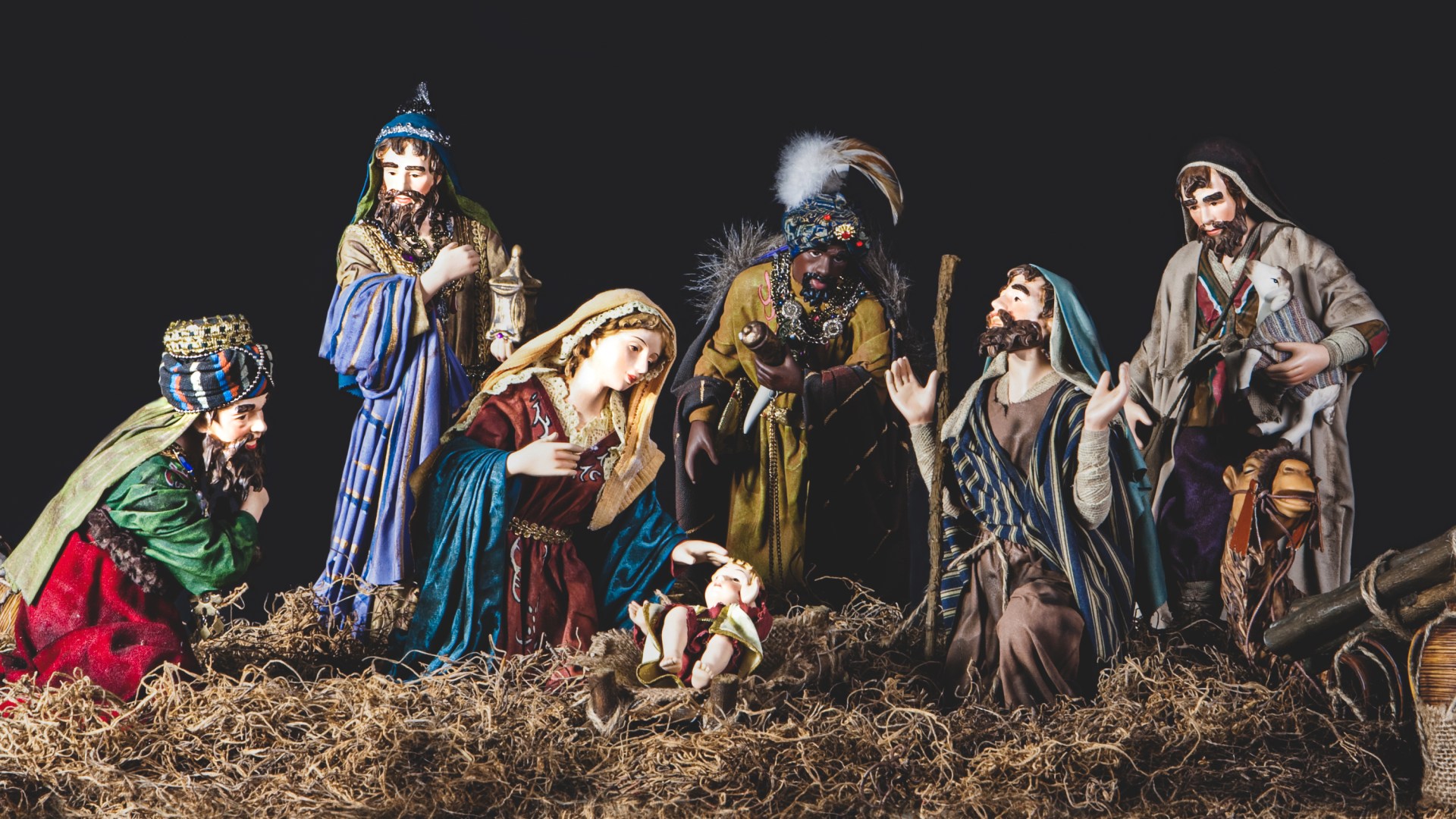
Theology

C. S. Lewis Was a Grinch

The writer loved the Incarnation. Not so much the Christmas holiday.

Christianity Today December 23, 2019
Illustration by Rick Szuecs / Source Images: Envato

“If there were less good will,” C. S. Lewis often said in December correspondence, “then we might have more peace on earth.” Lewis found no pleasure in the giving of generic winter cards, gift guilting, and the overall hurried pace of the Christmas season.

Lewis went from saying “I hope I am not a Scrooge” in a letter in 1952 to admitting his “real name is Scrooge” in another letter in 1956. In short, C. S. Lewis wasn’t a fan of the most wonderful time of the year. This attitude only intensified as he aged.

When I visited Lewis’s home parish, Holy Trinity Church in England, an elderly woman working the small gift shop inside remarked that she knew Lewis when she was a child. “He was a grumpy old man,” she told me.

Many consider C. S. Lewis a warm symbol of holiday cheer, particularly given his inclusion of Father Christmas in the Narnia stories. Yet the more I read by Lewis on the topic of Christmas, the more I’m reminded of my conversation with the clerk at Holy Trinity Church.

One of the most comical examples of Lewis’s disdain comes from his essay “Delinquents in the Snow,” which begins with his thoughts on Christmas carolers:

At my front they are, once every year, the voices of the local choir … those of boys or children who have not even tried to learn to sing, or to memorize the words of the piece they are murdering. The instruments they play with real conviction are the door-bell and the knocker; and money is what they are after.

Another essay lays bare Lewis’s lack of seasonal zeal by the fitting title, “What Christmas Means to Me.” Lewis condemned the season for giving more pain than pleasure, for forcing itself upon people, for its preponderance of junk novelties, and for generally being a nuisance.

Lewis makes fun of all the midwinter fuss in a satirical 1954 essay, “Xmas or Christmas: A Lost Chapter from Herodotus.” Writing as Herodotus, a Greek historian, Lewis described people who celebrated a season he called “Exmas” that focused on compulsory gift and card giving in which recipients must carefully choose return cards and gifts of equal value.

In his diaries, one of Lewis’s first recorded comments regarding Christmas is far from pleasant. He and his brother Warnie had spent the holiday with their widowed father. On their way to church early one morning, the siblings got into an argument with their father about the sunrise.

The brothers insisted the sun had indeed risen because they had enough light to find their way. Albert, their father, maintained that the sun had not risen because they could not yet see the sun itself. Lewis would later use this as a metaphor for the truth of the Incarnation, an event that revealed the way to life.

Lewis believed the Incarnation was the very key to unlocking the mystery of the universe. In his book Miracles, Lewis called the birth of Jesus “The Grand Miracle,” and he compared the Incarnation to the missing part of a novel or a symphony. This lost piece, once found, makes sense out of the rest. Christmas allowed Lewis to have a total worldview, a way of understanding both the universe and the human experience.

For the adult Lewis, Christmas could not—should not—be reduced or relegated to greeting cards or the giving of obligatory gifts. Christianity was a total philosophy, a thing so serious that it alone gave real reason for joy.

It wasn’t just the commercialization of Christmas that Lewis disdained. It was the trivialization of the historical event of Christ’s birth. Lewis thought the commercial racket should be detached from the remembrance of what the angels celebrated nearly 2,000 years ago. In a letter on December 19, 1952, Lewis wrote, “How wretchedly the Christian festival of Christmas has got snowed under by all the fuss and racket of commercialized ‘Xmas.’” A year later he penned, “Oh if we could have Christmas without Xmas.”

In his spiritual memoir Surprised by Joy, Lewis describes how it was a long evening walk with J. R. R. Tolkien and company that finally helped him embrace belief in God. Theism made sense of reality. And for Lewis, only the birth of Christ and Christianity could explain theism.

In his essay “Is Theology Poetry?” Lewis echoes his earlier argument with his father. “I believe in Christianity as I believe the sun has risen,” he wrote, “not only because I can see it, but because by it I see everything else.”

Theologian Alister McGrath traces this conviction back to December 25, 1931, when Lewis observed Holy Communion for the first time since his youth. He wrote to his brother Warren describing his early steps in his new faith. McGrath writes, “What Lewis did not know was that Warnie had made a similar journey of faith, and had received Communion for the first time since his childhood while on military assignment in Shanghai—also on Christmas Day 1931. The two brothers, unknown to each other, had made a public profession of commitment to Christianity on exactly the same day.”

For Lewis, the Incarnation was not something to be merely stamped on a card, drearily sung about in exchange for donations, or symbolized in a well-balanced exchange of gifts. It was an event that was either true or false. If false, it meant nothing; if true, it changed everything. There could be no middle ground. The birth of Christ was a light illuminating the entirety of human history—and one far too brilliant to be confined to a retail holiday.

Dan DeWitt (PhD, Southern Seminary) is author of multiple books including Life in the Wild: Fighting for Faith in a Fallen World (The Good Book, 2018). He teaches theology and apologetics at Cedarville University and blogs regularly at theolatte.com.


Theology

How a Hard-Won Pregnancy Prepared Me for Advent

Elizabeth, Mary’s mentor, helps me see the Incarnation in a new way.

Christianity Today December 23, 2019
Dardespot / Getty

Last Christmas, I was, like Mary the mother of Jesus, “great with child” (Luke 2:5). Expecting a baby during the season Advent is for many Christian women a holy time. Our bodies are creative forces, churning with life and hope and possibility. Our feet may be swollen and sore, and we may be dying for a cup of coffee or glass of wine, but many of us also feel a kinship with Mary as we witness and display the generative power of God.

During this season, church services often celebrate the expectant Holy Mother and include a recitation of Luke 1:46-55, known as “the Magnificat,” or “My Soul Magnifies the Lord.” Church tradition holds that Mary sang this song after her pregnant (and much further along) relative Elizabeth famously proclaimed, “Blessed are you among women, and blessed is the child you will bear! But why am I so favored, that the mother of my Lord should come to me? As soon as the sound of your greeting reached my ears, the baby in my womb leaped for joy. Blessed is she who has believed that the Lord would fulfill his promises to her!”

For many, this passage is a part of Advent’s wonder. A young woman has been given a miracle to carry within her body. The son of God and son of humanity—who takes away the sins of the world, destroys the power of death, frees captives, and establishes his everlasting peace and justice upon the earth—resides in the womb of a virgin. What could be more extraordinary than that? As a girl, I could not have imagined a greater marvel.

Many would argue that a virgin conceiving by divine order tops everyone’s pregnancy story. But for me and many other women like me, our understanding of the Incarnation is shaped by the quieter, commoner glory of a woman of advanced maternal age feeling the company of her child.

Last Advent season, I was in medical terms a “woman of advanced maternal age.” (If you think that’s insensitive, the official category used to be “geriatric pregnancy.”) As the scriptures say, I was expecting a child in my “old age.” And after spending almost a decade praying, pleading, bargaining, and weeping for a child, my perspective changed on what counts as a miraculous pregnancy.

Like many couples who struggle with infertility, when my spouse and I began our quest to welcome a child into our family, we had every confidence that we would achieve our goal in a matter of months. But after seven years of ovulation predictor kits, basal body temperature thermometers, medical interventions, hormonal treatments, and pregnancy loss, we found ourselves emotionally, financially, and spiritually exhausted.

Many women struggling to bear children will attest to the fact that when you are trying to have a baby, it seems like everyone you know is pregnant in particularly obnoxious, accidental ways. “Oops!” your friend’s Instagram account will say, “my partner and I weren’t even trying but now we are having TWINS!!!”

I diligently tried to talk myself out of grief. I told myself that the social and cultural directives put upon women unfairly prioritized biological motherhood as the most valuable form of existence. I reasoned that as a pastor’s spouse, I was under an unusual amount of pressure to produce an ideal nuclear family, something Protestants have valued since the days of Katerina Von Bora and Martin Luther’s Protestant pastor’s home. And I told myself that as a woman of considerable privilege with a network of loving friends and family, I had no right to be full of sadness when so many others in the world suffered more than me. Of course, there is truth in all of these thoughts, but they’re cold comfort in a season of sorrow.

One Christmas Eve, after a particularly grueling and unsuccessful round of hormone treatments, I was asked to read the Magnificat from the pulpit. The grandmother who was scheduled to read it had laryngitis, and as a pastor’s spouse, I was around and available. As I stood at the pulpit, I recited the words stoically: “Surely, from now on all generations will call me blessed; for the Mighty One has done great things for me.” That evening, I was angry with everyone and everything around me, even the Blessed Virgin herself.

Mercifully, this season came to an end. On our very last try with medical technology, we welcomed a baby into our household. That pregnancy was fraught with terror. Every waking hour brought with it new fears that I would lose the beautiful life growing in my body. The second time around, I was one of those annoying women who was pregnant by surprise—and in my old age! Those who know what it’s like to endure the pain of infertility and pregnancy loss know the weird feelings of survivor’s guilt that accompany this type of family building.Beyond the guilt, however, I came to feel a closeness to Elizabeth, Mary’s much older relative. Some biblical manuscripts attribute the Magnificat to Elizabeth. Elizabeth does not bear the Christ Child—she carries a special but merely human John the Baptist. But as I think about the words of the Magnificat springing from the soul of an older woman, I see her proclamation about the Incarnation in a different light.

In Luke, Elizabeth is far enough along to feel her child kicking in her womb. A woman of advanced maternal age who yearns for a child knows the power of this moment in a way that a young woman cannot. It is certainly not as showy as a virgin birth, but it is in its own way a poignant example of “God with us.” Old-timey words like wonder, marvel, and mystery come to mind.

History remembers this song as belonging to the Holy Mother. For me, especially at Christmastime, it is also Elizabeth’s song, my song, and the song of my many sisters across space and time who have longed and continue to long for their own common and glorious gift.

Leah Payne is assistant professor of Theological Studies at Portland Seminary of George Fox University and author of the award-winning book, Gender and Pentecostal Revivalism: Making a Female Ministry in the Twentieth Century. In her spare time, she co-hosts a pop culture and religion podcast called Weird Religion at weirdreligion.com.

Theology

Christmas Immigrants: A Story by Max Lucado

At the heart of the holiday, new parents fleeing danger.

Christianity Today December 23, 2019
Illustration by Rick Szuecs / Source Images: Getty / Unsplash

The moonlight was their only light. Huffing and puffing were the only sounds. José walked in front. The trail was narrow. He didn’t want his wife to stumble. She carried the baby. He’d offered to do so, but she’d refused.

“He’s asleep,” she’d explained.

“Let him sleep,” he’d agreed.

So, they hurried, José in the lead, all their earthly possessions crammed in the backpack he’d purchased from the street vendor in San Salvador. That was weeks ago. How many trains since then? How many miles? How many cold nights?

He glanced over his shoulder. Her eyes caught his. Was that a smile he saw? She’s something, this woman, he said to himself. He turned his attention back to the trail. Mesquites on either side scraped against their jeans.

Behind them was a village. Within the village was a barn. Within that barn lay, even still, the gathered straw and abandoned feed trough that had served as a bassinet for their baby.

The child whimpered. José stopped.

“He is fine,” Maria assured before José had time to ask.

They continued.

The trail emptied into a river that had long since emptied its water into a rancher’s pond. The wide, dry riverbed allowed them to walk abreast. No thorns. They moved faster. He hoisted the pack. She secured the child. A blacktop was near, they’d been told.

After a dozen steps they heard the shots.

José had been warned of the danger. Just that morning, as the men warmed their hands over the fire in the five-gallon drum, he heard them speak of the cartel. Take the baby and leave, they’d urged him. These men are violent.

He’d hurried back to the barn to tell Maria, but she was sound asleep. He decided to let her rest. When she awoke at noon, her face was pale. She nursed the child and dozed again. José kept an eye toward the door. An old cowboy knew they were using his barn for shelter. He brought them coffee and beans and a blanket for the child.

“Do you know about the gangs?” he asked José.

Maria overheard and sat up from her pallet.

“You must go,” the cowboy told them.

But José wanted to wait.

“Just another day, or two. Till you find your strength,” he told Maria, though he knew she had enough strength for them both. Nothing fazed her. This sudden journey. This barnyard birth. She was the strong one.

She nodded and stretched out on the pallet. The sun was setting, and the chill was creeping through the walls. He built a fire on the floor, sat next to her, and pulled knees to chest. He ventured a touch to her cheek. She did not stir. Her long hair was silk on her face. So young. Trusting.

He stretched out and closed his eyes. Sleep resisted, then relented. A messenger came to him in a dream. He was tall and light-filled. The same messenger who had spoken to him nine months earlier when spring was in the air and a wedding in his plans. But then came Maria’s mysterious pregnancy. Had it not been for this midnight visitor, José might have left her.

Tonight, the messenger came again. The boy is in danger. Blood will be shed. It’s time to go.

José sat up with a start. He knew he had no choice.

He shook Maria awake. “Get your things.”

Without a word she stood. She grabbed their few possessions and stuffed them in the pack. José lifted the lid of an old toolbox and took out the gifts. Strangers had brought them. They’d traveled far to see his son. Now, José would travel as far as necessary to protect him. Their kindness would fund the journey.

He placed the gifts in the pack and looked across the barn. Maria was leaning over their son. Shhh, she assured and lifted him. Within moments the three were out the door and scurrying down the narrow street. Within minutes they were standing in the riverbed, listening to the crack of gunfire. A woman screamed. A baby cried. Maria tugged on José’s sleeve. “We need to go!” she told him.

Yes, she was right. Time was short. Safety was within miles. If only they could reach it. They hurried. The riverbed emptied onto a single-lane road. They saw approaching headlights. José waved. A pickup pulled to a stop. José motioned to the truck bed. The driver nodded. The young family climbed in the back and squeezed together.

At one point the baby cried. Maria gave him milk. José looked at the Mexican sky. Stars sparkled like diamonds. For a moment, he wasn’t running, he was resting. Imagining a hacienda back home, perhaps? A home of their own, at least?

Maria dozed. Her hoodied head lay motionless on his shoulder. A pothole bumped the truck and she awoke. They rode wordlessly for an hour. The black sky gave way to gray, then gold. At the first daylight, the truck came to a stop on the side of the road.

“This is as far as I can carry you. What you seek is over the next hill.”

José gave the man a gracias and a coin then helped his family climb down. Maria’s face was chalked with road dust. The eyes of his son were open, looking at the sky then at his mother. The three set out on the final segment of their escape. One weary step after another carried them to the top of the hill. When they reached the crest, they stopped and stared. The river below was lined with tents, campfires, and people.

José reached for the newborn. “I’ll carry him the rest of the way.”

Maria gazed at the refugees. “Will we be safe, José?”

He looked at her for several moments before answering. The rising sun cast her face in orange.

Si Dios quiere, mi amor.

“Yes,” she agreed, “if God wills.”

The family turned and began the walk to the border.

***

Now when they had gone, an angel of the Lord appeared to Joseph in a dream and said, “Get up! Take the Child and his mother and flee…” (Matt. 2:13)

According to the UN Refugee agency, 70.8 million people are forcibly displaced worldwide, including 25.9 million refugees. During this season when Christians celebrate the most famous of refugee families, let’s offer prayers and assistance.

Max Lucado is a pastor and best-selling author in San Antonio, Texas. This story also appears on his blog.

Ideas

The Flag in the Whirlwind: An Update from CT’s President

President & CEO

Why our editor in chief spoke out against Trump, and why the conversation must continue.

Christianity Today December 22, 2019
Lisa Forseth / Lightstock

Reader responses to Mark Galli’s recent editorial have spanned the spectrum. We have received countless notes of encouragement from readers who were profoundly moved. They no longer feel alone. They have hope again. Many have told us of reading the editorial with tears in their eyes, sharing it with children who have wandered from the faith, rejoicing that at last someone was articulating what they felt in their hearts. They felt this was a watershed moment in the history of the American church—or they hoped it would prove to be. Stay strong, they told us, knowing we were about to reap the whirlwind.

On the other hand, we have heard from many readers who felt incensed and insulted. These readers felt the editorial engaged in character assassination, or maligned a broad swath of our fellow evangelicals, or revealed that we prefer the Democrats to a President who has done a lot of good for causes we all care about.

Of course, we appreciate the support and listen humbly to the criticisms. But at the end of the day, we write for a readership of One. God is our Tower. Let the whirlwind come.

President Donald Trump would have you believe we are “far left.” Others have said we are not Bible-believing Christians. Neither is true. Christianity Today is theologically conservative. We are pro-life and pro-family. We are firm supporters of religious liberties and economic opportunity for men and women to exercise their gifts and create value in the world. We believe in the authority of Scripture.

We are also a global ministry. We travel the world and see the breadth and depth of what God is doing through his people all around the planet. It is beautiful, and breathtaking, and immense. The global Body of Christ—and the community of evangelicals—is vastly larger than our domestic political squabbles. But partly on behalf of that global body, we can no longer stay silent.

American evangelicals have always been a loose coalition of tribes. We have fought one another as often as we have fought together. We at Christianity Today believe we need to relearn the art of balancing two things: having a firm opinion and inviting free discussion. We need, in other words, both a flag and a table.

First, then, the flag. Numerous reporters have asked whether the ministry supports what was stated in the editorial. Was Mark Galli speaking on behalf of the institution? CT does not have an editorial board. Editors publish under their own names. Yet Galli has stood in the trenches for men and women of faith for over three decades. He has been an outstanding editor in chief. While he does not speak for everyone in the ministry—our board and our staff hold a range of opinions—he carries the editorial voice of the magazine. We support CT’s editorial independence and believe it’s vital to our mission for the editor in chief to speak out on the issues of the day.

As an institution, Christianity Today has no interest in partisan politics. It does not endorse candidates. We aim to bring biblical wisdom and beautiful storytelling both to the church and from the church to the world. Politics matter, but they do not bring the dead back to life. We are far more committed to the glory of God, the witness of the church, and the life of the world than we care about the fortunes of any party. Political parties come and go, but the witness of the church is the hope of the world, and the integrity of that witness is paramount.

Out of love for Jesus and his church, not for political partisanship or intellectual elitism, this is why we feel compelled to say that the alliance of American evangelicalism with this presidency has wrought enormous damage to Christian witness. It has alienated many of our children and grandchildren. It has harmed African American, Hispanic American, and Asian American brothers and sisters. And it has undercut the efforts of countless missionaries who labor in the far fields of the Lord. While the Trump administration may be well regarded in some countries, in many more the perception of wholesale evangelical support for the administration has made toxic the reputation of the Bride of Christ.

Galli’s editorial focused on the impeachment, but it was clear the issues are deeper and broader. Reasonable people can differ when it comes to the flagrantly partisan impeachment process. But this is not merely about impeachment, or even merely about President Trump. He is not the sickness. He is a symptom of a sickness that began before him, which is the hyper-politicization of the American church. This is a danger for all of us, wherever we fall on the political spectrum. Jesus said we should give to Caesar what is Caesar’s and to God what is God’s. With profound love and respect, we ask our brothers and sisters in Christ to consider whether they have given to Caesar what belongs only to God: their unconditional loyalty.

Let me protect against two misunderstandings. The problem is not that we as evangelicals are associated with the Trump administration’s judicial appointments or its advocacy of life, family, and religious liberty. We are happy to celebrate the positive things the administration has accomplished. The problem is that we as evangelicals are also associated with President Trump’s rampant immorality, greed, and corruption; his divisiveness and race-baiting; his cruelty and hostility to immigrants and refugees; and more. In other words, the problem is the wholeheartedness of the embrace. It is one thing to praise his accomplishments; it is another to excuse and deny his obvious misuses of power.

Similarly, this is neither a criticism of the evangelical Trump voter nor an endorsement of the Democrats. The 2016 election confronted evangelical voters with an impossible dilemma: Vote for a pro-choice candidate whose policies would advance so much of what we oppose, or vote for an extravagantly immoral candidate who could well damage the standing of the republic and the witness of the church. Countless men and women we hold in the highest regard voted for President Trump, some wholeheartedly and some reluctantly. Friends we love and respect have also counseled and worked within the Trump administration. We believe they are doing their best to serve wisely in a fallen world.

We nevertheless believe the evangelical alliance with this presidency has done damage to our witness here and abroad. The cost has been too high. American evangelicalism is not a Republican PAC. We are a diverse movement that should collaborate with political parties when prudent but always standing apart, at a prophetic distance, to be what Martin Luther King, Jr. called “the conscience of the state.” That is what we believe. This is where we plant our flag. We know we are not alone.

Now, to the table. A table is a place of welcome, a place where bread is broken and friendships are forged. In a political landscape dominated by polarization, hostility, and misunderstanding, we believe it’s critical for Christians to model how to have a firm opinion and host free discussion at the same time. Evangelicals of different stripes cannot continue to shout one another down, bully those who disagree, or exclude one another and refuse to listen.

We hold fast to our view that the wholehearted evangelical embrace of Trump has been enormously costly—but we are committed to irenic conversation with men and women of good faith who believe otherwise. (And since an open letter was published even as we were preparing to publish this statement, let me simply say that I appreciate the thoughts it expresses, and I hope this statement too can be the beginning of a dialogue.)

In the words of Proverbs 27:6, “faithful are the wounds of a friend” (ESV). Deeply aware of our own sinfulness and limitations, we are going to invite supporters and critics alike to produce essays agreeing or disagreeing with our stated views. It is time for evangelicals to have a serious discussion about how our identity as Christians shapes our activity as citizens. We will invite authors who represent a variety of viewpoints in a thoughtful and charitable manner. We will publish those essays in mid-January. We hope we can come together in convicted humility and learn from one another.

Now it is time for Christmas. Christ is still the light that shines upon a people living in darkness. We look forward to resuming the conversation soon.

The flag is planted. The table is set. We invite you to join us at either one.

Timothy Dalrymple is president and CEO of Christianity Today.

Theology

Iceland Needs a Brighter Christmas Story

The bizarre myths of “Jól” fail to offer the hope and joy of the true Christmas story.

Christianity Today December 20, 2019
Naomi Rahim / Getty

At this time of year, Christians turn to the prophecy from Isaiah: “For unto us a child is born …” (9:6), as we celebrate the Incarnation as a fulfillment of Scripture’s promises of hope and redemption.

Around Christmas in Reykjavík, Iceland, the sun rises at about noon and sets at about 3:30 p.m. As I take a midday walk in the dark, with Christmas lights on balconies and windows in my neighborhood illuminating the way, I think of the line from earlier in the chapter: “The people who walked in darkness have seen a great light; those who dwelt in a land of deep darkness, on them has light shone” (9:2, ESV). The metaphor is particularly striking for those of us who spend the winter in darkness.

Here, the Christmas holiday is called Jól, or Yule as some foreigners may recognize. There’s no fight over putting Christ back into Christmas, as even the word Jól has no connotation to Christianity at all. It can be traced back to at least pagan times, when it described the winter solstice festival; later, when Christianity came to the Nordic countries, it was used to refer to Christmas.

Few of our holiday songs recount the birth of Jesus. Instead, we sing about getting presents, holiday romance in the air, and characters in our own distinct traditions, which—as in a lot of Nordic countries—range from comical to bizarre. Besides a Santa Claus (with his familiar white beard and red suit), Iceland has the 13 Yule lads, brothers that live in the mountains and start heading into the city 13 days before Christmas, one by one.

These are mischievous pranksters, with names that coincide with their favorite ways of harassing the population: breaking into homes to steal sausages, eating your leftovers, slamming doors, stealing and licking your spoons or pots, and taking your candles. The two I found particularly creepy as a child were the one that liked to sniff your doorway and the one simply known as “Window-Peeper.”

As a tradition, Icelandic children place their shoes in their window sills for the 13 days leading up to Christmas for the Yule lads to leave either a small treat in the shoes for good behavior or a potato for bad. The lads’ mother, Grýla, keeps a list of particularly bad children and snatches them during the night around Christmas. Back in her cave, she boils them into stew. As the story goes, she and her lazy third husband, Leppalúði, have a pet, the Yule Cat, who threatens to eat any child who does not get new clothes for Christmas.

While no adult Icelander takes these stories seriously, the stories we tell ourselves as a culture tend to tell us something about ourselves. In this case, we see a darkly humorous, punishing mythology in a society that has largely rejected a greater story. Our Jól stories expose our cynical outlook on life—a cynicism that does not strive for a joyful ending, and therefore prohibits us from allowing ourselves to hope for one, driving us to apathy rather than faith.

I’m a big fan of C. S. Lewis and am intrigued by his relationship with J. R. R. Tolkien, especially since they had at least a basic understanding of my mother tongue, Icelandic, and were fans of Nordic mythologies. I imagine they must have at least heard about Grýla, Leppalúði, and their 13 rambunctious sons, along with the terrifying house pet.

A defining discussion for Lewis and Tolkien, which took place before Lewis had become a Christian, revolved around the truthfulness of mythologies. Tolkien argued that myths that line up with the Christian story don’t render Christianity untruthful. Rather, mythologies have in them an attempt to convey truth, but the truth has been perverted.

He argued that myths all attempted to point to the ultimate mythology, the unperverted mythology, the truthful myth that is not only a story but happens in real life, fulfilled in the birth, life, resurrection, and ascension of Jesus Christ. Tolkien made the case that a subcategory of myths in particular—fairy tales—attempt to capture what only the true story could bring: the ultimate consolation, or what he called the eucatastrophe, the good catastrophe, the surprising and joyous ending.

As a pastor, I see that joy in our celebration of Christ’s birth, the Savior coming to his own creation. But the true Christmas story stands in stark contrast to national Jól traditions.

As we sing about gifts, we fail to praise the greatest gift of all given to us in Jesus Christ. As we scare kids into behaving with threatening stories about Grýla and her sons, we fail to see any kind of hope or grace for the sinner. As their cat threatens those who can’t afford new clothes or do not receive any for the holiday, we fail to see the beauty of being wrapped in the righteousness of Jesus Christ. In our attempts at emptying out this holiday of religious connotations, we have emptied it out of true joy, true hope, and true celebration.

And it doesn’t stop with Jól. A similar sense of hollowness can be found in our dark sense of humor, our movies and TV shows, and some of our songs. I have to wonder what effects these stories have on us, as Iceland now leads the world in anti-depressant usage per capita. People in Iceland continue to be drawn to dark stories of retribution, judgment, or punishment.

It is our mission as Christians to “take every thought captive to the obedience of Christ” (2. Cor. 10:5), so we teach our children a better story, remind each other of God’s grace to us, and seek to be his ambassadors. We know the Light of the World represents the eucatastrophe, and this is the story we hope to share with the people around us.

I ask for our brothers and sisters to pray for us: for creative ways to point our fellow Icelanders to the greatest story, the greatest gift. Pray for workers in the harvest, and ultimately that God would be glorified in and through our labors, so that the name of Jesus would be made famous in Iceland and all around the world.

Gunnar Ingi Gunnarsson lives in Reykjavík, Iceland, with his wife, Svava María, and their three children. Gunnarsson is the pastor of Loftstofan Baptistakirkja, currently the only Baptist church in Reykjavík. You can follow him on Instagram, sign up for his monthly ministry updates, or contact him at gunnar@loftstofan.is to learn more about praying, giving, or moving to Iceland to help with gospel ministry.

Culture

‘Little Women’ and the Feminist Search for Righteousness

The real story is not whether the four young women will marry, but whether they will become better people.

Christianity Today December 20, 2019
Wilson Webb/© 2019 CTMG, Inc. All Rights Reserved.

I spent significant portions of my childhood creating and wearing hoop skirts, so I have been curious about screenwriter and director Greta Gerwig’s new Little Women film coming out this Christmas. During middle school, I was a huge fan of all things Alcott. I read all of her works and watched every film adaptation I could find.

I couldn’t agree more with Gerwig when she recently told Vanity Fair, “This feels like autobiography … When you live through a book, it almost becomes the landscape of your inner life … It becomes part of you, in a profound way.” Gerwig’s will be the fourth major Hollywood adaptation of the classic novel. The story of Meg, Jo, Beth, and Amy seems to stand the test of time. Which has recently struck me as somewhat odd.

The evangelical, homeschooling world I grew up in promoted Little Women as espousing the lost values of America. Alcott frequently talks about a young woman’s ability to gain or lose virtue, and her characters find happy endings through marriage and children. There is no hint of sexual revolution in her pages.

Yet feminists in particular keep retelling the story. With the exception of the 1950s version, each adaptation of Little Women has featured some of Hollywood’s most outspokenly feminist actresses. Katharine Hepburn, who famously wore pants in public (a significant statement on gender in her time), played Jo first in the 1930s. The 1990s version featured Susan Sarandon, who had become a feminist icon in Thelma & Louise and publicly encourages men to identify as feminists.

This year’s version comes from a director who previously received accolades for writing and starring in the explicitly pro-choice romance, Francis Ha. Gerwig has said that the Alcotts were “the most modern people who had ever existed, up till that point,” and she has been forthright about her interest in portraying Jo and neighboring boy Laurie as androgynous and gender-neutral in their youthful years since “They find each other before they’ve committed to a gender.”

Whether homeschool-curriculum writers understood it or not, Little Women truly belongs in the canon of feminist literature. Long before the sexual revolution, and long before feminism was synonymous with abortion and reproductive freedom, the movement was about work. The main debate surrounding middle- and upper-class women in 19th-century America revolved around whether women should desire idleness or to be economically productive members of society. As labor began to be divided between men and women, idleness implied economic stability. The wealthier the family, the less women were expected to work in or outside of the home. Hiring others to do housework (maids, nannies, etc.) was for the economically stable woman. Earning wages was for the poor.

At the heart of Alcott’s feminism is her fundamental belief that all women ought to work. Throughout her novels, Alcott’s characters are women who are industrious economically and domestically.

Little Women is a tale of progress, and ultimately of virtue-signaling. In the opening pages of her novel, Alcott explains that the four March girls are on a journey of self-improvement. They each have their strengths and gifts, and each their own temptations. The real plot of the book is not whether they will marry, but whether these four young women will progress, becoming better people who do good.

The primary illustration Alcott uses to discuss the matter is The Pilgrim’s Progress. In the voice of Marmee, Alcott espouses in the first chapter of Little Women that “Our burdens are here, our road is before us, and the longing for goodness and happiness is the guide that leads us through many troubles and mistakes to the peace which is a true Celestial City. Now my little pilgrims, suppose you begin again, not in play, but in earnest, and see how far on you can get …”

The novel is made up of vignettes from the girls’ lives chronicling their various paths up the hill of personal improvement. To conclude each vignette, Alcott offers a short sermon observing the karmic results of the girls’ actions. When they do good, they eventually reap the benefits, though the path might be painful. When they act selfishly, they fail, often comically suffering the outcomes in order to learn a lesson. There is a lesson to all of Alcott’s episodes: Moral people will eventually prosper and the wicked must bolster their efforts toward self-improvement.

This is why Little Women is endlessly attractive to modern feminists. For after all, feminism, like all of the world’s “-isms,” is at its core a system self-improvement, offering to adherents freedom and utopia. My peers talk freely about being “good” or “bad” feminists. They judge and are judged in turn according to the morality of third- or fourth-wave feminism. Hepburn, Sarandon, and Gerwig all have understood that the tale of individual moral progress within Little Women can be recontextualized for each new generation. Feminist role models must be recast according to feminism’s evolving morality.

To be clear, Alcott may have lived in the 19th century, but she was not an orthodox Christian. The system she puts forth, and which those involved with Little Women’s many film adaptations keep contextualizing, is without grace and mercy. The messiness of atonement, the pain of forgiveness, and the language of sin are not to be found in Little Women. Alcott and her family were neighbors of Ralph Waldo Emerson and were noted transcendentalists themselves. A growing movement in the early 19th century, particularly in New England, Alcott’s transcendentalism meant she believed that the human soul must be perfected in this life. She even maintained that religion could help. But she did not believe in the need for a crucified Savior whose blood dripped on behalf of four little girls. When she referenced Pilgrim’s Progress, she did so without referencing conversion. She promoted progress, without first promoting the new heart only grace can create.

Despite the ways I have been processing Alcott and Hollywood’s moralistic world, on a recent rereading, I discovered something new in Little Women. As often happens, stories often show us unintended glimmers of grace. Alcott’s discussion of the girls’ need for progress takes place against the backdrop of the girls longing for their father, who is away during the Civil War.

The catalyst for their desire to improve is a letter from their father. In it, he writes,

A year seems very long to wait before I see them, but remind them that while we wait we may all work, so that these hard days need not be wasted. I know that they will be loving children to you, will do their duty faithfully, fight their bosom enemies bravely, and conquer themselves so beautifully that when I come back to them I may be fonder and prouder than ever of my little women.

These words are a hidden nod to the true motivation for virtue—the love of the father who sees in his children what does not yet exist. The works-based morality of modern feminism tells its adherents that right thinking and right living must be first earned in order to be considered lovely.

Within her most convincing sermon for works-based morality, Alcott inadvertently reveals what the Christian believes to be true—that the Father mercifully calls us lovely. In response, we are remade into the women he has meant for us to be.

Hannah Nation is a writer and editor based in Cambridge, MA, and temporarily living in the Netherlands. She received her MA in church history from Gordon-Conwell Theological Seminary and serves as the communications and content director for China Partnership.

Ideas

Trump Should Be Removed from Office

Columnist; Contributor

It’s time to say what we said 20 years ago when a president’s character was revealed for what it was.

Christianity Today December 19, 2019
Drew Angerer / Staff / Getty Images

In our founding documents, Billy Graham explains that Christianity Today will help evangelical Christians interpret the news in a manner that reflects their faith. The impeachment of Donald Trump is a significant event in the story of our republic. It requires comment.

The typical CT approach is to stay above the fray and allow Christians with different political convictions to make their arguments in the public square, to encourage all to pursue justice according to their convictions and treat their political opposition as charitably as possible. We want CT to be a place that welcomes Christians from across the political spectrum, and reminds everyone that politics is not the end and purpose of our being. We take pride in the fact, for instance, that politics does not dominate our homepage.

That said, we do feel it necessary from time to time to make our own opinions on political matters clear—always, as Graham encouraged us, doing so with both conviction and love. We love and pray for our president, as we love and pray for leaders (as well as ordinary citizens) on both sides of the political aisle.

Let’s grant this to the president: The Democrats have had it out for him from day one, and therefore nearly everything they do is under a cloud of partisan suspicion. This has led many to suspect not only motives but facts in these recent impeachment hearings. And, no, Mr. Trump did not have a serious opportunity to offer his side of the story in the House hearings on impeachment.

But the facts in this instance are unambiguous: The president of the United States attempted to use his political power to coerce a foreign leader to harass and discredit one of the president’s political opponents. That is not only a violation of the Constitution; more importantly, it is profoundly immoral.

The reason many are not shocked about this is that this president has dumbed down the idea of morality in his administration. He has hired and fired a number of people who are now convicted criminals. He himself has admitted to immoral actions in business and his relationship with women, about which he remains proud. His Twitter feed alone—with its habitual string of mischaracterizations, lies, and slanders—is a near perfect example of a human being who is morally lost and confused.

Trump’s evangelical supporters have pointed to his Supreme Court nominees, his defense of religious liberty, and his stewardship of the economy, among other things, as achievements that justify their support of the president. We believe the impeachment hearings have made it absolutely clear, in a way the Mueller investigation did not, that President Trump has abused his authority for personal gain and betrayed his constitutional oath. The impeachment hearings have illuminated the president’s moral deficiencies for all to see. This damages the institution of the presidency, damages the reputation of our country, and damages both the spirit and the future of our people. None of the president’s positives can balance the moral and political danger we face under a leader of such grossly immoral character.

This concern for the character of our national leader is not new in CT. In 1998, we wrote this:

The President's failure to tell the truth—even when cornered—rips at the fabric of the nation. This is not a private affair. For above all, social intercourse is built on a presumption of trust: trust that the milk your grocer sells you is wholesome and pure; trust that the money you put in your bank can be taken out of the bank; trust that your babysitter, firefighters, clergy, and ambulance drivers will all do their best. And while politicians are notorious for breaking campaign promises, while in office they have a fundamental obligation to uphold our trust in them and to live by the law.

And this:

Unsavory dealings and immoral acts by the President and those close to him have rendered this administration morally unable to lead.

Unfortunately, the words that we applied to Mr. Clinton 20 years ago apply almost perfectly to our current president. Whether Mr. Trump should be removed from office by the Senate or by popular vote next election—that is a matter of prudential judgment. That he should be removed, we believe, is not a matter of partisan loyalties but loyalty to the Creator of the Ten Commandments.

To the many evangelicals who continue to support Mr. Trump in spite of his blackened moral record, we might say this: Remember who you are and whom you serve. Consider how your justification of Mr. Trump influences your witness to your Lord and Savior. Consider what an unbelieving world will say if you continue to brush off Mr. Trump’s immoral words and behavior in the cause of political expediency. If we don’t reverse course now, will anyone take anything we say about justice and righteousness with any seriousness for decades to come? Can we say with a straight face that abortion is a great evil that cannot be tolerated and, with the same straight face, say that the bent and broken character of our nation’s leader doesn’t really matter in the end?

We have reserved judgment on Mr. Trump for years now. Some have criticized us for our reserve. But when it comes to condemning the behavior of another, patient charity must come first. So we have done our best to give evangelical Trump supporters their due, to try to understand their point of view, to see the prudential nature of so many political decisions they have made regarding Mr. Trump. To use an old cliché, it’s time to call a spade a spade, to say that no matter how many hands we win in this political poker game, we are playing with a stacked deck of gross immorality and ethical incompetence. And just when we think it’s time to push all our chips to the center of the table, that’s when the whole game will come crashing down. It will crash down on the reputation of evangelical religion and on the world’s understanding of the gospel. And it will come crashing down on a nation of men and women whose welfare is also our concern.

Mark Galli is editor in chief of Christianity Today.

Pastors

No-Sweat Sermons? No Thanks.

Many tools offer to make preaching prep easier, but struggle is the point.

CT Pastors December 19, 2019
Illustration by Rick Szuecs / Source Images: Envato

I'm regularly targeted by ads for overworked pastors. The algorithms know I minister in a small church in a small town. (Face it: It’s 2019, and the robots know everything.)

Recently a video cued up on my Facebook timeline in which a spokesman characterized the plight of the weekly preacher in this way: “No other place in the world do you find people having to work a full time job and prepare more than 40 research papers a year.” It was an ad for an online tool meant to simplify sermon preparation by supplying readymade sermon outlines, talking points, series graphics, and pre-written illustrations.

A tool that promises to speed up sermon writing sounds like a godsend, especially in a small-church context with limited-to-no staff. After all, wouldn’t the experts do a better job than I would at outlining the passage?

If proper exegesis were the only goal of weekly preaching, it would be hard to turn down this tool. But it’s not. In a pastor’s study, two works are happening simultaneously: one in the sermon and another in the sermonizer. This is why, despite the personal drain and tempting plethora of resources, I still fight to keep sermon preparation from drifting to the periphery of my ministry.

Sunday Is A-Comin’

S. M. Lockridge’s iconic phrase, “Sunday is a-comin’,” takes on a different meaning in the context of my pastoral workweek. Sunday is a looming deadline. It is the exhausting culmination of six days of hard work. It doesn’t matter if I’ve had a midweek funeral, an unexpected counseling situation, or meetings that gobbled up hours of sermon preparation time. I better figure things out because Sunday is a-comin’!

Pastors deal with the mounting pressure of the waning week in different ways. Here in the South, preachers sometimes resort to a “singin’ service” (a service loaded with extra song selections in place of a homily). Everyone knows “singin’ service” is code for “the pastor ran out of time to finish the sermon this week.” And I’ve encountered too much anecdotal evidence not to believe that every Sunday many congregations hear plagiarized sermons from the pulpit. Then there’s the tricky gray area of sermon tools like the one mentioned above that hybridize your work with someone else’s in a “Who actually wrote this sermon?” kind of way.

Although sermon-writing can be a pain, I don’t spare myself much pity on the subject. It’s what I signed up for. Even the three-year-old in Sunday school knows a pastor’s job is to preach. When I interviewed for my current position at College Street Baptist Church, I never asked the pulpit search committee if they expected me to preach weekly sermons, and they never asked if I planned to. We both took it for granted that I would stand behind the pulpit to preach on Sunday mornings as often as I could.

But I admit it’s a slog at times. Especially for new pastors, churning out a sermon every week can be arduous.

This is where the Adversary often finds a foothold in a pastor’s busy schedule. Preachers begin to imagine that preaching responsibilities—something they anticipated with delight as fresh-faced seminary graduates—now have them in a stranglehold. Criticisms from the loudest voices in the congregation echo in their mind all week: “Pastor, your sermons are boring. We want better illustrations. Also, why aren’t you visiting us more often?” Against their better judgment, pastors begin leaning heavily on ministry tools and sermon content from others. They don’t even know when it happened, but somewhere along the way they crossed the line of personal integrity, and worse, sidelined the very activity meant to care for their own souls.

Steadfastness Over Sensational Success

The problem is not the use of resources in sermon preparation. As in any area of the Christian life, the problem lies in the heart. Why am I constantly reaching for the commentary instead of the Bible itself? Why have I become so heavily dependent on the experts? When did my philosophy of sermon preparation become “less time is always better”?

The fight for the heart of the sermonizer is a continuous battle. I find myself regularly applying this salve when my heart grows sick of sermon writing: A group of Christian brothers and sisters have committed to giving their hard-earned dollars so that I can devote my time to being with the Lord in his Word and ministering to their souls. It astounds me to this day. Rather than imprisoning me, this expectation gives me a renewed freedom to “devote [myself] to prayer and to the ministry of the Word” (Acts 6:4).

Though sermon prep heartburn is a hazard of the job, I’ve found a few antacids that alleviate the stress.

I’m learning to be okay with less than my best. I have an achievement-driven personality, so it’s been hard to enter the pulpit on Sunday knowing what I have to preach is subpar. But at this point, I’ve preached plenty of sermons that stink, and I can always count on audible yawns from my kids in the front pew to alert me when it’s happening.

Rather than striving for sensational success, I’ve decided to opt for steadfastness. Early on it felt like the kingdom of heaven hung on the success of every Sunday sermon. But people came back after I bombed. They didn’t come back after I hit a home run. Some Sundays I crawled away embarrassed from the pulpit only to have a congregant shake my hand and say, “One of your best sermons, Pastor.” It became apparent that while I was called to weekly faithfulness, the Spirit of Christ had his own agenda.

My goal these days is to be a man with the right Word for the right moment. My weekly time reading, studying, and preaching verse by verse through God’s Word is a long, slow effort toward that goal. Whether in the pulpit or in a counseling session, whether by the hospital bed or the soccer team bench, I want to be known as a pastor who is “rightly handling the word of truth” (2 Tim. 2:15).

I’ve also had to learn how to dismantle my messiah complex. We never verbalize it this way, but there is a way to do ministry that implicitly says, “I have to do it. And I have to do it perfectly. If I don’t, the church will fail.” No wonder so many of us feel burned out. We are trying to do Jesus’ job for him!

If Jesus tarries, one day I will die. As pastors, we move this truth from the realm of theory to practice when we heed Paul’s instruction to Timothy: “What you have heard from me in the presence of many witnesses entrust to faithful men, who will be able to teach others also” (2 Tim. 2:2, ESV). Begin training your replacements now. One of my greatest joys has been listening with pride as a new preacher steps into the pulpit for the first time.

Sharing teaching and preaching responsibilities with others has provided for longevity in ministry for so many pastors, and I pray it will for me too. Churches that learn the importance of giving their main preaching pastors regular breaks from the pulpit protect them from the weekly stress that can lead to sermon plagiarism or an unhealthy dependence on extrabiblical resources.

Finally, I’m better at this on some weeks than others, but I have to fight to see my time in God’s Word as more than mere work. Shepherds study the Word not ultimately to have a sermon prepared on Sunday but to know the Good Shepherd and to hear his voice. This is why I never really flirt with ministry tools and resources that promise to do all the hard work for me. To outsource my study in the Word is to outsource my relationship with the Shepherd and Overseer of my soul.

I often go for a late Sunday afternoon run after all of the adrenaline of the morning has worn off and the family is still napping around the house. As my feet hit the pavement, I feel like I’m returning to that beach at the end of John’s gospel. I wrestle with a familiar sense of failure and frustration at my own shortcomings, poor word choices, or lack of zeal. In those moments, the question of Jesus echoes in my mind: “Do you love me?” “Yes, Lord; you know that I love you.” And every time, his gentle encouragement to a feeble, wandering, fearful pastor like me is simple: “Feed my lambs. Tend my sheep. Feed my sheep” (John 21:15–17).

This is the activity that cares for the soul of the lowercase “s” shepherd of the church. I know the love of Jesus and demonstrate my love for him in my faulty and feeble efforts to feed his sheep.

Pastor, take heart. Every week presents itself with another opportunity to experience the mercy and grace of our Shepherd. After all, Sunday is a-comin’!

Chad Ashby is the pastor of College Street Baptist Church in Newberry, South Carolina.

Theology

An Advent Image Is Worth a Thousand Words

This season, we’re invited to see symbols of the Nativity not as quaint supplements to doctrinal truth but as robust invitations to faith.

Christianity Today December 19, 2019
Allkindza / Getty

Every night since she was two, my three-year-old daughter has proclaimed, “I want to be a shepherd girl.” The towel goes over her head, and she gathers her sheep. She then sets them out to pasture—“Here, little sheep, eat”—or seeks for them because they are lost. After the game is over and we finish her bedtime routine, my husband or I tuck her into bed with “lambie,” her most precious possession.

As a parent, I see this imagery of sheep and shepherd as the first way that Christ is revealing himself to my daughter. But as a scholar of medieval theology and literature, I see it more broadly as an example of how images help convey an ancient gospel in the present moment. In other words, our understanding of Scripture often hinges on verbal and visual pictures, not merely exegetical prose. This is especially true in the Advent season, with its rich and diverse imagery—plywood nativity scenes in front yards, bulletin covers showing shepherds and angels, Christmas pageants with crying babies and crawling sheep.

When we disciple our kids in this season and every other, we teach them general principles for everyday life: “Jesus loves you,” “God made you,” “God is good.” As we should. But we often forget that images and the imagination are central to religious education. This idea holds true not just for teaching Scripture to small people but to big ones, too. The beauty of verbal and visual images is that they can stick with us even when we don’t have the ability to appreciate their significance, because they are “goods” in themselves that point us to higher truths.

Think of it this way: There is a difference between cracking a nut to eat it and planting that same kernel to let it grow. When we think about images as nuts that need cracking, we can discard the shell because we’ve gotten to the meat. We don’t need the story anymore because we have the moral: God is love. If a story is a seed, however, its significance develops over time and cannot be fully grasped at first go.

Under this paradigm, a Bible story—whether historical or parabolic—needs first to be enjoyed and understood as a story, because the meaning cannot be reduced to a simplistic moral. Rather, as the story or image is understood over time, its meaning unfolds.

By way of illustration, my daughter can delight in the images and stories of the Bible without always appreciating their full significance for her life, but when the time is right, as long as the seed has been properly buried and “watered,” its meaning will unfold as she grows older. For now, she plays the “shepherd girl” game and listens to Bible stories about shepherds and lost sheep. Over time, these theologically rich images are kernels that have the power to grow and be nourished.

The image of the shepherd and sheep is what Augustine would have called a “metaphorical sign.” A rhetorician can be very technical about different kinds of metaphorical signs; allegory, metaphor, typology, and symbolism are different kinds of metaphorical signs. When Augustine speaks about metaphorical signs, however, he’s talking about something more basic that affects the way an interpreter needs to approach reading. “As far as metaphorical signs … are concerned,” writes Augustine, “wherever readers find themselves stuck because of their unfamiliarity, they need to investigate them partly by a knowledge of languages, partly by a knowledge of things.”

If we apply this principle to shepherding and sheep metaphors in Scripture, then interpreting these passages requires learning about actual shepherds, actual sheep, and the historical circumstances surrounding shepherding. Even the best reader of Hebrew and Greek cannot understand passages concerning sheep and shepherds without knowing something about actual sheep and shepherds.

For example, all of us, scholars and laypeople alike, need to know that shepherding was not a respected job in the ancient world and was often relegated to a younger sibling. We need to know that it was common, dull work. David tended sheep. Moses. Jacob and his sons. Isaac. Rachel. Abraham. Abel. As readers who know the end of the story, it is easy to think they were occupied in a respected profession in the ancient world, but that is because Scripture has cultivated our cultural imagination. Now we need to see how this biblical insight was and is countercultural.

We also need to know that Scripture’s attention to shepherds often concerns those who haven’t done their duty. The prophets throughout the Old Testament decry the prevalence of unfaithful shepherding resulting in the scattering of the sheep (2 Chron. 18:16; 1 Kings 22:17; Ezek. 34:5; Jer. 10:21; Ezek. 34:5–6 and 21; Jer. 23:1–2; Zech. 13:7; Isaiah 13:14). With this scriptural background in mind, it should not be surprising that Christ is often portrayed as the Good Shepherd that sees the scattered sheep and has compassion (Matt. 9:36, Mark 14:27, Matt. 26:31, John 10:12).

In sum: When we understand biblical images as things in history and in the world, then we begin to understand the words of Scripture, suggests Augustine.

When I first realized in graduate school the significance of Augustine’s words, I began to marvel, and then I began to despair. I marveled because it occurred to me that God had chosen images that were relatable to most people throughout history: water, gardens, wheat and weeds, grapes, candles, oil, marriage, animal husbandry, and the building of edifices. I then despaired because I realized that most of us living in modern Western society can’t relate to the many agricultural metaphors in Scripture, and almost all of the marriage metaphors are difficult to comprehend as well. Reading Wendell Berry (for the first) and attending all the marriage seminars in the world (for the second) aren’t enough to fix the problem.

And then I saw my daughter playing “shepherd girl.” Of course, her play-acting is not the same as that of a little boy or girl who has actually done real-world shepherding. Nonetheless, God has given her an imagination that enables her to understand this thing to some degree so that one day, when she is old enough, she can unpack its meaning for her life. I also marveled at this realization: God has given humans the capacity to imagine and play at things we’ve never experienced, and the power of his Word comes through in those imaginings.

“Who are you?” I asked my daughter as she put a towel over her head one night. “I’m Mary,” she replied as she collected her sheep again. I suppose she saw that Mary’s head was covered just like the shepherd’s head and then presumed that Mary was a shepherd girl. I didn’t correct her. Her imagination, like my own, needs to be formed over time.

While at the moment she sees primarily the nurturing side of being a shepherd girl who mothers her lambs with food and puts them to bed, I hope one day she will also see the humility it takes to say yes to God, even when it means the world despises her. For both the shepherds and Mary were despised by the world. The shepherds because their profession was lowly, and Mary because the world presumed she had sinned when she had not. They were not appointed religious or political leaders, but God used them, because when he spoke, they listened. I pray my daughter will listen, too.

This Advent and Christmas season, we are invited to see images of the Nativity not as quaint supplements to doctrinal truth but rather as invitations to form and reform our imagination. We can join the little children in their playful engagement with the images of the Christmas story without rushing so quickly to exegesis. And we can slow down and enjoy the repetition, waiting to hear, like Mary, what God might speak to us.

Lesley-Anne Dyer Williams is an assistant professor of literature and Latin and director of the Liberal Arts Guild at LeTourneau University. She holds a master of philosophy degree in theology and religious studies from the University of Cambridge and a PhD in medieval studies from the University of Notre Dame.

News

Magi’s Gift Under Threat: The Steep Decline of the Frankincense Tree

Used in worship for millennia, the tree’s resin is in dangerous demand due to popularity of essential oils.

Christianity Today December 19, 2019
Frans Sellies / Getty

It’s the classic holiday scene: the church Christmas pageant, children dressed up as donkeys and camels and sheep, Mary and Joseph reclining in the makeshift stable, reminding the congregation of the birth of Christ. And what Christmas pageant would be complete without the entrance of the three wise men, bringing gold, frankincense, and myrrh to the infant Jesus?

Anjanette Decarlo, chief sustainability scientist at the Aromatic Plant Research Center and director of the Save Frankincense initiative, says that there’s a hidden layer to the story of the wise men’s gifts. “They brought frankincense to baby Jesus for a reason,” she said. “They knew there was really high child mortality in these days, and these were the most potent medicines known, frankincense, and myrrh. Talk about a clinical trial!”

Frankincense has been prized since ancient times as a potential panacea, and today it’s being used in everything from skin-care products to cancer treatments. But the frankincense tree is in peril, according to Decarlo and a recent study in Nature Sustainability by leading frankincense researcher Frans Bongers. The increasing popularity of frankincense products (essential oil in particular) has left many of the world’s frankincense trees dangerously overtapped. “We loved frankincense for 5,000 years,” Decarlo said. “With the growing world population and a real desire to use natural products and natural medications that are effective, we love it so much that we might love it to death.”

Decarlo first encountered the frankincense tree eight years ago on a research trip to Somalia. She returned in 2016 after the boom of the essential oil industry— which is particularly supported by Christians. She was stunned by the frankincense trees’ steep and sudden decline, caused by mismanagement and overtapping due to increased demand. “What was happening on the ground shocked me and rocked me to the core,” she said, so much so that she walked away from a coveted faculty position at the University of Vermont to dedicate herself to frankincense conservation full time. “After a lot of deep prayer, I just kept coming back to wanting to go back to my frankincense work again.” She said the trees she’s seen in Somalia and elsewhere are currently in dire condition.

Were the frankincense tree to go extinct, not only would the world lose its aromatic and medicinal benefits, but some forms of Christian worship would have to be altered. In the form of liturgical incense, frankincense has played a key role in Catholic, Eastern Orthodox, and some Anglican and Lutheran worship services.

Frankincense is also part of the livelihood of the Orthodox monks of Holy Cross Monastery in Wayne, West Virginia, who manufacture incense and sell it to Christians around the world. Father Basil, a resident monk, has been assisting with the manufacture of incense at the monastery for several years, a process that involves procuring pure frankincense resin from Ethiopia. “We take that raw frankincense, which is essentially an aromatic tree sap, grind it to a powder, and add fragrant oils to it,” Basil said. “That’s what gives it a particular smell.” For those who have never smelled frankincense, Basil described it as somewhere between a pine and citrus scent.

The use of incense hearkens back to the Old Testament, when the Israelites are commanded to offer incense to God, and it is also referenced in the Psalms (141:2). In Orthodox worship, frankincense-based incense is used in nearly every worship service in a process called “censing.” “There’s always at least one censing during the service and sometimes several,” said Basil, “where the priest or deacon will go around and cense the altar, the icons on the walls, and also the people and the church.” Some Orthodox Christians use incense in their homes as well.

Basil said that if frankincense were to become increasingly rare, it would make the manufacture of incense difficult. “It might require some inventiveness on the part of suppliers,” he said. “It’s such an integral part of Orthodox worship that it’s something that’s very much worth preserving.”

Derek Hatch, professor of Christian studies at Howard Payne University, said incense is also referenced in the New Testament: first in the book of Luke, when Zechariah offers incense at the altar and is told his wife will bear a son (1:8–17), and then, when it is described as going up before God “with the prayers of God’s people” (8:4).

Still, the use of incense is very rare for those in evangelical traditions, a casualty of the Reformation. “It’s not really an element of our worship that would disappear” if frankincense became rare, Hatch said, though he has noted that in the last two decades, some evangelical churches are incorporating elements like incense and visual art to make worship a multisensory experience, partly under the influence of the late Wheaton College professor Robert Webber.

Hatch said that he spends a lot of time impressing the importance of multisensory worship, or embodied worship, on his students. “How we worship shapes our theology,” he said. Embodied worship, with the inclusion of liturgical elements like incense, reminds us of the importance of the Incarnation, and it makes worship more accessible to the illiterate, including children and those with developmental disabilities.

To help drive this point home, Hatch takes a group of students to the Easter service at a nearby Greek Orthodox congregation every year. (The Orthodox Church operates on a different calendar than the Western Church, so Easter is typically on a different date.) Incense is a prevalent part of this service, something that Hatch’s students notice right away. “We’ve been talking about embodiment all semester, and here they’re confronted with what it would look like if we took that very seriously,” he said. “It’s very memorable for the students.”

Another part of taking the embodiment and the Incarnation seriously is recognizing the intrinsic value of all of creation—even a humble frankincense tree. “I want people to love the trees as much as they love the resin and the essential oil,” Decarlo said. “I want people to love the frankincense tree itself as much as what it gives. Sometimes there’s a disconnect—we get a frankincense product in a bottle and don’t necessarily think about the trees and the ecology of where it comes from.”

By purchasing frankincense products, consumers are affecting the lives of those whose livelihoods depend on tending healthy trees. “There’s a lot of demand for frankincense,” Decarlo said. “High demand is good in one way, because the folks that tend these trees are poor, and this is their livelihood. They deserve to make a fair wage, and they deserve to have a fair livelihood supplying the world with these resins.” The problem, Decarlo said, is improper management of the trees. “We want to see that the trees are managed properly so that we’re not overshooting what the trees can give versus what the world demand is.”

Another challenge facing frankincense trees is that they grow almost exclusively in war-torn areas. “The people around the trees are suffering,” Decarlo said. “They’re water insecure, they’re food insecure. So, when you’re in that situation, and someone comes around and says they’ll buy whatever you can get out of your trees, of course you’re going to be tempted to overtap your tree.”But the danger of overtapping is that it exposes the trees to infection and insect damage. Though climate change is also a factor, it is not the biggest one, and overconsumption of frankincense in the West is leading to the tree’s decline. According to Decarlo, when a community’s population of frankincense trees collapses, residents are forced to leave their homes, becoming “environmental refugees” and being driven even deeper into poverty.

Decarlo said that many of the people directly involved in the harvest of frankincense resin have no idea that the resin will be distilled into essential oil. One Somali resident, after Decarlo showed him a bottle of essential oil made from local resins, exclaimed, “Woman, how did you bottle my tree?”

As part of their conservation efforts, Decarlo and her team are experimenting with new ways of tapping frankincense trees and planting new trees. “It’s not easy to do,” she said. “A lot of trees are too weak to propagate from seed, so we’re experimenting with new ways of doing that with clippings and cuttings, and we’re having great success.” In Somalia, the Save Frankincense initiative has created the first frankincense nursery, with 250 successful cuttings. “A lot of people said it couldn’t be done,” Decarlo said. “We’re experimenting with putting some of those back out in the wild to see what happens.” Decarlo hopes to roll out a tree sponsorship program in the coming year.

When the Magi present their gifts in the church pageant, frankincense is a reminder of Christ’s embodied presence in our world—but also the fragility of ecosystems and of life itself. Decarlo says frankincense was brought to Christ because it was a precious substance—in other words, a gift befitting a newborn king. “We should use it with that level of reverence.”

Elyse Durham is a writer in Detroit.

Apple PodcastsDown ArrowDown ArrowDown Arrowarrow_left_altLeft ArrowLeft ArrowRight ArrowRight ArrowRight Arrowarrow_up_altUp ArrowUp ArrowAvailable at Amazoncaret-downCloseCloseEmailEmailExpandExpandExternalExternalFacebookfacebook-squareGiftGiftGooglegoogleGoogle KeephamburgerInstagraminstagram-squareLinkLinklinkedin-squareListenListenListenChristianity TodayCT Creative Studio Logologo_orgMegaphoneMenuMenupausePinterestPlayPlayPocketPodcastRSSRSSSaveSaveSaveSearchSearchsearchSpotifyStitcherTelegramTable of ContentsTable of Contentstwitter-squareWhatsAppXYouTubeYouTube