News

In Kolkata as It Is in Suburbia

How CT can cast a global vision.

Source images / Unsplash / PxHere

Global Christianity intervened in my life at precisely the moment I needed it. I was a teenager languishing in suburbia. I came from a strong Christian family. Attended a fine church. However, compared to the invitation of Jesus to seek first the kingdom, forsake all things, take up our crosses daily and follow him, the middle-class Christianity around me seemed so small, convenient, and comfortable.

If Christians are called to imitate Christ, why did the lives of Christians seem so far from the life of Jesus? Where was the cost of discipleship? Where was the call to die to ourselves?

Perhaps it was the self-righteousness of youth. Or perhaps it was the holy restlessness so many young Christians feel—the belief, or really the hope, that we were made for more than this. The soul drowns in shallow waters. Its musculature grows weak and unwilling. I yearned for the risk, the struggle, the immensity of the deep.

Then the global church found me. It came through a 1986 documentary about Mother Teresa. When I learned about this woman who lived among the poorest of the poor and showed a fierce love to the dying on the streets of Kolkata, it gave me hope. It expanded my vision for the kingdom of God, and for what it might mean to be a follower of Jesus. It summoned me, as it summoned countless others, to pursue a life more radically surrendered to God.

In our October issue, I promised I would begin to explain the strategic initiatives that will shape the future of Christianity Today. The first is CT Global. When Billy Graham cast the vision for this ministry, he envisioned 100 writers around the world reporting on matters of interest to the church. Today we are renewing our effort to be a storyteller of the global church. We want to show believers, and show the world, the beauty of the bride of Christ around the world. In recent months I have visited five countries with Jeremy Weber, the director of CT Global. We aim to raise up national and regional editors in their own contexts and empower them to lift up the stories and thought leadership of Christian communities around the planet.

Men and women in every nation, every day of the year, are following the call of Jesus in ways that are courageous, sacrificial, and powerfully transformative. We believe the church will be encouraged and young generations will find hope as we show the remarkable things God is doing around the world. In the next few years, you will see more global reporting in the pages of this magazine. If you would partner with us in this effort, we hope to hear from you.

Timothy Dalrymple is president and CEO of Christianity Today. Follow him on Twitter @TimDalrymple_.


Ideas

Divine Facial Recognition

Columnist

The Incarnation gave us a God we could recognize and know.

Illustration by Rick Szuecs / Source Images: Unsplash

I visited the National Portrait Gallery recently in Washington, DC. In its elegant hallways, a wide range of well-lit paintings are displayed side by side: politicians, war heroes, athletes, musicians, presidents. It is a library of human faces—a silent, visual documentary of who we are. Artists and subjects sharing one human story, marked by the fingerprints of God.

In particular, I was moved by Robert McCurdy’s portrait of the late author Toni Morrison. The oil-on-canvas looks like a photograph. Morrison’s hands are swallowed in the side pockets of an oversized sweater. She reveals no discernible expression but radiates light from within. There is integrity, sorrow, and tenacity in her face.

When he paints, McCurdy meets with a subject and makes hundreds of photographic portraits, then chooses one image to paint from that to him seems to exist in the “eternal present.” McCurdy aims for the viewer to be able to have their own personal encounter with the subject. It is a powerful experience to be face to face with someone you’ve never met in a piece like this one.

God has designed us for face-to-face encounters. Victor Hugo hints at the deeper reality in Les Misérables when he writes, “To love another person is to see the face of God.” Which is perhaps why God orchestrated the ultimate face-to-face experience in the Incarnation. God himself took on flesh, born as a baby that we would see the face of God in Jesus Christ. He encountered us in the eternal present. He memorized what we look like that we might know that we belong to him and that he belongs to us.

We reenact this divine encounter every day in hospital maternity wards around the world. When my son, Sam, was born a few months ago, we studied his face intently in those first hours. I wanted to know which baby in the nursery was ours. I memorized his features. He is imprinted upon my heart. I know he belongs to us, even when no words are exchanged. No words are required.

Sam will smile and coo at us now. Attachment begins here. Babies are drawn to human faces from their first days. The longing for familiarity is universal. We are drawn to God’s image in each other. We want to see and be seen.

To know a face, of course, is also to know the joys and the hardships it records. A few years ago, I visited an art museum in Nashville with a children’s exhibit and I took the time to participate in a few of the interactive exercises. I pulled up a stool beside a little table with a mirror, linen paper, and charcoal pencils. The prompt was to sketch a self-portrait. Seemed easy. I should know my own face by now. But it was harder than I thought.

After a long time staring, I didn’t recognize myself. I had recently gone through some major life changes and I could see symmetry, sadness and some surprising toughness looking back at me. I could see my family resemblance. Belonging is written in the lines of our faces. An amateur self-portrait exercise made for a contemplative experience. I’m looking for the fingerprints of God.

1 Peter 1:8 acknowledges the mystery that, even though we have an unfulfilled longing to see the incarnate Jesus, we love him anyway: “Though you have not seen him, you love him; and even though you do not see him now, you believe in him and are filled with an inexpressible and glorious joy.”

While we can’t see Jesus today in physical form, we can know him as he is revealed in the Scriptures. If I were to paint a McCurdy-style portrait of Jesus, I would use the photographic poetry of Isaiah 53. “Surely he took up our pain, and bore our suffering” (Isa. 53:4). Here we see Jesus in the eternal present and here I can imagine what Jesus looks like.

Not only do his hands have scars from nail holes, but his face is etched with love and sorrow and beauty that we will one day see in glorified form, in his resurrected body. As Isaac Watts’ timeless hymn puts it, “Did e’er such love and sorrow meet, or thorns compose so rich a crown?”

Jesus wears our sorrows in the lines of his own face, yet he is transfigured by the triumphant light of humility and glory. His light illuminates our blindness. “For now we see only a reflection as in a mirror; then we shall see face to face. Now I know in part; then I shall know fully, even as I am fully known” (1 Cor. 13:12). Jesus came to dwell with us in the eternal present, encouraging our feeble attempts at a self-portrait and translating our babbling sounds of affection into the poetry of belonging.

Sandra McCracken is a singer-songwriter who lives in Nashville. Follow her on Twitter @Sandramccracken.

Ideas

God’s Mercy is More Robust Than We Think

Columnist; Contributor

Grace does not sabotage the pursuit of righteousness but empowers it.

Rui Ricardo / Folio Art

In the now famous October courtroom scene, Brandt Jean turned to the former Dallas police officer convicted of killing his brother, Botham Jean, and said, “I forgive you. And I know if you go to God and ask him, he will forgive you.” Then the black man stepped off the witness stand and warmly embraced the white woman, Amber Guyger, who was sentenced to ten years in prison for murder.

The scene inspired millions. But any time the radical grace of God becomes manifest, some begin to grumble, and for understandable reasons. As Jemar Tisby noted in The Washington Post, the killing of a black person by a white person is always an iconic event. Such tragedies “aren’t just felt by one black person. The black community feels the impact.” He also said, “Instant absolution minimizes the magnitude of injustice. It distracts attention from the systemic change needed to prevent such tragedies from occurring.”

Tisby is rightly concerned about what Dietrich Bonhoeffer called “cheap grace,” as in: “Cheap grace is the preaching of forgiveness without requiring repentance . . . grace without discipleship, without the cross.” Many today would add, “grace without the pursuit of justice.”

Sentimental grace is indeed a danger, and yet so is a grace that is qualified by something we have to do to earn it. Faith without works is dead, as James noted, but that doesn’t take away from the fact that the forgiveness that faith receives is, in fact, “instant absolution.” To be clear, this instant absolution took place long before the act of faith, when on the cross Christ announced, “It is finished.” That was the moment when “God was reconciling the world to himself in Christ, not counting people’s sins against them” (2 Cor. 5:19). If the Cross means anything, it means absolute forgiveness with no strings attached.

To be sure, Paul also calls us to “be reconciled to God” (2 Cor. 5:20), which we do by repentance and faith. It is not our turning to God that makes Christ’s work on the cross powerful—we cannot add anything to that work—but our faith does make that work personal and effective in our own lives.

When we start worrying that mercy will lead to moral sloth, we need to recall that divine mercy is a robust mercy, one that shines a light on the magnitude of sin. Thus the church’s practice of having seasons of penitence, Advent and Lent, when we reflect on this reality: Our sin was so horrific that it took the death of a perfectly holy God to wipe the slate clean. We ponder our sins, both personal and social, not to beat ourselves but to recognize ever more uncomfortably just how horrible sin is and how wonderful is the mercy that covers it.

Back in October, some pundits complained after Brandt Jean’s dramatic act of forgiveness that blacks are “expected” to offer forgiveness, especially toward whites. I’m not so sure. The last thing I expect of a black person in the face of one more white-inflicted injury is forgiveness. Cheap grace would have us use this moment to put racism behind us. Overpriced justice would marginalize mercy. But robust mercy prompts us to explore the moment in greater depth. Given the history of racism in our land, I expect bitterness—and I don’t blame any black people who harbor ongoing anger. Injustice should prompt righteous anger. And yet, as I reflect on the radical mercy of a Brandt Jean, I stand amazed at grace. Robust mercy does not “put behind us” racist atrocities but only highlights their gravity—these too are sins that required nothing less than the death of God, so they must be serious sins indeed.

Such mercy burns more deeply into my soul the need to seek as much justice as one can hope for in this life, just as I pursue righteousness in my personal life. Robust mercy also fills me with a robust hope. Because of the Cross, we are assured that both holiness and justice will win in the end—precisely because mercy has already won on Calvary.

This being my last editorial for CT—I am retiring in January—I pondered what to say in this space. Those who have followed my writing know that the above is nothing new. To me, the response to every challenge—from injustice in the world to the sinfulness of the church, from cheap grace to grace that has become overpriced, to name a few—begins with grasping (as much as the Spirit helps us) the height and depth, the breadth and length of the robust mercy of God as found in Jesus Christ. May such mercy ever be the lodestar for his church.

Mark Galli is editor in chief of Christianity Today.

Reply All

Responses to our October issue.

Nastco / Getty Images

Don’t Paint the Orphanage

Thank you for this needed article. I was raised overseas, the child of missionaries, and I have been on short-term mission trips as an adult. One of the primary issues with mission trips is the terminology. Mission is how we live our daily lives, not something we do for a specific, limited period of time on a trip in another country. Are churches and donors willing to donate funds for youth cross-cultural ministry exposure trips, not just ‘mission trips’? If they care about youth being on mission, they should!

Heidi Carlson San Diego, CA

I was excited when I saw the cover story was about short-term mission trips. But when I finished the article, I was disappointed. It seems like, in your view, all that’s left is exposure trips and compassion tourism. Really? I still think short-term mission trips can bless people in faraway places, but it really helps if skilled people are involved and serious prior planning is done.

We all see that just sending money fails. Short-term teams bring accountability to the receiving of gifts. So does going back to the same place for several years in a row. When accountability is provided, development continues to happen.

Wayne Wager Champaign, IL

The assertion that the apostles are biblical examples of “short-term missionaries” is weak exegesis at best. The best New Testament example of short-term mission is Epaphroditus mentioned in Philippians who visited Paul to aid in his ministry. Using him as a benchmark, biblical short-term mission should in one way or another further the goals of the long term missionaries involved.

Daniel Hoskins Jacksonville, AR

Having served as a missions pastor for nearly 30 years, I was both surprised and disappointed that in a very long and what should have been a thorough article there is virtually no mention of evangelism. Is not evangelism central to all we do in ‘missions’? Although there is much attention paid to holistic ministry, there is too often a hole in our holistic. Jesus sent out short-term teams, but he sent them out to preach! May we never forget that, regardless of what we do to address injustice and other societal problems, our primary calling, whether short-term or long-term, is evangelism.

Robert Schneider Akron, OH

The Forgotten Female Preacher

In high school I was the “runner” at the Shrine Auditorium in Los Angeles, California, part of a team assisting Kathryn Kuhlman. Your article represents Miss Kuhlman well personally but misses a major difference with her ministry. While indeed healings were claimed—my job was to escort the healed to the stage—the real richness of her meetings was the atmosphere. There was such a strong presence of the Lord. It felt as though the Lord Himself was right there and could be touched. That was what made her meetings unique, and it was in this wonderful manifestation of the Holy Spirit that the miracles occurred. She often ended her meetings saying she “felt like taking off her shoes, for we were standing on holy ground.”

Donna Becker Rancho Palos Verdes, CA

The Christian Woman’s Path to Power

I have been shaking my head in disbelief that a Christian magazine would think that it was good literary content to promote the grasping of power by anyone. The whole concept of grasping for power is presented in the Bible from the Garden of Eden to the Revelation as an expression of sin and ungodliness. It is the exact opposite of what Jesus did in “kenosis,” emptying himself of power and taking on the very nature of a servant. (Philippians 2)

Jesus taught that it is better to seat yourself at the low end of the table and be raised up by the host then to take for yourself the seat of honor. The fact that men in ministry commit the sin of grasping for power and influence does not mean that women should be encouraged to sin in the same way!

Ethel Dowling Lexington, VA

Leaving the Faith of My Fathers

I once was a Mormon and, after meeting my wife, I became a born-again Christian. What really stuck out to me in this article was the phrase “experienced a burning in my bosom,” which perfectly describes the feelings I felt when I was in the Mormon Church. My experiences coming back to Christ after Mormonism primarily consisted of reading through the New Testament and comparing what was taught in the Mormon Church to what was really being taught in the Scripture through the Holy Spirit. Thank you again for sharing this article—it gave me comfort knowing I was not alone in feeling the pressure to “live up to a standard in order for Jesus to love me again.”

Sam Cadeaux Elk Grove, CA

News

The Gospel According to Mark (Galli)

Lessons from CT’s editor in chief.

My introduction to Mark Galli came when he hired me to be assistant editor at Christian History magazine in 1997. As summary of his editorial approach, he handed me the new issue on Eastern Orthodoxy.

“Our approach, as usual, is to try to understand Orthodoxy from the perspective of the Orthodox,” he wrote in that issue’s introduction. “We hope there are times in the issue when you think, That’s pretty cogent—and attractive.… Some will assume we’re trying to evangelize for Orthodoxy. Hardly. We just happen to believe that we cannot truly understand a historical subject unless we can empathize with it.”

Mark continued to empathize with and be attracted to the people, movements, and ideas he covered at Christian History and later at Christianity Today. He rarely left them behind: You won’t go long talking to Mark without hearing wisdom gleaned from the church fathers, Francis of Assisi, Karl Barth, Gerhard Forde, or others along his journey.

But even as he paddled in various Christian streams, Mark resolutely remained an evangelical, with commitments forged in the Presbyterian wars of his years as a pastor and wielded with grace. CT editors and writers can be tempted to despair at evangelicalism, to compare the worst of this movement against the best of others. And the strength of this semper reformandaactivist movement can easily enable self-righteousness. Mark’s rule has been steadfast: We don’t wag fingers. For years he kept a sign posted on his door for all editors to heed: “Love your evangelical reader as yourself.” Borrowing from Chesterton, he’d remind us: Evangelicals are not the problem; I am.

There was an unspoken corollary to that statement: Lectures aren’t the answer; grace is. Mark avoided the error of setting right doctrine and theology against grace. He saw doctrine as a gift of grace, and grace as the direction that right doctrine points to. Nowhere did I experience this more than amid a dark night of the soul I experienced 14 years ago after a miscarriage. Scripture and prayer turned to ash in my mouth. God seemed capricious and heartless. Close friends rebuked me or told me there was no answer to my questions. Mark, on the other hand, listened quietly and then simply said: Don’t stop asking those questions. Don’t put them aside. Press into them. I’m eager to hear what you learn. He knew the only way out was through, because he knew how God’s grace and mercy work.

Mark retires as CT’s editor in chief in early January (see his farewell editorial). For his 30 years here, he has wanted to help evangelicals to better empathize with and love each other, and to better understand God’s grace, mercy, and truth. And in a true journalist’s fashion, he has demonstrated that the best way to communicate those values is to “show, not tell.”

Ted Olsen (@TedOlsen) is CT’s editorial director.

News

Jesus Cares About Your Conspiracy Theory

By understanding the world of Scripture, we can understand how to approach conspiracies today.

Getty Images / WikiMedia Commons / NASA

It’s hardly surprising that conspiracies began circulating as soon as Jeffrey Epstein was found dead of apparent suicide in a Manhattan prison one morning in August. Epstein, the wealthy and well-connected financier charged with multiple counts of sex trafficking, probably had dirt on the Clintons, the thinking went. They probably had something to do with his death.

The story swirled on Twitter with an assist from President Donald Trump, who himself retweeted it. That it was one of the easier false claims of today to debunk made no difference. “Conspiracy theories aren’t fueled by facts,” Washington Post reporter Abby Ohlheiser wrote at the time. “They are fueled by attention.”

Seeing the world through the lens of a conspiracy fosters a sense of empowerment that can be intoxicating. It is not difficult to understand the emotional power of believing that we’ve cracked a secret society, that we see the “deep state” for what it is, controlling our government and all. It’s why I can understand how, as polls suggest, most Russian citizens don’t believe America ever went to the moon. I can even make sense of that old-turned-new plot that has caused some Americans to question the roundness of the earth. The ideas have a veneer of “reasonableness.”

Conspiracy theories have probably been around as long as humans have been reasoning. But they are seemingly spreading faster as postmodernism has lapsed into what some philosophers now call “supermodernism.” Supermodernism is a result of information inundation. It’s signaled by folks who give up on questions about what is true and who has the right to tell the correct master narrative. Because of the proliferation of data and sources, supermoderns only worry about who they can trust to guide them through the daily morass of information.

Conspiracy thinking injects itself at this exact point. Who will guide me? The conspiracist’s answer: I will! I, the one who knows, will peel back the corner of this deep-state or deep-science tarp and reveal to you all its secret inner-workings. You are not one of the sheeple. You are an independent thinker who can see it for yourself. That’s the tawdry promise of conspiracy.

Even Jesus had to deal with conspiracy theories. He repeatedly warned his followers that folks will come and solicit the church with conspiracies of his return (Luke 17:22–23). Hucksters will think that they have figured it all out. “Look here! Look there!” they will say. Fabulists will claim to be able to peel back the tarp of history to proclaim Jesus’ return. Jesus flatly instructed his disciples: “Do not listen to them!”

The early church suffered under conspiracy theories concerning the nature of their secret worship meetings. In a hostile Roman empire, those theories often led to the persecution and murder of Christians. And conspiracies still fuel violence against Christians today in charged environments such as India, as well as violence against other religious groups, such as social media-fueled attacks on Muslims in Sri Lanka.

The Thought World of Scripture

The biblical authors argue that there are better and worse ways of knowing, and they warn against recalcitrant beliefs that can’t be changed by evidence. The Scriptures portray a God who reasons with his people and people who must be reasoned with. By understanding and living within the rigorous thought world of Scripture, we should be naturally inoculated against naïve consumption of conspiracy theories.

By the same token, as biblical illiteracy spreads, we should expect to see more confusion about the meaning of the Christian life. Though Americans report positive benefits from reading Scripture, the title of a 2017 LifeWay survey article says it all: “Americans Are Fond of the Bible, Don’t Actually Read It.” What’s more, fewer than a quarter of Americans are engaging Scripture vigorously enough to grasp its deep-structured thinking, according to a recent study by the American Bible Society. With the loss of biblical engagement comes the thinning of biblical literacy.

The confusions that follow such losses will include the usual suspects: Christians launching off on unconfirmed callings to ministry, the inability to distinguish cultural cues from biblical principles, and even propagating conspiracies in the name of the Christian duty to seek truth. It might also include unusual suspects. Brent Strawn’s masterful book The Old Testament Is Dying chronicles this illiteracy from 19th-century Europe to now with sobering lines like this one: “The Nazis were able to enjoy success among German Christian groups in part because of widespread biblical—and here one should be specific: Old Testament—illiteracy.”

By understanding and living within the rigorous thought world of Scripture, we should be naturally inoculated against naïve consumption of conspiracy theories.

When challenged about promoting conspiracies, many modern Christians might respond, “But where in the Bible does it say not to believe in conspiracies?”

To answer that question, we must seek to understand the “intellectual world” of the Bible. This world goes beyond the literal words of biblical authors to include the consistent and coherent ideas that undergird all of their thinking. It is what God, through his prophets, is trying to show us, not just tell us. This intellectual world, for example, connects the care for the vulnerable with the teaching about “eye-for-an-eye,” making that principle of justice resistant to being reduced to mere retributive justice.

The intellectual world of the Bible is found by literacy that pushes beyond the words and stories to the thought patterns of Scripture. It’s a literacy that, in time, can confidently assess: Here’s what I think biblical authors would say about transhumanism, the viability of democracy, legalizing drugs, and more. I often can predict what my wife will think about something, but not because I memorized a bunch of her sayings. My knowledge of her thought world comes through embodying life with her and navigating all the complex and conflicted situations we’ve made for ourselves. So too, the prophets invite us in to live and learn.

The Bible’s Conspiracies

Throughout Jesus’ ministry, many of his contemporaries wrongly thought they had pieced together why he came and what he was about to do. His disciples had their own skewed theories, even after his death and resurrection (Acts 1:6). They seemed to think that all the pieces added up to a not-so-well-hidden agenda to restore the kingdom to Israel.

Jesus’ reply is chilling: “It is not for you to know” (Acts 1:7). Jesus didn’t give them the correct conspiracy; rather, he chided them about what they can and cannot know. Those constraints should be instructive for how we think in general, but specifically for how we think about the proliferating conspiracies that we encounter. This is what it means to enter the intellectual world of the Bible.

Prior to his death, Jesus sternly warned his disciples against buying into the various conspiracy theories that would come. “You will hear of wars and rumors of wars,” he said. But his counsel is revealing: “See that no one leads you astray. For many will come in my name … and they will lead many astray” (Matt. 24:4–6, ESV).

In fact, Jesus tapped deep into the biblical instruction on how to think about such ideas. God makes clear that we do not get to domesticate our understanding of the world, wrangling it into the kinds of ideas we think work best. Rather, we are responsible for what God shows us. “The hidden things belong to Yahweh our God, but the revealed things to us and to our children forever, that we may do all the words of this instruction” (Deut. 29:29, author’s translation).

The writer of Ecclesiastes goes even further. He is a man with the time, the means, the intellect, and the zeal to figure out the entire system running the universe—to get behind the curtain, so to speak. Yet he lands on a satisfied restraint about what is even possible to understand: “Even though a wise man claims to know, he cannot find it out” (8:17, ESV all). He bears a happy reticence to claim that he can see behind the conspiracy: “You do not know the work of God” he says in verse 11:5, and adds later: “Beware of anything beyond these. Of making many books there is no end, and much study is a weariness of the flesh” (12:12).

Scripture itself guides us in how to read it. By reducing the Bible to moralistic oracles or rules to be kept, we fail to be shaped intellectually or spiritually. Conspiracies are products of theological habits, for good or ill. They are attempts to see from God’s perspective or to “think the truths of God after him,” as theologian Louis Berkhof once put it. God occasionally invites us to see things from his perspective, but most often the prophets—including Jesus—implore us to see what God is trying to show us.

Seeing is Believing

Despite the opening line of Hebrews 11 and its commonly interpreted appeal to have “conviction of things not seen” (a better translation might be “the testing of the not-seen things”), biblical authors rather seem to understand that beliefs must withstand challenges by evidence. It’s the undramatic backbone of what they call “trust” (often translated as “faith,” which has a decidedly different meaning in modern English).

Recall that God regularly provides evidence when people ask him to be convinced. When Abram asked, “How am I to know,” God responded with a covenant and the words “knowingly you shall know” (Gen. 15:8,13, author’s translation). When Moses challenged God with Moses’ certainty that the Hebrews wouldn’t listen to his voice, God responded with signs and wonders that convinced Moses, then Aaron, then the elders, then Israel, and then many of the Egyptians (Ex. 4:1–9, 28–31; 9:20).

The same goes for Israel in Egypt (Ex. 14:30-31), the children of Israel who would conquer Canaan (Josh. 1–4), the judge Gideon (Judges 6:11–40), the people of Israel regarding the prophet Samuel (1 Sam. 3:19–21), second-temple Israel in a Roman Galilee (Matt. 4:23), Jews in the Diaspora (Acts 17:1–15), and Gentiles in the Roman empire (Acts 16).

Across Scripture, God rarely, if ever, pulls back the curtain to reveal the whole conspired circumstance of a present reality. Rather, God offers evidence to convince people that he and his prophets are both trustworthy and good. Only then does he ask those same folks to trust him in order to become the kind of people he will use to bless all the families of the earth. In short, God asks for a future-focused “faith” rooted in the empirical proof of what he has already done.

Today, the best conversations about how to know something accurately usually happen in the sciences or other areas of high-skill learning. But Scripture talks a lot about how we were designed to know our world—from the knowledge in the Garden of Eden (Gen. 2–3) to understanding the mysteries of the kingdom of God (Mark 4:11).

Across Scripture, God rarely, if ever, pulls back the curtain to reveal the whole conspired circumstance of a present reality. Rather, God offers evidence to convince people that he and his prophets are both trustworthy and good.

The biblical authors soaked their accounts with method and portraits of errors, all concerned with how we can know, how trust is earned, and warnings about naively thinking we’ve figured out what’s going on behind the curtain. Failing to understand the Bible’s conceptual spheres, even for Jesus’ disciples, has always led to thin or naïve understanding of our own world today.

Christians have the opportunity to reinvest in the intellectual life of the church by asking, in community with other believers, Who has been leading us to understand the nature of reality? How am I sinfully tempted towards certain explanations? And most key, Have my beliefs become resistant to evidence or reasoning? If God is willing to use evidence in order to establish his own credibility and reason with his people, then we should at least be willing to consider it.

The Right Conspiracies

The Bible’s authors weren’t naïve—they knew that some conspiracies, of course, turn out to be true. But Scripture demonstrates a notable interest in guiding how we’re to arrive at the truth.

What did God do when he heard of a citywide conspiracy to exploit and assault foreigners? He went and investigated. When God heard a report of injustice, he is depicted as sending messengers (angels) to determine whether it was true (Gen. 18:21).

To be clear, we don’t need to make guesses about whether God needs to “see for himself” in order to know. Rather, the biblical authors were comfortable portraying God as investigating the matter in person as a good way to pursue justice.

God expected the same of Israel. His instructions to Israel required that they confirm reports of law-breaking. If idolatry is reported in an Israelite village, Deuteronomy demands, “You must inquire, probe and investigate it thoroughly. And if it is true and it has been proved . . .” (13:14, NIV).

In fact, there’s one area in particular where the Bible pushes us to investigate cover-ups and conspiracies: wherever there are injustices against vulnerable populations. Many ordinary conspiracies of this variety lurk in the tucked-away corners of our communities, in the form of exploited children, trafficked men and women, harassed minorities and immigrants, and overlooked elders. The abuse of power against our modern-day “widows, orphans, and strangers” does not distinguish by country or socioeconomic status.

As we investigate pernicious conspiracies such as these, God will use us to help others see his kingdom. Therein lies the good conspiracy that we are to spread: The kingdom has come and is still coming in the ordinary lives of overlooked people in our communities. But that also means there are other conspiracies—lesser ones—that will compete and distract us from where God is trying to focus our efforts.

If we’re busy carrying out the mission of the coming kingdom, we won’t have much time or energy for tawdry conspiracy theories—and pretending we can peel back the curtains of history and discern the exact signs of the king’s coming will seems frivolous at best. The mother and father of Proverbs 1–9 don’t coach their children to discern the conspiratorial signs of the times. Rather, they plead, Listen my child, incline your ear.

Dru Johnson is the director of the Center for Hebraic Thought and teaches biblical studies and theology at The King’s College in New York City. His recent books include Human Rites: The Power of Rituals, Habits, and Sacraments (Eerdmans) and Scripture’s Knowing (Cascade).

Books

Old Testament Law Is a Gracious Invitation to Intimacy with God

Why believers shouldn’t throw it away out of embarrassment.

Keith Lance / Getty Images

For Christians, discomfort with the Old Testament is nothing new. During the second century, Marcion shunned what he saw as the wrathful God of Israel, instead embracing the compassionate figure of Jesus of Nazareth. In Bearing God’s Name: Why Sinai Still Matters, Prairie College Old Testament professor Carmen Joy Imes recovers the importance of God’s law for the church today, rejecting the popular heresy that we can dismiss the Old Testament in favor of the New. Writer Jen Pollock Michel spoke with Imes about the personal and communal dimensions of entering into the Sinai covenant through Jesus, the true Israelite.

Bearing God's Name: Why Sinai Still Matters

Bearing God's Name: Why Sinai Still Matters

IVP Academic

240 pages

$13.48

As you envisioned this book, what level of Old Testament familiarity were you assuming on the part of your readers?

I was thinking of my students when I wrote it. Some of them know nothing about the Bible, while others have been in church all their lives. But even among the regular churchgoers, I find plenty of biblical illiteracy and some very simplistic ways of understanding Scripture. By and large, they read the Old Testament moralistically, looking for heroes, for people whose example they can follow. But it’s very frustrating and disappointing, because everyone they encounter is flawed.

When students arrive in my Torah class, I help them dig deeper into Scripture. There’s some excavating that needs to be done to help them read the Bible as it’s intended.

The temptation to unhitch ourselves from the Old Testament is quite old, but is there anything particularly new about the way that temptation expresses itself today?

There are the classic issues people have struggled with for centuries, but these may be more acute in our age. Nowadays, we encounter questions like: What about the fate of the Canaanites? What about sexual ethics? What about violence towards women, or just the lack of recognition of what women have to offer? When we go to the Old Testament and read these stories, there are things that bother us that maybe didn’t bother people a couple centuries ago, because culturally we’re in a different moment.

For some, the solution is obvious: Let’s just unhitch. If we want people to see Jesus, let’s leave behind all these problematic texts and take them straight to the Gospels. But we can’t understand Jesus without the Old Testament. My approach is about returning to the Old Testament and learning to read it well in context, so that we don’t get mistaken impressions about who God is.

Are you saying there are no real problematic texts in the Old Testament, just perceptions of problems?

Most of the problems result from reading our cultural sensibilities back into ancient time periods where a different worldview and different concerns prevailed. What helps me most as I’m trying to make sense of these problematic texts is trying to read them in their ancient context. I’m asking questions like: What are other cultures saying during this time period? What rhetoric do they normally use? How does the Bible speak into that context?

The Bible has redemptive things to say in an ancient context that still sound very offensive to modern ears, but that’s because we’re not the primary audience. I want to bridge the gap for readers, taking them back to the Old Testament world and helping them appreciate what the Bible is trying to do. If we’ve done that well, it’s easier to cross the bridge back to our own time and ask: What does this mean for me?

How can we see the presence of God’s grace within the Old Testament Law?

Normally, Christians think of Old Testament Law as this ball and chain that we’ve happily done away with in Christ. When I go back and read the Mount Sinai narratives, I am struck by how gracious God is to come down to human level, reveal himself to his people, and show them exactly what he expects. This is especially striking when we compare their situation to those of other ancient Near Eastern peoples, where there was constant anxiety about what the gods wanted.

Another reason to see God’s grace at work is that the laws at Sinai are given after he has already rescued the Israelites from oppression. God is not giving them laws so they can be saved; he has already set them free. A final reason is that obedience to God’s laws makes it possible for him to continue dwelling among his people. The Law is a means to experiencing God’s presence.

How does a proper understanding of Sinai correct the easy-believism and hyper-individuality of American faith?

Many Christians today have a truncated view of what it means to be a Christian. If we begin with this—that being a Christian is asking Jesus into my heart so I can go to heaven when I die—then it’s primarily about after I die rather than here and now. If, however, we take Sinai seriously, we can see that God rescuing his people from Egypt is not just about securing their afterlife. It has to do with them being his people in real time, as they interact with each other and with their neighbors, the surrounding nations. They are his representatives to the nations.

If we can capture a glimpse of that, if we can see that being a Christian is entering that story and becoming God’s representative, then suddenly it matters how we live. My choices are not just between me and God. They’re not just about me having a sense of internal well-being or an assurance of knowing where I’m going after I die. It’s more public than that. I’m on display, and that’s the way that God designed it.

But the thing about Sinai is that it’s not just a story about individuals; it’s the whole community being called God’s treasured possession, a kingdom of priests. They are together supposed to live out this mandate to be God’s representatives and to bear God’s name among the nations. No one person can do the whole job individually. This reminds me that I am not all of who God intends for me to be without being a part of a church community. We are corporately accomplishing something, embodying something we can’t do by ourselves.

Given that many outside of the church are tempted to associate evangelical with bigotry, how can we rehabilitate our reputation and rightly bear God’s name in the world?

It’s important for us to notice that God does not give the Law at Sinai to all the nations. He gives it to his own people, the ones he’s redeemed from slavery. It’s not about legislating morality. It’s about setting up conditions for an intimate, ongoing relationship with God. We haven’t done a service to God’s name by being known as people who are trying to get everyone else to live by our rules.

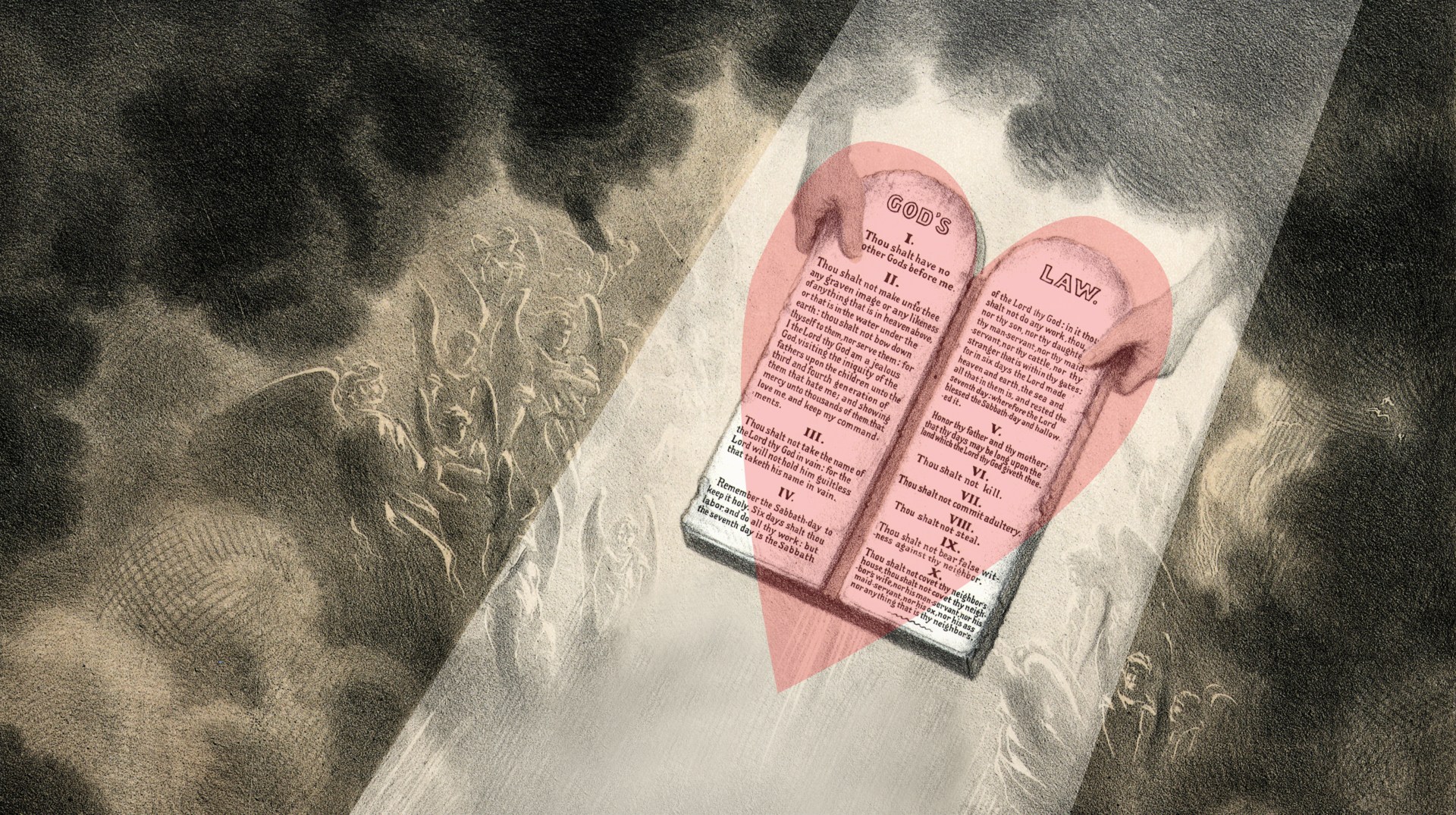
Jesus was right to summarize all the Sinai laws with “Love the Lord your God” and “Love your neighbor as yourself” (Mark 12:30–31). This unites the vertical and horizontal dimensions of the Sinai covenant. The whole point is to be a shining light to the nations, and so we need to be actively looking for ways to be a blessing, whether that involves environmental stewardship, working to improve education and health care, or making sure our justice system is operating the way it should. All those things honor God. The principles we see expressed in the Old Testament laws can shape our priorities as we consider how to help our world become a place for human flourishing.

Ideas

All God’s Laws Are Equal. Are Some More Equal Than Others?

Columnist; Contributor

Why Jesus doesn’t give a straightforward answer to questions about the greatest commandment.

Illustration by Rick Szuecs / Source Images: Carl Oesterley / Public domain

A scribe came to Jesus and asked, “Of all the commandments, which is the most important?” (Mark 12:28). It sounds like a fair question. First-century Jews counted 613 regulations in the Law, 248 commands, and 365 prohibitions. They ranged from the utterly foundational (“You shall have no other gods before me.” Ex. 20:3) to the apparently peripheral (“Do not cook a young goat in its mother’s milk.” Ex. 23:19). All of God’s laws are equal, but surely some are more equal than others.

Jesus’ response is fascinating. In a sense, he accepts the premise of the question and gives a straight answer: “The most important one,” he says, “is this: ‘Hear, O Israel: the Lord our God, the Lord is one. Love the Lord your God with all your heart and with all your soul and with all your mind and with all your strength’” (Mark 12:29–30). So there is a “most important” commandment: Love the Lord.

But in another sense, his response challenges the premise, as his responses (especially in this section of the Gospels) so often do. Rather than stopping after his apparently straight answer, Jesus continues: “The second is this: ‘Love your neighbor as yourself.’ There is no commandment greater than these” (12:31). But notice: That wasn’t what the scribe had asked. He wanted the commandments boiled down to one; Jesus refused to give him fewer than two. In Matthew’s version, he even says that the second commandment is “like” the first, adding that “[a]ll the Law and Prophets hang on these two commandments” (22:39–40). The most important commandment, then, is twofold: Love the Lord, and love your neighbor. If you keep the first without keeping the second, then you’re not really keeping the first.

It’s easy to think of contemporary equivalents. Which is more important for Christians: preaching the gospel or pursuing justice? What is the primary purpose of the church: making disciples or serving the poor? We frame questions this way because we want clarity. We want to ensure that, among everything Jesus taught us, we don’t miss out on what he most wanted.

But there is always a risk of reductionism. If X is more important than Y, then we’ll tend to treat Y as something to get around to sooner or later, once X is complete. Jesus challenges the way we frame the question, giving us two commandments for the price of one. Our focus, he says, must be thoroughly divine and no less thoroughly humanitarian.

The Gospels are filled with examples. Many of the controversies between Jesus and his opponents—debates about healing on the Sabbath, hypocrisy, table fellowship, the inclusion of sinners, and so on—reflect this tension. People are acting a certain way to honor God, but in doing so they are dishonoring their neighbors, which means they are not actually honoring God. Jesus is emphatic in his challenge: “[G]o and learn what this means: ‘I desire mercy, not sacrifice’” (Matt. 9:13). You can’t love God without loving the one made in his image.

In the three Gospels where the greatest commandment question appears, two stories illustrating how love for God and love for neighbor work together in practice immediately follow. That’s probably no coincidence. In Matthew 22 and Mark 12, Jesus transitions to a question about the Messiah’s lordship (love of God) and then a rebuke of merciless, hypocritical leaders (love of neighbor). In Luke 10, the conversation leads into the parable of the Good Samaritan (love of neighbor) and then the exchange with Martha and Mary, in which Mary is commended for choosing “what is better” (love of God). The Gospels don’t just tell us that these two loves belong together. Like the Ten Commandments, they reveal what it means to make each of them supreme in our lives.

In the final analysis, loving God comes first, loving our neighbor second. Each Gospel maintains this order, both in theory and in practice. Yet it is equally clear that we cannot keep the first command without keeping the second—just as we cannot adequately preach the gospel without pursuing justice or make disciples without caring for the poor. When we ask for one commandment, Jesus gives us two. May we rightly prioritize both, the better to confirm Jesus’ next sentence: “You are not far from the kingdom of God” (Mark 12:34).

Andrew Wilson is teaching pastor at King’s Church London and author of Spirit and Sacrament (Zondervan). Follow him on Twitter @AJWTheology.

The Christian Roots of the Fair Trade Movement

Beneath the buzzwords around sustainability, transparency, and ethical sourcing we find something far more important than consumerism: Christ-centered love for our neighbors.

Unsplash / Getty Images

Americans do the most shopping during the last two months on the calendar, fulfilling Christmas gift lists, taking advantage of online deals, and snagging up holiday favorites at local stores. But the spendiest season of the year also offers a broadening array of moral dilemmas regarding our consumerism and a yearning to make something better of it.

Beyond Black Friday and Cyber Monday and Giving Tuesday—lest the holiday gift of charity be overlooked—the shopping season now brings sustainable gift guides, fair trade festivals, promotions from charity-minded startups, and shop local movements like Small Business Saturdays. The ethical options force us, as Christians and as consumers, to think more deeply about the items we buy year-round, the companies we support, and how we steward our money and resources.

Take any product we’ve purchased, and we could probably tell you how much it cost and the store it came from. A $55 duffel bag from REI. A $9,000 used Subaru Impreza. A $10 V-neck tee from Target. But beyond that, plenty of questions go unanswered: What materials were used? How much waste was created? Who made the components? Were the workers cared for at each step in the process? How far did these elements travel to get here?

“The modern market economy adds layers of complexity between production and consumption, which makes it hard to see the impact of each choice we make,” said Hunter Beaumont, pastor at Fellowship Denver and a board member with the Denver Institute for Faith and Work. “A lot of our Christian moral convictions were shaped in a simpler economy, and it can feel paralyzing to apply those convictions to our complex, modern economy.”

We want to become more conscious consumers, and more shoppers are weighing the global consequences of their purchases before they click “checkout.” Millennials are the generation most likely to care about corporate behavior, and Gen Z is catching up fast.

But for every feel-good story of a socially conscious company, there is a report exposing the other side of the marketplace and our worst fears about what major companies do with our dollars: Nike sidestepping responsibility for human rights abuses in its supply chain and Amazon selling counterfeit books.

It’s no surprise that modern consumers are well versed in the moral dilemmas accompanying every purchase. We’re confronted with the choice between unprecedented convenience and affordability and a sense of responsibility to hold companies accountable to honor all their stakeholders and care for God’s creation.

So how are Christians called to faithfully steward our consumer decisions? Is it even possible? The answer may lie in the unlikely founder of the fair trade movement and the Christian convictions that can lead us to challenge the system of consumerism itself.

The Mennonite crafter who unintentionally started a movement

When Edna Ruth Byler began selling textiles from the back of her car in 1946, the concept of conscious consumerism was far from mainstream, and no one had heard of fair trade. Byler, a traditional Mennonite who donned a head covering and was known for her homemade donuts, started with a simple desire to help vulnerable women she met in the La Plata Valley of Puerto Rico.

Byler taught baking, sewing, and canning and belonged to a group that formed a new local church in Akron, Pennsylvania, where she and her husband worked for Mennonite Central Committee (MCC). Their involvement eventually opened up opportunities to visit vulnerable communities in Puerto Rico and later in Hong Kong, Jordan, and beyond.

In each place, she connected with women who overcame enormous obstacles to provide for their families and serve their neighbors. Like many who would come after her, she jumped without looking—promising to help these women by selling their handiwork in the United States, not knowing how she would make her idea work but determined to do so.

“There is a human story behind every product.” – Whitney Bauck

She led MCC’s Overseas Needlework and Crafts Project for over 20 years before it was renamed SELFHELP Crafts of the World, which grew into the now independent and popular chain Ten Thousand Villages.

Ten Thousand Villages is the first fair trade organization in the world and remains one of the largest and best-known. Byler never intended to pioneer a movement that today connects shoppers to over a million small-scale makers around the world. But her Christian commitment to treating these makers with dignity and celebrating the beauty of their craft developed momentum.

Similar organizations emerged in Europe, and by the ‘60s and ‘70s the movement entered the political sphere to advocate for greater equity in international trade—not only in handicrafts, but also in agricultural commodities such as coffee and cocoa.

Around the same time, America’s understanding of corporate social responsibility began to thread together. The Committee for Economic Development—an American public policy organization— declared that there was a “social contract” between business and society, building on economist Howard Bowen’s 1953 book Social Responsibilities of the Businessman.

The idea of businesses working for a greater good, and not just a bottom line, grew over the ‘80s and ‘90s, spurred on in part by President George H.  W. Bush’s call for organizations to serve each other and create a “thousand points of light.”

The double bottom line

While the fair trade movement focuses on caring for people and the planet first, corporate social responsibility is intended to keep companies accountable to social impact as a secondary objective. Both movements have intensified in recent years, raising the bar for ethical standards and giving us new opportunities to have a positive impact with our spending.

From Fortune 100 companies like like Disney and Apple to the oft-cited champions of social responsibility Patagonia and TOMS, and even to Hollywood’s red carpet and the Super Bowl, paying attention to social impact and performance—the double bottom line—has grown. Now it’s everywhere we look.

It’s firmly rooted in the mainstream business world; so much so that consumers, the media, and even governments have come to expect companies to do some form of social good.

Large corporations’ sustainability efforts can have the potential to make a major difference and influence a whole industry—but only if companies are following through with the do-good promises pushed in their brochures and ads.

Though corporate social responsibility has become part of doing business, the level of commitment to the cause varies. As companies get bigger, it’s hard to hold them accountable to ethical practices, said Whitney Bauck, assistant editor at Fashionista.com and a Christian writer covering ethical consumerism.

Even with the advent of a conscious consumer spending index, watchdog groups like Transparentem, social business legal structures like L3Cs and B Corps, and brand-ranking organizations like Ethical Consumer, it’s still overwhelming to try to figure out who is actually doing good. Large-scale consumerism is convenient, but it is complex and hard to navigate.

And on a smaller scale, the market for fair trade enterprises has continued to expand, thanks to the demand of consumers and the convictions of their founders. Today’s Christian entrepreneurs have launched a range of these cause-driven ventures selling gifts and goods: Akola Project, Giving Keys, Sseko Designs, Noonday Collection, Jonas Paul Eyewear, Tegu, Westrock Coffee, Krochet Kids, and dozens more.

These companies are rooted in creative ideas and redemptive entrepreneurship, using their processes and profits to create jobs for women, fund college scholarships, develop artisan businesses, expand access to healthcare, support sustainable farming practices, and provide social services for people in poverty. Like Byler and Ten Thousand Villages before them, their leaders seek to care for makers and the environment alike.

Melody Murray, the founder of JOYN bags, shares Byler’s commitment to dignify the people who create the goods we buy. Murray coined the phrase “purposeful inefficiency” as a way to honor those involved in every step of production—for her company that means harvesting cotton, weaving fabric, printing designs, sewing bags—rather than wishing for a mechanized solution to speed up the process.

But Murray, with a background doing marketing and sales for major companies, also brings business savvy and ambitious vision to the venture.

With her husband and fellow John Brown University grad David, Murray felt called not just to provide makers like her team at JOYN with a global market to buy their goods, but to resource and train local entrepreneurs to start their own agricultural or handicraft ventures to impact their communities.

Through JoyCorps, they have offered training and resources for a range of ventures in rural Asia. JoyCorps’ accelerator and incubator programs focus on innovation and restoration, believing that sustainable business spurs social change.

Over the years, their initiative has launched six businesses through its incubator program, with ten more coming through the accelerator program. For the Murrays, fair trade is all about local ownership and making things that are good for the world. Each entrepreneur they work with, they say, is rooted in their community and committed to holistic impact.

The kinds of companies the Murrays help create, ones where buyers can read stories of Dina who stitches the bags and Uma who does the packaging, put people and their stories up front.

“It’s easy to forget that real human hands make products,” said Bauck. “Fair trade organizations communicate to consumers that there is a human story behind every product.”

Llenay Ferretti, former CEO of Ten Thousand Villages and founder of the social enterprise of Bhavana World Project, puts it this way: Fair trade organizations invite us to “know our neighbor enough to love them.”

“The biblical definition of wealth includes our relationships with God and others.” – Hunter Beaumont

But there are still blind spots and areas of critique. Some worry about ventures that emphasize the story over the product, as customers may be tempted to approach it as charity rather than business. In certain companies, fair trade arrangements stop with the small-scale producers and do not extend to the people they hire. And arbitrarily fixing prices high above a product’s market value can create negative unintended consequences for those it aims to help.

Plus, everyday shoppers aren’t always familiar with sustainable options or don’t have the resources to purchase the higher-priced fair trade products.

Godly consideration over mindless spending

But even when we identify fair trade organizations or socially responsible corporations we trust and can afford, buying better is not the whole picture. It may ease our consciences and increase the likelihood that our money is doing good when we buy placemats from Ten Thousand Villages or handbags from JOYN, but purchasing different goods is simply choosing an alternative form of consumerism.

Faithful consumerism is about far more than which products we buy; it’s not a matter of who does the most research or knows how to read the labels (though those skills can reflect a more thoughtful approach).

Ferretti sees each purchasing decision as an opportunity to look to Christ’s life and how our faith ought to inform all our decisions. It’s an invitation to consider not just what we do, but how our decisions are shaping us and affecting our communities and the world.

While Edna Ruth Byler was, in many ways, a foremother of the conscious consumer, she wasn’t motivated by a desire to influence consumer decisions at all. “She was trying to love her neighbor,” Ferretti said.

Beaumont, the pastor in Denver, agrees community is intertwined with consumerism. “Our modern economy is built around a limited definition of wealth—that you can have more stuff, more money, more time,” he said. “But that doesn’t factor in the relational, psychological, and spiritual components of wealth. The biblical definition of wealth includes our relationships with God and others.”

When Beaumont’s barber moved across town, he could easily have found another shop nearby. But it was important to stay with the same guy. “We have a relationship,” he said. “We talk about what’s going on in our lives. I hear about his fishing trips with his grandkids, and I know my business helps to pay for that.”

Beaumont cites 1 Timothy 6 as Paul’s instruction for how to be faithful stewards of what the Lord has given to us. For those who are “rich in this present world,” Paul urges them to “do good, to be rich in good deeds, and to be generous and willing to share.”

“If we really take that to heart,” Beaumont said, “it bends us toward the communal, toward sharing and giving.” It leads us to focus less on “spending more and more on ourselves,” he said, and more on giving, sharing, and enjoying what we already have.

Less is more

Based on her reporting on ethical fashion, Bauck suggests that buying used products is the most morally responsible mode of shopping. Keeping existing goods in use longer means producing less waste as the byproduct of creating new goods. And in most thrift or charity stores, shoppers see where their money is going and can be confident that their spending is supporting their community.

Our faith also prompts us to contemplate what we really need. When we aren’t focused on asking, “What products should we buy?” we may realize that we already have enough.

Here again, Byler can serve as role model. In her close-knit Mennonite community, they didn’t have much more than the bare necessities. But even during the years of wartime rations and the Great Depression, the Byler children remember a happy home. We can buy better, but even more, we can challenge ourselves to practice contentment.

“The most ethical clothing is the stuff you already have in your closet,” wrote Kohl Crecelius, founder of Krochet Kids, which sells ethically made clothing and knit goods.

Even with minimalism and Kondo-ing becoming trendy, it’s still countercultural to decide we can happily live with less, to reject the idea that we need a new phone, car, television, winter coat, Christmas wreath, or whatever else. Yet we believe, as Scripture warns in the account of the rich young ruler in Matthew 19, that God grants us freedom through a modest and simple life.

Tish Harrison Warren, author of Liturgy of the Ordinary, said in an interview last year that while she believes simplicity is essential to our faith, it’s a hard path: “As consumerism eats away at every bit of our lives … Christians have to think really radically, honestly, and strategically about simplicity.”

For some believers, that means reining in Christmas spending, going for quality over quantity under the tree, or even opting to do homemade, found, or repurposed presents. Putting a pause on Target runs and Amazon “Buy Now” clicks can even serve as a spiritual discipline as people challenge themselves to do a “no spend” month—restricting purchases to the necessities. Christian author and Cultivate What Matters founder Lara Casey just completed her “no spend” year, challenging herself to “grow a faithful life over a comfortable life.”

We will never fully avoid the moral dilemma accompanying our every purchase, but maybe our unease can push us to think more deeply about what we need to buy and who our purchases impact. Even in a broken system, where can our dollars be a blessing? As we seek to follow the Greatest Commandment, our biggest consideration should be loving our neighbor.

The call to be faithful stewards of our consumer decisions is an invitation to consider how Christ’s example may challenge how and what we buy, propelling us to love our neighbors—both near and far—and to practice simplicity, knowing that God is the provider of all good things.

Claire Stewart is a writer, rock climber, and graduate of Wheaton College, where she studied philosophy. She lives in Lancaster, Pennsylvania, and is the strategic initiatives manager at HOPE International .

Chris Horst is the chief advancement officer at HOPE International , author of Mission Drift , and founder of dadcraft , a site on fatherhood.

Church Life

When Restoration Hurts

Christian counselors grapple with how to encourage reconciliation while protecting victims.

Jialun Deng

In 2002, Amanda sat at a Christian counseling office in Indiana with an assignment in front of her. She was supposed to list the ways she had been blessed by her father, who had been sexually abusing her for years. She was a hopeful 17-year-old looking for help.

It was not the family’s first encounter with counseling for her father’s behavior. Earlier, he had confessed the abuse to another counselor, who notified Child Protective Services and encouraged him to report himself to the police. With the support of a lawyer and the family’s pastor, however, he opted instead to move out, effectively stifling any investigation. Amanda, a pseudonym, says authorities never interviewed her about the abuse. Her father’s counselor refused to see him anymore.

Amanda’s mother told her husband he needed to seek help and found another counseling center, connected to a church, that was willing to see the family. But “no one [at church, or in counseling] had told me what happened was wrong, wasn’t my fault, or anything of the kind,” Amanda recalled.

At the new center, the counselor’s assignment was difficult, but Amanda came up with two ways her father had blessed her: He had provided for them and taken them to church. According to Amanda, her counselor was not happy with this short list and told her she was bitter. “I was confused,” Amanda told CT. “Did what happen to me matter? Did God care that [my father] had used my body?”

In both cases, the family saw what are known as “biblical counselors,” practitioners who defer to the Bible and theology—instead of psychology—as the guiding foundation for therapy. Amanda’s pastor told her not to tell others about her abuse, she said, because “no one would want me around their children if they knew I’d been abused.”

In addition to the blessing exercise, Amanda recalls biblical counselors telling her the reason her dad “pursued” her sexually was because her mom was not “satisfying dad sexually.” They told her that “to discuss (with others) what happened would be dwelling on bitterness.”

At one point Amanda remembers listening to apologies from her father. He repeated after his counselor, who was seated with him at the time, that he was sorry for “misusing his authority” and “acting impurely.” To Amanda his apologies appeared so insincere, she wondered how anyone took them seriously.

The counselors began talking with Amanda about her father returning home. And eventually, he did.

Amanda left for college shortly before her father moved back but remained concerned for her younger sisters. She recalls her counselor telling her: “He had repented and now I was to forgive, and forgiveness meant never bringing up the wrong again and believing he would never do it again. So to say my sisters were in danger was sinful.”

Amanda insisted that it wasn’t safe for her father to return home. After Amanda disagreed with counselors over what forgiveness and reconciliation should look like within her family, her counseling sessions were discontinued. Years later, Amanda learned that her father had been sexually abusing both of her younger sisters, just as she had feared.

Her counselor went on to leadership positions within biblical counseling, writing books and speaking at conferences.

A spokesperson for the counseling center confirmed that Amanda’s family used its services in 2002 but would not comment on specific details of the sessions. “We take very seriously Amanda’s charge that we did not listen to her well. We agree that the issue of whether an abuser should ever be reunited with his/her family is a very complicated question,” the spokesperson said in an email, adding it is not the center’s practice to force family members to ask for or grant forgiveness. “We can guide people using biblical principles, but ultimately others are making the final decision about reunification.”

Recently, Amanda filed a formal complaint with the Association of Certified Biblical Counselors (ACBC). She said they cautioned her not to talk to others about her counseling experience. But Amanda agreed to share her story with CT out of a desire to raise awareness of the need for churches to protect abuse victims while counseling them. Her story and others illustrate the high stakes facing Christian counselors in ministry settings as they weigh a challenging question: How high a priority should it be for victims of familial abuse to reconcile with their abusers?

The Bible’s place in counseling

While Amanda’s counseling happened under the umbrella of the ACBC, an organization that oversees certification and training of biblical counselors, Christian counselors more broadly belong to different professional associations and approach their work with varying philosophies.

RELATED NEWS:

Nov. 26—Leading Calvinist and complementarian scholar, Wayne Grudem, recently declared a shift from his long-time position on divorce, citing a scriptural basis for the practice in cases of abuse. Read more.

Christian approaches to counseling go back several decades. Beginning in the late 1960s, the biblical counseling movement, initially called nouthetic counseling, was founded by Jay Adams. He saw Scripture as the ultimate authority on human problems and believed counseling is a theological task rather than a psychological one. Out of Adams’ work came two major organizations that continue to certify and train biblical counselors: the ACBC and the Christian Counseling and Education Foundation (CCEF).

The ACBC approach tends to be popular in conservative Reformed circles, operating within churches or independent counseling centers. A few notable seminaries also train using biblical counseling principles, including Southern Baptist Theological Seminary (SBTS) in Louisville, Kentucky, and The Master’s University in Southern California. Prominent pastors such as John Piper and former Harvest Bible Chapel leader James MacDonald have also promoted this tradition through their ministries.

But biblical counseling has also been defined by what it is against: Generally, practitioners hold the conviction that modern psychology is humanistic and secular and cannot align with biblical revelation.

The CCEF is more open to forging relationships with evangelicals who are working as clinical psychologists but who also reserve a central role for Scripture. For example, the late David Powlison, the past president of CCEF, talked of different understandings of psychology, some of which he said are not at odds with biblical theology.

Eric Johnson, a psychologist who edited two editions of a book describing different approaches to psychology, says that the biblical counseling world today has grown more nuanced, particularly in its approach to women and abuse. He notes the recent work by the Southern Baptist Convention (SBC) committee to create a curriculum on caring for abuse victims. Yet Johnson hasn’t always found a place alongside those in the movement. Johnson was the only psychology professor at SBTS until 2017, when he left the seminary due to incompatibilities with biblical counseling faculty.

That said, Johnson isn’t unreservedly embracing psychology. The founder of a new institute at Houston Baptist University, Johnson agrees with the biblical counseling crowd that secular psychology often approaches the world from a faulty foundation. But instead of rejecting it, he feels it’s possible to build a better psychology on a historical Christian philosophy rather than add religion into mainstream psychology. Johnson mostly finds himself—and a small cadre of like-minded psychologists—somewhere in between biblical counseling and another prevalent view.

Around the same time as biblical counseling’s rise, other Christian practitioners and scholars, led by Clyde and Bruce Narramore, began to call themselves integrationists. Those following this tradition embrace, generally speaking, the methods and theories of psychology as part of God’s general revelation and see it as something that can complement his special revelation in Scripture. Integrationists are not setting out to change psychology at its core, rather to add the nuance it lacks on religion and theology. They are more likely to travel in mainstream psychology circles and publish articles in leading academic journals.

Institutions such as Fuller Seminary and Rosemead Graduate School of Psychology at Biola University were among the first to receive accreditation from the American Psychological Association. Today, Christian colleges and universities that have master’s level counseling programs overwhelmingly teach from an integrationist standpoint.

Trauma in counseling

Society’s very systems that abuse victims turn to for support can sometimes revictimize them—including law enforcement, counselors, social workers, family members, and church leaders.

Several abuse survivors told CT of additional harm done (if unintentionally) mostly by biblical counselors or pastors and, in at least one case, a licensed professional counselor who was a Christian. Vicki, Erica, and Cara—all pseudonyms, at their request—along with their children, turned to ACBC counselors or trainees after abuse at the hands of their husbands.

In Vicki’s case, she says her pastors and counselor were unwilling to see abusive behavior as serious, told her husband they thought she was lying, and instructed him to go home and stay home. He later went to jail after being convicted of child abuse.

Cara, at a large conservative Baptist church, initially felt encouraged that her counselor took her husband’s abuse seriously. But then, she says, the focus shifted to her sins in provoking her husband. She and her children moved out for safety, but the church continues to support her husband as a respected member of the community while they put her under church discipline. She is still battling for sole custody of her children.

Erica was forced to flee to a women’s shelter after her husband, who was sexually and emotionally abusing her, threatened her with a gun. Because of her husband’s tearful demeanor, she says, ACBC counselors thought he displayed more “fruits of repentance” than she did. While they would have supported a temporary separation, their goal was for restoration of the marriage and her coming back and “fully submitting” to her husband, a scenario she felt was unsafe.

Reconciliation for the hurting?

At the crux of the matter seems to be the question: When, if ever, should counselors encourage abuse victims to reconcile with their abuser? Beyond that, how can Christian counselors—whether vocational or pastoral—ensure that promoting forgiveness leads to healing rather than perpetuating violence?

Dale Johnson, executive director of the ACBC, told CT that restoration doesn’t look the same in all cases and that counselors recognize an abuser may not always be able to move back in. “We have to work with the victim to be wise on where she is, what she thinks about this, how she’s processing this,” he said.

He also pointed to ACBC’s training materials. But the guidance given could be interpreted in several ways, one of which emphasizes a biblical call to keep spouses and families together.

In a session during its 2018 abuse counseling training conference, Zondra Scott distributed a handout with a definition of forgiveness. It noted, quoting her husband Stuart Scott, a professor of counseling at SBTS, that once someone has fully repented of the sin and asked for forgiveness, forgiveness is “the full restoration of a sinning brother who is now repentant.” The promise of forgiveness was also defined as promising to “not hold this offense in my heart,” to “not spread this around to others,” and “to not bring this up against you again.”

Heath Lambert, professor of counseling at SBTS and the previous executive director of ACBC, says he focuses on protecting women and listening to them and he understands the damage abuse causes. He is also firm on confrontation of abuse and including the authorities.

However, his approach to the abuser seeks to provide equal care with the goal of “restoration, not stigmatization.” Lambert makes the case that “we never want abusers to sense that we are against them” and that “the goal in ministry to an abuser—as long as he will receive such ministry—is to see him be restored to his family, and ultimately to Christ.” Lambert advocates for a “fierce willingness to protect the abused. Yet this need must not be placed at odds with ministry to the husband.”

But the survivors CT talked to saw it differently. When the same counselors were juggling ministry to both survivors and abusers, the victims felt their safety was compromised. While the ACBC emphasizes that restoration should only happen after genuine change and repentance, several victims pointed out the difficulty of knowing when real change has happened, and that it was prideful for their counselors to assume they knew the hearts of their abusers.

Researchers have long asked what role personal biases might play in the ways that counselors work with abuse survivors. Just last year, Steven Sandage, a professor of psychology at Boston University and a licensed therapist, co-authored a study with Bethel Seminary professor Peter Jankowski that examined connections between theological views and attitudes toward domestic violence. They surveyed more than 200 Bethel students and found that where students held Calvinist views and adhered to gender complementarianism, there was a strong correlation with believing “domestic violence myths.” The term is used by psychologists to describe prejudice toward blaming a female victim and minimizing a perpetrator’s violent behavior—agreement with phrases such as “women can avoid physical abuse if they give in occasionally” and “women instigate most family violence.”

The study, published in the mainstream journal Psychology of Religion and Spirituality, is not without its critics, particularly some in Reformed circles who dispute the research methodology and caution against drawing overly broad conclusions from it. The authors zeroed in on that tradition in part because John Calvin once wrote that an abused wife should only leave her husband “when there is imminent peril to her life,” and otherwise should “bear with patience the cross which God has seen fit to place upon her.” That view was echoed more recently by pastor and popular author John Piper, who said in 2009 that a wife should endure “verbal abuse for a season, she endures perhaps being smacked one night,” before seeking intervention from her church. (Piper later clarified his comments and said churches should not harbor abusers and should seek law enforcement when necessary.)

Certainly, revictimization can happen in therapy of all kinds, faith-based and otherwise. While Chris Moles says he doesn’t speak for ACBC as a whole, he recognizes harmful ways some victims have been counseled by Christians. Counselors are aiming for the wrong target when their primary goal is reconciliation in abuse situations. “Safety,” he told CT, “is the first goal.”

Moles, who is a pastor, ACBC counselor, and group facilitator in domestic violence intervention and prevention, sees safety as a biblical priority because of the way Scripture depicts God’s heart toward the oppressed.

“Reconciliation can be a distraction from the process,” he pointed out, “because domestic violence shouldn’t be treated as a marriage problem.” Biblically, when abuse has taken place, he feels accountability should be the priority for the perpetrator. As far as when or even if a victim reconciles to their abuser, Moles emphasized that “decisions that belong to the victim belong to the victim” and that “victims do not need me to dictate.” He also said that reconciliation should only happen once safety for the victim has been established and the perpetrator has experienced transformation.

Moles acknowledges that some victims have received “dangerous” advice from biblical counselors and some “pro-biblical counseling” churches. During a talk at the 2018 conference, he shared examples: “You need to work on being more submissive.” “Pray more, read your Bible, have more sex.” “He didn’t mean to hit you.” “He didn’t just hit you for no reason. What did you do?”

He warned how biblical counselors might sometimes misuse doctrines of forgiveness, reconciliation, and restoration in a way that benefit only abusers.

Sandage, who wrote a book on the psychology of forgiveness, told CT that “in many cases, perpetrators of abuse can also use the language of ‘forgiveness’ in manipulative or coercive ways to guilt their victims into maintaining the status quo in a relationship. It is relatively easy to offer a verbal apology and much harder to transform patterns of behavior.”

Sandage described forgiveness as a long-term process. It may start with simply not exacting revenge. For some abuse victims, they may even prematurely “forgive” their perpetrator. This allows them to “bypass an accurate understanding of what they have experienced and the patterns involved and to ‘assume the best’ about future interactions with perpetrators in order to unconsciously avoid the fear, shame, anger, and difficult decisions that are involved,” he said, calling it a psychological survival strategy.

If perpetrators want healing, then they need “extended time” in treatment and should be exhibiting personal change, Sandage said, adding that growth is compromised if there are no significant consequences.

Finally, he concluded that reconciliation is something different from forgiveness, both biblically and psychosocially. “A person can ultimately forgive an offender and decide that reconciliation is not safe or warranted due to a lack of repentance and transformation on the part of the offender.”

Changing counseling

For her part, Amanda wants counselors to have a more trauma-informed theology and to recognize that victims often need help beyond what pastoral counseling can offer. “There is a superficial belief that trauma can be dealt with and everyone can move on in a few months,” she said. “Brain imaging has taught us that trauma actually rewires the brain and brain function is changed. A few verses, reading a book, and a couple months doesn’t change those facts.” She and most of the women interviewed are conservative Christians and hold a high regard for the Bible. “Survivors of abuse need God’s Word, just as someone suffering with cancer needs God’s hope,” Amanda said. “But it isn’t all they need.”

Jialun Deng

Years after Amanda’s abuse, a new pastor who identified with the Calvinist tradition came to her church and was crucial in helping her take important steps toward healing as an adult. She reported her abuse to police in 2008, although she said the investigation was short-lived because neither her family nor their counselors would talk to the police.

RELATED NEWS:

Nov. 26—Leading Calvinist and complementarian scholar, Wayne Grudem, recently declared a shift from his long-time position on divorce, citing a scriptural basis for the practice in cases of abuse. Read more.

Amanda feels the new pastor helped “rescue” her. His theological framework for acknowledging evil and God’s sovereignty, and his support for church discipline of wrongdoers, informed how he helped. Rightly understood, Amanda says, these doctrines can bring comfort to survivors.

Brad Strawn, a psychology and theology integration professor at Fuller Seminary, suggested that when empirical research or anecdotal evidence spotlight potentially negative tendencies in a particular Christian tradition, its members don’t need to abandon that tradition or despair.

“If there’s something in Calvinism that might lend itself to a more complementary and traditional model of marriage, that doesn’t mean (Calvinism) is wrong or bad,” Strawn said. “But theologians could go back to their work and say what in my tradition doesn’t point to spousal abuse? What is there in my theological tradition that would denounce spousal abuse?”

Moles said churches first need awareness, but also lament and repentance when abuse hasn’t been handled well in the past. He pointed out that no one should trivialize the pain of victims hurt by the church, but that it can be “hope-giving to victims” when churches lead the way in modeling change in how victims are treated.

He noted that unfortunately, few counselors, Christian or otherwise, “are thoroughly trained in the dynamics and impacts of abuse.”

The process for becoming a licensed therapist should include such training, Sandage said. “I am sure that doesn’t always happen or may not override individuals’ beliefs about blaming victims,” he said. “Some therapists will hold sexist beliefs, and some therapists will also hold biases against religious beliefs that may be important to clients.”

A team approach

Momentum is building for new approaches to help churches better support abuse victims. The SBC’s new training curriculum for responding to abuse drew on experts from a variety of backgrounds, including both conservative and progressive biblical counselors, psychologists, social workers, law enforcement, and abuse survivors.

The group was led by Brad Hambrick, a pastoral counselor at The Summit Church in Durham, North Carolina. He hopes the collaboration that went into building the curriculum, called Church Cares, will serve as an example of “a team of people that are representatives of relationships a pastor will want to have with people in their community,” he said.

Many of the women CT spoke with did receive additional help from sources outside the church—including women’s shelters, police, and psychologists. But these women turned to the church first. In fact, multiple studies have shown that pastors are often the first contact for individuals in need of mental health resources.

That can be a challenge when pastors approach counseling, for example, like one of Sandage’s students, who indicated that he would never meet with a married woman unless her husband was present. “He had never considered whether that might limit (her) freedom to report domestic violence,” Sandage said.

As Hambrick sees it, different “jurisdictions,” such as therapy, counseling, and pastoral care, have different underlying theories or theologies, and pastors can become suspicious of underlying worldviews. “Churches have a tendency to make everything about the theories and theologies, then we get lost in it. We assume others have a different theology than we do, when maybe they just come from a different jurisdiction and have a different set of questions,” Hambrick said.

“I don’t think the answers are nearly as neat as we’d like them to be,” he said. Though he’s always counseled in a pastoral setting and never sought licensing, he views those who are licensed in a secular context as community helpers with whom pastors should seek a good relationship. “I think we both do important, valuable work.”

Hambrick believes abuse survivors need distinctly pastoral support while wrestling with theological questions about suffering, but notes that abuse survivors particularly need the civil authorities to whom Christians are called to submit in Romans 13.

Since the Church Cares material released, all six SBC seminaries have agreed to incorporate it into their mandatory curriculum. The SBC’s Ethics and Religious Liberty Commission, tasked with promoting it, hopes it will be used widely by seminaries and churches of other evangelical denominations.

“There’s a certain convergence happening. [Churches are] coming at the same topic from different standpoints,” Johnson said. “I think that’s a fascinating sea change.”

Rebecca Randall is the science editor at Christianity Today. Kimi Harris is a writer, mother, and wife of a pastor. She and her husband serve in the Midwest.

Apple PodcastsDown ArrowDown ArrowDown Arrowarrow_left_altLeft ArrowLeft ArrowRight ArrowRight ArrowRight Arrowarrow_up_altUp ArrowUp ArrowAvailable at Amazoncaret-downCloseCloseEmailEmailExpandExpandExternalExternalFacebookfacebook-squareGiftGiftGooglegoogleGoogle KeephamburgerInstagraminstagram-squareLinkLinklinkedin-squareListenListenListenChristianity TodayCT Creative Studio Logologo_orgMegaphoneMenuMenupausePinterestPlayPlayPocketPodcastRSSRSSSaveSaveSaveSearchSearchsearchSpotifyStitcherTelegramTable of ContentsTable of Contentstwitter-squareWhatsAppXYouTubeYouTube