Ideas

Her Children Arise and Call Her #Blessed

Staff Editor

Monetizing child-rearing online is never a godly option. But maybe it’s more than an influencer problem.

A child surrounded by phones and social media
Christianity Today May 7, 2025
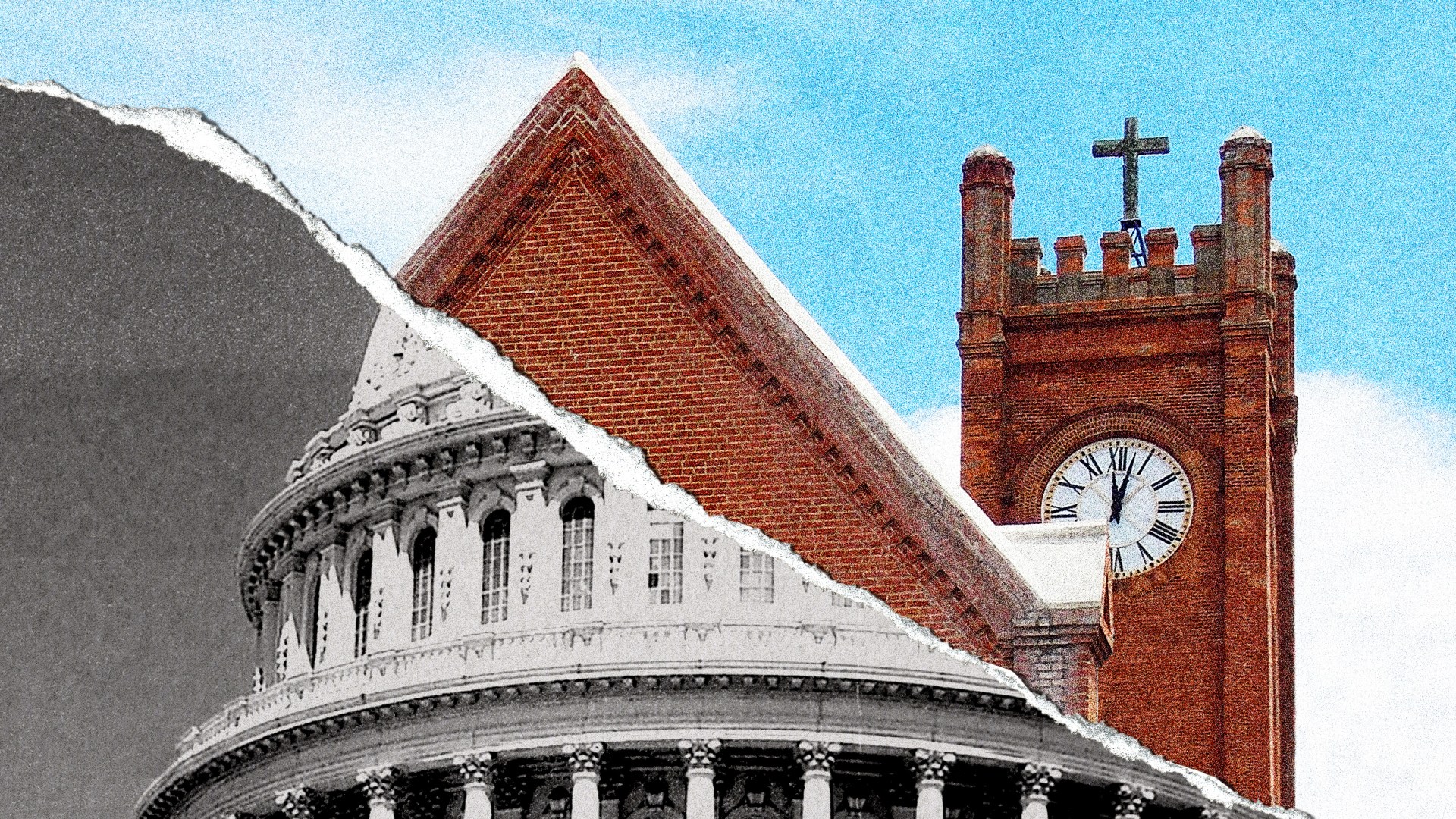
Illustration by Mallory Rentsch Tlapek / Source Images: Getty, Unsplash

Like most everything in America now, having babies is apparently a partisan decision, and it’s now become coded right. College admissions counselors eye the upcoming “demographic cliff” with alacrity. We all should be worried that in the US, the birth rate has dropped to historic lows since the country began tracking about 100 years ago. (In 2023, the birth rate dropped 3 percent from the previous year to 1.62 children per woman.) At the same time that men and women are more likely to forego parenting, motherhood particularly in the digital age has taken on a consumeristic edge.

Life as good and worthy per se is no longer key to our cultural thinking. Instead, children are signposts of one’s politics or used quite literally as accessories to lifestyle brands. In The Influencer Industry, Emily Hund explores the growth of the influencer industry (which Goldman Sachs estimates will grow from its current valued worth of $250 billion to $500 billion by 2027), particularly related to curated authenticity. Whether influencers sell goods via affiliate marketing, partner with brands, or simply monetize their feeds with advertising, everything is for sale.

While traditional societies may have regional and multigenerational safety nets, much of the Western world has turned to the internet in the past few decades for support. Back in 2002, when the internet felt like a free exchange of ideas and life stories, the mommy blogger was born out of a desire for community and potty-training advice. Over the years, what a mother went looking for online changed. As one former mommy blogger terms it, the writing of “gritty personal essays morphed into attractively staged, aspirational content.”

Today, mommy bloggers have been replaced with TikTok #TradWives who emphasize a stylized back-to-the-land aesthetic while carefully leaving out the manure or toddler meltdowns. Motherhood has become performative, and it’s harming real mothers, children, and families. These trad (traditional) wives sell us the allure of rootedness and of beautiful children parading like ducklings—without revealing any of their costs. They buy, sell, like, and share things that virtue builds slowly over time. Motherhood has become an industry.

“When monetizing one’s daily life is a growth industry,” Emily Hund asks, “where does it end?” Therein lies the rub. With phones in our hands, scrolling through reels with algorithms that increasingly serve us more of the same, we can easily become immersed in someone else’s life (or, at least, what they choose to disclose). As our attention equals monetary gain for someone or some platform, we must ask: What is the value of our attention? And when our attention is fixed on idealized squares of performed domesticity, who actually profits?

After all, authenticity is what makes one influencer more “valuable” than another. A little over a decade ago, a Nielsen study found that more than 90 percent of consumers would trust product recommendations from someone they knew (rather than a faceless brand). As the influencer industry has grown, authenticity and personality are no longer about connection but have become increasingly focused on metrics. “Only once influence could be measured could it be shaped into a good and assigned monetary value—and monetization was the goal,” writes Hund. What happens when we turn ourselves into brands? Or worse, turn our children into brands? What happens when we monetize motherhood?

Although many influencers are now removing their children from social media photos to restore a sense of privacy, the effect of monetizing parenthood is withering. Although not speaking about influencing specifically, writer Anne Lamott wisely observes that when we raise children “as adjuncts, like rooms added on in a remodel,” our children’s achievements become the parents’ “reflected glory, necessary for these parents’ self-esteem, and sometimes for the family’s survival.”

When we monetize children or look to their achievements to make sense of our own lives, we cut them—and ourselves—off from the gospel. If the influencer model, which works by teaching us to see ourselves and our children as moneymakers or influence bearers, tells us that we are only as valuable as the number of likes, follows, comments, or subscribers, what is the counternarrative for those who follow the Christian story?

Scripture repeatedly reminds us that God moves toward the failures, the murderers, the adulterers, and those without economic advantage, like the widows, the barren, and the sojourner. This is not to say wealth is bad: David and Solomon had great wealth and power, a circle of women supported Jesus’ ministry (Luke 8:1–3), and Phoebe supported the work of the apostle Paul (Rom. 16:1–2). The key is that no matter their amount, all these resources—whether monetary capital or social capital—were given in service to God and his kingdom.

While few of us are influencers, we’re all guilty of viewing what we do with our bodies—whether our fertility or our social media habits—as if we were our own. But we are not our own; we have been bought at a price (1 Cor. 6:20). If we’re parents, we’re likely guilty of wedding ourselves so tightly to the successes and failures of our children that we forget that children are not math equations where a particular input results in a specific output.

Children are people who need Jesus. Children of every age need to see the gospel enacted and lived out by their parents (and their faith communities), not through perfection but through obedience, failure, repentance, and grace.

Parenting by its very nature can’t be measured by algorithmic metrics or financial success, which are built into an influencer economy. To do so would be to say that the end goal of parenting depends on our own human action to influence or manipulate algorithms and spending habits.

But the good news of Jesus for mothers and fathers who are weary of trying to be perfect parents is this: Parenting is not about you. While your actions and the fruit of your life will impact your children, it is not clear how your children will turn out. Christian parenting is about continually pointing to Jesus as the author and perfecter of our faith, clinging to the reminder that he who began a good work in us and our children will complete it.

One of my favorite passages in Scripture that shows the emotional life of Christ is about how he longed to comfort and shelter Jerusalem. As a mother to four, I know the pull to shelter and protect while also needing to let go. Near the end of the Book of Luke, as Jesus heads toward his death, he compares himself to a mother hen: “How often I have longed to gather your children together, as a hen gathers her chicks under her wings” (Luke 13:34). Yet Jerusalem rebels. Pilate and the religious leaders conspire to kill Jesus. They are successful.

But the good news of the gospel is that this is not the end of the story. Just a few verses before Jesus’ response, some Pharisees tell Jesus to save himself: “Leave this place and go somewhere else. Herod wants to kill you” (v. 31). Rather than protecting himself or looking to worldly metrics that would shield him from suffering, Jesus responds by both acknowledging the truth of Jerusalem’s rebellion (v. 34) and reiterating that his response to rebellion is to gather his people under his wings and shelter them.

When Jesus uses the language of mothering, it is not to see people as expendable based on what they can do for him. Neither is it to accept rebellion against what he says is good, true, and beautiful. The response of Jesus is not to self-protect, run away, sugarcoat, or cut off. Rather, in Jerusalem’s failure and ours, Jesus always moves toward us with both truth and grace. That is good news for all parents.

Ashley Hales is editorial director for print at Christianity Today.

News

Unless the Lord Builds an Affordable House

Survivors displaced by LA fires turn to churches and ministries for help navigating the worsening crisis.

Aerial view of church ruins where people pray in circle with the mountains behind them

Bishop Charles Dorsey leads a prayer rally for the Altadena community and for his church, amid the remains of Lifeline Fellowship Christian Center, which burned to the ground in the Eaton Fire.

Christianity Today May 7, 2025
Mario Tama / Getty Images

Six months before the owners of her Pasadena, California, apartment sold the building, retired missionary Laura Raab started looking for new housing. By the time the official move notice came, area rents had gone up by $500 a month—well beyond what she could afford on her modest fixed income. Raab started to think she’d have to leave Southern California altogether.

Raab’s longtime church prayed for her, and she found a Christian family converting their garage into an apartment. She couldn’t afford their asking rent either, but they generously dropped the price to meet her budget.

Four years later, Raab faced a new housing threat when massive wildfires broke out in January. The Eaton and Palisades fires destroyed over 9,400 and 6,800 structures respectively, together killing 30 people. While the infernos raged, Raab evacuated to stay with fellow parishioners from Knox Presbyterian Church.

Other families from Knox—including its pastor, Matthew Colwell—did the same. These evacuations gave Raab and Colwell newfound closeness with their hosts—and a shared experience of the city’s grim housing landscape.

Raab’s housing survived, but Colwell’s family was one of eight in the congregation who lost their homes.

In the immediate aftermath, churches all over the Los Angeles area pulled together to respond to some of the most destructive fires in their state’s history. Four months later, many of the initial relief efforts—shelters, GoFundMe campaigns, material donations—have given way to the mid- and long-term response.

That slower, more tedious work includes clearing property, planning how to rebuild, and figuring out how to address massive housing loss in a region that was already one of the country’s least affordable places to live.

In Altadena, where the Eaton fire burned, senior pastor Jose Cervantes had no idea how bad things were until his church started housing people in the “tiny little rooms” Iglesia del Nazareno uses for Sunday school. Nineteen people stayed more than two months and 14 people for three months. The last just recently moved out.

Of those guests, one family of seven had been displaced when their motorhome burned. Another family of seven had been living on the street.

Even before the fires, LA ranked among cities with the worst housing shortages in the country, with fewer than 3 percent of nonhomeowners able to afford a mortgage.

“It’s like a housing crisis suddenly got pushed over a cliff,” Colwell said. For now, he and his family have moved into housing for retired pastors.

The church building survived, and Colwell believes his home insurance will cover most of the rebuilding costs, but others face a much greater toll. Jill Shook, cofounder of Making Housing and Community Happen, said some families who had paid off their houses—perhaps inherited from relatives—didn’t have home insurance.

And pastors at the 11 houses of worship destroyed in the Eaton Fire face a double challenge: losing their buildings on top of so many congregants losing their homes.

“We have this in common, this loss, and a lot of overlap in our experience of it,” said Carri Patterson Grindon, who leads Saint Mark’s Episcopal Church, which burned.

Almost three miles north of the 210 freeway that cuts through what was a once a thriving Black neighborhood, the church sat a few blocks southwest of the now-barren hills that form Eaton Canyon. Before the fire, tree-lined arteries such as Altadena Drive and Lake Avenue connected restaurants, grocers, and thrift stores to residents of the bungalows and other homes that stretched up to the hills.

Lifeline Fellowship Christian Center also burned down, as did two of three other churches near the intersection of Altadena and Lake, said Charles Dorsey, Lifeline’s senior pastor.

Through the Clergy Community Coalition, a group of about 100 churches and ministries in the Pasadena area, Dorsey and Grindon have connected with other leaders responding to dramatic shifts in church life.

The coalition’s executive director, Mayra Macedo-Nolan, said they’ve seen an uptick in attendance at local meetings, as clergy want to connect to share building space, resources, and stories.

“We’re working hard to understand what it means to be in solidarity with each other,” she said.

Cervantes said donations from other churches helped Iglesia del Nazareno, which averages 95 attendees each Sunday, assist people with rent. The church also replaced a large family’s motorhome and helped a formerly homeless family find an apartment. He estimates his church received about $60,000 in donations and have commitments of $30,000 more.

Housing advocates like Shook hope Christians will rely on their newly strengthened community for the challenging work of ensuring their neighbors have homes to go back to.

“The response of the church around this fire has been beautiful,” Shook said. But she distinguished the “mercy response” of immediate help with the “justice response” of long-term work to rebuild.

Much depends on how Altadena rebuilds. Local officials propose accelerating the process by adjusting existing housing regulations. For one, the Los Angeles County Board of Supervisors recommended California suspend a state law that allows owners to split their lots. 

If approved, the move would limit Altadena’s housing density and who could afford to live there.

“Historically, ‘keeping the character of the community’ has served to exclude lower-income residents,” Shook said. “For people that have lived for generations on a property and they’re on a big property, why not let them sell the other half so they can stay?”

According to Azusa Pacific University assistant professor Margaret Lee, affordable housing refers to both subsidized housing and housing available at an affordable cost relative to income—no more than 30 percent. Lee teaches social work at Azusa and serves as an adviser for Making Housing and Community Happen.

For renters like lifelong Pasadena resident Tatiyana Riley, that meant working three jobs, even before the Eaton Fire. Riley, who took advantage of a day shelter at Pasadena Foursquare Church during the weeks she thought her building had burned, makes $17 an hour at her full-time job as a server, just above California’s $16.50 minimum wage.

But to rent her $1,250 apartment on that income—and meet landlords’ 30 percent of gross wages requirement—she’d need to work 57 hours a week, or 29 eight-hour days a month. To afford it, Riley works two side jobs and shares her small one-bedroom apartment, which has poor plumbing and baseboards that were covered in mold and mildew when she moved in. But at least it has a kitchen. The room she used to rent alone for $1,200 a month didn’t even have a fridge or stove, and she had to share the bathroom with others in the building.

Lee said the lack of undeveloped land in LA County makes it hard to build more housing without building densely. But even unsubsidized buildings like duplexes, triplexes, fourplexes, or apartments bring resistance.

“Once a multifamily development gets put in your neighborhood, it’s perceived as a threat” regardless of neighborhood political leanings, she said.

Multiple people interviewed for this story mentioned a recent lawsuit in nearby La Cañada Flintridge, where the city tried to stop its first multifamily housing development in years.

Shook thinks Altadena is ideally suited to adding duplexes and, in some areas, multiunit buildings. Lee has proposed to her state senator, Sasha Renée Pérez, that California amend its budget to give grants to Eaton Fire victims for accessory dwelling units like an in-law unit or tiny home. Use of several pre-approved plans would expedite permitting to build.

“Then, while they’re living in it, they can start constructing their primary house,” said Lee, who teaches Azusa’s social work policy classes. Under her plan, grant recipients would agree to rent out the added units once they moved back into their reconstructed homes.

Senator Pérez selected Lee’s idea out of several proposals as the one budget amendment she’ll submit during the annual process in May. If the proposal advances, it’s unclear how that would interact with the county’s recommendation to restrict lot splits.

Church land provides another opportunity. Since Making Housing and Community Happen launched its congregational land team in 2019, over 100 Southern California churches have approached the group for help as they consider using part of their land for affordable developments.

Shook’s organization does “all the preliminary planning for churches,” she said, but the process can take years. One of 45 churches her organization is working with is now close to breaking ground on a project that will convert school classrooms into 60 units of housing.

The proposed restrictions on lot splits come just as church leaders across the region have begun rethinking their property, damaged churches weigh how and whether to rebuild, and others consider how they can use the spaces they have to serve the changing needs of their neighbors.

For Door of Hope, a longtime Pasadena ministry focused on preventing family homelessness, the fires spurred a reassessment of their mission. Jim Howe, the nonprofit’s chief operating and financial officer, said the scale of housing loss personally affected their staff: CEO Megan Katerjian and three other staffers lost their homes.

The ministry already ran four transitional housing facilities and a homelessness-prevention and rehousing program that served about 200 clients a year. It quickly decided to hire another caseworker so they could help some families affected by the fire.

Howe said many of them had been paying below-market rent, so the caseworkers offered to help find options in their budgets, including negotiating with landlords and subsidizing the cost.

At first, the ministry planned to add 50 families to its usual caseload, budgeting for both an additional caseworker and some direct aid for each family. “But we quickly found out that the need is much greater than that,” Howe said.

After further discussion and an influx of donations, the board has broadened the scope. “Staff can grow this program to whatever they can effectively fund and efficiently operate,” he said.

Even churches beyond the burn zone reevaluated their roles and resources in response. Two days after the fire, Pasadena Foursquare Church opened its building as a day shelter and contacted the denomination’s relief fund, which gave the church $2,000.

“We’re a small little church,” said Carolina Majors, who helps her husband pastor the church. On a typical Sunday, perhaps 50 to 60 people attend, including children. “We thought we were so limited because of our building,” a structure that’s in poor condition and is small relative to the land they own.

But even if they couldn’t host a church that had lost its building, the Majorses found another way to help: using their building as a day shelter. For the first two weeks after the fires, they opened up daily. By late April, they were down to two days a week but still offering their space to people like Riley.

Majors said people came from as far away as San Francisco and Sacramento to volunteer. Through the Majorses’ denomination, churches throughout the state and across the country reached out to offer help.

“We were able to raise—like, not us, God did it—$20,000,” Majors said. The money went to temporary housing, household essentials, and groceries.

“They’re really open and receptive to the community,” said Riley, who described leaving the church’s shelter “with a less heavy heart, a less heavy spirit.”

In La Cañada Flintridge to the west of Altadena, four churches hosted Making Housing and Community Happen for an all-day housing-justice event in the aftermath of the Eaton Fire.  Kyle Sears, pastor of La Cañada Congregational Church, brought up the community’s history as an unofficial “sundown town,” expecting non-whites to leave at night. More recently, the city had been fighting a years-long lawsuit that sought to stop one of its first multifamily developments in years—proposed to be built on the grounds of a former church.

On March 4—three days after the event—the city abandoned its lawsuit after a court ordered the city to post a $14 million bond.

“When people think justice—even racial justice—they don’t think zoning,” Lee said. “But really, when you drill down into the policy, that’s what it comes down to. … It ultimately comes down to loving your neighbor, whether it’s through giving someone a sandwich or sitting through a city meeting or writing an advocacy letter to your politician. It’s all a form of love.”

 Raab, the retired missionary, said after returning home, she gave a thank you gift to the family who hosted her during the evacuation. She got a note in response: “You’re family now.”

Books
Review

The What and the Why of Religious Decline

One is relatively simple to map out. The other is much harder to capture.

A person dusting off columns

Illustration by Micha Huigen

In this series

In social science, it’s relatively easy to explain what is happening. Ask a question with a straightforward answer—How has the cost of lettuce changed over time? Are people getting married later in life?—and the answer should be forthcoming. Just download the right data set, write a bit of computer code, and present the findings in an informative, visually appealing manner.

But once you describe the what, it’s natural to begin wondering about the why.

As I like to tell my graduate students, there’s nothing simple about the social world. The internet is full of clickbait articles promising three simple tricks to increase your income or one easy hack for a better night’s sleep. There are no such shortcuts, however, in academic social science. 

Take American religion for instance. Over the past several decades, the most important trend is a pretty simple line graph indicating the share of adults who claim no religious affiliation. Five decades ago, that figure was 5 percent of the population. Today, it’s about 6 times higher. But why? How did the share of “nones” rise so dramatically in such a short time?

Smith tackles those questions, among others, in Why Religion Went Obsolete. The book analyzes responses gleaned from four focus groups, over 200 interviews, and a survey sent to more than 2,000 adults. Smith’s conclusion is clear and simple: For a growing number of younger Americans, religion simply lost its usefulness.

Those accustomed to ruminating about the decline of religion have long sensed that today’s young people don’t seem to care much about faith one way or another. However, that feeling has never been developed into a mature, testable theory. Smith harnesses a term—zeitgeist, often defined as “the spirit of the times”—that helps ground this pervasive sense that some big shift has occurred. It’s an idea many of us innately understand, even if we have a hard time wrapping our minds around it. Smith does a great service by laying an academically rigorous foundation for what he calls the “Millennial zeitgeist.”

Getting down to specifics, Smith argues that the millennial generation has embraced a new zeitgeist based around four key characteristics: cultural individualism, rapid technological change, “postmaterialist” values of autonomy and self-expression, and a deep skepticism of authority. As an older millennial, I can say that those four factors resonate with my own experience. Even so, I’m not entirely convinced, on an empirical basis, that millennial life rests atop a philosophical scaffolding fundamentally unlike that of prior generations of Americans.

Take, for instance, one statement Smith posed to survey respondents: “I am more concerned with a good life here and now than what comes after death.” If millennials came of age amid an entirely different zeitgeist, we would expect their answers to differ dramatically from, say, those of baby boomers. In fact, the breakdown is strikingly similar (51% of people born between 1946 and 1954 either “strongly agree” or “somewhat agree” with the statement, compared to 54% of millennials). Thus, people born three or four decades apart have nearly the same view about the value of living a good life.

Smith also reports survey results that might seem to suggest significant generational differences, when in reality the explanations are probably more mundane. His questionnaire included the statement “I spend a great deal of time thinking about myself.” Fifty-three percent of millennials agreed with this compared to just 33 percent of early boomers. Does this indicate a huge zeitgeist shift? Or simply confirm that people self-reflect less as they age? Without having surveyed baby boomers on these questions when they were younger, we can’t know for sure.

Social science models always contain lots of unexplained variance, no matter how sophisticated our conceptual starting points and statistical techniques. In graduate school, I remember one of my professors joking about the best way to wave away these mysteries: Just shrug your shoulders, say culture, and move on with life.

We understand readily enough that culture shifts all the time, following new fashion styles and intellectual trends, even if we find these shifts impossible to fully explain. In attempting to get a handle on an obvious cultural shift in how young Americans view religion, Smith’s book wields social science tools with incredible skill. It’s a methodological tour de force. However, I can’t help wondering whether a full accounting still lies outside his grasp.

It bears mentioning, for instance, that the ranks of nones appear to have stopped increasing. A number of independent surveys demonstrate that the share of Americans claiming no religious affiliation froze back in 2020. According to data I reviewed from the Cooperative Election Study, religion may actually be on the upswing among millennials and Generation Z.

Even so, I generally agree with Smith’s conclusions. Religion in the United States is declining for many reasons, including self-inflicted wounds from corrupt or abusive ministry leaders. (In one chapter, Smith devotes four and a half pages to a single table listing scandals among major conservative Protestant leaders.) 

But churches are also emptying for reasons that can’t be blamed on ministry misbehavior. American culture was already heading in a direction that ensured headwinds for houses of worship. To take one example, Smith notes how the digital revolution ate away at communal gatherings by turbo-charging trends in atomization that began in the 1980s. More than ever, people could entertain themselves without leaving the comfort of home. While churches have occasionally responded with flashy worship bands, polished event production, and easily digestible sermons, this hasn’t always coaxed people away from scrolling news feeds on their couches.

In total, Smith’s book makes a laudable contribution to current discourse about the decline of religion. His concerted effort to describe, define, and measure the shifting cultural zeitgeist should motivate students of American religion to think outside the box when theorizing about the American religious landscape. However, I think all of us who share in this work would do well to remember Paul’s words in in 1 Corinthians 13:9–10: “For we know in part and we prophesy in part, but when completeness comes, what is in part disappears.”

Ryan P. Burge is associate professor of political science at Eastern Illinois University. He is the author of 20 Myths about Religion and Politics in America.

Books
Review

Young Nones Might Not Hate Religion. But They Don’t Like the Vibes.

How Christian Smith’s concept of a “Millennial Zeitgeist” helps explain their recent retreat from faith.

A person sitting on a hill

Illustration by Micha Huigen

In this series

I doubt I’m the only parent of Gen Zers who occasionally hears the protest “I’m not feelin’ it” on a Sunday morning. 

As Christian Smith argues in Why Religion Went Obsolete, it is widely recognized that traditional religion in America is in “a spiral of decline.” What is less understood is why. The book, as Smith describes it, “moves beyond statistics and interviews to explore the larger cultural environment” that made traditional religion (and especially Christianity) feel irrelevant to younger generations of Americans. 

Smith frames much of his cultural analysis around his notion of a millennial zeitgeist that gained momentum in the early 1990s and peaked just before 2010. The idea of a zeitgeist, or a “spirit of the age,” resembles what the philosopher Michael Polanyi called “subsidiary awareness.” It proposes that within a particular culture or time period, certain background assumptions become so pervasive that we aren’t even consciously aware of them. They simply “ring true.”

Following the work of London School of Economics professor Monika Krause, Smith rehabilitates this concept as something with real empirical force rather than a vague perception of something “in the air.” Various periods are distinguished by ideas and practices that extend across spheres of social life and geographical boundaries. As examples, Smith mentions the Wild West, the Roaring Twenties, and the 1960s.

The millennial zeitgeist isn’t defined by opposition to this or that doctrine. Rather, it flows from a network of ideas, practices, technologies, and habits that make Christianity feel out of date, like a horse and buggy in the automobile age.

Much of our apologetics aims at skeptics and atheists who can give coherent arguments for their stances. But the younger Americans Smith surveyed are not deliberately rejecting religion for clearly discernible reasons. According to one of several summary statements Smith uses to outline their consensus attitudes, “It is not necessary to be well-informed about religion to criticize and dismiss it.” One respondent confessed, “The Bible makes my eyes roll,” even though he’s never read it. Many others failed to articulate their beliefs in clear or consistent ways, beyond a hazy sense that “the vibes were off,” the idiom Smith uses to close one chapter.

After revealing the results of extensive empirical surveys, including his own, Smith sketches the “contours” of the millennial zeitgeist, accentuating this portrait with several dozen popular marketing slogans (“Obey your thirst,” “Drive your ambition”) and bits of youth lingo (“You do you,” “Don’t judge me”). His examples coalesce around a fundamental dogma: individual autonomy. Many respondents gesture toward an inner divinity that withdraws from external authorities like a snail into its shell.

Smith also shows how churches themselves have contributed to this environment, often by shifting their focus from a transcendent God to the earthly horizons of moral, political, and therapeutic benefits. They have downplayed norms of communal fellowship in favor of an individualistic “Jesus and me” piety. As one self-proclaimed churchgoer tells Smith, “You don’t have to physically go to a building to praise God, you can pray at home. I just go because I get satisfaction out of it.”

In a similar vein, many religious leaders encourage going deeper within yourself rather than trusting external authorities, institutions, and traditions. As an example of where this mindset leads, Smith cites Oprah Winfrey, who once remarked, “I have church with myself. I have church walking down the street. I believe in the God force that lives inside all of us, and once you tap into that, you can do anything.”

From Smith’s findings, I was struck by three paradoxes. The first is that respondents who dislike traditional notions of a personal God who exercises judgment often praise religious systems that ratchet up the consequences for sins.

One recalls discovering Wicca in college: “I learned they believe whatever they do comes back to them 10 times,” a cosmic pattern that sounded advantageous. “Because if [other people] do something bad to you, it’s gonna hurt them a lot worse. If I had to go to a religion, I would definitely go there.” The attraction, of course, is autonomy. This person can affirm punishments for wrong behavior, so long as those punishments can be controlled and manipulated without answering to a higher judge. 

A second paradox is that younger Americans bet everything on the here and now even though they have fading hopes for this life. “Younger generations face diminished economic opportunities,” Smith writes. “Their chances of achieving the American dream are slim.” But instead of raising their eyes to God, they double down on the quest for sacred experiences in this world.

Smith writes of young people seeking transcendence “in concerts, nature, dance, drugs, sports, family, clubbing, unexplained coincidences, serendipitous moments of joy.” Amid pessimism about their overall life prospects, they preoccupy themselves with transitory reprieves, cultivating “a healthy ‘fear of missing out’ (FOMO), even if it is stressful and tiring.”

A third paradox is seen in the desire of Smith’s subjects to enjoy the blessings of community without sacrificing the comforts of autonomy. As Smith writes of their mindset, “Religion is a personal ‘opinion’ of individual choice—whether religion is true or false is not at issue. . . . The possibility of a historical tradition guiding one’s life is nearly inconceivable.”

But of course it’s impossible to enjoy meaningful community if each individual is the author of his or her own religion. Younger Americans might “crave strong relationships and community,” Smith writes, but in practice they tend to “maintain [their] autonomy, safety, and options, even at the cost of some loneliness.”

Notably, none of these paradoxes suggests a complete loss of interest in spiritual matters. As Smith concludes, younger Americans might be giving up on organized religion, but they haven’t “lost interest in things supernatural, enchanted, or quasi-religious.” Many who find traditional Christianity obsolete are attracted to Neopaganism and non-Western religions. By contrast, a dogmatic secularism strikes them as “too empty and dreary to be engaging.”

But the reality of the millennial zeitgeist guarantees intense headwinds for anyone who would evangelize young people today. Why Religion Went Obsolete offers a sobering road map of the challenges ahead. Every pastor, elder, and seminarian should digest its findings.

Michael Horton is professor of systematic theology and apologetics at Westminster Seminary California. He is the author of Shaman and Sage: The Roots of “Spiritual but Not Religious” in Antiquity.

Books
Review

The Upside to Religious Obsolescence

Why a post-Christian generation might be the ripest for revival.

Flower growing among thorns

Illustration by Micha Huigen

In this series

Among Gen Xers and millennials, “deconstructing” one’s faith has been a popular response to spiritual doubts and church dissatisfactions.

When we see this trend reach a close friend or family member, deconstruction often looks more like devastation. The results can resemble smoldering rubble after a building demolition, leaving behind a pile of fading childhood church memories and a sense of confusion and isolation.

Most Gen X and millennial spirituality has not been capable of withstanding the wrecking balls aimed in its direction. As Christian Smith argues convincingly in Why Religion Went Obsolete, religion has come to seem outdated in the US. Among younger generations especially, it functions like a CD player in a world of Spotify or a typewriter in a world of laptops.

But there could be an upside to obsolescence. Unlike their Gen X and millennial parents, who were often scarred by the church, today’s young people are more of a blank slate. As Josh Packard, cofounder of the organization Future of Faith, once told me in conversation, “Today’s young people don’t hate the church; they nothing the church.” Perhaps young people are so post-Christian that they’re almost pre-Christian. Or maybe even pre-revival.

In his book, Smith analyzes declining faith among teenagers, emerging adults, and young adults of the 1990s and 2000s. During those decades, a multitude of philosophical, cultural, sociological, and relational pressures pushed religion toward the periphery of their worldview, relationships, and everyday practices.

But that may (emphasis on may) be changing. At least a little. In a 2024 nationwide survey of 1,112 13-year-olds conducted by Springtide Research Institute, 74 percent identified as at least slightly religious, and 82 percent described themselves as at least slightly spiritual.

Even more encouragingly, this generation thinks highly of Jesus. After studying 25,000 teenagers globally, The Barna Group concluded, “It’s rare that teens think poorly of Jesus. Most teenagers around the world have a positive perception of him.” According to this research, young people appreciate Jesus for offering hope, caring about people, inspiring trust, showing generosity, and making a real difference in the world. 

That openness to Jesus is translating into fresh movements in faith communities. Many parachurch campus ministries are expanding, including InterVarsity Christian Fellowship, which is experiencing its highest year-over-year growth since 1980. As InterVarsity president Tom Lin once told me in conversation, “Since many of today’s unchurched students are unscathed by church hurt, coupled with their humility and curiosity about faith, we see a generation uniquely open to spiritual transformation.”

Considering the past four decades of religious decline, Smith contends that we can’t reverse these trends through “theological idealism,” defined as promoting correct doctrine, or “program idealism,” meaning a shiny new program. He’s right, but he’s missed a way we can move forward: relational discipleship.

Young people’s deep need for relational discipleship is being confirmed through ethnically and ecumenically diverse efforts like the TENx10 collaboration, which seeks to help faith matter for 10 million teenagers in the next 10 years. Supported by evangelical, mainline, Catholic, and Orthodox youth leaders, this movement promotes a discipleship framework fueled by adult mentoring, spiritual formation practices, service, and partnership with families.

Evangelicals often speak more of having a “personal relationship with Jesus” than of cultivating relationships with fellow believers. As a product of 20th-century evangelicalism, I’ve used this language often. After seeing Smith’s account of how it contributed to religion’s obsolescence, I might never use it again.

In Smith’s interviews, those who reported leaving childhood faith as a teenager or adult gave two main reasons: because “religion is not about institutions but a personal matter,” and because “religion is a personal journey.” Such responses show how inviting people into purely personal relationships with Jesus can backfire. However well-intended, it can create a rationale for regarding church as optional or deciding for yourself who you think “God” is. 

Of course, the idea of a personal relationship with Jesus isn’t so much wrong as incomplete. We should want to offer young people both a personal and a communal relationship. Unfortunately, one recent test shows faith leaders failing in this regard. According to a nationwide sample of 13-to-25-year-olds, only 10 percent had a religious leader (from any faith) reach out to them during the first year of the pandemic. For young people identifying as Christians, the figure was barely higher.

But in the same study, 70 percent of teenagers and young adults reported valuing relationships more than they had prior to the pandemic. This finding parallels one of Smith’s observations: “Many post-Boomers have friends and family ties. But many also long for something more: to belong to real communities.”

Our invitations into intentional, formational community will be more appealing if we practice listening instead of lecturing. In a recently released study of 1,138 teenagers by Future of Faith, 75 percent indicated that being listened to helps them process spiritual challenges like doubt, disillusionment, and grief; and 71 percent reported that it deepens their own faith. Perhaps most importantly, the study concluded that experiencing a listening ear without judgment is two times likelier to produce spiritual growth than hearing sermons.  

In our new book, Future-Focused Church, Jake Mulder, Raymond Chang, and I affirm that “leadership begins with listening.” As we’ve seen in over 1,000 churches with whom we’ve journeyed, caring adults who empathetically relate to young people offer a lifeline as they navigate economic uncertainty, political instability, unprecedented mental health challenges, and other forms of adversity.

Fortunately, many young Americans still are open to and seek out transcendence. Reports from youth ministry observers regularly highlight how this generation is compelled by faith experiences. Teenagers and twentysomethings don’t just experiment with spiritual practices of prayer, Scripture reading, sabbath, baptism, and Communion—they invite their peers to join them. They share their experiences on social media. They stay open and curious.

Will we model that same posture toward young people? Will we provide spaces where they can find fresh faith—and will we let them lead us into fresh ways of being the church? If religion is nearly obsolete, that might signal a new world of opportunity for anyone willing to reimagine faith for—and with—a new generation.

Kara Powell is executive director of the Fuller Youth Institute and chief of leadership formation at Fuller Theological Seminary. Her books include 3 Big Questions That Change Every Teenager: Making the Most of Your Conversations and Connections.

Books

The Key Lesson of My Book: Don’t Underestimate ‘Deep Culture’

Christian Smith responds to CT’s reviews of Why Religion Went Obsolete.

People walking into a doorway

Illustration by Micha Huigen

In this series

Of all the themes I stress in Why Religion Went Obsolete, the importance of “deep culture” is among the most fundamental. Whether we’re analyzing the sociological data of religious decline, examining the broader intellectual currents in play, or charting possible responses, we shouldn’t underestimate the sheer weight of the cultural forces pushing millennials and Gen Zers away from traditional forms of faith. In this spirit, I’ll offer a few clarifications, cautions, and agreements, all aimed at furthering this essential conversation.

First, Ryan Burge makes an important point that younger generations don’t always differ radically from older ones. This was a key theme in my prior work about the religious lives of teenagers and emerging adults. Where we see fewer generational differences, that is partly because post-boomers (all generational cohorts born after 1965) did not change much from their parents, partly because many boomer parents are also shaped by the millennial zeitgeist. Generational influences work in both directions.

But a more interesting point remains when we recognize that millennials and Gen Xers, as the children of baby boomers, were socialized into their parents’ underlying norms and values. Much of the deep culture shaping post-boomers emerged amid the cultural revolutions of their parents’ generation in the 1960s and ’70s. Those boomers, however, had been socialized in a prior era (1945–1965) that took certain religious, moral, and epistemological foundations largely for granted—which put some ballast in their boats, so to speak.

Their children absorbed some of the boomers’ revolutionary values. But they grew up in a sociocultural environment lacking most of the older foundations. Instead, they were inundated by the internet, postmodernism, economic pressures, politicized religion, and other trends I describe in the book. Having inherited their parents’ distrust of authorities, they proceeded to carry that distrust in more immoderate directions.

I would also contest Burge’s claim that I present a “clear and simple” argument that “religion simply lost its usefulness.” My book emphasizes massive complexity. I speak broadly about religion lacking cultural resonance, not “vibing” with young people’s perspectives, and conflicting with the millennial zeitgeist.

Burge seems inclined, along with his grad school professor, to dismiss “culture” as a cop-out explanation for social change. But culture was and is ultimately where the action is. Culture is indeed harder to measure than, say, numbers of votes or births. But we need to look for our lost keys where they probably are, not only under the sociological lampposts where the light shines brightest.

I won’t say as much about Michael Horton’s response, which seems to grasp the gravity of the cultural situation my book portrays. I can only echo his invitation for ministry leaders to carefully consider the implications. 

Kara Powell addresses these leaders in her own response, which considers the path forward for churches in a climate of religious obsolescence. She takes an appropriately tentative tone throughout, leaning on language like “could be,” “perhaps,” “maybe,” and “almost.” Still, it’s worth probing a bit more into her reasons for guarded optimism.

I am not surprised, for example, that most American 13-year-olds claim on surveys to be at least slightly religious and spiritual. Few people that age—just past childhood, only beginning to form independent identities and commitments—are ready to identify as atheists or pagans. Check back 15 years later, and their mature sentiments will likely be more revealing.

I am also not surprised to hear that “teenagers globally” have a “positive perception of Jesus.” Yet “appreciating” Jesus for embodying ideals of hope, trust, and generosity is hardly the traditional Christian gospel.

Powell is understandably scanning the horizon for signs of hope. But questions remain. First, can admiring the virtues of Jesus open spiritual doors to something bigger and better? Or will it only validate more of the “niceness” commended by moralistic therapeutic deism? Second, do these teens view Jesus as one among a pantheon of moral and spiritual role models, along with Gandhi, the Buddha, and Mother Teresa? Or as the incarnate Son of the triune God?

Elsewhere, Powell floats an intriguing idea: Perhaps if some younger Americans are less “churched,” they are also less “scathed” by hurt from the church. Will this open them to spiritual change? Maybe. But even someone without scars (yet) from a church or parachurch organization isn’t necessarily a blank slate ready to be engaged with, converted, and discipled. That assumes an individualistic view of how people gain knowledge.

Every unchurched person lives and operates in the larger zeitgeist. When people lack firsthand experiences to shape what they know, they turn to common cultural sensibilities, memes, and ideas that everybody supposedly knows. I argue in my book that, regardless of individuals’ experiences, the cultural zeitgeist has left traditional religion polluted. This is why many Americans who are quite ignorant about religion nonetheless feel authorized to judge it negatively. Constructively engaging with such people requires addressing the cultural baggage they associate with religion, fairly or not.

Finally, I could not agree more with Powell about the importance of relationships and listening. Pastors, youth ministers, evangelists, seminary teachers, and denominational leaders are used to telling people things. They may be good listeners too, but telling is their job. In most cases, their schedules also leave little time to wander around, strike up conversations, and seriously listen for extended periods. 

Yet devoting time to building relationships across social, ethnic, and demographic lines is exactly what dealing with the current zeitgeist demands. Opportunities for outreach exist because the millennial zeitgeist is not one of grand, happy satisfaction. Many post-boomers contend with disappointment, pressure, isolation, resentment, distrust, frustration, and cynicism. They carry many felt needs and unmet longings. But the accumulated evidence shows that standard church practices—new outreach programs with more pizzazz, even more carefully crafted sermons—won’t work for most, even if they work for some.

Seen this way, Powell’s plea to listen and build relationships is not simply a useful pastoral strategy. It’s also a sociologically necessary means of confronting hard realities. Even if my book is only partly correct, now is the time for chastened humility and serious, critical, creative self-reflection.

Christian Smith is the William R. Kenan Jr. Professor of Sociology and founding director of the Center for the Study of Religion and Society at the University of Notre Dame.

Interviews with CT’s Young Storytellers

Reflections from Christianity Today’s first Young Storytellers Fellowship

Illustrations by Mary Putrasahan

At the beginning of 2025, Christianity Today wrapped up its inaugural Young Storytellers Fellowship—formerly called the NextGen Accelerator—with a commissioning weekend in Chicagoland. On Sunday afternoon, the fellows lingered in the hotel lobby, waiting for Ubers and shuttles to the airport and reflecting on their experiences over the previous six months. 

From August 2024 through January 2025, the 15 fellows had gathered together in person and virtually. They were young creatives—journalists, poets, pastors, illustrators, essayists, photographers, and artists—ranging in age from 19 to 27, from all across the United States. 

Between bouts of laughter and farewell embraces, there was a consensus that something special had taken place—something that felt like a need had been answered with lavish generosity. Those six months had been filled with an energy, insight, and blessing that I don’t think we could have anticipated the year before, when we first decided to launch the fellows program. 

Rather than explain too much on their behalf, we interviewed the fellows so they could share for themselves what the Young Storytellers Fellowship meant to them. — Hannah Glad

These interviews have been edited for clarity and concision. Illustrations of the Fellows were created by Mary Putrasahan.
Interested in applying for the 2025 cohort? Find out more here!

What were the unique aspects of this program?

Mary Putrasahan

Mary Putrasahan: With a lot of things—but especially in art—it’s very much “We’re pouring into you; we expect to get something out of it.” It feels unique that CT said, “We’re going to pour into you, and we’re going to pour into you very abundantly, and we’re not expecting anything in return.” Anything like that, in a world where it’s usually very give-and-take, is really unique. 

Kate Millar: You cared about our spiritual formation. That’s invaluable and completely intrinsic to the program, because I guess the point was to view ourselves as integrated beings; we are Christians and artists at the same time. The health of our soul will affect the health of our art.

Tali Valentine

Anna Mares: By being undefined, the program allowed people to be really creative.

Tali Valentine: The fact that CT understood that relationship was probably the most valuable output—that’s a pretty cool thing. It was smart to emphasize the relational aspect.

How did being a part of this cohort shape your experience?

Steven Slappey

Steven Slappey: Especially in the creative world, there’s competition: I need to get above everyone else. I think maybe we felt that going into the program—a little bit of Who are these guys?—but once we saw the Lord in each other there was solidarity. The truest thing about me is the truest thing about them, too. We were just for each other. That’s more conducive to good art and good writing. It’s cool how Christianity can flip things on their head in these spaces; support and love is better than harsh competition. 

Elijah Ramzy: This fellowship opened my eyes to what creativity can look like in different spheres and helped me to know that I’m not alone. Dallas has a good number of creatives, but not all of them are necessarily Christian, and so to know that I’m supported by other people that are like me, and that care about me and love me, who share the same faith, is really, really sweet. 

Rebecca Ince

Rebecca Ince: There’s a quote that says something like, “I’m not just a cool girl. I’m the conglomerate of every woman I ever thought was interesting.” And that’s how I feel fellowship-wise. I’m a little bit of you, a little her, and I’m just better for it. I don’t know what y’all’s process was for picking—maybe fasting and praying for 40 days and 40 nights! But it feels like some kind of a kairos moment. God was just like, “I want these people to know these people at this time and there’s nothing you can do about it to foster this; I’m the one cultivating it.” I think that this can be replicated over and over so long as God is at the head. 

What was the most meaningful experience or insight you gained?

Mary Putrasahan: I keep all of my finished paintings in a literal shoebox because I live in an apartment, so I didn’t realize it was going to be so meaningful to be able to display my work at the Inkwell Evening. But it really was. I had never seen so much of my art lined up in frames. It just felt nice. It was a healthy sense of accomplishment.

Jenna Mindel

Jenna Mindel: Being in proximity to creative people who are in my generation along with having insight from people who are older and wiser and have done more work in that area really reminded me of the importance of sharing our work and how our art should be made in the context of a community.

Steven Slappey: The world doesn’t need 10,000 of me. It doesn’t need a bunch of people that look just like me and are passionate about the exact same things within Christendom that I’m passionate about. The world needs Kate, the church needs Chris and Isaac. There’s so much comparison. But at the end of the day, the Lord isn’t going to ask us, “How did you compare to others?” but “Were you faithful with what I gave you?” If we were more focused on being faithful with the gifts God has given us, we would actually produce more beautiful things. A life lived unto Jesus is beautiful, but that looks different for each person. And so for me, going into pastoral ministry, I want to be the kind of pastor that instead of saying, “Hey, this is how you need to look on all these things,” I acknowledge that what you do vocationally and how you serve the church and how you glorify God is going to look different for each person. 

Lily Price

Lily Price: I’d never had that kind of engagement around the art I was creating before. It definitely challenged and changed the way I viewed the things I create as an artist and as a writer. It gave me a lot of confidence I didn’t have before. And what a perfect environment to foster that, with people who were excited to get to learn about one another and to see the kinds of art we were all creating.

Did your future vocational plans change because of the program? If so, how? 

Isaac Wood: The program solidified my vocational plans. I had tentative hopes of some sort of career in journalism. The thing is—at least where I grew up and in the schools I went to—I didn’t see what that path looks like. There weren’t a lot of roadmaps or scripts for how to go from “I’m pretty good in my grammar class” to “I’m making a salary writing.” Through this program—seeing a lot of other people who are making their living doing that sort of thing and meeting other young people looking to do that—I just felt an encouragement that it’s definitely on the table.

ChiChi Odo

ChiChi Odo: The program influenced me as a healthcare professional who works in substance abuse to ask for people’s stories. For example, I got on the phone with somebody who was concerned about the cost of her insurance and whether or not she’d get the medication she needed or be in withdrawal, and the effect of that on her work. She was obviously upset, but she wasn’t even mad at me. (She works in insurance and she understands the whole thing.) She was saying, “I need someone to hear what’s going on and recognize that I’m somebody who just wants to be okay.” Value for story has improved the way that I work and improved the way that I relate with my colleagues in general.

Hayoung Oh

Maddy Montoya: I think it was kind of a catalyst for what I knew I wanted to do.

Hayoung Oh: I feel like my calling has been reinforced. This program allowed me to go deeper into what I think God has called me to do and it has allowed me to ask better questions about the world around me, how God is involved, and how I’m involved in that, too.

What are some nuggets of wisdom you took away from our mentor calls throughout the program? 

Lily Price: You guys inviting Karen Swallow Prior to speak to us was just—chef’s kiss— perfect. That experience really cemented a lot of the thoughts I’d been having about vocation. Prior described vocation as something that’s given or appointed and not something that changes based on what you’re doing. I think—now knowing that—I can say that I have the vocation of writing and creating and it doesn’t mean that I can’t have other jobs in my life. I think that was a huge confidence boost for me.

Jenna Mindel: Jon Tyson talked about how the opposite of burnout is wholeheartedness. I’ve been thinking a lot about that—how approaching work and projects with excitement and things that really do fill your cup, that’s the opposite of burnout. I’m trying to integrate that into my daily life and figure out ways to be wholehearted.

If you had to sum up what you gained from this program in one sentence, what would it be?

Anna Mares

Anna Mares: There is enough. I feel like I’m always worried there’s not enough time and I’m not doing enough. I just love the expression: “there is enough.” There’s no rushing true art.

Chris Kuo: I learned a lot from the program about the ways stories influence us on a day-to-day basis, and because of that, the importance of choosing which stories you tell and examining the stories that you’re living by.

ChiChi Odo: I received the gift of dreaming again.

Sonia Parail: Learning how to integrate all the different parts of me, all my different identities, with my identity as a follower of Christ being the guiding lens.

Kate Millar

Kate Millar: I gained a broadened imagination of what it means to follow Christ as an artist and friend, and learned that I can bring my full curiosity, the same curiosity that I have brought to secular spaces. Full curiosity is a gift from God.

What role do you think storytelling plays in today’s cultural or faith conversations?

Isaac Wood

Isaac Wood: I think our generation, or at least the people I know, are fairly wary of people trying to pitch or sell them something, and the cheapness of social-media-style marketing. But strong and compelling storytelling is something that everyone enjoys. It just has this natural ability to connect people, which is important on its own, and then from an evangelizing perspective, it has the potential to be a genuine and authentic way of communicating to people what the faith has to say to our lives and how it’s important to us rather than some sort of sales pitch or marketing scheme. 

Tali Valentine: I think the storytellers are the namers. Good storytellers are people who name what to care about and what to look at.

Maddy Montoya

Maddy Montoya: I think people are made with stories, and a desire to hear stories and to tell stories. They are the framework that contextualizes everything. The Bible is the most important story, so I think it makes sense that we’re naturally inclined to this way of thinking. All throughout history, people have told stories…. That’s why I love that the Bible is a collection of peoples’ stories. You see God’s character through them. The Bible could just be a bullet list—God is this, this, this, and this. But are you going to believe that if you don’t see it played out in a story? 

Hayoung Oh: I love James K. A. Smith, and he talks a lot about how every philosophy or every prevailing idea in the world is always ultimately a story; how in a post-secular world, it’s less about objectivity and it’s more about who can tell the better story. And he’s like, why not tell the Christian story then? Right? It’s the one about resurrection, it’s something that seems so unbelievable but now, in a postmodern world, it can be something that’s believable, it doesn’t need as much objective scientific truth holding it down. In some ways we can unleash it. This has made me rethink my posture toward postmodernity. I feel like storytelling will play such a vital role in the Christian faith in the 21st century, especially in the online space where you have three seconds to share your pitch or people are going to scroll past you. Crafting the best story is vital, I think, to preserving and spreading the faith.

Elijah Ramzy

Elijah Ramzy: One of my old pastors used to say the best story wins. I think it’s really easy to live in a certain narrative, and if all that you hear is that narrative then you’re prone to believe that way, think that way, and act that way. But if you hear a better and greater story, then you’re able to live in a more beautiful and Christlike way. So storytelling I think is of utmost importance even if it’s not going to get all the views.

Sonia Parail

Sonia Parail: People are starved for connection. ​​Storytelling is a way to connect with others, a way for people to be seen, feel seen.

Rebecca Ince: There’s no way of evading story in life. Literally everything, even data, has a who, what, when, where, why, how. And it’s just how we move through life. Even before we had the written word, we had the orators to pass the stories down. People are also looking for relatability, to feel seen and understood, and I think Gen Z is just hacking it. We’re so raw that even if it’s just TikTok storytelling and somebody’s bawling their eyes out because they got broken up with on a live or something, we’re locked in. Somebody’s always telling something and people are always responding “I relate to this, I feel this…” I’m hopeful for the future of the church and for believers; I think the next however-many years will be marked by genuine storytelling and vulnerability. 

Chris Kuo

Chris Kuo: More broadly, there’s a loss of narrative within our cultural context. In modernity there’s this loss of tradition, and with the loss of tradition, a loss of story. And because stories help give us meaning and give us context for our lives, there’s often a loss of purpose as well. And so I think storytelling can provide people with a sense of purpose because I think we all innately want to be part of some kind of story. We all unconsciously have stories that we abide by and stories that shape us and I think it’s helpful to be mindful of those and then also be mindful about the stories that we create. 

We’re excited to announce that applications for the 2025 Young Storytellers Fellowship have now opened! Go ahead and learn more, apply, share with a friend, and see what happens.

Christianity Today Is Advancing A Global Movement of the Kingdom—And It Starts With Each of Us

How a career in public service and her family’s mission work in South Asia has made Mishal Montgomery more kingdom-minded.

Mishal Montgomery
Hung Tran

“Aslan is on the move, I always say,” remarks Mishal Montgomery, referencing C.S. Lewis’ classic The Lion, the Witch and the Wardrobe from the Chronicles of Narnia. “God is making it spring in Narnia again. He’s bringing about his kingdom, and we are to be obedient to his call. To me, Christianity Today is vital in helping Christians understand this very thing.”

For Mishal Montgomery, this biblical mandate to seek the kingdom has guided her vocation as a policy advisor and public servant. As someone who has dedicated over thirty years to local government affairs in Southern California, Mishal has seen it all when it comes to facing the issues that plague our cities and navigating the political upheavals of local government. 

Rather than becoming cynical about political divisiveness and the slog of bureaucracy, her unwavering optimism is rooted in a deep-felt conviction that civic engagement is not only important, but that every citizen—Christians in particular—should roll up their sleeves to work toward solutions rather than complaining when problems inevitably arise.

As an undergraduate business major at Biola University, Mishal had a professor who was serving on the local city council. He told her about his work and encouraged her to pursue a master’s degree in public policy. Her interest was piqued, and she soon earned her degree and began working as a policy advisor for elected officials in Los Angeles County, the largest county in the country, followed by several years serving the city of Anaheim.

“You can get things done in local government that you can’t at the state and national levels because it’s non-partisan,” she says. “Most city council members are part-time and only earn a few hundred dollars a month, so they’re there to do good. It just really appealed to me.”

Mishal and her husband Len met as students at Biola University, becoming friends through a bible study, and later dating and marrying several years after graduation. After starting a family and becoming a mother to three sons, Mishal decided to move from LA county into the Mayor’s office, serving in multiple roles, including Chief of Staff. Her public-facing career, spanning five Presidential administrations, has taught Mishal how to navigate multiple challenges and cultural shifts.

Today, Mishal runs her own consulting firm as a government affairs expert, using her in-depth knowledge of policy and municipal operations to help businesses and nonprofits navigate complicated departments. While she admits that trying to fix problems can sometimes feel like a game of whack-o-mole, she’s also witnessed first-hand how the concerns of regular citizens can lead to significant positive changes for communities. 

“I’ve had opportunities to work on behalf of a couple of companies that are trying to bring really smart solutions for both temporary and permanent housing to those who were impacted by the fires in LA County,” she explains. “Seeing how solutions manifest at the local level is very satisfying. But it can also be frustrating because the source of so many societal challenges are rooted in brokenness and the human condition. Government can’t and perhaps shouldn’t always be the solution to the problems we confront. What I love about Christianity Today is that I am reminded, in story after story, how the gospel transforms people and societies.” 

Mishal and Len give to Christianity Today because of its trustworthiness and because they believe that “CT is helping the Church be reminded that we are a global movement, and that biblical orthodoxy matters.” Mishal explains, “While there are many perspectives from across the Christian community represented through CT, and I don’t always agree with every emphasis or opinion, I do believe that there is an earnestness and a sincerity that drives the writers at Christianity Today to be biblically faithful.”

“When I read Christianity Today, I learn about what God is doing around the world: about the church in Japan, in Albania, in tiny provinces in China, in urban Birmingham, Alabama. In all these different places, the Church is alive! It’s like an organ that’s moving. Or like an army that is marching. I’m picturing The Lord of the Rings,” she says with a laugh, reiterating how the allegories of J.R.R. Tolkein, C.S. Lewis, and others have deepened her understanding of the kingdom of God.

Mishal explains that just as we as citizens have a responsibility to take care of our communities through public engagement, we are accountable as Christians in how we see and respond to and love the people around us. “We are the Church, so we need to be kind, thoughtful, and generous in our spirits.” Even though some Christians may avoid civic engagement because politics can be distasteful, she says that by being passive or ambivalent we may actually be contributing to the problem; instead, Mishal encourages everyone to do their part. “When you get frustrated with potholes or broken sprinklers in the park, sometimes it’s as simple as calling your public works department and explaining the issue,” she says.

For Mishal, Christianity Today reminds her that we are “one body with many parts,” and she appreciates that CT offers a global perspective on how God is always moving around the world. Both Mishal and her husband Len were raised as “missionary kids.” Len’s parents had a missions ministry in the Philippines, and he grew up reading CT at home, while Mishal, who is Indian-American, grew up immersed in her parent’s ministry equipping pastors in South Asia.

While Mishal is devoted to local public policy work, in many ways her path has been influenced by the faithful example of her parents who founded their own ministry working to train Indian nationals to reach others in India with the gospel. Mishal and her siblings as well as Len and their young adult sons continue to carry on the work in India, which has grounded her faith and profoundly shaped her perspective as a follower of Christ. Although it’s easy for us as Americans to get caught up in the political and culture wars in our social media feeds, she says that CT helps her to be mindful that the global Church is alive and well, even amid persecution in places like India.

“We are all part of this great universal church of those who have gone before us, those who are present today like you and me, and then future generations. If the Lord tarries another 50 years, 100 years, or hundreds of years from now, there’s going to be other iterations of Christ-followers building the movement.”

Mishal shares that the Testimonies section of the magazine has been particularly meaningful to her over the years. The testimony written by CT’s South Asia Editor Surinder Kaur, which appeared in the September/October 2024 issue, struck a chord with her because of her family’s background and long-time ministry in India. “So often, when I think of sharing the gospel with unbelievers I think, ‘They’re not going to listen to me.’ But hearing about everyday men and women in an article, I realize, they’re just like me. They’re sharing their testimony so I can do it too.” Mishal regularly shares CT articles with family and friends both as an encouragement to fellow believers and as a way to share the gospel with nonbelievers who may be searching for truth.

“When I went through a lot of political drama and trauma in one city where I worked, the mayor’s wife would always say, ‘We gotta keep on keeping on.’ And that’s what Christianity Today does. It helps us keep on keeping on. CT helps me think, ‘I’m part of this bigger movement and I can do this.’ I can keep going because Aslan is on the move.”

Ideas

Supreme Court Seems to Side with Faith-Based Charter School

Justices weighed First Amendment rights in the case of a publicly funded Catholic school in Oklahoma.

Demonstrators stand in front of the Supreme Court with signs
Christianity Today May 6, 2025
Shedrick Pelt for The Washington Post via Getty Images

As demonstrators gathered outside, the Supreme Court heard oral arguments on Wednesday about whether Oklahoma can operate the nation’s first faith-based charter school. St. Isidore of Seville would be a virtual, K–12 school run by the Roman Catholic Archdiocese of Oklahoma City and the Diocese of Tulsa.

Charters are typically public schools of choice, funded by taxpayer dollars. Unlike regular public schools, they are free from most state regulations on curriculum and teacher qualifications. Until now, however, charters, like other public schools, have been secular.

The litigation over St. Isidore reveals a built-in tension in the First Amendment religion clauses, under which “Congress shall make no law respecting an establishment of religion, or prohibiting the free exercise thereof.” While the free exercise clause guarantees people the right to believe as they wish, controversy remains over what constitutes an “establishment” of religion.

Here, the specific question is the extent to which, if any, states can spend public funds to allow parents to enroll their children in a faith-based charter school. Supporters are appealing a 2024 ruling from the Supreme Court of Oklahoma, which held that a religious charter school violated state law, as well as the Oklahoma and federal constitutions.

Oklahoma Gov. Kevin Stitt, a Republican supporter of St. Isidore, has said the case “stands to be one of the most significant religious and education freedom decisions in our lifetime.”

On the other hand, the attorney for St. Isidore’s challengers—led by Oklahoma Attorney General Gentner Drummond, who blocked the school’s opening—said that a victory for St. Isidore “would result in the astounding rule that states not only may but must fund and create public religious schools, an astounding reversal from this court’s time-honored precedents.”

It remains to be seen whether a ruling in favor of St. Isidore’s would prove to be a win for religious freedom, as Stitt claimed, or a threat. Even so, as a professor focused on education law, I believe an order to continue expanding taxpayer aid to faith-based institutions looks more likely after Wednesday’s arguments, where five of the eight participating justices seemed sympathetic to St. Isidore.

The Supreme Court faces two key questions.

First, do the teachings of “a privately owned and run school constitute state action simply because it contracts with the state to offer a free educational option for interested students?” In other words, is a charter school a state actor?

Second, the justices will weigh how the First Amendment religion clauses apply to a faith-based charter school. According to the First Amendment, “Congress shall make no law respecting an establishment of religion, or prohibiting the free exercise thereof.” The question is whether Oklahoma violates the free exercise clause by excluding schools from the charter program “solely because the schools are religious.” If so, is the exclusion justified by concerns about the government “establishing” religion?

The dispute over St. Isidore comes at a time when the Supreme Court has been steadily expanding the limits of aid to faith-based schools. Starting in 2016, a trio of cases have held that states cannot deny institutions and believers generally available, taxpayer-funded aid based solely on their religions. These cases covered aid to enhance playground safety at a Missouri preschool, the right to participate in Montana’s educational tax credit program, and providing tuition assistance to Maine parents in districts lacking public secondary schools.

The other issue—the “state actor” question—essentially asks whether a state-funded school teaching Catholicism would constitute the government promoting a religion, in violation of the First Amendment’s prohibition against doing so.

Drummond, Oklahoma’s attorney general, is also a Republican. However, he reversed his predecessor’s action allowing St. Isidore’s creation, arguing that the school “misuses the concept of religious liberty by employing it as a means to justify state-funded religion.”

In a 2024 brief to the Supreme Court, Drummond noted that Oklahoma’s “charter schools bear all of the hallmarks of a public school,” such as being entirely state-funded. During April arguments, his attorney emphasized that charters are “required to be public schools by the Congress of the United States and the legislatures of 47 states.”

If this argument prevails, it means St. Isidore is a government actor, and therefore it cannot promote any one religion over another.

The state action claim may be difficult for St. Isidore’s supporters to overcome. However, the ace in the hole is the Supreme Court’s recent trend of expanding the boundaries of government aid to faith-based schools and their students.

In fact, Chief Justice John Roberts authored the majority opinion in all three of those cases. Excluding a religious preschool “from a public benefit for which it is otherwise qualified, solely because it is a church, is odious to our Constitution all the same, and cannot stand,” he wrote in the 2016 decision.

Justice Amy Barrett, a supporter of increased aid to faith-based schools, recused herself from participating in the oral arguments, without explanation. This leaves five justices who support expanding public aid for faith-based schools: Clarence Thomas, Samuel Alito, Neil Gorsuch, Brett Kavanaugh, and Roberts.

During questioning, Roberts commented that St. Isidore’s creation seems like “much more comprehensive [state] involvement” with a religious organization, compared with the previous cases that expanded taxpayer aid to religious schools—leaving the door open to speculation over how he might vote. Nevertheless, he and the other four proponents of aid appeared open to St. Isidore’s argument that to exclude faith-based schools from charter programs is unconstitutional discrimination on the basis of religion.

“All the religious school is saying is don’t exclude us on account of our religion,” Kavanaugh commented. He added, “You can’t treat religious people and religious institutions and religious speech as second class in the United States.”

The remaining justices—Sonia Sotomayor, Elena Kagan, and Ketanji Brown Jackson—appeared skeptical of expanding state aid to faith-based schools.

Illustrating the tensions within the First Amendment, Sotomayor remarked to the attorney representing St. Isidore, “what you’re saying is the free exercise clause trumps the essence of the establishment clause.”

Jackson said to the same attorney that St. Isidore is “not being denied a benefit that everyone else gets. It’s being denied a benefit that no one else gets, which is the ability to establish a religious public school.”

If Roberts agrees with these three justices, resulting in a 4-4 tie, the judgment of the Supreme Court of Oklahoma would remain undisturbed.

In the words of the baseball sage Yogi Berra, “it ain’t over ‘till it’s over.” The court is expected to rule near the end of its term, likely in late June.

Charles J. Russo is the Joseph Panzer chair in education and research professor of law at the University of Dayton.

Church Life

Do Not Harm Yourself, for We Are All Here

Paul’s cry to the Philippian jailer is a model for the church to respond to suicide in an America plagued by deaths of despair.

Illustration by Abigail Erickson / Source Images: Wikimedia Commons, Getty Images

Christianity Today May 6, 2025

Paul, Silas, and their companions were dirty, wounded, and bleeding as they sat in a dark jail in the rough-and-tumble Macedonian city of Philippi. Unjustly beaten and imprisoned after freeing a young woman from spirit possession and human trafficking (Acts 16:16–24), they had every reason to be angry and discouraged. 

Instead, they prayed and sang hymns late into the night—and then, miraculously, a violent earthquake shook the prison, opened the doors, and unfastened their chains. They were delivered, free to slip away into the darkness of the surrounding countryside, away from Philippi and its corrupt authorities (vv. 25–26). 

But Paul and Silas didn’t leave. They noticed the Philippian jailer, the man who had kept them unjustly imprisoned. Desperate, the jailer had drawn his sword and was preparing to kill himself, lest he be blamed and punished for the escape of his prisoners. “Do not harm yourself,” Paul shouted, “for we are all here” (v. 28, NRSVue throughout).

And remarkably, the jailer did not kill himself. He fell at the feet of Paul and Silas and asked them how to be saved. He cleaned and washed the wounds from their public beating. He brought them to his own home, fed them, and introduced them to his family. Then, even more remarkably, he and his entire family were baptized (vv. 29–34). He did not die by suicide that night but found a life he had not known was possible. 

The jailer became the host. The accomplice of the violent became the medic. The persecutor of the disciples of Jesus became a disciple himself. And in this story the Bible offers its clearest depiction of a prevented suicide.

Many suicides are not prevented. Over 49,000 people died by suicide in America in 2023, and suicide is a major cause of death in the United States, ranking as the second-leading cause of death among Americans ages 10–14 and 25–34. These numbers are not improving. The age-adjusted rate of death by suicide in the US rose by 35 percent between 2000 and 2018. It has remained at a high plateau since. For every person who dies by suicide each year, hundreds of others consider or attempt suicide. 

But even such large numbers fail to convey suicide’s deeply personal pain. Suicide is a display of immense suffering, and every death by suicide leaves immense suffering in its wake. Many Christian families, churches, and communities know this all too well.  

Though Christians feel the pain of suicide, it is hard to speak about it well. Suicide is often cloaked in shame and stigma, leaving people who are considering suicide or loved ones grieving suicide even more isolated and vulnerable. Though most churches—including the Catholic church, contrary to popular misconception—do not teach this, some Christians even wonder whether suicide is an unforgiveable sin.

I am a psychiatrist who regularly works with people who are considering suicide and encourages them to choose life. I am also a Christian theological ethicist who believes the rising rate of death by suicide in the United States demands Christians think and act differently about suicide than we tend to do now. 

While suicide has spiritual dimensions, it is not solely a spiritual or religious problem that calls for prayer and pastoral counseling alone. And while suicide has medical dimensions, it is not solely a medical or mental health problem that should be left to the domain of health care practitioners like me. Rather, we must also understand suicide as a cultural problem linked to how we live together in the United States and the wider Western world—linked to how we belong to each other. 

Paul’s cry to the Philippian jailer—“Do not harm yourself, for we are all here”—is exactly what people who are considering suicide need to hear. And for Christians wondering how to respond to suicide and how to support those who are considering suicide, Paul is an excellent model in three ways. 

First, Paul’s response makes clear that the gospel is always on the side of lifeThis was as countercultural in Paul’s time as it is in ours. Much like advocates of “rational suicide” and euthanasia today, some influential first-century Greek and Roman philosophers like Seneca taught that suicide could be an appropriate response to loss of health and rational thought. The jailer faced real danger, enough that suicide may have been seemed rational. But like the vast majority of Christians throughout history, Paul clearly rejected that choice.

This “no” to suicide, however, should be understood primarily as a resounding “yes” to life, especially the lives of those who feel alone and vulnerable. The jailer was a Gentile functionary of the corrupt city authorities responsible for flogging and imprisoning Paul and Silas. He stood in the way of their freedom. Why should his life and his personal crisis matter? But the jailer’s life mattered to Paul because the jailer mattered to God.  

Suicide is a complex problem that affects every kind of person and every community. As in Paul’s time, though, suicide risk today tends to be higher among those who perceive our culture as telling them that their lives do not matter: older white men who for years have been taught to be independent and strong but are now facing frailty and vulnerability, adolescents struggling with gender and sexual identity, military veterans who wonder if they belong in civilian culture anymore, people with disabilities, and survivors of childhood sexual and physical abuse, among others. 

To those who wonder whether they belong and whether they matter to God, the answer of the gospel is always emphatically yes. The deepest truth of who we are as human beings is that God knows us and loves us. Our lives are held in trust by God, and nothing can ever change that.  

Second, Paul’s response to the jailer shows that when people are in crisis, it is not enough simply to value human life. It is also necessary to take direct action to help people stay alive and to get the help they need. 

For Christians, this action starts with willingness to talk about suicide, never in a way that valorizes or romanticizes it but in a way that acknowledges its reality and encourages people to seek the care of others when they are struggling. It means asking people directly when they are in crisis, “Are you having any thoughts of hurting or killing yourself?” and taking practical steps to help them if the answer is yes (including by calling the Suicide and Crisis Lifeline at 988 if necessary). Like Paul’s “Do not harm yourself,” it means directly encouraging people considering suicide to stay alive, not only because they matter to God and to others but also because, in most cases, people who survive suicidal crises are grateful to be alive after the crises have passed. 

Beyond directing people to individual help, practical action also means encouraging entire communities to limit access to potential means of suicide. This especially includes firearms, given that in the United States guns are involved in over half of suicide deaths, and more than half of firearm-related deaths each year are suicides. When someone is in crisis, being willing to store that person’s gun for safekeeping or offering to help install a simple gun lock can make the difference between life and death.

Third, Paul’s response to the jailer reminds us that suicide is not simply an individual problem that requires an individual response. It is also a communal problem that requires a community response. 

Many factors that increase the risk of death by suicide—including social isolation, unemployment, financial stress, housing insecurity, and a sense of purposelessness—are related to how we live together in community and how we think about our own lives and the lives of others. Economists Anne Case and Angus Deaton have evocatively described suicide (alongside deaths from drug overdose and alcohol-related illness) as modern American “deaths of despair.” People considering suicide often feel that they do not belong, are a burden to their communities, and have no hope for the future.

We can’t know exactly what the Philippian jailer was thinking when he drew his sword, but it’s not hard to imagine that he too wondered if he had a future. His one responsibility was to keep control of his prisoners, and he had failed. He would surely be punished by the Romans, perhaps even killed. His family would be ruined. 

The jailer was imprisoned by despair, but Paul reminded him that he was not alone. Instead, his prisoners became his community of support. They became his brothers and sisters in the body of Christ, fellow members of the fragile, fledgling house church of Philippi.

People who are considering suicide or are at risk for suicide need good mental health care and good spiritual counsel. But they also need healthy and supportive communities. They need the church, which is called to exactly this kind of care. Churches can help meet many needs for people in crisis: prayer, friendship, meals, transportation, assistance with navigating financial and legal challenges, connection to medical care, and more. 

But the church is not only called to direct care for those who are at risk for suicide. Constantly, in our rhythms of communal life and worship, we remind each other that we belong to one another as interdependent members of a common body (Rom. 12:4–5). We call each other into vocation and service according to our gifts and capacities (vv. 6–8). Put simply, when we wonder if our lives matter, the church gives us something to do and reminds us that our lives are “hidden with Christ in God” (Col. 3:3), that we always matter and are never alone. 

In the church, we carry one another in hope (Rom. 12:12). There are times in life when we may be unable to hope for ourselves, and this inability to hope may be accompanied by thoughts of suicide. But in these times, we are called to hope for one another—to do the work of hoping for those who presently cannot, looking forward to the day when their own hope returns. 

When the voices of emptiness, self-loathing, pain, and isolation creep in, we all need to hear the loud and clear voice of the gospel, mediated through fellow Christians: You matter. You are loved. Your life has meaning and value. Don’t give up. We will walk with you. We will help you get the support that you need. There is hope for your future. Do not harm yourself, for we are all here.

Years after his brief and eventful stay in Philippi, Paul wrote a warm letter to the church there. “I thank my God for every remembrance of you,” he wrote, “always in every one of my prayers for all of you, praying with joy for your partnership in the gospel from the first day until now. … It is right for me to think this way about all of you, because I hold you in my heart” (Phil. 1:3–5, 7). 

When that letter was read to the gathered Philippians, I wonder who was there. I wonder, specifically, if there was a man in the crowd, now perhaps in middle age, who had previously been a jailer. I wonder if he remembered that fateful night when he almost died by his own hand but instead was invited into a life of deeper beauty and grace than he had ever known. If so, then surely he knew what it meant to hold Paul in his heart, just as he knew Paul held him in his own, and thanked God for him. 

It is our task to offer the same life-saving and life-giving invitation.

Warren Kinghorn is a psychiatrist and theological ethicist at Duke University Medical Center and Duke Divinity School, the codirector of the Theology, Medicine, and Culture Initiative at Duke Divinity School, and a staff psychiatrist at the Durham VA Medical Center. He is the author most recently of Wayfaring: A Christian Approach to Mental Health Care.

If you are in crisis or thinking of suicide, we encourage you to reach out and talk to your local pastor or call, text or chat with the Suicide and Crisis Lifeline at 988, or contact the Crisis Text Line by texting TALK to 741741.

Apple PodcastsDown ArrowDown ArrowDown Arrowarrow_left_altLeft ArrowLeft ArrowRight ArrowRight ArrowRight Arrowarrow_up_altUp ArrowUp ArrowAvailable at Amazoncaret-downCloseCloseEmailEmailExpandExpandExternalExternalFacebookfacebook-squareGiftGiftGooglegoogleGoogle KeephamburgerInstagraminstagram-squareLinkLinklinkedin-squareListenListenListenChristianity TodayCT Creative Studio Logologo_orgMegaphoneMenuMenupausePinterestPlayPlayPocketPodcastRSSRSSSaveSaveSaveSearchSearchsearchSpotifyStitcherTelegramTable of ContentsTable of Contentstwitter-squareWhatsAppXYouTubeYouTube