News

Tunisia Church Tries to Hold Steady

The spiritual descendants of Tertullian face pressure.

Two young Tunisian women walk in the traditionally decorated narrow streets of Tunis.
Christianity Today April 23, 2025
SOPA Images / Getty

Almost 15 years ago, Tunisian calls for democracy reverberated throughout the Middle East and North Africa, toppling dictators and empowering citizens with new liberties.

Last week, a Tunisian court sentenced to prison nearly 40 political, media, and business leaders perceived to be threats, some receiving sentences up to 66 years.

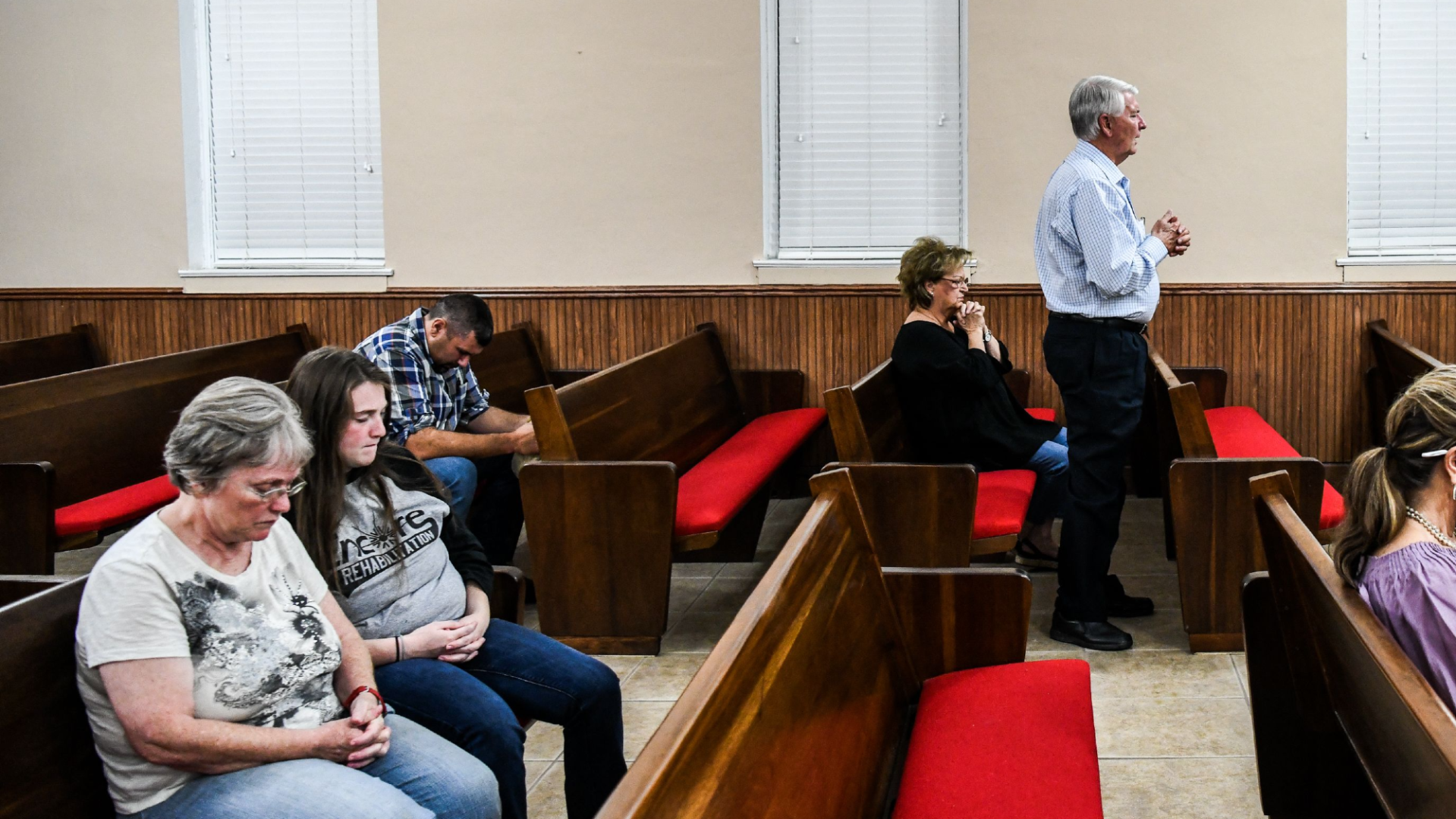
Still, on a typical Sunday at Église Réformée de Tunisie (ERT, Reformed Church of Tunisia), 120 or so congregants walkpast a block of French-colonial-style apartments, turninto a courtyard adorned with bougainvillea, and enterthe sanctuary.

They have a variety of backgrounds. One was an astrologer who read the Bible and had his whole cosmology turned upside down. He asked to be baptized and now leads the liturgy at ERT’s services. Another attendee learned about Christianity online, told his mother, and faced her disappointment. Several years later, she had a dream in which Jesus came to her and told her to read the Bible. She woke up, did, and professed faith in Christ. Another is a young Tunisian woman who rejected Islam and became a Communist but felt compelled to seek a better purpose. She was recently baptized.

But most of the worshipers at the 143-year-old church are from sub-Saharan Africa and came to Tunis for college, or they are passing through the capital on their way to Europe. Sunday services also include a handful of American and Canadian expats.

Some Tunisians view Christianity as a foreign force, counter to the Tunisian way of life. That’s ironic, because Christians lived in what is now Tunisia within decades after the first Easter, although the gospel’s exact journey has not been confirmed.

The early Christian apologist Tertullian, born in Carthage in 160, established core church doctrines that inspired the martyr Cyprian and later Augustine, a bishop in neighboring Hippo (modern-day Annaba, Algeria). A strong Christian presence continued until the Muslim conquest in North Africa in the seventh century reduced the Christian population to a small minority that persists today.   

Tunisians then lived under numerous empires before the French took over in the late 19th century. After gaining independence in 1956, Tunisia was initially more tolerant toward religious minorities than many of its neighbors were, even protecting the freedom of religion in its constitution.

For the first decades of the post-independence period, a liberal expression of Islam coexisted with Christianity. But in 1987, Zine al-Abidine Ben Ali took power and sought to tightly control all minority movements that could threaten his power.

On December 17, 2010, a young, demoralized man staggered angrily into a local government office in central Tunisia. He doused himself in paint thinner and lit a match. Incensed by Ben Ali’s decades-long authoritarian rule, Mohamed Bouazizi chose this gruesome final act of protest out of desperation for a freedom he believed impossible to attain.

Yet his death sparked the Arab Spring protests that unseated Ben Ali and raged in various forms throughout the Middle East and North Africa for 15 years.

The movement ignited civil wars in Libya, Yemen, and Syria; spurred the removal of dictators in three of the North African countries; and launched an initially promising political transformation in Tunisia. In 2014, the country organized its first free and fair elections and had a Nobel Peace Prize–winning transition followed by subsequent peaceful transfers of power. Many believed Tunisia would go the same way.

A reworking of the constitution, though, centralized power in the executive. The president is both the head of public prosecution and the sole figure capable of dismissing any judge on relatively limitless grounds.

The constitution includes language directing the state to protect Islam and guarantee its preeminence. One constitutional expert concluded that the government “is founding a religious state.”

Anti-immigration sentiment in the country has further complicated the lives of many Tunisian Christians. About 16,500 black, sub-Saharan refugees and migrants have registered with the UN High Commissioner for Refugees, though many have entered the North African nation without registering.

In 2023, authorities rounded up 1,200 black Africans, destroyed their property, and, allegedly, physically and sexually assaulted the migrants before expelling them at the Libyan border. 

Anyone who speaks out against the government increasingly risks prosecution. Decree-Law 54 is ostensibly a cybercrime law prohibiting speech that spreads false information, but the definition of what that is remains vague and subjective. Several recently-sentenced political opponents were arrested under the law, now weaponized to stifle dissent, hamstring lawyers, and punish antigovernment comments by journalists and others.

ERT and other churches in Tunisia try to make sure that new converts don’t believe their faith will automatically make life easier. As Augustine, who spent much of his ministry in Carthage, once wrote, God’s grace is meant “to help good people, not to escape their sufferings, but to bear them with a stout heart, with a fortitude that finds its strength in faith.” 

Luke Waggoner is an international political and governance consultant.

This article has been shortened at the urging of Tunisian Christians. 

Ideas

The Male Malaise

Rapid economic and social shifts have undermined traditional ideas of manhood. At the Cross we find a better vision—and more.

A collage of images of dejected men with an image of Christ in the middle.
Christianity Today April 23, 2025
Illustration by Elizabeth Kaye / Source Images: Pexels, Wikimedia Commons

Most cultures worldwide, anthropologist David Gilmore wrote in Manhood in the Making, have generally defined manhood around three capacities: the abilities to provide, protect, and procreate. For generations, the United States was no exception. Becoming a husband and father, along with serving as the primary breadwinner, has traditionally been the path prescribed to American men for achieving this sense of manhood.

However, economic and social shifts over the past 50 years have led many to question this traditional view, especially the capacity to provide. The transition to a high-skill, service-oriented economy requiring greater training and education has particularly disadvantaged men—especially those who, in another time, would’ve earned a living through manual labor. The proportion of men dropping out of the labor force continues to rise, and many of those with jobs suffer stagnant wages. Meanwhile, the education gap between the sexes has widened, with women now earning the majority of college degrees each year.

Sometimes when this issue is raised, there is an impulse to dismiss it: Why don’t men try harder? Or why don’t they simply get rid of their outdated view of manhood? That attitude is a mistake. The male instinct to provide is not just a social construct; it is fundamentally rooted in how males are wired. 

As Brookings Institution scholar Richard Reeves argued in Of Boys and Men, the erosion of the provider role has profoundly impacted men’s perception of their value and place in society. Men who do not see themselves as providers, especially financially, are more likely to detach not only from the labor force but also from society as a whole. Why? Because men who feel they don’t measure up as financial providers often view themselves as inadequate or may be seen by others as societal liabilities. 

Even men who do provide financially may still feel inadequate, though, if they are unprepared to meet new social expectations. Either way, too many men are left feeling worthless, aimless, disillusioned, and disenfranchised—an issue we cannot overlook.

The church can’t overhaul the whole economy or make it easier to measure up to the wider society’s expectations. But we can offer a vision of manhood sufficient for navigating the changes and complexities of our era. As Christians, we are blessed that God provides us with a clear vision of manhood, one that transcends different times and cultures and is far beyond anything we could invent to meet this moment.

This vision is not dependent on changing economic, social, or cultural realities. Nor is it solely linked to the roles of husband, father, and financial provider. Though these are all good things, as Tim Keller explains in his book Every Good Endeavor, they cannot be ultimate things. Our identity as men can’t be solely and ultimately anchored in our capacity to perform or achieve in these areas. That will lead to a fragile self-worth that falls apart when we encounter changes and challenges.

This vision is also not a call to deconstruct manhood altogether or a call for each man to invent his own definition. As Gilmore explains, manhood needs to be taught. Without guidance, men may feel lost or, worse, develop dysfunctional models of manhood that are harmful to society.

The central image of God’s vision of manhood is the Cross. At the Cross, Christ provides men with a clear, unambiguous, and enduring vision of being a man—one that remains relevant despite the societal changes around us. Paul makes this clear in Ephesians 5:25–33, where he discusses the relationship between husbands and wives, admonishing Christian men in Ephesus to love their wives the way “Christ loved the church and gave himself up for her.” In other words, Paul suggests that if you want to know what a real man looks like, look to the Cross, where Christ laid down his life for humanity.

This is a challenging call to selflessness, to following Jesus by willingly laying down our lives for those we love. Here, Paul calls husbands to prioritize their wives’ interests above their own, and in Philippians 2:3–4, he broadens that to all relationships: “Do nothing out of selfish ambition or vain conceit. Rather, in humility value others above yourselves, not looking to your own interests but each of you to the interests of the others.” 

Selflessness does not equate to weakness or timidity. On the contrary, Ephesians 5 calls for men to demonstrate strength and leadership in their marriages. However, being the “head” in marriage (v. 23) is not just any kind of leadership. Instead, God’s vision of manhood emphasizes gaining influence through self-sacrifice and using our strength to care for those we love, just as we would care for ourselves.

Whether married or not, men are made for selfless leadership. It gives meaning and purpose to our masculinity. Instead of reducing manhood to economic utility and financial provision, selfless leadership calls us to provide our whole selves—mind, soul, and body—for those we love, just as Christ did. I believe this call has the power, with God’s help, to awaken the hearts of disillusioned men by giving them a motivation and purpose worth living and dying for: the welfare of those entrusted to their care.

Of course, no man can fully live up to the vision of selfless leadership exemplified in Christ at the Cross. This is true no matter how hard we try. Furthermore, simply understanding this biblical vision of manhood is not enough to address our culture’s male malaise. As the church, we must go a step further. 

The Cross is not just where we find God’s vision for manhood. It is also where God shapes us into the men we are called to be. At the Cross, we confront the sobering duality of our humanity. On the one hand, we are confronted with a clear view of our depravity, weakness, and inadequacy as men. We are so flawed that we cannot save ourselves. We cannot provide for our own souls, let alone those of others. We are completely dependent on God to send his Son to accomplish what we cannot. 

On the other hand, the Cross reveals how unconditionally loved and valuable we are to God. Our weakness does not diminish his love. Despite our inadequacy, we are so valuable to him that Jesus willingly suffered the consequences we deserved, allowing us to gain the hope of “being transformed into his image with ever-increasing glory, which comes from the Lord, who is the Spirit” (2 Cor. 3:18). 

The Cross is the only place where a man can be inadequate and valuable at the same time. Only here can he encounter the power of God’s redeeming grace, a power that enables him to see his true worth and identity and transforms him into the man God calls him to be. 

In that sense, the ultimate solution to the male malaise is the same as it has always been: We must preach the gospel to our men. The gospel must be more than a message we recite; it must be where we anchor our very identity and value as men. The Bible must be more than a book we read to find a moral code; it must be where we go to encounter God’s grace until it transforms us into selfless leaders. And most importantly, Christ must not merely be our example in manhood. He must be our Savior.

Domonic D. Purviance is a writer, men’s ministry leader, and finance and economics expert. He cofounded King Culture, a nonprofit organization that equips men to reflect the selfless leadership of Christ.

News

A Christian Medical School Opens for the First Time in 40 Years

The Nashville program joins a growing movement to teach future doctors a “whole person” model of health care.

The first medical students at Belmont University's Frist College of Medicine participate in a pediatric clinic.

The first medical students at Belmont University's Frist College of Medicine participate in a pediatric clinic.

Christianity Today April 23, 2025
Matt Willoughby / Courtesy of Belmont University

For the first time in more than 40 years, a new Christian medical school granting MD degrees has opened its doors in the US.

A class of 50 students is finishing its inaugural school year now at Belmont University’s Thomas F. Frist, Jr. College of Medicine. That’s 50 future doctors who could be reinforcements for a workforce facing severe shortages.

“I call them the fabulous 50,” said Tanu Rana, a microbiologist and immunologist on the new faculty. “I love them dearly, and I’ve really enjoyed every second with them.”

It’s a diverse 50: The first class includes veterans, farm kids, and speakers of 24 different languages.

A new medical school in general is rare, let alone a Christian school. Belmont’s is the first MD-granting school of any kind to open in Tennessee in 50 years.

“It’s been extremely hard,” said Anderson Spickard, the school’s dean and a veteran internal medicine doctor. He came to the startup school from Vanderbilt University School of Medicine, where he was a faculty member for 27 years. “There’s tension at every turn.”

Oral Roberts University, which opened a medical school in 1981, appears to be the most recent Christian MD-granting institution to open. It closed in 1990 under millions in debt.

Belmont’s medical school has a clinical and advisory partnership with HCA Healthcare, a mammoth health system based in Nashville and founded by members of the Frist family. The school’s new facility, abutting the Belmont campus, is a $180 million columned edifice with labs, cozy study rooms, and a mock hospital ward for simulations.

Peter Huwe, who was teaching at Mercer University School of Medicine before joining the Belmont medical school faculty, said he had dreamed of being able to teach medicine from a Christian standpoint.

When he started looking into teaching at the Belmont medical school, “I could look around and see, ‘Oh yeah, this is going to work. They’ve got the pieces in place,’” he said. He is now a biochemistry professor at the school.

The school emphasizes servant leadership in doctors, a phrase faculty used several times in interviews, and whole person care.

Whole person care is a compassionate health care model for doctors to build relationships with patients and take social, spiritual, emotional, and behavioral factors into account in treatment. In education focused on whole person care, doctors learn to listen to patients and have empathetic conversations on difficult subjects—like terminal diagnoses.

Loma Linda University School of Medicine, a Christian medical school outside of Los Angeles, has for more than a century taught the “whole person care” model that Belmont is now undertaking.

More national medical organizations are recommending that US physicians, especially in primary care, shift toward that whole-person model. Another new, nonreligious medical school opening later this year will be focused on whole-person care.

Students entering medical school now are also more attuned to the whole-person approach, said Huwe, with their sensitivity to mental health and a person’s community context.

“It’s not as big of a leap for this cohort of students,” he said.

The cadaver lab at the school is unique in that it has an anteroom where students pause for 15 minutes of prayer and reflection before going in. “Fearfully and wonderfully made,” from Psalm 139:14, is printed on the wall outside.

While the school is open to anyone no matter their faith, the school’s leadership emphasizes that the school is rooted in Christ and his example. Faculty pray and have devotions together. They want to train doctors “having that humility to recognize that we’re broken,” said Huwe.

In the lobby of the main new building adjoining Belmont’s campus in Nashville hangs a seal for the new school. At its center is the Rod of Asclepius, a staff with a snake from Greek mythology that is associated with medicine. Spickard said that also references John 3:14, where Jesus says, “Just as Moses lifted up the snake in the wilderness, so the Son of Man must be lifted up.” The verse refers to his death on the cross, which in turn references the story in Numbers 21:4–9 where sick Israelites who looked on a snake would live.

“The snakes remind us that we’re facing evil here—the machinery, if nothing else, of what’s making that patient sick,” said Spickard. “But if we look at the snake without the cross, we get overwhelmed to face evil on our own.”

On the seal, the staff is planted in water, referencing Psalm 1 (“like a tree planted by streams of water, which yields its fruit in season”). And leaves and fruit grow around the staff, representing Revelation 22, the tree of life with fruit for the “healing of the nations.”

“Christ said that he took evil down with him and buried evil once and for all,” said Spickard. It reminds him as a doctor that he’s not the hero bringing lifesaving care to everyone. “We’re planted in that stream of water.”

Until becoming a dean and hanging up his stethoscope, Spickard was one of the few modern-day doctors still doing house calls. That allowed him to do whole person care; he was often tending a patient in a bedroom, washing his hands in a family bathroom, sometimes walking into a house that the family hadn’t had time to clean.

He wants students to understand that house-call feeling: that entering patients’ lives is high stakes and vulnerable.

Spickard’s agreement to join the new school came at a time of personal vulnerability. He had just learned his son was dying of cancer; he was a dad in the ICU (intensive care unit) watching doctors he had trained over 27 years at Vanderbilt care for his son. It was a raw time to be contemplating a new medical school formed around whole person care and the example of Christ.

Shortly after his son’s death, his own dad died. Initially a faculty member, he was asked by the school’s board at that time to become the dean. He said yes but told them, “You have a wounded dean.” 

“The chair of the board said, ‘That’s the best kind,’” said Spickard.

Then he stepped into all the challenges of a new medical school. A big hurdle is winning accreditation, which the Frist school did in 2023 from the Liaison Committee on Medical Education, the body that oversees all MD programs in the US.

Another challenge is that a standalone startup like the Frist school must find partner institutions for clinical rotations since Belmont does not have its own teaching hospital. Vanderbilt University School of Medicine, for example, has Vanderbilt University Medical Center, where students rotate.

But the school’s partnership with HCA Healthcare means that students will do rotations at HCA-affiliated facilities in Nashville.

Already, the first-year students have also done rotations at Siloam Health, a longtime Christian nonprofit health clinic in Nashville that serves refugees, immigrants, and other low-income residents who are uninsured. The clinic has been doing whole person care for more than 30 years, and Vanderbilt medical students rotate there as well.

On the wall in the lobby at Siloam is printed the story of Jesus healing a blind man in John 9, where he tells the man to wash in the pool of Siloam and the man regains his sight. Back in the offices where doctors see patients are hanging quilted flags from all the patients’ countries, like Cameroon and the Dominican Republic.

The clinic’s leadership wants to show the students “we can do excellent, charitable whole person care. It does exist,” said Katie Richards, Siloam’s CEO.

The Frist school encourages students to work in rural health and global health and has a scholarship for those who intend to be rural physicians. Rana, the microbiologist, leads a global health elective at the school, through which students will visit Korea and India.

Some of the members of the first class are already planning to work in rural communities.  

The medical school also has an unusual department: health systems science, which teaches students how to interact with systems of medicine so they can help patients figure out paying for care and navigating options—an essential skill if doctors want to help patients as whole people.

Whole person care teaches doctors to be good listeners of their patients, Spickard said, but doctors should also be “listeners” of the health care system.

“We don’t want you to think of the health care system as something you need to be vaccinated against, to go out and tolerate,” said Spickard about his students. “But be agents of hope within it.”

This article has been updated to clarify that the medical school’s partnership with HCA Healthcare is not financial.

News

Oldest-Known Hymn Inspires New Worship Song

Historian teams up with Chris Tomlin and Hillsong’s Ben Fielding to adapt rare music dating back to the third century.

Papyrus fragment with Greek writing

The Oxyrhynchus papyri, dating to the end of the 3rd century, contains a Christian worship hymn including both lyrics and musical notion.

Christianity Today April 23, 2025
Courtesy of The First Hymn movie

Historian John Dickson knows that “early” Christian music usually refers to sacred chants from the ninth or tenth century. So when he noticed a reference to an ancient hymn from hundreds of years before that—way back in the third century—he was immediately curious.

The words and musical notations to this obscure sacred song, penned in Greek on a tattered papyrus fragment uncovered over a century ago, named the “Father, Son, and Holy Spirit” and responded to pagan beliefs.

“The Christians who produced this were trying to create music that was understandable for their surrounding culture,” Dickson told CT. “It’s simultaneously worship and public Christianity.” 

The ancient Greek hymn is by far the oldest surviving piece of Christian music—it predates the next notated work by six centuries. Inspired by the ancient fragment, Dickson reached out to Ben Fielding, a fellow Aussie and a songwriter for Hillsong, to turn it into a singable work for today’s church. 

Early conversations between Dickson and Fielding eventually led to a collaboration with Grammy-winning worship artist Chris Tomlin, culminating in the production of a new worship song, “The First Hymn,” and a documentary about the discovery and study of the papyrus fragment containing the hymn. 

Chris Tomlin, Ben Fielding, and John DicksonCourtesy of The First Hymn movie
Chris Tomlin, Ben Fielding, and John Dickson

Through the Psalms and other biblical texts, Christians have had access to words that might have been sung by ancient worshipers. But this early hymn is the first example of Christian music with both text and musical notation preserved—offering rare hints about how the music of early Christian gatherings might have sounded. 

“The First Hymn” pulls from the Trinitarian themes and reverence for creation in the ancient song, showcasing Tomlin’s knack for writing simple, syllabic melodies that hold up with minimal accompaniment or full band. It feels thoroughly contemporary even though the text and melody are based on a piece of music likely sung by third-century Christians.

Christians across denominations have been captivated by the idea of singing songs with deep roots in the historic church. Over the past two decades, some evangelicals in the US have migrated to Orthodox or Anglican churches in search of historically rooted faith practices. The Catholic church is experiencing a resurgence of enthusiasm for tradition. Interest in hymns and hymnals is on the rise in a variety of church settings.

“The First Hymn,” like the preceding “ancient-future” worship trend of the 2000s, offers connection to early believers by adapting or reviving an artifact of the faith for modern Christians. 

“I’m skeptical of fads, including the fad of ‘going back,’” said Dickson. “I don’t think of this as ‘going back.’ It’s giving something back to the church.” 

Now a faculty member at Wheaton College, Dickson has been a lecturer in Hebrew, biblical studies, and classics at institutions in Australia, the UK, and the US. But in the ’90s, he was a singer-songwriter in a rock band. He’s long had an interest in putting ancient words to music, and the text of what scholars call “the Oxyrhynchus hymn” (or P.Oxy. XV 1786) presented the opportunity to join in what Dickson sees as a work of public theology by early Christians. 

The Oxyrhynchus hymn was found in a massive collection of papyri uncovered in Egypt. The Oxyrhynchus Papyri contain an estimated half-million fragments, mostly records and correspondence. 

The fragment on which the hymn was written preserves 35 words and the accompanying melody and rhythm in ancient Greek musical notation. It is believed to be the conclusion of a longer song. 

Let all be silent:
The shining stars not sound forth,
All rushing rivers stilled,
As we sing our hymn
To the Father, Son, and Holy Spirit,
As all Powers cry out in answer,
“Amen, amen.”
Might, praise, and glory forever to our God.
The only giver of all good gifts.
Amen. Amen.

“‘Giver of good gifts’ was one of Zeus’s epithets,” said Dickson. “But the writer says ‘only giver of all good gifts.’ This may be a nod to Zeus.” 

Dickson suggested that the writer of the hymn may have been directly answering or conversing with the competing religious beliefs of the time, something Paul modeled in his letters. 

“The phrase ‘in him we live and move and have our being’ comes from a hymn to Zeus,” Dickson observed. “Paul can quote it [in Acts 17:28] and say that this finds its fulfillment in the one true God.” 

The theme of cosmic silence (“Let all be silent”) would have resonated with non-Christians in ancient Greece and Egypt, said Dickson. 

Musica mundana—the music of the spheres—was a philosophical concept articulated by ancient Greeks to describe the harmony and balance of the heavenly bodies, governed by mathematical relationships. The call to silence of the heavenly bodies was something the Greeks would recognize as a command that only a powerful god could give.
“The thematic setting of silence is pagan,” said Dickson, noting that biblical texts like Psalm 148 most often call the natural world to join in a chorus of praise. “Asking all creation to be silent instead of joining in praise is weird from a biblical point of view.” 

People uncovering brick structures in desert sandCourtesy of The First Hymn movie
Oxyrhynchus excavation site in Egypt

While “The First Hymn” is the first effort to introduce the ancient song to a general audience, musicologists and historians have been studying it since 1922. Charles Cosgrove’s 2011 book, An Ancient Christian Hymn with Musical Notation: Papyrus Oxyrhynchus 1789: Text and Commentary, provides extensive analysis and history of the fragment. 

Cosgrove observed that the hymn is a challenge for researchers because it isn’t of central importance for scholars of ancient Greek music and because historians of Christian liturgy generally lack the specialized knowledge necessary to fully grasp and analyze the Greek musical notation. 

In academia, the hymn has remained in no man’s land. Its relative isolation and obscurity has to do with the fact that there are so few contemporaneous artifacts to compare it to. 

“One hopes that in further discoveries … another such hymn will come to light,” wrote Cosgrove. “But for now, P.Oxy. 1786 is our only example of pre-Gregorian Christian music. For that reason alone it deserves a comprehensive treatment.” 

The adaptation of P.Oxy. 1786 by Dickson, Fielding, and Tomlin is perhaps their version of a comprehensive treatment: an accessible song and a documentary about its history for those hungry for a connection to the historic church. 

The documentary premiered at Biola University on April 14, followed by a live premiere of the song at the Museum of the Bible in Washington, DC, on April 15. 

Resources for churches interested in using the song for congregational worship are already available on platforms like MultiTracks, where worship leaders can download charts and a collection of performance tracks—including all six electric guitar parts and a background choir. 

“The First Hymn” is a stirring anthem in the recognizable style of today’s popular worship music, featuring layers of synth textures and a clear verse-chorus structure that builds in intensity from a relatively sparse first verse. 

Other than the title, there’s nothing in the text or production that hints at the song’s ancient origin, as the modern setting avoids the potentially gimmicky inclusion of tropes to signal the old or exotic (such as the use of harmonic minor scales or the sound of a zither). Tomlin and Fielding have reworked the lyrics so they fit neatly over a singable melody. 

Tomlin calls the song “a sacred gift passed down from the early Church,” connecting its story to the lives of martyrs and persecuted Christians throughout history. “Now, 1,800 years later, we stand in a long line of brave and bold believers, singing alongside them.”

Dickson said that today’s church can learn from the openness of early Christians and their ability to “use pagan motifs to convey Christian doctrine,” even complicated doctrines like that of the Trinity. 

“The cool thing is, there’s nothing new here,” Dickson said. “The Trinity is the center; it’s the nature of God in three persons. And here’s the oldest hymn we have, reminding us of that.” 

News
Wire Story

How the Catholic Church Will Pick the Next Pope

A Catholic scholar explains every step of the conclave process that will determine the successor to the late Pope Francis.

Cardinals in the Sistine Chapel at the Vatican on the first day of the conclave.

Cardinals in the Sistine Chapel at the Vatican for a conclave.

Christianity Today April 22, 2025
Maurix / Getty

With the death of Pope Francis, attention now turns to the selection of his successor. The next pope will be chosen in what is called a conclave, a Latin word meaning “a room that can be locked up” or, more simply, “a closed room.”

Members of the College of Cardinals will cast their votes behind the closed and locked doors of the Vatican’s Sistine Chapel, famous for its ceiling frescoes painted by Michelangelo. Distinguished by their scarlet robes, cardinals are chosen by each pope to elect future popes. A cardinal must be under the age of 80 to be eligible to vote in the conclave. Of the 252 members of the College of Cardinals, 135 are currently eligible to elect the new pope.


As a scholar of global Catholicism, I am especially interested in how this will be the most diverse conclave in the history of the Catholic church. 
For many centuries, the College of Cardinals was dominated by Europeans—Italians, in particular. In fact, the first time a non-European cardinal actually cast a ballot in a conclave was only in the 20th century, when Baltimore’s archbishop, James Gibbons, voted in the 1903 papal election. Now, the College of Cardinals has members from over 90 countries, with Francis having appointed nearly 80 percent of them.

Holding a conclave to elect a pope is a tradition that goes back centuries. The practice was established in 1274 under Pope Gregory X in reaction to the chaos surrounding his own election, which lasted nearly three years. The tradition is old, but the results can be surprising, as when Francis himself was elected in 2013 as the first non-European pope in almost 1,300 years and the first Jesuit pope ever.

The conclave begins

Before the conclave, the College of Cardinals will meet in what are called “general congregations” to discuss issues facing the church. These general congregations will also be an opportunity for new cardinals and those from distant geographical locations to get to know their fellow cardinals. 

This can be a time for politicking. In times past, the politicking was rumored to include bribes for votes, as was alleged in the election of Alexander VI, a Borgia pope, in 1492. Nowadays, it is considered to be bad form—and bad luck—for a cardinal to lobby for himself as a candidate. Buying votes by giving money or favors to cardinals is called “simony” and is against church law.

Two to three weeks after the papal funeral, the conclave will begin. The cardinals will first make a procession to the Sistine Chapel, where electronic jamming devices will have been set up to prevent eavesdropping and Wi-Fi and cellphone use. As they file into the chapel, the cardinals will sing, in Latin, the hymn “Come Holy Spirit.” They will then vow on a book of the Gospels to keep the conclave proceedings secret.

After these rituals, the master of papal liturgical celebrations will say out loud, in Latin, “extra omnes,” which means “everyone out.” The doors of the Sistine Chapter will then be locked, and the conclave will begin.

The voting process

The cardinals electing the pope will be seated in order of rank

Usually, the dean of the College of Cardinals is seated in the first position. But the current dean—Cardinal Giovanni Battista Re—is over the eligible voting age and will not participate in the conclave. Instead, this papal election will be led by the Vatican’s secretary of state, Cardinal Pietro Parolin

When the cardinals have assembled, nine will be chosen at random to run the election, with three of them being “scrutinizers” who will examine the ballots and read them aloud.

After writing down the names of their chosen candidates, the cardinals will bring their ballots to the front of the chapel and place them on a plate that is set on top of an urn in front of the scrutinizers. Using the plate to drop their ballot into the urn, they will say, “I call as my witness Christ the Lord who will be my judge, that my vote is given to the one who before God I think should be elected.”

A new pope is elected by a two-thirds majority. If this majority is not reached during the first ballot, the ballots will be burned in a stove. Black smoke rising through the Sistine Chapel’s chimney will signal to the outside world that the election is still ongoing, a tradition that began with the election of Benedict XV in 1914. Chemical additives are used to make sure the smoke is black because during the election of John Paul II, there was confusion over the smoke’s color.

Following the first day—and on the days thereafter—there will be up to four ballots a day if a two-thirds majority is not reached. Both Benedict XVI and Francis were elected after relatively few ballots: four in the case of Benedict; five with Francis. According to rules set by Benedict, if a new pope is not chosen after 13 days, there will be a day of prayer and reflection. Then the election will be between the top two candidates, one of whom must receive a two-thirds majority. 

This new rule, some commentators have suggested, could lead to a longer or even deadlocked conclave because a compromise candidate is less likely to emerge.

The Room of Tears

Conclaves are usually short, such as the three-ballot election that chose Pope Pius XII in 1939. On a few occasions, deliberations have been quite long—the longest being the 1740 papal conclave, which elected Benedict XIV and lasted 181 days.

But regardless of the time frame, a new pope will be chosen. Once a candidate receives enough votes, he is asked, “Do you accept your canonical election as supreme pontiff?” By saying, “Accepto,” or “I accept,” he becomes the new leader of the Catholic church. This time, the ballots will be burned to create white smoke that will tell the world that the conclave has ended and that a new pope has been chosen.

Immediately after being elected, the new pope decides on his name, as Jorge Mario Bergoglio did when he was the first pope to choose the name Francis. The choice of a name—especially one of an immediate predecessor—often indicates the direction of the new pope’s pontificate. In Francis’ case, his name honored Francis of Assisi, a 13th-century mystic known for his simplicity and love for nature.

The new pope is then led to the “Room of Tears.” In this chamber, off the Sistine Chapel, he will have moments to reflect on the burdens of his position, which have often brought new popes to tears. He will put on a white cassock and other signs of his office. His election will be announced from the balcony of Saint Peter’s Basilica

From the balcony, the new pope will greet the crowd below and deliver his first blessing to the world. A new pontificate will have begun.

Mathew Schmalz is a professor of religious studies at College of the Holy Cross. This article originally appeared on The Conversation.

History

Nailing Down the Truth of Christ’s Crucifixion

Apologizing for what I got wrong reporting on an idiosyncratic view on how Jesus died.

Example of the cross, crown of thorns, and nails used to crucify Christ.
Christianity Today April 22, 2025
iStock / Getty Images Plus

Like so many Christians, I spent a lot of time before Easter thinking about the Crucifixion: how it must have felt for Jesus to die that way, how God chose this particular device of Roman terror to accomplish our salvation, and how it worked practically to kill someone on a cross.

An article in Biblical Archaeology Review piqued my reporting curiosity. A Bible professor suggested it was possible that crucifixions at the time of Christ’s death used ropes rather than nails. That’s obviously an idiosyncratic view—and almost certainly wrong, it seemed to me. But I thought it was interesting.

My curiosity took me to the descriptions of Christ’s death and the details in those accounts. I didn’t think about John 20:25 and the implication of the idea that Thomas was mistaken to think the resurrected Jesus would have nail marks in his hands. Thomas clearly would not have said that if the Romans at that time used ropes.

My article implicitly called into question the inerrancy of Scripture. In my eagerness to explore the historical context of Christ’s death, I missed that, and I’m sorry.

Ideas

The Limits of Open Letters

Contributor

American evangelicals love big statements—but we must first do the slow work of institution building and local discipleship.

Christianity Today April 22, 2025

Sometimes in church history, we find lightning in a bottle, moments so powerful that we wonder whether they could be the norm rather than the exception. The Barmen Declaration is one of those moments. Authored by an ecumenical group of Lutheran, Reformed, and United Church theologians and pastors, this 1934 document offered a clarion call from the Confessing Church. When much of the church capitulated to Adolf Hitler, Barmen warned of the dangers he posed to the church and the world. The declaration glows in historical remembrance, and rightly so.

Do we need another such declaration now? I see the question asked more and more in the American church in recent years, particularly among educated evangelicals. Church attendance has declined, church scandals have proliferated, and in many Christian circles worry is running high around the new Trump administration and its handling of immigration, religious advocacy, rule of law, and humanitarian programs and policies. 

So is it time for evangelicals to write a new statement of principles? I welcome the instinct to try to stand for truth—yet would offer a word of caution.

We should start by asking what the original Barmen Declaration meant in its time and what something similar might mean today. As an appeal to Protestant congregations across Germany, the document emphasized the threat of “alien principles” being forced on the German church by the Nazi government. It named numerous threats, some of which would be just as familiar to Christians today (like nationalism and government promises of safety), but others of which are less germane to an American context (like government interference in church confessions). 

Chief among those threats was the way in which the government was exercising dominion over the church’s ability to be the church. During the first year of the Nazi regime, a new movement formed of “German Christians,” represented by a national bishop and organized significantly around loyalty to Hitler. The Barmen Declaration responded to that movement, but the document also contradicted those who wished to carve a “third way,” affirming both Jesus Christ and fidelity to the government. 

There were many challenges yet to come for German Christians that were not fully in view in 1934. Repudiation of the extermination of God’s covenant people, the Jews, is notably absent from the document. But it does respond to pressing concerns, including Hitler’s claim to determine how churches should proclaim the gospel, the assumption that one can read God’s will in a cultural trend like National Socialism, and the notion that the church should be subject to the state. 

The declaration was the fork from which ran two Protestant trajectories in Germany: the German Evangelical Church, which acquiesced to Hitler’s party, and the Confessing Church, which did not. After the document’s release, the Confessing Church began to organize, establishing a new seminary and new parishes with ministers willing to say no to Hitler. 

Authored by some of the leading figures within European Christianity, Barmen remains a shining light in Christian history and our collective imagination. Yet its reach was objectively limited.

Intended not as a confession of faith but as a declaration, the document could never do the work of ordinary church formation, nor was it intended to fill that role. Its framers hoped to rouse a slumbering church to see impending danger, but their statement never had the authority of local church discipline. 

The declaration also suffered from the swift institutional decline of the Confessing Church. By 1937, internal divisions had caused the Evangelical Lutheran Church to break away from the movement. By 1940, many Confessing Church leaders had been arrested. By 1949, it had disbanded entirely. Along the way—as we read in the letters of Dietrich Bonhoeffer and others—issues of finances, church support, and legal restrictions by the Nazi government hastened the Confessing Church’s demise. (If you cannot drown a movement’s passion, smothering it with paperwork may do just as well.)

So how would a comparable declaration fare today? American Christians have a long history of authoring statements in times of emergency, sometimes with explicit allusion to Barmen as a model. 

Consider the Christians Against Christian Nationalism statement, aimed at raising awareness of efforts to “merge Christian and American identities,” or the recent statement by the Southern Baptist Ethics and Religious Liberty Commission on supporting Israel. Authored in response to particular political events, these documents seek to bring awareness to specific problems by way of theological categories. 

The most recent major statement came in 2024. Written “in this moment of social conflict and political division,” it traces mostly uncontroversial theological truths (allegiance to Jesus Christ, the truth of the Scriptures, the image of God) and outlines how Christians should live amid division (refrain from fear, value each life, judge leaders by their character). This statement and others like it largely follow Barmen. But Barmen and these more recent confessions diverge in three important ways. 

First, Barmen focuses primarily on clarifying theological principles. Across its elements, it articulates one theological point: Jesus Christ is Lord, and the state is not. It offers no practical guidance on what to do next and so, though occasioned by Nazi overreach, can be applicable for Christians in many different contexts. 

Contemporary statements, by contrast, tend to dwell on practical recommendations that tie them to a particular time, place, and political context. In the 2024 statement, for example, “this moment of political division” determines what confessions are included. Practical recommendations like “We will lead with love not fear” exist alongside theological affirmations of Scripture’s authority, the imago Dei, and the need for godly character in leaders. 

Second, the Barmen Declaration was designed to work through institutions committed to its theological vision. It was in synods, church councils, committee meetings, and classrooms that the Confessing Church teased out the practical implications of Barmen. Modern evangelical statements typically do not likewise rely on thick institutions to shape, sustain, and flesh out their truths. 

The 2024 statement, authored primarily by university officials, is signed by a variety of people but is without a readily available context for implementing these ideas. The signers rely instead on goodwill, individual liberty, publicity, and free association—all good but ultimately flimsier things. It’s notable that all who signed did so “in their personal capacity,” as the 2024 statement announces, making it an affirmation of goodwill, but not one with institutional backing.   

Third, the Barmen Declaration had a smaller and better-defined audience. It was written, pre-internet, by and for church leaders. It was read and had influence in institutional settings. 

Today, open letters and signed declarations proliferate online. They are signed by people with a more limited scope of authority and less (or sometimes no) institutional accountability. They are public and compete for attention in the rapid stream of public discourse—“now … this,” as Neil Postman called it. Accordingly, modern statements—even if written in the tongues of angels—stand little chance of gaining traction. Their medium works against their message.

These differences reveal the very limited utility of yet another statement. They show the difference between what the Barmen Declaration meant in its era and what a new declaration would mean today. 

That’s not to say the church doesn’t face great challenges in our moment. And there are many government policies—including, recently, challenges to churches’ tax-exempt status religious education requirements as defined by government officials, the closure of pathways of refugee resettlement, and overreach into the lives of churches by the executive branch—that are worth our opposition. 

But we should be realistic about what we can accomplish with a post on the internet in 2025. In the American evangelical context, another online declaration is dead on arrival. 

Making something like Barmen stick requires more than good writing and impressive signatories. It requires a laser-like focus on the theological convictions at stake and an interconnected institutional and ecclesial life capable of enforcing those convictions in budgets, in curricular decisions, and in pastoral training programs. 

American evangelicalism in 2025 is equipped to write and theologize, to reason about the contradictions between the life of the world and the life of God’s kingdom. But our institutions, ecclesial authority, and networks are everywhere fragile, if not in decline. 

What is left for us is not despair but retrieval. We must begin with commitment to rebuild institutions from the local church upward. Rightly remembering Barmen helps us see that its theological vision—while clear and provocative—was paired with a sober recognition that change does not come by declaration alone. Without an entire network of institutional support and dedicated local discipleship, Barmen would have been nothing but a clanging cymbal.

American evangelicals need that same solid foundation of institutions and discipleship. Declarations can meaningfully speak truth to power only if they come from a community that does more than speak—a community that faithfully prays and doggedly works for the world the declaration demands. Now is the time for rebuilding churches capable of welcoming strangers, feeding the hungry, and proclaiming the gospel. But the way there is slow, and there are no shortcuts, no matter how clarion the call to arms.

Myles Werntz is author of From Isolation to Community: A Renewed Vision for Christian Life Together. He writes at Taking Off and Landing and teaches at Abilene Christian University.

Theology

The Raging Sea Is More Than a Symbol of Chaos

The Bible’s favorite metaphor to remind you that you’re not in control.

Big ocean waves during a storm.
Christianity Today April 22, 2025
정규송 Nui Malama / Pexels

I grew up along the coast of Kupang, Indonesia, and spent most of my free time by the sea. Besides swimming and fishing, I loved playing soccer on the beach, which was only possible at low tide. My friends and I would often jokingly ask the sea to dry up earlier or come back later so we could have more time to play. Obviously, the sea ignored our requests. But these experiences showed me that the sea was unpredictable and fearsome.

Biblical depictions of the sea evoke a similar interpretation. The Psalms describe the foamy waters (46:3), roaring waves (65:7), and surging sea (89:9) as difficult situations that urgently need God’s intervention. The runaway prophet Jonah gets thrown off a boat to calm the raging sea (Jonah 1:15). The Gospels see Jesus rescuing his disciples from a terrible storm (Mark 4:35–41).

Many tend to read Bible passages like these and interpret the sea negatively, as dangerous and threatening. Such perceptions of the sea in Scripture are influenced by ancient Near Eastern myths that regard the sea as a symbol of chaos and destruction, Old Testament scholar Kenneth W. Lovett writes.

In the ancient Mesopotamian poem The Epic of Gilgamesh, the sea functions as an enemy. One of the poem’s inscriptions describes a flood as “an army in battle.” Tiamat, a character in the Babylonian creation myth Enuma Elish, personifies the primordial sea and symbolizes monstrous chaos, Lovett argues.

How the Bible describes the sea may also contribute to negative interpretations of it. God often uses the sea as a “tool of judgment against sin,” Lovett says, and Satan and other evil beasts emerge from the waters in Daniel’s vision.

But what Lovett and other theologians miss is that many of these negative interpretations of the sea in Scripture emerge from humanity’s inability to control and master it. A wider, fuller interpretation of the sea gives us a picture of God’s uncontrollability: the power, majesty, and holiness that define his character.

A biblical narrative of the sea that is solely negative is an anthropocentric perspective, where we interpret the world according to human values and experiences. In reading the sea only as chaotic and destructive, we inevitably practice what I call blue anthropocentrism, a reflection of humanity’s delusional dominion over the sea.

As finite human beings, however, we cannot control the waters—how currents ebb and flow, how marine creatures feed on all that grows within the sea, and how it responds to other natural phenomena like earthquakes and volcanoes.

Yet we mistakenly believe that the sea is an object to serve our interests. We view the sea as a site that overflows with economic profit, a means of fulfilling our greed. We think the sea is a vehicle for conquest, as the Roman Empire and European colonizers did.   

Through Scripture, God unveils our selfish, self-aggrandizing impulse to rule over the sea and everything in it.

While questioning Job, God mentions a mythical sea creature, the Leviathan. “Can you pull in Leviathan with a fishhook or tie down its tongue with a rope?” God asks Job (41:1). The Leviathan symbolizes absolute resistance to human arrogance, power, and greed, especially in efforts to domesticate and commodify nature, theologian Catherine Keller writes in an essay in the book Christianity and Ecology. “Any hope of subduing [the Leviathan] is false; the mere sight of it is overpowering,” God declares (v. 9).

God’s interrogation of Job and the rhetorical discourse on the Leviathan reveals humanity’s vulnerability: We are creatures with limitations, alongside the rest of creation.  

Our finitude is not something to regret or lament. Nor is it a fact to deny. Instead, we ought to be grateful, for the human limitations that the Leviathan reveals invite us to recognize and accept our creatureliness. The Leviathan dismantles a view of the sea that privileges humanity as the center of its existence. We are hardly mightier than the Leviathan, after all. 

Another instance where Scripture reminds us of our frailties is in one of Jesus’ interactions with his disciples. As they sail across the Sea of Galilee, a “furious squall” (Mark 4:37) breaks out, and powerful waves crash over the boat and nearly swamp it. All this time, Jesus is asleep. When his frightened followers ask him why he does not care if they drown, Jesus asks them, “Why are you so afraid?” (v. 40).

Jesus is not trying to shame the disciples for feeling afraid of the sea. He knows full well that they are unable to control what the sea does. Rather, his question reflects his divinity, presenting him as the only one who can calm the waters. Jesus’ question already presumes his power over all creation, including something as unruly as the sea.

The disciples’ inability to quell the roaring waves surrounding them is hardly a failure or inadequacy. Instead, Jesus calls them to accept their human limitations and to place their trust in him and his will.

The disciples also look upon Jesus’ act of calming the sea and marvel: “Who is this? Even the wind and the waves obey him!” (v. 41). Scripture invites us to see how the sea’s frothy, unpredictable nature testifies to a God who is likewise untamable and uncontrollable, a God who is far more holy and powerful than our finite minds can ever fully understand. As Psalm 77:19 puts it, “Your path led through the sea, your way through the mighty waters, though your footprints were not seen.”

The sea is sacramental because the sea speaks of a God who is beyond our control and prediction, Anglican priest Edmund Newell argues. “The sea’s varying moods resonate with our experiences of peace and turmoil, joy and sorrow, life and death,” Newell writes in his book The Sacramental Sea. “Eternal, unfathomable, elusive, powerful, mysterious, apparently infinite, life-giving, yet fearful: in its very essence the sea speaks of God.”

The sea is a site of danger and fear but also of wonder and awe. Both qualities can exist simultaneously, and both testify to our infinitely powerful and majestic God. The sea is not an enemy to defeat but a significant part of God’s creation that reveals more about who God is.

With this renewed interpretation of the raging sea in Scripture, we learn how to treat the sea in our world with respect and reverence, knowing that it provides us with glimpses of a God who is uncontainable, irreducible, and incomprehensible.

We also learn that adopting blue anthropocentrism is costly. This view preserves our perception of the sea—in Scripture and life—as chaotic and destructive. It places human interests above the natural character of the waters that God has made. It refuses to let the sea exist according to God’s order and empowerment of it.

If blue anthropocentrism persists, it will shape how we relate to the seas around us. We may keep employing science and technology to dominate the sea and reduce it to a mere object of commodification. We may overlook the ecological crisis at sea: destructive fishing practices, widespread coral bleaching “primarily driven by carbon emissions,” and increased plastic pollution in the ocean, all of which endanger life on the Blue Planet.

Every time we breathe, we are connected to and dependent on the sea, as most of the oxygen on this planet comes from phytoplankton and sea creatures, oceanographer Sylvia Earle asserts. God created and put humanity in an interconnected and interdependent community.

Rather than trying to dominate and master the sea or regard it simply as chaotic and destructive, we can consider the raging sea as a reflection of God’s magnificent and boundless nature. When we look upon powerful, white-capped waves crashing onto shore, go on bumpy boat rides across lakes, or head out to fish, we encounter and experience God’s immeasurable greatness.

To borrow from C. S. Lewis, the raging sea testifies that God is not safe, but he is good.

Elia Maggang is a vicar at the Protestant Evangelical Church in Timor, Indonesia (GMIT) and teaches theology of the sea and ecotheology at the Artha Wacana Christian University in Kupang, Indonesia. He holds a PhD from the University of Manchester, UK.

News

The Christian and Jewish Israelis Protecting West Bank Palestinians

As settler violence increases in the West Bank, a night-watch group guards Bedouin homes from intruders.

A home and farmland damaged by Israeli settlers who trespassed and vandalized property in the West Bank.

A home and farmland damaged by Israeli settlers who trespassed and vandalized property in the West Bank.

Christianity Today April 22, 2025
Marcus Yam / Contributor / Getty

Jonathan Pex is concerned about his Palestinian Bedouin neighbors in the West Bank’s South Hebron Hills.

They’re sheepherders who live in an expansive cave outfitted with solar electricity, ten minutes from Pex’s home. The region has seen an uptick in Israeli settler violence against Palestinians since the October 2023 Hamas attacks, and the Palestinian family is afraid they may be next on the settlers’ hit list, as they’ve had several disputes with their neighbors over grazing rights. 

So Pex, a Jewish Israeli Christian, packed a small bag and drove from his home near the border of the West Bank to Abu Shchade’s property for an overnight stay in late March. Through a friend’s invitation, he had joined a local night-watch group made up of several dozen Israelis who are on call to help local Palestinians concerned about extremist settler violence. 

After a simple dinner of rice with sheep’s milk, sliced tomatoes, and flatbread with olive oil, Pex set up the sleeping mat and blanket the Bedouin women provided and joined two other Israeli “night guards” in a strategic location outside the cave. 

“I’m going to do whatever I can to support them,” Pex said. “Jesus would have really had a heart for these people.” 

Pex said the attacks often happen at night. During past night watches at the homes of Bedouins, a seminomadic people originally from the Negev desert, he encountered some young men who had sneaked onto their property to cut water pipes and destroy solar panels. Settlers take in troubled youth and send them out to terrorize their Palestinian neighbors, Pex said. 

Sometimes the attacks are far worse than property damage.

In late March, dozens of extremist settlers assaulted a group of Palestinians in the village of Jinba, also in the South Hebron Hills. Three of the victims needed medical care, including a 16-year-old Palestinian boy with a severe head injury. Local authorities arrested more than 20 Palestinians but no settlers in the wake of the attack. Pex noted that this was a common trend. 

An attack last August involved more than 100 masked settlers who torched houses and cars in the northern West Bank city of Jit and killed a Palestinian man. Israeli prime minister Benjamin Netanyahu condemned the attack but has done little to curb settler violence and stop the expansion of illegal settlements. Israeli human rights groups claim indictments against settlers are rare.

Close to half a million settlers—Israelis with an even split of ultra-Orthodox, secular, and religious nationalist beliefs—live among 3 million Palestinians in the West Bank. After Israel captured the West Bank from Jordan during the 1967 war, it began building Israeli communities among the Palestinian population, an endeavor that has accelerated over time. 

The International Court of Justice considers all settlements in the West Bank illegal, but Israel claims its 141 government-sanctioned settlements are necessary for Israel’s national security and legal as they are built on “legitimately acquired land which did not belong to a previous lawful sovereign and which was designated as part of the Jewish State under the League of Nations Mandate,” according to Israel’s Ministry of Foreign Affairs. Most Israelis who move to the settlements believe Israel has a historical or religious claim to the territory. 

An outside view of a Bedouin house in South Hebron Hills.Photography by Jill Nelson
An an inside view of a Bedouin house in South Hebron Hills.Photography by Jill Nelson
An outside view (top) and an inside view (bottom) of a Bedouin house in the South Hebron Hills.

More than 200 of the settler outposts are considered illegal, even under Israeli law. Some far-right settlers wear partial Israeli military uniforms, posing as ruling authorities and committing acts of violence.

Some extremist settlers want to prevent a future Palestinian state in the territory, so they turn to violence and threats to scare Palestinians away and take over their property. Since the war began, uniformed settlers have increasingly patrolled beyond their settlements and attacked Palestinians. The United Nations counted more than 1,800 settler attacks between October 2023 and the beginning of this year. 

The Biden administration in February 2024 imposed sanctions on settlers accused of violence or the destruction of property. (The sanctions also applied to Palestinians who harm their neighbors.) The Trump administration scrapped the sanctions in January. 

“[The extremist settlers] have done many bad things in the name of the army and with the equipment of the army,” said Noam Oren, a Jewish Israeli farmer who lives just outside the West Bank. He is also part of the night-watch group, and sometimes Palestinians also call him during the day with reports of trouble.

A year ago, a Bedouin Palestinian called him when settlers brought a herd of sheep to his property to eat from his barley pile, just 50 yards from his home. Oren said settlers also let their sheep drink from Bedouin rainwater tanks, and sometimes they spoil the water by adding oil.

Oren called the police and drove to his friend’s home to confront the settlers—a decision he now acknowledges may not have been wise. As Oren approached the men, he said one threw a rock at his face while another shot his gun in the air. Oren tackled the man who had hit him with a rock and held him down until the other man put his gun down.

When Oren released the settler, the settler began throwing rocks again while the other man made a phone call. Five minutes later, 20 more uniformed settlers came onto the property and tackled him. The police officer eventually arrived and interviewed all parties involved. 

a herd of sheep owned by Bedouin in the South Hebron Hills.Photography by Jonathan Pex
A herd of sheep owned by the Abu Shchade family in the South Hebron Hills.

Oren showed the officer his injuries and video evidence from his phone that proved the settler had started the fight, but he learned weeks later that the officer still sided with the settlers in his report. “This is how it works,” Oren said.

Oren filed a separate report in the West Bank city of Hebron, and his case is still pending. The settler brought charges against Oren but eventually dropped them after Oren presented his evidence to regional authorities. 

Pex said it’s common for settlers to provoke Palestinians, and as soon as a Palestinian loses patience and reacts, the settler calls that person a terrorist and files charges. “Usually it’s just a poor Palestinian herder,” he said. Many Palestinians have added security cameras to their properties so they have a chance at proving their innocence. 

Pex is concerned that many of his Israeli friends, even those with left-leaning views, haven’t had compassion for Arabs since the Hamas attacks. But he believes the recent escalation in violence has raised awareness about the lack of justice in parts of the West Bank. He is considering hosting tours in the South Hebron Hills so Israelis who are afraid to visit these areas alone have an opportunity to meet the Bedouin population suffering from these attacks. 

“It makes me sad that a lot of Christians support Israel at all costs,” Pex said. He pointed to Jesus’ words in the Beatitudes, “Blessed are the meek,” as instructive for Christian interactions with suffering populations.

Pex didn’t sleep much during his night watch at Abu Shchade’s property—the dogs, chickens, and sheep were noisy—but he’s glad he went. The settlers kept their distance, and he hopes the somewhat regular presence of his group will be a deterrent. In the morning, the family served him fresh eggs, cream cheese, and bread.

“It was really quite an experience,” Pex said. “They’re sweet, simple people who live with hardly any running water, and all of this really breaks my heart.”

News

Died: Pope Francis, Friend to Evangelicals

The Roman Catholic leader “built bridges on the foundation of relationships” with Protestant ministers in Argentina.

Pope Francis
Christianity Today April 21, 2025
Edits by CT / Source Images: Vatican Pool, Getty

From his hospital bed in Rome, Pope Francis challenged Christians to “transform evil into goodness and build a fraternal world.” The pope, struggling with a lung infection, said, “Do not be afraid to take risks for love!”

One of the risks that the Argentine Jesuit born Jorge Mario Bergoglio was always willing to take was the risk of friendship with evangelicals.

“He was a person of relations,” Alejandro Rodríguez, president of Youth With A Mission (YWAM) Argentina, told Christianity Today. “He respected the institutions but built bridges on the foundation of relationships.”

Francis died on Monday at the age of 88 after 12 years as head of the Roman Catholic Church. He was at home, in the Saint Martha House, after spending five weeks in the Agostino Gemelli University Hospital in Rome. 

Catholics around the world are mourning the loss. And in Argentina, Christian leaders who did not follow Francis and do not recognize papal authority are, nonetheless, mourning too. 

“I am not ecumenical; we Christians are not all part of the same group,” Rodríguez said. And yet, he noted, “When we were together, we were not the pope and the pastor. We were Jorge and Alejandro.”

The YWAM director first met Francis more than 20 years ago, when Francis was called Cardinal Bergoglio and served the church as the archbishop of Buenos Aires. At the time, Rodríguez was working with Centro Nacional de Oración (Center for National Prayer), located in front of the Casa Rosada, the presidential palace, in Buenos Aires. 

The cardinal asked to meet for coffee, and Rodríguez used the opportunity to critique the Catholic church.

“You are always pointing out that the rulers are doing poorly,” he told Bergoglio. “But every leader in this country has always been educated and influenced by the Catholic church.” 

Why did Bergoglio think that was? 

Rodríguez went ahead and gave him his explanation: “The Catholic church has been the most corrupt institution in Latin American history.”

The cardinal’s answer surprised Rodríguez. Bergoglio said, “You’re right,” and then a few minutes later he asked the evangelical critic of the Catholic church to pray for him.

It was the beginning of a long friendship that continued even after Bergoglio went to Rome in 2013 and became Francis. In his 12 years as head of the Catholic church, he would never return to Argentina. The pontiff would call the YWAM director and ask for his advice on issues involving Latin America, or the war in Ukraine, or Protestants generally. Francis would also confide in him, Rodríguez said, and discuss his struggles dealing with the internal politics of the Vatican. 

Francis seemed to enjoy his evangelical Argentinian friends. Marcelo Figueroa, a Presbyterian who headed Argentine Bible Society, told CT that occasionally the pope would ask him his views on something, but much of their relationship was more personal. 

“We laughed a lot,” Figueroa said. “He is a good porteño”—a person from Buenos Aires.

The two men originally connected as cohosts, along with rabbi Abraham Skorka, of a weekly TV show called Biblia: Diálogo Vigente. It ran from 2010 to 2013, going off the air when Bergoglio was made pope. It was a professional relationship, but they became friends drinking coffee and chatting on public transportation. They stayed in touch, and in some ways the relationship even grew deeper.

In March 2015, Francis called Figueroa to wish him a happy birthday, and he asked him about his health. “I said, ‘Well, I’ll have a biopsy,’” Figueroa recalled, “‘but it will be no big deal.’”

He was wrong. He was diagnosed with a rare and aggressive type of skin cancer. Figueroa wrote to the pope to tell him and ask for prayer.

“He called me the moment he opened the letter,” Figueroa said. “He also called my wife when I was in surgery. One day he was leaving for an event on Holy Week and said, ‘I don’t want to leave without knowing how you are.’”

Figueroa recovered, to the surprise of his doctors, and Francis appointed him to be editor of the official Vatican newspaper, L’Osservatore Romano, in Argentina. He is the first Protestant in that position.

It may have been Francis’ ecumenical theology that led him to these relationships. While he certainly embraced the traditional Catholic teaching that there is only one church—the catholic, or universal, church—he also looked at Christians who were not in communion at Rome and, in some mysterious way, saw God at work.

“The Holy Spirit creates diversity in the Church,” Francis said a 2014 speech. “But then, the same Holy Spirit creates unity, and this way the Church is one in diversity. And, to use a beautiful word of an Evangelist whom I love very much, a diversity reconciled by the Holy Spirit.”

Or perhaps, more simply, it was Francis’ humility that allowed him, as head of the Catholic church, to be such good friends with evangelicals who did not acknowledge his authority. 

Humility was one of the hallmarks of his papacy. In his first public words after he became pope, Francis made a joke about how unlikely it was to have a pope from Argentina. “You know that the duty of the conclave was to give a bishop to Rome,” he said. “It seems that my brother cardinals went almost to the end of the world to get him.”

Then he asked people to pray for him. Usually, the pope is the one who prays for the crowd, not the one who requests the prayers of regular people. Vatican observers said the change was “unprecedented and shocking.”

Francis also just valued friendship. In his apostolic exhortation Christus Vivit, he argued that friendship is a gift from God and serves to sanctify us. 

“Through our friends,” he wrote, “the Lord refines us and leads us to maturity.” 

In another exhortation, Querida Amazonia (Beloved Amazon), he called on Catholics to be “open to the multiplicity of gifts that the Holy Spirit bestows on every one.”

Francis’ friendly interactions with evangelicals occasionally caused some consternation among his fellow Catholics. In 2014, for example, just a year after his consecration, Francis said he wanted to go to Chiesa Evangelica Della Riconciliazione (Evangelical Church of the Reconciliation), in Caserta, Italy. He knew the pastor, Giovanni Traettino, from a religious dialogue a dozen years before in Argentina. They were friends—and besides, it would be the first time a pope had ever visited a Pentecostal church. 

The local bishop objected. The day of the planned visit, he noted, was the feast day of Caserta’s patron saints, Joachim and Anne. It would cause a scandal if the pope visited on the special day only to go see the Protestants. 

Francis conceded the point, visiting the Catholics in Caserta and going to see the Pentecostals a few days later. When he met with Traettino and 350 evangelicals, though, he also asked for their forgiveness for the Catholics who had condemned them over the years. 

His humility won the praise of international evangelist Luis Palau, who called him a friend and “a very Jesus Christ-centered man.”

Since the pope’s passing, millions around the world have echoed that sentiment, remembering Francis as a model Christian and a shepherd to his flock. It reminded Rodríguez, the YWAM director, of a conversation they had years ago. He told the future pope that real shepherds live with their sheep and that they’re around them so much they have the same smell as their flock. 

“A pastor,” Rodríguez remembers saying, “must have the odor of the sheep.”

Francis was so touched by the metaphor that he would repeat it years later in a homily in his first Chrism Mass.

“This tells a lot about his humility,” Rodríguez said. 

Francis thought of himself as a shepherd with his sheep, not set above them. And he believed in taking risks to reach people—even evangelicals.

Apple PodcastsDown ArrowDown ArrowDown Arrowarrow_left_altLeft ArrowLeft ArrowRight ArrowRight ArrowRight Arrowarrow_up_altUp ArrowUp ArrowAvailable at Amazoncaret-downCloseCloseEmailEmailExpandExpandExternalExternalFacebookfacebook-squareGiftGiftGooglegoogleGoogle KeephamburgerInstagraminstagram-squareLinkLinklinkedin-squareListenListenListenChristianity TodayCT Creative Studio Logologo_orgMegaphoneMenuMenupausePinterestPlayPlayPocketPodcastRSSRSSSaveSaveSaveSearchSearchsearchSpotifyStitcherTelegramTable of ContentsTable of Contentstwitter-squareWhatsAppXYouTubeYouTube