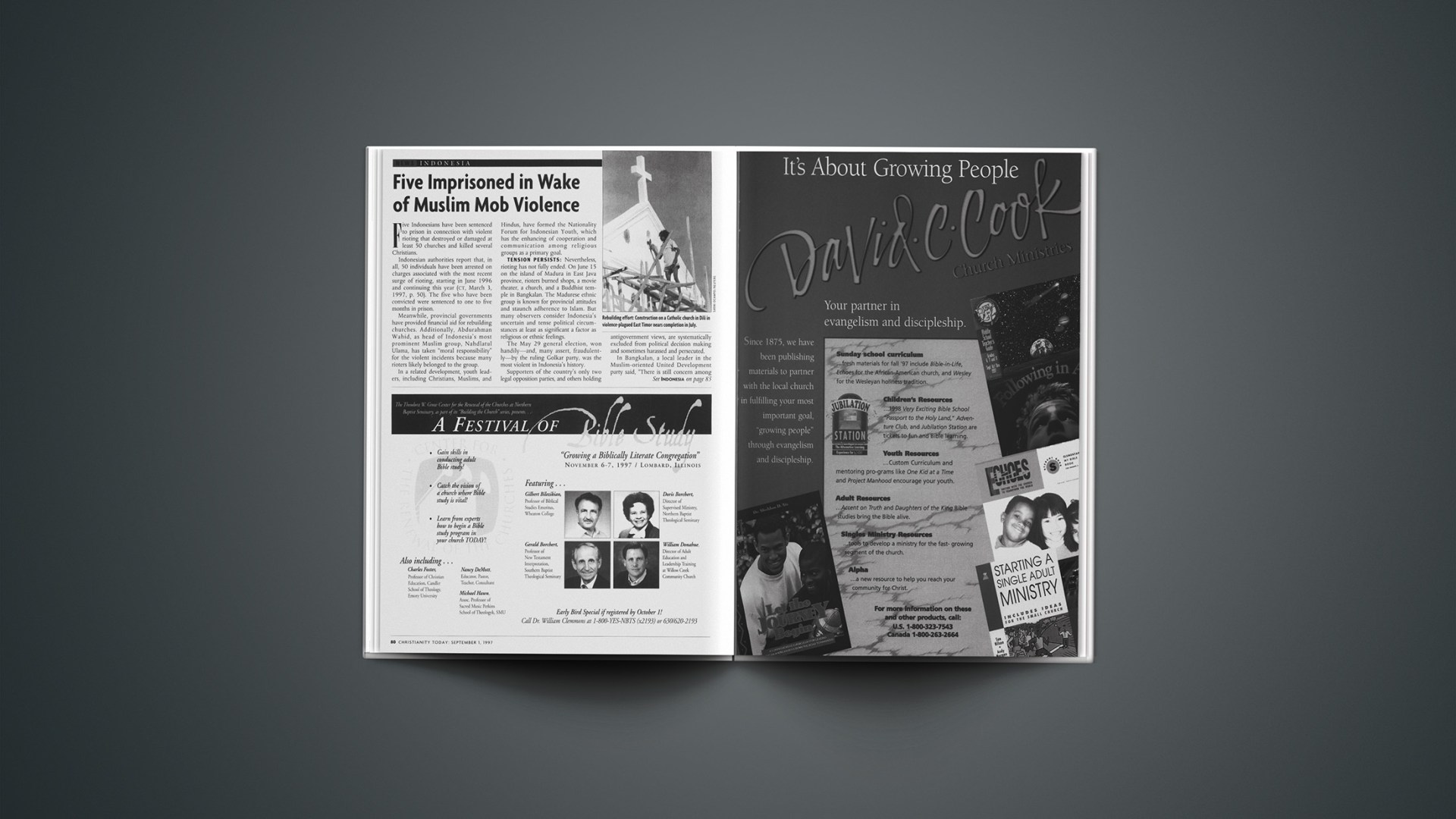

Five Indonesians have been sentenced to prison in connection with violent rioting that destroyed or damaged at least 50 churches and killed several Christians.
Indonesian authorities report that, in all, 50 individuals have been arrested on charges associated with the most recent surge of rioting, starting in June 1996 and continuing this year (CT, March 3, 1997, p. 50). The five who have been convicted were sentenced to one to five months in prison.
Meanwhile, provincial governments have provided financial aid for rebuilding churches. Additionally, Abdurahman Wahid, as head of Indonesia’s most prominent Muslim group, Nahdlatul Ulama, has taken “moral responsibility” for the violent incidents because many rioters likely belonged to the group.
In a related development, youth leaders, including Christians, Muslims, and Hindus, have formed the Nationality Forum for Indonesian Youth, which has the enhancing of cooperation and communication among religious groups as a primary goal.
TENSION PERSISTS: Nevertheless, rioting has not fully ended. On June 15 on the island of Madura in East Java province, rioters burned shops, a movie theater, a church, and a Buddhist temple in Bangkalan. The Madurese ethnic group is known for provincial attitudes and staunch adherence to Islam. But many observers consider Indonesia’s uncertain and tense political circumstances at least as significant a factor as religious or ethnic feelings.
The May 29 general election, won handily—and, many assert, fraudulently—by the ruling Golkar party, was the most violent in Indonesia’s history.
Supporters of the country’s only two legal opposition parties, and others holding antigovernment views, are systematically excluded from political decision making and sometimes harassed and persecuted.
In Bangkalan, a local leader in the Muslim-oriented United Development party said, “There is still concern among the population over widespread violations and fraud during the elections, but officials are just having fun and being merry. [The people] just felt insulted.”
As the 30-year authoritarian rule of President Suharto, now 76, enters its final chapters, social tensions between ethnic and religious groups are surfacing more frequently. Indonesia’s last political transition three decades ago witnessed a blood bath in which 500,000 people died.
In addition to identifiably religious unrest, the May election also saw a string of unprecedented bold attacks on polling stations and military targets by separatist rebels in the majority Roman Catholic province of East Timor, forcibly annexed by Indonesia in the mid-1970s.
Religious tensions in East Timor have flared over allegations that Indonesian authorities are attempting to “Islamize” the region by encouraging Muslims to migrate to East Timor from other Indonesian islands.
MUSLIMS, CHRISTIANS CLASH: In Rengasdengklok, 40 miles northeast of Indonesia’s capital, Jakarta, Muslim resentment toward Christians has been fueled in part by the recent renovation and expansion of a Presbyterian church. Also, a Chinese Christian businessman has constructed a religious monument, representing a fish, the enduring symbol of early Christianity.
In January, rioters in Rengasdengklok destroyed churches, Buddhist temples, and shops owned by the largely Christian—and relatively prosperous—ethnic-Chinese minority in Rengasdengklok. The riot began after a Chinese businessman scolded a Muslim teenager for playing a drum in early morning hours as part of traditional activities for the fasting month of Ramadan.
“Religious believers here had lived harmoniously,” a Muslim imam told the Bangkok-based newspaper The Nation. “We had never had a problem before.” During the riot, local Muslims spray-painted the word Muslim on their houses and shops.
Some Muslims also painted the word on their Christian neighbors’ property, in a bid to protect them. “My Muslim neighbor threw her sajadah [Muslim prayer rug] into my living room,” one ethnic-Chinese woman said. “It did not help, actually. The rioters still destroyed my house. But I will never forget her help.”
Copyright © 1997 Christianity Today. Click for reprint information.