
If you think contemporary praise music lacks robust theology, you’re not alone. Modern worship is widely criticized for not being Trinitarian enough, and its lyrics are often perceived to be more romantic than reverent—as if Jesus were a significant other, not the God of the universe.
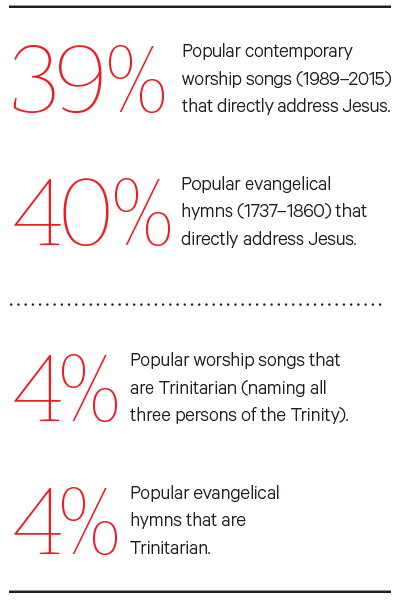
A new study, however, finds that Jesus has always been the primary focus of evangelical songs. Further, traditional hymns and contemporary worship are more similar in describing the Trinity than is widely believed.
So says Lester Ruth, research professor of Christian worship at Duke Divinity School. He compared the 110 worship songs that topped the Christian Copyright License International lists between 1989 and 2015 with the 70 most-printed US evangelical hymns from 1737 to 1860. He found that both traditional hymns and praise songs are equally weak in referencing the Trinity—and equally strong in addressing Jesus.
Ruth also found today’s praise songs never use sin as a verb per se, only as a noun; hymns predominantly use sin as a noun (including sinner) and occasionally as a verb (including sinning). No single theory of the Atonement predominates in either era. And whereas hymns tend to exhort people to worship, praise songs are more likely to worship God directly.
The striking difference between the two groups is eschatology. Ruth argues that in hymns, heaven hasn’t yet reached earth. In praise songs, heaven is already here.
Hymns emphasize patience and perseverance, portraying the Christian life “as a journey of harrowing dangers and temptations that, if one stays true and faithful, will safely bring the Christian, by the grace of Christ, to a destiny of unspeakable bliss,” said Ruth.
By comparison, the fulfillment of heaven’s blessings is immediate in praise songs. “As the angels and the heavenly host constantly sing ‘holy, holy, holy’ … so by our music we immediately access heaven and participate in our destiny to worship God,” he said.
Do our worship songs promise too much “heaven on earth”? CT asked experts to weigh in. (Answers are arranged on a spectrum from “yes” at the top to “no” at the bottom.)
“While we can celebrate how songs highlight our access to God’s presence in Christ—a truth from Hebrews—something significant is lost if we forget another truth from Hebrews: We, like Israel of old, have a ‘race set before us.’ Our songs need to set realistic expectations for what we already possess in heaven, and for what is not yet ours while we sojourn here and now.” ~Michael Allen, associate professor, Reformed Theological Seminary
“Christians have always struggled to maintain the tension between the ‘now’ and the ‘not yet’ of our faith. To imply in our singing that there is no future expectation or present deficiency is to turn worship into escapism, smugness, and a dangerous denial of present sin and evil. That modern songs seem to deny the ‘not yet’ may imply the church has limited its reach to the affluent and content.” ~Will Willimon, professor, Duke Divinity School
“Charismatic piety since the Jesus People has led to the overrealized eschatology of modern songs. However, we should applaud songwriters trying to return Christian singing not back to the Wesley/Watts era, but to Scripture itself. For example, ‘In Christ Alone’ doesn’t perfectly reflect the journey motif in hymns. But it certainly focuses on the mighty acts of God in history.” ~Douglas O’Donnell, senior lecturer, Queensland Theological College
“It’s crucial to recognize the cultural factors at work in both groups. Life for Christians centuries ago was difficult. They were more inclined to celebrate the future kingdom that God promised. Believers today expect life to be good, and appreciate their present experiences in Christ. Neither is bad in itself. But if believers focus too much on one, they can be distracted from serious discipleship.” ~William Dyrness, dean emeritus, Fuller Theological Seminary
“Both groups of songs reflect biblical themes. Modern songs reflect a distinct biblical emphasis that we currently have access to God’s presence. This access is not merely deferred. In Christ, we have everything we need to draw upon God’s enablement (Eph. 1:3). Assured that our future is secure, we can be less anxious about the present and patiently endure difficulties.” ~Darrell Bock, professor, Dallas Theological Seminary