
We all have stories that frame our everyday world, stories that illuminate the good, true, and beautiful life we long to experience. But what if these stories rely on underdeveloped or badly distorted notions of goodness, truth, and beauty? What would that mean for human flourishing, particularly for the most vulnerable members of our communities?
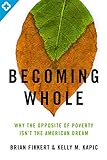
In their insightful book, Becoming Whole: Why the Opposite of Poverty Isn’t the American Dream, economist Brian Fikkert and theologian Kelly Kapic tackle these essential questions. The core reason our efforts to alleviate poverty fail, they argue, is not because we design flawed systems but because we proceed from flawed stories.
The authors confront the impoverished stories of Western naturalism and evangelical Gnosticism that muddy our perception of what makes for flourishing lives and communities. They examine the happiness paradox at the heart of contemporary Western society: Even as we enjoy greater wealth than ever before, we haven’t enjoyed corresponding gains in personal and communal well-being. By many important measures, in fact, our lives are increasingly fragile and broken. Fikkert and Kapic show that human flourishing requires something more than expressive individualism, personal comfort, and material affluence—something more, in other words, than the American Dream.
In critiquing Western naturalism, the authors point to sociologist Charles Taylor’s concept of the “immanent frame” and its soul-smothering emphasis on the here and now, which blinds us to God’s presence in the world and encourages a perilous Sunday-to-Monday gap. “It’s like we live in two dimensions rather than three,” Fikkert and Kapic write. “Spending 0.6 percent of our lives acknowledging God’s existence on Sunday mornings is simply not enough to overcome the 99.4 percent of our lives that are deeply shaped by narratives, systems, and formative practices of naturalism.” The authors also expose a growing strain of evangelical Gnosticism that falsely divides God’s good world, affirming the spiritual realm as inherently good and decrying the material realm as inherently bad. They marshal a wealth of sociological evidence demonstrating that neither approach—a God-excluding naturalism nor a world-denying spiritualism—has been friendly to human flourishing.
Is there a better way forward? Fikkert and Kapic believe so. Avoiding any hint of a human-centered utopian vision, they instead articulate a winsome and hopeful realism anchored in the biblical story of Creation, Fall, Redemption, and Restoration. Fikkert and Kapic are especially adept at showcasing God’s original creation design for human flourishing. As image bearers, humans are hard-wired for creative reflection. Our work—the cultivation of blessing from the created order—is a central aspect of that image-bearing capacity. It reinforces human dignity, bestowing a sense of purpose and bringing value to others. Humans are also hard-wired for relational connection. Made in the image of a fundamentally relational Triune God, we’re created with community in mind. When either of these traits is hindered or attacked—by sinful people, by unjust social and economic systems, or even by demonic powers—the inevitable result is human impoverishment.
The path from impoverishment to flourishing is a proper understanding of the gospel, incarnated and proclaimed in every nook and cranny of human existence. The message of the gospel is not only what Christ saves us from (sin and its eternal consequences) but also what he saves us for (a new life of flourishing, both now and for all eternity) and saves us to (a new community called the church). Fikkert and Kapic emphasize the vital importance of local churches in contributing to sustained personal and communal flourishing. They express it like this: “People experience human flourishing when they serve as priest-kings, using their mind, affections, will, and body to enjoy loving relationships with God, self, others, and the rest of creation. . . . At the core of poverty alleviation is worship of the one true God.”
Fikkert and Kapic articulate a biblical theology robust enough to transform our approach to fighting poverty and promoting flourishing for all. Their skillful blending of the theoretical and the practical makes this book a helpful companion both for experts on community development and for skillful practitioners meeting a range of on-the-ground needs. Becoming Whole is a persuasive and important statement of the ingredients—personal, social, and theological—that contribute to a durable common good.
Tom Nelson is president of the Made to Flourish network and senior pastor of Christ Community Church in Leawood, Kansas. He is the author of The Economics of Neighborly Love: Investing in Your Community’s Compassion and Capacity (InterVarsity Press).
Have something to say about this topic? Let us know here.