Mothers today face an onslaught of mixed messages about how best to parent in the 21st century. Podcasts, blogs, and books on mommy-ing abound, but many of them indulge regularly in shallow parenting advice and fallacies about excessive self-care or “me-time.”

In the midst of the coronavirus quarantine, moms on social media often advise diametrically opposed strategies: Take regular mental health breaks while your children gorge on Netflix, or schedule out every minute of children’s at-home education so they don’t fall behind in productivity. The message seems to be either “love yourself first” or “pour all your energy into your children’s future.”
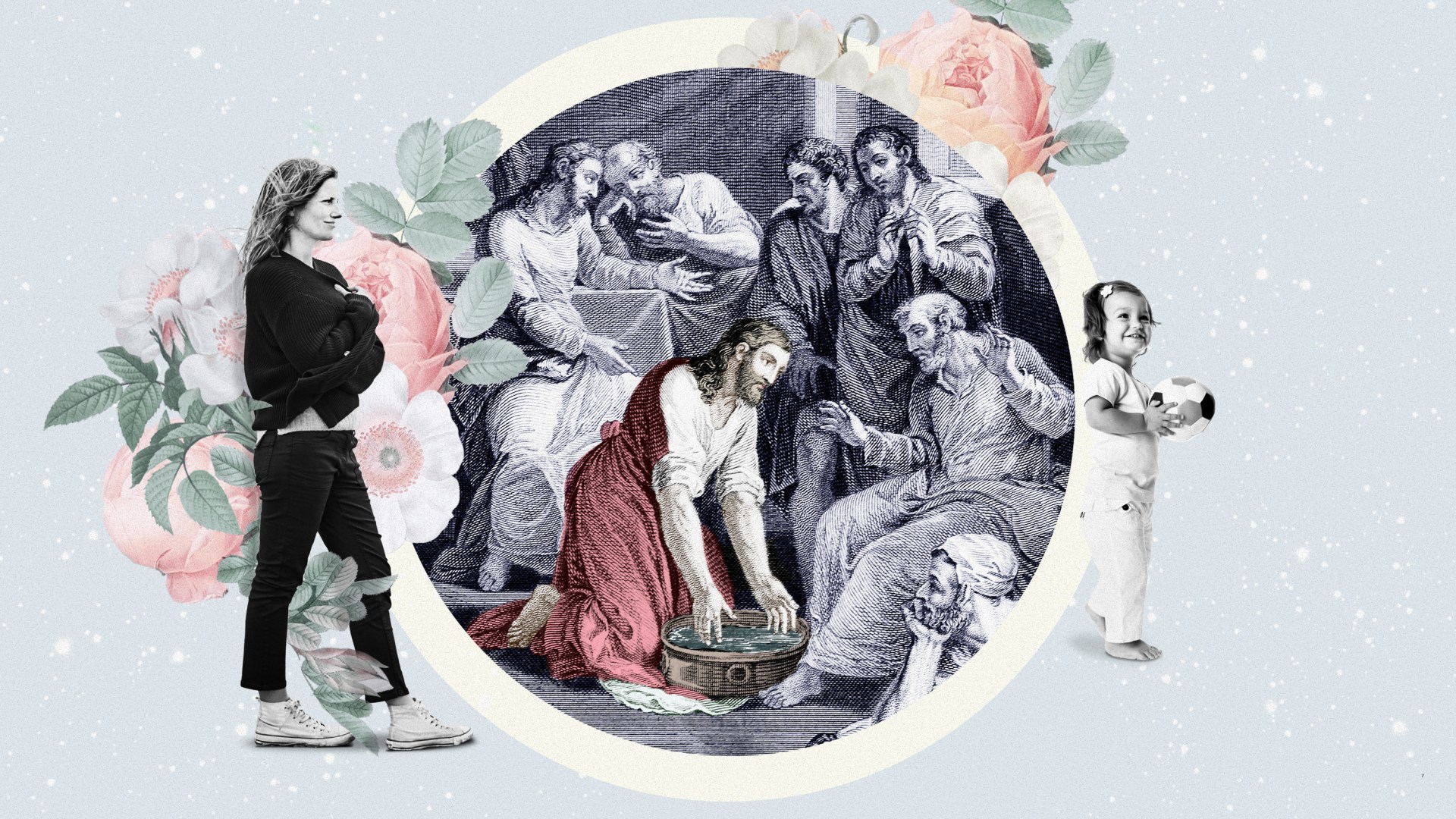
Neither side answers the more important question: How do we mother like Jesus Christ during this particular cultural moment? In the words of an overused adage, “What would Jesus do?”
In Motherhood: A Confession, Natalie Carnes, associate professor of theology at Baylor University, attempts to answer this question by sharing her personal experience of raising three daughters. She follows the structure and style of Augustine’s autobiography, Confessions, and elevates the conversation about motherhood from the self-centered to the spiritual without ever losing touch with the beauty of the ordinary. Part memoir and part theological study, Motherhood: A Confession explores “how motherhood, infancy, and children disclose what it means to be human in relation to the divine.”
Carnes’s core argument is that mothering imitates God. We birth forth disciples, hand down tradition, and grow our children into the church. By knowing the maternal attributes of God, we better mother our own children, and we also discover how the concept and practice of motherhood fuels a flourishing body of Christ.
In Scripture, God refers to himself as “the God who gave you birth” (Deut. 32:18), and in Isaiah, he compares himself to a nursing mother (Isa. 49:15). In the New Testament, Jesus adopts this metaphor for himself when he speaks to Jerusalem: “How often I have longed to gather your children together, as a hen gathers her chicks under her wings” (Matt. 23:37). Throughout church tradition, too, Christian writers from Origen to Bonaventure have drawn theological insight from imagining God as our mother.
We also find Jesus using birthing imagery to talk about salvation: “No one can see the kingdom of God unless they are born again” (John 3:3). Although preachers and biblical scholars are familiar with this birthing metaphor, they rarely dwell on its significance. Carnes offers a corrective by meditating on what this metaphor means for discipleship and what it reveals about God’s nature. Whereas the early church dramatized this birth image with baptismal fonts shaped like wombs, in the contemporary church, “women and children have remained largely absent from talk of divinity and humanity,” writes Carnes. “But what if their lives were taken as significant sites for theological work?”

If motherhood reveals God’s divine nature, it also reveals our own humanity. Many of us who’ve read Augustine’s Confessions relates to the fourth-century bishop not because of his portrait of holiness but because he authentically relays his struggle with ordering his often disordered loves—sexual desires, pride in his intellect and accomplishments, and the like. So, too, Carnes bares herself before her reader.
When she writes about how motherhood has divided her will in “an unhealable way,” I feel as though she’s telling my story and that of many other women like me. “I yearn for you, but I feel the pull of my work,” she confesses to her daughter. “I have only the episodic negotiations of my divided self [and] I am forced to face my limitations of time and energy.”
Although the enigmas of motherhood and work are left mostly unanswered in the book (as they should be), Carnes offers robust insights into the practice of Christian parenting. If we are to mother like Christ, she says, we must prepare our children “for a cruciform life.” Although it’s tempting to make parenting an end in itself—are we sleep training well, potty training right, educating successfully, raising good citizens, and training moral, upright individuals?—we need to direct our attention to the Cross. Our children belong first and foremost to God, as we all do. The God who bore us into existence also became “as an infinitesimal zygote,” showing how we mothers will become children again to our children. “As we age,” writes Carnes, “we all become our daughter’s daughters.”
The cruciform life is humbling, even humiliating, as we who are currently in authority over our children will someday become needy of their care. In the meantime, we teach our children to pray “not my will, but yours” (Luke 22:42) by first praying this prayer ourselves. We get on our knees and remember that God is the primary parent to us all. He “mothers us to life,” says Carnes, and draws us toward “the expectant Mother Church [that] labors for us all to reborn as little christs.”
By renewing our understanding of God’s maternal qualities, Carnes hopes to help us be better parents, yes. But ultimately, she wants to “help fashion the church’s imagination” to better love the Lord. That is God’s deepest desire for us. As mothers, it’s also our deepest desire for our own children.
Jessica Hooten Wilson is an associate professor of humanities at John Brown University and the author of three books, Giving the Devil His Due: Demonic Authority in the Fiction of Flannery O’Connor and Fyodor Dostoevsky; Walker Percy, Fyodor Dostoevsky, and the Search for Influence; and Reading Walker Percy’s Novels.