In this series





Indonesia boasts the largest Muslim population in the world. Yet Islam is not the state religion.
Instead, the archipelago that’s home to more than 273 million people is based on the foundation of Pancasila, an Indonesian philosophical theory composed of five principles: monotheism, civilized humanity, national unity, deliberative democracy, and social justice.
With Sunni Muslims making up 87 percent of the population and Christians making up 10 percent, Indonesia has sometimes struggled with exactly how religious harmony plays out.
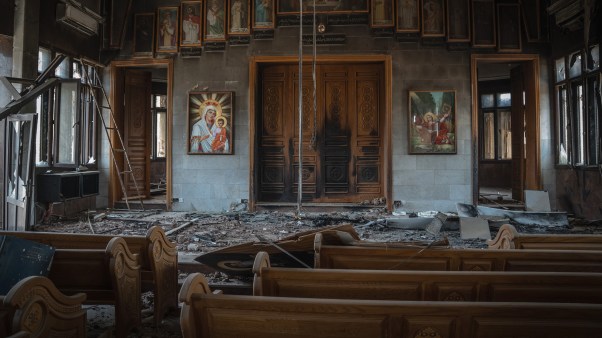
In recent years, Christians have been targeted in scattered terrorist attacks, restricted from building churches, and charged under blasphemy laws. Open Doors ranked Indonesia as the 33rd most dangerous country in which to be a Christian last year.
At the same time, President Joko Widodo has worked to promote religious tolerance and called on heads of provinces and districts to ensure all religions can worship freely. This coming year, the government will change the name of Jesus from Arabic to Bahasa in observed Christian holidays.
For many, Islam and national identity are tightly intertwined: A recent Pew Research Center survey found that 81 percent of Indonesians say being Muslim is very important to being truly Indonesian. Another 64 percent believe that sharia, or Islamic law, should be implemented as national law.
On the other hand, Pew researchers also found that 60 percent of Indonesians consider Christianity to be compatible with local culture and values. Muslim Indonesians were also more concerned about the growth of Muslim extremism (54%) than the growth of Christianity (35%).

Do these nuances point to an open-minded view of religious pluralism among Indonesian Muslims? And despite the archipelago’s complexities and mounting challenges, how much can interfaith dialogue and genuine cooperation promote and preserve understanding among Christians and Muslims?
CT interviewed three moderate Muslims and three Christians (bios listed below) on a range of topics including sharia’s role in society, the connection between religion and national identity, and how Christians and Muslims can work together for the good of Indonesia.
Their responses, edited and shortened for clarity, can be found in this special series’ six articles, listed to the right on desktop and below on mobile.
Muslim respondents:
K. H. Halim Mahfudz Leader of Seblak Jombang Islamic Boarding School and chairman of the endowment board at Tebuireng Islamic Boarding School in Jombang, East Java.
Inayah Rohmaniyah Dean of the faculty of Islamic Studies and Islamic Thought at Universitas Islam Negeri Sunan Kalijaga in Yogyakarta, Central Java.
Amin Abdullah Advisory council member of the Pancasila Ideology Development Agency in Yogyakarta.
Christian respondents:
Tantono Subagyo Pastor and chairman of the Suluh Insan Lestari Foundation (mother-tongue literacy program) and Wijaya Kusuma Pratama Foundation (which oversees private schools) in South Tangerang, Banten.
Ferry Mamahit Lecturer at Southeast Asia Bible Seminary in Malang, East Java, and executive director at the Center for Interdisciplinary Studies of Religion and Culture in Semarang, Central Java.
Farsijana Adeney-Risakotta Presbyterian Church (USA) missionary, lecturer at Duta Wacana Christian University, and founder of the Griya Jati Rasa Foundation (a commerce cooperative) in Yogyakarta.
With reporting assistance by Maria Fennita