Why pray alone or with your family if you can pray with big-biceped celebrities on the Hallow app? Why limit yourself to reading or hearing the Gospels if you can have a Jesus with all the thrill and appeal of a bingeable Netflix series? Why cultivate the Ignatian prayer skill of active imagination when you can passively experience an immersive exhibit that brings a storm on the Sea of Galilee to life?
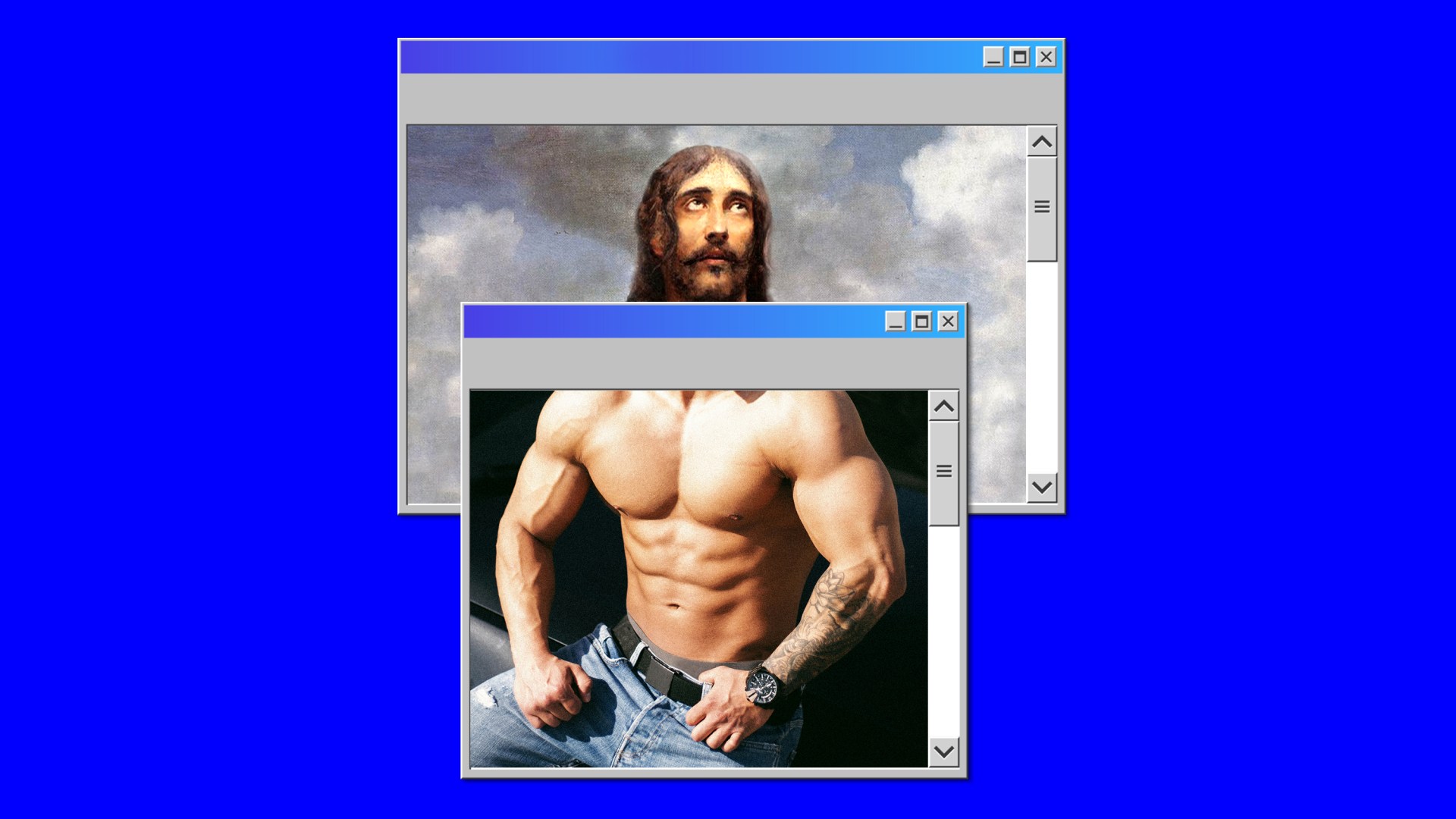
Why be satisfied with an ordinary church when you can digitally tour Europe’s greatest cathedrals or listen to famous preachers comfortably at home? Or why settle for traditional depictions of Jesus or figures from the Bible and church history when images of what The Atlantic dubbed “hot AI Jesus” and hot AI saints now proliferate online?
These are but some of the questions posed by our digital era’s dizzying accelerations, and Christians best have an answer. Here, I’ll focus on the artificial intelligence renderings of Jesus and explore how the example of history’s greatest Christian artist, Michelangelo, can help us resist the enticements of artificial devotion.
The easiest response to AI Jesus is to say that the iconoclasts—the Christian icon-breakers who warned against or outright destroyed devotional images in eighth-century Byzantium and sixteenth-century Europe—have been vindicated at last. An AI-generated image like shrimp Jesus is surely enough to cause some to hope that a modern equivalent of Oliver Cromwell’s stained glass–smashing soldiers will soon ride again.
Modern iconoclasts would argue that churches should be clean and imageless, an ever more necessary weekly cleansing of our digitally exhausted visual palette. This is venerable and ancient counsel. “When you are praying,” wrote the fourth-century desert father Evagrius of Pontus, “do not fancy the Divinity like some image formed within yourself. Avoid also allowing your spirit to be impressed with the seal of some particular shape, but rather, free from all matter, draw near to the immaterial Being and you will attain to understanding.” In other words, delete the app.
 AI-Generated Image by CT / Midjourney / Facebook
Another answer—from the iconophile, or image-loving one—would embrace these new developments wholeheartedly, channeling them to positive effect. Arguably, this was Michelangelo’s approach. As his career began, visually arresting classical sculptures were being dug up from the ground, prompting in many a crisis of faith: Had Christianity brought such visual splendor to a premature end?
Michelangelo’s early sculptures answered with a resounding no, showing that Christian art could be just as beautiful as that of the classical world, or even more so. Perhaps, we should take a similar approach to the new medium of AI, both embracing and exceeding what the world offers us today.
I tried that strategy myself, spending months using AI trying to resurrect a lost African saint in AI-generated icons. It left me cold. Truth be told, the strategy of total embrace left Michelangelo cold as well. “So the affectionate fantasy, that made art an idol and sovereign to me,” he wrote in a late sonnet in the 1550s, “I now clearly see was laden with error, like all things men want in spite of their best interests.”
 WikiMedia Commons
But that disillusion with cultural production doesn’t necessarily mean the iconoclasts win the argument. Michelangelo did not give up art completely. He instead returned with new intensity to a lifelong interest in the simpler and purer aesthetic of ancient Christian icons, which on several occasions he attempted to replicate or echo. One art historian convincingly argues that Michelangelo aimed to “preserve traditions of religious imagery at a time when artistic developments threatened their integrity and dominance,” and that—I believe—should also be our strategy today.
Michelangelo also actively undermined the visual techniques he had mastered. Influenced by Reformation doctrines of grace, Michelangelo’s last works are deliberately impoverished. You can see this shift in the contrast between his first and more famous Pietà, made when he was in his early 20s, and the Rondanini Pietà, executed when he was in his 80s. In the first, a larger than life, impossibly youthful Mary holds Jesus; in the deliberately rough and unfinished second, Jesus—even in his death—appears to be upholding the appropriately aged Mary.
 WikiMedia Commons
Michelangelo’s trust in ancient, humbler art forms and his deliberate embrace of visual poverty helped him navigate the tumultuous 16th century, and it can help us navigate our own time as well. Deluged with AI’s slick and sexually suggestive images of Jesus, we can benefit from the wisdom of faithful iconoclasts without abandoning devotional images completely.
Like Michelangelo, we can choose to make and contemplate Christian images that are humble, perhaps unimpressive but deliberately and faithfully so. We can seek art that does not dazzle our earthly senses but defers to heavenly realities. Owing to the fact that the current “data sets these [AI] tools are trained on are biased toward hotness,” the new tools are unlikely to help. We do better to embrace images that pronounce their poverty, images that say, like John the Baptist, “He must increase, but I must decrease” (John 3:30, KJV).
Michelangelo’s example teaches us to be suspicious of concocted visual greatness. Even if machines can now sculpt as well as he could, the lesson of Michelangelo’s final years remains the same: Christian images, insofar as they deserve the name Christian, should be deliberately restrained, for their purpose is not to attract attention or glory but to turn our eyes toward Christ. The traditional canon of Orthodox icons, more affordable now than ever, still does this remarkably well.
 WikiMedia Commons
Faced with its own bewildering array of eloquent preachers and visually immersive pagan shrines, the ancient church asked questions like the ones with which I began. The apostle Paul’s answer was candid, even blunt: “I did not come with eloquence or human wisdom as I proclaimed to you the testimony about God,” he wrote to the Corinthian church. “For I resolved to know nothing while I was with you except Jesus Christ and him crucified. I came to you in weakness” (1 Cor. 2:1–3).
In this and the testimony of Michelangelo, then, I see a simple rule for sifting this fresh round of visual enchantments: Never trust an image—or a savior—without wounds.
Matthew J. Milliner is a professor of art history at Wheaton College. He is author most recently of Mother of the Lamb: The Story of a Global Icon.